THE POINTER.
Reading edition
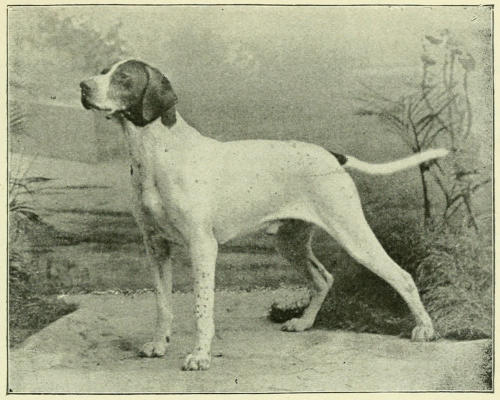
Westminster Kennel Club, Babylon, L. I.
King of Kent.
Origin.—The dog originally came from Spain, was imported into Great Britain, and undergoing many changes, no doubt by crossing with the foxhound, is to-day a vast improvement on the parent stock.
Uses.—Hunting all kinds of game-birds.
Scale of Points, Etc.
Value.
Skull 10
Nose 10
Ears, eyes, and lips 4
Neck 6
Shoulders and chest 15
Hind quarters and stifles 15
Legs, elbows, and hocks 12
Feet 8
Tail 5
Coat 3
Color 5
Symmetry and quality 7
Total 100
Brains, nose, and speed make the pointer. The countenance should be lively and intelligent.
Head.—Large, flat; stop well defined, and with a depression running from stop to occiput. The head should not be heavy, as this indicates coarseness and an unreliable disposition. A full development of occipital bone is indispensable. Nose large, long, broad (black in all except lemons and whites, when it should be deep flesh color), deep enough to make it “square”-muzzled; nostrils large and open. Ears moderately long, filbert-shaped, and lying flat; set low; leather thin and flexible; coverings silky. Eyes medium size, not set wide apart, and of the various shades of brown, varying with color of coat. Lips full; not thick nor pendulous.
Neck.—Arched, round, firm, and not too short; no tendency to throatiness; no dewlap.
Shoulders.—Long, sloping, and powerful.
Chest.—Deep, with narrow sternum, sloping backward to a well-tucked-up abdomen; ribs moderately sprung, not flat.
Hind Quarters.—Loins should be broad and slightly arched; hips thick, strong, and muscular; stifles are generally straight, but should be well bent.
Legs.—Good legs are most essential; front legs should be straight and strong, hind legs well crooked, and both should be covered with strong, compact muscles, well developed; the elbow- and hock-joints should be hinged long and set straight with sides of body.
Feet.—With surface enough to sustain the weight, but not too large; round and cat-like; pads full and tough; nails short and thick, with plenty of hair between toes.
Tail.—Set on well up, and should taper to a decided point; the straighter it is, the better. It should be carried low, and the action should be free.
Coat.—Fairly dense, and not too soft.
Color.—Liver and white, black and white, orange and white, whole black, or whole liver, this being the order of preference.