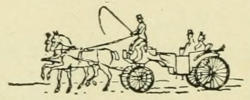
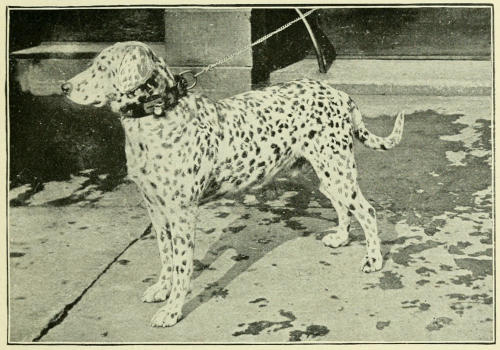
THE DALMATIAN (COACH-DOG).
Reading edition
J. Dickman Brown’s.
Perry.
Origin.—Probably indigenous to Dalmatia, a province of Austria, but records of the sixteenth century describe such a dog as belonging to Spain. The latest authentic trace is to Denmark, where it was used for drawing carts. Resembles the pointer in form.
Uses.—Simply to follow the coach or equestrian.
* Scale of Points, Etc.
Value.
Head and eyes 10
Ears 5
Neck and shoulders 10
Body, back, chest, and loins 10
Legs and feet 15
Coat 5
Color and markings 30
Tail 5
Symmetry 10
Total 100
General Appearance.—Strong, muscular, active; free from coarseness; capable of speed and great endurance.
Head.—Fair length; skull flat, broad between ears; moderate stop, and not in straight line from occiput to nose; no wrinkles; muzzle long and powerful; lips clean cut, fitting jaws closely. Eyes moderately wide apart, medium size, round, bright. In black-spotted dogs eyes are dark; in livers, light or light brown (yellow). Rims around eyes black in black-spotted varieties, and brown in the liver-spotted ones, never flesh-colored. Ears set on high, rather wide at base, tapering, carried close, thin, fine, always spotted. Nose black in blacks, brown in livers.
Neck and Shoulders.—Neck fairly long, arched, light, tapering, not throaty; shoulders sloping and muscular.
Body, Back, Chest, and Loins.—Chest very deep, not too wide; ribs well sprung, never rounded; powerful back; loins strong and arched.
Legs and Feet.—Fore legs perfectly straight, strong in bone; elbows close to body; cat-footed, tough pads; hocks well let down. Nails in black-spotted ones are black and white; in liver-spotted, brown and white.
Tail.—Not too long, tapering well to end, carried with slight curl upward, never curled; the more profusely spotted, the better.
Coat.—Short, dense, hard, fine, sleek, and glossy, never woolly nor silky.
Color and Markings.—Ground color is pure unmixed white. The spots of the black-spotted variety are black, in liver-spotted variety are brown; should not intermingle, but be distinct, and about size of ten-cent silver piece on body; on head, face, ears, legs, and tail, much smaller.
Weight.—Dogs, 55 pounds; bitches, 50 pounds.