THE HOUND (RUSSIAN WOLFHOUND).
Reading edition
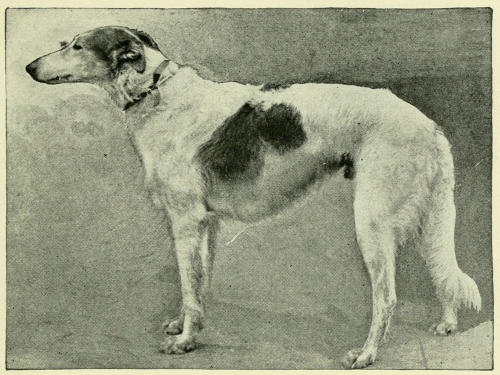
George M. Keasbey’s, Newark, N. J.
Optimist.
Origin.—The Russians do not seem to have an exact or even a clear idea as to the origin of this breed. It in all probability came from Persia, as it is more like the dog of that nation than it is like the deerhound. It is of the greyhound family, however.
Uses.—Attacking wolves and foxes, though it can rarely single-handed kill the former.
* Scale of Points, Etc.
Value.
Head and muzzle 15
Eyes and ears 10
Neck and chest 10
Back and loins 15
Ribs 5
Thighs and hocks 10
Legs and feet 10
Stern 5
Coat 5
General symmetry 15
Total 100
Head.—Generally very long, and lean throughout; flat, narrow skull; stop hardly perceptible; long snout. Nose black, and frequently Roman. Eyes dark, expressive, oblong. Ears small; thin leather; set on high; tips almost touching when thrown back.
Neck.—Not too short, nor rising straight.
Shoulders.—Clean and sloping.
Chest.—Somewhat narrow, but not hollow.
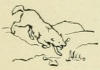
Back.—Rather bony, and free from any hollow; well arched in male, but level and broad in female; loins broad and drooping; ribs deep, not so well sprung as in the greyhound, reaching to elbow.
Fore Legs.—Lean and straight.
Hind Legs.—Somewhat under body when standing still; not straight; stifles only slightly bent; legs not too far apart; pasterns short.
Feet.—Long toes, closely joined; nails short and strong; feet covered with fur like a hare.
Coat.—Long, soft, silky.
Tail.—Long and sickle-shaped.
Color.—Any color.
Height and Weight.—Height for a dog, from 28 to 31 inches at shoulder; bitch, about 2 inches less. The male should be shorter in body than the female. Weight: dog, 75 to 100 pounds; bitch, 60 to 75 pounds.