THE TERRIER (FOX, SMOOTH-COATED).
Reading edition
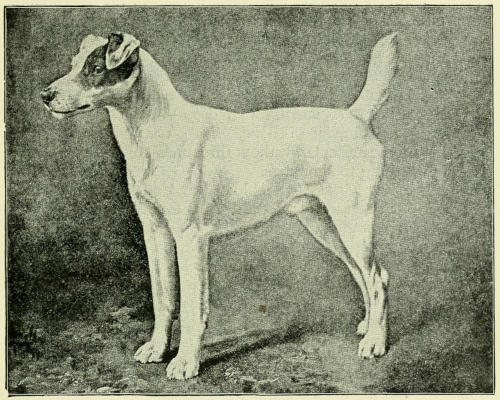
August Belmont’s.
Champion Blemton Victor II.
Origin.—Evidently a very judicious cross between a beagle and a bull-terrier.
Uses.—Essentially a vermin-dog of the highest order, and capable of worrying a fox when it has taken to earth. It is used by the operatives in some parts of England for coursing rabbits.
* The Various Parts of the Head, Body, Etc.
Scale of Points by Rawdon B. Lee.
Value.
Head, jaws, and ears 20
Neck 5
Shoulders and chest 10
Back and loins 10
Stern and hind quarters 10
Legs and feet 15
Coat 10
Size, symmetry, and character 20
Total 100
Head.—Skull flat, moderately narrow, gradually decreasing in width to eyes. Not much stop, but there should be more dip in profile between forehead and top jaw than in the greyhound. Cheeks must not be full. Ears V-shaped, small, of moderate thickness, drooping forward close to cheek, not hanging by side of head. Jaws strong and muscular, of fair punishing strength. There should not be much falling away below eyes. This part of head should be moderately chiseled out, but not like a wedge. Nose tapering and black. Eyes dark, small, rather deep set, full of fire and intelligence; nearly circular in shape. Teeth nearly level.
Neck.—Clean, muscular, without throatiness, of fair length, and gradually widening to shoulders.
Shoulders and Chest.—Shoulders long and sloping, well laid back, clearly cut at withers; chest deep and not broad.
Back.—Short, straight, and strong, with no appearance of slackness.
Loins.—Powerful and very slightly arched. Fore ribs moderately arched; back ribs deep. The dog should be well ribbed up.
Hind Quarters.—Strong, muscular, quite free from droop or crouch; thighs long and powerful; hocks near the ground.
Stern.—Set on rather high, carried gaily, but not over back or curled; of good strength, anything approaching a “pipe-stopper” tail being especially objectionable.
Legs.—Straight, showing little or no appearance of ankle in front; strong in bone, short and straight in pastern. Both fore and hind legs carried straight forward in traveling; stifles not turning outward; elbows perpendicular to the body.
Feet.—Round, compact, not large; soles hard and tough; toes moderately arched, and turned neither in nor out.
Coat.—Smooth, flat, hard, dense, and abundant. Belly and under side of thighs should not be bare.
Color.—White should predominate; brindle, red, or liver markings are objectionable.
Symmetry, Size, and Character.—The dog must present a generally gay, lively, and active appearance. Bone and strength in a small compass, but this does not mean that a fox-terrier should be cloggy or in any way coarse. Speed and endurance must be looked to as well as power, and the symmetry of the foxhound taken as a model. The terrier must on no account be leggy, nor must it be too short in leg. It should stand like a cleverly made hunter, covering a lot of ground, yet with a short back.
Weight is not a certain criterion of a terrier’s fitness for its work; general shape, size, and contour are the main points; it should not scale over 20 pounds in show condition.