THE SHEEP-DOG (OLD ENGLISH OR BOBTAIL).
Reading edition
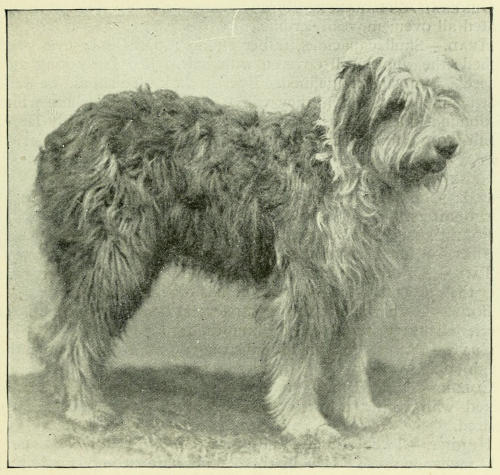
Wilford Kennels, Cohoes, N. Y.
Boxer III.
Origin.—It is claimed by the Welsh that this is purely a breed belonging to their own country.
Uses.—Same as the rough and smooth varieties of collie.
* Scale of Points, Etc.
Value.
Skull 10
Jaw, eyes, and nose 15
Color 10
Teeth and ears 10
Legs (if coated) 10
Tail (undocked) 10
Neck and shoulders 10
Body, loins, and hind quarters 10
Coat 10
Markings 5
Total 100
General Appearance.—Strong, compact, cobby dog, profusely coated all over; moves bear-like.
Head.—Skull capacious, rather square; parts over eyes well arched; the whole well covered with hair. Jaw fairly long and square. Stop slightly defined. Eyes in dark blue should be dark brown; in lighter colors they will follow them, and where white predominates a wall eye is typical. Nose black and fairly large. Teeth strong, firm, and even. Ears medium, heavy, and carried close.
Neck and Shoulders.—Neck long, arched, graceful, well coated; shoulders sloping, so that the dog is lower here than at hind quarters.
Fore Legs.—Straight, plenty of bone, not “leggy,” well coated.
Feet.—Round, large, toes arched, pads hard.
Tail.—All other points being equal, the tailless specimen wins over the one with a tail; the less he has of it, the better.
Body.—Rather short, very compact; ribs well sprung; brisket deep; loins very stout, arched; hind quarters bulky.
Coat.—Profuse, fairly hard and strong; double-coated, as in the rough collie.
Color.—Dark, light, or pigeon blue, and steel gray, generally mixed with white; white collars, legs, chest, and face greatly desired.
Height.—Twenty inches and upward.
Stonehenge says: “Usually these ‘bobs’ are strongly made and symmetrical dogs, but without any definite type; they have frequently a tendency to the brindle in color.” In awarding prizes, the premier honors seem generally to go to the homeliest specimens.