THE POODLE (BLACK, CURLY-COATED).
Reading edition
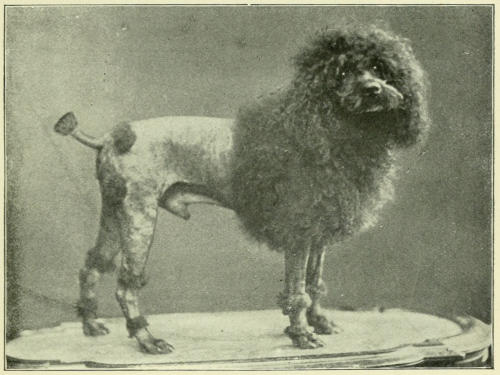
H. G. Trevor’s, Southampton, L. I.
Champion Milo.
Origin.—There is little doubt but that the poodle of to-day finds its origin in the old “water-dog” of France, where it was not only used for retrieving wounded water-fowl, but for swimming-contests, when the hind parts were clipped or shaven in order to give freer action to the legs.
Uses.—A very bright, intelligent companion, and a good retriever.
* Scale of Points, Etc.
Value.
Head, muzzle, and eyes 20
Neck and chest 5
Back and loins 10
Legs and feet 15
Stern 5
Coat 20
Color 10
Symmetry 15
Total 100
General Appearance.—Strong, active, intelligent, cobby in build, and perfectly coated with close curls or long “cords.”
Head.—Long; skull large, wide between the eyes, slight peak; parts over eyes well arched; the whole covered with curls or cords. Muzzle long (not snipy), slightly tapering, not too deep; stop well defined. Teeth level and strong; black roof of mouth preferable. Eyes medium size, dark, bright, and set at right angles with the line of face. Nose large, perfectly black; wide-open nostrils. Ears very long, close to cheek, low set, and well covered with ringlets or curls.
Neck.—Very strong, admitting head to be carried high.
Chest.—Fairly deep, but not too wide, well covered with muscles.
Legs.—Fore legs perfectly straight, and not so long as to be leggy; hind legs muscular, well bent, with hocks low down.
Feet.—Strong, slightly spread, standing well on toes; nails black; pads large and hard.
Back.—Fair length; well-ribbed-up body; loins strong and muscular.
Tail.—Carried at angle of 45 degrees, with long ringlets or cords. Preferable length, 3 to 5 inches.
Coat.—If corded, cords should be thick and strong, hanging in long, ropy cords. If curly, the curls close, thick, and of silky texture.
Weight.—From 40 to 60 pounds.
Only three colors are admitted, black, white, and red, and they should be without mixture.