THE ST. BERNARD (ROUGH-COATED).
Reading edition
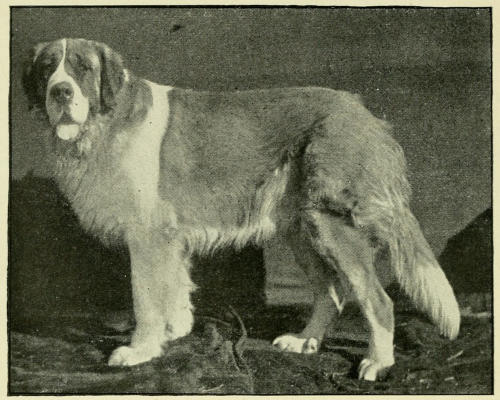
Leeds Barry.
Origin.—This is a point of great uncertainty, as the monks of St. Bernard are utterly unable to throw any light on the subject. According to tradition, however, the race sprang from a cross of a bitch of Denmark of the bulldog species, and the mastiff (shepherd-dog) of the Pyrenees. The size comes from the Denmark dog, and the sense of smell from the mastiff. The St. Bernard was first imported into England in 1815.
Uses.—An invaluable house-dog, guardian, and companion. Used on the Swiss mountains by the monks to find and succor lost travelers.
* Scale of Points, Etc.
Value.
Head, ears, and eyes 25
Expression and character 15
Neck, shoulders, and chest 10
Body 15
Stern 5
Legs and feet 10
Coat 10
Color and markings 10
Total 100
Head.—Large, massive, the circumference twice the length; short from stop to tip of nose; full below eye; square muzzle; great depth from eye to lower jaw. Lips deep, not too pendulous. Stop abrupt, well defined, and straight to end of nose. Skull broad, rounded at top, not domed; prominent brow. Ears medium size, close to cheek, strong at base, heavily feathered. Eyes rather small, deep set, dark, not too close together; lower eyelid drooping, showing haw. Nose large, black; well-developed nostrils. Teeth level.
Expression.—Denoting benevolence, dignity, and intelligence.
Neck.—Lengthy, muscular, slightly arched; dewlap developed.
Shoulders and Chest.—Shoulders broad, sloping; chest wide and deep.
Body.—Level back, slightly arched over loins; ribs well rounded; loins wide and muscular.
Tail.—Set on rather high; long, bushy; carried low in repose, slightly above line of back when in motion.
Legs and Feet.—Fore legs perfectly straight, strong. Hind legs heavy in bone, well bent at hocks; thighs muscular. Feet compact and large; well-arched toes.
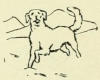
Size.—Dogs, 30 inches at shoulder; bitches, 27 inches (the taller, the better, if proportioned well). General outline suggests great power and endurance.
Coat.—Dense, flat, rather full around neck; thighs not too heavily feathered.
Color and Markings.—Red, orange, various shades of brindle, or white with patches of above colors. Markings should be: white muzzle and blaze on face, collar around neck; white on chest, fore legs, feet, and end of tail; black shadings on face and ears. If blaze be wide, running through collar, a spot of body-color should be on top of head.
Disqualifying Points.—Dudley, liver-colored nose; fawn if whole-colored or with black shadings only; black, black and tan, black and white, black, tan, and white, and all white, though an all white has taken high honors under one of our best judges.