THE HOUND (BLOODHOUND).
Reading edition
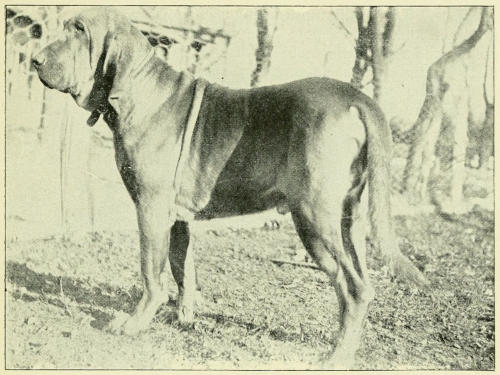
J. L. Winchell’s, Fair Haven, Vt.
Champion Victor.
Origin.—In Barbour’s “Bruce” (1489) we find the earliest mention of the bloodhound, where it is called the “sleuthhund.” However, little can be learned definitely of its origin.
Uses.—Having scenting powers to a marvelous degree, it is used in trailing wounded deer, slaves, sheep-stealers, escaped convicts, etc.
Disposition.—Contrary to general impressions, the modern bloodhound is of a most equable disposition, kind and gentle, and quite apt to be timid, excepting when on the trail; then it is extremely dangerous.
Scale of Points, Etc.
Value.
Head 15
Ears and eyes 10
Flews 5
Neck 5
Shoulders and chest 10
Back and ribs 10
Legs and feet 20
Color and coat 10
Stern 5
Symmetry 10
Total 100
Head.—This is the most distinguishable feature of the dog; it is domed, blunt at occiput; jaws very long and wide at nostrils, hollow and very lean at cheek; brows very prominent, and the general expression is grand and majestic; skin covering cheeks and forehead wrinkled to a wonderful degree.
Eyes and Ears.—Eyes hazel, rather small, deeply sunk, showing haw, which is deep red. This redness, some claim, is indicative of cross with mastiff, Gordon setter, or St. Bernard. Ears long, and will overlap when drawn over front of nose, hang close to cheek, never inclined to be pricked; leather thin, covered with soft hair.
Flews.—Very long and pendent, falling below mouth.
Neck.—Long, so as to enable the dog to easily drop his nose to the ground; considerable dewlap.
Chest and Shoulders.—Chest wider than deep; shoulders sloping and muscular.
Back and Back Ribs.—Wide and deep, the hips being wide or almost ragged.
Legs and Feet.—Legs must be straight and muscular; feet as cat-like as possible.
Coat.—Short and hard on body, silky on ears and top of head.
Color.—Black and tan or tan only; the black extends to the back, sides, top of neck, and top of head; the tan should be of deep, rich red; there should be little or no white.
Stern.—Carried gaily in gentle curve, but not raised above back; lower side is fringed with hair.
Defect.—Absence of black.