WILLIAM D. PENDER. BY W. A. MONTGOMERY.
Reading edition
Among the glorious number of heroic spirits who laid down their lives for this pre-doomed undertaking [the secession of the Confederate States] not one was more conspicuous for courage and loyalty, and but few, if any, for skill and leadership, than the subject of this sketch, General William Dorsey Pender. He was born in Edgecombe county, N. C., on the 6th of February, 1834, at the country home of his father, James Pender, Esq. His paternal ancestry is of ancient English stock, the name being as old as English history itself. The first of the family to come to America was Edwin, who, in the reign of Charles II., settled near Norfolk, Virginia. A descendant of the same name, grandfather of General Pender, removed from Norfolk to Edgecombe, on Town Creek, where he owned and died possessed of large landed interests and slaves. On one of these plantations, inherited by his father, General Pender was born. His mother was Sarah Routh, a sister of the mother of the late Hon. R. R. Bridgers, and the daughter of William Routh, Esq., of Tidewater, Virginia.
General Pender lived where he was born until he was fifteen years of age, when he entered, as a clerk, the store of his brother, Mr. Robert D. Pender, in Tarboro. This employment was distasteful to him from the first. The martial spirit was already strongly developed in him, and the opportunity soon presented itself for him to begin a military education and training. He entered the Military Academy at West Point as a cadet on the first of July, 1850, having been recommended as a suitable candidate by the Hon. Thomas Ruffin, who was then the member of Congress from his district. The friendship of Mr. R. R. Bridgers, which lasted through life, procured for him the appointment. He was graduated in 1854, standing nineteenth in his class. In this class were G. W. Custis Lee, Stephen D. Lee, J. E. B. Stuart and other distinguished military men. As cadet he was modest and unassuming in his intercourse with his fellows, respectful to his instructors and tractable to the discipline of the institution. Upon his graduation he was assigned to the First Artillery as Brevet Second Lieutenant and the same year was made Second Lieutenant of the Second Artillery. In the year 1855 he was transferred, at his own request, to the First Regiment of Dragoons, and in 1858 was promoted to a first lieutenancy. From the time he entered the dragoons he saw service in the field in all its phases, camp, frontier, and scouting; fighting in New Mexico, California, Washington and Oregon. He was engaged in many skirmishes, and in as many as three battles with the Indians—one of the engagements being with the Apaches at Amalgré Mountain, on March 20, 1856; another at the Four Lakes, September 1, 1858, and the other on the Spokane Plains, September 3, 1858. He took a conspicuous part in these engagements, and was mentioned with credit in the reports of them. Lieutenant Lawrence Kip, in his Army Life on the Pacific, narrates the following incident which occurred at the battle of Spokane Plains: "Lieutenant Pender, while in the woods, returning from the rear, where he had been on duty connected with ordering up the balance of the troops, was suddenly attacked by an Indian chief. To his dismay, the Lieutenant discovered that his sabre had become entangled in the scabbard and would not draw. Quick as thought one hand grasped the savage's arm, the other his neck, and in this manner, hugging him close and galloping into ranks, he lifted him from his horse and hurled him back among the men, who soon dispatched him." He was made Adjutant of the First Dragoons November 8, 1860, and served with that rank, with the headquarters at San Francisco, until January 31, 1861, when he was detached and ordered to report at Carlisle, Pennsylvania, on recruiting service.
On the 3d of March, 1859, he had married Miss Mary Frances Shepperd, daughter of the Hon. Augustine H. Shepperd, at Good Spring, the country-seat of the bride's father, near Salem, North Carolina. Shortly after the marriage he returned to his command, then in Washington Territory, his wife accompanying him and remaining with him until they returned to the east, arriving at Washington in the latter part of February, 1861. There they remained a few days, and on the 3d of March, the day before Mr. Lincoln was inaugurated, they left for North Carolina. This short stay at Washington at this juncture was a crisis in the young officer's life. He had seen a sectional feeling arise in the army. He now found the people divided. The Confederate Government was already established; troops had been organized and drilled in the South and Fort Sumter invested. He was perplexed as to what he ought to do; whether to continue in the service of the United States or resign his commission; for in case of war he could not take part against the South, and this would be required of him if he held his commission in the army. He became satisfied, after considering carefully the situation and observing closely the tendency of affairs, that war was inevitable, and from his knowledge of the character and temper of the two sections he knew the war would be a terrible one. He determined to cast his lot with his people of the South, and on the 21st of March resigned his commission in the army, and immediately offered his services to the Confederate Government at Montgomery. He was appointed captain in the artillery service of the provisional army, but was shortly afterwards sent by the government to Baltimore to take charge of the Confederate recruiting depot at that place.
The time has passed when the motives of the men who resigned their commissions in the armies of the United States and took service afterwards in the Confederate armies can be impugned. Impartial history has pronounced their conduct natural, consistent, and sincere. In this connection it is interesting to recall a sentence from the memorable address of Mr. Edmunds in the United States Senate in 1883, on the life and character of Senator B. H. Hill: "The notion of fidelity to one's own State, whether her cause be thought wise and right or not, is almost a natural instinct; and whether it be defensible on broad grounds or not, who does not sympathize with it?"
In the first week of May, 1861, when North Carolina began to organize her volunteer troops, Captain Pender returned and entered her service at the "Old Fair Grounds," near Raleigh, Governor Ellis appointing him to drill and instruct the officers of the companies of the First Regiment—the Bethel Regiment. After that regiment was dispatched to Virginia he was assigned to duty as Commandant of the Camp of Instruction at Garysburg, and, upon the formation there of the Third Regiment of Volunteers, was elected its colonel on the 16th of May, 1861. At this time he was twenty-seven years old, about five feet ten inches in height, well formed and straight; graceful in his carriage; with large, lustrous, dark eyes, dark-brown hair, an olive complexion, head almost faultless in shape, a mouth clear cut, and lips firmly compressed, and a voice soft, low, and distinct. The combined dignity and ease of his manner charmed all who came about him. The sweet modesty of his unassuming bearing was so striking that it won all to him; and this characteristic is always mentioned, even now, by those who knew him, as one of his most attractive charms; and it underwent no diminution in after years when he had won such distinguished military honors. His modest and unassuming character was not always understood by those who did not know him well. The following is an instance: He had fought more than half a dozen pitched battles under General Jackson before the two ever met socially. One day General Jackson said to Major Avery, who was well acquainted with them both: "What sort of a man is General Pender? I'm embarrassed at his never having been to see me. I know he is a fine soldier, gallant and skillful on the field, and his troops are well disciplined. I never fail to be impressed with his camps; they are always clean, orderly and comfortable. I've made it a rule, though, never to recommend an officer for promotion unless I have a personal and social acquaintance with him, and this will some day embarrass me."
However, from the beginning of his career to the end of it he knew the value of discipline, and though of a kind and gentle disposition he was firm in the management of his men. Throughout the entire period of his service the camps of his troops always showed the marks of order and system and the men the effects of training and discipline.
General W. G. Lewis, in a letter to Mr. D. W. Gilliam, says, after noting a visit paid by himself to General Pender shortly after the battle of Fredericksburg: "He received me most cordially and courteously, and I had a very pleasant visit and one of profit to me, as I saw plainly in his camps the results of true military discipline and careful attention from headquarters. His camp was a model of cleanliness, regularity and good order; his sentinels and guard saluted in strict military style; all officers wore the badges of their rank. I was particularly struck with this, as it was not, by far, universal in the Army of Northern Virginia." Discipline was enforced, as he often said, for the comfort and safety of his men, and because the fiery gallantry of the Southern soldier would be uselessly expended unless it was systematically and scientifically directed; and he used to say that discipline was a protection to the good soldier, in that it forced the doubtful one to the performance of his duty, and thus reduced the work and the peril of the former.
Colonel Pender, with his regiment, was near Suffolk, Va., until after the 15th of August, 1861, when he took command of Fisher's famous Sixth Regiment at Manassas. He was appointed colonel of the Sixth by Governor Clark, on the unanimous petition of its officers. That appointment, at that time, was the highest compliment that could have been paid to a North Carolinian. None but those who are old enough to remember those days can appreciate what honor it was to be accounted worthy to command the men whom Fisher led at Manassas; though that battle was full of all sorts of blunders, strategical and tactical, in the Confederate commanders, and turned out a barren victory, the troops behaved admirably, and this regiment as well as the best.
The Confederate army occupied about its original position near Manassas until March, 1862, when it was transferred, under the command of General Joseph E. Johnston, to the Peninsula to meet McClellan's "On to Richmond" from that direction. As the Federals advanced the Confederates retired upon Richmond, taking position on the south side of the Chickahominy, and from two to five miles on the east and north of the city. In the last week in May two Federal corps, Keyes' and Heintzelman's, crossed that stream and entrenched themselves across the Williamsburg stage road, near Seven Pines. General Johnston ordered the attack of the 31st May on the enemy's left. General Keyes, in his report of the battle, says: "The left of my line was all protected by white oak swamps, but the right was on ground so favorable to the approach of the enemy and so far from the Chickahominy that if Johnston had attacked an hour or two earlier than he did I could have made but a feeble defense, comparatively, and every man of us would have been killed, captured or driven into the swamps or river before assistance could have reached us." Owing to misunderstandings and jealousies between the Confederate general officers only five brigades of the twenty-three which were ordered for the attack on the enemy's left were used in that attack, and some of them fought knee and waist deep in mud and water in a white oak swamp trying to get at an enemy entrenched on high ground. There was great gallantry on the part of the Confederates, and the carnage was dreadful. General D. H. Hill, who made the morning attack with his division, after numerous repulses in and around the swamp finally carried the enemy's position from the front—Couch's Division of Keyes' Corps falling back northward to and beyond Fair Oaks, a station on the Richmond and York River Railroad. From a point just outside Fair Oaks, on the north, there is an intersection at right angles of the Nine-Mile Road to Richmond and a road from Grape Vine Bridge on the Chickahominy to the station. On the Grape Vine Bridge road, about a thousand yards from Fair Oaks, Couch's Division halted and formed a line facing toward the south, information having been received that Sumner's Corps had crossed the river at Grape Vine Bridge and was advancing to the assistance of the Union troops. About 5 o'clock in the afternoon Colonel Pender, with his Sixth Regiment, arrived at Fair Oaks from toward Richmond, on the Nine-Mile road, in advance of Whiting's Brigade. Line of battle having been instantly formed facing to the south, the regiment, without support and under direct orders from either General Whiting or General G. W. Smith, went rapidly forward. After an advance of probably a third of a mile without coming up with the enemy, Colonel Pender discovered a large force of Federals in the act of forming a line from column by companies, near the Grape Vine Bridge road and well to his left and rear. They had seen him in his perilous position, and were preparing to capture or destroy him. There really seemed no chance of escape; but as quick as lightning, and with coolness equaling his bravery, the order "By the left flank, file left, double quick!" rang out in as clear and musical a voice as ever was heard on battlefield. The old regiment, the best drilled and disciplined in the army of Northern Virginia, moved as if on parade, and before the enemy had completed their formation it was upon them, pouring volley after volley into their very faces; and under the suddenness and fury of the attack the foe staggered and reeled, while the glorious soldier withdrew his men and rejoined his brigade, which was just coming up. Our hero was here like Jackson in quickness of comprehension and promptness of decision; he was like Soult in his tactical skill; he was like Junot in his fiery onslaught. There never was a more courageous and skillful movement made on any field. In the attack by Whiting's Brigade, which almost immediately followed upon Colonel Pender's affair, the brigade was repulsed and the troops retired in great disorder. Colonel Froebel, of General Whiting's staff, who was present, in his report of the battle says that Colonel Pender reformed the broken regiments and restored the line by his courage and coolness. Mr. Davis was present and witnessed Colonel Pender's behavior, and said to him on the field, "General Pender, I salute you!" General Stephen D. Lee thus writes: "I was on the battlefield of Fair Oaks; saw him (General Pender) and conversed with him before and after the battle. He expressed his great satisfaction to me that he was literally made a general on the field of battle for gallant and meritorious conduct just performed, and said that it reminded him of such cases in European armies, where such recognitions of soldierly conduct were made."
Three days afterwards he was put in command of Pettigrew's Brigade (Pettigrew having been wounded and captured), which he led through the Seven Days' fight around Richmond. His commission as brigadier-general was handed to him July 22, 1862, to date from June 3. His brigade was composed of North Carolinians, the Thirteenth, Sixteenth, Twenty-second, Thirty-fourth, and Thirty-eighth Regiments, and General Pender commanded it until he was promoted.
General Johnston having been severely wounded in the battle of the 31st, the command of the army was given to General Lee. Within less than a month he concentrated around Richmond the largest army the Confederacy ever had in the field, composed of the very pick and flower of the South. There was little discipline in that army, but there were the highest personal courage and the greatest individuality of character among the men. Its antagonist, the Army of the Potomac, under General McClellan, though possibly a little inferior in numbers, was thoroughly organized, drilled, and equipped. On the 23d of June General Jackson arrived at General Lee's headquarters, having left his troops on the route from the Valley to join General Lee in a contemplated attack upon McClellan's right. It was agreed between the two generals that at sunrise on the morning of the 26th Jackson's forces should attack the rear of the Federal position at Mechanicsville and Beaver Dam, while a part of Lee's army should make the attack there in front. On the 25th, the divisions of the two Hills moved out, A. P. Hill's down the Meadow Bridge and D. H. Hill's on the Mechanicsville road. Jackson was waited for until about 3 o'clock of the afternoon of the 26th, when, not being heard from, A. P. Hill impetuously began the attack from the front, General Pender with his brigade being the first to engage. He brushed back the enemy's advanced line to their main one just behind and along Beaver Dam creek. The position was entrenched and fortified with siege-guns, as well as light artillery, while the creek just in front was made hopelessly impassable by all manner of obstructions placed there for that purpose. The approach was over an exposed plain about three-quarters of a mile wide and down the slope to the creek, with no cover or protection. General Pender and his brave North Carolinians swept over the plain and down the bottom under a murderous fire of artillery and musketry to the brink of the creek; nothing could live under that fire. The line wavered and staggered back. Mr. Davis, who was on the field, seeing the charge and the terrible repulse, ordered General D. H. Hill to send one of his brigades to his assistance, and Ripley was sent. About dark, Pender's lines having been reformed and joined by Ripley, a second advance was made. Though General Pender and his brave Carolinians knew what was before them, and had seen with their eyes that the position could not be carried, yet they went forward with a yell, many to their deaths, and many more to suffer from their bloody wounds and broken limbs. There was no chance for Pender to show his skill here, it was simply a forlorn undertaking. He obeyed orders. General D. H. Hill, in his article, "Lee's Attack North of the Chickahominy," in Battles and Leaders of the Civil War, writing of Pender's attack on Beaver Dam, uses the following language: "The result was as might have been foreseen, a bloody and disastrous repulse. None of us knew of the formidable character of the works on Beaver Dam. Our engineers seemed to know little of the country and nothing of the fortifications on the creek. The maps furnished the division commanders were worthless. The lack of knowledge of the topography was inexcusable. They had plenty of time. The Federals had been preparing for the movement all the winter, and McClellan's movements up the Peninsula indicated what position he would take up. The blood shed by the Southern troops was wasted in vain. They could have been halted at Mechanicsville until Jackson had turned the works on the creek, and all that waste of blood could have been avoided. Ripley's Brigade was sent by me to the assistance of Pender by the direct order of both Mr. Davis and General Lee. The attack on the Beaver Dam entrenchments or the heights of Malvern Hill and Gettysburg were all grand, but of exactly the kind of grandeur the South could not afford."
The next morning only a line of skirmishers occupied the works on Beaver Dam, the scene of yesterday's slaughter, the main line, upon discovering Jackson's near presence on the night of the 26th, having retreated to another strongly entrenched position extending from Gaines's Mill to near Cold Harbor. The Confederates followed, Pender hugging the Chickahominy, and then turning off by the mill to one-half mile beyond Cold Harbor. Here Porter's Corps, being well entrenched and supported by two other divisions sent to his assistance, made one of the finest battles of the war, repulsing the Confederates many times, holding Longstreet and the two Hills and Jackson at bay until about night, when the lines were broken. A. P. Hill's Corps was the first to attack. General Pender and his brave soldiers did their full part there on that day, forgetting their terrible experience of the day before. He was also at Frazier's Farm—Glendale—on the 30th.
From Beaver Dam to Malvern Hill, inclusive, these battles were one continuous series of Confederate assaults upon entrenched Union positions with unparalleled slaughter of the attacking columns. The Southerners lost, in killed and wounded, nearly twenty thousand men, the Federals not much more than half that number. General Longstreet, in Battles and Leaders of the Civil War, writes: "General Lee's plans in the seven days' fight were excellent, but very poorly executed." General E. P. Alexander, Chief of Artillery of Longstreet's Corps, in an article in the Southern Historical Society Papers on the battle of Frazier's Farm, writes: "As no one can go through the details of this action without surprise at the fatal want of concert of action which characterized the many gallant and bloody assaults of the Confederates, it is best to say beforehand that it was but the persistent mishap of every offensive battlefield which the army of Northern Virginia ever fought, and that its causes were not peculiar to any one."
General Pender in his official report of these battles, while paying full tribute to the memory of the dead, did not fail to confer honor on the meritorious survivors. He says of one of our townsmen, now a distinguished lawyer, "Lieutenant Hinsdale, my acting Assistant Adjutant-General, deserves the highest praise."
Lee's shattered brigades, somewhat gotten together after the fights around Richmond, commenced the Maryland campaign. It was begun to get rid of McClellan around Richmond, and also to strike General Pope, who was advancing from Washington with another army by way of Culpeper, before he and McClellan could unite.
Jackson moved off first, and finding the enemy at Cedar Run, or Slaughter Station, on the Rapidan, he attacked at once. He had his hands full, and for a time the battle seemed to be lost. At the supreme moment Pender came on the scene, and, by a beautiful flank movement, skillfully and energetically made, reanimated the wavering Confederate line, and in a general advance the enemy was beaten off the field. General Pender, in his official report of this battle, makes mention of a young soldier, then serving with him, who is now the accomplished editor of the News and Observer, in terms most complimentary: "Captain Ashe, my Assistant Adjutant-General, deserves notice for his conduct, being found almost at every point almost at the same time, cheering on the men."
At second Manassas, a few days afterwards, Jackson's Corps received every attack of nearly the whole of the Federal army without yielding. The fire was delivered very often during that day at not more than ten paces. There General Pender was like Ney. The all-importance of holding the line until Longstreet should arrive was appreciated by him. He exposed himself here almost recklessly. At Ox Hill, or Chantilly, where General Phil. Kearney was killed, General Pender again led the movement. He was wounded here again. On these fields his superior generalship was conspicuously displayed. From these battles his reputation was established as a skillful leader. At Winchester, Harper's Ferry, and Sharpsburg he was a commanding figure, always in place, with his troops well in hand on the march and in battle. His superiors in rank in every movement confided in his skill as well as in his courage.
The battle of Fredericksburg ended the campaign of 1862. In this battle General Pender received the highest encomiums for the steady and cool bravery with which he held his brigade under a protracted fire from artillery, the most deadly of the war. It was a great triumph of discipline, skill, and valor. He was again wounded here.
General Longstreet spent the winter of 1862-'63 with two divisions of his corps at and near Suffolk, Virginia, procuring supplies in eastern North Carolina. Before he returned to General Lee at Fredericksburg, Hooker, who was in charge of the Army of the Potomac, more than one hundred and twenty thousand strong, crossed the Rapidan and took position on Lee's left flank near Chancellorsville. The Confederate army numbered about fifty-five thousand of all arms. Instead of promptly pressing his advantage, Hooker delayed, and Lee and Jackson acted. This battle was perfect in both strategy and tactics, and advanced Generals Lee and Jackson to the forefront of military commanders. The Confederate soldiers could not add to their laurels already won. In this battle of Chancellorsville General Pender and his brigade made a name which will last as long as the fame of the battle itself. All of us are familiar with the first day's battle. Howard's Corps was routed by D. H. Hill's old division, commanded by General Rodes. The tangled growth of the wilderness and the darkness necessarily threw into great confusion the Confederate troops which had made the attack. While they were being reformed and reduced to order, and some of the brigades relieved by fresh men, the enemy, with great numbers, who had not been engaged, arrived, and, placing their artillery at short range, opened fire with fatal effect. Everything which had been gained seemed to be lost; and, when it was thought that the Confederate line could not be held, General Jackson, after he had received his death wound, recognizing in the darkness General Pender, who had relieved one of Rodes' brigades, said to him: "You must hold your ground, General Pender, you must hold your ground, sir!" and he held his ground. This was General Jackson's last command.
On the next morning early the handful of Confederates saw three times their numbers in a wilderness country, thoroughly entrenched, waiting to receive their attack. The assault had to be made. Sedgwick, with his corps, was in rear and flank at Fredericksburg, opposed by Early, who was too weak to cope with him, and Hooker's main force was between Lee and Richmond. It was a terrible day—that Sunday, the 3d of May, 1863. General Heth, in his official report of the battle, says that Pender and Thomas, the left of A. P. Hill's Division, opened the battle. They were repulsed in the first assault with great loss, but in the second charge they carried the day. Pender won more glory in this charge than any other of the heroic souls who took part in it.
General Lee, in his official report of this battle, said: "General Pender led his brigade to the attack under a destructive fire, bearing the colors of a regiment in his own hands up to and over the entrenchments with the most distinguished gallantry."
After the wounding of General A. P. Hill on that day, General Pender was put in command of that officer's division and was wounded late that afternoon. His own official report of this action proves the modesty and magnanimity of his great and lofty nature. He said: "I can truly say that my brigade fought May 3d with unsurpassed courage and determination. I never knew them to act universally so well. I noticed no skulking, and they never showed any hesitation in following their colors. My list in killed and wounded will show how manfully they fought on that glorious day. After having witnessed the fighting of nearly all the troops that fought on the left of the road, I am satisfied with my own, but by no means claim any superiority. All that I saw behaved as heroes."
No wonder everybody loved and admired General Pender!
The greatness of General Lee as a commander of armies is nowhere more certainly seen than in the reorganization and enlargement of his army after the battles of Chancellorsville. Within a month after those battles he had organized the most effective and best disciplined army he ever had. Longstreet had returned, other reenforcements had arrived, and when the movement of his army towards the North was begun, on June 3, 1863, he probably had seventy-five thousand of all arms. In the reorganization of the army A. P. Hill had been decided on as a corps commander, and a major-general to command his division was wanted. On the 20th of May, two weeks after Chancellorsville, General Lee wrote to Mr. Davis: "If A. P. Hill is promoted a major-general will be wanted for his division. Pender is an excellent officer, attentive, industrious, and brave; has been conspicuous in every battle, and, I believe, wounded in almost all of them." For a division commander of A. P. Hill's celebrated "Light Division," no two, or three, or more, are recommended for the President to choose from, but one, and that one W. D. Pender. He was appointed Major-General on the 27th May, 1863, and assigned to that division composed of the brigades of Scales, Lane, Thomas, and McGowan, one week later. He was the youngest major-general in the Confederate army, being only twenty-nine years old.
Longstreet and Ewell left their camps during the first week in June, and arrived with Stuart and all the cavalry at Culpeper on the 8th. Ewell pushed on, and A. P. Hill, leaving Fredericksburg on the 13th, where the Federals had remained up to this time, passed Longstreet and moved on to the Valley of Virginia, Longstreet protecting Hill's flank by moving himself along the eastern base of the Blue Ridge, with Stuart and his whole cavalry force in his front to watch the enemy.
"General Stuart was left to observe the movements of the enemy, and to impede him as much as possible, should he attempt to cross the Potomac. In that event, he was directed to move into Maryland, on right of our column as it advanced." (General Lee's report.) He, claiming the discretion, went off on a raid toward Washington, and thereby the enemy was enabled to interpose himself between the Confederate infantry and cavalry. Ewell, with his corps, advanced as far as Carlisle, and Longstreet and Hill were at Chambersburg on the 27th June. General Lee, in his official report of the Pennsylvania campaign, says: "It was expected that as soon as the Federal army should cross the Potomac General Stuart would give notice of its movements, and nothing having been heard from him since our entrance into Maryland, it was inferred that the enemy had not yet left Virginia. Orders were therefore issued (June 27th) to move on Harrisburg.
"On the night of the 28th news came through a scout that the Federal army had crossed the Potomac and the head of the column was at South Mountain, and this arrested the movement to Harrisburg."
This advance of the enemy threatened General Lee's communications with Virginia, and he determined to concentrate his army on the east of the mountains. On the 29th Hill was ordered to Gettysburg, and Longstreet was to follow next day. Ewell was ordered to Cashtown or Gettysburg, as circumstances might require. These movements towards Gettysburg were not so quickly made as they would have been had the movements of the enemy been known. Pettigrew's Brigade went to Gettysburg on the morning of the 30th to get provision, but finding it in the possession of the Federals, returned to Cashtown, where he rejoined Heth's and united with Pender's Division. Next morning the divisions of Pender and Heth and two battalions of artillery advanced to ascertain the strength of the enemy. Heth, in the lead, found the enemy's videttes three miles from the town, they having advanced on the Chambersburg road; he drove them, but was in turn driven back by a superior force. Pender coming up at this time, the two divisions advanced and engaged the enemy. Rodes arrived afterwards, about 2:30 P. M., on the Middleburg road, formed on Pender's left, at right angles, and Early coming up on the Heidlersburg road, formed quickly on Rodes' left, when a general advance was made, and the enemy gave way everywhere. The success was complete. Of General Pender's part in this battle another extract from the letter of General Lewis will be used: "While we were being placed in line on a hill to join on Pender's left, his division drove the enemy from the woods on Seminary Ridge and across the open field about one-third of a mile wide and three-quarters long. The enemy then reformed behind Seminary Ridge and, with unlimited artillery, made a gallant stand, but Pender's 'Light Division,' with unbroken ranks, drove them from this strong position just as we advanced to his assistance. General Pender deserves the entire credit of the victory of the battle of the first day at Gettysburg."
On the morning of the 2d of July Longstreet, with his corps, except Pickett, who had not arrived, was on the Confederate right, with the Federals on Round Top and the adjacent hills in front; Ewell with his corps in front of Culp's Hill and the north front of Cemetery Hill, and A. P. Hill in the center, along the western front of Cemetery Hill. Anderson's Division was the right of Hill's line, Pender's the left, and Heth's a little in rear, in reserve. At about 5 o'clock in the afternoon Longstreet attacked the Federal left on Round Top. Hill and Ewell were ordered to make feints to prevent Federal troops from being withdrawn from their fronts to reinforce the left, but to attack, if opportunity offered. It was during this attack of Longstreet that General Pender received the wound which resulted in his death. Anderson's Division was ordered in to support Longstreet. Just before the advance was begun, General Pender and his Adjutant-General, Major Joseph A. Engelhard, and General W. G. Lewis, who was then Lieutenant-Colonel of the Forty-third North Carolina Regiment, were on the extreme left of Pender's line, engaged in a friendly talk, sitting on a large granite boulder, when suddenly the enemy's artillery opened upon our right. Immediately General Pender turned to Major Engelhard, and said: "Major, this indicates an assault, and we will ride down our line."
In Major Engelhard's official report of this we find this account: "Late in the afternoon, during the attack of Longstreet and a part of Anderson's Division, General Pender having ridden to the extreme right to advance his division, did the opportunity occur, received a severe wound in the leg from a fragment of a shell."
A little later, on this same afternoon, at another part of the field where Colonel I. E. Avery (brother of Justice A. C. Avery of our Supreme Court), led the brigade of that distinguished soldier, General R. F. Hoke, who was absent on account of a wound received at Fredericksburg, could be seen the Sixth North Carolina (Pender's old regiment), under the command of Colonel Tate, now State Treasurer, climbing the east front of Cemetery Hill under a furious storm of shot and shell. The hill and its fortifications were taken, and the proud flag of the old regiment floated above the captured works, but the brave and gifted Avery yielded here his soul to God and his life to his country. In a plain plank box this hero was placed by old Elijah, his colored servant, and by him brought along with the army on its retreat from the place where he fell, in a wagon as plain as the coffin. The old man was seen every day on that long, weary march, enduring and suffering, but still devoted in his pious attentions; and his labors ended only when he had delivered his precious burden to the tender care of loved ones near the banks of the Potomac.
On the retreat of the Confederates from Gettysburg, General Pender took ambulance and set out for Staunton, the nearest railroad connection. Upon reaching that place a hemorrhage from his wound of an alarming character occurred. It was stayed, improvement followed, and the hopes of his friends were reassured; but in a few days, the hemorrhage recurring, the surgeons determined to amputate the limb. The operation was performed on the 18th of July. He survived it only a few hours. Just before the operation he said to his brother: "Tell my wife that I do not fear to die. I can confidently resign my soul to God, trusting in the atonement of our Lord Jesus Christ. My only regret is to leave her and our children. I have always tried to do my duty in every sphere of life in which Providence has placed me."
The body was taken to Tarboro, North Carolina, and buried in the beautiful grounds around Calvary church. He was a member of the Episcopal communion, having been received as a comunicant by confirmation at the hands of Bishop Johns, in St. John's Church, Richmond, Va., he having ridden quietly into the city at night for that purpose.
His death was a great public calamity. He combined every quality of the ideal soldier: courage, the power to control men, quickness of perception, readiness of decision, strong sense of justice, and modesty that excelled all. With the exception of his great commander he had no superior in the Army of Northern Virginia.
In the letter of General Lewis, heretofore referred to, occurs this sentence: "It was reported, and firmly believed throughout the Army of Northern Virginia, that General Lee had said that General Pender was the only officer in his army that could fill the place of Stonewall Jackson."
Whether General Lee ever expressed himself in this language may not be proved, yet it is superlative praise to have the Army of Northern Virginia believe it to be so, and to hand it down as a tradition. As some proof of this alleged declaration of General Lee, it will be appropriate to introduce some testimony from General G. C. Wharton. It is in the shape of an extract from a letter written from Radford, Va., on September 5, 1893, to James M. Norfleet, Esq., of Tarboro: "General Lee was preparing and about giving orders for the removal of the Army of Northern Virginia from the Valley of the Shenandoah (between Winchester and the Potomac) to the vicinity of Orange Court House. As my command was in good condition, not having been in the forced marches, nor in the battle of Gettysburg, General Lee decided to leave my command, with some cavalry, temporarily to protect his rear until his main force should cross the Blue Ridge at Manassas and other gaps and be well on the march to the Rapidan Valley. My orders were that after the army had crossed the Blue Ridge, unless too much pressed by the enemy, I was to retire slowly up the Shenandoah Valley, cross the Blue Ridge at Brown's or Williams' Gap, and rejoin the army (via Madison Court House) at or near Orange Court House. After explaining his wishes and giving the necessary orders, I was about leaving General Lee's headquarters, when General A. P. Hill, an old friend and schoolmate, rode up. After the usual salutations, we entered into a general conversation in regard to the movement of the troops and the result of the recent campaign in Maryland and Pennsylvania, specially in regard to the ill-fated battle of Gettysburg. In the course of conversation, General Lee said, with sadness: 'I ought not to have fought the battle at Gettysburg; it was a mistake.' Then, after a short hesitation, he added: 'But the stakes were so great I was compelled to play; for had we succeeded Harrisburg, Baltimore, and Washington were in our hands; and,' (with emphasis) 'we would have succeeded had Pender lived.'" In General Lee's first report, 30th of July, 1863, of the battle of Gettysburg, he refers at length to the services of General Pender and his death, and in terms of higher praise than can be found, after diligent search amongst his official reports of battles, than he used concerning any of his fallen subordinates except General Jackson. In this report he says: "General Pender has since died. This lamented officer has borne a distinguished part in every engagement of this army, and was wounded on several occasions while leading his command with conspicuous gallantry and ability. The confidence and admiration inspired by his courage and capacity as an officer were only equaled by the esteem and respect entertained by all with whom he was associated for the noble qualities of his modest and unassuming character."
General A. P. Hill, in his official report of the battle of the second day, says: "On this day, also, the Confederacy lost the invaluable services of Major-General W. D. Pender, wounded by a shell, and since dead. No man fell during this bloody battle of Gettysburg more regretted than he, nor around whose youthful brow were clustered brighter rays of glory."
General Pender undoubtedly made a great and lasting impression on General Lee. Six months after his first report of the battle of Gettysburg he made a full and complete one. Of course he thought well of what was to be his final report of this battle. In it he expressed himself in language concerning General Pender more complimentary, if possible, than that used in his first report. Here it is: "The loss of Major-General Pender is severely felt by the army and the country. He served with this army from the beginning of the war, and took a distinguished part in all its engagements. Wounded on several occasions, he never left his command in action until he received the injury that resulted in his death. His promise and usefulness as an officer were only equaled by the purity and excellence of his private life."
There is no need for further panegyric.
General Pender did not think his wound a mortal one when he received it, nor did his friends. His commissary, Major D. T. Carraway, saw him in the ambulance, and, though suffering from the wound, he particularly inquired about the quantity of commissary supplies on hand, and about the condition and comfort of his soldiers as minutely as when he was well. He knew, though, that his wound was a serious one, and would be long in healing; he therefore turned his face from the field of carnage and was driven towards the South.
Ah! we know where his thoughts were then. Though as brave as the lion, he was yet as gentle as the lamb. He had often heard the wild shouts of his fierce soldiery as he led them, with colors in his own hands, over fields red with slaughter, and he had also, in the beautiful summer days gone by, romped and played with his little children over field and meadow and in grassy lawn, while the wife and mother looked on with beaming face. But now, sorely wounded and helpless, his heart turned toward her, toward her who was more precious to him than fame, and battle, and glory.
"God bless all good women—to their soft hands and pitying hearts we must all come at last."
Judge Montgomery has portrayed the character of one of the ablest soldiers and most attractive men that the Civil War developed. It is well that this duty fell on him to whom it was a labor of love, who appreciated the value of Pender's life, and depended upon facts rather than rhetoric to fix his place in history and in the hearts of his grateful countrymen.
The remarks on the difficulties under which the South labored, appropriate in his Memorial Address, delivered May 10, 1894 (of which the foregoing sketch forms the main part), and well considered in themselves, are not essential to the sketch here presented, and are therefore omitted.
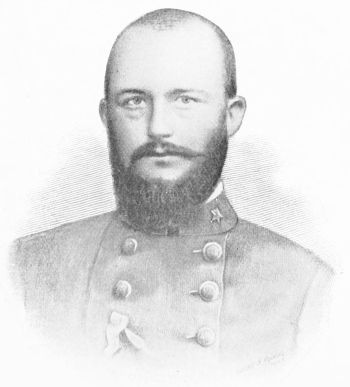
STEPHEN D. RAMSEUR.