ARCHIBALD D. MURPHY. BY WM. A. GRAHAM.
Reading edition
Archibald D. Murphy was, in the generation immediately preceding our own, one of the most eminent characters in North Carolina. In many of the attributes of a statesman and philosopher he excelled all his contemporaries in the State, and, in every department of exertion to which his mind was applied, he had few equals or seconds. As an advocate at the bar, a judge on the bench, a reporter of the decisions of the highest court of justice, a legislator of comprehensive intelligence, enterprise and patriotism, a literary man of classic taste, attainments and style in composition, his fame is a source of just pride to his friends and his country. But for the paucity of our information, and the pressure of time and circumstances in the preparation of this sketch, it would be a labor of love to review his earlier years and trace the development and progress of his career in youth. Neither materials nor leisure for this topic, however, are now at our command.
His father, Colonel Archibald Murphy, was a conspicuous citizen of the county of Caswell, and bore a part in the military service in the war of the Revolution, for which the citizens of that county, and especially of his vicinity, were greatly distinguished. The residence of his father was about two miles from Red House, in the congregation of Rev. Mr. McAden, a Presbyterian minister, whose son, the late Dr. John McAden, married the daughter of Colonel Murphy, by whom he left descendants who still survive. At this place, some seven miles from Milton, Archibald DeBow Murphy, the subject of our memoir, was born, we believe, in the year 1777. Of the other children of his parents there were two brothers and four sisters. His education, preparatory to admission into the infant University of the State at Chapel Hill, was received in the school of the Rev. Dr. David Caldwell, of Guilford county. Of the opportunities for education during his youth, Mr. Murphy himself informs us that before the University went into operation, in 1795, there were not more than three schools in the State in which the rudiments of a classical education could be acquired, and that the most prominent and useful of these was that of Dr. Caldwell; that the deficiency of books for literary instruction, except in the libraries of a few lawyers in the commercial towns, was still greater, and by way of illustration he relates that after completing his course of studies under Dr. Caldwell he spent nearly two years without finding any books to read except some old works on theological subjects, and that then chance threw in his way Voltaire's history of Charles XII. of Sweden, an odd volume of Roderick Random and an abridgment of Don Quixote. These constituted his whole stock of literary furniture when he entered college in 1796. When we remember that he afterwards became capable of writing like Goldsmith, and with an ease and rapidity that Goldsmith could not have equaled, we can but recall these reminiscences of earlier times and encourage the diligent student by his example. With a mind delighted by a consciousness of advancement in knowledge, and spirit of emulation, he profited greatly by three years of study in the University, and graduated with the highest distinction in 1799.
Such was the reputation acquired by him in this period that he was at once appointed Professor of Ancient Languages in his alma mater—a situation in which he continued the three succeeding years, and in which he matured that scholarship and taste for liberal studies which so much distinguished him among his professional brethren and the educated gentlemen of the State. His admission to the bar took place in 1802, after a course of professional reading so limited that the first judge to whom he applied (the signatures of two being then necessary for a license) refused to examine him; and (as he was accustomed to amuse his friends by relating) his success, only a few months later, in gaining admission to the practice in all the courts at once, was owing to the good fortune of bearing a letter from a friend, at the succeeding term of the Court of Conference, to one of the judges, a gentleman of proverbial benevolence and kindness, who conducted the examination, or interview, in his own chamber, and procured the signatures of his brethren without so much having been requested or expected—so little strictness was observed towards the few applicants then entering the profession.
But if he was allowed admission ex gratia, and without the requisite amount of learning, he was not long in supplying the deficiency. The powers of mind and eagerness in quest of knowledge which had been exhibited in his scholastic studies enabled him to make rapid progress in the law. His professional studies were directed by William Duffy, Esq., an eminent lawyer, then residing in Hillsborough, to whom he was ever afterwards affectionately attached, and to whose memory he paid a grateful tribute among his sketches of public and professional men of North Carolina, in an oration before the Literary Societies of the University in his latter years. Mr. Murphy advanced rapidly to the first rank of the advocates of his day, and notwithstanding his turning aside, to the indulgence of his tastes for general literature, his enlightened labors and bright career in legislation, his promotion and service on the bench for two years, his decayed health and irregular attendance on the courts in his latter days, he maintained his position in the public estimation, even to the end of his life. When it is remembered that among his competitors at one time or another, for more than a quarter of a century, were Archibald Henderson, Cameron, Norwood, Nash, Seawell, Yancey, Ruffin, Badger, Hawks, Mangum, and Morehead, it must be admitted that he was at a bar where the remark of Pinkney that "it was not a place where a false and fraudulent reputation for talents can be maintained," was fully justified. His practice for many years was not exceeded by that of any gentleman in the State, and his success corresponded with its extent. Both his examination of witnesses and argument of causes before juries on the circuit could not be excelled in skillfulness. He had a Quaker-like plainness of aspect, a scrupulous cleanness and neatness in an equally plain attire, an habitual politeness and a subdued simplicity of manner which at once won his way to the hearts of juries, while no Greek dialectician had a more ready and refined ingenuity or was more fertile in every resource of forensic gladiatorship. His manner of speaking was never declamatory or in any sense boisterous, but in the style of earnest and emphatic conversation, so simple and apparently undesigning that he seemed to the jury to be but interpreting their thoughts rather than enunciating his own, yet with a correctness and often elegance of diction which no severity of criticism could improve. A pattern of politeness in all his intercourse, public and private, he could torture an unwilling or corrupt witness into a full exposure of his falsehood, and often had him impaled before he was aware of his design; no advocate had at his command more effective raillery, wit, and ridicule to mingle with his arguments.
Many of his speeches in the nisi prius courts are still recollected by the profession and the people of middle age in the Fourth Circuit, and are spoken of with great admiration. One of the last of these in which, though he was then broken down by misfortune and enfeebled by disease, the fires of his genius and eloquence shone out in the lustre of his palmiest days, was made in the case of Burrow vs. Worth, in the Superior Court of Randolph in 1830 or 1831. It was an action for malicious prosecution against Dr. David Worth, a prominent physician, charging him with having falsely and maliciously caused the plaintiff, Burrow, to be presented for the murder of one Carter, of whose wife it was pretended he was the paramour. The plaintiff sought to show that not only was the accusation against him false, but that Worth was himself accessory to the murder which he alleged had been committed by the wife of Carter, by poison, which he (Worth) had furnished to her for that purpose, and he supported his complaint with a well-combined scheme of perjury and fraud which it required no ordinary skill and courage to baffle. His chief witness was a married woman who was found to be a member of a church, whose general character was vouched by her acquaintances to be good, and who deposed to a conversation between Worth and the wife of Carter, in which it was agreed that for a base motive he would provide her with arsenic with which she was to poison her husband. It was further shown, and this was true, that Worth had attended the deceased as a physician at the time of the alleged conspiracy against his life, so that the opportunity, at least, was not wanting. Such was the aspect worn by the case when this witness was tendered to Mr. Murphy, the defendant's counsel, for cross-examination. By a series of questions as to the time, place and circumstances, the furniture in the room in which the conversation was located, the relative positions of the parties and the witness, their previous acquaintanceship, the course of the dialogue between them, et cetera, he involved her in such a maze of inconsistencies, contradictions, and improbabilities as to expose the whole story as a base fabrication. The privilege of cross-examination is often abused, though there is a consistency in truth and incongruity in falsehood which, even in the case of the least resolute witnesses, rarely allows such abuse to do much harm. All perceived, in the case in question, that it was one of the great tests of truth which cannot safely be dispensed with in judicial proceedings. The evidence, as usually happens in such cases, was quite voluminous; we have but delineated its most prominent feature. Having for his client a personal friend, threatened to be victimized by a foul conspiracy for daring to perform one of the highest duties of a citizen, in bringing at least a supposed murderer to justice, Mr. Murphy in his defense, inspired by the theme, is said to have delivered a speech which has never been surpassed in the forensic displays of the State. Analysis, denunciation, wit, ridicule, pathos, invective were in turn poured forth with such telling effect that not only was the defendant triumphantly acquitted, but it would have been dangerous for the plaintiff had the question of his life or death been in the hands of the jury. The audience alternately convulsed with laughter, bathed in tears, or burning with indignation, were enraptured with his eloquence, and could not be restrained from demonstrations of applause.
Mr. Murphy delighted in the equity practice of his profession, and was accustomed to speak of this branch of our jurisprudence as the application of the rules of moral philosophy to the practical affairs of men. More of the pleadings in equity causes within the sphere and time of his practice will be found in his handwriting than in that of any other solicitor, and, with two or three exceptions, among those named above, he was by far the most adept as an equity pleader. He wrote with facility and accuracy, even amid the crowd of courts and confusion of clients, and his neat and peculiar chirography, to those a little accustomed to it, was as legible as print.
In the year 1818 he was elected by the General Assembly a judge of the Superior Courts, and rode the circuits in that capacity for two years, when he resigned and returned to the practice of his profession. Under a clause in the criminal law establishing the present Supreme Court system, passed that session, which authorized the Governor by special commission to detail a judge of the Superior Court to sit in stead of a judge of the Supreme Court, in causes where any one of their number had been of counsel or had an interest in the result, he was commissioned by the Governor for this service, and presided in the Supreme Court in several causes, in place of Judge Henderson, who had been recently elected from the bar. This provision of the law, being afterwards thought to be in conflict with that clause of the Constitution which requires the judges of the Supreme Court to be elected by the General Assembly, was repealed. In his office as a judge he well sustained his reputation for learning and ability, which had been so well established at the bar, and attracted the admiration of the profession and the people by the courtesy, patience, dignity and justice which characterized his administration of the laws. Before taking leave of his career as a lawyer it is proper to mention his tribute to his profession in three volumes of reports of the Supreme Court of the State, embracing the decisions of cases of interest from 1804 to 1819.
From 1812 to 1818, inclusive, Mr. Murphy was continually a Senator from the county of Orange in the General Assembly, and on this new theatre shone more conspicuously than he had done in his profession. He inaugurated a new era in the public policy of the State, and for many years exerted a greater influence in her counsels than any other citizen. Judging from the public documents which he has left behind him in advocacy of this policy, no man ever brought into our legislative halls a more ardent spirit of patriotism, a more thorough survey and comprehension of her situation and wants, or proposed bolder or more intelligent measures for her relief. Whether these measures failed from error in their conception or timidity in his contemporaries to meet and boldly sustain them, the historian must pronounce that his reports and other writings in regard to them are the noblest monuments of philosophic statesmanship to be found in our public archives since the days of the Revolution. From 1815 to 1823, either as chairman of a committee in the Legislature or of the Board of Internal Improvement, he annually prepared a report on the public policy of the State in relation to her improvement in the means of transportation, and in 1819 he published a memoir on improvements contemplated and the resources and finances of the State, dedicated to his friend John Branch, then her Governor; any one of which papers would have done honor to DeWitt Clinton or Calhoun, the champions of internal improvement in the State and Federal governments, respectively, during that period. Fully appreciating the condition of the world resulting from the general peace consequent on the battle of Waterloo and the overthrow of the first Napoleon (since which time there has been a greater advance in all the useful arts and diffusion of the comforts of life among mankind than in any five preceding centuries), he applied all the energies of his intrepid and well-furnished mind to the task of devising how his native State should most profit in this universal calm, confer the greatest good on the greatest number of her people, and resume her proper rank in the Union of which she was a member. His solution of this important problem he seems to have summed up in three propositions, namely: first by improving her means of transportation, in deepening her inlets from the ocean, opening her rivers for navigation, connecting these rivers by canals, and constructing turnpike or macadamized roads, so as to concentrate all her trade at two or three points within her own limits; second, by building up commercial cities of her own at these points, with a view to commercial independence of other States, to the better regulation and control of her currency and exchanges, and to cherish and stimulate a just State pride; third, by a system of education commensurate with the State's necessities, embracing primary schools, academies for instruction in the higher branches, the University by greatly enlarging its accommodations and course of instruction, and an asylum for the deaf and dumb. On this last subject of education he made a report to the General Assembly in 1817, comprehending these several topics, from which, since our limits will not permit us to recur to it again, we make one or two brief extracts as exhibitions of his style, his public spirit and his noble benevolence. The University then was, from causes which he details, in a state of extreme depression. He says: "When the pride of the State is awakening and an honorable ambition is cherished for her glory, an appeal is made to the patriotism and generous feelings of the Legislature in favor of an institution which in all civilized nations has been regarded as the nursery of moral greatness and the palladium of civil liberty. That people who cultivate the sciences and the arts with most success acquire a most enviable superiority over others. Learned men by their discussions and works give a lasting splendor to national character; and such is the enthusiasm of man that there is not an individual, however humble in life his lot may be, who does not feel proud to belong to a country honored with great men and magnificent institutions. It is due to North Carolina, it is due to the great men who first proposed the foundation of the University, to foster it with parental fondness, and to give to it an importance commensurate with the high destinies of the State." We may here remark that although much improvement has been made in the interim, yet even after the lapse of forty-odd years the outline of a system of studies in the University, which he therein proposed, has not been filled up. Of the necessity of public instruction for poor children he says: "Such has always been, and probably always will be, the allotment of human life, that the poor will form a large portion of every community; and it is the duty of those who manage the affairs of a State to extend relief to the unfortunate part of our species in every way in their power. Providence, in the impartial distribution of its favors, whilst it has denied to the poor many of the comforts of life, has generally bestowed upon them the blessing of intelligent children. Poverty is the school of genius; it is a school in which the active powers of man are developed and disciplined, and in which that moral courage is acquired which enables him to toil with difficulties, privations and want. From this school generally come forth those men who act the principal parts upon the theatre of life; men who impress a character upon the age in which they live. But it is a school which if left to itself runs wild; vice in all its depraved forms grows up in it. The State should take this school under her special charge, and nurturing the genius which there grows in rich luxuriance, give to it an honorable and profitable direction. Poor children are the peculiar property of the State, and by proper cultivation they will constitute a fund of intellectual and moral worth which will greatly subserve the public interest."
His greatest and most persevering exertions, however, were devoted to the subject of internal improvement. His reports and memoir on that and kindred topics were examined with high commendation in the year 1822, in an article in the North American Review, then under the editorial charge of the Hon. Edward Everett. It must be borne in mind that in that day the modern resource of the railroad for transportation at long distances had entered the contemplation of no one in Europe or America; sluices, canals and turnpike roads were the only improvements deemed to be practical. To effect these in the most approved methods, Mr. Hamilton Fulton, an engineer of much reputation, was brought into the service of the State from Europe, at a salary of twelve hundred pounds sterling ($6,000) per annum, who made surveys of all the harbors and rivers, and of many routes for roads in all sections of the State. The main features of the plan of Mr. Murphy, and to which he obtained the approbation of Mr. Fulton, after the improvement of inlets at Nag's Head (if practicable), Ocracoke, Beaufort, Swansborough, and Wilmington, consisted in opening for batteau navigation the rivers Roanoke, Tar, Neuse, Cape Fear, Yadkin, Catawba, Broad, and sundry tributaries, and by canals to join the Roanoke and Tar or Pamlico, and Neuse, so as to ship the productions of the country watered by each of them from Beaufort; and to unite by similar means the Cape Fear with Lumber River, and at a more northerly point with the Yadkin, and the Yadkin with the Catawba, so as to bring to the mouth of the Cape Fear the commerce of our whole watershed trending from the Blue Ridge, except that of Broad River (which was to be opened into South Carolina), and thus making commercial marts of Fayetteville and Wilmington. Places and sections more remote from these waters were to be supplied by roads. The boldness and comprehensiveness of this plan, providing, as it proposed to do, for the whole State, with the only facilities then known to science, must be seen by all. Whether it was practicable, and if so, at what cost, was a question for engineers. It was in all probability practicable at a cost not exceeding the amount which up to this time the State has invested in railroads, and if accomplished it would evidently have been a great advance beyond the cart and wagon, then the only means of transportation in use. Its very comprehensiveness, however, was probably the reason of its failure. To conciliate favor, inadequate appropriations for various parts of it in all sections of the State were made at once, and work was commenced under incompetent supervision, which resulted in failure. After a few years' trial the whole was abandoned, and the engineer, whose salary had at no time been less than twice that of the Governor of the State, was discharged. Its miscarriage is the less to be regretted since the iron rail and steam car, then undeveloped in the womb of time, would have superseded, if not supplanted, the most perfect works which it contemplated, so far as regards inland transportation at least. But the fame of its author as a patriot, statesman and sage should not be dimmed by mistakes or failures in the details of its execution or the advances made in the science of engineering in a subsequent age. The expenditures upon it from the State treasury, including the salaries of the principal engineer and assistants, did not exceed $50,000, and this was repaid tenfold in the topographical and statistical information which it elicited and caused to be published, and in the loyal and true North Carolina patriotism aroused by Mr. Murphy's discussions of the subject in the hearts of her people. We have recurred to this matter of expenditure with some care, for the reason that before the subject of internal improvement became popular in the State, it was the custom of its opponents to hold up Mr. Murphy's scheme of improvements as a kind of South Sea Bubble, from which the treasury had been well-nigh rendered bankrupt.
While immersed in endeavors to press forward those projects of improvement, and at the same time assiduously laboring in his profession, either as a judge on the bench or a lawyer at the bar, Mr. Murphy conceived the purpose of writing the history of his native State. He had studied her interests by every light of political economy and every record of the past within his reach, was personally acquainted with nearly every citizen of intelligence, and his talents, public spirit and engaging manners had rendered him a favorite among the surviving officers and soldiers of the Revolution. This latter circumstance had made him acquainted with the traditions of that period, and the great injustice by omission and commission which the State had suffered at the hands of the writers of history. He seems to have undertaken this task with the same motives of zealous patriotism which had inspired his legislative action. In a letter to General Joseph Graham, of Lincoln, dated July 20, 1821, he says:
"Your letter to Colonel Conner first suggested to me the plan of a work which I will execute if I live. It is a work on the history, soil, climate, legislation, civil institutions, literature, etc., of this State. Soon after reading your letter I turned my attention to the subject in the few hours which I could snatch from business, and was surprised to find what abundant materials could, with care and diligence, be collected—materials which if well disposed would furnish matter for one of the most interesting works that has been published in this country. We want such a work. We neither know ourselves nor are we known to others. Such a work, well executed, would add very much to our standing in the Union, and make our State respectable in our own eyes. Amidst the cares and anxieties which surround me, I cannot cherish a hope that I could do more than merely guide the labors of some man who would take up the work after me and prosecute it to perfection. I love North Carolina, and love her more because so much injustice has been done to her. We want pride. We want independence. We want magnanimity. Knowing nothing of ourselves, we have nothing in our history to which we can turn with conscious pride. We know nothing of our State and care nothing about it. We want some great stimulus to put us all in motion, and induce us to waive little jealousies, and combine in one general march to one great purpose."
His habits of labor, his readiness as a writer, and addiction to literary exercise as a pleasure, the philosophical cast of his mind, and above all, his sentiment of devotion to North Carolina, eminently fitted him for this enterprise; and he seems to have entered upon it with his characteristic industry and zeal. He gathered materials for the work from a great variety of sources, public and private, within and without the State. At his instance the Legislature, through the intervention of Mr. Gallatin, then the Minister of the United States in Great Britain, caused the office of the Board of Trade and Plantations and the State Paper Office in London to be explored, and an index of the documents therein, pertaining to our colonial history, to be furnished; literary men in other States, including Mr. Madison and Mr. Jefferson, readily seconded his efforts by supplying information sought of them; the families of deceased public men in the State, including those of Governor Burke, Governor Samuel Johnston, and Mr. Hooper, opened all their papers to his inspection; and many officers of the Revolution, then living, among whom were Colonel William Polk, General Lenoir, Major Donoho, of Caswell, General Graham, and divers others, undertook to contribute to him their personal reminiscences of the war. The memoranda of the gentleman last named, prepared in accordance with a request of Mr. Murphy, were given to the public in the pages of our University Magazine in the year 1856. Upon application of Mr. Murphy, by memorial, the General Assembly at the session of 1826 granted him authority to raise by lottery a sufficient sum for the publication of his contemplated history, the plan of which he set forth in detail. We regret that we have not at hand a copy of this memorial to lay before our readers the outline of the work as then prepared. It was more voluminous, and embraced a greater variety of topics than would have been preferred by the generality of readers, but its very magnitude showed the comprehension of his genius and the intrepidity of his mind. Beyond one or two chapters on the Indian tribes of the State, he appears to have done but little towards its composition, though his collection of materials, directing attention to the subject, and rescuing from oblivion much that was passing away, rendered the undertaking itself a great public benefit. Decayed health and a ruined fortune arrested him in mid-career, put a stop to his favorite enterprise, and clouded with poverty and adversity the evening of his days.
Among his public employments may be classed his mission to Tennessee as the representative of the University in 1822. The chief endowments of the University from the State consisted in escheats, or the estates of persons dying without heirs or next of kin, which passed to the State by a prerogative of sovereignty. In her deed of cession to the United States of her Tennessee territory, North Carolina had reserved the right to satisfy the claims of her citizens for military service in the army of the Revolution, by grants of land in the ceded territory, and where her soldiers had died leaving no heirs, or none who appeared and made claim within a limited period, their titles were considered as escheats, and vested by law in the Board of Trustees, and warrants were issued by the authorities of North Carolina, in the names of such soldiers for the benefit of the institution. The State of Tennessee took exception to these proceedings of North Carolina, alleging that they were in conflict with the provisions of the deed of cession, and, since her admission into the Union, with her sovereign rights as an independent State. The controversy became a serious one, and Mr. Murphy was sent to confer with the Legislature of Tennessee respecting it, in the year 1822. He was received with the courtesy due to his high character and the important interest he represented, and was heard upon the subject at the bar of the Legislature on two successive days. An adjustment of the dispute succeeded, by which a portion of the claims of the University were yielded for the benefit of a similar institution at Nashville, and the residue were confirmed. From the sales of the lands thus acquired have arisen a large portion of the investment in bank stocks, on which this institution is at present maintained.
As a literary character Mr. Murphy deserves to be classed among the first men of the State; and among those who, like himself, devoted their time laboriously to professional and public employments, he has had few superiors in literature in the nation. In the Latin, Greek, and French languages he attained such proficiency that till the close of his life he read the standard authors with pleasure and for amusement, and with the best of the English classics few were more familiar. To this, though self-taught, he added no inconsiderable attainments in science. As an epistolary writer he had no equal among his contemporaries, and in all his compositions there was an ease, simplicity, and at the same time an elegance of expression which showed him to be master of his native tongue. When it is known that a large part of his life was passed in taverns, on the circuit, where he was immersed in business—and when not so immersed, such was his proverbial urbanity and kindliness of nature that his rooms were the resort of all seeking advice and consultation, as well as of his circle of friends in every county, attracted by the charms of his conversation—his acquirements are a marvel to those less studious or less imbued with a true love of letters. His oration before the two Literary Societies of the University, in 1827, is a fair exponent of his style of writing, and also indicates his favorite studies, the subjects of his admiration, his enthusiastic American sentiment, his characteristic benevolence and kindness towards young men, and that unaffected modesty which was so remarkable a virtue in his character. Yet it is tinged with a vein of sadness, as if life for him was approaching its twilight and he was walking among the graves of the dead, some of them his comrades, whom he was soon to follow. Notwithstanding it was the first in the series of these discourses before the Societies, it has never been surpassed in appropriateness and interest by those of any of his successors, though among them have been many of the most distinguished scholars in the State. Its commendation by Chief Justice Marshall, in a letter to the author, published with the second edition, stamps its portraits of public characters with his approbation and renders it historical.
To the possession of genius in an eminent degree he united some of its infirmities. A sanguine temper, a daring confidence in results, a reliance on the apparent prosperity of the times, involved him in pecuniary obligations, many of them, perhaps, of a speculative character, which eventuated in disaster and swept away his estate. A little later came an attack of chronic rheumatism, from which he suffered much, and was often incapacitated for business during the last half-dozen years of his life. But during this season of adversity he struggled with a brave heart against the storms of fate. With a pallid cheek and disabled limbs he made his appearance in the courts, where, as we have seen, his gifted mind occasionally shone out in all its meridian splendor; and when this was not practicable, the hours of pain and misfortune were beguiled, if not solaced, by the pursuit of those noble studies which had been the delight of his leisure in the days of his prosperity.
He died in Hillsborough, then his place of residence, on February 3, 1832, and is interred in the graveyard of the town, a few feet from the door of the Presbyterian church, and nearly in front of it. No monument marks his resting-place. His sons, Dr. V. Moreau Murphy, of Macon, Mississippi, and Lieutenant P. U. Murphy, of the navy of the United States, are his only surviving children.
The work and worth and greatness of Murphy have never been duly appreciated even in his own State; and yet, when our history is written, if greatness is measured by the public benefit it confers, perhaps Macon, Murphy, and Vance will stand together as the three greatest men the State has yet produced.
In common-sense statecraft, in the choice and application of principles to existing conditions, and in the prophetic knowledge of the fruit they would bring forth after their kind, Macon was greatest. In scholarship and breadth of culture, combined with originality to conceive the most far-reaching policies of public welfare, Murphy was greatest. In the knowledge of men, in his boundless wealth of human sympathy, as the advocate and champion of the people's rights, Vance was greatest. But Graham had a far greater knowledge and grasp of the details of public business than any of them; and Badger, in his ability to rapidly acquire and assimilate law and learning, easily outstripped them all.
The sensibilities of Murphy were too refined for what is called success in practical politics. His love and enthusiasm for the public weal were so great that he forgot himself—but let us never forget him.
If Murphy had lived to write, as he intended, the history of North Carolina, he would have made all the world know and acknowledge that some of her people began the Revolution against British tyranny four years before the battle of Lexington. Perhaps he would have made it too plain for cavil that more than a year before Jefferson penned his immortal document, the spirit that resisted Tryon had formed a government at Charlotte independent of British rule, and that, in the strongest probability, the authors of that government had prepared the way for it by a declaration of independence.
Leavened by that spirit, the people of the whole State, through their convention at Halifax, on May 12, 1776, proposed, and on May 22 adopted, a resolution providing for "declaring independence" in concurrence with the "other colonies"—the first step taken in that direction by any of the colonies.
Perhaps his clear voice could have been heard above the conflicting jargon about the Regulators' War. The threadbare statement that the spirit of these people was so thoroughly crushed by Tryon's dress-parade campaign that they all took sides with the British in the Revolutionary war might have been thrashed a little thinner. Perhaps he would have found at King's Mountain some of the fifteen hundred families who fled west after the battle of Alamance.
Mrs. E. E. Moffitt of this city (a granddaughter of Judge Murphy's sister, Mrs. John Daniel) is my authority for the statement that Peter S. Ney—whom some believe to have been none other than the great Marshal Ney—was Murphy's amanuensis. It was a singular fate which drew these two peculiar men of genius together.
There is grim humor in his pathetic attempt to enkindle a love of history and education in this State by appealing to the love of gain. His other scheme, internal improvements, was equally chimerical; not because it lacked intrinsic merit, but because the times and people had changed. He had not calculated on the soporific effect of indirect taxes upon the unpreferred States. It was too early for any but a prophet to fully see that the States had dug the graves of their ultimate autonomy by adopting a Constitution which forbade them "to emit bills of credit"—a power of which they never stood in dire need until the General Government had monopolized all control of banking and currency.
No State, since the Union was formed, has, without Federal aid, direct or indirect, made any material progress in developing its resources!
ADDRESS AT THE UNIVERSITY.
BY ARCHIBALD D. MURPHY.
The Literary Societies of this institution have resolved that an address be delivered before them annually by some one of their members. This resolution, if carried into effect in the spirit in which it has been adopted, will be creditable to the Societies and favorable to the general literature of the State. It is now more than thirty years since these Societies were established, and all the alumni of this University have been members of one or the other of them. Upon these alumni, and upon others who shall go forth from this University, our hopes must chiefly rest for improvement in our literary character; and their zeal for such improvement cannot fail to be excited by being annually called together, and one of them selected to deliver a public discourse upon the progress and state of our literature, or some subject connected therewith. The Societies have conferred on me an unmerited honor by appointing me to deliver the first of these discourses. I accepted the appointment with pride, as it was an evidence of their esteem; yet with humility, from a conviction of my inability to meet public expectation—an inability of which I am conscious at all times, but particularly so after a painful and tedious illness.
Little that is interesting in the history of literature can be expected in the infancy of a colony planted on a continent three thousand miles distant from the mother-country, in the midst of a wilderness and surrounded by savages. Under such circumstances civilization declines, and manners and language degenerate. When the first patent was granted to Sir Walter Raleigh, in 1584, the English language had received considerable improvement. Spenser had published his Faerie Queene, Shakespeare his Plays, Sir Philip Sidney his Arcadia, Knolles his General History of the Turks, and our theology had been enriched by the eloquent writings of Hooker. This improvement was not confined to the learned; it had already extended itself to the common people, particularly in the towns and villages, and the language of the first colonists no doubt partook of this improvement. But these colonists were all adventurers; they joined in Sir Walter Raleigh's expedition only for the purpose of making fortunes, and their chief hope was that they would quickly find gold in abundance and return home to enjoy their wealth. This delusive hope continued for many years to beguile adventurers; who, not finding the treasure they came in quest of, became idle and profligate, and abandoned a country in which they had met with nothing but disappointment. Sir Walter Raleigh, after expending a large part of his estate in attempts to settle a colony, assigned to Thomas Smith, of London, and his associates, the privilege of trading to Virginia and of continuing the colony. Under the advice of Raleigh he directed his efforts to the waters of the Chesapeake, and there caused to be planted a colony which became permanent, and from which Virginia and Carolina were peopled. A new charter was granted to Thomas Smith and his associates in 1606, and enlarged in 1609. Their company continued with many vicissitudes of fortune until the year 1626, when it was dissolved. The history of the colony to the time of this dissolution was written by John Smith and also by Stith. They were contemporary with Lord Clarendon, who wrote the History of the Great Rebellion in England. Their style and manner of writing, and the public papers published by the President and Council of the Colony, during this period, evidence great improvement in our language. The chaos in which it lay in the early part of the reign of Elizabeth gradually gave way to the order and method which good sense introduced into every pursuit; the pedantry and conceits which disfigured our literature in the reign of James I. yielded to the influence of good taste. Sir Walter Raleigh published his History of the World, Lord Bacon his historical and philosophical works and moral essays, and our poetry was adorned by the writings of Milton, Dryden, Butler, and Otway. Shortly afterwards came Sir William Temple, Archbishop Tillotson and others, who gave facility and grace to composition. These were new beauties and pleased the nation more as they gave to style the charm of polished conversation.
Whilst the literary taste of the nation was thus improving, religious intolerance drove from England a great number of Quakers, Presbyterians and other sectarians, who sought refuge in the Virginia colony. They there soon met with the same persecution which had driven them from their native country. They were compelled to leave the colony; and Providence directing their course through the wilderness, they settled near Pasquotank and Perquimans, and formed the germ of the Carolina colony. Many of them were Quakers, and their descendants continue to occupy that district of country to this day.
In the year 1663, Charles II. granted the soil and seigniory of Carolina to eight Lords Proprietors, who, to encourage emigration, held out favorable terms. They promised to adventurers gratuities in land according to the number of their respective families, and the most perfect freedom in the exercise of religion. A civil government was established purely representative; a circumstance to which may be attributed, in a great degree, the republican feelings and opinions which soon characterized the colony, and which led to the plan of civil polity under which we now live. When the Lords Proprietors discovered that the colony was likely to become numerous and powerful they endeavored to restrain the civil and religious liberty which they had promised to emigrants: they established a new form of government, declaring their object to be "to make the government of the colony agree as nearly as possible with the monarchy of which it was a part, and to avoid erecting a numerous democracy." This plan of government was the joint work of Lord Ashley and the celebrated John Locke; and its chief aim was to appoint orders of nobility, establish a powerful aristocracy and check the progress of republican opinions and manners. A more ridiculous plan for the government of the colony could not have been devised. The people were accustomed to equality and self-government; a rank of nobility was odious to them, and they disregarded laws which they had not been consulted in making. The prosperity of the colony declined, public morals relaxed, the laws lost their energy, a general spirit of discontent grew up and ripened into rebellion; the Governors became corrupt, and the people idle and vicious. The attempt to give effect to the new plan of government entirely failed, and the Lords Proprietors abolished it as unsuited to the condition of the colony. Two factions then arose; one that wished to establish a high-toned prerogative government; the other consisted of High-churchmen, who gained the ascendency, and by their violence brought the government into contempt. Their object was to deprive all dissenters of the right of suffrage, to curtail their civil rights, and render their situation so oppressive as to compel them to leave the colony. A party of French Huguenots had emigrated to the colony to enjoy that liberty of conscience and of worship which was denied to them in their native country. These people, entitled by their sufferings no less than by their Protestantism to the friendship and hospitality of the colonists, were treated with a cruelty that disgraced the High-church party. Being aliens, they were incapable of holding lands until they were naturalized; and this party having the ascendency in the Assembly, not only refused to naturalize them, but declared their marriages by ministers not ordained by Episcopal Bishops illegal and their children illegitimate. The progress of this violent, persecuting spirit was checked by the wise and conciliating measures adopted by Governor Archdale. He assumed the government of the colony in 1695; he was a Quaker, and possessed in an eminent degree the philanthropy and command of temper for which this sect has been distinguished. He was one of the Proprietors of the province, and by the mere force of his character overawed the turbulent and restored good order. To this excellent man our ancestors are indebted for that tolerant provision in their militia law which we still retain as part of our code, for granting exemption to men who were restrained by religious principles from bearing arms.
The religious intolerance of the High-church party was exerted with new energy after the departure of Governor Archdale from the province. This party passed laws, which the Lords Proprietors ratified, to establish the Church of England and to disable dissenters from being members of the Assembly. This was in direct violation of the chartered rights of the colonists. The dissenters remonstrated to the House of Lords; and Queen Anne, upon the advice of that body, caused these laws to be repealed. But the High-church party, steady to their purpose, varied their mode of attack; the spirit of intolerance grew with the growth of the province; emigrations from the Virginia colony and the patronage of the Lords Proprietors gave to this party a decided majority in the Assembly; they levied a tax on each precinct for the support of a minister, and built churches. Protestant dissenters were only permitted to worship in public, and there to be subject to the rules and restrictions contained in the several acts of Parliament. Quakers were permitted to affirm instead of swearing; but they could not hold an office of profit or trust, serve as jurors, or give evidence by affirmation in any criminal case. This contest between the High-church party and the dissenters produced an hostility of feeling which time has softened, but which the lapse of more than a century has been insufficient to allay. This contest, however, promoted freedom of thought and inquiry among the people; it sharpened their understandings, and in a great degree supplied the place of books for instruction. At that time there were few books in the colony: the library of a common man consisted of a Bible and a spelling-book; the lawyers had a few books on law, and the ministers a few on theological subjects, and sometimes a few of the Greek and Roman classics: for they, particularly the Presbyterian ministers, were generally school-masters—and from them the poor young men of the colony, who wished to preach the gospel or plead law, received their humble education. The turbulent spirit of the colonists, their leaning towards republicanism and sectarianism, had induced the Lords Proprietors to forbid the establishment of printing presses in the colony; and Sir William Berkeley, who had the superintendence of this colony in 1661, gave thanks to heaven that there was not a printing office in any of the Southern provinces.
What improvement in literature could be expected among a people who were thus distracted by faction, destitute of books, and denied the use of the press? Notwithstanding all these discouragements and disadvantages, however, the literature of the colony evidently advanced. The public papers of that period are written in a conspicuous, nervous style, corresponding in force of expression, purity of language and perspicuity of arrangement, with similar writings in the reigns of Charles II., King William, and Queen Anne. The intelligence of the common people and the ability and learning of the men who managed the affairs of the colony in that period are matters of surprise and astonishment to any one acquainted with the disadvantages under which the colony labored. The Assembly and the courts of justice sat in private houses; the acts passed by the Assembly were not printed; they were read aloud to the people at the first court after they were passed; they were in force for only two years, and every biennial Assembly was under the necessity of reenacting all that were thought useful. There was no printing press in the colony before the year 1746, at which time the condition of the statute-book required a revisal, and the public interest called aloud for the printing of it. The learning and literature of the colony were confined to the lawyers and ministers of the gospel, most of whom were educated in England; and it was owing to this circumstance chiefly that the literature of the colony advanced so steadily with that of the mother-country.
The legislation of the colony began to assume form and system in the reign of Queen Anne; and in the year after her death, 1715, the Assembly passed sixty-six acts, most of which had been frequently reenacted before. Many of those acts remain in force to this day, and are monuments of the political wisdom and legal learning of that time. In style and composition they are equal to any part of our statute-book; they are the first statutes of the colony that have come down to our time.
In the year 1729 the Lords Proprietors, with the exception of Lord Granville, surrendered to the Crown their right to the soil and seigniory of North Carolina; and from that time the population and prosperity of the colony rapidly increased. But in a few years the great contest commenced between the prerogative of the Crown and the liberty of the colonial subject, which contest eventually terminated in the American Revolution. This contest gradually introduced into North Carolina, and into all the British colonies which took part in it, a style in composition which distinguishes this period from all others in English or American literature: a style founded upon and expressive of exalted feeling. Education embellished it and gave to it new beauties; but its force and impressive character were perceptible in the writings and speeches of ordinary men. What age or nation ever produced compositions superior to the addresses of the Continental Congress? When or where shall we find a parallel to the correspondence of General Washington and the general officers of the American army? The style of these addresses and of the correspondence is the style of high thought and of lofty, yet chastened feeling, and reminds the reader of the finest specimens of composition in Tacitus, and of the correspondence of Cicero and his friends after the death of Pompey.
There is something in the style and sentiment of the writings of this period which gives to them a magic charm, and seems to consecrate the subjects on which it is employed—a something connected with the finest perceptions of our nature. The reader is every moment conscious of it, yet knows not how to explain it. The high moral feeling and virtuous sympathy which characterized the American Revolution have given to it a hallowedness of character. It is fortunate for us that Chief Justice Marshall has written the history of this Revolution. Whatever may be the defects of this work, the history of our Revolution will never be so well written again: no work on that subject so well calculated to produce an useful effect upon its readers will ever appear. Marshall was a soldier of the Revolution, and possessed the finest genius; he was the personal friend of the Commander-in-chief; partook of all the feelings of the officers of the army; and he has transfused into his work that exalted sentiment which animated his compatriots in arms. This sentiment is strongly portrayed in the writings of the Marquis de Chastellux and Count Rochambeau, two French general officers in the American service, and in the correspondence of the Commander-in-chief and the American general officers. But it can never be embodied into an historical work by a man who did not feel it in all its force in the American camp. Literary elegance disappears before such moral beauty. There is no historical work in any language that can be read with so much advantage, such moral effect, by American youth, as Marshall's Life of George Washington. They should read it with diligence, and read it often. They will never rise from the perusal of it without feeling fresh incentives both to public and private virtue.
The progress of the style which marked the period of the American Revolution may be traced in North Carolina from the administration of Governor Dobbs. It had become the common style of the leading men of the colony before the meeting of the Continental Congress in 1774. The correspondence and public papers of Samuel Johnston and Joseph Hewes, of Edenton; of William Hooper and Archibald Maclaine, of Wilmington; of Richard Caswell, of Kinston; of Thomas Burke, of Hillsborough; of Francis and Abner Nash of New Bern, upon the great subjects which then engrossed the public attention, do honor to the literature of North Carolina at that time. They wrote upon matters of business—business which concerned the welfare of the nation; they wrote as they felt; and their compositions, coming warm from the heart, are free from affectation or pedantry, and equally free from that prolixity which is the vice of modern composition.
When these men disappeared, our literature, in a great degree, disappeared with them. The war had exhausted the resources of the State and ruined the fortunes of many individuals; we had no schools for the education of our youth; few of our citizens were able to send their sons to the Northern colleges or to Europe to be educated. Two individuals, who received their education during the war, were destined to keep alive the remnant of our literature and prepare the public mind for the establishment of this University. These were William R. Davie and Alfred Moore. Each of them had endeared himself to his country by taking an active part in the latter scenes of the war; and when public order was restored and the courts of justice were opened they appeared at the bar, where they quickly rose to eminence, and for many years shone like meteors in North Carolina. They adorned the courts in which they practiced, gave energy to the laws, and dignity to the administration of justice. Their genius was different and so was their eloquence. Davie took Lord Bolingbroke for his model, and Moore, Dean Swift; and each applied himself with so much diligence to the study of his model that literary men could easily recognize in the eloquence of Davie the lofty, flowing style of Bolingbroke; and in that of Moore, the plainness and precision of Swift —they roused the ambition of parents and their sons; they excited emulation among ingenuous youth; they depicted in glowing colors the necessity of establishing a public school or university in which the young men of the State could be educated. The General Assembly resolved to found an university. I was present in the House of Commons when Davie addressed that body upon the bill granting a loan of money to the trustees for erecting the buildings of this University; and although more than thirty years have since elapsed, I have the most vivid recollections of the greatness of his manner and the power of his eloquence upon that occasion. In the House of Commons he had no rival, and upon all great questions which came before that body his eloquence was irresistible. The genius and intellectual habits of Moore fitted him for the bar rather than a deliberative assembly. Public opinion was divided upon the question whether he or Davie excelled at the bar. Moore was a small man, neat in his dress and graceful in his manners; his voice was clear and sonorous, his perceptions quick, and his judgment almost intuitive; his style was chaste and his manner of speaking animated. Having adopted Swift for his model, his language was always plain. The clearness and energy of his mind enabled him, almost without an effort, to disentangle the most intricate subject and expose it in all its parts to the simplest understanding. He spoke with ease and with force, enlivened his discourses with flashes of wit, and where the subject required it, with all the bitterness of sarcasm. His speeches were short and impressive: when he sat down every one thought he had said everything that he ought to have said. Davie was in his person tall and elegant, graceful and commanding in his manners; his voice was mellow and adapted to the expression of every passion; his mind was comprehensive, yet slow in its operations, when compared with his great rival. His style was magnificent and flowing, and he had a greatness of manner in public speaking which suited his style and gave to his speeches an imposing effect. He was a laborious student, arranged his discourses with care, and, where the subject suited his genius, poured forth a torrent of eloquence that astonished and enraptured his audience. They looked upon him with delight, listened to his long, harmonious periods, caught his emotions, and indulged that ecstasy of feeling which fine speaking and powerful eloquence alone can produce. He is certainly to be ranked among the first orators, and his rival, Moore, among the first advocates, which the American nation has produced.
Whilst these two men were in the zenith of their glory, another man arose at the bar in North Carolina who surpassed them both in profoundness of legal learning, and, on many occasions, successfully contended with them for the palm of forensic eloquence. This was the late John Haywood. He had few advantages from nature; his person was indifferent, his voice harsh, his manners uncouth, his education limited. He was a stranger to the graces, and had few of the accomplishments of an orator. But he had a powerful and intrepid mind, which he cultivated by the most laborious study. The fame of Davie and Moore inspired his ambition, and he was tortured by a desire of entering the lists with these champions of the bar. He was conscious of his defects, and sought to gain the ascendency by superior legal learning. He came to the bar with confidence of high intellectual powers and profound knowledge of the law; and in a little time acquired a reputation that placed him at the head of his profession in this State and gave him rank among the ablest common-law lawyers in the Union.
Contemporary with Haywood were several gentlemen of the bar now living and several who are dead who have sustained the character of their profession for legal learning and general literature. Among the latter were William Duffy and Archibald Henderson. Duffy was the child of misfortune. Thrown upon the world without friends and without fortune, accident introduced him, in his early youth, to the acquaintance of John Haywood, Esq., the venerable Treasurer of this State, who, in the exercise of that benevolence for which his whole life has been conspicuous, gave him employment and enabled him to prosecute his studies and prepare himself for the bar. Duffy had an opportunity of witnessing the splendid displays of Davie and Moore and he profited by their example. He devoted a large portion of his time to polite literature, and acquired a more elegant style in composition than any of his contemporaries in North Carolina. He had a slight impediment in his speech, but by laborious perseverance he succeeded in regulating the tones and modulations of his voice in such a way that his impediment seemed to be an ornament to his delivery. He was one of the few men of our country who could read well; he studied the art of reading, and his friends will long remember the pleasure they have received from hearing him read. In his addresses at the bar he was always impressive, particularly upon topics connected with virtuous and benevolent feeling. He had a vigorous mind and feelings attuned to the finest emotions. I remember him with fond affection. He was my friend, my preceptor, my patron. He instructed me in the science of the law, in the art of managing causes at the bar, and in the still more difficult art of reading books to advantage. I wish it were in my power to render to his memory a more permanent honor than this passing tribute of respect and gratitude!
Henderson survived Duffy many years, and obtained the first standing at the bar of this State. He was devoted to his profession, and, upon the whole, was the most perfect model of a lawyer that our bar has produced. It was late in life before he turned his attention to polite literature, and he never acquired a good style in composition. Yet his style and manner of speaking at the bar were extremely impressive. I shall here speak of him as I did in a sketch of his character published shortly after his death. In him the faculties of a fine mind were blended with exalted moral feelings. Although he was at all times accessible, he seemed to live and move in an atmosphere of dignity. He exacted nothing by his manner, yet all approached him with reverence and left him with respect. The little quarrels and contests of men were beneath him; his was the region of high sentiment, and there he occupied a standing that was preeminent. The Constitution and jurisprudence of his country were his favorite studies. Profound reflection had generalized his ideas and given to his political and legal learning a scientific cast. No man better understood the theory of our government; no man more admired it, and no man gave more practical proofs of his admiration. The sublime idea that he lived under a government of laws was forever uppermost in his mind, and seemed to give a coloring to all his actions. As he acknowledged no dominion but that of the laws, he bowed with reverence to their authority, and taught obedience no less by his example than his precept. To the humble officer of justice he was respectful; the vices of private character were overlooked when the individual stood before him clothed with judicial authority. In the County Courts, where the justices of the peace administer the law, he was no less respectful in his deportment than in the highest tribunal of the State. He considered obedience to the laws to be the first duty of a citizen, and it seemed to be the great object of his professional life to inculcate a sense of this duty and give to the administration of the laws an impressive character. He was conscious of his high standing, and never committed himself nor put his reputation at risk. He always came to the trial of his causes well prepared; and if the state of his health or his want of preparation were likely to jeopardize his reputation in the management of his client's cause he would decline the trial until a more favorable time. The courts in which he practiced, and his brother lawyers, understood the delicacy of his feelings upon this point so well that they extended to him the indulgence he required, and a knowledge of this part of his character gave confidence to his clients and attracted crowds of people to hear his speeches. When he rose at the bar no one expected to hear common-place matter; no one looked for a cold, vapid, or phlegmatic harangue. His great excellence as a speaker consisted in an earnestness and dignity of manner and strong powers of reasoning. He seized one or two strong points, and these he illustrated and enforced. His exordium was short and appropriate; he quickly marched up to the great point in controversy, making no manœuvre as if he were afraid to approach it, or was desirous of attacking it by surprise. The confidence he exhibited of success he gradually imparted to his hearers; he grew more warm and earnest as he advanced in his argument, and seizing the critical moment for enforcing conviction, he brought forth his main argument, pressed it home and sat down. As he advanced in life he seemed more and more anxious that the laws should be interpreted and administered by the rules of common sense. He lost his reverence for artificial rules; he said the laws were made for the people, and they should be interpreted and administered by rules which the people understood, whenever it was practicable; that common sense belonged to the people in a higher degree than to learned men, and that to interpret laws by rules which were at variance with the rules of common sense necessarily lessened the respect of the people for the laws, and induced them to believe that courts and lawyers contrived mysteries in the science merely for the purpose of supporting the profession of lawyers. He said the rules of pedantry did not suit this country nor this age; that common sense had acquired dominion in politics and religion, and was gaining it in the law; that judges and lawyers should have the independence and magnanimity to strip off the veil of mystery from every branch of the science, and simplify and make it intelligible, as far as possible, to the understanding of the common people.
In all free States eloquence has preceded poetry, history, and philosophy. By opening the road to wealth and fame it subserves the purposes of avarice and ambition; society is led captive by its charms, and sometimes bound in fetters by its powers. In this State the bar and the General Assembly have been thus far the theatres for its display. Oratory is the branch of literature which we have cultivated with most success, and in which we have not been far behind any of our sister States.
Not long after Davie left the House of Commons there appeared in that body another man whose genius we have all admired and whose misfortune we all deplore. I hope I may be permitted to speak of him, although he be still living. Providence has withdrawn him from public view, and he has been followed by the regrets and tears of his countrymen. I speak of John Stanly, Esq. For more than twenty years he has been the ornament of the bar and of the House of Commons. Small in stature, neat in dress, graceful in manner, with a voice well modulated, and a mind intrepid, disciplined and rich in knowledge, he became the most accomplished orator of the State. His style of eloquence was more varied than that of any of his predecessors. Such were the versatility of his genius and the extent of his acquirements that he could at pleasure adopt the lofty, flowing style of Davie, or the plain, simple, energetic style of Moore. He could rouse the noble passions, or amuse by his wit and pleasantry. He excelled in appropriate pauses, emphasis and gesticulation. No speaker was ever more fortunate in accommodating his manner to his subject; and on all important subjects he had a greatness of manner which small men seldom acquire. He resembled Moore in the quickness of his perceptions and the intuition of his judgment. His talents and knowledge were always at command, and he could bring them to bear with force and effect as occasion required, without any preparation. His mind was so well disciplined and so happily toned that it was always ready for action. He possessed the rare talent of conversing well; his conversation was the perpetual flow of sober thought or pleasant humor, and was heightened in its effect by his happy style and gracefulness of manner. He was among the few orators of this or any country, whose style and manner in conversation equaled his style and manner in public speaking.
Few of the men whom I have named had the advantage of a liberal education; they rose to eminence by the force of genius and a diligent application to their studies. The number of our literary men has been small, when compared with our population; but this is not a matter of surprise when we look to the condition of the State since the close of the Revolutionary war. When the war ended the people were in poverty, society in disorder, morals and manners almost prostrate. Order was to be restored to society and energy to the laws before industry could repair the fortunes of the people; schools were to be established for the education of youth and congregations formed for preaching the gospel before the public morals could be amended. Time was required to effect these objects; and the most important of them, the education of youth, was the longest neglected. Before this University went into operation, in 1795, there were not more than three schools in the State in which the rudiments of a classical education could be acquired. The most prominent and useful of these schools was kept by Dr. David Caldwell, of Guilford county. He instituted it shortly after the close of the war and continued it for more than thirty years. The usefulness of Dr. Caldwell to the literature of North Carolina will never be sufficiently appreciated; but the opportunities of instruction in his school were very limited. There was no library attached to it; his students were supplied with a few of the Greek and Latin classics, Euclid's Elements of Mathematics, and Martin's Natural Philosophy. Moral philosophy was taught from a syllabus of lectures delivered by Dr. Witherspoon at Princeton College. The students had no books on history or miscellaneous literature. There were indeed very few in the State, except in the libraries of lawyers who lived in the commercial towns. I well remember that after completing my course of studies under Dr. Caldwell, I spent nearly two years without finding any books to read except some old works on theological subjects. At length, I accidentally met with Voltaire's history of Charles XII. of Sweden, an odd volume of Smollett's Roderick Random, and an abridgment of Don Quixote. These books gave me a taste for reading, which I had no opportunity of gratifying until I became a student in this University in the year 1796. Few of Dr. Caldwell's students had better opportunities for getting books than myself; and with these slender opportunities of instruction, it is not surprising that so few became eminent in the liberal professions. At this day, when libraries are established in all our towns, when every professional man and every respectable gentleman has a collection of books, it is difficult to conceive the inconveniences under which young men labored thirty or forty years ago.
But has the number of our distinguished men increased as the facilities of instruction have increased? They certainly have not. Of the number of young men who have been educated at this University, how few have risen to eminence in any branch of literature! Their number bears no proportion to the increased means of instruction which they have had. To what causes is this to be attributed? The causes are numerous, but we will notice only a few of the most operative. In the first place the plan of education in all our schools, particularly in our preparatory schools, is radically defective; too much time is spent upon syntax and etymology; the time of the student is wasted, and his genius frittered away upon words instead of being developed and polished by the spirit of the writer. Instead of directing the study of the Greek and Latin classics to the development of his faculties and the improvement of his taste, his time is taken up in nice attention to words, arrangement of clauses and construction of periods. With his mind thus injured, he enters upon the study of the physical and moral sciences, and long accustomed to frivolous investigation, he never rises to the dignity of those sciences nor understands the methods by which their truths are illustrated. In the next place, too many studies are crowded upon the student at once; studies which have no analogy or connection. In the third place, the time allotted for completing a course of scientific study is too short; the student's mind flags under the severe labors imposed upon it. The elasticity of the mind ought never to be weakened; if it be, the student thenceforward hobbles through his course, and is often broken down before he gets to the end of it. In the fourth place, too many studies are pursued, and none are pursued well; the student acquires a smattering of languages and sciences, and understands none of them. This encyclopedical kind of learning is destructive of the powers of the mind, and unfits it for deep and severe investigation. In the last place, the multitude of books is a serious injury to most students. They despair of reading many of them, and content themselves with reading reviews of the most celebrated. At length the valuable books are placed away carefully in a library, and newspapers, pamphlets and other fugitive productions take up all their time for reading. There is nothing in this course which teaches youth how to think and investigate. The great object of education is to give to the mind activity and energy: this object can never be attained by a course of studies which distracts its attention and impairs its elasticity.
The evils which I have mentioned are not confined to the schools of North Carolina; they exist in nearly all the schools of the Union. Massachusetts has taken the lead in correcting them and introducing methods of instruction founded upon the philosophy of the mind. The state of science and literature among her people shows the happy effect of these changes. The Trustees of this University have resolved to make similar changes, to remodel the plan of studies, and introduce new methods of instruction. But whatever changes may be made in our plan of education, young men, who are desirous of being either useful or eminent in active life, should recollect this truth, that the education received at a college or university is intended only as a preparation of the mind for receiving the rich stores of science and general knowledge which subsequent industry is to acquire. He who depends upon this preparation alone will be like a farmer who ploughs his land and sows no grain. The period of useful study commences when a young man finishes his collegiate course. At that time his faculties have acquired some maturity from age and some discipline from exercise; and if he enter with diligence upon the study of a branch of science, and confines his attention to that branch, he soon becomes astonished at his progress and at the increase of his intellectual powers. Let him avoid reading or even looking into a variety of books. Nine-tenths of them are worse than useless; the reading of them produces a positive injury to the mind; they not only distract his attention, but blunt his faculties. Let him read only works of men of genius—read but few books, and read them often. Take two young men of equal minds and similar genius; put into the hands of one Shakespeare's Plays, Milton's Paradise Lost, Don Quixote and Gil Blas; and into the hands of the other all the hundred volumes of dullness which fill our libraries; and at the end of twelve months mark the difference between them. The first will be like the high-spirited steed that is ready for the course; the other will be encumbered with a load of useless ideas, his faculties weakened, and the bright tints of his genius obscured.
The next great object, after the improvement of the intellectual faculties, is the forming of a moral character. This is by far the most difficult part of education: it depends upon the doctrines of morals and the philosophy of the passions and feelings. Little success has heretofore attended it, either in the schools of Europe or this country. The moral character of youth has been generally formed by their parents, by friends who gained their confidence, or by their pursuits in active life. The morality thus taught is purely practical; it has reference to no abstract truths; it looks only to the passions and feelings of our nature under the variety of circumstances in which we may be placed in society, and the duties which thence result. The science of ethics taught in our schools is a cold, speculative science; and our youth are misled by substituting this for practical morality. It is to be regretted that we have no work on moral philosophy which treats of ethics purely as a practical science; and it is remarkable that, notwithstanding the great improvement that has been made within the last century in metaphysical and physical science, and the liberal turn of philosophical inquiry which has been introduced, the science of ethics remains stationary. The question, "What is the foundation of moral obligation?" is not more satisfactorily answered now than it was two centuries ago. And until the principles of ethics shall be disentangled from the speculative doctrines of theology, interwoven by the schoolmen and monks in the sixteenth and seventeenth centuries, and those principles be traced to the constitution and condition of man, having for their object the development of his social rights and duties, we shall have to regret that the most sublime of all the sciences remains imperfect. It seems to be reserved for the philosophers of Scotland to trace those principles and make this development; and we wait with impatience for the promised work of Dugald Stewart on this subject. But any system of morals which we may study as a science will never have much effect in forming our moral character. We must look to our constitutional temperament, to our passions and feelings as influenced by external circumstances; and for rules of conduct we must look to the sermons and parables of Christ: they are worth more than all the books which have been written on morals; they explain and at the same time apply that pure morality which is founded upon virtuous feeling.
Young Gentlemen of the Dialectic and Philanthropic Societies:
As you have conferred on me the honor of delivering this first public address under your joint resolution, I hope you will permit me before I sit down to say a few words upon a subject connected with the usefulness of your Societies and the interests of the University. I speak to you in the spirit of fellowship, and a long acquaintance with your Societies enables me to speak with confidence. I well know the influence which your Societies can exercise in maintaining the good order of this Institution, in sustaining the authority of the faculty, in suppressing vice and promoting a gentlemanly deportment among the students. Every respectable student of proper age is a member of one or the other of your Societies, and feels more mortification at incurring its censure than that of the faculty. This feeling is the fulcrum on which the power of the Societies ought to be exerted. Let me entreat you then, more particularly as you propose hereafter to occupy a higher ground than you have heretofore done, to exert that power in sustaining the discipline of the University, in encouraging industry and good manners, and in suppressing vice. The united efforts of the two Societies can do more in effecting these objects than the authority of the Trustees or faculty. A high responsibility rests upon you; your honor and the welfare of the University demand its faithful discharge.
In a short time you will complete your course of studies at this place and bid adieu to these halls, to act your parts upon the great theatre of active life. Your friends and your country have much to hope, much to expect from you. Devote yourselves with diligence to your studies. When you shall have finished your course here, remember that your education is just commencing; I mean that education which is to fit you for acting a distinguished part upon the theatre of your country. The pursuits and the honors of literature lie in the same road with those of ambition; and he who aspires to fame or distinction must rest his hopes upon the improvement of his intellect. Julius Caesar was one of the most accomplished scholars of Rome, and Napoleon Bonaparte of France. In our own country we lately have seen one of our most eminent scholars raised to the chief magistracy of the nation, and the greatest orator of the age made his prime minister. I speak not here of politics: literature has no factions; good taste no parties. Remember, my young friends, that most of the men who thus far have shed a lustre upon our country had not one-half the opportunities of education which you have enjoyed. They had to rely upon their genius and industry. Genius delights to toil with difficulties: they discipline its powers and animate its courage; it contemns the honors which can be obtained without labor, and prizes only those which are purchased by noble exertion. Wish not, therefore, for a life of ease; but go forth with stout hearts and determined resolution. As yet you little know what labor and perseverance can effect, nor the exalted pleasures which honorable exertion gives to an ingenious mind. May God take charge of you; lead you in the ways of uprightness and honor; make you all useful men, and ornaments to your country!
LETTER FROM CHIEF JUSTICE MARSHALL TO MURPHY.
Richmond, October 6, 1827.
Dear Sir:—Your oration, delivered in Person Hall, Chapel Hill, reached this place during a visit I had made to our mountain country. It was taken out of the post-office and placed on a general table, among a number of papers and pamphlets received during my absence, and was not perceived till to-day. I mention this circumstance as an apology for having permitted so much time to elapse without making any acknowledgments for the gratification derived from its perusal.
I take a great deal of interest in your portraits of the eminent men of North Carolina, who have now passed away from the theatre of action. It was my happiness to be acquainted with those of whom you speak as being known to yourself, and I feel the justness of the eulogies you have bestowed upon them. I never heard Mr. Davie nor Mr. Moore at the bar, but the impressions they both made upon me in private circles were extremely favorable, and I think you have given to the character of each its true coloring. Neither have I ever heard Mr. Stanly, but I have known him also in private, and it was not possible to be in his company without noticing and being struck with his general talent, and most especially his vivacity, his wit, and his promptness. He appeared to be eminently endowed with a ready elocution, and almost intuitive perception of the subjects of discussion. With Mr. Haywood and Mr. Henderson I was well acquainted, and have heard them often at the bar. They were unquestionably among the ablest lawyers of their day. I saw not much of Mr. Duffy as a professional man, but thought him a pleasing, agreeable gentleman. You omitted one name which ranks, I think, among the considerable men of your State. It is that of the late Judge Iredell. I was well acquainted with him too, and always thought him a man of real talent.
In the rapid sketch you have taken of the colonial government, some circumstances excite a good deal of surprise. The persecuting spirit of the High-church party was still more vindictive than I had supposed, and the principle of limiting your laws to two years was, I believe, peculiar to Carolina. The scarcity of books, too, which seems to have prevailed ever since the Revolution, is a very remarkable fact. Although I concur perfectly in the opinion you express that much more advantage is to be derived from the frequent and attentive perusal of a few valuable books, than from indiscriminate and multifarious reading—that cramming injures digestion—yet, some books are necessary, not only for ornament, but for use.
Allow me to thank you for the pleasure I have received from the perusal of your oration, for I must suppose that I am indebted to yourself for this mark of polite attention, and to express my particular acknowledgments for the flattering notice you have taken of the Life of George Washington. That work was hurried into the world with too much precipitation, but I have lately given it a careful examination and correction. Should another edition appear it will be less fatiguing and more worthy of the character which the biographer of Washington ought to sustain.
With very great respect and esteem, I am, sir,
Your obedient servant, J. MARSHALL.
The Hon. Archibald D. Murphy, Haw River, North Carolina.
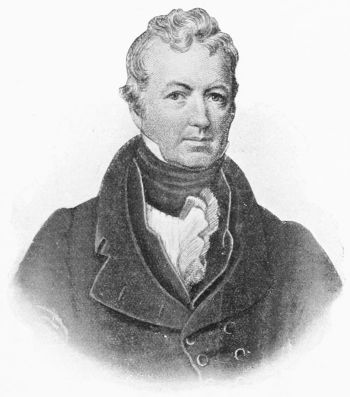
WILLIAM GASTON.