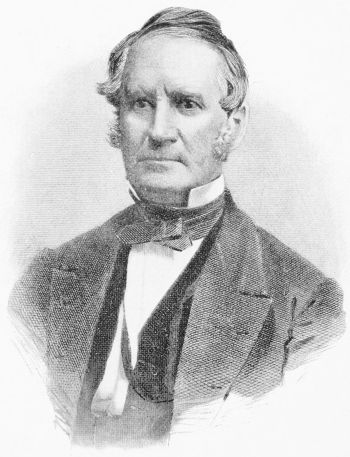
THOMAS BRAGG. BY PULASKI COWPER.
Reading edition
Thomas Bragg was the son of Thomas and Margaret Crossland Bragg, and was born in the town of Warrenton, in Warren county, on the 9th day of November, 1810. His father was a carpenter and contractor, a man of strong will, good judgment, and hard common sense, who devoted the fruits of his labor to the education of a large family of children. John, an older brother of Thomas, was a distinguished judge of Alabama, and a member of Congress from the Mobile District, in 1852, but declined a renomination. General Braxton Bragg, whose military reputation is familiar to the country, was a younger brother. Alexander J. was an architect of high standing in Alabama. Dunbar was a leading merchant in Texas; and William, the youngest brother, died near Chattanooga, July 25, 1863, from wounds received in battle. Mrs. Mary L. Cuthbert, widow of the late James E. Cuthbert, a sister, and the last of the children, died recently in Petersburg, Va.
Thomas Bragg received his preliminary schooling at the Academy in Warrenton and his education was completed at Captain Partridge's Military School, in Middletown, Connecticut, where he remained about two and a half years. Soon after returning from Middletown he commenced the study of law under the late Judge Hall, of Warrenton, one of the judges of the Supreme Court, and, on obtaining his license to practice in the courts of the State, he started out, with a horse and stick gig and fifty dollars, for Jackson, the county-seat of Northampton county, N. C., which place he made his home in the spring of 1833. This was all the assistance he had, but his paying practice was immediate, and he never needed aid from any other quarter.
Shortly after settling in Jackson, Benjamin B. Blume, who was County Attorney, resigned the office and removed to Petersburg, Va., selling his library to the subject of our sketch, who was elected County Attorney, beating his opponent, Colonel Samuel B. Spruill, the office then being worth about five hundred dollars. He was a strong and vigorous prosecuting officer, discharging the duties in strict conformity to his oath, and showing neither favor to a friend nor resentment to an enemy. His execution of the office was so rigid that it affected his popularity; evidence of which was visible, in some quarters, even up to the time he assumed the office of Governor. Upon one occasion, after he had spoken in the prosecution of a citizen of considerable prominence, Mr. B. F. Moore, who was counsel for the defendant, made strictures upon his course, and charged that his zeal was the result more of feeling and spite than of his conceived duties under his oath. He was seen to bow gracefully, but determinedly, to Mr. Moore, as he proceeded with his speech. Immediately after the adjournment of court, a note was borne from him to Mr. Moore by Colonel Spier Whitaker. It was with some difficulty that the matter was settled, but friends interposed, and it was satisfactorily adjusted to both parties; and these men were not formal in their subsequent intercourse, but, on the contrary, their relations were always cordial and friendly. Mr. Moore's strong and feeling speech in the Supreme Court-room, the day after Governor Bragg's funeral, clearly shows this.
It was not long after he had been at the bar when an important case was begun in Hertford county, Beale vs. Askew. It was a suit for damages for libel. A. J. Askew was charged with sending to the Norfolk (Va.) Herald, then edited by Thomas G. Broughton, Esq., a notice of Beale's marriage to a woman in Winton of infamous character. The case was moved to Chowan and tried in Edenton. Bragg and William W. Cherry, then very young men, appeared for Askew, and Judge Augustus Moore and Mr. Kinney, at that time the leading Eastern lawyers, were the opposing counsel. Governor Bragg alluded in his speech to his youth and to his being a stranger as working to his disadvantage before the jury. Mr. Kinney, in his kindest manner, complimented in his speech these young men for their able conduct and management of their case, and predicted their future usefulness and distinction. Mr. Cherry died when quite a young man. He possessed a powerful intellect, and was unquestionably, the most brilliant speaker the East ever had.
On the 4th day of October, 1837, Bragg was united in marriage to Miss Isabella M. Cuthbert, of Petersburg, Va. He first met her in Jackson while on a visit to her sister, Mrs. Starke, whose husband was at that time engaged in business in Jackson. Their associated lives were long and happy, and marked by the most devoted attention on his part, and cemented by a mutual affection and tenderness. She only survived him a few years.
Bragg was a close and hard student. Except when called away on business, he was rarely out of his office; and he left his house at night only when urgent engagements compelled it, which was infrequent. So closely did he confine himself to study and to the full preparation of his cases, and so fully was his time occupied, that he seemed estranged from the community. These seclusive habits, together with strongly drawn party lines, destroyed to a degree that social interchange which a more general intercourse would naturally have engendered. He was not what might be considered a popular man of the town, but his high moral worth and his honorable and commendable course of life accorded him the highest consideration and respect.
His daily course was to smoke his pipe and read his newspapers for about half an hour after breakfast, then repair to his office, which was near to his house and on his lot, read law, and prepare his cases, smoking a good deal of the time, until dinner. After dinner he would devote another half-hour to newspaper-reading and his pipe, and then go to his office, resuming his law studies and duties until late in the evening, when he would either take a ride or a walk with his wife. After supper he would take his smoke and read newspapers, magazines or other literary works until about ten o'clock, his usual bedtime. He rarely read law at night, except sometimes shortly before attending the Supreme Court, when it might be necessary for him to do so to prepare cases for argument there. Such was his regular course of life at Jackson, and he was as regular in it as clockwork. He was not an early riser, usually rising just before breakfast, which was about nine o'clock in winter and about seven in summer. He never slept in the afternoons, and during the warm summer evenings he would occasionally lie down on a lounge, or sofa, which he kept in his office, and read his law books, but he would never take an evening nap. During his two terms as Governor he would, when he had taken his after-dinner smoke, go direct to the executive office, and remain there until late in the evening, and if alone, it was rare for one to enter and find him not engaged in either reading or writing. He was an inveterate smoker, and followed the habit so persistently that he could not relinquish it, and he carried his pipe to his courts as regularly as he did his law books. His constitution was, no doubt, though not perceptibly, affected by it, and the late gifted Dr. Charles E. Johnson, his family physician, was fully impressed that it shortened his life and precipitated the disease of which he died.
Bragg practiced law, regularly, in the Courts of Northampton, Halifax, Hertford, and Gates counties up to the time he became Governor. When employed in special cases, he would attend the courts of Chowan and Washington counties. He had a large and controlling practice, appearing in nearly every important case, yet but twice did his practice amount to four thousand dollars a year, and it was brought to that figure by these special courts, the highest fee being three hundred dollars, which was the largest single fee he ever received before the war. He was a diligent and faithful worker, and a moderate charger. One of his greatest efforts at the bar, before the war, probably, was made in the case of the State vs. Garrett. Garrett was tried for murder in Northampton county, before Judge Bailey, about 1853. He was defended by Bragg and Mr. B. F. Moore, and the case occupied two days in taking the testimony. Both of these gentlemen made strong speeches, but Bragg's speech was particularly strong. He was deeply interested in the case and bestowed much labor upon it. He believed his client not guilty. The State was represented by M. W. Ransom, it being his first appearance as Attorney-General at Northampton court. He was a young man, and, having such able lawyers to confront, much sympathy was felt by the audience in the court room for him. He, however, did not need it. He saw the necessity for the full development of all the tact, brain power, and legal knowledge at his command. During the whole trial he took not a note, and he concluded the argument alike to the astonishment and admiration of the court, jury, and spectators, the very culmination, beyond doubt, of the greatest legal effort of his life. Garrett was convicted of murder, but before the day appointed for his execution he broke jail and was never afterwards captured or heard from.
It is by some supposed, and has been by some remarked, that Bragg developed as a lawyer after the war, and that up to that time he was merely a fair lawyer, with a good local reputation. This is a very great mistake. Though he may not have achieved an extended State reputation, yet he was recognized by the bar of the State as a strong lawyer, and he was accepted before the war by the people of the East as one of the leading, if not the leading, lawyer of that section.
In 1842 he was elected to the Legislature—House of Commons—defeating Thomas J. Gatling, a brother of the inventor of the Gatling gun. In 1844 he was defeated for the Legislature by Judge David A. Barnes, who had just before this come to the Northampton bar and had settled in Jackson. After this he sought no office, but was an active worker in the county political campaigns. In 1844 he was Presidential Elector on the Polk and Dallas ticket for the First District, his opponent being William W. Cherry, Esq., of Bertie county. In 1848 he was again elector for the First District on the Cass and Butler ticket, his opponent being the Hon. Kenneth Rayner, of Hertford county, one of the strongest political speakers of his day, and a man much to be dreaded in debate. At this time Bragg was not widely known in politics, and it was considered by the Whigs that Mr. Rayner would have a "walk-over." Their first meeting was at Rich Square, in Northampton, twelve miles from Jackson. Mr. Rayner's friends in Jackson (and the town was about all Whig) said they were "going out to see Rayner eat Bragg up," but the "eating up" was not done at that time, and they came back not so exhilarated as they went. Mr. Rayner had met his match, and Bragg had fully satisfied his Democratic hearers on that occasion. This campaign was exciting and ably conducted; and after it was ended Mr. Rayner was frequently heard to say that Thomas Bragg was the ablest debater and the strongest opponent he had ever met on the stump.
In 1852 he was again Elector for the Ninth District on the Pierce and King Presidential ticket, his opponent being Hon. David A. Barnes, of Northampton county. Judge Barnes was a ready and effective speaker. They had often crossed political swords. This campaign was marked by courtesy and ability.
In 1854 the Whig party nominated for Governor General Alfred Dockery, of Richmond county, and at that time Governor Bragg's name was prominently mentioned as the Democratic candidate. General Dockery opened his campaign at Gatesville, in Gates county. Bragg was there attending court, and he was called on to reply, which he did very successfully. It is said that he made a speech that much gratified and pleased his party friends. The week following the General spoke at Edenton, during court, and Bragg again replied with equal effect. Soon thereafter the Democratic convention assembled in Raleigh, and Bragg was unanimously nominated for Governor. He accepted this nomination with reluctance, and for a little while considered it. He had a good practice, amounting to about thirty-five hundred dollars a year. His home was comfortable and attractive, and his manner of life was quiet and contented. It was natural that a man thus situated and surrounded, and not beset by the disquietude of political strife and commotion should hesitate before disrupting such congenial associations. Upon reflection, however, he accepted, and when his courts were ended, joined General Dockery, and entered upon one of the most remarkable campaigns ever had in the State. General Dockery had been canvassing without any regular opponent, but the training incident to his having been pitted against some of the best Democratic talent in the State, as he went along, had developed him into a dangerous antagonist even for Bragg. The campaign waxed hotter and hotter, up to the day of the election, and, in all probability, had the election been a month later, Dockery would have been victorious.
An incident of the campaign may afford passing amusement. Dockery, in one of his speeches, had characterized his opponent as the aristocratic candidate, and said that he drove a fine horse, rode in a high sulky, and wore kid gloves. Bragg, in his rejoinder, stated that he was not at all an aristocrat, but only a hard-toiling lawyer, and the son of a plain carpenter, who had exhausted his means in educating his children. "But, fellow-citizens," said he, "General Dockery himself is in fact the aristocratic candidate, for he lives in the only brick house in the whole county of Richmond." At this juncture the General rose right up behind him, and, raising up his hands before the crowd, exclaiming in a loud voice: "Yes, and these old yaller hands made all the bricks that went into it, and toted them up thar, too." The effect was crushing, the crowd yelled, and Bragg was afterwards heard to say he wished he had left the old brick house alone. He defeated Dockery by a majority of two thousand and eighty-five votes, and was inaugurated Governor of North Carolina on the first day of January, 1855.
In 1856 he was again nominated for the second term, his opponent this time being Hon. John A. Gilmer, of Guilford county. Mr. Gilmer had a high reputation both as lawyer and politician. He was looked upon as the strongest man of his party, but Governor Bragg made it at once manifest that he was his equal in this admirably conducted campaign. Being desirous at their first joint discussion to have their positions clearly and correctly put before the people of the State, Governor Bragg carefully prepared a full account of their first meeting, which took place at Murphy, in Cherokee county, and sent it to a friend to be published in the Raleigh Standard. It was known only to his friend and the editor, and so impartially was it done that no one suspected its authorship.
In this campaign with Mr. Gilmer, Governor Bragg, though he confined himself to the record, was quite severe on the course of Mr. Rayner, who had espoused the "Know-Nothing" cause. The published accounts of these references so irritated Mr. Rayner that for a long time bitterness existed, and their intercourse became entirely estranged. During the State Fair of 1858, Mr. Rayner met an intimate friend of the Governor at the corner of Fayetteville street, where stood the old North Carolina Book Store, and said to him: "I have a high regard for Bragg; our estrangement is not well founded, and I desire to renew our former relations." This was told the Governor a few moments afterwards in the executive office, who simply bowed his head, making no reply. That day, seeing Mr. Rayner on the fair grounds, he went straight to him and offered his hand. These men were good friends afterwards.
Governor Bragg defeated Mr. Gilmer by a majority of twelve thousand six hundred and twenty-eight votes, and was the second time inaugurated Governor of North Carolina on the first day of January, 1857.
In his judicial appointments he exercised sound judgment. He was impressed with the belief that young men of promise and of good and studious habits would make the best judges, as they would subject themselves to greater application. Under this view he appointed Jesse G. Shepherd, of Cumberland, and Samuel J. Person, of New Hanover, Judges of the Superior Courts, and they adorned the bench and were among our most efficient judges. In this connection, in 1855, he conferred the appointment of Attorney-General upon Hon. Joseph B. Batchelor, then a young man, and now one of the leading lawyers of the State.
In the fall of 1856, and about the time of the State Fair, the Governors of the Southern States were called to meet in Raleigh to consider such action as might become necessary in the event of Frémont's election to the Presidency of the United States in November following. Governor Wise, of Virginia, Governor Adams, of South Carolina, and Governor Bragg, of North Carolina, were the only Governors present. An informal meeting was held in the parlors at the executive mansion. Among others present were General L. O'B. Branch, Governor Holden, Wesley Jones, A. M. Lewis, M. A. Bledsoe, Joseph A. Engelhard, and Pulaski Cowper. The Raleigh Register, then edited by Major Seaton Gales, a vigorous and ready writer, charged that this meeting of Governors was a step to break up the Union, and was quite severe in its criticisms. Governor Wise was warm and determined in his views, and favored immediate resistance, by fighting in the Union, in the event of Frémont's election, and that his election should be accepted as the overt act. Governor Bragg's position was quite conservative, his views being calmly stated. His sound reason, prudence, and wise counsel produced a deep impression, and was the subject of much favorable comment the next day. Owing to the small number of Governors present, nothing definite was outlined, but this may be characterized as the first secession meeting ever held in the South.
In the Legislature of 1858 Governor Bragg was elected United States Senator. He took a high stand in the Senate, and made a noted speech on the bill providing for the Florida Claims. He also took an active part in the discussion of other important measures of that time.
When the war had commenced, and the State had seceded, he resigned his seat in the Senate and returned to Raleigh. Upon the death of Governor Ellis, which occurred in June, 1861, Hon. Henry T. Clark, of Edgecombe county, by virtue of his office as Speaker of the Senate, became Governor. Governor Clark, under the law giving him power to appoint three persons to act as his military council, appointed Governor Bragg, Colonel Spier Whitaker, and General D. M. Barringer to compose this board. Governor Bragg held this position for only a short time, when he resigned.
Though not openly opposed to the war, and sensible of the just grounds that the South had to resist the unconstitutional encroachments of the North, yet he did not believe the South could establish her independence. He thought the preponderance of the North's population, together with wealth and resources, easy access to aid from the outside world, advantage of retaining the government and its possession of the entire navy, were too great odds against us. He saw that the spirit of our people was too high, their determination of resistance too united to take kindly any suggestions of doubt or difficulty. He therefore kept his opinions within his own breast. He said to a friend on his front porch, in July, 1861: "Our people are excited, and do not consider, I fear, the strength of the enemy; they look upon it as an easy job, and they believe the war will soon be over; but, in my opinion, it will be of long duration, and hotly contested on both sides. When our ports are blockaded and the gunboats come up our rivers, as will be the case, and our people encounter the hardships that will follow, I fear their spirits will weaken and dissension will come. I do not think we will succeed; but I will say this only to you." Continuing, he said: "I shall do all in my power to secure our success. I will stand by the old State, and if the worst shall ultimately come, as I very much fear, I will go down with her, and when all is over I will do what I can to save what is left of her."
After the removal of the Confederate Government to Richmond, Va., Mr. Davis, in 1863, tendered to him the position of Attorney-General of the Confederate States, which he accepted. He held this high office but a few months, when he resigned. Some speculation obtained as to the cause of his early retirement. Suffice it to say, that his reasons for doing so were cogent and well-founded, as all of his conclusions were. They were of a private nature, and need not be related in this sketch.
Upon his acceptance of the place of Attorney-General he rented out his residence in Raleigh and removed his family to Petersburg, Va. In the spring of 1864 he returned with his family to Raleigh, where he was residing when the war ended.
The conclusion of the war found him, like a large number of the people of the South, wasted in substance, without means or prospects, and bereft of all save a shelter from the winds and the cold. He was reluctant to return to the practice of the law, and had determined not to again resume it. He had been out of the practice from 1855 to 1865, and had entirely neglected its study during that time. He said he was rusty, and had about forgotten all the law he ever knew, and nothing but a dependent family could induce him to take it up again. He did resume it, and gave to it his former labor and endurance, and the eminence and success he attained is well known to the bar and people of the State.
Beyond doubt the greatest forensic effort of Governor Bragg's life was his speech in the Johnston will case tried before Judge A. S. Merrimon, at Edenton, in February, 1867. Probably so large and able an array of counsel was never before engaged in any suit in North Carolina. The late Mr. James C. Johnston, the wealthiest man in the State, had devised his estate to the late Mr. Edward Wood and his (Mr. Johnston's) three overseers, neither of whom were related to him. The next of kin sought to break the will, alleging mental disqualification. The case occupied twenty-three days in the trial, and the best legal talent in the State was engaged in it. The attorneys representing the will were B. F. Moore, W. N. H. Smith, R. R. Heath, H. A. Gilliam, P. H. Winston, Edward Conigland, John Pool, and T. H. Gilliam; those representing the contestants were Bragg, Graham, Vance, Augustus Moore, William Eaton, James W. Hinton, of Norfolk, Va., and William F. Martin. Governor Bragg was the leader on his side, and Mr. Moore was the leader on the opposite side. Dr. Hammond, of New York, the distinguished specialist, was introduced as a witness, and presented as an expert to show the want of mental capacity of the testator. His examination, by the counsel of both sides, was most searching, and it is said that his cross-examination by Mr. B. F. Moore was as fine, if not the finest, professional work of the kind ever done in the State. Judge Merrimon presided with great ability, patience and impartiality, and well sustained the high reputation he had for being one of our ablest Superior Court Judges; Governor Bragg spoke seven hours, making the greatest speech of his life before a jury. Chief Justice Merrimon, referring to this speech, said: "Upon an issue of fact it was the strongest speech I ever heard." Judge Gilliam said: "Governor Bragg was at his greatest (he was a very great man), and by his ability and his preëminent tact in the management of his side of the case for a long time put in peril the integrity of a will which should never have been questioned." The will was established. An appeal was taken to the Supreme Court, but the decision of the court below was affirmed.
The habeas corpus cases in 1870 are well remembered. The history of those times and the incidents arising have not been forgotten by the people of the State. That the great writ of habeas corpus, issuing from a properly constituted authority, should have been entirely disregarded, was a blow at the rights of the individual and a significant stride towards executive usurpation and the overthrow of the rule of law. That there should be no presumption of innocence until the contrary was shown, and that the surest and quickest avenue of establishing innocence of crime should have been obstructed by a usurped military despotism, betokened that the liberty of the citizen was fast vanishing, and he was soon to become helpless indeed. Governor Bragg was among the foremost in vindicating the law and in maintaining and preserving its supremacy. He made a strong appeal for the defense of right and justice, and protested, in burning eloquence, against the least infringement of the citizen's security, so watchfully guarded by the Constitution. His memorable words are engraven in the hearts of the people.
While Governor Bragg was making his forcible appeal for constitutional law and liberty, the late venerable Judge Battle was listening with marked interest and attention. As the speaker extolled the past lustre of North Carolina for the maintenance of law and liberty, and contrasted her former power and renown with the impending destruction of her people's highest privilege and greatest boon—their mighty writ of right and safety—the brightest jewel that ever decked the vesture of the English law—heeded for centuries, and ever granted when fitly craved—this eminent and pure judge, thoughtful of his State's honor, could not restrain his emotion, and tears trickled down his whitened cheeks. When the speech was concluded Judge Battle said that it was the most eloquent and powerful argument he had ever heard in that court room. This was a compliment indeed; because, with honorable distinction, for many years, he had sat upon the bench of that high Court, and had heard the arguments of the State's brightest legal luminaries, whose broad intellectualism was the wonder and the admiration of the time, and whose lives and reputations have done so much to mould and to make the Court's past and present history.
The last great effort of Governor Bragg was in the Holden impeachment trial, the history of which is fresh in recollection. He appeared for the State, and pressed with fervor the impeachment. He made a long, close, and exhaustive argument, was listened to with the deepest and most marked attention, and his speech was considered by many among the best of his life. When he concluded Mr. Conigland, one of Governor Holden's counsel, walked over to where he sat, and, taking his hand, said: "Governor, you have made a grand speech, but it does not equal your Johnston will speech." Mr. Paul C. Cameron, who was his schoolmate and drillmaster at Captain Partridge's military school, a man ripe in years, and yet riper in intellect, judgment, and learning, said that he had observed Governor Bragg from his early manhood to his death, and he had never known any one who had better sustained himself before the people in every capacity; and that though he was confronted in this trial by the strongest lawyers in the State, whose reputations were without limit, he considered that his speech was the most complete and exhaustive of any delivered on that occasion. General Thomas L. Clingman, a statesman of the old school, pronounced this speech as "overwhelming and unanswerable."
Governor Bragg was a well-fledged and thorough lawyer, and he made himself so by constant application and close study. He was a man of vigorous intellect and strong common sense. He was one among the few lawyers who studied thoroughly his adversary's case and anticipated the points he would most likely present, and was generally ready to meet and combat them. In conducting the examination of a witness he exhibited great tact and skill. This faculty of cross-examination, so effective in conducting suits, was a potent element in his practice, and gave him no little advantage in the trial of cases.
He was an open and frank practitioner, never taking a "nigh cut," but was just and magnanimous, and was possessed of the confidence and esteem of the profession throughout the State. He was as well-rounded a lawyer as the State ever had.
Just thirteen months prior to his death he associated with him Judge George V. Strong, a leading lawyer of the Goldsboro bar. This was an able combination, and promised the utmost success, for during the term of their connection their practice amounted to over nineteen thousand dollars.
Probably no two men were more generally pitted against each other in the courts which they attended than Governor Bragg and the late Chief Justice Smith. Their style of speaking was different. Governor Bragg's was simple, strong, and engaging; Judge Smith's was easy, forceful and very fluent. Their temperaments were also diverse. If an important case went adversely to Governor Bragg he dismissed it from his mind, and was not depressed about it; but Judge Smith was for the time keenly sensitive, and took to heart the loss of his case. Their intercourse, however, notwithstanding these frequent conflicts, was genial and their friendship true; but Judge Smith accepted it not graciously that Governor Bragg should have come down into his district and taken part against him in his campaign for Congress against Doctor Shaw. In a previous campaign with Colonel Outlaw, Doctor Shaw did not feel that Governor Bragg, who then resided in the district, had taken a sufficiently active part in his behalf, and being now hard pressed by Judge Smith, and the party needing all help at hand, Governor Bragg yielded to the general request and made several speeches in the district. But this spasmodic feeling soon vanished, this circumstance was forgotten, and these men left behind them lives alike well spent and distinguished and memories equally honored and revered.
When the Holden impeachment trial took place Governor Bragg had begun to fail, but not very perceptibly. The severe struggle, mental and physical, which he underwent during that trial hastened his end. He began soon after its conclusion rapidly to decline, and it was visible to all that his "last of earth" was fast approaching. It was painful to see the pallor of his countenance increase day by day, but he did not give up and it may be said that he worked in the harness up to his death.
On Friday, the 19th of January, 1872, he took his bed, never again to arise from it. He knew he was going to die, but he was calm and composed, exhibiting not the slightest fear of death. He said: "For the benefit of my family I would like to live ten years longer, but apart from that the matter of death gives me no concern."
His will was in his own handwriting, and in these words: "I give and bequeath to my wife, Isabella M. Bragg, all my real and personal estate of every description whatsoever. She knows my wishes, and I know she will carry them out." He was kept alive for a day or two with whiskey and gruel, and when this was given to him he would ask, "How much whiskey, and how much gruel?" Being told, he said, "You see the whiskey predominates. This is done to keep me alive for a little while, when I know I cannot live. I do not want it done. There is no use in keeping me alive in this way and giving you all the trouble of waiting on me. I protest against it."
On the evening before he died the door-bell rang. He saw his friend Mr. Cowper go to the door, and on his return he asked who it was, and being told that it was Governor Graham, said: "I have a high regard for him, and I regret very much that he was not asked in. I want you to go down to his room and tell him I am very sorry he was not brought in to see me, and that I should be pleased to see him." Governor Graham was much impressed and deeply moved when the message was delivered to him.
On Saturday evening he called his family to his bedside, and in beautiful language of wisdom gave them counsel and advice. In the midst of sorrow which such a solemn occasion would naturally bring, his eye was not moistened, his voice did not falter, and as calmly as if he were going on a short journey, he imparted to them words of advice "like apples of gold in pictures of silver." "My children," said he, "I wish to impress one thing upon you: always stand together, comfort and assist each other, consider that no necessity can arise by which you could feel justified in raising a hand or uttering a word one against the other."
Shortly before his death he uttered these words: "I have no doubt that I have my sins and transgressions to account for. All men must so account. I have endeavored to lead an exemplary life. I have never seen the time that I felt I could be induced, through fear, favor, affection, reward, or the hope of reward, to do otherwise than my conscience would dictate to me as right and proper. The future has always been to me, and is now, a deep, dark mystery."
A little while before day on Sunday morning, while resting quietly, but not sleeping, he heard the sound of wood being put on the fire in the adjoining room, and remarked: "It must be near day; I hear them making a fire in the next room." A few minutes after this he straightened himself in bed, placed his head on a line with his body, folded his arms across his breast, and in a little while was dead. It was on Sunday morning, January 21, 1872, about the hour of five o'clock, that he thus peacefully passed away in the sixty-second year of his age. He left a wife and seven children—three sons and four daughters. The wife and two sons have since "passed over the river" and entered the vale of the future and into the "deep, dark mystery."
He was buried the next day in Oakwood Cemetery, near the city of Raleigh. Both Houses of the Legislature and the Superior Court of Wake, then in session, adjourned for the day, and all the business houses of the city closed their doors to show their respect for his character and worth. On the following day a large meeting was held in the Supreme Court-room to do further honor to the life and services of the distinguished dead.
He was a man of kind heart, tender sympathies and noble impulses; a devoted husband and an indulgent father; and though he was not demonstrative, yet his friendship was valuable, because it was consistent and true. He was as true a man as ever trod the soil of his native land.
The younger members of the bar will recall with pleasure his courteous bearing to them, the delight it seemed to give him to render them assistance, and the painstaking aid he would bestow when his legal advice was solicited. The older members will long remember his quiet and dignified demeanor, his social intercourse, his manliness of character and his integrity, merit and worth.
He possessed those qualities which adorn and elevate society and exalt and ennoble human character. He has left a high and noble name, a reputation unspotted and untarnished—a priceless legacy to his posterity, and an enduring heritage to his State and country. It will not be dimmed as time proceeds.
The account of the discussion at Murphy, Cherokee county, previously referred to, is reproduced, and appended hereto, as interesting matter, showing the impartiality with which it was done, and calling to mind some of the issues of former and better days. This was Mr. Gilmer's first appointment, and Governor Bragg, seeing it announced in the Raleigh Register, went there to meet him. Desiring to put him on record, and have the East apprised of his position, he wrote the account of the discussion as given in the Standard of May, 1856, and sent it to the writer to deliver to Mr. Holden, with request that no intimation be given as to the writer of the article. No mention of this was made until after Governor Bragg's death, and upon the publication of this sketch.
The Bragg and Dockery campaign closed on the day of election at Murphy in August, 1854, and the Bragg and Gilmer campaign opened there in May, 1856.
ACCOUNT OF A POLITICAL DISCUSSION. (From the North Carolina Standard of May, 1856).
Murphy, Cherokee Co., May 9, 1856.
Editors of the North Carolina Standard.
Gentlemen:—The discussion between the gubernatorial candidates opened here yesterday, and I propose to give you the points made and the substance of what was said on that occasion. There were probably two hundred persons present, and there would have been more had it been generally known that both candidates would be present. Until Governor Bragg arrived it was doubted whether he would attend, as the Standard announcing his intention to do so did not reach us until the day of his arrival.
Mr. Gilmer opened the discussion by informing the people that his name was John A. Gilmer—that he was a candidate for the office of Governor, and had come among them for the purpose of presenting his claims for their suffrages. He said he had found the country beautiful and romantic far beyond his expectations—never having before been on this side the mountains—and that when he was in the Legislature he voted for the measures introduced for their relief and for the improvement of their section.
He said that a short time ago he had no intention of becoming a candidate—that he had not now, nor ever had, any political ambition, but that he had listened to the importunities of friends, and had yielded rather to feeling than to his better judgment.
He said the organ of the party to which his opponent belonged had said that he had a bad political record, and it had referred to many of his votes and addresses to show that he was a Western man. Well, he was ready to defend these votes and addresses; they were brought forward to injure him in the East. He was then justified in making an appeal to the people of the West to sustain him as a Western man. First, he was charged with having voted to distribute the school fund according to white instead of federal population. He said it was true and asked if he had not done right in so doing. He referred to the first law introduced and passed under the auspices of Bartlett Yancey, Esq., to raise the fund and distribute it among the white children of the State. In 1838-'39 it was submitted to the people and accepted on that basis. In 1842, when the Democrats got into power, they altered the law to the federal basis, the effect of which was to give to a child in the East five or six times as much as to one in the West. This was unjust, and was a violation of the original agreement upon which the fund was raised. He further said that had Western men been true to themselves, Governor Reid never could have been elected, occupying the position he did upon this question; that party was allowed to overcome their rights and true interests; for, taking the counties favoring the present mode of distributing the fund and those against it, there would be found a majority of fourteen or fifteen thousand in the latter. In the vote he had given he had carried out the will of his constituents, and he put it to them to say if it was fair to charge him with being a Western man with a view to injure him. He hoped, if such was the case, the West would stand by him. Next, as to free suffrage. He had been charged with being opposed to that. This was not true. He was always for it, provided it could be passed in a proper manner and with such guards and qualifications as, in his opinion, ought to go with it. He preferred a convention. He could not see why the West was disturbed on that question, willing as she was to go into convention on the federal basis. There all things could be settled. They could elect their justices of the peace by the people, and establish cheap justices' courts for the trial of petty offenses, and thus keep them from the courts; that it was important that justices should be elected by the people, as they laid the county taxes.
He said he voted against the present free-suffrage bill because there was no provision in it to prevent the undue taxation of land; that the Senate, as now constituted, was a check on such taxation; but, abolish the freehold qualification for voters, and where would the check be; that he had offered an amendment himself which, had it passed, he would have voted for the bill, and waived his objection to the legislative mode of amendment; that the object of this amendment was to provide simply a protection to lands by requiring land, the slave poll and white poll to be taxed alike; that, in his opinion, something ought to be adopted to protect the landholder.
He said that the Standard had called him the "shin-plaster candidate." It was true that his face appeared upon the bills of a small bank in his town, but he was in no way concerned in the same, and had no interest in the institution. He was, however, opposed to the law, and would make war upon any law which undertook to do away with small notes. Why take away small notes, the only currency which a poor man could get? The rich could get large bills, but they were beyond the reach of a poor man. (Here Mr. Gilmer entered into a rather elaborate argument to sustain the policy of small banknotes, and read the Bank Note Reporter and other authorities to show that true policy required their free circulation, and that the worst consequences had followed their discontinuance in some of the States.)
He next shadowed forth a project for a new bank, to be owned in part by the State and part by individuals. For every one hundred dollars the State owns in railroad stock he would have her own a like amount in stock in the bank, and the same as to individuals; something was said also as to State bonds forming a part of the basis, but the writer did not clearly catch the idea.
It was insisted, however, by Mr. Gilmer, that such a bank would be very profitable, and that the State would realize enough from the profits to pay the interest of the State debt, and relieve the people from taxation; and the plan was, he said, for the bank to issue mostly one and two dollar notes for currency, as in South Carolina.
He was, too, in favor of having our State bonds, and the interest on the same, payable in North Carolina, and not in New York, and thus keeping the money of our people at home. He said the national debt of England, being due to her own people, strengthened her, while ours acted as a continual drain to pay interest in New York.
After speaking one and a half hours, Mr. Gilmer said he desired, before he closed, to say something on Federal politics, and the principles of the American party, of which he was a candidate.
He said when Mr. Fillmore left the Presidency all was quiet. He had approved of the Compromise measures; and when Boston had rebelled against the fugitive-slave law, he declared he would enforce the law or burn the city, and it was enforced. We had extremists at both ends of the Union. Formerly, the Nashville Convention said the Union should be dissolved unless the Missouri Compromise line should be adopted. Now, the black Republicans said it should be dissolved unless it was restored.
Mr. Fillmore, in his message, said the existing laws were a finality on the subject of slavery—both the great parties said so in 1852, and agreed to abide by it. Did they do it? No; hence the troubles we now have. He had no doubt but that Mr. Pierce had acted honestly, but he had appointed freesoilers from the North and fire-eaters from the South, in order to reconcile all; but this had not been the result, and the country could only be saved by the honest men of both parties. He, therefore, advocated the principles of the American party—that Americans should rule America—that the influence of foreigners was great—that it gave the North a preponderating increase of population—that it ought to be checked, and that foreigners ought to remain here twenty-one years before voting, and that Catholics who owed allegiance to the Pope ought not to be allowed to hold office; that no one could insist that this was persecution; that the charge that it was was false and unfounded, and it was known to be so.
He then asked who was the founder of the American party. Said it was George Washington, and read from several of his letters to show it. He also read from a speech of Mr. Buchanan as to foreign influence, etc., and, after justifying the course of his party as to the Catholics, he closed, having spoken two hours and ten minutes.
Governor Bragg arose, and said: Two years ago this summer he closed the canvass with his then competitor. It had pleased a majority of the people of the State to elect him Governor. He had acted as such since the first of January, 1855. He had endeavored to discharge all his duties faithfully. The people, however, would be the judges of that. He would say, however, that he was not aware of any charges against him for not doing so; and if there was no just ground for complaint, then he submitted to all fair-minded men whether he had not now some right to ask at their hands a liberal and generous support in the present contest.
He said he concurred with Mr. Gilmer as to the beauty and fertility of their country, and as to what he had said in relation to its improvement, and hoped to see the day when its now comparatively hidden and locked up resources would be laid open and developed.
He said that he was surprised to hear his competitor to-day enter into the discussion of some matters which he had not supposed would be brought into this canvass, and he was still more surprised to see the manner in which he had treated them. His competitor complained that the Standard had assailed him for his vote some years ago as to the distribution of the school fund. This was a mistake. The Standard had never, to his knowledge referred to it at all. It may have been done in some other paper, but his competitor would find, as he had done in a former contest, that it was useless to notice attacks of that kind. If he did, he would have his hands full. But, from the course of his competitor, he rather thought he was availing himself of this matter to get votes in this section. He had made an elaborate argument to show the gross injustice of the present mode of distributing the school-fund, and had undertaken to show that the Democratic party was responsible for it; that the original pledge for distributing the fund had been violated; that the West had not been true to her own interests, or she would have defeated Governor Reid; and he had made a strong appeal to the people here as a Western man.
Now, said Mr. Bragg, I claim not your support either as an Eastern man or a Western man, but as one who intends to discard all sectional questions, looking to the interests and wishes of the whole State. But Mr. Gilmer is in error as to one thing—the fund chiefly for common schools was not raised by Mr. Yancey's bill, but came from the General Government as part of the surplus revenue under General Jackson's administration. Nor did the Democrats of 1842 introduce the present mode of distribution by a repeal of any other law, but it was done before that time—it was not a party vote, but it was one about which there was difference of opinion and contest without the slightest regard to party. Time and again the matter was brought before the Legislature, but for several years past the question had ceased to be raised. It was considered as settled. In the last contest it was so considered between him and his competitor, and he regretted that Mr. Gilmer had deemed it proper to reopen it. It would do no good; it would again lead to sectional strife; it would retard the public improvements of the State, and nothing practical would come of it, because experience had shown that it could not be changed. It would even injure the common schools which were now doing well and improving under the efficient management of our State Superintendent. Governor Bragg said that he had no wish to conceal his own opinions on this subject. He was against disturbing the matter. He would say so in the West; he would say so in the East. And now, said he, turning to Mr. Gilmer, I want my competitor to state his position. He has said a great deal about the matter, but has not told you what he will recommend in case he should be elected.
(At first Mr. Gilmer declined to answer, but before the discussion closed he said that the opinions advanced by him were his private opinions; but if elected Governor he would not recommend any change, but would acquiesce in the present law, whatever his own opinions might be.)
Then, said Governor Bragg, there is practically no difference between us. But my competitor makes a public argument in order to express his private opinions, and makes it in such a way as he thinks will get him votes here. I hope, said Governor Bragg, he will take the same course all over the State.
As to free suffrage, Governor Bragg said that his competitor professed to be a great free-suffrage man, but somehow always voted against it. Formerly, we were told that it was wrong to pass it by the Legislature; that it must be done by a convention. That was the objection two years ago. He had then told the people that it was idle to talk about a convention; that the action of the several Legislatures for years past had shown it to be so; that we must take things as they are, and act accordingly. Now he would remind the people of what he said, and would ask if it was not true, for, if they would examine the journals of the last General Assembly, they would find that the convention bill, when offered in the Senate, received the votes only of some sixteen out of the fifty members, and in the House of Commons never received, in any of the different shapes in which it was offered, more than forty out of one hundred and twenty members, thus showing, conclusively, that there was a large majority—two to one—against a convention in the Commons, in which house the West has a majority opposed to the call of a convention; whilst upon the passage, in the same House, of the free-suffrage bill, there were only fifteen votes against it, the members from Cherokee and most of the mountain counties who had voted for a convention voting for the bill. But his competitor, as already stated, had in every case voted against the bill, and says he is yet against it, unless an amendment offered by him, or some other, could be adopted; and, as that cannot be done now, the bill having passed through one Legislature, and to amend it would be to destroy it, of course his competitor was opposed to it. Governor Bragg said that the opponents of this measure were always finding some objection to it. First, it was to be done by an open convention, then by a restricted convention, and now it seems his competitor falls back upon an old objection always urged by those in favor of keeping things as they are, that there is danger that the landed interest would be burdened unduly with taxes. This was altogether chimerical—such had not been the case in other States. It was the largest and most powerful interest in the State, and members of the Assembly could not do such a thing and sustain themselves at home. Nor was it likely they ever would attempt it, inasmuch as they themselves must be landholders, and would suffer as well as other land proprietors. The thing was preposterous. Let the freemen of the State, then, be true to themselves, and the measure would be passed. But let them be on their guard. Every effort will be made by open enemies and pretended friends to defeat it.
As to the tempting bait held out to them of having cheap courts and trials of petty offenses before justices of the peace, and thus keeping such matters out of court, no one know better than Mr. Gilmer that the Legislature had power to do that without a convention; and if he thought it expedient, he ought to have done it when in the Legislature.
As to Mr. Gilmer's bank notions, in relation to which he wished to know Governor Bragg's opinion, he, Governor Bragg, stated he should have it whenever he would set them out with such plainness as to enable him to see what they were.
His competitor made brave promises, however, to the people that it would pay the interest on the State debt, and save them from taxation. He would say this—he did not believe that interest, debts, and taxes could be paid by any such legislative hocus pocus. As to small notes, the Governor said that the matter was not one of a party character; that he had no wish to follow Mr. Gilmer into that discussion, as it would consume all his time, and he much preferred to discuss what the Know-Nothing platform called the "Paramount Principles of Americanism"; and he would proceed to that after saying a word as to Mr. Gilmer's idea that our State bonds and the interest thereon should all be payable in North Carolina. Had he seen as much of this matter as I have done, said Governor Bragg, since I went into office, he would change his opinion. He said it would all be well enough to have our bonds paid here, if they could be sold here in sufficient quantities. But our public works would have stopped had they depended on sales in North Carolina, and our Treasurer and railroad presidents would tell him so; and moreover, that bonds payable here could not be sold in New York.
The Legislature had not taken the view of his competitor, and he thought they had acted wisely.
Governor Bragg said that he thought that the allusion of Mr. Gilmer to Mr. Fillmore and his execution of the fugitive-slave law was exceedingly unfortunate. In that case the negroes were allowed to be taken away from the United States authorities and carried off. In the case of Mr. Pierce, Anthony Burns, by the aid of the whole power of the Government was returned to his owner.
His competitor talked a great deal about the peace and quiet of Mr. Fillmore's administration, and charges Black Republicans and Democrats with causing all the excitement and danger of the existing troubles, and he stands upon a platform, said Governor Bragg, which denounces the administration for having recklessly and unwisely repealed the Missouri Compromise—a pretty platform for a Southern man to stand upon, especially when adopted in place of that of the year before. He read from the speech of Mr. Badger to show that all the Whig Senators from the South supported the Kansas-Nebraska Bill, except one, and that the measure was passed by Northern and Southern Democrats and Southern Whigs, and that Mr. Badger said it was right and proper that it should pass.
Governor Bragg then gave the history of the Missouri Compromise line—showed how unjust it was to the South originally, that the South had, however, shown every disposition to abide by it, and had time and again sought to have it extended over the new territory to the Pacific, while the North repudiated that line. The South was, therefore, not properly chargeable with any breach of faith, and was right to get rid of the odious act. Now, he said, there were questions of vital importance growing out of that matter, and he wished to know where our Know-Nothing opponents stood with regard to them. But no one could tell. What was Mr. Fillmore's opinion upon any one of these questions? Nobody knew. He had said nothing while at home, and at the last accounts, strange as it might seem to Know-Nothing ears, he was in the city of Rome partaking of the hospitalities of the Pope. When the matter is pressed, we are told that the party eschews all sectional questions, state and national, in order that the "Paramount Principles of Americanism" may have full play, thus raising the question only, who shall hold the offices of the country, and not, in what manner our government shall be administered. Can it be possible, said Governor Bragg, that the people will be thus humbugged and trifled with when the country is in danger?
Governor Bragg said he would then examine the claims of this new party. He went into a full examination of its principles; stated what had been its history North and South; what had been its fruits in different sections; how it sent nothing but abolitionists and freesoilers to Congress, and challenged his competitor to point to one solitary Northern national man of his party in either house of Congress; gave the history of the election of Speaker of the House of Representatives, and how not one of them voted for Aiken when the contest was between him and Banks, although five of them had voted for him the day before, including their candidate Fuller.
He then examined into its origin, and traced out the machinery of the whole thing; showed that it was a monstrous attempt to subvert the plan of government adopted by our fathers, and to substitute in its stead these worse than midnight Jacobin clubs. But I am unable to follow the Governor through this part of his speech without too much prolixity.
He exposed their constitutions, rituals, obligations and oaths, some of which he read. Said they had been hunted from their dark places in this State, and now profess to have done away with all this—how and in what way does not appear—while at the North these councils, as appears from their last national platform, are still kept up.
He concluded by saying that such a party did not deserve support of a free people, nor did he believe they would receive it. He was willing to go before the people of North Carolina on this subject, and should do so confident of success.
Mr. Cowper himself selected Governor Bragg's account of the discussion above given as illustrative of his judicial fairness of mind, and I have adopted it for all purposes. Of course there is nothing in it to show Bragg's strength of intellect. The discussion as reported is interesting, however, as a side-light on those times.
Bragg was essentially a lawyer. His practical sagacity and hard common sense, however, as well as his wide political reading, made him a success both in politics and law, a rare combination.
His speech in the Holden impeachment would give a better idea of his talents, but it is too long for the scope of this work; and all the facts and speeches of every trial should be published together in justice to the accused.
This sketch was written in 1891, and is here given in a slightly abbreviated form.
WILLIAM A. GRAHAM.