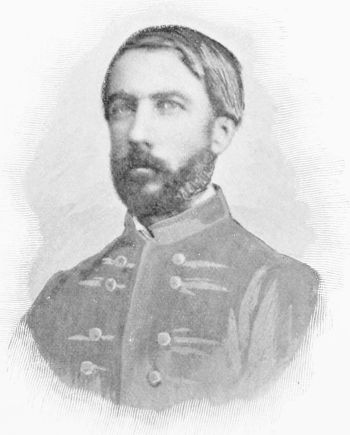
BRYAN GRIMES. BY H. A. LONDON.
Reading edition
Bryan Grimes, a Major-General in the provisional army of the Confederate States, was born on the 2d day of November, 1828, at Grimesland, in the county of Pitt, about eight miles from the town of Washington, N. C., and was the youngest child of Bryan and Nancy Grimes. He received a good academic education—having been a pupil of the late William Bingham, Sr., and graduated at the University of North Carolina in June, 1848. For his alma mater he always cherished a fond remembrance, and the last letter written by him on the day of his death was one ordering an oil portrait of himself to be sent to the Philanthropic Society, in accordance with a request made therefor by that body. Soon after graduating, his father gave him a valuable plantation in Pitt county, whereon he resided until the time of his death, with the exception of the four years during which he was in the Confederate army. On the 9th of April, 1851, he was married to Miss Elizabeth Hilliard, daughter of Dr. Thomas Davis, of Franklin county, who died in November, 1857. The only surviving issue of this marriage is the wife of S. F. Mordecai, Esq., of the Raleigh bar. In 1860 he made a visit to Europe, but returned home soon after Lincoln's election, and, at the first mutterings of the approaching storm he became deeply interested in the movements of the Southern States. As soon as he heard of the bombardment of Fort Sumter he hastened to the scene of conflict, but arrived after its surrender. Thence he visited Pensacola, which was then threatened with an attack, and then went on to New Orleans, returning home early in the month of May to find that, during his absence, his friends had nominated him as a candidate for a seat in the State Convention, and to which he was elected without opposition. That body is known as the "Secession Convention," and was the most remarkable—composed of the ablest men—ever assembled in North Carolina. The ordinance of secession was signed on the ever-memorable 20th of May, and, in a few days thereafter, General Grimes, feeling that duty called him to the tented field, resigned his seat in the Convention and accepted the appointment of Major of the Fourth Regiment of State Troops, then organizing at Garysburg. He was also, at the same time, offered by Governor Ellis the positions of Lieutenant-Colonel of the Eighth Regiment and Major of the Second Regiment of Cavalry, but he declined these offers because he felt his deficiency in the knowledge of military tactics (never having had any military training whatsoever), and wished to have the benefit of the military knowledge and experience of the Colonel of the Fourth Regiment, George B. Anderson, who was a graduate of West Point, and one of the best officers of the old army. Without delay he joined his regiment at Garysburg, where it remained drilling until ordered to Richmond, and arrived at Manassas only a few days after the victory at that place. During the remainder of the year and until March, 1862, his regiment was stationed near Manassas, and he was in command of it most of that period, as Colonel Anderson had been appointed commandant of the post at Manassas.
On the 1st of May, Major Grimes was appointed Lieutenant-Colonel of his regiment, and a night or two thereafter, when Yorktown was evacuated, he was assigned the very responsible position of commander of the picket line, with instructions to keep up, as usual, the firing throughout the night and retire about dawn, which perilous duty was most successfully and gallantly performed. At the battle of Williamsburg, on the 5th of May, the Fourth Regiment was only slightly engaged, and was commanded by Lieutenant-Colonel Grimes, as Colonel Anderson was commanding the brigade. But soon thereafter, on the 31st of May, at Seven Pines, that gallant regiment received its baptism of fire—the most bloody ever recorded. Lieutenant-Colonel Grimes led his regiment into that battle with twenty-five officers and five hundred and twenty non-commissioned officers and privates, and out of that number every officer, except himself, and four hundred and sixty-two men, were either killed or wounded. Such carnage is almost unparalleled in the annals of war, and seems incredible! In this battle the escape of Colonel Grimes seems miraculous. He acted with a bravery that rendered him conspicuous even in such a band of heroes. In attacking the enemy's fortifications his horse's head was blown off by a cannon ball, and the horse fell so suddenly as to catch his foot and leg under it. While in this position the regiment, thinking that he was killed, began to waver, when he, pinned to the ground by the dead horse, waved his sword and shouted, "Forward! Forward!" whereupon some of the men came to his assistance and pulled the horse off, and thus freed, he sprang to his feet, seized the flag of the regiment that was lying on the ground (the color-bearer and all the color-guard having been killed or wounded), and rushing forward, called upon his men to charge, which they did most gallantly, and captured the fortifications. Most nobly did the gallant Grimes, in this bloody charge, prove himself the worthy leader of such heroes! On the 19th of June, 1862, he was appointed Colonel of his regiment, Colonel Anderson having received his commission as Brigadier-General. The next battle in which Colonel Grimes was engaged was at Mechanicsville, on the 26th of June, where, with no officers and a mere handful of men, his regiment rendered most efficient service, and where he had another horse killed under him. After this battle Colonel Grimes, with his regiment, was detailed by General D. H. Hill to take charge of the captured stores and prisoners and report with them at Richmond. General Anderson protested against this, paying Colonel Grimes the high compliment of saying "Although small in numbers, Colonel Grimes' regiment is the key-stone of my brigade."
After remaining around Richmond until the middle of July, he was seized with typhoid fever and returned to Raleigh until he recovered. He rejoined his command in time to take part in the first Maryland campaign and the battles previous to the crossing of the Potomac. When crossing the Potomac, on the 5th of September, he received a very severe hurt upon the leg from the kick of a horse, causing a permanent indentation of the bone, and rendering him incapable for several days of walking or riding horseback. On the 14th of September was fought the bloody battle of Boonsboro, where Colonel Grimes, although really unfit for duty, again acted with conspicuous courage and had another horse killed under him; and just here it may be proper to mention that altogether during the war he had seven horses shot under him in battle. The exertions of the day exhausted him and rendered his injured leg so much worse that General Anderson insisted upon his being carried to a hospital in the rear, where amputation was seriously talked of. His injury incapacitated him for further service until November, when he was assigned to the temporary command of General Anderson's Brigade, that officer having been mortally wounded on the 17th of September, at Sharpsburg. Colonel Grimes commanded this brigade at the battle of Fredericksburg with much skill and judgment, and remained in command until February, when he was relieved by Brigadier-General Ramseur. During the remainder of the winter and until the opening of the campaign in May, Colonel Grimes diligently drilled his regiment until it became noted for its proficiency in military tactics and soldierly discipline.
During the next campaign Colonel Grimes and his regiment passed through a most fiery ordeal and nobly sustained their well-won reputation. On the 1st of May, 1863, began the battles around Chancellorsville. In the first day's fight Colonel Grimes' Regiment and a Mississippi regiment were detailed "to feel" the enemy, which they did in gallant style, driving everything before them until the main body of Hooker's army was reached. General Jackson himself accompanied Colonel Grimes in this movement, and when much resistance was shown by the enemy, would say, in suppressed tones: "Press them, Colonel." On the second day Colonel Grimes and his regiment took an active part in routing Sigel's Corps, and on the third day an incident occurred that deserves special mention. On the morning of the 3d of May General Ramseur's Brigade, having borne the brunt of the fights of the two previous days, was held in reserve to support other troops who were to take the advance. The brigade rested just in rear of a ... brigade of previous good reputation, which occupied the breastworks captured the day before by Ramseur's Brigade. A staff officer of General J. E. B. Stuart rode up to the officer in command of the ... brigade and gave orders to advance and charge the enemy, General Ramseur and Colonel Grimes standing near by and hearing the order given. The ... officer declined to move forward, whereupon General Ramseur said to the staff officer, "Give me the order, and I will charge." He was then told to make the charge. He and Colonel Grimes hurried back to their troops, and, at the command "Forward!" moved up to the earthworks occupied by the ... brigade, and actually climbed over these men now lying down behind it for protection, and over the breastworks, and then formed in line of battle under a murderous fire. Colonel Grimes was so disgusted with the cowardly conduct of the ... troops that, in passing over them, he singled out an officer of high rank who was lying down, and placing one foot on his back and the other on his head, with contempt and fierce indignation ground his face in the earth. After climbing over the breastworks and forming in line of battle, Ramseur's Brigade rushed forward, Colonel Grimes' Regiment and three companies of the Second Regiment not halting or firing a gun until they had captured the enemy's works and bayoneted the Federal soldiers on the opposite side of the earthworks. The remainder of the brigade had in the meantime halted to deliver their fire on encountering the enemy where they were engaged. This was one of the few times during the war when the opposing troops actually crossed bayonets, and where an inferior force in broad daylight, without firing a gun, captured breastworks held by superior numbers and drove them out at the point of the bayonet! In this charge Colonel Grimes' sword was severed by a ball, his clothing perforated in many places—a ball imbedded in his sword-belt and scabbard and he received a severe contusion on the foot. His regiment suffered fearfully, forty-six being killed and one hundred and fifty-seven wounded out of three hundred and twenty-seven carried into action. Truly may we claim that this charge was as gallant, daring, and self-sacrificing as the world-renowned charge of "the immortal six hundred" at Balaklava!
In the Pennsylvania campaign Colonel Grimes and his regiment were with the advance, and went on picket duty only eight miles from Harrisburg, the capital of the State. While on picket duty there, about five hundred Pennsylvania militia, wearing high, sugar-loaf hats, marched out to drive back the "bloody Rebels." As soon as Colonel Grimes caught sight of them he placed a portion of his men in ambush, who, as soon as the militia passed, opened fire in their rear, while those in front raised the terrifying "Rebel yell" and charged them. Of course the militia were completely stampeded, and sought shelter in the neighboring fields, dropping in their flight their hats, with which Colonel Grimes' men supplied themselves. In the first day's fight at Gettysburg Colonel Grimes and his regiment were the first to enter that town and drove the enemy through Gettysburg to the heights beyond, capturing more prisoners than there were men in his command. Had this temporary success been followed promptly by Lee's army Gettysburg would not have sounded the death-knell of the Southern Confederacy!
In the retreat from Pennsylvania Colonel Grimes was placed in the rear guard and assisted most efficiently in protecting the retreating army. It seems always to have been the fate of this officer to occupy the post of honor and danger—in the front in every advance and in the rear in every retreat, beginning with Yorktown, in 1862, and ending at Appomattox, in 1865. This fact speaks louder than any words the great confidence placed in him by his superior officers.
On the 5th day of September, 1863, Colonel Grimes was married to Miss Charlotte Emily, daughter of the late Honorable John H. Bryan, of Raleigh. This lady now survives him, with four daughters and four sons. May the latter prove themselves to be worthy scions of so noble a sire, and their mother be enabled to point them out as her jewels, as did the mother of the Gracchi! In October, 1863, the friends of Colonel Grimes urged him to become a candidate to represent the Second District in the Confederate Congress, and at first he yielded to their wishes; but upon further consideration, he declined the honor, and published a letter, which well illustrated his unselfish patriotism, in which he stated that he "preferred to remain in active service in the field until peace and independence were secured." In November Colonel Grimes was placed in command of the brigade for the second time, while General Ramseur was at home on a furlough. The following winter was spent quietly, both armies preparing for the great conflict that was soon to begin at the Wilderness. Commencing on the 5th day of May, 1864, there was one almost continuous battle for a month, fighting all day and at night resting on their arms in line of battle. Colonel Grimes was actively engaged every day, but his services on the 12th and 19th days of May deserve especial mention. The Federal troops, by a sudden movement, had surprised that portion of the Confederate breastworks known as the "Horse Shoe," and captured about two thousand men belonging to General Edward Johnson's Division. It was necessary to retake this position, and Ramseur's Brigade was selected for this difficult task. The charge was ordered, and while being gallantly made, General Ramseur was wounded, and was not able to keep up. At this critical juncture Colonel Grimes, seeing the need for prompt action, assumed the responsibility of ordering a second charge, himself leading it, and recovered the entire works and all the guns, capturing many prisoners and killing more of the enemy than the brigade numbered men. General Lee himself rode down, and in person thanked the brigade for its gallantry, telling them that they deserved the thanks of the country—they had saved his army.
General Junius Daniel having been mortally wounded on the 12th of May, Colonel Grimes was placed in command of that lamented officer's brigade, and soon thereafter received his well-deserved commission of brigadier-general. This commission, though not received until the 5th of June, bore date May 19th, on which day he had handled the brigade with such efficiency (on a flank movement towards the rear of Grant's army) that General Rodes (the division commander) approached him soon after the battle, and, shaking him by the hand, said: "You have saved Ewell's Corps, and shall be promoted, and your commission shall bear date from this day." Upon being assigned to the command of Daniel's Brigade, General Grimes' old regiment (the Fourth) made application to be transferred to that brigade, in order to be with their old commander, but their request, in which General Grimes heartily joined, was not granted. Still they were in the same division, and on every occasion possible General Grimes' old regiment testified their affection for him.
About the middle of June, Grimes' Brigade, with the other troops of Ewell's Corps (now commanded by General Jubal Early), was ordered to the Valley of Virginia, and began a series of movements almost unparalleled in war. They quickly drove the Federal forces, commanded by General Hunter, entirely out of Virginia, although the latter greatly outnumbered them. Forced marches were made almost every day, and the men were exhausted by hunger as well as by fatigue, and yet they marched on, crossed the Potomac, threatened Baltimore, alarmed the government at Washington, and defiantly flaunted their blood-stained banners in sight of the very dome of the Capitol!
In July General Grimes went home on a sick furlough, but soon returned to active duty, although still sick and having a surgeon's certificate of unfitness for duty. He could not remain at home while his services were so much needed at the front. Until the 19th of September Early's forces were generally victorious in every skirmish and battle, but on that fatal day a victory was turned into a rout, the enemy's vastly superior numbers overwhelming the Confederates and disastrously defeating them. Here fell the division commander, General R. E. Rodes, than whom there was no better officer in the Army of Northern Virginia. In this battle General Grimes greatly distinguished himself, and his escape was marvelous, he being in the thickest of the fight, his horse shot under him and nearly every member of his staff severely wounded. A month afterwards, on the 19th of October, Early's army was again defeated by overwhelming numbers. General Grimes made desperate efforts to stem the tide, exposing himself with an utter indifference to danger in his efforts to rally the panic-stricken troops, and having two horses shot under him. General Ramseur, who had succeeded Rodes in the command of the division, was mortally wounded in this battle, and General Grimes was placed in command of the division and retained that command until Lee's surrender, his commission as major-general being issued in the following February. This division was composed of as gallant a body of men as ever marched to battle, and had greatly distinguished itself in every campaign. For two years it had been commanded by General Rodes, who was one of General Lee's most trusted officers, and under its new commander—the gallant Grimes—it well sustained its brilliant reputation. It was composed of four brigades, two from North Carolina, one from Alabama, and one from Georgia. One of the North Carolina brigades was Daniel's old brigade—afterwards Grimes'—and the other was formerly Ramseur's, now commanded by General W. R. Cox. While North Carolina may well be proud of all her troops in the late civil war, she has especial cause to be proud of such heroes as composed those two brigades. The Alabama brigade had won at Seven Pines a reputation that was well sustained afterwards on many a hard-fought field. Its commander, General Cullen Battle, was so severely wounded at Winchester as not to be able to return again to active duty. The Georgia brigade, though the smallest in the division, always did its full duty, its first commander having been General Doles, who fell at Spottsylvania, and its second, General Phil. Cook, who was wounded at Hare's Hill and captured at the evacuation of Petersburg.
Immediately upon assuming command of the division, General Grimes actively set about removing all effects of the recent defeats it had sustained. He was busily engaged in reorganizing and inspecting the regiments, and enforcing the most rigid discipline. The result was that in a month's time, on the 22d of November, his division by itself routed four thousand of Sheridan's formidable cavalry. The week before Christmas Grimes' Division went into winter quarters on Swift Creek, about three miles from Petersburg, and for a few weeks enjoyed a comparative rest, which was greatly needed. On the 15th of February, General Grimes, with his division, left winter quarters and encamped near Southerland's Station, about twelve miles from Petersburg, protecting Lee's right wing, where they remained until the middle of March, when they occupied the trenches in front of Petersburg, relieving Bushrod Johnson's Division. The line of fortifications occupied by Grimes' Division extended from near the famous "Crater" on the left to a dam beyond Battery No. 45 on the right, a distance of at least three and a half miles. To defend this extended line General Grimes had only about two thousand two hundred men, and one-third of them constantly on picket duty. Men may well wonder then why Grant's greatly superior numbers did not sooner break through this attenuated line. No one who himself did not experience a soldier's life in the trenches around Petersburg can appreciate the dangers and hardships then endured by the men of Grimes' Division. The trenches were usually knee-deep in mud, the men always on the alert and ready for action, one-third always on picket duty in the rifle-pits, one-third kept awake at the breastworks every night, and one-third only off duty at a time, and they sleeping on their arms and with accoutrements on, as best they could, amid the continuous firing along the picket line. All night long the pickets kept up an incessant firing, the sound resembling at a distance the popping of fire-crackers, and the flash of the rifles illumining the darkness like fire-flies on a summer's night, while now and then a mortar shell would gracefully glide through the air and explode with a deafening roar. And yet those brave men endured all this, day after day and night after night, without a murmur, and on the 25th of March made one of the most desperate attacks of the war. On that day General Lee made his last and final effort to break through the coils of Grant's encircling army. It was a desperate undertaking, and came well-nigh being successful. At one point in front of Petersburg, near Hare's Hill, the breastworks of the two armies were only about one hundred yards apart, and General Lee determined to make a sudden sortie at this place and capture the enemy's line. A day or two before the attack was to be made Generals Gordon and Grimes visited this point, and carefully inspected the fortifications and acquainted themselves with the nature of the ground. Just before day-dawn the sharpshooters of Grimes' Division—about three hundred men—with unloaded muskets and in profound silence, leaped over our breastworks, dashed across the open space in front, surprising and capturing the enemy's pickets before they could give the alarm, and had mounted their breastworks and were upon the enemy before they could realize their situation. A brigadier-general and five hundred men were sent back as prisoners, and the remainder of the division followed the sharpshooters and occupied the enemy's works. Other troops, among whom were Ransom's and Lewis' North Carolina Brigades, had at the same time captured other portions of the enemy's works, and a brilliant victory seemed within our grasp, but it was only the meteor's flash that illumines for a moment and leaves the night darker than before. The expected reenforcements, Pickett's Division, did not come to their support, and the enemy soon collected a force ten times as large as ours and poured so destructive a fire upon our men that they were withdrawn after a most stubborn fight of two hours. General Lee himself overlooked the scene of conflict from a hill near the old Blandford Cemetery, and well do I remember the sad expression of his face as we passed him in returning to our quarters. In this short engagement Grimes' Division lost four hundred and seventy-eight officers and men. This was the first battle in which General Grimes was engaged after receiving his commission as major-general, and he acted with more than his usual gallantry, if such a thing be possible. He was the only Confederate on horseback—riding a captured horse—and thus rendering himself a conspicuous target for the enemy's fire, but, notwithstanding his great danger, he rode up and down the lines, urging on and encouraging his men, who, enthused with admiration of his dauntless courage, cheered him most lustily.
But the end was rapidly drawing near. On Saturday night, April 1st, about ten o'clock, the enemy opened a heavy artillery and mortar fire, and by a sudden dash captured a portion of the picket line held by Grimes' Division. General Grimes at once informed General J. B. Gordon, who commanded the corps, of the situation, and that, if the enemy charged his weak line, he would not be able to resist them. But there were no reenforcements to be sent, for Lee's lines had been broken at other points, and although our picket line was soon reestablished, yet shortly before daylight the Federal forces in large numbers attacked and captured that portion of our line known as Rune's Salient, held by Battle's Alabama Brigade. The enemy at once extended their line some distance up and down our breastworks before they could be checked. In a few minutes, however, General Grimes, on foot, rushed down the line, calling on his old brigade to follow him, and began rallying the troops who were retiring before the advancing enemy. Seizing a musket from a soldier, General Grimes himself opened fire on the enemy, and by his cool courage soon restored confidence to his men, and the enemy's further advance was promptly checked. Fighting continued until late in the day, and our troops not only successfully resisted any further advance of the enemy, but drove them back from traverse to traverse until the space in our breastworks occupied by them was not two hundred yards long. The fighting that day was desperate and bloody, being at such close quarters, and Grimes' Division—especially Grimes' old brigade—suffered heavily. If all of Lee's army could have held back the enemy that day as successfully as did Grimes' Division, Petersburg would not that night have been evacuated. But orders were received for our withdrawal, and shortly after dark the main body of the division retired from the trenches, marched through Petersburg and crossed the Appomattox river. A force of about two hundred and fifty men was left at the breastworks to cover the retreat of the main body, and this little band remained there, keeping up a brisk fire until after midnight, and then quietly followed the route taken by the division, being the last troops to leave Petersburg; and well do I remember crossing the Appomattox river on the old Pocahontas Bridge while the railroad bridge near by was burning brightly and making a light by which the enemy's artillery was directed at us.
Time would fail me and your patience would be exhausted, were I to attempt a detailed recital of the part taken by General Grimes on that memorable retreat from Petersburg to Appomattox. Always placed at the post of danger, his division rendered conspicuous service. Now stubbornly resisting the advance of superior numbers flushed with victory, now turning like a wounded lion upon his pursuers and charging desperately and putting to flight a too confident foe, and now toiling along over muddy roads, famished with hunger, exhausted with constant marching day and night, almost stupefied with the want of sleep, those men proved themselves to be heroes indeed—the equals of any the world has ever seen!
On Thursday, the 6th of April, the enemy pressed us most pertinaciously, and that afternoon, at Sailor's Creek, overwhelmed our exhausted troops; and at this place General Grimes made a most wonderful escape. And yet, notwithstanding their rout that afternoon, on the next day those men were as ready for battle as ever before, and made a most brilliant charge, with the old Confederate yell, recapturing the line from which General Mahone's Division had just been driven. General Lee himself was near, and saw this charge, and at once sent for General Grimes, and in person thanked him for this service rendered by him and his division.
And now we come to the last sad scenes at Appomattox Court House, where General Grimes planned and led the last charge made by the Army of Northern Virginia. General Lee had been trying to carry his army to Lynchburg, but the enemy had in overwhelming numbers thrown themselves in his front to head him off. Thereupon Grimes' Division, which always occupied the post of greatest danger, was hurried from the rear, where it had been covering the retreat, and placed in the advance. Shortly before daylight on that memorable Sunday, the 9th of April, 1865, our troops arrived at the village of Appomattox Court House, when it was ascertained that the enemy in strong numbers were in our immediate front. On the night before the last council of war had been held at General Lee's headquarters, which was attended by Generals Lee, Longstreet, Gordon, Pendleton, and Fitzhugh Lee, and the plan agreed upon was that Gordon's Corps and Fitzhugh Lee's cavalry were to attack the enemy next morning and attempt to cut a way out, and the other troops and wagon-train were to follow. It was then thought that only Sheridan's cavalry were in our front, and that they could be forced back. Soon after General Grimes arrived at Appomattox, Generals Gordon and Fitzhugh Lee joined him and held a conference as to what should be done. Gordon insisted that the enemy's troops were cavalry and that Fitzhugh Lee should attack, while the latter contended that they were infantry and that Gordon should attack. They discussed this so long, and so much valuable time was being lost, that General Grimes became impatient and said that it was somebody's duty to make the attack, and that at once, and that he would undertake it; whereupon General Gordon told him to do so, and placed under his command, in addition to his own division, the other two divisions of the corps, Evans' and Walker's—Bushrod Johnson's Division and Wise's Brigade having been placed under his command two or three days previously. General Grimes at once rode forward, made all the necessary arrangements, placed the troops in proper positions, and gave the signal to advance, which was done in gallant style, our troops charging the enemy and driving them back nearly a mile. General Grimes then sent a message to General Gordon, announcing his success and that the road to Lynchburg was now open for the escape of the wagons. Then, to his great surprise, he received orders to retire, which he declined to do, thinking that General Gordon did not understand the commanding position held by him. Gordon continued to send orders to withdraw, which General Grimes continued to disregard, still thinking that General Gordon was in ignorance of his position, until finally an order to retire came from General Lee himself, and then sullenly and slowly our men began to retrace their steps over the ground from which they had so successfully driven the enemy. This withdrawal was conducted in an orderly manner, although in the immediate front of a greatly superior force. At one time the enemy with loud cheers made a sudden rush as if to overwhelm our little band, but the brigade of General W. R. Cox (which was bringing up the rear) faced about, and with the steadiness of veterans on parade poured such a sudden and deadly volley into the astonished Federals that they hastily retired in confusion, and our troops were then allowed to withdraw without further molestation. This was the last volley fired at Appomattox and the last ever fired by the grand old Army of Northern Virginia! General Grimes having thus successfully withdrawn his men to their original position, rode up to General Gordon and inquired where he should form line of battle, to which he replied, "Anywhere you choose." Struck by so strange an answer, General Grimes asked an explanation, when he was informed that General Lee was then negotiating a surrender. At this astounding intelligence, General Grimes expressed himself very forcibly and indignantly upbraided General Gordon for not giving him notice of such intention, so that he could have escaped with his troops and joined General Joe Johnston's army, then near Raleigh. So horrible to General Grimes was the idea of surrendering that he turned his horse and started towards his command with the intention of informing his men of the approaching surrender and telling all, who might desire to do so, that they might escape with him. But General Gordon quickly overtook him, and placing his hand on his shoulder, asked him if he were going to desert the army and tarnish his honor as a soldier, and added that it would be a reflection upon General Lee and an indelible disgrace to him (Grimes), if he, an officer of high rank, should escape while a flag of truce was pending. Of course such an appeal had its immediate effect, for General Grimes' great courage was only equalled by his high sense of honor. But never can I forget his manner and the expression of his face while awaiting the final announcement of the surrender. He resembled a caged lion eager to break loose and scatter his tormentors. But the end had come, the Army of Northern Virginia had surrendered, the star of the young Confederacy had forever set, its tattered and blood-stained banners were forever furled, and its brave defenders, with "the consciousness of duty well performed," returned to their desolated homes and devastated fields. There a new duty awaited them. They realized that "peace hath her victories no less renowned than war," and at once went to work to build up the waste places. They had perilled their lives on an hundred carnage-covered fields because of their love for their native land, and they were now ready to work for her material prosperity. They thought of their beloved South, devastated as she was, as Byron exclaimed of Greece,
"Even in thy desert, what is like to thee? Thy very weeds are beautiful, thy waste More rich than other climes' fertility; Thy wreck a glory, and thy ruin graced With an immaculate charm which cannot be defaced."
Animated by these feelings, General Grimes, at the close of the war, returned to his farm and diligently applied himself to its cultivation, leading the quiet life of a country gentleman, his greatest pleasure being the society of his family and friends. Brave in war, he was gentle in peace; the bold soldier became the courteous gentleman, whose home was the seat of a refined and open-handed hospitality. With his ample means, he was ever ready to relieve the wants of the needy, and with his warm and generous heart he ever sympathized with the sufferings of the afflicted.
On the 14th day of August, 1880, while returning home from the town of Washington, N. C., this hero of an hundred battles was shot from the roadside by a concealed assassin and almost instantly killed. I cannot here trust myself to speak of the circumstances connected with his foul assassination—which will ever excite the fiercest indignation in every manly heart—but be it said to the everlasting disgrace of the administration of justice in North Carolina, his assassin escaped punishment!
In reviewing the military record of General Grimes, it seems almost incredible that any one, without the slightest previous military experience or training, should have attained his high rank or rendered such efficient services. Not only did he win the love and admiration of his soldiers, but the confidence and esteem of his superior officers. While a strict disciplinarian, he was remarkably careful of the comfort of his troops, and they never endured any hardships or dangers in which he did not willingly share. Indeed I have often known him to peril his own life in order to protect his men.
In recommending his promotion for Brigadier-General, Generals Ramseur and Daniel were very complimentary, saying that, "In battle Colonel Grimes is conspicuous for skill and gallantry. As a disciplinarian, Colonel Grimes has few superiors. He is ever zealous in the performance of military duty, and in providing for and taking care of his men."
Major-General Rodes endorsed this recommendation as follows: "I take pleasure in endorsing Colonel Grimes' claims to promotion. He has served in this division since its formation at Yorktown, and shown himself under all circumstances to be a good and reliable officer. He is a thorough gentleman, brave to a fault, invaluable in an action, and his habits are worthy of imitation."
In March, 1863, General D. H. Hill urged his promotion, saying: "Colonel Bryan Grimes entered the service as Major of the Fourth North Carolina Regiment, and for more than a year had the admirable training of the lamented General G. B. Anderson, who was Colonel of that regiment. Colonel Grimes led the Fourth with most distinguished gallantry at Seven Pines, and in all the subsequent battles of the year 1862 except Sharpsburg (when he was ill). He has been in many pitched battles, and has behaved most gallantly in them all. I think that he has seen more service than any Colonel from North Carolina. His gallantry, ripe experience, admirable training, intelligence and moral worth constitute strong claims for promotion."
With such testimonials from such Generals as Ramseur, Daniel, Rodes, and D. H. Hill, the friends of General Grimes may well feel proud of his reputation as a soldier, and nothing that I might say could add to it. No high-sounding words of praise are needed to perpetuate his memory. His heroic deeds and illustrious achievements are themselves sufficient, and will so brightly illumine the pages of North Carolina's history that words of eulogy would be dimmed by their brilliancy. And yet I cannot close without paying a slight tribute to one whom I loved while living, and whose memory I now so fondly cherish. It was my privilege, though a beardless boy, to have enjoyed the friendship of General Grimes and to have been with him on occasions that indeed "tried men's souls," and to-day it affords me peculiar pleasure and pride to declare that in devotion to every duty, in faithfulness to every trust, in sincerity of purpose, in dauntless courage, in unselfish patriotism—in everything that constitutes a noble, generous, true man—North Carolina has never honored a son superior to Bryan Grimes.
General Grimes was one of those men of iron nerve whom the God of battle raises up wherever a noble cause is to be defended. He was a strong man, loved truth, hated shams, and learned war to defend his country. His life is well told by his courier, H. A. London, Esq., in his address delivered May 10, 1886, and will be read with especial interest, not only by his old soldiers, but by all who seek to set before the minds of youth exemplars of valor. It is sad that he, who bore a charmed life in the war, was reserved by fate for the hand of an assassin. His account of the surrender at Appomattox is the simple, unvarnished statement of an eye-witness and participant of those stirring scenes, who told the truth as he saw it and believed it, and whose strong character you can feel through his words.
SURRENDER AT APPOMATTOX.
BY BRYAN GRIMES.
On the night of Saturday, April 1, 1865, my division occupied a portion of the defenses around the city of Petersburg, my left resting on Otey's Battery, near the memorable crater, my right extending to the dam on a creek beyond Battery Forty-five. Ramseur's old Brigade of North Carolinians, commanded by Colonel W. R. Cox (holding appointment as temporary Brigadier) was on the right; Archer's Brigade of Virginia Junior Reserves, and Grimes' old brigade of North Carolinians, commanded by Colonel D. G. Cowand of the Thirty-second North Carolina, Battle's Brigade of Alabamians, commanded by Colonel Hobson, of the Fifth Alabama, Cook's Brigade of Georgians, commanded by Colonel Nash, extended to the left in the order above named, numbering for duty about two thousand two hundred muskets, covering at least three and a half miles of the trenches around Petersburg. One-third of my men were constantly on picket duty in our front, one-third kept awake at the breastworks during the night, with one-third only off duty at a time, and they were required always to sleep with their accoutrements on and upon their arms, ready to repel an attack at a moment's warning.
About 10 o'clock on the night of April 1, 1865, the cannonading from the artillery and mortars in my front became unusually severe, and about 11 o'clock the Federals charged, capturing my picket line, which consisted of pits dug in the earth for protection from sharpshooters, and occupied by my soldiers, varying in distance from one hundred and fifty to three hundred yards in front of our main breastworks. I took measures immediately to reestablish this line, which was successfully accomplished, and our pits reoccupied. About daylight of the second the enemy again drove in our pickets and charged Rune's salient at the point where Battle's Brigade was posted, carrying the works for a few hundred yards on each side of that point, doubling and throwing Cook's Brigade back a short distance. I hurried the commands of Colonels Cowand and Archer to the point of attack as rapidly as possible, charging the enemy, who were in possession of and protected by our traverses and bomb-proofs (which were erected to prevent our line being enfiladed, and also as a place of refuge from their perpendicular mortar fire), and continued gradually to gain traverse after traverse of our captured works.
I then secured four pieces of artillery, which were placed in our second line of works, and were invaluable in checking the advance of the enemy, thus confining them by grape and canister to this particular point at the salient, preventing their advancing to attack our lines in flank or rear; Cook and Battle holding them in check on the left, and Cowand and Archer on the right of the captured works, their only point of egress being exposed to the fire of the artillery.
I regret my inability to recall the names and thus give honorable mention to those gallant artillerists who rendered me such effective service.
During the forenoon a brigade, under command of Colonel ——, reported to me for duty, and was placed near the artillery in this second line of earthworks (which had been constructed to fall back upon in case of disaster to our first line). My dispositions were soon made to attack the enemy simultaneously at all points—Cowand and Archer on the right, Cook and Battle on the left, who were to drive them from the protection of their traverses. Colonel —— commanded in front with a heavy line of skirmishers, connecting his left with Cook and his right with Cowand. My four pieces of artillery poured grape and canister into the enemy, and I gave the signal for the infantry to advance, when a general charge was made, but through a direct violation of orders on the part of Colonel ——, this attack only partially succeeded, capturing that portion of the line alone upon which the skirmishers advanced, Colonel —— having changed the direction of attack, and charged the point assigned to the skirmishers on the right, thereby leaving a space of three hundred yards unassailed. There is no doubt in my mind that if Colonel —— had attacked with vigor at that time, we could have driven the enemy entirely from our works. After the lapse of an hour, during which time the enemy were heavily reenforced, I ordered another attack from the second line in which Colonel —— participated, but by again diverting the brigade in the direction of Cowand's Brigade, instead of towards the salient, the enemy were dislodged from only a small portion of the lines.
Subsequently sixty men of Johnson's North Carolina Brigade, under command of Captain Plato Durham, recaptured Fort Mahone, which for an hour had been so covered by our fire as to forbid its occupants showing themselves. In taking this fort a large number of prisoners were captured; so many, in fact, that when I first saw them skulking behind the earthworks for protection against the fire of their own men, I feared it was a ruse on the part of the enemy to surprise us. They had secreted themselves for safety in this work, and we, in our charge, had taken the only outlet.
After this no general attack was made, though we continued slowly but gradually to drive them from traverse to traverse.
About nightfall the enemy occupied some two hundred yards of our breastworks. Through no inefficiency or negligence on the part of the officers and men were the works carried, but owing to the weakness of the line, its extreme length, and the want of sufficient force to defend it, for they acted most heroically on this trying occasion. Only one unwounded man (an officer) did I see seeking the rear, and he one whom I had the previous day ordered under arrest for trafficking with the enemy (exchanging tobacco for coffee). Him I hailed and inquired where he was going, when he recalled his arrest of the previous day, from which I immediately released him, and sent him back to his command.
I had a verbal conference with General Lee and afterwards officially reported my inability to hold this point against any vigorous attack. In consequence of this report, Lieutenant-Colonel Peyton, the Army-Inspector, was sent to examine this line, and he coincided with my views and so reported to General Lee. On an average throughout, the space from man to man was at least eight feet in the line of trenches. I doubted not that with a reserve of five hundred men I could have driven the enemy from any point which they might capture, and repeatedly urged that such an arrangement be made, knowing well that the enemy, by concentrating a large force on any given point, could press their way through the line, and my only salvation was in having the means at hand to drive them back before large numbers could enter. Our left was the post of greatest danger. There should the reserve have been placed; but General Lee informed me that every available man was on duty, and I must do the best I could.
On Sunday night of the 2nd we had orders to abandon the works, and without the knowledge of the Federals, we withdrew to the north side of the Appomattox river, following the Hickory Road to Goode's Bridge, where we recrossed the Appomattox, proceeding towards Amelia Court House, which we reached on the morning of the 5th. Wednesday we remained stationary in line of battle, confronting the enemy until about dark, when we followed the army, taking up the rear, being very much impeded on the march by the wagon train and its most miserable management, which, as I apprehended, would cause us some disaster. The enemy showed themselves on Thursday, about 8 o'clock A. M., in our rear and on our left flank, when near Amelia Springs, and in a short time began to press us vigorously.
I then formed Cox's and Cowand's Brigades in line of battle, with a heavy skirmish line in front to impede their progress, and to cover our rear, sending Battle's, Cook's and Archer's Brigades forward for one-half mile to form there, across the road, in line of battle in order to allow Cowand and Cox to retreat safely when the enemy had deployed and prepared to attack; our right flank being protected by a North Carolina brigade of cavalry under General Roberts. In this manner alternating the brigades throughout the day, we continued to oppose the enemy and retreat, endeavoring to protect the lagging wagon train, which was successfully done up to about 4 P. M., when we approached Sailor's Creek, and upon the ridge running parallel with that stream we made the final stand of the day, the wagons becoming blocked up at the bridge crossing the stream. At this point General Lee ordered me if possible to hold this line until he could have artillery put in position on the opposite hills over the creek parallel with those I occupied.
The enemy pushed on rapidly, attacking us with very great pertinacity. We here repeatedly repulsed their assaults, but by turning both of our flanks they succeeded in not only dislodging but driving us across the creek in confusion. About now the artillery from the heights occupied by General Lee opened upon the enemy, and the sun being down they did not cross the creek. After we broke, personally I was so pressed, the space between the two wings of the enemy being not over two hundred yards, that I sought safety in retreat. I galloped to the creek (the bridge being in their possession) where the banks were very precipitous, and for protection from their murderous fire, concluded to jump my horse in, riding him through the water, and effect my escape by abandoning him on the other side, the bullets of the enemy whistled around me like hail all the while. By great good fortune, the opposite banks proving not so precipitous, and my horse, seeming to appreciate the situation, clambered up the height and started off in a run, thus securing my safety. This same animal, Warren, I still own and treasure for his past services. That night we took the road for Farmville, crossing the Appomattox at High Bridge, posting guards on the south side, thus collecting all stragglers and returning them to their commands.
The next morning (Friday) we continued our march down the railroad and formed line of battle on the Lynchburg road, still endeavoring to preserve that "impedimenta" of Cæsar's—the wagon-train—marching by the left flank through the woods parallel to the road traveled by the wagon train, and about one hundred or so yards distant from the road. Upon reaching the road and point that turns towards Lynchburg from the Cumberland road, three of my brigades, Cook's, Cox's, and Cowand's, had crossed the Cumberland road and were in line of battle, and at right angles with Battle's and Archer's Brigades, who were still parallel with the Cumberland road. Heavy firing was going on at this point, when General Mahone came rushing up and reported that the enemy had charged; turning his flank, and driving his men from their guns and the works which he had erected early in the day for the protection of these cross roads. I then ordered my three brigades, Cook's, Cox's, and Cowand's [to move], at a double-quick on the line with Battle and Archer, and charging the enemy, we drove them well off from Mahone's works, recapturing the artillery taken by them and capturing a large number of prisoners. I held this position until sent for by General Lee, who complimented the troops of the division upon the charge made and the service rendered, ordering me to leave a skirmish line in my front, and stating that Field's Division would occupy my position; I was to hurry with all possible dispatch to the road which intersected the Lynchburg road, as the enemy's cavalry were reported to be approaching by that road.
We reached this road, halting and keeping the enemy in check until the wagons had passed, and then continued the march parallel with the road traveled by the wagon train, continuing thus to march until night, when we took the road following to protect the trains.
On Saturday, the 8th, no enemy appeared, and we marched undisturbed all day. Up to this time, since the evacuation of Petersburg, we had marched day and night, continually followed and harassed by the enemy. The men were very much jaded and suffering for necessary sustenance, our halts not having been sufficiently long to prepare their food, besides all our cooking utensils not captured or abandoned were where we could not reach them. This day Bushrod Johnson's Division was assigned to and placed under my command, by order of General Lee. Upon passing a clear stream of water and learning that the other division of the corps had gone into camp some two miles ahead, I concluded to halt and give my broken-down men an opportunity to close up and rejoin us, and sent a message to General Gordon, commanding the corps, making known my whereabouts, informing him I would be at any point he might designate at any hour desired.
By dark my men were all quiet and asleep. About 9 o'clock I heard the roar of artillery in our front, and in consequence of information received, I had my command aroused in time and passed through the town of Appomattox Court House before daylight, where, upon the opposite side of the town, I found the enemy in my front. Throwing out my skirmishers and forming line of battle, I reconnoitred and satisfied myself as to their position, and awaited the arrival of General Gordon for instructions, who, awhile before day, accompanied by General Fitz Lee, came to my position, when we held a council of war. General Gordon was of the opinion that the troops in our front were cavalry, and that General Fitz Lee should attack. Fitz Lee thought they were infantry and that General Gordon should attack. They discussed the matter so long that I became impatient, and said it was somebody's duty to attack, and that immediately, and I felt satisfied that they could be driven from the cross-roads occupied by them, which was the route it was desirable that our wagon train should pursue, and that I would undertake it; whereupon Gordon said, "Well, drive them off." I replied, "I cannot do it with my division alone, but require assistance." He then said, "You can take the two other divisions of the corps." By this time it was becoming sufficiently light to make the surrounding localities visible. I then rode down and invited General Walker, who commanded a division on my left, composed principally of Virginians, to ride with me, showing him the position of the enemy and explaining to him my views and plan of attack. He agreed with me as to its advisability. I did this because I felt that I had assumed a very great responsibility when I took upon myself the charge of making the attack. I then made dispositions to dislodge the Federals from their position, placing Bushrod Johnson's Division upon my right, with instructions to attack and take the enemy in the flank, while my division skirmishers charged in front, where temporary earthworks had been thrown up by the enemy, their cavalry holding the crossings of the road with a battery. I soon perceived a disposition on their part to attack this division in flank. I rode back and threw our right so as to take advantage of some ditches and fences to obstruct the cavalry if they should attempt to make a charge. In the meantime the cavalry of Fitz Lee were proceeding by a circuitous route to get in rear of them at these cross-roads. The enemy observing me placing these troops in position fired upon me with four pieces of artillery. I remember well the appearance of the shell, and how directly they came towards me, exploding and completely enveloping me in smoke. I then gave the signal to advance, at the same time Fitz Lee charged those posted at the cross-roads, when my skirmishers attacked the breastworks, which were taken without much loss on my part, also capturing several pieces of artillery and a large number of prisoners, I at the same time moving the division up to the support of the skirmishers in echelon by brigades, driving the enemy in confusion for three-quarters of a mile beyond the range of hills covered with oak undergrowth. I then learned from the prisoners that my right flank was threatened. Halting my troops I placed the skirmishers, commanded by Colonel J. R. Winston, Forty-fifth North Carolina troops, in front, about one hundred yards distant, to give notice of indication of attack. I placed Cox's Brigade, which occupied the right of the division at right angles to the other troops, to watch that flank. The other divisions of the corps (Walker's and Evans') were on the left. I then sent an officer to General Gordon announcing our success, and that the Lynchburg road was open for the escape of the wagons, and that I awaited orders. Thereupon I received an order to withdraw, which I declined to do, supposing that General Gordon did not understand the commanding position which my troops occupied. He continued to send me order after order to the same effect, which I still disregarded, being under the impression that he did not comprehend our favorable location, until finally, I received a message from him, with an additional one as coming from General Lee, to fall back. I felt the difficulty of withdrawing without disaster and ordered Colonel J. R. Winston, commanding the skirmish line which had been posted in my front on first reaching these hills, to conform his movement to those of the division, and to move by the left flank so as to give notice of an attack from that quarter. I then ordered Cox to maintain his position in line of battle, and not to show himself until our rear was one hundred yards distant, and then to fall back in line of battle, so as to protect our rear and right flank from assault. I then instructed Major Peyton, of my staff, to start the left in motion, and I continued with the rear.
The enemy upon seeing us move off, rushed out from under cover with a cheer, when Cox's Brigade, lying concealed at the brow of the hill, rose and fired a volley into them which drove them back into the woods, the brigade then following their retreating comrades in line of battle unmolested. After proceeding about half the distance to the position occupied by us in the morning, a dense mass of the enemy in column (infantry) appeared on our right, and advanced, without firing, towards the earthworks captured by us in the early morning, when a battery of our artillery opened with grape and canister and drove them under the shelter of the woods.
As my troops approached their position of the morning, I rode up to General Gordon and asked where I should form line of battle. He replied, "Anywhere you choose." Struck by the strangeness of the reply, I asked an explanation, whereupon he informed me that we would be surrendered. I then expressed very forcibly my dissent to being surrendered, and indignantly upbraided him for not giving me notice of such intention, as I could have escaped with my division and joined General Joe Johnston, then in North Carolina. Furthermore, that I should then inform my men of the purpose to surrender, and that whoever desired to escape that calamity could go with me, and galloped off to carry this idea into effect. Before reaching my troops, however, General Gordon overtook me, and placing his hand upon my shoulder, asked me if I were going to desert the army and tarnish my own honor as a soldier and said that it would be a reflection upon General Lee and an indelible disgrace to me, if I, an officer of rank, should escape under a flag of truce, which was then pending. I was in a dilemma and knew not what to do, but finally concluded to say nothing on the subject to my troops.
Upon reaching them, one of the soldiers asked if General Lee had surrendered, and upon my answering that I feared it was a fact that we had been surrendered, he cast away his musket and holding his hands aloft cried in an agonized voice, "Blow, Gabriel, blow! My God, let him blow, I am ready to die!" We then went beyond the creek at Appomattox Court House, stacked arms amid the bitter tears of bronzed veterans, regretting the necessity of capitulation.
Among the incidents ever fresh in my memory of this fatal day to the Confederacy is the remark of a private soldier. When riding up to my old regiment to shake by the hand each comrade who had followed me through four years of suffering, toil, and privation often worse than death, to bid them a final affectionate, and, in many instances, an eternal farewell, a cadaverous, ragged, barefooted man grasped me by the hand, and choking with sobs said, "Good-bye, General; God bless you; we will go home, make three more crops and then try them again." I mention this instance simply to show the spirit, the pluck, and the faith of our men in the justice of our cause, and that they surrendered more to grim famine than to the prowess of our enemies.
That day and the next the terms of surrender were adjusted; the following day our paroles were signed and countersigned, and on Wednesday, April 12, 1865, we stacked our arms in an old field, and each man sought his home as best he might.
The foregoing account of the surrender at Appomattox was written to Major John W. Moore, at his request, November 5, 1879.
It was fit that North Carolina soldiers should have made the last charge; they were first at Bethel. The fight was between the mercantile civilization of the North, Europeanized by immigration and commerce, and the agricultural civilization of the South, Americanized by the necessity of its situation. Being most essentially an agricultural State, least contaminated by communion with the great cities, and least corrupted by the greed of trade and the favoritism of trade's ill-gotten legislation, North Carolina was the centre of the rebellion against the aggressions of the North, aggressions which furthered the European policy of consolidating our government and destroying the equality, first of the States, and then of individuals. Democracy is not now a menace to kingcraft across the Atlantic. Europe has won its fight. Its policy is now to secure the fruits of its victory by treaties and alliances.
It is no wonder that North Carolina resorted to arms with such decent caution and fought with such desperate valor—the stakes were great—she knew the meaning of the fight. If the South's statesmen had been equal to her warriors there would have been no war, because she would have been prepared for it—every State would have had a place to manufacture the best ships and arms. Her statesmen were great constitutional lawyers—but great lawyers and orators are not necessarily statesmen.
General Cox's account of "the last charge" differs in some particulars from that of General Grimes. Both statements appear together in Moore's History of North Carolina, to which the interested reader may refer.
DANIEL H. HILL.