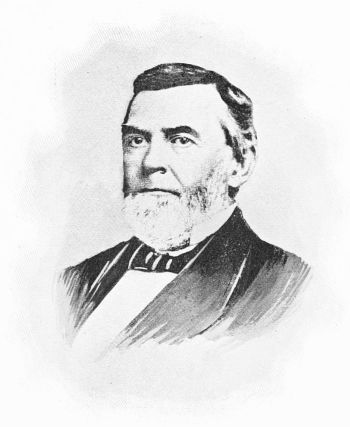
THOMAS RUFFIN. BY WM. A. GRAHAM.
Reading edition
The patriotic people of the county of Rockingham, in a public assemblage at their first Superior Court after the death of Chief Justice Ruffin, in which they were joined with cordial sympathy by the gentlemen of the bar at that court, resolved to manifest their appreciation of his talents, virtues and public usefulness, by causing to be pronounced a memorial on his life and character. Such an offering was deemed by them a fitting tribute from a people among whom his family first settled, upon their arrival in North Carolina, and with whom he had been associated as a planter and cultivator of the soil from his early manhood till his decease. The Agricultural Society of the State, of which for many years he had been a distinguished president, subsequently determined on a like offering to his memory at their annual fair. The invitation to prepare such a discourse has been by both bodies extended to the same individual. The task is undertaken with diffidence and a sense of apprehension that amid the multiplicity of other engagements its fulfillment may fail in doing justice to the subject of this memoir.
Thomas Ruffin, the eldest child of his parents, was born at Newington, the residence of his maternal grandfather, Thomas Roane, in the county of King and Queen, in Virginia, on the 17th of November, 1787.
His father, Sterling Ruffin, Esquire, was a planter in the neighboring county of Essex, who subsequently transferred his residence to North Carolina, and died in the county of Caswell. Ardent in his religious sentiments, and long attached to the Methodist Episcopal Church, he very late in life entered the ministry, and was for a few years prior to his death a preacher in that denomination.
His mother, Alice Roane, was of a family much distinguished in Virginia by the public service of many of its members, and was herself first cousin of Spencer Roane, the Chief Justice of that State, in the past generation, whose judicial course, connected as it was with questions of difficulty and importance in constitutional law, gave him high professional, as well as political, distinction; but it may well be doubted whether, in all that constitutes a great lawyer, he had preeminence over the subject of our present sketch, his junior kinsman in North Carolina, then but rising into fame, and destined to fill the like office in his own State.
His father, though not affluent, had a respectable fortune, and sought for the son the best means of education. His early boyhood was passed on the farm in Essex, and in attendance on the schools of the vicinity. Thence, at a suitable age, he was sent to a classical academy in the beautiful and healthful village of Warrenton, in North Carolina, then under the management of Mr. Marcus George, an Irishman by birth and education, a fine classical scholar and most painstaking and skillful instructor, especially in elocution, as we must believe, since among his pupils who survived to our times we found the best readers of their day, within our acquaintance. His excellence in this particular was probably attributable to his experience on the theatrical stage, where he had spent a portion of his life. He made his first appearance in the State at Hillsborough, during the Convention of 1788, which rejected the Federal Constitution, and being in search of employment as a teacher, he was engaged by the Warren gentlemen then in attendance, and many years subsequently was still at the head of a flourishing school, in which our student entered. The system and discipline of Mr. George conformed to the ancient regime, and placed great faith in the rod; and he being a man of much personal prowess and spirit, did not scruple to administer it on his pupils, when sloth, delinquency or misbehavior required, without regard to age, size or other circumstances. Yet he secured the respect of his patrons and the confidence of the public, and inspired the gratitude and affection of his pupils in a remarkable degree.
This turning aside from our subject, to pay a passing tribute to his old preceptor, is deemed to be justified not only by the long and useful labors of Mr. George, in the instruction of youth in the generation in which Mr. Ruffin's lot was cast, but because he himself entertained the highest appreciation of the profession of an instructor, accustoming himself to speak of it as one of the most honorable and beneficent of human employments. Throughout his laborious and well-spent life he often acknowledged his obligations of gratitude for the early training he had received under the tuition of this faithful, but somewhat eccentric, son of Erin. And it may well be doubted whether Lord Eldon, in the maturity of his wisdom and great age, retained a more grateful and affectionate recollection of Master Moises of the High School of New Castle, than did Chief Justice Ruffin of Master George of the Warrenton Male Academy.
At this institution were assembled the sons of most of the citizens of eastern North Carolina, and of the bordering counties of Virginia, who aspired to a liberal education. And here were formed friendships which he cherished with great satisfaction throughout life. Among his companions were the late Robert Broadnax, of Rockingham, subsequently a planter of large possessions on Dan River, among the most estimable gentlemen of his time; and Cadwallader Jones, then of Halifax, but afterwards of Orange, an officer at different periods in the navy and in the army of the United States, a successful planter, and a model of the manners and virtues which give a charm to social intercourse. Here, too, he found Weldon N. Edwards, of Warren, subsequently distinguished by much public service in Congress and under the government of the State, thenceforward his lifelong friend, with whom the bonds of amity seemed to be drawn more closely as others of his contemporaries dropped from around him. Of these four youths of the Warrenton Academy, in the beginning of the nineteenth century, Mr. Edwards alone survives. Long may he live to enjoy the veneration and respect due to a life of probity, honor, and usefulness.
From the Warrenton Academy young Ruffin was transferred to the College of Nassau Hall, at Princeton, New Jersey. It is believed that his father, who was a deeply pious man, was controlled in the selection of this college in preference to that of William and Mary, in Virginia (next to Harvard University the oldest institution of learning in the United States), not only by a desire to guard his son's health, which had suffered from the malaria of tide-water Virginia, but to secure him as well against the temptations incident to college life in an institution where, as he supposed, the discipline was too lax for the sons of affluence who matriculated there. He entered the freshman class at Princeton, and graduated at the commencement in 1805, the sixteenth in a class of forty-two members, "being the first of the second division of intermediate honors." The late Governor James Iredell, of North Carolina, was in the class succeeding his own, and for nearly the whole of his college course his room-mate. Thus commenced a friendship between these gentlemen in youth which was terminated only by the death of Mr. Iredell. Among others of his college associates who became distinguished in subsequent life, there were Samuel L. Southard and Theodore Frelinghuysen, of New Jersey, Joseph R. Ingersoll, of Philadelphia, the Cuthberts and Habershams, of Georgia, Christopher Hughes of Maryland, and Stephenson Archer, of Mississippi.
Returning home with his bachelor degree, Mr. Ruffin soon afterwards entered the law office of David Robertson, Esq., of Petersburg, as a student of law, and continued there through the years 1806 and 1807. Here he was associated as a fellow-student with John F. May, afterwards Judge May, of Petersburg, and Winfield Scott, afterwards so highly distinguished in arms, and the only officer, down to his time, except General Washington, who attained the rank of Lieutenant-General in the army of the United States. General Scott, in his autobiography, describes their preceptor, Mr. Robertson, as a Scotchman, a very learned scholar and barrister, who originally came to America as a classical teacher, but subsequently gained high distinction as a lawyer, and was the author of the report of the debates in the Virginia Convention which adopted the Federal Constitution, and of the report of the trial of Aaron Burr for high treason. In a note to the same work, General Scott mentions his chancing to meet Judge Ruffin in New York in 1853, while the latter was attending as a delegate the Protestant Episcopal Convention of the United States, after a separation of forty-seven years, and recurs to their association together with Judge May, as law students, and to the conversation in which they then indulged, with manifest pride and pleasure. He also refers to their subsequent intercourse in the City of Washington, in 1861, while Judge Ruffin was serving as a member of the Peace Congress, and expresses the opinion that if the sentiments of this good man, always highly conservative (the same as Crittenden's), had prevailed, the country would have escaped the sad infliction of the war, which was raging at the time he wrote.
Sterling Ruffin, the father, having suffered some reverses of fortune, determined to change his home, and removed to Rockingham county, North Carolina, in 1807. His son soon followed, a willing emigrant. It was in North Carolina he had received his first training for useful life: here was the home of most of his early friends, and here he confidently hoped to renew his associations with Broadnax, Jones, Edwards, Iredell, and other kindred spirits.
He doubtless brought with him a considerable store of professional learning from the office of Mr. Robertson, in which he had been more than two years a student, but on his arrival in North Carolina he pursued his further studies under the direction of Hon. A. D. Murphy, until his admission to the bar, in 1808. Early in 1809, he established his home in the town of Hillsborough, and on the 9th of December in that year he was united in marriage to Miss Ann Kirkland, eldest daughter of the late William Kirkland, of that place, a prominent merchant and leading citizen.
The twenty years next ensuing, during which his residence was continually in Hillsborough, comprehends his career at the bar and on the bench of the Superior Courts. In 1813, 1815 and 1816 he served as a member of the Legislature in the House of Commons from this town, under the old Constitution and filled the office of Speaker of the House at the last mentioned session, when first elected a judge, upon the resignation of Duncan Cameron. He was also a candidate on the electoral ticket in favor of William H. Crawford for the Presidency of the United States in 1824. But his aspirations, tastes, and interests inclined him not to political honors, but to a steady adherence to the profession to which his life was devoted. He found at the bar in Orange and the neighboring counties several gentlemen, his seniors in years, who were no ordinary competitors for forensic fame and patronage, of whom it may be sufficient to name Archibald D. Murphy, Frederick Nash, William Norwood, Duncan Cameron, Henry Seawell, Leonard Henderson, William Robards, Nicholas P. Smith, of Chatham, and later of Tennessee. His first essays in argument are said not to have been very fortunate. His manner was diffident and his speech hesitating and embarrassed. But these difficulties being soon overcome, the vigor of his understanding, the extent and accuracy of his learning, and the perfect mastery of his causes by diligent preparation, in a short time gave him position among these veterans of the profession, secured him a general and lucrative practice, and an easy accession to the bench in seven years from his initiation at the bar.
His reputation was greatly advanced and extended by the manner in which he acquitted himself in this office. The wants, however, of an increasing family and an unfortunate involvement by suretyship forbade his continuance in a situation of no better income than the salary which was its compensation. He resigned to the Legislature of 1818, and immediately returned to the practice. Mr. Ruffin had kept up habits of close study of his profession before his promotion to the bench, and he eagerly availed himself of the leisure afforded by the vacations of the office for the same object. He came back to the bar not only with his health renovated, which had never been very robust, but with a brightness in his learning and an increase of fame which, in the Supreme Court, then recently established on its present basis, and in the Circuit Court of the United States, as well as on the ridings in the State courts, brought to him a practice and an income which has hardly ever been equaled by any other practitioner in North Carolina. For forty-three weeks in the year he had engagements in court, and despite all conditions of the weather or other impediments to traveling in the then state of the country, rarely failed to fulfill them. He held the appointment of Reporter of the decisions of the Supreme Court for one or two terms, but relinquished it on account of the engrossment of his time by his practice; and his labors are embraced in the first volume of Hawks. Mr. Archibald Henderson, Mr. Gaston, Mr. Seawell, Mr. Murphy, Mr. Moses Mordecai, Mr. Gavin Hogg, and Mr. Joseph Wilson, all men of renown, were, with Mr. Ruffin, the chief advocates in the Supreme Court at that period, Mr. Nash and Mr. Badger being then upon the bench; and according to tradition, at no time have the arguments before it been more thorough and exhaustive. The late Governor Swain being, part of this period, a student of the law in the office of Chief Justice Taylor, in a public address at the opening of Tucker Hall, mentions a prediction in his hearing by Mr. Gaston to one of his clients in 1822, that if Mr. Ruffin should live ten years longer he would be at the head of the profession in North Carolina. By the same authority we are informed that only a year or two later Judge Henderson declared that he had then attained this position of eminence.
In the summer of 1825, upon the resignation of Judge Badger, Mr. Ruffin again accepted the appointment of Judge of the Superior Courts. His recent successes had relieved him of embarrassment, and supplied him a competent fortune; his health demanded relaxation and rest; and he considered his duties to his family, now quite numerous, required more of his presence at home than was consistent with the very active life he was leading. He therefore relinquished his great emoluments at the bar for the inadequate salary then paid to a judge, and virtually closed his career as an advocate. By the bar and the public he was welcomed back on the circuits, and for the three following years he administered the law with such universal approbation that it was generally understood he would be appointed to the bench of the Supreme Court.
The reputation he had established by this time, however, did not merely assign him capabilities as a lawyer, but ascribed to him every qualification of a thorough man of affairs. It was conceded, at least, that he could teach bankers banking and merchants the science of accounts.
In the autumn of 1828 the stockholders of the old State Bank of North Carolina, at the head of whom were William Polk, Peter Browne, and Duncan Cameron, owing to the great embarrassment of the affairs of the institution, involving disfavor with the public and threats of judicial proceedings for a forfeiture of its charter, prevailed on him to take the presidency of the bank, with a salary increased to the procurement of his acceptance, and with the privilege on his part to practise his profession in the city of Raleigh. In twelve months, with characteristic energy, mastering the affairs of the bank with a true talent for finance, making available its assets and providing for its liabilities, and inspiring confidence by the general faith in his abilities and high purpose to do right, he effectually redeemed the institution, and prepared the way to close out in credit the remaining term of its charter.
At this period, also, another place of high political eminence was at his choice, but was promptly declined. A vacancy having happened in the Senate of the United States by the appointment of Governor Branch to the head of the Navy Department, and Hon. Bartlett Yancey, who had been the general favorite for the succession, having recently died, Mr. Ruffin was earnestly solicited to accept a candidacy for this position, with every assurance of success. But his desire was, as he himself expressed it among his friends, after the labor and attention he had bestowed upon his profession, to go down to posterity as a lawyer. Irrespective, therefore, of his domestic interests, and the care and attention due to his family, of which no man ever had a truer or warmer conception, he could not be diverted from his chosen line of life by the attractions of even the highest political distinction.
While assiduously employed in the affairs of the bank, to which was devoted the year 1829, his services were still demanded by clients in the higher courts, and his reputation at the bar suffered no eclipse. Upon the death of Chief Justice Taylor, in this year, the executive appointment of a successor was conferred on a gentleman of merited eminence in the profession, and of a singularly pure and elevated character; but the sentiment of the majority of the profession, as well as public opinion, had made choice of Mr. Ruffin for the permanent office, and he was elected a Judge of the Supreme Court at the session of the Legislature in the autumn of 1829. In 1833, upon the demise of Chief Justice Henderson, he was elevated to the Chief Justiceship, in which he won that fame which will longest endure because it is incorporated in the judicial literature of the country, and is coextensive with the study and administration of our system of law.
Of Mr. Ruffin's arguments at the bar no memorials have been preserved save the imperfect briefs contained in the causes that have been reported. His nature was ardent, his manner of speech earnest and often vehement in tone and gesticulation. Though versed in belles-lettres, and with tastes to relish eloquent declamation, it was a field into which he did not often, if at all, adventure. His reliance was upon logic; not upon rhetoric; and even his illustrations were drawn from things practical rather than ideal. Analyzing and thoroughly comprehending his cause, he held it up plainly to the view of others, and with a searching incisive criticism exposed and dissipated the weak points in that of his adversary; and all this in a vigorous, terse and manly English, every word of which told. Few advocates ever equaled him in presenting so much of solid thought in the same number of words, or in disentangling complicated facts or elucidating abstruse learning so as to make the demonstration complete to the minds of his hearers. These capacities he doubtless gained by severe culture, a part of which, as I learned from an early student in his office, resulted from his daily habit of going carefully over the demonstration of a theorem in mathematics. Thus habituated to abstract and exact reasoning, he delighted in the approach to exactness in the reasoning of the law, and no student could more truly say of his professional investigations: Labor ipse est voluptas. The accuracy thus attained in his studies gave him great eminence as a pleader in causes both at law and in equity; and the office of framing the pleadings was usually conceded to him by his colleagues in the causes in which they were associated. It also gave him rank among the great counsellors of the time whose opinions were not the result of cramming for an occasion, or a fortunate authority, but the well considered reflections of gifted minds imbued with law as a science. The full development of his forensic character does not appear to have been manifested until after his return to the bar subsequently to his first service on the bench. But from this period till his second retirement, in 1825, he had hardly a rival in the bar of the Supreme Court of the State or the Circuit Court of the United States, except Archibald Henderson and Gaston, and he had a command of the practice in all the State courts he attended. As a Judge of the Superior Courts he exhibited equal aptitude as for the practice at the bar. With an energy that pressed the business forward, a quickness rarely equaled in perceiving and comprehending facts, patient and industrious habits of labor, and a spirit of command which suffered no time to be lost, he dispatched causes with expedition, but with no indecent haste. Whilst he presided it was rare that any cause before a jury ever occupied more than a single day, and none is remembered that extended beyond two. He dismissed a suit brought to test a wager at the cost of both parties, and remarked that it was on account of leniency that he did not imprison them.
In administering the criminal law, in which the extent of punishment generally depended on the discretion of the judge, his sentences were such as to inspire evil-doers with terror, but eminently tended to give protection to society and confidence to honest and law-abiding men.
His accession to the bench of the Supreme Court was a source of general satisfaction to the profession, and to the people of the State, by whom his enlightened labors in the circuits had been witnessed with admiration and pride. He at once took a conspicuous part in the proceedings of this high tribunal, and for the twenty-three years that he continuously sat there, probably delivered a greater number of the opinions than any judge with whom, in all this long career, he was associated. These opinions are found through more than twenty-five volumes of the Reports, and form the bulk of our judicial literature for a full generation. They have been cited with approbation in the American courts, State and national, by eminent legal authors, and in the judicial deliberations of Westminster Hall; and the North Carolina lawyer who can invoke one of them as a case in point with his own generally considers that he is possessed of an impenetrable shield. It has been rare in England that a judge or advocate has reached high distinction in the courts both of common law and equity. The student of the judicial arguments of Chief Justice Ruffin will be at a loss to determine in which of these branches of legal science he most excelled. To the votary of the common law, fresh from the perusal of the black letter of the times of the Tudors and early Stuarts, and captivated with its artificial refinements and technical distinctions, he would appear to have pursued his professional education upon the intimation of Butler, in his reminiscences, that "he is the best lawyer, and will succeed best in his profession, who best understands Coke upon Littleton"; or, advancing to the modern ages of greater enlightenment and freer intercourse among nations, that he had made a specialty of the law of contracts, bills of exchange and commercial law generally; whilst his expositions of equity causes will satisfy any impartial critic that he was at least equally a proficient and master of the principles and practice of the jurisprudence of the English Chancery, and would induce the belief that, like Sir Samuel Romilly or Sir William Grant, his practice at the bar had been confined to this branch of the profession.
During his chief-justiceship it cannot fail to be remarked that there was a great advance in the accuracy of pleadings in equity cases, and in general extension of the knowledge of equity practice throughout the circuits. And the precision and propriety of entries in every species of procedure were brought to a high state of perfection, mainly by his investigations and labors, in conjunction with those of that most worthy gentleman, and modest but able lawyer, Edmund B. Freeman, Esq., late Clerk of the Supreme Court, whose virtues and public usefulness, connected as he was for so many years in close and friendly association with the immediate subject of our remarks, now likewise gone down beyond the horizon, I am gratified the opportunity serves to commemorate.
Judge Ruffin's conversancy with political ethics, public law, and English and American history seems to have assigned to him the task of delivering the opinions on constitutional questions which have attracted most general attention. That delivered by him in the case of Hoke vs. Henderson, in which it was held that the Legislature could not, by a sentence of its own in the form of an enactment, divest a citizen of property, even in a public office, because the proceeding was an exercise of judicial power, received the high encomium of Kent and other authors on constitutional law; and I happened personally to witness that it was the main authority relied on by Mr. Reverdy Johnson, in the argument for the second time in Ex parte Garland, which involved the power of Congress, by a test oath, to exclude lawyers from the practice in the Supreme Court of the United States for having participated in civil war against the government; and in which, its reasoning on the negative side of the question, was sustained by that august tribunal.
The singular felicity and aptitude with which he denuded his judgments of all extraneous matter, and expounded the principles of the case in hand, usually citing authority only to uphold what had been demonstrated without it, is the most striking feature of his numerous opinions. His style of writing was elevated and worthy of the themes he discussed. His language was well selected, and exhibited a critical acquaintance with English philology. A marked characteristic in his writings, as it was also in his conversation, was the frequent, dextrous, and strikingly appropriate use he made of the brief words of our language, usually of Saxon derivation.
In the autumn of 1852, while in the zenith of his reputation, and not yet pressed with the weight of years, Chief Justice Ruffin resigned his office and retired, as he supposed forever, from the professional employments he had so long and with so much renown pursued. But on the death of his successor and friend, Chief Justice Nash, in December, 1858, he was called by the almost unanimous vote of the General Assembly, then in session, to fill the vacancy, and sat again as a Judge of the Supreme Court until the autumn of 1859, when failing health rendered his labors irksome, and he took his final leave of judicial life. Six years of rest in his rural home had induced nothing of rust or desuetude: he wore the ermine as naturally and gracefully as if he had never been divested of its folds; his judicial arguments at this time evince all that vigor of thought and freshness and copiousness of learning which had prompted an old admirer to say of him that he was a "born lawyer." It is not improbable that this preservation in full panoply was, in some degree, aided by the circumstance that in a desire to be useful in any sphere for which he was fitted, he had accepted the office of a justice of the peace in the county of Alamance, in which he then resided, and had held the County Courts with the lay justices during this period. Though near ten years later, and when he had passed the age of eighty, in a matter of seizure, under the revenue laws, in which he took some interest for a friend, in the Circuit Court of the United States, a branch of practice to which he had not been habituated by experience, I had occasion to observe that he was as ready with his pen in framing the pleadings, without books of authority or precedent, as any proctor in a court of admiralty.
At an early period he became the proprietor of an estate on Dan River, in Rockingham, on which he established a plantation at once, and gave personal direction to its profitable cultivation from that time until near the time of his death. Carrying his family to Raleigh for a sojourn of twelve months, upon assuming the presidency of a bank, as already stated, he removed thence to Haw River, in Alamance, in 1830, and there, under his own eye, carried on the operations of a planter with success until the year 1866, when the results of the war deprived him of laborers and he sold the estate and removed again to Hillsborough. The law has been said by some of its old authors to be a jealous mistress, and to allow no rival in the attentions of its votary. Chief Justice Ruffin, however, while diligently performing the duties of his great office, and keeping up with the labors of his contemporaries, Lyndhurst, Brougham, Tenterden, and Denman, in England, and the numerous courts exercising like jurisdictions in America, found leisure to manage his farm at home as well as to give direction to that in Rockingham. And this, not in the ineffective manner which has attended like efforts of some professional men, but with present profit and improvement of the estates. From early life he appeared to have conceived a fondness for agriculture, including horticulture and the growing of fruit-trees and flowers, which his home in the country seemed to have been selected to indulge. Here, for thirty-five years during the recesses of his courts, he found recreation in these pursuits and in the rearing of domestic animals; the result of which was the most encouraging success in orchards, grapery, garden, cereals, flocks and herds. Combining a knowledge of the general principles of science, with fine powers of observation, and the suggestions of the most approved agricultural periodicals, he was prepared to avail himself in practice of the highest intelligence in the art. It was therefore no empty compliment to a great jurist and leading citizen when the Agricultural Society of North Carolina, in 1854, elected him to its presidency after his retirement from the bench. He was continued in this distinguished position for six years, when declining health demanded his retirement; and at no time have the interests of the Society been more prosperous, its public exhibitions more spirited; and it may be added that on no occasion did he ever manifest more satisfaction than in the reunions of its members.
The liberal hospitality that he dispensed throughout life was a most conspicuous feature in the period thus devoted to practical agriculture. His nature was eminently social, his acquaintance in his high position extensive, his dwelling near one of the great highways of travel through the State in the old modes of conveyance, easy of access, and the exuberance of his farm, garden, orchards and domestic comforts were never more agreeably dispensed than when ministered to the gratification of his friends under his own roof.
The cordiality and ease with which he did the honors of an entertainer in an old-fashioned Southern mansion is among the pleasant recollections of not a few between the Potomac and the Mississippi. It was here, indeed, surrounded by a family worthy of the care and affection he bestowed upon them, relaxed from the severe studies and anxieties of official life, in unreserved and cheerful intercourse, that, after all, he appeared most favorably.
By his industry, frugality and aptitude for the management of property, he accumulated in a long life an estate more ample than usually falls to the lot of a member of the profession in this State; and although much reduced by the consequences of the civil war, it was still competent to the comfort of his large family.
Judge Ruffin was, until superseded by the changes made in 1868, the oldest trustee of the University of the State, and always one of the most efficient and active members of the board. For more than half a century on terms of intimate intercourse with its Presidents, Caldwell and Swain, and the leading Professors, Mitchell, Phillips and their associates, he was their ready counsellor and friend in any emergency; whether in making appeals to the Legislature in behalf of the institution for support and assistance in its seasons of adversity, or in enforcing discipline and maintaining order, advancing the standard of education or cheering the labors both of the faculty and students. His criterion of a collegiate education was high, and he illustrated by his own example the rewards of diligent and faithful study. He retained a better acquaintance with the dead languages than any of his compeers we have named except Gaston, Murphy, and Taylor. In ethics, history, and the standard British classics his knowledge was profound. In science and in natural history, more especially in chemistry, and those departments pertaining to agriculture, horticulture, pomology and the like, his attainments were very considerable, as they were also in works of belles-lettres, poetry, taste and fiction, at least down to the end of the novels of Scott and Cooper. He worthily received the honorary degree of Doctor of Laws from the University of North Carolina in 1834, and the like honor is believed to have been subsequently conferred by his alma mater at Princeton.
His style and manner in conversation, in which he took great delight and bore a distinguished part in all companies, abounded in pleasantry, but exhibited the same wide range of thought and information as his public performances, and was full of entertainment and instruction to the young. His temperament was mercurial, his actions quick and energetic, and his whole bearing in the farthest possible degree removed from sloth, inertness, and despondency. In political sentiment he accorded with the school of Jefferson, and for more than forty years was a constant reader of the Richmond Inquirer, the editor of which, Mr. Ritchie, was his relative, though no one entertained a more exalted reverence for the character, abilities, and patriotism of Marshall, with whom he cherished a familiar acquaintance while in practice before him at the bar, and after his own elevation to the bench. Later in life he formed a like kind and admiring acquaintance with Chancellor Kent.
In the winter of 1861 the Legislature of North Carolina, having acceded to the proposition of Virginia, on the approach of the late rupture between the States of the Union, to assemble a body of delegates in the City of Washington to consider and recommend terms of reconciliation, Judge Ruffin was appointed one of the members in the "Peace Conference," and is understood to have taken a conspicuous part in its deliberations and debates. We have the testimony of General Scott, in his autobiography, already quoted, that his counsels in that assembly were altogether pacific. President Buchanan, in his work in defense of his action in that important crisis, makes assertion of the same fact. After the failure of the efforts at adjustment, and the war, in his opinion, had become a necessity, Judge Ruffin accepted a seat in the State Convention of 1861, and threw into its support all the zeal and energy of his earnest and ardent temper; one of his sons, a grandson, and other near connections taking part in the dangers and privations of its camps and battle-fields. When defeat came he yielded an honest submission and acquiescence, and renewed in perfect good faith his allegiance to the government of the United States. Too far advanced in years to be longer active in affairs, his chief concern in regard to the public interests thenceforward was for the conservation of the public weal, and that the violent convulsion, of which we had felt the shock, and the change, might be permitted to pass without any serious disturbance of the great and essential principles of freedom and right which it had been the favorite study of his life to understand and illustrate.
With the close of the war, his farm about his mansion having experienced the desolation of an army encampment, and its system of labor being abolished, he felt unequal to the enterprise of its resuscitation and culture, and therefore disposed of his estate and again took up his abode in Hillsborough. Here, in occasional occupation as a referee of legal controversies, in directing the assiduous culture of his garden and grounds, in desultory reading, in which he now and then recurred to his old favorites among the novels of Scott, in the duties of hospitality and the converse of friends, in the bosom of his family, he passed the evening of his days. In the sense of imbecility or decrepitude he never grew old, but was blessed with the enjoyment of a remarkable intellectual vigor and fine flow of spirits almost till his dissolution. And, in anticipation of death, in his last illness he laid an injunction on his physician to administer to him no anodyne which should deprive him of consciousness, as he did not wish to die in a state of insensibility.
On the 15th of January, 1870, after an illness of but four days, though he had been an invalid from an affection of the lungs for a year or more, he breathed his last, in the eighty-third year of his age. His end was resigned and peaceful, and in the consolation of an enlightened and humble Christian faith. For more than forty years a communicant of the Protestant Episcopal Church, he was one of its most active members in the State, and more than once represented the Diocese in the Triennial Conventions of the Union.
The venerable companion of his life, a bride when not yet fifteen, a wife for more than sixty years, yet survives to receive the gratitude and affection of a numerous posterity and the reverence and esteem of troops of friends.
This imperfect offering is a memoir, not a panegyric. It contains not history, but particulas historae—scraps of history, which it is hoped may not be without their use to the future student of our annals, for the character we contemplate is destined to be historical. His life was passed in public view, in the most important public functions, in contact with the most gifted and cultivated men of the State for half a century; it ran through two generations of lawyers. It was given to a profession in which were engaged many of the first minds of other States, and I can call to recollection no judge of any State of the Union who in that period has left behind him nobler or more numerous memorials of erudition, diligence, and ability in the departments of the law he was called to administer. The study of his performances will at least serve to correct the error of opinions prevailing with many at the North, that the intellectual activity of the South delights itself only in politics.
It has been remarked by one of the British essayists, as "a saying of dunces in all ages, that men of genius are unfit for business." It is perhaps a kindred fallacy, to which pedantry and sloth have given as much countenance on the one hand as blissful ignorance upon the other, that high culture and erudition, as in the case of the learned professions, are incompatible with success in practical affairs in other departments. We have before us the life of one who demonstrated in his own person that it is possible for a great and profound lawyer to take a leading part and become a shining light in practically promoting the first and greatest of the industrial arts, and although there be no natural connection between these occupations, that the same well directed industry, patience, and energy which had achieved success in the one, was equal to a like triumph in the other; whilst in high probity, in stainless morals, in social intercourse, in the amenities of life, and the domestic affections and duties, his example will be cherished in the recollection of his friends, and may well be commended to the imitation of our youth.
OPINION IN EX PARTE BRADLEY.
BY THOMAS RUFFIN.
This opinion of Judge Ruffin, taken at random to illustrate his style, is not above his average.
His great opinions are too long and technical to be of interest to the general reader. He thoroughly understood "the language of the law," and used it with the utmost precision.
His discussion of the question at issue throws a side-light on times fifty years agone, and will awaken memories in the old and inquiry in the young.
Badger and Iredell applied to the Chief Justice for a writ of habeas corpus in behalf of William Bradley, who had been imprisoned for assault and battery.
OPINION.
Ruffin, C. J. At the last term of Anson Superior Court, William Bradley was convicted of an assault and battery, and was sentenced to pay a fine of one dollar, and "to be imprisoned in the public jail of Anson county for twelve months, and thereafter until the said fine and costs should be paid." He was committed to the custody of the sheriff of the county, and has been kept a close prisoner ever since, but has recently tendered to the sheriff a bond with sureties to keep within the rules of the prison (which have been laid off by the County Court, and contain six acres), and demanded of the sheriff to be let out of prison. This was refused by the sheriff, upon the ground that he was required by the sentence to keep this person within the public jail.
Upon an affidavit and petition of Bradley, stating those facts, he has applied for a habeas corpus, that he might be brought up and an order made for his enlargement, according to his application to the sheriff. His counsel, however, does not desire that he should be put to the expense and trouble of the writ, unless it should be thought that he is entitled to the liberty of the rules bounds. As I had an opportunity of consulting my brethren on the subject, I have availed myself of it, and I now give our unanimous opinion, that the sheriff is bound to keep the applicant a close prisoner. The application is founded on the Act of 1741, Rev. St., c. 90, s. 11. It enacts, that, "For the preservation of the health of such persons as shall be committed to the county prisons, the court shall have power to mark out such a parcel of land, as they shall think fit, not exceeding six acres, adjoining the prison, for the rules thereof; and every prisoner not committed for treason or felony shall have liberty to walk therein, out of prison, for the preservation of his or her health."
If there were no other objection to this application but its novelty, that would be sufficient. It is the first that has been made, as far as we have heard, since the act passed, which is now more than one hundred years. If this were an absolute right of all persons committed under sentence for misdemeanors, there can be no doubt that it would have been long before claimed and constantly exercised. But we think the construction of the act is plainly against it. It seems to have been made in reference to a known usage and regulation respecting prisons in the mother country. There, by "rules" of the several courts, debtors and prisoners for misdemeanors have the liberty of walking in the prison yards, or within such other limits as the courts prescribe for their respective prisoners, at such hours and on such days as "the rules" may designate. Those "grounds" came in time to be called the "rules of the prison" because they were laid off and the prisoners had liberty of exercise therein by rule of court for that prison. In the same manner and for the same purpose the grounds are to be laid out adjoining our prisons. The courts "shall have the power," that is to say, they may lay off ground, little or much, but not to exceed six acres, adjoining the prison, for the rules thereof. These last words, "for the rules thereof," show, that with each court it was left to make such rules respecting the prisoners committed by it as to the extent, periods and durations of enlargement out of close prison for exercise and health, as the situation of the prison, the season of the year, the danger of escape or the character of the prisoners, or the enormity or mildness of their offenses might suggest to the court, restraining them, indeed, from allowing more than six acres in space to any prisoner, and from extending the liberty to traitors and felons, or persons committed as such. Hence, also, the expression that the prisoner may have liberty "to walk therein for the preservation of his health," which shows that the courts had the power to allow the prisoners merely the "liberty of walking," at particular hours, and require them still to have their abode in the prison. Such, at first, was no doubt, the practice. But in laying out the bounds the rules of the court in modern days practically exempt persons committed in execution for debt from any imprisonment within the jail, by allowing them to walk, not for particular hours, but at all times of the day and night within the rules. As they are not required to eat or sleep within the prison, they are, in effect, allowed to live out of the walls, provided they do not go out of the rules.
But with regard to persons committed under sentence for crimes, no rules have ever been passed. At least, we have known of none; and the applicant does not state that there is any such rule for Anson Superior Court. We do not say that it might not be proper, in some cases, to grant to minor offenders the liberty of exercise and fresh air at reasonable times and for a moderate period. But that is, necessarily, as each court may order in regard to its own prisoners; for as the imprisonment itself and its duration are within the discretion of the court, so must the degree of its vigor be, at least, as to the power of mitigating it within the extent allowed by the statute. The reason why no regula generalis has been adopted by the court, doubtless has been, that our courts are not in the habit of sentencing convicts to imprisonment, unless in those cases in which the courts think that, for the purposes of correction and example, there should be actual imprisonment during the whole period. But if there be any general rule upon the subject in any court it would be under the control of that court, whether each prisoner should or should not be allowed the indulgence, and the sentence on this person is, "that he shall be imprisoned in the public jail of Anson for twelve months." Of course, this prisoner cannot demand an enlargement out of prison, as a matter of right.
As I should be under the necessity of remanding the prisoner, if brought up on habeas corpus, I decline issuing the writ at all, according to the suggestion of his counsel.
THOMAS BRAGG.