DAVID L. SWAIN. BY Z. B. VANCE. (continued 2)
Reading edition
Peter Browne, with an ample fortune and very high reputation, relinquished his professional pursuits at the comparatively early age of fifty-five. Selling the Lane residence, and his well-selected library to his friend, Mr. Boylan, in the summer of 1818, he returned to Scotland to spend the evening of his life amidst the romantic scenes of his native country. An absence of three years proved that the ties which bound him to Raleigh were stronger than those which bound him to his birthplace. He came back and resided here until his death in November, 1832. In 1821, he accepted the appointment of justice of the peace, and was during several years chairman of Wake County Court.
I remember to have heard him complain of the dilatory proceedings of the courts, and especially of the time lawyers were permitted to consume in argument, as a grievous innovation on ancient usages, and to asseverate most solemnly that there was one court in North Carolina where no such indulgence would be allowed. All who remember his administration, will admit that few and brief were the arguments heard in Wake County Court in his day.
My professional experience of ten years, eight at the bar, and two upon the bench, closed in December 1832. During this period I rode the Morganton, Hillsborough, Raleigh, and Edenton Circuits, and met at intervals nearly every eminent lawyer in the State. I can recall no instance when more than a day was occupied with the trial of a cause.
Judge Cameron, the immediate successor of Mr. Browne as president of the State Bank, was, during the last twenty years of his life, a citizen of Raleigh. He came to the bar at the age of twenty-one in 1798, was appointed judge in February 1814, resigned December 1816, engaged immediately in agricultural pursuits, and the performance of all the duties which properly devolved on eminent citizens in private life, and preeminent among these was the discharge of the duties of presiding magistrate of the County Court of Orange.
He had not attained his fortieth year when he retired from the bench of the Superior Court.
During the fifteen years that he practiced law, his professional emoluments were probably greater than fell to the lot of any other North Carolina lawyer, at so early a period of life, and to none were honors and emoluments more justly awarded.
Mr. Badger, alike eminent as a jurist and a statesman, following Mr. Browne, was, during a series of years chairman in Wake; and Chief Justice Ruffin (a citizen of Raleigh from 1828 to 1834), simultaneously with Mr. Badger's services here, was chairman of the County Court in Alamance.
Of the eminent lawyers who have appeared at our bar during the present century, to no one living or dead has greater length of days, crowned by more brilliant success in all walks of life, been accorded, than to the four great men who closed their professional career by the gratuitous, graceful, able, and impartial discharge of the important duties pertaining to the office of justice of the peace.
While I can make no positive averment, I am very confident in the opinion that during the time that Judges Badger, Cameron, and Ruffin presided on the Superior and County Court bench, no case tried before them ever occupied more than a single day.
Mr. Browne, as appears from the graveyard record, died at the age of sixty-seven. Mr. Badger had entered upon his seventy-second, and Judge Cameron his seventy-sixth year. Chief Justice Ruffin, in the possession of unimpaired intellectual strength, is an octogenarian.
In 1806, five years after the conviction of Glasgow, the great case of Lord Granville's heirs versus Governor Davie and others, which threatened a more extensive confiscation than that menaced in our time, was argued before the Federal Court in this city by Gaston and Harris for the plaintiffs, and Cameron, Woods, and Baker for the State of North Carolina. Potter, District Judge, charged the jury; Marshall, Chief Justice, from personal considerations, peremptorily declining to sit upon the trial.
Marshall is the only Revolutionary Titan I have ever seen. With fair opportunities to judge of him as he appeared upon the bench, and in social intercourse sixteen years afterwards, I can pronounce with emphasis, that I never expect to look upon his like again.
I sometimes feel apprehensive that I will become old myself before a great while, when my memory recurs to the time when Chief Justice Ruffin was one of the promising young men of my day. In 1822, when a student in Chief Justice Taylor's office, occupied by Mr. Gaston during the sessions of the Federal and Supreme Courts, Ithiel Town, the architect who planned the present capitol and who had an important suit pending in the Federal Court against the Clarendon Bridge Company, inquired of Mr. Gaston whether Mr. Ruffin would be acceptable to him as associate counsel. He replied: "No one more so; Mr. Ruffin is a very promising young man, and if he lives ten years longer will be at the head of the profession." The prediction was fully verified at an earlier date.
Rarely since the completion of the Pentateuch has full historic justice been meted out to woman. The character of the great father of the human race is not more fully and clearly delineated by Moses than that of its beautiful mother. The termagant Sarah received quite as much attention as the father of the faithful. Hagar is the heroine of an episode, the most beautiful in the annals of history, with the single exception of the narrative of the maternal tenderness of Naomi, and the filial love and devotion of Ruth, the fascinating little widow, whose charms dissolved the obdurate celibacy of the sage, opulent and stately Boaz. The crafty and managing Rebecca is finely contrasted with the confiding Isaac; and the beautiful Rachel, from the moment that Jacob gave his first kiss "and lifted up his voice and wept," as a bride, and a mother with Joseph at her side in his little coat of many colors and his stainless virtue, constitutes in life and in death, the most charming picture on the historical canvas of any age or country.
Why are not similar pictures presented in modern times? Moses was inspired. Subjects are not wanting worthy of historic inspiration. Has an abler monarch than Elizabeth, or a more estimable sovereign than Victoria ever given character and strength and grace to the British throne? Was "the man of destiny" superior to Josephine? Is the Empress of France inferior to Napoleon III.?
We are told that the heroic Wolfe while passing down the St. Lawrence on his way to "glory and the grave," closed the recitation of the inimitable "elegy" with the remark that he would gladly exchange all the renown he had acquired or hoped to achieve for the fame of the authorship of those verses, and yet Gray makes no reference to the spot where all the mothers of the hamlet sleep.
I have recently wandered through your cemetery, pausing and lingering here and there, at the tombs of familiar acquaintances and intimate friends, and realized the truth, that if I could summon the departed around me, I would stand in the midst of more numerous friends than I meet at the present day in the crowded streets of your living city.
I trust I shall be suspected of no want of gallantry to the living if I venture to intimate that among the nymphs that illuminate the page of memory and imagination, I find pictures of beauty and grace and refinement quite equal to the best specimens of modern times, or even, in poetic hallucination, "some brighter days than modern days, some fairer maids than living maids."
Captain Peace reposes by the side of his aged brother without as yet a stone to tell his name. He was, I suppose, at the time of his death, the oldest citizen of Raleigh, as well as the oldest man who has passed from the living city to the city of the dead. I have never yet met with a man whom I supposed to be a hundred years old. Various colored persons have represented themselves of greater age, but their computations would not bear scrutiny. The late William Henry Haywood, the elder, died at the age of eighty-seven, and Mrs. Haywood in her ninetieth year.
The honored name of their only son, the late Senator in Congress, was given at the baptismal font to the senior proprietor of Tucker Hall, in admiration of early promise, by a discerning father. The suit of clothes presented to the child by the Senator in acknowledgment of the compliment, is in a state of perfect preservation, and will be kept as an interesting illustration of the habits and customs of other days. We are to be instructed by grave lecturers in every department of science and art; shall we not have a miniature museum, a portrait gallery and a niche for the preservation of specimens of the antique, among which the best bib and tucker of earlier times may find an appropriate place?
John Rex was one of the earliest citizens of Raleigh. My acquaintance with him was slight. In appearance he was said to bear striking resemblance to John Quincy Adams. He was a grave, sedate, quiet, retiring, modest man, not unlike in character to his worthy contemporary William Peck. By long years of industry, economy and thrift in the management of the first tannery established in Raleigh at Rex's spring, near the railway station, he accumulated a handsome estate, and like Mr. Peace, atoned for his failure to build up a family, by a liberal provision for the children of misfortune and want. He manumitted all his slaves at the close of life, and bequeathed the remainder of his estate to the endowment of a hospital, the construction of which is understood to be in early prospect.
The Rex Hospital and Peace Institute, the latter far advanced towards completion, will constitute the appropriate and enduring monuments of these public benefactors. Mr. Rex died January 29, 1839, aged seventy-four years.
As scant justice is done to the memory of the ladies who repose in the cemetery, as is accorded to their sex on the page of modern history. The memorials are few, and the information given comparatively meagre.
Of the eighty-nine counties in North Carolina, nearly all perpetuate the names of men. Two only, Wake and Jones, are graced with the maiden names of women, the wives of Governor Tyron and Governor Nash. There are not less significant indications of the want of liberality from the sterner towards the gentler sex. Four-fifths of the wills that I have had occasion to construe, give to the "dear wife" a portion of the estate pared down to the narrowest limit that the law will allow, "during life or widowhood." So universal and inveterate is this phraseology, that a somewhat famous parson in the county of Gates, some years ago at the funeral of her husband, poured forth a most fervent supplication, that the bereaved wife might "be blessed in her basket and her store during life or widowhood."
I know but a single instance, the will of a distinguished American statesman, Gouverneur Morris, which provides a largely increased annuity to the widow in case of a second marriage.
Jacob Marling was the first portrait and landscape painter, and various specimens of his art are now extant, among others a picture of the State-house as it was anterior to the fire of 1831. It graces the parlor of Dr. F. J. Haywood.
The following narrative of the celebration of the thirty-third anniversary of American Independence, is from the pen of General Calvin Jones, one of the most useful men of his day. A careful examination of all the details will present to the mind a more life-like picture of what your city was in all the aspects of society in 1809 than can possibly be produced by the most elaborate attempt at description by a modern pen. Compare and contrast it with the scenes exhibited and the events which occurred on an anniversary fifty-eight years thereafter, and in due time make suitable preparation for the proper observance of a day still dear to every patriotic bosom.
"The thirty-third anniversary of American Independence was celebrated in this city in the usual manner on the 4th inst. At 12 o'clock a procession of citizens and strangers, with Captain Willie Jones' troop of cavalry at the head, formed at the court-house, agreeable to previous arrangements, and directed by Captain Scott, proceeded up Fayetteville street to the State-house, during the ringing of the State-house, court-house, academy and town bells, and firing of cannon. Being seated in the Commons' Chamber, an ode in honor of that day, composed for the occasion, was sung by a choir of about seventy voices, conducted by Mr. Seward, accompanied by a band of instrumental music.
"The Rev. Mr. Turner then rose and delivered an oration on the merits of which we shall at present forbear to speak as we intend to solicit a copy for publication, and hope in our next to present it as a very acceptable treat to our readers. At the conclusion another patriotic ode was sung.
"At 3 o'clock the company sat down to an excellent dinner prepared by Mr. Casso at the State-house, at which Colonel Polk and Judge Potter presided. Seventeen appropriate toasts were drunk, among which we notice the following: 'The President of the United States, may his administration close as it has commenced, with the applause and general approbation of the people.'
"'George Washington, the hero, patriot, statesman, friend and father of his country, the memory of his inestimable worth and service will never cease to be revered by the American people.'
"'Literature, the arts and sciences, the precursors of national greatness and universal happiness.'
"'The University of North Carolina, may the people see and fully understand the great interest they have in this institution, and before it is too late duly foster and endow it.'
"'The Constitution of North Carolina, the happy, wise and revered work of our ancestors, long may it remain sacred and inviolate.'
"'The social circles of life, may no discordant interests or variant opinions be suffered to destroy their harmony.'
"The Supreme Court of the State being in session, the celebration was honored with the presence of the judges, gentlemen of the bar and many other characters of respectability from almost every part of the State.
"In the evening a ball was given to the ladies."
Of all the joyous throng that crowded these streets at that national jubilee fifty-eight years ago, whose bosoms thrilled responsive to the patriotic sentiments of the orator of the day, or who gathered round the festive board—of all the gallant men and beautiful women who united in the exultant song or chased the flying hours in that evening's dance, there is probably not one present now, not one to contrast the spectacle then presented of a great, free, united, and happy people, with their discordant, dissevered relations in 1867!
"A King sat on his rocky throne Which looked on sea-born Salamis, And ships by thousands lay below And men and nations;—all were his! He counted them at break of day,— And when the sun set, where were they? And where are they—and where art thou, My country? On thy voiceless shore The statesman's tongue is silent now, The heroic bosom beats no more!"
Let us hope that when we meet here on the 4th of July, 1868, Southern voices will again have been heard in the halls of Congress, and that millions of Southern hearts, as in former days, will be prepared to respond, "Liberty and Union, now and forever, one and inseparable."
I heard Governor Vance deliver his address on Swain, which I have called a sketch, at the Chapel Hill Commencement of 1877. I well remember the low melancholy and the effortless pathos of his voice.
Governor Swain was his friend, and fortunate is he indeed to have had such a kind and able hand to sketch his life.
The foregoing estimate of Swain's character and methods does not receive the unanimous endorsement of all who knew him. He was thought by some to have been guilty of favoritism, to have lacked nerve for discipline, and to have shown too great partiality for families of wealth and influence. But he rendered a service to the State in writing and preserving some memorials of her history. He held the most important position she could bestow for many years, and until his death; and his regime illustrated the defects of a system which prevented the University from being directly and entirely dependent on the people for its support.
Vance put him among the distinguished men of North Carolina, and for this, if for no other reason, I could afford to put him in this book. Posterity will not lightly overrule the verdict of its greatest commoner, even though rendered in the partiality of affection.
Although no sketch of Vance is in this book (his life, in a more extended form, having been lately written), yet Bryan's estimate of him, spoken in the House of Representatives, February 25, 1895, is not an inappropriate introduction of the man who has contributed to history the foregoing sketch of Swain—if indeed there be any part of the Union where he needs an introduction, even from the lips of one who has canvassed the whole country. Besides, it would be offensive to North Carolinians if I should even begin a list of our distinguished dead without according to Vance his well-won place among the foremost.
W. J. BRYAN'S ESTIMATE OF VANCE.
Mr. Speaker: We are called upon on these occasions to speak of the virtues of many different types of men. Sometimes one is taken from us who has spent the most of his days in private business and has come to these halls to crown with public honors a busy life. Sometimes we are called to mourn a man taken from us in the very beginning of his career, and consider what he might have accomplished had he lived. But it is seldom that, in either of these halls, we find a man whose life was so completely given to public service as was the life of Senator Vance. He began his public career when a young man barely of age, and he has been a public servant from that time, almost without pause, until his earthly life was ended. In the history of our country I think we shall find few men as remarkable. When a man is elected once or twice and disappears, we may attribute his success to circumstances; but when he begins, as Mr. Vance began, a young man, and retains the confidence of those whom he served for a generation, we must conclude that his success is due to something more than a chance or accident.
Senator Vance was a "leader among men." Few in our day, or in our history even, have better earned that distinction. He was a leader among men—and naturally so. He had those characteristics which could not fail to make him a leader, not self-appointed, but chosen by common consent. He was a wise man. He was able to estimate causes and calculate effects. He was able to foresee what would come to pass, because he understood men—that is necessary in a leader. We rely upon the Infinite because we are finite. We feel the limitations of our own knowledge, and we long to find some one who knows more and can see further than we. Among men, we naturally turn to the one who can foresee events, as a child turns to a parent for advice. It was not the experience of age which he possessed, it was a sort of intuitive judgment, an instinct for truth, that made him see in advance what others only found out afterwards.
It has been mentioned here to-day that when the late civil war was about to break out he was able to survey the whole ground and see what would be the necessary result, and that he told his people what that result would be. He did this, too, when a young man—younger than any of us who are on this floor to-day—and time proved his wisdom. So, coming on down, as each new crisis arose, as each new force began its work upon society, he seemed to be able to calculate what was coming, and every time his judgment was justified by events his hold upon popular confidence increased.
When the Fifty-third Congress was convened in extra session in August, 1893, no man in this country more clearly foresaw the course of events and more clearly predicted the results of the proposed financial policy. He talked with his associates; he wrote to his people, he told them just what the effect would be upon the party with which he was identified, and whose name he loved.
Not only was he wise, but he was courageous. And courage is a characteristic, too, in a leader of men. He had the courage to assume responsibility. He shirked no duty. What he believed he said, and he was willing to stand or fall by the correctness of his conclusions. Jefferson, in speaking of some man, said that he had not learned the sublime truth that a bold, unequivocal virtue is the best handmaid even unto ambition. Zebulon B. Vance had learned that sublime truth. He knew, while trimming one's sails to catch a passing breeze may help temporarily, there is nothing which is permanently of aid to a public man except standing by his convictions. I have no doubt he had ambition; but from what I have been able to read and learn of him, it was a laudable ambition which every man in this country may well possess, an ambition to do his duty everywhere, an ambition to deserve well, to have what he deserved and nothing more.
He had more than wisdom and courage; he had that without which wisdom and courage would have boon of no avail: he loved the people whom he would lead. And it was no condescending love either. It was no stooping down to some one beneath him. He really believed in the equality of men, and that those among whom he associated were his brethren. He shared their hopes, their aims, and their ambitions. He felt their woes and he knew their joys. He was one of them, and the people loved him because they knew that he loved them. They trusted him because they knew that he trusted them. In building upon the affections of the people he built upon the only sure foundation.
It has been said that the most sincere tribute that can be paid to a man is that which is paid at his grave. Some may fear him while he lives, and therefore show him attention; or others may desire to court his favor. When we see apparent friendship for the great we do not always know what motives may be behind it. But when a man is dead and is impotent longer to injure or to aid, when men gather round his grave and manifest their love, then we know that their affection is disinterested. And I believe it can be said that no man in this country ever enjoyed the sincere affection of a larger proportion of the people whom he served than Mr. Vance.
But he was not only a leader of men, he was an orator of great influence. Not that, on dress parade, he was the best man to put up for a public speech, but he was one of the great orators because he possessed two of the characteristics of the orator; he knew what he was talking about when he talked, and he believed what he said. He who believes what he says will move others; and he who knows what he is talking about will convince others. Not only did he impart knowledge surcharged with earnestness, but he possessed rare ability in making the truth pleasant to receive.
He was a statesman as well as a leader of men and an orator. As a statesman he was devoted to his work and was prepared to make every sacrifice for which his position called. As a statesman he was ready to give to every call that conscientious response which duty required. As a statesman he was pecuniarily honest. There is nothing in the life of Mr. Vance that I prize more than the fact that with all his ability, with all his knowledge, with all his influence, no person can say that he ever sold his influence, his ability, or his support for money. No person can say that on any occasion he ever surrendered the interests of the people, as he understood those interests, for hope of gain.
Sometimes people speak sneeringly of legislators. Sometimes they speak as if there were no such thing as honesty among them. Some people talk as if every man has his price, as if all that is necessary is to offer enough money, and the influence of any man who is serving in official position can be purchased. I do not believe that the worst enemy that Mr. Vance ever had would say of him that any amount of money, however great, could have purchased his vote, his voice or his influence. And that a man with his commanding ability, whose official life began at the very dawn of manhood, and continued through all the conspicuous positions within the gift of his countrymen, should successfully resist all pecuniary temptation and die poor, is, I think, one of the proudest of his achievements.
Mr. Speaker, there are things in this life more valuable than money. The wise man said three thousand years ago, "A good name is rather to be chosen than great riches, and loving favor than silver and gold." We struggle, we sacrifice, and we toil in order to leave to our children a fortune; but I believe that Senator Vance has left to his widow, and to his children a greater, a more valuable heritage than could possibly have been left had he given to them all the money which one man ever accumulated in this world. When he left to them a name untarnished, when he left to them a reputation such as he earned and bore, he left to them that which no wealth can purchase. I am not skilled in the use of obituary adjectives, and did not rise to give a review of his life, but I beg to place on record my tribute of profound respect for a public servant who at the close of his career was able to say to the people for whom he toiled, "I have lived in your presence for a lifetime; I have received all my honors at your hands; I stand before you without fear that any one can charge against me an official wrong." I say, to such a man I pay my tribute of respect.
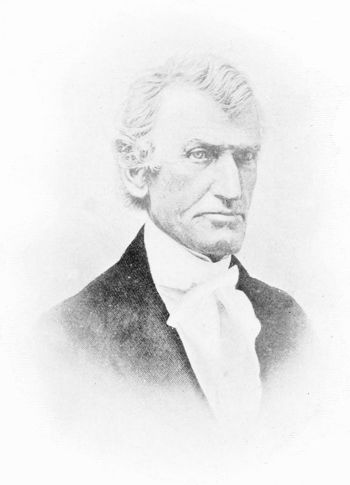
THOMAS RUFFIN.