Volume 6 — PHILLIPS BROOKS
Reading edition
(1835-1893)
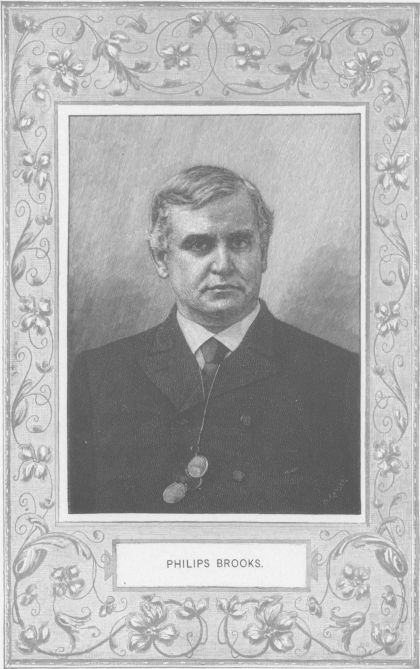
hillips Brooks was born in Boston, Massachusetts, December 13th, 1835, and died there January 23d, 1893. He inherited the best traditions of New England history, being on the paternal side the direct descendant of John Cotton, and his mother's name, Phillips, standing for high learning and distinction in the Congregational church. Born at a time when the orthodox faith was fighting its bitterest battle with Unitarianism, his parents accepted the dogmas of the new theology, and had him baptized by a Unitarian clergyman. But while refusing certain dogmas of the orthodox church, they were the more thrown back for spiritual support upon the internal evidences of evangelical Christianity. "Holding still," says the Rev. Arthur Brooks, "in a greater or less degree, and with more or less precision, to the old statements, they counted the great fact that these statements enshrined more precious truth than any other." Transition to the Episcopal church was easy; the mother became an Episcopalian, and Phillips Brooks received all his early training in that communion. But heredity had its influence, and in after-life the great Bishop said that the Episcopal church could reap the fruits of the long and bitter controversy which divided the New England church, only as it discerned the spiritual worth of Puritanism, and the value of its contributions to the history of religious thought and character.
Such were the early surroundings of the man, and the subsequent influences of his life tended to foster this liberal spirit. For such a purpose, Boston itself was a good place to live in: it was too large to be wholly provincial, and it was not so large that the individual was lost; and at that time it was moreover the literary centre of America. When Phillips Brooks entered Harvard, he came into an atmosphere of intense intellectual activity. James Walker was the president of the college, and Lowell, Holmes, Agassiz, and Longfellow were among the professors. He graduated with honor in 1855, and soon after entered the Episcopal theological seminary at Alexandria, Virginia.
The transition from Harvard to this college was an abrupt one. The standards of the North and South were radically different. The theology of the Church in Virginia, while tolerant to that of other denominations, was uncompromisingly hostile to what it regarded as heterodox.
When the War was declared he threw himself passionately into the cause of the Union. Yet his affection for his Southern classmates, men from whom he so widely differed, broadened that charity that was one of his finest characteristics, a charity that respected conviction wherever found.
No man, in truth, ever did so much to remove prejudice against a Church that had never been popular in New England. To the old Puritan dislike of Episcopacy and distrust of the English Church as that of the oppressors of the colony, was added a sense of resentment toward its sacerdotal claims and its assumption of ecclesiastical supremacy. But he nevertheless protested against the claim by his own communion to the title of "The American Church," he preached occasionally in other pulpits, he even had among his audiences clergymen of other denominations, and he was able to reconcile men of different creeds into concord on what is essential in all. The breadth and depth of his teaching attracted so large a following that he increased the strength of the Episcopal Church in America far more than he could have done by carrying on an active propaganda in its behalf. Under his pastorate Trinity Church, Boston, became the centre of some of the most vigorous Christian activity in America.
His first charge was the Church of the Advent, in Philadelphia; in two years he became rector of Holy Trinity Church in the same city. In 1869 he was called to Trinity Church, Boston, of which he was rector until his election as bishop of Massachusetts in 1891.
It is impossible to give an idea of Phillips Brooks without a word about his personality, which was almost contradictory. His commanding figure, his wit, the charm of his conversation, and a certain boyish gayety and naturalness, drew people to him as to a powerful magnet. He was one of the best known men in America; people pointed him out to strangers in his own city as they pointed out the Common and the Bunker Hill monument. When he went to England, where he preached before the Queen, men and women of all classes greeted him as a friend. They thronged the churches where he preached, not only to hear him but to see him. Many stories are told of him; some true, some more or less apocryphal, all proving the affectionate sympathy existing between him and his kind. It was said of him that as soon as he entered a pulpit he was absolutely impersonal. There was no trace of individual experience or theological conflict by which he might be labeled. He was simply a messenger of the truth as he held it, a mouthpiece of the gospel as he believed it had been delivered to him.
Although in his seminary days his sermons were described as vague and unpractical, Phillips Brooks was as great a preacher when under thirty years of age as he was at any later time. His early sermons, delivered to his first charge in Philadelphia, displayed the same individuality, the same force and completeness and clearness of construction, the same deep, strong undertone of religious thought, as his great discourses preached in Westminster Abbey six months before his death. His sentences are sonorous; his style was characterized by a noble simplicity, impressive, but without a touch showing that dramatic effect was strained for.
He passionately loved nature in all her aspects, and traveled widely in search of the picturesque; but he used his experience with reserve, and his illustrations are used to explain human life. His power of painting a picture in a few bold strokes appears strikingly in the great sermon on the 'Lesson of the Life of Saul,' where he contrasts early promise and final failure; and in that other not less remarkable presentation of the vision of Saint Peter. His treatment of Bible narratives is not a translation into the modern manner, nor is it an adaptation, but a poetical rendering, in which the flavor of the original is not lost though the lesson is made contemporary. And while he did not transcribe nature upon his pages, his sermons are not lacking in decoration. He used figures of speech and drew freely on history and art for illustrations, but not so much to elucidate his subject as to ornament it. His essays on social and literary subjects are written with the aim of directness of statement, pure and simple; but the stuff of which his sermons are woven is of royal purple.
The conviction that religious sentiment should penetrate the whole life showed itself in Phillips Brooks's relation to literature. "Truth bathed in light and uttered in love makes the new unit of power," he says in his essay on literature. It was his task to mediate between literature and theology, and restore theology to the place it lost through the abstractions of the schoolmen. What he would have done if he had devoted himself to literature alone, we can only conjecture by the excellence of his style in essays and sermons. They show his poetical temperament; and his little lyric 'O Little Town of Bethlehem' will be sung as long as Christmas is celebrated. His essays show more clearly even than his sermons his opinions on society, literature, and religion. They place him where he belongs, in that "small transfigured band the world cannot tame,"--the world of Cranmer, Jeremy Taylor, Robertson, Arnold, Maurice. His paper on Dean Stanley discloses his theological views as openly as do his addresses on 'Heresies and Orthodoxy.'
As might be expected of one who, in the word's best sense, was so thoroughly a man, he had great influence with young men and was one of the most popular of Harvard preachers. It was his custom for thirty alternate years to go abroad in the summer, and there, as in America, he was regarded as a great pulpit orator. He took a large view of social questions and was in sympathy with all great popular movements. His advancement to the episcopate was warmly welcomed by all parties, except one branch of his own church with which his principles were at variance, and every denomination delighted in his elevation as if he were the peculiar property of each.
He published several volumes of sermons. His works include 'Lectures on Preaching' (New York, 1877), 'Sermons' (1878-81), 'Bohlen Lectures' (1879), 'Baptism and Confirmation' (1880), 'Sermons Preached in English Churches' (1883), 'The Oldest Schools in America' (Boston, 1885), 'Twenty Sermons' (New York, 1886), 'Tolerance' (1887), 'The Light of the World, and Other Sermons' (1890), and 'Essays and Addresses' (1894). His 'Letters of Travel' show him to be an accurate observer, with a large fund of spontaneous humor. No letters to children are so delightful as those in this volume.
O LITTLE TOWN OF BETHLEHEM O little town of Bethlehem, How still we see thee lie! Above thy deep and dreamless sleep The silent stars go by. Yet in thy dark streets shineth The everlasting Light; The hopes and fears of all the years Are met in thee to-night. O morning stars, together Proclaim the holy birth! And praises sing to God the King, And peace to men on earth. For Christ is born of Mary, And gathered all above; While mortals sleep the angels keep Their watch of wondering love. How silently, how silently, The wondrous gift is given! So God imparts to human hearts The blessings of his heaven. No ear may hear his coming; But in this world of sin, Where meek souls will receive him still, The dear Christ enters in. Where children pure and happy Pray to the blessèd Child, Where Misery cries out to thee, Son of the Mother mild; Where Charity stands watching, And Faith holds wide the door, The dark night wakes; the glory breaks, And Christmas comes once more. O holy Child of Bethlehem, Descend to us, we pray! Cast out our sin and enter in; Be born in us to-day. We hear the Christmas angels The great glad tidings tell; O come to us, abide with us, Our Lord Emmanuel! Copyrighted by E.P. Dutton and Company, New York.
The Holy Child of Bethlehem
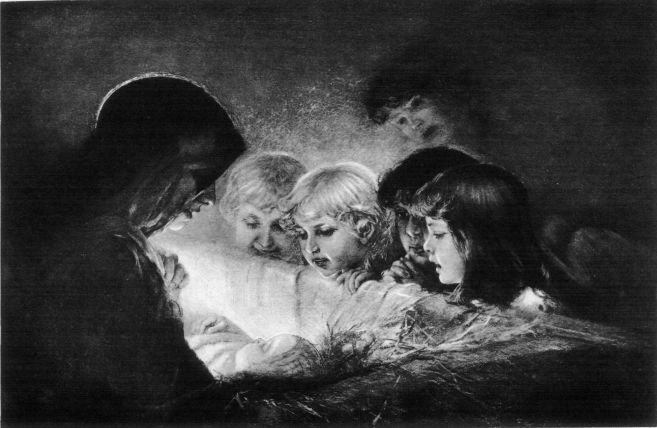
Photogravure from a Painting by H. Havenith. "Where children pure and happy Pray to the blessed Child."
PERSONAL CHARACTER
From 'Essays and Addresses'
As one looks around the world, and as one looks around our own land to-day, he sees that the one thing we need in high places--the thing whose absence, among those who hold the reins of highest power, is making us all anxious with regard to the progress of the country--is personal character. The trouble is not what we hold to be mistaken ideas with regard to policies of government, but it is the absence of lofty and unselfish character. It is the absence of the complete consecration of a man's self to the public good; it is the willingness of men to bring their personal and private spites into spheres whose elevation ought to shame such things into absolute death; the tendencies of men, even of men whom the nation has put in very high places indeed, to count those high places their privileges, and to try to draw from them, not help for humanity and the community over which they rule, but their own mean personal private advantage.
If there is any power that can elevate human character: if there is any power which, without inspiring men with a supernatural knowledge with regard to policies of government; without making men solve all at once, intuitively, the intricacies of problems of legislation with which they are called upon to deal; without making men see instantly to the very heart of every matter; if there is any power which could permeate to the very bottom of our community, which would make men unselfish and true--why, the errors of men, the mistakes men might make in their judgment, would not be an obstacle in the way of the progress of this great nation in the work which God has given her to do. They would make jolts, but nothing more. Or in the course which God has appointed her to run she would go to her true results. There is no power that man has ever seen that can abide; there is no power of which man has ever dreamed that can regenerate human character except religion; and till the Christian religion, which is the religion of this land--till the Christian religion shall have so far regenerated human character in this land that multitudes of men shall act under its high impulses and principles, so that the men who are not inspired with them shall be shamed at least into an outward conformity with them, there is no security for the great final continuance of the nation.
Copyrighted by E.P. Dutton and Company, New York.
THE COURAGE OF OPINIONS
From 'Essays and Addresses'
We have spoken of physical courage, or the courage of nerves; of moral courage, or the courage of principles. Besides these there is intellectual courage, or the courage of opinions. Let me say a few words upon that, for surely there is nothing which we more need to understand.
The ways in which people form their opinions are most remarkable. Every man, when he begins his reasonable life, finds certain general opinions current in the world. He is shaped by these opinions in one way or another, either directly or by reaction. If he is soft and plastic, like the majority of people, he takes the opinions that are about him for his own. If he is self-asserting and defiant, he takes the opposite of these opinions and gives to them his vehement adherence. We know the two kinds well, and as we ordinarily see them, the fault which is at the root of both is intellectual cowardice. One man clings servilely to the old ready-made opinions which he finds, because he is afraid of being called rash and radical; another rejects the traditions of his people from fear of being thought fearful, and timid, and a slave. The results are very different: one is the tame conservative and the other is the fiery iconoclast; but I beg you to see that the cause in both cases is the same. Both are cowards. Both are equally removed from that brave seeking of the truth which is not set upon either winning or avoiding any name, which will take no opinion for the sake of conformity and reject no opinion for the sake of originality; which is free, therefore--free to gather its own convictions, a slave neither to any compulsion nor to any antagonism. Tell me, have you never seen two teachers, one of them slavishly adopting old methods because he feared to be called "imitator," the other crudely devising new plans because he was afraid of seeming conservative, both of them really cowards, neither of them really thinking out his work? ...
The great vice of our people in their relation to the politics of the land is cowardice. It is not lack of intelligence: our people know the meaning of political conditions with wonderful sagacity. It is not low morality: the great mass of our people apply high standards to the acts of public men. But it is cowardice. It is the disposition of one part of our people to fall in with current ways of working, to run with the mass; and of another part to rush headlong into this or that new scheme or policy of opposition, merely to escape the stigma of conservatism.
LITERATURE AND LIFE
From 'Essays and Addresses'
Life comes before literature, as the material always comes before the work. The hills are full of marble before the world blooms with statues. The forests are full of trees before the sea is thick with ships. So the world abounds in life before men begin to reason and describe and analyze and sing, and literature is born. The fact and the action must come first. This is true in every kind of literature. The mind and its workings are before the metaphysician. Beauty and romance antedate the poet. The nations rise and fall before the historian tells their story. Nature's profusion exists before the first scientific book is written. Even the facts of mathematics must be true before the first diagram is drawn for their demonstration.
To own and recognize this priority of life is the first need of literature. Literature which does not utter a life already existent, more fundamental than itself, is shallow and unreal. I had a schoolmate who at the age of twenty published a volume of poems called 'Life-Memories.' The book died before it was born. There were no real memories, because there had been no life. So every science which does not utter investigated fact, every history which does not tell of experience, every poetry which is not based upon the truth of things, has no real life. It does not perish; it is never born. Therefore men and nations must live before they can make literature. Boys and girls do not write books. Oregon and Van Diemen's Land produce no literature: they are too busy living. The first attempts at literature of any country, as of our own, are apt to be unreal and imitative and transitory, because life has not yet accumulated and presented itself in forms which recommend themselves to literature. The wars must come, the clamorous problems must arise, the new types of character must be evolved, the picturesque social complication must develop, a life must come, and then will be the true time for a literature.... Literature grows feeble and conceited unless it ever recognizes the priority and superiority of life, and stands in genuine awe before the greatness of the men and of the ages which have simply lived.