Volume 6 — FERDINAND BRUNETIÈRE
Reading edition
(1849-)
BY ADOLPHE COHN

erdinand Brunetière, the celebrated French literary critic, was born in Toulon, the great military Mediterranean sea-port of France, in the year 1849. His studies were begun in the college of his native city and continued in Paris, in the Lycée Louis le Grand, where in the class of philosophy he came under Professor Émile Charles, by whose original and profound though decidedly sad way of thinking he was powerfully influenced. His own ambition then was to become a teacher in the University of France, an ambition which seemed unlikely to be ever realized, as he failed to secure admission to the celebrated École Normale Supérieure, in the competitive examination which leads up to that school. Strangely enough, about fifteen years later he was, though not in possession of any very high University degree, appointed to the Professorship of French Literature in the school which he had been unable to enter as a scholar, and his appointment received the hearty indorsement of all the leading educational authorities in France.
Ferdiand Brunetière
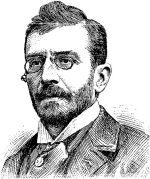
For several years after leaving the Lycée Louis le Grand, while completing his literary outfit by wonderfully extensive reading, Ferdinand Brunetière lived on stray orders for work for publishers. He seldom succeeded in getting these, and when he got any they were seldom filled. Thus he happened to be commissioned by the firm of Germer, Baillière and Company to write a history of Russia, which never was and to all appearances never will be written. The event which determined the direction of his career was the acceptance by the Revue des Deux Mondes, in 1875, of an article upon contemporary French novelists. François Buloz, the energetic and imperious founder and editor of the world-famed French bi-monthly, felt that he had found in the young critic the man whom French literary circles had been waiting for, and who was to be Sainte-Beuve's successor; and François Buloz was a man who seldom made mistakes.
French literary criticism was just then at a very low ebb. Sainte-Beuve had been dead about five years; his own contemporaries, Edmond Schérer for instance, were getting old and discouraged; the new generation seemed to be turning unanimously, in consequence of the disasters of the Franco-German war and of the Revolution of September, 1870, to military or political activity. The only form of literature which had power to attract young writers was the novel, which they could fill with the description of all the passions then agitating the public mind. That a man of real intellectual strength should then give his undivided attention to pure literature seemed a most unlikely phenomenon; but all had to acknowledge that the unlikely had happened, soon after Ferdinand Brunetière had become the regular literary critic of the Revue des Deux Mondes.
Fortunately the new critic did not undertake to walk in the footsteps of Sainte-Beuve. In the art of presenting to the reader the marrow of a writer's work, of making the writer himself known by the description of his surroundings, the narrative of his life, the study of the forces by which he was influenced, the illustrious author of the 'Causeries du Lundi' remains to this day without a rival or a continuator. Ferdinand Brunetière had a different conception of the duties of a literary critic. The one fault with which thoughtful readers were apt to charge Sainte-Beuve was, that he failed to pass judgment upon the works and writers; and this failure was often, and not altogether unjustly, ascribed to a certain weakness in his grasp of principles, a certain faint-heartedness whenever it became necessary to take sides. Any one who studies Brunetière can easily see that from the start his chief concern was to make it impossible for any one to charge him with the same fault. He came in with a set of principles which he has since upheld with remarkable steadfastness and courage. In an age when nearly every one was turning to the future and advocating the doctrine and the necessity of progress, when the chief fear of most men was that they should appear too much afraid of change, Brunetière proclaimed time and again that there was no safety for any nation or set of men except in a staunch adherence to tradition. He bade his readers turn their minds away from the current literature of the day, and take hold of the exemplars of excellence handed down to us by the great men of the past. Together with tradition he upheld authority, and therefore preferred to all others the period in which French literature and society had most willingly submitted to authority, that is, the seventeenth century and the reign of Louis XIV. When compelled to speak of the literature of the day, he did it in no uncertain tones. His book 'The Naturalistic Novel' consists of a series of articles in which he studies Zola and his school, upholding the old doctrine that there are things in life which must be kept out of the domain of art and cannot be therein introduced without lowering the ideal of man. Between the naturalistic and the idealistic novel he unhesitatingly declares for the latter, and places George Sand far above the author of 'L'Assommoir.'
But the great success of his labors cannot be said to have been due solely or even mainly to the principles he advocated. Other critics have appeared since--Messrs. Jules Lemaître and Anatole France, for instance,--who antagonize almost everything that he defends and defend almost everything that he antagonizes, and whose success has hardly been inferior to his. Neither is it due to any charm in his style. Brunetière's sentences are compact,--indeed, strongly knit together,--but decidedly heavy and at times even clumsy. What he has to say he always says strongly, but not gracefully. He has a remarkable appreciation of the value of the words of the French language, but his arrangement of them is seldom free from mannerisms. What, then, has made him the foremost literary critic of the present day? The answer is, knowledge and sincerity. No writer of the present day, save perhaps Anatole France, is so accurately informed of every fact that bears upon literary history. Every argument he brings forward is supported by an array of incontrovertible facts that is simply appalling. No one can argue with him who does not first subject himself to the severest kind of training, go through a mass of tedious reading, become familiar with dates to the point of handling them as nimbly as a bank clerk handles the figures of a check list. And all this comes forward in Brunetière's articles in the most natural, we had almost said casual way. The fact takes its place unheralded in the reasoning. It is there because it has to be there, not because the writer wishes to make a display of his wonderful knowledge; and thus it happens that Ferdinand Brunetière's literary articles are perhaps the most instructive ones ever written in the French language. They are moreover admirably trustworthy. It would never come to this author's mind to hide a fact that goes against any of his theories. He feels so sure of being in the right that he is always willing to give his opponents all that they can possibly claim.
Of late years, moreover, it must be acknowledged that Brunetière's mind has given signs of remarkable broadening. Under the influence of the doctrine of evolution, he has undertaken to class all literary facts as the great naturalists of the day have classed the facts of physiology, and to show that literary forms spring from each other by way of transformation in the same way as do the forms of animal or vegetable life. Already three works have been produced by him since he entered upon this new line of development: a history of literary criticism in France, which forms the first and hitherto only published volume of a large work, (The Evolution of Literary Forms); a work on the French drama, (The Periods of the French Theatre); and a treatise on modern French poetry, (The Evolution of French Lyric Poetry during the Nineteenth Century.) The second and last of these were first delivered by their author from the professor's chair or the lecturer's platform, where he has managed to display some of the greatest gifts of the public speaker. Most of M. Brunetière's literary articles have been collected in book form under the following titles:--(Questions of Criticism) (2 vols.), (History and Criticism) (3 vols.), (Critical Studies on the History of French Literature) (6 vols.), (The Naturalistic Novel) (1 vol.).
At various times remarkable addresses have been delivered by him on public occasions, in which he has often represented the French Academy since his election to that illustrious body. Unfortunately his productive literary activity has slackened of late. In 1895 he was called to the editorship of the Revue des Deux Mondes, and since his assumption of this responsible editorial position he has published only two or three articles, bearing upon moral and educational questions.
To pass final judgment upon a man whose development is far from completed is an almost impossible task. Still it may be said that with the exception of Sainte-Beuve's (Causeries du Lundi) and (Nouveaux Lundis,) nothing exists that can teach the reader so much about the history of French literature as Brunetière's works. The doctrinal side, to which the author himself undoubtedly attaches the greatest importance, will strike the reader as often very questionable. Too often Brunetière seems in his judgments to be quite unconsciously actuated by a dislike of the accepted opinion of the present day. His love of the past bears a look of defiance of the present, not calculated to win the reader's assent. But even this does not go without its good side. It gives to Brunetière's judgments a unity which is seldom if ever found in the works of those whose chief labors have been spent in the often ungrateful task of making a hurried public acquainted with the uninterrupted stream of literary production.
TAINE AND PRINCE NAPOLEON
For the last five or six months, since it has been known that a prince, nephew, cousin, and son of emperors or kings formerly very powerful, had proposed to answer the libel, as he calls it, written by M. Taine about Napoleon, we have been awaiting this reply with an impatience, a curiosity which were equally justified,--although for very different reasons,--by M. Taine's reputation, by the glorious name of his antagonist, by the greatness, and finally the national interest of the subject.
The book has just appeared; and if we can say without flattery that it has revealed to us in the Prince a writer whose existence we had not suspected, it is because we must at once add that neither in its manner nor in its matter is the book itself what it might have been. Prince Napoleon did not wish to write a 'Life of Napoleon,' and nobody expected that of him,--for after all, and for twenty different reasons, even had he wished it he could not have done it. But to M. Taine's Napoleon, since he did not find in him the true Napoleon, since he declared him to be as much against nature as against history, he could, and we expected that he would, have opposed his own Napoleon. By the side of the "inventions of a writer whose judgment had been misled and whose conscience had been obscured by passion,"--these are his own words,--he could have restored, as he promised in his 'Introduction,' "the man and his work in their living reality." And in our imaginations, on which M. Taine's harsh and morose workmanship had engraven the features of a modern Malatesta or modern Sforza, he could at last substitute for them, as the inheritor of the name and the dynastic claims, the image of the founder of contemporary France, of the god of war. Unfortunately, instead of doing so, it is M. Taine himself, it is his analytical method, it is the witnesses whom M. Taine chose as his authorities, that Prince Napoleon preferred to assail, as a scholar in an Academy who descants upon the importance of the genuineness of a text, and moreover with a freedom of utterance and a pertness of expression which on any occasion I should venture to pronounce decidedly insulting.
For it is a misfortune of princes, when they do us the honor of discussing with us, that they must observe a moderation, a reserve, a courtesy greater even than our own. It will therefore be unanimously thought that it ill became Prince Napoleon to address M. Taine in a tone which M. Taine would decline to use in his answer, out of respect for the very name which he is accused of slandering. It will be thought also that it ill became him, when speaking of Miot de Melito, for instance, or of many other servants of the imperial government, to seem to ignore that princes also are under an obligation to those who have served them well. Perhaps even it may be thought that it poorly became him, when discussing or contradicting the 'Memoirs of Madame de Rémusat,' to forget under what auspices the remains of his uncle, the Emperor, were years ago carried in his city of Paris. But what will be thought especially is, that he had something else to do than to split hairs in discussion of evidences; that he had something far better to say, more peremptory and to the point, and more literary besides, than to call M. Taine names, to hurl at him the epithets of "Entomologist, Materialist, Pessimist, Destroyer of Reputations, Iconoclast," and to class him as a "déboulonneur" among those who, in 1871, pulled down the Colonne Vendôme.
Not, undoubtedly, that M. Taine--and we said so ourselves more than once with perfect freedom--if spending much patience and conscientiousness in his search for documents, has always displayed as much critical spirit and discrimination in the use he made of them. We cannot understand why in his 'Napoleon' he accepted the testimony of Bourrienne, for instance, any more than recently, in his 'Revolution,' that of George Duval, or again, in his 'Ancien Régime,' that of the notorious Soulavic. M. Taine's documents as a rule are not used by him as a foundation for his argument; no, he first takes his position, and then he consults his library, or he goes to the original records, with the hope of finding those documents that will support his reasoning. But granting that, we must own that though different from M. Taine's, Prince Napoleon's historical method is not much better; that though in a different manner and in a different direction, it is neither less partial nor less passionate: and here is a proof of it.
Prince Napoleon blames M. Taine for quoting "eight times" 'Bourrienne's Memoirs,' and then, letting his feelings loose, he takes advantage of the occasion and cruelly besmirches Bourrienne's name. Does he tell the truth or not? is he right at the bottom? I do not know anything about it; I do not wish to know anything; I do not need it, since I know, from other sources, that 'Bourrienne's Memoirs' are hardly less spurious than, say, the 'Souvenirs of the Marquise de Créqui' or the 'Memoirs of Monsieur d'Artagnan.' But if these so-called 'Memoirs' are really not his, what has Bourrienne himself to do here? and suppose the former secretary of the First Consul to have been, instead of the shameless embezzler whom Prince Napoleon so fully and so uselessly describes to us, the most honest man in the world, would the 'Memoirs' be any more reliable, since it is a fact that he wrote nothing? ...
And now I cannot but wonder at the tone in which those who contradict M. Taine, and especially Prince Napoleon himself, condescend to tell him that he lacks that which would be needed in order to speak of Napoleon or the Revolution. But who is it, then, that has what is needed in order to judge Napoleon? Frederick the Great, or Catherine II., perhaps,--as Napoleon himself desired, "his peers"; or in other words, those who, born as he was for war and government, can only admire, justify, and glorify themselves in him. And who will judge the Revolution? Danton. we suppose, or Robespierre,--that is, the men who were the Revolution itself. No: the real judge will be the average opinion of men; the force that will create, modify, correct this average opinion, the historians will be; and among the historians of our time, in spite of Prince Napoleon, it will be M. Taine for a large share.
THE LITERATURES OF FRANCE, ENGLAND, AND GERMANY
Twice at least in the course of their long history, it is known that the literature and even the language of France has exerted over the whole of Europe an influence, whose universal character other languages perhaps more harmonious,--Italian for instance,--and other literatures more original in certain respects, like English literature, have never possessed. It is in a purely French form that our mediæval poems, our 'Chansons de Geste,' our 'Romances of the Round Table,' our fabliaux themselves, whencesoever they came,--Germany or Tuscany, England or Brittany, Asia or Greece,--conquered, fascinated, charmed, from one end of Europe to the other, the imaginations of the Middle Ages. The amorous languor and the subtlety of our "courteous poetry" are breathed no less by the madrigals of Shakespeare himself than by Petrarch's sonnets; and after such a long lapse of time we still discover something that comes from us even in the Wagnerian drama, for instance in 'Parsifal' or in 'Tristan and Isolde.' A long time later, in a Europe belonging entirely to classicism, from the beginning of the seventeenth to the end of the eighteenth century, during one hundred and fifty years or even longer, French literature possessed a real sovereignty in Italy, in Spain, in England, and in Germany. Do not the names of Algarotti, Bettinelli, Beccaria, Filengieri, almost belong to France? What shall I say of the famous Gottschedt? Shall I recall the fact that in his victorious struggle against Voltaire, Lessing had to call in Diderot's assistance? And who ignores that if Rivarol wrote his 'Discourse upon the Universality of the French Language,' it can be charged neither to his vanity nor to our national vanity, since he was himself half Italian, and the subject had been proposed by the Academy of Berlin?
All sorts of reasons have been given for this universality of French literature: some were statistical, if I may say so, some geographical, political, linguistic. But the true one, the good one, is different: it must be found in the supremely sociable character of the literature itself. If at that time our great writers were understood and appreciated by everybody, it is because they were addressing everybody, or better, because they were speaking to all concerning the interests of all. They were attracted neither by exceptions nor by peculiarities: they cared to treat only of man in general, or as is also said, of the universal man, restrained by the ties of human society; and their very success shows that below all that distinguishes, say, an Italian from a German, this universal man whose reality has so often been discussed, persists and lives, and though constantly changing never loses his own likeness....
In comparison with the literature of France, thus defined and characterized by its sociable spirit, the literature of England is an individualistic literature. Let us put aside, as should be done, the generation of Congreve and Wycherley, perhaps also the generation of Pope and Addison,--to which, however, we ought not to forget that Swift also belonged;--it seems that an Englishman never writes except in order to give to himself the external sensation of his own personality. Thence his humor, which may be defined as the expression of the pleasure he feels in thinking like nobody else. Thence, in England, the plenteousness, the wealth, the amplitude of the lyric vein; it being granted that individualism is the very spring of lyric poetry, and that an ode or an elegy is, as it were, the involuntary surging, the outflowing of what is most intimate, most secret, most peculiar in the poet's soul. Thence also the eccentricity of all the great English writers when compared with the rest of the nation, as though they became conscious of themselves only by distinguishing themselves from those who claim to differ from them least. But is it not possible to otherwise characterize the literature of England? It will be easily conceived that I dare not assert such a thing; all I say here is, that I cannot better express the differences which distinguish that literature from our own.
That is also all I claim, in stating that the essential character of the literature of Germany is, that it is philosophical. The philosophers there are poets, and the poets are philosophers. Goethe is to be found no more, or no less, in his 'Theory of Colors' or in his 'Metamorphosis of Plants,' than in his 'Divan' or his 'Faust'; and lyrism, if I may use this trite expression, "is overflowing" in Schleiermacher's theology and in Schelling's philosophy. Is this not perhaps at least one of the reasons of the inferiority of the German drama? It is surely the reason of the depth and scope of Germanic poetry. Even in the masterpieces of German literature it seems that there is mixed something indistinct, or rather mysterious, suggestive in the extreme, which leads us to thought by the channel of the dream. But who has not been struck by what, under a barbarous terminology, there is of attractive, and as such of eminently poetical, of realistic and at the same time idealistic, in the great systems of Kant and Fichte, Hegel and Schopenhauer? Assuredly nothing is further removed from the character of our French literature. We can here understand what the Germans mean when they charge us with a lack of depth. Let them forgive us if we do not blame their literature for not being the same as ours.
For it is good that it be thus, and for five or six hundred years this it is that has made the greatness not only of European literature, but of Western civilization itself; I mean that which all the great nations, after slowly elaborating it, as it were, in their national isolation, have afterwards deposited in the common treasury of the human race. Thus, to this one we owe the sense of mystery, and we might say the revelation of what is beautiful, in that which remains obscure and cannot be grasped. To another we owe the sense of art, and what may be called the appreciation of the power of form. A third one has handed to us what was most heroic in the conception of chivalrous honor. And to another, finally, we owe it that we know what is both most ferocious and noblest, most wholesome and most to be feared, in human pride. The share that belongs to us Frenchmen was, in the meanwhile, to bind, to fuse together, and as it were to unify under the idea of the general society of mankind, the contradictory and even hostile elements that may have existed in all that. No matter whether our inventions and ideas were, by their origin, Latin or Romance, Celtic or Gallic, Germanic even, if you please, the whole of Europe had borrowed them from us in order to adapt them to the genius of its different races. Before re-admitting them in our turn, before adopting them after they had been thus transformed, we asked only that they should be able to serve the progress of reason and of humanity. What was troublous in them we clarified; what was corrupting we corrected; what was local we generalized; what was excessive we brought down to the proportions of mankind. Have we not sometimes also lessened their grandeur and altered their purity? If Corneille has undoubtedly brought nearer to us the still somewhat barbaric heroes of Guillem de Castro, La Fontaine, when imitating the author of the Decameron, has made him more indecent than he is in his own language; and if the Italians have no right to assail Molière for borrowing somewhat from them, the English may well complain that Voltaire failed to understand Shakespeare. But it is true none the less that in disengaging from the particular man of the North or the South this idea of a universal man, for which we have been so often reviled,--if any one of the modern literatures has breathed in its entirety the spirit of the public weal and of civilization, it is the literature of France. And this ideal cannot possibly be as empty as has too often been asserted; since, as I endeavored to show, from Lisbon to Stockholm and from Archangel to Naples, it is its manifestations that foreigners have loved to come across in the masterpieces, or better, in the whole sequence of the history of our literature.