Volume 6 — ELISABETH BRENTANO (BETTINA VON ARNIM)
Reading edition
(1785-1859)

o picture of German life at the beginning of this century would be complete which did not include the distinguished women who left their mark upon the time. Among these Bettina von Arnim stands easily foremost. There was something triumphant in her nature, which in her youth manifested itself in her splendid enthusiasm for the two great geniuses who dominated her life,--Goethe and Beethoven,--and which, in the lean years when Germany was overclouded, maintained itself by an inexhaustible optimism. Her merry willfulness and wit covered a warm heart and a vigorous mind; and both of her great idols understood her and took her seriously.
Elisabeth Brentano
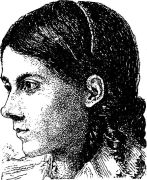
Elisabeth Brentano was the daughter of Goethe's friend, Maximiliane de la Roche. She was born at Frankfort-on-the-Main in 1785, and was brought up after the death of her mother under the somewhat peculiar influence of the highly-strung Caroline von Günderode. Through her filial intimacy with Goethe's mother, she came to know the poet; and out of their friendship grew the correspondence which formed the basis of Bettina's famous book, 'Goethe's Briefwechsel mit einem Kinde' (Goethe's Correspondence with a Child). She attached herself with unbounded enthusiasm to Goethe, and he responded with affectionate tact. To him Bettina was the embodiment of the loving grace and willfulness of 'Mignon.'
In 1811 these relations were interrupted, owing to Bettina's attitude toward Goethe's wife. In the same year she married Achim von Arnim, one of the most refined poets and noblest characters of that brilliant circle. The marriage was an ideal one; each cherished and delighted in the genius of the other, but in 1831 the death of Von Arnim brought this happiness to an end. Goethe died in the following year, and Germany went into mourning. Then in 1835 Bettina appeared before the world for the first time as an authoress, in 'Goethe's Correspondence with a Child.' The dithyrambic exaltation, the unrestrained but beautiful enthusiasm of the book came like an electric shock. Into an atmosphere of spiritual stagnation, these letters brought a fresh access of vitality and hope. Bettina's old friendly relations with Goethe had been resumed later in life, and in a letter written to her niece she gives a charming account of the visit to the poet in 1824, which proved to be her last. This letter first saw the light in 1896, and an extract from it has been included below.
The inspiration which went out from Bettina's magnetic nature was profound. She had her part in every great movement of her time, from the liberation of Greece to the fight with cholera in Berlin. During the latter, her devotion to the cause of the suffering poor in Berlin opened her eyes to the miseries of the common people; and she wrote a work full of indignant fervor, 'Dies Buch gehört dem König' (This Book belongs to the King), in consequence of which her welcome at the court of Frederick William IV. grew cool. A subsequent book, written in a similar vein, was suppressed. But Bettina's love of the people, as of every cause in which she was interested, was genuine and not to be quenched; she acted upon the maxim once expressed by Emerson, "Every brave heart must treat society as a child, and never allow it to dictate." Emerson greatly admired Bettina, and Louisa M. Alcott relates that she first made acquaintance with the famous 'Correspondence' when in her girlhood she was left to browse in Emerson's library. Bettina's influence was most keenly felt by the young, and she had the youth of Germany at her feet. She died in 1859.
There is in Weimar a picture in which are represented the literary men of the period, grouped as in Raphael's School of Athens, with Goethe and Schiller occupying the centre. Upon the broad steps which lead to the elevation where they are standing, is the girlish figure of Bettina bending forward and holding a laurel wreath in her hand. This is the position which she occupies in the history of German literature.
DEDICATION: TO GOETHE
From 'Goethe's Correspondence with a Child'
Thou, who knowest love, and the refinement of sentiment, oh how beautiful is everything in thee! How the streams of life rush through thy sensitive heart, and plunge with force into the cold waves of thy time, then boil and bubble up till mountain and vale flush with the glow of life, and the forests stand with glistening boughs upon the shore of thy being, and all upon which rests thy glance is filled with happiness and life! O God, how happy were I with thee! And were I winging my flight far over all times, and far over thee, I would fold my pinions and yield myself wholly to the domination of thine eyes.
Men will never understand thee, and those nearest to thee will most thoroughly disown and betray thee; I look into the future, and I hear them cry, "Stone him!" Now, when thine own inspiration, like a lion, stands beside thee and guards thee, vulgarity ventures not to approach thee. Thy mother said recently, "The men to-day are all like Gerning, who always says, 'We, the superfluous learned';" and she speaks truly, for he is superfluous. Rather be dead than superfluous! But I am not so, for I am thine, because I recognize thee in all things. I know that when the clouds lift themselves up before the sun-god, they will soon be depressed by his fiery hand; I know that he endures no shadow except that which his own fame seeks; the rest of consciousness will overshadow thee. I know, when he descends in the evening, that he will again appear in the morning with golden front. Thou art eternal, therefore it is good for me to be with thee.
When, in the evening, I am alone in my dark room, and the neighbors' lights are thrown upon my wall, they sometimes light up thy bust; or when all is silent in the city, here and there a dog barks or a cock crows: I know not why, but it seems something beyond human to me; I know what I shall do to still my pain.
I would fain speak with thee otherwise than with words; I would fain press myself to thy heart. I feel that my soul is aflame. How fearfully still is the air before the storm! So stand now my thoughts, cold and silent, and my heart surges like the sea. Dear, dear Goethe! A reminiscence of thee breaks the spell; the signs of fire and warfare sink slowly down in my sky, and thou art like the in-streaming moonlight. Thou art great and glorious, and better than all that I have ever known and experienced up to this time. Thy whole life is so good!
TO GOETHE
CASSEL, August 13th, 1807.
Who can interpret and measure what is passing within me? I am happy now in remembrance of the past, which I scarcely was when that past was the present. To my sensitive heart the surprise of being with thee, the coming and going and returning in a few blessed days--this was all like clouds flitting across my heaven; through my too near presence I feared it might be darkened by my shadow, as it is ever darker when it nears the earth; now, in the distance, it is mild and lofty and ever clear.
I would fain press thy dear hand with both of mine to my bosom, and say to thee, "How peace and content have come to me since I have known thee!"
I know that the evening has not come when life's twilight gathers in my heart: oh, would it were so! Would that I had lived out my days, that my wishes and joys were fulfilled, and that they could all be heaped upon thee, that thou mightst be therewith decked and crowned as with evergreen bays.
When I was alone with thee on that evening I could not comprehend thee: thou didst smile at me because I was moved, and laughed at me because I wept; but why? And yet it was thy laughter, the tone of thy laughter, which moved me to tears; and I am content, and see, under the cloak of this riddle, roses burst forth which spring alike from sadness and joy. Yes, thou art right, prophet: I shall yet with light heart struggle up through jest and mirth; I shall weary myself with struggling as I did in my childhood (ah, it seems as if it were but yesterday!) when with the exuberance of joy I wandered through the blossoming fields, pulling up the flowers by the roots and throwing them into the water. But I wish to seek rest in a warm, firm earnestness, and there at hand standest thou, smiling prophet!
I say to thee yet once more: Whoever in this wide world understands what is passing within me, who, am so restful in thee, so silent, so unwavering in my feeling? I could, like the mountains, bear nights and days in the past without disturbing thee in thy reflections! And yet when at times the wind bears the fragrance and the germs together from the blossoming world up to the mountain heights, they will be intoxicated with delight as I was yesterday. Then I loved the world, then I was as glad as a gushing, murmuring spring in which the sun for the first time shines.
Farewell, sublime one who blindest and intimidatest me! From this steep rock upon which my love has in life-danger ventured, I cannot clamber down. I cannot think of descending, for I should break my neck in the attempt.
BETTINA'S LAST MEETING WITH GOETHE
From a Letter to her Niece in 1824, first published in 1896
IN THE evening I was alone again with Goethe. Had any one observed us, he would have had something to tell to posterity. Goethe's peculiarities were exhibited to the full: first he would growl at me, then to make it all up again he would caress me, with the most flattering words. His bottle of wine he kept in the adjoining room, because I had reproached him for his drinking the night before: on some pretext or other he disappeared from the scene half a dozen times in order to drink a glass. I pretended to notice nothing; but at parting I told him that twelve glasses of wine wouldn't hurt him, and that he had had only six. "How do you know that so positively?" he said. "I heard the gurgle of the bottle in the next room, and I heard you drinking, and then you have betrayed yourself to me, as Solomon in the Song of Songs betrayed himself to his beloved, by your breath." "You are an arrant rogue," he said; "now take yourself off," and he brought the candle to light me out. But I sprang in front of him and knelt upon the threshold of the room. "Now I shall see if I can shut you in, and whether you are a good spirit or an evil one, like the rat in Faust; I kiss this threshold and bless it, for over it daily passes the most glorious human spirit and my best friend." "Over you and your love I shall never pass," he answered, "it is too dear to me; and around your spirit I creep so" (and he carefully paced around the spot where I was kneeling), "for you are too artful, and it is better to keep on good terms with you." And so he dismissed me with tears in his eyes. I remained standing in the dark before his door, to gulp down my emotion. I was thinking that this door, which I had closed with my own hand, had separated me from him in all probability forever. Whoever comes near him must confess that his genius has partly passed into goodness; the fiery sun of his spirit is transformed at its setting into a soft purple light.
IN GOETHE'S GARDEN I from this hillock all my world survey! Yon vale, bedecked by nature's fairy fingers, Where the still by-road picturesquely lingers, The cottage white whose quaint charms grace the way-- These are the scenes that o'er my heart hold sway. I from this hillock all my world survey! Though I ascend to heights fair lands dividing, Where stately ships I see the ocean riding, While cities gird the view in proud array, Naught prompts my heart's impulses to obey. I from this hillock all my world survey! And could I stand while Paradise descrying, Still for these verdant meads should I be sighing, Where thy dear roof-peaks skirt the verdant way: Beyond these bounds my heart longs not to stray.