Volume 6 — CHARLES FARRAR BROWNE (ARTEMUS WARD)
Reading edition
(1834-1867)
BY CHARLES F. JOHNSON
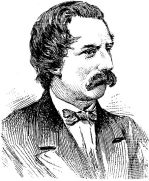
harles Farrar Brown, better known to the public of thirty years ago under his pen-name of Artemus Ward, was born in the little village of Waterford, Maine, on the 26th day of April, 1834. Waterford is a quiet village of about seven hundred inhabitants, lying among the foot-hills of the White Mountains. When Browne was a child it was a station on the western stage-route, and an important depot for lumbermen's supplies. Since the extension of railroads northerly and westerly from the seaboard, it has however shared the fate of many New England villages in being left on one side of the main currents of commercial activity, and gradually assuming a character of repose and leisure, in many regards more attractive than the life and bustle of earlier days. Many persons are still living there who remember the humorist as a quaint and tricksy boy, alternating between laughter and preternatural gravity, and of a surprising ingenuity in devising odd practical jokes in which good nature so far prevailed that even the victims were too much amused to be very angry.
Charles F. Browne
On both sides, he came from original New England stock; and although he was proud of his descent from a very ancient English family, in deference to whom he wrote his name with the final "e," he felt greater pride in his American ancestors, and always said that they were genuine and primitive Yankees,--people of intelligence, activity, and integrity in business, but entirely unaffected by new-fangled ideas. It is interesting to notice that Browne's humor was hereditary on the paternal side, his father especially being noted for his quaint sayings and harmless eccentricities. His cousin Daniel many years later bore a strong resemblance to what Charles had been, and he too possessed a kindred humorous faculty and told a story in much the same solemn manner, bringing out the point as if it were something entirely irrelevant and unimportant and casually remembered. The subject of this sketch, however, was the only member of the family in whom a love for the droll and incongruous was a controlling disposition. As is frequently the case, a family trait was intensified in one individual to the point where talent passes over into genius.
On his mother's side, too, Browne was a thorough-bred New-Englander. His maternal grandfather, Mr. Calvin Farrar, was a man of influence in town and State, and was able to send two of his sons to Bowdoin College. I have mentioned Browne's parentage because his humor is so essentially American. Whether this consists in a peculiar gravity in the humorous attitude towards the subject, rather than playfulness, or in a tendency to exaggerated statement, or in a broad humanitarian standpoint, or in a certain flavor given by a blending of all these, it is very difficult to decide. Probably the peculiar standpoint is the distinguishing note, and American humor is a product of democracy.
Humor is as difficult of definition as is poetry. It is an intimate quality of the mind, which predisposes a man to look for remote and unreal analogies and to present them gravely as if they were valid. It sees that many of the objects valued by men are illusions, and it expresses this conviction by assuming that other manifest trifles are important. It is the deadly enemy of sentimentality and affectation, for its vision is clear. Although it turns everything topsy-turvy in sport, its world is not a chaos nor a child's play-ground, for humor is based on keen perception of truth. There is no method--except the highest poetic treatment--which reveals so distinctly the falsehoods and hypocrisies of the social and economic order as the reductio ad absurdum of humor; for all human institutions have their ridiculous sides, which astonish and amuse us when pointed out, but from viewing which we suddenly become aware of relative values before misunderstood. But just as poetry may degenerate into a musical collection of words and painting into a decorative association of colors, so humor may degenerate into the merely comic or amusing. The laugh which true humor arouses is not far removed from tears. Humor indeed is not always associated with kindliness, for we have the sardonic humor of Carlyle and the savage humor of Swift; but it is naturally dissociated from egotism, and is never more attractive than when, as in the case of Charles Lamb and Oliver Goldsmith, it is based on a loving and generous interest in humanity.
Humor, must rest on a broad human foundation, and cannot be narrowed to the notions of a certain class. But in most English humor,--as indeed in all English literature except the very highest,--the social class to which the writer does not belong is regarded ab extra. In Punch, for instance, not only are servants always given a conventional set of features, but they are given conventional minds, and the jokes are based on a hypothetical conception of personality. Dickens was a great humorist, and understood the nature of the poor because he had been one of them; but his gentlemen and ladies are lay figures. Thackeray's studies of the flunky are capital; but he studies him qua flunky, as a naturalist might study an animal, and hardly ranks him sub specie humanitatis. But to the American humorist all men are primarily men. The waiter and the prince are equally ridiculous to him, because in each he finds similar incongruities between the man and his surroundings; but in England there is a deep impassable gulf between the man at the table and the man behind his chair. This democratic independence of external and adventitious circumstance sometimes gives a tone of irreverence to American persiflage, and the temporary character of class distinctions in America undoubtedly diminishes the amount of literary material "in sight" but when, as in the case of Browne and Clemens, there is in the humorist's mind a basis of reverence for things and persons that are really reverend, it gives a breadth and freedom to the humorous conception that is distinctively American.
We put Clemens and Browne in the same line, because in reading a page of either we feel at once the American touch. Browne of course is not to be compared to Clemens in affluence or in range in depicting humorous character-types; but it must be remembered that Clemens has lived thirty active years longer than his predecessor did. Neither has written a line that he would wish to blot for its foul suggestion, or because it ridiculed things that were lovely and of good report. Both were educated in journalism, and came into direct contact with the strenuous and realistic life of labor. And to repeat, though one was born and bred west of the Mississippi and the other far "down east," both are distinctly American. Had either been born and passed his childhood outside our magic line, this resemblance would not have existed. And yet we cannot say precisely wherein this likeness lies, nor what caused it; so deep, so subtle, so pervading is the influence of nationality. But their original expressions of the American humorous tone are worth ten thousand literary echoes of Sterne or Lamb or Dickens or Thackeray.
The education of young Browne was limited to the strictly preparatory years. At the age of thirteen he was forced by the death of his father to try to earn his living. When about fourteen, he was apprenticed to a Mr. Rex, who published a paper at Lancaster, New Hampshire. He remained there about a year, then worked on various country papers, and finally passed three years in the printing-house of Snow and Wilder, Boston. He then went to Ohio, and after working for some months on the Tiffin Advertiser, went to Toledo, where he remained till the fall of 1857. Thence he went to Cleveland, Ohio, as local editor of the Plain Dealer. Here appeared the humorous letters signed "Artemus Ward" and written in the character of an itinerant showman. In 1860 he went to New York as editor of the comic journal Vanity Fair.
His reputation grew steadily, and his first volume, 'Artemus Ward, His Book,' was brought out in 1862. In 1863 he went to San Francisco by way of the Isthmus and returned overland. This journey was chronicled in a short volume, 'Artemus Ward, His Travels.' He had already undertaken a career of lecturing, and his comic entertainments, given in a style peculiarly his own, became very popular. The mimetic gift is frequently found in the humorist; and Browne's peculiar drawl, his profound gravity and dreamy, far-away expression, the unexpected character of his jokes and the surprise with which he seemed to regard the audience, made a combination of a delightfully quaint absurdity. Browne himself was a very winning personality, and never failed to put his audience in good humor. None who knew him twenty-nine years ago think of him without tenderness. In 1866 he visited England, and became almost as popular there as lecturer and writer for Punch. He died from a pulmonary trouble in Southampton, March 6th, 1867, being not quite thirty-three years old. He was never married.
When we remember that a large part of Browne's mature life was taken up in learning the printer's trade, in which he became a master, we must decide that he had only entered on his career as humorous writer. Much of what he wrote is simply amusing, with little depth or power of suggestion; it is comic, not humorous. He was gaining the ear of the public and training his powers of expression. What he has left consists of a few collections of sketches written for a daily paper. But the subjoined extracts will show, albeit dimly, that he was more than a joker, as under the cap and bells of the fool in Lear we catch a glimpse of the face of a tender-hearted and philosophic friend. Browne's nature was so kindly and sympathetic, so pure and manly, that after he had achieved a reputation and was relieved from immediate pecuniary pressure, he would have felt an ambition to do some worthy work and take time to bring out the best that was in him. As it is, he had only tried his 'prentice hand. Still, the figure of the old showman, though not very solidly painted, is admirably done. He is a sort of sublimated and unoffensive Barnum; perfectly consistent, permeated with his professional view of life, yet quite incapable of anything underhand or mean; radically loyal to the Union, appreciative of the nature of his animals, steady in his humorous attitude toward life: and above all, not a composite of shreds and patches, but a personality. Slight as he is, and unconscious and unpracticed as is the art that went to his creation, he is one of the humorous figures of all literature; and old Sir John Falstaff, Sir Roger de Coverley, Uncle Toby, and Dr. Primrose will not disdain to admit him into their company; for he too is a man, not an abstraction, and need not be ashamed of his parentage nor doubtful of his standing among the "children of the men of wit."
EDWIN FORREST AS OTHELLO
Durin a recent visit to New York the undersined went to see Edwin Forrest. As I am into the moral show biziness myself I ginrally go to Barnum's moral museum, where only moral peeple air admitted, partickly on Wednesday arternoons. But this time I thot I'd go and see Ed. Ed has bin actin out on the stage for many years. There is varis 'pinions about his actin, Englishmen ginrally bleevin that he's far superior to Mister Macready; but on one pint all agree, & that is that Ed draws like a six-ox team. Ed was actin at Niblo's Garding, which looks considerable more like a parster than a garding, but let that pars. I sot down in the pit, took out my spectacles and commenced peroosin the evenin's bill. The awjince was all-fired large & the boxes was full of the elitty of New York. Several opery glasses was leveled at me by Gotham's fairest darters, but I didn't let on as tho I noticed it, tho mebby I did take out my sixteen-dollar silver watch & brandish it round more than was necessary. But the best of us has our weaknesses & if a man has gewelry let him show it. As I was peroosin the bill a grave young man who sot near me axed me if I'd ever seen Forrest dance the Essence of Old Virginny. "He's immense in that," sed the young man. "He also does a fair champion jig," the young man continnered, "but his Big Thing is the Essence of Old Virginny." Sez I, "Fair youth, do you know what I'd do with you if you was my sun?"
"No," sez he.
"Wall," sez I, "I'd appint your funeral to-morrow arternoon, & the korps should be ready. You're too smart to live on this yerth."
He didn't try any more of his capers on me. But another pussylanermuss individooul in a red vest and patent leather boots told me his name was Bill Astor & axed me to lend him 50 cents till early in the mornin. I told him I'd probly send it round to him before he retired to his virtoous couch, but if I didn't he might look for it next fall as soon as I'd cut my corn. The orchestry was now fiddling with all their might & as the peeple didn't understan anything about it they applaudid versifrusly. Presently old Ed cum out. The play was Otheller or More of Veniss. Otheller was writ by Wm. Shakspeer. The seene is laid in Veniss. Otheller was a likely man & was a ginral in the Veniss army. He eloped with Desdemony, a darter of the Hon. Mr. Brabantio, who represented one of the back districks in the Veneshun legislater. Old Brabantio was as mad as thunder at this & tore round considerable, but finally cooled down, tellin Otheller, howsoever, that Desdemony had come it over her par, & that he had better look out or she'd come it over him likewise. Mr. and Mrs. Otheller git along very comfortable-like for a spell. She is sweet-tempered and lovin--a nice, sensible female, never goin in for he-female conventions, green cotton umbrellers, and pickled beats. Otheller is a good provider and thinks all the world of his wife. She has a lazy time of it, the hird girl doin all the cookin and washin. Desdemony in fact don't have to git the water to wash her own hands with. But a low cuss named Iago, who I bleeve wants to git Otheller out of his snug government birth, now goes to work & upsets the Otheller family in most outrajus stile. Iago falls in with a brainless youth named Roderigo & wins all his money at poker. (Iago allers played foul.) He thus got money enuff to carry out his onprincipled skeem. Mike Cassio, a Irishman, is selected as a tool by Iago. Mike was a clever feller & a orficer in Otheller's army. He liked his tods too well, howsoever, & they floored him as they have many other promisin young men. Iago injuces Mike to drink with him, Iago slily throwin his whiskey over his shoulder. Mike gits as drunk as a biled owl & allows that he can lick a yard full of the Veneshun fancy before breakfast, without sweatin a hair. He meets Roderigo & proceeds for to smash him. A feller named Mentano undertakes to slap Cassio, when that infatooated person runs his sword into him. That miserble man, Iago, pretends to be very sorry to see Mike conduck hisself in this way & undertakes to smooth the thing over to Otheller, who rushes in with a drawn sword & wants to know what's up. Iago cunningly tells his story & Otheller tells Mike that he thinks a good deal of him but that he cant train no more in his regiment. Desdemony sympathises with poor Mike & interceds for him with Otheller. Iago makes him bleeve she does this because she thinks more of Mike than she does of hisself. Otheller swallers Iagos lyin tail & goes to makin a noosence of hisself ginrally. He worries poor Desdemony terrible by his vile insinuations & finally smothers her to deth with a piller. Mrs. Iago comes in just as Otheller has finished the fowl deed & givs him fits right & left, showin him that he has been orfully gulled by her miserble cuss of a husband. Iago cums in & his wife commences rakin him down also, when he stabs her. Otheller jaws him a spell & then cuts a small hole in his stummick with his sword. Iago pints to Desdemony's deth bed & goes orf with a sardonic smile onto his countenance. Otheller tells the peple that he has dun the state some service & they know it; axes them to do as fair a thing as they can for him under the circumstances, & kills hisself with a fish-knife, which is the most sensible thing he can do. This is a breef skedule of the synopsis of the play.
Edwin Forrest is a grate acter. I thot I saw Otheller before me all the time he was actin &, when the curtin fell, I found my spectacles was still mistened with salt-water, which had run from my eyes while poor Desdemony was dyin. Betsy Jane--Betsy Jane! let us pray that our domestic bliss may never be busted up by a Iago!
Edwin Forrest makes money actin out on the stage. He gits five hundred dollars a nite & his board & washin. I wish I had such a Forrest in my Garding!
Copyrighted by G.W. Dillingham and Company, New York.
HIGH-HANDED OUTRAGE AT UTICA
In the fall of 1856 I showed my show in Utiky, a trooly grate sitty in the State of New York.
The people gave me a cordyal recepshun. The press was loud in her prases.
1 day as I was givin a descripshun of my Beests and Snaiks in my usual flowry stile, what was my skorn & disgust to see a big burly feller walk up to the cage containin my wax figgers of the Lord's Last Supper, and cease Judas Iscariot by the feet and drag him out on the ground. He then commenced fur to pound him as hard as he cood.
"What under the son are you abowt?" cried I.
Sez he, "What did you bring this pussylanermus cuss here fur?" & he hit the wax figger another tremenjus blow on the hed.
Sez I, "You egrejus ass that air's a wax figger--a representashun of the false 'Postle."
Sez he, "That's all very well fur you to say, but I tell you, old man, that Judas Iscariot can't show hisself in Utiky with impunerty by a darn site!" with which observashun he kaved in Judassis hed. The young man belonged to 1 of the first famerlies in Utiky. I sood him and the Joory brawt in a verdick of Arson in the 3d degree.
Copyrighted by G.W. Dillingham and Company, New York.
AFFAIRS ROUND THE VILLAGE GREEN
And where are the friends of my youth? I have found one of 'em, certainly. I saw him ride in a circus the other day on a bareback horse, and even now his name stares at me from yonder board-fence in green and blue and red and yellow letters. Dashington, the youth with whom I used to read the able orations of Cicero, and who as a declaimer on exhibition days used to wipe the rest of us boys pretty handsomely out--well, Dashington is identified with the halibut and cod interests --drives a fish-cart, in fact, from a certain town on the coast back into the interior. Hurburtson--the utterly stupid boy--the lunkhead who never had his lesson, he's about the ablest lawyer a sister State can boast. Mills is a newspaper man, and is just now editing a Major General down South. Singlingson, the sweet-faced boy whose face was always washed and who was never rude, he is in the penitentiary for putting his uncle's autograph to a financial document. Hawkins, the clergyman's son, is an actor; and Williamson, the good little boy who divided his bread and butter with the beggar-man, is a failing merchant, and makes money by it. Tom Slink, who used to smoke Short Sixes and get acquainted with the little circus boys, is popularly supposed to be the proprietor of a cheap gaming establishment in Boston, where the beautiful but uncertain prop is nightly tossed. Be sure the Army is represented by many of the friends of my youth, the most of whom have given a good account of themselves.
But Chalmerson hasn't done much. No, Chalmerson is rather of a failure. He plays on the guitar and sings love-songs. Not that he is a bad man--a kinder-hearted creature never lived, and they say he hasn't yet got over crying for his little curly-haired sister who died ever so long ago. But he knows nothing about business, politics, the world, and those things. He is dull at trade--indeed, it is the common remark that "Everybody cheats Chalmerson." He came to the party the other evening and brought his guitar. They wouldn't have him for a tenor in the opera, certainly, for he is shaky in his upper notes; but if his simple melodies didn't gush straight from the heart! why, even my trained eyes were wet! And although some of the girls giggled, and some of the men seemed to pity him, I could not help fancying that poor Chalmerson was nearer heaven than any of us all.
Copyrighted by G.W. Dillingham and Company.
MR. PEPPER
From 'Artemus Ward: His Travels'
My arrival at Virginia City was signalized by the following incident:--
I had no sooner achieved my room in the garret of the International Hotel than I was called upon by an intoxicated man, who said he was an Editor. Knowing how rare it is for an Editor to be under the blighting influence of either spirituous or malt liquors, I received this statement doubtfully. But I said:
"What name?"
"Wait!" he said, and went out.
I heard him pacing unsteadily up and down the hall outside.
In ten minutes he returned, and said, "Pepper!"
Pepper was indeed his name. He had been out to see if he could remember it, and he was so flushed with his success that he repeated it joyously several times, and then, with a short laugh, he went away.
I had often heard of a man being "so drunk that he didn't know what town he lived in," but here was a man so hideously inebriated that he didn't know what his name was.
I saw him no more, but I heard from him. For he published a notice of my lecture, in which he said that I had a dissipated air!
HORACE GREELEY'S RIDE TO PLACERVILLE
From 'Artemus Ward: His Travels'
When Mr. Greeley was in California, ovations awaited him at every town. He had written powerful leaders in the Tribune in favor of the Pacific Railroad, which had greatly endeared him to the citizens of the Golden State. And therefore they made much of him when he went to see them.
At one town the enthusiastic populace tore his celebrated white coat to pieces and carried the pieces home to remember him by.
The citizens of Placerville prepared to fête the great journalist, and an extra coach with extra relays of horses was chartered of the California Stage Company to carry him from Folsom to Placerville--distance, forty miles. The extra was in some way delayed, and did not leave Folsom until late in the afternoon. Mr. Greeley was to be fêted at seven o'clock that evening by the citizens of Placerville, and it was altogether necessary that he should be there by that time. So the Stage Company said to Henry Monk, the driver of the extra, "Henry, this great man must be there by seven to-night." And Henry answered, "The great man shall be there."
The roads were in an awful state, and during the first few miles out of Folsom slow progress was made.
"Sir," said Mr. Greeley, "are you aware that I must be in Placerville at seven o'clock to-night?"
"I've got my orders!" laconically replied Henry Monk.
Still the coach dragged slowly forward.
"Sir," said Mr. Greeley, "this is not a trifling matter. I must be there at seven!"
Again came the answer, "I've got my orders!"
But the speed was not increased, and Mr. Greeley chafed away another half-hour; when, as he was again about to remonstrate with the driver, the horses suddenly started into a furious run, and all sorts of encouraging yells filled the air from the throat of Henry Monk.
"That is right, my good fellow," said Mr. Greeley. "I'll give you ten dollars when we get to Placerville. Now we are going!"
They were indeed, and at a terrible speed.
Crack, crack! went the whip, and again "that voice" split the air, "Get up! Hi-yi! G'long! Yip-yip."
And on they tore over stones and ruts, up hill and down, at a rate of speed never before achieved by stage horses.
Mr. Greeley, who had been bouncing from one end of the stage to the other like an India-rubber ball, managed to get his head out of the window, when he said:--
"Do-on't-on't-on't you-u-u think we-e-e-e shall get there by seven if we do-on't-on't go so fast?"
"I've got my orders!" That was all Henry Monk said. And on tore the coach.
It was becoming serious. Already the journalist was extremely sore from the terrible jolting--and again his head "might have been seen from the window."
"Sir," he said, "I don't care-care-air if we don't get there at seven."
"I've got my orders!" Fresh horses--forward again, faster than before--over rocks and stumps, on one of which the coach narrowly escaped turning a summerset.
"See here!" shrieked Mr. Greeley, "I don't care if we don't get there at all."
"I've got my orders! I work fer the California Stage Company, I do. That's wot I work fer. They said, 'Get this man through by seving.' An' this man's goin' through, you bet! Gerlong! Whoo-ep!"
Another frightful jolt, and Mr. Greeley's bald head suddenly found its way through the roof of the coach, amidst the crash of small timbers and the ripping of strong canvas.
"Stop, you--maniac!" he roared.
Again answered Henry Monk:--
"I've got my orders! Keep your seat, Horace!"
At Mud Springs, a village a few miles from Placerville, they met a large delegation of the citizens of Placerville, who had come out to meet the celebrated editor, and escort him into town. There was a military company, a brass band, and a six-horse wagon-load of beautiful damsels in milk-white dresses, representing all the States in the Union. It was nearly dark now, but the delegation was amply provided with torches, and bonfires blazed all along the road to Placerville.
The citizens met the coach in the outskirts of Mud Springs, and Mr. Monk reined in his foam-covered steeds.
"Is Mr. Greeley on board?" asked the chairman of the committee.
"He was, a few miles back!" said Mr. Monk. "Yes," he added, looking down through the hole which the fearful jolting had made in the coach-roof, "Yes, I can see him! He is there!"
"Mr. Greeley," said the chairman of the committee, presenting himself at the window of the coach, "Mr. Greeley, sir! We are come to most cordially welcome you, sir!--Why, God bless me, sir, you are bleeding at the nose!"
"I've got my orders!" cried Mr. Monk. "My orders is as follows: Git him there by seving! It wants a quarter to seving. Stand out of the way!"
"But, sir," exclaimed the committee-man, seizing the off-leader by the reins, "Mr. Monk, we are come to escort him into town! Look at the procession, sir, and the brass-band, and the people, and the young women, sir!"
"I've got my orders!" screamed Mr. Monk. "My orders don't say nothin' about no brass bands and young women. My orders says, 'Git him there by seving.' Let go them lines! Clear the way there! Whoo-ep! Keep your seat, Horace!" and the coach dashed wildly through the procession, upsetting a portion of the brass band, and violently grazing the wagon which contained the beautiful young women in white.
Years hence, gray-haired men who were little boys in this procession will tell their grandchildren how this stage tore through Mud Springs, and how Horace Greeley's bald head ever and anon showed itself like a wild apparition above the coach-roof.
Mr. Monk was on time. There is a tradition that Mr. Greeley was very indignant for a while: then he laughed and finally presented Mr. Monk with a brand-new suit of clothes. Mr. Monk himself is still in the employ of the California Stage Company, and is rather fond of relating a story that has made him famous all over the Pacific coast. But he says he yields to no man in his admiration for Horace Greeley.