Volume 6 — JOHN BRIGHT
Reading edition
(1811-1889)

ohn Bright was the modern representative of the ancient Tribunes of the people or Demagogues (in the original and perfectly honorable sense); and a full comparison of his work and position with those of the Cleons or the Gracchi would almost be an outline of the respective peoples, polities, and problems. He was a higher type of man and politician than Cleon,--largely because the English aristocracy is not an unpatriotic and unprincipled clique like the Athenian, ready to use any weapon from murder down or to make their country a province of a foreign empire rather than give up their class monopoly of power; but like his prototype he was a democrat by nature as well as profession, the welfare of the common people at once his passion and his political livelihood, full of faith that popular instincts are both morally right and intellectually sound, and all his own instincts and most of his labors antagonistic to those of the aristocracy. It is a phase of the same fact to say that he also represented the active force of religious feeling in politics, as opposed to pure secular statesmanship.
John Bright
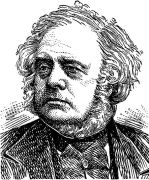
The son of a Quaker manufacturer of Rochdale, England, and born near that place November 16th, 1811, he began his public career when a mere boy as a stirring and effective temperance orator, his ready eloquence and intense earnestness prevailing over an ungraceful manner and a bad delivery; he wrought all his life for popular education and for the widest extension of the franchise; and being a Quaker and a member of the Peace Society, he opposed all war on principle, fighting the Crimean War bitterly, and leaving the Gladstone Cabinet in 1882 on account of the bombardment of Alexandria. He was retired from the service of the public for some time on account of his opposition to the Crimean War; but Mr. Gladstone, who differed from him on this point, calls it the action of his life most worthy of honor. He was perhaps the most warlike opponent of war ever high in public life; the pugnacious and aggressive agitator, pouring out floods of fiery oratory to the effect that nobody ought to fight anybody, was a curious paradox.
He was by far the most influential English friend of the North in the Civil War, and the magic of his eloquence and his name was a force of perhaps decisive potency in keeping the working classes on the same side; so that mass meetings of unemployed laborers with half-starving families resolved that they would rather starve altogether than help to perpetuate slavery in America. He shares with Richard Cobden the credit of having obtained free trade for England: Bright's thrilling oratory was second only to Cobden's organizing power in winning the victory, and both had the immense weight of manufacturers opposing their own class. That he opposed the game laws and favored electoral reform is a matter of course.
Mr. Bright entered on an active political career in 1839, when he joined the Anti-Corn-Law League. He first became a member of Parliament in 1843, and illustrates a most valuable feature of English political practice. When a change of feeling in one place prevented his re-election, he selected another which was glad to honor itself by having a great man represent it, so that the country was not robbed of a statesman by a village faction; and there being no spoils system, he did not have to waste his time in office-jobbing to keep his seat. He sat first for Durham, then for Manchester, and finally for Birmingham, remaining in public life over forty years; and never had to make a "deal" or get any one an office in all that period.
He was in Mr. Gladstone's Cabinet from 1868 to 1870, and again from 1873 to 1882. On the Home Rule question the two old friends and long co-workers divided; Mr. Bright, with more than half the oldest and sincerest friends of liberty and haters of oppression in England, holding the step to be political suicide for the British Empire.
As an orator, Mr. Bright stood in a sense alone. He was direct and logical; he carefully collected and massed his facts, and used strong, homely Saxon English, and short crisp words; he was a master of telling epigram whose force lay in its truth as much as in its humor. Several volumes of his speeches have been published: 'On Public Affairs'; 'On Parliamentary Reform'; 'On Questions of Public Policy'; 'On the American Question,' etc. His life has been written by Gilchrist, Smith, Robertson, and others. He died March 27th, 1889.
FROM THE SPEECH ON THE CORN LAWS (1843)
It must not be supposed, because I wish to represent the interest of the many, that I am hostile to the interest of the few.
But is it not perfectly certain that if the foundation of the most magnificent building be destroyed and undermined, the whole fabric itself is in danger? Is it not certain, also, that the vast body of the people who form the foundation of the social fabric, if they are suffering, if they are trampled upon, if they are degraded, if they are discontented, if "their hands are against every man, and every man's hands are against them," if they do not flourish as well, reasonably speaking, as the classes who are above them because they are richer and more powerful,--then are those classes as much in danger as the working classes themselves?
There never was a revolution in any country which destroyed the great body of the people. There have been convulsions of a most dire character which have overturned old-established monarchies and have hurled thrones and sceptres to the dust. There have been revolutions which have brought down most powerful aristocracies, and swept them from the face of the earth forever, but never was there a revolution yet which destroyed the people. And whatever may come as a consequence of the state of things in this country, of this we may rest assured: that the common people, that the great bulk of our countrymen will remain and survive the shock, though it may be that the Crown and the aristocracy and the Church may be leveled with the dust, and rise no more. In seeking to represent the working classes, and in standing up for their rights and liberties, I hold that I am also defending the rights and liberties of the middle and richer classes of society. Doing justice to one class cannot inflict injustice on any other class, and "justice and impartiality to all" is what we all have a right to from government. And we have a right to clamor; and so long as I have breath, so long will I clamor against the oppression which I see to exist, and in favor of the rights of the great body of the people....
What is the condition in which we are? I have already spoken of Ireland. You know that hundreds of thousands meet there, week after week, in various parts of the country, to proclaim to all the world the tyranny under which they suffer. You know that in South Wales, at this moment, there is an insurrection of the most extraordinary character going on, and that the Government is sending, day after day, soldiers and artillery amongst the innocent inhabitants of that mountainous country for the purpose of putting down the insurrection thereby raised and carried on. You know that in the Staffordshire ironworks almost all the workmen are now out and in want of wages, from want of employment and from attempting to resist the inevitable reduction of wages which must follow restriction upon trade. You know that in August last, Lancashire and Yorkshire rose in peaceful insurrection to proclaim to the world, and in face of Heaven, the wrongs of an insulted and oppressed people. I know that my own neighborhood is unsettled and uncomfortable. I know that in your own city your families are suffering. Yes, I have been to your cottages and seen their condition. Thanks to my canvass of Durham, I have been able to see the condition of many honest and independent--or ought-to-be-independent--and industrious artisans. I have seen even freemen of your city sitting, looking disconsolate and sad. Their hands were ready to labor; their skill was ready to produce all that their trade demanded. They were as honest and industrious as any man in this assembly, but no man hired them. They were in a state of involuntary idleness, and were driving fast to the point of pauperism. I have seen their wives, too, with three or four children about them--one in the cradle, one at the breast. I have seen their countenances, and I have seen the signs of their sufferings. I have seen the emblems and symbols of affliction such as I did not expect to see in this city. Ay! and I have seen those little children who at not a distant day will be the men and women of this city of Durham; I have seen their poor little wan faces and anxious looks, as if the furrows of old age were coming upon them before they had escaped from the age of childhood. I have seen all this in this city, and I have seen far more in the neighborhood from which I have come. You have seen, in all probability, people from my neighborhood walking your streets and begging for that bread which the Corn Laws would not allow them to earn.
"Bread-taxed weaver, all can see What the tax hath done for thee, And thy children, vilely led, Singing hymns for shameful bread, Till the stones of every street Know their little naked feet."
This is what the Corn Law does for the weavers of my neighborhood, and for the weavers and artisans of yours....
FROM THE SPEECH ON INCENDIARISM IN IRELAND (1844)
The great and all-present evil of the rural districts is this--you have too many people for the work to be done, and you, the landed proprietors, are alone responsible for this state of things; and to speak honestly, I believe many of you know it. I have been charged with saying out-of-doors that this House is a club of land-owners legislating for land-owners. If I had not said it, the public must long ago have found out that fact. My honorable friend the member for Stockport on one occasion proposed that before you passed a law to raise the price of bread, you should consider how far you had the power to raise the rates of wages. What did you say to that? You said that the laborers did not understand political economy, or they would not apply to Parliament to raise wages; that Parliament could not raise wages. And yet the very next thing you did was to pass a law to raise the price of produce of your own land, at the expense of the very class whose wages you confessed your inability to increase.
What is the condition of the county of Suffolk? Is it not notorious that the rents are as high as they were fifty years ago, and probably much higher? But the return for the farmer's capital is much lower, and the condition of the laborer is very much worse. The farmers are subject to the law of competition, and rents are thereby raised from time to time so as to keep their profits down to the lowest point, and the laborers by the competition amongst them are reduced to the point below which life cannot be maintained. Your tenants and laborers are being devoured by this excessive competition, whilst you, their magnanimous landlords, shelter yourselves from all competition by the Corn Law yourselves have passed, and make the competition of all other classes serve still more to swell your rentals. It was for this object the Corn Law was passed, and yet in the face of your countrymen you dare to call it a law for the protection of native industry....
Again, a rural police is kept up by the gentry; the farmers say for the sole use of watching game and frightening poachers, for which formerly they had to pay watchers. Is this true, or is it not? I say, then, you care everything for the rights--and for something beyond the rights--of your own property, but you are oblivious to its duties. How many lives have been sacrificed during the past year to the childish infatuation of preserving game? The noble lord, the member for North Lancashire, could tell of a gamekeeper killed in an affray on his father's estate in that county. For the offense one man was hanged, and four men are now on their way to penal colonies. Six families are thus deprived of husband and father, that this wretched system of game-preserving may be continued in a country densely peopled as this is. The Marquis of Normanby's gamekeeper has been murdered also, and the poacher who shot him only escaped death by the intervention of the Home Secretary. At Godalming, in Surrey, a gamekeeper has been murdered; and at Buckhill, in Buckinghamshire, a person has recently been killed in a poaching affray. This insane system is the cause of a fearful loss of life; it tends to the ruin of your tenantry, and is the fruitful cause of the demoralization of the peasantry. But you are caring for the rights of property; for its most obvious duties you have no concern. With such a policy, what can you expect but that which is now passing before you?
It is the remark of a beautiful writer that "to have known nothing but misery is the most portentous condition under which human nature can start on its course." Has your agricultural laborer ever known anything but misery? He is born in a miserable hovel, which in mockery is termed a house or a home; he is reared in penury: he passes a life of hopeless and unrequited toil, and the jail or the union house is before him as the only asylum on this side of the pauper's grave. Is this the result of your protection to native industry? Have you cared for the laborer till, from a home of comfort, he has but a hovel for shelter? and have you cherished him into starvation and rags? I tell you what your boasted protection is--it is a protection of native idleness at the expense of the impoverishment of native industry.
FROM THE SPEECH ON NON-RECOGNITION OF THE SOUTHERN CONFEDERACY (1861)
I advise you, and I advise the people of England, to abstain from applying to the United States doctrines and principles which we never apply to our own case. At any rate, they [the Americans] have never fought "for the balance of power" in Europe. They have never fought to keep up a decaying empire. They have never squandered the money of their people in such a phantom expedition as we have been engaged in. And now, at this moment, when you are told that they are going to be ruined by their vast expenditure,--why, the sum that they are going to raise in the great emergency of this grievous war is not greater than what we raise every year during a time of peace.
They say they are not going to liberate slaves. No; the object of the Washington government is to maintain their own Constitution and to act legally, as it permits and requires. No man is more in favor of peace than I am; no man has denounced war more than I have, probably, in this country; few men in their public life have suffered more obloquy--I had almost said, more indignity--in consequence of it. But I cannot for the life of me see, upon any of those principles upon which States are governed now,--I say nothing of the literal word of the New Testament,--I cannot see how the state of affairs in America, with regard to the United States government, could have been different from what it is at this moment. We had a Heptarchy in this country, and it was thought to be a good thing to get rid of it, and have a united nation. If the thirty-three or thirty-four States of the American Union can break off whenever they like, I can see nothing but disaster and confusion throughout the whole of that continent. I say that the war, be it successful or not, be it Christian or not, be it wise or not, is a war to sustain the government and to sustain the authority of a great nation; and that the people of England, if they are true to their own sympathies, to their own history, and to their own great act of 1834, to which reference has already been made, will have no sympathy with those who wish to build up a great empire on the perpetual bondage of millions of their fellow-men.
FROM THE SPEECH ON THE STATE OF IRELAND (1866)
I think I was told in 1849, as I stood in the burial ground at Skibbereen, that at least four hundred people who had died of famine were buried within the quarter of an acre of ground on which I was then looking. It is a country, too, from which there has been a greater emigration by sea within a given time than has been known at any time from any other country in the world. It is a country where there has been, for generations past, a general sense of wrong, out of which has grown a chronic state of insurrection; and at this very moment when I speak, the general safeguard of constitutional liberty is withdrawn, and we meet in this hall, and I speak here to-night, rather by the forbearance and permission of the Irish executive than under the protection of the common safeguards of the rights and liberties of the people of the United Kingdom.
I venture to say that this is a miserable and a humiliating picture to draw of this country. Bear in mind that I am not speaking of Poland suffering under the conquest of Russia. There is a gentleman, now a candidate for an Irish county, who is very great upon the wrongs of Poland; but I have found him always in the House of Commons taking sides with that great party which has systematically supported the wrongs of Ireland. I am not speaking of Hungary, or of Venice as she was under the rule of Austria, or of the Greeks under the dominion of the Turk; but I am speaking of Ireland--part of the United Kingdom--part of that which boasts itself to be the most civilized and the most Christian nation in the world. I took the liberty recently, at a meeting in Glasgow, to say that I believed it was impossible for a class to govern a great nation wisely and justly. Now, in Ireland there has been a field in which all the principles of the Tory party have had their complete experiment and development. You have had the country gentleman in all his power. You have had any number of Acts of Parliament which the ancient Parliament of Ireland or the Parliament of the United Kingdom could give him. You have had the Established Church supported by the law, even to the extent, not many years ago, of collecting its revenues by the aid of military force. In point of fact, I believe it would be impossible to imagine a state of things in which the Tory party should have a more entire and complete opportunity for their trial than they have had within the limits of this island. And yet what has happened? This, surely: that the kingdom has been continually weakened, that the harmony of the empire has been disturbed, and that the mischief has not been confined to the United Kingdom, but has spread to the colonies....
I am told--you can answer it if I am wrong--that it is not common in Ireland now to give leases to tenants, especially to Catholic tenants. If that be so, then the security for the property rests only upon the good feeling and favor of the owner of the land; for the laws, as we know, have been made by the land-owners, and many propositions for the advantage of the tenants have unfortunately been too little considered by Parliament. The result is that you have bad farming, bad dwelling-houses, bad temper, and everything bad connected with the occupation and cultivation of land in Ireland. One of the results--a result the most appalling--is this, that your population is fleeing your country and seeking refuge in a distant land. On this point I wish to refer to a letter which I received a few days ago from a most esteemed citizen of Dublin. He told me that he believed that a very large portion of what he called the poor, amongst Irishmen, sympathized with any scheme or any proposition that was adverse to the Imperial Government. He said further that the people here are rather in the country than of it, and that they are looking more to America than they are looking to England. I think there is a good deal in that. When we consider how many Irishmen have found a refuge in America, I do not know how we can wonder at that statement. You will recollect that when the ancient Hebrew prophet prayed in his captivity, he prayed with his window open towards Jerusalem. You know that the followers of Mohammed, when they pray, turn their faces towards Mecca. When the Irish peasant asks for food and freedom and blessing, his eye follows the setting sun, the aspirations of his heart reach beyond the wide Atlantic, and in spirit he grasps hands with the great Republic of the West. If this be so, I say then that the disease is not only serious, but it is desperate; but desperate as it is, I believe there is a certain remedy for it if the people and Parliament of the United Kingdom are willing to apply it....
I believe that at the root of a general discontent there is in all countries a general grievance and general suffering. The surface of society is not incessantly disturbed without a cause. I recollect in the poem of the greatest of Italian poets, he tells us that as he saw in vision the Stygian lake, and stood upon its banks, he observed the constant commotion upon the surface of the pool, and his good instructor and guide explained to him the cause of it:--
"This, too, for certain know, that underneath The water dwells a multitude, whose sighs Into these bubbles make the surface heave, As thine eye tells thee wheresoe'er it turn."
And I say that in Ireland, for generations back, the misery and the wrongs of the people have made their sign, and have found a voice in constant insurrection and disorder. I have said that Ireland is a country of many wrongs and of many sorrows. Her past lies almost in shadow. Her present is full of anxiety and peril. Her future depends on the power of her people to substitute equality and justice for supremacy, and a generous patriotism for the spirit of faction. In the effort now making in Great Britain to create a free representation of the people you have the deepest interest. The people never wish to suffer, and they never wish to inflict injustice. They have no sympathy with the wrong-doer, whether in Great Britain or in Ireland; and when they are fairly represented in the Imperial Parliament, as I hope they will one day be, they will speedily give an effective and final answer to that old question of the Parliament of Kilkenny--"How comes it to pass that the King has never been the richer for Ireland?"
FROM THE SPEECH ON THE IRISH ESTABLISHED CHURCH (1868)
I am one of those who do not believe that the Established Church of Ireland--of which I am not a member--would go to absolute ruin, in the manner of which many of its friends are now so fearful. There was a paper sent to me this morning, called 'An Address from the Protestants of Ireland to their Protestant Brethren of Great Britain.' It is dated "5, Dawson Street," and is signed by "John Trant Hamilton, T.A. Lefroy, and R.W. Gamble." The paper is written in a fair and mild, and I would even say,--for persons who have these opinions,--in a kindly and just spirit. But they have been alarmed, and I would wish, if I can, to offer them consolation. They say they have no interest in protecting any abuses of the Established Church, but they protest against their being now deprived of the Church of their fathers. Now, I am quite of opinion that it would be a most monstrous thing to deprive the Protestants of the Church of their fathers; and there is no man in the world who would more strenuously resist even any step in that direction than I would, unless it were Mr. Gladstone, the author of the famous resolutions. The next sentence goes on to say, "We ask for no ascendancy." Having read that sentence, I think that we must come to the conclusion that these gentlemen are in a better frame of mind than we thought them to be in. I can understand easily that these gentlemen are very sorry and doubtful as to the depths into which they are to be plunged; but I disagree with them in this--that I think there would still be a Protestant Church in Ireland when all is done that Parliament has proposed to do. The only difference will be, that it will not then be an establishment--that it will have no special favor or grant from the State--that it will stand in relation to the State just as your Church does, and just as the churches of the majority of the people of Great Britain at this moment stand. There will then be no Protestant bishops from Ireland to sit in the House of Lords; but he must be the most enthusiastic Protestant and Churchman who believes that there can be any advantage to his Church and to Protestantism generally in Ireland from such a phenomenon.