Volume 6 — FREDRIKA BREMER
Reading edition
(1801-1865)

redrika Bremer was born at Tuorla Manor-house, near Åbo, in Finland, on the 17th of August, 1801. In 1804 the family removed to Stockholm, and two years later to a large estate at Årsta, some twenty miles from the capital, which was her subsequent home. At Årsta the father of Fredrika, who had amassed a fortune in the iron industry in Finland, set up an establishment in accord with his means. The manor-house, built two centuries before, had become in some parts dilapidated, but it was ultimately restored and improved beyond its original condition. From its windows on one side the eye stretched over nearly five miles of meadows, fields, and villages belonging to the estate.
Fredrika Bremer
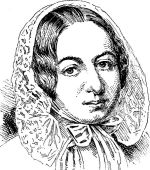
In spite of its surroundings, however, Fredrika's childhood was not a happy one. Her mother was severe and impatient of petty faults, and the child's mind became embittered. Her father was reserved and melancholy. Fredrika herself was restless and passionate, although of an affectionate nature. Among the other children she was the ugly duckling, who was misunderstood, and whose natural development was continually checked and frustrated. Her talents were early exhibited in a variety of directions. Her first verses, in French, to the morn, were written at the age of eight. Subsequently she wrote comedies for home production, prose and verse of all sorts, and kept a journal, which has been preserved. In 1821 the whole family went on a tour abroad, from which they did not return until the following year, having visited in the meantime Germany, Switzerland, and France, and spent the winter in Paris. This year among new scenes and surroundings seems to have brought home to Fredrika, upon the resumption of her old life in the country, its narrowness and its isolation. She was entirely shut off from all desired activity; her illusions vanished one by one. "I was conscious," she says in her short autobiography, "of being born with powerful wings, but I was conscious of their being clipped;" and she fancied that they would remain so.
Her attention, however, was fortunately attracted from herself to the poor and sick in the country round about; and she presently became to the whole region a nurse and a helper, denying herself all sorts of comforts that she might give them to others, and braving storm and hunger on her errands of mercy. In order to earn money for her charities she painted miniature portraits of the Crown Princess and the King, and secretly sold them. Her desire to increase the small sums she thus gained induced her to seek a publisher for a number of sketches she had written. Her brother readily disposed of the manuscript for a hundred rix-dollars; and her first book, 'Teckningar ur Hvardagslifvet' (Sketches of Every-day Life), appeared in 1828, but without the name of the author, of whose identity the publisher himself was left in ignorance. The book was received with such favor that the young author was induced to try again; and what had originally been intended as a second volume of the 'Sketches' appeared in 1830 as 'Familjen H.' (The H. Family). Its success was immediate and unmistakable. It not only was received with applause, but created a sensation, and Swedish literature was congratulated on the acquisition of a new talent among its writers.
The secret of Fredrika's authorship--which had as yet not been confided even to her parents--was presently revealed to the poet (and later bishop) Franzén, an old friend of the family. Shortly afterward the Swedish Academy, of which Franzén was secretary, awarded her its lesser gold medal as a sign of appreciation. A third volume met with even greater success than its predecessors, and seemed definitely to point out the career which she subsequently followed; and from this time until the close of her life she worked diligently in her chosen field. She rapidly acquired an appreciative public in and out of Sweden. Many of her novels and tales were translated into various languages, several of them appearing simultaneously in Swedish and English. In 1844 the Swedish Academy awarded her its great gold medal of merit.
Several long journeys abroad mark the succeeding years: to Denmark and America from 1848 to 1857; to Switzerland, Belgium, France, Italy, Palestine, and Greece, from 1856 to 1861; to Germany in 1862, returning the same year. The summer months of 1864 she spent at Årsta, which since 1853 had passed out of the hands of the family. She removed there the year after, and died there on the 31st of December.
Fredrika Bremer's most successful literary work was in the line of her earliest writings, descriptive of the every-day life of the middle classes. Her novels in this line have an unusual charm of expression, whose definable elements are an unaffected simplicity and a certain quiet humor which admirably fits the chosen milieu. Besides the ones already mentioned, 'Presidentens Döttrar' (The President's Daughters), 'Grannarna' (The Neighbors), 'Hemmet' (The Home), 'Nina,' and others, cultivated this field. Later she drifted into "tendency" fiction, making her novels the vehicles for her opinions on important public questions, such as religion, philanthropy, and above all the equal rights of women. These later productions, of which 'Hertha' and 'Syskonlif' are the most important, are far inferior to her earlier work. She had, however, the satisfaction of seeing the realization of several of the movements which she had so ardently espoused: the law that unmarried women in Sweden should attain their majority at twenty-five years of age; the organization at Stockholm of a seminary for the education of woman teachers; and certain parliamentary reforms.
In addition to her novels and short stories, she wrote some verse, mostly unimportant, and several books of travel, among them 'Hemmen i ny Verlden' (Homes in the New World), containing her experiences of America; 'Life in the Old World'; and 'Greece and the Greeks.'
A HOME-COMING
From 'The Neighbors'
LETTER I.--FRANCISCA W. TO MARIA M.
ROSENVIK, 1st June, 18.
Here I am now, dear Maria, in my own house and home, at my own writing-table, and with my own Bear. And who then is Bear? no doubt you ask. Who else should he be but my own husband? I call him Bear because--it so happens. I am seated at the window. The sun is setting. Two swans are swimming in the lake, and furrow its clear mirror. Three cows--my cows--are standing on the verdant margin, quiet, fat, and pensive, and certainly think of nothing. What excellent cows they are! Now the maid is coming up with the milk-pail. Delicious milk in the country! But what is not good in the country? Air and people, food and feelings, earth and sky, everything there is fresh and cheering.
Now I must introduce you to my place of abode--no! I must begin farther off. Upon yonder hill, from which I first beheld the valley in which Rosenvik lies (the hill is some miles in the interior of Smaaland) do you descry a carriage covered with dust? In it are seated Bear and his wedded wife. The wife is looking out with curiosity, for before her lies a valley so beautiful in the tranquillity of evening! Below are green groves which fringe mirror-clear lakes, fields of standing corn bend in silken undulations round gray mountains, and white buildings glance amid the trees. Round about, pillars of smoke are shooting up vertically from the wood-covered hills to the serene evening sky. This seems to indicate the presence of volcanoes, but in point of fact it is merely the peaceful labor of the husbandmen burning the vegetation, in order to fertilize the soil. At all events, it is an excellent thing, and I am delighted, bend forward, and am just thinking about a happy family in nature,--Paradise, and Adam and Eve,--when suddenly Bear puts his great paws around me, and presses me so that I am near giving up the ghost, while, kissing me, he entreats me to "be comfortable here." I was a little provoked; but when I perceived the heartfelt intention of the embrace, I could not but be satisfied.
In this valley, then, was my permanent home: here my new family was living; here lay Rosenvik; here I was to live with my Bear. We descended the hill, and the carriage rolled rapidly along the level way. Bear told me the names of every estate, both in the neighborhood and at a distance. I listened as if I were dreaming, but was roused from my reverie when he said with a certain stress, "Here is the residence of ma chère mère," and the carriage drove into a courtyard, and stopped before a large and fine stone house.
"What, are we going to alight here?" "Yes, my love." This was by no means an agreeable surprise to me. I would gladly have first driven to my own home, there to prepare myself a little for meeting my husband's stepmother, of whom I was a little afraid, from the accounts I had heard of that lady, and the respect Bear entertained for her. This visit appeared entirely mal àpropos to me, but Bear has his own ideas, and I perceived from his manner that it was not expedient then to offer any resistance.
It was Sunday, and on the carriage drawing up, the tones of a violin became audible to me. "Aha!" said Bear, "so much the better;" made a ponderous leap from the carriage, and lifted me out. Of hat-cases and packages, no manner of account was to be taken. Bear took my hand, ushered me up the steps into the magnificent hall, and dragged me toward the door from whence the sounds of music and dancing were heard. "See," thought I, "now I am to dance in this costume forsooth!" I wished to go into some place where I could shake the dust from my nose and my bonnet; where I could at least view myself in a mirror. Impossible! Bear, leading me by the arm, assured me that I looked "most charming," and entreated me to mirror myself in his eyes. I then needs must be so discourteous as to reply that they were "too small." He protested that they were only the clearer, and opened the door to the ball-room. "Well, since you lead me to the ball, you shall also dance with me, you Bear!" I exclaimed in the gayety of despair, so to speak. "With delight!" cried Bear, and at the same moment we found ourselves in the salon.
My alarm diminished considerably when I perceived in the spacious room only a crowd of cleanly attired maids and serving-men, who were sweeping merrily about with one another. They were so busied with dancing as scarcely to observe us. Bear then conducted me to the upper end of the apartment; and there, on a high seat, I saw a tall and strong lady of about fifty, who was playing on a violin with zealous earnestness, and beating time with her foot, which she stamped with energy. On her head she wore a remarkable and high-projecting cap of black velvet, which I will call a helmet, because that word occurred to my mind at the very first view I had of her, and I know no one more appropriate. She looked well, but singular. It was the lady of General Mansfelt, my husband's stepmother, ma chère mère!
She speedily cast her large dark-brown eyes on me, instantly ceased playing, laid aside the violin, and drew herself up with a proud bearing, but an air of gladness and frankness. Bear led me towards her. I trembled a little, bowed profoundly, and kissed ma chère mère's hand. She kissed my forehead, and for a while regarded me with such a keen glance, that I was compelled to abase my eyes, on which she again kissed me most cordially on lips and forehead, and embraced me almost as lustily as Bear had. Now it was Bear's turn; he kissed the hand of ma chère mère right respectfully; she however offered him her cheek, and they appeared very friendly. "Be welcome, my dear friends!" said ma chère mère, with a loud, masculine voice. "It was handsome in you to come to me before driving to your own home. I thank you for it. I would indeed have given you a better reception had I been prepared; at all events, I know that 'Welcome is the best cheer.' I hope, my friends, you stay the evening here?" Bear excused us, said that we desired to get home soon, that I was fatigued from the journey, but that we would not drive by Carlsfors without paying our respects to ma chère mère.
"Well, very good, well, very good!" said ma chère mère, with satisfaction; "we will shortly talk further about that in the chamber there; but first I must say a few words to the people here. Hark ye, good friends!" and ma chère mère knocked with the bow on the back of the violin, till a general silence ensued in the salon. "My children," she pursued in a solemn manner, "I have to tell you--a plague upon you! will you not be still there, at the lower end?--I have to inform you that my dear son, Lars Anders Werner, has now led home, as his wedded wife, this Francisca Burén whom you see at his side. Marriages are made in heaven, my children, and we will supplicate heaven to complete its work in blessing this conjugal pair. We will this evening together drink a bumper to their prosperity. That will do! Now you can continue your dancing, my children. Olof, come you here, and do your best in playing."
While a murmur of exultation and congratulations went through the assembly, ma chère mère took me by the hand, and led me, together with Bear, into another room. Here she ordered punch and glasses to be brought in. In the interim she thrust her two elbows on the table, placed her clenched hands under her chin, and gazed steadfastly at me, but with a look which was rather gloomy than friendly. Bear, perceiving that ma chère mère's review embarrassed me, broached the subject of the harvest or rural affairs. Ma chère mère vented a few sighs, so deep that they rather resembled groans, appeared to make a violent effort to command herself, answered Bear's questions, and on the arrival of the punch, drank to us, saying, with a serious look and voice, "Son and son's wife, your health!" On this she grew more friendly, and said in a tone of pleasantry, which beseemed her very well, "Lars Anders, I don't think people can say you have bought the calf in the sack. Your wife does not by any means look in bad case, and has a pair of eyes to buy fish with. Little she is, it is true; but 'Little and bold is often more than a match for the great.'"
I laughed, so did ma chère mère also; I began to understand her character and manner. We gossiped a little while together in a lively manner, and I recounted some little adventures of travel, which amused her exceedingly. After the lapse of an hour, we arose to take leave, and ma chère mère said, with a really charming smile, "I will not detain you this evening, delighted as I am to see you. I can well imagine that home is attractive. Stay at home to-morrow, if you will; but the day after to-morrow come and dine with me. As to the rest, you know well that you are at all times welcome. Fill now your glasses, and come and drink the folks' health. Sorrow we should keep to ourselves, but share joy in common."
We went into the dancing-room with full glasses, ma chère mère leading the way as herald. They were awaiting us with bumpers, and ma chère mère addressed the people something in this strain:--"We must not indeed laugh until we get over the brook; but when we set out on the voyage of matrimony with piety and good sense, then may be applied the adage that 'Well begun is half won'; and on that, my friends, we will drink a skoal to this wedded pair you see before you, and wish that both they and their posterity may ever 'sit in the vineyard of our Lord.' Skoal!"
"Skoal! skoal!" resounded from every side. Bear and I emptied our glasses, and went about and shook a multitude of people by the hand, till my head was all confusion. When this was over, and we were preparing to prosecute our journey, ma chère mère came after us on the steps with a packet or bundle in her hand, and said in a friendly manner, "Take this cold roast veal with you, children, for breakfast to-morrow morning. After that, you must fatten and consume your own calves. But forget not, daughter-in-law, that I get back my napkin. No, you shan't carry it, dear child, you have enough to do with your bag and mantle. Lars Anders shall carry the roast veal." And as if Lars Anders had been still a little boy, she charged him with the bundle, showed him how he was to carry it, and Bear did as she said. Her last words were, "Forget not that I get my napkin again!" I looked with some degree of wonder at Bear; but he smiled, and lifted me into the carriage.
THE LANDED PROPRIETOR
From 'The Home'
Louise possessed the quality of being a good listener in a higher degree than any one else in the family, and therefore she heard more than any one else of his Excellency; but not of him only, for Jacobi had always something to tell her, always something to consult her about; and in case she were not too much occupied with her thoughts about the weaving, he could always depend upon the most intense sympathy, and the best advice both with regard to moral questions and economical arrangements, dress, plans for the future, and so forth. He also gave her good advice--which however was very seldom followed--when she was playing Postilion; he also drew patterns for her tapestry work, and was very fond of reading aloud to her--but novels rather than sermons.
But he was not long allowed to sit by her side alone; for very soon a person seated himself at her other side whom we will call the Landed Proprietor, as he was chiefly remarkable for the possession of a large estate in the vicinity of the town.
The Landed Proprietor seemed to be disposed to dispute with the Candidate--let us continue to call him so, as we are all, in one way or the other, Candidates in this world--the place which he possessed. The Landed Proprietor had, besides his estate, a very portly body; round, healthy-looking cheeks; a pair of large gray eyes, remarkable for their want of expression; and a little rosy mouth, which preferred mastication to speaking, which laughed without meaning, and which now began to direct to "Cousin Louise"--for he considered himself related to the Lagman--several short speeches, which we will recapitulate in the following chapter, headed
STRANGE QUESTIONS
"Cousin Louise, are you fond of fish--bream for instance?" asked the Landed Proprietor one evening, as he seated himself by the side of Louise, who was busy working a landscape in tapestry.
"Oh, yes! bream is a very good fish," answered she, phlegmatically, without looking up.
"Oh, with red-wine sauce, delicious! I have splendid fishing on my estate, Oestanvik. Big fellows of bream! I fish for them myself."
"Who is the large fish there?" inquired Jacobi of Henrik, with an impatient sneer; "and what is it to him if your sister Louise is fond of bream or not?"
"Because then she might like him too, mon cher! A very fine and solid fellow is my cousin Thure of Oestanvik. I advise you to cultivate his acquaintance. What now, Gabrielle dear, what now, your Highness?"
"What is that which--"
"Yes, what is it? I shall lose my head over that riddle. Mamma dear, come and help your stupid son!"
"No, no! Mamma knows it already. She must not say it!" exclaimed Gabrielle with fear.
"What king do you place above all other kings, Magister?" asked Petrea for the second time,--having this evening her "raptus" of questioning.
"Charles the Thirteenth," answered the Candidate, and listened for what Louise was going to reply to the Landed Proprietor.
"Do you like birds, Cousin Louise?" asked the Landed Proprietor.
"Oh yes, particularly the throstle," answered Louise.
"Well,--I am glad of that!" said the Landed Proprietor. "On my estate, Oestanvik, there is an immense quantity of throstles. I often go out with my gun, and shoot them for my dinner. Piff, paff! with two shots I have directly a whole dishful."
Petrea, who was asked by no one "Do you like birds, cousin?" and who wished to occupy the Candidate, did not let herself be deterred by his evident confusion, but for the second time put the following question:--"Do you think, Magister, that people before the Flood were really worse than they are nowadays?"
"Oh, much, much better," answered the Candidate.
"Are you fond of roasted hare, Cousin Louise?" asked the Landed Proprietor.
"Are you fond of roasted hare, Magister?" whispered Petrea waggishly to Jacobi.
"Brava, Petrea!" whispered her brother to her.
"Are you fond of cold meat, Cousin Louise?" asked the Landed Proprietor, as he was handing Louise to the supper-table.
"Are you fond of Landed Proprietor?" whispered Henrik to her as she left it.
Louise answered just as a cathedral would have answered: she looked very solemn and was silent.
After supper Petrea was quite excited, and left nobody alone who by any possibility could answer her. "Is reason sufficient for mankind? What is the ground of morals? What is properly the meaning of 'revelation'? Why is everything so badly arranged in the State? Why must there be rich and poor?" etc., etc.
"Dear Petrea!" said Louise, "what use can there be in asking those questions?"
It was an evening for questions; they did not end even when the company had broken up.
"Don't you think, Elise," said the Lagman to his wife when they were alone, "that our little Petrea begins to be disagreeable with her continual questioning and disputing? She leaves no one in peace, and is stirred up herself the whole time. She will make herself ridiculous if she keeps on in this way."
"Yes, if she does keep on so. But I have a feeling that she will change. I have observed her very particularly for some time, and do you know, I think there is really something very uncommon in that girl."
"Yes, yes, there is certainly something uncommon in her. Her liveliness and the many games and schemes which she invents--"
"Yes, don't you think they indicate a decided talent for the fine arts? And then her extraordinary thirst for learning: every morning, between three and four o'clock, she gets up in order to read or write, or to work at her compositions. That is not at all a common thing. And may not her uneasiness, her eagerness to question and dispute, arise from a sort of intellectual hunger? Ah, from such hunger, which many women must suffer throughout their lives, from want of literary food,--from such an emptiness of the soul arise disquiet, discontent, nay, innumerable faults."
"I believe you are right, Elise," said the Lagman, "and no condition in life is sadder, particularly in more advanced years. But this shall not be the lot of our Petrea--that I will promise. What do you think now would benefit her most?"
"My opinion is that a serious and continued plan of study would assist in regulating her mind. She is too much left to herself with her confused tendencies, with her zeal and her inquiry. I am too ignorant myself to lead and instruct her, you have too little time, and she has no one here who can properly direct her young and unregulated mind. Sometimes I almost pity her, for her sisters don't understand at all what is going on within her, and I confess it is often painful to myself; I wish I were more able to assist her. Petrea needs some ground on which to take her stand. Her thoughts require more firmness; from the want of this comes her uneasiness. She is like a flower without roots, which is moved about by wind and waves."
"She shall take root, she shall find ground as sure as it is to be found in the world," said the Lagman, with a serious and beaming eye, at the same time striking his hand on the book containing the law of West Gotha, so that it fell to the ground. "We will consider more of this, Elise," continued he: "Petrea is still too young for us to judge with certainty of her talents and tendencies. But if they turn out to be what they appear, then she shall never feel any hunger as long as I live and can procure bread for my family. You know my friend, the excellent Bishop B----: perhaps we can at first confide our Petrea to his guidance. After a few years we shall see; she is still only a child. Don't you think that we ought to speak to Jacobi, in order to get him to read and converse with her? Apropos, how is it with Jacobi? I imagine that he begins to be too attentive to Louise."
"Well, well! you are not so far wrong; and even our cousin Thure of Oestanvik,--have you perceived anything there?"
"Yes, I did perceive something yesterday evening; what the deuce was his meaning with those stupid questions he put to her? 'Does cousin like this?' or 'Is cousin fond of that?' I don't like that at all myself. Louise is not yet full-grown, and already people come and ask her, 'Does cousin like--?' Well, it may signify very little after all, which would perhaps please me best. What a pity, however, that our cousin is not a little more manly; for he has certainly got a most beautiful estate, and so near us."
"Yes, a pity; because, as he is at present, I am almost sure Louise would find it impossible to give him her hand."
"You do not believe that her inclination is toward Jacobi?"
"To tell the truth, I fancy that this is the case."
"Nay, that would be very unpleasant and very unwise: I am very fond of Jacobi, but he has nothing and is nothing."
"But, my dear, he may get something and become something; I confess, dear Ernst, that I believe he would suit Louise better for a husband than any one else we know, and I would with pleasure call him my son."
"Would you, Elise? then I must also prepare myself to do the same. You have had most trouble and most labor with the children, it is therefore right that you should decide in their affairs."
"Ernst, you are so kind!"
"Say just, Elise; not more than just. Besides, it is my opinion that our thoughts and inclinations will not differ much. I confess that Louise appears to me to be a great treasure, and I know of nobody I could give her to with all my heart; but if Jacobi obtains her affections, I feel that I could not oppose their union, although it would be painful to me on account of his uncertain prospects. He is really dear to me, and we are under great obligations to him on account of Henrik; his excellent heart, his honesty, and his good qualities, will make him as good a citizen as a husband and father, and I consider him to be one of the most agreeable men to associate with daily. But, God bless me! I speak as if I wished the union, but that is far from my desire: I would much rather keep my daughters at home, so long as they find themselves happy with me; but when girls grow up, there is never any peace to depend on. I wish all lovers and questioners a long way off. Here we could live altogether as in a kingdom of heaven, now that we have got everything in such order. Some small improvements may still be wanted, but this will be all right if we are only left in peace. I have been thinking that we could so easily make a wardrobe here: do you see on this side of the wall--don't you think if we were to open--What! are you asleep already, my dear?"
Louise was often teased about Cousin Thure; Cousin Thure was often teased about Cousin Louise. He liked very much to be teased about his Cousin Louise, and it gave him great pleasure to be told that Oestanvik wanted a mistress, that he himself wanted a good wife, and that Louise Frank was decidedly one of the wisest and most amiable girls in the whole neighborhood, and of the most respectable family. The Landed Proprietor was half ready to receive congratulations on his betrothal. What the supposed bride thought about the matter, however, is difficult to divine. Louise was certainly always polite to her "Cousin Thure," but more indifference than attachment seemed to be expressed in this politeness; and she declined, with a decision astonishing to many a person, his constantly repeated invitations to make a tour to Oestanvik in his new landau drawn by "my chestnut horses," four-in-hand. It was said by many that the agreeable and friendly Jacobi was much nearer to Louise's heart than the rich Landed Proprietor. But even towards Jacobi her behavior was so uniform, so quiet, and so unconstrained that nobody knew what to think. Very few knew so well as we do that Louise considered it in accordance with the dignity of a woman to show perfect indifference to the attentions or doux propos of men, until they had openly and fully explained themselves. She despised coquetry to that degree that she feared everything which had the least appearance of it. Her young friends used to joke with her upon her strong notions in this respect, and often told her that she would remain unmarried.
"That may be!" answered Louise calmly.
One day she was told that a gentleman had said, "I will not stand up for any girl who is not a little coquettish!"
"Then he may remain sitting!" answered Louise, with a great deal of dignity.
Louise's views with regard to the dignity of woman, her serious and decided principles, and her manner of expressing them, amused her young friends, at the same time that they inspired them with great regard for her, and caused many little contentions and discussions in which Louise fearlessly, though not without some excess, defended what was right. These contentions, which began in merriment, sometimes ended quite differently.
A young and somewhat coquettish married lady felt herself one day wounded by the severity with which Louise judged the coquetry of her sex, particularly of married ladies, and in revenge she made use of some words which awakened Louise's astonishment and anger at the same time. An explanation followed between the two, the consequence of which was a complete rupture between Louise and the young lady, together with an altered disposition of mind in the former, which she in vain attempted to conceal. She had been unusually joyous and lively during the first days of her stay at Axelholm; but she now became silent and thoughtful, often absent; and some people thought that she seemed less friendly than formerly towards the Candidate, but somewhat more attentive to the Landed Proprietor, although she constantly declined his invitation "to take a tour to Oestanvik."
The evening after this explanation took place, Elise was engaged with Jacobi in a lively conversation in the balcony.
"And if," said Jacobi, "if I endeavor to win her affections, oh, tell me! would her parents, would her mother see it without displeasure? Ah, speak openly with me; the happiness of my life depends upon it!"
"You have my approval and my good wishes," answered Elise; "I tell you now what I have often told my husband, that I should very much like to call you my son!"
"Oh!" exclaimed Jacobi, deeply affected, falling on his knees and pressing Elise's hand to his lips: "oh, that every act in my life might prove my gratitude, my love--!"
At this moment Louise, who had been looking for her mother, approached the balcony; she saw Jacobi's action and heard his words. She withdrew quickly, as if she had been stung by a serpent.
From this time a great change was more and more perceptible in her. Silent, shy, and very pale, she moved about like a dreaming person in the merry circle at Axelholm, and willingly agreed to her mother's proposal to shorten her stay at this place.
Jacobi, who was as much astonished as sorry at Louise's sudden unfriendliness towards him, began to think the place was somehow bewitched, and wished more than once to leave it.
A FAMILY PICTURE
From 'The Home'
The family is assembled in the library; tea is just finished. Louise, at the pressing request of Gabrielle and Petrea, lays out the cards in order to tell the sisters their fortune. The Candidate seats himself beside her, and seems to have made up his mind to be a little more cheerful. But then "the object" looks more like a cathedral than ever. The Landed Proprietor enters, bows, blows his nose, and kisses the hand of his "gracious aunt."
Landed Proprietor--Very cold this evening; I think we shall have frost.
Elise--It is a miserable spring; we have just read a melancholy account of the famine in the northern provinces; these years of dearth are truly unfortunate.
Landed Proprietor--Oh yes, the famine up there. No, let us talk of something else; that is too gloomy. I have had my peas covered with straw. Cousin Louise, are you fond of playing Patience? I am very fond of it myself; it is so composing. At Oestanvik I have got very small cards for Patience; I am quite sure you would like them, Cousin Louise.
The Landed Proprietor seats himself on the other side of Louise. The Candidate is seized with a fit of curious shrugs.
Louise--This is not Patience, but a little conjuring by means of which I can tell future things. Shall I tell your fortune, Cousin Thure?
Landed Proprietor--Oh yes! do tell my fortune; but don't tell me anything disagreeable. If I hear anything disagreeable in the evening, I always dream of it at night. Tell me now from the cards that I shall have a pretty little wife;--a wife beautiful and amiable as Cousin Louise.
The Candidate (with an expression in his eyes as if he would send the Landed Proprietor head-over-heels to Oestanvik)--I don't know whether Miss Louise likes flattery.
Landed Proprietor (who takes no notice of his rival)--Cousin Louise, are you fond of blue?
Louise--Blue? It is a pretty color; but I almost like green better.
Landed Proprietor--Well, that's very droll; it suits exceedingly well. At Oestanvik my drawing-room furniture is blue; beautiful light-blue satin. But in my bedroom I have green moreen. Cousin Louise, I believe really--
The Candidate coughs as though he were going to be suffocated, and rushes out of the room. Louise looks after him and sighs, and afterwards sees in the cards so many misfortunes for Cousin Thure that he is quite frightened. "The peas frosted!"--"conflagration in the drawing-room"--and at last "a basket" ["the mitten"]. The Landed Proprietor declares still laughingly that he will not receive "a basket." The sisters smile and make their remarks.