Volume 6 — CHARLOTTE BRONTÉ AND HER SISTERS
Reading edition
(1816-1855)

he least that can be said of Charlotte Bronté is that she is a unique figure in literature. Nowhere else do we find another personality combining such extraordinary qualities of mind and heart,--qualities strangely contrasted, but still more strangely harmonized. At times they are baffling, but always fascinating. Nowhere else do we find so intimate an association of the personality of the author with the work, so thorough an identification with it of the author's life, even to the smaller details. So true is this in the case of Charlotte Bronté that the four novels 'Jane Eyre,' 'Shirley,' 'Villette,' and 'The Professor' might with some justice be termed 'Charlotte Bronté; her life and her friends.' Her works were in large part an expression of herself; at times the best expression of herself--of her actual self in experience and of her spiritual self in travail and in aspiration. It is manifestly impossible therefore to consider the works of Charlotte Bronté with justice apart from herself. A correct understanding of her books can be obtained only from a study of her remarkable personality and of the sad circumstances of her life.
Public interest in Charlotte Bronté was first roused in 1847. In October of that year there appeared in London a novel that created a sensation, the like of which had not been known since the publication of 'Waverley.' Its stern and paradoxical disregard for the conventional, its masculine energy, and its intense realism, startled the public, and proclaimed to all in accents unmistakable that a new, strange, and splendid power had come into literature, "but yet a woman."
And with the success of 'Jane Eyre' came a lively curiosity to know something of the personality of the author. This was not gratified for some time. There were many conjectures, all of them far amiss. The majority of readers asserted confidently that the work must be that of a man; the touch was unmistakably masculine. In some quarters it met with hearty abuse. The Quarterly Review, in an article still notorious for its brutality, condemned the book as coarse, and stated that if 'Jane Eyre' were really written by a woman, she must be an improper woman, who had forfeited the society of her sex. This was said in December, 1848, of one of the noblest and purest of womankind. It is not a matter of surprise that the identity of this audacious speculator was not revealed. The recent examination into the topic by Mr. Clement Shorter seems, however, to fix the authorship of the notice on Lady Eastlake, at that time Miss Driggs.
But hostile criticism of the book and its mysterious author could not injure its popularity. The story swept all before it--press and public. Whatever might be the source, the work stood there and spoke for itself in commanding terms. At length the mystery was cleared. A shrewd Yorkshireman guessed and published the truth, and the curious world knew that the author of 'Jane Eyre' was the daughter of a clergyman in the little village of Haworth, and that the literary sensation of the day found its source in a nervous, shrinking, awkward, plain, delicate young creature of thirty-one years of age, whose life, with the exception of two years, had been spent on the bleak and dreary moorlands of Yorkshire, and for the most part in the narrow confines of a grim gray stone parsonage. There she had lived a pinched and meagre little life, full of sadness and self-denial, with two sisters more delicate than herself, a dissolute brother, and a father her only parent,--a stern and forbidding father. This was no genial environment for an author, even if helpful to her vivid imagination. Nor was it a temporary condition; it was a permanent one. Nearly all the influences in Charlotte Bronté's life were such as these, which would seem to cramp if not to stifle sensitive talent. Her brother Branwell (physically weaker than herself, though unquestionably talented, and for a time the idol and hope of the family) became dissipated, irresponsible, untruthful, and a ne'er-do-weel, and finally yielding to circumstances, ended miserably a life of failure.
But Charlotte Bronté's nature was one of indomitable courage, that circumstances might shadow but could not obscure. Out of the meagre elements of her narrow life she evolved works that stand among the imperishable things of English literature. It is a paradox that finds its explanation only in a statement of natural sources, primitive, bardic, the sources of the early epics, the sources of such epics as Cædmon and Beowulf bore. She wrote from a sort of necessity; it was in obedience to the commanding authority of an extraordinary genius,--a creative power that struggled for expression,--and much of her work deserves in the best and fullest sense the term "inspired."
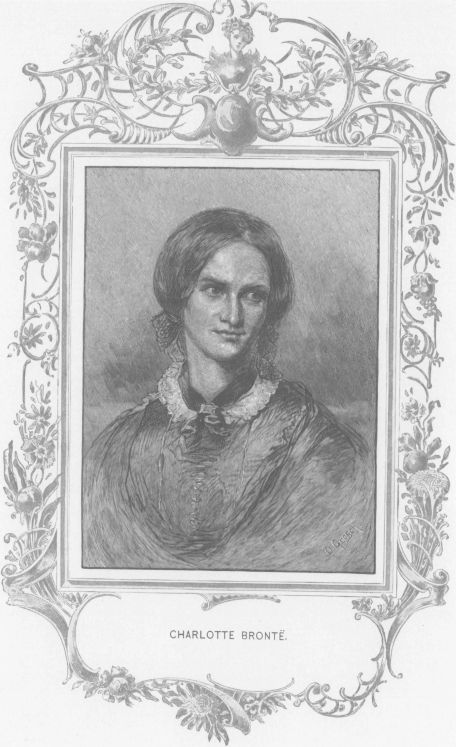
The facts of her life are few in number, but they have a direct and significant bearing on her work. She was born at Thornton, in the parish of Bradford, in 1816. Four years later her father moved to Haworth, to the parsonage now indissolubly associated with her name, and there Mr. Bronté entered upon a long period of pastorate service, that only ended with his death. Charlotte's mother was dead. In 1824 Charlotte and two older sisters, Maria and Elizabeth, went to a school at Cowan's Bridge. It was an institution for clergymen's children, a vivid picture of which appears in 'Jane Eyre.' It was so badly managed and the food was so poor that many of the children fell sick, among them Maria Bronté, who died in 1825. Elizabeth followed her a few months later, and Charlotte returned to Haworth, where she remained for six years, then went to school at Roe Head for a period of three years. She was offered the position of teacher by Miss Wooler, the principal at Roe Head, but considering herself unfit to teach, she resolved to go to Brussels to study French. She spent two years there, and it was there that her intimate and misconstrued friendship for M. Heger developed. The incidents of that period formed the material of a greater portion of her novel 'Villette,' filled twenty-two volumes of from sixty to one hundred pages of fine writing, and consisted of some forty complete novelettes or other stories and childish "magazines."
On returning to Haworth, she endeavored, together with her sister Emily, to establish a school at their home. But pupils were not to be had, and the outlook was discouraging. Two periods of service as governess, and the ill health that had followed, had taught Charlotte the danger that threatened her. Her experiences as a governess in the Sedgwick family were pictured by-and-by in 'Jane Eyre.' In a letter to Miss Ellen Nussey, written at this time, she gives a dark vignette of her situation.
With her two sisters Emily and Anne she lived a quiet and retired life. The harsh realities about them, the rough natures of the Yorkshire people, impelled the three sisters to construct in their home an ideal world of their own, and in this their pent-up natures found expression. Their home was lonely and gloomy. Mr. Clement K. Shorter, in his recent study of the novelist and her family, says that the house is much the same to-day, though its immediate surroundings are brightened. He writes:
"One day Emily confided to Charlotte that she had written some verses. Charlotte answered with a similar confidence, and then Anne acknowledged that she too had been secretly writing. This mutual confession brought about a complete understanding and sympathy, and from that time on the sisters worked together--reading their literary productions to one another and submitting to each other's criticism."
This was however by no means Charlotte's first literary work. She has left a catalogue of books written by her between 1829 and 1830. Her first printed work however appeared in a volume of 'Poems' by Acton, Ellis, and Currer Bell, published in 1846 at the expense of the authors. Under these names the little book of the Bronté sisters went forth to the world, was reviewed with mild favor in some few periodicals, and was lost to sight.
Then came a period of novel-writing. As a result, Emily Bronté's 'Wuthering Heights,' Anne Bronté's 'Agnes Grey,' and Charlotte Bronté's 'The Professor' set out together to find a publisher. The last-named was unsuccessful; but on the day it was returned to her, Charlotte Bronté began writing 'Jane Eyre.' That first masterpiece was shaped during a period of sorrow and discouragement. Her father was ill and in danger of losing his eyesight. Her brother Bran well was sinking into the slough of disgrace. No wonder 'Jane Eyre' is not a story of sunshine and roses. She finished the story in 1847, and it was accepted by the publishers promptly upon examination.
After its publication and the sensation produced, Charlotte Bronté continued her literary work quietly, and unaffected by the furore she had aroused. A few brief visits to London, where attempts were made to lionize her,--very much to her distaste,--a few literary friendships, notably those with Thackeray, George Henry Lewes, Mrs. Gaskell, and Harriet Martineau, were the only features that distinguished her literary life from the simple life she had always led and continued to lead at Haworth. She was ever busy, if not ever at her desk. Success had come; she was sane in the midst of it. She wrote slowly and only as she felt the impulse, and when she knew she had found the proper impression. In 1849 'Shirley' was published. In 1853 appeared 'Villette,' her last finished work, and the one considered by herself the best.
In 1854 she married her father's curate, Mr. A.B. Nicholls. She had lost her brother Branwell and her two sisters Emily and Anne. Sorrow upon sorrow had closed like deepening shadows about her. All happiness in life for her had apparently ended, when this marriage brought a brief ray of sunshine. It was a happy union, and seemed to assure a period of peace and rest for the sorely tried soul. Only a few short months, however, and fate, as if grudging her even the bit of happiness, snapped the slender threads of her life and the whole sad episode of her existence was ended. She died March 31st, 1855, leaving her husband and father to mourn together in the lonely parsonage. She left a literary fragment--the story entitled 'Emma,' which was published with an introduction by Thackeray.
Such are the main facts of this reserved life of Charlotte Bronté. Are they dull and commonplace? Some of them are indeed inexpressibly sad. Tragedy is beneath all the bitter chronicle. The sadness of her days can be appreciated by all who read her books. Through all her stories there is an intense note, especially in treating the pathos of existence, that is unmistakably subjective. There is a keen perception of the darker depths of human nature that could have been revealed to a human heart only by suffering and sorrow.
She did not allow sadness, however, to crush her spirit. She was neither morbid nor melancholy, but on the contrary Charlotte was cheerful and pleasant in disposition and manner. She was a loving sister and devoted daughter, patient and obedient to a parent who afterwards made obedience a severe hardship. There were other sides to her character. She was not always calm. She was not ever tender and a maker of allowances. But who is such? And she had good reason to be impatient with the world as she found it.
Her character and disposition are partially reflected in 'Jane Eyre.' The calm, clear mind, the brave, independent spirit are there. But a fuller and more accurate picture of her character may be found in Lucy Snowe, the heroine of 'Villette.' Here we find especially that note of hopelessness that predominated in Charlotte's character. Mrs. Gaskell, in her admirable biography of Charlotte Bronté, has called attention to this absence of hope in her nature. Charlotte indeed never allowed herself to look forward to happy issues. She had no confidence in the future. The pressure of grief apparently crushed all buoyancy of expectation. It was in this attitude that when literary success greeted her, she made little of it, scarcely allowing herself to believe that the world really set a high value on her work. Throughout all the excitement that her books produced, she was almost indifferent. Brought up as she had been to regard literary work as something beyond the proper limits of her sex, she never could quite rid herself of the belief that in writing successfully, she had made of herself not so much a literary figure as a sort of social curiosity. Nor was that idea wholly foreign to her time.
Personally Charlotte Bronté was not unattractive. Though somewhat too slender and pale, and plain of feature, she had a pleasant expression, and her homelier features were redeemed by a strong massive forehead, luxuriant glossy hair, and handsome eyes. Though she had little faith in her powers of inspiring affection, she attracted people strongly and was well beloved by her friends. That she could stir romantic sentiment too was attested by the fact that she received and rejected three proposals of marriage from as many suitors, before her acceptance of Mr. Nicholls.
Allusion has been made to the work of Charlotte's two sisters, Emily and Anne. Of the two Emily is by far the more remarkable, revealing in the single novel we have from her pen a genius as distinct and individual as that of her more celebrated sister. Had she lived, it is more than likely that her literary achievements would have rivaled Charlotte's.
Emily Bronté has always been something of a puzzle to biographers. She was eccentric, an odd mixture of bashful reserve and unexpected spells of frankness, sweet, gentle, and retiring in disposition, but possessed of great courage. She was two years younger than Charlotte, but taller. She was slender, though well formed, and was pale in complexion, with great gray eyes of remarkable beauty. Emily's literary work is to be found in the volume of "Poems" of her sisters, her share in that work being considered superior in imaginative quality and in finish to that of the others; and in the novel "Wuthering Heights," a weird, horrid story of astonishing power, written when she was twenty-eight years of age. Considered purely as an imaginative work, "Wuthering Heights" is one of the most remarkable stories in English literature, and is worthy to be ranked with the works of Edgar A. Poe. Many will say that it might better not have been written, so utterly repulsive is it, but others will value it as a striking, though distorted, expression of unmistakable genius. It is a ghastly and gruesome creation. Not one bright ray redeems it. It deals with the most evil characters and the most evil phases of human experience. But it fascinates. Heathcliff, the chief figure in the book, is one of the greatest villains in fiction,--an abhorrent creature,--strange, monstrous, Frankensteinesque.
Anne Bronté is known by her share in the book of "Poems" and by two novels, "Agnes Gray" and "The Tenant of Wildfell Hall," both of which are disappointing. The former is based on the author's experiences as a governess, and is written in the usual placid style of romances of the time. "The Tenant of Wildfell Hall" found its suggestion in the wretched career of Branwell Bronté, and presents a sad and depressing picture of a life of degradation. The book was not a success, and would no doubt have sunk long ago into oblivion but for its association with the novels of Emily and Charlotte.
In studying the work of Charlotte Bronté, the gifted older sister of the group, one of the first of the qualities that impress the reader is her actual creative power. To one of her imaginative power, the simplest life was sufficient, the smallest details a fund of material. Mr. Swinburne has called attention to the fact that Charlotte Bronté's characters are individual creations, not types constructed out of elements gathered from a wide observation of human nature, and that they are real creations; that they compel our interest and command our assent because they are true, inevitably true. Perhaps no better example of this individualism could be cited than Rochester. The character is unique. It is not a type, nor has it even a prototype, like so many of Charlotte Bronté's characters. Gossip insisted at one time that the author intended to picture Thackeray in Rochester, but this is groundless. Rochester is an original creation. The character of Jane Eyre, too, while reflecting something of the author's nature, was distinctly individual; and it is interesting to note here that with Jane Eyre came a new heroine into fiction, a woman of calm, clear reason, of firm positive character, and what was most novel, a plain woman, a homely heroine.
"Why is it," Charlotte had once said, "that heroines must always be beautiful?" The hero of romance was always noble and handsome, the heroine lovely and often insipid, and the scenes set in an atmosphere of exaggerated idealism. Against this idealism Charlotte Bronté revolted. Her effort was always toward realism.
In her realism she reveals a second characteristic scarcely less marked than her creative powers,--an extraordinary faculty of observation. She saw the essence, the spirit of things, and the simplest details of life revealed to her the secrets of human nature. What she had herself seen and felt--the plain rugged types of Yorkshire character, the wild scenery of the moorlands--she reflected with living truth. She got the real fact out of every bit of material in humanity and nature that her simple life afforded her. And where her experience could not afford her the necessary material, she drew upon some mysterious resources in her nature, which were apparently not less reliable than actual experience. On being asked once how she could describe so accurately the effects of opium as she does in 'Villette,' she replied that she knew nothing of opium, but that she had followed the process she always adopted in cases of this kind. She had thought intently on the matter for many a night before falling asleep; till at length, after some time, she waked in the morning with all clear before her, just as if she had actually gone through the experience, and then could describe it word for word as it happened.
Her sensitiveness to impressions of nature was exceedingly keen. She had what Swinburne calls "an instinct for the tragic use of landscape." By constant and close observation during her walks she had established a fellowship with nature in all her phases; learning her secrets from the voices of the night, from the whisper of the trees, and from the eerie moaning of the moorland blasts. She studied the cold sky, and had watched the "coming night-clouds trailing low like banners drooping."
Other qualities that distinguish her work are purity, depth and ardor of passion, and spiritual force and fervor. Her genius was lofty and noble, and an exalted moral quality predominates in her stories. She was ethical as sincerely as she was emotional.
We have only to consider her technique, in which she is characteristically original. This originality is noticeable especially in her use of words. There is a sense of fitness that often surprises the reader. Words at times in her hands reveal a new power and significance. In the choice of words Charlotte Bronté was scrupulous. She believed that there was just one word fit to express the idea or shade of meaning she wished to convey, and she never admitted a substitute, sometimes waiting days until the right word came. Her expressions are therefore well fitted and forcible. Though the predominant key is a serious one, there is nevertheless considerable humor in Charlotte Bronté's work. In 'Shirley' especially we find many happy scenes, and much wit in repartee. And yet, with all these merits, one will find at times her style to be lame, stiff, and crude, and even when strongest, occasionally coarse. Not infrequently she is melodramatic and sensational. But through it all there is that pervading sense of reality and it redeems these defects.
Of the unusual, the improbable, the highly colored in Charlotte Bronté's books we shall say little. In criticizing works so true to life and nature as these, one should not be hasty. We feel the presence of a seer. Some one once made an objection in Charlotte Bronté's presence to that part of 'Jane Eyre' in which she hears Rochester's voice calling to her at a great crisis in her life, he being many miles distant from her at the time. Charlotte caught her breath and replied in a low voice:--"But it is a true thing; it really happened." And so it might be said of Charlotte Bronté's work as a whole:--"It is a true thing; it really happened."
JANE EYRE'S WEDDING DAY
From 'Jane Eyre'
Sophie came at seven to dress me. She was very long indeed in accomplishing her task; so long that Mr. Rochester--grown, I suppose, impatient of my delay--sent up to ask why I did not come. She was just fastening my veil (the plain square of blonde, after all) to my hair with a brooch; I hurried from under her hands as soon as I could.
"Stop!" she cried in French, "Look at yourself in the mirror; you have not taken one peep."
So I turned at the door. I saw a robed and veiled figure, so unlike my usual self that it seemed almost the image of a stranger.
"Jane!" called a voice, and I hastened down. I was received at the foot of the stairs by Mr. Rochester. "Lingerer," he said, "my brain is on fire with impatience; and you tarry so long!"
He took me into the dining-room, surveyed me keenly all over, pronounced me "fair as a lily, and not only the pride of his life, but the desire of his eyes"; and then, telling me he would give me but ten minutes to eat some breakfast, he rang the bell. One of his lately hired servants, a footman, answered it.
"Is John getting the carriage ready?"
"Yes, sir."
"Is the luggage brought down?"
"They are bringing it down, sir."
"Go you to the church; see if Mr. Wood" (the clergyman) "and the clerk are there; return and tell me."
The church, as the reader knows, was but just beyond the gates; the footman soon returned.
"Mr. Wood is in the vestry, sir, putting on his surplice."
"And the carriage?"
"The horses are harnessing."
"We shall not want it to go to church; but it must be ready the moment we return--all the boxes and luggage arranged and strapped on, and the coachman in his seat."
"Yes, sir."
"Jane, are you ready?"
I rose. There were no groomsmen, no bridesmaids, no relatives to wait for or marshal; none but Mr. Rochester and I. Mrs. Fairfax stood in the hall as we passed. I would fain have spoken to her, but my hand was held by a grasp of iron; I was hurried along by a stride I could hardly follow; and to look at Mr. Rochester's face was to feel that not a second of delay would be tolerated for any purpose. I wondered what other bridegroom ever looked as he did--so bent up to a purpose, so grimly resolute; or who, under such steadfast brows, ever revealed such flaming and flashing eyes.
I know not whether the day was fair or foul; in descending the drive I gazed neither on sky nor earth; my heart was with my eyes, and both seemed migrated into Mr. Rochester's frame. I wanted to see the invisible thing on which, as we went along, he appeared to fasten a glance fierce and fell. I wanted to feel the thoughts whose force he seemed breasting and resisting.
At the churchyard wicket he stopped; he discovered I was quite out of breath.
"Am I cruel in my love?" he said. "Delay an instant; lean on me, Jane."
And now I can recall the picture of the gray old house of God rising calm before me, of a rook wheeling around the steeple, of a ruddy morning sky beyond. I remember something, too, of the green grave-mounds; and I have not forgotten, either, two figures of strangers, straying among the low hillocks, and reading the mementos graven on the few mossy headstones. I noticed them because as they saw us they passed around to the back of the church; and I doubted not they were going to enter by the side aisle door and witness the ceremony. By Mr. Rochester they were not observed; he was earnestly looking at my face, from which the blood had, I dare say, momentarily fled; for I felt my forehead dewy and my cheeks and lips cold. When I rallied, which I soon did, he walked gently with me up the path to the porch.
We entered the quiet and humble temple; the priest waited in his white surplice at the lowly altar, the clerk beside him. All was still; two shadows only moved in a remote corner. My conjecture had been correct; the strangers had slipped in before us, and they now stood by the vault of the Rochesters, their backs toward us, viewing through the rails the old time-stained marble tomb, where a kneeling angel guarded the remains of Damer de Rochester, slain at Marston Moor in the time of the civil wars, and of Elizabeth his wife.
Our place was taken at the communion-rails. Hearing a cautious step behind me, I glanced over my shoulder; one of the strangers--a gentleman, evidently--was advancing up the chancel. The service began. The explanation of the intent of matrimony was gone through: and then the clergyman came a step farther forward, and bending slightly toward Mr. Rochester, went on:--
"I require and charge you both (as ye will answer at the dreadful day of judgment, when the secrets of all hearts shall be disclosed) that if either of you know any impediment why ye may not lawfully be joined together in matrimony, ye do now confess it; for be ye well assured that so many as are coupled together otherwise than God's word doth allow are not joined together by God, neither is their matrimony lawful."
He paused, as the custom is. When is the pause after that sentence ever broken by reply? Not, perhaps, once in a hundred years. And the clergyman, who had not lifted his eyes from his book, and had held his breath but for a moment, was proceeding; his hand was already stretched toward. Mr. Rochester, as his lips unclosed to ask, "Wilt thou have this woman for thy wedded wife?"--when a distinct and near voice said, "The marriage cannot go on: I declare the existence of an impediment."
The clergyman looked up at the speaker and stood mute: the clerk did the same; Mr. Rochester moved slightly, as if an earthquake had rolled under his feet; taking a firmer footing, and not turning his head or eyes, he said, "Proceed!"
Profound silence fell when he had uttered that word, with deep but low intonation. Presently Mr. Wood said, "I cannot proceed without some investigation into what has been asserted, and evidence of its truth or falsehood."
"The ceremony is quite broken off," subjoined the voice behind us. "I am in a condition to prove my allegation; an insuperable impediment to this marriage exists."
Mr. Rochester heard, but heeded not; he stood stubborn and rigid; making no movement but to possess himself of my hand. What a hot and strong grasp he had!--and how like quarried marble was his pale, firm, massive front at this moment! How his eye shone, still, watchful, and yet wild beneath!
Mr. Wood seemed at a loss. "What is the nature of the impediment?" he asked. "Perhaps it may be got over--explained away?"
"Hardly," was the answer: "I have called it insuperable, and I speak advisedly."
The speaker came forward and leaned on the rails. He continued, uttering each word distinctly, calmly, steadily, but not loudly.
"It simply consists in the existence of a previous marriage. Mr. Rochester has a wife now living."
My nerves vibrated to those low-spoken words as they had never vibrated to thunder; my blood felt their subtle violence as it had never felt frost or fire; but I was collected, and in no danger of swooning. I looked at Mr. Rochester; I made him look at me. His whole face was colorless rock; his eye was both spark and flint. He disavowed nothing; he seemed as if he would defy all things. Without speaking, without smiling, without seeming to recognize in me a human being, he only twined my waist with his arm and riveted me to his side.
"Who are you?" he asked of the intruder.
"My name is Briggs, a solicitor of ---- Street, London."
"And you would thrust on me a wife?"
"I would remind you of your lady's existence, sir, which the law recognizes if you do not."
"Favor me with an account of her--with her name, her parentage, her place of abode."
"Certainly." Mr. Briggs calmly took a paper from his pocket, and read out in a sort of official, nasal voice:--
"I affirm and can prove that on the 20th of October, A.D.--" (a date of fifteen years back), "Edward Fairfax Rochester, of Thornfield Hall, in the county of ----, and of Ferndean Manor, in ---- shire, England, was married to my sister, Bertha Antoinetta Mason, daughter of Jonas Mason, merchant, and of Antoinetta his wife, a Creole, at ---- church, Spanish Town, Jamaica. The record of the marriage will be found in the register of that church--a copy of it is now in my possession. Signed, Richard Mason."
"That, if a genuine document, may prove I have been married, but it does not prove that the woman mentioned therein as my wife is still living."
"She was living three months ago," returned the lawyer.
"How do you know?"
"I have a witness to the fact whose testimony even you, sir, will scarcely controvert."
"Produce him--or go to hell!"
"I will produce him first--he is on the spot: Mr. Mason, have the goodness to step forward."
Mr. Rochester, on hearing the name, set his teeth: he experienced, too, a sort of strong convulsive quiver; near to him as I was, I felt the spasmodic movement of fury or despair run through his frame.
The second stranger, who had hitherto lingered in the background, now drew near; a pale face looked over the solicitor's shoulder--yes, it was Mason himself. Mr. Rochester turned and glared at him. His eye, as I have often said, was a black eye--it had now a tawny, nay, a bloody light in its gloom; and his face flushed--olive cheek and hueless forehead received a glow, as from spreading, ascending heart-fire; and he stirred, lifted his strong arm; he could have struck Mason--dashed him on the church floor--shocked by ruthless blow the breath from his body; but Mason shrank away, and cried faintly, "Good God!" Contempt fell cool on Mr. Rochester--his passion died as if a blight had shriveled it up; he only asked, "What have you to say?"
An inaudible reply escaped Mason's white lips.
"The devil is in it if you cannot answer distinctly. I again demand, what have you to say?"
"Sir--sir," interrupted the clergyman, "do not forget you are in a sacred place." Then addressing Mason, he inquired gently, "Are you aware, sir, whether or not this gentleman's wife is still living?"
"Courage," urged the lawyer; "speak out."
"She is now living at Thornfield Hall," said Mason, in more articulate tones. "I saw her there last April. I am her brother."
"At Thornfield Hall!" ejaculated the clergyman. "Impossible! I am an old resident in this neighborhood, sir, and I never heard of a Mrs. Rochester at Thornfield Hall."
I saw a grim smile contort Mr. Rochester's lip, and he muttered, "No, by God! I took care that none should hear of it, or of her under that name." He mused; for ten minutes he held counsel with himself: he formed his resolve, and announced it:--"Enough; all shall bolt out at once, like a bullet from the barrel. Wood, close your book and take off your surplice; John Green" (to the clerk) "leave the church: there will be no wedding to-day." The man obeyed.
Mr. Rochester continued hardily and recklessly:--"Bigamy is an ugly word! I meant, however, to be a bigamist; but fate has out-manoeuvred me, or Providence has checked me--perhaps the last. I am little better than a devil at this moment; and as my pastor there would tell me, deserve no doubt the sternest judgments of God, even to the quenchless fire and deathless worm.
"Gentlemen, my plan is broken up! what this lawyer and his client say is true: I have been married, and the woman to whom I was married lives! You say you never heard of a Mrs. Rochester at the house up yonder, Wood; but I dare say you have many a time inclined your ear to gossip about the mysterious lunatic kept there under watch and ward. Some have whispered to you that she is my bastard half-sister; some, my cast-off mistress: I now inform you that she is my wife, whom I married fifteen years ago--Bertha Mason by name; sister of this resolute personage who is now, with his quivering limbs and white cheeks, showing you what a stout heart men may bear. Cheer up, Dick! never fear me! I'd almost as soon strike a woman as you. Bertha Mason is mad; and she came of a mad family--idiots and maniacs through three generations! Her mother, the Creole, was both a mad-woman and a drunkard!--as I found out after I had wed the daughter; for they were silent on family secrets before. Bertha, like a dutiful child, copied her parent in both points. I had a charming partner--pure, wise, modest; you can fancy I was a happy man. I went through rich scenes! Oh! my experience has been heavenly, if you only knew it! But I owe you no further explanation. Briggs, Wood, Mason, I invite you all to come up to the house and visit Mrs. Poole's patient, and my wife! You shall see what sort of a being I was cheated into espousing, and judge whether or not I had a right to break the compact, and seek sympathy with something at least human. This girl," he continued, looking at me, "knew no more than you, Wood, of the disgusting secret: she thought all was fair and legal, and never dreamed that she was going to be entrapped into a feigned union with a defrauded wretch, already bound to a bad, mad, and imbruted partner! Come, all of you, follow."
Still holding me fast, he left the church: the three gentlemen came after. At the front door of the hall we found the carriage.
"Take it back to the coach-house, John," said Mr. Rochester, coolly: "it will not be wanted to-day."
At our entrance, Mrs. Fairfax, Adèle, Sophie, Leah, advanced to meet and greet us.
"To the right-about--every soul!" cried the master: "away with your congratulations! Who wants them? Not I! they are fifteen years too late!"
He passed on and ascended the stairs, still holding my hand, and still beckoning the gentlemen to follow him; which they did. We mounted the first staircase, passed up the gallery, proceeded to the third story: the low black door, opened by Mr. Rochester's master-key, admitted us to the tapestried room, with its great bed and its pictorial cabinet.
"You know this place, Mason," said our guide; "she bit and stabbed you here."
He lifted the hangings from the wall, uncovering the second door; this too he opened. In a room without a window there burned a fire, guarded by a high and strong fender, and a lamp suspended from the ceiling by a chain. Grace Poole bent over the fire, apparently cooking something in a saucepan. In the deep shade, at the further end of the room, a figure ran backward and forward. What it was, whether beast or human being, one could not at first sight tell; it groveled, seemingly, on all fours; it snatched and growled like some strange wild animal; but it was covered with clothing; and a quantity of dark grizzled hair, wild as a mane, hid its head and face.
"Good morning, Mrs. Poole," said Mr. Rochester. "How are you? and how is your charge to-day?"
"We're tolerable, sir, I thank you," replied Grace, lifting the boiling mess carefully on to the hob: "rather snappish, but not 'rageous."
A fierce cry seemed to give the lie to her favorable report: the clothed hyena rose up, and stood tall on its hind feet.
"Ah, sir, she sees you!" exclaimed Grace: "you'd better not stay."
"Only a few moments, Grace; you must allow me a few moments."
"Take care then, sir! for God's sake, take care!"
The maniac bellowed; she parted her shaggy locks from her visage, and gazed wildly at her visitors. I recognized well that purple face--those bloated features. Mrs. Poole advanced.
"Keep out of the way," said Mr. Rochester, thrusting her aside; "she has no knife now, I suppose? and I'm on my guard."
"One never knows what she has, sir, she is so cunning; it is not in mortal discretion to fathom her craft."
"We had better leave her," whispered Mason.
"Go to the devil!" was his brother-in-law's recommendation.
"'Ware!" cried Grace. The three gentlemen retreated simultaneously. Mr. Rochester flung me behind him; the lunatic sprang and grappled his throat viciously, and laid her teeth to his cheek; they struggled. She was a big woman, in stature almost equaling her husband, and corpulent besides; she showed virile force in the contest--more than once she almost throttled him, athletic as he was. He could have settled her with a well-planted blow; but he would not strike her; he would only wrestle. At last he mastered her arms; Grace Poole gave him a cord, and he pinioned them behind her; with more rope, which was at hand, he bound her to a chair. The operation was performed amid the fiercest yells and the most convulsive plunges. Mr. Rochester then turned to the spectators; he looked at them with a smile both acrid and desolate.
"That is my wife," said he. "Such is the sole conjugal embrace I am ever to know--such are the endearments which are to solace my leisure hours! And this is what I wished to have" (laying his hand on my shoulder): "this young girl, who stands so grave and quiet at the mouth of hell, looking collectedly at the gambols of a demon. I wanted her just as a change, after that fierce ragoût. Wood and Briggs, look at the difference. Compare these clear eyes with the red balls yonder--this face with that mask--this form with that bulk; then judge me, priest of the Gospel and man of the law, and remember, with what judgment ye judge ye shall be judged! Off with you now: I must shut up my prize."
We all withdrew. Mr. Rochester stayed a moment behind us, to give some further order to Grace Poole. The solicitor addressed me as he descended the stair.
"You, madam," said he, "are cleared from all blame; your uncle will be glad to hear it--if indeed he should be still living--when Mr. Mason returns to Madeira."
"My uncle? What of him? Do you know him?"
"Mr. Mason does; Mr. Eyre has been the Funchal correspondent of his house for some years. When your uncle received your letter intimating the contemplated union between yourself and Mr. Rochester, Mr. Mason, who was staying at Madeira to recruit his health, on his way back to Jamaica happened to be with him. Mr. Eyre mentioned the intelligence; for he knew that my client here was acquainted with a gentleman of the name of Rochester. Mr. Mason, astonished and distressed, as you may suppose, revealed the real state of matters. Your uncle, I am sorry to say, is now on a sick-bed; from which, considering the nature of his disease--decline--and the stage it has reached, it is unlikely he will ever rise. He could not then hasten to England himself, to extricate you from the snare into which you had fallen, but he implored Mr. Mason to lose no time in taking steps to prevent the false marriage. He referred him to me for assistance, I used all dispatch, and am thankful I was not too late: as you, doubtless, must be also. Were I not morally certain that your uncle will be dead ere you reach Madeira, I would advise you to accompany Mr. Mason back; but as it is, I think you had better remain in England till you can hear further, either from or of Mr. Eyre. Have we anything else to stay for?" he inquired of Mr. Mason.
"No, no; let us be gone," was the anxious reply; and without waiting to take leave of Mr. Rochester, they made their exit at the hall door. The clergyman stayed to exchange a few sentences, either of admonition or reproof, with his haughty parishioner: this duty done, he too departed.
I heard him go as I stood at the half-open door of my own room, to which I had now withdrawn. The house cleared, I shut myself in, fastened the bolt that none might intrude, and proceeded--not to weep, not to mourn, I was yet too calm for that, but--mechanically to take off the wedding-dress, and replace if by the stuff gown I had worn yesterday, as I thought for the last time. I then sat down: I felt weak and tired. I leaned my arms on a table, and my head dropped on them. And now I thought: till now I had only heard, seen, moved--followed up and down where I was led or dragged--watched event rush on event, disclosure open beyond disclosure; but now I thought.
The morning had been a quiet morning enough--all except the brief scene with the lunatic. The transaction in the church had not been noisy; there was no explosion of passion, no loud altercation, no dispute, no defiance or challenge, no tears, no sobs: a few words had been spoken, a calmly pronounced objection to the marriage made; some stern, short questions put by Mr. Rochester; answers, explanations given, evidence adduced; an open admission of the truth had been uttered by my master: then the living proof had been seen; the intruders were gone, and all was over.
I was in my own room as usual--just myself, without obvious change; nothing had smitten me, or scathed me, or maimed me. And yet where was the Jane Eyre of yesterday? where was her life? where were her prospects?
Jane Eyre, who had been an ardent, expectant woman--almost a bride--was a cold, solitary girl again: her life was pale; her prospects were desolate. A Christmas frost had come at midsummer; a white December storm had whirled over June; ice glazed the ripe apples; drifts crushed the blowing roses; on hay-field and corn-field lay a frozen shroud; lanes which last night blushed full of flowers, to-day were pathless with untrodden snow; and the woods, which twelve hours since waved leafy and fragrant as groves between the tropics, now spread waste, wild, and white as pine forests in wintry Norway.
My hopes were all dead--struck with a subtle doom, such as in one night fell on all the first-born in the land of Egypt. I looked on my cherished wishes, yesterday so blooming and glowing; they lay stark, chill, livid corpses that could never revive. I looked at my love, that feeling which was my master's--which he had created: it shivered in my heart, like a suffering child in a cold cradle; sickness and anguish had seized it; it could not seek Mr. Rochester's arms--it could not derive warmth from his breast. Oh, never more could it turn to him; for faith was blighted--confidence destroyed! Mr. Rochester was not to me what he had been; for he was not what I had thought him. I would not ascribe vice to him; I would not say he had betrayed me: but the attribute of stainless truth was gone from his idea; and from his presence I must go; that I perceived well. When--how--whither, I could not yet discern; but he himself, I doubted not, would hurry me from Thornfield. Real affection, it seemed, he could not have for me; it had been only fitful passion; that was balked; he would want me no more. I should fear even to cross his path now: my view must be hateful to him. Oh, how blind had been my eyes! how weak my conduct!
MADAME BECK
(From 'Villette')
"You ayre Engliss?" said a voice at my elbow. I almost bounded, so unexpected was the sound; so certain had I been of solitude.
No ghost stood beside me, nor anything of spectral aspect; merely a motherly, dumpy little woman, in a large shawl, a wrapping-gown, and a clean, trim, nightcap.
I said I was English, and immediately, without further prelude, we fell to a most remarkable conversation. Madame Beck (for Madame Beck it was; she had entered by a little door behind me, and being shod with the shoes of silence, I had heard neither her entrance nor approach)--Madame Beck had exhausted her command of insular speech when she said "You ayre Engliss," and she now proceeded to work away volubly in her own tongue. I answered in mine. She partly understood me, but as I did not at all understand her--though we made together an awful clamor (anything like madame's gift of utterance I had not hitherto heard or imagined)--we achieved little progress. She rang, ere long, for aid; which arrived in the shape of a "maîtresse," who had been partly educated in an Irish convent, and was esteemed a perfect adept in the English language. A bluff little personage this maîtresse was--Labasse-courienne from top to toe: and how she did slaughter the speech of Albion! However, I told her a plain tale, which she translated. I told her how I had left my own country, intent on extending my knowledge and gaining my bread; how I was ready to turn my hand to any useful thing, provided it was not wrong or degrading: how I would be a child's nurse or a lady's-maid, and would not refuse even housework adapted to my strength. Madame heard this; and questioning her countenance, I almost thought the tale won her ear.
"Il n'y a que les Anglaises pour ces sortes d'entreprises," said she: "sont-elles done intrépides, ces femmes-là!"
She asked my name, my age; she sat and looked at me--not pityingly, not with interest: never a gleam of sympathy or a shade of compassion crossed her countenance during the interview. I felt she was not one to be led an inch by her feelings: grave and considerate, she gazed, consulting her judgment and studying my narrative....
In the dead of night I suddenly awoke. All was hushed, but a white figure stood in the room--Madame in her night-dress. Moving without perceptible sound, she visited the three children in the three beds; she approached me; I feigned sleep, and she studied me long. A small pantomime ensued, curious enough. I dare say she sat a quarter of an hour on the edge of my bed, gazing at my face. She then drew nearer, bent close over me; slightly raised my cap, and turned back the border so as to expose my hair; she looked at my hand lying on the bed-clothes. This done, she turned to the chair where my clothes lay; it was at the foot of the bed. Hearing her touch and lift them, I opened my eyes with precaution, for I own I felt curious to see how far her taste for research would lead her. It led her a good way: every article did she inspect. I divined her motive for this proceeding; viz., the wish to form from the garments a judgment respecting the wearer, her station, means, neatness, etc. The end was not bad, but the means were hardly fair or justifiable. In my dress was a pocket; she fairly turned it inside out; she counted the money in my purse; she opened a little memorandum-book, coolly perused its contents, and took from between the leaves a small plaited lock of Miss Marchmont's gray hair. To a bunch of three keys, being those of my trunk, desk, and work-box, she accorded special attention: with these, indeed, she withdrew a moment to her own room. I softly rose in my bed and followed her with my eye: these keys, reader, were not brought back till they had left on the toilet of the adjoining room the impress of their wards in wax. All being thus done decently and in order, my property was returned to its place, my clothes were carefully refolded. Of what nature were the conclusions deduced from this scrutiny? Were they favorable or otherwise? Vain question. Madame's face of stone (for of stone in its present night-aspect it looked: it had been human, and as I said before, motherly, in the salon) betrayed no response.
Her duty done--I felt that in her eyes this business was a duty--she rose, noiseless as a shadow: she moved toward her own chamber; at the door she turned, fixing her eyes on the heroine of the bottle, who still slept and loudly snored. Mrs. Svini (I presume this was Mrs. Svini, Anglicé or Hibernicé Sweeny)--Mrs. Sweeny's doom was in Madame Beck's eye--an immutable purpose that eye spoke: madame's visitations for shortcomings might be slow, but they were sure. All this was very un-English: truly I was in a foreign land....
When attired, Madame Beck appeared a personage of a figure rather short and stout, yet still graceful in its own peculiar way: that is, with the grace resulting from proportion of parts. Her complexion was fresh and sanguine, not too rubicund; her eye, blue and serene; her dark silk dress fitted her as a French sempstress alone can make a dress fit; she looked well, though a little bourgeoise, as bourgeoise indeed she was. I know not what of harmony pervaded her whole person; and yet her face offered contrast too: its features were by no means such as are usually seen in conjunction with a complexion of such blended freshness and repose: their outline was stern; her forehead was high but narrow; it expressed capacity and some benevolence, but no expanse; nor did her peaceful yet watchful eye ever know the fire which is kindled in the heart or the softness which flows thence. Her mouth was hard: it could be a little grim; her lips were thin. For sensibility and genius, with all their tenderness and temerity, I felt somehow that madame would be the right sort of Minos in petticoats.
In the long run, I found that she was something else in petticoats too. Her name was Modeste Maria Beck, née Kint: it ought to have been Ignacia. She was a charitable woman, and did a great deal of good. There never was a mistress whose rule was milder. I was told that she never once remonstrated with the intolerable Mrs. Sweeny [the heroine's predecessor], despite her tipsiness, disorder, and general neglect; yet Mrs. Sweeny had to go, the moment her departure became convenient. I was told too that neither masters nor teachers were found fault with in that establishment: yet both masters and teachers were often changed; they vanished and others filled their places, none could well explain how.
The establishment was both a pensionnat and an externat: the externes or day-pupils exceeded one hundred in number; the boarders were about a score. Madame must have possessed high administrative powers: she ruled all these, together with four teachers, eight masters, six servants, and three children, managing at the same time to perfection the pupil's parents and friends; and that without apparent effort, without bustle, fatigue, fever, or any symptom of undue excitement; occupied she always was--busy, rarely. It is true that madame had her own system for managing and regulating this mass of machinery; and a very pretty system it was: the reader has seen a specimen of it in that small affair of turning my pocket inside out and reading my private memoranda. Surveillance, espionnage, these were her watchwords.
Still, madame knew what honesty was, and liked it--that is, when it did not obtrude its clumsy scruples in the way of her will and interest. She had a respect for "Angleterre"; and as to "les Anglaises," she would have the women of no other country about her own children, if she could help it.
Often in the evening, after she had been plotting and counter-plotting, spying and receiving the reports of spies all day, she would come up to my room, a trace of real weariness on her brow, and she would sit down and listen while the children said their little prayers to me in English: the Lord's Prayer and the hymn beginning "Gentle Jesus," these little Catholics were permitted to repeat at my knee; and when I had put them to bed, she would talk to me (I soon gained enough French to be able to understand and even answer her) about England and Englishwomen, and the reason for what she was pleased to term their superior intelligence, and, more real and reliable probity. Very good sense she often showed; very sound opinions she often broached: she seemed to know that keeping girls in distrustful restraint, in blind ignorance, and under a surveillance that left them no moment and no corner for retirement, was not the best way to make them grow up honest and modest women; but she averred that ruinous consequences would ensue if any other method were tried with Continental children--they were so accustomed to restraint that relaxation, however guarded, would be misunderstood and fatally presumed on: she was sick, she would declare, of the means she had to use, but use them she must; and after discoursing, often with dignity and delicacy, to me, she would move away on her "souliers de silence," and glide ghost-like through the house, watching and spying everywhere, peering through every key-hole, listening behind every door.
After all, madame's system was not bad--let me do her justice. Nothing could be better than all her arrangements for the physical well-being of her scholars. No minds were overtasked; the lessons were well distributed and made incomparably easy to the learner; there was a liberty of amusement and a provision for exercise which kept the girls healthy; the food was abundant and good: neither pale nor puny faces were anywhere to be seen in the Rue Fossette. She never grudged a holiday; she allowed plenty of time for sleeping, dressing, washing, eating: her method in all these matters was easy, liberal, salutary, and rational; many an austere English schoolmistress would do vastly well to imitate it--and I believe many would be glad to do so, if exacting English parents would let them.
As Madame Beck ruled by espionage, she of course had her staff of spies; she perfectly knew the quality of the tools she used, and while she would not scruple to handle the dirtiest for a dirty occasion--flinging this sort from her like refuse rind? after the orange has been duly squeezed--I have known her fastidious in seeking pure metal for clean uses; and when once a bloodless and rustless instrument was found, she was careful of the prize, keeping it in silk and cotton-wool. Yet woe be to the man or woman who relied on her one inch beyond the point where it was her interest to be trustworthy; interest was the master-key of madame's nature--the mainspring of her motives--the alpha and omega of her life. I have seen her feelings appealed to, and I have smiled in half-pity, half-scorn at the appellants. None ever gained her ear through that channel, or swayed her purpose by that means. On the contrary, to attempt to touch her heart was the surest way to rouse her antipathy, and to make of her a secret foe. It proved to her that she had no heart to be touched: it reminded her where she was impotent and dead. Never was the distinction between charity and mercy better exemplified than in her. While devoid of sympathy, she had a sufficiency of rational benevolence: she would give in the readiest manner to people she had never seen--rather, however, to classes than to individuals. "Pour les pauvres" she opened her purse freely--against the poor man, as a rule, she kept it closed. In philanthropic schemes, for the benefit of society at large, she took a cheerful part; no private sorrow touched her: no force or mass of suffering concentrated in one heart had power to pierce hers. Not the agony of Gethsemane, not the death on Calvary, could have wrung from her eyes one tear.
I say again, madame was a very great and a very capable woman. That school offered for her powers too limited a sphere: she ought to have swayed a nation; she should have been the leader of a turbulent legislative assembly. Nobody could have browbeaten her, none irritated her nerves, exhausted her patience, or overreached her astuteness. In her own single person, she could have comprised the duties of a first minister and a superintendent of police. Wise, firm, faithless, secret, crafty, passionless; watchful and inscrutable; acute and insensate--withal perfectly decorous--what more could be desired?
A YORKSHIRE LANDSCAPE
From 'Shirley'
"Miss Keeldar, just stand still now, and look down at Nunneley dale and wood."
They both halted on the green brow of the Common. They looked down on the deep valley robed in May raiment; on varied meads, some pearled with daisies and some golden with kingcups: to-day all this young verdure smiled clear in sunlight; transparent emerald and amber gleams played over it. On Nunnwood--the sole remnant of antique British forest in a region whose lowlands were once all sylvan chase, as its highlands were breast-deep heather--slept the shadow of a cloud; the distant hills were dappled, the horizon was shaded and tinted like mother-of-pearl; silvery blues, soft purples, evanescent greens and rose-shades, all melting into fleeces of white cloud, pure as azury snow, allured the eye with a remote glimpse of heaven's foundations. The air blowing on the brow was fresh and sweet and bracing.
"Our England is a bonnie island," said Shirley, "and Yorkshire is one of her bonniest nooks."
"You are a Yorkshire girl too?"
"I am--Yorkshire in blood and birth. Five generations of my race sleep under the aisles of Briarfield Church: I drew my first breath in the old black hall behind us."
Hereupon Caroline presented her hand, which was accordingly taken and shaken. "We are compatriots," said she.
"Yes," agreed Shirley, with a grave nod.
"And that," asked Miss Keeldar, pointing to the forest--"that is Nunnwood?"
"It is."
"Were you ever there?"
"Many a time."
"In the heart of it?"
"Yes."
"What is it like?"
"It is like an encampment of forest sons of Anak. The trees are huge and old. When you stand at their roots, the summits seem in another region: the trunks remain still and firm as pillars, while the boughs sway to every breeze. In the deepest calm their leaves are never quite hushed, and in a high wind a flood rushes--a sea thunders above you."
"Was it not one of Robin Hood's haunts?"
"Yes, and there are mementos of him still existing. To penetrate into Nunnwood, Miss Keeldar, is to go far back into the dim days of old. Can you see a break in the forest, about the centre?"
"Yes, distinctly."
"That break is a dell--a deep hollow cup, lined with turf as green and short as the sod of this Common: the very oldest of the trees, gnarled mighty oaks, crowd about the brink of this dell; in the bottom lie the ruins of a nunnery.
"We will go--you and I alone, Caroline--to that wood, early some fine summer morning, and spend a long day there. We can take pencils and sketch-books, and any interesting reading-book we like; and of course we shall take something to eat. I have two little baskets, in which Mrs. Gill, my house-keeper, might pack our provisions, and we could each carry our own. It would not tire you too much to walk so far?"
"Oh, no; especially if we rested the whole day in the wood; and I know all the pleasantest spots. I know where we could get nuts in nutting time; I know where wild strawberries abound; I know certain lonely, quite untrodden glades, carpeted with strange mosses, some yellow as if gilded, some a sober gray, some gem-green. I know groups of trees that ravish the eye with their perfect, picture-like effects: rude oak, delicate birch, glossy beech, clustered in contrast; and ash-trees, stately as Saul, standing isolated; and superannuated wood-giants clad in bright shrouds of ivy."
THE END OF HEATHCLIFF
From Emily Bronté's 'Wuthering Heights'
For some days after that evening Mr. Heathcliff shunned meeting us at meals; yet he would not consent formally to exclude Hareton and Cathy. He had an aversion to yielding so completely to his feelings, choosing rather to absent himself; and eating once in twenty-four hours seemed sufficient sustenance for him.
One night, after the family were in bed, I heard him go down-stairs and out at the front door; I did not hear him re-enter, and in the morning I found he was still away. We were in April then, the weather was sweet and warm, the grass as green as showers and sun could make it, and the two dwarf apple-trees near the southern wall in full bloom.
After breakfast, Catherine insisted on my bringing a chair and sitting with my work under the fir-trees at the end of the house; and she beguiled Hareton, who had recovered from his accident, to dig and arrange her little garden, which was shifted to that corner by the influence of Joseph's complaints.
I was comfortably reveling in the spring fragrance around, and the beautiful soft blue overhead, when my young lady, who had run down near the gate to procure some primrose roots for a border, returned only half laden, and informed us that Mr. Heathcliff was coming in.
"And he spoke to me," she added with a perplexed look.
"What did he say?" asked Hareton.
"He told me to begone as fast as I could," she answered. "But he looked so different from his usual look that I stopped a moment to stare at him."
"How?" he inquired.
"Why, almost bright and cheerful--no, almost nothing--very much excited, and wild, and glad!" she replied.
"Night-walking amuses him, then," I remarked, affecting a careless manner; in reality as surprised as she was, and anxious to ascertain the truth of her statement--for to see the master looking glad would not be an every-day spectacle; I framed an excuse to go in.
Heathcliff stood at the open door--he was pale, and he trembled; yet certainly he had a strange joyful glitter in his eyes, that altered the aspect of his whole face.
"Will you have some breakfast?" I said. "You must be hungry, rambling about all night!"
I wanted to discover where he had been; but I did not like to ask directly.
"No, I'm not hungry," he answered, averting his head, and speaking rather contemptuously, as if he guessed I was trying to divine the occasion of his good humor.
I felt perplexed--I didn't know whether it were not a proper opportunity to offer a bit of admonition.
"I don't think it right to wander out of doors," I observed, "instead of being in bed; it is not wise, at any rate, this moist season. I daresay you'll catch a bad cold, or a fever--you have something the matter with you now!"
"Nothing but what I can bear," he replied, "and with the greatest pleasure, provided you'll leave me alone--get in, and don't annoy me."
I obeyed; and in passing, I saw he breathed as fast as a cat.
"Yes!" I reflected to myself, "we shall have a fit of illness. I cannot conceive what he has been doing!"
That noon he sat down to dinner with us, and received a heaped-up plate from my hands, as if he intended to make amends for previous fasting.
"I've neither cold nor fever, Nelly," he remarked, in allusion to my morning speech. "And I'm ready to do justice to the food you give me."
He took his knife and fork, and was going to commence eating, when the inclination appeared to become suddenly extinct. He laid them on the table, looked eagerly toward the window, then rose and went out. We saw him walking to and fro in the garden, while we concluded our meal; and Earnshaw said he'd go and ask why he would not dine; he thought we had grieved him some way.
"Well, is he coming?" cried Catherine, when he returned.
"Nay," he answered; "but he's not angry: he seemed rare and pleased indeed; only I made him impatient by speaking to him twice: and then he bid me be off to you; he wondered how I could want the company of anybody else."
I set his plate to keep warm on the fender; and after an hour or two he re-entered, when the room was clear, in no degree calmer: the same unnatural--it was unnatural!--appearance of joy under his black brows; the same bloodless hue; and his teeth visible now and then in a kind of smile; his frame shivering, not as one shivers with chill or weakness, but as a tight-stretched cord vibrates--a strong thrilling, rather than trembling.
"I will ask what is the matter," I thought, "or who should?" And I exclaimed, "Have you heard any good news, Mr. Heathcliff? You look uncommonly animated."
"Where should good news come from to me?" he said. "I'm animated with hunger; and seemingly I must not eat."
"Your dinner is here," I returned: "why won't you get it?"
"I don't want it now," he muttered hastily. "I'll wait till supper. And, Nelly, once for all, let me beg you to warn Hareton and the other away from me. I wish to be troubled by nobody--I wish to have this place to myself."
"Is there some new reason for this banishment?" I inquired. "Tell me why you are so queer, Mr. Heathcliff. Where were you last night? I'm not putting the question through idle curiosity, but--"
"You are putting the question through very idle curiosity," he interrupted, with a laugh. "Yet I'll answer it. Last night I was on the threshold of hell. To-day I am within sight of my heaven--I have my eyes on it--hardly three feet to sever me. And now you'd better go. You'll neither see nor hear anything to frighten you if you refrain from prying."
Having swept the hearth and wiped the table, I departed more perplexed than ever. He did not quit the house again that afternoon, and no one intruded on his solitude till at eight o'clock I deemed it proper, though unsummoned, to carry a candle and his supper to him.
He was leaning against the ledge of an open lattice, but not looking out; his face was turned to the interior gloom. The fire had smoldered to ashes; the room was filled with the damp, mild air of the cloudy evening; and so still, that not only the murmur of the beck down Gimmerton was distinguishable, but its ripples, and its gurgling over the pebbles, or through the large stones which it could not cover.
I uttered an ejaculation of discontent at seeing the dismal grate, and commenced shutting the casements, one after another, till I came to his.
"Must I close this?" I asked, in order to rouse him, for he would not stir.
The light flashed on his features as I spoke. O Mr. Lockwood, I cannot express what a terrible start I got by the momentary view! Those deep black eyes! That smile and ghastly paleness! It appeared to me not Mr. Heathcliff, but a goblin; and in my terror I let the candle bend toward the wall, and it left me in darkness.
"Yes, close it," he replied in his familiar voice. "There, that is pure awkwardness! Why did you hold the candle horizontally? Be quick, and bring another."
I hurried out in a foolish state of dread, and said to Joseph, "The master wishes you to take him a light and rekindle the fire." For I dare not go in myself again just then.
Joseph rattled some fire into the shovel and went; but he brought it back immediately, with the supper tray in his other hand, explaining that Mr. Heathcliff was going to bed, and he wanted nothing to eat till morning.
We heard him mount the stairs directly. He did not proceed to his ordinary chamber, but turned into that with the paneled bed; its window, as I mentioned before, is wide enough for anybody to get through, and it struck me that he plotted another midnight excursion, which he had rather we had no suspicion of.
"Is he a ghoul, or a vampire?" I mused. I had read of such hideous incarnate demons. And then I set myself to reflect how I had tended him in infancy, and watched him grow to youth, and followed him almost through his whole course, and what nonsense it was to yield to that sense of horror.
"But where did he come from, the little dark thing, harbored by a good man to his bane?" muttered Superstition, as I dozed into unconsciousness. And I began, half dreaming, to weary myself with imagining some fit parentage for him: and repeating my waking meditations I tracked his existence over again, with grim variations; at last picturing his death and funeral; of which all I can remember is being exceedingly vexed at having the task of dictating an inscription for his monument, and consulting the sexton about it; and as he had no surname, and we could not tell his age, we were obliged to content ourselves with the single word "Heathcliff." That came true--we were. If you enter the kirkyard, you'll read on his headstone only that, and the date of his death. Dawn restored me to common-sense. I rose, and went into the garden, as soon as I could see, to ascertain if there were any foot-marks under his window. There were none.
"He has staid at home," I thought, "and he'll be all right to-day!"
I prepared breakfast for the household, as was my usual custom, but told Hareton and Catherine to get theirs ere the master came down, for he lay late. They preferred taking it out of doors, under the trees, and I set a little table to accommodate them.
On my re-entrance I found Mr. Heathcliff below. He and Joseph were conversing about some farming business; he gave clear, minute directions concerning the matter discussed, but he spoke rapidly, and turned his head continually aside, and had the same excited expression, even more exaggerated.
When Joseph quitted the room, he took his seat in the place he generally chose, and I put a basin of coffee before him. He drew it nearer, and then rested his arms on the table, and looked at the opposite wall, as I supposed surveying one particular portion, up and down, with glittering, restless eyes, and with such eager interest that he stopped breathing during half a minute together.
"Come now," I exclaimed, pushing some bread against his hand, "eat and drink that while it is hot. It has been waiting near an hour."
He didn't notice me, and yet he smiled. I'd rather have seen him gnash his teeth than smile so.
"Mr. Heathcliff! master!" I cried. "Don't, for God's sake, stare as if you saw an unearthly vision."
"Don't, for God's sake, shout so loud," he replied. "Turn round and tell me, are we by ourselves?"
"Of course," was my answer, "of course we are!"
Still I involuntarily obeyed him, as if I were not quite sure. With a sweep of his hand he cleared a vacant space in front among the breakfast things, and leaned forward to gaze more at his ease.
Now I perceived he was not looking at the wall; for when I regarded him alone, it seemed exactly that he gazed at something within two yards' distance. And, whatever it was, it communicated apparently both pleasure and pain in exquisite extremes; at least the anguished yet raptured expression of his countenance suggested that idea.
The fancied object was not fixed either; his eyes pursued it with unwearied vigilance, and even in speaking to me, were never weaned away.
I vainly reminded him of his protracted abstinence from food. If he stirred to touch anything in compliance with my entreaties--if he stretched his hand out to get a piece of bread--his fingers clenched before they reached it, and remained on the table, forgetful of their aim.
I sat, a model of patience, trying to attract his absorbed attention from its engrossing speculation till he grew irritable and got up, asking why I would not allow him to have his own time in taking his meals? and saying that on the next occasion I needn't wait--I might set the things down and go. Having uttered these words, he left the house, slowly sauntered down the garden path, and disappeared through the gate.
The hours crept anxiously by: another evening came. I did not retire to rest till late, and when I did I could not sleep. He returned after midnight, and instead of going to bed, shut himself into the room beneath. I listened and tossed about, and finally dressed and descended. It was too irksome to lie up there, harassing my brain with a hundred idle misgivings.
I distinguished Mr. Heathcliff's step, restlessly measuring the floor; and he frequently broke the silence by a deep inspiration, resembling a groan. He muttered detached words also; the only one I could catch was the name of Catherine, coupled with some wild term of endearment or suffering, and spoken as one would speak to a person present--low and earnest, and wrung from the depth of his soul.
I had not courage to walk straight into the apartment; but I desired to divert him from his revery, and therefore fell foul of the kitchen fire; stirred it and began to scrape the cinders. It drew him forth sooner than I expected. He opened the door immediately, and said:--
"Nelly, come here--is it morning? Come in with your light."
"It is striking four," I answered; "you want a candle to take upstairs--you might have lighted one at this fire."
"No, I don't wish to go upstairs," he said. "Come in, and kindle me a fire, and do anything there is to do about the room."
"I must blow the coals red first, before I can carry any," I replied, getting a chair and the bellows.
He roamed to and fro, meantime, in a state approaching distraction, his heavy sighs succeeding each other so thick as to leave no space for common breathing between.
"When day breaks, I'll send for Green," he said; "I wish to make some legal inquiries of him, while I can bestow a thought on those matters, and while I can act calmly. I have not written my will yet, and how to leave my property I cannot determine! I wish I could annihilate it from the face of the earth."
"I would not talk so, Mr. Heathcliff," I interposed. "Let your will be a while--you'll be spared to repent of your many injustices yet! I never expected that your nerves would be disordered--they are, at present, marvelously so, however; and almost entirely through your own fault. The way you've passed these last three days might knock up a Titan. Do take some food and some repose. You need only look at yourself in a glass to see how you require both. Your cheeks are hollow and your eyes bloodshot, like a person starving with hunger and going blind with loss of sleep."
"It is not my fault that I cannot eat or rest," he replied. "I assure you it is through no settled designs. I'll do both as soon as I possibly can. But you might as well bid a man struggling in the water rest within arm's-length of the shore! I must reach it first, and then I'll rest. Well, never mind Mr. Green; as to repenting of my injustices, I've done no injustice, and I repent of nothing. I'm too happy, and yet I'm not happy enough. My soul's bliss kills my body, but does not satisfy itself."
"Happy, master?" I cried. "Strange happiness! If you would hear me without being angry, I might offer some advice that would make you happier."
"What is that?" he asked. "Give it."
"You are aware, Mr. Heathcliff," I said, "that from the time you were thirteen years old you have lived a selfish, unchristian life: and probably hardly had a Bible in your hands during all that period. You must have forgotten the contents of the book, and you may not have space to search it now. Could it be hurtful to send for some one--some minister of any denomination, it does not matter which--to explain it, and show you how very far you have erred from its precepts, and how unfit you will be for its heaven, unless a change takes place before you die?"
"I'm rather obliged than angry, Nelly," he said, "for you remind me of the manner that I desire to be buried in. It is to be carried to the churchyard in the evening. You and Hareton may, if you please, accompany me--and mind, particularly, to notice that the sexton obeys my directions concerning the two coffins! No minister need come; nor need anything be said over me. I tell you, I have nearly attained my heaven; and that of others is altogether unvalued and uncoveted by me!"
"And supposing you persevered in your obstinate fast, and died by that means, and they refused to bury you in the precincts of the kirk?" I said, shocked at his godless indifference. "How would you like it?"
"They won't do that," he replied; "if they did, you must have me removed secretly; and if you neglect it, you shall prove practically that the dead are not annihilated!"
As soon as he heard the other members of the family stirring, he retired to his den, and I breathed freer. But in the afternoon, while Joseph and Hareton were at their work, he came into the kitchen again, and with a wild look bid me come and sit in the house--he wanted somebody with him.
I declined, telling him plainly that his strange talk and manner frightened me, and I had neither the nerve nor the will to be his companion alone.
"I believe you think me a fiend!" he said, with his dismal laugh; "something too horrible to live under a decent roof!"
Then turning to Catherine, who was there, and who drew behind me at his approach, he added, half sneeringly:--
"Will you come, chuck? I'll not hurt you. No! to you I've made myself worse than the devil. Well, there is one who won't shrink from my company! By God! she's relentless. Oh, damn it! It's unutterably too much for flesh and blood to bear, even mine."
He solicited the society of no one more. At dusk he went into his chamber. Through the whole night, and far into the morning, we heard him groaning and murmuring to himself. Hareton was anxious to enter, but I bid him fetch Mr. Kenneth, and he should go in and see him.
When he came, and I requested admittance and tried to open the door, I found it locked; and Heathcliff bid us be damned. He was better, and would be left alone; so the doctor went away.
The following evening was very wet; indeed, it poured down till day-dawn; and as I took my morning walk round the house, I observed the master's window swinging open, and the rain driving straight in.
"He cannot be in bed," I thought: "those showers would drench him through! He must be either up or out. But I'll make no more ado; I'll go boldly, and look!"
Having succeeded in obtaining entrance with another key, I ran to unclose the panels, for the chamber was vacant--quickly pushing them aside, I peeped in. Mr. Heathcliff was there--laid on his back. His eyes met mine, so keen and fierce that I started; and then he seemed to smile.
I could not think him dead--but his face and throat were washed with rain; the bed-clothes dripped, and he was perfectly still. The lattice, flapping to and fro, had grazed one hand that rested on the sill--no blood trickled from the broken skin, and when I put my fingers to it I could doubt no more--he was dead and stark!
I hasped the window; I combed his long, black hair from his forehead; I tried to close his eyes--to extinguish, if possible, that frightful, lifelike exultation, before any one else beheld it. They would not shut--they seemed to sneer at my attempts, and his parted lips and sharp white teeth sneered too! Taken with another fit of cowardice, I cried out for Joseph. Joseph shuffled up and made a noise, but resolutely refused to meddle with him. "Th' divil's harried off his soul," he cried, "and he muh hev his carcass intuh t' bargain, for ow't aw care! Ech! what a wicked un he looks, grinning at death!" and the old sinner grinned in mockery.
I thought he intended to cut a caper round the bed; but suddenly composing himself, he fell on his knees and raised his hands, and returned thanks that the lawful master and the ancient stock were restored to their rights.
I felt stunned by the awful event; and my memory unavoidably recurred to former times with a sort of oppressive sadness. But poor Hareton, the most wronged, was the only one that really suffered much. He sat by the corpse all night, weeping in bitter earnest. He pressed its hand, and kissed the sarcastic, savage face that every one else shrank from contemplating; and bemoaned him with that strong grief which springs naturally from a generous heart, though it be tough as tempered steel.
Kenneth was perplexed to pronounce of what disorder the master died. I concealed the fact of his having swallowed nothing for four days, fearing it might lead to trouble; and then, I am persuaded, he did not abstain on purpose: it was the consequence of his strange illness, not the cause.
We buried him, to the scandal of the whole neighborhood, as he had wished. Earnshaw and I, the sexton, and six men to carry the coffin, comprehended the whole attendance.
The six men departed when they had let it down into the grave: we stayed to see it covered. Hareton, with a streaming face, dug green sods and laid them over the brown mold himself. At present it is as smooth and verdant as its companion mounds--and I hope its tenant sleeps as soundly. But the country folks, if you asked them, would swear on their Bibles that he walks. There are those who speak to having met him near the church, and on the moor, and even within this house. Idle tales, you'll say, and so say I. Yet that old man by the kitchen fire affirms he has seen "two on 'em" looking out of his chamber window on every rainy night since his death--and an odd thing happened to me about a month ago.
I was going to the grange one evening--a dark evening threatening thunder--and, just at the turn of the Heights, I encountered a little boy with a sheep and two lambs before him. He was crying terribly, and I supposed the lambs were skittish and would not be guided.
"What is the matter, my little man?" I asked.
"They's Heathcliff and a woman yonder, under t' nab," he blubbered, "un' aw darnut pass 'em."
I saw nothing, but neither the sheep nor he would go on, so I bid him take the road lower down. He probably raised the phantoms from thinking, as he traversed the moors alone, on the nonsense he had heard his parents and companions repeat; yet still I don't like being out in the dark now, and I don't like being left by myself in this grim house. I cannot help it; I shall be glad when they leave it and shift to the Grange!
"They are going to the Grange, then?" I said.
"Yes," answered Mrs. Dean, "as soon as they are married; and that will be on New Year's day."
"And who will live here then?"
"Why, Joseph will take care of the house, and perhaps a lad to keep him company. They will live in the kitchen, and the rest will be shut up."
"For the use of such ghosts as choose to inhabit it," I observed.
"No, Mr. Lockwood," said Nelly, shaking her head. "I believe the dead are at peace, but it is not right to speak of them with levity."
At that moment the garden gate swung to; the ramblers were returning.
"They are afraid of nothing," I grumbled, watching their approach through the window. "Together they would brave Satan and all his legions."
As they stepped upon the door-stones, and halted to take a last look at the moon, or more correctly at each other, by her light, I felt irresistibly impelled to escape them again; and pressing a remembrance into the hands of Mrs. Dean, and disregarding her expostulations at my rudeness, I vanished through the kitchen, as they opened the house-door; and so should have confirmed Joseph in his opinion of his fellow-servant's gay indiscretions, had he not fortunately recognized me for a respectable character by the sweet ring of a sovereign at his feet.
My walk home was lengthened by a diversion in the direction of the kirk. When beneath its walls, I perceived decay had made progress even in seven months--many a window showed black gaps deprived of glass; and slates jutted off, here and there, beyond the right line of the roof, to be gradually worked off in coming autumn storms.
I sought, and soon discovered, the three headstones on the slope next the moor--the middle one, gray, and half buried in the heath--Edgar Linton's only harmonized by the turf and moss creeping up its foot--Heathcliff's still bare.
I lingered round them, under that benign sky; watched the moths fluttering among the heath and harebells; listened to the soft wind breathing through the grass; and wondered how any one could ever imagine unquiet slumbers for the sleepers in that quiet earth.