Chapter XVI · —Influences Of A Mountain Environment
Reading edition
Zones of altitude.
There are zones of latitude and zones of altitude. To every mountain region both these pertain, resulting in a nice interplay of geographic factors. Every mountain slope from summit to piedmont is, from the anthropo-geographical standpoint, a complex phenomenon. When high enough, it may show a graded series of contrasted complementary locations, closely interdependent grouping of populations and employments, every degree of density from congestion to vacancy, every range of cultural development from industrialism to nomadism. The southern slope of the Monte Rosa Alps, from the glacier cap at 4500 meters to the banks of the Po River, yields within certain limits a zonal epitome of European life from Lapland to the Mediterranean. The long incline from the summit of Mount Everest (8840 meters) in the eastern Himalayas, through Darjeeling down to sea level at Calcutta, comprises in a few miles the climatic and cultural range of Asia from Arctic to Tropic.
Politico-economic value of varied relief.
Relief and climate.
Altitude zones of economic and cultural development.
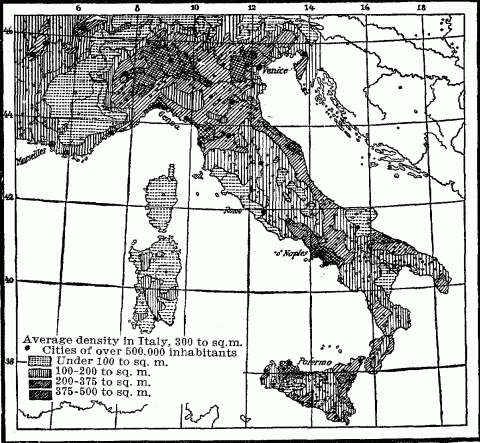
Density Of Population In Italy.
This stratification assumes marked variations in the different geographical zones. In Greenland life is restricted to the piedmont coastal belt; above this rises the desert waste of the ice fields. Norway shows a tide-washed piedmont, containing a large majority of the population; above this, a steep slope sparsely inhabited; and higher still, a wild plateau summit occupied in summer only by grazing herds or migrant reindeer Lapps. Farther south the Alps show successive tiers of rural economy, again with their appropriate density of settlement. On their lower slope is found the vineyard belt, a region of highly intensive tillage, large returns upon labor, and hence of closely distributed settlement. Above that is the zone of field agriculture, less productive and less thickly peopled. Higher still is the wide zone of hay farming and stock-raising, supporting a sparse, semi-nomadic population and characterized by villages which diminish with the altitude and cease beyond 2000 meters. On Aetna, located in the tropical Mediterranean, three girdles of altitude have long been recognized,—the girdle of agriculture, the forest belt, and the desert summit. But the tourist who ascends Aetna, passes from the coast through a zone of orange and lemon groves, which are protected by temporary matting roofs against occasional frosts; then through vineyards and olive orchards which rise to 800 meters; then through a belt of summer crops rising to 1550 meters, and varied between 1400 and 1850 meters elevation by stretches of chestnut groves, whose green expanse is broken here and there by the huts of the forest guards, the highest tenants of the mountain. From these lonely dwellings down to the sea, density of population increases regularly to a maximum of over 385 to the square mile (150 to the square kilometer) near the coast.
Altitude and density belts in tropical highlands.
From Mexico to central Chile, the heavy rains from the trade-winds clothe the slopes with dense forests, except on the lee side of the high Andean wall of Peru and Chile, and reduce much of the piedmont to malarial swamp and jungle. The discouragement to primitive tillage found in the unequal fight with a tropical forest, the dryer, more bracing and healthful climate of the high intermontane basins, their favorable conditions for agriculture by irrigation, and their naturally defined location stimulating to early cultural development, all combined to concentrate the population of prehistoric America upon the high valleys and plateaus. In historic times these centers have persisted, because the civilized or semi-civilized districts could be best exploited by the Spanish conquerors and especially because they yielded rich mineral wealth. Furthermore, the white population which has subsequently invaded tropical America has to a predominant degree reinforced the native plateau populations, while the imported negroes and mulattoes have sought the more congenial climatic conditions found in the hot lowlands.
Increasing density with motive of protection.
Motive of protection in primitive peoples.
Geographic conditions affecting density of mountain population.
The advance of civilization, which brought the ancient pirate-ridden city from the inner edge of the coastal zone down to the wave-washed strand, also drew the hill town down to the plain, and the mountain population from their inaccessible strongholds to the more accessible and productive valleys. These facts contain a hint. The future investigation of archaeological remains in high mountain districts may reveal at considerable elevations the oldest and hence lowest strata of prehistoric development, strata which, in the more attractive valleys, have been obliterated or overlaid by later invasions of peoples and cultures. Ignoring this temporary attraction of population to protected mountain locations in ages of persistent warfare, we find that a comparison of many countries reveals a decreasing food supply and decreasing density of population, with every increase of height above a certain altitude, except in favored mining regions and in some tropical lands, where better climatic conditions and freedom from malaria distribute settlements far above the steaming and forest-choked lowlands. The density of population in mountains is influenced also by the composition of the soil, which affects its fertility; by the grade and exposure of the slopes, which determine the ease and success of tillage; by the proximity of the highlands to teeming centers of lowland population, and by the general economic development of the people.
Sparsity of population in the Alps.
Terrace agriculture.
These figures tell of the hard conditions of life characteristic of most mountain regions. Population under normal circumstances settles in the narrow valleys between the ranges and along the borders of their drainage stream. Soon, however, the food supply becomes inadequate for the growing numbers, so that artificial means have to be employed to expand the area of arable land. The soil on the mountain slopes is so thin that it yields only a scanty return to the labor of tillage. Moreover, under the operations of ploughing and harrowing, it is exposed to the danger of washing; so that after a few croppings the underlying rock of the mountain side may be laid bare, and all that was valuable in the quondam field deposited in the valley as silt or swept away to enrich the distant delta of the nearest trunk river.
Geographical distribution.
Terrace agriculture, rare in new countries, in the more densely populated Old World is widely distributed in mountainous areas. In Germany, where it is nearly identical with the culture of the vine, it is found along the steep slopes overlooking the valley of the Moselle and the Rhine; also in the Vosges Mountains, the Black Forest and the Swabian Jura, to the limited altitude in which the vine will flourish in these northern regions. In the Alps it is widespread, and not confined to the culture of the vine. The traveler passing along the upper Rhone through the sunny Canton of Valais follows these terraced fields almost as far as Fiesch (altitude 3458 feet), beyond which agriculture proper becomes more and more restricted on account of the elevation, and passes rapidly into the mere hay-making of a pastoral community. Between Leak and Sierre, not only the mountain sides, but also the steep gravel hills constituting the old terminal moraine deposited by the receding Rhone glacier across the valley floor, are terraced to their very tops.
Terrace culture of the Saracens.
In the Himalayas.
In Tibet and China.
In ancient Peru.
Terrace agriculture in mountainous islands.
Among mountain savages.
Fertilizing
Economy of level land for houses and villages.
Perpendicular villages
Mountain pastures and stock-raising.
Paucity of arable land in mountain regions leads to the utilization of the untillable slopes for stock grazing. This industry is always a valuable ally to mountain agriculture on account of the manure which it yields; but in high altitudes, where the steepness or rockiness of the soil, cold and the brevity of the growing season restrict or eliminate cereal crops, it becomes the dominant occupation of the inhabitants, while agriculture takes a subordinate place, limited to the production of hay and fodder for the winter feeding of the stock. Above the line of tree growth flourish the natural summer pastures up to the border of perpetual snow; and just below lies a zone which, if cleared of its forests, supports a thick carpet of grass and herbage, though too cold to ripen grain.
Mountain herdsman and shepherds.
Communal ownership of mountain pastures.
Haymaking in high mountains.
Methods of curing hay in mountains.
In mountain regions of heavy rainfall, thick dew and numerous cloudy days, it becomes a problem to get the hay dried and stored before a drenching shower comes. In many parts of Switzerland, therefore, the peasant on a clear morning cuts a limited amount of grass. This, with the help of his wife and children, he diligently turns and tosses at short intervals all day long, thus subjecting it to a rapid curing process by the action of the wind and the sun, whose rays are doubly effective in the rarefied air of the heights. In the evening the hay is made up into bundles and carried on his back to the barn. In other parts of Switzerland the green hay is hung on horizontal poles arranged against the sunny side of the chalet and under its projecting roof, thus exposed to the heat and protected from the rain till cured. In Norway the same purpose is achieved by setting up in the fields racks supporting long horizontal bars, over which the newly cut grass is hung. There it is exposed to the gentle fanning of the wind and penetrated by the warmth of the sun, in the short intervals when the sky is not overcast; and during a shower it sheds the water immediately, so that a minimum of harm is done. In the mountains of Germany, the hay is stacked on cone-shaped racks made of poles, with lateral projections which support the grass; thus the air can circulate freely inside the hollow cone, which is lifted well above the ground. Elsewhere sharpened stakes provided with cross bars are simply driven into the ground, and on these the hay is draped till cured.
Winter industries of mountain peoples.
Overpopulation and emigration.
Forms of temporary emigration.
Permanent emigration.
Polyandry.
Female infanticide.
Effects of polyandry and polygamy.
Marauding tendencies in mountaineers
Cattle-lifting.
Historical results of mountain raiding.
Conquest of mountain regions
Such conquests, whatever be their motive, profit the vanquished in the end more than the victor. They result in the systematic and intelligent development of the mountain resources, and the maintenance of ampler social and economic relations between highland and lowland through the construction of roads, which must always represent the reach of the governing authority. The conquest of mountain peoples means always expensive and protracted campaigns. The invader has always two enemies to fight, Nature and the armed foe. There is a saying in India that "In Gilgit a small army is annihilated and a large army starves to death." Hunger is king in high altitudes, and comes always to the defense of mountain independence. Moreover, the inaccessibility of such districts, the difficulty of maintaining lines of communication, ignorance of by-paths and trails which forever offer strategic opportunities to the natives or escape at a crisis, all serve to protract the war. The independent spirit of the mountaineer, his endurance of hardships, his mastery of mountain tactics, and his obstinate resistance after repeated defeat, give always a touch of heroism to highland warfare. Consequently, history abounds in examples of unconquered mountain peoples, or of long sustained resistance, like that which for sixty years under the heroic leadership of Kadi Mulah and Shamyl used up the treasure and troops of Russia in the impregnable defiles of the Caucasus. In the end, however, the highland tribes succumb to numbers and the road-making engineer.
Political dismemberment of mountain peoples.
Political dismemberment, lack of cohesion due to the presence of physical barriers impeding intercourse, is the inherent weakness of mountain peoples. Political consolidation is never voluntary. It is always forced upon them from without, either by foreign conquest or by the constant menace of such conquest, which compels the mountain clans to combine for common defense of their freedom. The combination thus made is reluctant, loose, easily broken, generally short-lived. It becomes close and permanent only under a constant pressure from without, and then assumes a form allowing to the constituent parts the greatest possible measure of independence. The Swiss canton and commune are the result of a segregating environment; the Swiss Republic is the result of threatened encroachments by the surrounding states. It owed its first genuine federal constitution to Napoleon.
Individualism and independence
Mountain tribes are always like a pack of hounds on the leash, each straining in a different direction. Wall-like barriers, holding them apart for centuries, make them almost incapable of concerted action, and restive under any authority but their own. Clan and tribal societies, feudal and republican rule, always on a small scale, characterize mountain sociology. All these are attended by an exaggerated individualism and its inevitable concomitant, the blood feud. Mountain policy tends to diminish the power of the central authority to the vanishing point, giving individualism full scope. Social and economic retardation, caused by extreme isolation and encouraged by protected location, tend to keep the social body small and loosely organized. Every aspect of environment makes against social integration.
Types of mountain states.
Significance of their small size.
Slight power of mountain chiefs.
Mountain isolation and differentiation.
The power of mountains to protect makes them asylums of refuge for displaced peoples. This fact explains the confused ethnology which often characterizes these isolated regions, especially when they lie near or across natural highways of human migration. As a tide of humanity sweeps around or across the mountains, a branch stream turns into a side valley, where it is caught and held. There it remains unaltered, crystallizing in its seclusion, subjected for ages to few modifying influences from without. Its people keep their own language and customs, little affected by a totally different race stock similarly placed in a neighboring alcove of the mountains. Lack of communication engenders an endless multiplication of dialects, as we find them in the Alps, the Caucasus, in Kafirstan of the Hindu Kush and in Nepal. Diversity of speech, itself a product of isolation, reacts upon that political and social aloofness of mountain folk, to emphasize and fix it.
Survival of primitive races in mountains.
Diversity of peoples and dialects.
Constriction of mountain areas of ethnic survivals.
Isolation and retardation of mountain regions.
Conservatism of mountain peoples.
The mountain-dweller is essentially conservative. There is little in his environment to stimulate him to change, and little reaches him from the outside world. The "spirit of the times" is generally the spirit of a past time, when it has penetrated to his remote upland. He is strangely indifferent to what goes on in the great outstretched plains below him. What filters in to him from the outside has little suggestion for him, because it does not accord with the established order which he has always known. Hence innovation is distasteful to him. This repugnance to change reaches its clearest expression, perhaps, in the development and preservation of national costumes. Tracht, which is crystallized style in dress, appears nowhere so widespread and so abundantly differentiated as in mountain districts. In Switzerland, every canton has its distinctive costume which has come down from a remote past. The peasants of Norway, of the German and Austrian Alps, of the Basque settlements in the Pyrenees, of mountain-bound Alsace and Bohemia, give local color to the landscape by the picturesqueness of their national dress.
Mental and moral qualities.
With this conservatism of the mountaineer is generally coupled suspicion toward strangers, extreme sensitiveness to criticism, superstition, strong religious feeling, and an intense love of home and family. The bitter struggle for existence makes him industrious, frugal, provident; and, when the marauding stage has been outgrown, he is peculiarly honest as a rule. Statistics of crime in mountain regions show few crimes against property though many against person. When the mountain-bred man comes down into the plains, he brings with him therefore certain qualities which make him a formidable competitor in the struggle for existence,—the strong muscles, unjaded nerves, iron purpose, and indifference to luxury bred in him by the hard conditions of his native environment.
NOTES TO CHAPTER XVI