Chapter VII · —Geographical Boundaries
Reading edition
The boundary zone in nature.
Nature abhors fixed boundary lines and sudden transitions; all her forces combine against them. Everywhere she keeps her borders melting, wavering, advancing, retreating. If by some cataclysm sharp lines of demarcation are drawn, she straightway begins to blur them by creating intermediate forms, and thus establishes the boundary zone which characterizes the inanimate and animate world. A stratum of limestone or sandstone, when brought into contact with a glowing mass of igneous rock, undergoes various changes due to the penetrating heat of the volcanic outflow, so that its surface is metamorphosed as far as that heat reaches. The granite cliff slowly deposits at its base a rock-waste slope to soften the sudden transition from its perpendicular surface to the level plain at its feet. The line where a land-born river meets the sea tends to become a sandbar or a delta, created by the river-borne silt and the wash of the waves, a form intermediate between land and sea, bearing the stamp of each, fluid in its outlines, ever growing by the persistent accumulation of mud, though ever subject to inundation and destruction by the waters which made it. The alluvial coastal hems that edge all shallow seas are such border zones, reflecting in their flat, low surfaces the dead level of the ocean, in their composition the solid substance of the land; but in the miniature waves imprinted on the sands and the billows of heaped-up boulders, the master workman of the deep leaves his mark. [See map page 243.]
Under examination, even our familiar term coastline proves to be only an abstraction with no corresponding reality in nature. Everywhere, whether on margin of lake or gulf, the actual phenomenon is a coast zone, alternately covered and abandoned by the waters, varying in width from a few inches to a few miles, according to the slope of the land, the range of the tide and the direction of the wind. It has one breadth at the minimum or neap tide, but increases often two or three fold at spring tide, when the distance between ebb and flood is at its maximum. At the mouth of Cook's Inlet on the southern Alaskan coast, where the range of tides is only eight feet, the zone is comparatively narrow, but widens rapidly towards the head of the inlet, where the tide rises twenty-three feet above the ebb line, and even to sixty-five feet under the influence of a heavy southwest storm. On flat coasts we are familiar with the wide frontier of salt marshes, that witness the border warfare of land and sea, alternate invasion and retreat. In low-shored estuaries like those of northern Brittany and northwestern Alaska, this amphibian girdle of the land expands to a width of four miles, while on precipitous coasts of tideless sea basins it contracts to a few inches. Hence this boundary zone changes with every impulse of the mobile sea and with every varying configuration of the shore. Movement and external conditions are the factors in its creation. They make something that is only partially akin to the two contiguous forms. Here on their outer margins land and ocean compromise their physical differences, and this by a law which runs through animate and inanimate nature. Wherever one body moves in constant contact with another, it is subjected to modifying influences which differentiate its periphery from its interior, lend it a transitional character, make of it a penumbra between light and shadow. The modifying process goes on persistently with varying force, and creates a shifting, changing border zone which, from its nature, cannot be delimited. For convenience' sake, we adopt the abstraction of a boundary line; but the reality behind this abstraction is the important thing in anthropo-geography.
Gradations in the boundary zone.
All so-called boundary lines with which geography has to do have this same character,—coastlines, river margins, ice or snow lines, limits of vegetation, boundaries of races or religions or civilizations, frontiers of states. They are all the same, stamped by the eternal flux of nature. Beyond the solid ice-pack which surrounds the North Pole is a wide girdle of almost unbroken drift ice, and beyond this is an irregular concentric zone of scattered icebergs which varies in breadth with season, wind and local current; a persistent decrease in continuity from solid pack to open sea. The line of perpetual snow on high mountains advances or retreats from season to season, from year to year; it drops low on chilly northern slopes and recedes to higher altitudes on a southern exposure; sends down long icy tongues in dark gorges, and leaves outlying patches of old snow in shaded spots or beneath a covering of rock waste far below the margin of the snow fields.
In the struggle for existence in the vegetable world, the tree line pushes as far up the mountain as conditions of climate and soil will permit. Then comes a season of fiercer storms, intenser cold and invading ice upon the peaks. Havoc is wrought, and the forest drops back across a zone of border warfare—for war belongs to borders—leaving behind it here and there a dwarfed pine or gnarled and twisted juniper which has survived the onslaught of the enemy, Now these are stragglers in the retreat, but are destined later in milder years to serve as outposts in the advance of the forest to recover its lost ground. Here we have a border scene which is typical in nature—the belt of unbroken forest, growing thinner and more stunted toward its upper edge, succeeded by a zone of scattered trees, which may form a cluster perhaps in some sheltered gulch where soil has collected and north winds are excluded, and higher still the whitened skeleton of a tree to show how far the forest once invaded the domain of the waste.
Oscillating boundaries
Altitude boundary zones.
"Wallace's Line" a typical boundary zone.
Boundaries as limits of movements or expansion.
Such boundaries mark the limits of that movement which is common to all animate things. Every living form spreads until it meets natural conditions in which it can no longer survive, or until it is checked by the opposing expansion of some competing form. If there is a change either in the life conditions or in the strength of the competing forms, the boundary shifts. In the propitious climate of the Genial Period, plants and animals lived nearer to the North Pole than at present; then they fell back before the advance of the ice sheet. The restless surface of the ocean denies to man a dwelling place; every century, however, the Dutch are pushing forward their northern boundary by reclamation of land from the sea; but repeatedly they have had to drop back for a time when the water has again overwhelmed their hand-made territory.
Peoples as barriers.
The boundaries of race and state which are subjected to greatest fluctuations are those determined by the resistance of other peoples. The westward sweep of the Slavs prior to eighth century carried them beyond the Elbe into contact with the Germans; but as these increased in numbers, outgrew their narrow territories and inaugurated a counter-movement eastward, the Slavs began falling back to the Oder, to the Vistula, and finally to the Niemen. Though the Mohawk Valley opened an easy avenue of expansion westward for the early colonists of New York, the advance of settlements up this valley for several decades went on at only a snail's pace, because of the compact body of Iroquois tribes holding this territory. In the unoccupied land farther south between the Cumberland and Ohio rivers the frontier went forward with leaps and bounds, pushed on by the expanding power of the young Republic. [See map page 156.]
Anything which increases the expanding force of a people—the establishment of a more satisfactory government by which the national consciousness is developed, as in the American and French revolutions, the prosecution of a successful war by which popular energies are released from an old restraint, mere increase of population, or an impulse communicated by some hostile and irresistible force behind—all are registered in an advance of the boundary of the people in question and a corresponding retrusion of their neighbor's frontier.
Boundary zone as index of growth or decline.
Breadth of the boundary zone.
The breadth of the frontier zone is indicative of the activity of growth on the one side and the corresponding decline on the other, because extensive encroachment in the same degree disintegrates the territory of the neighbor at whose cost such encroachment is made. A straight, narrow race boundary, especially if it is nearly coincident with a political boundary, points to an equilibrium of forces which means, for the time being at least, a cessation of growth. Such boundaries are found in old, thickly populated countries, while the wide, ragged border zone belongs to new, and especially to colonial peoples. In the oldest and most densely populated seats of the Germans, where they are found in the Rhine Valley, the boundaries of race and empire are straight and simple; but the younger, eastern border, which for centuries has been steadily advancing at the cost of the unequally matched Slavs, has the ragged outline and sparse population of a true colonial frontier. Between two peoples who have had a long period of growth behind them, the oscillations of the boundary decrease in amplitude, as it were, and finally approach a state of rest. Each people tends to fill out its area evenly; every advance in civilization, every increase of population, increases the stability of their tenure, and hence the equilibrium of the pressure upon the boundary. Therefore, in such countries, racial, linguistic and cultural boundaries tend to become simpler and straighter.
The broad frontier zone of active expansion.
The growth is more apparent, or, in other words, the border zone is widest and most irregular, where a superior people intrudes upon the territory of an interior race. Such was the broad zone of thinly scattered farms and villages amid a prevailing wilderness and hostile Indian tribes which, in 1810 and 1820, surrounded our Trans-Allegheny area of continuous settlement in a one to two hundred mile wide girdle. Such has been the wide, mobile frontier of the Russian advance in Siberia and until recently in Manchuria, which aimed to include within a dotted line of widely separated railway-guard stations, Cossack barracks, and penal colonies, the vast territory which later generations were fully to occupy. Similar, too, is the frontier of the Dutch and English settlements in South Africa, which has been pushed forward into the Kaffir country—a broad belt of scattered cattle ranches and isolated mining hives, dropped down amid Kaffir hunting and grazing lands. Broader still was that shadowy belt of American occupation which for four decades immediately succeeding the purchase of Louisiana stretched in the form of isolated fur-stations, lonely trappers' camps, and shifting traders' rendezvous from the Mississippi to the western slope of the Rockies and the northern watershed of the Missouri, where it met the corresponding nebulous outskirts of the far-away Canadian state on the St. Lawrence River.
Economic factors in expanding frontiers.
Value of barrier boundaries.
Wasteful exploitation of a big territory is easier than the economical development of a small district. This is one line of least resistance which civilized man as well as savage instinctively follows, and which explains the tendency toward excessive expansion characteristic of all primitive and nascent peoples. For such peoples natural barriers which set bounds to this expansion are of vastly greater importance than they are for mature or fully developed peoples. The reason is this: the boundary is only the expression of the outward movement or growth, which is nourished from the same stock of race energy as is the inner development. Either carried to an excess weakens or retards the other. If population begins to press upon the limits of subsistence, the acquisition of a new bit of territory obviates the necessity of applying more work and more intelligence to the old area, to make it yield subsistence for the growing number of mouths; the stimulus to adopt better economic methods is lost. Therefore, natural boundaries drawn by mountain, sea and desert, serving as barriers to the easy appropriation of new territory, have for such peoples a far deeper significance than the mere determination of their political frontiers by physical features, or the benefit of protection.
The land with the most effective geographical boundaries is a naturally defined region like Korea, Japan, China, Egypt, Italy, Spain, France or Great Britain—a land characterized not only by exclusion from without through its encircling barriers, but also by the inclusion within itself of a certain compact group of geographic conditions, to whose combined influences the inhabitants are subjected and from which they cannot readily escape. This aspect is far more important than the mere protection which such boundaries afford. They are not absolutely necessary for the development of a people, but they give it an early start, accelerate the process, and bring the people to an early maturity; they stimulate the exploitation of all the local geographic advantages and resources, the formation of a vivid tribal or national consciousness and purpose, and concentrate the national energies when the people is ready to overleap the old barriers. The early development of island and peninsula peoples and their attainment of a finished ethnic and political character are commonplaces of history. The stories of Egypt, Crete and Greece, of Great Britain and Japan, illustrate the stimulus to maturity which emanates from such confining boundaries. The wall of the Appalachians narrowed the westward horizon of the early English colonies in America, guarded them against the excessive expansion which was undermining the French dominion in the interior of the continent, set a most wholesome limit to their aims, and thereby intensified their utilization of the narrow land between mountains and sea. France, with its limits of growth indicated by the Mediterranean, Pyrenees, Atlantic, Channel, Vosges, Jura and Western Alps, found its period of adolescence shortened and, like Great Britain, early reached its maturity. Nature itself set the goal of its territorial expansion, and by crystallizing the political ideal of the people, made that goal easier to reach, just as the dream of "United Italy" realized in 1870 had been prefigured in contours drawn by Alpine range and Mediterranean shore-line.
The sea as the absolute boundary
Natural boundaries as bases of ethnic and political boundaries.
Primitive waste boundaries.
Border wastes of Indian lands.
Alien intrusions into border wastes.
Politico-economic significance of the waste boundary.
This untenanted hem of territory surrounding so many savage and barbarous peoples reflects their superficial and unsystematic utilization of their soil, by reason of which the importance of the land itself and the proportion of population to area are greatly reduced. It is a part of that uneconomic and extravagant use of the land, that appropriation of wide territories by small tribal groups, which characterizes the lower stages of civilization, as opposed to the exploitation of every square foot for the support of a teeming humanity, which marks the most advanced states. Each stage puts its own valuation upon the land according to the return from it which each expects to get. The low valuation is expressed in the border wilderness, by which a third or even a half of the whole area is wasted; and also in the readiness with which savages often sell their best territory for a song.
For the same reason they leave their boundaries undefined; a mile nearer or farther, what does it matter? Moreover, their fitful or nomadic occupation of the land leads to oscillations of the frontiers with every attack from without and every variation of the tribal strength within. Their unstable states rarely last long enough in a given form or size to develop fixed boundaries; hence, the vagueness as to the extent of tribal domains among all savage peoples, and the conflicting land claims which are the abiding source of war. Owing to these overlapping boundaries—border districts claimed but not occupied—the American colonists met with difficulties in their purchase of land from the Indians, often paying twice for the same strip.
Common boundary districts.
Tariff free zones.
Even when the boundary line has been surveyed and the boundary pillars set up, the frontier is prone to assert its old zonal nature, simply because it marks the limits of human movements. Rarely, for instance, does a customs boundary coincide with a political frontier, even in the most advanced states of Europe, except on the coasts. The student of Baedecker finds a gap of several miles on the same railroad between the customs frontier of Germany and France, or France and Italy. Where the border district is formed by a high and rugged mountain range, the custom houses recede farther and farther from the common political line upon the ridge, and drop down the slope to convenient points, leaving between them a wide neutral tariff zone, like that in Haute Savoie along the massive Mont Blanc Range between France and Italy.
Boundary zones of mingled race elements.
When the political boundary has evolved by a system of contraction out of the wide waste zone to the nicely determined line, that line, nevertheless, is always encased, as it were, in a zone of contact wherein are mingled the elements of either side. The zone includes the peripheries of the two contiguous racial or national bodies, and in it each is modified and assimilated to the other. On its edges it is strongly marked by the characteristics of the adjacent sides, but its medial band shows a mingling of the two in ever-varying proportions; it changes from day to day and shifts backward and forward, according as one side or the other exercises in it more potent economic, religious, racial, or political influences.
Ethnic border zones in the Alps.
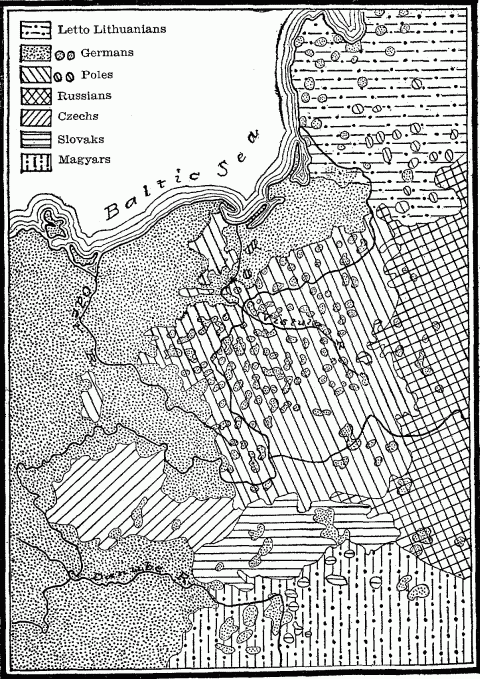
Slav-German Boundary In Europe.
The Slav-German boundary.
An ethnic map of the western Muscovite Empire in Europe shows a marked infiltration into White and Little Russia of West Slavs from Poland, and in the province of Bessarabia alternate areas of Russians and Roumanians. The latter in places form an unbroken ethnic expansion from the home kingdom west of the Pruth, extending in solid bands as far as the Dniester, and throwing out ethnic islands between this stream and the Bug.
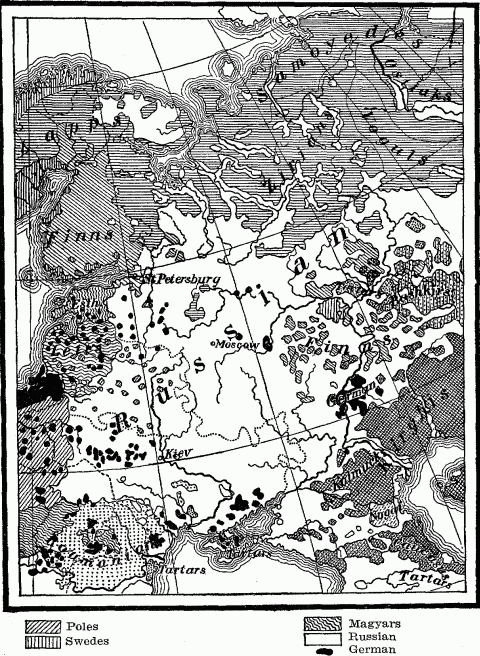
Ethnographical Map Of Russia.
MONGOLOID: Kalmucks, Kirghis, Nogai, Tartars, Bashkirs, Voguls, Ostiaks.
Samoyedes.
ZIRIAN: Mingled Mongoloid and Finnish.
Assimilation of culture in boundary zones.
Boundary zones of assimilation in Asia.
Boundary zones of mountain Tibet.
Relation of ethnic and cultural assimilation.
A race boundary involves almost inevitably a cultural boundary, often, too, a linguistic and religionary, occasionally a political boundary. The last three are subject to wide fluctuation, frequently overstepping all barriers of race and contrasted civilizations. Though one often accompanies another, it is necessary to distinguish the different kinds of boundaries and to estimate their relative importance in the history of a people or state. We may lay down the rule that the greater, more permanent, and deep-seated the contrasts on the two sides of a border, the greater is its significance; and that, on this basis, boundaries rank in importance, with few exceptions, in the following order: racial, cultural, linguistic, and political. The less marked the contrasts, in general, the more rapid and complete the process of assimilation in the belt of borderland.
The boundary zone in political expansion.
The significance of the border zone of assimilation for political expansion lies in the fact that it prepares the way for the advance of the state boundary from either side; in it the sharp edge of racial and cultural antagonism is removed, or for this antagonism a new affinity may be substituted. The zone of American settlement, industry, and commerce which in 1836 projected beyond the political boundary of the Sabine River over the eastern part of Mexican Texas facilitated the later incorporation of the State into the Union, just as a few years earlier the Baton Rouge District of Spanish West Florida had gravitated to the United States by reason of the predominant American element there, and thus extended the boundary of Louisiana to the Pearl River. When the political boundary of Siberia was fixed at the Amur River, the Muscovite government began extending the border zone of assimilation far to the south of that stream by the systematic Russification of Manchuria, with a view to its ultimate annexation. Schleswig-Holstein and Alsace-Lorraine, by reason of their large German population, have been readily incorporated into the German Empire. Only in Lorraine has a considerable French element retarded the process. The considerable sprinkling of Germans over the Baltic provinces of Russia and Poland west of the Vistula, and a certain Teutonic stamp of civilization which these districts have received, would greatly facilitate the eastward extension of the German Empire; while their common religions, both Protestant and Roman Catholic, would help obliterate the old political fissure. Thus the borderland of a country, so markedly differentiated from its interior, performs a certain historical function, and becomes, as it were, an organ of the living, growing race or state.
Tendency toward defection along political frontiers.
Location on a frontier involves remoteness from the center of national, cultural, and political activities; these reach their greatest intensity in the core of the nation and exercise only an attenuated influence on the far-away borders, unless excellent means of communication keep up a circulation of men, commodities, and ideas between center and periphery. For the frontier, therefore, the centripetal force is weakened; the centrifugal is strengthened often by the attraction of some neighboring state or tribe, which has established bonds of marriage, trade, and friendly intercourse with the outlying community. Moreover, the mere infusion of foreign blood, customs, and ideas, especially a foreign religion, which is characteristic of a border zone, invades the national solidarity. Hence we find that a tendency to political defection constantly manifests itself along the periphery. A long reach weakens the arm of authority, especially where serious geographical barriers intervene; hence border uprisings are usually successful, at least for a time. When accomplished, they involve that shrinkage of the frontiers which we have found to be the unmistakable symptom of national decline.
Centrifugal forces on the frontier.
The spirit of colonial frontiers.
Free border states as political survivals.
Guardians of the marches.
Border nomads as frontier police.
Lawless citizens deported to frontiers.
Drift of lawless elements to the frontiers.
Asylums beyond the border.
Border refugees and ethnic mingling.
These are some of the movements of individuals and groups which contribute to the blending of races along every frontier, and make of the boundary a variable zone, as opposed to the rigid artificial line in terms of which we speak.
NOTES TO CHAPTER VII