Chapter I · —The Operation Of Geographic Factors In History
Reading edition
Man a product of the earth's surface.
Man is a product of the earth's surface. This means not merely that he is a child of the earth, dust of her dust; but that the earth has mothered him, fed him, set him tasks, directed his thoughts, confronted him with difficulties that have strengthened his body and sharpened his wits, given him his problems of navigation or irrigation, and at the same time whispered hints for their solution. She has entered into his bone and tissue, into his mind and soul. On the mountains she has given him leg muscles of iron to climb the slope; along the coast she has left these weak and flabby, but given him instead vigorous development of chest and arm to handle his paddle or oar. In the river valley she attaches him to the fertile soil, circumscribes his ideas and ambitions by a dull round of calm, exacting duties, narrows his outlook to the cramped horizon of his farm. Up on the wind-swept plateaus, in the boundless stretch of the grasslands and the waterless tracts of the desert, where he roams with his flocks from pasture to pasture and oasis to oasis, where life knows much hardship but escapes the grind of drudgery, where the watching of grazing herd gives him leisure for contemplation, and the wide-ranging life a big horizon, his ideas take on a certain gigantic simplicity; religion becomes monotheism, God becomes one, unrivalled like the sand of the desert and the grass of the steppe, stretching on and on without break or change. Chewing over and over the cud of his simple belief as the one food of his unfed mind, his faith becomes fanaticism; his big spacial ideas, born of that ceaseless regular wandering, outgrow the land that bred them and bear their legitimate fruit in wide imperial conquests.
Man can no more be scientifically studied apart from the ground which he tills, or the lands over which he travels, or the seas over which he trades, than polar bear or desert cactus can be understood apart from its habitat. Man's relations to his environment are infinitely more numerous and complex than those of the most highly organized plant or animal. So complex are they that they constitute a legitimate and necessary object of special study. The investigation which they receive in anthropology, ethnology, sociology and history is piecemeal and partial, limited as to the race, cultural development, epoch, country or variety of geographic conditions taken into account. Hence all these sciences, together with history so far as history undertakes to explain the causes of events, fail to reach a satisfactory solution of their problems largely because the geographic factor which enters into them all has not been thoroughly analyzed. Man has been so noisy about the way he has "conquered Nature," and Nature has been so silent in her persistent influence over man, that the geographic factor in the equation of human development has been overlooked.
Stability of geographic factors in history.
In every problem of history there are two main factors, variously stated as heredity and environment, man and his geographic conditions, the internal forces of race and the external forces of habitat. Now the geographic element in the long history of human development has been operating strongly and operating persistently. Herein lies its importance. It is a stable force. It never sleeps. This natural environment, this physical basis of history, is for all intents and purposes immutable in comparison with the other factor in the problem—shifting, plastic, progressive, retrogressive man.
Persistent effect of remoteness.
History tends to repeat itself largely owing to this steady, unchanging geographic element. If the ancient Roman consul in far-away Britain often assumed an independence of action and initiative unknown in the provincial governors of Gaul, and if, centuries later, Roman Catholicism in England maintained a similar independence towards the Holy See, both facts have their cause in the remoteness of Britain from the center of political or ecclesiastical power in Rome. If the independence of the Roman consul in Britain was duplicated later by the attitude of the Thirteen Colonies toward England, and again within the young Republic by the headstrong self-reliance, impatient of government authority, which characterized the early Trans-Allegheny commonwealths in their aggressive Indian policy, and led them to make war and conclude treaties for the cession of land like sovereign states; and if this attitude of independence in the over-mountain men reappeared in a spirit of political defection looking toward secession from the Union and a new combination with their British neighbor on the Great Lakes or the Spanish beyond the Mississippi, these are all the identical effects of geographical remoteness made yet more remote by barriers of mountain and sea. This is the long reach which weakens the arm of authority, no matter what the race or country or epoch.
Effect of proximity.
As with geographical remoteness, so it is with geographical proximity. The history of the Greek peninsula and the Greek people, because of their location at the threshold of the Orient, has contained a constantly recurring Asiatic element. This comes out most often as a note of warning; like the motif of Ortrud in the opera of "Lohengrin," it mingles ominously in every chorus of Hellenic enterprise or paean of Hellenic victory, and finally swells into a national dirge at the Turkish conquest of the peninsula. It comes out in the legendary history of the Argonautic Expedition and the Trojan War; in the arrival of Phoenician Cadmus and Phrygian Pelops in Grecian lands; in the appearance of Tyrian ships on the coast of the Peloponnesus, where they gather the purple-yielding murex and kidnap Greek women. It appears more conspicuously in the Asiatic sources of Greek culture; more dramatically in the Persian Wars, in the retreat of Xenophon's Ten Thousand, in Alexander's conquest of Asia, and Hellenic domination of Asiatic trade through Syria to the Mediterranean. Again in the thirteenth century the lure of the Levantine trade led Venice and Genoa to appropriate certain islands and promontories of Greece as commercial bases nearer to Asia. In 1396 begins the absorption of Greece into the Asiatic empire of the Turks, the long dark eclipse of sunny Hellas, till it issues from the shadow in 1832 with the achievement of Greek independence.
Persistent effect of natural barriers.
If the factor is not one of geographical location, but a natural barrier, such as a mountain system or a desert, its effect is just as persistent. The upheaved mass of the Carpathians served to divide the westward moving tide of the Slavs into two streams, diverting one into the maritime plain of northern Germany and Poland, the other into the channel of the Danube Valley which guided them to the Adriatic and the foot of the Alps. This same range checked the westward advance of the mounted Tartar hordes. The Alps long retarded Roman expansion into central Europe, just as they delayed and obstructed the southward advance of the northern barbarians. Only through the partial breaches in the wall known as passes did the Alps admit small, divided bodies of the invaders, like the Cimbri and Teutons, who arrived, therefore, with weakened power and at intervals, so that the Roman forces had time to gather their strength between successive attacks, and thus prolonged the life of the declining empire. So in the Middle Ages, the Alpine barrier facilitated the resistance of Italy to the German emperors, trying to enforce their claim upon this ancient seat of the Holy Roman Empire.
It was by river-worn valleys leading to passes in the ridge that Etruscan trader, Roman legion, barbarian horde, and German army crossed the Alpine ranges. To-day well-made highways and railroads converge upon these valley paths and summit portals, and going is easier; but the Alps still collect their toll, now in added tons of coal consumed by engines and in higher freight rates, instead of the ancient imposts of physical exhaustion paid by pack animal and heavily accoutred soldier. Formerly these mountains barred the weak and timid; to-day they bar the poor, and forbid transit to all merchandise of large bulk and small value which can not pay the heavy transportation charges. Similarly, the wide barrier of the Rockies, prior to the opening of the first overland railroad, excluded all but strong-limbed and strong-hearted pioneers from the fertile valleys of California and Oregon, just as it excludes coal and iron even from the Colorado mines, and checks the free movement of laborers to the fields and factories of California, thereby tightening the grip of the labor unions upon Pacific coast industries.
Persistent effect of nature-made highways.
Regions of historical similarity.
Geographical environment, through the persistence of its influence, acquires peculiar significance. Its effect is not restricted to a given historical event or epoch, but, except when temporarily met by some strong counteracting force, tends to make itself felt under varying guise in all succeeding history. It is the permanent element in the shifting fate of races. Islands show certain fundamental points of agreement which can be distinguished in the economic, ethnic and historical development of England, Japan, Melanesian Fiji, Polynesian New Zealand, and pre-historic Crete. The great belt of deserts and steppes extending across the Old World gives us a vast territory of rare historical uniformity. From time immemorial they have borne and bred tribes of wandering herdsmen; they have sent out the invading hordes who, in successive waves of conquest, have overwhelmed the neighboring river lowlands of Eurasia and Africa. They have given birth in turn to Scythians, Indo-Aryans, Avars, Huns, Saracens, Tartars and Turks, as to the Tuareg tribes of the Sahara, the Sudanese and Bantu folk of the African grasslands. But whether these various peoples have been Negroes, Hamites, Semites, Indo-Europeans or Mongolians, they have always been pastoral nomads. The description given by Herodotus of the ancient Scythians is applicable in its main features to the Kirghis and Kalmuck who inhabit the Caspian plains to-day. The environment of this dry grassland operates now to produce the same mode of life and social organization as it did 2,400 years ago; stamps the cavalry tribes of Cossacks as it did the mounted Huns, energizes its sons by its dry bracing air, toughens them by its harsh conditions of life, organizes them into a mobilized army, always moving with its pastoral commissariat. Then when population presses too hard upon the meager sources of subsistence, when a summer drought burns the pastures and dries up the water-holes, it sends them forth on a mission of conquest, to seek abundance in the better watered lands of their agricultural neighbors. Again and again the productive valleys of the Hoangho, Indus, Ganges, Tigris and Euphrates, Nile, Volga, Dnieper and Danube have been brought into subjection by the imperious nomads of arid Asia, just as the "hoe-people" of the Niger and upper Nile have so often been conquered by the herdsmen of the African grasslands. Thus, regardless of race or epoch—Hyksos or Kaffir—history tends to repeat itself in these rainless tracts, and involves the better watered districts along their borders when the vast tribal movements extend into these peripheral lands.
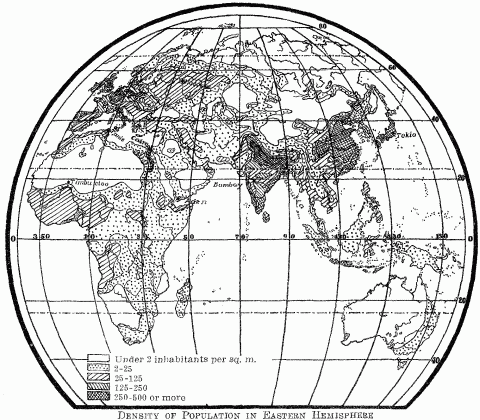
Density Of Population In Eastern Hemisphere
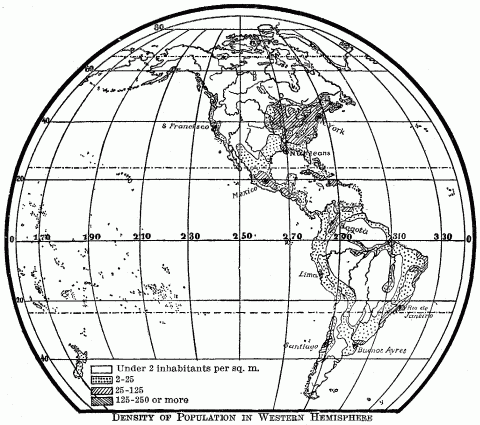
Density Of Population In Western Hemisphere
Climatic influences.
Climatic influences are persistent, often obdurate in their control. Arid regions permit agriculture and sedentary life only through irrigation. The economic prosperity of Egypt to-day depends as completely upon the distribution of the Nile waters as in the days of the Pharaohs. The mantle of the ancient Egyptian priest has fallen upon the modern British engineer. Arctic explorers have succeeded only by imitating the life of the Eskimos, adopting their clothes, food, fuel, dwellings, and mode of travel. Intense cold has checked both native and Russian development over that major portion of Siberia lying north of the mean annual isotherm of degree C. (32 degrees F.); and it has had a like effect in the corresponding part of Canada. (Compare maps pages 8 and 9.) It allows these sub-arctic lands scant resources and a population of less than two to the square mile. Even with the intrusion of white colonial peoples, it perpetuates the savage economy of the native hunting tribes, and makes the fur trader their modern exploiter, whether he be the Cossack tribute-gatherer of the lower Lena River, or the factor of the Hudson Bay Company. The assimilation tends to be ethnic as well as economic, because the severity of the climate excludes the white woman. The debilitating effects of heat and humidity, aided by tropical diseases, soon reduce intruding peoples to the dead level of economic inefficiency characteristic of the native races. These, as the fittest, survive and tend to absorb the new-comers, pointing to hybridization as the simplest solution of the problem of tropical colonization.
The relation of geography to history.
The more the comparative method is applied to the study of history—and this includes a comparison not only of different countries, but also of successive epochs in the same country—the more apparent becomes the influence of the soil in which humanity is rooted, the more permanent and necessary is that influence seen to be. Geography's claim to make scientific investigation of the physical conditions of historical events is then vindicated. "Which was there first, geography or history?" asks Kant. And then comes his answer: "Geography lies at the basis of history." The two are inseparable. History takes for its field of investigation human events in various periods of time; anthropo-geography studies existence in various regions of terrestrial space. But all historical development takes place on the earth's surface, and therefore is more or less molded by its geographic setting. Geography, to reach accurate conclusions, must compare the operation of its factors in different historical periods and at different stages of cultural development. It therefore regards history in no small part as a succession of geographical factors embodied in events. Back of Massachusetts' passionate abolition movement, it sees the granite soil and boulder-strewn fields of New England; back of the South's long fight for the maintenance of slavery, it sees the rich plantations of tidewater Virginia and the teeming fertility of the Mississippi bottom lands. This is the significance of Herder's saying that "history is geography set into motion." What is to-day a fact of geography becomes to-morrow a factor of history. The two sciences cannot be held apart without doing violence to both, without dismembering what is a natural, vital whole. All historical problems ought to be studied geographically and all geographic problems must be studied historically. Every map has its date. Those in the Statistical Atlas of the United States showing the distribution of population from 1790 to 1890 embody a mass of history as well as of geography. A map of France or the Russian Empire has a long historical perspective; and on the other hand, without that map no change of ethnic or political boundary, no modification in routes of communication, no system of frontier defences or of colonization, no scheme of territorial aggrandizement can be understood.
Multiplicity of geographic factors.
The study of physical environment as a factor in history was unfortunately brought into disrepute by extravagant and ill-founded generalization, before it became the object of investigation according to modern scientific methods. And even to-day principles advanced in the name of anthropo-geography are often superficial, inaccurate, based upon a body of data too limited as to space and time, or couched in terms of unqualified statement which exposes them to criticism or refutation. Investigators in this field, moreover, are prone to get a squint in their eye that makes them see one geographic factor to the exclusion of the rest; whereas it belongs to the very nature of physical environment to combine a whole group of influences, working all at the same time under the law of the resolution of forces. In this plexus of influences, some operate in one direction and some in another; now one loses its beneficent effect like a medicine long used or a garment outgrown; another waxes in power, reinforced by a new geographic factor which has been released from dormancy by the expansion of the known world, or the progress of invention and of human development.
Evolution of geographic relations.
These complex geographic influences cannot be analyzed and their strength estimated except from the standpoint of evolution. That is one reason these half-baked geographic principles rest heavy on our mental digestion. They have been formulated without reference to the all-important fact that the geographical relations of man, like his social and political organization, are subject to the law of development. Just as the embryo state found in the primitive Saxon tribe has passed through many phases in attaining the political character of the present British Empire, so every stage in this maturing growth has been accompanied or even preceded by a steady evolution of the geographic relations of the English people.
Owing to the evolution of geographic relations, the physical environment favorable to one stage of development may be adverse to another, and vice versa. For instance, a small, isolated and protected habitat, like that of Egypt, Phoenicia, Crete and Greece, encourages the birth and precocious growth of civilization; but later it may cramp progress, and lend the stamp of arrested development to a people who were once the model for all their little world. Open and wind-swept Russia, lacking these small, warm nurseries where Nature could cuddle her children, has bred upon its boundless plains a massive, untutored, homogeneous folk, fed upon the crumbs of culture that have fallen from the richer tables of Europe. But that item of area is a variable quantity in the equation. It changes its character at a higher stage of cultural development. Consequently, when the Muscovite people, instructed by the example of western Europe, shall have grown up intellectually, economically and politically to their big territory, its area will become a great national asset. Russia will come into its own, heir to a long-withheld inheritance. Many of its previous geographic disadvantages will vanish, like the diseases of childhood, while its massive size will dwarf many previous advantages of its European neighbors.
Evolution of world relations.
Interplay of geographic factors.
Skepticism as to the effect of geographic conditions upon human development is apparently justifiable, owing to the multiplicity of the underlying causes and the difficulty of distinguishing between stronger and weaker factors on the one hand, as between permanent and temporary effects on the other. We see the result, but find it difficult to state the equation producing this result. But the important thing is to avoid seizing upon one or two conspicuous geographic elements in the problem and ignoring the rest. The physical environment of a people consists of all the natural conditions to which they have been subjected, not merely a part. Geography admits no single blanket theory. The slow historical development of the Russian folk has been due to many geographic causes—to excess of cold and deficiency of rain, an outskirt location on the Asiatic border of Europe exposed to the attacks of nomadic hordes, a meager and, for the most part, ice-bound coast which was slowly acquired, an undiversified surface, a lack of segregated regions where an infant civilization might be cradled, and a vast area of unfenced plains wherein the national energies spread out thin and dissipated themselves. The better Baltic and Black Sea coasts, the fertility of its Ukraine soil, and location next to wide-awake Germany along the western frontier have helped to accelerate progress, but the slow-moving body carried too heavy a drag.
Land and sea in co-operation.
The law of the resolutions of forces applies in geography as in the movement of planets. Failure to recognize this fact often enables superficial critics of anthropo-geography to make a brave show of argument. The analysis of these interacting forces and of their various combinations requires careful investigation. Let us consider the interplay of the forces of land and sea apparent in every country with a maritime location. In some cases a small, infertile, niggardly country conspires with a beckoning sea to drive its sons out upon the deep; in others a wide territory with a generous soil keeps its well-fed children at home and silences the call of the sea. In ancient Phoenicia and Greece, in Norway, Finland, New England, in savage Chile and Tierra del Fuego, and the Indian coast district of British Columbia and southern Alaska, a long, broken shoreline, numerous harbors, outlying islands, abundant timber for the construction of ships, difficult communication by land, all tempted the inhabitants to a seafaring life. While the sea drew, the land drove in the same direction. There a hilly or mountainous interior putting obstacles in the way of landward expansion, sterile slopes, a paucity of level, arable land, an excessive or deficient rainfall withholding from agriculture the reward of tillage—some or all of these factors combined to compel the inhabitants to seek on the sea the livelihood denied by the land. Here both forces worked in the same direction.
Land and sea opposed.
Local and remote geographic factors.
Every country forms an independent whole, and as such finds its national history influenced by its local climate, soil, relief, its location whether inland or maritime, its river highways, and its boundaries of mountain, sea, or desert. But it is also a link in a great chain of lands, and therefore may feel a shock or vibration imparted at the remotest end. The gradual desiccation of western Asia which took a fresh start about 2,000 years ago caused that great exodus and displacement of peoples known as the Völkerwanderung, and thus contributed to the downfall of Rome; it was one factor in the Saxon conquest of Britain and the final peopling of central Europe. The impact of the Turkish hordes hurling themselves against the defenses of Constantinople in 1453 was felt only forty years afterward by the far-off shores of savage America. Earlier still it reached England as the revival of learning, and it gave Portugal a shock which started its navigators towards the Cape of Good Hope in their search for a sea route to India. The history of South Africa is intimately connected with the Isthmus of Suez. It owes its Portuguese, Dutch, and English populations to that barrier on the Mediterranean pathway to the Orient; its importance as a way station on the outside route to India fluctuates with every crisis in the history of Suez.
Direct and indirect effects of environment.
The geographic factors in history appear now as conspicuous direct effects of environment, such as the forest warfare of the American Indian or the irrigation works of the Pueblo tribes, now as a group of indirect effects, operating through the economic, social and political activities of a people. These remoter secondary results are often of supreme importance; they are the ones which give the final stamp to the national temperament and character, and yet in them the causal connection between environment and development is far from obvious. They have, therefore, presented pitfalls to the precipitate theorizer. He has either interpreted them as the direct effect of some geographic cause from which they were wholly divorced and thus arrived at conclusions which further investigation failed to sustain; or seeing no direct and obvious connection, he has denied the possibility of a generalization.
Indirect mental effects.
Indirect effects in differentiation of colonial peoples.
Indirect effect through isolation.
Such colonists in a remote country were necessarily few and could not be readily reinforced from home. Their new and isolated geographical environment favored variation. Heredity passed on the characteristics of a small, highly selected group. The race was kept pure from intermixture with the aborigines of the country, owing to the social and cultural abyss which separated them, and to the steady withdrawal of the natives before the advance of the whites. The homogeneity of island peoples seems to indicate that individual variations are in time communicated by heredity to a whole population under conditions of isolation; and in this way modifications due to artificial selection and a changed environment become widely spread.
Nor is this all. The modified type soon becomes established, because the abundance of land at the disposal of the colonists and the consequent better conditions of living encourage a rapid increase of population. A second geographic factor of mere area here begins to operate. Ease in gaining subsistence, the greater independence of the individual and the family, emancipation from carking care, the hopeful attitude of mind engendered by the consciousness of an almost unlimited opportunity and capacity for expansion, the expectation of large returns upon labor, and, finally, the profound influence of this hopefulness upon the national character, all combined, produce a social rejuvenation of the race. New conditions present new problems which call for prompt and original solution, make a demand upon the ingenuity and resourcefulness of the individual, and therefore work to the same end as his previous removal from the paralyzing effect of custom in the old home country. Activity is youth and sluggishness or paralysis is age. Hence the energy, initiative, adaptability, and receptivity to new ideas—all youthful qualities—which characterize the Anglo-Saxon American as well as the English Africander, can be traced back to the stimulating influences, not of a bracing or variable climate, but of the abundant opportunities offered by a great, rich, unexploited country. Variation under new natural conditions, when safe-guarded by isolation, tends to produce modification of the colonial type; this is the direct effect of a changed environment. But the new economic and social activities of a transplanted people become the vehicle of a mass of indirect geographic influences which contribute to the differentiation of the national character.
General importance of indirect effects.
Indirect political and moral effects.
In all democratic or representative forms of government permitting free expression of popular opinion, history shows that division into political parties tends to follow geographical lines of cleavage. In our own Civil War the dividing line between North and South did not always run east and west. The mountain area of the Southern Appalachians supported the Union and drove a wedge of disaffection into the heart of the South. Mountainous West Virginia was politically opposed to the tidewater plains of old Virginia, because slave labor did not pay on the barren "upright" farms of the Cumberland Plateau; whereas, it was remunerative on the wide fertile plantations of the coastal lowland. The ethics of the question were obscured where conditions of soil and topography made the institution profitable. In the mountains, as also in New England, a law of diminishing financial returns had for its corollary a law of increasing moral insight. In this case, geographic conditions worked through the medium of direct economic effects to more important political and ethical results.
The roots of geographic influence often run far underground before coming to the surface, to sprout into some flowering growth; and to trace this back to its parent stem is the necessary but not easy task of the geographer.
Time element.
The complexity of this problem does not end here. The modification of human development by environment is a natural process; like all other natural processes, it involves the cumulative effects of causes operating imperceptibly but persistently through vast periods of time. Slowly and deliberately does geography engrave the subtitles to a people's history. Neglect of this time element in the consideration of geographic influences accounts equally for many an exaggerated assertion and denial of their power. A critic undertakes to disprove modification through physical environment by showing that it has not produced tangible results in the last fifty or five hundred years. This attitude recalls the early geologists, whose imaginations could not conceive the vast ages necessary in a scientific explanation of geologic phenomena.
Effect of a previous habitat.
The importance of this time element for a solution of anthropo-geographic problems becomes plainer, where a certain locality has received an entirely new population, or where a given people by migration change their habitat. The result in either case is the same, a new combination, new modifications superimposed on old modifications. And it is with this sort of case that anthropo-geography most often has to deal. So restless has mankind been, that the testimony of history and ethnology is all against the assumption that a social group has ever been subjected to but one type of environment during its long period of development from a primitive to a civilized society. Therefore, if we assert that a people is the product of the country which it inhabits at a given time, we forget that many different countries which its forbears occupied have left their mark on the present race in the form of inherited aptitudes and traditional customs acquired in those remote ancestral habitats. The Moors of Granada had passed through a wide range of ancestral experiences; they bore the impress of Asia, Africa and Europe, and on their expulsion from Spain carried back with them to Morocco traces of their peninsula life.
The origin of Roman political institutions is intimately connected with conditions of the naturally small territory where arose the greatness of Rome. But now, after two thousand years we see the political impress of this narrow origin spreading to the governments of an area of Europe immeasurably larger than the region that gave it birth. In the United States, little New England has been the source of the strongest influences modifying the political, religious and cultural life of half a continent; and as far as Texas and California these influences bear the stamp of that narrow, unproductive environment which gave to its sons energy of character and ideals.
Transplanted religions.
Ideas especially are light baggage, and travel with migrant peoples over many a long and rough road. They are wafted like winged seed by the wind, and strike root in regions where they could never have originated. Few classes of ideas bear so plainly the geographic stamp of their origin as religious ones, yet none have spread more widely. The abstract monotheism sprung from the bare grasslands of western Asia made slow but final headway against the exuberant forest gods of the early Germans. Religious ideas travel far from their seedbeds along established lines of communication. We have the almost amusing episode of the brawny Burgundians of the fifth century, who received the Arian form of Christianity by way of the Danube highway from the schools of Athens and Alexandria, valiantly supporting the niceties of Greek religious thought against the Roman version of the faith which came up the Rhone Valley.
If the sacred literature of Judaism and Christianity take weak hold upon the western mind, this is largely because it is written in the symbolism of the pastoral nomad. Its figures of speech reflect life in deserts and grasslands. For these figures the western mind has few or vague corresponding ideas. It loses, therefore, half the import, for instance, of the Twenty-third Psalm, that picture of the nomad shepherd guiding his flock across parched and trackless plains, to bring them at evening, weary, hungry, thirsty, to the fresh pastures and waving palms of some oasis, whose green tints stand out in vivid contrast to the tawny wastes of the encompassing sands. "He leadeth me beside the still waters," not the noisy rushing stream of the rainy lands, but the quiet desert pool that reflects the stars. What real significance has the tropical radiance of the lotus flower, the sacred symbol of Buddhism, for the Mongolian lama in the cold and arid borders of Gobi or the wind-swept highlands of sterile Tibet? And yet these exotic ideas live on, even if they no longer bloom in the uncongenial soil. But to explain them in terms of their present environment would be indeed impossible.
Partial response to environment
A people may present at any given time only a partial response to their environment also for other reasons. This may be either because their arrival has been too recent for the new habitat to make its influence felt; or because, even after long residence, one overpowering geographic factor has operated to the temporary exclusion of all others. Under these circumstances, suddenly acquired geographic advantages of a high order or such advantages, long possessed but tardily made available by the release of national powers from more pressing tasks, may institute a new trend of historical development, resulting more from stimulating geographic conditions than from the natural capacities or aptitudes of the people themselves. Such developments, though often brilliant, are likely to be short-lived and to end suddenly or disastrously, because not sustained by a deep-seated national impulse animating the whole mass of the people. They cease when the first enthusiasm spends itself, or when outside competition is intensified, or the material rewards decrease.
The case of Spain.
Sporadic response to a new environment.
The larger conception of the environment.
The history and culture of a people embody the effects of previous habitats and of their final environment; but this means something more than local geographic conditions. It involves influences emanating from far beyond the borders. No country, no continent, no sea, mountain or river is restricted to itself in the influence which it either exercises or receives. The history of Austria cannot be understood merely from Austrian ground. Austrian territory is part of the Mediterranean hinterland, and therefore has been linked historically with Rome, Italy, and the Adriatic. It is a part of the upper Danube Valley and therefore shares much of its history with Bavaria and Germany, while the lower Danube has linked it with the Black Sea, Greece, the Russian steppes, and Asia. The Asiatic Hungarians have pushed forward their ethnic boundary nearly to Vienna. The Austrian capital has seen the warring Turks beneath its walls, and shapes its foreign policy with a view to the relative strength of the Sultan and the Czar.
Unity of the earth.
As the earth is one, so is humanity. Its unity of species points to some degree of communication through a long prehistoric past. Universal history is not entitled to the name unless it embraces all parts of the earth and all peoples, whether savage or civilized. To fill the gaps in the written record it must turn to ethnology and geography, which by tracing the distribution and movements of primitive peoples can often reconstruct the most important features of their history.
Anthropo-geographic problems are never simple. They must all be viewed in the long perspective of evolution and the historical past. They require allowance for the dominance of different geographic factors at different periods, and for a possible range of geographic influences wide as the earth itself. In the investigator they call for pains-taking analysis and, above all, an open mind.
NOTES TO CHAPTER I