Chapter XVII · —The Influence Of Climate
Reading edition
Importance of climatic influences.
Climate in the interplay of geographic factors.
Direct and indirect effects of climate.
For a clear understanding of climatic influences, it is necessary to adhere to the chief characteristics of the atmosphere, such as heat and cold, moisture and aridity, and to consider the effect of zonal location, winds and relief in the production and distribution of these; also to distinguish between direct and indirect results of climate, temporary and permanent, physiological and psychological ones, because the confusion of these various effects breeds far-fetched conclusions. The direct modification of man by climate is partly an a priori assumption, because the incontestable evidences of such modification are not very numerous, however strong the probability may be. The effect of climate upon plant and animal life is obvious, and immediately raises the assumption that man has been similarly influenced. But there is this difference: in contrast to the helpless dependence upon environment of stationary plants and animals, whose range of movement is strictly determined by conditions of food and temperature, the great mobility of man, combined with his inventiveness, enables him to flee or seek almost any climatic condition, and to emancipate himself from the full tyranny of climatic control by substituting an indirect economic effect for a direct physical effect.
While producing these direct effects, climate also influences man indirectly by controlling the wide range of his life conditions dependent upon the plant and animal life about him. It dictates what crops he may raise, and has it in its power to affect radically the size of his harvest. It decides which flocks and herds are best suited to his environment, and therefore directs his pastoral activities, whether he keeps reindeer, camels, llamas, horses or horned cattle. By interdicting both agriculture and stock-raising, as in Greenland whose ice cap leaves little surface free even for reindeer moss, it condemns the inhabitants forever to the uncertain subsistence of the hunter. Where it encourages the growth of large forests which harbor abundant game and yield abundant fruits, as in the hot, moist equatorial belt and on rainy mountain slopes, it prolongs the hunter stage of development, retards the advance to agriculture. Climate thus helps to influence the rate and the limit of cultural development. It determines in part the local supply of raw material with which man has to work, and hence the majority of his secondary activities, except where these are expended on mineral resources. It decides the character of his food, clothing, and dwelling, and ultimately of his civilization.
Effect of climate upon relief.
The very ground under man's feet, moreover, feels the molding hand of climate. In one region a former age of excessive cold has glaciated the surface and scoured off the fertile loam down to the underlying rock, or left the land coated with barren glacial drift or more productive clays. In another, the cold still persists and caps the land with ice and snow, or, as in the tundra, underlays it with a stratum of frozen earth, which keeps the surface wet and chilled even in the height of summer. In yet other regions, abundant moisture combined with heat covers the ground with a pad of fertile humus, while some hundred miles away drying trade winds parch and crack the steppe vegetation, convert most of its organic substance into gases, and leave only a small residue to enrich the soil. Rain itself modifies the relief of the land, and therefore often decides in a slow, cosmic way what shall be the ultimate destination of its precious store of water. A heavy precipitation on the windward side of a mountain range, by increasing the mechanical force of its drainage streams, makes them bite their way back into the heart of the system and decapitate the rivers on the leeward side, thus diminishing the volume of water left to irrigate the rainless slope. Thus the hydra-headed Amazon has been spreading and multiplying its sources among the Andean valleys, to the detriment of agriculture on the dry Pacific slope; thus the torrents of the Western Ghats, gorged by the monsoon rains from the Indian Ocean, are slowly nipping off the streams of the ill-watered Deccan, [See map page 484.] All these direct and indirect effects of climate may combine to produce ultimate politico-geographical results which manifest themselves in the expansion, power and permanence of states.
Climate limits the habitable area.
Climatic conditions limit the habitable area of the earth. This is their most important anthropo-geographic effect. At either pole lurks an invincible foe, with whom expanding humanity must always reckon, and who brooks little encroachment upon his territory. His weapon is the restriction of organic life, without which man cannot exist. The geographical boundaries of organic life, however, are wider than those of human life. The consequence of this climatic control, therefore, is not only a narrowed distribution of the human race, but a concentration which intensifies the struggle for existence, forces the utilization of all the available area, and thereby in every locality stimulates adaptation to environment.
Adaptability of man to climatic extremes.
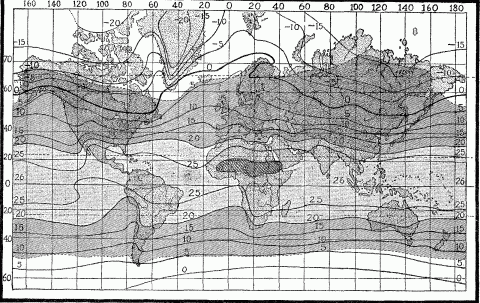
Mean Annual Isotherms And Heat Belts [Centigrade 0°C = 32°F. 20°C = 68°F. 30°C = 86°F.]
Temperature as modified by oceans and winds.
The zonal location of a country indicates roughly the degree of heat which it receives from the sun. It would do this accurately if variations of relief, prevailing winds and proximity of the oceans did not enter as disturbing factors. Since water heats and cools more slowly than the land, the ocean is a great reservoir of warmth in winter and of cold in summer, and exercises therefore an equalizing effect upon the temperature of the adjacent continents, far as these effects can be carried by the wind. The ocean is also the great source of moisture, and this, too, it distributes over the land through the agency of the wind. Where warm ocean currents, like the Gulf Stream and Kuro Siwa, penetrate into temperate or sub-polar latitudes, or where cool ones, like the Peruvian and Benguela Currents wash the coasts of tropical regions, they enhance the power of the ocean and wind to mitigate the extremes of temperature on land. The warm currents, moreover, loading the air above them with vapor, provide a store of rain to the nearest wind-swept land. Hence both the rainfall and temperature of a given country depend largely upon its neighboring water and air currents, and its accessibility to the rain-bearing winds. If it occupies a marked central position in temperate latitudes, like eastern Russia or the Great Plains of our semi-arid West, it receives limited moisture and suffers the extreme temperatures of a typical continental climate. The same result follows if it holds a distinctly peripheral location, and yet lies in the rain-shadow of a mountain barrier, like western Peru, Patagonia and Sweden north of the sixtieth parallel. [See map page 484.]
Effect of the westerlies.
Rainfall.
Temperature and zonal location.
Temperature, the other important element of climate, depends primarily upon zonal location, which has far different historical results from central and peripheral location, continental and insular. It determines the amount of heat received from the sun, though air and ocean currents may redistribute that heat within certain limits, and humidity or aridity modify its effects. Still zonal distinctions remain. The great climatic regions of the earth, like the hot, wet equatorial belt or the warm, dry trade-wind belts or the cool, well-watered temperate zones, constitute, through the medium of their economic products and their climatically imposed methods of production, so many socio-political areas, regardless of ethnic and political boundaries. The Berber nomads of the northern Sahara live much as the Semitic Bedouins of the Syrian desert or the Turkoman stock of arid Turkestan. They have the same tribal government, the same scattered distribution in small groups, the same economic basis of subsistence, though of different races and dominated respectively by France, Turkey and Russia. The history of the tropical Antilles has in both its economic and political features paralleled that of the East Indies since the early 16th century. Temperate South America promises to follow in the historical footsteps of temperate North America, South Africa in those of Europe and temperate Australia.
Reactions of contrasted zones.
While people of the same latitude live approximately under the same temperature conditions, those of contrasted zones are subjected to markedly different influences. They develop different degrees of civilization, wealth, economic efficiency, and density of population; hence they give rise to great historical movements in the form of migration, conquest, colonization, and commerce, which, like convection currents, seek to equalize the differences and reach an equilibrium. Nature has fixed the mutual destiny of tropical and temperate zones, for instance, as complementary trade regions. The hot belt produces numerous things that can never grow in colder countries, while a much shorter list of products, coupled, however, with greater industrial efficiency, is restricted to the Temperate Zone. This explains the enormous importance of the East Indian trade for Europe in ancient and medieval times, the value of tropical possessions for commercial countries like England and Holland. It throws light upon the persistence of the tropical plantation system in the Dutch East Indies and republican Mexico, as formerly in the sugar and cotton fields of the Southern States, with its relentless grip upon the throat of national life in hot lands.
Temperate products from tropical highlands.
Isothermal lines in anthropo-geography.
Despite some purely climatological objections, anthropo-geography finds the division of climatic zones according to certain isothermal lines of mean annual temperature the most expedient one for its purpose. The hot zone may be taken as the belt north and south of the equator enclosed between the annual isotherms of 20° C. (68° F.) These hold a course generally far outside the two tropics, and in the northern continents frequently reach the thirty-fifth parallel. The temperate climatic zones extend from the annual isotherm of 20° C. to that of 0° C. (32° F.), which bears little relation to the polar circles forming the limits of the solar Temperate Zone. The north temperate climatic zone has been further sub-divided along the annual isotherm of 5° C. (41° F.), distinguishing thus the warmer southern belt, which forms preëminently the zone of greatest historical intensity. The areas beyond the annual isotherms of 0°C. belong to the barren cold zones. [See map page 612.]
Historical effect of compressed isotherms.
Effect of slight climatic differences.
This compression of the isotherms emphasizes the differences of national characters produced in part by dissimilar climatic conditions. Contrasts in temperament, manner of life, and point of view, like that between the New Englander and Virginian, Chilean and Bolivian in the Americas, Breton and Provençal in France, Castilian and Andalusian in Spain, Gurkha and Bengali in India, seem to bleach out when they are located far apart, owing to many grades of transition between; but they become striking, stimulating, productive of important economic and political results, when close juxtaposition enables them to react sharply one upon the other. In effecting these nice differentiations of local types, climate is nearly always one of the factors at work, emphasizing perhaps an existing ethnic difference. Even the slight variations of temperature to be found in the same zone or the same climatic region produce distinct results, especially where they are harnessed, as is usually the case, with some other geographic condition of relief, area or soil, pulling in the same direction. Mexico, Peru, Italy, Switzerland, Greece and Asia Minor, with its high plateau interior and its contrasted Euxine and Aegean coasts, represent each a complex of climatic differences, which, reinforced by other geographic factors, have made in these regions a polychrome picture of national life.
Effect of climate upon distribution of immigration
Climate and race temperament.
The influence of climate upon race temperament, both as a direct and indirect effect, can not be doubted, despite an occasional exception, like the cheery, genial Eskimos, who seem to carry in their sunny natures an antidote to the cold and poverty of their environment. In general a close correspondence obtains between climate and temperament. The northern peoples of Europe are energetic, provident, serious, thoughtful rather than emotional, cautious rather than impulsive. The southerners of the sub-tropical Mediterranean basin are easy-going, improvident except under pressing necessity, gay, emotional, imaginative, all qualities which among the negroes of the equatorial belt degenerate into grave racial faults. If, as many ethnologists maintain, the blond Teutons of the north are a bleached out branch of the brunette Mediterranean race, this contrast in temperament is due to climate. A comparison of northern and southern peoples of the same race and within the same Temperate Zone reveals numerous small differences of nature and character, which can be traced back directly or indirectly to climatic differences, and which mount up to a considerable sum total. The man of the colder habitat is more domestic, stays more in his home. Though he is not necessarily more moderate or continent than the southerner, he has to pay more for his indulgences, so he is economical in expenditures. With the southerner it is "easy come, easy go." He therefore suffers more frequently in a crisis. The low cost of living keeps down his wages, so that as a laborer he is poorly paid. This fact, together with his improvidence, tends to swell the proletariat in warm countries of the Temperate Zone; and though here it does not produce the distressing impression of a proletariat in Dublin or Liverpool or Boston, it is always degrading. It levels society and economic status downward, while in the cooler countries of the Temperate Zone, the process is upward. The laborer of the north, owing to his providence and larger profits, which render small economies possible, is constantly recruited into the class of the capitalist.
Contrasted temperaments in the same nation.
Complexity of the geographic problem.
Monotonous climatic conditions.
In contrast to South Africa, temperate South America has an immense advantage in its large area lying outside the 20°C. isotherm, and in the wide range of mean temperatures (from 20°C. to 5°C.) found between the Tropic of Capricorn and Tierra del Fuego. Climate and relief have combined to make the mouth of the La Plata River the site of the largest city of the southern hemisphere. Buenos Ayres, with a population of over a million, reflects its large temperate hinterland.
The effects of Artic cold.
Frigid zones and the Tropics alike suffer from monotony, of Arctic the one of cold and the other of heat. The Arctic climatic belt, extending from the isotherm of 0°C. (32°F.) to the pole, includes inhabited districts where the mean annual temperature is less than -15°C. (or 5°F.), as at the Greenland village of Etah on Smith's Sound and the Siberian town of Verkhoyansk. Here the ground is covered with, ice or snow most of the year, and permanently frozen below the surface. Animal and plant life are reduced to a minimum on the land, so that man, with every poleward advance of his thin-strung settlements, is forced more and more to rely on the sea for his food. Hence he places his villages on narrow strips of coast, as do the Norse of Finmarken, the Eskimo and the Tunguse inhabiting the Arctic rim of Asia. Products of marine animals make the basis of his domestic economy. Farther inland, which means farther south, all tribes live by hunting and fishing. The Eurasian Hyperboreans find additional subsistence in their reindeer herds, which they pasture on the starchy lichen (Cladonia rangiferina) of the tundra. [See maps pages 103, 153.]
Similarity of cultural development.
Cold and health
In contrast to the numerous indirect effects of a frigid climate, no direct physiological effect can be positively ascribed to intense cold. It lays no bodily handicap on health and energy, as does the excessive heat of the Tropics. The coldest regions where tillage is possible are tolerable places of residence, because their winters are intensely dry. That of central Siberia, which is drier than the driest desert, makes tent life comfortable in the coldest season, provided the tenter be clad in furs. The low temperatures of the Canadian Northwest for the same reason have not repelled settlers even from the Southern States. Negroes, however, meet a climatic barrier in America at the isotherm of 5° Centigrade (41° F.). They are found in New England and Nova Scotia, generally with a large admixture of white blood; but there and farther north where the climate is moist as well as cold, they show a fatal tendency to pulmonary diseases.
The small amount of tropical emigration
The acclimatization of tropical people in temperate regions will never be a question of widespread importance. The negroes were involuntary immigrants to America, under conditions that can never recur. Their concentration in the "black belt," where they find the heat and moisture in which they thrive, and their climatically conditioned exclusion from the more northern states are matters of local significance. Economic and social retardation have kept the hot belt relatively underpopulated. The density map shows much the largest part of it with a population less than 25 to the square mile. Only the small portion contained in India, southernmost China, and Java shows a density over 125 to the square mile (or 50 to the square kilometer). This density has to rise to 500 or more to the square mile before emigration begins. The would-be exiles then have a wide choice of new homes in other tropical lands, where they find congenial climate and phases of economic development into which they will fit. East Indian coolies are found in Cape Colony, Natal, Zanzibar, Trinidad, and British Guiana, where they constitute 38 per cent. of the population.
Effects of tropical climate.
Historical significance of deterioration
The problem of acclimatization.
In all these instances the white race has been successfully transplanted. It has domiciled itself on the borders of the Tropics and has propagated its kind, though it has abated some of the vigorous qualities which characterized it in its temperate fatherland. In the real Tropics like India, Cochin China, the Malay Archipelago, and Central Africa, the whole perplexing and urgent problem of European colonization turns on the difficulty or impossibility of acclimatization; and this in turn affects the whole economic, ethnic and political destiny of present colonial holdings. If acclimatization is impossible, the alternative is an imported ruling class, constantly invalided and as constantly renewed, aided by a similar commercial body acting as superintendents of labor; the whole machine of government and economic exploitation is supported by a permanent servile native population, doing the preeminently tropical work of agriculture, which is so fatal to the white man in a torrid climate. This means that the conquering white race of the Temperate Zone is to be excluded by adverse climatic conditions from the productive but undeveloped Tropics, unless it consents to hybridization, like the Spaniards and Portuguese of tropical America. In that national struggle for existence which is a struggle for space, it means an added advantage for the Mediterranean peoples, that they are more tolerant of a torrid climate than the blond Teutons, whose disability in this regard is pronounced; it means that the aptitude of the Chinese for a wide range of climatic accommodation, from the Arctic circle to the equator, lends color to "the yellow peril."
Historical importance of the temperate zones.
In contrast to the monotonous extremes of climate in the hot and cold zones, temperate lands are characterized by the intermediate degrees of annual temperature and marked seasonal diversity which are so favorable to human development. In Arctic lands labor is paralyzed by cold as it is by heat in the enervating and overproductive Tropics. In one, the growing season is too short and ill-favored; in the other, too long to stimulate man to sustained industry. Hence the Temperate Zones, whose climate avoids both these extremes and abounds in contrasts, whose summers are productive enough to supply food for the winter, and whose winters give both motive and energy for the summer's work, are richer in cultural possibilities and hence in historical importance.
Effects of contrasted seasons.
Effects of length of seasons.
Effect of long winters.
Complexity of climatic effects.
Caution should be exercised in drawing conclusions from climate alone or from only one phase of its influence. The duration and intensity of the seasons affects not only the manner of work, but the whole mode of life of a people. On the Yukon, in Iceland, and the high mountain valleys of the Alps, winter puts a check not only upon out-of-door labor, but upon all public or community life. Intercourse stops or is greatly restricted. The outside world drops away. In Iceland, the law courts are in session only in summer when the roads by sea and land are open. In the Kentucky mountains the district schools close before Christmas, when the roads become impassable from rain and snow; the summer is the gala time for funeral services, for only then can the preacher or "circuit-rider" reach the graves made in the winter. Therefore the funerals in one community accumulate, so to speak, and finally, when leisure comes after the August harvest, they make the occasion for important social gatherings. Much of the influence of winter lies in its power to isolate.
Social effects of long winters.
The duration and severity of the cold season has put a drag upon the wheel of enterprise in Canada, as opposed to the warmer United States. The prairies of the Canadian Northwest, whose fertile soil should early have attracted settlement, were a closed land till railroads could pour into it every summer from the warmer south and east a seasonal tide of laborers. These follow the harvest as it advances from point to point, and then withdraw in autumn either to the lumber camps of eastern Canada, Minnesota and Wisconsin, or to seek other forms of out-door labor in the more southern states, thus lifting from the Canadian farmer the burden of their winter support.
Zones of culture.
Over and beyond slight local variations of climate and season within the same zone, which contribute their quota to economic and historical results, it is the fundamental differences between the hot, cold and temperate climatic zones that produce the most conspicuous and abiding effects. These broad belts, each with its characteristic climatic conditions and appropriate civilization, form so many girdles of culture around the earth. They have their dominant features of heat and cold, variously combined with moisture and aridity, which give a certain zonal stamp to human temperature and development.
The cradle of civilization.
The North Temperate Zone is preëminently the culture zone of the earth. It is the seat of the most important, most steadily progressive civilizations, and the source of all the cultural stimuli which have given an upward start to civilization in other zones during the past three centuries. It contains the Mediterranean basin, which was the pulsing heart of ancient history, and all the modern historically important regions of Europe, Asia, Africa, and America. The temperate belt of the southern hemisphere also is following its lead, since European civilization has been transplanted to other parts of the world. This is the zone which least suffers from the drawbacks of climatic monotony or extremes, and best combines, especially in the northern hemisphere, the wide range of annual and seasonal variety so favorable to economic and cultural development, with the incalculable advantage of large land area.
Most of the ancient civilizations originated just within the mild but drier margin of the Temperate Zone, where the cooler air of a short winter acted like a tonic upon the energies relaxed by the lethargic atmosphere of the hot and humid Tropics; where congenial warmth encouraged vegetation, but where the irrigation necessary to secure abundant and regular crops called forth inventiveness, coöperation, and social organization, and gave to the people their first baptism of redemption from savagery to barbarism. Native civilizations of limited development have arisen in the Tropics, but only where, as in Yemen, Mexico and Peru, a high, cool, semi-arid plateau, a restricted area of fertile soil, and a protected location alternately coddled and spurred the nascent people.
As the Tropics have been the cradle of humanity, the Temperate Zone has been the cradle and school of civilization. Here Nature has given much by withholding much. Here man found his birthright, the privilege of the struggle.
NOTES TO CHAPTER XVII