Chapter IV · —The Movements Of Peoples In Their Geographical Significance
Reading edition
Universality of these movements.
The ethnic and political boundaries of Europe to-day are the residuum of countless racial, national, tribal and individual movements reaching back into an unrecorded past. The very names of Turkey, Bulgaria, England, Scotland and France are borrowed from intruding peoples. New England, New France, New Scotland or Nova Scotia and many more on the American continents register the Trans-Atlantic nativity of their first white settlers. The provinces of Galicia in Spain, Lombardy in Italy, Brittany in France, Essex and Sussex in England record in their names streams of humanity diverted from the great currents of the Völkerwanderung. The Romance group of languages, from Portugal to Roumania, testify to the sweep of expanding Rome, just as the wide distribution of the Aryan linguistic family points to many roads and long migrations from some unplaced birthplace. Names like Cis-Alpine and Trans-Alpine Gaul in the Roman Empire, Trans-Caucasia, Trans-Caspia and Trans-Baikalia in the Russian Empire, the Transvaal and Transkei in South Africa, indicate the direction whence the advancing people have come.
Stratification of races
Ethnology reveals an east and west stratification of linguistic groups in Europe, a north and south stratification of races, and another stratification by altitude, which reappears in all parts of the world, and shows certain invading dominant races occupying the lowlands and other displaced ones the highlands. This definite arrangement points to successive arrivals, a crowding forward, an intrusion of the strong into fertile, accessible valleys and plains, and a dislodgment of the weak into the rough but safe keeping of mountain range or barren peninsula, where they are brought to bay. Ethnic fragments, linguistic survivals, or merely place names, dropped like discarded baggage along the march of a retreating army, bear witness everywhere to tragic recessionals.
The name Historical Movement.
Evolution of the Historical Movement.
Among primitive peoples this movement is simple and monotonous. It involves all members of the tribe, either in pursuit of game, or following the herd over the tribal territory, or in migrations seeking more and better land. Among civilized peoples it assumes various forms, and especially is differentiated for different members of the social group. The civilized state develops specialized frontiersmen, armies, explorers, maritime traders, colonists, and missionaries, who keep a part of the people constantly moving and directing external expansion, while the mass of the population converts the force once expended in the migrant food-quest into internal activity. Here we come upon a paradox. The nation as a whole, with the development of sedentary life, increases its population and therewith its need for external movements; it widens its national area and its circle of contact with other lands, enlarges its geographical horizon, and improves its internal communication over a growing territory; it evolves a greater mobility within and without, which attaches, however, to certain classes of society, not to the entire social group. This mobility becomes the outward expression of a whole complex of economic wants, intellectual needs, and political ambitions. It is embodied in the conquests which build up empires, in the colonization which develops new lands, in the world-wide exchange of commodities and ideas which lifts the level of civilization, till this movement of peoples becomes a fundamental fact of history.
Nature of primitive movements.
Number and range.
Importance of such movements in history.
The earth's surface is at once factor and basis in these movements. In an active way it directs them; but they in turn clothe the passive earth with a mantle of humanity. This mantle is of varied weave and thickness, showing here the simple pattern of a primitive society, there the intricate design of advanced civilization; here a closely woven or a gauzy texture, there disclosing a great rent where a rocky peak or the ice-wrapped poles protrude through the warm human covering. This is the magic web whereof man is at once woof and weaver, and the flying shuttle that never rests. Given a region, what is its living envelope, asks anthropo-geography. Whence and how did it get there? What is the material of warp and woof? Will new threads enter to vary the color and design? If so, from what source? Or will the local pattern repeat itself over and over with dull uniformity?
Geographical interpretation of historical movement.
It was the great intellectual service of Copernicus that he conceived of a world in motion instead of a world at rest. So anthropo-geography must see its world in motion, whether it is considering English colonization, or the westward expansion of the Southern slave power in search of unexhausted land, or the counter expansion of the free-soil movement, or the early advance of the trappers westward to the Rockies after the retreating game, or the withdrawal thither of the declining Indian tribes before the protruding line of white settlement, and their ultimate confinement to ever shrinking reservations. In studying increase of population, it sees in Switzerland chalet and farm creeping higher up the Alp, as the lapping of a rising tide of humanity below; it sees movement in the projection of a new dike in Holland to reclaim from the sea the land for another thousand inhabitants, movement in Japan's doubling of its territory by conquest, in order to house and feed its redundant millions.
The whole complex relation of unresting man to the earth is the subject matter of anthropo-geography. The science traces his movements on the earth's surface, measures their velocity, range, and recurrence, determines their nature by the way they utilize the land, notes their transformation at different stages of economic development and under different environments. Just as an understanding of animal and plant geography requires a previous knowledge of the various means of dispersal, active and passive, possessed by these lower forms of life, so anthropo-geography must start with a study of the movements of mankind.
Mobility of primitive peoples.
First of all is to be noted an evolution in the mobility of peoples. In the lower stages of culture mobility is great. It is favored by the persistent food-quest over wide areas incident to retarded economic methods, and by the loose attachment of society to the soil. The small social groups peculiar to these stages and their innate tendency to fission help the movements to ramify. The consequent scattered distribution of the population offers wide interstices between encampments or villages, and into these vacant spaces other wandering tribes easily penetrate. The rapid decline of the Indian race in America before the advancing whites was due chiefly to the division of the savages into small groups, scattered sparsely over a wide territory. Hunter and pastoral peoples need far more land than they can occupy at any one time. Hence the temporarily vacant spots invite incursion. Moreover, the slight impedimenta carried by primitive folk minimize the natural physical obstacles which they meet when on the march. The lightly equipped war parties of the Shawnee Indians used gorges and gaps for the passage of the Allegheny Mountains which were prohibitive to all white pioneers except the lonely trapper. Finally, this mobility gets into the primitive mind. The Wanderlust is strong. Long residence in one territory is irksome, attachment is weak. Therefore a small cause suffices to start the whole or part of the social body moving. A temporary failure of the food supply, cruelty or excessive exaction of tribute on the part of the chief, occasions an exodus. The history of every negro tribe in Africa gives instances of such secessions, which often leave whole districts empty and exposed to the next wandering occupant. Methods of preventing such withdrawals, and therewith the diminution of his treasury receipts and his fighting force, belong to the policy of every negro chieftain.
Natural barriers to movement.
Effect of geographical horizon.
Primitive peoples carry a drag upon their migrations in their restricted geographical outlook; ignorance robs them of definite goals. The evolution of the historical movement is accelerated by every expansion of the geographical horizon. It progresses most rapidly where the knowledge of outlying or remote lands travels fastest, as along rivers and thalassic coasts. Rome's location as toll-gate keeper of the Tiber gave her knowledge of the upstream country and directed her conquest of its valley; and the movement thus started gathered momentum as it advanced. Cæsar's occupation of Gaul meant to his generation simply the command of the roads leading from the Mediterranean to the northern sources of tin and amber, and the establishment of frontier outposts to protect the land boundaries of Italy; this represented a bold policy of inland expansion for that day. The modern historian sees in that step the momentous advance of history beyond the narrow limits of the Mediterranean basin, and its gradual inclusion of all the Atlantic countries of Europe, through whose maritime enterprise the historical horizon was stretched to include America. In the same way, mediæval trade with the Orient, which had familiarized Europe with distant India and Cathay, developed its full historico-geographical importance when it started the maritime discoveries of the fifteenth century. The expansion of the geographical horizon in 1512 to embrace the earth inaugurated a widespread historical movement, which has resulted in the Europeanization of the world.
Civilization and mobility.
Civilized man is at once more and less mobile than his primitive brother. Every advance in civilization multiplies and tightens the bonds uniting him with his soil; makes him a sedentary instead of a migratory being. On the other hand every advance in civilization is attended by the rapid clearing of the forests, by the construction of bridges and interlacing roads, the invention of more effective vehicles for transportation whereby intercourse increases, and the improvement of navigation to the same end. Civilized man progressively modifies the land which he occupies, removes or reduces obstacles to intercourse, and thereby approximates it to the open plain. Thus far he facilitates movements. But while doing this he also places upon the land a dense population, closely attached to the soil, strong to resist incursion, and for economic reasons inhospitable to any marked accession of population from without. Herein lies the great difference between migration in empty or sparsely inhabited regions, such as predominated when the world was young, and in the densely populated countries of our era. As the earth grew old and humanity multiplied, peoples themselves became the greatest barriers to any massive migrations, till in certain countries of Europe and Asia the historical movement has been reduced to a continual pressure, resulting in compression of population here, repression there. Hence, though political boundaries may shift, ethnic boundaries scarcely budge. The greatest wars of modern Europe have hardly left a trace upon the distribution of its peoples. Only in the Balkan Peninsula, as the frontiers of the Turkish Empire have been forced back from the Danube, the alien Turks have withdrawn to the shrinking territory of the Sultan and especially to Asia Minor.
Diffusion of culture.
Ethnic intermixture.
That vast sum of migrations, great and small, which we group under the general term of historical movement has involved an endless mingling of races and cultures. As Professor Petrie has remarked, the prevalent notion that in prehistoric times races were pure and unmixed is without foundation. An examination of the various forms of the historical movement reveals the extent and complexity of this mingling process.
In the first place, no migration is ever simple; it involves a number of secondary movements, each of which in turn occasions a new combination of tribal or racial elements. The transference of a whole people from its native or adopted seat to a new habitat, as in the Völkerwanderungen, empties the original district, which then becomes a catchment basin for various streams of people about its rim; and in the new territory it dislodges a few or all of the occupants, and thereby starts up a fresh movement as the original one comes to rest.
Complex currents of migration.
Cultural modification during migration.
Effect of early maritime migration.
The transit land.
The land traversed by a migrating horde is not to be pictured as a dead road beneath their feet, but rather as a wide region of transit and transition, potent to influence them by its geography and people, and to modify them in the course of their passage. The route which they follow is a succession of habitats, in which they linger and domicile themselves for a while, though not long enough to lose wholly the habits of life and thought acquired in their previous dwelling place. Although nature in many places, by means of valleys, low plains, mountain passes or oasis lines, points out the way of these race movements, it is safer to think and speak of this way as a transit land, not as a path or road. Even where the district of migration has been the sea, as among the Caribs of the Antilles Islands, the Moros of the Philippines, and the Polynesians of the Pacific, man sends his roots like a water plant down into the restless element beneath, and reflects its influence in all his thought and activities.
War as a form of the historical movement.
Primitive war.
Slavery as form of historical movement.
Fusion by deported and military colonies.
Withdrawal and flight.
Dispersal in flight.
Natural regions of retreat.
The hope of safety from pursuit drives fugitive peoples into isolated and barren places that are scarcely accessible or habitable, and thereby extends the inhabited area of the earth long before mere pressure of population would have stretched it to such limits. We find these refugee folk living in pile villages built over the water, in deserts, in swamps, mangrove thickets, very high mountains, marshy deltas, and remote or barren islands, all which can be classified as regions of retreat. Fugitives try to place between themselves and their pursuers a barrier of sea or desert or mountains, and in doing this have themselves surmounted some of the greatest obstacles to the spread of the human race.
Emigration and colonization.
Commerce.
Commerce a guide to various movements.
Movements due to religion.
Trade often finds in religion an associate and coadjutor in directing and stimulating the historical movement. China regards modern Christian missions as effective European agencies for the spread of commercial and political power. Jesuit and fur-trader plunged together into the wilds of colonial Canada; Spanish priest and gold-seeker into Mexico and Peru. American missionary pressed close upon the heels of fur-trader into the Oregon country. Jason Lee, having established a Methodist mission on the Willamette in 1834, himself experienced sudden conversion from religionist to colonizer. He undertook a temporary mission back to the settled States, where he preached a stirring propaganda for the settlement and appropriation of the disputed Oregon country, before the British should fasten their grip upon it. The United States owes Hawaii to the expansionist spirit of American missionaries. Thirty years after their arrival in the islands, they held all the important offices under the native government, and had secured valuable tracts of lands, laying the foundation of the landed aristocracy of planters established there to-day. Their sons and grandsons took the lead in the Revolution of 1893, and in the movement for annexation to the United States. Thus sometimes do the meek inherit the earth.
Religious pilgrimages.
Historical movement and race distribution.
The forms which have been assumed by the historical movement are varied, but all have contributed to the spread of man over the habitable globe. The yellow, white and red races have become adapted to every zone; the black race, whether in Africa, Australia or Melanesia, is confined chiefly to the Tropics. A like conservatism as to habitat tends to characterize all sub-races, peoples, and tribes of the human family. The fact which strikes one in studying the migrations of these smaller groups is their adherence each to a certain zone or heat belt defined by certain isothermal lines (see map chap. XVII.), their reluctance to protrude beyond its limits, and the restricted range and small numerical strength of such protrusions as occur. This seems to be the conservatism of the mature race type, which has lost some of its plasticity and shuns or succumbs to the ordeal of adaptation to contrasted climatic conditions, except when civilization enables it partially to neutralize their effects.
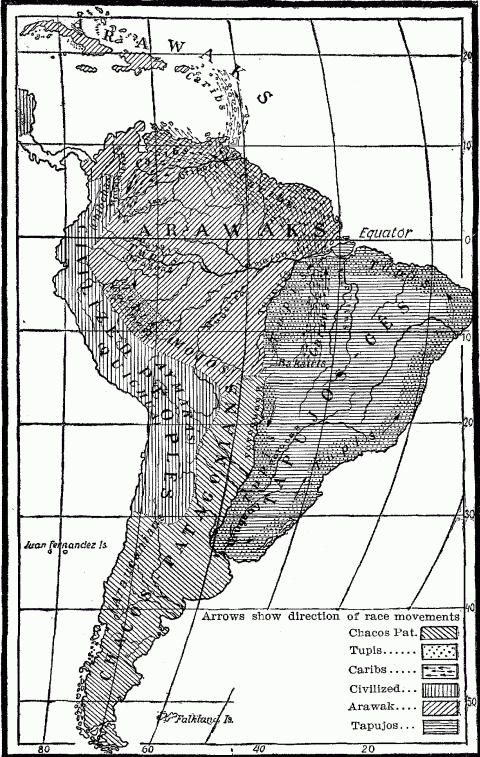
Primitive Indian Stocks Of South America (From Helmolt's History of the World. By permission of Dodd, Mead & Co.)
Migrations in relation to zones and heat belts.
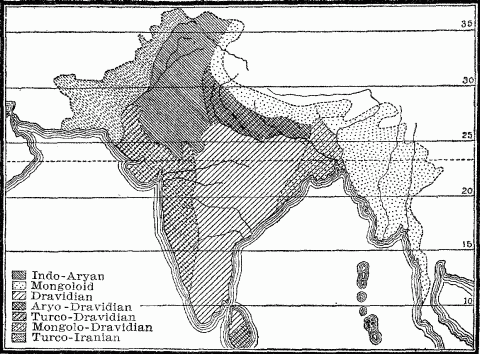
Ethnographical Map Of India From The Indian Census Of 1901.
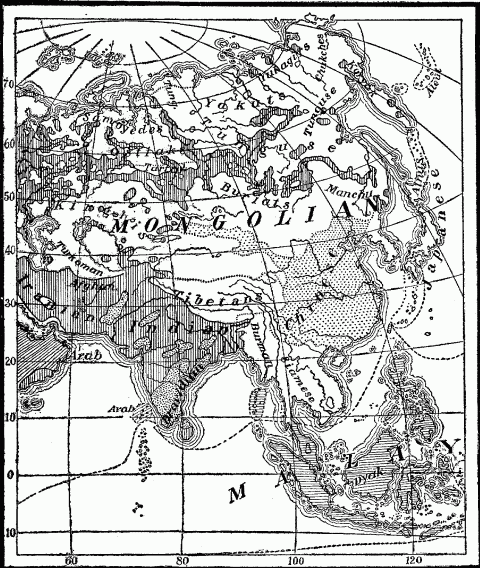
Ethnographical Map Of Asia. Vertical Shading in the North is Slav.
Range of movements in Asia.
Europe, except for its small sub-arctic area, has received immigrants, according to the testimony of history and ethnology, only from the temperate parts of Asia and Africa, with the one exception of the Saracens of Arabia, whose original home lay wholly within the hot climate belt of 20°C. (68°F.). Saracen expansion, in covering Persia, Syria, and Egypt, still kept to this hot belt; only in the Barbary Coast of Africa and in Spain did it protrude into the temperate belt. Though this last territory was extra-tropical, it was essentially semi-arid and sub-tropical in temperature, like the dry trade-wind belt whence the Saracens had sprung.
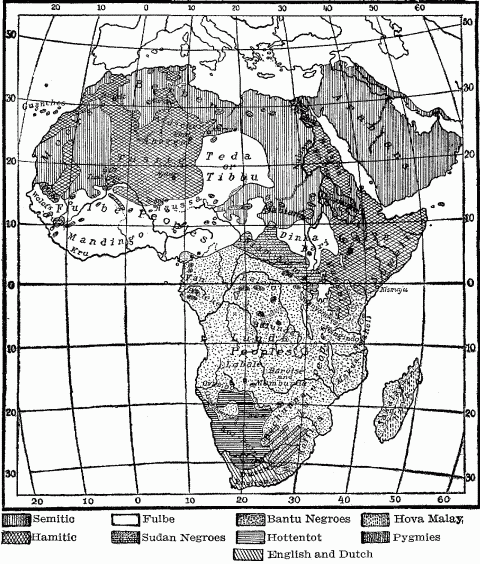
Ethnographical Map Of Africa And Arabia.
Range of movements in Africa.
Colonization and latitude.
The movement of Europeans into the tropical regions of Asia, Australasia, Africa and America, like the American advance into the Philippines, represents commercial and political, not genuine ethnic expansion. Except where it resorts to hybridization, it seeks not new homesteads, but the profits of tropical trade and the markets for European manufactures found in retarded populations. These it secures either by a small but permanently domiciled ruling class, as formerly in Spanish and Portuguese America, or by a body of European officials, clerks, agents and soldiers, sent out for a term of years. Such are the seventy-six thousand Britishers who manage the affairs of commerce and state in British India, and the smaller number of Dutch who perform the same functions in the Dutch East India islands. The basis of this system is exploitation. It represents neither a high economic, ethical, nor social ideal, and therefore lacks the stamp of geographic finality.
Movement to like geographic conditions.
Movement to better geographic conditions.
The search for better land, milder climate, and easier conditions of living starts many a movement of peoples which, in view of their purpose, necessarily leads them into an environment sharply contrasted to their original habitat. Such has been the radial outflow of the Mongoloid tribes down from the rugged highlands of central Asia to the fertile river lowlands of the peripheral lands; the descent of the Iran pastors upon the agricultural folk of the Indus, Ganges and Mesopotamian valleys, and the swoop of desert-born conquerors upon the unresisting tillers of well-watered fields in all times, from the ancient Hyksos of the Nile to the modern Fulbe of the Niger Valley.
Southward and westward drifts in the northern hemisphere.
Eastward movements.
Return movements.
Since the world is small, it frequently happens that a people after an interval of generations, armed with a higher civilization, will reënter a region which it once left when too crude and untutored to develop the possibilities of the land, but which its better equipment later enables it to exploit. Thus we find a backward expansion of the Chinese westward to the foot of the Pamir, and an internal colonization of the empire to the Ili feeder of Lake Balkash. The expansion of the Japanese into Korea and Saghalin is undoubtedly such a return current, after an interval long enough to work a complete transformation in the primitive Mongolians who found their way to that island home. Sometimes the return represents the ebbing of the tide, rather than the back water of a stream in flood. Such was the retreat of the Moors from Spain to the Berber districts of North Africa, whither they carried echoes of the brilliant Saracen civilization in the Iberian Peninsula. Such has been the gradual withdrawal of the Turks from Europe back to their native Asia, and slow expulsion of the Tartar tribes from Russia to the barren Asiatic limits of their former territory. [See map page 225.]
Regions of attraction and repulsion.
The security of such unproductive highlands lies more in their failure to attract than in their power to resist conquest. When to abundant natural resources, a single spot adds a reputation for wealth, magnificence, an exceptional position for the control of territory or commerce, it becomes a geographical magnet. Such was Delphi for the Gauls of the Balkan Peninsula in the third century, Rome for the Germanic and Hunnish tribes of the Völkerwanderung, Constantinople for the Normans, Turks and Russians, Venice for land-locked Austria, the Mississippi highway and the outlet at New Orleans for our Trans-Allegheny pioneers.
Psychical influences in certain movements.
Results of historical movement.
Historical movements are varied as to motive, direction, numerical strength, and character, but their final results are two, differentiation and assimilation. Both are important phases of the process of evolution, but the latter gains force with the progress of history and the increase of the world's population.
Differentiation and area.
When the relief includes mountains, the character not only of the land but of the climate changes, and therewith the type of community. Hence neighboring districts may produce strongly contrasted types of society. Madison County of Kentucky, lying on the eastern margin of the Bluegrass region, contains the rich landed estates, negro laboring class and aristocratic society characteristic of the "planter" communities of the old South; and only twenty miles southeast of Richmond, the center of this wealth and refinement, it includes also the rough barren hill country of the Cumberland Plateau, where are found one-room cabins, moonshine stills, feuds, and a backward population sprung from the same pure English stock as the Bluegrass people.
Contrasted environments.
As the great process of European colonization has permeated the earth and multiplied its population, not only the best land but the amount of this has commenced to differentiate the history of various European nations, and that in a way whose end cannot yet be definitely predicted. The best lands have fallen to the first-comers strong enough to hold them. People who early develop powers of expansion, like the English, or who, like the French and Russians, formulate and execute vast territorial policies, secure for their future growth a wide base which will for all time distinguish them from late-comers into the colonial field, like Germany and Italy. These countries see the fecundity of their people redounding to the benefit of alien colonial lands, which have been acquired by enterprising rivals in the choice sections of the temperate zone. German and Italian colonies in torrid, unhealthy, or barren tropical lands, fail to attract emigrants from the mother country, and therefore to enhance national growth.
Two-type populations.
Differentiation and isolation.
Differentiation and digression.
Geographic conditions of heterogeneity and homogeneity.
Differentiation versus assimilation.
Elimination by historical movement.
No new ethnic types.
Checks to differentiation.
Improved communication maintains or increases the ranks of the intruders from the home supply. The negroes in North America, imported as they were en masse, then steadily recruited by two centuries of the slave trade, while their race integrity was somewhat protected by social ostracism, have not been seriously modified physically by several generations of residence in a temperate land. Their changes have been chiefly cultural. The Englishman has altered only superficially in the various British colonial lands. Constant intercourse and the progress of inventions have enabled him to maintain in diverse regions approximate uniformity of physical well-being, similar social and political ideals. The changed environment modifies him in details of thought, manner, and speech, but not in fundamentals.
Geographical origins.
The origin of a people can be investigated and stated only in terms of geography. The problem of origin can be solved only by tracing a people from its present habitat, through the country over which it has migrated, back to its original seat. Here are three geographical entities which can be laid down upon a map, though seldom with sharply defined boundaries. They represent three successive geographic locations, all embodying geographic conditions potent to influence the people and their movement. Hence the geographical element emerges in every investigation as to origins; whether in ethnology, history, philology, mythology or religion. The transit land, the course between start and finish, is of supreme importance. Especially is this true for religion, which is transformed by travel. Christianity did not conquer the world in the form in which it issued from the cramped and isolated environment of Palestine, but only after it had been remodelled in Asia Minor, Egypt, Greece and Rome, and cosmopolized in the wide contact of the Mediterranean basin. The Roman speech and civilization, which spread through the Romance speaking peoples of Europe, were variously diluted and alloyed before being transplanted by French, Spaniard and Portuguese to American shores, there to be further transformed.
Large centers of dispersion.
Small centers.
Small centers of dispersion are generally natural districts with fixed boundaries, favored by their geographical location or natural resources or by both for the development of a relatively dense population. When this increases beyond the local limits of subsistence, there follows an emigration in point of number and duration out of all proportion to the small area whence it issues. Ancient Phoenicia, Crete, Samos, mediæval Norway, Venice, Yemen, modern Malta, Gilbert Islands, England and Japan furnish examples. Such small favored areas, when they embody also strong political power, may get the start in the occupation of colonial lands. This gives them a permanent advantage, if their colonies are chosen with a view to settlement in congenial climates, as were those of the English, rather than the more ephemeral advantage of trade, as were those of the Dutch and Portuguese in the Tropics. It seems also essential to these centers of dispersion, that, to be effective, they must command the wide choice of outlet and destination afforded by the mighty common of the sea. Only the Inca Empire in South America gives us an example of the extensive political expansion of a small mountain state.
Tests of origin.
A more scientific procedure is to look for the early home of a race in the locality around which its people or family of peoples centers in modern times. Therefore we place the cradle of the negro race in Africa, rather than Melanesia. Density often supplies a test, because colonial lands are generally more sparsely inhabited than the mother country. But even this conclusion fails always to apply, as in the case of Samos, which has a population vastly more dense than any section of the Grecian mainland. The largest compact area including at once the greatest density of population and the greatest purity of race would more nearly indicate the center of dispersion; because purity of race is incompatible with long migrations, as we have seen, though in the native seat it may be affected by intrusive elements. When this purity of race is combined with archaic forms of language and culture, as among the Lithuanians of Aryan speech among the Baltic swamps, it may indicate that the locality formed a segregated corner of the early center of dispersion. It seems essential to such an original seat that, whether large or small, it should be marked by some degree of isolation, as the condition for the development of specific racial characteristics.
The complexity of this question of ethnic origins is typical of anthropo-geographic problems, typical also in the warning which it gives against any rigidly systematic method of solution. The whole science of anthropo-geography is as yet too young for hard-and-fast rules, and its subject matter too complex for formulas.
NOTES TO CHAPTER IV