Chapter XIV · —Plains, Steppes And Deserts
Reading edition
Relief of the sea floor.
Anthropo-geography has to do primarily with the forms and relief of the land. The relief of the sea floor influences man only indirectly. It does this by affecting the forms of the coast, by contributing to the action of tides in scouring out river estuaries, as on the flat beaches of Holland and England, by determining conditions for the abundant littoral life of the sea, the fisheries of the continental shelf which are factors in the food quest and the distribution of settlements. Moreover, the ocean floor enters into the problem of laying telegraph cables, and thereby assumes a certain commercial and political importance. The name of the Telegraph Plateau of the North Atlantic, crossed by three cables, points to the relation between these and submarine relief. So also does the erratic path of the cable from southwestern Australia to South Africa via Keeling Island and Mauritius.
Submarine reliefs have yet greater significance in their relation to the distribution of the human race over the whole earth; for what is now a shallow sea may in geologically recent times have been dry land, on which primitive man crossed from continent to continent. It is vital to the theory of the Asiatic origin of the American Indian that in Miocene times a land bridge spanned the present shallows of Bering Sea. Hence the slight depth of this basin has the same bio-geographical significance as that of the British seas, the waters of the Malay Archipelago, and the Melanesian submarine platform. The impressive fact about "Wallace's Line" is the depth of the narrow channel which it follows through Lombok and Macassar Straits and which, in recent geological times, defined the southeastern shore of Asia. In all these questions of former land connection, anthropo-geography follows the lead of bio-geography, whose deductions, based upon the dispersal of countless plant and animal forms, point to the paths of human distribution.
Mean elevations of the continents.
Distribution of reliefs.
Homologous relief and homologous histories.
The chief features of mountain relief reappear on a large scale in the continents, which are simply big areas of upheaval lifted above sea level. The continents show therefore homologous regions of lowlands, uplands, plateaus and mountains, each district sustaining definite relations to the natural terrace above or below it, and displaying a history corresponding to that of its counterpart in some distant part of the world, due to a similarity of relations. This appears first in a specialization of products in each tier and hence in more or less economic interdependence, especially where civilization is advanced. The tendency of conquest to unite such obviously complementary districts is persistent. Hence the Central Highland of Asia is fringed with low peripheral lands like Manchuria, China, India and Mesopotamia, into whose history it has repeatedly entered as a disturbing force. All the narrow Pacific districts of the Americas from Alaska to Patagonia are separated by the Cordilleras from the lowlands on the Atlantic face of the continents; all reveal in their history the common handicap arising from an overwhelming preponderance of plateau and mountain and a paucity of lowlands. Colombia, Ecuador and Peru have in the past century been stretching out their hands eastward to grasp sections of the bordering Amazon lowlands, where to-day is the world's great field of conflicting boundary claims. Chile would follow its geographical destiny if it should supplement its high, serrated surface by the plateaus and lowlands of Bolivia, as Cyrus the Persian married the Plateau of Iran to the plains of the Tigris and Euphrates, and Romulus joined the Alban hills to the alluvial fields of the Tiber.
Anthropo-geography of lowlands.
Well-watered lowlands invite expansion, ethnic, commercial and political. In them the whole range of historical movements meet few obstacles beyond the waters gathering in their runnels and the forests nourished in their rich soils. Limited to 200 meters (660 feet) elevation, lowlands develop no surface features beyond low hills and undulating swells of land. Uniformity of life conditions, monotony of climate as of relief, except where grades of latitude intervene to chill or heat, an absence of natural boundaries, and constant encouragement to intercourse, are the anthropo-geographic traits of lowlands, as opposed to the arresting, detaining grasp of mountains and highland valleys. Small, isolated lowlands, like the mountain-rimmed plains of Greece and the Aegean coast of Asia Minor, the Nile flood-plain, Portugal, and Andalusia in Spain, may achieve precocious and short-lived historical importance, owing to the fertility of their alluvial soils, their character as naturally defined districts, and their advantageous maritime location; but while in these restricted lowlands the telling feature has been their barrier boundaries of desert, mountains and sea, the vast level plains of the earth have found their distinctive and lasting historical importance in the fact of their large and unbounded surface.
Such plains have been both source and recipient of every form of historical movement. Owing to their prevailing fitness for agriculture, trade and intercourse, they are favored regions for the final massing of a sedentary population. The areas of greatest density of population in the world, harboring 150 or more to the square kilometer (385 to the square mile), are found in the lowlands of China, the alluvial plains of India, and similar level stretches in the Neapolitan plain and Po Valley, the lowlands of France, Germany, Holland, Belgium, England and Scotland. Such a density is found in upland districts (660 to 2000 feet, or 200 to 600 meters) bordering agricultural lowlands, only where industries based upon mineral wealth cause a concentration of population. [See maps pages 8, 9, 559.]
Extensive plains unfavorable to early development.
Conditions for fusion in plains.
Retardation due to monotonous environment.
Influence of soils in low plains.
Value of slight elevations.
Plains and political expansion.
Lowland states tend to stretch out and out to boundaries which depend more upon the reach of the central authority than upon physical features. We have seen American settlement and dominion overleap one natural boundary after another between the Mississippi River and the Pacific, from 1804 to 1848. Russia in an equally short period has pushed forward its Asiatic frontier at a dozen points, despite all barriers of desert and mountain. Argentina, blessed with extensive plains, fertile soil and temperate climate, which have served to augment its population both by natural increase and steady immigration (one-fourth of its population is foreign), has expanded across the Rio Negro over the grasslands of the Patagonian plain, and thereby enlarged its area by 259,620 square miles since 1881. The statesman of the plains is a nature-made imperialist; he nurses wide territorial policies and draws his frontiers for the future. To him a "far-flung battle line" is significant only as a means to secure a far-flung boundary line.
Arid plains.
From these low, accessible plains of adequate rainfall, which at first encourage primitive nomadism but finally make it yield to sedentary life and to dense populations spreading their farms and cities farther and farther over the unresisting surface of the land, we turn to those boundless arid steppes and deserts which Nature has made forever the homes of restless, rootless peoples. Here quiescence is impossible, the Völkerwanderung is habitual, migration is permanent. The only change is this eternal restlessness. While the people move, progress stands still. Everywhere the sun-scorched grasslands and waterless waste have drawn the dead-line to the advance of indigenous civilization. They permit no accumulation of productive wealth beyond increasing flocks and herds, and limit even their growth by the food supply of scanty, scattered pasturage. The meager rainfall eliminates forests and therewith a barrier to migrations; it also restricts vegetation to grasses, sedges and those forms which can survive a prolonged summer drought and require a short period of growth.
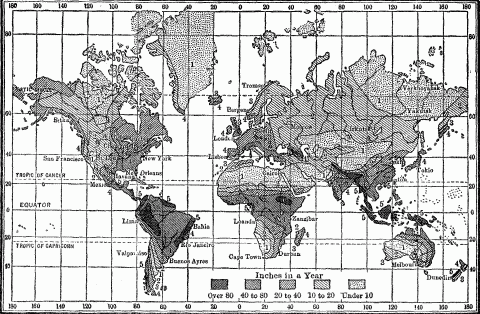
Annual Rainfall Of The World.
Distribution and extent of arid plains.
The union of arid plains and steppe vegetation is based upon climate, and is therefore a widely distributed phenomenon. These plains, whether high or low, are found in their greatest extent in the dry trade-wind belts, as in the deserts and steppes of Arabia, Persia, Sudan, the Sahara, South Africa and Central Australia; and in vast continental interiors, where the winds arrive robbed of their moisture in passing intervening highlands, as in the grasslands of our western plains, the llanos and pampas of South America, and the steppes of Central Asia. But wherever they occur, whether in Argentina or Russian Turkestan or the higher plains of Mongolia and Tibet, they present the same general characteristics of land surface, climate, flora and fauna, and the same nomadic populations of pastoral or hunting tribes. In them the movement of peoples reaches its culminating point, permanent settlement its nil point. Here the hunting savage makes the widest sweep in pursuit of buffalo or antelope, and pauses least to till a field; here the pastoral nomad follows his systematic wandering in search of pasturage and his hardly less systematic campaigns of conquest. It is the vast area and wide distribution of these arid plains, combined with the mobility which they impose on native human life, that has lent them historical importance, and reproduced in all sections of the world that significant homologous relation of arid and well-watered districts.
Pastoral life.
Pastoral nomads of Arctic plains.
Historical importance of steppe nomads.
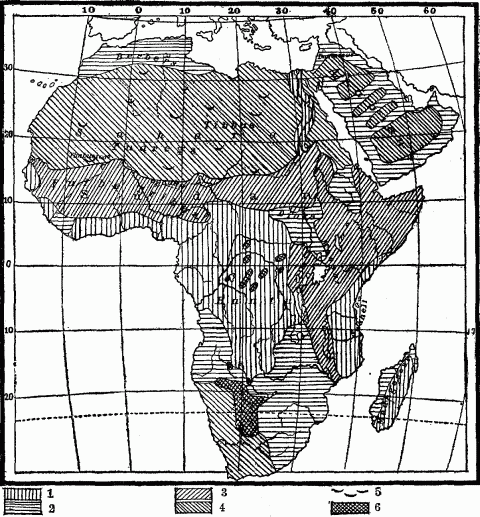
Cultural Regions Of Africa And Arabia.
Mobility of pastoral nomads.
Tendency to trek.
Seasonal migrations.
Marauding expeditions.
This systematic movement of nomads within their accepted boundaries leads, on slight provocation, to excursions beyond their own frontiers into neighboring territories. The growing herd alone necessitates the absorption of more land, more water-holes, because the grazed pastures renew their grass slowly under the prevailing conditions of drought. An area sufficient for the support of the tribe is inadequate for the sustenance of the herd, whose increase is a perennial expansive force. Soon the pastures become filled with the feeding flocks, and then herdsmen and herds spill over into other fields. Often a season of unusual drought, reducing the existing herbage which is scarcely adequate at best, gives rise to those irregular, temporary expansions which enlarge the geographical horizon of the horde, and eventuate in widespread conquest. Such incursions, like the seasonal movements of nomads, result from the helpless dependence of shepherd tribes upon variations of rainfall.
Depredation and conquests of African nomads.
Forms of defense against nomad depredations.
Pastoral life as a training for soldiers.
Military organization of nomads.
Capacity for conquest and political consolidation.
Scope of nomad conquests.
Centralization versus decentralization in nomadism.
Spirit of independence among nomads.
Resistance to conquest.
Curtailment of nomadism.
Supplementary agriculture of pastoral nomads.
Irrigation and horticulture.
Effect of diminishing water supply.
Scant diet of nomads.
Checks to population.
Trade of nomads.
Pastoral nomads as middlemen.
Desert markets.
Nomad industries.
Oriental rugs.
Architecture of nomad conquerors.
Pastoral nomads can give political union to civilized peoples; they can assimilate and spread ready-made elements of civilization, but to originate or develop them they are powerless. Between the art, philosophy and literature of China on the one side, and of the settled districts of Persia on the other, lies the cultural sterility of the Central Asia plateau. Its outpouring hordes have only in part acquired the civilization of the superior agricultural peoples whom they have conquered; from Kazan and Constantinople to Delhi, from Delhi to Peking they have added almost nothing to the local culture.
Arid lands as areas of arrested development.
But while the migrant shepherd originates nothing, he plays an historical rôle as a transmitter of civilization. Asiatic nomads have sparsely disseminated the culture of China, Persia, Egypt and Yemen over large areas of the world. The Semite shepherds of the Red Sea deserts, through their merchants and conquerors, long gave to the dark Sudan the only light of civilization which it received, Mohammed, a Bedouin of the Ishmaelite tribe, caravan leader on the desert highways between Mecca and Syria, borrowed from Jerusalem the simple tenets of a monotheistic religion, and spread them through his militant followers over a large part of Africa and Asia.
Mental and moral qualities of nomads.
Religion of pastoral nomads.
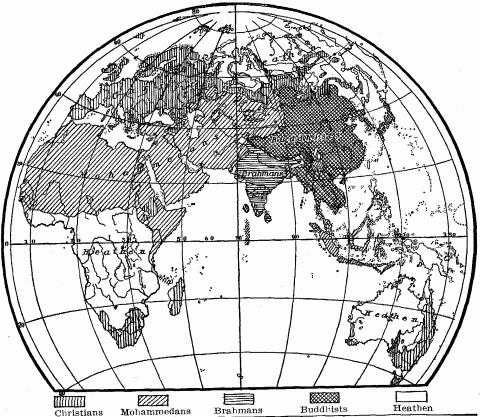
Distribution Of Religions In The Old World (World map showing distribution of Christians, Mohammedans, Brahmans, Buddhists, and Heathen).
Fanaticism as a force in nomad expansion.
The faith of the desert.
Judaism has always suffered from its narrow local base. Even when transplanted to various parts of the earth, it has remained a distinctly tribal religion. Intense conservatism in doctrine and ceremonial it still bears as the heritage of its desert birth. Islam too shows the limitations of its original environment. It embodies a powerful appeal to the peoples of arid lands, and among these it has spread and survives as an active principle. But it belongs to an arrested economic and social development, lacks the germs of moral evolution which Christianity, born in the old stronghold of Hebraic monotheism, but impregnated by all the cosmopolitan influences of the Mediterranean basin and the Imperium Romanum, amply possesses.
NOTES TO CHAPTER XIV