Front matter (continued 9)
Reading edition
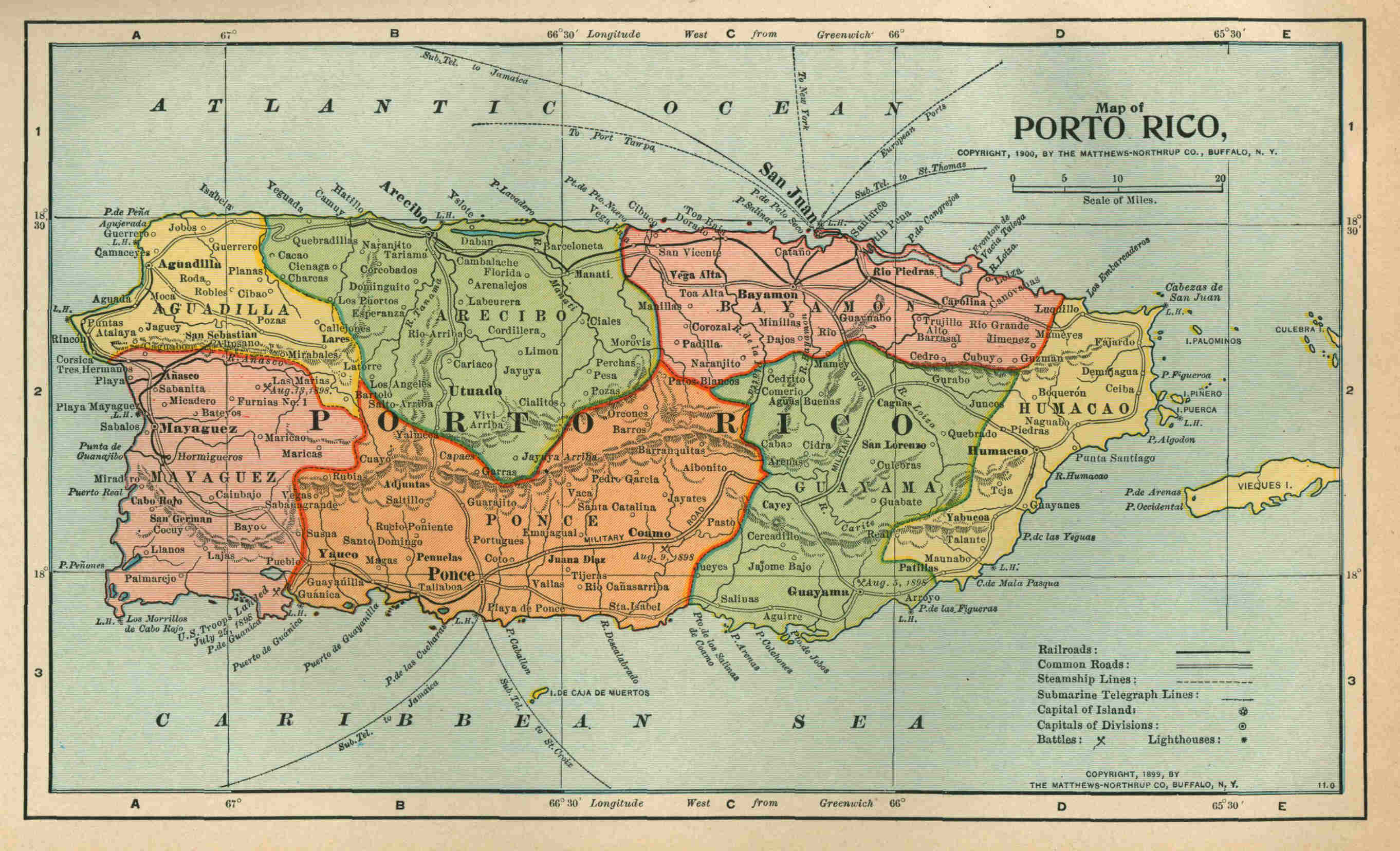
Map of Porto Rico. PORTO RICO: Area and Population. In the testimony given, January 13, 1900, before the United States Senate Committee on Pacific Islands and Porto Rico, General George W. Davis, Military Governor of Porto Rico, gave the following information: "The island of Puerto Rico has an area of about 3,600 square miles, according to the best information that now exists, but that area has to be verified, and it is doubted if the area is quite so large. It has a population of about a million, perhaps—certainly one of the most densely populated areas of 3,000 or 4,000 square miles on the face of the earth, approximating the density of population of Belgium, I think, and considerably greater than that of any of our thickly settled agricultural regions in the United States. New England has about 200 to the square mile while Puerto Rico has nearly 300. The inhabitants are mostly of Spanish origin—emigrants from Spain during the last 400 years and their descendants. There is a large representation from the Canary Islands and the Balearic group in the Mediterranean, a large number of Corsicans and their descendants, and consequently they are French subjects, a few Germans, a few English, and very few Americans before the occupation; a few Venezuelans, a few from Santo Domingo, and a few Cubans, but the most of the population is Spanish. Included in that million are about 300,000 negroes and mulattoes, approximately a little more than that number. {410} About one-third of the entire population is of the negro or mixed race, what would be called in the United States 'colored' people. Of pure-blood negroes there are about 70,000, the remainder mulattoes, and all speaking Spanish, and largely the slaves liberated in 1874. The number of slaves liberated at that time was considerably less than the number of negroes in Puerto Rico, the number being only about 30,000, for whom some $11,000,000 was paid the owners. That statement gives a fair idea of the character of the population as respects numbers and race." Several small adjacent islands are regarded as belonging to Porto Rico and were included in the cession to the United States. One of these, named Viequez, about 15 miles long and 3 or 4 miles wide, is very fertile, and has about 7,000 inhabitants. On another, called Culebra, there are some 600 or 700 people. The remaining islands are smaller and unimportant. 56th Congress, 1st Session, Senate Document Number 147, pages 1-2. PORTO RICO: The government as it was under Spanish rule. "The civil government of the island was the Governor-General, and the Governor-General was the civil government. All power was lodged in his hands and he was accountable only to Madrid. He was at once the executive, the legislative, and the judicial head. As Captain-General, he had chief command of the military forces, and made such disposition of them as he chose; as Governor-General, he conducted civil affairs, whether insular or municipal, according to his own pleasure. … If, as occasionally happened, he was a wise and good man, seeking the welfare of the people rather than his own personal enrichment or the advancement of his political friends, there was less cause for complaint from the people, who were completely ignored. As the position was one of great power and of large opportunities for pecuniary profit, it not infrequently went to those who were prepared to exploit it in their own interests. … "The system of autonomy, which was proclaimed November 25, 1897 [see, in this volume, CUBA: A. D. 1897 (NOVEMBER)], was never fully installed. The war intervened, and the provincial legislature, which was its most important feature, was dissolved when Sampson's fleet appeared, and the Governor-General conducted the government practically on the old plan, except that the ministry, as provided by the autonomistic law, was retained, as follows: Secretary of government or of state, secretary of the treasury, secretary of the fomento or interior, including public works, public instruction, public lands, mines, etc., agriculture and commerce, and secretary of justice and worship. The last three secretaries were subordinate to the secretary of government, through whom all orders from the Governor-General and all communications to or from him must pass. The autonomist law allowed the secretaries or ministers to be members of one or the other of the two legislative chambers. The Governor-General with his council constituted the executive power. No act of his was valid unless approved by one of the secretaries, and the secretaries could issue no order which he had not countersigned. He had the power to convoke or dissolve the chambers, to refer objectionable bills to Madrid for approval or disapproval, and to appoint or remove the secretaries. All matters of a diplomatic character were in his hands exclusively, and, constituted by the Pope patronato real, he was the head of the church in the island and practical director of ecclesiastical affairs. The legislature consisted of two chambers, the council and the house of representatives. The council was composed of fourteen members, eight of whom were elected, and six appointed by the Crown; the house of representatives of one representative for each 25,000 inhabitants, elected by the people. The liberality of this law is further indicated by the fact that it gave the right of suffrage to all males of 25 years of age and over. The two chambers were empowered to legislate on all insular questions, such as the estimates, which must be adopted by the Cortes at Madrid, public instruction, public works, sanitation, charities, etc. It will be seen that the reforms granted by this autonomistic decree were large in the letter, taking powers which the Governor-General had exercised unquestioned and giving them to the people, who had never been allowed to participate in the government of their own country. Whether it would have proved liberal in practical operation is not so certain. The Government invariably discriminated against Porto Ricans in favor of Spaniards, and it is also to be remembered that Spanish laws as written and Spanish laws as administered are not always identical." H. K. Carroll (Special Commissioner), Report on Porto Rico, 1899, pages. 15-16. PORTO RICO: A. D. 1898 (May). American bombardment of forts at San Juan. See (in this volume) UNITED STATES OF AMERICA: A. D. 1898 (APRIL-JUNE). PORTO RICO: A. D. 1898 (July-August). American conquest of. See (in this volume) UNITED STATES OF AMERICA: A. D. 1898 (JULY-AUGUST: PORTO RICO). PORTO RICO: A. D. 1898 (July-December). Suspension of hostilities. Cession to the United States. See (in this volume) UNITED STATES OF AMERICA: A. D. 1898 (JULY-DECEMBER). PORTO RICO: A. D. 1898-1899 (August-July). Popular feeling in the Island on the American occupation. Welcome to the Stars and Stripes. Expectations and desires of the people. Their character. Extent of illiteracy. The Peones. "All classes of natives of the island welcomed the American Army, American occupation, and American methods, and accepted without hesitation the Stars and Stripes in place of the red and yellow bars. They had not been disloyal to the old flag; but it had come to represent to them, particularly during the present century, in which a class feeling developed between the insular and the peninsular Spaniard, partiality and oppression. In the short war, some of the natives occupying official positions made demonstrations of loyalty to the Crown of Spain, as was perfectly natural, but they were among the first to submit to American rule when the protocol promised cession of the island to the United States. On the other hand, as the commissioner is informed, a Porto Rican who had hoped and prayed for American intervention for fifty years enrolled himself as a Spanish citizen some months after the war was concluded, and his hopes had been realized. Porto Ricans generally complained that the former Government discriminated in favor of the Spaniard, who, in the distribution of the offices, was preferred to the native, and who, aided by the powerful influence of the authorities, prospered in business as banker, merchant, manufacturer, or agriculturist. They also insist that the internal improvement of the island was neglected; that agriculture bore more than its share of the burden of taxation; that the assessments were very inequitable and unequal; that education was not fostered, and that in general the welfare of the people was not the first concern of their rulers. {411} "They expect under American sovereignty that the wrongs of centuries will be righted; that they will have an honest and efficient government; the largest measure of liberty as citizens of the great Republic under the Constitution; home rule as provided by the Territorial system; free access to the markets of the United States and no customs duties on goods coming from our ports; a school system modeled after that of the United States; the adoption of the English language in due time and the general adaptation to the island of all those institutions which have contributed to the prosperity, progress, and happiness of the American people. The largest and most representative gathering, since American occupation, was held in San Juan, October 30, 1898, without distinction of party or class with the object of consultation and formulation of a programme for the future. In brief, the propositions of the congress as submitted to the commissioner for presentation to the President of the United States were these: Immediate termination of military and inauguration of civil government; establishment of the Territorial system, with laws common to other Territories of the Union; a legislature in two branches; suffrage for all male citizens of 21 years of age or over, the right to be surrendered at the end of the first two years by those who do not then know how to read and write; judicial reform; introduction of the jury system; autonomy for municipal governments; taxation on the basis of valuation; free and reciprocal commerce with the ports of the United States; aid for agriculture; obligatory and universal education; trade schools; savings banks. This programme of reforms seems to have very general support, although there is a difference of opinion on certain points. Many Porto Ricans urged the commissioner to represent them as desiring that the military regime be made as short as possible, not because the military governors were in any way objectionable or their rule oppressive, but because the civil status of the island should be fixed with no unnecessary delay. There was no other opinion except among foreign subjects, many of whom thought that the people were not yet ready for self-government, and that the firm hand of military power would be needed for probably two years. … "If the desire to assume the burdens of local self-government may be taken as indicating some degree of capacity for self-government, the people of Porto Rico certainly have the desire. They may be poor, but they are proud and sensitive, and would be bitterly disappointed if they found that they had been delivered from an oppressive yoke to be put under a tutelage which proclaimed their inferiority. Apart from such qualifications as general education and experience constitute, the commissioner has no hesitation in affirming that the people have good claims to be considered capable of self-government. Education and experience, although too high a value can hardly be set upon them, do not necessarily make good citizens. … The unswerving loyalty of Porto Rico to the Crown of Spain, as demonstrated by the truth of history, is no small claim to the confidence and trust of the United States. The people were obedient under circumstances which provoked revolt after revolt in other Spanish colonies. The habit of obedience is strong among them. Their respect for law is another notable characteristic. They are not turbulent or violent. Riots are almost unknown in the island; so is organized resistance to law; brigandage flourished only for a brief period after the war and its object was revenge rather than rapine. They are not a criminal people. The more violent crimes are by no means common. Burglary is almost unknown. There are many cases of homicide, but the number in proportion to population is not as large as in the United States. Thievery is the most common crime, and petty cases make up a large part of this list of offenses. The people as a whole are a moral, law-abiding class, mild in disposition, easy to govern, and possess the possibilities of developing a high type of citizenship." H. K. Carroll (Special Commissioner), Report on Porto Rico, 1899, pages 55-57. "On the 25th day of July, 1899, an election was held in Adjuntas for municipal officers, and the registration was made in conformity to General Orders, No. 112, c. s., Headquarters Department of Puerto Rico. The order imposed the following qualifications for electors: Men over 21 years old, able to read and write, or who were taxpayers of record, who had been actual residents of the island for at least two years, and of the municipality for six months preceding the date of the election. The number who proved these qualifications before the board of registration was 906, out of a population, according to the census of 1897, of 18,505; that is, less than 5 per cent could vote under the conditions stated. There was much public interest in this election, and it is believed that about all who were eligible were registered. This incident indicated that in the whole island there may be approximately 45,000 who could vote under the conditions of the order above referred to. The class who can not fulfill these conditions, say 75 per cent of the males over 21 years of age, are usually in a state of abject poverty and ignorance, and are assumed to include one-fifth of the inhabitants. They are of the class usually called peones. This word in Spanish America, under old laws, defined a person who owed service to his creditor until the debt was paid. While those laws are obsolete, the condition of these poor people remains much as before. So great is their poverty that they are always in debt to the proprietors or merchants. They live in huts made of sticks and poles covered with thatches of palm leaves. A family of a dozen may be huddled together in one room, often with only a dirt floor. They have little food worthy of the name and only the most scanty clothing, while children of less than 7 or 8 years of age are often entirely naked. A few may own a machete or a hoe, but more have no worldly possessions whatever. Their food is fruit, and if they are wage-earners, a little rice and codfish in addition. They are without ambition and see no incentive to labor beyond the least that will provide the barest sustenance. All over the island they can be seen to-day sitting beside their ruined huts, thinking naught of to-morrow, making no effort to repair and restore their cabins nor to replant for future food. {412} "The remarks of Mr. James Anthony Froude in his work on 'The English in the West Indies' apply with full force to these people: 'Morals in the technical sense they have none, but they can not be said to sin because they have no knowledge of law, and therefore they can commit no breach of the law. They are naked and not ashamed. They are married but not parsoned. The women prefer the looser tie, that they may be able to lose the man if he treats her unkindly. Yet they are not licentious. … The system is strange, but it answers. … There is evil, but there is not the demoralizing effect of evil. They sin, but they sin only as animals, without shame, because there is no sense of doing wrong. They eat the forbidden fruit, but it brings with it no knowledge of the difference between good and evil. … They are innocently happy in the unconsciousness of the obligations of morality. They eat, drink, sleep, and smoke, and do the least in the way of work they can. They have no ideas of duty, and therefore are not made uneasy by neglecting it.' Between the negro and the peon there is no visible difference. It is hard to believe that the pale, sallow, and often emaciated beings are the descendants of the conquistadores who carried the flag of Spain to nearly all of South America, and to one-third of North America." General George W. Davis, Report on the Civil Government of Puerto Rico, September 30, 1899 (Message and Documents: Abridgment, 1899-1900, volume 2, pages 1293-1294). "The educated class of Puerto Ricans are as well educated and accomplished as the educated men of any country. They have had the benefit of a liberal education, a few in the United States, a good many in France, and a great many in Madrid and Habana, where they have passed through the universities. The lawyers and doctors are all graduates of either the university in Habana or some university in Spain, with very few exceptions. The merchants are largely Spanish, many of whom will probably preserve their nationality under the provision of the Treaty of Paris which gives them that right. A few may adopt American citizenship, and ultimately possibly all will, but many of the merchants who conduct the largest part of the business of Puerto Rico will retain their Spanish citizenship. There are a number of merchants who are natives, a few Germans, and a few English. I do not remember any American merchant in business there before the occupation. The schools in Puerto Rico conducted under the Spanish system were few in number. The amount allotted for education by the insular budget was something like 300,000 pesos a year, as I now recall the figures. The teachers were officers of the government, holding life positions and receiving pensions when superannuated. They belong to a civil-service class which is not dependent upon any change of administration, only being removed for cause. The lawyers, or judges, rather, of the island, occupy a similar position." General George W. Davis, Testimony before Senate Committee. (56th Congress, 1st Session, Senate Document. No. 147). PORTO RICO: A. D. 1898-1899 (October-October). The military government instituted by the United States. "The government of the island, its various civil institutions, its codes and its courts, the systems of taxation, etc., have been modified in very important particulars since the American occupation began, October 18, 1898. It will be useful, perhaps, to indicate the more important changes. Under General John R. Brooke [in command of the Department, October 18 to December 5, 1898] orders were issued declaring (1) That the political relations of Porto Rico with Spain were at an end; that provincial and municipal laws were in force in so far as not incompatible with the changed conditions, and that they would be enforced substantially as they were before. (2) Abolishing the use of all stamped paper and stamps of every kind for documents, public and private. (3) Exempting all conveyances and contracts from the payment of royal dues. (4) Discontinuing the diputacion provincial, and distributing its duties among the secretaries or ministers. (5) Directing that appeals should not be sent to the supreme court in Madrid, but should be heard by the superior court at San Juan. (6) Abolishing the subdelegation of pharmacy which gave degrees to pharmacists. (7) Making the fisheries free to all. Appropriations for the support of the church ceased with American occupation, and the Government lottery was discontinued. "Under the military government of General Guy V. Henry [December 6, 1898 to May 8, 1899], orders were issued: (l) Appointing military commissions to try cases of arson and murder which had accumulated in the civil courts. (2) Closing public offices on Sunday, as far as possible. (3) Suspending the municipal tax on fresh beef for use of the Army. (4) Making Christmas and New Year's holidays. (5) Forbidding grants or concessions of public or corporate rights or franchises without the approval of the commanding general and the Secretary of War. (6) Abolishing the municipal consumo tax on articles of food, fuel, and drink, and providing for additional assessments on the sale of liquors and tobacco. (7) Separating the collection of customs duties from that of direct taxes. (8) Establishing a new system of land taxation, by which agricultural lands should be taxed according to the several classes instituted, from 1 peso down to 25 centavos per cuerda, and levying 50 per cent additional on lands whose owners reside abroad. (9) Providing for the free vaccination of the people of the island. (10) Prohibiting the exhumation of bodies in the cemeteries, recognizing the right of priests to control burials in consecrated grounds, and requiring municipalities to keep cemeteries in repair. (11) Reducing notarial fees from $1.88 to $1, from $4.50 to $1, from $11 to $1, and from $1 to 50 cents, according to class of document, and canceling others. (12) Reorganizing the cabinet, so as to make all the secretaries directly responsible to the governor-general. (13) Suspending the foreclosure of mortgages on agricultural property and machinery for one year. (14) Appointing February 22 a holiday. (15) Prohibiting the sale of liquor to children under 14 years of age. (16) Modifying the civil marriage law. (17) Declaring that eight hours shall constitute a day's work. (18) Creating an insular police. {413} "Under the military government of General George W. Davis [May 8, 1899, to May 1, 1900], orders were issued (1) Modifying the order of General Henry concerning hours of labor, so as to allow agreements between employer and employee for longer or shorter hours. (2) Naming May 30 as a holiday. (3) Allowing the writ of habeas corpus to be issued. (4) Constituting a board of prison control and pardon. (5) Continuing the observance as a holiday of June 24. (6) Creating a provisional court on the basis of circuit and district courts of the United States for the hearing of cases not falling within the jurisdiction of local insular courts. (7) Creating a superior board of health for the island. (8) Reorganizing the bureau of public instruction and the system of education. (9) Relieving the judiciary from all control by the department of justice, discontinuing the office of secretary of justice, and appointing a solicitor-general. (10) Abolishing the sale at auction of the privilege of slaughter of cattle, and making it free. (11) Reorganizing the judicial system of the island, with a supreme court in San Juan and district courts in San Juan, Ponce, Mayaguez, Arecibo, and Humacao, and with modifications of civil and criminal procedure. (12) Discontinuing the departments of state, treasury, and interior, and creating bureaus of state and municipal affairs, of internal revenue, and of agriculture, to be placed under the direction of a civil secretary, responsible to the governor-general, and continuing the bureaus of education and public works, with an insular board of nine members to advise the governor-general on matters of public interest referred to them. "The reductions in the budget of expenditures have been extensive. That of 1898-99, adopted in June, 1898, amounted to $4,781,920, native money. The appropriations for 'general obligations,' which went to Madrid, $498,502, for the clergy, $197,945; for the army, $1,252,378; for the navy, $222,668, making a total of $2,171,493, ceased to be obligations, leaving $2,610,428 for the fiscal year. A new budget was adopted for the calendar year 1899, which still further reduces expenditures, calling only for $1,462,276. This budget, if carried out, would have involved a reduction from the proposed budget of 1898-99 of $3,319,644; but a new budget was formed, as already stated, for 1899-1900, which appears to call for an increase over this very moderate sum. The revenues were reduced by the abolition of stamped paper, personal passports, export duties, royal dues on conveyances, the lottery system, and other sources of income, amounting, all told, to less probably than a million of pesos." H. R. Carroll (Special Commissioner), Report on Porto Rico, October 6, 1899, pages 53-55. PORTO RICO: A. D. 1899 (August). Destructive cyclone. "On the morning of the 7th of August, 1899, the United States Weather Bureau, through its branch establishment here, announced the approach of a cyclonic disturbance, and the danger signal was ordered to be hoisted at substations of the Bureau at Ponce and Mayaguez. At the same time I directed that the danger be reported to all commanding officers of posts throughout the island. There had been no serious or destructive storm in Puerto Rico since 1867, and the inhabitants had ceased to feel great concern on account of tropical tempests. Except at seaports, little heed was given to the caution, and in some cases the telegraph operators failed to receive or to promptly deliver the warning messages. The vortex of the cyclone appears to have traversed the island throughout its whole length, from about Humacao to Mayaguez, and its path was a scene of very great devastation. … The gale struck the island at Humacao about midnight of August 7, and furiously blew all the rest of that night and well into the next day, while at Mayaguez the violence was not great until 9 o'clock on the morning of the 8th. But as the latter town was under the lee of high mountains, it suffered much less than it would have done had it been higher or not thus protected. Most of the habitations in the track of the center of the cyclone were entirely smashed and the débris strewn all over the country. The full reports of the loss of life bring the number of deaths up to 2,700. The wind worked dreadful havoc with nearly everything useful to man. Besides the mortality, which was appalling, the material damage was almost beyond belief. But the greatest loss of life resulted, not from the wind, but from the terrible downfall of rain that immediately followed. … Added to the horror of the situation there came with the gale on the southern coast a tidal wave, which submerged large areas with sea water and swept away what the wind and rain had spared, in some places completing the destruction. Every river bed or bottom of a land depression was a roaring torrent. The wind uprooted myriads of trees, and the rain, entering and permeating the soil, loosened it, and on steep declivities resulted in avalanches of earth, mud, and water, covering wide areas and piling up the debris in the ravines and gorges. … The material loss to the coffee growers can as yet only be estimated, but the most conservative figures received place this year's crop at one-third of the normal. … Regard being had to the fact that five years must elapse before the coffee trees and their shade can be replanted and reach a normal bearing condition, the total loss can not be safely placed below 25,000,000 pesos for Puerto Rico on account of this hurricane." General George W. Davis, Report (Message and Documents: Abridgment, 1899-1900, volume 2, pages 1343-1344). PORTO RICO: A. D. 1899 (October). Census of the Island taken under the direction of the War Department of the United States. "The population of Porto Rico shown by the schedules of the present census taken with reference to the date of October 16, 1899, was 953,243. This was about nine-tenths of the population of Maryland in 1890, the State whose population is nearest to that of Porto Rico. … If the figures for … earlier censuses may be accepted, it appears that the population of Porto Rico has been growing through the last twelve years with greater rapidity than before since 1860. Its present rate of increase is about the same as that of Ohio, Tennessee, or the Carolinas during the decade between 1880 and 1890. … It appears that the average increase of population in the interior has been more rapid than that on the coast. If the figures for the coast cities of San Juan, Ponce, and Mayaguez had been excluded, the difference would be yet more marked. The depressed condition of sugar-cane growing in the West Indies of recent years may have played an important part in producing this difference, for the growing of sugar cane is prevalent in the coast plains of Porto Rico. {414} "The area of Porto Rico, including the adjacent and dependent islands of Vieques, Culebra, Mona, and Muertos, has been measured in connection with this census and found to be 3,606 square miles. But owing to the imperfect surveys on which all maps of Porto Rico are based there must be a considerable and indeterminate margin of possible error in any such measurement. The island is about three times the size of Long Island, which was in 1890 perhaps the largest insular division of the United States. It is also slightly greater than the eastern shore of Maryland (3,461 square miles). … Porto Rico has 264 persons to a square mile. This density of population is about the same as in Massachusetts, twice that in New York State, and thrice that in Ohio. It is more than seven times that of Cuba and not much less than twice that of Habana province. … "The people of Porto Rico are, in the main, a rural community. There are no large cities in the island, the two largest being San Juan, which, regarding the entire municipal district as a city, had a population of 32,048, and Ponce, which with its port constituted practically one city, with a population of 27,952. These are the only two cities exceeding 25,000 inhabitants. The next city of magnitude is Mayaguez, on the west coast, with a population of 15,187. The only other city exceeding 8,000 inhabitants is Arecibo, with a population of 8,008. The total urban population of the island contained in cities exceeding 8,000 inhabitants each is 83,195, or only 8.7 per cent of the population of the island. This is a much smaller proportion than in Cuba, where the corresponding figures are 32.3 per cent, or in the United States, where the corresponding proportion in 1890 was 29.2 per cent. There are in Porto Rico 57 cities, each having a population of 1,000 or more. The total urban population of the island, under this definition, numbers 203,792, or 21.4 per cent of the total number of inhabitants of the island. Similar figures for Cuba show 47.1 per cent of the population of that island." Census of Porto Rico, Bulletin No.1. PORTO RICO: A. D. 1899-1900. The question of the tariff treatment of its new Territory by the United States Government. Writing in "The Forum," November, 1899, Mr. H. K. Carroll, who had investigated the conditions in Porto Rico as a Special Commissioner of the United States government, described the obligation which, in his view, they imposed on the latter as follows: "The only free market the Puertorican has for his products is the island market. All the rest of the world is closed to him. He cannot even buy in a free market; everything he buys as well as everything he sells being subject to duties. This is the penalty of independence; but Puerto Rico is not, and does not want to be, independent. She wants such commercial relations with us as Alaska, New Mexico, and Arizona have, and desires a territorial form of government. I am of the opinion that we cannot refuse these reasonable requests without doing great injustice to Puerto Rico. It must be remembered that we sought Puerto Rico; for Puerto Rico did not seek us. We wrested her from the sovereignty of Spain, without asking her if she desired to change her allegiance. We were of the opinion that she was not justly treated by Spain; that she was governed in the interests of the mother country solely; that she was oppressed and overtaxed and denied a proper measure of home rule; and that in consequence we were serving the cause of humanity in breaking the chains that bound her. This was what the Puertoricans thought also. They welcomed our troops and our control. They were glad to turn their backs on the history of the past, and begin under the glorious Republic of the North a new and more prosperous career. They are disappointed, perhaps unreasonably, that their new life has not already begun; they are eagerly expectant. They look to the President to recommend, and to Congress to adopt, a system of government which will make the island a Territory, equal in rank and rights and privileges to existing Territories. They ought not to be disappointed without the best and strongest of reasons. Three reasons are mentioned in opposition to the granting of territorial government to Puerto Rico. First, admission as a Territory implies ultimate admission to statehood; and statehood for islands separated as Hawaii and Puerto Rico are by from 1,200 to 2,500 miles from the United States is not to be thought of for a moment. Second, territorial organization involves the relinquishment of customs duties; and the cane and tobacco growers of our West India possession would have free access to the markets of the United States, and thus come into injurious competition with our own farmers. Third, the people of Puerto Rico are not competent for the measure of self-government which the territorial system provides." This most reasonable and just view of the duty of the American people to their new fellow citizens received strong endorsement from higher official authority in the subsequent annual report of the Secretary of War, who said: "It is plain that it is essential to the prosperity of the island that she should receive substantially the same treatment at our hands as she received from Spain while a Spanish colony, and that the markets of the United States should be opened to her as were the markets of Spain and Cuba before the transfer of allegiance. Congress has the legal right to regulate the customs duties between the United States and Porto Rico as it pleases; but the highest considerations of justice and good faith demand that we should not disappoint the confident expectation of sharing in our prosperity with which the people of Porto Rico so gladly transferred their allegiance to the United States, and that we should treat the interests of this people as our own; and I wish most strongly to urge that the customs duties between Porto Rico and the United States be removed." Message and Documents: Abridgment, 1899-1900, volume 2, page 757. And, finally, the President of the United States, in his Message to Congress, December 5, 1899, gave his high authority to the declaration that this duty of his government to Porto Rico was "plain": "It must be borne in mind," he said, "that since the cession Porto Rico has been denied the principal markets she had long enjoyed and our tariffs have been continued against her products as when she was under Spanish sovereignty. The markets of Spain are closed to her products except upon terms to which the commerce of all nations is subjected. The island of Cuba, which used to buy her cattle and tobacco without customs duties, now imposes the same duties upon these products as from any other country entering her ports. {415} She has therefore lost her free intercourse with Spain and Cuba, without any compensating benefits in this market. Her coffee was little known and not in use by our people, and therefore there was no demand here for this, one of her chief products. The markets of the United States should be opened up to her products. Our plain duty is to abolish all customs tariffs between the United States and Porto Rico and give her products free access to our markets." Message and Documents: Abridgment, volume 1, page 53. Notwithstanding all which high official acknowledgments and declarations of obligation and duty, on the part of the Republic of the United States to the people of the island which it had wrested from Spain, certain interests in the former that objected to competition from the latter were able to secure legislation which deferred the performance of the "plain duty" required. An Act of Congress which the President approved on the 12th of April, 1900, "temporarily to provide revenues and a civil government for Porto Rico and for other purposes," enacted as follows: "SECTION 3. That on and after the passage of this Act all merchandise coming into the United States from Porto Rico and coming into Porto Rico from the United States shall be entered at the several ports of entry upon payment of fifteen per centum of the duties which are required to be levied, collected, and paid upon like articles of merchandise imported from foreign countries; and in addition thereto upon articles of merchandise of Porto Rican manufacture coming into the United States and withdrawn for consumption or sale upon payment of a tax equal to the internal-revenue tax imposed in the United States upon the like articles of merchandise of domestic manufacture; such tax to be paid by internal-revenue stamp or stamps to be purchased and provided by the Commissioner of Internal Revenue and to be procured from the collector of internal revenue at or most convenient to the port of entry of said merchandise in the United States, and to be affixed under such regulations as the Commissioner of Internal Revenue, with the approval of the Secretary of the Treasury, shall prescribe; and on all articles of merchandise of United States manufacture coming into Porto Rico in addition to the duty above provided upon payment of a tax equal in rate and amount to the internal-revenue tax imposed in Porto Rico upon the like articles of Porto Rican manufacture: Provided, That on and after the date when this Act shall take effect, all merchandise and articles, except coffee, not dutiable under the tariff laws of the United States, and all merchandise and articles entered in Porto Rico free of duty under' orders heretofore made by the Secretary of War, shall be admitted into the several ports thereof, when imported from the United States, free of duty, all laws or parts of laws to the contrary notwithstanding; and whenever the legislative assembly of Porto Rico shall have enacted and put into operation a system of local taxation to meet the necessities of the government of Porto Rico, by this Act established, and shall by resolution duly passed so notify the President, he shall make proclamation thereof, and thereupon all tariff duties on merchandise and articles going into Porto Rico from the United States or coming into the United States from Porto Rico shall cease, and from and after such date all such merchandise and articles shall be entered at the several ports of entry free of duty; and in no event shall any duties be collected after the first day of March, nineteen hundred and two, on merchandise and articles going into Porto Rico from the United States or coming into the United States from Porto Rico. "SECTION 4. That the duties and taxes collected in Porto Rico in pursuance of this Act, less the cost of collecting the same, and the gross amount of all collections of duties and taxes in the United States upon articles of merchandise coming from Porto Rico, shall not be covered into the general fund of the Treasury, but shall be held as a separate fund, and shall be placed at the disposal of the President to be used for the government and benefit of Porto Rico until the government of Porto Rico herein provided for shall have been organized, when all moneys theretofore collected under the provisions hereof, then unexpended, shall be transferred to the local treasury of Porto Rico, and the Secretary of the Treasury shall designate the several ports and sub-ports of entry in Porto Rico, and shall make such rules and regulations and appoint such agents as may be necessary to collect the duties and taxes authorized to be levied, collected, and paid in Porto Rico by the provisions of this Act, and he shall fix the compensation and provide for the payment thereof of all such officers, agents, and assistants as he may find it necessary to employ to carry out the provisions hereof: Provided, however, That as soon as a civil government for Porto Rico shall have been organized in accordance with the provisions of this Act and notice thereof shall have been given to the President he shall make proclamation thereof, and thereafter all collections of duties and taxes in Porto Rico under the provisions of this Act shall be paid into the treasury of Porto Rico, to be expended as required by law for the government and benefit thereof instead of being paid into the Treasury of the United States." PORTO RICO: A. D. 1900 (April). Act to provide temporarily for the civil government of the Island. The fundamental provisions of the act of the Congress of the United States to provide temporarily for the civil government of Porto Rico, which the President approved April 12, 1900, are the following: "SECTION 6. That the capital of Porto Rico shall be at the city of San Juan and the seat of government shall be maintained there. "SECTION 7. That all inhabitants continuing to reside therein who were Spanish subjects on the eleventh day of April, eighteen hundred and ninety-nine, and then resided in Porto Rico, and their children born subsequent thereto, shall be deemed and held to be citizens of Porto Rico, and as such entitled to the protection of the United States, except such as shall have elected to preserve their allegiance to the Crown of Spain on or before the eleventh day of April, nineteen hundred, in accordance with the provisions of the treaty of peace between the United States and Spain entered into on the eleventh day of April, eighteen hundred and ninety-nine; and they, together with such citizens of the United States as may reside in Porto Rico, shall constitute a body politic under the name of The People of Porto Rico, with governmental powers as hereinafter conferred, and with power to sue and be sued as such. {416} "SECTION 8. That the laws and ordinances of Porto Rico now in force shall continue in full force and effect, except as altered, amended, or modified hereinafter, or as altered or modified by military orders and decrees in force when this Act shall take effect, and so far as the same are not inconsistent or in conflict with the statutory laws of the United States not locally inapplicable, or the provisions hereof, until altered, amended, or repealed by the legislative authority hereinafter provided for Porto Rico or by Act of Congress of the United States: Provided, That so much of the law which was in force at the time of cession, April eleventh, eighteen hundred and ninety-nine, forbidding the marriage of priests, ministers, or followers of any faith because of vows they may have taken, being paragraph four, article eighty-three, chapter three, civil code, and which was continued by the order of the secretary of justice of Porto Rico, dated March seventeenth, eighteen hundred and ninety-nine, and promulgated by Major-General Guy V. Henry, United States Volunteers, is hereby repealed and annulled, and all persons lawfully married in Porto Rico shall have all the rights and remedies conferred by law upon parties to either civil or religious marriages: And provided further, That paragraph one, article one hundred and five, section four, divorce, civil code, and paragraph two, section nineteen, of the order of the minister of justice of Porto Rico, dated March seventeenth, eighteen hundred and ninety-nine, and promulgated by Major-General Guy V. Henry, United States Volunteers, be, and the same hereby are, so amended as to read: 'Adultery on the part of either the husband or the wife.' … "SECTION 14. That the statutory laws of the United States not locally inapplicable, except as hereinbefore or hereinafter otherwise provided, shall have the same force and effect in Porto Rico as in the United States, except the internal-revenue laws, which, in view of the provisions of section three, shall not have force and effect in Porto Rico. "SECTION 15. That the legislative authority hereinafter provided shall have power by due enactment to amend, alter, modify, or repeal any law or ordinance, civil or criminal, continued in force by this Act, as it may from time to time see fit. "SECTION 16. That all judicial process shall run in the name of 'United States of America, ss: the President of the United States,' and all criminal or penal prosecutions in the local courts shall be conducted in the name and by the authority of 'The People of Porto Rico'; and all officials authorized by this Act shall before entering upon the duties of their respective offices take an oath to support the Constitution of the United States and the laws of Porto Rico. "SECTION 17. That the official title of the chief executive officer shall be 'The Governor of Porto Rico.' He shall be appointed by the President, by and with the advice and consent of the Senate; he shall hold his office for a term of four years and until his successor is chosen and qualified unless sooner removed by the President; he shall reside in Porto Rico during his official incumbency, and shall maintain his office at the seat of government; he may grant pardons and reprieves, and remit fines and forfeitures for offenses against the laws of Porto Rico, and respites for offenses against the laws of the United States, until the decision of the President can be ascertained; he shall commission all officers that he may be authorized to appoint, and may veto any legislation enacted, as hereinafter provided; he shall be the commander in chief of the militia, and shall at all times faithfully execute the laws, and he shall in that behalf have all the powers of governors of the Territories of the United States that are not locally inapplicable; and he shall annually, and at such other times as he may be required, make official report of the transactions of the government in Porto Rico, through the Secretary of State, to the President of the United States: Provided, That the President may, in his discretion, delegate and assign to him such executive duties and functions as may in pursuance with law be so delegated and assigned. "SECTION 18. That there shall be appointed by the President, by and with the advice and consent of the Senate, for the period of four years, unless sooner removed by the President, a secretary, an attorney-general, a treasurer, an auditor, a commissioner of the interior, and a commissioner of education, each of whom shall reside in Porto Rico during his official incumbency and have the powers and duties hereinafter provided for them, respectively, and who, together with five other persons of good repute, to be also appointed by the President for a like term of four years, by and with the advice and consent of the Senate, shall constitute an executive council, at least five of whom shall be native inhabitants of Porto Rico, and, in addition to the legislative duties hereinafter imposed upon them as a body, shall exercise such powers and perform such duties as are hereinafter provided for them, respectively, and who shall have power to employ all necessary deputies and assistants for the proper discharge of their duties as such officials and as such executive council. … "SECTION 27. That all local legislative powers hereby granted shall be vested in a legislative assembly which shall consist of two houses; one the executive council, as hereinbefore constituted, and the other a house of delegates, to consist of thirty-five members elected biennially by the qualified voters as hereinafter provided; and the two houses thus constituted shall be designated 'The legislative assembly of Porto Rico.' "SECTION 28. That for the purposes of such elections Porto Rico shall be divided by the executive council into seven districts, composed of contiguous territory and as nearly equal as may be in population, and each district shall be entitled to five members of the house of delegates. SECTION 29. That the first election for delegates shall be held on such date and under such regulations as to ballots and voting as the executive council may prescribe. … At such elections all citizens of Porto Rico shall be allowed to vote who have been bona fide residents for one year and who possess the other qualifications of voters under the laws and military orders in force on the first day of March, 1900, subject to such modifications and additional qualifications and such regulations and restrictions as to registration as may be prescribed by the executive council. … {417} "SECTION 32. That the legislative authority herein provided shall extend to all matters of a legislative character not locally inapplicable, including power to create, consolidate, and reorganize the municipalities, so far as may be necessary, and to provide and repeal laws and ordinances therefor; and also the power to alter, amend, modify, and repeal any and all laws and ordinances of every character now in force in Porto Rico, or any municipality or district thereof, not inconsistent with the provisions hereof: Provided, however, That all grants of franchises, rights, and privileges or concessions of a public or quasi-public nature shall be made by the executive council, with the approval of the governor, and all franchises granted in Porto Rico shall be reported to Congress, which hereby reserves the power to annul or modify the same. "SECTION 33. That the judicial power shall be vested in the courts and tribunals of Porto Rico as already established and now in operation, including municipal courts. … "SECTION 34. That Porto Rico shall constitute a judicial district to be called 'the district of Porto Rico.' The President, by and with the advice and consent of the Senate, shall appoint a district judge, a district attorney, and a marshal for said district, each for a term of four years, unless sooner removed by the President. The district court for said district shall be called the district court of the United States for Porto Rico. "SECTION 35. That writs of error and appeals from the final decisions of the supreme court of Porto Rico and the district court of the United States shall be allowed and may be taken to the Supreme Court of the United States in the same manner and under the same regulations and in the same cases as from the supreme courts of the Territories of the United States. … "SECTION 39. That the qualified voters of Porto Rico shall, on the first Tuesday after the first Monday of November, anno Domini nineteen hundred, and every two years thereafter, choose a resident commissioner to the United States, who shall be entitled to official recognition as such by all Departments, upon presentation to the Department of State of a certificate of election of the governor of Porto Rico, and who shall be entitled to a salary, payable monthly by the United States, at the rate of five thousand dollars per annum: Provided, That no person shall be eligible to such election who is not a bona fide citizen of Porto Rico, who is not thirty years of age, and who does not read and write the English language. "SECTION 40. That a commission, to consist of three members, at least one of whom shall be a native citizen of Porto Rico, shall be appointed by the President, by and with the advice and consent of the Senate, to compile and revise the laws of Porto Rico; also the various codes of procedure and systems of municipal government now in force, and to frame and report such legislation as may be necessary to make a simple, harmonious, and economical government, establish justice and secure its prompt and efficient administration, inaugurate a general system of education and public instruction, provide buildings and funds therefor, equalize and simplify taxation and all the methods of raising revenue, and make all other provisions that may be necessary to secure and extend the benefits of a republican form of government to all the inhabitants of Porto Rico." PORTO RICO: A. D. 1900 (May). Organization of civil government. Appointment of Governor Allen. Under the Act to establish civil government in Porto Rico, Honorable. Charles H. Allen, formerly a representative in Congress from Massachusetts, and lately Assistant-Secretary of the Navy, was appointed to the governorship of the island. Mr. J. H. Hollander, of Maryland, was appointed Treasurer, and Mr. John R. Garrison, of the District of Columbia, Auditor. Governor Allen was inducted into office with considerable ceremony, at San Juan, on the 1st of May. PORTO RICO: A. D. 1900 (August-October). First steps in the creation of a public school system. "The report of M. G. Brumbaugh, commissioner of education, on education in Porto Rico, dated October 15, 1900, shows what has been accomplished in the short time that elapsed after the commissioner entered upon his duties on August 4, 1900. … The people want schools … and the pupils will attend them. In 1899, 616 schools were opened in Porto Rico. In 1900 the department will maintain at least 800 schools, an increase of 30 per cent, which will provide for nearly 9,000 additional pupils. "In 1899 there were 67 Americans in the teaching force of the island. Since October 1, 1900, the number has increased to 100. The commissioner criticises one class of teachers who are 'seekers after novelty and new experiences, who imposed upon the administration and the children, and who used the salary and position of teacher solely to see a new country for a year and then return. … The people of Porto Rico have patiently borne with these adventurers, and quietly longed for their departure.' This class of teachers is now gone and the newly selected American teachers have some knowledge of Spanish and are graduates of universities, colleges, and normal schools in the States, and are for the most part young men and women of ability and discretion. The salaries of American teachers were fixed by law at $40 per month for nine months in cities of less than 5,000 population. In cities of larger population the salary was $50 per month for nine months and both are inadequate, although at the time the salaries were fixed the War Department provided free transportation from and to the United States. This transportation may now be withdrawn at any time, and the small inducement held out by the meager salary offered to teachers is not calculated to invite the best class of them to the island. "The new normal and industrial school at Fajardo, which was to have been established by the joint efforts of the local municipality and the American Government, was only so far advanced that the land had been purchased by the end of September, 1900. The normal department was opened October 1, in a rented building, while the industrial department cannot be opened until suitable quarters are provided. The commissioner recommends that the United States make this place the site of an agricultural experiment station for which it is pre-eminently fitted. On account of the industries of the country—coffee, sugar, tobacco, and fruit—agriculture could be well studied here, and free boarding, lodging, and tuition would be given the students, who would be for the most part poor boys and girls. "As to the school accommodation, the commissioner states that there are no public school buildings in Porto Rico. The schools are conducted in rented houses or rooms which are often unfit for the purpose, and the hygienic conditions are bad. There is a wide field, or rather a demand, for improvement in this direction, as well as in the school equipment and material. {418} In 1899, $33,000 was expended for school-books, and in 1900, $20,000 will be expended for books and supplies, which shall be free. In the United States 'free books' means usually their purchase by local boards and free use by the pupils. In Porto Rico the books and supplies will be free to the pupils without expense to the local boards. A pedagogical museum and library has been established for the benefit of teachers and others. About 300 volumes have been contributed to the library from friends in the States, and the Department will make the number up to 500 by purchase. A library of 5,000 volumes of standard Spanish and American literature was found in a building in San Juan, which has been installed in suitable rooms as a public library. "Many of the leading institutions of the United States have responded cordially to the application of the Department of Education on behalf of young Porto Ricans who wish to prosecute their studies in colleges and universities. Some have offered free tuition, some have added free lodging, while others have offered even free living to all such students as wish to avail themselves of their instruction. Many young Porto Ricans have availed themselves of these generous offers. "There are now 800 schools in Porto Rico, and 38,000 pupils attending them, while there are 300,000 children of school age for whom there are no accommodations. But the commissioner expresses the hope that gradually the great illiteracy in Porto Rico will be reduced, and the people prepared for the duties of citizenship in a democracy by means of the schools that shall be established. … The total expenditure for education in Porto Rico from the 1st of May to the end of September was $91,057.32." United States, Secretary of the Interior, Annual Report, November 28, 1900, page 116. PORTO RICO: A. D. 1900 (November-December). The first election under U. S. law. Meeting of the Legislative Assembly. The first election in the Island under the provisions of the Act recited above occurred on the 6th of November simultaneously with the elections in the United States. It seems to have been almost entirely a one-sided vote. "About two weeks before election day," says a despatch from San Juan, November 7, "the Federal Party, which carried the island at the election of less than a year ago by a majority of 6,500 votes, suddenly withdrew from the electoral contest. The Federal leaders sent instruction to their followers not to appear at the polls, but the Federal Election Judges were instructed to appear and watch the proceedings until the elections were concluded in order to gather evidence of any unfairness in the registration and any irregularity in the voting. The Federal Party intends to institute court proceedings after the election in the hope of nullifying it, claiming that gross irregularities in the registration and voting will be shown, and alleging that the districting was not done according to law." Only about 200 Federals voted, it is stated, while some 60,000 votes were cast for the candidates of the Republicans. Governor Allen cabled the following announcement of the election to President McKinley: "I am gratified and delighted. The outcome in Porto Rico is a guarantee of the island's future. To bring people who had long been under different rules and conditions to their first general election, to have the election pass off as quietly and orderly as in any State of the North conducted by the people without let or hindrance, and without a soldier or armed force of any sort, and to have nearly 60.000 men march to the polls to deposit their first ballot for self-government in such a manner, are good reasons for congratulation, not only to the people of the island, but to the painstaking members of the Administration, who had worked diligently and patiently to this end. This overwhelming Republican victory also means legislation for the good of the island in line with the American Administration. It means stable government and the protection of property interests, with which prospective investors in Porto Rico are deeply concerned. It means education, public works, and all the beneficent works which follow legislation wisely and conscientiously undertaken. It is an emphatic declaration of unqualified loyalty to the United States." The newly elected Legislative Assembly met and the House of Delegates was organized December 3. A correspondent of the "New York Tribune," writing a week later, said: "Already nineteen bills have been introduced. To introduce nineteen bills in six days after organizing, as well as forming the regular committees, is not bad work when it is considered that not one of the members had the slightest idea of parliamentary procedure. During the session one of the members may be seen making frequent trips to the Executive Mansion, where he confers with Secretary Hunt in regard to some doubtful point. It is said by some that in a short time the lower house will be controlled entirely by the portfolio members of the Council. It is known that the five Porto Rican members of the Council, when considering the question of franchises, etc., often vote contrary to their own ideas in order that the Council may continue harmonious. But it is not likely that the heads of departments will be able to control the thirty-five members of the House. The House, although regularly elected, is not representative of the island; the Federals refraining from voting kept over half the natives from the polls. The Federal party, it is asserted, is made up of the richest and best element of Porto Rico. The Republicans, though in power, do not feel that they are able to run things alone, so the majority is willing to be dictated to by the Council. Nevertheless there is a certain element in the House which will not be dictated to. So soon as any really important bill comes up for debate it is predicted that the House will divide against itself. And a little later, when the House passes some pet bill and the Council rejects it, the House will probably resign in a body. It is a natural trait of the people.' After another fortnight had passed, the same correspondent wrote very discouragingly of the disposition shown by a majority of the members of the House of Delegates, and their conduct of business, and stated: "The popular opinion among the Americans, even among some of the higher officials, is that if the House continues as it is Congress will abolish it altogether, and govern the island through a Governor and Cabinet. Such irregular procedure has been followed that it is a question here whether any business has been legally done." {419} PORTO RICO: A. D. 1901 (January), Close of the first session of the Legislative Assembly. The first session of the first Legislative Assembly of the island came to a close on the 31st of January, 1901, and the following remarks on its work were made in a newspaper despatch of that date from San Juan: "Over one hundred bills have been introduced in the House of Delegates, and dozens have been passed by both houses, and are awaiting the Governor's approval. … Committees have a hard day's work if they get together and agree to pass the bills on hand before midnight to-night. Ever since the House of Delegates resumed business after the new year, eight or nine members have been continually absent. There are only thirty-five members altogether, and the island is small, yet twenty-six has been the average attendance. A full attendance for even one day is not recorded. It was predicted that a number of the members would resign; they did not. They simply remained away, like truant schoolboys. A bill has been passed providing for the education of certain young Porto Rican men and women in the United States, about two hundred of them having petitioned the House of Delegates to be sent north at the island's expense. It is not known on what ground these petitions have been made. The island expends about $400,000 yearly on education, and excellent educational facilities are offered. But the people, in a way, seem to discredit the value of the opportunities at hand." PORTO RICO: A. D. 1901 (April). Distress of the workingmen of the Island. Their appeal to the President of the United States. The following petition, signed by 6,000 of the workingmen of Porto Rico, was brought to the United States by a delegate from the Federation of Labor in Porto Rico and presented to President McKinley on the 15th of April: "The undersigned, workers of Porto Rico, without distinction of color, political or religious creed, have the honor to bring to your attention the following facts: Misery, with all its horrible consequences, is spreading in our homes with wonderful rapidity. It has already reached such an extreme that many workers are starving to death while others, that have not the courage to see their mothers, wives, sisters and children perish of hunger, commit suicide by drowning themselves in the rivers or hanging themselves from branches of trees. All this, honorable sir, is due to the scarcity of work, which keeps us in enforced idleness, the mother of our misery. Our beautiful estates are idle; our lands are not being cultivated; our shops remain closed; and our Chambers do absolutely nothing to prevent our misery on this once so rich an island. The Government and municipality do not undertake any public works to keep us out of idleness. The emigration of workers, unknown in this island before, increases day by day, in proportion as misery increases. Under these trying conditions we are no longer a happy and contented people. We therefore, beg of you, honorable sir, to interest yourself in our cause, leading us, as the father of our country, in the path that will bring us work, and with it the means of subsistence. We want work; nothing but work. We want to earn the means of subsistence by the sweat of our brows; and nobody better than our Chief Magistrate can help us by lending ear to our appeals. " ----------PORTO RICO: End-------- PORTUGAL: A. D. 1891-1900. Delagoa Bay Arbitration. See (in this volume) DELAGOA BAY ARBITRATION. PORTUGAL: A. D. 1898. Alleged Treaty with Great Britain. There is said to be knowledge in diplomatic circles of a treaty between Great Britain and Portugal, concluded in 1898, which has never been made public, but which is understood to engage the former to assist the latter financially and to protect the kingdom as against dangers both external and internal. In return it is believed that England received the right to embark and disembark troops, stores and ammunitions at any point on Portuguese territory in Africa, to keep them there, or to convey them across Portuguese territory to any point she might see fit, irrespective as to whether she was at war with any third Power. Circumstances have given some support to this rumor, but it has no positive confirmation. PORTUGAL: A. D. 1899. Reciprocity Treaty with the United States. See (in this volume) UNITED STATES OF AMERICA: A. D. 1899-1901. PORTUGAL: A. D. 1899 (May-July). Representation in the Peace Conference at The Hague. See (in this volume) PEACE CONFERENCE. PORTUGUESE EAST AFRICA: A. D. 1895-1896. War with Gungunhana. See (in this volume) AFRICA: A. D. 1895-1896 (PORTUGUESE EAST AFRICA). POSTAGE, British Imperial Penny. See (in this volume) ENGLAND: A. D. 1898 (DECEMBER). POWERS, Concert of the. See (in this volume) CONCERT OF EUROPE. POWERS, The four great. See (in this volume) NINETEENTH CENTURY: EXPANSION. PRATT, Consul: Interviews with Aguinaldo at Singapore. See (in this volume) UNITED STATES OF AMERICA: A. D. 1898 (APRIL-MAY: PHILIPPINES). "PREDOMINANT MEMBER," Remarks of Lord Rosebery on the. See (in this volume) ENGLAND: A. D. 1894-1895. PREHISTORIC DISCOVERIES. See (in this volume) ARCHÆOLOGICAL RESEARCH. PREMPEH, Overthrow of King. See (in this volume) ASHANTI. PRESBYTERIAN CHURCHES: Union in Scotland. See (in this volume) SCOTLAND: A. D. 1900. PRESS, The: Relaxation of restrictions in Poland. See (in this volume) RUSSIA: A. D. 1897. PRESS, The: Prosecutions in Germany. See (in this volume) GERMANY: A. D. 1900 (OCTOBER 9). PRETORIA: A. D. 1894. Demonstration of British residents. See (in this volume) SOUTH AFRICA (THE TRANSVAAL): A. D. 1894. PRETORIA: A. D. 1900. Taken by the British forces. See (in this volume) SOUTH AFRICA (THE FIELD OF WAR): A. D. 1900 (MAY-JUNE). PRIMARY ELECTION LAW. See (in this volume) NEW YORK STATE: A. D. 1898. PRINCE EDWARD'S ISLAND. See (in this volume) CANADA. {420} PRINCETON UNIVERSITY: Celebration of 250th anniversary. Assumption of new name. See (in this volume) EDUCATION (UNITED STATES): A. D. 1896. PRINSLOO, Commandant: Surrender. See (in this volume) SOUTH AFRICA (THE FIELD OF WAR): A. D. 1900 (JUNE-DECEMBER). PROCTOR, Senator Redfield: Account of the condition of the Cuban Reconcentrados. See (in this volume) CUBA: A. D. 1897-1898 (DECEMBER-MARCH). PROGRESSISTS, PROGRESSIVES. See (in this volume) AUSTRIA-HUNGARY: A. D. 1897; JAPAN: A. D. 1890-1898, and after; SOUTH AFRICA (CAPE COLONY): A. D. 1898, and 1898 (MARCH-OCTOBER). PROHIBITION PARTY, The. See (in this volume) UNITED STATES OF AMERICA: A. D. 1896 (JUNE-NOVEMBER); and 1900 (MAY-NOVEMBER). PROHIBITION PLEBISCITE, Canadian. See (in this volume) CANADA: A. D. 1898 (SEPTEMBER). PROTECTIVE TARIFFS. See (in this volume) TARIFF LEGISLATION. PROTOCOL, for suspension of Spanish-American War. See (in this volume) UNITED STATES OF AMERICA: A. D. 1898 (JULY-DECEMBER). PRUSSIA: Census, 1895. See (in this volume) GERMANY: A. D. 1895 (JUNE-DECEMBER). PRUSSIA: A. D. 1899-1901. Canal projects. See (in this volume) GERMANY: A. D. 1899 (AUGUST); and 1901 (JANUARY). PRUSSIA: A. D. 1901. Bicentenary celebration. The bicentenary of the coronation of the first King of Prussia was celebrated with much ceremony and festivity on the 18th of January, 1901. PULLMAN. A decision of the Supreme Court of Illinois, rendered early in 1899, deprives the Pullman Car Company of the legal right to own and conduct the affairs of the town of Pullman, Illinois. The effect is understood to be that the town will be incorporated with Chicago. PUNJAB, Formation of a new province from districts of the. See (in this volume) INDIA: A. D. 1901 (FEBRUARY). PUPIN, Dr. Michael I.: Improvement in long-distance telephony. See (in this volume) SCIENCE, RECENT: ELECTRICAL. Q. QUEBEC, Province. See (in this volume) CANADA. QUEENS COUNTY: Incorporation in Greater New York. See (in this volume) NEW YORK CITY: A. D. 1896-1897. QUEENSLAND. See (in this volume) AUSTRALIA; and CONSTITUTION OF AUSTRALIA. QUINCY, Josiah: Progressive measures as Mayor of Boston. See (in this volume) BOSTON: A. D. 1895-1899. R. RACES, European, The expansion of. See (in this volume) NINETEENTH CENTURY: EXPANSION. RAILWAY, The Anatolian. Extension to the Persian Gulf. See (in this volume) TURKEY: A. D. 1899 (NOVEMBER). RAILWAY, Cape to Cairo. "A line now [1899] runs northward from Cape Town to Bulawayo, in Rhodesia, a distance of 1,360 miles, and is being pushed still farther northward. From Bulawayo to Lake Tanganyika is about 1,000 miles; and this Mr. Rhodes hopes to reach by 1905. Lake Tanganyika is 410 miles long; and it is likely that its waters will be utilized for a time at least for transferring northwardly the freights and passengers reaching its southern end. Meantime the railroad from Cairo is being pushed southwardly to meet the line which is coming from the Cape northwardly. It has already been constructed to Atbara, where American contractors have just finished the steel bridge in a time which British bridge-builders considered impossible; and the line is being pushed forward to Khartoum from that point. Khartoum is 1,300 miles from Cairo; so that when work on the section from Atbara to Khartoum is completed, as it will be within a few months, the two gaps to be filled in will be from Khartoum to the north end of Lake Tanganyika, a distance of 1,700 miles, and the 950 miles from the south end of Lake Tanganyika to Bulawayo; i. e., 2,700 miles in all. Thus, of the necessary land length, assuming that at least the 410 miles length of Lake Tanganyika will be at first utilized, about one-half will be finished on the completion of the section from Atbara to Khartoum, within the next few months. The remaining 2,700 miles will, it is estimated, cost $60,000,000; and Mr. Rhodes confidently predicts its completion before the year 1910." O. P. Austin, Africa: Present and Future (Forum, December, 1899). See, also (in this volume) AFRICA: A. D. 1899. Of course, the plans and calculations of Mr. Cecil Rhodes have been seriously interfered with by the South African War. He may have anticipated the war, but not the length nor the effects of it. RAILWAY, Haifa to Damascus and Bagdad. See (in this volume) JEWS: A. D. 1899. RAILWAY, The Intercontinental, or "Three Americas." "One of the important results of the International American Conference, held in Washington in 1889-90, was its recommendation that an International Commission be created to ascertain the feasibility, the cost, and the available location for a railroad connecting the countries of South and Central America with Mexico and the United States. This recommendation was cordially indorsed by Secretary Blaine in submitting the report to President Harrison, who transmitted it to Congress, asking that an appropriation be made to commence the surveys. In the same act which authorized the establishment of the Bureau of the American Republics—the Diplomatic and Consular Appropriation Act of July 14, 1890—the Intercontinental Railway Commission was created. {421} In this act it was provided that three Commissioners on the part of the United States should be appointed by the President, with the advice and consent of the Senate, who were to act with representatives of the other American Republics to devise plans for carrying out the objects recommended by the International American Conference. The Commission organized December 4, 1890, and at once set about the equipping of the surveying parties to make the necessary topographical examination. The United States representatives on the Commission were practical railroad men—A. J. Cassatt, Henry G. Davis, and R. C. Kerens, and eleven other Republics were represented on the Commission. The report just issued [March, 1899] is in four volumes, with four sets of maps and profiles, exhibiting the surveys and examination of the country that were made from Mexico through Central America to Colombia, Ecuador, and Peru, in South America. In addition to the personal observations in South America, the officers making the reports also gathered from the best obtainable sources geographical, railroad, and other information relating to Bolivia, Argentina, Brazil, Paraguay, Uruguay, Chile, and Venezuela. The report gives the proposed distances as follows: Central American division, from Ayutla, Guatemala, on the Mexican border, to Rio Golfito, Colombia, 1,043 miles; from Rio Golfito to Buenos Aires, Argentina, 5,446.76 miles; through the United States from New York to Laredo, Texas, 2,094 miles; and from that point, through Mexico to Ayutla, Guatemala, 1,644.3 miles; making a total of 10,228.06 miles, including the lines already in operation in the different countries. The extent of railway to be constructed is a little over one-half the total, being 5,456.13 miles. An estimate is given of the cost for grading, masonry, and bridges of that portion of the line which must be constructed to complete the connections, which amounts to $174,290,271.84." Bureau of American Republics, Bulletin, March, 1899. As now surveyed, from New York City to Buenos Ayres, it will be 10,221 miles long, and to finish and equip it will cost at least $200,000,000. This length and cost will also be increased when the line is extended through Patagonia to the southern limits of South America. The complete surveys … prove that a practicable route can be found and the road built within a reasonable time. The route of this road can be traced on the map, while the following table shows the distances, the miles built, and the gaps to be filled: Built. Proposed. Total. United States. 2,094 … 2,094 Mexico 1,183 461 1,644 Total North America. 3,277 461 3,738 --------- Guatemala. 43 126 169 San Salvador. 64 166 230 Honduras. … 71 71 Nicaragua. 103 106 209 Costa Rica. … 360 360 Total Central America. 210 829 1,039 Colombia. … 1,354 1,354 Ecuador. … 658 658 Peru. 151 1,833 1,784 Bolivia. 195 392 587 Argentina. 936 125 1,061 Total South America. 1,282 4,769 5,444 Grand total. 4,769 5,452 10,221 "The demands of trade may compel early construction of this railroad. It is doubtful if a remunerative commerce can be built up between North and South America by ship. The conformation of the eastern coast of South America compels a long detour to the east, and brings a ship almost as near to the ports of Europe as to the ports of the United States. The exports of South America, being mainly agricultural, will find a readier sale in Europe than in this country, and when they are exchanged for the cheap manufactured goods of that continent the conditions for trade are supplied. If, for these reasons, this country can not build up a commerce with South America by water, a quicker means of transit must be had, such as the Pan-American Railway would provide. The obstacles to be overcome are great. They surpass the difficulties in the way of the Siberian or the 'Cape to Cairo' road, but the results will be correspondingly greater. "South America has greater undeveloped resources than any other continent. Its agricultural possibilities are boundless. It has the greatest rivers in the world; its soil can produce any crop grown on the earth, and its mines of gold, silver, and coal have been scarcely touched. A railroad which would traverse the coffee lands of the Central American States, pass through the mines of Peru, and penetrate the rich pampas of Brazil and Argentina, must have great possibilities before it. The products of the three great valleys of the Orinoco, the Amazon, and the Paraguay rivers would find a market by means of it, and the riches of the mines of the Incas be shown to surpass those of California and South Africa." Bureau of American Republics, Bulletin, December, 1899. RAILWAY, The Tehuantepec. See (in this volume) MEXICO: A. D. 1898-1900. RAILWAY, The Three Americas. See, above, RAILWAY, INTERCONTINENTAL. RAILWAY, Trans-Siberian. See (in this volume) RUSSIA IN ASIA: A. D. 1891-1900. RAILWAY, The Uganda, or Mombasa-Victoria. See (in this volume) UGANDA RAILWAY. RAILWAYS: in Africa. See (in this volume) AFRICA: A. D. 1899. RAILWAYS: American Inter-State. Arbitration of industrial disputes. See (in this volume) UNITED STATES OF AMERICA: A. D. 1898 (JUNE). RAILWAYS: Concessions in China. See (in this volume) CHINA: A. D. 1895; 1897 (MAY-JUNE); 1897 (NOVEMBER); 1898 (FEBRUARY-DECEMBER); 1898 (MARCH); 1898 (APRIL-AUGUST); 1898 (MAY); 1899 (MARCH-APRIL). RAILWAYS: Russian projects in Persia. See (in this volume) RUSSIA IN ASIA: A. D. 1900. {422} RAILWAYS: State purchase in Switzerland. See (in this volume) SWITZERLAND: A. D. 1894-1898. RAINES LAW, The. See (in this volume) NEW YORK STATE: A. D. 1896-1897. RAMAPO WATER CONTRACT, The. See (in this volume) NEW YORK CITY: A. D. 1899-1900. RANAVALOMANJAKA, Queen. See (in this volume) MADAGASCAR. RAND, Gold fields of the. See (in this volume) SOUTH AFRICA (THE TRANSVAAL): A. D. 1885-1890. RECIPROCITY: Treaties under the Dingley Tariff Act. See (in this volume) UNITED STATES OF AMERICA: A. D. 1899-1901. RECONCENTRADOS. (See in this volume) CUBA: A. D. 1896-1897; and 1897-1898 (DECEMBER-MARCH). RED CROSS SOCIETY, The: Relief work in Armenia and Cuba. See (in this volume) TURKEY: A. D. 1896 (JANUARY-MARCH); and CUBA: A. D. 1896-1897. REFERENDUM, The: In Minnesota. See (in this volume) MINNESOTA: A. D. 1896. REFERENDUM, The: Introduction in South Dakota. See (in this volume) SOUTH DAKOTA: A. D. 1898. REFERENDUM, The: Its exercise in Switzerland. See (in this volume) SWITZERLAND: A. D. 1894-1898. REID CONTRACT, The. See (in this volume) NEWFOUNDLAND: A. D. 1897-1900; and 1899-1901. REITFONTEIN, Battle of. See (in this volume) SOUTH AFRICA (THE FIELD OF WAR): A. D. 1899 (OCTOBER-DECEMBER). RELIGIOUS ORDERS, Bill to regulate, in France. See (in this volume) FRANCE: A. D. 1901 (JANUARY). REPRESENTATIVES: Reapportionment in the Congress of the United States. See (in this volume) UNITED STATES OF AMERICA: A. D. 1901 (JANUARY). REPUBLICAN PARTY, The, in the U. S. Presidential elections, 1896 and 1900. See (in this volume) UNITED STATES OF AMERICA: A. D. 1896 (JUNE-NOVEMBER); and 1900 (MAY-NOVEMBER). RESERVOIRS, Nile. See (in this volume) EGYPT: A. D. 1898-1901. RHINE-ELBE CANAL PROJECT, The. See (in this volume) GERMANY: A. D. 1899 (AUGUST); and 1901 (JANUARY). RHODE ISLAND: A. D. 1900. Newport no longer a capital city. At the election in November, 1900, a constitutional amendment was adopted which makes Providence alone the capital city of Rhode Island. Newport had been one of the capitals since the colonies of Rhode Island and Providence Plantations were united. RHODES, Cecil John: Founder of the British South Africa Company. See (in this volume) SOUTH AFRICA (THE TRANSVAAL): A. D. 1884-1894. RHODES, Cecil John: Master spirit of the British South Africa Company. His name given to its dominions. See (in this volume) SOUTH AFRICA (BRITISH SOUTH AFRICA COMPANY): A. D. 1894-1895. RHODES, Cecil John: Participation in Uitlander revolutionary conspiracy at Johannesburg, leading to Jameson Raid. Resignation of Cape Colony premiership. See (in this volume) SOUTH AFRICA (THE TRANSVAAL): A. D. 1895-1896. RHODES, Cecil John: Dealing with Matabele revolt. See (in this volume) SOUTH AFRICA (RHODESIA): A. D. 1896 (MARCH-SEPTEMBER). RHODES, Cecil John: Resignation from the Board of the British South Africa Company. See (in this volume) SOUTH AFRICA (BRITISH SOUTH AFRICA COMPANY): A. D. 1896 (JUNE). RHODES, Cecil John: Accused by the Cape Colony Assembly of complicity in the Jameson Raid. See (in this volume) SOUTH AFRICA (CAPE COLONY): A. D. 1896 (JULY). RHODES, Cecil John: Testimony before British Parliamentary Committee on the Jameson Raid. The Committee's report. See (in this volume) SOUTH AFRICA (THE TRANSVAAL): A. D. 1897 (FEBRUARY-JULY). RHODES, Cecil John: In Cape Colony politics. See (in this volume) SOUTH AFRICA (CAPE COLONY): A. D. 1898. RHODES, Cecil John: Projection of a Cape to Cairo Railway. See (in this volume) RAILWAY, CAPE TO CAIRO; and AFRICA: A. D. 1899. RHODES, Cecil John: Beleaguered in Kimberley. See (in this volume) SOUTH AFRICA (THE FIELD OF WAR): A. D. 1899 (OCTOBER-NOVEMBER). RHODES, Cecil John: Projection of a Cape to Cairo Telegraph. See (in this volume) TELEGRAPH, CAPE TO CAIRO. RHODESIA: A. D. 1896 (March-September). Revolt of the Matabeles. See (in this volume) SOUTH AFRICA (RHODESIA): A. D. 1896 (MARCH-SEPTEMBER). RHODESIA: A. D. 1896 (July). Parliamentary investigation of British South Africa Company. See (in this volume) SOUTH AFRICA (BRITISH SOUTH AFRICA COMPANY): A. D. 1896 (JULY). RHODESIA: A. D. 1897. Report on compulsory native labor. See (in this volume) SOUTH AFRICA (BRITISH SOUTH AFRICA COMPANY): A. D. 1897 (JANUARY). RHODESIA: A. D. 1898. Reorganized administration. See (in this volume) SOUTH AFRICA (RHODESIA AND THE BRITISH SOUTH AFRICA COMPANY): A. D. 1898 (FEBRUARY). RHODESIA: A. D. 1900. Protectorate proclaimed over Barotsiland. See (in this volume) SOUTH AFRICA (RHODESIA): A. D. 1900 (SEPTEMBER). RIO PRIETO, Engagement at the. See (in this volume) UNITED STATES OF AMERICA: A. D. 1898 (JULY-AUGUST; PORTO RICO). RIZAL, Dr. José. See (in this volume) PHILIPPINE ISLANDS: A. D. 1896-1898. ROBERTS, Field Marshal, Lord (Sir Frederick Sleigh): In the South African War. See (in this volume) SOUTH AFRICA (THE FIELD OF WAR): A. D. 1900 (JANUARY-FEBRUARY), and after. ROBINSON, Sir Hercules: British High Commissioner in South Africa. See (in this volume) SOUTH AFRICA (THE TRANSVAAL): A. D. 1896 (JANUARY-APRIL). ROMAN CATHOLIC CHURCH, The. See PAPACY. ROMAN CATHOLICS: Protest of British Peers against the Declaration required from the Sovereign. See (in this volume) ENGLAND: A. D. 1901 (FEBRUARY). {423} ROMAN CATHOLICS: Victory in Belgium. See (in this volume) BELGIUM: A. D. 1894-1895. ROMAN LAW: Superseded in Germany. See (in this volume) GERMANY: A. D. 1900 (JANUARY). ROME: The likeness of its early settlement shown by excavations at Antemnæ. See (in this volume) ARCHÆOLOGICAL RESEARCH: ITALY. RÖNTGEN, Wilhelm Konrad: Discovery of the X rays. See (in this volume) SCIENCE, RECENT: CHEMISTRY AND PHYSICS. ROOSEVELT, Theodore: Lieutenant-Colonel of the Regiment of Rough Riders. See (in this volume) UNITED STATES OF AMERICA: A. D. 1898 (APRIL-MAY). ROOSEVELT, Theodore: Elected Vice President of the United States. See (in this volume) UNITED STATES OF AMERICA: A. D. 1900 (MAY-NOVEMBER). ROSEBERY, Earl of: Prime minister. Remarks on the "predominant member." See (in this volume) ENGLAND: A. D. 1894-1895. ROSEBERY, Earl of: Tribute to Mr. Gladstone. See (in this volume) ENGLAND: A. D. 1898 (MAY). ROSEBERY, Earl of: Tribute to Queen Victoria. See (in this volume) ENGLAND: A. D. 1901 (JANUARY). ROUGH RIDERS, The. See (in this volume) UNITED STATES OF AMERICA: A. D. 1898 (APRIL-MAY). ROUGH RIDERS, The. At Santiago. See (in this volume) UNITED STATES OF AMERICA: A. D. 1898 (JUNE-JULY). ROUMANIA. See (in this volume) BALKAN AND DANUBIAN STATES; and TURKEY: A. D. 1899-1901. ROYAL NIGER COMPANY, The. See (in this volume) NIGERIA: A. D. 1882-1899. ROYAL NIGER COMPANY, The. Transfer of territories to the British crown. See (in this volume) NIGERIA: A. D. 1899. RUDINI, Marquis di: Resignation of Ministry. See (in this volume) ITALY: A. D. 1898 (MARCH-JUNE). RUMANIA. See (in this volume) BALKAN AND DANUBIAN STATES; and TURKEY: A. D. 1899-1901. RUSSIA: A. D. 1895. Agreement with Great Britain concerning the frontier of Afghanistan and spheres of influence in the Pamir region. See (in this volume) AFGHANISTAN: A. D. 1895. RUSSIA: A. D. 1895. Alliance with France. See (in this volume) FRANCE: A. D. 1895. RUSSIA: A. D. 1895. Treaty with China giving railway and other privileges and rights in Manchuria. See (in this volume) CHINA: A. D. 1895. RUSSIA: A. D. 1896 (May-June). Coronation of the Tzar. The Tzar Nicholas II., who succeeded his father, Alexander III., on the death of the latter, November 1, 1894, was not formally crowned until May 26, 1896. The splendid festivities of the occasion lasted from May 18 until June, and were attended by a brilliant assembly of princes and high officials from all parts of the world. They were saddened by a frightful calamity on the 31st of May, when an attempt was made to distribute gifts of food and drink to a vast multitude of nearly half a million people, on Khodynskoye plain. Adequate measures for controlling the pressure of the crowd had not been taken, and nearly 3,000 were suffocated or trampled to death. RUSSIA: A. D. 1897. Relaxations of oppressive laws. Several important relaxations of oppressive laws were commanded by the Tzar in the course of the year. By one, sons of the marriage of an orthodox Russian with one of another creed were allowed to be brought up in the religion of the father and daughters in that of the mother. By another, Jews having an university education were allowed freedom of residence in any part of the empire. By others, greater freedom was given to the Polish press, formerly forbidden to discuss political questions; local assemblies of Polish nobles were organized; permission was given to restore Roman Catholic churches in Poland, and certain special Polish taxes were removed. RUSSIA: A. D. 1897 (February). Census of the Empire. "For the first time in the history of the Hyperborean Empire, a general, and if I may use the expression, scientific, census has been taken of the various tongues and tribes, religions and sects, cultured races and nomadic hordes who acknowledge the sway of the Tsar. It was a Herculean labour, without precedent in history and without a formula in statistics. … On June 5, 1895, the reigning Tsar gave his sanction to a scheme which was both conformable to the exigencies of modern statistics and suitable to the various conditions peculiar to Russia. … The general plan of operations was simple, and calculated as far as possible to impose a large portion of the task upon officials of the Administration, and obviate the necessity of paying for it. Thus there was a Committee in every Government or Province of the Empire, presided over by the actual Governor; and there were sub-committees in every district under the direction of the Marshal of the Nobility. … The task undertaken by the Central Committee was in the highest degree formidable: rooted prejudices had to be overcome, inarticulate suspicions removed—the half-civilised nomads have an insuperable dislike to answer questions of the 'Tshinovniks'—the confidence of the people gained, languages mastered, routes studied, badges prepared for the officials, millions upon millions of census papers printed and distributed over the length and breadth of the Empire, &c. &c. … "In order that the work might be finished as early as possible at the same time, the cantonal sections were split up into divisions, which had to be more or less equal. In country places the division was not usually allowed to exceed 400 households, or say, 2,600 souls; in cities 150 flats, or about 750 souls. The registrars, who were answerable for the census in these districts, were chosen from all classes of society, the only condition being that they must be persons of some education, and calculated to inspire the population with confidence—a very important consideration in Russia. Thus, there were priests, officers, school-teachers, students, merchants, landowners, and in some cases peasants. The remuneration fixed for the work, which was sometimes attended with danger and in almost every case with very disagreeable experiences, was 12 roubles, or about £1 4s. 6d., in rural districts, and 7 roubles in towns. {424} Labour is still cheap in Russia, but even there this modest sum was found insufficient to tempt the competent persons, who in out-of-the-way districts were few and far between. When this had become painfully evident, it was too late to set the clumsy machinery in motion through which alone it might have been possible to obtain a higher rate of remuneration. As the registrars were, in many places, not to be had, it seemed likely that the census would prove a lamentable failure. Then the Tsar appeared as a 'deus ex machinâ,' and instituted a special medal for all those who should agree to undertake the work gratis. Like most Continental peoples, Russians have a hankering after 'ribbons to stick in their coats,' and the moment the medal was promised for gratuitous services there was no lack of willing workmen. Thousands of volunteers presented themselves, and the authorities selected the most competent. … On January 28 [Old Style, being, N. S. February 9, 1897], … at break of day an army of 150,000 individuals left their homes to count the number of people inhabiting an empire which occupies one-sixth of the globe. … "The first Russian census … may be considered to have proved a brilliant success. The results may be summed up very briefly as follows: The population of the Russian Empire and the Grand Duchy of Finland numbers 129,211,114 souls, of whom 94,188,750 inhabit the 50 Governments of European Russia 9,442,500 inhabit the 10 Governments of Poland 9,723,553 inhabit the 11 Governments of the Caucasus 5,731,732 inhabit the 9 Governments of Siberia 3,415,174 inhabit the 5 Governments of the Steppe regions 4,175,101 inhabit the Provinces of Transcaspia and of Turkestan. 6,413 inhabit Khiva and Boukhara 2,527,801 inhabit Finland ---------- 129,211,114 Total "Compared with the figures of former years, as given by the partial official returns and in the tables of the statistician Köppen, we find that the population has increased since the year 1851 by 96.2 per cent; since 1858 by 73.2 per cent; since 1885 by 18.1 per cent. The average density of the population is 8.8 persons to the square verst [the verst equalling 1166.66 yards], but it naturally varies a good deal in the different districts and Provinces. Thus, in the 10 Governments of Poland it amounts to 84.6 to the sq. verst. In the 50 Governments of European Russia it amounts to 22.2 to the sq. verst. In the Governments of the Caucasus it amounts to 23.6 to the sq. verst. In Siberia it amounts to 0.5 to the sq. verst. In the Steppe region it amounts to 1.6 to the sq. verst. "Even in the different Governments of European Russia the density varies considerably. … "There are 19 cities in Russia, with a population of more than 100,000 souls each, and 35 which have from 50,000 to 100,000. In fifteen cities the number of females exceeds that of the males, whereas in all the others it is smaller. … The natural increase of the population is kept down to a relatively low figure by an abnormally large death-rate, which is mainly due to avoidable causes. Infectious diseases and insufficiency of medical help are among the most obvious. … In no country in the world are infectious diseases so frequently mortal as in Russia. Children especially suffer, and diphtheria, measles, scarlatina, smallpox, &c., literally decimate villages and country towns. It has been stated by the statistician Ekk, with the help of official figures, that about 1,900,000 persons, chiefly children, die every year who might, with a little care, be preserved to the Empire. The difference which this loss makes to the population in fifty years is enormous." E. J. Dillon, The First Russian Census (Contemporary Review, December, 1897). RUSSIA: A. D. 1897 (November). Treaty with the United States and Japan, to suspend pelagic sealing. See (in this volume) BERING SEA QUESTIONS. RUSSIA: A. D. 1897 (December). Adoption of the gold monetary standard. See (in this volume) MONETARY QUESTIONS: A. D. 1897 (DECEMBER). RUSSIA: A. D. 1897-1898. Contentions with Japan in Korea. See (in this volume) KOREA: A. D. 1895-1898. RUSSIA: A. D. 1898 (March). Increase of naval armament. On the 10th of March an imperial ukase ordered an addition of 90,000,000 roubles to the expenditure on war ships already provided for, the extra disbursement to be spread over seven years. RUSSIA: A. D. 1898 (March). Lease of Port Arthur, Talienwan and the Liaotung Peninsula from China. See (in this volume) CHINA: A. D. 1898 MARCH-JULY). RUSSIA: A. D. 1898 (May-December). In the Chinese "Battle of Concessions." See (in this volume) CHINA: A. D. 1898 (FEBRUARY-DECEMBER). RUSSIA: A. D. 1898-1899. The Tzar's proposal to check the increase of armaments. The resulting Peace Conference at The Hague. See (in this volume) PEACE CONFERENCE. RUSSIA: A. D. 1898-1901. The question of sugar bounties. United States countervailing duties and Russian retaliation. See (in this volume) SUGAR BOUNTIES. RUSSIA: A. D. 1898-1901. The Russianizing of Finland. Overthrow of the constitutional rights of the Finns. See (in this volume) FINLAND: A. D. 1898-1901. RUSSIA: A. D. 1899. Famine. A fearful famine in eastern Russia, within and beyond the valley of the Volga, was caused in 1899 by an almost unprecedented failure of crops. With the famine came typhus fever, and the tale of suffering and death was one of the most heart-rending of the century. RUSSIA: A. D. 1899 (February-June.) Disorder among the students. For some months, the universities and most of the higher schools of Russia were in a state of disorder, and in conflict with the police authorities. Many of the institutions were closed and a great number of the students were under arrest. The students complained of the statutes of the universities, and of the general treatment to which they were subjected, and were bitterly hostile to the police. The Tzar seems to have given personal attention to their grievances, which he appointed a commission to investigate. On the report of the commission he issued an imperial order severely censuring the administration of the universities, and also reproving the police, while, at the same time, he addressed some serious admonitions to the students. RUSSIA: A. D. 1899 (March-April). Agreement with Great Britain concerning railway interests in China. See (in this volume) CHINA: A. D. 1899 (MARCH-APRIL). {425} RUSSIA: A. D. 1899 (May). Steps toward the abolition of transportation to Siberia. On the 18th of May, the Tzar issued the following order: "A commission of the officers of the ministry of justice and representatives of the respective departments under the auspices of the minister of justice shall be formed. The commission is to work out the following: To replace transportation of criminals by punishment by courts; to abolish or limit administrative transportation by peasant boards; to reorganize penal servitude and the deportation which follows; to better the condition of the convicts now in Siberia; to improve prisons where criminals are confined awaiting transportation and deportation; to establish compulsory public labor and workhouses as penal measures; to provide means for carrying out the measures necessary for the reorganization of the transportation of criminals and of penal establishments. The minister of justice is to ask direct, and not through any department, for the imperial sanction of the committee's recommendations." The British Commercial Agent in Russia, reporting to the Foreign Office in June, 1900, stated in allusion to the above order: "The State Council is reported to have just decided, by a majority of votes, to introduce at once the necessary changes, as the Central Prisons Administration has declared that the gaol accommodation is sufficient. The number of exiles to Siberia from 1823 to 1898 is given as 908,266, mostly to Eastern Siberia." RUSSIA: A. D. 1899 (May-July). Representation in the Peace Conference at The Hague. See (in this volume) PEACE CONFERENCE. RUSSIA: A. D. 1899 (December). Adhesion to the arrangement of an "open door" commercial policy in China. See (in this volume) CHINA: A. D. 1899-1900 (SEPTEMBER-FEBRUARY). RUSSIA: A. D. 1899-1901. Attitude towards impending revolt in Macedonia. See (in this volume) TURKEY: A. D. 1899-1901; and BALKAN AND DANUBIAN STATES. RUSSIA: A. D. 1900. Military and naval expenditure. See (in this volume) WAR BUDGETS. RUSSIA: A. D. 1900. Naval strength. See (in this volume) NAVIES OF THE SEA POWERS. RUSSIA: A. D. 1900 (June-December). Co-operation with the Powers in China. See (in this volume) CHINA. RUSSIA: A. D. 1900 (August). Proposal to withdraw troops from Peking. See (in this volume) CHINA: A. D. 1900 (AUGUST-DECEMBER.) RUSSIA: A. D. 1900-1901. Student outbreaks. Serious demonstrations of discontent. Severe measures of repression. Action of the Tzar. A fresh outbreak of revolt among the students in the Russian universities, more serious in its nature, apparently, than that of 1899 (see above; A. D. 1899, FEBRUARY-JUNE), was started at Kieff, in December, 1900, by a remonstrance on the part of the students against the retention of a professor whom they deemed incompetent. The rector of the university refused to dismiss the objectionable professor; whereupon the governor-general of the province intervened and forbade him to lecture. The rector and the council of the university could not resist the authority of the governor-general, but they are said to have revenged themselves on the students by requiring seven of the latter to choose between three days of imprisonment and three years of expulsion from the university. They chose the latter and were expelled. Then the students as a body began to be troublesome, especially after the rector had refused to meet them for a discussion of their grievances. Finally the police and the military authorities were called in; a large number of the students were arrested and brought to trial before a special court which had been created for dealing with the student troubles of the year before. According to subsequent reports, more than two hundred of them were condemned to be sent into the ranks of the army—which seems to be a punishment newly devised for such cases, and not likely to improve the loyal spirit of the army. This hard treatment of the students at Kieff inflamed their sympathetic fellows in all the universities of the empire, and became the immediate cause of disorderly demonstrations, which began, in January or early in February, to be made at St. Petersburg, Moscow, Odessa, and elsewhere; but there cannot be a doubt that the disturbances since occurring represent an instigation deeper, more revolutionary, more serious, than the resentment of students misused by their teachers. The students persisted resolutely in attempts to hold meetings which were prohibited as seditious; to make appeals to the people; to circulate forbidden literature; while the authorities struck them, at every movement they made, with a relentless hand. As usual, the oppressive violence of government provoked desperate crime. On the 27th of February, the Minister of Public Instruction, Privy Councillor Bogoliepoff, was shot by an expelled student, who approached him, in his official apartments, under pretense of presenting a petition. He died of the wound on the 15th of March. Meantime, the conduct of students, at St. Petersburg and Moscow especially, became more and more riotous and revolutionary in spirit. There were signs, too, of an understanding between them and the discontented workingmen of the cities, which caused anxiety. A Vienna journal claims to have knowledge that, after the troubles at Kieff, a widespread movement of alliance between secret associations of students and workmen was set on foot, and that it threatened to be the most formidable revolutionary organization that the government had yet faced. That the sympathy of literary circles in Russia is with the students appears to be proved by the following manifesto, which was published in Paris on the 22d of March, signed, it is said, by forty-five Russian men of letters: "We, the undersigned Russian men of letters, deprived of the possibility of freely expressing our ideas on the needs of our poor Fatherland, prevented by the censorship from speaking of what happens before our eyes or indicating an outlet from the terrible situation of our country, and conscious of our duty towards the people, resort to our foreign brethren for the purpose of informing the civilized world of the atrocities now being committed among us. On March 17, in the Kazan Square at St. Petersburg, the police fell on an inoffensive and unarmed crowd of several thousand persons, men, women, and children, and without any provocation showed unexampled brutality and ferocity. Cossacks, surrounding the crowd and preventing it from dispersing, charged without warning the compact mass, which had mostly been drawn together by curiosity. {426} The police seized at random the people who fell into their hands, striking them without mercy with their fists or swords. Those of the public, even officers in uniform, who begged for a cessation of the carnage, were maltreated or even arrested. Such are the facts of which several of us have been eye-witnesses. Similar atrocities have recently been committed in other Russian towns. Full of terror and anguish at the future in store for our country, thus given up to the whips of Cossacks and the swords of the police, convinced that our indignation is shared by those of our Russian brethren whose signatures we have not had time to obtain, by all the intellectual society of Russia, and by all those from whom feelings of self-respect and humanity have not yet been eradicated, convinced also that our foreign brethren will not remain indifferent to what passes among us, we appeal to the Press of the world to give the utmost publicity to the attestation of the lamentable facts of which we have been witnesses." A despatch from St. Petersburg on the 26th reported that the Mutual Aid Association of Russian writers attached to the St. Petersburg Literary Society, from which this protest emanated, had been suppressed, as the consequence of its publication. A more significant expression, and one from which a more definite idea of the nature and causes of the discontent among the students may be obtained, is the following petition, addressed to the Tzar by a number of Russian professors and Senators in March. The St. Petersburg correspondent of the "London Times," who sent a translation of the paper to that journal on the 18th of March, remarked that "it is very doubtful if it will have any real effect, and its contents may very possibly be regarded by the red-tape officials into whose hands it may fall, if not by the Emperor himself, as implying a request for something like a Constitution. Apart from that consideration a collective petition in Russia is illegal." The translation of the document is as follows: "Your Imperial Majesty,—We, the undersigned loyal subjects, consider it our patriotic duty to address you, Sire, with the present humble petition on the subject of the recent agitation among the students. We desire to express in this paper the thoughts that have long been a matter of painful reflection to every Russian conscious of the life which he is living. This perturbation among the students, which has been of periodical recurrence for the last 40 years, has ruined the careers of thousands of young men and women animated by the most ardent aspirations for the good and happiness of their native country. It would undoubtedly be most unjust to lay all the blame for these disorders on the students themselves. The causes of this state of things lie much deeper. They are connected with many of the general conditions of the life of our State and society; they are to a great extent rooted in the want of organization of academical centres. This want of organization was explained by the special commission appointed by your Majesty's command two years ago. But the labours of that body failed to have the practical result which was apparently expected of it; public opinion was not permitted to take part in its deliberations, either by means of the Press or in any other way. The matter was treated according to the usual official routine, and in the Ministry of Public Instruction the magnanimous intentions of your Majesty were not only rendered colourless, but deprived of all their real significance. Instead of properly carrying out your Majesty's indications in regard to closer communion between the students and professors of the higher educational establishments, the Ministry dismissed those among the latter whose moral qualities and devotion to duty were calculated to exercise the most beneficial influence over their scholars. "Those among the students who took part in the disturbances, and who should have been worked upon by moral persuasion, were expelled from the Universities, and the force of inspectors, otherwise the University police, was increased for the purpose of controlling those who remained. The temporary law of June 29, 1899, against further disorders threatened the agitators with the punishment of being drafted into the ranks of the army. This measure, which has now been enforced, will, of course, put down the movement at least for a time; but it is impossible to ignore its moral effect. It only represses, but does not thoroughly convince. By this means the more hot-headed among the students, inspired by the most respectable aspirations and feelings, will be weeded out of the scholastic ranks, and their parents will be suddenly deprived of all hope and consolation in their children perhaps for years; while on the rest this measure can only have the effect which is always produced by terror and fear for the future. It oppresses them, extinguishes their best impulses, and tends to bring the weaker ones beneath the influence of those petty egotistical motives which are already so powerful in our daily life. To bring up an entire generation in such conditions is to create and support an oppressive state of things in the life of the nation which must finally lead to downfall and decay. "The oppressiveness of this environment is felt not only by the young, but also by their elders. Is it normal that in an autocratic State the voice of loyal subjects should be unable to reach their Sovereign? And yet at the present moment many persons regard the signature of this loyal petition as almost an act of the greatest civil courage. In order to loyally and honestly bring their wants and traditional desires to the notice of their Monarch (Lord), the subjects of your Majesty are obliged to act in the dark for fear that the police will seize hold on the petition and intercept it before it can reach your Majesty's hands. Many who fully agree with all that is here expressed will certainly be deterred from signing the petition because of the unpleasant consequences to themselves which they fear may follow. In such conditions life becomes intolerable. A deadening apathy spreads over everyone, all interest in public activity is lost, and in all spheres of the Government and society there is a decided feeling of the want of men. Put an end, Sire, by your magnanimous initiative to this oppressive situation! Show confidence in your faithful subjects, and, while discontinuing repression, accord us the possibility of freely expressing the voice of public opinion, which is now stifled. The agitation among the students will cease of itself, and the young men will quietly turn to their studies as soon as their youthful minds are no longer excited by the disagreeable conditions which surround them, when they see the prospect on finishing their education of being allowed to take a free and useful part in the affairs of their native land." {427} An attempt on the life of a Minister far more important and more obnoxious than Mr. Bogoliepoff was made on the 22d of March. This was M. Pobiedonostzeff, Procurator of the Holy Synod, who has long been credited with being the master-spirit of evil influence in Russian councils,—a Torquemada of the nineteenth century, responsible for all the mediævalism in Russian policy for the past twenty years. Three shots were fired at the Procurator from the street, through the windows of his study, and he was missed by them all. The would-be assassin, named Lagofsky, was promptly seized, and it is claimed to have been found that he was chosen by lot to execute an avenging decree. On the other hand, it is reported that he was moved to the deed by the excommunication of Count Tolstoi, which the Russian Church had lately pronounced. If reports are to be credited, the Tzar, at length, took the direction of measures relating to the disturbances into his own hands, and began by putting a stop to the forcing of condemned students into the army. He then appointed to the Ministry of Public Education General Vannovsky, who had investigated the student disorders of 1899 for him, and who seems to have recognized that the disaffection of the students was not without grounds. It is rumored that unlimited powers for two years have been given to the new Minister, so that he cannot be interfered with by the powerful reactionaries who evidently stand between the best intentions of the Tzar and their execution. The obvious difficulty of the autocrat is to learn the truth of things and to know what is being done by those who ostensibly obey his commands. Apparently he is striving to be served faithfully and intelligently in this case, and it is to be hoped that he may have success. He addressed a rescript to General Vannovsky, in which he said: "The regular organization of popular education has always formed one of the chief cares of the Russian rulers, who have striven, surely but gradually, to perfect it in accordance with the fundamental principles of Russian life and the requirements of the times. The experiences of recent years, however, have shown the existence of defects so material in our scholastic system that I think that the time has come to undertake an immediate and thorough revision and improvement. Highly valuing your experience as a statesman and your enlightenment, I have chosen you to co-operate with me in the work of renovating and reorganizing Russian schools; and, in appointing you to the now specially important office of Minister of Public Instruction, I am firmly convinced that you will unswervingly endeavour to attain the goal indicated by me, and that you will bring into the work of educating the Russian youth your cordial sympathy and sagacity ripened by experience. May God bless our work, and may parents and families, who above all are bound to care for their children, help us in our work, and then the time will soon come when I with all my people shall see in the young generation, with pride and encouragement, the firm and sure hope of the Fatherland and its strong protection for the future." The Russian "Official Messenger," St. Petersburg, announced on the 14th of April that "in consequence of the recent student disturbances many of the high schools were closed before the Easter holidays, and the young men were compelled either to lose a year of their studies or even to leave the college altogether. In view of the serious consequences which this measure involved for the career of the students, a special conference of the principals of the higher colleges was called to deliberate, under the presidency of the Minister of Public Instruction, upon the situation thus created. The conference decided that the following measures were indispensably necessary for the re-establishment of the regular course of study at the institutions concerned: 1. Lectures to be renewed in the higher colleges in the course of April and intermediate examinations under the direction of the scholastic authorities to be held under the usual regulations at the customary intervals. 2. The lectures and examinations to be continued during the summer vacation, should they not have been completed during the preceding term. 3. All those who without sufficient reason did not attend the examinations or failed to pass them to be liable to all the legal consequences thereof. 4. In particularly important cases autumn and supplementary examinations to be permitted in the higher schools exceptionally this year." According to a later despatch from St. Petersburg to the Associated Press, April 23d, the students of the university at the capital were informed that day by the rector that "General Vannoffsky, the Russian Minister of Public Instruction, had refused to defer the examinations until autumn or make further concessions to the students. Although the popular professor, M. Petrozicky, pleaded against an action which would make it difficult for a liberal minister to carry through his benevolent intentions, the students decided by a vote of 684 to 649 against participating in the examinations. They resolved, however, not to create obstruction and the minority agreed to submit to the will of the majority. The electro-technical, the civil engineering, the women's medical and the women's academic institutions also will decide against taking the examinations. The sincere friends of the students regret the step in this respect, believing the students should allow the recall of the absentees to come as an act of grace from the Government and should not attempt to force concessions." RUSSIA: A. D. 1900-1901. Operations in Manchuria. Practical possession of the country. Refusal of Chinese government to sign a demanded treaty. See (in this volume) MANCHURIA: A. D. 1900-1901. RUSSIA: A. D. 1900-1901. Strategic importance of Korea. Ground of Japanese jealousy. See (in this volume) KOREA: A. D. 1900. RUSSIA: A. D. 1901 (April). Expulsion of Count Tolstoi. His reply to the decree of excommunication. A reply by Count Tolstoi to the decree of excommunication pronounced against him by the Russian Church, some weeks before, written at Moscow on the 13th of April, was published in Paris on the 30th. As reported to the Associated Press, he states in his reply that, in consequence of the decree, he has received letters from ignorant people menacing him with death. {428} "He characterizes the decree as illegal or intentionally equivocal, arbitrary, unjustified and full of falsehoods. Moreover, he says, it constitutes an instigation to evil sentiments and deeds. Count Tolstoi denounces the practices of the church, and says he is convinced that the teaching of the church, theoretically astute, is injurious, is a lie in practice and is a compound of vulgar superstitions and sorcery, under which entirely disappears the sense of Christian doctrine." By Press despatch from Vienna, April 23, it was reported that a decree expelling Count Tolstoi from Russia had been signed by the Tzar, and carried into execution. RUSSIA IN ASIA: A. D. 1891-1900. The Trans-Siberian Railway. Resources of Siberia and the Amur country. The following account was reported to the British Foreign Office in June, 1900: "For over 30 years the question of constructing this line had been a theme of interminable discussions and reports. Finally, the following unmistakeably emphatic note of its Imperial founder, the Emperor Alexander III., appended to a report on the general condition of Siberia, moved the whole project definitely forward as a thing that was to be and at once: 'How many of these reports of the Governors-General of Siberia have I perused, and with sorrow and shame must own that the Government has hitherto hardly done anything to satisfy the demands of this rich but neglected region! It is time, indeed time!' A further equally emphatic and still briefer note, added to a report of the Minister of Ways with regard to the projected Ussuri route, is to form the appropriate inscription to the monument to be erected at Vladivostock, the terminus of his great work, to his late Imperial Majesty: 'The construction of this railway must be begun forthwith.' The first stone was laid at Vladivostock on May 19, 1891, by the then Grand Duke Nicholas, now the reigning Emperor. … A Siberian railway committee was formed under the presidency of the then Grand Duke Nicholas Alexandrovich, whose duties were (1) to construct the main and necessary feeding lines; (2) to take measures for the general commercial and industrial development of Siberia; and (3) to direct and control the colonisation movement. "Taking the direction of the route, not as it was to have been, but as it is or will be, we see that with Moscow as the European centre point, and the Moscow-Samara-Cheliabinsk line as its principal feeder, the main road runs from Cheliabinsk, whence it really starts eastward, direct through mid-Siberia to Lake Baikal, and thence, viâ Chita, to Stretensk on the Shilka, a navigable tributary of the Amur. At present, the projected course of the railway viâ the Amur has been arrested, owing on the one hand to various technical difficulties, and on the other to the facilities, political and otherwise, conceded by China, and another direction, in the nature of a short cut through Manchuria, has been entered upon. The well-known agreement with China [see, in this volume, CHINA: A. D. 1895] and the formation of the Chinese Eastern Railway Company, rendering the original continuation of the line from Stretensk less urgent, it has been resolved, instead, to construct two direct lines to the Chinese frontiers, from Kaidalovo on the main Siberian route on the one side, and from the Ussuri or Habarovsk-Vladivostock line on the other. These two lines, traversing Manchuria from opposite directions, are to meet at Khulan-Chan (Khaorbin), thence running southwards to Dalni and Port Arthur. Thus, we see the three lines, the main Siberian road, which, except for the brief stoppage at Lake Baikal, will run in a practically straight and uninterrupted course from Cheliabinsk to Vladivostock; the Ussuri line running northward through Russian territory from Vladivostock to Habarovsk; and the branch section from Khulan-Chan (Khaorbin), on the main line, striking out southward through Eastern China to Dalni and Port Arthur. "As far as Russia is concerned, it may be said that her portion of the work is practically ready, though much re-laying and reconstruction may at any time be necessary. The main line is open for regular traffic from Cheliabinsk to Lake Baikal, and for provisional traffic to Stretensk. According to the latest telegrams, regular traffic from Lake Baikal to Stretensk is to be commenced on July 1/14, 1900. Thus, there is now a direct run (excepting only the lake crossing of 60 versts (about 40 miles), from Moscow, viâ Samara, Cheliabinsk, Omsk, and Irkutch, to Kaidalovo (252 versts—168 miles—this side of Stretensk), whence the rail will turn off to Nagodan on the Chinese frontier. This latter stretch, a distance of 325 versts (216 miles), will complete the work as regards Russia. The Ussuri line, from Habarovsk to Vladivostock, has been open for traffic since 1897. The Circum-Baikal connecting line, round the southern bend of the lake, a distance of 292 versts (195 miles), remains to be laid, the lake being crossed at present by steam ferries or ice-breakers. A new ice-breaker, built in England, is now on its way in pieces to Lake Baikal. It is the Manchurian sections, therefore, that at present retard the consummation of the complete overland track to Vladivostock. Nor, from recent accounts, does it seem likely that the Chinese engaged in the work will bring it to a conclusion much before 1902, if then. Even now, however, goods can make their way through Siberia to Stretensk by rail, and thence down the Shilka and the Amur to Habarovsk, or further on, by the Ussuri line, to Vladivostock. As regards the railroad from Port Arthur northward, the latest news brings it to Telin, north of Mukden, trains with workmen running this distance, some 500 versts. The Chinese Eastern Railway Company promise to join Port Arthur to Vladivostock by October next, it is said, but, even on the route already temporarily in rough working order, dwellings, stations and permanent bridges have yet to be built. Thus, there is now direct communication between Moscow and Stretensk by rail, a distance of 6,471 versts (4,214 miles), and from Stretensk to Habarovsk and Nikolaieff by the Shilka and Amur rivers, a further distance to Habarovsk of about 2,000 versts (1,332 miles), and to Nikolaieff, the mouth of the Amur, of over 3,000 versts (2,000 miles). The Amur is navigable from May to September, but for shallow-draft vessels only. "Various important European feeding lines have been constructed, and others, partaking more of the character of huge main thoroughfares are projected. Cheliabinsk, the starting-point eastwards, is connected with Moscow by the Zlatoust-Samara-Moscow Railway, which, touching the Volga at Samara, crosses it at Sisran. {429} Two northern branches, the Tiumen-Perm, and Kotlass-Viatka-Perm, meeting at Ekaterinburg, the capital of the rich Ural mineral district, run into the main Siberian line at Cheliabinsk. From this latter point, too, a new route has long been projected direct to St. Petersburg, via Viatka and Vologda. So that, while the future will connect Cheliabinsk, and with it the main Siberian railway, in a direct line with the Baltic, not as now via Moscow, the present joins it on the one side with that city, the business centre of Russia, and on the other to the new northern through route, which, via Kotlass and Archangel, is this year to bring the cereals of Siberia to London." Great Britain, Parliamentary Publications (Papers by Command: Miscellaneous Series No. 533, 1900, pages 5-7). "It may be a wild idea, but Russian engineers are actually talking of a railroad from Stryetensk to Bering Strait, over a comparatively easy route that does not enter the Arctic Circle. This imaginary line, they hope, would connect with the American line which is now being built to Dawson City, the distance from which to Stryetensk is about three thousand miles. If this road ever is completed they figure that New York will be placed in railroad connection with London, Calcutta and Cape Town." A. H. Ford, The Warfare of Railways in Asia (Century, March, 1900). "Siberia and the Amur lands are rich beyond belief. … This vast territory, long looked upon as a barren waste, is destined to be one of the world's richest and most productive sections. In northern France, wheat ripens in 137 days; in Siberia, in 107. Even heavy night frosts do not injure the young seed. Under such conditions, the possibilities of agriculture are practically unlimited. I may add that oats require, in Siberia and in the Amur country, only 96 days, and in the regions of the Yenisei only 107. The frost period lasts only 97 days in the Irkutsk country. Transbaikalia lies entirely within the agricultural regions; so, too, almost the entire territory traversed by the Amur as far north as it runs. Efforts are being made to obtain along the Amur at least 300,000 square kilometers (115,835 square miles) for the higher forms of northern agriculture. Climatically, the best of northern Asia's territory, for planting purposes, is the Usuri country, which, in spite of its vast tracts of wood and grazing lands, has 195,000 square kilometers (75,292 square miles) of arable ground. The building of the Trans-Siberian Railroad has already added to the Empire's wheat product. "The mineral resources of western Siberia are vast. Between Tomsk and Kooznesk lie 60,000 square kilometers (23,167 square miles) of coal lands which have never been touched. The coal is said to be excellent. In eastern Siberia, with its 280,000 square kilometers (108,112 square miles) of fruitful soil, there are 400 places yielding gold. Rich mineral deposits—graphite, lapis lazuli; iron mines, particularly rich in quality (as high as 60 per cent); hard and soft coals, i. e., black and brown coals—await hands willing to work for them. To-day, thousands of colonists are hurrying to these promising lands. Russia's output in gold and silver is already very large, and is constantly increasing. "The industries of Siberia are in their infancy; still, they are growing and are bound to grow, so rich are the rewards promised. Chemical, sugar, and paper mills have been put up in several places and are paying well. Even Manchuria, a province so vast that it might make an empire, is looking to Russia for its future development. The wealth of this province, like that of Siberia and all eastern Russia, is ripe for harvesting. The traffic in Siberia and eastern Russia is increasing faster than even the advocates of the great Trans-Siberian road anticipated. The Ob, one of the world's big rivers, emptying through the Gulf of Ob into the Arctic Ocean, has 102 steamers and 200 tugs running already. On the Yenisei, 10 steamers carry the mails regularly. The mouths of both these rivers were visited last summer by English and Russian ships. This proves the practicability of connecting eastern and western Siberia with Europe by water." United States Consular Reports, November, 1899, page 411. An official publication of the year 1900 from St. Petersburg, furnished to American journals by the Russian embassy at Washington, is the source of the following statements relative to the rapid development of the vast Siberian country along the line of the great railway: "When viewed with reference to colonization Siberia divides itself naturally into two zones, extending east and west, and differing essentially from one another. The first of these embraces the region traversed by the new Siberian railway, the more populous southern portion of Siberia, in which the conditions of climate and soil are favorable to the development of agriculture and colonization. The other zone occupies the extensive, deserted northern region, the land of tundras, or polar marshes, with a constantly frozen subsoil and a severe climate, a dreary tract of land totally unfit for agriculture. Between these two zones stretches a broad belt of forests of tall trees, partly primeval pine and fir, partly leafy trees. The wealth of these broad agricultural and timber areas is, moreover, augmented by mineral deposits of every conceivable nature, as abundant and diversified as those of America, and into this whole region immigration is pouring in volume unequalled except in the history of American colonization. Ever since the serfs were emancipated in 1861 they have formed the bulk of the emigrants from the thickly populated agricultural districts of European Russia, but the great tide of settlers in the new territory is only now assuming tremendous proportions. During the twenty years' period of 1860 to 1880 about 110,000 persons emigrated to Siberia, while for the thirteen years from 1880 to 1892 there were over 440,000, and for the succeeding years since the great railway has been building the number of immigrants of both sexes has been as follows: 1893, 65,000; 1894, 76,000; 1895, 109,000; 1896, 203,000; 1897, 87,000; 1898, 206,000; 1899, 225,000. Total, 971,000. According to the census of 1897, the population of Siberia had risen to 8,188,368 inhabitants, of which the Russian peasantry formed over 25 per cent." RUSSIA IN ASIA: A. D. 1899 (May). Steps toward the abolition of transportation. See (in this volume) RUSSIA: A. D. 1899 (MAY). {430} RUSSIA IN ASIA: A. D. 1900. Russian railway building and railway projects in Persia and Afghanistan. By several writers who seem to have knowledge of what is doing in those parts of the eastern world, it was reported in the spring of 1900 that an active projection, planning, and building (to some extent) of railroads in Persia and Afghanistan was on foot among the Russians. From Tiflis, it was said, their plans contemplated a line of rail to Teheran; thence to be extended by one branch, southward, via Ispahan, to the Persian Gulf, and by another branch westward to Herat, in Afghanistan. From their Central Asian acquisitions they had advanced their railway to within 70 miles of Herat, and were said to be confidently expecting to push it on, through Kandahar and through Baluchistan, to the Arabian Sea. If these extensive plans could be carried out, and if Russian influence in Persia, said to be growing fast, should become actually controlling, the Muscovite Power would have made an enormous gain, by planting itself on the shores of the Indian Ocean. How far Russia can continue to press forward in this line of policy without collision with Great Britain and with Germany—which seems to have aims in the same direction, through Asiatic Turkey—is an interesting question for the future. The following is from a despatch to the "London Times" from its correspondent at Vienna, February 24, 1901: "According to trustworthy information from Teheran, Russia is particularly active just now in Persia and the Persian Gulf. … The road from Resht to Teheran, which has been built by a Russian company, is of no value for European trade in the absence of an agreement with Russia respecting the transit traffic through that country. European commerce is dependent upon the long and expensive caravan routes via Trebizond, Bushire, Baghdad, Mochamera,&c. These occupy from four to six months." RUSSO-CHINESE BANK, Concessions to the. See (in this volume) CHINA: A. D. 1898 (FEBRUARY-DECEMBER). S. SAGASTA, Señor Praxedes Mateo: Resignation from Spanish Ministry. See (in this volume) SPAIN: A. D. 1895-1896. SAGASTA, Señor Praxedes Mateo: Return to power. See (in this volume) SPAIN: A. D. 1897 (AUGUST-OCTOBER). SAGASTA, Señor Praxedes Mateo: Resignation. See (in this volume) SPAIN: A. D. 1899. SAGHALIEN. See (in this volume) SAKHALIN. SAHARA, The: French possessions. See (in this volume) NIGERIA: A. D. 1882-1899. ST. KITTS: Industrial condition. See (in this volume) WEST INDIES, THE BRITISH: A. D. 1897. ST. LOUIS: A. D. 1896. Republican National Convention. See (in this volume) UNITED STATES OF AMERICA: A. D. 1896 (JUNE-NOVEMBER). ST. VINCENT, The British colony of. See (in this volume) WEST INDIES, THE BRITISH: A. D. 1897. SAKHALIN. "Of late years … its increasing importance as a place of exile for Russian political and criminal offenders has invested Sakhalin with a certain interest, derived, perhaps, more from penal associations than physical resources, which latter may, when fully developed, materially affect trade and commerce in the far East. The island of Sakhalin is 584 miles in length, its breadth varying from 18 to 94 miles. The southern extremity is separated from the island of Yezo, twenty miles distant, by the Straits of La Perouse, and its western coast by the shallow Gulf of Tartary (at one point barely five miles across) from the mainland of Siberia. Although Dutch explorers are said to have landed here in 1643, the first reliable survey of the island was probably obtained in the year 1787 by La Perouse. Russian fur traders followed in the early part of the present century, but it was only in 1853 that, disturbances having occurred with the natives, a score or so of Cossacks were stationed at Dui on the west coast. In 1867 negotiations were entered into by the Russian and Japanese Governments for joint occupation of Sakhalin, but the subsequent discovery of coal, and consequent influx of Russian convicts, rendered this arrangement highly unsatisfactory. Further negotiations, therefore, ensued, with the result that, in 1875, the island was formally ceded to Russia, Japan receiving, in exchange, the entire Kurile Archipelago. "Sakhalin is by no means easy of access. Even during the open season (from May to September) but very few vessels visit the island, and, with the exception of the monthly arrival of convict-ships from Europe, and a couple of small Russian trading steamers, there is no fixed service with Vladivostok, which, with the exception of Nikolaefsk, is the only Siberian port whence Sakhalin may, in three days, be reached. During the winter months the island is completely ice-bound and unapproachable by water. Communication with the mainland is then maintained by means of dog-sledges, and the mails for Europe are dispatched across the frozen Gulf of Tartary—a journey, under favourable circumstances, of about three months. … "Sakhalin is, for administrative purposes, divided into three districts, viz.: Korsakovsky-Post in the south, Tymovsk in the north, and Alexandrovsky-Post on the western coast. The latter, which is situated in the centre of the coal district, is a picturesque, straggling town of about 7,000 inhabitants, consisting almost entirely of officials and convicts. This is the most important penal settlement on the island, contains the largest prison, and is, moreover, the residence of the Governor of Sakhalin, a subordinate of the Governor-General of Eastern Siberia. Alexandrovsky is garrisoned by about 1,500 men, and contains large foundries and workshops for convict labour, but most of the prisoners are employed in the adjacent coal mines of Dui. … Korsakovsky-Post, on the south coast, is the next largest settlement, containing about 5,000 convicts who are chiefly employed in agricultural pursuits. Although it may seem a paradox, the remaining prisons in the interior of the island, Derbynskaya, Rykovskaya, and Onor are not prisons at all, but huge wooden barracks, innocent of bolts and bars. Here, also, the work done is solely agricultural." Harry de Windt, The Island of Sakhalin (Fortnightly Review, May, 1897). SALISBURY, Lord Robert Cecil, Marquis of: Third Ministry. See (in this volume) ENGLAND: A. D. 1894-1895. {431} SALISBURY, Lord Robert Cecil, Marquis of: Correspondence with the Government of the United States on the Venezuela boundary question. See (in this volume) VENEZUELA: A. D. 1895 (JULY) and (NOVEMBER). SALISBURY, Lord Robert Cecil, Marquis of: Fourth Ministry. See (in this volume) ENGLAND: A. D. 1900 (NOVEMBER-DECEMBER). SALISBURY, Lord Robert Cecil, Marquis of: Tribute to Queen Victoria. See (in this volume) ENGLAND: A. D. 1901 (JANUARY). SALISBURY PLAIN: Purchase by Government. See (in this volume) ENGLAND: A. D. 1897 (FEBRUARY). SALVADOR. See (in this volume) CENTRAL AMERICA. SALVATION ARMY, The: Secession of the American Volunteers. Late account of the Army's work. Much feeling in the American branch of the Salvation Army, and among those who valued its work, was caused in January, 1896, by an order from the London headquarters of the Army recalling Mr. Ballington Booth, who had been its American Commander for nine years. Commander Booth and Mrs. Booth had been remarkably successful in their organization and direction of the Salvation Army work, and had won a high place in the esteem, not only of their own followers, but of the American public at large. A wide and strong movement of protest against their removal from the field failed to change the London order, which was said to be made in obedience to a necessary rule of the Army against long service in any one post. Miss Eva Booth, representing her father, General Booth, with Colonel Nicol, from London, and Commandant Herbert Booth, from Canada, came to New York as mediators, endeavoring to heal a threatened breach in the ranks; but their mission failed. Commander Ballington Booth resigned his office, and withdrew from the Salvation Army service, declining to return to London. After a time, he and Mrs. Booth became the heads of a new organization called the "Volunteers of America," for religious work, not in rivalry with that of the Salvation Army, but directed more towards the awakening of the interest of the working people, Mr. Ballington Booth was succeeded as Commander in America by a son-in-law of General Booth, Commissioner Frederick St. Clair Tucker. —For an account of the origin and growth of the Salvation Army see, under that heading, in the Supplement (volume 5) of the original edition of this work, or in volume 4 of the revised edition. Of results accomplished in that part of the work of the Salvation Army known as the "Darkest England Scheme," General Booth wrote, early in 1900, an extended account in the "Sunday Strand." He stated that the public had subscribed altogether for his scheme about $1,300,000. "It is a debated point," he wrote, "with the intelligent admirers of the scheme and the careful observers of its progress whether the benefits bestowed on the wretched classes for whom it was originated have been greater within than without our borders. The copyists of our plan have been legion, both at home and abroad, in church and state. The representatives of the different governments specially charged with the responsibility for the outcast classes have been gradually coming to appreciate the principles and methods involved in the scheme, and to show willingness to cooperate in giving it a chance. They have done this in two ways: (1) In attempting similar tasks themselves; (2) in using and subsidizing the army for doing the work for them. Many governments make grants to our various institutions in varying amounts toward the cost of dealing with different classes of the submerged." The following is a summary of the agencies which have been set at work by the general: "We have now 158 shelters and food depots for homeless men and women, 121 slum posts, each with its own slum sisters, 37 labor bureaus, (10 labor factories for the unemployed, 11 land colonies, 91 rescue homes for women, 11 labor homes for ex-criminals, several nursing institutions, 2 maternity hospitals for deserted women, an institution with branches in forty-five countries and colonies for finding lost and missing persons, together with a host of allied and minor agencies which I am not able here to enumerate. The total number of institutions named above is now 545, under the care of more than 2,000 trained officers and others wholly employed, all working in harmony with the principles I have laid down for helping the poorest and most unfortunate of their fellows, and all more or less experts at their work. "Nearly 20,000 destitute men and women are in some way or other touched by the operations of the scheme every day. No less than 15,000 wretched and otherwise homeless people are housed under our roofs every night, having their needs met, at least in part, with sympathy and prayer and the opportunity for friendly counsel. More than 300 ex-criminals are to-day in our houses of reformation, having before them another chance for this life, and in many cases the first they have ever had for preparing for the life to come. More than 5,000 women taken from lives of darkness and shame are safely sheltered in our homes each year, on the way—as we have abundantly proved in the case of others, in respect of a large proportion of them—to a future of virtue, goodness, and religion. Over 1,000 men are employed on the land colonies. Many of them are working out their own deliverance, and at the same time helping to solve one of the most difficult problems of modern times, and proving that many of the helpless loafers of the great cities can be made useful producers on the soil. Over the gates of every one of these homes, elevators, labor factories, and colonies there might be written: 'No man or woman need starve, or beg, or pauperize, or steal, or commit suicide. If willing to work, apply within. Here there is hope for all.'" General Booth adds that he has always 2,000 women in the rescue homes of the army. SAMOAN ISLANDS, The: Ending of the joint control of the Islands by Germany, England and the United States. Partition between Germany and the United States. Retirement of England. Said President Cleveland, in his annual Message to the Congress of the United States, December 4, 1893: "Led by a desire to compose differences and contribute to the restoration of order in Samoa, which for some years previous had been the scene of conflicting foreign pretensions and native strife, the United States, departing from its policy consecrated by a century of observance, entered [in 1889] … into the, treaty of Berlin [see, in volume 4, SAMOA], thereby becoming jointly bound with England and Germany to establish and maintain Malietoa Laupepa as King of Samoa. {432} The treaty provided for a foreign court of justice; a municipal council for the district of Apia, with a foreign president thereof, authorized to advise the King; a tribunal for the settlement of native and foreign land titles, and a revenue system for the Kingdom. It entailed upon the three powers that part of the cost of the new Government not met by the revenue of the islands. Early in the life of this triple protectorate the native dissensions it was designed to quell revived. Rivals defied the authority of the new King, refusing to pay taxes and demanding the election of a ruler by native suffrage. Mataafa, an aspirant to the throne, and a large number of his native adherents were in open rebellion on one of the islands. Quite lately, at the request of the other powers and in fulfillment of its treaty obligation, this Government agreed to unite in a joint military movement of such dimensions as would probably secure the surrender of the insurgents without bloodshed. The war ship Philadelphia was accordingly put under orders for Samoa, but before she arrived the threatened conflict was precipitated by King Malietoa's attack upon the insurgent camp. Mataafa was defeated and a number of his men killed. The British and German naval vessels present subsequently secured the surrender of Mataafa and his adherents. The defeated chief and ten of his principal supporters were deported to a German island of the Marshall group, where they are held as prisoners under the joint responsibility and cost of the three powers. This incident and the events leading up to it signally illustrate the impolicy of entangling alliances with foreign powers." United States, Message and Documents (Abridgment), 1893-1894. In his next annual Message, December 3, 1894, the President thus summarized the later situation in the islands: "The suppression of the Mataafa insurrection by the powers and the subsequent banishment of the leader and eleven other chiefs, as recited in my last message, did not bring lasting peace to the islands. Formidable uprisings continued, and finally a rebellion broke out in the capital island, Upolu, headed in Aana, the western district, by the younger Tamasese, and in Atua, the eastern district, by other leaders. The insurgents ravaged the country and fought the Government's troops up to the very doors of Apia. The King again appealed to the powers for help, and the combined British and German naval forces reduced the Atuans to apparent subjection, not, however, without considerable loss to the natives. A few days later Tamasese and his adherents, fearing the ships and the marines, professed submission. Reports received from our agents at Apia do not justify the belief that the peace thus brought about will be of long duration. It is their conviction that the natives are at heart hostile to the present Government, that such of them as profess loyalty to it do so from fear of the powers, and that it would speedily go to pieces if the war ships were withdrawn. … The present Government has utterly failed to correct, if indeed it has not aggravated, the very evils it was intended to prevent. It has not stimulated our commerce with the islands. Our participation in its establishment against the wishes of the natives was in plain defiance of the conservative teachings and warnings of the wise and patriotic men who laid the foundations of our free institutions, and I invite an expression of the judgment of Congress on the propriety of steps being taken by this Government looking to the withdrawal from its engagements with the other powers on some reasonable terms not prejudicial to any of our existing rights." United States, Message and Documents (Abridgment, 1894-1895). In the Message of 1895 the subject was again pressed on the attention of Congress without result. In August, 1898, Malietoa Laupepa died. By the Berlin Treaty of 1889 "it was provided that in case any question should arise in Samoa, respecting the rightful election of King, or of any other Chief claiming authority over the islands, or respecting the validity of the powers which the King or any Chief might claim in the exercise of his office, such question should not lead to war, but should be presented for decision to the Chief Justice of Samoa, who should decide it in writing, conformably to the provisions of the Act, and to the laws and customs of Samoa not in conflict therewith, and that the Signatory Governments would accept and abide by such decision. After the death of Malietoa an exchange of views took place between the Powers, and it was agreed that there should be no interference with the right of the Samoans to elect a King, and that the election should proceed strictly in accordance with the provisions of the Final Act. Some time elapsed before any action was taken, pending the completion of certain ceremonial usages customary in Samoa on the death of a High Chief. … As soon as the funeral ceremonies were at an end, deliberation and discussion among the Chiefs ensued. There were in the first instance several candidates for the succession. Their number was eventually reduced to two: 1. Malietoa Tanu, the son of the late King. 2. The High Chief Mataafa. This Chief had been in rebellion against Malietoa Laupepa, but had suffered defeat, and with other Chiefs had been deported, by agreement between the three Powers, to the Marshall Islands. On the recommendation of the Consular officers at Apia, the Powers, in July 1898, consented to his return. … On the 19th September, Mataafa and the other exiled Chiefs landed in Samoa. It does not appear that he took any overt steps to claim the vacant throne, but a section of the natives pronounced in his favour and announced on the 12th November to the Consuls and to the Chief Justice that he had been duly elected King. On the 13th November the opposing faction declared that the real election of a King had not taken place, and on the following day announced that their choice had fallen upon Malietoa Tanu. Both parties appealed to Mr. Chambers, the Chief Justice, who considered himself then in a position to take cognisance of the matter, according to the provisions of the Final Act, a question having arisen 'in Samoa respecting the rightful election or appointment of King.'" Great Britain, Parliamentary Publications (Papers by Command: Samoa, Number 1, 1899). The decision of the Chief Justice was in favor of Malietoa Tanu, and the adherents of Mataafa took up arms, defeating those of the favored candidate and driving many of them to take refuge on British and German ships of war. Subsequent events were related by the President of the United States in his Message to Congress, December 5, 1899, as follows: "In this emergency a joint commission of representatives of the United States, Germany, and Great Britain was sent to Samoa to investigate the situation and provide a temporary remedy. {433} By its active efforts a peaceful solution was reached for the time being, the kingship being abolished and a provisional government established. Recommendations unanimously made by the commission for a permanent adjustment of the Samoan question were taken under consideration by the three powers parties to the General Act. But the more they were examined the more evident it became that a radical change was necessary in the relations of the powers to Samoa. The inconveniences and possible perils of the tripartite scheme of supervision and control in the Samoan group by powers having little interest in common in that quarter beyond commercial rivalry had been once more emphasized by the recent events. The suggested remedy of the Joint Commission, like the scheme it aimed to replace, amounted to what has been styled a 'tridominium,' being the exercise of the functions of sovereignty by an unanimous agreement of three powers. The situation had become far more intricate and embarrassing from every point of view than it was when my predecessor, in 1894, summed up its perplexities and condemned the participation in it of the United States. The arrangement under which Samoa was administered had proved impracticable and unacceptable to all the powers concerned. To withdraw from the agreement and abandon the islands to Germany and Great Britain would not be compatible with our interests in the archipelago. To relinquish our rights in the harbor of Pago Pago, the best anchorage in the Pacific, the occupancy of which had been leased to the United States in 1878 by the first foreign treaty ever concluded by Samoa, was not to be thought of either as regards the needs of our Navy or the interests of our growing commerce with the East. We could not have considered any proposition for the abrogation of the tripartite control which did not confirm us in all our rights and safeguard all our national interests in the islands. Our views commended themselves to the other powers. A satisfactory arrangement was concluded between the Governments of Germany and of England, by virtue of which England retired from Samoa in view of compensations in other directions, and both powers renounced in favor of the United States all their rights and claims over and in respect to that portion of the group lying to the east of the one hundred and seventy-first degree of west longitude, embracing the islands of Tutuila, Ofoo, Olosenga, and Manua." United States, Message and Documents (Abridgment), 1899-1900, volume 1. The compensations to England "in other directions" were given by Germany, in the following provisions of a treaty signed at London, November 14, 1899: "ARTICLE II. Germany renounces in favour of Great Britain all her rights over the Tonga Islands, including Vavau, and over Savage Island, including the right of establishing a naval station and coaling station, and the right of extra-territoriality in the said islands. … She recognizes as falling to Great Britain those of the Solomon Islands, at present belonging to Germany, which are situated to the east and southeast of the Island of Bougainville, which latter shall continue to belong to Germany, together with the Island of Buka, which forms part of it. The western portion of the neutral zone in West Africa, as defined in Article V of the present Convention, shall also fall to the share of Great Britain. … "ARTICLE IV. The arrangement at present existing between Germany and Great Britain and concerning the right of Germany to freely engage labourers in the Solomon Islands belonging to Great Britain shall be equally extended to those of the Solomon Islands mentioned in Article II, which fall to the share of Great Britain. "ARTICLE V. In the neutral zone the frontier between the German and English territories shall be formed by the River Daka as far as the point of its intersection with the 9th degree of north latitude, thence the frontier shall continue to the north, leaving Morozugu to Great Britain, and shall be fixed on the spot by a Mixed Commission of the two Powers, in such manner that Gambaga and all the territories of Mamprusi shall fall to Great Britain, and that Yendi and all the territories of Chakosi shall fall to Germany. "ARTICLE VI. Germany is prepared to take into consideration, as much and as far as possible, the wishes which the Government of Great Britain may express with regard to the development of the reciprocal Tariffs in the territories of Togo and of the Gold Coast. "ARTICLE VII. Germany renounces her rights of extra-territoriality in Zanzibar, but it is at the same time understood that this renunciation shall not effectively come into force till such time as the rights of extra-territoriality enjoyed there by other nations shall be abolished." To the treaty was appended the following "Declaration": "It is clearly understood that by Article II of the Convention signed to-day, Germany consents that the whole group of the Howe Islands, which forms part of the Solomon Islands, shall fall to Great Britain. It is also understood that the stipulations of the Declaration between the two Governments signed at Berlin on the 10th April, 1886, respecting freedom of commerce in the Western Pacific, apply to the islands mentioned in the aforesaid Convention. It is similarly understood that the arrangement at present in force as to the engagement of labourers by Germans in the Solomon Islands permits Germans to engage those labourers on the same conditions as those which are or which shall be imposed on British subjects nonresident in those islands." Great Britain, Parliamentary Publication, (Papers by Command: Treaty Series, Number 7, 1900). Article III of the general treaty between the United States, Germany and Great Britain stipulated: "It is understood and agreed that each of the three signatory Powers shall continue to enjoy, in respect to their commerce and commercial vessels, in all the islands of the Samoan group, privileges and conditions equal to those enjoyed by the sovereign Power, in all ports which may be open to the commerce of either of them." United States, 56th Congress, 1st Session, Senate Document Number 157. {434} On the 17th of April, 1900, an "instrument of cession" was signed by the marks of twenty-two chiefs, conveying to the United States the islands of the Samoan group lying east of the 171st degree of west longitude, and the American flag was raised over the naval station at Pago-Pago. From Pago-Pago, March 27, 1901, a Press despatch announced: "The natives under the United States Government number 5,800, according to a census just taken, while the natives in the other islands under German rule number 32,000. The population has increased very slightly in the last thirty years, and the main cause of this failure to increase is the infant mortality, due to the violation of the simplest health principles in the care and diet of children. … Reports from the six islands under United States control show that the natives are improving in general conditions, and that they show a desire to keep their houses neat and to educate their children. Not a single native has been arrested for drunkenness since the Americans assumed control of Tutuila island." SAMPSON, Rear-Admiral William T.: Commanding North Atlantic Station. Blockade of Cuban ports. See (in this volume) UNITED STATES OF AMERICA: A. D. 1898 (APRIL-MAY: CUBA). SAMPSON, Rear-Admiral William T.: Operations at Santiago de Cuba. See (in this volume) UNITED STATES OF AMERICA: A. D. 1898 (APRIL-JUNE). SAMPSON, Rear-Admiral William T.: Destruction of Spanish squadron. See (in this volume) UNITED STATES OF AMERICA: A. D. 1898 (JULY 3). SAN DOMINGO. See (in this volume) DOMINICAN REPUBLIC. SAN FRANCISCO: A. D. 1898. New city charter. A city charter of a quite new and experimental character was adopted by popular vote in May, to go into effect at the beginning of the year 1900. Its main features were described at the time by the "New York Tribune," as follows: "The formation of this charter is an advanced example of the exercise of municipal home rule. The constitution of California gives the cities of the state the uncommon privilege of framing their own charters subject simply to the veto power of the legislature. Exercising that right, the people, acting through fifteen free-holders, elected for that purpose, have drawn up the new charter. … If the legislature approves, it will become the local constitution. The charter provides for its own amendment by the people without appeal to the legislature. So the present provisions of that instrument may be only a form to be entirely remodeled by the city at its own pleasure until it has no resemblance to the laws to which the state authorities gave approval. That is an extreme delegation of powers, such as we think has never before been made in an American state. The mayor has large powers of appointment and removal. He can suspend all elected officers except the supervisors—the city legislators—who may remove those whom he suspends, and he may remove at any time for cause all appointive officers. The elective list is large, for, though there are only eighteen supervisors, the number of places filled by election each year is thirty. This is a great departure from the charter-making practice recently prevalent, which has tended to the election of only a few administrative officers who are responsible for the selection of agents in different departments. Attempt is made to centre responsibility in the mayor, but the supervisors and the people both can pass ordinances likely to interfere with that responsibility. So the charter is as far as possible from inaugurating the one-man power, which has been much advocated as the cure for the ills which spring from a municipal administration animated by no uniform purpose or intelligence." SAN JUAN HILL, Battle of. See (in this volume) UNITED STATES OF AMERICA: A. D. 1898 (JUNE-JULY). SAND RIVER CONVENTION, The. See (in this volume) SOUTH AFRICA (THE TRANSVAAL): A. D. 1884-1894. SANTIAGO DE CUBA: A. D. 1898(May-June). Blockade of Spanish squadron in the Bay. See (in this volume) UNITED STATES OF AMERICA: A. D. 1898 (APRIL-JUNE). SANTIAGO DE CUBA: A. D. 1898 (June-July). Attack and investment by American army. See (in this volume) UNITED STATES OF AMERICA: A. D. 1898 (JUNE-JULY). SANTIAGO DE CUBA: A. D. 1898 (July 3). Destruction of Spanish fleet. See UNITED STATES OF AMERICA: UNITED STATES OF AMERICA: A. D. 1898 (JULY 3). SANTIAGO DE CUBA: A. D. 1898 (July 4-17). Surrender of the city and Spanish forces. See (in this volume) UNITED STATES OF AMERICA: A. D. 1898 (JULY 4-17). SANTIAGO DE CUBA: A. D. 1898 (August). Sickness in the American army. Withdrawal of troops. See (in this volume) UNITED STATES OF AMERICA: A. D. 1898 (JULY-AUGUST: CUBA). SARGON OF AKKAD. See (in this volume) ARCHÆOLOGICAL RESEARCH: BABYLONIA: AMERICAN EXPLORATION. SAYINGS OF OUR LORD, Discovery of a fragment of the. See (in this volume) ARCHÆOLOGICAL RESEARCH: EGYPT: DISCOVERY OF A FRAGMENT. SCHLEY, Admiral W. S.: In operations at Santiago de Cuba. See (in this volume) UNITED STATES OF AMERICA: A. D. 1898 (APRIL-JUNE). SCHLEY, Admiral W. S.: Destruction of Spanish squadron. See (in this volume) UNITED STATES OF AMERICA: A. D. 1898 (JULY 3). SCHOOLS. See EDUCATION. SCHREINER, W. P.: Resignation of the Premiership of Cape Colony. See (in this volume) SOUTH AFRICA (CAPE COLONY): A. D. 1900 (APRIL-JUNE). SCHWAN, General: Military operations in the Philippine Islands. See (in this volume) PHILIPPINE ISLANDS: A. D. 1899 (JANUARY-NOVEMBER). {435} ----------SCIENCE, RECENT: Start-------- NOTABLE ACHIEVEMENTS. ARCHÆOLOGICAL DISCOVERY. See (in this volume) ARCHÆOLOGICAL RESEARCH. CHEMISTRY AND PHYSICS: Acetylene Gas. Acetylene gas has been known since 1832, when it was discovered by Edmund Davy; but it remained a mere laboratory product until 1892, when two experimenters, in America and France, stumbled accidentally on the production, in an electric furnace, of calcium carbide, which water decomposes, readily yielding the gas in question. The American discoverer was Mr. Thomas Willson, a Canadian electrician, residing at Spray, North Carolina; his French rival was Professor Henry Moisson, of Paris. The priority of Mr. Willson in the discovery, or in the announcement of it, is most generally recognized, and he secured patents in the United States and elsewhere. Electrical developments since 1892 have economized the manufacture of calcium carbide, by electric heat acting on a mixture of lime and coke, and it has become an important commercial product, at Niagara Falls and other seats of electric power, bringing acetylene gas into extensive use as an illuminant. There have been dangers and difficulties in the use, however, not easily overcome. CHEMISTRY AND PHYSICS: Discovery of Argon and Helium. "After Lord Rayleigh, in 1892, had proved that nitrogen obtained from chemical combinations was about one-half per cent lighter than that obtained from the atmosphere, a determination that was again verified in 1894, Lord Rayleigh and Professor Ramsay separated from atmospheric nitrogen an elementary gas of great density which, by reason of its chemical indifference, they called argon. They proved that this gas formed about 0.8 or 0.9 per cent of the volume of nitrogen, from which it could be separated either by incandescent magnesium or by the continued action of the electric spark. It was established beyond doubt that Cavendish produced this gas a hundred years ago by the use of the electric spark. Argon, either alone or accompanied by helium, has also been found in natural waters as well as in minerals. Its discovery in a meteorite of Augusta County, Virginia, United States of America, may perhaps lead us to ascribe to it an extra-terrestrial origin. "The physical properties of argon are very distinct, and its characteristic spectrum enables us to at once distinguish it with certainty from any other substance, but from a chemical point of view this gas is most extraordinarily inactive, and we have not yet succeeded in making it form combinations as the other elements do. This peculiarity, and also the impossibility of finding a place in the periodic system for a simple body having the molecular weight of argon (39.88), have given rise to all sorts of hypotheses relative to the nature of this gas. … "Another most interesting discovery was that of helium, made by Professor Ramsay. In 1891 Hillebrand showed that uranium ore and ores of the same family when dissolved in acids or fused with alkaline carbonates, or even merely heated in a vacuum, may give off as much as 3 per cent of nitrogen. Professor Ramsay obtained this gas from cleveite and by means of spectroscopic examination demonstrated the presence of argon; and in the course of his experiments—in March, 1895—he observed beside the spectrum of argon another bright, yellow line that did not belong to that spectrum, and which Crookes recognized as identical with the line D that Lockyer had already observed in 1868 in the spectrum of the solar chromosphere, and which he had attributed to an element as yet unknown upon the earth—helium. The same line had also been distinguished in the spectra of other fixed stars, particularly in the spectrum of Orion, so that it may be admitted that helium exists in large quantities extra-terrestrially. … On our planet it appears, on the contrary, to be very rare, and may be ranked among the rarest of elements. … "Helium is the lightest of all the gases except hydrogen; Stoney deduces from this fact an explanation of the existence of these two elements in but very small quantities in a free state upon the face of the earth, while they are distributed in enormous masses throughout the universe. The comparatively small force of the earth's gravitation does not form a sufficient counterpoise to the velocity of their molecules, which therefore escape from the terrestrial atmosphere unless restrained by chemical combination. They then proceed to reunite around great centres of attraction, such as the fixed stars, in whose atmospheres these elements exist in large quantities." C. Winkler, The Discovery of new Elements within the last twenty-five years (Annual Report of Smithsonian Institution, 1897, page 237, translated from Revue Scientifique, 4th series, volume 8). CHEMISTRY AND PHYSICS: Liquefaction of Oxygen, Hydrogen and Air. "The most remarkable recent work in refrigeration is that of Professor James Dewar, of the Royal Institution in London. The feat of liquefying oxygen by a succession of approaches to its critical temperature has been thus described by him, in an interview which appeared in 'McClure's Magazine,' November, 1893: 'The process of liquefying oxygen, briefly speaking, is this: Into the outer chamber of that double compressor I introduce, through a pipe, liquid nitrous oxide gas, under a pressure of about 1,400 pounds to the square inch. I then allow it to evaporate rapidly, and thus obtain a temperature around the inner chamber of -90° C. Into this cooled inner chamber I introduce liquid ethylene, which is a gas at ordinary temperatures, under a pressure of 1,800 pounds to the square inch. When the inner chamber is full of ethylene, its rapid evaporation under exhaustion reduces the temperature to -135° C. Running through this inner chamber is a tube containing oxygen gas under a pressure of 750 pounds to the square inch. The critical point of oxygen gas—that is, the point above which no amount of pressure will reduce it to a liquid—is—115° C., but this pressure, at the temperature of -145° C., is amply sufficient to cause it to liquefy rapidly.' {436} "In May, 1898, Professor Dewar, by the use of liquid oxygen, succeeded in liquefying hydrogen, producing a liquid having but one-fourteenth the specific gravity of water; this exploit brought him within 21° of the absolute zero of centigrade. He afterward reduced the liquid to solid form, attaining a temperature estimated at four to five degrees lower. Faraday and other investigators of an earlier day surmised that hydrogen, when solidified, would prove to be a metal; now that the feat of solidification has been accomplished, hydrogen astonishes the physicist by displaying itself as non-metallic. … "For some years the plan was to employ a series of chemical compounds, each with a lower boiling-point than its predecessor in the process, and all troublesome and hazardous in manipulation. A better method has been developed by keeping to simple air from first to last, as in the apparatus of Dr. Linde, of Dr. Hampson, and of Mr. Charles E. Tripler. "As the Tripler machine does its work on a bolder scale than either of the others, let its operation be briefly outlined: Air is first compressed to 65 pounds pressure to the square inch; through a second pump this pressure is exalted to 400 pounds, and with a third pump the pressure is carried to 2,500 pounds. After each compression the air flows through jacketed pipes, where it is cooled by a stream of water. At the third condensation a valve, the secret of whose construction Mr. Tripler keeps to himself, permits part of the compressed air to flow into a pipe surrounding the tube through which the remainder is flowing. This act of expansion severely chills the imprisoned air, which at last discharges itself in liquid form—much as water does from an ordinary city faucet." G. Iles, Flame, Electricity and the Camera, chapter 6 (New York: Doubleday, Page & Co.). CHEMISTRY AND PHYSICS: Smokeless Powders. "In recent years smokeless powders have largely superseded all others. These contain usually nitro-cellulose (gun cotton), or nitro-glycerine, or both, made up into a plastic, coherent, and homogeneous compound of a gluey nature, and fashioned into horn-like sticks or rods by being forced under pressure, through a die plate having small holes, through which the plastic material is strained into strings like macaroni, or else is molded into tablets, pellets, or grains of cubical shape. Prominent among those who have contributed to this art are the names of Turpin, Abel and Dewar, Nobel, Maxim, Munroe, Du Pont, Bernadou and others. In the recent years of the Nineteenth Century great activity has been manifest in this field of invention. In the United States more than 600 different patents have been granted for explosives, the larger portion of them being for nitro-compounds which partake in a greater or less degree of the qualities of gun cotton or nitro-glycerine." E. W. Byrn, Progress of Invention in the 19th Century, page 419. CHEMISTRY AND PHYSICS: X Rays. The Discovery of Professor Rontgen. "Fresh proofs await us of the supreme rank of both electricity and photography as resources of art and science as we observe the transcendent powers evoked by their union. From this union no issue is more extraordinary, more weighty with meaning and promise, than the X-ray pictures due to Professor Wilhelm Konrad Rontgen. In these pictures he has but crowned labours which began when Sir John Herschel noticed that a peculiar blue light was diffused from a perfectly colourless solution of quinine sulphate. Professor (now Sir) George Stokes explained the phenomenon by showing that this blue light consists of vibrations originally too rapid to be visible, which are slowed down within the limits of perceptibility as they pass through the liquid. … "One path of approach to the achievement of Professor Röntgen was opened by Sir John Herschel; another, as important, was blazed and broadened by Professor (now Sir) William Crookes. In 1874 and 1875 he was engaged upon the researches which gave the world the radiometer, the tiny mill whose vanes rotate with rays of light or heat. The action of this mill depends upon its being placed in a glass bulb almost vacuous. When such a bulb incloses rubies, bits of phenakite, or other suitable objects, and electrical discharges are directed upon them, they glow with the most brilliant luminescence known to art. Excited by a cathode ray, that is, a ray from the negative pole of an electrical machine, a Crookes bulb itself shines with a vivid golden green ray which reminds the onlooker of the fluorescence of earlier experiments. … "Year by year the list of substances excitable to luminosity in a Crookes bulb has been lengthened, and in 1894 it was the good fortune of Professor Philipp Lenard to discover a wonderful power of such a bulb. Emerging from it was a cathode ray which passed nearly as freely through a thin plate of aluminium as common sunshine does through a pane of glass. Hertz had, a few years previously, discovered that metals in very thin sheets were virtually transparent (or, to use Mr. Hyndman's term, transradiable) to his electric waves. This property was found by Professor Lenard to extend to the cathode ray and in a much higher degree. … The ultra-violet ray of ordinary light has the singular power of causing the gases which it may traverse to become conductors of electricity, with the effect of discharging an electrified metallic plate; this property is shared by cathode rays. Associated with them are the rays of still more extraordinary powers, discovered by Professor Röntgen. In his own words let his achievement be recounted, as published in 'McClure's Magazine,' April, 1896. "'I have been for a long time interested in the problem of the cathode rays from a vacuum tube as studied by Hertz and Lenard. I had followed their and other researches with great interest, and determined, us soon as I had the time, to make some researches of my own. This time I found at the close of last October. I had been at work for some days when I discovered something new.' 'What was the date?' 'The 8th of November.' 'And what was the discovery?' 'I was working with a Crookes tube covered by a shield of black cardboard. A piece of barium platino-cyanide paper lay on the bench there. I had been passing a current through the tube, and I noticed a peculiar black line across the paper.' 'What of that?' 'The effect was one which could only be produced, in ordinary parlance, by the passage of light. No light could come from the tube, because the shield which covered it was impervious to any light known, even that of the electric arc.' 'And what did you think?' 'I did not think; I investigated. I assumed that the effect must have come from the tube, since its character indicated that it could come from nowhere else. I tested it. In a few minutes there was no doubt about it. Rays were coming from the tube which had a luminescent effect upon the paper. {437} I tried it successfully at greater and greater distances, even at two metres. It seemed at first a new kind of invisible light. It was clearly something new, something unrecorded.' 'Is it light?' 'No.' 'Is it electricity?' 'Not in any known form.' 'What is it?' 'I don't know.' And the discoverer of the X rays thus stated as calmly his ignorance of their essence as has everybody else who has written on the phenomena thus far. "'Having discovered the existence of a new kind of rays, I of course began to investigate what they would do.' He took up a series of cabinet-sized photographs. 'It soon appeared from tests that the rays had penetrative power to a degree hitherto unknown. They penetrated paper, wood, and cloth with ease; and the thickness of the substance made no perceptible difference, within reasonable limits.' He showed photographs of a box of laboratory weights of platinum, aluminium, and brass, they and the brass hinges all having been photographed from a closed box, without any indication of the box. Also a photograph of a coil of fine wire, wound on a wooden spool, the wire having been photographed and the wood omitted. "'The rays,' he continued, 'passed through all the metals tested, with a facility varying, roughly speaking, with the density of the metal. These phenomena I have discussed carefully in my report to the Würzburg Society, and you will find all the technical results therein stated.' He showed a photograph of a small sheet of zinc. This was composed of smaller plates soldered laterally with solders of different metallic proportions. The differing lines of shadow caused by the difference in the solders were visible evidence that a new means of detecting flaws and chemical variations in metals had been found. A photograph of a compass showed the needle and dial taken through the closed brass cover. The markings of the dial were in red metallic paint, and thus interfered with the rays, and were reproduced. 'Since the rays had this great penetrative power, it seemed natural that they should penetrate flesh, and so it proved in photographing the hand, as I showed you.'" … "Provided with a Röntgen bulb, the photographer passes from the exterior to the interior of an object, almost as if he were a sorcerer with power to transmute all things to glass. Equipped with a simple X-ray apparatus, dislocations and fractures are detected by the surgeon, diseases of bones are studied, and shot, needles, and bits of glass or corroding wire within the muscles of a patient are located with exactitude. Thanks to the work of Mr. Mackenzie Davidson, the like detection of renal calculi can be looked forward to with a fair degree of certainty. The same means of exploration offers equal aid to medicine: it demonstrates the calcification of arteries, and aneurysms of the heart or of the first part of the aorta; with improved methods it may be possible to study fatty degenerations of the arteries and larger blood-vessels. Dr. C. M. Mouillin, addressing the Röntgen Society of London as its president, states that the fluorescent screen has now reached such a degree of perfection that the minutest movement of the heart and lungs, and the least change in the action of the diaphragm, can be watched and studied at leisure in the living subject. He considers it probable that the examination of a patient's chest with this screen may become as much a matter of common routine as with the stethoscope to-day. … "Manifestly, the unseen universe which enfolds us is steadily being brought to the light of day. The investigations of Hertz established that the light-waves which affect the eye are but one octave in a gamut which sweeps indefinitely far both above and below them. In his hands, as in those of Joseph Henry long before, electric waves found their way through the walls and floors of a house; in the Marconi telegraph these waves pass through the earth or a fog, a mist or a rain-storm, with little or no hindrance. What does all this mean? Nothing less than that, given its accordant ray, any substance whatever is permeable, and that, therefore, to communicate between any two places in the universe is simply a question of providing the right means." G. Iles, Flame, Electricity and the Camera, chapter 24 (New York: Doubleday, Page & Co.). In an article made public in the "New York Tribune" of January 6, 1901, Professor John Trowbridge, of Harvard University, expressed his anticipations from the further improvement of the use of the X rays, as follows: "At present all of the great hospitals of the world examine injuries of the extremities of the human body by means of these rays. In some cases the thicker portions of the body can be studied by their means. There is, however, much to be desired in the method, for in general the rays exhibit only the shadows of the bones of the extremities, or reveal at most the regions of greatest density in the body. If the muscles and tendons or the veins and arteries could be studied by means of these rays, an immense aid to surgery would result. Some experiments I have conducted with currents of great strength, lead me to believe that much can be done in this direction, for I have in certain cases obtained unmistakable traces of muscles and tendons, and the direction in which to advance is becoming clearer. The use of the X rays is not confined to the examination of the body. Together with the ultra violet rays, the X rays are used to cure cutaneous disorders. We are realizing that electricity is an important factor in health and disease. The investigations which have resulted from the discovery of these rays have opened wide vistas in the molecular world." ELECTRICAL SCIENCE: Power. Lighting. Electro-chemical and Electro-metallurgical works. The development at Niagara Falls. "There were perhaps not more than twenty trolley cars in actual service in 1887, and these were of doubtful success. There were no regularly constituted electric railways worthy of the name. The telephone and electric-lighting wires were largely overhead, and frequently the construction was of the most imperfect and temporary character. … Within the past eight or ten years much has been done in the perfection of thoroughly practical forms of meters and other instruments for the measurement of electric forces and quantities. While such work resembles in its delicacy that demanded by watch mechanism, on the other hand the large station dynamos are examples of the heaviest machine construction. … A few years ago a dynamo was large if it demanded 100 or 200 horsepower to drive it, while now such machines are diminutive when compared with those of 2,000 horsepower commonly constructed. {438} Dynamos are in use at Niagara of 5,000 horsepower capacity. A single one of these would supply more than 50,000 incandescent lights such as are ordinarily used, or would give motion to 500 trolley cars. The period since 1887 has been marked by great extension in electric lighting by both arc and incandescent lamps. … One of the chief factors in this great extension has been the application of alternating electric currents, or currents of wave-like nature, reversing their direction many times in each second. The direct or continuous current had previously occupied the field alone. But the alternating current possessed the advantage of readily permitting the sending out over a long distance of a high pressure current with but little loss and by means of comparatively small and inexpensive lines. This current, relatively dangerous, could then be exchanged for a safe low-pressure current on the house mains for working the lights. The device which makes the exchange is called a transformer. It is in reality a modified induction coil—a simple structure of copper wire, sheet-iron, and insulating materials, with no moving parts to need attention or to get out of order. The properties and use of the transformer in an alternating-current system were comparatively unknown before 1887, but since that time it has played a part in electric development the importance of which cannot easily [not?] be overestimated. It has been, furthermore, brought to a high degree of perfection by the persistent and painstaking effort of numerous workers. In transforming a current of high pressure to one of lower pressure, or the reverse, only a very slight loss of power or energy is suffered. On a large scale, this loss is barely 3 per cent of the energy of the transformed current. The larger sizes of transformers now in use have capacities equivalent to considerably over 1,000 horsepower. Some of these structures are employed at Niagara and others at Buffalo. As in the case of the apparatus just mentioned, the effort spent in the perfection of the huge dynamo-electric generators used in lighting and power stations has resulted in machines so perfect as to leave but little chance of further increase of effectiveness. They waste only a small percentage in converting mechanical power into electrical energy, and run for years with but little attention or need of repairs. Along with all this improvement has gone a like betterment in the thousand and one details and minor devices which go to make up an electric system. … "Perhaps … no better example of the varied application of electric energy exists than at Niagara. Certainly no grander exemplification of the way in which electric forces may be called into play, to replace other and unlike agencies, can be cited. Here at Niagara we may forcibly realize the importance of cheap and unfailing power developed from water in its fall. We find the power of huge water wheels delivered to the massive dynamos for giving out electric energy. This energy is variously employed. The electric lighting of the city of Niagara and surroundings and the electric railways naturally depend upon the water power. Besides these, which may be termed the ordinary applications of electricity, there are clustered at Niagara a number of unique industrial establishments, the importance of which will undoubtedly increase rapidly. In the carborundum factory we find huge furnaces heated by the passage of electric current, and attaining temperatures far beyond those of the ordinary combustion of fuel. These electric furnaces produce carborundum, a new abrasive nearly as hard as the diamond, which is a combination of carbon and silicon, unknown before the electric furnace gave it birth. Sand and coke are the raw substances for its production, and these are acted upon by the excessively high heat necessary to form the new product, already in extensive use for grinding hard materials. The metal aluminum, which not many years ago cost $2 an ounce, is now produced on a large scale at Niagara, and sold at a price which makes it, bulk for bulk, cheaper than brass. Here, again, electricity is the agent; but in this case its power of electrolyzing or breaking up strong chemical unions is employed. … Works for the production of metallic sodium and other metals similarly depend upon the decompositions effected by the electric current. Solutions of ordinary salt or brine are electrolyzed on a large scale in extensive works established for the purpose. … The very high temperature which exists in an electric arc, or between the carbons of an arc lamp, has in recent years found application in the manufacture of another important compound, which was formerly but slightly known as a chemical difficult to prepare. Carbide of calcium is the compound referred to, and large works for its production exist at Niagara. Here again, as in the carborundum works, raw materials of the simplest and cheapest kind are acted upon in what may be termed an electric-arc furnace. Coke, or carbon, and lime are mixed and charged into a furnace in which an enormous electric arc is kept going. … The importance of carbide of calcium rests in the fact that, by contact with water, it produces acetylene gas. The illuminating power of this gas, when burned, is its remarkable property. "It will be seen that the metallurgical and chemical developments at Niagara are the direct outgrowth of electrical utilization of water power. With many water powers, however, the outlet for the application of the electrical energy exists many miles away from the place at which the water power is found. Even at Niagara there is an example of the beginning of long-distance transmission, by a high-pressure line extending to Buffalo and delivering electric energy to an electric station there. In this case 'step-up' transformers, as they are called, are employed at the Niagara power plant to step up or raise the electrical pressure or potential from that given by the dynamos to that required for the transmission to Buffalo. This transformation is from about 2,500 up to 10,000 volts. At the Buffalo end the reverse process is carried on by 'step-down' transformers, and the energy is delivered to the trolley lines at about 500 volts. … The whole Niagara plant has grown into existence within the past five years, and as a consequence of the technical advances within the period of the past ten years. There are, however, in active operation, besides the Niagara power plant, several other water-power transmissions, some of them far exceeding in distance that between Niagara and Buffalo, and some in which the amount of power conveyed, as well as the pressure of the current used upon the line, is much greater than is yet to be found at Niagara. … No limit can as yet be definitely set as to the distance which can be covered in an electrical transmission. … It may be said that at present the range of distances is between 30 and 100 miles. … {439} "Electricity seems destined at no distant day to play an important part in revolutionizing passenger traffic between large centers of population. The facility with which electric service may be superposed on ordinary steam roads will greatly further this development. The work with the third-rail system, undertaken by one of our prominent railway organizations, has abundantly demonstrated the practicability of such superposition. The future will witness the growing substitution of either single motor cars or two or three coupled cars for long, heavy trains drawn by locomotives, and a more frequent service will result. There is an eventual possibility of higher average speeds, since stops will not consume much time, and the time required to recover the speed after a stop will be much less than at present. … The heating power of the electric current is now utilized in a variety of ways. Electric welding machinery has been put into service either for accomplishing results which were not possible to be obtained before its development, or to improve the work and lessen the cost." Elihu Thomson, Electrical Advance in Ten Years (Forum, January, 1898). ELECTRICAL SCIENCE: Development of Power at Niagara Falls. The following description of the engineering work by which Niagara was harnessed to turbines and dynamos, for an enormous development of electrical power, is taken from a paper read by Mr. Thomas Commerford Martin, of New York, at a meeting of the Royal Institution of Great Britain, June 19, 1896, and printed in the Proceedings of the Institution, Volume 15; reprinted in the Annual Report of the Smithsonian Institution, 1896, page 223: "Niagara is the point at which are discharged, through two narrowing precipitous channels only 3,800 feet wide and 160 feet high, the contents of 6,000 cubic miles of water, with a reservoir area of 90,000 square miles, draining 300,000 square miles of territory. The ordinary overspill of this Atlantic set on edge has been determined to be equal to about 75,000 cubic feet per second, and the quantity passing is estimated as high as 100,000,000 tons of water per hour. The drifting of a ship over the Horse Shoe Fall has proved it to have a thickness at the center of the crescent of over 16 feet. Between Lake Erie and Lake Ontario there is a total difference of level of 300 feet, and the amount of power represented by the water at the falls has been estimated on different bases from 6,750,000 horsepower up to not less than 16,800,000 horsepower, the latter being a rough calculation of Sir William Siemens, who, in 1877, was the first to suggest the use of electricity as the modern and feasible agent of converting into useful power some of this majestic but squandered energy. … "It was Mr. Thomas Evershed, an American civil engineer, who unfolded the plan of diverting part of the stream at a considerable distance above the falls, so that no natural beauty would be interfered with, while an enormous amount of power would be obtained with a very slight reduction in the volume of the stream at the crest of the falls. Essentially scientific and correct as the plan now shows itself to be, it found prompt criticism and condemnation, but not less quickly did it rally the able and influential support of Messrs. W. B. Rankine, Francis Lynde Stetson, Edward A. Wickes, and Edward D. Adams, who organized the corporate interests that, with an expenditure of £1,000,000 in five years, have carried out the present work. So many engineering problems arose early in the enterprise that after the survey of the property in 1890 an International Niagara Commission was established in London, with power to investigate the best existing methods of power development and transmission, and to select from among them, as well as to award prizes of an aggregate of £4,400. This body included men like Lord Kelvin, Mascart, Coleman Sellers, Turrettini, and Dr. Unwin, and its work was of the utmost value. Besides this the Niagara Company and the allied Cataract Construction Company enjoyed the direct aid of other experts, such as Prof. George Forbes, in a consultative capacity; while it was a necessary consequence that the manufacturers of the apparatus to be used threw upon their work the highest inventive and constructive talent at their command. "The time-honored plan in water-power utilization has been to string factories along a canal of considerable length, with but a short tail race. At Niagara the plan now brought under notice is that of a short canal with a very long tail race. The use of electricity for distributing the power allows the factories to be placed away from the canal, and in any location that may appear specially desirable or advantageous. The perfected and concentrated Evershed scheme comprises a short surface canal 250 feet wide at its mouth, 1¼ miles above the fans, far beyond the outlying Three Sisters Islands, with an intake inclined obliquely to the Niagara River. This canal extends inwardly 1,700 feet, and has an average depth of some 12 feet, thus holding water adequate to the development of about 100,000 horsepower. The mouth of the canal is 600 feet from the shore line proper, and considerable work was necessary in its protection and excavation. The bed is now of clay, and the side walls are of solid masonry 17 feet high, 8 feet at the base, and 3 feet at the top. The northeastern side of the canal is occupied by a power house, and is pierced by ten inlets guarded by sentinel gates, each being the separate entrance to a wheel pit in the power house, where the water is used and the power is secured. The water as quickly as used is carried off by a tunnel to the Niagara River again. … "The wheel pit, over which the power house is situated, is a long, deep, cavernous slot at one side, under the floor, cut in the rock, parallel with the canal outside. Here the water gets a fall of about 140 feet before it smites the turbines. The arrangement of the dynamos generating the current up in the power house is such that each of them may be regarded as the screw at the end of a long shaft, just as we might see it if we stood an ocean steamer on its nose with its heel in the air. At the lower end of the dynamo shaft is the turbine in the wheel pit bottom, just as in the case of the steamer shaft we find attached to it the big triple or quadruple expansion marine steam engine. … {440} The wheel pit which contains the turbines is 178 feet in depth, and connects by a lateral tunnel with the main tunnel running at right angles. This main tunnel is no less than 7,000 feet in length, with an average hydraulic slope of 6 feet in 1,000. It has a maximum height of 21 feet, and a width of 18 feet 10 inches, its net section being 386 square feet. The water rushes through it and out of its mouth of stone and iron at a velocity of 26½ feet per second, or nearly 20 miles an hour. More than 1,000 men were employed continuously for more than three years in the construction of this tunnel. … "The American Company has also pre-empted the great utilization of the Canadian share of Niagara's energy. The plan for this work proposes the erection of two power houses of a total ultimate capacity of 125,000 horsepower. … With both the Canadian and American plants fully developed, no less than 350,000 horsepower will be available." "Within the last five years," said the "Electrical Review," in a "historical number" issued at the beginning of 1901, "there have been built in many parts of the world electrical installations of great magnitude, transmitting the power of cataracts for considerable distances. The longest of these, in California, operates over a distance of 115 miles. Perhaps the largest of them is that at Niagara, where 105,000 horse power is developed, and much of it transmitted … to the city of Buffalo"—20 miles. The first transmission of power from Niagara Falls to Buffalo was made at midnight, November 15-16, 1896, when 1,000 horsepower was sent over the wires to the power-house of the Buffalo Railway Company. The important event was signalled to the citizens by the firing of cannon, the ringing of bells and sounding of steam whistles. ELECTRICAL SCIENCE: The rotary magnetic field. Polyphased currents. Nikola Tesla's inventions. "At about the same time [1888], Galileo Ferraris, in Italy, and Nikola Tesla, in the United States, brought out motors operating by systems of alternating currents displaced from one another in phase by definite amounts and producing what is known as the rotating magnetic field. This invention seems destined to be one of the most important that has been made in the history of electricity. The result of the introduction of polyphase systems has been the ability to transmit power economically for considerable distances, and, as this directly operated to make possible the utilization of water-power in remote places and the distribution of power over large areas, the immediate outcome of the polyphase system was power transmission; and the outcome of power transmission almost surely will be the gradual supersession of coal and the harnessing of the waste forces of Nature to do useful work." Electrical Review, January 12, 1901. The following description of Tesla's invention was given by N. W. Perry in the "Engineering Magazine": "If the north and south poles of a small horseshoe magnet be suspended over a bar of soft iron free to revolve in a horizontal plane, or be placed over an ordinary compass-needle, the latter will be attracted at either end by the poles of the magnet and take up a position parallel to a straight line drawn between the two poles of the magnet. Now if the latter be revolved through any angle the soft iron or needle will follow, being dragged around by the magnet, and if the magnet be caused to revolve regularly the iron will also revolve, being pulled around by the full force of the magnet. It was not feasible, however, to cause the magnet to revolve in this way, and Tesla's invention consisted in obviating this trouble and, in fact, greatly simplifying the problem. He conceived the idea that if he took an iron ring and used two alternating currents, one of which had its maximum value at the instant that the other had a zero value—or, in other words, two currents whose periods were such that one waned as the other increased—he could produce in that iron ring by winding these circuits in alternate coils surfaces that without any mechanical movement of the parts would travel around that ring with a rapidity equal to the number of changes of direction of the currents employed. He thus had a ring, the north and south poles of which were rapidly revolving just as would the poles of the horseshoe magnet were it tied at its middle to a twisted string and allowed to revolve. A piece of iron pivoted at its middle placed concentric with this ring would therefore be dragged around by the changing poles of the ring. He had thus discovered what is somewhat awkwardly expressed by the expression, 'the rotary magnetic field,' and also the use of what have been termed 'polyphased currents'—the one referring to the magnetism and the other to the combination of currents by which this changing magnetism was produced. This discovery is undoubtedly one of the most important that has ever been made within the domain of alternating currents." Engineering Magazine, volume 7, page 780. Another of Tesla's inventions or discoveries which excited greater popular interest was that which produced what were called "high frequency effects," first publicly shown in connection with a lecture at Columbia College, in the spring of 1890. "Mr. Tesla started with the idea of setting matter into vibration at a rate approximating that of light (some two and a half millions a second), with the expectation that under such violent molecular agitation it would emit light. He has not as yet succeeded in obtaining so high a rate, but a much lower one produced some very surprising luminous effects. … The dynamo method for getting very high frequencies was soon abandoned as inadequate, and the oscillatory discharge of a Leyden jar or plate condensers was substituted. … Perhaps the most surprising of the new facts elicited from his investigations is that the shock due to these very high voltage and high frequency currents can be supported by a person without any serious inconvenience. He passes a current of two hundred thousand volts through his body with perfect impunity." F. J. Patten, New Science Review, volume 1, page 84. ELECTRICAL SCIENCE: Development of the Telephone System. The annual report of the American Telephone and Telegraph Company (by which the property and business of the American Bell Telephone Company were taken over at the close of the year 1899) for the year ending December 31, 1900, contains the following brief review of the development and growth of the telephone system, especially in the United States: "The year just passed rounds out the quarter century, within which is compassed the discovery and application of the art of transmitting speech by telephone. {441} A brief review of the development and growth of this new industry, which has become so important a factor in commercial and social life, seems appropriate at this time. Twenty-five years ago the wonderful invention of Professor Bell was made known to the world. Twenty-three years ago the first telephone exchange in the world was established in the United States, and from that beginning has been built up the great system of exchanges, and the network of connecting lines over which conversation can be held between points over a thousand miles apart. Twenty years ago there were 47,880 telephone subscribers in the United States, and 29,714 miles of wire in use for telephonic purposes. At the end of last year, there were 800,880 exchange stations equipped with our instruments, and 1,961,801 miles of wire were employed for exchange and toll line service. The United States has, from the beginning, held the leading place among nations in respect not only of the extensive development of the business, but in the employment of modern and improved appliances, tending to greater efficiency of service. "In connection with the record of development of telephone service in this country, some comparison of the systems of foreign countries is of interest. The latest reports that can be obtained, part of which are for the year 1899, others to the close of 1900, show the countries next in order to the United States, as respects the development of telephone service, to be the German Empire, having 229,391 stations; Great Britain, 171,660; Sweden, 73,500; France, 59,927; Switzerland, 38,864: Austria, 32,255; Russia, 31,376; Norway, 29,446. "As before stated, there were, at the close of last year, more than 800,000 stations connected with the exchanges of our licensee companies, which exceeds the aggregate number of subscribers in all the countries of Continental Europe. In addition to this, there were over 40,000 private line stations equipped with our telephones. The number of exchange and toll line connections in the United States now reaches almost two thousand millions yearly." More detailed and precise statistics of the telephone service in the United States are given in the report as follows: January 1, January 1, 1892. 1901. Exchanges. 788 1,348 Branch offices. 509 1,427 Miles of wire on poles. 180,139 627,897 Miles of wire on buildings. 14,954 16,833 Miles of wire underground. 70,334 705,269 Miles of wire submarine. 1,029 4,203 Total miles of wire. 266,456 1,354,202 Total circuits. 186,462 508,262 Total employees. 8,376 32,837 Total stations. 216,017 800,880 The estimated number of exchange connections daily in the United States, made up from actual count in most of the exchanges, is 5,668,986. Or a total per year of about 1,825,000,000. The number of daily calls per station varies in different exchanges from 1 to 15.9, the average throughout the United States being 7.1. The average cost to the subscriber varies according to the size of the exchange and character of the service, from less than 1 to 9 cents per connection. ELECTRICAL SCIENCE: Dr. Pupin's revolutionary improvement in long-distance Telephony. The most important advance in telephonic science that has been made since the invention of the Bell instrument was announced at about the beginning of the new century, as the result of studies pursued by Dr. Michael I. Pupin, of Columbia University, New York. Mathematical and experimental investigations which Dr. Pupin had been carrying on, for several years, led him to a determination of the precise intervals at which, if inductance coils are inserted in a long conductor, an electric current in traversing it may be made to travel far without much loss of force. He is said to have taken a hint from seeing how waves of vibration in a cord are strengthened by lightly "loading" it at certain exact points, determined by the wave lengths. It is probably correct to describe his invention as being a scientific ascertainment of the points in a long telephonic circuit at which to load the electric current in it, and the precise loading to be applied. In a paper published in the "Western Electrician," describing his investigations mathematically, Dr. Pupin wrote: "If an increase in efficiency of wave transmission over a cord thus loaded is to be obtained, it is evident that the load must be properly subdivided and the fractional parts of the total load must be placed at proper distances apart along the cord, otherwise the detrimental effects due to reflections resulting from the discontinuities thus introduced will more than neutralize the beneficial effects derived from the increased mass. … The insertion of inductance coils at periodically recurring points along the wave conductor produces the same effect upon electrical wave transmission as the distribution of the small loads along the stretched cord … produces upon mechanical wave transmission along the cord." The result is said to be that conversation by telephone over a distance of 3,000 miles is made not only practicable but easy, and that it is believed to be as practicable through submarine cables as through overland wires. If it does not make the telephone a common instrument of communication from continent to continent, it will, at least, improve oceanic telegraphy beyond measure. According to newspaper report, Dr. Pupin's invention has been sold to the Bell Telephone Company for a very large sum. ELECTRICAL SCIENCE: Wireless Telegraphy. "In 1864 Maxwell observed that electricity and light have the same velocity, 186,400 miles a second, and he formulated the theory that electricity propagates itself in waves which differ from those of light only in being longer. This was proved to be true by Hertz, in 1888, who showed that where alternating currents of very high frequency were set up in an open circuit, the energy might be conveyed entirely away from the circuit into the surrounding space as electric waves. … He demonstrated that electric waves move with the speed of light, and that they can be reflected and refracted precisely as if they formed a visible beam. At a certain intensity of strain the air insulation broke down, and the air became a conductor. This phenomenon of passing quite suddenly from a non-conductive to a conductive state is … also to be noted when air or other gases are exposed to the X ray. {442} "Now for the effect of electric waves such as Hertz produced, when they impinge upon substances reduced to powder or filings. Conductors, such as the metals, are of inestimable service to the electrician; of equal value are non-conductors, such as glass and gutta-percha, as they strictly fence in an electric stream. A third and remarkable vista opens to experiment when it deals with substances which, in their normal state, are non-conductive, but which, agitated by an electric wave, instantly become conductive in a high degree. As long ago as 1866 Mr. S. A. Varley noticed that black lead, reduced to a loose dust, effectually intercepted a current from fifty Daniell cells, although the battery poles were very near each other. When he increased the electric tension fourfold to sixfold, the black-lead particles at once compacted themselves so as to form a bridge of excellent conductivity. On this principle he invented a lightning-protector for electrical instruments, the incoming flash causing a tiny heap of carbon dust to provide it with a path through which it could safely pass to the earth. Professor Temistocle Calzecchi Onesti of Fermo, in 1885, in an independent series of researches, discovered that a mass of powdered copper is a non-conductor until an electric wave beats upon it; then, in an instant, the mass resolves itself into a conductor almost as efficient as if it were a stout, unbroken wire. Professor Edouard Branly of Paris, in 1891, on this principle devised a coherer, which passed from resistance to invitation when subjected to an electric impulse from afar. He enhanced the value of his device by the vital discovery that the conductivity bestowed upon filings by electric discharges could be destroyed by simply shaking or tapping them apart. … "The coherer, as improved by Marconi, is a glass tube about 1½ inches long and about 1/12 of an inch in internal diameter. The electrodes are inserted in this tube so as almost to touch; between them is about 1/30 of an inch filled with a pinch of the responsive mixture which forms the pivot of the whole contrivance. This mixture is 90 per cent. nickel filings, 10 per cent. hard silver filings, and a mere trace of mercury; the tube is exhausted of air to within 1/10000 part. … The coherer, when unexcited, forms a link which obstructs the flow of a current eager to leap across. The instant that an electric wave from the sending-station impinges upon the coherer it becomes conductive; the current instantly glides through it, and at the same time a current, by means of a relay, is sent through [a] powerful voltaic battery, so as to announce the signal through an ordinary telegraphic receiver. "An electric impulse, almost too attenuated for computation, is here able to effect such a change in a pinch of dust that it becomes a free avenue instead of a barricade. Through that avenue a powerful blow from a local store of energy makes itself heard and felt. No device of the trigger class is comparable with this in delicacy. An instant after a signal has taken its way through the coherer a small hammer strikes the tiny tube, jarring Hs particles asunder, so that they resume their normal state of high resistance. We may well be astonished at the sensitiveness of the metallic filings to an electric wave originating many miles away, but let us remember how clearly the eye can see a bright lamp at the same distance as it sheds a sister beam. Thus far no substance has been discovered with a mechanical responsiveness to so feeble a ray of light; in the world of nature and art the coherer stands alone. … "An essential feature of this method of etheric telegraphy, due to Marconi himself, is the suspension of a perpendicular wire at each terminus, its length twenty feet for stations a mile apart, forty feet for four miles, and so on, the telegraphic distance increasing as the square of the length of suspended wire. In the Kingstown regatta, July, 1898, Marconi sent from a yacht under full steam a report to the shore without the loss of a moment from start to finish. This feat was repeated during the protracted contest between the 'Columbia' and the 'Shamrock' yachts in New York Bay, October, 1899. On March 28, 1899, Marconi signals put Wimereux, two miles north of Boulogne, in communication with the South Foreland Lighthouse, thirty-two miles off. In August, 1899, during the manœuvres of the British navy, similar messages were sent as far as eighty miles. … "A weak point in the first Marconi apparatus was that anybody within the working radius of the sending instrument could read its message. To modify this objection secret codes were at times employed, as in commerce and diplomacy. A complete deliverance from this difficulty is promised in attuning a transmitter and a receiver to the same note, so that one receiver, and no other, shall respond to a particular frequency of impulses. The experiments which indicate success in this vital particular have been conducted by Professor Lodge." G. Iles, Flame, Electricity and the Camera, chapter 16 (New York: Doubleday, Page & Co.). "Shall we not," said Professor John Trowbridge, in an article published in the "New York Tribune," January 6, 1901, "in the next hundred years dispense with the limitations of wires and speak boldly through space, reaching some expectant human ear hundreds of miles away with the same ease that we now converse in a room? It is already possible to send messages by dots and dashes sixty to seventy miles without the use of wires. In the early days of the telephone this was the practical limit of that instrument, and we are all familiar with the immense extension which has taken place. Shall we not see a similar extension in the field of wireless telegraphy? Some late experiments which I have made lead me to be optimistic in regard to a possible great extension of the methods of wireless telegraphy. "In the first place, I believe that these experiments prove that wireless telegraphy is not necessarily or merely accomplished through the air, but, on the contrary, that the earth plays the controlling part, and that the message flows, so to speak, through the earth or over its surface rather than through the air. The most striking experiment was as follows: The poles of a storage battery of twenty thousand cells were connected with the ground at the Jefferson Laboratory, and I was enabled to receive the message in a room three quarters of a mile from the laboratory without the use of masts or wires of any sort. The earth was the medium of communication, and it seems possible, by arranging the sending and receiving apparatus suitably in connection with the electrical capacity of the earth, that we may dispense with lofty masts and overcome in this way the curvature of the earth." {443} Extensive experiments in wireless telegraphy are being conducted by the United States Weather Bureau, of which the following is a recent report: "Recognizing the advantage that would result to commerce and navigation by the establishment of wireless electrical communication between vessels at sea and exposed points on our lake and sea coasts, and also between islands along said coasts and the mainland, the Weather Bureau was directed to systematically investigate the various methods of electrical communication without wires. The progress made is eminently satisfactory. New appliances have been devised for the transmission of signals, and receivers have been constructed that probably are more delicate than any heretofore made. Messages already have been successfully transmitted and received over 50 miles of land, which presented a rough and irregular surface, conditions most unfavorable for the transmission of electro-magnetic waves. It is believed that the efficiency indicated by such transmission overland is sufficient to operate successfully over several hundred miles of water. The apparatus used is capable of further improvement. I hope the time is near at hand when the great number of craft employed in the coastwise commerce of the United States and over its great inland seas will be placed in instantaneous communication with the numerous stations of our Weather Bureau, which are located at all important ports. The matter is one of such great importance to our commerce that I have authorized extensive experimentation, which, from the success so far attending our efforts, will be vigorously prosecuted." United States, Annual Report of the Secretary of Agriculture, November 24, 1900, page 12. On the 12th of March, 1901, the chief of the Weather Bureau, Professor Moore, gave to the Press the following statement as to experiments in progress along the Virginia and North Carolina coast: "The most efficient method of long distance transmission has been found to be from wire cylinders. The new coast stations are being equipped with cylinders of sixteen wires each and 140 feet in length. From these cylinders it is expected to cover a magnetic field of not less than five hundred miles. The stations now in operation are at Hatteras and at Roanoke Island, in Pamlico Sound, North Carolina. Workmen are beginning the construction of a station at Cape Henry, which will be the third station. When this is finished the two remote stations will be 127 miles apart." MECHANICS: Steam turbines. "The latest form of steam-engine recalls the first. The steam-turbines of De Laval and of Parsons turn on the same principle as the æolipile of Hero. That simple contrivance was a metallic globe mounted on axes, and furnished through one of its trunnions with steam from a boiler near by. As steam rushed out from two nozzles diametrically opposite to each other, and at tangents to the globe, there resulted from the relieved pressure a swift rotation which might have done useful work. … Before the steam-turbine could be invented, metallurgists and mechanics had to become skilful enough to provide machinery which may with safety rotate 10,000 times in a minute; Watt had to invent the separate condenser; means had to be devised for the thorough expansion of high-pressure steam; and the crude device of Hero had to be supplanted by wheels suggested by the water-turbine. "The feature which gives the Parsons steam-turbine its distinction is the ingenious method by which its steam is used expansively. In a piston-engine the cylinder is filled to one-twelfth or one-fifteenth of its capacity with high-pressure steam, when communication with the boiler is cut off; during the remainder of its stroke the piston is urged solely by the steam's elasticity. In the Parsons turbine, by arranging what is practically a series of wheels on the same shaft, the steam passes from one wheel to the next, and at each wheel parts with only a fraction of its pressure and velocity. … "The 'Turbinia,' a torpedo-boat of 44½ tons displacement, 100 feet in length, and 9 feet in beam, driven by this turbine, has consumed but 14½ pounds of steam an hour per indicated horse-power. The 'Viper,' a torpedo-boat destroyer of 325 tons, and provided with a turbine capable of developing as much as 12,000 horse-power, ran at the rate of 37 knots in a rough sea during her trial trip in November, 1899." G. Iles, Flame, Electricity and the Camera, chapter 5 (New York: Doubleday, Page & Co.). MEDICAL AND SURGICAL: The determination of germ diseases. "Since 1880 it has been proved that anthrax, Asiatic cholera, cerebro-spinal meningitis, diphtheria, one form of dysentery, erysipelas, glanders, gonorrhœa, influenza, certain epidemics of meat poisoning, pyæmia and suppuration in general, pneumonia, tetanus, relapsing fever, tuberculosis, bubonic plague, and typhoid fever are due to minute vegetable organisms known as bacteria; that malarial fevers, Texas cattle fever, and certain forms of dysentery are due to forms of microscopic animal organisms known as microzoa; and for most of these diseases the mode of development and means of introduction of the micro-organism into the body are fairly well understood. To the information thus obtained we owe the triumphs of antiseptic and aseptic surgery, a great increase of precision in diagnosis, the use of specific anti-toxins as remedies and as preventives, and some of the best practical work in public hygiene." Dr. John S. Billings, Progress of Medicine in the Nineteenth Century (New York Evening Post, January 12, 1901). MEDICAL AND SURGICAL: Antitoxine. Treatment of diphtheria. "In the early study of germs and their relation to disease it was supposed that the symptoms of the disease depended directly upon the germs themselves. This, however, has been proven to be false with reference to most of the infectious diseases studied. Thus, in diphtheria, the bacilli were found, as a rule, only in the throat or upper air passages, while the effects of the disease were far-reaching, involving the heart, the nerves, and other distant parts of the body. This, and other like observations, led to the careful study of the products produced by the growth of bacteria. As the result of the work of Roux in Paris, and Brieger in Berlin, the exact nature of the toxic products of the diphtheria bacillus was discovered. It was found that this bacillus produces in its growth a poison which is known as the diphtheria 'toxine.' This was isolated and injected into animals with the reproduction of all the symptoms of diphtheria excepting the membrane in the throat. … {444} "In his early work upon splenic fever and chicken-cholera Pasteur, having established the causes of these diseases, set himself the task of discovering means of preventing them. After very many experiments he found that animals inoculated with the germs of splenic fever, when these germs had been cultivated at a relatively high temperature, were protected against the disease itself, while these inoculations themselves were harmless. … These methods of producing immunity have been extensively used in Europe for the past twenty years and have been of immense practical value. "With the discovery that it was not the bacteria themselves which produced most of the symptoms, but their poisonous products or toxines, new experiments in immunity were made by injecting these toxines into animals. It was found that if the quantity of the diphtheria toxine introduced was at first so small as not to kill the animal, the dose could gradually be increased until finally such a tolerance was established that the animal could resist enormous doses of it. Many theories were advanced as to the manner in which this tolerance was established. The conclusion was finally reached that it was due to the gradual production in the blood of larger and larger quantities of some substance which neutralized the toxine, i. e., an 'antitoxine.' … Later experiments showed that if some of the blood of an animal, which in this way had been made insusceptible to diphtheria, was injected into another animal, the latter likewise became to a certain degree and for a certain time insusceptible; that is to say, became 'immunized. … "The present plan of producing antitoxine is somewhat as follows. Large animals, such as the horse or cow, are usually employed for purposes of injection. In the beginning as large a quantity of the toxine of diphtheria is injected as the animal will bear without danger to life. … It is found that the dose of the toxine can gradually be increased with each injection until enormous quantities can be tolerated. When this point is reached at which the injection of large amounts of the toxine produces no reaction, the animal is said to possess a high degree of immunity. At this time the blood-serum contains a very large amount of the antitoxine. A long time is required for the production of this condition, the period being from three to twelve months, according to the size of the animal, its susceptibility, and many other conditions. … The antitoxine is obtained from the blood of the animal, generally by bleeding from the jugular vein. … After standing for a few hours this blood separates into a clot and a clear portion above which is known as the serum. The anti-toxine is contained in the blood-serum." L. E. Holt, The Antitoxine Treatment of Diphtheria (Forum, March, 1895). See, also (in this volume), PLAGUE. MEDICAL AND SURGICAL: Discovery of the secret of malaria. Detection of the mosquito as a carrier of disease. "Twenty-five years ago the best-informed physicians entertained erroneous ideas with reference to the nature of malaria and the etiology of the malarial fevers. Observation had taught them that there was something in the air in the vicinity of marshes in tropical regions, and during the summer and autumn in semi-tropical and temperate regions, which gave rise to periodic fevers in those exposed in such localities, and the usual inference was that this something was of gaseous form—that it was a special kind of bad air generated in swampy localities under favorable meteorological conditions. It was recognized at the same time that there are other kinds of bad air, such as the offensive emanations from sewers and the products of respiration of man and animals, but the term malaria was reserved especially for the kind of bad air which was supposed to give rise to the so-called malarial fevers. In the light of our present knowledge it is evident that this term is a misnomer. There is no good reason for believing that the air of swamps is any more deleterious to those who breathe it than the air of the sea coast or that in the vicinity of inland lakes and ponds. Moreover, the stagnant pools, which are covered with a 'green scum' and from which bubbles of gas are given off, have lost all terrors for the well-informed man, except in so far as they serve as breeding places for mosquitoes of the genus Anopheles. The green scum is made up of harmless algæ such as Spirogyra, Zygnema Protococcus, Euglena, etc.; and the gas which is given off from the mud at the bottom of such stagnant pools is for the most part a well-known and comparatively harmless compound of hydrogen and carbon-methane or 'marsh-gas.' "In short, we now know that the air in the vicinity of marshes is not deleterious because of any special kind of bad air present in such localities, but because it contains mosquitoes infected with a parasite known to be the specific cause of the so-called malarial fevers. This parasite was discovered in the blood of patients suffering from intermittent fevers by Laveran, a surgeon in the French army, whose investigations were conducted in Algiers. This famous discovery was made toward the end of the year 1880; but it was several years later before the profession generally began to attach much importance to the alleged discovery." G. M. Sternberg, Malaria (Popular Science Monthly, February, 1901). "It was the French doctor Laveran who, after a stay in a deadly malarial region of Algeria, discovered the malaria parasite in 1880. True, that pigment-cells, which we should now describe as malaria-parasites, were observed in human blood as early as 1835, among others by Virchow; but their relation to the disease was not known. In 1881, Laveran embodied his researches in a book, but its importance was overlooked. Bacteria attracted then general attention, and Laveran's parasite, not being a bacterium, was little thought of. He stuck, nevertheless, to his discovery, and was soon joined in his researches by Golgi (the Italian professor to whom we owe the method that led to the discovery of the neurons), as also by Marchiafava, Celli, Councilman, Sternberg, and the Viennese doctor Mannaberg who published in 1893 a full compendium of these researches. Dr. Mannaberg proved in this book that the real cause of malaria is Laveran's parasite, and he told its most interesting life-history so far as it was then known. "The parasite of malaria is not a bacterium. It is one of the protozoa—namely, as it appeared later on, a coccidium, which, like all other members of that family, undergoes in its development a series of transformations. … Laveran saw that some parasites ('corps à flagelles') would send out thin and long flagella which soon parted company with the mother body, and, owing to a proper helicoidal movement, disappeared in the plasm of the blood. This never happened, however, in the body of man, but only when a drop of his infected blood was drawn and placed on the glass plate under the microscope. {445} Laveran noticed, moreover, minute 'crescent-shaped bodies' which adhered to the red corpuscles and looked very much like cysts, protected by a harder envelope. From fifteen to twenty minutes after these bodies had been placed under the microscope, they also gave origin to a great number of 'flagella'; and this evolution, too, he remarked, seemed to be accomplished only when the cysts were taken out of the human body. "It was only natural to conclude from these observations that the further development of the flagella may take place in the body of some other animal than man, and this consideration brought Laveran, in a book which he published in 1884, to the idea that, taking into consideration the quantities of mosquitoes in malarial countries, they may be the agents of transition of malaria. This remark passed, however, unperceived. Many had the suspicion that gnats may play some part in the inoculation of malaria: the Italian peasants always thought so, and in the medical literature an American doctor, Mr. King, had advocated the same idea. But the complete life-history of the malaria parasite being not yet known fifteen years ago, the necessity of the mosquito or of some other living being serving as a host for the completion of the reproduction-cycle was not understood." P. Kropotkin, Recent Science (Nineteenth Century Review, December, 1900). Dr. Patrick Manson, of London, is credited with the final formulation of the mosquito-malarial theory; but the proofs by which it has been established have come from a number of investigators, who have patiently traced the singular life-history of the parasite, throughout its passage from man to the mosquito and from the mosquito back to man, as a vehicle of disease. Among the latter, prominence is given to Major Ronald Ross, who lectured on the subject in London in September, 1900, and was reported in "The Times" as follows: "They first carried on their life in man—the intermediary host—and later in the mosquito, the definitive host. These Hæmamœbidæ began as spores which entered a blood corpuscle, grew and became amœbæ. The nuclear matter divided, the corpuscle containing it burst, the spores scattered, and each spore then attached itself to a fresh corpuscle. The access of the typical fever began with this scattering of the spores, and thus the periodicity of the fever was accounted for. Besides this neutral proliferation there was proliferation by gametes. The blood of a fever patient exhibited the first forms of the gametocytes. The spore grew inside the blood corpuscle, and in that species which caused malignant fever it grew until it had almost eaten the whole of the host. It was then technically called a crescent. If this crescent were examined under the microscope a wonderful development might be observed to take place in a few moments. The crescent swelled and became first oval, then spherical, and in about 15 minutes after the drawing of the blood the microgametes made their escape and were to be seen wriggling about in the 'liquor sanguinis.' Ultimately they entered the macrogametocytes and produced zygotes, which was nothing but a perfect example of the sperm and the ovum process. "The whole process could be watched under the microscope. The mosquito, having bitten a person in whose blood these gametocytes were present, would take perhaps 100 of them into its own system, where the zygotes acquired a power of movement, edging towards the wall of the mosquito's stomach. About 12 hours afterwards they would be found adhering to the walls of the stomach, through which they passed and to which they finally attached themselves on the outside. This process was accomplished in about 36 hours. The zygotes then grew until they had increased to about eight times their original diameter and were almost visible to the naked eye. As the zygote increased it divided into meres containing nuclear matter, which went to the surface. The process here seemed to be closely similar to spermato-genesis, and Professor Ray Lankester declared that the process was the first known example of audrocratic parthenogenesis. When the final development was reached the cells burst and the blasts escaped and were immediately carried into all parts of the insect. They made their way to the salivary gland, with the evident purpose of seeking the blood of a fresh human host; and the injection of the secretion of the mosquito's salivary gland caused the bump which marked the mosquito's bite. A very large series of experiments had shown conclusively that malarial infection was caused by the bite of the mosquito. "The parasites which infested human blood were carried only by one genus of mosquito—'Anopheles'; the genus 'Culex' was harmless. The two genera could be readily distinguished. For example, 'Anopheles' rested on walls with their tails stuck out perpendicular to the wall; 'Culex' attached themselves with tails hanging downwards. 'Culex' bred in the water in pots and tubs; 'Anopheles' in pools. The larvæ of 'Culex,' if disturbed, sank to the bottom; the larvæ of 'Anopheles' skimmed along the surface. It was doubtful whether the eggs of 'Anopheles' would live for more than a few days after desiccation. The eggs were laid in an equilateral triangular pattern; they were soon hatched, and the larvæ then began to feed on the green scum in the water. A still evening, just before or after rain, was the time most favourable for the hatching out from the pupæ. As to the adults, he believed that they could live for a year; at any rate, they had been kept alive in tubes for more than a month; and it was certain that in England and Italy they hibernated. The female of 'Anopheles' alone was the biter, and though the favourite feeding time was at night, in West Africa the insects had been found to bite all day. While 'Culex' could be detected by its humming, 'Anopheles' was silent, and it was possible to be bitten without knowing of it at the moment. He had found that a blood diet was always necessary to the maturing of the eggs. He had kept many thousands of mosquitoes under observation and had never known one to lay eggs except after a meal of blood. Malarial infection was derived chiefly from the native children, who swarmed everywhere, and whose blood was full of the infecting parasites." An expedition sent out to West Africa by the Liverpool School of Tropical Medicine, to pursue investigations there, reported in December, 1900, that its observations confirm the conclusion "that the blood parasite which gives rise to malarial fever in man is carried by the mosquito from the native to the European—and more especially from the native children. {446} The examination of the blood of hundreds of native children revealed the interesting fact that between 50 and 80 per cent. of those under five years, between 20 and 30 per cent. of ages between five and ten years, and a small percentage over ten years contained malarial parasites, often in very large numbers. The breeding places of the 'Anopheles' were found to be chiefly the dug-out native canoes in the regions of the mangrove swamps, claypits and puddles in the forested district, and at Lokoja puddles and ditches on and alongside the roads and footpaths. It was particularly noticed everywhere how carelessness in the construction of roads and footpaths, and more especially in the laying out of the areas surrounding the factories of the European traders, was accountable for the production of a large number of breeding places for mosquitoes, which could easily have been avoided. In fact, it is certain that in West Africa such conditions are far more dangerous and more common than the proximity of a marsh or swamp, which is often noted as a cause of fever. … The two methods upon which alone any reliance can be placed as measures for prevention are—(l) segregation of Europeans from natives of all sorts, at a distance of about half a mile; and (2) complete and efficient surface drainage of the whole district in the immediate neighbourhood of European quarters." The detection of the mosquito as a carrier of one disease drew suspicion on the pestilent insect of other kindred crimes, and strong evidence of its agency in propagating yellow fever has been gathered already. A board of medical officers, which went from the United States to Cuba in the summer of 1900 to study the matter, reported in October that their investigations tended quite positively to that conclusion. The board was composed of Dr. Walter Reed, surgeon, United States Army, and Dr. James Carroll, Dr. A. Agramonte, and Dr. Jesse W. Lazear, all acting assistant surgeons of the United States Army. Two months later, so much confirmation had been obtained that Major-General Wood, Military-Governor of Cuba (himself a medical man) was reported, on the 29th of December, to have issued a general order directed to his post commanders, "reciting that the chief surgeon of the Department of Cuba has reported that it is now well-established that malaria, yellow fever and filarial infection are transmitted by the bites of mosquitoes. Therefore the troops are enjoined to observe carefully two precautions: First—they are to use mosquito bars in all barracks, hospitals and field service whenever practicable. Second—They are to destroy the 'wigglers,' or young mosquitoes, by the use of petroleum on the water where they breed. Permanent pools or puddles are to be filled up. To the others is to be applied one ounce of kerosene to each fifteen square feet of water twice a month, which will destroy not only the young but the old mosquitoes. This does not injure drinking water if drawn from below and not dipped out. Protection is thus secured, according to the order, because the mosquito does not fly far, but seeks shelter when the wind blows, and thus each community breeds its own mosquitoes." This was followed in April, 1901, by an order from the chief surgeon at Havana, approved by Surgeon-General Sternberg, U. S. A., which says: "The recent experiments made in Havana by the Medical Department of the Army having proved that yellow fever, like malarial fever, is conveyed chiefly, and probably exclusively, by the bite of infected mosquitoes, important changes in the measures used for the prevention and treatment of this disease have become necessary. So far as yellow fever is concerned, infection of a room or building simply means that it contains infected mosquitoes, that is mosquitoes which have fed on yellow fever patients. Disinfection, therefore, means the employment of measures aimed at the destruction of these mosquitoes. The most effective of these measures is fumigation, either with sulphur, formaldehydes or insect powder. The fumes of sulphur are the quickest and the most effective insecticide, but are otherwise objectionable. Formaldehyde gas is quite effective if the infected rooms are kept closed and sealed for two or three hours. The smoke of insect powder has also been proved useful; it readily stupefies mosquitoes, which drop to the floor and can then be easily destroyed. The washing of walls, floors, ceilings and furniture with disinfectants is unnecessary." MEDICAL AND SURGICAL: Recent advances in surgery. "In no department of surgery has greater progress been made than in the treatment of diseases of the abdominal organs. … At the present time no abdominal organ is sacred from the surgeon's knife. Bowels riddled with bullet-holes are stitched up successfully; large pieces of gangrenous or cancerous intestine are cut out, the ends of the severed tube being brought into continuity by means of ingenious appliances; the stomach is opened for the removal of a foreign body, for the excision of a cancer, or for the administration of nourishment to a patient unable to swallow; stones are extracted from the substance of the kidneys, and these organs when hopelessly diseased are extirpated; the spleen, when enlarged or otherwise diseased, is removed bodily; gall-stones are cutout, and even tumours of the liver are excised. The kidney, the spleen, and the liver, when they cause trouble by unnatural mobility, are anchored by stitches to the abdominal wall; and the stomach has been dealt with successfully in the same way for the cure of indigestion. Besides all this, many cases of obstruction of the bowels, which in days not very long gone by would have been doomed to inevitable death, are now cured by a touch of the surgeon's knife. The perforation of the intestine, which is one of the most formidable complications of typhoid fever, has in a few cases been successfully closed by operation; and inflammation of the peritoneum, caused by the growth of tuberculous masses upon it, has been apparently cured by opening the abdominal cavity. Among the most useful advances of this department of surgery must be accounted the treatment of the condition known as 'appendicitis,' which has been to a large extent rescued from the physician, with his policy of 'laissez faire,' and placed under the more resolute and more efficient government of the surgeon. A New York surgeon not long ago reported a series of 100 cases of operation for appendicitis, with only two deaths. … {447} "That surgery could ever deal with the abdominal organs in the manner just described would have seemed to our predecessors in the earlier part of the Queen's reign the baseless fabric of a vision. But the modern surgeon, clad in antisepsis, as the Lady in 'Comus' was 'clothed round with chastity,' defies the 'rabble rout' of microbes and dares things which only a short time ago were looked upon as beyond the wildest dreams of scientific enthusiasm. It is scarcely twenty years since the late Sir John Erichsen declared in a public address that operative surgery had nearly reached its furthest possible limits of development. He pointed out that there were certain regions of the body into which the surgeon's knife could never penetrate, naming the brain, the heart, and the lung as the most obvious examples of such inviolable sanctuaries of life. Within the last fifteen years the surgeon has brought each of these organs, which constitute what Bichat called the 'tripod of life,' within his sphere of conquest. … It must, however, be admitted that the results of brain surgery, though brilliant from the operative point of view, have so far been somewhat disappointing as regards the ultimate cure of the disease. In certain forms of epilepsy, in particular, which at first seemed to be curable by removal of the 'cortical discharging centre' in the brain which is the source of the mischief, the tendency to fits has been found to return after a time, and the last state of the patient has been worse than the first. Still, the mere fact that the brain has been proved to be capable of being dealt with surgically with perfect safety is in itself a very distinct progress. … "Other parts of the nervous system have been brought within the range of surgical art. The vertebral column has been successfully trephined, and fragments of bone pressing on the cord have been taken away in cases of fractured spine; tumours have also been removed from the spinal cord by Mr. Horsley and others. There is a steadily increasing record of cures of intractable neuralgia, especially of the face, by division or removal of the affected nerve trunks. … The ends of cut nerves have also been re-united, and solutions of their continuity have been filled up with portions of nerve taken from animals. … The heart naturally cannot be made so free with, even by the most enterprising surgeon, as the brain or the lung. Yet within the past twelve months a Norwegian practitioner has reported a case which encourages a hope that even wounds of the heart may not be beyond surgical treatment. … Tuberculous and inflammatory diseases of bones and joints, formerly intractable except by the 'ultima ratio' of the amputating knife, are now cured without mutilation. Deformities are corrected by division of tendons, the excision of portions of bone, and the physiological exercise of muscles, without complicated apparatus. The healing of large wounds is assisted by the grafting of healthy skin on the raw surface; wide gaps in bones and tendons are filled up with portions of similar structures obtained from animals." … Malcolm Morris, The Progress of Medicine during the Queen's Reign (Nineteenth Century, May, 1897). See, also, X RAYS, below. SCIENTIFIC LITERATURE: International cataloguing. On the 22d of March, 1894, the Secretaries of the Royal Society of London addressed the following communication to various institutions and societies: "The Royal Society of London, as you are probably aware, has published nine quarto volumes of 'The catalogue of scientific papers,' the first volume of the decade 1874-1883 having been issued last year. This catalogue is limited to periodical scientific literature, i. e., to papers published in the transactions, etc., of societies, and in journals; it takes no account whatever of monographs and independent books, however important. The titles, moreover, are arranged solely according to authors' names; and though the Society has long had under consideration the preparation of, and it is hoped may eventually issue, as a key to the volumes already published, a list in which the titles are arranged according to subject-matter, the catalogue is still being prepared according to authors' names. Further, though the Society has endeavored to include the titles of all the scientific papers published in periodicals of acknowledged standing, the catalogue is, even as regards periodical literature, confessedly incomplete, owing to the omission of the titles of papers published in periodicals of little importance, or not easy of access. "Owing to the great development of scientific literature, the task of the Society in continuing the catalogue, even in its present form, is rapidly increasing in difficulty. At the same time it is clear that the progress of science would be greatly helped by, indeed, almost demands, the compilation of a catalogue which should aim at completeness, and should contain the titles of scientific publications, whether appearing in periodicals or independently. In such a catalogue the titles should be arranged not only according to authors' names, but also according to subject-matter, the text of each paper and not the title only being consulted for the latter purpose. And the value of the catalogue would be greatly enhanced by a rapid periodical issue, and by publication in such a form that the portion which pertains to any particular branch of science might be obtained separately. It is needless to say that the preparation and publication of such a complete catalogue is far beyond the power and means of any single society. "Led by the above considerations, the president and council of the Royal Society have appointed a committee to inquire into and report upon the feasibility of such a catalogue being compiled through international co-operation." Library Journal, March, 1895. The movement thus initiated received cordial support and led to the convening of an International Conference in London, in 1896. The Conference was opened on Tuesday, July 14, at Burlington House. "The 42 delegates, representing nearly all the governments of civilized countries and most of the leading scientific societies of the world, were welcomed by Sir John Gorst, as provisional president. … It was decided that English, German and French should be the official languages of the conference. … The conference closed on Friday, July 17, the need of an international catalogue having been fully recognized, and a plan for its preparation mapped out. It was decided 'That it is desirable to compile and publish by means of some international organization a complete catalogue of scientific literature, arranged according both to subject-matter and to authors' names. That in preparing such a catalogue regard shall, in the first instance, be had to the requirements of scientific investigators, to the end that these may, by means of the catalogue, find out most easily what has been published concerning any particular subject of inquiry.' {448} "The preparation of the catalogue is to be in charge of an international council, to be appointed, and the final editing and publication shall be conducted by a central international bureau, under the direction of the international council. Any country that is willing to do so shall be entrusted with the task of collecting, provisionally classifying, and transmitting to the central bureau, in accordance with rules laid down by the international council, all the entries belonging to the scientific literature of that country. 'In indexing according to subject-matter regard shall be had, not only to the title (of a paper or book), but also to the nature of the contents.' The catalogue shall comprise all published original contributions—periodical articles, pamphlets, memoirs, etc.—to the mathematical, physical, or natural sciences, … 'to the exclusion of what are sometimes called the applied sciences—the limits of the several sciences to be determined hereafter.' … "The central bureau shall issue the catalogue in the form of 'slips' or 'cards,' the details of the cards to be hereafter determined, and the issue to take place as promptly as possible. … It was also decided that the central bureau shall be located in London, and that the Royal Society appoint a committee to study all undecided questions relating to the catalogue and to report later. … No system of classification was adopted and the subject was turned over for consideration to the committee of organization, which should also suggest 'such details as will render the catalogue of the greatest possible use to those unfamiliar with English.' January 1, 1900, is fixed as the date for the beginning of the catalogue." Library Journal, August, 1896. A second international conference, to consider further the plans previously outlined, was held October 11-13, 1898, at Burlington House, London. "The attendance was a representative one, including delegates from Austria, Belgium, France, Germany, Hungary, Japan, Mexico, Netherlands, Norway, Sweden, Switzerland, the United Kingdom, the United States (represented by Dr. Cyrus Adler), Cape Colony, India, Natal, New Zealand, and Queensland. Russia, Spain and Italy were the only large continental countries unrepresented. … "Professor Forster having formally presented the report of the Committee of the Royal Society, copies of which were forwarded in April last to the several governments represented at the conference, the discussion of the recommendations was opened, and it was resolved: 'That the conference confirms the principle that the catalog be published in the double form of cards and books. That schedules of classification shall be authorized for the several branches of science which it is decided to include in the catalog. That geography be defined as limited to mathematical and physical geography, and that political and general geography be excluded. That anatomy be entered on the list as a separate subject. That a separate schedule be provided for each of the following branches of science: Mathematics, Astronomy, Meteorology, Physics, Crystallography, Chemistry, Mineralogy, Geology (including Petrology), Geography, mathematical and physical, Paleontology, Anatomy, Zoology, Botany, Physiology (including Pharmacology and Experimental Pathology), Bacteriology, Psychology, Anthropology. That each of the sciences for which a separate schedule is provided shall be indicated by a symbol.'" Resolutions were then adopted providing for the regulations to be observed in the preparation of cards or slips, and for the organization of the work through Regional Bureaus. "The following recommendations of the Royal Society providing for international conventions in connection with the catalog were adopted: 'Each region in which a Regional Bureau is established, charged with the duty of preparing and transmitting slips to the Central Bureau for the compilation of the catalog, shall be called a constituent region. In 1905, in 1910, and every tenth year afterwards, an international convention shall be held in London (in July) to reconsider, and, if necessary, revise the regulations for carrying out the work of the catalog authorized by the international convention of 1898. Such an international convention shall consist of delegates appointed by the respective governments to represent the constituent regions, but no region shall be represented by more than three delegates. The rules of procedure of each international convention shall be the same as those of the international convention of 1898. The decisions of an international convention shall remain in force until the next convention meets.' "The following recommendations of the Royal Society relating to the constitution of an International Council, which shall be the governing body of the catalog, were adopted: 'Each Regional Bureau shall appoint one person to serve as a member of a body to be called The International Council. The International Council shall, within the regulations laid down by the international convention, be the governing body of the catalog. The International Council shall appoint its own chairman and secretary. It shall meet in London once in three years at least, and at such other times as the chairman, with the concurrence of five other members, may specially appoint. It shall, subject to the regulations laid down by the convention, be the supreme authority for the consideration of and decision concerning all matters belonging to the Central Bureau. It shall make a report of its doings, and submit a balance sheet, copies of which shall be distributed to the several Regional Bureaus, and published in some recognized periodical or periodicals in each of the constituent regions.'" Library Journal, December, 1898. The third international conference on a catalog of scientific literature was held in London, June 12, 1900, under the auspices of the Royal Society. "Unfortunately the United States finds no place in the list [of delegates]. This was owing to the failure to secure from Congress the necessary appropriation enabling the United States to join in the enterprise; and as the call to the conference required that delegates be charged with full powers, it was impossible for any representative of the United States to be in attendance. … "The general results of the conference are reviewed by Professor Henry E. Armstrong, in 'Nature,' as follows: 'There can be little doubt that the ultimate execution of this important enterprise is now assured. … Everyone was of opinion that if a fair beginning can once be made, the importance of the work is so great; it will be of such use to scientific workers at large; that it will rapidly grow in favor and soon secure that wide support which is not yet given to it simply because its character and value are but imperfectly understood. Therefore, all were anxious that a beginning should be made. {449} "'It has been estimated that if 300 sets or the equivalent are sold the expenses of publication will be fully met. As the purchase of more than half this number was guaranteed by France, Germany, Italy, Norway, Switzerland, and the United Kingdom, the conference came to the conclusion that the number likely to be taken by other countries would be such that the subscriptions necessary to cover the cost of the catalog would be obtained. The resolution arrived at after this opinion had been formed, That the catalog include both an author's and a subject index, according to the schemes of the Provisional International Committee, must, in fact, be read as a resolution to establish the catalog. "'Of the countries represented at the various conferences, excepting Belgium, not one has expressed any unwillingness eventually to co-operate in the work. Unfortunately, neither the United States nor Russia was officially represented on the present occasion. The attempts that have been made to induce the government in the United States to directly subsidise the catalog have not been successful: but that the United States will contribute its fair share, both of material and pecuniary support, cannot be doubted. There as here private or corporate enterprise must undertake much that is done under government auspices in Europe. As to Russia, the organization of scientific workers there has been so little developed that it is very difficult to secure their attention, and probably our Russian colleagues are as yet but very imperfectly aware of what is proposed. … A Provisional International Committee has been appointed, which will take the steps now necessary to secure the adhesion and co-operation of countries not yet pledged to support the scheme. "'Originally it was proposed to issue a card as well as a book catalog, but on account of the great additional expense this would involve, and as the Americans in particular have not expressed themselves in favor of a card issue, it is resolved to publish the catalog, for the present, only in the form of annual volumes. "'From the outset great stress has been laid on the preparation of subject indexes which go behind the titles of papers and give fairly full information as to the nature of their contents. Both at the first and the second International Conference this view met with the fullest approval. Meanwhile, the action of the German government has made it necessary to somewhat modify the original plan. In Germany, a regional bureau will be established, supported by a government subvention, and it is intended that the whole German scientific literature shall be cataloged in this office; no assistance will be asked from authors or editors or corporate bodies. In such an office it will for the present be impossible to go behind titles; consequently, only the titles of German papers will be quoted in the catalog. In the first instance, some other countries may prefer to adopt this course on the ground of economy. But in this country, at least, the attempt will be made to deal fully with the literature, and the co-operation of authors and editors will be specially invited. … "'The catalog is to be published annually in seventeen distinct volumes. The collection of material is to commence from January 1, 1901. As it will be impossible to print and issue so many volumes at once, it is proposed to publish them in sets of four or five at quarterly intervals.'" Library Journal, September, 1900. The fourth Conference was held at London, December 12-13, 1900, when "all arrangements were completed for the definitive commencement of the work on January 1. … The responsibility for publication and for the initial expenditure is undertaken by the Royal Society. … A comprehensive and elaborate system of classification has been devised with the assent of all the countries interested. This uniformity in a region where diversity of a perplexing kind has hitherto ruled is in itself a great boon to scientific workers everywhere. It may be anticipated that the scheme will by degrees be adopted in all collections of scientific works. As to the nothing aspects of this important undertaking, larger more need be said at present than that the scientific cataloguing of all scientific work most appropriately celebrates the opening of the twentieth century." [Transcriber's note: In the previous sentence the words "nothing" and "larger" appear interchanged.] London Times, December 14, 1900. SCIENTIFIC LITERATURE: In the Nineteenth Century. See (in this volume) NINETEENTH CENTURY: DOMINANT LINES. ----------Scientific Literature: End-------- ----------SCOTLAND: Start-------- SCOTLAND: A. D. 1900. Union of the Free and United Presbyterian Churches. "In the ecclesiastical world only one event of the first importance has happened [in Scotland, in 1900], the consummation of the union between the Free and United Presbyterian Churches, which has been the subject of negotiation for six years past. The May meetings of the leading representative courts of the two denominations were occupied almost exclusively with the final arrangements for the formal act of union, which was fixed to take place on October 31. An attempt by a number of lay office-bearers of the Free Church to postpone the final step, on the ground that the congregations had not been directly and fairly consulted, failed of its object. On October 30 the General Assembly of the Free Church and the Synod of the United Presbyterian Church held their last meetings in Edinburgh as independent bodies. On the following day they formally constituted themselves the United Free Church of Scotland in the Waverley Market, the largest public hall in Scotland, in presence of an audience computed to number 6,000 persons. The union has, as is the rule in Scotland, been accompanied by a 'disruption.' The minority of the Free Church, which on October 30 resolved to remain outside the United Free Church, is very small in number and is financially weak, but it claims to be the true Free Church of Scotland, it is asserting itself vigorously in the Highlands and islands, where Free Church 'constitutionalism' has always been strongest, and it has taken the first step in a process of litigation for the purpose of discovering whether it or the United Free Church is legally entitled to the property of the original Free Church founded in 1843. But for this secession, the strength of which is not accurately estimable, the new denomination would, according to the latest official returns, have opposed about 1,680 congregations and about 530,000 members to the 1,450 congregations and 650,000 members of the Church of Scotland." London Times, December 27, 1900. {450} SEA POWER. See (in this volume) NAVIES OF THE SEA POWERS. SEAL-KILLING DISPUTES. See (in this volume) BERING SEA QUESTIONS. SEGAN FU, SI-NGAN-FU, The Chinese Imperial Court at. See (in this volume) CHINA: A. D. 1900 (AUGUST-SEPTEMBER). SEMINOLES, United States Agreement with the. See (in this volume) INDIANS, AMERICAN: A. D. 1893-1899. SENEGAL; A. D. 1895. Under a French Governor-General. See (in this volume) AFRICA: A. D. 1895 (FRENCH WEST AFRICA). SENOUSSI, The Sect of the. See (in this volume) NIGERIA: A. D. 1882-1899. SERAPEION, Discovery of the. See (in this volume) ARCHÆOLOGICAL RESEARCH: EGYPT: DISCOVERY OF THE SERAPEION. SERVIA: A. D. 1894-1901. Abolition of the constitution by royal proclamation. Final exile and death of ex-King Milan. See (in this volume) BALKAN AND DANUBIAN STATES (SERVIA). SERVIA: A. D. 1901 (April). Promulgation of a new constitution. A new constitution for Servia was promulgated by King Alexander, at Belgrade, on the 19th of April, 1901. Of the character of the instrument, the King had previously given intimations in an interview conceded to the editor of the "Revue d'Orient," the account of which, translated for the "London Times," is partly as follows: "Our three Constitutions of 1869, 1888, and 1901 differ from each other in important matters of principle. That of 1869 practically amounted to absolutism, if I may thus qualify any Constitution. It is true that the executive power retained but few prerogatives, but that was deceptive, as the rights of the Legislature were surrounded by exceptions and restrictions which made it easy to paralyse and annihilate them at any moment. The Constitution of 1888 had the contrary defects. It subordinated the executive power to that of the Legislature, only leaving to the former an altogether insufficient sphere of action. It had another great fault. It was excessively doctrinaire and theoretical, affecting to foresee everything and to regulate everything, so that the legislative power was bound hand and foot and could not legislate freely. The Constitution which will be promulgated on April 19, the anniversary of the day when the fortress of Belgrade was finally evacuated by the Turks in 1867, is a charter similar to those which organize the public powers in several countries of Europe, as, for instance, in England and in France. It settles the form of government, the powers of the King and of the State, the rights of subjects, the working of the national representation, &c. But it leaves to the Legislature the settlement of all details. What more particularly distinguishes the Constitution of 1901 from that of 1869 is that it prevents the use and abuse of ordinances by the Executive, which will be obliged to frame special laws in every case—that is to say, laws accepted and approved of by the King, the Senate, and the Chamber of Deputies. Thus legality will henceforth be the regulating wheel in the machinery of government. The Chamber of Deputies will be much better organized, as the enlightened classes will be much more numerously represented. The Constitution of 1901 will also present great advantages over that of 1888. The Legislature will control the acts of the Government as far as can possibly be desired. At the same time the constitutional regime as established in the new Constitution will give the King all the power that he ought to retain in a country that is still new, like Servia, without diminishing any of the inviolable liberties of the nation. "I attach very great importance to the new political institution with which I am going to endow Servia—namely, an Upper Chamber. Considering that it already exists, not only in monarchical countries, but also in most Republics, as, for instance, in France and the United States, I cannot admit that it should be regarded as involving the slightest aristocratic tendency or idea. I know my country well enough to be sure that I shall find a sufficient number of high-class politicians to recruit the Senate, and that enough will remain for the Chamber of Deputies. I am likewise fully persuaded that the legislative task of the Parliament will be much better performed when the Chamber of Deputies is conscious that above it there exists a Senate whose business it is to revise and improve the laws which it has elaborated, of course for the greater benefit of the nation. Then, again, the Senate will form a moderating element which was much wanting in our Legislature. What Servia is suffering from is not any lack of legislation, but from the circumstances that the existing laws were hastily framed or were the outcome of party rancour. If we had formerly had a Senate composed of men of experience and good patriots, they would never have consented to the conclusion of so many onerous loans, to the application of so many iniquitous measures, nor to the convocation of the special tribunal, 'le tribunal extraordinaire,' of 1899. "At first the Radical party was not favourable to the institution of an Upper Chamber, but it now recognizes the great advantages it will offer, and has rallied to my project. The Progressist party has always been favourable to it. The majority of the Liberal party has also adhered to it. I therefore believe that this new institution will be of the greatest service to the country. All that is required, and with a little good will it can be easily done, is that the members of the two Chambers should endeavour honestly, sincerely, and loyally to work for the good of the State and of the nation. If I have not thought right to raise the qualification for the suffrage, as desired by some people, it is because I did not wish to disfranchise any of those who have enjoyed the right of voting during the last 35 years. I do not wish to restrict any of the rights of the nation. {451} "The application of the new Constitution will be the great task of my Government, in which I have every confidence. The Prime Minister, Dr. Vuitch, has the sympathy and support not only of his own party but of all who would like to see the country governed in a liberal spirit. His presence at the head of the Ministry is a pledge for the active and sincere co-operation of all elements of order and progress. … As soon as the new Constitution has been promulgated, the Government will invite the co-operation of all those which admit its necessity and fitness. A large Conservative party will thus be formed which will have the requisite power and authority for all purposes of government, for the application of the Constitution, and for the elaboration of financial and economic laws necessary for the progress of the country. "As regards the question of the succession to the Throne, I wanted to settle it finally, as the members of the reigning dynasty are not numerous unless the remote collateral lines be included, which is not possible. Moreover, everybody wished me to take in this matter such decisions as I might think proper in view of securing the continuation of the Servian Monarchy. The first thing to be done was to safeguard the rights of the direct line without seeking to bind ourselves by the Salic Law, which there is really no reason to apply in our country. I should add here that there are no anti-dynastic elements in Servia, with the exception, perhaps, of a few hare-brained individuals who really do not enter into account. My people are profoundly attached to the reigning dynasty, and never lose an opportunity of showing me their loyalty. It is the same with all the political parties. "Before promulgating the Constitution I decided to consult the most influential members of the parties in office. They agreed with me, and promised me to assist harmoniously in the work. I have also consulted the leading members of the Liberal party, and with two or three exceptions they have given me the same assurances. Such being the case, I may say that the Constitution of 1901 is not a production of my will or of my good pleasure, but that it is the result of an understanding between the Sovereign and the leaders of the three political parties. I consequently reckon upon their sincere and active co-operation, and I trust they will not fail me. I am firmly convinced that the new Constitution will act as a fresh and vigorous stimulus to my country, and that it will bring it that calm and stability which it sorely needs. I sincerely regard it as a source of prosperity and welfare for Servia." SEVERALTY ACT, The Indian. See (in this volume) INDIANS, AMERICAN: A. D. 1899-1900. SEYMOUR, Vice-Admiral Sir Edward: Expedition to relieve Peking. See (in this volume) CHINA: A. D. 1900 (JUNE 10-26). SEYYIDIEH, The province of. See (in this volume) BRITISH EAST AFRICA PROTECTORATE: A. D. 1895-1897. SHAFTER, General: Commanding the expedition against Santiago de Cuba. See (in this volume) UNITED STATES OF AMERICA: A. D. 1898 (JUNE-JULY). SHAFTER, General: Surrender of Spanish forces at Santiago and all eastern Cuba. See (in this volume) UNITED STATES OF AMERICA: A. D. 1898 (JULY 4-17). SHAFTER, General: Report of sickness in army. Removal of troops to Montauk Point. See (in this volume) UNITED STATES OF AMERICA: A. D. 1898 (JULY-AUGUST: CUBA). SHANGHAI. "Shanghai is the New York of China. It occupies a position on the coast quite similar to that of New York on our own eastern coast, and its percentage of importations into China is about the same as that which New York enjoys in the United States. The large share of the foreign trade of China which Shanghai controls is due largely to its position at the mouth of the great artery through which trade flows to and from China—the Yangtze-Kiang. Transportation in bulk in China up to the present time having been almost exclusively by water, and the Yangtze being navigable by steamers and junks for more than 2,000 miles, thus reaching the most populous, productive, and wealthy sections of the country, naturally a very large share of the foreign commerce entering or leaving that country passes through Shanghai, where foreign merchants, bankers, trade representatives, trade facilities, and excellent docking and steamship conveniences exist. The lines of no less than eight great steamship companies center at Shanghai, where they land freight and passengers from their fleets of vessels which are counted by hundreds, while the smaller vessels, for river and coastwise service, and the native junks are counted literally by thousands. The Yangtze from Shanghai westward to Hankow, a distance of 582 miles, is navigable for very large steamships that are capable of coasting as well as river service. Hankow, which with its suburbs has nearly a million people, is the most important of the interior cities, being a great distributing center for trade to all parts of central and western China and thus the river trade between Shanghai and Hankow is of itself enormous, while the coastwise trade from Shanghai, both to the north and south, and that by the Grand Canal to Tientsin, the most important city of northern China, is also very large." United States, Bureau of Statistics, Monthly Summary, March, 1899, page 2191. "When the English chose this position, in 1842, for their mercantile settlement, it seemed difficult to believe that they would ever succeed in making the place a rival of Canton or of Amoy. It is true that Shanghai possessed important commercial relations already, and the great geographical advantage of commanding the entrance to the navigable river which traverses the whole empire from west to east; but the builders of the city there had to struggle with enormous difficulties of soil and climate. They had to solidify and drain the land, dig canals, dry up marshes, cleanse the air of its miasms, besides incessantly dredging and clearing the channel, to keep it open for their ships. The first European merchants established at Shanghai were favored in fortune by the national disasters of China. The Taiping war drove fugitives in multitudes to the territory conceded to foreigners, and when the town of Soutcheou was destroyed, in 1860, Shanghai succeeded it as the great city of the country." É. Reclus, Nouvelle géographie universelle, volume 7, page 455. SHANGHAI: A. D. 1898. Rioting consequent on French desecration of a cemetery. Extension of foreign settlements. See (in this volume) CHINA: A. D. 1898-1899. SHANTUNG, The "Boxer" outbreak in. See (in this volume) CHINA: A. D. 1900 (JANUARY-MARCH). SHIMONOSEKI, Text of the Treaty of. See (in this volume) CHINA: A. D. 1894-1895. {452} SHIPPING OF THE WORLD: In 1900. Statement of number and net and gross tonnage of steam and sailing vessels of over 100 tons of the several countries of the world, as recorded in Lloyd's Register for 1900-1901 [dated July 1, 1900]. United States, Commissioner of Navigation, Annual Report, 1900, page 125. FLAG STEAM. SAIL. TOTAL. ------------------------- ------------------ ------------- Number. Net tons. Gross tons. Number. Net tons. Number. Tonnage. British: United Kingdom. 7,020 7,072,401 11,513,759 1,894 1,727,687 8,914 13,241,446 Colonies. 910 378,925 635,331 1,014 384,477 1,924 1,019,808 Total. 7,930 7,451,326 12,149,090 2,908 2,112,164 10,838 14,261,254 American (United States): Sea. 690 594,237 878,564 2,130 1,156,498 2,820 2,035,062 Lake. 242 436,979 576,402 73 138,807 315 715,209 Total. 932 1,031,216 1,454,966 2,203 1,295,305 3,135 2,750,271 Argentine. 95 36,938 57,239 106 30,407 201 87,646 Austro-Hungarian 214 240,808 387,471 56 28,613 270 416,084 Belgian. 115 111,624 162,493 2 420 117 162,913 Brazilian. 215 85,799 133,507 117 29,580 332 163,087 Chilean. 52 38,960 62,872 75 48,106 127 110,978 Chinese. 48 41,847 65,721 1 573 49 66,294 Colombian. 1 555 877 5 1,110 6 1,987 Danish. 369 240,599 412,273 433 106,738 802 519,011 Dutch. 289 307,574 467,209 117 63,068 406 530,277 French. 662 542,305 1,052,193 552 298,309 1,214 1,350,562 German. 1,209 1,344,605 2,159,919 501 490,114 1,710 2,650,033 Greek. 139 111,797 178,137 230 65,957 369 245,094 Haitian. 5 912 1,750 2 414 7 2,164 Italian. 312 343,020 540,349 864 443,306 1,176 983,655 Japanese. 484 303,303 488,187 582 86,370 1,006 574,557 Mexican. 25 6,562 11,460 13 3,081 38 14,541 Montenegrin. 1 1,064 1,857 14 3,513 15 5,370 Norwegian. 806 467,123 764,683 1,574 876,129 2,380 1,640,812 Peruvian. 3 3,204 4,869 33 9,607 36 14,476 Portuguese. 48 37,153 57,664 156 53,391 204 111,055 Roumanian. 17 9,686 17,361 3 659 20 18,020 Russian. 496 292,277 469,496 750 251,405 1,246 720,901 Sarawakian. 2 244 418 2 418 Siamese. 4 821 1,435 1 294 5 1,729 Spanish. 422 416,882 642,231 175 52,549 597 694,780 Swedish. 678 260,023 418,550 755 218,722 1,433 637,272 Turkish. 135 58,974 94,781 170 48,709 305 143,490 Uruguayan. 17 6,438 10,468 19 4,032 36 14,500 Venezuelan. 12 2,450 4,246 8 1,185 20 5,431 Zanzibarian. 3 1,871 2,808 3 2,808 Other countries: Hawaii. 23 11,185 16,922 24 29,707 47 46,629 Cuba. 35 17,651 27,040 11 2,410 46 29,450 Philippine Islands 69 19,587 31,099 42 8,236 111 39,335 Various: Arabia, Salvador, Ecuador, Liberia, Samos, Nicaragua, Bulgaria, Costa Rica, Egypt, Persia, Porto Rico, etc. 31 10,130 17,717 22 9,127 53 26,844 Total. 15,898 13,800,513 22,309,358 12,524 6,674,370 28,422 29,043,728 SHIRE HIGHLANDS, The. See (in this volume) BRITISH CENTRAL AFRICA PROTECTORATE. SHOA. See (in this volume) EGYPT: A. D. 1885-1896. SHUN-CH'ING, Anti-missionary insurrection at. See (in this volume) CHINA: A. D. 1898-1899 (JUNE-JANUARY). SIAH CHAI, or Vegetarians, The. See (in this volume) CHINA: A. D. 1895 (AUGUST). SIAM: A. D. 1896-1899. Declaration between Great Britain and France with regard to Siam. A declaration of agreement, in part as follows, between Great Britain and France, was signed at London, January 15, 1896: "I. The Governments of Great Britain and France engage to one another that neither of them will, without the consent of the other, in any case, or under any pretext, advance their armed forces into the region which is comprised in the basins of the Petcha Bouri, Meiklong, Menam, and Bang Pa Kong (Petriou) Rivers and their respective tributaries, together with the extent of coast from Muong Bang Tapan to Muong Pase, the basins of the rivers on which those two places are situated, and the basins of the other rivers, the estuaries of which are included in that coast; and including also the territory lying to the north of the basin of the Menam, and situated between the Anglo-Siamese frontier, the Mekong River, and the eastern watershed of the Me Ing. They further engage not to acquire within this region any special privilege or advantage which shall not be enjoyed in common by, or equally open to, Great Britain and France, and their nationals and dependents. These stipulations, however, shall not be interpreted as derogating from the special clauses which, in virtue of the Treaty concluded on the 3rd October, 1893, between France and Siam, apply to a zone of 25 kilometers on the right bank of the Mekong and to the navigation of that river. {453} II. Nothing in the foregoing clause shall hinder any action on which the two Powers may agree, and which they shall think necessary in order to uphold the independence of the Kingdom of Siam. But they engage not to enter into any separate Agreement permitting a third Power to take any action from which they are bound by the present Declaration themselves to abstain. III. From the mouth of the Nam Huok northwards as far as the Chinese frontier the thalweg of the Mekong shall form the limit of the possessions or spheres of influence of Great Britain and France. It is agreed that the nationals and dependents of each of the two countries shall not exercise any jurisdiction or authority within the possessions or sphere of influence of the other." In a despatch to the British Ambassador at Paris, written on the same day, Lord Salisbury explained the intent and purpose of the agreement as follows: "It might be thought that because we have engaged ourselves, and have received the engagement of France, not under any circumstances to invade this territory, that therefore we are throwing doubt upon the complete title and rights of the Siamese to the remainder of their kingdom, or, at all events, treating those rights with disregard. Any such interpretation would entirely misrepresent the intention with which this arrangement has been signed. We have selected a particular area for the application of the stipulations of this Treaty, not because the title of the King of Siam to other portions of his dominions is less valid, but because it is the area which affects our interests as a commercial nation. The valley of the Menam is eminently fitted to receive a high industrial development. Possibly in course of time it may be the site of lines of communication which will be of considerable importance to neighbouring portions of the British Empire. There seems every prospect that capital will flow into this region if reasonable security is offered for its investment, and great advantage would result to the commerce and industry of the world, and especially of Great Britain, if capitalists could be induced to make such an application of the force which they command. But the history of the region in which Siam is situated has not in recent years been favourable to the extension of industrial enterprise, or to the growth of that confidence which is the first condition of material improvement. A large territory to the north has passed from the hands of the Burmese Government to those of Great Britain. A large territory to the east has passed from the hands of its former possessors to those of France. The events of this recent history certainly have a tendency to encourage doubts of the stability of the Siamese dominion; and without in any degree sharing in those doubts, or admitting the possibility, within any future with which we have to deal, of the Siamese independence being compromised, Her Majesty's Government could not but feel that there would be an advantage in giving some security to the commercial world that, in regard to the region where the most active development is likely to take place, no further disturbances of territorial ownership are to be apprehended." Great Britain, Parliamentary Publications (Papers by Command: France, Number 2, 1896, pages 1-3). Perhaps the above explanation can be better understood after reading the following: "In the early eighties France commenced the subjugation of Tonquin. … It was not until 1893 that France openly attacked Siam. The demand was subtly formulated—on behalf, not of the Government of the French Republic, but of 'the Empire of Annam.' But even so the French had been in Annam for perhaps a quarter of a century, whereas Siam could show an undisturbed, undisputed tenure of the Mekong River's 'rive gauche' for at least ninety years. … The cession to France of territory amounting to rather more than one-third of the entire kingdom was insisted upon; and in March 1893 that Power sent the ship-of-war Lutin to Bangkok, where she remained for months a standing menace. A rigorous blockade of the Siamese seaboard followed, resulting in a few short days in complete surrender of the disputed territory to France and the payment of a heavy war indemnity. … By the Anglo-French Convention of last year [as given above] the King of Siam's position became, to say the least, slightly anomalous. That agreement practically amounted to the fair division, between France and England, of the whole of Siam save that portion situate in the fertile valley of the Meinam, whose autonomy they still guarantee to preserve. … France holds, in addition to the long-coveted port of Chantabûn, that part of the province of Luang Phrabang which is situate upon the right bank of the Mekong. … The Siamese king is 'nulli secundus' among Oriental monarchs as a progressive ruler. And fate has been unkind to him indeed! He has encouraged English customs and the English language by all the means in his power—has taken the kindliest possible interest in the introduction of electric light, electric tramways, &c., into his capital—has endeavoured to model his army and navy, his prison and other systems, upon the English method—and has in person opened the first railway (that connecting Bangkok with Pâknam) in Siam. It is, indeed, one of the strangest and most interesting sights, as you stroll through the streets of the capital, to witness the 'riksha and gharry of comparative barbarism travelling in juxtaposition to the electric tramcar and the bicycle! And for his broad and enlightened views the King of Siam has been requited by the wholesale and utterly unjustifiable plunder of his most fertile lands." Percy Cross Standing, The Significance of the Siamese Visit (Nineteenth Century, June, 1897). Frequent collisions between French and Siamese in the so-called "neutral zone" on the right bank of the Mekong continued, until a new convention was agreed upon in May, 1890. This gave to France the province of Luang-Phrabang, in return for which she agreed to withdraw entirely from the neutral territory and from the port of Chantabûn. SIAM: A. D. 1898. Gift of relics of Buddha. See (in this volume) BUDDHA. SIAM: A. D. 1899 (May-July). Representation in the Peace Conference at The Hague. See (in this volume) PEACE CONFERENCE. SIAN FU, SI-NGAN-FU, The Chinese Imperial Court at. See (in this volume) CHINA: A. D. 1900 (AUGUST-SEPTEMBER). SIBERIA. See (in this volume) RUSSIA IN ASIA. SIBERIAN ARCTIC EXPLORATION. See (in this volume) POLAR EXPLORATION, 1805, 1896, 1897, 1898, 1899, 1900. {454} SIERRA LEONE PROTECTORATE. Extension of British authority over the Hinterland of the Colony of Sierra Leone. The hut tax. Insurrection of natives. "Immediately adjoining the Colony of Sierra Leone, lying to the northward and eastward, is the Hinterland, the boundaries of which were defined by the Agreement between Great Britain and France which was concluded 21st January 1895. The extreme depth from south to north is about 210 miles, lying between 7° and 10° north latitude, and 180 miles from east to west, lying between 10° 40' and 13° 20' of west longitude. The estimated area is rather more than 30,000 square miles—about the size of Ireland. … Unlike many regions on the west coast of Africa, the country is, for the most part, well watered by rivers and running streams. The population of the Hinterland has not been ascertained. It has been variously estimated, before the present troubles, at from about 750,000 up to about 2,000,000. The trade and revenue of the Colony depend almost entirely on the Hinterland. A very large proportion of the goods imported into the Colony are carried into and consumed in the Hinterland. These goods are paid for by means of the products of the Hinterland, which are exported, and the profits derived from the exchange enable the merchants to pay the Customs duties, which constitute the bulk of the Colonial revenue. The territories forming the Hinterland are, according to the native organisation, ruled over by a large number of Chiefs (or Kings, as they used to be, and still in native parlance are, called). The portions of country under each Chief are well ascertained, and recognised by the various Chiefs and their subjects. … "The relations between the English Government and the Chiefs at the time of the conclusion of the Agreement between France and England in 1895 was … that some of the Chiefs whose territories lay most adjacent to the Colony of Sierra Leone had contracted with the English Crown certain treaties of cession, and treaties directed to definite objects of amity and good offices. In addition there had sprung up by usage a limited consensual and advisory jurisdiction, under which Chiefs as well as persons not Chiefs would bring their differences (mainly as to territorial boundaries) before the Governor of Sierra Leone as a sort of arbitrator, and implicitly follow his awards. This jurisdiction was exercised over an area of no defined limits, so far as any rules were concerned. As a fact, it was limited by conditions of distance and facility of travel, so that whilst the usage was most established in the countries nearest to Freetown, there was none in the more distant regions, or if there was any it was at most so rudimentary as to be jurally of no account. … I have not been able to trace any instance in which, either under treaty or any other form of consent, or without consent, the English Government has imposed, or endeavoured to impose any direct taxation upon the Chiefs or people of the Hinterland prior to 1896. "The agreement between France and Great Britain delimited the respective spheres of interest of the two countries south and west of the Middle or Upper Niger, and thus defined for England in the Hinterland of Sierra Leone a territory within which, so far as concerned any question between France and England, England was at liberty to exercise whatever species or extent of jurisdiction she might consider proper. It made, of course, no alteration on the existing native organisation, nor upon the existing relations between England and the native Chiefs, who were not parties to the agreement in any sense. … On 31st August 1896 a Proclamation was published setting forth that Her Majesty had assumed a Protectorate over the territories adjacent to the Colony of Sierra Leone in which Her Majesty had acquired power and jurisdiction. For purposes of administration the Hinterland was divided into five districts, intended to be of about equal size, avoiding severance as far as possible by the district boundary of the territories of Paramount Chiefs. These districts have been named as the Karene, Ronietta, Bandajuma, Pangmua, and Koinadugu districts. In anticipation of the arrangements that might become necessary for the government of the Protectorate, an Order of the Queen in Council had been made on 24th August 1895, … whereby, … Her Majesty was pleased, by and with the advice of her Privy Council, to order that it shall be lawful for the Legislative Council, for the time being, of the Colony of Sierra Leone, by Ordinance or Ordinances, to exercise and provide for giving effect to all such jurisdiction as Her Majesty may at any time, before or after the passing of the Order in Council, have acquired in the said territories adjacent to the Colony of Sierra Leone. … Following upon the Order of the Queen in Council, an Ordinance, entitled 'An Ordinance to Determine the mode of exercising Her Majesty's Jurisdiction in the Territories adjacent to the Colony of Sierra Leone,' was passed by the Legislative Council and Governor of Sierra Leone for the Government of the Protectorate, on 16th September 1896." Great Britain, Report and Correspondence on Insurrection in the Sierra Leone Protectorate (Parliamentary Publications: Papers by Command, 1899, C. 9388, pages 10-17). The Ordinance above mentioned, which was reenacted, with some changes, in September, 1897, provided, among other things, for the imposition of a house tax, or hut tax, upon the natives, and this proved to be the main cause of a serious native revolt in the Protectorate. "By way of asserting the Crown's ownership of all lands, whether in use and occupation or not—and also of attempting to make the people defray the cost of governing them by methods they resent—the Protectorate Ordinance imposes a 'house tax' of five shillings a year, and, in the case of 'houses with four rooms or more,' of ten shillings a year, on every 'householder'; the same to be paid in 'sterling coin' on or after the 1st January in each year, or, in default of payment on demand, to be distrained for with so much addition as will defray the cost of removing the property and disposing of it for 'the price current at the nearest market.' The absurdity of thus importing the mechanism of civilisation into 'house tax' levying among these ignorant savages matches the injustice of the tax itself. The mud hovels to be taxed are rarely worth more than the equivalent of two or three shillings apiece, and shillings or other 'sterling coin' are rarely seen or handled by the natives, such wages as they earn being generally paid in kind, and such trade as they carry on being nearly always in the way of barter. {455} Few who are not chiefs or headmen own property worth as much as five shillings, and property for which five shillings could be obtained 'at the nearest market' might be worth the equivalent of five pounds to them. There was no attempt to raise the proposed house or hut tax before last January [1898], and perhaps none of the natives have even yet any understanding of the clauses of the Protectorate Ordinance providing them with new-fangled 'courts of Justice,' and taking from them all proprietary rights in their land. But as soon as a proclamation was issued on 21st August, 1896, notifying the contemplated changes, all who heard of them were reasonably alarmed, and wherever the news spread seeds of fresh discontent were sown. … "There were burning of huts, buffeting of chiefs, and so forth, in the south and east, as well as in the north, where, owing to the alleged recalcitrancy of Bai Bureh and the zeal of Captain Sharpe, the District Commissioner, the havoc was greatest. Early in February several chiefs and headmen were brought to Freetown from Port Lokko in manacles, to be tried, or punished without trial, on a charge of 'refusing to comply with the provisions of the Protectorate Ordinance, and inciting their subjects to resist the law.' 'The most affecting part of the matter,' says the newspaper report, 'is that the natives all loudly affirm their unswerving loyalty to the Government, and say that they do not refuse to pay the hut tax because they do not wish to, but because they really cannot pay.' Their apologies were not listened to. Instead, a detachment of the West India Regiment was sent up to assist Captain Sharpe in the little war on which he had already embarked. A futile attempt to arrest Bai Bureh on 18th February led to a general uprising, and the first battle was fought on 3rd March, when the town of Karina was recovered from the 'insurgents' who had occupied it, and over sixty of them were killed. Another fight occurred at Port Lokko, on 5th March, when the 'insurgents' lost about forty more. These victories being insufficient, fresh troops were sent up in batches, until the entire force of conquerors numbered 800 or upwards. They found it easier to cow than to conquer the people, and the unequal struggle went on for three months. At the end of May operations had to be suspended during the rainy season, and before they can be renewed it may be hoped that peace will be patched up. Already, indeed, the 'rebellion' appears to be practically crushed, and with it all the civilisation and all the commerce that had been planted in the Karina district. Hundreds of natives have been shot down, many more hundreds have died of starvation. Nearly all the huts that it was proposed to tax have been destroyed, either by the owners themselves, or by the policemen and soldiers." H. R. Fox Bourne, Sierra Leone Troubles (Fortnightly Review, August, 1898). SILVER QUESTION, The: A. D. 1895 (January-February). Attitude of Free Silver majority in the U. S. Senate towards the Treasury gold reserve. See (in this volume) UNITED STATES OF AMERICA: A. D. 1895 (JANUARY-FEBRUARY); and 1895-1896 (DECEMBER-FEBRUARY). SILVER QUESTION, The: A. D. 1896. In the American Presidential election. See (in this volume) UNITED STATES OF AMERICA: A. D. 1896 (JUNE-NOVEMBER). SILVER QUESTION, The: A. D. 1896-1898. The Indianapolis Monetary Commission report and Secretary Gage's plan in Congress. See (in this volume) UNITED STATES OF AMERICA: A. D. 1896-1898. SILVER QUESTION, The: A. D. 1897. Negotiations by envoys from the United States for an international bi-metallic agreement. See (in this volume) MONETARY QUESTIONS: A. D. 1897 (APRIL-OCTOBER). SILVER QUESTION, The: A. D. 1900. Practical settlement of the issue in the United States. Attempted revival in the Presidential canvass. See (in this volume) UNITED STATES OF AMERICA: A. D. 1900 (MARCH-DECEMBER), and (MAY-NOVEMBER). SILVER REPUBLICANS. See (in this volume) UNITED STATES OF AMERICA: A. D. 1896 (JUNE-NOVEMBER); and 1900 (MAY-NOVEMBER). SI-NGAN-FU, SINGAN FU, The Chinese Imperial Court at. See (in this volume) CHINA: A. D. 1900 (AUGUST-SEPTEMBER). SIRDAR, Egyptian. See (in this volume) EGYPT: A. D. 1885-1896; and 1897-1898. SLAVERY: A. D. 1885. Emancipation in Cuba. See (in this volume) CUBA: A. D. 1868-1885. SLAVERY: A. D. 1895. New anti-slavery law in Egypt. See (in this volume) EGYPT: A. D. 1895. SLAVERY: A. D. 1896. Abolition in Madagascar. See (in this volume) MADAGASCAR: A. D. 1894-1896. SLAVERY: SLAVERY: A. D. 1897. Abolished in Zanzibar. See (in this volume) AFRICA: A. D. 1897 (ZANZIBAR). SLAVERY: A. D. 1897. Compulsory labor in Rhodesia. See (in this volume) SOUTH AFRICA (BRITISH SOUTH AFRICA COMPANY): A. D. 1897 (JANUARY). SLAVERY: A. D. 1897. Subjugation of Fulah slave raiders in Nupé and Ilorin. See (in this volume) AFRICA: A. D. 1897 (NIGERIA). SLAVERY: A. D. 1899. Forced labor in Congo State. See (in this volume) CONGO FREE STATE: A. D. 1899. SLESWICK: Complaints of German treatment. See (in this volume) GERMANY: A. D. 1899. SMOKELESS POWDERS, Invention of. See (in this volume) SCIENCE, RECENT: CHEMISTRY AND PHYSICS. SOCIAL DEMOCRACY, Encyclical Letter of Pope Leo XIII. on. See (in this volume) PAPACY: A. D. 1901. SOCIALIST PARTIES. See (in this volume) AUSTRIA-HUNGARY: A. D. 1897, and after; BELGIUM: A. D. 1894-1895; FRANCE: A. D. 1896 (APRIL-MAY), and 1900 (JANUARY); GERMANY: A. D. 1894-1895, and 1897 (JULY); ITALY: A. D. 1898 (APRIL-MAY); SWITZERLAND: A. D. 1894-1898; UNITED STATES OF AMERICA: A. D. 1896 (JUNE-NOVEMBER), and 1900 (MAY-NOVEMBER). SOKOTO. See (in this volume) NIGERIA: A. D. 1882-1899. SOLOMON ISLANDS, The: Definite division between Great Britain and Germany. See (in this volume) SAMOAN ISLANDS. SOMALIS, Rising of, in Jubaland. See (in this volume) BRITISH EAST AFRICA PROTECTORATE: A. D. 1900. SOUDAN. See (in this volume) SUDAN. "SOUND MONEY" DEMOCRATS. See (in this volume) UNITED STATES OF AMERICA: A. D. 1896 (JUNE-NOVEMBER). {456} ----------SOUTH AFRICA: Start-------- SOUTH AFRICA: Cape Colony: A. D. 1881-1888. Organization of the "Afrikander Bund." The "Afrikander Bund" or National Party was formed in Cape Colony in 1881, but held its first Congress, or convention, in 1888, at which meeting the following platform, or formal statement of objects, was adopted: "1. The Afrikander National party acknowledge the guidance of Providence in the affairs both of lands and peoples. 2. They include, under the guidance of Providence, the formation of a pure nationality and the preparation of our people for the establishment of a 'United South Africa.' 3. To this they consider belong: (a) The establishment of a firm union between all the different European nationalities in South Africa, and (b) The promotion of South Africa's independence. 4. They consider that the union mentioned in Article 3 (a) depends upon the clear and plain understanding of each other's general interest in politics, agriculture, stock-breeding, trade, and industry, and the acknowledgment of everyone's special rights in the matter of religion, education, and language; so that all national jealousy between the different elements of the people may be removed, and room be made for an unmistakable South African national sentiment. 5. To the advancement of the independence mentioned in Article 3 (b) belong: (a) That the sentiment of national self-respect and of patriotism toward South Africa should above all be developed and exhibited in schools, and in families, and in the public press. (b) That a system of voting should be applied which not only acknowledges the right of numbers, but also that of ownership and the development of intelligence, and that is opposed, as far as possible, to bribery and compulsion at the poll. (c) That our agriculture, stock-breeding, commerce, and industries should be supported in every lawful manner, such as by a conclusive law as regards masters and servants, and also by the appointment of a prudent and advantageous system of Protection. (d) That the South African Colonies and States, either each for itself or in conjunction with one another, shall regulate their own native affairs, employing thereto the forces of the land by means of a satisfactory burgher law; and (e) That outside interference with the domestic concerns of South Africa shall be opposed. 6. While they acknowledge the existing Governments holding rule in South Africa, and intend faithfully to fulfil their obligations in regard to the same, they consider that the duty rests upon those Governments to advance the interests of South Africa in the spirit of the foregoing articles; and whilst, on the one side, they watch against any unnecessary or frivolous interference with the domestic or other private matters of the burgher, against any direct meddling with the spiritual development of the nation, and against laws which might hinder the free influence of the Gospel upon the national life, on the other hand they should accomplish all the positive duties of a good Government, among which must be reckoned: (a) In all their actions to take account of the Christian character of the people. (b) The maintenance of freedom of religion for everyone, so long as the public order and honor are not injured thereby. (c) The acknowledgment and expression of religious, social, and bodily needs of the people, in the observance of the present weekly day of rest. (d) The application of an equal and judicious system of taxation. (e) The bringing into practice of an impartial and, as far as possible, economical administration of justice. (f) The watching over the public honor, and against the adulteration of the necessaries of life, and the defiling of ground, water, or air, as well as against the spreading of infectious diseases. 7. In order to secure the influence of these principles, they stand forward as an independent party, and accept the cooperation of other parties only if the same can be obtained with the uninjured maintenance of these principles. SOUTH AFRICA: The Transvaal: A. D. 1884-1894. The restored independence of the Boers and their dissatisfaction with its terms. Frustration of their desire for extended territory. The London Convention of 1884. After the British-Boer War of 1880-81 (see, in volume 4, SOUTH AFRICA: A. D. 1806-1881), which had been caused by an arbitrary annexation of the Transvaal State to the dominions of the British crown, the sense of justice in Mr. Gladstone led him to restore to the Transvaal Boers (by the Convention or Treaty of Pretoria, 1881) their right of internal self-government, with a reservation of "the suzerainty of Her Majesty," supposably relative to nothing but foreign affairs. The Boers were not satisfied with that concession, and began at once to strive for the complete independence they had previously possessed, under a Convention agreed upon and signed at Sand River, 1852, which guaranteed (quoting its precise terms) "in the fullest manner, on the part of the British Government, to the emigrant farmers (boers) beyond the Vaal River, the right to manage their own affairs and to govern themselves, without any interference on the part of Her Majesty the Queen's Government." To regain that status of complete independence became the first object of the Boers. They went far towards success in this endeavor, as early as 1884, when the British Colonial Secretary, Lord Derby, was induced to agree to a new Convention with the South African Republic (as it was then styled) which superseded the Convention of 1881. The terms of the later instrument are given below. The second aim of the Boers appears to have been the widening of their territory, by advances, in the first instance, southward into Zululand and westward into Bechuanaland. In the former movement they had success; in the latter they were thwarted. English missionaries complained of their treatment of the natives, and stirred up the British government to take the Bechuana tribes under its protection. Their eastern frontier they succeeded, after long controversies with Great Britain, in stretching beyond Swaziland, but they were not allowed to push it to the sea. Northward, they would provably have gone far, had it not been for the appearance, at this time, of Mr. Cecil Rhodes, who came upon the scene of South African politics with imperial ambitions, with great energies and capabilities, with few apparent hesitations, and with a vast fortune acquired in the Kimberley diamond mines. He organized the British South Africa Company, under a royal charter, got some settlers into the country north of the Limpopo and set up a government there, in 1890, just in time, it appears, to forestall the Boers See, in volume 4, SOUTH AFRICA: A. D. 1885-1893. {457} Of the effect of the two conventions, of 1881 and 1884, on the relations of the British government to the South African Republic, the following is an English view, by a well-known publicist: "In the Treaty of Pretoria, bearing date the 5th of April, 1881, it is stated that Great Britain guarantees 'complete self-government, subject to the Suzerainty of Her Majesty, to the inhabitants of the Transvaal.' … Article 15 declares that 'the Resident will report to the High Commissioner, as representative of the Suzerain, as to the working and observance of the provisions of this Convention.' … On the 31st of March, 1881, Lord Kimberley, who was then Secretary of State for the Colonies, used these words in the House of Lords with reference to the terms of the Convention, upon which the Treaty of Pretoria was afterwards based: 'I believe the word Suzerainty expresses very correctly the relation which we intend to exist between this country and the Transvaal. Our intention is that the Transvaal shall have independent power as regards its internal government; and we shall only reserve certain powers to be exercised by the Queen. … With respect to our control over the relations of the Transvaal with foreign Powers, … it is quite clear there ought to be, as regards foreign relations, only one Government in South Africa; that there ought to be no communication with foreign Powers upon any subject except through the representatives of the Queen.' "On the 25th of June, 1881, Mr. Gladstone, while defending in the House of Commons an assertion he had made during the Midlothian Campaign about the blood-guiltiness of the war with the Transvaal, referred to our Suzerainty in the following words; 'I apprehend that the term which has been adopted, the Suzerainty of the Queen, is intended to signify that certain portions of Sovereignty are reserved. … What are these portions of Sovereignty? The portions of Sovereignty we desire to reserve are, first, the relations between the Transvaal community and foreign governments, the whole care of the foreign relations of the Boers. The whole of these relations will remain in the hands of the Queen.' "From these quotations it is obvious that when we agreed to restore the independence of the Transvaal, the British public were led to believe, both by the then Premier and the then Colonial Minister, that this restoration left the control of all relations between the Transvaal and foreign Powers absolutely and entirely in the hands of Her Majesty's Government. … It is possible, or even probable, that at the time the Treaty of Pretoria was concluded, Mr. Gladstone, or at any rate several of his colleagues, imagined that our Suzerainty would really be made effective. But, when once the treaty had been signed and sealed, and the South African Republic had been granted absolute internal independence, it became evident that our Suzerainty could only be rendered efficacious, as against the sullen resistance of the Boers, by the exercise of force—that is, by the threat of war in the event of Boer non-compliance with the demands of the Suzerain Power. … "For the first two years which succeeded our surrender the Boers were too much occupied in the reorganisation of the Republic to trouble themselves greatly about their relations to the Suzerain Power. … Disputes were mainly connected with the treatment of the native chiefs, residing either within, or on the borders of, the territory of the Republic, who asserted, with or without reason, that they were the objects of Boer hostility on account of the support they had given to the British authorities during the period of British rule. "In May 1883 Mr. Gladstone stated in Parliament, in answer to certain protests about the proceedings of the Boers, that the British Government had decided to send a Commissioner to the Transvaal to investigate the working of the Convention concluded at Pretoria in 1881. This intention, however, was not carried out owing to the opposition of the South African Republic. In lieu of the despatch of a British Commissioner to the Transvaal, it was suggested at Pretoria that a Boer deputation should be sent to London. The suggestion, as usual, was accepted; and thereupon the Africander Bond in the Cape Colony forwarded a petition to the Queen, praying Her Majesty to entertain favourably the proposals of the Boer delegates for the modification of the Treaty of Pretoria. The deputation, consisting of President Kruger and Messieurs Du Toit and Smit, arrived in London in October, and submitted to the late Lord Derby, who had succeeded Lord Kimberley as Minister for the Colonies, a statement of the modifications they were instructed to demand. The memorandum in question distinctly declared that the alleged impracticability of the Treaty of Pretoria related, amongst other matters, 'to the extent of the Suzerain rights reserved to Her Majesty by Articles 2 and 18 of the Treaty of Pretoria, and to the vague and indefinite terms in which the powers reserved to Her Majesty's Government by the Convention are indicated.' "To this memorandum Lord Derby replied, on the 20th of November, 1883, admitting that 'expediency of substituting a new agreement for that of 1881 might be matter for discussion, but asking for information, in what sense it is wished that in such new agreement some connection with England should be maintained, and, if it is the desire of the Transvaal people that their State should hereafter stand in any special relation to this country, what is the form of connection which is proposed?' In reply to this request the Boer delegates answered as follows in the somewhat evasive fashion: 'In the new agreement any connection by which we are now bound to England should not be broken; but that the relation of a dependency "publici juris" in which our country now stands to the British Crown be replaced by that of two contractive Powers.' "The above documents were submitted to the Governor of Cape Colony, the then Sir Hercules Robinson. Characteristically enough, Sir Hercules recommended the surrender of our Suzerainty on the ground that 'The Transvaal burghers obviously do not intend to observe any condition in it (the Convention of 1881) distasteful to themselves, which Her Majesty's Government are not prepared to insist on, if necessary, by the employment of force. Her Majesty's Government, I understand, do not feel justified in proceeding to this extremity; and no provision, therefore, of the Convention which is not agreeable to the Transvaal will be carried out.' {458} "A few days later the delegates submitted a draft treaty, in which the following clause stands first: 'It is agreed that Her Britannic Majesty recognises and guarantees by this treaty the full independence of the South African Republic, with the right to manage its own affairs according to its own laws, without any interference on the part of the British Government; it being understood that this system of non-interference is binding on both parties.' To the letter enclosing this draft treaty Lord Derby replied that the proposed treaty was 'neither in form nor in substance such as Her Majesty's Government could adopt.' Meanwhile the discussion between the British Government and the Boer delegates seems to have turned mainly upon the extension of the territories of the Transvaal and the relations between the Republic and the native chiefs, subjects which had only an indirect bearing on the question of Suzerainty. It was only on the 25th of January, 1884, that the Colonial Office wrote to the delegates stating that if a certain compromise with regard to the frontier line were accepted, the British Government would be prepared 'to proceed at once with the consideration of the other proposals for the modification of the Treaty of Pretoria.' The delegates replied on the next day virtually accepting the proposed frontier compromise, and requested the British Government to proceed at once with the substitution of a new Convention. … The draft treaty was signed on the 27th of February, 1884. … "The Convention of London did not repeat the preamble of the original Convention in which the words 'subject to the Suzerainty of Her Majesty' are to be found. Nor is the word Suzerainty mentioned in the Convention of 1884, which declares that the articles contained therein, if endorsed by the Volksraad, 'shall be substituted for those of the Convention of 1881.' No formal withdrawal, however, of the Queen's Suzerainty is to be found in the Convention of 1884. On the contrary, it is distinctly affirmed in Article 4 of the modified Convention that 'the South African Republic will conclude no treaty or engagement with any State or nation, other than the Orange Free State, until the same has been approved by Her Majesty the Queen.'" Edward Dicey, British Suzerainty in the Transvaal (Nineteenth Century, October, 1897). In its preamble, the Convention of 1884 recites that—"Whereas the Government of the Transvaal State, through its Delegates, consisting of [Kruger, Du Toit and Smit], have represented that the Convention signed at Pretoria on the 3rd day of August, 1881, and ratified by the Volksraad of the said State on the 25th of October, 1881, contains certain provisions which are inconvenient, and imposes burdens and obligations from which the said State is desirous to be relieved, and that the south-western boundaries fixed by the said Convention should be amended with a view to promote the peace and good order of the said State, … now, therefore, Her Majesty has been pleased to direct," &c.—substituting the articles of a new Convention for those signed and ratified in 1881. Article I. of the new Convention describes the lines of boundary as amended. Article II. binds the two governments, respectively, to guard said boundaries against all trespassing. Article III. provides for the reception and protection, at Pretoria, of a resident British officer, "to discharge functions analogous to those of a consular officer." Article IV. reads as follows: "The South African Republic will conclude no Treaty or engagement with any State or nation other than the Orange Free State, nor with any native tribe to the eastward or westward of the Republic, until the same has been approved by Her Majesty the Queen. Such approval shall be considered to have been granted if Her Majesty's Government shall not, within six months after receiving a copy of such Treaty (which shall be delivered to them immediately upon its completion), have notified that the conclusion of such Treaty is in conflict with the interests of Great Britain, or of any of Her Majesty's possessions in South Africa." Articles V. and VI. relate to public debts. Article VII. guarantees the non-molestation of persons in the South African Republic who "remained loyal to Her Majesty during the late hostilities." Article VIII. is a declaration against slavery in the Republic. Article IX. is in language as follows: "There will continue to be complete freedom of religion and protection from molestation for all denominations, provided the same be not inconsistent with morality and good order; and no disability shall attach to any person in regard to rights of property by reason of the religious opinions which he holds." Article X. relates to graves of British soldiers; XI. to former grants of land which the present arrangement of boundary places outside of the Republic; XII. to the independence of the Swazis; XIII. to non-discrimination in import duties on both sides. Articles XIV. and XV. read thus: Article XIV. "All persons, other than natives, conforming themselves to the laws of the South African Republic, (a) will have full liberty, with their families, to enter, travel or reside in any part of the South African Republic; (b) they will be entitled to hire or possess houses, manufactories, warehouses, shops and premises; (c) they may carry on their commerce either in person or by any agents whom they may think fit to employ; (d) they will not be subject, in respect of their persons or property, or in respect of their commerce or industry, to any taxes, whether general or local, other than those which are or may be imposed upon citizens of the said Republic." Article XV. "All persons, other than natives, who establish their domicile in the Transvaal between the 12th day of April, 1877, and the 8th day of August, 1881, and who within twelve months after such last mentioned date have had their names registered by the British resident, shall be exempt from all compulsory military service whatever." Article XVI. provides for a future extradition treaty; XVII. for the payment of debts in the same currency in which they were contracted; XVIII. establishes the validity of certain land grants; XIX. secures certain rights to the natives; XX. nullifies the Convention if not ratified by the Volksraad within six months from the date of its signature—February 27, 1884. {459} With considerable reluctance, the Convention was ratified by the Volksraad of the South African Republic in the following terms: "The Volksraad having considered the new Convention concluded between its deputation and the British Government at London on 27th February 1884, as likewise the negotiations between the contracting parties, which resulted in the said Convention, approves of the standpoint taken by its deputation that a settlement based upon the principle of the Sand River Convention can alone fully satisfy the burghers of the Republic. It also shares the objections set forth by the deputation against the Convention of Pretoria, as likewise their objections against the Convention of London on the following points: 1st. The settlement of the boundary, especially on the western border of the Republic, in which the deputation eventually acquiesced only under the express conditions with which the Raad agree. 2nd. The right of veto reserved to the British Crown upon treaties to be concluded by the Republic with foreign powers; and 3rd. The settlement of the debt. Seeing, however, that in the said Convention of London considerable advantages are secured to the Republic, especially in the restoration of the country's independence, Resolves, With acknowledgment of the generosity of Her Britannic Majesty, to ratify, as it hereby does, the said Convention of London." Selected Official Documents of the South African Republic and Great Britain (Supplement to the Annals of the American Academy of Political and Social Science, July, 1900). Also in: State Papers, British and Foreign, volume 75. SOUTH AFRICA: The Transvaal: A. D. 1885-1890. The gold discoveries on the Rand and the influx of Uitlanders (Outlanders or Foreigners). "It was not until 1884 that England heard of the presence of gold in South Africa. A man named Fred Stuben, who had spent several years in the country, spread such marvellous reports of the underground wealth of the Transvaal that only a short time elapsed before hundreds of prospectors and miners left England for South Africa. When the first prospectors discovered auriferous veins of wonderful quality on a farm called Sterkfontein, the gold boom had its birth. It required the lapse of only a short time for the news to reach Europe, America, and Australia, and immediately thereafter that vast and widely scattered army of men and women which constantly awaits the announcement of new discoveries of gold was set in motion toward the Randt [the Witwatersrand or Whitewatersridge]. … In December, 1885, the first stamp mill was erected for the purpose of crushing the gneiss rock in which the gold lay hidden. This enterprise marks the real beginning of the gold fields of the Randt, which now yield one third of the world's total product of the precious metal. The advent of thousands of foreigners was a boon to the Boers, who owned the large farms on which the auriferous veins were located. Options on farms that were of little value a short time before were sold at incredible figures, and the prices paid for small claims would have purchased farms of thousands of acres two years before. In July, 1886, the Government opened nine farms to the miners, and all have since become the best properties on the Randt. … On the Randt the California scenes of '49 were being re-enacted. Tents and houses of sheet iron were erected with picturesque lack of beauty and uniformity, and during the latter part of 1886 the community had reached such proportions that the Government marked off a township and called it Johannesburg. The Government, which owned the greater part of the land, held three sales of building lots, or 'stands,' as they are called in the Transvaal, and realized more than $300,000 from the sales. … Millions were secured in England and Europe for the development of the mines, and the individual miner sold his claims to companies with unlimited capital. The incredibly large dividends that were realized by some of the investors led to too heavy investments in the Stock Exchange in 1889, and a panic resulted. Investors lost thousands of pounds, and for several months the future of the gold fields appeared to be most gloomy. The opening of the railway to Johannesburg and the re-establishment of stock values caused a renewal of confidence, and the growth and development of the Randt was imbued with renewed vigour. Owing to the Boers' lack of training and consequent inability to share in the development of the gold fields, the new industry remained almost entirely in the hands of the newcomers, the Uitlanders [so called in the language of the Boers], and two totally different communities were created in the republic. The Uitlanders, who, in 1890, numbered about 100,000, lived almost exclusively in Johannesburg and the suburbs along the Randt. The Boers, having disposed of their farms and lands on the Randt, were obliged to occupy the other parts of the republic, where they could follow their pastoral and agricultural pursuits. The natural contempt which the Englishmen, who composed the majority of the Uitlander population, always have for persons and races not their intellectual or social equals, soon created a gulf between the Boers and the newcomers." H. C. Hillegas, Oom Paul's People, chapter 3 (with permission of D. Appleton & Co., copyright, 1899). As the influx of newcomers increased and advanced, "the Boers realized that the world and civilisation were once more upon them. In spite of all the opposition that patriarchal prejudice could muster, railways usurped the place of the slow moving ox-waggon, and in the heart of their solitude a city had arisen; while to the north and to the east between them and the sea were drawn the thin red lines of British boundary. … A primitive pastoral people, they found themselves isolated, surrounded—'shut in a kraal for ever,' as Kruger is reported to have said,—while the stranger was growing in wealth and numbers within their gates. Expansion of territory, once the dream of the Transvaal Boers, as their incursions into Bechuanaland, into Zululand, and the attempted trek into Rhodesia, all testify, was becoming daily less practicable. One thing remained,—to accept their isolation and strengthen it. Wealth, population, a position among the new States of the world had been brought to them, almost in spite of themselves, by the newcomer, the stranger, the Uitlander. What was to be the attitude towards him politically? Materially he had made the State—he developed its resources, paid nine-tenths of its revenue. Would he be a strength or a weakness as a citizen—as a member of the body politic? Let us consider this new element in a new State—how was it constituted, what were its component parts? Was it the right material for a new State to assimilate? {460} Cosmopolitan to a degree—recruited from all the corners of the earth—there was in it a strong South African element, consisting of young colonists from the Cape Colony and Natal—members of families well known in South Africa—and many of them old schoolfellows or in some other way known to each other. Then the British contingent, self-reliant, full of enterprise and energy—Americans, for the most part skilled engineers, miners and mechanics—French, Germans, and Hollanders. A band of emigrants, of adventurers, and constituted, as I think all emigrants are, of two great classes—the one who, lacking neither ability nor courage, are filled with an ambition, characteristic particularly of the British race, to raise their status in the world, who find the conditions of their native environment too arduous, the competition too keen, to offer them much prospect, and who seek a new and more rapidly developing country elsewhere; and another, a smaller class who sometimes through misfortune, sometimes through their own fault, or perhaps through both, have failed elsewhere. "Adventurers all, one must admit; but it is the adventurers of the world who have founded States and Kingdoms. Such a class as this has been assimilated by the United States and absorbed into their huge fabric, of which to-day they form a huge and substantial portion. What should the Transvaal Boers have done with this new element so full of enterprise and vigour? This had been for the last ten years the great question for them to solve. … Enfranchisement, participation in the political life of the State by the Uitlander,—this means, they said, a transference of all political power from our hands to those of men whom we do not trust. 'I have taken a man into my coach,' said President Kruger, 'and as a passenger he is welcome; but now he says, Give me the reins; and that I cannot do, for I know not where he will drive me.' To the Boer it is all or nothing; he knows no mean, no compromise. Yet in that very mean lies the vital spirit of republicanism. What is the position of the Boers in the Cape Colony? Are they without their share, their influence, their Africander bond in the political affairs of the country? And so it is throughout the world today,—in the United States, in England, in France, in the British Colonies, wherever the individual thrives and the State is prosperous—the compromise of divided political power among all classes, all factions, is the great guarantee of their well being. … That the enfranchisement of the Uitlander would mean a complete transference of political power into his hands involves two assumptions: the first is that the Uitlanders would form a united body in politics; the second is that their representatives would dominate the Volksraad. The most superficial acquaintance with the action of the inhabitants of the Witwatersrand district on any public matter will serve to refute the first of these. … The second of these assumptions—though it is continually put forward—almost answers itself. The number of representatives from the Uitlander districts under any scheme of redistribution of seats which the Boer could reasonably be expected to make would fall considerably short of those returned from the Boer constituencies. Such was the attitude of the Boers on this vital question which led to the Reform Movement of 1895; and I have stated what I believe to be the injustice of it as regards the Uitlanders and the unwisdom of it in the true interests of the Boers." A. P. Hillier, Raid and Reform, pages 24-29 (London: Macmillan & Co.). SOUTH AFRICA: Portuguese Possessions: A. D. 1891. Delagoa Bay Railway question. See (in this volume) DELAGOA BAY ARBITRATION. SOUTH AFRICA: The Transvaal: A. D. 1894. Estimated population. In October, 1894, the British agent at Pretoria, J. A. de Wet, estimated the population of the Transvaal (on the basis of a census taken in 1890) as follows: "Transvaalers and Orange Free Staters, 70,861: British subjects, 62,509: other foreigners, 15,558;" total, 148,928. SOUTH AFRICA: The Transvaal: A. D. 1894. The "Commandeering" question. Visit of the British High Commissioner to Pretoria. Demonstration of British residents. The first question which came to a sharp issue between the government of the South African Republic and the British subjects resident in the gold fields related to the claim which the former made on the latter for military service in the wars of the Republic with neighboring native tribes. The demand for such service was made, in each case, by what was called a "commando," the commando being defined in the military law of the Boers as follows: "By commando is understood a number of armed burghers and subjects of the state called together to suppress rebellion amongst the natives, or disturbances amongst the white population." British residents protested against the requirement of this service from them; and the British Government, in 1894, opened negotiations with that of the Boer Republic to obtain their exemption from it. It was acknowledged that there is "nothing contrary to international comity in the application of such a law as the commando law to a foreigner"; but, said the British Colonial Secretary, in a despatch (June 8, 1894) giving instructions to the British High Commissioner in South Africa, "Her Majesty's Government consider that a special reason for now claiming exemption for our people is afforded by the fact that treaties have been concluded by the South African Republic under which, as they understand, the subjects of no less than seven Powers—Portugal, Holland, Belgium, Germany, France, Italy, and Switzerland—are now exempt from this liability; and they consider that they can hardly be expected to acquiesce in a state of things under which Her Majesty's subjects, whose interests in the South African Republic are greater and more intimate than those of any other Power, should remain in a position of such marked disadvantage. I have therefore to instruct you to address, in moderate and courteous terms, a friendly representation to the Government of the South African Republic on the subject." Negotiations on the subject were then opened, which led to a visit to the Boer capital by the British High Commissioner, Sir H. B. Loch, on invitation from President Kruger. His arrival at Pretoria (June 25) gave occasion for a demonstration on the part of British residents which showed the state of feeling existing more plainly, no doubt, than it had appeared before. The circumstances were reported a few days later by the High Commissioner, as follows: "When I entered the carriage with President Kruger, two men got on to the box with a Union Jack, and the crowd, notwithstanding the President's remonstrances, took the horses out and dragged the carriage to the hotel, a distance of nearly a mile, singing all the way 'God save the Queen,' and 'Rule Britannia.' {461} On arrival at the hotel, the address was presented, to which I briefly replied, and then called for three cheers for the President, which were heartily given. He was then dragged in his carriage to the Government Office. I am satisfied that no personal insult was intended, by this demonstration, to the President, and any annoyance with which he viewed the occurrence seemed to be caused from the fact of the arrangements for keeping order having been so defective. The political atmosphere, however, was charged with such an amount of electricity that every moment an explosion was imminent. The Legislative and Executive enactments which press heavily on the great industry which contributes upwards of £1,000,000 annually out of a total revenue of little more than a million and a quarter, without the population that produces this wealth possessing any franchise rights, or voice in the government of the country, has created a deep-seated feeling of dissatisfaction, shared alike by the English, American, German, and other foreign residents in the country. The compulsory commandeering was the last straw that broke down the patience they had hitherto exhibited. … The Transvaal Government were, before my arrival, seriously alarmed at the state of feeling at Johannesburg, but when they came to consider the real meaning of the demonstration on my arrival at Pretoria, which showed to them how general the dissatisfaction was amongst all classes of British subjects, who formed the majority of the whole population of the Republic, they, for the first time, realised the imminent danger of the situation, and told me of their dread of a collision that at any moment might occur between the Boer burghers, who were in considerable numbers in the town, and the English and foreign residents." To avoid any further excitement of feeling, the Commissioner declined to visit Johannesburg, which he had intended to do. During his stay at Pretoria, he submitted to President Kruger the draft of a Convention stipulating that "the subjects of Her Majesty the Queen whilst residing within the limits of the South African Republic, and the citizens of the South African Republic whilst residing within the dominions of Her Majesty the Queen, shall enjoy the same rights and privileges as the subjects of the most favoured nation with regard to military service and all obligations of a like nature"; and he received from President Kruger a counter proposition, for the negotiation of a new agreement, to take the place of the London Convention of 1884, embodying the desired provision concerning military service, along with other amendments of the old Convention. To this proposal, President Kruger added: "In order, however, to meet the request of Her Majesty's Government, the Government will, in the meantime, provisionally, no more commandeer British subjects for personal military service." Practically, this assurance disposed of the commandeering grievance; but no Convention on the subject was attained. Great Britain, Parliamentary Publication. (Papers by Command, C. 8159). "A great mass meeting was held at Johannesburg (July 14) for the purpose of demanding that the franchise should be extended to all aliens, and insisting that the Constitution should be amended and made more genuinely democratic. In consequence of this meeting the Volksraad passed at one sitting two readings of a bill restricting severely the right of public meeting. No outdoor meetings or addresses were to be allowed, and an assemblage of six persons would be considered a public meeting. The police were given power by this bill to order those present to disperse, and everyone attending was made liable to imprisonment for two years, while the callers of any meeting that the police might consider to be against the public peace might be fined £500 or sentenced to two years hard labour. … On the return of the 'commandeered' men from the war [with the rebellious chief Malaboch] President Kruger welcomed them, and said that no doubt the Volksraad would bestow on them the rights of full citizenship. The effect of the Franchise Act passed in June, however, was in general to prevent any citizen from obtaining the franchise unless his father was born in the State or had been naturalized. The formation of committees by aliens for the support of political candidates was rendered penal. … The Volksraad postponed for one year the consideration of the Government proposal to grant the franchise to the foreign residents who had recently served in the various 'commandos' against the Kaffir rebels." Annual Register, 1894, page 369. SOUTH AFRICA: British South Africa Company: A. D. 1894-1895. Extended charter and enlarged powers of the Company. Its master spirit, Mr. Cecil J. Rhodes. Attitude towards the South African Republic. The British South Africa Company, royally chartered in 1889 for the promotion of "trade, commerce, civilization and good government" in "the region of South Africa lying immediately to the north of British Bechuanaland, and to the north and west of the South African Republic, and to the west of the Portuguese dominions," was now in full possession, both politically and commercially, not only of the great domain of the Matabeles and the Mashonas, stretching to the Zambesi River, but likewise of a vast territory beyond that stream. Its charter had been extended in 1891, to cover the whole sphere of British influence north of the Zambesi, except the strip of country called Nyassaland, which borders the western shore of Nyassa Lake. It had subjugated the Matabeles, extinguished their kingdom, driven its native sovereign, Lo Bengula, to exile and death. See in volume 4, SOUTH AFRICA: A. D. 1885-1893. By a new agreement with the British Government, signed on the 23d of May, 1894, it had received political authority over this imperial domain, in addition to the powers and privileges which its broad charter gave. The administration of the government of the region was to be conducted by the Company, under an Administrator and a Council of four members composed of a Judge and three other members. The Administrator to be appointed by the Company, with the approval of the Colonial Secretary, and to be removed either by the Secretary or by the Company, with the approval of the Secretary. The Judge, appointed by the Company, with the approval of the Colonial Secretary, and removable only by the Secretary, was to be a member of the Council ex officio. {462} The members of the Council, other than the Judge, to be appointed by the Company, with the approval of the Secretary, and to be removable by the Company. … The Administrator should, as representative of the Company, administer the government, but must take the advice of his Council on all questions of importance. In cases of emergency, when he found it impracticable to assemble a quorum, the Administrator might take action alone, but must report such action to the Council at its next meeting. Moreover, he might overrule the Council, but must, in that case, report the matter forthwith to the Company, with the reasons for his action; and the Company might rescind the decision of the Administrator, whether made with, or without, or against, the advice of the Council. With the concurrence of at least two members of the Council, and with the approval of the British High Commissioner for South Africa, the Administrator was empowered to frame and issue regulations, which should have the force of law; but the Colonial Secretary or the Company could veto any such regulation at any time within twelve months of the date of approval by the High Commissioner. This power of making ordinances included the power to impose such taxes as might be necessary, and the right to impose and to collect customs duties. The armed forces of the Company were expressly forbidden to act outside the defined limits of its territory without the permission of Her Majesty's Government. The master spirit of the Company which exercised these imperial powers of government over so great a dominion in Africa was Mr. Cecil J. Rhodes, Premier of Cape Colony, organizer and chief of the De Beers Consolidated Mining Co. in the diamond fields,—millionaire projector and manager of everything stupendous in the enterprises of the African world. He seemed, in fact, to be more than a master spirit in the Company. Apparently he had created it as an instrument of his ambitions, and it moved in his shadow throughout. Its Administrator, Dr. Leander S. Jameson, was his closely confidential friend. Presently it stamped his name on the broad empire which bore already the stamp of his personality and will, by proclaiming (May 1, 1895): "The territories now or hereafter placed under the control of the British South Africa Company shall be named collectively Rhodesia. The provinces at the present time included in the territory of Rhodesia are Mashonaland, Matabeleland, and Northern Zambesia." Great ambitions—imperial ambitions—had thus come to be powerfully embodied in a corporation which practically served the will of one remarkably able man. They were ambitions which had been in conflict from the beginning with the interests as well as the ambitions of the Boers of the South African Republic, and the conflict was not to be ended by the triumph which the Rhodesians had won. Naturally the Boer was jealous and distrustful of the energetic men who had seized lands which he desired and hemmed his republic in. Naturally, too, the bold adventurers of Rhodesia, arrogant in their success and as little scrupulous as "empire-builders" are apt to be, looked with contempt and impatience at the plodding Boer, as an obstacle to their booming development in Africa of a civilization "up to date." Between the two incongruous neighbors rose the cry of the angry Uitlanders at Johannesburg, threatening the one and appealing to the sympathy of the other. The consequences soon appeared. SOUTH AFRICA: The Transvaal: A. D. 1895 (July). Opening of Delagoa Bay Railway.- The opening of the railway to Delagoa Bay was celebrated with much ceremony at Pretoria on the 8th of July. SOUTH AFRICA: The Transvaal: A. D. 1895 (September-December). Closing of Vaal River "drifts" (fords) as ports of entry. Anger in Cape Colony. A threatening situation. In September, the government of the South African Republic adopted a measure, for the benefit of its new railway, connecting Delagoa Bay with Pretoria, and for the development of foreign trade via Delagoa Bay rather than through Cape Colony, which raised a storm of indignation at the Cape, giving birth to a grievance there which became for a time more threatening than the grievances of the Uitlanders of the Rand. The measure in question was one that closed the "drifts" or fords of the Vaal River, between Cape Colony and the Transvaal, as ports of entry for the importation of over-sea goods. As stated by the British High Commissioner, in a despatch (October 7) to Mr. Chamberlain, the British Colonial Secretary, the history of the case is as follows: "In the year 1891 the Cape Government came to an agreement with the Transvaal Government and the Netherlands Railway Company to advance the latter £600,000 towards the construction of the railway from the Vaal river to Johannesburg, receiving in exchange for such advance Netherlands Railway Company 4 per cent. bonds at £93, guaranteed by the Transvaal Government. It was stipulated in the agreement that the Cape Government might fix the traffic rates on the Transvaal extension until the close of 1894, or until the completion of the railway from Delagoa Bay to Pretoria, if such completion should take place before that date. The railway extension from the Vaal river so provided for was opened in September, 1892, and the Cape Government secured thereby, during the continuance of the agreement, practically the monopoly of the Johannesburg traffic. The agreement terminated on the 31st December, 1894, the Delagoa Bay to Pretoria Railway having shortly before been completed and commenced working. Up to the close of the agreement the through-traffic rates from the coast to Johannesburg had been fixed by the Cape at the average rate of about 2.4d. per ton per mile. After the close of the agreement the Netherlands Railway Company raised the rates on its 52 miles of railway, from the Vaal river to Johannesburg, to an average of nearly 8d. per ton per mile. Upon this importers began to remove a portion of their goods from the railway at the Vaal river, and to send them on by road and bullock-waggon to their destination in the Transvaal, instead of by the Netherlands Railway to Johannesburg and elsewhere as before. This move has recently been met by the Transvaal Government issuing a Proclamation closing the drifts on the Vaal river alongside the railway as ports of entry for over-sea goods, leaving them open for other goods, the produce of South Africa. Importers of over-sea goods have thus only the choice between making use of the Netherlands line from the Vaal to Johannesburg at the enhanced traffic rates imposed on that line, or of importing via Delagoa Bay or Durban." {463} Vigorous remonstrances against this measure were made instantly by the government of Cape Colony, not only on the ground of its unfriendliness to the Colony, but also as being an infraction of the 13th article of the London Convention of 1884 (see above: A. D. 1884-1894), and the British government was appealed to for its interference. To this appeal the British Colonial Secretary replied with much caution, on the 1st of November, in a communication cabled to the High Commissioner, as follows: "Subject to the conditions stated further on, I am prepared to authorize you to send to the Government of the South African Republic a message to the following effect.:—'I am advised by the Law Officers of the Crown (who, it is hardly necessary to state, have examined the question from a purely legal standpoint) that the recent action of the South African Republic is a breach of Article XIII. of the London Convention. I am further advised that the Government of the South African Republic cannot now set itself right by making general the prohibition of entry by the drifts, so as to include Colonial goods, if and when they reissue their Proclamation, which, I am surprised to observe, they appear to have some intention of doing. Her Majesty's Government accept the legal advice which they have received; but independently of their Conventional rights they are of opinion that the closing of the drifts, and especially the extension of that measure to Colonial goods, is so unfriendly an action as to call for the gravest remonstrance on their part. While anxious for an amicable settlement of the question, they must therefore protest against what they regard as an attempt to force the hand of the Cape Government in Conference by a proceeding which almost partakes of the nature of an act of hostility.' You will communicate this message confidentially to your Ministers in writing, pointing out that when once it is sent Her Majesty's Government cannot allow the matter to drop until they have obtained a compliance with their demands, even if it should be necessary to undertake an expedition for that purpose. Her Majesty's Government do not intend that such au expedition should, like most previous Colonial wars, be conducted at the entire cost of this country; and you should explain to your Ministers that you are therefore instructed to require from them a most explicit undertaking in writing that, if it becomes necessary to send an expedition, the Cape Parliament will bear half the gross expense, and that the Local Government will furnish a fair contingent of the fighting force, so far as its resources in men may suffice, besides giving the full and free use of its railways and rolling stock for military purposes. If your Ministers cannot give you such assurances you will report fully by telegraph, and defer action pending further instructions from me; but if you obtain these assurances in writing, explicitly and without qualification, you may send the above message to the Government of the South African Republic." This was followed by a further cautionary message, November 3, in these words: "Referring to my telegrams of the 1st November, although willing to support your Ministers on the conditions already stated, I should think it would be well, in their own interests, and those of South African commerce generally, if they will be as moderate as they can find it consistent with their duty to be in their demands as to their share of railway business. I have no doubt that you have availed yourself of any chances you may have had of impressing such a view on them and if you think it expedient you may tell them, confidentially, that such is my view." On the 4th, Sir Hercules Robinson replied: "My Ministers, including Schreiner and Faure, the two Dutch Members, were unanimous in their decision to accept your conditions. I am assured by Mr. Rhodes that he can count on the support of the majority in the Cape Parliament, and there are no facts before me which would lead me to a different view; but I do not think that the question will arise, as the Government of the South African Republic will not hold out against the united action of the Cape and Her Majesty's Government." On the same day he transmitted to President Kruger the message contained (as above) in Secretary Chamberlain's despatch of November 1. On the 21st of November the reply of the Transvaal Government was given, as follows: "This Government most deeply regrets that the Cape Colony has by its own acts created a condition of things, in consequence of which it afterwards found itself compelled to invoke the intervention of the British Government, and it still more deeply regrets that Her Majesty's Government, on the 'ex parte' representations of the Cape Colony, felt itself constrained to telegraph to this Government in the terms of the communication of the 3rd instant. From the reply of this Government, it will be evident to your Excellency that it wishes to contribute in every possible way to preserve the good understanding in South Africa, and it therefore considers a passage such as occurs in your Excellency's telegram of the 3rd instant, 'An attempt to force the hand of the Cape Government at the Conference by a measure which almost resembles the nature of a hostile act,' not justified as regards this Republic. This Government adheres to its opinion and view that it has an undoubted right to regulate the ports of entrance on the borders of the Republic, and if Her Majesty's Government calls this an unfriendly act, this Government can only say that it was the consequence of an unfriendly act of the Cape Colony. In order not to be the cause of disturbance in South Africa, this Government is prepared to submit the regulating of the ports of entrance on the borders to arbitration, it being convinced of the justice of its assertion that the regulating of the ports of entrance on its borders by it is no infringement of Article 13 of the Convention of London." Great Britain, Papers by Command: 1897, C. 8474, pages 11-21. SOUTH AFRICA: The Transvaal: A. D. 1895 (November). The state of discontent among the Uitlanders, and its causes. The franchise question. Growth of British Imperialistic designs. The suspension of commandeering went a very little way towards removing the grievances of the British residents in the Transvaal. Underlying that and all other causes of discontent was the evident determination of the Boer inhabitants of the Republic to keep in their own hands the whole power of government, both state and municipal, and to deal with the increasing multitude of incomers from the outside world (whom they called Uitlanders, or Outlanders) permanently as aliens, excluded from citizenship by as many bars as a jealous legislature could raise. {464} Until 1882, a foreigner, settling in the Transvaal, could become a citizen and a voter after a residence of two years. The required residence was then raised to five years, and in 1887 it was carried up to fifteen. By this time the immigrant population was growing numerous, and its complaints of disfranchisement and non representation in the Volksraad, or Legislature, soon took on angry tones. In 1890 a nominal concession was made to the discontented Uitlanders, by the creation of a Second Volksraad (see, in this volume, CONSTITUTION OF THE SOUTH AFRICAN REPUBLIC—the bracketed amendments or added articles following Article 29), to which they could elect representatives. The suffrage in elections to this new chamber was given after two years residence, on the taking of an oath of allegiance to the Republic, and qualification for sitting in it was acquired after a residence of four years. But the Second Volksraad had no independent power. It could act only on certain specified subjects, taxation not included, and all that it did was subject to overruling by the First Volksraad, while the enactments of the latter were entirely valid without its consent. The Second Volksraad, in fact, was no actual branch of the national legislature, but a powerless appendage to it, where an appearance of representation in the government could be given to the Uitlander population without the reality. Naturally, this aggravated rather than pacified the discontent of the new comers. They were a rapidly increasing multitude, congregated, for the most part, in one district, where it was easy for them to feel and act in combination. By 1895 there was said to be 100,000 of them in the 'Witwatersrand, and some 60,000 natives were working in their mines. They were being heavily taxed, and they complained that they could get nothing adequate in return for the taxation,—neither an efficient police, nor decent sanitary regulations, nor a proper water supply, nor a safe restraint upon the sale of liquors to their native work people. At the same time it was charged that corruption prevailed in the omnipotent First Volksraad, and among public officials, and that, on the whole, the Republic was in bad as well as in ignorant hands. This was not alone the view of the complaining foreign residents, but was shared more or less by unprejudiced visitors to the country, including Mr. James Bryce, who travelled in the Transvaal in 1895, and who wrote of the grievances of the Uitlanders in quite a sympathetic vein. Until the gold-seekers came into it, the Republic had been poor and its revenues small. Their coming gave it a full treasury. They were the principal consumers of the imported goods on which its tariff was laid. Their large use of dynamite and other explosives in mining gave the government an opportunity to make a highly profitable monopoly of the manufacture, afterwards exchanged for an equally profitable concession to a monopolistic company. Their mines were the proper subject of a tax which yielded large returns. In fact, the Republic was taking much to itself from the Uitlanders,—no more, perhaps, than it had a fair right to take,—but, according to what seems to be trustworthy testimony, it was giving them far less in return for it than they had a just right to demand, and it was offering them no prospect of anything better in time to come. It seems to be certain that responsibility for whatever was hostile and unjust in the treatment of the foreign population rested largely upon the President of the Republic, Mr. Paul Kruger, who had been at the head of the government for many years. He exercised an influence and authority that had scarcely any limit. The Volksraad was obedient to his will, and most of its legislation was understood to emanate from him and from those whose council he took. There can be little doubt that he practically shaped the whole policy of the Boer Republic in its dealing with the Uitlanders, and that it expressed the attitude of his mind toward foreigners in general and Englishmen in particular. He distrusted even the Dutch of Cape Colony, and sought Hollanders for the public service when he needed qualifications which his own people did not possess. "While within the Transvaal there was growing discontent, matters were so shaping themselves without as to still further complicate the situation. The idea of a Confederation of British South Africa and the extension of the British sphere to the Zambesi, had long been the dream of imperialists, and the ruling classes at the Cape had persistently urged this upon the home government. … After the consolidation of the diamond companies. Mr. Cecil Rhodes became the imperialist leader in South Africa and marshaled behind him all the corporate interests and combined influence of his many associates. The Boer Republics stood in the way of the success of imperialistic enterprise. Then too the 'scramble for Africa,' which began with the efforts of the King of Belgium to consolidate the native tribes of central Africa under Belgian rule and which resulted in the carving out of the Congo Free State, the assertion of German protection over Damaraland and Namaqueland, and the joint effort of European powers to check the British sphere, all lent zest to ambition and brought the English popular mind into temper for concerted action. Under such circumstances the 'little England' party lost its standing and an imperial policy gained fullest support. With such an atmosphere surrounding the Transvaal the grievances of the 'aliens' within could not long be disregarded without serious trouble." F. A. Cleveland, The South African Conflict (The American Academy of Political and Social Science, Number 265), pages 19-22. SOUTH AFRICA: The Transvaal: A. D. 1895-1896. Revolutionary conspiracy of disaffected Uitlanders at Johannesburg with Rhodesians. The Jameson Raid and its results. In the fall of 1895, certain of the disaffected Uitlanders at Johannesburg, leaders of an organization called the Transvaal National Union, abandoned attempts to obtain what they sought from the President and the Volksraad by petition and agitation, and either invited or accepted proposals of assistance from the armed forces of the British South Africa Company, with a view to some kind of a revolutionary undertaking. The story of the plot has been told with great frankness by one of the actors in it, Mr. Alfred P. Hillier, who writes: {465} "Mr. Cecil Rhodes, … accustomed as he was to success, quick movement and rapid developments, in his great career, had … watched with impatient eyes the setting back of the clock within the South African Republic. His chief lieutenant, Dr. Jameson, who had shared with him the labour of reclaiming from barbarism and developing Rhodesia, and whose ambition was no less than his superior's, discussed with him the desirability of some active outside pressure; and between them was evolved what is known as the Jameson plan. Mr. Beit, the capitalist most largely interested in the mines of the Rand, an old financial colleague of Mr. Rhodes, both in the De Beers amalgamation and in the establishment of the Chartered Company, promised both his influence and his purse in support of the plan. Overtures were then made to Mr. Lionel Phillips, who was at the head of the Chamber of Mines, and Mr. Charles Leonard, the Chairman of the National Union. … The plan at this early stage was presented in a very attractive form. A force under Dr. Jameson was to be quietly gathered on the border. The Johannesburg agitation, reinforced with capitalist support, was to be steadily pushed forward. Rifles and ammunition were to be smuggled into Johannesburg. Both the High Commissioner and the Colonial Office might be counted on, it was said, to support a vigorous forward movement for reform. Mr. Phillips and Mr. Leonard, sick and weary of the hopelessness of unsupported constitutional action, and of the continual set back in Boer politics, already casting round in their minds for some new departure, accepted and from that time forth co-operated with Mr. Rhodes and Dr. Jameson in the development of the Jameson plan. "In October, 1895, a meeting took place at Groote Schuur, Mr. Rhodes' residence near Cape Town, at which were present, in addition to Mr. Cecil Rhodes, Mr. Lionel Phillips, Mr. Hammond, Mr. Charles Leonard, and Colonel Frank Rhodes. At this meeting the plan was more fully discussed and matured; and in November, 1895, when Dr. Jameson visited Johannesburg, the details were finally settled. The letter of invitation was written, signed and handed to Dr.Jameson, and the date of combined action provisionally fixed for the end of December. Dr. Jameson's force was to be about 1,000 strong, and the start to be made when finally summoned by the signatories of the letter. In the meantime the Johannesburg leaders were to have sent in to them 4,500 rifles and 1,000,000 rounds of ammunition, and were, if possible, to arrange for an attack on the Pretoria Arsenal simultaneously with the move from outside. With regard to the letter of invitation which was subsequently used by Dr. Jameson as a justification for his start, … Mr. Leonard, Colonel Rhodes, and Mr. Phillips have all distinctly stated that this letter was never intended as an authority to Dr. Jameson to enter the Transvaal, unless and until he received a further summons from them. Such was in brief the history of the Jameson plan as far as concerned Johannesburg. And it is necessary here to refer to the position with regard to it of the bulk of the men who subsequently constituted the Reform Committee. They at this time, with the exception of a few of their number, of which I personally was one, were entirely ignorant of what was going on. … The Johannesburg leaders, relying on the general sentiment of the community, assumed the responsibility of arranging a basis of operations. So that the plan when it was gradually revealed to various men had either to be accepted by them in its entirety or rejected. … Men demanded and received assurance that the movement was to be a republican one, and in no way to be an attempt on the independence of the country. A sufficient number of rifles were also to be forthcoming, and the High Commissioner was to be on the spot to expedite the adjustment of matters immediately disturbances arose." A. P. Hillier, Raid and Reform, pages 47-53. The practical working of the conspiracy proved less easy than the planning of it. Arms and ammunition were smuggled into Johannesburg, but not in sufficient quantities. The time of action had been fixed for the 28th of December. When it came near there were found to be only 2,500 rifles at hand, instead of the 10,000 that were wanted. A scheme for the surprising of the Boer arsenal at Pretoria was pronounced at the last moment impracticable. Still more disconcerting to many was a report which came from Cape Town, that Jameson would require the rising to be made under and in favor of the British flag. "The movement within the Transvaal," says Mr. Hillier, "had from its outset been one in favour, not of a British Colony, but of a sound Republic. … Many Americans and South Africans had accorded their support only on this understanding." Until a clearer arrangement with the Rhodesians on this point could be reached, the leaders in Johannesburg determined not to act. Accordingly, on the 26th of December, two days before the appointed date of insurrection, they telegraphed to Jameson, in covert language which he understood, that it was "absolutely necessary to postpone the flotation." On the following day they issued a lengthy manifesto, setting forth all their grievances, and deferring until the 6th of January a general meeting of the National Union which had been called for the 27th of December—the eve of the intended rising. The manifesto concluded as follows: "We have now only two questions to consider: (a) What do we want? (b) how shall we get it? I have stated plainly what our grievances are, and I shall answer with equal directness the question, 'What do we want?' We want: (1) the establishment of this Republic as a true republic: (2) a Grondwet or Constitution which shall be framed by competent persons selected by representatives of the whole people and framed on lines laid down by them—a constitution which shall be safeguarded against hasty alteration; (3) an equitable franchise law, and fair representation; (4) equality of the Dutch and English languages; (5) responsibility of the Legislature to the heads of the great departments; (6) removal of religious disabilities; (7) independence of the courts of justice, with adequate and secured remuneration of the judges; (8) liberal and comprehensive education; (9) efficient civil service, with adequate provision for pay and pension; (10) free trade in South African products. That is what we want. There now remains the question which is to be put before you at the meeting of the 6th January. viz., How shall we get it?" Great Britain: Papers by Command, 1896, C.—7933. {466} Acting, as appears, on his own responsibility, Dr. Jameson refused to be stopped by the postponement at Johannesburg, and, on the evening of December 29, he entered the Transvaal territory, from Pitsani-Pitlogo, in Bechuanaland, with a force of about 500 men. His movement created consternation in all the circles of the conspiracy, and received no effectual support. It was promptly disavowed and condemned by the British authorities, and by the home officials of the British South Africa Company. Cecil Rhodes could do nothing but tacitly acknowledge his responsibility for what his lieutenant had done (though the precipitation of the raid was evidently a surprise and a trouble to him) by resigning the premiership of Cape Colony. Meantime, the invaders had learned that the Boers were not to be ridden over in the easy fashion they supposed. Hasty levies had intercepted their march, had repulsed them at Krugersdorp, with a heavy loss in killed and wounded, surrounded them at Doornkop, and forced them to surrender on New Year's day. A few days later, the Uitlanders at Johannesburg, some of whom had made a confused and ineffectual attempt to take arms, proclaiming a provisional government, and around whose town the excited Boers had gathered in large force, were persuaded by the British High Commissioner to submit to the Transvaal authorities, and more than fifty of the leaders were placed under arrest. "With great difficulty, President Kruger overcame the desire of his people that Jameson and his officers should be brought to trial and punished in the country they had outraged by their invasion, and they were handed over to the British government for removal to England and trial by an English court. The trial took place in July (20-28), before the Lord Chief Justice (Lord Russell of Killowen), Baron Pollock, and Justice Hawkins, with a special jury. The charge on which the prisoners were tried was that of having fitted out a warlike expedition against a friendly state, in violation of the Foreign Enlistment Act. The charge of the Lord Chief Justice gave the following questions to the jury: Were preparations for a raid made by the defendants? Did they aid, abet, counsel, or procure such preparation? Were they employed in the actual expedition? Did the Queen exercise dominion and sovereignty in Pitsani-Pitlogo? The jury returned affirmative answers, which were held to constitute a verdict of "guilty," and sentence was pronounced,—fifteen months of imprisonment for Dr. Jameson, and terms varying from five to ten months for his four subordinate officers. During the trial and after there were many demonstrations of popular sympathy with the prisoners. Meantime, in April, the Transvaal authorities had brought the imprisoned leaders of the Johannesburg "reform committee" to trial at Pretoria on charges of treason and had convicted them all. Four, namely, Colonel Rhodes (brother of Cecil), Lionel Phillips, George Farrar, and John Hays Hammond (an American), were sentenced to death; the remainder to a payment of heavy fines. The death sentences were soon commuted, first to imprisonment for fifteen years, and subsequently to fines of $125,000 on each of four prisoners. SOUTH AFRICA: The Transvaal: A. D. 1896 (January). Message of the German Emperor to President Kruger, relative to the Jameson Raid. The critical situation of affairs produced by the Jameson raid was dangerously complicated at the beginning by the publication of the following telegram, sent to President Kruger, on the 3d of January, by the German Emperor: "I express my sincere congratulations that, supported by your people and without appealing for help to friendly powers, you have succeeded by your own energetic action against the armed bands which invaded your country as disturbers of the peace, and have thus been enabled to restore peace, and safeguard the independence of your country against attacks from without." President Kruger replied: "I testify to Your Majesty my very deep and heartfelt thanks for Your Majesty's sincere congratulations. With God's help we hope to do everything further that is possible for the holding of our dearly bought independence and the stability of our beloved republic." This kindled a white heat of indignation in England. It was supposed to signify a disposition on the part of the German Emperor to recognize the absolute independence which the South African Republic claimed, and to threaten interference as between Great Britain and the Boers. A powerful "flying squadron" was instantly put in commission, and several ships were ordered to Delagoa Bay. For some time the relations between Great Britain and Germany were seriously strained; but various influences gradually cooled the excited feeling in England, though not a little distrust of German intentions has remained. SOUTH AFRICA: The Transvaal: A. D. 1896 (January-April). Urgency of the British Colonial Secretary for redress of Uitlander grievances. Invitation to President Kruger to visit England. His requirement that Article IV. of the London Convention shall be discussed. Deadlock of the parties. The complaints of the Uitlanders, effectually silenced for the time being at Johannesburg by the vigorous action of the Boers, were now taken up by the British Secretary of State for the Colonies, Mr. Chamberlain, and pressed in strenuous despatches to the High Commissioner in South Africa, Sir Hercules Robinson. On the 4th of January, 1896, four days after the surrender of Jameson and four days before the insurgent Uitlanders at Johannesburg had laid down their arms, a long despatch was cabled by Mr. Chamberlain to the High Commissioner, instructing him to make "friendly representations" to President Kruger on the subject of those complaints. "I am aware," wrote the Colonial Secretary, "that victory of Transvaal Government over Administrator of Mashonaland may possibly find them not willing to make any concessions. If this is the attitude they adopt, they will, in my opinion, make a great mistake; for danger from which they have just escaped was real, and one which, if the causes which led up to it are not removed, may recur, although in a different form. I have done everything in my power to undo and to minimise the evil caused by late unwarrantable raid by British subjects into the territory of the South African Republic, and it is not likely that such action will be ever repeated; but the state of things of which complaint has been made cannot continue forever. If those who are now a majority of inhabitants of the Transvaal, but are excluded from all participation in its government, were, of their own initiative, and without any interference from without, to attempt to reverse that state of things, they would, without doubt, attract much sympathy from all civilised communities who themselves live under a free Government, and I cannot regard the present state of things in the South African Republic as free from danger to the stability of its institutions. {467} The Government of the South African Republic cannot be indifferent to these considerations, and President of South African Republic himself has on more than one occasion, expressed his willingness to inquire into and to deal with just reasons for discontent; and the Volksraad have now the opportunity to show magnanimity in the hour of their success and to settle all differences by moderate concessions. They must fully admit the entire loyalty of yourself and of Her Majesty's Government to the terms of London Convention, as shown by their recent intervention, and they must recognise that their authority in crisis through which they have passed could not have been so promptly and effectively asserted without that intervention. If they will recognise this by making concessions in accordance with our friendly advice, no one will be able to suggest that they are acting under pressure, and their voluntary moderation will produce best effect among all who are interested in well-being of the Transvaal and in future of South Africa." On the 13th of January the Colonial Secretary pursued the subject in another despatch to Sir Hercules Robinson, as follows: "Now that Her Majesty's Government have fulfilled their obligations to the South African Republic, and have engaged to bring the leaders in the recent invasion to trial, they are anxious that the negotiations which are being conducted by you should result in a permanent settlement by which the possibility of further internal troubles will be prevented. The majority of the population is composed of Uitlanders, and their complete exclusion from any share in the government of the country is an admitted grievance which is publicly recognised as such by the friends of the Republic as well as by the opinion of civilised Europe. There will always be a danger of internal disturbance so long as this grievance exists, and I desire that you will earnestly impress on President Kruger the wisdom of making concessions in the interests alike of the South African Republic and of South Africa as a whole. There is a possibility that the President might be induced to rely on the support of some foreign Power in resisting the grant of reforms or in making demands upon Her Majesty's Government; and in view of this I think it well to inform you that Great Britain will resist at all costs the interference of any foreign Power in the affairs of the South African Republic. The suggestion that such interference was contemplated by Germany was met in this country by an unprecedented and unanimous outburst of public feeling. In order to be prepared for all eventualities, it has been thought desirable by Her Majesty's Government to commission a Flying Squadron of powerful men-of-war, with twelve torpedo-ships; and many other vessels are held in reserve. Her Majesty's Government have no reason, at the present moment, to anticipate any conflict of interest with foreign Powers; but I think it right for you to know that Great Britain will not tolerate any change in her relations with the Republic, and that, while loyally respecting its internal independence, subject to the Conventions, she will maintain her position as the Paramount Power in South Africa, and especially the provisions of Article IV. of the Convention of 1884. It is my sincere hope that President Kruger, who has hitherto shown so much wisdom in dealing with the situation, will now take the opportunity afforded to him of making of his own free will such reasonable concessions to the Uitlanders as will remove the last excuse for disloyalty, and will establish the free institutions of the Republic on a firm and lasting basis." To this Sir Hercules replied with a remonstrance, saying: "Your telegram 13 January No.1 only reached me last night after I had left Pretoria. I could, if you consider it desirable, communicate purport to President of South African Republic by letter, but I myself think such action would be inopportune. … Nearly all leading Johannesburg men are now in gaol, charged with treason against the State, and it is rumoured that Government has written evidence of a long-standing and wide-spread conspiracy to seize Government of country on the plea of denial of political privileges, and to incorporate the country with that of British South Africa Company. The truth of these reports will be tested in the trials to take place shortly in the High Court, and meanwhile to urge claim for extended political privileges for the very men so charged would be ineffectual and impolitic. President of South African Republic has already promised municipal government to Johannesburg, and has stated in a Proclamation that all grievances advanced in a constitutional manner will be carefully considered and brought before the Volksraad without loss of time; but until result of trials is known nothing, of course, will now be done." Mr. Chamberlain saw force in the High Commissioner's objections, and assented to a momentary suspension of pressure on the Transvaal President, but not for long. "I recognise," he telegraphed on the 15th, "that the actual moment is not opportune for a settlement of the Uitlanders' grievances, and that the position of the President of the South African Republic may be an embarrassing one, but I do not consider that the arrest of a few score individuals out of a population of 70,000 or more, or the supposed existence of a plot among that small minority, is a reason for denying to the overwhelming majority of innocent persons reforms which are just in themselves and expedient in the interests of the Republic. Whatever may be said about the conduct of a few individuals, nothing can be plainer than that the sober and industrious majority refused to countenance any resort to violence, and proved their readiness to obey the law and your authority. I hope, therefore, to hear at an early date that you propose to resume the discussion with President of South African Republic on lines laid down in my previous telegrams. I do not see that the matter need wait until the conclusion of the trial of the supposed plotters." On the 28th of January the High Commissioner, under instructions from London, addressed to President Kruger the following invitation: "I am directed by Her Majesty's Government to tender to your Honour a cordial invitation to visit England, with a view to discussing with them all those questions which relate to the security of the South African Republic and the general welfare of South Africa. I am to add that, although Her Majesty's Government cannot consent to modify Article 4 of the London Convention [see above; A. D. 1884-1894], other matters are open to friendly discussion. {468} Her Majesty's Government hope that your Honour will come as the guest of the British Government." While this invitation was being considered, and before a reply to it had been made, the British Colonial Secretary reopened his own discussion of the questions at issue, February 4, in a despatch of great length, reviewing the whole history of the relations of the Uitlanders to the government of the South African Republic, and of the recent occurrences which had been consequent upon their discontent. It praised "the spirit of wisdom and moderation" shown by President Kruger, who "kept within bounds the natural exasperation of his burghers," and it gave especial attention to a proclamation which President Kruger had addressed to the inhabitants of Johannesburg, on the 10th of January, in which he had said: "It is my intention to submit a draft Law at the first ordinary session of the Volksraad, whereby a Municipality with a Mayor at its head will be appointed for Johannesburg, to whom the whole municipal government of this town will be entrusted." On this the Secretary made the following suggestions: "Basing myself upon the expressed desire of President Kruger to grant municipal government to Johannesburg, I suggest, for his consideration, as one way of meeting the difficulty, that the whole of the Rand district, from end to end, should be erected into something more than a municipality as that word is ordinarily understood; that, in fact, it should have a modified local autonomy, with powers of legislation on purely local questions, and subject to the veto of the President and Executive Council; and that this power of legislation should include the power of assessing and levying its own taxation, subject to the payment to the Republican Government of an annual tribute of an amount to be fixed at once and revised at intervals, so as to meet the case of a diminution or increase in the mining industry. As regards judicial matters in such a scheme, the Rand, like the Eastern Provinces and the Kimberley District of the Cape Colony, might have a superior court of its own. It would, of course, be a feature of this scheme that the autonomous body should have the control of its civil police, its public education, its mine management, and all other matters affecting its internal economy and well-being. The central Government would be entitled to maintain all reasonable safeguards against the fomenting of a revolutionary movement, or the storage of arms for treasonable purposes within the district. Those living in, and there enjoying a share in the government of, the autonomous district, would not, in my view, be entitled to a voice in the general Legislature or the Central Executive, or the presidential election. The burghers would thus be relieved of what is evidently a haunting fear to many of them—although I believe an unfounded one—that the first use which the enfranchised newcomers would make of their privileges would be to upset the republican form of government. Relieved of this apprehension, I should suppose that there would not be many of them who would refuse to deal with the grievances of the comparatively few Uitlanders outside the Rand on those liberal principles which characterized the earlier legislation of the Republic. The President may rest assured that in making the above suggestions I am only actuated by friendly feeling towards himself and the South African Republic. They are not offered in derogation of his authority, but as the sincere and friendly contribution of Her Majesty's Government towards the settlement of a question which continues to threaten the tranquillity of the Republic and the welfare and progress of the whole of South Africa. A proper settlement of the questions at issue involves so many matters of detail which could be more easily and satisfactorily settled by personal conference, that I should be glad to have the opportunity of discussing the subject with the President, if it suited his convenience, and were agreeable to him, to come to this country for the purpose. Should this be impracticable, I rely upon you to make my views known to him and to carry on the negotiations." This despatch, as soon as it had been forwarded from the Colonial Office, was published in the "London Gazette," so that a telegraphed summary of its contents reached President Kruger before it came to him officially,—which naturally added something to the irritations existing at Pretoria. However, the President, on the 8th of February, by telegram to the High Commissioner, and more fully on the 25th by letter, responded to the invitation to visit England. In his telegram he said: "In order to give me the liberty to let the Honourable Volksraad judge whether permission and power to act will be given me to go out of the country, an understanding must, of course, first be come to as to what points will he discussed or not, so that I may lay those points before the Volksraad for deliberation and resolution." In his letter he wrote: "At the commencement, I wish to observe that the object of this letter is to pave the way for a friendly discussion of the matters herein mentioned, in order to arrive at a satisfactory solution, and further that, although as yet I desire no positive and direct assent to the desires expressed herein, I would, nevertheless, to prevent a misunderstanding, desire to have an assurance that they will be taken into the most mature consideration with the earnest endeavour and the sincere desire to comply with my wishes. The desire to receive this assurance will be respected by your Excellency and Her Majesty's Government as reasonable, when I say that, considering especially my advanced age and the unavoidable delay, owing to my absence, in the transaction of matters affecting the highest State interests, I would, with difficulty, be able to make the sacrifice in going only to discuss matters without arriving at the desired result, and it is evident that if the assurance referred to by me cannot be given by Her Majesty's Government, in all probability the Honourable Volksraad would not grant its consent and commission. … Although, as already said, the Government could tolerate no interference in its internal relations and the official discussion of affairs with the object of requiring changes therein will have to be avoided, on the other hand I wish it to be understood that private hints given by statesmen of experience in the true interest of the country and its independence will always be warmly appreciated by me, from whatever side they may come. {469} "Going over to a summing up of the points which, in my opinion, should be brought under discussion, I wish to mention in the first place:— 1. The superseding of the Convention of London with the eye, amongst others, on the violation of the territory of the South African Republic: because in several respects it has already virtually ceased to exist; because in other respects it has no more cause for existence; because it is injurious to the dignity of an independent Republic; because the very name and the continual arguments on the question of suzerainty, which since the conclusion of this Convention no longer exists, are used as a pretext, especially by a libellous press, for wilfully inciting both white and coloured people against the lawful authority of the Republic; for intentionally bringing about misunderstanding and false relations between England and the Republic, whereby in this manner the interests of both countries and of their citizens and subjects are prejudiced and the peaceful development of the Republic is opposed. In the discussion of the withdrawal of the Convention as a whole, Article IV. should naturally not be kept back. I have reason to believe that the British Government has come to the decision to make no alteration in this on account of false representations made to it and lying reports spread by the press and otherwise with a certain object, to the effect that the Government of the Republic has called in, or sought, the protection of other Powers. While I thankfully acknowledge and will ever acknowledge the sympathy of other Powers or their subjects, and the conduct of the last named has, in the light of the trials recently passed through, on the whole offered a favourable contrast to that of British subjects, there is nevertheless nothing further from my thoughts than to strive for the protection of a foreign power, which I will never even seek. Neither I nor the people of the Republic will tolerate an interference with the internal relations from any power whatever, and I am prepared, if the course proposed by me be adopted, to give the necessary assurances for this, in order that Her British Majesty's Government need have no fear that Her interests in South Africa should be injured. 2. Further should be discussed the superseding of the Convention by a treaty of peace, commerce and friendship, by which the existing privileges of England in the dominion of commerce and intercourse and the interests of British subjects in the Republic will be satisfactorily guaranteed on the footing of the most-favoured nation, and herein I would be prepared to go to the utmost of what can reasonably be asked. 3. Then the necessary guarantees will have to be given against a repetition of the violation of territory out of the territory of the Chartered Company or the Cape Colony, and of disturbing military operations and unlawful military or police or even private movements on the borders of the Republic. 4. Further should be discussed the compensation for direct and indirect injury to be given or caused to be given by England for and by reason of the incursion that recently took place. The reasons for this are evident and need no argument. The amount to be demanded it is impossible as yet to determine, but, if required, it can still be given before my departure to England. 5. I would, although in the following respects I would not insist beforehand on an assurance such as that intended with regard to the above-mentioned points, nevertheless wish to request the earnest consideration of a final settlement of the Swaziland question, in this sense, that that country shall henceforth become a part of the Republic. … 6. Further, I would very much like to have discussed the revocation of the charter of the Chartered Company, which, if this does not take place, will continue to be a threatening danger to the quiet and peace of the Republic and thereby also to the whole South Africa. I am of opinion that all the above desires are fair and just. … I will be pleased to receive the views of Her Majesty's Government on the points herein brought forward, in order that I may be enabled to bring the matter for decision before the Honourable Volksraad." Mr. Chamberlain's reply to this communication was, in part, as follows: "Her Majesty's Government regret that President has given no definite reply to invitation to visit England which was sent to him on 28th January. This invitation was the result of private information conveyed to Her Majesty's Government that the President was desirous of arranging with them a settlement of all differences, and of placing on a permanent and friendly basis the relations between the United Kingdom and the South African Republic. Before forwarding the invitation, Her Majesty's Government knew that his Honour was in full possession of their opinion, that no arrangement can be satisfactory or complete which does not include a fair settlement of those grievances of the Uitlander population which have been recognized by the general public opinion of South Africa, and which have been the cause of discontent and agitation in the past, and are likely—unless remedied—to lead to further disturbances in future, Her Majesty's Government also took care to satisfy themselves that the President had been made aware that they were not prepared to modify in any way the provisions of Article IV. of the Convention of 1884, and this was again made clear in the formal invitation to visit England. Under these circumstances, it was with great surprise that Her Majesty's Government learnt from the Despatch of the President of 25th February that his Honour objected to discuss the question of the reforms asked for by the Uitlanders, and that he desired to propose withdrawal of Article IV. of the Convention, and Her Majesty's Government regret that they were not informed of his Honour's views on the subject at an earlier date, as they would not have felt justified in inviting the President to encounter the fatigue of a journey to this country if they had not been led to believe that he was in agreement with them as to the general object of such a visit. "In their view, Her Majesty's Government were able to offer a complete guarantee in the future to the South African Republic against any attack upon its independence, either from within any part of Her Majesty's dominions or from the territory of a foreign Power. In return, they assumed that the President would make known to them the measures which he proposed to take to remedy the acknowledged grievances of the Uitlanders, and to consider any suggestions which Her Majesty's Government might wish to offer as to the adequacy of these measures for the removal of all cause of internal disturbances. … Such a discussion as they contemplate would not involve any acknowledgment on the part of the President of a right of interference in the internal concerns of the Republic, but would only at the most amount to a recognition of the friendly interest of Her Majesty's Government in its security, and in the general welfare of South Africa. {470} The President would be, of course, at liberty to accept or to reject any advice that might be tendered to him by Her Majesty's Government, but in the latter case the responsibility for the result would naturally rest wholly with him. Her Majesty's Government have already expressed a willingness to give full consideration to any representations which his Honour may wish to make on the other points named in his letter, although some of them are matters wholly in jurisdiction of Her Majesty's Government. But unless the President is satisfied with the explanations I have now given, Her Majesty's Government are reluctantly obliged to come to the conclusion that no good purpose can be served by the proposed visit." In return to this despatch, President Kruger, on 17th of March, expressed his "deep disappointment" at its contents, by reason of which, he said, "it is not possible for me to proceed to convene a special session of the Volksraad at once" for the purpose of action upon the invitation of the British Government. Thereupon (April 27), the Colonial Secretary cabled to the High Commissioner in South Africa: "Her Majesty's Government have no alternative but to withdraw the invitation, which it appears from the President's message was given under a misapprehension of the facts." Thus the two parties were at a deadlock. Great Britain, Papers by Command: 1896, C. 7933, pages 19-91; and C. 8063, pages 11-17. SOUTH AFRICA: Rhodesia: A. D. 1896 (March-September). Matabele revolt. Taking advantage of the confusion in affairs which followed the Jameson raid, and its removal of part of the police force from the country, the Matabele rose in revolt. The main provocation of the rising appears to have been from severe measures that were adopted for stamping out rinderpest in the country. Many whites were killed in the regions of scattered settlement, and Buluwayo and Gwelo, where considerable numbers had taken refuge, were in much danger for a time. But prompt and vigorous measures were taken by the colonial and imperial authorities, as well as by the officers of the South Africa Company. Troops were sent from Cape Colony, Natal, and England, and Major-General Sir Frederick Carrington was ordered from Gibraltar to take command. Cecil Rhodes hastened to Salisbury on the first news of the outbreak and organized a force of volunteers for the relief of the beleaguered towns. The Transvaal government offered help. By June, when General Carrington arrived, and Lord Grey had succeeded Dr. Jameson as Administrator, the insurgent natives had been put on the defensive and had nearly ceased their attacks. They were driven into the Matoppo hills, where their position was formidably strong. At length, in August, Mr. Rhodes opened negotiations with some of the chiefs, and went, with three companions, unarmed, into their stronghold. He there made an agreement with them, which the British military authorities and many of the Matabele warriors refused to be bound by. But the revolt had been practically broken and soon came to an end. SOUTH AFRICA: British South Africa Company: A. D. 1896 (June). Resignation of Mr. Rhodes. On the 26th of June the resignations of Cecil J. Rhodes and Mr. Beit from the Board of Directors of the British South Africa Company, and of Mr. Rutherford Harris as its Secretary, were accepted by the Board. SOUTH AFRICA: Cape Colony: A. D. 1896 (July). Investigation of the Jameson Raid. Responsibility of Cecil J. Rhodes. On the 17th of July a Select Committee of the Cape Colony House of Assembly, appointed in the previous May "to inquire into the circumstances, as affecting this colony, in connexion with the preparations for and carrying out of the recent armed inroad into the territory of the South African Republic," made its report, rehearsing at length the facts ascertained, with evidence in full, and submitting a number of "conclusions," among them the following: "Your Committee are of opinion that no member of the then Colonial Government with the exception of the then Prime Minister [Mr. Cecil J. Rhodes], had any knowledge whatever or suspicion of the intention to send an armed force across the border of the South African Republic. … Your Committee is convinced that the stores and workshops of the De Beers Consolidated Mines were for some time previous to the inroad used for the storage and for the unlawful exportation of arms destined for the South African Republic, in connexion with this inroad, and also that 11 men were sent from De Beers to Johannesburg, who were afterwards allowed to resume their positions. The evidence is clear, and leaves no room for doubt on this point. The local directors give an emphatic denial to any guilty knowledge on their part, and your Committee must acquit them of anything beyond negligence, which, looking to the magnitude of the transactions and the length of time over which they extended, must have been very marked. It is not conceivable that such proceedings could have been permitted without the knowledge and approval of the Chairman and Life Governor, Mr. C. J. Rhodes. With regard to the Chartered Company, your Committee find that the principal officials in Cape Town either knew, or were in a position to have known, the existence of this plot. Two at least of the directors, Mr. Beit and the Right Honorable C. J. Rhodes, were, together with the Administrator, Dr. Jameson, and Dr. Harris, the South African Secretary of the Company, active as promoters and moving spirits throughout, and they were from time to time kept informed of the preparations. … The whole movement was largely financed and engineered from outside, and in both cases certain directors and officials of the Chartered Company of British South Africa were active throughout. As regards the Right Honorable C. J. Rhodes, your Committee can come to no other conclusion than that he was thoroughly acquainted with the preparations that led to the inroad. That in his capacity as controller of the three great joint-stock companies, the British South Africa Company, the De Beers Consolidated Mines, and the Gold Fields of South Africa, he directed and controlled the combination which rendered such a proceeding as the Jameson raid possible. … It would appear that Mr. Rhodes did not direct or approve of Dr. Jameson's entering the territory of the South African Republic at the precise time when he did do so, but your Committee cannot find that that fact relieves Mr. Rhodes from responsibility for the unfortunate occurrences which took place. Even if Dr. Jameson be primarily responsible for the last fatal step, Mr. Rhodes cannot escape the responsibility of a movement which had been arranged, with his concurrence, to take place at the precise time it did, if circumstances had been favourable at Johannesburg." Great Britain, Papers by Command: 1897, C. 8380, pages 7-9. {471} SOUTH AFRICA: British South Africa Company: A. D. 1896 (July). Parliamentary movement to investigate its administration. In the British House of Commons, on the 30th of July, Mr. Chamberlain, Secretary of State for the Colonies, made a motion for the appointment of a select committee of fifteen to conduct an inquiry into the administration of the British South Africa Company, and the motion was adopted. SOUTH AFRICA: The Transvaal: A. D. 1896-1897 (May-April). Continued controversies between the British Colonial Secretary, Mr. Chamberlain, and the Government of the South African Republic. Complaints and counter complaints. Aliens Immigration Law, etc. For a time after the abandonment of the proposed visit of President Kruger to England, the older questions at issue between Great Britain and the Transvaal fell into the background; but new ones were constantly rising. Each party watched the other with suspicious and critical eyes, sharply questioning things that would hardly have been noticed in ordinary times. The Boer authorities, on their side, were naturally disturbed and made inquisitive by every movement of troops or arms in the surrounding British territory, both of which movements were being somewhat increased by the revolt of the Matabeles. They were impatient, too, for some action on the part of the British government against the chief authors of the recent invasion,—the officials of the British South Africa Company,—and against the Company itself. On the 11th of May, 1896, the State Secretary of the Transvaal government telegraphed to the British High Commissioner as follows: "The newspapers of the last few days state that Her Majesty's Government still continue to take the part of the Directors of British South Africa Company, especially Mr. Rhodes. This Government will not believe the accuracy of these reports, but it is of opinion that the Chartered Company as administering the Government up to now is a source of danger to whole of South Africa. The inroad into this Republic was made by officers, troops, and arms of that Chartered Company, and even the explicit prohibition of Her Majesty's Government was unable to restrain them, notwithstanding the Chartered Company had taken upon itself the international obligations of Great Britain. The behaviour of the persons who knew of the scheme of the inroad beforehand and supported it is, as we see, defended by saying that they acted thus in the interests of and for the extension of Imperialism in South Africa. This Government does not believe that the end justifies the means, and is convinced that Her Majesty's Government does not wish to be served by misdeed." When this had been communicated to the British Colonial Secretary, Mr. Chamberlain, he replied (May 13) that the President of the South African Republic "has been misinformed if he supposes that Her Majesty's Government have taken the part of any of British South Africa Company Directors, including Mr. Rhodes, with regard to any connexion which they may be hereafter proved to have had with the recent raid. … On the contrary, while appreciating Mr. Rhodes's services in the past, Her Majesty's Government have condemned the raid, and the conduct of all the parties implicated by the telegrams recently published. Her Majesty's Government have promised a full Parliamentary inquiry, as soon as legal proceedings against Dr. Jameson and his officers have been concluded, to examine the Charter granted to British South Africa Company and the operation of its provisions, and to consider whether any improvements in it are desirable. Such an inquiry will go into the whole subject, not only of recent events, but of the whole administration. Her Majesty's Government cannot be expected to announce any decision as to the future of the Company until the Parliamentary Committee has made its recommendations." On the 15th President Kruger replied: "This Government is very pleased at receiving the assurance that a searching inquiry is being instituted against British South Africa Company and its Directors, and will follow its course with interest." But the following month found the authorities at Pretoria still unsatisfied as to the intention of the British government to bring Mr. Rhodes and the South Africa Company to account for what they had done. On the 19th of June, the then Acting High Commissioner (Sir Hercules Robinson having gone to England on leave) transmitted to Mr. Chamberlain two telegrams just received by him from the government of the South African Republic. The first was as follows: "Acting under instructions, I have the honour to acquaint your Excellency, for the information of Her Majesty's Government, that, with a view to the welfare and peace of South Africa, this Government is convinced that the proofs in the possession and at the disposal of Her Majesty's Government now completely justify and compel the bringing to trial of Messrs. Cecil Rhodes, Alfred Beit, and Doctor Rutherford Harris, as has already been done with Doctor Jameson and his accomplices. In the interests of all South Africa, this Government feels itself obliged to press the taking of this step upon Her Majesty's Government. I have also the honour to request your Excellency to communicate this despatch by cable to Her Majesty's Government in London." The second was in this language: "This Government regards with great regret the delay in the matter of the inquiry with respect to the complicity and responsibility of British South Africa Company in connexion with the raid of Doctor Jameson and his band within the territory of this Republic. This Government considers it its right and duty to press for the speedy holding of the inquiry, not merely because it is the injured party but also because of its interest and share in the well-being of South Africa, whose interests, as repeatedly intimated, are also dear to Her Majesty the Queen. This Government is also convinced that it is urgently necessary that the entire control and administration, as well civil as military, be taken out of hands of British South Africa Company and transferred to Her Majesty's Government, and I am instructed to press this point on behalf of this Government. I have further the honour to request your Excellency to cable this despatch to Her Majesty's Government in London." {472} To these communications Mr. Chamberlain made a somewhat haughty response. "Inform the Government of the South African Republic," he cabled on the 25th of June, "that Her Majesty's Government have received their telegrams of the 19th June, which were published in London almost simultaneously with their receipt by me. Her Majesty's Government do not require to be reminded of their duty in regard to the recent invasion of the South African Republic, and they cannot admit the claim of the Government of the Republic to dictate the time and manner in which they shall fulfil their obligations. I am unable to understand the reasons which have suddenly influenced the Government of the South African Republic to make representations which are inconsistent with their previous statements. On 18th April and on 15th May the Government of the Republic appeared to be satisfied with the assurances given them by Her Majesty's Government, from which there has never been any intention of departing. It would not be in accordance with English ideas of justice to condemn the British South Africa Company and deal with its powers as proposed in the telegrams before an enquiry had been made, and before the Company had been heard in its own defence. With regard to the demand of the Government of the South African Republic that the three gentlemen specifically named shall now be placed on their trial, you will remind them that Her Majesty's Government can only act in this matter upon the advice of the Law Officers of the Crown, and in accordance with the principles of English law." But Mr. Secretary Chamberlain, on his side, was equally—perhaps more than equally—watchful and critical of the doings and omissions of the government of the South African Republic. He kept an eye upon them that was especially alert for the detection of infractions of the London Convention of 1884 (see above: A. D. 1884-1894), with its provisions very strictly construed. He found treaties negotiated with foreign powers in contravention of Article IV. of that Convention, and laws passed which he deemed an infringement of its Article XIV. He arraigned the government of the Republic upon each as it came to his knowledge, and then, on the 6th of March, 1897, went back over the record of his complaints and summed them up, as follows: "It will be convenient if I recapitulate briefly the occasions for such complaint, beginning with the cases relating to Article IV. of the Convention. … "1.—Netherlands Treaty. On the 9th November 1895, an Extradition Treaty between the South African Republic and the Netherlands was signed at the Hague, and the ratifications were exchanged on the 19th June last, without the Treaty being submitted for the approval of Her Majesty. The case was therefore one of a clear infraction of the Convention, inasmuch as the Treaty had not been submitted to Her Majesty's Government on its completion, and had been concluded by the exchange of ratifications without obtaining the previous approval of the Queen. The Government of the South African Republic, on their attention being called to the infraction, did not deny that there had been a departure from the general practice, but urged that they had made no publication of the Treaty in anticipation of the approval of Her Majesty. The Treaty had, however, been published in the 'Netherlands Gazette' of the 3rd July, and I observed that when the Treaty was published in the 'Staats Courant' of the South African Republic after Her Majesty's approval had been given, the official notice merely stated that the Treaty was signed and ratified on certain dates, no reference being made to that approval. "2.-The Accession of the South African Republic to the Geneva Convention. After Dr. Jameson's raid, owing to a report made by the St. John's Ambulance Association, Her Majesty's Government determined to invite the South African Republic to accede to the Geneva Convention, and the necessary instructions were sent to Sir J. de Wet, who, however, omitted to carry them out. The South African Republic, on the 30th September, formally communicated to the Swiss Government, through their Representative at the Hague, their act of accession to the Geneva Convention. Her Majesty's Government, in the circumstances, did not hesitate to convey the Queen's approval, but the action of the Government of the Republic none the less constituted a breach of the London Convention. "3.—Portuguese Treaty. An Extradition Treaty between the South African Republic and Portugal was signed on the 3rd November 1893, but, contrary to the usual practice, has not yet been submitted for the Queen's approval, although two years have elapsed since Lord Ripon, in his Despatch of the 25th February 1895, requested your predecessor to call the attention of the President to the omission to communicate this Convention to Her Majesty's Government under the provisions of Article IV. of the London Convention. … I now pass to the consideration of some of the recent legislation of the Volksraad in its relation to Article XIV. It will be found that it involves in more than one case actual or possible breaches of the Convention. Article XIV. runs as follows:—'All persons, other than natives, conforming themselves to the laws of the South African Republic (a) will have full liberty, with their families, to enter, travel, or reside in any part of the South African Republic; (b) they will be entitled to hire or possess houses, manufactories, warehouses, shops, and premises; (c) they may carry on their commerce either in person or by any agents whom they may think fit to employ; (d) they will not be subject, in respect of their persons or property, or in respect of their commerce or industry, to any taxes, whether general or local, other than those which are or may be imposed upon citizens of the said Republic.' "4.—The Aliens Immigration Law. This law imposes upon aliens conditions of a new and burthensome character in excess of the simple requirement that they must conform themselves to the laws of the Republic. … 2. The Aliens Expulsion Law. This law empowers the President, with the advice and consent of the Executive Council, after consulting the State Attorney, to expel, without an appeal to the Court, any foreigner who, by word or writing, excites to disobedience or transgression of the law, or takes any steps dangerous to public peace and order. … Her Majesty's Government … do not admit that the Government of the Republic have a right to expel foreigners who are not shown to have failed to conform to the laws of the Republic, and they reserve the right to object to proceedings under the Act which may amount to a breach of the Convention. {473} 3. The Press Law. This law empowers the State President, on the advice and with the consent of the Executive, to prohibit entirely or for a time the circulation of printed or published matter the contents of which are, in his judgment, contrary to good morals or a danger to the peace and order in the Republic. The suppression of the 'Critic' newspaper, the property of a British subject, under this law, is a matter which may raise a serious question as to whether the action of the Government of the Republic has been consistent with the Convention, but as Her Majesty's Government have not yet received the explanation of the Government of the Republic in that case, it is only necessary for me to make a passing allusion to it in this Despatch. "In several of the cases above cited, the strict letter of the Convention could apparently have been observed without any difficulty, while in others the objects which the Government of the South African Republic had in view could have been attained without any infringement of the Convention by a previous understanding with Her Majesty's Government. Her Majesty's Government therefore cannot conceal from themselves that the Government of the South African Republic have in these cases failed to give effect in practice to the intention, so frequently expressed in public and official utterances, of upholding the Convention on the part of the Republic, and of maintaining that good understanding with Her Majesty's Government which is so necessary in the interests of South Africa." Of the laws complained of by Mr. Chamberlain, that relating to immigrant aliens had raised the most protest, because of its requirement that all such aliens who were permitted to enter and remain in the country must carry "travelling and residential passes," to be shown on demand. The Transvaal Government had met Mr. Chamberlain's first remonstrance on this subject, in January, by saying: "It is an evident fact that, especially during the last time, the immigration of aliens of the lowest class and without any means of subsistence has been increasing in a disquieting manner. These persons are dangerous to the peace of the inhabitants and of the State itself, and, in the opinion of this Government, no country whatever can be obliged to admit such undesirable persons. The regulation of unrestricted entry, as it at present takes place, is thus, from the point of view of police requirement, not only necessary but also entirely justified and constitutes no infringement of Article 14 of the Convention. This Government does not desire as yet to express any opinion on the suggestion that under the circumstances mentioned it should have approached Her Britannic Majesty's Government with a view to arriving at an understanding. In case, however, the Government of Her Britannic Majesty has another practical measure to propose whereby its above-mentioned subjects, whose presence here is not desired for the reasons stated, can be prevented from seeking an outlet on the soil of the South African Republic, and that measure can be found to be applicable to the subjects of other Powers as well (since the law makes no distinction in that respect) it will be ready, with gratitude, to give its full consideration to such measure." Great Britain, Papers by Command: 1897, C. 8423. SOUTH AFRICA: Cape Colony and Natal: A. D. 1897. Conference of colonial premiers with the British Colonial] Secretary. See (in this volume) ENGLAND: A. D. 1897 (JUNE-JULY). SOUTH AFRICA: British South Africa Company: A. D. 1897 (January). Compulsory labor in Rhodesia. In January, 1897, the Deputy Commissioner of the British government in Rhodesia made a report to the High Commissioner on several subjects pertaining to the native administration of the British South Africa Company which he had been instructed to investigate. One question to be answered was "whether there exists a law or practice whereby compulsory labor is exacted from natives, either by the government of the British South Africa Company, or by private persons with consent of the government, or by both?" From his lengthy report on this subject the High Commissioner deduced the following summary of conclusions, which he communicated to the colonial secretary: "(1.) That compulsory labour did undoubtedly exist in Matabeleland, if not in Mashonaland. (2.) That labour was procured by the various Native Commissioners for the various requirements of the Government, mining companies, and private persons. (3.) That the Native Commissioners, in the first instance, endeavoured to obtain labour through the indunas, but, failing in this, they procured it by force." Great Britain, Papers by Command: 1897, C.—8547. SOUTH AFRICA: The Transvaal: A. D. 1897 (January-March). Conflict of the Judiciary with the Executive and the Volksraad. The case of R. E. Brown. In January, 1897, a decision was rendered by the High Court of the Republic which brought it into conflict with President Kruger and the Volksraad. This decision was given in connection with a suit brought against the government of the South African Republic by an American engineer, Mr. R. E. Brown, and the claim of Mr. Brown had arisen out of circumstances which were subsequently related by a speaker in the United States Senate, as follows: Mr. R. E. Brown, a young American mining engineer, living and operating in the Cœur d'Alene district, in the State of Idaho, about eight years ago, at the invitation of English capitalists, left this country to go to the South African Republic for the purpose of assisting in the development of the gold mines of that country. It was about that time that Hammond, Clements, and other American engineers went there, and it is not too much to say that the genius and the energy of those young Americans more than anything else made that country a great gold producer and its mines the most valuable of any in the world. At that time most of the mines were held by English companies or Germans. The laws were very simple, but in some respects appear to have been drawn in the interest of the wealthy syndicates. Upon the discovery of new mines the President of the Republic by proclamation opened them to mining locations, fixing a day and hour at which they would be opened to such location. Thereafter persons desiring to stake out mines had to go to the office of the responsible clerk of the district in which the mines were located to make application for licenses to locate the mines, and thereafter they were authorized, either in person or by deputy, to go on the ground and make mining locations. {474} Under this system most of the valuable mines of the country had been absorbed, as I said, by English and German syndicates. The mode in which they operated to absorb the mines was to place their men upon the newly opened ground and at the earliest possible moment apply for licenses to locate the mines, and then by means of couriers with swift horses, or by signals from mountain to mountain where that was possible, to convey information to their men and cause the mines to be located before their rivals could get on the ground. Mr. Brown had not been in the country very long before he learned of this antiquated system, and he determined on the next opening of mines to apply to their location some of the snap and go of American methods. "In June, 1895, President Kruger by proclamation opened the mines on the Witfontein farm, district of Potchefstroom, the responsible clerk for which resided at Doornkop, in that district. Mr. Brown determined that he would acquire some of these mines, at least, and as large a number of them as possible. Witfontein was only 30 miles from Doornkop. The mines were known to be very valuable, because they had been prospected on each side and it was found that valuable gold-bearing reefs ran through them from end to end. Accordingly he purchased heliographic instruments and employed expert heliographic operators, and without the knowledge of his rivals established heliographic communication between Doornkop and Witfontein. Then he placed his men upon the ground, and on the 19th day of July, 1895, the earliest period at which he was permitted to do so, he appeared at the office of the responsible clerk and sought licenses to locate 1,200 mines upon this ground. However, on the day before the opening of the mines his rivals had found out about the heliographic communication, but they were beaten in the race. In that extremity they communicated with President Kruger by wire and induced him on the night of the 18th to issue a second proclamation, withdrawing the mines of Witfontein from the privilege of mining locations, and when Mr. Brown appeared at the office of the responsible clerk and tendered his money he was met with the information of this action on the part of the President of the South African Republic, and his application was refused. But nothing daunted he caused his agents on the ground to locate the mines the same as if the licenses had been granted to him, and then he brought suit before the high court of justice of the South African Republic against the Republic, alleging the facts substantially as I have stated them and praying that the authorities be compelled to issue to him licenses for the mines located, or in lieu thereof that compensation be made to him in the sum of £372,400, amounting to about $1,850,000. While this suit was pending it was sought to re-enforce the action of the President in withdrawing these lands, and the Volksraad [passed a resolution approving the withdrawal and declaring that no person should be entitled to compensation on account of it]." United States Congressional Record, January 21, 1901, page 1370. On Mr. Brown's suit, the High Court of the Republic decided that the claimant's right to the land was good, and could not be set aside by ex post facto measures of the Executive or the Legislature. The President and the Volksraad refused to submit to this decision, and passed a law to overrule it, on the ground that, under the Grondwet (constitution), the Volksraad is the highest power in the state. In a subsequent public statement of the matter, Justice Kotze, the Chief Justice, explained the issue that was thus raised between his court and the President, and also related the circumstances of a compromise by which it was settled temporarily, as follows: "This so-called Law Number 1 of 1897 seeks to deprive the judges of the testing right, authorizes the President to put a certain question to the members of the bench that they would not arrogate to themselves the so-called testing power, and empowers him to instantly dismiss the judge or judges from whom he receives no answer, or, in his opinion, an unsatisfactory answer. The judges for the future are also subjected to a humiliating form of oath. This measure, it seems almost superfluous to observe, is no law. It alters the constitution of the country without any previous reference to the people, and for the reasons given in the Brown case it is devoid of all legal validity. The five judges, on March 1, 1897, unanimously issued a declaration, stating that by this so-called Law Number 1 of 1897 a vital violation of the independence of the bench had taken place, and that the judges were exposed in future to the suspicion of bribery. In fact, the nature and tendency of this measure are so immoral that one of the judges openly said that no honorable man can occupy a seat on the bench while Law Number 1 of 1897 remains on the statute book. "The question above referred to was duly put by the President to the judges, who had unanimously signed a letter to the effect that they did not feel themselves at liberty to give any answer, when the chief justice of the Cape Colony arrived in Pretoria, and through his mediation a written understanding was proposed by the judges on March 19, and accepted without any qualification by the President on March 22, 1897. By the terms of this compact the judges undertook not to test laws and resolutions of the Volksraad on the distinct understanding that the President would as soon as possible submit a draft Grondwet to the Volksraad providing how alone the Grondwet can be altered by special legislation in a manner analogous to the provisions contained in the constitution of the Orange Free State on the subject, and incorporating the guaranties for the independence of the judiciary. By these means the judges intended to protect both the constitution and the bench against sudden surprises and attacks, such as, for instance, the oft-quoted measure known as Law Number 1, of 1897. They did this to avert a crisis, and, in order to help the Government and Volksraad out of a difficulty of their own creation, placed themselves under a temporary obligation upon the faith of the President as speedily as possible complying with his portion of the understanding." United States, 56th Congress, 1st Session, House Document Number 618. The promised amendment of the Grondwet was not made, and the issue concerning it was brought to a crisis in the next year. See below: A. D. 1898 (JANUARY-FEBRUARY). SOUTH AFRICA: A. D. 1897 (February): Appointment of Sir Alfred Milner. In February, Sir Alfred Milner was appointed High Commissioner for South Africa and Governor of Cape Colony, to succeed Sir Hercules Robinson, retired, and raised to the peerage as Lord Rosmead. {475} SOUTH AFRICA: The Transvaal: A. D. 1897 (February). The franchise. The government of the Transvaal extended the full franchise to 862 Uitlanders who supported it at the time of the Jameson raid. SOUTH AFRICA: The Transvaal: A. D. 1897 (February.) Indemnity claimed by the South African Republic for the Jameson Raid. On the 16th of February, 1877, the State Secretary of the South African Republic, Dr. W. J. Leyds, presented to the British High Commissioner the following "specification of the compensation to which the Government of the South African Republic lays claim for and in connexion with the incursion into the Territory of the South African Republic by Dr. Jameson and the Troops of the Chartered Company at the end of December 1895 and the beginning of January 1896. 1. Expenditure for military and commando services In connexion with the incursion, the sum of. £136,733 s.4 d.3 2. Compensation to the Netherlands South African Railway Company for making use, in accordance with the concession granted to that Company, of the railway worked by it during the commando on account of the incursion of Dr. Jameson. £9,500 s.0 d.0 3. Disbursements to surviving relatives of slain and wounded. £234 s.19 d.6 4. For annuities, pensions, and disbursements to widows and children of slain burghers and to relatives of unmarried slain burghers, as also to wounded burghers, a total sum of. £28,243 s.0 d.0 5. Expenses of the telegraph department, for more overtime, more telegrams on service in South African communication, more cablegrams, &c. £4,692 s.11 d.9 6. Hospital expenses for the care of the wounded and sick men, &c. of Dr. Jameson. £225 s.0 d.0 7. For support of members of the families of commandeered burghers during the commando. £177 s.8 d.8 8. Compensation to be paid to the and the commandeered burghers for their services troubles and cares brought upon them. £62,120 s.0 d.0 9. Account of expenses of the Orange Free State. £36,011 s.19 d.1 Total £677,936 s.3 d.3 "Moral or intellectual compensation to which the Government of the South African Republic lays claim for and in connexion with the incursion into the Territory of the South African Republic by Dr. Jameson and the Troops of the Chartered Company at the end of December 1895 and the beginning of January 1896. One million pounds sterling (£1,000,000)." To this claim the British colonial secretary, Mr. Chamberlain, replied on the 10th of April, saying, with reference to the specification under the second head, "for moral or intellectual damage," that "Her Majesty's Government … regret that they do not feel justified in presenting it to the British South Africa Company"; and adding: "Her Majesty's Government fear that they may be compelled to take similar exception to certain of the items composing the first head, especially in view of the very short period which elapsed between the crossing of the frontier by Dr. Jameson's force and its surrender; but as it is apparent from the nature of the figures that the Government of the South African Republic have proceeded on very precise data in arriving at the various sums to which they lay claim, Her Majesty's Government, before offering any observations on this part of the claim, would ask his Honour to be so good as to furnish them with full particulars of the way in which the different items comprised in the first head have been arrived at." Great Britain, Papers by Command: C.—8404, 1897; and C.—8721, 1898. SOUTH AFRICA: The Transvaal: A. D. 1897 (February-July). British parliamentary investigation of the Jameson Raid. A Committee of the British House of Commons, appointed "to inquire into the origin and circumstances of the incursion into the South African Republic by an armed force, and into the administration of the British South Africa Company," began its sittings on the 16th of February, 1897. Among the members of the Committee were the Chancellor of the Exchequer, the Attorney-General, Mr. Chamberlain, the Secretary of State for the Colonies, Sir William Harcourt, Sir John Lubbock, Sir H. Campbell-Bannerman, Mr. Labouchere, Mr. John Ellis, Mr. Buxton, Mr. Blake, and others. Mr. Rhodes, who was first examined by the Committee, read a statement of the circumstances leading up to the raid, in which he said that, as one largely interested in the Transvaal, he felt that the unfriendly attitude of the Boer Government was the great obstacle to common action among the various states in South Africa, and that, therefore, he had assisted the movement in Johannesburg with his purse and influence. "Further," he said, "acting within my rights, in the autumn of 1895 I placed a body of troops under Dr. Jameson, prepared to act in the Transvaal in certain eventualities." Subsequently Mr. Rhodes declared: "With reference to the Jameson raid, I may state that Dr. Jameson went in without my authority." He concluded his statement by declaring that in what he did he was greatly influenced by his belief that the policy of the Boer Government was to "introduce the influence of another foreign Power into the already complicated system of South Africa." Mr. Rhodes was kept under examination before the Committee for four days, and then "almost the next thing heard of him was that he had started for South Africa on his way back to Rhodesia." Another witness examined was Sir Graham Bower, Secretary to the High Commissioner at the Cape. "His evidence was certainly most startling, and at the same time of great importance. He stated that late in October, 1895, Mr. Rhodes came into his office and said: 'I want you to give me your word of honour that you will not say a word to anyone about what I am going to tell you.' Sir Graham Bower—who, as he said, had a great many Cape secrets in his possession—pledged his word, and soon found he was in possession of a secret which it was his official duty to disclose to the High Commissioner and his private duty not to disclose. Mr. Rhodes then said that he was negotiating about the Protectorate, that there was going to be a rising in Johannesburg, and that he wished to have a police force on the border. He added in substance: 'If trouble comes I am not going to sit still. You fellows are infernally slow.' It further transpired that on the fateful Sunday (December 28) Mr. Rhodes had told him that Jameson had gone in, but that he hoped that the message he had sent would stop him." {476} When Dr. Jameson was examined he fully acknowledged his conspiracy with the Johannesburg revolutionists, and stated that he had given information of it to Mr. Rhodes, adding; "He agreed, and we arranged that when the rising took place he should go to Johannesburg or Pretoria with the High Commissioner and Mr. Hofmeyr to mediate between the Transvaal Government and the Uitlanders. With these matters settled, I left Cape Town and joined my camp at Pitsani. I required no orders or authority from Mr. Rhodes, and desired neither to receive nor to send any messages from or to Cape Town." In the course of the inquiry, Mr. Chamberlain, the Colonial Secretary, desired to give testimony, and related that Dr. Harris, the Secretary in South Africa to the British South Africa Company, said to him, "I could tell you something in confidence," or "I could give you some confidential information"; but that he (Chamberlain) stopped him at once, saying, "I do not want to hear any confidential information. I am here in an official capacity, and I can only hear information of which I can make official use"; and adding: "I have Sir Hercules Robinson in South Africa. I have entire confidence in him, and I am quite convinced he will keep me informed of everything I ought to know." In concluding his testimony, Mr. Chamberlain said: "I desire to say, in the most explicit manner, that I did not then have, and that I never had, any knowledge or—until, I think it was, the day before the raid took place—the slightest suspicion of anything in the nature of a hostile or armed invasion of the Transvaal." The Committee having called upon Mr. Rhodes' solicitor, a Mr. Hawksley, to produce telegrams which had passed between Mr. Rhodes and himself, refused to do so. "The proceedings which ensued were not to the credit of the Committee, for instead of reporting the matter to the House at once in a special report, they decided to refer to it in the interim report on the raid. Mr. Labouchere and Mr. Blake alone opposed this course, which was either a confession of unwillingness to reach the bottom of the business, or the suggestion that somebody was to be shielded. … Having devoted two days to hearing counsel on behalf of Mr. Rhodes, Mr. Beit and Dr. Harris, the Committee adjourned to consider its report. The general feeling was that the proceedings had been conducted with singular laxity or want of skill. Those interested in keeping secret the true history of the raid were entirely successful, and it was generally by the merest chance that any fact of importance was elicited from the witnesses. The representatives of the Opposition, Sir William Harcourt, Sir H. Campbell-Bannerman and Mr. Buxton, were, after Mr. Rhodes had been unaccountably permitted to quit England, willing to allow the breakdown of the proceedings; and what was even more surprising in so strict a parliamentarian as Sir William Harcourt, a witness was allowed to treat the Committee with defiance, and to pass unchecked. To a very great extent the inquiry had been obviously factitious, but in whose interest concealment was considered necessary remained undivulged. It was surmised that reasons of State had been found which outweighed party considerations, and that the leaders of the Opposition had been privately convinced that the alleged grounds were sufficient for the course adopted." The report of the majority of the Committee, signed by all of its members except Mr. Labouchere and Mr. Blake (the former of whom submitted a minority report), was made public on the 13th of July. The results of its inquiry were summed up under the following heads: I. "Great discontent had, for some time previous to the incursion, existed in Johannesburg, arising from the grievances of the Uitlanders. II. Mr. Rhodes occupied a great position in South Africa; he was Prime Minister of the Cape Colony, and, beyond all other persons, should have been careful to abstain from such a course of action as that which he adopted. As managing director of the British South Africa Company, as director of the De Beers Consolidated Mines and the Gold Fields of South Africa, Mr. Rhodes controlled a great combination of interests; he used his position and those interests to promote and assist his policy. Whatever justification there might have been for action on the part of the people of Johannesburg, there was none for the conduct of a person in Mr. Rhodes' position in subsidising, organising, and stimulating an armed insurrection against the Government of the South African Republic, and employing the forces and resources of the Chartered Company to support such a revolution. He seriously embarrassed both the Imperial and Colonial Governments, and his proceedings resulted in the invasion of the territory of a State which was in friendly relations with her Majesty, in breach of the obligation to respect the right to self-government of the South African Republic under the conventions between her Majesty and that State. Although Dr. Jameson 'went in' without Mr. Rhodes' authority, it was always part of the plan that these forces should be used in the Transvaal in support of an insurrection. Nothing could justify such a use of such a force, and Mr. Rhodes' heavy responsibility remains, although Dr. Jameson at the last moment invaded the Transvaal without his direct sanction. III. Such a policy once embarked upon inevitably involved Mr. Rhodes in grave breaches of duty to those to whom he owed allegiance. He deceived the High Commissioner representing the Imperial Government, he concealed his views from his colleagues in the Colonial Ministry and from the board of the British South Africa Company, and led his subordinates to believe that his plans were approved by his superiors. IV. Your committee have heard the evidence of all the directors of the British South Africa Company, with the exception of Lord Grey. Of those who were examined, Mr. Beit and Mr. Maguire alone had cognisance of Mr. Rhodes' plans. Mr. Beit played a prominent part in the negotiations with the Reform Union; he contributed large sums of money to the revolutionary movement, and must share full responsibility for the consequences. V. There is not the slightest evidence that the late High Commissioner in South Africa, Lord Rosmead, was made acquainted with Mr. Rhodes' plans. The evidence, on the contrary, shows that there was a conspiracy to keep all information on the subject from him. The committee must, however, express a strong opinion upon the conduct of Sir Graham Bower, who was guilty of a grave dereliction of duty in not communicating to the High Commissioner the information which had come to his knowledge. Mr. Newton failed in his duty in a like manner. VI. Neither the Secretary of State for the Colonies nor any of the officials of the Colonial Office received any information which made them, or should have made them or any of them, aware of the plot during its development. {477} VII. Finally, your committee desire to put on record an absolute and unqualified condemnation of the raid and of the plans which made it possible." "The result caused for the time being grave injury to British influence in South Africa. Public confidence was shaken, race feeling embittered, and serious difficulties were created with neighbouring States. The course of action subsequently taken by the Government increased the suspicions which were aroused by such an emasculated report. Two days after its publication (July 15), Mr. Balfour was asked to set apart a day for the formal discussion of so important a matter. To this request Mr. Balfour, with the tacit concurrence of the front Opposition bench, replied that he saw no useful purpose to be served by such a debate." Those who were known as the "Forward Radicals," or "Forwards," in the House, were not to be silenced in this manner, and debate was forced upon a motion expressing regret at "the inconclusive action and report of the select committee on British South Africa," and summoning Mr. Hawksley to the bar of the House, to produce "then and there," the telegrams which he had refused to the committee. In the course of the discussion which followed, Mr.Chamberlain expressed his conviction that, "while the fault of Mr. Rhodes was about as great a fault as a politician or statesman could commit, there existed nothing which affected his personal character as a man of honour." When Sir Elliott Lees, a supporter of the government, rose to protest against such a doctrine, he was met by cries which silenced his speech. The House then divided, and the resolution was defeated by 304 to 77. "It was an open secret that throughout the debate one member, unconnected with either front bench, sat with the famous telegrams in his pocket, and with them certain correspondence relating thereto which he had been instructed to read in the event of Mr. Rhodes' character being aspersed." Annual Register, 1897. "The position … stands thus. The Colonial Office conceals its own documents. From none of its officials have we had any detailed or frank statement as to their relations to South African affairs during the critical period. The High Commissioner himself has not been examined. Mr. Rhodes has been allowed to go without any serious inquiry into this branch of the case. The most important cables are refused by Mr. Rhodes's order, and the Committee decline to exercise their power to compel the production of them. The story, in fact, so far as it concerns this question of the truth or falsity of the allegation that Mr. Chamberlain was 'in it,' is being smothered up, with an audacious disregard of the principles which guide all ordinary tribunals. The last steps in this proceeding have been taken with the direct assent of the leader of the Opposition. Everybody, therefore, is inquiring what reason can have induced Sir William Harcourt to execute this startling change of front. There is only one reason that can, with any probability, be assigned-that is, that some member of the Government has made a 'Front Bench communication' to the leader of the Opposition, indicating to him explicitly that there are 'reasons of State' for stopping the disclosures. There can be little doubt that this is what has happened, and conjecture, not only in this country but elsewhere, will naturally be keen to know what the nature of this momentous disclosure was. "If Mr. Chamberlain was as absolutely free from knowledge of the Jameson plan as he has professed to be, it is hard to see how full disclosure could do any damage to the Empire, or could do anything but good to the Colonial Secretary himself. Mr. Chamberlain, of course, professes in words his private desire that everything should come out. He has not, however, assisted in the attainment of that result. The consequence is that a national and international question of very grave importance has arisen. It is said in circles usually well informed, that when the Raid occurred, it became necessary to give assurances to foreign Governments, and in particular to Germany, that the Queen's Government was in no way compromised. These assurances, it is said, were given. It is even said that they were given expressly in the name of the Queen. Something of this kind may well have happened; but it is hard to see how, if it did happen, and if the Colonial Office was as innocent as it claims to be, the disclosure of the facts can do anything but confirm the Queen's word. That documents exist which are supposed to be compromising, and which the very authors of them allege to be compromising, is a fact past hiding. It casts, unless it is cleared up, a damning doubt. Therefore it would appear to be the duty of all honest men, and, above all, of the Parliament of Great Britain, to see that an immediate end is put to a policy which may be aptly described as 'thimble-rigging,' and that the truth, whether it suits Mr. Rhodes or Mr. Chamberlain, or neither of them, must be told at fist." Contemporary Review, July, 1897. SOUTH AFRICA: Orange Free State and Transvaal: A. D. 1897 (April). Treaty of alliance. In April, the two republics entered into a treaty for mutual support and defense against attacks on the independence of either, each opening its political franchises to the citizens of the other on the taking of an oath of allegiance. SOUTH AFRICA: The Transvaal: A. D. 1897 (April). Military expenditure by British and Boer Governments. The budget of the British Chancellor of the Exchequer, submitted to the House of Commons in April, contained an item of '£200,000 for increased military expenditure in South Africa. This was promptly attacked by the opposition, who accused the government of pursuing a war policy in its dealings with the Transvaal. Sir William Harcourt declared that Mr. Chamberlain had, "in every utterance of his during the last few months, been endeavouring to exasperate sentiment in South Africa, and to produce what, thank God! he had failed in producing—a racial war." Mr. Chamberlain retorted that Sir William Harcourt's attitude was unpatriotic and injurious to the cause of peace. He denied aggressiveness in the policy of the government, asserting that the South African Republic had been spending millions on armaments imported from abroad, in view of which the strengthening of the British garrison at the Cape by an additional regiment and three batteries was no unreasonable measure. Mr. Balfour, also, begged the House and the country to believe that the troops were sent only as a measure of precaution, to maintain admitted rights. {478} SOUTH AFRICA: The Transvaal: A. D. 1897 (May-October). The British assertion of suzerainty and declination of proposal to arbitrate disagreements. On the 7th of May, 1897, the Acting State Secretary of the South African Republic addressed to the British Agent at Pretoria a communication of great length, reviewing the positions taken by Mr. Chamberlain in his several arraignments of the government of the Republic for alleged violation of the London Convention of 1884, and proposing an arbitration of the questions involved. "The complaint," he wrote, "which Her British Majesty's Government has advanced in an unmistakably pronounced manner over an actual or possible breach of the Convention has deeply grieved this Government, as it thinks that it has fulfilled its obligations. It sees in the fulfilment of the mutual obligations under the Convention one of the best guarantees for the maintenance of a mutual good understanding and for the promotion of reciprocal confidence. To this good understanding and that confidence, however, severe shocks have been given by events which cannot be lightly forgotten. And if it were not that this Government wishes to guard itself against adopting a recriminating tone, it might put the question whether, for example, the incursion of Dr. Jameson, whether considered as a breach of the Convention or a grievance, is not of immeasurably greater importance than the various matters adduced by Her British Majesty's Government would be, even if the contention that they constitute breaches of the Convention could be accepted. There should, in the view of this Government, be a strong mutual endeavour to restore the shocked confidence and to calm the excited spirit which this Government with sincere regret sees reigning throughout almost the whole of South Africa. This Government is anxious to co-operate for this end, for the desire of the Republic, with the maintenance of its independence and rights, is for peace, and where for the reasons given it has been unable to entertain the proposal of Her British Majesty's Government in the matter of the Aliens Law,—and it appears very difficult to arrive at a solution of the question by means of correspondence,—it wishes to come to a permanent good understanding along a peaceful course, not only with respect to its undisturbed right to make an alien law, but also with regard to all points touching the Convention which are referred to in the two Despatches under reply by Her British Majesty's Government. While it respects the opinion of Her British Majesty's Government, it takes the liberty, with full confidence in the correctness of its own views, to propose to Her British Majesty's Government the principle of arbitration with which the honourable the First Volksraad agrees, in the hope that it will be taken in the conciliatory spirit in which it is made. … "Although this Government is firmly convinced that a just and impartial decision might be obtained even better in South Africa than anywhere else, it wishes, in view of the conflicting elements, interests, and aspirations, which are now apparent in South Africa, and in order to avoid even the appearance that it would be able or desire to exercise influence in order to obtain a decision favourable to it, to propose that the President of the Swiss Bondstate, who may be reckoned upon as standing altogether outside the question, and to feel sympathy or antipathy neither for the one party nor for the other, be requested to point out a competent jurist, as has already oftener been done in respect of international disputes. The Government would have no objection that the arbitrator be subject to a limitation of time, and gives the assurance now already that it will willingly subject itself to any decision if such should, contrary to its expectation, be given against it. The Government repeats the well-meant wish that this proposal may find favour with Her British Majesty's Government, and inasmuch as the allegations of breaches of the Convention find entrance now even in South Africa, and bring and keep the feelings more and more in a state of suspense, this Government will be pleased if it can learn the decision of Her Majesty's Government as soon as possible." Mr. Chamberlain's reply to this proposal was not written until the 16th of the following October, when he, in turn, reviewed, point by point, the matters dealt with, in the despatch of Mr. Van Boeschoten. With reference to the Jameson raid he said: "Her Majesty's Government note with satisfaction that the Government of the South African Republic see in the fulfilment of the mutual obligations under the London Convention one of the best guarantees for the maintenance of a mutual understanding and for the promotion of reciprocal confidence. Her Majesty's Government have uniformly fulfilled these obligations on their part, and they must strongly protest against what appears to be an implication in the Note under consideration that the incursion of Dr. Jameson can be considered as either a breach of the Convention by Her Majesty's Government or a grievance against them. That incursion was the act of private individuals unauthorised by Her Majesty's Government, and was repudiated by them immediately it became known. The immense importance to the Government of the South African Republic of that repudiation, and of the proclamation issued by the High Commissioner under instructions from Her Majesty's Government, is recognised throughout South Africa. Her Majesty's Government maintain strongly that since the Convention of 1881 there has never been any breach or even any allegation of a breach on their part of that or the subsequent Convention, and, as the subject has been raised by the implied accusation contained in the Note under consideration, Her Majesty's Government feel constrained to contrast their loyal action in the case of the Jameson raid with the cases in which they have had cause to complain that the Government of the South African Republic failed to interfere with, if they did not countenance, invasions of the adjacent territories by its burghers in violation of the Convention, and they feel bound to remind the Government of the Republic that in one of these cases Her Majesty's Government were compelled to maintain their rights by an armed expedition at the cost of about one million sterling, for which no compensation has ever been received by them." Concerning the proposal of arbitration, the reply of the British colonial secretary was as follows: "In making this proposal the Government of the South African Republic appears to have overlooked the distinction between the Conventions of 1881 and 1884 and an ordinary treaty between two independent Powers, questions arising upon which may properly be the subject of arbitration. {479} By the Pretoria Convention of 1881 Her Majesty, as Sovereign of the Transvaal Territory, accorded to the inhabitants of that territory complete self-government subject to the suzerainty of Her Majesty, her heirs and successors, upon certain terms and conditions and subject to certain reservations and limitations set forth in 33 articles, and by the London Convention of 1884 Her Majesty, while maintaining the preamble of the earlier instrument, directed and declared that certain other articles embodied therein should be substituted for the articles embodied in the Convention of 1881. The articles of the Convention of 1881 were accepted by the Volksraad of the Transvaal State, and those of the Convention of 1884 by the Volksraad of the South African Republic. Under these Conventions, therefore, Her Majesty holds towards the South African Republic the relation of a suzerain who has accorded to the people of that Republic self-government upon certain conditions, and it would be incompatible with that position to submit to arbitration the construction of the conditions on which she accorded self-government to the Republic. One of the main objects which Her Majesty's Government had in view was the prevention of the interference of any foreign Power between Her Majesty and the South African Republic, a matter which they then held, and which Her Majesty's present Government hold, to be essential to British interests, and this object would be defeated by the course now proposed. The clear intention of Her Majesty's Government at the time of the London Convention, that questions in relation to it should not be submitted to arbitration, is shown by the fact that when the delegates of the South African Republic, in the negotiations which preceded that Convention, submitted to Her Majesty's Government in the first instance (in a letter of the 26th of November, 1883, which will be found on page 9 of the Parliamentary Paper C. 3947 of 1884) the draft of a treaty or convention containing an arbitration clause, they were informed by the Earl of Derby that it was neither in form nor in substance such as Her Majesty's Government could adopt." Great Britain, Papers by Command. C.—8721, 1898. SOUTH AFRICA: Natal: A. D. 1897 (December). Annexation of Zululand. See (in this volume) AFRICA: A. D. 1897 (ZULULAND). SOUTH AFRICA: Cape Colony: A. D. 1898. The position of political parties. The Progressives and the Afrikander Bund. "The present position of parties at the Cape is as unfortunate and as unwarranted as any that the severest critic of Parliamentary institutions could have conjured up. … The Cape has always had the curse of race prejudice to contend with. Time might have done much to soften, if not to expunge it, if home-made stupidities had not always been forthcoming to goad to fresh rancour. The facts are too well known to need repetition. It is true not only of the Transvaalers that 'the trek has eaten into their souls,' and up to the time of emancipation and since, every conceivable mistake has been committed by those in authority. Thus, when the breach was, to all appearances, partly healed, the fatal winter of 1895 put back the hands of the clock to the old point of departure. As Englishmen, our sympathies are naturally with the party that is prevalently English, and against the party that is prevalently Dutch; but to find a real line of political difference between them other than national sentiment requires fine drawing. … According to our lines of cleavage both Bondsmen [Afrikander Bund] and Progressives are Conservatives of a decided type. Practically they are agreed in advocating protective duties on sea-borne trade, although in degree they differ, for whilst the Bond would have imposts as they are, the Progressives wish to reduce the duties on food stuffs to meet the grievance of the urban constituencies, and might be induced to accord preferential treatment to British goods. On the native question neither party adopts what would in England be considered an 'advanced' programme, for education is not made a cardinal point, and they would equally like, if possible, to extend the application of the Glen Grey Act, which, by levying a tax on the young Kaffirs who have not a labour certificate, forces them to do some service to the community before exercising their right of 'putting the spoon,' as the phrase is, 'into the family pot.' Neither party wishes to interfere with the rights of property or the absolute tenure of land under the Roman-Dutch law. A tax on the output of diamonds at Kimberley has been advocated by some members of the Bond as a financial expedient, but it is understood to have been put forward rather as a threat against Mr. Rhodes personally than as a measure of practical politics. Questions of franchise are tacitly left as they are, for no responsible politicians wish to go back upon the enactment which restricted the Kaffir vote to safe and inconsiderable limits. The redistribution of seats was the subject of a Bill upon which the last House was dissolved, after the rebuff that the Ministry received upon a crucial division, but it has been dealt with rather for practical than theoretical reasons. Two schemes of redistribution have been formulated, and each has been proposed and opposed with arguments directed to show the party advantage to be derived. For political reform, in the abstract, with or without an extension of the suffrage, there is no sort of enthusiasm in any quarter. Railway administration furnishes, no doubt, an occasional battle-field for the two sides of the House. Roughly, the Progressives favour the northern extension, and are willing to make concessions in rates and charges to help on the new trade with Rhodesia; whilst the Bond declare themselves against special treatment of the new interests, and would spend all the money that could be devoted to railway construction in the farming districts of the colony itself. Mr. Rhodes, however, has warned the Cape that any hostile action will be counteracted by a diversion of traffic to the East, and it is unlikely that any line of policy will be pursued that is likely to injure the carrying trade of the southern ports. Between the followers of Mr. Rhodes and the followers of Mr. Hofmeyr there is no wide divergence of principle on public affairs of the near future, so far as they have been or are to be the subject of legislation; where the difference comes in is in the attitude they severally assume towards the two republics and the territories of the north, but when talk has to yield to action it is improbable that there will be much in their disagreement." N. L. W. Lawson, Cape Politics and Colonial Policy (Fortnightly Review, November 1898). {480} SOUTH AFRICA: The Transvaal: A. D. 1898 (January-February). Re-election of President Kruger. Renewed conflict of the Executive with the Judiciary. Dismissal of Chief-Justice Kotze. The Presidential election in the South African Republic was held in January and February, the polls being open from the 3d of the former month until the 4th of the latter. President Kruger was re-elected for a fourth term of five years, by nearly 13,000 votes against less than 6,000 divided between Mr. Schalk Burger and General Joubert, who were opposing candidates. Soon afterwards, the conflict of 1897 between the Judiciary and the Executive (see above: A. D. 1897, JANUARY-MARCH), was reopened by a communication in which Chief-Justice Kotze, of the High Court, called the attention of the President to the fact that nothing had been done in fulfilment of the agreement that the independence of the Court and the stability of the Grondwet should both be protected by law against arbitrary interference, and giving notice that he considered the compromise then arranged to be ended. Thereupon (February 16) President Kruger removed the judge from his office and placed the State Attorney in his seat. Justice Kotze denied the legality of the removal, and adjourned his court sine die. In a speech at Johannesburg, some weeks afterwards, he denounced the action of President Kruger with great severity, saying: "I charge the President, as head of the State, with having violated both the constitution and the ordinary laws of the land; with having interfered with the independence of the High Court; and invaded and imperilled the rights and liberties of everyone in the country. The guarantees provided by the constitution for the protection of real and personal rights have disappeared, and these are now dependent on the 'arbitrium' of President Kruger." SOUTH AFRICA: Rhodesia and the British South Africa Company: A. D. 1898 (February). Reorganization. In February, the British government announced the adoption of plans for a reorganization of the British South Africa Company and of the administration of its territories. The Company, already deprived of military powers, was to give up, in great part, but not wholly, its political functions. It was still to appoint an Administrator for Rhodesia south of the Zambesi, and to name the majority of members in a council assisting him, so long as it remained responsible for the expenses of administration; but, by the side of the Administrator was to be placed a Resident Commissioner, appointed by the Crown, and over both was the authority of the High Commissioner for South Africa, to whom the Resident Commissioner made reports. At home the status of the Board of Directors was to be considerably altered. The life directorships were to be abolished, and the whole Board of Directors in future to be elected by the shareholders,—any official or director removed by the Secretary of State not being eligible without his consent. The Board of Directors was to communicate all minutes, etc., to the Secretary of State, and he to have the power of veto or suspension. Finally, the Secretary of State was to have full powers to inspect and examine all documents; Colonial Office officials named by him were, in effect, to exercise powers like those of the old Indian Board of Control. SOUTH AFRICA: Cape Colony: A. D. 1898 (March-October). Election in favor of the Afrikander Bund. Change in the government. Elections to the Upper House of the Cape Parliament, in March, gave the party called the Progressives, headed by Mr. Rhodes, a small majority over the Afrikander Bund—more commonly called the Bond. The Parliament opened in May, and the Progressive Ministry, under Sir Gordon Sprigg, was defeated in the Lower House in the following month, on a bill to create new electoral divisions. The Ministry dissolved Parliament and appealed to the constituencies, with the result of a defeat on that appeal. The Bond party won in the elections by a majority of two, which barely enabled it to carry a resolution of want of confidence in the government when Parliament was reassembled, in October. The Ministry of Sir Gordon Sprigg resigned, and a new one was formed with Mr. Schreiner at its head. SOUTH AFRICA: The Transvaal: A. D. 1898-1899. Continued dispute with the British Government concerning Suzerainty. During 1898 and half of 1899, a new dispute, raised by Mr. Chamberlain's emphatic assertion of the suzerainty of Great Britain over the South African Republic, went on between the British Colonial Office and the government at Pretoria. Essentially, the question at issue seemed to lie between a word and a fact and the difference between the disputants was the difference between the meanings they had severally drawn from the omission of the word "suzerainty" from the London Convention of 1884. On one side could be quoted the report which the Transvaal deputation to London, in 1884, had made to their Volksraad, when they brought the treaty back, and recommended that it be approved. The treaty, they reported, "is entirely bilateral [meaning that there were two sides in the making of it] whereby your representatives were not placed in the humiliating position of merely having to accept from a Suzerain Government a one-sided document as rule and regulation, but whereby they were recognized as a free contracting party. It makes, then, also an end of the British suzerainty, and, with the official recognition of her name, also restores her full self-government to the South African Republic, excepting one single limitation regarding the conclusion of treaties with foreign powers (Article 4). With the suzerainty the various provisions and limitations of the Pretoria Convention which Her Majesty's Government as suzerain had retained have also, of course, lapsed." On the other side, Mr. Chamberlain could quote with effect from a speech which Lord Derby, then the British Colonial Secretary, who negotiated the Convention of 1884 with the Boer envoys, made on the 17th of March, that year, in the House of Lords. As reported in Hansard, Lord Derby had then dealt with the very question of suzerainty, as involved in the new convention, and had set forth his own understanding of the effect of the latter in the following words: "Then the noble Earl (Earl Cadogan) said that the object of the Convention had been to abolish the suzerainty of the British Crown. The word 'suzerainty' is a very vague word, and I do not think it is capable of any precise legal definition. {481} Whatever we may understand by it, I think it is not very easy to define. But I apprehend, whether you call it a protectorate, or a suzerainty, or the recognition of England as a paramount Power, the fact is that a certain controlling power is retained when the State which exercises this suzerainty has a right to veto any negotiations into which the dependent State may enter with foreign Powers. Whatever suzerainty meant in the Convention of Pretoria, the condition of things which it implied still remains; although the word is not actually employed, we have kept the substance. We have abstained from using the word because it was not capable of legal definition, and because it seemed to be a word which was likely to lead to misconception and misunderstanding." Great Britain, Papers by Command: C. 9507, 1899, pages 24 and 34. SOUTH AFRICA: The Transvaal: A. D. 1899 (March). Petition of British subjects to the Queen. A fresh excitement of discontent in the Rand, due especially to the shooting of an Englishman by a Boer policeman, whom the Boer authorities seemed disposed to punish lightly or not at all, led to the preparation of a petition to the British Queen, from her subjects in the South African Republic, purporting to be signed in the first instance by 21,684, and finally by 23,000. The genuineness of many of the signatures was disputed by the Boers, but strenuously affirmed by those who conducted the circulation of the petition. It set forth the grievances of the memorialists at length, and prayed Her Majesty to cause them to be investigated, and to direct her representative in South Africa to take measures for securing from the South African Republic a recognition of their rights. The petition was forwarded to the Colonial Office on the 28th of March. Great Britain, Papers by Command: 1899, C. 9345. SOUTH AFRICA: The Transvaal: A. D. 1899 (May-June). The Bloemfontein Conference between President Kruger and the British High Commissioner, Sir Alfred Milner. There seems to be no mode in which the questions at issue between the British and the Boers, and the attitude of the two parties, respectively, in their contention with each other, can be represented more accurately than by quoting essential parts of the official report of a formal conference between President Kruger and the British High Commissioner in South Africa, Sir Alfred Milner, which was held at Bloemfontein, the capital of the Orange Free State, during five days, May 31-June 5, 1899. The meeting was arranged by President Steyn, of the Orange Free State, with a view to bringing about an adjustment of differences by a free and full discussion of them, face to face. In the official report of the conversations that occurred, from which we shall quote, the remarks of President Kruger are given as being made by the "President," and those of the High Commissioner as by "His Excellency." The latter, invited by the President to speak first, said: "There are a considerable number of open questions between Her Majesty's Government and the Government of the South African Republic on which there is at present no sign of agreement. On the contrary, disagreements seem to increase as time goes on. … In my personal opinion the cause of many of the points of difference, and the most serious ones, arises out of the policy pursued by the Government of the South African Republic towards the Uitlander population of that Republic among whom many thousands are British subjects. This policy, the bitter feeling it engenders between the Government and a section of Uitlanders, and the effect of the resulting tension in South Africa, and the feeling of sympathy in Great Britain, and even throughout the British Empire generally, with the Uitlander population, creates an irritated state of public opinion on both sides, which renders it much more difficult for the two Governments to settle their differences amicably. It is my strong conviction that if the Government of the South African Republic could now, before things get worse, of its own motion change its policy towards the Uitlanders, and take measures calculated to content the reasonable people among them, who, after all, are a great majority, such a course would not only strengthen the independence of the Republic but it would make such a better state of feeling all round that it would become far easier to settle outstanding questions between the two Governments. … The President, in coming here, has made a reservation as to the independence of the Republic. I cannot see that it is in any way impairing the independence of the Republic for Her Majesty's Government to support the cause of the Uitlanders as far as it is reasonable. A vast number of them are British subjects. If we had an equal number of British subjects and equally large interests in any part of the world, even in a country which was not under any conventional obligations to Her Majesty's Government we should be bound to make representations to the Government in the interests of Her Majesty's subjects, and to point out that the intense discontent of those subjects stood in the way of the cordial relations which we desire to exist between us. I know that the citizens of the South African Republic are intensely jealous of British interference in their internal affairs. What I want to impress upon the President is that if the Government of the South African Republic of its own accord, from its own sense of policy and justice, would afford a more liberal treatment to the Uitlander population, this would not increase British interference, but enormously diminish it. If the Uitlanders were in a position to help themselves they would not always be appealing to us under the Convention. … "President.—I shall be brief. I have come with my commission, in the trust that Your Excellency is a man capable of conviction, to go into all points of difference. … I should like His Excellency to go point by point in this discussion, so that we can discuss each point that he thinks requires attention, not with a view to at once coming to a decision, but to hear each side, and we can go back on any point if necessary, and see if we can arrive at an understanding. I would like to give concessions as far as is possible and practicable, but I want to speak openly, so that His Excellency may be able to understand. I should like to say that the memorials placed before Her Majesty's Government came from those who do not speak the truth. I mean to convey that we do give concessions wherever we think it practicable to do so, and after we have discussed it in a friendly way Your Excellency will be able to judge whether I or the memorialists are right. I have said that if there are any mistakes on our side, we are willing to discuss them. Even in any matter concerning internal affairs I would be willing to listen to his advice if he said it could be removed in this way or that way. But when I show him that by the point we may be discussing our independence may be touched, I trust he will be open to conviction on that subject. … {482} "His Excellency.—I think the point which it would be best to take first, if the President agrees, … would be the Franchise. … There are a number of questions more or less resting upon that. … I should like to know a little more about the President's views. I want to know more because if I were to begin and say I want this, that, and the other, I know I should be told this was dictation. I do not want to formulate a scheme of my own, but I can, if necessary. "President.—As long as I understand that it is meant in a friendly manner, and you mean to give hints, I won't take it that they are commands. It has already been arranged that you give me friendly hints and advice, and I will not take it as dictation, even though it should be on points on which I should consider you have no right to interfere. … I would like you to bear one point in view, namely, that all kinds of nations and languages, of nearly all powers, have rushed in at the point where the gold is to be found. In other countries … there are millions of old burghers, and the few that come in cannot out-vote the old burghers, but with us, those who rushed in to the gold fields are in large numbers and of all kinds, and the number of old burghers is still insignificant; therefore we are compelled to make the franchise so that they cannot all rush into it at once, and as soon as we can assure ourselves by a gradual increase of our burghers that we can safely do it, our plan was to reduce the time for anyone there to take up the franchise, and that is also my plan. … As His Excellency doubtless knows, I have proposed to the Volksraad that the time should be reduced by five years, and gradually as more trusted burghers join our numbers, we can, perhaps, go further. There are a number who really do not want the franchise, but they use it as pretext to egg on people with Her Majesty. … You must remember, also, on this subject, that the burghers in our Republic are our soldiers, who must protect the land, and that we have told these men to come and fight when we have had difficulties with the Kaffirs. They wanted the vote, but they would not come and fight. Those who were willing to help obtained the franchise, but it appears that many do not want to have it. "His Excellency.—They did not want to take the obligations without the rights of citizenship, and in that I sympathize with them. If they should obtain that right, then naturally they would have to take those burdens upon them. "President.—Those who want the franchise should bear the burdens. "His Excellency.—Yes. Immediately they get the franchise they take upon themselves the obligations connected therewith." [From this the talk wandered to the subject of commandeering, until the High Commissioner brought it back to the franchise question.] "His Excellency.—If I made a proposal to admit strangers under such conditions as to swamp the old burghers it would be unreasonable. But the newcomers have, at present, no influence on the legislation of the Republic, which makes an enormous difference. They haven't got a single representative. The First Volksraad consists of 28 members, and not one member represents the feelings of the large Uitlander population. "President.—Men from any country could after two years vote for the Second Volksraad, and after two years more sit in the Second Raad. There are Englishmen who have obtained the full franchise in that way, and are eligible for the Volksraad. And now I have proposed to shorten the last ten years of the period required for the full franchise and make it five years. "His Excellency.—There are a great many objections of the gravest kind to the process by which men may now obtain burgher rights. First of all, before he can begin the process of gradually securing burgher rights—which will be completed in 14 years at present, and in 9 years according to the President—he has to forswear his own allegiance. Take the case of a British subject, which interests me most. He takes the oath, and ceases to be a British subject by the mere fact of taking that oath; he loses all the rights of a British subject, and he would still have to wait for 12 years, and under the new plan 7 years, before he can become a full citizen of the Republic. British subjects are discouraged by such a law from attempting to get the franchise. Even if they wanted to become citizens, they would not give up their British citizenship on the chance of becoming in 12 years citizens of the Republic. "President.—The people are the cause of that themselves. In 1870 anyone being in the land for one year had the full franchise. "His Excellency.—That was very liberal. "President.—In 1881, after the war of independence, some of our officials and even members of our Raad then said that they were still British subjects, although they had taken the oath of allegiance, and I had to pay back, out of the £250,000, what I had commandeered from them. That was the reason the oath had to be altered. … "His Excellency.—In 1882, after all this had happened, there was a franchise law in the Transvaal, which demanded five years' residence, but it did not require the oath that is now taken. It required a simple declaration of allegiance to the State, though all this that the President refers to happened before. Why was not it necessary to introduce this alteration then? "President.—The people who, before the annexation, had taken that oath, but had not forsworn their nationality, 1887, sent a lying memorial, as they are sending lying memorials now, to say that everybody was satisfied, as they now say that everybody is dissatisfied. "His Excellency.—I think I must just explain a little more clearly my views on the point we are now discussing. … I think it is unreasonable to ask a man to forswear one citizenship unless in the very act of giving up one he gets another, and I think it is also unnecessary to ask him to do more than take an oath of fealty to the new State, of willingness to obey its laws and to defend its independence, when it is known and certain that the taking of that oath deprives him of his existing citizenship. I think the oath should be a simple oath of allegiance, and that it should not be required of a man until the moment he can get full rights in a new State. Now that was the position under the law of 1882, and all these reasons which the President has been giving are based on what happened before that. {483} Why were they not considered and acted upon when the law of 1882 was made? … As for the period required to qualify for the full franchise, I do not see why the length of time should be longer in the South African Republic than in any other South African State. They are all new countries. In the new country which is springing up in the north, and which is getting a new Constitution this year, the period is one year. The people who have conquered that country for the white race may find that the newcomers are more numerous than they are. But I do not expect that anything like that will be done in the South African Republic; something far short of that would be reasonable. What I do think and desire, and that is the object of my suggestion, is this: that the numerous foreign population engaged in commerce and industry—to which the country, after all, owes its present great position in wealth and influence— should have a real share in the government of the Republic, not to over-rule the old burghers—not at all—but to share the work of Government with them, to give them the benefit of their knowledge and experience, which is in many cases greater than that of the old burghers, so that through their gradual co-operation a time may come when, instead of being divided into two separate communities they will all be burghers of the same State. It is not enough that a few people should be let in. It is obvious, however, that you could not let in the whole crowd, without character or anything—I do not ask it—but you want such a substantial measure that in elections of members of the Volksraad the desires of the new industrial population should have reasonable consideration. They have not got it now, and when the questions that interest them come before the Volksraad it is too evident that they are discussed from an outside point of view. The industrial population are regarded as strangers. … I do not want to swamp the old population, but it is perfectly possible to give the new population an immediate voice in the legislation, and yet to leave the old burghers in such a position that they cannot possibly be swamped. "President.—I hope you will be open to conviction on that point. I would like to convince you on the subject, and to show you that it would be virtually to give up the independence of my burghers. In the Republic the majority of the enfranchised burghers consider they are the masters. Our enfranchised burghers are probably about 30,000, and the newcomers may be from 60,000 to 70,000, and if we give them the franchise to-morrow we may as well give up the Republic. I hope you will clearly see that I shall not get it through with my people. We can still consult about the form of oath, but we cannot make the time too short, because we would never get it through with the people—they have had bitter experience. I hope His Excellency will think about what I have said, and weigh it well. "His Excellency.—I see your point, and want to meet it. "President.—I will think over what has been said, and will try and meet every difficulty. At the opening of the Conference on the second day the President spoke of reports of an increase of British forces in South Africa, which the High Commissioner assured him were untrue. The latter in turn referred to accounts that had appeared of an extensive purchase of arms in the Transvaal; and was assured by the President that the armament of the burghers was only for their proper preparation to deal with the surrounding natives. The President then produced a memorial purporting to be signed by 21,000 Uitlanders, contradictory of the representations contained in the memorial sent to the Queen in March (see above). After discussion upon this, the conversation returned to the question of the franchise. "His Excellency.—What makes this whole discussion so difficult is the intense prejudice on the side of the present burghers, and their intense suspicion of us. They think Her Majesty's Government wants to get their country back in one way or another. Her Majesty's Government does not; but what it does desire is that it should have such a state of rest in the country as will remove causes of friction and difficulty between the Republic and Her Majesty's possessions in South Africa, and the whole of the British Empire, and my suggestions here are directed to that end. I do not want to say it over and over again, I say it once for all. … "President.—I should like to make a slight explanation to His Excellency. His Excellency yesterday mentioned that in some States those going in from outside speedily got burgher rights, but he must not forget, as I said before, they are glad of the people who come in. But, here we have all nations and all kinds, and if they were to get burgher rights quickly then that would be the end of our independence, and then they could send us away where they liked. I would like His Excellency to bear that in mind. "His Excellency.—I do not see how the old burghers can have it both ways. They cannot have a very large population streaming in to develop the resources of the country, and giving it a much higher position in the world than it would otherwise have, and at the same time exclude these people from participation in the Government of the country. "President.—Your Excellency must bear this in mind. There is no Gold Law in the world that is so liberal as that of the Republic." The President then recurred to the right which the Uitlanders might obtain, of voting for the Second Volksraad after two years, and becoming eligible to seats in it after four years, and said that it was in the Second Volksraad that their own interests were dealt with—not in the First. The High Commissioner asked if the Second Raad could act without consent of the First. The President acknowledged that the latter could alter any law which "appears to be against the general welfare," but contended that it had no wish to go into gold field matters, though it has the power, and that it had interfered with action of the Second Rand in but three or four instances. The High Commissioner remarked that Uitlanders who abandoned their own nationality to wait years for full citizenship in the Republic might have the latter prospect taken away from them at any moment by a single resolution of the First Raad. The President replied: "They haven't done it yet. The legislatures of all the world have the same power." To which the High Commissioner made answer: "This power existing, the new comers cannot be expected—I should not recommend one of them—to give up his present citizenship for the mere chance of becoming a citizen of the new country." {484} "His Excellency.—If the President thinks we are asking too much … I must report to Her Majesty's Government that the President rejects our friendly suggestions. "The President.—I would be misleading you if I should tell you that I can give all the strangers the franchise in a very short time. I would consider that our independence was sacrificed thereby: but I say this, let His Excellency keep impartially in view my points of difficulty, and let him make his proposals and submit them to us, so that we can consider them and judge about them. … I have already said that perhaps means may be found to alter the form of oath. … I would now like His Excellency to propose a scheme. "His Excellency.— … What I suggest is this: That every foreigner who can prove satisfactorily that he has been resident in the country for five years, and that he desires to make it his permanent place of residence, that he is prepared to take the oath to obey the laws, to undertake all the obligations of citizenship, and to defend the independence of the country, should be allowed to become a citizen on taking that oath. This should be confined to persons possessing a certain amount of property, or a certain amount of yearly wages, and who have good characters. In order to make that proposal of any real use for the new citizens who mostly live in one district in the Republic, and a district which only returns one member in 28 to the First Raad, and one in 28 to the Second Raad, I propose that there should be a certain number of new constituencies created, the number of which is a detail upon the discussion of which I will not now enter. But what is vital from my point of view is that the number of these districts should not be so small as to leave the representatives of the new population in a contemptible minority. "President.—With us the majority of the enfranchised burghers constitutes the ruling voice, and must be listened to in the Volksraad. If the 60,000 came in immediately, they would swamp the 30,000. … I mean this: that if they are all enfranchised then they would at once form the majority of the whole population, and the majority of enfranchised burghers, according to our law, must be listened to by the Volksraad; since in a Republic we cannot leave the sovereign voice out of account. "His Excellency.—This is pure theory, that the Volksraad have to do what the majority of the people desire. The Volksraad does what it considers right in its own eyes; it is elected by the people, and does what it thinks right, and the President has made it quite clear during the last year or two that anything the Volksraad does is law." At an afternoon meeting on the same day, there was a long discussion of the dynamite grievance of the Uitlanders, and the President wished to bring up other points; but the High Commissioner objected: "His Excellency.—I think the discussion will be of interminable length if we are to proceed in this way, and if we cannot approach one another on the point on which I have made my suggestions, and which lies outside all the pending questions between the two Governments, these other controversies may as well be allowed to go on in the usual course. If the President to-morrow will give me an answer on the first subject I raised, and then wishes to bring forward his grievances, I will consider them to-morrow. I do not want to go on with a long list of my own until I understand what is the basis on which I stand in regard to what I consider the most important question of all. "President.—I think it would be as well if we returned in a little while to discuss our points, but I would like to give His Excellency some things to think over. The first point I would like to mention is my wish that Swaziland should now be handed over to me as a portion of my land. … Secondly, the demand made with regard to the damages for the Jameson Raid, Mr. Chamberlain said he was against paying the million, but he is not against paying the expenses incurred. Thirdly, that differences such as those now existing between us, should be settled by arbitration, and then no war or quarrel could arise between us. … These are some of the questions I wish His Excellency to think about." At the opening of the Conference on the third day, the President sought to commit the High Commissioner to an "understanding," that "if we came," he said, "to some agreement on the franchise Her Majesty's Government then would engage not in any way to concern itself with internal affairs in the Republic any longer, and that in future questions that then may arise, whether out of the Convention or otherwise, Her Majesty would agree to have such questions referred to arbitration." The High Commissioner declined to deal with the subject of the franchise as a matter of "bargain." It was a subject of grievances and discontent, dangerous to the Republic and dangerous to the relations between the Republic and Great Britain, which ought to be dealt with on its merits alone. Nevertheless, after some controversy, he said: "His Excellency.— … As far as the Jameson Indemnity is concerned I know that a despatch is on the way to me at this present moment, which forwards a statement from the British South Africa Company examining the details of the claim which has been sent in, and asking that the question of the amount payable in respect of the Raid may be submitted to arbitration. I have received a telegram that that despatch is coming. The position is this—the British Government have admitted in principle that the Company must pay what is fairly due on account of that raid; but the question of the amount is still under discussion, and I hope that this proposal will lead to a settlement. As to the question of arbitration, which I think is the matter that interests the President most, I am in so far entirely with him that I want if possible to have in future as few questions to discuss with the Government of the South African Republic, as I now have with the Government of the Orange Free State. I feel that the President will need, if he accepts my scheme of franchise, or any other similar proposal, to have some assurance that there shall not be perpetual controversies between him and England, and that if there are controversies, some regular way of dealing with them should be devised. {485} The President once proposed that some question, or a number of questions, should be submitted to the President of the Swiss Republic. The British Government refused that on the general principle—from which I am sure they will not depart—that they will not have any foreign Government, or any foreign interference at all, between them and the South African Republic. But if some other method can be devised of submitting to an impartial tribunal questions that may in future arise between us, and perhaps even some questions which exist at present—but in any case to provide for the future—if such a plan can be devised and suggested to me, I will lay it before Her Majesty's Government and do what I can personally to assist in a satisfactory solution of the matter. The President must understand that I cannot pledge Her Majesty's Government in any way on this subject. The question has taken me by surprise; I didn't come here contemplating a discussion on it, but I must say if it could be satisfactorily arranged while excluding the interference of the foreigner, it would seem to me to open a way out of many difficulties. But all the same, I adhere firmly to my proposal that we should first try and settle on the scheme which the President would accept as regards the matter which I put forward." At the close of the morning interview, both parties expressed hopelessness of agreement. On meeting again in the afternoon, the President submitted in writing the following proposals concerning the franchise: "As the purpose I had in view at this Conference principally consists in the removal of existing grounds of disagreement and further to provide for the friendly regulation of the way of settling future disputes by means of arbitration, the following proposals with regard to the franchise must be considered as conditional and dependent on the satisfactory settlement of the first mentioned points, and on the request that my request to incorporate Swaziland in the South African Republic shall be submitted by the High Commissioner to Her Majesty's Government. Subject to the foregoing I undertake to submit without delay to the approval of the Volksraad and the people the following proposals about the franchise: "I. Every person who fixes his residence in the South African Republic has to get himself registered on the Field-cornets' books within fourteen days after his arrival according to the existing law; will be able after complying with the conditions mentioned under 'A.,' and after the lapse of two years to get himself naturalised; and will five years after naturalisation, on complying with the conditions mentioned under 'B.,' obtain the full franchise. "A.— 1. Six months' notice of intention to apply for naturalisation; 2. Two years' continued registration; 3. Residence in the South African Republic during that period; 4. No dishonouring sentence; 5. Proof of obedience to the laws; no act against Government or independence; 6. Proof of full State citizenship and franchise or title thereto in former country; 7. Possession of unmortgaged fixed property to the value of £150 approximately, or occupation of house to the rental of £50 per annum, or yearly income of at least £200. Nothing, however, shall prevent the Government from granting naturalisation to persons who have not satisfied this condition; 8. Taking of an oath similar to that of the Orange Free State. "B.— 1. Continuous registration five years after naturalisation; 2. Continuous residence during that period; 3. No dishonouring sentence; 4. Proof of obedience to the laws, &c.; 5. Proof that applicant still complies with the condition A(7). "II. Furthermore, the full franchise shall be obtained in the following manner:— (a.) Those who have fixed their residence in the South African Republic before the taking effect of Act 4, 1890, and who get themselves naturalised within six months after the taking effect of this Act on complying with the conditions under 1A, shall obtain the full franchise two years after such naturalisation on proof of compliance with the conditions mentioned under 1B (altering the five into two years). Those who do not get themselves naturalised within six months under Article 1, (b.) Those who have been resident in the South African Republic for two years or more can get themselves immediately naturalised on compliance with the conditions under 1A., and shall five years after naturalisation obtain the full franchise on compliance with the conditions under 1B. (c.) Those who have been already naturalised shall five years after naturalisation obtain the full franchise on compliance with the conditions under 1B." At the meeting next day, the High Commissioner presented to the President a written memorandum in reply to the proposals of the latter. He admitted that "the scheme proposed is a considerable advance upon the existing provisions as to franchise," but said that he could not recommend its acceptance as adequate to the needs of the case. "Under this plan," he continued, "no man who is not already naturalised, even if he has been in the country 13 or 14 years, will get a vote for the First Volksraad in less than 2½ years from the passing of the new law. There will be no considerable number of people obtaining that vote in less than five years, that is if they come in and naturalise. But I fear the majority of them will not come in, because the scheme retains that unfortunate provision, first introduced in 1890, by which, owing to the two stages—first, naturalisation with a partial franchise, and then, after five years, full franchise—a man has to abandon his old citizenship before he becomes a full-fledged citizen of his new country. My plan avoided this. My doctrine is that, however long a period of residence you fix before a man becomes a citizen of your State, you should admit him, once for all, to full rights on taking the oath of allegiance. And this is especially important in the South African Republic, because, owing to the facility and frequency with which laws—even fundamental laws—are altered, the man who takes the oath and thereby loses his old country will never feel quite sure that something may not happen in the interval, when he is only half a citizen, to prevent his becoming a whole one. The vote for the First Volksraad is the essential point. According to the present constitution of the Transvaal, the First Volksraad and the President really are the State. But under this scheme it will be a considerable time before any number of Uitlanders worth mentioning can vote for the First Volksraad, and even then they will only command one or two seats. My point was to give them at once a few representatives. They might be a minority, even a small minority. {486} I have said over and over again I do not want to swamp the old burghers. But as long as the representatives of the new comers are entirely excluded from the supreme legislative council, they will, as a body, remain an inferior caste. The co-operation and gradual blending of the two sections of the population will not take place. The old separation and hostility will continue. I see no prospect here of that concord to which I had looked both to bring about a more progressive system of government, and to remove causes of friction between the Government of the South African Republic and Great Britain. For these reasons I regret to say the scheme seems to me so inadequate that I think it would be wasting the time of the Conference to discuss its details." The President rejoined in another memorandum, which added one more to his former proposals, namely this: "I am ready to propose and to recommend to the First Volksraad to increase the number of members of the First Volksraad, whereby the Gold Fields will be represented by five, instead of as now by two, members." The response to this by the High Commissioner was a review, at length, of all that had been proposed, leading to the conclusion which he expressed as follows: "If I am asked whether I think they will satisfy the Uitlander community, and are calculated to relieve the British Government from further solicitude on the score of its Uitlander subjects, I cannot answer in the affirmative. Still less can I encourage the idea that the British Government can be asked to give something in exchange for such legislation as the President proposes. My own proposal was put forward in no bargaining spirit. I asked myself, in advancing it, what is the smallest measure of reform that will really be of any use, that is to say, which will allay the present unrest and enable the Uitlanders to exercise within a reasonable time an appreciable influence on the Government of the country. It was in that spirit that I suggested the outline of a scheme, intentionally not working it out in detail (for I was ready to listen as to details), but indicating a certain minimum from which I am not prepared to depart. … When I came here I came in the hope that I might be able to report to Her Majesty's Government that measures were about to be adopted which would lead to such an improvement in the situation as to relieve Her Majesty's Government from pressing for the redress of particular grievances on the ground that the most serious causes of complaint would now gradually be removed from within. I do not feel that what His Honour has seen his way to propose in the matter of franchise or what he indicates as the extreme length to which he might, at some future time, be willing to go in the extension of local government is sufficient to justify me in reporting in that sense." The Conference was ended by a last memorandum from the President, in which he said: "As it is my earnest wish that this Conference should not be fruitless, I wish to make the following proposal to His Excellency, viz.:—As according to his own admission my proposal about franchise is an important step in the right direction, I shall be prepared to lay my proposal before the Volksraad and to recommend it, even though His Excellency does not fully agree with it. From his side I shall then expect that His Excellency will lay before and recommend to Her Majesty's Government my request about arbitration on future matters of difference under the Convention. His Excellency will, however, readily understand that if Her Majesty's Government should not meet me so far, so as to grant my acknowledged fair request for arbitration, it could be with difficulty expected that the people of the South African Republic would approve of my comprehensive proposal with regard to franchise." Great Britain, Papers by Command: 1899, C. 9404. SOUTH AFRICA: The Transvaal: A. D. 1899 (May-August). Advice to President Kruger from Cape Afrikanders, and from Holland and Germany. Several private letters written at the time of these occurrences by Sir J. E. De Villiers, a leading Afrikander, Chief Justice of Cape Colony, and one of the Commissioners who negotiated the Convention of 1881, addressed to persons who might have influence with President Kruger, were made public a year later. In the first of these letters, written to President Steyn of the Orange Free State, on the 21st of May, 1899, Justice De Villiers used strong expressions, as follows: "On my recent visit to Pretoria I did not visit the President as I considered it hopeless to think of making any impression on him, but I saw Reitz, Smuts, and Schalk Burger, who, I thought, would be amenable to argument, but I fear that either my advice had no effect on them, or else their opinion had no weight with the President. I urged upon them to advise the President to open the Volksraad with promises of a liberal franchise and drastic reforms. It would have been so much better if these had come voluntarily from the Government instead of being gradually forced from them. In the former case they would rally the greater number of the malcontents around them, in the latter case no gratitude will be felt to the Republic for any concessions made by it. Besides, there can be no doubt that as the alien population increases, as it undoubtedly will, their demands will increase with their discontent, and ultimately a great deal more will have to be conceded than will now satisfy them. The franchise proposal made by the President seems to be simply ridiculous. I am quite certain that if in 1881 it had been known to my fellow Commissioners that the President would adopt his retrogressive policy, neither President Brand nor I would ever have induced them to consent to sign the Convention. They would have advised the Secretary of State to let matters revert to the condition in which they were before peace was concluded; in other words, to recommence the war. … If I had any influence with the President I would advise him no longer to sit on the boiler to prevent it from bursting. Some safety-valves are required for the activities of the new population. In their irritation they abuse the Government, often unjustly, in the press, and send petitions to the Queen; but that was only to be expected. Let the Transvaal Legislature give them a liberal franchise and allow them local self-government for their towns, and some portion of the discontent will be allayed. The enemies of the Transvaal will not be satisfied; on the contrary, the worst service that can be done to them is the redress of the grievance, but it is the friends of the country who should be considered." {487} On the 31st of July, the Justice wrote still more urgently and impatiently to a Mr. Fischer, who was in close relations with the Transvaal President: "I do not think that President Kruger and his friends realize the gravity of the situation. Even now the State Secretary is doing things which would be almost farcical if the times were not so serious. Some time ago I begged of him to drop the censorship of telegrams because it serves no useful purpose and only delays the publication of lies by a few days. His answer was that the Government should not disseminate lies by its own wires. He might as well have said Government should not disseminate lies by its own post-office. To crown all, I see that he has now gone so far as to stop a private telegram (which had been paid for) because it contained a lie. I really do not know where he is going to stop or whether he intends to guarantee that all telegrams allowed to pass contain the truth and nothing but the truth. Could you not induce him to stop such childish nonsense? The Transvaal will soon not have a single friend left among the cultivated classes. Then there is the Franchise Bill, which is so obscure that the State Attorney had to issue an explanatory memorandum to remove the obscurities. But surely a law should be clear enough to speak for itself, and no Government or Court of Law will be bound by the State Attorney's explanations. I do not know what those explanations are, but the very fact that they are required condemns the Bill. That Bill certainly does not seem quite to carry out the promises made to you, Mr. Hofmeyr, and Mr. Herholdt. The time really has come when the friends of the Transvaal must induce President Kruger to become perfectly frank and take the newcomers into his confidence. It may be a bitter pill to have to swallow in yielding to further demands, but it is quite clear to the world that he would not have done as much as he has done if pressure had not been applied. What one fears is that he will do things in such a way as to take away all grace from his concessions. Try to induce him to meet Mr. Chamberlain in a friendly manner and at once remove all the causes of unrest which have disturbed this unhappy country for so many years. As one who signed the Convention in 1881, I can assure you that my fellow Commissioners would not have signed it if they had not been led to believe that President Kruger's policy towards the Uitlanders would have been very different from what it has been." Three confidential despatches sent to President Kruger, in the same period, by the Minister for Foreign Affairs in the Netherlands government were laid before the States General at The Hague, October 25, 1900, and made public through Reuter's press agency, as follows: "In the first despatch, which is dated May 13, 1899, the Minister states that news received from different capitals leads him to believe in the imminence of the danger of a violent solution of the problem in South Africa. As a faithful friend he counsels Mr. Kruger in the true interests of the Republic to show himself as conciliatory and moderate as possible, and adds that he learns from a trustworthy source that the German Government fully shares that opinion. Mr. Kruger replied that he had always been conciliatory and did not desire war, but that he could not sacrifice the independence of the Republic. He was willing enough to grant the suffrage, but he could not tolerate Englishmen remaining subjects of the Queen while receiving at the same time the right to vote in the Republic. In the second despatch, dated August 4, 1899, the Netherlands Minister for Foreign Affairs advised President Kruger, in the interests of the country, not to refuse peremptorily the British proposal for an international commission. Mr. Kruger replied that the commission would not be international, but an Anglo-Transvaal commission. He intended to ask for further information from Great Britain as to the scope and composition of the commission, and did not mean to give a decided refusal. Finally, the Netherlands Minister, in a telegram dated August 15, 1899, stated that the German Government entirely shared his opinion as to the inadvisability of declining the English proposal, adding that the German Government, like himself, was convinced that any request to one of the Great Powers at such a critical moment would be barren of result and highly dangerous to the Republic. To this Mr. Kruger replied that the British proposal would result in very direct interference by the English in the internal affairs of the Republic. He added that he had no intention of appealing to a Great Power." Speaking in the German Reichsrath, on the 10th of December, 1900, the Imperial Chancellor, Count von Bülow, referred to the above publications by the Dutch government, and confirmed them, saying that it was in accordance with the views of the German Government that the Dutch Foreign Minister "strongly advised Mr. Kruger to maintain a moderate attitude. In June, 1899, Mr. Kruger was advised by Germany through the Dutch Government to invite mediation, but Dr. Leyds informed the Dutch Minister in Paris that Mr. Kruger did not consider 'that the moment had yet come for applying for the mediation of America.' Some time afterwards Mr. Kruger made the attempt to obtain arbitration, but 'feeling had become too heated,' and in August Mr. Kruger complained to the Dutch Government that arbitration could not be arranged. The answer to this complaint is given in the Dutch Yellow-book under the date of August 15, 1899, and points out that the German Government would at that date have regarded any appeal to a Great Power as hopeless and as very dangerous for the Republics. The German Government also shared the Dutch view that Mr. Kruger ought not to reject the English proposal then before him." SOUTH AFRICA: The Transvaal: A. D. 1899 (July-September) Amendment of the Franchise Law. After much discussion and many changes, an amended Franchise Law was adopted by the First Volksraad of the Republic and published on the 26th of July. It conceded to foreigners who had already been resident in the Republic for seven years a possibility of obtaining full burgher rights simultaneously with the taking of the oath of allegiance, but subjected the proceeding to conditions which would make it, in Uitlander opinion, of service to very few. The judgment of Sir Alfred Milner, the High Commissioner, as expressed to Secretary Chamberlain, was to the effect that "the bill, as it stands, leaves it practically in the hands of the Government of the South African Republic to enfranchise or not enfranchise the Uitlanders as it chooses. If worked in a liberal spirit, its clumsy and unreasonable provisions may be got over. {488} But if it is to be enforced rigidly, there will be practically unlimited opportunities of excluding persons whom the Government may consider undesirable, nor does the tone of the debate in the Raad leave much doubt as to the spirit in which some at least of the authors of the Bill would like to see it worked." His criticism applied especially to the certificate required from every applicant. "The certificate," he said, "which every applicant must obtain from three different officials, as to (a) continuous registration and domicile, (b) obedience to the laws, (c) committing no crime against the independence of the country, is one which these officials, even if well disposed, would be able in hardly any case to give. None of them can have any such knowledge of the Uitlander population as would enable them to give this comprehensive certificate; it is acknowledged that some of the Johannesburg lists have been lost; and the Field-cornet has, I believe, held his present office for less than four years." Moreover, a requirement of "continuous" registration "may mean," said the High Commissioner, "(and I cannot understand what else it could mean) registration for seven years in one ward and district; so that a person having resided and been registered in one district and subsequently removed to another would forfeit the benefit of his first period of residence. Even if this were not so, he would doubtless have to get a double set of certificates." Simultaneously with the publication of the new Franchise Law it was announced that the Executive Council had decided to give the Witwatersrand Gold Fields a representation of five members (out of 31) in the First Volksraad, as well as representation by the same number in the Second Volksraad. To the British Agent at Pretoria, Mr. Conyngham Greene, this seemed to be "so wholly inadequate as not to be worthy of serious consideration." In view of the complexities and uncertainties involved in the new Franchise Law, the High Commissioner addressed the following communication to the government of the South African Republic, August 1: "Her Majesty's Government authorize me to invite President South African Republic to appoint delegates to discuss with delegates to be appointed by me on behalf of Her Majesty's Government, whether Uitlander population will be given immediate and substantial representation by franchise law recently passed by Volksraad, together with other measures connected with it, such as increase of seats, and, if not, what additions or alterations may be necessary to secure that result. In this discussion it should be understood that the delegates of Her Majesty's Government would be free to make any suggestions calculated to improve measures in question and secure their attaining the end desired." The reply to this proposal was given by the Boer government to the British Agent at Pretoria in two notes, the first, dated August 19, as follows: "With reference to your proposal for a joint enquiry contained in your despatches of the 2nd and 3rd August, Government of South African Republic have the honour to suggest the following alternative proposal for consideration of Her Majesty's Government, which this Government trusts may lead to a final settlement. (1.) The Government are willing to recommend to the Volksraad and the people a 5 years' retrospective franchise, as proposed by His Excellency the High Commissioner on the 1st June, 1899. (2.) The Government are further willing to recommend to the Volksraad that 8 new seats in the First Volksraad, and, if necessary, also in the Second Volksraad, be given to the population of the Witwatersrand, thus with the 2 sitting members for the Goldfields giving to the population thereof 10 representatives in a Raad of 36, and in future the representation of the Goldfields of this Republic shall not fall below the proportion of one-fourth of the total. (3.) The new Burghers shall equally with the old Burghers be entitled to vote at the election for State President and Commandant-General. (4.) This Government will always be prepared to take into consideration such friendly suggestions regarding the details of the Franchise Law as Her Majesty's Government, through the British Agent, may wish to convey to it. (5.) In putting forward the above proposals Government of South African Republic assumes: (a) That Her Majesty's Government will agree that the present intervention shall not form a precedent for future similar action and that in the future no interference in the internal affairs of the Republic will take place. (b) That Her Majesty's Government will not further insist on the assertion of the suzerainty, the controversy on the subject being allowed tacitly to drop. (c) That arbitration (from which foreign element other than Orange Free State is to be excluded) will be conceded as soon as the franchise scheme has become law. (6.) Immediately on Her Majesty's Government accepting this proposal for a settlement, the Government will ask the Volksraad to adjourn for the purpose of consulting the people about it, and the whole scheme might become law say within a few weeks. (7.) In the meantime the form and scope of the proposed Tribunal are also to be discussed and provisionally agreed upon, while the franchise scheme is being referred to the people, so that no time may be lost in putting an end to the present state of affairs. The Government trust that Her Majesty's Government will clearly understand that in the opinion of this Government the existing Franchise Law of this Republic is both fair and liberal to the new population, and that the consideration that induces them to go further, as they do in the above proposals, is their strong desire to get the controversies between the two Governments settled, and further to put an end to present strained relations between the two Governments and the incalculable harm and loss it has already occasioned in South Africa, and to prevent a racial war from the effects of which South Africa may not recover for many generations, perhaps never at all, and therefore this Government, having regard to all these circumstances would highly appreciate it if Her Majesty's Government, seeing the necessity of preventing the present crisis from developing still further and the urgency of an early termination of the present state of affairs, would expedite the acceptance or refusal of the settlement here offered. (Signed) F. W. REITZ." The second note, which followed on the 21st of August, was in these terms: {489} "In continuation of my despatch of the 19th instant and with reference to the communication to you of the State Attorney this morning, I wish to forward to you the following in explanation thereof, with the request that the same may be telegraphed to His Excellency the High Commissioner for South Africa, as forming part of the proposals of this Government embodied in the above-named despatch. (1.) The proposals of this Government regarding question of franchise and representation contained in that despatch must be regarded as expressly conditional on Her Majesty's Government consenting to the points set forth in paragraph 5 of the despatch, viz.: (a) In future not to interfere in internal affairs of the South African Republic. (b) Not to insist further on its assertion of existence of suzerainty. (c) To agree to arbitration. (2.) Referring to paragraph 6 of the despatch, this Government trusts that it is clear to Her Majesty's Government that this Government has not consulted the Volksraad as to this question and will only do so when an affirmative reply to its proposals has been received from Her Majesty's Government. (Signed) F. W. REITZ." The above notes were repeated by cable, in full, to the Colonial Secretary, at London, and, on the 28th of August, he returned by the same medium his reply, as follows: "Her Majesty's Government have considered the proposals which the South African Republic Government in their notes to the British Agent of 19th and 21st August have put forward as an alternative to those contained in my telegram of 31st July. Her Majesty's Government assume that the adoption in principle of the franchise proposals made by you at Bloemfontein will not be hampered by any conditions which would impair their effect, and that by proposed increase of seats for the Goldfields and by other provisions the South African Republic Government intend to grant immediate and substantial representation of the Uitlanders. That being so, Her Majesty's Government are unable to appreciate the objections entertained by the Government of the South African Republic to a Joint Commission of Inquiry into the complicated details and technical questions upon which the practical effect of the proposals depends. Her Majesty's Government, however, will be ready to agree that the British Agent, assisted by such other persons as you may appoint, shall make the investigation necessary to satisfy them that the result desired will be achieved and, failing this, to enable them to make those suggestions which the Government of the South African Republic state that they will be prepared to take into consideration. Her Majesty's Government assume that every facility will be given to the British Agent by the Government of the South African Republic, and they would point out that the inquiry will be both easier and shorter if the Government of the South African Republic will omit in any future Law the complicated conditions of registration, qualification and behaviour which accompanied previous proposals, and would have entirely nullified their beneficial effect. Her Majesty's Government hope that the Government of the South African Republic will wait to receive their suggestions founded on the report of the British Agent's investigation before submitting a new Franchise Law to the Volksraad and the Burghers. With regard to the conditions of the Government of the South African Republic: First, as regards intervention; Her Majesty's Government hope that the fulfilment of the promises made and the just treatment of the Uitlanders in future will render unnecessary any further intervention on their behalf, but Her Majesty's Government cannot of course debar themselves from their rights under the Conventions nor divest themselves of the ordinary obligations of a civilized Power to protect its subjects in a foreign country from injustice. Secondly, with regard to suzerainty Her Majesty's Government would refer the Government of the South African Republic to the second paragraph of my despatch of 13th July. Thirdly, Her Majesty's Government agree to a discussion of the form and scope of a Tribunal of Arbitration from which foreigners and foreign influence are excluded. Such a discussion, which will be of the highest importance to the future relations of the two countries, should be carried on between the President and yourself, and for this purpose it appears to be necessary that a further Conference, which Her Majesty's Government suggest should be held at Cape Town, should be at once arranged. Her Majesty's Government also desire to remind the Government of the South African Republic that there are other matters of difference between the two Governments which will not be settled by the grant of political representation to the Uitlanders, and which are not proper subjects for reference to arbitration. It is necessary that these should be settled concurrently with the questions now under discussion, and they will form, with the question of arbitration, proper subjects for consideration at the proposed Conference." On the 2d of September the Boer government replied to this at length, stating that it considered the proposal made in its note of August 19 to have lapsed; again objecting to a joint inquiry relative to the practical working of the Franchise Law, but adding: "If they [the Government] can be of assistance to Her Majesty's Government with any information or explanation they are always ready to furnish this; though it appears to it that the findings of a unilateral Commission, especially when arrived at before the working of the law has been duly tested, would be premature and thus probably of little value." Meantime, on the 31st of August, Sir Alfred Milner had telegraphed to Mr. Chamberlain: "I am receiving representations from many quarters to urge Her Majesty's Government to terminate the state of suspense. Hitherto I have hesitated to address you on the subject, lest Her Majesty's Government should think me impatient. But I feel bound to let you know that I am satisfied, from inquiries made in various reliable quarters that the distress is now really serious. The most severe suffering is at Johannesburg. Business there is at a standstill; many traders have become insolvent; and others are only kept on their legs by the leniency of their creditors. Even the mines, which have been less affected hitherto, are now suffering owing to the withdrawal of workmen, both European and native. The crisis also affects the trading centres in the Colony. In spite of this, the purport of all the representations made to me is to urge prompt and decided action; not to deprecate further interference on the part of Her Majesty's Government. British South Africa is prepared for extreme measures, and is ready to suffer much in order to see the vindication of British authority. It is prolongation of the negotiations, endless and indecisive of result, that is dreaded." {490} On the 8th of September, the High Commissioner was instructed by Mr. Chamberlain to communicate the following to the government of the Transvaal: "Her Majesty's Government are still prepared to accept the offer made in paragraphs 1, 2, and 3 of the note of the 19th August taken by themselves, provided that the inquiry which Her Majesty's Government have proposed, whether joint—as Her Majesty's Government originally suggested—or unilateral, shows that the new scheme of representation will not be encumbered by conditions which will nullify the intention to give substantial and immediate representation to the Uitlanders. In this connection Her Majesty's Government assume that, as stated to the British Agent, the new members of the Raad will be permitted to use their own language. The acceptance of these terms by the Government of the South African Republic would at once remove the tension between the two Governments, and would in all probability render unnecessary any further intervention on the part of Her Majesty's Government to secure the redress of grievances which the Uitlanders would themselves be able to bring to the notice of the Executive and the Raad." In a lengthy response to this by State Secretary Reitz, September 16, the following are the essential paragraphs: "However earnestly this Government also desires to find an immediate and satisfactory course by which existing tension should be brought to an end, it feels itself quite unable, as desired, to recommend or propose to South African Republic Volksraad and people the part of its proposal contained in paragraphs 1, 2, and 3 of its note 19th August, omitting the conditions on the acceptance of which alone the offer was based, but declares itself always still prepared to abide by its acceptance of the invitation [of] Her Majesty's Government to get a Joint Commission composed as intimated in its note of 2nd September. It considers that if conditions are contained in the existing franchise law which has been passed, and in the scheme of representation, which might tend to frustrate object contemplated, that it will attract the attention of the Commission, and thus be brought to the knowledge of this Government. This Government has noticed with surprise the assertion that it had intimated to British Agent that the new members to be chosen for South African Republic Volksraad should be allowed to use their own language. If it is thereby intended that this Government would have agreed that any other than the language of the country would have been used in the deliberations of the Volksraad, it wishes to deny same in the strongest manner." Practically the discussion was ended by a despatch from the British Colonial Secretary, September 22d, in which he said; "Her Majesty's Government have on more than one occasion repeated their assurances that they have no desire to interfere in any way with independence of South African Republic, provided that the conditions on which it was granted are honourably observed in the spirit and in the letter, and they have offered as part of a general settlement to give a complete guarantee against any attack upon that independence, either from within any part of the British dominions or from the territory of a foreign State. They have not asserted any rights of interference in the internal affairs of the Republic other than those which are derived from the Conventions between the two countries or which belong to every neighbouring Government (and especially to one which has a largely predominant interest in the adjacent territories) for the protection of its subjects and of its adjoining possessions." Referring to his despatch of September 8, the Secretary concluded: "The refusal of the Government of the South African Republic to entertain the offer thus made, coming as it does at the end of nearly four months of protracted negotiations, themselves the climax of an agitation extending over a period of more than five years, makes it useless to further pursue a discussion on the lines hitherto followed, and Her Majesty's Government are now compelled to consider the situation afresh, and to formulate their own proposals for a final settlement of the issues which have been created in South Africa by the policy constantly followed for many years by the Government of the South African Republic. They will communicate to you the result of their deliberations in a later despatch." Great Britain, Papers by Command: 1899, C. 9518, 9521, 9530. SOUTH AFRICA: Orange Free State: A. D. 1899 (September-October). The Free State makes common cause with the South African Republic. On the 27th of September, President Steyn communicated to the British High Commissioner a resolution adopted that day by the Orange Free State Volksraad, instructing the government to continue efforts for peaceful settlement of differences between the South African Republic and Great Britain, but concluding with the declaration that "if a war is now begun or occasioned by Her Majesty's Government against South African Republic, this would morally be a war against the whole of white population of South Africa and would in its results be calamitous and criminal, and further, that Orange Free State will honestly and faithfully observe its obligations towards South African Republic arising out of the political alliance between the two Republics whatever may happen." On the 11th of October, the High Commissioner communicated to President Steyn the ultimatum that he received from the South African Republic, and asked: "In view of Resolution of Volksraad of Orange Free State communicated to me in Your Honour's telegram of 27th September I have the honour to request that I may be informed at Your Honour's earliest possible convenience whether this action on the part of the South African Republic has Your Honour's concurrence and support." The reply of the Orange Free State President was as follows: "The high handed and unjustifiable policy and conduct of Her Majesty's Government in interfering in and dictating in the purely internal affairs of South African Republic, constituting a flagrant breach of the Convention of London, 1884, accompanied at first by preparations, and latterly followed by active commencement of hostilities against that Republic, which no friendly and well-intentioned efforts on our part could induce Her Majesty's Government to abandon, constitute such an undoubted and unjust attack on the independence of the South African Republic that no other course is left to this State than honourably to abide by its Conventional Agreements entered into with that Republic. On behalf of this Government, therefore, I beg to notify that, compelled thereto by the action of Her Majesty's Government, they intend to carry out the instructions of the Volksraad as set forth in the last part of the Resolution referred to by Your Excellency." Great Britain, Papers by Command: 1899, C.—9530, pages 38 and 67. {491} SOUTH AFRICA: The Transvaal and Orange Free State: A. D. 1899 (September-October). Preparations for war. Troops massed on both sides of the frontiers. Remonstrances of Orange Free State. The Boer Ultimatum. Before the controversy between Boer and Briton had reached the stage represented above, both sides were facing the prospect of war, both were bringing forces to the frontier, and each was declaring that the other had been first to take that threatening step. Which of them did first begin movements that bore a look of menace seems difficult to learn from official reports. On the 19th of September, the British High Commissioner gave notice to the President of the Orange Free State that "it has been deemed advisable by the Imperial military authorities to send detachments of the troops ordinarily stationed at Cape Town to assist in securing the line of communication between the Colony and the British territories lying to the north of it"; and "as this force, or a portion of it, may be stationed near the borders of the Orange Free State," he wished the burghers of that State to understand that the movement was in no way directed against them. Eight days later, President Steyn, of the Orange Free State, addressed a long despatch to the High Commissioner, remonstrating against the whole procedure of the British government in its dealing with the South African Republic, and alluding to the "enormous and ever increasing military preparations of the British government." On the 2d of October he announced to the Commissioner that he had "deemed it advisable, in order to allay the intense excitement and unrest amongst our burghers, arising from the totally undefended state of our border, in the presence of a continued increase and movement of troops on two sides of this State, to call up our burghers, to satisfy them that due precaution had been taken." The High Commissioner replied on the 3d: "Your Honour must be perfectly well aware that all the movements of British troops which have taken place in this country since the beginning of present troubles, which have been necessitated by the natural alarm of the inhabitants in exposed districts, are not comparable in magnitude with the massing of armed forces by government of South African Republic on the borders of Natal." Some days previous to this, on the 29th of September, Secretary Chamberlain had cabled from London to Sir Alfred Milner: "Inform President of Orange Free State that what he describes as the enormous and ever-increasing military preparations of Great Britain have been forced upon Her Majesty's Government by the policy of the South African Republic, which has transformed the Transvaal into a permanent armed camp, threatening the peace of the whole of South Africa and the position of Great Britain as the paramount State." On the 9th of October the High Commissioner received another telegram from the President of the Orange Free State, of which he cabled the substance to London as follows: "He demurs to statement that military preparations of Her Majesty's Government have been necessitated by conversion of South African Republic into an armed camp. Her Majesty's Government must be entirely misinformed and it would be regrettable if, through such misunderstanding, present state of extreme tension were allowed to continue. Though Her Majesty's Government may regard precautions taken by South African Republic after Jameson Raid as excessive, Government of South African Republic cannot be blamed for adopting them, in view of large Uitlander population constantly being stirred up, through hostile press, to treason and rebellion by persons and organizations financially or politically interested in overthrowing the Government. Arming of Burghers not intended for any purpose of aggression against Her Majesty's dominions. People of South African Republic have, since shortly after Jameson Raid, been practically as fully armed as now, yet have never committed any act of aggression. It was not till Her Majesty's Government, with evident intention of enforcing their views on South African Republic in purely internal matters, had greatly augmented their forces and moved them nearer to borders that a single Burgher was called up for the purpose, as be firmly believed, of defending country and independence. If this natural assumption erroneous, not too late to rectify misunderstanding by mutual agreement to withdraw forces on both sides and undertaking by Her Majesty's Government to stop further increase of troops." But, in reality, it was already too late; for, on the same day on which the above message was telegraphed from Bloemfontein, the government of the South African Republic had presented to the British Agent at Pretoria a note which ended the possibility of peace. After reviewing the issue between the two governments, the note concluded with a peremptory ultimatum, as follows: "Her Majesty's unlawful intervention in the internal affairs of this Republic in conflict with the Convention of London, 1884, caused by the extraordinary strengthening of troops in the neighbourhood of the borders of this Republic, has thus caused an intolerable condition of things to arise whereto this Government feels itself obliged, in the interest not only of this Republic but also [?] of all South Africa, to make an end as soon as possible, and feels itself called upon and obliged to press earnestly and with emphasis for an immediate termination of this state of things and to request Her Majesty's Government to give it the assurance (a) That all points of mutual difference shall be regulated by the friendly course of arbitration or by whatever amicable way may be agreed upon by this Government with Her Majesty's Government. (b) That the troops on the borders of this Republic shall be instantly withdrawn. (c) That all reinforcements of troops which have arrived in South Africa since the 1st June, 1899, shall be removed from South Africa within a reasonable time, to be agreed upon with this Government, and with a mutual assurance and guarantee on the part of this Government that no attack upon or hostilities against any portion of the possessions of the British Government shall be made by the Republic during further negotiations within a period of time to be subsequently agreed upon between the Governments, and this Government will, on compliance therewith, be prepared to withdraw the armed Burghers of this Republic from the borders. {492} (d) That Her Majesty's troops which are now on the high seas shall not be landed in any port of South Africa. This Government must press for an immediate and affirmative answer to these four questions, and earnestly requests Her Majesty's Government to return such an answer before or upon Wednesday the 11th October, 1899, not later than 5 o'clock p. m., and it desires further to add that in the event of unexpectedly no satisfactory answer being received by it within that interval [it] will with great regret be compelled to regard the action of Her Majesty's Government as a formal declaration of war, and will not hold itself responsible for the consequences thereof, and that in the event of any further movements of troops taking place within the above-mentioned time in the nearer directions of our borders this Government will be compelled to regard that also as a formal declaration of war." To this ultimatum the British government gave its reply, in a despatch from Mr. Chamberlain to Sir Alfred Milner, October 10, as follows: "Her Majesty's Government have received with great regret the peremptory demands of the Government of the South African Republic conveyed in your telegram of 9th October, Number 3. You will inform the Government of the South African Republic, in reply, that the conditions demanded by the Government of the South African Republic are such as Her Majesty's Government deem it impossible to discuss." Great Britain, Papers by Command: 1899, C.—9530. Efforts which were being made at the time in Holland to assist the Boer Republic in pacific negotiations with Great Britain were suddenly frustrated by this action. A year later (in November, 1900) it was stated in the States General at The Hague that "in the autumn of 1899 the Netherlands Government offered in London its good offices for the resumption of negotiations with the Transvaal, but these efforts had no result in consequence of the sudden ultimatum of the Transvaal and the commencement of hostilities by the armies of the Republics, actions which surprised the Netherlands Government. When once the war had broken out any effort in the direction of intervention would have been useless, as was shown by the peremptory refusal given by Great Britain to the offer of the United States." An Englishman who was in the country at the time gives the following account of the Boer preparation for war: "In the towns the feeling was strongly against war; in the country districts war was popular, as the farmers had not the slightest doubt they would be able to carry out their threat of 'driving the English into the sea.' … Skilled artillerymen were finding their way into the country towards the end of August last [1899]. The Boers themselves did not put much faith in their artillery, but they were reassured by the officers who told them that they would yet learn to respect its usefulness and efficiency—a prophecy which to our cost has been more than fulfilled. … General Joubert was always ready and willing, at any time, to inspect and test new guns or military necessaries, and no expense was spared to make the Transvaal burgher army a first-class fighting-machine. … Surprise has been expressed at the inaccurate statements made by colonials as to the fighting strength of the Boers. They had not allowed for the enormous increase of population. From an absolutely reliable source the writer ascertained in September last that they could put in the field between 50 and 60 thousand men, made up as follows: Transvaal burghers, 22,000; resident foreigners, etc., 10,000; Free Staters, 16,000; colonists who would cross the border and join, 6,000; total, 54,000. … As soon as war seemed likely, no time was lost in perfecting the military arrangements. Before Great Britain had thought of mobilizing a soldier, the Boer emissaries were again scouring the colonies of Natal and the Cape, sounding the farmers as to what part they were prepared to take in the coming conflict. … While people at home were wondering what the next move would be, the Boers were ready to answer the question. Towards the middle of September all preparations were completed, the Government had laid in large quantities of supplies (mainly of flour, Boer meal, and tinned foods), which they anticipated would tide them over twelve to eighteen months, and by that time, if they had not beaten the British, they relied on foreign intervention. They had also received large sums of money from Europe, and some additional supplies of arms and ammunition. Ammunition was distributed in large quantities throughout the country, each burgher receiving a sealed packet in addition to his ordinary supply. The last batch of the Mauser rides was distributed, and the mobilization scheme finally arranged, by which, on a given word being telegraphed to the different centres, the first Republican army corps would be mobilized within twenty-four hours. This actually took place. … The British Government could hardly fail to be aware of the fact that the Transvaal was in earnest this time. A visit to the country districts towards the end of August, about the time when the Boer Executive themselves sounded the country through their private agencies, would have revealed the fact that the people were not only perfectly willing to go to war, but that they absolutely wished for it. As one Boer put it to the writer: 'We look on fighting the English as a picnic. In some of the Kaffir wars we had a little trouble, but in the Vryheids Oorlog (the Boer War of 1881) we simply potted the Rooineks as they streamed across the veld in their red jackets, without the slightest danger to ourselves.' They had the utmost contempt for Tommy Atkins and his leaders, many of them bragging that the only thing that deterred them from advocating war instanter was the thought that they would have to kill so many of the soldiers, with whom individually they said there was no quarrel. With such a state of things, which should have been perfectly clear to the Intelligence Department (and through it to the War Office) in London—because no resident with eyes to see could be deceived in the matter—we allowed the present war to find us unprepared!" J. Scoble and H. H. Abercrombie, The Rise and Fall of Krugerism, chapter 16 (New York: F. A. Stokes Co.).