Front matter (continued 11)
Reading edition
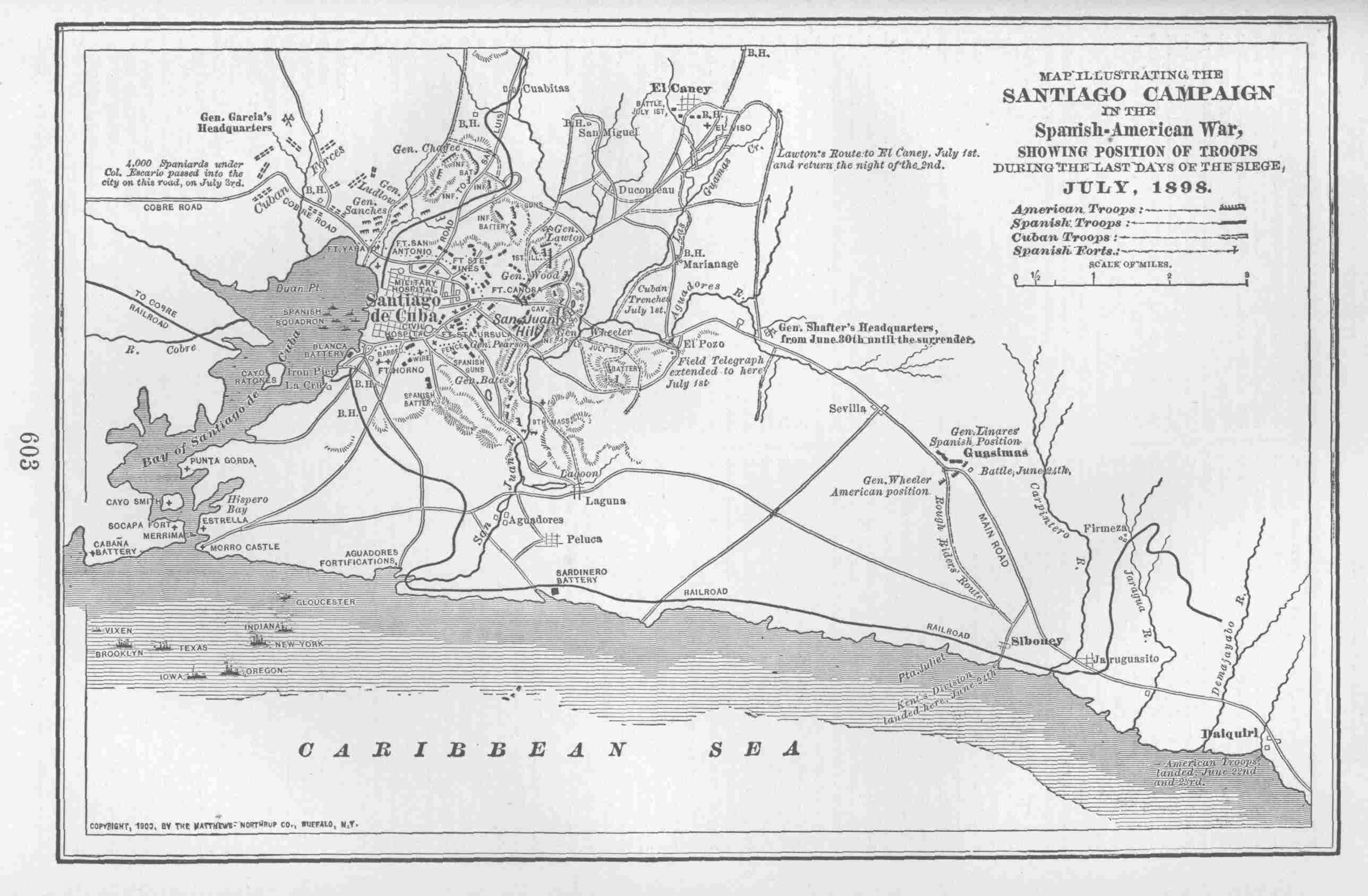
Map Illustrating the Santiago Campaign… {604} After carrying El Caney, Lawton was to move by the Caney road toward Santiago and take position on the right of the line. Wheeler's division of dismounted cavalry [embracing Sumner's brigade—3d, 6th and 9th regular cavalry, and Young's brigade mentioned above] and Kent's division of infantry [Wikoft's, Hawkins's and Pearson's brigades] were directed on the Santiago road, the head of the column resting near El Poso, toward which heights Grimes's battery moved on the afternoon of the 30th, with orders to take position thereon early the next morning and at the proper time prepare the way for the advance of Wheeler and Kent on San Juan Hill. The attack at this point was to be delayed until Lawton's guns were heard at El Caney and his infantry fire showed he had become well engaged. "The remainder of the afternoon and night was devoted to cutting out and repairing the roads and to other necessary preparations for battle. These preparations were far from what I desired them to be; but we were in a sickly climate; our supplies had to be brought forward by a narrow wagon road, which the rains might at any time render impassable; fear was entertained that a storm might drive the vessels containing our stores to sea, thus separating us from our base of supplies; and lastly, it was reported that General Pando, with 8,000 reenforcements for the enemy, was en route from Manzanillo and might be expected in a few days. Under those conditions I determined to give battle without delay. "Early on the morning of July 1, Lawton was in position around El Caney, Chaffee's brigade [7th, 12th, and 13th U. S. Infantry] on the right, across the Guantanamo road; Miles's brigade [1st, 4th, and 25th U. S. Infantry] in the center, and Ludlow's [8th and 22d U. S. Infantry and 2d Microcassettes Volunteers] on the left. The duty of cutting off the enemy's retreat along the Santiago road was assigned to the latter brigade. The artillery opened on the town at 6.15 A. M. The battle here soon became general and was hotly contested. The enemy's position was naturally strong and was rendered more so by blockhouses, a stone fort, and entrenchments cut in solid rock, and the loopholing of a solidly built stone church. The opposition offered by the enemy was greater than had been anticipated, and prevented Lawton from joining the right of the main line during the day, as had been intended. "After the battle had continued for some time Bates's brigade of two regiments (3d and 20th United States Infantry] reached my headquarters from Siboney. I directed him to move near El Caney, to give assistance, if necessary. He did so and was put in position between Miles and Chaffee. The battle continued with varying intensity during most of the day and until the place was carried by assault, about 4.30 p. m. As the Spaniards endeavored to retreat along the Santiago road, Ludlow's position enabled him to do very effective work and to practically cut off all retreat in that direction. "After the battle at El Caney was well opened and the sound of the small-arms fire caused us to believe that Lawton was driving the enemy before him, I directed Grimes's battery to open fire from the heights of El Poso on the San Juan' blockhouse, which could be seen situated in the enemy's entrenchments extending along the crest of San Juan Hill. This fire was effective and the enemy could be seen running away from the vicinity of the blockhouse. The artillery fire from El Poso was soon returned by the enemy's artillery. They evidently had the range of this hill, and their first shells killed and wounded several men. As the Spaniards used smokeless powder it was very difficult to locate the positions of their pieces, while, on the contrary, the smoke caused by our black powder plainly indicated the position of our battery. "At this time the cavalry division [of General Wheeler] under General Sumner (commanding temporarily in consequence of the illness of General Wheeler, who returned to duty that day], which was lying concealed in the general vicinity of the El Poso House, was ordered forward, with directions to cross the San Juan River and deploy to the right on the Santiago side, while Kent's division was to follow closely in its rear and deploy to the left. These troops moved forward in compliance with orders, but the road was so narrow as to render it impracticable to retain the column of fours formation at all points, while the undergrowth on either side was so dense as to preclude the possibility of deploying skirmishers. It naturally resulted that the progress made was slow, and the long range rifles of the enemy's infantry killed and wounded a number of our men while marching along this road and before there was any opportunity to return this fire. At this time Generals Kent and Sumner were ordered to push forward with all possible haste and place their troops in position to engage the enemy. General Kent, with this end in view, forced the head of his column alongside of the cavalry column as far as the narrow trail permitted, and thus hurried his arrival at the San Juan and the formation beyond that stream. A few hundred yards before reaching the San Juan the road forks, a fact that was discovered by Lieutenant-Colonel Derby, of my staff, who had approached well to the front in a war balloon. This information he furnished to the troops, resulting in Sumner moving on the right-hand road, while Kent was enabled to utilize the road to the left. … After crossing the stream, the cavalry moved to the right with a view of connecting with Lawton's left when he should come up, and with their left resting near the Santiago road. In the meanwhile Kent's division, with the exception of two regiments of Hawkins's brigade, being thus uncovered, moved rapidly to the front from the forks previously mentioned in the road, utilizing both trails, but more especially the one to the left, and crossing the creek formed for attack in the front of San Juan Hill." Annual Reports of the War Department, 1898, volume 1, part 2, page 147. "The particulars of this gallant attack, which won the hill and decided the fate of Santiago, are given with more clearness in the report of General Kent, who commanded the division which had most of the fighting to do, than in that of General Shafter. Wikoff's 'heroic brigade,' writes General Kent, 'consisting of the 13th, 9th, and 24th United States Infantry, speedily crossed the stream and were quickly deployed to the left of the lower ford. {605} While personally superintending this movement Colonel Wikoff was killed, the command of the brigade then devolving upon Lieutenant-Colonel Worth, 13th Infantry, who immediately fell severely wounded, and then upon Lieutenant-Colonel Liscum, 24th Infantry, who, five minutes later, also fell under the withering fire of the enemy. The command of the brigade then devolved upon Lieutenant-Colonel E. P. Ewers, 9th Infantry. Meanwhile I had again sent a staff officer to hurry forward the second brigade [Pearson's] which was bringing up the rear. The 10th and 2d Infantry, soon arriving at the forks, were deflected to the left to follow the Third Brigade [Wikoff's], while the 21st was directed along the main road to support Hawkins [whose brigade was composed of the 6th and 16th U. S. Infantry and the 71st New York Volunteers]. "Crossing the lower ford a few minutes later, the 10th and 2d moved forward in column in good order toward the green knoll … on the left. Approaching the knoll the regiments deployed, passed over the knoll, and ascended the high ridge beyond, driving back the enemy in the direction of his trenches. I observed this movement from the Fort San Juan Hill. … Prior to this advance of the second brigade, the third, connecting with Hawkins's gallant troops on the right, had moved toward Fort San Juan, sweeping through a zone of most destructive fire, scaling a steep and difficult hill, and assisting in capturing the enemy's strong position (Fort San Juan) at 1.30 p. m. This crest was about 125 feet above the general level and was defended by deep trenches and a loopholed brick fort surrounded by barbed-wire entanglements. General Hawkins, some time after I reached the crest, reported that the 6th and 16th Infantry had captured the hill, which I now consider incorrect. Credit is almost equally due the 6th, 9th, 13th, 16th, and 24th regiments of infantry. … The Thirteenth Infantry captured the enemy's colors waving over the fort, but unfortunately destroyed them. … "The greatest credit is due to the officers of my command, whether company, battalion, regimental, or brigade commanders, who so admirably directed the formation of their troops, unavoidably intermixed in the dense thicket, and made the desperate rush for the distant and strongly defended crest, I have already mentioned the circumstances of my third brigade's advance across the ford, where, in the brief space of ten minutes, it lost its brave commander (killed) and the next two ranking officers by disabling wounds; yet in spite of these confusing conditions the formations were effected without hesitation, although under a stinging fire, companies acting singly in some instances and by battalions and regiments in others, rushing through the jungle, across the stream, waist deep, and over the wide bottom thickly set with barbed-wire entanglements. … "The enemy having retired to a second line of rifle pits, I directed my line to hold their positions and intrench. At ten minutes past 3 p. m. I received almost simultaneously two requests—one from Colonel Wood, commanding a cavalry brigade, and one from General Sumner—asking for assistance for the cavalry on my right, 'as they were hard pressed.' I immediately sent to their aid the 13th Infantry, who promptly went on this further mission, despite the heavy losses they had already sustained. Great credit is due to the gallant officer and gentleman, Brigadier General H. S. Hawkins, who, placing himself between the two regiments, leading his brigade, the 6th and 16th Infantry, urged and led them by voice and bugle calls to the attack so successfully accomplished." Annual Reports of the War Department, 1898, volume 1, part 2, page 164. The part borne by the dismounted cavalry division in the capture of the Spanish intrenchments on San Juan Hill is described as follows in the report of General Sumner, temporarily in command: "After crossing the creek with sufficient strength to hold it and protect the crossing, I received verbal orders to move by the right flank to connect with Lawton's left. During the execution of this movement a balloon, under command of Colonel Derby, came up the road, forcing open Wood's Brigade and cutting it in two, thereby delaying the movement. The artillery fire of the enemy opened upon the balloon and continued for more than an hour, thereby subjecting part of my command massed and the rest moving by the flank to long shrapnel fire. Many officers and men were wounded here by exploding shells and small arms' firing of the enemy. After completing the deployment the command was so much committed to battle that it became necessary either to advance or else retreat under fire. "Lieutenant Miley, representing General Shafter, authorized an advance, which was ordered, Carroll's brigade taking the advance, reinforced on the right by Roosevelt's regiment and supported by the 1st and 10th Cavalry of Wood's Brigade. The advance was made under heavy infantry fire through open flat ground, cut up by wire fences, to the creek, dIstant about 600 yards. The advance was made in good order, the enemy's fire being returned only under favorable opportunities. In crossing the flat one officer (Captain O'Neil) and several men were killed and several officers and men wounded. Both sides of the creek are heavily wooded for about 200 yards. The creek was swollen, and the crossing through this space and the creek was made with great difficulty. After passing through the thick woods the ground was entirely open and fenced by wire. From this line it was necessary to storm the hill, upon the top of which is a house loopholed, etc., for defense. The slope of the hill is very difficult, but the assault was made with great gallantry and with much loss to the enemy. In this assault Colonel Hamilton, Lieutenants Smith and Shipp were killed; Colonel Carroll, Lieutenants Thayer and Myer were wounded. A number of casualties occurred among the enlisted men. After taking this hill the front line advanced to take the Fort San Juan Hill under fire from strong force of the enemy in trenches and house known as 'Blockhouse.' … The assault was successful, the line storming the trenches and blockhouse with conspicuous gallantry and coolness, capturing three prisoners, wounding and killing many of the enemy. … Connected with my left, Hawkins's brigade of Kent's division carried everything in front of it and captured the house and hill known as 'Fort San Juan' proper." Annual Reports of the War Department, 1898, volume 1, part 2. page 370. {606} Lieutenant Colonel Roosevelt, who commanded the Rough Riders regiment that day, while Colonel Wood commanded the brigade, tells the story of the fight, and what followed, very tersely, in his report: "After crossing the river at the ford," says the Lieutenant-Colonel, "we were moved along and up its light bank under fire, and were held in reserve at a sunken road. Here we lost a good many men, including Captain O'Neil, killed, and Lieutenant Haskell, wounded. We then received your order to advance and support the regular cavalry in the attack on the intrenchments and blockhouses on the hills to the left. The regiment was deployed on both sides of the road, and moved forward until we came to the rearmost lines of the regulars. We continued to move forward until I ordered a charge, and the men rushed the blockhouse and rifle pits on the hill to the right of our advance. They did the work in fine shape, though suffering severely. The guidons of Troops E and G were first planted on the summit, though the first men up were some A and B troopers who were with me. "We then opened fire on the intrenchments on a hill to our left which some of the other regiments were assailing and which they carried a few minutes later. Meanwhile we were under a heavy rifle fire from the intrenchments along the hills to our front, from whence they also shelled us with a piece of field artillery until some of our marksmen silenced it. When the men got their wind we charged again and carried the second line of intrenchments with a rush. Swinging to the left, we then drove the Spaniards over the brow of the chain of hills fronting Santiago. By this time the regiments were much mixed, and we were under a very heavy fire, both of shrapnel and from rifles from the batteries, intrenchments, and forts immediately in front of the city. On the extreme front I now found myself in command with fragments of the six cavalry regiments of the two brigades under me. The Spaniards made one or two efforts to retake the line, but were promptly driven back. "Both General Sumner and you sent me word to hold the line at all hazards, and that night we dug a line of intrenchments across our front, using the captured Spaniards' intrenching tools. We had nothing to eat except what we captured from the Spaniards; but their dinners had fortunately been cooked, and we ate them with relish, having been fighting all day. We had no blankets and coats, and lay by the trenches all night. The Spaniards attacked us once in the night, and at dawn they opened a heavy artillery and rifle fire. Very great assistance was rendered us by Lieutenant Parker's Gatling battery at critical moments; he fought his guns at the extreme front of the firing line in a way that repeatedly called forth the cheers of my men. One of the Spanish batteries which was used against us was directly in front of the hospital so that the red cross flag flew over the battery, saving it from our fire for a considerable period. The Spanish Mauser bullets made clean wounds; but they also used a copper-jacketed or brass-jacketed bullet which exploded, making very bad wounds indeed. "Since then we have continued to hold the ground; the food has been short; and until today [July 4] we could not get our blankets, coats, or shelter tents, while the men lay all day under the fire from the Spanish batteries, intrenchments, and guerrillas in trees, and worked all night in the trenches, never even taking off their shoes. But they are in excellent spirits, and ready and anxious to carry out any orders they receive. At the end of the first day the eight troops were commanded, two by captains, three by first lieutenants, two by second lieutenants, and one by the sergeant whom you made acting lieutenant. We went into the fight about 490 strong; 86 were killed or wounded, and there are about half a dozen missing. The great heat prostrated nearly 40 men, some of them among the best in the regiment." Annual Reports of the War Department, 1898, volume 1, part 2, page 684. There have been much contradiction and controversy concerning some of the orders by which the battle of San Juan was directed. The following are the conclusions on that subject of a civilian observer who seems to have seen and investigated with impartiality: "The orders under which the battle of San Juan was fought were given by Adjutant-General McClernand to General Kent, commanding the Infantry Division—consisting, in addition to the organizations already mentioned (Wikoff's and Pearson's brigades), of the First Brigade, including the Sixth and Sixteenth United States Infantry and the Seventy-first New York, under General Hawkins—at about nine o'clock in the morning. There is no question fortunately as to the exact wording of the orders. A little green knoll to the left of the Santiago road and half a mile short of the San Juan Heights was pointed out as the point which was to be the extreme limit of the forward movement of the Infantry Division. Once there, further orders would be given. The orders under which General Sumner advanced from El Pozo would appear to have been more specific, and certainly more clear than the orders which General Kent received for the Infantry Division a few minutes later. At the same time, it is true that these orders were also based upon a complete misconception of the situation and a total ignorance of the Spanish position and the lay of the country beyond El Pozo. General Sumner's orders were to advance along that branch of the Aguadores Creek which runs parallel with the Santiago road from El Pozo, until it joins the main stream of the Aguadores at the angle subsequently known as the 'bloody angle,' where the creek makes a sharp turn to the left, and then runs a general southerly course toward the town of Aguadores and the sea. This creek General Sumner was instructed to hold until the result of Lawton's attack upon Caney became known, and he received further orders. Once the creek was reached, Sumner, under the most unfavorable circumstances of a heavy fire, and the thick and pathless jungles which his men had to penetrate, deployed his whole division, and then sent back word to McClernand, the adjutant-general of the corps, acquainting him with the actual conditions by which he was confronted, and asking whether his orders contemplated an attack upon the enemy's intrenched position, setting forth at the same time the utter impossibility of keeping his men inactive for a long time under such a heavy fire as was being poured in upon them. {607} "Had it been proposed to carry out the plan, as discussed and agreed upon at General Shafter's headquarters the night before, to advance along the right flank of the Spanish position, keeping in touch with Lawton, obviously these two divisions, or a large part of them, should have been directed to take the direct road which ran north from El Pozo to Marianaje and thence to El Caney, leaving in front of San Juan only force sufficient to retain the Spaniards in their position. But the divisions were ordered to proceed along the Santiago road, and in a very few minutes came under fire. The original plan may have been changed at the last moment, of course; but as every movement that was subsequently made was in the line of carrying this plan out, until finally, on the 12th, General Lawton succeeded in completely investing the town on the north and west, this does not seem likely. The more probable explanation of the movement and of what followed, and the one accepted by general officers, is as follows: That it was still intended to follow Lawton's advance on the right, but that owing to our failure to develop the Spanish position in our front, and our complete ignorance of the lay of the land, the flank movement was not begun until too late—not until the troops had been led into a position from which they could be extricated only by wresting from the Spaniards the block-houses and the trenches from which, unexposed and unseen, they were delivering such a galling fire upon our men, engaged in wandering aimlessly about in an almost trackless tropical jungle. At this moment of great confusion and uncertainty, when the road was choked with the regiments of both the cavalry and infantry divisions, mutually hindering one another in their struggles to advance, and having to sustain a heavy and destructive fire which could not be answered, an ordeal even for the veteran soldier; at this moment, when something might still have been done to mislead the enemy and cover our advance, the war balloon was sent up directly behind our columns. This mistake betrayed the exact location of our advance, and the Spanish fire became heavier and better directed, and our losses more severe." S. Bonsal, The Fight for Santiago, chapter 6 (New York: Doubleday, Page & Company). The same writer gives a sickening account of the sufferings of the wounded after the battle and the miserable failure of provision for any kind of succor or care of them. "Of course:" he says, "in view of the perilous situation which the two divisions now occupied upon the crest of the hill, and the great anxiety which was felt at headquarters for the safety of the whole army, and the preparations which had to be made against the expected night attack of the Spaniards to drive our men back and retake their lost position, the search for the dead and wounded this evening had to be confined to a very limited area, and was only as thorough as the shortness of the time for which men could be spared from the colors permitted. The jungle and the great fields of long grass were not searched, and thus many of the wounded were not discovered until the following day; and quite a number, indeed, not until the armistice was declared, on the third day after the battle, when the men had time to ransack the hill-side and the valley for the missing. And there were some—those who had the strength when they fell to crawl through the cactus, the Spanish bayonet, and all manner of prickly and trailing plants into the deeper and more protected recesses of the jungle—who were never discovered at all until days, many days, had passed; and the gathering of the vultures told where some poor fellow had died without care and without food, of his wounds or from starvation. Of such an one, when his place of hiding was discovered, there was, as a rule, only left a whitened skeleton and pieces of the uniform he had worn. The last resting place of not a few was never discovered at all. "I believe I am giving a moderate estimate when I say that at least one-third of the men wounded on July 1st received no attention, and were not brought back to the division hospital until the afternoon of Ju]y 3d. This night we knew nothing, and had not even the slightest suspicion, of how numerous the undiscovered wounded were. … Only about half of the wounded men who were discovered this evening and been brought back to the dressing station when the moon rose above the dark forest line, and lit up the battlefield and the heights of San Juan as clearly, and, indeed, more clearly than day, for there was now not the dazzling force and the confusing mirage of the pitiless sunlight to blind the sight. The majority of these men had had their wounds dressed where they fell, or soon after falling, with the first-aid bandages. There were very few indeed to whom it had been possible to give any further attention than this, as the regimental surgeons, for want of transportation, had been unable to bring their medical chests, and those who were best provided carried with them only small pocket cases. … "When the first-aid bandages were applied, the wounded man and those who helped him were, as a rule, under fire, which made any but the most summary methods of wound-dressing quite impossible. Fortunately these bandages, so simple and practical, lent themselves excellently well to this procedure. The first thing the soldiers or the hospital attendants would do when they came upon a wounded man was, in the case of a wound in the body, to tear off his shirt, or in the case of a wound in the leg, tear off his trousers, and then wrap around the wound the first-aid bandage. The wound-dressers were generally in such haste, and the wounded men usually so helpless to assist in any way, and their shirts and trousers so rotten from the drenching rains in which they had been worn without change day or night, that the taking off of the clothing was literally what I call it—tearing, and the garment came off so rent as to be quite useless for further wear. Consequently the soldiers were carried half-naked, or, if they had been wounded in both the body and the lower limbs, as was so frequently the case, entirely naked, to the army wagons and so down to the hospital, where there was not a scrap of clothing or bedding forthcoming to cover them with. These who were stripped in this way during the daytime were baked and blistered by the fierce sunlight, only to shiver with the penetrating cold and dampness after the rain had ceased to fall and when the chill night came on. "Knowing that he was totally unprepared to clothe or cover the wounded that would probably be brought in, the chief surgeon of the corps issued an order, the evening before the battle, that all wounded men should be brought in with their blankets, halves of shelter-tents, and ponchos when possible. This was certainly a step in the right direction, even if it was but a frank confession by the authorities that no preparation had been made by them for the emergency which it cannot be said was suddenly thrust upon them, but which they might have foreseen and should have been preparing against for many weeks previous. {608} While the attending soldiers, realizing how serious for their wounded comrades it would be to have to lie in the hospitals uncovered to wind and weather, made great efforts to find their packs, these efforts were not often successful, and a great majority of the wounded reached the hospital half naked, and had thereafter only the covering and the bedding which their comrades and the hospital attendants were able to 'rustle' for them, and this was little enough and not seldom nothing at all. "Had this expedition been provided with a greater number of surgeons and hospital attendants, had the ambulances been at hand which we left in Tampa or upon the transports, ambulances without which it is reasonable to suppose—at least we had supposed—no civilized power would enter upon an aggressive war, much less upon a campaign in which we had the advantage of choosing both our own time and the field of operations, the outrageous treatment which our wounded suffered, and the barbarous scenes which we were called upon to witness upon this and the following days would never have occurred." S. Bonsai, The Fight for Santiago, chapter 8 (New York: Doubleday, Page & Company). The troops which had carried San Juan Hill were intrenched, that night, in the positions they had gained, and those which had taken El Caney were brought into connection with them, Lawton's division on their right and Bates's brigade on the left. The battle was renewed by the Spaniards soon after daylight on the morning of the 2d, and raged with more or less fury throughout the day. That evening, about 10 o'clock, a fierce attempt was made to break through the American lines, but without success. Again, on the morning of the third, the Spaniards reopened battle, but with less vigor than before. General Shafter then sent the following letter to General Toral, the Spanish commander: "I shall be obliged, unless you surrender, to shell Santiago de Cuba. Please inform the citizens of foreign countries, and all women and children, that they should leave the city before 10 o'clock to-morrow morning." In reply, General Toral wrote; "It is my duty to say to you that this city will not surrender, and that I will inform the foreign consuls and inhabitants of the contents of your message." Several of the foreign consuls at Santiago then came into the American lines and persuaded General Shafter to delay the shelling of the town until noon of the 5th, provided that the Spanish forces made no demonstration meantime against his own. This established a truce which was renewed, in a series of negotiations until the 10th. "I was of the opinion," reported General Shafter, "that the Spaniards would surrender if given a little time, and I thought this result would be hastened if the men of their army could be made to understand they would be well treated as prisoners of war. Acting upon this presumption I determined to offer to return all the wounded Spanish officers at El Caney who were able to bear transportation, and who were willing to give their paroles not to serve against the forces of the United States until regularly exchanged. This offer was made and accepted. These officers, as well as several of the wounded Spanish privates, 27 in all, were sent to their lines under the escort of some of our mounted cavalry. Our troops were received with honors, and I have every reason to believe the return of the Spanish prisoners produced a good impression on their comrades. The cessation of firing about noon on the 3d practically terminated the battle of Santiago." General Shafter goes on to say that when the battle was fiercest, on July 1st, he probably had no more than 12,000 men on the firing line, not counting a few Cubans who assisted in the attack on El Caney, and who fought with valor. They were confronted by about equal numbers of the enemy, in strong and intrenched positions. "Our losses in these battles were 22 officers and 208 men killed, and 81 officers and 1,203 men wounded; missing 79. The missing, with few exceptions, reported later." Up to this time, General Shafter had been unable to complete the investment of the town with his own men, and had depended upon General Garcia with his Cubans, placed on the extreme right of the American lines, to watch for and intercept reinforcements. They failed to do so, and 2,800 Spaniards, under General Escario, entered the city on the night of the 2d. The American commander now extended his own lines as rapidly as possible and completed the investment of the town. Annual Reports of the War Department, 1898, volume 1, part 2, pages 155-157. As stated above, permission was given on the 3d for non-combatants to leave the city. "They did leave in the following days to the number of perhaps 20,000, filling the neighboring villages and roads with destitute people, mostly women and children. It then seemed to fall to our lot to see that these people did not starve in a desolate country, and to be as much our duty to take care of these people, whom our policy had driven from their homes, as it was for Spain to feed the reconcentrados, whom they drove from their homes under their war policy. The task was not insignificant." Report of Inspector-General (Annual Reports of the War Department, 1898, volume 1, part 2, page 596). UNITED STATES OF AMERICA: A. D. 1898 (July). Annexation of the Hawaiian Islands. See (in this volume) HAWAIIAN ISLANDS: A. D. 1898. UNITED STATES OF AMERICA: A. D. 1898 (July 1). National Bankrupt Law. After years of effort on the part of its advocates, a national bankrupt law was enacted by both Houses of Congress and received the President's signature on the 1st of July, 1898. UNITED STATES OF AMERICA: A. D. 1898 (July 3). Destruction of the Spanish squadron at Santiago. On the morning of July 3, Admiral Cervera, convinced that Santiago would be taken by the American forces, and acting under orders from the Captain-General at Havana, made a desperate attempt to save his squadron by escaping to sea. The result was a total destruction of the Spanish ships, in an engagement with the blockading fleet, of which Admiral Sampson gave the following account in his official report: "The enemy's vessels came out of the harbor between 9.35 and 10 a. m., the head of the column appearing around Cay Smith at 9.31 and emerging from the channel five or six minutes later. The positions of the vessels of my command off Santiago at that moment were as follows: The flagship 'New York' was 4 miles east of her blockading station and about 7 miles from the harbor entrance. She had started for Siboney, where I intended to land, accompanied by several of my staff, and go to the front to consult with General Shafter. {609} A discussion of the situation and a more definite understanding between us of the operations proposed had been rendered necessary by the unexpectedly strong resistance of the Spanish garrison of Santiago. I had sent my chief of staff on shore the day before to arrange an interview with General Shafter, who had been suffering from heat prostration. I made arrangements to go to his headquarters, and my flagship was in the position mentioned above when the Spanish squadron appeared in the channel. The remaining vessels were in or near their usual blockading positions, distributed in a semicircle about the harbor entrance, counting from the eastward to the westward, in the following order: The 'Indiana' about a mile and a half from shore, the 'Oregon'—the 'New York's' place being between these two—the 'Iowa,' 'Texas,' and 'Brooklyn,' the latter two miles from the shore west of Santiago. The distance of the vessels from the harbor entrance was from 2½ to 4 miles, the latter being the limit of day blockading distance. The length of the arc formed by the ships was about 8 miles. The 'Massachusetts' had left at 4 a. m., for Guantanamo for coal. Her station was between the 'Iowa' and 'Texas.' The auxiliaries 'Gloucester' and 'Vixen' lay close to the land and nearer the harbor entrance than the large vessels, the 'Gloucester' to the eastward and the 'Vixen' to the westward. The torpedo boat 'Ericsson' was in company with the flagship and remained with her during the chase until ordered to discontinue, when she rendered very efficient service in rescuing prisoners from the burning' Vizcaya.' … "The Spanish vessels came rapidly out of the harbor, at a speed estimated at from 8 to 10 knots, and in the following order: 'Infanta Maria Teresa' (flagship), 'Vizcaya,' 'Cristobal Colon,' and the 'Almirante Oquendo.' The distance between these ships was about 800 yards, which means that from the time the first one became visible in the upper reach of the channel until the last one was out of the harbor an interval of only about 12 minutes elapsed. Following the 'Oquendo,' at a distance of about 1,200 yards, came the torpedo-boat destroyer 'Pluton,' and after her the 'Furor.' The armored cruisers, as rapidly as they could bring their guns to bear, opened a vigorous fire upon the blockading vessels, and emerged from the channel shrouded in the smoke from their guns. The men of our ships in front of the port were at Sunday 'quarters for inspection.' The signal was made simultaneously from several vessels, 'Enemy ships escaping,' and general quarters was sounded. The men cheered as they sprang to their guns, and fire was opened probably within 8 minutes by the vessels whose guns commanded the entrance. The 'New York' turned about and steamed for the escaping fleet, flying the signal, 'Close in towards harbor entrance and attack vessels,' and gradually increasing speed, until toward the end of the chase she was making 16½ knots, and was rapidly closing on the 'Cristobal Colon.' She was not, at any time, within the range of the heavy Spanish ships, and her only part in the firing was to receive the undivided fire from the forts in passing the harbor entrance, and to fire a few shots at one of the destroyers, thought at the moment to be attempting to escape from the 'Gloucester.' "The Spanish vessels, upon clearing the harbor, turned to the westward in column, increasing their speed to the full power of their engines. The heavy blockading vessels, which had closed in towards the Morro at the instant of the enemy's appearance, and at their best speed, delivered a rapid fire, well sustained and destructive, which speedily overwhelmed and silenced the Spanish fire. The initial speed of the Spaniards carried them rapidly past the blockading vessels, and the battle developed into a chase in which the 'Brooklyn' and 'Texas' had, at the start, the advantage of position. The 'Brooklyn' maintained this lead. The 'Oregon,' steaming with amazing speed from the commencement of the action, took first place. The 'Iowa' and the 'Indiana' having done good work, and not having the speed of the other ships, were directed by me, in succession, at about the time the 'Vizcaya' was beached, to drop out of the chase and resume blockading stations. These vessels rescued many prisoners. The 'Vixen,' finding that the rush of the Spanish ships would put her between two fires, ran outside of our own column and remained there during the battle and chase. "The skillful handling and gallant fighting of the 'Gloucester' excited the admiration of everyone who witnessed it, and merits the commendation of the Navy Department. She is a fast and entirely unprotected auxiliary vessel—the yacht 'Corsair'—and has a good battery of light rapid-fire guns. She was lying about 2 miles from the harbor entrance, to the southward and eastward, and immediately steamed in, opening fire upon the large ships. Anticipating the appearance of the 'Pluton' and 'Furor,' the 'Gloucester' was slowed, thereby gaining more rapidly a high pressure of steam, and when the destroyers came out she steamed for them at full speed, and was able to close to short range, while her fire was accurate, deadly, and of great volume. During this fight the 'Gloucester' was under the fire of the Socapa Battery. Within twenty minutes from the time they emerged from Santiago Harbor the careers of the 'Furor' and the 'Pluton' were ended, and two-thirds of their people killed. The 'Furor' was beached and sunk in the surf; the 'Pluton' sank in deep water a few minutes later. The destroyers probably suffered much injury from the fire of the secondary batteries of the battle ships 'Iowa,' 'Indiana,' and the 'Texas,' yet I think a very considerable factor in their speedy destruction was the fire, at close range, of the 'Gloucester's' battery. After rescuing the survivors of the destroyers, the 'Gloucester' did excellent service in landing and securing the crew of the 'Infanta Maria Teresa.' "The method of escape attempted by the Spaniards, all steering in the same direction, and in formation, removed all tactical doubts or difficulties, and made plain the duty of every United States vessel to close in, immediately engage, and pursue. This was promptly and effectively done. As already stated, the first rush of the Spanish squadron carried it past a number of the blockading ships which could not immediately work up to their best speed; but they suffered heavily in passing, and the 'Infanta Maria Teresa' and the 'Oquendo' were probably set on fire by shells fired during the first fifteen minutes of the engagement. It was afterwards learned that the 'Infanta Maria Teresa's' fire main had been cut by one of our first shots, and that she was unable to extinguish fire. With large volumes of smoke rising from their lower decks aft, these vessels gave up both fight and flight and ran in on the beach—the 'Infanta Maria Teresa' at about 10.15 a. m. at Nima Nima, 6½ miles from Santiago Harbor entrance, and the 'Almirante Oquendo' at about 10.30 a. m. at Juan Gonzales, 7 miles from the port. {610} "The 'Vizcaya' was still under the fire of the leading vessels; the 'Cristobal Colon' had drawn ahead, leading the chase, and soon passed beyond the range of the guns of the leading American ships. The 'Vizcaya' was soon set on fire, and, at 11.15, she turned inshore, and was beached at Aserraderos, 15 miles from Santiago, burning fiercely, and with her reserves of ammunition on deck already beginning to explode. When about 10 miles west of Santiago the 'Indiana' had been signaled to go back to the harbor entrance, and at Aserraderos the 'Iowa' was signaled to 'Resume blockading station.' The 'Iowa' assisted by the 'Ericsson' and the 'Hist,' took off the crew of the 'Vizcaya,' while the 'Harvard' and the 'Gloucester' rescued those of the 'Infanta Maria Teresa' and the 'Almirante Oquendo.' This rescue of prisoners, including the wounded, from the burning Spanish vessels, was the occasion of some of the most daring and gallant conduct of the day. The ships were burning fore and aft, their guns and reserve ammunition were exploding, and it was not known at what moment the fire would reach the main magazines. In addition to this a heavy surf was running just inside of the Spanish ships. But no risk deterred our officers and men until their work of humanity was complete. "There remained now of the Spanish ships only the 'Cristobal Colon'—but she was their best and fastest vessel. Forced by the situation to hug the Cuban coast, her only chance of escape was by superior and sustained speed. When the 'Vizcaya' went ashore, the 'Colon' was about 6 miles ahead of the 'Brooklyn' and the 'Oregon'; but her spurt was finished, and the American ships were now gaining upon her. Behind the 'Brooklyn' and the 'Oregon' came the 'Texas,' 'Vixen,' and 'New York.' It was evident from the bridge of the 'New York' that all the American ships were gradually overhauling the chase, and that she had no chance of escape. At 12.50 the 'Brooklyn' and the 'Oregon' opened fire and got her range—the 'Oregon's' heavy shell striking beyond her—and at 1.20 she gave up without firing another shot, hauled down her colors, and ran ashore at Rio Torquino, 48 miles from Santiago. Captain Cook, of the 'Brooklyn,' went on board to receive the surrender. While his boat was alongside I came up in the 'New York,' received his report, and placed the 'Oregon' in charge of the wreck to save her, if possible, and directed the prisoners to be transferred to the 'Resolute,' which had followed the chase. Commodore Schley, whose chief of staff had gone on board to receive the surrender, had directed that all their personal effects should be retained by the officers. This order I did not modify. The 'Cristobal Colon' was not injured by our firing, and probably is not much injured by beaching, though she ran ashore at high speed. The beach was so steep that she came off by the working of the sea. But her sea valves were opened and broken, treacherously, I am sure, after her surrender, and despite all efforts she sank. When it became evident that she could not be kept afloat, she was pushed by the 'New York' bodily up on the beach, the 'New York's' stem being placed against her for this purpose—the ship being handled by Captain Chadwick with admirable judgment—and sank in shoal water and may be saved. Had this not been done she would have gone down in deep water and would have been, to a certainty, a total loss. "I regard this complete and important victory over the Spanish forces as the successful finish of several weeks of arduous and close blockade, so stringent and effective during the night that the enemy was deterred from making the attempt to escape at night, and deliberately elected to make the attempt in daylight. The object of the blockade of Cervera's squadron was fully accomplished, and each individual bore well his part in it—the commodore in command on the second division, the captains of ships, their officers, and men. The fire of the battle ships was powerful and destructive, and the resistance of the Spanish squadron was, in great part, broken almost before they had got beyond the range of their own forts. … Several of the [American] ships were struck—the 'Brooklyn' more often than the others—but very slight material injury was done, the greatest being aboard the 'Iowa.' Our loss was 1 man killed and 1 wounded, both on the 'Brooklyn.' It is difficult to explain this immunity from loss of life or injury to ships in a combat with modern vessels of the best type, but Spanish gunnery is poor at the best, and the superior weight and accuracy of our fire speedily drove the men from their guns and silenced their fire. This is borne out by the statements of prisoners and by observation." Annual Report of Secretary of the Navy, 1898, volume 2, pages 506-511. Some particulars of the destruction of the "Furor," the "Pluton," and the "Infanta Maria Teresa," and of the rescue of surviving Spaniards, including Admiral Cervera, are given in a report by Lieutenant Huse, executive officer of the "Gloucester," as follows: "The 'Pluton' was run on the rocks about 4 miles west of Morro and blew up. Our crew cheered at the sight of the explosion. The 'Furor' soon commenced to describe circles with a starboard helm, her fire ceased, and it became apparent that she was disabled. A white rag was waved from forward and we stopped firing. Lieutenants Wood and Norman and Assistant Engineer Proctor were sent to rescue the crews and to see if the prizes could be saved. These found a horrible state of affairs on the 'Furor.' The vessel was a perfect shambles. As she was on fire and burning rapidly, they took off the living and then rescued all they could find in the water and on the beach. The 'Pluton' was among the rocks in the surf and could not be boarded, but her crew had made their way ashore or were adrift on life buoys and wreckage. These were all taken on board. I have since learned that the 'New York' passed a number of men in the water who had doubtless jumped overboard from the destroyers to escape our fire. All these were probably drowned. While this work was going on several explosions took place on the 'Furor,' and presently—at about 11.30—she threw her bows in the air, and turning to port slowly sank in deep water. … {611} "While one of our boats was still ashore, seeing heavy clouds of smoke behind the next point the ship was moved in that direction, the men being at quarters and everything in readiness for further action. On rounding the point two men-of-war were found on the beach burning fiercely aft, the majority of the crew being crowded on the forecastle and unable apparently to reach land, only 200 yards away. Our boats, under Lieutenant Norman and Ensign Edson, put off to the nearer vessel, which proved to be the flagship 'Infanta Maria Teresa,' and rescued all on board by landing them on the beach through the surf. Lieutenant Norman formally received the surrender of the commander in chief and all his officers and men present, and as soon as all hands had been transferred ashore, brought on board this ship all the higher officers, including the admiral. Lieutenant Wood meanwhile rescued the remaining survivors on board the 'Oquendo,' the second of the burning vessels. The Spanish officers not feeling that the prisoners on shore were secure from attack by Cuban partisans, by your orders I directed Lieutenant Norman to land with a small force, establish a camp on shore, and hoist the United States flag over it. He took with him all the rations that could be spared from the stores aboard." Annual Report of Secretary of the Navy, 1898, volume 2, page 542. The following is a translation, from Admiral Cervera's report, as partly published in newspapers at Madrid, giving his description of the destruction of his flagship and his own rescue from death: "The enemy's fire produced terrible damages on board the 'Infanta Maria Teresa,' destroying the elements of defence—among others, the net for protection against fire. In this critical moment the captain of the ship, Señor Concas, fell wounded, and it was necessary to withdraw him, I taking command of the vessel, because it was impossible to find the second commandant of the 'Maria Teresa.' Immediately afterwards they reported to me that my cabin was burning in consequence of an explosion. The fire soon became very great and ignited other parts of the ship. I gave orders to my aid to flood the after magazines, but it was impossible. Dense clouds of smoke impeded walking in the passages and practicing any kind of operations. In this situation I could only think of beaching the ship, and did so, running aground on Punta Cabrera. The contest was impossible on our side, and there was nothing more to be done but to save as much as possible. I thought to lower the flag, but that was not possible on account of the fire, which prevented all operations. In these anxious moments two boats came to the aid of the 'Maria Teresa,' into which a number of us jumped. Those that were not dying were saved with nothing. The 'Teresa' lowered a small boat, which sank before it could be of any service. Subsequently they succeeded in launching a steam launch, but this also sank after making one voyage to the beach. I succeeded in saving myself with nothing, two sailors helping me, one named Andres Sequeros and the officer D. Angel Cervera, all of us arriving on board the American ship 'Gloucester' naked. At this time we were all naked." Annual Report of Secretary of the Navy, 1898, volume 2, pages 558-559. UNITED STATES OF AMERICA: A. D. 1898 July (4-17). The surrender of Santiago and of all the Spanish forces in eastern Cuba. The following is a continuation of the report made by General Shafter of his operations at Santiago de Cuba, resulting in the surrender of the entire forces of Spain in eastern Cuba: "The information of our naval victory was transmitted under flag of truce to the Spanish commander in Santiago on July 4, and the suggestion again made that he surrender to save needless effusion of blood. On the same date I informed Admiral Sampson that if he would force his way into the harbor the city would surrender without any further sacrifice of life. Commodore Watson replied that Admiral Sampson was temporarily absent, but that in his (Watson's) opinion the navy should not enter the harbor. In the meanwhile letters passing between General Toral and myself caused the cessation of hostilities to continue; each army, however, continued to strengthen its intrenchments. I was still of the opinion the Spaniards would surrender without much more fighting, and on July 6 called General Toral's attention to the changed conditions and at his request gave him time to consult his home Government. This he did, asking that the British consul, with the employees of the cable company, be permitted to return from El Caney to the city. This I granted. The strength of the enemy's position was such I did not wish to assault if it could be avoided. An examination of the enemy's works, made after the surrender, fully justified the wisdom of the course adopted. The intrenchments could only have been carried with very great loss of life, probably with not less than 3,000 killed and wounded. "On July 8 General Toral offered to march out of the city with arms and baggage, provided he would not be molested before reaching Holguin, and to surrender to the American forces the territory then occupied by him. I replied that while I would submit his proposition to my home Government, I did not think it would be accepted. In the meanwhile arrangements were made with Admiral Sampson that when the army again engaged the enemy the navy would assist by shelling the city from ships stationed off Aguadores, dropping a shell every few minutes. On July 10 the 1st Illinois and the 1st District of Columbia arrived, and were placed on the line to the right of the cavalry division. This enabled me to push Lawton further to the right and to practically command the Cobra road. On the afternoon of the date last mentioned the truce was broken off at 4 p. m., and I determined to open with four batteries of artillery, and went forward in person to the trenches to give the necessary orders; but the enemy anticipated us by opening fire with his artillery a few minutes after the hour stated. His batteries were apparently silenced before night, while ours continued playing upon his trenches until dark. During this firing the navy fired from Aguadores, most of the shells falling in the city. There was also some small-arms firing. On this afternoon and the next morning we lost Captain Charles W. Rowell, 2d Infantry, and 1 man killed, and Lieutenant Lutz, 2d Infantry, and 10 men wounded. On the morning of July 11 the bombardment by the Navy and my field guns was renewed and continued until nearly noon, and on the same day I reported to the Adjutant-General of the Army that the right of Ludlow's brigade of Lawton's division rested on the bay. Thus our hold upon the enemy was complete. {612} "At 2 p. m. on this date, the 11th, the surrender of the city was again demanded. The firing ceased and was not again renewed. By this date the sickness in the army was increasing very rapidly as a result of exposure in the trenches to the intense heat of the sun and the heavy rains. Moreover, the dews in Cuba are almost equal to rains. The weakness of the troops was becoming so apparent I was anxious to bring the siege to an end, but in common with most of the officers of the army I did not think an assault would be justifiable, especially as the enemy seemed to be acting in good faith in their preliminary propositions to surrender. On July 11 I wrote General Toral as follows: 'With the largely increased forces which have come to me, and the fact that I have your line of retreat securely in my hands, the time seems fitting that I should again demand of your excellency the surrender of Santiago and of your excellency's army. I am authorized to state that should your excellency so desire the Government of the United States will transport the entire command of your excellency to Spain.' General Toral replied that he had communicated my proposition to his general-in-chief, General Blanco. "July 12 I informed the Spanish commander that Major-General Miles, commander-in-chief of the American Army, had just arrived in my camp, and requested him to grant us a personal interview on the following day. He replied he would be pleased to meet us. The interview took place on the 13th, and I informed him his surrender only could be considered, and that as he was without hope of escape he had no right to continue the fight. On the 14th another interview took place, during which General Toral agreed to surrender, upon the basis of his army, the Fourth Army Corps, being returned to Spain, the capitulation embracing all of eastern Cuba east of a line passing from Acerraderos on the south to Sagua de Tanamo on the north, via Palma Soriano. It was agreed commissioners should meet during the afternoon to definitely arrange the terms. … The terms of surrender finally agreed upon included about 12,000 Spanish troops in the city and as many more in the surrendered district. It was arranged the formal surrender should take place between the lines on the morning of July 17, each army being represented by 100 armed men. At the time appointed, I appeared at the place agreed upon with my general officers, staff, and 100 troopers of the Second Cavalry under Captain Brett. General Toral also arrived with a number of his officers and 100 infantry. We met midway between the representatives of our two armies, and the Spanish commander formally consummated the surrender of the city and the 24,000 troops in Santiago and the surrendered district. After this ceremony I entered the city with my staff and escort, and at 12 o'clock noon the American flag was raised over the governor's palace with appropriate ceremonies." Annual Reports of the War Department, 1898, volume 2, pages 157-159. UNITED STATES OF AMERICA: A. D. 1898 (July-August: Army administration). Red-tape and politics. Their working in the campaign. "The Cuban campaign had been foreseen by intelligent officers for more than a year, but the department which clothes the army had taken no steps toward providing a suitable uniform for campaigning in the tropics until war was declared. The Fifth Army Corps, a comparatively small body of 17,000 men, was concentrated at Tampa on the railroad within reach of all the appliances for expediting business. Between April 26, when war was declared, and, June 6, when the corps embarked for Cuba, sufficient time elapsed to have clothed 1,000,000 men if the matter had been handled in the same manner a wholesale clothing firm would handle similar business. Yet the corps went to Cuba wearing the winter clothing it had brought on its backs from Montana, Wyoming, and Michigan. It endured the heat of the tropics clad in this, and was furnished with light summer clothing by the department to wear for its return to Montauk, where the breezes were so bracing that the teeth chattered even when the men were clad in winter clothing. The only reason for this absolute failure to properly clothe the army was that the methods of the department are too slow and antiquated for the proper performance of business. There was no lack of money. It was a simple case of red-tape delays. There can be no doubt that the intention was that the summer clothing should be worn in Cuba and that there should be warm clothing issued at Montauk. It was issued after the troops had shivered for days in their light clothes. The delays unavoidably connected with an obsolete method caused great suffering that should not have been inflicted upon men expected to do arduous duty. A sensible man would not put a heavy blanket on a horse to do draught work on a hot day; but the red tape of an antiquated way of doing business caused our soldiers to wear heavy woolen clothes in torrid heat, when every nerve was to be strained to the breaking point in athletic exertion. This is not pointed out in a fault-finding spirit. The men are proud to have been in the Fifth Corps and to have endured these things for the country and the flag; but these unnecessary sufferings impaired the fighting strength of the army, caused much of the sickness that visited the Fifth Corps, and might have caused the failure of the whole expedition. … "The difficulty here depicted was one which beset the department at every turn in the whole campaign. It is a typical case. Transports, tentage, transportation—it was the same in everything. With the most heroic exertions the department was able to meet emergencies only after they had passed. This was caused partly by lack of ready material, but mainly by an inelastic system of doing business which broke down in emergencies. This, in turn, was caused mainly by the illiberal treatment accorded to this, as well as to every other department of the army by Congress. It uniformly cuts mercilessly all estimates of this, as of every other department, and leaves no margin of expenditure or chance of improvement. It dabbles in matters which are purely technical and require the handling of expert executive talent. … "Plans for war should be prepared in advance. This was especially true of the last war, which had been foreseen for years and considered a probability for several months. All details should have been previously worked out, all contingencies foreseen before hostilities began. Such plans would require some modifications, of course, but would form a working basis. {613} Neither Santiago nor Manila Bay would have been foreseen; but any plans for war would have involved the consideration and solution of the following problems: How to raise, arm, equip, organize, mobilize, clothe, feed, shelter, and transport large bodies of soldiers. The point where the battle might occur would be a mere tactical detail to be worked out at the proper time. The above problems could all be solved in time of peace and should have been solved. The general staff performs this function in foreign armies, but we had no such body in our service and nothing to imperfectly take its place. … "The most urgently needed reform is the absolute divorcement of the army in all of its departments from politics. … No department of the army should be more exempt from political influence than the staff. This points at once to the most urgent reform, viz., make the commanding general the real working head of the army, instead of the Secretary of War. No good results have come to the service by the extension of the Secretary's powers in Grant's first administration. Most of the evils of the service can be traced to the fact that the general commanding has since that time been practically deprived of his proper functions, and the real head of the army has been a politician." Lieutenant J. H. Parker, Our Army Supply Department and the need of a General Staff (Review of Reviews, December, 1898). UNITED STATES OF AMERICA: A. D. 1898 (July-August: Cuba). The War with Spain. Sickness in the American army at Santiago. Its alarming state. Hurried removal of troops to Montauk Point, Long Island. "After the surrender of General Toral's army General Shafter urged the War Department from time to time to hasten the shipment of the Spanish prisoners to their homes, in order that the American Army, whose condition was now deplorable, might be transported to the United States. At this time about half the command had been attacked by malarial fever, with a few cases of yellow fever, dysentery, and typhoid fever. The yellow-fever cases were mainly confined to the troops at Siboney, and the few cases found among the troops at the front were at once transferred to that place. … There was great fear, and excellent grounds for it, that the yellow fever, now sporadic throughout the command, would become epidemic. With the command weakened by malarial fevers, and its general tone and vitality much reduced by all the circumstances incident to the campaign, the effects of such an epidemic would practically mean its annihilation. The first step taken to check the spread of disease was the removal of all the troops to new camping grounds. … It was directed that the command be moved in this way every few days, isolating the cases of yellow fever as they arose, and it was expected that in a short time the yellow fever would be stamped out. … But the effect produced on the command by the work necessary to set up the tents and in the removal of the camps increased the number on the sick report to an alarming degree. Convalescents from malarial fever were taken again with the fever, and yellow fever, dysentery, and typhoid increased. It was useless now to attempt to confine the yellow-fever cases to Siboney, and isolation hospitals were established around Santiago. It was apparent that to keep moving the command every few days simply weakened the troops and increased the fever cases. Any exertion in this heat caused a return of the fever, and it must be remembered that the convalescents now included about 75 per cent. of the command. The Commanding General was now directed to move the entire command into the mountains to the end of the San Luis railroad, where the troops would be above the yellow fever limit; but this was a physical impossibility. … "The situation was desperate; the yellow-fever cases were increasing in number, and the month of August, the period in which it is epidemic, was at hand. It was with these conditions staring them in the face, that the officers commanding divisions and brigades and the Chief Surgeon were invited by General Shafter to discuss the situation. As a result of this conference the General sent the following telegram giving his views [and those of the General Officers and Medical Officers]. … 'In reply to telegram of this date [August 3], stating that it is deemed best that my command be moved to end of railroad, where yellow fever is impossible, I have to say that under the circumstances this move is practically impossible. The railroad is not yet repaired, although it will be in about a week. Its capacity is not to exceed 1,000 men a day, at the best, and it will take until the end of August to make this move, even if the sick-list should not increase. An officer of my staff, Lieutenant Miley, who has looked over the ground, says it is not a good camping ground. … In my opinion there is but one course to take, and that is to immediately transport the Fifth Corps and the detached regiments that came with it, and were sent immediately after it, with the least delay possible, to the United States. If this is not done I believe the death-rate will be appalling. I am sustained in this view by every medical officer present. I called together to-day the General Officers and the senior Medical Officers and telegraph you their views.' … "On August 4th instructions were received from the War Department to begin the removal of the command to Montauk Point, Long Island. Some of the immune regiments were on the way to Santiago, and other regiments were at once ordered there to garrison the district as General Shafter's command was withdrawn. The first of the fleet of vessels to return the Spanish troops arrived in time to be loaded and leave August 9th, and by the end of the month nearly all were transported. "After the surrender the relations between the American and Spanish troops were very cordial. There could be little or no conversation between individuals, but in many ways the respect each had for the other was shown, and there seemed to be no hatred on either side. Most of the Spanish officers remained in their quarters in town, and they shared in the feeling displayed by their men. Salutations were generally exchanged between the officers, and American ways and manners became very popular among the Spaniards. … {614} "By the 25th of the month General Shafter's entire command, with the exception of a few organizations just ready to embark, had departed, and, turning over the command to General Lawton, he sailed that day with his staff on the 'Mexico,' one of the captured transports, and at noon September 1st went ashore at Montauk Point, Long Island." J. D. Miley, In Cuba with Shafter, chapter 12 (New York: Charles Scribner's Sons). UNITED STATES OF AMERICA: A. D. 1898 (July-August: Philippines). Correspondence between the General commanding United States forces at Cavite and Manila, and Aguinaldo, the Filipino leader. On the 4th of July, General Thomas M. Anderson, then commanding the "United States Expeditionary Forces" at Cavite Arsenal, addressed the following communication to "Señor Don Emilio Aguinaldo y Famy, Commanding Philippine Forces": "General: I have the honor to inform you that the United States of America, whose land forces I have the honor to command in this vicinity, being at war with the Kingdom of Spain, has entire sympathy and most friendly sentiments for the native people of the Philippine Islands. For these reasons I desire to have the most amicable relations with you, and to have you and your people co-operate with us in military operations against the Spanish forces. In our operations it has become necessary for us to occupy the town of Cavite as a base of operations. In doing this I do not wish to interfere with your residence here and the exercise by yourself and other native citizens of all functions and privileges not inconsistent with military rule. I would be pleased to be informed at once of any misconduct of soldiers under my command, as it is the intention of my Government to maintain order and to treat all citizens with justice, courtesy, and kindness. I have therefore the honor to ask your excellency to instruct your officials not to interfere with my officers in the performance of their duties and not to assume that they can not visit Cavite without permission." On the following day Aguinaldo replied: "General: Interpreting the sentiments of the Philippine people, I have the honor to express to your excellency my most profound gratefulness for the sympathy and amicable sentiments with which the natives of these islands inspire the great North American nation and your excellency. I also thank most profoundly your desire of having friendly relations with us, and of treating us with justice, courtesy, and kindness, which is also our constant wish to prove the same, and special satisfaction whenever occasion represents. I have already ordered my people not to interfere in the least with your officers and men, orders which I shall reiterate to prevent their being unfulfilled; hoping that you will inform me of whatever misconduct that may be done by those in my command, so as to reprimand them and correspond with your wishes." … To this communication General Anderson returned the following on the 6th: "General: I am encouraged by the friendly sentiment expressed by your excellency in your welcome letter received on the 5th instant to endeavor to come to a definite understanding, which I hope will be advantageous to both. Very soon we expect a large addition to our forces, and it must be apparent to you as a military officer that we will require much more room to camp our soldiers, and also storeroom for our supplies. For this I would like to have your excellency's advice and co-operation, as you are best acquainted with the resources of this country. It must be apparent to you that we do not intend to remain here inactive, but to move promptly against our common enemy. But for a short time we must organize and land supplies, and also retain a place for storing them near our fleet and transports. I am solicitous to avoid any conflict of authority which may result from having two sets of military officers exercising command in the same place. I am also anxious to avoid sickness by taking sanitary precaution. Your own medical officers have been making voluntary inspections with mine, and fear epidemic diseases if the vicinity is not made clean. Would it not be well to have prisoners work to this end under the advice of the surgeons?" … On the 9th of July General Anderson reported to the War Department at Washington: "General Aguinaldo tells me he has about 15,000 fighting men, but only 11,000 armed with guns, which mostly were taken from the Spaniards. He claims to have in all 4,000 prisoners. When we first landed he seemed very suspicious, and not at all friendly, but I have now come to a better understanding with him and he is much more friendly and seems willing to co-operate. But he has declared himself dictator and president, and is trying to take Manila without our assistance. This is not probable, but if he can effect his purpose he will, I apprehend, antagonize any attempt on our part to establish a provisional government." On the 17th the American commander caused another communication to be addressed to "General Emilio Aguinaldo" as follows: "Sir: General Anderson wishes me to say that, the second expedition having arrived, he expects to encamp in the vicinity of Paranaque from 5,000 to 7,000 men. To do this, supply this army and shelter, will require certain assistance from the Filipinos in this neighborhood. We will want horses, buffaloes, carts, etc., for transportation, bamboo for shelter, wood to cook with, etc. For all this we are willing to pay a fair price, but no more. We find so far that the native population are not willing to give us this assistance as promptly as required. But we must have it, and if it becomes necessary we will be compelled to send out parties to seize what we may need. We would regret very much to do this, as we are here to befriend the Filipinos. Our nation has spent millions of money to send forces here to expel the Spaniards and to give good government to the whole people, and the return we are asking is comparatively slight. General Anderson wishes you to inform your people that we are here for their good, and that they must supply us with labor and material at the current market prices. We are prepared to purchase 500 horses at a fair price, but can not undertake to bargain for horses with each individual owner. I regret very much that I am unable to see you personally, as it is of the utmost importance that these arrangements should be made as soon as possible." To this communication there seems to have been no written reply until the 24th; and, on the 20th, the Chief Quartermaster reported to General Anderson "that it is impossible to procure transportation except upon Señor Aguinaldo's order, in this section, who has an inventory of everything. The natives have removed their wheels and hid them." On the 23d General Anderson repeated his request, as follows: {615} "General: When I came here three weeks ago I requested your excellency to give what assistance you could to procure means of transportation for the American Army, as it was to fight the cause of your people. So far we have received no response. As you represent your people, I now have the honor to make requisition on you for 500 horses and 50 oxen and ox carts. If you can not secure these, I will have to pass you and make requisition directly on the people. I beg leave to request an answer at your earliest convenience." The next day Aguinaldo replied: "I have the honor to manifest to your excellency that I am surprised beyond measure at that which you say to me in it, lamenting the nonreceipt of any response relative to the needs (or aids) that you have asked of me in the way of horses, buffaloes, and carts, because I replied in a precise manner, through the bearer, that I was disposed to give convenient orders whenever you advised me of the number of these with due anticipation (notice). I have circulated orders in the provinces in the proximity that in the shortest time possible horses be brought for sale, but I cannot assure your excellency that we have the number of 500 that is needed, because horses are not abundant in these vicinities, owing to deaths caused by epizootic diseases in January and March last. Whenever we have them united (or collected), I shall have the pleasure to advise your excellency. I have also ordered to be placed at my disposal 50 carts that I shall place at your disposition whenever necessary, always (premising) that you afford me a previous advice of four days in anticipation." Meantime, General Anderson had written to the War Department, on the 18th: "Since reading the President's instructions to General Merritt, I think I should state to you that the establishment of a provisional government on our part will probably bring us in conflict with insurgents, now in active hostility to Spain. The insurgent chief, Aguinaldo, has declared himself dictator and self-appointed president. He has declared martial law and promulgated a minute method of rule and administration under it. We have observed all official military courtesies, and he and his followers express great admiration and gratitude to the great American Republic of the north, yet in many ways they obstruct our purposes and are using every effort to take Manila without us. I suspect also that Aguinaldo is secretly negotiating with the Spanish authorities, as his confidential aid is in Manila. The city is strongly fortified and hard to approach in the rainy season. If a bombardment fails we should have the best engineering ability here." And, again on the 21st, he had written: "Since I wrote last, Aguinaldo has put in operation an elaborate system of military government, under his assumed authority as dictator, and has prohibited any supplies being given us, except by his order. As to this last I have written to him that our requisitions on the country for horses, ox carts, fuel and bamboo (to make scaling ladders) must be filled, and that he must aid in having them filled. His assumption of civil authority I have ignored, and let him know verbally that I could, and would, not recognize it, while I did not recognize him as a military leader. It may seem strange that I have made no formal protest against his proclamation as dictator, his declaration of martial law, and publication and execution of a despotic form of government. I wrote such a protest, but did not publish it, at Admiral Dewey's request, and also for fear of wounding the susceptibilities of Major-General Merritt, but I have let it be known in every other way that we do not recognize the dictatorship. These people only respect force and firmness. I submit, with all deference, that we have heretofore underrated the natives. They are not ignorant, savage tribes, but have a civilization of their own; and although insignificant in appearance, are fierce fighters, and for a tropical people they are industrious. A small detail of natives will do more work in a given time than a regiment of volunteers." On the 24th General Anderson received from the Philippine leader a very clear and definite statement of his attitude towards the "Expeditionary Forces of the United States," and the intentions with which he and the people whom he represented were acting. "I came," he wrote, "from Hongkong to prevent my countrymen from making common cause with the Spanish against the North Americans, pledging before my word to Admiral Dewey to not give place [to allow] to any internal discord, because, [being] a judge of their desires, I had the strong convictions that I would succeed in both objects, establishing a government according to their desires. Thus it is that in the beginning I proclaimed the dictatorship, and afterwards, when some of the provinces had already liberated themselves from Spanish domination, I established a revolutionary government that to-day exists, giving it a democratic and popular character as far as the abnormal circumstances of war permitted, in order that they [the provinces] might be justly represented, and administered to their satisfaction. It is true that my government has not been acknowledged by any of the foreign powers, but we expected that the great North American nation, which struggled first for its independence, and afterwards for the abolition of slavery, and is now actually struggling for the independence of Cuba, would look upon it with greater benevolence than any other nation. Because of this we have always acknowledged the right of preference to our gratitude. "Debtor to the generosity of the North Americans, and to the favors we have received through Admiral Dewey, and [being] more desirous than any other person of preventing any conflict which would have as a result foreign intervention, which must be extremely prejudicial, not alone to my nation but also to that of your excellency, I consider it my duty to advise you of the undesirability of disembarking North American troops in the places conquered by the Filipinos from the Spanish, without previous notice to this government, because as no formal agreement yet exists between the two nations the Philippine people might consider the occupation of its territories by North American troops as a violation of its rights. "I comprehend that without the destruction of the Spanish squadron the Philippine revolution would not have advanced so rapidly. Because of this I take the liberty of indicating to your excellency the necessity that, before disembarking, you should communicate in writing to this government the places that are to be occupied and also the object of the occupation, that the people may be advised in due form and [thus] prevent the commission of any transgression against friendship. {616} I can answer for my people, because they have given me evident proofs of their absolute confidence in my government, but I can not answer for that which another nation whose friendship is not well guaranteed might inspire in it [the people]; and it is certain that I do this not as a menace, but as a further proof of the true and sincere friendship which I have always professed for the North American people, in the complete security that it will find itself completely identified with our cause of liberty." In the same strain, on the 1st of August, Aguinaldo wrote to United States Consul Williams, as to a "distinguished friend:" "I have said always, and I now repeat, that we recognize the right of the North Americans to our gratitude, for we do not forget for a moment the favors which we have received and are now receiving; but however great those favors may be, it is not possible for me to remove the distrust of my compatriots. These say that if the object of the United States is to annex these islands, why not recognize the government established in them, in order in that manner to join with it the same as by annexation? Why do not the American generals operate in conjunction with the Filipino generals and, uniting the forces, render the end more decisive? Is it intended, indeed, to carry out annexation against the wish of these people, distorting the legal sense of that word? If the revolutionary government is the genuine representative by right and deed of the Filipino people, as we have proved when necessary, why is it wished to oppress instead of gaining their confidence and friendship? "It is useless for me to represent to my compatriots the favors received through Admiral Dewey, for they assert that up to the present the American forces have shown not an active, only a passive, co-operation, from which they suppose that the intentions of these forces are not for the best. They assert, besides, that it is possible to suppose that I was brought from Hongkong to assure those forces by my presence that the Filipinos would not make common cause with the Spaniards, and that they have delivered to the Filipinos the arms abandoned by the former in the Cavite Arsenal, in order to save themselves much labor, fatigue, blood, and treasure that a war with Spain would cost. But I do not believe these unworthy suspicions. I have full confidence in the generosity and philanthropy which shine in characters of gold in the history of the privileged people of the United States, and for that reason, invoking the friendship which you profess for me and the love which you have for my people, I pray you earnestly, as also the distinguished generals who represent your country in these islands, that you entreat the Government at Washington to recognize the revolutionary government of the Filipinos, and I, for my part, will labor with all my power with my people that the United States shall not repent their sentiments of humanity in coming to the aid of an oppressed people. "Say to the Government at Washington that the Filipino people abominate savagery; that in the midst of their past misfortunes they have learned to love liberty, order, justice, and civil life, and that they are not able to lay aside their own wishes when their future lot and history are under discussion. Say also that I and my leaders know what we owe to our unfortunate country; that we know how to admire and are ready to imitate the disinterestedness, the abnegation, and the patriotism of the grand men of America, among whom stands pre-eminent the immortal General Washington." United States, 56th Congress, 1st Session, Senate Document Number 208. In an article published in the "North American Review," February, 1900, General Anderson discussed his relations with Aguinaldo very frankly, in part as follows: "On the 1st of July, 1898, I called on Aguinaldo with Admiral Dewey. He asked me at once whether 'the United States of the North' either had recognized or would recognize his government—I am not quite sure as to the form of his question, whether it was 'had' or 'would.' In either form it was embarrassing. My orders were, in substance, to effect a landing, establish a base, not to go beyond the zone of naval co-operation, to consult Admiral Dewey and to wait for Merritt. Aguinaldo had proclaimed his government only a few days before (June 28), and Admiral Dewey had no instructions as to that assumption. The facts as to the situation at that time I believe to be these: Consul Williams states in one of his letters to the State Department that several thousand Tagals were in open insurrection before our declaration of war with Spain. I do not know as to the number, yet I believe the statement has foundation in fact. Whether Admiral Dewey and Consuls Pratt, Wildman and Williams did or did not give Aguinaldo assurances that a Filipino government would be recognized, the Filipinos certainly thought so, probably inferring this from their acts rather than from their statements. If an incipient rebellion was already in progress, what could be inferred from the fact that Aguinaldo and thirteen other banished Tagals were brought down on a naval vessel and landed in Cavite? Admiral Dewey gave them arms and ammunition, as I did subsequently, at his request. They were permitted to gather up a lot of arms which the Spaniards had thrown into the bay; and, with the four thousand rifles taken from Spanish prisoners and two thousand purchased in Hong Kong, they proceeded to organize three brigades and also to arm a small steamer they had captured. I was the first to tell Admiral Dewey that there was any disposition on the part of the American people to hold the Philippines, if they were captured. The current of opinion was setting that way when the first expeditionary force left San Francisco, but this the Admiral had had no reason to surmise. "But to return to our interview with Aguinaldo. I told him I was acting only in a military capacity; that I had no authority to recognize his government; that we had come to whip the Spaniards, and that, if we were successful, the indirect effect would be to free them from Spanish tyranny. I added that, as we were fighting a common enemy, I hoped we would get along amicably together. He did not seem pleased with this answer. The fact is, he hoped and expected to take Manila with Admiral Dewey's assistance, and he was bitterly disappointed when our soldiers landed at Cavite. … A few days thereafter, he made an official call, coming with cabinet and staff and a band of music. On that occasion he handed me an elaborate schedule for an autonomous government which he had received from some Filipinos in Manila, with a statement that they had reason to believe that Spain would grant them such a form of government. {617} With this was an open letter addressed to the Filipino people from Pedro Alexandre Paterno, advising them to put their trust in Spain rather than America. The day before, two German officers had called on Aguinaldo and I believed they had brought him these papers. I asked him if the scheme was agreeable to him. He did not answer, but asked if we, the North Americans, as he called us, intended to hold the Philippines as dependencies. I said I could not answer that, but that in one hundred and twenty years we had established no colonies. He then made this remarkable statement: 'I have studied attentively the Constitution of the United States, and I find in it no authority for colonies and I have no fear.' It may seem that my answer was somewhat evasive, but I was at the time trying to contract with the Filipinos for horses, carts, fuel and forage. … "The origin of our controversies and conflicts with the Filipinos can … be traced back to our refusal to recognize the political authority of Aguinaldo. Our first serious break with them arose from our refusal to let them co-operate with us. About nine o'clock on the evening of August 12, I received from General Merritt an order to notify Aguinaldo to forbid the Filipino insurgents under his command from entering Manila. This notification was delivered to him at twenty minutes past ten that night. The Filipinos had made every preparation to assail the Spanish lines in their front. Certainly, they would not have given up part of their line to us unless they thought they were to fight with us. They, therefore, received General Merritt's interdict with anger and indignation. They considered the war as their war, and Manila as their capital, and Luzon as their country. … At seven o'clock I received an order from General Merritt to remove the Filipinos from the city. … I therefore took the responsibility of telegraphing Aguinaldo, who was at Bacoor, ten miles below, requesting him to withdraw his troops and intimating that serious consequences would follow if he did not do so. I received his answer at eleven, saying that a Commission would come to me the next morning with full powers. Accordingly the next day Señors Buencomeno, Lagarde, Araneto and Sandeco came to Division Headquarters in Manila and stated that they were authorized to order the withdrawal of their troops, if we would promise to reinstate them in their present positions on our making peace with Spain. Thereupon I took them over to General Merritt. Upon their repeating their demands, he told them he could not give such a pledge, but that they could rely on the honor of the American people. The General then read to them the proclamation he intended to issue to the Filipino people. … "There is a great diversity of opinion as to whether a conflict with the Filipinos could not have been avoided if a more conciliatory course had been followed in dealing with them. I believe we came to a parting of the ways when we refused their request to leave their military force in a good strategic position on the contingency of our making peace with Spain without a guarantee of their independence." T. M. Anderson, Our Rule in the Philippines (North American Review, volume 170, page 275). UNITED STATES OF AMERICA: A. D. 1898 (July-August: Porto Rico). Occupation of Porto Rico. "With the fall of Santiago the occupation of Porto Rico became the next strategic necessity. General Miles had previously been assigned to organize an expedition for that purpose. Fortunately, he was already at Santiago, where he had arrived on the 11th of July with reinforcements for General Shafter's army. With these troops, consisting of 3,415 infantry and artillery, 2 companies of engineers and 1 company of the signal corps, General Miles left Guantanamo on July 21st, having 9 transports, convoyed by the fleet, under Captain Higginson, with the 'Massachusetts' (flagship), 'Dixie,', Gloucester,' 'Columbia' and 'Yale,' the two latter carrying troops. The expedition landed at on July 25th, which port was entered with little opposition. Here the fleet was joined by the 'Annapolis' and the 'Wasp,' while the 'Puritan' and 'Amphitrite' went to San Juan and joined the 'New Orleans,' which was engaged in blockading that port. The major general commanding was subsequently reinforced by General Schwan's brigade of the Third Army Corps, by General Wilson with a part of his division and also by General Brooke with a part of his corps, numbering in all 16,973 officers and men. On July 27th he entered Ponce, one of the most important ports in the island, from which he thereafter directed operations for the capture of the island. With the exception of encounters with the enemy at Guayama, Hormigueros [the Rio Prieto], Coamo, and Yauco and an attack on a force landed at Cape San Juan, there was no serious resistance. The campaign was prosecuted with great vigor and by the 12th of August much of the island was in our possession and the acquisition of the remainder was only a matter of a short time. At most of the points in the island our troops were enthusiastically welcomed. Protestations of loyalty to the flag and gratitude for delivery from Spanish rule met our commanders at every stage." Message of the President of the United States to Congress, December 5, 1898. "During the nineteen days of active campaign on the island of Puerto Rico a large portion of the island was captured by the United States forces and brought under our control. Our forces were in such a position as to make the positions of the Spanish forces, outside of the garrison at San Juan, utterly untenable. The Spaniards had been defeated or captured in the six different engagements which took place, and in every position they had occupied up to that time. The volunteers had deserted their colors, and many of them had surrendered to our forces and taken the oath of allegiance. This had a demoralizing effect upon the regular Spanish troops. … The loss of the enemy in killed, wounded and captured was nearly ten times our own, which was only 3 killed and 40 wounded." General Miles, Report (Annual Reports of the War Department, 1898, volume 1, part 2, page 36). {618} UNITED STATES OF AMERICA: A. D. 1898 (July-September). The War with Spain. Capture of Manila. Relations with the Filipino insurgents. General Merritt's report. Aguinaldo declared President of the Philippine Republic. "Immediately after my arrival [July 25] I visited General Greene's camp and made a reconnaissance of the position held by the Spanish, and also the opposing lines of the insurgent forces, hereafter to be described. I found General Greene's command encamped on a strip of sandy land running parallel to the shore of the bay and not far distant from the beach, but owing to the great difficulties of landing supplies, the greater portion of the force had shelter tents only, and were suffering many discomforts, the camp being situated in a low, flat place, without shelter from the heat of the tropical sun or adequate protection during the terrific downpours of rain so frequent at this season. I was at once struck by the exemplary spirit of patient, even cheerful, endurance shown by the officers and men under such circumstances, and this feeling of admiration for the manner in which the American soldier, volunteer and regular alike, accept the necessary hardships of the work they have undertaken to do, has grown and increased with every phase of the difficult and trying campaign which the troops of the Philippine expedition have brought to such a brilliant and successful conclusion. "I discovered during my visit to General Greene that the left or north flank of his brigade camp extended to a point on the 'Calle Real' about 3,200 yards from the outer line of Spanish defenses of the city of Manila. This Spanish line began at the powder magazine, or old Fort San Antonio, within a hundred yards of the beach and just south of the Malate suburb of Manila, and stretched away to the Spanish left in more or less detached works, eastward, through swamps and rice fields, covering all the avenues of approach to the town and encircling the city completely. The Filipinos, or insurgent forces at war with Spain, had, prior to the arrival of the American land forces, been waging a desultory warfare with the Spaniards for several months, and were at the time of my arrival in considerable force, variously estimated and never accurately ascertained, but probably not far from 12,000 men. These troops, well supplied with small arms, with plenty of ammunition and several field guns, had obtained positions of investment opposite to the Spanish line of detached works throughout their entire extent; and on the particular road called the 'Calle Real,' passing along the front of General Greene's brigade camp and running through Malate to Manila, the insurgents had established an earthwork or trench within 800 yards of the powder-magazine fort. They also occupied as well the road to the right, leading from the village of Pasay, and the approach by the beach was also in their possession. This anomalous state of affairs, namely, having a line of quasi-hostile native troops between our forces and the Spanish position, was, of course, very objectionable, but it was difficult to deal with, owing to the peculiar condition of our relations with the insurgents, which may be briefly stated as follows: "Shortly after the naval battle of Manila Bay, the principal leader of the insurgents, General Emilio Aguinaldo, came to Cavite from Hongkong, and, with the consent of our naval authorities, began active work in raising troops and pushing the Spaniards in the direction of the city of Manila. Having met with some success, and the natives flocking to his assistance, he proclaimed an independent government of republican form, with himself as president, and at the time of my arrival in the islands the entire edifice of executive and legislative departments and subdivision of territory for administrative purposes had been accomplished, at least on paper, and the Filipinos held military possession of many points in the islands other than those in the vicinity of Manila. As General Aguinaldo did not visit me on my arrival nor offer his services as a subordinate military leader, and as my instructions from the President fully contemplated the occupation of the islands by the American land forces, and stated that 'the powers of the military occupant are absolute and supreme and immediately operate upon the political condition of the inhabitants,' I did not consider it wise to hold any direct communication with the insurgent leader until I should be in possession of the city of Manila, especially as I would not until then be in a position to issue a proclamation and enforce my authority, in the event that his pretensions should clash with my designs. "For these reasons the preparations for the attack on the city were pressed and military operations conducted without reference to the situation of the insurgent forces. The wisdom of this course was subsequently fully established by the fact that when the troops of my command carried the Spanish intrenchments, extending from the sea to the Pasay road on the extreme Spanish right, we were under no obligations, by pre-arranged plans of mutual attack, to turn to the right and clear the front still held against the insurgents, but were able to move forward at once and occupy the city and suburbs. "To return to the situation of General Greene's brigade as I found it on my arrival, it will be seen that the difficulty in gaining an avenue of approach to the Spanish line lay in the fact of my disinclination to ask General Aguinaldo to withdraw from the beach and the 'Calle Real,' so that Greene could move forward. This was overcome by instructions to General Greene to arrange, if possible, with the insurgent brigade commander in his immediate vicinity to move to the right and allow the American forces unobstructed control of the roads in their immediate front. No objection was made, and accordingly General Greene's brigade threw forward a heavy outpost line on the 'Calle Real' and the beach and constructed a trench, in which a portion of the guns of the Utah batteries was placed. The Spanish, observing this activity on our part, made a very sharp attack with infantry and artillery on the night of July 31. The behavior of our troops during this night attack was all that could be desired, and I have, in cablegrams to the War Department, taken occasion to commend by name those who deserve special mention for good conduct in the affair. Our position was extended and strengthened after this and resisted successfully repeated night attacks, our forces suffering, however, considerable loss in wounded and killed, while the losses of the enemy, owing to the darkness, could not be ascertained. "The strain of the night fighting and the heavy details for outpost duty made it imperative to re-enforce General Greene's troops with General MacArthur's brigade, which had arrived in transports on the 31st of July. The difficulties of this operation can hardly be overestimated. The transports were at anchor off Cavite, 5 miles from a point on the beach where it was desired to disembark the men. {619} Several squalls, accompanied by floods of rain, raged day after day, and the only way to get the troops and supplies ashore was to load them from the ship's side into native lighters (called 'cascos') or small steamboats, move them to a point opposite the camp, and then disembark them through the surf in small boats, or by running the lighters head on to the beach. The landing was finally accomplished, after days of hard work and hardship; and I desire here to express again my admiration for the fortitude and cheerful willingness of the men of all commands engaged in this operation. Upon the assembly of MacArthur's brigade in support of Greene's, I had about 8,500 men in position to attack, and I deemed the time had come for final action. During the time of the night attacks I had communicated my desire to Admiral Dewey that he would allow his ships to open fire on the right of the Spanish line of intrenchments, believing that such action would stop the night firing and loss of life, but the admiral had declined to order it unless we were in danger of losing our position by the assaults of the Spanish, for the reason that, in his opinion, it would precipitate a general engagement, for which he was not ready. Now, however, the brigade of General MacArthur was in position and the 'Monterey' had arrived, and under date of August 6 Admiral Dewey agreed to my suggestion that we should send a joint letter to the captain-general notifying him that he should remove from the city all non-combatants within forty-eight hours, and that operations against the defenses of Manila might begin at any time after the expiration of that period. "This letter was sent August 7, and a reply was received the same date, to the effect that the Spanish were without places of refuge for the increased numbers of wounded, sick women, and children now lodged within the walls. On the 9th a formal joint demand for the surrender of the city was sent in. This demand was based upon the hopelessness of the struggle on the part of the Spaniards, and that every consideration of humanity demanded that the city should not be subjected to bombardment under such circumstances. The captain-general's reply, of same date, stated that the council of defense had declared that the demand could not be granted; but the captain-general offered to consult his Government if we would allow him the time strictly necessary for the communications by way of Hongkong. This was declined on our part for the reason that it could, in the opinion of the admiral and myself, lead only to a continuance of the situation, with no immediate result favorable to us, and the necessity was apparent and very urgent that decisive action should be taken at once to compel the enemy to give up the town, in order to relieve our troops from the trenches and from the great exposure to unhealthy conditions which were unavoidable in a bivouac during the rainy season. "The seacoast batteries in defense of Manila are so situated that it is impossible for ships to engage them without firing into the town, and as the bombardment of a city filled with women and children, sick and wounded, and containing a large amount of neutral property, could only be justified as a last resort, it was agreed between Admiral Dewey and myself that an attempt should be made to carry the extreme right of the Spanish line of intrenchments in front of the positions at that time occupied by our troops, which, with its flank on the seashore, was entirely open to the fire of the navy. It was not my intention to press the assault at this point, in case the enemy should hold it in strong force, until after the navy had made practicable breaches in the works and shaken the troops holding them, which could not be done by the army alone, owing to the absence of siege guns. … It was believed, however, as most desirable, and in accordance with the principles of civilized warfare, that the attempt should be made to drive the enemy out of his intrenchments before resorting to the bombardment of the city. … "All the troops were in position on the 13th at an early hour in the morning. About 9 a. m. on that day our fleet steamed forward from Cavite and before 10 a. m. opened a hot and accurate fire of heavy shells and rapid-fire projectiles on the sea flank of the Spanish intrenchments at the powder magazine fort, and at the same time the Utah batteries, in position in our trenches near the 'Calle Real,' began firing with great accuracy. At 10.25, on a prearranged signal from our trenches that it was believed our troops could advance, the navy ceased firing, and immediately a light line of skirmishers from the Colorado regiment of Greene's brigade passed over our trenches and deployed rapidly forward, another line from the same regiment from the left flank of our earthworks advancing swifty up the beach in open order. Both these lines found the powder-magazine fort and the trenches flanking it deserted, but as they passed over the Spanish works they were met by a sharp fire from a second line situated in the streets of Malate, by which a number of men were killed and wounded, among others the soldier who pulled down the Spanish colors still flying on the fort and raised our own. "The works of the second line soon gave way to the determined advance of Greene's troops, and that officer pushed his brigade rapidly through Malate and over the bridges to occupy Binondo and San Miguel, as contemplated in his instructions. In the meantime the brigade of General MacArthur, advancing simultaneously on the Pasay road, encountered a very sharp fire, coming from the blockhouses, trenches, and woods in his front, positions which it was very difficult to carry, owing to the swampy condition of the ground on both sides of the roads and the heavy undergrowth concealing the enemy. With much gallantry and excellent judgment on the part of the brigade commander and the troops engaged these difficulties were overcome with a minimum loss, and MacArthur advanced and held the bridges and the town of Malate, as was contemplated in his instructions. "The city of Manila was now in our possession, excepting the walled town, but shortly after the entry of our troops into Malate a white flag was displayed on the walls, whereupon Lieutenant Colonel C. A. Whittier, United States Volunteers, of my staff, and Lieutenant Brumby, United States Navy, representing Admiral Dewey, were sent ashore to communicate with the Captain-General. I soon personally followed these officers into the town, going at once to the palace of the Governor-General, and there, after a conversation with the Spanish authorities, a preliminary agreement of the terms of capitulation was signed by the Captain-General and myself. This agreement was subsequently incorporated into the formal terms of capitulation, as arranged by the officers representing the two forces, a copy of which is hereto appended and marked. {620} Immediately after the surrender the Spanish colors on the sea front were hauled down and the American flag displayed and saluted by the guns of the navy. The Second Oregon Regiment, which had proceeded by sea from Cavite, was disembarked and entered the walled town as a provost guard, and the colonel was directed to receive the Spanish arms and deposit them in places of security. The town was filled with the troops of the enemy driven in from the intrenchments, regiments formed and standing in line in the streets, but the work of disarming proceeded quietly and nothing unpleasant occurred. "In leaving the subject of the operations of the 13th, I desire here to record my appreciation of the admirable manner in which the orders for attack and the plan for occupation of the city were carried out by the troops exactly as contemplated. I submit that for troops to enter under fire a town covering a wide area, to rapidly deploy and guard all principal points in the extensive suburbs, to keep out the insurgent forces pressing for admission, to quietly disarm an army of Spaniards more than equal in numbers to the American troops, and finally by all this to prevent entirely all rapine, pillage, and disorder, and gain entire and complete possession of a city of 300,000 people, filled with natives hostile to the European interests, and stirred up by the knowledge that their own people were fighting in the outside trenches, was an act which only the law-abiding, temperate, resolute American soldier, well and skillfully handled by his regimental and brigade commanders, could accomplish. … "The amount of public funds and the numbers of the prisoners of war and small arms taken have been reported in detail by cable. It will be observed that the trophies of Manila were nearly $900,000, 13,000 prisoners, and 22,000 arms. Immediately after the surrender my headquarters were established in the ayuntamiento, or city office of the Governor-General, where steps were at once inaugurated to set up the government of military occupancy. … On the 16th a cablegram containing the text of the President's proclamation directing a cessation of hostilities was received by me, and at the same time an order to make the fact known to the Spanish authorities, which was done at once. This resulted in a formal protest from the Governor-General in regard to the transfer of public funds then taking place, on the ground that the proclamation was dated prior to the surrender. To this I replied that the status quo in which we were left with the cessation of hostilities was that existing at the time of the receipt by me of the official notice, and that I must insist upon the delivery of the funds. The delivery was made under protest. "After the issue of my proclamation and the establishment of my office as military governor, I had direct written communication with General Aguinaldo on several occasions. He recognized my authority as military governor of the town of Manila and suburbs, and made professions of his willingness to withdraw his troops to a line which I might indicate, but at the same time asking certain favors for himself. The matters in this connection had not been settled at the date of my departure. Doubtless much dissatisfaction is felt by the rank and file of the insurgents that they have not been permitted to enjoy the occupancy of Manila, and there is some ground for trouble with them owing to that fact, but, notwithstanding many rumors to the contrary, I am of the opinion that the leaders will be able to prevent serious disturbances, as they are sufficiently intelligent and educated to know that to antagonize the United States would be to destroy their only chance of future political improvement. "On the 28th instant I received a cablegram directing me to transfer my command to Major-General Otis, United States Volunteers, and to proceed to Paris, France, for conference with the peace commissioners. I embarked on the steamer 'China' on the 30th in obedience to these instructions." Report of General Wesley Merritt (Annual Reports of the War Department, 1898, volume 1, pages 39-45). "Aguinaldo … retired to Malalos, about 25 miles to the northward, leaving his troops entrenched round Manila, and there with considerable pomp and ceremony on September 29th, 1898, he was declared First President of the Philippine Republic, and the National Congress was opened with Pedro Paterno as President of that assembly." G. J. Younghusband, The Philippines and Round About, page 27. UNITED STATES OF AMERICA: A. D. 1898 (July-December). War with Spain. Suspension of hostilities. Negotiation of Treaty of Peace. Instructions to American Commissioners. Relinquishment of Spanish sovereignty over Cuba and cession of Porto Rico, the island of Guam and the Philippine Islands to the United States. In his message to Congress, December 5, 1898, President McKinley gave the following account of his reception of overtures from Spain, for the termination of the war, and of the negotiations which resulted in a treaty of peace: "The annihilation of Admiral Cervera's fleet, followed by the capitulation of Santiago, having brought to the Spanish Government a realizing sense of the hopelessness of continuing a struggle now become wholly unequal, it made overtures of peace through the French Ambassador, who, with the assent of his Government, had acted as the friendly representative of Spanish interests during the war. On the 26th of July M. Cambon presented a communication signed by the Duke of Almodovar, the Spanish Minister of State, inviting the United States to state the terms upon which it would be willing to make peace. On the 30th of July, by a communication addressed to the Duke of Almodovar and handed to M. Cambon, the terms of this Government were announced, substantially as in the protocol afterwards signed. On the 10th of August the Spanish reply, dated August 7th, was handed by M. Cambon to the Secretary of State. It accepted unconditionally the terms imposed as to Cuba, Porto Rico and an island of the Ladrone group, but appeared to seek to introduce inadmissible reservations in regard to our demand as to the Philippine Islands. Conceiving that discussion on this point could neither be practical nor profitable, I directed that, in order to avoid misunderstanding, the matter should be forthwith closed by proposing the embodiment in a formal protocol of the terms upon which the negotiations for peace were to be undertaken. {621} The vague and inexplicit suggestion of the Spanish note could not be accepted, the only reply being to present as a virtual ultimatum a draft of protocol embodying the precise terms tendered to Spain in our note of July 30th, with added stipulations of detail as to the appointment of commissioners to arrange for the evacuation of the Spanish Antilles. On August 12th M. Cambon announced his receipt of full powers to sign the protocol submitted. Accordingly, on the afternoon of August 12th M. Cambon, as the plenipotentiary of Spain, and the Secretary of State, as the plenipotentiary of the United States, signed a protocol providing: Article I— Spain will relinquish all claim of sovereignty over and title to Cuba. Article II- Spain will cede to the United States the island of Porto Rico and other islands now under Spanish sovereignty in the West Indies and also an island in the Ladrones to be selected by the United States. Article III- The United States will occupy and hold the city, bay and harbor of Manila pending the conclusion of a treaty of peace, which shall determine the control, disposition and government of the Philippines. The fourth article provided for the appointment of joint commissions on the part of the United States and Spain, to meet in Havana and San Juan, respectively, for the purpose of arranging and carrying out the details of the stipulated evacuation of Cuba, Porto Rico and other Spanish islands in the West Indies. The fifth article provided for the appointment of not more than five commissioners on each side, to meet at Paris not later than October 1st, and proceed to the negotiation and conclusion of a treaty of peace, subject to ratification according to the respective constitutional forms of the two countries. The sixth and last article provided that upon the signature of the protocol hostilities between the two countries should be suspended and that notice to that effect should be given as soon as possible by each government to the commanders of its military and naval forces. Immediately upon the conclusion of the protocol I issued a proclamation of August 12th, suspending hostilities on the part of the United States. The necessary orders to that end were at once given by telegraph. The blockade of the ports of Cuba and San Juan de Porto Rico was in like manner raised. On the 18th of August the muster-out of 100,000 Volunteers, or as near that number as was found to be practicable, was ordered. On the 1st of December 101,165 officers and men had been mustered out and discharged from the service and 9,002 more will be mustered out by the 10th of this month. Also a corresponding number of general staff officers have been honorably discharged from the service. The military commissions to superintend the evacuation of Cuba, Porto Rico and the adjacent islands were forthwith appointed: For Cuba, Major-General James F. Wade, Rear-Admiral William T. Sampson, Major-General Matthew C. Butler. For Porto Rico, Major-General John R. Brooke, Rear-Admiral Winfield S. Schley and Brigadier-General William W. Gordon, who soon afterwards met the Spanish commissioners at Havana and San Juan respectively. … Pursuant to the fifth article of the protocol, I appointed William H. Day, late Secretary of State; Cushman K. Davis, William P. Frye and George Gray, Senators of the United States, and Whitelaw Reid, to be the peace commissioners on the part of the United States. Proceeding in due season to Paris they there met on the first of October five commissioners, similarly appointed on the part of Spain." Message of the President to Congress, December 5, 1898. The instructions given (September 16) by President McKinley to the commissioners appointed to treat for peace with Spain, and the correspondence between the commissioners at Paris and the President and the Secretary of State at Washington during the progress of the negotiations, were communicated confidentially to the United States Senate on the 30th of January, 1899, but not published until February, 1901, when the injunction of secrecy was removed and the printing of the papers ordered by vote of the Senate. The chief interest of these papers lies in their disclosure of what passed between the American executive and the peace commissioners on the subject of the Philippine Islands which led to the demand for their entire surrender by Spain. In his instructions of September 16th to the commissioners, on their departure for the meeting with Spanish commissioners at Paris, the President wrote on this subject: "By article 6 of the protocol it was agreed that hostilities between the two countries should be suspended, and that notice to that effect should be given as soon as possible by each Government to the Commanders of its military and naval forces. Such notice was given by the Government of the United States immediately after the signature of the protocol, the forms of the necessary orders having previously been prepared. But before notice could reach the commanders of the military and naval forces of the United States in the Philippines they captured and took possession by conquest of the city of Manila and its suburbs, which are therefore held by the United States by conquest as well as by virtue of the protocol. In view of what has taken place it is necessary now to determine what shall be our future relations to the Philippines. … "Our aim in the adjustment of peace should be directed to lasting results and to the achievement of the common good under the demands of civilization rather than to ambitious designs. The terms of the protocol were framed upon this consideration. The abandonment of the Western Hemisphere by Spain was an imperative necessity. In presenting that requirement we only fulfilled a duty universally acknowledged. It involves no ungenerous reference to our recent foe, but simply a recognition of the plain teachings of history, to say that it was not compatible with the assurance of permanent peace on and near our own territory that the Spanish flag should remain on this side of the sea. This lesson of events and of reason left no alternative as to Cuba, Porto Rico, and the other islands belonging to Spain in this hemisphere. The Philippines stand upon a different basis. It is none the less true, however, that, without any original thought of complete or even partial acquisition, the presence and success of our arms at Manila imposes upon us obligations which we can not disregard. The march of events rules and overrules human action. A vowing unreservedly the purpose which has animated all our effort, and still solicitous to adhere to it, we can not be unmindful that without any desire or design on our part the war has brought us new duties and responsibilities which we must meet and discharge as becomes a great nation on whose growth and career from the beginning the Ruler of Nations has plainly written the high command and pledge of civilization. {622} "Incidental to our tenure in the Philippines is the commercial opportunity to which American statesmanship can not be indifferent. It is just to use every legitimate means for the enlargement of American trade; but we seek no advantages in the Orient which are not common to all. Asking only the open door for ourselves, we are ready to accord the open door to others. The commercial opportunity which is naturally and inevitably associated with this new opening depends less on large territorial possessions than upon an adequate commercial basis and upon broad and equal privileges. It is believed that in the practical application of these guiding principles the present interests of our country and the proper measure of its duty, its welfare in the future, and the consideration of its exemption from unknown perils will be found in full accord with the just, moral, and humane purpose which was invoked as our justification in accepting the war. "In view of what has been stated, the United States can not accept less than the cession in full right and sovereignty of the island of Luzon. It is desirable, however, that the United States shall acquire the right of entry for vessels and merchandise belonging to citizens of the United States into such ports of the Philippines as are not ceded to the United States upon terms of equal favor with Spanish ships and merchandise, both in relation to port and customs charges and rates of trade and commerce, together with other rights of protection and trade accorded to citizens of one country within the territory of another. You are therefore instructed to demand such concession, agreeing on your part that Spain shall have similar rights as to her subjects and vessels in the ports of any territory in the Philippines ceded to the United States." On the 7th of October, Mr. Day, on behalf of the American commissioners, cabled a long communication from Paris to Mr. Hay, his successor in the United States Department of State, summarizing testimony given before the Commission by General Merritt, lately commanding in the Philippines, and statements brought by General Merritt from Admiral Dewey, General Greene, and others. In part, the telegram was as follows: "General Anderson, in correspondence with Aguinaldo in June and July, seemed to treat him and his forces as allies and native authorities, but subsequently changed his tone. General Merritt reports that Admiral Dewey did not approve this correspondence and advised against it. Merritt and Dewey both kept clear of any compromising communications. Merritt expresses opinion we are in no way committed to any insurgent programme. Answering questions of Judge Day, General Merritt said insurrection practically confined to Luzon. Tribal and religious differences between the inhabitants of various islands. United States has helped rather than injured insurrection. Under no obligation other than moral to help natives. Natives of Luzon would not accept Spanish rule, even with amnesty. Insurgents would be victorious unless Spaniards did better in future than in past. Insurgents would fight among themselves if they had no common enemy. Think it feasible for United States to take Luzon and perhaps some adjacent islands and hold them as England does her colonies. Natives could not resist 5,000 troops. … General Merritt thinks that if United States attempted to take possession of Luzon, or all the group as a colony, Aguinaldo and his immediate followers would resist it, but his forces are divided and his opposition would not amount to anything. If the islands were divided, filibustering expeditions might go from one island to another, thus exposing us to constant danger of conflict with Spain. In answer to questions of Senator Frye, Merritt said insurgents would murder Spaniards and priests in Luzon and destroy their property if the United States withdrew. United States under moral obligation to stay there. He did not know whether the effect of setting up a government by the United States in Luzon would be to produce revolutions in other islands. It might cause reforms in their government. … Answering questions of Mr. Gray, Merritt said consequences in case of either insurgent or Spanish triumph made it doubtful whether United States would be morally justified in withdrawing. Our acts were ordinary acts of war, as if we had attacked Barcelona, but present conditions in Philippine Islands were partly brought about by us. Insurgents not in worse condition by our coming. Spaniards hardly able to defend themselves. If we restored them to their position and trenches, they might maintain themselves with the help of a navy when we withdrew. Did not know that he could make out a responsibility by argument, but he felt it. It might be sentimental. He thought it would be an advantage if the United States would change its policy and keep the islands. (He) thought our interests in the East would be helped by the cheap labor in the Philippines, costing only from 20 to 80 cents a day, according to skill. … Answering questions of Mr. Reid, Merritt said he considered capture of Manila practically capture of group. Nothing left of Spanish sovereignty that was not at mercy of the United States. Did not think our humanity bounded by geographical lines. After Dewey's victory we armed insurgents to some extent, but Dewey says it was over-estimated. Insurgents bought arms from Hongkong merchants with Dewey's cognizance, but Dewey was not in favor of allowing this to continue. Spaniards would destroy Aguinaldo and his principal followers, if allowed to do so." October 25, Judge Day cabled a message to Washington, saying: "Differences of opinion among commissioners concerning Philippine Islands are set forth in statements transmitted herewith. On these we request early consideration and explicit instructions. Liable now to be confronted with this question in joint commission almost immediately." The differing statements then transmitted were three in number, the first of them signed by Messrs. Davis, Frye, and Reid, who said: "Information gained by commission in Paris leads to conviction that it would be naval, political, and commercial mistake to divide the archipelago. Nearly all expert testimony taken tends to this effect. As instructions provide for retention at least of Luzon, we do not consider question of remaining in Philippine Islands at all as now properly before us. We therefore ask for extension of instructions. Spain governed and defended these islands from Manila, and with destruction of her fleet and the surrender of her army we became as complete masters of the whole group as she had been, with nothing needed to complete the conquest save to proceed with the ample forces we had at hand to take unopposed possession. {623} The Ladrones and Carolines were also governed from the same capital by the same governor-general. National boundaries ought to follow natural divisions, but there is no natural place for dividing Philippine Islands. … If we do not want the islands ourselves, better to control their disposition; that is, to hold the option on them rather than to abandon it. Could then at least try to protect ourselves by ample treaty stipulations with the acquiring powers. Commercially, division of archipelago would not only needlessly establish dangerous rivals at our door, but would impair value of part we kept." Disagreeing with this view, Judge Day said: "I am unable to agree that we should peremptorily demand the entire Philippine island group. In the spirit of our instructions, and bearing in mind the often declared disinterestedness of purpose and freedom from designs of conquest with which the war was undertaken, we should be consistent in our demands in making peace. Territory permanently held must be taken as war indemnity and with due regard to our responsibility because of the conduct of our military and naval authorities in dealing with the insurgents. Whether this conduct was wise or unwise is not now important. We cannot leave the insurgents to mere treaty stipulations or to their unaided resources, either to form a government or to battle against a foe which (although) unequal to us, might readily overcome them. On all hands it is agreed that the inhabitants of the islands are unfit for self-government. This is particularly true of Mindanao and the Sulu group. Only experience can determine the success of colonial expansion upon which the United States is entering. It may prove expensive in proportion to the scale upon which it is tried with ignorant and semibarbarous people at the other side of the world. It should therefore be kept within bounds." Judge Day, accordingly, suggested a division of the archipelago that would give to the United States Luzon, Mindoro, and Palawan, and control the entrance to the China Sea. Senator Gray, in a third statement, dissented from both these views, saying: "The undersigned can not agree that it is wise to take Philippine Islands in whole or in part. To do so would be to reverse accepted continental policy of the country, declared and acted upon throughout our history. Propinquity governs the case of Cuba and Porto Rico. Policy proposed introduces us into European politics and the entangling alliances against which Washington and all American statesmen have protested. It will make necessary a navy equal to largest of powers; a greatly increased military establishment; immense sums for fortifications and harbors; multiply occasions for dangerous complications with foreign nations, and increase burdens of taxation. Will receive in compensation no outlet for American labor in labor market already overcrowded and cheap; no area for homes for American citizens; climate and social conditions demoralizing to character of American youth; new and disturbing questions introduced into our politics; church question menacing. On whole, instead of indemnity—injury. The undersigned can not agree that any obligation incurred to insurgents is paramount to our own manifest interests. … No place for colonial administration or government of subject people in American system. So much from standpoint of interest; but even conceding all benefits claimed for annexation, we thereby abandon the infinitely greater benefit to accrue from acting the part of a great, powerful, and Christian nation; we exchange the moral grandeur and strength to be gained by keeping our word to nations of the world and by exhibiting a magnanimity and moderation in the hour of victory that becomes the advanced civilization we claim, for doubtful material advantages and shameful stepping down from high moral position boastfully assumed. We should set example in these respects, not follow in the selfish and vulgar greed for territory which Europe has inherited from medieval times. Our declaration of war upon Spain was accompanied by a solemn and deliberate definition of our purpose. Now that we have achieved all and more than our object, let us simply keep our word. … At the very least let us adhere to the President's instructions and if conditions require the keeping of Luzon forego the material advantages claimed in annexing other islands. Above all let us not make a mockery of the injunction contained in those instructions, where, after stating that we took up arms only in obedience to the dictates of humanity and in the fulfillment of high public and moral obligations, and that we had no design of aggrandizement and no ambition of conquest, the President among other things eloquently says: 'It is my earnest wish that the United States in making peace should follow the same high rule of conduct which guided it in facing war. It should be as scrupulous and magnanimous in the concluding settlement as it was just and humane in its original action.' This and more, of which I earnestly ask a re-perusal, binds my conscience and governs my actions." But the President had now arrived at a different state of mind, and directed Secretary Hay to make the following reply, on the 26th: "The information which has come to the President since your departure convinces him that the acceptance of the cession of Luzon alone, leaving the rest of the islands subject to Spanish rule, or to be the subject of future contention, can not be justified on political, commercial, or humanitarian grounds. The cession must be of the whole archipelago or none. The latter is wholly inadmissible and the former must therefore be required. The President reaches this conclusion after most thorough consideration of the whole subject, and is deeply sensible of the grave responsibilities it will impose, believing that this course will entail less trouble than any other and besides will best subserve the interests of the people involved, for whose welfare we can not escape responsibility." Two days later, the moral and political reflections of the President on the subject were expressed still further to the commissioners by Secretary Hay, in the following telegram: "While the Philippines can be justly claimed by conquest, which position must not be yielded, yet their disposition, control, and government the President prefers should be the subject of negotiation as provided in the protocol. It is imperative upon us that as victors we should be governed only by motives which will exalt our nation. Territorial expansion should be our least concern; that we shall not shirk the moral obligations of our victory is of the greatest. {624} It is undisputed that Spain's authority is permanently destroyed in every part of the Philippines. To leave any part in her feeble control now would increase our difficulties and be opposed to the interests of humanity. The sentiment in the United States is almost universal that the people of the Philippines, whatever else is done, must be liberated from Spanish domination. In this sentiment the President fully concurs. Nor can we permit Spain to transfer any of the islands to another power. Nor can we invite another power or powers to join the United States in sovereignty over them. We must either hold them or turn them back to Spain. Consequently, grave as are the responsibilities and unforeseen as are the difficulties which are before us, the President can see but one plain path of duty—the acceptance of the archipelago. Greater difficulties and more serious complications—administrative and international—would follow any other course. The President has given to the views of the commissioners the fullest consideration, and in reaching the conclusion above announced in the light of information communicated to the commission and to the President since your departure, he has been influenced by the single consideration of duty and humanity. The President is not unmindful of the distressed financial condition of Spain, and whatever consideration the United States may show must come from its sense of generosity and benevolence, rather than from any real or technical obligation. The terms upon which the full cession of the Philippines shall be made must be left largely with the commission." On the 3d of November, Judge Day cabled: "After a careful examination of the authorities, the majority of the commission are clearly of opinion that our demand for the Philippine Islands can not be based on conquest. When the protocol was signed Manila was not captured, siege was in progress and capture made after the execution of the protocol. Captures made after agreement for armistice must be disregarded and status quo restored as far as practicable. We can require cession of Philippine Islands only as indemnity for losses and expenses of the war. Have in view, also, condition of islands, the broken power of Spain, anarchy in which our withdrawal would leave the islands, etc. These are legitimate factors." On the 4th, Senator Davis added a personal telegram as follows: "I think we can demand cession of entire archipelago on other and more valid grounds than a perfected territorial conquest of the Philippine Islands, such as indemnity or as conditions of peace imposed by our general military success and in view of our future security and general welfare, commercial and otherwise. I think the protocol admits all these grounds, and that the ground alone of perfected territorial conquest of the Philippine Islands is too narrow and untenable under protocol." Secretary Hay replied, for the President, on the 5th: "The President has no purpose to question the commission's judgment as to the grounds upon which the cession of the archipelago is to be claimed. His only wish in that respect is to hold all the ground upon which we can fairly and justly make the claim. He recognizes fully the soundness of putting forward indemnity as the chief ground, but conquest is a consideration which ought not to be ignored. How our demand shall be presented, and the grounds upon which you will rest it, he confidently leaves with the commissioners. His great concern is that a treaty shall be effected in terms which will not only satisfy the present generation but, what is more important, be justified in the judgment of posterity." Discussion followed, in which Judge Day and Senator Gray repeated the views they had formerly expressed, in dissent from the policy determined upon by the President and his cabinet, the latter saying: "Believing that the result of a failure to obtain a treaty would be the forcible seizure of the whole Philippine Islands group, an event greatly to be deprecated as inconsistent with the traditions and civilization of the United States, I would be willing to take the islands by the cession of a treaty of peace, and I would, to that end, make such reasonable concessions as would comport with the magnanimity of a great nation dealing with a weak and prostrate foe. I mean that I would prefer the latter alternative to the former, not that I have changed my mind as to the policy of taking the Philippine Islands at all." So far as concerned the demands of the United States (which Spain was powerless to resist), the question was settled, on the 13th of November, by a telegram from Secretary Hay to Mr. Day, in which he said: "We are clearly entitled to indemnity for the cost of the war. We can not hope to be fully indemnified. We do not expect to be. It would probably be difficult for Spain to pay money. All she has are the archipelagoes of the Philippines and the Carolines. She surely can not expect us to turn the Philippines back and bear the cost of the war and all claims of our citizens for damages to life and property in Cuba without any indemnity but Porto Rico, which we have and which is wholly inadequate. … You are therefore instructed to insist upon the cession of the whole of the Philippines, and, if necessary, pay to Spain ten to twenty millions of dollars, and if you can get cession of a naval and telegraph station in the Carolines, and the several concessions and privileges and guaranties, so far as applicable, enumerated in the views of Commissioners Frye and Reid, you can offer more." United States, 56th Congress, 2d Session, Senate Document Number 148 (Papers relating to the Treaty with Spain). Discussion between the Spanish and American commissioners at Paris was prolonged until the 10th of December, when the former yielded to what they protested against as hard terms, and the following Treaty of Peace was signed: Treaty of Peace. ARTICLE I. Spain relinquishes all claim of sovereignty over and title to Cuba. And as the island is, upon its evacuation by Spain, to be occupied by the United States, the United States will, so long as such occupation shall last, assume and discharge the obligations that may under international law result from the fact of its occupation, for the protection of life and property. ARTICLE II. Spain cedes to the United States the island of Porto Rico and other islands now under Spanish sovereignty in the West Indies, and the island of Guam in the Marianas or Ladrones. {625} ARTICLE III. Spain cedes to the United States the archipelago known as the Philippine Islands, and comprehending the islands lying within the following line: A line running from west to east along or near the twentieth parallel of north latitude, and through the middle of the navigable channel of Bachi, from the one hundred and eighteenth (118th) to the one hundred and twenty seventh (127th) degree meridian of longitude east of Greenwich, thence along the one hundred and twenty seventh (127th) degree meridian of longitude east of Greenwich to the parallel of four degrees and forty five minutes (4° 45') north latitude, thence along the parallel of four degrees and forty five minutes (4° 45') north latitude to its intersection with the meridian of longitude one hundred and nineteen degrees and thirty five minutes (119° 35') east of Greenwich, thence along the meridian of longitude one hundred and nineteen degrees and thirty five minutes (119° 35') east of Greenwich to the parallel of latitude seven degrees and forty minutes (7° 40') north, thence along the parallel of latitude of seven degrees and forty minutes (7° 40') north to its intersection with the one hundred and sixteenth (116th) degree meridian of longitude east of Greenwich, thence by a direct line to the intersection of the tenth (10th) degree parallel of north latitude with the one hundred and eighteenth (118th) degree meridian of longitude east of Greenwich, and thence along the one hundred and eighteenth (118th) degree meridian of longitude east of Greenwich to the point of beginning. The United States will pay to Spain the sum of twenty million dollars ($20,000,000) within three months after the exchange of the ratifications of the present treaty. ARTICLE IV. The United States will, for the term of ten years from the date of the exchange of the ratifications of the present treaty, admit Spanish ships and merchandise to the ports of the Philippine Islands on the same terms as ships and merchandise of the United States. ARTICLE V. The United States will, upon the signature of the present treaty, send back to Spain, at its own cost, the Spanish soldiers taken as prisoners of war on the capture of Manila by the American forces. The arms of the soldiers in question shall be restored to them. Spain will, upon the exchange of the ratifications of the present treaty, proceed to evacuate the Philippines, as well as the island of Guam, on terms similar to those agreed upon by the Commissioners appointed to arrange for the evacuation of Porto Rico and other islands in the West Indies, under the Protocol of August 12, 1898, which is to continue in force till its provisions are completely executed. The time within which the evacuation of the Philippine Islands and Guam shall be completed shall be fixed by the two Governments. Stands of colors, uncaptured war vessels, small arms, guns of all calibres, with their carriages and accessories, powder, ammunition, livestock, and materials and supplies of all kinds, belonging to the land and naval forces of Spain in the Philippines and Guam, remain the property of Spain. Pieces of heavy ordnance, exclusive of field artillery, in the fortifications and coast defences, shall remain in their emplacements for the term of six months, to be reckoned from the exchange of ratifications of the treaty; and the United States may, in the meantime, purchase such material from Spain, if a satisfactory agreement between the two Governments on the subject shall be reached. ARTICLE VI. Spain will, upon the signature of the present treaty, release all prisoners of war, and all persons detained or imprisoned for political offences, in connection with the insurrections in Cuba and the Philippines and the war with the United States. Reciprocally the United States will release all persons made prisoners of war by the American forces, and will undertake to obtain the release of all Spanish prisoners in the hands of the insurgents in Cuba and the Philippines. The Government of the United States will at its own cost return to Spain and the Government of Spain will at its own cost return to the United States, Cuba, Porto Rico, and the Philippines, according to the situation of their respective homes, prisoners released or caused to be released by them, respectively, under this article. ARTICLE VII. The United States and Spain mutually relinquish all claims for indemnity, national and individual, of every kind, of either Government, or of its citizens or subjects, against the other Government, that may have arisen since the beginning of the late insurrection in Cuba and prior to the exchange of ratifications of the present treaty, including all claims for indemnity for the cost of the war. The United States will adjudicate and settle the claims of its citizens against Spain relinquished in this article. ARTICLE VIII. In conformity with the provisions of Articles I, II, and III of this treaty, Spain relinquishes in Cuba, and cedes in Porto Rico and other islands in the West Indies, in the island of Guam, and in the Philippine Archipelago, all the buildings, wharves, barracks, forts, structures, public highways and other immovable property which, in conformity with law, belong to the public domain, and as such belong to the Crown of Spain. And it is hereby declared that the relinquishment or cession, as the case may be, to which the preceding paragraph refers, cannot in any respect impair the property or rights which by law belong to the peaceful possession of property of all kinds, of provinces, municipalities, public or private establishments, ecclesiastical or civic bodies, or any other associations having legal capacity to acquire and possess property in the aforesaid territories renounced or ceded, or of private individuals, of whatsoever nationality such individuals may be. The aforesaid relinquishment or cession, as the case may be, includes all documents exclusively referring to the sovereignty relinquished or ceded that may exist in the archives of the Peninsula. Where any document in such archives only in part relates to said sovereignty, a copy of such part will be furnished whenever it shall be requested. Like rules shall be reciprocally observed in favor of Spain in respect of documents in the archives of the islands above referred to. In the aforesaid relinquishment or cession, as the case may be, are also included such rights as the Crown of Spain and its authorities possess in respect of the official archives and records, executive as well as judicial, in the islands above referred to, which relate to said islands or the rights and property of their inhabitants. Such archives and records shall be carefully preserved, and private persons shall without distinction have the right to require, in accordance with law, authenticated copies of the contracts, wills and other instruments forming part of notarial protocols or files, or which may be contained in the executive or judicial archives, be the latter in Spain or in the islands aforesaid. {626} ARTICLE IX. Spanish subjects, natives of the Peninsula, residing in the territory over which Spain by the present treaty relinquishes or cedes her sovereignty, may remain in such territory or may remove therefrom, retaining in either event all their rights of property, including the right to sell or dispose of such property or of its proceeds; and they shall also have the right to carry on their industry, commerce and professions, being subject in respect thereof to such laws as are applicable to other foreigners. In case they remain in the territory they may preserve their allegiance to the Crown of Spain by making, before a court of record, within a year from the date of the exchange of ratifications of this treaty, a declaration of their decision to preserve such allegiance; in default of which declaration they shall be held to have renounced it and to have adopted the nationality of the territory in which they may reside. The civil rights and political status of the native inhabitants of the territories hereby ceded to the United States shall be determined by the Congress. ARTICLE X. The inhabitants of the territories over which Spain relinquishes or cedes her sovereignty shall be secured in the free exercise of their religion. ARTICLE XI. The Spaniards residing in the territories over which Spain by this treaty cedes or relinquishes her sovereignty shall be subject in matters civil as well as criminal to the jurisdiction of the courts of the country wherein they reside, pursuant to the ordinary laws governing the same; and they shall have the right to appear before such courts, and to pursue the same course as citizens of the country to which the courts belong. ARTICLE XII. Judicial proceedings pending at the time of the exchange of ratifications of this treaty in the territories over which Spain relinquishes or cedes her sovereignty shall be determined according to the following rules: 1. Judgments rendered either in civil suits between private individuals, or in criminal matters, before the date mentioned, and with respect to which there is no recourse or right of review under the Spanish law, shall be deemed to be final, and shall be executed in due form by competent authority in the territory within which such judgments should be carried out. 2. Civil suits between private individuals which may on the date mentioned be undetermined shall be prosecuted to judgment before the court in which they may then be pending or in the court that may be substituted therefor. 3. Criminal actions pending on the date mentioned before the Supreme Court of Spain against citizens of the territory which by this treaty ceases to be Spanish shall continue under its jurisdiction until final judgment; but, such judgment having been rendered, the execution thereof shall be committed to the competent authority of the place in which the case arose. ARTICLE XIII. The rights of property secured by copyrights and patents acquired by Spaniards in the Island of Cuba and in Porto Rico, the Philippines and other ceded territories, at the time of the exchange of the ratifications of this treaty, shall continue to be respected. Spanish scientific, literary and artistic works, not subversive of public order in the territories in question, shall continue to be admitted free of duty into such territories, for the period of ten years, to be reckoned from the date of the exchange of the ratifications of this treaty. ARTICLE XIV. Spain will have the power to establish consular officers in the ports and places of the territories, the sovereignty over which has been either relinquished or ceded by the present treaty. ARTICLE XV. The Government of each country will, for the term of ten years, accord to the merchant vessels of the other country the same treatment in respect of all port charges, including entrance and clearance dues, light dues, and tonnage duties, as it accords to its own merchant vessels, not engaged in the coastwise trade. This article may at any time be terminated on six months notice given by either Government to the other. ARTICLE XVI. It is understood that any obligations assumed in this treaty by the United States with respect to Cuba are limited to the time of its occupancy thereof; but it will upon the termination of such occupancy, advise any Government established in the island to assume the same obligations. ARTICLE XVII. The present treaty shall be ratified by the President of the United States, by and with the advice and consent of the Senate thereof, and by Her Majesty the Queen Regent of Spain; and the ratifications shall be exchanged at Washington within six months from the date hereof, or earlier if possible. In faith whereof, we, the respective Plenipotentiaries, have signed this treaty and have hereunto affixed our seals. Done in duplicate at Paris, the tenth day of December, in the year of Our Lord one thousand eight hundred and ninety-eight. [Signed] William R. Day, Cushman K. Davis, William P. Frye, Geo. Gray, Whitelaw Reid, Eugenio Montero Ríos, B. de Abarzuza, J. de Garnica, W. R. de Villa Urrutia, Rafael Cerero. That the treaty would be ratified by the Senate of the United States was by no means certain when it was signed, and remained questionable for two months. See below: UNITED STATES OF AMERICA: A. D. 1899 (JANUARY-FEBRUARY). Some time after the conclusion of the treaty, it was discovered that the boundaries defined in it for the cession of the Philippine Islands failed to include the islands of Cagayan, or Kagayan, and Sibutu, in the southern part of the archipelago. Still later, it was found that several small islands (the Bachi or Bashee group, and others) belonging to the Spanish possessions in the East were left lying outside of the northern Philippine boundary, as laid down in the treaty of cession. It is said that the Japanese government called attention to this latter error, desiring to have the islands in question, which are near to Formosa, controlled by the United States, rather than by Spain. By a new treaty with Spain, negotiated in 1900, all these outlying islands were acquired by the United States, for the sum of $100,000. UNITED STATES OF AMERICA: A. D. 1898 (August). Losses of the armies at Santiago and in the Philippines. See below: UNITED STATES OF AMERICA: A. D. 1900 (JUNE). {627} UNITED STATES OF AMERICA: A. D. 1898 (August 21). The War with Spain. Letter from departing Spanish soldiers to the soldiers of the American army. The following letter, addressed, on the eve of their departure for Spain, by the Spanish soldiers at Santiago, to the soldiers of the American army, "is surely," says Lieutenant-Colonel Miley, who quotes it in his book entitled "In Cuba with Shafter"—"is surely the most remarkable letter ever addressed by vanquished soldiers to their conquerors: 'Soldiers of the American Army: We would not be fulfilling our duty as well-born men in whose breasts there lives gratitude and courtesy, should we embark for our beloved Spain without sending you our most cordial and sincere good wishes and farewell. We fought you with ardor and with all our strength, endeavoring to gain the victory, but without the slightest rancor or hate toward the American nation. We have been vanquished by you, so our generals and chiefs judged in signing the capitulation, but our surrender and the blood-battles preceding it have left in our souls no place for resentment against the men who fought us nobly and valiantly. You fought and acted in compliance with the same call of duty as we, for we all but represent the power of our respective States. You fought us as men, face to face, and with great courage, as before stated—a quality we had not met with during the three years we have carried on this war against a people without a religion, without morals, without conscience, and of doubtful origin, who could not confront the enemy, but shot their noble victims from ambush and then immediately fled. This was the kind of warfare we had to sustain in this unfortunate land. You have complied exactly with all the laws and usages of war as recognized by the armies of the most civilized nations of the world; have given honorable burial to the dead of the vanquished; have cured their wounded with great humanity; have respected and cared for your prisoners and their comfort; and lastly, to us, whose condition was terrible, you have given freely of food and of your stock of medicines, and have honored us with distinction and courtesy, for after the fighting the two armies mingled with the utmost harmony. With this high sentiment of appreciation from us all, there remains but to express our farewell, and with the greatest sincerity we wish you all happiness and health in this land, which will no longer belong to our dear Spain, but will be yours. You have conquered it by force and watered it with your blood, as your conscience called for under the demands of civilization and humanity; but the descendants of the Congos and Guineas, mingled with the blood of unscrupulous Spaniards and of traitors and adventurers—these people are not able to exercise or enjoy their liberty, for they will find it a burden to comply with the laws which govern civilized humanity. From eleven thousand Spanish soldiers. (Signed) Pedro Lopez De Castillo, Soldier of Infantry. Santiago de Cuba, August 21, 1898.'" UNITED STATES OF AMERICA: A. D. 1898 (August-December). Situation in the Philippines following the occupation of Manila by American forces. Growing distrust and unfriendliness of the Tagalos. Report of General Otis. See (in this volume) PHILIPPINE ISLANDS: A. D. 1898 (AUGUST-DECEMBER). UNITED STATES OF AMERICA: A. D. 1898 (December). Organization of military government in Cuba. See (in this volume) CUBA: A. D. 1898-1899 (DECEMBER-OCTOBER). UNITED STATES OF AMERICA: A. D. 1898-1899. Statistics of the Spanish-American War. The following military and naval statistics of the war with Spain, compiled from official sources, were submitted to the House of Representatives, during its debate on the Army Bill, in December, 1900, as part of an appendix to a speech made in support of the Bill by Honorable Charles Dick, of Ohio: ORGANIZATION AND STRENGTH OF THE ARMY DURING AND AFTER THE WAR. By an Act of Congress approved April 22, 1898, providing for the temporary increase of the military establishment of the United States, "the organized and active land forces were declared to consist of the Regular Army and of the militia of the several States when called into service, constituting two branches, designated, respectively, as be Regular Army and the Volunteer Army of the United States. And the President was authorized to organize the regular and volunteer troops into divisions of three brigades, each brigade to be composed of three or more regiments, and when three or more divisions are present in the same army, to organize them into army corps, each corps to consist of not more than three divisions. Under the authority conferred upon him by the joint resolution of April 20 and the act of April 22, 1898, the President issued a proclamation, dated April 23, 1898, calling for volunteers to the number of 125,000 men, to be apportioned as far as practicable among the several States, Territories, and the District of Columbia, according to population, to serve for two years unless sooner discharged. Among the several arms of the service the troops were apportioned as follows: Five regiments and 17 troops of cavalry, 16 batteries of light artillery, 1 regiment and 7 batteries of heavy artillery, 119 regiments and 10 battalions of infantry. May 25, 1898, the President issued a proclamation calling for an additional force of 75,000 men. For controlling military reasons, it was determined to utilize so much of this additional force as was necessary to bring up the several State organizations in service to the full legal strength, the remainder to be apportioned among the several States and Territories according to their respective quotas as nearly as possible. The apportionment to the several arms of service under this second call was for 16 batteries of light artillery, 3 battalions of heavy artillery, and 22 regiments, ten battalions, and 46 companies of infantry." The strength of the Regular Army on the 1st of April, 1898, just before the breaking out of the war, was as follows: Officers. Enlisted Men. General officers and staff corps. 532 2,026 Cavalry. 437 6,047 Artillery. 288 4,486 Infantry. 886 12,828 Miscellaneous. 653 Total. 2,143 26,040 The Regular Army was authorized to be increased to 65,000 men as a war footing. The total strength of the armies, Regular and Volunteer, at several later dates, was as follows: {628} DATE. Regulars. Volunteers. Total. April 15, 1898 28,183 28,183 May 31, 1898 38,816 124,776 162,592 August 31, 1898 56,362 216,256 272,618 January 31, 1899 65,531 90,241 155,772 June 30, 1899 63,535 16,550 80,085 Maximum force at any one time during Spanish-American war, 274,717 officers and men. On the 29th of November, 1898, the Army of the United States consisted of 2,324 officers and 61,444 enlisted men of the regular force, and of 5,216 officers and 110,202 enlisted men of the volunteer force, making an aggregate of 7,540 officers and 171,646 enlisted men. PAY OF ARMY. Payments made to Regular and Volunteer armies engaged during Spanish-American war, from April 21, 1898, to April 11, 1899, $67,065,629.56. CASUALTIES IN ACTION. In Cuba, Porto Rico, and the Philippines between May 1, 1898, and June 30, 1899. Killed Cuba Porto Rico Philippines Officers 21 16 Enlisted men 223 4 219 Wounded: Officers 101 92 Enlisted men 1,344 36 1,349 Died of Wounds: Officers 10 10 Enlisted men 64 8 82 Died of Disease: Officers 34 4 11 Enlisted men. 888 251 369 Grand total, 5,136. Casualties in Fifth Army Corps in campaign against Santiago, June 22, 1898, to July 17, 1898. Officers. Enlisted Men. Killed. 21 222 Wounded 101 1,344 At battle of Las Guasimas, June 24, 1898. Officers. Enlisted Men. Killed. 1 15 Wounded 6 43 At battle of El Caney, July 1, 1898. Officers. Enlisted Men. Killed. 4 77 Wounded 25 335 At Aguadores, July 1-2, 1898. Officers. Enlisted Men. Killed. 2 Wounded 10 At battle of San Juan, July 1-3, 1898. Officers. Enlisted Men. Killed. 15 127 Wounded 69 945 Casualties around Santiago, July 10-12, 1898. Officers. Enlisted Men. Killed. 1 1 Wounded 1 11 Grand total of casualties in killed and wounded during the war with Spain. WHERE. KILLED. WOUNDED. Officers. Enlisted Men. Officers. Enlisted Men. Cuba 23 237 99 1,332 Porto Rico. 3 4 36 Manila 17 10 96 Total 23 257 113 1,464 The deaths from all causes (including casualties in action) in the whole Army, regulars and volunteers, for the fourteen months from May, 1898, to June, 1899, inclusive, were 6,619. This is equivalent to an annual rate of 33.03 per thousand of strength. The deaths from disease during the whole period were at an annual rate of hut 25.68 per thousand. These were as follows: STATIONS. Number of Deaths Rate per 1,000. United States 3,577 23.81 Cuba 928 45.14 Porto Rico 238 38.15 Philippines 402 17.20 {629} Deaths in the armies of the United States, by countries, between May 1, 1898, and June 30, 1899. [Off. = Officer; Enl. = Enlisted Men.] COUNTRY KILLED. DIED OF DISEASE. ACCIDENT. WOUNDS Off. Enl. Off. Enl. Off. Enl. Off. Enl. REGULARS. United States 1 5 10 32 874 1 51 Cuba 19 184 5 60 8 381 7 Porto Rico 3 73 3 Hawaiian Islands 10 1 Philippine Islands 4 81 1 33 4 109 10 At sea 1 11 4 77 Total 24 270 7 114 51 1,524 1 72 VOLUNTEERS. United States 1 87 2,836 3 111 Cuba 3 39 10 16 457 2 12 Porto Rico 3 1 157 5 Hawaiian Islands 33 1 Philippine Islands 14 146 3 67 5 215 6 At sea 5 122 2 Total 17 188 3 78 114 3,820 5 137 Aggregate 38 458 10 192 165 5,344 6 209 COUNTRY. DROWNED. SUICIDE. MURDER TOTAL. HOMICIDE Off. Enl. Off. Enl. Off. Enl. Off. Enl. REGULARS. United States 1 16 19 18 35 993 Cuba 7 5 6 32 650 Porto Rico 1 3 1 3 81 Hawaiian Islands 1 12 Philippine Islands 19 1 3 1 10 256 At sea 1 4 2 6 94 Total 2 48 1 32 26 86 2,086 VOLUNTEERS. United States 23 1 15 22 91 3,008 Cuba 4 3 21 525 Porto Rico 2 1 1 1 169 Hawaiian Islands 34 Philippine Islands 1 9 3 23 446 At sea 2 1 5 127 Total 1 40 1 20 26 141 4,309 Aggregate 3 88 2 52 52 224 6,395 {630} Recapitulation of casualties in action in the armies of the United States between May 1, 1898, and June 30, 1899. [Off. = Officer; Enl. = Enlisted Men.] COUNTRY. KILLED. WOUNDED. TOTAL. AGGREGATE Off. Enl. Off. Enl. Off. Enl. REGULARS. Cuba 18 183 86 1,126 104 1,309 1,413 Porto Rico 1 2 15 2 16 18 United States 1 5 10 1 15 16 Philippines, to August 13, 1898 7 1 25 1 32 33 Philippines since February 4, 1899 2 74 20 410 22 484 506 Total 21 270 109 1,586 130 1,856 1,986 VOLUNTEERS. Cuba 3 39 15 218 18 257 275 Porto Rico 3 2 21 2 24 26 Philippines, to Aug. 13, 1898 11 9 74 9 85 94 Philippines, since February 4, 1899 14 135 62 865 76 1,000 1,076 Total 17 188 88 1,178 105 1,366 1,471 Grand total 38 458 197 2,764 235 3,222 3,457 HOSPITALS. From the declaration of war with Spain to September 20, 1899, there have been established: Beds. 20 field division hospitals, averaging 250 beds each 5,000 31 general hospitals with a total capacity of about 13,800 Railroad ambulance train 270 4 hospital ships 1,000 Total 20,070 In addition to these over 5,000 cases were treated in civil hospitals. It is difficult even to approximate the number of men treated in these hospitals. During that period somewhat over 100,000 cases were admitted on sick report, a number equal to 2,147 per 1,000 of strength during the year, or to 179 per 1,000 per month—the ratio of admissions to hospital cases being 13 to 8. Using these data as a basis, and assuming the mean strength of the Army (Regulars and Volunteers) to have been 154,000, it would appear that from May 1, 1898, to September 20, 1899, about 275,000 cases have been treated in these hospitals. TRANSPORTATION OF SPANISH PRISONERS OF WAR TO SPAIN. The following is a statement showing the dates of embarkation, names of vessels, and number of officers, enlisted men, and others who took passage: [Date = Date of Embarkation, Off. = Officers Men = Enlisted men, Women = Women and children over 5 years of age, Priests = Priests and Sisters of Charity.] Date Name of Vessel. Off. Men Women Priests Total August 9 Alicante 38 1,069 6 11 1,124 August 14 Isla de Luzon 137 2,056 40 4 2,237 August 16 Covadonga 109 2,148 79 2,336 August 19 Villaverde 52 565 34 651 August 19 Isla de Panay 99 1,599 26 5 1,729 August 22 P. de Satrustegui 128 2,359 68 2,555 August 25 Montevideo 136 2,108 122 2 2,368 August 27 Cherihon 18 905 37 960 August 28 Colón 100 1,316 59 1,475 August 30 do 23 726 5 754 September 1 Leon XIII 113 2,209 108 2,430 September 3 San Ignacio 59 1,408 20 12 1,499 September 6 Leonora 15 1,118 1,333 September 12 Cindad de Cadiz 53 19 14 86 September 17 San Augustin 65 800 45 910 September 17 San Francisco 18 588 11 617 Total 1,163 20,974 679 48 22,864 ARMS AND AMMUNITION CAPTURED AT SANTIAGO. Mauser carbines, Spanish, 7 mm 16,902 Mauser rifles, Argentine, 7½ mm 872 Remington rifles, 7 mm 6,118 Total rifles 23,892 Mauser carbines, Spanish 833 Mauser carbines, Argentine 7½ mm 84 Remington carbines, 7½ mm 330 Total carbines 1,247 Revolvers 75 {631} Mauser-Spanish—cartridges, 7 mm. 1,500,000 Mauser-Argentine—cartridges, 7½ mm. 1,471,200 Remington cartridges, 7½ mm 1,680,000 Total. 4,651,200 Nine hundred and seventy-three thousand Remington cartridges, 7½ mm., worthless. STRENGTH OF THE NAVY, REGULAR AND AUXILIARY. The number of enlisted men allowed by law prior to the outbreak of hostilities was 12,500. On August 15, when the enlisted force reached its maximum, there were 24,123 men in the service. This great increase was made necessary by the addition of 128 ships to the Navy. The maximum fighting force of the Navy, separated into classes, was as follows: Battle ships (first class). 4 Battle ships (second class). 1 Armored cruisers. 2 Coast defense monitors. 6 Armored ram. 1 Protected cruisers. 12 Unprotected cruisers. 3 Gunboats. 18 Dynamite cruiser. 1 Torpedo boats. 11 Vessels of old Navy, Including monitors. 14 Auxiliary Navy: Auxiliary cruisers. 11 Converted yachts. 28 Revenue cutters. 15 Light-house tenders. 4 Converted tugs. 27 Converted colliers. 19 Miscellaneous. 19 NAVAL, PRISONERS OF WAR CAPTURED OFF SANTIAGO, JULY 3, 1898. Officers. 99 Enlisted men. 1,675 CASUALTIES IN ACTION. ENGAGEMENT. Casualties Killed Wounded Died later from wounds Action at Manila Bay, May 1 9 9 Action off Cienfuegos, May 11 12 1 11 1 Action off Cardenas, May 11. 8 5 3 Action off San Juan, Porto Rico, May 12 8 1 7 Engagements at Guantanamo, Cuba, June 11 to 20 22 *6 16 Engagement off Santiago: June 22 10 1 9 July 3 11 1 10 Miscellaneous: Yankee, June 13. 1 1 Eagle, July 12 1 1 Bancroft, August 2 1 1 Amphitrite, August 7 1 1 †l Total 84 16 68 2 * One accidentally killed. † Accidentally shot. Congressional Record, February 1, 1901, pages 1941-1962. UNITED STATES OF AMERICA: A. D. 1898-1899. Investigation of the conduct of the War Department in the war with Spain. Severe criticism of the conduct of the War Department during the war with Spain, including many charges of inefficiency in its service, produced by improper appointments made for political reasons, and other charges of misdoing in the purchase of supplies, under influences either political or otherwise corrupt, led to the appointment by the President, in September, 1898, of an investigating commission, composed of nine soldier and civilian members, as follows: General Grenville M. Dodge, President. Colonel James A. Sexton. Colonel Charles Denby, Captain Evan P. Howell, Honorable Urban A. Woodbury, Brigadier-General John M. Wilson, U. S. A., General James A. Beaver, Major-General Alexander McD. Cook, U. S. A., Dr. Phineas S. Conner. The report of the Commission, made in the following February, cannot be said to have been a convincing and satisfactory one to the country at large. It was indignantly described as a "whitewashing report," even by many journals and writers of the party in power. Its inquiries did not appear to have been keenly and impartially searching; its conclusions were not thought to be drawn with a rigorous and fearless hand. The charges against the War Department which excited most feeling and drew most public attention related to the quality of the fresh beef supplied to the army, which was in two forms, refrigerated and canned. Major-General Miles, commanding the Army, had declared that much of the refrigerated beef furnished to the soldiers should be called "embalmed beef," maintaining that it had been "apparently preserved with secret chemicals, which destroy its natural flavor" and which were believed to be "detrimental to the health of the troops." He intimated that hundreds of tons of such beef had been contracted for by the Commissary-General "under pretense of experiment." In repelling this serious accusation, Commissary-General Charles P. Eagan read a statement before the Commission, so violent and unmeasured in its vituperation of the commanding general that it was returned to him for correction; many newspapers declined to publish it, and he was subsequently tried by court-martial in consequence—as related below. The conclusion of the Commission on the subject of the charges relating to refrigerated beef was stated in its report as follows: "The Commission is of the opinion that no refrigerated beef furnished by contractors and issued to the troops during the war with Spain was subjected to or treated with any chemicals by the contractors or those in their employ." Concerning the canned beef, which had caused much disgust in the army, the Commission reported: "The result of our own testing and of all the analyses made at our instance … is that the canned meat which has been brought to our attention is pure, sound, and nutritive. It has not been found to contain any acids or any deleterious substance, but to be unadulterated meat. The testimony before us is that the canned meat is not, in general, intended to be issued to troops except as an emergency ration. The preponderance of the proof is that meat on the hoof and the refrigerated beef are more acceptable. A number of officers and others have testified that the meat is unpalatable. Its palatability greatly depends upon the mode in which it is cooked. In a tropical climate, carried on the march, exposed to heat, the meat so changes in appearance as to become repulsive. In the Navy, where the meat is properly cared for, there has been no complaint, so far as has appeared in evidence before us. After careful consideration we find that canned meat, as issued to the troops, was generally of good quality, was properly prepared, and contained no deleterious substance. {632} At times probably material of poor quality is issued; in one of the cans sent to us and examined by the chemist a large amount of gristle was found. That it was not issued 'under pretense of an experiment' is indicated by the fact that it has been in use in the Army for more than 20 years." On the general management of the Quarter-master's Department, with which much fault had been found, the Commission reported: "The conclusions drawn … are as follows: "1. The Quartermaster's Department, a month before war was declared, was neither physically nor financially prepared for the tremendous labor of suddenly equipping and transporting an army over ten times the size of the Regular Army of the United States. "2. That the department devoted the ability, zeal, and industry of its officers to accomplish the herculean task before it so soon as funds were made available and war was declared. "3. That it deserves credit for the great work accomplished, for the immense quantity of materials obtained and issued within so short a period, and for its earnest efforts in reference to railroad transportation and in protecting the great interests of the General Government committed to its charge. Its officers, especially those at the head-quarters of the department and at its depots, worked earnestly and laboriously day and night, sparing themselves in no possible way. "4. There appears to have been a lack of system, whereby, even as late as October, troops in camps and in the field were lacking in some articles of clothing, camp and garrison equipage; and hospitals, at least at two important localities in the South—Fort Monroe, Virginia, and Huntsville, Alabama—lacked stoves, while at Huntsville fuel was wanting. "5. There appears to have been lack of executive or administrative ability, either on the part of the Quartermaster's Department or the railroad officials, in preventing the great congestion of cars at Tampa and Chickamauga when these camps were first established, which congestion caused delay, annoyance, and discomfort to the large bodies of troops concentrating at those places. "6. There appears to have been a lack of foresight in preparing and promptly having available at some central locality on the seacoast the necessary fleet of transports which it seemed evident would be required for the movement of troops to a foreign shore, and, finally, when the call came suddenly and the emergency was supreme, the department appears not to have fully comprehended the capacity of the fleet under its command; not to have supplied it with a complete outfit of lighters for the immediate disembarkation of troops and supplies; to have accepted without full investigation the statement that the vessels were capable of transporting 25,000 men, while really they could not and did not transport more than 17,000 with their artillery, equipments, ammunition, and supplies, and lacked sufficient storage room for the necessary amount of wagon transportation—that very important element in the movement of an army in the face of an enemy. "7. The Quartermaster's Department should maintain on hand at all times a complete supply for at least four months for an army of 100,000 men of all articles of clothing, camp and garrison equipage, and other quartermaster's supplies which will not deteriorate by storage or which cannot at once be obtained in open market. "Finally. In the opinion of this commission, there should be a division of the labor now devolving upon the Quartermaster's Department." In another part of its report, dealing especially with the Santiago campaign, the Commission makes a statement which seems to reflect some additional light on the sixth paragraph of the finding quoted above, relative to the unpreparedness of the quartermaster's department for the landing of the Santiago expedition. It says: "The Navy Department, on the 31st of May, 1898, sent the following communication to the honorable the Secretary of War: 'This Department begs leave to inquire what means are to be employed by the War Department for landing the troops, artillery, horses, siege guns, mortars, and other heavy objects when the pending military expedition arrives on the Cuban coast near Santiago. While the Navy will be prepared to furnish all the assistance that may be in its power, it is obvious that the crews of the armored ships and of such others as will be called upon to remove the Spanish mines and to meet the Spanish fleet in action can not be spared for other purposes, and ought not to be fatigued by the work incident to landing of the troops and stores, etc.' This information, so far as can be ascertained, was never communicated to either General Miles or General Shafter; the expedition therefore left Tampa with no facilities for landing other than were afforded by the boats of the several transports conveying the expedition, with the exception of several lighters and steam tugs of light draft, such as could be hastily secured." On the conduct of the Medical Department, which was another matter of investigation, the Commission reported: "To sum up, in brief, the evidence submitted shows: " 1. That at the outbreak of the war the Medical Department was, in men and materials, altogether unprepared to meet the necessities of the army called out. "2. That as a result of the action through a generation of contracted and contracting methods of administration, it was impossible for the Department to operate largely, freely, and without undue regard to cost. "3. That in the absence of a special corps of inspectors, and the apparent infrequency of inspections by chief surgeons, and of official reports of the state of things in camps and hospitals, there was not such investigation of the sanitary conditions of the army as is the first duty imposed upon the Department by the regulations. "4. That the nursing force during the months of My, June, and July was neither ample nor efficient, reasons for which may be found in the lack of a proper volunteer hospital corps, due to the failure of Congress to authorize its establishment, and to the nonrecognition in the beginning of the value of women nurses and the extent to which their services could be secured. "5. That the demand made upon the resources of the Department in the care of sick and wounded was very much greater than had been anticipated, and consequently, in like proportion, these demands were imperfectly met. {633} "6. That powerless as the Department was to have supplies transferred from point to point, except through the intermediation of the Quartermaster's Department, it was seriously crippled in its efforts to fulfil the regulation duty of 'furnishing all medical and hospital supplies.' "7. That the shortcomings in administration and operation may justly be attributed, in large measure, to the hurry and confusion incident to the assembling of an army of untrained officers and men, ten times larger than before, for which no preparations in advance had been or could be made because of existing rules and regulations. "8. That notwithstanding all the manifest errors, of omission rather than of commission, a vast deal of good work was done by medical officers, high and low, regular and volunteer, and there were unusually few deaths among the wounded and the sick. "What is needed by the medical department in the future is— "1. A larger force of commissioned medical officers. "2. Authority to establish in time of war a proper volunteer hospital corps. "3. A reserve corps of selected trained women nurses, ready to serve when necessity shall arise, but under ordinary circumstances, owing no duty to the War Department, except to report residence at determined intervals. "4. A year's supply for an army of at least four times the actual strength, of all such medicines, hospital furniture, and stores as are not materially damaged by keeping, to be held constantly on hand in the medical supply depots. "5. The charge of transportation to such extent as will secure prompt shipment and ready delivery of all medical supplies. "6. The simplification of administrative 'paper work,' so that medical officers may be able to more thoroughly discharge their sanitary and strictly medical duties. "7. The securing of such legislation as will authorize all surgeons in medical charge of troops, hospitals, transports, trains, and independent commands to draw from the Subsistence Department funds for the purchase of such articles of diet as may be necessary to the proper treatment of soldiers too sick to use the army ration. This to take the place of all commutation of rations of the sick now authorized. "Convalescent soldiers traveling on furlough should be furnished transportation, sleeping berths or staterooms, and $1.50 per diem for subsistence in lieu of rations, the soldier not to be held accountable or chargeable for this amount." Report of the Commission, volume 1. Public opinion of the report, when divested of partisan prejudice, was probably expressed very fairly in the following comments of "The Nation," of New York: "The two leading conclusions of the court of inquiry as to the quality of the beef supplied to our troops during the war with Spain, are in accordance with the evidence and will be accepted as fairly just by the country. The court finds that so far as the canned roast beef was concerned, the charges which General Miles made against it as an unsuitable ration are sustained, but that as regards the use of chemicals in the treatment of refrigerated beef his charges were not established. If instead of saying 'not established,' the court had said 'not fully sustained,' its verdict would have been above criticism on these two points. There was evidence of the use of chemicals, but it was not conclusive and was flatly contradicted. There is no doubt whatever that the use of the refrigerated beef was a blunder, but there was very little evidence to sustain a more serious charge than that against it. "But while the court has found justly on these points, it is difficult to read its report without feeling that its members did so reluctantly, and that, if left to follow their inclinations, they would have censured General Miles and allowed everybody else concerned to go free. General Miles is the one person involved whom they allow no extenuating circumstances to benefit in their report. At every opportunity they take the worst possible view of his conduct, while almost invariably taking the most lenient view possible of nearly everybody else. … So far as the findings of the court apply to Eagan's conduct, they are condemnatory in general terms, but they do not seek to go behind him for the reasons for his conduct. … No attention whatever is paid to the evidence of several reputable witnesses that Eagan had told them that he had to buy of certain contractors; none is paid, either, to the evidence of Eagan's subordinates that he himself so altered the refrigerated beef contracts that no one could say whether they called for preservation for seventy-two hours or twenty-four. Leniency of this kind is never shown toward General Miles." The Nation, May 11, 1899. Perhaps a weightier criticism is represented by the following, which we quote from an article contributed to "The Independent" by General Wingate, President of the National Guard Association of the United States: "So far as the refrigerated beef was concerned, the truth probably is that there was little, if any, 'embalming' about it. Soldiers generally agree that the beef itself was almost universally good. … General Miles, on the other hand, was clearly right in asking that the troops might be furnished with beef cattle on the hoof, which could follow the army over any road and which would keep in good condition on the luxuriant grasses of Cuba and Porto Rico. This was the system pursued in our Civil War. No one has yet explained why it was abandoned for the experiment of furnishing this kind of beef to places in the tropics where it had to be hauled in wagons for many hours over muddy roads, and when most of the wagons required to move it promptly had to be left behind for want of water transportation. "The matter of the refrigerated or so-called 'embalmed' beef is, however, of very slight consequence compared with that of the canned roast beef. The use of that beef as an army ration in this country, at least, was new. Officer after officer has testified before the court of inquiry that they never saw it so issued before the Cuban campaign. It is true that the navy uses it, but the facilities on shipboard for caring for and cooking food are so different and so superior to those of an army in the field that no comparison can justly be made between them. Moreover, as was recently stated in the 'Army and Navy Journal,' the belief is general in the navy that the canned beef it had rejected on inspection was afterward sold to the army and accepted by it without inspection. {634} Be this as it may, the evidence is overwhelming that the canned roast beef which was issued to the army was repulsive in appearance and disagreeable in smell. … Governor Roosevelt says in his testimony that 'from generals to privates he never heard any one who did not condemn it as an army ration.' Its defects appeared on the voyage to Santiago, if not before. It was then so bad that the men would not touch it, and as Governor Roosevelt says in his article in 'Scribner's,' his Rough Riders, who certainly were not particular, could not eat it, and as it constituted one-third of the rations, his men had to go hungry. And yet, in spite of these facts, a million pounds of that beef was purchased from Armour & Co. alone, and its issue was continued not only in Cuba but in Porto Rico. What is worse than all, after its defects were fully known it was issued as a traveling ration to the fever-racked men on their homeward voyage to this country; men who needed and were entitled to receive the most nourishing food and to whom this indigestible stuff was poison. This should never be forgotten or forgiven by the plain people of the country. … "No one in authority has been willing to admit that there was the slightest thing wrong, or the least need for improvement in his department. … This is another of the hundreds of examples which have occurred in our past war, and which will continue to take place in the future until the whole staff system of the army has been rectified, of the reign of that hide bound bureaucratic spirit which induces the head of a department in Washington to decide in his office what should be used by the troops in the field without practical experience on the subject, and to stubbornly close his eyes and ears to everything which will tend to show that it is possible that his department has made a mistake. … "It is noticeable that so far not an official in any of the supply or medical departments is known to have been court martialed or even censured. Yet I do not hesitate to say that the summary dismissal from the service, in the beginning, of two or three quartermasters and commissaries, including the gentlemen who were the cause of sending thousands of cars to Tampa without invoices or anything on the outside of them to indicate their contents, would have saved the lives of hundreds of our soldiers. Under these circumstances it is most lamentable to find that the awful experiences which have made so many homes desolate, and so many of our best young men invalids, have borne no practical fruit. Both the army officials and Congress are like the Bourbons, they 'have learned nothing and forgotten nothing.'" G. W. Wingate, What the Beef Scandal Teaches (Independent, April 6, 1899). UNITED STATES OF AMERICA: A. D. 1898-1899. Joint High Commission for settlement of pending questions with Canada. See (in this volume) CANADA: A. D. 1898-1899. UNITED STATES OF AMERICA: A. D. 1898-1899 (October-October). Military government of Porto Rico. See (in this volume) PORTO RICO: A. D. 1898-1899 (OCTOBER-OCTOBER). UNITED STATES OF AMERICA: A. D. 1898-1899 (December-January). Instructions by the President to General Otis, Military Governor of the Philippines. Their proclamation by the latter in a modified form. The effect. See (in this volume) PHILIPPINE ISLANDS: A. D. 1898-1899 (DECEMBER-JANUARY). UNITED STATES OF AMERICA: A. D. 1899 (January). The case of Commissary-General Eagan. A court-martial, sitting in January, 1899, for the trial of Commissary-General Eagan, on the charge that he had been guilty of "conduct unbecoming an officer and a gentleman, and conduct to the prejudice of good order and military discipline," in the abusive language that he had applied to the commanding general of the army, in the course of his testimony before the Commission to investigate the conduct of the War Department found the accused officer guilty, and imposed the inevitable penalty of dismissal from the service, but recommended executive clemency in his case. See: UNITED STATES OF AMERICA: A. D. 1898-1899. The sentence was commuted by the President to suspension from rank and duty for six years. This involved no loss of pay, and, at the end of six years, General Eagan will go on the retired list. UNITED STATES OF AMERICA: A. D. 1899 (January). Appointment of the First Commission to the Philippines. The President's instructions to the Commissioners. See (in this volume) PHILIPPINE ISLANDS: A. D. 1899 (JANUARY). UNITED STATES OF AMERICA: A. D. 1899 (January-February). The Treaty of Peace in the Senate. Its ratification. The Treaty of Peace with Spain, signed at Paris December 10, 1898, was sent by the President to the Senate on the 4th of January, 1899, and held under debate in that body until the 6th of February following. The opposition to it was very strong, being especially directed against the acquisition of the Philippine Islands, involving, as that acquisition did, the embarkation of the Republic in a colonial or imperial policy, of conquest and of government without the consent of the governed, which seemed to a great number of thoughtful people, not only incongruous with its constitution, but a dangerous violation of the principles on which its republican polity is founded. But even those most opposed to the acquisition of the Philippine Islands were reluctant to reopen the state of war by rejection of the treaty, and directed their efforts mainly towards the securing of a definite declaration from Congress of the intention of the government of the United States to establish independence in the islands. "Even before the signing of the treaty at Paris, on the 6th of December, when the demand of the American commissioners for cession of the Philippines was known, the opposition expressed itself in the following resolution, introduced by Senator Vest, of Missouri: "Resolved by the Senate and House of Representatives of the United States of America in Congress assembled. That under the Constitution of the United States no power is given to the Federal Government to acquire territory to be held and governed permanently as colonies. The colonial system of European nations can not be established under our present Constitution, but all territory acquired by the Government, except such small amount as may be necessary for coaling stations, correction of boundaries, and similar governmental purposes, must be acquired and governed with the purpose of ultimately organizing such territory into States suitable for admission into the Union." This resolution became the ground of much senatorial debate during the following weeks. The arguments opposed to it, and supporting the policy of the administration, are represented fairly by the following passage from a speech made by Senator Platt, of Connecticut, on December 16: {635} "I propose to maintain that the United States is a nation; that as a nation it possesses every sovereign power not reserved in its Constitution to the States or the people; that the right to acquire territory was not reserved, and is therefore an inherent sovereign right; that is a right upon which there is no limitation, and with regard to which there is no qualification; that in certain instances the right may be inferred from specific clauses in the Constitution, but that it exists independent of these clauses; that in the right to acquire territory is found the right to govern it; and as the right to acquire is a sovereign and inherent right, the right to govern is a sovereign right not limited in the Constitution, and that these propositions are in accordance with the views of the framers of the Constitution, the decisions of the Supreme Court, and the legislation of Congress. "Mr. President, this is a nation. It has been called by various names. It has been called a Confederated Republic, a Federal Union, the Union of States, a league of States, a rope of sand; but during all the time these names have been applied to it it has been a nation. It was so understood by the framers of the Constitution. It was so decided by the great judges of the Supreme Court in the early days of the Constitution. It is too late to deny it, and, Mr. President, it is also too late to admit it, and not have faith in it. Intellectual assent to the doctrines of Christianity does not make a man a Christian. It is saving faith that makes the Christian. And a mere intellectual assent to the doctrine that we are a nation does not make the true patriot. It is high time that we come to believe without qualification, to believe in our hearts, in the exercise of patriotic faith, that the United States is a nation. When we come to believe that, Mr. President, many of the doubts and uncertainties which have troubled men will disappear. "It is time to be heroic in our faith and to assert all the power that belongs to the nation as a nation. … The attempt to shear the United States of a portion of its sovereign power is an attempt which may well be thoroughly and fully discussed. In the right to acquire territory is found the right to govern, and as the right to acquire is sovereign and unlimited, the right to govern is a sovereign right, and I maintain is not limited in the Constitution. If I am right in holding that the power to acquire is the sovereign power without limitation, I think it must be admitted that the right to govern is also sovereign and unlimited. But if it is sought to rest the right to govern upon that clause of the Constitution which gives Congress the power to dispose of or make 'all needful rules and regulations' for the government of the territory of the United States, I submit there is no limitation there. There is no qualification there." On the 4th of January the Senate received the treaty from the President. On the 7th, Senator Mason, of Illinois, introduced the following resolution, and, subsequently, spoke with earnestness in its support: "Whereas all just powers of government are derived from the consent of the governed: Therefore, be it "Resolved by the Senate of the United States, That the Government of the United States of America will not attempt to govern the people of any other country in the world without the consent of the people themselves, or subject them by force to our dominion against their will." On the 9th an impressive speech was made by Senator Hoar, of Massachusetts, mainly in reply to Senator Platt. He spoke partly as follows: "Mr. President, I am quite sure that no man who will hear or who will read what I say today will doubt that nothing could induce me to say it but a commanding sense of public duty. I think I dislike more than most men to differ from men with whom I have so long and so constantly agreed. I dislike to differ from the President, whose election I hailed with such personal satisfaction and such exulting anticipations for the Republic. I dislike to differ from so many of my party associates in this Chamber, with whom I have for so many years trod the same path and sought the same goal. I am one of those men who believe that little that is great or good or permanent for a free people can be accomplished without the instrumentality of party. And I have believed religiously, and from my soul, for half a century, in the great doctrines and principles of the Republican party. I stood in a humble capacity by its cradle. I do not mean, if I can help it, to follow its hearse. I am sure I render it a service; I am sure I help to protect and to prolong the life of that great organization, if I can say or can do anything to keep it from forsaking the great principles and doctrines in which alone it must live or bear no life. I must, in this great crisis, discharge the trust my beloved Commonwealth has committed to me according to my sense of duty as I see it. However unpleasant may be that duty, as Martin Luther said, 'God help me. I can do no otherwise.' "I am to speak for my country, for its whole past and for its whole future. I am to speak to a people whose fate is bound up in the preservation of our great doctrine of constitutional liberty. I am to speak for the dead soldier who gave his life for liberty that his death might set a seal upon his country's historic glory. I am to speak for the Republican party, all of whose great traditions are at stake, and all of whose great achievements are in peril. … "The question with which we now have to deal is whether Congress may conquer and may govern, without their consent and against their will, a foreign nation, a separate, distinct, and numerous people, a territory not hereafter to be populated by Americans, to be formed into American States and to take its part in fulfilling and executing the purposes for which the Constitution was framed, whether it may conquer, control, and govern this people, not for the general welfare, common defense, more perfect union, more blessed liberty of the people of the United States, but for some real or fancied benefit to be conferred against their desire upon the people so governed or in discharge of some fancied obligation to them, and not to the people of the United States. "Now, Mr. President, the question is whether the men who framed the Constitution, or the people who adopted it, meant to confer that power among the limited and restrained powers of the sovereign nation that they were creating. Upon that question I take issue with my honorable friend from Connecticut. {636} I declare not only that this is not among the express powers conferred upon the sovereignty they created, that it is not among the powers necessarily or reasonably or conveniently implied for the sake of carrying into effect the purposes of that instrument, but that it is a power which it can be demonstrated by the whole contemporaneous history and by our whole history since until within six months they did not mean should exist—a power that our fathers and their descendants have ever loathed and abhorred—and that they believed that no sovereign on earth could rightfully exercise it, and that no people on earth could rightfully confer it. They not only did not mean to confer it, but they would have cut off their right hands, everyone of them, sooner than set them to an instrument which should confer it. … "The great contemporaneous exposition of the Constitution is to be found in the Declaration of Independence. Over every clause, syllable, and letter of the Constitution the Declaration of Independence pours its blazing torch-light. The same men framed it. The same States confirmed it. The same people pledged their lives, their fortunes, and their sacred honor to support it. The great characters in the Constitutional Convention were the great characters of the Continental Congress. There are undoubtedly, among its burning and shining truths, one or two which the convention that adopted it were not prepared themselves at once to put into practice. But they placed them before their countrymen as an ideal moral law to which the liberty of the people was to aspire and to ascend as soon as the nature of existing conditions would admit. Doubtless slavery was inconsistent with it, as Jefferson, its great author, has in more than one place left on record. But at last in the strife of a great civil war the truth of the Declaration prevailed and the falsehood of slavery went down, and at last the Constitution of the United States conformed to the Declaration and it has become the law of the land, and its great doctrines of liberty are written upon the American flag wherever the American flag floats. Who shall haul them down?" Two days later (January 11) the following resolutions were introduced by Senator Bacon, of Georgia: "Resolved by the Senate and House of Representatives of the United States of America in Congress assembled, First, That the Government and people of the United States have not waged the recent war with Spain for conquest and for the acquisition of foreign territory, but solely for the purposes set forth in the resolution of Congress making the declaration of said war, the acquisition of such small tracts of land or harbors as may be necessary for governmental purposes being not deemed inconsistent with the same. "Second. That in demanding and in receiving the cession of the Philippine Islands it is not the purpose of the Government of the United States to secure and maintain dominion over the same as a part of the territory of the United States, or to incorporate the inhabitants thereof as citizens of the United States, or to hold said inhabitants as vassals or subjects of this Government. "Third. That whereas at the time of the declaration of war by the United States against Spain, and prior thereto, the inhabitants of the Philippine Islands were actively engaged in a war with Spain to achieve their independence, and whereas said purpose and the military operations thereunder have not been abandoned, but are still being actively prosecuted thereunder, therefore, in recognition of and in obedience to the vital principle announced in the great declaration that governments derive 'their just powers from the consent of the governed,' the Government of the United States recognizes that the people of the Philippine Islands of a right ought to be free and independent; that, with this view and to give effect to the same, the Government of the United States has required the Government of Spain to relinquish its authority and government in the Philippine Islands and to withdraw its land and naval forces from the Philippine Islands and from the waters thereof. "Fourth. That the United States hereby disclaim any disposition or intention to exercise sovereignty, jurisdiction, or control over said islands, and assert their determination when an independent government shall have been duly erected therein entitled to recognition as such, to transfer to said government, upon terms which shall be reasonable and just, all rights secured under the cession by Spain, and to thereupon leave the government and control of the islands to their people." On the 13th, Senator McLaurin, of South Carolina, returned to the question of constitutional power in the government of the United States to hold territory in a permanently subject state, and spoke against the view maintained by Senator Platt, of Connecticut: "To hold," he said, "that there is an inherent power of sovereignty in the nation, outside of the Constitution, to do something not authorized by that instrument is to place this 'inherent sovereignty' above the Constitution and thus destroy the very foundation upon which constitutional government rests. Judge Gray in the Chinese-exclusion case, said: 'The United States are a sovereign and independent nation, and are invested by the Constitution with the entire control of international relations and with all the powers of government necessary to maintain that control and make it effective.' While holding that the United States are a sovereign and independent nation, it will be seen that he also holds that the sovereignty of the nation is vested by the Constitution; and if so, it can only be exercised in the mode pointed out in the Constitution and is controlled by the words of the grant of this sovereignty. There was no nation of the United States until the adoption of the Federal Constitution; hence before that time there could be no sovereignty of the nation. What conferred this sovereignty? Clearly the States, by and through the Federal Constitution. If so, then there can be no inherent right of sovereignty except that conferred by the Constitution. "The Senator further contends that we are a sovereign nation, and as such have the same inherent right to acquire territory as England, France, Germany, and Mexico. I controvert that proposition. The sovereignty of the nation of Great Britain and the others is vested in the people, and has never been delegated and limited as in our country. These Governments enjoy sovereignty in its elementary form. {637} What the government wills it may do without considering the act or its consequences in the light of an organic law of binding obligation. Our Government is in a very different position. The Federal Constitution is the embodiment of the sovereignty of the United States as a nation, and this sovereignty can only be exercised in accordance with the powers contained in its provisions. Great Britain can do anything as a nation in the way of the exercise of governmental functions. There is nothing to prohibit or restrict the fullest exercise of her sovereignty as a nation. Hence there is no analogy, and the sovereignty of the United States as a nation differs widely from that of Great Britain. "It is further contended that a sovereign right can not be limited and that all our Constitution can do is to prescribe the manner in which it can be exercised. If, as already shown, the sovereignty of the United States was conferred by the States through the Federal Constitution, it is clear that, in conferring the power and prescribing the manner of its exercise, they did set a limit in the very terms of the instrument itself. I deny, therefore, that the United States as a nation has a sovereign, inherent right and control outside of the grant of such power in the Constitution. This is not an essential element of nationality so far as our nation is concerned, although it may be in England or Russia, where the nationality and sovereignty incident to it are not created and limited by a written constitution." On the 14th of January, Mr. Hoar submitted the following: "Resolved, That the people of the Philippine islands of right ought to be free and independent; that they are absolved from all allegiance to the Spanish Crown, and that all political connection between them and Spain is and ought to be totally dissolved, and that they have, therefore, full power to do all acts and things which independent states may of right do; that it is their right to institute a new government for themselves, laying its foundation on such principles and organizing its powers in such form as to them shall seem most likely to effect their safety and happiness; and that with these rights the people of the United States do not propose to interfere." On the 18th, Mr. Bacon amended his resolutions, given above, by changing the phrase "an independent government" to "a stable and independent government," and then spoke upon them with force, saying, among other things: "The simple fact that we went to war with Spain did not devolve upon us any obligation with reference to the Philippine Islands. We went to war with Spain not for the purpose of correcting all the evils with which her people were afflicted; we went to war with Spain not to break the chains of tyranny with which she might be binding her different colonies: we did not undertake to be the great universal benefactor and to right all the wrongs of all the world, or even all the wrongs that Spain might be inflicting upon any of her people. "We went to war because a particular colony which she was afflicting lay at our doors; we went to war because the disorders of that Government affected the peace of our community and were injurious to our material interest. We said there was a condition of affairs which was unbearable and that we would put an end to it. "To that extent and to that alone we claimed and avowed the reason for the declaration of war. So it follows that the mere declaration of war did not affect in any manner our relations with the Philippine Islands except to put us in a state of war with them as a part of the Spanish domain, and in no manner laid any obligations upon us as to those islands. We were not charged with the duty of preserving order in Asia. We were not charged with the obligations of seeing that they had a stable and orderly government in any part of that hemisphere. No such duty rested upon us. None such was assumed by us. Therefore the simple declaration of war did not lay any obligation upon us as to the Philippine Islands, and I desire that any Senator will put his finger upon the act which laid us under any obligations to the Philippine Islands outside of the fact that in the war which ensued we took those who were the insurgents in those islands to be our allies and made a common cause with them. "Now, Mr. President, all that grows out of that—all that grows out of the fact of that cooperation and that alliance—is to impose upon us a single obligation which we must not ignore. How far does that obligation go? Does it require that we shall for all time undertake to be the guardians of the Philippine Islands? Does that particular obligation lay upon us the duty hereafter, not only now but for years to come, to maintain an expensive military establishment, to burden our people with debt, to run the risk of becoming involved in wars in order that we may keep our hands upon the Philippine Islands and keep them in proper condition hereafter? I am unable to see how the obligation growing out of the fact that they were our allies can possibly be extended to that degree. No Senator has yet shown any reason why such an obligation rests upon us, and I venture to say that none which is logical will or can be shown." The practical considerations, of circumstance and expediency, which probably had more influence than those of law or principle, were strongly urged by Senator Lodge, of Massachusetts, who said, on the 24th: "Suppose we ratify the treaty. The islands pass from the possession of Spain into our possession without committing us to any policy. I believe we can be trusted as a people to deal honestly and justly with the islands and their inhabitants thus given to our care. What our precise policy shall be I do not know, because I for one am not sufficiently informed as to the conditions there to be able to say what it will be best to do, nor, I may add, do I think anyone is. But I believe that we shall have the wisdom not to attempt to incorporate those islands with our body politic, or make their inhabitants part of our citizenship, or set their labor alongside of ours and within our tariff to compete in any industry with American workmen. I believe that we shall have the courage not to depart from those islands fearfully, timidly, and unworthily and leave them to anarchy among themselves, to the brief and bloody domination of some self-constituted dictator, and to the quick conquest of other powers, who will have no such hesitation as we should feel in crushing them into subjection by harsh and repressive methods. It is for us to decide the destiny of the Philippines, not for Europe, and we can do it alone and without assistance. … {638} "During the campaign of last autumn I said in many speeches to the people of my State that I could never assent to hand those islands back to Spain; that I wanted no subject races and no vassal States; but that we had by the fortunes of war assumed a great responsibility in the Philippines; that we ought to meet it, and that we ought to give to those people an opportunity for freedom, for peace, and for self-government; that we ought to protect them from the rapacity of other nations and seek to uplift those whom we had freed. From those views I have never swerved, and I believed then, as I believe now, that they met with the approbation of an overwhelming majority of the people of Massachusetts. … "Take now the other alternative. Suppose we reject the treaty or strike out the clause relating to the Philippines. That will hand the islands back to Spain; and I cannot conceive that any American should be willing to do that. Suppose we reject the treaty: what follows? Let us look at it practically. We continue the state of war, and every sensible man in the country, every business interest, desires the re-establishment of peace in law as well as in fact. At the same time we repudiate the President and his action before the whole world, and the repudiation of the President in such a matter as this is, to my mind, the humiliation of the United States in the eyes of civilized mankind and brands us a people incapable of great affairs or of taking rank where we belong, as one of the greatest of the great world powers. "The President cannot be sent back across the Atlantic in the person of his commissioners, hat in hand, to say to Spain, with bated breath, 'I am here in obedience to the mandate of a minority of one-third of the Senate to tell you that we have been too victorious, and that you have yielded us too much, and that I am very sorry that I took the Philippines from you.' I do not think that any American President would do that, or that any American would wish him to." Senator Harris, of Kansas, submitted the following on the 3d of February: "Resolved by the Senate of the United States of America, That the United States hereby disclaim any disposition or intention to exercise permanent sovereignty, jurisdiction, or control over the Philippine Islands, and assert their determination, when a stable and independent government shall have been erected therein entitled to recognition as such, to transfer to said government, upon terms which shall be reasonable and just, all rights secured under the cession by Spain, and to thereupon leave the government and control of the islands to their people." The following was offered on the 27th of January by Senator Sullivan, of Mississippi: "Resolved, That the ratification of the pending treaty of peace with Spain shall in no wise determine the policy to be pursued by the United States in regard to the Philippines, nor shall it commit this Government to a colonial policy; nor is it intended to embarrass the establishment of a stable, independent government by the people of those islands whenever conditions make such a proceeding hopeful of successful and desirable results." On the same day a joint resolution was proposed by Senator Lindsay, of Kentucky: "Resolved by the Senate and House of Representatives of the United States of America in Congress assembled, That the acquisition by the United States, through conquest, treaty, or otherwise, of territory, carries with it no constitutional obligation to admit said territory, or any portion thereof, into the Federal Union as a State or States. "Section 2. That it is against the policy, traditions, and interests of the American people to admit states erected out of other than North American territory into our union of American States. "Section 3. That the United States accept from Spain the cession of the Philippine Islands with the hope that the people of those islands will demonstrate their capacity to establish and maintain a stable government, capable of enforcing law and order at home and of discharging the international obligations resting on separate and independent States, and with no expectation of permanently holding those islands as colonies or provinces after they shall demonstrate their capacity for self-government, the United States to be the judge of such capacity." None of the resolutions given above obtained favorable consideration in the Senate. On the 6th of February the treaty was ratified, by one vote in excess of the two-thirds which the constitution requires. It received 57 votes against 27, or 61 against 29 if account be taken of senators absent and paired. Of the supporters of the treaty, 42 were Republicans; of its opponents, 24 were Democrats. It was signed by President McKinley on the 10th of February, and by the Queen of Spain on the 17th of March. After the ratification of the treaty, the Senate, by 26 votes against 22, adopted the following resolution, offered by Mr. McEnery of Louisiana: "Resolved, That by the ratification of the treaty of peace with Spain it is not intended to incorporate the inhabitants of the Philippine islands into citizenship of the United States, nor is it intended to permanently annex said islands as an integral part of the territory of the United States. But it is the intention of the United States to establish on said islands a government suitable to the wants and conditions of the inhabitants of said islands, to prepare them for local self-government, and in due time to make such disposition of said islands as will best promote the interests of the citizens of the United States and the inhabitants of said islands." Congressional Record, December 6, 1898—February 6, 1899. UNITED STATES OF AMERICA: A. D. 1899 (January-November). Attack on Americans at Manila by Aguinaldo's forces. Continued hostilities. Progress of American conquest. See (in this volume) PHILIPPINE ISLANDS: A. D. 1899 (JANUARY-NOVEMBER). UNITED STATES OF AMERICA: A. D. 1899 (March). Appointment of the Isthmian Canal Commission. See (in this volume) CANAL, INTEROCEANIC: A. D. 1889-1899. UNITED STATES OF AMERICA: A. D. 1899 (May). Modification of Civil Service Rules by President McKinley. See (in this volume) CIVIL SERVICE REFORM: A. D. 1899. UNITED STATES OF AMERICA: A. D. 1899 (May-July). Representation in the Peace Conference at The Hague. See (in this volume) PEACE CONFERENCE. UNITED STATES OF AMERICA: A. D. 1899 (June-October). Arbitration and settlement of the Venezuela boundary question. See (in this volume) VENEZUELA: A. D. 1896-1899. {639} UNITED STATES OF AMERICA: A. D. 1899 (July). Cabinet change. General Russel A. Alger resigned his place in the President's Cabinet as Secretary of War, in July, and was succeeded by the Honorable Elihu Root, of New York. UNITED STATES OF AMERICA: A. D. 1899 (July). Provisional government established in the island of Negros. See (in this volume) PHILIPPINE ISLANDS: A. D. 1899 (MARCH-JULY). UNITED STATES OF AMERICA: A. D. 1899 (October). Report of conditions in Cuba by the Military Governor. See (in this volume) CUBA: A. D. 1898-1899 (DECEMBER-OCTOBER). UNITED STATES OF AMERICA: A. D. 1899 (October). Modus Vivendi fixing provisional boundary line between Alaska and Canada. See (in this volume) ALASKA BOUNDARY QUESTION. UNITED STATES OF AMERICA: A. D. 1899 (November). Death of Vice-President Hobart. Honorable Garret A. Hobart, Vice-President of the United States, died November 21. Under the Act provided for this contingency, the Secretary of State then became the successor to the President, in the event of the death of the latter before the expiration of his term. UNITED STATES OF AMERICA: A. D. 1899 (November). Re-arrangement of affairs in the Samoan Islands. Acquisition of the eastern group, with Pago Pago harbor. See (in this volume) SAMOAN ISLANDS. UNITED STATES OF AMERICA: A. D. 1899-1900 (September-February). Arrangement with European Powers of the commercial policy of the "open-door" in China. See (in this volume) CHINA: A. D. 1899-1900 (SEPTEMBER-FEBRUARY). UNITED STATES OF AMERICA: A. D. 1899-1900 (November-November). Continued military operations in the Philippines. See (in this volume) PHILIPPINE ISLANDS: A. D. 1899-1900. UNITED STATES OF AMERICA: A. D. 1899-1901. Reciprocity arrangements under the Dingley Tariff Act, not ratified by the Senate. The Dingley Tariff Act, which became law on the 24th of July, 1897, authorized the making of tariff concessions to other countries on terms of reciprocity, if negotiated within two years from the above date. At the expiration of two years, such conventions of reciprocity had been arranged with France and Portugal, and with Great Britain for her West Indian colonies of Jamaica, Barbadoes, Trinidad, Bermuda, and British Guiana. With France, a preliminary treaty signed in May, 1898, was superseded in July, 1899, by one of broader scope, which opens the French markets to an extensive list of American commodities at the minimum rates of the French tariff, and cuts the American tariff from 5 to 20 per cent. on many French products, not inclusive of sparkling wines. In the treaty with Portugal, the reduction of American duties on wines is more general. The reciprocal reduction on American products extends to many agricultural and mineral products. The reciprocal agreement with the British West Indies covers sugar, fruits, garden products, coffee and asphalt, on one side, and flour, meat, cotton goods, agricultural machinery, oils, etc., on the other. None of these treaties was acted upon by the United States Senate during the session of 1899-1900, and it became necessary to extend the time for their ratification, which was done. Some additional reciprocity agreements were then negotiated, of which the following statement was made by the President in his Message to Congress, December 3, 1900: "Since my last communication to the Congress on this subject special commercial agreements under the third section of the tariff act have been proclaimed with Portugal, with Italy and with Germany. Commercial conventions under the general limitations of the fourth section of the same act have been concluded with Nicaragua, with Ecuador, with the Dominican Republic, with Great Britain on behalf of the island of Trinidad and with Denmark on behalf of the island of St. Croix. These will be early communicated to the Senate. Negotiations with other governments are in progress for the improvement and security of our commercial relations." The question of the ratification of all these treaties was pending in the Senate when the term of the 56th Congress expired, March 4, 1901. Opposing interests in the United States seemed likely then to defeat their ratification. On the last day of the special session of the Senate, March 5-9, an agreement extending the time for the ratification of the French reciprocity treaty was received and referred to the committee on foreign relations. On the 15th of March, Secretary Hay and Lord Pauncefote signed protocols extending for one year the time of ratification for four of the British West Indian reciprocity treaties, namely, Jamaica, Bermuda, Guiana and Turks and Caicos islands. UNITED STATES OF AMERICA: A. D. 1900. Naval strength. See (in this volume) NAVIES OF THE SEA POWERS. UNITED STATES OF AMERICA: A. D. 1900. State of Indian schools. Recent Indian policy. Indian population. See (in this volume) INDIANS, AMERICAN: A. D. 1899-1900. UNITED STATES OF AMERICA: A. D. 1900 (January). Report of the First Philippine Commission. See (in this volume) PHILIPPINE ISLANDS: A. D. 1900 (JANUARY). UNITED STATES OF AMERICA: A. D. 1900 (January-March). The outbreak of the "Boxers" in northern China. See (in this volume) CHINA: A. D. 1900 (JANUARY-MARCH). UNITED STATES OF AMERICA: A. D. 1900 (February). Negotiation of the Hay-Pauncefote Convention relative to the Nicaragua Canal. See (in this volume) CANAL, INTEROCEANIC: A. D. 1900 (DECEMBER). UNITED STATES OF AMERICA: A. D. 1900 (March-December). Passage of the Financial Bill. Settlement of the question of the monetary standard. The working of the act. Legislation in the direction sought by the advocates of the gold standard and of a reformed monetary system for the country, whose agitations are referred to above, was attained in the spring of 1900, by the passage of an important "Financial Bill" which became law on the 14th of March. See (in this volume) UNITED STATES OF AMERICA: A. D. 1896-1898 The provisions and the effect of the Act were summarized at the time by the Secretary of the Treasury, Mr. Gage, in a published statement, as follows: "The financial bill has for its first object what its title indicates, the fixing of the standard of value and the maintaining at a parity with that standard of all forms of money issued or coined by the United States. It reaffirms that the unit of value is the dollar, consisting of 25.8 grains of gold, nine tenths fine, but from that point it goes on to make it the duty of the Secretary of the Treasury to maintain all forms of money issued or coined at a parity with this standard. It puts into the hands of the Secretary ample power to do that. {640} For that purpose, the bill provides in the Treasury bureaus of issue and redemption and transfers from the general fund of the Treasury's cash $150,000,000 in gold coin and bullion to redemption fund, that gold to be used for the redemption of United States notes and Treasury notes. That fund is henceforth absolutely cut out of and separated from the cash balance in the Treasury and the available cash balance will hereafter show a reduction of $150,000,000 from the figures that have heretofore prevailed. This $150,000,000 redemption fund is to be used for no other purpose than the redemption of United States notes and Treasury notes and those notes so redeemed may be exchanged for the gold in the general fund or with the public, so that the reserve fund is kept full with gold to the $150,000,000 limit. If redemptions go on so that the gold in this reserve fund is reduced below $100,000,000, and the Secretary is unable to build it up to the $150,000,000 mark by exchange for gold in the general fund or otherwise, he is given power to sell bonds and it is made his duty to replenish the gold to the $150,000,000 mark by such means. "The 'endless chain' is broken by a provision which prohibits the use of notes so redeemed to meet deficiencies in the current revenues. The act provides for the ultimate retirement of all the Treasury notes issued in payment for silver bullion under the Sherman act. As fast as that bullion is coined into silver dollars Treasury notes are to be retired and replaced with an equal amount of silver certificates. The measure authorizes the issue of gold certificates in exchange for deposits of gold coin, the same as at present, but suspends that authority whenever and so long as the gold in the redemption fund is below $100,000,000 and gives to the Secretary the option to suspend the issue of such certificates whenever the silver certificates and United States notes in the general fund of the Treasury exceed $40,000,000. The bill provides for a larger issue of silver certificates, by declaring that hereafter silver certificates shall be issued only in denominations of $10 and under except as to 10 per cent. of the total volume. Room is made for this larger use of silver certificates in the way of small bills by another provision which makes it necessary as fast as the present silver certificates of high denominations are broken up into small bills to cancel a similar volume of United States notes of small denominations and replace them with notes of denominations of $10 and upward. Further room is made for the circulation of small silver certificates by a clause which permits national banks to have only one third of their capital in denomination under $10. "One clause of the bill which the public will greatly appreciate is the right it gives to the Secretary to coin any of the 1890 bullion into subsidiary silver coins up to a limit of $100,000,000. There has for years been a scarcity of subsidiary silver during periods of active retail trade, but this provision will give the Treasury ample opportunity to supply all the subsidiary silver that is needed. Another provision that the public will greatly appreciate is the authority given to the Secretary to recoin worn and uncurrent subsidiary silver now in the Treasury or hereafter received. "A distinct feature of the bill is in reference to refunding the 3 per cent. Spanish war loan, the 2 per cent. bonds maturing in 1907 and the 5 per cent. bonds maturing in 1904, a total of $839,000,000, into new 2 per cent. bonds. These new 2 per cent. bonds will not be offered for sale, but will only be issued in exchange for an equal amount, face value, of old bonds. This exchange will save the Government, after deducting the premium paid, nearly $23,000,000, if all the holders of the old bonds exchange them for the new ones. National banks that take out circulation based on the new bonds are to be taxed only one half of 1 per cent. on the average amount of circulation outstanding, while those who have circulation based on a deposit of old bonds will be taxed, as at present, 1 per cent. There are some other changes in the national banking act. The law permits national banks with $25,000 capital to be organized in places of 3,000 inhabitants or less, whereas heretofore the minimum capital has been $50,000. It also permits banks to issue circulation on all classes of bonds deposited up to the par value of the bonds, instead of 90 per cent. of their face, as heretofore. This ought to make an immediate increase in national bank circulation of something like $24,000,000, as the amount of bonds now deposited to secure circulation is about $242,000,000. If the price of the new 2s is not forced so high in the market that there is no profit left to national banks in taking out circulation, we may also look for a material increase in national bank circulation based on additional deposits of bonds. National banks are permitted under the law to issue circulation up to an amount equal to their capital. The total capital of all national banks is $616,000,000. The total circulation outstanding is $253,000,000. There is, therefore, a possibility of an increase in circulation of $363,000,000, although the price of the 2 per cent. bonds, as already foreshadowed by market quotations in advance of their issue, promises to be so high that the profit to the banks in taking out circulation will not be enough to make the increase anything like such a possible total." Upon the working of the Act, during the first nine months of its operation, Secretary Gage remarked as follows, in his annual report dated December 14, 1900: "The operation of the act of March 14 last with respect to these two important matters of our finances has well exemplified its wisdom. Confidence in the purpose and power of the Government to maintain the gold standard has been greatly strengthened. The result is that gold flows toward the Treasury instead of away from it. At the date of this report the free gold in the Treasury is larger in amount than at any former period in our history. Including the $150,000,000 reserve, the gold in the Treasury belonging to the Government amounts to over $242,000,000, while the Treasury holds, besides, more than $230,000,000, against which certificates have been issued. That provision of the act which liberalized the conditions of bank-note issue was also wise and timely. Under it, … there has been an increase of some $77,000,000 in bank-note issues. To this fact may be chiefly attributed the freedom from stress for currency to handle the large harvests of cotton, wheat, and corn. In this respect the year has been an exception to the general rule of stringency which for several years has so plainly marked the autumn season. {641} "Nevertheless, the measures referred to, prolific as they have been in good results, will yet need re-enforcement in some important particulars. Thus, as to the redemption fund provided for in said act, while the powers conferred upon the Secretary are probably ample to enable a zealous and watchful officer to protect fully the gold reserve, there appears to be lacking sufficient mandatory requirement to furnish complete confidence in the continued parity, under all conditions, between our two forms of metallic money, silver and gold. Upon this point further legislation may become desirable. As to the currency, while the liberalizing of conditions has, as previously noted, found response in a necessary increase of bank-note issues, there is under our present system no assurance whatever that the volume of bank currency will be continuously responsive to the country's needs, either by expanding as such needs require or by contracting when superfluous in amount. The truth is that safe and desirable as is our currency system in many respects, it is not properly related. The supply of currency is but remotely, if at all, influenced by the ever changing requirements of trade and industry. It is related most largely, if not entirely, to the price of Government bonds in the market." Annual Report of the Secretary of the Treasury, 1900, pages 72-73. UNITED STATES OF AMERICA: A. D. 1900 (April). Speech of Senator Hoar in denial of the right of the government of the United States, under the Constitution, to hold the Philippine Islands as a subject state. On the 17th of April, the following joint resolution was under consideration in the Senate: "Be it resolved by the Senate and House of Representatives of the United States of America in Congress assembled, that the Philippine Islands are territory belonging to the United States; that it is the intention of the United States to retain them as such and to establish and maintain such governmental control throughout the archipelago as the situation may demand." Senator Hoar, of Massachusetts, spoke in opposition to the resolution, and some passages from his speech are quoted here, because they are notably representative of the ground and spirit of an opposition which existed within the party controlling the government to the war of subjugation in the Philippine Islands, to which the party and the government were finally committed by the adoption of this Congressional declaration. The attitude and argument of parties on the question are set forth below, in the platforms and manifestos of the presidential election. This speech exhibits a feeling on that question which was overridden in the winning party, and it has an importance both forensic and historical: "The American people, so far as I know, were all agreed that their victory [in the Spanish American war] brought with it the responsibility of protecting the liberated peoples from the cupidity of any other power until they could establish their own independence in freedom and in honor. I stand here to-day to plead with you not to abandon the principles that have brought these things to pass. I implore you to keep to the policy that has made the country great, that has made the Republican party great, that has made the President great. I have nothing new to say. But I ask you to keep in the old channels, and to keep off the old rocks laid down in the old charts, and to follow the old sailing orders that all the old captains of other days have obeyed, to take your bearings, as of old, from the north star, Of whose true fixed and resting quality There is no fellow in the firmament, and not from this meteoric light of empire. "Especially, if I could, would I persuade the great Republican party to come back again to its old faith, to its old religion, before it is too late. There is yet time. The President has said again and again that his is only an ad interim policy until Congress shall act. It is not yet too late. Congress has rejected, unwisely, as I think, some declarations for freedom. But the two Houses have not as yet committed themselves to despotism. The old, safe path, the path alike of justice and of freedom, is still easy. It is a path familiar, of old, to the Republican party. If we have diverged from it for the first time, everything in our history, everything in our own nature calls us back. The great preacher of the English church tells you how easy is the return of a great and noble nature from the first departure from rectitude:— 'For so a taper, when its crown of flame is newly blown off, retains a nature so symbolical to light, that it will with greediness reenkindle and snatch a ray from the neighbor fire.' "I, for one, believed, and still believe that the pathway to prosperity and glory for the country was also the pathway to success and glory for the Republican party. I thought the two things inseparable. If, when we made the treaty of peace, we had adhered to the purpose we declared when we declared war; if we had dealt with the Philippine Islands as we promised to deal, have dealt, and expect to deal with Cuba, the country would have escaped the loss of 6,000 brave soldiers, other thousands of wrecked and shattered lives, the sickness of many more, the expenditure of hundreds of millions, and, what is far worse than all, the trampling under foot of its cherished ideals. There would have been to-day a noble republic in the East, sitting docile at our feet, receiving from us civilization, laws, manners, and giving in turn everything the gratitude of a free people could give-love, obedience, trade. The Philippine youth would throng our universities; our Constitution, our Declaration, the lives of Washington and Lincoln, the sayings of Jefferson and Franklin would have been the textbooks of their schools. How our orators and poets would have delighted to contrast America liberating and raising up the republic of Asia, with England subduing and trampling under foot the republic of Africa. Nothing at home could have withstood the great party and the great President who had done these things. We should have come from the next election with a solid North and have carried half the South. You would at least have been spared the spectacle of great Republican States rising in revolt against Republican policies. I do not expect to accomplish anything for liberty in the Philippine Islands but through the Republican party. Upon it the fate of these Islands for years to come is to depend. If that party can not be persuaded, the case is in my judgment for the present hopeless. … {642} "The practical question which divided the American people last year, and which divides them to-day, is this: Whether in protecting the people of the Philippine Islands from the ambition and cupidity of other nations we are bound to protect them from our own. … In dealing with this question, Mr. President, I do not mean to enter upon any doubtful ground. I shall advance no proposition ever seriously disputed in this country till within twelve months. … If to think as I do in regard to the interpretation of the Constitution; in regard to the mandates of the moral law or the law of nations, to which all men and all nations must render obedience; in regard to the policies which are wisest for the conduct of the State, or in regard to those facts of recent history in the light of which we have acted or are to act hereafter, be treason, then Washington was a traitor; then Jefferson was a traitor; then Jackson was a traitor; then Franklin was a traitor; then Sumner was a traitor; then Lincoln was a traitor; then Webster was a traitor; then Clay was a traitor; then Corwin was a traitor; then Kent was a traitor; then Seward was a traitor; then McKinley, within two years, was a traitor; then the Supreme Court of the United States has been in the past a nest and hotbed of treason; then the people of the United States, for more than a century, have been traitors to their own flag and their own Constitution. "'We are presented with an issue that can be clearly and sharply stated as a question of constitutional power, a question of international law, a question of justice and righteousness, or a question of public expediency. This can be stated clearly and sharply in the abstract, and it can be put clearly and sharply by an illustration growing out of existing facts. "The constitutional question is: Has Congress the power, under our Constitution, to hold in subjection unwilling vassal States? "The question of international law is: Can any nation rightfully convey to another sovereignty over an unwilling people who have thrown off its dominion, asserted their independence, established a government of their own, over whom it has at the time no practical control, from whose territory it has been disseized, and which it is beyond its power to deliver? "The question of justice and righteousness is: Have we the right to crush and hold under our feet an unwilling and subject people whom we had treated as allies, whose independence we are bound in good faith to respect, who had established their own free government, and who had trusted us? "The question of public expediency is: Is it for our advantage to promote our trade at the cannon's mouth and at the point of the bayonet? "All these questions can be put in a way of practical illustration by inquiring whether we ought to do what we have done, are doing, and mean to do in the case of Cuba; or what we have done, are doing, and some of you mean to do in the case of the Philippine Islands. "It does not seem to me to be worth while to state again at length the constitutional argument which I have addressed to the Senate heretofore. It has been encountered with eloquence, with clearness and beauty of statement, and, I have no doubt, with absolute sincerity by Senators who have spoken upon the other side. But the issue between them and me can be summed up in a sentence or two, and if, so stated, it can not be made clear to any man's apprehension, I despair of making it clear by any elaboration or amplification. I admit that the United States may acquire and hold property, and may make rules and regulations for its disposition. I admit that, like other property, the United States may acquire and hold land. It may acquire it by purchase. It may acquire it by treaty. It may acquire it by conquest. And it may make rules and regulations for its disposition and government, however it be acquired. When there are inhabitants upon the land so acquired it may make laws for their government. But the question between me and the gentlemen on the other side is this: Is this acquisition of territory, of land or other property, whether gained by purchase, conquest, or treaty, a constitutional end or only a means to a constitutional end? May you acquire, hold, and govern territory or other property as an end for which our Constitution was framed, or is it only a means toward some other and further end? May you acquire, hold, and govern property by conquest, treaty, or purchase for the sole object of so holding and governing it, without the consideration of any further constitutional purpose? Or must you hold it for a constitutional purpose only, such as the making of new States, the national defense and security, the establishment of a seat of government, or the construction of forts, harbors, and like works, which, of course, are themselves for the national defense and security? "I hold that this acquisition, holding and governing, can be only a means for a constitutional end—the creation of new States or some other of the constitutional purposes to which I have adverted. And I maintain that you can no more hold and govern territory than you can hold and manage cannon or fleets for any other than a constitutional end; and I maintain that the holding in subjection an alien people, governing them against their will for any fancied advantage to them, is not only not an end provided for by the Constitution, but is an end prohibited therein. … It is an end which the generation which framed the Constitution and the Declaration of Independence declared was unrighteous and abhorrent. So, in my opinion, we have no constitutional power to acquire territory for the purpose of holding it in subjugation, in a state of vassalage or serfdom, against the will of its people. "It is to be noted just here that we have acquired no territory or other property in the Philippine Islands, save at few public buildings. By every other acquisition of territory the United States became a great land owner. She owned the public lands as she had owned the public lands in the Northwest ceded to her by the old States. But you own nothing in the Philippines. The people own their farms and dwellings and cities. The religious orders own the rest. The Filipinos desire to do what our English ancestors did in the old days when England was Catholic. The laity feared that the Church would engross all the land. So they passed their statute of mortmain. You have either got to let the people of the Philippine Islands settle this matter for themselves, or you must take upon you the delicate duty of settling it for them. {643} Your purchase or conquest is a purchase or conquest of nothing but sovereignty. It is a sovereignty over a people who are never to be admitted to exercise it or to share it. In the present case we have not, I repeat, bought any property. We have undertaken to buy mere sovereignty. There were no public lands in the Philippine Islands, the property of Spain, which we have bought and paid for. The mountains of iron and the nuggets of gold and the hemp-bearing fields—do you purpose to strip the owners of their rightful title? We have undertaken to buy allegiance, pure and simple. And allegiance is just what the law of nations declares you can not buy. … "I have been unable to find a single reputable authority more than twelve months old for the power now claimed for Congress to govern dependent nations or territories not expected to become States. The contrary, until this war broke out, has been taken as too clear for reasonable question. I content myself with a few authorities. Among them are Daniel Webster, William H. Seward, the Supreme Court of the United States, James Madison. "Daniel Webster said in the Senate, March 23, 1848: 'Arbitrary governments may have territories and distant possessions, because arbitrary governments may rule them by different laws and different systems. We can do no such thing. They must be of us, part of us, or else strangers. I think I see a course adopted which is likely to turn the Constitution of the land into a deformed monster, into a curse rather than a blessing; in fact, a frame of an unequal government, not founded on popular representation, not founded on equality, but on the grossest inequality; and I think that this process will go on, or that there is danger that it will go on, until this Union shall fall to pieces. I resist it to-day and always! Whoever falters or whoever flies, I continue the contest!' "James Madison said in the Federalist: 'The object of the Federal Constitution is to secure the union of the thirteen primitive States, which we know to be practicable; and to add to them such other States as may arise in their own bosoms, or in their neighborhood, which we can not doubt will be practicable.' James Madison, Federalist, Number 14. "William H. Seward said: 'It is a remarkable feature of the Constitution of the United States that its framers never contemplated colonies, or provinces, or territories at all. On the other hand, they contemplated States only, nothing less than States, perfect States, equal States, as they are called here, sovereign States. … There is reason—there is sound political wisdom in this provision of the Constitution excluding colonies, which are always subject to oppression, and excluding provinces, which always tend to corrupt and ultimately to break down the parent State.' Seward's Works Volume 1, page 122. 'By the Constitution of the United States, there are no subjects, Every citizen of any one State is a free and equal citizen of the United States. Again, by the Constitution of the United States there are no permanent provinces or dependencies.' Seward's Works Volume 4, page 167. "The Supreme Court of the United States, in the case of Fleming vs. Page, said: 'The genius and character of our institutions are peaceful; and the power to declare war was not conferred upon Congress for the purposes of aggression or aggrandizement, but to enable the Government to vindicate by arms, if it should become necessary, its own rights and the rights of its citizens. A war, therefore, declared by Congress, can never be presumed to be waged for the purpose of conquest or the acquisition of territory; nor does the law declaring the war imply an authority to the President to enlarge the limits of the United States by subjugating the enemy's country.' "Our territories, so far, have all been places where Americans would go to dwell as citizens, to establish American homes, to obtain honorable employment, and to build a State. Will any man go to the Philippine Islands to dwell, except to help govern the people, or to make money by a temporary residence? … "When hostilities broke out, February 5, 1899, we had no occupancy of and no title of any kind to any portion of the Philippine territory, except the town and bay of Manila. Everything else was in the peaceful possession of the inhabitants. In such a condition of things, Mr. President, international law speaks to us with its awful mandate. It pronounces your proposed action sheer usurpation and robbery. You have no better title, according to the law of nations, to reduce this people to subjection than you have to subjugate Mexico or Haiti or Belgium or Switzerland. This is the settled doctrine, as declared by our own great masters of jurisprudence. You have no right, according to tho law of nations, to obtain by purchase or acquisition sovereignty over a people which is not actually exercised by the country which undertakes to convey it or yield it. We have not yet completed the acquisition. But at the time we entered upon it, and at the time of this alleged purchase, the people of the Philippine Islands, as appears by General Otis's report, by Admiral Dewey's report, and the reports of officers for whom they vouched, held their entire territory, with the exception of the single town of Manila. They had, as appears from these reports, a full organized government. They had an army fighting for independence, admirably disciplined, according to the statement of zealous advocates of expansion. "Why, Mr. President, is it credible that any American statesman, that any American Senator, that any intelligent American citizen anywhere, two years ago could have been found to affirm that a proceeding like that of the Paris treaty could give a just and valid title to sovereignty over a people situated as were the people of those islands? A title of Spain, originally by conquest, never submitted to nor admitted by the people of the islands, with frequent insurrections at different times for centuries, and then the yoke all thrown off, a constitutional government, schools, colleges, churches, universities, hospitals, town governments, a legislature, a cabinet, courts, a code of laws, and the whole island occupied and controlled by its people, with the single exception of one city; with taxes lawfully levied and collected, with an army and the beginning of a navy. {644} "And yet the Senate, the Congress enacted less than two years ago that the people of Cuba—controlling peaceably no part of their island, levying no taxes in any orderly or peaceable way, with no administration of justice, no cabinet—not only of right ought to be, but were, in fact, a free and independent State. I did not give my assent to that declaration of fact. I assented to the doctrine that they of right ought to be. But I thought the statement of fact much calculated to embarrass the Government of the United States, if it were bound by that declaration; and it has been practically disregarded by the Administration ever since. But the question now is a very different one. You not only deny that the Filipinos are, but you deny that they of right ought to be free and independent; and you recognize Spain as entitled to sell to you the sovereignty of an island where she was not at the time occupying a foot of territory, where her soldiers were held captives by the government of the island, a government to which you had delivered over a large number of Spanish prisoners to be held as captives. And yet you come here to-day and say that they not only are not, but they of right ought not to be free and independent; and when you are pressed you answer us by talking about mountains of iron and nuggets of gold, and trade with China. "I affirm that you can not get by conquest, and you can not get by purchase, according to the modern law of nations, according to the law of nations as accepted and expounded by the United States, sovereignty over a people, or title to a territory, of which the power that undertakes to sell it or the power from whom you undertake to wrest it has not the actual possession and dominion. … You cannot buy a war. More than this, you cannot buy a tyrant's claim to subject again an oppressed people who have achieved their freedom. … "Gentlemen tell us that the bill of the Senator from Wisconsin is copied from that introduced in Jefferson's time for the purchase of Louisiana. Do you claim that you propose to deal with these people as Jefferson meant to deal with Louisiana? You talk of Alaska, of Florida, of California; do you mean to deal with the Philippines as we mean to deal with Alaska and dealt with Florida or California? "I have spoken of the Declaration of Independence as a solemn affirmation of public law, but it is far more than that. It is a solemn pledge of national faith and honor. It is a baptismal vow. It is the bedrock of our republican institutions. It is, as the Supreme Court declared, the soul and spirit of which the Constitution is but the body and letter. It is the light by which the Constitution must be read. … There is expansion enough in it, but it is the expansion of freedom and not of despotism; of life, not of death. Never was such growth in all human history as that from the seed Thomas Jefferson planted. The parable of the mustard seed, than which, as Edward Everett said, 'the burning pen of inspiration, ranging heaven and earth for a similitude, can find nothing more appropriate or expressive to which to liken the Kingdom of God,' is repeated again. 'Whereunto shall we liken it, or with what comparison shall we compare it? It is like a grain of mustard seed, which, when it is sown in the earth, is less than all the seeds that be in the earth. But when it is sown, it groweth up, and becometh greater than all herbs, and shooteth out great branches, so that the fowls of the air may lodge under the shadow of it.' This is the expansion of Thomas Jefferson. It has covered the continent. It is on both the seas. It has saved South America. It is revolutionizing Europe. It is the expansion of freedom. It differs from your tinsel, pinchbeck, pewter expansion as the growth of a healthy youth into a strong man differs from the expansion of an anaconda when he swallows his victim. Ours is the expansion of Thomas Jefferson. Yours is the expansion of Aaron Burr. It is destined to as short a life and to a like fate. … "There are 1,200 islands in the Philippine group. They extend as far as from Maine to Florida. They have a population variously estimated at from 8,000,000 to 12,000,000. There are wild tribes who never heard of Christ, and islands that never heard of Spain. But among them are the people of the island of Luzon, numbering 3,500,000, and the people of the Visayan Islands, numbering 2,500,000 more. They are a Christian and civilized people. They wrested their independence from Spain and established a republic. Their rights are no more to be affected by the few wild tribes in their own mountains or by the dwellers in the other islands than the rights of our old thirteen States were affected by the French in Canada, or the Six Nations of New York, or the Cherokees of Georgia, or the Indians west of the Mississippi. Twice our commanding generals, by their own confession, assured these people of their independence. Clearly and beyond all cavil we formed an alliance with them. We expressly asked them to co-operate with us. We handed over our prisoners to their keeping; we sought their help in caring for our sick and wounded. We were told by them again and again and again that they were fighting for independence. Their purpose was as well known to our generals, to the War Department, and to the President, as the fact that they were in arms. We never undeceived them until the time when hostilities were declared in 1899. The President declared again and again that we had no title and claimed no right to anything beyond the town of Manila. Hostilities were begun by us at a place where we had no right to be, and were continued by us in spite of Aguinaldo's disavowal and regret and offer to withdraw to a line we should prescribe. If we crush that republic, despoil that people of their freedom and independence, and subject them to our rule, it will be a story of shame and dishonor. … "But we are told if we oppose the policy of our imperialistic and expanding friends we are bound to suggest some policy of our own as a substitute for theirs. We are asked what we would do in this difficult emergency. It is a question not difficult to answer. I for one am ready to answer it. "1. I would declare now that we will not take these islands to govern them against their will. "2. I would reject a cession of sovereignty which implies that sovereignty may be bought and sold and delivered without the consent of the people. Spain had no rightful sovereignty over the Philippine Islands. She could not rightfully sell it to us. We could not rightfully buy it from her. "3. I would require all foreign governments to keep out of these islands. "4. I would offer to the people of the Philippines our help in maintaining order until they have a reasonable opportunity to establish a government of their own. {645} "5. I would aid them by advice, if they desire it, to set up a free and independent government. "6. I would invite all the great powers of Europe to unite in an agreement that that independence shall not be interfered with by us, by themselves, or by any one of them with the consent of the others. As to this I am not so sure. I should like quite as well to tell them it is not to be done whether they consent or not. "7. I would declare that the United States will enforce the same doctrine as applicable to the Philippines that we declared as to Mexico and Haiti and the South American Republics. It is true that the Monroe Doctrine, a doctrine based largely on our regard for our own interests, is not applicable either in terms or in principle to a distant Asiatic territory. But, undoubtedly, having driven out Spain, we are bound, and have the right, to secure to the people we have liberated an opportunity, undisturbed and in peace, to establish a new government for themselves. "8. I would then, in a not distant future, leave them to work out their own salvation, as every nation on earth, from the beginning of time, has wrought out its own salvation. Let them work out their own salvation, as our own ancestors slowly and in long centuries wrought out theirs; as Germany, as Switzerland, as France, in briefer periods, wrought out theirs; as Mexico and the South American Republics have accomplished theirs, all of them within a century, some of them within the life of a generation. To attempt to confer the gift of freedom from without, or to impose freedom from without, on any people, is to disregard all the lessons of history. It is to attempt 'A gift of that which is not to be given By all the blended powers of earth and heaven.' "9. I would strike out of your legislation the oath of allegiance to us and substitute an oath of allegiance to their own country." UNITED STATES OF AMERICA: A. D. 1900 (April). Act temporarily to provide revenues and a civil government for Porto Rico. See (in this volume) PORTO RICO: A. D. 1899-1900; and 1900 (APRIL). UNITED STATES OF AMERICA: A. D. 1900 (April). Appointment of Second Commission to the Philippines. The President's instructions. Steps toward the establishment of civil government and the principles to be observed. See (in this volume) PHILIPPINE ISLANDS: A. D. 1900 (APRIL). UNITED STATES OF AMERICA: A. D. 1900 (May-October). The Twelfth Census of the Republic. The Twelfth Census of the United States was taken between May 1 and November 1, 1900, with general results reported on the latter date by the Director, William R. Merriam, as follows:—The following statement … gives the population of the United States in detail for each State and organized Territory and for Alaska and Hawaii as finally revised. The figures purporting to give the number of "persons in the service of the United States stationed abroad" include an estimated population of 14,400 for certain military organizations and naval vessels stationed abroad, principally in the Philippines, for which the returns have not yet been received. The total population of the United States in 1900, as shown by the accompanying statement, is 76,304,799, of which 74,610,523 persons are contained in the 45 States, representing the population to be used for apportionment purposes. This statement also shows a total of 134,158 Indians not taxed, of which 44,617 are found in certain of the States and which are to be deducted from the population of such States for the purpose of determining the apportionment of Representatives. The total population in 1890, with which the aggregate population at the present census should be compared, is 63,069,756, comprising 62,622,250 persons enumerated in the States and organized Territories at that census, 32,052 persons in Alaska, 180,182 Indians and other persons in the Indian Territory, 145,282 Indians and other persons on Indian reservations, etc., and 89,990 persons in Hawaii, this last-named figure being derived from the census of the Hawaiian Islands taken as of December 28, 1890. Taking this population for 1890 as a basis, there has been a gain in population of 13,235,043 during the ten years from 1890 to 1900, representing an increase of very nearly 21 per cent. No provision was made by the census act for the enumeration of the inhabitants of Porto Rico, but a census for that island, taken as of October 16, 1899, under the direction of the War Department, showed a population of 953,243. STATES AND Indians not TERRITORIES 1900 1890 taxed 1900 The United States. 76,304,799 63,009,756 134,158 STATES. Alabama 1,828,697 1,513,017 Arkansas 1,311,564 1,128,179 California 1,485,053 1,208,130 1549 Colorado 539,700 412,198 597 Connecticut 908,355 746,258 Delaware 184,735 168,493 Florida 528,542 391,422 Georgia 2,216,331 1,837,353 Idaho 161,772 84,385 2,297 Illinois 4,821,550 3,826,351 Indiana 2,516,462 2,192,404 Iowa 2,231,853 1,911,896 Kansas 1,470,495 1,427,096 Kentucky 2,147,174 1,858,635 Louisiana l,381,625 1,118,587 Maine 694,466 661,086 Maryland 1,190,050 1,042,390 Massachusetts 2,805,346 2,238,943 Michigan 2,420,982 2,093,889 Minnesota 1,751,394 1,301,826 1,768 Mississippi 1,551,270 1,289,600 Missouri 3,106,665 2,679,184 Montana 243,329 132,159 10,746 Nebraska 1,068,539 1,058,910 Nevada 42,335 45,761 1,665 New Hampshire 411,588 376,530 New Jersey 1,883,669 1,444,933 New York 7,268,012 5,991,353 4,711 North Carolina 1,893,810 1,617,947 North Dakota 319,146 182,719 4,692 Ohio 4,157,145 3,672,316 Oregon 413,536 313,767 Pennsylvania 6,302,115 5,258,014 Rhode Island 428,556 345,506 South Carolina 1,340,316 1,151,149 South Dakota 401,570 328,808 10,932 Tennessee 2,020,616 1,767,518 Texas 3,048,710 2,235,523 Utah 276,749 207,905 1,472 Vermont 343,641 332,422 Virginia 1,854,184 1,655,980 Washington 518,103 349,390 2,531 West Virginia 958,800 762,704 Wisconsin 2,069,042 1,686,880 1,657 Wyoming 92,531 60,705 Total for 45 States 74,610,523 62,116,811 44,617 {646} STATES AND TERRITORIES 1900 1890 Indians not taxed 1900 TERRITORIES Alaska 63,441 32,052 Arizona 122,931 59,620 24,644 District of Columbia 278,718 230,392 Hawaii 154,001 89,900 Indian Territory 391,960 180,182 56,033 New Mexico 195,310 153,593 2,937 Oklahoma 398,245 61,834 5,921 Total 1,604,606 807,663 89,541 Persons in the service of the United States stationed abroad 89,670 Indians, etc.,on Indian reservations, except Indian Territory 145,282 Report of the Director of the Census, November 1, 1900. "By the twelfth census the center of population in 1900 was in the following position: Latitude 39° 9' 36"; longitude 85° 48' 54". In ten years the center of population has moved westward 16' 1", or about fourteen miles, and southward 2' 20", or about two and one half miles. It rests now in Southern Indiana, at a point about six miles southeast of Columbus, the county seat of Bartholomew county, Indiana. The center of population is the center of gravity of the country, each individual being assumed to have the same weight. … The center of area of the United States, excluding Alaska and Hawaii and other recent accessions, is in northern Kansas, in approximate latitude 39° 55', and approximate longitude 98° 50'. The center of population is therefore about three-fourths of a degree south and more than 13 degrees east of the center of area." United States, Twelfth Census, Bulletin Number 62. UNITED STATES: A. D. 1900 (May-November). The Presidential election. Party platforms and nominations. The issues on which the presidential election of 1900 would naturally and logically have turned were those growing out of the Spanish-American War, relative to principles and policy in dealing with the colonial possessions that were taken from Spain. But circumstances forced those most important political questions into the background of consideration, so far as concerned the opinion of a large part of the American people. The monetary question, which might have been supposed to be settled by the election of 1896 and by the Congressional legislation of March, 1900, was brought forward again with a persistency that caused uneasy feeling in the commercial and industrial world. The party which had fought the battle for a silver monetary standard in 1896, and been beaten, seemed willing to abandon that "lost cause," but the candidate to whose fortunes the party had become committed would not consent. His will prevailed, and the old issue came into the canvass again, with such confusing effects that the real meaning of the votes that were cast, as an expression of the judgment and will of the American people, can by no possibility be known. Men dreaded a disturbance of the conditions under which the business of the country was active and prosperous. How far their wish to preserve those conditions coincided, as a motive in voting, with their judgment on other issues, and how far it overcame dispositions that urged them contrariwise, are puzzling questions which the election of 1900 has left behind. UNITED STATES: United Christian Party Platform and Nominations. The first candidates to be set in the field of the presidential campaign were put forward by a convention held at Rock Island, Illinois, May 1, representing a small combination of voters styled the United Christian Party. It named, in the first instance, the Reverend S. C. Swallow, of Pennsylvania, for President, and John G. Woolley, of Illinois, for Vice President, both of whom declined the nomination. Jonah F. R. Leonard, of Iowa, and David H. Martin, of Pennsylvania, were subsequently made the candidates of the party, and received a few hundred votes at the ensuing election, mostly, it would seem, in Illinois. The "Declarations" of the United Christian Party were as follows: "We, the United Christian party, in National Convention assembled in the city of Rock Island, Illinois, May 1 and 2, 1900, acknowledging Almighty God as the source of all power and authority, the Lord Jesus Christ as the sovereign ruler of nations, and the Bible as the standard by which to decide moral issues in our political life, do make the following declaration: "We believe the time to have arrived when the eternal principles of justice, mercy, and love, as exemplified in the life and teachings of Jesus Christ should be embodied in the Constitution of our nation, and applied in concrete form to every function of our Government. "We maintain that this statement is in harmony with the fundamental principles of our National common law; our Christian usages and customs; the declaration of the Supreme Court of the United States that 'This is a Christian nation,' and the accepted principle in judicial decisions that no law should contravene the Divine law. "We deprecate certain immoral laws which have grown out of the failure of our nation to recognize these principles, notably such as require the desecration of the Christian Sabbath, authorize unscriptural marriage and divorce, and license the manufacture and sale of intoxicating liquors as a beverage. "The execution of these immoral laws above mentioned we hold to be neither loyalty to our country nor honoring to God; therefore it shall be our purpose to administer the Government, so far as it shall be intrusted to us by the suffrages of the people, in accordance with the principles herein set forth, and, until amended, our oath of office shall be to the Constitution and laws as herein explained, and to no other, and we will look to Him who has all power in Heaven and in earth to vindicate our purpose in seeking His glory and the welfare of our beloved land. "As an expression of consent or allegiance on the part of the governed, in harmony with the above statements, we declare for the adoption and use of the system of legislation known as the 'initiative and referendum,' together with 'proportionate representation' and the 'imperative mandate.' "We hold that an men and women are created free and with equal rights, and declare for the establishment of such political, industrial, and social conditions as shall guarantee to every person civic equality, the full fruits of his or her honest toil, and opportunity for the righteous enjoyment of the same; and we especially condemn mob violence and outrages against any individual or class of individuals in our country. {647} "We declare against war, and for the arbitration of all National and international disputes. "We hold that the legalized liquor traffic is the crowning infamy of civilization, and we declare for the immediate abolition of the manufacture and sale of intoxicating liquors as a beverage. "We are gratified to note the widespread agitation of the cigarette question, and declare ourselves in favor of the enactment of laws prohibiting the sale of cigarettes or tobacco in any form to minors. "We declare for the daily reading of the Bible in the public schools and institutions of learning under control of the State. "We declare for the Government ownership of public utilities. "We declare for the election of the President and Vice-President and United States Senators by the direct vote of the people. "We declare for such amendment of the United States Constitution as shall be necessary to give the principles herein set forth an undeniable legal basis in the fundamental law of our land. "We invite into the United Christian party every honest man and woman who believes in Christ and His golden rule and standard of righteousness. We say especially to the sons of toil: Jesus, the carpenter's son, is your true friend. In His name and through the practice of His principles you may obtain your rights long withheld and long outraged. You have the votes necessary to enthrone Him. His love and principles, politically applied, will lift you up and give you true civic liberty forever." UNITED STATES OF AMERICA: A. D. 1900. People's or Populist Party Platforms and Nominations. The second of the political parties to appear in the field of the national contest was the People's, known more commonly as the Populist Party, the division in which, shown in 1896, had become separation, complete. The two wings of the party held distinct conventions, in different places, but on the same day, May 10. Those known as the Middle-of-the-Road Populists assembled at Cincinnati and named Wharton Barker, of Pennsylvania, for President, with Ignatius Donnelly, of Minnesota for Vice President. The convention representing those who wished to act in co-operation with the Democratic Party, and known as the Fusion wing, met at Sioux Falls, South Dakota, and anticipated the action of the Democracy by nominating William J. Bryan for President, with Charles A. Towne, of Minnesota, for Vice President. See, also, (in this volume) FARMERS' ALLIANCE. The platform declarations of the two wings were substantially the same on main questions; but those of the Fusionists covered several subjects which the Cincinnati convention passed by. They were as follows: "The People's party of the United States, in convention assembled, congratulating its supporters on the wide extension of its principles in all directions, does hereby reaffirm its adherence to the fundamental principles proclaimed in its two prior platforms and calls upon all who desire to avert the subversion of free institutions by corporate and imperialistic power to unite with it in bringing the Government back to the ideals of Washington, Jefferson, Jackson, and Lincoln. It extends to its allies in the struggle for financial and economic freedom, assurances of its loyalty to the principles which animate the allied forces and the promise of honest and hearty cooperation in every effort for their success. To the people of the United States we offer the following platform as the expression of our unalterable convictions: "Resolved, That we denounce the act of March 14, 1900, as the culmination of a long series of conspiracies to deprive the people of their constitutional rights over the money of the nation and relegate to a gigantic money trust the control of the purse and hence of the people. We denounce this act, First, for making all money obligations, domestic and foreign, payable in gold coin or its equivalent, thus enormously increasing the burdens of the debtors and enriching the creditors. Second—For refunding 'coin bonds' not to mature for years into long-time gold bonds so as to make their payment improbable and our debt perpetual. Third—For taking from the Treasury over $50,000,000 in a time of war and presenting it, as a premium, to bondholders to accomplish the refunding of bonds not due. Fourth—For doubling the capital of bankers by returning to them the face value of their bonds in current money notes so that they may draw one interest from the Government and another from the people. Fifth—For allowing banks to expand and contract their circulation at pleasure, thus controlling prices of all products. Sixth—For authorizing the Secretary of the Treasury to issue new gold bonds to an unlimited amount whenever he deems it necessary to replenish the gold hoard, thus enabling usurers to secure more bonds and more bank currency by drawing gold from the Treasury, thereby creating an 'endless chain' for perpetually adding to a perpetual debt. Seventh—For striking down the green back in order to force the people to borrow $346,000,000 more from the banks at an annual cost of over $20,000,000. While barring out the money of the Constitution this law opens the printing mints of the Treasury to the free coinage of bank paper money, to enrich the few and impoverish the many. "We pledge anew the People's party never to cease the agitation until this great financial conspiracy is blotted from the statute books, the Lincoln greenback restored, the bonds all paid, and all corporation money forever retired. We affirm the demand for the reopening of the mints of the United States for the free and unlimited coinage of silver and gold at the present legal ratio of 16 to 1, the immediate increase in the volume of silver coins and certificates thus created to be substituted, dollar for dollar, for the banknotes issued by private corporations under special privilege granted by law of March 14, 1900, and prior National banking laws, the remaining portion of the banknotes to be replaced with full legal-tender Government paper money, and its volume so controlled as to maintain at all times a stable money market and a stable price level. "We demand a graduated income and inheritance tax, to the end that aggregated wealth shall bear its just proportion of taxation. "We demand that postal savings banks be established by the Government for the safe deposit of the savings of the people and to facilitate exchange. {648} "With Thomas Jefferson we declare the land, including all natural sources of wealth, the inalienable heritage of the people. Government should so act as to secure homes for the people and prevent land monopoly. The original homestead policy should be enforced, and future settlers upon the public domain should be entitled to a free homestead, while all who have paid an acreage price to the Government under existing laws should have their homestead rights restored. "Transportation being a means of exchange and a public necessity, the Government should own and operate the railroads in the interests of the people and on a non-partisan basis, to the end that all may be accorded the same treatment in transportation, and that the extortion, tyranny, and political power now exercised by the great railroad corporations, which result in the impairment, if not the destruction, of the political rights and personal liberties of the citizen, may be destroyed. Such ownership is to be accomplished in a manner consistent with sound public policy. "Trusts, the overshadowing evil of the age, are the result and culmination of the private ownership and control of the three great instruments of commerce—money, transportation, and the means of transmission of information—which instruments of commerce are public functions, and which our forefathers declared in the Constitution should be controlled by the people through their Congress for the public welfare. The one remedy for the trusts is that the ownership and control be assumed and exercised by the people. We further demand that all tariffs on goods controlled by a trust shall be abolished. To cope with the trust evil, the people must act directly without the intervention of representatives who may be controlled or influenced. We therefore demand direct legislation, giving the people the lawmaking and veto power under the initiative and referendum. A majority of the people can never be corruptly influenced. "Applauding the valor of our army and navy in the Spanish War, we denounce the conduct of the Administration in changing a war for humanity into a war of conquest. The action of the Administration in the Philippines is in conflict with all the precedents of our National life; at war with the Declaration of Independence, the Constitution, and the plain precepts of humanity. Murder and arson have been our response to the appeals of the people who asked only to establish a free government in their own land. We demand a stoppage of this war of extermination by the assurance to the Philippines of independence and protection under a stable government of their own creation. "The Declaration of Independence, the Constitution, and the American flag are one and inseparable. The island of Porto Rico is a part of the territory of the United States, and by levying special and extraordinary customs duties on the commerce of that island the Administration has violated the Constitution, abandoned the fundamental principles of American liberty, and has striven to give the lie to the contention of our forefathers that there should be no taxation without representation. "Out of the imperialism which would force an undesired domination on the people of the Philippines springs the un-American cry for a large standing army. Nothing in the character or purposes of our people justifies us in ignoring the plain lesson of history and putting our liberties in jeopardy by assuming the burden of militarism, which is crushing the people of the Old World. We denounce the Administration for its sinister efforts to substitute a standing army for the citizen soldiery, which is the best safeguard of the Republic. "We extend to the brave Boers of South Africa our sympathy and moral support in their patriotic struggle for the right of self-government, and we are unalterably opposed to any alliance, open or covert, between the United States and any other nation that will tend to the destruction of liberty. "And a further manifestation of imperialism is to be found in the mining districts of Idaho. In the Cœur d'Alene soldiers have been used to overawe miners striving for a greater measure of industrial independence. And we denounce the State Government of Idaho and the Federal Government for employing the military arm of the Government to abridge the civil rights of the people, and to enforce an infamous permit system which denies to laborers their inherent liberty and compels them to forswear their manhood and their right before being permitted to seek employment. "The importation of Japanese and other laborers under contract to serve monopolistic corporations is a notorious and flagrant violation of the immigration laws. We demand that the Federal Government shall take cognizance of this menacing evil and repress it under existing laws. We further pledge ourselves to strive for the enactment of more stringent laws for the exclusion of Mongolian and Malayan immigration. "We indorse municipal ownership of public utilities, and declare that the advantages which have accrued to the public under that system would be multiplied a hundredfold by its extension to natural interstate monopolies. "We denounce the practice of issuing injunctions in the cases of dispute between employers and employés, making criminal acts by organizations which are not criminal when performed by individuals, and demand legislation to restrain the evil. "We demand that United States Senators and all other officials as far as practicable be elected by direct vote of the people, believing that the elective franchise and untrammelled ballot are essential to a government for and by the people. "The People's party condemns the wholesale system of disfranchisement by coercion and intimidation, adopted in some States, as un-republican and un-democratic. And we declare it to be the duty of the several State Legislatures to take such action as will secure a full, free, and fair ballot, and an honest count. "We favor home rule in the Territories and the District of Columbia, and the early admission of the Territories as States. "We denounce the expensive red-tape system, political favoritism, cruel and unnecessary delay and criminal evasion of the statutes in the management of the Pension Office, and demand the simple and honest execution of the law, and the fulfilment by the nation of its pledges of service pension to all its honorably discharged veterans." {649} UNITED STATES OF AMERICA: A. D. 1900. Socialist Labor Party Platform and Nominations. The convention of the Populists was followed next by that of the Socialist Labor Party, which met in New York City, on the 2d of June, and put in nomination Joseph P. Maloney, of Massachusetts, and Valentine Remmel, of Pennsylvania. Its Platform was as follows: "The Socialist Labor party of the United States, in convention assembled, reasserts the inalienable right of all men to life, liberty, and the pursuit of happiness. "With the founders of the American Republic we hold that the purpose of government is to secure every citizen in the enjoyment of this right; but in the light of our social conditions we hold, furthermore, that no such right can be exercised under a system of economic inequality, essentially destructive of life, of liberty, and of happiness. "With the founders of this Republic we hold that the true theory of politics is that the machinery of government must be owned and controlled by the whole people; but in the light of our industrial development we hold, furthermore, that the true theory of economics is that the machinery of production must likewise belong to the people in common. "To the obvious fact that our despotic system of economics is the direct opposite of our democratic system of politics can plainly be traced the existence of a privileged class, the corruption of government by that class, the alienation of public property, public franchises, and public functions to that class, and the abject dependence of the mightiest of nations upon that class. "Again, through the perversion of democracy to the ends of plutocracy, labor is robbed of the wealth which it alone produces, is denied the means of self-employment, and, by compulsory idleness in wage slavery, is even deprived of the necessaries of life. Human power and natural forces are thus wasted, that the plutocracy may rule. Ignorance and misery, with all their concomitant evils, are perpetuated, that the people may be kept in bondage. Science and invention are diverted from their humane purpose to the enslavement of women and children. "Against such a system the Socialist Labor party once more enters its protest. Once more it reiterates its fundamental declaration that private property in the natural sources of production and in the instruments of labor is the obvious cause of all economic servitude and political dependence. "The time is fast coming when, in the natural course of social evolution, this system, through the destructive action of its failures and crises on the one hand, and the constructive tendencies of its trusts and other capitalistic combinations on the other hand, shall have worked out its own downfall. "We, therefore, call upon the wage workers of the United States, and upon all other honest citizens, to organize under the banner of the Socialist Labor party into a class-conscious body, aware of its rights and determined to conquer them by taking possession of the public powers; so that, held together by an indomitable spirit of solidarity under the most trying conditions of the present class struggle, we may put a summary end to that barbarous struggle by the abolition of classes, the restoration of the land and of all the means of production, transportation, and distribution to the people as a collective body, and the substitution of the Cooperative Commonwealth for the present state of planless production, industrial war, and social disorder—a commonwealth in which every worker shall have the free exercise and full benefit of his faculties, multiplied by all the modern factors of civilization." UNITED STATES OF AMERICA: A. D. 1900. Republican Party Platform and Nominations. On the 19th of June the national convention of the Republican Party began its session at Philadelphia; adopted its platform on the following day, and nominated President William McKinley for re-election ou the 21st, naming Theodore Roosevelt, then Governor of New York, for Vice President, in opposition to his earnestly expressed wish. The adopted platform of principles was as follows: "The Republicans of the United States, through their chosen representatives, met in National Convention, looking back upon an unsurpassed record of achievement and looking forward to a great field of duty and opportunity, and appealing to the judgment of their countrymen, make these declarations: "The expectation in which the American people, turning from the Democratic party, intrusted power four years ago to a Republican Chief Magistrate and a Republican Congress, has been met and satisfied. When the people then assembled at the polls, after a term of Democratic legislation and administration, business was dead, industry paralyzed, and the National credit disastrously impaired. The country's capital was hidden away and its labor distressed and unemployed. The Democrats had no other plan with which to improve the ruinous conditions which they had themselves produced than to coin silver at the ratio of 16 to 1. The Republican Party, denouncing this plan as sure to produce conditions even worse than those from which relief was sought, promised to restore prosperity by means of two legislative measures—a protective tariff and a law making gold the standard of value. "The people, by great majorities, issued to the Republican party a commission to enact these laws. This commission has been executed, and the Republican promise is redeemed. Prosperity more general and more abundant than we have ever known has followed these enactments. There is no longer controversy as to the value of any government obligations. Every American dollar is a gold dollar, or its assured equivalent, and American credit stands higher than that of any nation. Capital is fully employed, and labor everywhere is profitably occupied. No single fact can more strikingly tell the story of what Republican government means to the country than this—that while during the whole period of 107 years from 1790 to 1897 there was an excess of exports over imports of only $383,028,497, there has been in the short three years of the present Republican Administration an excess of exports over imports in the enormous sum of $1,483,537,094. {650} "And while the American people, sustained by this Republican legislation, have been achieving these splendid triumphs in their business and commerce, they have conducted and in victory concluded a war for liberty and human rights. No thought of National aggrandizement tarnished the high purpose with which American standards were unfurled. It was a war unsought and patiently resisted, but when it came the American Government was ready. Its fleets were cleared for action, its armies were in the field, and the quick and signal triumph of its forces on land and sea bore equal tribute to the courage of American soldiers and sailors and to the skill and foresight of Republican statesmanship. To ten millions of the human race there was given 'a new birth of freedom,' and to the American people a new and noble responsibility. "'We indorse the Administration of William McKinley. Its acts have been established in wisdom and in patriotism, and at home and abroad it has distinctly elevated and extended the influence of the American nation. Walking untried paths and facing unforeseen responsibilities, President McKinley has been in every situation the true American patriot and the upright statesman, clear in vision, strong in judgment, firm in action, always inspiring and deserving the confidence of his countrymen. In asking the American people to indorse this Republican record and to renew their commission to the Republican party, we remind them of the fact that the menace to their prosperity has always resided in Democratic principles, and no less in the general incapacity of the Democratic party to conduct public affairs. The prime essential of business prosperity is public confidence in the good sense of the Government, and in its ability to deal intelligently with each new problem of administration and legislation. That confidence the Democratic party has never earned. It is hopelessly inadequate, and the country's prosperity when Democratic success at the polls is announced halts and ceases in mere anticipation of Democratic blunders and failures. "We renew our allegiance to the principle of the gold standard, and declare our confidence in the wisdom of the legislation of the Fifty-sixth Congress by which the parity of all our money and the stability of our currency upon a gold basis has been secured. "We recognize that interest rates are potent factors in production and business activity, and for the purpose of further equalizing and of further lowering the rates of interest, we favor such monetary legislation as will enable the varying needs of the seasons and of all sections to be promptly met in order that trade may be evenly sustained, labor steadily employed, and commerce enlarged. The volume of money in circulation was never so great per capita as it is to-day. "We declare our steadfast opposition to the free and unlimited coinage of silver. No measure to that end could be considered which was without the support of the leading commercial countries of the world. However firmly Republican legislation may seem to have secured the country against the peril of base and discredited currency, the election of a Democratic President could not fail to impair the country's credit and to bring once more into question the intention of the American people to maintain upon the gold standard the parity of their money circulation. The Democratic party must be convinced that the American people will never tolerate the Chicago platform. "We recognize the necessity and propriety of the honest cooperation of capital to meet new business conditions, and especially to extend our rapidly increasing foreign trade, but we condemn all conspiracies and combinations intended to restrict business, to create monopolies, to limit production, or to control prices, and favor such legislation as will effectively restrain and prevent all such abuses, protect and promote competition, and secure the rights of producers, laborers, and all who are engaged in industry and commerce. "We renew our faith in the policy of protection to American labor. In that policy our industries have been established, diversified, and maintained. By protecting the home market competition has been stimulated and production cheapened. Opportunity to the inventive genius of our people has been secured and wages in every department of labor maintained at high rates, higher now than ever before, and always distinguishing our working people in their better conditions of life from those of any competing country. Enjoying the blessings of the American common school, secure in the right of self-government, and protected in the occupancy of their own markets, their constantly increasing knowledge and skill have enabled them finally to enter the markets of the world. "We favor the associated policy of reciprocity so directed as to open our markets on favorable terms for what we do not ourselves produce in return for free foreign markets. "In the further interest of American workmen we favor a more effective restriction of the immigration of cheap labor from foreign lands, the extension of opportunities of education for working children, the raising of the age limit for child labor, the protection of free labor as against contract convict labor, and an effective system of labor insurance. "Our present dependence upon foreign shipping for nine-tenths of our foreign carrying is a great loss to the industry of this country. It is also a serious danger to our trade, for its sudden withdrawal in the event of European war would seriously cripple our expanding foreign commerce. The National defence and naval efficiency of this country, moreover, supply a compelling reason for legislation which will enable us to recover our former place among the trade carrying fleets of the world. "The nation owes a debt of profound gratitude to the soldiers and sailors who have fought its battles, and it is the Government's duty to provide for the survivors and for the widows and orphans of those who have fallen in the country's wars. The pension laws, founded in this just sentiment, should be liberal, and should be liberally administered, and preference should be given wherever practicable with respect to employment in the public service to soldiers and sailors and to their widows and orphans. "We commend the policy of the Republican party in maintaining the efficiency of the Civil Service. The Administration has acted wisely in its effort to secure for public service in Cuba, Porto Rico, Hawaii and the Philippine Islands only those whose fitness has been determined by training and experience. We believe that employment in the public service in these territories should be confined as far as practicable to their inhabitants. "It was the plain purpose of the Fifteenth Amendment to the Constitution to prevent discrimination on account of race or color in regulating the elective franchise. Devices of State governments, whether by statutory or constitutional enactment to avoid the purpose of this amendment are revolutionary and should be condemned. {651} "Public movements looking to a permanent improvement of the roads and highways of the country meet with our cordial approval and we recommend this subject to the earnest consideration of the people and of the Legislatures of the several States. We favor the extension of the rural free delivery service wherever its extension may be justified. "In further pursuance of the constant policy of the Republican party to provide free homes on the public domain, we recommend adequate National legislation to reclaim the arid lands of the United States, reserving control of the distribution of water for irrigation to the respective States and Territories. "We favor home rule for and the early admission to Statehood of the Territories of New Mexico, Arizona and Oklahoma. "The Dingley act, amended to provide sufficient revenue for the conduct of the war, has so well performed its work that it has been possible to reduce the war debt in the sum of $40,000,000. So ample are the Government's revenues and so great is the public confidence in the integrity of its obligations that its newly funded 2 per cent bonds sell at a premium. The country is now justified in expecting, and it will be the policy of the Republican party to bring about, a reduction of the war taxes. "We favor the construction, ownership, control and protection of an isthmian canal by the Government of the United States. "New markets are necessary for the increasing surplus of our farm products. Every effort should be made to open and obtain new markets, especially in the Orient, and the Administration is warmly to be commended for its successful effort to commit all trading and colonizing nations to the policy of the open door in China. "In the interest of our expanding commerce we recommend that Congress create a department of commerce and industries in the charge of a secretary with a seat in the Cabinet. The United States consular system should be reorganized under the supervision of this new department, upon such a basis of appointment and tenure as will render it still more serviceable to the Nation's increasing trade. The American Government must protect the person and property of every citizen wherever they are wrongfully violated or placed in peril. "We congratulate the women of America upon their splendid record of public service in the volunteer aid association, and as nurses in camp and hospital during the recent campaigns of our armies in the Eastern and Western Indies, and we appreciate their faithful co-operation in all works of education and industry. "President McKinley has conducted the foreign affairs of the United States with distinguished credit to the American people. In releasing us from the vexatious conditions of a European alliance for the government of Samoa his course is especially to be commended. By securing to our undivided control the most important island of the Samoan group and the best harbor in the Southern Pacific, every American interest has been safeguarded. We approve the annexation of the Hawaiian Islands to the United States. We commend the part taken by our Government in the Peace Conference at The Hague. We assert our steadfast adherence to the policy announced in the Monroe Doctrine. The provisions of The Hague Convention were wisely regarded when President McKinley tendered his friendly offices in the interest of peace between Great Britain and the South African republics. While the American Government must continue the policy prescribed by Washington, affirmed by every succeeding President and imposed upon us by The Hague Treaty, of non-intervention in European controversies, the American people earnestly hope that a way may soon be found, honorable alike to both contending parties, to terminate the strife between them. "In accepting by the Treaty of Paris the just responsibility of our victories in the Spanish war the President and the Senate won the undoubted approval of the American people. No other course was possible than to destroy Spain's sovereignty throughout the West Indies and in the Philippine Islands. That course created our responsibility before the world, and with the unorganized population whom our intervention had freed from Spain, to provide for the maintenance of law and order, and for the establishment of good government and for the performance of international obligations. Our authority could not be less than our responsibility, and wherever sovereign rights were extended it became the high duty of the Government to maintain its authority, to put down armed insurrection and to confer the blessings of liberty and civilization upon all the rescued peoples. The largest measure of self-government consistent with their welfare and our duties shall be secured to them by law. "To Cuba independence and self-government were assured in the same voice by which war was declared, and to the letter this pledge will be performed. "The Republican party upon its history, and upon this declaration of its principles and policies, confidently invokes the considerate and approving judgment of the American people." UNITED STATES OF AMERICA: A. D. 1900 Prohibition Party Platform and Nominations. In the next week after the meeting of the Republican national convention, that of the Prohibition Party was held at Chicago, opening on the 27th of June. It chose Mr. John G. Woolley, of Chicago (already named by the United Christian Party for Vice President—see above) to be its candidate for President, with Mr. Henry B. Metcalfe, of Rhode Island, for Vice President. Setting aside all political issues save those connected with the liquor traffic, its declarations were confined to that subject alone, and were as follows: "The National Prohibition party, in convention represented at Chicago, June 27 and 28, 1900, acknowledged Almighty God as the supreme source of all just government. Realizing that this Republic was founded upon Christian principles, and can endure only as it embodies justice and righteousness, and asserting that all authority should seek the best good of all the governed, to this end wisely prohibiting what is wrong and permitting only what is right, hereby records and proclaims: {652} "First.—We accept and assert the definition given by Edward Burke, that a party is 'a body of men joined together for the purpose of protecting by their joint endeavor the National interest upon some particular principle upon which they are all agreed.' "We declare that there is no principle now advocated, by any other party, which could be made a fact in government with such beneficent moral and material results as the principle of prohibition applied to the beverage liquor traffic; that the National interest could be promoted in no other way so surely and widely as by its adoption and assertion through a National policy and a cooperation therein by every State, forbidding the manufacture, sale, exportation, importation, and transportation of intoxicating liquors for beverage purposes; that we stand for this as the only principle proposed by any party anywhere for the settlement of a question greater and graver than any other before the American people, and involving more profoundly than any other their moral future and financial welfare; and that all the patriotic citizenship of this country agreed upon this principle, however much disagreement there may be as to minor considerations and issues, should stand together at the ballot-box from this time forward until prohibition is the established policy of the United States, with a party in power to enforce it and to insure its moral and material benefits. "We insist that such a party agreed upon this principle and policy, having sober leadership, without any obligation for success to the saloon vote and to those demoralizing political combinations, can successfully cope with all other and lesser problems of government, in legislative halls and in the executive chair, and that it is useless for any party to make declarations in its platform as to any questions concerning which there may be serious differences of opinion in its own membership and as to which, because of such differences, the party could legislate only on a basis of mutual concessions when coming into power. "We submit that the Democratic and Republican parties are alike insincere in their assumed hostility to trusts and monopolies. They dare not and do not attack the most dangerous of them all, the liquor power. So long as the saloon debauches the citizen and breeds the purchasable voter, money will continue to buy its way to power. Break down this traffic, elevate manhood, and a sober citizenship will find a way to control dangerous combinations of capital. We purpose, as a first step in the financial problem of the nation, to save more than a billion of dollars every year, now annually expended to support the liquor traffic and to demoralize our people. When that is accomplished, conditions will have so improved that with a clearer atmosphere the country can address itself to the questions as to the kind and quantity of currency needed. "Second.—We reaffirm as true indisputably the declaration of William Windom, when Secretary of the Treasury in the Cabinet of President Arthur, that 'considered socially, financially, politically, or morally, the licensed liquor traffic is or ought to be the overwhelming issue in American politics, and that the destruction of this iniquity stands next on the calendar of the world's progress.' We hold that the existence of our party presents this issue squarely to the American people, and lays upon them the responsibility of choice between liquor parties, dominated by distillers and brewers, with their policy of saloon perpetuation breeding waste, wickedness, woe, pauperism, taxation, corruption, and crime, and our one party of patriotic and moral principle, with a policy which defends it from domination by corrupt bosses, and which insures it forever against the blighting control of saloon politics. "We face with sorrow, shame, and fear the awful fact that this liquor traffic has a grip on our Government, municipal, State, and National, through the revenue system and a saloon sovereignty, which no other party dare to dispute; a grip which dominates the party now in power, from caucus to Congress, from policemen to President, from the rum shop to the White House; a grip which compels the Executive to consent that law shall be nullified in behalf of the brewer, that the canteen shall curse our army and spread intemperance across the seas, and that our flag shall wave as the symbol of partnership, at home and abroad, between this Government and the men who defy and defile it for their unholy gain. "Third.—We charge upon President McKinley, who was elected to his high office by appeal to Christian sentiment and patriotism almost unprecedented and by a combination of moral influences never before seen in this country, that by his conspicuous example as a wine-drinker at public banquets and as a wine-serving host in the White House, he has done more to encourage the liquor business, to demoralize the temperance habits of young men, and to bring Christian practices and requirements into disrepute than any other President this Republic has had. "We further charge upon President McKinley responsibility for the Army canteen, with all its dire brood of disease, immorality, sin and death, in this country, in Cuba, in Porto Rico and the Philippines; and we insist that by his attitude concerning the canteen, and his apparent contempt for the vast number of petitions and petitioners protesting against it, he has outraged and insulted the moral sentiment of this country in such a manner and to such a degree as calls for its righteous uprising and his indignant and effective rebuke. We challenge denial of the fact that our Chief Executive, as commander in chief of the military forces of the United States, at any time prior to or since March 2, 1899, could have closed every Army saloon, called a canteen, by executive order, as President Hayes in effect did before him, and should have closed them, for the same reason that actuated President Hayes; we assert that the act of Congress passed March 2, 1899, forbidding the sale of liquor, 'in any post exchange or canteen,' by any 'officer or private soldier' or by 'any other person on any premises used for military purposes in the United States,' was and is as explicit an act of prohibition as the English language can frame; we declare our solemn belief that the Attorney-General of the United States in his interpretation of that law, and the Secretary of War in his acceptance of that interpretation and his refusal to enforce the law, were and are guilty of treasonable nullification thereof, and that President McKinley, through his assent to and indorsement of such interpretation and refusal on the part of officials appointed by and responsible to him, shares responsibility in their guilt; and we record our conviction that a new and serious peril confronts our country, in the fact that its President, at the behest of the beer power, dare and does abrogate a law of Congress, through subordinates removable at will by him and whose acts become his, and thus virtually confesses that laws are to be administered or to be nullified in the interest of a law-defying business, by an Administration under mortgage to such business for support. {653} "Fourth.-We deplore the fact that an Administration of this Republic claiming the right and power to carry our flag across seas, and to conquer and annex new territory, should admit its lack of power to prohibit the American saloon on subjugated soil, or should openly confess itself subject to liquor sovereignty under that flag. We are humiliated, exasperated and grieved by the evidence painfully abundant that this Administration's policy of expansion is bearing so rapidly its first fruits of drunkenness, insanity and crime under the hothouse sun of the tropics; and when the president of the first Philippine Commission says 'It was unfortunate that we introduced and established the saloon there, to corrupt the natives and to exhibit the vices of our race,' we charge the inhumanity and un-Christianity of this act upon the Administration of William McKinley and upon the party which elected and would perpetuate the same. "Fifth.—We declare that the only policy which the Government of the United States can of right uphold as to the liquor traffic under the National Constitution upon any territory under the military or civil control of that Government is the policy of prohibition; that 'to establish justice, insure domestic tranquillity, provide for the common defence, promote the general welfare, and insure the blessings of liberty to ourselves and our posterity,' as the Constitution provides, the liquor traffic must neither be sanctioned nor tolerated, and that the revenue policy, which makes our Government a partner with distillers and brewers and barkeepers, is a disgrace to our civilization, an outrage upon humanity, and a crime against God. "We condemn the present Administration at Washington because it has repealed the prohibitory law in Alaska, and has given over the partly civilized tribes there to be the prey of the American grogshop, and because it has entered upon a license policy in our new possessions by incorporating the same in the revenue act of Congress in the code of laws for the government of the Hawaiian Islands. "We call general attention to the fearful fact that exportation of liquors from the United States to the Philippine Islands increased from $337 in 1898 to $167,198 in the first ten months of the fiscal year ended June 30, 1900; and that while our exportations of liquor to Cuba never reached $30,000 a year previous to American occupation of that island, our exports of such liquors to Cuba during the fiscal year of 1899 reached the sum of $629,655. "Sixth.—One great religious body (the Baptist) having truly declared of the liquor traffic 'that it has no defensible right to exist, that it can never be reformed, that it stands condemned by its unrighteous fruits as a thing unchristian, un-American, and perilous utterly to every interest in life'; another great religious body (the Methodist) having as truly asserted and reiterated that 'no political party has the right to expect, nor should it receive, the votes of Christian men so long as it stands committed to the license system or refuses to put itself on record in an attitude of open hostility to the saloons'; other great religious bodies having made similar deliverances, in language plain and unequivocal, as to the liquor traffic and the duty of Christian citizenship in opposition thereto, and the fact being plain and undeniable that the Democratic party stands for license, the saloon, and the canteen, while the Republican party, in policy and administration, stands for the canteen, the saloon, and revenue therefrom, we declare ourselves justified in expecting that Christian voters everywhere shall cease their complicity with the liquor curse by refusing to uphold a liquor party, and shall unite themselves with the only party which upholds the prohibition policy, and which for nearly thirty years has been the faithful defender of the church, the State, the home, and the school against the saloon, its expanders and perpetuators, their actual and persistent foes. "We insist that no differences of belief, as to any other question or concern of government, should stand in the way of such a union of moral and Christian citizenship as we hereby invite for the speedy settlement of this paramount moral, industrial, financial, and political issue which our party presents; and we refrain from declaring ourselves upon all minor matters as to which differences of opinion may exist that hereby we may offer to the American people a platform so broad that all can stand upon it who desire to see sober citizenship actually sovereign over the allied hosts of evil, sin, and crime in a government of the people, by the people, and for the people. "We declare that there are but two real parties to-day concerning the liquor traffic—Perpetuationists and Prohibitionists—and that patriotism, Christianity, and every interest of genuine republicanism and of pure democracy, besides the loyal demands of our common humanity, require the speedy union, in one solid phalanx at the ballot-box, of all who oppose the liquor traffic's perpetuation, and who covet endurance for this Republic." UNITED STATES OF AMERICA: A. D. 1900. Democratic Party Platform and Nominations. The delegates of the Democratic Party met in national convention at Kansas City, on the Fourth of July. By unanimous vote, on the following day, they again nominated William J. Bryan, of Nebraska, for President, and subsequently associated with him ex-Vice President Adlai E. Stevenson, of Illinois, for Vice President. The platform, adopted on the same day, reiterating the demand of 1896 for a free and unlimited coinage of silver at the ratio of 16 to 1, but emphasizing the question of colonial expansion as the "paramount issue of the campaign," was as follows: "'We, the representatives of the Democratic party of the United States, assembled in national convention on the anniversary of the adoption of the Declaration of Independence, do reaffirm our faith in that immortal proclamation of the inalienable rights of man, and our allegiance to the constitution framed in harmony therewith by the fathers of the Republic. We hold with the United States Supreme Court that the Declaration of Independence is the spirit of our government, of which the constitution is the form and letter. {654} We declare again that all governments instituted among men derive their just powers from the consent of the governed; that any government not based upon the consent of the governed is a tyranny; and that to impose upon any people a government of force is to substitute the methods of imperialism for those of a republic. We hold that the constitution follows the flag and denounce the doctrine that an executive or congress, deriving their existence and their powers from the constitution, can exercise lawful authority beyond it, or in violation of it. We assert that no nation can long endure half republic and half empire, and we warn the American people that imperialism abroad will lead quickly and inevitably to despotism at home. "Believing in these fundamental principles, we denounce the Porto Rico law, enacted by a Republican Congress against the protest and opposition of the Democratic minority, as a bold and open violation of the Nation's organic law and a flagrant breach of National good faith. It imposes upon the people of Porto Rico a government without their consent, and taxation without representation. It dishonors the American people by repudiating a solemn pledge made in their behalf by the commanding general of our Army, which the Porto Ricans welcomed to a peaceful and unresisted occupation of their land. It dooms to poverty and distress a people whose helplessness appeals with peculiar force to our justice and magnanimity. In this, the first act of its imperialistic programme, the Republican party seeks to commit the United States to a colonial policy inconsistent with republican institutions and condemned by the Supreme Court in numerous decisions. "We demand the prompt and honest fulfilment of our pledge to the Cuban people and the world, that the United States has no disposition nor intention to exercise sovereignty, jurisdiction, or control over the island of Cuba, except for its pacification. The war ended nearly two years ago, profound peace reigns over all the island, and still the Administration keeps the government of the island from its people, while Republican carpetbag officials plunder its revenue and exploit the colonial theory to the disgrace of the American people. "We condemn and denounce the Philippine policy of the present Administration. It has embroiled the Republic in an unnecessary war, sacrificed the lives of many of its noblest sons, and placed the United States, previously known and applauded throughout the world as the champion of freedom, in the false and un-American position of crushing with military force the efforts of our former allies to achieve liberty and self-government. The Filipinos cannot be citizens without endangering our civilization; they cannot be subjects without imperilling our form of government; and as we are not willing to surrender our civilization, or to convert the Republic into an empire, we favor an immediate declaration of the Nation's purpose to give to the Filipinos, first, a stable form of government; second, independence; and third, protection from outside interference such as has been given for nearly a century to the republics of Central and South America. The greedy commercialism which dictated the Philippine policy of the Republican Administration attempts to justify it with the plea that it will pay, but even this sordid and unworthy plea fails when brought to the test of facts. The war of 'criminal aggression' against the Filipinos, entailing an annual expense of many millions, has already cost more than any possible profit that could accrue from the entire Philippine trade for years to come. Furthermore, when trade is extended at the expense of liberty the price is always too high. "We are not opposed to territorial expansion, when it takes in desirable territory which can be erected into States in the Union, and whose people are willing and fit to become American citizens. We favor trade expansion by every peaceful and legitimate means. But we are unalterably opposed to the seizing or purchasing of distant islands to be governed outside the Constitution and whose people can never become citizens. We are in favor of extending the Republic's influence among the nations, but believe that influence should be extended not by force and violence, but through the persuasive power of a high and honorable example. "The importance of other questions now pending before the American people is in nowise diminished and the Democratic party takes no backward step from its position on them; but the burning issue of imperialism, growing out of the Spanish war, involving the very existence of the Republic and the destruction of our free institutions, we regard as the paramount issue of the campaign. "The declaration of the Republican platform adopted at the Philadelphia Convention, held in June, 1900, that the Republican party 'steadfastly adheres to the policy announced in the Monroe Doctrine,' is manifestly insincere and deceptive. This profession is contradicted by the avowed policy of that party, in opposition to the spirit of the Monroe Doctrine, to acquire and hold sovereignty over large areas of territory and large numbers of people in the Eastern Hemisphere. We insist on the strict maintenance of the Monroe Doctrine in all its integrity, both in letter and in spirit, as necessary to prevent the extension of European authority on these continents and as essential to our supremacy in American affairs. At the same time we declare that no American people shall ever be held by force in unwilling subjection to European authority. "We oppose militarism. It means conquest abroad and intimidation and oppression at home. It means the strong arm which has ever been fatal to free institutions. It is what millions of our citizens have fled from in Europe. It will impose upon our peace loving people a large standing army, an unnecessary burden of taxation, and would be a constant menace to their liberties. A small standing army and a well disciplined State militia are amply sufficient in time of peace. This Republic has no place for a vast military establishment, a sure forerunner of compulsory military service and conscription. When the Nation is in danger the volunteer soldier is his country's best defender. The National Guard of the United States should ever be cherished in the patriotic hearts of a free people. Such organizations are ever an element of strength and safety. For the first time in our history and coeval with the Philippine conquest has there been a wholesale departure from our time honored and approved system of volunteer organization. We denounce it as un-American, undemocratic and unrepublican and as a subversion of the ancient and fixed principles of a free people. {655} "Private monopolies are indefensible and intolerable. They destroy competition, control the price of raw material and of the finished product, thus robbing both producer and consumer. They lessen the employment of labor and arbitrarily fix the terms and conditions thereof; and deprive individual energy and small capital of their opportunity for betterment. They are the most efficient means yet devised for appropriating the fruits of industry to the benefit of the few at the expense of the many, and, unless their insatiate greed is checked, all wealth will be aggregated in a few hands and the Republic destroyed. The dishonest paltering with the trust evil by the Republican party in its State and National platforms is conclusive proof of the truth of the charge that trusts are the legitimate product of Republican policies, that they are fostered by Republican laws, and that they are protected by the Republican Administration in return for campaign subscriptions and political support. We pledge the Democratic party to an unceasing warfare in Nation, State and city against private monopoly in every form. Existing laws against trusts must be enforced and more stringent ones must be enacted providing for publicity as to the affairs of corporations engaged in interstate commerce and requiring all corporations to show, before doing business outside of the State of their origin, that they have no water in their stock, and that they have not attempted and are not attempting to monopolize any branch of business or the production of any articles of merchandise; and the whole constitutional power of Congress over interstate commerce, the mails and all modes of interstate communication shall be exercised by the enactment of comprehensive laws upon the subject of trusts. "Tariff laws should be amended by putting the products of trusts upon the free list, to prevent monopoly under the plea of protection. The failure of the present Republican Administration, with an absolute control over all the branches of the National Government, to enact any legislation designed to prevent or even curtail the absorbing power of trusts and illegal combinations, or to enforce the anti-trust laws already on the statute books, proves the insincerity of the high sounding phrases of the Republican platform. Corporations should be protected in all their rights and their legitimate interests should be respected, but any attempt by corporations to interfere with the public affairs of the people or to control the sovereignty which creates them should be forbidden under such penalties as will make such attempts impossible. We condemn the Dingley tariff law as a trust breeding measure skilfully devised to give to the few favors which they do not deserve, and to place upon the many burdens which they should not bear. We favor such an enlargement of the scope of the Interstate Commerce law as will enable the Commission to protect individuals and communities from discrimination and the public from unjust and unfair transportation rates. "We reaffirm and indorse the principles of the National Democratic platform adopted at Chicago in 1896 and we reiterate the demand of that platform for an American financial system made by the American people for themselves, which shall restore and maintain a bimetallic price level, and as part of such system the immediate restoration of the free and unlimited coinage of silver and gold at the present legal ratio of 16 to 1, without waiting for the aid or consent of any other nation. "We denounce the currency bill enacted at the last session of Congress as a step forward in the Republican policy which aims to discredit the sovereign right of the National Government to issue all money, whether coin or paper, and to bestow upon National banks the power to issue and control the volume of paper money for their own benefit. A permanent National bank currency, secured by Government bonds, must have a permanent debt to rest upon, and, if the bank currency is to increase with population and business, the debt must also increase. The Republican currency scheme is, therefore, a scheme for fastening upon the taxpayers a perpetual and growing debt for the benefit of the banks. We are opposed to this private corporation paper circulated as money, but without legal tender qualities, and demand the retirement of National bank notes as fast as Government paper or silver certificates can be substituted for them. We favor an amendment to the Federal Constitution providing for the election of United States Senators by direct vote of the people, and we favor direct legislation wherever practicable. We are opposed to government by injunction; we denounce the blacklist, and favor arbitration as a means of settling disputes between corporations and their employés. "In the interest of American labor and the upbuilding of the workingman as the cornerstone of the prosperity of our country, we recommend that Congress create a Department of Labor, in charge of a Secretary, with a seat in the Cabinet, believing that the elevation of the American laborer will bring with it increased production and increased prosperity to our country at home and to our commerce abroad. We are proud of the courage and fidelity of the American soldiers and sailors in all our wars; we favor liberal pensions to them and their dependents; and we reiterate the position taken in the Chicago platform in 1896, that the fact of enlistment and service shall be deemed conclusive evidence against disease and disability before enlistment. "We favor the immediate construction, ownership and control of the Nicaraguan canal by the United States, and we denounce the insincerity of the plank in the Republican national platform for an Isthmian canal, in the face of the failure of the Republican majority to pass the bill pending in Congress. "We condemn the Hay-Pauncefote treaty as a surrender of American rights and interests, not to be tolerated by the American people. "We denounce the failure of the Republican party to carry out its pledges to grant statehood to the territories of Arizona, New Mexico and Oklahoma, and we promise the people of those territories immediate statehood, and home rule during their condition as territories; and we favor home rule and a territorial form of government for Alaska and Porto Rico. "We favor an intelligent system of improving the arid lands of the West, storing the waters for the purposes of irrigation, and the holding of such lands for actual settlers. {656} "We favor the continuance and strict enforcement of the Chinese exclusion law and its application to the same classes of all Asiatic races. "Jefferson said: 'Peace, commerce and honest friendship with all nations, entangling alliances with none.' We approve this wholesome doctrine and earnestly protest against the Republican departure which has involved us in so-called world politics, including the diplomacy of Europe and the intrigue and land-grabbing in Asia, and we especially condemn the ill-concealed Republican alliance with England, which must mean discrimination against other friendly nations, and which has already stifled the nation's voice while liberty is being strangled in Africa. "Believing in the principles of self-government and rejecting, as did our forefathers, the claims of monarchy, we view with indignation the purpose of England to overwhelm with force the South African Republics. Speaking, as we believe, for the entire American nation, except its Republican officeholders, and for all free men everywhere, we extend our sympathy to the heroic Burghers in their unequal struggle to maintain their liberty and independence. "We denounce the lavish appropriations of recent Republican congresses, which have kept taxes high and which threaten the perpetuation of the oppressive war levies. We oppose the accumulation of a surplus to be squandered in such barefaced frauds upon the taxpayers as the shipping subsidy bill, which, under the false pretense of fostering American ship-building, would put unearned millions into the pockets of favorite contributors to the Republican campaign fund. "We favor the reduction and speedy repeal of the war taxes, and a return to the time-honored Democratic policy of strict economy in governmental expenditures. "Believing that our most cherished institutions are in great peril, that the very existence of our constitutional Republic is at stake, and that the decision now to be rendered will determine whether or not our children are to enjoy those blessed privileges of free government which have made the United States great, prosperous and honored, we earnestly ask for the foregoing declaration of principles the hearty support of the liberty-loving American people, regardless of previous party affiliations." UNITED STATES OF AMERICA: A. D. 1900. Silver Republican Platform and Nominations. The Republicans who broke from their party in 1896 on the silver question, and supported Mr. Bryan for the presidency, were still in affiliation with him and his party, but preserving a distinct organization, assuming the name of Lincoln Republicans. Simultaneously with that of the Democrats (July 6), they held a convention at Kansas City, and named Mr. Bryan as their candidate for President. The nomination for Vice President was referred to the national committee, which ultimately placed Mr. Stevenson's name on the Silver Republican ticket. The platform adopted differed little in leading principles from that of the Democratic party, except in the greater emphasis put on the monetary doctrines that were common to both. It was as follows: "We, the Silver Republican party, in National Convention assembled, declare these as our principles and invite the cooperation of all who agree therewith: "We recognize that the principles set forth in the Declaration of Independence are fundamental and everlastingly true in their applications of governments among men. We believe the patriotic words of Washington's farewell to be the words of soberness and wisdom, inspired by the spirit of right and truth. We treasure the words of Jefferson as priceless gems of American statesmanship. "We hold in sacred remembrance the broad philanthropy and patriotism of Lincoln, who was the great interpreter of American history and the great apostle of human rights and of industrial freedom, and we declare, as was declared by the convention that nominated the great emancipator, that the maintenance of the principles promulgated in the Declaration of Independence and embodied in the Federal Constitution, 'that all men are created equal; that they are endowed by their Creator with certain inalienable rights; that among these are life, liberty, and the pursuit of happiness; that to secure these rights governments are instituted among men, deriving their just powers from the consent of the governed,' is essential to the preservation of our republican institutions. "We declare our adherence to the principle of bimetallism as the right basis of a monetary system under our National Constitution, a principle that found place repeatedly in Republican platforms from the demonetization of silver in 1873 to the St. Louis Republican Convention of 1896. Since that convention a Republican Congress and a Republican President, at the dictation of the trusts and money power, have passed and approved a currency bill which in itself is a repudiation of the doctrine of bimetallism advocated theretofore by the President and every great leader of his party. "This currency law destroys the full money power of the silver dollar, provides for the payment of all government obligations and the redemption of all forms of paper money in gold alone; retires the time-honored and patriotic greenbacks, constituting one-sixth of the money in circulation, and surrenders to banking corporations a sovereign function of issuing all paper money, thus enabling these corporations to control the prices of labor and property by increasing or diminishing the volume of money in circulation, thus giving the banks power to create panics and bring disaster upon business enterprises. The provisions of this currency law making the bonded debt of the Republic payable in gold alone change the contract between the Government and the bondholders to the advantage of the latter, and is in direct opposition to the declaration of the Matthews resolution passed by Congress in 1878, for which resolution the present Republican President, then a member of Congress, voted, as did also all leading Republicans, both in the House and Senate. We declare it to be our intention to lend our efforts to the repeal of this currency law, which not only repudiates the ancient and time-honored principles of the American people before the Constitution was adopted, but is violative of the principles of the Constitution itself, and we shall not cease our efforts until there has been established in its place a monetary system based upon the free and unlimited coinage of silver and gold into money at the present legal ratio of 16 to 1 by the independent action of the United States, under which system all paper money shall be issued by the Government and all such money coined or issued shall be a full legal tender in payment of all debts, public and private, without exception. {657} "We are in favor of a graduated tax upon incomes, and if necessary to accomplish this we favor an amendment to the Constitution. "We believe that United States Senators ought to be elected by direct vote of the people, and we favor such amendment of the Constitution and such legislation as may be necessary to that end. "We favor the maintenance and the extension wherever practicable of the merit system in the public service, appointments to be made according to fitness, competitively ascertained, and public servants to be retained in office only so long as shall be compatible with the efficiency of the service. "Combinations, trusts, and monopolies contrived and arranged for the purpose of controlling the prices and quantity of articles supplied to the public are unjust, unlawful, and oppressive. Not only do these unlawful conspiracies fix the prices of commodities in many cases, but they invade every branch of the State and National Government with their polluting influence and control the actions of their employés and dependents in private life until their influence actually imperils society and the liberty of the citizen. We declare against them. We demand the most stringent laws for their destruction and the most severe punishment of their promoters and maintainers and the energetic enforcement of such laws by the courts. "We believe the Monroe doctrine to be sound in principle and a wise National policy, and we demand a firm adherence thereto. We condemn acts inconsistent with it and that tend to make us parties to the interests and to involve us in the controversies of European nations and to recognition by pending treaty of the right of England to be considered in the construction of an interoceanic canal. We declare that such canal, when constructed, ought to be controlled by the United States in the interests of American nations. "We observe with anxiety and regard with disapproval the increasing ownership of American lands by aliens and their growing control over our international transportation, natural resources, and public utilities. We demand legislation to protect our public domain, our natural resources, our franchises, and our internal commerce and to keep them free and maintain their independence of all foreign monopolies, institutions, and influences, and we declare our opposition to the leasing of the public lands of the United States whereby corporations and syndicates will be able to secure control thereof and thus monopolize the public domain, the heritage of the people. "We are in favor of the principles of direct legislation. In view of the great sacrifice made and patriotic services rendered we are in favor of liberal pensions to deserving soldiers, their widows, orphans, and other dependents. We believe that enlistment and service should be accepted as conclusive proof that the soldier was free from disease and disability at the time of his enlistment. We condemn the present administration of the pension laws. "We tender to the patriotic people of the South African Republics our sympathy and express our admiration for them in their heroic attempts to preserve their political freedom and maintain their national independence. We declare the destruction of these republics and the subjugation of their people to be a crime against civilization. We believe this sympathy should have been voiced by the American Congress, as was done in the case of the French, the Greeks, the Hungarians, the Poles, the Armenians, and the Cubans, and as the traditions of this country would have dictated. We declare the Porto Rican Tariff law to be not only a serious but a dangerous departure from the principles of our form of government. We believe in a republican form of government and are opposed to monarchy and to the whole theory of imperialistic control. "We believe in self-government—a government by the consent of the governed—and are unalterably opposed to a government based upon force. It is clear and certain that the inhabitants of the Philippine Archipelago cannot be made citizens of the United States without endangering our civilization. We are, therefore, in favor of applying to the Philippine Archipelago the principle we are solemnly and publicly pledged to observe in the case of Cuba. "There no longer being any necessity for collecting war taxes, we demand the repeal of the war taxes levied to carry on the war with Spain. "We favor the immediate admission into the union of States the Territories of Arizona, New Mexico, and Oklahoma. "We demand that our nation's promises to Cuba shall be fulfilled in every particular. "We believe the National Government should lend every aid, encouragement, and assistance toward the reclamation of the arid lands of the United States, and to that end we are in favor of a comprehensive survey thereof and an immediate ascertainment of the water supply available for such reclamation, and we believe it to be the duty of the General Government to provide for the construction of storage reservoirs and irrigation works so that the water supply of the arid region may be utilized to the greatest possible extent in the interests of the people, while preserving all rights of the State. "Transportation is a public necessity and the means and methods of it are matters of public concern. Railway companies exercise a power over industries, business, and commerce which they ought not to do, and should be made to serve the public interests without making unreasonable charges or unjust discriminations. "We observe with satisfaction the growing sentiment among the people in favor of the public ownership and operation of public utilities. "We are in favor of expanding our commerce in the interests of American labor and for the benefit of all our people by every honest and peaceful means. Our creed and our history justify the nations of the earth in expecting that wherever the American flag is unfurled in authority human liberty and political liberty will be found. We protest against the adoption of any policy that will change in the thought of the world the meaning of our flag. "We are opposed to the importation of Asiatic laborers in competition with American labor, and favor a more rigid enforcement of the laws relating thereto. "The Silver Republican party of the United States, in the foregoing principles, seeks to perpetuate the spirit and to adhere to the teachings of Abraham Lincoln." {658} UNITED STATES OF AMERICA: A. D. 1900. Platform of the American League of Anti-Imperialists. Republicans and others opposed to a policy of conquest, and to the government of people, not as citizens, but as subjects of the Republic of the United States, and who wished to make that opposition distinct and emphatic in the presidential canvass, met in convention at Indianapolis, on the 16th of August, as the "Liberty Congress of the American League of Anti-Imperialists." One party among them thought the best demonstration of public opinion on this issue could be obtained by the nomination of a third ticket; while another and larger party deemed it expedient to indorse the candidacy of William J. Bryan, as a pronounced opponent of the imperial policy. The views of the latter prevailed, and the indorsement of Mr. Bryan was carried in the convention; but many of the former refused submission to the vote of the majority, and subsequently held a Third Party convention at New York (see below). The Indianapolis Declaration was as follows: "This Liberty Congress of Anti-Imperialists recognizes a great National crisis, which menaces the Republic, upon whose future depends in such large measure the hope of freedom throughout the world. For the first time in our country's history the President has undertaken to subjugate a foreign people and to rule them by despotic power. He has thrown the protection of the flag over slavery and polygamy in the Sulu Islands. He has arrogated to himself the power to impose upon the inhabitants of the Philippines government without their consent and taxation without representation. He is waging war upon them for asserting the very principles for the maintenance of which our forefathers pledged their lives, their fortunes and their sacred honor. He claims for himself and Congress authority to govern the territories of the United States without constitutional restraint. "We believe in the Declaration of Independence. Its truths, not less self-evident to-day than when first announced by our fathers, are of universal application and cannot be abandoned while government by the people endures. "We believe in the Constitution of the United States. It gives the President and Congress certain limited powers and secures to every man within the jurisdiction of our Government certain essential rights. We deny that either the President or Congress can govern any person anywhere outside the Constitution. "We are absolutely opposed to the policy of President McKinley, which proposes to govern millions of men without their consent, which in Porto Rico establishes taxation without representation, and government by the arbitrary will of a legislature unfettered by constitutional restraint, and in the Philippines prosecutes a war of conquest and demands unconditional surrender from a people who are of right free and independent. The struggle of men for freedom has ever been a struggle for constitutional liberty. There is no liberty if the citizen has no right which the Legislature may not invade, if he may be taxed by the Legislature in which he is not represented, or if he is not protected by fundamental law against the arbitrary action of executive power. The policy of the President offers the inhabitants of Porto Rico, Hawaii and the Philippines no hope of independence, no prospect of American citizenship, no constitutional protection, no representation in the Congress which taxes them. This is the government of men by arbitrary power without their consent. This is imperialism. There is no room under the free flag of America for subjects. The President and Congress, who derive all their powers from the Constitution, can govern no man without regard to its limitations. "We believe the greatest safeguard of liberty is a free press, and we demand that the censorship in the Philippines, which keeps from the American people the knowledge of what is done in their name, be abolished. We are entitled to know the truth, and we insist that the powers which the President holds in trust for us shall not be used to suppress it. "Because we thus believe, we oppose the reelection of Mr. McKinley. The supreme purpose of the people in this momentous campaign should be to stamp with their final disapproval his attempt to grasp imperial power. A self-governing people can have no more imperative duty than to drive from public life a Chief Magistrate who, whether in weakness or of wicked purpose, has used his temporary authority to subvert the character of their government and to destroy their National ideals. "We, therefore, in the belief that it is essential at this crisis for the American people again to declare their faith in the universal application of the Declaration of Independence and to reassert their will that their servants shall not have or exercise any powers whatever other than those conferred by the Constitution, earnestly make the following recommendations to our countrymen: "First, that, without regard to their views on minor questions of domestic policy, they withhold their votes from Mr. McKinley, in order to stamp with their disapproval what he has done. "Second, that they vote for those candidates for Congress in their respective districts who will oppose the policy of imperialism. "Third, while we welcome any other method of opposing the re-election of Mr. McKinley we advise direct support of Mr. Bryan as the most effective means of crushing imperialism. We are convinced of Mr. Bryan's sincerity and of his earnest purpose to secure to the Filipinos their independence. His position and the declarations contained in the platform of his party on the vital issue of the campaign meet our unqualified approval. "We recommend that the Executive committees of the American Anti-Imperialist League and its allied leagues continue and extend their organizations, preserving the independence of the movement; and that they take the most active part possible in the pending political campaign. "Until now the policy which has turned the Filipinos from warm friends to bitter enemies, which has slaughtered thousands of them and laid waste their country, has been the policy of the President. After the next election it becomes the policy of every man who votes to re-elect him and who thus becomes with him responsible for every drop of blood thereafter shed. "In declaring that the principles of the Declaration of Independence apply to all men, this Congress means to include the negro race in America as well as the Filipinos. We deprecate all efforts, whether in the South or in the North, to deprive the negro of his rights as a citizen under the Declaration of Independence and the Constitution of the United States." {659} UNITED STATES OF AMERICA: A. D. 1900. The "Third Party" Anti-Imperialist Platform and Nominations. The Anti-Imperialists who desired a Third Party ticket in the field, called a convention which met in the city of New York, September 5, and put in nomination for President and Vice President Senator Donelson Caffery, of Louisiana, and Archibald Murray Howe, of Massachusetts. The name "National Party" was assumed, and its "aims and purposes" were thus declared: "We find our country threatened with alternative perils. On the one hand is a public opinion misled by organized forces of commercialism, that have perverted a war intended by the people to be a war of humanity into a war of conquest. On the other is a public opinion swayed by demagogic appeals to factional and class passions, the most fatal of diseases to a republic. We believe that either of these influences, if unchecked, would ultimately compass the downfall of our country, but we also believe that neither represents the sober conviction of our countrymen. Convinced that the extension of the jurisdiction of the United States for the purpose of holding foreign people as colonial dependents is an innovation dangerous to our liberties and repugnant to the principles upon which our Government is founded, we pledge our earnest efforts through all constitutional means: "First, to procure the renunciation of all imperial or colonial pretensions with regard to foreign countries claimed to have been acquired through or in consequence of military or naval operations of the last two years. "Second, we further pledge our efforts to secure a single gold standard and a sound banking system. "Third, to secure a public service based on merit only. "Fourth, to secure the abolition of all corrupting special privileges, whether under the guise of subsidies, bounties, undeserved pensions or trust breeding tariffs." Within a few weeks after the holding of this convention, Senator Caffery and Mr. Howe withdrew their names from the canvass, and it was decided to appoint electors-at-large in as many states as possible, to receive the votes of those supporting the movement. UNITED STATES OF AMERICA: A. D. 1900. Social Democratic Party Platform and Nominations. The last distinct movement of organization for the presidential election was that of a "Social Democratic Party," whose convention, at Chicago, September 29, placed Eugene V. Debs, of Illinois, in nomination for President, and Job Harriman, of California, for Vice President, on principles declared as follows: "The Social Democratic party of America declares that life, liberty, and happiness depend upon equal political and economic rights. "In our economic development an industrial revolution has taken place, the individual tool of former years having become the social tool of the present. The individual tool was owned by the worker, who employed himself and was master of his product. The social tool, the machine, is owned by the capitalist, and the worker is dependent upon him for employment. The capitalist thus becomes the master of the worker, and is able to appropriate to himself a large share of the product of his labor. "Capitalism, the private ownership of the means of production, is responsible for the insecurity of subsistence, the poverty, misery, and degradation of the ever-growing majority of our people; but the same economic forces which have produced and now intensify the capitalist system will necessitate the adoption of Socialism, the collective ownership of the means of production for the common good and welfare. "The present system of social production and private ownership is rapidly converting society into two antagonistic classes—i. e., the capitalist class and the propertyless class. The middle class, once the most powerful of this great nation, is disappearing in the mill of competition. The issue is now between the two classes first named. Our political liberty is now of little value to the masses unless used to acquire economic liberty. Independent political action and the trade-union movement are the chief emancipating factors of the working class, the one representing its political, the other its economic wing, and both must cooperate to abolish the capitalist system. "Therefore, the Social Democratic party of America declares its object to be: "First—The organization of the working class into a political party to conquer the public powers now controlled by capitalists. "Second—The abolition of wage-slavery by the establishment of a National system of cooperative industry, based upon the social or common ownership of the means of production and distribution, to be administered by society in the common interest of all its members, and the complete emancipation of the socially useful classes from the domination of capitalism. "The working class and all those in sympathy with their historic mission to realize a higher civilization should sever connection with all capitalist and reform parties and unite with the Social Democratic party of America. The control of political power by the Social Democratic party will be tantamount to the abolition of all class rule. The solidarity of labor connecting the millions of class-conscious fellow-workers throughout the civilized world will lead to international Socialism, the brotherhood of man. "As steps in that direction, we make the following demands: "First-Revision of our Federal Constitution, in order to remove the obstacles to complete control of government by the people irrespective of sex. "Second—The public ownership of all industries controlled by monopolies, trusts, and combines. "Third—The public ownership of all railroads, telegraphs, and telephones; all means of transportation and communication; all water-works, gas and electric plants, and other public utilities. "Fourth—The public ownership of all gold, silver, copper, lead, iron, coal, and other mines, and all oil and gas wells. "Fifth—The reduction of the hours of labor in proportion to the increasing facilities of production. {660} "Sixth—The inauguration of a system of public works and improvements for the employment of the unemployed, the public credit to be utilized for that purpose. "Seventh—Useful inventions to be free, the inventor to be remunerated by the public. "Eighth—Labor legislation to be National instead of local, and international when possible. "Ninth—National insurance of working people against accidents, lack of employment, and want in old age. "Tenth—Equal civil and political rights for men and women, and the abolition of all laws discriminating against women. "Eleventh—The adoption of the initiative and referendum, proportional representation, and the right of recall of representatives by the voters. "Twelfth—Abolition of war and the introduction of international arbitration." UNITED STATES OF AMERICA: A. D. 1900. The Canvass and Election. The canvass preceding the election was much less excited than that of 1896. The confusion of issues greatly lessened the intensity with which they were discussed. Mr. Bryan again took the field in person, travelling widely through all parts of the country, making great numbers of speeches to immense audiences everywhere; and Governor Roosevelt did the same on the Republican side, to a somewhat less extent. The election, which occurred on the 6th of November, was conducted with the quiet order that is rarely broken at such times in America. About fourteen millions of votes were cast, of which, according to the returns compiled for the Tribune Almanac, President McKinley received 7,214,027, and Bryan, 6,342,514. For the Prohibition ticket, 197,112 votes were cast; for the Socialist Labor ticket, 32,433; for the Social Democratic ticket, 82,904; and 78,444 votes were scuttered among other candidates. The States carried for McKinley were: California, giving 9 electoral votes; Connecticut, 6; Delaware, 3; Illinois, 24; Indiana, 15; Iowa, 13; Kansas, 10; Maine, 6; Maryland, 8; Massachusetts, 15; Michigan, 14; Minnesota, 9; Nebraska, 8; New Hampshire, 4; New Jersey, 10; New York, 36; North Dakota, 3; Ohio, 23; Oregon, 4; Pennsylvania, 32; Rhode Island, 4; South Dakota, 4; Utah, 3; Vermont, 4; Washington, 4; West Virginia, 6; Wisconsin, 12; Wyoming, 3; Total, 292. For Bryan, the electoral votes of the following States were given: Alabama, 11; Arkansas, 8; Colorado, 4; Florida, 4; Georgia, 13; Idaho, 3; Kentucky, 13; Louisiana, 8; Mississippi, 9; Missouri, 17; Montana, 3; Nevada, 3; North Carolina, 11; South Carolina, 9; Tennessee, 12; Texas, 15; Virginia, 12; Total, 155. President McKinley was re-elected by a majority of 137 votes in the Electoral College, and by a majority of nearly half a million of the popular vote. " The popular vote for President shows three interesting things: "(1) Many men of each party abstained from voting, for the total was only 45,132 greater than in 1896, whereas the increase in population adds about a million to the electorate every four years. The total vote last year was 13,970,234. Mr. McKinley received only about 100,000 more than in 1896, and Mr. Bryan 130,000 less. Many men in each party, then, were dissatisfied with their candidate and platform. "(2) Mr. Bryan's largest gains were in New England, because of the anti-Imperialistic feeling, and in New York and New Jersey and Illinois, because of a milder fear of financial disturbance; and his losses were greatest in Utah, in Colorado, and in the Pacific States, an indication of better times and of less faith in free silver. "(3) Twelve Southern States cast a smaller vote than in 1896, partly because of the elimination of the Negroes, and partly because many Gold Democrats abstained from voting." The World's Work, February, 1901. UNITED STATES OF AMERICA: A. D. 1900. The Democratic candidate on "Imperialism." The issue which ought to have been supreme in the Presidential election, because fundamental principles of government and lasting consequences of policy were bound up in it, but which was unhappily confused by prevailing anxieties in the sensitive region of commercial and industrial affairs, is more broadly and adequately defined in the declarations of the two leading candidates, on their formal acceptance of nominations by the Democratic and Republican parties, than it is in the party platforms quoted above. The first to speak was Mr. Bryan. Responding to the committee which notified him of his nomination, at Indianapolis, ou the 8th of August, he devoted the greater part of his remarks to the policy of colonial acquisition on which the government had been embarked. The following passages are fairly representative of the view taken by those who condemned what they termed "imperialism," in the undertaking of the government of the American Republic to impose its sovereignty upon the people of the Philippine Islands, and to hold their country as a "possession:" "When the president, supported by a practically unanimous vote of the House and Senate, entered upon a war with Spain for the purpose of aiding the struggling patriots of Cuba, the country, without regard to party, applauded. Although the Democrats realized that the administration would necessarily gain a political advantage from the conduct of a war which in the very nature of the case must soon end in a complete victory, they vied with the Republicans in the support which they gave to the President. When the war was over and the Republican leaders began to suggest the propriety of a colonial policy, opposition at once manifested itself. "When the President finally laid before the Senate a treaty which recognized the independence of Cuba, but provided for the cession of the Philippine Islands to the United States, the menace of imperialism became so apparent that many preferred to reject the treaty and risk the ills that might follow rather than take the chance of correcting the errors of the treaty by the independent action of this country. I was among the number of those who believed it better to ratify the treaty and end the war, release the volunteers, remove the excuse for war expenditures, and then give the Filipinos the independence which might be forced from Spain by a new treaty. … The title of Spain being extinguished we were at liberty to deal with the Filipinos according to American principles. The Bacon resolution, introduced a mouth before hostilities broke out at Manila, promised independence to the Filipinos on the same terms that it was promised to the Cubans. {661} I supported this resolution and believe that its adoption prior to the breaking out of hostilities would have prevented bloodshed, and that its adoption at any subsequent time would have ended hostilities. … If the Bacon resolution had been adopted by the Senate and carried out by the President, either at the time of the ratification of the treaty or at any time afterwards, it would have taken the question of imperialism out of politics and left the American people free to deal with their domestic problems. But the resolution was defeated by the vote of the Republican Vice-President, and from that time to this a Republican Congress has refused to take any action whatever in the matter. "When hostilities broke out at Manila, Republican speakers and Republican editors at once sought to lay the blame upon those who had delayed the ratification of the treaty, and, during the progress of the war, the same Republicans have accused the opponents of imperialism of giving encouragement to the Filipinos. … "The Filipinos do not need any encouragement from Americans now living. Our whole history has been an encouragement, not only to the Filipinos, but to all who are denied a voice in their own government. If the Republicans are prepared to censure all who have used language calculated to make the Filipinos hate foreign domination, let them condemn the speech of Patrick Henry. When he uttered that passionate appeal, 'Give me liberty or give me death,' he expressed a sentiment which still echoes in the hearts of men. Let them censure Jefferson; of all the statesmen of history none have used words so offensive to those who would hold their fellows in political bondage. Let them censure Washington, who declared that the colonists must choose between liberty and slavery. Or, if the statute of limitations has run against the sins of Henry and Jefferson and Washington, let them censure Lincoln, whose Gettysburg speech will be quoted in defense of popular government when the present advocates of force and conquest are forgotten. … If it were possible to obliterate every word written or spoken in defense of the principles set forth in the Declaration of Independence, a war of conquest would still leave its legacy of perpetual hatred, for it was God himself who placed in every human heart the love of liberty. He never made a race of people so low in the scale of civilization or intelligence that it would welcome a foreign master. "Those who would have this nation enter upon a career of empire must, consider not only the effect of imperialism on the Filipinos, but they must also calculate its effects upon our own nation. We cannot repudiate the principle of self-government in the Philippines without weakening that principle here. … "Our opponents, conscious of the weakness of their cause, seek to confuse imperialism with expansion, and have even dared to claim Jefferson as a supporter of their policy. Jefferson spoke so freely and used language with such precision that no one can be ignorant of his views. On one occasion he declared: 'If there be one principle more deeply rooted than any other in the mind of every American, it is that we should have nothing to do with conquest.' And again he said: 'Conquest is not in our principles; it is inconsistent with our government.' The forcible annexation of territory to be governed by arbitrary power differs as much from the acquisition of territory to be built up into states as a monarchy differs from a democracy. The Democratic party does not oppose expansion when expansion enlarges the area of the Republic and incorporates land which can be settled by American citizens, or adds to our population people who are willing to become citizens and are capable of discharging their duties as such. … "A colonial policy means that we shall send to the Philippine Islands a few traders, a few taskmasters and a few officeholders and an army large enough to support the authority of a small fraction of the people while they rule the natives. If we have an imperial policy we must have a great standing army as its natural and necessary complement. The spirit which will justify the forcible annexation of the Philippine Islands will justify the seizure of other islands and the domination of other people, and with wars of conquest we can expect a certain, if not rapid, growth of our military establishment. … "The Republican platform assumes that the Philippine Islands will be retained under American sovereignty, and we have a right to demand of the Republican leaders a discussion of the future status of the Filipino. Is he to be a citizen or a subject? Are we to bring into the body politic eight or ten million Asiatics, so different from us in race and history that amalgamation is impossible? Are they to share with us in making the laws and shaping the destiny of this nation? No Republican of prominence has been bold enough to advocate such a proposition. The McEnery resolution, adopted by the Senate immediately after the ratification of the treaty, expressly negatives this idea. The Democratic platform describes the situation when it says that the Filipinos cannot be citizens without endangering our civilization. Who will dispute it? And what is the alternative? If the Filipino is not to be a citizen, shall we make him a subject? On that question the Democratic platform speaks with equal emphasis. It declares that the Filipino cannot be a subject without endangering our form of government. A Republic can have no subjects. A subject is possible only in a government resting upon force; he is unknown in a government deriving its just powers from the consent of the governed. "The Republican platform says that 'the largest measure of self-government consistent with their welfare and our duties shall be secured to them (the Filipinos) by law.' This is a strange doctrine for a government which owes its very existence to the men who offered their lives as a protest against government without consent and taxation without representation. In what respect does the position of the Republican party differ from the position taken by the English government in 1776? Did not the English government promise a good government to the colonists? What king ever promised a bad government to his people? Did not the English government promise that the colonists should have the largest measure of self-government consistent with their welfare and English duties? Did not the Spanish government promise to give to the Cubans the largest measure of self-government consistent with their welfare and Spanish duties? The whole difference between a Monarchy and a Republic may be summed up in one sentence. In a Monarchy the King gives to the people what he believes to be a good government; in a Republic the people secure for themselves what they believe to be a good government. … {662} "The Republican platform promises that some measure of self-government is to be given the Filipinos by law; but even this pledge is not fulfilled. Nearly sixteen months elapsed after the ratification of the treaty before the adjournment of Congress last June, and yet no law was passed dealing with the Philippine situation. The will of the President has been the only law in the Philippine Islands wherever the American authority extends. Why does the Republican party hesitate to legislate upon the Philippine question? Because a law would disclose the radical departure from history and precedent contemplated by those who control the Republican party. The storm of protest which greeted the Porto Rican bill was an indication of what may be expected when the American people are brought face to face with legislation upon this subject. If the Porto Ricans, who welcomed annexation, are to be denied the guarantees of our Constitution, what is to be the lot of the Filipinos, who resisted our authority? If secret influences could compel a disregard of our plain duty toward friendly people, living near our shores, what treatment will those same influences provide for unfriendly people 7,000 miles away? … "Is the sunlight of full citizenship to be enjoyed by the people of the United States, and the twilight of semi-citizenship endured by the people of Porto Rico, while the thick darkness of perpetual vassalage covers the Philippines? The Porto Rico tariff law asserts the doctrine that the operation of the Constitution is confined to the forty-five States. The Democratic party disputes this doctrine and denounces it as repugnant to both the letter and spirit of our organic law. There is no place in our system of government for the deposit of arbitrary and irresponsible power. That the leaders of a great party should claim for any President or Congress the right to treat millions of people as mere 'possessions' and deal with them unrestrained by the Constitution or the bill of rights, shows how far we have already departed from the ancient landmarks and indicates what may be expected if this nation deliberately enters upon a career of empire. "The territorial form of government is temporary and preparatory, and the chief security a citizen of a territory has is found in the fact that he enjoys the same constitutional guarantees and is subject to the same general laws as the citizen of a state. Take away this security and his rights will be violated and his interests sacrificed at the demand of those who have political influence. This is the evil of the colonial system, no matter by what nation it is applied. … "Let us consider briefly the reasons which have been given in support of an imperialistic policy. Some say that it is our duty to hold the Philippine Islands. But duty is not an argument; it is a conclusion. To ascertain what our duty is, in any emergency, we must apply well settled and generally accepted principles. It is our duty to avoid stealing, no matter whether the thing to be stolen is of great or little value. It is our duty to avoid killing a human being, no matter where the human being lives or to what race or class he belongs. … "It is said that we have assumed before the world obligations which make it necessary for us to permanently maintain a government in the Philippine Islands. I reply, first, that the highest obligation of this nation is to be true to itself. No obligation to any particular nations, or to all the nations combined, can require the abandonment of our theory of government, and the substitution of doctrines against which our whole national life has been a protest. And, second, that our obligation to the Filipinos, who inhabit the islands, is greater than any obligation which we can owe to foreigners who have a temporary residence in the Philippines or desire to trade there. It is argued by some that the Filipinos are incapable of self-government and that, therefore, we owe it to the world to take control of them. Admiral Dewey, in an official report to the Navy Department, declared the Filipinos more capable of self-government than the Cubans, and said that he based his opinion upon a knowledge of both races. … "Republicans ask, 'Shall we haul down the flag that floats over our dead in the Philippines?' The same question might have been asked when the American flag floated over Chapultepec and waved over the dead who fell there; but the tourist who visits the City of Mexico finds there a national cemetery owned by the United States and cared for by an American citizen. Our flag still floats over our dead, but when the treaty with Mexico was signed American authority withdrew to the Rio Grande, and I venture the opinion that during the last fifty years the people of Mexico have made more progress under the stimulus of independence and self-government than they would have made under a carpet-bag government held in place by bayonets. The United States and Mexico, friendly republics, are each stronger and happier than they would have been had the former been cursed and the latter crushed by an imperialistic policy disguised as 'benevolent assimilation.' "'Can we not govern colonies?', we are asked. The question is not what we can do, but what we ought to do. This nation can do whatever it desires to do, but it must accept responsibility for what it does. If the Constitution stands in the way, the people can amend the Constitution. I repeat, the nation can do whatever it desires to do, but it cannot avoid the natural and legitimate results of its own conduct. … "Some argue that American rule in the Philippine Islands will result in the better education of the Filipinos. Be not deceived. If we expect to maintain a colonial policy, we shall not find it to our advantage to educate the people. The educated Filipinos are now in revolt against us, and the most ignorant ones have made the least resistance to our domination. If we are to govern them without their consent and give them no voice in determining the taxes which they must pay, we dare not educate them, lest they learn to read the Declaration of Independence and Constitution of the United States and mock us for our inconsistency. The principal arguments, however, advanced by those who enter upon a defense of imperialism are: "First—That we must improve the present opportunity to become a world power and enter into international politics. {663} "Second—That our commercial interests in the Philippine Islands and in the Orient make it necessary for us to hold the islands permanently. "Third—That the spread of the Christian religion will be facilitated by a colonial policy. "Fourth—That there is no honorable retreat from the position which the nation has taken. "The first argument is addressed to the nation's pride and the second to the nation's pocket-book. The third is intended for the church member and the fourth for the partisan. It is sufficient answer to the first argument to say that for more than a century this nation has been a world power. For ten decades it has been the most potent influence in the world. Not only has it been a world power, but it has done more to affect the politics of the human race than all the other nations of the world combined. Because our Declaration of Independence was promulgated others have been promulgated. Because the patriots of 1776 fought for liberty, others have fought for it. Because our Constitution was adopted, other constitutions have been adopted. The growth of the principle of self-government, planted on American soil, has been the overshadowing political fact of the nineteenth century. It has made this nation conspicuous among the nations and given it a place in history such as no other nation has ever enjoyed. Nothing has been able to check the onward march of this idea. I am not willing that this nation shall cast aside the omnipotent weapon of truth to seize again the weapons of physical warfare. I would not exchange the glory of this Republic for the glory of all the empires that have risen and fallen since time began. "The permanent chairman of the last Republican National Convention presented the pecuniary argument in all its baldness when he said: 'We make no hypocritical pretense of being interested in the Philippines solely on account of others. While we regard the welfare of those people as a sacred trust, we regard the welfare of the American people first. We see our duty to ourselves as well as to others. We believe in trade expansion. By every legitimate means within the province of government and constitution we mean to stimulate the expansion of our trade and open new markets.' This is the commercial argument. It is based upon the theory that war can be rightly waged for pecuniary advantage, and that it is profitable to purchase trade by force and violence. … The Democratic party is in favor of the expansion of trade. It would extend our trade by every legitimate and peaceful means; but it is not willing to make merchandise of human blood. But a war of conquest is as unwise as it is unrighteous. A harbor and coaling station in the Philippines would answer every trade and military necessity, and such a concession could have been secured at any time without difficulty. "It is not necessary to own people in order to trade with them. We carry on trade to-day with every part of the world, and our commerce has expanded more rapidly than the commerce of any European empire. We do not own Japan or China, but we trade with their people. We have not absorbed the republics of Central and South America, but we trade with them. It has not been necessary to have any political connection with Canada or the nations of Europe in order to trade with them. Trade cannot be permanently profitable unless it is voluntary. … "Imperialism would be profitable to the army contractors; it would be profitable to the ship-owners, who would carry live soldiers to the Philippines and bring dead soldiers back; it would be profitable to those who would seize upon the franchises, and it would be profitable to the officials whose salaries would be fixed here and paid over there; but to the farmer, to the laboring man and to the vast majority of those engaged in other occupations it would bring expenditure without return and risk without reward. "The pecuniary argument, though more effective with certain classes, is not likely to be used so often or presented with so much enthusiasm as the religious argument. If what has been termed the 'gunpowder gospel' were urged against the Filipinos only, it would be a sufficient answer to say that a majority of the Filipinos are now members of one branch of the Christian church; but the principle involved is one of much wider application and challenges serious consideration. The religious argument varies in positiveness, from a passive belief that Providence delivered the Filipinos into our hands for their good and our glory, to the exultation of the minister who said that we ought to 'thrash the natives (Filipinos) until they understand who we are,' and that 'every bullet sent, every cannon shot and every flag waved, means righteousness.' … If true Christianity consists in carrying out in our daily lives the teachings of Christ, who will say that we are commanded to civilize with dynamite and proselyte with the sword? … "Love, not force, was the weapon of the Nazarene; sacrifice for others, not the exploitation of them, was His method of reaching the human heart. A missionary recently told me that the Stars and Stripes once saved his life because his assailant recognized our flag as a flag that had no blood upon it. Let it be known that our missionaries are seeking souls instead of sovereignty; let it be known that instead of being the advance guard of conquering armies, they are going forth to help and uplift, having their loins girt about with truth and their feet shod with the preparation of the gospel of peace, wearing the breastplate of righteousness and carrying the sword of the spirit; let it be known that they are citizens of a nation which respects the rights of the citizens of other nations as carefully as it protects the rights of its own citizens, and the welcome given to our missionaries will be more cordial than the welcome extended to the missionaries of any other nation. "The argument made by some that it was unfortunate for the nation that it had anything to do with the Philippine Islands, but that the naval victory at Manila made the permanent acquisition of those islands necessary, is also unsound. We won a naval victory at Santiago, but that did not compel us to hold Cuba. The shedding of American blood in the Philippine Islands does not make it imperative that we should retain possession forever. American blood was shed at San Juan Hill and El Caney, and yet the President has promised the Cubans independence. The fact that the American flag floats over Manila does not compel us to exercise perpetual sovereignty over the islands; the American flag waves over Havana to-day, but the President has promised to haul it down when the flag of the Cuban Republic is ready to rise in its place. Better a thousand times that our flag in the Orient give way to a flag representing the idea of self-government than that the flag of this Republic should become the flag of an empire. {664} "There is an easy, honest, honorable solution of the Philippine question. It is set forth in the Democratic platform, and it is submitted with confidence to the American people. This plan I unreservedly indorse. If elected, I will convene congress in extraordinary session as soon as inaugurated and recommend an immediate declaration of the nation's purpose, first, to establish a stable form of government in the Philippine Islands, just as we are now establishing a stable form of government in Cuba; second, to give independence to the Cubans; third, to protect the Filipinos from outside interference while they work out their destiny, just as we have protected the republics of Central and South America, and are, by the Monroe doctrine, pledged to protect Cuba." UNITED STATES OF AMERICA: A. D. 1900. The Republican candidate on the same subject. The answer of the party controlling the government to the impeachment of its policy of colonial acquisition, and especially of its conduct in the Philippine Islands, was given by Mr. McKinley, in a letter of acceptance, addressed, September 8, to the committee which gave him formal notice of his renomination by the Republican convention. After rehearsing at considerable length the events which preceded, attended and followed the capture of Manila, he continued: "Would not our adversaries have sent Dewey's fleet to Manila to capture and destroy the Spanish sea power there, or, dispatching it there, would they have withdrawn it after the destruction of the Spanish fleet; and, if the latter, whither would they have directed it to sail? Where could it have gone? What port in the Orient was opened to it? Do our adversaries condemn the expedition under the command of General Merritt to strengthen Dewey in the distant ocean and assist in our triumph over Spain, with which nation we were at war? Was it not our highest duty to strike Spain at every vulnerable point, that the war might be successfully concluded at the earliest practicable moment? And was it not our duty to protect the lives and property of those who came within our control by the fortunes of war? Could we have come away at any time between May 1, 1898, and the conclusion of peace without a stain upon our good name? Could we have come away without dishonor at any time after the ratification of the peace treaty by the Senate of the United States? There has been no time since the destruction of the enemy's fleet when we could or should have left the Philippine Archipelago. After the treaty of peace was ratified, no power but Congress could surrender our sovereignty or alienate a foot of the territory thus acquired. The Congress has not seen fit to do the one or the other, and the President had no authority to do either, if he had been so inclined, which he was not. So long as the sovereignty remains in us it is the duty of the Executive, whoever he may be, to uphold that sovereignty, and if it be attacked to suppress its assailants. Would our political adversaries do less? "It has been asserted that there would have been no fighting in the Philippines if Congress had declared its purpose to give independence to the Tagal insurgents. The insurgents did not wait for the action of Congress. They assumed the offensive; they opened fire on our Army. Those who assert our responsibility for the beginning of the conflict have forgotten that, before the treaty was ratified in the Senate, and while it was being debated in that body and while the Bacon resolution was under discussion, on February 4, 1899, the insurgents attacked the American Army, after being previously advised that the American forces were under orders not to fire upon them except in defense. The papers found in the recently captured archives of the insurgents demonstrate that this attack had been carefully planned for weeks before it occurred. This unprovoked assault upon our soldiers at a time when the Senate was deliberating upon the treaty shows that no action on our part, except surrender and abandonment, would have prevented the fighting, and leaves no doubt in any fair mind of where the responsibility rests for the shedding of American blood. "With all the exaggerated phrase-making of this electoral contest, we are in danger of being diverted from the real contention. We are in agreement with all of those who supported the war with Spain and also with those who counseled the ratification of the treaty of peace. Upon these two great essential steps there can be no issue and out of these came all of our responsibilities. If others would shirk the obligations imposed by the war and the treaty, we must decline to act further with them, and here the issue was made. It is our purpose to establish in the Philippines a government suitable to the wants and conditions of the inhabitants and to prepare them for self-government when they are ready for it and as rapidly as they are ready for it. That I am aiming to do under my Constitutional authority, and will continue to do until Congress shall determine the political status of the inhabitants of the archipelago. "Are our opponents against the treaty? If so, they must be reminded that it could not have been ratified in the Senate but for their assistance. The Senate which ratified the treaty and the Congress which added its sanction by a large approbation comprised Senators and Representatives of the people of all parties. Would our opponents surrender to the insurgents, abandon our sovereignty or cede it to them? If that be not their purpose, then it should be promptly disclaimed, for only evil can result from the hopes raised by our opponents in the minds of the Filipinos, that with their success at the polls in November there will be a withdrawal of our Army and of American sovereignty over the archipelago; the complete independence of the Tagalog people recognized and the powers of government over all the other people of the archipelago conferred upon the Tagalog leaders. The effect of a belief in the minds of the insurgents that this will be done has already prolonged the rebellion and increases the necessity for the continuance of a large army. It is now delaying full peace in the archipelago and the establishment of civil governments and has influenced many of the insurgents against accepting the liberal terms of amnesty offered by General MacArthur under my direction. But for these false hopes, a considerable reduction could have been had in our military establishment in the Philippines, and the realization of a stable government would be already at hand. {665} "The American people are asked by our opponents to yield the sovereignty of the United States in the Philippines to a small fraction of the population, a single tribe out of 80 or more inhabiting the archipelago, a faction which wantonly attacked the American troops in Manila while in rightful possession under the protocol with Spain, awaiting the ratification of the treaty of peace by the Senate, and which has since been in active, open rebellion against the United States. We are asked to transfer our sovereignty to a small minority in the islands, without consulting the majority, and to abandon the largest portion of the population, which has been loyal to us, to the cruelties of the guerrilla insurgent bands. More, than this, we are asked to protect this minority in establishing a government, and to this end repress all opposition of the majority. We are required to set up a stable government in the interest of those who have assailed our sovereignty and fired upon our soldiers, and then maintain it at any cost or sacrifice against its enemies within and against those having ambitious designs from without. This would require an army and navy far larger than is now maintained in the Philippines and still more in excess of what will be necessary with the full recognition of our sovereignty. A military support of authority not our own, as thus proposed, is the very essence of militarism, which our opponents in their platform oppose, but which by their policy would of necessity be established in its most offensive form. "The American people will not make the murderers of our soldiers the agents of the Republic to convey the blessings of liberty and order to the Philippines. They will not make them the builders of the new commonwealth. Such a course would be a betrayal of our sacred obligations to the peaceful Filipinos and would place at the mercy of dangerous adventurers the lives and property of the natives and foreigners. It would make possible and easy the commission of such atrocities as were secretly planned to be executed on the 22d of February, 1899, in the city of Manila, when only the vigilance of our Army prevented the attempt to assassinate our soldiers and all foreigners and pillage and destroy the city and its surroundings. In short, the proposition of those opposed to us is to continue all the obligations in the Philippines which now rest upon the Government, only changing the relation from principal, which now exists, to that of surety. Our responsibility is to remain, but our power is to be diminished. Our obligation is to be no less, but our title is to be surrendered to another power, which is without experience or training or the ability to maintain a stable government at home and absolutely helpless to perform its international obligations with the rest of the world. To this we are opposed. We should not yield our title while our obligations last. In the language of our platform, 'Our authority should not be less than our responsibility,' and our present responsibility is to establish our authority in every part of the islands. "No government can so certainly preserve the peace, restore public order, establish law, justice and stable conditions as ours. Neither Congress nor the Executive can establish a stable government in these islands except under our right of sovereignty, our authority and our flag. And this we are doing. We could not do it as a protectorate power so completely or so successfully as we are doing it now. As the sovereign power, we can initiate action and shape means to ends and guide the Filipinos to self-development and self-government. As a protectorate power we could not initiate action, but would be compelled to follow and uphold a people with no capacity yet to go alone. In the one case we can protect both ourselves and the Filipinos from being involved in dangerous complications; in the other we could not protect even the Filipinos until after their trouble had come. Beside, if we cannot establish any government of our own without the consent of the governed, as our opponents contend, then we could not establish a stable government for them or make ours a protectorate without the like consent, and neither the majority of the people or a minority of the people have invited us to assume it. We could not maintain a protectorate even with the consent of the governed without giving provocation for conflicts and possibly costly wars. Our rights in the Philippines are now free from outside interference and will continue so in our present relation. They would not be thus free in any other relation. We will not give up our own to guarantee another sovereignty. "Our title is good. Our peace commissioners believed they were receiving a good title when they concluded the treaty. The Executive believed it was a good title when he submitted it to the Senate of the United States for its ratification. The Senate believed it was a good title when they gave it their Constitutional assent, and the Congress seems not to have doubted its completeness when they appropriated $20,000,000 provided by the treaty. If any who favored its ratification believed it gave us a bad title, they were not sincere. Our title is practically identical with that under which we hold our territory acquired since the beginning of the government, and under which we have exercised full sovereignty and established government for the inhabitants. It is worthy of note that no one outside of the United States disputes the fulness and integrity of the cession. What then is the real issue on this subject? Whether it is paramount to any other or not, it is whether we shall be responsible for the government of the Philippines with the sovereignty and authority which enable us to guide them to regulated liberty, law, safety and progress, or whether we shall be responsible for the forcible and arbitrary government of a minority without sovereignty and authority on our part and with only the embarrassment of a protectorate which draws us into their troubles without the power of preventing them. There were those who two years ago were rushing us on to war with Spain who are unwilling now to accept its clear consequence, as there are those among us who advocated the ratification of the treaty of pence, but now protest against its obligations. Nations which go to war must be prepared to accept its resultant obligations, and when they make treaties must keep them. {666} "Those who profess to distrust the liberal and honorable purposes of the Administration in its treatment of the Philippines are not justified. Imperialism has no place in its creed or conduct. Freedom is a rock upon which the Republican party was builded and now rests. Liberty is the great Republican doctrine for which the people went to war and for which 1,000,000 lives were offered and billions of dollars expended to make it a lawful legacy of all without the consent of master or slave. There is a strain of ill-conceived hypocrisy in the anxiety to extend the Constitutional guarantees to the people of the Philippines while their nullification is openly advocated at home. Our opponents may distrust themselves, but they have no right to discredit the good faith and patriotism of the majority of the people, who are opposing them; they may fear the worst form of imperialism with the helpless Filipinos in their hands, but if they do, it is because they have parted with the spirit and faith of the fathers and have lost the virility of the founders of the party which they profess to represent. "The Republican party does not have to assert its devotion to the Declaration of Independence. That immortal instrument of the fathers remained unexecuted until the people under the lead of the Republican party in the awful clash of battle turned its promises into fulfillment. It wrote into the Constitution the amendments guaranteeing political equality to American citizenship and it has never broken them or counseled others in breaking them. It will not be guided in its conduct by one set of principles at home and another set in the new territory belonging to the United States. If our opponents would only practice as well as preach the doctrines of Abraham Lincoln there would be no fear for the safety of our institutions at home or their rightful influence in any territory over which our flag floats. "Empire has been expelled from Porto Rico and the Philippines by American freemen. The flag of the Republic now floats over these islands as an emblem of rightful sovereignty. Will the Republic stay and dispense to their inhabitants the blessings of liberty, education and free institutions, or steal away, leaving them to anarchy or imperialism? The American question is between duty and desertion—the American verdict will be for duty and against desertion, for the Republic against both anarchy and imperialism." UNITED STATES OF AMERICA: A. D. 1900 (June). Revenues and expenditures of the government for the fiscal year ended June 30, 1900. The revenues of the Government from all sources (by warrants) for the fiscal year ended June 30. 1900, were: From internal revenue. $295,327,926.76 From customs. 233,164,871.16 From profits on coinage, bullion deposits, etc. 9,992,374.09 From District of Columbia. 4,008,722.77 From fees-consular, letters patents, and land. 3,291.716.68 From sales of public lands. 2,836.882.98 From tax on national banks. 1.998.554.00 From navy pension, navy hospital, clothing, and deposit funds. 1,621.558.52 From sales of Indian lands. 1,384,663.49 From payment of interest by Pacific railways. 1,173,466.43 From miscellaneous. 997,375.68 From sales of Government property. 779,522.78 From customs fees, fines, penalties, etc. 675,706.95 From immigrant fund. 537,404.81 From deposits for surveying public lands. 273,247.19 From sales of ordnance material. 257,265.56 From Soldiers' Home, permanent fund. 247,926.62 From tax on seal skins, and rent of seal islands. 225,676.47 From license fees, Territory of Alaska. 157,234.94 From trust funds, Department of State. 152,794.56 From depredations on public lands. 76,307.58 From Spanish indemnity. 57,000.00 From sales of lands and buildings 3,842,737.68 From part payment Central Pacific Railroad indebtedness. 3,338,016.49 From dividend received for account of Kansas Pacific Railway. 821,891.70 From Postal Service. 102,354,579.29 Total receipts 669,595,431.18 The expenditures for the same period were: For the civil establishment, including foreign intercourse, public buildings, collecting the revenues, District of Columbia, and other miscellaneous expenses $98,542,411.37 For the military establishment, including rivers and harbors, forts, arsenals, sea coast defenses, and expenses of the war with Spain and in the Philippines 134,174,761.18 For the naval establishment, including construction of new vessels, machinery, armament, equipment, improvement at navy-yards, and expenses of the war with Spain and in the Philippines 55,953,077.72 For Indian Service. 10,175,100.76 For pensions. 140,877,316.02 For interest on the public debt. 40,160,333.27 For deficiency in postal revenues. 7,230,778.79 For Postal Service. 102,354,579.29 Total expenditures. 590,068,371.00 Showing a surplus of 79,527,060.18 "As compared with the fiscal year 1899, the receipts for 1900 increased $58,613,426.83. … There was a decrease of $117,358,388.14 in expenditures." United States Secretary of the Treasury, Annual Report on the State of the Finances, 1900, pages 7-9. UNITED STATES OF AMERICA: A. D. 1900 (June). Return of losses from all causes in the armies of the United States since May 1, 1898. In response to a resolution of the Senate, the following return (56th Congress, 1st Session, Senate Document 426) was made by the Secretary of War, June 1, 1900, showing the losses from all causes in the armies of the United States between May 1, 1898, and June 30, 1899; casualties in the Philippines during the war with Spain, and after the close of the war with Spain down to May 20, 1900; and other interesting details: Statement showing losses, from all causes, in the armies of the United States between May 1, 1898, and June 30, 1899. Average strength. 1898: Regular Army, 55,853: Volunteers, 163,103. 1899: Regular Army, 63,370; Volunteers, 45,457. REGULAR ARMY. CAUSES. Officers. Enlisted Men. Total. Deaths: Killed in action. 24 270 294 By Wounds. 7 114 121 Disease. 51 1,524 1,575 Accident. 1 72 73 Drowning. 2 48 50 Suicide. 1 32 33 Murder or homicide. 26 26 Total 86 2,086 2,172 Wounded. 109 1,586 1,695 {667} VOLUNTEERS. CAUSES. Officers. Enlisted Men Total. Deaths: Killed in action. 17 188 205 By wounds. 3 78 81 Disease. 114 3,820 3,934 Accident. 5 137 142 Drowning. 1 40 41 Suicide. 1 20 21 Murder or homicide. 26 26 Total. 141 4,309 4,450 Wounded. 88 1,178 1,266 GRAND TOTAL. CAUSES. Officers. Enlisted Men Deaths: Killed In action 38 458 By wounds 10 192 Disease 165 5,344 Accident 6 209 Drowning 3 88 Suicide. 2 52 Murder or homicide. 52 Total 224 6,395 Wounded 197 2,764 Casualties in the Philippines during the war with Spain, June 30, 1898, to August 13, 1898. Average strength, 10,900. Officers. Enlisted Men. Total. Killed (no deaths from wounds) 18 18 Wounded 10 99 109 Total 10 117 127 In the Philippines, from February 4, 1899, to May 20, 1900, Average strength, 43,232. Officers. Enlisted Men. Total. Killed or died of wounds. 43 579 622 Deaths: By disease 19 1,054 1,073 Accident 1 43 44 Drowning 2 94 96 Suicide 6 23 29 Murder or homicide 11 11 Total 71 1,804 1,875 Wounded. 132 1,897 2,029 Grand total 203 3,701 3,904 Casualties in the Fifth Corps in the operations against Santiago, June 22 to July 17, 1898: KILLED. WOUNDED. ACTIONS. Officers. Men. Officers. Men. Las Guasimas, June 24 1 15 6 43 El Caney, July 1 4 77 25 335 San Juan, July 1-3 15 127 69 945 Aguadores, July l-2 2 10 Around Santiago, July 10-12 1 1 1 11 Total. 21 222 101 1,344 Died of wounds received in the five battles named: Officers, 5; men, 70. Total killed and died of wounds: Officers, 26; men, 292. Statement of the number of insane soldiers admitted to the Government Hospital for the Insane, Washington, D. C., from the Philippine Islands, May 24, 1900, and the disposition made of them: Regulars. Volunteers. Admitted 47 15 Discharged recovered 16 3 Discharged unimproved 1 On visit from hospital 1 Remaining in hospital 29 12 UNITED STATES OF AMERICA: A. D. 1900 (June). Immigration for the year ended June 30. "The Commissioner-General of Immigration, in the annual report of the operations of his Bureau for the fiscal year ended June 30, 1900, submits tabulated statements showing the arrival in this country during that period of 448,572 alien immigrants, 425,372 through ports of the United States and 23,200 through Canada. Of these, 304,148 were males and 144,424 females; 54,624 were under 14 years of age, 370,382 were from 14 to 45 years old, and 23,566 were 45 and over. As to the literacy of persons 14 years of age and over, there were 93,576 who could neither read nor write, and 2,097 who could read but were unable to write; 54,288 brought each $30 or over, and 271,821 showed sums less than $30, the total amounts displayed to inspectors aggregating $6,657,530. There were returned to their own countries within one year after landing 356, and hospital relief was rendered during the year to 2,417. The total debarred, or refused a landing at the ports, were 4,246, as compared with 3,798 last year. Of these, 1 was excluded for idiocy, 32 for insanity, 2,974 as paupers or persons likely to become public charges, 393 on account of disease, 4 as convicts, 2 as assisted immigrants, 833 as contract laborers, and 7 women upon the ground that they had been imported for immoral purposes. In addition to the foregoing, there were excluded at the Mexican and Canadian borders a total of 1,616 aliens. "It appears that the Croatian and Slovenian races sent an increase of 99 per cent over those of the same races who came last year; the Hebrew, an increase of 62 per cent; the South Italian (including Sicilian), 28 per cent; the Japanese, 271 per cent; the Finnish, 106 per cent; the Magyar, 181 per cent; the Polish, 64 per cent; the Scandinavian, 41 per cent.; the Slovak, 84 per cent. These nine races, of the total of forty-one races represented by immigration, furnished nearly as many immigrants as the total arrivals for the last year, or 310,444, and their aggregate increase represented 85 per cent of the total increase shown for the year. {668} The total immigration reported, 448,572, is in excess of that for the preceding year, 311,715, by 136,857, or 43.9 per cent. As to countries of origin, 424,700 came from European, 17,946 from Asiatic, 30 from African, and 5,896 from all other sources. The Commissioner-General points out that in addition to the 448,572 immigrants there arrived 65,635 other alien passengers, who, he contends, should be included in conformity to law with those classified as immigrants." United States, Secretary of the Treasury, Annual Report, 1900, page 37. UNITED STATES OF AMERICA: A. D. 1900 (June). Shipping, compared with that of other countries. See (in this volume) SHIPPING OF THE WORLD. UNITED STATES OF AMERICA: A. D. 1900 (June). Alaska Act. See (in this volume) ALASKA: A. D. 1900. UNITED STATES OF AMERICA: A. D. 1900 (June). Returns of Filipinos killed, wounded and captured from the beginning of hostilities with them. See (in this volume) PHILIPPINE ISLANDS: A. D. 1900 (MAY). UNITED STATES OF AMERICA: A. D. 1900 (June-December). Co-operation with the Powers in China. See (in this volume) CHINA. UNITED STATES OF AMERICA: A. D. 1900 (July). Appeal of citizens of Manila to the Congress of the United States. See (in this volume) PHILIPPINE ISLANDS: A. D. 1900 (JULY). UNITED STATES OF AMERICA: A. D. 1900 (July). Forces sent to China under General Chaffee. See (in this volume) CHINA: A. D. 1900 (JULY). UNITED STATES OF AMERICA: A. D. 1900 (August). Agreement with Russian proposal to withdraw troops from Peking. See (in this volume) CHINA: A. D. 1900 (AUGUST-DECEMBER). UNITED STATES OF AMERICA: A. D. 1900 (September). Opposition to German proposal for dealing with China. See (in this volume) CHINA: A. D. 1900 (AUGUST-DECEMBER). UNITED STATES OF AMERICA: A. D. 1900 (September-November). Legislative measures of the Philippine Commission. See (in this volume) PHILIPPINE ISLANDS: A. D. 1900 (SEPTEMBER-NOVEMBER). UNITED STATES OF AMERICA: A. D. 1900 (October). Military forces in the Philippine Islands. See (in this volume) PHILIPPINE ISLANDS: A. D. 1900 (OCTOBER). UNITED STATES OF AMERICA: A. D. 1900 (December). Amendment and ratification of the Hay-Pauncefote Convention. See (in this volume) CANAL, INTEROCEANIC: A. D. 1900 (DECEMBER). UNITED STATES OF AMERICA: A. D. 1900 (December). Celebration of the 100th anniversary of the removal of the capital to Washington. See (in this volume) WASHINGTON. UNITED STATES OF AMERICA: A. D. 1900 (December). Exports for the calendar year exceeding those of any other nation. A Press despatch from Washington, dated February 21, 1901, announced the fact that the "complete figures for the calendar year 1900, when compared with those of other nations, show that American exports of domestic products are greater than those of any other country. The total exports of domestic merchandise from the United States in the calendar year 1900 were $1,453,013,659; those from the United Kingdom, which has heretofore led in the race for this distinction were $1,418,348,000, and those from Germany $1,050,611,000. Additional interest is given to the first rank which the United States now holds as an exporting nation by the fact that a quarter of a century ago she stood fourth in that list. In 1875 the domestic exports of the United States were $497,263,737; those of Germany, $607,096,000; those of France, $747,489,000, and those of the United Kingdom, $1,087,497,000. To-day the United States stands at the head of the list, the United Kingdom second, Germany third and France fourth, with the figures as follows: United States, $1,453,013,659; United Kingdom, $1,418,348,000; Germany, $1,050,611,000; France, $787,060,000. All of these figures, it should be remembered, relate to the exports of domestic products. Thus in the quarter century the United States has increased her exports from $497,263,737 to $1,453,013,659, or 192 per cent; Germany, from $607,096,000 to $1,050,611,000, or 73 per cent; the United Kingdom, from $1,087,497,000 to $1,418,348,000, or 34 per cent, and France, from $747,489,000 to $787,060,000, or 5 per cent. "The following table, compiled from official reports, shows the exports of domestic merchandise from the United States, the United Kingdom and Germany in each calendar year from 1875 to 1900: Year United States United Kingdom Germany 1875 $497,263,737 $1,087,497,000 $607,096,000 1876 575,735,804 976,410,000 619,919,000 1877 607,666,495 967,913,000 672,151,000 1878 723,286,821 938,500,000 702,513,000 1879 754,656,755 932,090,000 675,397,000 1880 875,564,075 1,085,521,000 741,202,000 1881 814,162,951 1,138,873,000 724,379,000 1882 749,911,309 1,175,099,000 776,228,000 18&1 777,523,718 1,166,982,000 796,208,000 1884 733,768,764 1,134,016,000 779,832,000 1885 673,593,506 1,037,124,000 695,892,000 1886 699,519,430 1,035,226,000 726,471,000 1887 703,319,692 1,079,944,000 762,897,000 1888 679,597,477 1,141,365,000 780,076,000 1889 814,154,864 1,211,442,000 770,537,000 1890 845,999,603 1,282,474,000 809,810,000 1891 907,333,551 1,203,169,000 772,679,000 1892 923,237,315 1,105,747,000 718,806,000 1893 854,729,454 1,062,162,000 753,301,000 1894 807,312,116 1,051,193,000 720,607,000 1895 807,742,415 1,100,452,000 807,328,000 1896 986,830,080 1,168,671,000 857,745,000 1897 1,079,834,296 1,139,882,000 884,486,000 1898 1,233,564,828 1,135,642,000 894,063,000 1899 1,203,460,000 1,287,971,039 1,001,278,000 1900 1,453,013,659 1,418,348,000 1,050,611,000 UNITED STATES OF AMERICA: A. D. 1900-1901. Questions relating to the political status of the new possessions of the nation submitted to the Supreme Court. Questions of surpassing importance, touching the political status of the new possessions which the nation had acquired from Spain, the relations of their inhabitants to the government and laws of the United States, the source and nature of the authority to be exercised over them by the Congress of the United States, whether exercised under the constitution of the United States or independently of it, were taken, in December and January (1900-1901), into the Supreme Court for authoritative decision, by appeals to that tribunal made in several suits which had arisen from disputed exactions of duty on importations from Porto Rico and the Philippine Islands. The questions had been burning ones in American politics, from the moment that the treaty of peace with Spain was signed, and the whole cast, character and consequence of the new policy of over-sea expansion on which the American Republic was then launched depended on the decision of the Court. {669} Soon after the January argument and submission of these cases to the Supreme Court, their extraordinary importance was touched upon with impressive eloquence by the Honorable W. Bourke Cockran, in an address upon "John Marshall," in which he said: "At this moment the [Supreme Court] is considering the gravest question ever submitted to a judicial tribunal in the history of mankind. Within a few days it must decide whether the government of the United States, or rather whether two of its departments can govern territory anywhere by the sword, or whether authority exercised by officers of the United States must be controlled and limited everywhere by the Constitution of the United States. "I do not mention this momentous question to express the slightest opinion upon its merits, but merely that this assemblage of judges and of lawyers may realize the part which the judiciary is now required to play in determining the influence which this country must exercise forevermore in the family of nations. The power of Congress to acquire territory is of course unquestioned, but the disposition to exercise that power will always be controlled by the conditions under which newly acquired territory must be held, and these conditions the court must now prescribe. On the one hand it may hold that wherever power is exercised under the constitution there the limitations of the constitution must be obeyed—that wherever the executive undertakes to administer, or Congress to legislate, there the judiciary must enforce upon both respect for the organic law to which they owe their existence. If this doctrine be established it is clear that no scheme of forcible conquest will ever be undertaken by this government, for the simple reason that there can be no profit in such an enterprise. On the other hand the Court may decide that Congress can hold newly annexed territories on any terms that it chooses—that it may govern them according to the constitution or independently of it—that they may be administered to establish justice among the governed or for the glory and profit of the governors. If it be held that government for profit can be maintained under the authority of the United States, conceive the extent to which it may be carried and the consequences which it may portend. If it be possible to maintain two forms of government under our constitution, it is possible to establish twenty in as many different places. Territory may be annexed to the North, to the South, to the East and to the West. The President of the United States may be vested with imperial powers in one place, with royal prerogatives in another and perhaps remain a constitutional magistrate at home. He may be made a military autocrat in some South American State, an anointed emperor in some Northern clime, a turbaned sultan in some Eastern island. Nay, more, Congress can move itself and the seat of government from Washington to some newly annexed territory governed by officers of its own creation, subject to its own unlimited power, and thus take both outside the jurisdiction of the Supreme Court. "Has the world ever before seen—could the framers of this constitution have conceived—a bench of judges exercising such a power amid the universal submission and approval of the whole people. And more extraordinary than all, this submission remains unanimous though the decision of the court may seriously affect its own position in the structure of our government. For if it be held that the constitution does not extend of itself over newly annexed territory, then clearly the authority of the court cannot extend to it except by the action of Congress and the executive. If the authority, that is to say, the existence of the court in any part of the territory of the United States, depends upon the other departments, then it is idle to contend that it is an independent and coordinate branch of the government. To decide that the executive and legislative departments have the right to govern territory outside the constitution the court must deliberately renounce the importance which it has heretofore enjoyed and accept for itself an inferior place in our political system. "To me this is the most sublime spectacle ever presented in the history of the world. Think of it! A war has been waged with signal success, vast territory has been exacted from a conquered foe; a great political campaign has been fought and won upon the policy of taking this territory and governing it at the pleasure of Congress and the executive, yet if the court should hold that what the executive has attempted, what Congress has sanctioned, and what the people appear to have approved at the polls is in contravention of the constitution, not one voice would be raised to question the judgment or to resist its enforcement. I have said the spectacle is sublime; my friends, even a few weeks ago it was inconceivable. Before the late election I confess I believed and said that the success of the present administration would be interpreted as a popular endorsement of its foreign policy and that the popular verdict would very probably be made to exercise a strong if not decisive influence on the court. I admit now that I was mistaken. It is evident that this question will be decided on its merits without the slightest attempt to coerce, intimidate or influence the judges, and I say now with all frankness that whatever may be the judgment it will be the very best outcome for the people of this country, for the peace of the world, for the welfare of the human race. I cannot tell what this outcome may be, but I know that whenever a crisis has arisen in the pathway of the republic, the statesmanship of the common people has always met it with justice and solved it with wisdom." W. Bourke Cockran, John Marshall: an address before the Erie County Bar Association, February 4, 1901, at Buffalo. Argument before the Supreme Court was begun on the 17th of December, 1900, on two cases thus stated in the brief submitted for the government: "On June 6, 1899, Goetze imported from Porto Rico into the port of New York a quantity of leaf or filler tobacco, upon which duty was assessed at 35 cents per pound as filler tobacco not specially provided for, in accordance with the provisions of paragraph 213 of the tariff act of 1897, commonly known as the 'Dingley Act.' The importer protested, claiming that the merchandise was not subject to duty, because Porto Rico at the time of the importation was not a foreign country and because, therefore, the imposition of duties on goods brought from a place within the territory of the United States into a port of the United States is not lawful and valid under the Constitution. {670} The Board of General Appraisers sustained the assessment of duty imposed by the collector upon the merchandise in question, and thereupon the importer appealed to the United States circuit court for the southern district of New York, by which court the decision of the Board of General Appraisers was affirmed in an opinion rendered by District Judge Townsend. From the judgment of the circuit court this appeal was taken. "Porto Rico was partially occupied by the war forces of the United States during the months of July and August, 1898. By the protocol of August 12, 1898, between the United States and Spain, Spain agreed to cede Porto Rico to the United States and immediately evacuate. The evacuation was effected and full possession of the island assumed by the United States prior to January 1, 1899. From that date until the 1st of May, 1900, Porto Rico was occupied and governed by the military forces of the United States, under the command of the President, as conquered territory, under the law of belligerent right. The treaty of Paris, made in pursuance of the protocol, was signed December 10, 1898, ratified by the Senate February 6, 1899, and ratifications exchanged April 11, 1899. So that the importation in this case was subsequent to the ratification of the treaty, but prior to the establishment of a civil government in the island under act of Congress. It does not appear that the importers are citizens of the United States or of Porto Rico, nor whether or not the imported tobacco was the product of Porto Rico. "In the case of Fourteen Diamond Rings, it appears that the claimant, Pepke, is a citizen of the United States and served as a United States soldier in the Island of Luzon; that while there he purchased or acquired the rings in question and brought them into the United States without paying duty thereon some time in the year 1899, between July 31 and September 25. The rings were seized, on May 18, 1900, at Chicago, by a United States customs officer as merchandise liable to duty which should have been invoiced, and was fraudulently imported and brought into the United States contrary to law. An information for the forfeiture of the rings was filed on behalf of the Government, June 1, 1900, to which the claimant pleaded. Setting up that at the time he acquired said property Luzon was a part of the territory of the United States and that the seizure of said goods was contrary to the claimant's right as a citizen of the United States under the Constitution, and particularly under section 2, Article IV, thereof, and he insisted that under Article I, section 8, Congress is required in laying and collecting taxes to see to it that all taxes and duties shall be uniform throughout the United States. To this plea the United States demurred, and upon hearing of the demurrer, the district court gave judgment of forfeiture for the Government. This judgment the claimant has removed into this court by a writ of error." The contention of the government as set forth in the same brief, and the main contention of the appellants in the case, against which the argument for the government was directed, were partly as follows: "The Tariff Act of 1897 declares that 'there shall be levied, collected and paid upon all articles imported from foreign countries and mentioned in the schedules herein contained, the rates of duty which are by the schedules and paragraphs respectively prescribed.' (30 Stat., 151.) "The Government contends, and the circuit court so held, that this act applied to merchandise imported from Porto Rico and the Philippine Islands after their cession to the United States exactly as it did before; that within the meaning of the act these countries are to be regarded as foreign, belonging to but not forming in a domestic sense a part of the United States. "That it is within the constitutional province of the treaty-making power to accept the cession of foreign territory upon such terms, conditions, and limitations as to its internal status as may best subserve the interests of the United States, and it is not necessary to invest such territory with the full status of an integral part of the Union. "That this is one of the ordinary and necessary sovereign powers of an independent nation, and nothing in the Federal Constitution or in the fundamental principles that underlie our Republic denies to the nation a right to the full exercise of this usual and common sovereign right. "That the treaty-making power—the President and the Senate—as evidenced by the language of the treaty of Paris, did not intend to make Porto Rico and the Philippine Islands integral parts of the United States, but intended, in several particulars, to reserve their final status for adjustment by Congress, at the same time making peculiar and special differential provisions for variations and exceptions in customs and port regulations as to Spain and Spanish goods and subjects, which are inconsistent with the intention that the ceded countries became upon the ratification of the treaty a part of the United States in all respects and in the fullest sense. "The Government contends that the term 'foreign countries' in the act of 1897 is to be regarded as having been understood by Congress to be subject to the rule of interpretation of the phrase given by the Supreme Court in the case of Fleming v. Page, where it was held that under our revenue laws every port is regarded as a foreign one until expressly established as domestic under the authority and control of the statutes of the United States. "That the clause of the Constitution which declares that duties, imposts, and excises shall be uniform throughout the United States does not apply to nor govern these cases, because the term 'United States,' as there used, means only the territory comprised within the several States of the Union, and was intended only for their benefit and protection, and not for the benefit or protection of outside territory belonging to the nation; that in the latter sense duties on imports from these islands are uniform throughout the United States, because they are uniformly imposed at every port in the United States, so that there is no preference given to the ports of one State over those of another, nor is any inequality between the several States created. {671} "That the right to bring merchandise into the United States is a right entirely within the regulation of Congress; such right in no wise differs as to either citizens or aliens. Citizenship carries with it no special or peculiar privileges at the custom-house. The American, the Spaniard, the Porto Rican, are treated alike. The basis of the customs laws is not ownership, but (1) the geographical origin of the shipment, and (2) the nature of the goods. The duty is imposed against merchandise, not upon the importer. "The Government contends, therefore, that in view of the fact that tariff laws are 'in rem,' there is no principle of justice, much less of constitutional restriction, which forbids Congress from taxing in this way the merchandise of outlying possessions of the United States when brought into the ports of the Union. That the limitations of the Constitution as to customs, etc., were intended to secure equality between the States in the geographical sense, and not to forbid Congress from exercising the ordinary sovereign power of taxation as to the products of other sections of country not included within the geographical boundaries of the States; for which we rely upon the opinion of this court in Knowlton v. Moore as decisive and conclusive. "If the foregoing propositions are sound, then it is established (1) that the tariff act of 1897 was intended by Congress to classify as foreign all countries not a part of or belonging to the United States at the time of its passage, and the subsequent cession of the Spanish islands to the United States did not operate to admit imports from those islands free of duty, under that law; (2) that the tariff act so construed and enforced violates no constitutional rule of uniformity. "And the case of the plaintiffs in error would seem on these grounds to have no legal foundation. "The Government might well be content to rest its argument upon these propositions. But counsel for the plaintiffs in error, in the court below as well us in this court, have gone far beyond these limits, and have challenged and denied the constitutionality of certain provisions of the treaty of Paris, contending that the cession of Porto Rico and the Philippine Archipelago effected a complete incorporation of those countries with the United States, so that they have become a part of the United States in the fullest and largest sense, not only internationally, but organically, so completely, indeed, that no difference or distinction can be made by law between imports from those countries and imports from one of the States of the Union. "They insist that there can be no limited or qualified acquisition of territory by this nation; that when Porto Rico was ceded to the United States it came at once under the obligations of the Constitution and became entitled to the privileges of the Constitution, its inhabitants citizens of the United States, and its territory a part of the United States. They argue, therefore, that the clause of the treaty which says that 'the civil rights and political status of the inhabitants shall be determined by the Congress,' in so far as it is intended to defer the full enjoyment of the rights and privileges of citizenship under the Constitution until Congress shall bestow them hereafter upon the inhabitants, is 'ultra vires' and void, or at least superfluous and ineffective, because the Constitution 'ex proprio vigore' extends at once, as an automatic operation, to all territory ceded to this Government, and no treaty or treaty-making power can hinder or even suspend it. … "Counsel have been at great pains to prove that the Government of the United States is one of delegated powers, and that its powers are not absolute and untrammeled, but subject to certain limits never and nowhere to be transcended; that the vague political entity known as The People stands behind the constituted agencies of government, holding in reserve the sources of supreme power, capable and ready to alter or destroy at its pleasure the machinery heretofore set up in its behalf. They call these doctrines truisms, and so they are. They do not help us in this case. "The Government of the United States has been vested not with all powers but only with certain particular powers. These particular delegated powers are in some respects limited and confined in scope and operation, but in other respects they are entirely unlimited. So that the real and practical question is whether there is any limitation preventing the particular thing here complained of. "It is worth while, in passing, to allude to the undeniable fact that 'The People' referred to are not the people of the Territories or of the outlying possessions of the United States, but the people of the several States, who ordained and established for themselves and their posterity the Federal Constitution. "Counsel confuse ideas when they argue that the contention of the Government in these cases implies the possession by Congress of all unlimited and despotic powers in the government of territory. We mean no more than this court meant when it said: "'The power of Congress over the Territories is general and plenary. "'Its sovereignty over them is complete. "'It has full and complete legislative authority over the people of the Territories and all departments of the Territorial governments. "'The people of the United States, as sovereign owners of the National Territories, have supreme power over them and their inhabitants. "'In legislating for the Territories Congress would doubtless be subject to those fundamental limitations in favor of personal rights which are formulated in the Constitution and its amendments, but these limitations would exist rather by inference and the general spirit of the Constitution than by any express and direct application of its provisions.'" In the Supreme Court of the United States, October Term, 1900, John H. Goetze, Appellant, &c.; Brief for the United States. On the 8th of January, 1901, four other causes, involving substantially the same questions, came before the Supreme Court, and, by order of the Court, were consolidated, to be dealt with virtually as one case. The titles of the cases were respectively as follows: Elias S. A. Dc Lima et al., plaintiffs in error, agt. George R. Bidwell; Samuel B. Downes et al., plaintiffs in error, agt. George R. Bidwell; Henry W. Dooley et al., plaintiffs in error, agt. the United States; Carlos Armstrong, appellant, agt. the United States, and George W. Crossmon et al., appellants, agt. the United States. {672} For the plaintiffs, in the case of Henry W. Dooley et al., the Honorable John G. Carlisle made an oral argument, in which he said: "What is the Constitution? In the first place it is not only the supreme law of the States composing the union, but the supreme law of the land; supreme over every branch and department of the Government; supreme over every one exercising authority under the Government; supreme over every other law or order or regulation, and supreme over all the people, wherever they may be, within its jurisdiction, and what we claim is, that so long as this Constitution exists absolute and arbitrary power over the lives, liberties, or property of the people can be exercised nowhere in this Republic. It is now argued that it is supreme only within the boundaries of the several States, unless Congress extends it to the Territories; that it limits the powers of Congress only when legislating for the geographical area embraced in the States; that the inhabitants of the States are the only people who can, as a matter of right, claim the benefit of its guarantees and prohibitions for the protection even of those personal and property rights which have for ages been secured by the common law of England, and that all other people within the jurisdiction of the United States are dependent for the protection of their civil rights substantially upon the will of Congress. The question whether the Constitution should be declared to be the supreme law of the whole land, or only the supreme law of the respective States and their inhabitants or citizens, was presented in the Federal Convention of 1787, and was finally disposed of by the adoption of the clause as it now stands in the Constitution, which declares it to be "the supreme law of the land. "In the plan proposed by Mr. Charles Pinckney, of South Carolina, it was provided that 'all acts made by the legislature of the United States pursuant to this Constitution, and all treaties made under the authority of the United States, shall be the supreme law of the land,' etc. (1 Elliot, page 46). Mr. Patterson's plan proposed 'that all acts of the United States in Congress assembled made by virtue and in pursuance of the powers hereby vested in them, and by the Articles of Confederation and all treaties made and ratified under the authority of the United States, shall be the supreme law of the respective States, so far as those acts or treaties shall relate to such States or their citizens,' etc. (pages 71, 72). These plans and others were referred to the Committee of the Whole House and were reported back without any provision upon this subject. Afterwards the Convention unanimously agreed to the following resolution: 'That the Legislative acts made by virtue and in pursuance of the Articles of Union and all treaties made and ratified under the authority of the United States, shall be the supreme law of the respective States, so far as those acts or treaties shall relate to the said States or their citizens or inhabitants' (page 100). Thus it stood when referred to the committee of five, of which Mr. Rutledge was chairman, and on the 6th of August, 1787, that committee reported back to the Convention a draft of the proposed Constitution, the eighth article of which was the same as the resolution last quoted, except that in the place of the words 'Articles of Union' it contained the words 'this Constitution' (page 120). This report was considered in the Committee of the Whole, and on the 23d of August the eighth article was unanimously amended so as to read: 'This Constitution and all laws of the United States made in pursuance thereof, and all treaties made under the authority of the United States shall be the supreme law of the several States and of their citizens and inhabitants,' etc. (page 151). "This was the form in which the article stood when the whole draft was referred to the committee of eleven, but when reported back September 12, it constituted the second clause of the sixth article and declared that the Constitution and laws and the treaties made and to be made should be 'the supreme law of the land,' and so it now stands as part of the Constitution. If the clause had been adopted in the form agreed to in the committee and inserted in the first draft, there would have been at least a certain degree of plausibility in the argument made here for the Government, but even in that case we think the powers of Congress would have been limited whenever and wherever it might attempt to exercise them. But it is argued here that the history of the Constitution and the language employed in the preamble, and in some other places, show that it was intended to establish a government only for such of the States then existing as might ratify it, and such other States as might thereafter be admitted into the Union, and that, therefore, while it confers power upon Congress to govern Territories, it does not require that body to govern them in accordance with the supreme law of the land; that is, in accordance with the instrument from which the power to govern is derived. Even if the premises were true, the conclusion would not follow; but is it true that the Constitution was ordained and established for the government of the States only? If so, how did it happen that the great men who framed that instrument made it confer the power to govern Territories as well as States? It is true that the Constitution was ordained and established by the people of the States, but it created a National Government for national purposes, not a mere league or compact between the States, and jurisdiction was conferred upon that Government over the whole national domain, whatever its boundaries might be. It is not true that the Government was established only for the States, their inhabitants or citizens, but if it were true, then it could exercise no power outside of the States, and this court would have to put a new construction upon that provision which authorizes Congress to dispose of and make all needful rules and regulations respecting the territory, or other property, belonging to the United States. The necessary construction of that clause would be that it conferred power only to dispose of land or other property, and to make necessary rules and regulations respecting land or other property belonging to the United States; that is, belonging to the several States composing the Union. It would confer no power whatever to govern the people outside of the States." Supreme Court of the United States, October Term, 1900, Henry W. Dooley [et al.] vs. the United States: Argument of J. G. Carlisle. {673} On one point the argument of Mr. Charles H. Aldrich, attorney for the plaintiff in the case of the "Fourteen Diamond Rings," was as follows: In "the relations of the United States to other nations, our government is a sovereign state, and has the right, and as such 'free and independent State has full power, to levy war, conclude peace, contract alliances, establish commerce, and to do all other acts and things which independent States may of right do.' In this relation it is correct, as I conceive, to speak of the United States of America as a unit and use a singular verb. It is such unit and has this power because there was created a government upon which the people conferred these powers. If war is declared it must be under the constitution; if peace is concluded it is in the exercise of a constitutional power; if commerce is established it is because Congress under the constitution was given power to regulate commerce; if alliances are contracted it can only be done under the constitution. In short, the sovereign nation exists through the adoption of the constitution, and its powers are derived from that instrument and must be found, as this court has often declared, in the language thereof or by necessary implication therefrom. We are in the Philippines and Porto Rico and can be rightfully there only in the exercise of some of these enumerated powers, as in the language of the tenth amendment, 'the powers not delegated to the United States by the Constitution, nor prohibited by it to the States, are reserved to the States respectively, or to the people.' This amendment designates the constitution as the source of the power of the United States and excludes the idea of power free from constitutional restraint derived by implication from powers delegated by the constitution. "Nor is it true that at the time this declaration was made all independent states or nations claimed and exercised the right to acquire, hold and govern foreign dependencies, and no state or nation then recognized its obligation to confer on the people of such acquired territory the privileges and immunities enjoyed by the people of the home government, except at its own will and discretion. It is true that all independent states claimed and exercised the right to acquire territory, but if it were important in this case I think the arguments of Pitt, Camden and Barre could be used to establish the proposition that under the British Constitution as it then was, that nation had, from the time of King John and the Great Charter until King George, recognized that its subjects had essential rights not dependent upon the 'will and discretion' of the home government. It is unnecessary to follow that subject here. It is sufficient that the Declaration of Independence was brought about by the assertion on the part of King George and his ministers of precisely the present doctrine of this administration and its representatives in this court. If value is to be attached to contemporary history that fact cannot be lost sight of. The speeches of Grenville and Townshend in favor of unlimited power on the part of Parliament over the American colonists and their affairs have been substantially parodied in Congress by the advocates of unrestrained power over our 'colonies,' as it is now unfortunately fashionable to denominate them. The signers of the Declaration of Independence held that as subjects of the British Constitution there was no right to impose taxes upon them without their consent, to deprive them of trial by jury, to deprive them of their legislatures, and to declare Parliament in vested with power to legislate for them 'in all cases whatsoever.' These and other grievances were held denials of rights belonging to every British subject as such and to justify rebellion and war. It seems impossible that a people who rebelled for such reasons established a State invested with the very power which they had denied to the British government and the assertions of which made rebellion necessary. "This argument that the power to declare war and conclude peace carries with it, as an auxiliary, power to do whatever other nations are accustomed to do with the people and territory acquired through the exercise of these powers, has a remarkable likeness to the arguments put forward at the beginning of the century with reference to the Alien and Sedition Acts. The supporters of the constitutionality of these acts claimed that the common law had been introduced and become a part of the constitution of the United States, and therefore the powers usually exercisable under the common law could be exercised by the Congress of the United States in the respects involved in those acts. Mr. Madison's letter discussing this contention was answered, so far as it asserted the right of a state to nullify an act of Congress, but was never answered, so far as it denied the existence of the common law as a part of the constitution of the United States. His objections to that contention, succinctly stated, were, that if the common law was a part of the constitution, then there were no constitutional limitations. Congress, like Parliament, could legislate in all cases whatsoever; that the President would be possessed of the royal prerogatives (as is now claimed in this case by the Attorney-General); that the judiciary would have a discretion little short of legislative power; that these powers in the different branches of the government would not be alterable, because, being in the constitution, they could only be repealed by amendment of that instrument; and, lastly, that the constitution would have a different meaning in different States, inasmuch as the common law was different in such States, and that it would lack the certainty which a constitution should have, as the common law was an ever-growing or varying body of law, and, therefore, with reference to the proper action of the government in each instance, the question would be important as to what portion of the common law was in the constitution and what not so embodied. "Nearly every sentence of Mr. Madison's able argument with reference to the common law as a part of the constitution is applicable to the contention that sovereign powers, so-called, as derived from or defined by international law, became a part of the constitution of the United States through the delegation of the powers to make war, conclude peace, and make all needful rules and regulations respecting the territory and other property belonging to the United States. This court has adopted the view of Mr. Madison. It is hoped that the child of the old error by which again the executive and legislative power is sought to be enlarged through the incorporation into the constitution of 'the sovereign power of other nations' will receive the same answer. "In fact, we submit that this court has already held that sovereign power in the sense that the words are used in the law of nations as prerogative rights of the King or Emperor, not only is not vested in the United States or in any branch of its government, but cannot be so vested. The sovereign power is with the people. In leaving it with the people our government marked a departure from all that had previously existed." Supreme Court of the United States, October Term, 1900, Number 419: C. H. Aldrich, Argument in reply. {674} UNITED STATES OF AMERICA: A. D. 1901. Military and naval expenditure, compared with that of other Powers. See (in this volume) WAR BUDGETS. UNITED STATES OF AMERICA: A. D. 1901 (January). Apportionment of Representatives under the Twelfth Census. The question of obedience to the Fourteenth Amendment. Restrictions of the elective franchise in the States. Section 3 of Article 1 of the Constitution requires that "Representatives … shall be apportioned among the several States which may be included within this Union according to their respective numbers. … The actual enumeration shall be made within three years after the first meeting of the Congress of the United States, and within every subsequent term of ten years. … The number of Representatives shall not exceed one for every 30,000; but each State shall have at least one." The first meeting of Congress was in 1789; the required first census of the United States was taken in 1790, and, in obedience to the constitutional requirement, the enumeration has been repeated within the closing year of every decade since, to supply the basis for a new apportionment of representatives among the States. The twelfth census, taken in 1900, called for such new distribution, and action upon it was taken in Congress in January, 1901. As the section quoted above stood in the Constitution until 1868, it contained a further clause, inserted as one of the original compromises made between the slaveholding and the free States, requiring that the determination of numbers to be represented in the several States should be made "by adding to the whole number of free persons, including those bound to service for a term of years, and excluding Indians not taxed, three-fifths of all other persons." This original clause of the Constitution was superseded by the Fourteenth Amendment, adopted in 1868, which introduced this new provision, in its second section: "Representatives shall be apportioned among the several States according to their respective numbers, counting the whole number of persons in each State, except Indians not taxed. But when the right to vote at any election for the choice of electors for President and Vice President of the United States, Representatives in Congress, the executive and judicial officers of a State, or the members of the Legislature thereof, is denied to any of the male inhabitants of such State, being twenty-one years of age, and citizens of the United States, or in any way abridged, except for participation in rebellion, or other crime, the basis of representation therein shall be reduced in the proportion which the number of such male citizens shall bear to the whole number of male citizens twenty-one years of age in such State." To many persons it seemed to be very clear that this provision of the amended Constitution required account to be taken of the qualifications by which a number of States have abridged the suffrage, especially where done for the understood purpose of disfranchising colored citizens and that Congress was left with no discretion to do otherwise. See, (in this volume), LOUISIANA, NORTH CAROLINA, SOUTH CAROLINA, MISSISSIPPI, and MARYLAND. Those holding this view in the House of Representatives gave support to the following resolution, introduced by Mr. Olmsted, of Pennsylvania: "Whereas the continued enjoyment of full representation in this House by any State which has, for reasons other than participation in rebellion or other crime, denied to any of the male inhabitants thereof, being 21 years of age and citizens of the United States, the right to vote for Representatives in Congress, Presidential electors, and other specified officers, is in direct violation of the fourteenth amendment to the Constitution of the United States, which declares that in such case 'the basis of representation therein shall be reduced in the proportion which the number of such male citizens shall bear to the whole number of male citizens 21 years of age in such State,' and is an invasion of the rights and dignity of this House and of its members, and an infringement upon the rights and privileges in this House of other States and their representatives; and "Whereas the States of Massachusetts, Maine, Connecticut, Delaware, California, Louisiana, Mississippi, North Carolina, South Carolina, Wyoming, Oregon, and other States do, by the provisions of the constitutions and statutes of said States, and for reasons other than participation in rebellion or other crime, deny the right to vote for members of Congress and Presidential electors, as well as the executive and judicial officers of such States and members of the legislatures thereof, to male inhabitants 21 years of age and over and citizens of the United States; and such denial in certain of the said States extends to more than one-half of those who prior to the last apportionment of representation were entitled to vote in such States; and "Whereas in order that the apportionment of membership of the House of Representatives may be determined in a constitutional manner: Therefore, be it "Resolved by the House of Representatives, That the Director of the Census is hereby directed to furnish this House, at the earliest possible moment, the following information; "First. The total number of male citizens of the United States over 21 years of age in each of the several States of the Union. "Second. The total number of male citizens of the United States over 21 years of age who, by reason of State constitutional limitations or State legislation, are denied the right of suffrage, whether such denial exists on account of illiteracy, on account of pauperism, on account of polygamy, or on account of property qualifications, or for any other reason. "Resolved further, That the Speaker of the House of Representatives is hereby authorized and directed to appoint a select committee of five members from the membership of the Census Committee of the House of Representatives, who shall investigate the question of the alleged abridgment of the elective franchise for any of the causes mentioned in all the States of the Union in which constitutional or legislative restrictions on the right of suffrage are claimed to exist, and that such committee report its findings within twenty days from the date of the adoption of this resolution to the said Census Committee, and that within one week after the said report shall have been received by the Census Committee the Census Committee shall return a bill to the House of Representatives providing for the apportionment of the membership of the House of Representatives based on the provisions of the fourteenth amendment to the Constitution of the United States." {675} Republicans, hardly less than Democrats, in Congress and outside, were averse to raising what could not fail to be a burning sectional issue, and grounds for ignoring the constitutional mandate were sought with considerable eagerness on both sides. Strict obedience to the requirement of the Constitutional provision was claimed to be impracticable, at least within the time available for proceedings connected with the present apportionment of representatives. Said one speaker, opposing the resolutions in the House: "There is not a State in this Union that has not added to or subtracted from the Federal constitutional requirements—not one. … If there is any addition, whether as a matter of police regulation or otherwise, to the constitutional amendments regulating the franchise and the resultant representation in this House—if there is addition or subtraction of one iota—then those who desire to live up to this Constitution, no matter whether they ruin their neighbors, no matter whether they again kindle the fires of sectional strife, those who in their love for the Constitution are so mentally rigid that they would demand its enforcement though they set the Union aflame, must include every State in this Union." Said another: "How would anybody find out how many people in the State of Mississippi were disfranchised for the reasons stated in this resolution? There is there an educational qualification. How are you to determine how many of the men in the State of Mississippi who did not vote, did not vote because they were disfranchised under the educational qualification? Then there is a qualification in extension and not in limitation of the suffrage, saying that even those who can not read and write may still vote, provided they can give an understanding interpretation of the Constitution or any part of it. How are you going to determine how many are disqualified by that? And then there is a qualification which says that those can not vote who shall not by a certain time have paid their poll tax. Out of the number of people who did not vote, how are you going to determine which of them have not voted because of the educational qualification? Which because of the understanding qualification? Which because of the poll-tax qualification? Which because of the registration qualification? How many because of the pure Australian ballot which exists in the State of Mississippi? … There is not a State in the Union which has the Australian ballot which by the very fact and the necessity of voting according to that Australian ballot does not prevent the citizen who can not read and write from voting if he votes a split ticket of any sort." A third speaker remarked: "To live up to that amendment, 'that no male inhabitant shall be deprived of suffrage except for participation in the rebellion or other crimes,' the male inhabitant, I take it, is he who has acquired domicile in that State, and the moment that he acquires domicile, and is a male, he is a 'male inhabitant' of that State, and entitled at once to suffrage; and yet every State in the Union, I believe without exception, has requirements as to residence not only in the State, but in the city, in the county, in the precinct and ward and the voting place; and everyone of those requirements, as every gentleman on that side must admit, are in direct conflict with and contravention of the fourteenth amendment to the Constitution of the United States literally construed." But the advocates of obedience to the Constitution, supporting the resolutions of Mr. Olmsted, planted their argument on the very facts brought against it, as demonstrating the need of measures to check a growing tendency in the country to restrict the elective franchise. Said Mr. Shattuck, of Ohio: "We find that in 1870 there were three States that had abridged their electorates—California, Connecticut, and Massachusetts. In these three States there was a constitutional provision for an educational qualification, which disfranchised a certain percentage of the electorate—namely, the illiterates. But, in those States, the percentage of illiteracy is very light, averaging about 6 per cent. The basis of representation would hardly have been affected in those States had the fourteenth amendment been conformed with. "An examination into the election laws of the various States reveals an astonishing tendency at this time to abridge their electorates. When the Congress which adopted the existing apportionment discussed the matter ten years ago but three States had abridged their electorate by action of the State, and in these the percentage of disfranchised males was but 6 per cent. But since that time similar policies have been adopted by other States, and to-day we face the fact that ten of the forty-five States of this Union have abridged their electorates, and that in these the percentage of males 21 years of age and over, disfranchised, averages over 20 per cent. The constitutions of several other States permit such an abridgment. Besides, there are other States preparing to adopt these policies and to disfranchise thousands of men who to-day hold the right of franchise. In view of this remarkable tendency it is inconceivable that Congress can longer permit the fourteenth amendment to remain a dead letter, and to pass a bill making an apportionment based solely upon the population and neglecting the proviso which applies to all States which have abridged their electorate. "We will not review the past by any discussion of the question as to whether the provisions of the fourteenth amendment should have been made effective when the last apportionment was made ten years ago. We find to-day conditions existing which make its enforcement imperative. I do not propose to discuss at this time whether the reasons given for these abridgments by the people of the various States are valid or not. … I am simply pointing out the conditions as they exist; I am simply pointing out that the time has come when the tendency of the States to abridge their electorates has grown to such proportions as to demand that this Congress shall proceed in a constitutional manner in making the new apportionment. I do not say that States have not the right to establish educational qualifications for their electors, but I do maintain that when they have done so they must pay the penalty prescribed in the Constitution, and have their representation abridged proportionately. {676} I do not say that we shall punish only Louisiana; I do not say that we shall punish only Massachusetts; I do not say that we shall punish only California; but I do say and insist, as the representative of a State in which every male member 21 years of age and over is guaranteed the sacred right of franchise, that there is a constitutional remedy prescribed for their acts, and I do demand that that remedy be applied." The following interesting table, showing the restrictions of the electorate in the various States of the Union, was appended to the remarks of Mr. Shattuck: STATES. REQUIREMENTS AS TO CITIZENSHIP. [First paragraph] PERSONS EXCLUDED FROM SUFFRAGE. [Second paragraph] ALABAMA. Citizen of United States, or alien who has declared intention. Convicted of treason or other crime punishable by imprisonment, idiots, or insane. ARKANSAS. Citizen of United States, or alien who has declared intention. Idiots, insane, convicted of felony until pardoned, failure to pay poll tax, United States soldiers on duty in State. CALIFORNIA. Citizen by nativity, naturalization, or treaty of Queretaro. Chinese, insane, embezzlers of public moneys, convicted of infamous crime, person unable to read Constitution in English, and to write his name. COLORADO. Citizen or alien, male or female, who has declared intention 4 months prior to election. Under guardianship, insane, idiots, or imprisoned. CONNECTICUT. Citizen of United States. Convicted of felony or theft, unless pardoned. Person unable to read Constitution or statutes. DELAWARE. Citizen who has paid registration fee of $1. Idiots, insane, paupers, felons. Person who can not read the English language and write his name. FLORIDA. Citizen of United States. Insane, under guardianship, convicted of felony or any infamous crime. GEORGIA. Citizen of the United States who has paid all his taxes since 1877. Idiots, insane, convicted of crime punishable by imprisonment until pardoned, failure to pay taxes. IDAHO. Citizen of the United States, male or female. Under guardianship, idiots, insane, convicted of felony, treason, or embezzlement of public funds, polygamist or bigamist. ILLINOIS. Citizen of the United States. Convicted of felony. INDIANA. Citizen of United States, or alien who has declared intention and resided 1 year in United States and 6 months in State. Convicted of crime and disfranchised by judgment of the court, United States soldiers, sailors, and marines. IOWA. Citizen of the United States. Idiots, insane, convicted of infamous crime. KANSAS. Citizen of United States, alien who has declared intention, or [under] treaties with Mexico. Felons, insane, duelists, rebels, not restored to citizenship, under guardianship, public embezzlers, offering or accepting a bribe. KENTUCKY. Citizen of the United States. Treason, felony, bribery at election. LOUISIANA. Citizen of United States or alien who has declared intention. Idiots, insane, convicted of treason, embezzlement of public funds, all crime punishable by imprisonment in penitentiary, persons unable to read and write, and not owning property in the State assessed at $300, or not the son or grandson of a citizen of the United States prior to January 1, 1867, person who has not paid pool tax. MAINE. Citizen of the United States. Paupers, persons under guardianship, Indians not taxed, and in 1893 all new voters who can not read the Constitution or write their own names in English. MARYLAND. Citizen of the United States. Convicted of larceny or other infamous crime, unless pardoned, persons convicted of bribery. MASSACHUSETTS. Citizen of the United States. Paupers and persons under guardianship, person who can not read Constitution in English and write his name. MICHIGAN. Citizen or inhabitant who has declared intention under United States laws 6 months before election and lived in State 2½ years. Indians, duelists, and accessories. MINNESOTA. Citizen of United States or alien who has declared intention, and civilized Indians. Convicted of treason or felony, unless pardoned, persons under guardianship or insane. MISSISSIPPI. Citizen of the United States. Insane, idiots, Indians not taxed, felons, persons who have not paid taxes, persons who can not read or understand Constitution. Missouri. Citizen of United States or alien who has declared intention not less than 1 year or more than 5 before offering to vote. United States soldiers and marines, paupers, criminals convicted once until pardoned, felons and violators of suffrage laws convicted a second time. MONTANA. Citizen of the United States. Felons, unless pardoned, idiots, insane, United States soldiers, seamen, and marines, Indians. NEBRASKA. Citizen of United States or alien who has declared intention. Convicts. NEVADA. Citizen of the United States. Idiots, insane, unpardoned convicts, Indians, Chinese. NEW HAMPSHIRE. Citizen of United States. Paupers (except honorably discharged United States soldiers and sailors), persons excused from paying taxes at their own request, NEW JERSEY. Citizen of the United States or alien who has declared intention 30 days prior to election. Idiots, insane paupers, persons convicted of crimes (unless pardoned) which exclude them from being witnesses. NEW YORK. Citizen who shall have been a citizen for 90 days. Convicted of bribery or any infamous crime, Indians under tribal relations. NORTH CAROLINA. Citizen of the United States. Convicted of felony or other infamous crime, idiots, lunatics, persons unable to read or write, unless lineal descendant of citizen of United States prior to January 1, 1867, nonpayment of poll tax. NORTH DAKOTA. Citizen of the United States, alien who has declared intention 1 year, and civilized Indian. Under guardianship, persons non compos mentis, or convicted of felony and treason, unless restored to civil rights. OHIO. Citizen of the United States. Felony until pardoned, idiots, insane, United States soldiers and sailors. {677} OREGON. Citizen of Unite States or alien who has declared intention 1 year preceding election. Idiots, insane, convicted of felony, United States soldiers and sailors, Chinese. PENNSYLVANIA. Citizen of the United States at least 1 month, and if 22 years old or more, must have paid tax within 2 years. Convicted of some offense whereby right of suffrage is forfeited, non taxpayers. RHODE ISLAND. Citizen of the United States. Paupers, lunatics, persons non compos mentis, convicted of bribery or infamous crime until restored to right to vote under guardianship. SOUTH CAROLINA. Citizen of the United States. Convicted of treason, murder, or other infamous crime, dueling, paupers, insane, idiots, person who has not paid poll tax, who can not read an write any section of the State constitution, or can show that he has paid all taxes on property within the State assessed at $300. SOUTH DAKOTA. Citizen of the United States or alien who has declared intention. Under guardianship, idiots, insane, convicted of treason or felony, unless pardoned. TENNESSEE. Citizen of the United States who has paid poll tax of preceding year. Convicted of bribery or other infamous offense. TEXAS. Citizen of the United States or alien who has declared intention. Idiots, lunatics, paupers, convicted of felony, United States soldiers and seamen. UTAH. Citizen, male and female. Idiots, insane, convicted of treason or violation of election laws. VERMONT. Citizen of the United States. Those who have not obtained the approbation of the board of civil authority of the town in which they reside. VIRGINIA. Citizen of the United States. Idiots, lunatics, convicted of bribery at election, embezzlement of public funds, treason, felony and petty larceny, duelists and abettors unless pardoned by legislature. WASHINGTON. Citizen of the United States. Indians not taxed, idiots, insane, persons convicted of infamous crimes. WEST VIRGINIA. Citizen of the State. Paupers, idiots, lunatics, convicted of treason, felony, or bribery at elections. WISCONSIN. Citizen of the United States or alien who has declared intention. Insane, under guardianship, convicted of treason or felony, unless pardoned, Indians having tribal relations. WYOMING. Citizen of the United States, male and female. Idiots, insane, persons convicted of infamous crimes unless restored to civil rights, unable to read State constitution. Congressional Record, January 4-5, 1901, pages 618-20, and 662-5. The resolutions of Mr. Olmsted were not adopted. The reapportionment was made on the basis of the totals of the census returns, with no reckoning of any denials of the right to vote. The following is the text of the Act, as passed and approved January 16: "Be it enacted by the Senate and House of Representatives of the United States of America in Congress assembled, That after the third day of March, nineteen hundred and three, the House of Representatives shall be composed of three hundred and eighty-six members [the existing number being 357] to be apportioned among the several States as follows: Alabama, nine; Arkansas, seven; California, eight; Colorado, three; Connecticut, five; Delaware, one; Florida, three; Georgia, eleven; Idaho, one; Illinois, twenty-five; Indiana, thirteen; Iowa, eleven; Kansas, eight; Kentucky, eleven; Louisiana, seven; Maine, four; Maryland, six; Massachusetts, fourteen; Michigan, twelve; Minnesota, nine; Mississippi, eight; Missouri, sixteen: Montana, one; Nebraska, six; Nevada, one; New Hampshire, two; New Jersey, ten; New York, thirty-seven; North Carolina, ten; North Dakota, two; Ohio, twenty-one: Oregon, two; Pennsylvania, thirty-two; Rhode Island, two; South Carolina, seven; South Dakota, two; Tennessee, ten: Texas, sixteen: Utah, one; Vermont, two; Virginia, ten; Washington, three; West Virginia, five; Wisconsin, eleven; and Wyoming, one. "SECTION 2. That whenever a new State is admitted to the Union the Representative or Representatives assigned to it shall be in addition to the number three hundred and eighty-six. "SECTION 3. That in each State entitled under this apportionment, the number to which such State may be entitled in the Fifty-eighth and each subsequent Congress shall be elected by districts composed of contiguous and compact territory and containing as nearly as practicable an equal number of inhabitants. The said districts shall be equal to the number of the Representatives to which such State may be entitled in Congress, no one district electing more than one Representative. "SECTION 4. That in case of an increase in the number of Representatives which may be given to any State under this apportionment such additional Representative or Representatives shall be elected by the State at large, and the other Representatives by the districts now prescribed by law until the legislature of such State in the manner herein prescribed, shall redistrict such State; and if there be no increase in the number of Representatives from a State the Representatives thereof shall be elected from the districts now prescribed by law until such State be redistricted as herein prescribed by the legislature of said State; and if the number hereby provided for shall in any State be less than it was before the change hereby made, then the whole number to such State hereby provided for shall be elected at large, unless the legislatures of said States have provided or shall otherwise provide before the time fixed by law for the next election of Representatives therein. "SECTION 5. That all Acts and parts of Acts inconsistent with this Act are hereby repealed." No existing State quota was reduced by the new apportionment, and the gains were as follows: Illinois, New York and Texas, 3; Minnesota, New Jersey and Pennsylvania, 2; Arkansas, California, Colorado, Connecticut, Florida, Louisiana, Massachusetts, Mississippi, Missouri, North Carolina, North Dakota, Washington, West Virginia and Wisconsin, 1. {678} That clause of the third section which requires districts to be "composed of contiguous and compact territory" is intended to be a bar to the partisan trick called "gerrymandering." The vote on the bill in the House (165 against 102) was singularly non-partisan. The minority was said to be composed of exactly the same number of Republicans and Democrats, 51 of each, and in the majority vote there were included 84 Republicans and 81 Democrats. The vote was also non-sectional, except that New England voted almost solidly for the measure. East, South and West the State delegations were almost equally divided. UNITED STATES OF AMERICA: A. D. 1901 (February). Act to increase the standing army of the nation to 100,000 men. In his annual Message to Congress, December 3, 1900, the President set forth the military needs of the country, created by its new policy of imperial expansion, and recommended that the permanent army be raised to 100,000 in number, from 45,000 to 60,000 of which would be required in the Philippine Islands until their people were made submissive to the authority of the United States. In accord with the executive recommendation, Congress passed "an Act to increase the efficiency of the permanent military establishment of the United States," which became law by the President's signature on the 2d of February, 1901. Its first section provides that "from and after the approval of this Act the Army of the United States, including the existing organizations, shall consist of fifteen regiments of cavalry, a corps of artillery, thirty regiments of infantry, one Lieutenant-General, six major-generals, fifteen brigadier-generals, an Adjutant-General's Department, an Inspector-General's Department, a Judge-Advocate-General's Department, a Quartermaster's Department, a Subsistence Department, a Medical Department, a Pay Department, a Corps of Engineers, an Ordnance Department, a Signal Corps, the officers of the Record and Pension Office, the chaplains, the officers and enlisted men of the Army on the retired list, the professors, corps of cadets, the army detachments and band at the United States Military Academy, Indian scouts as now authorized by law, and such other officers and enlisted men as may hereinafter be provided for." A subsequent section enacts that the total enlisted force of the line of the army shall not exceed at any one time 100,000. Section 2 provides that "each regiment of cavalry shall consist of one colonel, one lieutenant-colonel, three majors, fifteen captains, fifteen first lieutenants, and fifteen second lieutenants; two veterinarians, one sergeant-major, one quartermaster-sergeant, one commissary-sergeant, three squadron sergeants-major, two color-sergeants with rank, pay, and allowances of squadron sergeant-major, one band, and twelve troops organized into three squadrons of four troops each. … Each troop of cavalry shall consist of one captain, one first lieutenant, one second lieutenant, one first sergeant, one quartermaster-sergeant, six sergeants, six corporals, two cooks, two farriers and blacksmiths, one saddler, one wagoner, two trumpeters, and forty-three privates; the commissioned officers to be assigned from among those hereinbefore authorized." Sections 3-9, relating to the Artillery, are, in part, as follows: "That the regimental organization of the artillery arm of the United States Army is hereby discontinued, and that arm is constituted and designated as the Artillery Corps. It shall be organized as hereinafter specified and shall belong to the line of the Army. That the Artillery Corps shall comprise two branches—the coast artillery and the field artillery. The coast artillery is defined as that portion charged with the care and use of the fixed and movable elements of land and coast fortifications, including the submarine mine and torpedo defenses; and the field artillery as that portion accompanying an army in the field, and including field and light artillery proper, horse artillery, siege artillery, mountain artillery, and also machine-gun batteries: Provided, That this shall not be construed to limit the authority of the Secretary of War to order coast artillery to any duty which the public service demands or to prevent the use of machine or other field guns by any other arm of the service under the direction of the Secretary of War. … That the Artillery Corps shall consist of a Chief of Artillery, who shall be selected and detailed by the President from the colonels of artillery, to serve on the staff of the general officer commanding the Army, and whose duties shall be prescribed by the Secretary of War: fourteen colonels, one of whom shall be the Chief of Artillery; thirteen lieutenant-colonels, thirty-nine majors, one hundred and ninety-five captains, one hundred and ninety-five first lieutenants, one hundred and ninety-five second lieutenants; and the captains and lieutenants provided for in this section not required for duty with batteries or companies shall be available for duty as staff officers of the various artillery garrisons and such other details as may be authorized by law and regulations; twenty-one sergeants-major, with the rank, pay, and allowances of regimental sergeants-major of infantry; twenty-seven sergeants-major, with the rank, pay, and allowances of battalion sergeants-major of infantry; one electrician sergeant to each coast artillery post having electrical appliances; thirty batteries of field artillery, one hundred and twenty-six batteries of coast artillery, and ten bands organized as now authorized by law for artillery regiments: Provided, That the aggregate number of enlisted men for the artillery, as provided under this Act, shall not exceed eighteen thousand nine hundred and twenty, exclusive of electrician sergeants." Concerning the Infantry it is provided, in Section 10, that "each regiment of infantry shall consist of one colonel, one lieutenant colonel, three majors, fifteen captains, fifteen first lieutenants, and fifteen second lieutenants; one sergeant-major, one quartermaster-sergeant, one commissary-sergeant, three battalion sergeants-major, two color sergeants, with rank, pay, and allowances of battalion sergeants-major, one band, and twelve companies, organized into three battalions of four companies each. Of the officers herein provided, the captains and lieutenants not required for duty with the companies shall be available for detail as regimental and battalion staff officers and such other details as may be authorized by law or regulations. … Each infantry company shall consist of one captain, one first lieutenant, one second lieutenant, one first sergeant, one quartermaster-sergeant, four sergeants, six corporals, two cooks, two musicians, one artificer, and forty-eight privates, the commissioned officers to be assigned from those hereinbefore authorized." {679} Section 11 provides that "the enlisted force of the Corps of Engineers shall consist of one band and three battalions of engineers. … Each battalion of engineers shall consist of one sergeant-major, one quartermaster-sergeant, and four companies. Each company of engineers shall consist of one first sergeant, one quartermaster-sergeant, with the rank, pay, and allowances of sergeant, eight sergeants, ten corporals, two musicians, two cooks, thirty-eight first-class and thirty-eight second-class privates." Section 12 relates to the appointment of army chaplains—one for each regiment of cavalry and infantry, and twelve for the corps of artillery—no person to be appointed who has passed the age of forty years. The office of post chaplain is abolished. Sections 13 to 27 relate mainly to the organization of the several Departments, of the Adjutant-General, Inspector-General, Judge-Advocate-General, Quartermaster-General, Commissary-General, Surgeon-General, Paymaster-General, Chief of Engineers, Chief of Ordnance, etc. Section 28, prescribing the rules of promotion and appointment, is as follows: "That vacancies in the grade of field officers and captain, created by this Act, in the cavalry, artillery, and infantry shall be filled by promotion according to seniority in each branch, respectively. Vacancies existing after the promotions have been made shall be provided for as follows: A sufficient number shall be reserved in the grade of second lieutenant for the next graduating class at the United States Military Academy. Persons not over forty years of age who shall have at any time served as volunteers subsequent to April twenty-first, eighteen hundred and ninety-eight, may be ordered before boards of officers for such examination as may be prescribed by the Secretary of War, and those who establish their fitness before these examining boards may be appointed to the grades of first or second lieutenant in the Regular Army, taking rank in the respective grades according to seniority as determined by length of prior commissioned service; but no person appointed under the provisions of this section shall be placed above another in the same grade with longer commissioned service, and nothing herein contained shall change the relative rank of officers heretofore commissioned in the Regular Army. Enlisted men of the Regular Army or volunteers may be appointed second lieutenants in the Regular Army to vacancies created by this Act, provided that they shall have served one year, under the same conditions now authorized by law for enlisted men of the Regular Army." Important provisions are embodied in Sections 35 and 36, as follows: "SECTION 35. That the Secretary of War be, and he is hereby, authorized and directed to cause preliminary examinations and surveys to be made for the purpose of selecting four sites with a view to the establishment of permanent camp grounds for instruction of troops of the Regular Army and National Guard, with estimates of the cost of the sites and their equipment with all modern appliances, and for this purpose is authorized to detail such officers of the Army as may be necessary to carry on the preliminary work; and the sum of ten thousand dollars is hereby appropriated for the necessary expense of such work, to be disbursed under the direction of the Secretary of War: Provided, That the Secretary of War shall report to Congress the result of such examination and surveys, and no contract for said sites shall be made nor any obligation incurred until Congress shall approve such selections and appropriate the money therefor. "SECTION 36. That when in his opinion the conditions in the Philippine Islands justify such action the President is authorized to enlist natives of those islands for service in the Army, to be organized as scouts, with such officers as he shall deem necessary for their proper control, or as troops or companies, as authorized by this Act, for the Regular Army. The President is further authorized, in his discretion, to form companies, organized as are companies of the Regular Army, in squadron's or battalions, with officers and non-commissioned officers corresponding to similar organizations in the cavalry and infantry arms. The total number of enlisted men in said native organizations shall not exceed twelve thousand, and the total enlisted force of the line of the Army, together with such native force, shall not exceed at any one time one hundred thousand. … When, in the opinion of the President, natives of the Philippine Islands shall, by their services and character, show fitness for command, the President is authorized to make provisional appointments to the grades of second and first lieutenants from such natives, who, when so appointed, shall have the pay and allowances to be fixed by the Secretary of War, not exceeding those of corresponding grades of the Regular Army." Section 38 abolishes the so-called "Army Canteen," in compliance with strenuous demands from temperance organizations in the country, notwithstanding much testimony favorable to the canteen system from well-informed and conscientious witnesses. The language of the section is as follows: "The sale of or dealing in beer, wine, or any intoxicating liquors, by any person in any post exchange or canteen or army transport, or upon any premises used for military purposes by the United States, is hereby prohibited. The Secretary of War is hereby directed to carry the provisions of this section into full force and effect." Prompt obedience to this command of law was given by the War Department, which issued the required general order February 4th. The following amendment, proposed by Senator Hoar for addition to the Act, was voted down: "Provided, That no further military force shall be used in the Philippine Islands, except such as may be necessary to keep order in places there now actually under the peaceable control of the United States and to protect persons or property to whom, in the judgment of the President, protection may be due from the United States, until the President shall have first proclaimed an amnesty for all political offenses committed against the United States in the Philippine Islands, and shall have, if in his power, agreed upon an armistice with persons now in hostility to the United States, and shall have invited such number, not less than 10, as he shall think desirable of the leaders or representatives of the persons now hostile to the United States there to come to the United States and state their wishes and the condition, character, and wishes of the people of the Philippine Islands to the Executive and Congress, and shall have offered to secure to them safe conduct to come, abide, and return, and shall have provided at the public charge for the expenses of their transportation both ways and their stay in this country for a reasonable and sufficient time for such purpose." {680} UNITED STATES OF AMERICA: A. D. 1910 (February). The Russian sugar question. United States countervailing duty and Russian retaliation. See (in this volume) SUGAR BOUNTIES. UNITED STATES OF AMERICA: A. D. 1901 (February-March). Adoption of the so-called "Spooner Amendment" to the Army Appropriation Bill empowering the President to establish a civil government in the Philippines. See (in this volume) PHILIPPINE ISLANDS: A. D. 1901 (FEBRUARY-MARCH). UNITED STATES OF AMERICA: A. D. 1901 (February-March). Adoption of the "Platt Amendment," prescribing conditions on which the President is authorized to "leave the government and control of the island of Cuba to its people." See (in this volume) CUBA: A. D. 1901 (FEBRUARY-MARCH). UNITED STATES OF AMERICA: A. D. 1901 (March). Reinauguration of President McKinley for a second term in the executive office. His inaugural address. The reinauguration of President McKinley, for the second term of office to which he had been elected, was performed with the customary ceremonies, at the capitol, in Washington, on the 4th of March, 1001. His inaugural address upon the occasion is especially interesting, for the reason that it indicates the understanding with which the President received his re-election, and the interpretation which he has put upon it as an expression of the national will on questions of extraordinary moment. He spoke as follows: "My Fellow Citizens: When we assembled here on March 4, 1897, there was great anxiety with regard to our currency and credit. None exists now. Then our treasury receipts were inadequate to meet the current obligations of the government. Now they are sufficient for all public needs, and we have a surplus instead of a deficit. Then I felt constrained to convene the Congress in extraordinary session to devise revenues to pay the ordinary expenses of the government. Now I have the satisfaction to announce that the Congress just closed has reduced taxation in the sum of $41,000,000. Then there was deep solicitude because of the long depression in our manufacturing, mining, agricultural and mercantile industries, and the consequent distress of our laboring population. Now every avenue of production is crowded with activity, labor is well employed and American products find good markets at home and abroad. Our diversified productions, however, are increasing in such unprecedented volume as to admonish us of the necessity of still further enlarging our foreign markets by broader commercial relations. For this purpose reciprocal trade arrangements with other nations should in liberal spirit be carefully cultivated and promoted. "The national verdict of 1896 has for the most part been executed. Whatever remains unfulfilled is a continuing obligation resting with undiminished force upon the Executive and the Congress. But fortunate as our condition is, its permanence can only be assured by sound business methods and strict economy in national administration and legislation. We should not permit our great prosperity to lead us to reckless ventures in business or profligacy in public expenditures. While the Congress determines the objects and the sum of appropriations, the officials of the executive departments are responsible for honest and faithful disbursement, and it should be their constant care to avoid waste and extravagance. Honesty, capacity and industry are nowhere more indispensable than in public employment. These should be fundamental requisites to original appointment and the surest guarantees against removal. "Four years ago we stood on the brink of war without the people knowing it and without any preparation or effort at preparation for the impending peril. I did all that in honor could be done to avert the war, but without avail. It became inevitable, and the Congress at its first regular session, without party division, provided money in anticipation of the crisis and in preparation to meet it. It came. The result was signally favorable to American arms and in the highest degree honorable to the government. It imposed upon us obligations from which we cannot escape, and from which it would be dishonorable to seek to escape. We are now at peace with the world, and it is my fervent prayer that if differences arise between us and other powers they may be settled by peaceful arbitration, and that hereafter we may be spared the horrors of war. "Intrusted by the people for a second time with the office of President, I enter upon its administration appreciating the great responsibilities which attach to this renewed honor and commission, promising unreserved devotion on my part to their faithful discharge and reverently invoking for my guidance the direction and favor of Almighty God. I should shrink from the duties this day assumed if I did not feel that in their performance I should have the cooperation of the wise and patriotic men of all parties. It encourages me for the great task which I now undertake to believe that those who voluntarily committed to me the trust imposed upon the chief executive of the republic will give to me generous support in my duties to 'preserve, protect and defend the constitution of the United States,' and to 'care that the laws be faithfully executed.' The national purpose is indicated through a national election. It is the constitutional method of ascertaining the public will. When once it is registered it is a law to us all, and faithful observance should follow its decrees. "Strong hearts and helpful hands are needed, and fortunately we have them in every part of our beloved country. We are reunited. Sectionalism has disappeared. Division on public questions can no longer be traced by the war maps of 1861. These old differences less and less disturb the judgment. Existing problems demand the thought and quicken the conscience of the country, and the responsibility for their presence as well as for their righteous settlement rests upon us all, no more upon me than upon you. There are some national questions in the solution of which patriotism should exclude partisanship. Magnifying their difficulties will not take them off our hands nor facilitate their adjustment. Distrust of the capacity, integrity and high purpose of the American people will not be an inspiring theme for future political contests. Dark pictures and gloomy forebodings are worse than useless. These only becloud, they do not help to point the way of safety and honor. 'Hope maketh not ashamed.' {681} "The prophets of evil were not the builders of the republic, nor in its crises have they saved or served it. The faith of the fathers was a mighty force in its creation, and the faith of their descendants has wrought its progress and furnished its defenders. They are obstructionists who despair and who would destroy confidence in the ability of our people to solve wisely and for civilization the mighty problems resting upon them. The American people, intrenched in freedom at home, take their love for it with them wherever they go, and they reject as mistaken and unworthy the doctrine that we lose our own liberties by securing the enduring foundations of liberty to others. Our institutions will not deteriorate by extension, and our sense of justice will not abate under tropic suns in distant seas. "As heretofore so hereafter will the nation demonstrate its fitness to administer any new estate which events devolve upon it, and in the fear of God will 'take occasion by the hand and make the bounds of freedom wider yet.' If there are those among us who would make our way more difficult we must not be disheartened, but the more earnestly dedicate ourselves to the task upon which we have rightly entered. The path of progress is seldom smooth. New things are often found hard to do. Our fathers found them so. We find them so. They are inconvenient. They cost us something. But are we not made better for the effort and sacrifice, and are not those we serve lifted up and blessed? "We will be consoled, too, with the fact that opposition has confronted every onward movement of the republic from its opening hour until now, but without success. The republic has marched on and on, and its every step has exalted freedom and humanity. We are undergoing the same ordeal as did our predecessors nearly a century ago. We are following the course they blazed. They triumphed. Will their successors falter and plead organic impotency in the nation? Surely after one hundred and twenty-five years of achievement for mankind we will not now surrender our equality with other Powers on matters fundamental and essential to nationality. With no such purpose was the nation created. In no such spirit has it developed its full and independent sovereignty. We adhere to the principle of equality among ourselves, and by no act of ours will we assign to ourselves a subordinate rank in the family of nations. "My fellow citizens, the public events of the last four years have gone into history. They are too near to justify recital. Some of them were unforeseen; many of them momentous and far reaching in their consequences to ourselves and our relations with the rest of the world. The part which the United States bore so honorably in the thrilling scenes in China, while new to American life, has been in harmony with its true spirit and best traditions, and in dealing with the results its policy will be that of moderation and fairness. "We face at this moment a most important question—that of the future relations of the United States and Cuba. With our near neighbors we must remain close friends. The declaration of the purposes of this government in the resolution of April 20, 1898, must be made good. Ever since the evacuation of the island by the army of Spain the Executive with all practicable speed has been assisting its people in the successive steps necessary to the establishment of a free and independent government prepared to assume and perform the obligations of international law, which now rest upon the United States under the Treaty of Paris. The convention elected by the people to frame a constitution is approaching the completion of its labors. The transfer of American control to the new government is of such great importance, involving an obligation resulting from our intervention and the treaty of peace, that I am glad to be advised by the recent act of Congress of the policy which the legislative branch of the government deems essential to the best interests of Cuba and the United States. The principles which led to our intervention require that the fundamental law upon which the new government rests should be adapted to secure a government capable of performing the duties and discharging the functions of a separate nation, of observing its international obligations, of protecting life and property, insuring order, safety and liberty, and conforming to the established and historical policy of the United States in its relation to Cuba. "The peace which we are pledged to leave to the Cuban people must carry with it the guarantees of permanence. We became sponsors for the pacification of the island, and we remain accountable to the Cubans no less than to our own country and people for the reconstruction of Cuba as a free commonwealth, on abiding foundations of right, justice, liberty and assured order. Our enfranchisement of the people will not be completed until free Cuba shall 'be a reality, not a name—a perfect entity, not a hasty experiment, bearing within itself the elements of failure.' "While the treaty of peace with Spain was ratified on February 6, 1899, and ratifications were exchanged nearly two years ago, the Congress has indicated no form of government for the Philippine Islands. It has, however, provided an army to enable the Executive to suppress insurrection, restore peace, give security to the inhabitants and establish the authority of the United States throughout the archipelago. It has authorized the organization of native troops as auxiliary to the regular force. It has been advised from time to time of the acts of the military and naval officers in the islands, of my action in appointing civil commissions, of the instructions with which they were charged, of their duties and powers, of their recommendations and of their several acts under Executive commission, together with the very complete general information they have submitted. "These reports fully set forth the conditions, past and present, in the islands, and the instructions clearly show the principles which will guide the Executive until the Congress shall, as it is required to do by the treaty, determine 'the civil rights and political status of the native inhabitants.' The Congress having added the sanction of its authority to the powers already possessed and exercised by the Executive under the constitution, thereby leaving with the Executive the responsibility for the government of the Philippines, I shall continue the efforts already begun until order shall be restored throughout the islands, and as fast as conditions permit will establish local governments, in the formation of which the full co-operation of the people has been already invited, and when established will encourage the people to administer them. {682} "The settled purpose, long ago proclaimed, to afford the inhabitants of the islands self-government as fast as they were ready for it will be pursued with earnestness and fidelity. Already something has been accomplished in this direction. The government's representatives, civil and military, are doing faithful and noble work in their mission of emancipation, and merit the approval and support of their countrymen. The most liberal terms of amnesty have already been communicated to the insurgents, and the way is still open for those who have raised their arms against the government for honorable submission to its authority. "Our countrymen should not be deceived. We are not waging war against the inhabitants of the Philippine Islands. A portion of them are making war against the United States. By far the greater part of the inhabitants recognize American sovereignty, and welcome it as n guarantee of order and security for life, property, liberty, freedom of conscience and the pursuit of happiness. To them full protection will be given. They shall not be abandoned. We will not leave the destiny of the loyal millions in the islands to the disloyal thousands who are in rebellion against the United States. Order under civil institutions will come as soon as those who now break the peace shall keep it. Force will not be needed or used when those who make war against us shall make it no more. May it end without further bloodshed, and there be ushered in the reign of peace, to be made permanent by a government of liberty under law." UNITED STATES OF AMERICA: A. D. 1901 (March). Rejection by the British government of the Interoceanic Canal Treaty as amended by the Senate. See (in this volume) CANAL, INTEROCEANIC: A. D. 1901 (MARCH). UNITED STATES OF AMERICA: A. D. 1901 (March). Death of Ex-President Harrison. Benjamin Harrison, President of the United States 1889-1893, died at his home in Indianapolis, on the afternoon of March 13, 1901, after an illness of a few days. UNITED STATES OF AMERICA: A. D. 1901 (March-April). Capture of Aguinaldo, the Filipino leader. His oath of allegiance to the United States. See (in this volume) PHILIPPINE ISLANDS: A. D. 1901 (MARCH-APRIL). UNITED STATES OF AMERICA: A. D. 1901 (April). Organization of the enlarged regular army. Its strength, 76,000 men. A Press despatch from Washington, April 24, announced that the Secretary of War had approved recommendations of Lieutenant-General Miles for the organization of the army, not raising it to the full strength of 100,000 men authorized by Congress, but providing for a force of 76,787 enlisted men, distributed as follows: "Line of the army, 74,504; ordnance department, 700; signal corps, 760; post quartermaster sergeants, 150; post commissary sergeants, 200; electrician sergeants, 100; Military Academy detachment and band, 298; Indian scouts, 75. The cavalry is to be organized into fifteen regiments, consisting of 12 troops of 85 enlisted men, which, with the bands, will make a cavalry force of 15,840 men. The infantry is to consist of 38,520 men, divided into 30 regiments of 12 companies each. The artillery corps will have a total of 18,862 men, of which the coast artillery will have 13, 734, organized into 126 companies of 109 men each; and the field artillery, 4,800 men, organized into 30 batteries of 150 men each. The engineer battalions will consist of 12 companies amounting to 1,282 men. This plan makes no provision for the employment of Filipino natives, but this is explained by the fact that the 12,000 authorized for the native military force was made a distinctive feature of the Army bill by Congress and separated from the Regular Army." UNITED STATES OF AMERICA: A. D. 1901 (April). Petition from the workingmen of Porto Rico. See (in this volume) PORTO RICO: A. D. 1901 (APRIL). UNITED STATES OF AMERICA: A. D. 1901 (May). Decision of the Supreme Court in the cases involving questions touching the status of the new territorial possessions of the nation. The opinions of the Supreme Court in the cases before it known as "the insular cases," involving questions touching the relations of the government of the United States to the insular possessions lately acquired (see above: A. D. 1900-1901), were announced on the 27th of May, as these sheets of the present volume were about to go to press. In the case of Elias S. A. De Lima et al. the opinion of the majority of the Court, delivered by Justice Brown, was against the claim of the government to duties on goods imported into the United States from Porto Rico after the ratification of the treaty of peace with Spain and before the passage of the Porto Rican act of April 12, 1900. See, (in this volume), PORTO RICO: A. D. 1899-1900; and 1900, APRIL). It was held in this decisive opinion that Porto Rico, at the time the duties in question were collected, was not a foreign country, but a territory of the United States. Said Justice Brown: "If an Act of Congress be necessary to convert a foreign country into domestic territory, the question at once suggests itself, What is the character of the legislation demanded for this purpose? Will an act appropriating money for its purchase be sufficient? Apparently not. Will an act appropriating the duties collected upon imports to and from such country for the benefit of its government be sufficient? Apparently not. Will acts making appropriations for its postal service, for the establishment of lighthouses, for the maintenance of quarantine stations, for erecting public buildings, have that effect? Will an act establishing a complete local government, but with the reservation of a right to collect duties upon commerce, be adequate for that purpose? None of these, nor all together, will be sufficient, if the contention of the government be sound, since acts embracing all these provisions have been passed in connection with Porto Rico, and it is insisted that it is still a foreign country within the meaning of the tariff laws. We are unable to acquiesce in this assumption that a territory may be at the same time both foreign and domestic. We are, therefore, of the opinion that at the time these duties were levied Porto Rico was not a foreign country within the meaning of the tariff laws, but a territory of the United States; that the duties were illegally exacted, and that the plaintiffs are entitled to recover them back." But in the case of Samuel B. Downes et al. a different set of circumstances was dealt with, since the duties in question were on goods imported from Porto Rico after the passage of the Act of April 12 (called "the Foraker Act"). On the question thus presented the majority of the Court sustained the contention of the government, saying, in an opinion delivered by Justice Brown: {683} "We are of opinion that the island of Porto Rico is a territory appurtenant and belonging to the United States, but not a part of the United States within the revenue clause of the Constitution; that the Foraker act is constitutional so far as it imposes duties upon imports from such island and that the plaintiff cannot recover the duties exacted in this case." The following general conclusions were held by Justice Brown to be established: "First—That the District of Columbia and the Territories are not States, within the judicial clause of the Constitution giving jurisdiction in cases between citizens of different States. "Second—That Territories are not States, within the meaning of revised statutes, section 709, permitting writs of error from this court in cases where the validity of a State's statute is drawn in question. "Third—That the District of Columbia and the Territories are States as that word is used in treaties with foreign powers, with respect to the ownership, disposition and inheritance of property. "Fourth—That the Territories are not within the clause of the Constitution providing for the creation of a Supreme Court and such inferior courts as Congress may see fit to establish. "Fifth—That the Constitution does not apply to foreign countries or trials therein conducted, and that Congress may lawfully provide for such trials before consular tribunals, without the intervention of a grand or petit jury. "Sixth—That where the Constitution has been once formally extended by Congress to Territories, neither Congress nor the Territorial Legislature can enact laws inconsistent therewith." Five of the nine justices of the Court concurred in the decree announced by Justice Brown; but three of them, viz., Justices White, Shims and McKenna, placed their concurrence on different and quite opposed grounds, in an opinion prepared by Justice White. In their view of the case before the court, "the sole and only issue is, had Porto Rico, at the time of the passage of the Act in question, been incorporated into and become an integral part of the United States?" and their conclusion is reported to have been, that "the question when Porto Rico was to be incorporated was a political question, to be determined by the American people, speaking through Congress, and was not for the courts to determine." The minority of the Court, consisting of Chief Justice Fuller, Justices Harlan, Brewer and Peckham dissented from the decree rendered by the majority, and from the varying grounds on which the two sections of that majority had rested it. As summarized in press despatches of the day, their opinion, delivered by the Chief Justice, "absolutely rejected the contention that the rule of uniformity [that is, the constitutional provision that 'all duties, imposts and excises shall be uniform throughout the United States'] was not applicable to Porto Rico because it had not been incorporated into and become an integral part of the United States; the word incorporation had no occult meaning, and whatever its situation before, the Foraker act made Porto Rico an organized Territory of the United States." "The concurring opinion of the majority," said the Chief Justice, "recognized that Congress, in dealing with the people of new territories or possessions, is bound to respect the fundamental guarantees of life, liberty and property, but assumes that Congress is not bound in those territories or possessions to follow the rules of taxation prescribed by the Constitution. And yet the power to tax involves the power to destroy and the levy of duty touches all our people in all places under the jurisdiction of the Government. The logical result is that Congress may prohibit commerce altogether between the States and Territories, and may prescribe one rule of taxation in one Territory, and a different rule in another. That theory assumes that the Constitution created a government empowered to acquire countries throughout the world, to be governed by different rules than those obtaining in the original States and Territories, and substitutes for the present system of republican government, a system of domination over distant provinces in the exercise of unrestricted power. In our judgment, so much of the Porto Rican act as authorized the imposition of these duties is invalid and plaintiffs were entitled to recover." Justice Harlan announced his concurrence with the dissenting opinion delivered by the Chief Justice. He regarded the Foraker act as unconstitutional in its revenue provisions, and believed that Porto Rico, after the ratification of the treaty with Spain, became a part of the United States. In conclusion, Justice Harlan said: "The addition of Porto Rico to the territory of the United States has been recognized by direct action upon the part of Congress. It has legislated in recognition of the treaty with Spain. If Porto Rico did not by such action become a part of the United States it did become such, at least, when Congress passed the Foraker act. I can not believe that Congress may impose any duty, impost or excise with respect to that territory and its people which is not consistent with the constitutional requirement that all duties, imposts and excises shall be uniform throughout the United States." No decision was rendered in the case of the Fourteen Diamond Rings, which involved questions relative to the status of the Philippine Islands in their relations to the government of the United States. ----------UNITED STATES OF AMERICA: End-------- UNITED STATES OF CENTRAL AMERICA. Its formation and dissolution. See (in this volume) CENTRAL AMERICA: A. D. 1821-1898. UNITED STATES STEEL CORPORATION. See (in this volume) TRUSTS: UNITED STATES: THE CLIMAX, &c. UNIVERSITIES. See (in this volume) EDUCATION. UNIVERSITY OF PENNSYLVANIA: Expeditions to explore the ruins of Nippur. See (in this volume) ARCHÆOLOGICAL, RESEARCH: BABYLONIA: AMERICAN EXPLORATION. UNYORO: British regulation of the kingdom. See (in this volume) UGANDA: A. D. 1897-1898. UR. See (in volume 1) BABYLONIA, PRIMITIVE; See (in volume 4) SEMITES; and (in this volume) ARCHÆOLOGICAL RESEARCH: BABYLONIA. {684} URUGUAY: A. D. 1896-1899. Revolutionary movement. Assassination of President Borda. Blancos and Colorados. Restoration of tranquil government by the Vice President, Cuestas. In November, 1896, a movement for the overthrow of President Borda was begun, with strong assistance from the neighboring Brazilian State of Rio Grande do Sul. Months of civil war followed, with varying fortunes, but the summer of 1897 found the President parleying with the insurgents, endeavoring to make terms. His original opponents had been the party called that of the Blancos, or Whites; the Colorados, or Reds, had supported him; but he seemed to be making enemies among them. By an assassin of his own party he was shot, on the 25th of August, as he came from a service in the cathedral at Montevideo which commemorated the anniversary of Uruguayan independence. Senor Juan Luis Cuestas, the President of the Senate and ex-officio Vice President of the Republic, assumed the administration of the government, made peace with the insurgents, and prepared to deal with a faction in the Chambers which is said to have made good government impossible. "The Representatives had made themselves hated by violence, corruption, and attacks on property. Senor Cuestas accordingly removed all officials devoted to the Chambers, called out a thousand National Guards, and being thus master of the situation, on February 10th dissolved the Chambers and declared himself provisional President. He then appointed a 'Council' of eighty prominent citizens of all parties, invested them with the legislative power, and directed them to elect a new President, and to settle the method and time of the next elections. … According to the 'Times', correspondent, the citizens of Monte Video of all parties approved his action, not a stroke was struck for the Chambers, and public securities rose at once by from eight to fourteen points. Senor Cuestas, in fact, is trusted and competent." The Spectator (London), March 26, 1898. In due time, the Provisional President had to deal with a military revolt, which he effectually suppressed. Then, on the 1st of March, 1899, he was constitutionally elected President, after resigning his dictatorial powers for a fortnight, in order that the election might be freely held. UTAH: A. D. 1895-1896. Prohibition of polygamous marriages. Proclamation of admission to the Union. On the 4th of January, 1896, a proclamation by the President of the United States, after reciting the provisions of the Act of Congress approved July 16, 1894, and the action taken by a convention of the people of Utah, held in accordance with the said act, in March, 1895, which convention "did, by ordinance irrevocable without the consent of the United States and the people of said State, as required by said act, provide that perfect toleration of religious sentiment shall be secured and that no inhabitant of said State shall ever be molested in person or property on account of his or her mode of religious worship, but that polygamous or plural marriages are forever prohibited," thereupon declared and proclaimed the creation of the State of Utah and its admission into the Union to be accomplished. The constitution of the new State has some radical features, providing for an eight-hours labor-day, and giving to women equal rights with men in suffrage and in eligibility to public office. V. VASSOS, Colonel, in Crete. See (in this volume) TURKEY: A. D. 1897 (FEBRUARY-MARCH). "VEGETARIANS," The. See (in this volume) CHINA: A. D. 1895 (AUGUST). VENEZUELA: A. D. 1895. Revolt suppressed. An attempted rising, in the interest of Dr. Rojas Paul, against the government of President Crespo, in the autumn of 1895, was quickly suppressed. VENEZUELA: A. D. 1895 (July). The question of the boundary of British Guiana taken up by the government of the United States. Despatch of Secretary Olney to Ambassador Bayard. For a number of years the government of the United States had been exerting itself to bring about the settlement of a long standing dispute between Great Britain and Venezuela concerning the line of boundary between the territory of Venezuela and that of British Guiana. In 1895 the effort became more resolute, as appeared in a lengthy despatch addressed, on the 20th of July, by the American Secretary of State, Mr. Olney, to the American Ambassador in London, Mr. Bayard. In this despatch Mr. Olney reviewed the long controversy which had been in progress, and recalled the communications on the subject which had passed between the governments of the United States and Great Britain since 1886. He then summarised "the important features of the existing situation" as represented in his recital, by the following statement: "1. The title to territory of indefinite but confessedly very large extent is in dispute between Great Britain on the one hand, and the South American Republic of Venezuela on the other. 2. The disparity in the strength of the claimants is such that Venezuela can hope to establish her claim only through peaceful methods—through an agreement with her adversary either upon the subject itself or upon an arbitration. 3. The controversy with varying claims on the part of Great Britain has existed for more than half-a-century, during which period many earnest and persistent efforts of Venezuela to establish a boundary by agreement have proved unsuccessful. 4. The futility of the endeavour to obtain a conventional line being recognized, Venezuela, for a quarter of a century, has asked and striven for arbitration. 5. Great Britain, however, has always and continuously refused, and still refuses, to arbitrate except upon the condition of a renunciation of a large part of the Venezuelan claim, and of a concession to herself of a large share of the territory in controversy. {685} 6. By the frequent interposition of its good offices at the instance of Venezuela, by constantly urging and promoting the restoration of diplomatic relations between the two countries, by pressing for arbitration of the disputed boundary, by offering to act as Arbitrator, by expressing its grave concern whenever new alleged instances of British aggression upon Venezuelan territory have been brought to its notice, the Government of the United States has made it clear to Great Britain and to the world that the controversy is one in which both its honour and its interests are involved, and the continuance of which it cannot regard with indifference." Mr. Olney proceeds next to consider the rights, the interests and the duty of the United States in the matter, and to what extent, if any, it "may and should intervene in a controversy between and primarily concerning only Great Britain and Venezuela," and his conclusions on these points are founded on the doctrine set forth by President Monroe, of resistance to European intervention in American affairs. Quoting President Monroe's celebrated Message on the subject, in 1823, Mr. Olney remarks: "The Message just quoted declared that the American continents were fully occupied, and were not the subjects for future colonization by European Powers. To this spirit and this purpose, also, are to be attributed the passages of the same Message which treat any infringement of the rule against interference in American affairs on the part of the Powers of Europe as an act of unfriendliness to the United States. It was realized that it was futile to lay down such a rule unless its observance could be enforced. It was manifest that the United States was the only Power in this hemisphere capable of enforcing it. It was therefore courageously declared, not merely that Europe ought not to interfere in American affairs, but that any European Power doing so would be regarded as antagonizing the interests and inviting the opposition of the United States. "That America is in no part open to colonization, though the proposition was not universally admitted at the time of its first enunciation, has long been universally conceded. We are now concerned, therefore, only with that other practical application of the Monroe doctrine the disregard of which by an European Power is to be deemed an act of unfriendliness towards the United States. The precise scope and limitations of this rule cannot be too clearly apprehended. It does not establish any general Protectorate by the United States over other American States. It does not relieve any American State from its obligations as fixed by international law, nor prevent any European Power directly interested from enforcing such obligations or from inflicting merited punishment for the breach of them. It does not contemplate any interference in the internal affairs of any American State, or in the relations between it and other American States. It does not justify any attempt on our part to change the established form of Government of any American State, or to prevent the people of such State from altering that form according to their own will and pleasure. The rule in question has but a single purpose and object. It is that no European Power or combination of European Powers shall forcibly deprive an American State of the right and power of self-government, and of shaping for itself its own political fortunes and destinies. That the rule thus defined has been the accepted public law of this country ever since its promulgation cannot fairly be denied. … "It is manifest that, if a rule has been openly and uniformly declared and acted upon by the Executive Branch of the Government for more than seventy years without express repudiation by Congress, it must be conclusively presumed to have its sanction. Yet it is certainly no more than the exact truth to say that every Administration since President Monroe's has had occasion, and sometimes more occasions than one, to examine and consider the Monroe doctrine, and has in each instance given it emphatic indorsement. … A doctrine of American public law thus long and firmly established and supported could not easily be ignored in a proper case for its application, even were the considerations upon which it is founded obscure or questionable. No such objection can be made, however, to the Monroe doctrine understood and defined in the manner already stated. It rests, on the contrary, upon facts and principles that are both intelligible and incontrovertible. That distance and 3,000 miles of intervening ocean make any permanent political union between an European and an American State unnatural and inexpedient will hardly be denied. But physical and geographical considerations are the least of the objections to such a union. Europe, as Washington observed, has a set of primary interests which are peculiar to herself. America is not interested in them, and ought not to be vexed or complicated with them. … "If, … for the reasons stated, the forcible intrusion of European Powers into American politics is to be deprecated—if, as it is to be deprecated, it should be resisted and prevented—such resistance and prevention must come from the United States. They would come from it, of course, were it made the point of attack. But, if they come at all, they must also come from it when any other American State is attacked, since only the United States has the strength adequate to the exigency. Is it true, then, that the safety and welfare of the United States are so concerned with the maintenance of the independence of every American State as against any European Power as to justify and require the interposition of the United States whenever that independence is endangered? The question can be candidly answered in but one way. The States of America, South as well as North, by geographical proximity, by natural sympathy, by similarity of Governmental Constitutions, are friends and allies, commercially and politically, of the United States. To allow the subjugation of any of them by an European Power is, of course, to completely reverse that situation, and signifies the loss of all the advantages incident to their natural relations to us. But that is not all. The people of the United States have a vital interest in the cause of popular self-government. … To-day the United States is practically Sovereign on this continent, and its fiat is law upon the subjects to which it confines its interposition. Why? It is not because of the pure friendship or good-will felt for it. It is not simply by reason of its high character as a civilised State, nor because wisdom and justice and equity are the invariable characteristics of the dealings of the United States. It is because, in addition to all other grounds, its infinite resources, combined with its isolated position, render it master of the situation, and practically invulnerable as against any or all other Powers. {686} All the advantages of this superiority are at once imperilled if the principle be admitted that European Powers may convert American States into Colonies or provinces of their own. The principle would be eagerly availed of, and every Power doing so would immediately acquire a base of military operations against us. What one Power was permitted to do could not be denied to another, and it is not inconceivable that the struggle now going on for the acquisition of Africa might be transferred to South America. If it were, the weaker countries would unquestionably be soon absorbed, while the ultimate result might be the partition of all South America between the various European Powers. … "The people of the United States have learned in the school of experience to what extent the relations of States to each other depend not upon sentiment nor principle, but upon selfish interest. They will not soon forget that, in their hour of distress, all their anxieties and burdens were aggravated by the possibility of demonstrations against their national life on the part of Powers with whom they had long maintained the most harmonious relations. They have yet in mind that France seized upon the apparent opportunity of our Civil War to set up a Monarchy in the adjoining State of Mexico. They realize that, had France and Great Britain held important South American possessions to work from and to benefit, the temptation to destroy the predominance of the Great Republic in this hemisphere by furthering its dismemberment might have been irresistible. From that grave peril they have been saved in the past, and may be saved again in the future, through the operation of the sure but silent force of the doctrine proclaimed by President Monroe. … "There is, then, a doctrine of American public law, well founded in principle and abundantly sanctioned by precedent, which entitles and requires the United States to treat as an injury to itself the forcible assumption by an European Power of political control over an American State. The application of the doctrine to the boundary dispute between Great Britain and Venezuela remains to be made, and presents no real difficulty. Though the dispute relates to a boundary-line, yet, as it is between States, it necessarily imports political control to be lost by one party and gained by the other. The political control at stake, too, is of no mean importance, but concerns a domain of great extent—the British claim, it will be remembered, apparently expanding in two years some 33,000 square miles—and, if it also directly involves the command of the mouth of the Orinoco, is of immense consequence in connection with the whole river navigation of the interior of South America. It has been intimated, indeed, that in respect of these South American possessions, Great Britain is herself an American State like any other, so that a controversy between her and Venezuela is to be settled between themselves as if it were between Venezuela and Brazil, or between Venezuela and Colombia, and does not call for or justify United States intervention. If this view be tenable at all, the logical sequence is plain. Great Britain as a South American State is to be entirely differentiated from Great Britain generally; and if the boundary question cannot be settled otherwise than by force, British Guiana with her own independent resources, and not those of the British Empire, should be left to settle the matter with Venezuela—an arrangement which very possibly Venezuela might not object to. But the proposition that an European Power with an American dependency is for the purposes of the Monroe doctrine to be classed not as an European but as an American State will not admit of serious discussion. If it were to be adopted, the Monroe doctrine would be too valueless to be worth asserting. … "The declaration of the Monroe Message—that existing Colonies or dependencies of an European Power would not be interfered with by the United States—means Colonies or dependencies then existing with their limits as then existing. So it has been invariably construed, and so it must continue to be construed, unless it is to be deprived of all vital force. Great Britain cannot be deemed a South American State within the purview of the Monroe doctrine, nor, if she is appropriating Venezuelan territory, is it material that she does so by advancing the frontier of an old Colony instead of by the planting of a new Colony. The difference is matter of form, and not of substance, and the doctrine if pertinent in the one case must be in the other also. It is not admitted, however, and therefore cannot be assumed, that Great Britain is in fact usurping dominion over Venezuelan territory. While Venezuela charges such usurpation Great Britain denies it, and the United States, until the merits are authoritatively ascertained, can take sides with neither. But while this is so—while the United States may not, under existing circumstances at least, take upon itself to say which of the two parties is right and which wrong—it is certainly within its right to demand that the truth shall be ascertained. … "It being clear, therefore, that the United States may legitimately insist upon the merits of the boundary question being determined, it is equally clear that there is but one feasible mode of determining them, viz., peaceful arbitration. The impracticability of any conventional adjustment has been often and thoroughly demonstrated. Even more impossible of consideration is an appeal to arms—a mode of settling national pretensions unhappily not yet wholly obsolete. If, however, it were not condemnable as a relic of barbarism and a crime in itself, so one-sided a contest could not be invited nor even accepted by Great Britain without distinct disparagement to her character as a civilized State. Great Britain, however, assumes no such attitude. On the contrary, she both admits that there is a controversy, and that arbitration should be resorted to for its adjustment. But, while up to that point her attitude leaves nothing to be desired, its practical effect is completely nullified by her insistence that the submission shall cover but a part of the controversy—that, as a condition of arbitrating her right to a part of the disputed territory, the remainder shall be turned over to her. If it were possible to point to a boundary which both parties had ever agreed or assumed to be such either expressly or tacitly, the demand that territory conceded by such line to British Guiana should be held not to be in dispute might rest upon a reasonable basis. But there is no such line. The territory which Great Britain insists shall be ceded to her as a condition of arbitrating her claim to other territory has never been admitted to belong to her. {687} It has always and consistently been claimed by Venezuela. Upon what principle—except her feebleness as a nation—is she to be denied the right of having the claim heard and passed upon by an impartial Tribunal? No reason or shadow of reason appears in all the voluminous literature of the subject. … "In these circumstances, the duty of the President appears to him unmistakable and imperative. Great Britain's assertion of title to the disputed territory, combined with her refusal to have that title investigated, being a substantial appropriation of the territory to her own use, not to protest and give warning that the transaction will be regarded as injurious to the interests of the people of the United States, as well as oppressive in itself, would be to ignore an established policy with which the honour and welfare of this country are closely identified. While the measures necessary or proper for the vindication of that policy are to be determined by another branch of the Government, it is clearly for the Executive to leave nothing undone which may tend to render such determination unnecessary. You are instructed, therefore, to present the foregoing views to Lord Salisbury by reading to him this communication (leaving with him a copy should he so desire), and to reinforce them by such pertinent considerations as will doubtless occur to you. They call for a definite decision upon the point whether Great Britain will consent or will decline to submit the Venezuelan boundary question in its entirety to impartial arbitration. It is the earnest hope of the President that the conclusion will be on the side of arbitration, and that Great Britain will add one more to the conspicuous precedents she has already furnished in favour of that wise and just mode of adjusting international disputes. If he is to be disappointed in that hope, however—a result not to be anticipated, and in his judgment calculated to greatly embarrass the future relations between this country and Great Britain—it is his wish to be made acquainted with the fact at such early date as will enable him to lay the whole subject before Congress in his next Annual Message." Great Britain, Parliamentary Publications (Papers by Command: United States Number 1, 1896, pages 13-21). VENEZUELA: A. D. 1895 (November). The British Guiana boundary question. Replies of Lord Salisbury to Secretary Olney. The reply of Lord Salisbury was not written until the 26th of November. It was then given in two despatches, bearing the same date,—one devoted entirely to a discussion of "the Monroe doctrine" and of the argument founded on it by Mr. Olney; the other to a rehearsal of the Venezuela controversy from the standpoint of the British government. In the communication first mentioned he wrote: "The contentions set forth by Mr. Olney in this part of his despatch are represented by him as being an application of the political maxims which are well known in American discussion under the name of the Monroe doctrine. As far as I am aware, this doctrine has never been before advanced on behalf of the United States in any written communication addressed to the Government of another nation; but it has been generally adopted and assumed as true by many eminent writers and politicians in the United States. It is said to have largely influenced the Government of that country in the conduct of its foreign affairs; though Mr. Clayton, who was Secretary of State under President Taylor, expressly stated that that Administration had in no way adopted it. But during the period that has elapsed since the Message of President Monroe was delivered in 1823, the doctrine has undergone a very notable development, and the aspect which it now presents in the hands of Mr. Olney differs widely from its character when it first issued from the pen of its author. The two propositions which in effect President Monroe laid down were, first, that America was no longer to be looked upon as a field for European colonization; and, secondly, that Europe must not attempt to extend its political system to America, or to control the political condition of any of the American communities who had recently declared their independence. The dangers against which President Monroe thought it right to guard were not as imaginary as they would seem at the present day. … The system of which he speaks, and of which he so resolutely deprecates the application to the American Continent, was the system then adopted by certain powerful States upon the Continent of Europe of combining to prevent by force of arms the adoption in other countries of political institutions which they disliked, and to uphold by external pressure those which they approved. … The dangers which were apprehended by President Monroe have no relation to the state of things in which we live at the present day. … It is intelligible that Mr. Olney should invoke, in defence of the views on which he is now insisting, an authority which enjoys so high a popularity with his own fellow-countrymen. But the circumstances with which President Monroe was dealing, and those to which the present American Government is addressing itself, have very few features in common. Great Britain is imposing no 'system' upon Venezuela, and is not concerning herself in any way with the nature of the political institutions under which the Venezuelans may prefer to live. But the British Empire and the Republic of Venezuela are neighbours, and they have differed for some time past, and continue to differ, as to the line by which their dominions are separated. It is a controversy with which the United States have no apparent practical concern. It is difficult, indeed, to see how it can materially affect any State or community outside those primarily interested, except perhaps other parts of Her Majesty's dominions, such as Trinidad. The disputed frontier of Venezuela has nothing to do with any of the questions dealt with by President Monroe. It is not a question of the colonization by a European Power of any portion of America. It is not a question of the imposition upon the communities of South America of any system of government devised in Europe. It is simply the determination of the frontier of a British possession which belonged to the Throne of England long before the Republic of Venezuela came into existence. {688} "But even if the interests of Venezuela were so far linked to those of the United States as to give to the latter a 'locus standi' in this controversy, their Government apparently have not formed, and certainly do not express, any opinion upon the actual merits of the dispute. The Government of the United States do not say that Great Britain, or that Venezuela, is in the right in the matters that are in issue. But they lay down that the doctrine of President Monroe, when he opposed the imposition of European systems, or the renewal of European colonization, confers upon them the right of demanding that when a European Power has a frontier difference with a South American community, the European Power shall consent to refer that controversy to arbitration; and Mr. Olney states that unless Her Majesty's Government accede to this demand, it will 'greatly embarrass the future relations between Great Britain and the United States.' Whatever may be the authority of the doctrine laid down by President Monroe, there is nothing in his language to show that he ever thought of claiming this novel prerogative for the United States. … I will not now enter into a discussion of the merits of this method of terminating international differences. It has proved itself valuable in many cases; but it is not free from defects, which often operate as a serious drawback on its value. It is not always easy to find an Arbitrator who is competent, and who, at the same time, is wholly free from bias; and the task of insuring compliance with the Award when it is made is not exempt from difficulty. … "In the remarks which I have made, I have argued on the theory that the Monroe doctrine in itself is sound. I must not, however, be understood as expressing any acceptance of it on the part of Her Majesty's Government. It must always be mentioned with respect, on account of the distinguished statesman to whom it is due, and the great nation who have generally adopted it. But international law is founded on the general consent of nations; and no statesman, however eminent, and no nation, however powerful, are competent to insert into the code of international law a novel principle which was never recognized before, and which has not since been accepted by the Government of any other country. … Though the language of President Monroe is directed to the attainment of objects which most Englishmen would agree to be salutary, it is impossible to admit that they have been inscribed by any adequate authority in the code of international law; and the danger which such admission would involve is sufficiently exhibited both by the strange development which the doctrine has received at Mr. Olney's hands, and the arguments by which it is supported, in the despatch under reply. In defence of it he says: 'That distance and 3,000 miles of intervening ocean make any permanent political union between a European and an American State unnatural and inexpedient will hardly be denied. But physical and geographical considerations are the least of the objections to such a union. Europe has a set of primary interests which are peculiar to herself; America is not interested in them, and ought not to be vexed or complicated with them.' … The necessary meaning of these words is that the union between Great Britain and Canada; between Great Britain and Jamaica and Trinidad; between Great Britain and British Honduras or British Guiana are 'inexpedient and unnatural.' President Monroe disclaims any such inference from his doctrine; but in this, as in other respects, Mr. Olney develops it. He lays down that the inexpedient and unnatural character of the union between a European and American State is so obvious that it 'will hardly be denied.' Her Majesty's Government are prepared emphatically to deny it on behalf of both the British and American people who are subject to her Crown." In his second despatch, Lord Salisbury drew the conclusions of his government from the facts as seen on the English side, and announced its decision, in the following terms: "It will be seen … that the Government of Great Britain have from the first held the same view as to the extent of territory which they are entitled to claim as a matter of right. It comprised the coast-line up to the River Amacura, and the whole basin of the Essequibo River and its tributaries. A portion of that claim, however, they have always been willing to waive altogether; in regard to another portion, they have been and continue to be perfectly ready to submit the question of their title to arbitration. As regards the rest, that which lies within the so-called Schomburgk line, they do not consider that the rights of Great Britain are open to question. Even within that line they have, on various occasions, offered to Venezuela considerable concessions as a matter of friendship and conciliation, and for the purpose of securing an amicable settlement of the dispute. If as time has gone on the concessions thus offered diminished in extent, and have now been withdrawn, this has been the necessary consequence of the gradual spread over the country of British settlements, which Her Majesty's Government cannot in justice to the inhabitants offer to surrender to foreign rule, and the justice of such withdrawal is amply borne out by the researches in the national archives of Holland and Spain, which have furnished further and more convincing evidence in support of the British claims. "Her Majesty's Government are sincerely desirous of being in friendly relations with Venezuela, and certainly have no design to seize territory that properly belongs to her, or forcibly to extend sovereignty over any portion of her population. They have, on the contrary, repeatedly expressed their readiness to submit to arbitration the conflicting claims of Great Britain and Venezuela to large tracts of territory which from their auriferous nature are known to be of almost untold value. But they cannot consent to entertain, or to submit to the arbitration of another Power or of foreign jurists, however eminent, claims based on the extravagant pretensions of Spanish officials in the last century, and involving the transfer of large numbers of British subjects, who have for many years enjoyed the settled rule of a British Colony, to a nation of different race and language, whose political system is subject to frequent disturbance, and whose institutions as yet too often afford very inadequate protection to life and property. No issue of this description has ever been involved in the questions which Great Britain and the United States have consented to submit to arbitration, and Her Majesty's Government are convinced that in similar circumstances the Government of the United States would be equally firm in declining to entertain proposals of such a nature." Great Britain, Papers by Command: United States Number 1, 1896, pages 23-31. {689} VENEZUELA: A. D. 1895 (December). Message of President Cleveland to the United States Congress on the Guiana boundary dispute. As the replies given by Lord Salisbury showed no disposition on the part of the British government to submit its dispute with Venezuela to arbitration, President Cleveland took the subject in hand, and addressed to Congress, on the 17th of December, 1895, a special Message which startled the world by the peremptoriness of its tone. "In my annual message addressed to the Congress on the 3d instant," he said, "I called attention to the pending boundary controversy between Great Britain and the Republic of Venezuela and recited the substance of a representation made by this Government to Her Britannic Majesty's Government suggesting reasons why such dispute should be submitted to arbitration for settlement and inquiring whether it would be so submitted. The answer of the British Government, which was then awaited, has since been received, and, together with the dispatch to which it is a reply, is hereto appended. Such reply is embodied in two communications addressed by the British prime minister to Sir Julian Pauncefote, the British ambassador at this capital. It will be seen that one of these communications is devoted exclusively to observations upon the Monroe doctrine, and claims that in the present instance a new and strange extension and development of this doctrine is insisted on by the United States; that the reasons justifying an appeal to the doctrine enunciated by President Monroe are generally inapplicable 'to the state of things in which we live at the present day,' and especially inapplicable to a controversy involving the boundary line between Great Britain and Venezuela. "Without attempting extended argument in reply to these positions, it may not be amiss to suggest that the doctrine upon which we stand is strong and sound, because its enforcement is important to our peace and safety as a nation and is essential to the integrity of our free institutions and the tranquil maintenance of our distinctive form of government. It was intended to apply to every stage of our national life and can not become obsolete while our Republic endures. If the balance of power is justly a cause for jealous anxiety among the Governments of the Old World and a subject for our absolute non-interference, none the less is an observance of the Monroe doctrine of vital concern to our people and their Government. Assuming, therefore, that we may properly insist upon this doctrine without regard to 'the state of things in which we live' or any changed conditions here or elsewhere, it is not apparent why its application may not be invoked in the present controversy. If a European power by an extension of its boundaries takes possession of the territory of one of our neighboring Republics against its will and in derogation of its rights, it is difficult to see why to that extent such European power does not thereby attempt to extend its system of government to that portion of this continent which is thus taken. This is the precise action which President Monroe declared to be 'dangerous to our peace and safety,' and it can make no difference whether the European system is extended by an advance of frontier or otherwise. "It is also suggested in the British reply that we should not seek to apply the Monroe doctrine to the pending dispute because it does not embody any principle of international law which 'is founded on the general consent of nations,' and that 'no statesman, however eminent, and no nation, however powerful, are competent to insert into the code of international law a novel principle which was never recognized before and which has not since been accepted by the government of any other country.' Practically the principle for which we contend has peculiar, if not exclusive, relation to the United States. It may not have been admitted in so many words to the code of international law, but since in international councils every nation is entitled to the rights belonging to it, if the enforcement of the Monroe doctrine is something we may justly claim, it has its place in the code of international law as certainly and as securely as if it were specifically mentioned; and when the United States is a suitor before the high tribunal that administers international law the question to be determined is whether or not we present claims which the justice of that code of law can find to be right and valid. "The Monroe doctrine finds its recognition in those principles of international law which are based upon the theory that every nation shall have its rights protected and its just claims enforced. Of course this government is entirely confident that under the sanction of this doctrine we have clear rights and undoubted claims. Nor is this ignored in the British reply. The prime minister, while not admitting that the Monroe doctrine is applicable to present conditions, states: 'In declaring that the United States would resist any such enterprise if it was contemplated, President Monroe adopted a policy which received the entire sympathy of the English Government of that date.' "He further declares: 'Though the language of President Monroe is directed to the attainment of objects which most Englishmen would agree to be salutary, it is impossible to admit that they have been inscribed by any adequate authority in the code of international law.' "Again he says: 'They [Her Majesty's Government] fully concur with the view which President Monroe apparently entertained, that any disturbance of the existing territorial distribution in that hemisphere by any fresh acquisitions on the part of any European State would be a highly inexpedient change.' "In the belief that the doctrine for which we contend was clear and definite, that it was founded upon substantial considerations, and involved our safety and welfare, that it was fully applicable to our present conditions and to the state of the world's progress, and that it was directly related to the pending controversy, and without any conviction as to the final merits of the dispute, 'but anxious to learn in a satisfactory and conclusive manner whether Great Britain sought under a claim of boundary to extend her possessions on this continent without right, or whether she merely sought possession of territory fairly included within her lines of ownership, this Government proposed to the Government of Great Britain a resort to arbitration as the proper means of settling the question, to the end that a vexatious boundary dispute between the two contestants might be determined and our exact standing and relation in respect to the controversy might be made clear. {690} It will be seen from the correspondence herewith submitted that this proposition has been declined by the British Government upon grounds which in the circumstances seem to me to be far from satisfactory. It is deeply disappointing that such an appeal, actuated by the most friendly feelings toward both nations directly concerned, addressed to the sense of justice and to the magnanimity of one of the great powers of the world, and touching its relations to one comparatively weak and small, should have produced no better results. "The course to be pursued by this Government in view of the present condition does not appear to admit of serious doubt. Having labored faithfully for many years to induce Great Britain to submit this dispute to impartial arbitration, and having been now finally apprised of her refusal to do so, nothing remains but to accept the situation, to recognize its plain requirements, and deal with it accordingly. Great Britain's present proposition has never thus far been regarded as admissible by Venezuela, though any adjustment of the boundary which that country may deem for her advantage and may enter into of her own free will can not of course be objected to by the United States. Assuming, however, that the attitude of Venezuela will remain unchanged, the dispute has reached such a stage as to make it now incumbent upon the United States to take measures to determine with sufficient certainty for its justification what is the true divisional line between the Republic of Venezuela and British Guiana. The inquiry to that end should of course be conducted carefully and judicially, and due weight should be given to all available evidence, records, and facts in support of the claims of both parties. In order that such an examination should be prosecuted in a thorough and satisfactory manner, I suggest that the Congress make an adequate appropriation for the expenses of a commission, to be appointed by the Executive, who shall make the necessary investigation and report upon the matter with the least possible delay. When such report is made and accepted it will, in my opinion, be the duty of the United States to resist by every means in its power, as a willful aggression upon its rights and interests, the appropriation by Great Britain of any lands or the exercise of governmental jurisdiction over any territory which after investigation we have determined of right belongs to Venezuela. "In making these recommendations I am fully alive to the responsibility incurred and keenly realize all the consequences that May follow. I am, nevertheless, firm in my conviction that while it is a grievous thing to contemplate the two great English-speaking peoples of the world as being otherwise than friendly competitors in the onward march of civilization and strenuous and worthy rivals in all the arts of peace, there is no calamity which a great nation can invite which equals that which follows a supine submission to wrong and injustice and the consequent loss of national self-respect and honor, beneath which are shielded and defended a people's safety and greatness." United States, Message and Documents (Abridgment, 1895-1896). The recommendations of the President were acted upon with remarkable unanimity and promptitude in Congress, a bill authorizing the appointment of the proposed commission, and appropriating $100,000 for the necessary expenditure, being passed by the House on the day following the Message (December 17), and by the Senate on the 20th. See (in this volume) UNITED STATES OF AMERICA: A. D. 1895 (DECEMBER). VENEZUELA: A. D. 1895-1896 (December-January). Feeling in England and the United States over the boundary dispute. See (in this volume) UNITED STATES OF AMERICA: A. D. 1895-1896 (DECEMBER-JANUARY). VENEZUELA: A. D. 1896-1899. Appointment of the United States Commission to investigate the boundary question. Reopening of negotiations between the United States and Great Britain. The solution of the main difficulty found. Arbitration and its result. The Commission authorized by the Congress of the United States to investigate and report on the true divisional line between British Guiana and Venezuela was named by the President of the United States, on the 1st of January, as follows: David J. Brewer, Associate Justice of the Supreme Court of the United States; Richard H. Alvey, Chief Justice of the Court of Appeals in the District of Columbia; Andrew D. White, ex-President of Cornell University, and ex-Minister to Germany and Russia; Daniel C. Gilman, President of Johns Hopkins University; Frederick H. Coudert, of New York. The Commission was organized on the 4th by the election of Justice Brewer to be its President. Mr. S. Mallet Prevost was subsequently appointed Secretary. One of the first proceedings of the Commission was to address a letter to the Secretary of State, suggesting a friendly intimation to the governments of Great Britain and Venezuela that their assistance to it, in procuring unpublished archives and the like evidence, would be highly acceptable, and that "if either should deem it appropriate to designate an agent or attorney, whose duty it would be to see that no such proofs were omitted or overlooked, the Commission would be grateful for such evidence of good will." This overture was well received in England, and had an excellent effect. It was responded to by Lord Salisbury, with an assurance that Her Majesty's government would readily place at the disposal of the President of the United States any information at their command, and would communicate advance copies of documents soon to be published on the subject of the boundary line. Before the close of January the Commission had organized its work, with several experts engaged to assist on special lines. Professor Justin Winsor, Librarian of Harvard University, had undertaken to report on the early maps of the Guiana-Venezuela country. Professor George L. Burr, of Cornell University, was making ready to examine the Dutch archives in Holland, and Professor J. Franklin Jameson, of Brown University, was enlisted for other investigations. Before these labors had gone far, however, the two governments, of Great Britain and the United States, were induced to reopen a discussion of the possibility of an arbitration of the dispute. On the 27th of February, Mr. Bayard, the Ambassador of the United States at London, conveyed to Lord Salisbury a proposal from his government "that Her Majesty's Ambassador at Washington should be empowered to discuss the question at that capital with the Secretary of State," and that "a clear definition of the 'settlements' by individuals in the territory in dispute, which it is understood Her Majesty's Government desire should be excluded from the proposed submission to arbitration, should be propounded." {691} Lord Salisbury assented so far as to telegraph, on the same day, to Sir Julian Pauncefote: "I have agreed with the United States' Ambassador that, in principle, the matter may be discussed between the United States Government (acting as the friend of Venezuela) and your Excellency." But, a few days later (March 5), the British Premier and Foreign Secretary gave a broader range to the discussion, by recalling a correspondence that had taken place in the spring of 1895 between the then American Secretary of State, Mr. Gresham, and the British Ambassador, in contemplation of a general system of international arbitration for the adjustment of disputes between the two governments. Reviving that project, Lord Salisbury submitted the heads of a general arbitration treaty between the United States and Great Britain, which became a subject of discussion for some weeks, without offering much promise of providing for the settlement of the Venezuela dispute. In May, the correspondence returned to the latter subject more definitely, Lord Salisbury writing (May 22): "From the first our objection has been to subject to the decision of an Arbiter, who, in the last resort, must, of necessity, be a foreigner, the rights of British colonists who have settled in territory which they had every ground for believing to be British, and whose careers would be broken, and their fortunes possibly ruined, by a decision that the territory on which they have settled was subject to the Venezuelan Republic. At the same time, we are very conscious that the dispute between ourselves and the Republic of Venezuela affects a large portion of land which is not under settlement, and which could be disposed of without any injustice to any portion of the colonial population. We are very willing that the territory which is comprised within this definition should be subjected to the results of an arbitration, even though some portion of it should be found to fall within the Schomburgk line." He proposed, accordingly, the creation of a commission of four persons, for the determination of the questions of fact involved, on whose report the two governments of Great Britain and Venezuela should endeavor to agree on a boundary line; failing which agreement, a tribunal of arbitration should fix the line, on the basis of facts reported by the Commission. "Provided always that in fixing such line the Tribunal shall not have power to include as the territory of Venezuela any territory which was bona fide occupied by subjects of Great Britain on the 1st January, 1887, or as the territory of Great Britain any territory bona fide occupied by Venezuelans at the same date." Objections to this proposal, especially to its final stipulation, were raised by the government of the United States, and the negotiation looked unpromising again for a time; but at length, on the 13th of July, Mr. Olney made a suggestion which happily solved the one difficulty that had been, from the beginning, a bar to agreement between the two governments. "Can it be assumed," he asked, in a letter of that date, "that Her Majesty's Government would submit to unrestricted arbitration the whole of the territory in dispute, provided it be a rule of the arbitration, embodied in the arbitral agreement, that territory which has been in the exclusive, notorious, and actual use and occupation of either party for even two generations, or say for sixty years, shall be held by the arbitrators to be the territory of such party? In other words, will Her Majesty's Government assent to unrestricted arbitration of all the territory in controversy, with the period for the acquisition of title by prescription fixed by agreement of the parties in advance at sixty years?" Lord Salisbury assented to the principle thus suggested, but proposed a shorter term of occupation than sixty years. Finally the term of fifty years was accepted on both sides, and from that point the arrangement of a Treaty of Arbitration between Great Britain and Venezuela went smoothly on. The good news that England and America were practically at the end of their dispute was proclaimed by Lord Salisbury, on the 9th of November, in a speech at the Lord Mayor's banquet, in London, when he said: "You are aware that in the discussion had with the United States on behalf of their friends in Venezuela, our question has not been whether there should be arbitration, but whether arbitration should have unrestricted application; and we have always claimed that those who, apart from historic right, had the right which attaches to established settlements, should be excluded from arbitration. Our difficulty for months has been to define the settled districts; and the solution has, I think, come from the suggestion of the government of the United States, that we should treat our colonial empire as we treat individuals; that the same lapse of time which protects the latter in civic life from having their title questioned, should similarly protect an English colony; but, beyond that, when a lapse could not be claimed, there should be an examination of title, and all the equity demanded in regard thereto should be granted. I do not believe I am using unduly sanguine words when I declare my belief that this has brought the controversy to an end." On the 10th of November, the Secretary of the United States Commission appointed to investigate the disputed boundary published the following: "The statements of Lord Salisbury, as reported in the morning papers, make it probable that the boundary dispute now pending between Great Britain and Venezuela will be sewed by arbitration at an early day. Under the circumstances the Commission, while continuing its deliberations in the preparation and orderly arrangement of many valuable maps, reports, and documents, which have been procured and used in the course of its labors, does not propose to formulate any decision for the present of the matters subject to its examination. It will continue its sessions from time to time, but with the hope and expectation that a friendly and just settlement of all pending differences between the nations interested will make any final decision on its part unnecessary." This hope was substantially realized a few days later, when a convention embodying the agreement of the United States and Great Britain was signed by Secretary Olney and the British Ambassador, Sir Julian Pauncefote. The agreement was carried to its next stage on the 2d of February, 1897, when a treaty between Great Britain and the United States of Venezuela was signed at Washington, which provided as follows: {692} "Article I. An Arbitral Tribunal shall be immediately appointed to determine the boundary-line between the Colony of British Guiana and the United States of Venezuela. "Article II. The Tribunal shall consist of five Jurists: two on the part of Great Britain, nominated by the Members of the Judicial Committee of Her Majesty's Privy Council, namely, the Right Honourable Baron Herschell, Knight Grand Cross of the Most Honourable Order of the Bath, and the Honourable Sir Richard Henn Collins, Knight, one of the Justices of Her Britannic Majesty's Supreme Court of Judicature; two on the part of Venezuela, nominated, one by the President of the United States of Venezuela, namely, the Honourable Melville Weston Fuller, Chief Justice of the United States of America, and one nominated by the Justices of the Supreme Court of the United States of America, namely, the Honourable David Josiah Brewer, a Justice of the Supreme Court of the United States of America; and of a fifth Jurist to be selected by the four persons so nominated, or in the event of their failure to agree within three months from the date of the exchange of ratifications of the present Treaty, to be selected by His Majesty the King of Sweden and Norway. The Jurist so selected shall be President of the Tribunal. In case of the death, absence, or incapacity to serve of any of the four Arbitrators above named, or in the event of any such Arbitrator omitting or declining or ceasing to act as such, another Jurist of repute shall be forthwith substituted in his place. If such vacancy shall occur among those nominated on the part of Great Britain, the substitute shall be appointed by the members for the time being of the Judicial Committee of Her Majesty's Privy Council, acting by a majority, and if among those nominated on the part of Venezuela, he shall be appointed by the Justices of the Supreme Court of the United States, acting by a majority. If such vacancy shall occur in the case of the fifth Arbitrator, a substitute shall be selected in the manner herein provided for with regard to the original appointment. "Article III. The Tribunal shall investigate and ascertain the extent of the territories belonging to, or that might lawfully be claimed by, the United Netherlands or by the Kingdom of Spain respectively at the time of the acquisition by Great Britain of the Colony of British Guiana, and shall determine the boundary-line between the Colony of British Guiana and the United States of Venezuela. "Article IV. In deciding the matters submitted, the Arbitrators shall ascertain all facts which they deem necessary to a decision of the controversy, and shall be governed by the following Rules, which are agreed upon by the High Contracting Parties as Rules to be taken as applicable to the case, and by such principles of international law not inconsistent therewith as the Arbitrators shall determine to be applicable to the case:— Rules. (a.) Adverse holding or prescription during a period of fifty years shall make a good title. The Arbitrators may deem exclusive political control of a district, as well as actual settlement thereof, sufficient to constitute adverse holding or to make title by prescription. (b.) The Arbitrators may recognize and give effect to rights and claims resting on any other ground whatever valid according to international law, and on any principles of international law which the Arbitrators may deem to be applicable to the case, and which are not in contravention of the foregoing rule. (c.) In determining the boundary-line, if territory of one Party be found by the Tribunal to have been at the date of this Treaty in the occupation of the subjects or citizens of the other Party, such effect shall be given to such occupation as reason, justice, the principles of international law, and the equities of the case shall, in the opinion of the Tribunal, require. … Article XIII. The High Contracting Parties engage to consider the result of the proceedings of the Tribunal of Arbitration as a full, perfect, and final settlement of all the questions referred to the Arbitrators:" Great Britain, Papers by Command: Treaty Series Number 5, 1897. Before the Arbitrators named in the treaty had entered on their duties, a vacancy in the tribunal was created by the death of Baron Herschell, and the Lord Chief Justice of England, Lord Russell of Killowen, was appointed in his place. His Excellency, Frederic de Martens, Privy Councillor and Permanent Member of the Council of the Ministry of Foreign Affairs in Russia, was selected to be the fifth Arbitrator. As thus constituted, the Arbitral Tribunal met in Paris on the 15th of June, 1899. In the hearings before it, Venezuela was represented by Benjamin Harrison, ex-President of the United States, and other counsel; the British government by Sir Richard Webster, Attorney-General of Great Britain, and others. The decision of the Tribunal, which is said to have been rendered with unanimity, was announced on the 3d of October, 1899, as follows: "We the undersigned Arbitrators do hereby make and publish our decision, determination, and Award of, upon, and concerning the questions submitted to us by the said Treaty of Arbitration, and do hereby, conformably to the said Treaty of Arbitration, finally decide, award, and determine that the boundary-line between the Colony of British Guiana and the United States of Venezuela is as follows: Starting from the coast at Point Playa, the line of boundary shall run in a straight line to the River Barima at its junction with the River Mururuma, and thence along the mid-stream of the latter river to its source, and from that point to the junction of the River Haiowa with the Amakuru, and thence along the mid-stream of the Amakuru to its source in the Imataka Ridge, and thence in a south-westerly direction along the highest ridge of the spur of the Imataka Mountains to the highest point of the main range of such Imataka Mountains opposite to the source of the Barima, and thence along the summit of the main ridge in a south-easterly direction of the Imataka Mountains to the source of the Acarabisi, and thence along the mid-stream of the Acarabisi to the Cuyuni, and thence along the northern bank of the River Cuyuni westward to its junction with the Wenamu, and thence following the mid-stream of the Wenamu to its westernmost source, and thence in a direct line to the summit of Mount Roraima, and from Mount Roraima to the source of the Cotinga, and along the mid-stream of that river to its junction with the Takutu, and thence along the mid-stream of the Takutu to its source, thence in a straight line to the westernmost point of the Akarai Mountains, and thence along the ridge of the Akarai Mountains to the source of the Corentin called the Cutari River. {693} Provided always that the line of delimitation fixed by this Award shall be subject and without prejudice to any questions now existing, or which may arise, to be determined between the Government of her Britannic Majesty and the Republic of Brazil, or between the latter Republic and the United States of Venezuela. "In fixing the above delimitation the Arbitrators consider and decide that in times of peace the Rivers Amakuru and Barima shall be open to navigation by the merchant-ships of all nations, subject to all just regulations and to the payment of light or other like dues: Provided that the dues charged by the Republic of Venezuela and the Government of the Colony of British Guiana in respect of the passage of vessels along the portions of such rivers respectively owned by them shall be charged at the same rates upon the vessels of Venezuela and Great Britain, such rates being no higher than those charged to any other nation: Provided also that no customs duties shall be chargeable either by the Republic of Venezuela or by the Colony of British Guiana in respect of goods carried on board ships, vessels, or boats passing along the said rivers, but customs duties shall only be chargeable in respect of goods landed in the territory of Venezuela or Great Britain respectively." Great Britain, Papers by Command: Venezuela Number 7, 1899, pages 6-7. VENEZUELA: A. D. 1898-1900. Change in the Presidency. Death of ex-President Crespo. Revolution. Rebellion. General Joaquin Crespo retired from the presidency and was succeeded by General Ignacio Andrade on the 1st of March, 1898. A revolutionary movement was soon started, with General Hernandez at its head, and ex-President Crespo, who led the forces of the government against it, was killed in a charge, on the 16th of April. Hernandez was surprised and captured a few weeks later, and the rebellion then subsided for a time. In the spring of 1899 Hernandez was set at liberty by Andrade, who, meantime, had crushed a minor revolt, undertaken by one General Guerra. August found the harassed President assailed by a fresh rising, started by General Cipriano Castro, and the restless revolutionist, Hernandez, was soon in league with it. This proved to be a revolution in earnest, and, after hard fighting, President Andrade fled from the capital and the country in October; Puerto Cabello, the last town to hold out for him, was bombarded and stormed the following month, and a new government was established, nominally under the Vice President, Rodriguez, but with Castro for its actual head. Before this had been fully accomplished, however, Hernandez was in arms against Castro, with his accustomed ill-success. Before the year closed he had fled the country; but early in 1900 he was once more in the field, maintaining a troublesome war until May, when he was defeated, and again a prisoner in his opponents' hands. VICTORIA, Queen: The Diamond Jubilee celebration of her accession to the throne. See (in this volume) ENGLAND: A. D. 1897 (JUNE). VICTORIA, Queen: Her death and funeral. Tributes to her character. See (in this volume) ENGLAND: A. D. 1901 (JANUARY). VICTORIA. See (in this volume) AUSTRALIA; and CONSTITUTION OF AUSTRALIA. VICTORIAN ORDER, The. A new order of knighthood, to be known as the Victorian Order, and to be conferred as a mark of high distinction, was instituted by Queen Victoria on the 21st of April, 1896. VIENNA: A. D. 1895-1896. Anti-Semitic agitation. See (in this volume) AUSTRIA-HUNGARY: A. D. 1895-1896. VIENNA: A. D. 1897. Scenes in the Reichsrath. See (in this volume) AUSTRIA-HUNGARY: A. D. 1897 (OCTOBER-DECEMBER). VIENNA: A. D. 1900. Census. According to a report from the United States Consul at Vienna, the census taken December 31, 1900, shows a population of 1,635,647, or nearly 63,000 less than that of Chicago, when the recent census of that city was taken. These figures show Vienna to rank next after London, Paris and Berlin among the European capitals, while in this country only New York and Chicago are larger. In the last ten years Vienna has increased 21.9 per cent, or slightly faster than the average for the whole United States. Of the two American cities larger than Vienna New York increased in ten years 37.8 per cent. and Chicago 54.4 per cent. VIEQUEZ. See (in this volume) PORTO RICO: AREA AND POPULATION. VILLIERS, Sir J. H. de: Advice to President Kruger. See (in this volume) SOUTH AFRICA (THE TRANSVAAL): A. D. 1899 (MAY-AUGUST). VIRDEN, Conflict with striking miners at. See (in this volume) INDUSTRIAL DISTURBANCES: A. D. 1898. VIRGINIUS AFFAIR, The. See (in this volume) CUBA: A. D. 1868-1885. VISAYAN ISLANDS, American occupation of the. See (in this volume) PHILIPPINE ISLANDS: A. D. 1899 (JANUARY-NOVEMBER). VISAYANS, The. See (in this volume) PHILIPPINE ISLANDS: THE NATIVE INHABITANTS. VOLKSRAAD, South African. See (in this volume) CONSTITUTION (GRONDWET) OF THE SOUTH AFRICAN REPUBLIC. VOLUNTARY SCHOOLS, English. See (in this volume) ENGLAND: A. D. 1896-1897. VOLUNTEERS OF AMERICA, The. See (in this volume) SALVATION ARMY. VOTING, Plural or Cumulative, and Compulsory. See (in this volume) BELGIUM: A. D. 1894-1895. {694} WADAI. See (in this volume) NIGERIA, A. D. 1882-1899. WALDECK-ROUSSEAU, M.: The Ministry of. See (in this volume) FRANCE: A. D. 1899 (FEBRUARY-JUNE), and after. WALES, The Prince or. It has been announced that Prince George, Duke of Cornwall and York, the only living son of King Edward VII., of England, and heir to the British throne, will be created Prince of Wales, by royal patent, after his return from Australia. See (in this volume) AUSTRALIA: A. D. 1901 (MAY). WANA: Inclusion in a new British Indian province. See (in this volume) INDIA: A. D. 1901 (FEBRUARY). WAR: Measures to prevent its occurrence and to mitigate its barbarities. See (in this volume) PEACE CONFERENCE. WAR BUDGETS: Military and naval expenditures of the great Powers. The following compilation of statistics of the military and naval expenditure of the leading Powers (Great Britain excepted) was submitted to the House of Representatives at Washington by the Honorable George B. McClellan of New York, in a speech, February 12, 1901, on the bill then pending in Congress, to make appropriations for the support of the Army of the United States. The tabulated statements were introduced with explanations and comments as follows: "For purposes of comparison, I have taken the armies and navies of Austria-Hungary, France, the German Empire, Italy, and Russia. I have not included Great Britain, for its conditions have been abnormal for nearly two years. I have based my estimates on the enlisted strength of the armies referred to, excluding commissioned officers. The figures are the most recent obtainable without direct communication with foreign authorities and are for the most part for the last fiscal year of the several countries, although in some cases they are for 1898-99. The German naval budget does not include the extraordinary expenditures for the new navy authorized by the recent enactment of the Reichstag. This does not begin to be effective until the next fiscal year. In estimating the equivalent in dollars of the Italian budget I have allowed 6 per cent for the depreciation of the present paper currency—a very moderate estimate. The Russian budget will appear abnormally low, for I have recently seen it stated at $159,000,000. This is because the ruble has been assumed to be the gold ruble, worth 52 cents, but the budget is expressed in paper rubles, and is now, under a recent order of M. Witte, uniformly reckoned at two-thirds of the gold ruble. I have therefore called it 34.6 cents." As to the military expenditure of the United States, "the House has during the present session appropriated, or is about to appropriate, for the support of what may be called the active Army, $152,068,100.84. The appropriations growing out of past wars amount to a total of $154,694,292. I have charged to this account every item that could by any possible construction be assumed to refer to past wars and not to the maintenance of the present Army. The pension appropriation bill carried $145,245,230. The cost of administering the Pension Bureau will amount to $3,352,790. The Record and Pension Office costs $585,170. I have further included appropriations for National and State Homes, back pay, etc., cemeteries, and $712,580 for extra clerks due to the Spanish war. Adding the appropriations due to past wars to the appropriation for the active Army, we find a total of $306,762,392.84, which represents the total of our Army budget. Taking the total cost of our active Army, and assuming the enlisted strength of the Army to be 100,000, we find the cost per annum of each enlisted man to be $l,520. Taking the total Army budget, including appropriations arising from past wars, we find the cost per annum of each enlisted man $3,067. "Without including appropriations arising from past wars, we find the cost of the Army per capita of population to be $1.99. Including appropriations arising from past wars, we find the cost of the Army per capita of population to be $4.02. The army budget of Austria-Hungary is $67,564,446, the cost of maintaining 1 enlisted man for one year being $183.86, and the cost of the army per capita of population $1.50. The army budget of France is $128,959,064, the cost of maintaining 1 enlisted man is $218.74, and the cost per capita of population is $3.34. The army budget of the German Empire is $156,127,743, the cost per annum of 1 enlisted man is $277.85, the cost per capita of population is $2.98. The army budget of Italy is $43,920,132, the cost of maintaining 1 enlisted man per annum is $202.65, the cost per capita of population is $1.39. The army budget of Russia is $99,927,997, the cost of maintaining 1 enlisted man is $119.65, the cost per capita of population is 77 cents. "The appropriations for the support of the naval establishment are by no means so widely distributed as are those for the Army. The naval bill carries $77,016,635.60. In the legislative, executive, and judicial bill there are carried appropriations directly chargeable to the support of the Navy, including pay of the clerical force in the Auditor's office, the office of the Secretary, the office of the heads of the bureaus, maintenance of building, and contingent expenses, amounting to $399,150. In the sundry civil bill there are carried, for printing and binding, appropriations amounting to $127,000. Up to the present time the Secretary of the Treasury has submitted to the House a statement of deficiencies for the support of the naval establishment amounting to $2,491,549.64, making a total of $80,034,335.24 that the House has appropriated or is about to appropriate during the present session for the support of the naval establishment. In addition to this the legislative, executive, and judicial bill carries an appropriation of $21,800 for the payment of extra clerks whose employment is necessitated by the Spanish war, making a total naval budget of $80,056,135.24. "The naval budget of Austria-Hungary is $7,028,167, a cost per capita of population of 15 cents. The naval budget of France is $61,238,478, a cost per capita of population of $1.58. The naval budget of the German Empire is $32,419,602, a cost per capita of population of 62 cents. The naval budget of Italy is $18,455,111, a cost per capita of population of 58 cents. The naval budget of Russia is $48,132,220, a cost per capita of population of 37 cents. {695} "The combined appropriations for the Army and Navy represent the total war budget, or, as some European countries prefer to call it, the 'defense budget.' The total war budget of the United States, excluding appropriations due to past wars, amounts to $233,102,435, or a cost per capita of population of $3.03. Our total war budget, including appropriations due to past wars, amounts to $386,818,527, a cost per capita of population of $5.06. The total war budget of Austria-Hungary is $74,592,613, a cost per capita of population of $1.66. The total war budget of France is $190,197,542, a cost per capita of population of $4.92. The total war budget of the German Empire is $188,547,345, a cost per capita of population of $3.60. The total war budget of Italy is $62,375,243, a cost per capita of population of $1.97. The total war budget of Russia is $148,060,017, a cost per capita of population of $1.14. The combined total war budgets of France and of the German Empire amount to $378,744,887, or $8,073,640 less than that of the United States. "The criticism has been made that there can be no comparison between the cost of maintaining our Army and the cost of maintaining those of Europe, for the reason that the European private receives 'no pay' and ours receives $156 a year. As a matter of fact, while service is compulsory on the Continent, the continental private is paid a small sum, amounting on the average to about $56 a year. In other words, our private receives about $100 more than his comrade of Europe. This criticism does not affect comparisons, as will be seen on the consideration of a few figures. The war budget of the German Empire is the largest in Europe. Were the Prussian private to receive the same pay as our private the Prussian army budget would be swelled to $212,354,343. Were the Russian private to receive the same pay as our private the Russian budget would be swelled to about $190,000,000 per annum. The difference in pay does not account for the proportionate difference in the size of the budgets, for were our Army to be increased to the size of that of the German Empire our budget would be increased by $702,644,320, making a total of $854,712,420, without including expenses due to past wars, or, including such expenses, making an Army budget of $1,009,406,712. Were our Army to be increased to the size of Russia's, our budget would be increased by $1,132,120,220, making a total Army budget, without including appropriations due to past wars, of 81,284,188,320, or, including appropriations due to past wars, making a total budget of $1,438,882,612. "I submit these figures to the consideration of the House without any comment whatsoever. Comment is unnecessary. "TABLE A. Analysis of the war budget of the United States as agreed to, or about to be agreed to, by the House of Representatives, first session Fifty-sixth Congress. 1. ARMY. Appropriations for the active Army. Army bill $117,994,649.10 Military Academy bill 700,151.88 Fortification bill 7,227,461.00 Legislative, executive, and judicial bill: Office of the Secretary of War $104,150 Office of the Auditor for the War Department 318,300 Offices of heads of so-called "staff" departments 653,826 Maintenance of three-eighths of Department building 45,990 Rent 13,500 Stationery 32,500 Postage 1,000 Contingent expenses 58,000 Total 1,227,266.00 Sundry civil bill: Arsenals and armories 281,550 Military posts 1,008,960 Bringing home dead 150,000 Maps, etc. 5,100 Printing and binding 241,000 Repairs, three-eighths Department building 31,500 Total 1,721,110.00 Deficiencies submitted: December 11, 1900 12,062,223.36 January 21, 1901 5,835,239.50 January 26, 1001 5,300,000.00 Total 23,197,462.36 Total, active Army 152,068,100.84 Appropriations growing out of past wars. Pensions $145,245,230.00 Salaries, Pension Bureau, etc. 3,352,700.00 Record and Pension Office 585,170.00 National Homes for Disabled Volunteer Soldiers 3,074,142.00 State Homes for Disabled Volunteer Soldiers 950,000.00 Back pay and bounty (civil war) 325,000.00 Arrears of pay (Spanish war) 200,000.00 National cemeteries 191,880.00 Artificial limbs and appliances 27,000.00 Headstones and burials 28,000.00 Apache prisoners 2,500.00 Secretary of War, extra clerks (Spanish war) 600,000.00 Auditor for War Department, extra clerks(Spanish war) 112,580.00 Total. 154,694,292.00 Appropriations for the active Army 152,068,100.84 Total Army budget. 300,762,392.81 2. NAVY. Naval bill $77,016,635.60 Legislative, executive, and judicial bill: Office of the Secretary of the Navy $47,900.00 Office of the Auditor for the Navy Department 68,080.00 Offices of heads of bureaus, etc. 224,430.00 Maintenance of three-eighths of Department building 45,990.00 Contingent expenses 12,750.00 Total $399,150.00 Sundry civil bill: Printing and binding 127,000.00 Deficiencies submitted: December 11, 1900 74,481.09 December 17, 1900 20,000.00 January 21, 1901 2,267,068.55 January 25, 1901 130,000.00 Total 2,491,549.64 Total, active Navy 80,034,335.24 Auditor for Navy Department, extra clerks (Spanish war) 21,800.00 Total Navy budget 80,056,135.24 3. RECAPITULATION. Active Army $152,068,100.84 Active Navy 80,034,335.24 Total $232,102,436.08 Army (past wars) 154,694,292.00 Navy (past wars) 21,800.00 Total War Budget 154,716,092.00 Total war budget 386,818,528.08 {696} TABLE B. Analysis of war budgets of various armies. Country Population Latest Total Cost of Cost of Latest Cost of Total war by last Obtainable enlisted maintaining army per obtainable navy per budget Cost of army and census Army Budget strength, one enlisted capita of naval capita of combined peace man for population budget population per capita of footing one year. population. Austria-Hungary 44,901,036 $67,564,446 368,002 $183.86 $1.50 $7,028,167 $0.15 $74,502,613 $1.66 France 38,517,975 128,959,064 589,541 218.74 3.34 61,238,478 1.58 190,197,542 4.92 German Empire 52,246,589 156,127,743 562,266 277.85 2.98 32,419,602 .62 188,547,345 3.60 Italy 31,479,217 43,020,132 216,720 202.65 1.39 18,455,111 .58 62,375,243 1.97 Russia 129,211,113 99,927,797 835,143 119.85 .77 48,132,220 .37 148,060,017 1.14 United States, not including cost of past wars 76,295,220 152,068,100 100,000 1,520.00 1.99 80,034,335 1.04 233,102,435 3.03 United States, including cost of past wars 76,295,220 306,762,392 100,000 3,067.00 4.02 80,056,135 1.04 380,818,527 5.06 Congressional Record, February 15, 1901, pages 2707-2709. The following is an abstract of the British Army estimates for 1901-1902, submitted to Parliament in March, 1901, compared with those of the previous year. They cover, of course, the extraordinary expenditure incident to the South African war: NET ESTIMATES. 1901-1002. 1900-1901. I. NUMBERS. Total Total Numbers. Numbers. Number of men on the Home and Colonial Establishments of the Army, exclusive of those serving 111 India. 450,000 430,000 II. EFFECTIVE SERVICES. £ £ Pay, &c., of Army (General Staff, Regiments, Reserve, and Departments). 21,657,500 18,450,000 Medical Establishment: Pay,&c. 1,083,600 908,000 Militia: Pay, Bounty, &c. 2,662,000 2,288,000 Yeomanry Cavalry: Pay and Allowances. 375,000 141,000 Volunteer Corps: Pay and Allowances. 1,230,000 1,730,000 Transport and Remounts. 15,977,000 19,800,000 Provisions, Forage and other Supplies. 18,782,000 18,200,000 Clothing Establishments and Services. 4,825,000 5,530,000 Warlike and other Stores: Supply and Repair. 13,450,000 13,200,000 Works, Buildings, and Repairs: Engineer Services. 3,281,000 4,730,700 Establishments for Military Education. 119,200 113,800 Miscellaneous Effective Services 218,200 200,900 War Office: Salaries and Miscellaneous Charges. 305,000 275,000 Total Effective Services. 83,970,500 85,573,400 III. NON-EFFECTIVE SERVICES. Non-Effective Charges for Officers, &c. 2,271,000 1,861,000 Non-Effective Charges for Men, &c. 1,485,000 l,379,000 Superannuation, Compensation, and Compassionate Allowances. 188,500 186,000 Total Non-Effective Services. 3,944,500 3,426,000 Total Effective and Non-Effective Services. 87,915,000 88,999,400 NOTE. The provision for Ordinary and War Services is as follows: 1901-02. 1900-01. £ £ For War Services: South Africa 56,070,000 61,286,700 China 2,160,000 3,450,000 Total 58,230,000 64,736,700 For Ordinary Services 29,685,000 24,262,700 Total 87,915,000 88,999,400 The British navy estimates for 1901-1902 amount to a net total of £30,875,500, being an increase of £2,083,600 beyond the amount of £28,791,900 voted for the year 1900-1901. The total number of Officers, Seamen and Boys, Coastguard, and Royal Marines, proposed for the year 1901-1902 is 118,635, being an increase of 3,745. The following statistics of the numerical strength and ratio to population of the armies of twenty-two nations, compiled in the War Department of the United States, were cited in the debate in the United States Senate on the bill to increase the strength of the United States Army, January 15, 1901. They differ in some particulars, but not greatly, from the corresponding figures given by Mr. McClellan: "War Department, Adjutant-General's office, Washington, August 28, 1900. According to the latest available sources, which are considered fairly reliable, the peace and war strength of the armies of the nations mentioned below is stated to be as follows: NATION. PEACE STRENGTH. WAR STRENGTH. Officers. Men. Austria-Hungary, 1899. 26,454 335,239 1,872,178 Belgium, 1899 3,472 48,030 163,000 Brazil, 1897 2,300 25,860 China 300,000 1,000,000 (a) France, 1900 29,740 586,735 2,500,000 (b) (a) Estimated. (b) Available men liable to military service. {697} NATION. PEACE STRENGTH. WAR STRENGTH. Officers. Men. Germany, 1899 23,230 562,266 3,000,000 (c) Great Britain, 1900 11,904 241,237 (d) 503,484 Italy, 1898 14,084 310,602 1,304,854 Japan, 1898 6,356 115,673 407,963 Mexico, 1898 2,068 30,075 151,500 Persia 24,500 105,500 Portugal, 1899 1,804 30,000 157,126 (e) Roumania 3,280 60,000 171,948 Russia, 1900 36,000 860,000 3,500,000 (f) Servia, 1897 160,751 353,366 Spain, 1899 98,140 183,972 Sweden, 1899 2,513 37,639 327,000 Switzerland, 1899 (g) 509,707 Turkey, 1898 700,620 900,000 United States, 1900. 2,587 65,000 100,000 (c) Estimated on present organization to have over 3,000,000 trained men. War strength not given. (d) Of this number 74,288 are Indian troops. (e) In addition there are maintained in the colonies 9,478 officers and men. (f) Approximately. (g) No standing army. "War Department, Adjutant General's office, Washington, December 8, 1900. Peace strength of the armies, population, and percentage of former to latter of the principal countries of the world. This table is not strictly accurate at the present time, because the dates of censuses vary. In preparing this table the latest published census has been taken for population, and the countries are arranged in order of their percentages: NATION. Peace Strength. Population. Percentage. France 616,475 38,517,975 1.6 Norway 30,900 2,000,917 1.54 Germany 585,896 52,279,901 1.1 Roumania 63,280 5,800,000 1.1 Italy 324,686 31,856,675 1 Greece 25,338 2,433,806 1 Servia 22,448 2,312,484 .97 Austria-Hungary 361,693 41,351,184 0.87 Sweden 40,152 5,062,918 .79 Belgium 51,502 6,669,732 .77 Russia. 896,000 128,932,113 .69 Great Britain and Ireland. 259,141 38,104,975 .68 Turkey. 244,000 38,791,000 .63 Portugal 31,804 5,049,729 .62 Spain 98,140 17,565,632 .56 Netherlands 21,696 5,074,632 .54 Denmark 9,769 2,185,335 .45 Japan 122,029 43,745,353 .30 Mexico 32,143 12,630,863 .25 Brazil 28,160 14,338,915 .19 United States 67,587 76,295,220 .089 Switzerland (h) 3,119,635 (h) Switzerland has no standing army, but every citizen has to bear arms. The first Class (élite), composed of men between the ages of 20 and 32, has from forty to eighty days' training the first year, and every second year thereafter sixteen days. About 18,000 men join the elite annually. In December, 1900, the British Board of Trade issued a return, for the year 1899 (except as stated otherwise), of the "Naval expenditure and Mercantile Marine" of leading nations, from which the following table is taken: COUNTRIES. Aggregate Aggregate Aggregate Naval Revenue Tonnage of Expenditure Mercantile on Seagoing Marine. Force. £ £ Tons. Great Britain (United Kingdom) 26,145,599 119,839,905 9,164,342 (1898-99) (Year ended 31st March, 1900) Russian Empire 8,306,500 165,905,000 554,141 Germany 6,672,788 76,309,000 1,639,552 (1899-1900) (1898) Netherlands 1,133,664 10,416,000 302,224 (1899-1900) (1898) France 13,796,033 142,021,000 957,756 Portugal 749,226 11,474,000 129,522 (Year ended (1898) 30th June, 1900) Spain 1,133,664 34,633,000 637,924 (Year ended (1898-99) (1897) 30th June, 1900) Italy. 4,617,034 70,181,000 815,162 (Year ended (Year ended (1898) 30th June, 1900) 30th June, 1899) Austria-Hungary 1,403,441 Austria. 66,171,000 164,506 (1898) (1898) Hungary. 42,903,000 66,072 United States (year ended 30th June) 9,840,912 127,288,000 848,246 (b). (1900) Japan 5,076,294 22,017,000 (a) 648,324 (1899-1900) (1898) NOTE. (a) Includes the Chinese indemnity. (b) Registered for foreign trade only. WAR DEPARTMENT, The United States: Investigation of its conduct in the war with Spain. See (in this volume) UNITED STATES OF AMERICA: A. D. 1898-1899. WASHINGTON, D. C.: A. D. 1897. Completion of the building for the Library of Congress. See (in this volume) LIBRARY OF CONGRESS. {698} WASHINGTON, D. C.: A. D. 1900 (December). Celebration of the Centennial Anniversary. The 100th anniversary of the removal of the national capital from Philadelphia to Washington was fittingly celebrated on the 12th of December, 1900, by an imposing military parade and by a notable assemblage in the House of Representatives, where addresses were delivered and the principal exercises took place. The President and the Vice President elect, members of all branches of the public service, the Governors and delegates from all the States and Territories, and various other dignitaries, were present. The day of celebration was not precisely that of the anniversary, but one chosen for convenience to represent it. Under the law in 1800 the two houses of Congress began their regular winter session about two weeks earlier than they do now, and November 17 was set as the date on which the VIth Congress should reassemble at the new seat of Federal power. As neither house could have taken part this year in anniversary ceremonies held on November 17, a day was naturally chosen which should allow the legislative branch its proper share in the centennial celebration. The Executive Departments had, in fact, been partially installed in the new District some time before the members of the VIth Congress found their way to the unfinished Capitol. President Adams, leaving Philadelphia on May 27, and travelling by a circuitous route through Lancaster and Frederick, reached Georgetown on June 3, 1800. He inspected the single wing of the original Capitol, then far from finished, visited Alexandria, at the southern extreme of the District, and after a ten days stay in Georgetown departed for Massachusetts. The President and Mrs. Adams returned to occupy the White House early in November of the same year. WAZIRIS, British-Indian wars with the. See (in this volume) INDIA: A. D. 1894, and 1897-1898. WEI-HAI-WEI, Lease of the harbor of, by Great Britain. See (in this volume) CHINA: A. D. 1898 (MARCH-JULY). WELLMAN, Walter: Second Arctic Expedition. See (in this volume) POLAR EXPLORATION, 1898-1899. WELSH CHURCH: Failure of Disestablishment Bill. See (in this volume) ENGLAND: A. D. 1894-1895. WEST AFRICA: A. D. 1895. Appointment of a Governor-General of the French possessions. See (in this volume) AFRICA: A. D. 1895 (FRENCH WEST AFRICA). WEST AFRICA: A. D. 1899. Definition of British and German boundaries. See (in this volume) SAMOAN ISLANDS. WEST INDIES, The British: A. D. 1897. Report of a Royal Commission on the condition and prospects of the sugar-growing colonies. A state of increasing distress in most of the British West India colonies, caused by the depression of the sugar-growing industry, led to the appointment, in December, 1896, of a Royal Commission "to make an inquiry into the condition and prospects of the colonies of Jamaica, British Guiana, Trinidad and Tobago, Barbados, Grenada, St. Vincent, St. Lucia, and the Leeward Islands, and to suggest such measures as appeared calculated to restore and maintain the prosperity of these colonies and their inhabitants." In the August following the Commission made its report, with the following summary of conclusions: "a. The sugar industry in the West Indies is in danger of great reduction, which in some colonies may be equivalent or almost equivalent to extinction. "b. The depression of the industry is due to the competition of other sugar-producing countries and in a special degree to the competition of beet sugar produced under a system of bounties. It is also affected by high protective tariffs, and by the competition of cane sugar, the production of which is specially encouraged by the Governments concerned. The causes of the depression may be described as permanent, inasmuch as they are largely due to the policy of foreign countries, and there is no indication that that policy is likely to be abandoned in the immediate future. "c. It is not due in any considerable degree to extravagance in management, to imperfection in the process of manufacture, or to inadequate supervision consequent on absentee ownership, and the removal of these causes, wherever they exist, would not enable it, generally, to be profitably carried on under present conditions of competition. … "d. The depression in the industry is causing sugar estates to be abandoned, and will cause more estates to be abandoned, and such abandonment is causing and will cause distress among the labouring population, including a large number of East Indian immigrants, and will seriously affect, for a considerable time, the general prosperity of the sugar-producing Colonies, and will render it impossible for some, and perhaps the greater number of them, to provide, without external aid, for their own government and administration. "e. If the production of sugar is discontinued or very largely reduced, there is no industry or industries that could completely replace it in such islands as Barbados, Antigua, and St. Kitts, and be profitably carried on and supply employment for the labouring population. In Jamaica, in Trinidad, in British Guiana, in St. Lucia, in St. Vincent, and to some extent in Montserrat and Nevis, the sugar industry may in time be replaced by other industries, but only after the lapse of a considerable period and at the cost of much displacement of labour and consequent suffering. In Dominica the sugar industry is not at the present day of great importance. We think it right to add that in all Colonies where sugar can be completely, or very largely, replaced by other industries, the Colonies in question will be in a much sounder position, both politically and economically, when they have ceased to depend wholly, or to a very great extent, upon the continued prosperity of a single industry. "f. The total or partial extinction of the sugar industry would, in most places, very seriously affect the condition of the labouring classes for the worse, and would largely reduce the revenue of the Colonies. In some places the loss of revenue could be met to a limited extent by economies, but this could not be done universally nor in a material degree in most of the Colonies. Some of the Colonies could not provide the necessary cost of administration, including the relief of distressed and necessitous persons, or of the support and repatriation (when necessary) of the East Indian immigrants, without subventions from the mother country. Jamaica, Trinidad, and Grenada may be expected to meet from their own resources the whole of the expenditure that is likely to fall on them. {699} "g. The best immediate remedy for the state of things which we have shown to exist would be the abandonment of the bounty system by continental nations. This change would in all probability enable a large portion of the sugar-cane cultivation to be carried on successfully, and would certainly reduce the rate at which it will diminish. Looking, however, to what appears to be the policy of the United States of America, to the great cheapening of the cost of production of beet sugar, and the fact that many countries appear to have singled out the sugar industry as one which ought to be artificially stimulated in various ways, it is not clear that, even if the bounties were abolished, another crisis of a similar character might not arise in the West Indies at a future day. "11. A remedy which was strongly supported by witnesses interested in the West Indian sugar estates was the imposition of countervailing duties on bounty-fed sugar when imported into the United Kingdom. … "i. The special remedies or measures of relief which we unanimously recommend are— (1.) The settlement of the labouring population on small plots of land as peasant proprietors. (2.) The establishment of minor agricultural industries, and the improvement of the system of cultivation, especially in the case of small proprietors. (3.) The improvement of the means of communication between the different islands. (4.) The encouragement of a trade in fruit with New York, and, possibly, at a future time, with London. (5.) The grant of a loan from the Imperial Exchequer for the establishment of Central Factories in Barbados. The subject of emigration from the distressed tracts also requires the careful attention of the various Governments, though we do not find ourselves at the present time in a position to make recommendations in detail. "j. We estimate the cost of the special remedies recommended in (2) (3) and (4) of i, at £27,000 a year for ten years, the expenditure to be borne by the mother country. We estimate the amount of the loan to Barbados for the erection of central factories at £120,000. This measure no doubt involves the risk of loss. Grants will be required in Dominica and St. Vincent for roads, and to enable the settlement of the labouring population on the land to be carried out, and their amount may be taken at £30,000. A further grant of about £60,000 is required to clear off the floating debt in some of the smaller islands. In addition, the smaller islands should receive grants to enable them to meet their ordinary expenditure of an obligatory nature. The amount may be placed at £20,000 a year for five years, and possibly a reduced amount for a further period of five years. The expenditure which we are able to estimate may be summarized as follows:— (1.) A grant of £27,000 a year for ten years. (2.) A grant of £20,000 a year for five years. (3.) Immediate grants of £60,000 and £30,000, or £90,000 in all. (4.) A loan of £120,000 to Barbados for the establishment of central factories." On a proposal for the federation of the West India colonies the Commission reported unfavorably, for the reason that the colonies are too widely scattered and differ too greatly in conditions for an efficient or economical common government. "Nor does it seem to us," says the report, "that the very important Island of Jamaica, which is separated by many hundreds of miles of sea from all the other West Indian Colonies, could dispense with a separate Governor, even if there should be a Governor-General; whilst the circumstances of British Guiana and Trinidad almost equally demand the constant presence and attention of an Administrator of Governor's rank. It might be possible, without disadvantage, to make some reduction in the number of higher officials in the smaller islands, and we are disposed to think that it would be conducive to efficiency and economy if the islands of the Windward Group, that is, Grenada and the Grenadines, St. Vincent and St. Lucia, were again placed under the Governor of Barbados, as they were for many years previous to 1885. We are also disposed to think that the Island of Dominica, which is not much further than Grenada from Barbados, and which, in its physical, social and industrial conditions partakes more of the character of the Windward Islands than of that of the other Leeward Islands, might be placed under this Government instead of being considered one of the Leeward Group. It might, indeed, be found possible to bring the whole of the Leeward Islands under the same Government as Barbados and the Windward Islands, and thus effect a further economy." Great Britain, Parliamentary Publications (Papers by Command; C.-8655, 1897, pages 69-70, and 23). With the sanction of Parliament, most of the recommendations of the Commission were promptly carried out. Provision was made for the construction of roads in the islands; for subsidising steamer lines between the several islands and between Jamaica, Canada and London; for developing the cultivation of fruits and other crops by a botanical department; for establishing model factories for the better and cheaper working of sugar cane; and for wiping off certain debts which were a cause of distress to some of the poorer islands. In these measures the imperial government undertook obligations which might, it was said, involve the payment of £200,000. WEST INDIES: A. D. 1899-1901. Reciprocity arrangement with the United States. See (in this volume) UNITED STATES OF AMERICA: A. D. 1899-1901. WESTERN AUSTRALIA. See (in this volume) AUSTRALIA; and CONSTITUTION OF AUSTRALIA. WEYLER y NICOLAU, General: At Barcelona. See (in this volume) SPAIN: A. D. 1895-1896. WEYLER y NICOLAU, General: Administration in Cuba. See (in this volume) CUBA: A. D. 1896-1897. WEYLER y NICOLAU, General: Appointed Captain-General of Madrid. See (in this volume) SPAIN: A. D. 1900 (OCTOBER-NOVEMBER). WHEATON, General: Military operations in the Philippine Islands. See (in this volume) PHILIPPINE ISLANDS: A. D. 1899 (JANUARY-NOVEMBER). WHITE, Andrew D.: American Commissioner to the Peace Conference at The Hague. See (in this volume) PEACE CONFERENCE. WILDMAN, Rounseville: Report of proposals from Philippine insurgents in 1897. See (in this volume) UNITED STATES OF AMERICA: A. D. 1897 (NOVEMBER). {700} WILHELMINA, Queen of the Netherlands: Enthronement and marriage. See (in this volume) NETHERLANDS: A. D. 1808, and 1901. WILLIAM II., German Emperor. Some of his autocratic speeches against the Social Democrats. See (in this volume) GERMANY: A. D. 1894-1895. WILLIAM II., German Emperor. His claim to kingship by Divine Right. See (in this volume) GERMANY: A. D.1894-1899. WILLIAM II., German Emperor. His message to President Kruger relative to the Jameson Raid. See (in this volume) SOUTH AFRICA (THE TRANSVAAL): A. D. 1896 (JANUARY). WILLIAM II., German Emperor. His speech to his brother, Prince Henry, at Kiel. See (in this volume) GERMANY: A. D. 1897 (NOVEMBER-DECEMBER). WILLIAM II., German Emperor. His speech to soldiers departing to China. Punishment of its critics. See (in this volume) GERMANY: A. D. 1900 (OCTOBER 9). WILLIAM II., German Emperor. His system of personal government. See (in this volume) GERMANY: A. D. 1900 (NOVEMBER-DECEMBER). WILMINGTON, NORTH CAROLINA: Race war. See (in this volume) NORTH CAROLINA: A. D. 1898. WIRELESS TELEGRAPHY. See (in this volume) SCIENCE, RECENT: ELECTRICAL. WITU. The State of. See (in this volume) BRITISH EAST AFRICA PROTECTORATE: A. D. 1895-1897. WITWATERSRAND, The. See (in this volume) SOUTH AFRICA (THE TRANSVAAL): A. D. 1885-1890. WOLCOTT, Senator Edward O.: Bimetallic mission to Europe. See (in this volume) MONETARY QUESTIONS: A. D. 1897 (APRIL-OCTOBER). WOMAN SUFFRAGE. Four States have given to women unlimited political freedom, these States being Colorado, Utah, Wyoming, and Idaho. The women of all these States, except Idaho, had the privilege of voting in the Presidential election of 1896. The women of Idaho voted in the State election of 1898, but their first chance to vote for a Presidential ticket was in 1900. To some extent, in the election of school boards and officers, or on questions of taxation, woman suffrage exists in a limited way in Arizona, Connecticut, Delaware, Illinois, Iowa, Kentucky, Massachusetts, Michigan, Minnesota, Montana, Nebraska, New Hampshire, New York, North Dakota, Ohio, Oklahoma, Oregon, South Dakota, Texas, Vermont, Washington and Wisconsin. WOMAN'S CENTURY, The. See (in this volume) NINETEENTH CENTURY. THE WOMAN'S CENTURY. WOOD, Leonard, Colonel of the Regiment of Rough Riders. See (in this volume) UNITED STATES OF AMERICA: A. D. 1898 (APRIL-MAY). WOOD, Leonard, Colonel Commanding at Santiago. Report. See (in this volume) CUBA: A. D. 1898-1899 (DECEMBER-OCTOBER) WOOD, Leonard, Colonel. Military Governor of Cuba. See (in this volume) CUBA: A. D. 1809 (DECEMBER). WORKINGMEN'S INSURANCE, Compulsory, in Germany. See (in this volume) GERMANY: A. D. 1897-1900. WORKMEN'S COMPENSATION ACT, English. See (in this volume) ENGLAND: A. D. 1897 (MAY-JULY). WORLD POWERS, The four great. See (in this volume) NINETEENTH CENTURY: EXPANSION. X. X RAYS. The discovery of. See (in this volume) SCIENCE, REGENT: CHEMISTRY AND PHYSICS. Y. YAMAGATA, Marquis: Ministry. See (in this volume) JAPAN: A. D. 1898-1899. YANG-TSUN, Battle of. See (in this volume) CHINA: A. D. 1900 (AUGUST 4-16). YANG-TSZE REGION, Chinese agreement not to alienate. See (in this volume) CHINA: A. D. 1898 (FEBRUARY). YAQUIS, Revolts of the. See (in this volume) MEXICO: A. D. 1896-1899. YAUCO, Engagement at. See (in this volume) UNITED STATES OF AMERICA: A. D. 1898 (JULY-AUGUST: PORTO RICO). YELLOW FEVER, Detection of the mosquito as a carrier of. See (in this volume) SCIENCE, RECENT: MEDICAL AND SURGICAL. YERKES OBSERVATORY, The. The Yerkes Observatory, built and equipped for the University of Chicago, by Mr. Charles T. Yerkes, of Chicago, at the village of Williams Bay, near Lake Geneva, Wisconsin, was opened and dedicated on the 21st of October, 1897. A remarkable gathering of eminent astronomers gave distinction to the occasion. The Observatory was pronounced to be the most perfectly equipped in the world. The lens of its great telescope—40 inch objective—the last great work of the late Alvan G. Clark, of Cambridge, Massachusetts was then the largest ever made. Its cost was $66,000; the cost of the equatorial mounting was $55,000. YOUNG PEOPLE'S SOCIETY OF CHRISTIAN ENDEAVOR. See (in this volume) CHRISTIAN ENDEAVOR, YOUNG PEOPLE'S SOCIETY OF. YUKON, The district of. See (in this volume) CANADA: A. D. 1895. {701} Z. ZAMBESIA, Northern. See (in this volume) SOUTH AFRICA (BRITISH SOUTH AFRICA COMPANY): A. D. 1894-1895. ZANZIBAR: A. D. 1895. Mainland divisions of the Sultanate included in British East Africa Protectorate. See (in this volume) BRITISH EAST AFRICA PROTECTORATE: A. D. 1895-1897. ZANZIBAR: A. D. 1896. British suppression of an usurper. See (in this volume) AFRICA: A. D. 1896 (ZANZIBAR). ZANZIBAR: A. D. 1897. Abolition of the legal status of slavery. See (in this volume) AFRICA: A. D. 1897 (ZANZIBAR). ZANZIBAR: A. D. 1899. Renunciation of rights of extra-territoriality by Germany. See (in this volume) SAMOAN ISLANDS. ZIONIST MOVEMENT, The. See (in this volume) JEWS: A. D. 1897-1901. ZULULAND: Extension of boundary. See (in this volume) AFRICA: A. D. 1895 (ZULULAND). ZULULAND: Annexation to Natal Colony. See (in this volume) AFRICA: A. D. 1897 (ZULULAND). ZOLA, Emile, and the Dreyfus case. See (in this volume) FRANCE: A. D. 1897-1899, and 1900 (DECEMBER). ZONA LIBRE. See (in this volume) MEXICAN FREE ZONE. {702} CHRONOLOGICAL RECORD OF EVENTS. 1895-1901. 1895. January 1, 1895. Murder of the reigning prince of Chitral, on the northwestern Indian border. January 7, 1895. Independence of Korea proclaimed at Seoul. January 13, 1895. Death of Sir John Seeley (Professor John Robert Seeley). January 17, 1895. Election of M. Felix Faure President of the French Republic. January 21, 1895. Agreement between Great Britain and France defining the boundaries of the hinterland of Sierra Leone. January 22-23, 1895. Resignation of President Saenz Peña of the Argentine Republic, and election of President Uriburu. January 24, 1895. Death of Lord Randolph Churchill. January 26, 1895. Death of Arthur Cayley, English mathematician. Death of Nikolai Karlovich de Giers, Russian statesman. January 28, 1895. Death of François Canrobert, Marshal of France. February 7, 1895. Rejection by the United States House of Representatives of the measure asked for by President Cleveland for the relief of the national treasury. February 8, 1895. Contract by the United States Secretary of the Treasury with New York and London banking houses for supply of gold to the treasury. Death of Reginald Stuart Poole, English archæologist. February 12, 1895. Death of Charles Etienne Gayarré, historian of Louisiana. February 16, 1895. Death of Lady Stanley of Alderley. February 18, 1895. Death of Archduke Albrecht of Austria. February 20, 1895. Death of Frederick Douglass, the most eminent colored man of his day. February 24, 1895. Renewal of insurrection in Cuba against Spanish rule. March 1, 1895. Beginning of the siege of a small force of British-Indian troops in the fort at Chitral by surrounding tribes. March 2, 1895. Death of the Grand Duke Alexis, brother of the Tzar Alexander III. Death of Professor John Stuart Blackie. Death of Ismail Pasha, ex-Khedive of Egypt. March 5, 1895. Death of Sir Henry Rawlinson, English archæologist. March 9, 1895. Death of Leopold von Sacher-Masoch, German novelist. March 11, 1895. Agreement between Great Britain and Russia for fixing the northern frontier of Afghanistan from Zulfikar on the Heri-Rud to the Pamirs. March 17, 1895. Bloody battle in the streets of Lima, Peru, ending in the overthrow of the usurping government of Caceres. March 18, 1895. Death of Captain Adam Badeau, military biographer of General Grant. March 31, 1895. Death of Sir George Chesney, military writer. April 20, 1895. Relief of the beleaguered British garrison at Chitral. April 30, 1895. Death of Gustav Freytag, German novelist. May 1, 1895. Proclamation by the British South Africa Company giving the name "Rhodesia" to its territories. May 4, 1895. Death of Roundell Pulmer, 1st Earl of Selborne. May 5, 1895. Death of Karl Vogt, German biologist. May 6, 1895. Re-hearing granted by the Supreme Court of the United States on cases testing constitutionality of the income tax. May 10, 1895. Relinquishment by Japan of the Fêng-tien peninsula in China. Census of the Argentine Republic. May 20, 1895. Final decision of the Supreme Court of the United States against the constitutionality of the income tax. May 23, 1895. Consolidation of the Astor and Lenox libraries with the "Tilden Trust," to form the New York Public Library. May 24, 1895. Death of Hugh McCulloch, American statesman and financier. May 28, 1895. Death of Walter Quinton Gresham, United States Secretary of State. May 30, 1895. Death of Frederick Locker-Lampson, English poet. May 31, 1895. Death of Emily Faithfull, philanthropist and author. June 14, 1895. Census of the German Empire. June 17, 1895. Celebration of the opening of the Kaiser Wilhelm Ship Canal between the Baltic and North seas. June 21-22, 1895. Defeat in the British Parliament and resignation of the Ministry of Lord Rosebery; Lord Salisbury called to form a new government. June 29, 1895. Death of Professor Thomas Henry Huxley, English biologist and scientific man of letters. {703} July 1, 1895. Final transfer of the territories of the British East Africa Company to the British government; completed organization of the East Africa Protectorate. July 8, 1895. Opening of the railway from Delagoa Bay to Pretoria, in the Transvaal. July 13, 1895. Parliamentary elections begun in Great Britain, resulting in a large majority for the Conservatives and Liberal Unionists. July 15, 1895. Assassination of Mr. Stambouloff, late chief Minister in the Bulgarian government, who died of his wounds on the 19th. July 20, 1895. Pressing despatch of Mr. Olney, United States Secretary of State, to the American Ambassador to Great Britain, on the question of the Venezuela boundary, asserting the Monroe Doctrine. July 21, 1895. Death of Professor Rudolph von Gneist, German jurist and historian. July 24, 1895. Defeat of Protectionist policy in the Parliamentary election, New South Wales. July 31, 1895. Death of Heinrich von Sybel, historian, and Director of the Prussian State Archives. Death of Richard M. Hunt, American architect. August 1, 1895. Massacre of English and American missionaries at Hua Sang in China. August 2, 1895. Death of Joseph Thomson, African explorer. August 12, 1895. Opening of the first session of the new Parliament in Great Britain. August 13, 1895. Death of Christian Bernhard Tauchnitz, Leipzig publisher. September 2, 1895. Government of a young native prince, under British tutelage and protection established at Chitral. September 16-18, 1895. Adoption of a constitution and organization of a republican government by the Cuban insurgents. September 18, 1895. Opening of the Cotton States and International Exposition at Atlanta. September 20, 1895. Executive order by President Cleveland for the improvement of the consular service of the United States. September 28, 1895. Death of Louis Pasteur, the father of bacteriology. September 30, 1895. Attack by Turkish police in Constantinople on Armenians who had gathered to present their grievances to the Sultan. October 3, 1895. Death of Professor Hjalmar Hjorth Boyesen, Norwegian-American novelist and poet. October 7, 1895. Death of William Wetmore Story, American sculptor and author. October 8-9, 1895. Massacre of Armenians at Trebizond by a Turkish mob. October 17, 1895. Turkish imperial irade directing reforms in Armenia which were not carried out. October 21, 1895. Death of Henry Reeve, English author and editor. November 4, 1895. Revolutionary installation of Aloy Alfaro as executive chief of the Republic of Ecuador. Death of Eugene Field, American poet and journalist. November 8, 1895. Discovery of the X rays by Professor Rontgen. November 9, 1895. Death of Colonel Benjamin Wait, a leader of the Canadian rebellion of 1837. November 20, 1895. Death of Chimelli de Marini, known as Rustem Pasha. November 25, 1895. More rigorous anti-slavery law instituted in Egypt. Death of Jules Barthélemy Saint-Hilaire, French statesman and orientalist. November 26, 1895. Reply of Lord Salisbury, for the British government, to the despatch of Mr. Olney, on the Venezuela question. Death of Henry Seebohm, English naturalist. November 27, 1895. Death of Alexandre Dumas, the younger. November 29, 1895. Death of Count Edward Taaffe, Austrian statesman. December 8, 1895. Death of George Augustus Sala, English journalist. December 12, 1895. Death of Allen G. Thurman, American political leader and statesman. December 17, 1895. Message of President Cleveland to the Congress of the United States on the boundary dispute between Great Britain and Venezuela. Death of Antonio Gallenga (Luigi Mariotti), Italian revolutionist, journalist, and author. December 18-20, 1895. Passage by the two branches of the Congress of the United States of an act authorizing the President to appoint a commission to ascertain the true boundary of Venezuela. December 20, 1895. Special Message of President Cleveland to the Congress of the United States on the financial situation of the country. December 23, 1895. Death of "Stepniak," Russian revolutionist and author. Death of John Russell Hind, English astronomer. December 27-28, 1895. Passage of temporary tariff bill and bill to maintain the coin redemption fund, by the United States House of Representatives. December 29, 1895. Raid by Dr. Jameson, Administrator of the British South Africa Company, into the Transvaal, with an armed force of 500 men. 1896. January 1, 1896. Appointment of an United States Commission to investigate the divisional line between Venezuela and British Guiana. Surrender of Dr. Jameson and his raiders to the Boers. New constitution for South Carolina brought into effect. January 3, 1896. Congratulatory telegram from the German Emperor, William II., to President Kruger, of the South African Republic, on the defeat of the Jameson Raid. January 8, 1896. Destructive earthquake shock in Persia. Death of Paul Verlaine, French poet. January 10, 1896. Proclamation of President Kruger to the inhabitants of Johannesburg, promising them a municipal government. January 11, 1896. Death of João de Deus, Portuguese poet. {704} January 15, 1896. Declaration of agreement between Great Britain and France concerning Siam. January 17, 1896. Occupation of Kumassi, the capital of Ashanti, by British forces, and submission of King Prempeh. January 18, 1896. Submission by the Queen of Madagascar to a French protectorate of the island. January 20, 1896. Death of Prince Henry of Battenberg. January 24, 1896. Death of Lord Leighton, English painter. January 29, 1896. Death of the Right Honourable Hugh Culling Eardley Childcrs, ex-Chancellor of the Exchequer, Great Britain. February 1, 1896. Substitution, by the United States Senate, of a free silver coinage bill for the House bill to maintain the coin redemption fund. February 6, 1896. Death of Jean Auguste Barre, French sculptor. February 8, 1896. Signing of treaty between United States and Great Britain for the arbitration of British claims for seizure of sealing vessels. February 10, 1896. Arrival of General Weyler at Havana as Governor and Captain-General of Cuba. February 11, 1896. Notification by the French government to the Powers that it had taken final possession of Madagascar. February 14, 1896. Rejection by the United States House of Representatives of the Senate substitute for its bill to maintain the coin redemption fund. February 16, 1896. Promulgation of Weyler's concentration order in Cuba. February 25, 1896. Defeat of the House tariff bill in the United States Senate. February 26, 1896. Death of Arsène Houssaye, French author. February 27, 1896. Reopening of a discussion of the Venezuela boundary question between the governments of the united States and Great Britain. March 1, 1896. Defeat of the Italians by the Abyssinians at Adowa. March 5, 1896. Suggestion by Lord Salisbury of a general treaty of arbitration between the United States and Great Britain. March 10-12, 1896. Passage of the Raines Liquor Law by the two branches of the New York Legislature. March 21, 1896. Beginning of the Anglo-Egyptian movement for the recovery of the Sudan from the Dervishes. March 22, 1896. Death of Thomas Hughes, author of "Tom Brown's School Days." March 24, 1896. Death of President Hippolyte of the Haytien Republic. March 28, 1896. Death of Mrs. Elizabeth Charles, English author. March 30, 1896. Resumption of the authority of the Pope over the Coptic Church, and re-establishment of the Catholic patriarchate of Alexandria. March 31, 1896. Reopening of the military and naval service of the United States to persons who had held commissions in the Confederate army or navy during the civil war. April 6, 1896. Revival of Olympic games at Athens. April 8. Highest latitude reached by Dr. Nansen, within 261 statute miles of the north pole. April 11, 1896. Death of Charilaos Trikoupis, Greek statesman. April 21, 1896. Death of Jean Baptiste Léon Say, French statesman. Death of Baron Hirsch, financier and millionaire-philanthropist. April 24, 1896. Promulgation of amendments to the constitution of the Republic of Mexico. April 26, 1896. Death of Sir Henry Parkes, Australian statesman. May 1, 1896. Opening of German industrial exposition at Berlin. Assassination of the Shah of Persia. Promulgation of additional amendments to the Mexican constitution. May 2, 1896. Opening of the great national exposition and festival at Buda-Pesth to celebrate the millennium of the kingdom of Hungary. May 3, 1896. Death of Alfred William Hunt, English artist. May 4, 1896. Opening of the National Electrical Exposition in New York. May 6, 1896. Promulgation of civil service rules by President Cleveland, adding 29,000 places to the classified service under the government of the United States. May 11, 1896. The bill to consolidate New York, Brooklyn, and neighboring cities, in the "Greater New York," made law by the Governor's signature. May 19, 1896. Promulgation of the law of public education in Mexico, establishing a national system. Publication in England of the manifesto of a New Radical Party, led by Sir Charles Dilke and Mr. Labouchere. Death of the Archduke Karl Ludwig of Austria. May 20, 1896. Death of Madame Clara Schumann, pianist. May 24, 1896. Outbreak of Turks against the Christians in Canea, Crete. Death of Edward Armitage, English artist. May 26, 1896. Coronation of the Russian Tzar, Nicholas II.; suffocation of nearly 3,000 people at the feasting. May 27, 1896. The city of St. Louis struck by a cyclone. May 27-28, 1896. Meeting of the national convention of the Prohibition Party, at Pittsburgh, to nominate candidates for President and Vice President of the United States. June 2, 1896. Death of Friedrich Gerhard Rohlfs, African explorer. June 4, 1896. Death of Ernesto Rossi, Italian actor and author. June 7, 1896. Battle of the British and Egyptian army with the Dervishes at Ferket. June 8, 1896. Death of Jules Simon, French statesmen and philosopher. June 9, 1896. Appointment of Commission to draft the "Greater New York" charter. June 16-18, 1896. Meeting, at St. Louis, of the Republican national convention, and nomination of William McKinley and Garret A. Hobart for President and Vice President of the United States. {705} June 23, 1896. Parliamentary elections in Canada, and substantial victory of the Liberal Party. Death of Sir Joseph Prestwich, English geologist. June 26, 1896. Resignation of Cecil J. Rhodes from the board of directors of the British South Africa Company. June 28, 1896. Re-election of President Diaz, of Mexico, for a fifth term. July 1, 1896. Abolition of inter-state taxes in Mexico. Death of Mrs. Harriet Beecher Stowe. July 4-10, 1896. Meeting, in New York, of the national convention of the Socialist Labor Party, to nominate candidates for President and Vice President of the United States. July 7-11, 1896. Meeting, at Chicago, of the Democratic national convention, and nomination of William J. Bryan and Arthur Sewall for President and Vice President of the United States. July 8, 1896. Retirement of Sir Charles Tupper from and succession of Sir Wilfrid Laurier to the Prime Ministry of the Canadian government. July 11, 1896. Death of Right Honourable Sir Augustus Berkeley Paget, diplomatist. July 12, 1896. Death of Professor Ernst Curtius, German historian. July 14, 1896. First international conference in London to plan co-operative work in the preparation of a catalogue of scientific literature. July 16, 1896. Death of Edmond Huot Goncourt, French novelist. July 17, 1896. Report of an investigating committee of the Cape Colony House of Assembly declaring Mr. Rhodes to be responsible for the Jameson Raid. July 20, 1896. Opening of the trial, in England, of Dr. Jameson and other leaders of the raid into the Transvaal. Death of Charles Dickens, eldest son of the novelist. July 22, 1896. Meeting of the convention of the National Silver Party, at St. Louis, to endorse the nominations of Bryan and Sewall, for President and Vice President of the United States. July 22-25, 1896. Meeting of the People's, or Populist Party in national convention at St. Louis; nomination of William J. Bryan and Thomas E. Watson for President and Vice President of the United States. July 23, 1896. Death of Mary Dickens, eldest daughter of Charles Dickens. July 26, 1896. Tidal wave on the coast of Kiangsu, China, destroying several thousand people. July 28, 1896. Conviction of Dr. Jameson and four of his subordinates. July 30, 1896. Resolution of the British House of Commons to investigate the administration of the British South Africa Company. August, 1896. Discovery of the Klondike gold fields. August 1, 1896. Death of Right Honourable Sir William R. Grove, jurist and man of science. August 19, 1896. Death of Professor Josiah Dwight Whitney, American geologist. August 25, 1896. Revolution in the sultanate of Zanzibar suppressed by British forces. Arrangement of Turkey with the Powers for reforms in Crete. August 26-28, 1896. Attack of Armenians on the Ottoman Bank at Constantinople; horrible massacre of Armenians by the Turks. August 27, 1896. Appointment of Monsignor Martinelli to succeed Cardinal Satolli as Papal Delegate to the United States. August 30, 1896. Death of Prince Alexis Borisovich Lobanof-Rostofski, Russian statesman and diplomatist. August 31, 1896. Proclamation establishing a British protectorate over the hinterland of Sierra Leone. September 2-3, 1896. Meeting of a convention of the National Democratic Party at Indianapolis; nomination of General John M. Palmer and General Simon B. Buckner for President and Vice President of the United States. September 15, 1896. Publication in the Paris "Eclair" of the fact that Captain Alfred Dreyfus (degraded and imprisoned in 1894 for alleged betrayal of military secrets to a foreign power) was convicted on the evidence of a document shown secretly to the court martial, and unknown to the prisoner and his counsel. September 23, 1896. The Dervishes driven from Dongola by the Anglo-Egyptian army. September 27, 1896. Abolition of slavery in Madagascar by decree of the French Resident-General. September 29, 1896. Official announcement of bubonic plague at Bombay. October 3, 1896. Death of William Morris, English poet. October 8, 1896. Death of George Du Maurier, English artist and novelist. October 11, 1896. Death of Edward White Benson, Archbishop of Canterbury. October 20-22, 1896. Celebration of the one hundred and fiftieth anniversary of the founding of The College of New Jersey, which then formally assumed the name of Princeton University. October 26, 1896. Peace made between the government of Italy and King Menelek, of Abyssinia. Death of Paul Amand Challemel Lacour, French publicist. November 3, 1896. Presidential election in the United States. November 9, 1896. Announcement by Lord Salisbury of the settlement of the Venezuela question between Great Britain and the United States. November 11, 1896. Death of Mrs. Mary Frances Scott-Siddons, actress. November 16, 1896. First transmission of electric power from Niagara Falls to Buffalo. November 21, 1896. Death of Sir Benjamin Ward Richardson, physician, scientific investigator, and author. November 26, 1896. Death of Coventry Patmore, English poet. Death of Mathilde Blind, author. Death of Benjamin Apthorp Gould, American astronomer. December 1, 1896. Death of Heinrich Gätke, painter and naturalist. December 7, 1896. Death of Antonio Maceo, leader of Cuban insurgents, killed in a skirmish with the Spaniards. December 10, 1896. Death of Alfred Noble, Swedish engineer and founder of a great fund for annually rewarding benefactors of humanity. {706} December 11, 1896. Political suffrage extended to women in Idaho by an amendment of the constitution. December 15, 1896. Death of Emile François Chatrousse, French sculptor. 1897. January 3, 1897 Death of Vivien St. Martin, French geographer. January 3-4, 1897. Outbreak of conflict between Christians and Moslems at Canea in Crete. January 5, 1897. Death of George Whiting Flagg, American painter. January 11, 1897. Signing, at Washington, of a general treaty between the United States and Great Britain for the arbitration of all matters of difference. January 12, 1897. Meeting, at Indianapolis, of a national convention of delegates from commercial organizations to take measures for promoting monetary reform in the United States. January 15, 1897. Death of Sir Travers Twiss, English jurist. January 16, 1897. Death of Joel Tyler Headley, American man of letters. January 27, 1897. Overthrow of the slave-raiding Emir of Nupé by forces of the Royal Niger Company. February 2, 1897. Signing, at Washington, of the treaty of arbitration between Great Britain and Venezuela. February 7, 1897. Union of Crete with Greece proclaimed by insurgent Christians at Halepa. February 9, 1897. The taking of the first general census of the Russian Empire. Death of Eliza Greatorex, American painter. February 11, 1897. Announcement by the government of Greece to the Powers that it had determined to intervene by force in behalf of the Christians of Crete. February 12, 1897. Death of Homer Dodge Martin, American artist. February 14, 1897. Landing of a Greek expedition of 2,000 men in Crete, under Colonel Vassos. February 15, 1897. Landing of a mixed force at Canea, Crete, by the Powers of the "European Concert," to protect the town; proclamation by the Greek commander, Colonel Vassos, that he had occupied the island in the name of the King of the Greeks. February 16, 1897. Beginning of the British parliamentary investigation of the Jameson Raid. Presentation by the South African Republic of its claim for indemnity on account of the Jameson Raid. February 17, 1897. Attack by the Greeks on the Turkish forces at Canea. February 18, 1897. Capture of Benin by British forces. February 22, 1897. Death of Jean François Gravelet Blondin, French acrobat. March 2, 1897. Veto of Immigration Bill by President Cleveland. Joint note by the powers of the "Concert" to Greece and Turkey, declaring that Crete cannot be annexed to Greece, but that the island will be endowed by the Powers with an autonomous administration. March 4, 1897. Inauguration of William McKinley in the office of President of the United States. March 6, 1897. Death of Reverend Ebenezer Cobham Brewer, English author. March 11, 1897. Death of Professor Henry Drummond, Scottish religious writer. March 15, 1897. Meeting of Congress in extra session called by the President. March 21, 1897. "Pacific blockade" of the coast of Crete established by the Powers of the European Concert. March 25, 1897. Passage of the Elementary Education Act by the British House of Commons. March 27, 1897. Death of William Taylor Adams (Oliver Optic), American writer of fiction for young readers. March 30, 1897. Opening of debate in the British Parliament on the report of a Royal Commission on the financial relations between Great Britain and Ireland. March 31, 1897. Passage of the Dingley tariff bill by the United States House of Representatives. April. Unprecedented floods along the Mississippi river. April 3, 1897. Death of Johannes Brahms, German composer. April 5, 1897. Publication in Austria of the language decrees for Bohemia. April 6, 1897. Edict of the Sultan of Zanzibar terminating the legal status of slavery. April 9, 1897. Incursion of irregular Greek troops into Turkish territory. April 10, 1897. Death of Daniel Wolsey Voorhees, United States Senator. April 12, 1897. Appointment of commissioners from the United States to negotiate in Europe for an international bi-metallic agreement. Formal delivery to the Governor of Massachusetts of the manuscript of Bradford's History of Plymouth Colony (called "the Log of the Mayflower ") as a gift from England. Death of Edward Drinker Cope, American naturalist. April 17, 1897. Turkish declaration of a state of war with Greece; beginning of hostilities between regular troops, at Milouna Pass. April 22-24, 1897. Retreat of the Greek army in panic rout from Tyrnavo. April 27, 1897. Resignation of the Greek Ministry of M. Delyannis. April 30, 1897. Repulse by the Greeks of a Turkish attack on positions near Velestino. Formation of a new Ministry in Greece, under Demetrius Ralli. May 1, 1897. Opening of the Centennial Exposition at Nashville, Tennessee. May 2-7, 1897. Continued attacks by the Turks on the line held by the Greeks between Pharsala and Volo; withdrawal of the Greeks to Domoko. May 14, 1897. Fire in a charity bazaar at Paris which was horribly destructive of life. The "Greater New York" charter becomes law. May 15, 1897. Rejection by the United States Senate of the arbitration treaty negotiated between the United States and Great Britain. May 16, 1897. Death of Henri Eugene Philippe Louis, Duc d' Aumale, French prince of the Bourbon-Orleans family, soldier and author. Death of James Theodore Bent, English traveler and writer. {707} May 8, 1897. Announcement by the Greek government to the Powers that Colonel Vassos and his forces would be withdrawn from Crete. May 11, 1897. Proffer by the Powers of the European Concert of mediation between Turkey and Greece. May 17, 1897. Defeat of the Greeks by the Turks at Domoko. May 20, 1897. Arrangement of an armistice between the Turks and the Greeks. May 23, 1897. Withdrawal of the last of the Greek troops from Crete. June 1, 1897. Census taken in Egypt. June 2, 1897. Opening of the Commercial Museum in Philadelphia. June 3, 1897. Opening of negotiations for peace between Turkey and Greece at Constantinople. June 10, 1897. Effect given to a new constitution for the State of Delaware, establishing an educational qualification of the suffrage. Rising of tribes on the Afghan frontier of India against the British. June 14, 1897. Convention between France and Great Britain, establishing the boundaries of their respective claims in the Niger region of West Africa. June 16, 1897. Transmission to Congress of a new treaty for the annexation of the Hawaiian Islands to the United States. June 20-22, 1897. Celebration in London of the sixtieth anniversary—the "Diamond Jubilee"—of the accession of Queen Victoria to the throne of the United Kingdom. June 24, 1897. Conference at London of the Premiers of British colonies with the Secretary of State for the Colonies. June 25, 1897. Death of Mrs. Margaret Oliphant (Wilson) Oliphant, Scottish novelist and writer in many fields. July 2, 1897. Death of Adjutant-General Francis Amasa Walker, American economist. July 7, 1897. Passage of the Dingley tariff bill by the United States Senate, with many amendments. July 8, 1897. Death of Isham Green Harris, United States Senator. July 10, 1897. Death of Daniel Greenleaf Thompson, American author. July 11, 1897. Adoption of constitutional amendments in Switzerland by popular vote. The starting of Andrée from Spitzbergen on his attempted balloon voyage to the north pole. July 12-15, 1897. Conference of American commissioners with Lord Salisbury and other British ministers, on the subject of an international bi-metallic agreement. July 13, 1897. Report of the British parliamentary committee which investigated the Jameson Raid. Death of Alfred Marshall Mayer, American physicist. July 14, 1897. Death of Anthony John Mundella, English statesman. July 15, 1897. Death of Brigadier-General Philippe Regis de Trobriand, French officer in the American civil war, and writer. July 20, 1897. Death of Sir John Skelton, Scottish historian. Death of Sir John Charles Bucknill, English alienist. July 24, 1897. Final passage of the Dingley tariff bill by both branches of the United States Congress. July 26, 1897. Attack on British garrisons in the Swat Valley (Afghan frontier of India), excited by "the mad mullah." July 30, 1897. Death of Étienne Vacherot, French philosopher. August 2, 1897. Death of Adam Asnyk, Polish poet. August 5, 1897. Death of James Hammond Trumbull. American philologist. August 8, 1897. Assassination of Señor Canovas del Castillo, Prime Minister of Spain. August 25, 1897. Assassination of President Borda, of Uruguay. August 29-31, 1897. Meeting of the first congress of the Zionists at Basle. August 31, 1897. Speech by the German Emperor at Coblenz, asserting "kingship by the grace of God," with "responsibility to the Creator alone." Death of Mrs. Louisa Lane Drew, actress. September 10, 1897. Death of Theodore Lyman, American naturalist. September 11, 1897. Death of Reverend Abel Stevens, American historian of the Methodist church. September 12, 1897. Ending of a great strike of coal miners in the United States, which began in July. September 16, 1897. Death of Edward Austin Sheldon, American educator. September 17, 1897. Death of Henry Williams Sage, American philanthropist. September 18, 1897. Signing of a preliminary treaty of peace between Turkey and Greece. September 20, 1897. Death of Wilhelm Wattenbach, German historian. September 22, 1897. Meeting at Washington of a commission on monetary reform, appointed by the Indianapolis Convention of January 12. Death of Charles Denis Sauter Bourbaki, French general. September 28, 1897. Vote on proposed constitutional amendments in New Jersey. October 1, 1897. Introduction of the gold monetary standard in Japan. October 2, 1897. Death of Neal Dow, American temperance reformer. October 4, 1897. Death of Professor Francis William Newman, English scholar and philosopher. October 6, 1897. The Philippine Islands swept by a typhoon, destroying over 6,000 lives. Death of Sir John Gilbert, English artist. October 18, 1897. Death of Rear-Admiral John Lorimer Worden, U. S. N. October 19, 1897. Death of George Mortimer Pullman, American inventor. October 21, 1897. Opening and dedication of the Yerkes Observatory, at Williams Bay, Wisconsin. October 22, 1897. Death of Justin Winsor, American historian and bibliographer. October 24, 1897. Death of Francis Turner Palgrave, English poet. October 25, 1897. Death of John Sartain, American artist. Death of John Stoughton, English church historian. October 27, 1897. Death of Mary, Duchess of Teck. Death of Alexander Milton Ross, Canadian naturalist. {708} October 28, 1897. Stormy session of the Austrian Reichsrath; twelve-hours' speech of Dr. Lecher. Death of Hercules George Robinson, Baron Rosmead, British colonial administrator. October 29, 1897. Death of Henry George, American economist. November 2, 1897. Election of the first Mayor of "Greater New York." Death of Sir Rutherford Alcock, British diplomatist. November 4, 1897. Seizure by Germany of the port of Kiao-chau on the northeastern coast of China. November 6, 1897. Signing of treaty between Russia, Japan and the United States, providing for a suspension of pelagic sealing. November 10, 1897. Adoption of plans for a building for the New York Public Library. November 14, 1897. Death of Thomas Williams Evans, American dentist in Paris, founder of the Red Cross Society in the Franco-Prussian war. November 15, 1897. Commandant Esterhazy denounced to the French Minister of War, by M. Matthieu Dreyfus, as the author of the "bordereau" on which Captain Alfred Dreyfus was secretly convicted. November 16, 1897. The Dreyfus case brought into the French Chamber of Deputies by a question to the Minister of War. November 19, 1897. Great fire in London, beginning in Aldersgate and spreading over six acres, destroying property estimated at £2,000,000 in value. Death of Henry Calderwood, Scottish philosopher. November 21, 1897. Death of Sir Charles Edward Pollock, English jurist. November 23, 1897. Death of A. Bardoux, French statesman. November 25, 1897. Promulgation by royal decree at Madrid of a constitution establishing self-government in Cuba and Porto Rico. November 29, 1897. Death of James Legge, Scotch oriental scholar. December, 1897. Annexation of Zululand to Natal Colony. December 5, 1897. Death of Mrs. Alice Wellington Rollins, American author. December 14. Signing of the treaty of Biac-na-bato, between the Spaniards and the insurgent Filipinos. December 29, 1897. Approval of Act of Congress forbidding the killing of seals by citizens of the United States, in the Pacific Ocean north of 35° North latitude. Death of William James Linton, American artist and author. December 31, 1897. Imperial proclamation, closing the sittings of the Austrian Reichsrath, and continuing the Austro-Hungarian "Ausgleich" provisionally for six months. 1898. January 2, 1898. Death of Sir Edward Augustus Bond, formerly principal librarian of the British museum. January 12, 1898. Acquittal of Commandant Esterhazy, after a farcical pretense of trial by a military tribunal, on the charge of being the author of the "bordereau" ascribed to Dreyfus. January 13, 1898. Publication in Paris of a letter by M. Zola, denouncing the conduct of the courts martial in the cases of Dreyfus and Esterhazy. Death of Mrs. Mary Victoria Cowden Clarke. January 16, 1898. Death of Charles Pelham Villiers, English statesman. January 18, 1898. Death of Henry George Liddell, English historian and classical scholar. January 20, 1898. Second meeting of monetary convention at Indianapolis, to consider the report of its commission. January 24, 1898. Declaration by Count von Bülow, in the German Reichstag, that no relations or connections of any kind had ever existed between Captain Dreyfus and any German agents. January 25, 1898. Friendly visit of the United States battle ship "Maine" to Havana, Cuba. January 28, 1898. End of a great strike and lockout in the British engineering trades, which began in the previous July. January 31, 1898. Disastrous blizzard in New England. February 4, 1898. Re-election (by voting which began January 3) of President Kruger for a fourth term of five years, in the South African Republic. February 7-15, 1898. Prosecution of M. Zola for defamation of certain military officers; his scandalous trial and conviction. February 14, 1898. Destruction of the United States battle ship "Maine," by an explosion, in the harbor of Havana, Cuba. February 16, 1898. Removal of Chief-Justice Kotze, of the High Court of the South African Republic, by President Kruger. February 18. Death of Frances Elizabeth Willard, American social reformer. February 19, 1898. Death of Dr. Edward Constant Seguin, neurologist, New York. February 26, 1898. Death of Frederick Tennyson, English poet. Death of Michael Gregorovich Tchernaieff, Russian soldier and popular hero of the Panslavists. February 27, 1898. Death of Major-General William Booth Taliaferro, Confederate army. March 1, 1898. Retirement of General Crespo from the Presidency of Venezuela; succession of General Andrade to the office. March 6, 1898. Death of Felice Cavalotti, Italian statesman and dramatist. March 11, 1898. Death of Major-General William Starke Rosecrans. March 15, 1898. Death of Sir Henry Bessemer, English inventor. March 16, 1898. Death of Aubrey Beardsley, English artist. March 17, 1898. Speech of Senator Proctor, of Vermont, in the United States Senate, describing the condition of the reconcentrados in Cuba, as he saw them during a recent visit to the island. Death of Blanche K. Bruce, register of the United States Treasury, born a slave. March 21, 1898. Report of the United States naval court of inquiry on the destruction of the battle ship "Maine." Death of Brigadier-General George Washington Rains, Confederate army. {709} March 22, 1898. Report of Spanish naval board of inquiry on the destruction of the United States battle ship "Maine." March 23, 1898. Primary election law in New York signed by the Governor. March 25, 1898. Death of James Payn, English novelist. March 27, 1898. Proposal by the government of the United States to that of Spain of an armistice and negotiation of peace with the insurgents in Cuba. Cession by China to Russia of Port Arthur and Talienwan. March 28, 1898. Message of the President of the United States to Congress on the destruction of the battle ship "Maine." Death of Anton Seidl, composer and musical conductor. March 31, 1898. Reply of the Spanish government to the proposals of the United States, for an armistice and negotiation with the Cuban insurgents. Death of Edward Noyes Westcott, American novelist. April 2, 1898. Quashing of the sentence pronounced on M. Zola, upon his appeal to the Court of Cassation. Lease by China to Great Britain of the port of Wei-hai Wei with adjacent territory. April 7, 1898. Death of Margaret Mather, American actress. April 8, 1898. Great victory of the Anglo-Egyptian army, under the Sirdar, General Kitchener, over the Dervishes, on the Atbara. April 10, 1898. Passage of bill through the German Reichstag to greatly increase the German navy. April 11, 1898. Special Message of the President of the United States to Congress on the relations of the country to Spain, consequent on affairs in Cuba. Lease by China to France of Kwang-chow Wan on the southern coast. April 13, 1898. Adoption by the United States House of Representatives of a joint resolution authorizing and directing the President to "intervene at once to stop the war in Cuba." April 16, 1898. Adoption by the United States Senate of a joint resolution not only directing intervention to stop the war in Cuba, but recognizing the insurgent government of "the Republic of Cuba." Death of ex-President Crespo, of Venezuela, killed in battle. April 17, 1898. Death of Jules Marcou, French geologist. April 18, 1898. Arrangement of the disagreement between the two branches of the United States Congress respecting the recognition of "the Republic of Cuba," and passage of a joint resolution to intervene for the stopping of the war in the island. April 19, 1898. Death of George Parsons Lathrop, American author. Death of Gustave Moreau, French painter. April 20, 1898. Passports asked for and received by the Spanish Minister at Washington. April 21, 1898. Appointment of Rear-Admiral Sampson to the command of the United States naval force on the Atlantic station. April 22, 1898. Proclamation by the President of the United States declaring a blockade of certain Cuban ports. April 23, 1898. Proclamation by the President of the United States calling for 125,000 volunteers. April 24, 1898. Commodore Dewey, commanding the Asiatic squadron of the United States, ordered to proceed from Hong Kong to the Philippine Islands, to destroy or capture the Spanish fleet in those waters. Interview, at Singapore, between the leader of the Philippine insurgents, Aguinaldo, and the United States Consul-General, Mr. Spencer Pratt; communication from Mr. Pratt to Commodore Dewey, at Hong Kong; request from Commodore Dewey that Aguinaldo come to Hong Kong. April 25, 1898. Formal declaration of war with Spain by the Congress of the United States, with authority given to the President to call out the land and naval forces of the nation. Removal of the American squadron under Commodore Dewey from Hong Kong to Mirs Bay, China. Signing of protocol between Russia and Japan relative to Korea. April 27, 1898. Sailing of the American squadron from Mirs Bay to Manila. April 29, 1898. Proclamation of neutrality by the Portuguese government, which required the Spanish fleet under Admiral Cervera to depart from the Cape Verde islands. May 1, 1898. Destruction of the Spanish squadron in Manila Bay by the American squadron under Commodore Dewey. May 2, 1898. Arrival of Aguinaldo at Hong Kong. May 3, 1898. Occupation of Cavite arsenal by American naval forces. May 8, 1898. General elections for a new Chamber of Deputies in France; first balloting. May 9, 1898. Serious fighting in Milan, ending bread riots in that city and elsewhere in northern Italy. May 12, 1898. Attack on the Spanish forts at San Juan, Porto Rico, by Admiral Sampson, then searching for Cervera's fleet. May 13, 1898. Death of Reverend William Stevens Perry, American church historian. May 16, 1898. Major-General Wesley Merritt, U. S. A., assigned to the command of the Department of the Pacific. Conveyance of Aguinaldo from Hong Kong to Cavite by the United States ship "McCulloch." May 19, 1898. Death of Mr. Gladstone. Death of Maria Louise Pool, American novelist. May 22, 1898. Second balloting in French elections, where the first had resulted in no choice. Death of Spencer Walpole, English historian. Death of Edward Bellamy, American novelist and social theorist. May 25, 1898. Proclamation by the President of the United States calling for 75,000 additional volunteers. Departure from San Francisco of the first military expedition from the United States to the Philippine Islands, under General T. M. Anderson. May 28, 1898. Public funeral of Mr. Gladstone; burial in Westminster Abbey. Death of Mrs. Madeleine Vinton Dahlgren, American author. {710} May 29, 1898. Blockade of the Spanish squadron under Rear-Admiral Cervera, in the harbor of Santiago de Cuba, by the American flying squadron under Commodore Schley. May 30, 1898. Agreement between Great Britain, Canada and the United States, creating a Joint High Commission for the adjustment of all existing subjects of controversy between the United States and Canada. June 1, 1898. Arrival of Admiral Sampson and his fleet off the entrance to the harbor of Santiago de Cuba, to perfect the blockade of the Spanish squadron. Opening of the Trans-Mississippi Exposition at Omaha, Nebraska. Enactment of law to provide for the arbitration of disputes between employés and companies engaged in interstate commerce in the United States. June 2, 1898. Death of George Eric Mackay, English poet. June 3, 1898. Sinking of the collier "Merrimac" in the channel of the harbor-entrance at Santiago de Cuba, by Assistant Naval Constructor Hobson. U. S. N. June 6, 1898. Bombardment of Spanish forts at Santiago de Cuba by the American blockading fleet. June 7-10, 1898. Possession of the lower bay at Guantanamo, near Santiago de Cuba, taken by vessels of the American navy, and a marine battalion landed. June 11, 1898. Reform edict issued by the young Emperor of China. June 14, 1898. Sailing, from Tampa, Florida, of the military expedition under General Shafter for the capture of Santiago de Cuba. June 15, 1898. Sailing, from San Francisco, of the second American military expedition to the Philippines. Adoption by the House of Representatives of a joint resolution to provide for annexing the Hawaiian Islands to the United States. June 16, 1898. Second bombardment of forts at Santiago de Cuba by the American blockading fleet. June 16-24, 1898. Elections to the Reichstag of the German Empire. June 17, 1898. Resignation of the Ministry of Signor Rudini in Italy. Death of Sir Edward Burne-Jones, English painter. June 20, 1898. Arrival, off Guantanamo, of the expedition under General Shafter. June 21, 1898. Capture and occupation of the island of Guam by the U. S. S. "Charleston." June 22-24, 1898. Landing of General Shafter's army at Daiquiri and Siboney. June 24, 1898. First engagement between American and Spanish troops in Cuba, at La Guasima. June 28, 1898. Proclamation by Aguinaldo, assuming the administration of a provisional government of the Philippine Islands. Approval by the President of the United States of the "Curtis Act," relating to the Five Civilized Tribes of Indians. Formation of a new Italian Ministry by General Pelloux. July, 1898. Discussion and passage by the British Parliament of a Local Government Act for Ireland. July 1, 1898. Assault by the American forces, at San Juan Hill and El Caney, on the Spanish lines defending Santiago. July 2-3, 1898. Continued fighting on the lines around Santiago de Cuba. July 3, 1898. Demand of General Shafter for the surrender of Santiago, under the threat of bombardment; truce arranged by foreign consuls and negotiations for surrender opened. Destruction of the Spanish fleet of Admiral Cervera on its attempting to escape from the blockaded port of Santiago de Cuba. July 4, 1898. Opening of communications between General Anderson, commanding the first expedition of the United States forces landed near Manila, and General Aguinaldo, "commanding the Philippine forces." July 6, 1898. Destruction of the Spanish cruiser" Alphonso XII.," when attempting to escape from the harbor of Havana. Adoption by the U. S. Senate of the joint resolution to provide for the annexation of the Hawaiian Islands. Exchange of Lieutenant Hobson and his fellow captives for prisoners taken from the Spanish forces. July 7, 1898. Declaration of M. Cavaignac, Minister of War, in the Chamber of Deputies, of his absolute certainty of the guilt of Captain Dreyfus. Death of Francisco Javier Cisneros, Cuban patriot. Death of M. Buffet, French statesman. July 10, 1898. Termination of truce at Santiago; resumption of hostilities; bombardment of the city by the navy. July 11, 1898. Death of Rear-Admiral Daniel Ammen, U. S. N. July 12, 1898. Outbreak of yellow fever in the military hospital at Siboney. Arrival of General Miles at Santiago with reinforcements for General Shafter. July 13, 1898. Interview of General Miles and General Shafter with General Toral, the Spanish commander at Santiago. July 14, 1898. Agreement by General Toral to surrender the city of Santiago and the entire district of eastern Cuba with 24,000 Spanish troops. Death of Mrs. Elizabeth Lynn Linton, English author. July 16, 1898. Signing of the terms of the Spanish surrender at Santiago. July 17, 1898. Death of Parker Pillsbury, American abolitionist. Death of Karl Gehrt, German artist. July 18, 1898. Opening of second trial of M. Zola, at Versailles. July 25, 1898. Landing, at Guanica, of the expedition of United States troops, under General Miles, for the conquest of Porto Rico. July 26, 1898. Overtures for peace addressed by the Spanish government to that of the United States through the French Minister at Washington. July 27, 1898. Occupation of Ponce, in Porto Rico, by the American forces under General Miles. July 28, 1898. Death of Dr. William Pepper, of Philadelphia, physician, and extraordinary leader in public enterprise. {711} July 30, 1898. Terms of peace proposed to Spain by the United States. Death of Reverend John Caird, Scottish divine and educator. July 31, 1898. Death of Prince Otto von Bismarck, at the age of 83. August 3, 1898. Urgent message from General Shafter to the United States War Department, asking for the instant withdrawal of his forces from Santiago, on account of the deadly ravages of yellow fever, typhoid and dysentery. August 4, 1898. Orders given for the removal of the American army from Santiago de Cuba to Montauk Point, Long Island. August 7, 1898. Acceptance by Spain of the terms of peace offered by the United States. Demand of Admiral Dewey and General Merritt for the surrender of Manila. Death of James Hall, American geologist. August 8, 1898. Death of Adolph Heinrich Joseph Sutro, American mining engineer. Death of Georg Moritz Ebers, German novelist and Egyptologist. August 12, 1898. Ceremony, at Honolulu, of the transfer of sovereignty over the Hawaiian Islands to the United States. Order by General Merritt forbidding the Filipino forces under Aguinaldo to enter Manila when the city should be taken. Signing of the protocol of terms for the negotiation of peace between the United States and Spain; proclamation by the President of the United States suspending hostilities. August 13, 1898. Attack by American forces on the Spanish lines at Manila and capture of the city. August 21, 1898. Friendly letter of Spanish soldiers at Santiago, Cuba, before departing for Spain, to their late enemies, the American soldiers. August 22, 1898. Death of Laupepa Malietoa, King of Samoa. August 24, 1898. Proposal by the Tzar of Russia of a conference of governments to discuss the means of stopping the progressive increase of military and naval armaments and promote the peace of the world. August 25, 1898. Transfer of command at Santiago from General Shafter to General Lawton. August 28, 1898. General Merritt ordered to Paris for consultation with the American Peace Commissioners; command at Manila transferred to General Otis. August 31, 1898. Termination of the minority of Queen Wilhelmina, of the Kingdom of the Netherlands, and of the regency of her mother, Queen Emma. Suicide of Colonel Henry, of the Intelligence Department of the French Army, after confessing that he had forged one of the documents on which M. Cavaignac based his certainty of the guilt of Captain Dreyfus. September 2, 1898. Battle of Omdurman; defeat of the Dervishes and occupation of the Khalifa's capital. September 3, 1898. Death of Wilford Woodruff, president of the Mormon Church. September 4, 1898. Resignation of M. Cavaignac from the French cabinet, because of his opposition to a revision of the Dreyfus case. September 6, 1898. Enthronement of Queen Wilhelmina, at Amsterdam. Turkish outbreak at Candia, Crete, against authority exercised by the British admiral in the name of the concerted Powers. September 10, 1898. Assassination of Elizabeth, Empress of Austria and Queen of Hungary. September 12, 1898. Death of Thomas McIntyre Cooley, American jurist. September 14, 1898. Death of Samuel Eliot, American historian. September 19, 1898. Death of Sir George Grey, British administrator. September 21, 1898. Overthrow of the Chinese reformers at Peking; submission of the Emperor to the Empress-Dowager. Death of Theodor Fontane, German poet. September 23, 1898. Death of Richard Malcolm Johnston, American author. September 26, 1898. Decision of the French cabinet to submit the question of a revision of the trial of Captain Dreyfus to the Court of Cassation. September 28, 1898. Execution of six of the Chinese reformers at Peking. Death of Thomas Francis Bayard, American statesman and diplomatist. September 29, 1898. Government of a Philippine Republic organized at Malolos; a national congress convened, and Aguinaldo declared President. Popular vote in Canada on the question of Prohibition. Death of Queen Louise of Denmark. September 30, 1898. Mob attack on foreigners near Peking. October, 1898. Discovery of the Cape Nome mining region in Alaska. Outbreak of Indians of the Leech Lake Reservation in Northern Minnesota. October 1, 1898. Call by foreign representatives at Peking for guards of marines to protect their legations. Meeting of Spanish and American commissioners at Paris to negotiate a Treaty of Peace. October 5, 1898. Demand of the Powers for the withdrawal of Turkish garrisons from Crete. October 6, 1898. Decree by the Empress-Dowager of China commanding protection to Christian missionaries and converts. October 7, 1898. Death of Blanche Willis Howard, Baroness von Teuffel, American novelist. Death of Abraham Oakey Hall, American lawyer and politician. October 12. Inauguration of General Julio Roca President of the Argentine Republic. Serious conflict at Virden, Illinois, growing out of a strike of coal miners; 14 persons killed and 25 wounded. Death of Reverend Calvin Fairbank, anti-slavery worker and helper of the freedmen. October 19, 1898. Death of Harold Frederic, American journalist and novelist. October 25, 1898. Decision of the Court of Cassation requiring a supplementary investigation of the case of Captain Dreyfus. Death of Pierre Puvis de Chavannes, French painter. October 29, 1898. Death of Colonel George Edwin Waring, American sanitary engineer. October 31, 1898. Death of Helena Faucit, Lady Martin, English actress. {712} November 1, 1898. Establishment of the Constitution of the United States of Central America. November 2, 1898. Announcement by Lord Salisbury of the amicable settlement, between France and Great Britain, of "the Fashoda incident." November 5, 1898. Death of David Ames Wells, American economist and publicist. November 12, 1898. Death of Clara Fisher (Mrs. Clara Fisher Maeder), actress. November 15, 1898. Inauguration of Dr. M. F. de Campos Salles, President of United States of Brazil. Order by the Court of Cassation that Dreyfus be notified by telegraph of the pending revision of his trial. November 19, 1898. Death of Brigadier-General Don Carlos Buell. November 20, 1898. Death of Sir George S. Baden-Powell, economist. November 25, 1898. Dissolution of the United States of Central America by the secession of Salvador. November 26, 1898. Appointment of Prince George, of Greece, to be High Commissioner of the Powers in Crete. November 27, 1898. Death of Charles Walter Couldock, actor. November 28, 1898. Death of Mrs. Mary Eliza (Joy) Haweis, English author and artist. December 5, 1898. Final raising of the "pacific blockade" of Crete by the Powers. December 6, 1898. General Guy V. Henry appointed Military Governor of Porto Rico. December 10, 1898. Signing, at Paris, of the Treaty of Peace between the United States and Spain. Death of William Black, English novelist. December 11, 1898. Death of General Calixto Garcia, Cuban military leader. December 13, 1898. Appointment of General Brooke as commander and military governor of Cuba, by direction of the President of the United States. Reception by the Empress-Dowager to the wives of foreign representatives at Peking. December 17, 1898. Death of Baron Ferdinand James de Rothschild. December 21, 1898. Arrival of Prince George of Greece in Crete, to undertake the administration of government as High Commissioner for the Powers. Instructions of the President of the United States to General Otis, relative to the military government of the Philippine Islands. December 22, 1898. Death of Sebastian Bach Mills, composer and pianist. December 23, 1898. Decision by the French government to comply with the demand of the Court of Cassation for the secret papers (the "dossier") in the Dreyfus case. December 25, 1898. Penny postage to all places in the British Empire except the Australasian colonies and Cape Colony brought into operation. December 28, 1898. Death of Justin Smith Morrill, United States Senator. December 30, 1898. Death of Don Matias Romero, Mexican ambassador to the United States. 1899. January 1, 1899. Formal relinquishment of the sovereignty of Spain over the island of Cuba, by ceremonies performed at Havana. January 4, 1899. The Treaty of Peace between the United States and Spain sent to the United States Senate by the President. Proclamation of General Otis to the people of the Philippine Islands, amending the instructions of the President. January 5, 1899. Proclamation of Aguinaldo to the people of the Philippine Islands, counter to that of General Otis. January 8, 1899. Sensational resignation of the President of the civil section of the French Court of Cassation. January 11, 1899. Second communication of the Tzar of Russia to other governments on the subject of an International Conference for the promotion of peace. January 13, 1899. Death of Representative Nelson Dingley, of Maine. January 17, 1899. Death of John Russell Young, librarian of Congress. January 19, 1899. Signing of an agreement between the government of Great Britain and that of the Khedive of Egypt, establishing a condominium or joint administration of government over the Sudan. January 20, 1899. Appointment of the First Philippine Commission by the President of the United States. January 22, 1899. Encyclical letter of Pope Leo XIII. condemning certain opinions called Americanism. January 29, 1899. Death of Dr. R. Fruin, Dutch historian. February 4, 1899. First outbreak of hostilities between the American and Filipino forces at Manila. February 6, 1899. Ratification by the United States Senate of the Treaty of Peace with Spain. Death of General Count Georg Leo von Caprivi, formerly chancellor of the German empire. Death of Irving Browne, American legal writer. February 10, 1899. Coup d'état of Señor Cuestas, declaring himself Provisional President of Uruguay. February 11, 1899. Occupation of the City of Iloilo, in the Philippine Islands, by the American forces. February 12, 1899. Sale of the Caroline and the Marianne or Ladrone Islands (excepting Guam) by Spain to Germany. February 15, 1899. Promulgation of a Russian imperial ukase which seriously impairs the constitutional independence of Finland. Death of Henry Jones ("Cavendish"). February 16, 1899. Sudden death of François Felix Faure, President of the French Republic. February 18, 1899. Election of Emile Loubet to the presidency of the French Republic. February 20, 1899. Adjournment of the Joint High Commission appointed to settle questions in dispute between the United States and Canada. February 23, 1899. Funeral of the late President Faure, at Paris; attempted revolutionary rising by the "League of Patriots," and others. February 24, 1899. Death of Émile Welti, formerly President of the Swiss Confederation. February 25, 1899. Death of Paul Julius de Reuter, Baron, founder of a telegraph company and news agency. {713} February 28, 1899. Defeat and resignation of the Spanish Ministry of Señor Sagasta, on the question of the signing of the treaty of Peace with the United States; formation of the Ministry of Señor Silvela. Death of Mrs. Emma Waller, English actress. March, 1899. Withdrawal of foreign legation guards from Peking. March 1, 1899. Formation of the Visayan Military District in the Philippines under General Marcus P. Miller. Death of Lord Herschell, English jurist. March 3, 1899. Creation of commission to examine and report on all possible routes for an inter-oceanic canal, under the control and ownership of the United States. March 6, 1899. Death of Princess Kaiulani, of Hawaii. March 10, 1899. Death of Sir Douglas Galton, British sanitary scientist. March 11, 1899. The signing of the treaty of peace with the United States by the Queen of Spain, on her own responsibility. March 13, 1899. Death of Mr Julius Vogel, British colonial statesman and author. March 14, 1899. Death of Emile Erckmann, French novelist. March 18, 1899. Modification of the plan of the Bureau of the American Republics, at a conference of the representatives of the American nations. March 21, 1899. Completed settlement of boundaries between English and French claims in West Africa and the Western Sudan. April 2, 1899. Death of Baroness Hirsch. April 11, 1899. Death of Sir Monier Monier-Williams, English philologist and Oriental scholar. April 15, 1899. Death of Ely Thayer, active organizer of "the Kansas crusade." April 28, 1899. Agreement between Great Britain and Russia concerning their railway interests in China. May 1, 1899. Death of Professor Karl Christian Ludwig Büchner, German physiologist and philosopher. May 8, 1899. General George W. Davis appointed Military Governor of Porto Rico. May 11, 1899. Papal proclamation of the "Jubilee of the Holy Year 1900." May 13, 1899. Advice from the Netherlands government to President Kruger, of the South African Republic, that he pursue a conciliatory course towards Great Britain. May 15, 1899. Death of Francisque Sarcey, French essayist. May 18, 1899. Meeting and organization of the International Peace Conference at The Hague. Order by the Tzar of Russia looking to the abolition of transportation to Siberia. May 19, 1899. Spanish garrison at Jolo, in the Sulu Archipelago, replaced by American troops. May 25, 1899. Death of Emilio Castelar, Spanish orator and statesman. Death of Rosa Bonheur, French artist. May 27, 1899. Death of Dr. Alphonse Charpentier, French physician. May 29, 1899. Order by President McKinley seriously modifying the civil service rules. May 31, 1899. Conference at Bloemfontein between President Kruger of the South African Republic and the British High Commissioner, Sir Alfred Milner. June, 1899. International Convention respecting the liquor traffic in Africa concluded at Brussels. June 2, 1899. Confession of Commandant Esterhazy, a refugee in England, that he wrote the "bordereau" ascribed to Captain Dreyfus. June 3, 1899. Decision of the Court of Cassation, quashing and annulling, in certain particulars, the judgment of condemnation pronounced against Captain Dreyfus in 1894 and ordering a new trial by court martial, to be held at Rennes. Death of Johann Strauss, Austrian composer. June 4, 1899. Ruffianly demonstration of young French royalists against President Loubet, at the Auteuil races; the President struck. June 7, 1899. Death of Augustin Daly, American theatrical manager. June 10, 1899. Death of John J. Lalor, American writer on political and economic subjects. June 12, 1899. Resignation of the Ministry of M. Dupuy, in France; formation of a "Government of Republican defense," under M. Waldeck-Rousseau. June 15, 1899. Meeting at Paris of the tribunal for the arbitration of the Venezuela boundary. Death of Representative Richard Parks Bland, of Missouri. June 24, 1899. Death of the Dowager Queen Kapiolani, widow of King Kalakaua of Hawaii. June 28-30, 1899. Political rioting and threatened revolution at Brussels. June 30, 1899. Death of Mrs. E. D. E. N. Southworth, American novelist. July 1, 1899. Death of Charles Victor Cherbuliez, French novelist and critic. July 6, 1899. Death of Robert Bonner, American publisher. July 7, 1899. Death of George W. Julian, American anti-slavery leader. July 10, 1899. Death of the Grand Duke George, brother of the Tzar of Russia. July 17, 1899. Release of Japan from her old treaties with the Western Powers; abolition of foreign consular courts. July 18, 1899. Death of Horatio Alger, American writer of stories for boys. July 21, 1899. Death of Colonel Robert G. Ingersoll, American apostle of atheism. July 22, 1899. Organization of a half military, half autonomous government in the Philippine island of Negros. July 25, 1899. Election to fill municipal offices in Porto Rico, under orders from the Military Governor. July 26, 1899. Amendment of its franchise law by the South African Republic. Assassination of General Heureaux, President of the Dominican Republic. July 29, 1899. Adoption and signing of the "Final Act" of the Peace Conference at The Hague, submitting three proposed Conventions, three Declarations, and several other recommendations, to the governments represented in it. July 31, 1899. Death of Dr. Daniel Garrison Brinton, American ethnologist. {714} August 1, 1899. Proposal of the British government to that of the South African Republic, that a joint inquiry be made as to the effect, in practical working, of the new franchise law. August 4, 1899. Renewed counsel of moderation to President Kruger, from the Netherlands government. August 7, 1899. Destructive cyclone in Porto Rico. Opening of the new trial of Captain Dreyfus by court martial at Rennes. A terrific hurricane in the West Indies; loss of life estimated at 5,000. August 9, 1899. Passage of Act creating a national Board of Education for England and Wales. August 11, 1899. Death of Dr. Charles Janeway Stillé, American author and educator. August 12, 1899. Arrest of Déronlède and other pestilential Frenchmen for revolutionary conspiracy. August 13, 1899. Russian imperial order declaring Talienwan a free port. August 14, 1899. Attempt, at Rennes, to assassinate M. Labori, one of the counsel for Captain Dreyfus. August 16, 1899. Death of Professor Robert Wilhelm Eberhard Bunsen, German chemist. August 19, 1899. Counter proposals from the government of the South African Republic to that of Great Britain. August 20, 1899. Rioting in Paris; barricading of M. Guérin and other members of the "Anti-Semitic League" in their headquarters, to defy arrest. September 4, 1899. Death of Jean Ristics, Servian statesman. September 6, 1899. Proposal by the government of the United States of an "open-door" commercial policy in China. September 8, 1899. Authorized publication at Berlin of a repeated declaration that the German government had never maintained, either directly or indirectly, any relations with Captain Dreyfus. September 9, 1899. Verdict of "guilty" pronounced against Dreyfus by five of the seven members of the Rennes court martial. September 11, 1899. Death of Cornelius Vanderbilt, millionaire. September 12, 1899. Impassioned protest by M. Zola against the Rennes verdict. September 18, 1899. Beginning of the trial, at Paris, of Déroulède and his fellow conspirators against the Republic. September 19, 1899. Pardon of Captain Dreyfus by President Loubet. September 22, 1899. Ending of the discussion of the Uitlander franchise question between the British and Boer governments. Death of Major George Edward Pond, military author. September 25, 1899. Death of Consul Willshire Butterfield, American historical writer. September 27, 1899. The Orange Free State makes common cause with the Transvaal against the British. Death of General Henry Heth, Confederate officer and historian. October, 1899. International Commercial Congress and National Export Exposition at Philadelphia. October 3, 1899. Announcement of the decision of the tribunal of arbitration upon the question of the boundary between Venezuela and British Guiana. Fall of eleven columns of the great temple at Karnak, Egypt. October 9, 1899. Ultimatum of the South African Republic to Great Britain. October 10, 1899. Reply of the British government to the Boer ultimatum. Contract of the Maritime Canal Company of Nicaragua declared forfeited by the Nicaraguan government. October 12, 1899. First act in the British-Boer war, in South Africa; Boer invasion of Natal and of Cape Colony. October 13, 1899. Death of Vice-Admiral Philip Howard Colomb, of the British navy. October 14, 1899. Death of Charlotte Heine, sister of Heinrich. October 15, 1899. Death of Lawrence Gronlund, socialist author. October 16, 1899. Census of Cuba and Porto Rico, taken under the direction of the War Department of the United States. Death of Professor Edward Orton, American geologist. October 20, 1899. Battle at Talana Hill, Natal, between British and Boer forces; mortal wounding of General Sir W. Penn Symons. Agreement between Great Britain and the United States upon a "modus vivendi" pending the settlement of the Alaska boundary. October 21, 1899. Battle at Elandslaagte, in Natal. October 25, 1899. Death of Grant Allen, author and naturalist. October 27, 1899. Death of Brigadier General Guy V. Henry, late military governor of Porto Rico. Death of Florence Marryat (Mrs. Francis Lean), English novelist. October 28, 1899. Death of John Codman Ropes, American military historian. Death of Ottmar Mergenthaler, inventor of the linotype printing process. October 29, 1899. Beginning of the siege of Ladysmith, in Natal. November 2, 1899. Earthquake and tidal wave in the island of Ceram, one of the Moluccas, overwhelming many towns. November 3, 1899. Death of Colonel Henry Inman, American writer on frontier history. November 14, 1899. Signing of treaties between Great Britain, Germany, and the United States, relative to the Samoan Islands. Inauguration of Juan Isidro Jiminez, President of the Dominican Republic. November 16, 1899. Death of Moritz Busch, biographer of Bismarck. November 19, 1899. Death of Sir John William Dawson, Canadian geologist. November 21, 1899. Death of Garret A. Hobart, Vice President of the United States. November 23, 1899. Battle of Belmont, in the South African war. November 24, 1899. Death of Reverend Samuel May, American abolitionist. November 25, 1899. Battle at Enslin, or Graspan, in the South African war. November 28, 1899. Battle at Modder River, in the South African war. November 30, 1899. Report of Isthmian Canal Commission in favor of the Nicaragua route. December 6, 1899. Appointment of General Leonard Wood to the military command and governorship of Cuba. {715} December 10, 1899. Repulse of the British by the Boers at Stormberg. December 11, 1899. Battle at Majesfontein, in the South African war. December 12, 1899. Inauguration of William S. Taylor, Republican, Governor of Kentucky, his election being disputed by Democratic opponents. December 15, 1899. First repulse of General Buller in attempting to pass the Tugela River, South Africa. December 18, 1899. Death of Major-General Henry W. Lawton, U. S. V. Death of Bernard Quaritch, London book dealer. December 20, 1899. Li Hung-chang appointed Acting Viceroy at Canton. December 22, 1899. Death of Dwight Lyman Moody, evangelist. December 23, 1899. Death of Dorman B. Eaton, leader in American civil-service reform. December 25, 1899. Beginning of the "Jubilee of the Holy Year 1900," proclaimed by Pope Leo XIII. Death of Elliott Coues, American naturalist. December 30, 1899. Death of Sir James Paget, British surgeon. December 31, 1899. Murder of Mr. Brooks, an English missionary, by Chinese "Boxers" in northern Shantung. 1900. January 1, 1900. Abolition of Roman Law and introduction of the Civil Code throughout Germany. Re-election of President Diaz, of Mexico, for a sixth term. January 5, 1900. Death of William A. Hammond, American physician. January 10, 1900. Landing of Field-Marshal Lord Roberts at the Cape, to take the British command in South Africa. January 12, 1900. Death of Reverend Dr. James Martineau, English divine. January 15, 1900. Letting of contract for building the Rapid Transit Tunnel in New York. Death of George W. Steevens, English war correspondent. January 17, 1900. Beginning of the second movement of General Buller across the Tugela River. January 20, 1900. Death of John Ruskin. January 21, 1900. Death of Richard Doddridge Blackmore, English novelist. Death of the Duke of Teck. January 23, 1900. Futile storming of the Boer fortifications on Spion Kop by the British troops under General Buller. January 24, 1900. Decree by the Chinese emperor relating to the succession to the throne. January 27, 1900. "Identic note" by foreign Ministers at Peking to the Tsung-li Yamen demanding action against the "Boxers" in Shantung and Chihli. January 28, 1900. Elections to the French Senate; substantial success of the moderate Republicans. January 29, 1900. Withdrawal of General Buller from beyond the Tugela. January 30, 1900. Assassination of Senator William Goebel, Democratic claimant of the governorship of Kentucky. January 31, 1900. Report of First Philippine Commission. February 5, 1900. Third advance of General Buller across the Tugela River. Signing at Washington of the Hay-Pauncefote Treaty between the United States and Great Britain, to facilitate the construction of an inter-oceanic canal. Death of William Henry Gilder, arctic explorer. February 9, 1900. Third retirement of General Buller from the north bank of the Tugela. February 11, 1900. Beginning of the advance movement of Lord Roberts from the Modder River. February 15, 1900. The Boer siege of Kimberley raised by General French. February 20, 1900. Death of William H. Beard, American animal painter. February 21, 1900. Agreement of Republican and Democratic leaders in Kentucky for a settlement of the gubernatorial question in the courts. Death of Henry Duff Traill, English man of letters. Death of Dr. Charles Piazzi Smyth, British astronomer. Death of Mr. Leslie E. Keeley, originator of the "gold cure" for the liquor habit. February 24, 1900. Death of Richard Hovey, American poet. February 25, 1900. Opening of the new ship canal from the sea to Bruges. February 27, 1900. Surrender of General Cronje and his army to the British, after nine days of battle, near Paardeberg. February 27-28, 1900. Final passage of the Tugela by General Buller, and relief of Ladysmith. March 1, 1900. Preliminary report of the United States Industrial Commission, on "trusts and industrial combinations." March 5, 1900. Overtures of peace to Lord Salisbury by Presidents Kruger and Steyn, of the South African republics. March 9, 1900. Death of Edward John Phelps, American diplomatist. March 10, 1900. Battle of Driefontein, in the Orange Free State. Death of Johann Feder E. Hartmann, Danish composer. March 11, 1900. Reply of Lord Salisbury to the Boer Presidents, declining to assent to the independence of either of the two republics. March 12, 1900. Occupation of Bloemfontein, capital of the Orange Free State, by the British forces. March 13, 1900. Death of Père Henri Didon, French Dominican author and preacher. March 14, 1900. Approval of the Financial Bill, for reforming the monetary system of the United States. March 18, 1900. Death of General Sir William Stephen Alexander Lockhart, British military commander. March 23, 1900. Death of Sherman S. Rogers, American lawyer, prominent in civil service reform. March 25, 1900. Rising of Ashantis and attack on the British in Kumassi. March 26, 1900. Death of Rabbi M. Wise, American Jewish divine. March 27, 1900. Death of General Pietrus Jacobus Joubert, Commandant-General and Vice-President of the South African Republic. March 29, 1900. Order promulgated by the Military Governor of the Philippine Islands providing for the election and institution of municipal governments. Death of Archibald Forbes, British war correspondent. {716} April, 1900. Visit of Queen Victoria to Ireland. April 1, 1900. Death of Professor St. George Milvart, English naturalist and scientific writer. April 4, 1900. Death of Ghazi Osman Nubar Pasha, Turkish general. April 6, 1900. Decision of the Kentucky Court of Appeals adverse to the right of William S. Taylor to the Governor's office. April 7, 1900. The Philippine Islands constituted, by order of the United States Secretary of War, a military division, consisting of four departments. Appointment of the Second Philippine Commission by the President of the United States. Death of Frederick E. Church, American landscape painter. April 10, 1900. Death of Frank H. Cushing, American ethnologist. April 12, 1900. Act of Congress of the United States to provide revenues and a civil government for Porto Rico. April 14, 1900. Opening of the Paris Exposition, with unfinished preparations. April 17, 1900. Cession to the United States by Samoan chiefs of the islands in that group lying east of the 171st degree of west longitude. April 19, 1900. Death of Robert Alan Mowbray Stevenson, British artist. April 21, 1900. Meeting of the third Ecumenical Conference on Protestant Foreign Missions, at New York. Death of Alphonse M. Edwards, French naturalist. April 23, 1900. Death of George Douglas Campbell, Duke of Argyll, Scottish author. April 26, 1900. Great fire in the city of Ottawa, Canada, and the town of Hull, on the opposite shore of the river. April 30, 1900. Approval of an Act of the Congress of the United States "to provide a government for the Territory of Hawaii." May 1, 1900. Meeting, at Rock Island, Illinois, of the national convention of the United Christian Party, to nominate candidates for President and Vice President of the United States. Inauguration of civil government in Porto Rico; induction into office of Governor Charles H. Allen. Death of Mihaly (Michael) Munkacsy, Hungarian painter. May 10, 1900. Meeting of the national conventions of the two wings of the People's Party, at Cincinnati and at Sioux Falls, to nominate candidates for President and Vice President of the United States. May 16, 1900. Dissolution of the Italian Parliament by the King. May 18, 1900. Relief of Mafeking, after a siege of seven months by the Boers. May 21, 1900. Decision of the Supreme Court of the United States that it had no jurisdiction in the matter of the disputed governorship of Kentucky. May 23, 1900. Passage of the Meat Inspection Bill in the German Reichstag. Death of Jonas Gilman Clark, founder of Clark University. May 24, 1900. Proclamation by Lord Roberts of the annexation of the Orange Free State to the dominions of the British Queen. May 28, 1900. Partial destruction of railway near Peking by "Boxers." Death of Sir George Grove, English musician. May 30, 1900. Congress of Cape Colony Afrikanders to protest against the annexation of the Boer republics. May 31, 1900. Occupation of Johannesburg by the British forces. Arrival at Peking of British, American, French, Italian, Russian and Japanese guards for the legations. June 1-3, 1900. Fruitless peace parley between British and Boer military commanders. June 2, 1900. Meeting of the national convention of the Socialist Labor Party, at New York, to nominate candidates for President and Vice President of the United States. Death of Clarence Cook, American art critic and writer. June 3, 1900. Election of a new Italian Parliament; resignation of the Pelloux Ministry; formation of a new cabinet under Saracco. June 5, 1900. Occupation of Pretoria, the capital of the South African Republic by the British forces. Death of Reverend Richard Salter Storrs, American divine. Death of Stephen Crane, author and journalist. Death of Miss Mary H. Kingsley, African explorer. June 6, 1900. Approval by the President of the United States of an act providing for the civil government of Alaska. June 10, 1900. International force of marines from foreign fleets at Taku started for Peking under Vice-Admiral Sir Edward H. Seymour. June 11, 1900. Murder at Peking of Mr. Sugiyama, the Chancellor of the Japanese Legation. Counter proclamation of President Steyn, declaring the annexation of the Orange Free State to be null and void. June 12, 1900. Death of Lucretia Peabody Rale, American author. June 12-15, 1900. Second fruitless discussion of terms of peace between the British and Boer military leaders. June 13, 1900. Massacre of native Christians and burning of foreign buildings by "Boxers" in Peking. June 16, 1900. Opening of the Elbe and Trave Canal. Election of municipal officers throughout the island of Cuba, under an election law promulgated by the military governor in the previous April. Death of the Prince de Joinville, son of King Louis Philippe of France. June 17, 1900. Bombardment and capture of Taku forts by the allied fleets. June 19, 1900. Meeting, at Philadelphia, of the national convention of the Republican Party, to nominate candidates for President and Vice President of the United States. {717} June 20, 1900. Beginning of the siege of the foreign legations and the Pei-tang Cathedral at Peking. Murder at Peking of the German Minister, Baron von Ketteler. Death of Henry Brougham Loch, Baron, British colonial administrator. June 21, 1900. Imperial Chinese decree proclaiming war upon foreigners and praising the "Boxers" as patriotic soldiers. Proclamation of amnesty by the Military Governor of the Philippine Islands. Death of Count Muravieff, Russian statesman. June 22, 1900. Burning, by the Chinese, of the Hanlin Imperial Academy, at Peking. June 25, 1900. Death of ex-Judge Mellen Chamberlain, American historical writer. June 26, 1900. Retreat of Admiral Seymour's expedition to Tientsin, driven back by the Chinese. Appointment of General Chaffee to command American forces sent to China. June 27, 1900. Meeting at Chicago, of the national convention of the Prohibition Party, to nominate candidates for President and Vice President of the United States. June 30, 1900. Great fire at Hoboken, New Jersey, destroying the pier system, with three large steamers, of the North German Lloyd steamship line, and with a loss of life estimated at three hundred persons. July 4, 1900. Meeting at Kansas City, of the national convention of the Democratic Party, to nominate candidates for President and Vice President of the United States. July 5, 1900. Death of Dr. Henry Barnard, American educator. July 6, 1900. Meeting of the national convention of Silver Republicans, at Kansas City, to nominate candidates for President and Vice President of the United States. July 7, 1900. Passage by the British Parliament of the Act to constitute the Commonwealth of Australia. July 13, 1900. Capture of Tientsin by the allied forces. July 14, 1900. Opening of Chinese attacks on the Russians in Manchuria. July 15, 1900. Appeal to Congress by inhabitants of Manila. Relief of the besieged British in Kumassi. July 20, 1900. First news from the beleaguered foreigners in Peking received at Washington, in a cipher despatch from the American Minister, Mr. Conger, sent through the Chinese Minister, Mr. Wu Ting Fang. July 23, 1900. Death of Baron von Manteuffel, German statesman. July 27, 1900. Speech of the German Emperor to troops departing for China, enjoining them to give no quarter and make no prisoners, but imitate the example of Attila and the Huns. July 29, 1900. Assassination of King Humbert, of Italy. July 31, 1900. Death of the Duke of Saxe-Coburg-Gotha and Duke of Edinburgh, second son of Queen Victoria. Death of John Clark Ridpath, American historian. August 4, 1900. Movement of allied forces from Tientsin, nearly 19,000 strong, for the rescue of foreigners in Peking. Death of Major-General Jacob D. Cox, American military historian. August 6, 1900. Capture of Yang-tsun by the allied forces. Death of Wilhelm Liebknecht, German Socialist leader. August 8, 1900. Speech of William J. Bryan, at Indianapolis, accepting his nomination for President of the United States. Death of Cyrus Hamlin, founder of Robert College, Constantinople. August 10, 1900. Death of Baron Russell of Killowen, Lord Chief Justice of England. August 13, 1900. International congress of Zionists at London. Death of Collis P. Huntington, American railway magnate. August 14, 1900. Rescue of the besieged Legations at Peking; entrance of the allied forces into the city. August 15, 1900. Forcing of the gates of the "Forbidden City," at Peking, and expulsion of Chinese troops, by the American forces, under General Chaffee. August 16, 1900. Meeting, at Indianapolis, of the American League of Anti-Imperialists, to take action with reference to the pending presidential election in the United States. August 21, 1900. Annexation of Austral Islands to France. August 22, 1900. Death of Carl Rohl Smith, American sculptor. August 25, 1900. Death of Friedrich Wilhelm Nietzsche, German philosopher (so-called). August 28, 1900. March of the allied army through the "Forbidden City," at Peking. August 29, 1900. Expressions from Russia and the United States in favor of an early withdrawal of troops from Peking. Death of Professor Henry Sidgwick, English economist. September 1, 1900. Transfer of all legislative authority from the Military Governor of the Philippine Islands to the Second Philippine Commission. September 2, 1900. Proclamation by Lord Roberts directing the burning of farms in punishment of guerrilla warfare. September 5, 1900. Meeting of Anti-Imperialists, at New York, to nominate candidates for President and Vice President of the United States. Decrees establishing compulsory military service in Chile. September 8, 1900. Letter of President McKinley, accepting his renomination for a second term as President of the United States. September 9, 1900. The city of Galveston, Texas, overwhelmed by hurricane and flood. September 10, 1900. Leave of absence given to President Kruger for departure to Europe. September 12, 1900. Appropriation of $2,000,000 by the Philippine Commission for improvement of highways and bridges. September 15, 1900. General election in Cuba of delegates to a convention for framing a constitution. September 17, 1900. Dissolution of the British Parliament by royal proclamation, and order given for new elections in October. Proclamation of the Australian Commonwealth by Queen Victoria. Beginning of a strike of 112,000 anthracite coal miners in Pennsylvania. September 19, 1900. Adoption by the Philippine Commission of an Act for the establishment and maintenance of an honest and efficient civil service in the islands. {718} September 22, 1900. Gigantic banquet in Paris to 23,000 representatives of the municipalities of France, in celebration of the centenary of the proclamation of the first French republic. September 29, 1900. Meeting, at Chicago, of the national convention of the Social Democratic Party, to nominate candidates for President and Vice President of the United States. October 4, 1900. Points submitted by the government of France as the suggested basis for negotiations with the government of China, accepted subsequently by all the Powers. October 10, 1900. Annexation of the Cook Islands to New Zealand. October 16, 1900. Agreement between Great Britain and Germany upon principles to be observed "in regard to their mutual policy in China." October 17, 1900. Ending of the strike of anthracite coal miners in Pennsylvania. October 18, 1900. Resignation of Prince Hohenlohe-Schillingsfürst, Chancellor of the German Empire, and appointment of Count von Bülow to succeed him. October 20, 1900. Death of Charles Dudley Warner, American author. October 21, 1900. Fall of the Cabinet of Senor Silvela, in Spain; formation of that of General Azcarraga. October 22, 1900. Death of John Sherman, American statesman. October 24, 1900. Conclusion of Parliamentary elections in Great Britain; return of an increased majority for the Conservative and Liberal Unionist government of Lord Salisbury. October 25, 1900. Annexation of the South African Republic to the dominions of the Queen proclaimed by Lord Roberts. October 28, 1900. Speech of the French premier, M. Waldeck-Rousseau, at Toulouse, foreshadowing a measure against the religious orders in France—the Bill on Associations. Census of Mexico. Death of Professor Friedrich Max Müller, Orientalist and philologist. October 29, 1900. Death of Prince Christian Victor, grandson of Queen Victoria. October 31, 1900. Union of the Free and the United Presbyterian churches in Scotland. November 4, 1900. Rejection by popular vote in Switzerland of proposals for proportional representation. November 5, 1900. Meeting of Cuban constitutional convention at Havana. November 6, 1900. Presidential election in the United States. First election in Porto Rico under the Act establishing civil government in the island. November 7, 1900. Parliamentary elections in Canada, sustaining the Liberal ministry in power. November 11, 1900. Signing of Russo-Chinese agreement concerning the Manchurian province of Fêng-tien. November 12, 1900. Closing of the Paris Exposition. November 18, 1900. Proclamation of Lord Roberts defining the intention of his order concerning farm-burning. Death of Martin Irons, American labor leader. November 22, 1900. Death of Sir Arthur Sullivan, British composer. November 29, 1900. The British command in South Africa delivered to Lord Kitchener by Lord Roberts, lately appointed Commander-in-Chief of the British Army. Death of Professor Burke A. Hinsdale, American historian and educator. November 30, 1900. Report of Second Philippine Commission. Death of Oscar Wilde. December 3, 1900. Meeting and organization of the first Legislative Assembly in Porto Rico. Death of Ludwig Jacobowski, German poet and novelist. December 5, 1900. Death of Mrs. Abby Sage Richardson, dramatist, author, actress. December 6, 1900. Congress of Cape Colony Afrikanders at Worcester, to appeal for peace and the independence of the defeated republics. Meeting of the newly elected Parliament in Great Britain. December 12, 1900. Celebration of the centennial anniversary of the removal of the capital of the United States from Philadelphia to Washington. Fourth international conference in London on the cataloguing of scientific literature, and final arrangement for beginning the work. December 13, 1900. Death of Michael G. Mulhall, British statistician. December 15, 1900. Landing at Sydney of Lord Hopetoun, the first Governor-General of the new Commonwealth of Australia. December 17, 1900. Opening of the first argument before the Supreme Court of the United States in cases involving questions concerning the status of new colonial possessions. December 19, 1900. Assumption of the title of Royal Highness by the Prince of Montenegro. December 20, 1900. A joint note from the plenipotentiaries of the Powers at Peking, setting forth the conditions of settlement with China, formulated, after long discussion, and signed and delivered to the Chinese plenipotentiaries. Ratification (with amendments) of the Hay-Pauncefote Treaty by the United States Senate. December 12, 1900. Death of Roger Wolcott, ex-governor of Massachusetts. Death of Representative Richard A. Wise, of Virginia. December 27, 1900. Death of Sir William George Armstrong, first Baron Armstrong, English inventor and gun manufacturer. December 28, 1900. Death of Professor Moses Coit Tyler, historian of American literature. Death of Major Serpa Pinto, Portuguese explorer of Africa. December 30, 1900. Death of Hiram Hitchcock, American archæologist. December 31, 1900. Fall of two stones at Stonehenge. 1901. January 1, 1901. The beginning of the Twentieth Century. Organization of the Permanent Court of International Arbitration at The Hague. Inauguration of the Federal Government of the Commonwealth of Australia. January 2, 1901. Death of Ignatius Donnelly, Shakespeare-Bacon theorist. {719} January 4, 1901. Transfer of Sir Alfred Milner from the governorship of Cape Colony to that of the Transvaal, continuing to be British High Commissioner for South Africa at large. January 8, 1901. Opening of the second argument before the Supreme Court of the United States in cases involving questions concerning the status of new possessions. January 12, 1901. Submission of the Chinese government to the requirements of the Powers. January 14, 1901. Defiant proclamation issued by President Steyn and General De Wet. Death of Right Reverend Mandell Creighton, English historian. Death of Charles Hermite, French mathematician. January 16, 1901. Approval of the Act apportioning Representatives in the Congress of the United States, under the census of 1900. January 17, 1901. Proclamation of martial law throughout most of Cape Colony. January 18, 1901. Celebration of the bicentenary of the coronation of the first King of Prussia. Encyclical letter of Pope Leo XIII. concerning Social and Christian Democracy. Death of Arnold Boecklin, German painter. January 19, 1901. Death of the Duc de Broglie, French statesman. January 21, 1901. Death of Professor Elisha Gray, one of the inventors of the telephone. Death of Colonel Frank Frederick Hilder, geographer and ethnologist. January 22, 1901. Death of Queen Victoria. January 24, 1901. Formal proclamation of the accession of King Edward VII. to the throne of the United Kingdom of Great Britain and Ireland. January 25, 1901. Death of Baron Wilhelm von Rothschild, financier. January 27, 1901. Death of Giuseppe Verdi, Italian composer. January 28, 1901. Death of Count Joseph V. Gurko, Russian general. January 29, 1901. Death of Reverend Hugh Reginald Haweis, English clergyman and author. Death of Vicomte Henri de Bornier, French poet and dramatist. February 1, 1901. Death of Dr. Fitzedward Hall, entomologist. February 1-4, 1901. Ceremonies of the funeral of Queen Victoria. February 2, 1901. Act to increase the regular army of the United States to 100,000 men approved by the President. February 5, 1901. Chinese Imperial decree, commanding new undertakings of reform. February 6, 1901. Fall of the Saracco Ministry in Italy; formation of a new government under Signor Zanardelli. February 7, 1901. Marriage of Queen Wilhelmina, of the Kingdom of the Netherlands, to Duke Henry of Mecklenburg. February 11, 1901. Death of ex-King Milan of Servia. February 12, 1901. Order by the United States Treasury Department levying a countervailing duty on Russian sugar, as being "bounty-fed." Death of Don Ramon de Campoamor, Spanish poet, philosopher and statesman. February 14, 1901. Marriage of the Princess of the Asturias, sister of the young King of Spain, to Prince Charles, of the Neapolitan Bourbon family. Opening of the British Parliament in state by King Edward VII. February 15, 1901. Death of Maurice Thompson, American author. February 16, 1901. Retaliatory order by the Russian Minister of Finance, levying additional duties on American manufactures of iron and steel. February 19, 1901. Death of Paul Armand Silvestre, French poet and critic. February 26, 1901. Execution of two high Chinese officials, at Peking, in compliance with the demands of the Powers. Adoption by the United States Senate of the so-called "Spooner amendment" to the Army Appropriation Bill, authorizing the President to establish civil government in the Philippines. February 27, 1901. Adoption by the U. S. Senate of the Platt Amendment to the Army Appropriation Bill, defining the conditions under which the President may "leave the government and control of the island of Cuba to its people." Assassination of the Russian Minister of Public Instruction. February 28, 1901. Unsuccessful peace parley opened between Lord Kitchener and Commandant Botha. Death of William Maxwell Evarts, American lawyer and statesman. March 1, 1901. Concurrence of the United States House of Representatives in the "Spooner Amendment" and the Platt Amendment of the Senate to the Army Appropriation Bill. March 1-14, 1901. Census of the Indian Empire, completed in 14 days. March 2, 1901. Official announcement of the terms of the formation of the United States Steel Corporation. March 4, 1901. Inauguration of William McKinley for a second term as President of the United States. March 6, 1901. Death of Canon William Bright, Oxford theologian. March 11, 1901. Rejection by the British government of the Hay-Pauncefote Treaty, as amended by the United States Senate. March 12, 1901. Offer, by Mr. Andrew Carnegie, of $5,200,000, for the establishing of branches of the New York Public Library. March 13, 1901. Death of Benjamin Harrison, ex-President of the United States. March 15, 1901, Order for withdrawal of American troops from China, excepting a Legation guard. March 17, 1901. Death of Reverend Elijah Kellogg, American writer of books for boys. March 20, 1901. Passage of a new election law by the Legislature of Maryland, to exclude the illiterate from the suffrage. March 21, 1901. Death of Reverend Dr. Frederick A. Muhlenberg, American divine. March 22, 1901. Attempted assassination of M. Pobiedonostzeff, Procurator of the Holy Synod, in Russia. March 23, 1901. Capture of the Philippine leader, Aguinaldo, by stratagem. March 24, 1901. Death of Charlotte Mary Yonge, English novelist and historical writer. {720} March 28, 1901. Debate in the British Parliament on the peace negotiations between Lord Kitchener and Commandant Botha. March 29, 1901. Passage of the Bill on Associations by the French Chamber of Deputies. Death of James Stephens, Irish Fenian leader. April 1, 1901. Re-election of Mr. Samuel M. Jones for a third term as Mayor of Toledo, Ohio, independently of political parties. Death of Sir John Stainer, British organist and composer. April 2, 1901. An oath of allegiance to the government of the United States taken by Aguinaldo. April 10, 1901. Death of Dr. William Jay Youmans, American scientist. April 18, 1901. Speech of Sir Michael Hicks-Beach, Chancellor of the Exchequer, in the British House of Commons, introducing the Budget of the year. April 19, 1901. Address to his countrymen issued by Aguinaldo, counselling submission to the sovereignty of the United States. Promulgation of a new constitution for the kingdom of Servia. April 22, 1901. Death of Right Reverend William Stubbs, Bishop of Oxford, English constitutional historian. May 27, 1901. Opinions delivered by the Supreme Court of the United States in the so-called "insular cases." --------Volume 6: End------------- ----------Word List: Start-------- a Aana Aaron abacists Abadiyeh abandon abandoned abandoning Abandonment Abarzuza abate abatement abating Abbey Abbott Abby Abbé abdicated abdomen abdominal Abdul Abdullah Abdullahi Abel Abercorn Abercrombie Aberdare abet abetting abettors abeyance Abgeordneten abhorred abhorrent abide abiding abilities ability abject able ablest ably abnegation abnormal abnormally aboard abode abolish Abolished abolishes abolishing abolition abolitionist abominable abominate abominations aboriginal ABORIGINES abortive abounded about above Abraham abrasive abreast abridge abridged Abridgement abridging Abridgment abridgments abroad abrogate abrogated abrogation abrupt abruptly Abruzzi absence absent absentee absenteeism absentees absenting absolue absolute absolutely absolutism absolved absorb absorbed absorbing absorption abstain abstained abstaining abstention abstentions abstinence abstract abstracting absurd absurdity absurdly Abu Abud abul abundance Abundant abundantly abuse abused abuses abusing abusive abuts Abydos Abyssinia Abyssinian Abyssinians academic academical Academy Acarabisi accede acceded acceding accelerated acceleration accept acceptable acceptance acceptation accepted accepting accepts access accessible accession accessions accessories accessory accident accidental Accidentally accidents acclamation acclamations acclimatised acclimatization acclimatized accommodate accommodating accommodation accommodations Accompanied accompanies accompaniment accompany accompanying accompli accomplice accomplices accomplish accomplished accomplishing accomplishment accomplishments accord accordance accordant accorded according Accordingly accords account accountability accountable accountant accounted accounting accounts accredited accrue accrued accruing accumulate accumulated accumulating accumulation accuracy accurate accurately accusation accusations accuse accused accuses accusing accustomed accustoming ace Acerraderos Acetylene achieve achieved achievement ACHIEVEMENTS achieving Achæan Achæmenian acids acknowledge acknowledged acknowledges acknowledging Acknowledgment acknowledgments acquaint acquaintance acquainted acquainting acquiesce acquiesced acquiescence acquire acquired acquires acquiring acquisition acquisitions acquit Acquittal acquitted acquitter acquitting acre acreage acres acrobat Acropole acropoli acropolis across ACT acted acting ACTION actions active actively activities activity actor actors actress acts actual actually actuated acute acuteness ad Adalbert Adam Adams Adana Adanan adapt adaptation adaptations adapted adapting Adare add added adding addition Additional additions Addosio address addressed addresses addressing adds adduced Adee Adelaide Aden adequacy adequate adequately adhere adhered adherence adherents adheres adhering adhesion adhesions adhesive adjacent Adjoining adjourn adjourned adjournment adjudged adjudicate adjudicated adjudication Adjuntas adjust adjustability adjusted adjusting Adjustment adjustments Adjutant Adlai Adler administer administered administering administers administration administrations administrative administrator administrators admirable admirably admiral admirals Admiralty admiration admire admired admirer admirers admires admiring admiringly admissible Admission admissions admit admits admittance admitted admittedly admitting admixture admonish admonished admonishing admonition admonitions Adna Adolph adopt adopted adopting adoption adopts adoration adorned adorning Adowa Adowah adresse Adrian Adrien adrift adult adulteration Adultery adults advance advanced advancement advances advancing advantage advantageous advantageously advantages advent adventure Adventurers adventurous adversaries adversary adverse adversely adverted advertised advertisement advice advices advisability advisable advise advised advisedly adviser advisers advises advising advisor advisory advocate advocated advocates advocating Aegean afar Aff affability affable affair Affaire Affaires affairs affect affectation affected affecting affection affectionate affects Affej affidavits affiliated affiliation affiliations affinities affirm affirmation affirmations affirmative affirmatively affirmed affirming affix affixed afflict afflicted afflicting afflictions afflicts affluent affluents afford afforded affording affords affront affronted Afghan AFGHANISTAN Afghans Afion aflame afloat afoot aforementioned aforesaid afraid afresh AFRICA African Africander Africanders Africans Afridi Afridis Afrikander Afrikanders Afrique aft AFTER afternoon afterthoughts afterward afterwards afterwords Afzul again AGAINST Agamemnon Agana agape agate Agaña AGE aged agencies agency Agent agents ages agglomeration aggrandised aggrandisement aggrandizement aggravated aggravating Aggregate aggregated aggregating aggregation aggression aggressive aggressiveness aggressor aghast Aghia agitated agitates agitating agitation agitations agitator agitators ago Agoncilla agonies agonize agony Agram Agramonte agrarian agrarianism Agrarians agree agreeable agreeably agreed agreeing Agreement Agreements agrees AGRICULTURAL Agriculturalists agriculture agriculturist agriculturists aground agt Aguada Aguadores Aguas AGUINALDO Agutaya Ahab Ahaz ahead ai Aid aide aided Aidin aiding aids ailing ailments aim aimed aiming aimless aimlessly aims Ain Aintab air Aird Airdrie Aires airs aisle Aiyun Akarai Akasheh Akhissar akin AKKAD Akkael Aksakal al Alabama alabaster Alabat alacrity Alan alarm alarmed alarming alarmingly alarms alas Alaska Alaskan Alawi Albania Albanian Albanians Albay Albemarle Albert Albrecht Albuquerque alcabalas alcalde alcaldes Alcock alcohol alcoholic Alderley aldermen Aldersgate Aldingen Aldrich ale Alene Aleph Aleppo alert Alexander Alexandra Alexandre Alexandretta ALEXANDRIA Alexandrian Alexandrie Alexandrovich Alexandrovsky Alexeieff Alexis Alfaro Alfonso Alford Alfred Alger Algeria Algerian Algerians Algerine Algiers algæ Alhambra Ali Aliaga Alicante Alice alien alienate alienated alienation alienist Aliens alight alighting alike alive Aliwal alkaline All Allahabad Allan allay allayed allegation allegations allege Alleged Allegheny allegiance alleging Allen alleviate alleviation alleys Allgemeine ALLIANCE alliances allied allies allotment allotments allotted allow allowable allowance allowances allowed allowing allows allude alluded alludes alluding allured allusion allusions alluvial ally Almanac Almighty Almirante Almodovar almond Almost Almyro Alois ALOISI alone Along Alongside Alonzo aloof aloud Aloy Alphabet alphabetic alphabetical Alphonse Alphonso Alpine Alps Already Alsace Alsatian also altar altars alter alterable alteration alterations altered altering alternate alternately alternating alternative alternatives alters Altgeld although altitude altitudes altogether aluminium aluminum Alva Alvan Alvey always am Amacura Amadeus Amakuru amalgamate Amalgamated amalgamating amalgamation amalgamations Aman Amand Amapala Amarna Amasa Amasia AMATONGALAND amazement amazing Amazon Amazonian Ambassador ambassadorial ambassadors ambiguity ambiguous Ambil ambit ambition ambitions ambitious Amboyna Ambrogiana Ambrose Ambulance ambulances ambuscade ambuscaded ambush Amdrup Ameer Ameers Amelineau ameliorate amelioration AMEN amenable amend amendatory amended amending AMENDMENT amendments amenity Amenophis Ament America AMERICAN Americana AMERICANISM Americans AMERICAS Amery Ames Amharic amiable amicable amicably Amid amidships amidst Amigos Amir amiss amity Ammen ammunition ammunitions amnesty among amongst amount amounted amounting amounts Amoy amphitheater Amphitrite ample amplification amplified amply amputating Amsterdam Amur amusement amusing amœbæ an Ana anaconda analogies analogous analogy analyses analysis analyze analyzed anarchical anarchism anarchist anarchistic Anarchists anarchy Anatolian anatomy ancestor ancestors ancestral anchor anchorage anchored anchoring anchors Ancient ancients ancillary Ancon AND Andean Anderson Ando Andrade Andres ANDREW Andrews ANDRÉE Andrée aneurysms anew ang angareb Angel Angeles Angelo anger angered Angiolillo angle angles Anglican Anglicans Anglo Angmagsalik Angola Angoni Angoniland Angora angry anguish Anhui animal animals animate animated animosities animosity animus Anio Ankaratoa Ankauf Anna Annals Annam Annapolis Anne annex annexation annexationists annexations Annexed annexing annihilate annihilated annihilation Anniversary anno announce announced Announcement announcements announces announcing annoyance annoyed annoying Annschütz annual annually annuities annul annull annulled annulling annulment annuls annum anointed anomalous Anopheles another answer answerable answered Answering answers antagonism antagonist antagonistic antagonists antagonize antagonized antagonizing Antananarivo ANTARCTIC ante antecedents Antemnae ANTEMNÆ Antemnæ Anthem Anthoine Anthony Anthoüard Anthracite anthrax Anthropological Anthropology Anti anticipate anticipated anticipates Anticipating anticipation anticipations ANTIGUA Antilles antipathy antipodes antiquarian antiquaries antiquary antiquated antique Antiquities Antiquity Antisemitic antisepsis Antiseptic antithesis antitoxin Antitoxine Anton Antonio ants Antwerp Anvers Anvil anxieties anxiety anxious anxiously any anybody Anyone anything anywhere anywise Anzeiger Anæsthetics ao Aoki aorta apace Apache Aparicio apart apartments apathy apex aphasia aphasic Aphthonios Apia apiece Apokorona apologetic apologia apologies apologising apology Apostle Apostles Apostolic apostolical Apostolici Apostolicæ appalling apparatus Apparent apparently appeal appealed appealing Appeals appear appearance appearances appeared appearing appears appease appeased appeasing appellant appellants appellate appellation appellations appendage appended appendicitis Appendix appertain appertaining appetite applaud applauded Applauding applause apples Appleton appliances applicable applicant applicants application applications applied applies apply Applying appoint appointed appointee appointees Appointing appointive appointment Appointments appoints Apponyi apportion apportioned apportioning Apportionment apportionments appraised appraisement Appraisers appreciable appreciate appreciated appreciates appreciating appreciation apprehend apprehended apprehending apprehension apprehensions apprehensive Apprentices apprenticeship apprise apprised approach approached approaches approaching approbation appropriate appropriated appropriately appropriateness appropriates appropriating Appropriation appropriations Approval approve approved approves approving approximate approximated approximately approximates approximating approximation appurtenance appurtenances appurtenant Apra April apt Apthorp aptitude aptly aqueduct AQUILA aquiline Arab Arabe Arabia Arabian Arabic arable Arabs Araneto Arayat Arbiter Arbitral arbitrament arbitrarily arbitrariness arbitrary arbitrate arbitrated arbitrating ARBITRATION Arbitrator arbitrators arbitrium ARC arcading arch archaeological archaeology Archangel Archbishop Archbishops archduchies Archduke archeological archeology Archibald ARCHIPELAGO archipelagoes Architect architects architectural architecture architraves archive archives Archivist ARCHÆOLOGICAL archæological archæologist Archæology Archœology Arctic Arcy Ardagh ardent ardently ardor arduous are area areas Arecibo Arellano arena Areopagus Argentina Argentine Argentines argon argue argued arguing Argument argumentatively arguments Argun Argyle Argyll Arian Arica arid Arikis Ariokh arise arisen arises arising aristocracy aristocratic arithmetic arithmetical Arithmetically Arizona Ark ARKANSAS Arku arm armament armaments Armand armchairs armed Armenia Armenian Armenians armes Armies arming armistice Armistices Armitage Armitt Armored armories armory Armour Armoury arms Armstrong ARMY armée Arnawai Arnold arose Around arouse aroused arousing Arpad arraign arraigned arraigning arraignments arrange arranged Arrangement arrangements arranges arranging array arrayed arrears Arrest arrested arresting arrests Arretez arrival arrivals arrive Arrived arrives arriving arrivé arrogance arrogant arrogate arrogated arrows Arrêté arsenal arsenals Arsenio arson Arsène ART Artacho arterial arteries artery ARTHUR Article articles artifice artificer Artificial artificiality artificially ARTILLERY artillerymen artisans artist artistic artistically artists artizans arts As ASA ascend ascendancy ascendant ascended ascendency ascending ascends Ascension ascent ascertain ascertained ascertaining ascertainment Asch ascribe ascribed ascribes ascribing Asehkenazim aseptic Aserraderos Ash ashamed Ashanti Ashantis Ashbel ashes Ashmolean ashore ASIA Asian Asiatic Asiatics aside Asingan ask Askalon Asked asking asks Asmar Asnyk Asoka aspect aspects aspersed asphalt asphyxiating aspirant aspirants aspiration aspirations aspire aspired aspiring assail assailant assailants assailed assailing Assam assassin assassinate assassinated assassination ASSASSINATIONS assassins Assault assaulted assaults assemblage assemble assembled assembles assemblies assembling assembly assemblymen assent assented assents Asser assert asserted asserting assertion assertions asserts assess assessed assessing assessment assessments asset assets assign assigned assigning assignment assigns assimilate assimilated assimilation Assiout Assisi assist assistance Assistant assistants assisted assisting assists Assiut Assizes Associate Associated associates associating Association ASSOCIATIONS Assouan Assuan assume assumed assumes assuming Assumption Assumptionist assumptions assurance Assurances assure Assured assuredly assures assuring Assyria Assyrian Assyriologist Assyriologists Assyriology astonished astonishes astonishing astonishment Astor astounded astounding astronomer astronomers Astronomical Astronomy Asturias astute asunder Asylum Asylums At Atacama Atago ATBARA ate Ateneo Athabasca atheism atheistic Athenian ATHENS athirst athletes athletic athletics Atkins Atkinson Atlanta Atlantic atlas atlases Atlin atmosphere atmospheres atmospheric Atoka atoms atonement atrocious atrocities attach attache attached attaches attaching attachment attaché attack attacked attacking attacks attain attainable attainder attained attaining attainment attainments attains attainted Attel Attempt attempted attempting attempts attend attendance attendant attendants Attended attending attendsavant attention attentions attentive attentively attenuated attest attestation attesting attests Attila attired Attitude attitudes Attorney attorneys attract attracted attracting attraction attractive attributable attribute attributed attributes attributing attuning Atua Atuans Au Aubrey Auckland auction audacious audacity Audencia audible audience audiences audiencia audit audited auditor audrocratic AUDUBON Aug augmented augmenting augury AuGUST Augusta Auguste Augustin Augustine Augustinian Augustinians Augustus Aumale auriferous Aurora Ausgleich auspices Austin Austral Australasia Australasian AUSTRALIA Australian Australians Austria Austrian Austrians Austro Auteuil authentic authentically authenticated authenticity author authorise authorised authoritative authoritatively authorities Authority Authorization authorize authorized authorizes authorizing authors authorship autocrat autocratic autographs automatic automatically autonomist Autonomistic autonomists autonomous autonomy autorité autre autumn aux auxiliaries auxiliary avail Available availed availing avais avalanche avalanches Avaradrano avec avenge avenged avenging Avenue avenues average averaged averages averaging averment Averoff averse aversion aversions avert averted averting avez avidity avocations avoid avoidable avoidance avoided avoiding avoids avoir Avondale avons avowed avowedly await awaited awaiting awaits awake awaken awakened awakening awaking Award awarded awards aware away awful awkward awkwardly awoke Axe axes axiom ayes Aygun Ayon Ayr AYRES ayuntamiento Ayuntamientos Ayutla Azcarraga Azim Aztec Aztecs b babblings Babel babes Babi Babnyanes Babuyan Babylon BABYLONIA Babylonian Babylonians Baca Bacatete Bach Bachi bacilli bacillus Back backbone backed background backing backs backsheesh backward backwards Bacolod Bacon Bacoor Bacteria BACTERIAL bacteriologist bacteriologists bacteriology bacterium bad Bade Badeau Baden BADENI badges badly baffle baffled bag Bagata BAGDAD baggage Baggara Baggaras bagging baggy Baghdad Baghirmi bags Bahadur Bahia Bahr Bai Baikal bail Bailiff Bairam Bait BAJAUR baked Baker bakers Bakor Baksheesh Balabae Balance balanced balances balconies bald Baldissera baldness Baldwin Balearic baled Baler bales Balfour Balinian Balinians Balkan Balkans balked ball ballads Ballington balloon balloons ballot balloting ballots Balmaceda Balmoral BALTIC Baltimore Baluchistan Balupiri Balæna Bamban bamboo Bancroft band bandage bandages Bandajuma banded bandit bandits banditti bando Bandora Bands baneful Banffy Bang Bangkok banish banished banishment BANK banker bankers Banking banknotes bankrupt bankruptcy bankrupts Banks banner Bannerman bannermen banners Bannu banquet banquets Bantayan Banton baptised baptismal baptisms Baptist Baptiste Baptists baptized Bar Baranera barangay Baratieri Barbadoes BARBADOS barbarian barbarians barbaric barbarism barbarities Barbarity barbarous barbed Barberton Barbour Barcelona bard Bardoux bare bared barefaced barely Barents barest Barfleur bargain bargained bargaining bargains barge barges Barima barium barkeepers Barker Barkly barley Barlow Barnard barnyard Baroda Barometer baron Baroness Barotsiland barracks barrage Barrages Barranca Barrawa Barre barred barrel barrelled barren barrenness Barrett barricade barricaded barricades barricading barrier barring barrio Barrios Barrow Barry bars barter Barth Bartholomew Barthélemy Bartlett Bartolome BARTON bas base based Basel baseless basely basement bases BASHEE Bashgal Bashi Basilan Basilica basilicas basin basing basins basis basket baskets Basle Basques Basra Bassorah bastards bastinado bastion Basutoland Bataan Batag Batan Batangas batch batches bated Bates Batetela Batetelas Bath bathed baths bato battalion battalions Battenberg battered batteries battering Battery Battle battlefield battlefields battles battleship battleships Bauendahl Bautista Bavaria Bavarian Bax BAY Bayard bayonet bayoneted bayonets bays Bazaar bazaars Bazouks bc Be Beach beached beaching beacons Beaconsfield beam beams bean Bear beard bearded beardless beards Beardsley bearer bearers Bearing bearings bears Beast beastliness beasts beaten Beatification beating beats Beaulieu Beaurepaire beauties beautiful beautifully beauty Beaver became Because Bechuana BECHUANALAND Beckham becloud become Becomes becometh becoming Bed bedding bedeviled Bedouin bedrock bedrooms Beds BEECHER BEEF been beer Beerenbrouck Beernaert BEERS bees beet Beethoven beets befallen befalling befell befit befitting before beforehand befriend beg began beget beggar beggars begged begin beginning beginnings begins begotten begrudge begs beguiled begun behalf behaved behaving behavior behaviour beheaded beheading beheld behest Behind behindhand Behnesa behold behooves BEHRING Being beings Beira Beirut Beit Bel Bela belabor beleaguered Belfast BELGIAN Belgians Belgica Belgium Belgrade belief beliefs believable believe believed believer believes believing belittle Bell Bellaire Bellamy Bellevue belligerence belligerency belligerent Belligerents Bellinghausen bells bellum Belly BELMONT belong belonged belonging belongings belongs beloved below belt Bench benches bend Bendigo bending beneath Benedictines benediction benefactions benefactor benefactors beneficent beneficial benefit benefiting benefits benevolence benevolent Bengal Benguela Benguet Bengula benignity benignly BENIN BENJAMIN Bennet Bennett Benson Bent Bentley Bentwich Benué bequeath bequeathed bequests Berar Berber Berda Berdrow Beresford BERGENDAL BERING Berkeley BERLIN Bermuda Bermudez Bernadottes Bernadou Bernard Bernhard Bernier Berovitch Berry Berthelot berths beryls Besançon beseech beseeching beset Beside Besides besieged besiegers bespattered Bessemer best bestirred bestow bestowal bestowed bestrode Beth Bethlehem Bethulie betide betrayal betrayed betraying Betsimisaraka better betterment between Beust Beuthen beverage beverages bewildering bewilderment Bey beyond Bhiwandi Bi BIAC bias Bible biblical bibliographer Bicentenary Bichat Bicol BICOLS bicycle bid BIDA bidders bidding Bids Bidwell Bielusha Bienfaisance biennial biennially Bienvenido bier big bigamist bigger biggest bigoted bigotedly bilateral Biliotti Biliran Bill billets billiard Billings billion billions Billot Billow Bills Biloa bimetallic bimetallism bin bind binding binds Bingham Bingner Binondo biographer BIOGRAPHERS biography biological biologist biology Bird birds Birjud Birmingham Birs Birth birthday birthplace birthrate birthright births Biscoe Biscuit Bishara Bishop Bishops Bishopsgate Bismarck Bisukei bit bite biter bites Bitlis bits bitten bitter bitterest bitterly bitterness bivouac bivouacked Biñang black blackboards Blackburn blackened blacker Blackie blacklist blackmail Blackmore blacks blacksmithing blacksmiths Blackwood blade Blagovestchensk Blaine Blake blame blamed Blanche Blanco BLANCOS Bland blandly blanket blankets blanks blasphemer blasphemy blast blasted blasts blaze blazed blazing bleeding blended blending bless Blessed blesses blessing blessings bleu blew blighted blighting blind blindly blindness Bliss blistered blizzard block Blockade blockaded blockading blocked Blockhouse blockhouses blocks Bloemfontein Blondin blood blooded bloodless bloods bloodshed bloodthirsty Bloody blotted blouse blouses blow blowing blown blows Blue Bluebook BLUEFIELDS Bluemantle Blumentritt blunder blunders blush board boarded boarding boards boast boasted boastfully boasting boasts boat boats Bobrikoff Boca Boden bodes bodied bodies bodily Bodley Body bodyguard Boecklin Boer BOERS Boeschoten Bogdanovich Bogoliepoff Bohemia Bohemian Bohemians Bohol boiled boiler boilers boiling Boisdeffre boisterous Bokhara bold bolder bolding boldly boldness Bolinao Bolivar Bolivia Bolivian bolo bolos bolt bolts Boma bomb Bombala bombard bombarded bombarding bombardment Bombardments Bombay bombs bona Bonaparte Bonapartist bond bondage bonded bondholders Bondieu bonding Bondmen bonds Bondsmen Bondstate bone bones Bongao Bonheur Boniface Bonilla Bonner Bonsai Bonsal bonum bonus bonuses bony Book books booksellers boom booming boon boot Booth booths boots booty Borchardt Borchgrevinck BORDA Bordeaux border bordereau bordering borders bore Borel borings Boris Borisovich Borissoff born borne Borneo Bornier Borough Boroughs Borrerro borrow borrowed borrowing Borsippa Bosch Bosnia Bosnian bosom bosoms Bosphorus Boss bosses Boston botanical Botany Both Botha Botti bottle bottles bottom Bougainville bought Boukhara Boulancy Boulanger Boulangism Boulangist Boulger Boulogne bound Boundaries BOUNDARY bounded bounding boundless bounds bounties bountifully bounty Bourassa Bourbaki Bourbon Bourbons Bourchier Bourgeois Bouri Bourke Bourne Bourse bout Boutros bow bowed Bowell bowels BOWER bowl Bowling bowls bows box Boxer Boxers boxes boxing boy boycotted Boyesen boyish Boyle Boylston boys bracing bracketed brackets Braddock Braddon BRADFORD Bradley bragging Brahmins Brahms brain brained brainless brains Branch branches Brand branded Brandes branding brands Brandwater brandy Branly brass Braunersreuther brave bravely braver bravery braves bravest brawls Bray Braye BRAZIL Brazilian Brazos Brazzaville breach breaches breaching bread breadth break breakdown breaker breakers breaking breakout breaks breastplate breasts breastwork breath breathe breathed bred Breech breed breeder breeding breeds breezes Bremen Bremerhaven Bresci Brethren Brett brewer breweries brewers brewing bribe bribed bribery brick bricks brickwork bride bridegroom BRIDGE bridged bridges bridlepaths Brief briefer briefest briefly Briefs Brieger Brien brigade brigaded brigades Brigadier brigandage brigands Bright brighter brightest brightness brilliance brilliancy brilliant brilliantly brilliants brimful brine bring Bringing brings brink Brinkerhoff Brinton brisk Brisson bristled Britain Britannia Britannic Britannica British Brito Briton Britons broached broad broadcast broaden broadened broader broadest broadly Broadway Brodie Brodrick Broglie broke broken broker brokerage Bronx bronze bronzes brood brooded brook BROOKE BROOKLYN Brooks Brophy Brothels brother brotherhood brotherly brothers Brougham Brought brow brown Browne brows Bruce BRUGES Brumbaugh Brumby Brunsbüttel BRUNSWICK brunt Brusati brush brushed brushes brusque Brussels brutal brutalities brutality brutally brute BRYAN Bryant Bryce brûle Brünn Buad bubble bubbles bubo buboes bubonic Bucas Buchanan Buck buckets Buckingham Buckner Bucknill buckwheat bud Buda Budapest Buddha Buddhism Buddhist Buddhists budget BUDGETS Buell Buencomeno Bueno Buenos Buergerliche buff BUFFALO buffaloes Buffet buffeting Bugahiaobeire bugle bugler bugles Bugoma build builded builder builders Building buildings builds Built Buka Bukharest Bulacan Bulawayo bulb Bulgaria Bulgarian Bulgarians bulged bulges bulk Bull BULLER bullet Bulletin bulletins Bullets bullion bullock bulls bullying Buluwayo bulwark bulwarks Bulwer bump Buna BUND bundle Buner bunker bunkers Bunsen buoy buoyed buoying buoys burden burdened burdening burdens Burdett Bureau bureaucracy bureaucratic bureaus Bureh Buren BURGER burgher burghers Burghersdorp Burglary burgomaster burgomastership burial burials Burias buried Burke Burleigh Burlington burly Burma BURMAH Burmese burn Burne burned Burnham burning burnings burns burnt Burr Burriel burst bursting Burt burthensome bury Busch bush Bushby bushes Bushire busied busiest busily Busindi business busts Busuanga busy busybodies But butchers butchery Butler butter Butterfield buttons Buxton buy buyers buying buys by Byrn Byron BÊL Bêl Büchner Bülow c ca Cabanatuan Cabell Cabello cabeza Cabiao cabin cabinet Cabinets cabins cable cabled cablegram cablegrams cables Cabrera Caceres Cacraray cactus Cadet cadets Cadiz Cadogan cafe Caffery Cagayan CAGAYANS cage Cagni Caicos Caird Cairo Caisse Calabar Calaguas Calais Calamian Calamianes calamities calamitous calamity Calayan calcification calcium calculate calculated calculation calculations calculi Calculus Calcutta Calderwood Caleb Caledonia calendar calibre calibres Calientes California Californias Calixto call Calle called Calleja callers calling callous callousness calls calm calmed calmer Calmette calmly calmness Calneh calumnies calumny Calvin Calvo calzadas Calzecchi Camargo camarilla Camarines CAMBON Cambria Cambridge Camden came camel camels Camera CAMEROONS Camiguin Camotes camp campaign campaigning campaigns Campbell Campeche camped camping Campoamor Campos camps Can Canaan Canacao Canada Canadian Canadians canaille canal canalization canals Canary cancel canceling cancellation cancelled cancelling Cancer cancerous Candia candid candidacy candidate candidates candidly candle candor cane CANEA canes Caney canned cannibalism cannibals cannon cannot canoes Canon canonized canons Canossa Canovas Canrobert cans CANTEEN Canterbury cantering Canton cantonal Cantonese cantonments cantons canvas Canvass canvassed Cap capabilities capability capable capably capacities capacity Capas CAPE capita Capital Capitalism capitalist capitalistic capitalists capitalization capitalized capitals Capitol capitulation Capitulations Capiz Capodistria Cappadocia capped caprice capriciously Caprivi Capron capstone capstones Capt Captain Captains captives captivity captor captors capture captured Captures capturing Capuchins car caravan carbide carbines carbon carbonates carbons carborundum card cardboard Cardenas Cardinal cardinals cards care cared career careers careful carefully careless carelessly carelessness cares careth Carew cargo Caribbean caricatures caring Carinthia Carl Carlisle Carlist Carlos Carmel Carmich carnage CARNEGIE carnival Carnot Caro Carolina Carolinas Caroline Carolines Carolinian carotid carpenter carpet carpetbag carpets carriage carriages Carrie Carried carrier carriers carries Carrington CARROLL Carron carry carrying Carrère cars cart carte Carter Carthage cartridges carts Cartwright carved carving carvings cascos case Casella Caserta cases Casey cash cashiered cashiering cashiers Casimir Casino casks Caspe Caspian CASSATION Cassatt Cassel cast caste Castelar Castelin castes Castillia Castillo Casting castings Castle Castro casts casual casualties casualty cataclysm Catacombs catalog cataloged CATALOGUE cataloguing CATALONIA Catalonians catamaran Catanduanes Catandunanes cataract cataracts catastrophe CATASTROPHES catch catching categorical category cathedra Cathedral cathedrals cathode Catholic Catholica CATHOLICS Catholicus Catholiques Catt Cattle Caucasian Caucasus caucus caught Cause caused causes causeway causing caustic caution cautionary cautious cautiously Cavaignac cavalcade Cavalieri Cavalotti CAVALRY cavalryman cavalrymen Cave Cavendish cavernous cavil Cavite cavity Cavité Cay Cayetano Cayley Cañas Cd ce cease ceased ceaseless ceases ceasing Cebreco Cebu Cecil cede ceded cedes ceding cedula ceiled ceilings celebrate celebrated celebrates Celebrating Celebration celestial Cell cellar cellars celle Celli cells cellulose cement cemented cemeteries Cemetery Censo Censor censors censorship censure censured censuring census censuses cent centavos centenary centennial Center centered centering centers centigrade CENTRAL centralised centralization centralized Centre centred centres Centrum cents centum centurial centuries century cependant Ceram cereals cerebral cerebro ceremonial ceremonies Ceremonious ceremoniously Ceremony Cerero Certain certainly certainty certificate certificates certified certifies certify certifying certitude Cervantes CERVERA Cespedes cess cessation cession cessions Cet cette Cettigne Ceylon cf Ch Chad Chadwick CHAFFEE CHAI chain chains chaio Chair Chairman chairmanship chairmen chairs CHAKDARRA Chakosi CHALDEA Chaldees Chaldæa Challemel challenge challenged Challenger challenges challenging Chaltin chamber Chamberlain CHAMBERS Chamot Champ champion championed champions Champs Chan Chanak chance chanced Chancellor Chancellorship Chancery chances Chang change changed changer changers changes changing channel channels CHANNING Chantabûn chao chaos chapel chapels chaplain chaplains Chaplin Chapman chapter chapters Chapultepec character characterised characteristic Characteristically Characteristics characterize characterized characterizes characters charge chargeable charged charges charging chargé Charilaos chariot chariots charitable charities Charity Charlemagne Charles Charleston Charlestown Charlotte charm charming charms Charpentier charred chart charted charter Chartered chartering charters charts chase chased chasse chastisement chastisements chastising chastity chastizes Chatrousse Chattanooga chatter chattered chattering chau Chaudie Chaudiere Chauvinism Chavannes Chaylard che cheap cheapen cheapened cheapening cheaper cheapest cheapness Cheapside Chebar check checked checking checkmated checks cheek cheered cheerful cheerfully cheering cheerless cheers Chefoo Chekiang Cheliabinsk Chemawa chemical chemicals chemist CHEMISTRY Chemnitz Chen Cheng Cheops Cherbuliez Cherche Cherif Cherihon cherish cherished cherishing Chermside Cherokee CHEROKEES Cheshire Chesney chest Chester chests Cheth Chevalier Cheyenne Chi chia Chiang Chiangsi chiao Chiaochou Chicago Chichester Chickamauga Chickasaw CHICKASAWS chicken chief chiefly chiefs chieftain chieftains Chieftainship Chien chih Chihli Chihuahua Chikusi Chilcat Chilcoot child Childcrs Childers childhood childish childless children Chile Chilean Chileans CHILI Chilian Chilkat chill chills chilly Chilocco chimed Chimelli chimera Chin China Chinaman Chinamen chinaware Chinchou Chine Chinee CHINESE CHING Chingkiang Chinkiang Chippewas Chita Chitral Chitralis chloroformed Cho Choate Choctaw CHOCTAWS choice choked cholera Cholmondeley choose chooses choosing chose chosen Choshu chou Chovevi Chow Chozen Chris Christ Christendom CHRISTIAN Christiani Christiania Christianity Christianized CHRISTIANS CHRISTINA Christlich Christmas Christopher chromosphere chronic Chronicle chronicled chronicler chroniclers chronological chronologically chronology Chu Chua Chuang Chugoku chun CHUNG Chungking church churches Churchill churchwardens churchyard chwang Chéng Chêkiang Chêng Chêngtu Chün cider Cienfuegos cigarette cigarettes Cincinnati Cindad cipher Cipriano circa Circle circles circuit circuitous circuits circular circulars circulate circulated circulating circulation Circum circumference circumnavigated circumspect circumspection circumstance circumstances circumstantial Cisleithania Cisleithanian Cisneros cistern citadel cited cites Cities Citizen citizens citizenship city civic civil civilian civilians Civilis civilisation civilised civilising Civilization civilizations civilize CIVILIZED civilly clad claim claimant claimants Claimed claiming claims clair Clam clamor clamored clamoring clamorous clamoured clan Clancy clandestinely clans clansmen clap Clara Clarence clarion Clark Clarke Clary clash clashed clashing clasp Class classed classes classical classically classics classification classified classify Classifying Claude Clause clauses clawed CLAY claypits Clayton clean cleaned cleaners cleaning cleanliness cleanse cleansing clear clearance cleared clearer clearest clearing Clearly clearness cleavage cleave clemency Clemens clement Clements clergy clergyman clergymen Clerical Clericalism clericals clerk clerks Clery cleveite CLEVELAND clever client climate climatic Climatically climax climb climbed clime Clinch cling clinging clique cliques clock clog clos close Closed closely closer closes closest closet closing clot cloth clothe clothed clothes Clothing clouded clouds cloven Club Clubs clue clumsy clung clustered clusters Cnossos Co coach coadjutor Coahnila COAL coalfield coalfields coaling coalition coals COAMO coarse Coast Coastguard coasting Coasts coastwise coat coated coats Cobham Coblenz Cobra Coburg coccidium Cockburn cocked cockpit Cockran cocoa cocoanuts cod Code codes codfish codification Codlin Codman coeducational coerce coerced coercion coercive coeval coffee coffer coffers coffin coffins cognisance cognisant cognizable cognizance coherence coherent coherer cohesion coil coils Coin coinage coincided coincident Coincidentally coinciding coined coins Coit Coke cold coldly Coleman COLENSO Coler Colesberg Colima collapse collapsed collar collars collate collateral colleague colleagues collect collected collecting collection Collections collective collectively collectivist collector collectors collects COLLEGE COLLEGES collegiate collier colliers Collins Collis collision collisions Colloquially Cologan Colomb Colombari COLOMBIA Colombian Colombo Colon Colonel colonelcy colonels colonial colonials Colonies colonisation colonists colonization colonize colonizing colonnade Colony color COLORADO Colorados colored colors colossal colossi Colossus colour coloured colourless colours cols Colt Columbia Columbian COLUMBUS column columns Colón Com Comanches combat combatant combatants combated combating combative combats combed combination combinations Combine combined combines combing combining combustible combustion Come comer comers comes comfort comfortable comfortably comforting comforts coming comity Command commandant Commandants commanded commandeer commandeered Commandeering Commander commanders Commanding COMMANDO commandos commands comme commemorate commemorated commemorates commence commenced commencement commences Commencing commend commendable commendation commended commending commensurate comment commented Commenting comments COMMERCE Commercial Commerciale commercialism Commercially Commerford commettant comminuted commissariat commissaries Commissary Commission COMMISSIONED commissioner commissioners Commissions commit committal committed committee committees committing commodities commodity Commodore Common Commoners commonly Commons commonwealth commonwealths commotion communal communes communicate communicated communicates communicating communication Communications communicative communion communions communique communities community commutation commuted comp compact compacted compactly Compagnie companies companion companions company comparable comparative comparatively Compare Compared compares comparing Comparison comparisons compartments compass compassed Compassionate compatible compatriots compel Compelled compelling compels compendium compensate compensates compensating COMPENSATION compensations Compensatory compete competed competence competency competent competing Competition competitive competitively competitor competitors compilation compile compiled compilers complacency complacent complain complainant complained complaining complaint Complaints complement COMPLETE completed completely completeness completes completing completion complex complexities complexity compliance complicate complicated complication complications complicity complied complies complimenting Compliments comply complying component comport comports compos compose composed composer composing composite composition compound compounded compounds comprehend comprehended comprehending comprehension comprehensive compressed compression compressor comprise comprised comprises comprising Compromis compromise compromised compromises compromising Comptroller compulsion COMPULSORY compunction computation computed comrade comrades Comte Comus Concas conceal concealed concealing concealment conceals concede conceded concedes conceding conceit conceivable conceivably conceive conceived Conceiving concentrate concentrated concentrating concentration concentrations concentric Concepcion conception Conceptions concern concerned Concerning concerns Concert concerted concerts Concession concessionaire concessionary concessions conciliate conciliated conciliating Conciliation conciliators conciliatory concisely conclude concluded concludes concluding Conclusion conclusions conclusive conclusively concocted concomitant Concord Concordat concourse concrete concubine concupiscence concur concurred concurrence concurrent concurrently concurring concurs condamnant condemn condemnable condemnation condemnatory condemned condemning condemns condensation condenser condensers condescension condign condition conditional conditionally conditioned conditions CONDOMINIUM conduce conduces conducive conduct conducted conducting conductive conductivity conductor conductors conducts conduits Condé confederacies CONFEDERATE Confederated Confederation confer Conference conferences conferred conferring confers confess confessed confessedly confesses confessing Confession confessions confessor confessors confide confided Confidence Confident confidential confidentially confidently Confiding configuration confine confined confinement confines confining confirm Confirmation confirmatory confirmed confirming confirms confiscated conflagration conflict Conflicting conflicts confluence conform conformable conformably conformation conformed conformer conforming conformity conformément confounded confounding confront confronted confronts Confucianism Confucius confuse confused confusing confusion Conger Congested congestion conglomeration Congo Congolese Congos congratulate congratulated congratulating congratulation congratulations Congratulatory congregated congregation Congregational congregations congress congresses Congressional Congressmen Coninck conjectural conjecture conjointly conjunction conjured Connaught Conneaut connect connected CONNECTICUT connecting connection connections connects Connellsville Conner connexion connexions connivance connive connived Connolly Connor conquer conquered conquering conqueror conquerors Conquest conquests conquistadores conscience consciences conscientious conscientiously conscious consciously consciousness conscription consecrate consecrated consecrating consecration consecutive conseil Conselheiro consensual consensus consent consented consenting consents consequence consequences consequent Consequently conservation conservatism Conservative Conservatives Conservators conservatory conserve conserved consider Considerable considerably considerate consideration Considerations Considered considering considers consist consisted consistent consistently consisting Consistorial consists consolation consoled consolidate consolidated consolidating Consolidation consolidations consoling Consols consonant consort conspicuous conspicuously conspiracies conspiracy conspirator conspirators conspire conspiring Constable constables Constabulary Constance Constant Constantin Constantine Constantinople constantly consternation constituencies constituency constituent constituents constitute constituted constitutes constituting Constitution constitutional constitutionalism Constitutionalist Constitutionalists constitutionality Constitutionally Constitutions Constitutis constrain constrained constraint construct constructed constructing construction constructions constructive Constructor construed construing consul consular consulate consulates consuls Consult consultation consultative consulted consulting consumable consume consumed consumer consumers consuming consummate consummated consummation consumo consumption conséquence contact contagion contagious contain contained containing contains contaminates contaminating contemplate Contemplated contemplates contemplating contemplation contemporaneous contemporaneously contemporaries contemporary contempt contemptible contempts contemptuous contend contended Contending contends content contented contentedly contenting contention Contentions contentment contents contenue conterminous contest contestants contested contests contestée contiguous continent continental continents contingencies contingency contingent contingents continual continually continuance continuation continuations continue Continued continuer continues continuing continuity continuous continuously contra Contract contracted Contracting contraction contractions contractive contractor contractors contracts contradicted contradiction contradictions contradictoriness contradictory contrariwise contrary contrast contrasted contrasting contravene contravention contribute contributed contributes contributing contribution contributions contributor contributors contributory contrivance contrive contrived contriving control controllable controlled Controller controlling controls Controversies Controversy controvert controverted contrôleurs contumelious convalescence Convalescent convalescents convene convened convenience conveniences convenient conveniently convening convent CONVENTION conventional conventions convents converge conversant conversation conversations converse conversion convert converted converting converts convey Conveyance conveyances conveyed conveying convict convicted conviction convictions Convicts convince Convinced convinces convincing convocation convoke convoy convoyed convoys convulsed convulsion convulsive Conway Conyngham cook cooked cooking cooks cool cooled Cooley Coolgardie Coolies Cooling coolness Coomassie cooped COOPER cooperate cooperated cooperating cooperation Cooperative coordinate Coorg cope Copenhagen Copernicus copied copies coping copious Copper Coppinger copra Coptic Copy copying copyists Copyright copyrighted copyrights cord Cordero Cordes cordial cordially cordon core Corea Corentin Corinto corn Cornelius Cornell corner corners cornerstone cornet cornetcies cornets CORNWALL Corocoro corona Coronado coronation Corporal corporals corporate Corporation corporations Corps corpse corpses Corpus corpuscle corpuscles corral correct corrected correcting correction Correctional correctly correctness Correo correspond corresponded correspondence Correspondent correspondents corresponding correspondingly corresponds corridors corroborate corroboration corroding corrupt corrupting corruption corruptions corruptly Corsair Corsicans cortege Cortes Cortez cortical corvee Corvey Corvinus Corvée Corwin cosmopolitan Cossacks cost Costa costing costliest costly costs costume costumes coterminous Cotinga cotta cottage cottagers cotton cottons Coubertin couch couched Coudert Coues Could couldn Couldock Council Councillor councillors Councilman Councilmen councilor councilors councils Counsel counseled counselled counselling Counsellor counsellors counselor counsels Count counted countenance Counter counteract counteracted counteracting counterbalanced countermanding countermarching counterpart counterpoise countersigned countervailing counties counting countless Countries COUNTRY countrymen Counts County Coup coupable couple coupled Cour courage courageously Courant Courcol courier couriers course courses COURT courteous courteously courtesies courtesy Courts courtyard courtyards cousin Cousteau Coutts couvert Covadonga covenant covenants Coventry cover covered covering covers covert covertly covet coveted covetous cow Coward cowardice cowardly cowboys Cowden cowe cowed Cowes cows Cox coöperation crack cracks cradle craft crafty Cragin cramped cranage Cranborne Crane Crash crashed crashing craved crawl crawled creameries create created creates Creating creation Creator creature creatures credence credentials credible credibly Credit creditable credited creditor creditors credulity creed creeds Creek Creeks creeps Creighton Creole Creoles crept Crescent Crespo crest crests Cretan Cretans Crete Creusot crevices crew crews Cridler cried cries crime Crimean crimeless crimes criminal criminally criminals cripple crippled cripples crippling crises crisis CRISPI Cristobal Critic critical critically criticise criticised criticises criticising criticism criticisms criticized critics Croatia Croatian Croatians crocketed Croix Croker Crokerism Crombet Cromer Cromwell CRONJE Crookes crop crops crore crores Crosby CROSS crossed crosses crossing crossings Crossley Crossmon crowd crowded crowding crowds Crowell Crown crowned crowning Crowns Crozier crucial crude crudeness crudest cruel cruelly cruelties cruelty Cruikshank Cruise cruiser cruisers crumbles crumbling crusade crusaders crush crushed crushing Cruz cry crying crystal crystallise crystallized crystallizes Crystallography Cuba Cuban Cubans cubic cubical cuerda Cuestas CUGNONI Cugo cul Culebra Culex culinary cullender Culling Cullom culminated culminating culmination culpability culpabilité culpable culprits cult cultivable cultivate cultivated cultivating cultivation cultivator cultivators cults culture cultured cultures cumbrous cumulative cuneiform cunning cunningly cup cupidity curable curate curates Curaçoa curbing curdling cure cured cures Curia curing curio curiosities curiosity curious curiously curling currency Current currently currents Curreo curriculum Currie curse cursed cursive curtail curtailed curtailing curtailment curtails curtain curtains Curtis Curtius curvature curves curving CURZON Curæ Cushing Cushman Custance custody custom customary customers Customs cut cutaneous Cutari cutlery cutout cuts cutters cutthroats cutting Cuyos Cuyuni cwt cwts cyanide Cyclades cycle cyclone cyclonic Cydonia cylinder cylinders cynosure Cypriote Cyprus Cyrus cysts Czar Czech Czechs Cæsar côte Cœur d dabbles Daedalus Daggett Dagh Dagupan Dahlgren DAHOMEY daily Daiquiri dairies dairy Daka DAKOTA dale Dall Dallas Dallul Dalmatia Dalni Dalny Dalton Dalupiri Daly dam damage damaged damages Damaraland Damascus Damasus Damietta damning damp dampness dams dancing dandy Dane Danes danger dangerous dangerously dangers dangled Daniel Daniell Danilo Danish dans dantai Danube DANUBIAN Daram Darazzo Darcy dare dared dares Darfour Darfur DARGAI daring dark darkened darker DARKEST darkness Darwaz Darwin Das dash dashes dashing data date Dated dates dating dato Datory datos daughter daughters daunted dauntlessly Davenport David Davidson Davies DAVIS Davitt Davy Dawes dawn dawned Dawson Day daybreak daylight days daytime dazed dazzled dazzling daïs Dc De dead deadening Deadlock deadly deaf deafening Deakin deal dealer dealing Dealings deals dealt dean Deane dear dearly dearth death Deaths debar debarred debase debased debasement debate debated debates debauchery debauches debit Deboe debouching debris Debs debt debtor debtors debts Dec decade decadence decadent decades decapitated decapitation decay decayed decaying Deccan Decease deceased deceit deceive deceived December decenniums decent decentralization deception deceptions deceptive decide decided decidedly decides deciding decimal decimate decimated decipher deciphered decipherer decipherment decision decisions decisive deck decks Declaration Declarations declare declared declares declaring Decle declination declinations decline declined declining declivities decomposes decomposition decompositions decoration decorations Decrease decreased decreases decreasing Decree decreed decreeing decrees decrepit dedans dedicate dedicated Dedication deduced deduces Deduct deducted deducting deduction deductions deed Deeds deem deemed Deeming deems deep deepen deepened deeper deepest deeply defaced defamation defamatory defamed default defaulted defaults defeat defeated defeating defeats defect defection defective defects Defence defenceless defences defend defendant defendants defended Defender defenders defending defends defense defenseless defenses defensible defensive defer deference deferred deferring defiance defiant Deficiencies deficiency deficient deficit defied defies defile defiling define defined defines Defining Definite definitely definiteness definition definitions definitive deflected deformed Deformities defrauded defray defrayed defraying defrays deftness defunct defy defying degeneracy degenerate degenerated degenerating degeneration degenerations degradation degrade degraded degrading Degree degrees Dehn deigned deities deity DEL Delagoa Delarey DELAWARE delay delayed delaying delays Delcassé delegate delegated delegates delegation delegations deleterious deliberate deliberated deliberately deliberating deliberation deliberations deliberative delicacy delicate delicately delight delighted delights delimit delimitated delimitation delimited delinquents deliver deliverable deliverance deliverances delivered delivering delivers delivery DELL delta deluded deluding deluges delusively Delyannis demagogic demagogues demand demande demanded demanding demands Demange demarcation demarcations Demetrius demise democracy Democrat democratic democrats democritisation demolished demolishing demolition demonetization demonetizing demoniacal demonstrate demonstrated demonstrates demonstrating Demonstration demonstrations demoralising demoralization demoralize demoralized demoralizing demur demurred demurrer demurs den denationalisation denationalizing Denby denial denials denied denies Denis Denison DENMARK Dennis denominate denomination denominational denominations denote denotes denounce denounced denounces denouncing dens dense densely densest density dentist denude denuded denunciation Denunciations denunciatory deny denying depart departed departing department departmental departments Departure departures depend dependants depended dependence dependencies dependency dependent dependents depending depends depicted deplete depleting depletion depletions deplorable deplorably deplore deplored deploy deployed deploying deployment depopulated depopulation deport deportation deported deportment deposed deposit deposited depositing deposition depositor depositors depository deposits depot depots deprecate deprecated deprecates depreciated depreciates depreciating depreciation depreciations depredations depressed depresses depressing depression deprive deprived deprives depriving depth depths Deputation deputed Deputies Deputy Dera Derby Derbynskaya Derdepoort derelict dereliction derision derivation derivatives derive derived derives deriving derogating derogation Derrick dervish Dervishes des Descamps Descartes descend descendant descendants descended descent describe described describes describing Description descriptions descriptive desecrated desecration desert deserted deserting desertion deserts deserve deservedly deserves deserving desiccation desideratum design designate designated designates designation designed designers designing designs desirability desirable desire desired desires Desiring desirous desist desisted desk desks desolate desolated desolation despair despairing Despatch despatched Despatches despatching desperadoes desperados Desperate desperately desperation despicable despise despised despite despoil despondency despotic despotism Despots Destelan destination destined destinies destiny destitute destitution Destournelles destroy destroyed destroyer destroyers destroying destroys Destruction destructions Destructive desuetude desultory detach detached Detachment detachments Detail detailed details detain detained detected detecting Detection detectives detention deteriorate deteriorated Determination determinations Determine determined determinedly determines determining deterred deterrent detest detestable detested dethronement detour detract detrained detriment detrimental Detroit Dette Deum deus Deutsch Deutsche devastated devastating devastation develop developed developing Development developments develops deviating deviations device Devices devient devil devilish devils devise devised Devoe devoid devolution devolve devolved devolves devolving Devonshire devote devoted devotedly devoting devotion devour devouring devout devoutly Dewar Dewetsdorp DEWEY dews Dexter Deák Dhanis di Diable diabolical diagnosis diagram dial dialect diameter diametrically Diamond diamonds Diana diaphragm Diarbekir Diario diary DIAZ Dibbs Dicey Dick Dickens Dickson dicta Dictaean dictate dictated dictates dictating dictation dictator dictatorial Dictatorship dictionaries dictum Did didactic didn Didon die Died Diego diem dies Diet Diets Dieulafoy differ differed Difference differences different differential differentiate differentiated differently differing differs difficult difficulties difficulty diffuse diffused diffuses diffusion dig digested Digger diggers diggings Digna dignified dignify dignitaries dignitary dignities dignity dikes dilapidated dilate dilatory dilemma diligence diligent diligently Dilke Dillingham Dillon Dillonites dimensions diminish diminished diminishes diminishing diminution diminutive dimmed Din Dinagat Dinair dine Dingley Dinizulu dinned dinner dinners dint diocese dioceses Diodorus diorite Diphtheria diplomacy diplomas diplomat diplomatic diplomatically Diplomatique diplomatist diplomats dipped diputacion DIR dirai dire Direct directed directing direction directions directly directness director directors directorship directorships directs dirge Dirk dirt disabilities disability disable Disabled disabling disabused disadvantage disadvantageous disadvantages disaffected disaffection disagreeable disagreed Disagreeing disagreement disagreements disallow disallowance disallowed disappear disappearance disappeared disappearing disappears disappoint disappointed disappointing disappointingly disappointment disappointments disapproval disapproved disarm disarmament disarmed disarming disaster disasters disastrous disastrously disavow disavowal disavowals disavowed disavowing disband Disbanded disbandment disbelief disbursed disbursement disbursements discernable discerned discerning discharge Discharged discharges discharging disciples disciplinary Discipline disciplined disclaim disclaimed disclaiming disclaims disclose disclosed disclosure disclosures discolored discomfiture discomfort discomforts disconcerting discontent discontented discontents discontinuance discontinue discontinued Discontinuing discontinuities discord discordant discount discountenanced discourage discouraged discouragement discouraging discouragingly discourse discover discovered discoverer discoverers discoveries discovering discovery discredit discredited discrepancies discrepancy discrepant discretion discriminate discriminated discriminating discrimination discriminations discuss discussed discussing discussion discussions disdain disdainfully disease diseased diseases disembark disembarkation disembarked disembarking disembowelling disenfranchisement disentitled Disestablishment disfavour disfranchise disfranchised Disfranchisement disfranchises disfranchising disgrace disgraced disgraceful disgracefully disguise disguised disgust disgusted disheartened dishes dishonest dishonesty dishonor dishonorable dishonors dishonour dishonouring disillusion disinclination disinclined disinfectants disinfecting Disinfection disingenuously disintegration disinterestedness disinterred Disko dislike disliked dislocation dislocations dislodge dislodging disloyal disloyalty dismantle dismantling dismayed dismemberment dismiss dismissal dismissed dismissing dismounted disobedience disobey disobeyed disorder disordered Disorderly disorders disorganised disparage disparagement disparity dispassionately dispatch dispatched dispatches dispatching dispelled dispence Dispensary dispensation dispensatory dispense dispenser dispensers dispensing dispersal disperse dispersed dispersing dispersion dispirited displaced displacement display displayed displaying displays displease displeased displeasing displeasure disposal dispose disposed disposing disposition dispositions dispossess disproportionately disputable disputants dispute disputed Disputes disqualified disquieted disquieting disquietude Disraeli disregard disregarded Disregarding disregards disreputable disrepute disruption dissatisfaction dissatisfied dissecting disseized disseminate disseminated dissension dissensions dissent dissented dissenting dissimulate dissipating dissipation dissociated dissolution dissolutions dissolve dissolved dissolving dissuade distance distances distant distasteful distilled distillers Distilling distinct distinction distinctions distinctive distinctively distinctly distinguish distinguished distinguishes distinguishing distorted distorting distracted distrained distraining distress distressed distresses distressing distribute distributed distributes distributing distribution District districting districts Distrust distrusted distrustful distrusting disturb disturbance DISTURBANCES disturbed disturbers disturbing disuse disused dit ditch ditches dites diurnal diverged divergence divergencies divergent divers diverse diversified diversion Diversity divert diverted diverting divest divested divide divided dividend dividends divides dividing DIVINE divinely Divinity divisible division divisional divisions Divorce divorced divorcement divulged Dixie Djelaleddin do Doc docile dock dockage docking docks dockyards Doctor doctors doctrinaire Doctrine doctrines document documentary documentation Documents Dodd Doddridge Dodge dodges doe Doerpfeld doers Does dog dogged doggedly dogmas dogs doing doings Dole Doles dollar dollars Dolores Domain dome domestic domicile domiciled domiciles Dominance dominant dominate dominated dominates dominating dominatio domination domineering Domingo Domini Dominic Dominica Dominican Dominicans Dominion dominions Domoko Don Dona Donald donate donation donations Done Donelson Dongola donkeys Donnelly donner donnée donor dont Dooley doom doomed dooms DOOR Doorkeeper Doornkop doors doorway doorways Dorian Dorman dormant Dortmund Dorward Dos dose doses dossier doth dots double doubled Doubleday doubles doubling doubly doubt doubted doubtful doubting doubtless doubts Douglas Douglass dour Dow DOWAGER down Downes downfall Downing downpours downward downwards doyen Doyle dozen dozens Dr draft drafted drafting drafts draftsmen drag Draga dragged dragoman Dragon Drah drain Drainage drained draining drains Drakenberg drama dramas dramatic dramatist Draper drastic draught draughtmen draw drawback drawbacks Drawing DRAWINGS drawn draws dread dreaded dreadful dream dreamed dreams dreamt dreary dredged dredging Dreher Dreibund drenching dress dressed dressers dressing drew DREYFUS dried Driefontein drift drifted drifting Drifts driftwood drill drilled drilling drink Drinker drinking drinks drive driven Driver drives driving droit drop dropped dropping drops drought droughts drouth drove drown DROWNED drowning Drs drug Drum drummer Drummond drunk drunkards drunken drunkenness dry Drygalski drying Du Duaba dual Duaro Dublin Dubuque Duc ducal Duchesne Duchess Duchy duct dude Dudgeon Dudley due duel dueling duelists dues Duff Dufferin dug Dui Duke dull dullest Duluth duly dum Dumaran Dumas dumb Dumfries Duncan Dundee Dunfermline dung dungeons duped duplicate duplicated duplicates Dupuy durability Durand duration Durban duress during duro dusk dusky Dusseldorf dust Dutch Dutcher Dutchmen dutiable Duties dutiful duty duumvirate dwell dwellers dwelling dwellings dwelt Dwight dwindle dwindled dye Dyea dying dykes dynamical dynamics Dynamite dynamo dynamos dynastic dynasties Dynasty dysentery dyspepsia dyspeptic DÉROULÈDE débats débris découvert déjeuner déliberé député Déronlède Déroulède désirez détaillée E EACH Eagan eager Eagerly eagerness Eagle ear Eardley Earl earldom Earlier earliest early earn earned earners earnest earnestly earnestness earning earnings ears Earth earthen earthly Earthquake earthquakes earthwork earthworks ease easier easily east Eastchester Easter easterly Eastern eastward eastwardly eastwards easy eat eaten eating Eaton Ebenezer Eberhard Ebers ecclesiastic Ecclesiastical ecclesiasticism ecclesiastics echoes Ecija Eclair eclipse economic economical economically economics economies Economist economists economized economizing economy ECUADOR Ecuadorian ECUMENICAL ed Eddy edge edges edging Edhem Edict Edicts edification edifice edifices edifying Edinburgh edited editing EDITION editor editorial editors Edmond Edmund Edmunds Edouard Edson Eduardo educate educated educating EDUCATION educational educator educators Edward EDWARDS Edwin Eerste effaced effacing effect effected effecting EFFECTIVE effectively effectiveness effectives effects effectual effectually Effendina effete efficacious efficacy efficiency efficient efficiently effluxion effort Efforts effusion Eger egg eggs egoism egotistical egress Egypt Egyptian Egyptianising Egyptians Egyptologist Eider eight eighteen eighteenth eighth Eighthly eighths eighties eighty eines Either ejected ejection Ekaterinburg eked Ekk Ekroll EL elaborate elaborated elaborateness elaboration Elam Elamite Elamites Elamitic Elands ELANDSLAAGTE elapse elapsed Elassona elastic elasticity Elba Elbe elbow elbows elder elders eldest elect Elected electing ELECTION electioneering Elections elective elector electoral electorate electorates electors Electric electrical electrician Electricity electrified Electro electrodes electrolyzed electrolyzing eleemosynary elegance elegant element elemental Elementary elements elephant elevate elevated elevating elevation elevator elevators eleven Eleventh Elgin ELI Elias elicited eligibility eligible Elihu Elijah eliminable eliminated elimination Eliot Elisha elite Eliza ELIZABETH elle ELLERY Ellesmere Ellinwood Elliot Elliott Ellis elongated eloquence eloquent eloquently else elsewhere elucidating Elwell Ely Elysées emaciated emanate emanated emanates emanating emanations emancipate emancipated emancipating Emancipation emancipator emasculated embalmed embalming embankment embankments embargo embark Embarkation embarked embarks embarrass embarrassed embarrassing embarrassment embarrassments embassies Embassy embedded embellishment embezzlement embezzlers embittered emblem emblems embodied embodies embodiment embody embodying emboldened embouchure embrace Embraced embraces embracing embroideries embroidery embroiled embroiling Embryology embryonic emendation emerge emerged emergencies emergency emerging Emerson Emery emigrant emigrants emigrate emigrated emigrating emigration Emile Emilio Emily eminence eminent eminently Emir emissaries emissary emit Emma Emmanuel emolument emoluments Emory emotion emotions empanelling Emperor emphasis emphasise emphasised emphasize emphasized emphasizes emphasizing emphatic emphatically Empire empires emplacement emplacements Employ employed employee employees Employer Employers employing employment employments employé employés Emporia empower empowered empowering empowers Empress Empresses empted emptied emption empty emptying Ems En enable enabled enables enabling enact enacted enacting Enactment enactments enacts enameled enamelled enamoured encamp encamped encased enchanted enciente encircling enclave enclaves enclosed enclosing enclosure enclosures encompassed encounter encountered encountering encounters encourage Encouraged encouragement encourages encouraging encroach encroachment encroachments encumbered encyclical encyclicals encyclopædias end endanger endangered endangering endangers endeared ENDEAVOR endeavored endeavoring endeavors endeavour endeavoured endeavouring endeavours ended Enderby Endicott ending endings endless endorse endorsed endorsement endow endowed endowment endowments ends endurance endure endured endures enduring enemies enemy energetic energetically energies energy enfeebled enfilade enfin enfolds enforce enforced Enforcement enforcing enfranchise enfranchised Enfranchisement Eng engage engaged ENGAGEMENT Engagements engages engaging Engel engendered engenders engine engineer engineered Engineering engineers engines ENGLAND ENGLISH Englishman Englishmen engraved engravings engross engulfed enhance enhanced enhancing Enigmas enjoin enjoined enjoining enjoins enjoy enjoyed Enjoying enjoyment enjoyments enjoys Enl enlarge ENLARGED enlargement enlarges enlarging enlightened enlightenment enlightens enlist enlisted enlisting enlistment enmity Enno enormity enormous enormously Enough enquiry enraged enrich enriched enriching enrichment Enrique enrol enrolled enrolling Enrollment Ensign ensigns enslavement ENSLIN ensue ensued ensues ensuing ensure entail entailed entailing entails entanglements entangling entendu entente enter entered enteric entering enterprise enterprises enterprising enters entertain entertained entertaining entertainment entertainments entertains enthralling enthrone enthroned Enthronement enthusiasm enthusiast enthusiastic enthusiastically enticed entire entirely entirety entities entitle entitled entitles entitling entity entomologist entourage entrance entreat entreaties Entrecasteaux entrenched entrenchments entries entrust entrusted entrusting entry enumerate enumerated enumerating enumeration enumerations enunciated enunciation envelope enveloped enveloppe envious environed environment environs envoy envoys envy ephemeral Ephraim epidemic epidemics epilepsy Epirus episcopal Episcopalian episcopate episode episodes epithets epitome epizootic epoch epochs EPWORTH equal equalising equality equalization equalize equalizing equalled equalling equally equals equanimity equator Equatoria Equatorial Equatoriale equidistant equilateral equilibrium equip equipage equipment equipments equipped equipping equitable equitably equities equity equivalent equivalents equivocal equivocation er era eradicated eras Erckmann Erebus Erech erect erected erecting erection Eric Erichsen Ericsson Eridu Erie Ernest Ernesto Ernst err Errazuriz erring erroneous erroneously error errors eruption erysipelas Erythrea Erythræa Erzeroum Erzerum Esaglia escape Escaped escapes escaping Escario escarpment eschew escort escorted escorting escorts Eski Eskimo Eskimos Espagñol España especial especially espied espionage Esplanade esprit Esq essay essayist Essays essence essential essentially Essequibo est establish established establishes establishing Establishment ESTABLISHMENTS estad estate estates esteem Esterhazy Estevoz estimable Estimate estimated Estimates estimating estimation Estrada estrangement estuaries ET etat etc Eteocretan eternal ether etheric ethical ethnologist Ethuike ethylene Etienne etiology etiquette Etruria Etruscan ETRUSCANS Etta eu Eucken Eudora eues Eugene Eugenio Euglena eulogizing Eulogy eunuch eunuchs Euphrates Europe European Europeans Eva evacuate evacuated evacuation evade Evan evangelist Evans evaporate Evaporation Evarts evasion evasions evasive eve Evelyn Even Evening evenly event eventful Events eventual eventualities eventuality eventually Ever Everard Everett everlasting everlastingly Evershed every everybody everyday everyone everything everywhere evicted evidence evidenced evidences evident Evidently evil evils evinced evoked evolution evolutionary evolutionist evolved evolving Ewart Ewers ex exact exacted exaction exactions exactitude exactly exacts exaggerated exaggerating exaggeration exaggerations exalt exaltation exalted Examination examinations examine examined Examiner examining example examples exasperate exasperated exasperates exasperation excavate excavated excavating excavation excavations excavator exceed exceeded exceeding exceedingly exceeds excel excelled excellence Excellencies excellency excellent excellently excelling except excepted Excepting exception exceptional exceptionally exceptions excerpt excerpts excess excesses excessive excessively exchange exchanged exchanges Exchequer excise excised excises excision excitable excite excited excitement excitements excites exciting exclaimed exclude excluded excludes Excluding exclusion Exclusive exclusively exclusiveness excommunication excrements excreta excursions excuse excused excuses execration execute executed executing Execution executioners executions Executive executives executors exemplary exemplification exemplified exempt exempted exempting exemption exemptions exercisable exercise exerciseable exercised exercises Exercising exert exerted exerting exertion exertions exerts exhausted exhausting exhaustion exhaustive Exhibit exhibited exhibiting exhibition exhibitions exhibitors exhibits exhort exhorted exhorts exhumation exigcant exigeant exigencies exigency exigent exile exiled exiles exist existed existence existent Existing exists exit Exodus expand expanded expanders expanding expanse expansion expansive expansively expect expectant expectation Expectations expected expecting expectorations expects expediency expedient expedients expedite expediting EXPEDITION expeditionary expeditions expeditious expel expelled expelling expend expended expending Expenditure Expenditures expends expense Expenses expensive expensively Experience experienced experiences experiment Experimental experimentally experimentation experimenters experiments expert experts expiation Expiatory expiration expire expired expires expiring expiry explain explained explaining explains explanation explanations EXPLANATORY explication explicit explicitly explode exploded exploding exploit exploitation exploited exploiting exploration Explorations exploratory explore explored explorer explorers exploring explosion explosions explosive EXPLOSIVES exponent export exportation exportations exported exporter exporting Exports expose exposed exposing Exposition exposure exposures expounded Express expressed expresses expressing expression expressions expressive expressly expropriate expropriation expulsion expunge exquisite exquisitely extend extended EXTENDING extends extension extensions Extensive extensively extent extenuate extenuating extenuation exterior exterminate exterminated exterminating extermination external exterritorial exterritoriality extinct extinction extinguish extinguished extinguishes extinguishing extinguishment extirpate extirpated extirpation extolling extort extorted extorting extortion extortions extra extract extracted extracting extraction extracts extradition extraordinaire extraordinarily extraordinary extravagance extravagant extravagantly extreme extremely extremists extremities extremity extricate extricated exultant exultation exulting eye eyeless eyes Eyre eyrie Ezekiel F Fa Fabian fabled fabric fabrics Fabrieken fabriqué fabulous fac face faced faces facile facilitate facilitated facilitates facilitating facilitation Facilities facility facing facsimile fact faction factional factions factious factitious facto factor Factories factors Factory factotum facts facultative faculties faculty fade faded fading fail failed Failing fails failure failures fain faint faintest fainting Fair Fairbank Fairbanks Fairchild faire Fairfield fairly fairness fairs fait Faith faithful Faithfull faithfully faithfulness faiths Fajardo Falkenhayn Fall fallen falling fallowing falls false falsehood falsehoods falseness falsified falsities falsity Falstaffian falter faltered falters Fame famed Fami familiar familiarize familiarizing familiarly families famille Family FAMINE famines famished famishing famous FAMY fan fanatical fanaticism FANATICS fancied fancy fanfare fang fangled fanners fanning fans fantastic Fantis far Faraday farce farcical fare fares farewell faring farm farmer farmers farmhouses farming farms Farnham FARRAGUT Farrar farriers Farringdon Farther fas fascinating fashion fashionable fashioned Fashoda fast fasten fastened fastening faster fastest fastnesses fatal fatalistic fatally fate fated fateful Fateh Father fatherhood Fatherland fatherly fathers fathom fathoms fatigue fatigued Fatimite Fatshan fatty faucet Faucit Faulkner fault faults faulty fauna Faure faut Favier favor favorable favorably favored favoring favorite favoritism favors favour favourable favourably favoured favourite favours Fayetteville Fayum façade fealty Fear feared fearful fearfully fearing fearless fearlessly fearlessness fears feasibility feasible feast feasted feasting feat feathers feats feature features Feb FEBRUARY fed feddans Feder federal Federalist Federals federate federated Federating FEDERATION federations fee feeble feebleness feebly feed feeder Feeders feeding feel feeler Feeling feelingly feelings feels fees feet Feichen feigned Feilden feint Felice felicitous felicitously felicity Felix fell Fellaheen felled felling Fellow fellows fellowship felons Felony felt female females fence fenced fences fencing Feng Fenghua Fenian Ferdinand Feria Ferket ferment fermented Fermo Fernandina Fernando ferocious ferocity Ferraris ferret ferries fertile fertility fertilization fertilizing fervent fervor fervour festered festival festivals festivities festivity fetched fetching fetish fettered feud feudal feudalism feudatory feuds fever fevers Few fewer fewest fiasco fiat fickle fiction fictions fictitious Fide fidelity Field Fields fiend fiendish fierce fiercely fierceness fiercest Fife Fifteen Fifteenth Fifth Fifthly fifths fiftieth fifty Figaro Fight fighters fighting fights Figuereo figure figured figures filarial filch file filed files filial filibustering filibusters filing filings Filipino Filipinos fill filled filler filling filtered filth Final finality finally Finance financed finances financial financially financier financiers financing Finck find finding findings finds fine fined finely fineness finer fines finest finger fingered fingers finish finished finishing finite FINLAND Finlanders Finnish Finns fir fire firearms fireballs fired firemen fireproof fires firing firm firmament firman firmest firmly firmness firms First Firstly fiscal Fischer Fish Fisher Fisheries fishermen fishery fishing fissures Fist Fists fit Fitch fitness fits fitted fittest fitting fittingly Fitzedward Fitzhugh Fiume FIVE fix fixed fixes fixing fixity fixtures Fjord FLAG flagella flagelles Flagg flagged Flagler flagrant flagranti flagrantly flags flagship Flaissières flaking flame flames flank flanked flanking flanks flash flat Flatbush flatly flats flatten flattened flavor flavoring flaw flaws flax Fled fledged flee fleeing fleet fleets Fleming Flemish flesh fleshless Fleury flew Fliche flies flight flimsiness flimsy flinch flinched Flinders fling flint float floated floating floats flocked flocking flocks floe flogged flogging floggings flood flooded flooding floodings floods floor floors Flor flora floral Florence Florid Florida florin florins flotation flour flourish flourished Flourishing flow flowed flower flowering flowing flown flows fluctuating fluently fluid fluorescence fluorescent Flushing fly flying foe foes fog fold folded folder folders folding foliation folk folks follow followed followers Following follows fomented fomenting fomento fond fondly Fontane Foochow food foods foodstuffs Fookien fool fooled foolish foolishly foot foothold footholds footing footings Footnote footpaths Footsteps FOR forage Foraker Foran forbad forbade forbearance Forbes forbid Forbidden forbidding forbids force forced forceful forces forcible forcibly forcing ford fords fore Forearmed forebodings forecast Forecasting forecastle foreclosure forefathers forefront forego foregoing forehead foreheads Foreign foreigner Foreigners Foreland forelock Foreman Foremost forenoon forensic forerunner forerunners foresee foreseen foreshadowed foreshadowing foresight forest forestall forested forestry forests foretaste foretell forever forevermore forewarned forfeit forfeited forfeits forfeiture forfeitures forge forged forger forgeries forgery forget forgetful forgetfulness forgets forgetting forgings Forgive forgiven forgot forgotten forks forlorn form formal Formaldehyde formaldehydes formalities formality formally Forman formation formations formed former formerly formidable formidably forming formless Formosa forms formula formulate formulated formulating formulation Forrest forsake forsaken forsaking Forster forswear forsworn fort forth forthcoming forthwith forties Fortieth Fortification fortifications fortified fortify fortitude fortnight Fortnightly fortress fortresses FORTS Fortschrittliche fortunate fortunately fortune fortunes forty Forum forward forwarded forwarding Forwards Forzinetti fossils foster fostered fostering fought foul fouled foulest found foundation foundations founded Founder foundered founders founding foundries founds fountain four fourfold fours fourteen fourteenth Fourth Fourthly fourths fowl fowls Fox foyer Foyn fr fraction fractional fractions fracture fractured fractures Fraenkel fragile fragment fragmentary fragments frail Fram frame framed framers framework framing France Frances Franchise FRANCHISES Francis Franciscan Franciscans FRANCISCO Francisque Franco Francois francs frank franker Frankfort Franklin frankly frankness frantic Frantzius FRANZ Française François Fraser fraternal fraternised fraternities fraternity fraternized fraud frauds fraudulently fraught freak Frear Fred Frederic Frederick Free freed freedmen Freedom freehold freeing freely freemen freer Freetown freeze Freie freight freighted freights Frelinghuysen Fremdenblatt French Frenchman Frenchmen frenzied frenzy frequencies frequency Frequent frequented frequenting frequently fresco frescoes fresh freshly freshman Fresnel Frey Freycinet Freytag friar FRIARS friction Friday fried Friedrich friend friendless friendliness friendly Friends friendship friendships Fries frieze friezes frightened frightful frightfully Frisch fritter frittered frivolous fro Frogmore From front frontage fronted frontier frontiers frontiersmen fronting fronts frost frosts frosty Frothingham frothy Froude Frozen frugal Fruin fruit fruitful fruitless fruits frustrate frustrated Frustration Fry Frye frying ft fu Fuchau fuel Fuga fugitive fugitives fuh Fukien Fukushima Fulah fulfil fulfill fulfilled fulfilling fulfillment fulfilment Fulham full Fuller fullest Fully fulness FULTON fumes fumigation function functionaries functions fund fundamental fundamentally funded funding funds funeral funereal Funke Funston fur furious furiously furlough Furman furnace furnaces furnish furnished furnishes furnishing furniture Furor furrows further furtherance furthering Furthermore furthermost furthest fury fuse fused fusil fusillade fusillades Fusion Fusionists fuss Futa Futile futility future Fuyu FÊNG Färoe Fên Fêng Fêngtien G Gabes gables Gaelic Gage gain gained gainer gaining Gains GALABAT Galata Galatz gale Galesburg Galicia Galician Galilee Galileo gall gallant gallantly gallantry Gallas Gallenga gallery galley Gallifet galling Gallinger gallons galloped Galton galvanized GALVESTON Gambaga Gambia gamblers gambling game GAMES gametes gametocytes Gamewell gamut gan gang gangers gangrenous gangs gangway gaol gap gaping gaps Garay garb garbled GARCIA Garden gardening Gardens Garibaldi garlands garment Garnett Garnica Garret Garrigues Garrison garrisoned garrisoning garrisons Garstein Garter Gary GAS Gaselee gaseous Gases Gatacre gate gates Gateway gateways gather gathered gathereth gathering gatherings gathers Gatling Gatty gauche gauge Gaul Gautama Gautsch gave Gayarré Gazaland gaze gazed gazette gear Gedil Gedrosia Gee Gehrt Geistlichkeit gems Gen gendarme gendarmerie gendarmes genealogies genealogy genera General Generalcy Generalissimo generalities generally generals generate generated generating generation generations generators generosity generous generously genesis GENEVA genius Gennesareth Genoa Gentile gentle gentleman Gentlemen gentleness gentry genuine genuinely genuineness genus Geo Geodetic Geoffray geog geographer Geographical geographically Geographisch Geography geologic geological geologist geology Geometric Geometry Georg George Georges Georgetown Georgia Gerald Gerhard Gerlache Germ Germain German Germanic Germans Germany germinal germs Gerona Geronimo Gerritz GERRYMANDERING Gesenius Gesetzbuch gesso gesturing get gets getting Gettysburg Ghali gharry ghastly Ghazal Ghazel Ghazi Ghent Ghezireh Ghoorkas ghoulish giant Gibbons Gibraltar Gibson Giers Giffen gift gifted gifts Gigantic GILBERT gilded Gilder Gilgit Gillespie Gilman Gilroy gin girders girl Girls girt Giuseppe give given giver gives giving Glacial glaciated Glacier glaciers glacis glad gladly Gladstone glamour glance glancing gland glanders GLASGOW glass glasses glassware glassworkers gleamed Gleason glebes Glen Glencoe glided glides glimmering glitter gloat gloating globe gloom gloomy glories glorification Glorious glory glossy Gloucester glow glowing glucose gluey glut glycerine gnarled gnats gneiss Gneist go goad goal goat goats gobbled gobernadorcillo Gobi God goddess Godfrey Godkin godowns gods godsend Goebel goes Goethe Goetze going Golchika Gold golden Goldfields Goldsmid Goldwin Golfito Golgi Golo Golofnin Gomanikwenda Gomez Goncourt gone gonorrhœa Gonse Gonzales Gonzalez Good goodness Goodnow goods goodwill Goold Goorkhas goose Gordon gore gorge gorges Gorst Goschen Gosha gospel gospels GOSPODAR Gosse got Gotha Gothard GOTHENBURG Gothic gotten gouged Goujon Gould Goulâs Gouverneur govern governance governed governing government governmental governments governor Governors governorship governs gown Graaf Graaff grab grabbed grabber grabbing grace graced graceful graces Gracious graciously gradation grade graded grades grading gradual Gradually graduate graduated graduates graduating graduation Graf graft grafting Graham grain grained grains Gram grammar Granada grand grandchild grandchildren Grande Grandee grander grandest grandeur grandfather grandparent grandson grandsons granite grant granted granting Grants grapes graphic graphically graphite grasp GRASPAN grasped grass grasses grateful gratefully gratefulness gratification gratified gratify gratifying gratis gratitude gratuitous gratuity Grave gravel Gravelet gravels gravely graver graves gravest Gravitation gravity Gray Grayson grazing GREAT greater greatest greatly greatness Greatorex Greece greed greediness greedy Greek Greeks Greeley green greenback GREENBACKS Greene Greenfield GREENLAND Greenleaf greensward Greenwich greet greeted greeting greetings Gregorio Gregorovich Gregory Grenada Grenadines Grenfell Grenville Gresham Gresovala grew grewsome Grey greybeards GREYTOWN Griblin grief grievance grievances grieved grieveth grievous grievously Griffin Griffith Griffiths Griggs Griggsby grim Grimes grin grinding grinning grip Griqualand grisly gristle groaning groans Grobler grogshop Grondwet Gronlund Groote grooving groping gropings gross grossest Grossgrundbesitz grossly Grosvenor grotesque Ground grounds Group grouped groupings Groups Grove GROVER groves grow growers groweth growing grown grows Growth growths grudge grumbling grâce Græco Guam Guanajuato Guanica guano Guantanamo Guantánamo guarantee guaranteed guaranteeing guarantees guaranties guaranty guard guarded guardian guardians guardianship guarding Guards Guarnaschelli GUASIMA Guasimas Guaso Guatemala GUAYAMA gubernatorial guerilla Guerra Guerre Guerrero guerrilla guerrillas guess guessed guessing guest guests Guglielmo Guiana guidance guide guided guides guiding guidons Guild Guildhall guilds guileless Guillermo guilt guiltiness guiltless guilty Guimaras guinea Guineas Guintinua guise Gujarat gulches Gulf gulleys gum gun gunboat gunboats GUNGUNHANA gunnery gunpowder guns gunshot gurgling Gurko Gurob Gustav Gustave Gutierrez gutta gutted gutters Guy GUÉRIN Guérin Gwelo Gwynn gymnasium gymnasiums gymnastics gypsum Gätke Géographie Göttingen H ha Haas Habana Habarovsk habeas Habert habit habitable habitation habitations habited habits habitual habitually Habsburg haciendas hacked hacking had Haderslev Hadjin HAFFKINE HAGUE hai Haicheng Haida Haidarabad Haifa haikwan hail hailed Hainan Hains Haiowa hair haired hairy Haiti Haitian Haji Halbherr Hale HALEPA Half Halfa halfpenny Halifax HALL Halle Halliday halls halt halted halting halts halves hamals Hamar Hamburg Hamed Hamid Hamilton Hamipo hamlet hamlets Hamlin Hammer hammered Hammond hamper hampered hampering Hampshire Hampson Hamud Hamza Han Hancock hand Handbook handed handful handicraftsman handing handiwork handkerchief handle handled handling hands handsome handwriting Hangchow hanged hangers Hanging hankering HANKOW Hanlin Hanotaux Hanover Hansa Hansard Hansen haphazard happen happened happening happens happier happily happiness happy har Hara Harald harassed harassing Harbor harborage harbored Harbors harbour harbours Harcourt hard Harden hardened harder hardest hardihood Hardinge hardly hardship hardships hardware hardy Hare harem harems Harkness Harlan Harlem Harley harlotry harm harmless harmlessness harmonious harmoniously harmonize harmonized harmonizing Harmony HARMSWORTH harness harnessed harnessing Harold Harper harpies Harpoot harried Harriet Harriman Harris Harrison harrowing Harry harsh harshly harshness HART Hartmann HARVARD harvest harvesting harvests Has Haskell haste hasten hastened hastening hastily Hastings hasty hat Hata Hatch hatched hatching hate hated hateful hath hating hatred hats Hatteras Hattie Hatzfeldt haughty haul hauled haunting Haupt Hausa Hausas Haussas Havana Have Havel Havelock Havemeyer haven Haverfield having havoc Havre HAWAII Hawaiian Hawaiians Haweis Hawick Hawkins Hawksley hawser HAWTHORNE Hay Hayes Haynes Hays Hayti Haytien hazardous hazards haze Hazzard Haïnan he Head headed heading headings headless Headley headlong headman headmen headpiece headquarters heads headship Headstones headway heal healed healing health healthiest healthy Healy Healyites heap heaps hear hearably heard hearers Hearing hearings hearsay hearse heart hearted heartfelt hearth heartily heartlessness heartrending hearts hearty heat heated heathen heating heave heaven heavens heavier heaviest heavily heavy Hebrew HEBREWS Hebrides Hecker hectolitre heed heel heeled heels Hei height heights Heilungchiang Heine heinous Heinrich Heinze Heir heiress heirs held Helena Helene helicoidal heliograph heliographic helium hell Hellenes Hellenic Hellenism helm Helmholtz helots Help helped helper helpers helpful helping helpless helplessly helplessness helps Helsingfors helter Helu Hely hemisphere hemispheres hemmed hemming hemp Hempstead hen Hence Henceforth henceforward Henderson Heng Henkel Henn Henri Henrietta HENRY Henschel her herald heraldic heralding Heralds Herat Herbert herbs herculean Hercules herd herded herdless herds here hereafter hereby hereditary herein hereinafter hereinbefore hereof heresies heresy heretical hereto heretofore hereunder hereunto herewith Herholdt Heri heritage Hermite Hermon Hernandez hero Herodotus heroes heroic heroism Herr Herrera herrings hers Herschel Herschell Herself Hertz HERVEY Herzl hesitancy hesitate hesitated hesitating hesitation hesitations Hetairia heterogeneous Heth Heureaux Hewett hewing hewn Hezekiah Hibbert hibernated Hicks hid hidden hide hideous hideously hides hiding hien hierarchic hierarchy hieratic hieroglyph hieroglyphic hieroglyphics hieroglyphs Higginson high higher Highest Highland Highlanders HIGHLANDS highly Highness Highnesses highway highways Hilaire Hilder HILL Hillah Hillebrand Hillegas Hillier hills hilltop hilly Hilo Hilprecht Hiltebrandt him Himalayas Himself Hind Hinde hinder hindered hindering Hindoo hindrance hindrances Hindu Hindus Hingan hinges Hinsdale hint Hintchak hinted hinterland Hinterlands Hintonburg hints Hippolyte Hiram Hiraoka hire hired hireling Hirsch his Hispano Hissarlik hissed Hist historian HISTORIANS historic historical historically history hit Hitchcock hitherto Hitt Hittite Hizen Hjalmar Hjort Hjorth Hjärne ho Hoa hoar hoard hoarding Hobart Hoboken Hobson Hodgson hoe Hofmeyr Hogarth Hohenlohe Hohenstein hoist hoisted hoisting Hokuriku hol hold holder holders Holding holdings holds hole holes Holguin Holguín holiday holidays Holiness HOLLAND Hollander Hollanders hollow hollows HOLLS Holm Holman Holstein Holt Holtenau HOLY homage hombre home homeless homemade Homer Homeric homes Homesickness homestead homesteads homeward homicidal homicide Hommel homogeneous Homonkon Hon Honan Honda HONDURAS honest honestly honesty honey HONG Hongkong Honolulu honor honorable honorably honorarium honorary honored honoring honors honour honourable honourably honoured honouring Honours hood Hoods hoof hooks Hoop hope hoped Hopeful hopefully hopefulness hopeless hopelessly hopelessness hopes Hopetoun hoping Hopkins HORACE Horatio hordes horizon horizontal horizontally HORMIGUEROS horn Horns horrible horribly horrid horrified horror horrors hors Horse horseback horsemanship horsemen horsepower horses horseshoe Horsley horticultural Hoshi hospitable hospital hospitality hospitals host hostages hostess Hostile hostilities hostility hosts hot hotbed hotel hotels Hotep hothouse hotly Hottentot hottest Houghton hounded hour hours HOUSE housed Household householder householders households housekeeper housekeepers houseless HOUSES Houssaye Houston Houx Hova hovels hover Hovey How Howard Howe Howell However howl howsoever Hoyle Hs Hsiang Hsien Hsiku Hsin Hsiu Hsu Hsuan Hsueh Hsü Hu HUA huai Huaichaca huan Huang Hubbard hucksters huddled HUDSON hue huei hug huge Hugh Hughes Hugo Huguenots HUI Huis Hull Humac Humacao human humane humanely humanitarian Humanity HUMBERT humble humbled humbler humbles humbly humiliated humiliating humiliation humiliations humility Humingan humming humouring Hun Hunan Hunch HUNDRED hundredfold Hundreds hung Hungarian Hungarians HUNGARY hunger hungry Huns Hunt hunted Hunter hunters hunting Huntington huntsman Huntsville Hunyady Huok Huot Hupeh Hupei hurled hurrah hurricane Hurried hurriedly hurry hurrying hurt husband HUSBANDISTS husbandry husbands Huse Hushed Huskisson hustled hut Hutchinson Hutchison Hutin huts Huxley Hwei Hy Hyacinth Hyde hydraulic hydrogen hydrographic hydrographical Hydrological hygiene hygienic Hyndman Hyperborean hypnotized hypocrisy hypocritical hypotheses hypothesis hysterical Hæmamœbidæ hésitez hêng Hübner I Ian iao Ibayat Ibero Ibi Ibrahimieh ice ICELAND icequake Ichang IDAHO Ide idea ideal ideals ideas Identic identical identification identified identify identifying identity idiocy idiots idle idleness idol idolatrous idolatry idols if Ignacio Ignatius ignited ignorance ignorant ignore ignored ignoring II iii Il Iles Ilios ill illegal illegality illegalité illegally illiberal illicit illimitable Illinois illiteracy illiterate illiterates illness Illocos illogical ills illuminant illuminate illuminating illumination illumined illusion illusory illustrate Illustrated Illustrating illustration illustrations illustrative illustrious Illustrirte Ilocanos Ilocos Iloilo Ilorin im Image imaginable imaginary imagination imagine imagined Imarovatana Imataka imbued Imerina Imgur imitate imitated imitating imitation immaterial immeasurable immeasurably Immediate Immediately immemorial immense immensity immigrant immigrants immigrated immigration imminence imminent immoral immorality immortal Immortalité immovable immune immunities immunity immunized impact impair impaired impairing impairment impairs impart imparted impartial impartiality impartially impassable Impassioned impatience impatient impatiently impeached impeachment impede impeded impediment impediments impending imperative imperatively imperfect imperfection imperfections imperfectly imperfectness IMPERIAL imperialism Imperialist Imperialistic imperialists imperil imperilled imperilling imperils imperious imperishable impermeable impersonation impertinent impervious impetus impinge impinges impiously implacable implants implements implicate implicated implication implicitly implied implies implore implored imploring imply implying impolicy impolitic import importance Important importantly importation importations imported importer importers importing imports importunate importunately importuned impose imposed imposes imposing imposition impossibility impossible impost imposts impotence impotency impoverish impoverished impoverishment impracticability impracticable impregnable impregnated impress impressed impressing impression impressionable impressions impressive impressively impressiveness imprison imprisoned imprisonment improbable improper improperly impropriety improve improved Improvement Improvements improvidence improving imprudence impudence impudent impulse impulses impulsive impunity imputation imputed Imus in inability inaccessible inaccuracy inaccurate inaction inactive inactivity inadequacy inadequate inadequately inadmissible inadvisability inadvisable inalienable inapplicable inarticulate inasmuch Inaugural inaugurate inaugurated inaugurating inauguration Inayat incalculable incalculably incandescent incantations incapable incapacitated incapacity incarcerated incarceration Incarnation incarnations Incas incendiarism incense incensed incentive inception incessant incessantly inch inches incidence INCIDENT Incidental incidentally incidents incipient incisions incisive incite incited inciting inclination inclinations inclined inclose inclosed incloses inclosure inclosures include Included includes Including Inclusion inclusions inclusive incognito incoherent INCOME incomers incomes incoming incomparable incompatibility incompatible incompetent incomplete incomprehensible inconceivable inconclusive incongruous inconsiderable inconsistency inconsistent incontestable incontinently incontrovertible inconvenience inconveniences inconvenient inconveniently incorporate incorporated incorporates incorporating incorporation incorrect incorrectly increase increased Increases increasing increasingly incredible incredibly incredulity increment incriminated incubation inculcated incumbency incumbent incumbered incur incurable incurably incurred incurs incursion incursions Indang indebted indebtedness indecision indecisive indeed indefensible indefinite indefinitely indelible indemnified indemnify Indemnities indemnity indenture Independence Independent independently Independents indescribable indeterminate index indexes indexing INDIA Indian INDIANA Indianapolis Indians indicate indicated indicates indicating indication indications indicted indictment indictments Indies indifference indifferent indifferently indigenous indigestible indigestion indignant indignantly indignation indignity indigo Indios indiquant indirect indirectly indiscretion indiscriminate indispensable indispensably indisputable indisputably indissoluble individual individuality individually individuals indomitable INDONESIAN Indonesians indoor indorse indorsed indorsement indubitable induce induced inducement induces inducing inductance inducted induction indulge indulged indulgence indulgences indulgent indulges indulging indunas Indus industrial industrialism Industries industrious industry ineffaceably ineffective Ineffectual inefficiency inefficient inelastic inequality inequitable ineradicable inertia inestimable inevitable inevitably inexhaustible inexpediency inexpedient inexpensive inexplicable inexplicit inexpressible inextricably infallible infallibly infamous infamy infancy infant Infanta Infanticide INFANTRY infants infect infected infecting infection infectious infer inference Inferior inferiority infernally inferred inferring infested infidelium infinite infinitely infirm infirmaries inflamed inflammable inflammation inflammatory inflexible inflict inflicted inflicting Influence influenced influences influential influenza influx inform informal informally informant informants information informed informing informs infraction infractions infrequency infrequently infringe infringement infringing infused ING ingenious ingeniously ingenuity Ingersoll ingested Ingolf ingots inhabit inhabitant inhabitants inhabited inhabiting inhabits inhaled inharmonious inherent inherit inheritance inheritances inherited inheritor inherits inhibition inhuman inhumanity iniquities iniquitous iniquity initial initiate initiated initiation initiative Initiator injected injecting injection injudicious injunction injunctions injure injured injuries injuring injurious injuriously injury injustice Inland inlet inlets Inman inmates inn Inner Innes innings innocence innocent innocently innocuous innovation innovations innumerable inoculated Inoculation inoculations inoffensive inoperative inopportune Inouye inquire inquired inquirer inquires inquiries inquiring inquiry inquisitive inroad inroads insane insanity insatiable insatiate inscribe inscribed inscription Inscriptions insect insecticide insects insecure insecurity inseparable insert inserted insertion inshore inside insight insignia insignificance insignificant insincere insincerity insinuation insinuations insist insisted insistence insistent insisting insists insolence insolent insolvency insolvent insolvents insomnia insomuch inspect inspected inspecting INSPECTION inspections Inspector Inspectorate inspectors inspiration inspire inspired inspiring inst installation installations installed installment installments instalment instalments instance instances instant instantaneous instantaneously instanter instantly Instead instigated instigates instigating instigation instigator instigators instill instinct instinctive instinctively instincts Institut Institute instituted institutes institution institutional institutions instruct instructed instructing Instruction Instructions instructive instructors instrument instrumental instrumentality instruments insubordination insufficiency insufficient insufficiently insular insulating insulation insult insulted insulting insultingly insults insuperable insurance insure insured insures insurgent insurgents insuring Insurrection insurrectionary insurrections insusceptible intact intake integral integrity intellectual Intelligence intelligent intelligently intelligible intemperance intend Intendants intended intending intends intense intensely intensify intensity intent intention intentional intentionally intentioned intentions intently intents INTER interaction interceded intercept intercepted intercepting interchange interchanged Intercolonial Intercontinental intercourse interdict interdicted interdiction Interest interested interesting interestingly interests interfere interfered Interference interfering interim interior interlopers intermarriage intermarry intermediaries intermediary intermediate intermediation interments interminable intermission intermittent Intermix intermixed intern internal International internationalisation internationally internecine interned internment internments Interoceanic interparliamentary Interpellation interpeller interposed interposition interpret interpretation interpretative interpreted interpreter interpreting interprets interred interregnum interrogated interrupt interrupted interrupters interrupting interruption interruptions intersected intersection interspersed interstate interval intervals intervene intervened intervenes intervening intervention interview Interviews interwoven intestine intimate intimated intimately intimating intimation intimations intimidate intimidated intimidation intituled into intolerable intolerance intoxicants intoxicating intra intractable intrench intrenched intrenching intrenchments intrepid intrepidity intrepidly intricate intrigue intriguers intrigues intrinsic introduce introduced introduces introducing Introduction introductory intruders intruding intrusion intrust intrusted intuition intuitions intéressants inundated inundation inundations invade invaded invaders invading Invalid invalidate invalided Invalides invalidity invalids invaluable invariable invariably invasion invasions inveighing invent invented inventing invention INVENTIONS inventive inventor inventors inventory Inverness invest invested investigate investigated investigating INVESTIGATION investigations investigator investigators investing investment investments investors invests inveterately inviolability inviolable inviolably inviolate invisible invitation invitations invite invited invites inviting invocation invoice invoiced invoices invoke invoked invokes invoking involuntary involve involved involves involving invulnerability invulnerable inward inwardly iota Iowa irade Iraq IRELAND Irish irksome Irkutch Irkutsk Iron ironclad Irons Ironside Iroquois irrational irreconcilable irreconcilables irregular irregularities irregularity irregularly irregulars irrelevant irremediable Irreparable irrepressible irresistible irrespective irresponsible irrevocable irrevocably irrigate irrigated irrigates irrigation irritable irritated irritating irritation irritations Irving is Isaac Isabela Isham Ishpeming Isidro Iskanderoun Isla Islam island islanders islands Isle Ismail Ismid isolate isolated isolating isolation Ispahan Isparhecher ISRAEL Israelite Israelites Israélite issuance Issue Issued issues Issuing isthmian isthmus Istria it ITAGAKI Italian Italians Italy item items Ito Its itself IV ivory IVth ivy IX J Jacinto Jack jackals jacket jacketed jackets jacks Jackson Jacob Jacobinism Jacobowski Jacobus Jacquemyns jade Jaffa jailors Jalhay Jalisco Jallon JAMAICA jamais James Jameson jams Jan Janeiro Janeway JANUARY Japan Japanese jar Jardine Jarlin jarring jars Jasen Javier Jay je jealous jealousies jealously jealousy Jean Jedburgh jeering JEFFERSON Jeffersonian Jehovah Jehu Jena Jenner jeopardize jeopardized jeopards jeopardy Jerid Jerome Jersey Jerusalem Jesse Jesuit Jesuits Jesus jet jetties Jew jewel jewels Jewish Jews Jiji Jiminez jingo Jingoism Joan Joannes Joaquin Job jobbers jobbery jobs Joel Johann Johannes JOHANNESBURG Johannesburgers Johansen John Johns Johnson Johnston Johnstown join joined Joining joins joint jointly joints Joinville Joliet Jolo Jomalig Jonah Jonas JONATHAN Jones Jonkheer Joppa Joralemon Jordan Jorge Jorgensen Jose JOSEF Joseph Josephine Joshua Josiah Joss Josshouse José Joubert jour Journal journalism journalist journalistic journalists journals journey journeyed journeying journeys Joy joyful joyfully joys João Jr Ju Juan Juanillo Juarez Juba Jubaland JUBILEE Judah Judean Judge judged Judges judging judgment Judgments judicature judicial judicially Judiciary judicious judiciously Judson Judæa Judæan jugement juger Juggernaut jugular jugée Jui Juif Jules Julian Julio Julius JULY jumble jumped jumps junction JUNE Jung jungle jungles Junior Junius Junker Junkerthum junks junta Jura jurally juridiquc juries Juris jurisdiction jurisdictional jurisdictions jurisprudence Jurist Jurists Juror jurors Jury Just justement juster Justice justices justifiable justification justified justifies justify justifying Justin justly Jutland Jutlanders juvenile juxtaposition Jêho k Kabagambe Kabarega Kabayama Kabayma Kabul Kabyle Kabyles Kaffir Kaffirs Kafiristan Kafirs Kafukwe Kagayan Kagoshima Kahoolawe Kahului kai Kaidalovo kaids Kaimakam Kaiphing Kaiping Kairwan Kaiser Kaishin Kaishinto Kaiulani Kakushinto Kalabaka Kalakaua Kalamines Kalgoorlie Kalindero Kalnoky Kamchatka Kamerun KAMERUNS Kandahar Kanem KANG Kanitz Kann Kansas Kansu Kao Kaph KAPILAVASTU Kapiolani Kara Karachi Karahissar Karatheodory Karene Karina Karl Karlovich KARNAK Karnatik Karukala Kasar Kashgar Kashmir Kasr Kassaba KASSALA Kasson Katholische Katikiro KATIPUNAN Kauai Kazan Kazungu KEARSARGE Kedleston Kedong keel Keeley keen Keene keener keenest keenly keep keeper keepers Keeping keeps Keewatin Keifer Kekewich Kelat Kellogg Kelly Kelvin Kempff Kengi Kensei Kent Kentucky Kepler kept Keramia Kerens kerosene Kestner Ketteler kew key keys Keystone KHAIBAR Khalid Khalifa khalifas Khan khans Khaorbin Kharran Khartoum Khartum Khedival Khedive Khedivial Khel Khiva Khodynskoye Khotan Khufu Khulan Khyber Ki KIANG Kiango Kiangsi Kiangsu KIAO Kiaochau Kiaochou Kiaochow Kibero kicking kidnapped kidnapping kidney kidneys Kieff Kiel Kien Kienning Kiffi Kiggins Kikuyu kill killed KILLING Killowen kilograms kilometers kilometre kilometres kilomètres Kimberley kin kind kindle kindled kindlier kindliest kindly kindness kindred kinds king kingcraft kingdom Kingdoms kingly kings Kingsbridge kingship Kingsley Kingston Kingstown kinsfolk kinsmen Kioja Kipini Kirin Kirksville Kirtomado Kis Kishm Kismayu kiss Kissamo Kitasato kitchen Kitchener Kittleson Kitts Kiukiang Klaheela Klehini KLONDIKE Klondyke Klukwan knee knees knell knew Knife Knight knighthood Knipovich knit knives knocked knoll Knossos knot knots Know Knowing knowingly knowledge Knowlton known knows Knox ko Kobbé Kobe Kock Kohat Kohlen Kohlensyndikat Koinadugu Kokang Koku Koldewey Kollar Koloman Kolonial Kolthoff Komati Komura KONG Kongo Koniah Konieh Konrad Konversations Koordish Koords Kooznesk KOP kopjes Koptos Kordofan KOREA Korean Koreans Korsakovsky Kossuth Kotlass Kotze Kotzebue Kou Koutzo Kow Kowlon Kowloon Kozar kraal Krag Kristensen Kroonstad Kropotkin KRUGER Krugerism Krugerite Krugersdorp Krupp Ku Kuan KUANG Kuka Kumasai Kumassi Kumassis KUN Kung Kuping Kurabu Kuram Kurbash Kurds Kurigalzu Kurihama Kurile Kurla Kuropatkin KURRAM Kuruman Kurun Kush Kusumoto kwa kwan Kwang KWANGCHOW Kwangsi Kwangtung Kwanti Kwanto Kwei Kweichow kweitze Kwungtung Kwyhoo Kydonia Kyle Kyushu Kálman Kämpfe Königreiche Königsberg Köppen Körber l La laagers LABOR laboratories Laboratory labored laborer Laborers Labori laboring laborious laboriously labors Labouchere Laboulaye Labour laboured labourers labouring labours LABRADOR labrys LABYRINTH lace laces lack lacked lacking Lacour ladders laden ladies Lado LADRONE ladrones Lady LADYSMITH Lafargue Lagarde Lagas Lagofsky LAGOS Laguan Laguna Lahovari Lai laid Laing laissez laity Lajas lake Lakes lakh lakhs Lakkiotes Lakkos Lalor Lama Lamb Lambermont lamentable lamentations lamented lamenting laments Lamia Lammasch lamp lamps Lampson Lamsdorff Lamu Lan Lanai Lancashire Lancaster lance Lancet LAND Landdrost Landdrosts landed landholders landholding landing landlord landlordism landlords landmark landmarks landowner landowners Landrost Landrosts Lands landscape Landsthing Landtag landwards Lane lanes Lang Langfang Langford Langson language languages Lankester Lansdowne Lanyon Laotze lapis Lappa lapse lapsed larceny Laredo large largely larger largest Larissa LARNED Laroche Larsen larvæ Las lashed last lasted lasting lastly lasts Latané late lately latent later lateral laterally Lateran latest Lathrop Latin latitude latitudinal latter latterly Lattimer laudable Lauenburg laughed laughing Laughlin launch launched launches launching laundry Laupepa Laura Laureate laurel laurels Laurence LAURIER Lauth lava Laval Laveran lavish lavished Lavoro law lawbreakers lawful lawfully lawgivers Lawless lawlessness lawmaking Lawrence laws Lawson lawsuit lawsuits LAWTON lawyer Lawyers laxity lay Layard layer layers laying layman lays Lazaro Lazear Lazes lazuli lazy lb le lead leader leaders leadership leading leadingstrings leads leaf leafy LEAGUE leagued leagues leaked Lean Leander leaned leaning leanings Leao leap leaped leaps learn learned Learning learns learnt lease leased leasehold leases leash leasing Least leathern leave leavened leaves leaving Lebanon Lebel Leblois Lebrun Lebœuf LECHER lecherous lecture lectured lecturers Lectures lecturing Led ledges Lee Leech Leeds Lees Leeward left leg legacy legal legality legalized legally Legaria Legaspi legation legations legend legendary legends Legge legion legions legislate legislated legislating LEGISLATION Legislative legislators Legislature Legislatures Legitimate legitimately legs Lehigh Lei LEICHAU Leighton Leipsic Leipzig leisure leisurely Leite Leland Lemercier Lena Lenard lend lenders lending length lengthened lengthening lengths lengthy leniency lenient leniently Lenox lens lent Lentilhon Leo Leon Leonard LEONE Leonora Leopold leper Lerner Leroy les Leslie less lessees lessen lessened lessening Lesseps Lesser lesson lessons lessor lest let lethargy Letran Letter letters Letting Leucocytes Levant level leveled levelled levelling lever Levering Levi leviable levied levies Levis levy levying Lewis Lewiston LEX Lexicon Lexow Leyba Leyden Leyds Leydsdorp Leyte Lezo li liabilities Liability Liable Liang Liao Liaotung libel libellous libels liberal liberalism liberality liberalized liberalizing liberally Liberals liberated liberating liberation liberators Liberia liberties liberty libidinous Libog Librarian librarians libraries Library LIBRE Libyan Libyans libérateur libéré licence Licences licencia license licensed licensee licenses licensing licentious lichens licked lid Liddell lie Liebig Liebknecht Liechtenstein Liefsting Liege lien liens lies lieu lieutenancy Lieutenant lieutenants life lifeless lifelong lifetime lift lifted lifter light lighted lightened lightening lightens lighter lighters lightest Lighthouse lighthouses Lighting lightly lightning lights lightships LII LIII Like liked likelihood likely liken likened likeness likes Likewise likin liking Likipia lil Liliuokalani Lille Lima Limantour limb Limbancauyan Limbourg limbs lime limes limit limitation limitations limited limiting limits limply Limpopo Lin Linapacan Linares LINCOLN Linde Lindsay line lineage lineal linear lined linen Linens LINES Lingay Lingayen lingering Lingey Linivitch link linked links linotype Linton lion Lionel lioness lionised lions lip Lippett Lippincott lips Liquefaction liquefy liquefying liquid liquidated liquidating liquidator liquids liquor liquors Lisbon Liscum lisière list listen listened listening lists lit literacy literal literally Literary literati Literature litigants litigation Littell litters LITTLE Littmann littoral LIU LIV live lived liveliest livelihood lively liver Liverpool lives livestock Living Livingstone LIX LL Lloyd lo Loa load loaded Loading loads loafers Loan loanable Loanda Loango loans loath loathed loathful loathsome loaves Lobanof lobster lobsters local localities locality locally locate located location locations Loch Lock locked Locker Lockhart lockout LOCKOUTS Lockroy locks locksmiths Lockyer loco LOCOMOTION locomotive locomotives locus lodge lodged lodgers lodging lodgings lodgment Loengi loftiest lofty LOG Logan Logia logical logically logomachy Lohman loins Lokal Lokko Lokoja Lombardy Lombok LONDON Londoner lone lonely Long longed longer longest longevity LONGFELLOW longing Longitude Longmans longs Longstaff look looked lookers Looking looks loom looming loop loopholed loopholes loopholing loose loosened looser loot looted looters LOOTING Lopez Lorain Lord lords lordship lordships Lorenzo Loret Loreto Lorimer Lorraine los lose loser loses losing Loss losses lost lot Lothaire lots lotteries lottery lotus LOUBET loud loudly LOUIS Louisa Louise Louisiana Louisville lounging Lourenço lovableness love loved lover lovers loves loving lovingly low Lowe Lowell lower lowered lowering lowest lowland Lowry loyal loyalists loyally loyalty lu Luan Luang Luangwa Lubang Lubas Lubbock Luccheni Lucia lucid lucidity Lucien Lucifer luckless lucky lucrative Lucretia Ludgate ludicrous Ludlow Ludwig Lueders Lueger Lugal Luh lui Luigi Luis Luke Lukoja Lukou Lukouchiao Lukács lull lulled lumber Lumbini luminary luminescence luminescent luminosity luminous lumière Lummis lump Luna lunatic Lunatics luncheon Lung Lungchow lungs Lupao lurk Lusan Lushington Lushunk lust lustful Lutai Luther Lutin Lutz Lutzow LUXEMBOURG Luxemburg Luxor luxuriant luxuries luxury Luzon LV LVI LVII LVIII LX LXI lxxviii Lycée lying Lyman LYNCH lynching lynchings Lynde Lyne Lynn Lyon lyric LÈSE LÜBECK Länder Lèse légale Léon Lü Lübeck m Ma Mabini Macabebe Macabebes macadamized Macao Macarius macaroni MacArthur MACCHI MacCormac MacCracken MacDonald Macedo MACEDONIA Macedonian Macedonians MACEO maces MACHADADORP Machadodorp machete Machia machinations machine machinery machines machinâ Mackay Mackenzie Macmillan Macoun Macris macrogametocytes Mactan mad MADAGASCAR Madame Madder made Madeleine Madison madly madness Madras Madrid Madu Maeder Mafeking Mafia Magalang Magalhaes Magaliesburg magazine magazines Magellan Maghallanes magic magical magistrate Magistrates Magnalia magnanimity magnanimous magnate Magnates magnesium magnet magnetic magnetism magnificence magnificent magnified magnify Magnifying magnitude Maguire Magungu Magyar Magyars Mahan Maharaja MAHDI Mahdism Mahdists Mahmoud Mahmud Mahomed Mahomedan Mahometan Mahometans Mahommedan Mahommedanism Mahon Mahukona Mai Maibung mail mailed mails maimed main Maine Mainland Mainly mains maintain maintainable maintained maintainers maintaining Maintenance Mainz maison Maizar maize Majesfontein majestic Majesty MAJESTÉ majesté Major majorities majority majors Majuba Makaroff make makee maker makers makes makeshift maketh Makh making Malaboch Malabon Malacca Malaga MALAGASY Malakand Malalos malaria malarial Malate Malatia Malay MALAYAN Malays Malcolm malcontent Malcontento malcontents male malefactors malefic males Malet malevolent Malhou malicious Malietoa malignant maligned malignity mall Mallet Malolos Maloney malt Maltese Malthus maltreat maltreated maltreatment mamelukes mammals Mamprusi man manacles manage managed management Manager managers managing Managua Manchester Manchu MANCHURIA Manchurian Manchus Manda Mandaloyan Mandamus Mandano Mandarin Mandarindom mandate mandates mandatory Mandell Mandian MANETHO mangled mangrove MANHATTAN manhood mania manifest manifestation manifestations manifested manifesting manifestly manifesto manifestos manifold Manila manipulation Manishtusu Manitoba mankind manly Mann Mannaberg manned manner mannered manners Manoquin manor manors Mansion Manson Manteuffel Manu Manua Manual Manuel manufactories Manufacture manufactured manufacturer manufacturers manufactures manufacturing manumission manuscript manuscripts many Manzanillo manœuvre manœuvres Maoris Map mapped mapping maps Maputa mar Marash Marathon marauders marauding marble Marblehead Marburg Marcel Marcelino Marcelo march MARCHAND marched marches Marchiafava marching Marconi Marcou Marcus Marduk Margaret margin Maria Mariana Marianaje Marianas Marianne Marimba Marinas Marindugna marine Mariner Marines Marini Marion Mariotti Maripipi Mariquina maritime mark Marked market markets marking markings marks marksman marksmen Maronite Marques Marquess Marquez Marquis marriage marriages married marrow marry Marryat Mars Marseilles marsh Marshal marshaled Marshall Marshalmen marshals marshes marshy Marsovan Martens Marti martial martialed Martin Martineau Martinelli Martinez Martini Martinique Martinis Martitz marts martyred martyrology martyrs marvellous marvellously marvelous Mary MARYLAND Masai Masbate Mascart Maschin MASELLA MASHONALAND Mashonas mask Masoch Mason masonry Maspero MASS Massachusetts massacre massacred massacres massacring masse massed Masses massing massive Masso Massowah mast master mastered masterpieces masters mastery masts Mastuj mat Mataafa Matabele Matabeleland Matabeles Matadi Matamoras Matanzas match matched matches Matchett matchless Mateo material materially materials materiel maternity mathematical mathematically mathematician Mathematics Mather Matheson Mathew Mathias Mathilde Mati Matias Matignon Matin Matoppo Matou matrimonial mats Matsuda Matsugata Matsukata matter Matters MATTHEW Matthews Matthieu mattresses mature matured maturing maturity Matzen Mau Maud Maui Mauri Maurice Maurier Mauritius Mauser mausoleum Mavromichali Max Maxim Maximilian Maximo Maximoff Maxims Maximum Maxwell may Mayaguez maybe Mayen Mayer Mayflower Mayon Mayor mayoral mayoralty Mayors maze MAZET Mazrui Mazzella Maître McArthur McCallum McClellan McClelland McClernand McClure McCulloch McCutcheon McD McDonald McDougall McEnery McGrath McIlwraith McIntyre McKee McKeesport McKelway McKenna McKenzie McKinley McLaurin McMurdo me mea Mead meager meagerly meagre meal meals mean meaner meaning meanings meanness means meant meantime meanwhile measles measurably measure measured measurement measures measuring Meat meats Mecca mechanic MECHANICAL MECHANICS Mechanicsburg mechanism Mecklenburg medal medals meddling media median mediate mediating mediation mediator mediators Medical medicinal medicine medicines medieval Medina mediocre meditated meditation Mediterranean medium mediæval mediævalism medley meek meet meeting meetings meets megalithic Mehtar Meiji Meiklong Meinam Meishan Mekka Mekong Mekran melancholy Melbourne Melchite Meline mell Mellen mellow melodramatically Melouna melt melting meltings Melvil Melville member members membership membrane memoir memoirs memorable memoranda memorandum memorial memorialised memorialist memorialists memorialize memorialized memorializing Memorials memories Memory Memphis men MENA menace menaced menaces menacing Menam Mencius mend mendacity mendicant mending MENELEK Menes Mengtz meningitis mensuration mental mentall mentally mention mentioned mentioning mentions mentis Merawi Mercado Mercantile Mercedes mercenaries merchandise merchandize merchant merchantmen merchants Mercier mercies merciful mercifully merciless mercilessly mercury Mercy mere merely MERENPTAH meres merest merge merged Mergen Mergenthaler merging meridian meridional merit merited merits Merodach Meron Merriam Merrill MERRIMAC Merritt Merry Mersine mes Mesa Mesaba Meshed Mesopotamia message messages messenger messengers Messieurs messing Messrs mestizo met metal metallic Metalliferous metallism metallurgical metallurgists metals Metcalfe mete meteoric meteorite meteorites Meteoritic meteorological Meteorology Meteors meters Metford Metfords methane method methodical Methodist methods Methuen metre metres metric metropolis Metropolitan mewed MEXICAN Mexico Meyer Mgr miasms mice Michael MICHIGAN Michoacan micro microbe microbes Microcassettes microgametes microscope microscopic microzoa Mid midday Middelburg Middle middlemen Midi Midland Midlothian midnight midshipman midst midway midwinter Mieh Mier Mifflin might mightier mightiest Mighty Miguel Mihaileano Mihaly Mikado Milan Milanese Milburn mild milder mile mileage Miles Miley militaire militarism MILITARY militated militia milk MILL Millard Millennial MILLENNIUM millenniums Miller Millerand millet milliard million millionaire millionaires millions mills Milner Milouna Milton Milvart Milwaukee mimicking Min mind MINDANAO minded mindedness mindful Mindoro minds mine mined miner mineral Mineralogy minerals miners Mines Ming mingled Mingo miniature minimise minimum mining minister Ministerial ministers Ministries Ministry Ministère Minneapolis Minnesota minor minorities minority minors MINOS Minotaur mint mintage mints Minute minuteness minutes minutest minutiæ Miquel Miquelon miracle miracles miraculously mirage Mirko Miro Mirri Mirs Mirza misadventure misapprehension misbehaviour miscalculated MISCELLANEOUS mischief mischievous misconception misconduct misconstruction misdeed misdeeds misdemeanor misdemeanors misdoing miserable miserably miseries misery misfortune misfortunes misgiving misgivings misgovernment misguided mishap mishaps misinform misinformed misinterpretation mislead misleading misled mismanaged mismanagement misnamed misnomer misrepresent misrule misruled Miss missed missing mission Missionaries missionary missioners MISSIONS Mississippi Missouri mist mistake mistaken mistakes mistrust misunderstand misunderstanding misunderstandings misunderstood misuse misused Mitchel Mitchell mitigate mitigated Mitry mix mixed mixing mixture MM Mme moat moats mob Mobile mobilisation mobility mobilization mobilize mobilized mobilizing mobs Mochamera mock mockery Modder mode model modeled models moderate moderately Moderates moderating moderation Modern modernised modernizing modes modest modestly modification modifications Modified modify modifying modus Moeris Mohamed Mohammed Mohammedan Mohammedans Mohmand moieties moiled Moines Moisson molasses Moldavia molded mole Molecular molecules molest molestation molested molesting Molinos Molokai Molucca Moluccas Mombasa moment momentarily Momentary momentous moments Mommsen Mona Monaco Monaghan Monarch monarchical Monarchists monarchs monarchy monasteries monastery monastic Moncada Monday Monet MONETARY MONEY moneys Mongol Mongolia Mongolian Mongols monied Monier monitors monk monks Monmouth monographs monometallic monometallism MONOPOLIES monopolise monopolistic monopolize monopolized MONOPOLY monotonous Monroe Monseigneur monsieur Monsignor monsoon monster monsters monstrosity monstrous Mont Montalban Montana Montauk Monte Montefiore Montenegrin Montenegrins MONTENEGRO Monterey Montero Montevideo Montgomery month monthly months Montjuich Montluçon Montreal Montreux Montserrat Montsioa Montt monument monumental monuments Monza moods Moody Mooi Moon Moore moored moorings mooted Moral Morales morality morally Morals Moravia Morazan More Moreau Morelos Moreover Morgan Moritz Morley Mormon morning Moro Morocco Morong MOROS Morozugu Morrill Morris Morrison Morro morrow MORSE mortal mortality mortally mortars mortgage mortgaged mortgages mortification mortifying Mortimer Mortimore mortised mortmain Morton mosaic Moscow Moses Moslem MOSLEMS Mosque mosques Mosquito mosquitoes Moss Mossamedes mosses most mostly mot Motcha mote Mother motherland mothers motion motionless motions motive motives motley Motono motor motors motto mottoes Mouillin Moukden mouldering moulding mouldy mound mounds Mount Mountain mountainous Mountains Mounted mounting Mouravieff mourned mourning mourns Moush mouth mouths movable move moveable Moved movement Movements moves moving Mowbray Mozambique Mpanjakany Mr Mrs Msiri MSS Mu Mubarak much mud muddy Mudirieh Mudirs Muertos Muhammadan Muhammadans Muhlenberg Mujelibeh MUKDEN Mul mulatto mulattoes mulberry mule mules Mulhall Mulk mullah multiplication multiplicity multiplied multiply multiplying multitude multitudes multitudinous Mundella Muneris Munich MUNICIPAL municipalities Municipality municipio municipios munificence munificently munitions Munkacsy Munroe Muong mural Muravieff MURDER murdered murderer murderers murdering murderous murders Murdoch murmur Murphy Murray Mururuma muscle muscles Muscogee Muscovite muscular museum museums MUSIC MUSICAL musician musicians musketry Mussulman Mussulmans must mustache mustard muster mustered musters musty mutes mutilate mutilated mutilation mutineers mutinied mutinous Mutiny Mutsu mutterings mutton Mutual mutually Muzaffar Muzzle muzzled muzzles Mwanga Mwasi My Mycenae Mycenaean Myer Myers Mykenae Mykenai Mykenæan myriads Myself mysterious mystery mystic mystical mythical mythologic Mzerib Méline mên Möllner Müller N NA Nabonidos Nagada Nagasaki nagging Nagodan Nahua Naic Naikaku nailed nails naked Nam Namacpacan Namaqueland name named nameless namely Names naming Namwan Nan Nancy Nanking Nanning NANSEN Nanshan Nantes Naples Napoleon Napoleonic Narahara Naram Narbolpolassar Narbonne Nares narrate narrated narrating narrative narrow narrowed narrower narrowest narrowing narrowly Narâm nascent NASHVILLE nata Natal Natalie NATHANIEL Nathorst nation National Nationalism Nationalist NATIONALISTS nationalities nationality nationals nations Native natives Nativity natural naturalisation naturalise naturalised naturalist naturalistically naturalists Naturalization naturalized Naturally nature natured natures naught nauseating nautical naval Navarin navies navigable navigate navigated navigating Navigation navvies navy nay nays Nazarene naïvely nd ne Neal Neapolitan near nearer nearest nearing Nearly nearness neat Nebo Nebraska Nebuchadnezzar Nebuchadrezzar necessaries necessarily necessary necessitate necessitated necessities necessitous necessity neck necked necks necropoli need needed needful needing needle needles needless needlessly needs needy NEELY nefas negative negatived negatives negge neglect neglected neglecting negligence negligently negotiate negotiated negotiating Negotiation Negotiations negotiators Negras Negrito Negritos negro negroes Negros Negus neighbor neighborhood neighborhoods neighboring neighbors neighbourhood neighbouring neighbours Neil Neither NEK Nelson Nelspruit Nemi Nemitti neo Nepal Nepalese nephew nerve nerved nerves nervous nest nests net Netherland Netherlands Nethterland Netted Netten Netter network Netzahualcoyotl Netze Neue Neues neuralgia neurologist neurons Neutral neutrality neutralization neutralize neutralized neutralizing neutrals Nevada Never Nevertheless Nevis new Newark Newcastle Newchwang newcomer newcomers Newel newer newest Newfoundland Newfoundlanders newly Newman Newnes Newport news newspaper newspapers Newton Newtonian Newtown next Nezeros ngan Niagara Nicaragua Nicaraguan Nicea NICHOLAS NICHOLS Nicholson nickel Nicol Nicolas Nicolau Nicoya Nieh Nien Nietzsche NIFFER Nigel Niger Nigeria nigh night nights Nigra Niihau Nikola Nikolaefsk Nikolai Nikolaieff Nikolas Nil Nile Niles Nima Nimrod Nimrûd Nin Nine ninepence nineteen nineteenth Ninety Nineveh Ninfa ning Ningpo Ninguta Ninib ninth Ninthly nipped NIPPUR nitrates nitro nitrogen nitrous Niu Niuchuang NIUCHWANG Nizam no Nobel nobility Noble nobleman noblemen nobles noblest nobly nobodies nobody Nochistongo noes Nogales noise noisemaker noises noisily Noisy nomad nomadic nomads NOME nomenclature nominal nominally nominate nominated nominating nomination Nominations nominee nominees Non nonacceptance noncommissioned Nonconformists noncumulative None nonentities nonfulfillment nonpayment nonreceipt nonrecognition nonrecurring nonreservation nonresident nonsense noon noose nor Nordenfeldt Nordenfelt Nordenskïold NORFOLK normal normally Norman Norris Norrland Norroy Norte north Northeast northeasterly northeastern northeastwardly northerly northern Northumberlands Northward northwardly northwards NORTHWEST Northwestern northwestwardly Norton NORWAY Norwegian Norwegians nose noses Not notabilitles NOTABLE notables notably Notarbartolo notarial notary Note noted Notekeeper Notes noteworthy nothing nothingness Notice noticeable noticed notices noticing Notification notified notify notifying noting notion notions notoriety notorious notoriously notulenhouder Notwithstanding nourish nourishing nourishment Nous Nouvelle nouvelles Nova Novarum novel Noveleta novelist novels novelty NOVEMBER now Nowadays nowhere nowise noxious Noyes Nozaleda nozzles Ntonda Nubar Nubas Nubian nuclear nucleus Nueva NUFFAR nugatory nuggets nuisance nuisances null nullement nulli nullification nullified nullifies nullify nullifying nullity numb number numbered numbering Numbers numerals numerical numerically NUMEROUS numerously Nun Nunciature Nuncio nuns NUPÉ Nupé NUREMBERG nurse nursed nursemaids nurses nursing nurtured nutrition nutritive Nyanza Nyasa Nyasaland Nyassa Nyassaland Nâsr o Oahu oak Oakey Oakland oars Oath oaths oats Oaxaca Ob obedience Obedient obeisance obelisk obey obeyed obeying obeys Obi object objected objecting Objection objectionable objections objective objects obligated obligation obligations obligatory oblige obliged obliges obligingly obliquely obliterate obliterated obliterating Oblivion obnoxious obscure obscured obscurities obscurity obsequies observable observance observation observations OBSERVATORY observe observed observer observers observes observing obsidian obsolete obstacle obstacles obstinacy obstinate obstinately Obstruct obstructed obstructing obstruction obstructionist obstructionists obstructions obstructive obstructs obtain Obtainable obtained obtaining obtains obviate obviated obviating obvious obviously occasion Occasional occasionally occasioned occasions occult occupancy occupant occupants occupation occupations occupied occupier occupies occupy occupying occur occurred occurrence occurrences occurring occurs ocean oceanic oceans Oct octave OCTOBER octroi oculist odd odds Odell Oder odes Odessa odious odours Oesterreichische of Off offence offences offended offenders offending offense offenses offensive Offer offered offering offers Office officeholders officer officered OFFICERS Offices official officially officials officio offset offshoot offspring offsprings Oficial Ofoo oft often oftener Ogaden Ogadens Ogden Oh OHIO Oil oils Okhotsk Oklahoma Okuma OLD older oldest olds oligarchy Oliphant olive Olivecrona Oliver Olmsted OLNEY Olosenga Olutanga Olympia Olympian Olympic Omaha OMDURMAN ominous omission omissions omit omits omitted omitting omnipotent omniscient Omoso Omri Omsk On once One onerous ones onesided Onesti onlooker Only Onor Onslaught Ont Ontario onto onward onwards Oom Oorlog OPEN opened opening openings openly opens operate operated operates operating operation operations operative operatively operatives operators opinion opinions opium Oporto Oppert opponent opponents opportune opportunities Opportunity oppose opposed opposing opposite opposition oppress oppressed oppresses oppressing Oppression oppressions oppressive oppressively oppressiveness oppressor oppressors Optic optimistic option optional Options Oquendo or oracular oral orally Orange oranges orating orator orators ordained ordeal ORDER ordered ordering orderlies orderly Orders ordinance Ordinances Ordinaries ordinarily Ordinary ordinations ordnance ordre ore Oregon ores organ organic organically organisation organise organised organiser organising organism organisms organist ORGANIZATION organizations organize organized organizer organizes organizing organs orgies orgy ORIENT Oriental Orientalist origin original originality Originally originals originate originated originating originator origine Orinoco Orion Orlando Orleanists Orleans Ormescheville ornamentation ornaments Oro Oroté Orphan orphanage orphans Orsova Orthodox orthography Orton Oruro Osborne Oscar oscillate oscillatory oser Osiris OSMAN Ostend ostensibly Oswald other others otherwise OTIS Ottawa Ottmar Otto OTTOMAN Ottumwa ou Oudh ought ounce ounces Our Ourfa ours ourself ourselves ousted ousting out Outbreak Outbreaks outburst outbursts outcast outcome outcry outdone outdoor Outer outfit outfits outflanked outflow outgoings outgrew outgrowth Outlander Outlanders outlaw outlaws outlay outlays outlet outline outlined Outlook outlying outnumbered outpost outposts output outrage outraged outrageous outrages outraging outright outrival outs outset Outside outsider outsiders outskirts outspoken outstanding outstripped outward Outwardly outweigh outweighed outwit outwits Ouvrier oval ovation oven over overawe overawed overboard overburdened overcame overcapitalization overcaution overcharged overcoat overcome overcoming overcrowd overcrowded overcrowding overcrowds overdrawn overestimated overflow overflowed overflows overhanging overhauling overhead overhung overland overlap overlooked overlooking overlooks overnight overpowered overpowering overridden overrule overruled overrules overruling overrun overseers overshadowed overshadowing overspill overspread overstated overstay overstepping overt overtake overtaken overtaxed overthrew overthrow overthrowing overthrown overtime overture Overtures overturned overweening overwhelm overwhelmed overwhelming overwhelmingly overworked overworn ovum owe owed Owen owes Owing owls Own owned owner owners ownership owning owns ox Oxen Oxford oxhead oxide Oxus oxygen Oxyrhynchus Oyapok Ozi P Pa Paarde PAARDEBERG Pac pace paces Pacific pacifically pacification pacified pacify pacifying pack packages packed packers packet packing packs PACT Pacto pagan Pagano pagans Page pageant pageants pages Paget Pago pagodas paid pain Paine painful painfully pains painstaking paint painted painter painters painting paintings pair paired Pakhoi palace palaces Palanan palatability Palatine Palawan pale paleolithic Paleontology Palermo PALESTINE palettes Palgrave palisade palisades Palizzolo Pall palliative palliatives palm Palma PALMER palms palpable palpitating paltering paltry palæographic palæographist palæography palæolithic Pamir Pamirs Pamlico Pampanga PAMPANGAS pampas pamphlet pamphlets pan Pana Panama Panaon Panay pandemonium Pando pane panels Pang Pangani Pangasinan PANGASINANS Pangasinaus Panglao Pangmua Pangutaran panic panics Panique Panizzardi Panjah panned panniers Pannonia pans Panslavists pantomime Pao Paolini Paoting PAPACY Papagayo papal Paper Papers papier papyri papyrus par parable parade paraded paradox paradoxically paragraph paragraphs Paraguay parallel paralleled paralleling paralyse paralysed paralysing paralysis paralyze paralyzed paralyzing paramount Paranaque parapet paraphernalia parasite parasites parcel parcels Pardon pardonable pardoned pardoning Pardons parent parental parentis Parents Paris parish parishes parishioners parity park Parker Parkes Parkhurst Parks parlance parle parler parley parleying Parliament parliamentarian Parliamentary Parliaments parlour Parnell Parnellites parochial parodied parole paroles parrying parsimonious parsimony parsonages parsoned Parsons part partake partakes partaking parte parted parthenogenesis Parti Partial partiality partially partibus participate participating participation particles particular Particularism particularized particularly particulars parties parting partisan partisans partisanship partition partly partner partners partnership parts PARTY pas Pasay Paschal Pasco Pascual Pase Pasha Pashas Pasig Pasijan Paso pass passably passage passages Passamaqnoddy passed passenger passengers passer passers passes passing Passion passionate passions passive passport Passports past Pasteur pastime pastor pastoral pastors pasture pastures Patagonia patch patched patches patchwork patent patented patents paternal paternalism Paterno Paterson patesis path Pathetic pathless Pathology Pathos paths pathway patience patient patiently patients Patmore Patriarch patriarchal patriarchate Patriarchs Patrick patrie patrimony patriot Patriotic patriotically patriotism patriots patrol patrolled patrolling patrols patron patronage patronate patronato patronise Patrons Patta Patten pattern patterns Patterson Paty Paua Paul Pauli Paulists Paulus Pauncefote pauper pauperism pauperize paupers Pause paused pausing pave paved pavilion pavilions paving pawed pawned pax PAY payable payer paying Paymaster paymasters payment payments Payn pays Pe PEABODY peace peaceable peaceably peaceful peacefully peacemaker Peacock peak Peake peal pearl pearls Pearson PEARY peasant peasantry Peasants Pecheli Pechili Peckham peculation peculiar peculiarity peculiarly pecuniary pedagogical pedantry pedestal Pedro Peer peerage peeresses peers peg Peh Pei Peiho Peirce Peiyang Pekah Pekin Peking pelagic Pelasgian Pelasgic PELEW Pelham pell pellets Pellieux Pelliot Pelloux Peloponnesus Pelz pen Penal penalize penalties penalty penance pence pencil pendency Pending Pendleton Pendulum penetrate Penetrated penetrates penetrating penetration penetrative Peninsula Peninsular Peninsulars penitent penitentiary Penn penned Penniless PENNSYLVANIA PENNY Penrhyn pens Pension pensionable pensioned pensioners pensioning PENSIONS pentelic peon Peonage PEONES PEOPLE peopled peoples Peoria Pepke Pepper Pepperman Pepy per Pera peradventure perceive perceived perceiving percent percentage percentages perceptibility perceptible perceptibly perception percha Percy perdition perdu Pereira peremptorily peremptoriness Peremptory Perez perfect perfected perfecting perfection perfectly perfidy perforation perforce perform performance performances performed performing performs perfumes perfunctorily perfunctory Pergamos perhaps Perier Peril perilous perils period periodic periodical periodically periodicals periodicity periods peripheries perish perishable perished perishing peritoneum peritonitis Perivolia perjured perjury Perm permanence permanency permanent permanently permeable permeates permeating permissible Permission permissive permit permits permitted permitting pernicious Perouse perpendicular perpetrated perpetrating perpetrators perpetual perpetually perpetuate perpetuated perpetuation Perpetuationists perpetuators perpetuity perplexing perplexities perplexity PERRY persecute persecution persecutions perseverance persevere persevered perseveringly PERSIA Persian persist persisted persistence persistency persistent persistently persisting person personage personages personal personality Personally personalty personifications personne personnel persons perspective persuade persuaded persuading persuasion persuasive pertain pertaining pertains Perth pertinacious pertinent perturb perturbation Peru perusal perused Peruvian pervades perversion pervert perverted PESCADORES peseta pesetas Peshawar Peshawur peso pesos pessimism pessimistic pest PESTH pestilence pestilences pestilent pestilential pet Petar Petcha PETER Peters Petersburg Pethick Pethiek Petit Petition petitioned petitioners petitions Petrel Petrie Petriou petroleum Petrology Petrozicky pettiest petty Petuna Petunê peut pewter Peña pf Phaenician phalanx Pharaoh Pharaohs Pharisaic pharmacists Pharmacology pharmacy Pharsala phase phases Phelps phenakite phenomena phenomenal phenomenon Philadelphia philanthropic philanthropist philanthropists philanthropy Philip Philipp Philippe Philippine Philippines Philippino Philips Philipstown Phillips Philo philologist philosopher philosophic philosophical philosophies philosophy Phineas phlegmatic Phocaeans Phoenicia Phoenician Phoenicians Phoenix phonograph Photiades photograph photographed photographer photographing photographs Photography Phrabang phrase phrases physical physically physician physicians physicist physicists physics physiognomy physiological physiologist Physiology physique PHŒNICIANS Phœnician pianist Piazzi Picard Pichon pick pickax picked Pickersgill picket picking picnic Picquart pictorial picture pictures picturesque piece pieced piecemeal pieces Piedras pien pier pierced pierces Pierola Pierre piers Piet Pietersburg Pietrus piety pig pigeon pigment pigmy pigs pigtail pigtails Pike pikes Pilar pile piled piles Pileser pilgrim pilgrimage pilgrimages Pilgrims piling pill Pillage pillaged PILLAGER pillaging pillar pillars pillows Pillsbury pilot pin Pinar pinch pinchbeck Pinckney Pincus pine Pines ping Pinney Pinto Pioneer pioneers pious pipage Pipe pipes piracies piracy pirates Pistoia pistol piston pit Pitcairn pitch pitched pitching piteously pith Pithole pitiable pitiful pitiless Pitlogo pits Pitsani Pitt pittance Pittsburg Pittsburgh pity Pius pivot pivoted pièce placard placarded placards placated Place placed places placing PLAGUE plain plaine plainer Plaines plainly plains plaintiff plaintiffs plaited plan plane planet plank planless planned planning plans plant plantations planted planter planters planting plants plasm plastering plastic Plate plateau plateaux plates platform Platforms plating platino platinum Platt plausibility Plausible play Playa played Playfair playgrounds playing plays plea plead pleaded pleading pleasant please pleased pleases pleasing pleasure pleasures plebiscitary plebiscite plebs pledge pledged Pledges pledging plenary plenipotentiaries Plenipotentiary plenitude plentiful plenty pliable plied plodding plot plots plotters plotting plough plow plum plumage Plumer plumes plunder plundered plunderers plundering plunged plungers plunging Plunkett Plural plurality plus plutocracy Pluton plying PLYMOUTH Plébiscite pneumatic pneumonia Po Pobedonostzeff Pobiedonostzeff Poblacion pocket pocketed pockets poems poet poetic poetical poetry Poets Point pointed pointedly pointing points poison poisoned poisoning poisonous poked POLAND polar Polare Polaveja Polavieja pole poles Police policeman policemen policies Policy Polillo POLISH polished polite politely politeness politic political politically politician Politicians POLITICO politics polity poll polled polling Pollock polls polluted polluting polychromatic polygamist polygamous polygamy polygonal polyphase polyphased polytechnic pomp Pompey Ponce ponchos Pond ponder Pondoland ponds ponies Ponson Pont Pontiff Pontiffs Pontifical Pontificate pony pood Pool Poole pooling pools Poona Poor poorer poorest poorly Poort POP Pope Popham poppy populace Popular popularity popularly populated population populations Populist populistic Populists populous porch Porcupine Porfirio Poro porphyry Porritt PORT portable Portal portant Porte portend portentous porter porters portfolio portfolios portion portions Portland Porto portrait portraits Ports Portsmouth PORTUGAL Portuguese posed Posen Poshan position positions positive positively positiveness Poso possess possessed possesses possessing Possession possessions possessors possibilities possibility possible possibly possumus post POSTAGE Postal posted posterity posters posthumous posting postmaster postmasters postmasterships postpone postponed postponement Posts postscript posture pot potable Potato potatoes Potchefstrom Potchefstroom potent potentates potential potentiality potentially potently pots Potsdam potted potter pottery pouch poultry pounced pound pounder pounders pounding pounds pour poured pouring pours pouvoir Poverty powder powdered Powders POWELL Power powerful powerfully powerless Powers pox Pozo Pozorrubio practicability practicable practical Practically practice practiced practices practicing practise practised practising practitioner Pragmatic Prague prairie praise praised praises praiseworthy praising prandial PRATT Praxedes pray prayed prayer prayers praying prays pre preach preached preacher preachers preaching Preamble prearranged precaution precautionary precautions precede preceded precedence precedent precedents preceding precept precepts precinct precincts precious precipitate precipitated precipitately precipitation precipitous precis precise precisely precision preclude precluded precludes preconcerted precursor predatory predecessor predecessors predestined predicament predicated predict predicted predicting predictions predicts predispose predominance PREDOMINANT preeminence PREFACE prefaced Prefect Prefects Prefecture Prefectures prefer preferable preference preferences preferential preferment preferred preferring prefers pregnant PREHISTORIC prehistory prejudice prejudiced prejudices prejudicial prejudicially prelates preliminaries preliminary premature premeditated Premier Premiers premiership premises premising premium premiums Prempeh Prenez Prentice preoccupation preoccupied preparation preparations preparatory prepare prepared preparedness prepares preparing preponderance preponderating prepossessing prepossession prepossessions preposterous prerequisite prerogative prerogatives PRESBYTERIAN prescribe prescribed prescribes prescribing prescription presence present Presentation presented presenting Presently Presentment presents preservation preserve preserved preservers preserves preserving preside presided Presidency President Presidentes Presidential presidents presides presiding press Presse pressed presses Pressing pressure prestige Preston Prestwich presumably presume presumed presuming presumption presumptive presumptively presupposes pretence pretences pretend pretending pretense pretenses pretensions pretext pretexts Pretoria pretorian pretty preuve preuves prevail prevailed prevailing prevails prevalent prevalently prevent prevented preventing prevention preventive preventives prevents Previous previously prevision Prevost prey Priam Pribilof price priced priceless Prices pricked prickly pride prided prie priest priesthood priestly priests PRIETO Prim primal primarily primary Primates prime primeval primitive Primo primordial prince princely Princes princess princesses Princeton principal principalities Principality principally principals Principe principle Principles PRINSLOO print printed printer Printing Prior priori priority Prison prisoner Prisoners Prisons Private privately privates privation privations privilege privileged privileges Privy Prix prize prizes Pro probabilities probability probable Probably probed probing problem problems procedure Proceed proceeded proceeding proceedings proceeds process processes Procession processionally proclaim proclaimed proclaiming proclaims Proclamation Proclamations proclivity procrastinate procrastination PROCTOR Procurator procure procured Procureur procuring procès procédure prodigious produce produced producer producers produces producing product Production productions productive productiveness products produire produit Prof Profane profess professe professed professes profession professional professionnel professions professor professors Proffer proffers proficiency profile profiles profit profitable profitably profited profits profligacy profligate profound profoundly profuse program programme Progress progressed progressing Progressist Progressists Progressive progressively Progressives Prohibit prohibited Prohibiting PROHIBITION prohibitionist Prohibitionists prohibitions prohibitive prohibitory prohibits project projected projectile projectiles Projection projector projects proletariat proliferation prolific prolong Prolongation prolonged prolonging prominence prominent prominently promiscuously promise promised promises promising promissory promontory promote promoted promoter promoters promotes promoting promotion promotions Prompt prompted promptitude promptly promptness promulgate promulgated promulgating Promulgation prone pronounce pronounced pronouncement pronouncements pronounces pronouncing Proof proofs prop propaganda propagandism propagate propagates propagating Propagation propagators propelling proper properly properties property propertyless prophecies prophecy prophesied prophesy Prophet prophetic prophets prophylactic Propinquity propitious proportion proportional proportionally proportionate proportionately proportioned proportions proposal Proposals propose proposed proposers proposes proposing proposition propositions propounded propped proprietary proprietor proprietorial proprietors proprietorship propriety proprio propylaea prorogue prorogued prosaic proscription prosecute prosecuted prosecutes prosecuting Prosecution Prosecutions Prosecutor proselyte proselytizing prospect prospected prospecting prospective prospectors prospects prosper prospered prospering prosperity Prospero prosperous prostrate prostrated prostration protect protected Protecteur protecting protection protectionist Protectionists protective protector PROTECTORATE protectorates protectors protects Protest Protestant Protestantism Protestants protestations protested protesting Protests Protococcus protocol protocols prototype prototypes protozoa protracted protraction protruding proud proudly prouve provably prove proved proven proverbial proves provide Provided providence providential Providentially provides Providing province provinces Provincial provincials proving Provision Provisional provisionally provisioned PROVISIONS proviso provocation provocations provocative provoke provoked Provost proximity proxy Prudence prudent prudently Prussia Prussian Prussians PRÁXEDES Præclara Psalm Psychology pu Publ PUBLIC publication publications publici publicist Publicists publicity publicly publish published publisher PUBLISHERS publishes Publishing puddles Puebla pueblo pueblos puerilities Puerto Puertorican Puertoricans Puget puis pull pulled Pullman Pulmer pulmonary pulpit pump pumping Pumps punctuality Punctually punctuated Pundita punish punishable punished punishing Punishment Punishments Punitive Punjab Punta pupil pupils Pupin pups pupæ purchasable purchase purchased purchaser purchases purchasing Pure purely purer purest purges purified Puritan purity purport purported purporting purports purpose purposely purposes purposing purse pursuance pursuant pursue pursued pursuing pursuit pursuits Pursuivant Pursuivants purview push pushed pushing put Putnam puts putting Puvis puzzle puzzling pygmies pylon pyramid pyramidal pyramids Pythagoras pyæmia Pâknam Père Pé Pésé Q qtls qu quadrangular quadrants quadruple quadrupled quaint quaintly qualification qualifications qualified qualify qualifying qualities Quality quantities quantity quarantine Quaritch Quarrel quarrels quarries quarry quarter quartered Quarterly quartermaster quartermasters quarters quarto quashes quashing quasi quay quays que QUEBEC Quebrada Queen Queenly Queens Queensland Queenstown quell quelled quelques Queretaro queried Quesnay QUESTION questionable questioned questioning questions qui quibbling Quiberon quick quicken quickened quickening quicker quickest quickly quiescent quiet quieted quietest quietly quietness Quinalasag Quincy Quingua quinine Quinta Quintin Quinton quit quite quitted quitting quivered quivering quivers quo Quod quondam quorum quota quotas quotation Quotations quote quoted quotes quoting R Raad Rabbi rabbinical Rabbis rabbit rabbits rabble Rabi rabid rabidly race raced RACES racial racing racked rackets radical radically Radicals radiometer radius Rafael Raffles raft rafts Rag rage raged rages raging Ragsdale Rahden raid raided raider raiders raiding raids rail railing Railroad railroading railroads rails Railway Railways rain rained RAINES rainfall rains rainy raise Raised raises Raising Raja Rajah Rajpoots Rajputana Rajputs raked Rale Raleigh Ralli rallied rally rallying RALPH ram Ramabai Ramahavaly RAMAPO Ramazan Rameses Ramesseum Ramon ramp Rampart Ramparts Rampolla rams Ramsay Ramsden Ramses ran RANAVALOMANJAKA ranches ranching rancor rancour RAND Randolph random Randt Ranfurly rang Range ranged ranges ranging rank ranked Rankine ranking rankled ranks ransack ransacked ransom rapacity rape raped Rapid rapidity rapidly Rapido Rapids rapine rapporteur rapprochement Rapurrapu rare Rarely rarest Rarotonga Ras rascal Rashid rashly rashness rata ratable rate ratepayers rates Rather Ratibor ratification ratifications ratified ratify ratifying rating ratings ratio ration rational rations rats rattle ravaged ravages Ravenni ravine ravines ravishing Ravndal Ravololona raw rawest Rawlinson Ray rayahs Rayleigh RAYS razed razor razors rd Rds Re reach reached reaches reaching reaction reactionaries reactionary read reader readers readier readily readiness Reading readings readjusting reads readvance READY reaffirm reaffirmed reaffirms real realisation realise realised realising realities reality realization realize realized realizes Realizing really realm realty reap reaping reappear reappearance reappeared reapportionment rear reared rearing rearmost rearrangement rearward reason reasonable reasonably reasoning reasons reassemble reassembled reassembling reassert reasserting Reassertion reasserts reassure reassured reassuring rebate rebates rebel rebelled rebellion rebellions rebellious rebels rebuff rebuilding rebuilt rebuke rebuked recalcitrancy recall recalled recalling recalls recanted recapitulate recapitulated Recapitulation recapture recaptured recast recasting recede receded receipt receipts receivable receive received receiver receivers receives receiving RECENT Recently reception recess recesses recession recipient recipients reciprocal Reciprocally reciprocate reciprocated RECIPROCITY recital recited recites reciting reckless recklessly reckon reckoned reckoning reclaim reclaimed reclaiming reclamation reclassified Reclus recognise recognised recognises recognising Recognition recognizable recognize recognized recognizes recognizing recoin recoinage recollections Recolletos recombined recommence recommend recommendation recommendations recommended recommending recommends recompense reconcentrado RECONCENTRADOS reconcentration reconcile reconciled reconciliation reconciling reconcontrados reconducted reconnaissance reconnoiter reconnoitered reconnoitering Reconnoitring reconquer reconquered reconquest reconsider reconsideration reconstitute reconstituted reconstitution reconstructed reconstruction reconstructions reconvened RECORD recorded recorder recording records recounted recounts recoup recourse recover recovered recovering recovery recreation recriminating recrossed recrudescence recruit recruited recruiting recruits rectification rectified rectify rectitude rector recuperation recuperative recur recurred Recurrence recurrent recurring red Redcliffe redeem redeemable redeemed redeemer redeeming redemption redemptions Redfield redhanded redistribute redistributing redistribution redistrict redistricted Redjaf redoubled redoubt redoubtable redound redress redressed Reds reduce reduced reduces reducing Reduction reductions redundant Redvers reed reeds reef reefs reelected reelection reeled reenacted reenforce reenforcements reenkindle reestablishment Reeve Reeves refashioning refer referee REFERENCE references Referendum referred Referring refers refined refinements refiner Refineries refiners refinery refining refitting reflect reflected Reflecting reflection reflections reform Reformation reformed reformer reformers reforming reforms refracted refrain refrained refraining refreshing refreshment refrigerated refrigeration refuge refugee Refugees refund refunding Refusal refuse refused refuses refusing refute regain regained regaining regains regal Regard regarded Regarding regardless regards regatta regency regenerate regenerating regeneration REGENT Regents regime regiment regimental regiments Reginald region Regional Regions Regis register registered registering registers Registrar registrars registration registry regnante Regolado regret regrets regrettable Regular regularity regularly REGULARS regulate regulated regulating regulation regulations regulièrement rehabilitate rehearsal rehearsed rehearsing Rehoboam Reichsrath Reichsrathe Reichstag REID Reign reigned reigning reigns REILEY Reilly reimposing reimposition Reina Reinach Reinauguration reincorporate reindeer reindeers Reinet reinforce reinforced reinforcement reinforcements reins reinscribed reinstate reinstated reinstatement reintroduced Reis reissue reiterate reiterated reiterates reiterating Reitfontein Reitz reject rejected rejecting Rejection rejects rejoice rejoiced rejoicing rejoined rejoining rekindled relapse relapsed relapsing relate related relates relating relation relations relationship relative relatively relatives relax relaxation relaxations relaxed relay release released releasing relegate relegated relegating relentless reliable reliably reliance reliant relic relics relied Relief reliefs relies relieve Relieved relieves relieving religion religionists religions religious religiously relinquish relinquished relinquishes relinquishment relish reluctance reluctant reluctantly rely relying rem remain remainder remained Remaining remains remanded remark remarkable remarkably remarked remarking remarks remarquez remedial remedied remedies remedy remedying remember remembered Remembering remembrance remind reminded reminder reminding reminds Remington remiss remission remit remits remitted Remmel remnant remnants remodeled remonstrance Remonstrances remonstrate remonstrated remonstrating remorse remote remotely remotest Remounts removable removal removals remove removed removes removing remunerated remuneration remunerative remuneratively renal Renault render rendered rendering renders rending rendition Rendsburg renegade renew renewable renewal Renewed renewing Rennes Rennie renomination renounce renounced renouncement renounces renouncing renovating renovation renown renseignemcnts rent rental rentals rented renting rents Renunciation René reoccupied reoccupy reopen reopened Reopening reopens reorganisation reorganised Reorganization reorganize Reorganized Reorganizing Rep repaid repair repaired repairing repairs reparation repassed repatriated repatriation repay repayment repeal repealed repealing repeat Repeated repeatedly repeating repeats repel repelling repent repentance repentant repetition replace replaced replacing replant replanted replenish replenishing replied replies reply replying report Reported reporter reporters reporting reports repose reposed reposes reposing reprehensible represent Representation representations representative REPRESENTATIVES represented representing represents repress represses repressing repression repressive reprieves reprimand reprinted reprisals reproach reproached reproduce reproduced reproducing reproduction reprosecute reprosecuted reproving Republic Republica Republican republicanism republicans Republics repudiate repudiated repudiates repudiating repudiation repugnance repugnant repulse repulsed repulsive reputable reputation repute reputed reputedly request requested requesting requests require required requirement REQUIREMENTS requires requiring requisite requisites requisition requisitioned Requisitions requite requited Rerum resale rescind rescinded rescission Rescript rescue rescued rescuing RESEARCH researches resemblance resemble resembled resembles resembling resent resented resentment reservation reservations Reserve reserved reserves reserving Reservoir reservoirs Reseña reshipped Resht reside resided residence residences resident residential Residents resides residing residual resign resignation resignations resigned resigning resigns resist resistance resisted resisting Resolute resolutely resolution Resolutions resolve resolved resolves resolving resonant resort resorted resorting resorts resound resounding resource Resources respect respectability respectable respected respectful respectfully respecting respective respectively respects respiration respites respond responded Responding responds response responsibilities responsibility responsible responsive responsiveness rest restaking restaurants rested restful resting restitution restive restless restlessness Restoration restorations restore restored restores restoring restrain restrained restraining restrains restraint restraints restrict restricted restricting restriction Restrictions rests restée result resultant resulted resulting Results resume resumed resumes resuming resumption Resurrection resurvey resurveying retail retain retained retainers retaining retains retake retaliate retaliated retaliation Retaliatory retard retarded retarding retention reticent retinue retire retired Retirement retirements retires retiring Retiro retort retorted retrace retraced Retreat retreated Retrenchment Retribution retrocession retrograde retrogression retrogressive retrospective return Returned Returning returns Reunion reunite reunited Reuter Rev revaluations reveal revealed revealing reveals revelation revelations reveled revenge revenged revengeful revenging revenue Revenues reverence Reverend reverent reverently reversal reverse reversed reverses reversing reversion reversionary revert revictual Review reviewed reviewing reviews revile reviled revise Revised revising Revision Revival revive revived reviving revocation revoked revoking Revolt revolted revolting Revolts Revolution revolutionaries revolutionary revolutionist revolutionists revolutionize revolutionized revolutionizing revolutions revolve revolved revolver revolvers revolving Revue revulsion reward rewarded rewarding rewards Rey Reyna Reza reëstablished Rheinisch Rhenish Rhenoster RHINE Rhineland RHODE RHODES Rhodesia Rhodesians ribbons Ribot ribs RICA Rican Ricans rice Rich Richard Richardson richer riches richest richly Richmond Richthofen RICO Ricotti rid riddance ridden riddled ride rider RIDERS rides ridge ridges ridiculed ridiculous ridiculously riding Ridpath rife rifle riflemen rifles rift rigging Riggs RIGHT righted righteous righteously righteousness rightful rightfully righting rightly rightminded rights rigid rigidly rigor rigorous rigorously rigour Rikken riksha rilles rinderpest ring ringing ringleaders ringleted rings RIO Rios riot rioters rioting riotous riots riparian ripe ripened ripens Ripon rise risen rises Rishon rising risings risk risked risks Ristics rite Rites ritual Rius rival rivalry Rivals rive river Rivera Rivers Riverside riveting rivulet RIZAL Road roads roam Roanoke roar roaring roast rob robbed robbers robbery Robbing robed ROBERT Roberts Robertson robing Robinson robust Roca rocher Rochesterville Rochussen rock Rockefeller rocker rockers rockets Rockhill Rockies rocking rocks rocky rod rode Rodriguez rods Roell Roger Rogers Rohl Rohlfs Rojas role Rolin roll rolled rolling Rollins rolls ROM Romaine Roman Romana Romans romantic Romblon Rome Romero Romulus Ronald Roncadore Ronietta Rontgen roof roofed roofs Rooineks rookeries Room rooms Roosevelt root rooted rooting rootless roots rope Ropes Roraima Rosa Rosales rose ROSEBERY Rosecrans Rosetta rosettes Rosetti Rosmead Ross Rossi Rossia Rosthorn Rostofski rotary rotate rotating Rotation Rothschild Rothschilds rotten rottenness rotting rotunda Roubaix rouble roubles Rouge Rough roughed rougher roughly Roughriders Roughs roughshod Rougé ROUMANIA Roumanian Roumanie Round rounded Roundell rounding rounds Rounseville rouse roused rousing Rousseau rout route routed Routes routine routing Roux roving Row rowdies rowed Rowell rows royal royalist royalists royally Royalty rubbed rubber rubbing rubbish rubies ruble rubles Rud rudder rude rudely ruder rudest rudimentary rudiments RUDINI Rudolf Rudolph Rue ruffian ruffianism Ruffianly ruffians Rufus rug Rugby rugged ruin ruined ruining ruinous ruins Ruis Rule ruled ruler rulers rules Ruling rum RUMANIA Rumanian Rumanians rumbling rumor rumored rumors rumour rumoured rumours run Rundle runners Running runs rupee rupees rupture rural ruse Ruses rush rushed rushes rushing Ruskin Russel Russell Russia Russian Russianize Russianizing Russians Russias Russification Russify Russifying RUSSO Rustem rustic rustle Ruthenians Rutherford ruthless ruthlessly ruthlessness Rutledge ruts Ryan rye Rykovskaya RÖNTGEN règles régime régulièrement Ríos rôle Röntgen s Saatz Saban Sabbath Sabderat Sabine Saburo sac sacerdotal sache Sacher Saclemente sacrament sacraments Sacred sacredness sacrifice sacrificed sacrifices sacrificial sacrilege sad saddened sadder saddled saddler saddles Sadiki sadly Sadok Saenz safe safeguard safeguarded safeguards safely safer safest safety sag sagacity SAGASTA Sage SAGHALIEN Sagua Saham Sahara said Saigo Saigon sail sailed Sailing sailor sailors sails Saint saints Saionji saith sak sake SAKHALIN Sala salaamed Salaga Salamon Salaria salaried salaries salary sale saleable Salem sales salesmen Salic salient Salim Salinas Salisbury salivary Salles sallow Salonica Saloon saloons salt Salter saltpeter salutary Salutations salute saluted salutes saluting Salvador Salvadorean salvage Salvago Salvation Sam Samal Samar Samara Samaria same Samekh Sammun SAMOA SAMOAN Samoans Samos samples SAMPSON Samuel San sanatorium Sanciano Sancta Sancti sanction sanctioned sanctity sanctuaries sanctuary SAND Sandaken sandbags sandbank Sandeco Sandherr sands sandstone Sandusky Sandwith sandy Sanford SANG sanguinary sanguine sanguinis Sanial Sanitary sanitation sank Sannikoff Sans Sansing Sant Santa Santandar Santiago Santo Santos Saracco Sarajevo Saranguani Sarawakian Sarcey Sargent Sargon Sargonic sarra Sartain Sartinski Sarzec Sassaks Sassoun Sassun sat satin satins satire satirical satirically satisfaction satisfactorily satisfactory satisfied satisfy satisfying Satolli Satow Satrustegui Satsuma saturated Saturday saturnalia sauntering sausage sausages Sauter sauve savage savagely savagery savages Save saved Savile saving Savings Saviour Savornin savour Savoy saw sawed Sawyer Saxe Saxon Saxony say Sayce saying sayings says Scadding scaffolding scale scaled scaling scalping scamped Scandal scandalized scandalous scandals Scandinavia Scandinavian scant scanty scar scarce scarcely scarcity scare scarlatina scarlet scathing scats scatter scattered scattereth scattering scatters scene scenery scenes scenic scent scepticism sceptics sceptre Schaeffer Schalk Schedule schedules Scheil scheme schemes scheming Schenectady Scheurer Schillingsfürst Schleswig Schley Schliemann scholar scholarly scholars scholarship scholastic Schomburgk Schonborn school schoolboys schoolfellows schoolhouse schoolhouses schooling schoolmaster schoolroom schoolrooms schools schooner Schrader SCHREINER Schumann Schurman Schuur Schwan Schwarzkoppen Schwerin Schönerer sciemment science sciences SCIENTIFIC scientifically Scientifique scientist scientists Scimetar Scoble scoldings Scope scorching score scores scorn scorned Scotch scotched Scotia Scotland Scott Scottish scoured scourge scourged scouring scouts scramble scrambling scrap scraper scratch screen screened screw Scribner script scripts scrolls scrupled scrupulous scrupulously scrutinize sculptor sculptors sculptural sculpture sculptures scum scuttered Scythian Se sea seaboard seaboards seacoast seacoasts Seagoing seal sealed sealer sealers sealing seals sealskins seamed Seamen seams seaport seaports sear search searched searches searching seas seashore season seasons Seat seated seating seats Seattle Seaver seaward seawards Sebastian seceded Secession secessions seclusion Second secondary seconder Secondly secrecy Secret Secretariate secretaries Secretary Secretaryship secretion secretly secrets secrète sect sectarian sectarianism Section sectional Sectionalism Sections sects secular Secularist Secularists secundus secure secured securely secures securing securities security Sedalia Sedan Seddon sedentary Sedition seditionary seditious seduce seduction seductive sedulously see Seebohm seed seeds Seeing seek seekers seeking seeks Seeley seem seemed seeming seems seen sees seething Segan segment segregated segregation Seguin Seidl Seine seised Seiyu Seiyukai seize seized seizing seizure seizures Selborne seldom select Selected selecting selection selections selector selects self selfish selfishness Selkirk sell seller Sellers selling sells semblance Semerara semi semibarbarous semicircle seminaries seminary Seminole SEMINOLES Semite SEMITES Semitic Semitised Semitism senate senator senatorial Senators sence send sending sends Seneca Senefern SENEGAL Senegalese Senegambia Senior seniority Sennacherib Senor SENOUSSI sensation Sensational sensations sense senseless sensibilities sensible sensibly sensitive sensitiveness sent sentence sentenced sentences sentiment sentimental sentimentality sentiments sentinel sentinelled sentinels sentries sentry Seoul separate separated separately separates Separating Separation Sephardists September sepulchers sepulchre sequel sequence sequences Sequeros Serapeion Serbs Serene serenity serfdom serfs Sergeant sergeants series Serious seriously seriousness Serjeant Serjeants sermon Serpa serried serum servant servants serve served serves Servia Servian SERVICE serviceable services serving servir servitude servitudes serviçal Seslien session Sessions set Seth Sethos Seti sets setting settings settle settled settlement settlements settler settlers settles settling Seven seventeen seventeenth Seventh Seventhly seventies seventieth seventy sever Several severally SEVERALTY severance Severe severed severely severest severing severity Sevilla Seville sewage Sewall Seward sewed Sewerage sewered sewers sewing sex Sexennate sexes Sextant Sexton sexually Seymour Seyyidieh Señor Señorita Señors Sfax sha shabbiness shackle shade shades shadow shadowed shadows shaft Shafter shafts Shah Shahuo shake shaken Shakespeare shaking Shakir shall shallow shallowness shallows shalt sham shambles shame shamed Shameful shamefully Shamrock Shan Shang Shanghae Shanghai Shanghaikuan Shanhai Shanhaikuan Shanhaikwan Shankaikuan Shansi Shantung Shao shape shaped shaping sharaki share shared shareholders shares sharing Sharon sharp Sharpe sharper sharpest sharply sharpshooters Shashih Shatt shattered Shattuck Shaw Shawneetown shaykhs She shear shed shedding sheds sheep sheer sheet sheets Sheik Sheikh Sheiks Shelby Sheldon Shell Shelled shelling shells shelter sheltered shelters shelved shelves shelving Shen Sheng Shenking Shensi shepherds Sher Sheriff sheriffs Sherman Shetlands Sheu shew shewn shi shia Shiba shield shielded Shifalu shift shifting shiftless Shigoku Shih Shilka Shilkhak shilling shillings Shilluk Shimazu Shimonoseki Shims Shimti shin shine shines Shingking shining Shio ship shipboard shipbuilding shipmen shipment shipments shipowners Shipp shipped shippers SHIPPING ships shipwrecked shipyards SHIRE shires shirk shirt shirts Shiré Shishak shiver shivered Shoa shoal shock shocked shocking shockingly shocks shod Shoe shoes Shogun Shogunate shoot shooteth shooting shoots Shop shopkeeper shopkeepers Shops Shore shores shorn short shortcomings shorten shortened shortening shorter shortest Shortland shortly shortness shot shots Shou Should shoulder shouldered shoulders Shoushan shout shouted shouting shoved Show showed Showing shown shows shrank shrapnel shred shrewd shrieking shrieks shrine shrines shrink shrinkage shrinking shrinks shrouded shrunk Shu shudder shuddering shui Shuja SHUN shut shutting Shuy Shâsha Shê Shên si Siah Siam Siamese Sian siang Siaoheichan Siargao Siassi Siberia SIBERIAN Siboney Sibutu Sibuyan sic Sicilian Sicily Sick sickening sickle sickly sickness Siddons side sided sidedness sidereal sides sidetrack sideways Sidgwick Sidi Sidon Siege Sieges Sieleny Siemens sien SIERRA sifted sight sighted sights sign Signal signaled signaler signalize signalized signalled signally signals signatories Signatory signature signatures signed signers signets Significance significant significantly signification signified signifies signify signifying signing Signor signs Sikhs Silan Silang Silas silence silenced silencing silent silently Silesia Silico silicon silk silken silks silkworms Silvela silver Silvestre Simara similar similarity similarly simile similitude Simla simmering Simon Simonstown simple simpler simplest simplicity simplification simplify simplifying Simplon simply simultaneous simultaneously sin Sinaitic since sincere sincerely sincerity Sind sine sinful sinfully sing Singan Singapore singing single singled singles singly sings singular singularity singularly sinister sink sinking Sinminting sins Sioux Siquijor Sir Sirdar Sire Sisran Sissoi sister Sisters sit site sites sits sitting sittings situate situated Situation situs Siu Sivas six sixfold sixpence sixteen Sixteenth Sixth Sixthly sixtieth Sixty size sized sizes Siècle Skagway Skaugh skeleton skelter Skelton skepticism Sketch sketches skies skilful skilfully skill Skilled skillful skillfully skimmed skin skinned skins skirmish skirmishers skirmishes skirmishing skirt skirted skirting skirts Skouses skulls sky slab slabs slack slackened slain slandering slate slaughter slaughtered Slav slave slaveholding slavery slaves Slavic Slavo Slavonic Slavs slay slayers sledge sledges Sledging sleds sleep sleepers sleeping Sleigh slept SLESWICK slice slid sliding Slight slightest slightly slip slipped slips slipshod slogans slope Sloping slot sloth Slovak Slovenes Slovenian slow slowed slower slowly sluice sluices slum slumbered slumbering slumberous smack small smaller smallest smallness smallpox smartness smashed smeared smell smelters smile smiled smiling Smit smite smites Smith Smithmeyer Smithsonian smoke SMOKELESS smokers smoking Smollenske smooth smoothed smoothing smoothly smoothness smothered smoulder smouldering smuggled smugglers Smuggling Smuts Smyrna Smyth snail Snake snakes snap snapper snare snares snatch snatched Snead sneers sniper sniping Snow snows snowy SO soaked soap soapstone Sobat sober sobering soberness sobriety Socapa social socialism SOCIALIST socialistic Socialists socialization socially Sociedad Societies Society Société sockets sod Soden sodium soever Sofia soft Softas soften softened softening softens softness Sohm soil sojourned sojourner sojourning SOKOTO solace Solar sold soldered solders soldier soldierly Soldiers soldiery sole solely solemn solemnely solemnities solemnity solemnly Solent solicit solicitation solicitations solicitor solicitous solicitude solid solidarity solidification solidified solidify solidifying solidity solidly solitary solitude Solomon solution Solutions solve solved solvency solvent Somali SOMALIS some somebody somehow somersaults Somerset Something sometidos sometimes somewhat somewhere somnolence Son song songs Sonora sons Soochow soon Sooner soothe sorcerer sorcery sordid sore sorely Soriano sorrow sorrowful Sorrowfully sorrows sorry sort sortie sorts soshi Sosian SOUDAN Soudanese soufflet sought soul souls sound sounded sounder sounding Soundings soundness sounds source sources Sousse Soutcheou south southeast southeasterly southeastern southeastward southerly southern southernmost Southgate southward southwardly southwards Southwark SOUTHWEST southwesterly southwestern southwestward southwestwards Southworth souvenir souvenirs Sovereign sovereigns sovereignties Sovereignty sow sown Soziale space spaces spacious spade spadeful Spain span Spaniard Spaniards Spanish spanned spare spared sparing sparingly spark sparkling sparks sparred spars sparse sparsely spasmodic Spaulding speak speakee speaker speakers Speaking speaks spear spearmen spears special SPECIALISTS specialized specially specialties specie species specific specifically specification specifications specified specify specimen specimens specious spectacle Spectator spectators spectra spectre spectroscopic Spectrum speculation speculative speculators Speech speeches speechless speed speedier speedily speeds speedy spelt Spencer spend spending spendthrifts spent Speranza sperm spermato Sphakia sphere Spheres spherical spice spiders spies spill spilt spinal spindle Spine spinning SPION spirit spirited spiritedly spirits Spiritual spiritualistic spirituous Spiritus Spirogyra spit spite Spitzbergen Spitzkop splashing spleen splendid splendidly splendor splendour splenic splints split splitting spoil spoiled spoilers SPOILS spoilsmen spoke spoken spokesman spokesmen spoliation spongy sponsor sponsors spontaneous spontaneously spool spoon Spooner sporadic spore spores sport sporting sports spot spots Spouse sprang Spray spread spreaders spreading spreads Spreckles Spree Sprigg spring SPRINGFIELD springing springs sprouted sprung spur spurs spurt sputtering spy Spytfontein sq squadron squadrons squads squalls squandered Square squarely squares squaring squeeze squeezing Squiers SS Ssu Ssuchuan Ssü st Staal Staats stabbed stability stable stables stablished stabs stack stacked stacks Stadden stades stadium Stadling staff staffs stag stage stages staggered staggering stagnant stagnate stagnation staid stain stained Stainer staircase stake staked stakes staking stalwart Stamboul STAMBOULOFF stammered Stamp stamped stampede stamping stamps Stanard stanchest stanchly stand standard standards standi Standing standpoint stands standstill Stanford Stanley staples star starboard starch stare staring Starke starred Stars start started Starting startled startling startlingly starts starvation starve starved starving Stasts Stat state statecraft Stated Statehood stately statement statements Staten staterooms Staters States statesman statesmanlike statesmanship statesmen stating Station stationary stationed Stationery STATIONS Statist statistical statistician statistics Statistische Statsco statu statue statues stature status Statute Statutes statutory staunch stay stayed staying Stead steadfast steadfastly steadily steadiness steading steady steal stealers stealing steam steamboat steamboats steamed steamer Steamers steaming steamship steamships steel Steenstrup steep steeped steeple steered steering steers Steevens Stein Steindorf Steindorff stela stele Stella stem stench stenographers stentorian step Stephanus Stephen Stephens Stepniak Steppe steppes stepping steps stepson stereotyped sterile Sterkfontein sterling stern Sternberg sterner stethoscope Stetson Stettin Steubenville Stevens STEVENSON Steward Stewart Steyn stick sticklets sticks stiff stifled stifling stigmatised Stikine stiletto still stilled Stillman Stillé stimulate stimulated stimulating stimulation stimulus stinging stinking stipulate stipulated stipulating stipulation stipulations stir stirred Stirring stitched stitches stock stockholder stockholders Stockholm stocks Stoffel Stokes stole stolen stomach Stone stoned Stonehenge stones Stoney stood STOOL stop stoppage stoppages stopped stopping stops storage store stored storehouse storeroom stores storeyed storied stories storing storm Stormberg stormed storming storms Stormy Storrs Storthing story Stotsenberg Stoughton stout stoutly stoves Stowe stowed straggling stragglingly straight straightforward strain strained straining strains Strait Straits Stranahan strand strands Strange strangely strangeness stranger strangers strangest strangle strangled Stransky straps strata stratagem strategic strategical strategically strategy Strathcona stratum Strauss straw stray strays stream streamed streaming streams street streets STRENGTH strengthen strengthened strengthening Strenuous strenuously stress stretch stretched stretcher stretchers stretches stretching Stretensk strewn Stricken strict stricter strictest strictly strictness stride strides strife Strike strikers STRIKES striking strikingly Strindberg string stringency stringent strings strip Stripes stripped stripping strive striven striving strivings strode stroke strokes stroll strolled strolling strong stronger strongest stronghold strongholds strongly Strouts strove struck structure structures Struggle struggled struggles struggling strung Stryetensk Stuart stubborn stubbornly stubbornness Stubbs Stuben stuck studded student STUDENTS studied studies studious study studying stuff stuffed stuffs stultified stultifies stumbled stupa stupefies stupendous stupid stupidest stupidities stupidity sturdy Stuttgart Stuyvesant Style styled styling Su Suakim Suakin Suarda sub subalterns subbasement subcommission subcommissions subdelegation subdistricts subdivide subdivided subdivision subdue subdued subduing Subic subject subjected subjecting subjection SUBJECTS subjoined subjugate subjugated subjugating Subjugation subjugator Sublime sublimity submarine submerged submersion submission submissions submissive submit submits submitted submitting subordinate subordinated subordinates suborn subornation subscribe subscribed subscriber subscribers subscribing subscription subscriptions subsection subsequent subsequently subserve subserved subserviency subsided subsidence subsidiary subsidies subsidise subsidised subsidising subsidized subsidizing subsidy subsist subsistence subsisting subsoil substance substances substantial substantially substantiated substations substitute substituted substitutes substituting Substitution substructures subtle subtly subtracted subtraction subtropical suburb suburbs subvention subventions subversion subversive subvert subverted subverting Subway succeed succeeded succeeding succeeds success successes successful successfully succession successive successor successors succinct succinctly succinctness succor succoured succumb succumbed Such Suchow Suda Sudan SUDANESE sudd Sudden suddenly suddenness sue sued sues Suez suffer suffered sufferers suffering sufferings suffers suffice sufficed suffices sufficiency sufficient sufficiently suffocated suffocation suffrage suffrages sugar sugars suggest suggested suggesting suggestion suggestions suggestive suggests Sugita Sugiyama Sui suicidal Suicide suing suit suitability suitable suitably suite suited suitor suits Sukkur Sul sullen Sullivan sulphate sulphur Sultan Sultanate Sultans Sulu sum Sumatra SUMER Sumerian Sumerians summarily summarised summarized summarizing Summary summed Summer Summerall Summing summit summits summon summoned summoning summons summum Sumner sumptuary sumptuous sums sun Sunda Sunday Sundays sunder sundown Sundry Sung Sungari Sunk Sunken sunlight sunny sunrise suns sunset Sunshine superannuated Superannuation superb supercilious superficial superfluous superintend superintended superintendence Superintendent superintendents superintending Superior superiority superiors supernatural superposed superposition supersede Superseded superseding supersession superstition superstitions superstructure superstructures supervened supervise supervised supervising supervision supervisors supervisory supine Supper supplant supplanted supplanting supplement supplemental supplementary supplemented supplements supplied supplies supply supplying support Supported supporter supporters supporting supports supposably suppose supposed supposes supposing supposition suppositious suppress suppressed suppressing suppression suppuration Suprema supremacy Supreme supremely suprême sur Surat sure surely surest surety surf surface surfaced surfaces surgeon surgeons surgery surgical surgically surmise surmised surmising surmounted surpass surpassed surpassing surplus surprise surprised surprises surprising surprisingly surrender surrendered surrendering surrenders surreptitious surreptitiously surround surrounded surrounding Surroundings surveillance Survey surveyed surveying Surveyor surveys survive survived survives surviving survivor survivors Susa susceptibilities susceptibility susceptible suspect suspected suspects suspend suspended Suspending suspends suspens suspense Suspension suspicion suspicions suspicious suspiciously sustain sustained sustaining sustenance Sutcliffe sutlers Sutro SUWAROFF suzerain Suzerainty Suákin Svend Sverdrup Swallow swallowed swallows swamp swamped swamps swampy swarm swarmed swash Swat Swatow Swats sway swayed Swaziland Swazis swear swears sweat sweating Sweden Swedes Swedish sweep sweeping sweepings sweeps sweetheart sweetness sweets swell swelled swelling swept swerved swift swiftly swifty swim swimming swine swing Swinging Swiss switches Switzerland swollen sword swords swore sworn swung Sybel sycophant Sydney syllabic syllable symbol symbolical symbolized symbols Symons sympathetic sympathies sympathise sympathisers sympathize sympathizers sympathizes sympathy symptom symptoms synagogue Syndicate Syndicates Synod synods synopsis Syracuse Syria Syrian system systematic systematically systematise systematization systematize systems Szechuan Szechuen Szell Szilagyi Sérapeum T ta Taaffe Taal tabards Tabasco Tabellen tabernacle Tablas TABLE tableland TABLES tablet tablets tabooed taboos Tabora tabulated Tabulinga tacit tacitly Tacitus tacked tacking TACNA Tacoma tact tactfulness tactical tactics tael taels Taft Tagal Tagalo Tagalog TAGALOGS TAGALOS Tagals Tagblatt Tahiti Tai tail tailoring tails Taimoro tainted Taiping Takamori Takaungu take Taken takers Takes taking Taku Takutu Talajit Talana Talavera tale talent talents tales Taliaferro TALIENWAN talisman talk talked talking talks tall Talmud Tamasese Tamaulipas Tamayo TAMMANY Tampa Tan Tana Tanamo Tandubato tang Tanganyika tangents tangible tangle tangled tank tanks Tanner tanneries tantamount Tanu TAO Taoist Taotai Tapan tape taper tapping tardily tardy Tarfa target tariff TARIFFS Tarlac tarnished tarpaulin Tartar Tartary task taskmasters tasks TASMANIA taste tattered Tau Tauchnitz taught Taungs taunting Taussig taut Tawai Tawi tax taxable Taxation taxed taxes taxing taxpayer taxpayers Tayabas Taylor Tayug Tchad Tchernaieff Te tea teach teacher Teachers teaches teaching teachings tear tearing tears Tebet technical technicalities technicality technically Technology Teck tedious teemed teeming teems teeth teetotalers Teheran TEHUANTEPEC Telegram telegrams Telegraph telegraphed telegraphic telegraphing Telegraphs telegraphy Telephone telephones telephonic TELEPHONY telescope Telin Tell Teller telling Tello Telloh tells Tembuland Temistocle temper temperament temperance temperate temperately temperature temperatures tempered tempest tempests temple temples Temporal temporarily temporary temporize Temps tempt temptation temptations tempting Ten tenable tenacity tenancy tenant tenants tend tended tendencies tendency tender tendered tenderness tenders tending tendons tends Teneriffe tenet tenets TENNESSEE Tenney tennis Tennyson tenor tens tension tent tentage tentative Tenth Tenthly tenths tents tenure tenures Tepic Terai Teresa term termed terminable terminal terminals terminate terminated terminates terminating termination terminations termino terminos terminus terms terra terrace terrazzo Terrell terrestrial terrestrially terrible terribly terrific terrified terrify Territorial territoriality Territories Territory terror terrorise terrorists terrorized terrors tersely TESLA Test testament testamentary tested testifie testified testifies testify testifying Testimony testing tests Tetabiate tetanus Tetuan Teuffel Texan Texans Texas text textbooks textile textiles texts texture th thalers thalweg Thames than Thana thank thanked thankful thankfully thankfulness thanking Thanks Thanksgiving that thatched thatches Thayer THE theater theatre theatrical Thebes thee theft Their theirs them theme themselves then thence thenceforth theocracy Theodor Theodore Theodosius theologian theologians theological theoretic theoretical theoretically theories theorist theorists Theory there Thereafter thereby therefor Therefore therefrom therein thereof thereon Theresias thereto theretofore thereunder thereunto Thereupon therewith Thermometer Thermopylæ these Thessalian Thessalians Thessaly they thick thickened thicker thickest thicket thickly thickness Thiers Thievery Thieves thigh thimble thin thine thing things Think thinking thinks thinly thinned Third Thirdly thirds thirst thirteen Thirteenth thirtieth Thirty This thither thitherto tho Thomann Thomas Thompson Thomson thorn Thornhill thorns Thornton Thoroddsen thorough thoroughfare thoroughfares thoroughly thoroughness those thou Though thought thoughtful thoughtless thoughts thousand thousands thraldom thrash thread threadless threads threat threaten Threatened threatening threatenings threatens threats three threshold thresholds threw thrice thrift thrill thrilling thrive thriven thrives thriving throat Throndak throne throng thronged throttled Through throughout throw throwing thrown throws thrust Thun thunder thundered thundering Thurman Thursday Thurston thus THUTMOSIS thwart thwarted thwarting thy Tiber Tiberias Tibet Ticao ticket tickets Tidal tide tided tidewater tidings tie tied tien tiens Tientsin ties Tiflis tightly Tiglath Tigris Tila Tilden tile tiled tiles Till tillage tilled tillers Tillman timber timbered Time timed timely Times timid timidity timidly Timothy Tin Tinagua tincture Ting tinge tinged tingling tinned Tinneh tinsel tiny tirades Tirailleurs tired Tirol Tirolese Tiryns Tis tissue title titles titre titular Tiumen Tlaxcala To tobacco Tobago TOCHI today toes together Togo TOGOLAND Tohoku toil toiled toiler Toit Tokat token Tokio Tokiwo Tokyo told TOLEDO tolerable tolerance tolerant tolerate tolerated tolerating toleration Toll tolls Tolosan Tolstoi Tom Tomas tomb tombs Tommy tomorrow Tompkins Tomsk ton tone tones tong Tonga Tongaland Tongkew Tongking Tongoland tongue tongues Tonnage Tonquin Tons tonsure too took tool tools top topazes topic topics topmost topographical topography topped topple toppled tops TORAL torch torches torchon torment tormented tormentors torn Tornado Tornielli Torpedo torpedoes Torquemada Torquino torrent torrents Torres torrid tortuous torture tortured tortures Tory Toryism Tosa Toski TOTAL totally Totals toto touch touched touches touching toughs Toulon Toulouse tour tourist tourists tours tousled tout toute toward Towards towed tower towered towering towers Town Towne Towns Townsend Townshend township townships townspeople toxic toxine toxines toxins trace traced tracery traces tracing track trackless tracks Tract tracts Tracy trade traded trademarks traders trades tradesman Tradesmen tradespeople trading tradition traditional traditions traffic trafficking tragedies tragedy tragic tragical tragically Trail trailing Traill Trails train trainbands trained Training Trains trait traitor traitors Traitre tramcar tramp trample trampled trampling tramps tramway tramways tranquil tranquillity tranquillizing trans transact transacted transacting transaction transactions Transbaikalia Transcaspia transcend transcended transcendent Transcendental transcontinental transcribed transcriber transcript transfer transference transferred transferring transfers transform transformation transformations transformed transformer transformers transforming transgression transient transit transition transitory Transkei translate translated translating translation Translations translator transliteration transmission transmissions transmit transmittal transmitted transmitter transmitters transmitting transmute transparent transpired transport transportation transported transporters transporting Transports transradiable transubstantiation TRANSVAAL Transvaalers trap trapping Trarieux Trave travel traveled traveler traveling travelled traveller travellers travelling travels Travers traverse traversed traverses traversing trays treacherous treacherously treachery treacle tread Treason treasonable treasure treasurer Treasurers treasures treasuries treasury treat treated Treaties treating treatment treats treaty Trebizond treble trebled trebling tree trees trek tremble trembling tremendous Tremont trench Trenches trenching TREND Trenton trephined trespass trespassers trespassing Trevelyan Treves tri Triads Trial trials triangular Tribal tribe TRIBES tribesmen TRIBUNAL Tribunals Tribune tributaries tributary Tribute Tributes trick tricks Tricoupis tridents tridominium tried tries Trieste trifled trifles trifling trigger Trikoupis Trim trimmed trimmings Trinidad Trinity trip tripartite triple Tripler tripod Tripoli tripping trips tritithons Triton triumph triumphal triumphant triumphantly triumphed triumphs Triune trivial Trobriand Trocadero trocha TROCHAS trod Troia Trojan trolley Tromsoë troop troopers troops trop trophies tropic tropical tropics trotting trouble troubled troubles troublesome troubling trousers Trowbridge TROY truant Truce trucks truculence truculent True truest truism truisms truly Trumbull trumped trumpet Trumpeter Trumpeters trumpets trunk trunks trunnions trussed trusses trust trusted Trustees trusting trusts trustworthy Trusty truth truthfully truths try trying très Ts Tsai tsang Tsao Tsar Tschiposan Tse Tseng Tshinovniks tsi Tsikalaria tsin Tsinan tsing Tsitsihar Tsu tsun Tsung Tsushima Tsz tsze Tszechau Tsü tu Tuan tube tuberculosis tuberculous Tubes tubs Tubuai tubular Tucker Tuesday TUGELA tugs Tui Tuileries tuition tumbled tumbling tumours Tumuc tumult tumults tumulus tun tundras tune TUNG Tungtschau tunic Tunis Tunisia Tunisian Tunisians tunnel TUNNELS Tupper turbaned turbine TURBINES Turbinia turbulence turbulent Turk Turkestan TURKEY Turkhan Turkish Turkistan Turks turmoil turn Turnavos turned Turner turning turnpikes turns Turpin Turrettini Tuscany tusks tutelage tutor Tutuila TWAIN Twan Twelfth Twelve twelvemonth twentieth twenty Twice twigs twilight twin Twiss twist twisted twitching Two twofold Tyler Tymovsk type types typhoid typhoon typhus typical tyrannized tyranny tyrant Tyre Tyrnavo Tyrol Tyrone Tzar Tze Tzetinye Tzrnagora tzu télégramme u uan Ubao ubiquitous Uchali Uganda ugly Uitlander UITLANDERS ukase ul Ulises Ulloa Ulster ult ulterior ultima ultimate Ultimately Ultimatum ultimo ultra Ultramontanism ULYSSES Umata Umba Umpire Umra Umtali Un unabated unable Unabridged unacceptable unaccountable unaccountably unaccustomed unacquainted unadulterated unaffected unaided unalterable unalterably unaltered unanimity unanimous unanimously unanswered Unappalled unapproachable unarmed unasked unassailable unassociated unattainable unattended unauthorised unauthorized unavailing unavoidable unavoidably unaware unbaked unbearable unbearded unbecoming unblemished unblushing unborn unbounded unbridled unbroken unburied unbusinesslike uncanceled uncaptured unceasing unceasingly uncertain uncertainties uncertainty uncertified unchain unchangeable unchanged unchecked unchristian uncivilized unclaimed uncle unclothed uncommon uncompromising unconcealed unconcerned unconditional unconditionally unconnected unconquerable unconscious unconsciously unconsciousness unconstitutional unconstitutionally uncontrolled uncovered uncovering uncurrent uncurtailed und undamaged undaunted undeceived undecided undeciphered undefended undefined undemocratic undeniable undeniably undenominational under undercutting underestimating undergo undergoes undergoing undergone underground undergrowth underlie underlined underlings Underlying undermined undermines undermining underpaid underrated underselling Undersigned understaffed understand understanding understandings understated understatement understood undertake undertaken undertakers undertakes undertaking undertakings undertone undertook undervalue underwent Underwood undesecrated undeserved undeservedly undesirability undesirable undesired undetermined undeveloped undexterous undignified undiminished undischarged undisciplined undiscovered undisputed undisturbed undivided undivulged undo undone undoubted undoubtedly undreamed undue unduly undutiable une unearned unearthed Uneasiness uneasy uneducated unemployed unequal unequaled unequalled unequally unequivocal unessential unexampled unexcited unexecuted unexpected unexpectedly unexpended unexplored unexposed unextinguishable unfailing unfair unfairly unfairness unfamiliar unfavorable unfavorably unfettered unfinished unfit unflagging unflinching unfolded unforeseen unforgettable unfortified unfortunate unfortunately unfortunates unfounded unfriendliness unfriendly unfulfilled unfunded unfurled ung UNGAVA ungenerous ungrateful unground unguarded unhampered unhappily unhappy unharmed unhealthy unheeded unhesitating unhindered unhistorical unholy unhoped unhurt unification unified uniform uniformed uniformity uniformly Uniforms unilateral unimpaired unimpassioned unimpeded unimportant unimproved uninhabitable uninhabited uninjured uninterrupted uninterruptedly union unionism Unionist Unionists unions unique uniqueness unirrigated unison unit unite united uniting units unity universal universally universe Universelle UNIVERSITIES university unjust unjustifiable unjustified unjustly unkind unkindly unknown unlawful Unless unlike unlikely unlimited unloading unlooked unmanageable unmarked unmarred unmarried unmeasured unmindful unmistakable unmistakably unmistakeably unmixed unmodified unmolested unmortgaged Unmoved unnamed unnatural unnaturally unnecessarily unnecessary unnerved unnoticed unobjectionable unobstructed unobtainable unofficial unofficially unopposed unorganized unostentatious unpaid unpalatable unparalleled unpardoned unpatriotic unperceived unpermissible unpitying unpleasant unpleasantly unpopular unprecedented unprejudiced unprepared unpreparedness unprincipled unproductive unproductively unprofitable unprofitably unpromising unpronounceable Unprotected unprovided unprovoked unpublished unpunished unqualified unquestionable unquestionably unquestioned unratified unreadiness unreasonable unreasonably unrecognized unrecorded unrehabilitated unremitting unrepresented unrepublican unreserved unreservedly unresisted unrest unrestrained unrestricted unrighteous unrivalled unroofed unruly unsafe unsanitary Unsatisfactory unsatisfied unscientific unscriptural unscrupulous unseat unseating unsectarian unseemly unseen unselfish unsettled unshaken unshod unsought unsound unspared unsparing unspeakable unstained unstaked unsteadiness unsuccessful unsuitable unsuited unsupported unsurpassed unsuspected unswerving unswervingly untamed untarnished untaught untaxable untaxed untenable until untimely untiring unto untold untouched untoward untrained untrammeled untrammelled untrampled untried untroubled untrue untrustworthiness untrustworthy untruth untruthfully unused unusual unusually unvarying unvexed unvindicated unwarrantable unwarranted unwavering unwelcome unwholesome unwieldy unwilling unwillingly unwillingness Unwin unwisdom unwise unwisely unworkable unworthily unworthy unwritten Unyoro Up upbraid upbuilding upheaval upheavals upheld uphill uphold upholder upholders upholding upholds uplift uplifted Upolu Upon Upper upright uprights uprising uprisings uproar uprooted uprooting upset upsetting upshot upward upwards UR Ural uranium Urban urbana Urga urge urged urgency urgent urgently urges urging Uribe Uriburu URREA Urrutia Uruguay Uruguayan Us usage usages Use used useful usefully usefulness useless uselessness USES ushered Using Usoga Ussuri usual usually usufruct usufructuary usurers Usuri usurient usurpation usurped usurper usurping Utah utilitarian utilities utility utilization utilize utilized utilizing Utman utmost Utrecht utter utterance utterances uttered uttering utterly uttermost v va Vaal Vaca vacancies vacancy vacant vacate vacated vacating vacation vaccination Vacherot vacuous vacuum vagabonds vague vaguely vagueness vain vainly Vakin Val Valdivia Valencia Valentine Valeriano Vali valiantly valid validated validity Valis Valladolid Valley valleys valor valorem valour Valparaiso valuable valuables valuation valuations value valued valueless values valuing valve valves Valérien Vamos Van Vancouver Vanderbilt Vandergrift vanes vanished Vannoffsky Vannovsky vanquished vanquishing vantage Varanger Vardö variance variations varied varies varieties variety Various variously Varipetro Varley Varona vary Varying vase vases vassal vassalage vassals Vassos vast vastly vastness Vatican Vau vaudeville vaudevilles Vaughan vaulted vaulting Vavau Vecchia Veeder Vegas vegetable vegetables Vegetarian Vegetarians vegetation vehemence vehement vehemently vehicle vehicles veil veiled vein veins Velasco veld veldt Velestino Veliki velocity vendetta venerable venerated veneration Venezuela Venezuelan Venezuelans vengeance vengefulness Venice Venosta vent ventilating ventilation venture ventured ventures Vera verb verbal verbally verbaux Verde Verdi Verdict Vereinigung Vereins Verfassungstreue Vergano verge verification verified verify verifying Verily veritable Verkauf Verlaine Vermilion VERMONT Vernon versa Versailles verse versed version verst versts vertebral vertical vertically vertretenen very vespers vessel vessels vest vested vestige vestiges vesting vestries vestry veteran veterans veterinarians veterinary veto vetoed vetoes Vetter vex vexation vexatious vexed VI Via viability Viatka vibrated vibration vibrations Vicar vice Viceroy Viceroyal viceroyalty viceroys vices vicinage vicinities vicinity vicious vicissitudes Vicksburg Vicomte Vict victim victimised victims Victor Victoria Victorian victories victorious victors victory vide Video vied Vienna Viennese vient Vieques VIEQUEZ view viewed views Vigan vigilance vigilant vigor vigore vigorous vigorously vigour VII VIII vilayet vilayets vile Villa village villagers villages Villalon Villaverde Villiers VINCENT vindicate vindicated vindication vindictive vindictiveness vines vinous vintage Vinton violated violates violating violation violations violative violators Violence violent violently violet violé Viper Virchow VIRDEN vires virgin VIRGINIA VIRGINIUS virile virility virtual virtually virtue virtues virtuous virulence vis Visayan VISAYANS Visayas VISCONTI Viscount visible visibly vision visionary visit visitation visited visiting visitor visitors visits vista vistas Vistula vital vitality vitals VIth vituperation vive Vivendi Vivid vividly vividness Vivien Vixen viz Vizcaya vizier viâ Vladika Vladikas Vladivostock Vladivostok Vocal vocation vocations Vogel Vogt vogue voice voiced voices void voir vol Vola volcanic volcano Volga Volkspartei VOLKSRAAD Volksraads Volksrust volley volleyed volleys Volo Vologda voltage voltaic volte volts Volume volumes voluminous voluntarily VOLUNTARY volunteer volunteered volunteering volunteers von Vonizongo Voorhees Vorarlberg vortex Vorwärts Vossische Vote voted voter voters votes VOTING votive votre vouched vouchsafe vouchsafed vous vow vowed vowing vows voyage voyages Vroublevsky Vryburg Vryheids vs Vuitch vulgar vulnerable vultures Vágó vérité W Wad WADAI Wade Wadi WADSWORTH Wady Wagandas wage waged wager wages waggon waging Wagner wagon wagoner wagons Wahis waifs wailed waist waists Wait waited waiting waive waived wake wakening Wakhan waking Waldeck Waldersee WALDO WALES Walfisch walk walked Walker walketh Walking walks Wall Wallace Wallachs walled Waller Walls Walpole Walter Wan WANA wander wandered Wanderer Wandering waned Wang wangtao Wano want wanted wanting wanton wantonly wantonness wants war WARD wardrobe wards Wardwell warehouses warehousing wares warfare Waring Warka warlike Warm Warmbath warmer warmest warmly warmth warn warned Warner warning warnings Warrant warranted warrants warren warring warrior warriors wars warship warships Warthe Was Washburn washed washhouses washing WASHINGTON washtub Wasp waste wasted wasteful wastes wasting watch watched watchers watchful watchfulness watching watchman WATER watered waterfalls watering Waterloo waterproof waters watershed waterspout waterway waterways waterworks Watson Watt Wattenbach Wauchope wave waved Waverley waves waving wavy way wayfarers Ways Wazir Waziri WAZIRIS we weak weaken weakened weakening weaker weakest weakling weaklings weakly weakness weaknesses weal wealth wealthiest wealthy weapon Weapons wear weariness wearing wears weary weather weave weaving Weber Webster wedded Weddell wedding wedge wedging Wednesday weeded week weekly weeks weels ween weep weeping WEI weigh weighed weighing weighs weight weighted weightier Weights weighty Weih weir weird welcome welcomed welcoming welding Weldon welfare well Wellington Wellman wells Welsh weltering Welti wen Wenamu wended went wept Were Weser Wesley Wessels west Westchester Westcott westerly WESTERN westernmost Westfälische Westlake Westminster Weston Westphalia westward westwardly westwards Wet Wetmore Wettek Weyler whale whaler Whaling wharf wharfage Wharton wharves what Whatever whatsoever Wheat Wheaton Wheedon wheel wheelbarrow Wheeler Wheeling wheels when whence whenever where whereabouts Whereas whereby Wherefore wherein whereof whereon whereto Whereunto whereupon Wherever wherewith whether Which whichever while whilom whilst whip whipper whips whirled whirling whiskey Whisky whisper whispered whistled whistles whistling WHITE Whiteboyism Whitehall Whitehead Whitelaw whitened whites whitewashing Whitewatersridge whither Whiting Whitman WHITNEY Whittier Who whoever Whole wholesale wholesome wholly whom whomsoever whose Whosoever Why Wick wicked wickedness Wickes Wide widely widened widening wider widespread widest widow widowed widowhood widows width wielded wields Wiener wife Wiggins wigglers Wight wigwams WIIS Wikoff Wikoft Wilberforce Wilcox wild Wilde wilder wilderness wildest wildfire wildly Wildman Wilford Wilfred Wilfrid wilful wilfully Wilhelm Wilhelmina Wilhelmshafen Wilkes Wilkinsburg will Willard Willcocks willed willful William Williams willing Willingly willingness Willis Williston wills Willshire Willson WILMINGTON Wilson Wimereux win Winchester Winchow wind Windhoek winding windings Windom window windows winds Windsor Windt Windward wine wines Winfield Wing Wingate wings Winifred winking Winkler winning Winnipeg Winsor Winter Wintered Winterhalder wintering Winthrop wiped wiping wire wireless wirepullers wires WISCONSIN wisdom wise wisely wiser wisest wish wished wishes wishing wisps wistfully wit Witfontein with withdraw Withdrawal withdrawals withdrawing withdrawn withdraws withdrew withering withheld withhold withholds Within Without withstand withstood witness Witnessed witnesses Witt Witte Witu Witwatersrand wives Wm Wodehouse woe WOLCOTT Wolf Wolmarans Wolmeraans Wolseley Wolsey wolves woman womanhood womanly women won wonder wondered Wonderful wondering wonderment wonders WOOD Woodbury wooded wooden Woodford woodland Woodruff Woods woodsmen Woodstock woodwork wool woolen woollens Woolley wools Woolwich Woosung Worcester word worded Worden wording WORDS wore Work workable worked worker Workers workhouses working workingman workingmen workings workingwoman workman workmen works Workshop workshops workwomen world worldly worn worry worse worship worshipping worst worth worthily worthless worthy Wortley Would wound WOUNDED wounding wounds wrap wrapped wrath Wray wreak wreaking wreck wreckage wrecked wreckers wrecking wrecks wrest wrested wresting wretched wretchedly wriggling Wright wring writ write writer writers writes writhing Writing writings writs written wrong wronged wrongful wrongfully wrongly wrongs wrote wrought wrung Wu Wuch Wuhu Wurster Wyck Wynberg WYOMING Wên Wêng Würtemberg Würzburg x XCI XCII XCIII xi xii XIII xiv XIX XL XLI XLII XLIII XLIV XLIX XLV XLVI XLVII XLVIII XV xvi XVII XVIII xx XXI xxii XXIII xxiv xxix XXV xxvi XXVII XXVIII xxx XXXI XXXII XXXIII xxxiv xxxix XXXV xxxvi XXXVII xxxviii y yacht yachts Yafa Yakub Yale Yaloo Yalu YAMAGATA Yamagutchi Yamen yamên Yamêns Yang Yangtsun Yangtsze Yangtze Yankee Yao Yaos Yaqui Yaquis Yard yards Yarkand Yass Yauco Ybayat ye yea year yearly yearning yearns Years yeas Yellow Yells Yen Yendi Yenesei Yengtai Yenisei yeomanry Yerkes Yermak Yersin Yes yesterday yet Yeu Yezo Yi Yichow yield yielded yielding yields Yin Ying Yingkow Yint Ylin Yod yoke yoked yokes Yokohama Yokoi Yola Yonge Yonkers YORK you Youmans young younger youngest Younghusband Youngstown Your Yours yourself yourselves yourt youth youthful youths Youtsey Ypsiloritis Yu yuen Yugor Yukon Yukoners Yule Yun Yung Yungan Yungtsin Yunnan yuyu Yü yüan Yünnan Z zaggi Zambales Zambesi Zambesia Zambezi Zamboanga Zanardelli Zangwill Zanjon Zanzibar Zanzibarian Zaragoza zariba Zavala zeal ZEALAND Zealander Zealanders zealous zealously Zeebrugge Zeitoun Zeitung Zelaya Zembla Zenta zero zest Zeus Zeyla Ziegler zigzag Zina Zinc Zion Zionism Zionist Zionists Zionwards Zirpanit Zlatoust Zola ZONA Zone zones Zoology Zoshan Zoutpansberg Zukunft Zulfikar Zulu ZULULAND ZULUS zum Zurich Zurlinden Zygnema zygote zygotes É Éclair Éclaireur Émile Étienne à æolipile æsthetic ça ébranlait écrit élite état êng être üan