Front matter (continued 4)
Reading edition
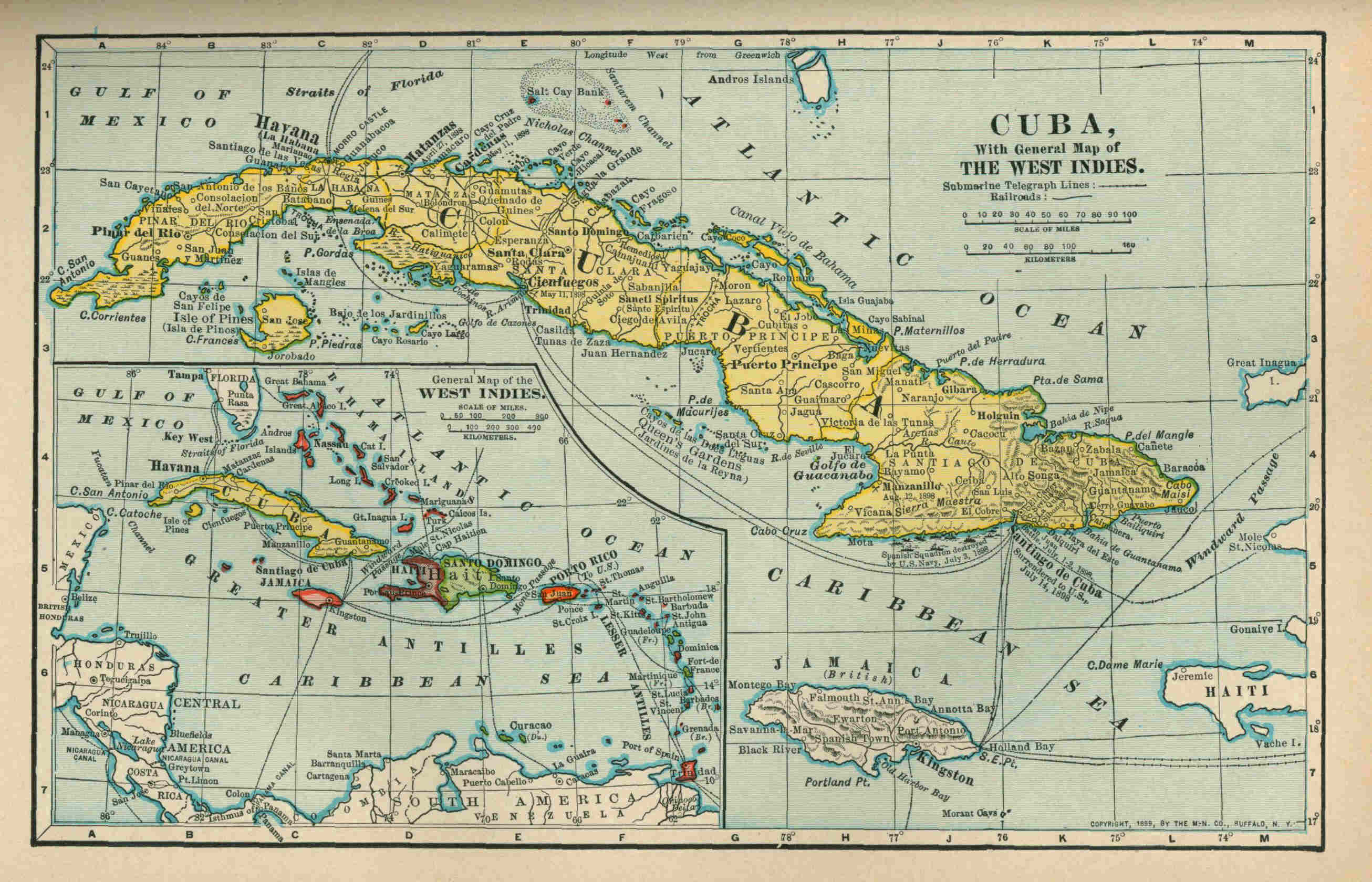
Map of Cuba and West Indies. CUBA: A. D. 1868-1885. Ten years of insurrection. The United States and Spain. The Affair of the Virginius. End of Slavery. "The abolition of slavery in the southern states left the Spanish Antilles in the enjoyment of a monopoly of slave labor, which, in the production of sugar, especially, gave them advantages which overcame all competition. This led to the formation of a strong Spanish party, for whom the cause of slavery and that of Spanish dominion were identical. These were known as Peninsulars or Spanish immigrants. They were the official class, the wealthy planters and slave-owners, and the real rulers of Cuba. Their central organization was the Casino Espagñol of Havana, which was copied in all the towns of the island, and through these clubs they controlled the volunteers, who at times numbered 60,000 or 70,000. … These volunteers never took the field, but held possession of all the cities and towns, and thus were able to defy even the captain-general. They were obedient to his orders only so long as he was acting in close accord with the wishes of their party. On the other hand, there was a party composed of Creoles, or native Cubans, whose cry was 'Cuba for the Cubans!' and who hoped to effect the complete separation of the island from Spain, either through their own efforts or through the assistance of the United States. … "The Spanish revolution of September, 1868, was the signal for an uprising of the native or Creole party in the eastern part of the island under the leadership of Cespedes. This movement was not at first ostensibly for independence, but for the revolution in Spain, the cries being, 'Hurrah for Prim!' 'Hurrah for the Revolution!' Its real character was, however, apparent from the first, and its supporters continued for a period of ten years, without regard to the numerous vicissitudes through which the Spanish Government passed—the provisional government, the regency, the elective monarchy, the republic, and the restored Bourbon dynasty—to wage a dogged, though desultory warfare against the constituted authorities of the island. This struggle was almost conterminous with President Grant's Administration of eight years." {171} President Grant made early offers of mediation between Spain and the insurgents, but no agreement as to terms could be reached. An increasing sympathy with the Cubans raised demands in the United States for their recognition as belligerents, with belligerent rights, and the President is said to have been ready to yield to the demand, but was deterred by the influence of his Secretary of State, Mr. Fish, who contended that the insurgents had established no government that could claim such rights. The Cuban sympathizers in Congress were accordingly checked by an opposing message (June 13, 1870), and no interference occurred. "In February, 1873, when King Amadeus resigned his crown and a republic was proclaimed in Spain, the United States made haste to give the new government recognition and support, which led to friendly relations between the two countries for a time, and promised happy results. The Spanish republicans were being urged to give the Cubans self-government and end slavery in the whole Spanish domain, and they were lending, at least, a considerate ear to the advice. But negotiation on that topic was soon disturbed. On October 31, 1873, the steamer 'Virginius,' sailing under American colors and carrying a United States registry, was captured on the high seas by the 'Tornado,' a Spanish war vessel, and on the afternoon of the first of November taken into the port of Santiago de Cuba. The men and supplies she bore were bound for the insurgents, but the capture did not occur in Cuban waters. General Burriel, the commandant of the city, summoned a court-martial, and, in spite of the protests of the American consul, condemned to death—at the first sitting—four of the passengers—General W. A. C. Ryan, an Irish patriot, and three Cubans. They were shot on the morning of November 4. On the 7th twelve other passengers were executed, and on the 8th Captain Fry and his entire crew, numbering 36, making the total number of executions 53." This barbarous procedure caused hot excitement in the United States, and demands for reparation were made so sharply that the two countries came near to war. In the end it was shown that the "Virginius" was sailing under the American flag without right, being owned by Cubans and controlled by them. The vessel was surrendered, however, but foundered off Cape Fear, while being conveyed to the United States. Her surviving passengers were released, and an indemnity was paid for all who were put to death. The brutal officer who took their lives was never brought to justice, though his punishment was promised again and again. On the settlement of the Virginius question, the government of the United States resumed its efforts to wring concessions to the Cubans from Spain, and sought to have its efforts supported by Great Britain and other European powers. Cold replies came from all the cabinets that were approached. At the same time, the Spanish government met the demand from America with promises so lavish (April, 1876), going so far in appearance towards all that had been asked, that no ground for intervention seemed left. The act of Secretary Fish, in proposing intervention to foreign powers, was sharply criticised as a breach of the Monroe doctrine; but he made no defense. "The Cuban struggle continued for two years longer. In October, 1877, several leaders surrendered to the Spanish authorities and undertook the task of bringing over the few remaining ones. Some of these paid for their efforts with their lives, being taken and condemned by court-martial, by order of the commander of the Cuban forces. Finally, in February, 1878, the terms of pacification [under an agreement called the Treaty of El Zanjon] were made known. They embraced representation in the Spanish Cortes, oblivion of the past as regarded political offences committed since the year 1868, and the freedom of slaves in the insurgent ranks. In practice, however, the Cuban deputies were never truly representative, but were men of Spanish birth, designated usually by the captain-general. By gradual emancipation, slavery ceased to exist in the island in 1885. The powers of the captain-general, the most objectionable feature of Spanish rule, continued uncurtailed." J. H. Latané, The Diplomatic Relations of the United States and Spanish America, chapter 3. CUBA: A. D. 1895. Insurrection renewed. Early in 1895 a new uprising of the oppressed Cubans was begun, and on the 7th of December, in that year, T. Estrada Palma, writing as their authorized representative, presented to the State Department at Washington a statement setting forth the causes of the revolt and describing its state of organization at that time. The causes, he wrote, "are substantially the same as those of the former revolution, lasting from 1868 to 1878, and terminating only on the representation of the Spanish Government that Cuba would be granted such reforms as would remove the grounds of complaint on the part of the Cuban people. Unfortunately the hopes thus held out have never been realized. The representation which was to be given the Cubans has proved to be absolutely without character; taxes have been levied anew on everything conceivable; the offices in the island have increased, but the officers are all Spaniards; the native Cubans have been left with no public duties whatsoever to perform, except the payment of taxes to the Government and blackmail to the officials, without privilege even to move from place to place in the island except on the permission of the governmental authority. Spain has framed laws so that the natives have substantially been deprived of the right of suffrage. The taxes levied have been almost entirely devoted to support the army and navy in Cuba, to pay interest on the debt that Spain has saddled on the island, and to pay the salaries of the vast number of Spanish officeholders, devoting only $746,000 for internal improvements out of the $26,000,000 collected by tax. No public schools are within reach of the masses for their education. All the principal industries of the island are hampered by excessive imposts. Her commerce with every country but Spain has been crippled in every possible manner, as can readily be seen by the frequent protests of shipowners and merchants. The Cubans have no security of person or property. The judiciary are instruments of the military authorities. Trial by military tribunals can be ordered at any time at the will of the Captain-General. There is, beside, no freedom of speech, press, or religion. In point of fact, the causes of the Revolution of 1775 in this country were not nearly as grave as those that have driven the Cuban people to the various insurrections which culminated in the present revolution. … {172} "Years before the outbreak of the present hostilities the people within and without the island began to organize, with a view of preparing for the inevitable revolution, being satisfied, after repeated and patient endeavors, that peaceful petition was fruitless. In order that the movement should be strong from the beginning, and organized both as to civil and military administration, the Cuban Revolutionary party was founded, with José Marti at its head. The principal objects were by united efforts to obtain the absolute independence of Cuba, to promote the sympathy of other countries, to collect funds with these objects in view, and to invest them in munitions of war. The military organization of this movement was completed by the election of Maximo Gomez as commander in chief. This election was made by the principal officers who fought in the last revolution. The time for the uprising was fixed at the solicitation of the people in Cuba, who protested that there was no hope of autonomy, and that their deposits of arms and ammunition were in danger of being discovered and their leaders arrested. A large amount of war material was then bought by Marti, and vessels chartered to transport it to Cuba, where arrangements were made for its reception in the provinces of Santiago, Puerto Principe, and Santa Clara; but at Fernandina, Florida, it was seized by the United States authorities. Efforts were successfully made for the restitution of this material; nevertheless valuable time and opportunity was thus lost. The people in Cuba clamored for the revolution to proceed immediately, and in consequence the uprising was not further postponed. The date fixed for the uprising was the 24th of February. The people responded in Santiago, Santa Clara, and Matanzas. The provinces of Puerto Principe and Pinar del Rio did not respond, owing to lack of arms. In Puerto Principe rigorous search had previous to the 24th been instituted, and all arms and ammunition confiscated by the Government. The leaders in the provinces of Matanzas and Santa Clara were imprisoned, and so the movement there was checked for the time being. … In the province of Santiago the revolution rapidly increased in strength under the leadership of Bartolome Masso; one of the most influential and respected citizens of Manzanillo; Guillermo Moncada, Jesus Rabi, Pedro Perez, Jose Miro, and others. It was characterized by the Spanish Government as a negro and bandit movement, but many of the most distinguished and wealthy white citizens of the district flocked to the insurgent camp. … On the 1st of April, Generals Antonio and José Maceo, Flor Crombet, and Augustin Cebreco, all veteran leaders in the former revolt, landed at Duaba, in the province of Santiago, and thousands rose to join them. Antonio Maceo then took command of the troops in that province, and on the 11th of April a detachment received Generals Maximo Gomez, José Marti, Francisco Borrerro, and Angel Guerra. Captain-General Calleja was, on the 16th of April, succeeded by General Arsenio Martinez Campos, the present commander in chief of the Spanish forces, who has the reputation of being Spain's greatest living general. … The military organization of the Cubans is ample and complete. Major General Maximo Gomez is the commander in chief, as we have said, of all the forces, a veteran of the last revolution, as indeed are all the generals almost without exception. Major General Antonio Maceo is second in command of the army of liberation, and was, until called upon to cooperate with the commander in chief in the late march to the western province, in command of Santiago. The army is at present divided into five corps—two in Santiago, one in Puerto Principe, and two in Santa Clara and Matanzas. … "As above indicated, Jose Marti was the head of the preliminary civil organization, and he, immediately upon landing with Gomez in Cuba, issued a call for the selection of representatives of the Cuban people to form a civil government. His death [in an engagement at Boca de Dos Rios, May 19] postponed for a time the selection of these men, but in the beginning of September the call previously issued was complied with. Representatives from each of the provinces of Santiago, Puerto Principe, Santa Clara, and the western part of the island, comprising the provinces of Matanzas and Havana, making twenty in all, were elected to the constituent assembly, which was to establish a civil government, republican in form. … A constitution of the Republic of Cuba was adopted on the 16th of September. … On the 18th of September … officers of the Government were elected by the constituent assembly in accordance with the terms of the constitution. … "The Spaniards charge, in order to belittle the insurrection, that it is a movement of negroes. It should be remembered that not more than one-third of the entire population are of the colored race. As a matter of fact, less than one-third of the army are of the colored race. Take, for instance, the generals of corps, divisions, and brigades; there are but three of the colored race, namely, Antonio and José Maceo and Augustin Cebreco, and these are mulattoes whose deeds and victories have placed them far above the generals of those who pretend to despise them. None of the members of the constituent assembly or of the government are of the colored race. The Cubans and the colored race are as friendly in this war as they were in times of peace. … "The subject … which has caused probably the most discussion is the order of General Gomez to prevent the grinding of sugar cane and in case of the disobedience of said order the destruction of the crop. … The reasons underlying this measure are the same which caused this country to destroy the cotton crop and the baled cotton in the South during the war of the secession. The sugar crop is a source of large income to the Spanish Government, directly by tax and export duty, as well as indirectly. The action of the insurgents is perfect]y justified, because it is simply a blockade, so to speak, on land—a prevention of the gathering, and hence the export, of the commodity with, naturally, a punishment for the violation thereof. … {173} "In view of the history of this revolution as herein stated, in view of the causes which led to it, its rapid growth, its successes in arms, the establishment, operation, and resources of the Government of the Cuban Republic, the organization, number, and discipline of its army, the contrast in the treatment of prisoners to that of the enemy, the territory in its control and subject to the carrying out of its decrees, of the futility of the attempts of the Spanish Government to crush the revolution, in spite of the immense increase of its army in Cuba and of its blockade and the many millions spent for that purpose, the cruelties which on the part of the Spanish have especially characterized this sanguinary and fiercely conducted war, and the damage to the interests of the citizens of this country under the present conditions, I, as the duly accredited representative, in the name of the Cuban people in arms who have fought singly and alone against the monarchy of Spain for nearly a year, in the heart of a continent devoted to republican institutions, in the name of justice, in the name of humanity, in the name of liberty, petition you, and through you the Government of the United States of America, to accord the rights of belligerency to a people fighting for their absolute independence." United States, 54th Congress, 1st Session, Senate Document Number 166. CUBA: A. D. 1896-1897. Captain-General Campos succeeded by General Weyler. Weyler's Concentration Order and other edicts. Death of Antonio Maceo. Weyler succeeded by Blanco. In January, 1896, Governor and Captain-General Campos, whose policy had been as humane and conciliatory as his Spanish surroundings would permit it to be, was recalled, and Don Valeriano Weyler y Nicolau, Marquis of Teneriffe, and lately Captain-General of Catalonia, was sent to take his place. General Weyler arrived at Havana on the 10th of February, and six days later, before he could possibly have acquired any personal knowledge of the conditions with which he had to deal, he issued three military edicts, in which a policy of merciless ruin to the island was broadly set forth. The first of these edicts or proclamations commanded as follows: "Article 1. All inhabitants of the district of Sancti Spiritus and the provinces of Puerto Principe and Santiago de Cuba will have to concentrate in places which are the headquarters of a division, a brigade, a column, or a troop, and will have to be provided with documentary proof of identity, within eight days of the publication of this proclamation in the municipalities. "Article 2. To travel in the country in the radius covered by the columns in operation, it is absolutely indispensable to have a pass from the mayor, military commandants, or chiefs of detachments. Anyone lacking this will be detained and sent to headquarters of divisions or brigades, and thence to Havana, at my disposition, by the first possible means. Even if a pass is exhibited, which is suspected to be not authentic or granted by authority to person with known sympathy toward the rebellion, or who show favor thereto, rigorous measures will result to those responsible. "Article 3. All owners of commercial establishments in the country districts will vacate them, and the chiefs of columns will take such measures as the success of their operations dictates regarding such places which, while useless for the country's wealth, serve the enemy as hiding places in the woods and in the interior. "Article 4. All passes hitherto issued hereby become null and void." The order of "concentration" contained in the first article of this decree was slowly executed, but ultimately it produced horrors of suffering and death which words could hardly describe. The second of Weyler's edicts delegated his own unlimited "judicial attributes," for the enforcement of the "military code of justice," to certain subordinate commanders, and gave sharp directions for their exercise. The third specified a large number of offenses as being "subject to military law," including in the category every use of tongue or pen that could be construed as "favorable to the rebellion," or as injurious to the "prestige" of the Spanish army, or "the volunteers, or firemen, or any other force that co-operates with the army." It is said to have been nearly a year before the Weyler policy of "concentration" was generally carried out; but even before that occurred the misery of the country had become very great. Both parties in the war were recklessly laying waste the land. The insurgent leaders had published orders for a total destruction of sugar factories and plantations, because the product supplied revenues to Spain; and now the Spanish governor struck all traffic and industry down in the rural districts, by driving the inhabitants from their homes and fields, to concentrate and pen them up in certain prescribed places, with practically no provision for employment, or shelter or food. At the close of the year 1896 the state of suffering in the island was not yet at its worst; but already it was riveting the attention of the neighboring people of the United States, exciting a hot feeling against Spain and a growing desire for measures on the part of the American government to bring it to an end. Repeated attempts had already been made by frothy politicians in Congress to force the country into an attitude toward Spain that would challenge war; but the Executive, supported by a congressional majority, and by the better opinion of the American public, adhered with firmness to a policy which aimed at the exhausting of pacific influences in favor of the Cuban cause. In his annual message to Congress at the opening of the session in December, 1896, President Cleveland set forth the situation in the following words: "It is difficult to perceive that any progress has thus far been made towards the pacification of the island. … If Spain still holds Havana and the seaports and all the considerable towns, the insurgents still roam at will over at least two-thirds of the inland country. If the determination of Spain to put down the insurrection seems but to strengthen with the lapse of time, and is evinced by her unhesitating devotion of largely increased military and naval forces to the task, there is much reason to believe that the insurgents have gained in point of numbers, and character, and resources, and are none the less inflexible in their resolve not to succumb, without practically securing the great objects for which they took up arms. If Spain has not yet re-established her authority, neither have the insurgents yet made good their title to be regarded as an independent state. Indeed, as the contest has gone on, the pretense that civil government exists on the island, except so far as Spain is able to maintain it, has been practically abandoned. Spain does keep on foot such a government, more or less imperfectly, in the large towns and their immediate suburbs. But, that exception being made, the entire country is either given over to anarchy or is subject to the military occupation of one or the other party. … In pursuance of general orders, Spanish garrisons are now being withdrawn from plantations and the rural population required to concentrate itself in the towns. The sure result would seem to be that the industrial value of the island is fast diminishing, and that unless there is a speedy and radical change in existing conditions, it will soon disappear altogether. … {174} "The spectacle of the utter ruin of an adjoining country, by nature one of the most fertile and charming on the globe, would engage the serious attention of the Government and people of the United States in any circumstances. In point of fact, they have a concern with it which is by no means of a wholly sentimental or philanthropic character. It lies so near to us as to be hardly separated from our territory. Our actual pecuniary interest in it is second only to that of the people and Government of Spain. It is reasonably estimated that at least from $30,000,000 to $50,000,000 of American capital are invested in plantations and in railroad, mining, and other business enterprises on the island. The volume of trade between the United States and Cuba, which in 1889 amounted to about $64,000,000, rose in 1893 to about $103,000,000, and in 1894, the year before the present insurrection broke out, amounted to nearly $96,000,000. Besides this large pecuniary stake in the fortunes of Cuba, the United States finds itself inextricably involved in the present contest in other ways both vexatious and costly. … These inevitable entanglements of the United States with the rebellion in Cuba, the large American property interests affected, and considerations of philanthropy and humanity in general, have led to a vehement demand in various quarters, for some sort of positive intervention on the part of the United States. … "It would seem that if Spain should offer to Cuba genuine autonomy—a measure of home rule which, while preserving the sovereignty of Spain, would satisfy all rational requirements of her Spanish subjects—there should be no just reason why the pacification of the island might not be effected on that basis. Such a result would appear to be in the true interest of all concerned. … It has been objected on the one side that Spain should not promise autonomy until her insurgent subjects lay down their arms; on the other side, that promised autonomy, however liberal, is insufficient, because without assurance of the promise being fulfilled. … Realizing that suspicions and precautions on the part of the weaker of two combatants are always natural and not always unjustifiable—being sincerely desirous in the interest of both as well as on its own account that the Cuban problem should be solved with the least possible delay—it was intimated by this Government to the Government of Spain some months ago that, if a satisfactory measure of home rule were tendered the Cuban insurgents, and would be accepted by them upon a guaranty of its execution, the United States would endeavor to find a way not objectionable to Spain of furnishing such guaranty. While no definite response to this intimation has yet been received from the Spanish Government, it is believed to be not altogether unwelcome, while, as already suggested, no reason is perceived why it should not be approved by the insurgents. … "It should be added that it can not be reasonably assumed that the hitherto expectant attitude of the United States will be indefinitely maintained. While we are anxious to accord all due respect to the sovereignty of Spain, we can not view the pending conflict in all its features, and properly apprehend our inevitably close relations to it, and its possible results, without considering that by the course of events we may be drawn into such an unusual and unprecedented condition, as will fix a limit to our patient waiting for Spain to end the contest, either alone and in her own way, or with our friendly co-operation." President Cleveland's Message to Congress, December 7, 1896. Just at this time (December 7, 1896) the Cuban insurgents suffered a serious calamity, in the death of Antonio Maceo, the heroic mulatto, who seems to have been the most soldierly and inspiring of their leaders. He had broken through the "trocha," or fortified line across the island, by which the Spaniards were endeavoring to hold its western part, and had been troubling them in the province of Pinar del Rio for some months. At length he was killed in an unimportant skirmish, and much of the vigor of the insurrection appears to have gone out of it when he died. The obstinacy of spirit remained, nevertheless, and all the merciless energy of Weyler only spread death and misery, without opening any prospect of an end to the state of war. Spain was being utterly exhausted by the immense cost of the struggle; Cuba was being ruined and depopulated; yet neither would yield. The oppressors would not set their victims free; the oppressed would not submit. But, politically, the situation continued for another year as it had been when described by President Cleveland at the close of 1896. The only visible authority was that which the Spaniards maintained here and there. The revolutionists established no government that could reasonably be given the name, and their "Republic of Cuba," which foolish people in the United States were clamoring to have recognized, existed on paper alone. To concede "belligerent rights" to the scattered bands of insurgents would only bring them under crippling rules of international law, and do no good to their cause. President McKinley, who succeeded President Cleveland in March, 1897, made no change in the policy which the latter had pursued. He continued the insistent pressure by which it was sought to persuade the Spanish government to give a satisfying measure of free government to its great dependency. After some months there appeared to be a fair promise of success. The Liberal party had come into power at Madrid, with Sagasta at its head. In October, Weyler was recalled, General Blanco took his place, and a new constitution for Cuba was announced, giving the colony what seemed to be a fairly autonomous government, under a parliament of its own. In his message to Congress the following December, President McKinley was able to meet the continued clamor for more violent measures of interference by saying: "It is honestly due to Spain, and to our friendly relations with Spain, that she should be given a reasonable chance to realize her expectations, and to prove the asserted efficacy of the new order of things to which she stands irrevocably committed. She has recalled the commander whose brutal orders inflamed the American mind and shocked the civilized world. She has modified the horrible order of concentration, and has undertaken to care for the helpless and permit those who desire to resume the cultivation of their fields to do so, and assures them the protection of the Spanish Government in their lawful occupations." {175} But the awful tragedy of suffering among the "reconcontrados" had excited lookers-on to such a pitch that the conduct of Spain in any new line of policy could no longer be fairly judged. There had been attempts on the part of the Spanish authorities to give some relief to the starved and perishing multitude, and help to that end had been accepted from the United States. The American Red Cross Society, with Miss Clara Barton at its head, entered the island in December, with vast stores of food and hospital supplies, and a strong force of generous workers; but the need was far beyond their means. The tale of death and misery in the stricken country seemed to grow more sickening every day. CUBA: A. D. 1897 (November). Constitution establishing self-government in the islands of Cuba and Porto Rico, promulgated by Royal Decree. The following is a translation of the text of the Constitution establishing self-government in the islands of Cuba and Porto Rico which was promulgated by royal decree at Madrid on the 25th of November, 1897: Upon the proposition of my Prime Minister, and with the concurrence of the Council of Ministers in the name of my august son, King Alfonso XIII, and as Queen Regent of the Kingdom, I hereby decree as follows: [Footnote Start] EXPLANATORY NOTE. To facilitate the understanding of this decree and to avoid confusion as to the legal value of the terms employed therein the following definitions are to be observed: Central Executive Power: The King with his Council of Ministers. The Spanish Parliament: The Cortes with the King. The Spanish Chambers: The Congress and the Senate. The Central Government: The Council of Ministers of the Kingdom. The Colonial Parliament: The two Chambers with the Governor-General. The Colonial Chambers: The Council of Administration and the Chamber of Representatives. Colonial Legislative Assemblies: The Council of Administration and the Chamber of Representatives. Governor-General in Council: The Governor-General with the Secretaries of his Cabinet. Instructions of the Governor-General: Those which he may have received when named for his office. Statute: Colonial measure of a legislative character. Colonial Statutes: Colonial Legislation. Legislation or General Laws: Legislation or laws of the Kingdom. [Footnote End] TITLE I. GOVERNMENT AND CIVIL ADMINISTRATION IN THE ISLANDS OF CUBA AND PORTO RICO. ARTICLE 1. The system of government and civil administration in the islands of Cuba and Porto Rico shall hereafter be carried on in conformity with the following provisions: ARTICLE 2. Each island shall be governed by an insular parliament, consisting of two chambers, and by the Governor-General, representing the mother country, who shall exercise supreme authority. TITLE II. THE INSULAR CHAMBERS. ARTICLE 3. The legislative power as to colonial matters in the shape and manner prescribed by law, shall be vested in the insular chambers conjointly with the Governor-General. ARTICLE 4. Insular representation shall consist of two bodies of equal powers, which shall be known as chamber of representatives and council of administration. TITLE III. COUNCIL OF ADMINISTRATION. ARTICLE 5. The council shall be composed of thirty-five members, of whom eighteen shall be elected in the manner directed by the electoral law and seventeen shall be appointed by the Governor-General acting for the Crown, from among such persons as have the qualifications specified in the following articles: ARTICLE 6. To be entitled to sit in the council of administration it is necessary to be a Spanish subject; to have attained the age of thirty-five years; to have been born in the island, or to have had four years' constant residence therein; not to be subject to any pending criminal prosecution; to be in the full enjoyment of his political rights; to have his property free from attachment; to have had for two or more years previous an annual income of four thousand dollars; to have no interest in any contract with either the insular or the home government. The shareholders of a stock company shall not be considered as government contractors, even if the company has a contract with the government. ARTICLE 7. Persons are also qualified to serve as councilors who, besides the above-stated requirements, have any of the following qualifications: 1. To be or to have been a senator of the Kingdom, or to possess the requirements for being a senator, in conformity with Article III of the constitution. 2. To have held for a period of two years any of the following offices: President, or prosecuting attorney of the pretorian court of Havana; rector of the University of Havana; councilor of administration in the council formerly thus designated; president of the Havana Chamber of Commerce; president of the Economic Society of Friends of the Country; president of the Sugar Planters' Association; president of the Tobacco Manufacturers' Union; president of the Merchants, Tradesmen's, and Agriculturalists' League; dean of the bar of Havana; mayor of Havana; president of the provincial assembly of Havana during two terms or of any provincial assembly during three terms; dean of either of the chapters of the two cathedrals. 3. Likewise may be elected or appointed as councilor any property owner from among the fifty taxpayers paying the highest taxes, either on real estate or on industries, commerce, arts, and the professions. ARTICLE 8. The councilors appointed by the Crown shall be appointed by special decrees, stating the qualification entitling the appointee to serve as councilor. Councilors thus appointed shall hold office for life. One-half the number of elective councilors shall be elected every five years, and the whole number shall be elected whenever the council of administration shall be dissolved by the Governor-General. ARTICLE 9. The qualifications required in order to be appointed or elected councilor of administration may be changed by a national law, at the request or upon the proposition of the insular chambers. ARTICLE 10. No councilor shall, during the session of the council, accept any civil office, promotion (unless it be strictly by seniority), title, or decoration; but any councilor may be appointed by either the local or the home government to any commission within his own profession or category, whenever the public service shall require it. The secretaries of the insular government shall be excepted from the foregoing rule. {176} TITLE IV. THE CHAMBER OF REPRESENTATIVES. ARTICLE 11. The chamber of representatives shall be composed of members named by the electoral boards in the manner prescribed by law and in the proportion of one for every twenty-five thousand inhabitants. ARTICLE 12. To be elected as representative the candidate must have the following requirements: To be a Spanish citizen, to be a layman, to have attained his majority, to be in full enjoyment of civil rights, to have been born in the island or to have had four years' constant residence therein, and not to be subject to any pending criminal prosecution. ARTICLE 13. Representatives shall be elected every five years, and any representative may be re-elected any number of times. The insular chamber shall determine what classes of offices are incompatible with the office of representative, as well as the cases governing re-election. ARTICLE 14. Any representative upon whom either the local or home government shall confer a pension, or any employment, promotion (unless it be by strict seniority), paid commission, title, or decoration, shall cease to be such without necessity of any declaration to that effect, unless he shall within fifteen days of his appointment notify the chamber of his having declined the favor. The provisions of the preceding paragraph shall not include the representatives who shall be appointed members of the cabinet. TITLE V. PROCEEDINGS OF THE INSULAR CHAMBERS AND THEIR RELATIONS TO EACH OTHER. ARTICLE 15. The chambers will meet every year. The King, the Governor-General acting in his name, shall convene, suspend, and adjourn the sessions and dissolve the chamber of representatives and the council of administration, either separately or simultaneously, under the obligation to call them together again or renew them within three months. ARTICLE 16. Each of the two legislative bodies shall determine the rules of their proceedings and shall be the judges of the qualifications of their respective members and the legality of their election. Until the chamber and the council shall pass their own rules, they shall be governed by the rules of the national house of representatives and of the senate, respectively. ARTICLE 17. Each chamber shall choose its president, vice-president and secretaries. ARTICLE 18. Neither chamber shall sit unless the other be sitting also, except when the council exercises judicial functions. ARTICLE 19. The two insular chambers shall not deliberate together nor in the presence of the Governor-General. The sessions shall be public, but either chamber may hold secret sessions whenever business of a private nature shall require it. ARTICLE 20. To the Governor-General, through his secretaries, as well as to either of the two chambers, belongs the power to initiate and propose colonial statutes. ARTICLE 21. All colonial statutes in regard to taxes and the public credit shall originate in the chamber of representatives. ARTICLE 22. Resolutions may be passed by either chamber by a plurality of votes; but in order to pass a measure of a legislative character a majority of all the members constituting the body must be present. Nevertheless, one-third of the members shall constitute a quorum for deliberation. ARTICLE 23. No resolution or law shall be considered passed by the insular parliament unless it has had the concurrence of the chamber of representatives and the council of administration. ARTICLE 24. Every colonial statute, as soon as it has been approved in the form prescribed in the preceding article, shall be presented to the Governor-General by the officers of both chambers for his sanction and proclamation of the same. ARTICLE 25. Members of the council and the chamber of representatives shall have immunity for any speech or vote in either chamber. ARTICLE 26. No councilor of administration shall be indicted or arrested without a previous resolution of the council, unless he shall be found "in flagranti" or the council shall not be in session, but in every case notice shall be given to that body as soon as possible, that it may determine what should be done. Nor shall the representatives be indicted or arrested during the sessions without the permission of the chamber unless they are found "in flagranti," but in this last case, or in case of indictment or arrest when the chamber is not sitting, notice shall be given as soon us possible to the chamber of representatives for its information and action. All proceedings against councilors and representatives shall be brought before the pretorian court at Havana in the cases and manner that shall be prescribed by colonial statutes. ARTICLE 27. The guarantees established in the foregoing section shall not apply to a councilor or representative who shall himself admit that he is the author of any article, book, pamphlet, or printed matter wherein military sedition is incited or invoked, or the Governor-General is insulted and maligned, or national sovereignty is assailed. ARTICLE 28. The relations between the two chambers shall be governed, until otherwise provided, by the act of July 19, 1837, regulating the relations between the two legislative houses of the Cortes. ARTICLE 29. Besides the power of enacting laws for the colony the insular chambers shall have power: 1. To receive the oath of the Governor-General to preserve the constitution and the laws which guarantee the autonomy of the colony. 2. To enforce the responsibility of the secretaries of the executive, who shall be tried by the council, whenever impeached by the chamber of representatives. 3. To address the home government through the Governor-General, proposing the abrogation or modification of existing laws of the Kingdom; to invite the home government to present bills as to particular matters, or to ask a decision of an executive character on matters which interest the colony. ARTICLE 30. The Governor-General shall communicate to the home government before presenting to the insular parliament any bill originating in the executive government of the island whenever, in his judgment, said bill may affect national interests. Should any such bill originate in the insular parliament, the government of the island shall ask for a postponement of the debate until the home government shall have given its opinion. In either case the correspondence passing between the two governments shall be laid before the chambers and published in the official Gazette. {177} ARTICLE 31. All differences of jurisdiction between the several municipal, provincial, and insular assemblies, or between any of them and the executive, which by their nature may not be referred to the home government, shall be submitted to the courts of justice in accordance with the rules herein prescribed. TITLE VI. POWERS VESTED IN THE INSULAR PARLIAMENT. ARTICLE 32. The insular chambers shall have power to pass upon all matters not specially and expressly reserved to the Cortes of the Kingdom or to the central government as herein provided, or as may be provided hereafter, in accordance with the prescription set forth in additional Article 2. In this manner, and without implying that the following enumeration presupposes any limitation of their power to legislate on other subjects, they shall have power to legislate on all matters and subjects concerning the departments of justice, interior, treasury, public works, education, and agriculture. They shall likewise have exclusive cognizance of all matters of a purely local nature which may principally affect the colonial territory; and to this end they shall have power to legislate on civil administration; on provincial, municipal, or judicial apportionment; on public health, by land or sea, and on public credit, banks, and the monetary system. This power, however, shall not impair the powers vested in the colonial executive according to the laws in connection with the matters above mentioned. ARTICLE 33. It shall be incumbent upon the colonial parliament to make regulations under such national laws as may be passed by the Cortes and expressly intrusted to it. Especially among such measures parliament shall legislate, and may do so at the first sitting, for the purpose of regulating the elections, the taking of the electoral census, qualifying electors, and exercising the right of suffrage; but in no event shall these dispositions affect the rights of the citizens, as established by the electoral laws. ARTICLE 34. Notwithstanding that the laws governing the judiciary and the administration of justice are of a national character, and therefore obligatory for the colony, the insular parliament may, within the provisions of said laws, make rules or propose to the home government such measures as shall render easier the admission, continuance, or promotion in the local courts of lawyers, natives of the island, or practicing therein. The Governor-General in council shall have, as far as the island of Cuba is concerned, the same power that has been vested heretofore in the minister for the colonies for the appointment of the functionaries and subordinate and auxiliary officers of the judicial order and as to the other matters connected with the administration of justice. ARTICLE 35. The insular parliament shall have exclusive power to frame the local budget of expenditures and revenues, including the revenue corresponding to the island as her quota of the national budget. To this end the Governor-General shall present to the chambers every year before the month of January the budget for the next fiscal year, divided in two parts, as follows: The first part shall state the revenues needed to defray the expenses of sovereignty, and the second part shall state the revenues and expenditures estimated for the maintenance of the colonial administration. Neither chamber shall take up the budget of the colonial government without having finally voted the part for the maintenance of sovereignty. ARTICLE 36. The Cortes of the Kingdom shall determine what expenditures are to be considered by reason of their nature as obligatory expenses inherent to sovereignty, and shall fix the amount every three years and the revenue needed to defray the same, the Cortes reserving the right to alter this rule. ARTICLE 37. All treaties of commerce affecting the island of Cuba, be they suggested by the insular or by the home government, shall be made by the latter with the co-operation of special delegates duly authorized by the colonial government, whose concurrence shall be acknowledged upon submitting the treaties to the Cortes. Said treaties, when approved by the Cortes, shall be proclaimed as laws of the Kingdom and as such shall obtain in the colony. ARTICLE 38. Notice shall be given to the insular government of any commercial treaties made without its participation as soon as said treaties shall become laws, to the end that, within a period of three months, it may declare its acceptance or nonacceptance of their stipulations. In case of acceptance the Governor-General shall cause the treaty to be published in the Gazette as a colonial statute. ARTICLE 39. The insular parliament shall also have power to frame the tariff and fix the duties to be paid on merchandise as well for its importation into the territory of the island as for the exportation thereof. ARTICLE 40. As a transition from the old regime to the new constitution, and until the home and insular governments may otherwise conjointly determine hereafter, the commercial relations between the island and the metropolis shall be governed by the following rules: 1. No differential duty, whether fiscal or otherwise, either on imports or exports, shall be imposed to the detriment of either insular or peninsular production. 2. The two governments shall make a schedule of articles of direct national origin to which shall be allowed by common consent preferential duty over similar foreign products. In another schedule made in like manner shall be determined such articles of direct insular production as shall be entitled to privileged treatment on their importation into the peninsula and the amount of preferential duties thereon. In neither case shall the preferential duty exceed 35 per cent. Should the home and the colonial government agree upon the schedules and the preferential duties, they shall be considered final and shall be enforced at once. In case of disagreement the point in dispute shall be submitted to a committee of representatives of the Cortes, consisting of an equal number of Cubans and Peninsulars. The committee shall appoint its chairman, and in case of disagreement the eldest member shall preside. The chairman shall have the casting vote. 3. The valuation tables concerning the articles in the schedules above mentioned shall be fixed by mutual agreement, and shall be revised after discussion every two years. The modifications which may thereupon become necessary in the tariff duties shall be carried out at once by the respective governments. {178} TITLE VII. THE GOVERNOR-GENERAL. ARTICLE 41. The supreme authority of the colony shall be vested in a Governor-General, appointed by the King on the nomination of the council of ministers. In his capacity he shall have as vice-royal patron the power inherent in the patronate of the Indies; he shall have command of all military and naval forces in the island; he shall act as delegate of the departments of state, war, navy, and the colonies; all other authorities in the island shall be subordinate to his, and he shall be responsible for the preservation of order and the safety of the colony. The Governor-General shall, before taking possession of his office, take an oath in the presence of the King to discharge his duties faithfully and loyally. ARTICLE 42. The Governor-General, representing the nation, will discharge by himself and with the aid of his secretaries all the functions indicated in the preceding articles and such others as may devolve upon him as direct delegate of the King in matters of a national character. It shall be incumbent upon the Governor-General as representing the home government: 1. To appoint without restriction the secretaries of his cabinet. 2. To proclaim, execute, and cause to be executed in the island all laws, decrees, treaties, international covenants, and all other acts emanating from the legislative branch of the government, as well as all decrees, royal commands, and other measures emanating from the executive which shall be communicated to him by the departments of which he acts as delegate. Whenever in his judgment and in that of his secretaries he considers the resolutions of the home government as liable to injure the general interests of the nation or the special interests of the island, he shall have power to suspend the publication and execution thereof, and shall so notify the respective department, stating the reasons for his action. 3. To grant pardons in the name of the King, within the limitations specially prescribed to him in his instructions from the government, and to stay the execution of a death sentence whenever the gravity of the circumstances shall so demand or the urgency of the case shall allow of no time to solicit and obtain His Majesty's pardon; but in either case he shall hear the counsel of his secretaries. 4. To suspend the guarantees set forth in articles 3, 5, 6, and 9, and in the first, second, and third paragraphs of article 13 of the constitution; to enforce legislation in regard to public order, and to take all measures which he may deem necessary to preserve the peace within and the safety without for the territory entrusted to him after hearing the counsel of his cabinet. 5. To take care that in the colony justice be promptly and fully administered, and that it shall always be administered in the name of the King. 6. To hold direct communication on foreign affairs with the ministers, diplomatic agents, and counsels of Spain throughout America. A full copy of such correspondence shall be simultaneously forwarded to the home Department of State. ARTICLE 43. It behooves the Governor-General, as the superior authority in the colony and head of its administration: 1. To take care that the rights, powers, and privileges now vested or that may henceforth be vested in the colonial administration be respected and protected. 2. To sanction and proclaim the acts of the insular parliament, which shall be submitted to him by the president and secretaries of the respective chambers. Whenever, in the judgment of the Governor-General, an act of the insular parliament goes beyond its powers or impairs the rights of the citizens as set forth in Article I of the constitution, or curtails the guarantees prescribed by law for the exercise of said rights, or jeopards the interest of the colony or of the nation, he shall forward the act to the council of ministers of the Kingdom, which, within a period that shall not exceed two months, shall either assent to it or return it to the Governor-General with the objections to its sanction and proclamation. The insular parliament may, in view of the objections, reconsider or modify the act, if it deems fit, without a special proposition. If two months shall elapse without the central government giving any opinion as to a measure agreed upon by the chambers which has been transmitted to it by the Governor-General, the latter shall sanction and proclaim the same. 3. To appoint, suspend, and discharge the employees of the colonial administration, upon the suggestion of the secretaries of the departments and in accordance with the laws. 4. To appoint and remove, without restriction, the secretaries of his cabinet. ARTICLE 44. No executive order of the Governor-General, acting as representative and chief of the colony, shall take effect unless countersigned by a secretary of the cabinet, who by this act alone shall make himself responsible for the same. ARTICLE 45. There shall be five secretaries of department, to wit: Grace and justice and interior; finance; public education, public works and posts and telegraphs; agriculture, industry, and commerce. The Governor-General shall appoint the president of the cabinet from among the secretaries, and shall also have power to appoint a president without a secretaryship. The power to increase or diminish the number of secretaries composing the colonial cabinet, and to determine the scope of each department, is vested in the insular parliament. ARTICLE 46. The secretaries of the cabinet may be members of either the chamber of representatives or the council of administration and take part in the debates of either chamber, but a secretary shall only vote in the chamber of which he is a member. ARTICLE 47. The secretaries of the cabinet shall be responsible to the insular parliament. ARTICLE 48. The Governor-General shall not modify or abrogate his own orders after they are assented to by the home government, or when they shall declare some rights, or when a sentence by a judicial court or administrative tribunal shall have been based upon said orders, or when they shall deal with his own competency. ARTICLE 49. The Governor-General shall not turn over his office when leaving the island except by special command from the home government. In case of absence from the seat of government which prevents his discharging the duties of his office or of disability to perform such duties, he can appoint one or more persons to take his place, provided the home government has not previously done so or the method of substitution shall not be stated in his instructions. {179} ARTICLE 50. The supreme court shall have the sole power to try the Governor-General when impeached for his responsibilities as defined by the Penal Code. The council of ministers shall take cognizance of his other responsibilities. ARTICLE 51. The Governor-General shall have the power, in spite of the provisions of the different articles of this decree, to act upon his own responsibility, without consulting his secretaries, in the following cases: 1. When forwarding to the home government a bill passed by the insular parliament, especially when, in his opinion, it shall abridge the rights set forth in Article 1 of the constitution of the monarchy or the guarantees for the exercise thereof vouchsafed by the laws. 2. When it shall be necessary to enforce the law or public order, especially if there be no time or possibility to consult the home government. 3. When enforcing the national laws that shall have been approved by the Crown and made applicable to all of the Spanish or to the colony under his government. The proceedings and means of action which the Governor-General shall employ in the above cases shall be determined by a special law. TITLE VIII. MUNICIPAL AND PROVINCIAL GOVERNMENT. ARTICLE. 52. Municipal organization shall be compulsory for every group of population of more than one thousand inhabitants. Groups of less number of inhabitants may organize the service of their community by special covenants. Every legally constituted municipality shall have power to frame its own laws regarding public education; highways by land, river, and sea; public health; municipal finances, as well as to freely appoint and remove its own employees. ARTICLE 53. At the head of each province there shall be an assembly, which shall be elected in the manner provided for by the colonial statutes, and shall be composed of a number of members in proportion to the population. ARTICLE 54. The provincial assembly shall be autonomous as regards the creation and maintenance of public schools and colleges; charitable institutions and provincial roads and ways by land, river, or sea; also as regards their own budgets and the appointment and removal of their respective employees. ARTICLE 55. The municipalities, as well as the provincial assemblies, shall have power to freely raise the necessary revenue to cover their expenditures, with no other limitation than to make the means adopted compatible with the general system of taxation which shall obtain in the island. The resources for provincial appropriations shall be independent of municipal resources. ARTICLE 56. The mayors and presidents of boards of aldermen shall be chosen by their respective boards from among their members. ARTICLE 57. The mayors shall discharge without limitation the active duties of the municipal administration, as executors of the resolutions of the board of aldermen or their representatives. ARTICLE 58. The aldermen and the provincial assemblymen shall be civilly responsible for the damages caused by their acts. Their responsibility shall be exacted before the ordinary courts of justice. ARTICLE 59. The provincial assemblies shall freely choose their respective presidents. ARTICLE 60. The elections of aldermen and assemblymen shall be conducted in such manner as to allow for a legitimate representation of the minorities. ARTICLE 61. The provincial and municipal laws now obtaining in the island shall continue in vogue, wherever not in conflict with the provisions of this decree, until the insular parliament shall legislate upon the matter. ARTICLE 62. No colonial statute shall abridge the powers vested by the preceding articles in the municipalities and the provincial assemblies. TITLE IX. AS TO THE GUARANTEES FOR THE FULFILLMENT OF THE COLONIAL CONSTITUTION. ARTICLE 63. Whenever a citizen shall consider that his rights have been violated or his interests injured by the action of a municipality or a provincial assembly he shall have the right to apply to the courts of justice for redress. The department of justice shall, if so required by the agents of the executive government of the colony, prosecute before the courts the boards of aldermen or provincial assemblies charged with breaking the laws or abusing their power. ARTICLE 64. In the cases referred to in the preceding article, the following courts shall have jurisdiction: The territorial audiencia shall try all claims against municipalities; and the pretorian court of Havana shall try all claims against provincial assemblies. Said courts, when the charges against any of the above-mentioned corporations shall be for abuse of power, shall render their decisions by a full bench. From the decision of the Territorial audiencia an appeal shall be allowed to the pretorian court of Havana, and from the decisions of the latter an appeal shall be allowed to the supreme court of the Kingdom. ARTICLE 65. The redress of grievances which Article 62 grants to any citizen can also be had collectively by means of public action, by appointing an attorney or representative claimant. ARTICLE 66. Without in any way impairing the powers vested in the Governor-General by Title V of the present decree, he may, whenever he deems fit, appear before the pretorian court of Havana in his capacity as chief of the executive government of the colony, to the end that said court shall finally decide any conflict of jurisdiction between the executive power and the legislative chambers of the colony. ARTICLE 67. Should any question of jurisdiction be raised between the insular parliament and the Governor-General in his capacity as representative of the home government, which shall not have been submitted to the council of ministers of the Kingdom by petition of the insular parliament, either party shall have power to bring the matter before the supreme court of the Kingdom, which shall render its decision by a full bench and in the first instance. ARTICLE 68. The decisions rendered in all cases provided for in the preceding articles shall be published in the collection of colonial statutes and shall form part of the insular legislation. ARTICLE 69. Every municipal measure for the purpose of contracting a loan or a municipal debt shall be without effect, unless it be assented to by a majority of the townspeople whenever one-third of the number of aldermen shall so demand. The amount of the loan or debt which, according to the number of inhabitants of a township, shall make the referendum proceeding necessary, shall be determined by special statute. {180} ARTICLE 70. All legislative acts originating in the insular parliament or the Cortes shall be compiled under the title of colonial statutes in a legislative collection, the formation and publication of which shall be entrusted to the Governor-General as chief of the colonial executive. ADDITIONAL ARTICLES. ARTICLE 1. Until the colonial statutes shall be published in due form, the laws of the Kingdom shall be deemed applicable to all matters reserved to the jurisdiction of the insular government. ARTICLE 2. When the present constitution shall be once approved by the Cortes of the Kingdom for the islands of Cuba and Porto Rico, it shall not be amended except by virtue of a special law and upon the petition of the insular parliament. ARTICLE 3. The provisions of the present decree shall obtain in their entirety in the island of Porto Rico; they shall, however, be ordained by special decree in order to conform them to the population and nomenclature of said island. ARTICLE 4. Pending contracts for public services affecting in common the Antilles and the Peninsula shall continue in their present shape until termination, and shall be entirely governed by the conditions and stipulations therein made. As regards other contracts already entered into, but not yet in operation, the Governor-General shall consult the home government, or the colonial chambers, as the case may be, and the two governments shall by mutual accord decide as between themselves the final form of such contract. TRANSITORY PROVISIONS. ARTICLE 1. With a view to carry out the transition from the present regime to the system hereby established with the greatest possible dispatch and the least interruption of the public business, the Governor-General shall, whenever he deems it timely and after consulting the home government, appoint the secretaries of the executive office as per Article 45 of this decree, and with their aid he shall conduct the local government of the island until the insular chambers shall have been constituted. The secretaries thus appointed shall vacate their offices as soon as the Governor-General shall take his oath of office before the insular chambers, and the Governor-General shall immediately appoint as their successors the members of parliament who, in his judgment, most fully represent the majorities in the chamber of representatives and the council of administration. ARTICLE 2. The manner of meeting the expenditures occasioned by the debt now weighing upon the Spanish and Cuban treasuries, and the debt that may be contracted until the termination of the war, shall be determined by a law fixing the share that shall be borne by each treasury, and the special ways and means for the payment of the interest, and the sinking fund, and for refunding the principal in due time. Until the Cortes of the Kingdom shall decide this point no changes shall be made in the conditions under which said debts were contracted, nor in the payment of the interest, nor provisions for a sinking fund, nor in the guarantees which they enjoy, nor in the actual terms of payment. When the Cortes shall have apportioned the shares, each of the two treasuries shall take upon itself the payment of the share allotted. In no event shall the obligations contracted towards the lenders on the faith of the Spanish nation cease to be scrupulously respected. Issued in the Palace, Madrid, November 25, 1897. MARIA CHRISTINA. The President of the Council of Ministers, PRÁXEDES MATEO SAGASTA. CUBA: A. D. 1897-1898 (November-February). The experiment of autonomy or home rule. It cannot be said that the Constitution of 1897 was given a fair trial. In the circumstances, one may doubt whether a fair trial of its working was possible. It came too late for advantageous testing or unprejudiced judging of its practicability. The autonomist party, which might once have been able to make Cuba a constitutional dependency, like Canada, had been discouraged and broken up. Weyler's policy had excited a feeling in the United States which was too impatient to wait for new experiments in Spanish dealing with Cuba to be worked out, or to estimate reasonably the chances of their success. The first showing of results from the scheme of autonomy was unpromising, as it could hardly have failed to be, and that was readily taken as conclusive in condemnation of it. The judgment of General Fitzhugh Lee, Consul-General of the United States at Havana, had great influence in America, and he saw nothing to expect from the Constitution. In an article contributed subsequently to the "Fortnightly Review," June, 1898, he wrote: "It [the Constitution) was an elaborate system of 'Home Rule' with a string to every sentence; so that I soon became satisfied that, if the insurrection against the Spanish throne on the island ceased, the condition of the Cubans would speedily be the same as it was at the commencement of the war. I gave the reasons therefor in a paper now on file in the State Department which clearly proved that the Spaniards could easily control one of the legislative chambers, and that behind any joint action on the part of both was the veto of the Governor-General, whose appointment was made from the throne in Madrid. "This system of autonomy, however, was gravely proceeded with. An Autonomistic Cabinet was seriously formed, composed in part of Cubans who, though at one time in favour of a government of the island free from Spanish control, had given satisfactory intimations that, if they were appointed to cabinet offices, their former opinions could be modified to suit existing circumstances. Blanco's Autonomistic Government was doomed to failure from its inception. The Spanish soldiers and officers scorned it, because they did not desire Cuban rule, which such autonomy, if genuine, would insure. The Spanish merchants and citizens were opposed to it, because they too were hostile to the Cubans having control of the island, and if the question could be narrowed down to Cuban control or annexation to the United States, they were all annexationists, believing that they could get a better government and one that would protect, in a greater measure, life and property under the United States flag than under the Cuban banner. On the other hand, the Cubans in arms would not touch it, because they were fighting for Free Cuba; and the Cuban citizens and sympathizers, or the non-arm-bearing population, were distinctly opposed to it also; while those in favour of it seemed to consist of the Autonomistic Cabinet, General Blanco, his Secretary-General and Staff, and a few followers elsewhere." {181} Fitzhugh Lee, Cuba and her Struggle for Freedom (Fortnightly Review, June, 1898). CUBA: A. D. 1897-1898 (December-March). Condition of the Reconcentrados. On the 14th of December, 1897, General Fitzhugh Lee, Consul-General of the United States at Havana, reported to the Department of State as follows: "I have the honor to report that I have received information that in the Province of Havana reports show that there have been 101,000 'Reconcentrados,' and that out of that 52,000 have died. Of the said 101,000, 32,000 were children. This excludes the city of Havana and seven other towns from which reports have not yet been made up. It is thought that the total number of 'Reconcentrados' in Havana Province will amount to 150,000, nearly all women and children, and that the death rate among their whole number from starvation alone will be over 50 per cent. For the above number of 'Reconcentrados' $12,500, Spanish silver, was set aside out of the $100,000 appropriated for the purpose of relieving all the 'Reconcentrados' on the island. Seventy-five thousand of the 150,000 may be still living, so if every dollar appropriated of the $12,500 reaches them the distribution will average about 17 cents to a person, which, of course, will be rapidly exhausted, and, as I can hear of no further succor being afforded, it is easy to perceive what little practical relief has taken place in the condition of these poor people." On the 8th of January, 1898, General Lee made another report on the same subject as follows: "I have the honor to state, as a matter of public interest, that the 'reconcentrado order' of General Weyler, formerly Governor-General of this island, transformed about 400,000 self-supporting people, principally women and children, into a multitude to be sustained by the contributions of others or die of starvation or of fevers resulting from a low physical condition and being massed in large bodies without change of clothing and without food. Their houses were burned, their fields and plant beds destroyed, and their live stock driven away or killed. I estimate that probably 200,000 of the rural population in the Provinces of Pinar del Rio, Havana, Matanzas, and Santa Clara have died of starvation, or from resultant causes, and the deaths of whole families almost simultaneously, or within a few days of each other, and of mothers praying for their children to be relieved of their horrible sufferings by death, are not the least of the many pitiable scenes which were ever present. In the Provinces of Puerto Principe and Santiago de Cuba, where the 'reconcentrado order' could not be enforced, the great mass of the people are self-sustaining. A daily average of ten cents' worth of food to 200,000 people would be an expenditure of $20,000 per day, and of course the most humane efforts upon the part of our citizens can not hope to accomplish such a gigantic relief, and a great portion of these people will have to be abandoned to their fate." A little later, Senator Proctor, of Vermont, visited Cuba, for personal observation of the condition of things in the island, and, on his return, made a statement of what he had seen and learned, in a speech to the Senate, which made an impression on the country much deeper than any previous testimony on the subject that had reached the public eye or ear. The following is a part of the account that he gave: "My observations were confined to the four western provinces, which constitute about one-half of the island. The two eastern ones are practically in the hands of the insurgents, except the few fortified towns. These two large provinces are spoken of to-day as 'Cuba Libre.' Outside Habana all is changed. It is not peace nor is it war. It is desolation and distress, misery and starvation. Every town and village is surrounded by a 'trocha' (trench), a sort of rifle pit, but constructed on a plan new to me, the dirt being thrown up on the inside and a barbed-wire fence on the outer side of the trench. These trochas have at every corner and at frequent intervals along the sides what are there called forts, but which are really small blockhouses, many of them more like large sentry boxes, loopholed for musketry, and with a guard of from two to ten soldiers in each. "The purpose of these trochas is to keep the Reconcentrados in as well as to keep the insurgents out. From all the surrounding country the people have been driven in to these fortified towns and held there to subsist as they can. They are virtually prison yards, and not unlike one in general appearance, except that the walls are not so high and strong; but they suffice, where every point is in range of a soldier's rifle, to keep in the poor reconcentrado women and children. Every railroad station is within one of these trochas and has an armed guard. Every train has an armored freight car, loopholed for musketry and filled with soldiers, and with, as I observed usually, and was informed is always the case, a pilot engine a mile or so in advance. There are frequent blockhouses inclosed by a trocha and with a guard along the railroad track. With this exception there is no human life or habitation between these fortified towns and villages, and throughout the whole of the four western provinces, except to a very limited extent among the hills where the Spaniards have not been able to go and drive the people to the towns and burn their dwellings. I saw no house or hut in the 400 miles of railroad rides from Pinar del Rio Province in the west across the full width of Habana and Matanzas provinces, and to Sagua La Grande on the north shore, and to Cienfuegos on the south shore of Santa Clara, except within the Spanish trochas. "There are no domestic animals or crops on the rich fields and pastures except such as are under guard in the immediate vicinity of the towns. In other words, the Spaniards hold in these four western provinces just what their army sits on. Every man, woman, and child, and every domestic animal, wherever their columns have reached, is under guard and within their so-called fortifications. To describe one place is to describe all. To repeat, it is neither peace nor war. It is concentration and desolation. This is the 'pacified' condition of the four western provinces. West of Habana is mainly the rich tobacco country; east, so far as I went, a sugar region. Nearly all the sugar mills are destroyed between Habana and Sagua. Two or three were standing in the vicinity of Sagua, and in part running, surrounded, as are the villages, by trochas and 'forts' or palisades of the royal palm, and fully guarded. Toward and near Cienfuegos there were more mills running, but all with the same protection. {182} … All the country people in the four western provinces, about 400,000 in number, remaining outside the fortified towns when Weyler's order was made were driven into these towns, and these are the Reconcentrados. They were the peasantry, many of them farmers, some landowners, others renting lands and owning more or less stock, others working on estates and cultivating small patches; and even a small patch in that fruitful clime will support a family. It is but fair to say that the normal condition of these people was very different from what prevails in this country. Their standard of comfort and prosperity was not high, measured by ours. But according to their standards and requirements their conditions of life were satisfactory. They lived mostly in cabins made of palms or in wooden houses. Some of them had houses of stone, the blackened walls of which are all that remain to show the country was ever inhabited. "The first clause of Weyler's order [renewing that of February 16, 1896] reads as follows: 'I Order and Command. First. All the inhabitants of the country or outside of the line of fortifications of the town shall, within the period of eight days, concentrate themselves in the towns occupied by the troops. Any individual who, after the expiration of this period, is found in the uninhabited parts will be considered a rebel and tried as such.' … Many, doubtless, did not learn of this order. Others failed to grasp its terrible meaning. Its execution was left largely to the guerrillas to drive in all that had not obeyed, and I was informed that in many cases the torch was applied to their homes with no notice, and the inmates fled with such clothing as they might have on, their stock and other belongings being appropriated by the guerrillas. When they reached the towns, they were allowed to build huts of palm leaves in the suburbs and vacant places within the trochas, and left to live, if they could. "Torn from their homes, with foul earth, foul air, foul water, and foul food or none, what wonder that one-half have died and that one-quarter of the living are so diseased that they cannot be saved? … Deaths in the streets have not been uncommon. I was told by one of our consuls that they have been found dead about the markets in the morning, where they had crawled, hoping to get some stray bits of food from the early hucksters, and that there had been cases where they had dropped dead inside the market surrounded by food. These people were independent and self-supporting before Weyler's order. … I went to Cuba with a strong conviction that the picture had been overdrawn; that a few cases of starvation and suffering had inspired and stimulated the press correspondents, and that they had given free play to a strong, natural, and highly cultivated imagination. … I could not believe that, out of a population of 1,600,000, 200,000 had died within these Spanish forts, practically prison walls, within a few months past from actual starvation and diseases caused by insufficient and improper food. My inquiries were entirely outside of sensational sources. They were made of our medical officers, of our consuls, of city alcaldes (mayors), of relief committees, of leading merchants and bankers, physicians, and lawyers. Several of my informants were Spanish born, but every time the answer was that the case had not been overstated. What I saw I cannot tell so that others can see it. It must be seen with one's own eyes to be realized. … "The dividing lines between parties are the most straight and clear cut that have ever come to my knowledge. The division in our war was by no means so clearly defined. It is Cuban against Spaniard. It is practically the entire Cuban population on one side and the Spanish army and Spanish citizens on the other. I do not count the autonomists in this division, as they are so far too inconsiderable in numbers to be worth counting. General Blanco filled the civil offices with men who had been autonomists and were still classed as such. But the march of events had satisfied most of them that the chance for autonomy came too late. … There is no doubt that General Blanco is acting in entire good faith; that he desires to give the Cubans a fair measure of autonomy, as Campos did at the close of the ten-year war. He has, of course, a few personal followers, but the army and the Spanish citizens do not want genuine autonomy, for that means government by the Cuban people. And it is not strange that the Cubans say it comes too late." Congressional Record, March 17, 1898. CUBA: A. D. 1898 (February). Destruction of the United States Battleship Maine in Havana harbor. See (in this volume) UNITED STATES OF AMERICA: A. D. 1898 (FEBRUARY-MARCH). CUBA: A. D. 1898 (March-April). Discussion of Cuban affairs between Spain and the United States. Message of the President to Congress asking for authority to intervene. See (in this volume) UNITED STATES OF AMERICA: A. D. 1898 (MARCH-APRIL). CUBA: A. D. 1898 (April). Demand of the United States Government for the withdrawal of Spain from the island, and its result in a state of war. See (in this volume) UNITED STATES OF AMERICA: A. D. 1898 (APRIL). CUBA: A. D. 1898 (April-December). Operations of war between the United States and Spain. Suspension of hostilities. Negotiation of treaty of peace. Relinquishment of sovereignty by Spain. See (in this volume) UNITED STATES OF AMERICA: A. D. 1898 (APRIL) to 1898 (JULY-DECEMBER). CUBA: A. D. 1898 (December). Removal of the remains of Columbus to Spain. The remains of Columbus were taken from the Cathedral in Havana, on the 12th of December, for transfer to the cathedral at Seville, in Spain. CUBA: A. D. 1898-1899 (December-October). Organization of military government under United States authority. Report of the military governor, on conditions prevailing, measures adopted, and results obtained. On the 13th of December, 1898, the following General Order was issued by the Secretary of War: "By direction of the President, a division to be known as the Division of Cuba, consisting of the geographical departments and provinces of the island of Cuba, with headquarters in the city of Habana, is hereby created, under command of Major General John R. Brooke, U. S. A., who, in addition to command of the troops in the division, will exercise the authority of military governor of the island. Major General Fitzhugh Lee, U. S. V., commanding the Seventh Army Corps, is assigned to the immediate command of all the troops in the province of Habana. Major General William Ludlow, U. S. V., is designated as the military governor of the city of Habana, and will report direct to the division commander. He is charged with all that relates to collection and disbursement of revenues of the port and city, and its police, sanitation, and general government, under such regulations as may be prescribed by the President." {183} General Brooke arrived at Havana on the 28th of December and assumed the command of the troops and the military governorship of the island. In his subsequent report (October 1, 1899) of conditions then existing, proceedings taken, events occurring and results attained, he wrote: "It was found that considerable confusion incident to the withdrawal of the Spanish troops and replacing them with the United States troops existed, but no untoward event occurred, however, as every precaution was taken to maintain order. The gradual withdrawal of the Spanish troops and the advance of the United States troops continued, until the morning of the 1st of January, 1899, found but few Spanish troops in the city, and these went on board transports, which movement was completed about 12.30 p. m. Outside of the principal towns the retiring Spanish army was closely followed by the Cuban army, which took charge of the towns and country, maintaining order, and, generally, performing police duty. This state of affairs continued, substantially, until the final disbandment of that army. The disbandment of the Cuban army was commenced in November, 1898, but only such as could procure work, or were anxious to resume their former vocations, seem to have taken advantage of the 'licencia' (furlough) which was given to many. A large part of the army was held together on various pretexts until the distribution of the $3,000,000 [allotted for distribution to the Cuban army, to enable the soldiers to return to their homes], and the giving up of their arms effected a final disbandment. During the time the army was held together as an organized body the police duties performed seemed to be well done and order was preserved. The spectacle of an army of, according to the rolls, 48,000 men being peacefully dispersed among the people has for its prototype the disappearance of the great volunteer army of the United States in 1865. In neither case has there been any great disturbance, as was feared in both cases, and particularly so as regards the Cuban army. The small attempts at brigandage were quickly suppressed, the lawbreakers placed in prison, and the courts are now hearing their cases. "On January 1, 1899, a division of the Seventh Army Corps, under the command of General Fitzhugh Lee, General Keifer's division, was brought to the city, and, with the regiments on duty in Habana under the command of General William Ludlow, were so placed as to insure good order during the ceremonies of the relinquishment of sovereignty by Spain, which occurred in the Governor-General's palace at 12 o'clock noon, where were assembled the Captain-General and his staff, the United States commission with its officers, the American military governor with his staff, Major General Fitzhugh Lee, Major General William Ludlow, Major General J. Warren Keifer, and their staffs, and nine Cuban generals as his guests. This ceremony was simple in its character, though very impressive, consisting of a formal speech by the Spanish Governor-General, which was replied to by General Wade, the chairman of the United States evacuation commission, who, in concluding his remarks, turned to the military governor and transferred the island of Cuba to him, who, thereupon, entered upon the full exercise of his duty as the military governor of Cuba. Of course, the gathering into his hands of all the duties of his office took time. The desire of a large body of the Cuban army to take part on the 1st of January in the ceremonies of the relinquishment of sovereignty by Spain was reported verbally, by General Ludlow, and he was informed that the danger to life and property was too great, and that the celebration must be postponed to a time when the excitement had cooled off and the passions of the people could be under control. This celebration afterwards took place on the arrival in the city of General Maximo Gomez, Commander in Chief of the Cuban forces, on February 24. General Ludlow was directed to meet General Gomez at the city limits and show him every courtesy possible. The Quinta de los Molinos, the summer residence of the Governor-General, was placed at his disposal, and for several months he, with his staff and escort, occupied the houses and grounds as the guests of this Government. The civil bureaus of the Governor-Generalcy were taken over by officers of the military governor's staff, and held by them until the proper civil officials could be selected and appointed. … "In reaching this stage on the highway of progress toward the establishment of government through civil channels, many obstacles have been overcome, the most serious being the very natural distrust of the people, which was born and nurtured under the system of the preceding government, and was particularly the effect of the wars which these people waged in their effort to improve their condition. It is believed that this distrust has given way to confidence in the minds of a majority of the people, and that they are generally beginning to see that the government, as administered by the United States, is for them and for their benefit. It is proper at this time to speak of the condition of the people and the country as it existed at the time of the relinquishment of sovereignty by Spain. A large number of the people were found to be actually starving. Efforts were immediately made to supply food, which the War Department sent, all told, 5,493,500 Cuban rations, in addition to the 1,000,000 rations distributed by Mr. Gould, and these were sent into the country and distributed under the direction of the commanding generals of departments, through such agencies as they established; while in the cities the distribution was generally conducted by an officer of the Army. The result of this action was the immediate lowering of the death rate, the restoration to health of the sick, and a general change for the better was soon apparent. Medicines were also supplied for the sick with most beneficial results. Employment was given to those who could work, and they were paid weekly, so that they might have money to buy food. In fact, no effort was spared to relieve the terrible condition in which so many thousand people were found. … {184} "Turning to the present conditions, we have in view such a change that the progress seems incredible. A great part of the improvement dates from the month of May, when the muster out of the Cuban army removed a great source of distrust. The extent to which have been carried the cultivation of the fields, the reconstruction of homes, the re-establishment of order and public service, especially in the matter of hygiene in the towns, is something wonderful. … The question of finance, as relates to the restoration of crippled and destroyed agricultural industries, is one which has occupied a great deal of attention on the part of this government. It is evident that assistance in the way of repairing the roads and bridges, as well as to municipalities in their present impoverished conditions, is a necessity, and the most pressing wants in this direction have been met by granting money from the revenues of the island. There is every reason to hope that the municipal revenues will meet all requirements as soon as agriculture is again on its feet, and there will, doubtless, be some changes in the present tax law made. In this connection, it is well to know that planters and small farmers in the tobacco growing districts are rapidly recovering from their forlorn condition. The quick growing crop and the remunerative prices have enabled them to restore, in a measure, the lost cattle, mules, and implements necessary to the farmers. There is, also, a desire to use labor-saving devices, which are now being slowly introduced. … "The quiet severance of church and state has been effected by the fact of the Government of the United States being in control. Certain changes have already been made in the laws, and others will follow in due course; this without violating the legal rights of the Roman Catholic Church, which was the only religious denomination tolerated in the island, except a small body of Baptists. The important subject of schools is now approaching a solution. The present system will be improved upon, but it will require time to develop fully a good school system throughout the island. There are no school-houses, and under present conditions there can be none built for some time to come. It is hoped that a manual training school will be opened as soon as certain repairs and changes can be made in the Spanish barracks at Santiago de las Vegas, a short distance south of Habana, in which about 600 of both sexes can receive instruction at one time. This form of instruction is more important, under the conditions found to exist, than the ordinary instruction given in the other schools. As conditions improve, an opportunity can be given to increase the number of these schools, and by their means introduce modern methods more rapidly than by other systems." General John R. Brooke, Civil Report, October 1, 1899 (Message and Documents: Abridgment, 1899-1900, volume 2, pages 1266-1276). General Fitzhugh Lee reported, September 19, 1899, on the state of things in the province of Havana, as follows: "I assumed command of the department of the province of Habana January 1, 1899, and of the province of Pinar del Rio April 19, 1899. The deplorable condition of the island after it was evacuated by the Spanish is well known. Business of all sorts was suspended. Agricultural operations had ceased; large sugar estates, with their enormous and expensive machinery, were destroyed; houses burned: stock driven off for consumption by the Spanish troops, or killed. There was scarcely an ox left to pull a plow, had there been a plow left. Not a pig had been left in the pen, nor a hen to lay an egg for the poor, destitute people who still held on to life, most of them sick, weary, and weak. Miles and miles of country uninhabited either by the human race or domestic animals was visible to the eye on every side. The great fertile island of Cuba in some places resembled an ash pile; in others, the dreary desert. The 'reconcentrado' order of the former Captain-General Weyler, it will be remembered, drove from their houses and lands all the old men, women, and children who had remained at their homes because they were not physically able to bear the burdens of war. The wheels of the former government had ceased to revolve. Chaos, confusion, doubt, and uncertainty filled with apprehension the minds of the Cubans, who, for the first time, had been relieved of the cruel care of those who for centuries controlled their country and their destiny. … The railroads on the island were in bad order, having been used to the extent of their endurance conveying Spanish troops and Spanish supplies over them, while the great calzadas or turnpikes were filled with holes, for the war prevented repairs to either railroads or roads. Municipalities were all greatly in debt. None of the civil officers had been paid, and school-teachers had large amounts of back salary due. Judicial officers were discharging their duties as far as they could—for there was really no law in the island except the mandate of the Captain-General—without pay, and many months of back pay was due to the professors in the colleges of the largest cities. The whole framework of the government had to be rebuilt, and its machinery carefully and gradually reconstructed. Important government problems had to be promptly solved, which involved social, economic, commercial, agricultural, public instruction, support of eleemosynary institutions of all kinds, means of communications, reorganization of municipalities, with the necessary town and city police, including a mounted force to patrol the adjoining rural districts within the limits, and subject to the authorities of the mayors and council of their respective municipalities; the appointment of new alcaldes and other officers to replace those left in authority by the Spanish Government, and who would be more in accord with the inhabitants whose local affairs they directed. Many trying and troublesome questions arose, and many difficulties environed on either side of the situation. "Of the Cuban rural population, less than 20 per cent of them were able to read and write, resembling children awaking the first time to the realities of life. They were in the main obedient, docile, quiet, and inoffensive, and anxious to adapt themselves as soon as possible to the new conditions which confronted them. The Cuban soldiers, black and white, who had been in the fields and woods for four years defying the Spanish banner, still kept their guns, and were massing around the cities and towns, producing more or less unrest in the public mind with the fear that many of them, unaccustomed to work so long, would be transformed into brigands, and not become peaceful, law-abiding citizens. {185} In eight months wonderful progress has been made. The arms of the Cuban soldiers have been stacked, and they have quietly resumed peaceful vocations. Brigandage, which partially flourished for a time, has been stamped out, tillage everywhere has greatly increased, many houses rebuilt, many huts constructed, fences are being built, and more and more farming lands are gradually being taken up, and municipalities reorganized with new officers representing the wishes of the majority of the inhabitants. Municipal police have been appointed who are uniformed and under the charge of, in most cases, efficient officers." General Fitzhugh Lee, Report, September 19, 1899. General Leonard Wood, commanding in the province of Santiago, reported at the same time as follows: "On the assumption of control by the American Government, July 17, 1899, of that portion of the province of Santiago included in the surrendered territory, industries were practically at a standstill. In the rural districts all industries were at an end. The estates, almost without exception, have been destroyed, and no work is being done. … In the towns the effect of reconcentration was shown by large crowds of women and children and old men who were practically starving. They were thin, pale, and barely able to drag themselves about. The merchants and a few planters were the only prosperous people in the province. … A feeling of bitter hostility existed between the Cubans and Spaniards, and also a very ugly feeling between the Cubans who had acted in harmony with the autonomists in the latter days of the Spanish occupation and those who had been in the Cuban army. At first there was a good deal of talk of a threatening character in regard to what the Cubans would do to the Spaniards, now that they were in a position to avenge themselves for some of the many injuries received in the past. This, however, soon passed over, and much more friendly and sensible ideas prevailed. There were no schools and no material for establishing them. All officers of the civil government had resigned and left their posts, with the exception of one judge of the first instance and several municipal judges and certain police officers. The prisons were full of prisoners, both Spanish and Cuban, many of them being Spanish military and political prisoners. The administration of justice was at a standstill. The towns all presented an appearance of greatest neglect, and showed everywhere entire disregard of every sanitary law. The amount of clothing in the possession of the people was very limited, and in many of the interior villages women were compelled to keep out of sight when strangers appeared, as they had only skirts and waists made of bagging and other coarse material. Many of the children were absolutely without clothing. Evidences of great suffering were found on every hand. A very large proportion of the population was sick in the country districts from malaria and in the seaboard towns from lack of food and water. … "The first two and a half months after the surrender were devoted almost entirely to the distribution of food and to supplying hospitals and charities with such limited quantities of necessary material as we were able to obtain. Commanding officers in all parts of the island were busily engaged in cleaning up towns and carrying out all possible sanitary and administrative reforms. Schools were established, some 60 in the city of Santiago and over 200 in the province as a whole. Affairs have continued to improve slowly but surely, until at the present time we find the towns, generally speaking, clean, the death rate lower than the people have known before, some public improvements under way in all the large towns, the amount of work done being limited only by the amount of money received. … Industries of all kinds are springing up. New sugar plantations are being projected; hospitals and charitable institutions are being regularly supplied, and all are fairly well equipped with necessary articles. The death rate among the native population is very much lower than in former years. The people in the towns are quiet and orderly, with the exception of a few editorial writers, who manage to keep up a certain small amount of excitement, just enough to give the papers in question a fair sale. The people are all anxious to work. The present currency is American currency. A condition of good order exists in the rural districts. The small planters are all out on their farms and a condition of security and good order prevails. The issue of rations has been practically stopped and we have few or almost no applications for food." General Leonard Wood; Report, September 20, 1899. CUBA: A. D. 1899 (October). Census of the Island. Statistics of population, nativity, illiteracy, etc. "The total population of Cuba on October 16, 1899, determined by the census taken [under the direction of the War Department of the United States] as of that date, was 1,572,797. This was distributed as follows among the six provinces: Habana, 424,804; Matanzas, 202,444; Pinar del Rio, 173,064; Puerto Principe, 88,234; Santa Clara, 356,536; Santiago, 327,715. The latest census taken under Spanish authority was in 1887. The total population as returned by that census was 1,631,687, and the population by provinces was as follows: Habana, 451,928; Matanzas, 259,578; Pinar del Rio, 225,891; Puerto Principe, 67,789; Santa Clara, 354,122; Santiago, 272,379. Whether that census was correct may be a matter of discussion, but if incorrect, the number of inhabitants was certainly not overstated. Comparing the total population at these two censuses, it is seen, that the loss in the 12 years amounted to 58,890, or 3.6 per cent of the population in 1887. This loss is attributable to the recent civil war and the reconcentration policy accompanying it, but the figures express only a part of the loss from this cause. Judging from the earlier history of the island and the excess of births over deaths, as shown by the registration records, however imperfect they may be, the population probably increased from 1887 up to the beginning of the war and at the latter epoch reached a total of little less than 1,800,000. It is probable, therefore, that the direct and indirect losses by the war and the reconcentration policy, including a decrease of births and of immigration and an increase of deaths and of emigration reached a total of approximately 200,000. … "The area of Cuba is approximately 44,000 square miles, and the average number of inhabitants per square mile 35.7, about the same as the State of Iowa. … Habana, with the densest population, is as thickly populated as the State of Connecticut, and Puerto Principe, the most sparsely populated, is in this respect comparable with the State of Texas. … {186} "The total number of males of voting age in Cuba was 417,993, or 26 per cent of the total population. This is a little less than the proportion, in 1890, in the United States, where it was 27 per cent. … Classifying the potential voters of Cuba by birthplace and race, it is seen that 44.9 per cent were whites, born in Cuba; that 30.5 per cent were colored, and as nearly all the colored were born in the island it is seen that fully seven-tenths of the potential voters of Cuba were native born, 23 per cent were born in Spain, and 1.6 per cent in other countries. Classifying the whole number of potential voters by citizenship it is seen that 70 per cent were Cuban citizens, 2 per cent were Spanish citizens, 18 per cent were holding their citizenship in suspense, and 10 per cent were citizens of other countries, or their citizenship was unknown. … "The Cuban citizens, numbering 290,905, were composed almost entirely of persons born in Cuba, there being among them but 220 white persons, and probably not more colored, of alien birth. The white Cuban citizens, who were natives of the island, numbered 184,471, and of these 94,301, or 51 per cent, were unable to read. The colored Cuban citizens numbered 106,214, of which not less than 78,279, or 74 per cent, were unable to read. The people of Cuba who claimed Spanish citizenship numbered 9,500, and of these nearly all were born in Spain, there being but 159 born elsewhere. Those whose citizenship was in suspense numbered 76,669. These also were nearly all of Spanish birth, the number born elsewhere being but 1,420. The number of persons of other or unknown citizenship was 40,919. Of these fully one-half were colored, most of them being Chinese, and much the larger proportion of the remaining half were of Spanish birth. "Summing up the situation, it appears that the total number of males of voting age who could read was 200,631, a little less than half the total number of males of voting age. Of these 22,629 were of Spanish or other foreign citizenship or unknown citizenship. The number whose citizenship was in suspense was 59,724, and the number of Cuban citizens able to read was 118,278, or 59 per cent of all Cuban citizens of voting age." Census of Cuba, Bulletins Numbers I and III. CUBA: A. D. 1899 (December). Appointment of General Leonard Wood to the military command and Governorship. On the 6th of December General Leonard Wood was commissioned major-general of volunteers, and was assigned to command of the Division of Cuba, relieving General Brooke as division commander and military governor of Cuba. On the 30th, Governor Wood announced the appointment of the following Cuban ministers to form his cabinet: Secretary of State and Government, Diego Tamayo; Secretary of Justice, Luis Estevoz; Secretary of Education, Juan Bautista Hernandez; Secretary of Finance, Enrique Varona; Secretary of Public Works, Jose Ramon Villalon; Secretary of Agriculture, Industry, and Commerce, Rius Rivera. CUBA: A. D. 1900. Organization of a school system. Teachers at Harvard Summer School. "Especial attention has been given by the military government to the development of primary education. The enrollment of the public schools of Cuba immediately before the last war shows 36,306 scholars, but an examination of the reports containing these figures indicates that probably less than half the names enrolled represented actual attendance. There were practically no separate school buildings, but the scholars were collected in the residences of the teachers. There were few books, and practically no maps, blackboards, desks or other school apparatus. … Even these poor apologies for public schools were, to a great extent, broken up by the war, and in December, 1899, the entire public-school enrollment of the island numbered 21,435. The following table shows the advance in school facilities during the half year ending June 30 last: School rooms. Enrollment. January, 1900 635 37,995 February, 1900 1,338 69,476 March, 1900 3,126 127,881 April, 1900 3,126 127,426 May, 1900 3,313 139,616 June, 1900 3,500 143,120 "This great development was accomplished under the Cuban secretary of public instruction and the Cuban commissioner of public schools, with the able and experienced assistance of Mr. Alexis E. Frye as superintendent. It is governed by a school law modeled largely upon the law of Ohio. … The schools are subject to constant and effective inspection and the attendance is practically identical with the enrollment. "The schools are separated from the residences of the teachers, and each schoolroom has its separate teacher. The courses and methods of instruction are those most approved in this country. The text-books are translations into Spanish of American text-books. For the supply of material $150,000 were, in the first instance, appropriated from the insular treasury, and afterwards, upon a single order, 100,000 full sets of desks, text-books, scholars' supplies, etc., were purchased upon public advertisement in this country at an expense of about three-quarters of a million dollars. All over the island the old Spanish barracks, and barracks occupied by the American troops which have been withdrawn, are being turned into schoolrooms after thorough renovation. The pressure for education is earnest and universal. The appropriations of this year from the insular treasury for that purpose will amount to about four and a half million dollars; but great as the development has been it will be impossible, with the resources of the island for a long time yet to come, to fully meet the demand for the learning so long withheld. The provincial institutions and high schools and the University of Habana have been reorganized. "During the past summer, through the generosity of Harvard University and its friends, who raised a fund of $70,000 for that purpose, 1,281 Cuban teachers were enabled to attend a summer school of instruction at Cambridge, designed to fit them for their duties. They were drawn from every municipality and almost every town in the island. They were collected from the different ports of the island by five United States transports, which carried them to Boston, and, at the expiration of their visit, took them to New York and thence to Habana and to their homes. They were lodged and boarded in and about the University at Cambridge, and visited the libraries and museums and the educational institutions and manufacturing establishments in the neighborhood of Boston. Through the energy of Mr. Frye money was raised to enable them to visit New York and Washington. They were returned to their homes without a single accident or loss, full of new ideas and of zeal for the educational work in which they had found so much sympathy and encouragement." United States, Secretary of War, Annual Report, November 30, 1900, pages. 32-33. {187} CUBA: A. D. 1900 (June-November). Municipal elections and election of a Constitutional Convention. Meeting of the Convention. Statement of the Military Governor. "The census having been completed and the period given for Spanish residents to make their election as to citizenship having expired on the 11th of April, 1900, steps were immediately taken for the election of municipal governments by the people. In view of the fact that 66 per cent of the people could not read and write, it was not deemed advisable that absolutely unrestricted suffrage should be established, and, after very full conference with leading Cubans, including all the heads of the great departments of state, a general agreement was reached upon a basis of suffrage, which provided that every native male Cuban or Spaniard who had elected to take Cuban citizenship, of full age, might vote if he either could read and write, or owned real estate or personal property to the value of $250, or had served in and been honorably discharged from the Cuban army; thus according a voice in the government of the country to everyone who had the intelligence to acquire the rudiments of learning, the thrift to accumulate property, or the patriotism to fight for his country. On the 18th of April an election law, which aims to apply the best examples of our American election statutes to the existing conditions of Cuba, was promulgated for the guidance of the proposed election. On the 16th of June an election was held throughout the island in which the people of Cuba in all the municipalities, which include the entire island, elected all their municipal officers. The boards of registration and election were composed of Cubans selected by the Cubans themselves. No United States soldier or officer was present at or in the neighborhood of any polling place. There was no disturbance. After the newly elected municipal officers had been installed and commenced the performance of their duties an order was made enlarging the powers of the municipal governments and putting into their hands as much of the government of the people as was practicable. "As soon as the new municipal governments were fairly established the following call for a constitutional convention was issued: 'Habana, July 25, 1900. The military governor of Cuba directs the publication of the following instructions: Whereas the Congress of the United States by its joint resolution of April 20, 1898, declared That the people of the island of Cuba are, and of right ought to be, free and independent; That the United States hereby disclaims any disposition or intention to exercise sovereignty, jurisdiction, or control over said island except for the pacification thereof, and asserts its determination, when that is accomplished, to leave the government and control of the island to its people; And whereas the people of Cuba have established municipal governments, deriving their authority from the suffrages of the people given under just and equal laws, and are now ready, in like manner, to proceed to the establishment of a general government which shall assume and exercise sovereignty, jurisdiction, and control over the island: Therefore "'It is ordered, That a general election be held in the island of Cuba on the third Saturday of September, in the year nineteen hundred, to elect delegates to a convention to meet in the city of Habana, at twelve o'clock noon on the first Monday of November, in the year nineteen hundred, to frame and adopt a constitution for the people of Cuba, and, as a part thereof, to provide for and agree with the Government of the United States upon the relations to exist between that Government and the Government of Cuba, and to provide for the election by the people of officers under such constitution and the transfer of government to the officers so elected. "'The election will be held in the several voting precincts of the island under and pursuant to the provisions of the electoral law of April 18, 1900, and the amendments thereof. The people of the several provinces will elect delegates in number proportionate to their populations as determined by the census, viz: The people of the province of Pinar del Rio will elect three (3) delegates. The people of the province of Habana will elect eight (8) delegates. The people of the province of Matanzas will elect four (4) delegates. The people of the province of Santa Clara will elect seven (7) delegates. The people of the province of Puerto Principe will elect two (2) delegates. The people of the province of Santiago de Cuba will elect seven (7) delegates.' "Under this call a second election was held on the 15th of September, under the same law, with some slight amendments, and under the same conditions as the municipal elections. The election was wholly under the charge of Cubans, and without any participation or interference whatever by officers or troops of the United States. The thirty-one members of the constitutional convention were elected, and they convened at Habana at the appointed time. The sessions of the convention were opened in the city of Habana on the 5th of November by the military governor, with the following statement: 'To the delegates of the Constitutional Convention of Cuba. Gentlemen: As military governor of the island, representing the President of the United States, I call this convention to order. It will be your duty, first, to frame and adopt a constitution for Cuba, and, when that has been done, to formulate what, in your opinion, ought to be the relations between Cuba and the United States. The constitution must be adequate to secure a stable, orderly, and free government. "'When you have formulated the relations which, in your opinion, ought to exist between Cuba and the United States, the Government of the United States will doubtless take such action on its part as shall lead to a final and authoritative agreement between the people of the two countries for the promotion of their common interests. {188} "'All friends of Cuba will follow your deliberations with the deepest interest, earnestly desiring that you shall reach just conclusions, and that, by the dignity, individual self-restraint, and wise conservatism which shall characterize your proceedings, the capacity of the Cuban people for representative government may be signally illustrated. The fundamental distinction between true representative government and dictatorship is that in the former every representative of the people, in whatever office, confines himself strictly within the limits of his defined powers. Without such restraint there can be no free constitutional government. Under the order pursuant to which you have been elected and convened you have no duty and no authority to take part in the present government of the island. Your powers are strictly limited by the terms of that order.'" United States, Secretary of War, Annual Report, November 30, 1900, pages 24-32. CUBA: A. D. 1900 (December). Measures for the destruction of the mosquito, as a carrier of yellow fever. See (in this volume) SCIENCE, RECENT: MEDICAL AND SURGICAL. CUBA: A. D. 1900-1901. Frauds by American officials in the Havana post office. Question cf the extradition of C. F. W. Neely. Decision of the Supreme Court of the United States as to the independent status of Cuba in its relations to the United States. In the spring of 1900 a discovery was made of extensive frauds committed by American officials who had been placed, by U. S. military authority, in the post office at Havana. One of the persons accused, named C. F. W. Neely, having returned to the United States, his extradition, for trial in Cuba, was demanded, and a question thereon arose as to the status of the island of Cuba in its relations to the United States. The case (Neely vs. Henkel) was taken on appeal to the Supreme Court of the United States, and Neely was subjected to extradition by the decision of that tribunal, rendered in January, 1901. The status of Cuba, as an independent foreign territory, was thus defined in the opinion of the Court: "The legislative and executive branches of the Government, by the joint resolution of April 20, 1898, expressly disclaimed any purpose to exercise sovereignty, jurisdiction, or control over Cuba, 'except for the pacification thereof,' and asserted the determination of the United States, that object being accomplished, to leave the government and control of Cuba to its own people. All that has been done in relation to Cuba has had that end in view, and so far as the court is informed by the public history of the relations of this country with that island, nothing has been done inconsistent with the declared object of the war with Spain. Cuba is none the less foreign territory, within the meaning of the act of Congress, because it is under a military governor appointed by and representing the President in the work of assisting the inhabitants of that island to establish a government of their own, under which, as a free and independent people, they may control their own affairs without interference by other nations. The occupancy of the island by troops of the United States was the necessary result of the war. That result could not have been avoided by the United States consistently with the principles of international law or with its obligations to the people of Cuba. It is true that as between Spain and the United States—indeed, as between the United States and all foreign nations—Cuba, upon the cessation of hostilities with Spain and after the treaty of Paris, was to be treated as if it were conquered territory. But—as between the United States and Cuba, that island is territory held in trust for the inhabitants of Cuba, to whom it rightfully belongs and to whose exclusive control it will be surrendered when a stable government shall have been established by their voluntary action." CUBA: A. D. 1901 (January). Draft of Constitution reported to the Convention by its Central Committee. Public sessions of the Constitutional Convention were not opened until the middle of January, 1901, when the draft of a Constitution was reported by its Central Committee, and the text given to the Press. By subsequent action of the Convention, various amendments were made, and the instrument, at this writing (early in April), still awaits finish and adoption. The amendments have been reported imperfectly and the text of the Constitution, even in its present state, cannot be authentically given. It is probable, however, that the structure of government provided for in the draft reported to the Convention stands now and will remain substantially unchanged. An outline of its features is the most that we will venture to give in this place. The preamble is in these words: "We, the delegates of the Cuban people, having met in assembly for the purpose of agreeing upon the adoption of a fundamental law, which, at the same time that it provides for the constitution into a sovereign and independent nation of the people of Cuba, establishes a solid and permanent form of government, capable of complying with its international obligations, insuring domestic tranquillity, establishing justice, promoting the general welfare, and securing the blessings of liberty to the inhabitants, we do agree upon and adopt the following constitution, in pursuance of the said purpose, invoking the protection of the Almighty, and prompted by the dictates of our conscience." The form of government is declared to be republican. The guarantees of the Constitution, defined with precision and at length, include "equal rights under the law," protection from arbitrary arrest and imprisonment, freedom of thought, speech, writing and publication, freedom of worship, freedom of association and meeting, freedom of teaching, freedom of travel, inviolability of private dwellings and private papers, "except by order of a competent authority and with the formalities prescribed by the laws." Legislative powers are to be exercised by two elective bodies, to be named House of Representatives and Senate, and conjointly known as Congress. The Senate to be composed of six senators elected from each of the six departments of the republic; the boundaries and names of the departments to be those of the present provinces "as long as not modified by the laws." {189} The terms of the senators to be six years, one third of their number to be elected every two years. The House of Representatives to be composed of "one representative for every 25,000 inhabitants or fraction of more than 12,000, elected for a period of four years, by direct vote, and in the manner prescribed by law "; one half to be elected every two years. Representatives and Senators not to be held responsible for opinions expressed in the exercise of their duties, and not to be arrested nor tried without the consent of the body to which they belong, "except in case of being discovered in the act of committing some crime." Congress to meet in regular session every year on the first Monday in November, and to remain in session for at least ninety consecutive days, excepting holidays and Sundays. Its powers to be substantially the same as those exercised by the Congress of the United States. The executive power to be exercised by the President of the republic, who "shall be elected by direct votes, and an absolute majority thereof, cast on one single day, in accordance with the provisions of the law." The term of the President to be four years, and none to be elected for three consecutive terms. A Vice-President to be elected "in the same manner as the President, conjointly with the latter and for a like term." The judicial power to be "exercised by the Supreme Court of Justice and such other courts as may be established by law." The Supreme Court, like that of the United States, "to decide as to the constitutionality of legislative acts that may have been objected to as unconstitutional," and to have an appellant jurisdiction corresponding to that of the Supreme Court of the United States. Over each of the six departments or provinces it is provided that there shall be a governor, "elected by a direct vote for a period of three years," and a Departmental Assembly, "to consist of not less than eight or more than twenty, elected by direct vote for a like period of three years." The Departmental Assemblies to "have the right of independent action in all things not antagonistic to the constitution, to the general laws nor to international treaties, nor to that which pertains to the inherent rights of the municipalities, which may concern the department, such as the establishment and maintenance of institutions of public education, public charities, public departmental roads, means of communication by water or sea, the preparation of their budgets, and the appointment and removal of their employés." The "municipal terminos" are to be governed by "Ayuntamientos," composed of Councilmen elected by a direct vote in the manner prescribed by law, and by a Mayor, elected in like manner. The Ayuntamientos to be self-governing, free to "take action on all matters that solely and exclusively concern their municipal termino, such as appointment and removal of employés, preparation of their budgets, freely establishing the means of income to meet them without any other limitation than that of making them compatible with the general system of taxation of the republic." The provision for amendment of the Constitution is as follows: "The constitution cannot be changed in whole or part except by two-thirds vote of both legislative bodies. Six months after deciding on the reform, a Constitutional Assembly shall be elected, which shall confine itself to the approval or disapproval of the reform voted by the legislative bodies. These will continue in their functions independently of the Constitutional Assembly. The members in this Assembly shall be equal to the number of the members in the two legislative bodies together." CUBA: A. D. 1901 (February-March). Conditions on which the government of the island will be yielded to its people prescribed by the Congress of the United States. In the call for a Constitutional Convention issued by the military governor on the 25th of July, 1900 (see above), it was set forth that the duty of the Convention would be "to frame and adopt a constitution for the people of Cuba, and, as a part thereof, to provide for and agree with the government of the United States upon the relations to exist between that government and the government of Cuba." This intimated an intention on the part of the government of the United States to attach conditions to its recognition of the independent government for which the Convention was expected to provide. The intimation was conveyed still more plainly to the Constitutional Convention by Military Governor Wood, at the opening of its sessions, when he said: "When you have formulated the relations which, in your opinion, ought to exist between Cuba and the United States, the government of the United States will doubtless take such action on its part as shall lead to a final and authoritative agreement between the two countries for the promotion of their common interests." The Convention, however, gave no sign of a disposition to act as desired by the government of the United States, and seemed likely to finish its work, either without touching the subject of relations between the Cuban and American Republics, or else offering proposals that would not meet the wishes of the latter. Those wishes were made known to the Convention in flat terms, at length, by the military governor, and its prompt action was urged, in order that the judgment of the Congress of the United States might be pronounced on what it did. But the day on which the session of Congress would expire drew near, and still nothing came from the Cubans, who seem to have understood that they were exempted from such dictation by the resolution which Congress adopted on the 18th of April, 1898, when it took up the Cuban cause [see (in this volume)) UNITED STATES OF AMERICA: A. D. 1998 (APRIL)], declaring that "the United States hereby disclaims any disposition or intention to exercise sovereignty, jurisdiction, or control over said island [of Cuba], except for the pacification thereof, and asserts its determination when that is accomplished to leave the government and control of the island to its people." Unwilling to be left to deal, alone, with the question thus arising between the Cubans and their liberators, President McKinley caused it to be understood that he should call an extra session of Congress, if no Congressional expression on the subject of Cuban relations was found practicable before the 4th of March. This stimulated action in the expiring Congress, and the Army Appropriation Bill, then pending in the Senate, was made the vehicle of legislation on the subject, by the hasty insertion therein of the following amendment, offered by Senator Platt, of Connecticut: {190} "In fulfillment of the declaration contained in the joint resolution approved April 20, 1898, entitled 'For the recognition of the independence of the people of Cuba, demanding that the Government of Spain relinquish its authority and government in the island of Cuba, and to withdraw its land and naval forces from Cuba and Cuban waters, and directing the President of the United States to use the land and naval forces of the United States to carry these resolutions into effect,' the President is hereby authorized to 'leave the government and control of the island of Cuba to its people,' so soon as a government shall have been established in said island under a constitution which, either as a part thereof or in an ordinance appended thereto, shall define the future relations of the United States with Cuba, substantially as follows; I. "That the government of Cuba shall never enter into any treaty or other compact with any foreign power or powers which will impair or tend to impair the independence of Cuba, nor in any manner authorize or permit any foreign power or powers to obtain by colonization or for military or naval purposes or otherwise, lodgment in or control over any portion of said island. II. "That said government shall not assume or contract any public debt, to pay the interest upon which, and to make reasonable sinking fund provision for the ultimate discharge of which, the ordinary revenues of the island, after defraying the current expenses of government, shall be inadequate. III. "That the government of Cuba consents that the United States may exercise the right to intervene for the preservation of Cuban independence, the maintenance of a government adequate for the protection of life, property, and individual liberty, and for discharging the obligations with respect to Cuba imposed by the treaty of Paris on the United States, now to be assumed and undertaken by the government of Cuba. IV. "That all acts of the United States in Cuba during its military occupancy thereof are ratified and validated, and all lawful rights acquired thereunder shall be maintained and protected. V. "That the government of Cuba will execute, and as far as necessary extend, the plans already devised or other plans to be mutually agreed upon, for the sanitation of the cities of the island, to the end that a recurrence of epidemic and infectious diseases may be prevented, thereby assuring protection to the people and commerce of Cuba, as well as to the commerce of the Southern ports of the United States and the people residing therein. VI. "That the Isle of Pines shall be omitted from the proposed constitutional boundaries of Cuba, the title thereto being left to future adjustment by treaty. VII. "That to enable the United States to maintain the independence of Cuba, and to protect the people thereof, as well as for its own defence, the government of Cuba will sell or lease to the United States lands necessary for coaling or naval stations at certain specified points, to be agreed upon with the President of the United States. VIII. "That by way of further assurance the government of Cuba will embody the foregoing provisions in a permanent treaty with the United States." The Platt Amendment, as it is known, was adopted by the Senate on the 27th of February (yeas 43, nays 20, not, voting 25), and concurred in by the House on the 1st of March (yeas 161, nays 136, not voting 56). The opponents of the amendment were weakened by their dread of an extra session of Congress, and by their knowledge that the party of the administration would be still stronger in the new Congress than in that which expired on the 4th of March. Otherwise, no vote on the measure could have been reached before that date. At the time of this writing, the effect in Cuba of the declarations of the Congress of the United States remains in doubt. The Constitutional Convention has taken no action upon them. ----------CUBA: End-------- CULEBRA. See (in this volume) PORTO RICO: AREA AND POPULATION. CUMULATIVE VOTING. See (in this volume) BELGIUM: A. D. 1894-1895. CURTIS ACT, The. See (in this volume) INDIANS, AMERICAN: A. D. 1893-1899. CURZON, George N., Baron: Appointed Viceroy of India. See (in this volume) INDIA: A. D. 1898 (SEPTEMBER). CZECH PARTIES. See (in this volume) AUSTRIA-HUNGARY: A. D. 1897. D. DAHOMEY: A. D. 1895. Under a Governor-General of French West Africa. See (in this volume) AFRICA: A. D. 1895 (FRENCH WEST AFRICA). DAHOMEY: A. D. 1897. Settlement of Tongaland boundary. See (in this volume) AFRICA: A. D. 1897 (DAHOMEY AND TONGALAND). DAMASCUS, Railway to. See (in this volume) JEWS: A. D. 1899. DARGAI, Battle of. See (in this volume) INDIA: A. D. 1897-1898. "DARKEST ENGLAND" SCHEME, Results from General Booth's. See (in this volume) SALVATION ARMY. DAVIS, General George W.: Military Governor of Porto Rico. See (in this volume) PORTO RICO: A. D. 1898-1899 (OCTOBER-OCTOBER). DAVIS, General George W.: Report on the Civil Government of Porto Rico. See (in this volume) PORTO RICO: A. D. 1898-1899 (AUGUST-JULY). DAWES COMMISSION, The work of the. See (in this volume) INDIANS, AMERICAN: A. D. 1893-1899. {191} DE BEERS CONSOLIDATED MINING COMPANY: Complicity in the Jameson Raid. See (in this volume) SOUTH AFRICA (CAPE COLONY): A. D. 1896 (JULY). DECLARATION AGAINST TRANSUBSTANTIATION, The English King's. See (in this volume) ENGLAND: A. D. 1901 (FEBRUARY). DELAGOA BAY, and the railway to Pretoria. See (in this volume) SOUTH AFRICA (THE TRANSVAAL): A. D. 1895 (JULY) and (SEPTEMBER-DECEMBER). DELAGOA BAY ARBITRATION. "On December 11th, 1875, Portugal concluded a treaty with the Transvaal Government under which the latter Government bound itself to continue the line of railway—which the Portuguese Government proposed to build from Lourenço-Marques to the Transvaal frontier—'up to a centre of production and consumption which should insure the traffic of the line and the development of international commerce.' The Portuguese Government then began to look about for a concessionaire and contractor for this line, and after some research, eventually came to terms with one Colonel Edward McMurdo, a citizen of the United States of America, who undertook to build the line without any Government subvention,—a matter of some importance to the Portuguese Government,—but upon certain conditions, of which the most important was that the concessionaire should have the right to fix the tariffs without any State interference. A contract … was drawn up and executed in Lisbon on December 14th, 1883." The government bound itself to grant no concession for a rival railway from the coast to the Transvaal boundary, and gave the contractor certain valuable mining rights and grants of land. On his part he was to complete the road within three years. He formed a Portuguese company for the purpose, and seems to have been prepared for success in his undertaking, when rumors began to circulate that the Transvaal government had secured from that of Portugal the right to build a steam tramway from the eastern terminus of its own line to the coast. These rumors were contradicted by the Portuguese government: but are said to have been eventually confirmed. Five months after the signing of the contract with Colonel McMurdo, the Portuguese authorities, it seems, had actually violated it in the manner described. Henceforth the contractor appears to have had every possible embarrassment thrown in his way by combined action of the Portuguese and Boer governments. His Portuguese company was broken down, but he organized another in England, which struggled on with the enterprise until 1880, when a decree from Lisbon rescinded the concession, declared the railway forfeited, and ordered military possession of it to be taken. The sufferers in the matter, being British and American citizens, appealed then to their respective governments, and both intervened in their behalf. The result was a reference of the matter to the arbitration of Switzerland. So much was settled in June, 1891; but it was not until March, 1900, that the judgment of the arbitrators was pronounced. They awarded to the Delagoa Bay Company, as its due on the railway, 13,980,000 francs. "To this is added a sum of fr. 2,000,000 as an indemnity for the land grant, which brings the total award (less £28,000 paid by Portugal on account in 1890) to fr. 15,314,000 (or about £612,560), with interest at 5 per cent. from June 25th, 1889, to the date of payment. The amount of this award came as a considerable shock to the claimants, as well it might. It was insufficient to pay even the bonds in full (including interest at 7 per cent.), and left nothing whatever for the shareholders, while even the expenses are to be borne by each party equally." M. McIlwraith, The Delagoa Bay Arbitration (Fortnightly Review, September, 1900). DELAWARE: A. D. 1897. A new Constitution. A new constitution for the State of Delaware, which went into effect June 10, 1897, provides that after January 1, 1900, no citizen shall vote who cannot write his name and read the constitution in the English language. It also provides a registration fee of one dollar as a qualification to vote. DEMOCRACY: In the Nineteenth Century. See (in this volume) NINETEENTH CENTURY; THE TREND. DEMOCRACY: In the Nineteenth Century. Pope Leo's Encyclical concerning. See (in this volume) PAPACY: A. D. 1901. DEMOCRATIC EXPERIMENTS, New Zealand. See (in this volume) NEW ZEALAND: A. D. 1891-1900. DEMOCRATIC PARTY, and the Silver Question in the United States. See (in this volume) UNITED STATES OF AMERICA: A. D. 1896 (JUNE-NOVEMBER); and 1900 (MAY-NOVEMBER). DENMARK: A. D. 1899. Complaints from Danish Sleswick of German treatment. See (in this volume) GERMANY: A. D. 1899. DENMARK: A. D. 1899. Representation in the Peace Conference at The Hague. See (in this volume) PEACE CONFERENCE. DÉROULÈDE, Paul: Trial and conviction for treasonable conspiracy. See (in this volume) FRANCE: A. D. 1890 (FEBRUARY-JUNE); and 1899-1900 (AUGUST-JANUARY). DERVISHES, of the Sudan, The. See (in this volume) EGYPT: A. D. 1885-1896; 1897-1898; and 1899-1900. DEVIL'S ISLAND. See (in this volume) FRANCE: A. D. 1897-1899. DEWEY, Admiral George: Destruction of Spanish fleet in Manila Bay. See (in this volume) UNITED STATES OF AMERICA: A. D. 1898 (APRIL-JULY). DIAMOND JUBILEE, Queen Victoria's. See (in this volume) ENGLAND; A. D. 1897 (JUNE). DIAZ, Porfirio: The results of twenty years of his Presidency in Mexico. See (in this volume) MEXICO: A. D. 1898-1900. DINGLEY TARIFF, The. See (in this volume) UNITED STATES OF AMERICA: A. D. 1897 (MARCH-JULY); and 1899-1901. DIPHTHERIA: Discovery of antitoxine treatment of. See (in this volume) SCIENCE, RECENT: MEDICAL AND SURGICAL. DIR: Inclusion in a new British Indian province. See (in this volume) INDIA: A. D. 1901 (FEBRUARY). {192} DISCOVERIES, Scientific: Comparison of the Nineteenth Century with preceding ages. See (in this volume) NINETEENTH CENTURY; COMPARISON. DISFRANCHISEMENT OF THE NEGRO. See (in this volume) MISSISSIPPI; LOUISIANA; NORTH CAROLINA: A. D. 1900; SOUTH CAROLINA; A. D. 1896; MARYLAND; and UNITED STATES OF AMERICA: A. D. 1901 (JANUARY). DISPENSARY LAWS. See (in this volume) SOUTH CAROLINA: A. D. 1892-1899; NORTH CAROLINA: A. D. 1897-1899; SOUTH DAKOTA: A. D. 1899; and ALABAMA: A. D. 1899. DIVINE RIGHT, Kingship by: German revival of the doctrine. See (in this volume) GERMANY: A. D. 1894-1899. DOMINICA: Condition and relief measures. See (in this volume)) WEST INDIES, THE BRITISH: A. D. 1897. DOMINICAN REPUBLIC: A. D. 1899. Assassination of President Heureaux. Revolution. Election of President Jiminez. General D. Ulises Heureaux, President of the Republic, was shot through the heart by an assassin and instantly killed, on the 26th of July. "He was in his fourth consecutive term as president, and had occupied that position for fifteen years, although still a young man. San Domingo had been more free from revolution, more prosperous, better inclined toward outside capital and enterprise, and more disposed toward the ways of modern civilization under Heureaux, than at any previous time for many decades. Although nominally a republic, San Domingo was ruled by this iron-willed and resolute negro with a stern despotism hardly matched by any other contemporary government on earth. He was superior to all law. He constantly made use of the practice of executing officials, generals, and well-known public men with his own hand whenever dissatisfied with them. Still more frequently, when the objects of his disapproval were not within easy traveling distance, he gave orders to some officer or subordinate, dependent upon his favor, to undertake an assassination. Failure to comply promptly and successfully with such a mandate meant death to the men who failed. These statements convey no exaggerated impression of the way in which Heureaux has ruled San Domingo, nipped insurrection in the bud, and kept himself in power. … He always excused his ruthlessness on the ground of public necessity. Of course, it was inevitable that such a man should sooner or later be assassinated himself." American Review of Reviews, September, 1899. According to the provisions of the constitution, the Vice-President, General Figuereo, succeeded to the presidency; but an insurrection against his government was so rapidly successful that he resigned his office on the 31st of August, and a provisional government was created, pending arrangements for an election. The recognized leader of the revolutionary movement was Juan Isidro Jiminez, who had been compelled, some years before, to quit San Domingo, on account of his opposition to Heureaux, leaving a large property behind. Since that time he had been a successful and well-known merchant in New York. Latterly, Jiminez had established himself in Cuba, whence he attempted to assist as well as direct the revolution in the neighboring island; but the United States authorities objected to such use being made of neutral territory, and he was placed for a time under arrest. When released, however, he was permitted to proceed to San Domingo, without men or arms, and there he was elected President, assuming the office on the 14th of November. DOMINICAN REPUBLIC: A. D. 1900. Commercial Convention with the United States. See (in this volume) UNITED STATES OF AMERICA: A. D. 1899-1901. DOMOKO, Battle of. See (in this volume) TURKEY: A. D. 1897 (MARCH-SEPTEMBER). DONGOLA, Expedition to. See (in this volume) EGYPT: A. D. 1885-1896. DREYFUS AFFAIR, The. See (in this volume) FRANCE: A. D. 1897-1899. DREYFUS AFFAIR, The Closed by the Amnesty Bill. See (in this volume) FRANCE: A. D. 1900 (DECEMBER). DRIEFONTEIN, Battle of. See (in this volume) SOUTH AFRICA (THE FIELD OF WAR): A. D. 1900 (MARCH-MAY). DRIFTS, Closing of the Vaal River. See (in this volume) SOUTH AFRICA (THE TRANSVAAL): A. D. 1895 (SEPTEMBER-DECEMBER). DUM-DUM BULLET, The. The dum-dum bullet, about which there was much discussion at The Hague Peace Conference, is constructed to spread slightly at the point. All modern rifle bullets have an outer jacket of hard metal, to take the grooving of the gun-barrel. "Originally the jacket was thickest at the point, and so strong that, while penetration was enormous, stopping power was wanting; in other words, one bullet might easily go through half a dozen men, yet, unless it happened to hit a vital spot or a bone, they need not be disabled, and might therefore continue to fight. This was amply illustrated in the Chitral campaign, during which our soldiers began to lose confidence in their weapon, while the enemy, quick to recognize the different effect of volleys, were inclined to attack British infantry armed with the Lee-Metford rather than native infantry armed with the Martini-Henry. The Indian military authorities at once set about designing a bullet which, while maintaining range, should have the required stopping power. The result was the dum-dum bullet—so named after the place near Calcutta where it is made—of which much has been heard. The difference in appearance between it and the original pattern is comparatively slight. The shape is exactly the same, but the jacket is differently arranged; instead of having its greatest strength at the point, it is weakest there—indeed, at the apex a small part of the core is uncovered, but does not project." Quarterly Review, July, 1899. {193} DUTCH EAST INDIES: A. D. 1894. Revolt in Lombok. A rising in the island of Lombok, one of the Lesser Sunda group, which began in August, proved a troublesome affair. "The cause of the rebellion was the concession made to the Sassaks, to be henceforth governed by their own chiefs, instead of by the Balinian chiefs, who had hitherto been all-powerful. During the continuance of the hostilities, the Sassaks remained constantly faithful to the Dutch, and fought against the Balinians, who, although far inferior in numbers, had, nevertheless, oppressed their fellow-islanders for many years; but the courage, energy and audacity of the Balinians were well known, and as early as 1868 the Dutch troops had been in serious conflict with them. The news of this disaster aroused in Holland great excitement, and public opinion was unanimous in its demand for speedy and energetic reprisals. Several severe and bloody encounters took place, but finally the Dutch troops, under the orders of General Vetter, succeeded in making the Rajah of Lombok prisoner, his immense wealth falling at the same time into the hands of the victors." Annual Register, 1894, page 308. DYNAMITE MONOPOLY, The Boer. See (in this volume) SOUTH AFRICA (THE TRANSVAAL): A. D. 1895 (NOVEMBER). E. EAGAN, General Charles P.: The case of. See (in this volume) UNITED STATES OF AMERICA: A. D. 1899 (JANUARY). EAST AFRICA, German: Trade, etc. See (in this volume) GERMANY: A. D. 1899 (JUNE). EAST AFRICA PROTECTORATE, British. See (in this volume) BRITISH EAST AFRICA PROTECTORATE: A. D. 1895-1897. EAST INDIES, Dutch. See (in this volume) DUTCH EAST INDIES. ECCLESIASTICAL LAWS, The Hungarian. See (in this volume) AUSTRIA-HUNGARY: A. D. 1894-1895. ECUADOR: A. D. 1894-1899. Successful Revolution. Government measures against the Church. In the fall of 1894 the government of Chile sold ostensibly to that of Ecuador a war vessel, which the latter at once transferred to Japan, then at war with China. The round about transaction was regarded with suspicion, the Ecuadorian government being accused of a corrupt agency in it, to cover the Chilian breach of neutrality. Much feeling on the subject was excited in the country, and this gave to the Radical party an opportunity to stir up revolt. They improved it with success. After an obstinate civil war of more than six months the government of President Cordero was overthrown, and General Aloy Alfaro, the revolutionist leader, was inaugurated Executive Chief of the Republic on the 4th of November, 1895. The defeated Conservatives, stimulated by the clergy, were quickly in arms again, in the summer of 1896, but again they were overcome, and the government of Alfaro began to deal severely with the religious orders and the Church. Much of the Church property was confiscated, and the inmates of religious houses are said to have fled in considerable numbers to other countries. In October, 1896, a National Convention was held and the constitution revised. Among other changes, it imposed limitations on the former power of the Church, and extended religious freedom to other sects. In 1897 the Indians who had supported Alfaro two years before were admitted to citizenship. A renewed attempt at revolution, that year, organized and armed in Colombia, was suppressed with the help of the Colombian government. The same fate attended another undertaking of rebellion in January, 1899; but it was overcome only after a hard fought battle. ECUADOR: A. D. 1900. Commercial Convention with the United States. See (in this volume) UNITED STATES OF AMERICA: A. D. 1899-1901. ECUMENICAL CONFERENCE ON MISSIONS. See (in this volume) MISSIONS. EDUCATION: Australia and New Zealand. Progress of educational work. See (in this volume) AUSTRALIA: RECENT EXTENSIONS OF DEMOCRACY. EDUCATION: Birth of educational systems in the Nineteenth Century. See (in this volume) NINETEENTH CENTURY: THE TREND. EDUCATION: Canada: A. D. 1890-1896. The Manitoba School Question. See (in this volume) CANADA: A. D. 1890-1896. EDUCATION: Canada: A. D. 1898. Encyclical Letter of Pope Leo XIII. on the Manitoba School Question. See (in this volume) CANADA: A. D. 1898 (JANUARY). EDUCATION: Belgium: A. D. 1895. Religious teaching restored. A new school law was carried in Belgium, against fierce opposition from the Liberals and Socialists, which restores obligatory religious teaching in both public and private schools. Parents are permitted, however, to withhold their children from the instruction that is given during school hours by Catholic priests, on attesting in writing that it is their wish to do so. EDUCATION: Congo State: The Belgian provision of schools. See (in this volume) CONGO FREE STATE: A. D. 1899. EDUCATION: Cuba: A. D. 1898. As left by the Spaniards. See (in this volume) CUBA: A. D. 1898-1899 (DECEMBER-OCTOBER). EDUCATION: Cuba: A. D. 1900. Organization of public schools. See (in this volume) CUBA: A. D. 1900. EDUCATION: Egypt: Gordon Memorial College at Khartoum. See (in this volume) EGYPT: A. D. 1898-1899. EDUCATION: England: A. D. 1896-1897. "The Voluntary Schools Act" and "The Elementary Education Act." See (in this volume) ENGLAND: A. D. 1896-1897. EDUCATION: England: A. D. 1899. Creation of a Board of Education. See (in this volume) ENGLAND: A. D. 1899 (AUGUST). EDUCATION: England: A. D. 1900. Age at which children may leave school raised from eleven to twelve years. See (in this volume) ENGLAND: A. D. 1900 (FEBRUARY). EDUCATION: Hawaii: Progress of educational work. See (in this volume) HAWAII: A. D. 1900. EDUCATION: Japan: 1897. Restriction of religious teaching. See (in this volume) JAPAN: A. D. 1899 (AUGUST). EDUCATION: Japan: A. D. 1899. A Japanese injunction to students concerning behavior to foreigners. See (in this volume) JAPAN: A. D. 1899 (JULY). EDUCATION: Mexico: Progress of educational work. See (in this volume) MEXICO: A. D. 1898-1900. {194} EDUCATION: Philippine Islands: A. D. 1898. Schools and colleges under the Spanish regime. "The only educational advantages attainable by the common people of the archipelago are those afforded by the primary schools. The Spanish regulations provided that there should be one male and one female primary school teacher for each 5,000 inhabitants, instruction being given separately to the two sexes. This wretchedly inadequate provision was, as a matter of fact, never carried out. … From [a table showing the relation between number of primary school teachers and population in the several provinces, etc.] it appears that the number of teachers of each sex required by law for a population of 6,709,810 is 1,342, making a total of 2,684 teachers, whereas there are in reality but 991 male teachers and 923 female teachers, giving a total of 1,914. Disregarding the question of sex, we see that while there should be one teacher for each 2,500 inhabitants, there is in reality but one to each 3,500, even if we include only that portion of the population sufficiently civilized to be taken account of in the above enumeration. Taking the entire population at 8,000,000, we find that there is but one teacher to each 4,179 individuals. Examination of the … table further shows that in many instances the lack of teachers is greater in those provinces which are most thickly populated and whose people are most highly civilized. … "While most of the small towns have one teacher of each sex, in the larger towns and cities no adequate provision is made for the increased teaching force necessary; so that places of 30,000 or 40,000 inhabitants are often no better off as regards number of teachers than are other places in the same province of but 1,500 or 2,000 souls. The hardship thus involved for children desiring a primary education will be better understood if one stops to consider the nature of the Philippine 'pueblo,' which is really a township, often containing within its limits a considerable number of distinct and important villages or towns, from the most important of which the township takes its name. The others, under distinct names, are known as 'barrios,' or wards. It is often quite impossible for small children to attend school at the particular town which gives its name to the township on account of their distance from it. … "The character and amount of the instruction which has heretofore been furnished is also worthy of careful consideration. The regulations for primary schools were as follows: 'Instruction in schools for natives shall for the present be reduced to elementary primary instruction and shall consist of— 1. Christian doctrine and principles of morality and sacred history suitable for children. 2. Reading. 3. Writing. 4. Practical instruction in Spanish, including grammar and orthography. 5. Principles of arithmetic, comprising the four rules for figures, common fractions, decimal fractions, and instruction in the metric system with its equivalents in ordinary weights and measures. 6. Instruction in general geography and Spanish history. 7. Instruction in practical agriculture as applied to the products of the country. 8. Rules of deportment. 9. Vocal music.' "It will be noted that education in Christian doctrine is placed before reading and writing, and, if the natives are to be believed, in many of the more remote districts instruction began and ended with this subject and was imparted in the local native dialect at that. It is further and persistently charged that the instruction in Spanish was in very many cases purely imaginary, because the local friars, who were formerly 'ex officio' school inspectors, not only prohibited it, but took active measures to enforce their dictum. … Ability to read and write a little of the local native language was comparatively common. Instruction in geography was extremely superficial. As a rule no maps or charts were available, and such information as was imparted orally was left to the memory of the pupil, unaided by any graphic method of presentation. The only history ever taught was that of Spain, and that under conventional censorship. The history of other nations was a closed volume to the average Filipino. … The course as above outlined was that prescribed for boys. Girls were not given instruction in geography, history, or agriculture, but in place of these subjects were supposed to receive instruction 'in employments suitable to their sex.' "It should be understood that the criticisms which have been here made apply to the provincial schools. The primary instruction given at the Ateneo Municipal at Manila, under the direction of the Jesuits, fulfilled the requirements of the law, and in some particulars exceeded them. … The only official institution for secondary education in the Philippines was the College of San Juan de Letran, which was in charge of the Dominican Friars and was under the control of the university authorities. Secondary education was also given in the Ateneo Municipal of Manila, by the Jesuit Fathers, and this institution was better and more modern in its methods than any other in the archipelago. But although the Jesuits provided the instruction, the Dominicans held the examinations. … There are two normal schools in Manila, one for the education of male and the other for the education of female teachers. … The only institutions for higher education in the Philippines have been the Royal and Pontifical University of Santo Tomas, and the Royal College of San José, which has for the past twenty-five years been under the direction of the university authorities." Report of the Philippine Commission, January 1, 1900, volume 1, part 3. EDUCATION: Porto Rico: A. D. 1898. Spanish schools and teachers. See (in this volume) PORTO RICO: A. D. 1898-1899 (AUGUST-JULY). EDUCATION: Porto Rico: A. D. 1900. First steps in the creation of a public school system. See (in this volume) PORTO RICO: A. D. 1900 (AUGUST-OCTOBER). EDUCATION: Russia: Student troubles in the universities. See (in this volume) RUSSIA: A. D. 1899 (FEBRUARY-JUNE); 1900; and 1901. EDUCATION: Tunis: Schools under the French Protectorate. See (in this volume) TUNIS: A. D. 1881-1898. EDUCATION: United States: Indian schools. See (in this volume) INDIANS, AMERICAN: A. D. 1899-1900. EDUCATION: United States: A. D. 1896. Princeton University. The one hundred and fiftieth anniversary of the founding of the institution at Princeton, New Jersey, which had borne the name of "The College of New Jersey," was celebrated on the 20th, 21st, and 22d of October, 1896, with ceremonies in which many representatives from famous seats of learning in Europe and America took part. The proceedings included a formal change of name, to Princeton University. {195} EDUCATION: United States: A. D. 1900. Women as students and as teachers. See (in this volume) NINETEENTH CENTURY: THE WOMAN'S CENTURY. EDWARD VII., King of England. Accession. English estimate of his character. See (in this volume) ENGLAND: A. D. 1901 (JANUARY-FEBRUARY). Opening of his first Parliament. The Royal Test Oath. EDWARD VII., King of England. See (in this volume) ENGLAND: A. D. 1901 (FEBRUARY). ----------EGYPT: Start-------- EGYPT: Recent Archæological Explorations and their result. Discovery of prehistoric remains. Light on the first dynasties. See (in this volume) ARCHÆOLOGICAL RESEARCH: EGYPT: RESULTS. EGYPT: A. D. 1885-1896. Abandonment of the Egyptian Sudan to the Dervishes. Death of the Mahdi and reign of the Khalifa. Beginning of a new Anglo-Egyptian movement for the recovery of the Sudan. The expedition to Dongola. After the failure to rescue General Gordon from the Mahdists at Khartoum (see, in volume 1, EGYPT: A. D. 1884-1885), the British government, embarrassed in other quarters, felt compelled to evacuate the Sudan. Before it did so the Mahdi had finished his career, having died of smallpox in June, 1885, and one of his three chief commanders, styled khalifas, had acquired authority over the Dervish army and reigned in his place. This was the Khalifa Abdullah, a chieftain of the Baggara tribe. Khartoum had been destroyed, and Omdurman, on the opposite side of the river, became his capital. The rule of the Khalifa was soon made so cruelly despotic, and so much in the interest of his own tribe, that incessant rebellions in many parts of his dominions restrained him from any vigorous undertaking of the conquest of Egypt, which was the great object of Dervish desire. But his able and energetic lieutenant in the Eastern Sudan, Osman Digna, was a serious menace to the Egyptian forces holding Suakin, where Major Watson, at first, and afterwards Colonel Kitchener, were holding command, under General Grenfell, who was then the Egyptian Sirdar, or military chief. Osman Digna, however, was defeated in all his attempts. At the same time the Khalifa was desperately at war with the Negus. John, of Abyssinia, who fell in a great battle at Galabat (March, 1889), and whose death at the crisis of the battle threw his army into confusion and caused its defeat. Menelek, king of the feudatory state of Shoa, acquired the Abyssinian crown, and war with the Dervishes was stopped. Then they began an advance down the Nile, and suffered a great defeat from the British and Egyptian troops, at Toski, on the 17th of August, 1889. From that time, for several years, "there was no real menace to Egypt," and little was heard of the Khalifa. "His territories were threatened on all sides: on the north by the British in Egypt; on the south by the British in Uganda: on the west by the Belgians in the Congo Free State, and by the French in the Western Soudan; whilst the Italians held Kassala on the east; so that the Khalifa preferred to husband his resources until the inevitable day should arrive when he would have to fight for his position." A crisis in the situation came in 1896. The Egyptian army, organized and commanded by British officers, had become a strong fighting force, on which its leaders could depend. Its Sirdar was now Major-General Sir Herbert Kitchener, who succeeded General Grenfell in 1892. Suddenly there came news, early in March, 1896, of the serious reverse which the Italians had suffered at Adowa, in their war with the Abyssinians (see, (in this volume) ITALY: A. D. 1895-1896). "The consternation felt in England and Egypt at this disaster deepened when it became known that Kassala, which was held by the Italian forces, was hemmed in, and seriously threatened by 10,000 Dervishes, and that Osman Digna was marching there with reinforcements. If Kassala fell into the hands of the Dervishes, the latter would be let loose to overrun the Nile valley on the frontier of Egypt, and threaten that country itself. As if in anticipation of these reinforcements, the Dervishes suddenly assumed an offensive attitude, and it was rumoured that a large body of Dervishes were contemplating an immediate advance on Egypt. … A totally new situation was now created, and immediate action was rendered imperative. Everything was ripe for an expedition up the Nile. Whilst creating a diversion in favour of the Italians besieged at Kassala, it afforded an opportunity of creating a stronger barrier than the Wady Halfa boundary between Egypt and the Dervishes, and it would moreover be an important step towards the long-wished-for recovery of the Soudan. The announcement of the contemplated expedition was made in the House of Commons on the 17th of March, 1896, by Mr. Curzon, Under-Secretary for Foreign Affairs. It came as a great surprise to the whole country, which, having heard so little of the Dervishes of late years, was not prepared for a recrudescence of the Soudan question. [But a vote of censure on the Egyptian policy of the government, moved by Mr. John Morley in the House of Commons, was rejected by 288 to 145.] … "An unexpected difficulty arose in connection with the financing of the expedition. This is explained very plainly and concisely in the 'Annual Register,' 1896, which we quote at length:— 'In order to defray the cost of the undertaking, it being obviously desirable to impose as little strain as possible on the slowly recovering finances of Egypt, it was determined by the Egyptian Government to apply for an advance of £500,000 from the General Reserve Fund of the Caisse de la Dette, and the authorities of the Caisse obligingly handed over the money. … However, the French and Russian members of the Caisse de la Dette protested against the loan which the Caisse had made. … In December (1896) the International Court of Appeal required the Egyptian Government to refund to the Caisse the £500,000 which they had secured. The very next day Lord Cromer offered an English loan to make good the advance. The Egyptian Government accepted his offer, and repaid immediately the £500,000 to the Caisse, and the result of this somewhat absurd transaction is that England has thus strengthened her hold in another small point on the Government of Egypt.'" H. S. L. Alford, and W. D. Sword, The Egyptian Soudan, its Loss and Recovery, chapter 4 (London: Macmillan & Company). {196} On the 21st of March, the Sirdar left Cairo for Assouan and Wady Halfa, and various Egyptian battalions were hurried up the river. Meantime, the forces already on the frontier had moved forward and taken the advanced post of the Dervishes, at Akasheh. From that point the Sirdar was ready to begin his advance early in June, and did so with two columns, a River Column and a Desert Column, the latter including a camel corps and a squadron of infantry mounted on camels, besides cavalry, horse artillery and Maxim guns. Ferket, on the east bank of the Nile, 16 miles from Akasheh, was taken after hard fighting on the 7th of June, many of the Dervishes refusing quarter and resisting to the death. They lost, it was estimated, 1,000 killed and wounded, and 500 were taken prisoners. The Egyptian loss was slight. The Dervishes fell back some fifty miles, and the Sirdar halted at Suarda during three months, while the railroad was pushed forward, steamers dragged up the cataracts and stores concentrated, the army suffering greatly, meantime, from an alarming epidemic of cholera and from exhausting labors in a season of terrific heat. In the middle of September the advance was resumed, and, on the 23d, Dongola was reached. Seeing themselves outnumbered, the enemy there retreated, and the town, or its ruins, was taken with only a few shots from the steamers on the river. "As a consequence of the fall of Dongola every Dervish fled for his life from the province. The mounted men made off across the desert direct to Omdurman, and the foot soldiers took the Nile route to Berber, always being careful to keep out of range of the gunboats, which were prevented by the Fourth Cataract from pursuing them beyond Merawi." C. Hoyle, The Egyptian Campaigns, new and revised edition, to December, 1899, chapter 70-71. The Emir who commanded at Dongola was a comparatively young man, Mohammed Wad el Bishara, who seems to have been possessed by a very genuinely religious spirit, as shown in the following letter, which he had written to the Dervish commander at Ferket, just before the battle there, and which was found by the British officers when they entered that place: "You are, thank God, of good understanding, and are thoroughly acquainted with those rules of religion which enjoin love and unison. Thanks be to God that I hear but good reports of you. But you are now close to the enemy of God, and have with you, with the help of God, a sufficient number of men. I therefore request you to unite together, to have the heart of a single man founded on love and unity. Consult with one another, and thus you will insure good results, which will strengthen the religion and vex the heathen, the enemies of God. Do not move without consulting one another, and such others, also, in the army who are full of sense and wisdom. Employ their plans and tricks of war, in the general fight more especially. Your army, thank God, is large; if you unite and act as one hand, your action will be regular: you will, with the help of God, defeat the enemies of God and set at ease the mind of the Khalifa, peace be on him! Follow this advice, and do not allow any intrigues to come between you. Rely on God in all your doings; be bold in all your dealings with the enemy; let them find no flaw in your disposition for the fight. But be ever most vigilant, for these enemies of God are cunning, may God destroy them! Our brethren, Mohamed Koku, with two others, bring you this letter; on their return they will inform me whether you work in unison or not. Let them find you as ordered in religion, in good spirits, doing your utmost to insure the victory of religion. Remember, my brethren, that what moves me to urge on you to love each other and to unite is my love for you and my desire for your good. This is a trial of war; so for us love and amity are of utmost necessity. You were of the supporters of the Mahdi, peace be on him! You were as one spirit occupying one body. When the enemy know that you are quite united they will be much provoked. Strive, therefore, to provoke these enemies of religion. May God bless you and render you successful." EGYPT: A. D. 1895. New anti-slavery law. A convention to establish a more effective anti-slavery law in Egypt was signed on the 21st of November, 1895, "by the Minister of Foreign Affairs, representing the Khedival Government, and the British diplomatic agent and consul-general. … This new convention will supplant that of August 4, 1877, which … was found to be defective, inasmuch as it provided no penalty for the purchaser of a slave, but for the seller only. An Egyptian notable, Ali Pasha Cherif, at that time president of the Legislative Council, was tried for buying slaves for his household, but escaped punishment through a technicality of the law hitherto escaping notice. … Under the existing regulations, every slave in the Egyptian dominions has the right to complete freedom, and may demand his certificate of manumission whenever he chooses. Thus, all domestic slaves, of whom there are thousands in Cairo, Alexandria, and the large towns, may call upon their masters to set them free. Many choose to remain in nominal bondage, preferring the certainty of food and shelter to the hardships and uncertainty of looking after themselves." United States, Consular Reports, March, 1896, page 370. EGYPT: A. D. 1897. Italian evacuation of Kassala, in the eastern Sudan. See (in this volume) ITALY: A. D. 1897. EGYPT: A. D. 1897 (June). Census. A census of Egypt, taken on the 1st of June, 1897, showed a population of 9,700,000, the area being Egypt up to Wady Haifa. In 1882 an imperfect census gave six and three-quarter millions. Twelve per cent. of the males can write, the rest are totally illiterate. There are, it is said, about 40,000 persons not really Egyptians, but who come from other parts of the Ottoman Empire. The Bedouin number 570,000, but of these only 89,000 are really nomads, the rest being semi-sedentary. Of foreign residents there are 112,500, of whom the Greeks, the most numerous, number 38,000. Then come the Italians, with 24,500. The British (including 6,500 Maltese and 5,000 of the Army of Occupation) are 19,500; and the French (including 4,000 Algerians and Tunisians), 14,000. The Germans only number 1,300. {197} The classification according to religion shows nearly 9,000,000 Moslems, 730,000 Christians, and 25,000 Jews, The Christians include the Coptic race, numbering about 608,000. Only a very small proportion profess the Roman Catholic and Protestant faiths. Amongst the town populations Cairo contains 570,000, Alexandria 320,000. EGYPT: A. D. 1897-1898. The final campaigns of the Anglo-Egyptian conquest of the Eastern Sudan. Desperate battles of the Atbara and of Omdurman. "The winter of 1896-1897 was passed, undisturbed by the enemy. The extended and open front of the Egyptian army imperatively called for fresh guarantees against a Dervish invasion. The important strategic position of Abu Hamed was then held by the enemy, to dislodge whom was the objective of the 1897 campaign. The railway was boldly launched into the Nubian Desert; the rail-head crept rapidly and surely towards the Dervish post, until within striking distance of Abu Hamed: when the river-column, by a forced march, through difficult country, delivered an attack on 7th August. Abu Hamed was taken by the Egyptian army under Major-General (now Sir Archibald) Hunter, with trifling loss: and the effect of this victory caused the precipitate evacuation of Berber. The Dervishes withdrew: the Egyptians—not to lose so favourable an opening—advanced. Berber, the key to the Sudan, was promptly re-occupied. The railway was hastened forward; reinforcements were detrained, before the close of the year, at a short distance from Berber: and the Anglo-Egyptian authorities gathered force for the last heat. British troops were called up. In this final struggle [1898] nothing could be risked. An Egyptian reverse would have redoubled the task on the accomplishment of which, having deliberately accepted it, we had pledged our honour. Mahmud, the Dervish emir, and that ubiquitous rascal Osman Digna, with their united forces, were marching on Berber. They, however, held up at the confluence of the Atbara, and comfortably intrenched themselves in a 'zariba.' Here the Sirdar came out to have a look at them. The Dervish force numbered about 19,000 men. The Anglo-Egyptian army was composed of 13,000 men. The odds were good enough for the Sirdar: and he went for them. Under the demoralization created by some sharp artillery practice, the Anglo-Egyptians stormed the 'zariba,' killed three-fourths of the defenders, and chased the remainder away. This victory [April 8, 1898], which cost over 500 men in killed and wounded, broke the Dervish power for offence and seriously damaged the Khalifa's prestige. With reinforcements, bringing his army up to 22,000 men, including some picked British regiments, the Sirdar then advanced slowly up the river. It was a pilgrimage to the Mahdi's tomb, in sight of which Cross and Crescent combined to overthrow the false prophet. This sanguinary and decisive engagement [before Omdurman] took place on 2nd September, 1898. The Khalifa was put to flight; his forces were scattered and ridden down. On the same evening, the Sirdar entered Omdurman, and released the European captives. Subsequently, the British and Egyptian flags were hoisted together at Khartum; and divine service was celebrated at the spot where Gordon fell." A. S. White, The Expansion of Egypt, pages 383-384 (New York: New Amsterdam Book Company). "The honour of the fight [at Omdurman] must still go with the men who died. Our men were perfect, but the dervishes were superb—beyond perfection. It was their largest, best, and bravest army that ever fought against us for Mahdism, and it died worthily of the huge empire that Mahdism won and kept so long. Their riflemen, mangled by every kind of death and torment that man can devise, clung round the black flag and the green, emptying their poor, rotten, homemade cartridges dauntlessly. Their spearmen charged death at every minute hopelessly. Their horsemen led each attack, riding into the bullets till nothing was left but three horses trotting up to our line, heads down, saying, 'For goodness' sake, let us in out of this.' Not one rush, or two, or ten—but rush on rush, company on company, never stopping, though all their view that was not unshaken enemy was the bodies of the men who had rushed before them. A dusky line got up and stormed forward: it bent, broke up, fell apart, and disappeared. Before the smoke had cleared, another line was bending and storming forward in the same track. "It was over. The avenging squadrons of the Egyptian cavalry swept over the field. The Khalifa and the Sheikh-ed-Din had galloped back to Omdurman. Ali Wad Helu was borne away on an angareb with a bullet through his thigh-bone. Yakub lay dead under his brother's banner. From the green army there now came only death-enamoured desperadoes, strolling one by one towards the rifles, pausing to shake a spear, turning aside to recognise a corpse, then, caught by a sudden jet of fury, bounding forward, checking, sinking limply to the ground. Now under the black flag in a ring of bodies stood only three men, facing the three thousand of the Third Brigade. They folded their arms about the staff and gazed steadily forward. Two fell. The last dervish stood up and filled his chest; he shouted the name of his God and hurled his spear. Then he stood quite still, waiting. It took him full; he quivered, gave at the knees, and toppled with his head on his arms and his face towards the legions of his conquerors. Over 11,000 killed, 16,000 wounded, 4,000 prisoners,—that was the astounding bill of dervish casualties officially presented after the battle of Omdurman. Some people had estimated the whole dervish army at 1,000 less than this total: few had put it above 50,000. The Anglo-Egyptian army on the day of battle numbered, perhaps, 22,000 men: if the Allies had done the same proportional execution at Waterloo, not one Frenchman would have escaped. … The dervish army was killed out as hardly an army has been killed out in the history of war. It will shock you, but it was simply unavoidable. Not a man was killed except resisting—very few except attacking. Many wounded were killed, it is true, but that again was absolutely unavoidable. … It was impossible not to kill the dervishes: they refused to go back alive." {198} The same brilliant writer gives the following description of Omdurman, as the British found it on entering the town after the victory: "It began just like any other town or village of the mean Sudan. Half the huts seemed left unfinished, the other half to have been deserted and fallen to pieces. There were no streets, no doors or windows except holes, usually no roofs. As for a garden, a tree, a steading for a beast—any evidence of thrift or intelligence, any attempt at comfort or amenity or common cleanliness,—not a single trace of any of it. Omdurman was just planless confusion of blind walls and gaping holes, shiftless stupidity, contented filth and beastliness. But that, we said, was only the outskirts: when we come farther in we shall surely find this mass of population manifesting some small symbols of a great dominion. And presently we came indeed into a broader way than the rest—something with the rude semblance of a street. Only it was paved with dead donkeys, and here and there it disappeared in a cullender of deep holes where green water festered. … Omdurman was a rabbit-warren—a threadless labyrinth of tiny huts or shelters, too flimsy for the name of sheds. Oppression, stagnation, degradation, were stamped deep on every yard of miserable Omdurman. "But the people! We could hardly see the place for the people. We could hardly hear our own voices for their shrieks of welcome. We could hardly move for their importunate greetings. They tumbled over each other like ants from every mud heap, from behind every dung-hill, from under every mat. … They had been trying to kill us three hours before. But they salaamed, none the less, and volleyed, 'Peace be with you' in our track. All the miscellaneous tribes of Arabs whom Abdullahi's fears or suspicions had congregated in his capital, all the blacks his captains had gathered together into franker slavery—indiscriminate, half-naked, grinning the grin of the sycophant, they held out their hands and asked for backsheesh. Yet more wonderful were the women. The multitude of women whom concupiscence had harried from every recess of Africa and mewed up in Baggara harems came out to salute their new masters. There were at least three of them to every man. Black women from Equatoria and almost white women from Egypt, plum-skinned Arabs and a strange yellow type with square, bony faces and tightly-ringleted black hair, … the whole city was a huge harem, a museum of African races, a monstrosity of African lust." G. W. Steevens, With Kitchener to Khartum, chapter 32-34 (copyright, Dodd, Mead & Company, quoted with permission). "Anyone who has not served in the Sudan cannot conceive the state of devastation and misery to which that unfortunate country has been brought under Dervish rule. Miles and miles of formerly richly cultivated country lies waste; villages are deserted; the population has disappeared. Thousands of women are without homes or families. Years must elapse before the Sudan can recover from the results of its abandonment to Dervish tyranny; but it is to be hoped and may be confidently expected, that in course of time, under just and upright government, the Sudan may be restored to prosperity; and the great battle of September will be remembered as having established peace, without which prosperity would have been impossible; and from which thousands of misguided and wretched people will reap the benefits of civilization." E. S. Wortley, With the Sirdar (Scribner's Magazine, January, 1899). EGYPT: A. D. 1898. The country and its people after 15 years of British occupation. "The British occupation has now lasted for over fifteen years. During the first five, comparatively little was accomplished, owing to the uncertain and provisional character of our tenure. The work done has been done in the main in the last ten years, and was only commenced in earnest when the British authorities began to realise that, whether we liked it or not, we had got to stay; and the Egyptians themselves came to the conclusion that we intended to stay. … Under our occupation Egypt has been rendered solvent and prosperous; taxes have been largely reduced; her population has increased by nearly 50 per cent.; the value and the productiveness of her soil has been greatly improved; a regular and permanent system of irrigation has been introduced into Lower Egypt, and is now in the course of introduction into Upper Egypt; trade and industry have made giant strides; the use of the Kurbash [bastinado] has been forbidden; the Corvée has been suppressed; regularity in the collection of taxes has been made the rule, and not the exception; wholesale corruption has been abolished; the Fellaheen can now keep the money they earn, and are better off than they were before; the landowners are all richer owing to the fresh supply of water, with the consequent rapid increase in the saleable price of land; justice is administered with an approach to impartiality; barbarous punishments have been mitigated, if not abolished; and the extraordinary conversion of Cairo into a fair semblance of a civilised European capital has been repeated on a smaller scale in all the chief centres of Egypt. To put the matter briefly, if our occupation were to cease to-morrow, we should leave Egypt and the Egyptians far better off than they were when our occupation commenced. "If, however, I am asked whether we have succeeded in the alleged aim of our policy, that of rendering Egypt fit for self-government, I should be obliged honestly to answer that in my opinion we have made little or no progress towards the achievement of this aim. The one certain result of our interference in the internal administration of Egypt has been to impair, if not to destroy, the authority of the Khedive; of the Mudirs, who, as the nominees of the Effendina, rule over the provinces; and of the Sheiks, who, in virtue of the favour of the Mudirs, govern the villages. We have undoubtedly trained a school of native officials who have learnt that it is to their interest to administer the country more or less in accordance with British ideas. Here and there we may have converted an individual official to a genuine belief in these ideas. But I am convinced that if our troops were withdrawn, and our place in Egypt was not taken by any other civilised European Power, the old state of things would revive at once, and Egypt would be governed once more by the old system of Baksheesh and Kurbash." E. Dicey, Egypt, 1881 to 1897 (Fortnightly Review, May, 1898). {199} Reviewing the report, for 1898, of Lord Cromer, the British Agent and Consul-General, who is practically the director of the government of Egypt, "The Spectator" (London) has noted the principle of Lord Cromer's administration to be that of "using English heads but Egyptian hands. In practice this means the policy of never putting an Englishman into any post which could be just as well filled by a native. In other words, the Englishman is only used in the administration where he is indispensable. Where he is not, the native, as is only just and right, is employed. The outcome of this is that Lord Cromer's work in Egypt has been carried out by 'a body of officials who certainly do not exceed one hundred in number, and might possibly, if the figures were vigorously examined, be somewhat lower.' Lord Cromer adds, however, that 'these hundred have been selected with the greatest care.' In fact, the principle has been,—never employ an Englishman unless it is necessary in the interests of good government to do so, but then employ a first-class man. The result is that the inspiring force in every Department of the Egyptian State is a first-class English brain, and yet the natives are not depressed by being deprived of their share of the administration. The Egyptians, that is, do not feel the legitimate grievance that is felt by the Tunisians and Algerians when they see even little posts of a couple of hundred a year filled by Frenchmen." Spectator, April 15, 1899. EGYPT: A. D. 1898 (September-November). The French expedition of M. Marchand at Fashoda. On the 10th of September, eight days after destroying the power of the Khalifa at Omdurman, the Sirdar, Lord Kitchener, left that fallen capital with five gunboats and a considerable force of Highlanders, Sudanese and Egyptians, to take possession of the Upper Nile. At Fashoda, in the Shilluk country, a little north of the junction of the Sobat with the White Nile, he found a party of eight French officers and about a hundred Senegalese troops, commanded by M. Marchand, entrenched at the old government buildings in that place and claiming occupation of the country. It had been known for some time that M. Marchand was leading an expedition from the French Congo towards the Nile, and the British government had been seeking an explanation of its objects from the government of France, uttering warnings, at the same time, that England would recognize no rights in any part of the Nile Valley except the rights of Egypt, which the evacuation of the Egyptian Sudan, consequent on the conquests of the Mahdi and the Dervishes, had not extinguished. Even long before the movements of M. Marchand were known, it had been suspected that France entertained the design of extending her great possessions in West Africa eastward, to connect with the Nile, and, as early as the spring of 1895, Sir Edward Grey, speaking for the British Foreign Office, in reply to a question then asked in the House of Commons, concerning rumors that a French expedition from West Africa was approaching the Nile, said with unmistakable meaning: "After all I have explained about the claims we consider we have under past Agreements, and the claims which we consider Egypt may have in the Nile Valley, and adding to that the fact that those claims and the view of the Government with regard to them are fully and clearly known to the French Government, I cannot think it is possible that these rumors deserve credence, because the advance of a French expedition under secret instructions right from the other side of Africa into a territory over which our claims have been known for so long would be not merely an inconsistent and unexpected act, but it must be perfectly well known to the French Government that it would be an unfriendly act, and would be so viewed by England." In December, 1897, the British Ambassador at Paris had called the attention of the French government to Sir Edward Grey's declaration, adding that "Her Majesty's present Government entirely adhere to the language that was on this occasion employed by their predecessors." As between the two governments, then, such was the critical situation of affairs when the Sirdar, who had been already instructed how to act if he found intruders in the Nile Valley, came upon M. Marchand and his little party at Fashoda. The circumstances and the results of the meeting were reported by him promptly as follows: "On reaching the old Government buildings, over which the French flag was flying, M. Marchand, accompanied by Captain Germain, came on board. After complimenting them on their long and arduous journey, I proceeded at once to inform M. Marchand that I was authorized to state that the presence of the French at Fashoda and in the Valley of the Nile was regarded as a direct violation of the rights of Egypt and Great Britain, and that, in accordance with my instructions, I must protest in the strongest terms against their occupation of Fashoda, and their hoisting of the French flag in the dominions of His Highness the Khedive. In reply, M. Marchand stated that as a soldier he had to obey orders; the instructions of his Government to occupy the Bahr-el-Ghazal and the Mudirieh of Fashoda were precise, and, having carried them out, he must await the orders of his Government as to his subsequent action and movements. I then pointed out that I had the instructions of the Government to re-establish Egyptian authority in the Fashoda Mudirieh, and I asked M. Marchand whether he was prepared—on behalf of the French Government—to resist the execution of these orders; he must be fully aware, I said, that the Egyptian and British forces were very much more powerful than those at his disposal, but, at the same time, I was very averse to creating a situation which might lead to hostilities. I therefore begged M. Marchand to most carefully consider his final decision on this matter. I further informed him that I should be pleased to place one of the gun-boats at his disposal to convey him and his expedition north. In answer to this, M. Marchand did not hesitate to admit the preponderating forces at my disposal, and his inability to offer effective armed resistance; if, however, he said, I felt obliged to take any such action, he could only submit, to the inevitable, which would mean that he and his companions would die at their posts. He begged, therefore, that I would consider his position, and would allow the question of his remaining at Fashoda to be referred to his Government, as, without their orders, he could not retire from his position or haul down his flag; at the same time, he said he felt sure that, under the circumstances, the orders for his retirement would not be delayed by his Government, and that then he hoped to avail himself of the offer I had made him. I then said to him: 'Do I understand that you are authorized by the French Government to resist Egypt in putting up its flag and reasserting its authority in its former possessions—such as the Mudirieh of Fashoda?' M. Marchand hesitated, and then said that he could not resist the Egyptian flag being hoisted. I replied that my instructions were to hoist the flag, and that I intended to do so. … The Egyptian flag was hoisted … at 1 P. M. with due ceremony in the presence of the British and Egyptian troops, and a salute of twenty-one guns was fired. {200} I should add that, in the course of the conversation, I informed M. Marchand that, in addition to my verbal protest, I intended to make a formal protest in writing, and this I duly handed him before leaving Fashoda. During these somewhat delicate proceedings nothing could have exceeded, the politeness and courtesy of the French officers. Having officially appointed Major Jackson Commandant of the Fashoda district, and leaving with him a battalion of infantry, four guns, and a gun-boat, I proceeded south with the remainder of the troops and four gun-boats. … "I had no opportunity for a further interview with M. Marchand, who, I venture to think, holds at Fashoda a most anomalous position—encamped with 120 men on a narrow strip of land, surrounded by marshes, cut off from access to the interior, possessing only three small boats without oars or sails and an inefficient steam-launch which has lately been dispatched on along journey south, short of ammunition and supplies, his followers exhausted by years of continuous hardship, yet still persisting in the prosecution of his impracticable undertaking in the face of the effective occupation and administration of the country I have been able to establish. It is impossible not to entertain the highest admiration for the courage, devotion, and indomitable spirit displayed by M. Marchand's expedition, but our general impression was one of astonishment that an attempt should have been made to carry out a project of such magnitude and danger by the dispatch of so small and ill-equipped a force which—as their Commander remarked to me, was neither in a position to resist a second Dervish attack nor to retire—indeed, had our destruction of the Khalifa's power at Omdurman been delayed a fortnight, in all probability he and his companions would have been massacred. The claims of M. Marchand to have occupied the Bahr-el-Ghazal and Fashoda Provinces with the force at his disposal would be ludicrous did not the sufferings and privations his expedition endured during their two years' arduous journey render the futility of their efforts pathetic." Great Britain, Parliamentary Publications (Papers by Command: Egypt, Numbers 2 and 3, 1898). The "Fashoda incident," as it was described, caused great excitement in both England and France, and threatened for some weeks to involve the two countries in war. Both army feeling and popular feeling in France very nearly forced the government to persist in what was plainly an ill-considered and inopportune movement, and to hold untenable ground. But better sense prevailed, and, on the 2d of November, when the Sirdar, Lord Kitchener, who had visited England, was being feasted and given the freedom of London, at Guildhall, Lord Salisbury was able to make a dramatic announcement of the closing of the dispute. "I received," he said, speaking at the banquet, "from the French ambassador this afternoon the information that the French Government had come to the conclusion that the occupation of Fashoda was of no sort of value to the French Republic, and they thought that, under those circumstances, to persist in an occupation which only cost them money and did them harm, merely because some people—some bad advisers—thought it might be disagreeable to an unwelcome neighbor, would not show the wisdom with which, I think, the French Republic has been uniformly guided, and they have done what I believe many other governments would have done in the same position—they have resolved that the occupation must cease." EGYPT: A. D. 1898-1899. The Gordon Memorial College at Khartoum. On an appeal from Lord Kitchener, funds were raised in Great Britain for the founding of a Gordon Memorial College at Khartoum, to be, in the first instance, a school for elementary instruction to the sons of the heads of districts and villages. EGYPT: A. D. 1898-1901. The Barrage and Reservoir works on the Nile. In February, 1898, the Khedive in Council approved a contract concluded with the British firm of John Aird & Company, for the construction of a dam or "barrage" across the Nile at Assouan, drowning the cataracts and turning the river above into a vast storage reservoir; with another dam at Assiout, for the irrigation of Middle Egypt and the Fayum. In the report of Lord Cromer for 1898, Sir William Garstein, at the head of the Egyptian Public Works Department, gave the following description of the plan of the works, then fairly under way: "The dam which is to form the reservoir will be built at the first cataract, a few miles south of Assouan. It is designed to hold up water to a level of 106 metres above mean sea level, or rather more than 20 metres above the low-water level of the Nile at site. Its total length will be 2,156 yards with a width at crest of 26.4 feet. The width of base at the deepest portion will be 82.5 feet, and the height of the work at the deepest spot will be 92.4 feet. The dam will be pierced by 180 openings, or under-sluices (140 of which are 23.1 feet by 6.6 feet and 40 are 18.2 feet by 6.6 feet) provided with gates. These sluices will pass the flood and surplus water through the dam, and by them the reservoir will be emptied when water is required for irrigation in Middle and Lower Egypt. Three locks will be built, and a navigation channel made on the west of the river to enable boats to pass up and down. "The dam at Assiout will be what is called an open Barrage, and will be similar in construction to the existing Barrages on the Rosetta and Damietta branches. The new work will consist of 111 bays or openings, each 16.5 feet wide, and each bay will be provided with regulating gates. The total length of the work will be 903 yards. A lock 53 feet in width will be constructed on the west bank, large enough to pass the largest tourist boat plying on the river. By regulating on this Barrage water will be supplied in spring and summer to the Ibrahimieh Canal, which irrigates Middle Egypt. At present this canal has to be dredged to a depth of some 2 metres below the lowest summer level in the river, and even with these the crops suffer in years of low summer supply. A regulation bridge with a lock will be built at the head of the Ibrahimieh Canal in order to allow of the supply being reduced, if necessary, in flood." Great Britain, Papers by Command: Egypt, Number 3, 1899. By a singular happening, the Nile flood of 1899 was the lowest recorded in the century, and gave an opportunity for the barrage and irrigation works, barely begun as they were, to give a convincing foretaste of their value. According to the report of that year, "the distress was enormously less than on all previous occasions of a failure of the flood. The area of 'sharaki,' or land unirrigated and therefore untaxed, which had been 900,000 feddans in 1877 was only one-third of this in 1899. {201} Even in this area, which lay principally in Upper Egypt, 'distress,' says Sir William Garstein, 'was hardly felt at all by the people. The immense amount of contract work in progress in the country enabled them to obtain a good daily wage and tided over the interval between the two crops.' In Lower Egypt 'the situation was saved by the Barrage, which, for the first time in its history, was regulated upon throughout the flood. Had it not been for the work done by this structure, there is little doubt that large areas of crop would have been lost. As it is, the cotton crop is very nearly the largest on record, and the maize crop was up to the average.'" Of the progress of the work at Assouan it is said: "After nearly a year had been spent in accumulation of material and various preparations, the foundation stone of the dam was laid by H. R. H. the Duke of Connaught on February 12; and from that date the work was carried on with less interruption than must have been necessitated by a normal flood. Beginning on the east bank, masonry was carried on throughout a length of 620 metres, and of these, 360 metres were brought up to within two metres of their full height. … Not less satisfactory progress was made with the weir at Assiut, although the original design had to be considerably altered." On the 7th of February, 1901, a Press despatch from Cairo reported: "Sir John Aird and Sir Benjamin Baker start for England on Sunday next, having completed their visit of inspection to the great engineering works at Assuan, where the immense dam to hold up the waters of the Nile is being constructed. The total extent of the dam is one mile and a quarter, of which one mile and an eighth of the foundation is finished. Temporary dams enabling the remaining section to be put in are now carried across the channel. Pumps for getting in the permanent dam foundations will be started next week. The whole of the granite masonry required for the dam is cut and ready to be laid in its place. The parapet alone remains to be prepared. The portion of the dam remaining to be built is that across the well-known deep western channel. The work is of considerable difficulty, but the experience gained last season in dealing with other channels has rendered the engineers and contractors confident that equal success will be obtained this year in the western channel. The dam is pierced with 180 openings, about 23 feet high and 7 feet wide, which openings are controlled by steel sluices. The work for the latter is now well advanced. The discharge through these sluices at high Nile may reach 15,000 tons of water per second. The navigation channel and chain of locks are equally advanced with the dam itself, and the lock gates will also be in course of construction in about three months. Unless anything unforeseen occurs the reservoirs will be in operation for the Nile flood of 1903. This will be well within the contract time, although owing to the increased depth of the foundations the work done by the contractors has been largely increased. "At Assiut the great regulating dam across the Nile approaches completion, the foundations being practically all in position, leaving a portion of the superstructure to be completed. The sluice openings here number 119, all 16 feet wide. This dam is somewhat similar in principle to the well-known barrage near Cairo, but the details of construction are entirely different, as the foundations are guarded against undermining by a complete line of cast iron and steel-piling above and below the work. The barrage itself is constructed of high-class masonry instead of brickwork as at the old barrage. Although the Assiut barrage is overshadowed by the greater magnitude of the Assuan dam, it will, doubtless, rank second as the monumental work of Egypt." EGYPT: A. D. 1899 (January). The Anglo-Egyptian Condominium established in the Sudan. The following agreement between the British government and that of the Khedive of Egypt, relative to the future administration of the Sudan, establishing a condominium or joint dominion therein, was signed at Cairo on the 19th of January, 1899, and made public the same day: Whereas certain provinces in the Sudan which were in rebellion against the authority of His Highness the Khedive have now been reconquered by the joint military and financial efforts of Her Britannic Majesty's Government and the Government of His Highness the Khedive; and whereas it has become necessary to decide upon a system for the administration of and for the making of laws for the said reconquered provinces, under which due allowance may be made for the backward and unsettled condition of large portions thereof, and for the varying requirements of different localities; and whereas it is desired to give effect to the claims which have accrued to Her Britannic Majesty's Government by right of conquest, to share in the present settlement and future working and development of the said system of administration and legislation; and whereas it is conceived that for many purposes Wadi Haifa and Suákin may be most effectively administered in conjunction with the reconquered provinces to which they are respectively adjacent; now, it is hereby agreed and declared by and between the Undersigned, duly authorized for that purpose, as follows: ARTICLE I. The word "Sudan" in this Agreement means all the territories South of the 22nd parallel of latitude, which: 1. Have never been evacuated by Egyptian troops since the year 1882; or 2. Which, having before the late rebellion in the Sudan been administered by the Government of His Highness the Khedive, were temporarily lost to Egypt, and have been reconquered by Her Majesty's Government and the Egyptian Government acting in concert; or 3. Which may hereafter be reconquered by the two Governments acting in concert. ARTICLE II. The British and Egyptian flags shall be used together, both on land and water, throughout the Sudan, except in the town of Suákin, in which locality the Egyptian flag alone shall be used. ARTICLE III. The supreme military and civil command in the Sudan shall be vested in one officer, termed the "Governor-General of the Sudan." He shall be appointed by Khedivial Decree on the recommendation of Her Britannic Majesty's Government, and shall be removed only by Khedivial Decree, with the consent of Her Britannic Majesty's Government. {202} ARTICLE IV. Laws, as also Orders and Regulations with the full force of law, for the good government of the Sudan, and for regulating the holding, disposal, and devolution of property of every kind therein situate, may from time to time be made, altered, or abrogated by Proclamation of the Governor-General. Such Laws, Orders, and Regulations may apply to the whole of any named part of the Sudan, and may, either explicitly or by necessary implication, alter or abrogate any existing Law or Regulation. All such Proclamations shall be forthwith notified to Her Britannic Majesty's Agent and Consul-General in Cairo, and to the President of the Council of Ministers of His Highness the Khedive. ARTICLE V. No Egyptian Law, Decree, Ministerial Arrêté, or other enactment hereafter to be made or promulgated shall apply to the Sudan or any part thereof, save in so far as the same shall be applied by Proclamation of the Governor-General in manner hereinbefore provided. ARTICLE VI. In the definition by Proclamation of the conditions under which Europeans, of whatever nationality, shall be at liberty to trade with or reside in the Sudan, or to hold property within its limits, no special privileges shall be accorded to the subjects of anyone or more Power. ARTICLE VII. Import duties on entering the Sudan shall not be payable on goods coming from Egyptian territory. Such duties may, however, be levied on goods coming from elsewhere than Egyptian territory, but in the case of goods entering the Sudan at Suákin, or any other port on the Red Sea Littoral, they shall not exceed the corresponding duties for the time being leviable on goods entering Egypt from abroad. Duties may be levied on goods leaving the Sudan at such rates as may from time to time be prescribed by Proclamation. ARTICLE VIII. The jurisdiction of the Mixed Tribunals shall not extend, nor be recognized for any purpose whatsoever, in any part of the Sudan, except in the town of Suákin. ARTICLE IX. Until, and save so far as it shall be otherwise determined, by Proclamation, the Sudan, with the exception of the town of Suákin, shall be and remain under martial law. ARTICLE X. No Consuls, Vice-Consuls, or Consular Agents shall be accredited in respect of nor allowed to reside in the Sudan, without the previous consent of Her Britannic Majesty's Government. ARTICLE XI. The importation of slaves into the Sudan, as also their exportation, is absolutely prohibited. Provision shall be made by Proclamation for the enforcement of this Regulation. ARTICLE XII. It is agreed between the two Governments that special attention shall be paid to the enforcement of the Brussels Act of the 2nd July 1890, in respect to the import, sale, and manufacture of fire-arms and their munitions, and distilled or spirituous liquors. Done in Cairo, the 19th January, 1899. (Signed) Boutros Ghali-Cromer. A. S. White, The Expansion of Egypt, Appendix V. (New York: New Amsterdam Book Company) By a subsequent, agreement signed July 10, the exceptions in the above relative to Suákin were abrogated. EGYPT: A. D. 1899-1900. Final defeat and death of the Khalifa. Capture of Osman Digna. Condition of the Sudan. The Khalifa, who escaped from the scene of his overthrow at Omdurman, in 1898, kept a following of his own tribe, the Baggaras, sufficient to give trouble for more than another year. At length, late in November, 1899, he was overtaken by Sir Francis Wingate, who succeeded General Kitchener as Governor-General of the Sudan, and was killed in a battle fought near Gedil. Again Osman Digna, his able lieutenant, escaped; but in January of the following year the latter was captured and taken to Suez. In a report to Lord Salisbury, made on the 20th of February, 1900, Lord Cromer, British Agent and Consul-General in Egypt, gave the following account of the general state of affairs in the Sudan: "The territorial situation may be briefly described as follows:—The frontier between the Soudan and the Italian Colony of Erythræa has now been delimitated from Ras Kasar, on the Red Sea, to Sabderat, a few miles east of Kassala. Negotiations are proceeding which will, without doubt, result before long in the delimitation of the small remaining portion of the Italian frontier from Sabderat up to the point where it strikes Abyssinian territory. The most friendly relations exist between the British and Abyssinian Governments. The general basis of a frontier arrangement in respect to the country lying west of the Blue Nile has already been settled with the Emperor Menelek. When the survey party, now being employed, has finished its work, it may confidently be expected that the detailed delimitation will be carried out without much difficulty. "An endeavour is being made to cut through the sudd which obstructs the White Nile, and thus open up communication with Uganda. To a certain extent this communication may be said to be already established, for a mixed party, consisting of British, French, and Belgian officers, with their followers, arriving from the South, recently succeeded in getting through and joining the Egyptian party, under Major Peake, which was engaged in cutting the sudd. … From the moment of the Khalifa's crushing defeat at Omdurman, the desert and Kordofan tribes, with the exception of a certain number of Baggaras who still adhered to the cause of their Chief, threw in their lot with the Government. Most of these tribes, however, rendered but little active assistance to the Government in the subsequent operations against the Khalifa. Omdurman and the Ghezireh [the tract of country lying south of Khartoum, between the White and Blue Niles] were found to be full of Arabs belonging to the Kordofan and far western tribes, who had been brought from their homes by the Khalifa. They were without any regular means of subsistence, but, in the existing state of insecurity, it was for the time being impossible for them to return to their own districts. … The inhabitants of the districts which were raided by the Dervishes were obliged to take refuge in the Ghezireh, with the result that the situation remained practically unchanged until the Khalifa's overthrow and death. Since then, the main objects of the Government have been to send back to their homes the inhabitants of the gum producing region, and to get rid of the useless mouths from the Ghezireh. In respect to the first point, some success has attended their efforts, but many thousands of Arabs belonging to tribes whose homes are in Kordofan and Darfour, still remain in the Ghezireh. … The attitude of the Nubas and of other tribes in Central and Southern Kordofan has, since the battle of Omdurman, been perfectly satisfactory. … Some long time must certainly elapse before prosperity returns to the tribes in the Soudan. The population has wasted away under Dervish rule." Great Britain, Papers by Command: Egypt, Number 1, 1900, pages 43-44. ----------EGYPT: End-------- {203} ELAM. See (in volume 1) BABYLONIA, PRIMITIVE; (in volume 4) SEMITES; and (in this volume) ARCHÆOLOGICAL RESEARCH: BABYLONIA, and PERSIA. ELANDSLAAGTE, Battle of. See (in this volume) SOUTH AFRICA (THE FIELD OF WAR): A. D. 1899 (OCTOBER-DECEMBER). ELBE-RHINE CANAL PROJECT, The. See (in this volume) GERMANY: A. D. 1899 (AUGUST); and 1901 (JANUARY). EL CANEY, Battle of. See (in this volume) UNITED STATES OF AMERICA: A. D. 1898 (JUNE-JULY). ELECTRICAL SCIENCE, Recent advances in. See (in this volume) SCIENCE, RECENT: ELECTRICAL. ELIZABETH, Empress of Austria: Assassination. See (in this volume) AUSTRIA-HUNGARY: A. D. 1898 (SEPTEMBER). EL ZANJON, Treaty of. See (in this volume) CUBA: A. D. 1868-1885. EMPLOYERS' FEDERATION, British. See (in this volume) INDUSTRIAL DISTURBANCES; A. D. 1897. EMPLOYERS' LIABILITY BILL, The English. See (in this volume) ENGLAND: A. D. 1897 (MAY-JULY). EMPRESS-DOWAGER, of China, The. See (in this volume) CHINA: A. D. 1898 (OCTOBER), and after. ENGINEERS, Strike and lockout of British. See (in this volume) INDUSTRIAL DISTURBANCES: A. D. 1897. ----------ENGLAND (GREAT BRITAIN): Start-------- ENGLAND: A. D. 1894. The commandeering question with the South African Republic. See (in this volume) SOUTH AFRICA (THE TRANSVAAL): A. D. 1894. ENGLAND: A. D. 1894-1895. Retirement of Mr. Gladstone from public life. Earl of Rosebery Prime Minister. His speech on the "predominant member" and Home Rule. Weakening and overthrow of the Liberal Government. Dissolution of Parliament. Conservative and Unionist triumph. Third Ministry of Lord Salisbury. Mr. Gladstone, who had passed his 84th year, whose health was failing, and who might justly consider that his public work was done, resigned his post as Prime Minister, on the 2d of March, 1894, and the Earl of Rosebery, on his recommendation, was called by the Queen to take his place. Slight changes, otherwise, were made in the cabinet, but the spirit in the Liberal government was no longer the same. The new Premier soon signified that his disposition in the matter of Home Rule for Ireland was not quite what Mr. Gladstone's had been, by using the following language in a speech (March 13) in the House of Lords: "Before Irish Home Rule is conceded by the Imperial Parliament England, as the predominant member of the partnership of the three kingdoms, will have to be convinced of its justice. That may seem to be a considerable admission to make, because your lordships will know that the majority of English members of Parliament, ejected from England proper, are hostile to Home Rule. But I believe that the conviction of England in regard to Home Rule depends on one point alone, and that is the conduct of Ireland herself. I believe that if we can go on showing this comparative absence of agrarian crime; if we can point to the continued harmony of Ireland with the great Liberal party of this country; if we can go on giving proofs and pledges that Ireland is entitled to be granted that boon which she has never ceased to demand since the Act of Union was passed. I believe that the conversion of England will not be of a slow or difficult character. My lords, the question of Home Rule is one that I regard not from the point of view of Ireland only. It has for me a triple aspect. It has, in the first place, the aspect that I believe that Ireland will never be contented until this measure of Home Rule be granted to her; and that, though you may come in on other issues and succeed us who sit here, your policy of palliatives is bound to fail. In the second place, I believe that not merely have we in our Irish policy to satisfy those who live in the island of Ireland itself, encompassed, as Mr. Disraeli once said, by that melancholy ocean, we have not merely to satisfy the Irish themselves within Ireland, but, for the good of our Empire and for the continuity and solidarity of our relations with our brethren across the Atlantic, it is necessary that we should produce an Irish policy which shall satisfy the Irish people. And, lastly, I view it from the highest Imperial grounds, because I believe that the maintenance of this Empire depends, not on centralization, but on decentralization, and that if you once commence to tread this path, you will have to give satisfaction under the same conditions certainly to Scotland, and possibly to Wales, not in the same degree or possibly in the same way, but so as to relieve this groaning Imperial Parliament from the burden of legislation under which it labours. I will not detain you further on this subject to-night. I did not mean to dilate so much on the question of Home Rule." His remarks seemed to show an intention to postpone the pressing of the measure. Distrust arose among the Irish and uncertainty was created in the mind of the Liberal party. It became evident very quickly that the Liberals, with the loss of their old leader, had lost heart and faith in the policy to which he had committed them, and that a serious weakening of the political energies of the party had been produced. No measures which raised troublesome issues were undertaken in Parliament during the year of Mr. Gladstone's retirement: but, at the session which opened in the following February (1895), the government brought forward a number of high]y important bills. {204} The first to be introduced was a bill "to terminate the Establishment of the Church of England in Wales and Monmouth." The bill made provision for the creation of a representative Church body, giving power to the bishops, clergy and laity to hold synods and to legislate on ecclesiastical matters. It entrusted ecclesiastical revenues to a commission; provided for the transfer of churches and parsonages to the representative body of the Church, and of burial grounds and glebes to parish, district, and town councils; other property of the Church to be vested in the commission before mentioned, which should also have the charge of cathedrals, to keep them in repair. The bill had its first reading on the 28th of February, and its second on the 1st of April, but went no further. It shared the fate of the other measures of the Government, including a bill to establish local control of the liquor traffic, and others for the remedying of defects in the Irish Land Law, and for the abolition of plural voting, all of which were extinguished by the sudden and unexpected overthrow of the Government on the 21st of June. It was defeated on a motion to reduce the salary of the Secretary for War, which was made for no purpose but to start a question as to the adequacy of the provision of certain ammunition stored for use. When the vote was found to be against the Government there was great surprise in both parties. But the Ministry had been steadily losing support and was quite willing to resign, which it did the next day. Lord Salisbury was sent for by the Queen and accepted the task of forming a new Government, with the understanding that Parliament should be dissolved as soon as practicable, and the will of the country ascertained. In the new Government, Lord Salisbury filled the office of Secretary of State for Foreign Affairs, with that of Prime Minister; Mr. A. J. Balfour became First Lord of the Treasury; Sir Michael Hicks-Beach Chancellor of the Exchequer; Mr. Joseph Chamberlain Secretary of State for the Colonies; Mr. G. J. Goschen First Lord of the Admiralty. Before the dissolution of Parliament, which occurred on the 6th of July, a bill for the amendment of the Factories Act, on which both parties agreed, was passed. The elections that followed, beginning July 13, resulted in the return of a majority of 152 in favor of the new Ministry, which represented the coalition of Conservatives and Liberal Unionists. The majority of the popular vote on the same side in the three kingdoms was a little more than 30,000, in a total poll of 4,792,512; but in Eng]and the new Government received a majority of some 300,000. In Ireland the vote went heavily against them, and in Wales and Scotland to a lighter extent. Of the Irish members elected, 12 were of the Parnell faction and 69 Anti-Parnell. The new Parliament came together August 12, and, after a brief session, at which little was done, was prorogued September 5. ENGLAND: A. D. 1895. Enforcement of claims against Nicaragua. See (in this volume) CENTRAL AMERICA (NICARAGUA): A. D. 1894-1895. ENGLAND: A. D. 1895. The question of Chitral. See (in this volume) INDIA: A. D. 1895 (MARCH-SEPTEMBER). ENGLAND: A. D. 1895 (January). Agreement with France defining the boundaries of the Hinterland of Sierra Leone. See (in this volume) SIERRA LEONE PROTECTORATE. ENGLAND: A. D. 1895 (March-July). Agreement with Russia concerning the northern Afghan frontier and spheres of influence in the Pamir region. See (in this volume) AFGHANISTAN: A. D. 1895. ENGLAND: A. D. 1895 (July-November). Correspondence with the Government of the United States on the Venezuela boundary question. See (in this volume) VENEZUELA: A. D. 1895 (JULY) and (NOVEMBER). ENGLAND: A. D. 1895 (November). Action on the closing of the Vaal River Drifts by the South African Republic. See (in this volume) SOUTH AFRICA (THE TRANSVAAL): A. D. 1895 (SEPTEMBER-DECEMBER). ENGLAND: A. D. 1895 (December). Message of the President of the United States to Congress on the British Guiana-Venezuela boundary dispute. See (in this volume) VENEZUELA: A. D. 1895 (DECEMBER). ENGLAND: A. D. 1895-1896 (November-January). Discontent and revolutionary conspiracy of Uitlanders in the Transvaal. The Jameson Raid. See (in this volume) SOUTH AFRICA (THE TRANSVAAL): A. D. 1895 (NOVEMBER); and A. D. 1895-1896. ENGLAND: A. D. 1895-1896 (December-January). The feeling in England and America over the Venezuela boundary dispute. See (in this volume) UNITED STATES OF AMERICA: A. D. 1895-1896 (DECEMBER-JANUARY). ENGLAND: A. D. 1896. Establishment of the Sierra Leone Protectorate. See (in this volume) SIERRA LEONE PROTECTORATE. ENGLAND: A. D. 1896. Report on Old-Age Pensions. The question of the practicability and expediency of a national system of pensions for old age, which had been agitated in England for some years, and which a royal commission, appointed in 1893, had already examined with great thoroughness and no definite result, was referred in 1896 to a committee of financial experts, with Lord Rothschild at their head. This committee reported that it could recommend no scheme as satisfactory, though it put forward that of Sir Spencer Walpole as open to less objection than others. The scheme in question was as follows: "1. Any person at 65 having an assured income of not less than 2s. 6d. and not more than 5s. may apply for a pension. 2. If the pensioning authority is satisfied as to the income a pension may be granted. 3. The applicant must not be physically or mentally infirm. 4. To an income of 2s. 6d. 2s. 6d. is to be added. To an income of 3s. 0d. 2s. 0d. is to be added. To an income of 4s. 0d. 1s. 0d. is to be added. 5. 'Assured income' includes real estate, leasehold property, securities, or annuities (Government, friendly society, or insurance office), but not out-relief. 6. The guardians are to be the pensioning authority. 7. Not more than half of the pension is to be paid out of Imperial taxation, the remainder out of local rates. 8. The pension is not to involve disenfranchisement." The committee, however, pointed out some very strong objections to this scheme, which they roughly estimated as likely to apply to 443,333 persons, and to cost £2,300,000 a year. On the whole, while they regarded the Walpole scheme as the best suggested, the Rothschild committee held that, like the rest, its inherent disadvantages outweighed its merits. In effect, they pronounced the establishment of old-age pensions to be impracticable. {205} ENGLAND: A. D. 1896. Report of Royal Commission on the financial relations between Great Britain and Ireland. See (in this volume) IRELAND: A. D. 1896-1897. ENGLAND: A. D. 1896 (January). Agreement with France concerning Siam. See (in this volume) SIAM: A. D. 1896-1899. ENGLAND: A. D. 1896 (January). Excitement over the German Emperor's message to President Kruger on the Jameson Raid. See (in this volume) SOUTH AFRICA (THE TRANSVAAL): A. D. 1896 (JANUARY). ENGLAND: A. D. 1896 (January-February). Appointment of United States Commission to investigate the Venezuela boundary. Reopening of discussion with the government of the United States on the arbitration of the dispute. See (in this volume) VENEZUELA: A. D. 1896-1899. ENGLAND: A. D. 1896 (February). New treaty with the United States for arbitration of Bering Sea claims. See (in this volume) BERING SEA QUESTIONS. ENGLAND: A. D. 1896 (March-September). Expedition to Dongola. Beginning of an Anglo-Egyptian movement for the recovery of the Sudan. See (in this volume) EGYPT: A. D. 1885-1896. ENGLAND: A. D. 1896 (May). The New Radical party. A New Radical party, under the leadership of Sir Charles Dilke and Mr. Labouchere, issued a statement of its policy (May 19), setting forth as its chief aim "the democritisation and devolution of Parliament." ENGLAND: A. D. 1896 (June). The Agricultural Land Bill. Among the measures brought forward in Parliament this year and carried by the Conservative government was one which aroused bitter feeling and was sharply denounced, as being legislation in the interest of the landholding class, at the expense of the community at large. A ground of justice for it was found by its supporters, however, in the extreme agricultural depression of the time. This Agricultural Land Bill, as it was styled, provided that, in the case of every rate to which it applied, agricultural land should be assessed in future on half its ratable value, while houses and buildings would still be assessed on the whole of their ratable value. The bill passed the Commons near the end of June, and went speedily through the House of Lords. ENGLAND: A. D. 1896 (July). Parliamentary movement to investigate the British South Africa Company. See (in this volume) SOUTH AFRICA (BRITISH SOUTH AFRICA COMPANY); A. D. 1896 (JULY). ENGLAND: A. D. 1896 (August). Suppression of an usurper in Zanzibar. See (in this volume) AFRICA: A. D. 1896 (ZANZIBAR). ENGLAND: A. D. 1896 (September). Papal Bull declaring Anglican orders invalid. See (in this volume) PAPACY: A. D. 1896 (SEPTEMBER). ENGLAND: A. D. 1896 (November). Agreement with the United States for the settlement of the Venezuela dispute. See (in this volume) VENEZUELA: A. D. 1896-1899. ENGLAND: A. D. 1896-1897. "The Voluntary Schools Act" and "The Elementary Education Act." The Conservative Ministry of Lord Salisbury came to power, in England, in 1895, under pledges to the Church that it would revise the educational system in the interest of the "Voluntary Schools" (mostly Church schools), as against the secular or non-sectarian "Board Schools" which were steadily gaining ground from the former, and proving superior efficiency. See, in volume 1, EDUCATION, MODERN: ENGLAND: A. D. 1699-1870. A bill to that end, for England and Wales, was introduced at the end of March, 1896. In support of the bill it was stated that, in the previous year, the voluntary schools educated 2,445,812 children, as against 1,879,218 educated in the board schools, though the voluntary schools were, as a rule, "understaffed," had less qualified teachers, and labored generally under financial difficulties; but that a large proportion of the members of the Church of England, as well as Roman Catholics, made it a point of conscience that their children should be educated by teachers of their own denomination, and could not be forced to send them to board schools without a gross exercise of religious intolerance; that, finally, it would cost £25,345,635 to replace the voluntary schools, and £2,250,000 yearly to maintain board schools in their place, if they were not kept up. Therefore, it was contended that they should receive a more liberal allowance of state aid by parliamentary grant, to keep them alive and improve their efficiency. Connected with provisions to that effect were others which would completely reorganize the system of school administration and control. They proposed to take the administration to a great extent from the Committee of Council on Education, where it had been centralized, and to place it in the County Councils, to be exercised by statutory educational committees appointed by each Council. By what was called a "conscience clause," the bill required separate religious instruction to be given to children in schools (board or voluntary) wherever a "reasonable number of parents" required it. The measure was strenuously opposed on the ground that its aim was the extinction of the board schools; that it would give them only £17,000 out of £500,000, and give it, said Lord Rosebery, "without any vestige of control, so that in 8,000 places where only Church of England schools existed the Nonconformists would have only the vague protection of the conscience clause." So much debate was provoked by the bill, and so much time was being consumed by it, that the Government was forced to drop the measure in June, in order to save the other business of the session from being spoiled,—promising, however, to bring it forward again the next January. The promise was redeemed, on the convening of Parliament in January, 1897, in so far that a new Education Bill was brought forward by the government; but the measure was very different from that of the previous session. It was addressed solely to the end of strengthening the voluntary or Church schools against the board schools, firstly by increasing the aid to them from public funds, and secondly by uniting them in organized associations, under stronger governing bodies. The main provisions of the bill were as follows: "(1.) For aiding voluntary schools there shall be annually paid out of moneys provided by Parliament an aid grant, not exceeding in the aggregate five shillings per scholar for the whole number of scholars in those schools. {206} "(2.) The aid grant shall be distributed by the Education Department to such voluntary schools and in such manner and amounts, as the Department think best for the purpose of helping necessitous schools and increasing their efficiency, due regard being had to the maintenance of voluntary subscriptions. "(3.) If associations of schools are constituted in such manner in such areas and with such governing bodies representative of the managers as are approved by the Education Department, there shall be allotted to each association while so approved, (a) a share of the aid grant to be computed according to the number of scholars in the schools of the association at the rate of five shillings per scholar, or, if the Department fix different rates for town and country schools respectively (which they are hereby empowered to do) then at those rates; and (b) a corresponding share of any sum which may be available out of the aid grant after distribution has been made to unassociated schools. "(4.) The share so allotted to each such association shall be distributed as aforesaid by the Education Department after consulting the governing body of the association, and in accordance with any scheme prepared by that body which the Department for the time being approve. "(5.) The Education Department may exclude a school from any share of the aid grant which it might otherwise receive, if, in the opinion of the Department, it unreasonably refuses or fails to join such an association, but the refusal or failure shall not be deemed unreasonable if the majority of the schools in the association belong to a religious denomination to which the school in question does not itself belong. "(6.) The Education Department may require, as a condition of a school receiving a share of the aid grant, that the accounts of the receipts and expenditure of the school shall be annually audited in accordance with the regulations of the Department. "(7.) The decision of the Education Department upon any question relating to the distribution or allotment of the aid grant, including the question whether an association is or is not in conformity with this Act, and whether a school is a town or a country school, shall be final." The passage of the bill was resisted strenuously by the Liberals in the House of Commons. "Whether they regarded the bill from an educational, a constitutional, a parliamentary, or a social aspect," said Mr. John Morley, in his concluding speech in the debate, "he and his friends regarded it as a mischievous and reactionary measure." But the opposition was of no avail. The bill passed its third reading in the House of Commons, on the 25th of March, with a majority of 200 in its favor, the Irish Nationalists giving it their support. In the House of Lords it was ruled to be a money bill, which their lordships could not amend, and they passed it with little debate. In April, the government brought forward a second school bill, which increased the parliamentary grant to Board schools by £110,000. The sum was so trivial that it excited the scorn of the friends of the Board schools, and did nothing towards conciliating them. It became a law on the 3d of June. ENGLAND: A. D. 1896-1897 (May-April). Continued controversies with the South African Republic. See (in this volume) SOUTH AFRICA (THE TRANSVAAL): A. D. 1896-1897 (MAY-APRIL). ENGLAND: A. D. 1897 (January-May). Arbitration Treaty with the United States defeated in the United States Senate. See (in this volume) UNITED STATES OF AMERICA: A. D. 1897 (JANUARY-MAY). ENGLAND: A. D. 1897 (February). Indemnity for Jameson Raid claimed by the South African Republic. See (in this volume) SOUTH AFRICA (THE TRANSVAAL): A. D. 1897 (FEBRUARY). ENGLAND: A. D. 1897 (February). Loan for national defense. Purchase of 60 square miles on Salisbury Plain. A bill which authorized a loan of £5,458,000 for purposes of national defense was passed rapidly through both Houses of Parliament in February. It included an item of £450,000 for the purchase of 40,000 acres (60 square miles) on Salisbury Plain, for military manœuvres. ENGLAND: A. D. 1897 (February). Punitive expedition against Benin. See (in this volume) NIGERIA: A. D. 1897. ENGLAND: A. D. 1897 (February-July). Parliamentary investigation of the Jameson Raid. See (in this volume) SOUTH AFRICA (THE TRANSVAAL): A. D. 1897 (FEBRUARY-JULY). ENGLAND: A. D. 1897 (April). Increase of armament in South Africa. The Government accused of a war policy. See (in this volume) SOUTH AFRICA (THE TRANSVAAL): A. D. 1897 (APRIL). ENGLAND: A. D. 1897 (May). Treaty with Menelek of Abyssinia. See (in this volume) ABYSSINIA: A. D. 1897. ENGLAND: A. D. 1897 (May-June). New cessions and concessions from China. See (in this volume) CHINA: A. D. 1897 (MAY-JUNE). ENGLAND: A. D. 1897 (May-July). The Workmen's Compensation Act. A subject which had grown urgent, in England, for parliamentary attention, was that of a better provision in law for securing proper compensation to workmen for accidental injuries suffered in the course of their employment. The measure was not one that a Conservative government would be likely, under ordinary circumstances, to take up; since the class of large employers of labor, from which opposition to it came, were mostly in the Conservative ranks. But the Liberal Unionists, now in parliamentary coalition with the Conservatives, were called upon to favor such a piece of legislation by their creed, and rumor said that they bargained for it with their political partners, in exchange for the support they gave unwillingly to the Voluntary Schools Bill. At all events, a bill which was first called the Employers' Liability Bill, but finally named the Workmen's Compensation Bill, was brought in to the House of Commons, by the government, in May, and was carried, after much debate, through both Houses in July. The essential provisions of the Act as passed are the following: "I. (1.) If in any employment to which this Act applies personal injury by accident arising out of and in the course of the employment is caused to a workman, his employer shall, subject as herein-after mentioned, be liable to pay compensation in accordance with the First Schedule to this Act. {207} (2.) Provided that: (a.) The employer shall not be liable under this Act in respect of any injury which does not disable the workman for a period of at least two weeks from earning full wages at the work at which he was employed; (b.) When the injury was caused by the personal negligence or wilful act of the employer, or of some person for whose act or default the employer is responsible, nothing in this Act shall affect any civil liability of the employer, but in that case the workman may, at his option, either claim compensation under this Act, or take the same proceedings as were open to him before the commencement of this Act; but the employer shall not be liable to pay compensation for injury to a workman by accident arising out of and in the course of the employment both independently of and also under this Act, and shall not be liable to any proceedings independently of this Act, except in case of such personal negligence or wilful act as aforesaid; (c.) If it is proved that the injury to a workman is attributable to the serious and wilful misconduct of that workman, any compensation claimed in respect of that injury shall be disallowed. (3.) If any question arises in any proceedings under this Act as to the liability to pay compensation under this Act (including any question as to whether the employment is one to which this Act applies), or as to the amount or duration of compensation under this Act, the question, if not settled by agreement, shall, subject to the provisions of the First Schedule to this Act, be settled by arbitration, in accordance with the Second Schedule to this Act. … "2. (1.) Proceedings for the recovery under this Act of compensation for an injury shall not be maintainable unless notice of the accident has been given as soon as practicable after the happening thereof and before the workman has voluntarily left the employment in which he was injured, and unless the claim for compensation with respect to such accident has been made within six months from the occurrence of the accident causing the injury, or, in case of death, within six months from the time of death. … "3. (1.) If the Registrar of Friendly Societies, after taking steps to ascertain the views of the employer and workmen, certifies that any scheme of compensation, benefit, or insurance for the workmen of an employer in any employment, whether or not such scheme includes other employers and their workmen, is on the whole not less favourable to the general body of workmen and their dependants than the provisions of this Act, the employer may, until the certificate is revoked, contract with any of those workmen that the provisions of the scheme shall be substituted for the provisions of this Act, and thereupon the employer shall be liable only in accordance with the scheme, but, save as aforesaid, this Act shall apply notwithstanding any contract to the contrary made after the commencement of this Act. … "7. (1.) This Act shall apply only to employment by the undertakers as herein-after defined, on or in or about a railway, factory, mine, quarry, or engineering work, and to employment by the undertakers as herein-after defined on, in or about any building which exceeds thirty feet in height, and is either being constructed or repaired by means of a scaffolding, or being demolished, or on which machinery driven by steam, water, or other mechanical power, is being used for the purpose of the construction, repair, or demolition thereof. (2.) In this Act— … 'Undertakers' in the case of a railway means the railway company; in the case of a factory, quarry, or laundry means the occupier thereof within the meaning of the Factory and Workshop Acts, 1878 to 1895; in the case of a mine means the owner thereof within the meaning of the Coal Mines Regulation Act, 1887, or the Metalliferous Mines Regulation Act, 1872, as the case may be, and in the case of an engineering work means the person undertaking the construction, alteration, or repair; and in the case of a building means the persons undertaking the construction, repair, or demolition. … 'Workman' includes every person who is engaged in an employment to which this Act applies, whether by way of manual labour or otherwise, and whether his agreement is one of service or apprenticeship or otherwise, and is expressed or implied, is oral or in writing." The "First Schedule" referred to in the first section of the Act prescribes rules for determining compensation, those principally important being as follows; "The amount of compensation under this Act shall be—(a) where death results from the injury—(i) if the workman leaves any dependants wholly dependent upon his earnings at the time of his death, a sum equal to his earnings in the employment of the same employer during the three years next preceding the injury, or the sum of one hundred and fifty pounds, whichever of those sums is the larger, but not exceeding in any case three hundred pounds, provided that the amount of any weekly payments made under this Act shall be deducted from such sum, and if the period of the workman's employment by the said employer has been less than the said three years, then the amount of his earnings during the said three years shall be deemed to be 156 times his average weekly earnings during the period of his actual employment under the said employer; (ii) if the workman does not leave any such dependants, but leaves any dependants in part dependent upon his earnings at the time of his death, such sum, not exceeding in any case the amount payable under the foregoing provisions, as may be agreed upon, or, in default of agreement, may be determined, on arbitration under this Act, to be reasonable and proportionate to the injury to the said dependants; and (iii) if he leaves no dependants, the reasonable expenses of his medical attendance and burial, not exceeding ten pounds; (b) where total or partial incapacity for work results from the injury, a weekly payment during the incapacity after the second week not exceeding fifty per cent. of his average weekly earnings during the previous twelve months, if he has been so long employed, but if not, then for any less period during which he has been in the employment of the same employer, such weekly payment not to exceed one pound." 60 & 61 Victoria, chapter 37. ENGLAND: A. D. 1897 (May-October). Reassertion of suzerainty over the South African Republic. Refusal of arbitration. See (in this volume) SOUTH AFRICA (THE TRANSVAAL): A. D. 1897 (MAY-OCTOBER); and 1898-1899. {208} ENGLAND: A. D. 1897 (June). The "Diamond Jubilee" of Queen Victoria. The sixtieth anniversary of the coronation of Queen Victoria was celebrated in London on the 20th of June, by religious services of great solemnity and impressiveness, and, two days later, by pageants of extraordinary pomp and magnificence, in which representatives of every people who acknowledge the queen's supremacy bore a part. Numerous functions and ceremonies followed, to many of which the aged sovereign was able to lend her presence. At the end of all, on the 15th of July, she addressed the following letter to the millions of her subjects throughout the world: "I have frequently expressed my personal feelings to my people, and though on this memorable occasion there have been many official expressions of my deep sense of the unbounded loyalty evinced I cannot rest satisfied without personally giving utterance to these sentiments. It is difficult for me on this occasion to say how truly touched and grateful I am for the spontaneous and universal outburst of loyal attachment and real affection which I have experienced on the completion of the sixtieth year of my reign. During my progress through London on the 22nd of June this great enthusiasm was shown in the most striking manner, and can never be effaced from my heart. It is indeed deeply gratifying, after so many years of labour and anxiety for the good of my beloved country, to find that my exertions have been appreciated throughout my vast empire. In weal and woe I have ever had the true sympathy of all my people, which has been warmly reciprocated by myself. It has given me unbounded pleasure to see so many of my subjects from all parts of the world assembled here, and to find them joining in the acclamations of loyal devotion to myself, and I would wish to thank them all from the depth of my grateful heart. I shall ever pray God to bless them and to enable me still to discharge my duties for their welfare as long as life lasts. VICTORIA, R. I." ENGLAND: A. D. 1897 (June-July). Conference of colonial premiers with the Secretary of State for the Colonies. Discussion of important questions. Denunciation of commercial treaties with Germany and Belgium. "On Thursday, the 24th of June, the Prime Ministers of Canada, New South Wales, Victoria, New Zealand, Queensland, Cape Colony, South Australia, Newfoundland, Tasmania, Western Australia, and Natal, assembled at the Colonial Office, Downing Street, for the discussion of certain Imperial questions with the Secretary of State for the Colonies. It was decided that the proceedings should be informal and that the general results only should be published. With the view of giving a definite direction to the discussion, the Secretary of State, in opening the proceedings, set forth the subjects which he considered might usefully be discussed, so as to secure an interchange of views upon them, and where they were ripe for a statement of opinion, a definite resolution in regard to them. [He did so in a speech of some length, after which the several questions brought forward in his remarks were discussed in succession at a series of meetings in the Colonial Office.] The commercial relations of the United Kingdom and the self-governing Colonies were first considered, and the following resolutions were unanimously adopted: 1. That the Premiers of the self-governing Colonies unanimously and earnestly recommend the denunciation, at the earliest convenient time, of any treaties which now hamper the commercial relations between Great Britain and her Colonies. 2. That in the hope of improving the trade relations between the mother country and the Colonies, the Premiers present undertake to confer with their colleagues with the view to seeing whether such a result can be properly secured by a preference given by the Colonies to the products of the United Kingdom. Her Majesty's Government have already [July 31, 1897] given effect to the first of these resolutions by formally notifying to the Governments concerned their wish to terminate the commercial treaties with Germany and Belgium, which alone of the existing commercial treaties of the United Kingdom are a bar to the establishment of preferential tariff relations between the mother country and the Colonies. From and after the 30th July 1898, therefore, there will be nothing in any of Her Majesty's treaty obligations to preclude any action which any of the Colonies may see fit to take in pursuance of the second resolution. It is, however, right to point out that if any Colony were to go farther and to grant preferential terms to any Foreign Country, the provisions of the most favoured nation clauses in many treaties between Her Majesty and other powers, in which the Colonies are included, would necessitate the concession of similar terms to those countries. "On the question of the political relations between the mother country and the self-governing Colonies, the resolutions adopted were as follows: 1. The Prime Ministers here assembled are of opinion that the present political relations between the United Kingdom and the self-governing Colonies are generally satisfactory under the existing condition of things. Mr. Seddon and Sir E. N. C. Braddon dissented. 2. They are also of opinion that it is desirable, whenever and wherever practicable, to group together under a federal union those colonies which are geographically united. Carried unanimously. 3. Meanwhile, the Premiers are of opinion that it would be desirable to hold periodical conferences of representatives of the Colonies and Great Britain for the discussion of matters of common interest. Carried unanimously. Mr. Seddon and Sir E. N. C. Braddon dissented from the first resolution because they were of opinion that the time had already come when an effort should be made to render more formal the political ties between the United Kingdom and the Colonies. The majority of the Premiers were not yet prepared to adopt this position, but there was a strong feeling amongst some of them that with the rapid growth of population in the Colonies, the present relations could not continue indefinitely, and that some means would have to be devised for giving the Colonies a voice in the control and direction of those questions of Imperial interest in which they are concerned equally with the mother country. It was recognised at the same time that such a share in the direction of Imperial policy would involve a proportionate contribution in aid of Imperial expenditure, for which at present, at any rate, the Colonies generally are not prepared. "On the question of Imperial defence, the various points raised in the speech of the Secretary of State were fully discussed;" but on this, and on some questions of minor importance, no conclusions were definitely formulated. Great Britain, Parliamentary Publications (Papers by Command, C.-8596, 1897). {209} The following reference to the "denunciation" of the treaties appeared in the "London Statist" of August 7, 1897: "Last week the British Government gave notice to Germany and Belgium of its intention to terminate the commercial treaties with those countries at the end of July next year, at the same time expressing its willingness to conclude fresh treaties. This important step is a fitting sequel to the jubilee festivities. It is a graceful recognition of the great loyalty displayed by our colonies toward the mother country and prepares the way to that closer union which this paper has strongly advocated. In twelve months' time, therefore, we shall be free from our embarrassing engagements not to permit our colonies to place higher or other import duties on the produce of Germany and Belgium than upon the produce of the United Kingdom. Our colonies will thus have complete freedom to place what duties they choose on any produce they care to purchase from the United Kingdom or from any other country, and if they so desire they may place discriminating duties on their own exports. The action taken indicates no change in the policy of this country, and foreign nations need have no fear that British markets will be closed to their produce. It is quite possible that at some future time, when the colonies have much further developed their resources and the struggle for existence becomes still keener, we may be disposed to give a greater preference to colonial than to foreign produce, but that period has not yet come. Of course, the time may be greatly hastened by the attitude of foreign countries. The unfriendliness of Germany last year caused a wave of feeling in this country in favor of a duty upon German goods, and the Canadian offer of preferential duties to the mother country has created a responsive desire to assist Canadian trade. Should our other colonies follow the lead of Canada, which, from Mr. Chamberlain's statement, appears most likely, a strong movement might arise for giving them preferential treatment, especially if, at the same time, Germany, Belgium, or anyone else were disposed to raise their duties on British goods." ENGLAND: A. D. 1897 (July-October). Discussion with American envoys of a bi-metallic agreement. See (in this volume) MONETARY QUESTIONS: A. D. 1897 (APRIL-OCTOBER). ENGLAND: A. D. 1897 (August). Report on condition and prospects of West India colonies, and Parliamentary action. See (in this volume) WEST INDIES, THE BRITISH: A. D. 1897. ENGLAND: A. D. 1897-1898. Campaigns on the Nile. Anglo-Egyptian conquest of the Sudan. See (in this volume) EGYPT: A. D. 1897-1898. ENGLAND: A. D. 1897-1898. Insurrections and mutiny in Uganda. See (in this volume) UGANDA: A. D. 1897-1898. ENGLAND: A. D. 1897-1898 (June-April). Wars on the Afghan frontier of India. See (in this volume) INDIA: A. D. 1897-1898. ENGLAND: A. D. 1897-1898 (July-January). The great strike and lock-out in the engineering trades. See (in this volume) INDUSTRIAL DISTURBANCES: A. D. 1897 (GREAT BRITAIN). ENGLAND: A. D. 1898. Alleged treaty with Portugal. See (in this volume) PORTUGAL: A. D. 1898. ENGLAND: A. D. 1898. Results of British occupation of Egypt. See (in this volume) EGYPT: A. D. 1898. ENGLAND: A. D. 1898 (February). British troops fighting in eight regions of the world. "We are a people of peaceful traders—shopkeepers, our rivals of the Continent affirm—and are consequently at war on only eight points of the globe, with forces which in the aggregate only just exceed sixty thousand men. There are thirty-five thousand on the Indian Frontier fighting the clansmen of the Northern Himalayas, who, according to the Afridi sub-officers interrogated by Sir Henry Havelock-Allan, are all eager to enter our service; twenty-five thousand about to defeat the Khalifa at Omdurman; a thousand doing sentry duty in Crete; four hundred putting down an outbreak in Mekran; three hundred crushing a mutiny in Uganda; and some hundreds more restoring order in Lagos, Borneo, and Basutoland. All these troops, though of different nationalities—Englishmen, Sikhs, Ghoorkas, Rajpoots, Malays, Egyptians, Soudanese, Haussas, and Wagandas— are under British officers, are paid from funds under British control, and are engaged in the self-same work, that of solidifying the 'Pax Britannica,' so that a commercial civilisation may have a fair chance to grow." The Spectator (London), February 5, 1898. ENGLAND: A. D. 1898 (February). Resentment shown to China for rejection of a loan, through Russian influence. Chinese agreement not to alienate the Yang-tsze region and to open internal waters to steam navigation. See (in this volume) CHINA: A. D. 1898 (FEBRUARY). ENGLAND: A. D. 1898 (February-May). Native revolt in the Sierra Leone Protectorate. See (in this volume) SIERRA LEONE PROTECTORATE. ENGLAND: A. D. 1898 (March-April). Unsuccessful opposition to Russian lease of Port Arthur and Talienwan from China. Compensatory British lease of Wei-hai Wei. See (in this volume) CHINA: A. D. 1898 (MARCH-JULY). ENGLAND: A. D. 1898 (April-August). Further exactions from China. Lease of territory opposite Hong Kong, etc. See (in this volume) CHINA: A. D. 1898 (APRIL-AUGUST). ENGLAND: A. D. 1898 (May). Death of Mr. Gladstone. After a long and painful illness, the great statesman and leader of the Liberal party in England, William Ewart Gladstone, died on the 19th of May. His death drew tributes in Parliament from his political opponents which exalted him quite to the height of great distinction that those who followed him would claim. It was said by Lord Salisbury that "the most distinguished political name of the century had been withdrawn from the roll of Englishmen." Mr. Balfour described him as "the greatest member of the greatest deliberative assembly that the world had yet seen": and expressed the belief that "they would never again have in that assembly any man who could reproduce what Mr. Gladstone was to his contemporaries." Lord Rosebery paid an eloquent tribute to the dead statesman. "This country." he said, "this nation, loves brave men. Mr. Gladstone was the bravest of the brave. There was no cause so hopeless that he was afraid to undertake it; there was no amount of opposition that would cowe him when once he had undertaken it. My lords, Mr. Gladstone always expressed a hope that there might be an interval left to him between the end of his political and of his natural life. That period was given to him, for it is more than four years since he quitted the sphere of politics. Those four years have been with him a special preparation for his death, but have they not also been a preparation for his death with the nation at large? {210} Had he died in the plenitude of his power as Prime Minister, would it have been possible for a vigorous and convinced Opposition to allow to pass to him, without a word of dissent, the honours which are now universally conceded? Hushed for the moment are the voices of criticism, hushed are the controversies in which he took part; hushed for the moment is the very sound of party faction. I venture to think that this is a notable fact in our history. It was not so with the elder Pitt. It was not so with the younger Pitt. It was not so with the elder Pitt, in spite of his tragic end, of his unrivalled services, and of his enfeebled old age. It was not so with the younger Pitt, in spite of his long control of the country and his absolute and absorbed devotion to the State. I think that we should remember this as creditable not merely to the man, but to the nation." With the consent of Mrs. Gladstone and family, a public funeral was voted by Parliament, and the remains of the great leader were laid, with simple but impressive ceremonies, in Westminster Abbey, on the 28th of May. ENGLAND: A. D. 1898 (June). The Sugar Conference at Brussels. See (in this volume) SUGAR BOUNTIES. ENGLAND: A. D. 1898 (July). The Local Government Act for Ireland. See (in this volume) IRELAND: A. D. 1898 (JULY). ENGLAND: A. D. 1898 (July-December). In the Chinese "Battle of Concessions." See (in this volume) CHINA: A. D. 1898 (FEBRUARY-DECEMBER). ENGLAND: A. D. 1898 (September-November).- The Nile question with France. Marchand's expedition at Fashoda. See (in this volume) EGYPT: A. D. 1898 (SEPTEMBER-NOVEMBER). ENGLAND: A. D. 1898 (December). Imperial Penny Postage. On Christmas Day, 1898, the Imperial penny postage came into operation,—i. e., it became possible to send for a penny a letter not above half an ounce in weight to all places in the British Empire, except the Australasian Colonies and the Cape. "Thousands of small orders and business transactions and millions of questions and answers will fly round the world at a penny which were too heavily weighted at two-pence halfpenny. The political effect of the fact that it will not now be necessary to think whether an address is outside the United Kingdom, but only whether it is inside the British Empire, will be by no means insignificant. If people will only let the Empire alone we shall ultimately weave out of many varied strands—some thick, some thin—a rope to join the Motherland and the Daughter States which none will be able to break. Not an unimportant thread in the hawser will be,—letters for a penny wherever the Union Jack is flown." The Spectator (London), December 31, 1898. ENGLAND: A. D. 1898-1899. Joint High Commission for settlement of pending questions between the United States and Canada. See (in this volume) CANADA: A. D. 1898-1899. ENGLAND: A. D. 1898-1899 (June-June). Convention with France defining West African and Sudan possessions. See (in this volume) NIGERIA: A. D. 1882-1899. ENGLAND: A. D. 1899. Dealings with anti-missionary demonstrations in China. See (in this volume) CHINA: A. D. 1899. ENGLAND: A. D. 1899 (January). Agreement with Egypt, establishing the Anglo-Egyptian Condominium in the Sudan. See (in this volume) EGYPT: A. D. 1899 (JANUARY). ENGLAND: A. D. 1899 (March-April). Agreement with Russia concerning railway interests in China. See (in this volume) CHINA: A. D. 1899 (MARCH-APRIL). ENGLAND: A. D. 1899 (May-June). The Bloemfontein Conference with President Kruger. See (in this volume) SOUTH AFRICA (THE TRANSVAAL): A. D. 1899 (MAY-JUNE). ENGLAND: A. D. 1899 (May-July). Representation in the Peace Conference at The Hague. See (in this volume) PEACE CONFERENCE. ENGLAND: A. D. 1899 (June-October). Arbitration and settlement of the Venezuela boundary question. See (in this volume) VENEZUELA: A. D. 1896-1899. ENGLAND: A. D. 1899 (July). Passage of the London Government Act. See (in this volume) LONDON: A. D. 1899. ENGLAND: A. D. 1899 (July-September). Discussion of proposed amendments to the Franchise Law of the South African Republic. See (in this volume) SOUTH AFRICA (THE TRANSVAAL): A. D. 1899 (JULY-SEPTEMBER). ENGLAND: A. D. 1899 (August). The Board of Education Act. An Act of Parliament which became law on the 9th of August, 1899, and operative on the 1st of April, 1900, created a national Board of Education, "charged with the superintendence of matters relating to education in England and Wales," and taking the place of the Committee of the Privy Council on Education, by which that function had previously been performed. The Act provided that the Board "shall consist of a President, and of the Lord President of the Council (unless he is appointed President of the Board), Her Majesty's Principal Secretaries of State, the First Commissioner of Her Majesty's Treasury, and the Chancellor of Her Majesty's Exchequer. … The President of the Board shall be appointed by Her Majesty, and shall hold office during Her Majesty's pleasure." The Act provided further for the creation by Her Majesty in Council of "a Consultative Committee consisting, as to not less than two-thirds, of persons qualified to represent the views of Universities and other bodies interested in education, for the purpose of—(a) framing, with the approval of the Board of Education, regulations for a register of teachers, … with an entry in respect to each teacher showing the date of his registration, and giving a brief record of his qualifications and experience; and (b) advising the Board of Education on any matter referred to the committee by the Board." 62 & 63 Victoria, chapter 33. ENGLAND: A. D. 1899 (August). Instructions to the Governor of Jamaica. See (in this volume) JAMAICA: A. D. 1899. ENGLAND: A. D. 1899 (September-October). Preparations for war in South Africa. The Boer Ultimatum. See (in this volume) SOUTH AFRICA (THE TRANSVAAL AND ORANGE FREE STATE): A. D. 1899 (SEPTEMBER-OCTOBER). ENGLAND: A. D. 1899 (October-November). Opening circumstances of the war in South Africa. Want of preparation. See (in this volume) SOUTH AFRICA (THE FIELD OF WAR): A. D. 1899 (OCTOBER-NOVEMBER). ENGLAND: A. D. 1899 (November). Adhesion to the arrangement of an "open door" commercial policy in China. See (in this volume) CHINA: A. D. 1899-1900 (SEPTEMBER-FEBRUARY). {211} ENGLAND: A. D. 1899 (November). Withdrawal from the Samoan Islands, with compensations in the Tonga and Solomon Islands and in Africa. See (in this volume) SAMOAN ISLANDS. ENGLAND: A. D. 1899-1900. Renewed investigation of the Old-Age Pension question. On the initiative of the government, a fresh investigation of the question of old-age pensions was opened in 1899 by a select committee of the House of Commons, under the chairmanship of Mr. Chaplin. The report of the Committee, made in the following year, suggested the following plan: Any person, aged 65, whether man or woman, who satisfied the pension authority that he or she" (1) Is a British subject; (2) Is 65 years of age; (3) Has not within the last 20 years been convicted of an offence and sentenced to penal servitude or imprisonment without the option of a fine; (4) Has not received poor relief, other than medical relief, unless under circumstances of a wholly exceptional character, during twenty years prior to the application for a pension; (5) Is resident within the district of the pension authority; (6) Has not an income from any source of more than 10s. a week; and (7) Has endeavoured to the best of his ability, by his industry or by the exercise of reasonable providence, to make provision for himself and those immediately dependent on him—"should receive a certificate to that effect and be entitled to a pension. The amount of pension to be from 5s. to 7s. a week. As a means of ascertaining approximately the number of persons in the United Kingdom who would be pensionable under this scheme, a test census was taken in certain districts made as representative as possible by the inclusion of various kinds of population. In each of the selected areas in Great Britain a house-to-house visitation was made with a view of ascertaining how many of the aged would satisfy the conditions of the scheme. In Ireland a similar census had to be abandoned as impracticable because "the officials, although they proceeded courteously, were received with abuse"; but the Poor Law inspectors framed some rough estimates after consultation with local authorities. Altogether the inquiry in Great Britain extended to a population of rather over half a million persons. From facts thus obtained the following estimate of the cost of the proposed pensioning project was deduced: Estimated number of persons over 65 years of age in 1901 2,016,000 Deduct: 1. For those whose incomes exceed 10s. a week 741,000 2. For paupers 515,000 3. For aliens, criminals, and lunatics 32,000 4. For inability to comply with thrift test 72,700 Total deductions 1,360,700 Estimated number of pensionable persons 655,000 Estimated cost (the average pension being taken at 6s. a week) £9,976,000 Add administrative expenses (3 per cent.) £299,000 Total estimated cost. £10,275,000 In round figures. £10,300,000 The Committee estimated, still further, that the cost would rise to £15,650,000 by 1921. No legislative action was taken on the report. ENGLAND: A. D. 1899-1900 (October-January). Troops from Canada for the South African War. See (in this volume) CANADA: A. D. 1899-1900. ENGLAND: A. D. 1899-1901. The Newfoundland French Shore question. See (in this volume) NEWFOUNDLAND: A. D. 1899-1901. ENGLAND: A. D. 1900. Industrial combinations. See (in this volume) TRUSTS: IN ENGLAND. ENGLAND: A. D. 1900. Naval strength. See (in this volume) NAVIES OF THE SEA POWERS. ENGLAND: A. D. 1900 (January-March). The outbreak of the "Boxers" in northern China. See (in this volume) CHINA: A. D. 1900 (JANUARY-MARCH). ENGLAND: A. D. 1900 (February). Compulsory education. A bill introduced in Parliament by a private member, unsupported by the government, providing that the earliest date at which a child should be permitted to leave school should be raised from 11 to 12 years, was passed, only one member of the Cabinet voting for it. ENGLAND: A. D. 1900 (February). Negotiation of a convention with the United States relative to the projected Interoceanic Canal. See (in this volume) CANAL, INTEROCEANIC: A. D. 1900 (DECEMBER). ENGLAND: A. D. 1900 (March). Overtures of peace from the Boer Presidents. Reply of Lord Salisbury. See (in this volume) SOUTH AFRICA (THE FIELD OF WAR): A. D. 1900 (MARCH). ENGLAND: A. D. 1900 (May). Annexation of Orange Free State by right of conquest. See (in this volume) SOUTH AFRICA (ORANGE FREE STATE): A. D. 1900 (MAY). ENGLAND: A. D. 1900 (June-December). Co-operation with the Powers in China. See (in this volume) CHINA. ENGLAND: A. D. 1900 (July). Passage of the "Commonwealth of Australia Constitution Act," federating the Australian Colonies. See (in this volume) AUSTRALIA: A. D. 1900; and CONSTITUTION OF AUSTRALIA. ENGLAND: A. D. 1900 (September). Proclamation of the Commonwealth of Australia. See (in this volume) AUSTRALIA: A. D. 1900 (SEPTEMBER-DECEMBER). ENGLAND: A. D. 1900 (September-October). Dissolution of Parliament. Election of a new Parliament. Victory for the Conservatives and Liberal Unionists. By royal proclamation, September 17, the existing Parliament was dissolved and order given for the issue of writs calling a new Parliament, the elections for which were held in October, concluding on the 24th of that month. The state of parties in the House of Commons resulting from the election was as follows: Conservatives, 334, Liberal Unionists, 68; total supporters of the Unionist Ministry, 402. Liberals and Labor members, 186, Nationalists (Irish), 82; total opposition, 268. Unionist majority, 134, against 128 in the preceding Parliament. The issues in the election were those growing out of the South African War. Although most of the Liberals upheld the war, and the annexation of the South African republics, they sharply criticised the prior dealings of the Colonial Secretary, Mr. Chamberlain, with the Transvaal Boers, and the general conduct of the war. A number of the leading Liberals were uncompromising in condemnation of the war, of the policy which caused it, and of the proposed extinction of Boer independence. The sentiment of the country was shown by the election to be strongly against all questioning of the righteousness of the war or of the use to be made of victory in it. {212} ENGLAND: A. D. 1900 (October). Anglo-German agreement concerning policy in China. See (in this volume) CHINA: A. D. 1900 (AUGUST-DECEMBER). ENGLAND: A. D. 1900 (October). Annexation of the Transvaal. See (in this volume) SOUTH AFRICA (THE TRANSVAAL): A. D. 1900 (OCTOBER). ENGLAND: A. D. 1900 (November-December). The Fourth Ministry of Lord Salisbury. Brief session of Parliament. For the fourth time, Lord Salisbury was called to the lead in government, and formed his Ministry anew, making considerable changes. He relieved himself of the conduct of Foreign Affairs (which was transferred to the Marquis of Lansdowne), and took, with the office of Prime Minister, that of Lord Privy Seal. Mr. Brodrick, who had been an Under Secretary, succeeded Lord Lansdowne as Secretary of State for War. Mr. Balfour continued to be First Lord of the Treasury, and Leader of the House; Mr. Chamberlain remained in the Colonial Office. Mr. Goschen retired. Parliament met on the 6th of December, for the purpose set forth in a remarkably brief "Queen's Speech," as follows: "My Lords, and Gentlemen, It has become necessary to make further provision for the expenses incurred by the operations of my armies in South Africa and China. I have summoned you to hold a Special Session in order that you may give your sanction to the enactments required for this purpose. I will not enter upon other public matters requiring your attention until the ordinary meeting of Parliament in the spring." The estimates of the War Office called for £16,000,000, and it was voted after a few days of debate, in which the causes and conduct of the war were criticised and defended by the two parties, and, on the 15th, Parliament was prorogued to the 14th of February, 1901, by the Queen's command. ENGLAND: A. D. 1900 (December). Fall of stones at Stonehenge. See (in this volume) STONEHENGE. ENGLAND: A. D. 1900 (December). Parliamentary statements of the number of men employed in the South African War, and the number dead and disabled. In the House of Commons, December 11, Mr. Brodrick, Secretary of State for War, moved a vote of £16,000,000, required for the current year, to meet additional expenditure in South Africa and China. In the course of his remarks, explanatory of the need for this supplementary supply, he made the following statement: "When the war broke out we had in South Africa in round figures 10,000 men, all Regular troops. We have in the 14 months' which have since elapsed sent from this country and landed in South Africa 175,000 Regular soldiers, a number which exceeds by far any number which any Minister from this bench or any gentleman sitting behind these benches or in front of them ever suggested that this country ought to be in a position to ship to any part of the world, and a number far in excess of that which during any period that I have sat in the house any member of the House, except an official, would have been willing to believe that the War Office could find to dispose of. But they are not the only troops. We have called on them, I will not say to the extreme limit of our power, but, at all events, with an unsparing hand. But you have in addition, as this return will show, some 40,000 Volunteers of various descriptions from the United Kingdom—40,000 including the Imperial Yeomanry, whose service is spoken of by every officer under whom they have served with such satisfaction; 30 Militia regiments, who are also Volunteers, since their term of service was only for the United Kingdom and who have gone abroad at great personal sacrifice to themselves; and the volunteer companies who have joined the Regular battalions. You have also got 40,000 colonial troops, to a large extent, no doubt, men raised in the colonies affected, and as everybody knows to a still larger extent consisting of men who have gone for a year from Australia, Canada, and other places." Sir William Harcourt replied to Mr. Brodrick, not in opposition to the motion, but in criticism of the conduct of the war. Referring to a return submitted by the War Office, he analyzed its showing of facts, thus: "Now just let us look at this table. By some accident it only gives the rank and file and non-commissioned officers. It is a very terrible return, and I think it is worthy of the attention of the men who delight in war, of whom, I am afraid, there are unhappily not a few. I have made a short analysis of the paper. It shows that the garrison at the Cape before the war was 9,600. Reinforcements of 6,300 men were sent out in October last year and from India 5,600, which with the former garrison made up 21,000 in all when the war broke out. Up to August, that is, after the last estimate for 1900, according to this table 267,000 men had been in arms in South Africa—that is without the officers. Therefore I will call it 270,000 men in round numbers. I think the right honourable gentleman made a mistake when he said that the colonial troops were more numerous from beyond the seas than they were in the Cape. This return shows that the men raised in South Africa were 30,000, and, apart from them, the colonials from beyond the seas were 11,000. According to the last return there were 210,000 men in South Africa. You will observe there is a balance of some 60,000 or 70,000 men. What has become of those men? You would find from this return, one would suppose, that a good many of these have returned safe and sound to England. No, Sir; the men who have returned to England according to this paper, not invalids, are 7,500 and to the colonies 3,000 more. That makes 10,000 men, or with the officers about 11,000 men. But since July you have sent out 13,000 men to South Africa, more, in fact, than you have been bringing home, and yet you have only 210,000 men there. Now, Sir, how is this accounted for? First of all you have the heading, 'killed or died of wounds,' 11,000 men. You have 'wounded,' 13,000, you have 'in hospital in South Africa,' 12,000, and you have 'returned to England, sick, wounded, or died on passage,' 36,000 men. That is the balance. Seventy thousand men have been killed, wounded, or disabled, or have died in this war. And now what is the prospect that is held before us with this force, once 270,000 men, and now 210,000, in South Africa? Lord Roberts has declared that the war is over, yet you hold out to us no prospect of diminishing the force you have in South Africa of 210,000 men." {213} ENGLAND: A. D. 1901 (January). Death of Queen Victoria. The following notice, which appeared in the "Court Circular," on the 18th of January, dated from the winter residence of the Queen at Osborne House, in the Isle of Wight, seems to have been the first intimation to the country of its sovereign's failing health: "The Queen has not lately been in her usual health and is unable for the present to take her customary drives. The Queen during the past year has had a great strain upon her powers, which has rather told upon her Majesty's nervous system. It has, therefore, been thought advisable by her Majesty's physicians that the Queen should be kept perfectly quiet in the house and should abstain for the present from transacting business." It was subsequently found, as stated in an "authoritative account" by the "British Medical Journal," and the "Lancet," that "the Queen's health for the past 12 months had been failing, with symptoms mainly of a dyspeptic kind, accompanied by impaired general nutrition, periods of insomnia, and later by occasional slight and transitory attacks of aphasia, the latter suggesting that the cerebral vessels had become damaged, although her Majesty's general arterial system showed remarkably few signs of age. … The dyspepsia which tended to lower her Majesty's original robust constitution was especially marked during her last visit to Balmoral. It was there that the Queen first manifested distinct symptoms of brain fatigue and lost notably in weight. These symptoms continued at Windsor, where in November and December, 1900, slight aphasic symptoms were first observed, always of an ephemeral kind, and unattended by any motor paralysis. … A few days before the final illness transient but recurring symptoms of apathy and somnolence, with aphasic indications and increasing feebleness, gave great uneasiness to her physician." Before the publication of the cautious announcement quoted above, the symptoms had become too grave to leave any doubt as to the near approach of death. It came on Tuesday, the 22d of January, at half past six o'clock in the evening, the dying Queen being then surrounded by a large number of her many children, grandchildren and great grandchildren, whom she recognized, it is said, within a few moments of the end. The eldest of the Queen's children, the Empress Frederick, was kept from her mother's side a this last hour by serious illness of her own; but the Emperor William, of Germany (son of the Empress Frederick and eldest grandson of Queen Victoria) had hastened to the scene and showed a filial affection which touched English hearts. On Friday, the first day of February, the remains of the Queen were borne from the island where she died to Portsmouth, between long lines of battle-ships and cruisers—British, German, French, Italian, Japanese, Belgian and Portuguese. The scene of the funeral voyage was impressively described by a correspondent of the New York "Sun," as follows: "Nature was never kindlier. The smiling waters of the Solent were as calm as on a summer's morning. It was 'Queen's weather' to the very last. The cavalcade which wended slowly through the narrow lane, green even in midwinter, down through the streets of the little town of Cowes to the Trinity pier was a funeral procession such as the world had never seen before. Kings and princes, a Queen and princesses, walked humbly between black lines of mourning islanders, escorting the coffin of the dead sovereign. Then followed a sight far more notable and more impressive, indeed, than the great tribute the great capital of the empire will pay to-morrow. It was the transit of the funeral yacht across the waters between lines of steel which are England's bulwarks against the world. Battleship after battleship thundered its grief, band after band wailed its dirge and crew after crew bowed low their heads as the pigmy yacht swept past, bearing no passengers save an admiral on the bridge and four red-coated guards at the corners of the simple, glowing white bier resting amidships. It was a picture neither a painter's brush nor an orator's eloquence could reproduce. … The boat slowly glided on in the mellow light of the afternoon sun, herself almost golden in hue, sharply contrasting with the black warships. The ears also were assailed in strange contrast, the sad strains of Beethoven's funeral march floating over the water being punctuated by the roar of minute guns from each ship. Somehow it was not incongruous and one felt that it was all a great and majestic tribute to a reign which was an era and to a sovereign to whom the world pays its highest honors." On the following day the remains were conveyed by railway from Portsmouth to London, carried in solemn procession through the streets of the capital, and thence by railway to Windsor, where the last rites were performed on Monday, the 4th. The Queen was then laid to rest, by the side of her husband, in the mausoleum which she had built at Frogmore. Of the sincerity with which Queen Victoria had been loved by her own people and respected and admired by the world at large, and of the genuineness of sorrow that was manifested everywhere at her death, there can be no doubt. To the impressiveness of the ending of an unexampled period of history there was added a true sense of loss, from the disappearance of a greatly important personage, whose high example had been pure and whose large influence had been good. Among all the tributes to the Queen that were called out by her death none seem so significant and so fully drawn from knowledge of what she was in her regal character, as the words that were spoken by Lord Salisbury in the House of Lords, at the meeting of Parliament on the Friday following her death. "My lords." he said, "the late Queen had so many titles to our admiration that it would occupy an enormous time to glance at them even perfunctorily; but that on which I think your lordships should most reflect, and which will chiefly attach to her character in history, is that, being a constitutional monarch with restricted powers, she reigned by sheer force of character, by the lovableness of her disposition, over the hearts of her subjects, and exercised an influence in moulding their character and destiny which she could not have done more if she had bad the most despotic power. She has been a great instance of government by example, by esteem, by love; and it will never be forgotten how much she has done for the elevation of her people, not by the exercise of any prerogative, not by the giving of any commands, but by the simple recognition and contemplation of the brilliant qualities which she has exhibited in her exalted position. My lords, it may be, perhaps, proper that those who, like noble lords opposite and myself, have had the opportunity of seeing the close workings of her character in the discharge of her duties as Sovereign, should take this opportunity of testifying to the great admiration she inspired and the great force which her distinguishing characteristics exercised over all who came near her. {214} The position of a Constitutional Sovereign is not an easy one. Duties have to be reconciled which sometimes seem far apart. Much has to be accepted which it may not be always pleasant to accept; but she showed a wonderful power, on the one hand, of observing with the most absolute strictness, the limits of her action which the Constitution draws, and, on the other hand, of maintaining a steady and persistent influence on the action of her Ministers in the course of legislation and government which no one could mistake. She was able to accept some things of which, perhaps, she did not entirely approve, but which she thought it her duty in her position to accept. "She always maintained and practised a rigorous supervision over public affairs, giving to her Ministers her frank advice and warning them of danger if she saw there was danger ahead; and she certainly impressed many of us with a profound sense of the penetration, almost intuition, with which she saw the perils with which we might be threatened in any course it was thought expedient to adopt. She left upon my mind, she left upon our minds, the conviction that it was always a dangerous matter to press on her any course of the expediency of which she was not thoroughly convinced; and I may say with confidence that no Minister in her long reign ever disregarded her advice, or pressed her to disregard it, without afterwards feeling that he had incurred a dangerous responsibility. She had an extraordinary knowledge of what her people would think. I have said for years that I always thought that when I knew what the Queen thought I knew certainly what view her subjects would take, and especially the middle classes of her subjects. Such was the extraordinary penetration of her mind. Yet she never adhered to her own conceptions obstinately. On the contrary, she was full of concession and consideration; and she spared no effort—I might almost say she shrank from no sacrifice—to make the task of conducting this difficult Government more easy to her advisers than it would otherwise have been. My lords, I feel sure that the testimony I have borne will be abundantly sustained by all those who have been called to serve her. "We owe her gratitude in every direction—for her influence in elevating the people, for her power with foreign Courts and Sovereigns to remove difficulties and misapprehension which sometimes might have been dangerous; but, above all things, I think, we owe her gratitude for this, that by a happy dispensation her reign has coincided with that great change which has come over the political structure of this country and the political instincts of its people. She has bridged over that great interval which separates old England from new England. Other nations may have had to pass through similar trials, but have seldom passed through them so peaceably, so easily, and with so much prosperity and success as we have. I think that future historians will look to the Queen's reign as the boundary which separates the two states of England—England which has changed so much—and recognize that we have undergone the change with constant increase of public prosperity, without any friction to endanger the peace or stability of our civil life, and at the same time with a constant expansion of an Empire which every year grows more and more powerful. We owe all these blessings to the tact, the wisdom, the passionate patriotism, and the incomparable judgment of the Sovereign whom we deplore." [sic] In the House of Commons, on the same day, Mr. Balfour, the leader of the House, spoke with fine feeling, partly as follows: "The reign of Queen Victoria is no mere chronological landmark. It is no mere convenient division of time, useful for the historian or the chronicler. No, Sir, we feel as we do feel for our great loss because we intimately associate the personality of Queen Victoria with the great succession of events which have filled her reign and with the development of the Empire over which she ruled. And, associating her personality with those events, surely we do well. In my judgment, the importance of the Crown in our Constitution is not a diminishing, but an increasing, factor. It is increasing, and must increase, with the growth and development of those free, self-governing communities, those new commonwealths beyond the sea, who are bound to us by the person of the Sovereign, who is the living symbol of the unity of the Empire. But, Sir, it is not given, it cannot, in ordinary course, be given, to a Constitutional Monarch to signalize his reign by any great isolated action. The effect of a Constitutional Sovereign, great as it is, is produced by the slow, constant, and cumulative results of a great ideal and a great example; and of that great ideal and that great example Queen Victoria surely was the first of all Constitutional Monarchs whom the world has yet seen. Where shall we find that ideal so lofty in itself, so constantly and consistently maintained, through two generations, through more than two generations, of her subjects, through many generations of her public men and members of this House?