Front matter (continued 5)
Reading edition
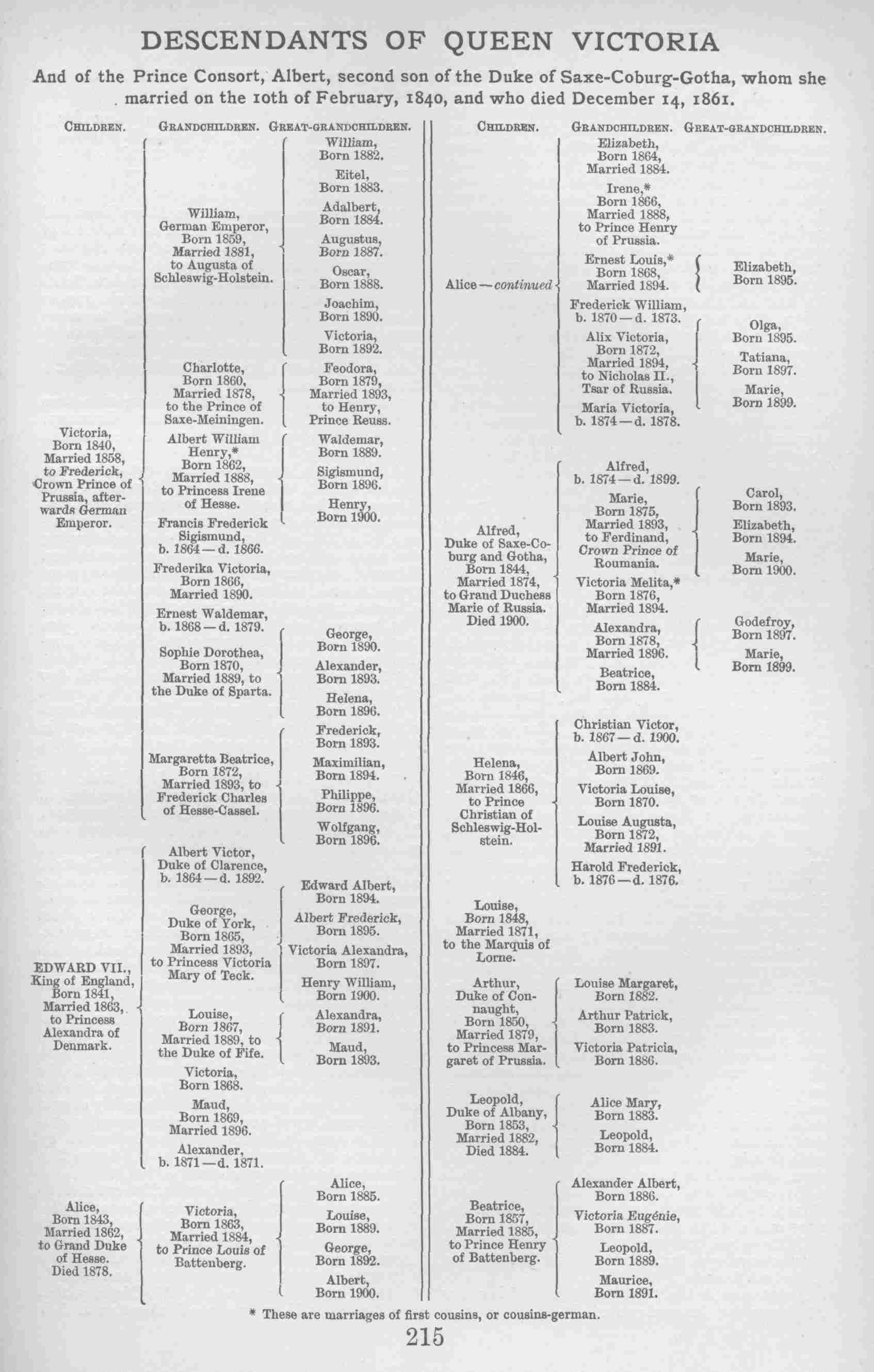
Descendants of Queen Victoria. "Sir, it would be almost impertinent for me were I to attempt to express to the House in words the effect which the character of our late Sovereign produced upon all who were in any degree, however remote, brought in contact with her. The simple dignity, befitting a Monarch of this realm, in that she could never fail, because it arose from her inherent sense of the fitness of things. It was no trapping put on for office, and therefore it was that this dignity, this Queenly dignity, only served to throw into stronger relief and into a brighter light those admirable virtues of the wife, the mother, and the woman with which she was so richly endowed. Those kindly graces, those admirable qualities, have endeared her to every class in the community, and are known to all. Perhaps less known was the life of continuous labour which her position as Queen threw upon her. Short as was the interval between the last trembling signature affixed to a public document and final rest, it was yet long enough to clog and hamper the wheels of administration; and I remember when I saw a vast mass of untouched documents which awaited the hand of the Sovereign of this country to deal with it was brought vividly before my mind how admirable was the unostentatious patience with which for 63 years, through sorrow, through suffering, in moments of weariness, in moments of despondency, it may be, she carried on without intermission her share in the government of this great Empire. {216} For her there was no holiday, to her there was no intermission of toil. Domestic sorrow, domestic sickness, made no difference in her labours, and they were continued from the hour at which she became our Sovereign to within a very few days of her death. It is easy to chronicle the growth of Empire, the progress of trade, the triumphs of war, all the events that make history interesting or exciting; but who is there that will dare to weigh in the balance the effect which such an example continued over 63 years has produced on the highest life of the people? It is a great life, and had a fortunate, and, let me say, in my judgment, a happy ending." The especial and peculiar importance which Queen Victoria had acquired in the political world, and the weight in its councils which England owed to her personality, were impressively suggested by Lord Rosebery, in a speech which he made at a special court of the Governors of the Corporation of the Royal Scottish Hospital, when he said: "We hear much in these days of the life of the Queen and of what we owe her. But I sometimes wonder if we all realize how much we do owe her, for you would have had to know much about the Queen to realize adequately the debt which the nation was under to her. Probably every subject in Great Britain realizes that he has lost his greatest and his best friend. But they do not understand of what enormous weight in the councils of the world we are deprived by the death of our late Sovereign. She gave to the councils of Great Britain an advantage which no talents, no brilliancy, no genius, could supply. Think of what her reign was! She had reigned for 63 years. For 63 years she had known all that was to be known about the political condition of her country. For 63 years she had been in communication with every important Minister and with every important public man. She had received reports, daily reports almost, from her successive Ministers, or their deputies in the House of Commons. She had, therefore, a fund of knowledge which no constitutional historian has ever had at his command. That by the stroke of death is lost to us to-day. All that was of incalculable advantage to our Monarchy. But have you realized what the personal weight of the late Queen was in the councils of the world? She was by far the senior of all the European Sovereigns. She was, it is no disparagement to other Kings to say, the chief of all the European Sovereigns. The German Emperor was her grandson by birth. The Emperor of Russia was her grandson by marriage. She had reigned 11 years when the Emperor of Austria came to his throne. She had seen two dynasties pass from the throne of France. She had seen, as Queen, three Monarchs of Spain, and four Sovereigns of the House of Savoy in Italy. In all those kingdoms which have been carved out of the Turkish Empire she had seen the foundation of their reigning dynasties. Can we not realize, then, what a force the personal influence of such a Sovereign was in the troubled councils of Europe? And when, as we know, that influence was always given for peace, for freedom, and for good government, we feel that not merely ourselves but all the world has lost one of its best friends." A statement in the "London Times" of January 26 shows the descendants of Queen Victoria to be in number as follows: "The Queen has had 9 children of whom 6 survive 40 grandchildren of whom 31 survive 37 great-grandchildren of whom 37 survive [A total of] 86 [of whom] 74 [survive]. "Of the great-grandchildren 22 are boys and 15 are girls; 6 are grandchildren of the Prince of Wales; 18 are grandchildren of the Empress Frederick; 11 are grandchildren of the late Princess Alice; 6 are grandchildren of the late Duke of Saxe-Coburg and Gotha. This would appear to make a total of 41, but three of them are grandchildren of both the Empress Frederick and Princess Alice, while one is grandchild of both the Princess Alice and the Duke of Saxe-Coburg and Gotha. "It will be seen that in the course of nature the future rulers of Great Britain, Germany, Russia, Greece, and Rumania will be descendants of her Majesty." ENGLAND: A. D. 1901 (January-February). Ceremonies of the accession of King Edward VII. His speech in Council and his messages to the people of the British Empire. On Wednesday, the 23d of January—the day following the death of the Queen—her eldest son, Albert Edward, long known as Prince of Wales, went from Osborne to London to take up the sceptre of sovereignty which his mother had laid down. The proceedings in Council which took place thereupon were officially reported in the "London Gazette" as follows: "At the Court at Saint James's, the 23rd day of January, 1901. Present, "The King's Most Excellent Majesty in Council. His Majesty being this day present in Council was pleased to make the following Declaration: "'Your Royal Highnesses, My Lords, and Gentlemen, This is the most painful occasion on which I shall ever be called upon to address you. My first and melancholy duty is to announce to you the death of My beloved Mother the Queen, and I know how deeply you, the whole Nation, and I think I may say the whole world, sympathize with Me in the irreparable loss we have all sustained. I need hardly say that My constant endeavour will be always to walk in Her footsteps. In undertaking the heavy load which now devolves upon life, I am fully determined to be a Constitutional Sovereign in the strictest sense of the word, and as long as there is breath in My body to work for the good and amelioration of My people. "'I have resolved to be known by the name of Edward, which has been borne by six of My ancestors. In doing so I do not undervalue the name of Albert, which I inherit from My ever to be lamented, great and wise Father, who by universal consent is I think deservedly known by the name of Albert the Good, and I desire that his name should stand alone. "'In conclusion, I trust to Parliament and the Nation to support Me in the arduous duties which now devolve upon Me by inheritance, and to which I am determined to devote My whole strength during the remainder of My life.' "Whereupon the Lords of the Council made it their humble request to His Majesty that His Majesty's Most Gracious Declaration to their Lordships' might be made public, which His Majesty was pleased to Order accordingly." {217} The King then "caused all the Lords and others of the late Queen's Privy Council, who were then present, to be sworn of His Majesty's Privy Council." Orders had been previously given for proclaiming "His present Majesty," in the following form: "Whereas it has pleased Almighty God to call to His Mercy Our late Sovereign Lady Queen Victoria, of Blessed and Glorious Memory, by whose Decease the Imperial Crown of the United Kingdom of Great Britain and Ireland is solely and rightfully come to the High and Mighty Prince Albert Edward: We, therefore, the Lords Spiritual and Temporal of this Realm, being here assisted with these of Her late Majesty's Privy Council, with Numbers of other Principal Gentlemen of Quality, with the Lord Mayor, Aldermen, and Citizens of London, do now hereby, with one Voice and Consent of Tongue and Heart, publish and proclaim, That the High and Mighty Prince, Albert Edward, is now, by the Death of our late Sovereign of Happy Memory, become our only lawful and rightful Liege Lord Edward the Seventh, by the Grace of God, King of the United Kingdom of Great Britain and Ireland, Defender of the Faith, Emperor of India: To whom we do acknowledge all Faith and constant Obedience, with all hearty and humble Affection; beseeching God, by whom Kings and Queens do reign, to bless the Royal Prince Edward the Seventh, with long and happy Years to reign over Us." The proclamation was made in London, with antique and picturesque ceremony on the succeeding day, January 24, and the following official report of it, from "Earl Marshal's Office," published in the "London Gazette": "This day His Most Gracious Majesty King Edward VII. was, in pursuance of an Order in Council of the 23rd instant, proclaimed with the usual ceremonies. At 9 o'clock in the forenoon, the Officers of Arms habited in their tabards, the Serjeants-at-Arms, with their maces and collars; and Deputy-Serjeant Trumpeter in his collar; the Trumpeters, Drum Major, and Knight Marshalmen being assembled at St James's Palace, the Proclamation was read in the Grand Court by William H. Weldon, Esq., Norroy King of Arms, Deputy to Sir Albert W. Woods, Garter Principal King of Arms, in the presence of the Earl Marshal of England, the Lord Steward, the Lord Chamberlain, the Master of the Horse, and many other Members of Her late Majesty's Household, with Lords and others of the Privy Council and several personages of distinction. Deputy Garter read the Proclamation. Then the Officers of Arms having entered Royal Carriages, a procession was formed in the following order: The High Bailiff of Westminster, in his carriage. Horse Guards. Trumpeters. A Royal Carriage containing The four Serjeants-at-Arms, bearing their maces. A Royal Carriage containing Pursuivants. Rouge Dragon: Everard Green. Bluemantle: G. Ambrose Lee. Rouge Croix: G. W. Marshall. Heralds. Windsor: W. A. Lindsay, Esq. York: A. S. Scott-Gatty, Esq. Somerset: H. Farnham Burke, Esq., in a Royal Carriage. A Detachment of Horse Guards. "The Procession, flanked by the Horse Guards, moved from St. James's Palace to Temple Bar, and Rouge Dragon Pursuivant of Arms, alighting from the carriage, advanced between two trumpeters, preceded by two of the Horse Guards, to the barrier, and after the trumpets had sounded thrice, demanded in the usual form admission into the City to proclaim His Royal Majesty King Edward VII.; and being admitted, and the barrier again closed, Rouge Dragon was conducted by the City Marshal and his Officers to the Lord Mayor, who was in attendance in his State Carriage, when Rouge Dragon delivered to his Lordship the Order in Council, which the Lord Mayor, having read, returned, and directed the barrier to be opened; and Rouge Dragon being reconducted to his place in the Procession it then moved into the City; the High Bailiff of Westminster filing off at Temple Bar. "At the corner of Chancery-lane York Herald read the Proclamation; then the Lord Mayor, Aldermen, Recorder, Sheriffs, Chamberlain, Common Serjeant, Town Clerk, and City Officers fell into the procession immediately after the Officers of Arms, and the procession moved on to the Royal Exchange, where it was lastly read by Somerset Herald, when the guns in St. James's Park and at the Tower of London were fired. A multitude of spectators filled the streets through which the procession passed, the windows of which were crowded; and the acclamations were loud and general." As described more fully by the "London Times," the interesting proceeding, according to ancient custom, at Temple Bar—the site of the old city gate—was as follows: "Temple Bar has passed away, but not so the privileges associated with it, although they have ceased to have more than an historical, ceremonial, and picturesque interest. In accordance, therefore, with ancient custom, the Lord Mayor yesterday proceeded in State to the site of Temple Bar to grant entrance to the King's Officer of Arms, who was about to proclaim his Majesty King within the City. The gates of Temple Bar were formerly closed for a short time before this ceremony, to be opened, upon demand of the Officer of Arms, by the direction of the Lord Mayor. As there are now no gates, a barrier was made for the occasion by the holding of a red silken rope across the street on either side of the Griffin which commemorates the spot upon which Temple Bar formerly stood. A strong force of burly constables was entrusted with this duty, and the barrier thus created answered every practical purpose, although there must have been lingering in the minds of some of the venerable City Fathers some little regret that stern necessity had occasioned the removal of the historic landmark which stood there when Queen Victoria was proclaimed and remained for many a long year afterwards, one of the most interesting features of the ancient City. {218} "The Pursuivant (Rouge Dragon), the heralds, the officials of Westminster, and the cavalcade halted a short distance to the west of the barrier, and the Pursuivant then advanced between two trumpeters, and the trumpets sounded thrice. Upon this the City Marshal, on horseback, in scarlet tunic and cocked hat with plumes, advanced to the barrier to meet the Pursuivant, and in a loud voice, which could be heard by those at a considerable distance, asked, 'Who comes there?' The Pursuivant replied, 'The Officer of Arms, who demands entrance into the City to proclaim his Royal Majesty, Edward the Seventh.' Thereupon the barrier was opened so as to admit the Pursuivant without escort, and immediately closed again. The Pursuivant was then conducted by the City Marshal to the Lord Mayor, who, being made acquainted with the object of the Pursuivant's visit, directed the opening of the barrier, and the Pursuivant returned to his cavalcade. There was a fanfare of trumpets, and York Herald, Mr. A. S. Scott-Gatty, between two trumpeters, approached the Lord Mayor, and presented to his lordship the Order in Council requiring him to proclaim his Majesty. The Lord Mayor replied: 'I am aware of the contents of this paper, having been apprised yesterday of the ceremony appointed to take place, and I have attended to perform my duty in accordance with ancient usages and customs of the City of London.' "The Lord Mayor then read aloud the Order in Council requiring the herald to proclaim his Majesty within the jurisdiction of the City, and returned it to the herald. … The trumpets sounded and, the officials of Westminster having filed off, the cavalcade advanced into the City as far as the corner of Chancery-lane. There was another fanfare of trumpets, and the herald then made the proclamation, reading it with admirable clearness. When it was over the spectators, who had listened with bared heads, cried 'God Save the King.' The trumpets were again sounded, and a military band stationed to the west of Temple Bar played the National Anthem. This was followed by cheering, which lasted while the Lord Mayor and his retinue resumed their places in the carriages which had brought them, and the procession made its way to the Royal Exchange, the route being down Fleet-street, up Ludgate-hill, through St. Paul's Churchyard, and along Cheapside. "Thus ended a ceremony which impressed all who saw it by its solemnity, its dignity, and its significance. It brought home vividly to the mind of every spectator the continuity which exists amid all the changes of our national life, and the very strangeness of the quaint heraldic garb worn by the heralds and pursuivants, which at another time might have provoked a smile, was felt to be an object-lesson for all, telling of unbroken tradition reaching far back into the glorious history of our country. On turning away from the site of Temple Bar after the Proclamation had been made and the procession had disappeared, one felt that the seriousness of the occasion had impressed itself on every mind and that from every heart there rose a common prayer—God Save the King!" With somewhat less ceremony, on the same day, the same proclamation was read in many parts of the United Kingdom. On Friday, the 25th, both Houses of Parliament met (the members having, one by one, taken the oath of allegiance to the new sovereign on the two preceding days) to receive a message from the King and to adopt an address in reply. The royal message was as follows: "The King is fully assured that the House of Commons will share in the deep sorrow which has befallen his Majesty and the nation by the lamented death of his Majesty's mother, the late Queen. Her devotion to the welfare of her country and her people and her wise and beneficent rule during the sixty-four years of her glorious reign will ever be held in affectionate remembrance by her loyal and devoted subjects throughout the dominions of the British Empire." The Marquis of Salisbury, in the House of Lords, and Mr. Balfour, in the House of Commons, moved the following Address, in speeches from which some passages have been quoted above: "That an humble Address be presented to his Majesty to assure his Majesty that this House deeply sympathizes in the great sorrow which his Majesty has sustained by the death of our beloved Sovereign, the late Queen, whose unfailing devotion to the duties of her high estate and to the welfare of her people will ever cause her reign to be remembered with reverence and affection; to submit to his Majesty our respectful congratulations on his accession to the Throne; to assure his Majesty of our loyal attachment to his person; and, further, to assure him of our earnest conviction that his reign will be distinguished under the blessing of Providence by an anxious desire to maintain the laws of the kingdom and to promote the happiness, the welfare, and the liberty of his subjects." Speeches in support of the motion were made by the leaders of the Opposition party, the Earl of Kimberley, in the House of Lords, and Sir H. Campbell-Bannerman, in the House of Commons, and by the Archbishop of Canterbury, also, in the former chamber. The Address was then adopted, and Parliament was adjourned until February 14. On the 4th of February, the new King addressed the following messages to his subjects in the British Empire at large, to the Colonies, and to the princes and people of India: "To My People. Now that the last Scene has closed in the noble and ever glorious life of My beloved Mother, The Queen, I am anxious to endeavour to convey to the whole Empire the extent of the deep gratitude I feel for the heart-stirring and affectionate tributes which are everywhere borne to Her Memory. I wish also to express My warm recognition of those universal expressions of what I know to be genuine and loyal sympathy with Me and with the Royal Family in our overwhelming sorrow. Such expressions have reached Me from all parts of My vast Empire, while at home the sorrowful, reverent and sincere enthusiasm manifested in the magnificent display by sea and land has deeply touched Me. The consciousness of this generous spirit of devotion and loyalty among the millions of My Subjects and of the feeling that we are all sharing a common sorrow, has inspired Me with courage and hope during the past most trying and momentous days. Encouraged by the confidence of that love and trust which the nation ever reposed in its late and fondly mourned Sovereign, I shall earnestly strive to walk in Her Footsteps, devoting Myself to the utmost of My powers to maintaining and promoting the highest interests of My People, and to the diligent and zealous fulfilment of the great and sacred responsibilities which, through the Will of God, I am now called to undertake. EDWARD, R. I." {219} "To My People Beyond the Seas. The countless messages of loyal sympathy which I have received from every part of My Dominions over the Seas testify to the universal grief in which the whole Empire now mourns the loss of My Beloved Mother. In the welfare and prosperity of Her subjects throughout Greater Britain the Queen ever evinced a heartfelt, interest. She saw with thankfulness the steady progress which, under a wide extension of Self-Government, they had made during Her Reign. She warmly appreciated their unfailing loyalty to Her Throne and Person, and was proud to think of those who had so nobly fought and died for the Empire's cause in South Africa. I have already declared that it will be My constant endeavour to follow the great example which has been bequeathed to Me. In these endeavours I shall have a confident trust in the devotion and sympathy of the People and of their several Representative Assemblies throughout My vast Colonial Dominions. With such loyal support I will, with God's blessing, solemnly work for the promotion of the common welfare and security of the great Empire over which I have now been called to reign, EDWARD, R. I." "To the Princes and People of India. Through the lamented death of My beloved and dearly mourned Mother, I have inherited the Throne, which has descended to Me through a long and ancient lineage, I now desire to send My greeting to the Ruling Chiefs of the Native States, and to the Inhabitants of My Indian Dominions, to assure them of My sincere good will and affection, and of My heartfelt wishes for their welfare. My illustrious and lamented Predecessor was the first Sovereign of this Country who took upon Herself the direct Administration of the Affairs of India, and assumed the title of Empress in token of Her closer association with the Government of that vast Country. In all matters connected with India, the Queen Empress displayed an unvarying deep personal interest, and I am well aware of the feeling of loyalty and affection evinced by the millions of its peoples towards Her Throne and Person. This feeling was conspicuously shown during the last year of Her long and glorious reign by the noble and patriotic assistance offered by the Ruling Princes in the South African War, and by the gallant services rendered by the Native Army beyond the limits of their own Country. It was by Her wish and with Her sanction that I visited India and made Myself personally acquainted with the Ruling Chiefs, the people, and the cities of that ancient and famous Empire. I shall never forget the deep impressions which I then received, and I shall endeavour to follow the great example of the first Queen Empress to work for the general well being of my Indian subjects of all ranks, and to merit, as She did, their unfailing loyalty and affection. EDWARD, R. ET I." English feeling toward the new sovereign of the British Empire, and the English estimate of his character and promise, are probably expressed quite truly, for the general mass of intelligent people, by the following remarks of "The Times:" "In the whole range of English social and political life there is no position more difficult to fill satisfactorily and without reproach than that of Heir Apparent to the Throne, and it may be justly said that the way in which that position has been filled for more than the ordinary lifetime of a generation has contributed to the remarkable increase of devotion to the Throne and the dynasty which is one of the most striking characteristics of Queen Victoria's reign. In the relations of private life, from his childhood upwards, 'the Prince' has been universally and deservedly popular. Cheerful and amiable, kind and generous, ever ready to sympathize with the joys and sorrows of those around him, a true friend, and a loyal antagonist, possessing considerable mental culture and wide intellectual sympathies without any tinge of pedantry, he has represented worthily the type of the genuine English gentleman. Though a lover of sport, like most of his countrymen, he differed from some of them in never regarding it as the chief interest and occupation in life. If he had been born in a humbler station he might have become a successful business man or an eminent administrator, for he possesses many of the qualities which command success in such spheres of action. He is a quick and methodical worker, arranges his time so as never to be hurried, is scrupulously conscientious in fulfilling engagements, great and small, with a punctuality which has become proverbial, never forgets to do anything he has undertaken, and never allows unanswered letters to accumulate. Few men have a larger private correspondence, and his letters have the clearness, the directness, the exquisite tactfulness, and the absolute freedom from all affectation which characterize his conversation. … "In public life he has displayed the same qualities and done a great deal of very useful work. The numerous and often irksome ceremonial duties of his position have been invariably fulfilled most conscientiously and with fitting dignity. Of the remainder of his time a considerable part has been devoted to what might be called semi-official activity. In works of benevolence and public utility and in efforts to promote the interests of science and art he was ever ready and anxious to lend a helping hand. He never forgot, however, that in his public appearances he had not the liberty of speech and action enjoyed by the ordinary Englishman. Whilst taking the keenest interest in public affairs of every kind, he carefully abstained from overstepping in the slightest degree the limits imposed on him by constitutional tradition and usage. No party clique or Court camarilla ever sheltered itself behind him, and no political intrigue was ever associated with his name. Throughout her dominions Queen Victoria had no more loyal, devoted subject than her own eldest son. If this strictly correct attitude had been confined to his relations with the Head of the State we might have supposed that it proceeded from a feeling of deep filial affection and reverence, but, as it was displayed equally in his relations with Parliament and politicians, we must assume that it proceeded also from a high and discriminating sense of duty. Of the Prime Ministers, leaders of her Majesty's Opposition, and politicians of minor degree with whom he came in contact, he may have found some more sympathetic than others, but such personal preferences were carefully concealed in his manner, which was invariably courteous and considerate, and were not allowed to influence his conduct." {220} In another article, the same journal again remarked that "there is no position more difficult to fill than that of Heir Apparent to the Throne," and added: "It is beset by more than all the temptations of actual Royalty, while the weight of counteracting responsibility is much less directly felt. It must be with a feeling akin to hopelessness that a man in that position offers up the familiar prayer, 'Lead us not into temptation.' Other men may avoid much temptation if they honestly endeavour to keep out of its way, but the heir to a Throne is followed, dogged, and importuned by temptation in its most seductive forms. It is not only the obviously bad that he has to guard against; he must also steel himself against much that comes in the specious garb of goodness and almost with the imperious command of necessity. The King has passed through that tremendous ordeal, prolonged through youth and manhood to middle age. We shall not pretend that there is nothing in his long career which those who respect and admire him could not wish otherwise. Which of us can say that with even approximate temptations to meet he could face the fierce light that beats upon an heir apparent no less than upon the Throne?" The King was in his sixtieth year when he succeeded to the throne, having been born on the 9th of November, 1841. "By inheritance under a patent of Edward III., he became at once Duke of Cornwall, and a month later he was created, by patent, Prince of 'Wales and Earl of Chester—titles which do not pass by descent." He was married to the Princess Alexandra, of Denmark, on the 10th of March, 1863. The children born of the marriage have been six in all—three sons and three daughters. Of the former only one survives, Prince George, Duke of York, the second son, who will no doubt be created Prince of Wales. The eldest son, Prince Albert Victor, Duke of Clarence and Avondale, died in his 27th year, on the eve of his marriage. The third son, Alexander, born in 1871, died an infant. The Duke of York is married to Princess Victoria Mary, daughter of the late Duke of Teck and of his wife, Princess Mary of Cambridge. There are four children of the marriage, three sons and a daughter, the eldest son, in direct succession to the Throne, bearing the name of Prince Edward Albert. Of the daughters of the new Sovereign the eldest, Princess Louise, is the wife of the Duke of Fife and has two daughters. Of her two sisters, the Princess Victoria is unmarried. The Princess Maud became in 1896 the wife of Prince Charles of Denmark. ENGLAND: A. D. 1901 (February). The opening of Parliament by King Edward VII. The royal declaration against transubstantiation and the invocation of saints. Protest of Roman Catholic peers. Parliament, reassembling on the 14th of February, was formally opened by the King in person, with a degree of pomp and ceremony which had been made strange by half a century of disuse. King and Queen were escorted in procession, with all possible state, from Buckingham Palace to Westminster. Received there, at the royal entrance, by the great officers of state, they were conducted, by a still more imposing procession of dignitaries, to the "robing room." "His Majesty being robed and the Imperial Crown borne by the Duke of Devonshire (Lord President of the Council), the Procession advanced into the House of Peers in the same order, except that the Cap of Maintenance [a mediæval symbol of dignity] was borne immediately before His Majesty, on the right hand of the Sword of State, by the Marquess of Winchester. The King being seated on his Throne, the Lord bearing the Cap of Maintenance stood on the Steps of the Throne, on the right, and the Peer bearing the Sword of State, on the left, of His Majesty. The Lord Chancellor, the Lord President and the Earl Marshal stood on the right, and the Lord Privy Seal on the left, of His Majesty; the Lord Great Chamberlain stood on the Steps of the Throne on the left hand of His Majesty, to receive the Royal Commands. The Lord Steward and the other officers of His Majesty's Household arranged themselves on each side of the Steps of the Throne, in the rear of the Great Officers of State." By hereditary right, the ceremonial arrangements of the occasion were controlled by the Duke of Norfolk, as Earl Marshal, and the Marquess of Cholmondeley, as Lord Great Chamberlain, and they are said to have followed ancient precedent with a strictness which became very offensive to modern democratic feeling. The small chamber of the House of Lords was so filled with peeresses as well as peers that next to no room remained for the House of Commons when its members were summoned to it, to meet the King. What should have been a dignified procession behind the Speaker became, in consequence, a mob-like crush and scramble, and only some fifty out of five hundred Commoners are said to have succeeded in squeezing themselves within range of his Majesty's eye. The King, then, as required by laws of the seventeenth century (the Bill of Rights and the Test Act—see, in volume 2, ENGLAND: A. D. 1689, OCTOBER, and 1672-1673) signed and made oath to the following Declaration against the doctrine of transubstantiation, the invocation of the Virgin and the invocation of saints: "I doe solemnely and sincerely in the presence of God professe testifie and declare that I doe believe that in the sacrament of the Lord's Supper there is not any transubstantiation of the elements of bread and wine into the body and blood of Christ at or after the consecration thereof by any person whatsoever; and that the invocation or adoration of the Virgin Mary or any other saint and the sacrifice of the masse as they are now used in the Church of Rome are superstitions and idolatrous, and I doe solemnely in the presence of God professe testifie and declare that I doe make this declaration and every part thereof in the plaine and ordinary sence of the words read unto me as they are commonly understood by English Protestants without any evasion, equivocation or mentall reservation whatsoever and without any dispensation already granted me for this purpose by the Pope or any other authority or person whatsoever or without any hope of any such dispensation from any person or authority whatsoever or without thinking that I am or can be acquitted before God or man or absolved of this declaration or any part thereof although the Pope or any other person or persons or power whatsoever should dispence with or annull the same, or declare that it was null and void from the beginning." {221} Having thus submitted to the old test of a Protestant qualification for the Throne, the King read his Speech to Parliament, briefly stating the general posture of public affairs and setting forth the business which the two Houses were asked by government to consider. The war in South Africa was dealt with by the royal speaker in a very few words, as follows: "The war in South Africa has not yet entirely terminated; but the capitals of the enemy and his principal lines of communication are in my possession, and measures have been taken which will, I trust, enable my troops to deal effectually with the forces by which they are still opposed. I greatly regret the loss of life and the expenditure of treasure due to the fruitless guerrilla warfare maintained by Boer partisans in the former territories of the two Republics. Their early submission is much to be desired in their own interests, as, until it takes place, it will be impossible for me to establish in those colonies a government which will secure equal rights to all the white inhabitants, and protection and justice to the native population." In a later paragraph of the Speech he said: "The prolongation of hostilities in South Africa has led me to make a further call upon the patriotism and devotion of Canada and Australasia. I rejoice that my request has met with a prompt and loyal response, and that large additional contingents from those Colonies will embark for the seat of war at an early date." The Speech concluded with the following announcement of subjects and measures to be brought before Parliament: "Gentlemen of the House of Commons, The Estimates for the year will be laid before you. Every care has been taken to limit their amount, but the naval and military requirements of the country, and especially the outlay consequent on the South African war, have involved an inevitable increase. "The demise of the Crown renders it necessary that a renewed provision shall be made for the Civil List. I place unreservedly at your disposal those hereditary revenues which were so placed by my predecessor; and I have commanded that the papers necessary for a full consideration of the subject shall be laid before you. "My Lords and Gentlemen, Proposals will be submitted to your judgment for increasing the efficiency of my military forces. "Certain changes in the constitution of the Court of Final Appeal are rendered necessary in consequence of the increased resort to it, which has resulted from the expansion of the Empire during the last two generations. "Legislation will be proposed to you for the amendment of the Law relating to Education. "Legislation has been prepared, and, if the time at your disposal shall prove to be adequate, will be laid before you, for the purpose of regulating the voluntary sale by landlords to occupying tenants in Ireland, for amending and consolidating the Factory and Workshops Acts, for the better administration of the Law respecting Lunatics, for amending the Public Health Acts in regard to Water Supply, for the prevention of drunkenness in Licensed Houses or Public Places, and for amending the Law of Literary Copyright. "I pray that Almighty God may continue to guide you in the conduct of your deliberations, and may bless them with success." Dated from the House of Lords, on the day of the opening, the following protest, signed by Roman Catholic peers (of whom there are thirty), against the continued requirement from the British sovereign of the Declaration quoted above, was laid before the Lord Chancellor: "My Lord,—On the opening of his first Parliament to-day his Majesty was called upon to make and subscribe the so-called Declaration against Transubstantiation, which was framed during the reign of Charles II., at a moment when religious animosities were unusually bitter. "Some days ago we addressed ourselves to your lordship, as the chief authority on English law, to ascertain whether it was possible to bring about any modification of those parts of the Declaration which are specially provocative to the religious feelings of Catholics. We received from your lordship the authoritative assurance that no modification whatever was possible, except by an Act of Parliament, and that no action of ours would therefore be of the slightest use to effect the pacific purpose we had in view. The Sovereign himself has, it appears, no option, and is obliged by statute to use the very words prescribed, although we feel assured that his Gracious Majesty would willingly have been relieved (as all his subjects have for many years been relieved by Act of Parliament) from the necessity of branding with contumelious epithets the religious tenets of any of his subjects. "While we submit to the law, we cannot be wholly silent on this occasion, We desire to impress upon your lordship that the expressions used in this Declaration made it difficult and painful for Catholic peers to attend to-day in the House of Lords in order to discharge their official or public duties, and that those expressions cannot but cause the deepest pain to millions of subjects of his Majesty in all parts of the Empire, who are as loyal and devoted to his Crown and person as any others in his dominions. "We are, my lord, your lordship's most obedient and faithful servants." London Times, February 15, 1901. In the House of Lords, on the 22d of February, the Marquis of Salisbury made the following reply to Lord Braye, who asked if the Prime Minister could hold out hope of an early measure to abolish the oath so offensive to Catholic subjects of the King: "Though I am very anxious to give an answer which would be satisfactory to the noble lord and his co-religionists, I do not wish to leave on his mind an impression that there are any doubts in the matter. We all of us deplore the language in which that declaration is couched, and very much wish it could be otherwise expressed; but when it comes to altering an enactment which has now lasted, as far as I know, without serious question, 200 years, and which was originally included in the Bill of Rights, it is a matter which cannot be done without very considerable thought. We must remember that an enactment of that kind represents the passions, feelings, and sensibilities of the people by whom it was originally caused; and that these have not died out. They are not strong within these walls; but there are undoubtedly parts of the country where the controversies which the declaration represents still flourish, and where the emotions which it indicates have not died out. Before an enactment is proposed, with all the discussion which must precede such an enactment, we shall have to consider how far it is desirable to light again passions which sleep at this moment, for an occasion which is not now urgent, and which we all earnestly hope may not be urgent in our lives. {222} I do not wish to debar the noble lord from any action which he may think it right to take; but I wish to point out to him the extreme difficulties and anxieties which would accompany any such attempt. With respect to the actual question of legislation, I need hardly observe that it is rather a question for the House of Commons than for us, because here I do not imagine there would be any doubt whatever about the result of such attempted legislation. But I could not be certain that a very strong feeling might not be excited elsewhere; and I notice that, possibly with a view to that consideration, the leader of the other House, in answer to a question, said that, at all events for the present year, he did not see the possibility of having the requisite opportunity of bringing the question before the House. I am afraid, therefore, however deeply I sympathize with the feelings of the noble lord and wish there had been no cause for their being appealed to, that my answer would have to be of a discouraging character." Notwithstanding this discouraging reply to the question, Lord Salisbury, on the 21st of March, moved the following resolution in the House of Lords: "To resolve that it is desirable that a Joint Committee of both Houses be appointed to consider the declaration required of the Sovereign, on his accession, by the Bill of Rights: and to report whether its language can be modified advantageously, without diminishing its efficacy as a security for the maintenance of the Protestant succession." On introducing the resolution he said: "The only thing that it is necessary I should mention is that something has been said with respect to referring the Coronation Oath to the same committee and making in it alterations which undoubtedly will have to be made. But the two subjects are not at all similar, and it would have been impossible to put the Coronation Oath into this reference. If, later, it should be thought wise to use the same committee for the purpose of considering the matter of the Coronation Oath, I probably shall see no difficulty in that." ENGLAND: A. D. 1901 (February). Attitude of the Liberal party towards the South African War. At the annual meeting of the general committee of the National Liberal Federation, held at Rugby, February 27, 1901, more than 400 affiliated Liberal Associations in England and Wales being represented by about 500 delegates, including many eminent men, the following resolution was adopted: "That this committee records its profound conviction that the long continuance of the deplorable war in South Africa, declared for electioneering purposes to be over last September, is due to the policy of demanding unconditional surrender and to a want of knowledge, foresight, and judgment on the part of the Government, who have neither demonstrated effectively to the Boers the military supremacy of Great Britain, nor so conducted the war as to induce them to lay down their arms; this committee bitterly laments the slaughter of thousands of brave men on both sides, the terrible loss of life from disease, owing in no small degree to the scandalous inadequacy of sanitary and hospital arrangements provided for our forces, and the enormous waste of resources in actual expenditure upon the war, in the devastation of territory, and in the economic embarrassments which must inevitably follow; the committee calls upon the Government to announce forthwith, and to carry out, on the cessation of hostilities, a policy for the settlement of South African affairs which will secure equal rights to the white races, just and humane treatment of natives, and such a measure of self-government as can honourably be accepted by a brave and high-spirited people." ENGLAND: A. D. 1901 (February). Emphatic declaration of the policy of the government in dealing with the Boers. See (in this volume) SOUTH AFRICA (THE FIELD OF WAR): A. D. 1901. ENGLAND: A. D. 1901 (March). Rejection of the Inter-oceanic Canal Treaty as amended by the United States Senate. See (in this volume) CANAL, INTEROCEANIC: A. D. 1901 (MARCH). ----------ENGLAND: End-------- ENSLIN, Battle of. See (in this volume) SOUTH AFRICA (THE FIELD OF WAR): A. D. 1899 (OCTOBER-DECEMBER). EPWORTH LEAGUE, The. The Epworth League, an organization of young people in the Methodist Episcopal Church, on lines and with objects kindred to those of the "Young People's Society of Christian Endeavor" (see, in this volume, CHRISTIAN ENDEAVOR), was instituted by a convention of representatives from various societies of young people in that church, held at Cleveland, Ohio, May 14-15, 1889. It was officially adopted by the General Conference of the M. E. Church in 1892. The Year-book of the League for 1901 says:—"A dozen years ago the Epworth League had no regularly organized Chapter. To-day it has almost twenty-one thousand. Twelve years ago it had a total membership of twenty-seven. To-day it has a million and a half. Twelve years ago the Junior League had scarcely been dreamed of. To-day it is the most promising division of the great Epworth army, having a membership of tens of thousands. Twelve years ago a suggestion to establish a newspaper organ was looked upon as a most doubtful experiment, and predictions of failure were freely made. To-day the organization has an official journal whose circulation exceeds that of any Church weekly in the world." ETRUSCANS, The: Fresh light on their origin. See (in this volume) ARCHÆOLOGICAL RESEARCH: ITALY. EUPHRATES, Valley of the: Recent archæological exploration. See (in this volume) ARCHÆOLOGICAL RESEARCH: BABYLONIA. EUROPEAN RACES, The expansion of the. See (in this volume) NINETEENTH CENTURY: EXPANSION. EVOLUTION, The doctrine of: Its influence on the Nineteenth Century. See (in this volume) NINETEENTH CENTURY: DOMINANT LINES. EXCAVATIONS, Recent archæological. See (in this volume) ARCHÆOLOGICAL RESEARCH. EXPLOSIVES FROM BALLOONS, Declaration against. See (in this volume) PEACE CONFERENCE. {223} EXPOSITION, The Cotton States and International. See (in this volume) ATLANTA: A. D. 1895. EXPOSITION, National Export. See (in this volume) INTERNATIONAL COMMERCIAL CONGRESS. EXPOSITION, Pan-American. See (in this volume) BUFFALO: A. D. 1901. EXPOSITION, Paris. See (in this volume) FRANCE: A. D. 1900 (APRIL-NOVEMBER). EXPOSITION, Scandinavian. See (in this volume) STOCKHOLM. EXPOSITION, Tennessee Centennial, at Nashville. See (in this volume) TENNESSEE: A. D 1897. EXPOSITION, Trans-Mississippi. See (in this volume) OMAHA: A. D. 1898. EXTERRITORIAL RIGHTS. See (in this volume) JAPAN: A. D. 1899 (JULY). F. FAMINE: In China. See (in this volume) CHINA: A. D. 1901 (JANUARY-FEBRUARY). FAMINE: In India. See (in this volume) INDIA: A. D. 1896-1897; and 1899-1900. FAMINE: In Russia. See (in this volume) RUSSIA: A. D. 1899. "FANATICS," The. See (in this volume) BRAZIL: A. D. 1897. FAR EASTERN QUESTION, The. See (in this volume) CONCERT OF EUROPE. FARM BURNING, In the South African War. See (in this volume) SOUTH AFRICA (THE FIELD OF WAR): A. D. 1900 (AUGUST-DECEMBER). FARMERS' ALLIANCE, and Industrial Union, The. The Supreme Council of the Farmers' Alliance and Industrial Union held its fourth annual session at Washington, February 6-8, 1900, and pledged support to whatever candidates should be named by the national convention of the Democratic Party, making, at the same time, a declaration of principles analogous to those maintained by the People's Party. FASHODA INCIDENT, The. See (in this volume) EGYPT: A. D. 1898 (SEPTEMBER-NOVEMBER). FAURE, Francois Felix, President of the French Republic. Sudden death. See (in this volume) FRANCE: A. D. 1899 (FEBRUARY-JUNE). FEDERAL STEEL COMPANY, The. See (in this volume) TRUSTS: UNITED STATES. FÊNG-TIEN PENINSULA: A. D. 1894-1895. Cession in part to Japan and subsequent relinquishment. See (in this volume) CHINA: A. D. 1894-1895. FÊNG-TIEN PENINSULA: A. D. 1900. Russian occupation and practical Protectorate. See (in this volume) MANCHURIA: A. D. 1900. FILIPINOS. See (in this volume) PHILIPPINE ISLANDS. FINLAND: A. D. 1898-1901. A blow at the constitutional rights of the country. Attempt to Russianize the Finnish army. Possible defeat of the measure. "In July, 1898, just one month before the publication of the Czar's Peace Manifesto, the Diet of Finland was summoned to meet in extraordinary session during January, 1899, in order to debate upon the new Army Bill submitted by the Russian Government. Hitherto, the army of Finland has been strictly national in character, and has served solely for the defence of the province. The standing army has been limited to 5,600 men, 1,920 of whom are annually selected to bear arms during a period of three years. This has now been changed; the main features of the new Army Bill being as follows: 1. Finnish troops may be requisitioned for service beyond the confines of the Grand Duchy. 2. Russians may serve in the Finnish, and Finlanders in the Russian, Army. 3. A lightening of the duties of military service upon the ground of superior education will be granted to those only who can speak, read, and write Russian. 4. The period of active service under the flag is increased from three years to five. 5. The annual contingent of soldiers in active service is increased from 1,920 men to 7,200. We at once perceive the fundamental nature of these changes, which threaten to impose a far heavier burden upon Finland, and to Russify her army. Naturally, the new law met with the most determined opposition. But while the bill was still in committee there appeared on February 15, 1899, an Imperial ukase, whereby the entire situation was radically changed, and the independence of Finland seriously threatened. This ukase decrees that while the internal administration and legislation of Finland are to remain unimpaired, matters affecting the common interests of Finland and Russia are to be no longer submitted solely to the jurisdiction of the Grand Duchy. Furthermore, the Emperor reserves to himself the final decision as to which matters are to be included in the above category. … "The document is couched in terms expressing good-will for Finland. In effect, however, it signifies the complete demolition of the constitutional rights of that country. For in all matters involving the interests of both countries, or affecting in any way those of Russia, Finland will hereafter be confined to a mere expression of opinion: she will no longer be able to exercise the privilege of formulating an independent resolution. The definition of 'common interests' as furnished by the ukase is so vague as to make the exercise of any form of self-government on the part of the Finlanders a matter of uncertainty, if not of serious difficulty. Not only the interpretation of 'common interests,' but also the designation of the law governing them, is primarily in the hands of the Russian authorities. Finland, an independent, constitutional state [see, in volume 4, SCANDINAVIAN STATES: A. D. 1807-1810], has been, or, at all events, is to be, converted into a province of Russia. … "The conviction is general that the Czar, who had formerly manifested such good-will toward the country, and who had abrogated the enactments curtailing its constitutional rights, could not possibly have so completely changed his views within so short a time. Consequently, it was decided to address a monster petition in behalf of the people directly to the ruler himself. This plan met with the enthusiastic approval of the entire nation, and the document was signed by no fewer than 523,931 men and women of Finland. {224} A deputation of five hundred was elected to present this petition, which so eloquently voiced the conviction of the whole nation. These five hundred representatives went to St. Petersburg, and requested an audience with the Czar. But their efforts were unavailing. They were not received; and it appeared as if the united voice of a peaceful and loyal people could not penetrate to the ear of the ruler. "In the meantime the attention of all Europe was directed to the matter; and everywhere the liveliest sympathy was manifested for that little Nation in the Northeast. … There now arose—entirely from private initiative, and without the exercise of any influence on the part of Finland—a general movement among European nations to select prominent scholars and artists; i. e., men entirely removed from the political arena, to act as representatives of the popular sentiment, and to speak a good word with the Czar in behalf of Finland. … Addresses of sympathy for Finland were formulated in England, France, Germany, Austria, Hungary, Italy, Switzerland, Belgium, Holland, Denmark, Sweden, and Norway; and these addresses were signed by over one thousand and fifty scholars and artists. … All the addresses together were to be presented to the Czar by a small deputation; and for this purpose the Commission mentioned at the beginning of this article proceeded to St. Petersburg. The gentlemen took great pains to secure an audience; they went from one minister to another, and avoided every appearance of unfriendliness. Nevertheless, their request was politely declined; and the acceptance of the document bearing the signatures of over one thousand notabilitles firmly refused." R. Eucken, The Finnish Question (Forum, November, 1899). A correspondent of the "London Times," writing from Helsingfors, December 28, 1900, reported: "The situation in Finland at the end of the year is by no means improved, notwithstanding a few gratifying events, such as the permission granted by General Bobrikoff for a new daily paper to be published in Helsingfors. … Two papers, one published in a provincial town, and a weekly journal in Helsingfors, have been suppressed for ever, and the preventive censorship is applied with the utmost rigour. The Governor-General has displayed great energy in enforcing the restrictions on the right to hold meetings, and he has in circulars to the provincial Governors issued instructions for the introduction of Russian as the language of the Provincial Government offices even earlier, and more fully, than is provided for in the language ordinance promulgated last autumn. Denunciations of private persons to General Bobrikoff by secret agents, as well as public authorities, are events of well-nigh daily occurrence, and one consequence of these secret reports is that five University professors are threatened with summary dismissal unless they 'bind themselves to mix themselves up no longer in any sort of political agitation.' … "The question of the new military law will in all probability come before the Russian Imperial Council in January, all authorities concerned having had an opportunity of expressing their views on the report made on the question by the Finnish Diet in 1899, including the Minister of War, General Kuropatkin. In conformity with the manifesto of February 15, 1899, this report will be regarded merely as an 'opinion' given by that body, in no way binding when the matter comes up for further consideration. This scheme, it will be remembered, not only imposes on Finland a military burden beyond the powers of the country, but has the political aim of denationalizing the Finnish army, and is thus intended to serve as a potent lever in the Russification of the Grand Duchy. The main features of the Bill were rejected by the Finnish Diet, but, although several members of the Imperial Council are opposed to the new scheme, it is believed that it will gain the majority in the Council in all its more salient points." Three months later (February 26, 1901), an important change in the situation was reported from St. Petersburg by the same correspondent. The project of Russifying the Finnish army had suffered defeat, he learned, in the Council of State, by a large majority. "But," he added, "this does not by any means imply that the military reform scheme in Finland, which has been the chief cause of all the harm done to the Finnish Constitution during the last three years, has been finally upset. A similar procedure in any other European civilized country would mean as much, but it is not so in Russia. It simply means that the Russification of Finland is still being prosecuted by a small powerful minority, who will probably gain their point in spite of the vast majority of his Majesty's councillors. The Council of State, the highest institution in the sphere of supreme administration, is merely a consultative body, whose opinion can be, and often has been, set aside by the Sovereign without the least difficulty. A mere stroke of the pen is necessary. "In the present case the Finnish military project was discussed by the four united departments of the Council. It is stated that M. Pobiedonostzeff and the Minister of War said nothing, being, perhaps, either too much impressed by the speech of M. Witte against the project, or feeling sure of their ground without the need of entering into useless discussion. M. Witte, whose influence is gradually embracing every branch of government, is also looming big in this question. He is reported to have made a speech on the occasion which carried over 40 members of the Council with him in opposition to the project. He attacked it principally on financial grounds, and declared that nobody could advise his Majesty to adopt it. The rejection of the proposal by the four departments is preliminary to its discussion by a plenary assembly of the Council, and only after that has taken place will the opinion of the majority be laid before the Emperor," FIST OF RIGHTEOUS HARMONY, Society of the. See(in this volume) CHINA: A. D. 1900 (JANUARY-MARCH). FIVE CIVILIZED TRIBES, The. See (in this volume) INDIANS, AMERICAN: A. D. 1893-1899. FORBIDDEN CITY, March of allied forces through the. See (in this volume) CHINA: A. D. 1900 (AUGUST 15-28). FORMOSA: A. D. 1895. Cession by China to Japan. See (in this volume) CHINA: A. D. 1894-1895. FORMOSA: A. D. 1896. Chinese risings against the Japanese. See (in this volume) JAPAN: A. D. 1896. {225} ----------FRANCE: Start-------- FRANCE: A. D. 1894-1896. Final subjugation and annexation of Madagascar. See (in this volume) MADAGASCAR. FRANCE: A. D. 1895. Cession of Kiang-Hung by China. See (in this volume) CHINA: A. D. 1894-1895 (MARCH-JULY). FRANCE: A. D. 1895. Ministerial changes. The alliance with Russia. On the resignation of the presidency of the Republic by M. Casimir-Perier and the election of M. Felix Faure to succeed him (January 15-17), a ministry was formed which represented the moderate republican groups, with M. Ribot at its head, as President of the Council and Minister of Finance, and with M. Hanotaux as Minister of Foreign Affairs. See, in volume 2, FRANCE: A. D. 1894-1895). The most important work of the new government was the arrangement of an alliance with Russia, which was conspicuously signified to the world by the union of the French and Russian fleets when they entered the German harbor of Kiel, on the 17th of June, to take part in the celebration of the opening of the Kaiser Wilhelm Ship Canal, between the Baltic and North Seas (see, in this volume, GERMANY: A. D. 1895, JUNE). This gave the greatest possible satisfaction to the nation, and powerfully strengthened the ministers for a time; but they were discredited a little later in the year by disclosures of waste, extravagance and peculation in the military department. Early in the autumn session of the Chamber of Deputies a vote was carried against them, and they resigned. A more radical cabinet was then formed, under M. Leon Bourgeois, President of the Council and Minister of the Interior; with M. Berthelot holding the portfolio of foreign affairs, M. Cavaignac that of war, and M. Lockroy that of the marine. FRANCE: A. D. 1896 (January). Agreement with Great Britain concerning Siam. See (in this volume) SIAM: A. D. 1896-1899. FRANCE: A. D. 1896 (March). Census of the Republic. Returns of a national census taken in March showed a population in France of 38,228,969, being an increase in five years of only 133,919. The population of Paris was 2,511;955. FRANCE: A. D. 1896 (April-May). Change of Ministry. Socialist gains. After a long conflict with a hostile Senate, the Radical Ministry of M. Bourgeois gave way and was succeeded, April 30, by a Cabinet of Moderate Republicans, in which M. Méline presided, holding the portfolio of Agriculture, and with M. Hanotaux returned to the direction of Foreign Affairs. At municipal elections in the following month the Socialists made important gains. "The elections of May, 1896, revealed the immense progress that socialism had made in all lands since the year 1893. Towns as important as Lille, Roubaix, Calais, Montluçon, Narbonne, re-elected socialist majorities to administer their affairs; and even where there was only a socialist minority, a socialist mayor was elected, as in the case of Dr. Flaissières at Marseilles, and Cousteau at Bordeaux. But in the small towns and the villages our victories have been especially remarkable. The Parti Ouvrier alone can reckon more than eighteen hundred m municipal councillors elected upon its collectivist programme; and at the Lille Congress, which was held a few days before the International Congress in London, thirty-eight socialist municipal councils and twenty-one socialist minorities of municipal councils were represented by their mayors or by delegates chosen by the party." P. Lafargue, Socialism in France (Fortnightly Review, September, 1897). FRANCE: A. D. 1897. Industrial combinations. See (in this volume) TRUSTS: IN EUROPEAN COUNTRIES. FRANCE: A. D. 1897 (May-June). Cessions and concessions from China. See (in this volume) CHINA: A. D. 1897 (MAY-JUNE). FRANCE: A. D. 1897 (June). Renewal of the privileges of the Bank of France. See (in this volume) MONETARY QUESTIONS: A. D. 1897. FRANCE: A. D. 1897 (July). Co-operation with American envoys in negotiations for a bi-metallic agreement with Great Britain. See (in this volume) MONETARY QUESTIONS: A. D. 1897 (APRIL-OCTOBER). FRANCE: A. D. 1897-1899. The Dreyfus Affair. Although Captain Alfred Dreyfus, of the French army, was arrested, tried by court-martial, convicted of treasonable practices, in the betrayal of military secrets to a foreign power, and thereupon degraded and imprisoned, in 1894, it was not until 1897 that his case became historically important, by reason of the unparalleled agitations to which it gave rise, threatening the very life of the French Republic, and exciting the whole civilized world. Accordingly we date the whole extraordinary story of Captain Dreyfus and his unscrupulous enemies in the French Army Staff from that year, in order to place it in proper chronological relations with other events. As told here, the story is largely borrowed from a singularly clear review of its complicated incidents by Sir Godfrey Lushington, formerly Permanent Under Secretary in the British Home Office, which appeared in the "London Times," while the question of a revision of the Dreyfus trial was pending in the Court of Cassation. We are indebted to the publisher of "The Times" for permission to make use of it: "In October, 1894, Captain Alfred Dreyfus, an artillery officer on the staff, was arrested for treason. He belonged to a respected and highly loyal Jewish family in Alsace, his military character was unblemished, and he was in easy circumstances. At this time General Mercier was Minister of War, General de Boisdeffre Chief of the Staff (practically Commander-in-Chief of the French army), General Gonse, Assistant-Chief. Colonel Sandherr, well known as an Anti-Semite, was head of the Intelligence Department, under him were Commandants Picquart, Henry, and Lauth, also the Archivist Griblin. Commandant Du Paty de Clam was an officer attached to the general staff. Commandant Esterhazy was serving with his regiment. On October 15, on the order of the Minister of War, Captain Dreyfus was arrested by Commandant Du Paty de Clam, and taken in the charge of Commandant Henry to the Cherche-Midi Prison, of which Commandant Forzinetti was governor. For a fortnight extraordinary precautions were taken to keep his arrest an absolute secret from the public and even from his own family. His wife alone knew of it, but dared not speak. … So harsh was his treatment that Commandant Forzinetti felt it his duty to take the strong step of making a formal representation to the Minister of War and also to the Governor of Paris, at the same time declaring his own conviction that Captain Dreyfus was an innocent man. {226} On October 31 Commandant Du Paty de Clam made his report, which has not seen the light, and on November 3 Commandant d'Ormescheville was appointed 'rapporteur' to conduct a further inquiry, and in due course to draw up a formal report, which practically constitutes the case for the prosecution. Not till then was Captain Dreyfus informed of the particulars of the charge about to be laid against him. From this report of Commandant d'Ormescheville's we learn that the basis of the accusation against Captain Dreyfus was a document known by the name of the 'bordereau' [memorandum]. Neither Commandant d'Ormescheville's report nor the 'bordereau' has been officially published by the Government, but both ultimately found their way into the newspapers. The bordereau was a communication not dated, nor addressed, nor signed. It began:—'Sans nouvelles m'indiquant que vous désirez me voir, je vous adresse cependant, Monsieur, quelques renseignemcnts intéressants.' ['Without news indicating that you wish to see me, I send you, nevertheless, monsieur, some important information.'] (Then followed the titles of various military documents, 1, 2, &c.) The report stated that the bordereau had fallen into the hands of the Minister of War, but how the Minister declined to say, beyond making a general statement that the circumstances showed that it had been sent to an agent of a foreign Power. It is now generally accepted that it had been brought to the War Office by a spy—an Alsatian porter who was in the service of Colonel von Schwarzkoppen, then the military attache to the German Embassy in Paris. The report contained nothing to show that Captain Dreyfus had been following treasonable practices or to connect him in any manner with the bordereau. The sole question for the Court-martial was whether the bordereau was in his handwriting. On this the experts were divided, three being of opinion that it was, two that it was not, in his handwriting. "The Court-martial was duly held, and Captain Dreyfus had the aid of counsel, Maître Demange; but the first act of the Court was, at the instance of the Government representative, to declare the 'huis cols,' so that none but those concerned were present. After the evidence had been taken the Court, according to custom, adjourned to consider their verdict in private. Ultimately they found Captain Dreyfus guilty, and he was sentenced to be publicly expelled from the army and imprisoned for life. Not till after his conviction was he allowed to communicate with his wife and family. The sentence has been carried out with the utmost rigour. Captain Dreyfus was transported to the Isle du Diable [off the coast of French Guiana], where he lives in solitary confinement. … The Court-martial having been held within closed doors, the public at large knew nothing … beyond the fact that Captain Dreyfus had been convicted of betraying military secrets to a foreign Power, and they had no suspicion that there had been any irregularity at the Court-martial or that the verdict was a mistaken one. … For two years the Dreyfus question may be said to have slumbered. In the course of this time Colonel Sandherr, who died in January, 1897, had been compelled to retire from ill-health, and Commandant Picquart became head of the Intelligence Department. … In May, 1896, there were brought to the Intelligence Department of the War Office some more sweepings from Colonel von Schwarzkoppen's waste-paper basket by the same Alsatian porter who had brought the bordereau. These were put by Commandant Henry into a packet, and given by him (according to the usual custom) to Commandant Picquart. Commandant Picquart swears that amongst these were about 60 small pieces of paper. These (also according to custom) he gave to Commandant Lauth to piece together. When pieced together they were found to constitute the document which is known by the name of 'Petit bleu, à carte télégramme' for transmission through the Post-office, but which had never been posted. It was addressed to Commandant Esterhazy, and ran as follows: "'J'attendsavant tout une explication plus détaillée que celle que vous m'avez donnée, l'autre jour, sur la question en suspens. En conséquence, je vous prie de me la donner par écrit, pour pouvoir juger si je puis continuer mes relations avec la maison R … ou non. [I await, before anything farther, a more detailed explanation than you gave me the other day on the question now in suspense. In consequence, I request you to give this to me in writing, that I may judge whether I can continue my relations with the house of R. or not.] M. le Commandant Esterhazy, 27, Rue de la Bienfaisance, Paris.' "At this time Commandant Esterhazy was a stranger to Commandant Picquart, and the first step which Commandant Picquart took was to make inquiry as to who and what he was. His character proved most disreputable, and he was in money difficulties. The next was to obtain a specimen of his handwriting in order to compare it with other writings which had been brought by spies to the office and were kept there. In this way it came about that it was compared with the facsimile of the bordereau, when, lo and behold, the writings of the two appeared identical. It was Commandant Esterhazy, then, who had written the bordereau, and if Commandant Esterhazy, then not Captain Dreyfus. … Commandant Picquart acquainted his chiefs with what had been done—namely, General de Boisdeffre in July, and his own immediate superior, General Gonse, in September. … "On September 15 of the same year, 1896, took place the first explosion. This solely concerned the Dreyfus trial. On that day the 'Éclair,' an anti-Semite newspaper, published an article headed 'Le Traitre,' in which they stated that at the Court-martial the 'pièce d'accusation' on which Captain Dreyfus was tried was the bordereau; but that after the Court had retired to the 'chamber of deliberation,' there was communicated to them from the War Office, in the absence of the prisoner and his counsel, a document purporting to be addressed by the German military attaché to his colleague at the Italian Embassy in Paris, and ending with a postscript, 'Cet animal de Dreyfus devient trop exigcant'; further, that this document was the only one in which appeared the name Dreyfus. This at once had removed all doubts from the minds of the Court-martial, who thereupon had unanimously brought the prisoner in guilty; and the 'Eclair' called upon the Government to produce this document and thus satisfy the public conscience. This document has, for sufficient reasons hereinafter appearing, come to be known as 'le document libérateur,' and by this name we will distinguish it. {227} As to the article in the 'Eclair,' it must have proceeded either from a member of the Court-martial or from some one in the War Office; but whether its contents were true is a matter which to this day has not been fully cleared up. This much, however, is known. We have the authority of Maître Demange (Captain Dreyfus's advocate) that no such document was brought before the Court-martial during the proceedings at which he was present. On the other hand, it has now been admitted that at the date of Captain Dreyfus's trial there was, and that there had been for some months previously, in the archives of the War Office a similar document, not in the Dreyfus' dossier' proper, but in a secret dossier, only that the words therein are not 'Cet animal de Dreyfus,' but 'Ce (sic) canaille de D—' (initial only) 'devient trop exigeant.' … The Government have never yet either admitted or denied that General Mercier went down to the Court-martial and made to them a secret communication. … "As might have been expected, the article in the 'Eclair' occasioned a considerable stir; both parties welcomed it, the one as showing Captain Dreyfus to have been really a traitor and therefore justly deserving his sentence; the other as a proof that whether guilty or not he had been condemned illegally on a document used behind his back. The public excitement was increased when on the 10th of November the 'Matin'—a War Office journal—published what purported to be a fac-simile of the bordereau, and a host of experts and others set to work to compare it with the accused's handwriting. The reproduction was no doubt made, not from the original bordereau, which was in the sealed-up Dreyfus dossier, but from a photograph of it. And the photograph must have been obtained surreptitiously from some one in the War Office or from some one who had attended the secret Court-martial. … The natural sequel to these revelations was an interpellation in the Chamber—the 'interpellation Castelin' of November 18, 1896. On that day, M. Castelin, an anti-Semite deputy, by asking some question as to the safe custody of Dreyfus, gave the Government an opportunity. General Billot, then Minister of War, replied in general terms—'L'instruction de l'affaire, les débats, le jugement, ont eu lieu conformément aux règles de la procédure militaire. Le Conseil de Guerre regulièrement compose, a regulièrement déliberé,' &c. ['The instructions, the debates, the verdict, have all taken place conformably to the rules of military procedure. The Court-martial, regularly composed, has deliberated regularly,' etc.] … On November 14, 1896, on the eve of the Interpellation Castelin, Commandant Picquart was sent on a secret mission, which has not been disclosed. He left his duties as head of the Intelligence Department nominally in the hands of General Gonse, his superior, but practically to be discharged by Commandant Henry, who was Commandant Picquart's subordinate. He requested his family to address their private letters for him to the War Office, whence they would be forwarded. His secret mission, or missions, took him first to Nancy, then to Besançon (permission being refused to him to return to Paris even for a night to renew his wardrobe), later on to Algeria and Tunisia, with instructions to proceed to the frontier. … In March, 1897, Commandant Picquart was appointed Lieutenant-Colonel of the 4th Tirailleurs, the appointment being represented to him as a favour. He was the youngest Colonel in the service. In his stead Commandant Henry became Chief of the Intelligence Department. … From the first Colonel Picquart had, of course, felt some uneasiness at being sent on these missions away from his ordinary duties, and various little circumstances occurred to increase it, and in May, 1897, having occasion to write unofficially to Commandant Henry, now Chief of the Intelligence Department, he expressed himself strongly as to the mystery and falsities with which his departure had been surrounded; and he received a reply dated June 3, in which Commandant Henry said that the mystery he could well enough explain by what had come to his knowledge after some inquiry, and he alluded in general to three circumstances—(1) Opening letters in the post; (2) attempt to suborn two officers in the service to speak to a certain writing as being that of a certain person; and (3) the opening of a secret dossier. The first Colonel Picquart knew to refer to his having intercepted Commandant Esterhazy's letters; the other two allusions he did not at the time (June, 1897) fully understand; but the letter, couched in such terms and coming from one who had until lately been his subordinate, and was now the head of the Department, convinced him that he was the object of serious and secret machinations in the War Office. He immediately applied for leave and came to Paris. There he determined, with a view to his self-defence, to obtain legal advice from an advocate, M. Leblois; saw him, and showed him Colonel Henry's letter, and, whilst abstaining (according to his own account and that of M. Leblois) from touching on the third matter, the secret dossier, spoke freely on the other two—on the 'affaires' Dreyfus and Esterhazy generally; also, in order to explain how far he had acted with the sanction or cognizance of his superiors, he placed in his hands the correspondence—not official but confidential—about Commandant Esterhazy which he had had with General Gonse in 1896. He left it to M. Leblois to take what course he might think necessary, and returned to Sousse. In the course of the autumn he was summoned to Tunis and asked by the military authority there whether he had been robbed of a secret document by a woman. The question seemed a strange one and was answered by him with a simple negative. Later on he received at Sousse two telegrams from Paris, dated November 10. One:—'Arretez Bondieu. Tout est découvert. Affaire très grave. Speranza.' This was addressed to Tunis and forwarded to Sousse. The other:—'On a des preuves que le bleu est fabriqué par Georges. Blanche.' This was addressed to Sousse. And two days after he received a letter, likewise of November 10, from Esterhazy, an abusive one, charging him with conspiring against him, &c. He felt certain that the telegrams were sent in order to compromise him. … Colonel Picquart suspected Commandant Esterhazy to be the author of the telegrams, the more so that in Commandant Esterhazy's letter and in one of the telegrams his own name Picquart was spelt without a c. He at once telegraphed to Tunis for leave to come and see the General there. {228} He did see him and through him forwarded to the Minister of War the three documents, with a covering letter in which he demanded an inquiry. He then obtained leave to go to Paris, but the condition was imposed on him that he should see no one before presenting himself to General de Pellieux. When he saw the General he learnt for the first time and to his surprise that ever since he left Paris in November, 1896, his letters had been intercepted and examined at the War Office and he was called upon to explain various letters and documents. … "Before June, 1897, Commandant Esterhazy's name had not been breathed to the public; it is now to come out, and from two independent sources. Some little time after seeing Colonel Picquart, in June, 1897, M. Leblois had determined, in his interest, to consult M. Scheurer-Kestner, who was well known to have taken an interest in the 'affaire Dreyfus,' because of the suspicion that Captain Dreyfus had been condemned on a document which he had never seen and because of the discrepancies between Captain Dreyfus's handwriting and that of the bordereau. He was Vice-President of the Senate and a personal friend of General Billot, the Minister of War. M. Leblois communicated to him what he knew about Commandant Esterhazy and showed him General Gonse's letters to Colonel Picquart. In October M. Scheurer-Kestner communicated on the subject both with General Billot and with the President of the Council, M. Méline. He was now to learn the name of Commandant Esterhazy from another quarter. One afternoon in the end of October a M. de Castro, a stock-broker, was seated in a cafe in Paris, and a boy from the street came up with copies of the facsimile of the bordereau, which had then been on sale for more than a year. M. de Castro bought a copy, and at once recognized, as he thought, the handwriting of the bordereau to be that of Commandant Esterhazy, who was a client of his. He took the copy home, compared it with letters of Commandant Esterhazy, and all doubts vanished. His friends told M. Matthieu Dreyfus, who begged him to take the letters to M. Scheurer-Kestner, and he did so on November 12, 1897, and M. Scheurer-Kestner advised that M. Matthieu Dreyfus should go to General Billot and denounce Commandant Esterhazy as the author of the bordereau. And now to turn to Commandant Esterhazy. His own statement is this. In the month of October, 1897, when in the country, he received a letter from 'Speranza' giving minute details of a plot against himself, the instigator of which was, Speranza said, a colonel named Picquart (without the c). He at once went to Paris, saw the Minister of War, and gave him Speranza's letter. Shortly afterwards he received a telegram asking him to be behind the palisades of the bridge Alexander III. at 11.30 p.m. He would there meet a person who would give him important information. He kept his appointment, met a veiled woman, who, first binding him over under oath to respect her incognito, gave him long details of the plot of the 'band' against himself. Afterwards he had three similar interviews, but not at the same place. At the second of these four interviews the unknown woman gave him a letter, saying:—'Prenez la pièce contenue dans cette enveloppe, elle prouve votre innocence, et si le torchon brûle, n'hésitez pas it vous en servir.' ['Take the piece contained in this envelope, it proves your innocence, and if there is trouble do not hesitate to use it.'] This document, henceforward called 'le document libérateur,' was no other than the letter referred to in the 'Eclair' (ce canaille de D.), which, of course, ought to have been safe in the archives of the Intelligence Department. On November 14 Commandant Esterhazy returned this document to the Minister of War under a covering letter in which he called upon his chief to defend his honour thus menaced. The Minister of War sent Commandant Esterhazy a receipt. The next day the Minister received a letter from M. Matthieu Dreyfus denouncing Commandant Esterhazy as the author of the bordereau. The letter of Speranza to Commandant Esterhazy has not yet been divulged to the public; and the War Office, after diligent inquiries, have not been able to find the veiled woman. Very different was the interpretation put on this narrative by M. Trarieux, ex-Minister of Justice, and others interested in revision. Their suggestion was that Commandant Esterhazy was in the first instance apprised beforehand by his friends in the War Office of the coming danger and was for flying across the frontier, but that subsequently these same friends, finding that the chiefs of the army were fearful of being compromised by his flight from justice and would make common cause with him, wished to recall him, and with this view, took from the archives the 'document libérateur,' and sent it to him as an assurance that he might safely return and stand his trial, and also with a view to his claiming the credit of having restored to the office a document which it was now intended to charge Colonel Picquart with abstracting. On November 16, 1897, on a question being asked in the Chamber, General Billot, Minister of War, replied that he had made inquiries, and the result 'n'ébranlait nullement dans lion esprit l'autorité de la chose jugée,' but that as a formal denunciation of an officer of the army had been made by the 'famille Dreyfus,' there would be a military investigation. A fortnight or so afterwards he 'repeated that the Government considered the 'affaire Dreyfus comme régulièrement et justement jugée.' Here, as elsewhere, the reader will remember that the question at issue was who was the author of the bordereau, and that if Captain Dreyfus was, Commandant Esterhazy could not be. Consequently, a public declaration by the Minister of War that Captain Dreyfus had been justly condemned was as much as to say that Commandant Esterhazy must be acquitted. … Commandant Esterhazy was acquitted. "On the morrow of Commandant Esterhazy's acquittal M Zola launched his letter of January 13, 1898, which was addressed to the President, of the Republic, and wound up with a series of formal accusations attributing the gravest iniquities to all concerned in either of the Courts-martial, each officer being in turn pointedly mentioned by name. M. Zola's avowed object was to get himself prosecuted for defamation and so obtain an opportunity for bringing out 'la lumière' on the whole situation. The Minister of War so far accepted the challenge as to institute a prosecution at the Assizes; but resolving to maintain the 'chose jugée' as to the 'affaire Dreyfus,' he carefully chose his own ground so as to avoid that subject, selecting from the whole letter only 15 lines as constituting the defamation. {229} In particular as to one sentence, which ran:—['J'accuse enfin le Premier Conseil de Guerre d'avoir violé le droit en condamnant un accuse sur une pièce restée secrète, et] j'accuse le Second Conseil de Guerre d'avoir couvert cette illegalité par ordre, en commettant à son tour le crime juridiquc d'acquitter sciemment un coupable'; ['I accuse, finally, the first Court-martial of having violated the law in its conviction of the accused on the strength of a document kept secret; and I accuse the second Court-martial of having covered this illegality, acting under orders and committing in its turn the legal crime of knowingly acquitting a guilty person.'] "The prosecution omitted the first half of the sentence, the part within brackets. By French law it is for the defendants to justify the defamatory words assigned, and to prove their good faith. But this was a difficult task even for M. Labori, the counsel for M. Zola. There were several notable obstacles to be passed before light could reach the Court: 1. The 'chose jugée' as applicable to the 'affaire Dreyfus.' 2. The 'huis clos'; the whole proceedings at the Dreyfus trial, and all the more important part of the proceedings at the Esterhazy trial, having been conducted within closed doors. 3. The 'secret d'Etat' excluding all reference to foreign Governments. 4. The 'secret professionnel,' pleaded not only by officers civil and military, but even by the experts employed by the Court for the identification of handwriting. 5. To these may be added the unwillingness of a witness for any reason whatever. Thus Colonel Du Paty de Clam was allowed to refuse to answer questions as to his conduct in family affairs; and, as for Commandant Esterhazy, he turned his back on the defendants and refused to answer any question whatever suggested by them, although it was put to him by the mouth of the Judge. … Of the above-mentioned obligations to silence, three were such as it was within the competence of the Government to dispense from. No dispensation was given, and hence it was that the Minister of War was seen as prosecutor pressing his legal right to call upon the defendants, under pain of conviction, to prove the truth of the alleged libel, and at the same time, by the exercise or non-exercise of his official authority, preventing the witnesses for the defence from stating the facts which were within their knowledge and most material to the truth. But the 'chose jugée' was a legal entity by which was meant not merely that the sentence could not be legally disputed, but that it was to be accepted as 'la vérité légale'; no word of evidence was to be admitted which in any way referred to any part of the proceedings—the whole affair was to be eliminated. The bar thus raised was very effectual in shutting out of Court large classes of witnesses who could speak only to the 'affaire Dreyfus' … whatever was the rule as to the 'chose jugée,' it should have been enforced equally on both parties. This was not always the case. One single example of the contrary shall be given, which, as will be shown hereafter, events have proved to be of the utmost significance. General de Pellieux had completed his long evidence, but having received from 'a Juror' a private letter to the effect that the jury would not convict M. Zola unless they had some further proof of the guilt of Captain Dreyfus, on a subsequent day he asked leave to make a supplementary deposition and then said:— "'Au moment de l'interpellation Castelin [i. e., in 1896] it s'est produit un fait que je tiens à signaler. On a eu au Ministère de la Guerre (et remarquez que je ne parle pas de l'affaire Dreyfus) la preuve absolue de la culpabilité de Dreyfus, et cette preuve je l'ai vile. Au moment de cette interpellation, il est arrivé au Ministère de la Guerre un papier dont l'origine ne peut être contestée, et qui dit—je vous dirai ce qu'il y a dedans—"Il va se produire une interpellation sur l'affaire Dreyfus. Ne dites jamais les relations que nous avons eues avec ce juif."' ['At the time of the Castelin interpellation (1896) there was a fact which I want to point out. The Ministry of War held—remark that I am not speaking of the Dreyfus case—absolute proof of the guilt of Dreyfus; and this proof I have seen. At the moment of that interpellation there arrived at the Ministry of War a paper the origin of which is incontestable, and which says,—I will tell you what it says,—"There is going to be an interpellation about the Dreyfus affair. You must never disclose the relations which we had with that Jew."'] And General de Pellieux called upon General de Boisdeffre and General Gonse to confirm what he said, and they did so. But when M. Labori asked to see the document and proposed to cross-examine the generals upon it, the Judge did not allow him, 'Nous n'avons pas à parler de l'affaire Dreyfus.' It may be conceived what effect such a revelation, made by the chiefs of the French army in full uniform, had upon the jury. They pronounced M. Zola guilty and found no extenuating circumstances; and he was sentenced by the Judge to the maximum penalty, viz., imprisonment for a year and a fine of 3,000 francs. "On April 2 the Zola case is brought up before the Court of Cassation [the French Court of Appeals] and the Court quashes the verdict of the Assizes, on the technical ground that the prosecution had been instituted by the wrong person. The Minister of War was incompetent to prosecute; the only persons competent were those who could allege they had been defamed— in this instance the persons constituting the Esterhazy Court-martial. … The officers who had sat at the Esterhazy Court-martial were then called together again in order to decide whether M. Zola should be reprosecuted. To put a stop to any unwillingness on their part, M. Zola published in the 'Siècle' of April 7 a declaration of Count Casella, which the Count said he would have deposed to on oath at the former trial if the Judge had allowed him to be a witness. This declaration gave a detailed history of various interviews in Paris with Count Panizzardi, the military attaché at the Italian Embassy, and at Berlin with Colonel von Schwarzkoppen, who had been the military attache at the German Embassy. According to Count Casella, both these officers had declared positively to him that they had had nothing to do with Captain Dreyfus, but Colonel von Schwarzkoppen much with Commandant Esterhazy. It will be said that this declaration of Count Casella had not been sifted by cross-examination; but it is understood that at the end of 1896, immediately after the 'Éclair' made the revelation of 'le document libérateur,' both the German and Italian Governments made a diplomatic representation to the French Government, denying that they had had anything to do with Captain Dreyfus. {230} At all events, in January, 1898, official denials had been publicly made by the German Minister of Foreign Affairs to the Budget Commission of the Reichstag and by the Italian Under-Secretary for Foreign Affairs to the Parliament at Home. The officers of the Court-martial resolve to reprosecute, and the case is fixed for the May Assizes at Versailles. When the case comes on, M. Zola demurs to its being tried outside Paris; the demurrer is overruled by the Court of Cassation, and ultimately, on July 18, the case comes on again at the Versailles Assizes. The charge, however, is now cut down from what it had been on the first trial in Paris. Of the whole letter of M. Zola now only three lines are selected as defamatory—viz.:—'Un conseil de guerre vient par ordre d'oser acquitter un Esterhazy, soufflet suprême à toute vérité, à toute justice.' ['The Court-martial has by order dared to acquit an Esterhazy, supreme blow to all truth, to all justice.'] This selection was manifestly designed to shut out any possibility of reference to the 'affaire Dreyfus,' and M. Labori, finding that any attempt to import it would be vain, allowed the case to go by default, and M. Zola was condemned and, as before, sentenced to a year's imprisonment and a fine of 3,000f. He has appealed to the Com de Cassation, and the appeal may be heard in the course of the autumn. To secure his own liberty in the meantime, M. Zola has avoided personal service of the order of the Assizes by removing beyond the frontier. "We will now go back to Colonel Picquart. During the year 1897 he had become aware that in the Intelligence Department suspicions were expressed that the 'petit-bleu' was not a genuine document and insinuations made that Colonel Picquart had forged it. … The ground on which this imputation was rested came out clearly in the evidence which was given subsequently in the Zola trial, to which reference may now be made. The sweepings of Colonel von Schwarzkoppen's basket had been brought by a spy to the Intelligence Department, and were given first into the hands of Commandant Henry, who put them into a packet or 'cornet' and passed them on to Colonel Picquart to examine. Colonel Picquart swore that on examination he had found amongst the papers a large number of fragments, fifty or sixty. These he gave to Commandant Lauth to piece together and photograph. When pieced together they were found to constitute the 'petit-bleu' addressed to Commandant Esterhazy, who at that time was a perfect stranger to Colonel Picquart. At the Zola trial Colonel Henry had sworn that the pieces were not in the 'cornet' when he gave it, to Colonel Picquart, and the insinuation was that Colonel Picquart had forged the document, torn it in pieces, and put the pieces into the 'cornet.' … Commandant Esterhazy was acquitted by the Court-martial, and on the very next day Colonel Picquart was himself summoned to submit to a military inquiry. The Court-martial sat with closed doors, so that neither the charges nor the proceedings nor the findings would be known to the public, but the findings have found their way into the newspapers. [Picquart, cleared himself on the main charges.] … But as to the charge (which had never been disputed) that in 1897 Colonel Picquart had communicated General Gonse's letters to M. Leblois, this the Court found to be proved; and for this military offence Colonel Picquart was removed from the army upon a pension of a little more than 2,000f., or £80, per annum. Other chastisements have followed. … "We now come to the famous declaration of July 7 (1898), made by M. Cavaignac, Minister of War. On an interpellation by M. Castelin, the Minister of War replied that hitherto the Government had respected the 'chose jugée,' but now considerations superior to reasons of law made it necessary for them to bring before the Chamber and the country all the truth in their possession, the facts which had come to confirm the conviction of Captain Dreyfus. He made this declaration because of the absolute certainty he had of his guilt. He based his declaration first on documents in the Intelligence Department, and then on Captain Dreyfus's own confessions. The latter will here be dealt with first. The Minister relied on two witnesses. One was Captain d'Attel, who on the day of Captain Dreyfus's resignation had told Captain Anthoine that Captain Dreyfus had just said in his presence, 'As to what I have handed over, it was worth nothing. If I had been let alone I should have had more in exchange.' Captain Anthoine had, according to the Minister, immediately repeated these words to Major de Mitry. But Captain d'Attel is dead, and M. Cavaignac did not state to the Chamber at what date or on whose authority this information came to the War Office. The other witness was a Captain Lebrun-Renault, still alive, who had acted as captain of the escort on the day of degradation, January 5, 1895. … The Minister omits to specify the date at which Captain Lebrun-Renault first communicated to the War Office. It is believed to be in November, 1897; and against these allegations may be set the testimony of Commandant Forzinetti, the governor of the prison in which Captain Dreyfus was confined, to the effect that there is no record of confession in the official report made at the time by Captain Lebrun-Renault, as Captain of the escort, and that within the last year the Captain had denied to him (Commandant Forzinetti) that there had been any confession. Further we know that throughout his imprisonment before trial, at the trial, at the scene of his degradation, and in his letter written immediately afterwards to his wife, and to the Minister of War, Captain Dreyfus protested his innocence and that he had never committed even the slightest imprudence. "Then as to the documents confirmatory of the conviction of Captain Dreyfus. M. Cavaignac did not say whether by this term 'guilt' be meant that Captain Dreyfus had been guilty of writing the bordereau, or had been guilty otherwise as a traitor. Indeed it was remarked that he never so much as mentioned the bordereau. Was, then, the bordereau dropped, as a document, no longer recognized to be in the handwriting of Captain Dreyfus? But he informed the Chamber that the Intelligence Department had during the last six years accumulated 1,000 documents and letters relating to espionage, of the authorship of which there was no reasonable doubt. {231} He would call the attention of the Chamber to only three, all of which, he said, had passed between the persons who had been mentioned (Colonel von Schwarzkoppen and M. Panizzardi). Here again it was noticed that the 'document libérateur' (ce canaille de D.) was not mentioned. Had this, too, been dropped as no longer to be relied upon, because' D.' did not mean Dreyfus, or was it now omitted because it had been produced at the Court-martial by General Mercier and therefore could not be said to be confirmatory of his conviction? Of the three documents which M. Cavaignac specified, the first, dated in March, 1894, made reference to a person indicated as D.; the second, dated April 16, 1894, contained the expression 'cette canaille de D.,' the same as that used in the 'document libérateur.' The third was no other than 'la preuve absolue' which General de Pellieux had imported into his evidence in the Zola trial as having been in the hands of the Government at the time of the Castelin interpellation in November, 1896. M. Cavaignac read out its contents, of which the following is an exact transcript:—'J'ai lu qu'un député va interpeller sur Dreyfus. Si—je dirai que jamais j'avais des relations avec ce Juif. C'est entendu. Si on vous demande, dites comme ça, car il faut pas que on sache jamais personne ce qui est arrivé avec lui.' ['I read that a deputy is going to question concerning Dreyfus. I shall say that I never had relations with that Jew. If they ask you, say the same, for it is necessary that we know no one who approaches him.'] M. Cavaignac went on to say that the material authenticity of this document depended not merely on its origin, but also on its similarity with a document written in 1894 on the same paper and with the same blue pencil, and that its moral authenticity was established by its being part of a correspondence exchanged between the same persons in 1896. 'The first writes to the other, who replies in terms which left no obscurity on the cause of their common uneasiness.' The Chamber was transported with the speech of the Minister of War, and, treating it as a 'coup de grâce' to the 'affaire Dreyfus,' decreed by a majority of 572 to two that a print of it should be placarded in the 36,000 communes of France. On the next day Colonel Picquart wrote a letter to the Minister of War undertaking to prove that the first two documents had nothing to do with Captain Dreyfus, and that the third, 'la preuve absolue,' was a forgery. Within six weeks his words as to 'la preuve absolue' come true. On August 31 the public are startled with the announcement that Colonel Henry has confessed to having forged it himself, and has committed suicide in the fortress Mont Valérien, being found with his throat cut and a razor in his left hand. The discovery of the forgery was stated to have arisen from a clerk in the Intelligence Department having detected by the help of a specially strong lamp that the blue paper of 'la preuve absolue' was not identical with the blue paper of a similar document of 1894 which M. Cavaignac had relied upon as a proof of its material authenticity. … As a sequel to this confession, General de Boisdeffre, chief of the staff, has resigned, feeling he could not remain after having placed before the Minister of War as genuine a document proved to be a forgery. Commandant Esterhazy has been removed from the active list of the army, having been brought by M. Cavaignac before a Court-martial sitting with closed doors—his offence not disclosed, but conceived to be his anti-patriotic correspondence with a Mme. de Boulancy. A like fate has befallen Colonel Du Paty de Clam from a similar Court-martial instituted by M. Cavaignac's successor, his offence likewise not disclosed, but presumed to be improper communication of official secrets to Commandant Esterhazy. … "However, notwithstanding the confession of Colonel Henry, M. Cavaignac insisted that Captain Dreyfus was guilty, and refused consent to revision. The Cabinet not acceding to this view, M. Cavaignac resigns the Ministry of War, and is succeeded by General Zurlinden, then military Governor of Paris. General Zurlinden asks first to be allowed time to study the dossier, and after a week's study and communication with the War Office staff he also declares his opposition to revision, retires from the Ministry of War, and resumes his post of Governor of Paris. With him also retires one other member of the Cabinet. Then the Minister of Justice takes the first formal step in referring the matter to a legal Commission, the technical question at issue appearing to be whether the confession by Colonel Henry—a witness in the case—of a forgery committed by him subsequently to the conviction with a view to its confirmation might be considered either as a new fact in the case or as equivalent to a conviction for forgery, so as to justify an application to the Cour de Cassation for revision. The Commission were divided in opinion, and the matter would have fallen to the ground if the Cabinet had not decided to take the matter into their own hands and apply to the Court direct. This has now been done; the Court is making preliminary inquiries, and will then decide whether revision in some form may be allowed or a new trial ordered. "With regard to Colonel Picquart, his public challenge of the documents put forward in the speech of the Minister of War was followed three days afterwards by an order of the Cabinet directing the Minister of War to set the Minister of Justice in motion with a view that he should be criminally prosecuted in a non-military Court for communication of secret documents—the same offence as that for which he had been punished by the Court-martial early in the year by removal from the active list of the army—and M. Leblois was to be prosecuted with him as an accomplice. On the 13th of July Colonel Picquart is put into prison to await his trial, M. Leblois being left at large. The prison was a civil prison, where he was allowed to communicate with his legal advisor. … On September 21 Colonel Picquart is taken from his prison to the Court for his trial. The Government Prosecutor rises and asks for an indefinite postponement on the ground that the military authorities are about to bring him before a military Court for forgery. … The military prosecution for forgery was ordered, and on the strength of it the Correctional Court acceded to the application for indefinite postponement of the other case of which it was seised; the military authorities claimed to take the prisoner out of the hands of the Civil authorities, and the Correctional Court acquiesced. Then it was that Colonel Picquart broke out—'This, perhaps, is the last time my voice will be heard in public. It will be easy for me to justify myself as to the petit-bleu. I shall perhaps spend to-night in the Cherche-Midi (military) Prison, but I am anxious to say if I find in my cell the noose of Lemercier-Picard, or the razor of Henry, it will be an assassination. I have no intention of committing suicide.' The same or the next day Colonel Picquart was removed to the Cherche-Midi Prison, there to await his Court-martial, which is not expected yet for some weeks. He is not permitted to communicate with his legal advisor or anyone else." G. Lushington, The Dreyfus Case (London Times, October 13, 1898). {232} Late in October (1898) the Court of Cassation decided that it found ground for proceeding to a supplementary investigation in the case of Captain Dreyfus, but not for the suspension meantime of the punishment be was undergoing. On the 15th of November it decided that the prisoner should be informed by telegraph of the pending revision proceedings, in order that he might prepare his defense. The Court was now endeavoring to secure possession of the secret documents (known as the "Dreyfus dossier") on which the conviction of the accused was said to have been really founded. For some time the war office seemed determined to withhold them; but at length, late in December, the dossier was turned over, under pledges of strict secrecy as to the documents contained. Showing still further a disposition to check the doings of the military authorities, the Court of Cassation, in December, ordered a suspension of proceedings in the military court against Colonel Picquart, and demanded all documents in his case for examination by itself. Attacks were now made on the Court which had thus ventured to interfere with the secret doings of the army chiefs. Suddenly, on the 8th of January (1899), the president of the civil section of the Court, M. Quesnay de Beaurepaire, resigned his office and denounced his recent colleagues as being in a conspiracy to acquit Dreyfus and dishonor the army. This, of course, was calculated to stimulate anti-Dreyfus excitement and furnish ground for challenging the final decision of the Court, if it should be favorable to a new trial for the imprisoned Captain. It also delayed proceedings in the case, leading to the enactment of a law requiring all cases of revision to be tried by the united sections of the Court of Cassation. This act took the Dreyfus case from the 16 judges of the criminal section and committed it to the whole 48 judges of the Court. Major Esterhazy had taken refuge in England. On the 2d of June he went to the office of the London "Chronicle" and made the following confession for publication: "The chiefs of the army have disgracefully abandoned me. My cup is full, and I shall speak out. Yes, it was I who wrote the bordereau. I wrote it upon orders received from Sandherr. They (the chiefs of the general staff) will lie, as they know how to lie; but I have them fast. I have proofs that they knew the whole thing and share the responsibility with me, and I will produce the proofs." Immediately it was said that he had been bribed by the friends of Dreyfus to take the crime upon himself. On the day following this confession, the decision of the Court of Cassation was announced. Meantime, the newspaper "Figaro" had, by some means, been able to obtain and publish the testimony which the Court had taken with closed doors, and had thus revealed the flimsiness and the contradictoriness of the grounds on which the officers of the Army Staff based their strenuous assertions that they had positive knowledge of the guilt of Dreyfus. This had great influence in preparing the public mind for the decision of the Court when announced. On grounds relating to the bordereau, to the document which contained the expression "ce canaille de D.," and to the alleged confession of Dreyfus,—leaving aside all other questions of evidence,—the judgment as delivered declared that "the court quashes and annuls the judgment of condemnation pronounced on December 22, 1894, against Alfred Dreyfus by the first court-martial of the Military Government of Paris, and remits the accused to the court-martial of Rennes, named by special deliberation in council chamber, to be tried on the following question:—Is Dreyfus guilty of having in 1894 instigated machinations or held dealings with a foreign power or one of its agents in order to incite it to commit hostilities or undertake war against France by furnishing it with the notes and documents enumerated in the bordereau? and orders the prescribed judgment to be printed and transcribed on the registers of the first court-martial of the Military Government of Paris in the margin of the decision annulled." Captain Dreyfus was taken immediately from his prison on Devil's Island and brought by a French cruiser to France, landing at Quiberon on the 1st of July and being taken to Rennes, where arrangements for the new military trial were being made. The new court-martial trial began at Rennes on the 7th of August. When it had proceeded for a week, and had reached what appeared to be a critical point—the opening of a cross-examination of General Mercier by the counsel for Dreyfus—M. Labori, the leading counsel for the defense, was shot as he walked the street, by a would-be assassin who escaped. Fortunately, the wound he received only disabled him for some days, and deprived the accused of his presence and his powerful service in the court at a highly important time. The trial, which lasted beyond a month, was a keen disappointment in every respect. It probed none of the sinister secrets that are surely hidden somewhere in the black depths of the extraordinary case. In the judgment of all unimpassioned watchers of its proceeding, it disclosed no proof of guilt in Dreyfus. On the other hand, it gave no opportunity for his innocence to be distinctly shown. Apparently, there was no way in which the negative of his non-guiltiness could be proved except by testimony from the foreign agents with whom he was accused of having treasonable dealings: but that testimony was barred out by the court, though the German and Italian governments gave permission to the counsel for Dreyfus to have it taken by commission. Outside of France, at least, the public verdict may be said to have been unanimous, that the whole case against Captain Dreyfus, as set forth by the heads of the French army, in plain combination against him, was foul with forgeries, lies, contradictions and puerilities, and that nothing to justify his condemnation had been shown. But the military court, on the 9th of September, by a vote of five judges against two, brought in a verdict of Guilty, with "extenuating circumstances" (as though any circumstances could extenuate the guilt of an actual crime like that of which Dreyfus was accused), and sentenced him to imprisonment in a fortress for ten years, from which term the years of his past imprisonment would be taken out. {233} Mr. G. W. Steevens, the English newspaper correspondent, who attended the trial and has written the best account of it, makes the following comment on the verdict, which sums up all that needs to be said: "In a way, the most remarkable feature about the verdict of Rennes was the proportion of the votes. When it had been over a few hours, and numb brains had relaxed to thought again, it struck somebody that on the very first day the very first motion had been carried by five to two. The next and next and all of them had been carried by five to two. Now Dreyfus was condemned by five to two. The idea—the staggering idea—dropped like a stone into the mind, and spread in widening circles till it filled it with conviction. Everyone of the judges had made up his mind before a single word of evidence had been heard. The twenty-seven days, the hundred-and-something witnesses, the baskets of documents, the seas of sweat and tears—they were all utterly wasted. … The verdict was, naturally, received with a howl of indignation, and to endeavour to extenuate the stupid prejudice—that at least, if not cowardly dishonesty—of the five who voted against the evidence is not likely to be popular with civilized readers. Yet it may be said of them in extenuation—if it is any extenuation—that they only did as almost any other five Frenchmen would have done in their place. Frenchmen are hypnotized by the case of Dreyfus, as some people are hypnotized by religion; in its presence they lose all mental power and moral sense." The army chiefs had had their way; the stain of their condemnation had been kept upon Dreyfus; but the government of France was magnanimous enough to punish him no more. His sentence was remitted by the President, and he was set free, a broken man. FRANCE: A. D. 1898. State of the French Protectorate of Tunis. See (in this volume) TUNIS: A. D. 1881-1898. FRANCE: A. D. 1898 (April). Lease of Kwangchow Wan from China. Railway and other concessions exacted. See (in this volume) CHINA: A. D. 1898 (APRIL-AUGUST). FRANCE: A. D. 1898 (April-December). In the Chinese "Battle of Concessions." See (in this volume) CHINA: A. D. 1898 (FEBRUARY-DECEMBER). FRANCE: A. D. 1898 (May). Demands on China consequent on the murder of a missionary. See (in this volume) CHINA: A. D. 1898 (MAY). FRANCE: A. D. 1898 (May-November). General Elections. Fall of the Ministry of M. Meline. Brief Ministry of M. Brisson, struggling with the Dreyfus question. Coalition Cabinet of M. Dupuy. General elections for a new Chamber of Deputies were held throughout France on Sunday, May 8, with a second balloting on Sunday, May 22, in constituencies where the first had resulted in no choice. Of the 584 seats to be filled, the Progressive Republicans secured only 225, so that the Ministry of M. Méline could count with no certainty on the support of a majority in the Chamber. It was brought to a downfall in the following month by a motion made by M. Bourgeois, in the following words: "The Chamber determines to support only a Ministry relying exclusively on a Republican majority." This was carried by a majority of about fifty votes, and on the next day the Ministry resigned. It was succeeded by a Radical cabinet, under M. Henri Brisson, after several unsuccessful attempts to form a Conservative government. By announcing that it would not attempt to carry out a Radical programme in some important particulars, the Brisson Ministry secured enough support to maintain its ground for a time; but there were fatal differences in its ranks on the burning Dreyfus question, as well as on other points. M. Cavaignac, Minister of War, was bitterly opposed to a revision of the Dreyfus ease, which the Premier and M. Bourgeois (now Minister of Public Instruction) were understood to favor. M. Cavaignac soon placed himself in an extremely embarrassing position by reading to the Chamber certain documents which he put forward as absolute proofs of the guilt of Dreyfus, but of which one was shown presently to have been forged, while another had no relation to the case. He accordingly resigned (September 4), and General Zurlinden took his place. But Zurlinden, too, resigned a few days later, when a determination to revise the trial of Dreyfus was reached. The government was then exposed to a new outburst of fury in the anti-Dreyfus factions, and all the enemies of the Republic became active in new intrigues. The Orleanists bestirred themselves with fresh hopes, and the old Boulangist conspirators revived their so-called Patriotic League, with M. Déroulède at its head. At the same time dangerous labor disturbances occurred in Paris, threatening a complete paralysis of railway communications as well as of the industries of the capital. The Ministry faced its many difficulties with much resolution; but it failed of support in the Chamber, when that body met in October, and it resigned. A coalition cabinet was then formed, with M. Charles Dupuy in the presidency of the council, and M. de Freycinet as Minister of War. FRANCE: A. D. 1898 (June). The Sugar Conference at Brussels. See (in this volume) SUGAR BOUNTIES. FRANCE: A. D. 1898 (September-November). The Nile question with England. Marchand's expedition at Fashoda. See (in this volume) EGYPT: A. D. 1898 (SEPTEMBER-NOVEMBER). FRANCE: A. D. 1898-1899. Demands upon China for attacks on Missions in Szechuan. See (in this volume) CHINA: A. D. 1898-1899 (JUNE-JANUARY). FRANCE: A. D. 1898-1899. Demand on China for extension of settlement at Shanghai. See (in this volume) CHINA: A. D. 1898-1899. FRANCE: A. D. 1898-1899 (June-June). Convention with England defining possessions in West and North Africa. The great Empire in the Sudan and Sahara. See (in this volume) NIGERIA: A. D. 1882-1899. FRANCE: A. D. 1899 (February-June). Death of President Faure. Election of President Loubet. Revolutionary attempts of "Nationalist" agitators. The Ministry of M. Waldeck-Rousseau. Felix Faure, President of the French Republic, died suddenly on the 16th of February,—a victim, it is believed, of the excitements and anxieties of the Dreyfus affair. The situation thus produced was so sobering in its effect that the Republican factions were generally drawn together for the moment, and acted promptly in filling the vacant executive. {234} The Senate and the Chamber of Deputies were convened in joint session, as a National Assembly, at Versailles, on the 18th, and Emile Loubet, then President of the Senate, was chosen to the presidency of the Republic on its first ballot, by 483 votes, against 279 for M. Meline, and 45 for M. Cavaignac. At the funeral of the late President Faure, which occurred on the 23d, the pestilential Déroulède and his fellow mischief-makers, with their so-called "League of Patriots," "League de Patrie Française," and party of "Nationalists," attempted to excite the troops to revolt, but without success. Déroulède and others were arrested for this treasonable attempt. During some months the enemies of the Republic were active and violent in hostility to President Loubet, and the cabinet which he inherited from his predecessor was believed to lack loyalty to him. On the 4th of June, while attending the steeple-chase races at Auteuil, he was grossly insulted, and even struck with a cane, by a party of young royalists, the leader of whom, Count Christiani, who struck the shameful blow, was sentenced afterwards to imprisonment for four years. The Ministry of the day was considered to be responsible for these disorders, and, on the 12th of June, a resolution was passed in the Chamber to the effect that it would support only a government that was determined to defend republican institutions with energy and preserve public order. Thereupon the Ministry of M. Dupuy resigned, and a new cabinet was formed with much difficulty by M. Waldeck-Rousseau. It included a radical Socialist, M. Millerand, who became Minister of Commerce, and a resolute and honest soldier, the Marquis de Gallifet, as Minister of War. The latter promptly cleared the way for more independent action in the government, by removing several troublesome generals from important commands. The new Ministry assumed the name of the "Government of Republican Defense," and offered a front to the enemies of the Republic which plainly checked their attacks. M. Déroulède and some of his fellow conspirators were brought to trial before the Court of Assizes, and acquitted. FRANCE: A. D. 1899 (May). New Convention with Siam. See (in this volume) SIAM: A. D. 1896-1899. FRANCE: A. D. 1899 (May-July). Representation in the Peace Conference at The Hague. See (in this volume) PEACE CONFERENCE. FRANCE: A. D. 1899 (July). Reciprocity Treaty with the United States. See (in this volume) UNITED STATES OF AMERICA: A. D. 1899-1901. FRANCE: A. D. 1899 (December). Adhesion to the arrangement of an "open door" commercial policy in China. See (in this volume) CHINA: A. D. 1899-1900 (SEPTEMBER-FEBRUARY). FRANCE: A. D. 1899-1900 (August-January). Arrest and trial of revolutionary conspirators. In August, 1899, the government, having obtained good evidence that treasonable plans for the overthrow of the Republic had been under organization for several months, in the various royalist, anti-Semitic, and so-called "Patriotic" leagues, caused the arrest of a number of the leaders implicated, the irrepressible Paul Déroulède being conspicuous among them. The president of the Anti-Semitic League, M. Guérin, with a number of his associates, barricaded themselves at the headquarters of the League and defied arrest, evidently expecting a mob rising in Paris if they were attacked. Serious rioting did occur on the 20th of August; but the government prudently allowed Guérin and his party to hold their citadel until the ending of the excitements of the Dreyfus trial; then, on the showing of a serious determination to take it by force, they gave themselves up. The trial of the conspirators was begun in September, before the Senate, sitting as a high court of Justice, and continued at intervals until the following January. Déroulède conducted himself with characteristic insolence, and received two sentences of imprisonment, one for three months and the other for two years, on account of outrageous attacks on the Senate and on the President of the Republic. These were additional to a final sentence to ten years of banishment for his treasonable plotting, which he shared with one fellow conspirator. Guérin was condemned to ten years imprisonment in a fortified place. The remainder of the accused were discharged with the exception of one who had escaped arrest, and who was convicted in his absence. The trial, wrote the Paris correspondent of the "London Times," "showed how strange a thing was this motley conspiracy between men who had but one common bond of sympathy, namely, the desire to upset the Republic,—men from whom the Bonapartist, another variety of anti-Republican conspirators, had held aloof. The latter fancied themselves sufficiently represented in the conspiracy by the plebiscitary party [of Déroulède] whose accession to office would have been tantamount to the success of Imperialism. … The condemnation of these conspirators of varied aspirations proved that the Nationalist party was a mere conglomeration of ambitions which would end in every form of violence if ever the conspirators were called upon to share the booty. The harm that they have already done, even before they have made themselves masters of France, shows that the danger which they constitute to their country is infinitely greater than the danger with which it was menaced by Boulangism, for then at least at the moment of victory all the ambitions would have been concentrated round a single will, however mediocre that will, and General Boulanger would at all events have been a rallying flag for the conspirators visible all over France. The Nationalism condemned by the Court in its various personifications has not even a head around which at the moment of action the accomplices could be grouped. It is confusion worse confounded. If it succeeded in its aims it could only avoid at home the consequences of its incoherent policy by some desperate enterprise abroad. The judgment of the High Court, by restoring tranquillity in the streets, preserved France from the dangers towards which she was hastening, and which were increased, consciously or unconsciously, by auxiliaries at the head of the executive office. But owing to the verdict of the High Court France had time to pull herself together, to breathe more easily, and to take the necessary resolutions to secure tranquillity. The approach of the Exhibition imposed upon everyone a kind of truce, and M. Déroulède himself, with an imprudence of which he is still feeling the consequences, declared that he would return to France when once the Exhibition was over." {235} In a speech which he made subsequently, at San Sebastian, his place of exile, Déroulède declared that the "coup d'état" prepared by his party of revolutionists for the 23d of February, 1899, on the occasion of the funeral of President Faure (see above), was frustrated because he refused, at the last moment, to permit it to be used in the interest of the Duke of Orleans. "The following day," he said, "between midday and 4 o'clock in the afternoon, a mysterious hand had upset all the preparations made, the position of the troops, their dislocation, their order and the officers commanding them, and the same evening Marcel Habert and myself were arrested." The intimation of his speech seemed to be that the hand in the government which changed the position of the troops and upset the revolutionary plot would not have done so if the royalists had been taken into it. Soon after the conclusion of the conspiracy trials, the superior and eleven monks of the Order of the Assumptionist Fathers, who had appeared to be mixed up in the plot, were brought to account as an illegal association, and their society was dissolved. FRANCE: A. D. 1899-1901. The Newfoundland French Shore question. See (in this volume) NEWFOUNDLAND: A. D. 1899-1901. FRANCE: A. D. 1900. Military and naval expenditure. See (in this volume) WAR BUDGETS. FRANCE: A. D. 1900. Naval strength. See (in this volume) NAVIES OF THE SEA POWERS. FRANCE: A. D. 1900 (January). Elections to the Senate. Elections to the French Senate, on the 28th of January, returned 61 Republicans, 6 Liberal Republicans, 18 Radicals, 7 Socialists, 4 Monarchists, and 3 Nationalists. "The Radicals are as they were. The Socialists have just gained an entrance to the Senate, and to this they were entitled by the large and solid Socialist vote throughout France. The great mass of solid and sensible Republicans have not only held their ground, but have increased and solidified their position. The reactionaries, whether avowed Monarchists, or supporters of the Déroulède movement, have made one or two merely formal gains, but have really fallen back, from the point of view of their pretensions, and the long list of candidates they put forward. On the whole, we may fairly say that the solid, sober Republican vote of France has proved that it is in the ascendant. Once more, in a deeper sense than he meant, the verdict of M. Thiers has, for the moment at any rate, been verified,—that France is really at bottom Left Centre. That is to say, the nation is for progress, but for progress divested of vague revolutionary pretensions, of mere a priori dogmas as to what Republican progress involves. In the main the nation seems to have supported the Government in repelling the aggressive attacks of unbridled Clericalism, and in rejecting the pretensions of the Army to dictate French politics. On the other hand, the mass of the French electors do not desire a crusade against the Roman Catholic Church, and they do not care for an indiscriminate attack on the French Army." The Spectator (London), February 3, 1900. FRANCE: A. D. 1900 (January-March). The outbreak of the "Boxers" in northern China. See (in this volume) CHINA: A. D. 1900 (JANUARY-MARCH). FRANCE: A. D. 1900 (April-November). The Paris Exposition. The Paris Exposition of 1900, which exceeded all previous "world's fairs" in extent and in the multitude of its visitors, was formally opened on the 14th of April, but with unfinished preparations, and closed on the 12th of November. The reported attendance during the whole period of the Exposition was 48,130,301, being very nearly double the attendance at the Exposition of 1889. The total receipts of money were 114,456,213 francs, and total expenditures 116,500,000 francs, leaving a deficit of 2,044,787 francs. But France and Paris are thought to have profited greatly, notwithstanding. Forty countries besides France took part in the preparations and were officially represented. The number of exhibitors was 75,531; the awards distributed were 42,790 in number. The buildings erected for the Exposition numbered more than 200, including 36 official pavilions erected by foreign governments. The ground occupied extended on each side of the Seine for a distance of nearly two miles, comprising, besides the quays on each side of the river, the Champ de Mars, the Esplanade des Invalides, the Trocadero Gardens, and part of the Champs Elysées. FRANCE: A. D. 1900 (June-December). Co-operation with the Powers in China. See (in this volume) CHINA. FRANCE: A. D. 1900 (August). Annexation of the Austral Islands. See (in this volume) AUSTRAL ISLANDS. FRANCE: A. D. 1900 (September). The centenary of the Proclamation of the French Republic. A gigantic banquet. On the 22d of September, the centenary of the proclamation of the French Republic was celebrated in Paris by a gigantic banquet given by President Loubet, accompanied by his Ministers, to the assembled Mayors of France, gathered from near and far. Some 23,000 guests sat down to the déjeuner, for which a temporary structure had been prepared in the Tuileries Gardens. It was a triumphant demonstration of the culinary resources of Paris; but it had more important objects. It was a political demonstration, organized by the President of the Republic, in concert with the Cabinet of M. Waldeck-Rousseau, as a check to certain schemes of the Paris Nationalists, against the government. It brought the municipal representatives of the provinces to the capital to show the array of their feeling for the Republic against that of the noisy demagogues of the capital. It was a striking success. FRANCE: A. D. 1900 (October). Proposal of terms for negotiation with the Chinese government. See (in this volume) CHINA: A. D. 1900 (AUGUST-DECEMBER). FRANCE: A. D. 1900 (December). The Amnesty Bill. With the object of making it impossible for the enemies of the Republic to find such opportunity for a revival of the dangerous Dreyfus controversy as any new trial of its issues would give them, the French government, in December, accomplished the passage of an amnesty bill, which purges everybody connected with the affair, so far as legal proceedings are concerned. The measure was strenuously opposed by the friends of Dreyfus, Picquart and Zola, none of whom are willing to be left unvindicated by law, nor willing to be barred from future proceedings against some of the army staff. It was also fought by the mischievous factions which wish to keep the Dreyfus quarrel alive for purposes of disorderly excitement. {236} The policy of the measure, from the governmental standpoint, was thus described at the time it was pending: The Cabinet "felt that this affair had done great injury to France, that it was a dangerous weapon in the hands of all the conspirators against the Republic, that no Court-martial would agree to acquit Dreyfus, even though convinced of his innocence, and that, in view of the futility of any attempt to secure an acquittal, it was necessary to avoid danger to the Republic by reopening the affair. France had already suffered irreparable mischief from it. … The affair has falsified the judgment and opinion of the army, so that it has no longer a clear notion of its duty at home. In external affairs it is still always ready to march to the defence of the country, but as to its duties at home it is in a state of deplorable confusion. … Considering that the Dreyfus affair has so armed the adversaries of the Government that it cannot be sure of the army in internal matters, the Cabinet, it is evident, could not allow that affair to remain open and produce anarchy. On the other hand, there was a prosecution pending against M. Zola, who, it was clearly proved to all, was right in his famous letter 'J'accuse.' There was a prosecution against Colonel Picquart, who had sacrificed a brilliant future in the defence of truth against falsehood. There was likewise a prosecution against M. Joseph Reinach, who had accused Henry of having been a traitor or the accomplice of a traitor. I do not know how far Dr. Reinach had proofs of his allegations, but these three prosecutions were so closely connected with the Dreyfus case that, if they had been allowed to go on, that affair, which was so dangerous to tranquillity, security, and order, would be reopened. Now the Government will not at any cost allow the affair to be reopened. The whole Amnesty Bill hinges on this question. The Government agrees to amnesty everybody except the persons condemned by the High Court, and who continue to defy it. … It insists on these three prosecutions being struck off the rolls of the Tribunals. This is the whole question. Nothing else in the eyes of the Government is essential, but it will not allow the further serious mischief which would result from the reopening of the affair. The Bill will not stop the civil proceedings against MM. Zola, Picquart, and Reinach, but such proceedings do not cause the same excitement as criminal prosecutions. If the latter are stopped, the dangers occasioned by the confusion in the spirit of the army will disappear, and it may then be hoped that the excitement will calm down." M. Zola protested vigorously against the Amnesty Bill, and, on its passage, wrote an open letter to the President in which he said: "I shall not cease repeating that the affair cannot cease as long as France does not know and repair the injustice. I said that the fourth act was played at Rennes and that there would have to be a fifth act. Anxiety remains in my heart. The people of France always forget that the Kaiser is in possession of the truth, which he may throw in our face when the hour strikes. Perhaps he has already chosen his time. This would be the horrible fifth act which I have always dreaded. The French Government should not for one hour accept such a terrible contingency." FRANCE: A. D. 1900 (December). Award in the arbitration of French Guiana boundary dispute with Brazil. See (in this volume) BRAZIL: A. D. 1900. FRANCE: A. D. 1901. The Bill on Associations. A measure to place the Religious Orders under strict regulations of law, and to limit their possession of property. In a speech delivered at Toulouse on the 28th of October, 1900, the French Prime Minister, M. Waldeck-Rousseau, announced the intention of the government to bring forward, at the next session of the Chambers, a measure of critical importance and remarkable boldness, being no less than the project of a law (called in general terms a "Bill on Associations ) for the stringent regulation and restriction of the religious orders in France,—especially for the restriction of their acquisition and ownership of property. Forecasting the measure in that speech, he said: "The question is the rendering free, and subject only to the common law, all the associations which are in themselves lawful as regards the safety of the State. Another object of the same Bill is to cope with the peril which arises from the continuous development in a Democratic society of an organism which, according to a famous definition, the merit of which is due to our old Parliaments, 'tends to introduce into the State under the specious veil of a religions institution a political corporation the object of which is to arrive first at complete independence and then at the usurpation of all authority.' I am filled with no sectarian spirit, but merely with the spirit which dominated as well the policy of the Revolution as the entire historical policy of France. The fundamental statute determining the relations between the churches and the State should be exactly applied so long as it has not been altered, and we have always interpreted its spirit with the broadest tolerance. But as things are now going, what will remain of this pact of reciprocal guarantees? It had been exclusively confined to the secular clergy owing hierarchic obedience to their superiors and to the State and to questions of worship, the preparation for ecclesiastical functions and preaching in the churches. And, now, lo and behold, we find religious orders teaching in the seminaries, the pulpit usurped by the missions, and the Church more and more menaced by the chapel. The dispersed but not suppressed religious communities cover the territory with a close network, which has been evidenced in a recent trial, and have been so bold as to defy the Church dignitaries not accepting their vassalage. In pointing to the peril of increasing mortmain threatening the principle of the free circulation of property, it is sufficient to say that we are influenced by no vain alarms, that the value of the real property occupied or owned by the communities was in 1880 as much as 700,000,000f., and that it now exceeds a milliard. Starting from this figure, what may be the value of mortmain personalty? Yet the real peril does not arise from the extension of mortmain. In this country, whose moral unity has for centuries constituted its strength and greatness, two youths are growing up ignorant of each other until the day when they meet, so unlike as to risk not comprehending one another. Such a fact is explained only by the existence of a power which is no longer even occult and by the constitution in the State of a rival power. All efforts will be fruitless as long as a rational, effective legislation has not superseded a legislation at once illogical, arbitrary, and inoperative. If we attach so much importance to a Law on Association it is also because it involves the solution of at least a portion of the education question. This Bill is the indispensable guarantee of the most necessary prerogatives of modern society." {237} This pre-announcement of the intentions of the government gave rise, as it must have been intended to do, to a warm discussion of the project in advance, and showed something of the strength of the antagonists with whom its supporters must make their fight. At length, late in December—a few days before the opening of debate on the bill in the Chambers—the attitude of the Church upon it was fully declared by the Pope, in a lengthy interview which M. Henri des Houx, one of the members of the staff of the "Matin," was permitted to publish in that Paris journal. "After M. Waldeck-Rousseau's Toulouse speech, and in presence of the Associations Bill," said the Pope, "I can no longer keep silent. It is my Apostolic duty to speak out. French Catholics will know that their father does not abandon them, that he suffers with them in their trials, and that he encourages their generous efforts for right and liberty. They are well aware that the Pope has unceasingly laboured in their behalf and for the Church, adapting the means to the utility of the ends. The pilot is the judge of the manœuvre at the bar. At one moment he seems to be tacking before the tempest; at another he is bound to sail full against it. But his one aim ever is to make the port. Now, the Pope cannot consent to allow the French Government to twist the Concordat from its real intent and transform an instrument of peace and justice into one of war and oppression. The Concordat [see, in volume 2, FRANCE: A. D. 1801-1804] established and regulated in France the exercise of Catholic worship and defined, between the Church and the French State, mutual rights and duties. The religious communities form an integral part of the Apostolic Church as much as the secular clergy. They exercise a special and a different mission, but one not less sacred than that of the pastors recognized by the State. To try to destroy them is to deal a blow at the Church, to mutilate it, and to restrain its benefits. Such was not the intent of the Concordat. It would be a misconstruction of this treaty to declare illegal and to interdict whatever it was not able to settle or foresee. The Concordat is silent as to religious communities. This means that the regular clergy has no share in the special rights and relative privileges granted by the Concordat to the members of the secular ecclesiastical hierarchy. It does not mean that religious orders are to be excluded from the common law and put outside the pale of the State. … There was no need of mentioning the religious communities in the Concordat because these pious bodies were permitted to live under the shelter of the equal rights accorded to men and citizens by the fundamental clauses of your Constitution. But if an exception is to be made to these solemn declarations in the case of certain citizens it is an iniquity towards the Church, an infraction of the intentions of the negotiators of 1801. Look at the countries with which the Holy See has signed no Concordat, and even at Protestant countries like England, the United States, and many another. Are religious communities there excluded from the liberties recognized as belonging to other citizens? Do they not live there without being harassed? And thither, perhaps, these communities would take refuge, as in the evil days of the Terror, from the iniquity of Catholic France! But since then France has become bound by the Concordat, and she seems to forget it. … "Why does France figure to-day by the side of the great nations in the concert of the Powers settling the Chinese question? Whence have your Ministry for Foreign Affairs and your representative in Peking the authority which gives weight to their opinion in the assembly of plenipotentiaries? What interest have you in the north of China? Are you at the head there in trade and industry? Have you many traders there to protect? No. But you are there the noblest champions of Christian civilization, the protectors of the Catholic missions. Your foreign rivals are envious of this privileged situation. They are seeking to dispute your rights laid down in treaties that assign to you the rôle of defenders of native missions and Christian settlements. … Hitherto your Governments had had a better notion of the importance of their rights. It is in the name of treaties guaranteeing them that they protested to me when the Chinese Emperor asked me to arrange diplomatic relations directly with the Holy See. Upon the insistence of M. de Freycinet, the then Minister, I refused, so fearful was I that France might believe, even wrongfully, that I wished in any way to diminish her prestige, her influence, and her power. In the Levant, at Constantinople, in Syria, in the Lebanon, what will remain of the eminent position held by your Ambassador and Consuls if France intends to renounce representing there the rights of Christianity? … "M. Waldeck-Rousseau, in his Toulouse speech, spoke of the moral unity of France. Who has laboured more than I for it? Have I not energetically counselled Catholics to cease all conflict against the institutions which your country has freely chosen and to which it remains attached? Have I not urged Catholics to serve the Republic instead of combating it? I have encountered warm resistance among them, but I believe that their present weakness arises from their very lack of union and their imperfect deference to my advice. The Republican Government at least knows in what degree my authority has been effective towards bringing about that public peace and moral unity which is proclaimed at the very moment when it is seriously menaced. It has more than once thanked me. If the Pontifical authority has not been able entirely to accomplish the union so much desired I at least have spared no effort for it. Is there now a desire to reconstitute the union of Catholics against the Republic? How could I prevent this if, instead of the Republic liberal, equitable, open to all, to which I have invited Catholics to rally, there was substituted a narrow, sectarian Republic, governed by an inflamed faction governed by laws of exception and spoliation, repugnant to all honest and upright consciences, and to the traditional generosity of France? Is it thought that such a Republic can obtain the respect of a single Catholic and the benediction of the Supreme Pontiff? I still hope that France will spare herself such crises, and that her Government will not renounce the services which I have been able to render and can still render it. {238} On several occasions, for instance, and quite recently, I have been asked by the head of a powerful State to allow disregard of the rights of France in the East and Far East. Although compensations were offered to the Church and the Holy See, I resolved that the right of France should remain intact, because it is an unquestionable right, which France has not allowed to become obsolete. But if in your country the religious orders, without which no Catholic expansion is possible, are ruined and suppressed, what shall I answer whenever such requests are renewed to me? Will the Pope be alone in defending privileges the possessors of which prize them so little?" Of the seriousness of the conflict thus opening between the French Republicans and the Roman Catholic Church there could be no doubt. The threatened bill was brought forward by the government and debate upon it opened on the 15th of January, 1901. The most stringent clauses of the measure were translated and communicated to the "London Times" by its Paris correspondent, as follows: "II. Any association founded on a cause, or for an illicit end, contrary to the laws, to public order, to good manners, to the national unity, and to the form of the Government of the Republic, is null and void. "III. Any member of an association which has not been formed for a determined time may withdraw at any term after payment of all dues belonging to the current year, in spite of any clauses to the contrary. "IV. The founders of any association are bound to publish the covenants of the association. This declaration must be made at the prefecture of the Department or at the sub-prefecture of the district which is the seat of the association. This declaration must reveal the title and object of the association, the place of meeting and the names, professions, and domiciles of the members or of those who are in any way connected with its administration. … The founders, directors, or administrators of an association maintained or reconstituted illegally after the verdict of dissolution will be punished with a fine of from 500f. to 5,000f. and imprisonment ranging from six days to a year. And the same penalty will apply to all persons who shall have favoured the assemblage of the members of the dissolved association by the offer of a meeting place. … "X. Associations recognized as of public utility may exercise all the rights of civil life not forbidden in their statutes, but they cannot possess or acquire other real estate than that necessary for the object which they have in view. All personal property belonging to an association should be invested in bonds bearing the name of the owner. Such associations can receive gifts and bequests on the conditions defined by Clause 910 of the Civil Code. Real estate included in an act of donation or in testamentary dispositions, which is not necessary for the working of the association, is alienated within the period and after the forms prescribed by the decree authorizing acceptance of the gift, the amount thereby represented becoming a part of the association's funds. Such associations cannot accept a donation of real estate or personal property under the reserve of usufruct for the benefit of the donor. "XI. Associations between Frenchmen and foreigners cannot be formed without previous authorization by a decree of the Conseil d'Etta. A special law authorizing their formation and determining the conditions of their working is necessary in the case, first of associations between Frenchmen, the seat or management of which is fixed or emanates from beyond the frontiers or is in the hands of foreigners; secondly, in the case of associations whose members live in common. … "XIV. Associations existing at the moment of the promulgation of the present law and not having previously been authorized or recognized must, within six months, be able to show that they have done all in their power to conform to these regulations." Discussion of the Bill in the Chamber of Deputies was carried on at intervals during ten weeks, the government defeating nearly every amendment proposed by its opponents, and carrying the measure to its final passage on the 29th of March, by a vote of 303 to 220. Of the passage of the bill by the Senate there seems to be no doubt. After disposing of the Bill on Associations, on the 27th of March, the Chamber adjourned to May 14. ----------FRANCE: End-------- FRANCHISE LAW, The Boer. See (in this volume) SOUTH AFRICA (THE TRANSVAAL): A. D. 1899 (MAY-JUNE); and (JULY-SEPTEMBER). FRANCHISES, Taxation of public, See (in this volume) NEW YORK STATE: A. D. 1899 (MAY). FRANKLIN, The Canadian district of. See (in this volume) CANADA: A. D. 1895. FRANZ JOSEF LAND: Exploration of. See (in this volume) POLAR EXPLORATION, 1896; 1897; 1898-1899; 1900-; and 1901. FREE SILVER QUESTION, The. See (in this volume) UNITED STATES OF AMERICA: A. D. 1896 (JUNE-NOVEMBER); and 1900 (MAY-NOVEMBER). FREE SPEECH: Restrictions on, in Germany. See (in this volume) GERMANY: A. D. 1898; and 1900 (OCTOBER 9). FREE TRADE. See (in this volume) TARIFF LEGISLATION. FREE ZONE, The Mexican. See (in this volume) MEXICAN FREE ZONE. FRENCH SHORE QUESTION, The Newfoundland. See (in this volume) NEWFOUNDLAND: A. D. 1899-1901. FRENCH WEST AFRICA. See (in this volume) AFRICA: A. D. 1895; and NIGERIA: A. D. 1882-1899. FRIARS, Spanish, in the Philippines. See (in this volume) PHILIPPINE ISLANDS: A. D. 1900 (NOVEMBER). {239} G. GALABAT, Battle of. See (in this volume) EGYPT: A. D. 1885-1896. GALVESTON: A. D. 1900. The city overwhelmed by wind and waves. "The southern coast of the United States was visited by a tropical hurricane on September 6-9, the fury of which reached its climax at and near Galveston, Texas, 1:45 A. M., on Sunday, the 9th. Galveston is built upon the east end of a beautiful but low-lying island some thirty miles long and six or seven miles wide at the point of greatest extent, though only a mile or two wide where the city is built. The pressure of the wind upon the waters of the Gulf was so powerful and so continuous that it lifted the waves on the north coast many feet above the ordinary high-tide level, and for a short time the entire city was submerged. … The combined attack of hurricane and tidal-wave produced indescribable horrors—the destruction of property sinking into insignificance when compared with the appalling loss of life. The new census taken in June accredited Galveston with a population of 37,789. The calamity of a few hours seems to have reduced that number by 20 per cent. The loss of life in villages and at isolated points along the coast-line will probably bring the sum total of deaths caused by this fatal storm up to 10,000. The condition of the survivors for two or three days beggars description. The water had quickly receded, and all means of communication had been destroyed, including steamships, railroads, telephone and telegraph lines, and public highways. Practically all food supplies had been destroyed, and the drinking-water supply had been cut off by the breaking of the aqueduct pipes. The tropical climate required the most summary measures for the disposition of the bodies of the dead. Military administration was made necessary, and many ghoulish looters and plunderers were summarily shot, either in the act of robbing the dead or upon evidence of guilt. … "Relief agencies everywhere set to work promptly to forward food, clothing, and money to the impoverished survivors. Great corporations like the Southern Pacific Railroad made haste to restore their Galveston facilities, and ingenious engineers brought forward suggestions for protection of the city against future inundations. These suggestions embraced such improvements as additional break-waters, jetties, dikes, and the filling in of a portion of the bay, between Galveston and the mainland. The United States Government in recent years has spent $8,000,000 or $10,000,000 in engineering works to deepen the approach to Galveston harbor. The channel, which was formerly only 20 or 21 feet deep across the bar, is now 27 feet deep, and the action of wind and tide between the jetties cuts the passage a little deeper every year. The foreign trade of Galveston, particularly in cotton, has been growing by leaps and bounds." American Review of Reviews, October, 1900, page 398. GARCIA, General: Commanding Cuban forces at Santiago. See (in this volume) UNITED STATES OF AMERICA: A. D. 1898 (JUNE-JULY). GENEVA CONVENTION: Adaptation to maritime warfare. See (in this volume) PEACE CONFERENCE. GEORGE, Henry: Candidacy for Mayor of Greater New York, and death. See (in this volume) NEW YORK CITY: A. D. 1897 (SEPTEMBER-NOVEMBER). GERMAN ORIENT SOCIETY: Exploration of the ruins of Babylon. See (in this volume) ARCHÆOLOGICAL RESEARCH: BABYLONIA: GERMAN EXPLORATION. GERMAN PARTIES, in Austria. See (in this volume) AUSTRIA-HUNGARY. ----------GERMANY: Start-------- GERMANY: A. D. 1891-1899. Recent commercial treaties. Preparations for forthcoming treaties. "The new customs tariff of July 15, 1879 [see, in volume 4, TARIFF LEGISLATION (GERMANY): A. D. 1853-1892] exhibited the following characteristics: An increase of the existing duties and the introduction of new protective duties in the interests of industrial and agricultural products. The grain and wood duties, abolished in 1864, were reintroduced, and a new petroleum duty was adopted. Those on coffee, wine, rice, tea, tobacco, cattle, and textiles were raised. Those on iron were restored; and others were placed on many new articles formerly admitted free. In 1885 the tariff was again revised, especially in the direction of trebling the grain and of doubling the wood duties. Those on cattle, brandy, etc., were raised at the same time. The year 1887 saw another general rise of duties. But, on the other hand, some reductions in the tariff for most-favored nations came about in 1883 and in 1889 in consequence of the tariff treaties made with Switzerland and Spain. Other reductions were made by the four tariff treaties of 1891 with Belgium, Italy, Austria-Hungary, and Switzerland, and again in 1892 and 1893, when like treaties were respectively made with Servia and Roumania. Increases in some duties took place in 1894 and 1895, such as those on cotton seeds, perfumes, ether, and honey. … In consequence of the higher price, rendered possible at home from the protective duty, the German manufacturer can afford to sell abroad the surplus of his output at a lower price than he could otherwise do. His average profit on his whole output is made up of two parts: Firstly, of a rather high profit on the sales in Germany; and, secondly, of a rather low profit on the sales abroad. The net average profit is, however, only an ordinary one; but the larger total quantity sold (which he could not dispose of without the foreign market, combined with the extra low price of sale abroad) enables him to produce the commodity in the larger quantities at a lower cost of production than he otherwise could if he had only the German market to manufacture for. He thereby obtains abroad, when selling against an Englishman, an indirect advantage from his home protection, which stands him in good stead and is equivalent to a small indirect benefit (which the Englishman has not) on his foreign sales, which is, however, paid for by the German consumer through the higher sale price at home. {240} "The customs tariff now in force provides one general or 'autonomous' rate of duty for all countries, from which deviations only exist for such nations as have tariff treaties or treaties containing the most-favored-nation clause. Such deviations are 'treaty' or 'conventional' duties. At the present moment treaties of one kind or another exist with most European powers (excepting Great Britain, Spain, and Portugal) and with the majority of extra-European countries. So that, with few exceptions, the German Empire may now be said to trade with the world on the basis of the lower 'conventional' or 'treaty' tariff. Most of the tariff treaties existing in Europe expired early in 1892, whereupon many countries prepared higher customs tariffs in order to be prepared to grant certain concessions reciprocally when negotiating for the new treaties. Germany, therefore, under the auspices of General Caprivi, set to work to make a series of special tariff treaties with Belgium, Italy, Austria-Hungary, and Switzerland, which were all dated December 6, 1891. Later additions of the same class were those with Servia in 1892, with Roumania in 1893, and with Russia in 1894. "Perhaps almost the greatest benefit conferred upon the country by these seven tariff treaties was the fact of their all being made for a long period of years and not terminable in any event before December 31, 1903. This secured for the mercantile classes the inestimable benefit of a fixed tariff for most of the important commodities of commerce over a long period of time—a very valuable factor in trade, which has in this case greatly assisted the development of commerce. The reductions in Germany granted by these treaties were not great except on imported grains, and those in the various foreign countries were not very considerable either. … The preparations for the negotiation of the new commercial treaties which are to replace those which expire on January 1, 1904, were begun in Germany as early as 1897. Immense trouble has been and is being taken by the Government to obtain thoroughly reliable data on which to work, as they were by no means content merely to elaborate a new tariff on the wide experience already gained from the working of the seven commercial treaties of 1891 to 1893." Diplomatic and Consular Reports of the British Government, January, 1899 (quoted in Monthly Summary of Commerce and Finance of the United States, January, 1899). GERMANY: A. D. 1894-1895. The Emperor and the Social Democrats. His violent and autocratic speeches. Failure of the Anti-Revolutionary Bill. Socialist message to France. At the opening of the winter session of the Reichstag, in December, 1894, the Emperor, speaking in person, declared it to be "necessary to oppose more effectually than hitherto the pernicious conduct of those who attempt to disturb the executive power in the fulfilment of its duty," and announced that a bill to that end, enlarging the penal provisions of law, would be introduced without delay. This was well understood to be aimed at the Social Democrats, against whom the Emperor had been making savagely violent speeches of late. At Potsdam, in addressing some recruits of the Foot Guards, he had gone so far as to say: "You have, my children, sworn allegiance to me. That means that you have given yourselves to me body and soul. You have only one enemy, and that is my enemy. With the present Socialist agitation I may order you,—which God forbid!—to shoot down your brothers, and even your parents, and then you must obey me without a murmur." In view of these fierce threatenings of the Emperor, and the intended legislative attack upon their freedom of political expression and action, six members of the Social Democratic party, instead of quitting the House, as others did, before the customary cheers for his Imperial Majesty were called for, remained silently sitting in their seats. For that behaviour they were not only rebuked by the president of the Reichstag, but a demand for proceedings against them was made by the public prosecutor, at the request of the Imperial Chancellor. The Reichstag valued its own rights too highly to thus gratify the Emperor, and the demand was refused, by a vote of three to one. His Imperial Majesty failed likewise to carry the bill—the Anti-Revolutionary Bill, as it was called—on which he had set his heart, for silencing critical tongues and pens. The measure was opposed so stoutly, in the Reichstag and throughout the Empire, that defeat appeared certain, and in May (1895) it was dropped. The Emperor did not take his defeat quietly. Celebrating the anniversary of the battle of Sedan by a state dinner at the palace, he found the opportunity for a speech in which the Socialists were denounced in the following terms: "A rabble unworthy to bear the name of Germans has dared to revile the German people, has dared to drag into the dust the person of the universally honoured Emperor, which is to us sacred. May the whole people find in themselves the strength to repel these monstrous attacks; if not, I call upon you to resist the treasonable band, to wage a war which will free us from such elements." The Social Democrats replied by despatching the following telegram to the Socialists in Paris: "On the anniversary of the battle of Sedan we send, as a protest against war and chauvinism, our greeting and a clasp of the hand to our French comrades. Hurrah for international solidarity!" Prosecutions followed. The editor of "Vorwärts" got a month's imprisonment for saying the police provoked brawls to make a pretext for interference; Liebknecht, four, for a caustic allusion to the Emperor's declarations against Socialism, and for predicting the collapse of the Empire; and Dr. Forster, three, for lèse-majesté. GERMANY: A. D. 1894-1899. The Emperor's claim to "Kingship by Divine Right," A great sensation was produced in Germany by a speech addressed on September 6, 1894, by the German Emperor to the chief dignitaries and nobles of East Prussia in the Royal Palace at Königsberg. The following are the principal passages of this speech: "Agriculture has been in a seriously depressed state during the last four years, and it appears to me as though, under this influence, doubts have arisen with regard to the fulfilment of my promises. Nay, it has even been brought home to me, to my profound regret, that my best intentions have been misunderstood and in part disputed by members of the nobility with whom I am in close personal relation. Even the word 'opposition' has reached my ears. {241} Gentlemen, an Opposition of Prussian noblemen, directed against their king, is a monstrosity. Such an Opposition would be justifiable only when the king was known to be at its head. The history of our House teaches us that lesson. How often have my predecessors had to oppose misguided members of a single class on behalf of the whole community! The successor of him who became Sovereign Duke in Prussia in his own right will follow the same path as his great ancestor. The first King of Prussia once said, 'Ex me mea nata corona,' and his great son 'set up his authority as a rocher de bronze.' I, in my turn, like my imperial grandfather, hold my kingship as by the grace of God. … We witnessed an inspiring ceremony the day before yesterday. Before us stands the statue of the Emperor William, the imperial sword uplifted in his right hand, the symbol of law and order. It exhorts us all to other duties, to the serious combating of designs directed against the very basis of our political and social fabric. To you, gentlemen, I address my summons to the fight for religion, morality, and order against the parties of revolution. Even as the ivy winds round the gnarled oak, and, while adorning it with its leaves, protects it when storms are raging through its topmost branches, so does the nobility of Prussia close round my house. May it, and with it the whole nobility of the German nation, become a brilliant example to those sections of the people who still hesitate. Let us enter into this struggle together. Forward with God, and dishonor to him who deserts his king." Time has wrought no change in these extraordinary ideas of the German Emperor. Speaking at Hamburg, October 19, 1899, on the necessity of strengthening the naval forces of the Empire, in order to afford protection to trade over the sea, he said: "The feeling for these things is only slowly gaining ground in the German fatherland, which, unfortunately, has spent its strength only too much in fruitless factional strife. Germans are only slowly beginning to understand the questions which are important to the whole world. The face of the world has changed greatly during the last few years. What formerly required centuries is now accomplished in a few months. The task of Kaiser and government has consequently grown beyond measure, and a solution will only be possible when the German people renounce party divisions. Standing in serried ranks behind the Kaiser, proud of their great fatherland, and conscious of their real worth, the Germans must watch the development of foreign states. They must make sacrifices for their position as a world power, and, abandoning party spirit, they must stand united behind their prince and emperor." Commenting on this utterance, a recent writer has said: "This ideal of a docile nation led by a triumphant emperor whose intelligence embraces everything throws considerable light on the relations of imperialism to party government and parliamentary institutions. … There are many other expressions of the emperor which indicate an almost medieval conception of his office, a revival of the theory of divine right. The emperor believes that his grandfather, had he lived in the Middle Ages, would have been canonized, and that his tomb would have become a cynosure of pilgrimages from all parts of the world. … In a speech delivered at Coblenz on August 31, 1897, he speaks of the 'kingship by the grace of God, with its grave duties, its tremendous responsibility to the Creator alone, from which no man, no minister, no parliament can release the monarch.'" GERMANY: A. D. 1895 (June). Opening of the Kaiser Wilhelm Ship Canal. The opening of the new ship canal (named the Kaiser Wilhelm Canal) between the Baltic and the North Sea was made the occasion of a great celebration, on the 21st of June, in which the navies of Great Britain, Russia, France, Austria and Italy took part, steaming in procession with the German squadron through the canal. It was also made the occasion for an exhibition of the newly-formed alliance between Russia and France, the Russian and French fleets entering the harbor of Kiel together. See (in this volume), FRANCE: A. D. 1895. The canal had been eight years in building, the first spadeful of earth in the excavation having been turned by Emperor William I. at Holtenau, near Kiel, on the 3d of June, 1887. The canal is thus described: It is "98.6 kilometers (61.27 miles) in length. It begins at Holtenau, on the Bay of Kiel, and terminates near Brunsbüttel, at the mouth of the River Elbe, thus running clear through the province of Schleswig-Holstein from northeast to southwest. Both openings are provided with huge locks. Near Rendsburg, there is a third lock connecting the canal with the old Eider Canal. The medium water level of the canal will be about equal to the medium water level of Kiel harbor. At the lowest tide the profile of the canal has, in a depth of 6.17 meters (20 feet 6 inches) below the surface of the water, a navigable width of 36 meters (118.11 feet), so as to allow the largest Baltic steamers to pass each other. For the navy, 22 meters (72.18 feet) of canal bottom are provided, at least 58 meters (190.29 feet) of water surface, and 8½ meters (27 feet 9 inches) depth of water. The greatest depth for merchant vessels was calculated at 6.5 meters (21 feet 3 inches). The estimated cost was $37,128,000. Two-thirds of the cost is defrayed by Germany; the remaining one-third by Russia. The time saved by a steam-ship sailing from Kiel to Hamburg via the canal, instead of through the Skaugh (the strait between Jutland and Sweden), is estimated at 2, days. The time of passage through the canal, including stoppages and delays, will be about thirteen hours. In time of peace, the canal is to be open to men-of-war, as well as merchant vessels of every nation, but in time of war, its use will be restricted to vessels of the German navy. Many vessels have been wrecked and many lives lost on the Danish and Swedish coasts, in waters which need not be navigated after the canal is opened to traffic. Its strategic importance to Germany will also be great, as it will place that country's two naval ports, Kiel on the Baltic, and Wilhelmshafen on the North Sea, within easy access of each other." United States Consular Report, Number 175, page 603. {242} GERMANY: A. D. 1895 (June-December). Census of the Empire and census of Prussia. "The results of the last census of the German Empire (the census being taken every five years in December) … have produced some surprise in that, notwithstanding the alleged depression of agriculture and manufactures, the tables show an increase greater than any census since the formation of the Empire. The population, according to the official figures, is 52,244,503, an increase since December, 1890, of 2,816,027, or 1.14 per cent increase per year. The percentages of the previous censuses was: In 1871-1875. 1 per cent; 1875-1880, 1.14 per cent; 1880-1895, 0.7 per cent; 1885-1890, 1.06 per cent. A striking illustration is given by a comparison with the figures of the French census. The increase in France for the same period (1890-1895) was but 124,000, an annual average of 0.07 per cent of its population, and Germans see in this proportionally smaller increase a reason for certain classes in France entertaining a less warlike feeling toward Germany, and thereby assuring general European peace. "In 1871, at the foundation of the German Empire, its population was 40,997,000. [In 1890, it was 49,428,470.] The percentage of increase differs vastly in northern and southern Germany. In the former, the annual increase was 1.29 per cent; in the latter, only 0.71 per cent. This must be attributed in a great measure to the highly developed mining industries of the Rhineland and Westphalia, where the soil, besides its hidden mineral wealth, is devoted to agriculture. The southern states—Bavaria, Baden, and Würtemberg—being more mountainous, offer less opportunities for agricultural pursuits and are favored with less natural riches. It is again noticeable that those provinces which are ultra-agrarian show a very favorable increase. It would seem that it is not the peasant, but the great landowner, whose condition is undesirable and that this condition is due less to the present low prices of cereals and the customs-revenue policy of the Government than to the heavily mortgaged estates and lavish style of living which is not in keeping with their revenues. … "The number of marriages, which showed a decrease from the middle of the eighties, has increased since 1892. An unlooked-for increase is shown in the country population." United States, Consular Reports, June, 1896, pages. 245-246. "Some of the results of the last census of Prussia, taken on the 14th of June, 1895, with special regard to trades and professions, have appeared in an official journal devoted to statistics. … The entire population of Prussia, which includes the provinces wrested from Poland, Denmark, and Saxony, as well as the seized Kingdom of Hanover, counts up for both sexes on the 14th of June, 1895, 31,491,209; by the last census (December 1, 1890), it was 29,955,281, an increase of 1,335,928, or 5.13 per cent. Of males, June 14, 1895, there were 15,475,202; December 1, 1890, 14,702,151, an increase of 773,051; females, June 14, 1895, 16,016,007; December 1, 1890, 15,253,130, an increase of 762,877. The relatively small surplus in Prussia of females over males, viz, 540,805, may … be ascribed in part to the stoppage of emigration to the United States since 1892. This affects more men than women, since men emigrate more readily than women. "The population of Rhineland is the largest unit in Prussia. This year it is 5,043,979, against 4,710,391 in 1890, an increase of 333,588; that of Silesia is 4,357,555, against 4,224,458 in 1890, an increase of only 133,097, notwithstanding the temporary harvest hands in summer. Posen, its neighbor province, has the lowest increase of all—about 20,000 souls. All parts of Prussia, however, show some increase. The largest increase of population—that of Rhineland or the Rhenish provinces (333,588)—may be safely ascribed to the flourishing manufactures of that district, while the low figures in Posen, Silesia, and East Prussia are due to the depression in agriculture produced by the rivalry of the United States, Argentina, and Australia, as well as by the unprotected state of the laborer in his relations with the landed proprietors. "One of the surprises of the new census is the small increase of Berlin's population, all the more remarkable owing to the unprecedented increase of Berlin for the years between 1870 and 1890. It is on]y 36,288, or 2.2 per cent for the past four years and a half. By the census of 1895, it was 1,615,082; 1890, 1,578,794; increase, 36,288." United States, Consular Reports, January, 1896, pages 75-76. GERMANY: A. D. 1895-1898. The Agrarian Protectionists and their demands. "The depression of agriculture in Germany was the subject which most occupied German politicians throughout the year [1895]. The policy favoured by the Agrarian League was that advocated by Count Kanitz, of which the following were the chief points: (1) That the State should buy and sell the foreign grain, flour, and meal destined for consumption in Germany; (2) that the average selling price in Germany from 1850 to 1890 should be fixed as the selling price of grain, and that the price of flour and meal should be determined by the proportion they bear to the unground grain and the said selling price, provided that the buying price is covered thereby; while in the case of higher buying prices, the selling prices must be proportionally raised; (3) that the profit obtained be spent, so that a part at least equal to the amount of the present grain duty flows into the Imperial Treasury; (4) that steps should be taken for the accumulation of stocks to be used in extraordinary time of need, as, for instance, in the event of war; and (5) that a reserve should be formed when prices are higher at home and abroad, to secure the payment of the above-mentioned annual amount to the Treasury. The Emperor, however, repeatedly expressed his disapproval of this policy, and Prince Bismarck is said to have remarked that if he were a deputy he would vote for it, but as Chancellor he would reject it. … The Agrarians now started an agitation all over the country in favour of Count Kanitz's proposal, and even threatened to refuse the supplies required for the navy if the Government should not accept it. In March, the Emperor referred the question to the committee of the Federal State Council, which passed a resolution declaring the proposals of Count Kanitz for establishing a State monopoly in cereals to be incompatible with the correct interpretation of the present position of the State in regard to industry and international trade, and irreconcilable with Germany's commercial treaties." Annual Register, 1895, pages 256-257. {243} "The agrarian protectionists control the Conservative party in Parliament completely; they are strongly represented in the Center, or Catholic, party, and are not without a considerable following among the National Liberals. The Antisemitic party, the Poles, and other small parties are all infected with the agrarian protectionist ideas. The only decided opponents, as well as the only decided free-traders, are to be found among the three Liberal sections and the Social Democrats. The agrarian protectionists not only wish to annul the commercial treaties, because these hinder them from raising the protective duties on agricultural imports (these duties are by no means low—for instance, 35 marks per ton on rye or wheat), but the extreme members of the party advocate the abolition of the gold standard and the adoption of a so-called bimetallic—in reality a silver-standard. The most rabid among them oppose the cutting of canals, because foreign produce would thus enter Germany on cheaper terms. In short, the agrarian protectionists oppose the natural evolution of all economic progress. … "The old Prussian feudal aristocracy (Junkerthum), forming the pith and marrow of the agrarian movement, has never been well off; but for the last twenty years they have suffered from the competition with the whole world, which is felt so keenly in all old countries, in the reduction of the rent of land. They have sunk deeper and deeper into debt, while the standard of material comfort has risen throughout all classes in Germany. The 'Junker' has long since given up the hope of making both ends meet by his own industry, and while endeavoring to raise the rent of land by various kinds of protective measures, he is really at the same time struggling for bread-and-butter and upholding a tradition of political supremacy. "No government can really satisfy these claims, and hence each in turn is compelled, sooner or later, to oppose the agrarian movement. However, considering the strong influence the Prussian 'Junker' exerts in the army, in the ranks of government officials, and at court, practical statesmen deem it advisable to avoid any open rupture with the pack of famished wolves." T. Barth, Political Germany (American Review of Reviews, April. 1898). GERMANY: A. D. 1896 (January). Emperor William's congratulations to the President of the South African Republic on the defeat of the Jameson Raid. See (in this volume) SOUTH AFRICA (THE TRANSVAAL): A. D. 1896 (JANUARY). GERMANY: A. D. 1896 (May). The Berlin Industrial Exposition. See (in this volume) BERLIN INDUSTRIAL EXPOSITION. GERMANY: A. D. 1896 (May). Sugar bounty and sugar tax legislation. "The sugar-tax amendment law, over which has been waged in the German Parliament one of the longest and most determined battles of recent years, was finally enacted as a concession to the agrarian interest, and went into effect [May, 1896]. Its influence will be to increase the sugar production of Germany, and, to that extent, exert a depressing effect upon the general market and the interests of producers in other beet-growing countries. The circumstances which have led to the present situation are, briefly, these: From the time when the Prussian Government began the systematic encouragement of the beet-sugar industry down to 1887, the tax on sugar for home consumption was calculated upon the quantity of beets worked up by each separate factory, it being assumed that the quantity of roots required to produce a given weight of sugar would be uniform and invariable. The proportion adopted was 20 units of raw beet root to 1 unit of sugar, which, at the time when the law was enacted: was approximately correct. "But, under the stimulus of the export bounties provided by the same law, the German beet growers and sugar makers worked hard and intelligently to improve and increase their product. By careful selection and cultivation, the beets were so improved that from 12 to 14 tons of roots would yield a ton of sugar. Great advance was also made in the machinery and processes employed in the sugar factories, so that, as a final result, the German Government, which paid nearly 12 cents per cwt. bounty on all sugar exported, and charged 11 tax of the same amount on all sugar for home consumption that could be made from 20 cwts. of beets, found that the export bounties completely absorbed the revenue derived from the sugar tax. This tendency of the system had become apparent as early as 1869, and an attempt was made at that time to revise the law, but the sugar-producing interest was powerful enough to resist this effort. … Sugar growing still continued to be the most profitable form of culture for German farmers, the area of cultivation and number of sugar factories continued to increase, loud complaints were heard against a system that favored one class of farmers at the expense of the entire population, and, in 1891, the Imperial Diet reduced the sugar export bounty by half, that is, to 29.7 cents per 100 kilograms, and decreed that such bounty should entirely cease on the 31st of July, 1897, provided that, in the meantime, Austria, France, and other bounty-paying countries should likewise reduce their bounties on exported sugar. Several attempts have been made to reach such an international agreement, but without successful result, and under cover of this failure to secure a general reduction or abolition of bounties, the German Agrarians have rallied and secured the adoption of the present law, which restores the export bounty of 1887 (59.5 cents per 220.46 pounds) and raises the tax on sugar for home consumption from 18 marks ($4.28) to 21 marks ($4.99) per 100 kilograms, or about 2.2 cents per pound. This increased tax will, of course, be added to the retail price of sugar, already very high, and tend to still further retard the increase of sugar consumption in Germany, which is now only 28.8 pounds per capita, against. 73.68 pounds per capita in England and 77 pounds in the United States. … "From the statistics that were brought out in the recent debate, it appears that the whole system of beet culture and sugar manufacture in Germany has reached a higher standard of scientific perfection than has been attained in any other European country. Every step, from the preparation and fertilization of the land to the smallest detail in the factory process, has been reduced as nearly as possible to exact scientific methods. … Statistics were cited to prove that the German sugar producers are safe from all European competition and do not need the protection of an increased export bounty; but nothing could withstand the demand of the Agrarians, and their victory is one of the most significant events in recent German legislation." United States Consular Reports, July, 1896, page 512. See, also, (in this volume) SUGAR BOUNTIES. GERMANY: A. D. 1897. Industrial combinations. Trusts. See (in this volume) TRUSTS: IN EUROPEAN COUNTRIES. {244} GERMANY: A. D. 1897 (July). Defeat in Prussia of a bill to restrict the right of political association and meeting. In July, the government in Prussia suffered a significant defeat in the Prussian Landtag on an attempt to give the police new powers for interference with political meetings and associations. The bill was especially aimed at the Social Democrats, enacting in its first clause that "agents of the police authorities have power to dissolve meetings in which anarchist or Social Democratic movements are manifest, having for their object the overthrow of the existing order of state or of society, and finding an expression in a manner which endangers public security, and in particular the security of the state." It passed the upper house overwhelmingly, but was rejected in the lower by 209 votes to 205. GERMANY: A. D. 1897 (July). British notice to terminate existing commercial treaties. See (in this volume) ENGLAND: A. D. 1897 (JUNE-JULY). GERMANY: A. D. 1897 (September-December). Demand for indemnity enforced against Hayti. See (in this volume) HAYTI: A. D. 1897. GERMANY: A. D. 1897 (November-December). Seizure and acquisition of Kiao-chau Bay. Naval expedition to China. Speeches of the Emperor and Prince Henry. The murder of two German missionaries in Shantung province, China, gave the German government a pretext, in November, 1897, for the seizure of the port of Kiao-chau, on demands for indemnity which were not satisfied until the Chinese government had consented to lease that port, with adjacent territory, to Germany, for 99 years, with extensive rights and privileges in the whole rich province of Shantung. See (in this volume) CHINA: A. D. 1897 (NOVEMBER). To support this opening of an "imperial policy" in the East, a German naval expedition was despatched to China, in December, under the command of the Emperor's brother, Prince Henry, and its departure was made the occasion for speeches by the Emperor and Prince Henry, at a royal banquet, at Kiel, which caused much remark, and some smiling, in Europe and America. Said the Emperor, addressing his brother, at the end of some remarks in a similar strain: "As a sign of imperial and of naval power, the squadron, strengthened by your division, will now have to act in close intercourse and good friendship with all the comrades of the foreign fleets out there, for the protection of our home interests against everybody who tries to injure Germany. That is your vocation and your task. May it be clear to every European out there, to the German merchant, and above all, to the foreigner whose soil we may be on, and with whom we shall have to deal, that the German Michael has planted his shield, adorned with the eagle of the empire, firmly on that soil, in order, once for all, to afford protection to those who apply to him for it. May our countrymen abroad, whether priests or merchants, or of any other calling, be firmly convinced that the protection of the German Empire, as represented by the imperial ships, will be constantly afforded them. Should, however, anyone attempt to affront us, or to infringe our good rights, then strike out with mailed fist, and if God will, weave round your young brow the laurel which nobody in the whole German Empire will begrudge you." The Prince in reply said: "Most Serene Emperor, most powerful King and Lord, illustrious brother,—As children we grew up together. Later on it was granted to us as men to look into each other's eyes and stand faithfully at each other's side. To your Majesty the imperial crown has come with thorns. I have striven in my restricted sphere and with my scanty strength, as man, soldier, and citizen, to help your Majesty. We have reached a great epoch, an important epoch for the nation—an important epoch for your Majesty and the Navy. Your Majesty has made a great sacrifice, and has shown great favour to myself in entrusting this command to me. I thank your Majesty from the bottom of a loyal, brotherly and humble heart. I well understand your Majesty's feelings. I know what a heavy sacrifice you made in giving me so fine a command. It is for this reason, your Majesty, that I am so much moved, and that I so sincerely thank you. I am further deeply indebted for the confidence which your Majesty reposes in my weak person, and I can assure your Majesty of this—I am not allured by hopes of winning glory or laurels, I am only animated by one desire—to proclaim and preach abroad to all who will hear, as well as to those who will not, the gospel of your Majesty's anointed person. This I will have inscribed on my banner, and will bear it wherever I go. These sentiments with which I set out are shared by my comrades. I raise my glass and call upon those who with me enjoy the happy privilege of being permitted to go forth, to remember this day, to impress the person of the Emperor on their minds, and to let the cry resound far out into the world—Our most Serene, Mighty, Beloved Emperor, King and Master, for ever and ever. Hurrah, hurrah, hurrah!" GERMANY: A. D. 1897-1900. Practical operation of the state system of workingwoman's insurance. Enlargement of its provisions. By a series of laws enacted in 1883, 1884, and 1889, a system of compulsory state insurance of workingmen was established in Germany, applying in the first instance to sickness, then to accidents, and finally becoming a pensioning insurance for old age and permanent invalidity. These laws establish a compulsion to be insured, but leave freedom of choice as to the associations in which the insurance shall be maintained, all such associations being under the surveillance of the state. In a report from United States Consul J. C. Monaghan, Chemnitz, made July, 1898. the practical working of the system to that time is thus described: "Time is proving the practical value of the German workingmen's insurance system. … The social and economic influence of so gigantic a system must be very great. "The object of the system is to alleviate the sufferings of workmen and their families: (1) In cases of sickness (sick insurance); (2) in cases of accidents incurred at work (accident insurance); (3) in cases of feebleness, wasting diseases, decreased capacity to work, and old age (invalid and old-age insurance). In cases coming under Number 1 there is given free medical treatment; sick money—that is, money during period of sickness with which to obtain medicine, nourishment, etc.—or, if desired, free treatment in a hospital and support for the family; and money, in case of death, is supplied the family. The fund is furnished by employers and employed—the former paying one-third, the latter two-thirds. In cases of accident insurance the parties receive support during convalescence, from the fourteenth week after the accident happens. {245} Money is given the wounded person from the fifth week. Rents are paid from the first day of the fourteenth week after the accident. The rents amount to two-thirds, and in some cases to three-fifths, of the workman's yearly salary. The fund for burial expenses is furnished by the employers. In cases coming under invalid and old-age insurance, the parties receive rents from the time they are unable to work, without regard to age; old-age rents, from the seventieth year, even if they can work and do not draw invalid rent; and assistance against disease so as to prevent incapacity. In case of his death or marriage, the full sum paid by the party is returned. "The following amounts were paid out in the years given: Sick Accident Invalid and Old Age insurance insurance insurance Year. 1885-86. $23,905,005 $460,625 — 1887. 13,138,099 1,412,030 — 1888. 14,651,637 2,304,173 — 1889. 16,892,097 3,442,503 — 1890. 20,013,420 4,835,041 — 1891. 21,243,594 6,289,483 $3,643,089 1892. 22,433,499 7,696,967 5,344,742 1893. 24,269,264 9,082,984 6,700,509 1894. 23,702,063 10,539,044 8,312,475 1895. 24,947,731 11,929,940 10,221,647 1896. 26,114,026 13,602,747 12,293,533 1897. 26,207,417 15,252,301 14,161,000 Total. 257,517,856 86,847,842 60,696,997 "During the years from 1885 to 1897 employers had paid in 1,337,741,176 marks ($318,382,399), and workmen 1,173,449,805 marks ($279,281,053), a total of 2,511,190,981 marks ($597,663,452). Of this amount 1,702,184,100 marks ($405,121,816) have been paid out. Thus the workmen have already received 528,700,000 marks ($125,830,600) more than they have paid in. The annual amount paid out is increasing at the rate of 15,000.000 marks ($3,570,000) per annum. The reserve fund at the end of 1897 was, in round numbers, 850,000,000 marks ($202,500,000). For every twentieth person of the Empire's population, one has been paid insurance. "Besides this system, there are others by which workingmen are aided. There are State and private insurance and pension systems. One alone, the Miners' and Smelters' Union, paid out in the years 1895-1897, inclusive, 320,000,000 marks ($76,160,000). From 1900 on, the annual amount to be paid out will be upwards of 300,000,000 marks ($71,400,000), or 100 marks ($23.80) for every working-day in the year. Whether a system which makes so much for paternalism is one to commend, I can not say. Its effects here have been anything but bad. Poverty, in spite of poor wages, is practically unknown." United States Consular Reports, September, 1898, page 51. A revision of the accident insurance law in 1900 extended the compulsory insurance to laborers in breweries and in the shops of blacksmiths, locksmiths and butchers, and to window cleaners. It raised the amount of assistance provided for the injured in many cases, making it in some instances of permanent, disability equal to the wages previously earned. It also fixed more sharply the responsibility for carelessness on the part of an employer. GERMANY: A. D. 1898. Lèse-majesté. "In 1898 there were 246 convictions for 'lèse-majesté,' and the punishments inflicted amounted to a total of 83 years imprisonment, in addition to various terms of confinement in a fortress." Annual Register, 1899, page 273. GERMANY: A. D. 1898 (March-December). In the Chinese "Battle of Concessions." See (in this volume) CHINA: A. D. 1898 (FEBRUARY-DECEMBER). GERMANY: A. D. 1898 (April). The new naval policy. "One of the most important economic movements taking place in Germany is the development of her maritime interests. The mercantile marine and 'over-sea' interests had developed to such an extent that recently the Government obtained the consent of the nation to add largely to its navy. During the year 1897 continuous efforts had been made to bring this question prominently before the public, and to point out the absolute necessity of a large increase of the navy in order to adequately protect Germany's growing maritime interests. The introductory statement of the bill presented to the Reichstag in November gave great prominence to the following considerations of general interest in connection with the new programme, namely, that during the last twenty years the increase of imports and exports, the rapid investment of capital abroad, the acquisition of colonies, the flourishing fisheries, and the rapidly increasing population had greatly added to German 'over-sea' interests, but that at the same time this expansion had brought with it the danger of a conflict with the interests of foreign nations, which must be provided against by an increase of the navy, for any injury to these maritime interests would entail serious consequences on the whole country. "The bill, as eventually passed on April 10, 1898, provided that the nonrecurring expenditure should not exceed £20,445,000, of which £17,835,000 was to be devoted to the construction of ships and their armaments. The German fleet will then be brought up to a total strength of 17 battle ships of the line, 8 coast-defense vessels, 9 large and 26 small cruisers, besides a variety of torpedo and other small craft. It is thought and hoped that, in consequence of the favorable state of the revenues of the Empire, a total sum of £5,876,274 a year can easily be devoted exclusively to the annual naval budget of the next six years, by which time the additions to the fleet are to be completed." United States Bureau of Statistics, Monthly Summary of Commerce and Finance, January, 1899. See, also, (in this volume) GERMANY: A. D. 1900 (JUNE). GERMANY: A. D. 1898 (April). Withdrawal from the blockade of Crete and the "Concert of Europe." See (in this volume) TURKEY: A. D. 1897-1899. GERMANY: A. D. 1898 (June). Elections to the Imperial Parliament, and their significance. Elections to the Parliament of the Empire (the Reichstag) took place in June, and resulted in the following distribution of seats: Conservatives, 52; Imperialists, 22; National Liberals, 48; Liberal Unionists, 12; Liberal Democrats, 29; German Democrats, 8; Social Democrats, 56; Centre (Catholic), 106; Poles, 14; Anti-Semites, 10; Independents, 40; Total, 397. {246} "The elections as a whole show the growing power of German manufactures and the decline of German agriculture. Germany has become already, in far less time than it took England, a great urban community. That appears to us the most prominent fact in German life, and it was therefore bound to make itself manifest in German politics. In spite of Imperial patronage, the rural parties have lost. Both the Conservative sections have indeed lost rather heavily; the Conservatives proper standing in the new Reichstag at sixty-two instead of at seventy-two, as in the Reichstag of 1893, and the Free Conservatives at twenty instead of twenty-seven. The losses of the National Liberals, who usually vote solidly with the Conservatives, are smaller, but still they have lost. Though they represent 'Particularism,' yet the Poles are a peasant party, and they have lost, standing as they do at fourteen as compared with nineteen in 1893. The Anti-Semites, who under clerical guidance draw their strength largely from country districts, have also lost. On the other hand, those parties which have gained are the parties which hold the German cities,—the Centre, the Radicals, and the Social Democrats. The Centre, as we have said, represents the nascent Rhenish and Bavarian industrialism, the Radicals have made significant gains in Berlin, and the Social Democrats have gained in nearly all the towns except Berlin, where they have lost seats to the Radicals,—on what ground does not seem clear, unless it is that the more Anarchical section, which has all along been strong in Berlin Socialism, has rebelled against the centralised dictatorship of the party. We imagine that the urban professional and trading classes, dependent for their position on the growth of industry, have mainly voted Radical, and that the working classes have, on the whole, voted Socialist, except in those cases where they have, as devout Catholics, supported the Centre party. It will be seen, therefore, that what we may call Toryism (of an extreme and fanatical type, practically unknown in England), representing rural proprietorial interests, has lost: and that the forces of democracy, whether Liberal of the 'Manchester' type, Socialist, or Catholic, but all representing the growth of industrialism and urban life, have gained. In short, what strikes us as the most obvious moral of the elections is that the old forces and forms of German life are weakening, that the ancient Conservative entrenchments are being destroyed, and that we now have to deal with a modernised Germany. "It may perhaps be asked why we place the Centre party in the same category with the Radicals and Social Democrats, since the last-named party is avowedly anti-religious, and the Radicals are largely indifferent on the religious question. We reply that the Centre party is essentially a democratic party, and a party, moreover, committed to reforms only less far-reaching than those of the Social Democrats, for whose candidates the Catholic democratic electors have often voted on the second ballots. The Centre party embodies to a large extent the spirit of Bishop Ketteler of Mainz, the chief founder of German Catholic 'Christian Socialism': its organs in the Press are democratic in tone: and so far as the present Pope has advanced in the direction of wide Catholic social reform, he has had no stronger supporters than the members of the German Centre party, with the possible exception of the democratic American Catholic prelates, with whom the Centre party has much in common. This being the case, it is clear that democracy, in some or other of its varied forms, controls a majority of votes in the Reichstag: a small majority, it is true." The Spectator (London), July 2, 1898. GERMANY: A. D. 1898 (June). The Sugar Conference at Brussels. See (in this volume) SUGAR BOUNTIES. GERMANY: A. D. 1898 (July). Death of Prince Bismarck. Prince Otto van Bismarck, whose importance in German history is comparable only with that of Charlemagne, Luther, and Frederick the Great, died on the 31st of July, at the age of 83. Immediately upon his death his confidential secretary. Dr. Moritz Busch, made public the full text of the letter of resignation which Bismarck addressed to the Emperor, William II., when he withdrew—practically dismissed—from the public service, in 1890. It showed that the immediate cause of his resignation was an order from the new sovereign which repealed an arrangement established by the latter's grandfather, in 1852, whereby a responsible ministry was created in Prussia, through the giving of responsible authority to a prime minister at its head. For nearly half a century that constitutional usage had been maintained. William II. appears to have made his first grasp at absolutism by setting it aside, and thereupon Bismarck resigned, as he was undoubtedly expected to do. GERMANY: A. D. 1898 (October-November). The Emperor's visit to Palestine. A journey made by the Emperor and Empress, with a large retinue and considerable state, first to Constantinople, and then to Palestine, in October and November, was suspected of having some other motive than a love of travel and an interest in seeing the Holy Land. Looked at in connection with some other movements, it was supposed to indicate a policy aiming at the establishment of German influence in the realm of the Turk. GERMANY: A. D. 1899. Complaints from Danish Sleswick. "It can never be anything but an encroachment and a cruelty to insist, as is now being done in Danish North Sleswick, that all teaching in the schools, with the exception of two miserable hours a week of religious lessons, shall be carried on in German, and to forbid even private instruction in the Danish language. It can never be called anything but brutality and meanness to punish young men who go into Danish territory for the purpose of study by depriving their parents of their parental rights, or by expelling innocent persons from the country. These methods, too, are beside the purpose. The Germans complain that Danes who have become Prussian subjects against their will do not feel like Prussians. They are tortured and annoyed, subjected to the most minute espionage and the most contemptible police reports, with the persecution connected therewith, and then it is considered amazing that they are not changed into enthusiastic admirers of Prussia. … The Danish language, in spite of its small area, is a language of culture. And only the same undue self-admiration which the Germans are in the habit of criticising in the French can look upon the forcible extermination of Danish culture, for the sake of spreading German, as a worthy act, an end that justifies the means. … {247} "Some years ago the actors of the Royal Theatre were forbidden to produce some innocent old vaudevilles in Sleswick towns (although permission had already been given to the owner of a theatre in Haderslev; indeed, they were not even allowed to remain over night at an hotel. Intense indignation was roused in Denmark by this narrow-minded police rule, which used as a pretext the danger to the peace and quietness of Germany of a scenic representation in Danish. This, however, was nothing compared with recent events, which, however, will in South Jutland only have a stimulating effect on the self-respect and patriotism of the people; while in Denmark those who have hitherto tried to bring about a better understanding between Danes and Germans will throw up the game, and without superfluous words take their stand on the side of the oppressed. The Danes can and must submit to humiliations, which the stronger nation again and again puts upon the weaker, humiliations which itself would never stand from any other Power. But one thing they cannot do. They cannot give up exerting all their power to preserve their language and culture within the Sleswick territory, which for a thousand years has been Danish, and is so still. They would be miserable creatures if they could. From the Danish side no attempt has been made, nor can be made, to regain politically what has been lost. No political agitation has been undertaken, nor can it be undertaken, to excite the South Jutlanders against the conditions which by ill-fate have once been legally imposed upon them. But the alliance of hearts and minds cannot be broken even by a great Power like Germany. "How insecure this Prussian rule feels in North Sleswick in spite of its mailed fist! Everything alarms it. It dares not allow Danish actors to play an old vaudeville dating from 1830. It fears the storm of applause which would break loose as soon as the first unimportant, but Danish, words were heard from the stage. It feels obliged to forbid a Danish orator from holding any discourse whatsoever on South Jutland territory. He is not even allowed to speak on literature—not on German literature, not even on Goethe. For one can really never know!—One cannot be sure that the audience, in spite of the subject being of no political significance whatever, though even it be a German national topic, might not seize the opportunity to applaud a speaker from Denmark. And in Heaven's name that must not happen! On such fragile feet of clay does the Prussian Colossus stand in Sleswick that it cannot bear a hand-clap after a Danish lecture on Goethe. Still less can it endure Danish reading-books and Danish song-books in the hands of little children, or Danish colours in a lady's gown or upon a house; Danish songs it fears even behind closed doors. What is the use of gendarmes if not to wage war against colours and songs? Such is the measure of the anxiety of Prussia, equipped with all the instruments of power, as to whether German might, German wealth, German military glory, German science and art, and half a hundred million of German people will exercise so great an attraction on the inhabitants of North Sleswick as the important miniature State which bears the name of Denmark." G. Brandes, Denmark and Germany (Contemporary Review, July, 1899). GERMANY: A. D. 1899. Foreign interests of the German people. United States Consul J. C. Monaghan wrote from Chemnitz in 1899: "German economists are not exaggerating when they say this Empire's people and capital are operating in every part of the world. Not only Hamburg, Bremen, Stettin, Lübeck, and Kiel—i. e., the seaport cities—but towns far inland, have invested millions in foreign enterprises. In the Americas, North and South, in Australia, in Asia, in a large part of Africa, German settlements, German factories, German merchants, and German industrial leaders are at work. Nor is it always in settlements under the Empire's control that this influence is strongest. In Senegambia, on the Gold Coast, the Slave Coast, in Zanzibar and Mozambique, in Australia, Samoa, the Marshall Islands, Tahiti, Sumatra, and South and Central America, there are powerful commercial organizations aiding the Empire. From Vladivostock to Singapore, on the mainland of Asia, and in many of the world's most productive islands, the influence of German money and thrift is felt. In Central America and the West Indies, millions of German money are in the plantations; so, too, in the plantations along the Gold Coast. In Guatemala, Honduras, Mexico, the Dominican Republic, Cuba, Puerto Rico, Trinidad, Venezuela, Brazil, etc., German capital plays a very important part in helping to develop the agricultural and in some cases the manufacturing and commercial interests. A consequence of this development is seen in the numerous banking institutions whose fields of operation show that German commerce is working more and more in foreign parts. These banks look after and aid foreign investment as well as the Empire's other commercial relations. They help the millions of Germans in all parts of the world to carry on trade relations, not only with the Fatherland, but with other countries. "These are the links in a long and very strong chain of gold uniting the colonies with the Mother Country. Quite recently, large quantities of German capital have been invested in various industries. The Empire's capital in United States railroads is put down at $180,000,000. In America, Germans have undertaken manufacturing. They have used German money to put up breweries, hat factories, spinning, weaving, and paper mills, tanneries, soap-boiling establishments, candle mills, dye houses, mineral-water works, iron foundries, machine shops, dynamite mills, etc. Many of these mills use German machinery, and not a few German help. The Liebig Company, the Chilean saltpeter mines, the Chilean and Peruvian metal mines, many of the mines of South Africa, etc., are in large part controlled by German money and German forces. Two hundred different kinds of foreign bonds or papers are on the Berlin, Hamburg, and Frankfort exchanges. Germany has rapidly risen to a very important place in the financial, industrial, and mercantile world. Will she keep it? Much will depend on her power to push herself on the sea." United States Consular Reports, September, 1899, page 127. {248} GERMANY: A. D. 1899. Military statistics. A report presented to the Reichstag showed the total number of men liable for service in 1899, including the surplus from previous years, was 1,696,760. Of these 716,998 were 20 years of age, 486,978 of 21 years, 362,568 of 22 years, and 130,216 of more than 22 years. The whereabouts of 94,224 was unknown, and 97,800 others failed to appear and sent no excuse; 427,586 had already undertaken military duties, 579,429 cases were either adjourned or the men rejected (for physical reasons), 1,245 were excluded from the service, 43,196 were exempt, 112,839 were incorporated in the naval reserve, 226,957 were called upon to join the colors, leaving a surplus of 5,187; there were 23,266 volunteers for the army and 1,222 for the navy. Of the 226,957 who joined the colors 216,880 joined the army as combatants and 4,591 as non-combatants, and 5,486 joined the navy. Of the 5,486 the maritime population furnished 3,132 and the inland 2,354. There were 21,189 men who entered the army before attaining the regulation age, and 1,480 under age who entered the navy; 33,652 of the inland population and only 189 of the maritime were condemned for emigrating without leave; while 14,150 inland and 150 maritime cases were still under consideration at the end of the year. GERMANY: A. D. 1899 (February). Chinese anti-missionary demonstrations in Shantung. See (in this volume) CHINA: A. D. 1899. GERMANY: A. D. 1899 (February). Purchase of Caroline, Pelew and Marianne Islands from Spain. See (in this volume) CAROLINE AND MARIANNE ISLANDS. GERMANY: A. D. 1899 (May-July). Representation in the Peace Conference at The Hague. See (in this volume) PEACE CONFERENCE. GERMANY: A. D. 1899 (May-August). Advice to the South African Republic. See (in this volume) SOUTH AFRICA (THE TRANSVAAL): A. D. 1899 (MAY-AUGUST). GERMANY: A. D. 1899 (June). State of German colonies. The following report on German colonies for the year ending June 30, 1899, was made to the British Foreign Office by one of the secretaries of the Embassy at Berlin: "The number of Europeans resident in the German African Protectorates, viz., Togoland, Cameroons, South-West Africa, and East Africa, at the time of the issue of the latest colonial reports in the course of 1899 is given as 4,522 men, women, and children, of whom 3,228 were Germans. The expense to the home government of the African colonies, together with Kiao-chao in the Far East, the Caroline and Samoa Islands in the South Seas, and German New Guinea and its dependencies, is estimated at close upon £1,500,000 for 1900, the Imperial Treasury being asked to grant in subsidies a sum nearly double that required last year. Kiao-chao is included for the first time in the Colonial Estimates, and Samoa is a new item. The Imperial subsidy has been increased for each separate Protectorate, with the single exception of the Caroline Islands, which are to be granted £5,000 less than last year. East Africa receives about £33,000 more; the Cameroons, £10,000; South-West Africa, £14,000; Togoland, £800; New Guinea, £10,000; and the new items are: £489,000 for Kiao-chao (formerly included in the Naval Estimates), and £2,500 for Samoa. A Supplementary Vote of £43,265 for the Protectorate troops in the Cameroons is also now before the Budget Committee. … "Great efforts have been made to encourage German trade with the African colonies, and it is shown that considerable success has been attained in South-West Africa, where the total value of goods imported from Germany amounted to £244,187, as against £181,961 in the previous year, with an appreciable falling-off in the value of imports from other countries. In East Africa the greater part of the import trade still comes from India and Zanzibar—about £450,000 worth of goods out of the gross total of £592,630, having been imported thence. The export trade is also largely carried on through Zanzibar." Great Britain, Parliamentary Publications (Papers by Command: Miscellaneous Series, Number 528, 1900, pages 3-5). GERMANY: A. D. 1899 (August). Defeat of the Rhine-Elbe Canal Bill. Resentment of the Emperor. An extraordinary edict. Among several new canal projects in Germany, those of "the Dortmund-Rhine Canal and the Great Midland Canal (joining from the east to west the rivers Elbe, Weser, and Rhine) are the most important. The first involves an expenditure of over £8,000,000 altogether, and the second is variously estimated at from £10,000,000 to £20,000,000, according to its eventual scope. The latter is intended to amalgamate the eastern and western waterways of the nation and to join the Dortmund-Ems Canal to the Rhine system, in order to give the latter river an outlet to the sea via a German port, instead of only through ports in the Netherlands. It will also place the Rhine-Main-Danube connection in direct communication with all the streams of North Germany." United States Bureau of Statistics, Monthly Summary of Commerce and Finance, January, 1899. The Rhine-Elbe canal project is one which the Emperor has greatly at heart, and when, in August, 1899, a bill to promote it was defeated in the Prussian Landtag by the Agrarians, who feared that canal improvements would promote agricultural competition, his resentment was expressed in an extraordinary edict, which said: "The royal government, to its keen regret, has been compelled to notice that a number of officials, whose duty it is to support the policy of His Majesty the King, and to execute and advance the measures of His Majesty's government, are not sufficiently conscious of this obligation. … Such conduct is opposed to all the traditions of the Prussian administration, and cannot be tolerated." This was followed by an extensive dismissal of officials, and excited strong feeling against the government in a class which is nothing if not loyal to the monarchy. GERMANY: A. D. 1899 (November). Railway concession in Asia Minor, to the Persian Gulf. See (in this volume) TURKEY: A. D. 1899 (NOVEMBER). GERMANY: A. D. 1899 (November). Re-arrangement of affairs in the Samoan Islands. Partition of the islands with the United States. Withdrawal of England, with compensations in the Tonga and Solomon Islands and in Africa. See (in this volume) SAMOAN ISLANDS. GERMANY: A. D. 1900. Military and naval expenditure. See (in this volume) WAR BUDGETS. GERMANY: A. D. 1900. Naval strength. See (in this volume) NAVIES OF THE SEA POWERS. GERMANY: A. D. 1900 (January). Introduction of the Civil Code. On the first day of the year 1900 a great revolution was effected in the laws of Germany, by putting into operation the new German Civil Code. "Since the close of the fifteenth century Germany has been the land of documentary right. The Roman judicial code was recognized as common law; while all legal procedure distinctly native in its origin was confined to certain districts and municipalities, and was, therefore, entirely devoid of Imperial signification in the wider sense. The Civil Code of the land was represented by the Corpus Juris Civilis, a Latin work entirely incomprehensible to the layman. {249} This very remarkable circumstance can be accounted for only by the weakness of mediæval German Imperialism. In England and France royalty itself had, since the fourteenth century, assumed control of the laws in order that a homogeneous national code might be developed. German Imperialism of the fourteenth and fifteenth centuries, however, was incapable of such a task. … "An incessant conflict has been waging in Germany between the Roman Law of the Empire and the native law as perpetuated in the special enactments of the separate provinces and municipalities. During the sixteenth and seventeenth centuries the preponderance of power lay with the Roman system, which was further supported by the German science of jurisprudence— a science identified exclusively with the common law of Rome. Science looked upon the native systems of legal procedure as irrational and barbarous; and as Roman judicature exercised complete dominion over all legislation, the consequence was that it steadily advanced, while native and local law was gradually destroyed. Only within the eighteenth and nineteenth centuries has the native law of Germany been aroused to the defence of its interests, … the signal for the attack upon Roman Law being given by King Frederick William I, of Prussia. As early as 1713 this monarch decreed that Roman law was to be abrogated in his dominions, and replaced by the native law of Prussia. The movement became general; and the era of modern legal codes was ushered in. The legal code of Bavaria was established in 1756; Prussia followed in 1794; France, in 1804 (Code Civil); Baden, in 1809; Austria, in 1811 (Das Oesterreichische Buergerliche Gesetzbuch); and finally Saxony, in 1863 (the designation here being similar to that adopted by Austria). Everywhere the motto was the same; viz., 'Emancipation from the Latin Code of Rome.' The native code was to supplant the foreign, obscure, and obsolete Corpus Juris. But the success of these newly established codes was limited; each being applicable to its own particular province only. Moreover, many of the German states had retained the Roman law; confining their reforms to a few modifications. … "The reestablishment of the German Empire was, therefore, essential also to the reestablishment of German law. As early as 1874 the initial steps for the incorporation of a new German Civil Code had already been taken; and this work has now at last been completed. On August 18, 1896, the new system, together with a 'Law of Introduction,' was promulgated by Emperor William II. It will become effective on January 1, 1900, a day which will ever be memorable as marking the climax of a development of four centuries. At the close of the fifteenth century Roman law was accepted in Germany; and now, at the end of the nineteenth, this entire system is to be completely abolished throughout the Empire. As a means of education, and solely for this purpose, the Roman Code will be retained in the universities. As a work of art it is immortal; as a system of laws, perishable. The last relic of that grand fabric of laws, which once dominated the whole world, crumbles to-day. The national idea is victorious; and German law for the German Empire is at last secured." R. Sohm, The Civil Code of Germany (Forum, October, 1800). GERMANY: A. D. 1900 (January-March). The outbreak of the "Boxers" in northern China. See (in this volume) CHINA: A. D. 1900 (JANUARY-MARCH). GERMANY: A. D. 1900 (February). Adhesion to the arrangement of an "open door" commercial policy in China. See (in this volume) CHINA: A. D. 1890-1900 (SEPTEMBER-FEBRUARY). GERMANY: A. D. 1900 (February-June). Increased naval programme. With much difficulty, and as the result of strenuous pressure, the Emperor succeeded in carrying through the Reichstag, in June, a bill which doubles the programme of naval increase adopted in 1898. See (in this volume) GERMANY: A. D. 1898 (April). "After the way had been prepared by a speech of the Emperor to the officers of the Berlin garrison on January 7, 1900, and by a vigorous Press agitation, this project was brought before the Reichstag on February 8. In form it was an amendment of the Sexennate, or Navy Law of 1898, which had laid down a six years' programme of naval construction. By the new measure this programme was revised and extended over a period of 20 years. Instead of the double squadron of 10 battleships, with its complement of cruisers and other craft, it was demanded that the Government should be authorized to build two double squadrons, or 38 battleships and the corresponding number of cruisers. The Bill also provided for a large increase in the number of ships to be employed in the protection of German interests in foreign waters. The Centre party, both through its speakers in the Reichstag and through its organs in the Press, at first took up a very critical attitude towards the Bill. Its spokesmen dwelt especially upon the breach of faith involved in the extension of the programme of naval construction so soon after the compromise of 1898 had been accepted, and upon the difficulty of finding the money to pay for a fleet of such magnitude. The Clerical leaders, however, did not persist in their opposition, and finally agreed to accept the main provisions of the Bill, with the exception of the proposed increase in the number of ships employed in foreign waters. They made it a condition that the Government should incorporate with the Bill two financial projects designed to provide the money required without burdening the working classes. Both the Stamp Duties Bill and the Customs Bill were adopted by the Government, and the Navy Bill was carried with the aid of the Centre." Berlin Correspondent, London Times. GERMANY: A. D. 1900 (May). The Lex Heinze. The Socialists won a notable triumph in May, when they forced the Reichstag to adopt their views in the shaping of a measure known as the Lex Heinze. This Bill, as introduced by the Government, gave the police increased powers in dealing with immorality. The Clericals and the Conservatives sought to extend its scope by amendments which were denounced by the Radicals and Socialists as placing restrictions upon the "liberty of art and literature." After a prolonged struggle, in which the Socialists resorted to the use of obstruction, the most obnoxious amendments were withdrawn. {250} GERMANY: A. D. 1900 (May). Passage of the Meat Inspection Bill. A much discussed and sharply contested bill, providing for a stringent inspection of imported meats, and aimed especially at the obstructing of the American meat trade, was passed by the Reichstag on the 23d of May. It prohibits the importation of canned or sausage meat entirely, and imposes conditions on the introduction of other meats which are thought to be, in some cases, prohibitory. The measure was originally claimed to be purely one of sanitary precaution. It "had been introduced in the Reichstag early in 1899, but the sharp conflict of interests about it kept it for more than a year in committee, When the bill finally emerged for discussion in the Reichstag, it was found that the Agrarian majority had distorted it from a sanitary to a protective measure. Both in the new form they gave the bill and in their discussions of it in the Reichstag, the Agrarians showed that it was chiefly the exclusion of foreign meats, rather than a system of sanitary inspection, that they wanted. As finally passed in May the bill had lost some of the harsh prohibitory features given it by the Agrarians, the latter contenting themselves with the exclusion of canned meats and sausages. To the foreign student of German politics, the Meat Inspection Law is chiefly interesting as illustrating the tendency of the general government to seize upon functions which have hitherto been in the hands of the individual states and municipalities, as well as of bringing the private affairs of the people under the control of governmental authority. It is another long step of the German government away from the principle of 'laissez-faire.' The task undertaken by the government here is itself a stupendous one. There is certainly no other great government in the world that would endeavor to organize the administrative machinery for inspecting every pound of meat that comes upon the markets of the country." W. C. Dreher, A Letter from Germany (Atlantic Monthly, March, 1901). GERMANY: A. D. 1900 (June). Opening of the Elbe and Trave Canal. "The new Elbe and Trave Canal, which has been building five years and has been completed at a cost of 24,500,000 marks ($5,831,000)—of which Prussia contributed 7,500,000 marks ($1,785,000) and the old Hansa town of Lübeck, which is now reviving, 17,000,000 marks ($4,046,000)—was formally opened by the German Emperor on the 16th [of June]. The length of the new canal-which is the second to join the North Sea and the Baltic, following the Kaiser Wilhelm Ship Canal, or Kiel Canal, which was finished five years ago at a cost of 156,000,000 marks ($37,128,000)-is about 41 miles. The available breadth of the new canal is 72 feet; breadth of the lock gates, 46 feet; length of the locks, 87 yards; depth of the locks, 8 feet 2 inches. The canal is crossed by twenty-nine bridges, erected at a cost of $1,000,000. The span of the bridges is in all cases not less than 30 yards and their height above water level about 15 feet. There are seven locks, five being between Lübeck and the Möllner See—the highest point of the canal—and two between Möllner See and Lauenburg-on-the-Elbe." United States, Consular Reports, September, 1900, page 8. A memorandum by the British Charge d'Affaires in Berlin on the Elbe-Trave Canal says that the opening of the Kaiser Wilhelm Canal injuriously affected the trade of Lübeck. This was foreseen, and in 1894 a plan was sanctioned for the widening of the existing canal, which only allowed of the passage of vessels of about thirty tons. The direction of the old canal was followed only to some extent, as it had immense curves, while the new bed was fairly straight from Lübeck to Lauenburg, on the Elbe above Hamburg. The memorandum states that the undertaking is of great importance to the States along the Elbe, as well as to Sweden, Norway, Denmark, and Russia. It will to some extent divert traffic from Hamburg, and possibly reduce somewhat the revenue of the Kaiser Wilhelm Canal. GERMANY: A. D. 1900 (June-December). Co-operation with the Powers in China. See (in this volume) CHINA. GERMANY: A. D. 1900 (September). Government loan placed in America. Great excitement and indignation was caused in September by the action of the imperial government in placing a loan of 80,000,000 marks (about $20,000,000) in the American money market. On the meeting of the Reichstag, the finance minister, Dr. von Miquel, replying to attacks upon this measure, explained that in September the state of the German market was such that if they had raised the 80,000,000 marks at home the bank discount rate would have risen above the present rate of 5 per cent. before the end of the year. In the previous winter the bank rate had been at 6 per cent, for a period of 90 days, and during three weeks it had stood at 7 per cent. The government had been strongly urged to do everything in its power to prevent the recurrence of such high rates of discount. The London rate was rapidly approaching the German, and there was reason to fear that there would be a serious flow of gold from Germany. It was therefore urgently desirable to attract gold from abroad, and there was no country where money was so easy at the time as in the United States. This was due to the extraordinarily favorable balance of American trade and the remarkable increase in exports out of all proportion to the development of imports. Another reason was the American Currency Law, which enabled the national banks to issue as much as 100 per cent. of their capital in loans, whereas they formerly issued only 90 per cent. There was no doubt that the 80,000,000 marks could have been obtained in Germany, but the public must have been aware that other loans of much greater extent were impending. There was going to be a loan of about 150,000,000 marks for the expedition to China, and it was certain that before the end of the year 1901 considerable demands would be made upon the public. GERMANY: A. D. 1900 (September). Proposal to require leaders of the Chinese attack on foreigners to be given up. See (in this volume) CHINA: A. D. 1900 (AUGUST-DECEMBER). GERMANY: A. D. 1900 (October). Anglo-German agreement concerning policy in China. See (in this volume) CHINA: A. D. 1900 (AUGUST-DECEMBER). {251} GERMANY: A. D. 1900 (October 9). Lèse-majesté in criticism of the Emperor's speech to soldiers departing for China, enjoining no quarter and commending the Huns as a military example. Increasing prosecutions for Lèse-majesté. On the 9th of October, a newspaper correspondent wrote from Berlin: "The Berlin newspapers of yesterday and to-day chronicle no fewer than five trials for 'lèse-majesté.' The most important case was that of Herr Maximilian Harden, the editor of the weekly magazine 'Zukunft.' Herr Harden, who enjoyed the confidence of the late Prince Bismarck, wields a very satirical pen, and has been designated 'The Junius of modern Germany.' In 1898 Herr Harden was convicted of lèse-majesté and was sentenced to six months' incarceration in a fortress. In the present instance he was accused of having committed lèse-majesté in an article, 'The Fight with the Dragon,' published in the 'Zukunft' of August 11. The article dealt with the speech delivered by the Emperor at Bremerhaven on July 27, 'the telegraphic transmission of which, as was asserted at the time, had been forbidden by Count von Bülow.' The article noted as a fact that the Emperor had commanded the troops who were leaving for China to give no quarter and to make no prisoners, but, imitating the example of Attila and the Huns, to excite a terror in East Asia which would last for a thousand years. The Emperor had added, 'May the blessing of God attend your flags and may this war have the blessed result that Christianity shall make its way into China.' Herr Harden in his comments on this speech had critically examined the deeds of the historic Attila and had contrasted him with the Attila of popular story in order to demonstrate that he was not a proper model to set up for the imitation of German soldiers. The article in the 'Zukunft' had also maintained that it was not the mission of the German Empire to spread Christianity in China, and, finally, had described a war of revenge as a mistake." No publicity was allowed to be given to the proceedings of the trial. "Herr Harden was found guilty not only of having been wanting in the respect due to the Emperor but of having actually attacked his Majesty in a way that constituted lèse-majesté. The Court sentenced him to six months' incarceration in a fortress and at the same time directed that the incriminated number of the 'Zukunft' should be destroyed. "The 'Vossische Zeitung' remarks:—'We read in the newspapers to-day that a street porter in Marburg has been sentenced to six months' imprisonment for insulting the Empress, that in Hamburg a workman has been sentenced to five months' imprisonment for lèse-majesté, that in Beuthen a workman has been sentenced to a year's imprisonment for lèse-majesté, and that in Dusseldorf a man who is deaf and dumb has been sentenced to four months' imprisonment for the same offence. The prosecutions for lèse-majesté are multiplying at an alarming rate. We must emphatically repeat that such proceedings appear to us to be in the last degree unsuited to promote the principles of Monarchy. … The greater the number of political prosecutions that are instituted the more accustomed, under force of circumstances, does the Press become to the practice of writing so that the reader may read between the lines. And this attitude is to the advantage neither of public morals nor of the Throne. … We regret in particular that the case of yesterday (that of Herr Harden) was tried 'in camera.' … It has justly been said that publicity is more indispensable in political trials than in prosecutions against thieves and murderers. … If there is no prospect of an improvement in this respect the Reichstag will have to devote its serious attention to the question how the present administration of justice is to be dealt with, not only in the interest of freedom of speech and of the Press, but also for the good of the Crown and the well-being of the State.'" GERMANY: A. D. 1900 (October 18). Change in the Imperial Chancellorship. On the 18th of October it was announced in the "Imperial Gazette" that" His Majesty the Emperor and King has been graciously pleased to accede to the request of the Imperial Chancellor, the President of the Ministry and Minister for Foreign Affairs, Prince Hohenlohe-Schillingsfürst, Prince of Ratibor and Corvey, to be relieved of his offices, and has at the same time conferred upon him the high Order of the Black Eagle with brilliants. His Majesty has further been graciously pleased to appoint Count von Bülow, Minister of State and Secretary of State to the Foreign Office, to be Imperial Chancellor and Minister for Foreign Affairs." Count von Bülow is the third of the successors of Prince Bismarck in the high office of the Imperial Chancellor. The latter was followed by Count von Caprivi, who gave way to Prince Hohenlohe in 1894. Prince Hohenlohe had nearly reached the age of 82 when he is said to have asked leave to retire from public life. GERMANY: A. D. 1900 (November). Withdrawal of legal tender silver coins. "Germany has lately taken a step to clear off the haze from her financial horizon by calling in the outstanding thalers which are full legal tender, and turning them into subsidiary coins of limited legal tender—a process which will extend over ten years. At the end of that time, if no misfortune intervenes, she will be on the gold standard as surely and safely as England is. Her banks can now tender silver to their customers when they ask for gold, as the Bank of France can and does occasionally. When this last measure is carried into effect the only full legal-tender money in Germany will be gold, or Government notes redeemable in gold." New York Nation, November 29, 1900. GERMANY: A. D. 1900 (November-December). The Reichstag and the Kaiser. His speeches and his system of personal government. In the Reichstag, which reassembled on the 14th of November, "the speeches of the Kaiser were discussed by men of all parties, with a freedom that was new and refreshing in German political debates. Apart from the Kaiser's speeches in connection with the Chinese troubles, the debates brought out some frank complaints from the more 'loyal' sections of German politics, that the Kaiser is surrounded by advisers who systematically misinform him as to the actual state of public opinion. It has long been felt, and particularly during the past few years, that the present system of two cabinets—one of which is nominally responsible to the Reichstag and public opinion, while the other is merely a personal cabinet, responsible to neither, and yet exercising an enormous influence in shaping the monarch's policies—has been growing more and more intolerable. This system of personal government is becoming the subject of chronic disquietude in Germany, and even the more loyal section of the press is growing restive under it. Bismarck's wise maxim, 'A monarch should appear in public only when attired in the clothing of a responsible ministry,' is finding more and more supporters among intelligent Germans." W. C. Dreher, A Letter from Germany (Atlantic Monthly, March, 1901). {252} GERMANY: A. D. 1900 (December). Census of the Empire. Growth of Berlin and other cities. Urban population compared with that in the United States. A despatch from Berlin, February 26, announced the results of the census of December, 1900, made public that day. The population of the German Empire is shown to have increased from 52,279,901 in 1895 to 56,345,014. Of this population 27,731,067 are males and 28,613,947 females. Over 83 per cent. of the whole population is contained in the four kingdoms; of these Prussia comes first with (in round figures) 34,500,000 inhabitants, and Bavaria second with 6,200,000. The figures for Saxony and Würtemberg are 4,200,000 and 2,300,000 respectively. More than 16 per cent. of the population is resident in the 33 towns of over 100,000 inhabitants. Of these 33 towns the largest is Berlin, while the smallest is Cassel, of which the inhabitants number 106,001. The Prussian Statistical Office had already published the results of the census, so far as they concern Berlin and its suburbs. It appears that the population of the German capital now amounts to 1,884,151 souls, as against 1,677,304 in 1895 and 826,3!1 in 1871. The population of the suburbs has increased from 57,735 in 1871 and 435,236 in 1895, to 639,310 in 1900. The total population of the capital, including the suburbs, is given as 2,523,461 souls, as against 2,112,540 in 1895, an increase of over 19 per cent. Some figures relating to other cities had previously appeared, going to show "an acceleration of the movement of population from the country toward the great cities. The growth of the urban population in five years has been astonishing. The population of Berlin, for example, increased more than twice as much in the last five years as in the preceding five. The fourteen German cities now having a population of above 200,000 have increased more than 17 per cent since 1895. … No other European capital is growing so fast in wealth and numbers as Berlin; and the city is rapidly assuming a dominant position in all spheres of German life." W. C. Dreher, A Letter from Germany (Atlantic Monthly, March, 1901). The percentage of growth in Berlin "has been far outstripped by many other cities, especially by Nuremberg; and so far as our own census shows, no American city of over 50,000 inhabitants can match its increase. In five years it has grown from 162,000 to 261,000—60 per cent increase. That would mean 120 per cent in a decade. "But though Germany has only one city of more than one million, and one more of more than half a million, and the United States has three of each class, Germany has, in proportion to its population rather more cities of from 50,000 to 100,000 inhabitants, and decidedly more of from 100,000 to 500,000, than the United States. In the United States 8,000,000 people live in cities of over 500,000 inhabitants, against some 3,000,000 in Germany; yet in the United States a larger percentage of the population lives in places which have under 50,000 inhabitants." The World's Work, March, 1901. GERMANY: A. D. 1901 (January). Celebration of the Prussian Bicentenary. See (in this volume) PRUSSIA: A. D. 1901. GERMANY: A. D. 1901 (January). Promised increase of protective duties. In the Reichstag—the Parliament of the Empire—on the 26th of January, the Agrarians brought in a resolution demanding that the Prussian Government should "in the most resolute manner" use its influence to secure a "considerable increase" in the protective duties on agricultural produce at the approaching revision of German commercial policy, and should take steps to get the new Tariff Bill laid before the Reichstag as promptly as possible. In response, the Imperial Chancellor, Count von Bülow, made the following declaration of the policy of the government, for which all parties had been anxiously waiting: "Fully recognizing the difficult situation in which agriculture is placed, and inspired by the desire effectively to improve that situation, the Prussian Government is resolved to exert its influence in order to obtain adequate protection for agricultural produce by means of the Customs duties, which must be raised to an extent calculated to attain that object." GERMANY: A. D. 1901 (January). The Prussian Canal scheme enlarged. The canal scheme which suffered defeat in the Prussian diet in 1899 (see above), and the rejection of which by his dutiful agrarian subjects roused the wrath of the emperor-king, was again brought forward, at the opening of the session of the Diet, or Landtag, in January, 1901, with a great enlargement of its scope and cost, and with an emphatic expression of the expectation of his Majesty that the bill providing for it should be passed. The bill covered no less than seven different projects, of which the total cost to the State was estimated at about 389,010,700 marks, or nearly $100,000,000. These include the Rhine-Elbe Canal, which is calculated to cost 260,784,700 marks; a ship canal between Berlin and Stettin, to cost 41,500,000 marks; a waterway connecting the Oder and the Vistula, of which the cost, together with that of a channel rendering the Warthe navigable for ships from Posen to the junction of the Netze, is estimated at 22,631,000 marks, and a canal connecting the province of Silesia with the canal joining the Oder to the Spree. The bill further proposed that the State should participate in the work of improving the flow of water in the Lower Oder and the Upper Havel to the extent of 40,989,000 marks and 9,670,000 marks respectively, and should contribute the sum of 9,336,000 marks towards the canalization of the Spree. GERMANY: A. D. 1901 (February). Annual meeting of the Husbandists. The annual meeting of the Husbandists, one of the organizations of German agrarian interests, held at Berlin on the 11th of February, is reported to have been attended by some 8,000 delegates. The official report of the organization showed a membership of 232,000, or an increase of 26,000 over that of the previous year. Large gains were made during the year in the southern section of the Empire. It also appeared that no fewer than 202,000 members represented small farmers. A resolution was adopted demanding that the Government grant such protection to agriculture as would enable it to form prices independent of the Bourse, fixing the duties high enough to make it possible for tillers of the soil to reap as large profits for their products as from 1870 to 1800. "Above all," said the resolution, "Germany must not grant the same tariffs to countries discriminating in their tariffs, as in the case of the United States." ----------GERMANY: End-------- {253} GERRYMANDERING: Legislation against by the Congress of the United States. See (in this volume) UNITED STATES OF AMERICA: A. D. 1901 (JANUARY). GLADSTONE, William Ewart: Retirement from public life. See (in this volume) ENGLAND: A. D. 1894-1895. Death and burial. See (in this volume) ENGLAND: A. D. 1898 (MAY). GOEBEL, Governor William E.: Assassination. See (in this volume) KENTUCKY; A. D. 1895-1900. GOLD COAST COLONY. See (in this volume) ASHANTI; and AFRICA: A. D. 1900. GOLD DEMOCRATS. See (in this volume) UNITED STATES OF AMERICA: A. D. 1893 (JUNE-NOVEMBER). GOLD FIELDS, The Witwatersrand. See (in this volume) SOUTH AFRICA (THE TRANSVAAL): A. D. 1885-1890. GOLD MINING: Cape Nome discovery. See (in this volume) ALASKA: A. D. 1898-1899 GOLD STANDARD. See (in this volume) MONETARY QUESTIONS AND MEASURES. GOLDEN STOOL, King Prempeh's. See (in this volume) ASHANTI. GORDON MEMORIAL COLLEGE, at Khartoum. See (in this volume) EGYPT: A. D. 1898-1899. GOSCHEN, George J.: First Lord of the Admiralty in the British Cabinet. See (in this volume) ENGLAND: A. D. 1894-1895. GOSPODAR. See (in this volume) BALKAN AND DANUBIAN STATES (MONTENEGRO). GOTHENBURG SYSTEM, The. Dispensary Laws. See (in this volume) SOUTH CAROLINA: A. D. 1892-1899; NORTH CAROLINA: A. D. 1897-1899; SOUTH DAKOTA: A. D. 1899; and ALABAMA: A. D. 1899. GRASPAN, Battle of. See (in this volume) SOUTH AFRICA (THE FIELD OF WAR): A. D. 1899 (OCTOBER-DECEMBER). GREAT BRITAIN. See ENGLAND. GREATER NEW YORK. See (in this volume) NEW YORK CITY: A. D. 1896-1897. ----------GREECE: Start-------- GREECE: Light on prehistoric times. Recent explorations in Crete and Egypt. See (in this volume) ARCHÆOLOGICAL RESEARCH: CRETE; and same: EGYPT. GREECE: A. D. 1896 (April). Revival of Olympic Games. See (in this volume) ATHENS: A. D. 1896. GREECE: A. D. 1897 (February-March). Interference in Crete. Expedition of Colonel Vassos. Appeal for the annexation of the island. Action of the Great Powers. See (in this volume) TURKEY: A. D. 1897 (FEBRUARY-MARCH). GREECE: A. D. 1897 (March-June). Disastrous war with Turkey. Appeal for peace. Submission to the Powers on the Cretan question. See (in this volume) TURKEY: A. D. 1897 (MARCH-SEPTEMBER). GREECE: A. D. 1899 (May-July). Representation in the Peace Conference at The Hague. See (in this volume) PEACE CONFERENCE. GREECE: A. D. 1899-1900. Attitude towards impending revolt in Macedonia. See (in this volume) TURKEY: A. D. 1899-1901; and BALKAN AND DANUBIAN STATES. ----------GREECE: End-------- GREENBACKS. See (in this volume) UNITED STATES OF AMERICA: A. D. 1895 (JANUARY-FEBRUARY); 1895-1896 (DECEMBER-FEBRUARY); 1896-1898; and 1900 (MARCH-DECEMBER) GREENLAND, Recent exploration of. See (in this volume) POLAR EXPLORATION, 1895-1896, 1896, 1897, 1898-1899, 1898-, 1899, 1899-1900. GREYTOWN: Possession given to Nicaragua. See (in this volume) CENTRAL AMERICA (NICARAGUA-COSTA RICA): A. D. 1897. GRONDWET (CONSTITUTION), of the South African Republic. See (in this volume) CONSTITUTION (GRONDWET) OF THE SOUTH AFRICAN REPUBLIC. GUAM, The island of: A. D. 1898 (June). Seizure by the U. S. S. Charleston. See (in this volume) UNITED STATES OF AMERICA: A. D. 1898 (JUNE), THE WAR WITH SPAIN. GUAM: A. D. 1898 (December). Cession to the United States. See (in this volume) UNITED STATES OF AMERICA: A. D. 1898 (JULY-DECEMBER). GUAM: A. D. 1900. Naval station. Work planned for the creation of an U. S. naval station at Guam is expected to cost, it is said, about $1,000,000. GUANTANAMO: Capture of harbor by American navy. See (in this volume) UNITED STATES OF AMERICA: A. D. 1898 (JUNE-JULY). GUATEMALA. See (in this volume) CENTRAL AMERICA. GUAYAMA, Engagement at. See (in this volume) UNITED STATES OF AMERICA: A. D.1898 (JULY-AUGUST: PORTO RICO). GUÉRIN, M.: The barricade of. See (in this volume) FRANCE: A. D. 1899-1900 (AUGUST-JANUARY). GUIANA, British: A. D. 1895-1899. Venezuela boundary question. See (in this volume) VENEZUELA. GUIANA, French: Boundary dispute with Brazil. Award of Swiss arbitrators. See (in this volume) BRAZIL: A. D. 1900. GUINEA, French. See (in this volume) AFRICA: A. D. 1895 (FRENCH WEST AFRICA). GUNGUNHANA, Portuguese war with. See (in this volume) AFRICA: A. D. 1895-1896 (PORTUGUESE EAST AFRICA). {254} H. HABANA, or HAVANA. See (in this volume) CUBA. HAFFKINE'S PROPHYLACTIC. See (in this volume) PLAGUE. HAGUE, The, Peace Conference at. See (in this volume) PEACE CONFERENCE. HALEPA, The Pact of. See (in this volume) TURKEY: A. D. 1896. HALL OF FAME, for Great Americans, The. In the designing of new buildings for the New York University College of Arts and Science, at University Heights, certain exigencies of art led to the construction of a stately colonnade, surrounding a high terrace which overlooks Harlem River, and the happy idea was conceived by Chancellor MacCracken of evolving therefrom a "Hall of Fame for Great Americans." The idea has been carried out, by providing for the inscription of carefully chosen names on panels of stone, with a further provision of space for statues, busts, portraits, tablets, autographs, and other memorials of those whose names are found worthy of the place. For the selection of names thus honored, a body of one hundred electors, representing all parts of the country, was appointed by the Senate of the University. These electors were apportioned to four classes of citizens, in as nearly equal numbers as possible, namely: (A) University or college presidents and educators. (B) Professors of history and scientists. (C) Publicists, editors, and authors. (D) Judges of the Supreme Court, State or National. It was required of the electors that they should consider the claims of eminent citizens in many classes, not less than fifteen, and that a majority of these classes should be represented among the first fifty names to be chosen. They were, furthermore, restricted in their choice to native-born Americans, a rule which had some reasons in its favor, though it excluded from the Hall such shining names in American history as those of John Winthrop, Roger Williams, and Alexander Hamilton. As the result of the votes given by 97 electors, in the year 1900, 29 names were found to have received the approval of 51 or more of the electors, and these were ordered to be inscribed in the Hall of Fame. The 29 names are as follows, in the order of preference shown them by the 97 electors, as indicated by the number of votes given to each: GEORGE WASHINGTON. 97 ABRAHAM LINCOLN. 96 DANIEL WEBSTER. 96 BENJAMIN FRANKLIN. 94 ULYSSES S. GRANT. 92 JOHN MARSHALL. 91 THOMAS JEFFERSON. 90 RALPH WALDO EMERSON. 87 HENRY WADSWORTH LONGFELLOW. 85 ROBERT FULTON. 85 WASHINGTON IRVING. 83 JONATHAN EDWARDS. 81 SAMUEL F. B. MORSE. 80 DAVID GLASGOW FARRAGUT. 79 HENRY CLAY. 74 NATHANIEL HAWTHORNE. 73 GEORGE PEABODY. 72 ROBERT E. LEE. 69 PETER COOPER. 69 ELI WHITNEY. 67 JOHN JAMES AUDUBON. 67 HORACE MANN. 67 HENRY WARD BEECHER 66 JAMES KENT. 65 JOSEPH STORY. 64 JOHN ADAMS. 61 WILLIAM ELLERY CHANNING 58 GILBERT STUART. 52 ASA GRAY. 51 Resolutions by the Senate of the University have determined the action to be taken for the selection of further names, as follows: "The Senate will take action in the year 1902, under the rules of the Hall of Fame, toward filling at that time the vacant panels belonging to the present year, being 21 in number." "Each nomination of the present year to the Hall of Fame that has received the approval of ten or more electors, yet has failed to receive a majority, will be considered a nomination for the year 1902. To these shall be added any name nominated in writing by five of the Board of Electors. Also other names may be nominated by the New York University Senate in such way as it may find expedient. Any nomination by any citizen of the United States that shall be addressed to the New York University Senate shall be received and considered by that body." Furthermore: "Every five years throughout the twentieth century five additional names will be inscribed, provided the electors under the rules can agree by a majority upon so many." The Senate further took note of the many requests that foreign-born Americans should be considered, by adopting a memorial to the University Corporation, to the effect that it will welcome a similar memorial to foreign-born Americans, for which a new edifice may be joined to the north porch of the present hall, containing one fifth of the space of the latter, providing thirty panels for names. Chancellor H. M. MacCracken, The Hall of Fame (American Review of Reviews, November 1900, page 563). archive.org/details/sim_review-of-reviews- us_july-december-1900_22_index/mode/ 2up?view=theater&q=MacCracken HANKOW. See (in this volume) SHANGHAI. HART, Sir Robert: Testimony as to the causes and character of the "Boxer" movement in China. See (in this volume) CHINA: A. D. 1900 (JANUARY-MARCH). HARVARD UNIVERSITY: Summer School for Cuban Teachers. See (in this volume) CUBA: A. D. 1900. HAVANA. See (in this volume) CUBA.