Front matter (continued 6)
Reading edition
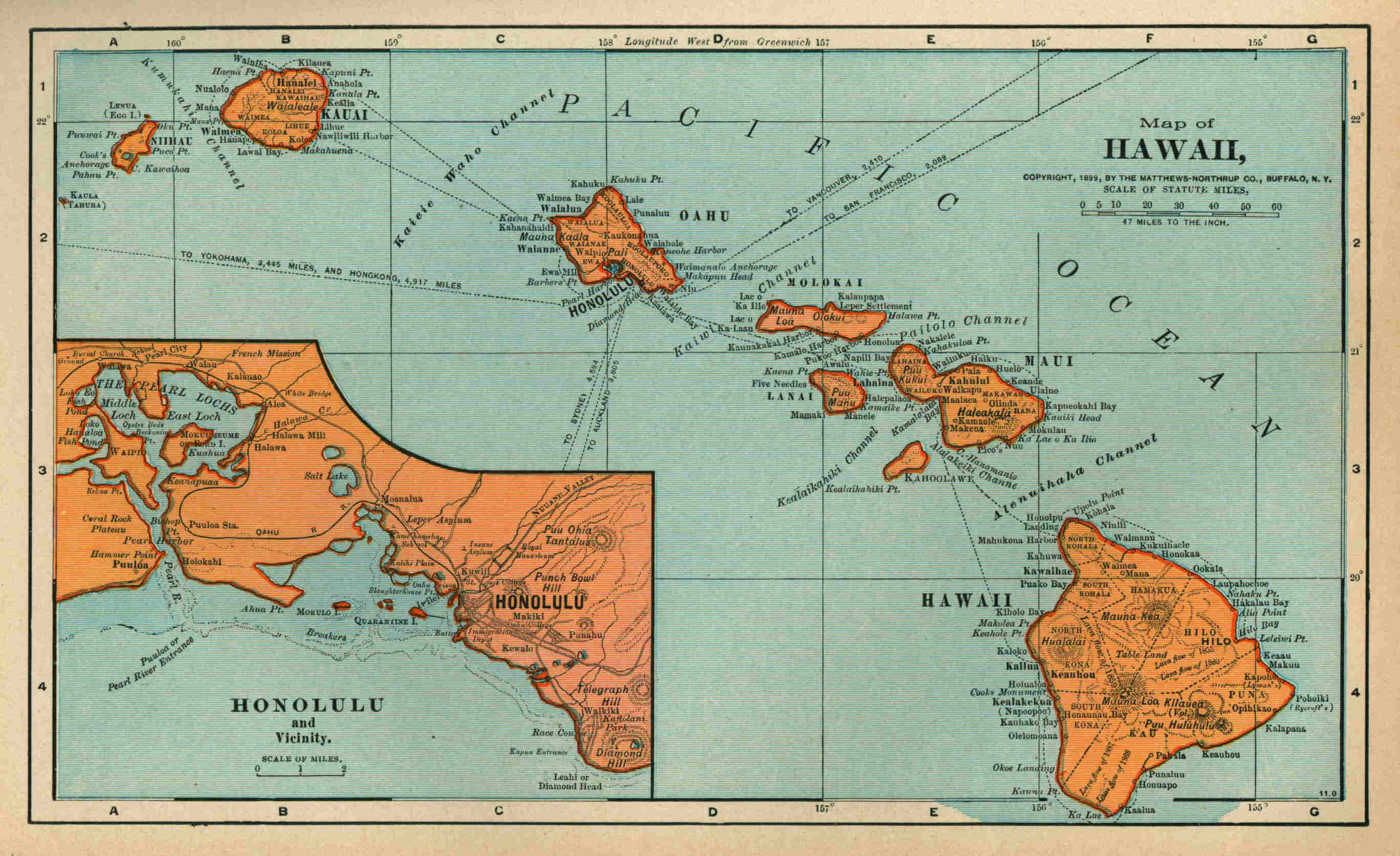
Map of Hawaii and Honolulu. HAWAII. Names and areas of the islands. "For practical purposes, there are eight islands in the Hawaiian group. The others are mere rocks, of no value at present. These eight islands, beginning from the northwest, are named Niihau, Kauai, Oahu, Molokai, Lanai, Kahoolawe, Maui, and Hawaii. The areas of the islands [in square miles] are: Niihau, 97; Kauai, 590; Oahu, 600; Molokai, 270; Maui, 760; Lanai, 150; Kahoolawe, 63; Hawaii, 4,210. Total, 6,740. {255} As compared with States of the Union, the total area of the group approximates most nearly to that of the State of New Jersey—7,185 square miles. It is more than three times that of Delaware—2,050 square miles." Bulletin of the Bureau of American Republics, August, 1898. HAWAII: Annexation to the United States. On the 16th of June, 1897, the President of the United States transmitted to Congress a new treaty for the annexation of the Republic of Hawaii to the United States, signed that day by representatives of the governments of the two countries, appointed to draft the same. With the treaty he submitted a report from his Secretary of State, Mr. Sherman, in which the latter said: "The negotiation which has culminated in the treaty now submitted has not been a mere resumption of the negotiation of 1893 (see HAWAIIAN ISLANDS, in volume 3), but was initiated and has been conducted upon independent lines. Then an abrupt revolutionary movement had brought about the dethronement of the late queen and set up instead of the theretofore titular monarchy a provisional government for the control and management of public affairs and the protection of the public peace, such government to exist only until terms of union with the United States should have been negotiated and agreed upon. Thus self-constituted, its promoters claimed for it only a de facto existence until the purpose of annexation in which it took rise should be accomplished. As time passed and the plan of union with the United States became an uncertain contingency, the organization of the Hawaiian commonwealth underwent necessary changes, the temporary character of its first Government gave place to a permanent scheme under a constitution framed by the representatives of the electors of the Islands, administration by an executive council not chosen by suffrage, but self-appointed, was succeeded by an elective and parliamentary regime, and the ability of the new Government to hold—as the Republic of Hawaii—an independent place in the family of sovereign States, preserving order at home and fulfilling international obligations abroad, has been put to the proof. Recognized by the powers of the earth, sending and receiving envoys, enforcing respect for the law, and maintaining peace within its island borders, Hawaii sends to the United States, not a commission representing a successful revolution, but the accredited plenipotentiary of a constituted and firmly established sovereign State. However sufficient may have been the authority of the commissioners with whom the United States Government treated in 1893, and however satisfied the President may then have been of their power to offer the domain of the Hawaiian Islands to the United States, the fact remains that what they then tendered was a territory rather than an established Government, a country whose administration had been cast down by a bloodless but complete revolution and a community in a state of political transition. Now, however, the Republic of Hawaii approaches the United States as an equal, and points for its authority to that provision of article 82 of the constitution, promulgated July 24, 1894, whereby—'The President, with the approval of the cabinet, is hereby expressly authorized and empowered to make a treaty of political or commercial union between the Republic of Hawaii and the United States of America, subject to the ratification of the Senate.'" The essential articles of the treaty thus submitted were the following: ARTICLE I. The Republic of Hawaii hereby cedes absolutely and without reserve to the United States of America all rights of sovereignty of whatsoever kind in and over the Hawaiian Islands and their dependencies; and it is agreed that all the territory of and appertaining to the Republic of Hawaii is hereby annexed to the United States of America under the name of the Territory of Hawaii. ARTICLE II. The Republic of Hawaii also cedes and hereby transfers to the United States the absolute fee and ownership of all public, government or crown lands, public buildings or edifices, ports, harbors, military equipments and all other public property of every kind and description belonging to the Government of the Hawaiian Islands, together with every right and appurtenance thereunto appertaining. The existing laws of the United States relative to public lands shall not apply to such lands in the Hawaiian Islands; but the Congress of the United States shall enact special laws for their management and disposition, Provided: that all revenue from or proceeds of the same, except as regards such part thereof as may be used or occupied for the civil, military or naval purposes of the United States, or may be assigned for the use of the local government, shall be used solely for the benefit of the inhabitants of the Hawaiian Islands for educational and other public purposes. ARTICLE III. Until Congress shall provide for the government of such Islands all the civil, judicial and military powers exercised by the officers of the existing government in said Islands, shall be vested in such person or persons and shall be exercised in such manner as the President of the United States shall direct; and the President shall have power to remove said officers and fill the vacancies so occasioned. The existing treaties of the Hawaiian Islands with foreign nations shall forthwith cease and determine, being replaced by such treaties as may exist, or as may be hereafter concluded between the United States and such foreign nations. The municipal legislation of the Hawaiian Islands, not enacted for the fulfilment of the treaties so extinguished, and not inconsistent with this treaty nor contrary to the Constitution of the United States, nor to any existing treaty of the United States, shall remain in force until the Congress of the United States shall otherwise determine. Until legislation shall be enacted extending the United States customs laws and regulations to the Hawaiian Islands, the existing customs relations of the Hawaiian Islands with the United States and other countries shall remain unchanged. ARTICLE IV. The public debt of the Republic of Hawaii, lawfully existing at the date of the exchange of the ratifications of this Treaty, including the amounts due to depositors in the Hawaiian Postal Savings Bank, is hereby assumed by the Government of the United States; but the liability of the United States in this regard shall in no case exceed $4,000,000. So long, however, as the existing Government and the present commercial relations of the Hawaiian Islands are continued, as hereinbefore provided, said Government shall continue to pay the interest on said debt. ARTICLE V. There shall be no further immigration of Chinese into the Hawaiian Islands, except upon such conditions as are now or may hereafter be allowed by the laws of the United States, and no Chinese by reason of anything herein contained shall be allowed to enter the United States from the Hawaiian Islands. {256} ARTICLE VI. The President shall appoint five commissioners, at least two of whom shall be residents of the Hawaiian Islands, who shall as soon as reasonably practicable, recommend to Congress such legislation concerning the Territory of Hawaii as they shall deem necessary or proper." United States, 55th Congress, 1st Session, Senate Executive Document E. A determined opposition to the renewed proposal of Hawaiian annexation was manifested at once, in Congress and by many expressions of public opinion at large. It condemned the measure on grounds of principle and policy alike. It denied the right of the existing government at Honolulu to represent the Hawaiian people in such disposal of their country. It denied the constitutional right of the government of the United States to annex territory in the circumstances and the manner proposed. It denied, too, the expected advantages, whether naval or commercial, that the annexation of the islands would give to the United States. A protest against the annexation came also from the deposed Hawaiian queen, Liliuokalani, and another from a party in the island which attempted to rally round the presumptive heiress to the overturned Hawaiian throne, the Princess Kaiulani. The government of Japan also entered a protest, apprehending some disturbance of rights which it had acquired for its emigrating subjects, by treaty with the Republic of Hawaii; but this protest was ultimately withdrawn. The army of opposition sufficed, however, to hold the question of annexation in abeyance for more than a year. No action was taken on the treaty during the special session of the Senate. When Congress assembled in December, 1897, President McKinley repeated his expressions in its favor, and the treaty was reported to the Senate, from the committee on foreign relations, early in the following year; but the two-thirds majority needed for its ratification could not be obtained. Attempts to accomplish the annexation by that method were given up in March, 1898, and the advocates of the acquisition determined to gain their end by the passage of a joint resolution of Congress, which required no more than a majority of each House. Over the question in this form the battle was fiercely fought, until the 15th of June in the House of Representatives and the 6th of July in the Senate, on which dates the following "joint resolution to provide for annexing the Hawaiian Islands to the United States" was passed. It was signed by the President the following day: "Whereas the Government of the Republic of Hawaii having, in due form, signified its consent, in the manner provided by its constitution, to cede absolutely and without reserve to the United States of America all rights of sovereignty of whatsoever kind in and over the Hawaiian Islands and their dependencies, and also to cede and transfer to the United States absolute fee and ownership of all public, Government, or Crown lands, public buildings or edifices, ports, harbors, military equipment, and all other public property of every kind and description belonging to the Government of the Hawaiian Islands, together with every right and appurtenance thereunto appertaining: Therefore, "Resolved by the Senate and House of Representatives of the United States of America in Congress assembled, That said cession is accepted, ratified, and confirmed, and that the said Hawaiian Islands and their dependencies be, and they are hereby, annexed as a part of the territory of the United States and are subject to the sovereign dominion thereof, and that all and singular the property and rights hereinbefore mentioned are vested in the United States of America. The existing laws of the United States relative to public lands shall not apply to such lands in the Hawaiian Islands; but the Congress of the United States shall enact special laws for their management and disposition: Provided, That all revenue from or proceeds of the same, except as regards such part thereof as may be used or occupied for the civil, military, or naval purposes of the United States, or may be assigned for the use of the local government, shall be used solely for the benefit of the inhabitants of the Hawaiian Islands for educational and other public purposes. "Until Congress shall provide for the government of such islands all the civil, judicial, and military powers exercised by the officers of the existing government in said islands shall be vested in such person or persons and shall be exercised in such manner as the President of the United States shall direct; and the President shall have power to remove said officers and fill the vacancies so occasioned. The existing treaties of the Hawaiian Islands with foreign nations shall forthwith cease and determine, being replaced by such treaties as may exist, or as may be hereafter concluded, between the United States and such foreign nations. The municipal legislation of the Hawaiian Islands, not enacted for the fulfillment of the treaties so extinguished, and not inconsistent with this joint resolution nor contrary to the Constitution of the United States nor to any existing treaty of the United States, shall remain in force until the Congress of the United States shall otherwise determine. Until legislation shall be enacted extending the United States customs laws and regulations to the Hawaiian Islands the existing customs relations of the Hawaiian Islands with the United States and other countries shall remain unchanged. The public debt of the Republic of Hawaii, lawfully existing at the date of the passage of this joint resolution, including the amounts due to depositors in the Hawaiian Postal Savings Bank, is hereby assumed by the Government of the United States; but the liability of the United States in this regard shall in no case exceed four million dollars. So long, however, as the existing Government and the present commercial relations of the Hawaiian Islands are continued as hereinbefore provided said Government shall continue to pay the interest on said debt. "There shall be no further immigration of Chinese into the Hawaiian Islands, except upon such conditions as are now or may hereafter be allowed by the laws of the United States; and no Chinese, by reason of anything herein contained, shall be allowed to enter the United States from the Hawaiian Islands. "The President shall appoint five commissioners, at least two of whom shall be residents of the Hawaiian Islands, who shall, as soon as reasonably practicable, recommend to Congress such legislation concerning the Hawaiian Islands as they shall deem necessary or proper. {257} "SECTION 2. That the commissioners hereinbefore provided for shall be appointed by the President, by and with the advice and consent of the Senate. "SECTION 3. That the sum of one hundred thousand dollars, or so much thereof as may be necessary, is hereby appropriated, out of any money in the Treasury not otherwise appropriated, and to be immediately available, to be expended at the discretion of the President of the United States of America, for the purpose of carrying this joint resolution into effect." There was no strict division of parties on the passage of the resolution; but only three Republicans in the House voted against it. Speaker Reed, who had strenuously opposed the measure, was absent. Two Republican senators voted against the resolution and three who opposed it were paired. A large majority of the Democrats in both Houses were in opposition. The policy advocated by the opponents of annexation was set forth in the following resolution, which they brought to a vote in the House, and which was defeated by 205 to 94: "1. That the United States will view as an act of hostility any attempt upon the part of any government of Europe or Asia to take or hold possession of the Hawaiian islands or to account upon any pretext or under any conditions sovereign authority therein. 2. That the United States hereby announces to the people of those islands and to the world the guarantee of the independence of the people of the Hawaiian islands and their firm determination to maintain the same." Immediately upon the passage of the resolution of annexation, preparations were begun at Honolulu for the transfer of sovereignty to the United States, which was performed ceremoniously August 12. Meantime, the President had appointed, as commissioners to recommend legislation for the government of the Islands, Messrs. Shelby M. Cullom, John T. Morgan, Robert R. Hitt, Sanford B. Dole, and Walter F. Frear. In the following November the Commission presented its report, with a draft of several bills embodying the recommended legislation. When the subject came into Congress, wide differences of opinion appeared on questions concerning the relations of the new possession to the United States and the form of government to be provided for it. As the consequence, more than a year passed before Congress reached action on the subject, and Hawaii was kept in suspense for that period, provisionally governed under the terms of the resolution of annexation. The Act which, at last, determined the status and the government of Hawaii, under the flag of the United States, became law by the President's signature on the 30th of April, 1900, and Sanford B. Dole, formerly President of the Republic of Hawaii, was appointed its governor. The fundamental provisions of the "Act to provide a government for the Territory of Hawaii" are the following: SECTION 2. That the islands acquired by the United States of America under an Act of Congress entitled "Joint resolution to provide for annexing the Hawaiian Islands to the United States," approved July seventh, eighteen hundred and ninety-eight, shall be known as the Territory of Hawaii. SECTION 3. That a Territorial government is hereby established over the said Territory, with its capital at Honolulu, on the island of Oahu. SECTION 4. That all persons who were citizens of the Republic of Hawaii on August twelfth, eighteen hundred and ninety-eight, are hereby declared to be citizens of the United States and citizens of the Territory of Hawaii. And all citizens of the United States resident in the Hawaiian Islands who were resident there on or since August twelfth, eighteen hundred and ninety-eight, and all the citizens of the United States who shall hereafter reside in the Territory of Hawaii for one year shall be citizens of the Territory of Hawaii. SECTION 5. That the Constitution, and, except as herein otherwise provided, all the laws of the United States which are not locally inapplicable, shall have the same force and effect within the said Territory as elsewhere in the United States: Provided, that sections eighteen hundred and fifty and eighteen hundred and ninety of the Revised Statutes of the United States shall not apply to the Territory of Hawaii. SECTION 6. That the laws of Hawaii not inconsistent with the Constitution or laws of the United States or the provisions of this Act shall continue in force, subject to repeal or amendment by the legislature of Hawaii or the Congress of the United States. … SECTION 12. That the legislature of the Territory of Hawaii shall consist of two houses, styled, respectively, the senate and house of representatives, which shall organize and sit separately, except as otherwise herein provided. The two houses shall be styled "The legislature of the Territory of Hawaii." … SECTION 17. That no person holding office in or under or by authority of the Government of the United States or of the Territory of Hawaii shall be eligible to election to the legislature, or to hold the position of a member of the same while holding said office. … SECTION 55. That the legislative power of the Territory shall extend to all rightful subjects of legislation not inconsistent with the Constitution and laws of the United States locally applicable. … SECTION 66. That the executive power of the government of the Territory of Hawaii shall be vested in a governor, who shall be appointed by the President, by and with the advice and consent of the Senate of the United States, and shall hold office for four years and until his successor shall be appointed and qualified, unless sooner removed by the President. He shall be not less than thirty-five years of age; shall be a citizen of the Territory of Hawaii; shall be commander in chief of the militia thereof; may grant pardons or reprieves for offences against the laws of the said Territory and reprieves for offences against the laws of the United States until the decision of the President is made known thereon. … SECTION 68. That all the powers and duties which, by the laws of Hawaii, are conferred upon or required of the President or any minister of the Republic of Hawaii (acting alone or in connection with any other officer or person or body) or the cabinet or executive council, and not inconsistent with the Constitution or laws of the United States, are conferred upon and required of the governor of the Territory of Hawaii, unless otherwise provided. … {258} SECTION 80. That the President shall nominate and, by and with the advice and consent of the Senate, appoint the chief justice and justices of the supreme court, the judges of the circuit courts, who shall hold their respective offices for the term of four years, unless sooner removed by the President. … SECTION 81. That the judicial power of the Territory shall be vested in one supreme court, circuit courts, and in such inferior courts as the legislature may from time to time establish. … SECTION 85. That a Delegate to the House of Representatives of the United States, to serve during each Congress, shall be elected by the voters qualified to vote for members of the house of representatives of the legislature; such Delegate shall possess the qualifications necessary for membership of the senate of the legislature of Hawaii. … Every such Delegate shall have a seat in the House of Representatives, with the right of debate, but not of voting. SECTION 86. That there shall be established in said Territory a district court to consist of one judge, who shall reside therein and be called the district judge. The President of the United States, by and with the advice and consent of the Senate of the United States, shall appoint a district judge, a district attorney, and a marshal of the United States for the said district, and said judge, attorney, and marshal shall hold office for six years unless sooner removed by the President. Said court shall have, in addition to the ordinary jurisdiction of district courts of the United States, jurisdiction of all cases cognizable in a circuit court of the United States, and shall proceed therein in the same manner as a circuit court. … SECTION 88. That the Territory of Hawaii shall comprise a customs district of the United States, with ports of entry and delivery at Honolulu, Hilo, Mahukona, and Kahului. HAWAII: A. D. 1900. Census of the Islands. Progress of educational work. "The last Hawaiian census, taken in the year 1896, gives a total population of 109,020, of which 31,019 were native Hawaiians. The number of Americans reported was 8,485. The results of the Federal census taken this year [1900] show the islands to have a total population of 154,001, an increase over that reported in 1896 of 44,981, or 41.2 per cent. The total land surface of the Hawaiian Islands is approximately 6,449 square miles: the average number of persons to the square mile at the last three censuses being as follows: For 1890, 13.9; 1896, 16.9; 1900,23.8. "Education in Hawaii is making favorable progress. In Honolulu two large schoolhouses have recently been erected at a cost of $24,778 and $20,349, respectively. The department of education is under the management of a superintendent of public instruction, assisted by six commissioners of public instruction, two of whom are ladies. The tenure of office of the commissioners is six years, the term of two of them expiring each year. They serve without pay. The system is the same as that existing under the Republic of Hawaii. In the biennial period ending December 31 there were 141 public and 48 private schools in the Hawaiian Islands; 344 teachers in the public schools, of whom 113 were men and 231 were women, and 200 teachers in the private schools, of whom 79 were men and 121 were women. In the same period there were 11,436 pupils in the public schools, of whom 6,395 were boys and 5,041 were girls, and 4,054 pupils in the private schools, of whom 2,256 were boys and 1,798 were girls. This gives a total of 15,490 pupils, of whom 8,651 were boys and 6,839 were girls. … Of the 15,490 pupils, 5,045 were Hawaiian, 2,721 part Hawaiian, 601 American, 213 British, 337 German, 3,882 Portuguese, 84 Scandinavian, 1,141 Japanese, 1,314 Chinese, 30 South Sea Islanders, and 124 other foreigners. Each nationality had its own teacher. The expenditures for the two years ending December 31, 1899, were $575,353. Since the year 1888 nearly all the common schools, in which the Hawaiian language was the medium of instruction, have been converted into schools in which English alone is so employed, 98 per cent. of the children being at present instructed by teachers who use English." United States, Secretary of the Interior, Annual Report, November 30, 1900. ----------HAWAII: End-------- HAY-PAUNCEFOTE TREATY, The. See (in this volume) CANAL, INTEROCEANIC: A. D. 1900 (DECEMBER); and 1901 (MARCH). HAYTI: A. D. 1896. Election of President Sam. Hayti elected a new President, General Theresias Simon Sam, to succeed General Hippolyte, who died suddenly on the 24th of March. HAYTI: A. D. 1897. Quarrel with Germany. The government of Hayti came into conflict with that of Germany, in September, 1897, over what was claimed to be the illegal arrest of a Haytien-born German, named Lueders, who had secured German citizenship. Germany demanded his release, with an indemnity at the rate of $1,000 per day for his imprisonment. The demand not being acceded to promptly, the German consul at Port-au-Prince hauled down his flag. Then the United States Minister persuaded the Haytien President, General Simon Sam, to set Lueders free. But the demand for indemnity, still pending, brought two German war-ships to Port-au-Prince on the 6th of December, with their guns ready to open fire on the town if payment were not made within eight hours. For Hayti there was nothing possible but submission, and $30,000 was paid, with apologies and expressions of regret. HEBREWS, The ancient: Their position in history as affected by recent archæological research. See (in this volume) ARCHÆOLOGICAL RESEARCH; IN BIBLE LANDS. HECKER, Father Isaac Thomas, and the opinions called "Americanism." See (in this volume) PAPACY: A. D. 1899 (JANUARY). HELIUM, The discovery of. See (in this volume) SCIENCE, RECENT; CHEMISTRY AND PHYSICS. HENRY, General Guy V.: Military Governor of Porto Rico. See (in this volume) PORTO RICO: A. D. 1898-1899 (OCTOBER-OCTOBER). HERVEY, or COOK, ISLANDS: Annexation to New Zealand. See (in this volume) NEW ZEALAND: A. D. 1900 (OCTOBER). HEUREAUX, President: Assassination. See (in this volume) DOMINICAN REPUBLIC: A. D. 1899. {259} HICKS-BEACH, Sir Michael, Chancellor of the Exchequer, in the British Cabinet. See (in this volume) ENGLAND: A. D. 1894-1895. HILPRECHT, Professor H. V.: Researches on the site of ancient Nippur. See (in this volume) ARCHÆOLOGICAL RESEARCH: BABYLONIA: AMERICAN EXPLORATION. HINTCHAK, The. See (in this volume) TURKEY: A. D. 1895. HINTERLAND. A German word which has come into general use to describe unnamed and poorly defined regions lying behind, or on the inland side, of coast districts, in Africa more especially, which have been occupied or claimed by European powers. HISTORICAL DISCOVERIES, Recent. See (in this volume) ARCHÆOLOGICAL RESEARCH. HOAR, Senator George F.: Action to recover the manuscript of Bradford's History. See (in this volume) MASSACHUSETTS: A. D. 1897. HOAR, Senator George F.: Speech in opposition to the retention of the Philippine Islands as a subject State. See (in this volume) UNITED STATES OF AMERICA: A. D. 1900 (APRIL). HOBART, Garret A.: Vice President of the United States. Death. See (in this volume) UNITED STATES OF AMERICA: A. D. 1899 (November). HOBOKEN, Great fire at. On the 30th of June, 1900, between 200 and 300 people lost their lives in a fire which destroyed the pier system of the North German Lloyd steamship line, at Hoboken, N. J. The fire wrecked three of the large ships of the company, and is said to have been the most destructive blaze that ever visited the piers and shipping of the port of New York. An estimate placed the loss of life at nearly 300, and the damage to property at about $10,000,000, but the company's estimate of the loss of life and the value of the property wiped out was considerably less. The fire started in some cotton on one of the four large piers at 4 o'clock in the afternoon. In a few minutes the pier on which it broke out was enveloped in flames, and in six minutes the whole pier system was burning. The flames spread so quickly that many men on the piers and on the vessels, lighters and barges were hemmed in before they realized that their lives were in danger. HOBSON, Lieutenant Richmond Pearson: The sinking of the collier Merrimac at Santiago. See (in this volume) UNITED STATES OF AMERICA: A. D. 1898 (APRIL-JUNE). HOLLAND. See (in this volume) NETHERLANDS, THE KINGDOM OF THE. HOLLS, Frederick W.: American Commissioner to the Peace Conference at The Hague. See (in this volume) PEACE CONFERENCE. HOLY YEAR 1900, Proclamation of the Universal Jubilee of the, Its extension. See (in this volume) PAPACY: A. D. 1900-1901. HONDURAS. See (in this volume) CENTRAL AMERICA. HONG KONG: A. D. 1894. The Bubonic Plague. See (in this volume) PLAGUE. HONG KONG: A. D. 1898. British lease of territory on the mainland. See (in this volume) CHINA: A. D. 1898 (APRIL-AUGUST). HORMIGUEROS, Engagement at. See (in this volume) UNITED STATES OF AMERICA: A. D. 1898 (JULY-AUGUST: PORTO RICO). HOUSE OF REPRESENTATIVES, The United States: The "Spoils System" in its service. See (in this volume) CIVIL SERVICE REFORM: A. D. 1901. HOVA, The. See (in this volume) MADAGASCAR. HUA SANG, Massacre of missionaries at. See (in this volume) CHINA: A. D. 1895 (AUGUST). HUDSON BAY, Investigation of. See (in this volume) POLAR EXPLORATION, 1897. HUMBERT I., King of Italy: Assassination. See (in this volume) ITALY: A. D. 1899-1900; and 1900 (JULY-SEPTEMBER). HUNGARY. See ((in this volume) AUSTRIA-HUNGARY. HUSBANDISTS, The. See (in this volume) GERMANY: A. D. 1901 (FEBRUARY). I. ICELAND, Recent exploration of. See (in this volume) POLAR EXPLORATION, 1898-1899. IDAHO: A. D. 1896. Adoption of Woman Suffrage. On the 11th of December, 1896, an amendment of the constitution of Idaho, extending the suffrage to women, was submitted to the then voters of the State, and carried by 12,126, against 6,282. Though carried by a large majority of the votes given on the suffrage issue, it did not receive a majority of the whole vote cast on other questions at the same election; but the supreme court of the State decided that the amendment had been adopted. I-HO-CH'UAN, The. See (in this volume) CHINA: A. D. 1900 (JANUARY-MARCH). ILLINOIS: A. D. 1898. Strike of coal miners. Bloody conflict at Virden. See (in this volume) INDUSTRIAL DISTURBANCES: A. D. 1898. ILOCANOS, The. See (in this volume) PHILIPPINE ISLANDS: THE NATIVE INHABITANTS. ILOILO: The American occupation of the city. See (in this volume) PHILIPPINE ISLANDS: A. D. 1899 (JANUARY-NOVEMBER). ILORIN, British subjugation of. See (in this volume) AFRICA: A. D. 1897 (NIGERIA). IMPERIAL BRITISH EAST AFRICA COMPANY: Transfer of territory to the British Government. See (in this volume) AFRICA: A. D. 1895 (BRITISH EAST AFRICA). IMPERIAL CONFERENCE: Meeting of British Colonial Prime Ministers at the Colonial Office, London. See (in this volume) ENGLAND: A. D. 1897 (JUNE-JULY). IMPERIALISM: The question in American politics. See (in this volume) UNITED STATES OF AMERICA: A. D. 1900 (APRIL); and (MAY-NOVEMBER). {260} INCOME TAX: Decision against by United States Supreme Court. See (in this volume) UNITED STATES OF AMERICA: A. D. 1895 (APRIL-MAY). INDIA: A. D. 1894. The Waziri War. A fierce attempt to interrupt the demarcation of the Afghan boundary was made by the Waziris. The escort of 5,000 troops, consisting mainly of Sikhs and Goorkhas, was desperately attacked in camp at Wano, November 3. The attack was repulsed, but with heavy loss on the British side. It became afterwards necessary to send three strong columns into the country, under Sir William Lockhart, in order to carry out the work. INDIA: A. D. 1895 (March-September). The defense and relief of Chitral. The British frontier advanced. At the extreme northwestern limit of British-Indian dominion and semi-dominion, under the shadow of the lofty Hindu-Kush mountains, lie a group of quasi-independent tribal states over which the Amir of Afghanistan claimed at least a "sphere of influence" until 1893. In that year the Amir and the Government of India agreed upon a line which defined the eastern and southern frontier of Afghanistan, "from Wakhan to the Persian border," and agreed further as follows: "The Government of India will at no time exercise interference in the territories lying beyond this line on the side of Afghanistan, and his Highness the Amir will at no time exercise interference in the territories lying beyond this line on the side of India. The British Government thus agrees to his Highness the Amir retaining Asmar and the valley above it, as far as Chanak. His Highness agrees, on the other hand, that he will at no time exercise interference in Swat, Bajaur, or Chitral, including Arnawai or Bashgal valley." Under this agreement, the Indian Government prepared itself to be watchful of Chitral affairs. The little state was notoriously a nest of turbulence and intrigue. Its rulers, who bore the Persian title of Mehtar, signifying "Greater," can never have expected to live out their days. Changes of government were brought about commonly by assassination. The reigning prince, Nizam-ul-Mulk, owed his seat to the murder of his father, Aman-ul-Mulk, though not by himself. In turn, he fell, on New Year's day, 1895, slain at the instigation of his half-brother, Amir-ul-Mulk, who mounted the vacant chair of state. The usurper was then promptly assailed by two rivals, one of them his brother-in-law, Umra Khan, a mountain chieftain of Bajaur, the other an uncle, Sher Afzul, who had been a refugee at Kabul. On the news of these occurrences at Chitral, the Government of India sent thither, from Gilgit, its political agent, Surgeon-Major Robertson, with a small escort, to learn the state of affairs. The result of Dr. Robertson's attempt to settle matters was an alliance of Umra Khan and Sher Afzul in a desperate attempt to destroy him and his small force of native troops, which had five English officers at its head. The latter took possession (March 1) of the fort at Chitral, a structure about 80 yards square, walled partly with wood, and so placed in a valley that it was commanded from neighboring hills. In this weak fortification the little garrison held off a savage swarm of the surrounding tribes during 46 days of a siege that is as thrilling in the story of it as any found in recent history. The first reinforcements sent to Dr. Robertson, from near Gilgit, were disastrously beaten back, with the loss of the captain in command and 50 of his men. As speedily as possible, when the situation was known in India, an army of about 14,000 men was made ready at Peshawur, under the command of Major-General Sir Robert Low, and relieving columns were pushed with great difficulty through the Malakand Pass, then filled deep with snow. A smaller force, of 600 men, under Colonel Kelly, fought its way from Gilgit, struggling through the snows of a pass 12,000 feet above the level of the sea. Colonel Kelly was the first to reach Chitral, which he did on the 20th of April. The besiegers had fled at his approach. The beleaguered garrison was found to have lost 40 killed and 70 wounded, out of its fighting force of about 370 men. Sher Afzul was caught by the Khan of Dir, who led 2,000 of his followers to the help of the British. Umra Khan escaped to Kabul, where he was imprisoned by the Amir. Shuja-ul-Mulk, a younger brother of Amir-ul-Mulk was declared Mehtar. The question whether British authority should be maintained in Chitral or withdrawn was now sharply debated in England; but Lord Salisbury and his party, coming into power at that moment, decided that the advanced frontier of Indian Empire must be held. The young Mehtar was installed in the name of the Maharaja of Kashmir as his suzerain, and the terms under which his government should be carried on were announced at his installation (September 2, 1895) by the British Agent, as follows: "The general internal administration of the country will be left in the hands of the Mehtar and of his advisers. The Government of India do not intend to undertake themselves the management of the internal affairs of Chitral, their concern being with the foreign relations of the State, and with its general welfare. It, however, has to be remembered that Shuja-ul-Mulk is only a boy, and that, at an age when other boys are engaged in education and amusement, he has been called upon to hold the reins of State. Bearing this fact in mind, the Government of India recognise the necessity of his receiving some help during the time of his minority, and it has consequently been decided to leave at Chitral an experienced Political Officer upon whom the Mehtar may always call for advice and assistance, while it is proposed to appoint three persons, Raja Bahadur Khan, the Governor of Mastuj, Wazir Inayat Khan and Aksakal Fateh Ali Shah, to give him help, instruction and advice in the management of his State and in the laws and customs of the people. Ordinarily the entire country will be governed in accordance with their experience and judgment; but nevertheless the Assistant British Agent, if he thinks it necessary to do so, may, at any time, ask the Mehtar to delay action recommended by his three advisers, until the opinion of the British Agent at Gilgit has been obtained, whose decision shall be final and authoritative. {261} "The desirability of abolishing traffic in slaves is a matter to which the Government of India attach much importance, and that they have lately interested themselves with some success in procuring the release of Natives of Kashmir and her dependencies, including Chitralis, who are held in bondage in Chinese Turkistan. It is in accordance therefore with the general policy of the Government of India that in Chitral also all buying and selling of slaves, whether for disposal in the country or with the intention of sending them abroad, should be altogether prohibited. Any such selling of slaves is therefore from this time forward absolutely illegal." Great Britain, Parliamentary Publications: Papers by Command, 1896 (C.-8037). Also in: C. Lowe, The Story of Chitral (Century magazine, volume 55, page 89). INDIA: A. D. 1895 (April). Report of the Opium Commission. "The long-deferred publication of the report of this commission was made in April, and the report was signed by eight out of nine members of the commission. The commissioners declared that it had not been shown to be necessary, or to be demanded by the people, that the growth of the poppy and the manufacture of opium in British India should be prohibited. Such a prohibition, if extended to the protected States, would be an unprecedented act of interference on the part of the paramount Power, and would be sure to be resisted by the chiefs and their people. The existing treaties with China in regard to the importation of Indian opium into that country had been admitted by the Chinese Government to contain all they desired. The evidence led the commissioners to the conclusion that the common use of opium in India is moderate, and its prohibition is strongly opposed by the great mass of native opinion." Annual Register, 1895, pages 337-338. INDIA: A. D. 1896-1897. Famine in northwestern and central provinces. A failure of rains, especially in northwestern and central India, produced the inevitable consequence of famine, lasting with awful severity from the spring of 1896 until the autumn of 1897. In December of the former year there were 561,800 persons employed on relief works which the Indian government organized. In the following March the number had risen to more than three millions, and in June it exceeded four millions. Rain fell in July, and August, and the distress began soon afterwards to grow less. In addition to the heavy expenditures of the government, the charitable contributions for the relief of sufferers from this famine were officially reported to have amounted to 1,750,000 pounds sterling ($8,750,000). INDIA: A. D. 1896-1900. The Bubonic Plague. See (in this volume) PLAGUE. INDIA: A. D. 1897. Change in the government of Burmah. See (in this volume) BURMAH: A. D. 1897. INDIA: A. D. 1897. Rejection of American proposals for a reopening of mints to silver. See (in this volume) MONETARY QUESTIONS: A. D. 1897 (APRIL-OCTOBER). INDIA: A. D. 1897-1898. Frontier wars. From the early summer of 1897 until beyond the close of the year, the British were once more seriously in conflict with the warlike tribes of the Afghan frontier. The risings of the latter were begun in the Tochi Valley, on the 10th of June, when a sudden, treacherous attack was made by Waziri tribesmen on the escort of Mr. Gee, the political agent, at the village of Maizar. A number of officers and men were killed and wounded, and the whole party would have been destroyed if timely reinforcements had not reached them. Over 7,000 troops were subsequently employed in the suppression and punishment of this revolt. The next outbreak, in the Swat Valley, was more extensive. It was ascribed to the preaching of a fanatical Mohammedan priest, known as "the mud mullah," who labored to excite a religious war, and was opened, July 26, by a night attack on the British positions at Malakand and Chakdarra. The latter outpost, guarding the bridge over the Swat river, on the road to Chitral, was held by a small garrison of less than 300 men, who were beleaguered for a considerable time before relief came. According to an official return of "wars and military operations on or beyond the borders of British India in which the Government of India has been engaged," made to Parliament on the 30th of January, 1900, there were 11,826 troops employed in the operations immediately consequent on this rising, with the result that "the insurgents were defeated and the fanatical gatherings were dispersed; large fines were taken in money and arms." But other neighboring tribes either gave help to the Swats or were moved to follow their example, and required to be subdued, their countries traversed by punitive expeditions and "fines of money and arms" collected. Before the year closed, these tasks employed 6,800 men in the Mohmand country, 3,200 in the Utman Khel country, 7,300 in the Buner country, 14,231 in the Kurram Valley; and then came the most serious business of all. The Afridis, who had been subsidized by the government of India for some years, as guardians of the important Khyber Pass, were suddenly in arms against their paymasters, in August, destroying the Khyber posts. This serious hostility called nearly 44,000 British-Indian troops into the field, under General Sir William Lockhart, whose successful campaign was not finished until the following spring. The most serious engagement of the war with the Afridis was fought at the village of Dargai, October 18. The final results of the campaign are thus summarized in the return mentioned above: "British troops traversed the country of the tribes, inflicting severe loss on the tribesmen, who were ultimately reduced to submission: they paid large fines in money and arms, and friendly relations have since been restored." Great Britain, House of Commons Reports and Papers, 1900, 13. INDIA: A. D. 1898. Discovery of the birthplace and the tomb of Gautama Buddha. See (in this volume) BUDDHA. INDIA: A. D. 1898 (September). Appointment of Lord Curzon to the Viceroyalty. In September, 1898, the Right Hon. George N. Curzon, lately Under Secretary of State for Foreign Affairs, was appointed Viceroy and Governor-General of India, to succeed the Earl of Elgin. In the following month, Mr. Curzon was raised to the peerage, as Baron Curzon of Kedleston. INDIA: A. D. 1899-1900. Famine again. There was a recurrence of drought and famine in 1899, far more extensive than that of 1896-1897; producing more death and suffering, and calling out more strenuous exertions for its relief. The regions afflicted were largely the same as two years before, embracing much of northwestern and central India. The relief measures which it demanded were carried far into the summer of 1900. In October of the latter year Lord Curzon, the Viceroy, addressing the Legislative Council at Simla, and reviewing the experience through which the government and the country had passed, made some important statements of fact: {262} "In a greater or less degree," he said, "nearly one-fourth of the entire population of the Indian continent came within the range of the relief operations. The loss occasioned may be roughly put in this way. The annual agricultural production of India and Burma averages in value between 300 and 400 crores of rupees [the crore being ten millions, and the rupee equivalent to about one-third of a dollar]. On a very cautious estimate the production of 1899-1900 must have been at least one-quarter, if not one-third, below the average, or at normal prices 75 crores, or £50,000,000 sterling. If to this be added the value of some millions of cattle, some conception may be formed of the destruction of property which great drought occasions. There have been many great droughts in India, but no other of which such figures could be predicated as these. … "If a special characteristic can be attributed to our campaign of famine relief in the past year, it has been its unprecedented liberality. There is no parallel in the history of India or any country of the world to the total of over 6,000,000 persons who, in British India and the native States for weeks on end, have been dependent upon the charity of the Government. The famine cost ten crores in direct expenditure, while 238 lakhs were given to landholders and cultivators on loans and advances, besides loans to native States. … There has never been a famine when the general mortality has been less, when the distress has been more amply or swiftly relieved, or when the Government and its officers have given themselves with more whole-hearted devotion to the saving of life and the service of the people. It is impossible to tell the actual mortality, but there has apparently been an excess of mortality over the normal of 750,000. Cholera and smallpox have accounted for 230,000, which is probably below the mark, so that the excess in British India has equalled 500,000 during the year. To say that the greater part of these died of starvation or even of destitution would be an unjustifiable exaggeration, since many other contributory causes have been at work." Referring to the charitable help received from various parts of the world, Lord Curzon said: "In 1896-1897 the total collections amounted to 170 lakhs [the lakh being 100,000 rupees] of which 10 lakhs remained over at the beginning of the recent famine. In the present year the Central Relief Committee has received a sum of close upon 140 lakhs, not far short of £1,000,000 sterling. To analyze the subscriptions: India has contributed about the same amount to the fund as in 1896-1897—namely, 32 lakhs. If the contributions from the European community are deducted, India may be considered to have contributed less than one-fifth of the total collections of 140 lakhs. More might have been expected from the native community as a whole, notwithstanding individual examples of remarkable generosity. The little colony of the Straits Settlements, which has no connexion with India beyond that of sentiment, has given more than the whole Punjab. A careful observation of the figures and proceedings in each province compels me to say that native India has not yet reached as high a standard of practical philanthropy and charity as might reasonably be expected. … The collections from abroad amounted to 108 lakhs, as against 137 in 1896-1897. The United Kingdom's contribution of 88½ lakhs compared indifferently with its contribution of 123 lakhs in 1896-1897, but in the circumstances of the year it is a noble gift. Glasgow has been especially generous with a donation of 8¼ lakhs and Liverpool with 4½, in addition to nearly 16 lakhs from the rest of Lancashire. Australasia has given nearly 8 lakhs in place of 2 lakhs. The Straits Settlements, Ceylon, and Hong-Kong have also been extremely generous. Even the Chinese native officials have collected handsome sums. The liberal donation of Germany at the instigation of the Emperor has already been publicly acknowledged. The United States, both through direct contributions to the fund and by means of privately-distributed gifts of money and grain, have once more shown their vivid sympathy with England's mission and India's need." INDIA: A. D. 1901. Census of the Empire. Decrease of population in several of the Native States. The Indian census, begun on the 1st of March, 1901, was completed for the entire empire in fourteen days, the result being announced on the 15th. It showed a total population in British territory of 231,085,000, against 221,266,000 in 1891; in Native States 63,181,000, against 66,050,000 in 1891; total for all India, 294,266,000, against 287,317,000 in 1891. The Native States, it will be seen, have declined in population to the extent of nearly 3,000,000, showing greater severity in those states of the effects of famine and disease. In several provinces, however, of the British territory, a decrease of population appears: Berar declining from 2,897,000 in 1891 to 1,491,000 in 1901; Bombay (British Presidency) from 15,957,000 to 15,330,000; Central Provinces from 10,784,000 to 9,845,000; Aden from 44,000 to 41,000; Coorg from 173,000 to 170,000. Of the Native States the greatest loss of population was suffered in Rajputana, which sank from 12,016,000 to 9,841,000; in Central India, where the numbers fell from 10,318,000 to 8,501,000; and in the Bombay States, which were reduced in population from 8,059,000 to 6,891,000. The provinces in British India which show the greatest percentage of gain are Upper and Lower Burma, Assam and Sind. The present population of the greater British provinces is as follows: Bengal, 74,713,000; Madras, 38,208,000; Northwest provinces, 34,812,000; Punjab, 22,449,000. INDIA: A. D. 1901 (February). Continued famine. On the 24th of January, 1901, the Viceroy of India reported to the British Government, by telegram, that the winter rainfall had been unusually good in Upper India, Rajputana, Central Provinces, and Central India, and agricultural prospects were very favorable: but that in Gujarat, Deccan, and the Karnatik districts of Bombay, through the early cessation of the monsoon in September and the absence of rain, the crop prospects were bad and serious distress was expected between then and August. Relief measures would be required. The affected district included Baroda and part of Haidarabad. On the 14th of February the Viceroy reported further that the number on the relief works and gratuitous relief showed little increase, but greater pressure was expected in the affected area after the reaping of the scanty harvests there. {263} In Upper and Central India some damage by storm and damp had been done to crops which promised to be very good. The number of persons then in receipt of relief was: Bombay, 176,000; Bombay Native States, 17,000; Baroda, 15,000; Haidarabad, 2,000; Madras, 3,000; Central India States, 1,000. Total, 214,000. INDIA: A. D. 1901 (February). Creation of a new administrative province on the northwestern frontier. A despatch from Calcutta, February 13, announced the determination of the government of India to create "a new frontier agency or province, formed out of the four trans-Indus districts of the Punjab, under an Agent to the Governor-General of similar status to the Agent in Baluchistan, with revenue and judicial commissioners, all the officers being under the Supreme Government and enrolled in the Political Department. The districts which form the new province will be Peshawar, Kohat, Bannu, and Dera Ismail Khan, with the tribal country beyond their limits, and also the existing political agencies of Dir, Swat, Chitral, the Khaibar, the Kuram, Tochi, and Wana. The scheme takes as little as possible away from the Punjab, while making a compact charge, easily controllable by one officer." INDIA: A. D. 1901 (February). Message of King Edward VII. to the princes and people. See (in this volume) ENGLAND: A. D. 1901 (JANUARY-FEBRUARY). INDIANAPOLIS CONVENTION, and Monetary Commission, The. See (in this volume) UNITED STATES OF AMERICA: A. D. 1896-1898. INDIANS, The American: A. D. 1893-1899. Negotiations and agreements with the Five Civilized Tribes. Work of the Dawes Commission. In his annual Message to the Congress of the United States, December 7, 1896, President Cleveland made the following reference to the work of a commission created in 1893, for negotiating with what are known as the Five Civilized Tribes of Indians: "The condition of affairs among the Five Civilized Tribes, who occupy large tracts of land in the Indian Territory and who have governments of their own, has assumed such an aspect as to render it almost indispensable that there should be an entire change in the relations of these Indians to the General Government. This seems to be necessary in furtherance of their own interests, as well as for the protection of non-Indian residents in their territory. A commission organized and empowered under several recent laws is now negotiating with these Indians for the relinquishment of their courts and the division of their common lands in severalty, and are aiding in the settlement of the troublesome question of tribal membership. The reception of their first proffers of negotiation was not encouraging, but through patience and such conduct on their part as demonstrated that their intentions were friendly and in the interest of the tribes the prospect of success has become more promising. The effort should be to save these Indians from the consequences of their own mistakes and improvidence and to secure to the real Indian his rights as against intruders and professed friends who profit by his retrogression. A change is also needed to protect life and property through the operation of courts conducted according to strict justice and strong enough to enforce their mandates. As a sincere friend of the Indian, I am exceedingly anxious that these reforms should be accomplished with the consent and aid of the tribes and that no necessity may be presented for radical or drastic legislation." United States, Message and Documents (Abridgment, 1896-1897). The Act of March 3, 1893, by which the commission was created, set forth its character, its duties and its powers, as follows: "The President shall nominate and, by and with the advice and consent of the Senate, shall appoint three commissioners to enter into negotiations with the Cherokee Nation, the Choctaw Nation, the Chickasaw Nation, the Muscogee (or Creek) Nation, the Seminole Nation, for the purpose of extinguishment of the national or tribal title to any lands within that territory now held by any and all of such nations or tribes, either by cession of the same or some part thereof to the United States, or by the allotment and division of the same in severalty among the Indians of such nations or tribes, respectively, as may be entitled to the same, or by such other method as may be agreed upon between the several nations and tribes aforesaid, or each of them, with the United States, with a view to such an adjustment, upon the basis of justice and equity, as may, with the consent of such nations or tribes of Indians, so far as may be necessary, be requisite and suitable to enable the ultimate creation of a State or States of the Union which shall embrace the lands within said Indian Territory. … "Such commissioners shall, under such regulations and directions as shall be prescribed by the President, through the Secretary of the Interior, enter upon negotiation with the several nations of Indians as aforesaid in the Indian Territory, and shall endeavor to procure, first, such allotment of lands in severalty to the Indians belonging to each such nation, tribe, or band, respectively, as may be agreed upon as just and proper to provide for each such Indian a sufficient quantity of land for his or her needs, in such equal distribution and apportionment as may be found just and suited to the circumstances; for which purpose, after the terms of such an agreement shall have been arrived at, the said commissioners shall cause the land of any such nation, or tribe, or band to be surveyed and the proper allotment to be designated; and, secondly, to procure the cession, for such price and upon such terms as shall be agreed upon, of any lands not found necessary to be so allotted or divided, to the United States; and to make proper agreements for the investment or holding by the United States of such moneys as may be paid or agreed to be paid to such nation, or tribes, or bands, or to any of the Indians thereof, for the extinguishment of their [title?] therein. But said commissioners shall, however, have power to negotiate any and all such agreements as, in view of all the circumstances affecting the subject, shall be found requisite and suitable to such an arrangement of the rights and interests and affairs of such nations, tribes, bands, or Indians, or any of them, to enable the ultimate creation of a Territory of the United States with a view to the admission of the same as a State in the Union." {264} A subsequent Act, of March 2, 1895, authorized the appointment of two additional members of the commission; and an Act of June 10, 1896, provided that "said commission is further authorized and directed to proceed at once to hear and determine the application of all persons who may apply to them for citizenship in any of said nations, and after said hearing they shall determine the right of said applicant to be so admitted and enrolled. … That the said commission … shall cause a complete roll of citizenship of each of said nations to be made up from their records, and add thereto the names of citizens whose right may be conferred under this act, and said rolls shall be, and are hereby, made rolls of citizenship of said nations or tribes, subject, however, to the determination of the United States courts, as provided herein." A further Act of Congress, known as the Curtis Act, June 28, 1898, ratified, with some amendments, an agreement made by the commission with the Choctaws and Chickasaws, in April. 1897, and with the Creeks in September of that year, to become effective if ratified by a majority of the voters of those tribes at an election held prior to December 1, 1898. In the annual report, for 1899, made by the commission (of which the Honorable Henry L. Dawes, of Massachusetts, is chairman, and which is often referred to as "the Dawes Commission,") the following account of results is given: "A special election was called by the executives of the Choctaw and Chickasaw nations to be held August 24, and the votes cast were counted in the presence of the Commission to the Five Civilized Tribes at Atoka, August 30, resulting in the ratification of the agreement by a majority of seven hundred ninety-eight votes. Proclamation thereof was duly made, and the 'Atoka agreement,' so called, is therefore now in full force and effect in the Choctaw and Chickasaw nations. Chief Isparhecher of the Creeks was slow to call an election, and it was not until November 1, 1898, that the agreement with that tribe was submitted in its amended form for ratification. While no active interest was manifested, the full-bloods and many of the freedmen were opposed to the agreement and it failed of ratification by about one hundred and fifty votes. … "The Cherokees now began to realize the sensations of 'a man without a country,' and again created a commission at a general session of the national council in November, 1898, clothed with authority to negotiate an agreement with the United States. The earlier efforts of this commission to conclude an agreement with that tribe were futile, owing to the disinclination of the Cherokee commissioners to accede to such propositions as the Government had to offer. The commission now created was limited in its power to negotiate to a period of thirty days. The United States Commission had advertised appointments in Mississippi extending from December 19, 1898, to January 7, 1899, for the purpose of identifying the Mississippi Choctaws, a duty imposed upon the commission by the act of June 28, 1898, but on receiving a communication from the chairman of the Cherokee Commission requesting a conference it was deemed desirable to postpone the appointments in Mississippi and meet the Cherokee Commission, which it did on December 19, 1898, continuing negotiations until January 14, 1899, producing the agreement which is appended hereto. In the meantime the Creeks had, by act of council, created another commission with authority to negotiate an agreement with the United States, and a conference was accorded it immediately upon conclusion of the negotiations with the Cherokees, continuing to February 1, 1899, when an agreement was concluded. The agreement with the Cherokees was ratified by the tribe at a special election held January 31, 1899, by a majority of two thousand one hundred six votes, and that with the Creeks on February 18, 1899, by a majority of four hundred eighty-five. "While these agreements do not in all respects embody those features which the commission desired, they were the best obtainable, and the result of most serious, patient, and earnest consideration, covering many days of arduous labor. The commissions were many times on the point of suspending negotiations, there having arisen propositions upon the part of one of the commissions which the other was unwilling to accept. Particularly were the tribal commissioners determined to fix a maximum and minimum value for the appraisement of lands, while this commission was equally vigorous in its views that the lands should be appraised at their actual value, excluding improvements, without limitations in order that an equal division might be made. The propositions finally agreed upon were the result of a compromise, without which no agreement could have been reached. The desirability, if not the absolute necessity, of securing a uniform land tenure among the Five Tribes leads the commission to recommend that these agreements, with such modifications and amendments as may be deemed wise and proper, be ratified by Congress. … "The Choctaw and Chickasaw governments, in a limited way, are continued, by agreement, to March 4, 1906, and certain of their laws are therefore effective within the territory of those tribes. A similar condition exists as to the Seminoles, with which an agreement was concluded at the close of the year 1897. To supply needed laws to replace various tribal statutes which had by Congress been made inoperative, the laws of Arkansas pertaining to certain matters have been extended over Indian Territory. The Federal laws have been made to apply to still other subjects, and officials under the Interior Department are charged with the enforcement of rules and regulations governing still further matters, and so on. So complicated and complex a state of affairs does this system of jurisprudence present that the people are dazed and often unable to determine what is law and who is authorized to enforce it. Indeed, none other than an able lawyer can reasonably hope to understand the situation, and even he must be content to look upon certain phases of it as not being susceptible of solution. "Conditions are not yet ripe for the immediate installation of a Territorial or State government. 'Tis a consummation devoutly to be wished,' but wholly impracticable at this time for various reasons, not the least of which is found in the fact that there are four non-citizens in Indian Territory to every citizen. The non-citizen does not own a foot of soil, save as provisions have recently been made for the segregation and sale of town sites, and with a voice in legislation, the non-citizen would soon legislate the Indian into a state of innocuous desuetude. On the other hand, it would be manifestly unjust and at ill-accord with the spirit of our institutions to deny the right of franchise to so great a number of people, in all respects otherwise entitled to enjoy that prerogative. {265} Another very serious obstacle to the establishment of a territorial form of government is the lack of uniform land tenures. The commission indulges in the hope and belief that at no great distant date some method may be devised whereby the lands of all the Five Tribes may be subjected to a uniform tenure. It will be seen that the legislative feature of the popular form of government is not possible at this time, and while legislation by Congress for all the petty needs of the Territory is impracticable in the highest degree, the more urgent requirements of the people must be met by this means for the present. The judicial branch is well represented by the United States courts. … "The commission, in conclusion, most earnestly urges the importance of adequate appropriations for pushing to an early completion the work contemplated by the various laws and agreements under which a transformation is to be wrought in Indian Territory. The all-important and most urgent duty now devolving upon the Government of the United States incident to the translation of conditions among the Five Tribes is the allotment of lands in severalty, and the most pressing and essential preliminary steps toward that end are the completion of citizenship rolls, the appraisement of lands, and the subdivision of sections into forty-acre tracts, all of which have been already discussed in detail in this report. The commission believes that the enrollment of citizens is progressing as rapidly as the nature of the work will permit, and unless some unforeseen obstacle arises to prevent, the rolls in four of the nations will be completed and delivered to the Secretary during the fiscal year ending June 30, 1900, and very material progress made in the fifth." Sixth Annual Report of the Commission to the Five Civilized Tribes, 1899, page 66-67, and 9-29. INDIANS, AMERICAN: A. D. 1898. Outbreak in northern Minnesota. An alarming outbreak of hostility on the part of some of the Indians of the Leech Lake Reservation in northern Minnesota occurred in October, 1898, provoked, as was afterwards shown, by gross frauds and abuses on the part of certain of the officials with whom they had to deal. They had been shamefully defrauded in the sale of their timber lands, which the government assumed to undertake for their benefit; but the immediate Cause of trouble appeared to be a scandalous practice on the part of deputy marshals, who made arrests among them for trivial reasons, conveyed prisoners and witnesses to the federal court at St. Paul, in order to obtain fees and mileage, and left them to make their way home again as they could. The outbreak began on the arrest of a chief of the Pillager band of Chippewas, on Bear Island. He was to be taken to St. Paul as a witness in a case of alleged whiskey-selling; but his followers rescued him. The marshal, thereupon, called for military aid, and a company of United States infantry was sent to the Reservation. They were ambuscaded by the Indians and suffered a loss of 5 killed and 16 wounded. The Pillager band was joined by Indians from neighboring tribes, and all in the region were dangerously excited by the event, while the whites were in great dread of a general Indian war. But reinforcements of troops were promptly sent to the scene, and peace was soon restored,—measures being taken to remedy the wrongs of which the Indians complained. INDIANS, AMERICAN: A. D. 1899-1900. The recent Indian policy of the government, and its results. Indian schools and education. Present Indian population. "This, then, is the present Indian policy of the nation,—to fit the Indian for civilization and to absorb him into it. It is a national work. It is less than twenty-five years since the government turned from the policy of keeping him on reservations, as quiet as possible, out of the way of civilization, waiting, with no excess of patience, for the race to fade out of existence and to cease from troubling. It was in 1877 that the nation made the first appropriation from its own treasury to fit for its own citizenship this portion of the human race living under its own flag and constitution, but without legal status or constitutional immunities. … The first appropriation was a mere pittance of $20,000; it was given only after a hard struggle. But the first step met with encouragement, and the next year the sum was increased to $30,000, and then to $60,000, and in two years more it became $125,000. The policy has at last so grown in public confidence that, while there is still much discussion of the best methods of expenditure, not a word is heard among the lawgivers for its abandonment. It has in the meantime so broadened in its scope that the appropriations for this work have increased from year to year, till this year (1899) it has risen to $2,638,390. … There are now 148 well-equipped boarding schools and 295 day schools, engaged in the education of 24,004 children, with an average attendance of 19,671. How near this comes to including the whole number of children of school age, in a total population of a quarter of a million of Indians, every inquirer can form a pretty close estimate for himself. No one will deny that, at this rate of progress, the facilities for the education of Indian children will soon reach, if they have not already reached, those enjoyed by their white neighbors in the remote regions of the West. The results thus far are of a most encouraging character. "But the work does not stop with the rising generation of the race; it embraces also the adult Indian. … Soon after the beginning of appropriations for Indian schools, Congress, in what is called the Severalty Act, provided for every Indian capable of appreciating its value, and who chose to take it, a homestead of one hundred and sixty acres to heads of families, and a smaller number to other members, inalienable and untaxable for twenty-five years, to be selected by him on the reservation of his tribe. If he prefer to abandon his tribe and go elsewhere, he may take his allotment anywhere on the public domain, free of charge. No English baron has a safer title to his manor than has each Indian to his homestead. He cannot part with it for twenty-five years without the consent of Congress, nor can the United States, without his consent, be released from a covenant to defend his possession for the same period. This allotment carries with it also all the rights, privileges, and immunities of an American citizen; opens to these Indians, as to all other citizens, the doors of all the courts; and extends to them the protection of all the laws, national and state, which affect any other citizen. Any Indian, if he prefers not to be a farmer, incumbered with one of these homesteads, may become a citizen of the United States, and reside and prosecute any calling in any part of the United States, as securely under this law as anyone else, by taking up his residence separate and apart from his tribe, and adopting the habits of civilized life. Thus every door of opportunity is thrown wide open to every adult Indian, as well as to those of the next generation. {266} "This recognition of the home and family as a force in Indian civilization became a part of the present policy of dealing with the race only twelve years ago. These are some of its results: 55,467 individual Indians, including a few under former treaty stipulations, have taken their allotments, making an aggregate of 6,708,628 acres. Of these, 30,000 now hold complete patents to their homes, and the rest are awaiting the perfection and delivery of their title deeds. … Not alone in these statistics are manifest the evidences of permanent advance of the race toward the goal of orderly, self-supporting citizenship. Bloody Indian wars have ceased. The slaughter of warring clans and the scalping of women and children fleeing from burning wigwams are no longer recorded. Geronimo himself has become a teacher of peace. The recent unfortunate difficulty with the Chippewas in Minnesota, caused more by lack of white than of red civilization, is no exception. We are at peace with the Indian all along the border, and the line between the Indian and the white settlements is fast fading out." H. L. Dawes, Have we failed with the Indian? (Atlantic Monthly, August, 1899). "Indian education is accomplished through the means of nonreservation boarding schools, reservation boarding schools, and reservation and independent day schools, all under complete Government control, State and Territorial public schools, contract day and boarding schools, and mission day and boarding schools. The Indian school system aims to provide a training which will prepare the Indian boy or girl for the every day life of the average American citizen. It does not contemplate, as some have supposed on a superficial examination, an elaborate preparation for a collegiate course through an extended high-school curriculum. The course of instruction in these schools is limited to that usually taught in the common schools of the country. Shoe and harness making, tailoring, blacksmithing, masonry work, plastering, brick making and laying, etc., are taught at the larger nonreservation schools, not, it is true, with the elaborateness of special training as at the great polytechnic institutions of the country, but on a scale suited to the ability and future environment of the Indian. There are special cases, however, where Indian boys are, and have been, trained so thoroughly that their work compares favorably with that of the white mechanic. … Phoenix, Haskell, Albuquerque, and other institutions, have well-organized schools of domestic science, where the girls are practically taught the art of preparing a wholesome meal, such as appears on the tables of persons of moderate means. … "Nonreservation schools … are as a rule the largest institutions devoted to Indian education. As indicated by their designation, they are situated off the reservations and usually near cities or populous districts, where the object lessons of white civilization are constantly presented to the pupils. They are recruited principally from the day and boarding schools on the reservations. The majority are supported by special appropriations made by Congress, and are adapted to the teaching of trades, etc., in a more extended degree than are schools on the reservations. The largest of these schools is situated at Carlisle, Pennsylvania, where there are accommodations for 1,000 pupils; the next largest is at Phoenix, Arizona, with a capacity for 700; the third, at Lawrence, Kansas, and known as Haskell Institute, accommodating 600 pupils. These three large schools are types of their class, and are not restricted in territory as to collection of pupils. Chemawa school, near Salem, Oregon, and Chilocco school, near Arkansas City, Oklahoma, are types of the medium-sized schools, and each has a capacity of 400 pupils. The remainder of the schools are of less capacity and have not been developed so highly. There are altogether 25 of these schools. … "There are 81 boarding schools located on the different reservations, an increase of 11 over last year. At these institutions the same general line of policy is pursued as at the nonreservation schools. Frequently located far from the centers of civilization, conditions are different, and their conduct must be varied to suit their own special environment. Many were formerly mission schools and army posts, unsuited to Indian school purposes, but by constant modification are being brought into general harmony with the system. … Government day schools are small schools with capacity for 30 or 40 pupils each. As a rule they are located at remote points on the reservations, and are conducted by a teacher and a housekeeper. A small garden, some stock, and tools are furnished, and the rudiments of industrial education are given the boys; and the girls are taught the use of the needle in mending and sewing, and of the washtub in cleanliness. … There were 147 day schools in operation during the year, an increase of 5 over last year." The number of government schools reported for the year 1900 was 253, total enrollment, 22,124, average attendance, 17,860; contract schools, 32, with an enrollment of 2,806, average attendance, 2,451; public and mission schools, 22, with an enrollment of 1,521, and an average attendance of 1,257; the aggregate being 307 schools, with an enrollment of 26,451, and an average attendance of 21,568. "Statistics of the schools for the New York Indians are not included in the above, for the reason that as they are cared for by the State of New York this office has no jurisdiction over them. … The Indian population of the United States under the control of the Indian Office (excluding the Five Civilized Tribes) was 187,312 in 1899, which would give a scholastic population of between 45,000 and 47,000. Deduct 30 per cent for the sick and otherwise disabled, and those in white schools or away from the direct control of the office, and it would leave about 34,000 children for whom educational facilities should be provided. There are now 26,000 of them in school, leaving about 8,000 unprovided for." Annual Report of the Commissioner of Indian Affairs, 1900, pages 15-23. {267} "Taking the concurrent facts of history and experience into consideration, it can, with a great degree of confidence, be stated that the Indian population of the United States has been very little diminished from the days of Columbus, Coronado, Raleigh, Captain John Smith, and other early explorers." The number of Indians in the United States in the year 1900, according to the report of the Indian Office, was 272,023. This excludes "the Indians of Alaska, but includes the New York Indians (5,334) and the Five Civilized Tribes in Indian Territory (84,750)—a total population of 90,084. These Indians are often separated from the others in statistics because they have separate school and governmental systems." Annual Report of the Commissioner of Indian Affairs, 1900, pages 47-49. INDONESIAN RACE. See (in this volume) PHILIPPINE ISLANDS: THE NATIVE INHABITANTS. INDUSTRIAL ARBITRATION. See (in this volume) NEW ZEALAND: A. D. 1891-1900; and UNITED STATES OF AMERICA: A. D. 1898 (JUNE). INDUSTRIAL COMBINATIONS. See (in this volume) TRUSTS; UNITED STATES. INDUSTRIAL COMMISSION, The United States. See (in this volume) UNITED STATES OF AMERICA: A. D. 1898 (JUNE). INDUSTRIAL DISTURBANCES, Wide-spread: A. D. 1895-1896. Strike of glassworkers in France. A great strike of French glass workers, beginning in the summer of 1895, ended the following January in a lockout of the men, leaving thousands without means of subsistence. INDUSTRIAL DISTURBANCES, Wide-spread: A. D. 1897. The great dispute in the British engineering trades. "The strike originated in an effort on the part of some of the men employed in London to introduce the eight-hour day. As a consequence of this movement, the Employers' Federation voted, on July 1st, that in case the threatened movement in favor of eight hours should be carried out 'notices will immediately be given by the members of the associations affiliated to the federation that a reduction of hands of 25 per cent. will take place of the members of such unions in their employment.' This challenge of the employers was quickly taken up by the Unionists. The Amalgamated Society at once gave instructions that in all cases in which notices of lockout were issued to 25 per cent. of their members, the remaining 75 per cent. should hand in notices to cease work at the same time. The result was the inauguration of a dispute, which took in part the form of a lockout, in part that of a strike, but which from the beginning was carried on with an ominous display of bitterness and obstinacy on both sides. The membership of the different societies concerned in the dispute was estimated, by the Labor Gazette in July, at over 109,000. All of these were not, of course, actually on strike. … It seems as if the employers had been quite ready to enter into this contest with the view of crushing the union, or at least of teaching it a lesson; but the result is a very widespread industrial conflict, which is producing results far beyond those immediately concerned." Yale Review (November, 1897). "The number of work people directly affected by the dispute was about 25,000 at the outset, but as the area of the dispute widened the number of firms and of workmen involved gradually increased, until the lock-out involved 702 firms and 35,000 workmen directly and 12,500 indirectly. … Though the immediate cause of the general dispute was the demand for an eight hours' day in London, the real questions at issue between the parties had become of a much more far-reaching kind, and now involved the questions of workshop control and the limits of trade union interference. During October and November negotiations under the Conciliation Act took place between the Board of Trade and the representatives of the parties with a view to arrange a conference between them. As a result of the correspondence both sides assented to the following basis for a conference suggested by the Board of Trade: 1. The Federated Employers, while disavowing any intention of interfering with the legitimate action of trade unions, will admit no interference with the management of their business. The Trade Unions on their part, while maintaining their right of combination, disavow any intention of interfering with the management of the business of the employers. 2. The notices demanding a 48 hours' week served on the Federated Employers in London without previous request for a conference are withdrawn. 3. A conference between representatives of the Federated Employers and the Trade Unions concerned in the dispute shall be held forthwith. … Pending the conference the employers agreed to suspend all pending lockout notices, and the Unions not to interfere in any way with men in employment. … "The sittings were held on November 24th and two following days, and again on November 30th and three following days, after which an adjournment took place until December 14th in order to allow the men to vote as to the acceptance or otherwise of the proposals made by the employers. … When the Conference resumed its sittings on December 14th the result of the ballot of the men was declared to be:—For the terms, 752; against, 68,966. Discussion of the proposals was, however, resumed and continued over four days by a sub-committee of three representatives on each side, who consulted with their colleagues when necessary. The terms were somewhat amended. … On submitting these amended conditions to the vote of the men 1,041 voted in favour of their acceptance and 54,933 against. The truce which had been arranged over the period of negotiations was brought to an end by this vote, and fresh notices of lock-out were given in various centres, which considerably increased the numbers affected. … "On January 13th, however, an important change was made in the position of the men. The London Joint Committee, the body which took the first actual step in the dispute by ordering strike notices to be given in certain London shops, passed the following resolution:—That we intimate to the Employers' Federation that the demand for an eight hours' day, or forty-eight hours' week be withdrawn. That before such intimation is given the above resolution to be sent to the Executive Councils of the Societies represented on the Joint Committee for their approval or otherwise. … This resolution received the approval of the trade unions concerned, and the withdrawal of the demand for a 48 hours' week was intimated to the Employers' Federation, which, however, still insisted on the acceptance by the unions of the 'conditions of management mutually adjusted at the recent Westminster Conference' as a condition of returning to work. The men asked that the employers' notes and explanations should be read as part of the proposed agreement, and eventually, after renewed negotiations between the parties, a provisional agreement was arrived at and submitted to the votes of the men, who ratified it by 28,588 to 13,727. The final agreement was signed in London on January 28th, and work was resumed in the following week. … {268} "Naturally, after so long a stoppage the resumption of work by the men was a gradual process, but the number unemployed owing to the dispute, including those indirectly affected, sank from 44,500 at the close of the lock-out to 7,500 at the end of February, 2,000 at the end of April, 1,500 at the end of May, and 1,000 at the end of June. … Some idea of the indirect effects of the stoppage on trades related to those engaged in the struggle may be formed from the fact that the percentage of unemployed members in trade unions of the ship-building group rose from 4.4 per cent. in July, to 14.1 per cent. in December." Great Britain, Board of Trade (Labour Department), Report on the Strikes and Lock-outs of 1897. INDUSTRIAL DISTURBANCES, Wide-spread: A. D. 1897. Great coal miners' strike in the United States. A general strike of the coal miners in the various districts of the United States began in July, 1897. The territory covered five states and involved about 157,000 men. The strikers asked for an advance in wages on the ground that it was their right to share in the increase of business prosperity and advanced prices. A grievance for which redress was asked was that of being obliged to buy at the company stores, paying in company's orders, to be deducted from their wages. The principal grievance was the 54-cent rate, paid by Mr. W. P. De Armitt of the New York and Cleveland Gas Coal Company. The men employed by Mr. De Armitt had signed a contract to accept a rate 10 cents below that of other operators, in return for which he had abolished company stores, gave steady employment, and paid promptly in cash. His men were satisfied with the arrangement, although the prevailing price for mining coal was 64 cents a ton. Most of them, however, were finally forced by the organization to join the strikers. The strike lasted until September 12, when matters were arranged in a convention at Columbus, Ohio, when a uniform rate of 65 cents was adopted. A tragic feature of the strike occurred at Lattimer, Pennsylvania, where a mob of marching miners, resisting the sheriff and handling him roughly, were fired upon by armed deputies. Eighteen were killed and about forty wounded. INDUSTRIAL DISTURBANCES, Wide-spread: A. D. 1898. New England cotton mill strike. In January a general strike, affecting 125,000 operatives, resulted from a reduction in wages in 150 cotton mills of New England. By April most of the strikers returned to work at the manufacturers' terms. INDUSTRIAL DISTURBANCES, Wide-spread: A. D. 1898. Coal miners' strike in Illinois. This strike, beginning in May, originated in the refusal of the mine operators to grant the rate of 40 cents a ton, agreed upon after the strike of 1897. The operators refused to compromise and the miners were upheld by the United Mine Workers. Riots arose in the towns of Pana and Virden upon the attempt of the mine owners to import negro workers from the south. Governor Tanner, in sending troops to restore order, enjoined upon them to protect citizens, but on no account to assist mine owners to operate their mines with imported labor, The governor's attitude provoked much criticism. A serious outbreak occurred on October 12, at Virden, when 14 persons were killed and 25 wounded. The strike at Virden was settled in November, the mine owners agreeing to the demands of the miners. The trouble at Pana lasted until April, when a settlement was arrived at. INDUSTRIAL DISTURBANCES, Wide-spread: A. D. 1900. Anthracite coal miners' strike in Pennsylvania. A great strike of the anthracite mine workers of Pennsylvania, which began September 17, practically ended October 17, when the Philadelphia and Reading Coal and Iron Company and the Lehigh Valley Coal Company agreed to abolish the sliding scale in their respective regions and to grant an advance in wages of 10 per cent. net, the advance to remain in operation until April 1, 1901, and thereafter till further notice. Mr. John Mitchell, president of the Mine Workers' National Union, in a speech soon after the end of the strike, said that of the 142,000 men concerned "at first only 8,000 men were in the union or organized. Nevertheless, the day the strike began, 112,000 men laid down their tools; and when the strike ended, after 39 days of non-employment, all but 2,000 of them had joined the ranks of the union." INDUSTRIAL REVOLUTION, in the United States. See (in this volume) UNITED STATES OF AMERICA: A. D. 1897. INITIATIVE IN SWITZERLAND, The. See (in this volume) SWITZERLAND: A. D. 1894-1898. INSURANCE, Compulsory, in Germany. See (in this volume) GERMANY: A. D. 1897-1900. INTERCONTINENTAL RAILWAY, The. See (in this volume) RAILWAY, INTERCONTINENTAL. INTERNATIONAL ARBITRATION. See (in this volume) ARBITRATION, INTERNATIONAL. INTERNATIONAL CATALOGUING, of Scientific Literature. See (in this volume) SCIENCE, RECENT: SCIENTIFIC LITERATURE. INTERNATIONAL COMMERCIAL CONGRESS. An important step in promotion of the development of international commerce was taken at Philadelphia, in October, 1899, by the assembling of an International Commercial Congress, under the auspices of the Philadelphia Commercial Museum and the Franklin Institute, with the co-operation, not only of the city and the State, but also of the Congress of the United States. Some forty governments, and a great number of chambers of commerce and other business organizations were represented, and much good was expected from the meeting. It adopted resolutions urging co-operative and assimilated action by all nations, in the registration of trade marks, in the preparation of trade statistics and agricultural reports, and in the establishing of the parcels post. It commended the Philadelphia Commercial Museum as an example to be imitated; urged the construction of an interoceanic canal, recommended free trade in artistic works, and pleaded for the pacific settlement of international disputes by arbitration. At the time of the session of the Congress, a National Export Exposition was being held at Philadelphia, under the same auspices, with great success. {269} INTEROCEANIC CANAL. See (in this volume) CANAL, INTEROCEANIC. INTEROCEANIC RAILWAY, The Tehuantepec. See (in this volume) MEXICO: A. D. 1898-1900. INTER-STATE COMMERCE, American. Arbitration of industrial disputes. See (in this volume) UNITED STATES OF AMERICA: A. D. 1898 (JUNE). INVENTIONS: Comparison of the Nineteenth Century with preceding ages. See (in this volume) NINETEENTH CENTURY: COMPARISON. IRADE. See (in this volume) TURKEY: A. D. 1895. ----------IRELAND: Start-------- IRELAND: A. D. 1890-1900. Hopeful work in the organization and systematization of Irish agriculture. "Can nothing be made of an essentially food-producing country situated at the very door of the greatest market for food-stuffs that the world has ever seen? Government has at last moved in this matter, but, as usual, not before private initiation had shamed them into action. Mr. Horace Plunkett and his friends went to work ten years ago, pointing out that Ireland had natural resources equal or superior to those of countries which were driving her few products out of the English market, and preached the organisation, the co-operation, and the scientific methods of agriculture which in those other countries were inculcated and subsidised by state agencies. Then the Congested Districts Board, under the auspices of Mr. Arthur Balfour, began its beneficent work. Then came in 1895 the Recess Committee, on Mr. Plunkett's suggestion; and finally, in 1899, the recommendations of that Committee's invaluable Report were practically embodied in the creation of a Board of Agriculture and Technical Instruction. This body has scarcely as yet begun its work, but its main business will be to do throughout the whole of Ireland what has been done in the least hopeful districts by the Congested Districts Board, and over a larger area, but with very inadequate means, by the Irish Agricultural Organisation Society, of which Mr. Plunkett has been the moving spirit. Things are therefore only at their beginning. … The main purpose of the Irish Agricultural Organisation Society has been not to create new industries but to organize and systematise the one already existing—the characteristic Irish industry of agriculture. It has done the work which in France, Denmark, Canada, and a dozen other countries that can be named, is being done by a State department; and the efforts of its promoters have brought into being such a department for Ireland also. The Society spent in nine years £15,000 of subscriptions. This neither can last nor ought to last. It is the business of the Department, if it does not supersede the Society, to subsidise it." Stephen Gwynn, A Month in Ireland (Blackwood's Magazine, October, 1900, page 573). The most effective work done thus far, by the official and private agencies above mentioned, appears to have been in the organization of co-operative creameries and dairies. IRELAND: A. D. 1894. Cooling of the Liberal party towards Irish Home Rule. See (in this volume) ENGLAND: A. D. 1894-1895. IRELAND: A. D. 1896. A new Land Act. "The celebrated Land Act of 1881, supplemented by Acts in the same direction, placed the land of Ireland, as everyone knows, under a system of perpetual leases, at State-settled rents, renewable every fifteen years; and, in 1896, the time was at hand for revising the rents fixed from 1881 onwards, and for renewing the leases made during this interval of time. An Act, accordingly, was passed through Parliament in order fully to accomplish this end; and, incidentally, it dealt with many other things connected with the Irish Land System, and with the legislation inaugurated in 1881. It enlarged the sphere of State-settled rent, bringing within it certain classes of tenants which, hitherto, had been excluded from it; it placed the law for exempting tenants' improvements from rent, to a considerable extent, on a new basis; and it introduced, for the first time, what is called the principal of 'compulsory purchase' into the system of 'Land Purchase,' so named in Ireland, always a favourite policy of Lord Salisbury's Governments." Judge O'Connor Morris, The Report of the Fry Commission (Fortnightly Review, November, 1898). The new bill (59 & 60 Vict. ch. 47) was carried successfully through Parliament by the Government, with skillful management on the part of Mr. Gerald Balfour, the Secretary for Ireland, after many amendments and much debate. It was a compromise measure, reluctantly accepted and satisfying no interest or party. The general feeling with which it was passed is described as follows: "The practical result of the discussion was to show that the bill did not go so far as Mr. T. W. Russell, a member of the Government and the representative of the Ulster farmers, wished; that the section of the Nationalists headed by Mr. Dillon were anxious to throw cold water upon it, but afraid to oppose it openly; and that Mr. Healy and his friends, as well as the Parnellites, were ready to do their best to ensure its passing. But while the representatives of the tenants were ready to accept the bill as an installment of their claims, they at the same time pronounced it, to be inadequate. … The Dillonites were unwilling to give the Healyites and the Parnellites the chance of taunting them with having lost the bill, whilst the landlords hoped for an improvement of the purchase clauses and a reform of procedure in the law courts. … The debate on the third reading, although not forced to a division, was spirited; the landlords opposing it because it was too much of a tenant's bill, and Mr. Davitt opposing it because it was too much of a landlords' bill. Mr. Dillon and his followers voted for it, but in their speeches did all they could to run it down, while the Parnellites and Healyites did all in their power to support it." Annual Register, 1896, pages 160-161. {270} IRELAND: 1896-1897. Report of a Royal Commission on the Financial Relations between Great Britain and Ireland. "At various times since the passing of the Act of Legislative Union between Great Britain and Ireland, complaints have been made that the financial arrangements between the two countries were not satisfactory, or in accordance with the principles of that Act, and that the resources of Ireland have had to bear an undue pressure of taxation. Inquiries into the truth of these allegations have frequently been called for"; but it was not until 1894 that provision was made for a thorough investigation of the subject. In that year a Royal Commission was appointed, with Mr. Childers, ex-Chancellor of the Exchequer, at its head, "to inquire into the financial relations between Great Britain and Ireland, and their relative taxable capacity, and to report: (1.) Upon what principles of comparison, and by the application of what specific standards, the relative capacity of Great Britain and Ireland to bear taxation may be most equitably determined. (2.) What, so far as can be ascertained, is the true proportion, under the principles and specific standards so determined, between the taxable capacity of Great Britain and Ireland. (3.) The history of the financial relations between Great Britain and Ireland at and after the Legislative Union, the charge for Irish purposes on the Imperial Exchequer during that period, and the amount of Irish taxation remaining available for contribution to Imperial expenditure; also the Imperial expenditure to which it is considered equitable that Ireland should contribute." The Commission made its "Final Report" in 1896, submitting the conclusions on which its members were unanimously agreed, and presenting, further, no less than seven differing reports on other points upon which agreement could not be reached. The summary of conclusions in the unanimous joint report was as follows: "In carrying out the inquiry we have ascertained that there are certain questions upon which we are practically unanimous, and we think it expedient to set them out in this joint report. Our conclusions on these questions are as follows: I. That Great Britain and Ireland must, for the purpose of this inquiry, be considered as separate entities. II. That the Act of Union imposed upon Ireland a burden which, as events showed, she was unable to bear. III. That the increase of taxation laid upon Ireland between 1853 and 1860 was not justified by the then existing circumstances. IV. That identity of rates of taxation does not necessarily involve equality of burden. V. That whilst the actual tax revenue of Ireland is about one-eleventh of that of Great Britain the relative taxable capacity of Ireland is very much smaller, and is not estimated by any of us as exceeding one-twentieth." Great Britain, Parliamentary Publications (Papers by Command: C.—8262, pages 1-2). The report was keenly criticised in England, and the fact that it emanated from a Commission in which the majority were partisans of Irish Home Rule was used by the Conservatives to disparage its conclusions. A new investigation of the subject was called for. The subject came before Parliament in the session of 1897,—first in the Lords, and later in the Commons. On the 30th of March, Mr. Blake, a member from Ireland, moved a resolution in the House of Commons, to the effect that the report of the Commission had established the existence of an undue burden of taxation on Ireland and made it the duty of the Government to propose remedial legislation at an early day. The debate which this opened was continued during three nights, at the end of which the motion was negatived by a vote of 317 to 157. IRELAND: A. D. 1898 (July). The Local Government Act. A bill which had great success, so far as it went, in satisfying the representatives of Ireland in the Parliament of the United Kingdom, was brought forward there, by the Conservative Government, in February, 1898, and carried through both Houses in July. It was accepted by the Irish as "no substitute for Home Rule," but as a recognized "step in that direction." It had been foreshadowed in the Queen's Speech at the opening of Parliament, and described as a measure "for the organisation of a system of local government in Ireland substantially similar to that which, within the last few Years, has been established in Great Britain." This important Act established County Councils, Urban District Councils, Rural District Councils, and Boards of Guardians, all elected by ballot every three years, on a franchise broader than the Parliamentary franchise, since it gave the local suffrage to women. The same Act extended to Ireland the provisions of the Act for the relief of agricultural land, and contained some other welcome provisions of financial relief. 61 & 62 Vict. chapter 37. "To understand the extent of the change which is now determined on … it is necessary first to describe the system of Irish Local Government which is about to pass away forever. Broadly speaking, that system consisted of three parts, viz.: the Grand Jury, the Poor Law Boards, and various forms of Municipal Government in towns and cities. … The Grand Jury was about the most anomalous and indefensible institution which can be conceived. It consisted, usually, of a couple of dozen persons chosen from a larger number selected by the High Sheriff for the county or the city, as the case might be, the High Sheriff himself being the nominee of the Lord Lieutenant, who acted on the recommendation of the Superior Court Judges, who, in their turn, always recommended some leading landlord and magistrate. … The Grand Jury in every Irish county, down even to the present year, has always consisted almost entirely of members of the landlord class, and mainly of Protestants also. To bodies thus constituted was entrusted the control of all public roads and other public works of the county, the contracts therefor, the management of the prisons, the care of the public buildings, the power to contribute to infirmaries, lunatic asylums and fever hospitals, the appointment of all the paid officials of the county, and the right to levy a tax called the county cess, which, of late years, has produced considerably more than a million pounds sterling annually. Associated with the Grand Juries were smaller bodies, the members of which met at 'Presentment Sessions' once or twice a year to initiate county works. Those bodies also were non-elective, and represented mainly the landlords and magistrates of the respective counties. In the old days, these Grand Juries became—not unnaturally—not merely nests of jobbery and corruption, but an agency of social and political oppression. … {271} For many years past, indeed, the Grand Juries have not been open to all those charges. They have not, as a rule, been the corrupt jobbers they were forty or fifty years ago. Their administration of the business entrusted to them has been fairly honest and efficient. But in their constitution they have, on the whole, continued to be what they were. … "The Boards of Poor Law Guardians have in the course of time become more or less popular bodies, and, besides their original function of dispensing relief out of the rates to the destitute poor, have been invested with the management of so many other matters in recent years that their title is now really a misnomer. They are, for instance, the sanitary authorities in all rural and in some urban districts; they have to do with the registration of births, deaths, and marriages, and—not to go through the whole list of their powers and duties—they have had the administration of the Laborers' Acts, under which a good deal has been done, since the year 1883, to improve the homes of agricultural laborers. "It remains to notice the system of Government in the towns and cities. In this case there has been some degree of reality in the phrase, 'local self-government'—at least, for the last forty or fifty years. Down to 1840 there was no really representative system of government in any Irish town or city. … Since the year mentioned the corporations have been more or less representative, and since 1854 the smaller towns in Ireland have been allowed the right to possess municipal institutions of a less important, but still representative, character. In respect, however, of both the corporations of the cities and of the town boards of the smaller civic communities, the franchise for municipal purposes has been ridiculously restricted. In Dublin, the population exceeds 300,000; the Parliamentary electorate is upwards of 40,000; but the municipal electorate amounts to only about 8,000 or 9,000; and the same story is true of all the other municipalities, except a few which, like Belfast, have by special acts of Parliament obtained extensions of the suffrage peculiar to themselves. "Here, then, was a state of thing's which, assuredly, required mending, and, as I have said, innumerable efforts to mend it had been made up to last year with no result. Last summer, however, the reform now virtually accomplished was announced to the House of Commons one afternoon by Mr. Arthur Balfour, without anyone having asked for it and without any warning whatever. The chief features of the measure may be briefly described. In the first place, the ground is cleared by absolutely sweeping away the Grand Juries for fiscal purposes. Those bodies are still retained for their original purpose—that, namely, of dealing with indictments. … With them go the Boards of Guardians as they are at present constituted. Bodies will still continue to exist under that name, but they will be no longer constituted as they are now. … In the place of the Grand Juries and the Boards of Guardians there has been set up a rather complicated system of County Councils and District Councils, these latter being sub-divided into two classes—Urban District Councils and Rural District Councils; and at this point one provision applicable to all those bodies, and also to every Corporation and Town Board in the country, may be conveniently mentioned. It is that which enacts that the electorate in each case shall be the Parliamentary electorate, in addition to peers and to such women as would, if they were men, be qualified for the Parliamentary franchise. Here is manifestly a great reform in itself. … The change is a vast one, in view of the narrow foundation on which even the most popular Irish local institutions have hitherto rested. It means the transfer of power from a class to the people. It means the ousting of what used to be the English garrison in Ireland from what it had come to regard as its inalienable heritage. It marks the entry of the Irish Nation, after ages of weary waiting, into at least a considerable portion of its birthright. To the County Councils, which will thus repose on a thoroughly popular basis, and one of which will be established in every county, will be entrusted all the fiscal business of the Grand Juries, with one exception. The excepted business is that of assessing compensation for malicious injuries." J. J. Clancy, The Latest Reform in Ireland (North American Review, September, 1898). IRELAND: A. D. 1900 (April). Visit of Queen Victoria. For the first time in nearly forty years, Queen Victoria paid a visit to Ireland in April, and held court in Dublin for three weeks, being cordially received and treated throughout with respect by well-mannered crowds. Apparently the visit gave satisfaction to most of the Irish people. IRELAND: A. D. 1900-1901. Parliamentary elections. Triumph of the United Irish League. Its absorption of the Nationalist party. Its programme. The elections to a new Parliament (see, in this volume, ENGLAND: A. D. 1900, SEPTEMBER-OCTOBER), held in October, resulted in a sweeping victory for the United Irish League, a new organization formed by Mr. William O'Brien, which, according to the "London Times," "has practically absorbed the whole of the Irish Nationalist party" and "is the successor in title of the old Land League." "Mr. William O'Brien," says the "Times," "returned his own followers to Parliament from practically every Nationalist constituency in Ireland. … For the moment at least all the other successors of Mr. Parnell are vanquished or in captivity, and Mr. O'Brien finds himself at the head of a party which for the first time in ten years has the right to call itself 'united.'" On the opening of the Parliament, in the following February, the new League was soon brought to its attention by Mr. O'Brien, who moved, on the 22d, to amend the Address to the King, which was then under discussion, by adding to it the following: "Humbly to represent to your Majesty that this House has observed that a combination of the agricultural classes in Ireland has been formed, under the name of the United Irish League, with the object of accomplishing reforms which alone, in the opinion of nine-tenths of the constitutional representatives of Ireland, can arrest the continued depopulation of that country and the decay of its only great national industry. {272} These reforms being, first, the creation of an occupying proprietary in substitution for the present unsettled and vexatious system of dual ownership of land; and, secondly, the utilization of extensive tracts, at present lying practically waste in the congested districts, for the purpose of supplying holdings of sufficient extent to a hard-working and deserving population, who for want of land are compelled to live in a condition of chronic privation and even famine on the borders of those fertile depopulated areas; that the movement which has been carried on for the past three years for the promotion of these objects has been marked by the disappearance of those crimes of violence and secret conspiracies which were used to the discredit of all former agrarian combinations in Ireland, and the league, basing itself on the principle that its struggle is in the nature of a great economic industrial dispute between the tillers of the soil on the one side and the rent-owners, supported by a vast capital and territorial influence, on the other, has relied for success upon those combinations for mutual protection and appeals to public opinion which the trade union laws have expressly authorized in the cause of disputes between capital and labour of a non-agricultural character; that, nevertheless, this House has observed that the forces of the Crown have been unconstitutionally employed, and public justice has been polluted in the interest of one of the parties to the dispute; that the right of public meeting has been capriciously suppressed; that prosecutions for conspiracy and Whiteboyism have been instituted in reference to open and advised appeals to public opinion and measures of mutual protection, which are indisputably within the right of trade unions in ordinary industrial struggles; that the power of contempt of Court has been unconstitutionally and oppressively abused for the purpose of inflicting prolonged sentences of imprisonment without trial; that the right of trial by jury has been outraged by the systematic exclusion from the jury-box of all jurors sharing the politics or creed of the accused, and the empanelling of juries composed exclusively of sympathizers with the territorial class, that the liberty of the Press in Ireland has been assailed, and influential organs of opinion prosecuted in the endeavour to silence public comment on this iniquitous system; that grievous and vindictive fines have been exacted from districts obnoxious to the landlord interest by means of charges for extra police quartered upon peaceful populations, and that the people of Ireland have been subjected to divers others the like cruel oppressions and provocations; and humbly to represent to your Majesty that, it being of the highest constitutional import to encourage the Irish people to seek the redress of their grievances by the fullest freedom of speech and of combination which is warranted by the example of the trade unions of Great Britain, this House is of opinion that the attacks at present directed by the Executive against the rights of free speech and of combination in Ireland should cease, and that the legislation protecting the trade unions in the exercise of their rights of combination against capital and non-union labour should be extended to all agricultural combinations of a similar character in that country." In his speech supporting the amendment Mr. O'Brien charged that, "there being no real crime in Ireland, the Executive there had made crime of perfectly legitimate actions, treating the people as if the object was to goad them into conspiracy and violence. The record of the league was virtually a crimeless one, it had carried on its work now for three years without any of those blood-curdling incidents which coercion Ministers used to smack their lips over in that House. … The league, which had been tested by time and had proved its power at the general election, had started and carried on in Ireland an irresistible agitation for the suppression, for the abolition of landlordism, and had elicited in the King's first Speech a promise, such as it was, of another land Bill, although two years ago that House was assured that there was no longer an Irish land question." An extensive combination, he said, was going on in Ireland against the taking of evicted farms, and "what form of trade unionism could be more legitimate?" But charges of intimidation and conspiracy; he claimed, were trumped up, and juries were packed, for the suppression of this movement, though it went no farther than trades unions in England could go with no interference. "The Irish people exercised the right of combination in the United Irish League, and they would continue to exercise it whether the Government liked it or not, in order to obtain the land on conditions that would give its cultivators a living wage. In the ranks of the organization were 500,000 farmers and labourers, representing with their families three-fourths of the population of Ireland. Their object was to parcel out the vast grazing lands lying derelict among the cottagers who were starving on their verge. A department of the Government was actually engaged in carrying out the programme of the league, but at such a snail's pace that it would take centuries to make any impression upon the mass of misery which existed in the country." After several hours of debate the amendment to the Address was rejected by 203 votes against 109. ----------IRELAND: End-------- IRON, Combinations in the production of. See (in this volume) TRUSTS: UNITED STATES. IRON GATES OF THE DANUBE, Opening of the. See (in this volume) AUSTRIA-HUNGARY: A. D. 1896. ISLE DU DIABLE. See (in this volume) FRANCE: A. D. 1897-1899. ISRAEL, The People of: Discovery of the sole mention of them in Egyptian inscriptions. See (in this volume) ARCHÆOLOGICAL RESEARCH: EGYPT: RESULTS. ISTHMIAN CANAL, The. See (in this volume) CANAL, INTEROCEANIC. ISTHMIAN RAILWAY, The Tehuantepec. See (in this volume) MEXICO: A. D. 1898-1900. ITAGAKI, Count: Leader of the Japanese Liberal party. See (in this volume) JAPAN: A. D. 1890-1898. {273} ----------ITALY: Start-------- ITALY: Recent archæological explorations. See (in this volume) ARCHÆOLOGICAL RESEARCH: ITALY. ITALY: A. D. 1895-1896. Accusations against the Crispi Ministry. Fresh offense to the Vatican. Disastrous war with Abyssinia. Fall of Crispi. In elections to the Italian Chamber of Deputies, which took place in May, 1895, the government, under Signor Crispi, was accused of audacious practices, striking the names of opposed electors from the voting lists, to the number, it is said, of several hundreds of thousands, and contriving otherwise to paralyze the opposition to itself. The result of the elections was the return of 336 government candidates, against 98 of other parties. An attempt to obtain an official return of all the deputies who were receiving pay from the State, directly or indirectly, was skilfully baffled by Signor Crispi, and remained a matter of rumor and guess. In September, the government gave fresh offense to the Vatican by an imposing celebration of the 25th anniversary of the entry of the Italian troops into Rome, with a display of the flag of free-masonry. Hostility of France and Russia to Italy was made acute "by the renewal, on the return of Lord Salisbury to office in 1895, of an agreement between England, Austria and Italy for common action in the Eastern question, originally made in 1887. In virtue of this agreement Italy sent her fleet to the Aegean to support Great Britain at the opening of the Armenian question [see, in this volume, TURKEY: A. D. 1895, and after], and the consequence was that France and Russia put pressure on Abyssinia to renew hostilities against Italy. This new campaign Crispi was ill-prepared to meet, as he had detailed a corps d'armée for an expedition to Asia Minor in conjunction with the naval preparations, and the strength of the forces under arms did not enable the minister of war to detach another corps to Erythrea. To complete the difficulties of the position, a coolness arose between the Emperor of Germany and the government of Crispi, the latter having notified the German government that he should at the proper time denounce the Treaty of the Triple Alliance with the object of providing better security for Italian interests in Africa. The Emperor in reply advised the King of Italy that Crispi was becoming importunate and must be got rid of. This defection probably determined the fall of Crispi. It gave such strength to the opposition at home, that the intrigues of the Court and military circles succeeded in paralyzing all his military plans, and especially in preventing him from superseding Baratieri, now recognized as incompetent for the enlarged operations which were in view. The King refused to consent to the suppression until it became imperative through the increase of the force to a point at which a superior officer was necessitated by the regulations, when Baldissera was appointed to the superior command. But before Baldissera could enter on his command, Baratieri, against the distinct orders of the government, attacked with a force of 14,000 men the impregnable positions near Adowah which Menelek held with 80,000. He was met by the most crushing defeat that Italy has had to undergo in modern times. Out of the total force no less than 6,000 perished. "The history of this affair still remains more or less a secret, the court-martial which followed being rather calculated to bury than expose the facts of the case, but the immediate effect was to induce the ministry to resign without waiting for the assembling of parliament. The magnitude of the disaster made it evident that, considering the Italian temperament and its tendency to panic, the responsibility for it would be visited on the ministry, though it was only responsible in so far as it had submitted to the Royal decision deferring the recall of Baratieri. The King, unwilling to accept the programme of Rudini, gave the formation of the new ministry to General Ricotti, a Senator, Rudini taking the portfolio of home affairs (March, 1896). … The scheme of army reorganization proposed by Ricotti, which aimed at improving the efficiency of the force by devoting money rather to the instruction of the rank and file than to the maintenance of superfluous officers, was opposed, … the law was defeated in the chamber, and Ricotti gave place to Rudini as President of the Council. The rejection of Ricotti's plan was a triumph for the Franco-Russian party, which had re-assumed the direction of foreign affairs. Africa, under this policy, being excluded from the Italian sphere of action, peace was made with Menelek [October 26, 1896] on terms which practically implied withdrawal from Erythrea to the port of Massowah. This measure satisfied the exigencies of the old Right, while the Radicals were conciliated by the exclusion and proscription of Crispi and by the understanding with France, as well as by the reversal of the repressive policy towards the extreme members of their party. Thus the year 1897 saw Italy reduced to inertia abroad and apathy within." W. J. Stillman, The Union of Italy, chapter 15 (Cambridge: University Press). The peace made with King Menelek in 1896 ended the Italian claim to a protectorate over Abyssinia, which seems never to have had any basis of right. It started from a treaty negotiated in 1889, known as the Treaty of Uchali, which purported to be no more than an ordinary settlement of friendly relations, commercial and political. But the convention contained a clause which is said to have read in the Amharic (the court and official language of Abyssinia), "the King of Abyssinia may make use of the government of the King of Italy in all matters whereon he may have to treat with other governments." In the Italian version of the treaty, the innocent permissive phrase, "may make use," became, it is said, an obligatory "agrees to make use," &c., and was so communicated to foreign governments, furnishing grounds for a claim of "protection" which the Abyssinians rejected indignantly. Hence the wars which proved disastrous to Italy. ITALY: A. D. 1897. Dissolution of the Chamber. Election of Deputies. Reconstruction of the Ministry. Early in the year a royal decree dissolved the Chamber of Deputies, and elections held in March gave the Rudini Ministry a large majority. The Catholic party refrained almost entirely from voting. But divisions arose in the course of the year which brought about a reconstruction of the Cabinet in December, Signor Rudini still being at the head. An important event of the year was the resolution of the Italian government to evacuate Kassala, on the Abyssinian frontier, directly eastward from Khartum. The Italians had taken it from the Mahdists in 1894. It now became part of the Anglo-Egyptian territory. {274} ITALY: A. D. 1898. Arbitration Treaty with Argentine Republic. See (in this volume) ARGENTINE REPUBLIC: A. D. 1898. ITALY: A. D. 1898 (March-June). Report on charges against Signor Crispi. His resignation from Parliament and re-election. Change of Ministry. In March, a special commission, appointed the previous December, to investigate certain serious charges against the ex-Premier, Signor Crispi, reported his culpability, but that nothing in his conduct could be brought for trial before the High Court. The charges were connected with a scandalous wrecking of several banks, at Rome, Naples, and elsewhere, which had occurred during Signor Crispi's administration, and which was found to be due to political extortions practiced on those institutions by members and agents of the government. Personally, it did not appear that the ex-Premier had profited by what was done; but his wife seemed to have been a large recipient of gain, and moneys wrung from the banks had been used for party political purposes and for the government secret service fund. On the report made by the commission Signor Crispi resigned his seat in Parliament, and was promptly re-elected from Palermo by an overwhelming majority. In May, the Ministry of the Marquis di Rudini, much weakened by the troubled state of the country, was reconstructed, but only to hold its ground for another month. On the 17th of June, upon a threatened vote of want of confidence, it resigned, and, on the 28th, a new Liberal Ministry took office, with General Pelloux at its head. ITALY: A. D. 1898 (April-May). Bread riots in the south and revolutionary outbreaks in the north. "May 1898 will be remembered for a long time in Italy, and one may wish that the eventful month may mark the turning-point in political life of the new kingdom. The revolt was general, the explosion broke out almost suddenly, but long was the period of preparation. 'Malcontento' is quite a household word in Italy—and the Italians had more than one reason to be dissatisfied with their national government. The rise in the price of bread, as a consequence of the Hispano-American war, was the immediate, but by no means the only, cause of the uprising which darkened the skies of sunny Italy for several days. The enormous taxation imposed upon a people yet young in its national life, in order to carry out a policy far too big for the financial means of the country; the failure in the attempt to establish a strong colony in the Red Sea; the economic war with France; the scanty help Italy received from her allies in time of need; the political corruption, unchecked when not encouraged by those who stood at the helm of the State; the impotence of the Chambers of Deputies to deal with the evil-doers as the claims of justice and the voice of the people required, all these evils have prepared a propitious ground for the agitators both of the radical and reactionary parties. "The Bread Riots began towards the end of April, and in a few days they assumed a very alarming aspect, especially in the small towns of the Neapolitan provinces, inhabited by people ordinarily pacific and law-abiding. The destruction of property was wanton and wide-spread, women careless of their lives leading the men to the assault. In many cases the riots soon came to an end; in others the immediate abolition of the 'octroi' did not produce the desired effect. … There was no organization in the Neapolitan provinces; the riots were absolutely independent of one another, but they were originated by the same cause—misery; they aimed at the same object—a loud protest by means of devastation; they all ended in the same way—viz., after two or three days the soldiers restored order, the dead were buried, and the ringleaders taken to prison to be dealt with by the military court. In the north, at Milan, the uprising was of quite a different character. In the south of Italy it was truly a question of bread and bread alone. In Central Italy it was a question of work, in Lombardy a truly revolutionary movement. The Neapolitan mob shouted for bread and bread alone, some asking for cheaper bread, some others for 'free bread.' In Tuscany the cry was, 'Pane o Lavoro!' (bread or work). In Lombardy quite another trumpet was sounded: 'Down with the Government! Down with the Dynasty!' "The Milanese, of all the people of Italy, have plenty of work and bread, and it is admitted by all that bread had nothing to do with the revolt of Milan. I have studied this movement from its inception, and my conclusion is that the revolt broke out long before it was expected, thus making the discomfiture more certain. The great majority of the population of Milan was, and is, conservative and loyal to the King, although not pleased with the doings of the Government. Only a minority, but a very noisy and active minority, is against monarchical institutions. For some time past the revolutionary party of Milan have made no mystery of their political aspirations towards the establishment of a Milanese republic, to be called 'Republica Ambrogiana.' … Milan is also the headquarters of Socialism and Anarchism. Socialists and Republicans once upon a time were implacable foes. Many a battle they fought one against the other; but since 1886 the two have come to love each other more, or to hate each other less, whichever it may be; and towards the end of 1895 they entered into partnership against their common enemy—Crispi! Then the Anarchists came in. Decent Republicans and timid Socialists were rather averse to ally themselves with anarchy; the very name was loathsome to them. However, this natural mistrust soon disappeared, and the Anarchists were welcomed into the dual alliance. Still another element was to enter—the clerical party. … The clericals have not a special cry of their own. They satisfied themselves by rubbing their hands and saying: 'Down it goes at last.' Little they knew that not the dynasty, not united Italy was then going down, but society itself. … A friend of mine, who was in the midst of the revolt, assures me that its importance has been very much exaggerated in the first reports sent abroad; and from the official documents, since published, it appears that about 90 barricades were erected, and some 20 houses ransacked to provide the necessary material to build them. The number of the killed amounted to 72, and that of the seriously wounded to 63. On Monday evening [May 9] order was restored in Milan. … On Wednesday morning shops and factories were reopened, but it will take years to undo the mischief done on May 7, 8, and 9, 1898. All are sadder now; one may hope that they will be wiser also. The agitators, the deluded, the masses, the governing classes, the Government, all have had their lesson." G. D. Vecchia, The Revolt in Italy (Contemporary Review, July, 1898). {275} ITALY: A. D. 1899 (May-July). Representation in the Peace Conference at The Hague. See (in this volume) PEACE CONFERENCE. ITALY: A. D. 1899-1900. Parliamentary disorder, leading to arbitrary government. Assassination of King Humbert. Much feeling was excited in Italy by the agreement between Great Britain and France which practically awarded most of the Sahara Hinterland of Tripoli (a possession long hoped for and expected by the Italians), as well as that of Tunis, Algiers, and Morocco, to France (see, in this volume, NIGERIA). The government was accused of want of vigor in opposing this, and was held responsible, at the same time, for the humiliating failure of an attempt to secure a share of spoils in China, by lease of Sammun Bay. The resignation of the Ministry was consequent, early in May; but the King retained General Pelloux at the head of the government, and new associates in his cabinet were found. The Chamber of Deputies became unmanageable; obstruction, very much in the Austrian manner, was carried to such an extent that Parliament was prorogued. The King then, by royal decree, conferred extraordinary powers on the Ministry, suspending, at the same time, rights of meeting and association, to suppress political agitation, and taking, in fact, a serious backward step, toward government outside of constitutional law. Liberals of all shades, and, apparently, many constitutional Conservatives, were alarmed and outraged by this threatening measure, and, when Parliament was reconvened, the proceedings of obstruction were renewed with more persistency than before. The government then attempted an arbitrary adoption of rules to prevent obstruction; whereupon (April 3, 1900) the entire Opposition left the House in a body. The situation at length became such that the King adjourned the Parliament sine die, on the 16th of May, and a new Chamber of Deputies was elected on the 3d of the month following. The Opposition was considerably strengthened in the election, and the Ministry of General Pelloux, finding itself more helpless in Parliament than ever, resigned on the 18th of June. A new Cabinet under Signor Saracco was formed. On the 29th of July, 1900, King Humbert was assassinated by an Italian anarchist, named Angelo Bresci, who went to Italy for the purpose, from Paterson, New Jersey, in the United States, where he had latterly been living. The King was at Monza, and had been distributing prizes at a gymnasium. At the close of the ceremony, as he entered his carriage, the assassin fired three shots at him, inflicting wounds from which the King died within an hour. The murderer was seized on the spot, tried and convicted of the crime. He received the severest penalty that Italian law could inflict, which was imprisonment for life. The son who succeeds King Humbert, Victor Emmanuel III., was in his thirty-first year when thus tragically raised to the throne. He is weak in body, but is reputed to have an excellent mind. He was wedded in 1896 to Princess Helene of Montenegro. ITALY: A. D. 1900. Military and naval expenditure. See (in this volume) WAR BUDGETS. ITALY: A. D. 1900. Naval strength. See (in this volume) NAVIES OF THE SEA POWERS. ITALY: A. D. 1900 (January). Adhesion to the arrangement of an "open door" commercial policy in China. See (in this volume) CHINA: A. D. 1899-1900 (SEPTEMBER-FEBRUARY). ITALY: A. D. 1900 (January). Exposure of the Mafia. Circumstances came to light in the course of the year 1899 which compelled the government to enter upon an investigation of the doings of the Sicilian secret society known as the Mafia. This resulted in the arrest of a number of persons, including a Sicilian member of the Chamber of Deputies, named Palizzolo, charged with complicity in the murder, seven years before, of the Marquis Notarbartolo, manager of the Bank of Sicily at Palermo. The accused were brought to Milan for trial, which took place in January, 1900, and the disclosures then Made showed that Sicily had long been terrorized and tyrannized, in all departments of affairs, by a few men who controlled this murderous secret organization, Palizzolo being, apparently, the head of the fiendish crew. One of the ministers in the Italian government, General Mirri, Secretary of War, was found to have had, at least, some scandalous understandings with the Mafia, and he was forced to resign. ITALY: A. D. 1900 (January-March). The outbreak of the "Boxers" in northern China. See (in this volume) CHINA: A. D. 1900 (JANUARY-MARCH). ITALY: A. D. 1900 (June-December). Co-operation with the Powers in China. See (in this volume) CHINA. ITALY: A. D. 1900 (July-September). An Italian view of the state of the country. "Appearances, it is well known, are often deceptive, and the present condition of Italy is a case in point. Discontent is not a new thing for the Italian mind to be agitated by, but there is an enormous difference between being discontented with the Government of the day and being dissatisfied with the national institutions. Italians have a quick perception and are extremely impulsive; they often act suddenly and on the impression of the moment, but they are also apt to fall into a state of lethargy, during which the will of the nation is very weak, both as a stimulus to good government and as repressive of that which is bad. There are, however, times in which this will asserts itself. Italy is just passing through one of these lucid intervals. "The assassination of King Humbert seems to have awakened the whole nation from a long sleep. Those who thought there was no affection left for monarchical institutions in Italy must have experienced a very depressing disappointment. For forty-eight hours there was no king at all in Italy. King Humbert was dead and his successor was somewhere on the high seas, but nobody knew exactly where, yet not a single disorderly movement was noticed anywhere. Clericals, Socialists, Republicans, the three declared enemies of the monarchy, entirely disappeared from the scene during the crisis. {276} If anyone of these parties, which during the last period of national lethargy had grown more audacious and bolder, had only attempted to assert itself, the Italian public 'en masse' would have revolted against it, and performed one of those acts of summary justice of which the history of Italy furnishes abundant examples. I think this absence of disorder of any kind is the most convincing proof that can be adduced in favour of the present state of things in Italy. Surely, if the people had been nursing in their hearts a general revolt, that was the moment for action. "Of course a few anarchists here and there have rejoiced over the crime of their comrade; however, I venture to assert that it is not quite correct to call Italy the hotbed of anarchy. It is true that many of the most fierce anarchists are Italian by birth; but anarchism did not originate in Italy, it was imported there. France and Russia had—under another name—anarchists long before the name of any Italian was ever connected with anarchism. … Political education is still in Italy of very poor quality—truthfully speaking, there is none. Even the anarchists go elsewhere to perfect their education. The assassins of Carnot, of the Empress Elizabeth, and of Canovas, had their political education perfected in Paris or in London. Italy does not export political murderers, as was very unkindly said on the occasion of the assassination of the Empress of Austria. Italy at the worst exports only the rough material for the making of anarchical murderers. Even the assassin of King Humbert belongs to this category. He left Italy with no homicidal mania in him. He was not then a wild beast with a human face, to make use of an expression uttered by Signor Saracco, the Premier of Italy. The anarchist clubs of Paris, London, and New York were his university colleges." G. D. Vecchia, The Situation in Italy (Nineteenth Century Review, September, 1900). ITALY: A. D. 1901. Fall of the Saracco Ministry. Formation of a Liberal Cabinet under Signor Zanardelli. Census of the kingdom. The Saracco Ministry, which took direction of the government in June, 1900, was defeated on the 6th of February, 1901, and compelled to resign. An extraordinarily heavy vote (318 to 102) was cast against it in condemnation of its conduct in matters relating to a "Chamber of Labor" at Genoa. First, it had ordered the dissolution of that body, as being subversive in influence, and then, when a "strike" occurred in Genoa, as the consequence, it receded from its action and reconstituted the Chamber. By the first proceeding it had disgusted the Conservatives; by the second the Radicals, and by its indecision the Moderates. They combined to overthrow it. With some difficulty a new Cabinet was formed containing Liberals of various shades, with Signor Zanardelli, a veteran republican of the Garibaldi generation, at its head. A writer who has frequently discussed foreign politics with a good deal of knowledge in the columns of the "New York Tribune," over the signature "Ex-Attache," believes that Zanardelli is committed "to anti-clerical legislation of the most drastic and far reaching character," and "may be depended upon to proceed against the Vatican with a vigor unprecedented in the annals of united Italy. And there will be," he thinks, "no attempt on the part of Victor Emmanuel to hold him in leash. Existing laws will be enforced to the utmost against the Papacy, while new measures may be looked for to restrict further the activity of the Church as a factor in political life, to extend the control of the government over all ecclesiastical enterprises and undertakings and to emphasize the fact that all Italians, no matter whether they form part of the Papal Court or not, are Italian citizens, as well as subjects of the Italian crown, and required to obey the laws and to fulfil their obligations as such." A Press despatch from Rome, in February, announced that "the result of the first Italian census in 20 years has proved a surprise. It shows that the population is 35,000,000, while it was not expected that it would exceed 31,000,000. The ratio of increase is greater than in any other European country. This is ascribed to improved sanitation. The birthrate continues high. It is estimated that 5,000,000 Italians have gone to the United States and South America." ----------ITALY: End-------- ITO, Marquis: Administration and political experiments. See (in this volume) JAPAN: A. D. 1890-1898; 1898-1899; and 1900 (AUGUST-OCTOBER). J. JACKSON-HARMSWORTH EXPEDITION, Return of the. See (in this volume) POLAR EXPEDITION, 1897. JAMAICA: A. D. 1898. Industrial condition. See (in this volume) WEST INDIES, THE BRITISH: A. D. 1897. JAMAICA: A. D. 1899. Financial crisis and conflict between the Governor and the Legislative Assembly. A crisis in the financial circumstances of the Colony, consequent on expenditures exceeding revenue for several years, was reached in 1899, and led to a serious conflict of views between the Governor and the Legislative Assembly. The latter is constituted of members partly elected and partly appointed by the Governor. The elected members of the Assembly had been in the majority, hitherto, but the Governor possessed authority to add to the nominated membership, and he exercised that authority, as a means of obtaining action on a tariff bill which he held to be a necessary measure. He did so under instructions from the British Colonial Secretary. Before this occurred, an agent of the Colonial Office, Sir David Barbour, had been sent to Jamaica to report on the financial situation. His report, submitted in June, besides recommending financial remedies, contained some references to the political constitution of the colony—among them these: {277} "The peculiar constitution of the Government had … an influence in bringing about, or aggravating the present financial difficulties: When it was apparent that either more revenue must be raised or expenditure must be reduced, the Government was in favour of increasing taxation, while the elected members of the Legislative Council pressed for reductions of expenditure. From the nature of the Constitution, the Government was practically unable to carry proposals for increased taxation in opposition to the votes of nine elected members, while the elected members could not in any satisfactory manner enforce reduction of expenditure. The present state of things shows that both increase of taxation and reduction of expenditure were necessary, but though there has been much friction in recent years, and great loss of time in the Legislative Council, neither increase of taxation nor reduction of expenditure was effected in any degree at all adequate to avert the difficulties which were approaching. … The Home Government are, in the last resort, responsible for the financial condition of Jamaica, while, under ordinary circumstances, the Colonial Office exercises at present no real direct and immediate control over the finances. … It may be taken for granted that under any circumstances Her Majesty's Government would be unwilling to see the Colony sink into a condition of insolvency without an effort for its relief, and as the ultimate responsibility must, therefore, rest on Her Majesty's Government it would seem better to exercise the power of control, while it is still possible to apply a remedy, rather than to wait until the mischief can only be redressed at the cost of the British taxpayer. On the other hand, as no real responsibility can be enforced on the Elected Members, it seems necessary to give the Governor some practicable means of enforcing his policy, and I would suggest that this might be done by keeping the number of nominated Members at its full strength so that in case of need the Governor would only have to make the necessary declaration, and would not have to go through the preliminary operation of adding to the number of nominated Members." On the 22d of August, the report of Sir David Barbour was reviewed at length by the Colonial Secretary, Mr. Chamberlain, in a despatch to Governor Hemming, and the above recommendations were substantially approved and made instructions to the Governor. "Two plain facts in connection with this matter," said the Colonial Secretary, "must force themselves upon the attention of all who study the question, still more of all who are called upon to find a solution of it. The first is, that 'the Home Government,' in Sir David Barbour's words, 'are in the last resort responsible for the financial condition of Jamaica.' The second is that as a 'working compromise,' the existing system has failed. It is a compromise, but it has not worked. I am not now so much concerned with principle as with practice. As a machine for doing the work which has to be done the present system has failed. It is in fact impossible, except where tact and goodwill and friendly feeling exist in an unusual degree, for the government of a country to be carried on when those who are responsible for it are in a permanent minority in the Legislature. I decline to allow the Jamaica Government to remain in that position any longer, not merely because it is unfair to them, but also because, recognizing the ultimate responsibility of Her Majesty's Government for the solvency of the Colony, I must ensure that the measures which they may consider necessary are carried out. I must instruct you, therefore, before the Legislative Council is again summoned, to fill up the full number of nominated members and to retain them, using at your discretion the power given you by the Constitution to declare measures to be of paramount importance. You will give the Council and the public to understand that this step is taken by my express instructions. It is my hope that the Elected Members will recognise that my decision is based on public grounds, and has become inevitable, that they will loyally accept it, and co-operate with me and with you for the good of the Colony." Great Britain, Parliamentary Publications (Papers by Command: Jamaica, 1899 [C.-9412] and 1900 [Cd.-125]). ----------JAMESON, Dr. Leander S.: Start-------- JAMESON, Dr. Leander S.: Administrator of Rhodesia. See (in this volume) SOUTH AFRICA (BRITISH SOUTH AFRICA COMPANY): A. D. 1894-1895. JAMESON, Dr. Leander S.: Raid into the Transvaal. Surrender. Trial in England. Imprisonment. See (in this volume) SOUTH AFRICA (THE TRANSVAAL): A. D. 1895-1896. JAMESON, Dr. Leander S.: The German Emperor's message to President Kruger concerning the Jameson Raid. See (in this volume) SOUTH AFRICA (THE TRANSVAAL): A. D. 1896 (JANUARY). JAMESON, Dr. Leander S.: Investigation of the Raid by the Cape Colony Assembly. See (in this volume) SOUTH AFRICA (CAPE COLONY): A. D. 1896 (JULY). JAMESON, Dr. Leander S.: Indemnity for the Raid claimed by South African Republic. See (in this volume) SOUTH AFRICA (THE TRANSVAAL): A. D.1897 (FEBRUARY). JAMESON, Dr. Leander S.: British Parliamentary investigation of the Raid. See (in this volume) SOUTH AFRICA (THE TRANSVAAL): A. D. 1897 (FEBRUARY-JULY). ----------JAMESON, Dr. Leander S.: End-------- ----------JAPAN: Start-------- JAPAN: A. D. 1890-1898. Rise of Parliamentary parties. Working of Constitutional Government. "When the Emperor's nominal authority was converted into a reality by the overthrow of the Shogun in 1868, the work was largely due to the four clans of Satsuma, Choshu, Hizen, and Tosa. Their aim was to destroy the Shogunate and to create an Imperial Government, and though many other motives actuated them, these were the two main ideas of the revolution which grew in importance and left political results. No sooner, however, was the Imperial Government established than it was found that the Satsuma clan was strongly divided. There were within it a party in favour of reform, and another party, led by Shimazu Saburo and Saigo Takamori, who clung to old traditions. The sword had not yet given place to the ballot-box, and the result of a bloody contest was the annihilation of the reactionaries. There remained, therefore, the Satsuma men loyal to the Emperor and to the absolute government of 1868, and with them the Choshu, Hizen, Tosa, and other clans. Some of these clans had not always been friendly in the past. They found it difficult to work together now. Marquis Ito has observed that Japanese politicians are more prone to destroy than to construct, and an opportunity to indulge this proclivity soon presented itself. {278} Although the four clans were equally pledged to secure representative government eventually, jealousy of one another drove two of them to take up this cry as a pretext for dissolving the alliance. The Tosa clan, now represented by Count Itagaki, seceded accordingly in 1873, and the Hizen clan, represented by Count Okuma, followed its example eight years afterwards. The former organised a party called the Fuyu-to, or Liberals, and the latter the Kaishin-to, or Progressives. The two remaining clans of Satsuma and Choshu were called for shortness the Sat-Cho. Such was the origin of parliamentary parties in Japan. There was no political issue at stake; the moving cause was simply clan jealousy, and hence it was that Hizen and Tosa did not join hands, though both strenuously opposed the Sat-Cho Government and each posed as the friend of the people. Consequently, when the first Diet met, in November, 1890, the Sat-Cho Ministry, with Marquis Yamagata as Premier, found itself face to face with a bitter and, it must be added, an unscrupulous opposition." H. N. G. Bushby, Parliamentary Government in Japan (Nineteenth Century, July, 1899). "The history of the Japanese Parliament [see CONSTITUTION OF JAPAN, in volume 1], briefly told, is as follows: The first Diet was opened in November, 1890, and the twelfth session in May, 1898. In this brief space of time there have been four dissolutions and five Parliaments. From the very first the collision between the Government and the Diet has been short and violent. In the case of the first dissolution, in December, 1891, the question turned on the Budget estimate, the Diet insisting on the bold curtailment of items of expenditure. In the second dissolution, in December, 1893, the question turned on the memorial to be presented to the Throne, the Opposition insisting in very strong terms on the necessity of strictly enforcing the terms of treaties with Western Powers, the Diet regarding the Cabinet as too weak-handed in foreign politics. The third dissolution, in June, 1894, was also on the same question. The Cabinet, in these two latter cases, was under the presidency of Marquis Ito (then Count), and was vigorously pushing forward negotiations for treaty revision, through the brilliant diplomacy of Count Mutsu, the Foreign Minister. This strict-enforcement agitation was looked upon by the Government as a piece of anti-foreign agitation—a Jingo movement—and as endangering the success of the treaty-revision negotiations. In fact, the revised treaty with Great Britain was on the latter date well-nigh completed, it being signed in July following by Lord Kimberley and Viscount Aoki. It was at this stage that the scepticism of foreign observers as to the final success of representative institutions in Japan seemed to reach its height. … Marquis Ito and some of the most tried statesmen of the time were out of office, forming a sort of reserve force, to be called out at any grave emergency. But great was the disappointment when it was seen that after Marquis Ito, with some of the most trusted statesmen as his colleagues, had been in office but little over a year, dissolution followed dissolution, and it seemed that even the Father of the Constitution was unable to manage its successful working. … There is no question that the Constitutional situation was at that time exceedingly critical. "But when the war broke out the situation was "But when the war broke out the situation was completely changed. In the August following the whole nation spoke and acted as if they were one man and had but one mind. In the two sessions of the Diet held during the war the Government was most ably supported by the Diet, and everybody hoped that after the war was over the same good-feeling would continue to rule the Diet. On the other hand, it was well known that the Opposition members in the Diet had clearly intimated that their support of the Government was merely temporary, and that after the emergency was over they might be expected to continue their opposition policy. Sure enough, many months before the opening of the ninth session, mutterings of deep discontent, especially with reference to the retrocession of the Liaotung peninsula, began to be widely heard, and it was much feared that the former scenes of fierce opposition and blind obstruction would be renewed. However, as the session approached (December, 1896), rumours were heard of a certain 'entente' between the Government and the Liberal party, at that time the largest and the best organised in the country. And in the coming session the Government secured a majority, through the support of the Liberals, for most of its important Bills. "Now this 'entente' between Marquis Ito and the Liberals was a great step in advance in the constitutional history of the country, and a very bold departure in a new direction on the part of the Marquis. He was known to be an admirer of the German system, and a chief upholder of the policy of Chozen Naikaku, or the Transcendental Cabinet policy, which meant a Ministry responsible to the Emperor alone. Marquis Ito saw evidently at this stage the impossibility of carrying on the Government without a secure parliamentary support, and Count Itagaki, the Liberal leader, saw in the Marquis a faithful ally, whose character as a great constructive statesman, and whose history as the author of the Constitution, both forbade his ever proving disloyal to the Constitution. The 'entente' was cemented in May following by the entrance of Count Itagaki into the Cabinet as the Home Minister. On the other hand, this entente' led to the formation of the Progressist party by the union of the six Opposition parties, as well as to the union of Count Okuma, the Progressist leader, and Count Matsugata, leader of the Kagoshima statesmen. Their united opposition was now quite effective in harassing the administration. At this stage certain neutral men, particularly Count Inouye, suggested compromise, offering a scheme of a Coalition Cabinet. … But Count Itagaki was firm in opposing such a compromise, saying it was tantamount to the ignoring of party distinction, and as such was a retrogression instead of being a forward step in the constitutional history of the country. He finally tendered his resignation. When Marquis Ito saw that the Count was firm in his determination, he, too, resigned, saying that he felt so deeply obliged to the Liberals for their late parliamentary support that he would not let the Count go out of office alone. Thus fell the Ito Ministry after five years' brilliant service. {279} "The new Cabinet, formed in September, 1896, had Count Matsukata for Premier and Treasury Minister; Count Okuma for Foreign Minister; and Admiral Kabayama, the hero of the Yaloo battle, for Home Minister. There were at this time three things that the nation desired. It wanted to be saved from the impending business depression. It wished to see Japanese Chauvinism installed at the Foreign Office, and the shame of the retrocession of the Liaotung peninsula wiped off. It hoped, lastly, to see a Parliamentary Government inaugurated and all the evils of irresponsible bureaucracy removed. The statesmen now installed in office aspired to satisfy all these desires, and they were expected to work wonders. But, unfortunately, the Cabinet lacked unity. … Early in the fall [of 1897] Count Okuma resigned office, saying that he felt like a European physician in consultation over a case with Chinese doctors. … Count Okuma led away the majority of the Progressist party, and the Government was left with but an insignificant number of supporters. As soon as the Diet met, the spirit of opposition manifested was so strong that the Ministers asked the Emperor to issue an edict for dissolution. It was expected that the government would at once appeal to the country with some strong programme. But to the astonishment of everybody the Ministry resigned the very next day. In the midst of the general confusion which followed, Marquis Ito's name was in the mouth of everybody. He was unanimously hailed as the only man to bring order into the political situation. In January following [1898] the new Cabinet was announced with Ito for Premier, Count Inouye for the Treasury, and Marquis Saionji, one of the best cultured, most progressive, and, perhaps, also most daring of the younger statesmen, for Education Minister." Tokiwo Yokoi, New Japan and her Constitutional Outlook (Contemporary Review, September, 1898). JAPAN: A. D. 1895. The war with China. Treaty of Shimonoseki. Korean independence secured. Part of Feng-tien, Formosa and the Pescadores ceded by China. Relinquishment of Feng-tien by Japan. See (in this volume) CHINA: A. D. 1894-1895. JAPAN: A. D. 1896. Affairs in Formosa. Retirement of Marquis Ito. Progressists in power. Destructive sea-wave. Serious risings of the Chinese in Formosa against the newly established Japanese rule in that island were said to have been caused by insolent and atrocious conduct on the part of the Japanese soldiery. Possibly a decree which prohibited the importation of opium into Formosa, and which placed the medicinal sale of the drug under close restrictions, had something to do with the discontent. In Japan, the able statesman, Marquis Ito, was made unpopular by his yielding of the Liao Tung peninsula (in the Fêng-tien province of China,—see, in this volume, CHINA: A. D. 1894-1895), under pressure from Russia, Germany and France. He retired from the government, and Count Matsukata became Premier in September, with a cabinet of the Progressist (Kaishinto) party, which advocated resistance to Russia, and opposition generally to the encouragement of foreign enterprises in Japan. A frightful calamity was suffered in June, when a prodigious wave, probably raised by some submarine volcano, overwhelmed a long stretch of northeastern coast, destroying some 30,000 people, and sweeping out of existence a number of considerable towns. Annual Register, 1896. JAPAN: A. D. 1897. New tariff. A new tariff, regulating the customs duties levied in all cases wherein Japan is not bound by treaty stipulations, was adopted in March, 1897. The duties imposed range from 5 to 40 per cent., ad valorem, the higher being laid upon liquors and tobacco. The "Japan Gazette" is quoted as saying in explanation: "The statutory tariff fixes the duties to be collected on every article imported into Japan from countries that have not concluded tariff conventions with her, or that are not entitled to the most-favored-nation treatment in regard to the tariff. Spain, Portugal, Greece, and many other countries have no tariff conventions with Japan and no favored-nation clause, in regard to tariff, in their new treaties with this country. The United States, Belgium, Holland, Russia, and others have the favored-nation clause and will get the benefit of the lesser duties on items named in the different mentioned tariffs. There will, therefore, be two columns of figures in the printed general tariff list, showing in the first column the duties on the articles named in the conventional tariffs, and in the second column the duties on the same articles imported from countries that have no tariff convention with Japan, and that are not entitled to favored-nation treatment. For instance, most textile articles are subject to a duty of 10 per cent in the conventional tariff column and to a duty of 15 per cent in the statutory column." United States Consular Reports, July and September, 1897, pages 475 and 91. JAPAN: A. D. 1897 (October). Introduction of the gold standard. See (in this volume) MONETARY QUESTIONS: A. D. 1897 (MARCH). JAPAN: A. D. 1897 (November). Treaty with the United States and Russia to suspend pelagic sealing. See (in this volume) BERING SEA QUESTIONS. JAPAN: A. D. 1897-1898. Contentions with Russia in Korea. See (in this volume) KOREA: A. D. 1895-1898. JAPAN: A. D. 1898-1899. The struggle between clan government and party government. "When, in January 1898, Marquis Ito made an attempt to win the country back to non-party government and efficiency by forming an independent Ministry in defiance of the Liberal demands, he was acting no doubt from no mere clan instinct, but, as he conceived, in the highest interests of the realm. His experiment was not destined to succeed. In the general election of March 1898, 109 Progressives and 94 Liberals were returned as Representatives in a House of 300. A common hunger for office and a common sense of humiliation at their treatment by the greater statesmen of the clans united the two parties under one banner as they had not been united since 1873. At last they took up in earnest the crusade against clan government, which, logically, they should have commenced together exactly a quarter of a century before. They called their coalition the 'Kensei-to,' or Constitutional Party. Japan is a country of rapid progress, but she is lucky that for twenty-five years the formation of the Kensei-to was deferred while she was content to be guided through difficult times by clansmen more skilled in statecraft than the usurient nobodies who were kicking at the heels of Counts Okuma and Itagaki. {280} "Meanwhile Marquis Ito had to decide how he would act. He had tried to govern with the help of a party and had partially succeeded. He had tried to govern without one, and had discovered that it was impossible. The two parties could no longer be played off one against the other. They were united, and with fifty new recruits formed the Kensei-to, 253 strong. There remained only nineteen clan government sympathisers, calling themselves National Unionists, and twenty-eight Independents. In these difficult circumstances Marquis Ito's decision was a bold one, and in its consequences far-reaching. He advised that Count Okuma, the Progressive leader of the Kensei-to should be summoned to form a Cabinet in conjunction with his Liberal colleague, Count Itagaki. His advice was followed by the Emperor, but with the significant condition that the Ministries of War and the Navy were to be retained by clansmen. The Emperor was not disposed to allow constitutional experiments in these departments. On the 28th of June 1898, Marquis Ito resigned, and on the 30th the Okuma-Itagaki Cabinet was formed. "It now seemed to many that the death-blow had been given to clan government, and that at last the era of government by party had commenced. … The elements of which the Kensei-to was composed were the two great ones of the Progressives, led by Count Okuma, and the Liberals, led by Count Itagaki. These two parties acted together in a condition of veiled hostility. There was coalition without any approach to amalgamation. A common hunger for office, a common dislike for clan government, obscured for a little while a mutual jealousy and distrust. Meanwhile the Kensei-to as a whole, and both wings of it, were divided into endless clubs, cliques, and associations. Our own Temperance, Colonial, Church, and China parties are affable and self-effacing in comparison. Thus, to name only a few of the political divisions of the Kensei-to, there were the territorial associations of the Kwanto-kai (led by Mr. Hoshi), the Hokuriku-kai (led by Mr. Sugita), the Kyushu Kurabu (led by Mr. Matsuda), the Tohoku-dantai, the Chugoku-kai, and the Shigoku-kai; there were the Satsuma section, the Tosa section, the Kakushinto, the Young Constitutionalists, the Senior Politicians (such as Baron Kusumoto, Mr. Hiraoka, the chief organiser of the coalition, and others), the Central Constitutionalist Club, and so forth. Each clique had its private organisation and animosities; each aspired to dictate to the Cabinet and secure portfolios for its members in the House. They combined and recombined among themselves. … Clearly, however loyally the two leaders wished to work together, each must find it impossible in such circumstances to preserve discipline among his own followers. Indeed, the leaders scarcely tried to lead. … It was impossible to carry on the Government under such conditions. The Okuma-Itagaki Cabinet fell, and Field Marshal the Marquis Yamagata, Premier of the first Japanese Ministry, was summoned by the Emperor. Once more a clan Ministry, independent of party, was formed; once more it seemed as though party government was to be indefinitely postponed. … Marquis Yamagata formed his Ministry in November 1898, on strictly clan lines. … Being an old soldier, he wisely determined to profit by experience and seek an ally. No one knew better than himself the need of passing the Land Tax Bill, on which the efficiency of the national defence and the future of Japan depended. … It was natural, therefore, for him to approach the Liberals, who had shown themselves favourable to an increase of the Land Tax. … On the 27th of November the support of the Liberals was assured, an event which prompted the 'Jiji' to express its joy that Marquis Yamagata had become a party man, leaving 'the mouldy, effete cause of the non-partisan Ministry.' The Government party consisted now of the National Unionists (in favour of clan government' and loyal followers of Marquis Yamagata), the Liberals, and a few so-called Independents (who, of course, speedily formed themselves into a club), giving the Government a majority of about fifteen or twenty votes in the House. … "The first session of Marquis Yamagata's second Ministry will always be remembered in Japan because the Land Tax Bill was successfully passed through both Houses. … But the most important episode of the session, from a parliamentary point of view, was a remarkable act of self-denial on the part of the Liberals. In March of this year [1899] they agreed not to demand office from Marquis Yamagata for any of their number, though they were to be free to accept such offices as he might of his own bounty from time to time be able to offer them. If this unprecedented pledge be loyally adhered to, it marks a very great stride towards effective party government in the future. … The hope of the Liberals now lies, not in the immediate enjoyment of the sweets of office, but in winning over Marquis Ito to their party. If he were to show the way, it is probable that many more of the leading clan statesmen would take sides, in which case, to adopt Mr. Bodley's phrase, political society would be divided vertically as in England, not horizontally as in France, and either party on obtaining a majority in the House would be able to find material in its own ranks for an efficient Cabinet. At present neither is in that happy position." H. N. G. Bushby, Parliamentary Government in Japan (Nineteenth Century, July, 1899). JAPAN: A. D. 1899 (May-July). Representation in the Peace Conference at The Hague. See (in this volume) PEACE CONFERENCE. JAPAN: A. D. 1899 (July). Release from the treaties with Western Powers which gave them exterritorial rights. Consular jurisdictions abolished. "Japan has been promoted. The great sign that Europe regards a Power as only semi-civilised is the demand that all who visit it, or trade in it, should be exempted from the jurisdiction of the local Courts, the Consuls acting when necessary as Judges. This rule is maintained even when the Powers thus stigmatised send Ambassadors, and is, no doubt, very keenly resented. It seems specially offensive to the Japanese, who have a high opinion of their own merits, and they have for seventeen years demanded the treatment accorded to fully civilised States. As the alliance of Japan is now earnestly sought by all Europe this has been conceded, and on Monday, July 17th, the Consular jurisdiction ceased. (Owing to some blunder, the powers of the French and Austrian Consuls last a fortnight longer, but the difference is only formal.) The Japanese are highly delighted, and the European traders are not displeased, as with the Consular jurisdictions all restrictions on trading with the interior disappear." The Spectator (London), July 22, 1899. {281} The early treaties of Japan with Western Powers, which gave the latter what are called rights of extra-territoriality, or exterritoriality, for all their subjects (the right, that is, to administer their own laws, by their own consular or other courts, upon their own subjects, within a foreign country), were modified in 1894. Japan then became free to extinguish the foreign courts on her soil at the end of five years, upon giving a year's notice, which she did as stated above. Her government has thus attained a recognized peerage in sovereignty with the governments of the Western world. At the same time, the whole country has been thrown open to foreign trade—restricted previously to certain ports. In careful preparation of the Japanese people for this important change in their relations with the foreign world, the following imperial rescript was issued at the end of June, 1899: "The revision of the treaties, our long cherished aim, is to-day on the eve of becoming an accomplished fact; a result which, while it adds materially to the responsibilities of our Empire, will greatly strengthen the basis of our friendship with foreign countries. It is our earnest wish that our subjects, whose devoted loyalty in the discharge of their duties is conspicuous, should enter earnestly into our sentiments in this matter, and, in compliance with the great policy of opening the country, should all unite with one heart to associate cordially with the peoples from afar, thus maintaining the character of the nation and enhancing the prestige of the Empire. In view of the responsibilities that devolve upon us in giving effect to the new treaties, it is our will that our ministers of state, acting on our behalf, should instruct our officials of all classes to observe the utmost circumspection in the management of affairs, to the end that subjects and strangers alike may enjoy equal privileges and advantages, and that, every source of dissatisfaction being avoided, relations of peace and amity with all nations may be strengthened and consolidated in perpetuity." Obedient to this command, the Minister President of State, Marquis Yamagata, published the following instruction on the 1st of July: "The work of revising the treaties has caused deep solicitude to His August Majesty since the centralization of the Government, and has long been an object of earnest desire to the people. More than twenty years have elapsed since the question was opened by the dispatch of a special embassy to the West in 1871. Throughout the whole of that interval, numerous negotiations were conducted with foreign countries and numerous plans discussed, until finally, in 1884, Great Britain took the lead in concluding a revised treaty, and the other powers all followed in succession, so that now the operation of the new treaties is about to take place on the 17th of July and the 4th of August. "The revision of the treaties in the sense of placing on a footing of equality the intercourse of this country with foreign states was the basis of the great liberal policy adopted at the time of the restoration, and that such a course conduces to enhance the prestige of the Empire and to promote the prosperity of the people is a proposition not requiring demonstration. But if there should be anything defective in the methods adopted for giving effect to the treaties, not merely will the object of revision be sacrificed, but also the country's relations with friendly powers will be impaired and its prestige may be lowered. It is, of course, beyond question that any rights and privileges accruing to us as a result of treaty revision should be duly asserted. But there devolves upon the Government of this Empire the responsibility, and upon the people of this Realm the duty, of protecting the rights and privileges of foreigners, and of sparing no effort that they may one and all be enabled to reside in the country confidently and contentedly. It behooves all officials to clearly apprehend the august intentions and to pay profound attention to these points." With still finer care for the honor and good name of Japan, the following instruction to schools was published on the same day by Count Kabayma, the Minister of State for Education: "The schools under the direct control of the Government serve as models to all the public and private educational institutions throughout the country. It is therefore my earnest desire that the behavior of the students at such schools should be regulated with notably strict regard to the canons of propriety, so that they may show themselves worthy of the station they occupy. The date of the operation of the revised treaties is now imminent, and His Imperial Majesty has issued a gracious rescript. It may be expected that the coming and going of foreigners in the interior of the country will henceforth grow more frequent, and if at such a time students be left without proper control, and suffered to neglect the dictates of propriety by cherishing sentiments of petty arrogance and behaving in a violent, outrageous, or vulgar manner, not only will the educational systems be brought into discredit, but also the prestige of the country will be impaired and its reputation may even be destroyed. For that reason I have addressed an instruction to the local governors urging them to guard against any defects in educational methods, and I am now constrained to appeal to the Government schools which serve for models. I trust that those upon whom the functions of direction and teaching devolve, paying respectful attention to the august intention, will discharge their duties carefully towards the students, and, by securing the latter's strict adherence to rules, will contrive that they shall serve as a worthy example to the schools throughout the country." United States Consular Reports, October, 1899, page 285. JAPAN: A. D. 1899 (August). Prohibition of religious instruction in the government schools. Some important regulations for the national schools were promulgated in August by the Minister of Education, having the effect, probably intended, of discouraging attendance at the Christian mission schools, and stimulating a preference for the schools of the national system. They forbade religious exercises or instruction in any schools that adopt the curriculum of the national schools, while, at the same time, they allow admission from no others to the higher schools of the national system without examination. Students in the middle schools of the national system are exempted from conscription, while others are not. That the aim in this policy is to strengthen the national schools, rather than to interfere with religious freedom, seems probable. {282} JAPAN: A. D. 1899 (December). Adhesion to the arrangement of an "open door" commercial policy in China. See (in this volume) CHINA: A. D. 1899-1000 (SEPTEMBER-FEBRUARY). JAPAN: A. D. 1900. Naval strength. See (in this volume) NAVIES OF THE SEA POWERS. JAPAN: A. D. 1900 (June-December). Co-operation with the Powers in China. See (in this volume) CHINA. JAPAN: A. D. 1900 (July) Failure of attempts to entrust the Japanese government with the rescue of the foreign Legations at Peking. See (in this volume) CHINA: A. D. 1900 (JUNE-JULY). JAPAN: A. D. 1900 (August-October). The new party of Marquis Ito. The letters of the Tokio correspondent of the London "Times" describe interestingly the genesis of a new party of which Marquis Ito has taken the lead, and which took control of the government in October, 1900. Various parties, the career of which the writer reviews, had been formed in opposition to the veteran statesmen who continued to hold the reins of government after constitutional forms were introduced in 1880. But very few of the party politicians who constructed these parties, says the writer, had held high office. "They were without the prestige of experience. To put such men on the administrative stage while the gallery was occupied by the greybeards—the 'Meiji statesmen,' as they are called—who had managed the country's affairs since the Restoration, would have seemed a strange spectacle in the eyes of the nation. The Meiji statesmen, however, persistently declined to be drawn into the ranks of the political parties. They gave the latter plenty of rope; they even allowed them to administer the State, which essay ended in a fiasco; and they took them into alliances which served chiefly to demonstrate the eagerness of these politicians for office and emoluments. But there was no amalgamation. The line of demarcation remained indelible. … "The political parties, discovering the impossibility of becoming a real power in the State without the coöperation of the Meiji statesmen, asked Marquis Ito to assume their leadership. Marquis Ito may be said to possess everything that his country can give him. He has the unbounded confidence of his Sovereign and his countrymen; he is loaded with titles and honours, and a word from him can make or mar a Ministry. It seems strange that such a man should step down from his pedestal to become a party leader; to occupy a position which can bring no honour and must at once create enemies. Yet Marquis Ito has consented. He issued his manifesto. It is in two respects a very remarkable document. First, it tells the politicians that their great fault has been self-seeking; that they have set party higher than country; office and emolument above public duty and political responsibility. Secondly, it informs them in emphatic terms that Parliamentary Cabinets are unconstitutional in Japan; that "Ministers and officials must be appointed by the Sovereign without any reference to their party connexions. The politicians who place themselves under Marquis Ito's leadership must eschew the former failing and abandon the latter heresy. It would be impossible to imagine a more complete reversal of the tables. The men who, ten years ago, asked the nation to condemn the Meiji statesmen on a charge of political self-seeking are now publicly censured by the chief of these statesmen for committing the very same sin in their own persons; and the men who for ten years have made Parliamentary Cabinets the text of their agitation now enrol themselves in a party which openly declares such Cabinets to be unconstitutional." The new party calls itself the "Association of Friends of the Constitution" (Rikken Seiyukai). "In its ranks are found the whole of the Liberals, and many members of the Diet who had hitherto maintained an independent attitude, so that it can count on 152 supporters among the 300 members of the Lower House. … The Opposition, the Progressists, command only 90 votes, and the remainder of the House is composed mainly of men upon whose support the Cabinet can always reckon. In fact, now for the first time since the Diet opened, does the direction of State affairs come into the hands of Ministers who may rest assured of Parliamentary cooperation." Marquis Yamagata, who had conducted the administration for nearly two years, resigned in October, and Marquis Ito brought his new party into power. His Cabinet "does not include one of the elder statesmen—the 'clan statesmen'—except the marquis himself. Among the seven portfolios that have changed hands—those of War and of the Navy are still held as before— three have been given to unequivocal party politicians, leaders of the Liberals, and four to men who may be regarded as Marquis Ito's disciples. … The Yamagata Cabinet consisted entirely of clan statesmen and their followers. The Ito Cabinet has a clan statesman for leader and his nominees for members. It may be called essentially a one man Ministry, so far does the Premier tower above the heads of his colleagues." JAPAN: A. D. 1900-1901. Strategic importance of Korea. Interest in the designs of Russia. See (in this volume) KOREA: A. D. 1900. JAPAN: A. D. 1901. Movement to erect a monument to commemorate the visit of Commodore Perry. A movement in Japan to erect a monument at Kurihama, the landing place of the American expedition, commanded by Commodore Matthew C. Perry, which visited Japan in 1853 and brought about the opening of that country to intercourse with the western world (see, in volume 3, JAPAN: A. D. 1852-1888), was announced to the State Department at Washington by the U. S. Consul-General at Yokohama, in March, 1901. The undertaking is directed by the "American Association of Japan," of which the Japanese Minister of Justice is President, and its purpose is to commemorate an event which the Association, in a published circular, declares to be "the most memorable" in the annals of Japan. The language of the circular, in part, is as follows: "This visit of Commodore Perry was in a word the turning of the key which opened the doors of the Japanese Empire to friendly intercourse with the United States, and subsequently to the rest of the nations of Europe on similar terms, and may in truth be regarded as the most memorable event in our annals—an event which paved the way for and accelerated the introduction of a new order of things, an event that enabled the country to enter upon the unprecedented era of National ascendancy in which we are now living. {283} Japan has not forgotten—nor will she ever forget—that next to her reigning and most beloved sovereign, whose high virtues and great wisdom are above all praise, she owes, in no small degree, her present prosperity to the United States of America, in that the latter rendered her a great and lasting service already referred to. After the lapse of these forty-eight years, her people, however, have come to entertain but an uncertain memory of Kurihama, and yet it was there that Commodore Perry first trod on the soil of Japan and for the first time awoke the country from a slumberous seclusion of three centuries—there it was where first gleamed the light that has ever since illumined Japan's way in her new career of progress." ----------JAPAN: End-------- JESUS, Discovery of a fragment of the Logia or Sayings of. See (in this volume) ARCHÆOLOGICAL RESEARCH: EGYPT: DISCOVERY OF A FRAGMENT. ----------JEWS: Start-------- JEWS: Discovery of the sole mention of the people of Israel in Egyptian inscriptions. See (in this volume) ARCHÆOLOGICAL RESEARCH: EGYPT: RESULTS. JEWS: General results of recent archæological research as affecting our knowledge of the ancient Hebrews. See (in this volume) ARCHÆOLOGICAL RESEARCH: IN BIBLE LANDS. JEWS: A. D. 1897: Freedom of residence in Russia given to the university educated. See (in this volume) RUSSIA: A. D. 1897. JEWS: A. D. 1897-1901. The Zionist movement. "The three closing days of August [1897] saw a congress at Basle concerning the significance of which friends and foes alike seem already pretty well agreed. It was the Congress of Zionists. Zionists! Until then that word was almost unknown to the public at large. Zionism virtually made its bow to the Gentile world at Basle, and disclosed for the first time what its aims and its needs were. … It was in my work, 'The Jewish State,' which appeared a year and a half ago, that I first formulated what the Congress at Basle virtually adopted as an axiom. In the terms of that definition: 'Zionism has for its object the creation of a home, secured by public rights, for those Jews who either cannot or will not be assimilated in the country of their adoption.' "Nothing was more instructive at the Basle Congress than the vigour—I might almost say violence—with which the representatives of the great Jewish strata of population resisted any attempt to limit the guarantees for a State based on public rights. The executive appointed to draw up a programme had proposed 'a legally secured home.' The delegates, however, were not satisfied, and clamoured for an alteration to 'secured on the basis of international rights.' It was only by adopting the intermediary expression 'public rights' that an agreement was arrived at. The significance of this logomachy is, that what the Jews desire is not to acquire more tracts of land, but a country for the Jewish people, and to emphasise that desire in terms as plain as possible without wounding certain legitimate and sovereign susceptibilities. We can acquire land any day in our private right everywhere. But that is not the point with Zionists. In our case we have nothing to do with private rights. That will come later—as well as the land speculators—once our movement has achieved success. What the Zionists are alone directing their attention to is the 'public rights' idea. In that they hope to find a remedy for the old evil. Were I to express myself paradoxically, I should say that a country belonging to the Jews on the basis of public rights, even though down to the very last parcel it was the legally secured property of non-Jews, would mean the final solution of the Jewish question. … We have held a gathering at Basle before the whole world, and there we saw the national consciousness and the popular will break forth, at times like a convulsive upheaval. To Basle came Jews of all countries, of all tongues, of all parties, and of all forms of religious confession. There were more than 200 representatives of the Jewish people—most of them delegates for hundreds and thousands. Men from Roumania alone brought over 50,000 signatures of those who had sent them there. There surely was never such a motley assembly of opinions in such a narrow space before. On the other hand, there would certainly have been more conflict of opinion in any other deliberative assembly than there was in this. … "It would … appear to be to the interest of Turkey to come to an arrangement with the Jews. But, what are the interests which other Governments would have in assisting the realisation of a legally guaranteed Jewish home? The interest would vary with each country, but it is present in some form or other everywhere. It would mean the drawing off of an unhappy and detested element of population which is reduced more and more to a condition of despair, and which, scattered over the face of the earth, and in a state of unrest, must perforce identify itself with the most extreme parties everywhere. Governments and all friends of the existing order of things cannot bring themselves to believe that, by helping us in the solution we propose, they could give peace to an element which has been driven to revolution and rendered dangerous through its dispersion. That a highly conservative people, like the Jews, have always been driven into the ranks of revolutionists is the most lamentable feature in the tragedy of our race. Zionism would mean an end to all that. We should see results accrue for the general condition of mankind, the full benefits of which we cannot even guess. There are, of course, a great number of existing political difficulties to be overcome, but these, given the necessary good will, might be surmounted." Theodor Herzl, The Zionist Congress (Contemporary Review, October, 1897). {284} "The programme of the Philo-Zionists as defined in their printed constitution is as follows: (a) To foster the national idea in Israel. (b) To promote the colonization of Palestine and neighbouring territories by Jews, by establishing new colonies and assisting those already established. (c) To diffuse the knowledge of Hebrew as a living language. (d) To further the moral, intellectual, and material status of Israel. The English Association, known as the Chovevi Zion, is presided over by Colonel Albert Edward Goldsmid, Assistant Adjutant-General of Her Majesty's Forces; it has 35 established 'Tents' spread through the length and breadth of the United Kingdom. … Similar associations have been established in America, Germany, France, Russia, Austria, Denmark, Switzerland, and other countries; and there is a central committee meeting at Paris, where the organisation of new colonies and development of existing ones in the Holy Land is systematically carried out. Even before these associations had been called into existence Baron Edmond de Rothschild of Paris, encouraged by the success of the agricultural schools at Jaffa, founded by the late Charles Netter, had devoted his vast influence and his open purse to the work; and there is a separate administration in Palestine charged with the control and management of what are known as 'the Baron's colonies.' "To-day we have in Palestine between twenty and thirty distinct colonies or communities spreading along the coast from Askalon in the south to Carmel in the north, and along the Jordan from the Waters of Meron to the Sea of Galilee in the east. The population of these colonies varies from 100 to 700 souls, and they may safely be estimated to number 10,000 souls in all, independently of the large number of Jewish day labourers from neighbouring towns and villages, to whom they give occasional employment. There are 50,000 more Jews—mostly refugees—in the various Holy Cities, and the immediate problem is to get these—or the better part of them—also on the land. The current language of the colonists is the Hebrew of the Bible, although many of them have acquired the native Arabic, and also French, which is taught in their schools. They have their places of worship, their houses of study, their modest institutes, their public baths, and in fact the counterpart in small of all the features of the model European village: and they have, thanks to the Baron and the Philo-Zionists' Associations, the most modern appliances and complete installations for the prosecution of their agricultural works." Herbert Bentwich, Philo-Zionists and Anti-Semites (Nineteenth Century, October, 1897). "At the beginning of March, 1898, an important Conference was held in London, attended by delegates from nearly 50 societies, representing 10,000 English Zionists, and resolutions were passed adopting the International programme, and making provisions for a federation of all the English Zionist bodies. Similar conferences were held in New York, in Berlin, in Galatz (Roumania), and other great centres; and local federations were everywhere formed to give greater strength and solidity to the general organization. At the second International Congress, which was held at Basle in August, 1898, and was attended by an imposing body of more than 500 delegates, the Executive Committee were able to report that the 'Basle programme' had received the support of 913 Zionist organizations (out of which over 700 had sprung up since the first Congress), it being calculated that these represented at least a quarter of a million of active members. The Congress had become the authorised representative and exponent of the people's wishes, and the Zionists had become a power to be reckoned with in any settlement of the Jewish question. Prominent among the attendants at this world gathering were the Rabbis—crown officials from orthodox Russia and Poland, as well as the elect of reform congregations from America—who took an active interest in the settlement of the programme of work for the ensuing year, which was the main business of the meeting." H. Bentwich, The Progress of Zionism (Fortnightly Review, December, 1898). At the International Zionist Congress which assembled in London on the 13th of August, 1900, the report of the executive committee on the progress which the movement has made showed as follows: "In Russia there are at least 100,000 members of Zionist societies; in England the movement is supported by 38 societies, as against 16 last year, and all these societies have increased membership. Thanks to the work of the English Zionist Federation Zionism has made great headway in England. In the United States there are 135 societies, as against 102 last year. Notwithstanding the war in South Africa, the contributions towards the expenses of the movement have been well maintained. Having regard to the returns received by the executive committee the reporter felt no hesitation in saying that to-day the vast majority of the Jewish nation were in favour of Zionism." London Times, August 15, 1900. Late in December, 1900, it was announced at Vienna that the Sultan had issued or renewed a decree, according to which the Jews are forbidden to remain in Palestine for longer than three months. This measure, which applies both to traders and pilgrims, further prohibits the acquisition by Jews of landed property. It was suggested that the wholesale exodus of Jews from Russia and their recent emigration from Rumania gave rise to the apprehension that they might overcrowd Palestine. This apprehension is said to have been strengthened by the increasing activity of the Zionists, who are suspected in certain circles in Constantinople of pursuing distinct political ends. According to another suggestion, Russia had grown jealous of the Jewish colonization of Palestine, fearing it to be in the interest of German policy, and had used influence to check it. "Viewed merely on its prosaic side, Zionism is by no means a visionary scheme. The aggregation of Jews in Palestine is only a matter of time, and it is better that they should be aggregated there under their own laws and religion, and the mild suzerainty of the Sultan, than under the semi-barbarous restrictions of Russia or Roumania, and exposed to recurrent popular outbreaks. True, Palestine is a ruined country, and the Jews are a broken people, but neither is beyond recuperation. Palestine needs a people, Israel needs a country. If, in regenerating the Holy Land, Israel could regenerate itself, how should the world be other than the gainer? In the solution of the problem of Asia, which has just succeeded the problem of Africa, Israel might play no insignificant part. Already the colony of Rishon le Zion has obtained a gold medal for its wines from the Paris Exposition, which is not prejudiced in the Jew's favor. {285} We may be sure the spiritual wine of Judæa would again pour forth likewise that precious vintage which the world has drunk for so many centuries. And as the unscientific activities of the colonization societies would have paved the way for the pastoral and commercial future of Israel in its own country, so would the rabbinical sing-song in musty rooms prove to have been but the unconscious preparation of the ages for the Jerusalem University. "But Palestine belongs to the Sultan, and the Sultan refuses to grant the coveted Judæan Charter, even for dangled millions. Is not this fatal? No, it matters as little as that the Zionists could not pay the millions, if suddenly called upon. They have barely collected a quarter of a million (in English pounds). But there are millionaires enough to come to the rescue, once the charter was dangled before the Zionists. It is not likely that the Rothschilds would see themselves ousted from their familiar headship in authority and well-doing, nor would the millions left by Baron Hirsch be altogether withheld. And the Sultan's present refusal is equally unimportant, because a national policy is independent of transient moods and transient rulers. The only aspect that really matters is whether Israel's face be, or be not, set steadily Zionwards,—for decades and even for centuries. Much less turns on the Sultan's mind than on Dr. Herzl's. Will he lose patience? for leaders like Herzl are not born in every century." I. Zangwill, The Wandering Jew and the New Century (Sunday School Times, January 12, 1901). JEWS: A. D. 1899. In Palestine. "In view of the impetus given the Zionist movement by the second Zionist congress, held at Basel in September, and also by the Palestine journey of Emperor Wilhelm II, the present status of Jews in Palestine becomes a matter of general interest. Out of a total population in Palestine of some 200,000 souls, about 40,000 are Jews, as against 14,000 twenty years ago. In Jerusalem, there are 22,000 Jews, half of whom have immigrated from Europe and America and are called Asehkenazim to distinguish them from the oriental Israelites, the Sephardists. Nine hundred and sixty families, numbering about 5,000 souls, inhabit the twenty-two Jewish colonies in Palestine which have been founded and subsidized by Europeans —ten by Baron Edmond de Rothschild, representing the Alliance Israélite Universelle; the rest by the Jewish Colonization Association and by the Odessa Company. "The idea of gathering in Palestine homeless Jews scattered all over the globe was championed in the forties by Moses Montefiore, but with indifferent success. In the eighties, however, the immigration of Jews to Palestine assumed significant proportions. Of the twenty-two present colonies, the 'Jacob Memorial' is the largest, supporting more than 1,000 souls. It boasts a graded school (five teachers), a synagogue, etc., and 4,000 acres of land under cultivation, on which are raised fruit (chiefly grapes), honey, and mulberry leaves, the rearing of silkworms being a leading industry. The 'First to Zion' is another quite important colony, owning 2,000 acres of land. Some forty two-storied stone dwelling houses greet the eye of the approaching stranger; also a school house with a Hebrew library, a synagogue, and a hospital. One million five hundred thousand vines and 25,000 olive, almond, orange, and mulberry trees belong to this colony, which also possesses famous wine cellars. The 'Hope of Israel,' a mile beyond Yafa, in the plains of Sharon, is perhaps best known for its agricultural school, in which one hundred or more pupils are taught gardening. Recently, a high school for Jewish girls was established in Yafa. The 'Head Corner Stone,' amid the hills beyond Tiberias, with snow-capped Hermon in the background, is another quite prosperous Jewish colony in Palestine. Being near the source of the Jordan, water is plentiful; and its situation, high up above the level of Lake Gennesareth, insures fair climatic conditions. In the 'Door of Hope,' dairy farming is profitably followed and experiments made in tea planting. This colony is said to have 1,000,000 vines. "Entirely irrespective of whether or not the Zionists will succeed in awakening in the Jewish people a national spirit and forming a Judean monarchy or republic, with its parliament in Jerusalem and its representation in foreign capitals, the present agitation makes for the development of a country which is but a shadow of its former self, and which will generously respond to modern influences. The Sultan seems quite disposed to grant railway, harbor, and other franchises, and it is possible that the new Jewish Colonial Bank, the organization of which was decided upon in Basel, will be permitted, under certain guaranties, to play an important part in the industrial advancement and growth of Palestine. The movement is furthermore bringing out new qualities in the Jews residing in Palestine. They are no longer content with studying the Talmud and living on charity, but are waking to the fact, as the Hebrew would put it, that to till the ground is worship of God. "It should not be inferred from statements here made that peace and prosperity have suddenly become the lot of the Jews in Palestine. Only a few days ago, Rev. William King Eddy, of Sidon, returned from beyond the Jordan, and he informs me that a Jewish colony situated not far from El Mzerib (on the caravan route from Damascus to Mekka) was recently attacked by predatory Bedouin tribes. The settlers were all driven away, their gardens and crops destroyed. Even a road built by the Jews to connect their frontier colony with older ones in Galilee, west of the river, was at least partially obliterated. Taxes are more oppressive than ever, officials are corrupt, and prohibitive measures regarding immigration are still in force, although inadequate. I think, however, I am justified in saying that the prospects are brighter than ever for the Jews in Palestine and for Palestine itself. European influence has obtained a foothold in the country, and the tide of modern ideas can not be long debarred. Only four or five weeks ago, an English company announced its determination to build a broad-gauge railway from the sea at Haifa through the very heart of Samaria and Galilee to Damascus and on to Bagdad, and active operations have already commenced." G. B. Ravndal, United States Consul at Beirut (United States Consular Reports, April, 1899, page 691). {286} JEWS: A. D. 1901. Turkish order regulating visits to Palestine. A Press telegram from Washington, February 16, 1901, states that "Consul Merrill, at Jerusalem, has reported to the State Department that the Turkish Minister of the Interior at Constantinople has issued an order relative to Jews who visit Palestine, which went into effect on January 29. The order applies to an Jews who come to Palestine from other countries as pilgrims or visitors. The conditions of the order are as follows: On arriving at Joppa the visitor must deliver his passport to the Turkish authorities and receive therefor a Turkish document. The visitor is allowed to stay in the country three months, when he must leave, surrendering the Turkish permit and receiving his own. Foreign consuls are to compel the Jews who overstay the three months' period to leave Turkey." ----------JEWS: End-------- JOAN OF ARC, The Beatification of. The beatification of Joan of Are, recommended by the Congregation of Rites, at Rome, was pronounced by the Pope, January 28, 1894. JOHANNESBURG: Origin. See (in this volume) SOUTH AFRICA (THE TRANSVAAL): A. D. 1885-1890. JOHANNESBURG: A. D. 1895-1896. Revolutionary conspiracy of Uitlanders. See (in this volume) SOUTH AFRICA (THE TRANSVAAL): A. D. 1895-1896. JOHANNESBURG: A. D. 1900. Taken by the British forces. See (in this volume)) SOUTH AFRICA (THE FIELD OF WAR): A. D. 1900 MAY-JUNE). JOINT HIGH COMMISSION, Anglo-American. See (in this volume) CANADA: A. D. 1898-1899. JOLO, The Sultan of. See (in this volume) PHILIPPINE ISLANDS: A. D. 1899 (MAY-AUGUST). JONES, Samuel M., Mayor of Toledo. See (in this volume) TOLEDO, OHIO: A. D. 1899-1901. JOUBERT, General Pietrus Jacobus: In the South African War. See (in this volume) SOUTH AFRICA (THE FIELD OF WAR): A. D. 1899 (OCTOBER-DECEMBER). JOUBERT, General Pietrus Jacobus: Death. See (in this volume) SOUTH AFRICA (THE FIELD OF WAR): A. D. 1900 (MARCH). JUBILEE, The Diamond, of Queen Victoria. See (in this volume) ENGLAND: A. D. 1897 (JUNE). JUBILEE OF THE HOLY YEAR 1900, Proclamation of the Universal. See (in this volume) PAPACY: A. D. 1900-1901. JU JU SACRIFICE. See (in this volume) NIGERIA: A. D. 1807. K. KAFIRISTAN: Its conquest by the Afghans. See (in this volume) AFGHANISTAN: A. D. 1896. KAGAYAN, or CAGAYAN, The American acquisition of. See (in this volume) UNITED STATES OF AMERICA: A. D. 1898 (JULY-DECEMBER). KAIRWAN: Opened to tourists. See (in this volume) TUNIS: A. D. 1881-1898. KAISER WILHELM II. See (in this volume) GERMANY. KAISER WILHELM SHIP CANAL, The. See (in this volume) GERMANY: A. D. 1895 (JUNE). KAMERUNS, The: Cost of maintenance. See (in this volume) GERMANY: A. D. 1809 (JUNE). KANG YEU-WEI, Chinese reformer. See (in this volume) CHINA: A. D. 1898 (JUNE-SEPTEMBER), and after. KAPILAVASTU, Discovery of the ruins of. See (in this volume) BUDDHA. KARNAK, Fall of eleven columns of the temple of. See (in this volume) ARCHÆOLOGICAL RESEARCH: EGYPT: FALL OF KARNAK COLUMNS. KASSALA, Italian evacuation of. See (in this volume) ITALY: A. D. 1897. KATIPUNAN, The. See (in this volume) PHILIPPINE ISLANDS: A. D. 1896-1898. KEARSARGE, Loss of the. The United States cruiser Kearsarge, destroyer of the Alabama, was totally wrecked, February 2. 1894, on Roncadore Reef, off the Mosquito coast, her crew being saved. KENGI. See (in this volume) ARCHÆOLOGICAL RESEARCH: BABYLONIA: AMERICAN EXPLORATION. KENTUCKY: A. D. 1895-1900. Political conflicts. Assassination of Governor Goebel. In 1895 a Republican Governor, William O. Bradley, was elected in Kentucky by a majority of nearly 9,000 votes. In 1896 the conflict of political parties became fierce and dangerous, on the occasion of the election of au United States Senator to succeed the Democratic incumbent, J. C. S. Blackburn, whose term would expire March 3d, 1897. On joint ballot in the Legislature the Republicans and Democrats had 68 votes each, and the Populists had 2,—the latter thus bolding a balance of power: But the two Populist members were divided, and the Democrats could not act together, owing to the division in their party on the money question. The "sound-money" Democrats refused support to Senator Blackburn, who obtained the caucus nomination of his party for re-election, and their votes were scattered. The Republicans were united on a candidate, and secured one of the Populist votes, but needed one more to give them a majority. They attempted to win the needed vote by unseating a Democrat in the Lower House whose seat was contested; but the Democrats promptly neutralized their move by unseating two Republicans in the Upper House. The passions excited by the factious contest had by this time become so violent and threatening that in March, 1897, the Governor of the State deemed it necessary to call out several companies of militia to preserve peace at Frankfort. In the end, the Legislature adjourned without electing an United States Senator; but a special session was called and the election accomplished, on the 28th of April, William J. Deboe, Republican, winning the senatorial seat. {287} In the following year (1898) the Democrats secured strong majorities in both branches of the Legislature, and, under the lead of Senator William Goebel, passed an election bill which was bitterly denounced as a contrivance for fraud. It created a State election board, appointed by the existing Legislature for four years, which board should name three commissioners in each county, by whom all election and registration officers should be chosen. Notwithstanding this provision of partisan returning officers, the Democrats were so divided on the silver question in the gubernatorial election of 1899, and further weakened by personal hostilities which Goebel, who became their candidate for governor, had stirred up, that the official returns of the election gave William S. Taylor, the Republican candidate, a plurality of more than 2,000 votes over Goebel. There had been fear of riot in Louisville on election day, and the Governor had called out State troops to preserve order. The defeated party claimed that military interference in that city had made the election illegal, and demanded that the returns from Louisville should be thrown out. On both sides there were accusations of fraud, and a dangerous state of political excitement ensued again. But two of the three members (all Democrats) of the State Board of Election Commissioners decided that Taylor, the Republican candidate, had been lawfully elected, and he was inaugurated Governor on the 12th of December. Goebel and his partisans, refusing to accept the decision, determined to unseat Governor Taylor, by authority of the Legislature, in which they controlled a considerable majority of votes. The Legislature met and organized on the 1st of January, 1900. The Governor prepared to defend his possession of the office by summoning troops of the State Guard from the strong Republican districts of the mountain region, and 1,000 or more armed men arrived in Frankfort on the 25th. There had been fighting between the two parties already, and the situation now became desperately strained. Some kind of a bloody outcome seemed inevitable, but no one could anticipate the barbarous tragedy which ensued. As Senator Goebel was walking to the state house, on the 30th of January, he was shot from one of its windows, by a hidden assassin, receiving a wound from which he died February 3d. The Legislature at once closed its investigation of the election, and voted to recognize the dying William E. Goebel as Governor, with J. C. W. Beckham as his Lieutenant and the successor to the office in the event of his death. Governor Taylor issued an address to the people of the State, denouncing the murder and enjoining the preservation of order. At the same time he proclaimed an adjournment of the Legislature, closed the State House against it, and summoned its members to reassemble on the 6th of February, not at Frankfort, but at the distant small mountain town of London. Goebel, on his death-bed, took the oath of office, and issued orders dismissing Governor Taylor's Adjutant-General, appointing another in his place, and commanding the force at Frankfort to return to their homes. The President of the United States was applied to by Governor Taylor for recognition and support, but decided that he had no authority to interfere. The supporters of Goebel applied with more effect to the Circuit Court of Kentucky, which issued a writ enjoining Governor Taylor from the use of armed force to prevent the Legislature from meeting. A clerk who succeeded in serving the writ by tacking it on the door of the Governor's office was seized and held prisoner by the military, and a writ of habeas corpus requiring his deliverance was disobeyed for several days. All authority was breaking down, and a state of political chaos being produced. To save the State from actual anarchy and civil war, a conference of leaders in both parties was held at Louisville, February 5, and an agreement reached to withdraw troops from the capital, allow the Legislature to meet there, and abide by its action, with promise to repeal the obnoxious election law. Governor Taylor refused acceptance of the agreement. He dismissed the troops, however, on the 12th, and called the Legislature to meet at the capital. The Democratic members of that body were holding meetings at Louisville, the Republican members at London. The latter obeyed the call to Frankfort, while the former continued at Louisville, both fragments claiming to be the Legislature of the State. A petition to the United States Circuit Court, for injunctions against the Democratic claimants for certain of the minor State offices, was denied by Judge Taft on the 14th. On the 21st, Republican and Democratic leaders came to another agreement, that the gubernatorial question should be settled in the courts,—first in those of the State, and then carried by appeal to the Supreme Court of the United States. This agreement prevailed, and the case, as between Governor Taylor and Governor Beckham (declared to be Governor by a majority of the members of the Legislature after Governor Goebel's death) was peacefully adjudicated in favor of the latter. The Circuit Court of the State recognized the Legislature's decision of the election as final; the Court of Appeals, with only one of three Republican judges dissenting, did the same, April 6. On April 30 the case was argued, on appeal, before the Supreme Court of the United States, and on the 21st of May that tribunal decided that it had no jurisdiction. This ended attempts to dispute the authority of Governor Beckham. Strenuous efforts were being made to implicate his competitor, Mr. Taylor, as accessory to the murder of Goebel. Several persons had been arrested and put on trial for that crime, including Caleb Powers, the Secretary of State in Governor Taylor's fallen government, from the window of whose office it was claimed that the cowardly shot had been fired. The trials were scandalized by confessions of perjury and charges and counter-charges of subornation on the part of witnesses. In August, Powers was found guilty and sentenced to imprisonment for life. Subsequently, Henry E. Youtsey received the same sentence, while James Howard was condemned to death. Appeals were taken in each case. Mr. Taylor, under indictment as an accomplice, had left the State, and a requisition for his rendition was refused by the Governor of Indiana, where he sojourned. He indignantly denied all knowledge of the alleged conspiracy to kill his competitor, but claimed that a fair trial could not be secured to him if he was placed in the power of his political enemies. {288} In October, a new election law was passed by the Legislature and signed by the Governor. It provides that, of the three State Election Commissioners, one is to be taken from each of the dominant parties, upon the recommendation of the State Central Committee, and the Clerk of the Court of Appeals, an elective officer, is to act as umpire. The Commissioners are to be appointed by the Governor. They are to appoint the county boards, one from each party, with the Sheriff as umpire. All the boards are to have only ministerial powers, and the law gives the right of appeal in all cases of contests to the courts except in the case of Governor and Lieutenant-Governor, which must be tried by the Legislature, as the constitution prescribes. The Goebel law made the boards supreme. The new law also provides for an equitable division of election officers. KHAIBAR: Inclusion in a new British Indian province. See (in this volume) INDIA: A. D. 1901 (FEBRUARY). KHALIFA, The. See (in this volume) EGYPT: A. D. 1885-1896; 1897-1898; and 1899-1900. KHARTUM, Destruction of. See (in this volume) EGYPT: A. D. 1885-1896. KHARTUM, Gordon Memorial College. See (in this volume) EGYPT: A. D. 1898-1899. KIANG-HUNG: Cession to France. See (in this volume) CHINA: A. D. 1894-1895 (MARCH-JULY). KIAO-CHAU: A. D. 1897. Seizure by Germany. See (in this volume) CHINA: A. D. 1897 (NOVEMBER). KIAO-CHAU: A. D. 1899. Cost of maintenance. See (in this volume) GERMANY: A. D. 1899 (JUNE). KIEL: Opening of the Baltic Canal. See (in this volume) GERMANY: A. D. 1895 (JUNE). KIENNING, Anti-missionary riot at. See (in this volume) CHINA: A. D. 1899. KIMBERLEY, Siege of. See (in this volume) SOUTH AFRICA (THE FIELD OF WAR): A. D. 1899 (OCTOBER-NOVEMBER); (OCTOBER-DECEMBER); and 1900 (JANUARY-FEBRUARY). KINGSHIP BY DIVINE RIGHT: German revival of the doctrine. See (in this volume) GERMANY: A. D. 1894-1899. KIS, The city of. See (in this volume) ARCHÆOLOGICAL RESEARCH: BABYLONIA: AMERICAN EXPLORATION. KITCHENER, Major-General Sir Herbert (afterwards Lord): Sirdar of the Egyptian army. Expedition to Dongola. See (in this volume) EGYPT: A. D. 1885-1896. KITCHENER, Major-General Sir Herbert (afterwards Lord): Final campaigns against the Dervishes. See (in this volume) EGYPT: A. D. 1897-1898. KITCHENER, Major-General Sir Herbert (afterwards Lord): Dealing with the French expedition at Fashoda. See (in this volume) EGYPT: A. D. 1898 (SEPTEMBER-NOVEMBER). KITCHENER, Major-General Sir Herbert (afterwards Lord): In the South African War. See (in this volume) SOUTH AFRICA (THE FIELD OF WAR): A. D. 1900 (JANUARY-FEBRUARY), and after. KLONDIKE GOLD FIELDS, The. "Many years ago gold was known to exist on the Yukon. The Hudson Bay Company's men tested the bars of the main river, and found 'the color,' but not in sufficient quantity to warrant working. The reason is, that, in the disintegration of the rocks by the smaller streams and the action of frost and melting snow, the metallic burden of the waters is dropped in the causeway of the smaller tributaries; only the finest float gold and the lighter sand and gravel being carried as far as the Yukon itself. In 1880, after years of fruitless search on the main stream, a body of prospectors under the protection of Captain (now Admiral) Beardsley, United States Navy, landed at the head of Lynn Canal, crossed the divide, and proceeded to explore the head-waters. Not much being found at first in Canadian territory, the prospectors descended the river to the region near the lower end of the Upper Ramparts. In this region lies the boundary, formed by the one hundred and forty-first degree of west longitude from Greenwich. Here the Yukon receives from the southwest a tributary called Forty-Mile Creek. A few miles of the lower part of this creek, including its mouth, are on the Canadian side of the line: the head-waters—on which the gold is chiefly found—are, for the most part, on the American side. In this vicinity the first substantial deposits were discovered, many of which are still worked. … "The site of the new diggings—which have produced an excitement recalling the 'Fraser River rush' of 1857—is on a stream tributary to the Yukon from the northeast, wholly in Canadian territory, and entering the main river about fifty miles eastward from the boundary. Here a mining camp, called Dawson City,—after the head of the Dominion Geological Survey,—has been established. … The stream above referred to has been named the Klondyke,—signifying 'reindeer': on some of the older maps it is designated Reindeer River. It is said however that the name should really be Throndak,—a Tinneh term meaning 'plenty of fish.' The existence of gold on this stream and its branches appears to have been first made known by Indians. One of the first prospectors to locate upon it with success was J. A. Carmich, who staked out his claim in August, 1896, and with two helpers, in a few weeks, washed out over $14,000." W. H. Dall, Alaska and the New Gold-Field (Forum, September, 1897). KNIGHTHOOD: Victorian Order. See (in this volume) VICTORIAN ORDER. KNOSSOS, Archæological excavations at. See (in this volume) ARCHÆOLOGICAL RESEARCH: CRETE. KOKANG: Cession to Great Britain. See (in this volume) CHINA: A. D. 1897 (MAY-JUNE). KOREA: A. D. 1895-1898. Nominal independence of Korea. Japanese influence supplanted by Russian. On the 7th of January, 1893, the independence of Korea (see, in this volume, CHINA: A. D. 1894-1895) was formally proclaimed at Seoul. For a time, Japanese influence prevailed, and the party favorable to it controlled affairs. But Russian jealousy gave encouragement to the opposing faction, headed by the queen, and the latter succeeded at length in thwarting most of the aims of the Japanese. The result was a revolutionary conspiracy in October, carried out by a murderous band which broke into the palace and killed three women, one of whom was supposed to be the queen. The assassins were dressed in Japanese costume, and were said to belong to the "soshi," or hireling cutthroats, of that country; but the Japanese government indignantly repudiated the crime, recalled and arrested its Minister, who was suspected of complicity, and forbade its subjects to enter Korea without special permission. Russian influence, nevertheless, became dominant soon after; the king yielded to it completely, and obtained riddance of opposing ministers with Russian support. In the end, Russia and Japan came to an agreement, nominally establishing a joint protectorate over Korea; but practically the Japanese seemed to be fairly shouldered out. {289} In the later part of 1897, the Russian Minister to Korea brought about the dismissal of an English official, Mr. Brown, who had been the financial adviser of the Korean government and its commissioner of customs, putting a Russian in his place, and secured a written agreement that none but Russians or Koreans should fill that important post in future. The vigorous remonstrance of the British government, however, caused this action to be reversed. Russia and Japan came to a new understanding in 1898, more favorable to the interests of the latter in Korea. This was embodied in a protocol, signed at Tokyo on the 25th of April, 1898, in terms as follows: "I. That the Governments of Japan and Russia, recognizing the sovereignty and complete independence of Korea, shall in no way directly interfere with the domestic government of that country. II. That in order to avoid misunderstandings in the future, whenever either Japan or Russia is applied to by Korea for advice or assistance, neither contracting party shall take any steps toward the appointment of military instructors or financial advisers without previous consultation with the other. III. That Russia, recognizing the great progress made in commercial and industrial enterprises by Japan in Korea, and the great number of Japanese subjects residing in the settlements, will do nothing to injure the development of the commercial and industrial relations between Japan and Korea." United States Consular Reports, August, 1898, page 591. A reform party had begun to manifest influence at this time, even aspiring to representative institutions in the government. Various progressive measures were undertaken in 1898; the gold monetary standard was adopted; American engineers were engaged to plan roads, bridges, etc., and new ports were opened. KOREA: A. D. 1900. Strategic importance of Korea to Russia and Japan. Japanese jealousy of Russian encroachments in Manchuria and its grounds. "Considerable as are the material interests which Japan is building up in Korea, it is still from the strategical point of view that she is most deeply concerned with the future of the Korean peninsula, which, in the hands of a great military Power like Russia, would be a permanent threat to her safety. And the Japanese appear to be firmly convinced that, when once Russia is firmly seated in Northern China, she must inevitably seek to absorb Korea. In any other hands but her own the Korean peninsula would always be a wedge inconveniently driven in between her older acquisitions on the Pacific seaboard and her more recent acquisitions in the Gulf of Chi-li, nor could she regard her strategical position in the Far East as thoroughly secured so long as she did not command one shore of the straits through which lies the natural waterway between her two naval bases at Vladivostok and at Port Arthur. … Port Arthur is situated practically on an inland sea to which the approaches can be dominated not only by positions already in the hands of other European Powers, such as Wei-hai-wei and Kiaochau, but by the Korean peninsula and islands as well as by the Japanese archipelago, from Tsushima down to Formosa. With Port Arthur as her main base Russia's position as a naval Power in the Far East would be subject to natural limitations not altogether unlike those which hamper her in the Black Sea and the Baltic. "Considered in this light the question of Russian aggrandisement in Northern China is so closely interwoven with that of the future of Korea that it must necessarily wear a much more serious aspect for Japan than for any other Power —so serious, indeed, that not a few Japanese deem the time to be close at hand when Japan should retort upon Russia in precisely the same terms which the latter used in 1895 and demand the evacuation of territories where her presence must be a permanent threat to the independence of the Chinese Empire and the peace of the Far East." London Times, Tokio Correspondence, December 27, 1900. KOTZE, Chief-Justice: Conflict with President Kruger of the Transvaal. See (in this volume) SOUTH AFRICA (THE TRANSVAAL): A. D. 1897 (JANUARY-MARCH); and 1898 (JANUARY-FEBRUARY). KROONSTAD: Temporary seat of Orange Free State government. See (in this volume) SOUTH AFRICA (THE FIELD OF WAR): A. D. 1900 (MARCH-MAY). KRUGER: President Stephanus Johannes Paulus. See (in this volume) SOUTH AFRICA (THE TRANSVAAL): A. D. 1885-1890, and after. KUANG HSU, Emperor of China. See (in this volume) CHINA: A. D. 1898 (JUNE-SEPTEMBER), and after. KUMASSI, or COOMASSIE: Occupation by the British. Siege and relief. See (in this volume) ASHANTI. KURAM, The: Inclusion in a new British Indian province. See (in this volume) INDIA: A. D. 1901 (FEBRUARY). KURRAM VALLEY, British-Indian war with tribes in the. See (in this volume) INDIA: A. D. 1897-1898. KWANGCHOW WAN, Lease of, to France. See (in this volume) CHINA: A. D. 1898 (APRIL-AUGUST). KWANG-SI, Rebellion in. See (in this volume) CHINA: A. D. 1898 (APRIL-JULY). {290} L. LABOR COLONIES: In Australia. See (in this volume) AUSTRALIA; RECENT EXTENSIONS OF DEMOCRACY. LABOR CONFLICTS. See (in this volume) INDUSTRIAL DISTURBANCES. LABOR LEGISLATION: Compulsory insurance in Germany. See (in this volume) GERMANY: A. D. 1897-1900. LABOR LEGISLATION: Eight-hours day in Utah. See (in this volume) UTAH: A. D. 1895-1896. LABOR LEGISLATION: New Zealand Labor Laws. See (in this volume)) NEW ZEALAND: A. D. 1891-1900. LABOR LEGISLATION: Workmen's Compensation Act in Great Britain. See (in this volume) ENGLAND: A. D. 1897 (MAY-JULY). LABOR LEGISLATION: The United States Industrial Commission. See (in this volume) UNITED STATES OF AMERICA: A. D. 1898 (JUNE). LABRADOR, Recent exploration of. See (in this volume) POLAR EXPLORATION, 1893-1900, 1896. LABYRINTH, The Cretan: Its supposed discovery. See (in this volume) ARCHÆOLOGICAL RESEARCH: CRETE. LADRONE ISLANDS: Sale by Spain to Germany. See (in this volume) CAROLINE AND MARIANNE ISLANDS. LADYSMITH, Siege of. See (in this volume) SOUTH AFRICA (THE FIELD OF WAR): A. D. 1899 (OCTOBER-DECEMBER); and 1900 (JANUARY-FEBRUARY). LAGAS, The ancient city of. See (in this volume) ARCHÆOLOGICAL RESEARCH; BABYLONIA: AMERICAN EXPLORATION. LAGOS. See (in this volume) NIGERIA: A. D. 1899. LA GUASIMA, Battle at. See (in this volume) UNITED STATES OF AMERICA: A. D. 1898 (JUNE-JULY). LAKE SUPERIOR CONSOLIDATED IRON MINES: In the United States Steel Corporation. See (in this volume) TRUSTS: UNITED STATES: THE CLIMAX. LAND BILL, Irish (1896). See (in this volume) IRELAND: A. D. 1896. LAND SYSTEM, The New Zealand. See (in this volume) NEW ZEALAND; A. D. 1891-1900. LAND TAXATION: In Australia and New Zealand. See (in this volume) AUSTRALIA: RECENT EXTENSIONS OF DEMOCRACY. LANDLORDS, Irish, New League against. See (in this volume) IRELAND: A. D. 1900-1901. LATTIMER, Conflict of striking coal miners with sheriffs' deputies at. See (in this volume) INDUSTRIAL DISTURBANCES: A. D. 1897. LAURIER, Sir Wilfrid: Prime Minister of Canada. See (in this volume) CANADA: A. D. 1890-1896, and after. LAWS OF WAR. See (in this volume) PEACE CONFERENCE. LAWTON, General Henry W.: Command at Santiago de Cuba. See (in this volume) UNITED STATES OF AMERICA: A. D. 1898 (JULY-AUGUST: CUBA). LAWTON, General Henry W.: Military operations in the Philippine Islands. See (in this volume) PHILIPPINE ISLANDS: A. D. 1899 (JANUARY-NOVEMBER). LAWTON, General Henry W.: Death. See (in this volume) PHILIPPINE ISLANDS: A. D. 1899-1900. LECHER, Dr.: Twelve-hours speech. See (in this volume) AUSTRIA-HUNGARY: A. D. 1897 (OCTOBER-DECEMBER). LEE, General Fitzhugh: U. S. Consul-General at Havana. See (in this volume) CUBA: A. D. 1897-1898 (NOVEMBER-FEBRUARY); and (DECEMBER-MARCH). LEE, General Fitzhugh: Command at Havana. Report. See (in this volume) CUBA: A. D. 1898-1899 (DECEMBER-OCTOBER). LEICHAU PENINSULA, Leases in, to France. See (in this volume) CHINA: A. D. 1898 (APRIL-AuGUST). LEO XIII., Pope, See PAPACY. LÈSE MAJESTÉ. A hurt to Majesty. Any offense or crime against the sovereign. For lèse majesté in Germany, See (in this volume) GERMANY: A. D. 1898; and 1900 (OCTOBER). LEX FALKENHAYN, The. See (in this volume) AUSTRIA-HUNGARY: A. D. 1897 (OCTOBER-DECEMBER). LEX HEINZE, The. See (in this volume) GERMANY: A. D. 1900 (MAY). LEXOW INVESTIGATION, The. See (in this volume) NEW YORK CITY; A. D. 1894-1895. LIAOTUNG PORTS: A. D. 1895. Russo-Chinese Treaty relating to. See (in this volume) CHINA: A. D. 1895. See, also, references from PORT ARTHUR; TALIENWAN; and FÊNG-TIEN PENINSULA. LIBRARIES, The gifts of Mr. Andrew Carnegie to. Of neither the manifold items nor the stupendous total of the gifts made by Mr. Andrew Carnegie for the founding or for the assistance of public libraries in America and Great Britain is there any authentic account; but a tentative record of them, compiled mainly from the news columns of the "Library Journal," and published, on the 17th of March, 1901, in the "Buffalo Illustrated Express," is probably not far from correct. It begins in 1881, with the founding of a public library at Dunfermline, Scotland, the birthplace of Mr. Carnegie, who then gave for it $40,000. Two years later, he is said to have given $50,000 to a library at Inverness. In 1885 the New York Free Circulating Libraries were helped by him to the extent of $5,000. In the following year his benefactions were raised to their larger scale by his gift of $250,000 to the Free Public Library of Edinburgh; besides which he gave $28,000 to the Workmen's Library of the Keystone Bridge Works, and smaller donations elsewhere. In 1889 he founded the Carnegie Library at Braddock, Pennsylvania, at a cost of $300,000. {291} In 1890 he contributed $325,000 to the founding of the Carnegie Free Public Library at Allegheny, Pennsylvania, which the city undertook to support; he replaced the Cambria Library, which the great flood at Johnstown had destroyed, expending $65,000 in that kindly work; gave $40,000 to a library at Fairfield, Iowa, and $9,000 to another at Augusta, Maine. Five thousand dollars to a library in Airdrie, $50,000 to one in Ayr, and $2,500 to a third at Jedburgh, all three in Scotland, are the gifts recorded in 1893 and 1894. In 1895 Mr. Carnegie seemed to be crowning his munificence by the creation, at Pittsburg, of the great institution, combining library, art gallery, and museum, on which, between that year and 1899 he is said to have expended no less than $3,860,000. In the same year he founded a small library at Wick, in Scotland. In 1897 the donations appear to have been small. In 1898 Dumfries, in Scotland, received for a public library $50,000 from his open purse, and $250,000 went from it to the creation of the Carnegie Library at Homestead, Pennsylvania, the seat of the Carnegie works. Hitherto the stream of Mr. Carnegie's bounty to public libraries had been a rivulet: it now, in 1899, began to pour like the fertilizing flood of the Nile, and that first twelvemonth of the amazing tide was celebrated by American librarians, at the annual meeting of their Association, as "the Carnegie year." In reality, it but opened a series of "Carnegie years," which have filled the period since, and may still go on. As compiled by the "Express," supplemented by a later record in the "Library Journal" for April, 1901, the list of the library gifts and offers of Mr. Carnegie, from the beginning of 1899 until March, 1901, includes $5,200,000, tendered to the city of New York for branches to its Public Library (see below); $1,000,000 tendered to St. Louis; $350,000 to the city of Washington; $260,000 to Syracuse; $125,000 each to Atlanta and Louisville; $100,000, or $150,000 (there seems to be uncertainty as to the sum) to Seattle; $100,000 each to Richmond, Conneaut, Grand Rapids, Ottawa, Ont., and the State College in Pennsylvania; $75,000 each to Lincoln, Nebraska, Springfield, Illinois, Davenport, Iowa, Tacoma, Washington, and the Bellevue Medical College, New York; $50,000 each to San Diego, Oakland, Duluth Sedalia, East Liverpool, Ohio, Steubenville, Sandusky, Connellsville, McKeesport, Beaver, Beaver Falls, Tyrone, Pennsylvania, Clarion, Oil City, Fort Worth, Dallas, Cheyenne, Dubuque, Ottumwa, Emporia College, East Orange, York, Coal Center and Wilkinsburg, Pennsylvania, Chattanooga, Houston, San Antonio, Vancouver, British Columbia., Aurora, Illinois, Lewiston, Maine, Niagara Falls, Yonkers, Canton, Ohio, Montgomery, Alabama, Marion, Indiana, Galesburg, Illinois, Schenectady, New York, and Hawick, Scotland; besides a great number of lesser sums, ranging from a few hundred dollars to $40,000. The total of the library gifts and proffers of Mr. Carnegie, from the beginning to March, 1900, is thought to exceed $23,000,000. To many other educational institutions Mr. Carnegie has been munificently generous, giving, for example, $500,000 for the Manual Training School of Cooper Institute, New York; $250,000 to Birmingham University; $50,000 to the engineering laboratory of Stevens Institute, Hoboken; $50,000 to the Edinburgh Technical School, and making other gifts of like kind. LIBRARY, New York Public, Astor, Lenox and Tilden Foundations. Andrew Carnegie's offered gift. "The New York Public Library, Astor, Lenox and Tilden Foundations, was formed by the consolidation, on the 23d of May, 1895, of the three corporations, 'The Trustees of the Astor Library,' originally incorporated January 18, 1849, 'The Trustees of the Lenox Library,' originally incorporated January 20, 1870, and 'The Tilden Trust,' originally incorporated March 26, 1887. … In the agreement for consolidation it was provided that the name of the new corporation should be 'The New York Public Library, Astor, Lenox and Tilden Foundations'; that the number of its trustees should be twenty-one, to be selected from the thirty-three members of the separate boards; and that 'the said new corporation shall establish and maintain a free public library and reading room in the city of New York, with such branches as may be deemed advisable, and shall continue and promote the several objects and purposes set forth in the respective acts of incorporation of 'The Trustees of the Astor Library,' 'The Trustees of the Lenox Library,' and the 'Tilden Trust.' … In December, Dr. John Shaw Billings, United States Army (retired), was chosen Director, but he did not enter fully upon his duties until June, 1896. … "At the time of the consolidation the Astor library owned its site and buildings, had an endowment fund of about $941,000, producing an annual income of about $47,000, and contained 267,147 volumes. The Lenox library owned its site and building, had an endowment fund of $505,500, producing an annual income of $20,500, and contained about 86,000 volumes. The Tilden Trust possessed Mr. Tilden's private library, containing about 20,000 volumes, and an endowment fund estimated at $2,000,000, making the total number of volumes in the New York Public Library 373,147, and the total endowment fund about $3,446,500. … The joint libraries now contain about 500,000 volumes and 175,000 pamphlets." Immediately upon the completion of the consolidation of the three libraries, the city of New York was asked to provide a suitable building for the great institution contemplated, and the ground covered by the old reservoir, on Fifth Avenue, between Fortieth and Forty-second Streets, was suggested as an advantageous site. "The result of this appeal, which met with cordial public support, was that an act was passed by the legislature and approved May 19, 1897, giving the necessary authority to the city to issue bonds for the construction of a library building, the result of which was that on November 10, 1897, the plans prepared by Messrs. Carrère & Hastings, of New York City, were selected and approved, and were laid before the Board of Estimate and Apportionment of the City of New York on December 1, 1897. These plans were approved by the Board of Estimate and on December 8 a contract was entered into between the City of New York and the New York Public Library, by which the library building to be erected upon Bryant Park was leased to the New York Public Library. … The sketch plans provide for a building about 350 feet in length and about 250 feet in width from east to west, giving shelving for about 1,500,000 volumes and seating capacity for about 800 readers in the main reading room. … {292} "Plans and specifications for the removal of the Forty-second Street reservoir and laying the foundations for the new building having been approved the contract for this work was awarded to Mr. Eugene Lentilhon, and the work of removing was begun on June 6th, 1899." Handbook to the New York Public Library, 1900. In October, 1900, it was stated in the newspapers of the city that Mayor Van Wyck, Controller Coler, and the other members of the Board of Estimate had come to an understanding regarding the consolidation of all the libraries of the Greater New York under the New York Public Library. "It was announced officially that all the smaller libraries would be allowed about the same amount of money for maintenance this year as was allowed last year. A practical plan of consolidation will be perfected, and when the matter comes up before the Board of Estimate next year it was agreed that the libraries would be put under one head. … It is proposed to spend $5,000,000 on the New York Public Library now in course of erection in Bryant Park on the site of the old reservoir. It will be four years before the building can be completed. Controller Coler's idea is to gradually merge the smaller libraries so that when the new building is completed New York will have the largest and best equipped library for sending out books of any city in the world." On the 12th of March, 1901, Mr. Andrew Carnegie addressed the following letter to Dr. Billings, the Director of the New York Public Library, making a proposal of unparalleled munificence: "Dear Dr. Billings: Our conferences upon the needs of greater New York for branch libraries to reach the masses of the people in every district have convinced me of the wisdom of your plans. Sixty-five branches strike one at first as a very large order, but as other cities have found one necessary for every sixty thousand or seventy thousand of population, the number is not excessive. You estimate the average cost of these libraries at, say, $80,000 each, being $5,200,000 for all. If New York will furnish sites for these branches for the special benefit of the masses of the people, as it has done for the central library, and also agree in satisfactory form to provide for their maintenance as built, I should esteem it a rare privilege to be permitted to furnish the money as needed for the buildings, say, $5,200,000. Sixty-five libraries at one stroke probably breaks the record, but this is the day of big operations, and New York is soon to be the biggest of cities. Very truly yours, ANDREW CARNEGIE." In communicating this extraordinary proposal to the New York Public Library Board, Dr. Billings made the following statement of the plan contemplated in the suggestions he had made: "In the conferences referred to by Mr. Carnegie the suggestions which I have made have related mainly to a free public library system for the boroughs of Manhattan and The Bronx. I have stated that such a system should include the great central reference library in Forty-second street and Fifth avenue, about forty branch libraries for circulation, small distributing centres in those public school buildings which are adapted to such purpose, and a large travelling library system operated from the central building. Each of the branch libraries should contain reading rooms for from 50 to 100 adults and for from 75 to 125 children, and in these reading rooms should be about 500 volumes of encyclopædias, dictionaries, atlases and large and important reference books. There should be ample telephone and delivery arrangements between the branches and the central library. "To establish this system would require at least five years. The average cost of the branch libraries I estimated at from $75,000 to $125,000, including sites and equipment. The cost of maintaining the system when completed I estimated at $500,000 a year. The circulation of books for home use alone in these boroughs should amount to more than 5,000,000 of volumes a year, and there should be at least 500,000 volumes in the circulation department, with additions of new books and to replace worn out books of at least 40,000 a year. "With regard to the other boroughs of greater New York I have made no special plans or estimates, but have said that about twenty-five libraries would be required for them." LIBRARY, The Temple, of ancient Nippur. See (in this vol.) ARCHÆOLOGICAL RESEARCH: BABYLONIA: AMERICAN EXPLORATION. LIBRARY, The U. S. House of Representatives: Its management under the spoils system. See (in this volume) CIVIL SERVICE REFORM: A. D. 1901. LIBRARY OF CONGRESS, at Washington. The new building. "By the act of April 15, 1886, the present site, one-quarter of a mile south of east from the Capitol, was selected, its acquisition by the United States provided for, and the construction of a building authorized. During this long period of discussion many schemes for attaining the desired end, including a variety of plans for enlarging and occupying the Capitol and many different sites in the city of Washington, were considered. Several times did the legislation reach an advanced state and fail through the pressure of more absorbing interests. Finally the law referred to adopted sketch plans that had been prepared by Messrs. Smithmeyer and Pelz, a firm of Washington architects, but it fixed no limit of cost, nor did it specify the materials of construction or character of execution of the design other than to stipulate that the building should be fireproof. A commission, composed of the Secretary of the Interior, the Librarian of Congress, and the Architect of the Capitol, was designated to conduct the construction of the building. The site, comprising two city squares—nearly nine acres, within the city building lines and with the included streets—was purchased of the private owners, the ground cleared of some seventy buildings occupying it, and by the summer of 1888 about one-half of the foundation footings for the building were laid. During that year, however, Congress became dissatisfied with the progress that had been made and the uncertainties involved in the operation of the inadequate original law, and accordingly, on October 2, modified it and lodged the entire control of the work, including the preparation of new plans at a limited cost, in the hands of Brigadier General Thomas Lincoln Casey, Chief of Engineers of the United States Army. He immediately placed the writer in local charge. {293} On March 2, 1889, Congress enacted that the building should be erected at a total cost of $6,500,000, including previous expenditures, according to a plan that had been prepared and submitted by General Casey, pursuant to the previous act of October 2, 1888. This plan was based on that adopted by the original act, and provided a building of similar form, dimensions, and architecture. The project embodied the principal materials of construction and a detailed estimate of the cost. Under these auspices operations were begun in the spring of 1889 where the operations had left off the year before, and the construction thence proceeded without interruption until the building was finally completed, in the spring of 1897. It was 470 feet in length by 340 feet in width, having three stories and a subbasement, and fronts west—toward the Capitol. … The foundations of the building are of hydraulic cement concrete, 6 feet deep in ground which is a mixture of clay and sand of very uniform character. The cellar walls are of hard red brick; the exterior face of the superstructure of a fine grained light blue granite from Concord, New Hampshire; the stone of the rotunda and the trimmings of the court walls a light blue granite from near Woodstock, Maryland; the facing of the court walls enameled brick from Leeds, England; and the backing and interior walls as well as all of the vaulting of the basement and first stories are of hard red brick. Most of the floors that are flat ceiled are of terra cotta, and this material also forms the covering and filling of the roofs and main dome, of which the supporting members are of rolled steel in beams, girders, and trusses. All of the floors are leveled up with concrete and surfaced with tiles, terrazzo, or mosaic in the public spaces, while in the office and working rooms they are covered with a carpet of southern pine boards. The most important of the strictly useful features of the building are the book stacks, of which the design is largely original. The problem was new, not only through the capacity to be provided but the numerous other conditions to be met, such as light, ventilation, adjustability to several uses, communication, immunity from fire, cleanliness, durability, and simplicity. It was also necessary that rapid mechanical transmission of books between the shelving and the reading room should be provided, coupled with a quick and reliable means of communication, both written and oral. … The book carrier is a pair of parallel, endless chains, running in a vertical shaft in the middle of the stack; thence in a horizontal duct in the cellar to a point below the central desk of the reading room, where it turns upward and ascends vertically to the delivery outlet at the desk. A series of equidistant book trays, eighteen in number, are suspended between the chains. The machine runs continuously and automatically takes on and delivers books of the size of a quarto or less at its reading room terminal and at each of the stack stories. The speed of the carrier is about 100 feet per minute. The pneumatic message tube is also convenient as a speaking tube. The great rotunda or public reading room of the building, the main staircase hall or foyer, the private reading rooms for the members of Congress, the Librarian's office, the corridors communicating with these, and the exhibition halls as well as many portions of the exterior walls, especially the west main pavilion, have received a good degree of artistic treatment and embellishment, but all within strict architectural requirements. Some forty sculptors and mural painters, about equally divided in numbers, furnished the principal works of art under the architects' supervision and direction. Many appropriate quotations and names are inscribed on the walls in the architectural tablets, friezes and panels, adding to the general impressiveness and interest of the building. In all ways and from all points of view the library building is eminently instructive as an example of good design, good appointment for its great purpose, good building and good administration in the execution, and therefore the more appropriate to house the nation's library. The unusual success of the undertaking under Government auspices is almost wholly due to the selection of a known competent, sturdy, and faithful individual such as General Casey was, and giving him the sole charge directly under Congress without an executive superior liable to interfere and cause delays. The work went on quietly, but with energy; and was completed within the originally estimated time and well within the legal limit of cost. The total cost of the building was $6,344,585.34—that of the site, $585,000." Bernard R. Green, The Building for the Library of Congress (Annual Report Smithsonian Institution, 1897, page 625). LI HUNG-CHANG: Negotiation of peace with Japan. See (in this volume) CHINA: A. D. 1894-1895. LI HUNG-CHANG: Tour in Europe and America. See (in this volume) CHINA: A. D. 1896. LI HUNG-CHANG: Charged with being in Russian pay. See (in this volume) CHINA: A. D. 1898 (APRIL-JULY). LI HUNG-CHANG: Acting Viceroy at Canton. See (in this volume) CHINA: A. D. 1899 (DECEMBER). LI HUNG-CHANG: Attempt to open negotiations with allied Powers. See (in this volume) CHINA: A. D. 1900 (JULY). LI HUNG-CHANG: Chinese Plenipotentiary to negotiate with the allied Powers. See (in this volume) CHINA: A. D. 1900 (AUGUST-DECEMBER). LIKIN, The Chinese taxes called. "Chinese tariff rates, where they exist, average about 5 per cent ad valorem. Many articles are admitted free of duty, and on some the rates are higher than 5 per cent, but in general terms this is about the average rate. To this, however, there is a material addition where the goods are intended for interior points. The Chinese Government, while it collects a part of its revenue from customs, relies largely upon the provinces to supply revenue, and arbitrarily names each year the sum which each province must supply, leaving to the officers of that province the methods by which this is obtained. The consequence is that each province is permitted to collect a tax on goods entering it from the adjacent provinces, and this custom has been extended to the subdivision of the provinces, so that goods in transit are frequently compelled to pay taxes every few miles. As a consequence, the interior taxes, known as 'likin,' became not only the terror of importers, but sometimes almost prohibitory. So serious was this system in its effects upon attempts to introduce foreign goods that, upon the insistence of foreign ministers, the Chinese Government announced that an addition of 50 per cent to the rates paid at the custom-houses would insure passage of the goods to any point in the interior without the exaction of likin taxes. {294} This was gladly accepted by foreigners desiring to do business in the interior of China. The additional 50 per cent on duties was paid and 'transit passes' issued for the goods in question, purporting to authorize their free transit to any point in the Empire. Actual experience, however, shows that these transit passes do not always accomplish what was expected. … Every 8 or 10 miles along the principal waterways or caravan routes a likin station is found, where a tax is levied upon some article or articles carried through by boat, pack animal, or wheelbarrow. At some points every article is taxed. This is the usual rule at the gates of cities. In some cases the tax is as little as 2 per cent ad valorem; in others, such as silk, satin, and native opium, much more, amounting at times to 6, 8, or even 10 per cent. Between Shanghai and Soochow, a distance of 84 miles, there are 8 likin stations. At the first and last stations all goods are dutiable; at the rest all goods must be examined, and there is scarcely a single article that does not in that distance pay at least three taxes. It is easily seen that under such a system foreign goods cannot be carried very far from the coast before their prices become prohibitive for ordinary people." United States, Bureau of Statistics, Monthly Summary, March, 1899, pages 2188, 2231. LINCOLN PARTY, The. See (in this volume). UNITED STATES OF AMERICA: A. D. 1900 (MAY-NOVEMBER), SILVER REPUBLICAN. LIQUID AIR, The production of. See (in this volume) SCIENCE, RECENT: CHEMISTRY AND PHYSICS. LIQUOR SELLING, The regulation of. Abolition of the Army Canteen. See (in this volume) UNITED STATES OF AMERICA: A. D. 1901 (FEBRUARY). LIQUOR SELLING: Dispensary Laws. See (in this volume) SOUTH CAROLINA: A. D. 1892-1899; NORTH CAROLINA: A. D. 1897-1899; SOUTH DAKOTA: A. D. 1899; and ALABAMA: A. D. 1899. LIQUOR SELLING: International convention respecting the liquor traffic in Africa. See (in this volume) AFRICA: A. D. 1899 (JUNE). LIQUOR SELLING: The question in American politics. See (in this volume) UNITED STATES OF AMERICA: A. D. 1896 (JUNE-NOVEMBER); and 1900 (MAY-NOVEMBER). LIQUOR SELLING: The Raines Liquor Law. See (in this volume) NEW YORK STATE: A. D. 1896-1897. LISCUM, Colonel Emerson H.: Death. See (in this volume) CHINA: A. D. 1900 (JULY). LITTLE ENGLAND PARTY. A name given by its opponents to the section of the Liberal party in Great Britain which condemns the boundless enlargement of British annexations, protectorates and spheres of influence in all parts of the world, and which is critical of expansive and imperialistic wars. LIU KUN-YI, Viceroy at Nanking: Admirable conduct during the Chinese outbreak. See (in this volume) CHINA: A. D. 1900 (JUNE-DECEMBER). LOCH, Sir H. B.: British High Commissioner in South Africa. See (in this volume) SOUTH AFRICA (THE TRANSVAAL): A. D. 1894. LOCKOUTS. See (in this volume) INDUSTRIAL DISTURBANCES. LOG OF THE MAYFLOWER, The so-called. See (in this volume) MASSACHUSETTS: A. D. 1897. LOGIA, Discovery of a fragment of the. See (in this volume) ARCHÆOLOGICAL RESEARCH: EGYPT; DISCOVERY OF A FRAGMENT. LOMBOK. See (in this volume) DUTCH EAST INDIES. LONDON: A. D. 1894. The Tower Bridge. The Tower Bridge was formally opened on the 30th of June, eight years after the beginning of the work. Its cost was £1,250,000. LONDON: A. D. 1897. Great fire. On November 19, 1897, occurred one of the largest fires in London since 1606. Beginning in Aldersgate, it spread over six acres of a densely populated quarter, destroying over 100 warehouses and buildings. The loss was estimated at £2,000,000. LONDON: A. D. 1899. The London Government Act. "The London Government Act is the most important measure passed by Lord Salisbury's Government during the year 1899; indeed, in some respects it is the most valuable reform carried by the Parliament which [expired in 1000]. There was urgent need for such a measure. The machinery of London Government was hopelessly out of gear. It was both cumbrous and intricate; it was controlled by a network of small local authorities whose duties were ill-defined and often clashed with each other. There was no uniformity or harmony in the system." The old Roman wall, "built somewhere between A. D. 350 and A. D. 370 … played a most important part in the history of London; and, indeed, it had a large share in creating the problems with which Mr. Balfour had to deal in 1899. Little did its unknown builder dream that his wall, so admirable in itself, would cause us trouble fifteen centuries after his death. But such is the fact. He was a wise man, this nameless benefactor of the infant municipality; he took care that the wall should be thoroughly well built; and he allowed, as he thought, ample room for later growth. The exact position of this wall is well known to antiquaries. Many portions of it still remain; it included in its ambit about a square mile of territory, with wells and trees, gardens and pastures, bordering on the great Roman roads. For a thousand years or more this area was sufficient for all purposes. … So far as we now can guess, it was not till the 16th century that any Londoner felt cramped within the wall and craved more elbow-room. Gradually the City expanded, and at first it incorporated its extra-mural parishes, such as Bishopsgate and Farringdon Without. The borough of Southwark was supposed for some purposes to be annexed to the City; it was till last year by a fiction regarded as a ward of the City—the ward of Bridge Without. To this extent, then, the City spread outside its wall. But here its natural expansion stopped. … The City proper remained a compact town, well organized and well governed, but the suburbs were treated as mere country villages; their only local authority was the parish vestry, and its only officers the churchwardens and the overseers. {295} "This state of things obviously could not last. It soon became impossible for the parishioners to assemble in the vestry; no room, indeed, would hold them. First one parish and then another applied to Parliament for an Act creating what was called a 'select vestry,' and many representative bodies were thus formed with diverse and very miscellaneous powers. … Where the parishes were small, instead of a select vestry a district board was formed, under which several small parishes were grouped. And so when the London Government Act was passed there were 78 parishes and extra-parochial places within the county, but outside the City of London. … These vestries and boards were the sanitary authorities for their respective areas: they superintended the removal of nuisances, and the lighting, paving, watering, and cleansing of the streets; they also attended to some minor works of drainage, ancillary to the main system. … In 1855, the Metropolitan Board of Works was created to control the main drainage, to carry out improvements, to regulate the streets and bridges, and to maintain and manage the Fire Brigade. But its members were elected on a vicious system—by the various vestries and boards, and not directly by the ratepayers. … Its place was taken [in 1888] by the London County Council. But besides these vestries, local boards, district boards, and the Metropolitan Board, it was deemed necessary from time to time to create many minor authorities to meet various pressing needs; such were the Metropolitan Asylums Board, the Thames Conservators, the Lee Conservators, the commissioners of baths and washhouses, the commissioners of free libraries, the burial boards, &c., in addition to 30 boards of guardians and the London School Board. As the population of London outgrew its existing institutions, the defects and shortcomings were remedied by patchwork. … "From this position of affairs we have been rescued by two important measures, … the Local Government Act, 1888, and the London Government Act, 1899. … The Local Government Act of 1888 abolished the Metropolitan Board of Works: it created the administrative county of London; it called into existence the London County Council. The London Government Act of 1899 has done still more for London. It has abolished some 127 local authorities, whose place will be taken by the 28 borough councils which must be elected on November 1. The London County Council, the City Corporation, the Metropolitan Asylums Board, the boards of guardians, and the London School Board remain practically untouched. But 73 vestries, 12 district boards, the Woolwich Local Board of Health (the last of its race), 12 burial boards, 19 boards of library commissioners, and 10 boards of baths and washhouses commissioners, for all purposes of civic government, cease to exist." London Times, October 16, 1900. LONDON CONVENTION (British-Boer), of 1884. See (in this volume) SOUTH AFRICA (THE TRANSVAAL): A. D. 1884-1894. LONGEVITY, Human: The Nineteenth Century increase of. See (in this vol.) NINETEENTH CENTURY: THE LENGTHENED AVERAGE. LOOTING, in China. See (in this volume) CHINA: A. D. 1900 (AUGUST 5-16, and 15-28). "LOS VON ROM" MOVEMENT, The. See (in this volume) AUSTRIA-HUNGARY: A. D. 1899-1900. LOUBET, Émile: Election to the Presidency of the French Republic. See (in this volume) FRANCE: A. D. 1899 (FEBRUARY-JUNE). LOUISIANA: A. D. 1898. New State Constitution. An educational qualification of the suffrage which applies to all negroes and few whites. The framing of a new constitution for the State was completed in May. Its distinctive feature is an educational qualification of the suffrage which does not apply to men who were qualified in any State to vote at the beginning of the year 1867, nor to the sons and grandsons of such men, nor to foreigners naturalized before the 1st of January, 1898. The amendment is as follows: "SECTION 3. He (the voter) shall be able to read and write, and shall demonstrate his ability to do so when he applies for registration, by making, under oath administered by the registration officer or his deputy, written application therefor, in the English language, or his mother tongue, which application shall contain the essential facts necessary to show that he is entitled to register and vote, and shall be entirely written, dated, and signed by him, in the presence of the registration officer or his deputy, without assistance or suggestion from any person or memorandum whatever, except the form of application hereinafter set forth: Provided, however, That if the applicant be unable to write his application in the English language, he shall have the right, if he so demands, to write the same in his mother tongue from the dictation of an interpreter; and if the applicant is unable to write his application by reason of physical disability, the same shall be written at his dictation by the registration officer or his deputy, upon his oath of such disability. The application for registration, above provided for, shall be a copy of the following form, with the proper names, dates, and numbers substituted for the blanks appearing therein, to wit: "I am a citizen of the State of Louisiana. My name is --. I was born in the State (or country) of --, parish (or county) of --, on the -- day of --, in the year --. I am now -- years -- months and -- days of age. I have resided in this State since --, and am not disfranchised by any provision of the constitution of this State. "SECTION 4. If he be not able to read and write, as provided by section 3 of this article, then he shall be entitled to register and vote if he shall, at the time he offers to register, be the bona fide owner of property assessed to him in this State at a valuation of not less than $300 on the assessment roll of the current year, if the roll of the current year shall then have been completed and filed, and on which, if such property be personal only, all taxes due shall have been paid. "SECTION 5. No male person who was on January 1, 1867, or at any date prior thereto, entitled to vote under the constitution or statute of any State of the United States, wherein he then resided, and no son or grandson of any such person not less than 21 years of age at the date of the adoption of this constitution, and no male person of foreign birth, who was naturalized prior to the first day of January, 1898, shall be denied the right to register and vote in this State by reason of his failure to possess the educational or property qualifications prescribed by this constitution: Provided, He shall have resided in this State for five years next preceding the date at which he shall apply for registration, and shall have registered in accordance with the terms of this article prior to September 1, 1898; and no person shall be entitled to register under this section after said date." {296} LOW, Seth: Citizens' Union candidate for Mayor of Greater New York. See (in this volume) NEW YORK CITY: A. D. 1897 (SEPTEMBER-NOVEMBER.) LOW, Seth: American commissioner to the Peace Conference at The Hague. See (in this volume) PEACE CONFERENCE. LÜBECK: A. D. 1900. The Elbe and Trave Canal. See (in this volume) GERMANY: A. D. 1900 (JUNE). LUDLOW, General William: Military Governor of Havana. See (in this volume) CUBA: A. D. 1898-1899 (DECEMBER-OCTOBER). LUEGER, Dr.: Anti-Semitic agitation in Vienna. See (in this volume) AUSTRIA-HUNGARY: A. D. 1895-1896. LUXEMBOURG: A. D. 1899 (May-July). Representation in the Peace Conference at The Hague. See (in this volume) PEACE CONFERENCE. LUZON. See (in this volume) PHILIPPINE ISLANDS. LYNCH LAW, in the United States. Statistics, compiled by the "Chicago Tribune," of the cases of mob-murder, called "lynchings," which were reported in the newspapers as having occurred in the United States during the year 1899, showed a total of 107, being 20 less than a similar record for 1898 had shown. Of the reported cases, 3 were in Kansas, 1 in Pennsylvania, and 103 in Southern States. Georgia led in the latter list, being credited with 20 executions under lynch law. Mississippi followed with 14, Louisiana with 13, Arkansas with 11, and other States of the South with lesser numbers. Of the victims (mostly colored) 44 were accused of murder; 11 of complicity in murder; 11 with rape or attempted rape; 1 with rape and murder. The "Political Science Quarterly," in its Record of Political Events between November 11, 1897, and May 10, 1898, cites 31 incidents of lynching, exclusive of a mob-murder committed at Lake City, South Carolina, where a negro postmaster and one of his children were killed, his wife and three other children wounded, and their house burned down. Of these incidents, 23 were reported from the South, the victims in every case being black; 8 were from northwestern States, the victims being white. For 1897, the "Buffalo Express" compiled statistics of reported lynchings from its news columns, which showed 38 between January 1 and June 8, and 77 during the remainder of the year, making a total of 115. M. MACARTHUR, General: Military operations in the Philippine Islands. See (in this volume) PHILIPPINE ISLANDS: A. D. 1899 (JANUARY-NOVEMBER). MACDONALD, Sir Claude: British Minister at Peking. See (in this volume) CHINA: A. D. 1898 (FEBRUARY), and after. MACEDONIA, Impending revolt in. See (in this volume) TURKEY: A. D. 1899-1901; and BALKAN AND DANUBIAN STATES. MACEO, Antonio: Death of the Cuban leader. See (in this volume) CUBA: A. D. 1896-1897. MACHADADORP: Temporary seat of Transvaal government. See (in this volume) SOUTH AFRICA (THE FIELD OF WAR): A. D. 1900 (MAY-JUNE). MACKENZIE, The district of. See (in this volume) CANADA: A. D. 1895. MCKINLEY, William: Election and reelection to the Presidency of the United States. See (in this volume) UNITED STATES OF AMERICA: A. D. 1896 (JUNE-NOVEMBER); and 1900 (MAY-NOVEMBER). MCKINLEY, William: Administration. See (in this volume) UNITED STATES OF AMERICA: A. D. 1897 (MARCH), and after. MCKINLEY, William: Message on the condition of Cuba in 1897. See (in this volume) CUBA: A. D. 1896-1897. MCKINLEY, William: Message on the destruction of the battleship Maine. See (in this volume) UNITED STATES OF AMERICA: A. D. 1898 (FEBRUARY-MARCH). MCKINLEY, William: Message asking for power to intervene in Cuba. See (in this volume) UNITED STATES OF AMERICA: A. D. 1898 (MARCH-APRIL). MCKINLEY, William: Message announcing state of war with Spain. See (in this volume) UNITED STATES OF AMERICA: A. D. 1898 (APRIL). MCKINLEY, William: Civil Service order in 1899. See (in this volume) CIVIL SERVICE REFORM: A. D. 1899. MCKINLEY, William: Negotiation of peace with Spain. Instructions to and correspondence with Commissioners at Paris. See (in this volume) UNITED STATES OF AMERICA: A. D. 1898 (JULY-DECEMBER). MCKINLEY, William: Instructions to the military commander and to the two commissions in the Philippines. See (in this volume) PHILIPPINE ISLANDS: A. D. 1898-1899 (DECEMBER-JANUARY); 1899 (JANUARY); and 1900 (APRIL). MADAGASCAR. The island of Madagascar, which stretches through more than thirteen degrees of latitude, in close neighborhood to the eastern African coast, opposite Mozambique, though often called "the great African island," is more Malayan than African in its population. The dominant tribe is the Hova. For more than a century the French have been covetous of the island, and since 1883, when they opened a war with its Hova rulers, they have pursued a steady policy toward the end of making it their own. The result of the war of 1886 was a treaty under which the French claimed a certain protectorate or control of Malagasy foreign relations,—a claim concerning which there remained much dispute. In 1890 the British government recognized the French protectorate, but the native government continued steadily to refuse acknowledgment that the treaty had given any such rights. {297} MADAGASCAR: Subjugation of the island by the French. Anti-foreign and anti-Christian risings. Revival of idolatry. Final possession of the island by France proclaimed. Submissive Declaration of the Queen. In 1894 the French government took decisive measures looking toward the subjugation of the island, and, early in 1895, a strong expedition under General Duchesne was landed on the coast. The Malagasy were much divided among themselves, and they were poorly prepared for war. They made feeble resistance to the invaders; but the latter had a difficult and costly campaign, notwithstanding, on account of the nature of the country and the absence of roads, which they were obliged to construct as they advanced. They are said to have lost only 20 men killed in action, but 6,000 by disease. They reached Antananarivo, the Hova capital, at the end of September. "Immediately on the arrival of General Duchesne a treaty was signed by the Malagasy authorities, by which the whole power of the country was ceded to the French. The queen remained in her place, and the Hova Prime Minister was also allowed to be nominally at the head of affairs. Part of this arrangement was found impracticable after a short time; the Prime Minister had enjoyed unlimited power for too long a period to accept a subordinate position, and General Duchesne was forced to remove him. According]y, he was taken to a house of his own at a short distance from the capital, where he was kept under surveillance for two or three months, but as he was still supposed to be plotting he was deported to Algiers, in which country he died after a very short exile. "It seemed at first as if the change of masters in the island was to be accomplished without any serious disturbance. … In the early part of November (1895), however, this satisfactory state of affairs was rudely interrupted. A paltry quarrel between two clans about a piece of ground, which each claimed, gradually developed into a serious rising. The two parties came to an understanding by agreeing to make an attack upon the Europeans. As soon as General Duchesne was informed of what had been happening to the south-west of the capital, he sent a column … with orders to punish the insurgents and to pacify the district. … The resistance on the part of the natives was vigorous, and for a time well sustained. … Discipline and Lebel rifles, however, were more than a match for all their efforts, and after a loss of about 150 men they desisted. … One distressing feature in the insurrection was the revival of idolatry, which was thought to be extinct in Imerina, but which evidently has been scotched and not killed. Almost the first move on the part of the rebels had been to reinstate a local idol called Ravololona, and the performance of certain acts of worship in the presence of the idol was considered the mark of a good patriot. Naturally under these circumstances the teachers and the more prominent Christians in the various churches and chapels were objects of dislike and hatred, and in the disaffected district these men with their wives and families had to fly for their lives. It is useless to shut one's eyes to facts; a considerable number of those who were held in esteem by the missionaries failed to stand the test of persecution, and if not guilty of actually worshipping idols were actively in league with those who did so. … After the suppression of this first outbreak matters remained quiet in Imerina for some months. … "The next serious event in the island was an outbreak of a different character. With the exception of the Hova, few if any of the tribes were thought to be opposed to French rule. … The Hova were as much hated as they were feared, and, from whatever quarter it might come, release from their rule would be welcome. The arrival of the French was the long-wished-for moment; but news spreads slow]y in Madagascar, and though the Hova power came to an end at the beginning of October, it was not realised on the coast until the new year [1896]. When, however, it was known that the French were masters of the country the explosion came. The two large tribes of the Betsimisaraka and the Taimoro on the east rose against the Hova, and ruthlessly killed them wherever they could catch them. … The buildings used as churches and schools were also burnt, for, as the greater part of the teachers came from Imerina, religion and education were associated with the Hova. In one or two instances Europeans were murdered, but only when they were mixed up with the Hova." F. A. Gregory, The French in Madagascar (Nineteenth Century, January, 1897). Formal possession of the island was now proclaimed, and, on the 18th of January, 1896, the submissive queen signed the following "Declaration": "Her Majesty the Queen of Madagascar, having been made acquainted with the Proclamation taking possession of the Island of Madagascar by the French Government, declares her acceptance of the following conditions: "ARTICLE I. The Government of the French Republic shall be represented at the Court of Her Majesty the Queen of Madagascar by a Resident-General. "ARTICLE II. The Government of the French Republic shall represent Madagascar in all relations with foreign Powers. The Resident-General shall be intrusted with the conduct of relations with the Agents of foreign Powers; and all questions affecting foreigners in Madagascar shall be dealt with through him. The French Diplomatic and Consular Agents abroad shall be charged with the protection of Malagasy subjects and interests. "ARTICLE III. The Government of the French Republic reserve to themselves the right of maintaining in Madagascar the armed forces necessary for the exercise of their authority. "ARTICLE. IV. The Resident-General shall control the internal administration of the island. Her Majesty the Queen of Madagascar undertakes to introduce such reforms as the French Government shall deem expedient for the economic development of the island, and for the advancement of civilization. "ARTICLE. V. The Government of Her Majesty the Queen of Madagascar undertake to contract no loan without the authorization of the Government of the French Republic. (Signed) RANAVALOMANJAKA, Mpanjakany Madagascar." On the 11th of February the following "Notification" was officially communicated to all the Powers: "In consequence of difficulties which have arisen in Madagascar, the Government of the Republic, in the exercise of their Protectorate, have been obliged to intervene by force of arms in order to make their rights respected, and to obtain guarantees for the future. They have thus been obliged to occupy the island with their troops, and to take final possession thereof." Great Britain, Parliamentary Publications (Papers by Command: Africa, No.8, 1897). {298} About this time, "M. Laroche, the first Resident-General, arrived at the capital and began to organise the government of the country. A new Prime Minister was appointed, in whose name laws might be issued, for it had been settled that the administration should be indirect, that is to say conducted through the medium of the natives. A considerable number of regulations were promulgated, affecting the development of the industries of the country, the granting of concessions, and the education of the natives. Most of these were much too elaborate to be useful, and up to the present time nearly all of them have remained a dead letter. Some may be useful when the insurrection has been quelled, when the country is such as to invite capitalists, and when schools have been re-established. In March there were again signs of trouble, though at first these were faint and perhaps too far off to attract the serious attention of the authorities. … "A petty disturbance in the beginning, fomented for private purposes and fostered by an appeal to patriotic feeling, has developed into a formidable insurrection. I say formidable, but I do not mean to give the idea that the insurrection is formidable from a military point of view. … But from industrial, educational, and religious points of view, the rebellion has been a complete success, and however soon it may be suppressed, the progress of the country in some parts has been thrown back for years, a large tract reduced to desolation, and the inhabitants to little better than savages. This destruction has been effected in five months, for, beginning in May, it has spread over the whole of Avaradrano, Vonizongo, part of Imarovatana, and Vakin Ankaratoa, four out of the six divisions of Imerina. … To mark the, anti-European character of the rising, the churches were burnt without distinction, and in some places leper hospitals were destroyed, and their unhappy inmates rendered houseless. The English and Norwegian missions have suffered the most severely. It is impossible to estimate correctly the number of churches and chapels that have been burnt, but at the lowest computation it must amount to 600. … As in the West, idol-worship was practised, the idol in this case being Ramahavaly, the war-god or goddess; the pillaging of houses and property became almost universal, and soon it came to pass that no one was safe unless he either joined the insurgents or paid them to leave him unmolested. … "The greatest move in the organisation of the country is the abolition of slavery throughout the island. This was proclaimed in the official gazette issued on the 27th of September [1896] by decree of the Resident-General. It was wholly unexpected at the time, though there had been rumours two or three months previously to the effect that the step was contemplated, but would be effected gradually. Naturally, it fell upon the Hova like a clap of thunder, and, as the law was published on a Sunday, some worthy folk found themselves, on their return from service, without a slave to cook the dinner. … It would have been better to have proceeded more slowly to the desired end; to have made an children born after a fixed day free; and to have made the redemption of the rest, either by themselves or by others, cheap and easy. However, it has been decided otherwise, and certainly the state of the country is such as to justify any measure, for, when everything is in a state of upheaval the exact amount of pressure is of small importance. In addition to this it must be remembered that in consequence of the outbreak Madagascar has been declared a French colony, and that this carries with it the abolition of the status of slavery. While, then, the greater number of Europeans who know Madagascar would have preferred that slavery should have been abolished by degrees, few would be prepared to say that it was altogether a mistake." F. A. Gregory, The French in Madagascar (Nineteenth Century, January, 1897). An Act for the annexation of Madagascar was passed by the French Chamber and Senate in the early summer of 1896, with a declaration for the immediate abolition of slavery. In the following year Queen Ranavalomanjaka was banished to the French Island of Reunion, and in 1899 she was removed to a more distant and more cruel exile in Algiers. MAFEKING, Siege of. See (in this volume) SOUTH AFRICA (THE FIELD OF WAR): A. D. 1899 (OCTOBER-NOVEMBER); and 1900 (MARCH-MAY). MAFIA, Exposure in Italy of the. See (in this volume) ITALY: A. D. 1900 (JANUARY). MAHAN, Captain Alfred T.: American Commissioner to the Peace Conference at The Hague. See (in this volume) PEACE CONFERENCE. MAHDI, The death of the. See (in this volume) EGYPT: A. D. 1885-1896. MAINE, The battle-ship: Destruction in Havana harbor. See (in this volume) UNITED STATES OF AMERICA: A. D. 1898 (FEBRUARY-MARCH). MAJESFONTEIN, Battle of. See (in this volume) SOUTH AFRICA (THE FIELD OF WAR): A. D. 1899 (OCTOBER-DECEMBER). MALAGASY, The. See (in this volume) MADAGASCAR. MALAKAND, Attack by Swat tribes on. See (in this volume) INDIA: A. D. 1897-1898. MALARIA, Discovery of the secret of. See (in this volume) SCIENCE, RECENT: MEDICAL AND SURGICAL. MALAYAN RACE. See (in this volume) PHILIPPINE ISLANDS: THE NATIVE INHABITANTS. MALOLOS: The seat of Aguinaldo's government in the Philippines. See (in this volume) UNITED STATES OF AMERICA: A. D. 1898 (JULY-SEPTEMBER). MANCHESTER SHIP CANAL. See (in this volume) CANAL, MANCHESTER SHIP. MANCHURIA: A. D. 1895-1900. Trans-Siberian Railway. Russo-Chinese Treaty. See (in this volume) CHINA: A. D. 1895; and RUSSIA IN ASIA: A. D. 1891-1900. {299} MANCHURIA: A. D. 1900-1901. Chinese Boxer attack on the Russians and savage Russian retaliation. Russian occupation of Niu-chwang. Russo-Chinese negotiations concerning the province. Distrust of Russian designs. The Boxer outbreak in and around Peking, in the early summer (see, in this volume, CHINA: A. D. 1900-MAY-JUNE, and after), was followed, in July, by an attack on the Russians in Manchuria, along the line of the Manchurian branch of their Trans-Siberian Railway (see, in this volume, RUSSIA IN ASIA), and on the Amur. The retaliation of the Russians appears to have been simply ferocious. Professor G. Frederick Wright, who was travelling in Manchuria at the time, gives a sickening account of what he saw on the Amur, above Blagovestchensk, in a letter written, August 6, from Stretensk, Siberia, to "The Nation," of New York. The Chinese fort at Aygun, on the Manchurian side of the Amur, began, without warning, on the 14th of July, he writes, "to fire upon passing steamboats, and, on the 15th, fire was opened upon Blagovestchensk, and some Russian villages were burned opposite the fort. The actual injury inflicted by the Chinese was slight; but the terror caused by it was indescribable, and it drove the Cossacks into a frenzy of rage. The peaceable Chinese, to the number of 3,000 or 4,000, in the city were expelled in great haste, and, being forced upon rafts entirely inadequate, were most of them drowned in attempting to cross the river. The stream was fairly black with their bodies. Three days after, we counted hundreds of them in the water. In our ride through the country to reach the city on Thursday, the 19th, we saw as many as thirty villages and hamlets of the Chinese in flames. One of them was a city of 8,000 or 10,000 inhabitants. We estimated that we saw the dwellings of 20,000 peaceable Chinese in flames that awful day, while parties of Cossacks were scouring the fields to find Chinese, and shooting them down at sight. What became of the women and children no one knew; but there was apparently no way for them to escape to a place of safety. On our way up the river for 500 miles above the city, every Chinese hamlet was a charred mass of ruins. The large village of Motcha was still smoking, and we were told that 4,000 Chinese had been killed. We do not mention these facts to excite prejudice against the Russian authorities or against the Cossacks. This work of devastation has not been ordered by those high in authority. It is rather the result of mob violence such as instigates the promoters of lynch law in the Southern States, or, more nearly, such as has from time immemorial animated the pioneers in America against the Indians. The wholesale destruction, both of property and of life, was thought to be a military necessity. The wives and children of the Cossacks were in terror." Russian troops were poured into Manchuria in vast numbers, and however much or little there may have been of the Boxer movement, it was crushed with merciless rigor. A letter from the Manchurian treaty port of Niu-chwang, on the Liao-tung Gulf, written August 13, to the "London Times," describes the Russian occupation of that town and region, in the previous week. After some 1,500 or 2,000 Chinese soldiers and civilians, in flight from the town, had been intercepted and killed, "the Russian general," says the writer, "was about to order a general assault on the town when the foreign residents interceded, as there were no longer any soldiers or 'Boxers' left. He declared his intention was to kill all, as it was impossible to distinguish between soldiers, 'Boxers' and civilians. Some foreigners then went down into the city and brought up the principal merchants, who were given until 10 a. m. to deliver up all the guns in the town. This, of course, they could not and did not do, so some foreign residents offered to enter the city with the Russian soldiers, and guaranteed peaceful occupation. This offer was accepted, and the town was spared enormous loss of life, though there was a certain amount of looting, and a few people were bayoneted in the outlying houses. Outside the walls men, women, and children were killed, and from all sides came reliable reports of violation of women. There is no possible doubt about the truth of these reports. The Russians are carrying out a policy of destruction of property and extermination of the people. Kai-chau, the district city, 24 miles south of this port, and nearly all the villages have been burnt and the inhabitants killed. The soldiers, both infantry and Cossacks, have been allowed to do what they like for some days." The same correspondent goes on to say: "The Russians hoisted their naval flag over the Custom-house at 7.30 p. m. on August 4. Neither in the attack and bombardment of the town nor in hoisting their flag did they consult any of the foreign Consuls or the commanders of the two Japanese gunboats in port. Admiral Alexeieff arrived on the 5th and issued a circular announcing the occupation of the treaty port by Russian military forces. … What the other Powers will say to the seizure of a treaty port and hoisting of only one flag remains to be seen." The "one flag" seems to have been still waving over Niu-chwang as late as the 15th of February, 1901, since a member in the British House of Commons, on that day, arraigning his government for want of vigor in China, said that "though British people traded with Niu-chwang to the extent of three millions sterling a year, the port was now under the civil and military administration of Russia alone. He should like to know what undertaking his Majesty's Government had obtained that Russia would speedily evacuate Niu-chwang, and that the administration of the port would revert to the hands of the Chinese Government. A few days later, the Under Secretary of State for Foreign Affairs, Viscount Cranborne, said in reply to this statement: "We made proper inquiry from our representative, and he assured us that any agreement which exists between Russia and China in respect to Manchuria is in the nature of a 'modus vivendi,' consisting merely in the simultaneous presence of the Russian and Chinese forces in Manchuria, and in order to prevent disturbances on their frontier. He assured us that the occupation of the railway is of a purely temporary character, and that, although a guarantee is expected by the Russian Government that upon their withdrawal the disturbances shall not breakout again, yet that guarantee will not take the form of an acquisition of territory or of a virtual or actual protectorate in Manchuria. … In respect to Niu-chwang we have received assurances at least equal to those which have been given us in respect to the province of South Manchuria. We understand the Russians are prepared to restore Niu-chwang at the end of their occupation precisely to its former condition." {300} For the time being, however, the Russians seem to have established in practice a very real protectorate over the province of Fêng-tien, in Southern Manchuria, by an agreement between the Russian governor of the territory leased from China in the Liao-tung peninsula and the Chinese Tartar general of Fêng-tien, signed on the 11th of November, 1900. The general terms of this agreement were reported late in December, and excited much uneasiness as to Russian designs. The full text was communicated to the "London Times," in the February following, by its Peking correspondent, with the information that the Tartar general who signed it, in transmitting a copy to Li Hung-chang, "states that grief pierces his very soul, but what alternative has he?" The agreement required the Tartar general to disband his troops and disarm them, on account of the rebellions which had occurred among them; to deliver up all munitions of war and dismantle all forts and defences, and to give full information of all important measures taken by him to a Russian resident who should be stationed at Mukden, with "general powers of control." Late in February, 1901, it was ascertained that the Russian Minister at Peking, M. de Giers, was negotiating a more definite and binding convention relative to Manchuria with the Chinese imperial government, as represented by Li Hung-chang; and, on the 7th of March, the Peking correspondent of the "London Times" telegraphed to that journal what claimed to be a translation of the full text of the treaty, as follows: "I. The Emperor of Russia, being desirous to manifest his friendly feelings, agrees to restore Manchuria completely to China without keeping in mind the fact of the recent warfare in that province. The Chinese administration shall be restored in all respects to the 'status quo ante.' "II. China granted to the railway company, as stipulated in Article VI. of the Eastern China Railway Concession, the right of guarding the line with troops, but the country being still in disorder and the number of troops being insufficient, it has been found necessary to station a body of troops in the province, which will be withdrawn as soon as peace and order are restored and the provisions of the last four articles of the present convention are carried out. "III. In case of emergency, the Russian troops stationed in the province shall render all possible assistance to China to suppress any disturbances. "IV. The recent attacks against Russia having been conducted principally by regular troops, China agrees not to organize any army before the completion of the railway and the opening thereof for traffic. When China subsequently organizes her military forces, the number of troops shall be fixed in consultation with Russia. The importation of arms and ammunition into Manchuria is prohibited. "V. In order to safeguard the province, China shall immediately dismiss such Governors-General and high local officials as have committed improper acts in connexion with foreign relations against which Russia would protest. China can organize infantry and cavalry in Manchuria for police purposes, but the number shall be fixed in consultation with Russia. Artillery should be excluded, and arms given to no subjects of any other Power employed in connexion with the exercise of functions. "VI. China, as previously agreed, shall not employ the subjects of any other Power for training her naval and military forces in the northern provinces. "VII. In order to maintain peace and order, the local authorities, residing in the vicinity of the neutral zone provided for by the fifth article of the convention relating to the lease of the territory of Leao-tong, shall establish special regulations suitable to the circumstances, and shall relinquish the administrative autonomy of Kin-chau, which is reserved to China by Article IV. of the special convention. "VIII. China shall not grant, without the consent of Russia, to any other Power or their subjects advantages relative to mines, railways, or other matters in the Russo-Chinese Frontier provinces—namely, Manchuria, Mongolia, Kashgar, Yarkand, Khotan, and Turkestan; neither shall she construct her own railways in those provinces without the consent of Russia. Leases of land outside Niu-chwang shall not be granted to the subjects of any other Power. "IX. China being under obligations to pay the war expenses of Russia and the claims of the various other Powers, the amount of Russia's indemnity, and the terms of payment and the security for it, shall be adjusted conjointly with the other Powers. "X. Indemnities shall be paid and compensation granted for the destruction of railway property and to the employés of the company. Losses accruing from delay in the work shall be adjusted between China and the railway company. "XI. When the indemnities for the various damages shall have been agreed upon between China and the company the whole or part of the amount of such indemnities should be met by advantages other than pecuniary compensation—that is, either by revision of the existing agreement relating to the railway or by the grant of new advantages. "XII. China shall, as previously agreed, grant to Russia a concession for the construction of a railway from the main or branch line of the Manchuria Railway towards Peking and to the Great Wall." Notwithstanding the very positive agreement contained in the first article of this treaty, that the Emperor of Russia will "restore Manchuria completely to China," the publication of its terms excited new and greater distrust of the designs and the action of the Muscovite Power. It was seen that Chinese authority, for the time being, would be pushed out of Manchuria so completely, and that of Russia would be established so firmly, that any future restoration of the former was improbable, to say the least. Moreover, the entire exclusion of all people except Russians from any share in the development of Manchurian resources was exceedingly offensive to the money-making desires with which the whole western world is looking toward the great decaying empire of the East. That such an exclusion should extend beyond Manchuria, even to Mongolia, Kashgar, Yarkand, Khotan and Turkestan, as set forth in the above report of the pending treaty, was an idea at which capitalistic circles in Europe and America stood aghast. {301} Very soon there was denial that the exclusiveness asked for by the modest Russian went farther than the bounds of Manchuria; but, even as thus limited, it roused strenuous protest from the Press of the western world, if not from the governments. What diplomatic action was taken by the Powers in general is not known at the time of this writing; but the United States remonstrated to China (see CHINA: A. D. 1901, MARCH-APRIL,), and, as stated by the British Foreign Minister, Lord Lansdowne, in Parliament, on the 28th of March, the British and German governments did the same. The Chinese government was nerved accordingly to resist the Russian demands, though Li Hung-chang appears to have urged submission to them. The contemplated treaty was not signed. Before and after this determination the Russian government maintained that it had no ulterior designs in the arrangement it sought with China. Lord Lansdowne, in the speech to Parliament referred to above, spoke as follows of the assurances he had received from Count Lamsdorff, the Russian Foreign Minister: "He told us that it was the object of the Russian Government 'to arrange with the local civil authorities the terms of a "modus vivendi" between them for the duration of the simultaneous presence of Russian and Chinese authorities in Southern Manchuria, the object being to prevent the recurrence of disturbances in the vicinity of the Russian frontier and to protect the railway from the Russian frontier to Port Arthur.' And he told us that his government had 'no intention of seeking this guarantee in any acquisition of territory or of an actual or virtual protectorate over Manchuria.'" Similar assurances are reported to have been given to the American government, on the 4th of April; and, for the time being at least, the Manchurian question has ceased to be disturbing to the "Concert of the Powers." MANCHURIA AND MONGOLIA. The following information concerning Manchuria and Mongolia is taken from notes made in 1897 by Colonel Browne, Military Attache to the British Legation at Peking: "The area of Manchuria is computed to contain no less than 362,310 square miles, or just three times as large as that of Great Britain and Ireland. It is divided into three provinces, of which the most southerly, Feng-tien or Shên-king, with its capital at Mukden, has for several hundred years formed an integral part of the Chinese Empire, and is consequently more opened up and more densely inhabited than the two northern provinces, which were regarded until the beginning of this century as waste lands, outside the pale of civilization, fit only for the transportation of criminals. Though the old palisades have long disappeared, their trace still marks the boundary between Manchuria and Mongolia, and the gateways on the main roads are still used as posts for the collection of transit dues. These places may be recognized by the termination 'mên' (a gate), such as Fa-k'u-mên, Fa-ta-ha-mên. The province of Kirin and its capital bear the same name, while the huge northern province of Hei-lung-chiang has its seat of government at Tsi-tsi-har. It is generally said that the Governor of Fêng-tien (Mukden) occupies somewhat the position, as regards the two northern provinces, as a viceroy in China holds towards the provinces comprised in his Viceroyalty, but this does not appear to be so, except in his capacity as High Commissioner for the defence of the three Manchurian provinces. The Governors of the three provinces are styled in the official Gazette by the same title of Military Governor of the Provincial Capital and Tartar General of the Province, but the Governor of Fêng-tien holds the more honourable post, because Mukden is an Imperial city, within its walls is an Imperial Palace, without its walls the tombs of the founders of the Manchu dynasty. It has also, in miniature, Boards similar to those at the capital for regulating ceremonies, punishments, and civil appointments; in short, all the theoretical paraphernalia to carry on the government of the country, should the Emperor visit this quarter of his dominions. … The great grain and bean producing area in the three provinces is contained in a strip of country, extending from the Treaty Port of Newchwang to 30 miles north of Pei-tuan-lin-tzu. To the west of this belt of arable are the Mongolian steppes, all in grass, but fading away into sand as they merge in the great desert of Gobi; to the east is a hilly or mountainous region, in which the only large cultivated area is that watered by the River Hwei-fa, an affluent of the Upper Sungari; elsewhere the cultivated areas are small, such as those at Mergen, Tsi-tsi-har, the Valley of the Yen, and at Sansing, Ninguta, Hun-chun, and Omoso. Exclusive of patches of cultivation in remote districts and valleys, the great cultivated area may be estimated to amount to 16,000 square miles, or about one twenty-fourth of the total area of the country. To what extent under improved communications, drainage, and more favourable conditions generally, the cultivated area is capable of expansion, it is difficult to say. … The population of Manchuria has been variously estimated from a few millions by the Chinese to as much as 25,000,000 by Europeans. A Russian engineer, who has travelled all over the country, estimates it as between 10,000,000 and 15,000,000. … Before I received these figures I had arrived at a somewhat similar result by taking the cultivated area at 700 per square mile which gives a population of 11,250,000, and assuming 2,500,000 scattered throughout the more remote districts, or a population in all of about 14,000,000. What proportion of these are Manchus is also a vexed question to which no definite answer can be given. Certainly the Manchus are in the minority, for though there are several towns almost wholly Chinese, I know of no town in which it is not acknowledged that the Chinese form more than half the population. The Manchus are nearly all concentrated in towns; there are Manchu villages, but they are small, possibly their numbers amount to between 2,000,000 and 3,000,000, or about 20 per cent. of the population. The chief appointments in Manchuria are, without exception, held by Manchus, the descendants of the conquerors of China. In four centuries of ease and sloth they have lost the wild courage, the spirit of adventure that inspired them to overrun China, and the hardihood and skill at arms that brought success to their venture. But if they have lost the warlike instincts of their savage ancestors, they have retained all their pride, their ignorance, their cruelty, and their superstition. All these qualities a Manchu possesses far in excess of the liberal share that nature has bestowed on the Chinese. {302} It is true that skill at arms still nominally opens the door to military preferment, but such arms and such skill! Shooting arrows from a moderately strung bow when cantering on a pony is a test which displays neither skill, strength, nor endurance. Even according to Chinese ideas they are ignorant. … As regards their privileges, the Manchus pay no land tax; but in so far as I have been able to ascertain, the opinion generally held, that they are all pensioned by Government, is erroneous. … But though the mass of the Manchus receive no pension, nearly all are in pay as hangers-on at Yamêns, body-guard to officials, soldiers, care-takers at the Palace or Imperial tombs, and similar posts. The emoluments are small, just sufficient to enable the man to support his family without working, or making his way in the world as an ordinary Chinese must do. Formerly the Manchus did not intermarry with Chinese women, but at the present time this custom is frequently broken through, though of course no Chinese would be permitted to marry a Manchu woman. The Manchus, especially the dependents, hangers-on, and soldiers, are great opium smokers, and a very worthless class; probably intermarriage with the Chinese will prevent the extinction of the race, which, were the present dynasty to fall, would be speedily absorbed, for, without being propped up with State assistance, it could not on its merits hold the position it does at present. As regards the Chinese, few of the rich merchants make Manchuria their home. They come to the country for a definite number of years, and the same applies to their agents, managers, and staff generally, who leave their families in China. The settlers, on the contrary, have made the country their home. They are a fine, healthy, and vigorous race. Driven from China by poverty or famine, they regard Manchuria as a land flowing with milk and honey. … Whether it be the rigour of the climate which softens their manners, or the absence of the Chinese Mandarin, or living under the sway of an alien race which humbles their pride, or a combination of all these elements, it is difficult to say, but the people are far less hostile to the foreigner than those in China proper. … "Mongolia extends for 1,500 miles along the northern frontier of China, and as its eastern border is coterminous with Manchuria, a few words regarding the Mongols may not be out of place in these notes. The race is said to come with the Manchus from a common Tartar stock, but, except in colour and features, there is little resemblance between the two races. The Mongol is essentially a nomad, hating towns and houses. He prefers to wander about the steppes, pitching his 'yourt,' or felt tent, wherever water and pasture are for the time most plentiful. As the nature of the country they inhabit prohibits agriculture, the art is unknown among his people, who are entirely engaged in tending their flocks and herds, ponies, and camels. They are mere children in the hands of the Chinese, who can outwit them as easily as a member of the 'confidence trick' fraternity outwits a rustic from the shires. … A small portion of their territory is rented by the Chinese on the west of the Provinces of Kirin and Fêng-tien, of which it has now become an integral part. Kuan-cheng-tzu was originally in Mongolia, and so are all the towns and villages to the west of the palisade, of which the principal are Mai-mai-kai (Fenghua), Ch'ang-tu, and Cheng-chia-tun. Mongolia is the great breeding land for horses and cattle. At first sight when travelling through the country one is astonished at the enormous size of the troops of ponies; but when one considers that this territory supplies Siberia, China, and Manchuria with animals, it is easy to see that the supply is not greater than the demand. … The Mongols are governed by their hereditary Princes, Chinese authority being maintained by Imperial Residents at Ching-hai, in Western Mongolia (Ko-ko-nor), and at Urga, in the north." Great Britain, Parliamentary Publications (Papers by Command, China, Number 1, 1899, pages 34-37). MANCHUS: Increasing ascendancy in Chinese Government. See (in this volume) CHINA: A. D. 1899 (APRIL). MANETHO, Vindication of the list of. See (in this volume) ARCHÆOLOGICAL RESEARCH; EGYPT: RESULTS. MANHATTAN BOROUGH. See (in this volume) NEW YORK CITY: A. D. 1896-1897. MANILA: The capital city of the Philippine Islands. See (in this volume) PHILIPPINE ISLANDS. MANILA: A. D. 1898 (April-July). Destruction of the Spanish fleet in Manila Bay. Blockade and siege. See (in this volume) UNITED STATES OF AMERICA: A. D. 1898 (APRIL-JULY). MANILA: A. D. 1898 (July-September). Capture by the Americans. Relations of Americans with Filipino insurgents. General Merritt's report. See (in this volume) UNITED STATES OF AMERICA: A. D. 1898 (JULY-SEPTEMBER). MANILA: A. D. 1900. Regulation of the sale of liquors. See (in this volume) PHILIPPINE ISLANDS: A. D. 1900 (SEPTEMBER-NOVEMBER). MANITOBA SCHOOL QUESTION. See (in this volume) CANADA; A. D. 1890-1896; and 1898 (JANUARY). MARCHAND'S EXPEDITION. See (in this volume) EGYPT: A. D. 1898 (SEPTEMBER-NOVEMBER). MARCONI, Guglielmo: Development of wireless telegraphy. See (in this volume) SCIENCE, RECENT: ELECTRICAL. MARIANNE ISLANDS: Sale by Spain to Germany. See (in this volume) CAROLINE AND MARIANNE ISLANDS. MARITIME CANAL COMPANY. See (in this volume) CANAL, INTEROCEANIC. MARITIME POWERS. See (in this volume) NAVIES; and WAR BUDGETS. MARITIME WARFARE, Convention relative to. See (in this volume) PEACE CONFERENCE. MARRIAGE LAWS, Hungarian. See (in this volume) AUSTRIA-HUNGARY: A. D. 1894-1895. {303} MARYLAND: New election law, establishing a qualification of the suffrage. A new election law, said to have been driven through the Legislature by partisan pressure, and for the purpose of disfranchising the majority of colored citizens, was passed by both houses on the 20th of March, 1901. It is said to be "considerably more fair than the North Carolina and similar laws in States farther south. It disfranchises by means of regulations which practically make it necessary for a voter to be able to read his ballot. The illiterate are denied any assistance when they go into the booths, and all emblems are omitted from the ticket. The color line is not drawn. It is believed that there are about 32,000 negroes and 16,000 whites who will not be able to vote under this law. Practically all of the negroes are supposed to be Republicans, while it is estimated that the whites are divided about evenly between the parties." MASHONALAND: Embraced in Rhodesia. See (in this volume) SOUTH AFRICA (BRITISH SOUTH AFRICA COMPANY): A. D. 1894-1895. MASSACHUSETTS: A. D. 1897. Recovery of the original manuscript of Governor Bradford's History of Plymouth Colony, sometimes called "The Log of the Mayflower." "It has long been well known that Governor Bradford wrote and left behind him a history of the settlement of Plymouth. It was quoted by early chroniclers. There are extracts from it in the records at Plymouth. Thomas Prince used it when he compiled his annals, Hubbard depended on it when he wrote his 'History of New England,' Cotton Mather had read it, or a copy of a portion of it, when he wrote his 'Magnalia,' Governor Hutchinson had it when he published the second volume of his history in 1767. From that time it disappeared from the knowledge of everybody on this side of the water. All our historians speak of it as lost, and can only guess what had been its fate. … "In 1844 Samuel Wilberforce, Bishop of Oxford, afterward Bishop of Winchester, One of the brightest of men, published one of the dullest and stupidest of books. It is entitled 'The History of the Protestant Episcopal Church in America.' It contained extracts from manuscripts which he said he had discovered in the library of the Bishop of London at Fulham. The book attracted no attention here until, about twelve years later, in 1855, John Wingate Thornton … happened to pick up a copy of it while he was lounging in Burnham's book store. He read the bishop's quotations, and carried the book to his office, where he left it for his friend, Mr. Barry, who was then writing his 'History of Massachusetts,' with passages marked, and with a note which is not preserved, but which, according to his memory, suggested that the passages must have come from Bradford's long-lost history. That is the claim for Mr. Thornton. On the other hand, it is claimed by Mr. Barry that there was nothing of that kind expressed in Mr. Thornton's note, but in reading the book when he got it an hour or so later, the thought struck him for the first time that the clue had been found to the precious book which had been lost so long. He at once repaired to Charles Deane, then and ever since, down to his death, as President Eliot felicitously styled him, 'the master of historical investigators in this country.' Mr. Deane saw the importance of the discovery. He communicated at once with Joseph Hunter, an eminent English scholar. Hunter was high authority on all matters connected with the settlement of New England. He visited the palace at Fulham, and established beyond question the identity of the manuscript with Governor Bradford's history, an original letter of Governor Bradford having been sent over for comparison of handwriting. "How the manuscript got to Fulham nobody knows. Whether it was carried over by Governor Hutchinson in 1774; whether it was taken as spoil from the tower of the Old South Church in 1775; whether, with other manuscripts, it was sent to Fulham at the time of the attempts of the Episcopal churches in America, just before the Revolution, to establish an episcopate here, —nobody knows." George F. Hoar, address, May 26, 1897, on the Return of the Manuscript to Massachusetts. After the discovery of the manuscript, several attempts to bring about its return to America were made: by Justin Winsor, in 1860, and again in 1877; by Mr. Motley, in 1869; and by others. At length, Senator Hoar, after delivering an address at Plymouth, in 1895, on the anniversary of the landing of the Pilgrims, went abroad, with his interest in the matter warmly stirred up, and took steps, in concurrence with Ambassador Bayard, which led to the enlistment of potent influences on both sides of the sea in favor of the restoration of the precious piece of writing to its proper home. There were many difficulties in procuring the necessary legal authority for the surrender of the manuscript by the Bishop of London,—difficulties not created wilfully, but by questions and processes of law; but they were all overcome, with kindly help from everybody concerned, and, on the 12th of April, 1897, the coveted manuscript book was formally delivered to the United States Ambassador, Mr. Bayard, for conveyance to the Governor of the Commonwealth of Massachusetts. It was delivered by Mr. Bayard in person, on the 26th of May following, in the presence of the Senate and the House of Representatives of Massachusetts, sitting together in the chamber of the latter, with many guests invited for the occasion. The ceremonies of the occasion included the address by Senator Hoar from which the above account is taken. The manuscript volume is now deposited in the State Library of Massachusetts at Boston. A new edition, carefully reproducing the text of the history from it, with a full report of the proceedings incident to its return to Massachusetts, was printed in 1900, under the direction of the Secretary of the Commonwealth, by order of the General Court. The following remarks on the manuscript are from the Introduction to that edition: "By very many it has been called, incorrectly, the log of the 'Mayflower.' Indeed, that is the title by which it is described in the decree of the Consistorial Court of London. The fact is, however, that Governor Bradford undertook its preparation long after the arrival of the Pilgrims, and it cannot be properly considered as in any sense a log or daily journal of the voyage of the 'Mayflower.' It is, in point of fact, a history of the Plymouth Colony, chiefly in the form of annals, extending from the inception of the colony down to the year 1647. The matter has been in print since 1856, put forth through the public spirit of the Massachusetts Historical Society, which secured a transcript of the document from London, and printed it in the Society's Collections of the above-named year." {304} MASSACRES: Of Armenians in Constantinople. See (in this volume) TURKEY: A. D. 1896 (AUGUST). MASSACRES: Of Chinese by the allied troops. See (in this volume) CHINA: A. D. 1900 (AUGUST 5-16). MASSACRES: Of Chinese in Manchuria by the Russians. See (in this volume) MANCHURIA: A. D. 1900. MASSACRES: Of Christian missionaries and converts in China. See (in this volume) CHINA: A. D. 1895 (AUGUST); 1898 (MAY); 1898-1899 (JUNE-JANUARY); 1899; 1900 (JANUARY-MARCH), (MAY-JUNE); and 1901 (MARCH). MATABELES. Matabeleland. See (in this volume) SOUTH AFRICA (BRITISH SOUTH AFRICA COMPANY): A. D. 1894-1895; and (RHODESIA); 1896 (MARCH-SEPTEMBER). MATTHEW, The Gospel of: Discovery of a fragment of an early copy. See (in this volume) ARCHÆOLOGICAL RESEARCH: EGYPT: RESULTS. MAYFLOWER, The so-called Log of the. See (in this volume, page 303) MASSACHUSETTS: A. D. 1897. MAZET INVESTIGATION, The. See (in this volume) NEW YORK CITY: A. D. 1899 (APRIL-DECEMBER). MEAT INSPECTION BILL, The German. See (in this volume) GERMANY: A. D. 1900 (MAY). MEDICAL SCIENCE, Recent advances in. See (in this volume) SCIENCE, RECENT: MEDICAL AND SURGICAL. MEHTAR OF CHITRAL, The. See (in this volume) INDIA: A. D. 1895 (MARCH-SEPTEMBER). MEIJI STATESMEN. See (in this volume) JAPAN: A. D. 1900 (AUGUST-OCTOBER). MENA, The tomb of. See (in this volume) ARCHÆOLOGICAL RESEARCH: EGYPT: RESULTS. MENELEK II., King of Shoa and Negus of Abyssinia. See (in this volume) EGYPT: A. D. 1885-1896. MERENPTAH I., The funeral temple of. See (in this volume) ARCHÆOLOGICAL RESEARCH: EGYPT: RESULTS. MERRIMAC, The sinking of the collier, at Santiago. See (in this volume) UNITED STATES OF AMERICA: A. D. 1898 (APRIL-JUNE). MERRITT, General: Report of capture of Manila. See (in this volume) UNITED STATES OF AMERICA: A. D. 1898 (JULY-SEPTEMBER). MESOPOTAMIA, Recent archæological research in. See (in this volume) ARCHÆOLOGICAL RESEARCH: BABYLONIA. MESOPOTAMIA: Projected railways. See (in this volume) TURKEY: A. D. 1899 (NOVEMBER); and JEWS: A. D. 1899. MEXICAN FREE ZONE, The. "The Department of State has received through Consul-General Barlow a report of the Free Zone, compiled by the Secretary of the Treasury of Mexico, giving a history of the original creation of the zone and defining its limits, and the privileges and restrictions applicable thereto. The Free Zone is a narrow strip of territory extending along the northern border from the Gulf of Mexico to the Pacific Ocean, with a latitudinal area of about 12½ miles to the interior, and embracing a portion of the States of Tamaulipas, Coahnila, Chihuahua, Sonora, and the territory of Lower California. It was established many years ago [1861] by the Central Government, as a compromise or concession to the States bordering the Rio Grande, as a protection against smuggling from the United States. The principal cities of the zone are Matamoras, Camargo, Mier, Guerrero, Laredo, Porfirio Diaz (Piedras Negras), Juarez, and Nogales. The total population does not exceed 100,000 people. According to the official reports, there exist within the limits of the free zone no industries worth mentioning, which is explained by the fact that all industrial products manufactured in the zone when sent into the interior of the country are required to pay the regular duties charged on imports into the country; and, on account of the protective tariff of the United States, it is impracticable to export such products to that country. Thus the manufacturing industries would have to depend upon the home consumption, which is not sufficient to maintain them. All merchandise imported into the zone destined for consumption therein is admitted on a basis of 10 per cent of the regular tariff duties, but such merchandise when reshipped into the interior of Mexico is required to pay an additional duty of 90 per cent, making, in connection with the 10 per cent already paid, the regular tariff duty of Mexico. In his report the secretary of the treasury, Senor Limantour, makes this statement: 'Many distinguished financiers and eminent statesmen are opposed to the Free Zone, but all recognize the fact that, on account of existing circumstances in the northern frontier, its sparse population, without resources in agriculture, industry, or mining, the privilege could not be abolished without compensation, and the problem lies in choosing some other advantage without prejudice to the rest of the country.'" Bulletin of the American Republics, August, 1898. "The franchise granted the Free Zone consisted, in the beginning, in not levying any duty upon imported articles; afterwards, however, some small duties, purely local, were established, and the ordinance of 1887 established as a fixed basis 3 per cent on the value of the duties according to tariff—a basis which was raised to 10 per cent by the ordinance of 1891. By subsequent decrees the duties were raised l½ per cent for the municipality and 7 per cent for stamps for internal revenue, the result of all this being that the merchandise introduced into the Free Zone from abroad now paid 18½ per cent upon the importation duties according to tariff. … As the records of the frontier custom-houses of the north make no distinction in the duties, those for the Free Zone as well as those for the interior appearing in the same classification, it is impossible to know exactly what the treasury loses by the 90 per cent rebate on the duties of the merchandise destined for consumption in the Free Zone; but, admitting as an exaggerated estimate that the total consumption of the Free Zone represents in duties $400,000 ($177,600) a year, with the 10 per cent charge on this amount, the average annual loss would be $365,000 ($162,060). {305} "The institution of the Free Zone obliges the Mexican Government, in order to prevent the introduction clandestinely into the interior of merchandise proceeding therefrom, to maintain a body of fiscal guards at an annual expense of $562,525.95 ($249,762). The guards of the custom-houses must not be reckoned in this account; for these, with or without the Free Zone, are necessary to prevent the smuggling which would be carried on from the United States, and which is even now done. In case of abolishing the Free Zone, it would not be possible to completely suppress the fiscal guards; lessened in number and with a distinct organization, they would have to be maintained, especially since in case of their abolition the entire duties would be charged (that is to say, 90 per cent more than is now levied), and this would be inducement enough to provoke attempts at smuggling. This body of guards, fiscal as well as administrative, supplies the place of an interior custom-house (although it does not levy duties), as it reviews in certain instances the merchandise shipped through the frontier custom-houses and in a military capacity guards the roads leading to and from the frontier to prevent smuggling. It has a system of fixed sections situated at convenient locations between the Gulf of Mexico and the Pacific, and of flying detachments continually patrolling the strip of territory named. Experience has demonstrated the usefulness of the body, for instances of smuggling by wagons, carts, or animals can be said to no longer exist." Of smuggling, "there are two divisions to be made, as follows: Smuggling to the interior of the Republic and smuggling to the United State, of America. The first was at one time of importance, since it was practiced on a large scale. Bands of smugglers, resorting at times to violence, conducted merchandise to the interior, but since the Republic entered the period of peace the Government has been able to take measures to end this illegal traffic. The custom-houses, which formerly scarcely produced enough to pay the employees, now render from $4,000,000 to $5,000,000 annually from import duties. "Smuggling from Mexico to the United States of America has never been practiced to any great extent." United States Consular Reports, August, 1898, page 619. ----------MEXICO: Start-------- MEXICO: A. D. 1892-1895. Boundary surveys. The international commission which had been engaged since 1892 in resurveying the incorrectly marked boundary between Mexico and the United States from San Diego, California, to El Paso, Texas, finished its work in 1895. Another commission began in the same year to resurvey the remainder of the boundary, along the Rio Grande from El Paso to the Gulf. MEXICO: A. D. 1895. Boundary dispute with Guatemala. There was a quite serious threatening of war between Mexico and Guatemala in 1895, consequent upon a disputed boundary line. The mediation of the United States brought about a settlement, which gave the disputed district to Guatemala, and provided for an arbitration of indemnities, the United States Minister to Mexico being selected as arbitrator. MEXICO: A. D. 1895. Census of population. Its distribution. "The population of Mexico appears to be, from our … census … in 1895, 12,570,195, which would give 16.38 for each square mile; but from my personal knowledge of the country, I am quite sure that it is not less than 15,000,000. It is very difficult to take a correct census in Mexico, because there is not the proper machinery in operation for that purpose, and especially because a great many districts are inhabited by Indians, who are impressed with the fear that if they inscribe themselves in the census they will be taxed or drafted into the military service, and they try to avoid registration. "A great many of our people live in such remote districts that they are practically cut off from communication with other portions of the country, and in fact are almost isolated; and this constitutes still another difficulty in the way of taking a correct census. … The upper lands being the healthiest, most of the population in Mexico is settled in the central plateau; a relatively small portion lives in the temperate zone, while the torrid zone is very thinly populated. I imagine, at a rough calculation, that about 75 per cent. of the population make their abode in the cold zone, from 15 to 18 per cent. in the temperate zone, and from 7 to 10 per cent. in the torrid zone. "From the synopsis of our censuses, … it appears that the population in Mexico has duplicated during the last century, and although that increase does not keep pace with the increase in the United States, because this has been really wonderful, it compares favorably with the increase in other countries." M. Romero, Mexico and the United States, volume 1, pages 89-90 (New York: G. P. Putnam's Sons). MEXICO: A. D. 1896. Amendments to the Constitution. See (in this volume) CONSTITUTION OF MEXICO. MEXICO: A. D. 1896. Re-election of President Diaz. By a popular election held on the 28th of June, 1896, followed by a vote of "electors" cast July 13, Porfirio Diaz was chosen President of the Republic of Mexico for a fifth term of four years, to begin December 1, 1896. MEXICO: A. D. 1896 (July). Abolition of inter-state taxes. The following announcement was reported in May, 1896, by the United States Consul-General at the City of Mexico: "'All the States and Territories having approved the amendment to the constitution prohibiting any interstate tax on commerce (alcabalas), Congress has passed the bill, the President has signed it, the Diario Official has published it, and it will soon be promulgated by "bando." as the Vice-Presidency was the other day. The law takes effect July 1.' This tax has been in existence for many years in Mexico, and has been a source of much embarrassment to internal and external trade. Its repeal meets with general approval, although some of the States will be compelled to seek other modes of taxation to replace the money heretofore obtained by this interstate tax." United States Consular Reports, June, 1806, page 354. {306} MEXICO: A. D. 1896-1899. Revolts of the Yaquis. The Yaquis, one of the native tribes of northwestern Mexico, taking their name from the river, in Sonora, on which they dwell, have been in frequent revolt. In 1896, and again in 1899, some of the tribe were fiercely in arms, excited, it was said, by a religious enthusiast, Teresa Urrea, who claimed a divine mission and obtained boundless influence over her tribe, as a saint. She was expelled from the country by the Mexican government, but stayed on the border, in United States territory, and continued to stir up hostilities. Though repeatedly beaten by the government troops, with heavy loss, their late rising was obstinately persisted in for many months; but early in 1900 their chief, Tetabiate, was slain, and a few sharp engagements after that time seems to have brought the revolt, practically, to an end. A writer in the California magazine, entitled "The Land of Sunshine" (July, 1899), says of the Yaquis that they are "the backbone of the population of Sonora. They are the best workmen in the republic, commanding from 10 to 20 per cent. higher wages in many localities than Mexican or other Indian labor. There is not a lazy bone in the Yaqui body. They are a peaceable, law-abiding people when justly treated. From time immemorial they have been hunters, miners, and tillers of the soil. They have the nomad instinct in less degree than almost any other Indian tribe." Another writer makes this statement: "There are about three hundred wild and rebellious Yaqui Indians hidden in the fastnesses of the Bacatete Mountains, and some thirty thousand peaceful Yaquis working all over Sonora—among the best workers, the most successful farmers, and the quietest citizens in the whole state. … There are few things in the history of the native races of North America of such absorbing interest as the career of the Yaqui Indians. The Spanish conquistadores found them living in this country three hundred and fifty years ago. They were a strong and stalwart race. Put a Yaqui by the side of an Iroquois and you can hardly tell them apart. Put a Yaqui and an Iroquois by the side of any other Indians in North America, and their physical superiority is seen at once. Compare them physically with all the other races of the earth and you will find that they have few, if any, superiors. The Yaquis were not, however, like their prototypes, the Iroquois, dependent upon the chase for their food. From the beginning they were not woodsmen, but farmers. Cabeza de Vaca, after his long, romantic and perilous journey across the continent, found great fields of Indian corn waving on the Yaqui River as far back as 1636. When the early Spanish missions were established in the Californias they obtained their supplies from the agricultural Indians in the Yaqui Valley, and many are the Spanish armies that have been saved from starvation in times past by the Yaqui corn fields." W. S. Logan, Yaqui, the Land of Sunshine and Health, pages 15, 17. MEXICO: A. D. 1898. Completion of the great drainage tunnel and canal of the City of Mexico. "Mexico is finishing a great work, the drainage of the valley where the capital city is located, which has required for its completion nearly three hundred years and many millions of dollars, and has cost the lives of hundreds of thousands of men. … The Valley of Mexico is an immense basin, of approximately circular shape, with one extreme diameter of about 60 miles, completely bounded by high mountains, and having only two or three quite high passes out of it. No water drains out of the basin. The surface of this valley has a mean altitude above the sea of 7,413 feet and an area of about 2,220 square miles. Mountain ranges rise on every side, making a great corral of rock containing dozens of villages and hamlets, with the ancient capital in the centre. … Evaporation is so excessive at certain periods of the year that malaria, consequent on drouth, was far more dreaded by the inhabitants than the periodical floods, and thousands perished annually, so that proper drainage was an absolute necessity for the preservation of health. Nearly fifty years before the discovery of America, which took place in 1492, Netzahualcoyotl saw the necessity for a drainage canal, and commenced the work in 1450." The Spaniards, throughout their rule, labored at projects to the same end, and sacrificed the lives of vast numbers of the natives in the work, without much result. "Frequent floodings of the old Aztec city and of the Spanish capital, situated almost at the lowest point of the valley, were sure to come in times of unusually heavy rains. In early days, when the Aztecs lived in the middle of Lake Mexico, when their temples and wigwams were built on piles and the streets were often only canals, the periodical overflows from the upper lakes were a matter of small concern, though even then the Nahua engineers were called upon to protect the city by dykes. But when by evaporation, by filling in at the site of the city, by lessened waters, due to the fissures caused by earthquakes, Lake Mexico had disappeared, and the city had come to be built on the spongy soil, above all, when the short-sighted choice of Cortez had been confirmed and the capital of New Spain had come to stand on the ruins of the Aztec town, increasing rapidly in population and wealth,—it became a serious matter that on an average of once in twenty-five years the streets should be from two to six feet under water for an indefinite time. … "In 1866 the works now [1895] nearing completion were commenced. A project proposed by Señor Don Francisco de Garay, a well-known engineer of the city of Mexico, was pronounced the most feasible. But the revolutionary struggle succeeded, and for many years the work was relegated to the background. … The present gigantic work cannot have been considered to have been seriously undertaken, with a view of completion at any cost, until the year 1885, when the City Council of Mexico submitted a project to the Government to which they offered to contribute largely in the event of its being adopted. A special commission, with ample authority to deal with the funds set aside for the work, was appointed by President Porfirio Diaz. … "The drainage works, when carried out, will receive the surplus waters and sewage of the City of Mexico and carry them outside of the valley, and will also control the entire waters of the valley, affording an outlet, whenever found necessary, to those which might otherwise overflow fields and towns, rendering the soil stagnant and marshy. The work consists of three parts—1st, the tunnel; 2d, a canal starting from the gates of San Lazaro, and having a length of 47½ kilometres, or 43 miles; … and 3d, the sewage of the City of Mexico. … {307} As this paper goes to press, the drainage works of the Valley of Mexico are practically finished, as the waters of the valley have been for several years passing through the canal and the tunnel to their outlet in the river which takes them to the Gulf of Mexico, and the company with whom the canal was contracted is now giving the finishing touches to the sides and bottom of the canal and will deliver it to the Government Board of the Drainage Directors in January, 1898. … "The canal and six-mile tunnel through the mountain range have a total length approaching 37 miles. The present works will take rank with the great achievements of modern times, just as the immense 'cut' of Nochistongo, their unsuccessful predecessor, was the leader among ancient earthworks in all the world. The completed system will have cost $20,000,000." M. Romero, Mexico and the United States, pages 266-280 (New York: G. P. Putnam's Sons). MEXICO: A. D. 1898-1900. The results of twenty years of the presidency of Porfirio Diaz. The wonderful advance of the Republic. In his interesting book on Mexico, entitled "The Awakening of a Nation," written in 1898, Mr. Charles F. Lummis expresses the opinion that, under the Presidency of Porfirio Diaz, that country "has graduated to be the most compact and unified nation in the New World"; that "she has acquired not only a government which governs, but one which knows how to govern— and contemporaneously a people which has learned how to be ruled"; and he characterizes its government as "logical paternalism—a scheme frightfully dangerous under a bad father, incalculably beneficial under a good one." Two years later, in a contribution to an elaborate "Review of the Nineteenth Century," by many writers, which was published by the "New York Evening Post," January 12, 1901, Mr. Lummis wrote: "Before Diaz, the rich and ancient capital had spent two and a half centuries and ten millions in vain attempts to relieve its recurrent Hoods. Sewerage was unknown. Today the valley is drained and sewered by a system nowhere surpassed. Electric lighting, transit, and power-transmission are in vogue. Law and order are of a proportion we may well envy. Public education and individual scholarship have no call to blush in any fair comparison with any land. Business is prosperous, almost without individual exceptions. Factories of all sorts— and some of the costliest and finest factories in the world—have sprung up by the thousand. The comminuted bones of a national spirit have knit as they never were before. Nowadays, it is not Mexico, but we, who are 'fooled' when we omit her from the category of the nations that count. She does count; she will count far more. She has mastered anarchy, she has triumphed even over free silver. She is busily engaged in practising one of the first gospels and mottoes of the American colonies—'Mind Your Own Business'—and is making a magnificent success at it. It is a curious problem in the philosophies of history, what shall be the outcome of a nation which instead of being born rugged and growing old and easy, was born old and in the last quarter-century has come into the heritage of sturdy youth. For it is as a young nation, with muscles still growing, that we must think of new Old Mexico." Honorable John W. Foster, writing to the "New York Tribune," on the 9th of January, 1901, from the City of Mexico, where he formerly resided for some years as United States Minister, has borne similar testimony to the astonishing progress of the country. "Since the advent of General Porfirio Diaz to power in 1876," writes Mr. Foster, "there has been no foreign war and no serious disturbance of an internal character, the only exception being the outbreak of certain semi-independent Indian tribes. In the previous fifty years of the existence of the republic there had been as many presidents, the majority of whom owed their existence to revolutionary movements. The wretched story of Mexican history of that period is too familiar to be repeated here. … In his inaugural address to Congress last month, on being again installed as President, he [president Diaz] referred to the achievements of Mexico in the last twenty-five years, and modestly said that in it there were no brilliant deeds to chronicle. From that notable address I make this extract: 'If it were true that a peaceful and laborious people have no history, the administration period I am about to review would almost be devoid of history. But, on the contrary, those nations that deserve to be called happy in the only intelligible sense of the word, far from being without a history, have a very glorious and interesting one, if, besides being peaceful and laborious, they are also progressive. That history is the history of their progress, their achievements, their growing prosperity, of the improvements of every kind which they have introduced—a history which, in this modern age and the present constitution of civilized societies, is as interesting as that of their past and just as deserving of attention.'" A report for 1900 by the British Consul at Vera Cruz is to the same effect. The result of the recent elections he describes as an assurance of prosperity and a guarantee of the foreign capital invested in the country. Few countries, the Consul observes, can boast of such rapid and beneficial reforms as Mexico; these have, in a short time, prepared the way for the development of her extensive resources, which are themselves a sufficient assurance of the future. The finances have of recent years been brought to a high state of excellence, and commerce throughout the Republic has flourished. Foreign capital has flowed in steadily, railway construction has progressed, and other modes of communication have improved, the telegraph and postal service have been reformed. The improvement of inter-oceanic communication across the Tehuantepec isthmus, with the harbors now being constructed on both coasts, will revolutionize the foreign trade of Mexico. It will take more than three years to complete the reconstruction of the railway and to put the ports in a condition to enable freight to be taken from the ship's side at one port and placed alongside the ship at the other within 24 hours. The Consul thinks the route is destined to become one of the principal thoroughfares of the world, competing with all other routes between Europe and the Far East. {308} Of what has been done for public education in Mexico under the Diaz government the following account is given in one of the publications (1900) of the Bureau of the American Republics: "Education in Mexico has been for many years the subject of serious consideration on the part of the Government, on account of the difficulty experienced in combating the conservative ideas prevailing in the Republic. The main obstacles have, however, been overcome, and the country to-day enjoys the benefit of a liberal system of education, which is administered under three branches—gratuitous, lay, and obligatory. … The law making education compulsory was promulgated March 23, 1888, but its enforcement was not decreed at that time, and the first Congress of Public Education was convened for the purpose of adopting such measures as should tend to establish an efficient and uniform system of education. This congress met on December 1, 1889, and closed its sessions on March 31, 1890. … A second congress was convened on December 1, 1890, which solved certain problems on compulsory elemental education, fixed the methods to be followed in the schools of superior primary education, and settled matters pertaining to normal schools, preparatory education, and special schools. As the result of this congress, the law of March 21, 1891, was enacted, regulating compulsory education in the Federal District and the Territories of Tepic and Lower California, which law became effective on January 17, 1892. … "On May 19, 1896, the law of public education was promulgated, its salient points being as follows: Official primary elemental education in the Federal Districts and Federal Territories was placed under the exclusive control of the Executive; primary superior education was organized as an intermediate educational system between elementary and preparatory instruction. A general board of primary education was created, charged to develop and maintain the same under a scientific and administrative plan. Preparatory education was decreed to be uniform for all professions, its extent being limited to the study of such matters as are necessary to the development of the physical and intellectual faculties and the morals of youth, it being further directed that professional education be reorganized, limiting it to technical matters which pertain to the profession or professions to which each particular school is devoted. "By virtue of this law public education ceased to be in charge of the Board of Aldermen (ayuntamientos) of the above-mentioned sections. At the time of its promulgation the municipality of Mexico contained 113 schools, supported by the Board of Aldermen, 14,246 students being entered on the rolls, with an average attendance of 9,798. Each State defrays the expenses of public education, either with funds specially appropriated for that purpose or with the municipal funds. "According to statistical data, in 1876, there were throughout the country 8,165 primary schools, with 368,754 students of both sexes. In 1895 Government schools reached the number of 4,056, of which 2,189 were for males, 1,119 for females, and 748 for both sexes; municipal schools numbered 3,394—for males, 1,754; females, 932; both sexes, 708. These comprised 7,380 primary, 32 secondary, and 35 professional schools, the number of students enrolled being 310,496 males and 181,484 females (a total of 491,980), and the mean attendance 338,066. The total cost to the Government and the municipalities for the maintenance of these institutions was $3,973,738. In the same year private schools to the number of 1,816 were being conducted, 659 for males, 460 for females, and the remainder under a coeducational system. In addition, 276 were supported by the clergy and 146 by associations, the total number of students enrolled being 68,879, of which 40,135 were males and 38,744 females. The total number of private schools was accordingly 2,238, of which 2,193 were devoted to primary education, 34 to secondary instruction, and 11 to professions. "The statistics for 1897, which are the latest available, give the following figures: SCHOOLS. 1896. 1897. Federal and State Governments. 5,852 6,141 Municipal. 3,218 1,953 Private institutions. 1,953 1,797 Supported by the clergy. 303 285 Supported by associations. 186 122 "Using the figures given in 1896 for Vera Cruz and the Federal District as identical for 1897, it may be safely assumed that on December 31, 1897, the public schools in Mexico (Federal, State, and municipal) stood as follows: Number of schools. 9,065 Students enrolled. 666,787 Average monthly attendance. 458,035 Private institutions. 2,361 Number of students. 92,387 Average attendance. 75,857 "The total expenditures for the support of Federal, State, and municipal schools amounted in 1897 to $6,291,000. In addition to the normal and primary schools, the Government also supports the following institutions: School of jurisprudence, school of medicine, school of agriculture and veterinary instruction, school of engineers, school of fine arts, school of arts and trades for men, and a similar institution for women, school of commerce and administration. National conservatory of music, preparatory school, schools for the blind, for deaf-mutes; reform schools, etc., also 9 museums, and 17 libraries containing from 400 to 159,000 volumes. Beside the Government institutions above mentioned, there are throughout the country 26 museums, 83 libraries, 32 scientific and literary associations, and 457 periodical publications." Bureau of American Republics, Mexico: a Geographical Sketch, page 313. MEXICO: A. D. 1899 (May-July). Representation in the Peace Conference at The Hague. See (in this volume) PEACE CONFERENCE. MEXICO: A. D. 1900 (January). Re-election of President Diaz. President Porfirio Diaz was reelected on January 1, for a sixth term of four years. MEXICO: A. D. 1900 (October). Census of the Republic. Gains shown in five years. Announcement was made from Washington, on the 24th of February, 1901, that "complete official returns of the census taken on October 28, 1900, received by the Bureau of American Republics, shows that the population of Mexico is 13,570,545, against a population of 12,632,427 [given by M. Romero as 12,570,195—see above] in 1895. The gain in five years was 938,118, or 7.43 per cent. due in part to the greater accuracy of the latest enumeration. The Federal District, in which is located the City of Mexico, is the most densely populated portion of the republic, and contains 530,723 people. {309} The City of Mexico increased about 20,000 in five years, and now has nearly 357,000 inhabitants. The population of seven States, Jalisco, Guanajuato, Puebla. Vera Cruz, Oaxaca, Michoacan and Mexico, is 6,995,880, or a little more than one-half of the entire population of the country. The population of the States of Sonora, Tamaulipas, Tlaxcala, Morelos, Tabasco, Aguas Calientes, Campeche, Colima, and the territories of Tepic and Lower California, the total area of which is more than one-fourth the entire country, is slightly in excess of 1,380,000, or a density of only about 2.7 inhabitants to the square kilometre. The central and southern portions of the republic are the most thickly populated, the Western and Northern States being the most sparsely settled, and the Gulf region, or eastern coast, contains a larger number of inhabitants than the Pacific Coast region. … The greatest percentage of increase is noted in the northern States. These States, in addition to being good agricultural districts, are enormously rich in mineral wealth, and the large increase in population in this part of the country is chiefly due to the rapid development of the mines of the republic, the erection of smelters and manufacturing plants, and to the general stimulus given to trade and commerce by the construction of railroads and the heavy investments of foreign capital in the republic." ----------MEXICO: End-------- MIDDLE-OF-THE-ROAD POPULISTS, The. See (in this volume) UNITED STATES OF AMERICA: A. D. 1896 (JUNE-November); and 1900 (MAY-NOVEMBER). MILAN, Ex-King: His later years and death. See (in this volume) BALKAN AND DANUBIAN STATES (SERVIA). MILAN: A. D. 1898. Revolutionary outbreak. See (in this volume) ITALY: A. D. 1898 (APRIL-MAY). MILES, General Nelson A.: Operations against Santiago de Cuba. See (in this volume) UNITED STATES OF AMERICA: A. D. 1898 (JUNE-JULY). MILES, General Nelson A.: Commanding expedition against Porto Rico. See (in this volume) UNITED STATES OF AMERICA: A. D. 1898 (JULY-AUGUST: PORTO RICO). MILES, General Nelson A.: Charges against the Commissary Department, U. S. Army. See (in this volume) UNITED STATES OF AMERICA: A. D. 1898-1899. MILITARY ESTABLISHMENTS: Armies of Europe and America and their cost. See (in this volume) WAR BUDGETS. MILLENNIUM, The Hungarian. See (in this volume) AUSTRIA-HUNGARY: A. D. 1896. MILNER, Sir Alfred: Governor of Cape Colony and High Commissioner for South Africa. See (in this volume) SOUTH AFRICA: A. D. 1897 (FEBRUARY), and after. MILNER, Sir Alfred: Governor of the Transvaal and British High Commissioner. See (in this volume) SOUTH AFRICA (BRITISH COLONIES): A. D. 1901 (JANUARY). MINDANAO. See (in this volume) PHILIPPINE ISLANDS. MINERS, Strikes among. See (in this volume) INDUSTRIAL DISTURBANCES. MINNESOTA: A. D. 1896. Constitutional amendments. Use of the Referendum. Several constitutional amendments were submitted to the voters of the State and adopted; among them one requiring citizenship of the United States for three months and residence in the State for six months before permitting a new-comer to vote; another vesting the pardoning power in a Board of Pardons; another empowering cities to frame their own charters, subject to the State laws. At the same time, the Referendum was brought into practical use, by the submission of several legislative acts to the popular vote. One of the acts thus submitted, providing for the holding of a constitutional convention, was rejected. MINNESOTA: A. D. 1898. Outbreak of Pillager Indians. See (in this volume) INDIANS, AMERICAN: A. D. 1898. MINOS, The Palace of: Its supposed discovery. See (in this volume) ARCHÆOLOGICAL RESEARCH: CRETE. MISSIONARIES, Christian: The outbreak against in China. See (in this volume) CHINA: A. D. 1895 (AUGUST); 1898 (MAY); 1898-1899 (JUNE-JANUARY); 1899; 1900 (JANUARY-MARCH), (MAY-JUNE); and 1901 (MARCH). MISSIONARIES, Christian: Outbreak against in Madagascar. See (in this volume) MADAGASCAR. MISSIONS, Christian: The Ecumenical Conference of 1900 in New York. Statistics of the Protestant foreign missionary work of the world. The third Ecumenical Conference on Protestant foreign missions (the second having been held in London in 1888) was assembled at New York on the 21st of April, 1900, under circumstances related as follows in volume I. of the official report: "The immediate origin of the Ecumenical Conference of 1900 was the discussion of a question put in the 'question box' at the Annual Conference of Foreign Missions Boards of the United States and Canada, which met in New York in January, 1896, as to whether it would be advisable to invite the secretaries or representatives of societies from the other side of the Atlantic to meet with the Annual Conference of the American societies as it was then held, consisting chiefly of the officers of the Boards. The Reverend F. F. Ellinwood. D. D., speaking to the question, said: 'I have had a hope that in the year 1898, ten years from the great London Conference, we might invite our brethren from all lands to a great Ecumenical Conference on Missions.' "Following this suggestion, a committee of five, consisting of the Reverend Drs. Judson Smith, F. F. Ellinwood, A. B. Leonard, S. W. Duncan, and William S. Langford was appointed 'to consider the advisability of calling an Ecumenical Missionary Conference, to meet in this country within the next four years, to make preliminary preparation therefor, if deemed advisable, and to report at the Conference of the following year.' This committee corresponded with missionary societies throughout the world, and at the next Annual Conference recommended that such a Conference be held in New York City in April of the year 1900; that this recommendation be communicated to the societies, and a final date agreed upon. In January, 1898, after further correspondence, the place and date were finally decided." Measures were taken to raise a guarantee fund of $30,000 for expenses, and other preparations were made. Then "under date of June 1, 1899, a general invitation was sent to every missionary whose name and address could be secured, to attend the Conference and participate in the discussions." {310} The Conference was opened in Carnegie Hall, New York, on the 21st of April, 1900, and continued its sessions, there and in neighboring churches, until the 1st of May. "The personnel of the Conference was broadly representative. It consisted (1) of delegates appointed by organizations conducting foreign missions outside of Europe and America; (2) the missionaries of such organizations, and (3) members elected by the Executive Committee. The British and Continental and other foreign societies were invited to send as many delegates as possible. The American and Canadian societies were limited in the number of their delegates; the total from both countries, being fixed at 1,666, was apportioned among the societies on the basis of their expenditures in foreign missions. All foreign missionaries in active service or retired were received as full members. Some of the honorary members and vice-presidents who were unable to attend desired to have their names connected with so historic a gathering. Members of committees and speakers, who were not already delegates, were by a general act of the Executive Committee, constituted 'special members.' In addition to the members of the Conference a large number of persons came from far and near to attend the meetings. Over fifty thousand tickets to the Carnegie Hall and alternate meetings were distributed among this class of visitors. Many thousands more attended the sectional and overflow meetings where no tickets were required. The Honorable Benjamin Harrison, for four years President of the United States of America, occupied the chair, and made an opening speech." The magnitude of the organizations of missionary work, all the interests, needs and fruits of which were discussed in the Conference, is most succinctly represented in the subjoined tables, prepared by Dr. James S. Dennis, which are given in the appendix to the official report (pages 424-426, volume 2). The classification appearing in the tables is explained as follows: "The Bible Societies, the Tract and Literature Societies, the United Society of Christian Endeavor, the Epworth Leagues, and similar organizations, philanthropic specialties like that of the Pundita Ramabai in India, with a considerable number of organizations, foreign missionary in title and purpose, but simply rendering financial or other aid to existing societies—demand recognition, and yet should they be counted as strictly and technically foreign missionary societies? It was chosen for the present purpose, to differentiate and classify, naming three classes of societies as follows; Class I. Societies directly engaged in conducting foreign missions. Class II. Societies indirectly co-operating or aiding in foreign missions. Class III. Societies or Institutions independently engaged in specialized effort in various departments of foreign missions." MISSISSIPPI: A. D. 1890-1892. New State Constitution. Qualification of the suffrage. A new State Constitution, framed and put in force in 1890 by a constitutional convention, without submission to the people, established a qualification of the suffrage which heavily diminished the negro vote by its effect. It imposed a pool tax of two dollars per head, to which any county might add a further tax not exceeding one dollar per head, which poll tax for the year every voter must have paid before his ballot would be received at any election. A further clause of the Constitution on the subject was as follows: "On and after the first day of January, A. D. 1892, the following qualifications are added to the foregoing: Every qualified elector shall be able to read any section of the Constitution of this State, or he shall be able to understand the same when read to him, or to give a reasonable interpretation thereof. A new registration shall be made before the next ensuing election after these qualifications are established. Electors in municipal elections shall possess all the qualifications herein prescribed, and such additional qualifications as may be prescribed by law." In 1892 the Supreme Court of the State affirmed the validity of the Constitution, which had been challenged on two grounds, namely: that it had not been submitted to the vote of the people, and that it was in conflict with the Fourteenth Amendment of the Constitution of the United States. So far, the disfranchisement of the mass of blacks seems to have had an unlooked for evil effect. "The Negro eliminated, only one political party remains, and political stagnation has followed. In Mississippi, the requirement that a poll tax be paid long before the election deprives many white men also of their votes. But it does not bar them out of nominating conventions. Many communities are ruled by a mere handful of whites who cannot even cast a ballot. For instance, there are 320,000 males of voting age in Mississippi, but the whole vote cast in the State in November was only 59,000. This is 11,000 votes less than were cast four years ago under the same restrictions of suffrage. In other words, the whole State of Mississippi cast practically 110 more ballots to elect seven members of Congress than were cast in a single congressional district in New York. (The fourteenth New York district cast 58,000 votes.) In the town of Eudora, where a mayor, a marshal, a treasurer, and four aldermen were elected, only eight votes were cast, and of the eight voters seven are said to have been candidates for office. "'The same men,' says a trustworthy despatch from New Orleans, 'were voters, candidates for office, and judges of election to pass as judges on their own votes as voters for themselves; and in spite of all their efforts they could get only one outsider to come to the polls and cast his ballot.' This is an extreme case; but in every State that has disfranchised the Negro (making a discrimination between him and the ignorant white man, in the white man's favor) political activity has constantly disappeared, the vote has shrunk, public spirit in politics has died. In Louisiana the total vote in November fell from 99,000 in 1896 to 61,000; of Mississippi, from 69,000 to 59,000; of South Carolina, from 68,000 to 50,000—the shrinkage in four years in these three States being nearly 68,000 votes, in spite of the increase of population." The World's Work, February, 1901. MODDER RIVER, Military operations on. See (in this volume) SOUTH AFRICA (THE FIELD OF WAR): A. D. 1899 (OCTOBER-DECEMBER); and 1900 (JANUARY-FEBRUARY). {311}