Front matter (continued 2)
Reading edition
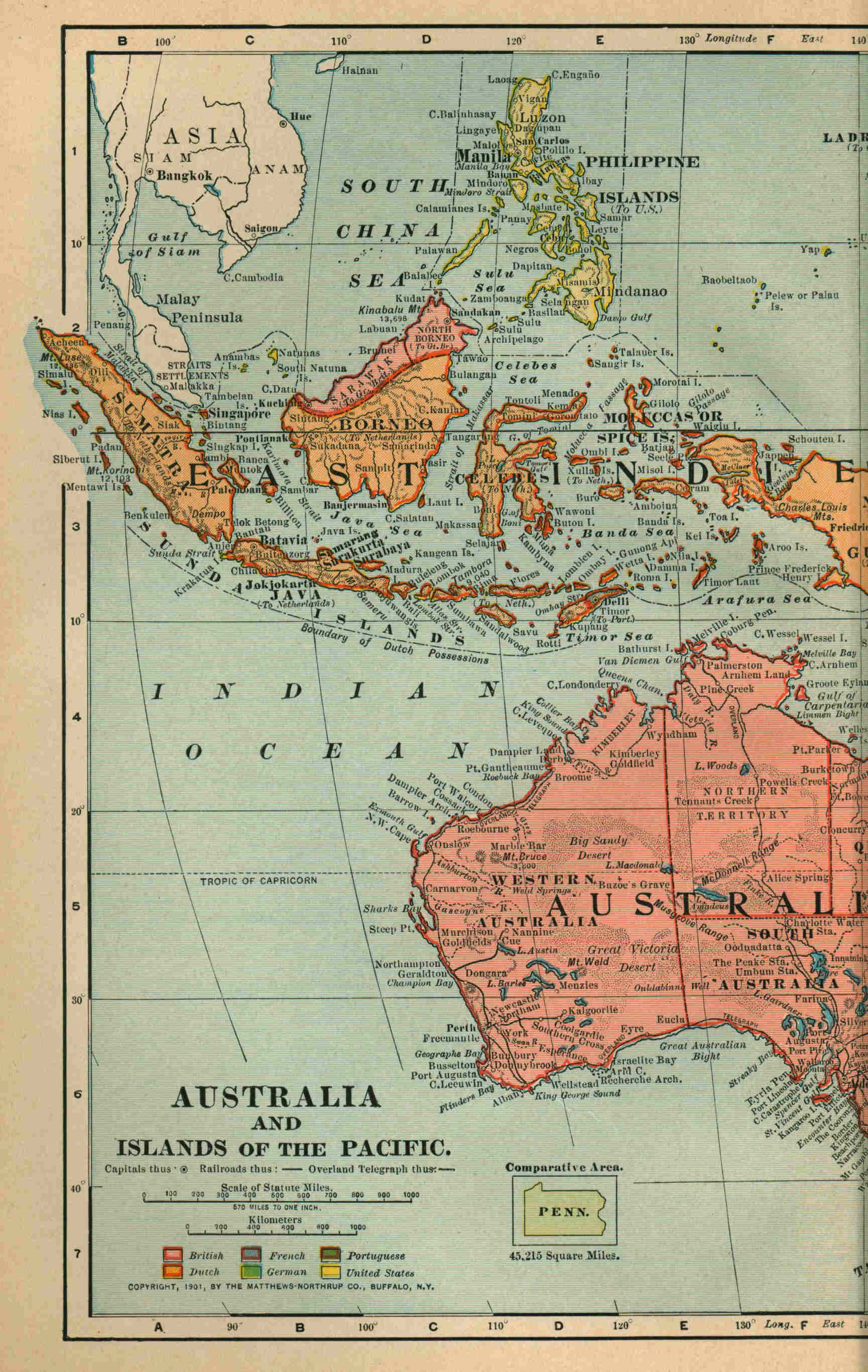
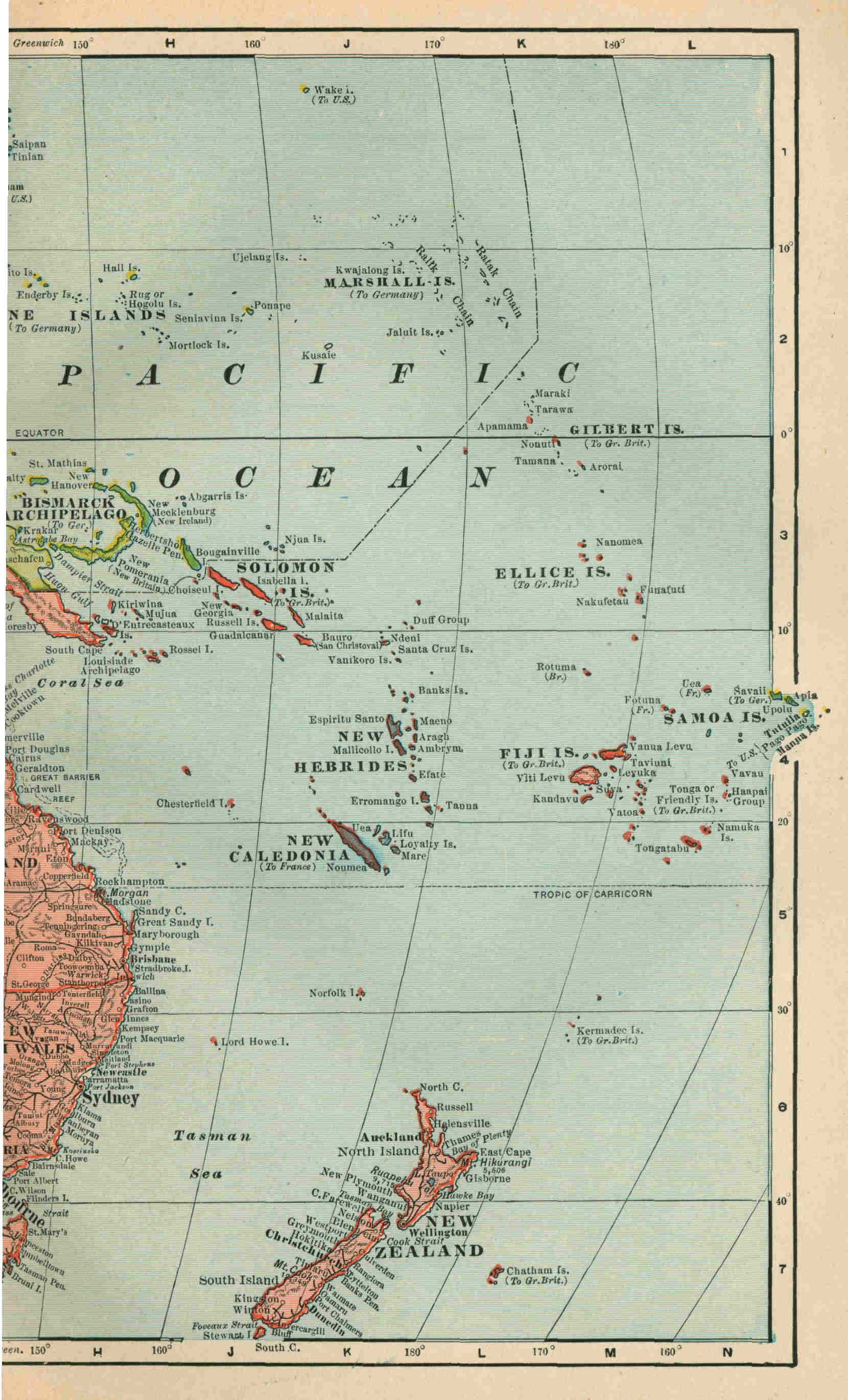
Map of Australia and Islands of the Pacific.
{31} AUSTRALIA: A. D. 1900. Federation of the Australian Colonies. The steps by which the Union was accomplished. Passage of the "Commonwealth of Australia Constitution Act" by the Imperial Parliament. "The first indication of a plan for united action among the colonies is to be found in a proposal of Earl Grey in 1850. The main object of the proposal was to bring about uniformity in colonial tariffs; but, though partially adopted, it came to nothing. From 1850 to 1860 the project of federation was discussed from time to time in several of the colonial legislatures, and committees on the subject were appointed. But there seems to have been little general interest in the question, and up to 1860 all efforts in the direction of federation met with complete failure. Shortly after, however, a new form of united action, less ambitious but more likely of success, was suggested and adopted. From 1863 to 1883 conferences of colonial ministers were held at various times to discuss certain specified topics, with a view to introducing identical proposals in the separate colonial legislatures. Six of these conferences were held at Melbourne and three at Sydney; and one also was held at Hobart in 1895, though the period of the real activity of the conference scheme practically closed in 1883. The scheme proved a failure, because it was found impossible to carry out the measures concerted in the conferences. But material events were doing more than could any public agitation to draw attention to the advantages of closer union. The colonies were growing in population and wealth, railroads were building and commerce was extending. The inconveniences of border customs duties suggested attempts at something like commercial reciprocity between two or more colonies. New political problems also helped to arouse public interest. Heretofore there had been little fear of foreign aggression and, hence, no feeling of the need of united action for common defense; nor had there been any thought of the extension of Australian power and interests beyond the immediate boundaries of the different colonies. But the period from 1880 to 1890 witnessed a change in this respect. It was during this period that much feeling was aroused against the influx of French criminals, escaped from the penal settlements in New Caledonia. The difficulties in regard to New Guinea belong also to this decade. Suspicion of the designs of Germany upon that part of the island of New Guinea nearest the Dutch boundary led to the annexation of its eastern portion by the Queensland government. This action was disavowed by the British government under Gladstone, and the fears of the colonists were ridiculed; but almost immediately after the northern half of New Guinea was forcibly taken possession of by Germany. The indignation of Australians was extreme, and the opinion was freely expressed that the colonies would have to unite to protect their own interests. Finally, this was the time of the French designs on the New Hebrides Islands and of German movements with reference to Samoa. These conditions, economic and political, affected all the colonies more or less intimately and resulted in the first real, though loose, form of federal union. At the instigation of the Honorable James Service, premier of Victoria, a convention met at Sydney, November, 1883, composed of delegates from all the colonial governments. This convention adopted a bill providing for the establishment of a Federal Council, with power to deal with certain specified subjects and with such other matters as might be referred to it by two or more colonies. … New South Wales and New Zealand refused to agree to the bill, but it was adopted by the other colonies; and the Imperial Parliament, in 1885, passed an act permitting such a Council to be called into existence at the request of any three colonies, to be joined by other colonies as they saw fit. Meetings of the Council took place in 1886, 1888, 1889 and 1891, but very little was accomplished. That the Federal Council was a very weak affair is obvious. … Meanwhile, interest in a more adequate form of federation was growing. In 1890 Sir Henry Parkes proposed a plan for federal union of a real and vigorous sort. At his suggestion, a conference met at Melbourne, February 6, 1890, to decide on the best method of getting the question into definite shape for consideration. … Provision was made … for the calling of a convention to draw up a constitution. … In accordance with the decision of the conference, delegates from the several colonies convened at Sydney, March 2, 1891; and with the work of this convention began the third and final stage in the federation movement. The Sydney convention formulated a bill, embodying a draft of a federal constitution, and then resolved that provision should be made by the several parliaments to submit it to the people in such manner as each colony should see fit. … But there was no sufficient external pressure to bring about an immediate discussion and an early settlement. … The result was that nothing was done. … Meanwhile, federation leagues had been organized in different colonies, and in 1893 delegates from a number of these leagues met at Bendigo, Victoria. … After adopting the bill of 1891 as a basis of discussion, the Bendigo conference resolved to urge the colonial governments to pass uniform enabling acts for a new convention—its members to be elected by popular vote—to frame a constitution which should be submitted to the people for approval. This proposal met with general favor and resulted in the calling of a meeting of the premiers of all the colonies at Hobart in January, 1895. There an enabling bill was drafted which five premiers agreed to lay before their respective parliaments. … It took two years to get this machinery into working order. At length, however, the requisite authority was granted by five colonies: New South Wales, Victoria, South Australia, Western Australia and Tasmania, Queensland and New Zealand declining to participate. On March 22, 1897, the second constitutional convention assembled at Adelaide. This convention drew up a new federal constitution, based upon the draft of 1891. Between May 5 and September 2 the constitution was discussed in each of the parliaments. When the convention reassembled at Sydney on March 2, as many as 75 amendments were reported as suggested by the different colonies. Many were of an insignificant character and many were practically identical. The constitution and proposed amendments were discussed in two sessions of the convention, which finally adjourned March 16, 1898, its work then being ready to submit to the people. {32} In June a popular vote resulted in the acceptance of the constitution by Victoria, Tasmania, and South Australia; but the failure of the parent colony, New South Wales, to adopt it blocked all hope of federal union for the moment. Recently, however, at a conference of colonial premiers certain amendments demanded by New South Wales were agreed to in part, and upon a second vote the constitution, as amended, was accepted by that colony." W. G. Beach, The Australian Federal Constitution (Political Science Quarterly, December, 1899). In August, 1899, the draft of a Constitution thus agreed upon was transmitted to England, with addresses from the provincial legislatures, praying that it be passed into law by the Imperial Parliament. Early in the following year delegates from the several colonies were sent to England to discuss with the Colonial Office certain questions that had arisen, and to assist in procuring the passage by Parliament of the necessary Act. Looked at from the Imperial standpoint, a number of objections to the draft Constitution were found, but all of them were finally waived excepting one. That one related to a provision touching appeals from the High Court of the Australian Commonwealth to the Queen in Council. As framed and adopted in Australia, the provision in question was as follows: "74. No appeal shall be permitted to the Queen in Council in any matter involving the interpretation of this Constitution or of the Constitution of a State, unless the public interests of some part of Her Majesty's Dominions, other than the Commonwealth or a State, are involved. Except as provided in this section, this Constitution shall not impair any right which the Queen may be pleased to exercise, by virtue of Her Royal Prerogative, to grant special leave of appeal from the High Court to Her Majesty in Council. But The Parliament may make laws limiting the matters in which such leave may be asked." This was objected to on several grounds, but mainly for the reasons thus stated by Mr. Chamberlain: "Proposals are under consideration for securing a permanent and effective representation of the great Colonies on the Judicial Committee, and for amalgamating the Judicial Committee with the House of Lords, so as to constitute a Court of Appeal from the whole British Empire. It would be very unfortunate if Australia should choose this moment to take from the Imperial Tribunal the cognizance of the class of cases of greatest importance, and often of greatest difficulty. Article 74 proposes to withdraw from the Queen in Council matters involving the interpretation of the Constitution. It is precisely on questions of this kind that the Queen in Council has been able to render most valuable service to the administration of law in the Colonies, and questions of this kind, which may sometimes involve a good deal of local feeling, are the last that should be withdrawn from a Tribunal of appeal with regard to which there could not be even a suspicion of prepossession. Questions as to the constitution of the Commonwealth or of a State may be such as to raise a great deal of public excitement as to the definition of the boundaries between the powers of the Commonwealth Parliament and the powers of the State Parliaments. It can hardly be satisfactory to the people of Australia that in such cases, however important and far-reaching in their consequences, the decision of the High Court should be absolutely final. Before long the necessity for altering the Constitution in this respect would be felt, and it is better that the Constitution should be enacted in such a form as to render unnecessary the somewhat elaborate proceedings which would be required to amend it." Great Britain, Parliamentary Publications (Papers by Command, April and May, 1900, Australia—Cd. 124 and 158). In reply, the Australian delegates maintained that they had no authority to amend, in any particular, the instrument which the people of the several colonies had ratified by their votes; but the Imperial authorities were inflexible, and the article 74 was modified in the Act which passed Parliament, on the 7th of July, 1900, "to constitute the Commonwealth of Australia," as may be seen by reference to the text, published elsewhere. See (in this volume) CONSTITUTION OF AUSTRALIA. AUSTRALIA: A. D. 1900. The question of the Federal Capital. By the Constitution of the Commonwealth, it is required that the seat of government "shall be determined by the Parliament, and shall be within territory which shall have been granted to or acquired by the Commonwealth, and shall be vested in and belong to the Commonwealth, and shall be in the State of New South Wales, and be distant not less than one hundred miles from Sydney;" and "such territory shall contain an area of not less than one hundred square miles." "New South Wales," says a correspondent, writing from Sydney, "is naturally anxious to get the question decided as quickly as possible; but Victoria will equally be inclined to procrastinate, and the new Parliament—which cannot be more comfortable than it will be at Melbourne—will not be in a hurry to shift. The necessity for a new and artificial capital arises entirely out of our provincial jealousies, and it would have been a great saving of initial expense and a great diminution of inconvenience if we could have used one of the old capitals for a quarter of a century." To remove preliminary difficulties and avoid delay, the government of New South Wales appointed a commissioner to visit and report on the most likely places. The report of this commissioner, made early in October, "reduces the possible positions to three—one near Bombala in the south-east corner of the colony at the foot of the Australian Alps, one near Yass on the line of the railway between Sydney and Melbourne, and one near Orange on our western line. On the whole he gives the preference to the first named." AUSTRALIA: New South Wales: A. D. 1900. Old-Age Pension Act. A letter from Sydney, November 29, 1900, announced: "The question of the establishment of an old age pension system, similar to that now in successful operation in New Zealand [see (in this volume) NEW ZEALAND: A. D. 1899], has been agitating New South Wales for several months, and to-day the bill for that purpose became a law. There has been a desire on the part of some members of the Legislature to hold over the bill until the convening of the Federal Parliament, in the hope that the measure would become universal throughout the continent, but the majority, including the Premier, wished the bill to be pushed through without loss of time. There is no opposition worth mentioning. … At a mass meeting in favor of the bill representatives of every political party, of every Church and of every profession and trade in the community were present. {33} The sentiment of the colony has never been more unanimous. … The estimated cost of the scheme is something like £250,000 or £300,000 a year, but this does not take into consideration the amount which will be saved by doing away with the charitable institutions now draining the pockets alike of the state and of the individual. Private contributions alone amount to £600,000 a year; all this will be saved, together with a part of the Government's annual expenditure—about £400,000—for public institutions. Not all pauper institutions can be abolished, for many of the aged and friendless poor are ailing or slightly feeble minded, and will continue to need medical attention." AUSTRALIA: A. D. 1900 (March). New Zealand looking toward federation with the Australian Commonwealth. See (in this volume) NEW ZEALAND: A. D. 1900 (MARCH). AUSTRALIA: West Australia: A. D. 1900 (August). Vote to join the Commonwealth. The question of union with the other colonies in the Commonwealth, from which the West Australians had previously held aloof, was submitted to them in August (women voting for the first time), and decided affirmatively by 44,704 against 19,691. Adding the West Australian totals to the aggregate vote at the decisive referendum in each of the other federating colonies, the following is the reported result: For federation. 422,647 Against federation. 161,024 Majority. 261,623 AUSTRALIA: A. D. 1900 (September-December). The Queen's Proclamation of the Australian Commonwealth. Contemplated visit of the Duke and Duchess of York to open the first session of the Federal Parliament. Appointment of Lord Hopetoun to be Governor-General. The first Federal Cabinet. On the 17th of September the following proclamation of the Australian Commonwealth was issued by the Queen: "Whereas by an Act of Parliament passed in the sixty-third and sixty-fourth years of Our reign, intituled 'An Act to constitute the Commonwealth of Australia,' it is enacted that it shall be lawful for the Queen, with the advice of the Privy Council, to declare by Proclamation that, on and after a day therein appointed, not being later than one year after the passing of this Act, the people of New South Wales, Victoria, South Australia, Queensland, and Tasmania, and also, if Her Majesty is satisfied that the people of Western Australia have agreed thereto, of Western Australia, shall be united in a Federal Commonwealth, under the name of the Commonwealth of Australia. And whereas We are satisfied that the people of Western Australia have agreed thereto accordingly. We therefore, by and with the advice of Our Privy Council, have thought fit to issue this Our Royal Proclamation, and We do hereby declare that on and after the first day of January, one thousand nine hundred and one, the people of New South Wales, Victoria, South Australia, Queensland, Tasmania, and Western Australia shall be united in a Federal Commonwealth under the name of the Commonwealth of Australia. Given at Our Court at Balmoral, this seventeenth day of September, in the year of our Lord one thousand nine hundred, and in the sixty-fourth year of Our reign. God save the Queen." At the same time, the following announcement, which caused extreme delight in Australia, was published officially from the Colonial Office: "Her Majesty the Queen has been graciously pleased to assent, on the recommendation of the Marquis of Salisbury, to the visit of their Royal Highnesses the Duke and Duchess of York to the colonies of Australasia in the spring of next year. His Royal Highness the Duke of York will be commissioned by her Majesty to open the first Session of the Parliament of the Australian Commonwealth in her name. Although the Queen naturally shrinks from parting with her grandson for so long a period, her Majesty fully recognizes the greatness of the occasion which will bring her colonies of Australia into federal union, and desires to give this special proof of her interest in all that concerns the welfare of her Australian subjects. Her Majesty at the same time wishes to signify her sense of the loyalty and devotion which have prompted the spontaneous aid so liberally offered by all the colonies in the South African war, and of the splendid gallantry of her colonial troops. Her Majesty's assent to this visit is, of course, given on the assumption that at the time fixed for the Duke of York's departure the circumstances are as generally favourable as at present and that no national interests call for his Royal Highness's presence in this country." To manifest still further the interest taken by the British government in the event, it was made known in October that "when the Duke of York opens the new Commonwealth Parliament, the guard of honour, it is directed, shall be so made up as to be representative of every arm of the British Army, including the Volunteers. To the Victoria and St. George's Rifles has fallen the honour of being selected to represent the entire Volunteer force of the country. A detachment of the regiment, between 50 and 60 strong, will accordingly leave for Australia in about a month and will be absent three or four months." The honor of the appointment to be the first Governor-General of the new Commonwealth fell to a Scottish nobleman, John Adrian Louis Hope, seventh Earl of Hopetoun, who had been Governor of Victoria from 1889 to 1895, and had held high offices at home, including that of Lord Chamberlain in the household of the Queen. Lord Hopetoun landed at Sydney on the 15th of December and received a great welcome. On the 30th, his Cabinet was formed, and announced, as follows: Mr. Barton, Prime Minister and Minister for External Affairs; Mr. Deakin, Attorney-General; Sir William Lyne, Minister for Home Affairs; Sir George Turner, Treasurer; Mr. Kingston, Minister of Trade and Commerce; Mr. Dickson, Minister of Defence; Sir John Forrest, Postmaster-General. AUSTRALIA: A. D. 1901 (January). Inauguration of the Federal Government. The government of the Commonwealth was inaugurated with splendid ceremonies on the first day of the New Year and the New Century, when the Governor-General and the members of the Federal Cabinet were sworn and assumed office. Two messages from the British Secretary of State for the Colonies were read, as follows: {34} "The Queen commands me to express through you to the people of Australia her Majesty's heartfelt interest in the inauguration of the Commonwealth, and her earnest wish that, under divine Providence, it may ensure the increased prosperity and well-being of her loyal and beloved subjects in Australia." "Her Majesty's Government send cordial greetings to the Commonwealth of Australia. They welcome her to her place among the nations united under her Majesty's sovereignty, and confidently anticipate for the new Federation a future of ever-increasing prosperity and influence. They recognize in the long-desired consummation of the hopes of patriotic Australians a further step in the direction of the permanent unity of the British Empire, and they are satisfied that the wider powers and responsibilities henceforth secured to Australia will give fresh opportunity for the display of that generous loyalty and devotion to the Throne and Empire which has always characterized the action in the past of its several States." AUSTRALIA: A. D. 1901 (May). Opening of the first Parliament of the Commonwealth by the heir to the British crown. The programme of the Federal Government. The Duke of Cornwall and York, heir to the British crown (but not yet created Prince of Wales), sailed, with his wife, from England in March, to be present at the opening of the first Parliament of the federated Commonwealth of Australia, which is arranged to take place early in May. He makes the voyage in royal state, on a steamer specially fitted and converted for the occasion into a royal yacht, with an escort of two cruisers. Preliminary to the election and meeting of Parliament, the new federal government has much organizing work to do, and much preparation of measures for Parliament to discuss. The Premier, Mr. Barton, in a speech made on the 17th of January, announced that the Customs were taken over from the several States on January 1, and the defences and post-offices would be transferred as soon as possible. " Probably the railways would be acquired by the Commonwealth at an early date. Whether the debts of the several States would be taken over before the railways was a matter which had to be decided, and was now engaging the attention of the Treasurer. The Ministry would not consider the appointment of a Chief Justice of the High Court until Parliament had established that tribunal." In the same speech, the main features of the programme and policy of the federal government were indicated. "The Commonwealth," said the Premier, "would have the exclusive power of imposing Customs and excise duties, and it would, therefore, be necessary to preserve the States' power of direct taxation. There must be no direct taxation by the Commonwealth except under very great pressure. Free trade under the Constitution was practically impossible; there must be a very large Customs revenue. … The policy of the Government would be protective, not prohibitive, because it must be revenue-producing. No one colony could lay claim to the adoption of its tariff, whether high or low. The first tariff of Australia ought to be considerate of existing industries. The policy of the Government could be summed up in a dozen words. It would give Australia a tariff that would be Australian. Regarding a preferential duty on British goods, he would be glad to reciprocate where possible, but the question would have to receive very serious consideration before final action could be taken. Among the legislation to be introduced at an early date, Mr. Barton continued, were a Conciliation and Arbitration Bill in labour disputes, and a Bill for a transcontinental railway, which would be of great value from the defence point of view. He was in favour of womanhood suffrage. Legislation to exclude Asiatics would be taken in hand as a matter of course." ----------AUSTRALIA: End-------- ----------AUSTRIA-HUNGARY: Start-------- AUSTRIA-HUNGARY: Financial relations of the two countries forming the dual Empire. "The financial relations of Austria and Hungary fall under three main heads. Firstly, the Quota, or proportionate contribution to joint expenditure. The Quota is an integral portion of the compact of 1867 [see—in volume 1—AUSTRIA: A. D. 1866-1867], but is revised every ten years. Failing an agreement on the proportion to be paid by each half of the monarchy, the Quota is fixed from year to year by the Emperor till an agreement is arrived at. Secondly, the so-called commercial 'Ausgleich' treaty, which provides for a customs union, postal and telegraphic union, commercial equality of citizens of one state in the other, identical excise duties, &c. Thirdly, the Bank Union, by which Austria and Hungary have a common Austro-Hungarian bank, and common paper money. The Ausgleich and Bank Union are not essential parts of the 1867 compact; they are really only treaties renewable every ten years, and if no agreement is come to, they simply lapse, and each state makes its own arrangements, which seems very likely to be the fate of the Ausgleich unless the present crisis can be got over. The proceeds of the joint customs are applied directly to common expenses, and only the difference is made up by Quota. But if the Ausgleich falls through, the whole of the joint expenditure will have to be settled by quota payments. The joint expenditure goes almost wholly to the up-keep of the army, navy, and consular and diplomatic services. It amounts on an average to about 150 million florins or 12½ million £, falling as low as 124½ million florins in 1885 and rising to nearly 167 million in 1888. Of this total the customs revenues have, in the last few years, accounted for nearly a third, usually about 31 per cent. The Quota was fixed in 1867 at 70 per cent. for Austria and 30 per cent. for Hungary, based on a very rough calculation from the yield of common taxation in the years 1860-1865, the last few years preceding the restoration of Hungarian independence. On the incorporation of the so-called Military Frontier in Hungary, the Hungarian proportion was increased to 31.4. Hitherto the Hungarians have resisted any attempt to increase their quota. This 'non possumus' attitude has provoked great resentment in Austria, especially when it is compared with the self-complacent tone with which the Magyars dwell on the enormous progress made by Hungary since 1867. That progress is indubitable. Hungary has not only developed as an agricultural state, but is in a very fair way of becoming an industrial and manufacturing state as well. … {35} "On all these grounds the Austrians declare that they can no longer go on paying the old Quota of 68.6 per cent. The Hungarians admit the great progress made by Hungary, but with some qualifications. In spite of the growth of Budapest, Fiume, and a few other towns, Hungary is still, on the whole, very backward when compared with Austria. The total volume of her manufactures is very small, in spite of the rapid increase of recent years. Hungary is still, to all intents and purposes, an agricultural country, and as such, has suffered largely from the fall in prices." L. S. Amery, Austro-Hungarian Financial Relations (Economic Journal, September, 1898). AUSTRIA-HUNGARY: A. D. 1894-1895. The Hungarian Ecclesiastical Laws. Conflict with the Church. Resignation of Count Kalnoky. In the last month of 1894 royal assent was given to three bills, known as the Ecclesiastical Laws, which marked an extraordinary departure from the old subserviency of the State to the Church. The first was a civil marriage law, which made civil marriage compulsory, leaving religious ceremonies optional with the parties, and which modified the law of divorce; the second annulled a former law by which the sons of mixed marriages were required to follow the father's religion, and the daughters to follow that of the mother; the third established an uniform State registration of births, deaths and marriages, in place of a former registration of different creeds, and legalized marriages between Christians and Jews without change of faith. These very radical measures, after passing the lower house of the Hungarian legislature, were carried with great difficulty through the aristocratic and clerical upper house, and only by a strong pressure of influence from the emperor-king himself. They were exceedingly obnoxious to the Church, and the Papal Nuncio became active in a hostility which the Hungarian premier, Baron Banffy, deemed offensive to the State. He called upon the Imperial Minister of Foreign Affairs, Count Kalnoky, to address a complaint on the subject to the Vatican. This led to disagreements between the two ministers which the Emperor strove without success to reconcile, and Count Kalnoky, in the end, was forced to retire from office. The Pope was requested to recall the offending Nuncio, and declined to do so. AUSTRIA-HUNGARY: A. D. 1895-1896. Race-jealousies and conflicts. The position of Bohemia in the part of the dual Empire called Austria. Anti-Semitic agitation in Vienna. Austrian Ministry of Count Badeni. Enlarged parliamentary franchise. In the constitutional reconstruction of the Empire after the war of 1866, almost everything was conceded to the Magyars of Hungary, who acquired independence in matters of internal administration, and ascendancy over the other races subject to the Hungarian crown. "On the other hand, absolute equality was established between the different countries that are not connected with Hungary. No greater privileges were granted to an ancient historical kingdom such as Bohemia than were given, for instance, to the small Alpine district situated between the Tyrol and the Boden See (Lake of Constance) known as Vorarlberg. … The representatives of these countries were to meet at Vienna, and a ministry for 'Cisleithania' was appointed. That these measures were injudicious is now the opinion of almost all Austrians. Beust [the Saxon statesman who was called in to conduct the political reconstruction of 1867—see, in volume 1, AUSTRIA: A. D. 1866-1867; and 1866-1887], created a new agglomeration of smaller and larger countries, entirely different as regards race, history, and culture. It is characteristic of the artificiality of Count Beust's new creation that up to the present day no real and generally accepted name for it has been found. The usual designation of Cisleithania is an obvious absurdity. A glance at the map will suffice to show how senseless such a name is when applied, for instance, to Dalmatia, one of the countries ruled from Vienna. The word 'Austria' also can correctly be applied only either to all the countries ruled by the house of Habsburg-Lorraine or to the archduchies of Upper and Lower Austria, which are the cradle of the dynasty. The official designation of the non-Hungarian parts of the empire is 'the kingdoms and lands represented in the parliament' (of Vienna)—'Die im Reichsrathe vertretenen Königreiche und Länder.' "Though the Germans willingly took part in the deliberations of the Parliament of 'Cisleithania,' the Slavs of Bohemia and Poland were at first violently opposed to the new institution. They might perhaps have willingly consented to take part in a Vienna parliament that would have consisted of representatives of the whole empire. But when the ancient historical rights of Hungary were fully recognized, countries such as Bohemia and Poland … naturally felt offended. Count Beust dealt differently with these two divisions of the empire. The partly true, partly imaginary, grievances of the Poles were more recent and better known thirty years ago than they are now. Beust was impressed by them and considered it advisable to make large concessions to the Poles of Galicia with regard to autonomy, local government, and the use of the national language. The Poles, who did not fail to contrast their fate with that of their countrymen who were under Russian or Prussian rule, gratefully accepted these concessions, and attended the meetings of the representative assembly at Vienna. Other motives also contributed to this decision of the Galician Poles. Galicia is a very poor country, and the Germans who then ruled at Vienna, naturally welcoming the representatives of a large Slav country in their Parliament, proved most generous in their votes in favour of the Galician railways. Matters stood differently in Bohemia, and the attitude of Count Beust and the new 'Cisleithanian' ministers was also here quite different. They seem to have thought that they could break the resistance of the Bohemians by military force, and with the aid of the German minority of the population. A long struggle ensued. … Bohemia is … the 'cockpit' of Austrian political warfare, and almost every political crisis has been closely connected with events that occurred in Bohemia. The Bohemian representatives in 1867 refused to take part in the deliberations of the Vienna Parliament, the existence of which they considered contrary to the ancient constitution of their country. {36} In 1879 they finally decided to take part in the deliberations of the Vienna assembly. … The Bohemians, indeed, entered the Vienna Parliament under protest, and declared that their appearance there was by no means to be considered as a resignation of the special rights that Bohemia had formerly possessed. The Bohemian deputies, however, continued henceforth to take part in the deliberations of the Cisleithanian Parliament and loyally supported those of the many Austrian ministers who were not entirely deaf to their demands. Some of these demands, such as that of the foundation of a national university at Prague, were indeed granted by the Vienna ministers. Though a German university continued to exist at Prague, this concession was vehemently opposed by the Germans, as indeed every concession to appease the Bohemian people was." Francis Count Lutzow, Austria at the End of the Century (Nineteenth Century Review, December, 1899). During recent years, government in the dual empire has been made increasingly difficult, especially on the Austrian side, by the jealousy, which grows constantly more bitter, between the German and Slavic elements of the mixed population, and by the rising heat of the Anti-Semitic agitation. The latter was brought to a serious crisis in Vienna during 1895 by the election of Dr. Lueger, a violent leader of Anti-Semitism, to the office of First Vice-Burgomaster, which caused the resignation of the Burgomaster, and led to such disorders in the municipal council that the government was forced to intervene. The council was dissolved and an imperial commissioner appointed to conduct the city administration provisionally; but similar disorders, still more serious, recurred in October, when elections were held and the Anti-Semites won a majority in the council. Dr. Lueger was then elected Burgomaster. The government, supported by a majority in the Austrian Reichsrath, refused to confirm the election. A second time Dr. Lueger was elected; whereupon the municipal council was again dissolved and the municipal administration transferred to an imperial commissioner. This measure was followed by scenes of scandalous turbulence in the Reichsrath and riotous demonstrations in the streets, which latter were vigorously suppressed by the police. Some considerable part of the temper in these demonstrations was directed against the Austrian premier, Count Badeni, and still more against the Polish race, to which he belonged. Count Badeni, who had been Governor of Galicia, had just been called to the head of affairs, and gave promise of an administration that would be strong; but several other members of his cabinet were Poles, and that fact was a cause of offense. He gave an early assurance that the demand for an enlargement of the parliamentary franchise should be satisfactorily met, and that other liberal measures should be promptly taken in hand. These promises, with the show of firmness in the conduct of the government, produced a wide feeling in its favor. The promise of an enlargement of the parliamentary franchise in Austria was redeemed the following February (1896), by the introduction and speedy passage of a parliamentary reform bill, which embodied an important revision of the Austrian constitution. Seventy-two new members were added to the 353 which formerly constituted the lower or Abgeordneten House of the Austrian Reichsrath. The original body of 353 remained as it had been, made up in four sections, elected by four classes in the community, namely: owners of large estates, electing 85 members; doctors of the universities and town taxpayers who pay five florins of direct taxation yearly, these together electing 115; chambers of commerce and industry, electing 22; country taxpayers who pay five florins of direct taxation yearly, electing 131. The number of voters in these four privileged classes were said to number 1,732,000 when the Reform Bill passed. The new voters added by the bill were estimated to number about 3,600,000. But the latter would elect only the 72 new members added to the House, while the former continued to be exclusively represented by the 353 members of its former constitution. In other words, though the suffrage was now extended to all male adults, it was not with equality of value to all. For about one-third of the political community, the franchise was given five times the weight and force that it possessed for the remaining two-thirds. Nevertheless, the bill seems to have been accepted and passed with no great opposition. In Vienna, the Anti-Semitic agitation was kept up with violence, Dr. Lueger being elected four times to the chief-burgomastership of the city, in defiance of the imperial refusal to sanction his election. Finally the conflict was ended by a compromise. Lueger resigned and was permitted to take the office of Vice Burgomaster, while one of his followers was chosen to the Chief Burgomaster's seat. AUSTRIA-HUNGARY: A. D. 1896. Celebration of the Millennium of the Kingdom of Hungary. The millennial anniversary of the Kingdom of Hungary was celebrated by the holding of a great national exposition and festival at Buda-Pesth, from the 2d of May until the end of October, 1896. Preparations were begun as early as 1893, and were carried forward with great national enthusiasm and liberality, the government contributing nearly two millions of dollars to the expense of the undertaking. The spirit of the movement was expressed at the beginning by the Minister of Commerce, Bela Lukács, by whose department it was specially promoted. "The government," he said, "will take care that the national work be exhibited in a worthy frame, so as to further the interests of the exhibitors. May everyone of you, its subjects, therefore show what he is able to attain by his diligence, his taste, and his inventive faculty. Let us all, in fact, compete—we who are working, some with our brains, others with our hands, and others with our machines—like one man for the father-land. Thus the living generation will be able to see what its fore-fathers have made in the midst of hard circumstances, and to realize what tasks are awaiting us and the new generations in the path which has been smoothed by the sweat, labor, and pain of our ancestors. This will be a rare family festival, the equal of which has not been granted to many nations. Let the people gather, then, round our august ruler, who has guided our country with fatherly care and wisdom in the benevolent ways of peace to the heights which mark the progress of to-day, and who—a faithful keeper of the glorious past of a thousand years—has led the Hungarian people to the threshold of a still more splendid thousand years to come!" {37} Writing shortly before the opening, the United States Consul at Buda-Pesth, Mr. Hammond, gave the following description of the plans and preparations then nearly complete: "The series of official festivities will be diversified by those of a social and popular character. These will be the interparliamentary conference for international courts of arbitration; the congress of journalists, with the view to constitute an international journalistic union; international congresses of art and history, of actors, tourists, athletes, etc.; numerous national congresses embracing every intellectual and material interest of the country, in which the leading personages of all groups and branches of national production, the highest authorities in the field of commerce, industry, communication, etc., as well as those who are in the forefront of the literary, spiritual, and philanthropic movements of the country will take part. "There is activity in all classes of Hungarian society, with a view to carrying out the ingenious project of the artist Paul Vágó—the great historical pageant. Several municipal bodies have already promised their cooperation, while scores of men and women, bearers of historic names, have declared their readiness to take part at their own expense. All the costumes of all the races and social classes who have inhabited this country during ten centuries will pass before our eyes in this beautiful cortege. The genius of the artist will call into life in their descendants the warriors who conquered Pannonia under Arpad, and, during the reign of Louis the Great, annexed to this realm all the neighboring countries; all the dignitaries, both civil and ecclesiastical, who, under Stephen the Saint, King Kálman, and Mathias Corvinus, spread Christianity, enlightenment, liberty, and wealth to the extreme confines of this part of Europe; all the crusaders of Joannes Hunyady, who drove back the Crescent for a century and thus defended western civilization against eastern fanaticism; all the kings, princes, noblemen, and poets of modern times who have led the nation in her struggle for modern ideas. These historical figures will be followed by their retainers or surrounded by the popular types of the respective epochs. To judge by the sketches of the artist, this pageant promises to surpass anything that has hitherto been offered on similar occasions. "All these festivals will move, as it were, within the fixed frame of the Millennial National Exhibition, which will cover an area of 500,000 square meters (5,382,100 square feet) and consist of 169 buildings and pavilions, erected at a total cost (including private expenses) of 10,000,000 florins ($4,020,000). This exhibition is divided into two sections, viz: (1) The historical section, containing art treasures, relics, and antiquities of the past, which will illustrate the political, religious, military, and private life of each principal period in the history of the nation. … (2) The section of modern times will embrace everything offered by similar exhibitions. Nevertheless, the visitor's mind will here, too, be impressed with the solemnity of the millennium and the enthusiasm inspiring the nation at this momentous period of its history. The programme embraces the national life in all its manifestations. Not only will the present condition of Hungary be laid open to general view, but the world will also be impressed with the great progress Hungary has made since the reestablishment of her constitution in 1867." United States Consular Reports, April, 1896. By every possible arrangement of facilitation and cheapening, a visit to the Exposition was placed within the means of all the inhabitants of the kingdom; and especial provision was made for bringing schools and teachers to receive the object-lessons which it taught. Among the ceremonies which attended the ending of the great national festival, was the formal opening, at Orsova, of a ship channel through the rocky obstructions that have been known since the days when they troubled the Romans as the "Iron Gates of the Danube." AUSTRIA-HUNGARY: A. D. 1897. Industrial combinations. See (in this volume) TRUSTS: IN EUROPEAN COUNTRIES. AUSTRIA-HUNGARY: A. D. 1897. The forces of feudalism and clericalism in Austria. Austrian parties in the Reichsrath. Their aims, character and relative strength. Count Badeni's language decrees for Bohemia. "In no European country have the forces of feudalism and clericalism such an enormous influence as they have in Austria. The Austrian nobility is supreme at Court and in the upper branches of the Administration. In Hungary the small nobility and landed gentry exercise a preponderating influence, but they are a wide class and filled with the national spirit. The Austrian nobility forms a narrow, intensely exclusive and bigoted caste, whose only political interest is the maintenance of its own class supremacy. The large Protestant element in Hungary has in no small degree contributed to the success of the Magyars, both in its effect on the national character and by the secondary position to which the mixture of creeds has relegated the Church. In Austria the Church of Rome is all-powerful. The House of Habsburg has always been bigotedly Catholic: Francis Joseph himself was a pupil of the Jesuits. The triumph of the reaction after 1848 was the establishment in 1855 of that 'written Canossa' the Concordat, which made the Church absolute in all matters relating to education and marriage. And even though the Concordat was got rid of in 1870, the energies of the clerical party have been but little weakened. The real explanation of the whole course of Austrian politics lies in the interaction of the two conflicts—of reaction, clerical or aristocratic, against liberalism, and of Slav against German. … "In March 1897 came the general elections, to which a special interest was lent by the first appearance of the fifth class of voters. The most striking feature of the elections was the complete and final break up of the German Liberal party. … The history of the German Liberal party has been one of a continuous decline both in numbers and importance. It counted 200 members in 1873, 170 in 1879, 114 in 1885-1891, and only 77 out of a total of 425 in 1897. … Their political theories are those of moderate constitutional liberalism as understood on the Continent in the middle of the century—i. e. belief in the efficacy of parliamentary government, in commercial and industrial freedom, hostility to military bureaucracy and clericalism. … The most radical group among them, the Progressists, an offshoot of the last election, is about as radical as the ordinary English Conservative of to-day. The views of the Verfassungstreue Grossgrundbesitz are those of the English Tory of fifty years ago. {38} "Of the fractions into which the Liberal party is now divided the most important is the Deutsch Fortschrittliche, or Progressive, which split off from the main body in November 1896. Its chief object was to direct a stronger opposition on national and liberal lines to Count Badeni. Its 35 members are almost exclusively recruited from Bohemia and Moravia. They differ from the German 'Volkspartei' mainly in their refusal to accept anti-Semitism, which would be both against their liberal professions and their economic convictions as representatives of the commercial and manufacturing classes. The constitutional landowners (Verfassungstreue Grossgrundbesitz, 30 seats) represent the most conservative element of the old Liberal party. … The 12 members of the Free German Union (Freie Deutsche Vereinigung) may perhaps consider themselves the most authentic remnant of the great Liberal party—it is their chief claim to distinction. The German National or People's party (Deutsche Volkspartei, 43 seats) first made its appearance at the elections of 1885. It rejected the old idea of the Liberals that the Germans were meant, as defenders of the State, to look to State interests alone without regard to the fate of their own nationality, and took up a more strictly national as well as a more democratic attitude. It has also of late years included anti-Semitism in its programme. Its main strength lies in the Alpine provinces, where it heads the German national and Liberal opposition to the Slovenes on the one side, and the German clericals on the other. It is at present the largest of the German parties. … "Least but not last of the German parties comes the little group of five led by Schönerer and Wolf. Noisy, turbulent, and reckless, this little body of extremists headed the obstruction in the Reichsrath, the disorganised larger German parties simply following in its wake. The object these men aim at is the incorporation of German Austria in the German Empire, the non-German parts being left to take care of themselves. Both the German National party and Schönerer's followers are anti-Semitic, but anti-Semitism only plays a secondary part in their programme. The party that more specially claims the title of anti-Semite is the Christian Social (Christlich-Soziale, 27 seats). The growth of this party in the last few years has been extraordinarily rapid. In Dr. Lueger and Prince Alois Liechtenstein it has found leaders who thoroughly understand the arts of exciting or humouring the Viennese populace. … The characteristic feature of Austrian anti-Semitism, besides the reaction against the predominance of the ubiquitous Jew in commerce, journalism, and the liberal professions, is that it represents the opposition of the small tradesman or handicraftsman to the increasing pressure of competition from the large Jewish shops and the sweating system so frequently connected with them. The economic theories of the party are of the crudest and most mediæval kind; compulsory apprenticeship, restricted trade guilds, penalties on stock exchange speculation, &c., form the chief items of its programme. … "The German Clericals and the Clerical Conservatives (Katholische Volkspartei and Centrum) number some 37 votes together; but their importance has always been increased by the skilful and unscrupulous parliamentary tactics of the party. The strength of the Clerical party lies in the ignorant and devotedly pious peasantry of Upper Austria and the Alpine provinces. The defence of agrarian interests is included in its programme; but its only real object is the maintenance of the moral and material power of the Church. Its policy looks solely to the interests of the Vatican. … "The best organised of the national parties is the Polish Club (59 seats). It represents the national and social interests of the Polish nobility and landed gentry. … Standing outside of Austrian interests, they exercise a controlling voice in Austrian affairs. The three-score well-drilled Polish votes have helped the Government again and again to ride roughshod over constitutional opposition. The partition of Poland has thus avenged itself on one at least of its spoilers. The Germans have long resented this outside interference which permanently keeps them in a minority. … The Czechs are a party of 60, and together with the 19 representatives of the Czech landed aristocracy, form the largest group in the Reichsrath. The Young Czech party began in the seventies as a reaction against the Old Czech policy of passive resistance. In contra-distinction to the Old Czechs, they also professed radical and anti-clerical views in politics generally. … In 1897 the Old Czechs finally withdrew from the contest or were merged in the victorious party. … Of the other nationalist parties the most important is the Slav National Christian Union (35 seats), comprising the Slovenes, Croatians, and some of the more moderate Ruthenians from Galicia. Their programme is mainly national, though tinged with clericalism; equality of the Slav languages with German and Italian in mixed districts; and ultimately a union of the southern Slavs in an autonomous national province. The Italians are divided into 5 Clerical Italians from the Tirol and 14 Liberals from Trieste, Istria, &c. The Tirolese Italians desire a division of the Tirol into a German and an Italian part. … "The most interesting, and in some ways the most respectable, of all Austrian parties is the Socialist or Social Democratic party (15 seats). It is the only one that fights for a living political theory—German liberalism being to all intents and purposes defunct—and not for mere national aggression. The Social Democrats hold the whole national agitation to be an hysterical dispute got up by professors, advocates, and other ne'er-do-weels of the unemployed upper classes. … Their support is derived from the working classes in the industrial districts, and not least from the poorer Jews, who supply socialism with many of its keenest apostles. … "Altogether a most hopeless jumble of incoherent atoms is this Austrian Reichsrath. The chariots driving four-ways on the roof of the Houses of Parliament are a true symbol of the nature of Austrian politics. To add to the confusion, all the parties are headless. Able men and men of culture, there are a good many in the House; but political leaders there are none. The general tone of the House is undignified, and has been so for some time. … {39} "On April 5, 1897, Count Badeni published the notorious language decrees for Bohemia. This ordinance placed the Czech language on an absolute equality with the German in all governmental departments and in the law courts all over Bohemia. … After 1901 all officials in every part of Bohemia were to be obliged to know both languages. The refusal of the Germans to admit the language spoken by 62 per cent. of the population of Bohemia to an equality with their own is not quite so preposterous as would at first sight appear. Without subscribing to Professor Mommsen's somewhat insolent dicta about 'inferior races,' one must admit that the Czech and German languages do not stand on altogether the same footing. German is a language spoken by some 60,000,000 of people, the language of a great literature and a great commerce. Czech is difficult, unpronounceable, and spoken by some 5,000,000 in all. It must be remembered, too, that the two nations do not really live together in Bohemia, but that the Germans live in a broad belt all round the country, while the Czechs inhabit the central plain. There is no more reason for a German Bohemian to acquire Czech than there is for a citizen of Edinburgh to make himself master of Gaelic. On the other hand, every educated Czech naturally learns German, even in a purely Czech-speaking district. … It must also be remembered that the decrees, as such, were of doubtful constitutionality; the language question was really a matter for the Legislature to settle. The decrees at once produced a violent agitation among the Germans, which rapidly spread from Bohemia over the whole Empire." The Internal Crisis in Austria-Hungary (Edinburgh Review, July, 1898). AUSTRIA-HUNGARY: A. D. 1897 (October-December). Scenes in the Austrian Reichsrath described by Mark Twain. "Here in Vienna in these closing days of 1897 one's blood gets no chance to stagnate. The atmosphere is brimful of political electricity. All conversation is political; every man is a battery, with brushes overworn, and gives out blue sparks when you set him going on the common topic. … Things have happened here recently which would set any country but Austria on fire from end to end, and upset the government to a certainty; but no one feels confident that such results will follow here. Here, apparently, one must wait and see what will happen, then he will know, and not before; guessing is idle; guessing cannot help the matter. This is what the wise tell you; they all say it; they say it every day, and it is the sole detail upon which they all agree. There is some approach to agreement upon another point: that there will be no revolution. … Nearly every day some one explains to me that a revolution would not succeed here. 'It couldn't, you know. Broadly speaking, all the nations in the empire hate the government—but they all hate each other too, and with devoted and enthusiastic bitterness; no two of them can combine; the nation that rises must rise alone; then the others would joyfully join the government against her, and she would have just a fly's chance against a combination of spiders. This government is entirely independent. It can go its own road, and do as it pleases; it has nothing to fear. In countries like England and America, where there is one tongue and the public interests are common, the government must take account of public opinion; but in Austria-Hungary there are nineteen public opinions—one for each state. No—two or three for each state, since there are two or three nationalities in each. A government cannot satisfy all these public opinions; it can only go through the motions of trying. This government does that. It goes through the motions, and they do not succeed; but that does not worry the government much.' … "The recent troubles have grown out of Count Badeni's necessities. He could not carry on his government without a majority vote in the House at his back, and in order to secure it he had to make a trade of some sort. He made it with the Czechs—the Bohemians. The terms were not easy for him: he must pass a bill making the Czech tongue the official language in Bohemia in place of the German. This created a storm. All the Germans in Austria' were incensed. In numbers they form but a fourth part of the empire's population, but they urge that the country's public business should be conducted in one common tongue, and that tongue a world language—which German is. However, Badeni secured his majority. The German element was apparently become helpless. The Czech deputies were exultant. Then the music began. Badeni's voyage, instead of being smooth, was disappointingly rough from the start. The government must get the 'Ausgleich' through. It must not fail. Badeni's majority was ready to carry it through; but the minority was determined to obstruct it and delay it until the obnoxious Czech-language measure should be shelved. "The 'Ausgleich' is an Adjustment, Arrangement, Settlement, which holds Austria and Hungary together [see above; also, in volume 1, AUSTRIA: A. D. 1866-1867]. It dates from 1867, and has to be renewed every ten years. It establishes the share which Hungary must pay toward the expenses of the imperial government. Hungary is a kingdom (the Emperor of Austria is its King), and has its own parliament and governmental machinery. But it has no foreign office, and it has no army—at least its army is a part of the imperial army, is paid out of the imperial treasury, and is under the control of the imperial war office. The ten-year rearrangement was due a year ago, but failed to connect. At least completely. A year's compromise was arranged. A new arrangement must be effected before the last day of this year. Otherwise the two countries become separate entities. The Emperor would still be King of Hungary—that is, King of an independent foreign country. There would be Hungarian custom-houses on the Austrian frontier, and there would be a Hungarian army and a Hungarian foreign office. Both countries would be weakened by this, both would suffer damage. The Opposition in the House, although in the minority, had a good weapon to fight with in the pending 'Ausgleich.' If it could delay the 'Ausgleich' a few weeks, the government would doubtless have to withdraw the hated language bill or lose Hungary. "The Opposition began its fight. Its arms were the Rules of the House. It was soon manifest that by applying these Rules ingeniously, it could make the majority helpless, and keep it so as long as it pleased. It could shut off business every now and then with a motion to adjourn. It could require the ayes and noes on the motion, and use up thirty minutes on that detail. It could call for the reading and verification of the minutes of the preceding meeting, and use up half a day in that way. {40} It could require that several of its members be entered upon the list of permitted speakers previously to the opening of a sitting; and as there is no time limit, further delays could thus be accomplished. These were all lawful weapons, and the men of the Opposition (technically called the Left) were within their rights in using them. They used them to such dire purpose that all parliamentary business was paralyzed. The Right (the government side) could accomplish nothing. Then it had a saving idea. This idea was a curious one. It was to have the President and the Vice-Presidents of the parliament trample the Rules under foot upon occasion! … "And now took place that memorable sitting of the House which broke two records. It lasted the best part of two days and a night, surpassing by half an hour the longest sitting known to the world's previous parliamentary history, and breaking the long-speech record with Dr. Lecher's twelve-hour effort, the longest flow of unbroken talk that ever came out of one mouth since the world began. At 8.45, on the evening of the 28th of October, when the House had been sitting a few minutes short of ten hours, Dr. Lecher was granted the floor. … Then burst out such another wild and frantic and deafening clamor as has not been heard on this planet since the last time the Comanches surprised a white settlement at midnight. Yells from the Left, counter-yells from the Right, explosions of yells from all sides at once, and all the air sawed and pawed and clawed and cloven by a writhing confusion of gesturing arms and hands. Out of the midst of this thunder and turmoil and tempest rose Dr. Lecher, serene and collected, and the providential length of him enabled his head to show out above it. He began his twelve-hour speech. At any rate, his lips could be seen to move, and that was evidence. On high sat the President imploring order, with his long hands put together as in prayer, and his lips visibly but not hearably speaking. At intervals he grasped his bell and swung it up and down with vigor, adding its keen clamor to the storm weltering there below. Dr. Lecher went on with his pantomime speech, contented, untroubled. … One of the interrupters who made himself heard was a young fellow of slight build and neat dress, who stood a little apart from the solid crowd and leaned negligently, with folded arms and feet crossed, against a desk. Trim and handsome; strong face and thin features; black hair roughed up; parsimonious mustache; resonant great voice, of good tone and pitch. It is Wolf, capable and hospitable with sword and pistol. … Out of him came early this thundering peal, audible above the storm: "'I demand the floor. I wish to offer a motion.' "In the sudden lull which followed, the President answered, 'Dr. Lecher has the floor.' "Wolf. 'I move the close of the sitting!' "President. 'Representative Lecher has the floor.' [Stormy outburst from the Left—that is, the Opposition.] "Wolf. 'I demand the floor for the introduction of a formal motion. [Pause.] Mr. President, are you going to grant it, or not? [Crash of approval from the Left.] I will keep on demanding the floor till I get it.' "President. 'I call Representative Wolf to order. Dr. Lecher has the floor.' … "'Which was true; and he was speaking, too, calmly, earnestly, and argumentatively; and the official stenographers had left their places and were at his elbows taking down his words, he leaning and orating into their ears—a most curious and interesting scene. … At this point a new and most effective noisemaker was pressed into service. Each desk has an extension, consisting of a removable board eighteen inches long, six wide, and a half-inch thick. A member pulled one of these out and began to belabor the top of his desk with it. Instantly other members followed suit, and perhaps you can imagine the result. Of all conceivable rackets it is the most ear-splitting, intolerable, and altogether fiendish. … Wolf went on with his noise and with his demands that he be granted the floor, resting his board at intervals to discharge criticisms and epithets at the Chair. … By-and-by he struck the idea of beating out a tune with his board. Later he decided to stop asking for the floor, and to confer it upon himself. And so he and Dr. Lecher now spoke at the same time, and mingled their speeches with the other noises, and nobody heard either of them. Wolf rested himself now and then from speech-making by reading, in his clarion voice, from a pamphlet. "I will explain that Dr. Lecher was not making a twelve-hour speech for pastime, but for an important purpose. It was the government's intention to push the 'Ausgleich' through its preliminary stages in this one sitting (for which it was the Order of the Day), and then by vote refer it to a select committee. It was the Majority's scheme—as charged by the Opposition—to drown debate upon the bill by pure noise—drown it out and stop it. The debate being thus ended, the vote upon the reference would follow—with victory for the government. But into the government's calculations had not entered the possibility of a single-barrelled speech which should occupy the entire time-limit of the sitting, and also get itself delivered in spite of all the noise. … In the English House an obstructionist has held the floor with Bible-readings and other outside matters; but Dr. Lecher could not have that restful and recuperative privilege—he must confine himself strictly to the subject before the House. More than once, when the President could not hear him because of the general tumult, he sent persons to listen and report as to whether the orator was speaking to the subject or not. "The subject was a peculiarly difficult one, and it would have troubled any other deputy to stick to it three hours without exhausting his ammunition, because it required a vast and intimate knowledge—detailed and particularized knowledge—of the commercial, railroading, financial, and international banking relations existing between two great sovereignties, Hungary and the Empire. But Dr. Lecher is President of the Board of Trade of his city of Brünn, and was master of the situation. … He went steadily on with his speech; and always it was strong, virile, felicitous, and to the point. He was earning applause, and this enabled his party to turn that fact to account. Now and then they applauded him a couple of minutes on a stretch, and during that time he could stop speaking and rest his voice without having the floor taken from him. … {41} "The Minority staid loyally by their champion. Some distinguished deputies of the Majority staid by him too, compelled thereto by admiration of his great performance. When a man has been speaking eight hours, is it conceivable that he can still be interesting, still fascinating? When Dr. Lecher had been speaking eight hours he was still compactly surrounded by friends who would not leave him and by foes (of all parties) who could not; and all hung enchanted and wondering upon his words, and all testified their admiration with constant and cordial outbursts of applause. Surely this was a triumph without precedent in history. … "In consequence of Dr. Lecher's twelve-hour speech and the other obstructions furnished by the Minority, the famous thirty-three-hour sitting of the House accomplished nothing. … Parliament was adjourned for a week—to let the members cool off, perhaps—a sacrifice of precious time, for but two months remained in which to carry the all-important 'Ausgleich' to a consummation. … "During the whole of November things went from bad to worse. The all-important 'Ausgleich' remained hard aground, and could not be sparred off. Badeni's government could not withdraw the Language Ordinance and keep its majority, and the Opposition could not be placated on easier terms. One night, while the customary pandemonium was crashing and thundering along at its best, a fight broke out. … On Thanksgiving day the sitting was a history-making one. On that day the harried, bedeviled and despairing government went insane. In order to free itself from the thraldom of the Opposition it committed this curiously juvenile crime: it moved an important change of the Rules of the House, forbade debate upon the motion, put it to a stand-up vote instead of ayes and noes, and then gravely claimed that it had been adopted. … The House was already standing up; had been standing for an hour; and before a third of it had found out what the President had been saying, he had proclaimed the adoption of the motion! And only a few heard that. In fact, when that House is legislating you can't tell it from artillery-practice. You will realize what a happy idea it was to sidetrack the lawful ayes and noes and substitute a stand-up vote by this fact: that a little later, when a deputation of deputies waited upon the President and asked him if he was actually willing to claim that that measure had been passed, he answered, 'Yes—and unanimously.' … "The 'Lex Falkenhayn,' thus strangely born, gave the President power to suspend for three days any deputy who should continue to be disorderly after being called to order twice, and it also placed at his disposal such force as might be necessary to make the suspension effective. So the House had a sergeant-at-arms at last, and a more formidable one, as to power, than any other legislature in Christendom had ever possessed. The Lex Falkenhayn also gave the House itself authority to suspend members for thirty days. On these terms the 'Ausgleich' could be put through in an hour—apparently. The Opposition would have to sit meek and quiet, and stop obstructing, or be turned into the street, deputy after deputy, leaving the Majority an unvexed field for its work. "Certainly the thing looked well. … [But next day, when the President attempted to open the session, a band of the Socialist members made a sudden charge upon him, drove him and the Vice President from the House, took possession of the tribune, and brought even the semblance of legislative proceedings to an end. Then a body of sixty policemen was brought in to clear the House.] Some of the results of this wild freak followed instantly. The Badeni government came down with a crash; there was a popular outbreak or two in Vienna; there were three or four days of furious rioting in Prague, followed by the establishing there of martial law; the Jews and Germans were harried and plundered, and their houses destroyed; in other Bohemian towns there was rioting—in some cases the Germans being the rioters, in others the Czechs—and in all cases the Jew had to roast, no matter which side he was on. We are well along in December now; the new Minister-President has not been able to patch up a peace among the warring factions of the parliament, therefore there is no use in calling it together again for the present; public opinion believes that parliamentary government and the Constitution are actually threatened with extinction, and that the permanency of the monarchy itself is a not absolutely certain thing! "Yes, the Lex Falkenhayn was a great invention, and did what was claimed for it—it got the government out of the frying-pan." S. L. Clemens (Mark Twain), Stirring Times in Austria (Harper's Magazine, March, 1898). AUSTRIA-HUNGARY: A. D. 1897 (December). Imperial action. On the last day of the year the Emperor closed the sittings of the Austrian Reichsrath by proclamation and issued a rescript continuing the "Ausgleich" provisionally for six months. AUSTRIA-HUNGARY: A. D. 1898. Prolongation of factious disorders. Paralysis of constitutional government. Though scenes in the Austrian Chamber were not quite so violent, perhaps, as they had become near the close of 1897, the state of factious disorder continued much the same throughout the year, and legislation was completely stopped. The work of government could be carried on only by imperial decrees. The ministry of Baron von Gautsch, which had succeeded that of Count Badeni, attempted a compromise on the language question in Bohemia by dividing the country into three districts, according to the distribution of the several races, in one of which German was to be the official tongue, in another Czech, while both languages were to be used in the third. But the Germans of the empire would accept no such compromise. In March, Baron von Gautsch retired, and Count Thun Hohenstein formed a Ministry made up to represent the principal factions in the Reichsrath; but, the scheme brought no peace. Nor did appeals by Count Thun, "in the name of Austria," to the patriotism and the reason of all parties, to suspend their warfare long enough for a little of the necessary work of the state to be done, have any effect. The turbulence in the legislature infected the whole community, and especially, it would seem, the students in the schools, whose disorder caused many lectures to be stopped. In Hungary, too, there was an increase of violence in political agitation. A party, led by the son of Louis Kossuth, struggled to improve what seemed to be an opportunity for breaking the political union of Hungary with Austria, and realizing the old ambition for an independent Hungarian state. {42} The ministry of Baron Banffy had this party against him, as well as that of the clericals, who resented the civil marriage laws, and legislation came to a deadlock nearly as complete in the Hungarian as in the Austrian Parliament. There, as well as in Austria, the extension of the Ausgleich, provisionally for another year, had to be imposed by imperial decree. AUSTRIA-HUNGARY: A. D. 1898 (April). Withdrawal from the blockade of Crete and the "Concert of Europe." See (in this volume) TURKEY: A. D. 1897-1899. AUSTRIA-HUNGARY: A. D. 1898 (June). The Sugar Conference at Brussels. See (in this volume) SUGAR BOUNTIES. AUSTRIA-HUNGARY: A. D. 1898 (September). Assassination of the Empress. Jubilee of the Emperor's reign. On the 10th of September, Elizabeth, Empress of Austria and Queen of Hungary, was assassinated at Geneva by an Italian anarchist, named Luigi Luccheni, who stabbed her with a small stiletto, exceedingly thin and narrow in the blade. The murderer rushed upon her and struck her, as she was walking, with a single attendant, on the quay, towards a lake steamer on which she intended to travel to Montreux. She fell, but arose, with some assistance, and walked forward to the steamer, evidently unaware that she had suffered worse than a blow. On the steamer, however, she lost consciousness, and then, for the first time, the wound was discovered. It had been made by so fine a weapon that it showed little external sign, and it is probable that the Empress felt little pain. She lived nearly half an hour after the blow was struck. The assassin attempted to escape, but was caught. As Swiss law forbids capital punishment, he could be only condemned to solitary confinement for life. This terrible tragedy came soon after the festivities in Austria which had celebrated the jubilee year of the Emperor Francis Joseph's reign. The Emperor's marriage had been one of love: he had suffered many afflictions in his later life; the state of his realm was such as could hardly be contemplated without despair; men wondered if he could bear this crowning sorrow and live. But he had the undoubted affection of his subjects, much as they troubled him with their miserably factious quarrels, and that consciousness seems to have been his one support. AUSTRIA-HUNGARY: A. D. 1899 (May-July). Representation in the Peace Conference at The Hague. See (in this volume) PEACE CONFERENCE. AUSTRIA-HUNGARY: A. D. 1899-1900. Continued obstruction by the German parties in Austria. Extensive secession of German Catholics from their Church, and its significance. Withdrawal of the Bohemian language decrees. Obstruction taken up by the Czechs. During most of the year the German parties in the Austrian Reichsrath continued to make legislation impossible by disorderly obstruction, with the avowed purpose of compelling the government to withdraw the language decrees in Bohemia. A still more significant demonstration of German feeling and policy appeared, in a wide-spread and organized movement to detach German Roman Catholics from their church, partly, it would seem, as a proceeding of hostility to the Clerical party, and partly as a means of recommending the Germans of the Austrian states to the sympathy of the German Empire, and smoothing the approach to an ultimate union of some of those states with the Germanic federation. The agitation against the Catholic Church is called "Los von Rom," and is said to have had remarkable results. "Those acquainted with the situation in Austria," says a writer in the "Quarterly Review," "do not wonder that in various parts of the Empire there is a marked tendency among the German Catholics to join Christian communions separated from Rome. Many thousand Roman Catholics have recently renounced their allegiance to the Holy See. Further secessions are announced as about to take place. The movement is especially strong in great centres like Eger, Asch, and Saatz, but has made itself felt also in Carinthia, and even in coast districts. This is a grave political fact, for it is a marked indication of serious discontent, and a sure sign that some arrangement under which certain districts of Austria might be joined to Germany would not be unwelcome to a section of the people." Quarterly Review, January, 1899. In September the Austrian Ministry of Count Thun resigned, and was succeeded by one formed under Count Clary-Aldingen. The new premier withdrew the language decrees, which quieted the German obstructionists, but provoked the Czechs to take up the same rôle. Count Clary-Aldingen resigned in December, and a provisional Ministry was formed under Dr. Wettek, which lasted only until the 10th of January, 1900, when a new Cabinet was formed by Dr. von Körber. In Hungary, Baron Banffy was driven from power in February, 1899, by a state of things in the Hungarian Parliament much like that in the Austrian. M. Koloman Szell, who succeeded him, effected a compromise with the opposition which enabled him to carry a measure extending the Ausgleich to 1907. This brought one serious difficulty of the situation to an end. AUSTRIA-HUNGARY: A. D. 1899-1901. Attitude towards impending revolt in Macedonia. See (in this volume) TURKEY: A. D. 1899-1901; and BALKAN AND DANUBIAN STATES. AUSTRIA-HUNGARY: A. D. 1900. Military and naval expenditure. See (in this volume) WAR BUDGETS. AUSTRIA-HUNGARY: A. D. 1900 (February). Attempted pacification of German and Czech parties by a Conciliation Board. "On Monday last [February 5] the German and Czech Conciliation Board met for the first time in Vienna, under the presidency of the Austrian Premier, Dr. von Körber, and conferred for two hours. … Dr. von Körber is at the head of what may be called a 'business' Ministry, composed largely of those who had filled subordinate offices in previous Ministries. It was hoped, perhaps, that, since the leading politicians with a political 'past' could apparently do nothing to bring about a settlement, men with no past, but with a capacity for business, and in no way committed on the racial question, might do better in effecting a working arrangement. The appointment of this Conciliation Board seemed a promising way of attempting such a settlement. Dr. von Körber opened Monday's proceedings with a strong appeal to both sides, saying: 'Gentlemen, the Empire looks to you to restore its happiness and tranquillity.' It cannot be said that the Empire is likely to find its wishes fulfilled, for when the Board came down to hard business, the old troubles instantly revealed themselves. {43} The Premier recommended a committee for Bohemia of twenty-two members, and one for Moravia of fifteen members, the two sitting in joint session in certain cases. Dr. Engel then set forth the historical claims of the Czechs, which immediately called forth a demand from Dr. Funke, of the German party, that German should be declared the official language throughout Austria. Each speaker seems to have been supported by his own party, and so no progress was made, and matters remain in 'statu quo ante.' The singularly deficient constitution of this Board makes against success, for it seems that the German Nationalists and Anti-Semites have only one delegate apiece, the Social Democrats were not invited at all, while the extreme Germans and extreme Czechs, apparently regarding the Board as a farce, declined to nominate delegates to its sittings. … There is unhappily little reason for believing that the Board of Conciliation will effect what the Emperor himself has failed to accomplish." Spectator (London), February 10, 1900. AUSTRIA-HUNGARY: A. D. 1900 (June-December). Co-operation with the Powers in China. See (in this volume) CHINA. AUSTRIA-HUNGARY: A. D. 1900 (September-December). Warnings by the Emperor. Clerical interference in politics. The attitude of Hungary. Economic decline of Austria. Pessimistic views in Vienna. The pending elections. The Vienna correspondence of the "London Times" seems to be the best source of information concerning the critical conditions that are prevailing in the composite Empire, as the Nineteenth Century closes, and the events by which those conditions are from time to time revealed. The writer, whose reports we shall quote, is evidently well placed for observation, and well prepared for understanding what he sees. In a dispatch of September 14, he notes the significance of a reprimand which the Emperor had caused to be administered to the Archbishop of Sarajevo, for interference in political affairs: "The chief of the Emperor's Cabinet called the Archbishop's attention to newspaper reports of a speech made by him at the close of the Catholic Congress recently held at Agram, in which he was represented to have expressed the hope that Bosnia would be incorporated with Croatia at the earliest possible date. As that question was a purely political one and foreign to the sacred vocation of the Archbishop, and as its solution fell exclusively within the jurisdiction of certain lay factors, and more especially within the Sovereign prerogatives of his Majesty, the chief of the Cabinet was instructed, in case the reports were correct, to communicate to his Grace the serious warning and firm expectation of the Emperor that his Grace would abstain in future, both in word and deed, from interference in political questions. As was to be expected, this sharp reprimand to an ecclesiastic of such high position and repute has made a great sensation. It meets with warm approval from the entire Hungarian Press. … There is, on the other hand, bitter mortification in Clerical circles. It is evidently felt that the warning to abstain from politics may be of more than mere local and individual significance." In another dispatch on the same day the correspondent reported a still more significant imperial utterance, this time from the Emperor's own lips: "Yesterday the Emperor, who is attending the manœuvres in Galicia, received the Polish Parliamentary Deputation and, addressing their president, informed him that the dissolution of the Reichsrath and the coming elections were the last constitutional means which would be employed by his Government. That implies that, if the new Parliament will not work, the Constitution will be suspended. … The dissolution of the Reichsrath takes place in opposition to the wish of the moderate element of all parties, who did their utmost to dissuade the Prime Minister from taking such a drastic measure. The opinion of those who did not approve of dissolution is that in the absence of a new suffrage the next Parliament will prove more unruly than the last. … Yesterday's Imperial warning requires no comment. It means no more than it says—namely, an eventual suspension of the Constitution. It does not point to any alternative regime in case the Parliamentary system should break down. Indeed, there is nothing to show that any such alternative has been under the consideration of the Emperor and his Ministers. No less an authority than Dr. Lueger, the Anti-Semitic burgomaster of Vienna, has just expressed his opinion on the subject to a local journalist in the following words: 'I am firmly convinced that nobody, not a single man in Austria, including all statesmen and Parliamentary politicians, has the faintest idea of how the situation will develop.'" A few days later (September 25) the "Times" correspondence summarized an important speech by the Hungarian statesman, Count Apponyi, to his constituents, in which the same forecast of a political catastrophe in Austria was intimated. Count Apponyi,—"after dwelling upon the importance of maintaining the Ausgleich, remarked that affairs in Austria might take a turn which would render its revision indispensable owing either to a complete suspension of the constitutional system in Austria, the maintenance of which was one of the conditions of the arrangement of 1867, or such modifications thereof as would make the existing form of union between the two countries technically untenable or politically questionable. In either case the revision could only confirm the independence of Hungary. But even then Count Apponyi believed that by fallowing the traditions of Francis Deák it would be possible to harmonize the necessary revision with the fundamental principles of the Dual Monarchy. It would, however, be a great mistake to raise that question unless forced to do so by circumstances. Count Apponyi went on to say that the importance of Hungary, not only in the Monarchy but throughout the civilized world, was enormously increased by the fact that it secured the maintenance of Austria-Hungary, threatened by the destructive influence of the Austrian chaos, and thus constituted one of the principal guarantees of European tranquillity. The peace-abiding nations recognized that this service to the dynasty, the Monarchy, and the European State system was only possible while the constitutional independence and national unity of Hungary was maintained. It was clear to every unprejudiced mind that Hungarian national independence and unity was the backbone of the Dual Monarchy and one of the most important guarantees of European peace. But the imposing position attained by Hungary through the European sanction of her national ideal would be imperilled if they were of their own initiative to raise the question of the union of the two countries and thus convert the Austrian crisis into one affecting the whole Monarchy." {44} An article in the "Neue Freie Presse," of Vienna, on the hostility of the Vatican to Austria and Hungary was partially communicated in a despatch of October 11. The Vienna journal ascribes this hostility in part to resentment engendered by the alliance of Catholic Austria with Italy, and in part to the Hungarian ecclesiastical laws. See above: A. D. 1894-1895. It remarked: "Never has clericalism been so influential in the legislation and administration of this Empire. The most powerful party is the one that takes its 'mot d'ordre' from the Papal Nunciature. It guides the feudal nobility, it is the thorn in the flesh of the German population, it has provoked a 20 years' reaction in Austria, and, unhindered and protected, it scatters in Hungary that seed which has thriven so well in this half of the Monarchy that nothing is done in Austria without first considering what will be said about it in Rome." A day or two later some evidence of a growing resentment in Austria at the interference of the clergy in politics was adduced: "Thus the Czech organ, inspired by the well-known leader of the party, Dr. Stransky, states that a deputation of tradespeople called on the editor and expressed great indignation at the unprecedented manner in which the priests were joining in electoral agitation. They added that they 'could no longer remain members of a Church whose clergy took advantage of religious sentiment for political purposes.' The Peasants' Electoral Association for Upper Austria has just issued a manifesto in which the following occurs:—'We have for more than 20 years invariably elected the candidates proposed by the Clerical party. What has been done during that long period for us peasants and small tradespeople? What have the Clerical party and the Clerical members of Parliament done for us? How have they rewarded our long fidelity? By treason. … We have been imposed upon long enough. It is due to our self-respect and honour to emancipate ourselves thoroughly from the mamelukes put forward by the Clerical wirepullers. We must show that we can get on without Clerical leadingstrings.'" On the 26th of October the writer summarized a report that day published by the Vienna Stock Exchange Committee, as furnishing "fresh evidence of the disastrous effects of the prolonged internal political crisis." "The report begins by stating that the Vienna Stock Exchange, formerly the leading and most important one in Europe, and which, in consequence of the geographical situation of the town, was called upon to be the centre of financial operations with the Near East, has for years past been steadily declining. Every year the number of those frequenting the Bourse diminishes, and there has been an annual decrease in the amount of capital that has changed hands. Of late years, and particularly within the last few months, this has assumed such dimensions that it has become an imperative duty for the competent authorities to investigate the causes of the evil and to seek a remedy. It is recognized that the deplorable domestic situation has largely contributed to the decline of the Bourse. The deadlock in the Legislative Assembly has occasioned stagnation in industry and commerce, whereas outside the Monarchy there has been an unprecedented development of trade. Further prejudice has been caused by what is called in the report the anti-capitalist tendencies, which represent all gains and profits to be ill-gotten. The profession of merchant has been held up by unprincipled demagogues as disreputable. The authorities are reproached with having encouraged those tendencies by undue tolerance." Early in November, the Vienna letters began accounts of the electioneering campaign then opening, though elections for the new House were not to take place until the following January: "Every day," wrote the correspondent, "brings its contingent of electoral manifestos, and all parties have already had their say. Unfortunately, nothing could be less edifying. It may be said of them all that they have profited little by experience, and it is vain to search for any indication of a conciliatory disposition among Czechs or Germans, Liberals or Clericals. One and all are as uncompromising as ever, and neither the leaders nor the rank and file are prepared to reckon with the real exigencies of the situation, even to save their own Parliamentary existence. The feudal nobility, who stand aloof from Parliamentary strife, have alone lost nothing of their position and influence. They disdainfully refuse to take either the requirements of the State or the legitimate wishes of the Crown into account. They are preparing in alliance with Ultramontanism to hold their own against the coming storm. Their action in the pending electrical campaign is of an occult nature; their proceedings are seldom reported by the newspapers, and when they meet it is by groups and privately. "The political speeches which have hitherto been delivered in various parts of the country are bewildering. The Germans are split up into several fractions, and even on the other side there have been separate manifestos from the Young Czechs and also from the Old Czechs, who have long ceased to play a part in the Reichsrath. It is confusion worse confounded, in fact complete chaos. The prospect of a rallying of the heterogeneous and mutually antagonistic groups on the basis of resistance to Hungarian exigencies, though possible, is not yet at hand, whatever the future may reserve. … The words of warning that came from the Crown as to this being the last attempt that would be made to rule by constitutional methods has clearly failed to produce that impression among Parliamentary politicians which might justly have been anticipated. Not even the most experienced and best informed among the former members of the Reichsrath are disposed to make any prophecy as to what will follow the dissolution of the next Chamber." {45} In the following month, a significant speech in the Reichsrath at Buda-Pesth, by the very able Hungarian Prime Minister, M. Szell, WIIS reported. "He foreshadowed the possibility of a situation in which Austria would not be able to fulfil the conditions prescribed in the Ausgleich Act of 1867 with regard to the manner of dealing with the affairs common to both halves of the Monarchy. He himself had, however, made up his mind on the subject, and was convinced that even in those circumstances the Hungarians would by means of provisional measures regulate the common affairs and interests of the two States, 'while specially asserting the rights of Hungary and its independence.' Another version of this somewhat oracular statement runs as follows:—'Hungary, without infringing the Ausgleich law, will find ways and means of regulating those affairs which, in virtue of the Pragmatic sanction, are common to both States, while at the same time protecting her own interests and giving greater emphasis to her independence.' Dr. Szell added:—'When the right time comes I shall explain my views, and eventually submit proposals to the House. Meanwhile, let us husband our strength and keep our powder dry.' The self-confident and almost defiant tone of this forecast, coming from a responsible statesman accustomed to display such prudence and moderation of language as M. Szell, has made a profound impression in Austria. It assumes the breakdown of the Austrian Parliamentary system to be a certainty, and anticipates the adoption by Hungary of one-sided measures which, according to M. Szell, will afford more effective protection to its interests and confirm its independence. This seems to be interpreted in Vienna as an indication that the Hungarian Premier has a cut and dry scheme ready for the revision of the Ausgleich in a direction which bodes ill for Austria. The gravity of the Ministerial statement is recognized by journals of such divergent views as the semi-official 'Fremdenblatt,' the pan-Germanic and Anti-Semitic 'Deutsche Zeitung,' and the 'Neues Wiener Tagblatt,' which is the organ of the moderate German element. The 'Neues Wiener Tagblatt' frankly acknowledges that, in addition to all her other cares, Austria has now to consider the crucial question of the form which her relations with Hungary will assume at no distant date. Commercial severance and declarations of independence are, it says, being discussed by the initiated sections of the community in both countries, as if it were a matter of merely economic concern, instead of the greatest and most perilous political problem that the Monarchy has been called upon to solve since the establishment of the Dual system, which, in spite of its complexity, has worked well for such a long period. The 'Neues Wiener Tagblatt,' nevertheless, admits that things have now reached a stage at which economic severance is no longer impossible." In a subsequent speech on New Year's Day, M. Szell declared that it "would be a fatal mistake to sever the ties which had so long connected the two countries, as the objects for which they were called into existence still remained and their fundamental basis was not shaken." The Vienna journals, on that New Year's Day of 1901, reviewed the past and surveyed the prospects of the future in gloomy and pessimistic tones. Heading its article "Progress Backward," the "Wiener Allgemeine Zeitung" said: "It is true that Austria has at her disposal a larger and more efficiently trained army than ever. The natural resources of the country have been better developed than in the past. The progress of the century has not been without influence upon ourselves. But, whereas other nations are more vigorous, greater, and mightier, we have become weaker, smaller, and less important. The history of the world during the second half of the past century has been made at our expense. … In the new partition of the world no room has been reserved for Austria. The most important events which will perhaps give the world a new physiognomy are taking place without Austria's being able to exercise the slightest influence thereon. We are living upon our old reputation, but in the long run that capital will prove insufficient." AUSTRIA-HUNGARY: A. D. 1900 (December). Census of Vienna. See (in this volume) VIENNA: A. D. 1900. AUSTRIA-HUNGARY: A. D. 1901. Parliamentary elections. Weakening of the Clerical and Anti-Semitic parties. Gains for the ultra-radical German parties. Disorderly opening of the Reichsrath. Speech of the Emperor from the throne. From the parliamentary elections held in January the Clerical and Anti-Semitic parties came back to the Reichsrath shorn of about one-third of their strength, while the various radical factions, especially those among the Germans, appear to have made considerable gains. Even in the Tyrol, one of the strongest of the Clerical leaders, Baron Di Pauli, was defeated, and in Vienna the Anti-Semitic majority was cut to less than one-fourth of what it had been three years before. "The Pan-Germanic group," writes "The Times" correspondent from Vienna, "which only numbered five in the last Parliament, now musters 21. It will be remembered that it openly advocates incorporation with the German Empire, and as a preparatory measure the wholesale conversion of the German population of Austria to Protestantism. It has hitherto been to a certain extent boycotted by the other German parties, being excluded from their so-called union for mutual defence and joint action." "But the programme which had thus been boycotted by the bulk of the German members has been the most successful of all in the recent general election. The position of its leading representative, Herr Schönerer, has been so strengthened that he has been able to impose upon the whole group the title of Pan-Germanic Union, and to enforce the acceptance of the principle of 'emancipation from Rome.' The latter demand caused a certain hesitation on the part of some of his new followers, who, however, ultimately decided to adopt it, although not to the full extent of renouncing the Roman Catholic faith, as Herr Schönerer and his principal lieutenant, Herr Wolf, themselves had done. At a conference of the party its programme was declared to be the promotion of such a federal connexion of the German provinces of Austria with the German Empire as would furnish a permanent guarantee for the maintenance of the German nationality in this country. The party would oppose every Government that resisted the realization of that object, and it could not participate in any manifestations of loyalty while such a Government policy was maintained. At the same time, the party regarded it as their obvious duty to emancipate themselves from Rome in a political but not religious sense—that is to say, to free themselves from the influence of the Roman Curia in affairs of State. {46} "This boycotted party and programme now threatens to win the voluntary or enforced adherence of the advanced section of the other German groups which had hitherto declined to commit themselves to such an extreme policy. The most moderate of all the German parties, that of the constitutional landed proprietors, has felt called upon to enter an energetic and indignant protest against the foregoing Pan-Germanic programme. While they are convinced supporters of the Austro-German alliance, they unconditionally reject aspirations which they hold to be totally inconsistent with the tried and reliable basis of that agreement, and which would constitute an undignified sacrifice of the independence of the Monarchy. They further decline to make their manifestations of loyalty to the Sovereign dependent upon any condition; and they strongly condemn the emancipation from Rome movement as a culpable confusion of the spheres of religion and politics, and an infringement of the liberty of conscience which is calculated to sow dissension among the German nationality in Austria. "It now remains to be seen to which side the bulk of the German representatives will rally; to that of the Moderates, who have re-affirmed their devotion to the Dynasty and the existing Constitution, or to that of the Pan-Germanic revolutionaries, who have decided to make their manifestations of loyalty dependent upon the adoption by the Crown of their programme. "The outlook has thus undergone, if anything, a change for the worse since the last Reichsrath was dissolved. The only reassuring feature of the situation is that the fall of the Ministry is not a primary end with any of the parties in the Reichsrath. Dr. von Körber, who is a politician of great tact and experience, has avoided friction on all sides." The opening session of the newly elected Reichsrath was held on the 31st of January, and the disorderly temper in it was manifested upon a reference by the President to the death of Queen Victoria, which called out cries of hostility to England from both Germans and Czechs. "In the course of the proceedings some of the members of the Extreme Czech fraction warned the Prime Minister in threatening terms against introducing a single word hostile to the Czech nation in the coming Speech from the Throne. They also announced their intention of squaring accounts with him so soon as the Speech from the Throne should be delivered. The whole sitting did not last an hour, but … what happened suffices to show that not only the Pan-Germanic Union, but also the Extreme section of the German People's party and a couple of Radical Czechs, are ready at a moment's notice to transform the Reichsrath into a bear garden." On the 4th of February the two Houses of the Reichsrath were assembled at the Palace and addressed by the Emperor, in a speech from the throne of which the following is a partial report: "His Majesty referred to various features of legislation, including the Budget, the revision of the Customs tariff, the promotion of trade, industry, and navigation, the protection of the working classes and the regulation of the hours of labour, the Government railway projects and the Bosnian lines, and Bills for the regulation of emigration, the construction of dwellings for the lower classes, the repression of drunkenness, the development of the University system and other educational reforms, and a revision of the Press laws—in fact a whole inventory of the important legislative arrears consequent upon the breakdown of Parliament. "The following passage occurs in the further course of the speech: 'The Constitution which I bestowed upon my dominions in the exercise of my free will ought to be an adequate guarantee for the development of my people. The finances of the State have been put in order in exemplary fashion and its credit has been raised to a high level. The freedom of the subject reposes upon a firm foundation, and thanks to the scholastic organization and the extraordinary increase of educational establishments general culture has reached a gratifying standard, which has more especially contributed to the efficiency and intelligence of my army. The Provincial Diets have been able to do much within the limits of their jurisdiction. The beneficial influence of the constitutional system has penetrated as far as the communal administrations. I am thus justified in saying that the fundamental laws of the State are a precious possession of my loyal people. Notwithstanding the autonomy enjoyed by certain kingdoms and provinces, they constitute for foreigners the symbol of the strength and unity of the State. I was, therefore, all the more grieved that the last sessions of the Legislature should have had no result, even if I am prepared to acknowledge that such business as affected the position of the Monarchy was satisfactorily transacted by all parties.' "The Emperor then expressed his regret that other matters of equal importance affecting the interests of Austria had not been disposed of. His Majesty made an appeal to the representatives of the Reichsrath to devote their efforts to the necessary and urgent work awaiting them, and assured them that they might count upon the Government. All attempts at the moral and material development of the Empire were, he said, stultified by the nationality strife. Experience had shown that the efforts of the Government to bring about a settlement of the principal questions involved therein had led to no result and that it was preferable to deal with the matter in the Legislature. The Government regarded a generally satisfactory solution of the pending language question as being both an act of justice and a necessity of State. Trusting in the good will manifested by all parties, the Ministry would do its utmost to promote a settlement which would relieve the country of its greatest evil. At the same time, the Cabinet was under the obligation of maintaining intact the unity of language in certain departments of the Administration, in which it constituted an old and well-tested institution. Success must never again be sought through paralysing the popular representation. The hindrance of Parliamentary work could only postpone or render quite impossible the realization of such aspirations as most deeply affected the public mind. The Sovereign then referred to the damage done to the interests of the Empire by the obstacles placed in the way of the regular working of the Constitution, and pointed to the indispensable necessity of the vigorous co-operation of Parliament in the approaching settlement of the commercial relations between the two halves of the Monarchy. The speech concluded with a warmly-worded appeal to the representatives to establish a peace which would correspond to the requirements of the time and to defend as their fathers had defended 'this venerable State which accords equal protection to all its peoples.'" {47} AUSTRIA-HUNGARY: A. D. 1901 (March). Continued turbulence of the factions in the Austrian Reichsrath. Outspoken aim of the Pan-Germans. At this writing (late in March), the disgraceful and destructive conflict of reckless factions is still raging in the Austrian Reichsrath, and the parties have come to blows several times. The hope of the German extremists for a dissolution of the Empire seems to be more and more openly avowed. On one occasion, "a Czech member, Dr. Sieleny, having accused the Pan-Germans of wistfully glancing across the frontier, Herr Stein, a member of the Pan-Germanic group, replied, 'We do not glance, we gaze.' Being reproached with looking towards Germany with an ulterior motive, the same gentleman answered, 'You Czechs want to go to Russia, and we Germans want to go to Germany.' Again, on being told that he would like to become a Prussian, he exclaimed, 'I declare openly that we want to go to the German Empire.' Finally, in reply to another remark, Herr Stein observed that everybody in the country who was an Austrian patriot was stupid." ----------AUSTRIA-HUNGARY: End-------- AUTONOMY, Constitutional: Granted by Spain to Cuba and Porto Rico. See (in this volume) CUBA: A. D. 1897 (NOVEMBER); and 1897-1898 (NOVEMBER-FEBRUARY). AYUNTAMIENTOS. Town councillors in Spain and in the Spanish American states. See (in this volume) CUBA: A. D. 1901 (JANUARY). B. BABYLON: Exploration of the ruins of the city. See (in this volume) ARCHÆOLOGICAL RESEARCH: BABYLONIA: GERMAN EXPLORATION. BABYLON: Railway to the ruins. See (in this volume) TURKEY: A. D. 1899 (NOVEMBER). BABYLONIA: Archæological Exploration in. See (in this volume) ARCHÆOLOGICAL RESEARCH: BABYLONIA: AMERICAN EXPLORATION. BACHI, BASHEE ISLANDS, The American acquisition of. See (in this volume) UNITED STATES OF AMERICA: A. D. 1898 (JULY-DECEMBER). BACTERIAL SCIENCE, Recent. See (in this volume) SCIENCE, RECENT: MEDICAL AND SURGICAL. BADENI, Count: Austrian ministry. See (in this volume) AUSTRIA-HUNGARY: A. D. 1895-1896. BADEN-POWELL, General R. S. S.: Defense of Mafeking. See (in this volume) SOUTH AFRICA (THE FIELD OF WAR): A. D. 1899 (OCTOBER-NOVEMBER); and 1900 (MARCH-MAY). BAGDAD, Railways to. See (in this volume) TURKEY: A. D. 1899 (NOVEMBER); and JEWS: A. D. 1899. BAJAUR. See (in this volume) INDIA: A.D. 1895 (MARCH-SEPTEMBER). BALFOUR, Arthur J.: First Lord of the Treasury in the British Cabinet. See (in this volume) ENGLAND: A. D. 1894-1895; and 1900 (NOVEMBER-DECEMBER). BALFOUR, Arthur J.: Tribute to Queen Victoria. See (in this volume) ENGLAND: A. D. 1901 (JANUARY). BALKAN AND DANUBIAN STATES, The. "The States of the Balkan Peninsula, ever since the practical disruption of European Turkey after the war of 1877-78, have been in a condition of chronic restlessness. Those who desire the repose of Europe have hoped against hope that the new communities which were founded or extended on the ruins of the Ottoman dominion in Europe would be able and willing to keep the peace among themselves and to combine in resisting the intrusion of foreign influences. These expectations have been too frequently disappointed. The lawlessness of Bulgaria and the unsettled state of Servia, more especially, continue to constitute a periodical cause of anxiety to the diplomacy of Europe. The recent murder at Bukharest of Professor Mihaileano, a Macedonian by birth and a Rumanian by extraction, appears to be a shocking example of the teaching of a school of political conspirators who have their centre of operations at Sofia. These persons had already combined to blackmail and terrorise the leading Rumanian residents in the capital of Bulgaria, where the most abominable outrages are stated to have been committed with impunity. Apparently, they have now carried the war, with surprising audacity, into the Rumanian capital itself. Two persons marked out for vengeance by the terrorists of Sofia had previously been murdered in Bukharest, according to our Vienna Correspondent, but these were Bulgarians by birth. It is a further step in this mischievous propaganda that a Rumanian subject, the occupant of an official position at the seat of the Rumanian government, should be done to death by emissaries from the secret society at Sofia. His crime was that, born of Rumanian parents in Macedonia, he had the boldness to controvert in the Press the claims of the Bulgarians to obtain the upper hand in a Turkish province, where Greeks, Turks, Bulgarians, Albanians, and Serbs are inextricably mixed up. Professor Mihaileano had probably very good reasons for coming to the conclusion that, whatever may be the evils of Ottoman rule, they are less than those which would follow a free fight in the Balkans, ending, it may be, in the ascendency of Bulgarian ruffianism. "It is for this offence that M. Mihaileano suffered the penalty of death by the decree of a secret tribunal, and at the hands of assassins sent out to do their deadly work by political intriguers who sit in safety at Sofia. The most serious aspect of the matter, however, is the careless and almost contemptuous attitude of the Bulgarian Government. The reign of terror at Sofia and the too successful attempts to extend it to Rumania have provoked remonstrances not only from the government at Bukharest, but from some of the Great Powers, including Austria-Hungary, Germany, and Italy. … There is only too much reason to fear, even now, that both the Bulgarian Government and the ruler of the Principality are afraid to break with the terrorists of Sofia. {48} Political assassination is unfortunately among the traditions of the Bulgarian State, but it has never been practised with such frequency and impunity as under the rule of Prince Ferdinand. … His own conduct as a ruler, coupled with the lamentable decline of the spirit of Bulgarian independence, which seemed to be vigorous and unflinching before the kidnapping of Prince Alexander, has steadily lowered his position. The Bulgarian agitation—to a large extent a sham one—for the 'redemption,' as it is called, of Macedonia is a safety-valve that relieves Prince Ferdinand and those who surround him from much unpleasant criticism. … "The situation in the Balkans is in many respects disquieting. The Bulgarian agitation for the absorption of Macedonia is not discouraged in high quarters. The hostility of the Sofia conspirators to the Koutzo-Wallachs, the Rumanians of Macedonia, is due to the fact that the latter, being a small minority of the population, are ready to take their chance of equal treatment under Turkish rule, subject to the supervision of Europe, rather than to be swallowed up in an enlarged Bulgaria, dominated by the passions that now prevail in the Principality and that have been cultivated for obvious reasons. Russia, it is believed, has no wish to see Bulgarian aspirations realized, and would much rather keep the Principality in a state of expectant dependence. Servia and Greece would be as much embarrassed as Rumania by the success of the Bulgarian propaganda, and Austria-Hungary would regard it as a grave menace. Of course the Turkish government could not be expected to acquiesce in what would, in fact, be its knell of doom. … In Greece, the insubordination in certain sections of the army is a symptom not very alarming in itself, but unpleasantly significant of latent discontent. In Turkey, of course, the recrudescence of the fanaticism which periodically breaks out in the massacres of the Armenians cannot be overlooked. A more unfortunate time could not be chosen for endeavouring to reopen the Eastern question by pressing forward the Bulgarian claim to Macedonia. Nor could a more unfortunate method be adopted of presenting that claim than that of the terrorists who appear to be sheltered or screened at Sofia." London Times, August 23, 1900. See, also (in this volume), TURKEY: A. D. 1899-1901. BALKAN AND DANUBIAN STATES: Bulgaria. On the 15th of July, 1895, M. Stambouloff, lately the powerful chief minister in the Bulgarian government, but now overthrown and out of favor, was attacked by four assassins, in the streets of Sofia, and received wounds from which he died three days afterwards. The increasing influence of Russia in Bulgaria was manifested unmistakably on the 14th of February, 1896, when Prince Boris, the infant son and heir of the reigning Prince Ferdinand, was solemnly baptised into the Orthodox Greek Church, the Tzar of Russia, represented by proxy at the ceremony, acting as sponsor. This is understood to have been done in opposition to the most earnest remonstrances of the mother of the child, who is an ardent Roman Catholic, the father being nominally the same. BALKAN AND DANUBIAN STATES: Montenegro: Recent changes. "The accession of territory obtained under the Berlin Treaty has already begun to alter the character of the country. The area of the Principality has been almost doubled, and fertile valleys, tracts of rich woodland and a strip of sea-coast have been added to the realm of Prince Nikolas. Montenegro is now something more than the rocky eyrie of a warlike clan, and the problem of its commercial development constantly occupies the mind of its ruler. The state of transition is reflected in the aspect of the capital. A tiny hamlet in 1878, Tzetinye now bears witness to the growth of civilisation and to the beneficent influence of a paternal despotism. … Nikolas I., 'Prince and Gospodar of free Tzrnagora and the Berda,' is the most picturesque and remarkable figure in the South Slavonic world. Descended from a long line of heroes, the heir of the Vladikas, he has, like them, distinguished himself in many a hard-fought conflict with the hereditary foe. In the field of poetry he has also won his triumphs; like his father Mirko, 'the Sword of Montenegro,' he has written lyric odes and ballads; like his ancestor, the Vladika Petar II., he has composed historical dramas, and his poems and plays hold a recognised place in contemporary Slavonic literature. The inheritor of a splendid tradition, a warrior and a bard, gifted by nature with a fine physique and a commanding presence, he forms the impersonation and embodiment of all that appeals most to the imagination of a romantic and impressionable race, to its martial instinct, its poetic temperament, and its strange—and to us incomprehensible—yearning after long-vanished glories. … Any attempt to describe Prince Nikolas' work as an administrator and a reformer would lead me too far. The codification of the law, which was begun by his ancestors, Danilo I. and Petar I., has been almost completed under his supervision. … The suppression of the vendetta is one of the greatest of the Prince's achievements. … Crime is now rare in the Principality, except in the frontier districts, where acts of homicide are regarded as justifiable, and indeed laudable, if perpetrated in payment of old scores, or if the victim is an Albanian from over the border. Primary education has been made universal, schools have arisen in every village, and lecturers have been appointed to explain to the peasants the advantages of learning. Communications are being opened up, and the Principality, which a few years since possessed nothing but mule-tracks, can now boast of 138 miles of excellent carriage-road, better engineered and maintained than any I have seen in the Peninsula. The construction of roads is viewed with some apprehension by the more conservative Montenegrins, who fear that their mountain stronghold may lose its inaccessible character. But the Prince is determined to keep abreast of the march of civilisation. Nine post-offices and thirteen telegraph stations have been established. The latter, which are much used by the people, will play an important part in the next mobilization of the Montenegrin army. Hitherto the forces of the Principality have been called together by stentorian couriers who shouted from the tops of the mountains. A great reform, however, still remains to be attempted—the conversion of a clan of warriors into an industrial nation. The change has been rendered inevitable by the enlargement of the bounds of the Principality, and its necessity is fully recognised by the Prince. {49} Once the future of the country is assured, his order will be 'à bas les armes.' He is aware that such an edict would be intensely unpopular, but he will not flinch when the time for issuing it arrives. Every Montenegrin has been taught from his cradle to regard warfare as his sole vocation in life, and to despise industrial pursuits. The tradition of five hundred years has remained unbroken, but the Prince will not hesitate to destroy it. So enormous is his influence over the people, that he feels confident in his ability to carry out this sweeping reform." J. D. Bourchier, Montenegro and her Prince (Fortnightly Review, December, 1898). BALKAN AND DANUBIAN STATES: Montenegro: New title of the Prince. On the 19th of December, 1900, at Tzetinye, or Cettigne, "the President of the Council of State, in the presence of the other Ministers and dignitaries and of the members of the Diplomatic Corps, presented an address to the Prince of Montenegro praying him, in token of the gratitude of the Montenegrin people for the benefits which he had conferred on them during his 40 years' reign, to take the title of Royal Highness. The Prince acceded to the request, and, replying to the President, thanked all the European rulers who on this occasion had given him a fresh proof of their friendship by their recognition of his new title. After the ceremony a Te Deum was celebrated in the Cathedral, and the Prince subsequently reviewed the troops, receiving a great welcome from the people." Telegram, Reuter's Agency. BALKAN AND DANUBIAN STATES: Servia. In January, 1894, the young king, Alexander, called his father, the ex-king, Milan (abdicated in 1889—see, in volume 1. BALKAN AND DANUBIAN STATES: A. D. 1879-1889), to Belgrade to give him help against his Radical ministers, who had been taking, the latter thought, too much into their own hands. The first result was a change of ministry, soon followed by a decision from the synod of Servian bishops annulling the divorce of ex-King Milan and Queen Natalie; by a public announcement of their reconciliation, and by an ukase from King Alexander, cancelling all laws and resolutions which touched his parents and restoring to them their rights and privileges as members of the royal house. This, again, was followed, on the 21st of May, by a royal proclamation which abolished the constitution of December, 1888, and restored the old constitution of 1869. This was a tremendous step backward, to a state of things in which almost no protection against arbitrary kingship could be found. For some years the ex-king exercised considerable influence over his son, and was again an uncertain and much distrusted factor in the troubled politics of southeastern Europe. In 1898 the son appointed him commander-in-chief of the Servian army, and he is said to have ably and energetically improved its efficiency during the brief period of his command. A breach between father and son was brought about before long, however, by the determination of the latter to marry a lady, Madame Draga Maschin, considerably older than himself, who had been lady-in-waiting to his mother; while the father was arranging a political marriage for him with a German princess. The young king married his chosen bride in August, 1900, and guarded his frontier with troops to bar the return of his father, then sojourning at a German watering place, to the kingdom. It was a final exile for the ex-king. He visited Paris for a time; then went to Vienna, and there, on the 11th of February, 1901, he died, at the age of 47. BALLOONS, Declaration against explosives from. See (in this volume) PEACE CONFERENCE. BALTIC and NORTH SEA CANALS. See (in this volume) GERMANY: A. D. 1895 (JUNE); and 1900 (JUNE). BANK OF FRANCE: Renewal of privileges. See (in this volume) MONETARY QUESTIONS: A. D. 1897. BANKING: Its effect on the Nineteenth Century. See (in this volume) NINETEENTH CENTURY: THE TREND. BANKRUPTCY LAW, National. See (in this volume) UNITED STATES OF AMERICA: A. D. 1898 (JULY 1). BARBADOS: Condition and relief measures. See (in this volume) WEST INDIES, THE BRITISH: A. D. 1897. BARCELONA: A. D. 1895. Student riots. See (in this volume) SPAIN: A. D. 1895-1896. BAROTSILAND: British Protectorate proclaimed. See (in this volume) SOUTH AFRICA (RHODESIA): A. D. 1900 (SEPTEMBER). BARRAGE WORKS, Nile. See (in this volume) EGYPT: A. D. 1898-1901. BARRIOS, President: Assassination. See (in this volume) CENTRAL AMERICA (GUATEMALA): A. D. 1897-1898. BARTON, Miss Clara, and the Red Cross Society. Relief work in Armenia and Cuba. See (in this volume) ARMENIA: A. D. 1896 (JANUARY-MARCH); and CUBA: A. D. 1896-1897. BASHEE, BACHI ISLANDS, The American acquisition of. See (in this volume) UNITED STATES OF AMERICA: A. D. 1898 (JULY-DECEMBER). BECHUANALAND, British: Annexation to Cape Colony. See (in this volume) AFRICA: A. D. 1895 (CAPE COLONY). BECHUANALAND, British: Partial conveyance to the British South Africa Company. See (in this volume) AFRICA: A. D. 1895 (BECHUANALAND). BEEF INVESTIGATION, The American Army. See (in this volume) UNITED STATES OF AMERICA: A. D. 1898-1899. BEET SUGAR. See (in this volume) GERMANY: A. D. 1896 (MAY); and SUGAR BOUNTIES. BEHRING SEA. See (in this volume) BERING SEA. BÊL, Temple of: Exploration of its ruins at Nippur. See (in this volume) ARCHÆOLOGICAL RESEARCH: BABYLONIA: AMERICAN EXPLORATION. BELGIAN ANTARCTIC EXPEDITION. See (in this volume) POLAR EXPLORATION, 1897-1899. {50} BELGIUM: A. D. 1894-1895. The first election under the new constitution. Victory of the Catholics and surprising Socialist gains. Elsewhere in this work the full text of the Belgian constitution as it was revised in 1893; See in volume 1 CONSTITUTION OF BELGIUM). The peculiar features of the new constitution, especially in its provision of a system of cumulative or plural voting, are described. See in volume 3 NETHERLANDS (BELGIUM): A. D. 1892-1893) The singularity of the experiment thus introduced caused the elections that were held in Belgium in 1894 and 1895 to be watched with an interest widely felt. Elections for the Chamber of Representatives and the Senate occurred on the same day, October 14, 1894. Previously the Belgian suffrage had been limited to about 130,000 electors. Under the new constitution the electors numbered no less than 1,370,000, and the working of the plural system gave them 2, 111,000 votes. The result was a more crushing victory for the Catholics than they had ever won before. Of 152 Representatives they elected no less than 104. The Liberal party was almost annihilated, securing but 20 seats in the Chamber; while the Socialists rose to political importance, winning 28 seats. This representation is said to be not at all proportioned to the votes cast by the several parties, and it lent force to the demand for a system of proportional representation, as the needed accompaniment of plural voting, which had been urged when the constitution was revised. In the Senate the Conservatives obtained 52 seats and the Liberals 24. In the next year an electoral law relating to communal councils was passed. In this law, the principle of proportional representation was introduced, along with that of cumulative or plural voting. Compulsory voting, enforced by penalties more or less severe, was also a feature of the law. In November, the first election under it was held, and again the Socialists made surprising gains, at the expense of the Radical party, the Catholics and Liberals generally holding their ground. BELGIUM: A. D. 1895. New School Law. Compulsory religious teaching restored. See (in this volume) EDUCATION: A. D. 1895 (BELGIUM). BELGIUM: A. D. 1897. Industrial combinations. See (in this volume) TRUSTS: IN EUROPEAN COUNTRIES. BELGIUM: A. D. 1897 (July). British notice to terminate existing commercial treaties. See (in this volume) ENGLAND: A. D. 1897 (JUNE-JULY). BELGIUM: A. D. 1898 (June). The Sugar Conference at Brussels. See (in this volume) SUGAR BOUNTIES. BELGIUM: A. D. 1898 (July-December). In the Chinese "battle of concessions." See (in this volume) CHINA: A. D. 1898 (FEBRUARY-DECEMBER). BELGIUM: A. D. 1899 (May-July). Representation in the Peace Conference at The Hague. See (in this volume) PEACE CONFERENCE. BELGIUM: A. D. 1899-1900. Threatened revolution. An explosion of discontent with the working of the electoral provisions of the new constitution (see above) occurred in June, and created for a time an exceedingly dangerous situation. It was precipitated by an attempt on the part of the government to pass a bill providing for proportional representation in certain districts, which was expected to increase the advantage already possessed by the Clerical or Catholic party. Excitement in the Chamber of Deputies reached such a height on the 28th of June that fighting among the members occurred, and soldiers were called in. That night and the next day there was serious rioting in Brussels; barricades were built; sharp battles between citizens and soldiers were fought, and a general strike of working men was proposed. On the 30th, the government arranged a compromise with the Socialist and Liberal leaders which referred the question of proportional representation to a committee in which all parties were represented. This quieted the disorder. In due time the committee reported against the measure which the government had proposed; whereupon a change of ministry was made, the new ministry being expected to bring forward a more satisfactory plan of proportional representation. It produced a bill for that purpose, the provisions of which failed to give satisfaction, but which was passed, nevertheless, near the end of the year. Commenting, in July, on the disturbances then just quieted in Belgium, the "Spectator," of London, remarked: "The recent explosion of political feeling in Belgium was a much more serious event than was quite understood in this country. It might have involved all Europe, as, indeed, it may even yet. There was revolution in the air, and a revolution in Belgium would gravely affect the military position both of France and Germany, would rouse keen suspicions and apprehensions in this country, and would perturb all the dynasties with fears of coming change. The new electoral bill drove the Liberals and Socialists of the little kingdom into one another's arms—both believing that it would give the Clericals a permanent hold on power—and whenever these two parties are united they control the majority of the Belgian people. That majority is a most dangerous one. It controls all the cities, and it includes hundreds of thousands of men who resent their economic condition with justifiable bitterness, and who are penetrated with a tradition of victories achieved by insurrection. At the same time they have no pacific vent for their discontents, for the suffrage gives double votes to the well-to-do, and secures to both Liberals and laborers on all economic or religious questions a certainty of defeat. With the inhabitants of the cities all rioting and killing the officials, the government would have been compelled to resort to force, and it is by no means clear that force was decidedly on their side. The Belgian army is not a caste widely separated in feeling from the people; it has no instinctive devotion to the Clerical party, and it has no great soldier whom it admires or to whom it is attached. The king is distrusted and disliked both personally and politically; and the dynasty, which has no historic connection with Belgium, has never taken root in the soil as the Bernadottes, for example, have done in Sweden. If the revolutionists had been beaten, they would have appealed to France, where Belgium is regarded as a reversionary estate; while if they had been victorious, they might—in our judgment, they certainly would—have proclaimed a republic. … The danger has, we suppose, for the moment been smoothed away; but it has not been removed, probably can not be removed, while the conditions which produce it continue to exist. The Belgians, who are commonly supposed to be so prosperous and pacific, are divided by differences of race, creed, and social condition more violent than exists in Ireland, where at all events, all alike, with insignificant exceptions, speak one tongue. {51} The French-speaking Belgians despise the Flemish-speaking Belgians, and the Flemish speaking Belgians detest the French-speaking Belgians, with a rancor only concealed by the long habit of living and acting together,—a habit which, remember, has not prevented the same contempts and aversions from continuing to exist in Ireland. The Clericals and the Secularists hate each other as only religious parties can hate; far more than Catholics and Protestants in any of the countries where the two creeds stand side by side. The Secularist seems to the Clerical a blasphemer, against whom almost all devices are justifiable, while the Clerical is held by the Secularist to be a kind of evil fool, from whom nothing is to be expected except cunningly concealed malignity. The possessors of property expect that the 'ugly rush' which used to be talked of in England will occur tomorrow, while the wage receivers declare that they are worked to death for the benefit of others, who will not leave them so much as a living wage. All display when excited to a noteworthy fierceness of temper, a readiness to shed blood, and a disposition to push every quarrel into a sort of war,—tendencies visible throughout the history of the country." At the parliamentary election in June, 1900, under the new law providing for proportional representation, the Socialists gained seventeen seats from the Clerical party. BELGIUM: A. D. 1900. Relations with the Congo State. See (in this volume) CONGO FREE STATE: A. D. 1900. BELL TELEPHONE SYSTEM, Recent development of. See (in this volume) SCIENCE, RECENT: ELECTRICAL. BELMONT, Battle of. See (in this volume) SOUTH AFRICA (THE FIELD OF WAR): A. D. 1899 (OCTOBER-DECEMBER). BENIN: Massacre of British officials. Capture of the town. See (in this volume) NIGERIA: A. D. 1897. BERGENDAL FARM, Battle of. See (in this volume) SOUTH AFRICA (THE FIELD OF WAR): A. D. 1900 (JUNE-DECEMBER). BERING SEA QUESTIONS. "Several vexatious questions were left undetermined by the decision of the Bering Sea Arbitration Tribunal. See, in volume 5, UNITED STATES OF AMERICA: A. D. 1886-1893. The application of the principles laid down by that august body has not been followed by the results they were intended to accomplish, either because the principles themselves lacked in breadth and definiteness or because their execution has been more or less imperfect. Much correspondence has been exchanged between the two Governments [of Great Britain and the United States] on the subject of preventing the exterminating slaughter of seals. The insufficiency of the British patrol of Bering Sea under the regulations agreed on by the two Governments has been pointed out, and yet only two British ships have been on police duty during this season in those waters. The need of a more effective enforcement of existing regulations as well as the adoption of such additional regulations as experience has shown to be absolutely necessary to carry out the intent of the award have been earnestly urged upon the British Government, but thus far without effective results. In the meantime the depletion of the seal herds by means of pelagic hunting [that is, in the open sea] has so alarmingly progressed that unless their slaughter is at once effectively checked their extinction within a few years seems to be a matter of absolute certainty. The understanding by which the United States was to pay and Great Britain to receive a lump sum of $425,000 in full settlement of all British claims for damages arising from our seizure of British sealing vessels unauthorized under the award of the Paris Tribunal of Arbitration was not confirmed by the last Congress, which declined to make the necessary appropriation. I am still of the opinion that this arrangement was a judicious and advantageous one for the Government, and I earnestly recommend that it be again considered and sanctioned. If, however, this does not meet with the favor of Congress, it certainly will hardly dissent from the proposition that the Government is bound by every consideration of honor and good faith to provide for the speedy adjustment of these claims by arbitration as the only other alternative. A treaty of arbitration has therefore been agreed upon, and will be immediately laid before the Senate, so that in one of the modes suggested a final settlement may be reached." Message of the President of the United States to Congress, December, 1895. The treaty thus referred to by the President was signed at Washington, February 8, 1896, and ratifications were exchanged at London on the 3d of June following. Its preamble set forth that, whereas the two governments had submitted certain questions to a tribunal of arbitration, and "whereas the High Contracting Parties having found themselves unable to agree upon a reference which should include the question of the liability of each for the injuries alleged to have been sustained by the other, or by its citizens, in connection with the claims presented and urged by it, did, by Article VIII of the said Treaty, agree that either party might submit to the Arbitrators any questions of fact involved in said claims, and ask for a finding thereon, the question of the liability of either Government on the facts found to be the subject of further negotiation: And whereas the Agent of Great Britain did, in accordance with the provisions of said Article VIII, submit to the Tribunal of Arbitration certain findings of fact which were agreed to as proved by the Agent of the United States, and the Arbitrators did unanimously find the facts so set forth to be true, as appears by the Award of the Tribunal rendered on the 15th day of August, 1893: And whereas, in view of the said findings of fact and of the decision of the Tribunal of Arbitration concerning the jurisdictional rights of the United States in Behring Sea, and the right of protection of property of the United States in the fur-seals frequenting the islands of the United States in Behring Sea, the Government of the United States is desirous that, in so far as its liability is not already fixed and determined by the findings of fact and the decision of said Tribunal of Arbitration, the question of such liability should be definitely and fully settled and determined, and compensation made, for any injuries for which, in the contemplation of the Treaty aforesaid, and the Award and findings of the Tribunal of Arbitration, compensation may be due to Great Britain from the United States: And whereas it is claimed by Great Britain, though not admitted by the United States, that prior to the said Award certain other claims against the United States accrued in favour of Great Britain on account of seizures of or interference with the following named British sealing-vessels, to wit: the 'Wanderer,' the 'Winifred,' the 'Henrietta,' and the 'Oscar and Hattie,' and it is for the mutual interest and convenience of both the High Contracting Parties that the liability of the United States, if any, and the amount of compensation to be paid, if any, in respect to such claims, and each of them should also be determined under the provisions of this Convention—all claims by Great Britain under Article V of the modus vivendi of the 18th April, 1892, for the abstention from fishing of British sealers during the pendency of said arbitration having been definitely waived before the Tribunal of Arbitration"—therefore the two nations have concluded the Convention referred to, which provides that "all claims on account of injuries sustained by persons in whose behalf Great Britain is entitled to claim compensation from the United States, and arising by virtue of the Treaty aforesaid, the Award and the findings of the said Tribunal of Arbitration, as also the additional claims specified in the 5th paragraph of the preamble hereto, shall be referred to two Commissioners, one of whom shall be appointed by Her Britannic Majesty, and the other by the President of the United States, and each of whom shall be learned in the law." Great Britain, Parliamentary Publications (Papers by Command: Treaty Series, Number 10, 1896). {52} Judges William L. Putnam, of the United States, and George E. King, of Canada, were subsequently appointed to be the two commissioners provided for in the treaty. Meantime each government had appointed a number of men of science to investigate the condition of the herds of fur-seals on Pribilof Islands, President David S. Jordan, of Leland Stanford Junior University being director of the American investigation and Professor D'Arcy W. Thompson having charge of the British. The two bodies of investigators reached quite different conclusions. Professor Jordan, in a preliminary statement, announced; "There is still a vast body of fur seals on the islands, more than the commissioners were at first led to expect, but the number is steadily declining. The only cause of this decline is the killing of females through pelagic sealing. The females are never molested on the islands, but three-fourths of those killed in Bering sea are nursing females. The death of the mother causes the death of the young on shore, so that for every four fur seals killed at sea three pups starve to death on shore. As each of those females is also pregnant, a like number of unborn pups is likewise destroyed." His formal report, made in January, 1897, was to the same effect, and led to the following conclusion: "The ultimate end in view should be an international arrangement whereby all skins of female fur seals should be seized and destroyed by the customs authorities of civilized nations, whether taken on land or sea, from the Pribilof herd, the Asiatic herds, or in the lawless raiding of the Antarctic rookeries. In the destruction of the fur seal rookeries of the Antarctic, as well as those of the Japanese islands and of Bering sea, American enterprise has taken a leading part. It would be well for America to lead the way in stopping pelagic sealing by restraining her own citizens without waiting for the other nations. We can ask for protection with better grace when we have accorded, unasked, protection to others." The report of Professor Thompson, made three months later, agreed but partially with that of the American experts. He admitted the extensive starving of the young seals, caused by the killing of the mothers, but contended that the herd was diminishing slightly, if at all, and he did not favor drastic measures for the suppression of pelagic sealing. The government of the United States adopted measures in accordance with the views of Professor Jordan, looking to an international regulation of the killing of seals. Hon. John W. Foster was appointed a special ambassador to negotiate arrangements to that effect. Through the efforts of Mr. Foster, an international conference on the subject was agreed to on the part of Russia and Japan, but Great Britain declined to take part. While these arrangements were pending, the American Secretary of State, Mr. Sherman, addressed a letter to the American Ambassador at London, Mr. Hay, criticising the conduct of the British government and its agents in terms that are not usual among diplomats, and which excited much feeling when the letter was published in July. This called out a reply from the British Colonial Secretary, Mr. Chamberlain, in which he wrote: "When Her Majesty's government sent their agents to inquire into the actual facts in 1896, it was found that, in spite of the large catch of 1895, the herd actually numbered more than twice as many cows as it had been officially asserted to contain in 1895. The result of these investigations, as pointed out in Lord Salisbury's dispatch of May 7, has further been to show that pelagic sealing is much less injurious than the practice pursued by the United States' lessees of killing on land every male whose skin was worth taking. If the seal herd to-day is, as Professor Jordan estimates, but one-fifth of what it was in 1872-74, that result must be, in great measure, due to the fact that, while the islands were under the control of Russia, that power was satisfied with an average catch of 33,000 seals; subsequently under the United States' control more than three times that number have been taken every year, until the catch was, perforce, reduced because that number of males could no longer be found. "Last year, while the United States government were pressing Her Majesty's government to place further restrictions on pelagic sealing, they found it possible to kill 30,000 seals on the islands, of which Professor Jordan says (in one place in his report) 22,000 were, to the best of his information, three-year-olds, though (in another place) he estimated the total number of three-year-old males on the islands as 15,000 to 20,000. If such exhaustive slaughter is continued, it will, in the light of the past history of the herd, very quickly bring about that commercial extermination which has been declared in the United States to be imminent every year for the last twelve years. Enough has perhaps been said to justify the refusal of Her Majesty's government to enter on a precipitate revision of the regulations." {53} The two countries were thus being carried into serious opposition, on a matter that looks contemptible when compared with the great common interests which ought to bind them in firm friendship together. But, while the government of Great Britain declined to enter into conference with those of Russia, Japan and the United States, on general questions relating to the seals, it assented at length to a new conference with the United States and Canada, relative to the carrying out of the regulations prescribed by the Paris tribunal of 1893. Both conferences were held at Washington in October and November of 1897. The first resulted in a treaty (November 6) between Russia, Japan, and the United States, providing for a suspension of pelagic sealing during such time as might be determined by experts. The other conference led, after some interval, to the creation of a Joint High Commission for the settlement of all questions in dispute between the United States and Canada, the sealing question included. See (in this volume) CANADA: A. D. 1898-1899. So far as concerned its own citizens, the American government adopted vigorous measures for the suppression of pelagic sealing. An Act of Congress, approved by the President on the 29th December, 1897, forbade the killing of seals, by any citizen of the United States, in any part of the Pacific Ocean north of 35 degrees north latitude. The same act prohibited the importation into the United States of sealskins taken elsewhere than in the Pribilof Islands, and very strict regulations for its enforcement were issued by the Treasury Department. No sealskins, either in the raw or the manufactured state, might be admitted to the country, even among the personal effects of a traveller, unless accompanied by an invoice, signed by an United States Consul, certifying that they were not from seals killed at sea. Skins not thus certified were seized and destroyed. In his annual report for 1898, the United States Secretary of the Treasury stated that no pelagic sealing whatever had been carried on by citizens of the United States during the season past; but that 30 British vessels had been engaged in the work, against 32 in the previous year, and that their total catch had been 10,581, against 6,100 taken by the same fleet in 1897. The number of seals found on the Islands was reported to be greatly reduced. BERLIN: A. D. 1895. Census. See (in this volume) GERMANY: A. D. 1895 (JUNE-DECEMBER). BERLIN: A. D. 1896. Industrial exposition. An exposition of German industries and products was opened at Berlin on the 1st of May, 1896. which excited wide interest and had an important stimulating effect in Germany. BERLIN: A. D. 1900. Growth shown by the latest census. See (in this volume) GERMANY: A. D. 1900 (DECEMBER). BERLIN: A. D. 1901. The Berlin and Stettin Ship Canal. See GERMANY: A. D. 1901 (JANUARY). BETHLEHEM, Capture of. See (in this volume) SOUTH AFRICA (THE FIELD OF WAR): A. D. 1900 (JUNE-DECEMBER). BIAC-NA-BATO, Treaty of. See (in this volume) PHILIPPINE ISLANDS: A. D. 1896-1898. BIBLE LANDS, Archæological exploration in. See (in this volume) ARCHÆOLOGICAL RESEARCH: BABYLONIA: AMERICAN EXPLORATION. BICOLS, The. See (in this volume) PHILIPPINE ISLANDS: THE NATIVE INHABITANTS. BIDA, British subjugation of. See (in this volume) AFRICA: A. D. 1897 (NIGERIA). BIG SWORD, BIG KNIFE SOCIETY. See (in this volume) CHINA: A. D. 1900 (JANUARY-MARCH). BISMARCK, Prince Otto von: Death. See (in this volume) GERMANY: A. D. 1898 (JULY). BLACK FLAG REBELLION. See (in this volume) CHINA: A. D. 1898 (APRIL-JULY). BLANCO, General Ramon, Captain-General of Cuba. See (in this volume) CUBA: A. D. 1896-1897. BLANCOS. See (in this volume) URUGUAY: A. D. 1896-1899. BLOEMFONTEIN: Taken by the British. See (in this volume) SOUTH AFRICA (THE FIELD OF WAR): A. D. 1900 (MARCH—MAY). BLOEMFONTEIN CONFERENCE, The. See (in this volume) SOUTH AFRICA (THE TRANSVAAL): A. D. 1899 (MAY-JUNE). BLUEFIELDS INCIDENT, The. See (in this volume) CENTRAL AMERICA (NICARAGUA): A. D. 1894-1895. BOARD SCHOOLS, English. See (in this volume) ENGLAND: A. D. 1896-1897. BOERS. See (in this volume) SOUTH AFRICA (THE TRANSVAAL). BOHEMIA: Recent situation in the Austro-Hungarian Empire. See (in this volume) AUSTRIA-HUNGARY: A. D. 1895-1896, and after. BOHEMIA: A. D. 1897. The language decrees. See (in this volume) AUSTRIA-HUNGARY: A. D. 1897; and 1898. BOLIVIA: A. D. 1894-1900. The dispute with Chile concerning Atacama. See (in this volume) CHILE: A. D. 1894-1900. BOLIVIA: A. D. 1899. Revolution. The government of President Alonzo (elected in 1896) was overthrown in April, 1899, by a revolutionary movement conducted by General José Manuel Pando, who was elected President by the legislative chambers in the following October. BOMBAY: A. D. 1896-1901. The Bubonic Plague. See (in this volume) PLAGUE. BOMBAY: A. D. 1901. Census returns. Decrease of population. A telegram from Bombay, March 6, 1901, reports that "the census returns show the city of Bombay has 770,000 inhabitants, a decrease of over fifty thousand in ten years, mainly due to the exodus of the last two months on account of the plague. Partial returns from the rural districts show terrible decreases in population through famine." BORDA, President: Assassination. See (in this volume) URUGUAY: A. D. 1896-1899. BORIS, Prince: Conversion. See (in this volume) BALKAN AND DANUBIAN STATES (BULGARIA). {54} BOSTON: A. D. 1895-1899. The municipal experiments of Mayor Quincy. First elected Mayor of Boston in 1895, and reelected in 1897, the two terms of the administration of Mayor Josiah Quincy were made remarkable by the number, the originality and the boldness of the experiments which he introduced in extension of the functions of municipal government. They consisted on the one hand in the substitution, in certain branches of public work, of direct labor for the contract system, and on the other in the provision of new facilities for promoting popular health, recreation, and instruction. He established a municipal printing office, a municipal department of electrical construction, and another municipal department which conducts every kind of repairing work that the city requires; all of these to supersede the old system of contracts and jobs. He instituted a great number and variety of public baths,—floating baths, beach baths, river baths and swimming pools. He opened playgrounds and gymnasiums, both outdoor and indoor. He carried the city into the work of the fresh air missions for poor children. He reorganized the administration of public charities. He placed the artistic undertakings of the city under the supervision of a competent board. He instituted cheap concerts of a high order, as well as popular lectures. Boston at length took alarm at the extent of the ventures of Mayor Quincy, complained of the cost, and refused him reelection for a third term. But the Boston correspondent of a New York journal opposed in politics to Mayor Quincy, writing on the 15th of December, 1900, testifies that "most of the experiments are working well, and a study of them cannot fail to be beneficial to those who have the government of other cities in their hands. … The madness of Mayor Quincy had evidently a method. It seems to have made permanent a good many excellent institutions. Some good citizens say that things were done too quickly, that they cost too much money, that the Mayor was always robbing Peter to pay Paul, as it were. But, after all, it seems cause for thankfulness that they were done at all." BOSTON: A. D. 1899. Completion of the Subway. In this year the city of Boston completed a very important public improvement, undertaken in 1895, and carried out under the direction of a commission appointed that year. This was the construction of a Subway under Boylston and Tremont streets, and under various streets in the northern district, for the transit of electric cars through the crowded central parts of the city. The section of Subway from Park Square to Park Street was finished in the fall of 1897; the remainder in 1899. The entire length of underground road is one and two-thirds miles. The cost of work done was $4,686,000: cost of real estate taken, $1,100,000. The legislative Act authorizing the work provided further for the construction of a tunnel to East Boston, and for the purchase of rights of way for an elevated road to Franklin Park, with new bridges to Charlestown and West Boston. BOWER, Sir Graham: Testimony before British Parliamentary Committee on the Jameson Raid. See (in this volume)) SOUTH AFRICA (THE TRANSVAAL): A. D. 1897 (FEBRUARY-JULY). BOXERS, The Chinese: The secret society and the meaning of its name. See (in this volume) CHINA: A. D. 1900 (JANUARY-MARCH), and after. BRADFORD'S HISTORY: Return of the manuscript to Massachusetts. See (in this volume) MASSACHUSETTS: A. D. 1897. BRAZIL: A. D. 1897. Conflict with the "Fanatics." A religious enthusiast, called Conselheiro (Counsellor), who had made his appearance in the State of Bahia and gathered a great number of followers, began in 1897 to become dangerous to the government, which he denounced as atheistic; his following grew disorderly, and political malcontents were taking advantage of the disturbance which he caused. Attempts on the part of the government to stop the disorder were fiercely resisted, and its conflict with "the Fanatics," as Conselheiro and his followers were known, soon became a very serious war, demanding many thousands of troops, and spreading over wide regions of the country. Amazonian bands of women fought with "the Fanatics," and were among the most dreaded forces on their side. The headquarters and stronghold of the movement were finally taken in July, after an obstinate defense, and in October Conselheiro was killed; after which the rebellion came to an end. BRAZIL: A. D. 1898. Election of Dr. Campos Salles to the Presidency. The nomination and election of Dr. M. F. de Campos Salles, who was inaugurated President of the United States of Brazil on the 15th of November, 1898, "marks the decided distinction of parties in Brazil. Previously, there had been various divergencies among the Republicans, but no distinct party differences. But at that time there arose a party advocating the selection of a candidate who would favor the national against the foreign (naturalized) element; one who would have influence with the few remaining advocates of the monarchical government; who would give preference to a military over a civil government; finally, one who would introduce into the government the system called 'Jacobinism,' a designation which the new party did not refuse to accept. Dr. Campos Salles was the candidate of the moderate Republicans or Conservatives, who were organized under the name of the Republican party, with a platform demanding respect for the constitution and declaring for the institution of such reforms as only reason and time should dictate. The sympathies of the conservative element and of foreigners who had interests in the country were with the candidate of this party and gave him their support. The election of Dr. Campos Salles inspired renewed confidence in the stability of Brazil, a confidence which was at once manifested by the higher quotation of the national bonds, by an advance in the rate of exchange, and by greater activity in business throughout the country. Brazil, in spite of all hindrances, has prospered since 1889." Bulletin of the Bureau of American Republics, December, 1898. {55} BRAZIL: A. D. 1900. Arbitration of the French Guiana boundary dispute. Award of the Swiss Government. A dispute with France concerning the boundary of the French possessions in Guiana, which Brazil inherited from Portugal, and which dates back to the 17th century, was submitted at last to the Swiss Federal Council, as a tribunal of arbitration, and settled by the award of the Council on December 1, 1900. The decision fixes the River Oyapok and the watershed of the Tumuc Humac Mountains as the boundary. It is practically in favor of Brazil, for France had claimed, a year before, a territory of not less than 400,000 square kilomètres, ten times the area of Switzerland itself. Even after a large abatement had been made, the claim was still for 260,000 square kilometres, or 100,000 square miles, much more than the area of Great Britain. The actual territory allotted to France by the Federal Government of Switzerland is about 3,000 square miles. The arbitrators had no excuse for saying that the case was not brought before them in all its length and breadth. The documents presented by France formed four large volumes, supplemented by an atlas of 35 maps, while Brazil, not to be outdone, put in 13 volumes of documents and three atlases, with about 200 maps. BRITISH CENTRAL AFRICA PROTECTORATE: Administrative separation from British South Africa Company's territory. Conflicts with natives. Resources and prospects of the country. Until 1894, the territory north of the Zambezi over which the British South Africa Company claimed a "sphere of influence," and the region covered by the British Protectorate that was declared in 1889-1890 over Nyassaland and the Shiré Highlands, were administered together by Sir Harry Johnston. But in that year the South Africa Company undertook the administration of its own portion of British Central Africa, and Commissioner Johnston became the Administrator of the remaining "British Central Africa Protectorate." In his report for 1895-1896 (April to April) the Commissioner estimated the native population of the Protectorate at 844,420; British subjects, 259; other Europeans, 30; Indians, 263; half-castes, 23. Of hostilities with the natives, Commissioner Johnston gave the following report: "In the autumn of 1895, … a campaign lasting four months was commenced and carried to a successful conclusion against all the independent Yao Chiefs who dwelt on the south-eastern border of the Protectorate, and who continued to raid our territories for slaves. This campaign culminated in the complete defeat and death or expulsion of those Arabs who had created an independent power in the North Nyasa district. Action was also taken against the Angoni Chief, Mwasi Kazungu, in the interior of the Marimba district, who had made common cause with the Arabs, and was attempting to form against us a league of the Angoni-Zulus. … The only people likely now to give trouble in any way are the Angoni-Zulus, who are to the west of the Protectorate what the Yaos and Arabs have been to the north. For the past 40 years the western portions of the Protectorate have been the happy hunting-ground of the descendants of the Zulu bands who quitted Matabeleland at various periods during the last 70 years, and who penetrated into Central Africa as far as the eastern part of Tanganyika and the south shores of the Victoria Nyanza. They established themselves strongly as a ruling caste on the high plateaux to the west and to the north-east of Lake Nyasa. From these plateaux they raided perseveringly for slaves, chiefly in the regions of the Great Luangwa valley, but also to some extent the coast lands of Lake Nyasa. "Not a few of the Angoni Chiefs are friendly and well disposed towards the British, and seem likely to settle down quietly as they appreciate the futility of continued defiance of our power; but we may have yet a little trouble from the Western Angoni, and also from an ill-conditioned young Chief ordinarily known by his father's name, Chikusi, but whose private appellation is Gomanikwenda. Chikusi lives on the wedge of Portuguese territory which penetrates the southwestern part of the Protectorate. Secure in the knowledge that our forces cannot infringe the Portuguese border, he occasionally makes raids for slaves into the Upper Shire and Central Angoniland districts." Sir Harry Johnston, Report (Great Britain, Parliamentary Publications: Papers by Command, Africa, Number 5, 1896), pages 12-13. In the autumn of 1896, Chikusi raided one of the mission stations at Ntonda, killing many native Christians. An expedition was then sent against him, which pursued him to his chief kraal, and took him prisoner. He was tried for murder, condemned and shot. "Nyasaland, or British Central Africa as it is officially called, is now [1898] in a fair way of becoming one of the richest coffee and tobacco growing districts of the world. It enjoys the immense advantage of direct water communication with the coast and, with the exception of a stretch of one hundred miles, the River Shiré, which runs out of Lake Nyasa, is navigable along its whole course. Before long the Upper and Lower Shiré will be connected by a railway line, and goods will then be landed at the northern extremity of Lake Nyasa—a distance of 700 miles from the mouth of the Zambezi—at a trifling cost. At present the journey can already be accomplished in a week. Ten steamers navigate Lake Nyasa, and double that number run on the Zambezi and the Shiré Rivers. This mighty task—accomplished, we must not forget it, without the cost of a single penny to the British tax-payer—did not benefit Great Britain alone. The Portuguese, who, for the last three centuries were slumbering in their East African possessions, were aroused by the extraordinary activity which was displayed at their door. At first they raised objections, but they soon understood what advantages they would derive from the situation, and gave their hearty co-operation to Great Britain. It brought more wealth than they had ever dreamt of to their Zambezi provinces, now a busy centre of trade, in telegraphic communication with the Cape in the South and Lake Nyasa in the North. The Portuguese port of Beira, a sandbank some years ago, has become the most important harbour between Zanzibar and Delagoa Bay, and owes its present position to the railway line which runs to Mashonaland." L. Decle, The Fashoda Question (Fortnightly Review, November, 1898). BRITISH COLUMBIA. See (in this volume) CANADA. BRITISH EAST AFRICA PROTECTORATE, The: A. D. 1895. Territory transferred to the British Government. See (in this volume) AFRICA: A. D. 1895 (BRITISH EAST AFRICA). {56} BRITISH EAST AFRICA PROTECTORATE, The: A. D. 1895-1897. Its creation and extent. Existence of slavery. War in the Province of Seyyidieh. Report of the commissioner. "The British East Africa Protectorate is bounded on the east by the Indian Ocean, on the west by the Uganda Protectorate, and on the south-west by the Anglo-German frontier, which, starting from the mouth of the River Umba, runs in a generally north-west direction till it strikes the eastern shore of Lake Victoria Nyanza at the point at which it is intersected by the 1st parallel of south latitude. To the north and north-east it is bounded by the Italian sphere of influence from which it is divided by the River Juba up to parallel 6° of north latitude, and thence by a line running along that parallel until it reaches the Blue Nile. The frontier between the East Africa and Uganda Protectorates is only partially defined: starting from the German frontier, it follows the Guaso Masai River as far as Sosian, thence strikes north-cast to the Kedong River, which it follows to its source, and thence runs in a northerly direction along the Likipia escarpment or eastern lip of the great 'meridional rift.' It is, however, still undecided whether or not it should be deflected, for greater convenience in dealing with the Uganda Masai, so as to leave to Uganda the region between the southern portion of the Likipia escarpment and the so-called Aberdare range. In view of the uncertainty existing as to the inland boundaries, it is impossible to give the exact area of the territory, though it may be estimated roughly at 280,000 square miles. It will be sufficient here to state that its coast-line, including in the term the Islands of Lamu, Manda, and Patta, which are separated from the mainland by narrow channels, is 405 miles long, whilst its greatest breadth, measured from the centre of the district of Gosha on the Juba, to the Likipia escarpment, is 460 miles. "The Protectorate in its present form was constituted on the 1st July, 1895. Previous to that date a Protectorate had been declared on the 4th November, 1890, over those portions of the territory which formed part of the Zanzibar Sultanate, and on the 19th November of the same year over Witu and the whole of the coast between the Tana and Juba Rivers. The administration of this second Protectorate was confided in 1893, with the exception of those portions of the coast between the Tana and Juba which belonged to the Zanzibar Sultanate and were rented by the Imperial British East Africa Company from him, to the Sultan of Zanzibar, but without being fused in or united to the Sultanate. In September, 1894, a Protectorate was established under an independent Commissioner over Uganda, and was subsequently defined as extending over the whole of the intervening territory from which the Imperial British East Africa Company had withdrawn its effective control, that is, as far as the western limits of its district of Kikuyu, which still constitutes the frontier between the East Africa and Uganda Protectorates. The remainder of the British sphere between the Zanzibar and Uganda boundaries and the Tana River and German frontier was placed under Her Majesty's protection on the 1st July, 1895, and the whole of the above-described territories to the east of the Uganda Protectorate were at the same time fused into one administrative whole under the title of the' East Africa Protectorate.' "British East Africa includes three district sovereignties, i. e.: 1. The mainland territories of the Sultan of Zanzibar. 2. The Sultanate of Witu. 3. The remainder of the Protectorate consisting of the old 'chartered territory' of the Imperial British East Africa Company and of the region between the Tana and the Juba not included either in Zanzibar or Witu. This division, which I propose for the sake of convenience to style British East Africa proper, is not, of course, technically under Her Majesty's sovereignty, and is divided among a number of tribes and races under our Protectorate, but it differs from Zanzibar and Witu in that the status of the Chiefs exercising authority there is not recognized by international law or at least by any international engagement. "The mainland dominions of the Sultan of Zanzibar included in the Protectorate (for he possesses certain coast ports to the north of it now leased to Italy) consist—(1.) Of a strip of coast 10 miles deep from high-water mark, extending from the mouth of the River Umba on the south to Kipini on the Ozi on the north; and (2.) Of a series of islands off the coast between the Ozi and the Juba and of the mainland town of Kismayu with a radius of 10 miles around it. … The State of Witu extends along the coast from Kipini to Kwyhoo, its northern boundary being a straight line drawn in 1887 by Commissioners representing the German and Zanzibar Governments due west from Kwyhoo to a point a few miles east of the Ozi River. It was founded, or rather gradually grew up, in the years from 1860 to 1885, round a colony of outlaws. … When the German Government first interested itself, about a decade ago, in East African affairs, it recognized the little colony of outlaws and refugees from the coast towns which had grown up in Witu, as an independent State. … Accordingly, on transferring this Protectorate by the Treaty of 1890 to Great Britain, it stipulated by Article II of that Agreement, that the sovereignty of the Sultan of Witu over the territory formally defined as his in 1887 should be recognized by the new Protecting Power. … "Beyond the Zanzibar and Witu limits, the territories comprised in the Protectorate are ruled directly under Her Majesty by the British officers in charge of them. All the various tribes, Mahommedan and heathen, retain, however, their respective native Rulers and institutions. … For a period of ten months from the transfer from the Imperial British East Africa Company to Her Majesty's Government, the country now forming the Province of Seyyidieh, was the theatre of disturbances, which for a time retarded the development of the territory, and diverted the attention of the Administration from useful schemes of improvement that might otherwise have been immediately set on foot. These disturbances began under the Administration of the Imperial British East Africa Company, their immediate cause being a dispute over the succession to the Chieftainship of Takaungu between Rashid-bin-Salim, the son, and Mubarak-bin-Rashid, the nephew of the former Chief. … The Company supported Rashid, who, though younger in years than Mubarak, was friendly to the English. … Though the rebellion of the Mazrui Chiefs retarded to some extent the development of the province, and entailed in its suppression considerable expense, its occurrence, under the special circumstances which attended it, has not been an unmixed evil. We have broken once for all the power of several influential Arab potentates, who were never thoroughly subjugated either by the Sultans or the Company, and whose ambitions and semi-independent position would sooner or later have involved us in trouble with them had we attempted to make the authority of our Administration effective, and to interfere with the slavery, and even Slave Trade, which flourished under their protection." Sir A. Hardinge, Report (Great Britain, Parliamentary Publications: Papers by Command, Africa, Number 7, 1897), page 1-3, and 65. {57} BRITISH EAST AFRICA PROTECTORATE, The: A. D. 1900-1901. Rising of Ogaden Somalis. In the later part of November, 1900, news reached Zanzibar of a rising of the Somali tribe called Ogadens in the Jubaland province of the British East Africa Protectorate, and that the British Sub-Commissioner, Mr. Jenner, had probably been killed. The Somalis are a very war-like race, supposed to be Gallas by descent, with an admixture of Arab blood. In the following February it was announced that Aff-Madu, the headquarters of the Ogaden Somalis, had been occupied without opposition by the British punitive expedition sent to exact reparation for the murder of Mr. Jenner, and that the Ogaden Sultan was a prisoner. BRITISH EMPIRE, Penny postage in. See (in this volume) ENGLAND: A. D. 1898 (DECEMBER). BRITISH SOUTH AFRICA COMPANY: A. D. 1889. The founding of the Company. See (in volume 4) SOUTH AFRICA: A. D. 1885-1893. BRITISH EAST AFRICA PROTECTORATE, The: A. D. 1894-1895. Extended charter and enlarged powers. Its master spirit, Mr. Rhodes. See (in this volume) SOUTH AFRICA (BRITISH SOUTH AFRICA COMPANY): A. D. 1894-1895. BRITISH EAST AFRICA PROTECTORATE, The: A. D. 1895. Arrangements in Bechuanaland. See (in this volume) AFRICA: A. D. 1895 (BECHUANALAND). BRITISH EAST AFRICA PROTECTORATE, The: A. D. 1896. Revocation of the Company's charter called for by President Kruger. See (in this volume) SOUTH AFRICA (THE TRANSVAAL): A. D. 1896 (JANUARY-APRIL). BRITISH EAST AFRICA PROTECTORATE, The: A. D. 1896. Resignation of Mr. Rhodes. See (in this volume) SOUTH AFRICA (BRITISH SOUTH AFRICA COMPANY): A. D. 1896 (JUNE). BRITISH EAST AFRICA PROTECTORATE, The: A. D. 1896. Parliamentary investigation of its administration. See (in this volume) SOUTH AFRICA (BRITISH SOUTH AFRICA COMPANY): A. D. 1896 (JULY). BRITISH EAST AFRICA PROTECTORATE, The: A. D. 1896. Complicity of officials in the Jameson Raid. See (in this volume) SOUTH AFRICA (CAPE COLONY): A. D. 1896 (JULY). BRITISH EAST AFRICA PROTECTORATE, The: A. D. 1896-1897. Demands from President Kruger for proceedings against the Directors. See (in this volume) SOUTH AFRICA (THE TRANSVAAL): A. D. 1896-1897 (MAY-APRIL). BRITISH EAST AFRICA PROTECTORATE, The: A. D. 1897. Convicted of subjecting natives to forced labor. See (in this volume) SOUTH AFRICA (BRITISH SOUTH AFRICA COMPANY): A. D. 1897 (JANUARY). BRITISH EAST AFRICA PROTECTORATE, The: A. D. 1898. Reorganization. See (in this volume) SOUTH AFRICA (RHODESIA AND THE BRITISH SOUTH AFRICA COMPANY): A. D. 1898 (FEBRUARY). BRITISH EAST AFRICA PROTECTORATE, The: A. D. 1900. Administration extended over Barotsiland. See (in this volume) SOUTH AFRICA (RHODESIA): A. D. 1900 (SEPTEMBER). BRONX, The Borough of the. See (in this volume) NEW YORK CITY: A. D. 1896-1897. BROOKE, General John R.: Military Governor of Cuba. Report. See (in this volume) CUBA: A. D. 1898-1899 (DECEMBER-OCTOBER). Commanding in Porto Rico. See (in this volume) PORTO RICO: A. D. 1898-1899 (OCTOBER-OCTOBER). BROOKLYN: Absorption in Greater New York. See (in this volume) NEW YORK CITY: A. D. 1896-1897. Tunnel from New York. See (in this volume) NEW YORK CITY: A. D. 1900 (JANUARY-SEPTEMBER). BRUGES: A. D. 1900. The new canal from the city to the sea. "On the 25th day of February, the inauguration of the new canal was celebrated at Bruges. … The canal runs from Zeebrugge, a port on the North Sea 14.29 miles north of Ostend, to the city of Bruges, a total distance of 7.46 miles. The work is now so far completed that vessels of a draft of 25 feet can enter and pass to the port of Bruges. The locks are fully completed, as well as three-fifths of the wharf wall at Bruges; when finished, the wharf wall will have a total length of 1,575 feet. The canal has a width of 72 feet 6 inches at the bottom and 229 feet 4 inches at the water level and will have, when completed, a depth of 26 feet 3 inches; this will also be the depth of the interior port and of the great basin of Bruges. Bruges is an old, inland deep-water port, having connection with the sea by canal from Ostend, but this only for vessels of very light draft." United States Consular Reports, July, 1900, page 346. BRUSSELS: A. D. 1898. Sugar Conference. See (in this volume) SUGAR BOUNTIES. BRUSSELS: The General Act of. See (in this volume) AFRICA: A. D. 1899 (JUNE). BRYAN, William J.: Candidacy for the American Presidency. His speech of acceptance, 1900. See (in this volume) UNITED STATES OF AMERICA: A. D. 1896 (JUNE-NOVEMBER); and 1900 (MAY-NOVEMBER). BUBONIC PLAGUE, The. See (in this volume) PLAGUE. BUDA-PESTH: A. D. 1896. Celebration of the Hungarian Millennium. See (in this volume) AUSTRIA-HUNGARY: A. D. 1896. BUDDHA, Gautama: Discovery of his birthplace and his tomb, with personal relics. "Mr. Vincent Smith, of the Bengal Civil Service, a learned antiquary, has published in the Allahabad 'Pioneer' a statement as to the nature and significance of recent discoveries of Buddhist antiquities in India. The first of these is the home of Gautama Buddha, who lived about 500 B. C., and who is known to have been the son of the Raja of Kapilavastu, a small state in the Nepal Terai, bordering on the modern Oudh. The site of Kapilavastu has long been eagerly sought for, and it is only within the past three years that the accidental discovery of an inscribed pillar erected by the Emperor Asoka, in the third century B. C., fixed with certainty the site of the city. The ruins, which were lately visited by Mr. Smith, are, so far as is yet known, all of brick; they are for the most part buried in jungle, and are so extensive that many years would be required for their exploration. The city was destroyed during the lifetime of Gautama, and when the first of the famous Chinese pilgrims visited the place, in 410 A. D., it was a mass of desolate ruins, and there is no indication that it has since been occupied. This fact gives exceptional interest to the excavations now in progress, for they are bringing to light buildings more ancient than any previously known in India. {58} More interesting even than Kapilavastu is the discovery of the Lumbini Garden, the traditional birthplace of Gautama. The sacred spot has been found marked by another of Asoka's pillars, on which the inscription is perfect. This is also in Nepalese territory, five miles from the British frontier. The pillar stands on the western edge of a mound of ruins, about a hundred yards in diameter, and on the south side of the mound is the tank in which the child's mother bathed after his birth. Another discovery which was made in a stupa, or brick tumulus, close to the British frontier, is that of relics of Buddha himself. These consist only of fragments of bone, which were deposited in a wooden vessel that stood on the bottom of a massive coffer, more than four feet long and two feet deep, cut out of a solid block of fine sandstone. This coffer was buried under eighteen feet of masonry, composed of huge bricks, each sixteen inches long. The wooden vessel was decayed, and with it was an exquisitely finished bowl of rock crystal, the largest yet discovered in India, and also five small vases of soapstone. All these vessels were partially filled, in honor of the relics, with a marvellous collection of gold stars, pearls, topazes, beryls, and other jewels, and of various objects delicately wrought in crystal, agate, and other substances. An inscription on the lid of one of the soapstone vases declares the relics to be those of Buddha himself, and the characters in which the inscription is written are substantially the same as those of the Asoka inscriptions, and indicate that the tumulus was constructed between 300 and 250 B. C." London Times, May, 1898. The relies discovered, as described above, were presented by the Indian government to the King of Siam, he being the only existing Buddhist monarch, with the proviso that he offer a portion of them to Buddhists of Ceylon and Burmah. BUENOS AYRES: A. D. 1895. Population. See (in this volume) ARGENTINE REPUBLIC: A. D. 1895. BUFFALO: A. D. 1896. First reception of electric power from Niagara Falls. See (in this volume) SCIENCE, RECENT: ELECTRICAL. BUFFALO: A. D. 1901. The Pan-American Exposition. As this volume goes to press, the preparations are about completed for holding a great Exposition at Buffalo, which promises to be second in importance only to the Columbian Exposition at Chicago, in 1893, so far as concerns undertakings of like character in America. The Columbian Exposition was a "World's Fair"; this at Buffalo is "Pan-American,"—an exhibition, that is, of the arts, the industries, and all the achievements in civilization of the peoples of the Western hemisphere, from Bering Strait to Cape Horn. Very nearly every country in North, South and Central America has taken a warmly interested part in the preparations for the Exposition, and many have erected special buildings for their exhibits. The States of the Union have likewise been active, and few of them will be unrepresented in the numerous buildings on the grounds. Cuba, Porto Rico, and the West Indies generally, as well as Hawaii and the Philippine Islands, in their new character as dependencies of the United States, are brought importantly into the scheme. The enterprise received official endorsement from the Federal Government when Congress in July, 1898, by resolution declared that "A Pan-American Exposition will undoubtedly be of vast benefit to the commercial interests of the countries of North, South and Central America, and it merits the approval of Congress, and of the people of the United States." In March, 1899, Congress appropriated $500,000, and declared that "it is desirable to encourage the holding of a Pan-American Exposition on the Niagara Frontier in the City of Buffalo, in the year 1901, fittingly to illustrate the marvelous development of the Western Hemisphere during the Nineteenth Century, by a display of the arts, industries, manufactures and the products of the soil, mine and sea," and also declared that "the proposed Pan-American Exposition being confined to the Western Hemisphere, and being held in the near vicinity of the great Niagara Cataract, within a day's journey of which reside forty million people, would unquestionably be of vast benefit to the commercial interests, not only of this country, but of the entire hemisphere, and should therefore have the sanction of the Congress of the United States." The grounds of the Exposition are in the northern part of the city of Buffalo, taking in a portion of its most beautiful public park. They extend about one mile in length, from north to south, and about half a mile in width, containing 350 acres. A general plan of landscape and building architecture, with which every detail of form and color should be made to harmonize, was worked out at the beginning by a board of the leading architects of the United States, and has been adhered to with beautifully harmonious effects. In one of the circular announcements of the Exposition it is said: "In planning the Exposition the management early decided upon giving to electricity special homage. The progress of the electrical science has been so marked in recent years as to excite the wonderment of the scientific world. Buffalo is, perhaps, more than any other city on the globe, interested in this science, owing to the nearness of Niagara Falls, where the greatest electric power plants known to this class of engineering have been installed. In fact the electrical displays here contemplated would be impossible except where a large volume of power is available, such as Buffalo receives from the great Falls of Niagara. … The Pan-American Exposition will far surpass former enterprises of this kind in six important features: First, the electrical effects: second, the hydraulic and fountain effects; third, the horticultural, floral and garden effects; fourth, the original sculptural ornamentation; fifth, the color decorations; sixth, the court settings. Particular attention has been given by the designers in the arrangement of its court settings, to provide unusually large vistas, both for the purpose of providing a memorable picture and for the utility reason of accommodating large crowds of people." The Pan-American Exposition is under the management of a strong company of professional and business men in Buffalo, with Mr. John G. Milburn for its President. The Director-General is Honorable William I. Buchanan, former United States Minister to the Argentine Republic. {59} BULGARIA: A. D. 1895-1900. Condition. See (in this volume) BALKAN AND DANUBIAN STATES; and TURKEY: A. D. 1899-1901. BULGARIA: A. D. 1899(May-July). Representation in the Peace Conference at The Hague. See (in this volume) PEACE CONFERENCE. BULLER, General Sir Redvers: In the South African War. See (in this volume) SOUTH AFRICA (THE FIELD OF WAR): A. D. 1899 (OCTOBER-DECEMBER), and after. BULLETS, Declaration against certain. See (in this volume) PEACE CONFERENCE. BULLETS, Dum-dum. See (in this volume) DUM-DUM BULLET. BUREAU OF THE AMERICAN REPUBLICS. See (in this volume) AMERICAN REPUBLICS, BUREAU OF THE. BURMAH: A. D. 1897. Raised in status as a British dependency. Burmah was raised in status as a British dependency, under the government of India, by royal proclamation in 1897. The chief commissioner became lieutenant-governor, and a local legislative council was to be created. C. CAGAYAN, KAGAYAN: The American acquisition. See (in this volume) UNITED STATES OF AMERICA: A. D. 1898 (JULY-DECEMBER). CAGAYANS, The. See (in this volume) PHILIPPINE ISLANDS: THE NATIVE INHABITANTS. CALCIUM CARBIDE, The production of. See (in this volume) SCIENCE, RECENT: CHEMISTRY AND PHYSICS. CALNEH, The ancient city of: Its identity with Nippur. Exploration of its ruins. See (in this volume) ARCHÆOLOGICAL, RESEARCH: BABYLONIA: AMERICAN EXPLORATION. CAMBON, M. Jules: Action for Spain in making overtures for peace with the United States. See (in this volume) UNITED STATES OF AMERICA: A. D. 1898 (JULY-DECEMBER). CAMEROONS, KAMERUNS, The: Cost of maintenance. See (in this volume) GERMANY: A. D. 1899 (JUNE). ----------CANADA: Start-------- CANADA: A. D. 1890-1896. The Manitoba School Question. "When Manitoba in 1870 passed from the position of a Crown territory, managed by the Hudson's Bay Company, into that of a province of Canada, its area, which is considerably greater than that of England and Wales, was peopled by about 12,000 persons, whites and half-breeds. In religion this population was about equally divided into Catholics and Protestants. Previous to the Union there was no State system of education. A number of elementary schools existed, but they owed their foundation entirely to voluntary effort, and were supported exclusively by private contributions, either in the form of fees paid by some of the parents or of funds supplied by the Churches. In every case these schools were conducted and managed on strictly denominational lines. When the Act of Union was passed it was sought to secure the continuance of this state of things, and to safeguard the rights of whichever Church should in the hereafter be in the minority by the following sub-sections in the 22nd section, which gave to the legislature of the province the power to make laws in relation to education: '(1) Nothing in any such law shall prejudicially affect any right or privilege with respect to denominational schools which any class of persons have by law or practice in the province at the Union. (2) An appeal shall lie to the Governor-General in Council from any act or decision of the legislature of the province, or of any provincial authority, affecting any right or privilege of the Protestant or Roman Catholic minority of the Queen's subjects in relation to education.' Those two clauses of the Manitoba Act, 1870, govern the whole situation. "The attention of the new provincial legislature was at once directed to the condition of the elementary schools. The Government decided to supersede the old voluntary system by one of State-aided schools, which, however, were still to be scrupulously denominational in character. The legislature simply took the educational system as it found it and improved it by assistance from public funds. Thus it was arranged that the annual public grant for common school education was to be appropriated equally between the Protestant and the Catholic schools. … The only important amendment to this Act was passed in 1875, and provided that the legislative grant, instead of being divided between the Protestant and Catholic schools as heretofore, should in future be distributed in proportion to the number of children of school age in the Catholic and Protestant districts. Already immigration had begun to upset the balance of numbers and power, and as the years went on it became evident that the Catholics were destined to be in a permanent minority in Manitoba. This trend of immigration, which in 1875 made legislation necessary, has continued ever since; and to-day the Catholics of the province number only 20,000 out of a total population of 204,000. No further change was made in the educational system of Manitoba until the memorable year of 1890. In that year the provincial legislature boldly broke all moorings with the past, and, abolishing the separate denominational schools, introduced a system of free compulsory and unsectarian schools, for the support of which the whole community was to be taxed. … To test the legality of the change, what is known as Barrett's case was begun in Winnipeg. It was carried to the Supreme Court of Canada, and the Canadian judges by a unanimous decision declared that the Act of 1890 was ultra vires and void. {60} The city of Winnipeg appealed to the Privy Council, and that tribunal in July 1892 reversed the decision of the Canadian Court and affirmed that the Act was valid and binding. … The second subsection of the 22nd section of the Manitoba Act already quoted says: 'An appeal shall lie to the Governor-General in Council from any Act or decision of the legislature of the province, or of any provincial authority, affecting any right or privilege of the Protestant or Roman Catholic minority of the Queen's subjects in relation to education.' But if the legislation of 1890 was intra vires, and expressly declared to be so on the ground that it had not prejudicially affected the position which the minority held at the time of the Union, how could there be an appeal from it? … The Governor-General, however, consented to refer the question as to his jurisdiction to the courts of justice. What is known as Brophy's case was begun, and in due course was carried to the Supreme Court of Canada. The decision of that tribunal, though not unanimous, was in accord with public expectation. The majority of the judges felt that the previous judgment of the Privy Council had settled the matter beforehand. The Act of 1890 had been declared intra vires on the ground that it had not interfered with the rights which the minority possessed before the Union, and therefore there could be no appeal from it. … "Still the undaunted Archbishop of St. Boniface went on, and for a last time appealed to that Judicial Committee of the Privy Council which two years and a half before had so spoiled and disappointed the Catholic hopes. In January 1894 the final decision in Brophy's case was read by the Lord Chancellor. For a second time the Lords of the Council upset the ruling of the Supreme Court of Canada, and treated their reasoning as irrelevant. It will be remembered that both the appellant prelates and the Canadian judges had assumed that the clause in the Manitoba Act, which conferred the right of appeal to the Governor-General, was limited to one contingency, and could be invoked only if the minority were robbed at any time of the poor and elementary rights which they had enjoyed before the Act of Union. But was the clause necessarily so limited? Could it not be used to justify an appeal from legislation which affected rights acquired after the Union? … In the words of the judgment: 'The question arose: Did the sub-section extend to the rights and privileges acquired by legislation subsequent to the Union? It extended in terms to "any" right or privilege of the minority affected by any Act passed by the legislature, and would therefore seem to embrace all the rights and privileges existing at the time when such Act was passed. Their lordships saw no justification for putting a limitation on language thus unlimited. There was nothing in the surrounding circumstances or in the apparent intention of the legislature to warrant any such limitation.' … In other words, the dispute was referred to a new tribunal, and one which was free to consider and give effect to the true equities of the case. The Governor-General and his responsible advisers, after considering all the facts, found in favour of the Catholic minority, and at once issued a remedial Order to the Government of Manitoba, which went far beyond anything suggested in the judgment in Brophy's case. The province was called upon to repeal the legislation of 1890, so far as it interfered with the right of the Catholic minority to build and maintain their own schools, to share proportionately in any public grant for the purposes of education, and with the right of such Catholics as contributed to Catholic schools to be held exempt from all payments towards the support of any other schools. In a word, the Governor-General and Sir Mackenzie Bowell's Administration, exercising, as it were, appellate jurisdiction, decided that the minority were entitled to all they claimed. The Government of Manitoba, however, had hardened their hearts against the minority in the province, and refused to obey the remedial Order. … "The refusal of the provincial Government 'to accept the responsibility of carrying into effect the terms of the remedial Order' for the first time brought the Parliament of Canada into the field, and empowered them to pass coercive legislation. A remedial Bill was accordingly, after an inexplicable delay, brought into the Federal Parliament to enforce the remedial Order. … The Cabinet recognised that the Federal Parliament had no power to spend the money of the province, and so all they could do was to exempt the minority from the obligation to contribute to the support of schools other than their own. The Bill bristled with legal and constitutional difficulties; it concerned the coercion of a province; it contained no less than 116 clauses; it was introduced on the 2nd of March 1896, when all Canada knew that the life of the Federal Parliament must necessarily expire on the 24th of April. Some fifteen clauses had been considered when the Government admitted, what all men saw, the impossibility of the task, and abandoned the Bill. … While the fate of the remedial Bill was still undecided, Sir Donald Smith and two others were commissioned by the Federal Government to go to Winnipeg and see if by direct negotiations some sort of tolerable terms could be arranged. … Sir Donald Smith proposed that the principle of the separate school should be admitted wherever there were a reasonable number of Catholic children—thus, wherever in towns and villages there are twenty-five Catholic children of school age, and in cities where there are fifty such children, they should have 'a school-house or school-room for their own use,' with a Catholic teacher. … In the event the negotiations failed; the baffled Commissioners returned to Ottawa, and on the 24th of April 1896 Parliament was dissolved. The Government went to the country upon the policy of the abandoned Bill. On the other hand, many of the followers of Mr. Laurier in the province of Quebec pledged themselves to see justice done to the Catholics of Manitoba, and let it be understood that they objected to the remedial Bill only because it was not likely to prove effective in the face of the combined hostility of the legislature and the municipalities of the province. … Catholic Quebec gave Mr. Laurier his majority at Ottawa. … {61} "When the Liberal party for the first time for eighteen years found itself in power at Ottawa, Mr. Laurier at once opened negotiations with Manitoba. The result was a settlement which, although it might work well in particular districts, could not be accepted as satisfactory by the Catholic authorities. It arranged that where in towns and cities the average attendance of Catholic children was forty or upwards, and in villages and rural districts the average attendance of such children was twenty-five or upwards, one Catholic teacher should be employed. There were various other provisions, but that was the central concession. … Leo the Thirteenth, recognising the difficulties which beset Mr. Laurier's path, mindful, perhaps, also that it is not always easy immediately to resume friendly conference with those who have just done their best to defeat you, has sent to Canada an Apostolic Commissioner." J. G. Snead Cox, Mr. Laurier and Manitoba (Nineteenth Century, April, 1897). CANADA: A. D. 1895. Northern territories formed into provisional districts. "The unorganized and unnamed portion of the Dominion this year was set apart into provisional districts. The territory east of Hudson's Bay, having the province of Quebec on the south and the Atlantic on the east, was to be hereafter known as Ungava. The territory embraced in the islands of the Arctic Sea was to be known as Franklin, the Mackenzie River region as Mackenzie, and the Pacific coast territory lying north of British Columbia and west of Mackenzie as Yukon. The extent of Ungava and Franklin was undefined. Mackenzie would cover 538,600 square miles, and Yukon 225,000 square miles, in addition to 143,500 square miles added to Athabasca and 470,000 to Keewatin. The total area of the Dominion was estimated at 3,456,383 square miles." The Annual Register, 1895, page 391. CANADA: A. D. 1895. Negotiations with Newfoundland. Negotiations for the entrance of Newfoundland into the federation of the Dominion of Canada proved ineffectual and were abandoned in May. The island province refused the terms proposed. CANADA: A. D. 1896 (June-July). Liberal triumph in Parliamentary elections. Formation of Ministry by Sir Wilfred Laurier. General elections held in Canada on the 23d of June, 1896, gave the Liberal Party 113 seats out of 213 in the Dominion House of Commons; the Conservatives securing 88, and the Patrons of Industry and other Independents 12. Much to the general surprise, the scale was turned in favor of the Liberals by the vote of the province of Quebec, notwithstanding the Manitoba school question, on which clerical influence in the Roman church was ranged against that party. The effect of the election was to call the Liberal leader, Sir Wilfred Laurier, of Quebec, to the head of the government, the Conservative Ministry, under Sir Charles Tupper, retiring on the 8th of July. CANADA: A. D. 1896-1897. Policy of the Liberal Government. Revision of the tariff, with discriminating duties in favor of Great Britain, and provisions for reciprocity. "The position of the Canadian Liberals, when they came into power after the General Election of 1896, was not unlike that of the English Liberals after the General Election of 1892. Both Liberal parties had lists of reforms to which they were committed. The English measures were in the Newcastle Programme. Those of the Canadian Liberals were embodied in the Ottawa Programme, which was formulated at a convention held at the Dominion Capital in 1893. … A large part of the Ottawa Programme was set out in the speech which the Governor-General read in the Senate when the session of 1897 commenced. There was then promised a measure for the revision of the tariff; a bill providing for the extension of the Intercolonial railway from Levis to Montreal; a bill repealing the Dominion Franchise Act and abolishing the costly system of registration which goes with it; and a measure providing for the plebiscite on the Prohibition question. Neither of these last two measures was carried through Parliament. Both had to be postponed to another session; and the session of 1897 was devoted, so far as legislation went, chiefly to the tariff, and to bills, none of which were promised in the Speech from the Throne, in retaliation for the United States Contract Labor Laws, and the new United States tariff. … "The new tariff was a departure from the tariffs of the Conservative regime in only one important direction. Protective duties heretofore had been levied on imports from England, in the same way as on imports from the United States or any other country. The 'National Policy' had allowed of no preferences for England; and during the long period of Conservative rule, when the Conservatives were supported by the Canadian manufacturers in much the same way as the Republican party in the United States is supported by the manufacturing interests, the Canadian manufacturers had been as insistent for adequate protection against English-made goods, as against manufactured articles from the United States or Germany. The Conservative party had continuously claimed a monopoly of loyalty to England; but in its tariffs had never dared to make any concession in favour of English goods. In the new tariff, preferences for England were established; and with these openings in favour of imports from Great Britain, there came a specific warning from the Minister of Finance that Canadian manufacturers must not regard themselves as possessing a vested interest in the continuance of the protective system. … "When the Minister of Finance laid the tariff before the House of Commons, he declared that the 'National Policy,' as it had been tried for eighteen years, was a failure; and … claimed that lowering the tariff wall against England was a step in the direction of a tariff 'based not upon the protective system but upon the requirements of the public service.' During the first fifteen months of the new tariff, the concession to England consists of a reduction by one-eighth of the duties chargeable under the general list. At the end of that time, that is on the last of July, 1898, the reduction will be one-fourth. The reductions do not apply to wines, malt liquors, spirits and tobacco, the taxes on which are essentially for revenue. While England was admitted at once to the advantages of the reduced tariff, this tariff is not to be applicable to England alone. In July, it was extended to the products of New South Wales, the free-trade colony of the British Australasian group; and any country can come within its provisions whose government can satisfy the Comptroller of Customs at Ottawa, that it is offering favourable treatment to Canadian exports, and is affording them as easy an entrance through its customs houses as the Canadians give by means of the reciprocal tariff. It is also possible, under a later amendment to the Tariff Act, for the Governor in Council to extend the benefits of the reciprocal tariff to any country entitled thereto by virtue of a treaty with Great Britain. {62} Numerous alterations were made in the general list of import duties. Some of these involved higher rates; others lowered the duties. But if the changes in the fiscal system had been confined to these variations, the new tariff would not have been noteworthy, and it would have fulfilled few of the pledges made by the Liberals when they were in Opposition. It owes its chief importance to the establishment of an inner tariff in the interests of countries which deal favourably with Canada." E. Porritt, The New Administration in Canada (Yale Review, August, 1897). CANADA: A. D. 1897 (June-July). Conference of colonial premiers with the British Colonial Secretary. See (in this volume) ENGLAND: A. D. 1897 (JUNE-JULY). CANADA: A. D. 1897 (October). Self-government for the Northwestern Territories. By an Act passed in October, a system of self-government, going far towards the full powers of a provincial government, but having some limitations, was provided for the Northwest Territories. CANADA: A. D. 1898 (January). Encyclical Letter of the Pope on the Manitoba School Question. On the report made by his delegate, Monsignor Merry del Val, Pope Leo XIII. addressed an encyclical letter to the Roman Church in Canada, concerning the duty of Catholics in the matter of the Manitoba schools (see above: A. D. 1890-1896), which was made public at Quebec on the 9th of January, 1898. The letter has great general importance, as defining with precision the attitude of the Church towards all secular school systems. With a few unessential passages it is given in what follows: "It was with extreme solicitude," wrote the Pope, "that we turned our mind to the unhappy events which in these later years have marked the history of Catholic education in Manitoba. … And since many expected that we should make a pronouncement on the question, and asked that we should trace a line of conduct and a way to be followed, we did not wish to decide anything on this subject before our Apostolic delegate had been on the spot, charged to proceed to a serious examination of the situation, and to give an account to us of the state of affairs. He has faithfully and diligently fulfilled the command which we had given him. The question agitated is one of great and exceptional importance. We speak of the decision taken seven years ago by the parliament of Manitoba on the subject of education. The act of Confederation had secured to Catholic children the right of education in public schools in keeping with their conscientious convictions. The parliament of Manitoba abolished this right by contrary law. By this latter law a grave injury was inflicted, for it was not lawful for our children to seek the benefits of education in schools in which the Catholic religion is ignored or actively combated, in schools where its doctrine is despised and its fundamental principles repudiated. If the Church has anywhere permitted this, it was only with great reluctance and in self-defense, and after having taken many precautions, which, however, have too often been found unequal to parrying the danger. In like manner one must at all cost avoid, as most pernicious, those schools wherein every form of belief is indifferently admitted and placed on an equal footing—as if in what regards God and Divine things, it was of no importance whether one believed rightly or wrongly, whether one followed truth or falsehood. You well know, venerable brothers, that all schools of this kind have been condemned by the Church, because there can be nothing more pernicious nor more fitted to injure the integrity of faith and to turn away the tender minds of youth from the truth. … For the Catholic there is but one true religion, the Catholic religion; hence in all that concerns doctrine, or morality, or religion, he cannot accept or recognize anything which is not drawn from the very sources of Catholic teaching. Justice and reason demand, then, that our children have in their schools not only scientific instruction but also moral teachings in harmony, as we have already said, with the principles of their religion, teachings without which all education will be not only fruitless but absolutely pernicious. Hence the necessity of having Catholic teachers, reading books, and textbooks approved of by the bishops, and liberty to organize the schools, that the teaching therein shall be in full accord with Catholic faith as well as with all the duties that flow therefrom. For the rest, to decide in what institutions their children shall be instructed, who shall be their teachers of morality, is a right inherent to parental authority. When, then, Catholics demand, and it is their duty to demand, and to strive to obtain, that the teaching of the masters shall be in conformity with the religion of their children, they are only making use of their right; and there can be nothing more unjust than to force on them the alternative of allowing their children to grow up in ignorance, or to expose them to manifest danger in what concerns the supreme interests of their souls. It is not right to call in doubt or to abandon in any way these principles of judging and acting which are founded on truth and justice, and which are the safe-guards both of public and private interests. Therefore, when the new law in Manitoba struck a blow at Catholic education, it was your duty, venerable brothers, to freely protest against the injury and disaster inflicted; and the way in which you all fulfilled that duty is a proof of your common vigilance, and of a spirit truly worthy of bishops; and, although each one of you will find on this point a sufficient approbation in the testimony of his own conscience, learn, nevertheless, that you have also our conscience and our approbation, for the things which you sought and still seek to protect and defend are most sacred. The difficulties created by the law of which we speak by their very nature showed that an alleviation was to be sought for in a united effort. For so worthy was the Catholic cause that all good and upright citizens, without distinction of party, should have banded themselves together in a close union to uphold it. Unfortunately for the success of this cause, the contrary took place. What is more deplorable still, is that Catholic Canadians themselves failed to unite as they should in defending those interests which are of such importance to all—the importance and gravity of which should have stilled the voice of party politics, which are of much less importance. We are not unaware that something has been done to amend that law. The men who are at the head of the federal government and of the Province of Manitoba have already taken certain measures with a view to decreasing the difficulties of which the Catholics of Manitoba complain, and against which they rightly continue to protest. {63} We have no reason to doubt that these measures were taken from love of justice and from a laudable motive. We cannot, however, dissimulate the truth; the law which they have passed to repair the injury is defective, unsuitable, insufficient. The Catholics ask—and no one can deny that they justly ask—for much more. Moreover, in the remedial measures that have been proposed there is this defect, that in changes of local circumstances they may easily become valueless. In a word, the rights of Catholics and the education of their children have not been sufficiently provided for in Manitoba. Everything in this question demands, and is conformable to justice, that they should be thoroughly provided for, that is, by placing in security and surrounding with due safe-guards those unchangeable and sacred principles of which we have spoken above. This should be the aim, this the end to be zealously and prudently sought for. Nothing can be more injurious to the attainment of this end than discord; unity of spirit and harmony of action are most necessary. Nevertheless since, as frequently happens in things of this nature, there is not only one fixed and determined but various ways of arriving at the end which is proposed and which should be obtained, it follows that there may be various opinions equally good and advantageous. Wherefore let each and all be mindful of the rules of moderation, and gentleness, and mutual charity; let no one fail in the respect that is due to another; but let all resolve in fraternal unanimity, and not without your advice, to do that which the circumstances require and which appears best to be done. As regards especially the Catholics of Manitoba, we have every confidence that with God's help they will succeed in obtaining full satisfaction. This hope is founded, in the first place, in the righteousness of the cause, next in the sense of justice and prudence of the men at the head of the government, and finally in the good-will of all upright men in Canada. In the meantime, until they are able to obtain their full rights, let them not refuse partial satisfaction. If, therefore, anything is granted by law to custom, or the good-will of men, which will render the evil more tolerable and the dangers more remote, it is expedient and useful to make use of such concessions, and to derive therefrom as much benefit and advantage as possible. Where, however, no remedy can be found for the evil, we must exhort and beseech that it be provided against by the liberality and munificence of their contributions, for no one can do anything more salutary for himself or more conducive to the prosperity of his country, than to contribute, according to his means, to the maintenance of these schools. There is another point which appeals to your common solicitude, namely, that by your authority, and with the assistance of those who direct educational institutions, an accurate and suitable curriculum of studies be established, and that it be especially provided that no one shall be permitted to teach who is not amply endowed with all the necessary qualities, natural and acquired, for it is only right that Catholic schools should be able to compete in bearing, culture, and scholarship with the best in the country. As concerns intellectual culture and the progress of civilization, one can only recognize as praiseworthy and noble the desire of the provinces of Canada to develop public instruction, and to raise its standard more and more, in order that it may daily become higher and more perfect. Now there is no kind of knowledge, no perfection of learning, which cannot be fully harmonized with Catholic doctrine." CANADA: A. D. 1898 (September). Popular vote on the question of Prohibition. Pursuant to a law passed by the Dominion Parliament the previous June, a vote of the people in all the Provinces of the Dominion was taken, on the 29th of September, 1898, upon the following question: "Are you in favor of the passing of an act prohibiting the importation, manufacture or sale of spirits, wine, ale, beer, cider, and all other alcoholic liquors for use as beverages?" The submitting of this question to a direct vote of the people was a proceeding not quite analogous to the Swiss Referendum, since it decided the fate of no pending law; nor did it imitate the popular Initiative of Swiss legislation, since the result carried no mandate to the government. It was more in the nature of a French Plébiscite, and many called it by that name; but no Plebiscite in France ever drew so real an expression of popular opinion on a question so fully discussed. The result of the voting was a majority for prohibition in every Province except Quebec, Ontario pronouncing for it by more than 39,000, Nova Scotia by more than 29,000, New Brunswick by more than 17,000, Manitoba by more than 9,000, Prince Edward's Island by more than 8,000, and the Northwest Territories by more than 3,000, while British Columbia gave a small majority of less than 600 on the same side. Quebec, on the other hand, shouted a loud "No" to the question, by 93,000 majority. The net majority in favor of Prohibition was 107,000. The total of votes polled on the question was 540,000. This was less than 44 per cent of the total registration of voters; hence the vote for Prohibition represented only about 23 per cent of the electorate, which the government considered to offer too small a support for the measure asked for. CANADA: A. D. 1898-1899. The Joint High Commission for settlement of all unsettled questions between Canada and the United States. As the outcome of negotiations opened at Washington in the previous autumn by the Canadian Premier, relative to the seal-killing controversy, an agreement between Great Britain, Canada and the United States was concluded on the 30th of May, 1898, for the creation of a Joint High Commission to negotiate a treaty, if possible, by which all existing subjects of controversy between the United States and Canada should be settled with finality. Appointments to the Commission by the three governments were made soon afterwards, Great Britain being represented by the Lord High Chancellor, Baron Herschell; Canada by Sir Wilfred Laurier, Premier, Sir Richard Cartwright, Minister of Trade and Commerce, and Sir Louis Henry Davies, Minister of Marine and Fisheries; the United States by Honorable John W. Foster, ex-Secretary of State, Senator Charles W. Fairbanks, Senator George Gray, Representative Nelson Dingley, and the Honorable John A. Kasson, Reciprocity Commissioner. Senator Gray having been subsequently appointed on the Commission to negotiate peace with Spain, his place on the Anglo-American Commission was taken by Senator Faulkner. {64} The Joint Commission sat first in Quebec and later in Washington. Among the questions referred to it were those relating to the establishment of the boundary between Alaska and British Columbia; the issues over Bering Sea and the catch of fur seals; the unmarked boundary between Canada and the United States near Passamaqnoddy Bay in Maine and at points between Wisconsin and Minnesota and Canada; the northeast fisheries question, involving the rights of fishing in the North Atlantic off Newfoundland and other points; the regulation of the fishing rights on the Great Lakes; alien-labor immigration across the Canadian-American border; commercial reciprocity between the two countries; the regulation of the bonding system by which goods are carried in bond across the frontier and also the regulation of traffic by international railways and canals of the two countries; reciprocal mining privileges in the Klondyke, British North America and other points; wrecking and salvage on the ocean and Great Lakes coasting waters; the modification of the treaty arrangement under which only one war vessel can be maintained on the Great Lakes, with a view to allowing warships to be built on the lakes and then floated out to the ocean. The sessions of the Joint Commission were continued at intervals until February, 1899, when it adjourned to meet at Quebec in the following August, unless further adjournment should be agreed upon by the several chairmen. Such further adjournment was made, and the labors of the Joint Commission were indefinitely suspended, for reasons which the President of the United States explained in his Message to Congress, December, 1899, as follows: "Much progress had been made by the Commission toward the adjustment of many of these questions, when it became apparent that an irreconcilable difference of views was entertained respecting the delimitation of the Alaskan boundary. In the failure of an agreement as to the meaning of articles 3 and 4 of the treaty of 1825 between Russia and Great Britain, which defined the boundary between Alaska and Canada, the American Commissioners proposed that the subject of the boundary be laid aside and that the remaining questions of difference be proceeded with, some of which were so far advanced as to assure the probability of a settlement. This being declined by the British Commissioners, an adjournment was taken until the boundary should be adjusted by the two Governments. The subject has been receiving the careful attention which its importance demands, with the result that a modus vivendi for provisional demarcations in the region about the head of Lynn Canal has been agreed upon [see (in this volume) ALASKA BOUNDARY QUESTION] and it is hoped that the negotiations now in progress between the two Governments will end in an agreement for the establishment and delimitation of a permanent boundary." CANADA: A. D. 1899 (October). Modus Vivendi, fixing provisional boundary line of Alaska. See (in this volume) ALASKA BOUNDARY QUESTION. CANADA: A. D. 1899-1900. Troops to reinforce the British army in South Africa. A proposal from the Canadian government to assist that of the Empire in its South African War was gratefully accepted in the early stages of the war, and a regiment of infantry called the Royal Canadian, numbering a little more than 1,000 men, sailed from Quebec, October 30. In the following January a second contingent of more than 1,000 men was sent to the field. This latter comprised squadrons of mounted rilles and rough-riders, and three batteries of field artillery. In the same month the Canadian government accepted an offer from Lord Strathcona to raise, equip and transport at his own expense a body of 500 mounted men from the Northwest. CANADA: A. D. 1900 (November). General election. The general election of members of the Dominion House of Commons was held November 7, resulting as follows: Provinces. Liberal. Conservative. Independent. Total. Nova Scotia. 15 5 0 20 New-Brunswick. 9 5 0 14 Prince Edward Island. 3 2 0 5 Quebec. 57 8 0 65 Ontario. 33 54 5 92 Manitoba. 2 3 2 7 Northwest Territories. 2 0 2 4 British Columbia. 3 2 1 6 Totals. 124 79 10 213 As in the election of 1896, the Liberal Ministry of Sir Wilfred Laurier found its strong support in the province of Quebec. Its party suffered unexpected losses in Ontario. The slight meaning of the election was summed up by Professor Goldwin Smith as follows: "The net result of the elections seems to be a Government resting on French Quebec and an Opposition resting on British Ontario. The minor provinces have been carried, as usual, by local interests rather than on general questions. Apart from the distinction of race between the two great provinces and the antagonism, before dormant but somewhat awakened by the war, there was no question of importance at issue between the parties. Both concurred in sending contingents to South Africa. The Liberals, though they went in at first on the platform of free trade—at least, of a tariff for revenue only—have practically embraced protection under the name of stability of the tariff, and are believed to have received from the protected manufacturers contributions to their large election fund. The other special principles, such as the reduction of expenditure and discontinuance of the bonus to railways, proclaimed by Liberals before the last election, have been dropped. So has reform of the Senate. It is not likely that the Liberal victory will be followed by any change either in legislation or government, or by any special reform. Mr. Bourassa and Monet, of the French-Canadian members who protested against the contingent, have been re-elected. Great as may be the extent and warmth of British feeling, the statement that Canadians were unanimously in favour of participation in the war must not be taken without qualification. For myself, I felt that so little principle was at stake that I voted for two Conservatives on their personal merits." {65} CANAL, The new Bruges. See (in this volume) BRUGES: A. D. 1900. CANAL, The Chicago Drainage. See (in this volume) CHICAGO: A. D. 1900. CANAL, City of Mexico Drainage. See (in this volume) MEXICO: A. D. 1898. CANAL, The Elbe and Trave. See (in this volume) GERMANY: A. D. 1900 (JUNE). CANAL, Interoceanic, The Project of the: A. D. 1581-1892. The early inception of the project. Movements towards its realization. "The thought of uniting the two great oceans by means of a canal across the American isthmus sprang up, as is known, from the moment the conviction was reached that the passage which, from the days of Columbus, was thought to exist towards the Southern Sea, was not a reality. … Nevertheless the first survey of the land was not carried out until the year 1581, when, in obedience to superior instructions, Captain Antonio Pereira, Governor of Costa Rica, organized an expedition and explored the route by way of the San Juan river, the lake, and the rivers emptying into Gulf Nicoya, Costa Rica. Thirty-nine years later Diego de Mercado submitted to King Philip III his famous report of January 23, 1620, suggesting the route by the river and lake, and thence through Costa Rican territory along the Quebrada or Barranca Honda to Salinas Bay, then called Puerto del Papagayo. Either because the magnitude of the undertaking was at that time superior to the necessities of trade, or, as was said, because Spain considered the canal antagonistic to her interests, the era of independence arrived without the execution of the project ever having been entered upon. After independence the Congress of Central America, in which Costa Rica and Nicaragua were represented as States of the Federation which succeeded the Colonial Government, enacted on June 16, 1825, a decree providing for the construction of the canal, and in that same year Don Antonio José Cañas, Diplomatic Representative of Central America in Washington, addressed the Secretary of State, Mr. Henry Clay, informing him of this resolution and stating that: 'A company formed of American citizens of respectability was ready to undertake the work as soon as a treaty with the United States insuring the coöperation of the latter was signed; that he was ready to enter into negotiations for the treaty, and that nothing would be more pleasant for Central America than to see the generous people of the United States joining her in the opening of the canal, sharing the glory of the enterprise, and enjoying the great advantages to be derived from it.' The Government of Central America could not carry the undertaking into effect, notwithstanding that among the means employed to reach the desired result there figures the arrangement concluded with the King of Holland in October, 1830. But, though the hopes centered in the undertaking were frustrated, to the honor of Central America the declarations of that Congress, which constitute, like the concession for the canal itself, one of the loftiest public documents ever issued by any nation of the earth, have become a matter of record. The Central American Federation dissolved, this important matter attached to Nicaragua and Costa Rica directly, and the boundary line between the two republics having been determined by the treaty of April 15, 1858, as were also the points relative to the canal, the two governments jointly granted a concession on May 1 of that same year to Mr. Felix Belly, a distinguished French writer, to whom the Emperor Napoleon gave his support to carry forward the undertaking. This failing of accomplishment, the two governments, in perfect accord, concluded the contract known as the Ayon-Chevalier, signed by Nicaragua on October 16, 1868, and by Costa Rica on June 18, 1869, which, it is unnecessary to say, also failed to produce any results whatever. Some years after the expiration of this last contract Nicaragua promoted a discussion as to the validity of the treaty and the meaning of some of its stipulations, which Costa Rica upheld in its original form, and the question was submitted to the decision of the President of the United States, Mr. Cleveland, who in his award of March 22, 1888, accepted by both parties, declared the treaty valid and binding upon each Republic and interpreted the points which in the opinion of Nicaragua were doubtful. According to the provisions of both of these documents, the treaty and award, even in the remote event that the natural rights of Costa Rica should not be injured, Nicaragua is bound not to make any grants for canal purposes across her territory without first asking the opinion of the Republic of Costa Rica. Three years prior, and while this question was still pending, Nicaragua concluded the treaty known as the Zavala-Frelinghuysen, signed in Washington on December 1, 1884, whereby the title to the canal was conveyed to the United States, and Costa Rica adhered to this treaty under date of February 23, 1885; but the negotiations remained without effect, because, ratification having been denied in the Senate, although a reconsideration of the subject had been agreed to, President Cleveland, on inaugurating his first administration, withdrew the document from the Senate. Things then returned to the status they formerly maintained, and Nicaragua in April, 1887, and Costa Rica in July, 1888, respectively granted the concessions pursuant to which the construction of the American waterway has been pending of late years. The Congress of the United States has been giving special attention to this important matter since the year 1892, and commissions have been created charged with the survey and location of the route, as well as the study of the influence of the canal in its different aspects. Recently the investigation is not limited to the route by Nicaragua and Costa Rica alone, but extends to Panama." Speech of Señor Calvo, Costa Rican Minister, at the International Commercial Congress, Philadelphia, October 24, 1899. {66} CANAL, Interoceanic, The Project of the: A. D. 1889-1899. The Maritime Canal Company. Investigation of Nicaragua routes. "The failure of the Frelinghuysen-Zavala treaty [see above] was a severe disappointment to the friends of the canal project, but it did not discourage them. A company of private citizens, capitalists and promoters, was organized, which at length took the name of the Maritime Canal Company. Fair and full concessions were secured from the government of Nicaragua, while similar articles were also signed with the Republic of Costa Rica on account of imagined ownership of a portion of the territory through which the canal was to pass, though it has been shown subsequently, in the settlement of the boundary dispute between those two governments, that Costa Rica's rights in the matter were solely riparian. In due time Congress was called upon to grant a charter to the Maritime Company, which asked nothing more than this." The chartering act was passed by Congress in 1889, with an important amendment proposed by Judge Holman of Indiana, providing that "nothing in this act contained shall be so construed as to commit the United States to any pecuniary liability whatever for any account of said company, nor shall the United States be held in any wise liable or responsible in any form or by any implication for any debt or, liability in any form which said company may incur, nor as guaranteeing any engagement or contract of said company." But two years afterwards, the company having failed to enlist the necessary capital for its undertaking, an attempt was made to set aside the above provision and to persuade Congress to guarantee $100,000,000 of bonds, taking $70,000,000 of stock and making the government a partner in the enterprise. The proposal was rejected. Congress "did not guarantee the company's bonds. The company, without such guarantee, was unable to raise the necessary capital, either in the United States or abroad, and the financial crisis of 1893 so overwhelmed it that all active operations on the isthmus were suspended, and they have never been resumed. The same issue, the guaranteeing of bonds, has come up from time to time in succeeding Congresses, but not until the second session of the Fifty-fourth [1897] did it appear to have much chance of being decided in favor of the company. The opposition in the Senate, where it was first considered, was strong, and the arguments advanced against the bill were clear, sound and forceful. The advocates of the measure were pressing for a vote, but almost at the supreme moment a note was received from the State Department, accompanied by a communication from Minister Rodriguez, the representative of the Greater Republic of Central America, setting forth several unassailable objections of his government to the methods of procedure. This final thrust determined the fate of the bill, and a vote on it was not taken. … The material points of Minister Rodriguez's criticism, which caused the Senate bill in 1897 to be withdrawn, were that some of the vital provisions of the cessions under which the Maritime Canal Company had the right to construct the canal were violated." C. M. Stadden, Latest Aspects of the Nicaragua Canal Project (North American Review, December, 1898). Congress now (June 4, 1897) passed an Act which created a commission to examine all practicable routes for a canal through Nicaragua, and report its judgment as to the best, with an estimate of the cost of the work on such route. The commissioners appointed were Admiral Walker, Professor Haupt, and Colonel Hains. Their report, submitted to the President in May, 1899, unanimously recommended the route described as follows: "This line, leaving Brito, follows the left bank of the Rio Grande to near Bueno Retiro, and crosses the western divide to the valley of the Lajas, which it follows to Lake Nicaragua. Crossing the lake to the head of the San Juan river, it follows the upper river to near Boca San Carlos; thence, in excavation, by the left bank of the river to the San Juanillo and across the low country to Greytown, passing to the northward of Lake Silico." But while the commissioners agreed in finding this route preferable to any others in the Nicaragua region, they disagreed seriously in their estimates of cost, Colonel Hains, putting it at nearly $135,000,000, while Admiral Walker and Professor Haupt placed the cost at little more than $118,000,000. Before the report of this Nicaragua Canal Commission was made, however, Congress (March 3, 1899) had directed the appointment of another commission to examine and report upon all possible routes for an interoceanic canal, in the Panama region and elsewhere, as well as through Nicaragua and to determine the cost of constructing such a canal and "placing it under the control, management and ownership of the United States." This later commission, known as the Isthmian Canal Commission, was made up as follows: Rear-Admiral John G. Walker, U. S. N.; Samuel Pasco, of Florida; Alfred Noble, C. E. of Illinois; George S. Morrison, C. E., of New York; Colonel Peter C. Hains, U. S. A.; Professor William H. Burr, of Connecticut; Lieutenant-Colonel Oswald H. Ernst, U. S. A.; Professor Lewis M. Haupt, C. E., of Pennsylvania; Professor Emory R. Johnston, of Pennsylvania. In his Message to Congress the next December, President McKinley stated: "The contract of the Maritime Canal Company of Nicaragua was declared forfeited by the Nicaraguan Government on the 10th of October, on the ground of nonfulfillment within the ten years' term stipulated in the contract. The Maritime Canal Company has lodged a protest against this action, alleging rights in the premises which appear worthy of consideration. This Government expects that Nicaragua will afford the protestants a full and fair hearing upon the merits of the case." But another company had been put into the place of the Maritime Canal Company, by action of President Zelaya, of Nicaragua, who, in 1898, granted to Edward Eyre and E. F. Cragin, who represented an American Syndicate, the right to construct the canal when the contract with the Maritime should have lapsed. This transaction, however, lacked confirmation by Costa Rica and the United States. CANAL, Interoceanic, A. D. 1893-1900. The Panama Canal Concession twice extended. Formation of new company. See (in this volume) COLOMBIA: A. D. 1893-1900. CANAL, Interoceanic, A. D. 1899 (December). Transfer of the Panama Canal to an American company. The transfer of the Panama Canal from the later French company to an American company, chartered in New Jersey, was accomplished in December, 1899. The new company received all the property, rights, and powers of its French predecessor, the consideration to be paid to the latter being mainly in the form of shares in the American company.