Front matter (continued 10)
Reading edition
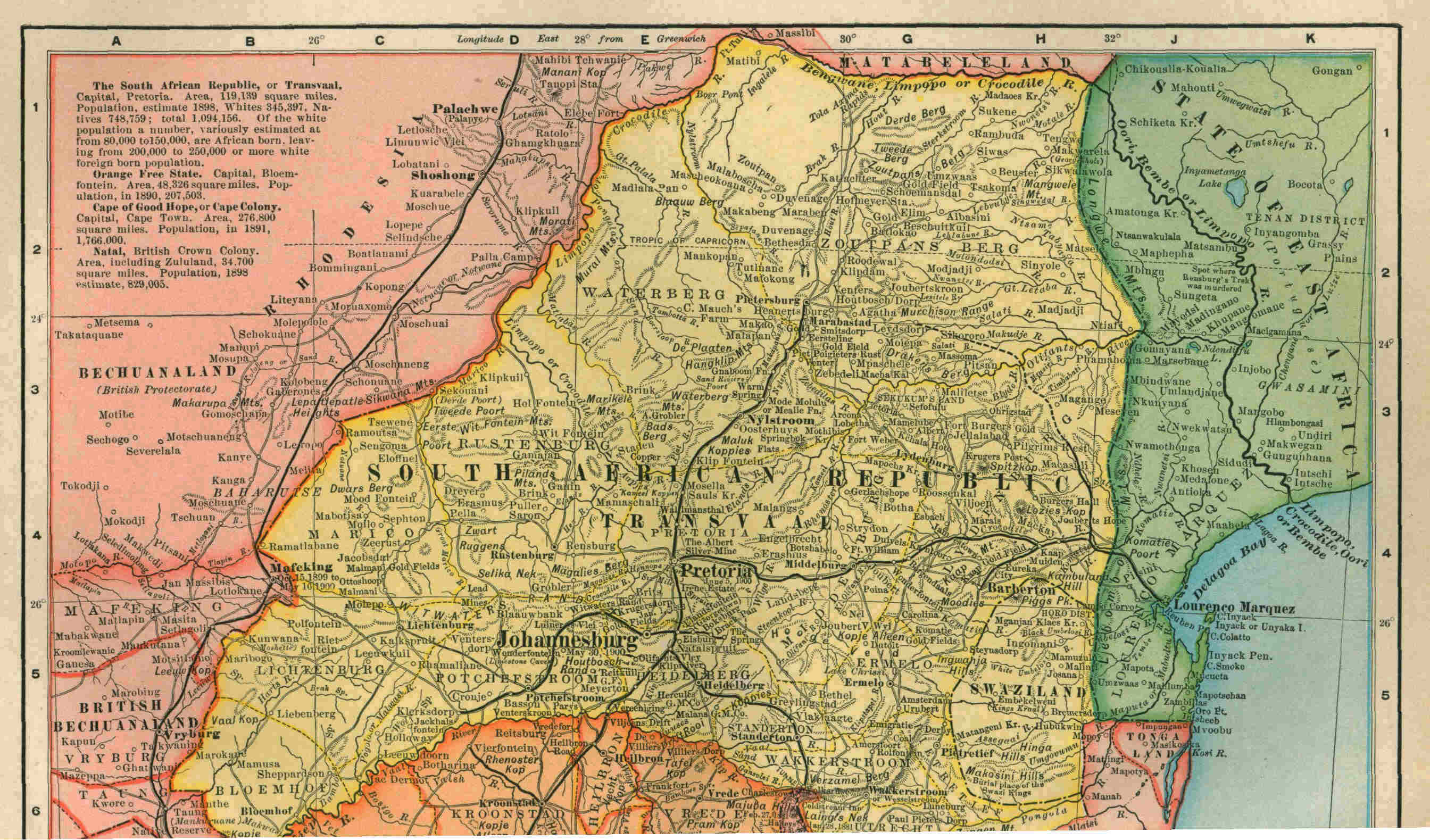
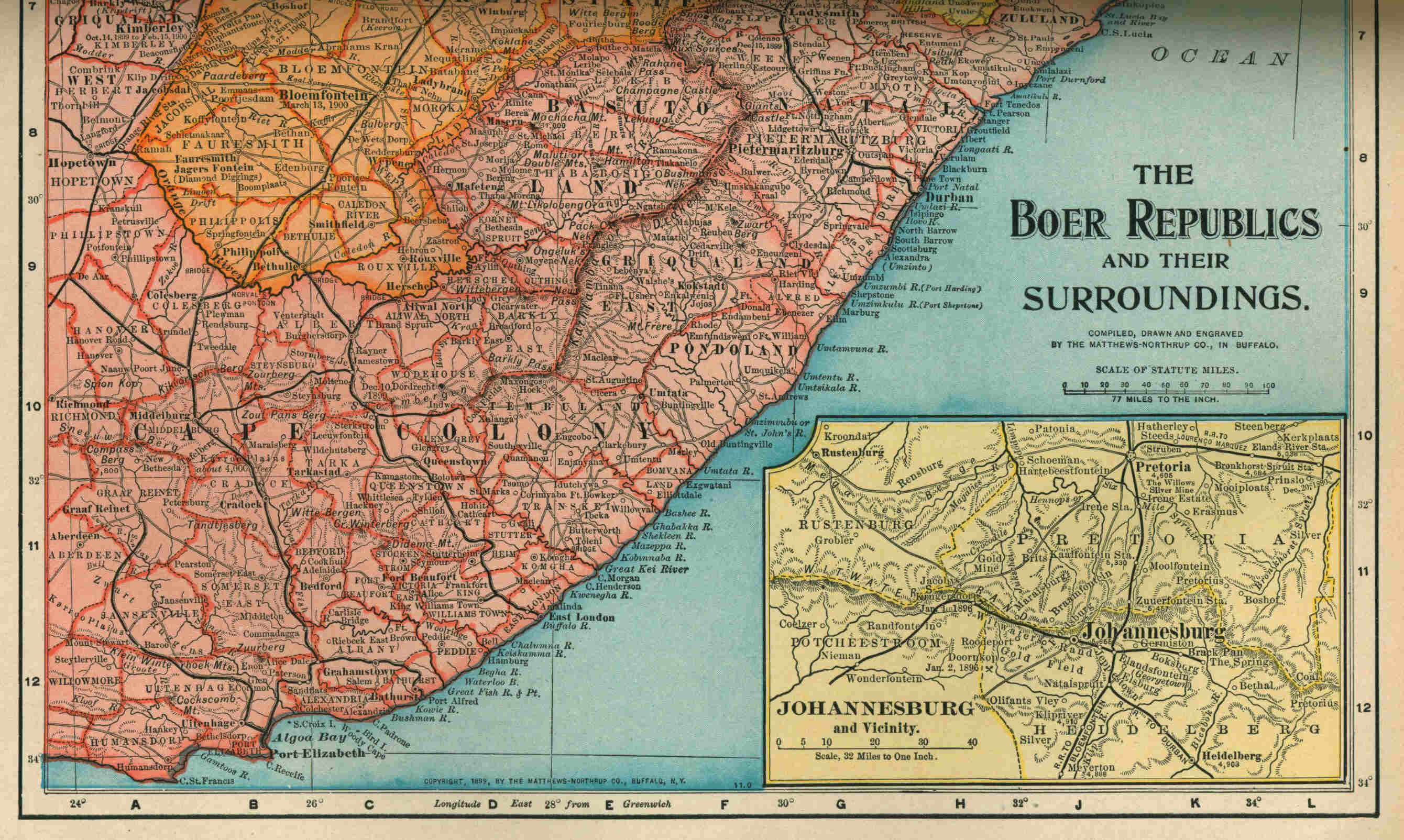
The Boer Republics and the Surroundings. {493} SOUTH AFRICA: The Field of War: A. D. 1899 (October-November). The Boer advance. Invasion of Cape Colony and Natal. The invaders joined by Dutch farmers of the colony. The British unprepared. Investment of Kimberley and Mafeking. In a despatch dated January 16, 1900, Sir Alfred Milner gave particulars of the first advance of the Boer forces from the Orange Free State into Cape Colony, and of the extent to which they were joined by Dutch farmers in districts south of Orange River. He wrote: "The portion of the Colony with which I propose to deal is that which lies south of the Orange River. The districts north of that river have been so completely cut off, and our accounts of what has been, and is, going on there are so scanty and imperfect, that the history of their defection cannot yet be written. I shall content myself with quoting an extract from a report upon the state of affairs in that region by a gentleman lately resident in Vryburg, which undoubtedly fairly expresses the truth so far as he has been in a position to observe it:—'All the farmers in the Vryburg, Kuruman, and Taungs districts,' he says, 'have joined the Boers, and I do not believe that you will find ten loyal British subjects among the Dutch community in the whole of Bechuanaland.' … The districts invaded by the enemy south of the Orange River are:—Colesberg, Albert, Aliwal North, Wodehouse, and Barkly East. It was on the 12th October that the enemy committed the first act of war and of invasion near Vryburg, on the western border, but it was not till more than a month later, namely, the 14th November, that they occupied Colesberg. Apparently they were waiting for reinforcements, for when they actually did cross the frontier they were 1,100 strong. Whatever the cause of their delay, it was not due to any discouragement from the people of Colesberg. The small British garrison then in the country being engaged elsewhere, and the district being entirely unguarded save by a few policemen, people from there continually visited the river to communicate with the enemy. The Chief Constable reports that when he left the town 300 Colesberg farmers had already joined the enemy, and that 400 more were expected from the adjoining district of Philipstown. … On the 16th November General Grobler, the Boer Commandant, addressed the following telegram to Bloemfontein:—'Colesberg was occupied by me without opposition. … I was very well pleased with the conduct of the Afrikanders. We were everywhere welcomed.' … Eastwards along the border the tide of insurrection ran strong. In the closing days of October a Boer force assembled at Bethulie Bridge, which was guarded only by a handful of police. As the days passed and the alarm grew, the Cape police force was withdrawn from Burghersdorp, which lies south of Bethulie, down the line to Stormberg, while, in their turn, the Imperial forces abandoned the important position of Stormberg, and retired on Queenstown, thus leaving the district clear for the invaders. That they did not immediately advance was certainly not owing to any fear of resistance at Burghersdorp, the inhabitants of which fraternised with the commando stationed on the river, continually passing to and fro. Finally, on the 14th November, the date of the occupation of Colesberg, the advance was made, and on the following morning a body of 500 Boers occupied the town. … According to the despatch of the Boer Commandant, dated 16th November, Burghersdorp was occupied 'amidst cheers from the Afrikanders,' and 'the Colonial burghers are very glad to meet us.' Commandeering at once began throughout the district of Albert, and a Burghersdorp resident estimated that about 1,000 farmers were prepared to join at the date of his leaving the place. … "Within a space of less than three weeks from the occupation of Colesberg, no less than five great districts—those of Colesberg, Albert, Aliwal North, Barkly East, and Wodehouse—had gone over without hesitation, and, so to speak, bodily, to the enemy. Throughout that region the Landdrosts of the Orange Free State had established their authority, and everywhere, in the expressive words of a Magistrate, British loyalists were 'being hunted out of town after town like sheep.' In the invaded districts, as will be seen from the above, the method of occupation has always been more or less the same. The procedure is as follows:-A commando enters, the Orange Free State flag is hoisted, a meeting is held in the Court-house or market-place, and a Proclamation is read, annexing the district. The Commandant then makes a speech, in which he explains that the people must now obey the Free State laws generally, though they are at present under martial law. A local Landdrost is appointed, and loyal subjects are given a few days or hours in which to quit, or be compelled to serve against their country. … The number of rebels who have actually taken up arms and joined the enemy during their progress throughout the five annexed districts can for the present only be matter of conjecture. I shall, however, be on the safe side in reckoning that during November it was a number not less than the total of the invading commandos, that is, 2,000, while it is probable that of the invading commandos themselves a certain proportion were colonists who had crossed the border before the invasion took place. And the number, whatever it was, which joined the enemy before and during November has been increased since. A well-informed refugee from the Albert district has estimated the total number of Colonial Boers who have joined the enemy in the invaded districts south of the Orange River at 3,000 to 4,000. In the districts north of that river, to which I referred at the beginning of this despatch, the number can hardly be less. Adding to these the men who became burghers of the Transvaal immediately before, or just after, the outbreak of war, with the view of taking up arms in the struggle, I am forced to the conclusion that, in round figures, not less than 10,000 of those now fighting against us in South Africa, and probably somewhat more, either are, or till quite recently were, subjects of the Queen."- Great Britain, Papers by Command: Cd. 264, 1900, pages 1-5. The above relates to movements from the Orange Free State into Cape Colony, where the most of reinforcement from Afrikander inhabitants of British soil was to be got. From the Transvaal, the movement of Boer forces across the frontiers, both eastward and westward, was equally prompt. Early on the morning of the 12th they were in Natal, advancing in three strong columns, under General Joubert, upon Newcastle, threatening the advance posts of the British at Dundee and Glencoe (some 40 miles northeast of Ladysmith), where valuable coal mines claimed defence. At the same time, another Boer army, under General Cronje, had passed the western border and was moving upon Mafeking, where Colonel (afterwards General) Baden-Powell, with an irregular force of about 1,200 men, was preparing for a siege. {494} The inhabitants of the town, including refugees, numbered about 2,000 whites and 7,000 blacks. A few days later Boer forces were skirmishing with the defenders of the diamond mines at Kimberley, where Colonel Kekewich commanded about 1,000 men, and where Cecil Rhodes was among the beleaguered citizens. The population of Kimberley was 33,000, more than half blacks. It is plain that the British were wholly unprepared for so vigorous an opening of hostilities on the part of the Boers. A military writer in the "London Times," discussing the "Lessons of the War," at the end of a year after its beginning, made the following statements and comment:—"There was no difficulty in obtaining the fullest information as to the resources of the Transvaal and the Free State, and we have been officially informed that 'the armed strength of the Boers, the number of their guns, with their character and calibre,' as laid down in the report of the Director of Intelligence, 'corresponds exactly with our recently-ascertained knowledge of what the enemy has put into the field.' Whether or not these reports ever travel from Queen Anne's gate to Pall-mall seems uncertain, since the Commander-in-Chief publicly stated that 'We have found that the enemy … are much more powerful and numerous than we expected.' The report of the Intelligence Department seems, therefore, to have been as valueless for practical purposes as were those transmitted to Paris by Colonel Stoffel prior to the outbreak of the Franco-German war, and Lord Wolseley was apparently as little aware of the fighting resources of the Boers as was Marshal Lebœuf of those of the Germans. When, early in September, 1899, it became a pressing necessity to reinforce the troops in South Africa, it was painfully realized that not a single unit at home was ready to take the field. One weak battalion and three field batteries, hastily compounded by wholesale drafting from others, represented the available contribution from a standing army at home whose nominal effectives considerably exceeded 100,000. The reinforcements, totally inadequate to meet the crisis, were made up by drawing upon India and the colonial garrisons." London Times, November 22, 1900. Another writer in "The Times," reviewing, at nearly the same time, the previous year of the war, gave this account of its opening circumstances:—"If the organization of the British Army had permitted the despatch at short notice of 30,000 troops from Great Britain, the whole course of the war would have been different. It was a prevailing illusion that Mr. Kruger would yield to diplomatic pressure not backed by available force, and political expediency, over-riding military considerations, led to a compromise. It was tardily decided to bring the forces in South Africa up to a total of about 22,000 by drawing on India and the colonial garrisons; mobilization was deferred till October 7. Thus the first reinforcements arrived barely in time to prevent Natal from being over-run by the Boers, and the expeditionary force did not begin to reach Durban [the port of Natal] till after Ladysmith had been closely invested. … There were advisers of the Cabinet who held that the military strength of the Boers was a bubble easily pricked. Thus it was widely believed that a severe repulse in Northern Natal would suffice to break up the Boer forces, and, knowing only that a body of 4,000 British troops was assembled at Dundee and another somewhat larger at Ladysmith, we hastily assumed that these places were naturally well suited and had been specially prepared for defence. When, on the 26th, the concentration at Ladysmith was accomplished, after a painful and a hazardous march, it was imagined that our forces occupied an intrenched camp, which, if necessary, could be held with ease. Later it became clear that Ladysmith was exceedingly ill-adapted for defence, that it was practically unfortified when invested, and finally that, if the attacking force had been composed of trained troops, it must have fallen, in spite of every effort on the part of the garrison. The occupation of Dundee, it was discovered, was maintained against the military judgment of Sir G. White. … "When at length the army corps and the cavalry division began, early in November, to arrive in South Africa, we believed that the bulk of this large force, which was apparently ready to take the field, would invade the Orange Free State and strike for Bloemfontein, clearing Cape Colony and inevitably drawing Boer forces away from the investments of Kimberley and of Ladysmith. This was another illusion. At least one-half of the expeditionary force was despatched to Durban and the rest was frittered away between three separate lines of advance. There were thus four separate groupings of British troops, spread over an immense front, and incapable of affording each other mutual support. Moreover, the Commander-in-Chief being involved in a difficult campaign in Natal, there was no responsible head in Cape Colony, where partial chaos soon supervened. … Faulty as was the strategy which substituted scattered efforts with insufficient force for a primary object, that of the Boers was happily even more ill-conceived. In place of attempting to occupy our troops in Natal and throwing their main strength into Cape Colony, where a Dutch rising on a large scale would inevitably have occurred, they also preferred to fritter away their strength, devoting their main efforts against Ladysmith, Kimberley, and Mafeking, and contenting themselves with the occupation of Colesberg and Stormberg in small force, which, however, was quickly swelled by local rebels." London Times, November 5, 1900. SOUTH AFRICA: The Field of War: A. D. 1899 (October-December). The early battles. British reverses. Siege of Ladysmith. The serious fighting of the war began in Natal, as early as the 20th of October, when three columns of the Boer forces closed in on the British advance post at Glencoe. The first of the Boer columns to arrive opened a precipitate attack, and in the hard battle which ensued (at Talana Hill) the British could claim the final advantage, though at very heavy cost. Their commander, General Sir W. Penn Symons, received a mortal wound and died three days afterwards, kindly cared for and buried by the enemy, his successor in the command, General Yule, having found it necessary to retreat from Glencoe and Dundee to Ladysmith. The Boers were already striking at the railroad between Glencoe and Ladysmith, and sharp fighting had taken place on the 21st at Elandslaagte, a station on the line only seventeen miles from the latter town. {495} The Boers, in that encounter, had been driven from the neighboring hills, but the British had again suffered greatly, and began to realize the quality of the foe with which they had to deal. A graphic account of the battle at Elandslaagte was written by the famous newspaper correspondent, G. W. Steevens, who died shortly afterwards at Ladysmith. Two days after Elandslaagte there was another engagement at Reitfontein, still nearer to Ladysmith, fought for the purpose of keeping the Boers from intercepting the retreat of General Yule. The British forces defending Natal were now concentrated at Ladysmith, which they had chosen for their main position, and in which they had been collecting large quantities of military stores. General Sir George White was there in general command. The Boers, with General Joubert in chief command, were rapidly closing in upon the town, and, on the 29th, they had a Creusot (French) six-inch gun on a neighboring hill, within range, ready to drop shells into its streets. That night General White made an attempt to break their lines which ended in sore disaster. One column, which marched far out, to a hill called Nicholson's Nek, for a flanking attack on the enemy, lost most of its ammunition and its battery, by a stampede of mules, and then was caught in so helpless a position that it had to lay down its arms. "The cursed white flag," wrote Mr. Steevens. "was up again over a British force in South Africa. The best part of a thousand British soldiers, with all their arms and equipment and four mountain guns, were captured by the enemy. The Boers had their revenge for Dundee and Elandslaagte in war; now they took it full measure in kindness. As Atkins had tended their wounded and succoured their prisoners there, so they tended and succoured him here. One commandant wished to send the wounded to Pretoria; the others, more prudent as well as more humane, decided to send them back into Ladysmith. They gave the whole men the water out of their own bottles; they gave the wounded the blankets off their own saddles and slept themselves on the naked veldt. They were short of transport, and they were mostly armed with Martinis; yet they gave captured mules for the hospital panniers and captured Lee-Metfords for splints." It is consoling to come on a bit of incident like this in the generally horrid story of war. A few days later the communications of Ladysmith southward were cut off, and the forces commanded by General White, about 10,000 in number, were hemmed in by superior numbers of the Boers. British reinforcements were now beginning to arrive in South Africa, and great numbers were at sea, not only imperial troops, coming from England, India, Ceylon and elsewhere, but colonial troops, offered by Canada, New Zealand and the Australian colonies, and accepted by the imperial government. The first operations of the British campaign were planned with three objects, more or less distinct, namely, to rescue General White's army, at Ladysmith, to relieve Kimberley, and to expel the Boers from northern Cape Colony. They were conducted on three lines, from the Natal port of Durban, towards Ladysmith, under General Clery at the beginning; from Cape Town towards Kimberley, under General Lord Methuen; from Port Elizabeth and East London to Queenstown and the Cape districts occupied by the Boers, under General Gatacre. In the early battles of General Methuen's campaign, fought at Belmont, November 23d, at Enslin, or Graspan, on the 25th, and at Modder River, only 25 miles from Kimberley, on the 28th, he carried his point, and kept up his advance, but at a heavy sacrifice of men. The battle with Cronje's forces at Modder River was a desperate struggle of ten hours duration, in which the British lost nearly 500 men and gained little. The Boers withdrew to an equally strong position, behind fortified lines which extended, some six miles in length, on hills between two points which bore the names of Spytfontein and Majesfontein. There General Methuen attacked them again, December 11, and met with a terrible repulse. His Highland Brigade, advancing in the darkness, before daybreak, was in the midst of the enemy's intrenchments before it knew them to be near, and was horribly cut to pieces, losing 53 officers, including its commander, General Wauchope, and 650 men. The British fell back to Modder River, leaving not less than 1,000 men behind. Just one day before this catastrophe, on the 10th, another of like nature, but little less serious, was sustained by General Gatacre's column, moving from Queenstown. He, too, attempted a night march and an early morning attack on the Boers in a fortified position at Stormberg, was misled by guides, miscalculated the distance, neglected to send scouts ahead, and so took his men to the very muzzles of waiting guns. From the storm which then opened on them there were more than 500 who did not escape. Besides the dead and wounded, many went as prisoners to Pretoria. Before the week of these defeats reached its end, another, far worse, had been added in the Natal campaign. General Sir Redvers Buller, appointed to the chief command in South Africa, had arrived at Cape Town on the last day of October, and, after some general study of the field at large, had taken personal direction of the operations in Natal, for the relief of Ladysmith. His movements were undoubtedly hurried by urgent appeals from General White. On the 15th of December he felt prepared to attempt the passage of the Tugela River, near Colenso, and did so with his full force, at two drifts, or fords, some two miles apart. Like Methuen and Gatacre, he seems to have been strangely misinformed as to the location and strength of the intrenchments of the Boers. The latter had succeeded again and again in concealing lines of deadly rifle-pits and batteries until their assailants fairly stumbled against them, within fatally close range. This happened at Colenso, as at Stormberg and Majesfontein and the ill-managed attempt to begin an advance upon Ladysmith cost 165 men and officers killed, 670 wounded, 337 prisoners and missing, besides 11 guns. SOUTH AFRICA: The Field of War: A. D. 1900. Fighting qualities of the Boers. "Take a community of Dutchmen of the type of those who defended themselves for fifty years against all the power of Spain at a time when Spain was the greatest power in the world. Intermix with them a strain of those inflexible French Huguenots who gave up home and fortune and left their country forever at the time of the revocation of the Edict of Nantes. The product must obviously be one of the most rugged, virile, unconquerable races ever seen upon earth. {496} Take this formidable people and train them for seven generations in constant warfare against savage men and ferocious beasts, in circumstances under which no weakling could survive, place them so that they acquire exceptional skill with weapons and in horsemanship, give them a country which is eminently suited to the tactics of the huntsman, the marksman, and the rider. Then, finally, put a finer temper upon their military qualities by a dour fatalistic Old Testament religion and an ardent and consuming patriotism. Combine all these qualities and all these impulses in one individual, and you have the modern Boer—the most formidable antagonist who ever crossed the path of Imperial Britain." A. C. Doyle, The Great Boer War, chapter 1. Count Adalbert von Sternberg, a German officer who served with the Boers, and who has since related his experiences in a book, writes to the same effect. "The Boers," he remarks, "were mounted, whilst the English were on foot, a matter of considerable importance in these hot countries. Given the same or even slightly superior forces, no Continental army would have played its part better than the English, and I even doubt whether, in regard to practical equipment and technical smartness and efficiency the Continent would have done as well. The fact is the Boer is an enemy of quite exceptional a character, such as never has been met before, or is likely to be met again. Mounted sharpshooters, armed with the very best of weapons, acclimatized, fanatical, and accustomed to habits of war, are terrible opponents, and cannot be dealt with off hand as if they were hordes of savages. One must not forget that the Boers have the keenest eyes imaginable, and that they understand better than anyone else how to get the fullest advantage of cover. All these are advantages which go far towards compensating defective leading and the weakening of moral due to being always on the defensive. … The Boers would have had much greater successes if they had not abandoned all idea of taking the offensive. They could not be brought to that, for that they lacked courage, and to that lack of courage they owe their destruction." SOUTH AFRICA: The Field of War: A. D. 1900 (January-February). Continued British disasters on the Tugela. Lord Roberts and Lord Kitchener in the field. Invasion of Orange Free State. Capture of General Cronje and army. Relief of Kimberley and Ladysmith. The dark and heavy clouds of disaster which overhung the British in South Africa at the close of the year shadowed England with anxiety and gloom. For the first time, the seriousness of the task of war in which the country had become engaged was understood, and energies corresponding to it were roused. Field-Marshal Lord Roberts, of Indian and Afghan renown, was sent out to take supreme command, with the equally famous Lord Kitchener, subjugator of the Egyptian Sudan, for his chief of staff. Immense reinforcements of troops were provided for with haste. On the 1st of January it was estimated that 30,000 fresh troops were afloat or on the point of embarkation, and that Lord Roberts would have 200,000 men at command when all then assigned to South Africa should have reached Natal and the Cape. Lord Roberts landed at the Cape on the 10th of January, and was occupied for a month in organizing and preparing for new movements in the field. Meantime, General Buller had made a second attempt to turn the strongly fortified position of his opponent on the Tugela, between his own army and the beleaguered force at Ladysmith, and had failed more discouragingly than before. Crossing the Tugela, some miles west of Colenso, on the 17th, he pressed a hard-fought, uphill advance, from one to another of the rocky hills (called kopjes) of the region, for several days. On the 23d his troops stormed the fortifications of the Boers on Spion Kop, a spur of the Drakenberg mountains, and carried them with heavy loss, only to find that they were commanded from other heights and could not be held. Again he drew back to the southern bank of the Tugela, on the 29th; but only for a few days. On the 5th of February his army was once more pushed beyond the river, and entrenched in a position among the hills, which it held until the 9th, and was then, for the third time, withdrawn. This third movement is supposed to have been a feint, intended to detain the Boer forces in his front, either from some assault feared at Ladysmith or from interference with the campaign which Lord Roberts was about to open. The besieged at Ladysmith were holding out with grim resolution, but they were known to be in sore straits. Occasional messages by the heliograph told of much sickness and fast approaching starvation in the town. Fever was killing more than the shells from the bombarding guns; and the chances of relief seemed to have almost disappeared. But a sudden change in the whole military situation was about to be made. Lord Roberts and Lord Kitchener had organized arrangements of transportation and supplies for handling the immense force now at their command, and were ready to execute their plans. The former arrived at Modder River on the 9th of February; two days later his columns were set in motion, and the Boer forces, under General Cronje, were too greatly outnumbered to withstand the avalanche which fell upon them. General French led a cavalry expedition to Kimberley, reaching the town on the 15th and raising the siege. The next day General Cronje was in retreat towards Bloemfontein, the Free State capital, harassed by British cavalry, and with the main army of Lord Roberts straining every nerve to strike him before he reached it. On the 18th he was brought to bay, at a point on the Madder River, near Paardeberg, where he defended himself for nine days, in a situation that was impregnable to assault, but terribly exposed to artillery fire from surrounding heights. He was expecting help from the forces in Natal and elsewhere, and several attempts were made by his associates to reach him; but the British were too strong to be driven from their prey. After suffering to such a degree that his men would endure no more, the brave and stubborn Boer surrendered on the 27th, his army, reduced to about 4,000, laying down their arms. Some 500 had been taken in the previous fighting, and considerable numbers in the last days of the siege, are said to have deserted and found means to slip through the enemy's lines. The prisoners were sent, for convenience of custody, to the island of St. Helena, the general being accompanied by his whole family, and treated with much respect. {497} While these operations were being carried to success by Lord Roberts, General Buller was again attacking the formidable fortifications of the enemy in his front. From the 14th of February until the 23d he sacrificed great numbers of men in assaults which failed to break a passage through the kopjes defended by Boer guns. But Lord Roberts's invasion of the Free State had, by this time, caused large withdrawals of Boers from the line of the Tugela, and they were preparing to raise the siege of Ladysmith. Consequently, when the British attack was renewed, on the 27th, it achieved success, at last. The Boers were driven from their main position and abandoned their whole line. Ladysmith was reached by a swift advance of cavalry the next day, and the half-starved garrison and citizens were soon receiving supplies. SOUTH AFRICA: The Field of War: A. D. 1900 (March). Overtures of peace from Presidents Kruger and Steyn. The reply of Lord Salisbury. Death of General Joubert. On the 5th of March, the Presidents of the South African Republic and the Orange Free State addressed the following telegram, jointly, to Lord Salisbury: "The blood and tears of the thousands who have suffered by this war, and the prospect of all the moral and economic ruin with which South Africa is now threatened, make it necessary for both belligerents to ask themselves dispassionately, and as in the sight of the Triune God, for what they are fighting, and whether the aim of each justifies all this devouring misery and devastation. With this object, and in view of the assertions of various members of the British Parliament to the effect that this war was begun and is being carried on with the set purpose of undermining Her Majesty's authority in South Africa, and of setting up an Administration over all South Africa independent of Her Majesty's Government, we consider it our duty solemnly to declare that this war was undertaken solely as a defensive measure for securing the threatened independence of the South African Republic, and is only continued in order to secure the incontestable independence of both Republics as sovereign international States, and to ensure that those of Her Majesty's subjects who have taken part with us in this war shall suffer no harm whatever in person or property. On these conditions, but on these conditions alone, are we now, as in the past, desirous of seeing peace reëstablished in South Africa, and of putting an end to the evil now reigning over South Africa; while, if Her Majesty's Government is determined to destroy the independence of the Republics, there is nothing left to us and our people but to persevere to the end in the course already begun, in spite of the overwhelming pre-eminence of the British Empire, confident that the God who lighted the unextinguishable fire of the love of freedom in the hearts of our fathers will not forsake us, but will accomplish His work in us and in our descendants. We hesitated to make this declaration earlier to Your Excellency, as we feared that as long as the advantage was always on our side, and as long as our forces held defensive positions far in Her Majesty's Colonies, such a declaration might hurt the feelings of honour of the British people; but now that the prestige of the British Empire may be considered to be assured by the capture of one of our forces by Her Majesty's troops, and that we are thereby forced to evacuate other positions which our forces had occupied, that difficulty is over, and we no longer hesitate clearly to inform your Government and people in the sight of the whole civilised world why we are fighting, and on what conditions we are ready to restore peace." On the 11th Lord Salisbury replied as follows: "I have the honour to acknowledge Your Honours' telegram, dated the 5th of March, from Bloemfontein, of which the purport is principally to demand that Her Majesty's Government shall recognise the 'incontestable independence' of the South African Republic and Orange Free State 'as sovereign international States,' and to offer, on those terms, to bring the war to a conclusion. In the beginning of October last peace existed between Her Majesty and the two Republics under the Conventions which then were in existence. A discussion had been proceeding for some months between Her Majesty's Government and the South African Republic, of which the object was to obtain redress for certain very serious grievances under which British residents in the South African Republic were suffering. In the course of those negotiations, the South African Republic had, to the knowledge of Her Majesty's Government, made considerable armaments, and the latter had, consequently, taken steps to provide corresponding reinforcements to the British garrisons of Cape Town and Natal. No infringement of the rights guaranteed by the Conventions had, up to that point, taken place on the British side. Suddenly, at two days' notice, the South African Republic, after issuing an insulting ultimatum, declared war upon Her Majesty; and the Orange Free State, with whom there had not even been any discussion, took a similar step. Her Majesty's dominions were immediately invaded by the two Republics, siege was laid to three towns within the British frontier, a large portion of the two Colonies was overrun, with great destruction to property and life, and the Republics claimed to treat the inhabitants of extensive portions of Her Majesty's dominions as if those dominions had been annexed to one or other of them. In anticipation of these operations the South African Republic had been accumulating for many years past military stores on an enormous scale, which by their character could only have been intended for use against Great Britain. Your Honours make some observations of a negative character upon the object with which these preparations were made. I do not think it necessary to discuss the questions you have raised. But the result of these preparations, carried on with great secrecy, has been that the British Empire has been compelled to confront an invasion which has entailed upon the Empire a costly war and the loss of thousands of precious lives. This great calamity has been the penalty which Great Britain has suffered for having in recent years acquiesced in the existence of the two Republics. In view of the use to which the two Republics have put the position which was given to them, and the calamities which their unprovoked attack has inflicted upon Her Majesty's dominions, Her Majesty's Government can only answer Your Honours' telegram by saying that they are not prepared to assent to the independence either of the South African Republic or of the Orange Free State." Great Britain, Papers by Command: Africa, Number 2, 1900. {498} On the 27th of March, the Boer cause experienced a great loss, in the sudden death, from peritonitis, of General Joubert, the Commandant-General and Vice President of the South African Republic. SOUTH AFRICA: Orange Free State: A. D. 1900 (March). Proclamation to the burghers by the British commander. Soon after entering the Orange Free State, Lord Roberts issued a proclamation addressed to the burghers, assuring them that the British government did not believe them to be responsible for the aggressive act of war committed by the government of the Orange Free State, and bore them no ill-will. "I, therefore," his proclamation continued, "warn all Burghers to desist from any further hostility towards Her Majesty's Government and the troops under my command, and I undertake that any of them, who may so desist and who are found staying in their homes and quietly pursuing their ordinary occupations, will not be made to suffer in their persons or property on account of their having taken up arms in obedience to the order of their Government. Those, however, who oppose the forces under my command, or furnish the enemy with supplies or information, will be dealt with according to the customs of war. Requisitions for food, forage, fuel, or shelter, made on the authority of the officers in command of Her Majesty's troops, must be at once complied with; but everything will be paid for on the spot, prices being regulated by the local market rates. If the inhabitants of any district refuse to comply with the demands made on them, the supplies will be taken by force, a full receipt being given. Should any inhabitant of the country consider that he or any member of his household has been unjustly treated by any officer, soldier or civilian attached to the British Army, he should submit his complaint, either personally or in writing, to my Headquarters or to the Headquarters of the nearest General Officer. Should the complaint on enquiry be substantiated, redress will be given. Orders have been issued by me, prohibiting soldiers from entering private houses, or molesting the civil population on any pretext whatever, and every precaution has been taken against injury to property on the part of any person belonging to, or connected with, the Army." After the occupation of Bloemfontein, Lord Roberts issued a second proclamation, announcing that he had received authority from his government to offer the following terms to those "who have been engaged in the present war": "All Burghers who have not taken a prominent part in the policy which has led to the war between Her Majesty and the Orange Free State, or commanded any forces of the Republic, or commandeered or used violence to any British subjects, and who are willing to lay down their arms at once, and to bind themselves by an oath to abstain from further participation in the war, will be given passes to allow them to return to their homes and will not be made prisoners of war, nor will their property be taken from them." Great Britain, Papers by Command: Cd. 261, 1900, pages 62-63. SOUTH AFRICA: The Transvaal and the Free State: A. D. 1900 (March). Boer Peace Commissioners to Europe and America. In March, three commissioners, Messrs. Fischer, Wolmeraans and Wessels were sent to Europe and America by the two Boer governments to solicit intervention in their behalf. They visited several European countries and proceeded thence to the United States, in May. There were many demonstrations of popular sympathy in their reception, on both sides of the ocean, but they failed to obtain official recognition. SOUTH AFRICA: The Field of War: A. D. 1900 (March-May). The British in Bloemfontein and Kroonstad. The relief of Mafeking. From the scene of the surrender of General Cronje Lord Roberts moved quickly on the Free State capital. His advance was resisted by considerable forces of the Boers, but he was able to turn most of their positions, and fought only one severe battle, at Driefontein, on the 10th of March. On the 12th his cavalry was in possession of Bloemfontein, and the Field-Marshal entered the city on the following day, receiving from the municipal officers a formal surrender of the keys of the public buildings, and being welcomed by some part of the population with demonstrations of joy. President Steyn and most of the members of the government of the Republic had retired to Kroonstad and established the seat of authority there. The lighting and the forced marches of a single month, since he began his advance, had now exhausted the mobility of Lord Roberts's army, worn out the means of transportation which Lord Kitchener had hastily organized for it,—while his troops were being stricken with fever,—and he was compelled to suspend his campaign for some weeks. The situation at that time was probably described with accuracy by a military contributor to "Blackwood's Magazine" for June, 1900, who wrote: "Lord Roberts found himself at Bloemfontein with the wreck of an army and a single narrow-gauge line of railway between himself and his base, upwards of 700 miles distant. It was very soon known in Boer headquarters at Kroonstad that he could not move beyond Bloemfontein for some weeks. The triumphal march of Generals Gatacre and Clements through the recently captured territory, accepting submissions, hoisting union-jacks and picking up rifles of antique date, afforded much amusement to the Boers, who saw their opportunity and streamed down in large numbers on the small British posts which were scattered east and south of the railway." There was a good deal of raiding and fighting on a minor scale, with a number of mortifying mishaps to the British arms; but little of importance occurred in the military field until near the end of April, when Lord Roberts had reinforced and mobilized his army sufficiently to move forward again, towards Pretoria. On the 12th of May he entered Kroonstad, and the Free State government was again in flight. He paused at Kroonstad for some days, and while he paused there came news of the relief of Mafeking, which caused a wilder joy in England than any other event of the war. There had been painful anxiety on account of the besieged in that remote town, in the far corner of Bechuanaland, on the border of the Transvaal,—so far from help, and so stoutly defended for seven weary months by a very small force. From a point near Kimberley, a flying column of mounted men, mostly colonial troops, commanded by Colonel Mahon, had been started northward on the 4th of May, taking a route east of the railway, to avoid, as much as possible, the Boers. {499} On the 15th they were 20 miles west of Mafeking, and there they were joined by another detachment, under Colonel Plumer, which had been operating in the northern region for some weeks without being able to break up the siege. The two advanced on the works of the besiegers, drove them out by hard fighting, and entered the town on the 18th of May. Meantime, another column, under General Hunter, had been securing and opening the railway, to bring up the sorely needed supplies for the famished and worn-out garrison and people of the town. The defense of Mafeking was one of the finest performances of the war, and gave distinction to Colonel Baden-Powell. SOUTH AFRICA: Cape Colony: A. D. 1900 (April-June). The question of the treatment of Cape Colonists who had taken part with the Boers in the war. Resignation of Premier Schreiner. On the 28th of April, the Ministers of Cape Colony addressed to the Governor, Sir Alfred Milner, a Minute upon the subject of the treatment of those inhabitants of the Colony who had joined or given aid to the Boers in the war, and who had thus made themselves liable to the pains and penalties of high treason. "Ministers submit," they said, "that the ends of justice would be served by the selection of a certain limited number of the principal offenders, whose trials would mark the magnitude of their offence, and whose punishment, if found guilty, would act as a deterrent. For the remainder, Ministers believe that the interests both of sound policy and of public morality would be served if Her Gracious Majesty were moved to issue, as an act of grace, a Proclamation of amnesty under which, upon giving proper security for their good behaviour, all persons chargeable with high treason, except those held for trial, might be enlarged and allowed to return to their avocations. Ministers urge such a course not only on the ground of that natural desire for clemency towards her erring subjects which they feel sure would spring from Her Gracious Majesty, but from a deep sense of the importance of such a step upon the future well-being of this country." The substance of the Minute was transmitted by cable to Mr. Chamberlain, and he replied to it on the 5th of May, objecting to the proposed proclamation of a broad amnesty, saying: "Clemency to rebels is a policy which has the hearty sympathy of Her Majesty's Government, but justice to loyalists is an obligation of duty and honour. The question is how can these two policies be harmonized. It is clear that in the interest of future peace it is necessary to show that rebellion cannot be indulged in with impunity, and above all that if unsuccessful it is not a profitable business for the rebel. Otherwise the State would be offering a premium to rebellion. The present moment, therefore, while the war is still proceeding, and while efforts may still be made to tempt British subjects into rebellious courses, is in any case not appropriate for announcing that such action may be indulged in with absolute impunity. And if, as has been suggested, a great many of the Queen's rebellious subjects are the mere tools of those who have deceived them, it is important that these should be made aware individually that whatever their leaders may tell them rebellion is a punishable offence." This attitude of the Imperial Government on the subject of amnesty occasioned differences in the Ministry of Cape Colony which led to the resignation of the Premier, Mr. W. P. Schreiner, on the 13th of June, and the appointment of a new Ministry, under Sir Gordon Sprigg. Great Britain, Papers by Command: July, 1900, Cape Colony, Cd. 264. SOUTH AFRICA: The Field of War: A. D. 1900 (May). The British army stricken with fever. The losses of the British army in battle during this campaign of Lord Roberts had not been severe; but it had encountered a worse enemy than the Boers, and was being terribly thinned and shattered by the ravages of enteric or typhoid fever. The sanitary condition of the army in May, and the lack of due provision for dealing with the dreadful epidemic, have been graphically described by the writer already quoted, in "Blackwood's Magazine." Referring to the outset of the campaign, in February, he wrote: "The movement of men and cattle depends on flesh and muscle—it cannot go on for ever; the strain of incessant marching on insufficient food and forage will find out the weak spot even in the most willing. General French started on his memorable ride with 4,800 horses, of which 990 dropped by the way, though the loss in the ranks, exclusive of Paardeberg, was only fifty men,—the brunt of the battle for life lay with the horses. But not for long. The men with worn-out boots, tattered clothes, hurrying through scorching days and frosty nights, with half a biscuit and water tainted with dead Boers, to satisfy an appetite and thirst compelled by hard work at an altitude of 4,000 feet, who marched in as soldiers, proud of the victory they had won, staggered and fell out, victims to the curse that creeps in, unnoticed, wherever camps are crowded—enteric. … Of all things on which we prided ourselves was the care and the money we had lavished to provide comforts for our sick soldiers. The foremost surgeons of the day had volunteered; military hospitals had been arranged on the latest plan; private benevolence had provided as many more; ladies of every rank in life had gone out to nurse: the soldiers, at all events, would be looked after. Letters from the front had come from patients to say how well they had been treated. Mr. Treves at the Reform Club made a speech eulogizing the perfection of the hospitals in Natal, and Sir W. MacCormac spoke of the medical arrangements as admirable—our minds rested content. All this was so long ago as the 10th March, but what happened in March, for all we knew, was happening in May. Then Mr. Burdett-Coutts told us that hundreds of men were lying in the worst stages of typhoid, with only a blanket to cover them, a thin water-proof sheet (not even that for many) between them and the ground; no milk and hardly any medicines; without beds, stretchers, or mattresses; without pillows, without linen of any kind, without a single nurse amongst them, with a few private soldiers as orderlies, and only three doctors to attend on 350 patients; their faces covered with flies in black clusters, the men too weak to brush them off, trying in vain to dislodge them by painful twitching of the features—there was no one to do it for them. And this a mile from Bloemfontein, where the army had been for six weeks. It is true that a terrible epidemic had followed it from Paardeberg, to break out when it halted. Lord Roberts tells us that before he left on May 3rd the sick gradually increased to 2,000, reaching on June 4th the appalling number, in Bloemfontein, of over 5,000 suffering from typhoid alone. {500} Such were the bare facts as stated on either side—a sudden and devastating epidemic with totally inadequate hospital arrangements to meet it. … Yet typhoid has always been the scourge of armies in the field,—in South Africa the water-supply, invariably surface drainage fouled by dead animals, is proverbial—that at least was known. The medical authorities on the spot were repeatedly warned by local medical men that from February onwards ten men would be down with typhoid for one with wounds. Ladysmith is in evidence of the persistent presence of typhoid—every one who has visited South Africa bears witness to the same—it can hardly be urged that an outbreak was unreasonable to expect; yet when it did occur it seems to have been taken by the medical administration at the base as an unwarrantable intrusion." The War Operations in South Africa (Blackwood's Magazine, August, 1900). SOUTH AFRICA: The Transvaal: A. D. 1900 (May). Speech of President Kruger to the Volksraads. The following translation of a speech addressed to both Volksraads by President Kruger, in May, 1900, was published in England some months later: "It is known to you," said the President, "how, before the war started, pressure was brought to bear to obtain the franchise. It is known to you that the Government conceded, after the Rand had consented, although this body saw the difficulty in the matter, till even the burghers made petitions to the effect that we had parted with all our rights. The Government had in view the prevention of shedding blood. The Raad then consented to a seven years' franchise, and also to grant immediately the franchise to people resident here longer than seven years. There were then nearly 30,000 who would obtain the franchise immediately, and so much was conceded that when these had obtained the franchise they would have been able to out-vote the old burghers. We consented to this solely to prevent the shedding of blood. Yet they were not satisfied and they wanted the franchise after five years' residence. Our burghers were against this, and there were also members of the Raad who would not agree to this, yet, nevertheless, the Government made a proposition about it, because they had discovered that it was not about the franchise, but that it was a pretence full of Pharisaic hypocrisy, because documents had been found that in 1896 it was decided that the two independent Republics should not be allowed to exist any more. I cannot express myself otherwise than to call it a devilish fraud. Peace was spoken of while a resolution had already been passed to annihilate us. Even if we had conceded more, yea, even if we had said that the franchise could be obtained after one year, then that would not have been accepted. It was proved by documents that, as this nation could not be allowed to be a free nation, as was pointed out in the address, the Government, to prevent the further shedding of blood, made a proposition to Chamberlain and Salisbury about this matter, and what was the reply? You have, doubtless, read the paper, and, although I cannot verbally repeat the contents of the said document, it amounts to this. That they were annoyed ever to have acknowledged us as an independent nation, and that, notwithstanding all conventions made, they would never acknowledge this nation as self-supporting. Honourable gentlemen, I had to express that which was in my mind. Psalm 83 speaks of the assault of the evil one on the Kingdom of Christ. That must not exist. The self-same words of Salisbury also appear, because he says 'this nation must not exist,' and God says, 'this nation shall exist.' Who will be victorious? Certainly the Lord. You see therein the deceit which they then already practised, even they, for though our nation did not wish to part with any rights, the Executive Council conceded so far that we nearly lost the country. The intention was not to obtain these rights. They wanted our country not to be independent any longer. Every other proposition was unsatisfactory to them. "Let us look this matter in the face and see the cunning deceit enveloped therein. They wrote to the Orange Free State that they had nothing against them, but that they had some grievance against this Republic. Their intention was to tear the two Republics asunder, and it has been proved by documentary evidence that neither of them would be allowed to remain. You see the deception which lies therein. The documents prove that this was already decided in 1896, from the time of Jameson's invasion, and yet they maintain that if the Orange Free State had laid down their weapons that that country would remain in existence. The Orange Free State decided not to lay down their arms, and we started together. We were 40,000 men, but everywhere we had to watch the Kaffirs, and even the commander of Mafeking informed us that certain Kaffir chiefs would assist him. We know that these numbered 30,000 able-bodied men. The number of Kaffirs nearly equalled the number of our forces. Besides them, more than 200,000 English troops arrived, and against these we have to fight. Now, gentlemen, look on God's government. Is it not wonderful that 40,000 men having to fight these thousands, besides the coloured people, still live? Acknowledge therein the hand of God. The matter I wish to impress is this. It is remarkable that when we meet the enemy we stand in the proportion of 10 to 100. Yet the Lord hath spared us thus far. I do not wish to prophesy, but I wish to point out that our guidance is in the word of God. It is extraordinary, but this war is a sign of the times. What it amounts to is this. That the power of the Beast is an obstinate power to persecute the Church and will continue this until the Lord says, 'Thus far and no further: and why? Because the Church must be tried and purified as there is so much iniquity among us. That is why the war is extraordinary and is a sign of the times. Every one will be convinced that the word of God can be plainly traced in this matter. They say that the people 'shall not exist,' but God says, 'it shall exist and be purified.' In my mind it lies clear and discernable that the day of grace is not far off. The Lord will prove to be ruler, and nothing shall take place without His will. When He allows chastisement to come upon us we must bend ourselves and humble ourselves, confess our sins and turn again to the Lord. When the whole nation has been humbled, and it is seen that we can do nothing ourselves, the Lord will help us and we shall have peace immediately. {501} This humility has not grasped our hearts sufficiently at present, and we must perform our earnest duty as Peter says in 1 Peter, chapter v., v. 7 and 8:—'Casting all your care upon Him; for He careth for you'; but in the eighth verse it states:—'Be sober, be vigilant; because your adversary the Devil, as a roaring lion, walketh about, seeking whom he may devour.' That is the point on which we must be careful. If we fall into disbelief then we lower ourselves. "I ask you, brothers, what is their behaviour? In an open letter Kaffirs are called up by them as at Derdepoort, and women and children are murdered. The English assert that no Kaffirs were utilized against us but only coloured people, but it is a fact that Montsioa with his Kaffirs are in Mafeking, and are employed to fight against us. Now, gentlemen, you must not come to the conclusion that everyone who fights against us belongs to the Beast (vide Revelations, chapter 13). There are certainly hundreds of God's children with them who, however, through fear are the Beast's, and are forced to act with them, but God knows all hearts. We did not seek to spill the blood which lies strewn upon the earth, as we conceded nearly all our rights; but when they wanted to murder us, we could not give way any more. How did it fare with Ahab? The mighty foe came on to the walls of the city, and they lost heart. Then the prophet of God came and said, Fear nothing. Then God arose, and in that God we must put our trust, because He is the same God. Let us not, therefore, live as if no God existed; He reigns. In the beginning was the Word, and the Word was God, and the Word became flesh and lived amongst us. Look at history, it must be an example to us. He is still the same God who led out Israel and hardened the heart of Pharaoh to the end, until finally all the first-born of the Egyptians died, whereupon Pharaoh allowed the Israelites to go. He is still the same God who calmed the winds and storms on the sea, and His arm is not shortened. Some ask, 'Does not this only have reference to the Church in the two Republics?' No. See the three youths in the burning oven. Did these rejoice alone? No; but God's people of the whole earth. Was it solitary for Daniel in the lions' den? No, but all Christians on the whole earth rejoiced. So the Lord often chooses a small body to whom He shows His miracles as an example for the whole Christian world. Look upon the blood which has been spilt upon this earth. Who is the cause of it? We have wanted peace and our freedom since 1836, and the Lord has given it us, and will the Lord ever give anything and then withdraw? No. But let us humble ourselves before the Lord. There is no doubt about it that eventually the Lord will lead us to victory. The day of grace is not far from His people. Do not let us doubt but remain true to God's word and fight in His name. When the cup of humiliation is brought to our lips and we earnestly humble ourselves before the Lord, then the day of grace has arrived. Let each one then acknowledge that it is the hand of God which makes us free and nothing else, then we shall not boast. Yet He uses man as His instrument. "I have laid my address before you, and I hope that the Raad will not sit over it longer than to-morrow morning. There are several members of the Raad who are burghers or military officers in the field, so there will be no time to treat ordinary subjects. I trust that you will only treat such subjects as I lay before you. I have appointed an acting Commandant General since I have lost my right-hand man, although I do not infer that I have not more such men. The late most noble Commandant General, Messrs. Kock and Wolmarans, members of the executive council, are lost to me. The State Secretary is a newly appointed one, and I am the only one remaining of the old members of the executive council, yet I have experienced much assistance and support from the present members, and God will also support us. The Lord is still our Commander-in-Chief; He gives orders and He knows when to say, 'Thus far and no further.' It is surprising how other Powers are unanimously with us and how the whole of Europe prays for us, and will the Lord lend a deaf ear to these prayers? Oh, no! Trust in the Lord and let us stand by Him, and He will perform miracles. Even if I have to go to St. Helena, the Lord will bring His people back and make them free, and the same judgment will fall on the present Babylon, the cause of all the spilt blood. We fight for the freedom which God granted to us. I say again, should any brothers from this Raad and private persons fall by the sword, they fought in the name of the Lord and believed, and they, so says the word of the Lord, are sacrificed on the altar for the glorification of His name and of the glorious Church, which, at this time, is to be revealed. The Church must be tried and purified, and that is why I cannot see that this extraordinary war will be allowed to destroy us. This war will be continued until the Lord says, 'Thus far and no further,' remain at that, abide by that, and fight with me. I give myself in the hands of the Lord, whatever He has destined for me, I shall kiss His rod with which He chastizes me because I am also guilty. Let everyone humble himself before the Lord, I have said." SOUTH AFRICA: Orange Free State: A. D. 1900 (May). Annexation by proclamation of Lord Roberts to the Dominions of the Queen. "In view of Lord Robert's opinion that early annexation would tend towards the pacification of the country, by removing a feeling of uncertainty as to the return of President Steyn's government," the following commission by the Queen to Lord Roberts was issued on the 21st of May: "Victoria R. I., by the Grace of God of the United Kingdom of Great Britain and Ireland Queen, Defender of the Faith, Empress of India: To Our Right Trusty and Well-beloved Councillor Frederick Sleigh, Baron Roberts of Kandahar, Field Marshal of Our Forces, Knight of Our Most Illustrious Order of Saint Patrick, Knight Grand Cross of Our Most Honourable Order of the Bath, Knight Grand Commander of Our Most Exalted Order of the Star of India, Knight Grand Commander of Our Most Eminent Order of the Indian Empire, upon whom We have conferred the Decoration of the Victoria Cross. Greeting: Whereas the territories in South Africa heretofore known as the Orange Free State have been conquered by Our forces, And whereas it is expedient that such territories should be annexed to and should henceforth form part of Our Dominions: Now know you that We, reposing especial trust and confidence in you the said Frederick Sleigh, Baron Roberts of Kandahar, do hereby authorize and empower you in Our name to annex the said territories and to declare that the said territories shall henceforth form part of Our Dominions. {502} And We do hereby constitute and appoint you to be thereupon Administrator of the said territories provisionally and until Our pleasure is more fully known. And We do authorize and empower you as such Administrator to take all such measures, and to make and enforce such laws as you may deem necessary for the peace, order, and good government of the said territories. And we do strictly charge and command all Our officers, civil and military, and all other Our faithful subjects, that in their several places, and according to their respective opportunities, they do aid and assist you in the execution of this Our Commission, and for so doing this shall be your Warrant. Given at Our Court at St. James's, this 21st day of May, One thousand nine hundred, in the Sixty-third Year of Our Reign." The commission was executed by a public reading of the proclamation of Lord Roberts at Bloemfontein on the 24th of May. Great Britain, Papers by Command: 1900, Cd. 261, pages 136, 144. A counter-proclamation, referring to that of the British commander, was issued by President Steyn, from Reitz, on the 11th of June, declaring: "Whereas an unjust war was forced on the people of the Orange Free State and of the South African Republic by Great Britain in the month of October 1899, and whereas these two small Republics have maintained the unequal struggle with the powerful British Empire for more than eight months and still maintain it; … Whereas the forces of the Orange Free State are still in the field and the Orange Free State has not been conquered and whereas the aforesaid proclamation is thus in contradiction with International Law; Whereas the independence of the Orange Free State has been acknowledged by nearly all the civilised Powers; Whereas it is notorious that the British authorities have lately recognised that the Orange Free State is governed in an exemplary manner, and that it is both a violation of the laws of civilization and a denial of the fundamental rights of such people to rob it on what a pretence soever, of its freedom, and whereas I consider it desirable to make known to all whom it may concern that the aforesaid Proclamation is not recognised by the Government and the people of the Orange Free State; So, therefore, I, M. T. Steyn, State President of the Orange Free State, in consultation with the Executive Council, and in the name of the independent people of the Orange Free State, do hereby proclaim that the aforesaid annexation is not recognised and is hereby declared to be null and of no avail. The people of the Orange Free State is and remains a free and independent people, and refuses to submit to British rule." Great Britain, Papers by Command: Cd. 261, 1900, page 155. SOUTH AFRICA: Cape Colony: A. D. 1900 (May). Opposition of Cape Colony Afrikanders to the annexation of the Republics. A "People's Congress" of the Afrikanders, or Bondmen, of Cape Colony, was held at Graaff-Reinet, on the 30th of May, to protest against the annexation of the Boer Republics. The following resolution was adopted by acclamation: "Whereas, were the Republics to be annexed the majority of Cape Colonists would feel themselves bound morally to work unceasingly by every right and lawful means for the restoration of independence to the Republics, and to make that end their first political object; And whereas from our knowledge of the history and character of the Republics we are convinced they would never become the willing subjects of the Empire, but would seize any and every opportunity which might offer itself to recover their independence, possibly by force of arms, once they were to be deprived of it; And whereas instead of the annexation of the Republics tending to promote the welfare of their people, as has been claimed, it would, if successfully maintained for any long period, tend to degrade those people and their offsprings, seeing that the servitude of a self-governing State is as demoralising to its people as the more direct form of personal slavery; And whereas, as the annexation of the Republics by Great Britain would be as great a wrong morally as the theft by a rich man of a poor man's hard-earned savings; On that general ground alone it is not believable that permanent good could result from such a policy. Therefore be it resolved now that we, on behalf of the majority of Cape Colonists, do hereby declare our solemn and profound conviction that the annexation of the two South African Republics would be disastrous to the peace and welfare of South Africa and of the Empire as a whole." Also the following: "Be it resolved that it is the opinion of the people in Congress here assembled that a settlement of the South African question on the following basis would prove a blessing to South Africa and the Empire, namely, that the two Republics should have their unqualified independence; that the Colonies should have the right to enter into treaties of obligatory arbitration with the Republics for the settlement of all disputes affecting the internal affairs of the South African Continent, and that this colony, and any other colony so deserving it, should have a voice in the selection of its Governors. Be it further resolved that a settlement on the above basis would make the majority of the people who have made South Africa their home the warm friends and staunch allies of the British Empire, and that in no other way known to us can that end now be attained." In transmitting a report of this meeting to Secretary Chamberlain, the High Commissioner, Sir Alfred Milner, wrote: "I do not myself take a very gloomy view of the prospect of racial relations in the Colony, much less in South Africa generally. If it is true, as the conciliators are never tired of threatening us, that race hatred will be eternal, why should they make such furious efforts to keep it up at the present moment? The very vehemence of their declarations that the Africanders will never forgive, nor forget, nor acquiesce, seems to me to indicate a considerable and well-justified anxiety on their part lest these terrible things should after all happen." Great Britain, Papers by Command: July, 1900, South Africa, Cd. 261, pages 182-188. {503} SOUTH AFRICA: The Field of War: A. D. 1900 (May-June). The British invasion of the Transvaal. Occupation of Johannesburg and Pretoria. Expulsion of the Boers from Natal. Discussion of terms of surrender. On the 22d of May, Lord Roberts resumed his forward movement from Kroonstad, with a strong column of cavalry, under General French, in advance on the west, and another, of mounted infantry, under General Ian Hamilton, on the east. The Boers, under General Botha, had prepared defensive works on the Rhenoster River, but were too much endangered by the flanking column of General Hamilton to make a stand there, and fell back. Again at the Vaal River, their fortifications were untenable, as against an invasion of such numbers, with so large a mounted force. With little resistance the British army crossed the Vaal on the 26th and 27th and entered the territory of the South African Republic. On the 30th it was before Johannesburg, and the town was surrendered on the following day. Thence the invading force moved upon Pretoria, meeting some opposition, but evidently none that was hopefully made, and the capital was surrendered unconditionally to Lord Roberts on the 5th of June. President Kruger and the officials of his government had left the town, with their archives and their treasure, and movable offices had been prepared for them in railway cars, which were transferred for the time being to Machadodorp, at some distance eastward. Most of the armed burghers had escaped from the town, and they had been able to remove about 900 of their British prisoners; but a large number of the latter were set free. General Botha gathered up his broken and discouraged forces and intrenched them in a strong position on the Lorenzo Marquez railway, only 15 miles eastward from Pretoria. Lord Roberts moved against him on the 11th and compelled him to retreat, after hard fighting for five hours. This ended important operations in that part of the field. In Natal, General Buller, since early in May, had been pushing his army northward, in a movement co-operative with that of Lord Roberts. He had turned the flank of the Boer forces in the positions they had fortified against his advance, regained Glencoe and Dundee, and moved on to Newcastle. Then, with more serious fighting, he forced Botha's Pass through the mountains, compelled the Boers to evacuate their strongholds on Laing's Nek and Majuba Hill, and was substantially in possession of Natal. On the 30th of May, General Buller sent word to General Chris Botha that Lord Roberts had crossed the Vaal, and suggested surrender, further resistance appearing useless. This led to a meeting of the opposed commanders, at which Botha asked what terms Lord Roberts would offer. Buller immediately referred the question to Lord Roberts, saying: "Can you let me know your terms of peace for individual and separate commandos? … I think they are inclined to give in, and that I have in front of me about half the Transvaal forces now in the field. If you think it worth while please let me know if I may mention any terms of peace to them. I think, even if assisted from the Orange Free State, it will cost me about 500 men killed and wounded to get out of Natal." The reply of Lord Roberts, dated June 3, 1900, was as follows: "Your telegram of yesterday. My terms with the Transvaal Government are unconditional surrender. With regard to troops, those who deliver up their arms and riding animals are allowed to go to their homes on signing pledge that they will not fight again during present war. The exceptions to this rule are those who have commanded portions of the Republican forces, or who have taken an active part in the policy which brought about the war, or who have been guilty of or been parties to wanton destruction of property, or guilty of acts contrary to the usages of civilized warfare. Principal officers should remain with you on parole until you receive instructions regarding their disposal." General Botha declined the terms. Nine days later (June 12) Lord Roberts opened correspondence on the same subject with General Louis Botha, Acting Commandant-General of the Boer forces, endeavoring to persuade him, "in the cause of humanity, to refrain from further resistance." The Commandant-General wrote in return: "For the purpose of arriving at a decision, it is not only absolutely necessary for me to call a General Council of War of my Officers and to consult them, but above all it is necessary for me to consider the subject with my Government. I trust that for the sake of humanity your Excellency will give me the opportunity for such consideration and consultation. As some of my Officers are near the Natal Border, and I am also a long way separate from my Government, this will require some time. I ask your Excellency kindly, therefore, for an armistice for six days, beginning from to-morrow morning at sunrise, during which time no forward movement will be made on either side within the territory of the South African Republic." Lord Roberts replied: "I am anxious to meet your wishes and to enable your Honour to communicate with the Government of the South African Republic, but as the movement of my troops in that Republic are intimately connected with operations in progress in other parts of South Africa, it is impossible for me to accede to your Honour's request that there should be an armistice for 6 days, during which time no forward movement will be made on either side within the territory of the South African Republic. I am willing, however, to refrain from making further movements in the district to the east of the Elands River Railway Station, our present most advanced post in that direction, and also in the district north of the Volksrust and Johannesburg Railway, for a period of five (5) days, commencing at dawn on the 15th June, on the condition that no movement westward or southward is made by the Army of the South African Republic during that same period. This will, I trust, give your Honour the opportunity you desire of consulting your Officers and conferring with your Government, and I sincerely hope that the result will be of such a satisfactory nature as to prevent further unnecessary loss of life." The proposal was declined by General Botha, in the following note (June 15): "In answer to your letter, dated 14th June, just received by me, wherein your Excellency consents to an armistice for five days, but with the reservation of the right to your Excellency to move your Army in all directions within the South African Republic, except cast of Elands River Station and north of the Volksrust-Johannesburg Railway line, I must, to my great regret, inform your Excellency that this reservation makes it impossible for me to accept this armistice, which I have so much desired." {504} SOUTH AFRICA: The Field of War: A. D. 1900 (June-December). Continued resistance of the Boers in guerilla warfare. An outline of the events of seven months. A British view of the later situation. "After the occupation of Pretoria, exhaustion of the mounted forces and of the transport again supervened and Lord Roberts was preoccupied with the double task of bringing up large numbers of horses and masses of stores by a railway exposed to attack along a distance of 290 miles, and at the same time of dealing, as best he could, with scattered bodies of the enemy, nowhere formidable in a military sense, but capable of much mischief. The period beginning with the occupation of Bloemfontein, during which the Boers developed and maintained warfare of guerilla type, imposed highly responsible duties upon British officers in charge of scattered posts and convoys. In some cases those duties were not adequately discharged, and for a time the defences of the important line of communications appeared to be somewhat imperfectly organized and supervised. There were signs of the tendency to relax precautions after a conspicuous success, which has been shown by British armies on other occasions. It was clear that the main centre of Boer activity was in the Bethlehem district, and at the end of June Lord Roberts despatched a strong column south under Lieutenant-General Hunter to co-operate with Major-Generals MacDonald, Clements, and Paget from the west. Bethlehem was captured on July 7, and by the end of the month Commandant Prinsloo, caught in the Brandwater Basin between the forces of Lieutenant-Generals Hunter and Rundle, surrendered with more than 4,000 men and a large number of horses and wagons. … Meanwhile, Lord Roberts, who had driven back the Boers along the Lorenzo Marques line, in two actions near Eerste Fabrieken, on June 11 and 12, began an advance eastward on July 23, and on August 7 Sir R. Buller moved northwards from Paarde Kop. On August 25 the Commander-in-Chief met Sir R. Buller and Generals French and Pole-Carew at Belfast, and after the fighting of the 27th the resistance of the Boers in this district practically collapsed. Starting from Machadodorp on September 1, Sir R. Buller moved slowly towards Spitzkop, driving the enemy before him through a difficult mountainous region, and General French pressed on to Barberton, which was occupied on the 13th without opposition. On the 24th the Guards reached Komati Poort. The rugged hill country east of Belfast offered great opportunities for the tactics in which the Boers appeared to excel; but the 'natural fortress surrounded by a glacis of about 1,500 yards absolutely without cover' near Bergendal Farm was not defended with the tenacity shown on previous occasions, and the subsequent British advance led to a wholesale destruction of artillery material and to the surrender of some 3,000 men to the Portuguese. This, the third great disaster which has befallen the Boers, left them without any centre of resistance or any considerable gathering of fighting men. "Before the outbreak of war we estimated their available strength at about 45,000, to which must be added some 10,000 colonial rebels and perhaps 5,000 mercenaries. It is doubtful whether the force actually in the field at any one time reached 45,000, and the total loss in killed, wounded and prisoners, cannot be much less than 30,000. … Exhaustion of supplies and of ammunition must soon begin to tell heavily upon the Boers; but it cannot be said that they have at present given evidence of personal demoralization. Comparatively small bodies, lightly equipped, still hold the field and show much activity over a wide area. It is impossible to provide British garrisons for every town and village, and wherever the roving bands of the enemy appear there is a recrudescence of local hostility, even in districts which have been apparently tranquil for months. Large mobile columns are employed in pursuit, but the Boers carefully avoid general engagements and attack only when there appears to be a chance of surprising and overpowering small detachments. … Mounted forces, marching as light as possible and capably commanded, are the principal requirements of the situation. It is necessary to give the roving commandos no rest and to make every effort to capture their leaders. The work is not easy, and it requires great energy and sound military judgment; but it will be successfully accomplished, and the scale of the operations will steadily dwindle into measures of police. Meanwhile a gradual withdrawal of troops from South Africa is taking place, and progress is doubtless being made with the new organization under Lieutenant-General Baden-Powell, which will be specially fitted for the work that now lies before us. … "The total casualties of the war up to the 31st ult. are estimated at about 46,000, and 'the reduction of the military forces' due to a campaign of more than a year is returned at 12,769, of which total 11,739 are accounted for by death, including 6,482 victims to disease. It is impossible to rank the Boer war among the great campaigns of the British Army; but the peculiar difficulties must never be forgotten. The closest parallel is probably that of the American Civil war, in which an armed people long resisted far superior forces and carried invasion into the territory of the stronger Power. The military potentiality of the Southern States was at first as little realized in Washington as was that of the Boers in London, and disasters therefore resulted. In both cases the issue was certain as soon as adequate force in strong hands was available. The Southern leaders, like the Boers, hoped and strove for foreign intervention in vain; but the former were far less prepared for war than the latter. On the other hand the Boers, though ably led in a limited sense, have produced no commanders with a genius for war comparable to that of Lee and of Jackson, nor have they shown the discipline and the cohesion which characterized the Southern armies when at their best. Desultory and irregular warfare may still be prolonged for a time; great activity and ample vigilance will still be required." London Times, November 5, 1900. At the end of the year the "Times" summed up the later features of the situation as follows: "The spirit of the Boers remained unbroken, and small mobile commandos, scattered over the vast area of the countries which we had undertaken to occupy, perfectly familiar with the ground, and in close touch with the civil population, have succeeded up to the present time in making the task of the British Generals one of extreme difficulty. The Boer resistance has centered chiefly in three men, Commandants Louis Botha in the northeast, Delarey to the west of Pretoria, and De Wet in the Orange Free State. The first, who since the death of General Joubert, was in chief command in Natal, and afterwards in the Eastern Transvaal, has not been conspicuously active since September, but the other two have achieved a great deal with their very limited resources, and have earned enduring fame as guerrilla chieftains. {505} De Wet, especially, after having been 'routed' and 'surrounded' times without number, has succeeded in giving occupation to several British Generals and their forces up to the present time, has kept the eastern part of the Orange Colony in a continual ferment, and till now has defied the energetic efforts of General Charles Knox to capture him. Delarey, after remaining fairly quiescent for several weeks, suddenly advanced through the Magaliesburg in the middle of the present month with a force variously estimated at 1,500 or 3,000 men, surrounded and captured a position held by four companies of the Northumberlands, and compelled the retreat of General Clements and the evacuation of his camp. It is true that these things are but the episodes of the later stages of a war in which there will be no more great battles, but they are exhausting, costly, and sometimes humiliating." London Times, December 31, 1900. SOUTH AFRICA: The Field of War: A. D. 1900 (August-December). Farm-burning by the British troops. Under proclamations issued by Lord Roberts in August and September, aimed at the suppression of irregular warfare, a punitive policy was adopted, which included the burning of farmhouses where guerrilla bands were sheltered, or whose inmates acted with such bands, and which soon came to be denounced as one of shameful barbarity. Such different representations have been made, as to the manner in which the orders of Lord Roberts were carried out, and as to the measure of devastation and suffering produced, that it seems to be impossible to judge whether the British farm-burning in the Transvaal and Orange Free State has or has not gone beyond the usual brutalities that belong to the very nature of war. Mr. Kruger, in speeches made after he went to Europe, represented it as monstrous beyond example. "The war waged against us," he said, on landing at Marseilles, "is a war of barbarians. I have witnessed wars of barbarians and never have I seen committed barbarities so monstrous as those committed daily among us. Our farms, which we had had so much difficulty to construct, are burned. The women whose husbands are at the war are hunted down and brutally separated from their children, who are deprived of bread and necessaries." The Afrikanders of Cape Colony held similar language. Men of conscience and heart in England were troubled by such accusations. Mr. Trevelyan, M. P., wrote to "The Times," on the 24th of November: "What so many of us feel, in the first place, is that we are not in a position to form a fair judgment from sheer lack of the most elementary reliable information of what has been done and is still doing. An officer returned from the war about two months told me the other day that he supposed only about 40 farms had been burnt. I read in the 'Westminster Gazette' from an equally honourable gentleman that it would not be an exaggeration to say that one-third of the farms in the Orange River Colony were in ashes. Clearly it is impossible for the nation to make out the truth when such contradictory statements are universally current. … One thing we do know for certain—that on September 2 Lord Roberts, regarding the war as having degenerated into guerrilla fighting, proclaimed that all farms would be burnt within a radius of ten miles of any point upon the railway raided by the Boers. It is now November 24. We know that many people innocent of any dealing with De Wet have lost all they possess owing to his misguided energy. Has it diminished sensibly the Boer forces in the field? If not, what is its utility? … If the resistance of the Boers is being lessened by these destructions, let us at least have the poor consolation of knowing it. Again, we want to know what really happens to the women and children whom our soldiers conduct, I believe, generally to the nearest town after their homes have been burned. People whose property has been totally destroyed in a country where war has stopped all industry obviously cannot keep themselves." When Parliament met in December the subject was brought up there, by Mr. Trevelyan and others, and debated at length, without much clearer light on it being found. The government could give no definite information as to what was being done, but stoutly upheld the course which the military leaders had taken. Mr. Balfour said: "The ordinary laws of war as practised by civilized countries depend essentially upon drawing a sharp distinction between combatant and non-combatant. The combatant has his particular privileges, the non-combatant has his particular privileges. What has been universally found intolerable is that a man should oscillate, according to his convenience, from one category to the other—be a peaceful agriculturist when it suits him and an effective combatant when circumstances seem to be favourable. That practice is so intolerable that I believe all nations have laid down the severest rules for repressing it. I have in my hands the instructions to the army of the United States in the field, dated 1898. I should like to read to the House two extracts from this document. Rule 52 says:— 'If a people of a country, or any portion of same already occupied by the army, rises against it, they are violators of the laws of war, and are not entitled to their protection.' The 82nd rule is to the effect that men, or squads of men, who take part in raids of any kind without permission, and without being part or portion of an organized hostile army, are not public enemies, and therefore if captured are not entitled to be treated as prisoners of war, but shall be treated as highway robbers or pirates." Mr. Chamberlain said: "Lord Roberts's proclamation was to the effect that, in the first instance, general officers were authorized to burn down farmhouses as a punishment in cases in which they were used as fortified places or places for the concealment of arms, or in which the white flag had been improperly used, or where they had been the scenes of gross treachery and of acts contrary to the laws of war. As a matter of right and morality, the Government are prepared to sustain Lord Roberts absolutely. … Lord Roberts was placed in the most difficult position in which a general could possibly be placed. He had his base 1,500 miles away at least from his front, through a most difficult country, and he was served only by a single line of railway, and any catastrophe to the railway might have meant a catastrophe to the whole army. It is all very well to talk of humanity, but you must take first account of our own people. {506} Now, Sir, it was of the first importance, it was the clear duty of Lord Roberts, to take any steps in his power to prevent the cutting of the line and the danger which would thereby accrue to his force, and he accordingly issued a proclamation that in the case of the destruction of the line persons in the vicinity would be held responsible, and that farmhouses in the vicinity might be destroyed. We understood his proclamation to mean that he would require evidence of some complicity on the part of the persons whose farmhouses were destroyed. … We inquired the other day, when the matter assumed greater importance, whether the construction we placed upon the proclamation was true, and we have a reply from Lord Kitchener, who has now taken the place of Lord Roberts, that we are perfectly right in that assumption. … According to the proclamation of Lord Roberts, whose humanity is proverbial, and who therefore could not under any circumstances be accused of unnecessary cruelty, cattle are always to be paid for by the troops, or a receipt given, which is as good as payment, except in those cases in which the owner of the cattle has been guilty of acts of war or of outrages which are punishable by all civilized nations who are at war. Therefore the taking of cattle does not mean necessarily that the owner of the cattle is placed in the impossibility of continuing his occupation. If he has not got the cattle he has got the money for them except in the cases in which destruction has taken place as a punitive measure. In all other cases the instructions are precise, and I believe from all the information we have obtained from the reports of the generals in the field they have been strictly carried out. Never in the history of war has war been carried out with so much humanity on the part of the officers and of the soldiers concerned as in the present war. The honourable member also spoke of the deportation of women. That sounds like something serious, but I believe it will be found that it is only for their own protection. If we are unable in this vast country to occupy and garrison every bit of it, when our troops are removed, if women and children are left alone they remain there in some danger—in danger from those marauding bands of which I have spoken and also from the vast native population. And, Sir, this native population is answerable, I believe, for every case of proved outrage either upon women or children. I believe, and the last reports we have received confirm that belief, that in no case has a British soldier been justly accused of such an outrage." The following proclamation, issued by Lord Roberts, November 18, seems to indicate that there had been practices in farm-burning, before that time, which he could not approve: "As there appears to be some misunderstanding with reference to burning of farms and breaking of dams, Commander-in-Chief wishes following to be lines on which General Officers Commanding are to act:—No farm is to be burnt except for act of treachery, or when troops have been fired on from premises, or as punishment for breaking of telegraph or railway line, or when they have been used as bases of operations for raids, and then only with direct consent of General Officer Commanding, which is to be given in writing, the mere fact of a burgher being absent on commando is on no account to be used as reason for burning the house. All cattle, wagons, and foodstuffs are to be removed from all farms; if that is found to be impossible, they are to be destroyed, whether owner be present or not." Great Britain, Papers by Command: Cd. 426, 1900, page 23. SOUTH AFRICA: Rhodesia: A. D. 1900 (September). Protectorate over Barotsiland. The "Cape Times" of September 19, 1900, stated that a "Government Gazette Extraordinary" had been issued containing an Order in Council proclaiming a protectorate over Barotsiland—North-Western Rhodesia. "The limits of the country included in the protectorate are the parts of Africa bounded by the River Zambesi, the German South-West African Protectorate, the Portuguese possessions, the Congo Free State, and the Kafukwe or Loengi River. The Order provides that the British South Africa Company may nominate officials to govern the territory, and that these are to be confirmed by the High Commissioner. The High Commissioner may, amongst other things, from time to time by proclamation provide for the administration of justice, the raising of revenue by the imposition of taxes (which may include a tax in respect of the occupation of native huts), and Customs duties or otherwise, and generally for the peace, order, and good government of all persons within the limits of the order, including the prohibition and punishment of acts tending to disturb the public peace. The expenses of the administration of this country, if not entirely borne by the revenues of the country, will be borne by the British South Africa Company, and if the revenue more than meet the expenses, the excess will be paid to the Chartered Company." SOUTH AFRICA: The Transvaal: A. D. 1900 (September). Leave of absence to President Kruger. His departure for Europe. Proclamation of Lord Roberts. The following proclamation by the Executive Council of the Boer government was issued from Nelspruit on the 10th of September, 1900: "Whereas the advanced age of His Honour the State President makes it impossible for His Honour further to accompany the Commandos; and whereas the Executive Council is convinced that the highly-valued services of His Honour can still be usefully applied in the interest of Land and People, the Executive Council hereby determines to grant His Honour leave of absence to Europe for the period of six months, in order still to advance our cause there, and Mr. S. W. Burger, Vice-President, takes his place according to law. [Signed] S. W. BURGER, Vice President. F. W. REITZ, State Secretary." Lord Roberts seems to have regarded the acceptance of this "leave of absence" by President Kruger as equivalent to a resignation of his office; for he published, on the 14th of September, a proclamation in the following words: "The late President, Mr. Kruger, and Mr. Reitz, with the archives of the South African Republic, have crossed the Portuguese frontier, and arrived at Lourenço Marques with a view to sailing for Europe at an early date. Mr. Kruger has formally resigned the position he held as President of the South African Republic, thus severing his official connection with the Transvaal. Mr. Kruger's action shows how hopeless in his opinion is the war which has now been carried on for nearly a year, and his desertion of the Boer cause should make it clear to his fellow burghers that it is useless for them to continue the struggle any longer. {507} "It is probably unknown to the inhabitants of the Transvaal and Orange River Colony that nearly 15,000 of their fellow-subjects are now prisoners of war, not one of whom will be released until those now in arms against us surrender unconditionally. The burghers must by this time be cognisant of the fact that no intervention on their behalf can come from any of the Great Powers, and, further, that the British Empire is determined to complete the work which has already cost her so many valuable lives, and to carry to its conclusion the war declared against her by the late Governments of the South African Republic and Orange Free State, a war to which there can be but one ending. If any further doubts remain in the minds of the burghers as to Her Britannic Majesty's intentions, they should be dispelled by the permanent manner in which the country is gradually being occupied by Her Majesty's Forces, and by the issue of the Proclamations signed by me on the 24th May and 1st September 1900, annexing the Orange Free State and the South African Republic respectively, in the name of Her Majesty. "I take this opportunity of pointing out that, except in the small area occupied by the Boer army under the personal command of Commandant-General Botha, the war is degenerating, and has degenerated, into operations carried on in an irregular and irresponsible manner by small, and in very many cases, insignificant bodies of men. I should be failing in my duty to Her Majesty's Government and to Her Majesty's Army in South Africa if I neglected to use every means in my power to bring such irregular warfare to an early conclusion. The means which I am compelled to adopt are those which the customs of war prescribe as being applicable to such cases. They are ruinous to the country, and entail endless suffering on the burghers and their families, and the longer this guerrilla warfare continues the more vigorously must they be enforced." Great Britain, Papers by Command: 1900, Cd. 420, page 78, and Cd. 426, page 17. SOUTH AFRICA: The Transvaal: A. D. 1900 (October). Proclamation of annexation to the British Dominions. In terms similar to those used in proclaiming the annexation of the Orange Free State (see above: MAY) the annexation of the Transvaal to the Dominions of Her British Majesty was proclaimed with great ceremony at Pretoria on the 25th of October. SOUTH AFRICA: The Field of War: A. D. 1900 (November). Return of Lord Roberts to England, leaving Lord Kitchener in command. Having been appointed Commander-in-Chief of the British Army, in the place of Lord Wolseley, Field-Marshal Lord Roberts, on the 29th of November, delivered the command in South Africa to Lord Kitchener, and returned to England. At the same time, Lord Kitchener was raised to the rank of Lieutenant-General. SOUTH AFRICA: Cape Colony and the Transvaal: A. D. 1900 (December). Afrikander Congress. Lord Kitchener to the burghers of Pretoria. From 6,000 to 8,000 persons were reported to be in attendance at an "Afrikander Congress," held at Worcester, in Cape Colony, December 6, which adopted the following resolutions: "1. We men and women of South Africa assembled and represented here, having heard the report of the people's deputation to England, and having taken into earnest consideration the deplorable condition into which the people of South Africa have been plunged, and the grave danger threatening our civilization, record our solemn conviction that the highest interests of South Africa demand, first, the termination of the war now raging with untold misery and horror, such as the burning of houses, the devastation of the country, the extermination of the white nationality, and the treatment to which women and children are subjected, which will leave a lasting heritage of bitterness and hatred, while seriously endangering further relations between civilization and barbarism in South Africa; secondly, the retention by the Republics of their independence, whereby alone the peace of South Africa can be maintained. 2. The congress desires full recognition of the right of the people of this colony under its Constitution to settle and manage their own affairs and to express grave disapproval of the policy pursued and the attitude adopted in this matter by the Governor and High Commissioner, his Excellency Sir Alfred Milner. 3. The congress solemnly pledges itself to labour in a constitutional way unceasingly for the above resolutions, and resolves to send a deputation to his Excellency Sir Alfred Milner, asking him to bring the resolutions officially to the notice of her Majesty's Government." On the 21st of December Lord Kitchener addressed a meeting, at Pretoria, of burghers who had surrendered to the British and who desired to bring about peace. In his remarks he was reported to have said: "The Boers had fought a good fight, but they were overpowered. There would be no dishonour in the leaders recognizing this fact. The proclamations that had been issued were of little use, as means were adopted to prevent them from reaching the burghers. He trusted that the committee would endeavour to acquaint the Boers in the field with the true position. He desired to give them every chance to surrender voluntarily, and to finish the war by the most humane means possible. If the conciliatory methods now being adopted failed he had other means which he would be obliged to exercise. He would give the committee notice if the time arrived to consider conciliation as a failure. The principal difficulties were that burghers desirous of surrendering were afraid they would not be allowed to remain in their own districts or that they would be punished for violating their oath of neutrality. General Kitchener declared that he had issued instructions that burghers who surrendered would, with their families and stock, be protected in their own districts. Those who had broken the oath of neutrality under compulsion would be accorded the same treatment. Deserted women and children would be kept in laagers, where their friends could freely join them. It was essential to clear the country. While food remained the commandos were enabled to continue in the field. General Kitchener added that it must be understood that the British would not be responsible for stock unless it was brought in and kept within protected limits. In conclusion General Kitchener said that he had come to speak to the burghers personally in order that they might be able to tell their friends what they had heard from his own lips." {508} SOUTH AFRICA: The Field of War: A. D. 1900 (December). Numbers of British troops employed in the war from the beginning, and their losses. See (in this volume) ENGLAND: A. D. 1900 (DECEMBER). SOUTH AFRICA: British Colonies: A. D. 1901 (January). New heads of the Colonial Governments. The following appointments were announced by the British Colonial Office on the 4th of January, 1901: Sir Alfred Milner to be Governor of the Transvaal and British High Commissioner. The Honourable Sir Walter Francis Hely-Hutchinson (Governor of Natal and Zululand since 1893) to be Governor of Cape Colony. Lieutenant-Colonel Sir Henry C. McCallum (Governor of Newfoundland since 1898, and aide-de-camp to the Queen since 1900) to be Governor of Natal. Major Hamilton John Goold-Adams (Resident Commissioner of the Bechuanaland Protectorate) to be Lieutenant-Governor of the Orange River Colony. SOUTH AFRICA: Cape Colony: A. D. 1901 (January). Boer invasion. Declaration of martial law. On New Year's Day, 1901, the Cape Town correspondent of the "London Times" was compelled to write: "The immediate aspect of affairs in Cape Colony at the opening of the new year is scarcely less gloomy than at the beginning of 1900. The number of Boers invading the country to-day may be less than it was a year ago, but they have penetrated further south, and their presence near such centres of hostile Dutch feeling as Graaf Reinet constitutes an element of danger which was not present last January. The proclamation issued this morning by the High Commissioner calling for volunteers to defend the lines of communication proves that the military authorities are at last alive to the critical nature of the situation, but the measure comes very late in the day." On the 17th of January a cable message from Cape Town announced: "An extraordinary gazette issued this afternoon contains a proclamation placing the whole of the Cape Colony under martial law, with the exception of the Cape Town, Wynberg, Simonstown, Port Elizabeth and East London districts and the territories of the Transkei, Tembuland, Griqualand and East Pondoland. The gazette also states that the peace-preservation act will be enforced in the Cape Colony, Wynberg and Simonstown districts. Under this act all the civil population will be called upon to deliver up their arms." SOUTH AFRICA: Orange Free State: A. D. 1901 (January). Peace movement. Condition of country described. Defiant proclamation of Steyn and De Wet. Early in January, a "Central Peace Committee," formed at Kroonstad, addressed an open letter to their fellow citizens, appealing for submission and peace, saying: "The country is literally one vast wilderness. The farmers are obliged to go to the towns for protection, and huge refugee camps have been formed by the British for them and their families. These people have lost everything, and ruin and starvation stare them in the face. All this misery is caused by a small and obstinate minority, who will not bow to the inevitable and who make the majority suffer. Any encouragement to the men still on commando to continue the hopeless struggle can only injure us and cause us further misery. We have done our best and fought to get Africa under one flag, and we have lost. Let there be no mistake about this. England has spent millions and sacrificed thousands of lives, and no reasonable being can believe for one moment that she will now give up the fruits of victory. It is, therefore, a duty for us, her beaten foe, to accept the terms offered by our conqueror. … We appeal to you and ask you to appoint another congress, and nominate men of influence out of your midst to visit Mr. Steyn and General De Wet, and try to persuade them to accept the terms offered by England. These two men are the only obstacles to peace. We ask you to believe us when we say that Mr. Kruger and the late Transvaal Government have been willing twice already to accept British terms, but Mr. Steyn refused to have anything to do with surrender. He continued the war and encouraged the burghers in the hope that we should get European assistance. To-day he is cut off from all communication with the outside world. You know and we know how unfounded that hope is and it is your duty to assist us to make him understand this. We appeal to you to help us to make an end to this unhappy state of affairs, which is plunging everybody into poverty and despair." As if in response to this cry for peace, Steyn and De Wet issued the following proclamation a few days later: "Be it known to all that the war which was forced on the Republics by the British Government still rages in the Orange Free State and in the South African Republic; and that the customs of civilized warfare and also the Conventions of Geneva and The Hague have not been observed by the enemy, who has not scrupled, contrary to the Geneva Convention, to capture doctors and ambulances and to deport them, in order to prevent our wounded from getting medical assistance. He has seized ambulances and material appertaining thereto, and has not hesitated, contrary to the recognized primitive rules of warfare, and contrary to his solemn agreement at The Hague, to arrest neutrals and deport them, and to send out marauding bands to plunder, burn, and damage the burghers' private property. He has armed Kaffirs and natives and made use of them against us in war. He has been continually busy capturing women and children, old and sickly men. Many women's deaths have been occasioned because the so-called Christian enemy had no consideration for women on a sick bed or for those whose state of health should have protected them against rough treatment. Honourable women and tender children have not only been treated roughly, but also in an insulting manner by the soldiers, by order of their officers. Moreover, old mothers and women have been raped, even wives and children. The property of prisoners of war, and even of killed burghers, has not been respected. In many instances the mother and father have been taken from the house, which was thus left unprotected, and all have been left to their fate, an easy prey to the savage. The world has been untruthfully informed by the enemy that he was obliged to carry out this destruction because the burghers blew up the line and cut the wires, or misused the white flag. Nearly all the houses in the two Republics have been destroyed, whether in the neighbourhood of the railway line or not; while with regard to the misuse of the white flag, that is simply a continuance of the everlasting calumny against which the Afrikander has had to strive since God brought him into contact with Englishmen. Robbing his opponent of his goods has not satisfied him; he will not be satisfied till he has robbed him of his good name also. {509} "Then he wishes to inform the world that the Republics are conquered and the war ended, and that only here and there small plundering bands are to be found who continue the strife in an irresponsible manner. It is an untruth. The Republics are not yet conquered. The war is not finished. The burgher forces of the two Republics are still led by responsible leaders, as from the commencement of the war, under the supervision of the Governments of both Republics. The fact that Lord Roberts and Lord Kitchener choose to term the burgher forces marauding bands does not make them such. Similarly, saying that the war is over does not put an end to it while fighting still continues. When was this war over? After the battle of Spion Kop or after Paardeberg? After the occupation of Bloemfontein or Pretoria? Or perhaps after the battles of Dewetsdorp or Commando Nek, in both of which irregulars were captured and the enemy totally vanquished. The burghers would be less than men if they allowed the enemy to go unpunished after ill-treating their wives and destroying their homes from sheer lust of destruction. Therefore a portion of our burghers have again been sent into Cape Colony, not only to wage war, but to be in a position to make reprisals as they have already done in the case of the ambulances. Therefore we again warn the officers of her Majesty's troops that unless they cease the destruction of property in the Republics, we shall wreak vengeance by destroying the property of her Majesty's subjects who are unkindly disposed to us; but at the same time, to avoid being misunderstood, we hereby openly declare that the women and children will always remain unmolested, despite anything done to ours by her Majesty's troops. We ask for nothing from our brothers in Cape Colony, but we call upon them, as well as upon the civilized world, to assist on behalf of civilization and Christianity in putting an end to the barbarous manner of the enemy's warfare. Our prayer will always be that the God of our fathers will not desert us in this unrighteous strife. "On the field, January 14. STEYN. DE WET." SOUTH AFRICA: The Field of War: A. D. 1901 (February). Report of British military forces in South Africa from the beginning of the war, with the number of killed and wounded and the deaths from wounds and disease. A Parliamentary paper issued on the 26th of February, 1901, contained the following table, showing the strength of the garrison in South Africa on the 1st of August, 1899, before the beginning of the war, with the subsequent reinforcements and casualties, and the total strength of forces on the 1st of February, 1901: |NON-COMMISSIONED OFFICERS AND MEN. OFFICERS|CAVALRY|ARTILLERY|INFANTRY|OTHERS|TOTAL|TOTAL AND OFFICERS MOUNTED AND MEN INFANTRY ----------------------------------------------------------------------------- I. Garrison on Aug. 1, 1899 318 1,127 1,035 6,428 1,032 9,622 9,940 ----------------------------------------------------------------------------- II. Reinforcements, Aug. 1, 1899, to Oct. 11, 1899 (outbreak of war) (1.) From Home. 280 … 743 5,620 … 6,363 6,643 (2.) From India (some of these did not reach South Africa until after the outbreak of hostilities) 259 1,564 653 3,427 … 5,644 5,903 ------------------------------------------------------------------------------ 539 1,564 1,396 9,047 … 12,007 12,546 ------------------------------------------------------------------------------ III. Further reinforcements from Oct. 11, 1899, to end of July, 1900 Regulars (1.) From Home and Colonies. 5,748 11,003 14,145 110,292 14,347 149,787 155,535 (2.) From India. 132 713 376 670 … 1,759 1,891 ------------------------------------------------------------------------------ 5,880 11,716 14,521 110,962 14,347 151,546 157,426 ------------------------------------------------------------------------------ Colonials (1.) From Colonies other than South African. 550 287 692 9,788 267 11,034 11,584 (2.) Raised in South Africa. 1,387 … … … … 28,932 30,319 ------------------------------------------------------------------------------- 1,937 … … … … 39,966 41,903 ------------------------------------------------------------------------------- Imperial yeomanry. 536 … … … … 10,195 10,731 Volunteers from United Kingdom. 342 … 358 9,995 434 10,787 11,129 Militia. 831 … 617 19,753 256 20,626 21,457 -------------------------------------------------------------------------------- Total all arms sent to, and raised in, South Africa up to Aug. 1, 1900, including garrison on Aug. 1, 1899. 10,383 … … … … 254,749 265,132 -------------------------------------------------------------------------------- IV. Further reinforcements from Aug. 1, 1900, to Jan. 31, 1901 (1.) Regulars 820 3,213 652 10,439 975 15,279 16,099 (2.) Militia 7 … … 1,141 … 1,141 1,148 -------------------------------------------------------------------------------- 11,210 … … … … 271,169 282,379 -------------------------------------------------------------------------------- {510} NON-COMMISSIONED OFFICERS AND MEN. Officers Cavalry. Artillery. Infantry Others. Total. Total and Officers Mounted and Men Infantry V. Numbers (1.) Killed to Jan. 31, 1901 334. 3,346 3,680 (2.) Wounded to Jan 31, 1901. 1,242. 14,914 16,156 (3.) Died of disease or wounds or accidentally killed in South Africa to Jan. 31, 1001. 301. 9,008 9,309 (4.) Disbanded and discharged in South Africa. 299. 5,231 5,530 (5.) In hospital in South Africa on Dec. 28, 1900 (latest returns). 415. 13,716 14,131 VI. Numbers left South Africa (1.) For England not invalids. 1,214 11,109 12,323 (2.) For England sick, wounded, and died on passage 1,703 39,095 40,198 (3.) Returned to India direct from South Africa. 20 70 90 (4.) Returned to Colonies direct from South Africa (a) Regulars, including two battalions to Ceylon. 98 2,041 2,139 (b) Colonials. 177 3,384 3,561 VII. Present strength of Forces in South Africa, Feb. 1, 1901 (1.) Regulars. 4,305 12,600 12,000 99,700 12,885 137,185 141,490 (2.) Colonials. 1,339 27,000 28,339* (3.) Imperial yeomanry 495 7,500 7,995 4.) Volunteers. 200 7,500 7,700 5.) Militia. 725 18,700 19,425 TOTAL 7,064 197,885 204,949* * Exclusive of recently raised Colonials whose numbers have not yet been reported. On the 9th of February the following announcement was issued officially from the British War Office: "In view of recent Boer activity in various directions his Majesty's Government have decided, in addition to the large forces recently equipped locally in South Africa, to reinforce Lord Kitchener by 30,000 mounted troops beyond those already landed in Cape Colony. The recruiting for Imperial Yeomanry has proceeded so rapidly that it is anticipated not less than 10,000 will be shortly available. The South African Mounted Constabulary, including those enlisted in the colonies, may be relied upon to the extent of 8,000. The new colonial contingents to replace those withdrawn will probably reach 5,000. The remainder of the force will be made up by cavalry and mounted infantry from the home establishment. The enlistment of Volunteer companies to replace those who have served a year in South Africa is also being proceeded with. Arrangements have been made for the prompt equipment and transportation of the force." In reply to a question in Parliament the 18th of February, 1901, Mr. Brodrick, the Secretary of State for War, stated that the total number of cases of typhoid or enteric fever in the British army, from the beginning of the war to the end of December, 1900, had been 19,101; deaths 4,233; invalided and sent home, 10,075. SOUTH AFRICA: The Field of War: A. D. 1901 (February). The declared policy of the British Government. Speaking in the House of Commons on the 18th of February, 1901, the Colonial Secretary, Mr. Chamberlain, declared the government policy of dealing with the Boers, with strong emphasis, in the following words: "From the moment when the invasion took place, and the first shot was fired by the Boers, from that moment we declared our policy, that not one shred of the independence which the Boers had abused should ever again be conceded to them. That was the policy stated by the Prime Minister in his answer to the representations which were made to him by the Presidents of the two Republics. That was the policy, is the policy, and will be the policy of His Majesty's Government to the end. Let there be no mistake about that. It is no use arguing with us on the subject of independence. That, as far as we are concerned, is a closed question. Raise it, if you like to raise it, not in speeches, but by amendments. We are quite ready. We challenged you at the last election. You have never ceased to complain of the challenge. We challenge you in the House of Commons. If you believe the annexation we have announced ought to be repudiated; if you think, with the honorable and learned gentleman who has just spoken, that we ought to restore the independence of these two Republics, in any form, it is for you to say so in a definite amendment. It is for you to put the issue before the House of Commons and the country and we are perfectly prepared to meet you. Assuming that we are all agreed that annexation cannot be undone, then the policy of the Government is to establish equality and protection and justice for the native population and to grant the fuller liberties involved in our definition of self-government as soon as that can safely be conceded. … The Boers know perfectly well, they have been told again and again, directly and indirectly, and it has been repeatedly stated in this House that at the earliest possible moment they will be granted self-government." {511} The Liberal leader interrupted the speaker to intimate that he understood a Crown colony government to be in contemplation, and that his objection was to that. On which Mr. Chamberlain proceeded to say: "Either the right honourable gentleman does not know what Crown colony government is or else he is quibbling about words. Will he be satisfied if I call it a civil government, with Ministers and a Governor appointed by his Majesty and a council to advise him? That is civil government, and it has this about it—that the Imperial Government has control in the last resort. That is what we mean. … We are quite ready to establish the civil government of which I have spoken, we are ready to maintain equality, we are ready to secure justice to all the inhabitants of the Transvaal and the Orange River Colony, but we are not prepared to put into their hands the whole control of the administration and civil government until we know it will be safe to do so. It is said that our views have not been communicated to the Boers and that a proclamation which I promised I would endeavour to have circulated has not yet been so distributed. I wish to say that, so far as the leaders are concerned, I am convinced they know perfectly well what terms we are willing to offer. There is no excuse on their part. It is possible that many of their followers, being ignorant people—when they come to us we find they have been deceived as to what is going on—do not know the terms we are willing to offer. We have by various means endeavoured to get to the rank and file a knowledge of the terms which are being offered, and we know what the result has been. The emissaries have been sent—emissaries not sent by us, permitted by us to go, who volunteered themselves in what they believed to be the interests of their countrymen, to make these representations— these emissaries have been apparently, as far as our information goes, brutally ill-used, tortured before execution, shot as spies after having been flogged. " SOUTH AFRICA: The Field of War: A. D. 1901 (February). Attitude of the English Liberal party towards the war. See (in this volume) ENGLAND: A. D. 1901 (FEBRUARY). SOUTH AFRICA: The Field of War: A. D. 1901 (February-March). Unsuccessful peace parley between Lord Kitchener and Commandant Botha. By the intermediation of the wife of the Boer Commandant Louis Botha, an interview between that officer and Lord Kitchener was brought about, on the last day of February, for discussion "as to means of bringing the war to an end." The questions raised in the conversation were reported by Lord Kitchener to Mr. Brodrick, the British Secretary for War, in a telegram from Pretoria, March 1, as follows: "I have had a long interview with Botha, who showed very good feeling and seemed anxious to bring about peace. He asked for information on a number of subjects which he said that he should submit to his Government and people, and if they agreed he should visit Orange River Colony and get them to agree. They should all then hand in their arms and finish the war. He told me that they could go on for some time, and that he was not sure of being able to bring about peace without independence. He tried very hard for some kind of independence, but I declined to discuss such a point, and said that a modified form of independence would be most dangerous and likely to lead to war in the future. Subject was then dropped, and— "Firstly.—The nature of future government of Colonies asked about. He wanted more details than were given by Colonial Secretary, and I said that, subject to correction from home, I understood that when hostilities ceased military guard would be replaced by Crown Colony administration, consisting of nominated Executive, with elected assembly to advise administration, to be followed after a period by representative government. He would have liked representative government at once, but seemed satisfied with above. "Secondly.—Whether a Boer would be able to have a rifle to protect him from native? I said I thought he would be by a licence and on registration. "Thirdly.—He asked whether Dutch language would be allowed? I said that English and Dutch would, I thought, have equal rights. He expressed hope that officials dealing with farmers would know Dutch. "Fourthly.—The Kaffir question. This turned at once on franchise of Kaffirs, and a solution seemed to be that franchise should not be given to Kaffirs until after representative government was granted to Colonies. Orange Free State laws for Kaffirs were considered good. "Fifthly.—That Dutch Church property should remain untouched. "Sixthly.—Public trusts and orphan funds to be left intact. He asked whether British Government, in taking over the assets of Republics, would also take over legal debts. This he made rather a strong point of, and he intended it to include debts legally contracted since the war began. He referred to notes issued amounting to less than a million. "Seventhly.—He asked if any war tax would be imposed on farmers? I said I thought not. "Eighthly.—When would prisoners of war return? "Ninthly.—He referred to pecuniary assistance to repair burnt farms, and enable fanners to start afresh. I said I thought some assistance would be given. "Tenthly.—Amnesty to all at end of war. We spoke of Colonials who joined Republics, and he seemed not adverse to their being disfranchised. "I arranged with him that I should write and let him know the view of the Government on these points. All I said during the interview was qualified by being subject to confirmation from home. He was anxious to get an answer soon." Two days later, General Kitchener drafted and submitted to High Commissioner Sir A. Milner the reply which he wished to be authorized to make to the questions of Commandant Botha. This was transmitted, in turn, by the High Commissioner to Colonial Secretary Chamberlain, with approval of all the suggestions of Lord Kitchener, except on the subject of amnesty to the rebel "Afrikanders" of Cape Colony and Natal, who had joined the ranks of the Boers. Lord Kitchener wished to say that "on the cessation of hostilities and the complete surrender of arms, ammunition, cannon, and other munitions of war now in the hands of the burghers in the field or in Government depots or elsewhere, His Majesty's Government is prepared at once to grant an amnesty in the Transvaal and Orange River Colony for all bona fide acts of war committed during the recent hostilities; as well as to move the Governments of Cape Colony and Natal to take similar action but qualified by the disfranchisement of any British subjects implicated in the recent war." {512} Sir Alfred Milner proposed to amend the latter clause as follows: "British subjects of Cape Colony or Natal, though they will not be compelled to return to those Colonies, will, if they do so, be liable to be dealt with under the laws of those Colonies specifically passed to meet the circumstances arising out of the present war and which greatly mitigate the ordinary penalties of rebellion." "While willing," he said, "to concede much in order to strengthen Botha in inducing his people to submit, the amnesty of rebels is not, in my opinion, a point which His Majesty's Government can afford to concede. I think it would have a deplorable effect in Cape Colony and Natal to obtain peace by such a concession." Mr. Chamberlain agreed with the High Commissioner, writing in reply: "His Majesty's Government feel that they cannot promise to ask for complete amnesty to Cape and Natal rebels who are in totally different position to burghers without injustice to those who have remained loyal under great provocation, and they are prepared substantially to adopt your words, but you must consider whether your last line is strictly applicable to Natal." Mr. Chamberlain made numerous other criticisms of Lord Kitchener's suggested letter, and amended it in many particulars, the most important of which related to the form of government under which the late republics would be placed. Lord Kitchener would have said: "Military law will cease and be at once replaced by civil administration, which will at first consist of a Governor and a nominated Executive with or without an advisory elected Assembly, but it is the desire of His Majesty's Government, as soon as circumstances permit, to establish representative Government in the Transvaal and Orange River Colony." His political superior instructed him to change the statement as follows: "For 'military law will cease' say 'military administration will cease.' It is possible that there may be disturbed districts for some time after terms have been accepted, and Governor of Colonies cannot abandon right of proclaiming martial law where necessary. In the same sentence omit the words 'at the same time' and 'at once' and substitute at the beginning the words 'at the earliest practicable date.' For 'consist of a Governor' down to 'Assembly' read 'consist of a Governor and an Executive Council composed of the principal officials with a Legislative Council consisting of a certain number of official members to whom a nominated unofficial element will from the first be added.' In place of the words 'to establish representative government' substitute 'to introduce a representative element, and ultimately to concede to the new Colonies the privilege of self-government.' It is desirable at this stage to be quite precise in order to avoid any charge of breach of faith afterwards." Out of the instructions he received, Lord Kitchener finally framed the following letter to Commandant Botha, sent to him on the 7th of March: "With reference to our conversation at Middelburg on 28th February, I have the honour to inform you that in the event of a general and complete cessation of hostilities and the surrender of all rifles, ammunition, cannon, and other munitions of war in the hands of the burghers or in Government depots or elsewhere, His Majesty's Government is prepared to adopt the following measures: "His Majesty's Government will at once grant an amnesty in the Transvaal and Orange River Colonies for all bona fide acts of war committed during the recent hostilities. British subjects belonging to Natal and Cape Colony, while they will not be compelled to return to those Colonies, will, if they do so, be liable to be dealt with by the law of those Colonies specially passed to meet the circumstances arising out of the present war. As you are doubtless aware, the special law in the Cape Colony has greatly mitigated the ordinary penalties for high treason in the present cases. "All prisoners of war now in St. Helena, Ceylon, or elsewhere will, on the completion of the surrender, be brought back to their country as quickly as arrangements can be made for their transport. "At the earliest practicable date military administration will cease and will be replaced by civil administration in the form of Crown Colony Government. There will therefore be, in the first instance, in each of the new Colonies a Governor and an Executive Council, consisting of a certain number of official members, to whom a nominated unofficial element will be added. But it is the desire of His Majesty's Government, as soon as circumstances permit, to introduce a representative element and ultimately to concede to the new Colonies the privilege of self-government. Moreover, on the cessation of hostilities a High Court will be established in each of the new Colonies to administer the law of the land, and this Court will be independent of the Executive. "Church property, public trusts, and orphans funds will be respected. "Both the English and Dutch languages will be used and taught in public schools where parents of the children desire it, and allowed in Courts of Law. "As regards the debts of the late Republican Governments, His Majesty's Government cannot undertake any liability. It is, however, prepared, as an act of grace, to set aside a sum not exceeding £1,000,000 to repay inhabitants of the Transvaal and Orange River Colonies for goods requisitioned from them by the late Republican Governments, or, subsequent to annexation, by Commandants in the field being in a position to enforce such requisitions. But such claims will have to be established to the satisfaction of a Judge or Judicial Commission appointed by the Government to investigate and assess them, and if exceeding in the aggregate £1,000,000, they will be liable to reduction pro rata. "I also beg to inform your Honour that the new Government will take into immediate consideration the possibility of assisting by loan the occupants of farms who will take the oath of allegiance to repair any injury sustained by destruction of buildings or loss of stock during the war, and that no special war tax will be imposed on farmers to defray the expense of the war. "When burghers require the protection of fire-arms such will be allowed to them by licence and on due registration, provided they take the oath of allegiance. Licences also will be issued for sporting rifles, guns, &c., but military firearms will only be allowed for means of protection. {513} "As regards the extension of the franchise to Kaffirs in the Transvaal and Orange River Colony, it is not the intention of His Majesty's Government to give such franchise before representative government is granted to these Colonies, and if then given it will be so limited as to secure the just predominance of the white races. The legal position of coloured persons will, however, be similar to that which they hold in Cape Colony. "In conclusion, I must inform your Honour that if the terms now offered are not accepted after a reasonable delay for consideration they must be regarded as cancelled." On the 16th of March the following reply came from the Boer Commandant: "I have the honour to acknowledge receipt of your Excellency's letter stating what steps your Excellency's Government is prepared to take in the event of a general and total cessation of hostilities. I have advised my Government of your Excellency's said letter; but, after the mutual exchange of views at our interview at Middelburg on 28th February last, it will certainly not surprise your Excellency to know that I do not feel disposed to recommend that the terms of the said letter shall have the earnest consideration of my Government. I may add also that my Government and my chief officers here entirely agree to my views." This ended the negotiations. A discussion of the negotiations in Parliament occurred on the 28th of March, when Mr. Bryce (Liberal) said "they were agreed that the Government took an onward step when they allowed the peace negotiations to be entered into, and it was important to observe that, not only Lord Kitchener, but Sir Alfred Milner was persuaded that General Botha meant business. It was possible there were causes at work with which the House were not acquainted which caused the negotiations to be broken off. General Botha wrote to Lord Kitchener:—'You will not be surprised to hear that my answer is in the negative.' One of two things must have happened—either Lord Kitchener heard from General Botha something that the House had not heard of, or else General Botha was so much struck by the difference between the terms which Lord Kitchener had discussed and the terms contained in the letter that he conceived a distrust of us altogether and believed that the Government would not accept what Lord Kitchener had offered. He thought the Government were right in asking that the oath of allegiance should be taken, that they were entitled to insist upon the provision that all hostilities must cease, and that they could not pledge themselves as to the precise time when they would bring back the prisoners. But there were three points on which there were substantial differences between the terms Lord Kitchener appeared to have offered and the terms in the final letter. The first is the question of amnesty for the Cape rebels. Lord Kitchener and General Botha appeared to have come to an agreement on that subject. General Botha did not object to the disfranchisement of the Cape rebels, and Lord Kitchener did not appear to have conveyed any suggestion whatever of anything except disfranchisement. He could conceive nothing more likely to turn back the pacific desires of the Boers than the fact that they found that, instead of the Cape rebels having nothing but disfranchisement to fear, they were to be held subject to the Cape laws as to treason. He was not arguing whether that was right or wrong. The question was what the Boers would think, and he put it to the House that it was the most natural thing that they should be struck by the contrast between the terms which Lord Kitchener appeared to offer and the terms which were offered when the final letter came, and that that was just the point upon which brave men, feeling for their comrades, would be inclined to stand out. They would be told that they would displease the loyalists at the Cape if they did not exact all the penalties for treason. He hoped they would never in that House consider it any part of their business to satisfy the vindictive feeling of the colonists at the Cape." As to the difference between the terms of future government for the inhabitants of the late republics proposed by Lord Kitchener and those laid down by the Colonial Secretary, Mr. Bryce said: "He should like to have known what the proposals were that General Botha made with regard to a modified independence, for he thought it was quite possible that it might turn out in the long run that some kind of what was called modified independence, protection, would be a great deal easier for this country to work than a system of Crown colony government. He thought the contrast between the elective assembly which Lord Kitchener offered and the purely arbitrary and despotic system which the final letter conveyed must at once have struck the Boers as indicating the difference between the views which the military man on the spot entertained and the proposal which they might expect from the Government. Of course there were objections to the immediate grant of self-government. So also there were objections to any course, and that course should be chosen which was open to the fewest objections. But the proposal of Crown colony government was, of all courses, the worst that could be suggested. It had been suggested that members of the Liberal party had asked for full-grown representative and responsible government, but they never had suggested that. What they had objected to was Crown colony government. They admitted that when the war ended there must be an intermediate period of administration, military or civil, but there was all the difference in the world between an admittedly provisional administration understood to be provisional and the creation of the whole apparatus of Crown colony government. The Boer population had an aversion to Crown colony administration, associated in their minds with the days of Sir Owen Lanyon, and an arbitrary form of government it was known to be. Of course it was arbitrary; honourable members who questioned that could not know what Crown colony administration was. The existence of a nominated council did not prevent it being arbitrary inasmuch as the members were obliged to vote as they were directed by the Governor. He could not help thinking that Lord Kitchener might, if he were asked to do so, throw some light on a remarkable expression in the letter from General Botha in which he said, after the mutual interchange of views at their meeting, Lord Kitchener would not be surprised to learn that he was not disposed to recommend the terms proposed." {514} The radical Mr. Labouchere was sharper in his criticism: "He held that it was nonsense to call the terms offered to the Boers liberal and lenient; they were neither. We had burnt their farms and desolated their country, and then we offered them a small gift of money to put them back on their farms while we took away their independence and their flag. He honoured the men who resisted, no matter at what cost, when the question was the independence of their native land. How right General Botha was in distrusting the alterations made by the Secretary for the Colonies in the matter of the gift was shown by the right honourable gentleman himself, when he said that, whereas the gift was to be limited to a certain sum, the loyalists were to be paid first. In that case what would remain to the burghers of the two colonies? The position of the Boers in the Empire under the terms of the Colonial Secretary would be little better than that of Kaffirs. As far as ultimate self-government was concerned, they were to put their faith in the Colonial Secretary. If he might offer them a word of advice it would be—Put no faith in the Colonial Secretary; get it in black and white. We had lost a great opportunity of ending the war and settling South Africa. Peace won by the sword would create a dependency in which racial feuds would go on and the minority would be maintained over the majority by a huge British garrison. The Dutch majority was certain to increase every decade. The Transvaal farmers lived in a poor, rude manner which English people would not accept. … "He did not particularly admire the Boers. To his mind they had too much of the conservative element in them; but, judging between the Afrikanders and the English who went to South Africa, whilst fully recognizing that among the latter there were many respectable men, he thought, taking them collectively, the Boers were the better men. If we wanted to maintain our rule in South Africa the Boers were the safest men with whom to be on good terms. What were the Boers ready to do? As he read the correspondence, they were ready to enter the area of the British Empire, but only upon terms. Surely our problem was to find terms honourable to us and to them, which would lead to South Africa becoming one of those great commonwealths connected with the Empire such as existed in Australia and Canada. He suggested that, in the first place, we should offer a full and absolute amnesty. He urged that the Orange State and the Transvaal should as soon as possible be made self-governing colonies. The Orange State was regarded by every Englishman who had written about it as a model State. As to the Transvaal, he admitted there was a difficulty, but he would suggest that the main area of the country should be separated from the Rand. The Rand might be administered by a governor, a military governor if they liked, while in the rest of the country the Dutch would have a majority. If this course were adopted, instead of our giving some sort of pecuniary aid to the Transvaalers, they might be paid a reasonable rent for the Rand district, of which they would be deprived. … They on that side of the House would be perfectly ready to agree to the establishment of a provisional government, military or civil—he should himself prefer Lord Kitchener to Sir Alfred Milner—to carry on the country while they were arranging for the colony to be self-governing. They were accustomed to be told that Sir Alfred Milner was a sort of divine pro-consul. He believed Sir Alfred Milner to be a most honourable man, and very intelligent in many walks of life; but the truth was that he began life as an Oxford don and then became an official in the Treasury, facts which militated against his success in practical politics. He believed that a man like Lord Dufferin would do more for the cause of peace in South Africa than all our soldiers." SOUTH AFRICA: The Field of War: A. D. 1901 (February-April). The High Commissioner, Sir Alfred Milner, on the situation and prospects. Leave of absence obtained by Sir Alfred. A British Blue Book, made public in London on the 18th of April, contains an interesting despatch from Sir Alfred Milner, frankly reviewing the general situation in South Africa, as it appeared to him on the 6th of February, when he wrote, from Cape Town, and giving his forecast of future prospects. The following are the more important passages of the communication: "A long time has elapsed since I have attempted to send to you any general review of South African affairs. The reason is twofold. In the first place, I am occupied every day that passes from morning till night by business, all of which is urgent, and the amount and variety of which you are doubtless able to judge from the communications on a great variety of subjects, which are constantly passing between us. In the next place, I have always hoped that some definite point would be reached at which it might be possible to sum up that chapter of our history which contained the war, and to forecast the work of administrative reconstruction which must succeed it. But I am reluctantly forced to the conclusion that there will be no such dividing line. I have not the slightest doubt of the ultimate result, but I foresee that the work will be slower, more difficult, more harassing, and more expensive than was at one time anticipated. At any rate, it is idle to wait much longer in the hope of being able to describe a clear and clean-cut situation. Despite the many other calls upon my time, and despite the confused character of the present position, I think it better to attempt to describe, however roughly and inadequately, the state of things as it exists to-day. "It is no use denying that the last half-year has been one of retrogression. Seven months ago this Colony was perfectly quiet, at least as far as the Orange River. The southern half of the Orange River Colony was rapidly settling down, and even a considerable portion of the Transvaal, notably the south-western districts, seemed to have definitely accepted British authority, and to rejoice at the opportunity of a return to orderly government, and the pursuits of peace. To-day the scene is completely altered. It would be superfluous to dwell on the increased losses to the country caused by the prolongation of the struggle, and by the form which it has recently assumed. The fact that the enemy are now broken up into a great number of small forces, raiding in every direction, and that our troops are similarly broken up in pursuit of them, makes the area of actual fighting, and consequently of destruction, much wider than it would be in the case of a conflict between equal numbers operating in large masses. {515} Moreover, the fight is now mainly over supplies. The Boers live entirely on the country through which they pass, not only taking all the food they can lay hands upon on the farms, grain, forage, horses, cattle, &c., but looting the small village stores for clothes, boots, coffee, sugar, &c., of all which they are in great need. Our forces, on their side, are compelled to denude the country of everything moveable, in order to frustrate these tactics of the enemy. No doubt a considerable amount of the stock taken by us is not wholly lost, but simply removed to the refugee camps, which are now being established at many points along the railway lines. But even under these circumstances, the loss is great, through animals dying on the route, or failing to find sufficient grass to live upon when collected in large numbers at the camps. Indeed, the loss of crops and stock is a far more serious matter than the destruction of farm buildings, of which so much has been heard. I say this not at all as an advocate of such destruction. I am glad to think that the measure is now seldom if ever resorted to. At the same time, the destruction of even a considerable number of farms, having regard to the very rough and inexpensive character of the majority of these structures in the Orange River Colony and Transvaal, is a comparatively small item in the total damage caused by the war to the agricultural community. "To the losses incidental to the actual course of the campaign, there has recently been added destruction of a wholly wanton and malicious character. I refer to the injury done to the head-gear, stamps, and other apparatus of some of the outlying mines by Boer raiders, whose sole object was injury. For this destruction there is, of course, no possible excuse. … Fortunately the damage done to the mines has not been large, relatively to the vast total amount of the fixed capital sunk in them. The mining area is excessively difficult to guard against purely predatory attacks having no military purpose, because it is, so to speak, 'all length and no breadth'—one long thin line, stretching across the country from east to west for many miles. Still, garrisoned as Johannesburg now is, it is only possible successfully to attack a few points in it. Of the raids hitherto made, and they have been fairly numerous, only one has resulted in any serious damage. In that instance the injury done to the single mine attacked amounted to £200,000, and it is estimated that the mine is put out of working for two years. This mine is only one out of a hundred, and is not by any means one of the most important. These facts may afford some indication of the ruin which might have been inflicted, not only on the Transvaal and all South Africa, but on many European interests, if that general destruction of mine works which was contemplated just before our occupation of Johannesburg had been carried out. However serious in some respects may have been the military consequences of our rapid advance to Johannesburg, South Africa owes more than is commonly recognized to that brilliant dash forward, by which the vast mining apparatus, the foundation of all her wealth, was saved from the ruin threatening it. "The events of the last six or seven months will involve a greater amount of repair and a longer period of recuperation, especially for agriculture, than anybody could have anticipated when the war commenced. Yet, for all that, having regard to the fact that both the Rand and Kimberley are virtually undamaged, and that the main engines of prosperity, when once set going again, will not take very long to get into working order, the economic consequences of the war, though grave, do not appear by any means appalling. The country population will need a good deal of help, first to preserve it from starvation, and then, probably, to supply it with a certain amount of capital to make a fresh start. And the great industry of the country will need some little time before it is able to render any assistance. But, in a young country with great recuperative powers, it will not take many years before the economic ravages of the war are effaced. "What is more serious to my mind than the mere material destruction of the last six months is the moral effect of the recrudescence of the war. I am thinking especially of the Orange River Colony, and of that portion of the Transvaal which fell so easily into our hands after the relief of Mafeking, that is to say, the country lying between Johannesburg and Pretoria, and the border of Bechuanaland. Throughout this large area the feeling in the middle of last year was undoubtedly pacific. The inhabitants were sick of the war. They were greatly astonished, after all that had been dinned into them, by the fair and generous treatment they received on our first occupation, and it would have taken very little to make them acquiesce readily in the new regime. At that time too, the feeling in the Colony was better than I have ever known it. The rebellious element had blown off steam in an abortive insurrection, and was glad to settle down again. If it had been possible for us to screen those portions of the conquered territory, which were fast returning to peaceful pursuits, from the incursions of the enemy still in the field, a great deal of what is now most deplorable in the condition of South Africa would never have been experienced. The vast extent of the country, the necessity of concentrating our forces for the long advance, first to Pretoria and then to Komati Poort, resulted in the country already occupied being left open to raids, constantly growing in audacity, and fed by small successes, on the part of a few bold and skilful guerrilla leaders who had nailed their colours to the mast. The reappearance of these disturbers of the peace, first in the south-east of the Orange River Colony, then in the south-west of the Transvaal, and finally in every portion of the conquered territory, placed those of the inhabitants who wanted to settle down in a position of great difficulty. Instead of being made prisoners of war, they had been allowed to remain on their farms on taking the oath of neutrality, and many of them were really anxious to keep it. But they had not the strength of mind, nor, from want of education, a sufficient appreciation of the sacredness of the obligation which they had undertaken, to resist the pressure of their old companions in arms when these reappeared among them appearing to their patriotism and to their fears. … {516} "As the guerrilla warfare swept back over the whole of the western Transvaal, and practically the whole of the Orange River Colony, its effect upon the Cape Colony also became very marked. There was a time, about the middle of last year, when the bulk of the Dutch population in the Cape Colony, even those who had been most bitter against us at the outset, seemed disposed to accept the 'fait accompli,' and were prepared to acquiesce in the union of all South Africa under the British flag. Some of them even began to see certain advantages in such a consummation. The irreconcilable line taken in the Cape Parliament, during its recent Session from July to October, was a desperate effort to counteract this tendency. But I doubt whether it would have succeeded to the moderate extent to which it has, had it not been for the recrudescence of the war on the borders of the Colony, and the embittered character which it assumed. Every act of harshness, however necessary, on the part of our troops, was exaggerated and made the most of, though what principally inflamed the minds of the people were alleged instances of needless cruelty which never occurred. Never in my life have I read of, much less experienced, such a carnival of mendacity as that which accompanied the pro-Boer agitation in this Colony at the end of last year. And these libels still continue to make themselves felt. … "The present position of affairs, alike in the new territories and in a large portion of the Cape Colony, if by no means the most critical, is possibly the most puzzling that we have had to confront since the beginning of the war. Naturally enough the public are impatient, and those who are responsible for the government of the country are bombarded with most conflicting advice. On the one hand, there is the outcry for greater severity and for a stricter administration of Martial Law. On the other hand, there is the expression of the fear that strict measures would only exasperate the people. Personally, I am of the opinion, which I have always held, that reasonable strictness is the proper attitude in the presence of a grave national danger, and that exceptional regulations for a time of invasion, the necessity of which every man of sense can understand, if clearly explained and firmly adhered to, are not only not incompatible with, but actually conducive to, the avoidance of injustice and cruelty. I am satisfied by experience that the majority of those Dutch inhabitants of the Colony who sympathize with the Republics, however little they may be able to resist giving active expression to that sympathy, when the enemy actually appear amongst them, do not desire to see their own districts invaded, or to find themselves personally placed in the awkward dilemma of choosing between high treason and an unfriendly attitude to the men of their own race from beyond the border. There are extremists who would like to see the whole of the Cape Colony overrun. But the bulk of the farmers, especially the substantial ones, are not of this mind. … "The inherent vice, if I may say so, of almost all public discussion of our South African difficulties is the tendency to concentrate attention too exclusively upon the Boers. Say what we will, the controversy always seems to relapse into the old ruts—it is the British Government on the one hand, and the Boers on the other. The question how a particular policy will affect, not merely our enemies, but our now equally numerous friends, seems seldom to be adequately considered. And yet it would seem that justice and policy alike should lead us to be as eager to consider the feelings and interests, and to retain the loyalty, of those who are fighting on our side, as to disarm the present enmity and win the future confidence of those who are fighting against us. And this principle would seem an the easier to adhere to because there is really nothing which the great body of the South African loyalists desire which it is not for the honour and advantage of the Mother Country to insist upon. Of vindictiveness, or desire to oppress the Afrikanders, there is, except in hasty utterances, inevitable in the heat of the conflict, which have no permanent significance, or in tirades which are wholly devoid of influence, no sign whatever. The attitude of almost all leading and representative men, and the general trend of public feeling among the loyalists, even in the intensity of the struggle, is dead against anything like racial exclusiveness or domination. If this were not so, it would be impossible for a section of pure bred Afrikanders, small no doubt in numbers but weighty in character and position, to take the strong line which they do in opposition to the views of the majority of their own people, based as these are, and as they know them to be, upon a misconception of our policy and intentions. These men are among the most devoted adherents to the Imperial cause, and would regard with more disfavour and alarm than anyone the failure of the British nation to carry out its avowed policy in the most complete manner. They are absolutely convinced that the unquestioned establishment of the British supremacy, and the creation of one political system from Cape Town to the Zambesi, is, after all that has happened, the only salvation for men of their own race, as well as for others. Of the terms already offered, a great majority, I believe, of the South Africans at present in arms on our side entirely approve. There is, no doubt, an extreme section who would advocate a sterner attitude on our part, but they are not numerous, and their feelings are not lasting. The terms offered by Lord Kitchener, which are, in substance, identical with repeated declarations of policy on the part of His Majesty's Government, are generally regarded as a generous and statesmanlike offer, as one which, if firmly adhered to, will ultimately be accepted, but as an offer which we cannot afford to enlarge. On the other hand, there is a very general desire that no effort should be spared to make the generous character of our intentions widely known, and to encourage any disposition on the part of the enemy to parley, with the object of making them better acquainted with the terms on which we are prepared to accept their submission. "If I might sum up the predominant, indeed, the almost unanimous feeling of those South Africans who sympathise with the Imperial Government, I should describe it as follows:—They are sick to death of the war, which has brought ruin to many of them, and imposed considerable sacrifices on almost all. But they would rather see the war continue for an indefinite time than run the risk of any compromise which would leave even the remotest chance of the recurrence of so terrible a scourge in the future. They are prepared to fight and suffer on, in order to make South Africa, indisputably and for ever, one country under one flag, with one system of government, and that system the British, which they believe to ensure the highest possible degree of justice and freedom to men of all races. {517} But, with that object accomplished, they are willing, and, indeed, ready, to bury racial animosities. They have fought against the principle of race oligarchy in one form, and they do not wish to re-establish it in another. For the attainment of that object, they would rely for the present on the vigorous prosecution of the war in which they are prepared themselves to take the most active part, coupled with every inducement to the enemy to come in on the terms already offered, and for the future, as soon as public security is assured and the circumstances permit, on the extension to the newly acquired territories of a system of Colonial self-government. For my own part, I have no doubt that this attitude is a wise one, and that it only requires persistence in it, in spite of the discouraging circumstances of the moment, to lead us to ultimate success." Great Britain, Papers by Command, Cd. 547. The same Blue Book made known the fact that, on the 3d of April, Sir Alfred Milner applied for and obtained leave of absence for three months from his duties in South Africa. SOUTH AFRICA: The Field of War: A. D. 1901 (April). The situation. Early in April it was announced that the seat of government of the South African Republic had been transferred from Pietersburg to Leydsdorp in the Zoutpansberg by the Vice-President, General Schalk-Burger, which seems to indicate the beginning of another stage of the South African war. The Boers are said to have been for some time past collecting great quantities of cattle and sheep in the fastnesses of the Zoutpansberg, where also they have ample supplies of ammunition, and intend making it a point of ultimate resistance as well as a base of present operations. SOUTH AFRICA: The Field of War: A. D. 1901 (April). The cost of the war to Great Britain as stated by the Chancellor of the Exchequer. In his speech (April 18), on introducing the budget for 1901, in the House of Commons, the Chancellor of the Exchequer, Sir Michael Hicks-Beach, made the following statements of the cost of the war to Great Britain: "I would remind the Committee that so far we have borrowed towards the cost of the war £67,000,000—£13,000,000 Treasury bills, £10,000,000 Exchequer Bonds maturing rather less than three years hence, £14,000,000 Exchequer Bonds maturing about five years hence, and £30,000,000 War Loan maturing in 1910. Now, Sir, in what mode may we fairly borrow such a large sum as we now require? This can no longer be considered a small war. In cost it is a great war. Let me just make a statement to the Committee as to what, so far, the estimated cost of this war has been. In 1899-1900 the Estimates were £23,217,000. Last year they were £68,620,000, and this year's Estimates amount to £60,230,000, including in each case the interest on the sums borrowed. That amounts to over £152,000,000. I must ask the Committee to remember that in those figures I include the cost of both the South African and Chinese wars. Then I have to add a million and a quarter for this year's borrowing, making in all over £153,000,000. That is double the cost of the Crimean War, and when I look back at the Peninsular War I find the two most expensive years were 1813 and 1814. The forces engaged, of course, were very much smaller than those engaged now; but in those two years the total cost of our Army and Navy amounted to £144,581,000. This amount is less than the charges of the South African and Chinese wars. Therefore, I think I am justified in saying that in cost this has been a great war. I think, then, it is clear we can no longer, in borrowing towards the cost of it, rely upon temporary borrowing. We have already £67,000,000 of unfunded debt borrowed for this purpose and maturing within the next ten years. We have also some £36,000,000 of 2¾ and 2½ per cent., redeemable in 1905. Therefore, whatever may be the prosperity of the country, whatever may be the condition of our finances, it is perfectly obvious to my mind that the stanchest advocate of the redemption of the debt will have ample scope for his energies in the years that are now before us. For this reason I propose to ask the Committee to extend the powers of borrowing which they gave me in previous Acts, to Consols." ----------SOUTH AFRICA: End-------- SOUTH AFRICAN REPUBLIC, The. See (in this volume) SOUTH AFRICA (THE TRANSVAAL); also, CONSTITUTION (GRONDWET) OF THE SOUTH AFRICAN REPUBLIC. SOUTH AUSTRALIA. See (in this volume) AUSTRALIA; and CONSTITUTION OF AUSTRALIA. SOUTH CAROLINA: A. D. 1892-1899. The Dispensary Law. In 1892 the Legislature of South Carolina passed an Act, commonly called the Dispensary Law, which caused turbulent agitations in the State, and excited much interest in the country at large. It was based upon the principle of what is known as the Gothenburg system of regulation for the sale of intoxicating liquors, making the traffic a State monopoly, carried on by officials, under rigorous restrictions, with profit to the public treasury, and none else. It provided for the creation of a State Board of Control, under the direction of which a Commissioner, appointed by the Governor, should purchase all intoxicating liquors allowed to be sold in the State, and should furnish the same to such agents (called "dispensers") in the several counties as might be appointed by county boards to sell them, in accordance with the regulations prescribed. It required all liquors purchased by the Commissioner to be tested by an official chemist and declared to be pure and unadulterated. It allowed nobody but the official "dispensers" to deal in any manner with any kinds of intoxicating liquors after the 1st of July, 1893. It forbade the selling of such drinks by the authorized salesmen to minors and drunkards, and it required all who bought to sign and date a printed or written request, stating their residence and age. The law was fiercely resisted in many parts of the State by mobs, and powerfully assailed in the courts; but Governor (afterwards Senator) Tillman, who then occupied the executive chair, gave it resolute enforcement and support. The attack in the courts had momentary success in 1894, the Supreme Court of the State rendering a decision adverse to the constitutionality of the law; but, meantime, the Legislature, in 1893, had made changes in the Act, and its new enactment was held to be untouched by the judgment of the court. {518} Before a new case could be brought to issue, the retirement of one of the justices of the Supreme Court brought about a change of opinion in that tribunal, and the law in its new form was sustained. Disorderly resistance to the enforcement of the law was long kept up; but in the end such resistance seems to have been mostly overcome. In January, 1897, however, one provision of the Act, which forbade all importation of liquors into the State by private persons, even for their own use, was declared by the Supreme Court of the United States to be an interference with inter-state commerce, and therefore unconstitutional. This breaks down the Dispensary Law, so far as concerns citizens who are able to import liquors for themselves. Otherwise the law seems to be now stoutly entrenched, and other States are being sufficiently satisfied with its success in South Carolina to adopt it. The following testimony as to its success is from the pen of a North Carolinian, who became instrumental in carrying the system into his own State. "The familiar features of the dispensary were its closing promptly at sundown; no drinking on the premises; the sale of liquor to those only who were of age, who were not in the habit of drinking to excess, who were sober at the time of the sale, and who signed an application for what they bought on a public book; and the fact that the dispenser was a salaried officer, and thus free from pecuniary interest in stimulating sales. To this was added in South Carolina a force of constables whose special business it was to arrest those who sold liquor contrary to law. "The fact that the dispensary law was a substitute for Prohibition made the law odious at first to those who had fought most ardently for the Prohibition cause. And the political faction over which Mr. Tillman had triumphed, containing a good proportion of the best blood and brains of the State, opposed the dispensary on personal grounds. The spy system, as it was called, and the resistance to the constables, sometimes resulting in bloodshed, set many of the more peaceable and conservative citizens against the law. Added to this, the constitutionality of the law as a whole and of important provisions separately was strenuously contested in the United States Courts, with varying success until the Supreme Court settled the matter forever in favor of the law. These difficulties are mentioned to show what the system has had to face in South Carolina, and for the purpose of remarking that the system has triumphed over all opposition. The amended Constitution of the State decrees against the re-establishment of the saloon. The Dispensary candidate for Governor in the last election defeated the Prohibition candidate. And the testimony of sober, conservative citizens of every rank and profession is now practically unanimous to the effect that drunkenness and the crimes resulting therefrom have decreased beyond expectation." A. J. McKelway, The Dispensary in North Carolina (Outlook, April 8, 1899). SOUTH CAROLINA: A. D. 1896. New constitution. Introduction of a qualified suffrage. Practical disfranchisement pf the greater part of the negroes. On the 1st of January, 1896, a new constitution, promulgated by a constitutional convention the previous month, without submission to popular vote, came into effect. It was framed especially to accomplish a practical disfranchisement of the larger part of the negro population, which it did by the operation of an educational qualification with peculiar conditions attached. Until the first of January, 1898, it permitted the enrollment of voters who could read, or who could explain to the satisfaction of the registering officer a section of the constitution read to them; and all citizens registered before that date were to be qualified voters thereafter. But subsequent to the date specified, none could be registered except those able to read and write any required part of the constitution, or else to prove themselves owners of property and taxpayers on not less than $300. Registration to be conducted by county boards appointed by the governor. See, also (in this volume) MISSISSIPPI. Speaking in the United States Senate in justification of this measure, Senator Tillman, of South Carolina, said: "We took the government away. We stuffed ballot boxes. We shot them. We are not ashamed of it. The Senator from Wisconsin would have done the same thing. I see it in his eye right now. He would have done it. With that system—force, tissue ballots, etc.—we got tired ourselves. So we called a constitutional convention, and we eliminated, as I said, all of the colored people whom we could under the fourteenth and fifteenth amendments. … I want to call your attention to the remarkable change that has come over the spirit of the dream of the Republicans; to remind you gentlemen from the North that your slogans of the past—brotherhood of man and the fatherhood of God—have gone glimmering down the ages. The brotherhood of man exists no longer, because you shoot negroes in Illinois, when they come in competition with your labor, as we shoot them in South Carolina when they come in competition with us in the matter of elections. You do not love them any better than we do. You used to pretend that you did, but you no longer pretend it except to get their votes. … You deal with the Filipinos just as we deal with the negroes, only you treat them a heap worse." Congressional Record, 56th Congress, 1st Session, pages 2347, 2349. SOUTH DAKOTA: A. D. 1898. Constitutional amendment introducing the Initiative and the Referendum. A constitutional amendment, adopted by popular vote at the November election, introduces the principle of the Swiss Initiative and Referendum, providing that the Legislature must render obedience to petitions signed by 5 per cent. of the voters of the State, which call for the enactment and submission to popular vote of any stipulated law, or which require the submission to a popular vote of any Act which the Legislature may have passed. SOUTH DAKOTA: A. D. 1899. Adoption of the Dispensary System. A constitutional amendment, providing for a dispensary system of regulation for the liquor traffic was adopted in 1899 by a majority of 1,613 votes. See, (in this volume), SOUTH CAROLINA: A. D. 1892-1899. The newly adopted clause reads as follows: "The manufacture and sale of intoxicating liquors shall be under exclusive State control, and shall be conducted by duly authorized agents of the State, who shall be paid by salary and not by commission." {519} SOUTHWEST AFRICA, German: Trade, etc. See (in this volume) GERMANY: A. D. 1899 (JUNE). SPAIN: A. D. 1868-1885. Affairs in Cuba. See (in this volume) CUBA: A. D. 1868-1885. SPAIN: A. D. 1895-1896. Conflict between army and Press. Change of Ministry. Renewed insurrection in Cuba. A violent conflict between the military authorities and the newspaper Press arose in consequence of an attack made by officers of the army on a Republican editor who had sharply criticised certain details of army administration. They not only assaulted him in person, but broke up his presses and type. This military mob outrage was resented and denounced by the whole Press, of every party; whereupon the military authorities began prosecutions in the military courts, and making arrests of publishers and editors, with a contempt for law which seemed to be ominous of some revolutionary intent. The Liberal Ministry, under Señor Sagasta, not able, apparently, to control these proceedings, resigned office, and a Conservative Cabinet was formed by Señor Canovas del Castillo. The new Ministry had many difficulties to face, the fresh outbreak of revolt in Cuba being the most serious. See (in this volume) CUBA: A. D. 1895. But student rioting at Barcelona, caused by the dismissal of 11 professor whose writings were condemned at Rome, became grave enough to require the sending of the redoubtable General Weyler to the scene; and popular excitements in Madrid, growing out of exposures of corruption in the municipal council, drove two of the colleagues of Canovas from their posts. In January, 1896, Weyler was sent to Cuba, to pursue in that unhappy island a policy which produced conditions that horrified the world. See (in this volume) CUBA: A. D. 1896-1897, and 1897-1898 (DECEMBER-MARCH). Elections held in April, 1896, gave the government of Canovas an overwhelming majority in the Cortes. SPAIN: A. D. 1896-1897, Administration of General Weyler in Cuba. See (in this volume) CUBA: A. D. 1896-1897. SPAIN: A. D. 1896-1898. Insurrection in the Philippines. See (in this volume) PHILIPPINE ISLANDS: A. D. 1896-1898. SPAIN: A. D. 1897 (August-October). Assassination of the Prime Minister, Canovas del Castillo. Return of Sagasta to power. Condition of the country. On the 8th of August, the Spanish Prime Minister, Señor Canovas del Castillo, was shot by an Italian anarchist, a Neapolitan, named Angiolillo, while sojourning for a few days, with his wife, at the baths of Santa Aguada. He lived but two hours after receiving his wounds. General Azcarraga, Minister of War, was called by the Queen to take temporary charge of the government; but before the end of September he and his cabinet were forced to resign, and the Liberals, under the lead of Señor Sagasta, returned to power. "Canovas was the strong man of Spain. He was not the educator of the people, or the worker of the popular inclination. His vigorous understanding was their muscular master. The police were on his side; a useful portion of the press, hired judiciously for the purpose; the army; and the brains to set them all in motion; and, so equipped, Antonio Canovas del Castillo confronted the Spanish people and said, 'Come on.' It was a resolute and daring attitude, and kept the crowd triumphantly at bay for thirty years. But of late a change had taken place. A good deal of the old fire had burned out. Fifteen years of colonial revolt, again, impress even the thickest-headed Spanish peasant into conceiving that the trouble has no business to last so long, and that his rulers, if hard and exigent towards himself, are weak, extravagant, and undexterous elsewhere. And this suspicion ripens into certainty when he sees his sons torn from his side and packed over sea, and when his taxes swell and swell, and the price of bread goes up and up, and still no alteration for the better. This cumulative truth is what the Spanish plebs have learned at last, within a year ago, and if Canovas had had the foresight of the true statesman, instead of the blind egoism of the autocrat, he would have thrown up his losing cards while there was time and said, 'The Cuban War is a mistake. Forgive me.' But his unflagging obstinacy held him to his desperate and aimless course. Although his complicity with his emissary, Weyler, in sending and publishing one lying telegram after another, was manifest as day, he smiled and rubbed his hands, and vowed the war was all but over; and behind that smile he half despised and half defied the victims he invited to believe him. He made no claim to be a patriot. He knew he was unpopular. He knew that for every cottage whence a son had been torn away to that disastrous strife in Cuba the Conservative Government of the nation may count upon one bitter foe—the Republicans or the Duke of Madrid upon one sure ally. What would have happened in Spain, had he lived longer, is quite beyond the average power to say. The prospect was too horrible for words. However, he died, and his ministry, after feebly mimicking the stubborn temper of their chief, succumbed also, leaving to the Liberal Party a legacy which may be likened to a bomb with time-fuse well alight and sputtering into the explosive. In plainer words what faces Señor Sagasta is the following: Spain is a beggar. Her credit is gone. Her army, always of late years behindhand in discipline, instruction, commissariat, and the thousand and one minutiæ other nations are solicitous to attend to, is decimated by disease, dispirited, and utterly incompetent to engage in war with any civilised power. Her navy is rotten. Her people are discontented and divided into various creeds. Some are for the existing regime, some for Don Carlos, and some for the Republic." L. Williams, Can Sagasta save Spain? (Fortnightly Review, December, 1897). SPAIN: A. D. 1897 (November). Autonomous Constitution granted to Cuba and Porto Rico. See (in this volume) CUBA: A. D. 1897 (NOVEMBER); and 1897-1898 (NOVEMBER-FEBRUARY). SPAIN: A. D. 1898. War with the United States. See (in this volume) UNITED STATES OF AMERICA: A. D. 1898 (FEBRUARY-MARCH), to 1899 (JANUARY-FEBRUARY). SPAIN: A. D. 1898 (February-March). Destruction of the United States battle-ship Maine in Havana harbor. See (in this volume) UNITED STATES OF AMERICA: A. D. 1898 (FEBRUARY-MARCH). SPAIN: A. D. 1898 (March-April). Discussion of Cuban affairs with the Government of the United States. Message of the President to Congress, asking for authority to intervene in Cuba. See (in this volume) UNITED STATES OF AMERICA: A. D. 1898 (MARCH-APRIL). {520} SPAIN: A. D. 1898 (April). Demand of the United States Government that the authority and Government of Spain be withdrawn from Cuba, and its result in a state of war. See (in this volume) UNITED STATES OF AMERICA: A. D. 1898 (APRIL). SPAIN: A. D. 1898 (July-December). Suspension of hostilities and negotiations of Treaty of Peace with the United States. Relinquishment of sovereignty over Cuba, and cession of Porto Rico, Guam and the Philippine Islands to the United States. See (in this volume) UNITED STATES OF AMERICA: A. D. 1898 (JULY-DECEMBER). SPAIN: A. D. 1898 (August 21). Letter from Spanish soldiers, on their departure from Santiago de Cuba, to the soldiers of the American army. See (in this volume) UNITED STATES OF AMERICA: A. D. 1898 (AUGUST 21). SPAIN: A. D. 1899. Abolition of the Ministry of the Colonies. Resignation of the Sagasta Cabinet. Ratification of the Treaty of Peace. The new conditions in Spanish government resulting from the loss of Cuba, Porto Rico, and the Philippines were promptly acknowledged, in January, by the abolition of the Ministry of Colonies, for which no sufficient duties remained. On the 20th of February the Cortes was summoned, and on the same day the "state of siege," declared during the war, which had practically suspended constitutional rights, was removed by proclamation. The Treaty of Peace with the United States was laid before the Cortes; but the military party, led by General Weyler, opposed the approval of the Treaty, evidently for the purpose of embarrassing and weakening the government. They were so far successful that Señor Sagasta and his cabinet were forced to resign, on the 28th of February, and a Conservative Ministry, under Señor Silvela, was formed. But the Cortes, which declined to support the government in accepting the Treaty of Peace, was dismissed a few days later by the Queen-Regent, who signed the Treaty on her own responsibility, March 11. The Silvela Ministry proved inharmonious, made so especially by the Minister of War, General Polavieja, and in September it was reconstructed, with Polavieja dropped out. SPAIN: A. D. 1899 (January). Relinquishment of sovereignty in Cuba. See (in this volume) CUBA: A. D. 1898-1899 (DECEMBER-OCTOBER). SPAIN: A. D. 1899 (February). Sale of the Caroline, Pelew and Marianne Islands to Germany. See (in this volume) CAROLINE AND MARIANNE ISLANDS. SPAIN: A. D. 1899 (May-July). Representation in the Peace Conference at The Hague. See (in this volume) PEACE CONFERENCE. SPAIN: A. D. 1900 (October-November). Weyler appointed Captain-General of Madrid. Resignation of the Silvela Ministry. The army in control. The army won control of the government in October, when General Linares, Minister of War, without consulting his colleagues of the cabinet—if report be true—appointed General Weyler to be Captain-General of Madrid. Several members of the cabinet resigned in protest, and the Premier, Señor Silvela, found it necessary to place the resignation of the Ministry as a whole in the hands of the Queen-Regent (October 21). A new cabinet was formed, with General Azcarraga for its chief, General Linares retaining the portfolio of the War Office, and Weyler holding the military command in Madrid. The military party appears to be fully in power, and a token of the spirit it has carried into the government was given within ten days after the formation of the new Ministry, by the promulgation of a decree suspending the guarantees of the constitution and establishing martial law throughout the kingdom. Some movements of Carlist agitation and insurrection furnished a pretext for this measure, but they appear to have had no serious character. It is probable that the military reaction at Madrid will stimulate a revival of the old independent aspirations of the Catalonians, which have been showing of late many signs of new life. The desire for separation from Spain has never died out in Catalonia, and a resolute new effort to accomplish it may easily appear among the incidents of the near future. SPAIN: A. D. 1900 (November). Spanish-American Congress. At the instance of the "Sociedad Union Ibero-Americana," an unofficial organization which has been in existence for more than 15 years, a congress was held in Madrid in November, 1900, with the object of strengthening the relations between Spain and those American peoples who are of Spanish origin. The proposal of the "Union Ibero-Americana" met with the approval of the Spanish Government, and on April 16 a Royal decree was issued appointing Señor Silvela, the Prime Minister, to be president of a congress to be held in Madrid. The Government of Spain then issued invitations to the Spanish-American Republics, asking them to send representatives, which invitations were accepted by the governments of Mexico, the Argentine Republic, Chile, Uruguay, Peru, and other States. The list of subjects for discussion included proposals of treaties of commerce, international arbitration, the harmonizing of the civil, penal, and administrative legal codes of the various countries represented, emigration, the international validity of professional diplomas, the establishment of Ibero-American banks, and others. The most important result of the Congress was the voting of a plan of compulsory arbitration by the South American republics. The motion was introduced by Peru, which has the most to gain by arbitration. Chile's was the sole dissenting voice. "This," remarks "The Nation," of New York, "recalls the fact that Chile consented to take part in the Pan-American Congress at the City of Mexico, only on condition that any arbitration there provided for should not concern her own disputed boundaries." SPAIN: A. D. 1901. Anti-clerical agitation, directed especially against the Jesuits. Marriage of the Princess of the Asturias. A case arising in Madrid in February produced excitements of feeling against the Jesuits which spread to all parts of the country, and were the cause of serious political demonstrations and rioting in many cities. A wealthy young lady, Señorita Ubao, had been persuaded by her confessor, a priest of the Jesuit order, to enter a convent, against the wish of her family. The family applied to the High Court for a mandate to secure her release. The prominence of the parties drew universal attention to the case, and it was discussed with passion throughout Spain, stirring up, as appears to be evident, a latent anti-clerical feeling which only waited to be moved. {521} It seems, moreover, to have served as an occasion for demonstrations of the republicanism that continues to be strong in Spain. Students of the universities were active promoters of the excitement, and set examples of disorder which were followed by rougher mobs. In Madrid, Zaragoza, Valencia, Valladolid, Santandar, Granada, Malaga, Barcelona, and other towns the excitement ran high, and was not quieted by a decision of the High Court on the 19th of February, restoring Señorita Ubao to her friends. At Barcelona, on the last day of March, a meeting of 9,000 citizens, held in the bull-ring, is reported to have passed resolutions in favor of the separation of Church and State, advocating the prohibition of religious orders, and expressing a desire that their property should be taken possession of by the State. The meeting voted messages congratulating France and Portugal on their Anti-Clerical attitude. The meeting was followed by a riotous attack on the Jesuit convent, and by a conflict of the mob with the civil guard, in which blood was shed. From various parts of the country, demands for the expulsion of the religious orders were reported, in April, to be reaching the government. A royal wedding which occurred in the early days of this anti-clerical agitation added something to the disturbance of the public mind. Dona Maria de las Mercedes, eldest of the children of the late King Alphonso XII. and his second wife, was married on the 14th of February to Prince Charles, of the Neapolitan Bourbon family, son of the Count of Caserta. The Princess was Queen of Spain, in her infancy, for a few months after her father's death, until the posthumous birth of her brother, in 1886, and presumptively she may again inherit the crown. In itself, the marriage does not seem to have been unpopular; but, for some reason, the Count of Caserta was odious to the public of Madrid, and became the object of unpleasant attentions from the mob, while the bride and bridegroom, and other members of the family of the latter, were treated with respect. SPANISH-AMERICAN CONGRESS, The. See (in this volume) SPAIN: A. D. 1900 (NOVEMBER). SPANISH-AMERICAN WAR. See (in this volume) UNITED STATES OF AMERICA: A. D. 1898 (FEBRUARY-MARCH), to 1899 (JANUARY-FEBRUARY). SPANISH SOLDIERS: Letter to American soldiers. See (in this volume) UNITED STATES OF AMERICA: A. D. 1898 (AUGUST 21). SPION KOP, The storming of. See (in this volume) SOUTH AFRICA (THE FIELD OF WAR): A. D. 1900 (JANUARY-FEBRUARY). SPITZBERGEN: Claimed by Russia. See (in this volume) POLAR EXPLORATION, 1898. SPITZBERGEN: Recent Exploration of. See (in this volume) POLAR EXPLORATION, 1896, 1897, 1898, 1899, 1900, 1900-. SPOILS SYSTEM, The: As maintained in the service of the United States House of Representatives. See (in this volume) CIVIL SERVICE REFORM: A. D. 1901. SPOONER AMENDMENT, The. See (in this volume) PHILIPPINE ISLANDS: A. D. 1901 (FEBRUARY-MARCH). STAMBOULOFF, M. Stephen, assassination of. See (in this volume) BALKAN AND DANUBIAN STATES: BULGARIA. STANDARD OIL COMPANY. See (in this volume) TRUSTS: UNITED STATES. STATEN ISLAND: Incorporation in Greater New York. See (in this volume) NEW YORK CITY: A. D. 1896-1897. STATISTICS: Of the British-Boer war. See (in this volume) ENGLAND: A. D. 1900 (DECEMBER); and SOUTH AFRICA (THE FIELD OF WAR: A. D. 1901 (FEBRUARY), and (APRIL). STATISTICS: Of Christian Missions. See (in this volume) MISSIONS, CHRISTIAN. STATISTICS: Of finances and exports of the United States. See (in this volume) UNITED STATES OF AMERICA: A. D. 1900 (JUNE), and (DECEMBER). STATISTICS: Of the navies of the Sea Powers. See (in this volume) NAVIES OF THE SEA POWERS. STATISTICS: Of the shipping of the world. See (in this volume) SHIPPING OF THE WORLD. STATISTICS: Of the Spanish-American war. See (in this volume) UNITED STATES OF AMERICA: A. D. 1898-1899, STATISTICS; and 1900 (JUNE); also, PHILIPPINE ISLANDS: A. D. 1900 (MAY), and (OCTOBER). STATISTICS: Of war-making expenditure by the leading Powers. See (in this volume) WAR BUDGETS. STEAM TURBINES, The invention of. See (in this volume) SCIENCE, RECENT: MECHANICS. STEEL: The Age of. See (in this volume) NINETEENTH CENTURY: THE AGE OF STEEL. STEEL PRODUCTION, Combinations in. See (in this volume) TRUSTS: UNITED STATES. STEVENSON, Adlai E.: Bi-metallic mission to Europe. See (in this volume) MONETARY QUESTIONS: A. D. 1897 (APRIL-OCTOBER). STOCKHOLM, Exposition at. A Scandinavian industrial exposition, which proved exceedingly attractive, was held with much success at Stockholm, the Swedish capital, in the summer and autumn of 1897. STONEHENGE: Fall of two stones. "The last night of the nineteenth century was marked, as a correspondent pointed out in our issue of yesterday, by a serious injury to what remains of the majestic monument of Stonehenge. One of the great uprights of the outer circle of stones, as well as the cross-piece mortised to it on the top, fell to the ground, thus destroying still further the most striking effect of this gigantic temple or sepulchre. The fall was probably caused by the torrents of rain and the violent winds that closed the troubled record of the year 1900. One of the uprights was brought to the ground, where it lies like so many other of the stones that formed this vast megalithic structure, and the capstone has been broken in pieces. The continuous exterior circle of which these formed a part was originally about one hundred feet in diameter, and though the masses were less imposing individually than those of the great tritithons around the centre, the effect of the mighty round of uprights, sixteen feet high, with huge capstones resting on them, must have been wonderful in its noble simplicity … {522} "The solicitude of the present age has placed Stonehenge, like other great national monuments, under the permissive protection of the law, but the law itself cannot prevent the ravages of weather and the gradual subsidence of the foundations on which these masses stand. Little, we fear, can be done to keep the remaining uprights standing. They will fall when their time comes and will lie where they fall like those that have already succumbed to their fate. It is better, perhaps, for the dignity of this venerable monument that it is in no serious danger of that restoration which is at work on so many later structures, more splendid as triumphs of art, but less stubborn in their strength." London Times, January 4, 1901. STORMBERG, Battle of. See (in this volume) SOUTH AFRICA (THE FIELD OF WAR): A. D. 1899 (OCTOBER-DECEMBER). STRATHCONA'S HORSE. See (in this volume) CANADA: A. D. 1899-1900. STRIKES. See (in this volume) INDUSTRIAL DISTURBANCES. SUDAN, The Egyptian: A. D. 1885-1898. Abandonment to the Dervishes. Death of the Mahdi. Reign of the Khalifa. Anglo-Egyptian re-conquest. See (in this volume) EGYPT: A. D. 1885-1896; 1897-1898; and 1899-1900. SUDAN, The Egyptian: A. D. 1899. Anglo-Egyptian condominium established. See (in this volume) EGYPT: A. D. 1899 (JANUARY). SUDAN, The French: A. D. 1895. Under a Governor-General of French West Africa. See (in this volume) AFRICA: A. D. 1895 (FRENCH WEST AFRICA). SUDAN, The French: A. D. 1897. Definition of Tongoland boundary. See (in this volume) AFRICA: A. D. 1897 (DAHOMEY AND TONGOLAND). SUDAN, The French: A. D. 1898-1899. Agreement with Great Britain as to the limits. See (in this volume) NIGERIA: A. D. 1882-1899. SUDANESE TROOPS: Mutiny in Uganda. See (in this volume) UGANDA: A. D. 1897-1898. SUFFRAGE: Qualifications in the several States of the American Union. See (in this volume) UNITED STATES OF AMERICA: A. D. 1901 (JANUARY); also, DELAWARE; LOUISIANA; MARYLAND; MISSISSIPPI; NORTH CAROLINA; and SOUTH CAROLINA. SUFFRAGE, Woman. See (in this volume) WOMAN SUFFRAGE. SUGAR BOUNTIES. An extremely complicated and irrational state of things, connected with the production and consumption of sugar throughout the world, has been experienced for many years, as a consequence of the system of bounties on exportation, by which a number of European countries have stimulated the production of beet-sugar, in competition with the sugar produced from cane. The system was carried to its extreme development in 1896-1897, in consequence of action taken in Germany. See (in this volume) GERMANY: A. D. 1896 (MAY). The legislation in other countries which followed the German measure of 1896 was set forth briefly in a memorial from the Belgian beet-root sugar makers, in February, 1897, to the Belgian Chamber of Representatives, a translation of which was transmitted at the time to the State Department at Washington by the United States Consul at Ghent. Said that memorial: "The fiscal system applied to sugar factories in force [previously] in the various countries mentioned [was] chiefly established by the following laws: Germany, law of May 31, 1891; Austria, law of May 20, 1888; France, law of July 29, 1884; Russia, law of July 13, 1891; Belgium, law of April 16, 1887; Holland, law of April 15, 1891, and preceding legislation. Since the dates above mentioned, the basis established in these various countries had undergone only secondary modifications, rather local than international, and, generally, of a nature to diminish the fiscal favors instead of increasing them. From the point of view of competition among the countries of Europe, a sort of peaceful stability was thus acquired, resulting in a corresponding equilibrium in the interior relations of each country between the rural and industrial systems, as well as between the cultivator and owner. This situation, slowly established, has, during the last year, suffered the most serious disturbances. Important modifications have been adopted by all our competitors, Russia excepted; the latter, enjoying a special system, suffices almost entirely for itself without having much to export, it is, therefore, not necessary to give it special consideration. "The modifications to which we allude are the following: In Germany, the law of May 27, 1896, increased the export bounties in the following proportions: (1) For raw sugar, from 30 cents to 60 cents per 220 pounds; (2) for white sugar, from 41 cents to 72 cents; (3) for refined sugar, from 48 cents to 89 cents. This is not meant to interfere with other measures, notably the imposition of supplementary taxes, and the provision by which a factory, under the penalty of having its proportion of export bounties reduced, is, so to speak, obliged to increase its output or at least to maintain it at the same level, even under the most unfavorable circumstances. Immediately afterwards, Austria, by the law of July 7, 1896, took corresponding protective and defensive measures, especially increasing from about $2,000,000 to $3,600,000 the amount of public funds destined for export bounties. In France, the Chamber of Deputies has just voted export bounties even more important than those of other countries, amounting to—(1) raw sugar, 68 cents per 220 pounds; (2) white sugar, 77 cents; (3) refined sugar, 87 cents. All these export bounties are independent of the interior advantages accorded in Germany and Austria, in various forms less tangible, although not less real, and in France in the form of bonuses upon the manufacture, which, in the official French statistics, appear for sums varying from $1.16 to $l.54½ per 220 pounds, and which may be normally fixed at $1.35 per 220 pounds. Holland, in turn, has just revised its system, giving from the beginning to its producers a bounty of $1.06½ per 220 pounds on raw sugars. It is an economic war to the finish between rival nations, each desiring the ruin of the others, which these measures unchain on the sugar interests of Europe." United States Consular Reports, June, 1897, page 304. {523} The effect of bounty-payments is to enable the sugars-makers of the country which pays them to sell sugar to foreign buyers at a lower price than to buyers at home. Consumers in such a country as England, where no sugar is produced, and where no duties on imported sugar are levied, reap an enormous gain from them, at the expense of the sugar consumers of the bounty-paying countries. At the same time, the cane-sugar growing colonies of England, especially those in the West Indies, suffer from the competition which is made unnatural by this method of governmental support. England, therefore, has conflicting interests in the matter. The mass of her home population, who are great consumers of "sweets," delight in the continental bounties, which give them cheap sugar; while her West India colonists, and the English sugar refiners, are groaning under the hard competition they maintain. In the bounty-paying countries the same conflict of interest exists between beet-growers and sugar consumers, and governmental attitudes on the question of adhering to the bounties seem to depend on the relative strength, or political weight, of the two bodies. Repeated attempts have been made to come to an international agreement for their abolition or modification. A general conference on the subject was held without result in London, 1887; and another was undertaken in June, 1898, at Brussels, on the invitation of the Belgian government. The latter made manifest a strong desire to be rid of the bounty-paying system, on the part of Germany, Austria-Hungary, Belgium and the Netherlands. France was willing to withdraw her direct bounties on the exportation of sugar, but insisted on maintaining an internal system of taxes which was said to have the real effect of a bounty. Russia, likewise, would adhere to a domestic system of regulations which had that effect. Great Britain declined to engage herself to impose a duty on what was called "bounty-fed" sugar, for the purpose of neutralizing the bounty, and so placing that commodity on a footing of equality with its rivals in her markets. Hence no agreement of common action could be reached, and the Conference adjourned without result. Continental consumers of sugar continue to pay a high price for the prosperity of their beet-growers and sugar-makers; but Englishmen, who have reveled in cheap "jams" at foreign expense, are probably to lose that privilege, since the exigencies of their Boer war expenditure have forced the Chancellor of the Exchequer, at last, to introduce a duty of 4s. 2d. per cwt. on refined sugar in his budget for 1901. But in his speech on introducing the budget, in the House of Commons (April 18, 1901), the Chancellor expressed hopefulness that the foreign sugar bounty might save England from a rise in price for sugar, notwithstanding the tax. His remarks were as follows: "What is likely to be the effect on the price of sugar of the imposition of a duty? In my opinion that is a very doubtful question, because the price of sugar is not governed solely by the ordinary conditions, but it is governed largely by the bounty system. The great bulk of our imports of sugar come from bounty-giving countries; and what is that system? Why, Sir, it amounts to this, that the country giving the bounty encourages the production of sugar within its borders, and at the same time does its best to restrict the consumption of sugar by its own people by every possible means, so that the result is that there is an enormous surplus of sugar produced which must find a foreign market, and which under present circumstances can only find a market here. Therefore, it is quite conceivable, unless, of course, a bounty-giving country either reduced the area of their sugar production or lowered their own excise duties on sugar for the benefit of their own population—both of which would mean the abolition of the bounty system—it is quite conceivable that the result of the imposition of a tax on sugar here might be that, though at first the price might go up and the consumption of sugar might be consequently decreased, there would be such an influx into this country of bounty-paid sugar that could not go anywhere else that the price might be brought down. I merely put the hypothesis to the Committee, because I think it is one that ought to be considered by anyone who looks into this question." London Times, April 19, 1901. "The geographical poles of the sugar trade are now Great Britain and the United States, and the two great areas of production are the beet-sugar countries of the continent of Europe and the cane-growing countries of the American and the Asiatic tropics. These two areas of production have been in active rivalry for the past thirty years, and out of this rivalry have come some striking results. The first is, that beet sugar controls the world's sugar market; for of the 8,000,000 tons that constitute the commercial supply of sugar, about 5,000,000 are produced from the beet, and the price of this portion of the supply practically determines the price of the 3,000,000 tons of cane sugar also. Still more significant results are the removal of Great Britain from her once dominant position in tropical sugar production and the elimination of France and Spain from the struggle for leadership in the same line of enterprise, as economic conditions have centered the cane-sugar trade and industry in America. To-day the continental beet-sugar countries supply the United Kingdom with seventy-five per cent. of its annual sugar imports (2,500,000 tons), leaving only one-quarter to come from the tropics. The United States, on the other hand, has become the chief market for tropical sugar. … "India and the United States exclude bounty fed beet sugar; and the reciprocity treaties with the United States, by favoring tropical sugar with a minimum duty, put a narrower limit to beet-sugar development, now prospering under a protective tariff and state bounties. The general effect of these positive aids to trade, as well as of the negative restraints, has been to encourage tropical enterprise in which sugar plays a leading role. … "As things stand now, Germany continues to control the world's sugar situation—not because of any superiority over the tropics in machinery, nor because of the advantages of fiscal bounties over tropical resources of the soil, but because all the natural advantages under the prevailing slipshod methods of tropical cane cultivation are more than counterbalanced by the scientific methods of European agriculture applied to beet farming. When the tropics apply to the cultivation of canes (which covers half of the cost of producing sugar) the same degree of scientific attention that has been given to the methods of manufacturing the canes into sugar, then—and not until then—need the beet-sugar interests of Europe look to their laurels, under the present conditions of the trade." J. F. Crowell, The Sugar Situation in the Tropics (Political Science Quarterly. December, 1899). {524} In the United States, the Dingley Tariff law of 1897 required the Secretary of the Treasury to levy a special countervailing duty on all bounty-fed sugar equal to the benefit derived by the manufacturers of it from the bounty systems under which it was produced. German and French sugars have had to bear such countervailing duty, and it was exacted on Russian sugar for a time after the passage of the Dingley Act; but the Russian government succeeded in bringing about a suspension of it, pending negotiations for a commercial treaty, which came to nothing. It was the Russian contention, that the system operating in that country for the benefit of the sugar producers, by means of internal taxes which are not collected on exported sugar, and by paternal regulations which control prices in the domestic market, is not a bounty system, within the meaning of the American law. (The full text of the Russian law on the subject may be found translated in the "Congressional Record," February 26, 1901, page 3335.) By these arguments and by protracted negotiations the Russians succeeded in keeping the door of the American market open to their sugar, with no extra levy of duties, until February, 1901, when the Secretary of the Treasury of the United States arrived at the decision that he is required by the law to levy and collect a countervailing duty or tax of 32 cents on each pood (about 36 pounds) of Russian sugar imported into the United States. The order to that effect, issued on the 12th of February, gave great satisfaction to the American sugar-trust, and more than equal dissatisfaction to other important interests in the country, which are threatened by the danger of retaliatory tariffs on the Russian side. The situation produced is thus described in a Washington letter to the "Tribune" of New York: "The iron and steel manufacturers have been clamoring for the continued suspension of the countervailing duty on Russian sugars. They have begun, they say, to build up a market in Russia for American steel products, and that market will be lost to them if Russia in retaliation imposes maximum instead of minimum duties on steel and iron manufactures. The steel industry all over the world is threatened with a glut in production, and the American manufacturers especially are keenly looking about for every possible opportunity to dispose of an increasing surplus. They deplore, therefore, the reimposition of the sugar duty, and will help to fight for a reversal of Secretary Gage's action by the Board of General Appraisers or by the courts. The Secretary contends that the Russian scheme of encouraging the sugar interest should be submitted for judgment to some legal tribunal, and that in such an evident case of doubt it is his duty to favor the Government to the extent of reimposing the disputed duty. The case will go to the Board of General Appraisers in New York, and then to the Federal courts, and a final decision is, perhaps, two years off. Meanwhile the German, French and other Continental governments have been somewhat appeased, and the Sugar Trust has won a substantial victory at the expense of the iron and steel consolidation. Russia is disposed to resort to retaliatory decrees, and the whole horizon is more or less clouded with threats of commercial warfare." The immediate consequence of the order of the United States Treasury Department was a retaliatory order by M. De Witte, the Russian Minister of Finance, issued four days later (February 16), directing the collection of an additional tariff of 30 per cent net upon American hardware, iron, steel, boilers, pipes, forgings, castings, tools, gas and water meters, dynamos, sewing machines, when such articles are of American manufacture. This includes motors and machinery of all kinds. SUGAR TRUST, The. See (in this volume) TRUSTS: UNITED STATES; UNITED STATES OF AMERICA: A. D. 1897 (MARCH-JULY); and SUGAR BOUNTIES. SULU ARCHIPELAGO: Acknowledgment of the sovereignty of the United States. The Sultan's Government. See (in this volume) PHILIPPINE ISLANDS: A. D. 1899 (MAY-AUGUST). SUMER. See (in volume 1) BABYLONIA, PRIMITIVE; (in volume 4) SEMITES; and (in this volume) ARCHÆOLOGICAL RESEARCH: BABYLONIA. SUPREME COURT OF THE UNITED STATES: A. D. 1895. Decision against the constitutionality of the Income Tax. See (in this volume) UNITED STATES OF AMERICA: A. D. 1895 (APRIL-MAY). SUPREME COURT OF THE UNITED STATES: A. D. 1900-1901. Hearing of cases involving questions concerning the status of the new possessions of the United States. See (in this volume) UNITED STATES OF AMERICA: A. D. 1900-1901. SURGERY, Recent advances in. See (in this volume) SCIENCE, RECENT: MEDICAL AND SURGICAL, and CHEMISTRY AND PHYSICS (X RAYS). SUSA, Recent exploration of the ruins of. See (in this volume) ARCHÆOLOGICAL RESEARCH: PERSIA. SUWAROFF ISLAND: Proposed annexation to New Zealand. See (in this volume) NEW ZEALAND: A. D. 1900 (OCTOBER). SUZERAINTY: The question between Great Britain and the South African Republic. See (in this volume) SOUTH AFRICA (THE TRANSVAAL): A. D. 1884-189-1; 1897 (MAY-OCTOBER); and 1898-1899. SWAT VALLEY: British India and the tribes of the. See (in this volume) INDIA: A. D. 1895 (MARCH-SEPTEMBER); 1897-1898; and 1901 (FEBRUARY). SWAZILAND: Administration assumed by the Transvaal Government. See (in this volume) AFRICA: A. D. 1895 (THE TRANSVAAL). {525} SWEDEN AND NORWAY: Norwegian discontent with the union. "The question of representation in foreign countries has now convulsed Scandinavia for some years. A race of democratic tendencies usually thinks more of its Consular than of its Diplomatic Service, and Norway, in demanding immediate permission to appoint her own Consuls, announces that she is willing to leave for future consideration the subject of separate Ambassadors for the two countries. Professor Harald Hjärne crystallizes the reply of Sweden in the words: 'By granting such a request we run the risk of our foreign policy, and with it also our satisfactory relations with foreign Powers, in fact, the whole external safety of our country, becoming a mere ball for the Norwegian parties during their contests for power.' However, the King, who is ever ready to grant privileges to his Norwegian subjects, even when acting against his better judgment, declared himself willing to accede to the petition as to the Consuls, and to allow the sister country to have the direct voice in the regulation of foreign affairs which she has so long demanded, but only on condition that she would contribute to the defence of the two Kingdoms in proportion to her population. … Many leading Norwegians declare that those who shout so loudly for a revision of the Constitution are, after all, in the minority. They argue that claims on Sweden are, for the most part, merely advanced as a party cry, and that if a general appeal were made to the country, the majority would pronounce, without hesitation, in favor of a continuation of the Union to the State which has given Norway, for the first time in her history, a period of nearly a century of peace and uninterrupted prosperity. … "The Left support their plea for separate Consuls by pointing out that the mercantile navy of Norway is far larger than that of Sweden; they claim for it, in fact, that it is the third largest in the world. A reply to this is that a large proportion of this navy consists of old wooden sailing-boats, unfit for any purpose but that of carrying timber, that Norway has increased her mercantile navy at the expense of her warships, and that in time of war she would have to depend exclusively on the splendid modern battleships of Sweden for the defence both of her harbours and her shipping, since she is not now herself the owner of one single modern ironclad. It may be mentioned, in connection with this matter, that the exports and imports of Sweden are nearly treble those of Norway, the timber trade of the former country alone being the largest in Europe, and that it is in consequence of Sweden leaving so much of her carrying trade in the hands of the sister country, thereby contributing no little to her prosperity, that she has been encouraged and enabled to increase her merchant navy to such an extent. Sweden has throughout the century made enormous sacrifices for her navy, and especially has this been the case since King Oscar came to the throne. She is, therefore, so far as can be foreseen, in a position to defend both her own ports and her merchant vessels. She does not, however, profess to be equal to the task of protecting the long coast-line of Norway and that vast fleet of merchant vessels, of which the land last named is justly proud, without any aid whatever from the sister country, and statistics prove that, however willing in an emergency Norway might be, she would be unable to offer for this purpose help that would be of any practical use. … "In March, 1895, during the Consular crisis, King Oscar went over to Christiania and did his utmost to effect a compromise. Demands were made on him by the Extreme Left, to which he could not consent, and he referred the Storthing to the Act of Union proving that should he agree to the claim, he would himself be guilty of a violation of the Constitution. Some painful scenes ensued, and the King left Norway almost at once. On his arrival in Stockholm he received an ovation such as few Swedish monarchs can ever have had before. Every distinguished man in the country seemed to have assembled at the railway-station to greet him; each public body was represented by its leading member, the whole of the Swedish Parliament was present, and the fervour and enthusiasm with which he was saluted is beyond description. The Press, without a single exception, took the King's side, praising His Majesty's action in most lavish terms; this produced more effect than anything in Norway, where the Left had counted on the support of the Radical Press in Sweden, not realising that, when once there was a question of attacks on the Union and the Constitution, all parties were equally prepared to rally round the King. … "In view of the strained relations between Sweden and Norway, it may be said that Russia's encroachment on the liberties of Finland is extremely ill-timed if, as is probable, she contemplates offering her protection to Norway as she did to the neighbouring country at the beginning of the century. Even if no such extreme step on the part of Russia be in view, should those among Norway's two million inhabitants who demand separation, have their way, the country would be able to offer the Imperial Government a splendid bribe as the price of its non-intervention, for to the north of the territory of Norrland lies the Varanger Fjord, an inlet including several fine harbours, which is practically free from ice throughout the year. This bay, so much coveted by the greater power, is only separated from the Czar's dominions by a narrow strip of Norwegian soil, which has already been crossed by a railway constructed by Russia with the permission of Norway. The value of this fjord to the Empire in time of war would be incalculable, and to have this magnificent gift at its disposal is a perpetual temptation to Norway to win the suffrages of the only European Power she has reason to fear should she ever hoist the flag of revolt she has so long held half-unfurled in her hand." Constance Sutcliffe, Scandinavia and her King (Fortnightly Review, October, 1897). In 1899, an Act directing the removal of the emblem of union from the flag of Norway was passed by the Norwegian Storthing for the third time over the veto of the King, and became law, under the provisions of the Constitution. SWEDEN AND NORWAY: A. D. 1899 (May-July). Representation in the Peace Conference at The Hague. See (in this volume) PEACE CONFERENCE. SWITZERLAND: A. D. 1894-1898. The Initiative and the Referendum in practice. Three times during the year 1894, with a conservative result in each instance, important questions of legislation were submitted to the vote of the Swiss people. In one instance they were asked to demand that a portion of the federal customs dues should be assigned to the cantons for cantonal use, the avowed aim of the proposition being to weaken the Confederation. They rejected the scheme by a vote of 347,491 against 145,270. {526} A still heavier majority was given against Socialist proposals for a constitutional article guaranteeing the right of every Swiss citizen to remunerated work. This was supported by only 75,880 votes, against 308,289. For another Socialist proposal, of gratuitous medical attendance, the necessary petition (with 50,000 signatures) in order to bring it to a popular vote, could not be obtained. A third, for extending factory regulations to all shops in which manual work is done, and for establishing obligatory trade syndicates, to fix salaries, prices, number of apprentices, was lost by a vote of 135,713 against 158,492. Again, in 1895, the result of appeals made to the Referendum seemed to show that the disposition of the people was more conservative than that of the government. An Army Reform Bill, which enlarged the federal control of military administration, was rejected by 270,000 votes, against 195,000. Two or three other proposals of less moment were voted down by considerable majorities, and it appeared unmistakably that changes dependent on the popular will were not to be easily made. In 1896 a proposal from the Federal Council to make the head of the War Office commander-in-chief of the army in time of peace was voted down, on a referendum, by 310,992 against 77,169. During that year there was much agitation of a project for the establishment of a State Bank, which the Chambers had sanctioned; but, on being submitted to the people, early in 1897, it was defeated by a majority of about 60,000. Another measure, supported by the Federal Council and adopted in the Chambers, for the purchase of the five principal railways of the republic, was submitted to the decision of the Referendum in February, 1898, and carried by 384,272 votes against 176,002. Accordingly, the five railways known as the Swiss Central, the Union, the Northeastern, the St. Gothard, and the Jura Simplon, about 1,650 miles in total length, became the property of the state. The general plan of the government was to purchase the railways at twenty-five times the average net annual earnings for the past ten years, providing this was not less than the actual cost. The companies to have the privilege of deducting surplus capital, but to turn over the roads in first-class condition. SWITZERLAND: A. D. 1897. Constitutional amendments. Consul Germain wrote from Zurich, July, 1897: "Constitutional amendments were voted on and adopted by the Swiss people on Sunday last, July 11. The first amendment relates to forestry and gives the Federal Government control over and power to enact uniform laws to regulate Swiss forests. The second amendment puts the manufacture, sale, and importation of food products under federal control. These two amendments will relieve the cantons from vexatious legislation, heretofore differing in each of the twenty cantons and four half cantons, and give the whole of Switzerland uniform laws on forestry and the manufacture, sale, and importation of food products." United States Consular Reports, October, 1897, page 296. SWITZERLAND: A. D. 1899 (May-July). Representation in the Peace Conference at The Hague. See (in this volume) PEACE CONFERENCE. SWITZERLAND: A. D. 1900. Rejection of new electoral proposals. On the 4th of November the Swiss nation gave its decision regarding two important proposals which under the name of the "double initiative" had been causing great excitement among the population of the Confederation. One of these proposals had for its object the election of members of the National Council on the system of proportional representation, the other the election of the Federal Council by the people. Both proposals were rejected, the first by 242,004 popular votes to 163,548, and by 11½ cantonal votes to 10½, and the second by 264,087 popular votes to 134,167 and by 14 cantonal votes to 8. SYRIA: Exploration of ruined cities of the Roman province. See (in this volume) ARCHÆOLOGICAL RESEARCH: SYRIA. SZECHUAN. See (in this volume) CHUNG-KING. T. TA TAO HUI, The. See (in this volume) CHINA: A. D. 1900 (JANUARY-MARCH). TACNA, The question concerning. See (in this volume) CHILE: A. D. 1894-1900. TAGALOS, TAGALOGS, The. See (in this volume) PHILIPPINE ISLANDS: THE NATIVE INHABITANTS. TAGALOS: Revolt against the sovereignty of the United States in the Philippines. See (in this volume) PHILIPPINE ISLANDS: A. D. 1898 (AUGUST-DECEMBER), and after. TAKU FORTS, Allied capture of the. See (in this volume) CHINA: A. D. 1900 (JUNE 10-26). TALANA HILL, Battle of. See (in this volume) SOUTH AFRICA (THE FIELD OF WAR): A. D. 1899 (OCTOBER-DECEMBER). TALIENWAN: A. D. 1895. Russo-Chinese Treaty. See (in this volume) CHINA: A. D. 1895. TALIENWAN: A. D. 1898. Lease to Russia. See (in this volume) CHINA: A. D. 1898 (MARCH-JULY). TALIENWAN: A. D. 1899. Declared a free port. See (in this volume) CHINA: A. D. 1899 (AUGUST). TAMMANY HALL. See (in this volume) NEW YORK CITY: A. D. 1894-1895; and 1897 (SEPTEMBER-NOVEMBER). TARIFF, Chinese. See (in this volume) LIKIN. TARIFF LEGISLATION: Australia: A. D. 1894-1895. Defeat of Protection in New South Wales. See (in this volume) AUSTRALIA (NEW SOUTH WALES): A. D. 1894-1895. TARIFF LEGISLATION: Australia: A. D. 1901. Promised protective policy for the new Commonwealth. See (in this volume) AUSTRALIA: A. D. 1901 (MAY). TARIFF LEGISLATION: Canada: A. D. 1897. Revision of tariff, with discriminating duties in favor of Great Britain, and provisions for reciprocity. See (in this volume) CANADA: A. D. 1896-1897. TARIFF LEGISLATION: Europe and America: A. D. 1896-1901. The question of sugar bounties and countervailing duties. See (in this volume) SUGAR BOUNTIES; and GERMANY: A. D. 1896 (MAY). {527} TARIFF LEGISLATION: Germany: A. D. 1891-1899. Recent commercial treaties. Preparations for forthcoming treaties. See (in this volume) GERMANY: A. D. 1891-1899. TARIFF LEGISLATION: Germany: A. D. 1895-1898. Demands of the German Agrarian Protectionists. See (in this volume) GERMANY: A. D. 1895-1898. TARIFF LEGISLATION: Germany: A. D. 1901. Promised increase of protective duties. See (in this volume) GERMANY: A. D. 1901 (JANUARY). TARIFF LEGISLATION: Japan: A. D. 1897. New tariff law. See (in this volume) JAPAN: A. D. 1897. TARIFF LEGISLATION: Philippines: A. D. 1901. New tariff for the Islands. See (in this volume) PHILIPPINE ISLANDS: A. D. 1901 (MARCH). TARIFF LEGISLATION: Porto Rico. A. D. 1900 Tariff between Porto Rico and the United States. See (in this volume) PORTO RICO: A. D. 1899-1900. TARIFF LEGISLATION: United States: A. D. 1897. The Dingley Tariff. See (in this volume) UNITED STATES OF AMERICA: A. D. 1897 (MARCH-JULY); and 1899-1901. TARIFF LEGISLATION: United States: A. D. 1899-1901. Reciprocity treaties. See (in this volume) UNITED STATES OF AMERICA: 1899-1901. TARIFF LEGISLATION: United States: A. D. 1900. Relations of the tariff to steel and tin plate industries. See (in this volume) TRUSTS: UNITED STATES. TASMANIA. See (in this volume) AUSTRALIA; and CONSTITUTION OF AUSTRALIA. TEHUANTEPEC RAILWAY, The. See (in this volume) MEXICO: A. D. 1898-1900. TELEGRAPH, Cape to Cairo. For the projected line of telegraph from the southern to the northern extremity of Africa, Mr. Cecil Rhodes has undertaken to find most of the needed money. He began construction from the northern terminus of the Cape telegraphic service. In 1899 it was reported: "He has pushed the line northward through Rhodesia to Umtali, in Mashonaland, which is 1,800 miles from the Cape, and is pushing it on through Nyassaland to the southern end of Lake Tanganyika, another 700 miles farther north. The total distance to be covered is 6,600 miles. At the same time the Egyptian government, under British auspices, was pushing its telegraph system southward from Wady Halfa. Its advance was intermittent, the erection of the telegraph poles being necessarily dependent upon the pushing back of the outposts of the Dervishes. Last autumn, however, the destruction of the power of the Khalifa at Omdurman enabled the Anglo-Egyptian authorities to reopen the long-closed telegraph office at Khartoum. Khartoum being 1,300 miles from Cairo, this reduces the distance to be spanned by the telegraph wire to 3,500 miles; or, if we reckon Abercorn, on Lake Tanganyika, as its northern terminus, only 2,800 miles. It is being rapidly eaten into at both ends, more rapidly in the south than in the north. Still nearly one-half of the continent, and that the most difficult part, remains to be crossed." W. T. Stead (in McClure's Magazine, August, 1899). Soon after this was written, the South African War stopped the progress of the work. TELEGRAPHS, Submarine. "The submarine telegraphs of the world number 1,500. Their aggregate length is 170,000 miles; their total cost is estimated at $250,000,000, and the number of messages annually transmitted over them 6,000,000: All the grand divisions of the earth are now connected by their wires, and from country to country and island to island the thoughts and words of mankind are instantaneously transmitted. … Adding to the submarine lines the land-telegraph systems by which they are connected and through which they bring interior points of the various continents into instantaneous communication, the total length of telegraph lines of the world is 835,000 miles, the length of their single wires or conductors 3,500,000 miles, and the total number of messages annually sent over them 365,000,000, or an average of 1,000,000 messages each day. In the short half century since the practicability of submarine telegraphy was demonstrated, the electric wires have invaded every ocean except the Pacific. Nearly a score of wires have been laid across the Atlantic, of which no less than thirteen now successfully operate between the United States and Europe, while three others span the comparatively short distance between South America and the African and south European coast lines. Throughout the Indian Ocean, lines connect the far East with Europe and America by way of the Red Sea, the Mediterranean, the western coast of Europe, and the great trans-Atlantic lines. The Mediterranean is crossed and recrossed in its entire length and breadth by numerous cable lines, and the Mediterranean of America,' the Gulf of Mexico and the Caribbean Sea, is traversed in all directions by lines which bring its islands and colonies into speaking relations with each other and with South America, Central America, the United States, and thence with Europe, Africa, Asia—the whole world. Along the eastern coast of Asia, cable lines loop from port to port and island to island, receiving messages overland from eastern Europe by way of the Russia-Siberian land lines and forwarding them to Japan, China, Australia, New Zealand, the Straits Settlements, Hongkong, and the Philippines, and receiving others in return. South America is skirted with cable lines along its entire border save the extreme south, where they are brought into inter-communication by land lines. Along the entire coast of Africa, cables loop from place to place and from colony to colony, stretching along the entire circumference and penetrating the interior by land lines at various points. Every body of water lying between the inhabited portions of the earth, with the single exception of the Pacific Ocean, has been crossed and recrossed by submarine telegraph lines. Even that vast expanse of water has been invaded along its margin, submarine wires stretching along its western border from Siberia to Australia, while its eastern borders are skirted with lines which stretch along the western coasts of the two Americas. Several adventurous pioneers in Pacific telegraphy have ventured to considerable distances and depths in that great ocean, one cable line running from Australia to New Zealand, a distance of over 1,000 miles, and another extending from Australia to the French colony of New Caledonia, 800 miles seaward." United States Bureau of Statistics, Monthly Summary, January, 1899. TELEGRAPHY, Wireless. See (in this volume) SCIENCE, RECENT: ELECTRICAL. TELEPHONE SYSTEM, Recent development of. See (in this volume) SCIENCE, RECENT: ELECTRICAL. {528} TELEPHONY, Dr. Pupin's improvement in long-distance. See (in this volume) SCIENCE, RECENT: ELECTRICAL. TEMPERANCE. See (in this volume) references under LIQUOR SELLING. TEMPLE LIBRARY, of ancient Nippur, The. See (in this volume) ARCHÆOLOGICAL RESEARCH: BABYLONIA: AMERICAN EXPLORATION. TENNESSEE: A. D. 1897. Centennial Exposition. The centennial anniversary of the admission of Tennessee to the American Union was celebrated by the holding of a very successful exposition at Nashville, opening May 1, 1897. TERESA URREA. See (in this volume) MEXICO: A. D. 1896-1899. TESLA, Nikola: Electrical inventions and discoveries. See (in this volume) SCIENCE, RECENT: ELECTRICAL. THREE AMERICAS RAILWAY, The. See (in this volume) RAILWAY, INTERCONTINENTAL. THUTMOSIS I., The tomb of. See (in this volume) ARCHÆOLOGICAL RESEARCH: EGYPT: NEW DISCOVERIES. TIENTSIN. "Tientsin is the most important city of northern China, being located at the head of the Gulf of Pechili and but 80 miles from the capital, Pekin, with which it is connected by water and by a railway line. Another completed railway line runs northeastwardly to Shanhai-kwan, and an elaborate railway system is projected southward from this point through the populous provinces of Shantung and Kiangsu to connect Tientsin with Shanghai. In addition to these, the Grand Canal, the most important of the great artificial waterways of China, has for centuries connected Tientsin with the Yangtze-Kiang and Shanghai. Its population is in round numbers 1,000,000." United States, Bureau of Statistics, Monthly Summary, March, 1899, page 2194. "Tientsin is situated at the junction of the Huei River (sometimes called the Grand Canal) with the Peiho River, in latitude 39° 3' 55" north and longitude 117° 3' 55" east. It is distant from Pekin by road about 80 miles. Formerly, it was a military station only, but towards the end of the seventeenth century became a city of great importance. To-day, it is the home of 1,000,000 people, with an annual import and export trade aggregating 65,000,000 taels * ($42,250,000). [* Consul Ragsdale values the haikwan tael at 65 cents; the estimate of the United States Director of the Mint, July 1, 1898, is 68.8 cents.] … The growth of Tientsin within the past few years is most astonishing. The mud holes and swamps of a few years ago have been filled in; one, two, three, and even four story brick buildings erected; streets macadamized, trees planted, gas works constructed, and now pipes (from New York) for a very elaborate and perfect water system are being laid—all due to foreign enterprise. On the other hand, the Chinese authorities have been seized with the spirit of progress, and to them is due the building and furnishing of the Imperial Military College, the Imperial University, arsenals for the manufacture of guns and ammunition, a mint for the coinage of silver, and, last but not least, 320 miles of a splendid railway. … "The Imperial University was established in 1895 by its president, Mr. C. D. Tenney (former United States vice-consul at Tientsin), at the request of His Excellency Sheng Hsuan, with the advice and approval of the Emperor. His Excellency Wu Ting-fang, present Chinese minister at Washington, and Mr. Ts-ai Shao-chin, member of Viceroy Wang's staff, were the first directors. The university is divided into three departments, viz, collegiate, preparatory, and railway. The preparatory course covers four years, after which the students enter the collegiate department, where they remain another four years. At the end of the first year in the collegiate department, the students are drafted into special classes—civil, mining, and mechanical engineering, and law. Each special branch is in charge of foreign professors, assisted by Chinese professors. The railway department was organized for the purpose of providing men for subordinate positions in the railway service—draftsmen, engineers, station masters, etc. The students are admitted to the various departments by competitive examinations. The government of the university is solely in the hands of the president and directors, the former being responsible for the educational work of the institution. Thirty students in each class are supported by the Government and are bound to Government service after their graduation. The present number of students is 250, and the annual expenses are 60,000 taels ($39,000), entirely borne by the Government. The president and four of the five professors are citizens of the United States. "The Imperial Military College was established by His Excellency Li Hung-Chang, the viceroy of Chihli, in the year 1884. At the beginning, it was simply intended to give employment to the German officers under contract with the Government, but the necessity of training men in the arts of war led the viceroy to memorialize the Throne in behalf of a permanent military college. A suitable building was erected, at a cost of 50,000 taels ($32,500), and the annual expense of maintenance is about the same amount. The students are drafted from the different military camps, and they are supported by the generals under whom they were serving. After a two years' course, they return to their respective commands as instructors. The school is under the directorship of Taotai Yint Chang, a Manchu, who received his military education in Germany, and held a commission of lieutenancy in the Austrian army. All the principal instructors are Germans, most of them being noncommissioned officers." United States Consular Reports, December, 1898, pages 550-552. TIENTSIN: A. D. 1897. Extension of British settlement. See (in this volume) CHINA: A. D. 1897 (MAY-JUNE). TIENTSIN: A. D. 1900. Capture by allied forces. See (in this volume) CHINA: A. D. 1900 (JULY). TIGRIS, Valley of the: Recent archæological exploration. See (in this volume) ARCHÆOLOGICAL RESEARCH: BABYLONIA. TIN PLATE INDUSTRY, in the United States. See (in this volume) TRUSTS: UNITED STATES. {529} TOCHI VALLEY, British-Indian war with the tribes. See (in this volume) INDIA: A. D. 1897-1898. Inclusion in a new British Indian province. See (in this volume) INDIA: A. D. 1901 (FEBRUARY). TOGOLAND: A. D. 1899. State of German colony. See (in this volume) GERMANY: A. D. 1899 (JUNE). TOGOLAND: A. D. 1900. Demarcation of the Hinterland. See (in this volume) AFRICA: A. D. 1900. TOLEDO, OHIO: A. D. 1899-1901. The election of Mayor Jones. Importance was given to the municipal election of April, 1899, in Toledo, Ohio, by the character of the chosen Mayor, Samuel M. Jones. He had first made himself known as a manufacturer in the city, by his dealings with his employees. The Golden Rule was posted in his shops, as the law by which he expected his own conduct and that of the men who served him to be governed, and it was found that he consistently obeyed the rule. In 1897, the Republican party, needing a candidate for Mayor, put him forward and elected him. In office, he served the people so well and the politicians and the monopoly interests so little to their satisfaction, that his party, obedient to the latter, cast him aside and nominated to the Mayor's office a more "practical" man. Mr. Jones, thereupon, was induced to present himself as an independent candidate, on a platform denounced as "socialistic," and was elected by more than double the total vote cast against him, for the regular candidates of the Republican and Democratic parties. In the following November, Mr. Jones was put forward as an independent candidate for Governor of Ohio, and was not elected, but received something over 106,000 votes. On the 1st of April, 1901, Mr. Jones was reelected Mayor of Toledo for a third term, again as an Independent, and as a champion of municipal ownership for all public utilities. TONGA ISLANDS, The: Renunciation of German rights to Great Britain. See (in this volume) SAMOAN ISLANDS. TORAL, General: The Spanish defense of Santiago de Cuba. See (in this volume) UNITED STATES OF AMERICA: A. D. 1898 (JUNE-JULY). Surrender of Spanish forces in eastern Cuba. See (in this volume) UNITED STATES OF AMERICA: A. D. 1898 (JULY 4-17). TOSKI, Battle of. See (in this volume) EGYPT: A. D. 1885-1896. TOWER BRIDGE. See (in this volume) LONDON: A. D. 1894. TRANS-MISSISSIPPI EXPOSITION. See (in this volume) OMAHA: A. D. 1898. TRANS-SIBERIAN RAILWAY. See (in this volume) CHINA: A. D. 1895; and RUSSIA IN ASIA: A. D. 1891-1900. TRANSUBSTANTIATION, English royal declaration against. See (in this volume) ENGLAND: A. D. 1901 (FEBRUARY). TRANSVAAL, The. See (in this volume) SOUTH AFRICA (THE TRANSVAAL). TRANSVAAL NATIONAL UNION, The. See (in this volume) SOUTH AFRICA (THE TRANSVAAL): A. D. 1895-1896. TRIADS, Rebellion of the. See (in this volume) CHINA: A. D. 1898 (APRIL-JULY). TRIBUNAL OF ARBITRATION, The Permanent. See (in this volume) PEACE CONFERENCE. TRIPLE ALLIANCE, The. The treaty of the Triple Alliance, or Dreibund, of Germany, Austria-Hungary and Italy, formed in 1882 and renewed in 1887, for common defense against France and Russia, expires in 1903. See, in volume 5, TRIPLE ALLIANCE. Rumors of an intention on the part of Italy to withdraw from the Alliance arose in the spring of 1901, and received some color from a marked exchange of friendly courtesies between Italy and France in April, when an Italian squadron was entertained at Toulon, on the occasion of a visit from the President of the French Republic to that city. But there seems to be little reason to believe that any such action has been determined by the Italian government. TROCHAS. A Spanish term applied to military entrenchments or fortified lines. See (in this volume) CUBA: A. D. 1896-1897; and 1897-1898 (DECEMBER-MARCH). TROY: Later researches on the site. See (in this volume) ARCHÆOLOGICAL RESEARCH: TROY. TRUST, The Sugar, and the Dingley Tariff. See (in this volume) UNITED STATES OF AMERICA: A. D. 1897 (MARCH-JULY); and SUGAR BOUNTIES. ----------TRUSTS: Start-------- TRUSTS: Industrial combinations in the United States. An "Industrial Commission," was created by Act of Congress in June, 1898. See (in this volume) UNITED STATES OF AMERICA: A. D. 1898 (JUNE). It submitted a preliminary report on the 1st of March, 1900, on the subject of "Trusts and Industrial Combinations," from which the following historical information is taken: "The form of organization that has given them [industrial combinations] their name 'trusts' was the one started by the Standard Oil Trust in 1882, afterwords followed by the Whisky combination—the Distillers and Cattle Feeders' Trust—and by the Sugar Trust—the American Sugar Refineries Company. The plan of that organization was as follows: The stockholders of the different corporations entering the combination assigned their stock in trust to a board of trustees without the power of revocation. That board of trustees then held the voting power of the stocks of the different companies, and was thus enabled, through the election of directors, to control them absolutely. In place of the stock thus received the trustees issued trust certificates upon which the former holders of the stock drew their dividends, these being paid upon the certificates regardless of what disposition was made of the plants of the different corporations. Owing largely to hostile legislation and to the bitter feeling against the trusts above named, these trusts, after some adverse decisions of the courts, went out of existence, reorganizing as single corporations in most cases, and none at the present time remain. {530} A somewhat similar form of organization, however—the voting trust—is found at times. In this form of trust the holders of at least a majority of stock of a single corporation put their stock into the hands of trustees for the purpose of voting it, retaining for themselves all the privileges of drawing dividends and making transfers. Such a voting trust has been formed, it is claimed, in the case of the Pure Oil Company—an organization of the independent oil interests—for the sake of protecting a majority of the stock against purchase by the Standard Oil Company. … As a form of corporate combination for the sake of securing monopolistic control, the voting trust does not seem to be now in vogue. "The form of organization that seems most common at the present time is that of the single large corporation, which owns outright the different plants. A combination of this kind is formed by the purchase of all of the plants of the different corporations or individuals who enter into it, the corporations then dissolving as separate corporations. Often payments for the plants are made largely in stock of the new corporation, so that many of the former owners maintain their interest in the business. The affairs are then managed entirely by the stockholders of the one corporation through their board of directors, elected in the ordinary way. It is usual for these larger corporations to choose a very liberal form of charter. "A third form of organization, which is in many particulars quite like the original trust form, is that which has been taken by the Federal Steel Company, by the Distilling Company of America, and others. In this form the central company, instead of purchasing the plants of the different corporations which it is proposed to unite, simply buys a majority of the stock, or possibly the entire stock of each one of the corporations. The separate corporations keep in separate corporate existence, but a majority of the stock being held by the one larger corporation, its officers, of course, elect the boards of directors of all of the separate corporations, and in this way hold ultimately complete control. It is usually true that the separate corporations manage their own affairs practically independently, although they are furnished information regarding the workings of the other establishments in the combination through the central officers, and are doubtless largely directed in their policy in this way. "In the case of the Standard Oil Company, when the original trust was dissolved, there were issued to the holders of trust certificates proportional amounts of stocks of each of the constituent companies, and since the trustees themselves had held a majority of the certificates, they retained as individuals a majority of the stock in each one of the companies that had formerly been in the trust. The separate corporations were named as separate corporations, but the majority of the stock of all being held in the same hands, the directors of the different companies were largely the same men, and their affairs were managed in unison in substantially the same way as had been the case before. The new Standard Oil Company of New Jersey has recently been formed with the intention of transferring the stocks of the different corporations into the stock of the new company, so that when the transfer has been finally made, one single corporation, the Standard Oil Company of New Jersey, will own outright the property now owned by the separate companies which are commonly known and mentioned together under the name of the Standard Oil Company. This combination at present has no formal unity. It has a practical unity as great as it will have probably after the complete change into the New Jersey company is effected. "As most of the larger corporations have, within the last few years, been organized in New Jersey, it will be worth while to note the special advantages given by the corporation laws of that State. The advantages that seem to be brought out most clearly are: First, taxation. The organization tax is considerably lower than that of most of the States, while the annual tax is fixed upon the amount of capital paid in, so that it is an absolutely certain quantity and can be determined by anyone, thus leaving no opportunity for corruption on the part of either the corporation itself or of State officials. The rate of the tax is moderate, and decreases as the amount of capital increases. Second. Perhaps a greater advantage is to be found in the liberal form of the New Jersey charter. The amount of capital is unlimited, the period of organization is unlimited, the amount of indebtedness is not limited, the powers that are granted to corporations are also practically unlimited, with the exception that an ordinary business corporation is forbidden to engage in banking. The Federal Steel Company would have found it impossible to organize for the purpose of engaging in the various enterprises which it has undertaken had it incorporated in the State of Illinois or of Pennsylvania. The same thing holds also with reference to the American Steel and Wire Company. Third. There is less liability on the part of the stockholders than in several other States. Fourth. The directors have also less liability. In case of issuance of stock for property the judgment of the directors is conclusive as to the value of the property taken, unless there is evidence of fraud. Stock issued thus for property is considered fully paid up, and the stockholders can not be held further liable in case the property proves to have been taken at less than its cash value. The directors are not personally liable for the debts of the corporation if they fail to file reports or to conform with certain other requirements. … "During the past few years the total capitalization of the new industrial combinations has reached an enormous sum, well into the billions, and in many cases at least the nominal capitalization of the corporations far exceeds the cash value of their property. … Regarding most of the combinations concerning which testimony has been taken the facts appear quite clear. None of the witnesses believe that the Standard Oil Company is on the whole over-capitalized, as compared with the present value of the plants. Its opponents believe that its profits are enormous on the capitalization. The witnesses representing the Standard Oil Company itself, while admitting very large profits and presenting no very definite facts regarding the capitalization, still give the same impression from their testimony. The American Sugar Refining Company seems to be, beyond question, capitalized at a sum twice as large at least as the cost of reconstruction of the plants themselves. The capitalization was shown to be several times the original capitalization of its constituent members. … {531} "Perhaps the clearest testimony on this subject of capitalization came from the witnesses connected with some of the iron and steel companies. The witnesses regarding the tin-plate combination were in substantial agreement in stating that the owners of most of the plants gave an option on their plants at what they considered was the fair cash value, although, owing to the good times and to the fact that, in many cases, the industries were quite prosperous, the prices were high. They were then given, by the promoter, the option of taking this valuation of their property in cash, or of taking instead the same amount in preferred stock with a like amount of common stock added as bonus. … One of the witnesses, at least, conceded that the total amount of stock thus paid for the plants, since the cash option was taken in prosperous times and included not merely the value of the plant but also the good will of the running business, probably amounted in some instances to three or four or even five times the cash cost of the plants at that time. … Exactly the same system seems to have been followed in the capitalization of the National Biscuit Company, the National Steel Company, and the American Steel Hoop Company. In all these cases there was a clear understanding that the common stock represented simply bonus or anticipated profits. … "In the case of the American Tin Plate Company there was also added ten millions of common stock, which was issued to the promoter for his services and for the cost of organization. It is presumed, of course, that not a little of this ten millions had to be paid out in commissions etc. to those who aided in securing the required amount of capital, including cash furnished for working capital. The amount of extra common stock issued for purposes of promotion in the American Steel Hoop Company and in the National Steel Company was $5,000,000 in each case." United States Industrial Commission, Preliminary Report (56th Congress, 1st Session, House Document Number 476, part 1). pages 10-15. TRUSTS: Standard Oil Company. As the rise of the Standard Oil Company seems to have marked the beginning of the movement towards combination in productive industries, on the great scale of recent times, the following passages from testimony concerning the history of the Company and of the oil business is especially interesting. The first is from the examination of Mr. John D. Rockefeller: "Q. 'What was the first combination in which you were interested of different establishments in the oil industry? A. The first combination of different establishments in the oil industry in which I was interested was the union of William Rockefeller & Co., Rockefeller & Andrews, Rockefeller & Co., S. V. Harkness, and H. M. Flagler, about the year 1867. "Q. What were the causes leading to its formation? A. The cause leading to its formation was the desire to unite our skill and capital in order to carry on a business of some magnitude and importance in place of the small business that each separately had theretofore carried on. As time elapsed and the possibilities of the business became apparent, we found further capital to be necessary, obtained the required persons and capital, and organized the Standard Oil Company with a capital of $1,000,000. Later we found more capital could be utilized and found persons with capital to interest themselves with us, and increased our capital to $3,500,000. As the business grew, and markets were obtained at home and abroad, more persons and capital were added to the business, and new corporate agencies were obtained or organized, the object being always the same, to extend our business by furnishing the best and cheapest products. "Q. Did the Standard Oil Company or other affiliated interests at any time before 1887 receive from the railroads rebates on freight shipped, or other special advantages? A. The Standard Oil Company of Ohio; of which I was president, did receive rebates from the railroads prior to 1880, but received no special advantages for which it did not give full compensation. The reason for rebates was that such was the railroads' method of business. A public rate was made and collected by the railway companies, but, so far as my knowledge extends, was never really retained in full, a portion of it was repaid to the shippers as a rebate. … The Standard Oil Company of Ohio, being situated at Cleveland, had the advantage of different carrying lines, as well as of water transportation in the summer, and taking advantage of those facilities made the best bargains possible for its freights. All other companies did the same, their success depending largely upon whether they had the choice of more than one route. The Standard sought also to offer advantages to the railways for the purpose of lessening rates of freight. It offered freights in large quantity, car-loads and train loads. It furnished loading facilities and discharging facilities. It exempted railways from liability for fire. For these services it obtained contracts for special allowances on freights. These never exceeded, to the best of my present recollections, 10 per cent. But in almost every instance it was discovered subsequently that our competitors had been obtaining as good, and, in some instances, better rates of freight than ourselves. … "Q. About what percentage of the profits of the Standard Oil Company came from special advantages given by the railroads when these were greatest? A. No percentage of the profits of the Standard Oil Company came from advantages given by railroads at any time. Whatever advantage it received in its constant efforts to reduce rates of freight was deducted from the price of oil. The advantages to the Standard from low freight rates consisted solely in the increased volume of its business arising from the low price of its products. … "Q. To what advantages, or favors, or methods of management do you ascribe chiefly the success of the Standard Oil Company? A. I ascribe the success of the Standard to its consistent policy to make the volume of its business large through the merits and cheapness of its products. It has spared no expense in finding, securing, and utilizing the best and cheapest methods of manufacture. It has sought for the best superintendents and workmen and paid the best wages. It has not hesitated to sacrifice old machinery and old plants for new and better ones. {532} It has placed its manufactories at the points where they could supply markets at the least expense. It has not only sought markets for its principal products, but for all possible by-products, sparing no expense in introducing them to the public. It has not hesitated to invest millions of dollars in methods for cheapening the gathering and distribution of oils by pipe lines, special cars, tank steamers, and tank wagons. It has erected tank stations at every important railroad station to cheapen the storage and delivery of its products. It has spared no expense in forcing its products into the markets of the world among people civilized and uncivilized. It has had faith in American oil, and has brought together millions of money for the purpose of making it what it is, and holding its markets against the competition of Russia and all the many countries which are producers of oil and competitors against American oil." United States Industrial Commission, Preliminary Report (56th Congress, 1st Session, House Document Number 476, part 2). page 794. Against the testimony of Mr. Rockefeller that the Standard Oil Company obtained no exclusive advantages from railway companies, other witnesses contended that such advantages were given to it. On this point, the Commission say in their report: "It was charged by most of the leading opponents of the Standard Oil Company that the chief reason for the rapid growth of the Standard, and its apparent great success in underselling rivals and winning markets, was the special advantages that it had received from the railroads. It was claimed that the company not merely received discriminating rates on its own shipments, but that it was frequently paid rebates on the shipments of its competitors. It was conceded by representatives of the Standard Oil Company that before the passage of the interstate-commerce act special freight rates and rebates were frequently received. It was asserted, however, that this was the usual custom on the part of all railroads with all large shippers, and that competitors of the Standard had received similar favors. … "Much greater differences of opinion exist with reference to the condition of affairs since the passage of the interstate-commerce act. It has been charged as a matter of general belief on the part of almost all of the opponents of the Standard Oil Company that these discriminations in various forms have been continually received even up to date. On the other hand, these charges have been denied in toto and most emphatically by every representative of the Standard Oil Company with reference to all cases excepting one, which they claim was a mistake, the amount of freight due being promptly paid on discovery of the error. … Certain opponents of the company claimed that the Standard Oil Company received commissions for shipping freight over railroads, which commissions amounted to rebates. This charge is emphatically denied by the Standard Oil Company and no positive proof on the subject has been offered." United States Industrial Commission, Preliminary Report (56th Congress, 1st Session, House Document Number 476, part 1). pages 25. Of testimony on the subject of pipe-line consolidations in the oil business, the report says: "Mr. Boyle [publisher of the 'Oil City Derrick'] gives a somewhat detailed history of the development of pipe-line transportation in the oil business. The first successful pipe lines were established in 1864 from Pithole to the Miller farm. Others were soon constructed in the same district. These were usually short, scarcely over 5 miles in length, and at first did not even connect directly with the wells themselves, although this practice was soon established. Numerous lines soon grew up in different parts of the oil region, but the first more extended systems date from 1869, when the Mutual Pipe Line was laid more or less throughout Clarion County. Vandergrift and Forman later established a system through Butler County which became the nucleus of what is now known as the United Pipe Line System. The original pipe lines were only transporters of oil, but the nature of their work soon led them to purchase oil, although at first it was not in the name of the company itself. … "Mr. Emery [of Bradford] also makes a brief statement of the early history of pipe lines. He states that the first attempt to combine separate pipe lines into a more complex system was made by William H. Abbott and Henry Harley, beginning about 1866. By 1869 they had a capital of nearly $2,000,000, and 500 miles of pipe centering in the Miller farm. The concern was then known as the Pennsylvania Transportation Company. "Several witnesses describe the process by which the Standard Oil Company gradually secured control of the various pipe lines throughout the oil regions. The opponents of the trust attribute the success of the Standard Oil Company in this movement to the railway discriminations upon oil received from pipe lines controlled by that company. It appears that for a considerable period a rebate of 22 cents per barrel was allowed on oil from pipe lines maintaining the agreed rates of pipage. … Other opponents of the combination ascribe its success in driving out competing pipe lines largely to the practice of paying premiums upon oil in the territory of such competing lines. "Mr. Boyle gives the fullest statement of the growth of the pipe-line consolidation during the seventies and attributes it to the natural advantages arising from large capital and from skill in organizing. He testifies that during the early part of that decade very numerous pipe lines had been established. These were at first constructed on a small scale by separate oil producers, but, having entered the business, many producers were inclined to extend their lines and form a system. There thus arose an excessive number of competing lines, and the solvency and integrity of some of them became a matter of doubt. This excessive competition was the cause of driving the pipe lines into a more complete organization. As early as 1873 or 1874 a pooling arrangement was made by some of the pipe lines, and rebates were paid by railways on oil received from such lines. The United Pipe Line Company was established in 1877, with a capital at first of $3,000,000, and acquired by purchase a large number of lines. The new company included many producers and stockholders of the smaller companies, but it is estimated that the persons controlling the Standard Oil Company had somewhat more than a one-half interest in the United Pipe Lines. The National Transit Company is the present owner of the United Pipe Lines System, and the Standard Oil Company controls the National Transit Company. … {533} "It was pointed out by several witnesses that the almost complete control of the pipe-line system by the Standard Oil Company gives it great power in fixing the prices of crude oil, since producers can dispose of their product only through the pipe lines, especially in view of the further fact, which is alleged, that railway rates on crude oil are by agreement kept at least as high as, if not higher than, the pipe-line charges. The pipe-line system also gives the combination great advantage over other refiners, who must pay the rates of pipage fixed by the Standard, which are claimed to be excessively high, or the high rates of freight." United States Industrial Commission, Preliminary Report (56th Congress, 1st Session, House Document Number 476, part 1), pages 100. TRUSTS: Sugar Trust. The following is from the testimony of Mr. Henry O. Havemeyer: "Q. The history and organization of the Sugar Refining Company has been gone over so many times in testimony before that it is not worth while to dwell on it at length, but in order that we may have the record somewhat complete, will you give a brief sketch of its development, going back to the conditions of the old sugar trust? [1887] A. There were about twenty-five different firms or corporations in the sugar business. I think the evidence before some one of the Congressional committees was that for a period of 5 or 6 years before the formation of the trust, 18 of those failed or went out of business. "Q. Eighteen out of 25? A. Not out of 25; 18 out of about 40. It occurred to some one to consolidate the others, and 18 out of 21, I believe, went into the trust, leaving 3 or 4 outside, who represented, I think, 30 per cent. Then Spreckles built a refinery in Philadelphia, and, 2 or 3 years after the formation of the trust, the trust or its successor bought the Philadelphia refineries. "Q. Will you explain in a word or two the difference between the trust and its successor and the reason for its going into this other form? A. The trust was attacked, and the courts decided it was illegal, and a company was organized in New Jersey which bought outright and paid for the different companies, which were the constituent companies of the trust. They then represented, I think, over 90 per cent of the output; then other refineries began to be constructed, until now I think they would represent 50 per cent of the consumption. … "Q. The condition before the formation of the trust was about this: When these 18 different companies failed, business was in such a condition, as a whole, that it was considered unprofitable? A. Very unprofitable—ruinous. "Q. Now, can you tell what special advantages—if you can give this in some detail I shall be glad—come from this organization, and in what way you make your savings? A. The greatest advantage is in working the refinery full and uninterruptedly. Of course, if you have a capacity of 140,000,000 and can only melt 100,000,000 somebody has got to cut down materially. The moment you cut down you increase the cost; by buying up all the refineries … and concentrating the meltings in four refineries and working them full, you work at a minimum cost. That enables us to pay a dividend on the common stock. "Q. SO the chief advantage in the combination was in concentrating the production and destroying the poor refineries? A. Precisely." United States Industrial Commission, Preliminary Report (56th Congress, 1st Session, House Document Number 476, part 2). pages 109. See, also (in this volume), UNITED STATES OF AMERICA: A. D. 1897 (MARCH-JULY). TRUSTS: The earlier combinations in steel production. Mr. Reis, president of the National Steel Company, states that that company was organized in February, 1899, under the laws of New Jersey, with a capital of $59,000,000, $27,000,000 of 7 per cent cumulative preferred stock and $32,000,000 of common stock. The company includes six steel plants, located at New Castle, Youngstown, Sharon, Mingo Junction, Bellaire, and Columbus. These plants are engaged in producing steel billets and slabs, which are the raw materials for making tin plates and various other products. The plants include 15 blast furnaces. The company also owns iron mines in northern Michigan at Iron Mountain and Ishpeming. These are expected to produce from 1,250,000 to 1,400,000 tons of ore annually, the total amount required for the use of the steel plants in the combination being about 3,000,000 tons. The National Steel Company also owns nine lake boats for transporting ore, capable of carrying about 1,000,000 tons annually. … Mr. Reis testifies that the National Steel Company is not a 'trust' in the ordinary sense, since it makes no attempt to secure control of a large proportion of the output of steel. Its economies are sought in the combination of steel plants with sources of raw materials. The National Steel Company produces only about 18 per cent of the Bessemer steel made in this country. The other chief concerns engaged in steel production are the Carnegie Steel Company; Federal Steel Company; the Maryland; Jones & Laughlin Steel Company; Wheeling Steel and Iron Company, and the Lorain Steel Company. … "Mr. Reis states that the tariff, so far as it is placed upon steel billets, bars, and sheets, is no longer necessary for the protection of the industry. No steel is imported, and during the past 8 or 10 years the tariff has cut no figure. But if the tariff should be removed from tin plate or from certain other branches of the iron and steel industry there would be an indirect effect upon the making of steel. … "Mr. Gary states that the Federal Steel Company owns all the capital of the Minnesota Iron Company, the Illinois Steel Company, the Lorain Steel Company, and the Elgin, Joliet and Eastern Railroad Company. The Minnesota Iron Company is the owner of 150,000 acres of iron ore property on the Vermilion and Mesaba ranges. It owns the Duluth and Iron Range Railroad Company, connecting its mines with Lake Superior at Two Harbors and Duluth. It owns large ore docks and also 22 steel lake vessels capable of carrying 2,000,000 tons per annum. The product of the Minnesota Iron Company will probably be 3,500,000 tons in 1900. The Lorain Steel Company manufactures chiefly steel rails for street railways, and to some extent steel billets. It produces about 500,000 tons of pig iron per year. The Illinois Steel Company has plants at North Chicago, West Chicago, South Chicago, Milwaukee, and Joliet. It produces about 1,500,000 tons of pig iron per year, and also manufactures steel rails, billets, plates, etc. It owns the Chicago, Lake Shore and Eastern Railway, which connects its plants in the neighborhood of Chicago. It also owns large tracts of coal property in Pennsylvania and West Virginia, and makes there about 1,500,000 tons of coke per year. This company also owns iron mines in Wisconsin and Michigan. … {534} "Mr. Stetson, a lawyer, who drafted the charter and conducted the legal arrangements in the organization of the Federal Steel Company, testified that it was organized in September, 1898, with an authorized capital of $100,000,000 6 per cent noncumulative preferred stock and $100,000,000 common stock. Of this, $98,000,000 in all was originally issued. … Mr. Gary states that the Federal Steel Company is not a trust in any sense. It has not sought to restrict competition and has not brought together companies which were competing with one another, as is the case with most so-called trusts. The company has bought the stocks of companies doing different lines of business, just as an individual might do. … "The American Steel and Wire Company operates iron mines in the Lake Superior region. It controls, perhaps, one-sixth or one-seventh of the output of that region. It owns and operates coal mines and burns coke. It operates 8 or 9 blast furnaces, 17 open-hearth furnaces, from 22 to 25 rod rolling mills, and from 20 to 30 wire mills. Its finished product is plain wire, barbed wire, wire fencing, rope, etc., wire nails, and all kindred articles. … Mr. Gates, chairman of the American Steel and Wire Company of New Jersey, testified concerning the formation of that company. It was organized on January 12, 1899. A gradual process of consolidating wire plants had been going on previously. As early as 1890 companies in which Mr. Gates was interested practically controlled the manufacture of barbed wire in this country. In December, 1897, and January, 1898, J. P. Morgan & Co. investigated the value of the various wire plants throughout the country with a view to further consolidation. The American Steel and Wire Company of Illinois, formed in March, 1898, seems to have resulted from this effort. … The combination into the American Steel and Wire Company was not rendered necessary by excessive competition and consequent losses among the wire companies. The Consolidated Steel and Wire Company, for example, made between 27 and 28 per cent during the last three years of its existence. It was believed, however, that more profit would be made through better management under consolidation. United States Industrial Commission, Preliminary Report (56th Congress, 1st Session, House Document Number 476, part 1), pages 190. TRUSTS: Tin Plate Industry. "The American Tin Plate Company was incorporated under the laws of New Jersey on January 6, 1899. Its authorized capital is $20,000,000 of 7 per cent cumulative preferred stock and $30,000,000 of common stock. Of this, $18,000,000 of preferred and $28,000,000 of common stock has been issued. … It is made clear by the evidence of all the witnesses that the tin-plate industry in the United States has been built up practically since the McKinley tariff of 1890, which raised the duty on tin plates from 1 to 2.2 cents per pound. Without the protection, all the witnesses agree, the industry could not have been profitably established. Having once been established, it was able to submit to the reduction of the duty to 1.2 cents by the Wilson tariff of 1894, and is now sufficiently protected by the duty of 1.5 cents under the Dingley tariff of 1897." United States Industrial Commission, Preliminary Report (56th Congress, 1st Session, House Document Number 476, part 1), pages 174 and 187. TRUSTS: The climax of consolidation in steel industries. Formation of the United States Steel Corporation. In February, 1901, the climax was reached in movements of industrial combination, so far as concerns the production and greater uses of iron and steel, by the formation of one gigantic corporation, to embrace not only the companies named above, but to purchase the enormous interests of the Carnegie Company outright, and to take in several organizations of more than considerable magnitude besides. The combination was effected by the firm of J. P. Morgan & Co., New York, as "syndicate managers," and an official statement of its essential terms was published in a circular from that firm, on the 2d of March, addressed to the stockholders of the Federal Steel Company, National Steel Company, National Tube Company, American Steel and Wire Company of New Jersey, American Tin Plate Company, American Steel Hoop Company, American Sheet Steel Company, to whom the following announcement was made: "The United States Steel Corporation has been organized under the laws of the State of New Jersey, with power, among other things, to acquire the outstanding preferred stocks and common stocks of the companies above named, and the outstanding bonds and stock of the Carnegie Company. A syndicate, comprising leading financial interests throughout the United States and Europe, of which the undersigned are managers, has been formed by subscribers to the amount of $200,000,000, (including among such subscribers the undersigned and many large stockholders of the several companies,) to carry out the arrangement hereinafter stated, and to provide the sum in cash and the financial support required for that purpose. Such syndicate, through the undersigned, has made a contract with the United States Steel Corporation, under which the latter is to issue and deliver its preferred stock and its common stock and its five per cent. gold bonds, in consideration for stocks of the above named companies and bonds and stock of the Carnegie Company and the sum of $25,000,000 in cash. "The syndicate has already arranged for the acquisition of substantially all the bonds and stock of the Carnegie Company, including Mr. Carnegie's holdings. The bonds of the United States Steel Corporation are to be used only to acquire bonds and 60 per cent. of the stock of the Carnegie Company. The undersigned, in behalf of the syndicate, and on the terms and conditions hereinafter stated, offer, in exchange for the preferred stocks and common stocks of the companies above named, respectively, certificates for preferred stock and common stock of the United States Steel Corporation, upon the basis stated." Details relating to the terms and the procedure of exchange are then given, and several statements of public interest are made, among them these: "The authorized issue of capital stock of the United States Steel Corporation presently provided for in said contract is $850,000,000, of which one-half is to be seven per cent. cumulative preferred stock and one-half is to be common stock. The company will also issue its five per cent. gold bonds to an aggregate amount not exceeding $304,000,000. In case less than all of the bonds and stock of the Carnegie Company or less than all of the stocks of the other companies above referred to shall be acquired, the amounts of bonds and stocks to be issued will be reduced as provided in said contract. The forms of the new bonds and of the indenture securing the same, and of the certificates for the new preferred and common shares, and the entire plan of organization and management of the United States Steel Corporation, shall be determined by J. P. Morgan & Co. {535} Every depositor shall accept in full payment and exchange for his deposited stock the shares of the capital stock of the United States Steel Corporation, to be delivered at the rates above specified, in respect of the stock by him so deposited; and no depositor or holder of any receipt issued hereunder shall have any interest in the disposition of any other of the shares of stock, or of the bonds of the United States Steel Corporation, by it to be issued and delivered to or for account of the syndicate or of any proceeds thereof. All shares of the United States Steel Corporation deliverable to or for account of the syndicate, which shall not be required for the acquisition of the stock of the Carnegie Company or for delivery to depositors under the terms of this circular, are to be retained by and belong to the syndicate. … It is proper to state that J. P. Morgan & Co. are to receive no compensation for their services as syndicate managers beyond a share in any sum which ultimately may be realized by the syndicate." Subsequently the American Bridge Company and the Lake Superior Consolidated Iron Mines were taken into the consolidation, and, on the 1st of April, 1901, the United States Steel Corporation filed with the Secretary of State at Trenton, New Jersey, amended articles of incorporation increasing its authorized capital stock to $1,100,000,000. The stock is equally divided into 7 per cent. cumulative preferred stock and common stock. The total is greater by $250,000,000 than the amount stated in the circular issued by J. P. Morgan & Co., on March 2, as "presently provided for," and with the 5 per cent. gold bonds, not exceeding $304,000,000, brings the security issues of the great steel combination up to $1,404,000,000. TRUSTS: Industrial combinations in European countries. "Trusts of the magnitude and influence of those now so numerous in the United States are as yet rare in the Old World. … It is in Germany, … of all European countries, that trusts have spread most extensively and have been most successful. … The German technical journals for 1897 enumerate about 180 trusts, of which, it is true, only a few would correspond to American ideas, but all of which demonstrate a capacity for wider combination and fuller development. … As regards great industrial combinations, the most striking advance has been made in the German coal industry; the most prominent organization in this department being the Rheinisch-Westfälische Kohlensyndikat, which is distinguished by the characteristics of a genuine trust, exercising within its sphere of activity almost unlimited power. Like the American Standard Oil Company, it directly controls the sales, leaving the matter of production entirely to the separate companies. Under the innocent title of 'eines Vereins zum Ankauf und Verkauf von Kohlen' (a society for the buying and selling of coal), this trust has, for the past five years, completely controlled the West German coal industry, and dictated prices. … "In Austria and Hungary trusts have not yet extended so rapidly. Nevertheless, on various occasions several of them have given rise to such unfavorable comment that the sentiment in favor of a legislative restriction of the movement is to-day much more pronounced in the Austrian than in the German Parliament. … "As far as England is concerned, it must be admitted that, notwithstanding her great industrial activity and a competitive warfare not less pronounced than that of other states, the Trust system has as yet found but tardy acceptance in that country. This is doubtless due in some degree to the thorough application of the principle of Free Trade; for it is well known that the largest trusts are powerless unless their interests are secured by a protective tariff excluding from the home market the products of foreign countries. Furthermore, we should remember that in England the principle of individual freedom is regarded as inviolable. There, it still obtains more widely than in most other countries; and the majority of British merchants consider the principle involved in the formation of trusts as a serious menace to the freedom of the individual. … "France is a country in which the Trust system has long flourished and assumed extensive proportions. In the iron trade, great trust companies—local in their character, it is true—have existed for the last twenty years; and the most powerful of these, like those of Germany, limit their activity to the establishment of sales-depots. The chemical industry of France, like that of Germany, is now controlled almost exclusively by combinations. … Several international trusts, such as the Zinc Trust, also have their headquarters at Paris. Belgium, like France, is interested in most of the international trusts; and there, as in France, the Trust system has been successful largely in those enterprises which, in other industrial countries, have hitherto maintained a stubborn resistance to the inroads of the Trust. … "In respect to the economic value of trusts in Europe, it may be said that the influence exerted by them, both for good and for evil, is, in its essential features, similar to that exerted by the trusts of America." W. Berdrow, Trusts in Europe (Forum, May. 1899). TRUSTS: Industrial combinations in England. "England no longer enjoys that immunity from monopoly which was the boast of its own economists and the object-lesson of American free-traders. While the position of trusts has not greatly changed in the United States during the past ten years, except to develop on the same lines, a commercial revolution is taking place in England. The country is becoming honey-combed with combinations and trusts; and, what is more and perhaps worse, there is no agitation against the system. No effort is made to check trusts or control them. … There are a large number of informal combines in England which give some advantages of monopoly without unity of control or financial association. Thus, the railroad corporations have long ceased to compete as regards rates. It is perfectly well understood, and has been admitted over and over again by railroad men before Parliamentary committees, that the railroad companies combine. They agree in their rates, but compete in facilities, speed, etc. If it were not that the railroad companies are strictly regulated by the Board of Trade, this system of concerted action would be a very serious factor. As it is, the railroads represent the most powerful interest in Parliament. … Similarly, the leading shipping companies have fixed rates for freight, to stop under-cutting, competing only in speed and facilities. … There are various understandings and agreements in the coal-trade. … {536} "Until a few years ago, England was not ripe for trusts. The early efforts failed either through the overcapitalization of the concerns, opposition from outsiders, or defective management. … The monopoly that has been most prejudicial to public interests—the National Telephone Company—is now being undermined. … The agitation against this monopoly on the part of municipalities became so strong that in 1898 the House of Commons appointed a committee to investigate the question. The result was that last year an act was passed giving municipalities the right to establish telephones, and authorizing the post-office to spend $10,000,000 in creating a competitive system in London. … "During the last three years, there has been a prolific crop of amalgamations—half-way houses to trusts. … There is one kind of amalgamation taking place that deserves special note. Great mining, iron, engineering, and shipbuilding firms have come together. Instead of having between the raw material and the completed ship or engineering work the intermediary profits of the iron-ore miner, the coal-miner, the iron-master, the steel-maker, the iron-founder, the forger, the marine-engine builder, and so forth,—all these middlemen are got rid of, and the whole business placed, as it were, under one roof. … "Consumers in England have not so much to fear from combines regulated by the Companies' Act, and held in check by free trade, as consumers in the United States." R. Donald, Trusts in England (Review of Reviews, November, 1900). TRUSTS: The question in American politics. See (in this volume) UNITED STATES OF AMERICA: A. D. 1896 (JUNE-NOVEMBER); and 1900 (MAY-NOVEMBER). ----------TRUSTS: End-------- TSUNG-LI-AMEN, The Chinese. See (in this volume) CHINA: A. D. 1899 (MARCH). TUBUAI ISLANDS. See (in this volume) AUSTRAL ISLANDS. TUGELA RIVER, Military operations on the. See (in this volume) SOUTH AFRICA (THE FIELD OF WAR): A. D. 1899 (OCTOBER-DECEMBER); and 1900 (JANUARY-FEBRUARY). TUNIS: A. D. 1881-1898. During the French Protectorate. In 1881, under pretexts which were much condemned at the time, the government of France compelled the Bey of Tunis to sign a treaty by which he submitted himself and country to the Protectorate of France. See, in volume 2, FRANCE: A. D. 1875-1889. This action gave bitter offense to the Italians, who had been intending to lay their own hands on Tunis, and it is to be counted among the causes of the entrance of Italy into the Dreibund or Triple Alliance with Germany and Austria-Hungary in 1882. But time had so far worn away the grievance that the Tunisian protectorate was practically recognized by the Italian government in a treaty with France, signed in September, 1896. In 1898, the general results produced in Tunis by seventeen years of French control were described in an elaborate report to the British government by its representative in the Protectorate, or Regency, Sir H. Johnston. The following is quoted from that report: "The protectorate of Tunis is nominally an Arab Kingdom, ruled by a prince of Turkish descent under the guidance and control of a French Minister Resident-General and a staff of French officials. The present Bey of Tunis, Sidi Ali Pasha-Bey, is, I believe, the most aged ruler living, having been born in the year 1817. He was Heir Apparent at the time of the French treaty of protection, concluded with his elder brother, Sidi Sadok Bey. Sidi Ali at his accession to the throne in 1882 accepted the inevitable with a good grace, and has from the very first lent himself unreservedly to the French efforts for the regeneration of his country. Two of his ministers are Arabs (the Prime Minister and the Minister of the Pen), the remainder of the Council are French officials. M. René Millet, the Resident-General of France, is at the same time Minister for the Foreign Affairs of the Tunisian Government and President of the Council. … The personal staff of the Resident-General consists of about nine members. In addition, the French Government is more or less directly represented throughout the Regency by officials corresponding almost exactly to our vice-consuls, collectors and assistant-collectors in our African Protectorates, with this difference, that the collectors are called 'contrôleurs.' … "The whole of Tunisia is now under civil administration, except the Saham district to the south of Gabes, which still remains under military control. … In the districts which I visited, the natives, talking to me freely, said that they would sooner be under the rule of any Frenchman than under that of their own kaids. The French are face to face here with the same problem that we find so difficult in other oriental countries—that of creating amongst the natives a body of public officials who will keep their hands from picking and stealing, and their tongues from evil speaking, lying and slandering. No tyrant is so cruel to an Arab as an Arab; no one is harder on Muhammadans than their co-religionists. Justice is administered to Europeans, and to the protected subjects of European powers, by French tribunals, which equally deal with cases arising between Europeans and Tunisians. … Justice is administered to natives, in cases where natives alone are concerned, by Arab courts depending directly on the Tunisian Government, but with a Frenchman at the head of each principal department. At all the centres of population there are Arab courts of justice. The Court of Appeal for the French courts in Tunis is the Supreme Court of Algiers; the appeal from the Arab courts is to the Bey. … Public works are entirely under French control, though Tunisians are employed in minor posts. … "Public education is under French and Arab direction. The schools and colleges more or less directly supported by the Government in the city of Tunis are the following:— The Lycée Carnot, the College Sadiki, the secondary school for girls, the Alawi College, two lay schools for boys, a school for Jewish children of the Israelite Alliance, a Jewish agricultural school, two schools for Jewish girls, three schools for boys under the direction of friars, and a primary school for little girls. {537} There is a Muhammadan university at the Great Mosque in Tunis, and there are 113 primary Muhammadan schools in the same town. In the interior there are about 98 primary schools for boys and girls, supported by the Government, and mainly under French direction. There are also about 500 Muhammadan schools in the interior, either private or assisted by Government funds. In addition to Government-supported schools, a large number of private establishments have sprung up at Tunis and at Sfax, wherein surprisingly good teaching is given, even in such subjects as music. … The progress of education is having very marked results on the indigenous population of the coming generation—good results in the dissipation of Muhammadan fanaticism and prejudice, results less pleasing, however, when the recipient of this education is turned out a creature with no particular religion, with no principles, and a contempt for manly labour. … "In 1880 life and property were thoroughly insecure. The property of Europeans, perhaps, was safe, provided they were the subjects of a Power able to coerce the Government of Tunis, and their lives were not in any great danger in the principal towns; but it would have been impossible for any European to have travelled about many parts of the Regency without a considerable escort; impossible, indeed, to penetrate some parts of the Regency at all unless at the head of an army. … It was as difficult, and dangerous, and expensive to travel about the Regency 18 years ago as it is now to visit the far interior of Morocco. I spent eight months in Tunisia at that time, but never succeeded in visiting Kairwan, the Holy City. … Now, I can go from Tunis to Kairwan in a few hours by railway, see all the sights unhindered, enter the mosques without offence, dine and sleep at an excellent hotel, and be back again at my work in Tunis the next day. I may further add that I have just traversed much of the Tunisian Sahara and a good deal of the Jerid country with no other escort than my servant, and a native cavalryman to act as guide. I should have been equally safe had I been alone. The whole Regency of Tunis is now as safe for tourists as France." Great Britain, Parliamentary Publications (Papers by Command, 1898, C. 8649-18, pages 10-15, and 2-3). TUNNELS, New York Rapid Transit and East River. See (in this volume) NEW YORK CITY: A. D. 1900 (JANUARY-SEPTEMBER). TURBINES, Steam, The invention of. See (in this volume) SCIENCE, RECENT: MECHANICS. ----------TURKEY: Start-------- TURKEY: A. D. 1895. Revolt and massacres in Armenia. Atrocities on both sides. A horrible condition of things in Armenia was beginning to cause excitement throughout the world. On one hand, the Armenians were in revolt against the foul Turkish government, and avenging themselves savagely upon their oppressors whenever they found the opportunity; on the other hand the Turks were making the revolt an excuse for the atrocities that are habitual to them in every such case. A special correspondent sent in January by Reuter's news agency to investigate the situation reported his conviction "that both Turk and Armenian are in the wrong, and that, as very often happens, it is the innocent who have suffered for the wrong-doings of the guilty. When it is asserted on behalf of the Turks that they are engaged in suppressing a revolutionary movement in Armenia, the statement is fully justified by the facts of the case. There does exist in Armenia an extremely vigorous revolutionary movement, and it is equally beyond question that the methods of some of the leaders of this movement are no less shocking than the barbarity of the Turk in suppressing it. At every step," he added, "I became more and more convinced that the inhuman ferocity displayed in this terrible struggle for the mastery has not been in the least exaggerated in the reports of the massacres already published in England. At Bitlis I heard the story of a Turkish soldier who boasted, as one who had achieved a glorious feat, that he had taken part in the disembowelling of thirty pregnant women. 'Two lives in one,' was the rallying cry of the armed men who perpetrated this butchery. Another soldier, who had taken part in a massacre in a church, described, gloating upon every ghastly detail, how he had slipped and slid along the blood-washed floor while the inhuman work proceeded. Unfortunately, something very like a counterpart of these atrocities is presented by the methods of some of the leaders of the Armenian revolutionary movement. I believe there is no doubt of the fact that certain of these Armenian conspirators arranged to murder the Reverend Dr. Edward Riggs and two other American missionaries at Marsovan, and fasten the blame upon the Turks, in order that, as they imagined, the United States might inflict summary punishment upon the Turkish Government, thereby rendering Armenian independence possible. The missionaries only escaped through a timely warning which they received from an Armenian friend. Dr. Riggs has devoted his life to the education of the Armenian youth in the missionary schools, but the conspirators, in their blind fanaticism, gave this fact little heed." There could be no denial however, that the treatment of Armenia and the Armenians by their Turkish political masters was horribly bad. In May, the governments of Great Britain, France and Russia united in proposing certain reforms for Armenia, over which there were evasive and dilatory negotiations carried on by the Porte for several months. Meantime, the Armenians became more aggressive and threatening, and a secret society called the "Hintchak," which had been in existence among them since 1887, assumed great activity. Connected with the Hintchak there was said to be an organization of spies and "executioners," the latter of whom carried out decrees of assassination, arson, and bomb-explosion which the society had pronounced. Finally, on the 17th of October, an imperial irade (edict, or decree) was issued, approving and adopting the project of reform which the British, French and Russian ambassadors had submitted to the Porte. {538} But the appearance of the sultan's ineffectual irade was speedily followed by fresh reports of frightful massacres of Armenians, at Trebizond, Erzeroum, Bitlis, Zeitoun, and elsewhere, with outraging of women and destruction of property, which increased rather than diminished as time went on. There was no sign that anything had been done towards carrying out the promised reforms; though the sultan wrote personally to Lord Salisbury to remonstrate against an expression of skepticism concerning them, which the latter had let fall in a speech, and to say to the British Premier: "I will execute the reforms. … This is my earnest determination, as to which I give my word of honour." But nothing came of it all, and the Powers which had received the Sultan's promises could agree on no steps further, except to demand and obtain permission to bring, each, an additional gunboat into the Bosphorus. Annual Register, 1895, pages 284-294 and 190-193. In response to a resolution of the Senate of the United States asking for information relative to the treatment of the Armenian subjects of the Turkish government, the Secretary of State, Mr. Olney, on the 19th of December, 1895, communicated the following, among other statements of fact: Of the massacres at Sassoun, which occurred in August, 1894, "the Department of State has little trustworthy information. … Since that time appalling outbreaks against the Armenians have occurred in many other parts of Asia Minor, where these unfortunate people form but a small minority of the population. At first they were scarcely more than local riots, as at Tokat, in the vilayet of Sivas, in March last, where one Armenian was killed outright and more than 30 wounded by the Turkish soldiery. In June last an attempted rising of Armenians in the province of Aleppo in the mountains of Kozar-Dagh and Zeitoun was thwarted without bloodshed by the arrest of the alleged conspirators. … In July a band of armed Armenians crossing into the vilayet of Erzerum from Russia was dispersed, several being killed or captured. By August the Moslem feeling against Armenians had become so far aroused that rumors of intended massacres came from several independent quarters, Harpoot, Marsovan, and Bitlis among them, which led to urgent demands by the United States minister for adequate measures looking to the due protection of American citizens in those places. "On the 30th of September grave disturbances began at Constantinople itself. Several hundred Armenians, who had gathered for the purpose of going in a body to the Sultan's palace and demanding redress for the grievances of their countrymen, were dispersed by the police after a severe conflict in which a number of Turks and Armenians were killed and wounded. Mob violence followed, the Armenians resident in various quarters of the capital being assailed by an excited Turkish rabble, and over 50 were slain. The rioting continued the next day, October 1, in Constantinople and its suburbs. Some 800 or 1,000 Armenians were captured or arrested, many of them being armed with new revolvers of a uniform pattern. By the third day order was restored, and the Armenians who had sought refuge in their churches returned to their homes. The effect of this outbreak at the national capital was most disastrous in the provinces. The danger of a general massacre of Christians in the vilayets of Adana and Aleppo seemed so imminent, that renewed orders for the effective protection of American citizens in those quarters were demanded and obtained. Fears for their safety at Hadjin, Mersine, and Marash were especially felt, and the cruiser Marblehead was promptly ordered to Iskanderoun (Alexandretta), the nearest seaport. "On October 8 a Turkish uprising occurred at Trebizond, due, it is reported, to an attempt to assassinate the late Vali of Van as he was about to leave for Constantinople, the Turks claiming that the act was done by an Armenian and that they were in danger of a general Armenian attack. On the 9th the disturbance was renewed, many Armenians being killed and their homes and shops looted by the mob. The authorities attempted to quell the riot, but having only some 400 soldiers and policemen at command, were powerless, and murder and pillage ran their course as long as an Armenian was in sight. The official Turkish reports give the number of Armenians slain as 182, of Turks 11, but the general estimate places the total number at some 500. Reinforcements of troops soon arrived, and quiet was restored. No injury to American citizens or property occurred. "From this time the reports of conflicts between Turks and Armenians, with great loss of life, become frequent and confused. At Akhissar, some 60 miles from Smyrna, 50 Armenians were killed October 9. Koordish raids terrorized many parts of the Armenian provinces. At Bitlis over 500 were reported killed, the Turkish accounts alleging that the Armenians attacked the Moslem mosques during the hour of prayer. At Diarbekir 5,000 are said to have lost their lives, of which 2,300 were Mussulmans—but the Turkish authorities pronounce this estimate exaggerated. From Malatia comes the report of a 'great massacre' early in November, when every adult male Christian is said to have perished. Another sanguinary outbreak, with great slaughter, is reported from Sivas on November 12; some 800 Armenians and 10 Koords are said to have been killed. At Hadjin and Ourfa loss of life is reported, the American missionaries at those places being protected by Turkish guards under orders from the Porte. "The Kaimakam of Hadjin is credibly said to have announced that he would destroy the town and sow barley on its site. There being an American school at that place, directed by American teachers, the United States minister thereupon notified the Porte that if one of those American ladies received injury from the riotous conduct of the populace, he would demand, in the name of the United States, 'the head of that Kaimakam.' That officer has since been removed. Later reports allege massacres at Marsovan and Amasia. The consular agent at Aleppo telegraphs that a severe conflict had occurred at Aintab, and that great fear prevailed at Aleppo. The burning of the American buildings at Harpoot took place during a bloody riot, and many persons are said to have perished in the province of that name. At Kurun 400 deaths are reported. Particulars of the recent outbreak at Marash, on November 19, in which American missionary property was destroyed, have not yet been received. {539} "These scattered notices, for the most part received by telegraph, are given, not as official averment of the facts stated, but as showing the alarming degree to which racial prejudices and fanatical passions have been roused throughout Asia Minor. As above said, the Department of State has and can have official knowledge regarding but few of these reported massacres, and though up to the early part of December the United States minister estimated the number of the killed as exceeding 30,000, it is more than likely that the figures are greatly exaggerated. At latest advices mob violence and slaughter appear to have been checked, or at least to have partially subsided. The Turkish Government has been emphatic in assurances of its purpose and ability to restore order in the affected localities; new governors have been appointed in many of the provinces, troops have been sent to the scene of recent or apprehended disorders, and forces have been massed to subdue the Armenians who had gained the ascendant in Zeitoun." Of the American missionary establishments in Turkey, and of the extent to which they suffered harm during the outbreaks, the same report gave the following account: "The number of citizens of the United States resident in the Turkish Empire is not accurately known. According to latest advices there are 172 American missionaries, dependents of various mission boards in the United States, scattered over Asia Minor. There are also numbers of our citizens engaged in business or practicing professions in different parts of the Empire. Besides these, more or less persons, originally subjects of Turkey and since naturalized in the United States, have returned to the country of their birth and are temporarily residing there. The whole number of persons comprising these several classes can not be accurately estimated, but, the families of such citizens being considered, can hardly be less than five or six hundred, and may possibly exceed that total. "Outside of the capital and a few commercial seaport towns, the bulk of this large American element is found in the interior of Asia Minor and Syria, remote from the few consular establishments maintained by this Government in that quarter, inaccessible except by difficult journeys, and isolated from each other by the broken character of the mountain country and the absence of roads. Under these circumstances and in the midst of the alarming agitation which for more than a year past has existed in Asia Minor, it has been no slight task for the representative of the United States to follow the interests of those whose defense necessarily falls to his care, to demand and obtain the measures indispensable to their safety, and to act instantly upon every appeal for help in view of real or apprehended peril. It is, however, gratifying to bear testimony to the energy and promptness of the minister in dealing with every grievance brought to his notice, and his foresight in anticipating complaints and securing timely protection in advance of actual need. The efforts of the minister have had the moral support of the presence of naval vessels of the United States on the Syrian and Adanan coasts from time to time as occasion required. … "While the physical safety of all citizens of the United States appears up to the present date to have been secured, their property has, on at least two recent occasions, been destroyed in the course of local outbursts at Harpoot and Marash. The details of the Harpoot destruction have so far been only meagerly reported, although it took place about the middle of November. It is stated that the buildings at that place were set on fire separately by Kurds and citizens, in the presence of the Turkish soldiery, during an Armenian riot. Besides the chapel, girls' theological school and seminary building, the ladies' house, boarding house, and residences of three American missionaries were burned, the aggregate loss on the buildings, personal property, stock, fixtures, and apparatus being estimated in the neighborhood of $100,000. The United States minister has notified the Porte that the Turkish Government will be held responsible for the immediate and full satisfaction of all injuries on that score. The American Missionary School of Science at Marash was burned during a sanguinary outbreak on November 19. The value of the property destroyed has not been ascertained, but after prompt investigation the minister will make like demand for adequate indemnity." United States, 54th Congress, 1st Session, Senate Document, Number 33. "On November 9 one of tho Foreign Consuls arrived at Constantinople from Erzeroum on leave, and he reported the scene on his journey as heartrending. 'The whole country between Trebizond and Erzeroum was devastated. He counted 100 dead bodies lying by the road near one town. Nearly all the villages were burnt, and in many cases the male population entirely wiped out.' At last, on December 13, 1895, Lord Salisbury received the following telegraphic despatch from Sir Philip Currie: 'It may be roughly stated that the recent disturbances have devastated, as far as the Armenians are concerned, the whole of the provinces to which the scheme of reforms was intended to apply; that over an extent of territory considerably larger than Great Britain all the large towns, with the exception of Van, Sassun, and Moush, have been the scene of massacres of the Armenian population, while the Armenian villages have been almost entirely destroyed. A modest estimate puts the loss of life at 30,000. The survivors are in a state of absolute destitution, and in many places they are being forced to turn Mussulmans. The charge against the Armenians of having been the first to offer provocation cannot be sustained. Non-Armenian Christians were spared, and the comparatively few Turks who fell were killed in self-defence. The participation of the soldiers in the massacres is in many places established beyond doubt.' "Of the appalling horror of this account I wish it were needless to speak. … [It] would be none the less horrible if the whole of the people massacred and outraged, ruined, and starved, and driven to the snowy mountains in the middle of winter, had been all the rudest villagers of the most rustic village communities. But when we know that many thousands of the victims have been people educated at Christian schools and colleges, and who had acquired there, in addition to the ineradicable virtues of their native and ancient faith, much also of the refinements and activities of civilised life, we may reach some true conception of the agonies which have been inflicted on such a people in the face of Europe and of the world by the cruelty and brutality of the Turks. {540} It is, indeed, right that our first indignation should be directed against the infamous Government of Turkey. … Let us remember that this is not a Government with which we have had nothing to do, or for which we have had no responsibility, but a Government which the European Powers, and we especially, have been protecting and nursing for half a century. … Then we may indeed begin to think, with remorse and shame, of our handiwork, and of its results. In this particular case, indeed, the immediate blame lies almost alone with Russia. By a complete departure from all her previous great traditions she deliberately refused to join the other Powers of Europe for the purpose of compelling the Sultan to act with decent humanity to those of whom she had been the declared defender. She had the physical power and the geographical opportunity which others had not; and there can be no doubt whatever that a joint occupation of the waters of Constantinople by the fleets of the European Powers would have secured the very moderate demands that Europe made upon the Porte." The Duke of Argyle, Our Responsibilities for Turkey, pages 116-122. TURKEY: A. D. 1896. Conflict in Crete between Christians and Mussulmans, and its preceding causes. In 1868, the Cretans, for the second time, were thrust under the Turkish yoke. "By way of solace the Powers exerted themselves feebly in inducing the Porte to concede the so-called 'Organic Statute' See (in volume 3) GREECE: A. D. 1862-1881. Organic Regulation. … As the Charter remained a dead letter, the Cretans seized the next favourable opportunity to rise in 1877. Their case was brought before the Congress of Berlin; but the only relief the Powers could extend to them was a fresh promise on the part of the Porte, recorded in the XXIII Article of the Treaty, to observe scrupulously that Organic Statute, which had been proved to be unworkable. Meanwhile, the Cretans had remained under arms during the whole of 1878, the island being again almost completely devastated by the half-naked and famishing troops which had survived the Russo-Turkish War. Ultimately, through the mediation of England, the Porte was induced, in November of that year, to concede the Pact of Halepa, so named after the village near Canea where it was negotiated, and signed under the supervision of the British Consul, Mr. T. B. Sandwith—this fact being expressly recorded in the preamble of the document. The arrangement was accepted by the Cretans as a compromise, in spite of its many and manifest drawbacks. Nevertheless, it brought about, at the outset, certain beneficial results. Political parties were formed in which the Mohammedan Cretans blended, irrespective of religious differences, with their Christian countrymen; and the unprecedented phenomenon of a Christian Vali completing his four years' tenure of governorship was witnessed in the person of Photiades Pasha. "But this tendency to conciliation of the conflicting elements in the island was by no means to the liking of the Porte. The presence of a Mussulman military governor was therefore discovered to be necessary; and as his grade was usually superior to that of the Vali, and the Mussulman sub-governor was the official whose recommendations were of weight with the Porte, nothing was easier than to create insuperable difficulties for the Christian Vali. Thus successive Valis were compelled—often by private wire from Constantinople—to tender their resignation; while, at the same time, the Porte took care not to fulfil the financial engagements prescribed by the Pact. By these means an acute crisis was brought about under the Governorship of Sartinski Pasha, a Pole, in 1889, when a preconcerted plan of deception and treachery was carried out by the Porte with consummate skill. "The Cretans, as it is but natural, are guided in critical contingencies by the advice they seek at Athens. The Porte therefore promised to the Greek Government, as soon as things began to assume a threatening aspect in Crete, to satisfy the demands of the islanders, provided they were prevailed upon to abstain from occupying certain important positions. In spite of the transparent perfidy of the proposal, M. Tricoupis, the then Greek Premier, fell into the snare. While the Cretans were held back, troops were poured into the island, and the strategical points having been seized, the Greek Government and the Cretans were defied. An Imperial firman, issued in November of that year, abrogated the Pact of Halepa and the British Government, under whose auspices it was concluded, was now powerless to exact respect for what was virtually an international arrangement. There was no longer any question of a Christian Vali with a fixed tenure of office, or of an Assembly of Cretan representatives. Shakir Pasha, the commander of the Turkish troops, was invested with absolute civil and military authority; Mussulman Albanians occupied the Christian villages as gendarmes, and Crete continued to submit to this kind of martial law up to 1894. When, however, Mahmoud Djelaleddin Pasha, the then Mussulman Vali, surpassed even his predecessors in arbitrariness, and actually dictated to the tribunals decisions in favour of Mohammedan litigants, the Cretans began to lose patience and another outbreak appeared imminent. It was only then that the Great Powers moved in the matter and prevailed upon the Porte to revert partly to the pre-existing order of things, by appointing Alexander Karatheodory Pasha, a Christian and a Greek, as Governor. Beyond this, however, the Pact of Halepa was not observed. True to its traditional tactics, the Porte took with one hand what it had given with the other. The Mussulman Deputy Governor and the military commander frustrated every effort of the Vali, the very funds necessary for the maintenance of the gendarmerie being denied him. Karatheodory was consequently forced to resign. Complete anarchy now reigned in the island." Ypsiloritis, The Situation in Crete (Contemporary Review, September, 1896). "Occasional skirmishes between the Christian inhabitants and the soldiers kept the excitement simmering and ushered in the sanguinary scenes that finally followed. Turkhan Pasha, taking time by the forelock, armed the Cretan Moslems for the combat with the approval of the commander of the troops, and the city of Canea prepared for a blood bath. The Mohammedan Lent (Ramazan) was drawing to a close, and the three days of rejoicing which invariably follow (Bairam) were supposed to be fixed for the attack on the Christians. These anticipations were duly realised, and on the 24th May, 1896, at 1 o'clock P. M., the Turks fired the first shots, blowing out the brains of several Christians to make that Moslem holiday. {541} Forearmed, however, is forewarned, and the Christians defended themselves to the best of their ability on that day and the 25th and 26th, during which every house in Canea was barricaded, and neighbours living on opposite sides of the absurdly narrow streets fired at each other from behind stone heaps piled up in the windows of their bedrooms. The streets were deserted, all traffic suspended, and it was not until the 27th that the thirty Christian corpses (including two women and four children) and the twenty lifeless Turks were removed for burial. "These events provoked a new administrative change of scene: Turkhan Pasha was recalled, and Abdullah Pasha, at the head of four battalions from Salonica, came to take his place. These troops laid waste the villages and fields of the provinces of Apokorona, Cydonia, and Kissamo, burning houses, huts, and churches on the way. The best soldiers in the world, however, run terrible risks in the interior of Crete, and Abdullah was repulsed with the loss of two hundred men at the town of Vamos. The foreign consuls at Canea, having verified these facts, strongly blamed his conduct in a joint verbal note, and the Porte shortly afterwards recalled him, and appointed Berovitch Pasha [Prince of Samos] in his place. This was the beginning of the end. The Christians of the island meanwhile met, and through their delegates formulated certain demands, which the foreign consuls referred to their ambassadors at Constantinople, and the famous 'Modifications of the Convention of Halepa' were framed in consequence. The sultan, too, yielding to tardy pressure, graciously conceded the nomination of a Christian governor-general in the person of Berovitch, the summoning of the National Assembly, and other demands. … The questions of the tribunals and the gendarmerie [for the enforcement of peace and order in the island] were to be arranged by international commissions; but weeks and months passed away before they were even appointed. … At last the commissions arrived and began their work in December [1896]." E. J. Dillon, Crete and the Cretans (Fortnightly Review, May, 1897). TURKEY: A. D. 1896 (January-March Turkish opposition to English and American measures for relief to Armenian sufferers. Work of Miss Clara Barton and the Red Cross Society. For some time the distribution of supplies from England and America to the sufferers in Armenia was forbidden by the Turkish government, for reasons stated by the Turkish minister at Washington as follows: "The collections are made on the strength of speeches delivered in public meetings by irreconcilable enemies of the Turkish race and religion, and on the basis of false accusations that Turkey repudiates. Besides, the Sublime Porte is mindful of the true interests of its subjects, and, distinguishing between the real state of things and the calumnies and wild exaggerations of interested or fanatical parties, will under its own legitimate control alleviate the wants of all Turkish subjects, irrespective of creed or race." The Red Cross Society, of which the American branch had prepared to send its President, Miss Clara Barton, with a small corps of assistants, to the scene of the suffering, was especially excluded, by the order of the Porte. Miss Barton and her staff sailed, however, from New York, in January, and Mr. Terrell, the American minister at Constantinople, succeeded in obtaining permission for them to do their humane work as private individuals, not in the name of the obnoxious society, and without displaying its insignia: The single-mindedness, the prudence, the patient energy with which Miss Barton pursued the one object of giving relief to the suffering, overcame all opposition and all obstructions, so that, in April, she was able to report: "The way is all made clear for sending supplies. The suitable agents all along the route are now known, and have been arranged with for service, so that heavy supplies can be sent at any and all times as they are needed. I feel my breath come lighter as I think of these poor scourged and fever-stricken towns without even one doctor, when our sixteen strong, skilled men, with twenty-five camels' burden of supplies, shall carry some light of hope and help into their night of hopeless woe. I am happy to be able to say for the comfort of contributors, that I hold the written word of the Porte, officially given through the minister of foreign affairs from the grand vizier, that not the slightest interference with any distribution within the province will be had. This official document was addressed and delivered to Sir Philip Currie, the British ambassador, and by him passed to me. The decision is general and final, without question or reservation, and settles all doubt." In September Miss Barton returned home for rest, and to bear her testimony to America of the immensity of the need still existing in the Armenian provinces and calling for help. Her departure from Constantinople was reported by the newspapers to have been the occasion of a remarkable demonstration, by cheers, flags and salutes, from ship and shore, of the estimate put upon the work she had done. TURKEY: A. D. 1896 (August). Attack of Armenian revolutionists on the Ottoman Bank at Constantinople. Turkish massacre of Armenians in the city. In the spring of 1896, the Armenian revolutionists, encouraged by the outbreak in Crete, made fresh appeals for attention to the sufferings of their country, with threats of some desperate action if no heed was given. In August, the desperate act was undertaken, at Constantinople, by 30 or 40 madly devoted men. This reckless little band of misguided patriots made a sudden attack on the Ottoman Bank, a British institution which controls finance in the Turkish empire, gained possession of the building, made prisoners and hostages of two of its directors and some 80 of its clerks, and were fully prepared with dynamite to destroy everything within its walls, including themselves, if certain reforms which they set forth were not instantly decreed. Their theory was, that "the Ambassadors would force the Sultan to grant the reasonable reforms which they demanded for the Armenians, rather than permit the destruction of the Bank and its staff. It was a scheme borrowed from the theatre, absurd in itself, and made ridiculous by the way in which they failed to carry it out. They went in bravely, and nothing hindered their destroying the Bank, but they allowed themselves to be talked out of it by Mr. Maximoff, the Russian dragoman, and would have been the laughing stock of the world if its attention had not been absorbed by the massacre which followed. {542} "The real heroism of that day was displayed in another quarter of the city, by another small party of Russian Armenians, men and women, who took possession of two stone houses and fought the Turkish troops to the death, the survivors killing themselves when they could fight no longer. There was no serious fighting anywhere else, although dynamite bombs were thrown from the windows of houses and khans upon the troops in a number of places, showing that some preparation had been made for a more extended outbreak. There is nothing to be said in justification of this attempt of the revolutionists. They had provocation enough to justify anything in reason, but there was nothing reasonable in this plan, nothing in it to attract the sympathy of the Powers or to conciliate public opinion; and if the statements are true which have been made by Armenians as to certain unexecuted parts of the plan, it was diabolical. This only can be said on behalf of these revolutionary committees. They are the natural outcome of the treatment of the Armenians by the Turkish Government during the last twenty years. When oppression passes a certain limit and men become desperate, such revolutionary organisation always appears. They are the fruit and not the cause of the existing state of things in Turkey, and if we can judge by the experience of other countries, the worse things become here, the more violent will be the action of these committees, whether Europe enjoys it or not. "Revolutionists are the same all the world over, but the Turkish Government is unique, and it is not the attack on the Bank which interests us but the action of the Government which followed it. As we have said, the authorities had full information of what was to be attempted and did nothing to prevent it, but they made every preparation for carrying out their own plan. Bands of ruffians were gathered in Stamboul, Galata, and Pera, made up of Kurds, Lazes, and the lower class of Turks, armed with clubs, knives or firearms; and care was taken that no one should kill or plunder in the quarter to which he belonged, lest he should be recognised and complaint made afterwards by the Embassies, with a demand for punishment. A large number of carts were in readiness to carry off the dead. The troops and police were in great force to prevent any resistance, and to assist the mob if necessary. It was a beautiful day, the streets were crowded, and few had any idea of what had happened at the Bank, when suddenly, without any warning, the work of slaughter and plunder began, everywhere at once. European ladies on the way to the Bosphorus steamers suddenly found themselves surrounded by assassins, and saw men beaten to death at their feet. Foreign merchants saw their own employés cut to pieces at their doors. The streets in some places literally ran with blood. Every man who was recognised as an Armenian was killed without mercy. In general, the soldiers took no part in the slaughter and behaved well, and this somewhat reassured those in the streets who were not Armenians; but in a few moments the shops were closed and a wild panic spread through the city. The one idea of everyone was to get home; and as the foreigners and better classes live out of the city in summer they had to go to the Galata bridge to take the steamers, which ran as usual all through the three days of massacre. This took them through the streets where the slaughter was going on, and consequently we have the testimony of hundreds of eye-witnesses as to what took place. The work of death and plunder continued unchecked for two days. On Friday there were isolated outbreaks, and occasional assassinations occurred up to Tuesday. "The number killed will never be known. The Ambassadors put it at 5,000 or 6,000; the official report to the palace at 8,750, besides those thrown into the sea. Thousands of houses, shops and offices were plundered, including a number belonging to Greeks and foreigners. Everything was done in the most systematic way, and there was not a moment of anarchy, not a moment when the army and police had not perfect control of the city during all these days. … The majority of those massacred belonged to the working class—especially the hamals (porters)—but a large number of gentlemen, merchants and other wealthy men, were killed, together with about fifty women and children. The savage brutality of the Moslem mob was something beyond all imagination, and in many cases the police joined in beating men to death and hacking others to death with knives, in the very face of Europeans. … In may cases European officials appealed to the officers in command of the troops, who were looking on at the slaughter of helpless, unarmed men, to interfere and put a stop to it. The reply was 'We have orders.' It was an officer who killed the clerk of the British Post-office on the steps. And some of the most cold-blooded and horrible murders took place in front of the guard house, at the Galata end of the bridge, in the presence of officers of the Sultan's household of the highest rank. They also had their orders. "Happily for the honour of the Turkish people, there is another side to the story. It was the Government and not the people that conducted this massacre. And although the vile instruments employed were told that they were acting in the name of the Prophet, and freely used his name, and are boasting to-day of what they did for Islam, the Sheik-ul-Islam forbad the Softas taking any part in the slaughter, and many a pious Turk did what he could to protect his neighbours. … It is not the people, not even the mob, who are responsible for this great crime. It was deliberately committed by the Government. The Ambassadors of the six Powers have declared this to be an unquestionable fact in the Joint Note addressed to the Porte. "Since the massacre this same Government has been carrying on a warfare against the Armenians which is hardly less inhuman than beating out their brains with clubs. There were from 150,000 to 200,000 Armenians in Constantinople. They were merchants, shopkeepers, confidential clerks, employés in banks and offices of every kind—the chief business men of the city. They were the bakers of the city, they had charge of the khans and bazaars and the wealth of the city; they were the porters, house-servants, and navvies. … Now the Government has undertaken to ruin this whole population. They are hunted about the city and over the hills, like wild beasts. … Thousands have been sent off at once to the Black Sea ports, to find their way as best they can without money or food to their desolated villages in the interior. … Thousands have fled to foreign countries." The Constantinople Massacre (Contemporary Review, October, 1896). {543} TURKEY:A. D. 1897 (January-February). Fresh conflicts in Crete. Attitude of Christians and Mussulmans towards each other. Reports of the British Consul-General and others. Early in January, 1897, while proceedings for the organization of the new gendarmerie were under way, and while the discussion of candidates for the National Assembly, to be elected in March, was rife, fresh hostilities between Christians and Mussulmans broke out, and there seems to be good evidence in the following report, by Sir Alfred Biliotti, the British Consul-General at Canea, that responsibility for the state of things in Crete should be charged upon one party hardly more than upon the other. The despatch of the Consul-General to Lord Salisbury, written January 9, 1897, is partly as follows: "In the afternoon of the 3rd instant a great panic occurred in the town owing to a wounded Christian having been conveyed to the hospital, where he died of his wounds in the night, and to a rumour that two Mussulmans had been killed or wounded at the same time on the road between Canea and Suda Bay. All the shops were shut up as usual, but there was no general 'sauve qui peut,' Christians especially having congregated in the square near the hospital in the hope of finding out further information. Happening to be in the town, I took a carriage and drove towards Suda. When at about a mile distant from Canea I came upon a number of Mussulmans, who told me that four Christians going to Apokorona had, without any provocation whatever, discharged their revolvers on three Mussulmans, two of whom had been severely wounded. I saw one of them in his cottage hard by the road with a bullet wound in the abdomen; the other had been conveyed on horseback to the village of Tsikalaria (southeast of Suda Bay), 2 miles from where he had been wounded, of which he was a native. The four Christians fled across the fields, leaving on the road a horse and an overcoat, and took to the mountains. "Between half and a quarter of an-hour after this incident another Christian, a native, like the Turk, of Tsikalaria, was passing on the road when he was fired upon by Mussulmans in retaliation for the wounding of their two co-religionists. Not having been hit, the Christian jumped from his mule and ran for his life along the Suda road, being pursued by armed Turks. He was overtaken by three of them about half-a-mile farther down, and was shot at and mortally wounded at 20 paces in front of Commander Shortland, of Her Majesty's ship 'Nile,' who was coming on foot from Suda Bay to Canea. The wounded Christian was taken charge of by the Albanian corporal stationed in a Christian monastery close by, and was subsequently put in a carriage by the Russian Consul, who was returning from Suda Bay at that moment, and sent to the town hospital, where he died. While I was making inquiries on the road a brisk fusillade was heard towards Tsikalaria, and as I was about to return to Halepa a young Turk was seen at a distance running towards us with a letter in his hand. It was a message sent by the Albanian corporal stationed at Tsikalaria asking for assistance. This messenger had hardly arrived when a gendarme was seen coming down in great haste. He said that the fight between Christians and Mussulmans having become general, and there being only another gendarme with the corporal, armed assistance was immediately required. I took both these messengers and conveyed them to the gate of the town, from whence I drove to Halepa to acquaint the Vali with what was taking place. It was getting dark when I met on the road his Excellency accompanied by the Italian Consul going on foot to Canea, having found no available carriage, and I drove back with them. The position was rather perplexing. There was no available gendarmerie, and no soldiers could be sent out, as they would have been fired upon by the Christians. … "Early on the day following, that is, on the 4th instant, the Governor-General visited the village of Tsikalaria and the villages westward of it in order to ascertain the truth with regard to the numerous reports which were in circulation since the preceding evening. It would seem that on hearing of his son having been killed on the Canea-Suda road, the father of the wounded Mussulman opened fire on the Christians. Other Christians maintain that this wounded Mussulman, after having shot at the Christian on the road, hastened to Tsikalaria, and together with his father, began firing on the Christians. In a very short time all the Christians rushed towards the heights, and the Mussulmans towards the plain. During this evolution a Christian was killed, it is said, by the father of the wounded Mussulman, who had been arrested and is in prison. The same night the women and children took refuge in the villages on the mountains, while a contingent of 150 armed Christians came down from Campos and Keramia in order to assist the male population of Tsikalaria to defend their property. On the other hand, armed Mussulmans flocked from all parts of the plain to defend their co-religionists. The Mussulmans at Perivolia, where they are of nearly equal numerical force, tried to surround the Christians in order to keep them as hostages for the safety of their co-religionists in other villages where the Christians are more numerous. In so doing they shot down a Christian, on whom they also inflicted numerous knife stabs, finally cutting his throat. This was followed by an emigration to, and armed assistance from, the mountain villages as at Tsikalaria. "In the village of Varipetro the Mayor, assisted by the corporal of gendarmerie, a Mussulman Albanian, was doing his utmost to prevent a conflict between its Christian and Mussulman inhabitants, when a Christian from Lakkos, whose brother had been murdered two years ago by a native Mussulman, stealing behind the corporal, shot him dead. The Christians of Varipetro, with whom the corporal was popular, having tried to arrest his murderer, the Lakkiotes, who had come there in order to defend their co-religionists, turned their arms against them, and prevented them from carrying out their intention. In consequence of this murder all the Christians of Varipetro emigrated to the mountains, and all the Mussulmans to the town of Canea. Nearly 1,000 Christians from the plains of Cydonia and Kissamo came to defend the inhabitants of Galata and Darazzo, and for a time blockaded the Turks in the village of Kirtomado, Aghia, &c. {544} But the inhabitants of Galata, who are all Christians, have so much confidence in the Mussulman Albanian Lieutenant called Islam, who is stationed in their village, that they begged their co-religionists to withdraw, which they did. … "As is always the case, each party claims to have been attacked by the other party, and the truth is not likely to be ever discovered. Be this as it may, both Christians and Mussulmans remain under the unshaken conviction that they are wronged by the other party; this increases the animosity of one sect against the other, and each member of the two races will act on this conviction. This is the inevitable consequence of the absolute want of confidence between the two elements, and there is not the least hope that this feeling will disappear, nor even slightly decrease, so long as they are left to themselves. In the present instance it may be that the Mussulmans, or some of them, may have considered themselves bound to retaliate for recent murders committed on their co-religionists by Christians. … The Christians are convinced, and all their proceedings are marked by that conviction, that all the incidents which trouble the public peace are devices of the native Mussulmans to prevent the execution of the promised reforms. I do not deny that the attitude of the authorities at Constantinople may have such an effect on the low class of Cretan Mussulmans; but it is far from being so with the educated class who are as, if not more, anxious than the Christians that the intended reforms should be carried out without delay. In fact, they know that they have nothing to hope from Constantinople, and that the only protection of the minority to which they belong lies in the promised reforms. On the other hand, I have observed with the greatest pleasure that the Christians laid down their arms at the first recommendation of the Consuls to do so, which proves a sincere desire on their part to live in peace. When the Christians were taking up arms in former times they used to remain for weeks, even for months, on the mountains in spite of the entreaties of the Consuls. Therefore, the Christians and the Mussulmans are respectively well disposed, but there is such an insuperable distrust on both sides, that they can never come to a mutual understanding. Whether the incidents which cause disturbances or disorders on the island are the work of the Turks or of the Christians or of both is quite immaterial to me. The important fact to be taken into consideration is that an exchange of a few shots between one or two Christians and as many Mussulmans is sufficient to cause several districts, four in the present instance (Canea, Apokorona, Sphakia, and Kissamo), to take up arms, and also that there can be no doubt that such scenes will be repeated on every recurrence of such incidents." To the same effect, Captain Custance, of the British ship Barfleur, reported on the 15th to Admiral Hopkins: "The general situation, as I understand it, is, that the Cretan Christian leaders, urged on by certain interested people at Athens, have been preparing for some time to make an attempt to drive the Turkish authorities out of the island in the spring, if a favourable opportunity offers. The Mussulmans would not be sorry to see the last of the Turkish Government if they could only be sure that their lives and property would be safe under the new regime, which, owing to the bitter hatred existing between the Christians and Mussulmans, cannot be expected. The two parties are face to face, armed to the teeth, with long-standing feuds and wrongs, and with no force between them capable of maintaining order." On the 27th of January the Consul-General reported by telegram to Lord Salisbury: "An outburst of terror, such as has not yet occurred in Candia, has been caused by the commencement of a fresh immigration of Mussulmans into the town, and by the murder, within a week, of two men of that faith, and a few minor outrages." The next day he reported: "Telegraphic news from Candia, dated to-day, reports murder of a Mussulman, and wounding of two others, and murder of seven Christians; murder of further Mussulmans is rumoured. The Mussulman Military Commissioner, and the Austrian Military Attache, now in Candia, report that they met about 1,000 armed Mussulmans moving inland, and numbers of Mussulman families moving towards the town." Again, on the 2d of February: "Murder of four Mussulmans last night, following on wounding of Christian by Mussulman on the 31st January near Canea. Panic ensued in Canea and Suda Bay this morning. Shops all closed. Shots fired in town and Halepa, which resulted in death of two Mussulmans. Four mixed villages, one large Christian village, and several farms in environs are in flames." On the 4th, Colonel Chermside, of the gendarmerie commission, sent the following statement to Lord Salisbury: "The most that we have been able to attempt to-night is to get a cordon to separate Christian and Moslem quarters. Patrolling was tried, but the fire from the Christians was too heavy to maintain it. Several Turkish soldiers have been killed and wounded." Great Britain, Parliamentary Publications (Papers by Command: Turkey, Number 10, 1897, pages 15-45). TURKEY: A. D. 1897 (February-March). Greek interference in Crete. Greek forces in the island. Demands for annexation of Crete to Greece. Action of the Powers in the "Concert of Europe." Pacific blockade of Crete. Early in February, the difficulties of the attempt which the leading European powers, acting in what was known as "the Concert of Europe," were making to settle affairs in Crete by reforming its Turkish government, were complicated by interference from Greece. The Greeks, in ardent sympathy with their Cretan kinsmen, were eager to take up the cause of the Christian inhabitants of the island, and their government was driven into independent action to that end, hoping that Christian sentiment in Europe would constrain the Powers to give it a free hand. A Greek squadron was sent to Crete, to bring away fugitives—women and children especially—and to prevent the landing of Turkish reinforcements. This was quickly followed by an expedition of 2,000 men, Colonel Vassos in command. An instant stimulation of the insurrection occurred, and declarations demanding the annexation of Crete to the kingdom of Greece began to appear; while the Greek government represented in a note to the Powers that no possible solution of the Cretan problem could be found without concession to that demand. The Greek troops, considerably increased in number, were landed on the island, joining the insurgent Cretans, and beginning operations against the Turks. {545} On the 13th of February the admirals commanding the foreign naval forces at Canea joined in sending a warning to the Greek commodore, requiring him to "desist from all hostile acts and to conform with international law." On the 15th a mixed force of British, French, Russian, Italian and Austrian marines was landed for the protection of the town. On the same day, from Colombari, Colonel Vassos, the Greek commander, issued a proclamation, saying: "In the name of His Majesty, George I., King of the Greeks, I occupy the Island of Crete, and proclaim this to its inhabitants without distinction of sex or nationality. I promise in the name of His Majesty that I will protect the honour, life and property, and will respect the religious convictions, of its inhabitants, bringing them peace and equality rights." On the 17th, the Turkish forces at Canea were attacked by the Greeks and insurgents, and the attack was renewed on the 21st; whereupon, after warnings from the foreign admirals in the harbor, the Russian, German, Austrian and British ships opened fire on the attacking troops. In the meantime, considerable bodies of Mohammedans were being besieged by superior forces at other points in the island, with great danger of massacre if overcome. On the 2d of March, the representatives of Great Britain, Austria-Hungary, France, Germany, Italy and Russia, at Constantinople, arrived at an agreement of action, and jointly addressed notes to the governments of Turkey and Greece. To the Porte they wrote: "The Great Powers, animated by the desire to assure the maintenance of peace and to see the integrity of the Ottoman Empire respected, have sought for the means of ending the disorders that have led to their armed intervention in Crete, as well as of putting an end to the presence of the Greek forces in the island. They have recognized that in consequence of the delay in applying them, the reforms contemplated in the Arrangement of August 25, 1896, no longer correspond to the requirements of the present situation, and they have agreed upon the following points: 1. Crete can in no case be annexed to Greece in the present circumstances. 2. The island will be endowed by the Powers with an autonomous administration ('régime'). In notifying these decisions to the Sublime Porte by order of their Governments, the Representatives of the Great Powers at Constantinople think it their duty to communicate the resolution which has been taken by their Governments to address to Greece a summons to withdraw her troops and naval forces from Crete." To the Greek government the same announcement was made, that "Crete can in no case, in the present circumstances, be annexed to Greece," and the communication was more explicit in the further statements, as follows: "In view of the delays caused by Turkey in the application of the reforms agreed upon in concert with the Powers, and which now make it impossible to adapt those reforms to a changed condition of affairs, the Powers are resolved, while maintaining the integrity of the Ottoman Empire, to endow Crete with an absolutely effective autonomous administration (régime), intended to secure to it a separate government, under the high suzerainty of the Sultan. The Cabinets are convinced that these views can only be realized by the withdrawal of the Greek ships and troops now in the waters and on the territory of the island which is occupied by the Powers. We accordingly confidently expect this decision from the wisdom of His Majesty's Government, which cannot wish to persist in a course opposed to the decision of the Powers, who are determined to carry out an early pacification, which is as necessary for Crete as it is for the maintenance of general peace. I will not, however, conceal from your Excellency that I am instructed to warn you that, in case of a refusal of the Royal Government, the Great Powers have arrived at the irrevocable decision not to shrink from any measure of compulsion if, on the expiration of six days, the recall of the Greek ships and troops from Crete has not been effected." The Turkish government replied on the 6th: "The Sublime Porte has had the honour to receive the note which the Ambassadors of the Great Powers were good enough to address to it on the 2nd of March relative to Crete. The Imperial Government takes note with satisfaction of the assurances which the Great Powers are good enough to give it as to their desire to respect the integrity of the Empire and of the decision which they have taken to obtain the withdrawal of the Greek ships of war and troops from Crete. Relying upon their friendly sentiments, and upon their firm resolve not to impair the Sultan's rights of sovereignty, the Sublime Porte, which is itself desirous of assuring the maintenance of peace, accepts the principle of an autonomy to be accorded to Crete, while reserving to itself liberty to discuss with the Ambassadors the form and the details of the administration ('régime') with which the island is to be endowed." Two days later, the Greek government replied at greater length, imploring the Great Powers "not to insist upon the system of autonomy decided on, but to give back to Crete what it already possessed at the time of the liberation of the other provinces which form the Hellenic kingdom, and to restore it to Greece, to which it already belonged in the time of the Presidency of Capodistria," and appealing against the demand for the withdrawal of the Greek military forces from the island. "Since, in our opinion," wrote M. Skouses, the Greek minister, "the new autonomous administration ('régime') condition could not fulfil the noble object of the Powers, it is clear what would be the condition of the unfortunate island from now until the establishment of that administration, if the Great Powers decided to persist in their resolve. "In this connection, and in the name of humanity, as also in the interest of the pacification of the island—a pacification which is the sole object of the solicitude of the Great Powers—we do not hesitate to appeal to them in regard to the other measure, relative to the withdrawal of our military forces. … The presence in the island of the Greek army is … demanded by the dictates of humanity, and is necessary in the interest of the definitive restoration of order. It is, above all, our duty not to leave the Cretan people at the mercy of Mussulman fanaticism, and of the Turkish army, which has always intentionally, and by connivance, been a party to the acts of aggression of the populace against the Christians. {546} "Above all, if our troops in the island, who are worthy of the full confidence of the Great Powers, were intrusted with the mandate of pacifying the country, their wishes and intentions would at once be completely satisfied. It would then be possible, after order had been restored, to obtain a free expression of the wishes of the Cretan people, with a view to decide their lot. Not only are the horrors which during several decades have occurred periodically in Crete, not committed without profoundly agitating the Hellenic people, but they also interrupt the social activity, and seriously disturb the economy and finances of the State. Even if it were possible for us to forget for a moment that we are co-religionists of the Cretan people, that we are of the same race, and allied by blood, we cannot conceal from the Great Powers that the Hellenic State is unable to resist such shocks any longer. We therefore appeal to the generous sentiments which animate the Great Powers, and beg them to allow the Cretan people to declare how it desires to be governed." Great Britain, Parliamentary Publications (Papers by Command: Turkey, Numbers 4 and 5, 1897). The position taken by the Greek government in this reply was firmly maintained. Its troops were not withdrawn from Crete, and the Powers of "the Concert," thus practically defied, had difficulty in agreeing upon the next steps they would take. France, England, and Italy would not consent to strong measures of coercion proposed by Russia, Germany and Austria, and the decision reached finally was to establish what is known as a "pacific blockade" of the Cretan coast, to begin on the 21st of March. This was announced on the 18th by the admirals commanding on that coast, who gave notice: "The blockade will be general for all vessels flying the Greek flag. Vessels of the Six Powers or of neutral Powers will be allowed to enter the ports in the occupation of the Powers and land their merchandise there, but only if it is not intended for the Greek troops or for the interior of the island. The ships of the international fleets may visit these vessels." The Greek government was notified to recall its men-of-war still in Cretan waters, with the warning that "they will be retained there by force if they have not left by 8 A. M. on the 21st March." On the day previous to this announcement of blockade the same admirals had published a proclamation as follows: "The undersigned, Commanders-in-chief of the naval forces of Germany, Austria-Hungary, France, Great Britain, Italy, and Russia, in Cretan waters, acting under instructions from their respective Governments, solemnly proclaim and announce to the people of the island that the Great Powers have arrived at the irrevocable decision to secure the complete autonomy of Crete, under the suzerainty of the Sultan. It is well understood that the Cretans are to be free from all control on the part of the Sublime Porte as regards their internal affairs. The principal aim of the Powers being to provide a remedy for the evils which have afflicted the country, and to prevent their recurrence, they are drawing up in concert a scheme of measures intended to regulate the working of the autonomous régime, to restore peace, to assure to everyone, without distinction of race or religion, liberty and security of property, and to facilitate, by the resumption of agricultural work and trade, the progressive development of the resources of the country. Such is the aim of the Powers. They wish this to be understood by all. A new era is commencing for Crete; let all lay down their arms. The Powers desire peace and order. They will, if it be required, have the necessary authority to make their decisions respected. They count on the co-operation of all the inhabitants of the island, Christian and Mussulman, to assist them in accomplishing a work which promises to secure concord and prosperity to the Cretans." To the promise of an autonomous government for Crete the insurgent Christians appear to have given no heed; but a great number of the Mohammedan inhabitants of the island united in sending telegrams to the British minister at Constantinople, which were all of the tenor of the following: "Your Excellency knows that the Christians of Crete, forming the numerical majority of the population, but incapable of properly administering the former privileges they enjoyed, have now again been emboldened to massacre, destroy, and ruin, in the same way that in the past they have always made ill-use of their liberties in the country by the treacherous destruction and ruin of their Moslem fellow-countrymen. Therefore, if the people are left irresponsible for the government of the country, which is the very breath of human life, it will facilitate the completion of their bloodthirsty designs, and hasten the ruin of the Mussulmans. We are quite sure that this state of things will not recommend itself to the sympathy of the Great Powers, the propagators of civilization. "We therefore beg, in the name of the Mussulman population, that the internal affairs of the Christian inhabitants of Crete who have not yet reached even the first step on the path of civilization, and are led away by the seditious designs of Greece, may not be removed from the direction of the Sublime Porte; if this be impossible, we beg that the internal affairs of the island may be placed under the continual control of the Great Powers in conjunction with the Porte; and we finally beg that the necessary measures may be taken for the protection of the life, honour, and property, as well as the rights of the 20,000 Mussulman inhabitants now living in Turkey, whose interest in property is greater in value than that of the Christians, and who are occupied with commerce and other pursuits, besides those who live In the island, who, if necessary, are prepared to undergo a census, and who exceed 100,000." The situation of the Moslem population of the island was represented a little later by Colonel Chermside, in a despatch to Lord Salisbury, as follows: "Over 49,000 Moslems are assembled in Candia and within cordon area, comprising 25 square miles, viz., about two-thirds of Moslem population of Crete. Of these, 29,000 are refugees from central and eastern districts of island. Doles of flour are issued to 39,000 persons; issue up to date 18 lb. per head; no other food issued. The mass of the people have no buying power and no work, but since arrival of British troops, armed individuals are rare in streets; distress is supported with great fortitude, in spite of insufficient food and ravages of small-pox. Population hopes for future foreign protection against Christian compatriots. " Great Britain, Papers by Command: Turkey, Number 10, 1897, pages 153-178. {547} TURKEY: A. D. 1897 (March-September). War with Greece. Success of the Turkish arms. Peace sought by the Greek Government. Notwithstanding the opposition of the Great Powers, the Greeks were rashly bent upon war with the Turks, and, when balked in Crete, began hostile demonstrations along the Turkish frontier in their own peninsula. The events that followed have been thus described by an eye-witness, who wrote immediately afterwards: "When I arrived in Athens," says this writer, "early last March [1897], although the Cretan insurrection was being openly supported by Greek arms, war had not been declared against Turkey. It was what I think was once described in Parliament as 'a condition of war,' but not war. … King George and his advisers rashly decided to attempt to hasten matters in their own fashion. Agitation was begun without and within the Turkish frontier, and the Ethuike Hetairia manufactured alarms and disturbances in Macedonia and Epirus. Attempts were made in other directions, but though money and emissaries were sent, nothing came of it. Meanwhile the mobilisation of the Greek army was begun, and later on reserves were called out. Knowing a good deal about the relative condition of preparedness for war of both Turkey and Greece, I spoke without reserve on the subject to the King and, later on, to the Princes. I told them nearly every military intelligence department in Europe knew that Turkey had been getting her troops ready for a year past to deal with insurrection or invasion along the Macedonian frontier. Within the Salonica military district she had nearly 100,000 men under arms, all well trained and passably equipped. Besides infantry she had nearly 10,000 cavalry, and within a month could place a further force of 70,000 infantry in the field. Against these the Greeks could not bring more than 60,000 regulars. There no doubt might be mustered twice that number of men, but they would be untrained irregulars and volunteers who would take a month at least before they could be of much use, and Turkey would have her bands of irregulars out also to offset their value. It was notorious besides that the Greek army was indifferently organised, that it had no transport, no commissariat department, no medical department, and was without anything like a sufficiency of trained officers. … "Prepared or not, the Greeks clamoured for war, never doubting latterly but that they would win. They protested that the Hellenes were aroused and would fight and die, if need be, to the last man. Greece would not waive an iota of her demands. We were told that the Greeks scattered throughout the Turkish Empire would spring to arms and paralyze the enemy's hands. There were to be fearful outbreaks in Macedonia, Epirus, and Albania, and tumults and burnings in all the chief cities under Turkish rule where Greeks dwelt—Smyrna, Constantinople, Salonica, and so on. I was informed that insurrectionary bands were being got ready to invade Macedonia and Epirus, and I was introduced to several of the leaders of these new expeditions. … I saw many of these Greek filibusters at Kalabaka and other places. By order from Athens the local commandants supplied them with stores, transport, and trenching tools, and sent guides to direct them, so that they should slip across into Macedonia at the most suitable points for conducting their operations. … "The Greeks had a fairly long innings carrying on the war within Turkish territory, whilst disingenuously disclaiming responsibility for the acts of their own levies. Finally, in April, the Sultan declared war and set his forces in motion. Prior to that date the Greeks had moved up the whole of their available strength close to the Thessalian frontier. The army numbered nearer fifty than sixty thousand, of all ranks. … Before war was declared the Crown Prince Constantine arrived in Larissa, and took over the command of the Greek army in Thessaly. … He had no military experience; and, as events disclosed, was neither of a martial disposition nor of a firm temperament. He showed subsequently that he felt keenly his false position, and he tried to excuse the awful failures made in the conduct of the campaign of panic and flight. … "Independence Day having passed without a general invasion of Macedonia by the Greeks, it is likely that the Turks had thought the danger over, when suddenly firing began in a night along the frontier from Nezeros to Ravenni. For a day or two the Greeks carried all before them, capturing many block-houses and taking a number of prisoners. They succeeded in penetrating Turkish territory in some places for two or three miles. … The Turks were in immediate danger of being outflanked in one part of the field of operations, and separated from their main force at Elassona. It was midday, the 19th of April, when at a critical moment for the safety of a portion of Edhem's forces an order arrived from the Crown Prince to cease firing and retire the whole Greek army back upon their own side of the frontier. … After an interval of three hours, during which there was little or no firing, a message arrived from headquarters that a blunder had been made and the army was to readvance and engage the enemy. It was a lost opportunity, for the Turks followed up the Greeks and reoccupied the lines from which they had been driven. … The cost of the blunder was a serious one to the Greeks, for in a futile attempt, on the following day, to retake Gresovala, General Mavromichali lost 2,000 men. … "On the 21st of April, without any of the pictorial display or reputed hand-to-hand fighting, some 40,000 Turks, not less, accompanied by three cavalry regiments and half a score of batteries, quietly streamed down the zigzag paved way in the steep Melouna pass into Thessaly. They occupied the village of Legaria and positions among the lowest foot hills at the outlet of the pass. The Greeks were not able to embarrass them as they deployed, although an attempt was made to find the range with artillery. … For two days there was a fierce artillery duel, interspersed occasionally with sharp rifle fire as the infantry became engaged on the right and left of the line. … All had ended in favour of the Greeks when the sun set on the 22nd April, and the battle of Mati was over. … It was the same night that the Crown Prince ordered the army to retreat upon Larissa, twenty-five miles distant by road. About 8 P. M. the men were roused from their first sleep and commanded to fall in. They did so very orderly and quietly, thinking it was intended to deliver a surprise attack upon the Turks. {548} The whole army was on the march, and had got five or six miles from the battle-field, or close to Turnavos, when the unaccountable mad panic seized them. Some say it originated one way, some another. … The army broke into pieces and became a furious rabble, which fled by road and fields south as hard as most could run. Arms and ammunition and baggage were cast aside wholesale. The Greek officers, as a rule, behaved worse than the men, for they led the fleeing mob, and many of them never stopped until they reached Pharsala or Vola. … The whilom Greek army was a mob convinced that the Turkish cavalry was upon their heels, though it never was near them. It gave them the strength of despair, and so they covered afoot fifty to sixty miles within twenty-four hours. The inhabitants of Larissa and all the surrounding country, terrified at the sudden calamity, were left by the military and civic authorities, without hint or warning, to shift for themselves. … The women and children of Larissa had to carry what they wished to save upon their own backs. Thousands of these helpless creatures, together with sick and wounded soldiers, were left around the railway station, whilst officers rode off upon the early or later special trains, to fly, as some of them did, as far as Athens. The troops had gone hours before I left Larissa, and even then there were no signs of the enemy to be seen." Bennet Burleigh, The Greek War, as I saw it (Fortnightly Review, July, 1897). "Not until several hours after the departure of the last Greek, did a few Turkish cavalrymen cautiously enter the town [Larissa], some distance ahead of the Turkish army. … It was the design of the Greeks to save Volo, a wealthy town, and the haven of refuge of many of the peasants. Accordingly, a line was formed from two miles beyond Pharsala to the pass which was the doorway to Volo. About three miles from this pass was the village of Velestino; and on the hills back of it were the headquarters of Colonel Smollenske, commander of this, the right wing of the Greek army. The Greek fleet, with decks cleared for action, was in the Bay of Volo; having gone there after the defeat of Mati, hoping that, in case the army failed, its heavy guns would protect the town. After four days, the Turks, having digested their victory with cigarettes and coffee, were ready to renew fighting. Meanwhile, the Greeks had put themselves in a sort of order. Evidently, the first intention of the Turks was to force their way through Smollenske's line and on to Volo. Accordingly, they attempted to storm Smollenske's rifle-pits; but they were driven back for the first time, and with the greatest loss that any such movement had yet encountered in the campaign. … The Turks, after a slight resistance, withdrew from the villages in front of Velestino, which they had taken, and were soon moving over to the left. Their plan of cutting the Greek line in two was executed with energy. On the morning of May 7, Edhem Pasha sent his fearless infantry, under heavy fire, up the hollows between the mountain-ridges which ran at right angles to the Turkish line across the plain. They intrepidly scaled the ridges, and forced the Greeks from the position. Smollenske's force was flanked and separated from the Crown Prince's force: and he retreated in an orderly manner to Almyro. The Crown Prince's force had been flanked on its left; at the same time it was being flanked on its right by the force that had flanked Smollenske. The Crown Prince, therefore, withdrew to the heights of Domoko. "So apparent was now the hopelessness of the Greek cause that even the new ministry, which had been buoyed up into almost an aggressive spirit by the 'victory' of Velestino, begged for the intervention of the Powers. It was granted in the form of a demand on the Sultan for an armistice. As there are six Powers, each having a formal foreign office, this took some time. The Sultan, as usual, was more deliberate than the six tormentors, whom he in return tormented. Being truly Greek, the Greek Cabinet seemed to believe that articles of peace would be signed the moment the necessity of peace appealed to the ministerial mind. … Two days after Pharsala, the Turkish army appeared on the plain some ten miles from Domoko. There it rested quietly for more than a week, leisurely celebrating the important feast of Bairam. This confirmed the belief of the Greek generals that the war was at an end. The morning of May 17 found the Crown Prince's force more than ever convinced of an armistice, and quite unprepared for an attack. At nine o'clock the whole Turkish army began to advance upon the astounded Greeks—most astounded of them all were the Crown Prince and General Macris—in such a manner as to leave no doubt as to its intention. "The battle of Domoko which followed was the most sanguinary of the campaign. … For three hours, that is, until sundown,—the attack having begun at four o'clock,—the Greeks steadily returned the hot fire of the Turks, who soon ceased to advance, and doggedly hung on to the ground that they had gained. … During this attack in front the Turks were making a more important movement, strategically, on the right. … With amazing intrepidity, during the hot action on the centre, the Turks had fought their way over the mountains at the Greeks' far right. Some reserves were sent around at sunset—but too late. The Turkish left wing was already even with the town of Domoko. Military experts maintain that the Crown Prince, by readjusting his forces over night, could have given the phlegmatic enemy a surprise in the morning, and held him in check for several days. The retreat over the pass to Lamia began at ten o'clock in the evening; and the next morning the battalions covering the retreat were under heavy fire. The Greeks' next stand was to be at Thermopylæ. Should the Turks advance spiritedly, Smollenske's army would be cut off from that of the Crown Prince, and forced to surrender. But the Sultan, being somewhat appeased by more blood-letting, now bowed before a letter from him whom the Greeks called 'a vile enemy,'—the Czar,—who, for this act, saw his influence at Constantinople supplanted by that of Germany, though the fear of Russia was undiminished. At last the armistice came,—none too soon for the demoralized army of Greece. The war had lasted just thirty-one days." F. Palmer, How the Greeks were defeated (Forum, November, 1897). {549} The preliminary treaty of peace, signed September 18, required Greece to pay to Turkey a war indemnity of nearly eighteen millions of dollars, arrangements for securing the payment of which were to be controlled by an international commission composed of one representative of each of the mediating Powers. The same Powers were likewise to settle with Turkey a rectification of the Greek frontier. Greece, in fact, was helplessly in their hands. TURKEY: A. D. 1897-1899. Prolonged anarchy in Crete. The inharmonious "Concert of Europe." Final departure of Turkish troops and officials from the island. Organization of government under Prince George of Greece. "The autonomous regime promised to this unfortunate island—the Cuba of Europe—is still [at the end of 1897] apparently far from realization. In the meantime a most distressing condition; amounting to practical anarchy, prevails everywhere except at some ports where the international gendarmerie maintain a fair semblance of order. So completely have the houses and property of the Mahometan population been destroyed by the insurgents that the coming of winter has brought no prospect to the former but one of desolation and famine. Considerable pillaging of Christian houses by Mahometan refugees was also reported from Candia, Kydonia, and other points. In Candia the Turkish gendarmerie—recruited from the worst class of Bashi-Bazouks—have proved worse than useless for keeping order; they connive with the marauders and share in the pillage. The British occupation is said to be only nominal. … "A strange satire upon the concert of Europe and the pretenses of Western civilization was the circular letter addressed by the Sultan to the powers, about mid-October, urging upon them 'in firm language' the necessity of promptness in restoring tranquillity to the disordered island, and warning them of the dangers of procrastination in this matter. … To accomplish the pacification of Crete, the Sultan, in the letter referred to, suggested that the entire population, Christian and Mahometan, should be disarmed; that the disarmament should be carried out by Ottoman troops; that the international troops should co-operate in the work if the powers so desired; that the entire force should be commanded by a European general in the Turkish service; that an Ottoman garrison should be permanently maintained; that the governor should be a Christian and an Ottoman subject; and that a corps of gendarmerie should be formed. … Toward the end of October it was announced that the powers had finally chosen for the post of governor-general of Crete Colonel Charles Schaeffer, a native of the grand duchy of Luxemburg, and a man of extended experience in the Turkish and Egyptian services, … related to several of the principal houses of the aristocracy at St. Petersburg, as well as to some of the most influential personages in the entourage of the Sultan. … The Porte, however, protested, with the support of Germany, against the appointment of Colonel Schaeffer, who appears to have been suspected of English sympathies. Russia, too, it was said, objected, insisting that the appointee must be of the Orthodox Greek faith. Thus, on the question of selecting a governor-general for Crete, the concert of the powers broke down as it did at other points during the long crisis. At the end of November the name of Prince Francis Joseph of Battenberg was prominently mentioned as a prospective candidate of favor. The Cretan assembly proposed, unless a suitable governor were speedily chosen by the powers, to offer the post to a candidate of its own selection." Current History, 1897, pages 865-866. Months went on, while the Powers still discussed the Cretan situation and no agreement was reached. In January, 1898, the Turkish government appointed Edhem Pasha governor of Candia; but, in the face of the admirals of the blockading squadrons, who exercised an undefined authority, he seems to have had practically little power. Presently, a new attempt was made to select a Christian Governor-general. France and Russia proposed Prince George of Greece, but Austria and Turkey opposed. In April, Austria and Germany withdrew from the blockade and from the "Concert," leaving Great Britain, Russia, France and Italy to deal with Cretan affairs alone. The admirals of these Powers, acting under instructions, then divided the Cretan coast among themselves, each directing the administration of such government as could be conducted in his own part. The British admiral had Candia, the capital town, and there trouble arose which brought the whole Cretan business to a crisis. He attempted to take possession of the customs house (September 6), and landed for that purpose a small force of 60 men. They were attacked by a Turkish mob, with which they fought desperately for four hours, losing 12 killed and some 40 wounded, before they could make their retreat to the shore and regain their ship. At the same time a general massacre of Christians in the town was begun and some 800 perished before it was stopped. Edhem Pasha, with about 4,000 Turkish troops at his command, was said to have waited long for the mob to do its work before he interfered. This outbreak brought the four Powers to a decisive agreement. They joined in imperatively demanding the withdrawal of Turkish troops and officials from the island, and enforced the demand. Guarantees for the safety of the Mohammedan population in life and property were given; it was conceded that the Sultan's suzerainty over Crete should be maintained, and he was allowed to hold one military post in the island for a sign of the fact. On those terms the Turkish evacuation of Crete was carried out in November, and Prince George of Greece was appointed, not Governor-general, but High Commissioner of the four Powers, to organize an autonomous government in the island and administer it for a period of three years. The appointment was accepted, and Prince George was received with rejoicing in Crete on the 21st of December. The blockade had been raised on the 5th, and on the 26th the admirals departed. During the following two years (1899-1900) there seems to have been a generally good condition of order restored and preserved. A constitution was framed by a national assembly, which conferred the executive authority on Prince George, as High Commissioner, with responsible councillors, and created a Chamber of Deputies, elected for the most part by the people, but containing ten members appointed by the High Commissioner. Equal rights for all religious beliefs was made a principle of the constitution. TURKEY: A. D. 1899 (May-July). Representation in the Peace Conference at The Hague. See (in this volume) PEACE CONFERENCE. {550} TURKEY: A. D. 1899 (October). Concessions to the Armenians. In October an irade was published by the Sultan which withdrew restrictions on the movements of Armenians in the provinces, except in the case of suspects; granted pardon or commutation of sentence to a number of Armenian prisoners; ordered payment of sums due to Armenian government officials who had been killed or expelled at the time of the massacres; directed assistance to be given in the repairing and rebuilding of churches, schools, and monasteries which had been injured or destroyed, and also gave direction for the building of an orphanage near Constantinople. TURKEY: A. D. 1899 (November). Railway to the Persian Gulf. A German Bank Syndicate obtained from the Sultan, in November, 1899, a concession for the extension of the Anatolian Railway from Konieh in Asia Minor, to Basra, or Bassorah, on the Persian Gulf. The line, which will pass through Bagdad, and along the valleys of the Tigris and Euphrates, is to be completed within eight years from the date of the grant. "The concession is regarded as a startling proof of German influence in Constantinople, and a defeat both for Russian and British diplomacy. It is certainly a defeat for the former, and will greatly increase suspicion at St. Petersburg as to the ultimate ends of Germany in Turkey; but we suspect that Indian statesmen will perceive considerable compensations in the arrangement. Not to mention that all railways which approach India develop Indian trade, the railway may secure us a strong ally in Asia. It is not of much use for Russia to be running a line from the Caspian to Bushire if when she gets there she finds Britain and Germany allied in the Persian Gulf, and able by a railway through Gedrosia to Sind to throw themselves right across her path." Spectator (London), December 2, 1899. "The opposition of the French company owning the Smyrna-Kassaba road, which extends east as far as Afion Karahissar, was removed by granting this company 40 per cent of the shares in the extension, and the local objection was obviated by a provision in the concession giving the Turkish Government the right to purchase the line at any time. Few railroad lines can be of greater prospective importance than this 2,000 miles of railroad uniting the Persian Gulf with Europe, forming a rapid transit to and from the East, opening up large tracts of agricultural country, and paving the way for German commercial supremacy in Asia Minor and Mesopotamia. It is not difficult to see how Germany, with preferential rates for goods on German lines, will be able to control the chief markets of Asia Minor and invade the East. … Germans purchased the Constantinople-Ismid Railroad from an English company and extended it to Angora. They also checkmated the French and English by extending their line from Eski-Sher to Konieh, thus preventing extension of both the Smyrna-Afion Karahissar and the Smyrna-Aidin-Dinair roads. The two great distributing points—Constantinople and Smyrna—are thus controlled by Germans, and German goods may enter the interior of Asia Minor and the great valley of the Tigris and Euphrates on German-controlled roads at a decided advantage. Germans have obtained the right to build docks and warehouses at Haida Pasha, the terminus of the Anatolian railroads; and with through rates for German goods on German lines, German freight cars may be sent across the Bosphorus and travel to Mesopotamia and the confines of India and Persia without change." United States Consular Reports, April, 1900, page 497. Professor Hilprecht has remarked, in the "Sunday School Times" that "a new era for Babylonian archeology will begin when the railroad from Koniah to Baghdad and Bassorah has been constructed. It will then take about a week from London to the ruins of Babylon, where, doubtless, a railway station (Hillah) will be established. At present the traveler needs at the best six weeks to cover this route. This railroad," says the Professor, "has now become a certainty." TURKEY: A. D. 1899-1901. Impending outbreak in Macedonia. The state of things in Macedonia, where the people have long been on the brink of revolt against Turkish rule, excited to it from Bulgaria and encouraged from Greece, but warned otherwise by Russia and Austria, is thus described by the "Economist," in an article quoted in "Littell's Living Age," March, 1899: "It is improbable, for reasons stated below, that Macedonia will rise in insurrection this year [1899], but, nevertheless, there is great danger in that quarter, which is evidently disturbing both Vienna and St. Petersburg, and exciting apprehensions in Constantinople. The Austrian and Russian Foreign Offices are both issuing intimations that if a revolt occurs Turkey will be allowed to put it down by Turkish methods, and the Sultan is raising more troops, sending Asiatic levies to Macedonia, and despatching some of his ablest officers to control the hill districts. Severe warnings have also been sent both to Belgrade and Sofia, and the Greeks are warned that if their active party moves the Government of Athens will not again be saved by Europe from the worst consequences. All these symptoms imply that there is grave fear, among those who watch Macedonia, that the patience of her sorely oppressed people has given way, and that they have resolved to risk everything rather than remain longer under the rule of Pashas from whom no man's life and no woman's honor is safe for twelve hours together. It is known, moreover, that the course of events in Crete and the appearance of the Tsar's Rescript have greatly stirred the population. The former is held by them to show that if a Christian population in Turkey will risk massacre, Europe will not allow them to be exterminated, while the latter has made submission more difficult by putting an end to hope for the next five years. … "Turkish subjects must be driven to despair before they will rise against the Turks, and if they can even hope to be left alone, the Macedonians will wait, rather than encounter so dreadful a risk. They have, it is true, the example of the Cretans to encourage them, but their country is not an island, and they have the fate both of the Armenians and the Thessalians to warn them that on the mainland the Turks cannot be resisted by half-drilled forces. "It seems almost a truism to say that Europe is foolish to allow such a source of danger as Macedonia presents to continue without a cure; but there is something to be said on the other side. The Powers sincerely desire peace, and the Macedonian magazine cannot be flooded without a war, if it be only a war between Russia and the Sultan. {551} Nobody knows to what such a war would lead, or in what condition Eastern Europe might emerge from it. Moreover, however much the Macedonians may excite the sympathies of philanthropists, they have done a good deal to alienate those of politicians. They decline to be either Austrian or Russian. They asked for years to be aided by Greece, and when Greece declared war on Turkey they refused to rise behind Edhem Pasha, whom they could have cut away from his supports. They now ask aid from Bulgaria, but they are most unwilling to submit to Sofia, and so make of Bulgaria a fairly strong State. They wish, they say, to make of Macedonia a Principality, but if it were so made the Slavo-Macedonians would begin fighting the Græco-Macedonians, until both had been nearly ruined. They must join one party or the other if they wish to be free, and stick to the one they join, and fight for it with a coherence which they have never yet displayed." On the 7th of January, 1901, a correspondent of the "London Times" wrote on the same subject from Vienna, as follows: "The situation in Macedonia, as described in trustworthy accounts coming from different directions, testifies to the increasing danger of trouble. Things have gone so far that an outbreak may occur this year. In diplomatic circles it is considered impossible that in any case it can be delayed for longer than a twelvemonth. In Constantinople, Athens, and all the capitals of the Balkan States the eventuality of a Macedonian rising has been expected for several years past, and in more than one instance preparations have been made accordingly. To what extent the Macedonia committees have received official patronage in Bulgaria is now of secondary interest. The mischief has been done, and the agitation in Macedonia is at present beyond the control of the Bulgarian authorities, even if they wished to keep it in check, which is not certain. All that can be said with confidence is that last summer Austria and Russia made a vigorous and successful effort to put an end to the almost open encouragement extended to the Macedonian committees at Sofia, which was within an ace of involving the Principality in a war with Rumania. The Austro-Russian 'entente' [an understanding or agreement between Russia and Austria, in 1897, to act together in keeping peace in the Balkan peninsula] has, in fact, done excellent service wherever diplomatic pressure can be brought to bear. But, unfortunately, that does not include Macedonia. If the revolutionary element in that province of the Ottoman Empire sets at defiance the imposing Turkish forces concentrated on the spot, it is not likely that it will be influenced by what is probably regarded as the remote contingency of the direct armed intervention of Austria and Russia. All the warnings and scoldings in the world will not suffice to preserve peace in Macedonia. "It is difficult to say what foundation there may be for the statement that the Sultan himself seeks to take advantage of the disturbed condition of Macedonia for purposes of his own. It is alleged that he wishes to prevent any change in the existing regime in Crete by exciting the apprehension in Athens and elsewhere that an attempt to modify the status quo in that island would cause a massacre of the Hellenic population in Macedonia. This view of the case finds expression in the following extracts from a letter addressed to the 'Roumanie,' one of the leading organs of Bukharest:—'The thoroughly bad policy pursued by the Sublime Porte in Macedonia, which consists in allowing that unhappy province to remain a prey to Bulgarian agitators so as in case of need to terrify diplomacy by the spectre of a revolution, has contributed to open the eyes of the Powers. On the other hand, the irresistible attraction exercised by the Kingdom of Greece, not only on the Cretans themselves, but also on all the rayahs of the Ottoman Empire, is an indisputable fact.'" See, also (in this volume), BALKAN AND DANUBIAN STATES. TURKEY: A. D. 1900. The Zionist movement of the Jews to colonize Palestine. See (in this volume) JEWS: A. D. 1897-1901. TURKEY: A. D. 1901. The Cretan question. The provisional arrangement of government for Crete, administered by Prince George, of Greece, as High Commissioner for the Powers, expires by limitation in December, 1901. What shall then be done with the island is a question that was referred, by the several Powers of the Concert, in the early part of the year, to their ambassadors at Rome, in conference with the Italian Minister of Foreign Affairs. The administration of Prince George appears to have been quite remarkably satisfactory to all concerned, and its continuation was evidently desired, as much by the Cretans as by the protecting Powers; but the former sought to have it placed on a basis of permanency, in some form that would be practically tantamount to the long craved annexation to Greece. Prince George naturally looks in the same direction, and he is said to have made it known that he would decline to hold his post provisionally beyond the term of three years for which he accepted it in 1898. The ambassadorial conference at Rome decided, however, that the time has not come for a permanent settlement of the Cretan question, and that the provisional arrangement for its government must be renewed. A Press despatch from Athens, on the 22d of March, 1901, announced the decision and indicated the circumstances of the situation, as follows: "The Cretan Assembly meets at the end of next month, and its probable attitude towards the question of union with Greece is already the subject of speculation here. The decision of the conference of Ambassadors at Rome is embodied in a memorandum which has been handed to Prince George by the Consuls at Canea, while a copy of the document has been unofficially presented to King George 'à titre d'information.' The Ambassadors express their opinion that any manifestation on the part of the Cretans in favour of union with Greece would be inopportune at the present moment, and they propose a prolongation of the present provisional system of government without assigning any definite term to the High Commissioner's mandate. "Whether Prince George, who is an enthusiastic advocate of union with Greece, will accept the new arrangement unconditionally remains to be seen. Meanwhile the islanders are occupied with preparations for the elections. {552} "It appears that at a recent sitting of the Prince's Council one of the most prominent of Cretan politicians advocated the institution of an autonomous Principality on the lines already laid down by the existing Constitution. The proposal provoked a violent outburst on the part of the Athenian Press, which denounces its author as a traitor to the cause of Hellenism. The opinion apparently prevails here that the establishment of a Principality would finally preclude the union of the island with Greece." TURKEY: A. D. 1901. Order regulating the visit of Jews to Palestine. See (in this volume) JEWS: A. D. 1901. ----------TURKEY: End-------- TWAIN, Mark: Description of scenes in the Austrian Reichsrath. See (in this volume) AUSTRIA-HUNGARY: A. D. 1897 (OCTOBER-DECEMBER). U. UCHALI, Treaty of. See (in this volume) ITALY: A. D. 1895-1896. UGANDA: A. D. 1894. Creation of the Protectorate. See (in this volume) BRITISH EAST AFRICA PROTECTORATE: A. D. 1895-1897. UGANDA: A. D. 1897-1898. Native insurrection and mutiny of Sudanese troops. A train of serious troubles in the Uganda Protectorate began in May, 1897, with an insurrection of some of the chiefs, instigated by the king, Mwanga, who was restive under British control. The revolt was suppressed after some sharp fighting, especially at Kiango, on the 24th of July, and King Mwanga escaped into German territory. In August he was formally deposed by a council of chiefs, and his infant son, Chua, was elected king in his place, under a regency of three of the chiefs. But a more serious trouble followed, from the mutiny of a part of the Sudanese troops which had been serving in Uganda. These troops were being sent to join an expedition, under Major Macdonald, for the exploration of the districts adjacent to the Italian sphere of influence, and were not permitted to take their women with them. This seems to have been their chief grievance. They also complained of being overworked, underpaid, insufficiently fed, and commanded by young officers who would not listen to their complaints. They seized Fort Lubas, on the frontier between Uganda and Usoga, made prisoners of several of their officers, whom they finally murdered, and held the fort against repeated attacks until early in January, 1898, when they made their escape. They were pursued and attacked (February 24) at Kabagambe, on Lake Kioja, where they had built a fort. Many were killed, the remainder much scattered. A considerable party got away to the eastern side of the Nile and continued to give trouble there throughout the year. Meantime, the deposed king, Mwanga, had escaped from the Germans and effected a new rising among his late subjects; and another deposed king, Kabarega, of Unyoro, had also reappeared, to make trouble in that region. After the suppression of the Sudanese mutiny these risings were overcome, with the help of some 1,100 troops brought from India for the emergency. In March, there was news of Kabarega's death, and the British Acting Commissioner and Consul General issued the following proclamation: "Whereas Kabarega, the deposed King of Unyoro, is reported to have deceased, and whereas the present disordered state of affairs in that country has proved that, for the maintenance of good government and good-will, it is expedient to provide for the succession to the kingdom of a member of the Royal House, it is hereby publicly proclaimed that Karukala, son of Kabarega, is now appointed King of Unyoro, under the protection of Her Britannic Majesty. The Kingdom of Unyoro comprises the provinces of—Busindi, Shifalu, Magungu, Kibero, Bugoma, Bugahiaobeire. This appointment is in accordance with the general conditions by which countries in British African Protectorates are guided and regulated, and it secures to the Kingdom of Unyoro all the advantages which accrue from its being an integral part of such a Protectorate. The local government of the country will be administered, under the guidance of Her Majesty's Representative, by a Council of Regency of either two or three Chiefs, to be appointed by Her Majesty's Commissioner. This Council of Regency will, subject to the approval of Her Majesty's Commissioner, select and appoint the Katikiro and the other Chiefs of the first rank required in accordance with local custom. These Chiefs, on their appointment being confirmed, will select and appoint in full Council the lesser grade Chiefs, until the system of local administration is complete." Great Britain, Parliamentary Publications (Papers by Command: Africa, Number 7, 1898, page 42). UGANDA RAILWAY, The. On the 30th of April, 1900, the British Parliament voted £1,930,000 for the completion of the railway under construction from Mombasa, on the Indian Ocean, to Lake Victoria-Nyanza, officially known as the Mombasa-Victoria Railway. Previous expenditure had been about £3,000,000. On the 30th of October it was reported that rails were laid down to the 452d mile from Mombasa, and that advance gangs were working about 40 miles beyond that point. UITLANDERS. See (in this volume) SOUTH AFRICA (THE TRANSVAAL): A. D. 1885-1890, and after. UNGAVA, The district of. See (in this volume) CANADA: A. D. 1895. UNITED CHRISTIAN PARTY. See (in this volume) UNITED STATES OF AMERICA: A. D. 1900 (MAY-NOVEMBER). UNITED IRISH LEAGUE, The. See (in this volume) IRELAND: A. D. 1900-1901. UNITED STATES OF BRAZIL. See (in this volume) BRAZIL. {553} ----------UNITED STATES OF AMERICA: Start-------- UNITED STATES OF AMERICA: A. D. 1868-1885. Cuban questions in controversy with Spain. See (in this volume) CUBA: A. D. 1868-1885. UNITED STATES OF AMERICA: A. D. 1894. Legislation to promote the reclamation of arid lands. The following measure of legislation to promote the reclamation of arid lands was carried through Congress as an amendment to the appropriation bill for Sundry Civil Expenditures, and became law August 18, 1894: "Section 4. That to aid the public land States in the reclamation of the desert lands therein, and the settlement, cultivation, and sale thereof in small tracts to actual settlers, the Secretary of the Interior with the approval of the President, be, and hereby is, authorized and empowered, upon proper application of the State to contract and agree, from time to time, with each of the States in which there may be situated desert lands as defined by the Act entitled 'An Act to provide for the sale of desert land in certain States and Territories,' approved March 3d, 1877, and the Act amendatory thereof, approved March 3d, 1891, binding the United States to donate, grant and patent to the State free of cost for surveyor price such desert lands, not exceeding one million acres in each State, as the State may cause to be irrigated, reclaimed, occupied, and not less than twenty acres of each one hundred and sixty-acre tract cultivated by actual settlers, within ten years next after the passage of this Act, as thoroughly as is required of citizens who may enter under the said desert land law. "Before the application of any State is allowed or any contract or agreement is executed or any segregation of any of the land from the public domain is ordered by the Secretary of the Interior, the State shall file a map of the said land proposed to be irrigated which shall exhibit a plan showing the mode of the contemplated irrigation and which plan shall be sufficient to thoroughly irrigate and reclaim said land and prepare it to raise ordinary agricultural crops and shall also show the source of the water to be used for irrigation and reclamation, and the Secretary of the Interior may make necessary regulations for the reservation of the lands applied for by the States to date from the date of the filing of the map and plan of irrigation, but such reservation shall be of no force whatever if such map and plan of irrigation shall not be approved. That any State contracting under this section is hereby authorized to make all necessary contracts to cause the said lands to be reclaimed, and to induce their settlement and cultivation in accordance with and subject to the provisions of this section; but the State shall not be authorized to lease any of said lands or to use or dispose of the same in any way whatever, except to secure their reclamation, cultivation and settlement. "As fast as any State may furnish satisfactory proof according to such rules and regulations as may be prescribed by the Secretary of the Interior, that any of said lands are irrigated, reclaimed and occupied by actual settlers, patents shall be issued to the State or its assigns for said land so reclaimed and settled: Provided, That said States shall not sell or dispose of more than one hundred and sixty acres of said land to any one person, and any surplus of money derived by any State from the sale of said lands in excess of the cost of their reclamation, shall be held as a trust fund for and be applied to the reclamation of other desert lands in such State. That to enable the Secretary of the Interior to examine any of the lands that may be selected under the provisions of this section, there is hereby appropriated out of any moneys in the Treasury, not otherwise appropriated, one thousand dollars." Acts, 53d Congress, 2d Session, chapter 301. UNITED STATES OF AMERICA: A. D. 1895. Re-survey of Mexican boundary. See (in this volume) MEXICO: A. D. 1892-1895. UNITED STATES OF AMERICA: A. D. 1895 (January-February). The monetary situation. Contract for replenishing the gold reserve in the Treasury. The alarming situation of the Treasury of the United States at the beginning of the year 1895 was clearly described by the President in his special Message to Congress, January 28. See in volume 5, UNITED STATES OF AMERICA: A. D. 1895). By the operation of what had been aptly called "the endless chain" of the greenback currency issues of the government (paid out with one hand, to be redeemed with the other in gold, which the declining value of silver brought more and more into demand) the gold reserve in the Treasury was fast being exhausted, and the hour was approaching when, without some effective relief, the obligations of the nation would have to be paid in depreciated silver coin, and its credit lost. The appeal of the President to Congress had no effect. The Senate was controlled by a majority of men who desired precisely the result which he wished to avert. The state of things in that body was described by Senator Sherman, of the Committee on Finance, in the following words: "The Committee on Finance is utterly helpless to deal with this vast question. We are quite divided upon it. We are not allowed to propose a measure to this Senate which all can approve of, unless there is attached to it a provision for free coinage of silver." The attitude of the House was different, but almost equally hostile to the President's views. Its Republican majority was not favorable to the aims of the free silver parties, but held that the relief needed for the Treasury was to be sought in a return to higher import duties, as a means of obtaining increased revenue. Hence, a bill to carry out the recommendations of the President was rejected in the House, on the 7th of February, by a vote of 162 against 135. On the following day, the Secretary of the Treasury, Mr. Carlisle, exercising authority which he possessed to sell certain four per cent. thirty year bonds, contracted with August Belmont &; Co., who represented the Rothschilds of London, and with the house of J. P. Morgan & Co., of New York, on behalf of J. S. Morgan & Co., London, and themselves, for supplying 3,500,000 ounces of standard gold coin of the United States, at the rate of 817.80441 per ounce, in exchange for such bonds. It was a condition of the contract that one half of the coin supplied should be brought from Europe: also that the contracting syndicate should use its influence to protect the Treasury against withdrawals of gold. {554} At the same time, the Secretary of the Treasury reserved the right to substitute three per cent. gold bonds, if Congress would authorize such an issue, to be taken by the syndicate at par, in place of the four per cents to which his existing authority was restricted. It was shown that the consequent saving in interest would be $539,000 per annum, amounting to $16,174,770 in thirty years; but the proposal was rejected in the House of Representatives by 167 votes against 120. The contract was accordingly carried out in its original form, with success so far that the withdrawals of gold from the Treasury dropped for a considerable period to a low point. It appeared that when this emergency break was put upon the working of the "endless chain," the sub-treasury in New York was believed to be within twenty-four hours of a suspension of gold payments. But the contract was loudly condemned. nevertheless, by the opponents of the administration. UNITED STATES OF AMERICA: A. D. 1895 (February). Renewed insurrection in Cuba. See (in this volume) CUBA: A. D. 1895. UNITED STATES OF AMERICA: A. D. 1895 (April-May). Decision of the Supreme Court against the constitutionality of the Income Tax. Cases testing the constitutionality of the income tax which Congress had attached to the Tariff Act of 1894, were brought to a partial decision in the Supreme Court in April, and finally in May, 1895. See, in volume 4 of original edition, or in volume 5 of revised edition, TARIFF LEGISLATION, UNITED STATES: A. D. 1894. [Transcriber's note: For this set see, Volume 4, "TARIFF: (United States): A. D. 1894."] The cases in question were "Pollock v. Farmers' Loan and Trust Company," and "Hyde v. Continental Trust Company." On the first hearing, the illness and absence of one of the justices, Mr. Jackson, of Tennessee, left but eight members in attendance, and they divided equally on several points which were vital to the decision of the question of constitutionality in the tax. The appellants accordingly filed a petition for a re-hearing, submitting, among other reasons, the following: "The question involved in these cases was as to the constitutionality of the provisions of the tariff act of August 15, 1894 (sections 27 to 37), purporting to impose a tax on incomes. The Court has held that the same are unconstitutional, so far as they purport to impose a tax upon the rent or income of real estate and income derived from municipal bonds. It has, however, announced that it was equally divided in opinion as to the following questions, and has expressed no opinion in regard to them: (1) Whether the void provisions invalidate the whole act. (2) Whether, as to the income from personal property as such, the act is unconstitutional as laying direct taxes. (3) Whether any part of the tax, if not considered as a direct tax, is invalid for want of uniformity. "The court has reversed the decree of the Circuit Court and remanded the case, with directions to enter a decree in favor of complainant in respect only of the voluntary payment of the tax on the rents and income of defendant's real estate and that which it holds in trust, and on the income from the municipal bonds owned or so held by it. While, therefore, the two points above stated have been decided, there has been no decision of the remaining questions regarding the constitutionality of the act, and no judgment has been announced authoritatively establishing any principle for interpretation of the statute in those respects." The re-hearing asked for was granted by the Court on the 6th of May, when Justice Jackson was able to take his seat on the bench, after which, on the 20th of May, by the opinion of five members of the Court against four, the law was pronounced null, so far as concerned the imposition of a tax on incomes. The opinion of the majority was delivered by Chief Justice Fuller, who said, in part: "The Constitution divided Federal taxation into two great classes, the class of direct taxes, and the class of duties, imposts and excises; and prescribed two rules which qualified the grant of power as to each class. The power to lay direct taxes apportioned among the several States in proportion to their representation in the popular branch of Congress, a representation based on population as ascertained by the census, was plenary and absolute; but to lay direct taxes without apportionment was forbidden. The power to lay duties, imposts, and excises was subject to the qualification that the imposition must be uniform throughout the United States. "Our previous decision was confined to the consideration of the validity of the tax on the income from real estate and on the income from municipal bonds. … We are now permitted to broaden the field of inquiry, and to determine to which of the two great classes a tax upon a person's entire income, whether derived from rents, or products, or otherwise, of real estate, or from bonds, stocks, or other forms of personal property, belongs; and we are unable to conclude that the enforced subtraction from the yield of all the owner's real or personal property, in the manner prescribed, is so different from a tax upon the property itself, that it is not a direct, but an indirect tax in the meaning of the Constitution. "The words of the Constitution are to be taken in their obvious sense, and to have a reasonable construction. In Gibbons v. Ogden, Mr. Chief Justice Marshall, with his usual felicity, said: 'As men, whose intentions require no concealment, generally employ the words which most directly and aptly express the ideas they intend to convey, the enlightened patriots who framed our Constitution, and the people who adopted it must be understood to have employed words in their natural sense, and to have intended what they have said.' 9 Wheat. 1, 188. And in Rhode Island v. Massachusetts, where the question was whether a controversy between two States over the boundary between them was within the grant of judicial power, Mr. Justice Baldwin, speaking for the Court, observed: 'The solution of this question must necessarily depend on the words of the Constitution; the meaning and intention of the convention which framed and proposed it for adoption and ratification to the conventions of the people of and in the several States; together with a reference to such sources of judicial information as are resorted to by all courts in construing statutes, and to which this court has always resorted in construing the Constitution.' 12 Pet. 657, 721. We know of no reason for holding otherwise than that the words 'direct taxes,' on the one hand, and 'duties, imposts and excises,' on the other, were used in the Constitution in their natural and obvious sense. Nor in arriving at what those terms embrace do we perceive any ground for enlarging them beyond or narrowing them within their natural and obvious import at the time the Constitution was framed and ratified. {555} "And passing from the text, we regard the conclusion reached as inevitable, when the circumstances which surrounded the convention and controlled its action and the views of those who framed and those who adopted the Constitution are considered. … In the light of the struggle in the convention as to whether or not the new Nation should be empowered to levy taxes directly on the individual until after the States had failed to respond to requisitions—a struggle which did not terminate until the amendment to that effect, proposed by Massachusetts and concurred in by South Carolina, New Hampshire, New York, and Rhode Island, had been rejected—it would seem beyond reasonable question that direct taxation, taking the place as it did of requisitions, was purposely restrained to apportionment according to representation, in order that the former system as to ratio might be retained while the mode of collection was changed. This is forcibly illustrated by a letter of Mr. Madison of January 29, 1789, recently published, written after the ratification of the Constitution, but before the organization of the government and the submission of the proposed amendment to Congress, which, while opposing the amendment as calculated to impair the power only to be exercised in extraordinary emergencies, assigns adequate ground for its rejection as substantially unnecessary, since, he says, 'every State which chooses to collect its own quota may always prevent a Federal collection, by keeping a little beforehand in its finances and making its payment at once into the Federal treasury.' "The reasons for the clauses of the Constitution in respect of direct taxation are not far to seek. The States, respectively, possessed plenary powers of taxation. They could tax the property of their citizens in such manner and to such extent as they saw fit; they had unrestricted powers to impose duties or imposts on imports from abroad, and excises on manufactures, consumable commodities, or otherwise. They gave up the great sources of revenue derived from commerce; they retained the concurrent power of levying excises, and duties if covering anything other than excises; but in respect of them the range of taxation was narrowed by the power granted over interstate commerce, and by the danger of being put at disadvantage in dealing with excises on manufactures. They retained the power of direct taxation, and to that they looked as their chief resource; but even in respect of that, they granted the concurrent power, and if the tax were placed by both governments on the same subject, the claim of the United States had preference. Therefore, they did not grant the power of direct taxation without regard to their own condition and resources as States; but they granted the power of apportioned direct taxation, a power just as efficacious to serve the needs of the general government, but securing to the States the opportunity to pay the amount apportioned, and to recoup from their own citizens in the most feasible way, and in harmony with their systems of local self-government. If, in the changes of wealth and population in particular States, apportionment produced inequality, it was an inequality stipulated for, just as the equal representation of the States, however small, in the Senate, was stipulated for. … "Moreover, whatever the reasons for the constitutional provisions, there they are, and they appear to us to speak in plain language. It is said that a tax on the whole income of property is not a direct tax in the meaning of the Constitution, but a duty, and, as a duty, leviable without apportionment, whether direct or indirect. We do not think so. Direct taxation was not restricted in one breath and the restriction blown to the winds in another. Cooley (On Taxation, page 3) says that the word 'duty' ordinarily 'means an indirect tax imposed on the importation, exportation or consumption of goods'; having a broader meaning than "custom," which is a duty imposed on imports or exports'; that 'the term "impost" also signifies any tax, tribute or duty, but it is seldom applied to any but the indirect taxes. An excise duty is an inland impost, levied upon articles of manufacture or sale, and also upon licenses to pursue certain trades or to deal in certain commodities.' In the Constitution the words 'duties, imposts and excises' are put in antithesis to direct taxes. Gouverneur Morris recognized this in his remarks in modifying his celebrated motion, as did Wilson in approving of the motion as modified. … "Our conclusions may therefore be summed up as follows: "First. We adhere to the opinion already announced, that, taxes on real estate being indisputably direct taxes, taxes on the rents or income of real estate are equally direct taxes. "Second. We are of opinion that taxes on personal property, or on the income of personal property, are likewise direct taxes. "Third. The tax imposed by sections twenty-seven to thirty-seven, inclusive, of the act of 1894, so far as it falls on the income of real estate and of personal property, being a direct tax within the meaning of the Constitution, and, therefore, unconstitutional and void because not apportioned according to representation, all those sections, constituting one entire scheme of taxation, are necessarily invalid." Four dissenting opinions were prepared, by Justices Harlan, Brown, Jackson and White. In that of Mr. Justice Harlan, he said: "What are 'direct taxes' within the meaning of the Constitution? In the convention of 1787, Rufus King asked what was the precise meaning of 'direct' taxation, and no one answered. Madison Papers, 5 Elliott's Debates, 451. The debates of that famous body do not show that any delegate attempted to give a clear, succinct definition of what, in his opinion, was a direct tax. Indeed the report of those debates, upon the question now before us, is very meagre and unsatisfactory. An illustration of this is found in the case of Gouverneur Morris. It is stated that on the 12th of July, 1787, he moved to add to a clause empowering Congress to vary representation according to the principles of 'wealth and numbers of inhabitants,' a proviso 'that taxation shall be in proportion to representation.' And he is reported to have remarked, on that occasion, that while some objections lay against his motion, he supposed 'they would be removed by restraining the rule to direct taxation.' Elliott's Debates, 302. {556} But, on the 8th of August, 1787, the work of the Committee on Detail being before the convention, Mr. Morris is reported to have remarked, 'let it not be said that direct taxation is to be proportioned to representation.' 5 Elliott's Debates, 393. If the question propounded by Rufus King had been answered in accordance with the interpretation now given, it is not at all certain that the Constitution, in its present form, would have been adopted by the convention, nor, if adopted, that it would have been accepted by the requisite number of States." The following is from the dissenting opinion of Mr. Justice Brown: "In view of the fact that the great burden of taxation among the several States is assessed upon real estate at a valuation, and that a similar tax was apparently an important part of the revenue of such States at the time the Constitution was adopted, it is not unreasonable to suppose that this is the only undefined direct tax the framers of the Constitution had in view when they incorporated this clause into that instrument. The significance of the words 'direct taxes' was not so well understood then as it is now, and it is entirely probable that these words were used with reference to a generally accepted method of raising a revenue by tax upon real estate. … But, however this may be, I regard it as very clear that the clause requiring direct taxes to be apportioned to the population has no application to taxes which are not capable of apportionment according to population. It cannot be supposed that the convention could have contemplated a practical inhibition upon the power of Congress to tax in some way all taxable property within the jurisdiction of the Federal government, for the purposes of a national revenue. And if the proposed tax were such that in its nature it could not be apportioned according to population, it naturally follows that it could not have been considered a direct tax, within the meaning of the clause in question." Mr. Justice Jackson concluded his dissenting opinion as follows: "The practical operation of the decision is not only to disregard the great principles of equality in taxation, but the further principle that in the imposition of taxes for the benefit of the government the burdens thereof should be imposed upon those having the most ability to bear them. This decision, in effect, works out a directly opposite result, in relieving the citizens having the greater ability, while the burdens of taxation are made to fall most heavily and oppressively upon those having the least ability. It lightens the burden upon the larger number in some States subject to the tax, and places it most unequally and disproportionately on the smaller number in other States. Considered in all its bearings, this decision is, in my judgment, the most disastrous blow ever struck at the constitutional power of Congress. It strikes down an important portion of the most vital and essential power of the government in practically excluding any recourse to incomes from real and personal estate for the purpose of raising needed revenue to meet the government's wants and necessities under any circumstances. "I am therefore compelled to enter my dissent to the judgment of the court." The opinion delivered by the majority of the Court was criticised with severity by Mr. Justice White, who said: "The injustice of the conclusion points to the error of adopting it. It takes invested wealth and reads it into the Constitution as a favored and protected class of property, which cannot be taxed without apportionment, whilst it leaves the occupation of the minister, the doctor, the professor, the lawyer, the inventor, the author, the merchant, the mechanic, and all other forms of industry upon which the prosperity of a people must depend, subject to taxation without that condition. A rule which works out this result, which, it seems to me, stultifies the Constitution by making it an instrument of the most grievous wrong, should not be adopted, especially when, in order to do so, the decisions of this court, the opinions of the law writers and publicists, tradition, practice, and the settled policy of the government must be overthrown. "To destroy the fixed interpretation of the Constitution, by which the rule of apportionment according to population, is confined to direct taxes on real estate so as to make that rule include indirect taxes on real estate and taxes, whether direct or indirect, on invested personal property, stocks, bonds, etc., reads into the Constitution the most flagrantly unjust, unequal, and wrongful system of taxation known to any civilized government. This strikes me as too clear for argument. I can conceive of no greater injustice than would result from imposing on one million of people in one State, having only ten millions of invested wealth, the same amount of tax as that imposed on the like number of people in another State having fifty times that amount of invested wealth. The application of the rule of apportionment by population to invested personal wealth would not only work out this wrong, but would ultimately prove a self-destructive process, from the facility with which such property changes its situs. If so taxed, all property of this character would soon be transferred to the States where the sum of accumulated wealth was greatest in proportion to population, and where therefore the burden of taxation would be lightest, and thus the mighty wrong resulting from the very nature of the extension of the rule would be aggravated. It is clear then, I think, that the admission of the power of taxation in regard to invested personal property, coupled with the restriction that the tax must be distributed by population and not by wealth, involves a substantial denial of the power itself, because the condition renders its exercise practically impossible. To say a thing can only be done in a way which must necessarily bring about the grossest wrong, is to delusively admit the existence of the power, while substantially denying it. And the grievous results sure to follow from any attempt to adopt such a system are so obvious that my mind cannot fail to see that if a tax on invested personal property were imposed by the rule of population, and there were no other means of preventing its enforcement, the red spectre of revolution would shake our institutions to their foundation. … "It is, I submit, greatly to be deplored that, after more than one hundred years of our national existence, after the government has withstood the strain of foreign wars and the dread ordeal of civil strife, and its people have become united and powerful, this court should consider itself compelled to go back to a long repudiated and rejected theory of the Constitution, by which the government is deprived of an inherent attribute of its being, a necessary power of taxation." United States Reports, v. 158, pages 601-715. {557} UNITED STATES OF AMERICA: A. D. 1895 (July-November). Correspondence with the Government of Great Britain on the Venezuela boundary question. See (in this volume) VENEZUELA: A. D. 1895 (JULY), and (NOVEMBER). UNITED STATES OF AMERICA: A. D. 1895 (September). Executive order for the improvement of the consular service. In his annual Message to Congress, December 2, 1895, President Cleveland made the following statement of measures adopted for the improvement of the consular service of the country: "In view of the growth of our interests in foreign countries and the encouraging prospects for a general expansion of our commerce, the question of an improvement in the consular service has increased in importance and urgency. Though there is no doubt that the great body of consular officers are rendering valuable services to the trade and industries of the country, the need of some plan of appointment and control which would tend to secure a higher average of efficiency can not be denied. The importance of the subject has led the Executive to consider what steps might properly be taken without additional legislation to answer the need of a better system of consular appointments. The matter having been committed to the consideration of the Secretary of State, in pursuance of his recommendations, an Executive order was issued on the 20th of September, 1895, by the terms of which it is provided that after that date any vacancy in a consular or commercial agency with an annual salary or compensation from official fees of not more than $2,500 or less than $1,000 should be filled either by transfer or promotion from some other position under the Department of State of a character tending to qualify the incumbent for the position to be filled, or by the appointment of a person not under the Department of State, but having previously served thereunder and shown his capacity and fitness for consular duty, or by the appointment of a person who, having been selected by the President and sent to a board for examination, is found, upon such examination, to be qualified for the position. Posts which pay less than $1,000 being usually, on account of their small compensation, filled by selection from residents of the locality, it was not deemed practicable to put them under the new system. "The compensation of $2,500 was adopted as the maximum limit in the classification for the reason that consular officers receiving more than that sum are often charged with functions and duties scarcely inferior in dignity and importance to those of diplomatic agents, and it was therefore thought best to continue their selection in the discretion of the Executive without subjecting them to examination before a board. Excluding seventy-one places with compensation at present less than $1,000, and fifty-three places above the maximum in compensation, the number of positions remaining within the scope of the order is one hundred and ninety-six. This number will undoubtedly be increased by the inclusion of consular officers whose remuneration in fees, now less than $1,000, will be augmented with the growth of our foreign commerce and a return to more favorable business conditions. In execution of the Executive order referred to, the Secretary of State has designated as a board to conduct the prescribed examinations the Third Assistant Secretary of State, the Solicitor of the Department of State, and the Chief of the Consular Bureau, and has specified the subjects to which such examinations shall relate. "It is not assumed that this system will prove a full measure of consular reform. It is quite probable that actual experience will show particulars in which the order already issued may be amended, and demonstrate that, for the best results, appropriate legislation by Congress is imperatively required. In any event these efforts to improve the consular service ought to be immediately supplemented by legislation providing for consular inspection. This has frequently been a subject of Executive recommendation, and I again urge such action by Congress as will permit the frequent and thorough inspection of consulates by officers appointed for that purpose or by persons already in the diplomatic or consular service. The expense attending such a plan would be insignificant compared with its usefulness, and I hope the legislation necessary to set it on foot will be speedily forthcoming. "I am thoroughly convinced that in addition to their salaries our ambassadors and ministers at foreign courts should be provided by the Government with official residences. The salaries of these officers are comparatively small and in most cases insufficient to pay, with other necessary expenses, the cost of maintaining household establishments in keeping with their important and delicate functions. The usefulness of a nation's diplomatic representative undeniably depends upon the appropriateness of his surroundings, and a country like ours, while avoiding unnecessary glitter and show, should be certain that it does not suffer in its relations with foreign nations through parsimony and shabbiness in its diplomatic outfit. These considerations and the other advantages of having fixed and somewhat permanent locations for our embassies, would abundantly justify the moderate expenditure necessary to carry out this suggestion." Message of the President (54th Congress, 1st Session, House Documents, volume 1). UNITED STATES OF AMERICA: A. D. 1895 (December). Message of President Cleveland on the boundary dispute between Great Britain and Venezuela. Prompt response from Congress. On the 17th of December, 1895, the country was startled and the world at large excited by a message from President Cleveland to Congress, relating to the disputed boundary between British Guiana and Venezuela, and the refusal of the British government to submit the dispute to arbitration. See, (in this volume), VENEZUELA: A. D. 1895 (DECEMBER). The tone in which the President recommended the appointment of a commission to ascertain the "true divisional line" between Venezuela and British Guiana, with a view to determining the future action of the United States, was peremptory and threatening enough to awaken all the barbaric passions which wait and watch for signals of war; and Congress, in both branches, met the wishes of the President with the singular alacrity that so often appears in the action of legislative bodies when a question arises which carries the scent of war. The House refused to wait for any reference of the matter to its Committee on Foreign Relations, but framed and passed at once (December 18) without debate or division, an act authorizing the suggested commission and appropriating $100,000 for the expenses of its work. {558} In the Senate there were some voices raised against needless and unseemly haste in the treatment of so grave a proposition. Senator Teller, of Colorado, was one who spoke to that effect, saying: "I do not understand that our great competitor in commerce and trade, our Great English-speaking relative, has ever denied our right to assert and maintain the Monroe doctrine. What they claim is that the Monroe doctrine does not apply to this case. Whether it applies to this case depends upon the facts, which are unknown to us, it appears. If I knew what the facts were, as an international lawyer I would have no difficulty in applying the law. As a believer in the American doctrine of the right to say that no European power shall invade American soil, either of North or South America, I should have no trouble in coming to a conclusion. Is it an invasion of American soil? I do not know that. I repeat, I thought I did. I have found that I do not. "If the President of the United States had said that in the Department of State they had determined what was the true line between the British possessions and Venezuela, and if he had said, 'We are confident that the British Government, instead of attempting to arrange a disputed line, is attempting to use this disputed line as a pretense for territorial acquisition,' no matter what may be the character of the Administration, whether Democratic or Republican, I would have stood by that declaration as an American Senator, because there is where we get our information upon these subjects, and not from our own judgment. We must stand by what the Department says upon these great questions when the facts are ascertained by it. The President says that he needs assistance to make this determination. We are going to give it to him. Nobody doubts that. The only question is, how shall we give it to him? I am as firm a believer in the Monroe doctrine as any man who lives. I am as firm a believer as anyone in the maintenance of the honor of the American people, and do not believe it can be maintained if we abandon the Monroe doctrine. "Mr. President, there is no haste in this matter. The dispute is one of long standing. Great Britain is not now taking any extraordinary steps with reference to the control of the territory in dispute. They took, it is said, five months to answer our Secretary's letter of July 20. Mr. President, the time was not excessive. It is not unreasonable in diplomatic affairs that there should be months taken in replying to questions of so much importance. We may properly take months, if we choose, to consider it before we plant ourselves upon what we say are the facts in this case. I repeat, so far as the American people are concerned, the Monroe doctrine is not in dispute, is not in doubt, whatever may be the doubt about the facts in this case. If the facts are not ascertained, we must, before we proceed further, ascertain them. "This is a very important question. It is not a question of party politics. It is not a question that any political party ought to take advantage of to get votes. The political party that attempts to make capital out of this question will find that it is a loser in the end. The American people will not be trifled with on a question of this kind. If the other side of the Chamber, or the Administration, or anybody, attempts to make capital out of it they will find that they will lose in the end, as we should lose on our side if we should be foolish enough, as I know we are not, to attempt to make capital out of it in any way. … This question is of so much importance that I do not care myself if the bill goes to the Committee on Foreign Relations and lies there a month. You will not impress the world with our solidarity and solidity on this question by any haste in this body. Let this proceeding be a dignified proceeding. Let the bill go to the committee. Let the committee take their time on it. Let them return it here and say what is the best way by which we can strengthen the hands of the President of the United States in his efforts to maintain this American doctrine. "Mr. President, I am not one of those who want war. I do not believe in war. I believe in this case Great Britain made a great mistake when she said she would not arbitrate, and I have faith enough in the love of justice and right that pervades the people of Great Britain to believe that on second sober thought they will submit this question to arbitration, as many of their representative men have declared they are willing to submit all questions of this character. … Let this bill go to the committee. Let it be considered. If the committee wants a week, ten days, or two weeks, or a month, let the committee take it. Nothing will be lost. Great Britain will not misunderstand our attitude. She does not misunderstand it now. She knows just as well how we feel upon these subjects as she will when we pass this bill. She has had it dinned in her ears again and again from nearly every Secretary of State that we were not willing to abandon the Monroe doctrine, nor view with indifference the improper interference of any European power with any existing American Government, whether such interference is a violation of the Monroe doctrine or not." Congressional Record, December 19, 1895, page 246. Senator Call made a similar appeal, saying: "As to all this talk about war, in my opinion there is no possibility of war. There can be, and ought to be, no possibility of it. The enlightened sentiment of the nations of the world would forbid that there should be a war between this country and England upon this question. Nevertheless, it would be the duty of this country to maintain by force of arms the proposition that there shall be no forcible establishment of European institutions and European Governments over any portion of this territory. Who can entertain the idea that war can be made with Great Britain, and that the people of the British Empire will permit that Government to engage in war upon a question of boundaries which is not sustained by the facts of the case, but a mere aggression, and that the peace of mankind shall be disturbed by it. … "I agree with the Senator from Ohio [Mr. Sherman] that there is no necessity for haste in this action and that it comports better with the dignity of Congress for the Senate of the United States and the House of Representatives to declare that this Government will firmly maintain, as a definite proposition, that Venezuela shall not be forced to cede any portion of her territory to Great Britain or to recognize a boundary line which is not based upon the facts of history and upon clear and ascertained proof. {559} It seems to me, Mr. President, that all this discussion about war should not have place here, but that we should make a bold and independent and firm declaration as to the proper policy of this Government, and vote the President of the United States the money necessary, in his judgment, to carry out that declaration so far as obtaining information which may be desired. … "The possibility that war between these two nations will be the result of our defending the right of Venezuela to the integrity of her territory against its forced appropriation by England should not be entertained. These two nations, the United States and Great Britain, are the main pillars of the civilization of the world, neither can afford to demand of the other anything that is wrong or any injustice to the other. Great Britain recognizes the supremacy of the United States in the Western Hemisphere, and it is sufficient for them to know that we will maintain this with all the power of the Republic, and that this is not an idle menace. "This is my view of the situation. The President has done his duty. He has recommended that the traditional policy of this country to protect all people who establish governments of their choice against forcible intervention by European powers, under whatever pretense, whether by claiming fictitious boundaries and enforcing their claim, or by any other means, and that we will be the judge of this, but that we are ready to submit the facts to the judgment of a fair arbitration. It is sufficient for us to sustain this declaration and for us to provide the means of obtaining the information necessary for an intelligent judgment on the question. It will suffice for the able statesman who represents the Government of Great Britain to know and to inform his Government that the people of the United States are united in the determination to maintain and defend this policy with all their power, and a peaceable settlement of the question will be made." Congressional Record, December 20, 1895, page 264. The Senate was persuaded to refer the House Bill to its Committee on Foreign Relations, but the Committee reported it on the following day (December 20), and it was passed without division. UNITED STATES OF AMERICA: A. D. 1895-1896 (December-January). The feeling in England and America over the Venezuela boundary dispute. Happily President Cleveland's Message did not provoke in England the angry and combative temper that is commonly roused by a demand from one nation upon another, made in any peremptory tone. The feeling produced there seemed to have in it more of surprise and regret than of wrath, revealing very plainly that friendliness had been growing of late, much warmer in English sentiment toward the American Republic than in American sentiment toward England. Within the past thirty years there had been what in France would be called a "rapprochement" in feeling going on between the two peoples; but the rate of approach had been greater on one side than on the other, and neither had understood the fact until it was brought home to them by this incident. There seems to be no doubt that the English people were astonished and shocked by the sudden prospect of a serious quarrel with the United States, and that Americans were generally surprised and moved by the discovery of that state of feeling in the English mind. The first response in the United States to the President's message came noisily from the more thoughtless part of the people, and seemed to show that the whole nation was fairly eager for war with its "kin beyond sea." But that was a short-lived demonstration. The voices that really speak for the country soon made themselves heard in a different tone,—anxious to avert war,—critical of the construction that had been given to the Monroe doctrine by President Cleveland and his Secretary of State,—earnestly responsive to the pacific temper of the English public,—and yet firm in upholding the essential justice of the ground on which their government had addressed itself to that of Great Britain. The feeling in the two countries, respectively, at the beginning of 1896, appears to have been described very accurately by two representative writers in the "North American Review" of February in that year. One was Mr. James Bryce, the well-known English student of American institutions—author of "The American Commonwealth"—who wrote: "Those Englishmen who have travelled in America have of course been aware of the mischief your school-books do in teaching young people to regard the English as enemies because there was war in the days of George III. Such Englishmen knew that as Britain is almost the only great power with which the United States has had diplomatic controversies, national feeling has sometimes been led to regard her as an adversary, and displays of national feeling often took the form of defiance. Even such travellers, however, were not prepared for the language of the President and its reception in many quarters, while as to Englishmen generally, they could scarcely credit their eyes and ears. 'Why,' they said, 'should we be regarded as enemies by our own kinsfolk? No territorial dispute is pending between us and them, like those we have or have lately had with France and Russia. No explosions of Jingoism have ever been directed against them, like those which Lord Beaconsfield evoked against Russia some twenty years ago. There is very little of that commercial, and none of that colonial, rivalry which we have with France and Germany, for the Americans are still chiefly occupied in developing their internal resources, and have ample occupation for their energy and their capital in doing so. Still less is there that incompatibility of character and temper which sometimes sets us wrong with Frenchmen, or Russians, or even Germans, for we and the Americans come of the same stock, speak the same language, read the same books, think upon similar lines, are connected by a thousand ties of family and friendship. No two nations could be better fitted to understand one another's ideas and institutions. English travellers and writers used no doubt formerly to assume airs of supercilious condescension which must have been offensive to Americans. But those airs were dropped twenty or thirty years ago, and the travellers who return now return full of gratitude for the kindness they have received and full of admiration for the marvellous progress they have witnessed. We know all about the Irish faction; but the Irish faction do not account for this. {560} So we quite understand that resentment was caused in the North and West of America by the attitude of our wealthy class during the Civil War. But that attitude was not the attitude of the British nation. … Our press, whose tone often exasperates Continental nations, is almost uniformly respectful and friendly to America. What can we have done to provoke in the United States feelings so unlike those which we ourselves cherish?' "In thus summing up what one has been hearing on all sides in Britain during the last fortnight, I am not exaggerating either the amazement or the regret with which the news of a threatened breach between the two countries was received. The average Englishman likes America far better than any foreign nation; he admires the 'go,' as he calls it, of your people, and is soon at home among you. In fact, he does not regard you as a foreign nation, as any one will agree who has noticed how different has been the reception given on all public occasions to your last four envoys, Messrs. Welsh, Lowell, Phelps, and Lincoln (as well as your present ambassador) from that accorded to the ambassadors of any other power. The educated and thoughtful Englishman has looked upon your Republic as the champion of freedom and peace, has held you to be our natural ally, and has even indulged the hope of a permanent alliance with you, under which the citizens of each country should have the rights of citizenship in the other and be aided by the consuls and protected by the fleets of the other all over the world. The sentiments which the news from America evoked were, therefore, common to all classes in England. … Passion has not yet been aroused, and will not be, except by the language of menace." J. Bryce, British Feeling on the Venezuelan Question (North American Review, February, 1896). The writer who described American feeling, or opinion, in the same magazine, was Mr. Andrew Carnegie, who said: "In the United States, East, West, North and South, from which divergent voices were at first heard, there is but one voice now. Public opinion has crystallized into one word—arbitration. In support of that mode of settlement we now know the nation is unanimous. The proofs of this should not fail to carry conviction into the hearts of Britons. The one representative and influential body in the United States which is most closely allied with Britain not only by the ties of trade, but by the friendships which these ties have created, is the Chamber of Commerce of New York. If that body were polled by ballot, probably a greater proportion of its members than of any other body of American citizens would register themselves as friendly to England. So far did the feeling extend in this body, that a movement was on foot to call a meeting to dissent from the President's Message. Fortunately, wiser counsels prevailed, and time was given for an examination of the question, and for members to make up their minds upon the facts. The result was that at the crowded meeting subsequently held, there was passed a resolution, with only one dissenting voice, in favor of a commission for arbitration. In the whole proceedings there was only one sentiment present in the minds of those assembled: 'this is a question for arbitration.' … "Every nation has its 'Red Rag,' some nations have more than one, but what the 'Right of Asylum' is to Great Britain, the Monroe Doctrine is to the United States. Each lies very deep in the national heart. Few statesmen of Great Britain do not share the opinion of Lord Salisbury, which he has not feared to express, that the 'Right of Asylum' is abused and should be restricted, but there has not arisen one in Britain sufficiently powerful to deal with it. The United States never had, and has not now, a statesman who could restrain the American people from an outburst of passion and the extreme consequences that national passion is liable to bring, if any European power undertook to extend its territory upon this continent, or to decide in case of dispute just where the boundary of present possessions stand. Such differences must be arbitrated. … "In his speech at Manchester Mr. Balfour said he 'trusted and believed the day would come when better statesmen in authority, and more fortunate than even Monroe, would assert a doctrine between the English-speaking peoples under which war would be impossible.' That day has not to come, it has arrived. The British Government has had for years in its archives an invitation from the United States to enter into a treaty of arbitration which realizes this hope, and Mr. Balfour is one of those who, from their great position, seem most responsible for the rejection of the end he so ardently longs for. It is time that the people of Great Britain understood that if war be still possible between the two countries, it is not the fault of the Republic but of their own country, not of President Cleveland and Secretary of State Olney, but of Prime Minister Salisbury, and the leader of the House of Commons, Mr. Balfour, who do not accept the offered treaty which would banish war forever between the two nations of our race. This invitation was sent by the same President Cleveland, who is now denounced as favoring war. … It was my office to introduce to Mr. Cleveland, then President of the United States, as he is now, the delegation from the British Parliament urging arbitration. In the conferences I had with him previous to his receiving the deputation, I found him as strong a supporter of that policy as I ever met. I do not wonder at his outburst, knowing how deeply this man feels upon that question; it is to him so precious, it constitutes so great an advance over arbitrament by war that—even if we have to fight, that any nation rejecting it may suffer—I believe he feels that it would be our duty to do so, believing that the nation which rejects arbitration in a boundary dispute deserves the execration of mankind."- A. Carnegie, The Venezuelan Question (North American Review, February, 1896). UNITED STATES OF AMERICA: A. D. 1895-1896 (December-February). The gold reserve in the Treasury again imperilled. Refusal of any measures of relief by the Senate. In his annual Message to Congress, December 2d, 1895, President Cleveland described at length the stress of circumstances under which in the previous February, the Secretary of the Treasury had contracted with certain bankers and financiers to replenish and protect the reserve of gold in the Treasury for redemption of United States notes (see above), and added: "The performance of this contract not only restored the reserve, but checked for a time the withdrawals of gold and brought on a period of restored confidence and such peace and quiet in business circles as were of the greatest possible value to every interest that affects our people. {561} I have never had the slightest misgiving concerning the wisdom or propriety of this arrangement, and am quite willing to answer for my full share of responsibility for its promotion. I believe it averted a disaster the imminence of which was, fortunately, not at the time generally understood by our people. Though the contract mentioned stayed for a time the tide of gold withdrawal, its good results could not be permanent. Recent withdrawals have reduced the reserve from $107,571,230 on the 8th day of July, 1895, to $79,333,966. How long it will remain large enough to render its increase unnecessary is only matter of conjecture, though quite large withdrawals for shipment in the immediate future are predicted in well-informed quarters. About $16,000,000 has been withdrawn during the month of November. The foregoing statement of events and conditions develops the fact that after increasing our interest-bearing bonded indebtedness more than $162,000,000 to save our gold reserve we are nearly where we started, having now in such reserve $79,383,966 as against $65,488,377 in February, 1894, when the first bonds were issued. "Though the amount of gold drawn from the Treasury appears to be very large as gathered from the facts and figures herein presented, it actually was much larger, considerable sums having been acquired by the Treasury within the several periods stated without the issue of bonds. On the 28th of January, 1895, it was reported by the Secretary of the Treasury that more than $172,000,000 of gold had been withdrawn for hoarding or shipment during the year preceding. He now reports that from January 1, 1879, to July 14, 1890, a period of more than eleven years, only a little over $28,000,000 was withdrawn, and that between July 14, 1890, the date of the passage of the law for an increased purchase of silver, and the 1st day of December, 1895, or within less than five and a half years, there was withdrawn nearly $375,000,000, making a total of more than $403,000,000 drawn from the Treasury in gold since January 1, 1879, the date fixed in 1875 for the retirement of the United States notes. "Nearly $327,000,000 of the gold thus withdrawn has been paid out, on these United States notes, and yet everyone of the $346,000,000 is still uncanceled and ready to do service in future gold depletions. More than $76,000,000 in gold has since their creation in 1890 been paid out from the Treasury upon the notes given on the purchase of silver by the Government, and yet the whole, amounting to $155,000,000, except a little more than $16,000,000 which has been retired by exchanges for silver at the request of the holders, remains outstanding and prepared to join their older and more experienced allies in future raids upon the Treasury's gold reserve. In other words, the Government has paid in gold more than nine-tenths of its United States notes and still owes them all. It has paid in gold about one-half of its notes given for silver purchases without extinguishing by such payment one dollar of these notes. "When, added to all this, we are reminded that to carry on this astounding financial scheme the Government has incurred a bonded indebtedness of $95,500,000 in establishing a gold reserve, and of $162,315,400 in efforts to maintain it; that the annual interest charge on such bonded indebtedness is more than $11,000,000; that a continuance of our present course may result in further bond issues, and that we have suffered or are threatened with all this for the sake of supplying gold for foreign shipment or facilitating its hoarding at home, a situation is exhibited which certainly ought to arrest attention and provoke immediate legislative relief. "I am convinced the only thorough and practicable remedy for our troubles is found in the retirement and cancellation of our United States notes, commonly called greenbacks, and the outstanding Treasury notes issued by the Government in payment of silver purchases under the act of 1890. I believe this could be quite readily accomplished by the exchange of these notes for United States bonds, of small as well as large denominations, bearing a low rate of interest. They should be long-term bonds, thus increasing their desirability as investments, and because their payment could be well postponed to a period far removed from present financial burdens and perplexities, when with increased prosperity and resources they would be more easily met. … "Whatever is attempted should be entered upon fully appreciating the fact that by careless easy descent we have reached a dangerous depth, and that our ascent will not be accomplished without laborious toil and struggle. We shall be wise if we realize that we are financially ill and that our restoration to health may require heroic treatment and unpleasant remedies. "In the present stage of our difficulty it is not easy to understand how the amount of our revenue receipts directly affects it. The important question is not the quantity of money received in revenue payments, but the kind of money we maintain and our ability to continue in sound financial condition. We are considering the Government's holdings of gold as related to the soundness of our money and as affecting our national credit and monetary strength. If our gold reserve had never been impaired; if no bonds had ever been issued to replenish it; if there had been no fear and timidity concerning our ability to continue gold payments; if any part of our revenues were now paid in gold, and if we could look to our gold receipts as a means of maintaining a safe reserve, the amount of our revenues would be an influential factor in the problem. But unfortunately all the circumstances that might lend weight to this consideration are entirely lacking. In our present predicament no gold is received by the Government in payment of revenue charges, nor would there be if the revenues were increased. The receipts of the Treasury, when not in silver certificates, consist of United States notes and Treasury notes issued for silver purchases. These forms of money are only useful to the Government in paying its current ordinary expenses, and its quantity in Government possession does not in the least contribute toward giving us that kind of safe financial standing or condition which is built on gold alone. {562} "If it is said that these notes if held by the Government can be used to obtain gold for our reserve, the answer is easy. The people draw gold from the Treasury on demand upon United States notes and Treasury notes, but the proposition that the Treasury can on demand draw gold from the people upon them would be regarded in these days with wonder and amusement; and even if this could be done there is nothing to prevent those thus parting with their gold from regaining it the next day or the next hour by the presentation of the notes they received in exchange for it. The Secretary of the Treasury might use such notes taken from a surplus revenue to buy gold in the market. Of course he could not do this without paying a premium. Private holders of gold, unlike the Government, having no parity to maintain, would not be restrained from making the best bargain possible when they furnished gold to the Treasury; but the moment the Secretary of the Treasury bought gold on any terms above par he would establish a general and universal premium upon it, thus breaking down the parity between gold and silver, which the Government is pledged to maintain, and opening the way to new and serious complications. In the meantime the premium would not remain stationary, and the absurd spectacle might be presented of a dealer selling gold to the Government and with United States notes or Treasury notes in his hand immediately clamoring for its return and a resale at a higher premium. "It may be claimed that a large revenue and redundant receipts might favorably affect the situation under discussion by affording an opportunity of retaining these notes in the Treasury when received, and thus preventing their presentation for gold. Such retention to be useful ought to be at least measurably permanent; and this is precisely what is prohibited, so far as United States notes are concerned, by the law of 1878, forbidding their further retirement. That statute in so many words provides, that these notes when received into the Treasury and belonging to the United States shall be 'paid out again and kept in circulation.'" United States, Message and Documents (Abridgment), 1895-1896, page 27. "The difficulty which had been anticipated in keeping gold in the treasury became acute as a result of the president's Venezuelan message of December 17. The 'war scare' which was caused by that document was attended by a panic on the London Exchange, which communicated itself to the Continental exchanges and produced at once serious consequences in New York. Prices fell heavily, some failures were reported, and the withdrawal of gold from the treasury assumed great proportions. On the 20th the reserve had gone down to $69,650,000, ten millions less than three weeks earlier, with future large reductions obviously near at hand. The president accordingly on that day sent to Congress a special message, stating the situation, alluding to the effect of his recently announced foreign policy, and declaring that the result conveyed a 'warning that even the patriotic sentiment of our people is not an adequate substitute for a sound financial policy.' He asked Congress to postpone its holiday recess until something had been done to reassure the apprehensive among the people, but declared that in any case he should use every means in the power of the executive to maintain the country's credit. The suggestion was acted upon. … "On December 26 two bills were introduced in the House of Representatives by Chairman Dingley of the ways and means committee. Adopting the view maintained by the Republicans, that the chief cause of the difficulty in maintaining the gold reserve was the deficiency in the revenue, he proposed first a bill 'to temporarily increase the revenues.' This provided that until August 1, 1898, the customs duties on most varieties of wool and woolen goods and on lumber, should stand at 60 per cent of those imposed by the McKinley Act of 1890, and that the duties in all the other schedules of the tariff, except sugar, should, with slight exceptions, be increased by 15 per cent over those of the existing law. This bill passed the House on the 27th by a party vote of 205 to 81. On the following day the second bill, 'to maintain and protect the coin redemption fund,' was passed by 170 to 136,—47 Republicans in the minority. This bill authorized the secretary of the treasury to procure coin for redeeming legal-tenders by the sale of three-per-cent five-year bonds, and to provide for temporary deficiencies by the issue of three-year three-per-cent certificates of indebtedness in small denominations. The administration was as little satisfied with this bill as with that changing the tariff, and proceeded with the bond issue. … "The failure of the bills in the Senate was foreseen, but the precise form in which it was manifested excited some surprise. On February 1, [1896], the bond bill was transformed by the adoption of a substitute providing for the free coinage of silver, and this was passed by a vote of 42 to 35. On the 14th the House refused, by 215 to 90, to concur in the Senate's amendment, and the whole subject was dropped. Meanwhile the Senate finance committee had reported a free-coinage substitute for the House tariff bill also. But after this further exhibition of their strength the silver senators refused to go further, and on February 25 joined with the Democrats in rejecting, by 33 to 22, a motion to take up the bill for consideration. This vote was recognized as finally disposing of the measure." Political Science Quarterly, June, 1896. UNITED STATES OF AMERICA: A. D. 1895-1896 (December-December). Plans for coast defense. In his annual report to the President, 1895, the Secretary of War wrote as follows of pending plans for coast defense, and of the progress of work upon them: "In your annual message transmitted to Congress in December, 1886, attention was directed to the urgent necessity for seacoast defense in these words: 'The defenseless condition of our seacoast and lake frontier is perfectly palpable; the examinations made must convince us all that certain of our cities should be fortified and that work on the most important of these fortifications should be commenced at once.' … Since that time the condition of these defenses has been under grave consideration by the people and by this Department. Its inadequacy and impotency have been so evident that the intelligence of the country long since ceased to discuss that humiliating phase of the subject, but has addressed itself to the more practical undertaking of urging more rapid progress in the execution of the plan of defense devised by the Endicott Board in 1886, with subsequent slight modifications. That plan contemplated a system of fortifications at 27 ports (to which Puget Sound was subsequently added), requiring 677 guns and 824 mortars of modern construction, at a cost of $97,782,800, excluding $28,595,000 for floating batteries. By an immediate appropriation at that time of $21,500,000 and an annual appropriation of $9,000,000 thereafter, as then recommended, the system of land defenses could have been completed in 1895. {563} "The original plan contemplated an expenditure of $97,782,800 by the end of the present year. The actual expenditures and appropriations for armament and emplacements have, however, been but $10,631,000. The first appropriation for guns was made only seven years ago and the first appropriation for emplacements was made only five years ago. The average annual appropriations for these two objects has been less than $1,500,000. The work has therefore been conducted at about one-seventh the rate proposed. If future appropriations for the manufacture of guns, mortars, and carriages be no larger than the average authorized for the purpose since 1888, it will require twenty-two years more to supply the armament of the eighteen important ports for which complete projects are approved. If the appropriations for the engineer work are to continue at the rate of the annual appropriations since 1890, it will require seventy years to complete the emplacements and platforms for this armament for the ports referred to." Report of the Secretary of War, 1895, page 19 (54th Congress, 1st Session, House Document volume 1). In his Message of the following year, the subject was touched upon by the President, as follows: "During the past year rapid progress has been made toward the completion of the scheme adopted for the erection and armament of fortifications along our seacoast, while equal progress has been made in providing the material for submarine defense in connection with these works. … We shall soon have complete about one-fifth of the comprehensive system, the first step in which was noted in my message to the Congress of December 4, 1893. When it is understood that a masonry emplacement not only furnishes a platform for the heavy modern high-power gun, but also in every particular serves the purpose and takes the place of the fort of former days, the importance of the work accomplished is better comprehended. In the hope that the work will be prosecuted with no less vigor in the future, the Secretary of War has submitted an estimate by which, if allowed, there will be provided and either built or building by the end of the next fiscal year such additional guns, mortars, gun carriages, and emplacements, as will represent not far from one-third of the total work to be done under the plan adopted for our coast defenses—thus affording a prospect that the entire work will be substantially completed within six years. In less time than that, however, we shall have attained a marked degree of security. The experience and results of the past year demonstrate that with a continuation of present careful methods the cost of the remaining work will be much less than the original estimate. We should always keep in mind that of all forms of military preparation coast defense alone is essentially pacific in its nature." Message of the President, 1896 (54th Congress, 2d Session, House Document, volume 1). UNITED STATES OF AMERICA: A. D. 1896 (January). Admission of Utah to the Union. See (in this volume) UTAH: A. D. 1895-1896. UNITED STATES OF AMERICA: A. D. 1896 (January-February). Appointment of commission to investigate the Venezuela boundary. Re-opening of discussion with Great Britain on the arbitration of the dispute. See (in this volume) VENEZUELA: A. D. 1896-1899. UNITED STATES OF AMERICA: A. D. 1896 (February). New treaty with Great Britain for arbitration of Bering Sea claims. See (in this volume) BERING SEA QUESTIONS. UNITED STATES OF AMERICA: A. D. 1896 (February). Weyler made Governor of Cuba. His Concentration Order. See (in this volume) CUBA: A. D. 1896-1897. UNITED STATES OF AMERICA: A. D. 1896 (March). Removal of Confederate disabilities. The following enactment of Congress, which may, with propriety, be styled an "Act of Oblivion," was approved by the President on the 31st of March, 1896: "That section twelve hundred and eighteen of the Revised Statutes of the United States, as amended by chapter forty-six of the laws of 1884, which section is as follows: 'No person who held a commission in the Army or Navy of the United States at the beginning of the late rebellion, and afterwards served in any capacity in the military, naval, or civil service of the so-called Confederate States, or of either of the States in insurrection during the late rebellion, shall be appointed to any position in the Army or Navy of the United States,' be, and the same is hereby, repealed." United States of America, Statutes at Large, volume 29, page 84. UNITED STATES OF AMERICA: A. D. 1896 (May). Extension of civil service rules by President Cleveland. See (in this volume) CIVIL SERVICE REFORM: A. D. 1893-1896. UNITED STATES OF AMERICA: A. D. 1896 (June-November). The Presidential election. The silver question at issue. Party Platforms and Nominations. A national conference held at Washington, in March, 1895, may be looked upon as the beginning of a widely and powerfully organized movement to force the demand for a free and unlimited coinage of silver, on equal terms, as legal tender money, with gold, into the front of the issues of the presidential canvass of 1896. The agitation then projected was carried on with extraordinary ardor and skill and had astonishing success. It was helped by the general depression of business in the country, and especially by the long continued ruling of low prices for the produce of the farms,—for all of which effects the gold standard of values was held to be the one relentless cause. In both political parties the free silver propaganda was pushed with startling effect, and there seemed to be doubt, for a time, whether the controlling politicians in either would take an opposing stand. Southern influences proved decisive of the result in the Democratic party; eastern influences in that of the Republicans. The ranks of the former were swept rapidly into the movement for free silver, and the party chiefs of the latter were driven to a conflict with it, not wholly by convictions or will of their own. During the spring and early summer of 1896, the Democratic Party in State after State became committed on the question, by declarations for the unlimited free coinage of silver, at the ratio of 16 to 1; until there was tolerable certainty, some weeks before the meeting of the national convention, that its nominee for President must be one who represented that demand. How positively the Republican Party would champion the gold monetary standard was somewhat less assured, though its stand on that side had been taken in a general way. {564} UNITED STATES OF AMERICA: Republican Platform and Nominations. The Republican national convention was held at St. Louis, on the 16th, 17th and 18th of June. The "platform" reported by the committee on resolutions was adopted without amendment on the last named date. Its declarations were as follows: "The Republicans of the United States, assembled by their representatives in National Convention, appealing for the popular and historical justification of their claims to the matchless achievements of the thirty years of Republican rule, earnestly and confidently address themselves to the awakened intelligence, experience, and conscience of their countrymen in the following declaration of facts and principles: "For the first time since the civil war the American people have witnessed the calamitous consequences of full and unrestricted Democratic control of the Government. It has been a record of unparalleled incapacity, dishonor, and disaster. In administrative management it has ruthlessly sacrificed indispensable revenue, entailed an unceasing deficit, eked out ordinary current expenses with borrowed money, piled up the public debt by $262,000,000 in time of peace, forced an adverse balance of trade, kept a perpetual menace hanging over the redemption fund, pawned American credit to alien syndicates, and reversed all the measures and results of successful Republican rule. "In the broad effect of its policy it has precipitated panic, blighted industry and trade with prolonged depression, closed factories, reduced work and wages, halted enterprise, and crippled American production while stimulating foreign production for the American market. Every consideration of public safety and individual interest demands that the Government shall be rescued from the hands of those who have shown themselves incapable to conduct it without disaster at home and dishonor abroad, and shall be restored to the party which for thirty years administered it with unequalled success and prosperity, and in this connection we heartily endorse the wisdom, patriotism, and the success of the administration of President Harrison. "We renew and emphasize our allegiance to the policy of protection as the bulwark of American industrial independence and the foundation of American development and prosperity. This true American policy taxes foreign products and encourages home industry; it puts the burden of revenue on foreign goods; it secures the American market for the American producer; it upholds the American standard of wages for the American workingman; it puts the factory by the side of the farm, and makes the American farmer less dependent on foreign demand and price; it diffuses general thrift, and founds the strength of all on the strength of each. In its reasonable application it is just, fair, and impartial; equally opposed to foreign control and domestic monopoly, to sectional discrimination, and individual favoritism. "We denounce the present Democratic tariff as sectional, injurious to the public credit, and destructive to business enterprise. "We demand such an equitable tariff on foreign imports which come into competition with American products as will not only furnish adequate revenue for the necessary expenses of the Government, but will protect American labor from degradation to the wage level of other lands. We are not pledged to any particular schedules. The question of rates is a practical question, to be governed by the conditions of the time and of production; the ruling and uncompromising principle is the protection and development of American labor and industry. The country demands a right settlement, and then it wants rest. "We believe the repeal of the reciprocity arrangements negotiated by the last Republican administration was a national calamity, and we demand their renewal and extension on such terms as will equalize our trade with other nations, remove the restrictions which now obstruct the sale of American products in the ports of other countries, and secure enlarged markets for the products of our farms, forests, and factories. See, in volume 5, TARIFF LEGISLATION (UNITED STATES): A. D. 1890, and 1894. "Protection and reciprocity are twin measures of Republican policy and go hand in hand. Democratic rule has recklessly struck down both, and both must be re-established. Protection for what we produce; free admission for the necessaries of life which we do not produce; reciprocity agreements of mutual interests which again open markets for us in return for our open markets to others. Protection builds up domestic industry and trade and secures our own market for ourselves; reciprocity builds up foreign trade and finds an outlet for our surplus. We condemn the present administration for not keeping faith with the sugar producers of this country. The Republican party favors such protection as will lead to the production on American soil of all the sugar which the American people use, and for which they pay other countries more than $100,000,000 annually. To all our products—to those of the mine and the fields as well as to those of the shop and the factory—to hemp, to wool, the product of the great industry of sheep husbandry, as well as to the finished woollens of the mill—we promise the most ample protection. "We favor restoring the early American policy of discriminating duties for the upbuilding of our merchant marine and the protection of our shipping in the foreign carrying trade, so that American ships—the product of American labor, employed in American shipyards, sailing under the Stars and Stripes, and manned, officered, and owned by Americans—may regain the carrying of our foreign commerce. "The Republican party is unreservedly for sound money. It caused the enactment of the law providing for the resumption of specie payments in 1879; since then every dollar has been as good as gold. We are unalterably opposed to every measure calculated to debase our currency or impair the credit of our country. We are, therefore, opposed to the free coinage of silver except by international agreement with the leading commercial nations of the world, which we pledge ourselves to promote, and until such agreement can be obtained the existing gold standard must be preserved. All our silver and paper currency must be maintained at parity with gold, and we favor all measures designed to maintain inviolably the obligations of the United States and all our money, whether coin or paper, at the present standard, the standard of the most enlightened nations of the earth. {565} "The veterans of the Union Army deserve and should receive fair treatment and generous recognition. Whenever practicable, they should be given the preference in the matter of employment, and they are entitled to the enactment of such laws as are best calculated to secure the fulfillment of the pledges made to them in the dark days of the country's peril. We denounce the practice in the Pension Bureau, so recklessly and unjustly carried on by the present administration, of reducing pensions and arbitrarily dropping names from the rolls as deserving the severest condemnation of the American people. "Our foreign policy should be at all times firm, vigorous, and dignified, and all our interests in the Western Hemisphere carefully watched and guarded. The Hawaiian Islands should be controlled by the United States, and no foreign power should be permitted to interfere with them; the Nicaraguan Canal should be built, owned, and operated by the United States; and by the purchase of the Danish Islands we should secure a proper and much needed naval station in the West Indies. "The massacres in Armenia have aroused the deep sympathy and just indignation of the American people, and we believe that the United States should exercise all the influence it can properly exert to bring these atrocities to an end. In Turkey American residents have been exposed to the gravest dangers and American property destroyed. There and everywhere American citizens and American property must be absolutely protected at all hazards and at any cost. "We reassert the Monroe doctrine in its full extent, and we reaffirm the right of the United States to give the doctrine effect by responding to the appeal of any American State for friendly intervention in case of European encroachment. We have not interfered with and shall not interfere with the existing possessions of any European power in this hemisphere, but those possessions must not on any pretext be extended. We hopefully look forward to the eventual withdrawal of European powers from this hemisphere and to the ultimate union of all the English-speaking parts of the continent by the free consent of its inhabitants. "From the hour of achieving their own independence the people of the United States have regarded with sympathy the struggles of other American people to free themselves from European domination. We watch with deep and abiding interest the heroic battle of the Cuban patriots against cruelty and oppression, and our best hopes go out for the full success of their determined contest for liberty. The Government of Spain having lost control of Cuba, and being unable to protect the property or lives of resident American citizens, or to comply with its treaty obligations, we believe that the Government of the United States should actively use its influence and good offices to restore peace and give independence to the island. "The peace and security of the Republic and the maintenance of its rightful influence among the nations of the earth demand a naval power commensurate with its position and responsibility. We therefore favor the continued enlargement of the navy and a complete system of harbor and seacoast defenses. "For the protection of the quality of our American citizenship and of the wages of our workingmen against the fatal competition of low-priced labor, we demand that the immigration laws be thoroughly enforced and so extended as to exclude from entrance to the United States those who can neither read nor write. "The civil-service law was placed on the statute book by the Republican party, which has always sustained it, and we renew our repeated declarations that it shall be thoroughly and honestly enforced and extended wherever practicable. "We demand that every citizen of the United States shall be allowed to cast one free and unrestricted ballot, and that such ballot shall be counted and returned as cast. "We proclaim our unqualified condemnation of the uncivilized and barbarous practice, well known as lynching or killing of human beings suspected or charged with crime, without process of law. We favor the creation of a National board of arbitration to settle and adjust differences which may arise between employers and employed engaged in interstate commerce. "We believe in an immediate return to the free-homestead policy of the Republican party, and urge the passage by Congress of a satisfactory free-homestead measure such as has already passed the House and is now pending in the Senate. "We favor the admission of the remaining Territories at the earliest practicable date, having due regard to the interests of the people of the Territories and of the United States. All the Federal officers appointed for the Territories should be selected from bona fide residents thereof, and the right of self-government should be accorded as far as practicable. "We believe the citizens of Alaska should have representation in the Congress of the United States, to the end that needful legislation may be intelligently enacted. "We sympathize with all wise and legitimate efforts to lessen and prevent the evils of intemperance and promote morality. "The Republican party is mindful of the rights and interests of women. Protection of American industries includes equal opportunities, equal pay for equal work, and protection to the home. We favor the admission of women to wider spheres of usefulness, and welcome their co-operation in rescuing the country from Democratic and Populist mismanagement and misrule. "Such are the principles and policies of the Republican party. By these principles we will abide and these policies we will put into execution. We ask for them the considerate judgment of the American people. Confident alike in the history of our great party and in the justice of our cause, we present our platform and our candidates in the full assurance that the election will bring victory to the Republican party and prosperity to the people of the United States." Before the adoption of this platform, a motion to amend its currency "plank," by substituting a declaration in favor of "the use of both gold and silver as equal standard money," was laid on the table by a vote of 818½ to 105½. A protest from delegates representing Colorado, Idaho, Nevada, Utah, Montana and South Dakota was then read, and twenty-two withdrew from the convention, as a sign of secession from the party. {566} Immediately following the adoption of the platform, the Honorable William McKinley, ex-Governor of Ohio, and of fame in his connection with the tariff act of 1890, was nominated on the first ballot for President of the United States, by 661½ votes against 240½ divided among several opposing candidates, and the nomination was then made unanimous. For Vice President, the Honorable Garret A. Hobart, of New Jersey, was named, and similarly by the first voting. UNITED STATES OF AMERICA: 1896. Democratic Platform and Nominations. The Democratic national convention was held in Chicago, July 7-11. The delegates who came to it from the southern States, and from most of the States west of Ohio, were arrayed with a close approach to solid ranks for free silver; while those from New England and the Middle States opposed them in a phalanx almost equally firm. The "Gold Democrats" or "Sound Money Democrats," as the latter were called, ably led by ex-Governor Hill, of New York, fought hard to the end, but without avail. The financial resolution they strove to place in the platform was the following: "We declare our belief that the experiment on the part of the United States alone of free-silver coinage, and a change in the existing standard of value independently of the action of other great nations, would not only imperil our finances, but would retard or entirely prevent the establishment of international bimetallism, to which the efforts of the government should be steadily directed. It would place this country at once upon a silver basis, impair contracts, disturb business, diminish the purchasing power of the wages of labor, and inflict irreparable evils upon our nation's commerce and industry. "Until international co-operation among leading nations for the coinage of silver can be secured, we favor the rigid maintenance of the existing gold standard as essential to the preservation of our national credit, the redemption of our public pledges, and the keeping inviolate of our country's honor. We insist that all our paper currency shall be kept at a parity with gold. The democratic party is the party of hard money, and is opposed to legal-tender paper money as a part of our permanent financial system; and we therefore favor the gradual retirement and cancellation of all United States notes and treasury notes, under such legislative provisions as will prevent undue contraction. We demand that the national credit shall be resolutely maintained at all times and under all circumstances. " This resolution was rejected by 626 votes against 303. Another resolution from the same source, commending "the honesty, economy, courage and fidelity" of the "democratic national administration" of President Cleveland, was voted down by 564 to 357. Resolutions to protect existing contracts against a change of monetary standard, and to provide for a suspension of silver free coinage, at the ratio of 16 to 1, after trial for one year, if it failed to maintain parity between silver and gold, were similarly voted down. The declarations then adopted, for the "platform" of the party, were as follows: "We, the Democrats of the United States, in National Convention assembled, do reaffirm our allegiance to those great essential principles of justice and liberty upon which our institutions are founded, and which the Democratic party has advocated from Jefferson's time to our own—freedom of speech, freedom of the press, freedom of conscience, the preservation of personal rights, the equality of all citizens before the law, and the faithful observance of constitutional limitations. "During all these years the Democratic party has resisted the tendency of selfish interests to the centralization of governmental power, and steadfastly maintained the integrity of the dual scheme of government established by the founders of this Republic of republics. Under its guidance and teachings the great principle of local self-government has found its best expression in the maintenance of the rights of the States and in its assertion of the necessity of confining the General Government to the exercise of the powers granted by the Constitution of the United States. "Recognizing that the money question is paramount to all others at this time, we invite attention to the fact that the Federal Constitution names silver and gold together as the money metals of the United States, and that the first coinage law passed by Congress under the Constitution made the silver dollar the monetary unit, and admitted gold to free coinage at a ratio based upon the silver-dollar unit. "We declare that the act of 1873 demonetizing silver without the knowledge or approval of the American people has resulted in the appreciation of gold and a corresponding fall in the prices of commodities produced by the people; a heavy increase in the burden of taxation and of all debts, public and private; the enrichment of the money-lending class at home and abroad; prostration of industry and impoverishment of the people. "We are unalterably opposed to gold monometallism, which has locked fast the prosperity of an industrial people in the paralysis of hard times. Gold monometallism is a British policy, and its adoption has brought other nations into financial servitude to London. It is not only un-American but anti-American, and it can be fastened on the United States only by the stifling of that spirit and love of liberty which proclaimed our political independence in 1776 and won it in the war of the Revolution. "We demand the free and unlimited coinage of both gold and silver at the present legal ratio of sixteen to one, without waiting for the aid or consent of any other nation. We demand that the standard silver dollar shall be a full legal tender, equally with gold, for all debts, public and private, and we favor such legislation as will prevent for the future the demonetization of any kind of legal-tender money by private contract. "We are opposed to the policy and practice of surrendering to the holders of the obligations of the United States the option reserved by law to the Government of redeeming such obligations in either silver coin or gold coin. "We are opposed to the issuing of interest-bearing bonds of the United States in time of peace, and condemn the trafficking with banking syndicates which, in exchange for bonds and at an enormous profit to themselves, supply the Federal Treasury with gold to maintain the policy of gold monometallism. {567} "Congress alone has the power to coin and issue money, and President Jackson declared that this power could not be delegated to corporations or individuals. We therefore demand that the power to issue notes to circulate as money be taken from the National banks, and that all paper money shall be issued directly by the Treasury Department, be redeemable in coin, and receivable for all debts, public and private. "We hold that the tariff duties should be levied for purposes of revenue, such duties to be so adjusted as to operate equally throughout the country and not discriminate between class or section, and that taxation should be limited by the needs of the Government honestly and economically administered. "We denounce, as disturbing to business, the Republican threat to restore the:McKinley law, which has been twice condemned by the people in national elections, and which, enacted under the false plea of protection to home industry, proved a prolific breeder of trusts and monopolies, enriched the few at the expense of the many, restricted trade, and deprived the producers of the great American staples of access to their natural markets. Until the money question is settled we are opposed to any agitation for further changes in our tariff laws, except such as are necessary to make the deficit in revenue caused by the adverse decision of the Supreme Court on the income tax. "There would be no deficit in the revenue but for the annulment by the Supreme Court of a law passed by a Democratic Congress in strict pursuance of the uniform decisions of that court for nearly 100 years, that court having sustained constitutional objections to its enactment which had been overruled by the ablest judges who have ever sat on that bench. We declare that it is the duty of Congress to use all the constitutional power which remains after that decision, or which may come by its reversal by the court, as it may hereafter be constituted, so that the burdens of taxation may be equally and impartially laid, to the end that wealth may bear its due proportion of the expenses of the Government. "We hold that the most efficient way to protect American labor is to prevent the importation of foreign pauper labor to compete with it in the home market, and that the value of the home market to our American farmers and artisans is greatly reduced by a vicious monetary system, which depresses the prices of their products below the cost of production, and thus deprives them of the means of purchasing the products of our home manufacture. "We denounce the profligate waste of the money wrung from the people by oppressive taxation and the lavish appropriations of recent Republican Congresses, which have kept taxes high, while the labor that pays them is unemployed, and the products of the people's toil are depressed in price till they no longer repay the cost of production. We demand a return to that simplicity and economy which best befit a Democratic Government and a reduction in the number of useless offices, the salaries of which drain the substance of the people. "We denounce arbitrary interference by Federal authorities in local affairs as a violation of the Constitution of the United States and a crime against free institutions, and we especially object to government by injunction as a new and highly dangerous form of oppression, by which Federal judges, in contempt of the laws of the States and rights of citizens, become at once legislators, judges, and executioners, and we approve the bill passed at the last session of the United States Senate, and now pending in the House, relative to contempts in Federal courts, and providing for trials by jury in certain cases of contempt. "No discrimination should be indulged by the Government of the United States in favor of any of its debtors. We approve of the refusal of the Fifty-third Congress to pass the Pacific Railroad funding bill, and denounce the effort of the present Republican Congress to enact a similar measure. "Recognizing the just claims of deserving Union soldiers, we heartily endorse the rule of the present Commissioner of Pensions that no names shall be arbitrarily dropped from the pension roll, and the fact of an enlistment and service should be deemed conclusive evidence against disease or disability before enlistment. "We extend our sympathy to the people of Cuba in their heroic struggle for liberty and independence. "We are opposed to life tenure in the public service. We favor appointments based upon merit, fixed terms of office, and such an administration of the civil-service laws as will afford equal opportunities to all citizens of ascertained fitness. "We declare it to be the unwritten law of this Republic, established by custom and usage of 100 years, and sanctioned by the examples of the greatest and wisest of those who founded and have maintained our Government, that no man should be eligible for a third term of the Presidential office. "The absorption of wealth by the few, the consolidation of our leading railroad systems, and formation of trusts and pools require a stricter control by the Federal Government of those arteries of commerce. ''We demand the enlargement of the powers of the Inter-state Commerce Commission, and such restrictions and guarantees in the control of railroads as will protect the people from robbery and oppression. "We favor the admission of the Territories of New Mexico and Arizona into the Union as States, and we favor the early admission of all the Territories giving the necessary population and resources to entitle them to Statehood; and while they remain Territories we hold that the officials appointed to administer the government of any Territory, together with the District of Columbia and Alaska, should be bona fide residents of the Territory or District in which their duties are to be performed. The Democratic party believes in home rule, and that all public lands of the United States should be appropriated to the establishment of free homes for American citizens. "We recommend that the Territory of Alaska be granted a Delegate in Congress, and that the general land and timber laws of the United States be extended to said Territory. "The Federal Government should care for and improve the Mississippi River and other great waterways of the Republic so as to secure for the interior people easy and cheap transportation to tidewater. When any waterway of the Republic is of sufficient importance to demand aid of the Government, such aid should be extended upon a definite plan of continuous work until permanent improvement is secured. {568} "Confiding in the justice of our cause and the necessity of its success at the polls, we submit the foregoing declaration of principles and purposes to the considerate judgment of the American people. We invite the support of all citizens who approve them, and who desire to have them made effective through legislation for the relief of the people and the restoration of the country's prosperity." In the course of the debate upon the silver question, a speech of impassioned eloquence was made by William J. Bryan, of Nebraska, who had represented his district in Congress for two terms, 1891-1894, and who was rising to prominence among the leaders of the free-silver Democracy of the west. The speech excited an enthusiasm and an admiration which led to the nomination of Mr. Bryan for the presidency. That unexpected choice was reached after four ballots, in each of which the votes for the Nebraska orator rose steadily in number. At the fifth ballot they had passed the requisite two-thirds, and his nomination was declared to be unanimous, though protests were made. The entire delegation from New York and many delegates from New England and New Jersey cast no votes, refusing to take any part in the nomination of a candidate on the platform laid down. The chosen candidate for Vice President was Arthur Sewall, of Maine. UNITED STATES OF AMERICA: 1896. The National Silver Party. The considerable body of Republicans who desired an unlimited free coinage of silver, and were prepared to quit their party on that issue, had made efforts to persuade the Democratic convention at Chicago to accept their leader, Senator Teller, of Colorado, for its presidential candidate. Failing in that, they assembled a convention of delegates at St. Louis, July 22-24, and, under the name of the "National Silver Party," took the alternative method of uniting the free-silver Republican vote with that of the free-silver Democracy, by accepting the Democratic nominations as their own. William J. Bryan and Arthur Sewall were duly nominated for President and Vice President, and a "platform" set forth as follows: "The National Silver Party in Convention assembled hereby adopts the following declaration of principles: "First. The paramount issue at this time in the United States is indisputably the money question. It is between the gold standard, gold bonds, and bank currency on the one side and the bimetallic standard, no bonds, and Government currency on the other. "On this issue we declare ourselves to be in favor of a distinctively American financial system. We are unalterably opposed to the single gold standard, and demand the immediate return to the constitutional standard of gold and silver, by the restoration by this Government, independently of any foreign power, of the unrestricted coinage of both gold and silver into standard money at the ratio of sixteen to one, and upon terms of exact equality, as they existed prior to 1873; the silver coin to be a full legal tender equally with gold for all debts and dues, private and public, and we favor such legislation as will prevent for the future the demonetization of any kind of legal-tender money by private contract. "We hold that the power to control and regulate a paper currency is inseparable from the power to coin money, and hence that all currency intended to circulate as money should be issued, and its volume controlled by the General Government only, and should be legal tender. "We are unalterably opposed to the issue by the United States of interest-bearing bonds in time of peace, and we denounce as a blunder worse than a crime the present Treasury policy, concurred in by a Republican House, of plunging the country in debt by hundreds of millions in the vain attempt to maintain the gold standard by borrowing gold, and we demand the payment of all coin obligations of the United States as provided by existing laws, in either gold or silver coin, at the option of the Government and not at the option of the creditor. "The demonetization of silver in 1873 enormously increased the demand for gold, enhancing its purchasing power and lowering all prices measured by that standard; and since that unjust and indefensible act the prices of American products have fallen upon an average nearly fifty per cent., carrying down with them proportionately the money value of all other forms of property. Such fall of prices has destroyed the profits of legitimate industry, injuring the producer for the benefit of the non-producer, increasing the burden of the debtor, swelling the gains of the creditor, paralyzing the productive energies of the American people, relegating to idleness vast numbers of willing workers, sending the shadows of despair into the home of the honest toiler, filling the land with tramps and paupers, and building up colossal fortunes at the money centres. "In the effort to maintain the gold standard the country has, within the last two years, in a time of profound peace and plenty, been loaded down with $262,000,000 of additional interest-bearing debt, under such circumstances as to allow a syndicate of native and foreign bankers to realize a net profit of millions on a single deal. "It stands confessed that the gold standard can only be upheld by so depleting our paper currency as to force the prices of our product below the European and even below the Asiatic level to enable us to sell in foreign markets, thus aggravating the very evils our people so bitterly complain of, degrading American labor, and striking at the foundations of our civilization itself. "The advocates of the gold standard persistently claim that the cause of our distress is over-production; that we have produced so much that it has made us poor—which implies that the true remedy is to close the factory, abandon the farm, and throw a multitude of people out of employment, a doctrine that leaves us unnerved and disheartened, and absolutely without hope for the future. "We affirm it to be unquestioned that there can be no such economic paradox as over-production, and at the same time tens of thousands of our fellow-citizens remaining half-clothed and half-fed, and who are piteously clamoring for the common necessities of life. {569} "Second. That over and above all other questions of policy we are in favor of restoring to the people of the United States the time-honored money of the Constitution—gold and silver, not one, but both—the money of Washington and Hamilton and Jefferson and Monroe and Jackson and Lincoln, to the end that the American people may receive honest pay for an honest product; that the American debtor may pay his just obligations in an honest standard, and not in a standard that has depreciated 100 per cent. above all the great staples of our country, and to the end further that the standard countries may be deprived of the unjust advantage they now enjoy in the difference in exchange between gold and silver—an advantage which tariff legislation alone cannot overcome. "We therefore confidently appeal to the people of the United States to leave in abeyance for the moment all other questions, however important and even momentous they may appear, to sunder, if need be, all former party ties and affiliations, and unite in one supreme effort to free themselves and their children from the domination of the money power—a power more destructive than any which has ever been fastened upon the civilized men of any race or in any age, and upon the consummation of our desires and efforts we invoke the gracious favor of Divine Providence. "Inasmuch as the patriotic majority of the Chicago convention embodied in the financial plank of its platform the principles enunciated in the platform of the American Bimetallic party, promulgated at Washington, D. C., January 22, 1896, and herein reiterated, which is not only the paramount but the only real issue in the pending campaign, therefore, recognizing that their nominees embody these patriotic principles, we recommend that this convention nominate William J. Bryan, of Nebraska, for President, and Arthur Sewall, of Maine, for Vice President." UNITED STATES OF AMERICA: 1896. People's or Populist Party Platform and Nominations. The People's Party, more commonly called the Populist Party, held its national convention at St. Louis on the 22d-25th of July, simultaneously with that of the National Silver Party, and with strong influences urging it to act on the same line. One section of the party strove to bring about a complete endorsement of the Democratic nominations made at Chicago. Another section, styled the "Middle-of-the-Road" Populists, opposed any coalition with other parties; while a third wished to nominate Bryan, with a Populist candidate for Vice President, looking to an arrangement with the Democratic organization for a fusion of electoral tickets in various States. The idea of the latter prevailed, and William J. Bryan was nominated for President, with Thomas E. Watson, of Georgia, for Vice President. The People's Party had little disagreement with the Chicago declarations of the Democratic Party, and none at all on financial questions, concerning which its doctrines were set forth in the following platform: "The People's Party, assembled in National Convention, reaffirms its allegiance to the principles declared by the founders of the Republic, and also to the fundamental principles of just government as enunciated in the platform of the party in 1892. "We recognize that through the connivance of the present and preceding administrations the country has reached a crisis in its National life, as predicted in our declaration of four years ago, and that prompt and patriotic action is the supreme duty of the hour. "We realize that while we have political independence, our financial and industrial independence is yet to be attained by restoring to our country the constitutional control and exercise of the functions necessary to a people's government, which functions have been basely surrendered by our public servants to corporations and monopolies. The influence of European money-changers has been more potent in shaping legislation than the voice of the American people. Executive power and patronage have been used to corrupt our legislatures and defeat the will of the people, and plutocracy has been enthroned upon the ruins of democracy. To restore the government intended by the fathers, and for the welfare and prosperity of this and future generations, we demand the establishment of an economic and financial system which shall make us masters of our own affairs and independent of European control, by the adoption of the following declaration of principles: "We demand a National money, safe and sound, issued by the general government only, without the intervention of banks of issue, to be a full legal tender for an debts, public and private, and a just, equitable, and efficient means of distribution direct to the people and through the lawful disbursements of the Government. "We demand the free and unrestricted coinage of silver and gold at the present legal ratio of sixteen to one, without waiting for the consent of foreign nations. "We demand that the volume of circulating medium be speedily increased to an amount sufficient to meet the demands of the business population of this country and to restore the just level of prices of labor and production. "We denounce the sale of bonds and the increase of the public interest-bearing bond debt made by the present administration as unnecessary and without authority of law, and we demand that no more bonds be issued except by specific act of Congress. "We demand such legislation as will prevent the demonetization of the lawful money of the United States by private contract. "We demand that the Government, in payment of its obligations, shall use its option as to the kind of lawful money in which they are to be paid, and we denounce the present and preceding administrations for surrendering this option to the holders of government obligations. "We demand a graduated income tax, to the end that aggregated wealth shall bear its just proportion of taxation, and we denounce the recent decision of the Supreme Court relative to the income-tax law as a misinterpretation of the Constitution and an invasion of the rightful powers of Congress over the subject of taxation. "We demand that postal savings banks be established by the Government for the safe deposit of the savings of the people and to facilitate exchange. "Transportation being a means of exchange and a public necessity, the Government should own and operate the railroads in the interest of the people and on non-partisan basis, to the end that all may be accorded the same treatment in transportation, and that the tyranny and political power now exercised by the great railroad corporations, which result in the impairment if not the destruction of the political rights and personal liberties of the citizens, may be destroyed. Such ownership is to be accomplished gradually, in a manner consistent with sound public policy. {570} "The interest of the United States in the public highways built with public moneys and the proceeds of extensive grants of land to the Pacific railroads should never be alienated, mortgaged, or sold, but guarded and protected for the general welfare as provided by the laws organizing such railroads. The foreclosure of existing liens of the United States on these roads should at once follow default in the payment of the debt of the companies, and at the foreclosure sales of said roads the Government should purchase the same if it becomes necessary to protect its interests therein, or if they can be purchased at a reasonable price; and the Government should operate said railroads as public highways for the benefit of the whole and not in the interest of the few, under suitable provisions for protection of life and property, giving to all transportation interests and privileges and equal rates for fares and freight. "We denounce the present infamous schemes for refunding those debts and demand that the laws now applicable thereto be executed and administered according to their true intent and spirit. "The telegraph, like the post-office system, being a necessity for the transmission of news, should be owned and operated by the Government in the interest of the people. "The true policy demands that the National and State legislation shall be such as will ultimately enable every prudent and industrious citizen to secure a home, and therefore the land should not be monopolized for speculative purposes. "All land now held by railroads and other corporations in excess of their actual needs should by lawful means be reclaimed by the Government and held for actual settlers only, and private land monopoly, as well as alien ownership, should be prohibited. "We condemn the frauds by which the land grant to the Pacific Railroad Companies have, through the connivance of the Interior Department, robbed multitudes of bona fide settlers of their homes and miners of their claims, and we demand legislation by Congress which will enforce the exemption of mineral land from such grants after as well as before patent. "We demand that bona fide settlers on all public lands be granted free homes, as provided in the National homestead law, and that no exception be made in the case of Indian reservations when opened for settlement, and that all lands not now patented come under this demand. "We favor a system of direct legislation through the initiative and referendum under proper constitutional safeguards. "We demand the election of President, Vice-President, and United States Senators by a direct vote of the people. "We tender to the patriotic people of Cuba our deepest sympathy in their heroic struggle for political freedom and independence, and we believe the time has come when the United States, the great Republic of the world, should recognize that Cuba is and of right ought to be a free and independent State. "We favor home rule in the Territories and the District of Columbia and the early admission of the Territories as States. "All public salaries should be made to correspond to the price of labor and its products. "In times of great industrial depression idle labor should be employed on public works as far as practicable. "The arbitrary course of the courts in assuming to imprison citizens for indirect contempt and ruling by injunction should be prevented by proper legislation. "We favor just pensions for our disabled Union soldiers. "Believing that the elective franchise and untrammelled ballot are essential to a government of, for, and by the people, the People's Party condemn the wholesale system of disfranchisement adopted in some States as unrepublican and undemocratic, and we declare it to be the duty of the several State legislatures to take such action as will secure a full, free, and fair ballot and an honest count. "While the foregoing propositions constitute the platform upon which our party stands, and for the vindication of which its organization will be maintained, we recognize that the great and pressing issue of the pending campaign, upon which the present Presidential election will turn, is the financial question, and upon this great and specific issue between the parties we cordially invite the aid and co-operation of all organizations and citizens agreeing with us upon this vital question." UNITED STATES OF AMERICA: 1896. National Democratic Platform and Nominations. An extensive revolt in the Democratic Party against the declarations and the action of the party convention at Chicago had been quickly made manifest, and steps were soon taken towards giving it an organized form. These led to the assembling of a convention of delegates at Indianapolis, on the 2d and 3d of September, which, in the name of the "National Democratic Party," repudiated the platform and the candidates put forward at Chicago, and branded them as false to the historic party name which they assumed. General John M. Palmer, of Illinois, was put in nomination for President, and General Simon Bolivar Buckner, of Kentucky, for Vice President, of the United States, and a declaration of Democratic principles adopted, the fundamental passages of which are quoted in the following: "This convention has assembled to uphold the principles upon which depend the honor and welfare of the American people, in order that democrats throughout the Union may unite their patriotic efforts to avert disaster from their country and ruin from their party. "The democratic party is pledged to equal and exact justice to all men of every creed and condition; to the largest freedom of the individual consistent with good government; to the preservation of the federal government in its constitutional vigor, and to the support of the states in all their just rights; to economy in the public expenditures; to the maintenance of the public faith and sound money; and it is opposed to paternalism and all class legislation. The declarations of the Chicago convention attack individual freedom, the right of private contract, the independence of the judiciary, and the authority of the president to enforce federal laws. They advocate a reckless attempt to increase the price of silver by legislation, to the debasement of our monetary standard; and threaten unlimited issues of paper money by the government. {571} They abandon for republican allies the democratic cause of tariff reform, to court favor of protectionists to their fiscal heresy. In view of these and other grave departures from democratic principles, we cannot support the candidates of that convention, nor be bound by its acts. The democratic party has survived defeats, but could not survive a victory won in behalf of the doctrine and policy proclaimed in its name at Chicago. "The conditions, however, which made possible such utterances from a national convention, are the direct result of class legislation by the republican party. It still proclaims, as it has for years, the power and duty of government to raise and maintain prices by law, and it proposes no remedy for existing evils except oppressive and unjust taxation. … The demand of the republican party for an increase in tariff taxation has its pretext in the deficiency of the revenue, which has its causes in the stagnation of trade and reduced consumption, due entirely to the loss of confidence that has followed the populist threat of free coinage and depreciation of our money, and the republican practice of extravagant appropriations beyond the needs of good government. We arraign and condemn the populistic conventions of Chicago and St. Louis for their cooperation with the republican party in creating these conditions, which are pleaded in justification of a heavy increase of the burdens of the people by a further resort to protection. We therefore denounce protection and its ally, free coinage of silver, as schemes for the personal profit of a few at the expense of the masses; and oppose the two parties which stand for these schemes as hostile to the people of the republic, whose food and shelter, comfort and prosperity are attacked by higher taxes and depreciated money. In fine, we reaffirm the historic democratic doctrine of tariff for revenue only. … "The experience of mankind has shown that, by reason of their natural qualities, gold is the necessary money of the large affairs of commerce and business, while silver is conveniently adapted to minor transactions, and the most beneficial use of both together can be insured only by the adoption of the former as a standard of monetary measure, and the maintenance of silver at a parity with gold by its limited coinage under suitable safeguards of law. Thus the largest possible employment of both metals is gained with a value universally accepted throughout the world, which constitutes the only practical bimetallic currency, assuring the most stable standard, and especially the best and safest money for all who earn their livelihood by labor or the produce of husbandry. They cannot suffer when paid in the best money known to man, but are the peculiar and most defenceless victims of a debased and fluctuating currency, which offers continual profits to the money changer at their cost. "Realizing these truths demonstrated by long and public inconvenience and loss, the democratic party, in the interests of the masses and of equal justice to all, practically established by the legislation of 1834 and 1853 the gold standard of monetary measurement, and likewise entirely divorced the government from banking and currency issues. To this long-established democratic policy we adhere, and insist upon the maintenance of the gold standard, and of the parity therewith of every dollar issued by the government, and are firmly opposed to the free and unlimited coinage of silver and to the compulsory purchase of silver bullion. But we denounce also the further maintenance of the present costly patchwork system of national paper currency as a constant source of injury and peril. We assert the necessity of such intelligent currency reform as will confine the government to its legitimate functions, completely separated from the banking business, and afford to all sections of our country uniform, safe, and elastic bank currency under governmental supervision, measured in volume by the needs of business. "The fidelity, patriotism, and courage with which President Cleveland has fulfilled his great public trust, the high character of his administration, its wisdom and energy in the maintenance of civil order and the enforcement of the laws, its equal regard for the rights of every class and every section, its firm and dignified conduct of foreign affairs, and its sturdy persistence in upholding the credit and honor of the nation are fully recognized by the democratic party, and will secure to him a place in history beside the fathers of the republic. We also commend the administration for the great progress made in the reform of the public service, and we indorse its effort to extend the merit system still further. We demand that no backward step be taken, but that the reform be supported and advanced until the un-democratic spoils system of appointments be eradicated." UNITED STATES OF AMERICA: 1896. Prohibition Platform and Nominations. The Prohibition Party had been the first to open the presidential campaign with candidates placed in the field. Its national convention was held at Pittsburg, on the 27th and 28th of May, and its nominees for President and Vice President were Joshua Levering, of Maryland, and Hale Johnson, of Illinois. But a split in the convention occurred on attempts made to graft free-silver and kindred doctrines on the one-issue platform which the majority of the party desired. Except in a single particular, the latter prevailed. The platform adopted was as follows: "The Prohibition Party, in national convention assembled, declares its firm conviction that the manufacture, exportation, importation, and sale of alcoholic beverages has produced such social, commercial, industrial, and political wrongs, and is now so threatening the perpetuity of all our social and political institutions, that the suppression of the same by a national party organized therefor is the greatest object to be accomplished by the voters of our country, and is of such importance that it, of right, ought to control the political actions of all our patriotic citizens until such suppression is accomplished. The urgency of this course demands the union without further delay of all citizens who desire the prohibition of the liquor traffic. Therefore be it "Resolved, That we favor the legal prohibition by state and national legislation of the manufacture, importation, and sale of alcoholic beverages. That we declare our purpose to organize and unite all the friends of prohibition into one party; and in order to accomplish this end we deem it of right to leave every prohibitionist the freedom of his own convictions upon all other political questions, and trust our representatives to take such action upon other political questions as the changes occasioned by prohibition and the welfare of the whole people shall demand." {572} Resolved, "The right of suffrage ought not to be abridged on account of sex." Those delegates who were dissatisfied with this platform withdrew from the convention, assembled in another hall, assumed the name of "The National Party," adopted the following declarations, and nominated Charles E. Bentley, of Nebraska, and J. II. Southgate, of North Carolina, for the two highest offices in the national government: "The National Party, recognizing God as the author of all just power in government, presents the following declaration of principles, which it pledges itself to enact into effective legislation when given the power to do so: "The suppression of the manufacture and sale, importation, exportation, and transportation of intoxicating liquors for beverage purposes. We utterly reject all plans for regulating or compromising with this traffic, whether such plans be called local option, taxation, license, or public control. The sale of liquors for medicinal and other legitimate uses should be conducted by the State, without profit, and with such regulations as will prevent fraud or evasion. "No citizen should be denied the right to vote on account of sex. "All money should be issued by the General Government only, and without the intervention of any private citizen, corporation, or banking institution. It should be based upon the wealth, stability, and integrity of the nation. It should be a full legal tender for all debts, public and private, and should be of sufficient volume to meet the demands of the legitimate business interests of the country. For the purpose of honestly liquidating our outstanding coin obligations, we favor the free and unlimited coinage of both silver and gold, at the ratio of sixteen to one, without consulting any other nation. "Land is the common heritage of the people and should be preserved from monopoly and speculation. All unearned grants of land, subject to forfeiture, should be reclaimed by the Government and no portion of the public domain should hereafter be granted except to actual settlers, continuous use being essential to tenure. "Railroads, telegraphs, and other natural monopolies should be owned and operated by the Government, giving to the people the benefit of service at actual cost. "The National Constitution should be so amended as to allow the national revenues to be raised by equitable adjustment of taxation on the properties and incomes of the people, and import duties should be levied as a means of securing equitable commercial relations with other nations. "The contract convict-labor system, through which speculators are enriched at the expense of the State, should be abolished. "All citizens should be protected by law in their right to one day of rest in seven, without oppressing any who conscientiously observe any other than the first day of the week. "American public schools, taught in the English language, should be maintained, and no public funds should be appropriated for sectarian institutions. "The President, Vice-President, and United States Senators should be elected by direct vote of the people. "Ex-soldiers and sailors of the United States army and navy, their widows, and minor children, should receive liberal pensions, graded on disability and term of service, not merely as a debt of gratitude, but for service rendered in the preservation of the Union. "Our immigration laws should be so revised as to exclude paupers and criminals. None but citizens of the United States should be allowed to vote in any State, and naturalized citizens should not vote until one year after naturalization papers have been issued. "The initiative and referendum and proportional representation should be adopted. "Having herein presented our principles and purposes, we invite the co-operation and support of all citizens who are with us substantially agreed." UNITED STATES OF AMERICA: 1896. Socialist-Labor Party Nominations. Still another party which placed candidates for the presidency and vice-presidency in nomination was the Socialist-Labor organization, which held a convention in New York, July 4-10, and named for the two high offices, Charles H. Matchett, of New York, and Mathew Maguire, of New Jersey. Its platform embodied the essential doctrines of socialism, as commonly understood, and was as follows: "The Socialist Labor Party of the United States, in convention assembled, reasserts the inalienable rights of all men to life, liberty, and the pursuit of happiness. "With the founders of the American Republic we hold that the purpose of government is to secure every citizen in the enjoyment of this right; but in the right of our conditions we hold, furthermore, that no such right can be exercised under a system of economic inequality, essentially destructive of life, of liberty, and of happiness. "With the founders of this Republic we hold that the true theory of politics is that the machinery of government must be owned and controlled by the whole people; but in the light of our industrial development we hold, furthermore, that the true theory of economics is that the machinery of production must likewise belong to the people in common. "To the obvious fact that our despotic system of economics is the direct opposite of our democratic system of politics, can plainly be traced the existence of a privileged class, the corruption of Government by that class, the alienation of public property, public franchises, and public functions to that class, and the abject dependence of the mightiest of nations upon that class. "Again, through the perversion of democracy to the ends of plutocracy, labor is robbed of its wealth which it alone produces, is denied the means of self-employment, and by compulsory idleness in wage slavery, is even deprived of the necessaries of life. "Human power and natural forces are thus wasted, that the plutocracy may rule. Ignorance and misery, with all their concomitant evils, are perpetuated, that the people may be kept in bondage. Science and invention are diverted from their humane purpose to the enslavement of women and children. "Against such a system the Socialist Labor party once more enters its protest. Once more it reiterates its fundamental declaration that private property in the natural sources of production and in the instruments of labor is the obvious cause of all economic servitude and political dependence. {573} "The time is fast coming when, in the natural course of social evolution, this system, through the destructive action of its failures and crises on one hand, and the constructive tendencies of its trusts and other capitalistic combinations on the other hand, shall have worked out its own downfall. "We therefore call upon the wage-workers of the United States, and upon all honest citizens, to organize under the banner of the Socialist Labor party into a class-conscious body, aware of its rights and determined to conquer them by taking possession of the public powers, so that, held together by an indomitable spirit of solidarity under the most trying conditions of the present class struggle, we may put a summary end to that barbarous struggle by the abolition of classes, the restoration of the land and of all the means of production, transportation, and distribution to the people as a collective body, and the substitution of the co-operative commonwealth for the present state of planless production, industrial war, and social disorder, a commonwealth in which every worker shall have the free exercise and full benefit of his faculties, multiplied by all modern factors of civilization. "With a view to immediate improvement in the condition of labor we present the following demands: "1. Reduction of the hours of labor in proportion to the progress of production. "2. The United States shall obtain possession of the railroads, canals, telegraphs, telephones, and all other means of public transportation and communication; the employés to operate the same co-operatively under control of the Federal Government and to elect their own superior officers, but no employé shall be discharged for political reasons. "3. The municipalities shall obtain possession of the local railroads, ferries, waterworks, gas-works, electric plants, and all industries requiring municipal franchises; the employés to operate the same co-operatively under control of the municipal administration and to elect their own superior officers, but no employé shall be discharged for political reasons. "4. The public lands declared inalienable. Revocation of all land grants to corporations or individuals the conditions of which have not been complied with. "5. The United States to have the exclusive right to issue money. "6. Congressional legislation providing for the scientific management of forests and waterways, and prohibiting the waste of the natural resources of the country. "7. Inventions to be free to all: the inventors to be remunerated by the nation. "8. Progressive income tax and tax on inheritances; the smaller incomes to be exempt. "9. School education of all children under fourteen years of age to be compulsory, gratuitous, and accessible to all by public assistance in meals, clothing, books, etc., where necessary. "10. Repeal of all pauper, tramp, conspiracy, and sumptuary laws. Unabridged right of combination. "11. Prohibition of the employment of children of school age and of female labor in occupations detrimental to health or morality. Abolition of the convict-labor contract system. "12. Employment of the unemployed by the public authorities (county, State, or nation). "13. All wages to be paid in lawful money of the United States. Equalization of women's wages to those of men where equal service is performed. "14. Laws for the protection of life and limb in all occupations, and an efficient employers' liability law. "15. The people to have the right to propose laws and to vote upon all measures of importance according to the referendum principle. "16. Abolition of the veto power of the Executive (National, State, or municipal), wherever it exists. "17. Abolition of the United States Senate and all upper legislative chambers. "18. Municipal self-government. "19. Direct vote and secret ballots in all elections. Universal and equal right of suffrage without regard to color, creed, or sex. Election days to be legal holidays. The principle of proportional representation to be introduced. "20. All public officers to be subject to recall by their respective constituencies. "21. Uniform civil and criminal law throughout the United States. Administration of justice free of charge. Abolition of capital punishment." UNITED STATES OF AMERICA: 1896. The Canvass and Election. The canvass which occupied the months between party nominations and the election was the most remarkable, in many respects, that the country had ever gone through. On both sides of the silver question intense convictions were burning and intense anxieties being felt. To the defenders of the gold standard of value—the monetary standard of the world at large—an unlimited free coinage of silver legal tender money, at the ratio of 16 to 1, meant both dishonor and ruin—national bankruptcy, the wreck of industry, and chaos in the commercial world. To many of those who strove with desperate eagerness to bring it about it meant, on the contrary, a millennial social state, in which abundance would prevail, the goods of the world be divided more fairly, and labor have a juster reward. So the issue fronted each as one personal, vital, almost as of life and death. Their conflict bore no likeness to those commonly in politics, where consequences seem remote, vague, general to the body politic,—not, instantly overhanging the head of the individual citizen, as in this case they did. Not even the patriotic and moral excitements of the canvass of 1860 produced so intense a feeling of personal interest in the election—so painful an anxiety in waiting for its result. And never in any former political contest had the questions involved been debated so earnestly, studied so widely and intently, set forth by every artifice of exposition and illustration with so much ingenious pains. The "campaign literature" distributed by each party was beyond computation in quantity and beyond classification in its kinds. The speeches of the canvass were innumerable. Mr. Bryan contributed some hundreds, in tours which he made through the country, and Mr. McKinley, at his home, in Canton, Ohio, received visiting delegations from all parts of the country and addressed them at more or less length. {574} With all the excitement of anxiety and the heated conflict of beliefs there was little violence of any kind, from first to last. The critical election day (November 3) passed with no serious incidents of disorder. The verdict of the people, pronounced for the preservation of the monetary standard which the world at large has established in general use, was accepted with the equanimity to which self-governing citizens are trained. Nearly fourteen millions of votes were cast, of which the Republican presidential electors received 7,104,244; electors representing the various parties which had nominated Mr. Bryan received, in all, 6,506,835; those on the National Democratic ticket received 134,652; those on the Prohibition tickets, 144,606; those on the Socialist-Labor ticket, 36,416. In the Electoral College, there were 271 votes for McKinley, and 176 for Bryan. The States giving their electoral votes for McKinley were California (excepting 1 vote, cast for Bryan), Connecticut, Delaware, Illinois, Indiana, Iowa, Kentucky (except 1), Maine, Maryland, Massachusetts, Michigan, Minnesota, New Hampshire, New Jersey, New York, North Dakota, Ohio, Oregon, Pennsylvania, Rhode Island, Vermont, West Virginia, Wisconsin. The States which chose electors for Bryan were Alabama, Arkansas, Colorado, Florida, Georgia, Idaho, Kansas, Louisiana, Mississippi, Missouri, Montana, Nebraska, Nevada, North Carolina, South Carolina, South Dakota, Tennessee, Texas, Utah, Virginia, Washington, Wyoming, besides the single votes won in California and Kentucky. For Vice President, Hobart received 271 electoral votes—the same as McKinley; but Sewall received 27 less than Bryan, that number being cast for the Populist candidate, Watson. This was consequent on fusion arrangements between Democrats and Populists in 28 States. In some States, the majority given against silver free coinage was overwhelming, as for example, in New York, 268,000 plurality for McKinley, besides 19,000 votes cast for the "Gold Democratic" candidate; New Jersey, 87,000 Republican plurality and 6,000 votes for General Palmer; Pennsylvania, 295,000 and 11,000; Massachusetts, 173,000 and 11,000. On the other hand, Texas gave Bryan a plurality of 202,000, and Colorado 135,000. UNITED STATES OF AMERICA: A. D. 1896 (November). Agreement with Great Britain for the settlement of the Venezuela dispute. See (in this volume) VENEZUELA: A. D. 1896-1899. UNITED STATES OF AMERICA: A. D. 1896 (December). President Cleveland on affairs in Cuba. See (in this volume) CUBA: A. D. 1896-1897. UNITED STATES OF AMERICA: A. D. 1896-1897. Immigration Bill vetoed by President Cleveland. On the 17th of December, 1896, a bill to amend the immigration laws, which had passed the House of Representatives during the previous session of Congress, passed the Senate, with amendments which the House refused to accept. By conferences between the two branches of Congress an agreement was finally reached, in which the House concurred on the 9th of February and the Senate on the 17th. But the President disapproved the measure, and returned it to Congress on the 2d of March, with his objections set forth in the following Message: "I herewith return without approval House bill No. 7864, entitled 'An act to amend the immigration laws of the United States.' "By the first section of this bill it is proposed to amend section 1 of the act of March 3, 1891, relating to immigration by adding to the classes of aliens thereby excluded from admission to the United States the following: 'All persons physically capable and over 16 years of age who can not read and write the English language or some other language; but a person not so able to read and write who is over 50 years of age and is the parent or grandparent of a qualified immigrant over 21 years of age and capable of supporting such parent or grandparent may accompany such immigrant, or such a parent or grandparent may be sent for and come to join the family of a child or grandchild over 21 years of age similarly qualified and capable, and a wife or minor child not so able to read and write may accompany or be sent for and come and join the husband or parent similarly qualified and capable.' "A radical departure from our national policy relating to immigration is here presented. Heretofore we have welcomed all who came to us from other lands except those whose moral or physical condition or history threatened danger to our national welfare and safety. Relying upon the zealous watchfulness of our people to prevent injury to our political and social fabric, we have encouraged those coming from foreign countries to cast their lot with us and join in the development of our vast domain, securing in return a share in the blessings of American citizenship. A century's stupendous growth, largely due to the assimilation and thrift of millions of sturdy and patriotic adopted citizens, attests the success of this generous and free-handed policy which, while guarding the people's interests, exacts from our immigrants only physical and moral soundness and a willingness and ability to work. A contemplation of the grand results of this policy can not fail to arouse a sentiment in its defense, for however it might have been regarded as an original proposition and viewed as an experiment its accomplishments are such that if it is to be uprooted at this late day its disadvantages should be plainly apparent and the substitute adopted should be just and adequate, free from uncertainties, and guarded against difficult or oppressive administration. "It is not claimed, I believe, that the time has come for the further restriction of immigration on the ground that an excess of population overcrowds our land. It is said, however, that the quality of recent immigration is undesirable. The time is quite within recent memory when the same thing was said of immigrants who, with their descendants, are now numbered among our best citizens. It is said that too many immigrants settle in our cities, thus dangerously increasing their idle and vicious population. This is certainly a disadvantage. It can not be shown, however, that it affects all our cities, nor that it is permanent; nor does it appear that this condition where it exists demands as its remedy the reversal of our present immigration policy. The claim is also made that the influx of foreign laborers deprives of the opportunity to work those who are better entitled than they to the privilege of earning their livelihood by daily toil. An unfortunate condition is certainly presented when any who are willing to labor are unemployed, but so far as this condition now exists among our people it must be conceded to be a result of phenomenal business depression and the stagnation of all enterprises in which labor is a factor. {575} With the advent of settled and wholesome financial and economic governmental policies and consequent encouragement to the activity of capital the misfortunes of unemployed labor should, to a great extent at least, be remedied. If it continues, its natural consequences must be to check the further immigration to our cities of foreign laborers and to deplete the ranks of those already there. In the meantime those most willing and best entitled ought to be able to secure the advantages of such work as there is to do. "It is proposed by the bill under consideration to meet the alleged difficulties of the situation by establishing an educational test by which the right of a foreigner to make his home with us shall be determined. Its general scheme is to prohibit from admission to our country all immigrants 'physically capable and over 16 years of age who can not read and write the English language or some other language,' and it is provided that this test shall be applied by requiring immigrants seeking admission to read and afterwards to write not less than twenty nor more than twenty-five words of the Constitution of the United States in some language, and that any immigrant failing in this shall not be admitted, but shall be returned to the country from whence he came at the expense of the steamship or railroad company which brought him. "The best reason that could be given for this radical restriction of immigration is the necessity of protecting our population against degeneration and saving our national peace and quiet from imported turbulence and disorder. I can not believe that we would be protected against these evils by limiting immigration to those who can read and write in any language twenty-five words of our Constitution. In my opinion, it is infinitely more safe to admit a hundred thousand immigrants who, though unable to read and write, seek among us only a home and opportunity to work than to admit one of those unruly agitators and enemies of governmental control who can not only read and write, but delights in arousing by inflammatory speech the illiterate and peacefully inclined to discontent and tumult. Violence and disorder do not originate with illiterate laborers. They are, rather, the victims of the educated agitator. The ability to read and write, as required in this bill, in and of itself affords, in my opinion, a misleading test of contented industry and supplies unsatisfactory evidence of desirable citizenship or a proper apprehension of the benefits of our institutions. If any particular element of our illiterate immigration is to be feared for other causes than illiteracy, these causes should be dealt with directly, instead of making illiteracy the pretext for exclusion, to the detriment of other illiterate immigrants against whom the real cause of complaint cannot be alleged. "The provisions intended to rid that part of the proposed legislation already referred to from obvious hardship appear to me to be indefinite and inadequate. A parent, grandparent, wife, or minor child of a qualified immigrant, though unable to read and write, may accompany the immigrant or be sent for to join his family, provided the immigrant is capable of supporting such relative. These exceptions to the general rule of exclusion contained in the bill were made to prevent the separation of families, and yet neither brothers nor sisters are provided for. In order that relatives who are provided for may be reunited, those still in foreign lands must be sent for to join the immigrant here. What formality is necessary to constitute this prerequisite, and how are the facts of relationship and that the relative is sent for to be established? Are the illiterate relatives of immigrants who have come here under prior laws entitled to the advantage of these exceptions? A husband who can read and write and who determines to abandon his illiterate wife abroad will find here under this law an absolutely safe retreat. The illiterate relatives mentioned must not only be sent for, but such immigrant must be capable of supporting them when they arrive. This requirement proceeds upon the assumption that the foreign relatives coming here are in every case, by reason of poverty, liable to become a public charge unless the immigrant is capable of their support. The contrary is very often true. And yet if unable to read and write, though quite able and willing to support themselves and their relatives here besides, they could not be admitted under the provisions of this bill if the immigrant was impoverished, though the aid of his fortunate but illiterate relative might be the means of saving him from pauperism. "The fourth section of this bill provides—'That it shall be unlawful for any male alien who has not in good faith made his declaration before the proper court of his intention to become a citizen of the United States to be employed on any public works of the United States or to come regularly or habitually into the United States by land or water for the purpose of engaging in any mechanical trade or manual labor for wages or salary, returning from time to time to a foreign country.' The fifth section provides—'That it shall be unlawful for any person, partnership, company, or corporation knowingly to employ any alien coming into the United States in violation of the next preceding section of this act.' "The prohibition against the employment of aliens upon any public works of the United States is in line with other legislation of a like character. It is quite a different thing, however, to declare it a crime for an alien to come regularly and habitually into the United States for the purpose of obtaining work from private parties, if such alien returns from time to time to a foreign country, and to constitute any employment of such alien a criminal offense. When we consider these provisions of the bill in connection with our long northern frontier and the boundaries of our States and Territories, often but an imaginary line separating them from the British dominions, and recall the friendly intercourse between the people who are neighbors on either side, the provisions of this bill affecting them must be regarded as illiberal, narrow, and un-American. The residents of these States and Territories have separate and especial interests which in many cases make an interchange of labor between their people and their alien neighbors most important, frequently with the advantage largely in favor of our citizens. This suggests the inexpediency of Federal interference with these conditions when not necessary to the correction of a substantial evil, affecting the general welfare. Such unfriendly legislation as is proposed could hardly fail to provoke retaliatory measures, to the injury of many of our citizens who now find employment on adjoining foreign soil. {576} The uncertainty of construction to which the language of these provisions is subject is a serious objection to a statute which describes a crime. An important element in the offense sought to be created by these sections is the coming 'regularly or habitually into the United States.' These words are impossible of definite and certain construction. The same may be said of the equally important words 'returning from time to time to a foreign country.' "A careful examination of this bill has convinced me that for the reasons given and others not specifically stated its provisions are unnecessarily harsh and oppressive, and its defects in construction would cause vexation and its operation would result in harm to our citizens. GROVER CLEVELAND." In the House of Representatives, the Bill was passed again, over the veto, by the requisite vote of two-thirds; in the Senate it was referred to the Committee on Immigration, and no further action was taken upon it. Therefore, it did not become a law. UNITED STATES OF AMERICA: A. D. 1896-1898. Agitation for monetary reforms. The Indianapolis Commission. Secretary Gage's plan. The Senatorial block in the way. On November 18, 1896, the Governors of the Indianapolis Board of Trade invited the Boards of Trade of Chicago, St. Louis, Cincinnati, Louisville, Cleveland. Columbus, Toledo, Kansas City, Detroit, Milwaukee, St. Paul, Des Moines, Minneapolis, Grand Rapids, Peoria, and Omaha to a conference on the first of December following, to consider the advisability of calling a larger convention from commercial organizations throughout the country for the purpose of discussing the wisdom of selecting a non-partisan commission to formulate a sound currency system. This preliminary conference issued a call for a non-partisan monetary convention of business men, chosen from boards of trade, chambers of commerce, and commercial clubs, to meet in Indianapolis, on January 12, 1897. At the convention there were assembled, with credentials, 299 delegates, representing business organizations and cities in nearly every State in the Union. The result of its deliberations was expressed in resolutions which opened as follows: "This convention declares that it has become absolutely necessary that a consistent, straightforward, and deliberately planned monetary system shall be inaugurated, the fundamental basis of which should be: First, that the present gold standard should be maintained. Second, that steps should be taken to insure the ultimate retirement of all classes of United States notes by a gradual and steady process, and so as to avoid the injurious contraction of the currency, or disturbance of the business interests of the country, and that until such retirements provision should be made for a separation of the revenue and note-issue departments of the Treasury. Third, that a banking system be provided, which should furnish credit facilities to every portion of the country and a safe and elastic circulation, and especially with a view of securing such a distribution of the loanable capital of the country as will tend to equalize the rates of interest in all parts thereof." Recognizing the necessity of committing the formulation of such a plan to a body of men trained and experienced in these matters, a commission was proposed. In case no commission should be authorized by Congress in the spring of 1897, the Executive Committee of the Convention was authorized to select a commission of eleven members, "to make thorough investigation of the monetary affairs and needs of this country, in all relations and aspects, and to make appropriate suggestions as to any evils found to exist, and the remedies therefor." Congress did not authorize the appointment of a monetary commission; and the Executive Committee of the Convention selected a commission of eleven members, which began its sittings in Washington, September 22, 1897. … The Commission was composed as follows: George F. Edmunds, Vermont, chairman; George E. Leighton, Missouri, vice-chairman; T. G. Bush, Alabama; W. B. Dean, Minnesota; Charles S. Fairchild, New York; Stuyvesant Fish, New York; J. W. Fries, North Carolina; Louis A. Garnett, California; J. Laurence Laughlin, Illinois; C. Stuart Patterson, Pennsylvania; Robert S. Taylor, Indiana; and L. Carron Root and H. Parker Willis, secretaries. Early in January, 1898, the report of the Monetary Commission was made public, and a second convention of delegates from the boards of trade and other commercial organizations of leading cities in the country was called together at Indianapolis, January 20-26, to consider its recommendations. The measures proposed by the Commission were approved by the convention, and were submitted to Congress by a committee appointed to urge their enactment in law. The Secretary of the Treasury, Mr. Gage, had already, in his first annual report and in the draft of a bill which he laid before the House committee on banking and currency, made recommendations which accorded in principle with those of the Commission, differing somewhat in details. Both plans, with some proposals from other sources, were now taken in hand by the House committee on banking and currency, and a bill was prepared, which the committee reported to the House on the 15th of June. But the other branch of Congress, the Senate, had already declared itself in a way which forbade any hope of success. By a vote of 47 to 32, that body had resolved, on the 28th of January, that "all the bonds of the United States issued, or authorized to be issued, under the said acts of Congress herein before recited, are payable, principal and interest, at the option of the government of the United States, in silver dollars, of the coinage of the United States, containing 412½ grains each of standard silver: and that to restore to its coinage such silver coins as a legal tender in payment of said bonds, principal and interest, is not in violation of the public faith, nor in derogation of the rights of the public creditor." The House, by 182 to 132, had rejected this resolution; but the Senate action had demonstrated the evident uselessness of attempting legislation in the interest of a monetary reform. Accordingly the House bill, after being reported and made public, for discussion outside, was withdrawn by the committee, and the subject rested in Congress, while agitation in the country went on. {577} UNITED STATES OF AMERICA: A. D. 1897. The Industrial Revolution. "In 1865 the problem presented was this: The United States could certainly excel any European nation in economic competition, and possibly the whole Continent combined, if it could utilize its resources. So much was admitted; the doubt touched the capacity of the people to organize a system of transportation and industry adequate to attain that end. Failure meant certain bankruptcy. Unappalled by the magnitude of the speculation, the American people took the risk. What that risk was may be imagined when the fact is grasped that in 1865, with 35,000 miles of road already built, this people entered on the construction of 160,000 miles more, at an outlay, probably, in excess of $10,000,000,000. Such figures convey no impression to the mind, any more than a statement of the distance of a star. It may aid the imagination, perhaps, to say that Mr. Giffen estimated the cost to France of the war of 1870, including the indemnity and Alsace and Lorraine, at less than $3,500,000,000, or about one-third of this portentous mortgage on the future. "As late as 1870 America remained relatively poor, for America, so far as her export trade went, relied on agriculture alone. To build her roads she had to borrow, and she expected to pay dear; but she did not calculate on having to pay twice the capital she borrowed, estimating that capital in the only merchandise she had to sell. Yet this is very nearly what occurred. Agricultural prices fell so rapidly that between 1890 and 1897, when the sharpest pressure prevailed, it took something like twice the weight of wheat or cotton to repay a dollar borrowed in 1873, that would have sufficed to satisfy the creditor when the debt was contracted. Merchandise enough could not be shipped to meet the emergency, and balances had to be paid in coin. The agony this people endured may be measured by the sacrifice they made. At the moment of severest contraction, in the single year 1893. the United States parted with upwards of $87,000,000 of gold, when to lose gold was like draining a living body of its blood. … "What America owed abroad can never be computed; it is enough that it reached an enormous sum, to refund which, even under favorable circumstances, would have taken years of effort; actually forced payment brought the nation to the brink of a convulsion. Perhaps no people ever faced such an emergency and paid, without recourse to war. America triumphed through her inventive and administrative genius. Brought to a white heat under compression, the industrial system of the Union suddenly fused into a homogeneous mass. One day, without warning, the gigantic mechanism operated, and two hemispheres vibrated with the shock. In March, 1897, the vast consolidation of mines, foundries, railroads, and steamship companies, centralized at Pittsburg, began producing steel rails at $18 the ton, and at a bound America bestrode the world. She had won her great wager with fate. … The end seems only a question of time. Europe is doomed not only to buy her raw material abroad, but to pay the cost of transport. And Europe knew this instinctively in March, 1897, and nerved herself for resistance. Her best hope, next to a victorious war, lay in imitating America, and in organizing a system of transportation which would open up the East. "Carnegie achieved the new industrial revolution in March, 1897. Within a twelvemonth the rival nations had emptied themselves upon the shore of the Yellow Sea. In November Germany seized Kiao-chau, a month later the Russians occupied Port Arthur, and the following April the English appropriated Wei-hai-wei; but the fact to remember is that just 400 miles inland, due west of Kiao-chau, lies Tszechau, the centre, according to Richthofen, of the richest coal and iron deposits in existence. There with the rude methods used by the Chinese, coal actually sells at 13 cents the ton. Thus it has come to pass that the problem now being attacked by all the statesmen, soldiers, scientific men, and engineers of the two eastern continents is whether Russia, Germany, France, England, and Japan, combined or separately, can ever bring these resources on the market in competition with the United States." B. Adams, The New Industrial Revolution (Atlantic Monthly, February, 1901). UNITED STATES OF AMERICA: A. D. 1897 (January-May). Arbitration Treaty with Great Britain rejected by the Senate. See, (in this volume), VENEZUELA: A. D. 1896-1899. The correspondence which took place between the governments of the United States and Great Britain, on the subject of an arbitration of the Venezuela Boundary dispute, having led to the revival of a project for the negotiation of a general treaty of arbitration, which the late American Secretary of State, Mr. Gresham, had broached to the British government in the spring of 1895, the terms of such an arrangement were carefully and fully discussed between Secretary Olney and Lord Salisbury, during the year 1896, and an agreement was reached which took form in a solemn compact for the settlement by arbitration of all matters in difference between the two countries, signed at Washington on the 11th of January, 1897. The treaty thus framed was as follows: "ARTICLE I. The High Contracting Parties agree to submit to Arbitration in accordance with the provisions and subject to the limitations of this Treaty all questions in difference between them which they may fail to adjust by diplomatic negotiation. "ARTICLE II. All pecuniary claims or groups of pecuniary claims which do not in the aggregate exceed £100,000 in amount, and which do not involve the determination of territorial claims, shall be dealt with and decided by an Arbitral Tribunal constituted as provided in the next following Article. In this Article and in Article IV the words 'groups of pecuniary claims' mean pecuniary claims by one or more persons arising out of the same transactions or involving the same issues of law and fact.' "ARTICLE III. Each of the High Contracting Parties shall nominate one arbitrator who shall be a jurist of repute and the two arbitrators so nominated shall within two months of the date of their nomination select an umpire. In case they shall fail to do so within the limit of time above mentioned, the umpire shall be appointed by agreement between the Members for the time being of the Supreme Court of the United States and the Members for the time being of the Judicial Committee of the Privy Council in Great Britain, each nominating body acting by a majority. In case they shall fail to agree upon an umpire within three months of the date of an application made to them in that behalf by the High Contracting Parties or either of them, the umpire shall be selected in the manner provided for in Article X. The person so selected shall be the President of the Tribunal and the award of the majority of the Members thereof shall be final. {578} "ARTICLE IV. All pecuniary claims or groups of pecuniary claims which shall exceed £100,000 in amount and all other matters in difference, in respect of which either of the High Contracting Parties shall have rights against the other under Treaty or otherwise, provided that such matters in difference do not involve the determination of territorial claims, shall be dealt with and decided by an Arbitral Tribunal, constituted as provided in the next following Article. "ARTICLE V. Any subject of Arbitration described in Article IV shall be submitted to the Tribunal provided for by Article III, the award of which Tribunal, if unanimous, shall be final. If not unanimous either of the High Contracting Parties may within six months from the date of the award demand a review thereof. In such case the matter in controversy shall be submitted to an Arbitral Tribunal consisting of five jurists of repute, no one of whom shall have been a member of the Tribunal whose award is to be reviewed and who shall be selected as follows, viz:—two by each of the High Contracting Parties, and one, to act as umpire, by the four thus nominated and to be chosen within three months after the date of their nomination. In case they shall fail to choose an umpire within the limit of time above-mentioned, the umpire shall be appointed by agreement between the Nominating Bodies designated in Article III acting in the manner therein provided. In case they shall fail to agree upon an umpire within three months of the date of an application made to them in that behalf by the High Contracting Parties or either of them, the umpire shall be selected in the manner provided for in Article X. The person so selected shall be the President of the Tribunal and the award of the majority of the Members thereof shall be final. "ARTICLE VI. Any controversy which shall involve the determination of territorial claims shall be submitted to a Tribunal composed of six members, three of whom (subject to the provisions of Article VIII) shall be Judges of the Supreme Court of the United States or Justices of the Circuit Courts to be nominated by the President of the United States, and the other three of whom (subject to the provisions of Article VIII) shall be Judges of the British Supreme Court of Judicature or Members of the Judicial Committee of the Privy Council to be nominated by Her Britannic Majesty, whose award by a majority of not less than five to one shall be final. In case of an award made by less than the prescribed majority, the award shall also be final unless either Power shall, within three months after the award has been reported, protest that the same is erroneous, in which case the award shall be of no validity. In the event of an award made by less than the prescribed majority and protested as above provided, or if the members of the Arbitral Tribunal shall be equally divided, there shall be no recourse to hostile measures of any description until the mediation of one or more friendly Powers has been invited by one or both of the High Contracting Parties. "ARTICLE VII. Objections to the jurisdiction of an Arbitral Tribunal constituted under this Treaty shall not be taken except as provided in this Article. If before the close of the hearing upon a claim submitted to an Arbitral Tribunal constituted under Article III or Article V either of the High Contracting Parties shall move such Tribunal to decide, and thereupon it shall decide that the determination of such claim necessarily involves the decision of a disputed question of principle of grave general importance affecting the national rights of such party as distinguished from the private rights whereof it is merely the international representative, the jurisdiction of such Arbitral Tribunal over such claim shall cease and the same shall be dealt with by arbitration under Article VI. "ARTICLE VIII. In cases where the question involved is one which concerns a particular State or Territory of the United States, it shall be open to the President of the United States to appoint a judicial officer of such State or Territory to be one of the Arbitrators under Article III or Article V or Article VI. In like manner in cases where the question involved is one which concerns a British Colony or possession, it shall be open to Her Britannic Majesty to appoint a judicial officer of such Colony or possession to be one of the Arbitrators under Article III or Article V or Article VI. "ARTICLE IX. Territorial claims in this Treaty shall include all claims to territory and all claims involving questions of servitudes, rights of navigation and of access, fisheries and all rights and interests necessary to the control and enjoyment of the territory claimed by either of the High Contracting Parties. "ARTICLE X. If in any case the nominating bodies designated in Articles III and V shall fail to agree upon an Umpire in accordance with the provisions of the said Articles, the Umpire shall be appointed by His Majesty the King of Sweden and Norway. Either of the High Contracting Parties, however, may at any time give notice to the other that, by reason of material changes in conditions as existing at the date of this Treaty, it is of opinion that a substitute for His Majesty should be chosen either for all cases to arise under the Treaty or for a particular specified case already arisen, and thereupon the High Contracting Parties shall at once proceed to agree upon such substitute to act either in all cases to arise under the Treaty or in the particular case specified as may be indicated by said notice; provided, however, that such notice shall have no effect upon an Arbitration already begun by the constitution of an Arbitral Tribunal under Article III. The High Contracting Parties shall also at once proceed to nominate a substitute for His Majesty in the event that His Majesty shall at any time notify them of his desire to be relieved from the functions graciously accepted by him under this Treaty either for all cases to arise thereunder or for any particular specified case already arisen. "ARTICLE XI. In case of the death, absence or incapacity to serve of any Arbitrator or Umpire, or in the event of any Arbitrator or Umpire omitting or declining or ceasing to act as such, another Arbitrator or Umpire shall be forthwith appointed in his place and stead in the manner provided for with regard to the original appointment. {579} "ARTICLE XII. Each Government shall pay its own agent and provide for the proper remuneration of the counsel employed by it and of the Arbitrators appointed by it and for the expense of preparing and submitting its case to the Arbitral Tribunal. All other expenses connected with any Arbitration shall be defrayed by the two Governments in equal moieties. Provided, however, that, if in any case the essential matter of difference submitted to arbitration is the right of one of the High Contracting Parties to receive disavowals of or apologies for acts or defaults of the other not resulting in substantial pecuniary injury, the Arbitral Tribunal finally disposing of the said matter shall direct whether any of the expenses of the successful party shall be borne by the unsuccessful party, and if so to what extent. "ARTICLE XIII. The time and place of meeting of an Arbitral Tribunal and all arrangements for the hearing and all questions of procedure shall be decided by the Tribunal itself. Each Arbitral Tribunal shall keep a correct record of its proceedings and may appoint and employ all necessary officers and agents. The decision of the Tribunal shall, if possible, be made within three months from the close of the arguments on both sides. It shall be made in writing and dated and shall be signed by the Arbitrators who may assent to it. The decision shall be in duplicate, one copy whereof shall be delivered to each of the High Contracting Parties through their respective agents. "ARTICLE XIV. This Treaty shall remain in force for five years from the date at which it shall come into operation, and further until the expiration of twelve months after either of the High Contracting Parties shall have given notice to the other of its wish to terminate the same. "ARTICLE XV. The present Treaty shall be duly ratified by the President of the United States of America, by and with the advice and consent of the Senate thereof, and by Her Britannic Majesty; and the mutual exchange of ratifications shall take place in Washington or in London within six months of the date hereof or earlier if possible." United States, 54th Congress, 2d Session, Senate Document Number 63. Public feeling in both countries gave joyful welcome to this nobly conceived treaty when it was announced. All that was best in English sentiment and American sentiment had been shuddering at the thought of possible war between the kindred peoples, and thanked God for what promised some certitude that no dispute would be pushed to that barbarous appeal. Only the mean thought and temper of either country was provoked to opposition; but, unhappily, the meaner temper and the narrower and more ignorant opinion on one side of the sea had been getting so strong a representation in the United States Senate as to prove capable of much mischief there, on this and other matters of most serious public concern. When the great covenant of peace went to that body for approval, there were senators who found it offensive to them because it came from the hands of President Cleveland and Secretary Olney; and there were other senators whose dignity was hurt by the eager impatience with which the public voice cried out for their ratifying vote; and still others there were who looked with official jealousy at the project of an arbitral tribunal which might sometimes take something from senatorial functions in foreign affairs. And the combination of pitiful motives had strength enough to baffle the high hopes and defeat the will of the American people. Of the public feeling thus outraged, the following is one expression of the time, among many which it would be possible to quote: Many people "are represented by influential papers like the St. Paul 'Pioneer Press' and the Minneapolis 'Journal,' the latter declaring that it is humiliating to think that, widely as the treaty is favored throughout the country, a few ill-natured men in the Senate have the power to delay ratification. In the Central West the feeling is generally strong for arbitration, if we may judge from the Chicago 'Times-Herald,' the St. Louis 'Republic,' the Indianapolis 'Journal,' and the Cleveland 'Leader.' In the South there are such cheering reports as this from the Memphis 'Scimetar'; 'If the treaty now under consideration in the Senate Committee on Foreign Relations should fail of ratification, public opinion in this country would demand that the incoming Administration provide another embodying the same vital principle.' In the East the sentiment in favor of immediate ratification of the original draft has been almost universal, the only two journals of note differing from this being the New York 'Sun' and the Washington 'Post.' The trend of opinion is shown in the adoption by the Massachusetts House of Representatives of an endorsement by a vote of 141 to 11. An important meeting took place last week in Washington in favor of ratification. The speakers were ex-Secretary of State Foster, Mr. G. G. Hubbard, Professor B. L. Whitman, ex-Senator J. B. Henderson, ex-Governor Stanard, and Justice Brewer, of the Supreme Court. The last named said; 'I do not believe in saying to the gentlemen charged with the duty of considering carefully that treaty, that "you must vote for it." There is something in my own nature which, when anybody says to me "you must," causes something to run up my spinal column which says "I won't." It is the Senate's duty to consider that treaty carefully, and when I say that, I say it is no trespass upon their rights for American citizens to express their views of that treaty. What are the errors and losses incidental to arbitration compared to the horrors of war? What are a few million dollars of wrongful damages in comparison to the sacrifice of thousands of human lives?'" The Outlook, February 6, 1897. "This treaty was greeted with widespread favor in the press, but was antagonized at once in the Senate by the jingo element and by the personal adversaries of the administration. The committee on foreign relations reported the draft favorably, but with certain amendments, on February 1. The ensuing debate soon revealed that a vote on ratification could not be obtained before March 4, and the whole matter was dropped. At the opening of the new Congress the Senate Committee again considered the treaty and reported it, with amendments, on March 18. During two weeks' discussion the Senate adopted the committee's amendments and also others, with the result that the draft was radically transformed. {580} Instead of the general reference of all disputes to the tribunals, it was provided that any difference 'which, in the judgment of either power, materially affects its honor or its domestic or foreign policy,' should be submitted to arbitration only by special agreement; that no question should be submitted save with the consent of the Senate in its treaty-making capacity; and that no claim of a British subject against a state or territory of the United States should be submitted under any circumstances. The first of these changes was due mainly to the objection that without it the Monroe Doctrine might be subjected to arbitration; the second to the sensitiveness of senators as to their constitutional functions in foreign relations; and the third to a desire to protect states against claims on their defaulted bonds. Other changes modified materially the method of appointing the arbitrators for the United States, and struck out entirely the designation of the King of Sweden as umpire. Even with these amendments, the opposition to the treaty was not overcome; and the final vote on ratification, taken May 5, resulted in its rejection, the vote standing 43 to 26, less than two-thirds in the affirmative. Thirty Republicans and 13 Democrats voted for the treaty; 8 Republicans, 12 Democrats and 6 Populists against it." Political Science Quarterly, June, 1897. UNITED STATES OF AMERICA: A. D. 1897 (March). Inauguration of President McKinley. Leading topics of the inaugural address. The President's Cabinet. The inauguration of President McKinley was performed with the customary ceremonies on the 4th of March. In his inaugural address, the new President laid somewhat less emphasis than might have been expected on the need of measures for reforming the monetary system of the country, but strongly urged that instant steps be taken to increase the revenues of the government by a return to higher tariff charges. "With adequate revenue secured," he argued, "but not until then, we can enter upon such changes in our fiscal laws as will, while insuring safety and volume to our money, no longer impose upon the government the necessity of maintaining so large a gold reserve, with its attendant and inevitable temptations to speculation. Most of our financial laws are the outgrowth of experience and trial, and should not be amended without investigation and demonstration of the wisdom of the proposed changes. We must be both 'sure we are right' and 'make haste slowly.' … "The question of international bimetallism will have early and earnest attention. It will be my constant endeavor to secure it by cooperation with the other great commercial powers of the world. Until that condition is realized, when the parity between our gold and silver money springs from and is supported by the relative value of the two metals, the value of the silver already coined, and of that which may hereafter be coined, must be kept constantly at par with gold by every resource at our command. The credit of the government, the integrity of its currency, and the inviolability of its obligations must be preserved. This was the commanding verdict of the people, and it will not be unheeded. "Economy is demanded in every branch of the government at all times, but especially in periods like the present of depression in business and distress among the people. The severest economy must be observed in all public expenditures, and extravagance stopped wherever it is found, and prevented wherever in the future it may be developed. If the revenues are to remain as now, the only relief that can come must be from decreased expenditures. But the present must not become the permanent condition of the government. It has been our uniform practice to retire, not increase, our outstanding obligations; and this policy must again be resumed and vigorously enforced. Our revenues should always be large enough to meet with ease and promptness not only our current needs and the principal and interest of the public debt, but to make proper and liberal provision for that most deserving body of public creditors, the soldiers and sailors and the widows and orphans who are the pensioners of the United States. … "A deficiency is inevitable so long as the expenditures of the government exceed its receipts. It can only be met by loans or an increased revenue. While a large annual surplus of revenue may invite waste and extravagance, inadequate revenue creates distrust and undermines public and private credit. Neither should be encouraged. Between more loans and more revenue there ought to be but one opinion. We should have more revenue, and that without delay, hindrance, or postponement. A surplus in the treasury created by loans is not a permanent or safe reliance. It will suffice while it lasts, but it cannot last long while the outlays of the government are greater than its receipts, as has been the case during the last two years. … The best way for the government to maintain its credit is to pay as it goes—not by resorting to loans, but by keeping out of debt—through an adequate income secured by a system of taxation, external, or internal, or both. It is the settled policy of the government, pursued from the beginning and practiced by all parties and administrations, to raise the bulk of our revenue from taxes upon foreign productions entering the United States for sale and consumption, and avoiding, for the most part, every form of direct taxation except in time of war. "The country is clearly opposed to any needless additions to the subjects of internal taxation, and is committed by its latest popular utterance to the system of tariff taxation. There can be no misunderstanding either about the principle upon which this tariff taxation shall be levied. Nothing has ever been made plainer at a general election than that the controlling principle in the raising of revenue from duties on imports is zealous care for American interests and American labor. The people have declared that such legislation should be had as will give ample protection and encouragement to the industries and the development of our country. … The paramount duty of congress is to stop deficiencies by the restoration of that protective legislation which has always been the firmest prop of the treasury. The passage of such a law or laws would strengthen the credit of the government both at home and abroad, and go far toward stopping the drain upon the gold reserve held for the redemption of our currency, which has been heavy and well-nigh constant for several years. In the revision of the tariff, especial attention should be given to the re-enactment and extension of the reciprocity principle of the law of 1890, under which so great a stimulus was given to our foreign trade in new and advantageous markets for our surplus agricultural and manufactured products." {581} Without effect, the incoming President urged the ratification of the treaty of arbitration with Great Britain, negotiated by his predecessor and still pending in the Senate. In concluding his address he announced his intention to convene Congress in extra session, saying: "The condition of the public treasury demands the immediate consideration of congress. It alone has the power to provide revenue for the government. Not to convene it under such circumstances, I can view in no other sense than the neglect of a plain duty." On the day following his inauguration, the President sent to the Senate the following nominations for his Cabinet, which were confirmed: Secretary of State, John Sherman of Ohio; Secretary of the Treasury, Lyman J. Gage of Illinois; Secretary of War, Russel A. Alger of Michigan; Attorney-General, Joseph McKenna of California; Postmaster-General, James A. Gary of Maryland; Secretary of the Navy, John D. Long of Massachusetts; Secretary of the Interior, Cornelius N. Bliss of New York; Secretary of Agriculture, James Wilson of Iowa. UNITED STATES OF AMERICA: A. D. 1897 (March-July). Passage of the Dingley Tariff Act. Carrying out an intention announced in his Inaugural Address, President McKinley called Congress together in extra session on the 15th of March, asking for immediate action to increase the revenue of the government by increased duties, "so levied upon foreign products as to preserve the home market, so far as possible, to our own producers." In his Inaugural Address the President had expressed the understanding of his party as to the chief meaning of the late election, by saying that "the country is … committed by its latest popular utterance to the system of tariff taxation. … The people have declared that such legislation should be had as will give ample protection and encouragement to the industries and development of our country. … The paramount duty of Congress is to stop deficiencies by the restoration of that protective legislation which has always been the firmest prop of the treasury." To the majority in both Houses of Congress these views were entirely acceptable, and they were acted upon at once. The Ways and Means Committee of the House of Representatives in the previous Congress had already prepared a comprehensive new tariff bill, which it passed on to its successor. This ready-made bill was reported to the House on the first day of the session, by Mr. Dingley, chairman of the newly appointed committee, as he had been of the one before it. Debate on the measure began a week later, and was controlled by a fixed programme, which required it to be ended on the 31st of March. The bill was then passed, by a vote of 205 against 121. Of the action of the Senate upon it, and of the main features of the bill as it was finally shaped and became law, the following is a succinct account: "The bill, referred at once to the Senate Committee on Finance, was reported after a month, on May 8, with important amendments. There was an attempt to impose some purely revenue duties, and, as to the protective duties, the tendency was towards lower rates than in the House bill, though on certain articles, such as wools of low grade, hides, and others (of which more will be said presently), the drift was the other way. The Senate, however, paid much less respect than the House to the recommendations of the committee in charge. In the course of two months, from May 4 to July 7, it went over the tariff bill item by item, amending without restraint, often in a perfunctory manner, and not infrequently with the outcome settled by the accident of attendance on the particular day; on the whole, with a tendency to retain the higher rates of the House bill. As passed finally by the Senate on July 7, the bill, though it contained some 872 amendments, followed the plan of the House Committee rather than that of the Senate Committee. As usual, it went to a Conference Committee. In the various compromises and adjustments in the Senate and in the Conference Committee there was little sign of the deliberate plan and method which the House had shown, and the details of the act were settled in no less haphazard fashion than has been the case with other tariff measures. As patched up by the Conference Committee, the bill was promptly passed by both branches of Congress, and became law on July 24. In what manner these political conditions affected the character of the act will appear from a consideration of the more important specific changes. "First and foremost was the reimposition of the duties on wool. As the repeal of these duties had been the one important change made by the act of 1894, so their restoration was the salient feature in the act of 1897. … Clothing wool was subjected once more to a duty of 11 cents a pound, combing wool to one of 12 cents. On carpet wool there were new graded duties, heavier than any ever before levied. If its value was 12 cents a pound or less the duty was 4 cents; if over 12 cents, the duty was 7 cents. … The duties on carpet wool, as has already been noted, were made higher than ever before. In the House the rates of the act of 1890 had been retained; but in the Senate new and higher rates were inserted. … They were demanded by the Senators from some States in the Far West, especially from Idaho and Montana. … They [the Senators in question] needed to be placated and they succeeded in getting higher duties on the cheap carpet wools, on the plea of encouragement for the comparatively coarse clothing wool of their ranches. … The same complications that led to the high duty on carpet wool brought about a duty on hides. This rawest of raw materials had been on the free list for just a quarter of a century, since 1872, when the duty of the war days had been repealed. … But here, again, the Senators from the ranching States were able to dictate terms. … In the Senate a duty of 20 per cent. was tacked on. The rate was reduced to 15 per cent. in the Conference Committee, and so remains in the act. The restored duties on wool necessarily brought in their train the old system of high compensating duties on woollens. … In the main, the result was a restoration of the rates of the act of 1890. There was some upward movement almost all along the line; and the ad valorem duty alone, on the classes of fabrics which are most largely imported, crept up to 55 per cent. … {582} "On cotton goods the general tendency was to impose duties lower than those of 1890. This was indicated by the drag-net rate, on manufactures of cotton not otherwise provided for, which had been 50 per cent. in 1890, and was 45 per cent. in 1897. On two large classes of textile goods new and distinctly higher duties were imposed,—on silks and linens. … The mode of gradation was to levy the duties according to the amount of pure silk contained in the goods. The duties were fixed by the pound, being lowest all goods containing a small proportion of pure silk, and rising as that proportion became larger; with the proviso that in no case should the duty be less than 50 per cent. … Thus, the duty on certain kinds of silks was $1.30 cents per pound, if they contained 45 per cent in weight of silk; but advanced suddenly to $2.25, if they contained more than 45 per cent. … On linens another step of the same kind was taken, specific duties being substituted here also for ad-valorem. … Linens were graded somewhat as cottons had been graded since 1861, according to the fineness of the goods as indicated by the number of threads to the square inch. If the number of threads was 60 or less per square inch, the duty was 1¾ cents a square yard; if the threads were between 60 and 120, the duty was 2¾ cents; and so on,—plus 30 per cent. ad-valorem duty in all cases. But finer linen goods, unless otherwise specially provided for, were treated leniently. If the weight was small (less than 4½ ounces per yard), the duty was but 35 per cent. On the other hand, linen laces, or articles trimmed with lace or embroidery, were dutiable at 60 percent.,—an advance at 10 per cent. over the rate of 1890. … It was inevitable, under the political conditions of the session, that in this schedule something should again be attempted for the farmer; and, accordingly, we find a substantial duty on flax. The rate of the act of 1890 was restored,—3 cents a pound on prepared flax, in place of the rate of 1½ cents imposed by the act of 1894. … "On chinaware the rates of 1890 were restored. The duty on the finer qualities which are chiefly imported had been lowered to 35 per cent. in 1894, and was now once more put at 60 per cent. On glassware, also, the general ad-valorem rate, which had been reduced to 35 per cent. in 1894, was again fixed at 45 per cent., as in 1890. Similarly the specific duties on the cheaper grades of window-glass and plate-glass, which had been lowered in 1894, were raised to the figures of 1890. … The metal schedules in the act of 1897 showed in the main a striking contrast with the textile schedules. Important advances of duty were made on many textiles, and in some cases rates went considerably higher even than those of 1890. But on most metals, and especially on iron and steel, duties were left very much as they had been in 1894. … On steel rails there was even a slight reduction from the rate of 1894—$6.72 per ton instead of $7.84. On coal there was a compromise rate. The duty had been 75 cents a ton in 1890, and 40 cents in 1894; it was now fixed at 67 cents. On the other hand, as to certain manufactures of iron and steel farther advanced beyond the crude stage, there was a return to rates very similar to those of 1890. Thus, on pocket cutlery, razors, guns, we find once more the system of combined ad-valorem and specific duties, graded according to the value of the article. … Copper remained on the free list, where it had been put in 1894. … For good or ill the copper duty had worked out all its effects years before. On the other hand, the duties on lead and on lead ore went up to the point at which they stood in 1890. Here we have once more the signs of concession to the silver Republicans of the far West. … The duty on tin plate, a bone of contention under the act of 1890, was disposed of, with little debate, by the imposition of a comparatively moderate duty. … "A part of the act which aroused much public attention and which had an important bearing on its financial yield was the sugar schedule—the duties on sugar, raw and refined. … The act of 1890 had admitted raw sugar free, while that of 1894 had imposed a duty of 40 per cent. ad valorem. … The price of raw sugar had maintained its downward tendency; and the duty of 40 per cent. had been equivalent in 1896 to less than one cent a pound. In the act of 1897 the duty was made specific, and was practically doubled. Beginning with a rate of one cent a pound on sugar tested to contain 75 per cent., it advanced by stages until on sugar testing 95 per cent. (the usual content of commercial raw sugar) it reached 1.65 cents per pound. The higher rate thus imposed was certain to yield a considerable increase of revenue. Much was said also of the protection now afforded to the beet sugar industry of the West. That industry, however, was still of small dimensions and uncertain future. … On refined sugar, the duty was made 1.95 cents per pound, which, as compared with raw sugar testing 100 per cent., left a protection for the domestic refiner,—i. e., for the Sugar 'Trust,'—of 1/8 of one cent a pound. Some intricate calculation would be necessary to make out whether this 'differential' for the refining interest was more or less than in the act of 1894; but, having regard to the effect of the substitution of specific for ad-valorem duties, the Trust was no more favored by the act of 1897 than by its predecessor, and even somewhat less favored. The changes which this part of the tariff act underwent in the two Houses are not without significance." In the bill passed by the House. "the so-called differential, or protection to the refiners, was one-eighth of a cent per pound. In the Senate there was an attempt at serious amendment. The influence of the Sugar Trust in the Senate had long been great. How secured, whether through party contributions, entangling alliances, or coarse bribery, the public could not know; but certainly great, as the course of legislation in that body demonstrated." The Senate attempted to make an entire change in the scheme of sugar duties, which would give the Trust a fifth of a cent per pound of protective differential, instead of an eighth; but the House resisted, with more success than in 1894, and the senatorial friends of the Sugar Trust had to give way. See, also (in this volume), TRUSTS: UNITED STATES; and SUGAR BOUNTIES. "The tariff act of 1894 had repealed the provisions as to reciprocity in the act of 1890, and had rendered nugatory such parts of the treaties made under the earlier act as were inconsistent with the provisions of its successor. The act of 1897 now revived the policy of reciprocity, and in some ways even endeavored to enlarge the scope of the reciprocity provisions" See below: A. D. 1899-1901. F. W. Taussig, Tariff History of the United States, 4th edition, chapter 7 (New York: G. P. Putnam's Sons). UNITED STATES OF AMERICA: A. D. 1897 (April-October). Negotiations for an international bi-metallic agreement. See (in this volume) MONETARY QUESTIONS: A. D 1897 (APRIL-OCTOBER). {583} UNITED STATES OF AMERICA: A. D. 1897 (June). Appointment of the Nicaragua Canal Commission. See (in this volume) CANAL, INTEROCEANIC: A. D. 1889-1899. UNITED STATES OF AMERICA: A. D. 1897 (November). Refusal to negotiate with the insurgent republic of the Philippine Islands. On the 3d of November, 1897, Mr. Rounseville Wildman, the U. S. Consul at Hongkong, addressed the following to the State Department: "Since my arrival in Hongkong I have been called upon several times by Mr. F. Agoncilla, foreign agent and high commissioner, etc., of the new republic of the Philippines. Mr. Agoncilla holds a commission, signed by the president, members of cabinet, and general in chief of the republic of Philippines, empowering him absolutely with power to conclude treaties with foreign governments. Mr. Agoncilla offers on behalf of his government alliance offensive and defensive with the United States when the United States declares war on Spain, which, in Mr. Agoncilla's judgment, will be very soon. In the meantime he wishes the United States to send to some port in the Philippines 20,000 stand of arms and 200,000 rounds of ammunition for the use of his government, to be paid for on the recognition of his government by the United States. He pledges as security two provinces and the custom-house at Manila. He is not particular about the price—is willing the United States should make 25 per cent or 30 per cent profit. He is a very earnest and attentive diplomat and a great admirer of the United States. On his last visit he surprised me with the information that he had written his government that he had hopes of inducing the United States to supply the much-needed guns, etc. In case Señor Agoncilla's dispatch should fall into the hands of an unfriendly power and find its way into the newspapers, I have thought it wise to apprise the State Department of the nature of the high commissioner's proposals. Señor Agoncilla informs me by late mail that he will proceed at once to Washington to conclude the proposed treaty, if I advise. I shall not advise said step until so instructed by the State Department." To this communication, the Third Assistant Secretary of State, Mr. Cridler, returned the following reply, December 15, 1897: "I have to acknowledge the receipt of your dispatch Number 19 of November 3, 1897, in which you announce the arrival at your post of Mr. F. Agoncilla, whom you describe as foreign agent and high commissioner of the new republic of the Philippines, and who holds full power to negotiate and conclude treaties with foreign powers. Mr. Agoncilla offers an alliance 'offensive and defensive with the United States when the United States declares war on Spain, which, in Mr. Agoncilla's judgment, will be very soon,' and suggests that 20,000 stand of arms and 200,000 rounds of ammunition be supplied to his government by that of the United States. You may briefly advise Mr. Agoncilla, in case he should call upon you, that the Government of the United States does not negotiate such treaties and that it is not possible to forward the desired arms and ammunition. You should not encourage any advances on the part of Mr. Agoncilla, and should courteously decline to communicate with the Department further regarding his alleged mission." Treaty of Peace and Accompanying Papers (55th Congress, 3d Session, Senate Document Number 62, part 1, pages 333,334). UNITED STATES OF AMERICA: A. D. 1897 (November). Treaty with Russia and Japan to suspend pelagic sealing. See (in this volume) BERING SEA QUESTIONS. UNITED STATES OF AMERICA: A. D. 1897 (December). President McKinley on Cuban affairs. See (in this volume) CUBA: A. D. 1896-1897. UNITED STATES OF AMERICA: A. D. 1897 (December). Stringent measures against pelagic sealing. See (in this volume) BERING SEA QUESTIONS. UNITED STATES OF AMERICA: A. D. 1897-1898 (December-March). Reports from Cuba of the suffering condition of the "reconcentrados." See (in this volume) CUBA: A. D. 1897-1898 (DECEMBER-MARCH). UNITED STATES OF AMERICA: A. D. 1897-1899. Agreements with the Choctaw, Chickasaw, Creek, Cherokee, and Seminole tribes of Indians. Work of the Dawes Commission. See (in this volume) INDIANS, AMERICAN: A. D. 1893-1899. UNITED STATES OF AMERICA: A. D. 1897-1900. Treaty for the annexation of Hawaii. Its failure of ratification. Passage of joint resolution to annex, and of an Act for the government of the islands. See (in this volume) HAWAII. UNITED STATES OF AMERICA: A. D. 1898 (February-March). American sympathy with the Cubans and indignation against Spain. Destruction of the United States battle-ship "Maine" in Havana harbor. Investigation and findings of the American and Spanish courts of inquiry. Public feeling in the United States, excited by a terrible state of suffering in Cuba, resulting from Spanish methods of dealing with insurrection in that island, had been gathering intensity for months past, and threatening a rupture of peaceful relations between the United States and Spain. See (in this volume), CUBA: A. D. 1896-1897 and 1897-1898) A sudden crisis in the situation was produced, on the morning of the 15th of February, 1898, by news that the United States battle-ship "Maine," while paying a visit of courtesy to the harbor of Havana, had been totally destroyed, on the previous evening, by an explosion which killed most of her crew. In a subsequent message on the subject to Congress, President McKinley recited the circumstances of the catastrophe, and the proceedings adopted to ascertain its cause, with the conclusions reached, in the following words: "For some time prior to the visit of the 'Maine' to Havana Harbor our consular representatives pointed out the advantages to flow from the visit of national ships to the Cuban waters, in accustoming the people to the presence of our flag as the symbol of good will and of our ships in the fulfillment of the mission of protection to American interests, even though no immediate need therefor might exist. Accordingly on the 24th of January last, after conference with the Spanish minister; in which the renewal of visits of our war vessels to Spanish waters was discussed and accepted, the peninsular authorities at Madrid and Havana were advised of the purpose of this Government to resume friendly naval visits at Cuban ports, and that in that view the 'Maine' would forthwith call at the port of Havana. This announcement was received by the Spanish Government with appreciation of the friendly character of the visit of the 'Maine,' and with notification of intention to return the courtesy by sending Spanish ships to the principal ports of the United States. Meanwhile the 'Maine' entered the port of Havana on the 25th of January, her arrival being marked with no special incident besides the exchange of customary salutes and ceremonial visits. {584} "The 'Maine' continued in the harbor of Havana during the three weeks following her arrival. No appreciable excitement attended her stay; on the contrary, a feeling of relief and confidence followed the resumption of the long-interrupted friendly intercourse. So noticeable was this immediate effect of her visit that the consul-general strongly urged that the presence of our ships in Cuban waters should be kept up by retaining the 'Maine' at Havana, or, in the event of her recall, by sending another vessel there to take her place. At forty minutes past 9 in the evening of the 15th of February the 'Maine' was destroyed by an explosion, by which the entire forward part of the ship was utterly wrecked. In this catastrophe 2 officers and 264 of her crew perished, those who were not killed outright by her explosion being penned between decks by the tangle of wreckage and drowned by the immediate sinking of the hull. Prompt assistance was rendered by the neighboring vessels anchored in the harbor, aid being especially given by the boats of the Spanish cruiser 'Alfonso XII' and the Ward Line steamer 'City of Washington,' which lay not far distant. The wounded were generously cared for by the authorities of Havana, the hospitals being freely opened to them, while the earliest recovered bodies of the dead were interred by the municipality in a public cemetery in the city. Tributes of grief and sympathy were offered from all official quarters of the island. "The appalling calamity fell upon the people of our country with crushing force, and for a brief time an intense excitement prevailed, which in a community less just and self-controlled than ours might have led to hasty acts of blind resentment. This spirit, however, soon gave way to the calmer processes of reason and to the resolve to investigate the facts and await material proof before forming a judgment as to the cause, the responsibility, and, if the facts warranted, the remedy due. This course necessarily recommended itself from the outset to the Executive, for only in the light of a dispassionately ascertained certainty could it determine the nature and measure of its full duty in the matter. The usual procedure was followed, as in all cases of casualty or disaster to national vessels of any maritime State. A naval court of inquiry was at once organized, composed of officers well qualified by rank and practical experience to discharge the onerous duty imposed upon them. Aided by a strong force of wreckers and divers, the court proceeded to make a thorough investigation on the spot, employing every available means for the impartial and exact determination of the causes of the explosion. Its operations have been conducted with the utmost deliberation and judgment, and while independently pursued no attainable source of information was neglected, and the fullest opportunity was allowed for a simultaneous investigation by the Spanish authorities. The finding of the court of inquiry was reached, after twenty-three days of continuous labor, on the 21st of March, instant, and, having been approved on the 22d by the commander in chief of the United States naval force on the North Atlantic Station, was transmitted to the Executive. It is herewith laid before the Congress, together with the voluminous testimony taken before the court. Its purport is, in brief, as follows: "When the 'Maine' arrived at Havana she was conducted by the regular Government pilot to buoy Number 4, to which she was moored in from 5½ to 6 fathoms of water. The state of discipline on board and the condition of her magazines, boilers, coal bunkers, and storage compartments are passed in review, with the conclusion that excellent order prevailed and that no indication of any cause for an internal explosion existed in any quarter. At 8 o'clock in the evening of February 15 everything had been reported secure, and all was quiet. At forty minutes past 9 o'clock the vessel was suddenly destroyed. There were two distinct explosions, with a brief interval between them. The first lifted the forward part of the ship very perceptibly. The second, which was more open, prolonged, and of greater volume, is attributed by the court to the partial explosion of two or more of the forward magazines. The evidence of the divers establishes that the after part of the ship was practically intact and sank in that condition a very few moments after the explosion. The forward part was completely demolished. Upon the evidence of a concurrent external cause the finding of the court is as follows: "'At frame 17 the outer shell of the ship, from a point of 11½ feet from the middle line of the ship and 6 feet above the keel when in its normal position, has been forced up so as to be now about 4 feet above the surface of the water, therefore about 34 feet above where it would be had the ship sunk uninjured. The outside bottom plating is bent into a reversed V shape (˄), the after wing of which, about 15 feet broad and 32 feet in length (from frame 17 to frame 25), is doubled back upon itself against the continuation of the same plating, extending forward. At frame 18 the vertical keel is broken in two and the flat keel bent into an angle similar to the angle formed by the outside bottom plates. This break is now about 6 feet below the surface of the water and about 30 feet above its normal position. In the opinion of the court this effect could have been produced only by the explosion of a mine situated under the bottom of the ship at about frame 18 and somewhat on the port side of the ship.' "The conclusions of the court are: That the loss of the 'Maine' was not in any respect due to fault or negligence on the part of any of the officers or members of her crew; That the ship was destroyed by the explosion of a submarine mine, which caused the partial explosion of two or more of her forward magazines; and That no evidence has been obtainable fixing the responsibility for the destruction of the 'Maine' upon any person or persons. "I have directed that the finding of the court of inquiry and the views of this Government thereon be communicated to the Government of Her Majesty the Queen Regent, and I do not permit myself to doubt that the sense of justice of the Spanish nation will dictate a course of action suggested by honor and the friendly relations of the two Governments. It will be the duty of the Executive to advise the Congress of the result, and in the meantime deliberate consideration is invoked." Congressional Record, March 28, 1898. {585} A Spanish naval board of inquiry, convened by the maritime authority at Havana, and investigating the matter with haste, arrived at a conclusion quite opposite to that stated above, reporting on the 22d of March that "an explosion of the first order, in the forward magazine of the American ironclad 'Maine,' caused the destruction of that part of the ship and its total submersion in the same place in this bay at which it was anchored. … That the important facts connected with the explosion in its external appearances at every moment of its duration having been described by witnesses, and the absence of all circumstances which necessarily accompany the explosion of a torpedo having been proved by these witnesses and experts, it can only be honestly asserted that the catastrophe was due to internal causes. … That the character of the proceedings undertaken and respect for the law which establishes the absolute extra-territoriality of a foreign war vessel have prevented the determination, even by conjecture, of the said internal origin of the disaster, to which also the impossibility of establishing the necessary communication either with the crew of the wrecked vessel or the officials of their Government commissioned to investigate the causes of the said event, or with those subsequently intrusted with the issue, has contributed. … That the interior and exterior examination of the bottom of the 'Maine,' whenever it is possible, unless the bottom of the ship and that of the place in the bay where it is sunk are altered by the work which is being carried on for the total or partial recovery of the vessel, will prove the correctness of all that is said in this report; but this must not be understood to mean that the accuracy of these present conclusions requires such proof." U. S. Senate Report Number 885, 55th Congress, 2d Session, page 635. UNITED STATES OF AMERICA: A. D. 1898 (February-December). In the Chinese "battle of concessions." See (in this volume) CHINA: A. D. 1898 (FEBRUARY-DECEMBER). UNITED STATES OF AMERICA: A. D. 1898 (March). Account by Senator Proctor of the condition of the "reconcentrados" in Cuba. See (in this volume) CUBA: A. D. 1897-1898 (DECEMBER-MARCH). UNITED STATES OF AMERICA: A. D. 1898 (March-April). Continued discussion of Cuban affairs with Spain. Unsatisfactory results. Message of the President asking Congress for authority to terminate hostilities in Cuba. On the 11th of April, President McKinley addressed another special message to Congress, setting forth the unsatisfactory results with which Cuban affairs had been further discussed with the government of Spain, and formally asking to be authorized and empowered to take measures for securing a "full and final termination of hostilities" in the oppressed island. He said: "Obedient to that precept of the Constitution which commands the President to give from time to time to the Congress information of the state of the Union and to recommend to their consideration such measures as he shall judge necessary and expedient, it becomes my duty now to address your body with regard to the grave crisis that has arisen in the relations of the United States to Spain by reason of the warfare that for more than three years has raged in the neighboring island of Cuba. I do so because of the intimate connection of the Cuban question with the state of our own Union, and the grave relation the course which it is now incumbent upon the nation to adopt must needs bear to the traditional policy of our Government, if it is to accord with the precepts laid down by the founders of the Republic and religiously observed by succeeding Administrations to the present day. "The present revolution is but the successor of other similar insurrections which have occurred in Cuba against the dominion of Spain, extending over a period of nearly half a century, each of which, during its progress, has subjected the United States to great effort and expense in enforcing its neutrality laws, caused enormous losses to American trade and commerce, caused irritation, annoyance, and disturbance among our citizens, and, by the exercise of cruel, barbarous, and uncivilized practices of warfare, shocked the sensibilities and offended the humane sympathies of our people. Since the present revolution began, in February, 1895, this country has seen the fertile domain at our threshold ravaged by fire and sword in the course of a struggle unequaled in the history of the island and rarely paralleled as to the numbers of the combatants and the bitterness of the contest by any revolution of modern times where a dependent people striving to be free have been opposed by the power of the sovereign state. Our people have beheld a once prosperous community reduced to comparative want, its lucrative commerce virtually paralyzed, its exceptional productiveness diminished, its fields laid waste, its mills in ruins, and its people perishing by tens of thousands from hunger and destitution. We have found ourselves constrained, in the observance of that strict neutrality which our laws enjoin and which the law of nations commands, to police our own waters and to watch our own seaports in prevention of any unlawful act in aid of the Cubans. Our trade has suffered; the capital invested by our citizens in Cuba has been largely lost, and the temper and forbearance of our people have been so sorely tried as to beget a perilous unrest among our own citizens which has inevitably found its expression from time to time in the National Legislature, so that issues wholly external to our own body politic engross attention and stand in the way of that close devotion to domestic advancement that becomes a self-contained commonwealth whose primal maxim has been the avoidance of all foreign entanglements. All this must needs awaken, and has, indeed, aroused the utmost concern on the part of this Government, as well during my predecessor's term as in my own. "In April, 1896, the evils from which our country suffered through the Cuban war became so onerous that my predecessor made an effort to bring about a peace through the mediation of this Government in any way that might tend to an honorable adjustment of the contest between Spain and her revolted colony, on the basis of some effective scheme of self-government for Cuba under the flag and sovereignty of Spain. It failed through the refusal of the Spanish Government then in power to consider any form of mediation or, indeed, any plan of settlement which did not begin with the actual submission of the insurgents to the mother country, and then only on such terms as Spain herself might see fit to grant. The war continued unabated. The resistance of the insurgents was in no wise diminished. The efforts of Spain were increased, both by the dispatch of fresh levies to Cuba and by the addition to the horrors of the strife of a new and inhuman phase happily unprecedented in the modern history of civilized Christian peoples. {586} The policy of devastation and concentration, inaugurated by the captain-general's bando of October 21, 1896, in the province of Pinar del Rio, was thence extended to embrace all of the island to which the power of the Spanish arms was able to reach by occupation or by military operations. The peasantry, including all dwelling in the open agricultural interior, were driven into the garrison towns or isolated places held by the troops. The raising and movement of provisions of all kinds were interdicted. The fields were laid waste, dwellings unroofed and fired, mills destroyed, and, in short, everything that could desolate the land and render it unfit for human habitation or support was commanded by one or the other of the contending parties and executed by all the powers at their disposal. "By the time the present Administration took office, a year ago, reconcentration—so called—had been made effective over the better part of the four central and western provinces—Santa Clara, Matanzas, Habana, and Pinar del Rio. The agricultural population to the estimated number of 300,000 or more was herded within the towns and their immediate vicinage, deprived of the means of support, rendered destitute of shelter, left poorly clad, and exposed to the most unsanitary conditions. As the scarcity of food increased with the devastation of the depopulated areas of production, destitution and want became misery and starvation. Month by month the death rate increased in an alarming ratio. By March, 1897, according to conservative estimates from official Spanish sources, the mortality among the reconcentrados, from starvation and the diseases thereto incident, exceeded 50 per centum of their total number. No practical relief was accorded to the destitute. The overburdened towns, already suffering from the general dearth, could give no aid. So-called 'zones of cultivation' established within the immediate areas of effective military control about the cities and fortified camps proved illusory as a remedy for the suffering. The unfortunates, being for the most part women and children, with aged and helpless men, enfeebled by disease and hunger, could not have tilled the soil without tools, seed, or shelter for their own support or for the supply of the cities. Reconcentration, adopted avowedly as a war measure in order to cut off the resources of the insurgents, worked its predestined result. As I said in my message of last December, it was not civilized warfare; it was extermination. The only peace it could beget was that of the wilderness and the grave. "Meanwhile the military situation in the island had undergone a noticeable change. The extraordinary activity that characterized the second year of the war, when the insurgents invaded even the thitherto unharmed fields of Pinar del Rio and carried havoc and destruction up to the walls of the city of Habana itself, had relapsed into a dogged struggle in the central and eastern provinces. The Spanish arms regained a measure of control in Pinar del Rio and parts of Habana, but, under the existing conditions of the rural country, without immediate improvement of their productive situation. Even thus partially restricted, the revolutionists held their own, and their conquest and submission, put forward by Spain as the essential and sole basis of peace, seemed as far distant as at the outset. In this state of affairs my Administration found itself confronted with the grave problem of its duty. My message of last December reviewed the situation, and narrated the steps taken with a view to relieving its acuteness and opening the way to some form of honorable settlement. The assassination of the prime minister, Canovas, led to a change of government in Spain. The former administration, pledged to subjugation without concession, gave place to that of a more liberal party, committed long in advance to a policy of reform involving the wider principle of home rule for Cuba and Porto Rico. "The overtures of this Government, made through its new envoy, General Woodford, and looking to an immediate and effective amelioration of the condition of the island, although not accepted to the extent of admitted mediation in any shape, were met by assurances that home rule, in an advanced phase, would be forthwith offered to Cuba, without waiting for the war to end, and that more humane methods should thenceforth prevail in the conduct of hostilities. Coincidentally with these declarations, the new Government of Spain continued and completed the policy already begun by its predecessor, of testifying friendly regard for this nation by releasing American citizens held under one charge or another connected with the insurrection, so that by the end of November not a single person entitled in any way to our national protection remained in a Spanish prison. "While these negotiations were in progress the increasing destitution of the unfortunate reconcentrados and the alarming mortality among them claimed earnest attention. The success which had attended the limited measure of relief extended to the suffering American citizens among them by the judicious expenditure through the consular agencies of the money appropriated expressly for their succor by the joint resolution approved May 24, 1897, prompted the humane extension of a similar scheme of aid to the great body of sufferers. A suggestion to this end was acquiesced in by the Spanish authorities. On the 24th of December last I caused to be issued an appeal to the American people, inviting contributions in money or in kind for the succor of the starving sufferers in Cuba, following this on the 8th of January by a similar public announcement of the formation of a central Cuban relief committee, with headquarters in New York City, composed of three members, representing the American National Red Cross and the religious and business elements of the community. The efforts of that committee have been untiring and have accomplished much. Arrangements for free transportation to Cuba have greatly aided the charitable work. The president of the American Red Cross and representatives of other contributory organizations have generously visited Cuba and cooperated with the consul-general and the local authorities to make effective distribution of the relief collected through the efforts of the central committee. Nearly $200,000 in money and supplies has already reached the sufferers, and more is forthcoming. The supplies are admitted duty free, and transportation to the interior has been arranged, so that the relief, at first necessarily confined to Habana and the larger cities, is now extended through most, if not all, of the towns where suffering exists. {587} Thousands of lives have already been saved. The necessity for a change in the condition of the reconcentrados is recognized by the Spanish Government. Within a few days past the orders of General Weyler have been revoked; the reconcentrados, it is said, are to be permitted to return to their homes, and aided to resume the self-supporting pursuits of peace. Public works have been ordered to give them employment, and a sum of $600,000 has been appropriated for their relief. "The war in Cuba is of such a nature that short of subjugation or extermination a final military victory for either side seems impracticable. The alternative lies in the physical exhaustion of the one or the other party, or perhaps of both—a condition which in effect ended the ten years' war by the truce of Zanjon. The prospect of such a protraction and conclusion of the present strife is a contingency hardly to be contemplated with equanimity by the civilized world, and least of all by the United States, affected and injured as we are, deeply and intimately, by its very existence. Realizing this, it appeared to be my duty, in a spirit of true friendliness, no less to Spain than to the Cubans who have so much to lose by the prolongation of the struggle, to seek to bring about an immediate termination of the war. To this end I submitted on the 27th ultimo, as a result of much representation and correspondence, through the United States minister at Madrid, propositions to the Spanish Government looking to an armistice until October 1 for the negotiation of peace with the good offices of the President. In addition, I asked the immediate revocation of the order of reconcentration, so as to permit the people to return to their farms and the needy to be relieved with provisions and supplies from the United States, cooperating with the Spanish authorities, so as to afford full relief. "The reply of the Spanish cabinet was received on the night of the 31st ultimo. It offered, as the means to bring about peace in Cuba, to confide the preparation thereof to the insular parliament, inasmuch as the concurrence of that body would be necessary to reach a final result, it being, however, understood that the powers reserved by the constitution to the Central Government are not lessened or diminished. As the Cuban parliament does not meet until the 4th of May next, the Spanish Government would not object, for its part, to accept at once a suspension of hostilities if asked for by the insurgents from the general in chief, to whom it would pertain, in such case, to determine the duration and conditions of the armistice. The propositions submitted by General Woodford and the reply of the Spanish Government were both in the form of brief memoranda, the texts of which are before me, and are substantially in the language above given. The function of the Cuban parliament in the matter of 'preparing' peace and the manner of its doing so are not expressed in the Spanish memorandum; but from General Woodford's explanatory reports of preliminary discussions preceding the final conference it is understood that the Spanish Government stands ready to give the insular congress full powers to settle the terms of peace with the insurgents—whether by direct negotiation or indirectly by means of legislation does not appear. "With this last overture in the direction of immediate peace, and its disappointing reception by Spain, the Executive is brought to the end of his effort. In my annual message of December last I said: 'Of the untried measures there remain only: Recognition of the insurgents as belligerents; recognition of the independence of Cuba; neutral intervention to end the war by imposing a rational compromise between the contestants, and intervention in favor of one or the other party. I speak not of forcible annexation, for that can not be thought of. That, by our code of morality, would be criminal aggression.' Thereupon I review these alternatives, in the light of President Grant's measured words, uttered in 1875, when after seven years of sanguinary, destructive, and cruel hostilities in Cuba he reached the conclusion that the recognition of the independence of Cuba was impracticable and indefensible; and that the recognition of belligerence was not warranted by the facts according to the tests of public law. I commented especially upon the latter aspect of the question, pointing out the inconveniences and positive dangers of a recognition of belligerence which, while adding to the already onerous burdens of neutrality within our own jurisdiction, could not in any way extend our influence or effective offices in the territory of hostilities. Nothing has since occurred to change my view in this regard; and I recognize as fully now as then that the issuance of a proclamation of neutrality, by which process the so-called recognition of belligerents is published, could, of itself and unattended by other action, accomplish nothing toward the one end for which we labor—the instant pacification of Cuba and the cessation of the misery that afflicts the island. "Turning to the question of recognizing at this time the independence of the present insurgent government in Cuba, we find safe precedents in our history from an early day. They are well summed up in President Jackson's message to Congress, December 21, 1836, on the subject of the recognition of the independence of Texas. He said: 'In all the contests that have arisen out of the revolutions of France, out of the disputes relating to the Crowns of Portugal and Spain, out of the separation of the American possessions of both from the European Governments, and out of the numerous and constantly occurring struggles for dominion in Spanish America, so wisely consistent with our just principles has been the action of our Government that we have, under the most critical circumstances, avoided all censure, and encountered no other evil than that produced by a transient estrangement of good will in those against whom we have been by force of evidence compelled to decide. It has thus made known to the world that the uniform policy and practice of the United States is to avoid all interference in disputes which merely relate to the internal government of other nations, and eventually to recognize the authority of the prevailing party without reference to our particular interests and views or to the merits of the original controversy. … But on this, as on every other trying occasion, safety is to be found in a rigid adherence to principle. In the contest between Spain and the revolted colonies we stood aloof, and waited not only until the ability of the new States to protect themselves was fully established, but until the danger of their being again subjugated had entirely passed away. {588} Then, and not until then, were they recognized. Such was our course in regard to Mexico herself. … It is true that with regard to Texas the civil authority of Mexico has been expelled, its invading army defeated, the chief of the Republic himself captured, and all present power to control the newly-organized government of Texas annihilated within its confines; but, on the other hand, there is, in appearance at least, an immense disparity of physical force on the side of Texas. The Mexican Republic, under another Executive, is rallying its forces under a new leader and menacing a fresh invasion to recover its lost dominion. Upon the issue of this threatened invasion the independence of Texas may be considered as suspended; and were there nothing peculiar in the relative situation of the United States and Texas, our acknowledgment of its independence at such a crisis could scarcely be regarded as consistent with that prudent reserve with which we have hitherto held ourselves bound to treat all similar questions.' "Thereupon Andrew Jackson proceeded to consider the risk that there might be imputed to the United States motives of selfish interest in view of the former claim on our part to the territory of Texas, and of the avowed purpose of the Texans in seeking recognition of independence as an incident to the incorporation of Texas in the Union, concluding thus: 'Prudence, therefore, seems to dictate that we should still stand aloof and maintain our present attitude, if not until Mexico itself or one of the great foreign powers shall recognize the independence of the new government, at least until the lapse of time or the course of events shall have proved beyond cavil or dispute the ability of the people of that country to maintain their separate sovereignty and to uphold the government constituted by them. Neither of the contending parties can justly complain of this course. By pursuing it we are but carrying out the long-established policy of our Government, a policy which has secured to us respect and influence abroad and inspired confidence at home.' "These are the words of the resolute and patriotic Jackson. They are evidence that the United States, in addition to the test imposed by public law as the condition of the recognition of independence by a neutral state (to wit, that the revolted state shall 'constitute in fact a body politic, having a government in substance as well as in name, possessed of the elements of stability,' and forming de facto, 'if left to itself, a state among the nations, reasonably capable of discharging the duties of a state'), has imposed for its own governance in dealing with cases like these the further condition that recognition of independent statehood is not due to a revolted dependency until the danger of its being again subjugated by the parent state has entirely passed away. This extreme test was, in fact, applied in the case of Texas. The Congress, to whom President Jackson referred the question as one 'probably leading to war,' and therefore a proper subject for 'a previous understanding with that body, by whom war can alone be declared, and by whom all the provisions for sustaining its perils must be furnished,' left the matter of the recognition of Texas to the discretion of the Executive, providing merely for the sending of a diplomatic agent when the President should be satisfied that the Republic of Texas had become 'an independent State.' It was so recognized by President Van Buren, who commissioned a chargé d'affaires March 7, 1837, after Mexico had abandoned an attempt to reconquer the Texan territory, and when there was at the time no bona fide contest going on between the insurgent province and its former sovereign. "I said in my message of December last, 'It is to be seriously considered whether the Cuban insurrection possesses beyond dispute the attributes of statehood which alone can demand the recognition of belligerency in its favor.' The same requirement must certainly be no less seriously considered when the graver issue of recognizing independence is in question, for no less positive test can be applied to the greater act than to the lesser, while, on the other hand, the influences and consequences of the struggle upon the internal policy of the recognizing State, which form important factors when the recognition of belligerency is concerned, are secondary, if not rightly eliminable, factors when the real question is whether the community claiming recognition is or is not independent beyond peradventure. "Nor from the standpoint of expediency do I think it would be wise or prudent for this Government to recognize at the present time the independence of the so-called Cuban republic. Such recognition is not necessary in order to enable the United States to intervene and pacify the island. To commit this country now to the recognition of any particular government in Cuba might subject us to embarrassing conditions of international obligation toward the organization so recognized. In case of intervention our conduct would be subject to the approval or disapproval of such government. We would be required to submit to its direction and to assume to it the mere relation of a friendly ally. When it shall appear hereafter that there is within the island a government capable of performing the duties and discharging the functions of a separate nation, and having, as a matter of fact, the proper forms and attributes of nationality, such government can be promptly and readily recognized and the relations and interests of the United States with such nation adjusted. "There remain the alternative forms of intervention to end the war, either as an impartial neutral by imposing a rational compromise between the contestants or as the active ally of the one party or the other. As to the first, it is not to be forgotten that during the last few months the relation of the United States has virtually been one of friendly intervention in many ways, each not of itself conclusive, but all tending to the exertion of a potential influence toward an ultimate pacific result just and honorable to all interests concerned. The spirit of all our acts hitherto has been an earnest, unselfish desire for peace and prosperity in Cuba untarnished by differences between us and Spain and unstained by the blood of American citizens. The forcible intervention of the United States as a neutral to stop the war, according to the large dictates of humanity and following many historical precedents where neighboring states have interfered to check the hopeless sacrifices of life by internecine conflicts beyond their borders, is justifiable on rational grounds. It involves, however, hostile constraint upon both the parties to the contest, as well to enforce a truce as to guide the eventual settlement. {589} "The grounds for such intervention may be briefly summarized as follows: First. In the cause of humanity and to put an end to the barbarities, bloodshed, starvation, and horrible miseries now existing there, and which the parties to the conflict are either unable or unwilling to stop or mitigate. It is no answer to say this is all in another country, belonging to another nation, and is therefore none of our business. It is specially our duty, for it is right at our door. Second. We owe it to our citizens in Cuba to afford them that protection and indemnity for life and property which no government there can or will afford, and to that end to terminate the conditions that deprive them of legal protection. Third. The right to intervene may be justified by the very serious injury to the commerce, trade, and business of our people and by the wanton destruction of property and devastation of the island. Fourth, and which is of the utmost importance. The present condition of affairs in Cuba is a constant menace to our peace, and entails upon this Government an enormous expense. With such a conflict waged for years in an island so near us and with which our people have such trade and business relations—when the lives and liberty of our citizens are in constant danger and their property destroyed and themselves ruined—where our trading vessels are liable to seizure and are seized at our very door by warships of a foreign nation, the expeditions of filibustering that we are powerless to prevent altogether, and the irritating questions and entanglements thus arising—all these and others that I need not mention, with the resulting strained relations, are a constant menace to our peace, and compel us to keep on a semi-war footing with a nation with which we are at peace. "These elements of danger and disorder already pointed out have been strikingly illustrated by a tragic event which has deeply and justly moved the American people. I have already transmitted to Congress the report of the naval court of inquiry on the destruction of the battleship 'Maine' in the harbor of Habana during the night of the 15th of February. The destruction of that noble vessel has filled the national heart with inexpressible horror. Two hundred and fifty-eight brave sailors and marines and two officers of our Navy, reposing in the fancied security of a friendly harbor, have been hurled to death, grief and want brought to their homes and sorrow to the nation. The naval court of inquiry, which, it is needless to say, commands the unqualified confidence of the Government, was unanimous in its conclusion that the destruction of the 'Maine' was caused by an exterior explosion, that of a submarine mine. It did not assume to place the responsibility: that remains to be fixed. In any event the destruction of them 'Maine' by whatever exterior cause, is a patent and impressive proof of a state of things in Cuba that is intolerable. That condition is thus shown to be such that the Spanish Government cannot assure safety and security to a vessel of the American Navy in the harbor of Habana on a mission of peace, and rightfully there. "Further referring in this connection to recent diplomatic correspondence, a dispatch from our minister to Spain, of the 26th ultimo, contained the statement that the Spanish minister for foreign affairs assured him positively that Spain will do all that the highest honor and justice require in the matter of the 'Maine.' The reply above referred to of the 31st ultimo, also contained an expression of the readiness of Spain to submit to an arbitration all the differences which can arise in this matter, which is subsequently explained by the note of the Spanish minister at Washington of the 10th instant, as follows: 'As to the question of fact which springs from the diversity of views between the reports of the American and Spanish boards, Spain proposes that the facts be ascertained by an impartial investigation by experts, whose decision Spain accepts in advance.' To this I have made no reply. "President Grant, in 1875, after discussing the phases of the contest as it then appeared, and its hopeless and apparent indefinite prolongation, said: 'In such an event, I am of opinion that other nations will be compelled to assume the responsibility which devolves upon them, and to seriously consider the only remaining measures possible—mediation and intervention. Owing, perhaps, to the large expanse of water separating the island from the peninsula, … the contending parties appear to have within themselves no depository of common confidence, to suggest wisdom when passion and excitement have their sway, and to assume the part of peacemaker. In this view in the earlier days of the contest the good offices of the United States as a mediator were tendered in good faith, without any selfish purpose, in the interest of humanity and in sincere friendship for both parties, but were at the time declined by Spain, with the declaration, nevertheless, that at a future time they would be indispensable. No intimation has been received that in the opinion of Spain that time has been reached. And yet the strife continues with all its dread horrors and all its injuries to the interests of the United States and of other nations. Each party seems quite capable of working great injury and damage to the other, as well as to all the relations and interests dependent on the existence of peace in the island; but they seem incapable of reaching any adjustment, and both have thus far failed of achieving any success whereby one party shall possess and control the island to the exclusion of the other. Under these circumstances, the agency of others, either by mediation or by intervention, seems to be the only alternative which must sooner or later be invoked for the termination of the strife.' "In the last annual message of my immediate predecessor during the pending struggle, it was said: 'When the inability of Spain to deal successfully with the insurrection has become manifest, and it is demonstrated that her sovereignty is extinct in Cuba for all purposes of its rightful existence, and when a hopeless struggle for its re-establishment has degenerated into a strife which means nothing more than the useless sacrifice of human life and the utter destruction of the very subject-matter of the conflict, a situation will be presented in which our obligations to the sovereignty of Spain will be superseded by higher obligations, which we can hardly hesitate to recognize and discharge.' {590} "In my annual message to Congress, December last, speaking to this question, I said: 'The near future will demonstrate whether the indispensable condition of a righteous peace, just alike to the Cubans and to Spain, as well as equitable to all our interests so intimately involved in the welfare of Cuba, is likely to be attained. If not, the exigency of further and other action by the United States will remain to be taken. When that time comes that action will be determined in the line of indisputable right and duty. It will be faced, without misgiving or hesitancy, in the light of the obligation this Government owes to itself, to the people who have confided to it the protection of their interests and honor, and to humanity. Sure of the right, keeping free from all offense ourselves, actuated only by upright and patriotic considerations, moved neither by passion nor selfishness, the Government will continue its watchful care over the rights and property of American citizens and will abate none of its efforts to bring about by peaceful agencies a peace which shall be honorable and enduring. If it shall hereafter appear to be a duty imposed by our obligations to ourselves, to civilization, and humanity to intervene with force, it shall be without fault on our part, and only because the necessity for such action will be so clear as to command the support and approval of the civilized world.' "The long trial has proved that the object for which Spain has waged the war cannot be attained. The fire of insurrection may flame or may smoulder with varying seasons, but it has not been and it is plain that it cannot be extinguished by present methods. The only hope of relief and repose from a condition which can no longer be endured is the enforced pacification of Cuba. In the name of humanity, in the name of civilization, in behalf of endangered American interests which give us the right and the duty to speak and act, the War in Cuba must stop. "In view of these facts and of these considerations, I ask the Congress to authorize and empower the President to take measures to secure a full and final termination of hostilities between the Government of Spain and the people of Cuba, and to secure in the island the establishment of a stable government, capable of maintaining order and observing its international obligations, insuring peace and tranquillity and the security of its citizens as well as our own, and to use the military and naval forces of the United States as may be necessary for these purposes. And in the interest of humanity and to aid in preserving the lives of the starving people of the island I recommend that the distribution of food and supplies be continued, and that an appropriation be made out of the public Treasury to supplement the charity of our citizens. "The issue is now with the Congress. It is a solemn responsibility. I have exhausted every effort to relieve the intolerable condition of affairs which is at our doors. Prepared to execute every obligation imposed upon me by the Constitution and the law, I await your action. "Yesterday, and since the preparation of the foregoing message, official information was received by me that the latest decree of the Queen Regent of Spain directs General Blanco, in order to prepare and facilitate peace, to proclaim a suspension of hostilities, the duration and details of which have not yet been communicated to me. This fact with every other pertinent consideration will, I am sure, have your just and careful attention in the solemn deliberations upon which you are about to enter. If this measure attains a successful result, then our aspirations as a Christian, peace-loving people will be realized. If it fails, it will be only another justification for our contemplated action." Congressional Record, April 11, 1898. UNITED STATES OF AMERICA: A. D. 1898 (April). Action of Congress empowering the President to expel Spanish authority from the island of Cuba, and its result in a state of war with Spain. On the 13th of April, two days after receiving the President's Message, as above, the House of Representatives adopted the following resolution, by a vote of 324 against 19: "Resolved, That the President is hereby authorized and directed to intervene at once to stop the war in Cuba, to the end and with the purpose of securing permanent peace and order there and establishing by the free action of the people thereof a stable and independent government of their own in the island of Cuba; and the President is hereby authorized and empowered to use the land and naval forces of the United States to execute the purpose of this resolution." Congressional Record, April 13, 1898, pages 4192-4196. Three days later the Senate adopted the following, by 27 votes against 21: "Resolved by the Senate and House of Representatives of the United States of America in Congress assembled, First. That the people of the Island of Cuba are, and of right ought to be, free and independent, and that the Government of the United States hereby recognizes the Republic of Cuba as the true and lawful Government of that island. "Second. That it is the duty of the United States to demand, and the Government of the United States does hereby demand, that the Government of Spain at once relinquish its authority and government in the Island of Cuba and withdraw its land and naval forces from Cuba and Cuban waters. "Third. That the President of the United States be, and he hereby is, directed and empowered to use the entire land and naval forces of the United States, and to call into the actual service of the United States the militia of the several States, to such extent as may be necessary to carry these resolutions into effect. "Fourth. That the United States hereby disclaims any disposition or intention to exercise sovereignty, jurisdiction, or control over said island except for the pacification thereof, and asserts its determination when that is accomplished to leave the government and control of the island to its people." Congressional Record, April 16, 1898, page 4386-4387. The two Houses were in conflict, it will be seen, on the question of the recognition of what claimed to be the government of the Republic of Cuba, organized by the insurgents. A majority of the House shared the doubts expressed by the President in his message, as to the existence of such a government in Cuba as could be recognized without embarrassment; a majority of the Senate shut its eyes to that doubt. After two days of heated controversy, the Senate gave way, and the following resolution, recommended by conference committees, was adopted in both Houses,—in the Senate by 42 yeas to 35 nays (12 not voting); in the House by 311 to 6 (39 not voting): {591} "Resolved, etc. "First. That the people of the Island of Cuba are and of right ought to be free and independent. "Second. That it is the duty of the United States to demand, and the Government of the United States does hereby demand, that the Government of Spain at once relinquish its authority and government in the Island of Cuba and withdraw its land and naval forces from Cuba and Cuban waters. "Third. That the President of the United States be, and he hereby is, directed and empowered to use the entire land and naval forces of the United States, and to call into the actual service of the United States the militia of the several States, to such extent as may be necessary to carry these resolutions into effect. "Fourth. That the United States hereby disclaims any disposition or intention to exercise sovereignty, jurisdiction, or control over said island, except for the pacification thereof, and asserts its determination when that is accomplished to leave the government and control of the island to its people." Congressional Record, April 18, 1898, pages 4421-4422, and 4461-4462. One week later, on the 25th of April, the President communicated to Congress an account of his action in accordance with this joint resolution, and its result in a state of war between the United States and Spain as follows: "Upon communicating to the Spanish minister in Washington the demand which it became the duty of the Executive to address to the Government of Spain in obedience to said resolution, the minister asked for his passports and withdrew. The United States minister at Madrid was in turn notified by the Spanish minister for foreign affairs that the withdrawal of the Spanish representative from the United States had terminated diplomatic relations between the two countries, and that all official communications between their respective representatives ceased therewith. "I commend to your special attention the note addressed to the United States minister at Madrid by the Spanish minister for foreign affairs on the 21st instant, whereby the foregoing notification was conveyed. It will be perceived therefrom that the Government of Spain, having cognizance of the joint resolution of the United States Congress, and in view of the things which the President is thereby required and authorized to do, responds by treating the reasonable demands of this Government as measures of hostility, following with that instant and complete severance of relations by its action which, by the usage of nations, accompanies an existent state of war between sovereign powers. "The position of Spain being thus made known and the demands of the United States being denied with a complete rupture of intercourse by the act of Spain, I have been constrained, in exercise of the power and authority conferred upon me by the joint resolution aforesaid, to proclaim under date of April 22, 1898, a blockade of certain ports of the north coast of Cuba, lying between Cardenas and Bahia Honda and of the port of Cienfuegos on the south coast of Cuba; and further, in exercise of my constitutional powers and using the authority conferred upon me by the act of Congress approved April 22, 1898, to issue my proclamation dated April 23, 1898, calling forth volunteers in order to carry into effect the said resolution of April 20, 1898. … "In view of the measures so taken, and with a view to the adoption of such other measures as may be necessary to enable me to carry out the expressed will of the Congress of the United States in the premises, I now recommend to your honorable body the adoption of a joint resolution declaring that a state of war exists between the United States of America and the Kingdom of Spain, and I urge speedy action thereon, to the end that the definition of the international status of the United States as a belligerent power may be made known, and the assertion of all its rights and the maintenance of all its duties in the conduct of a public war may be assured." Congressional Record, April 25, 1898, page 4671. The recommendation of the President was carried out, on the same day, by the passage in both Houses, unanimously, of an enactment, "First. That war be, and the same is hereby, declared to exist, and that war has existed since the 21st day of April, A. D. 1898, including said day, between the United States of America and the Kingdom of Spain. Second. That the President of the United States be, and he hereby is, directed and empowered to use the entire land and naval forces of the United States, and to call into the actual service of the United States the militia of the several States, to such extent as may be necessary to carry this act into effect." Congressional Record, April 25, pages 4674 and 4693. UNITED STATES OF AMERICA: A. D. 1898 (April). Cabinet changes. Two resignations from the President's cabinet occurred in April, both occasioned by failing health. Honorable James A. Gary was succeeded as Postmaster-General by Honorable Charles Emory Smith, and Honorable John Sherman was followed in the Secretaryship of State by his First Assistant in that office, Judge William R. Day. UNITED STATES OF AMERICA: A. D. 1898 (April-May). War with Spain. Military preparations. Regular and Volunteer armies. "The Rough Riders." At the outbreak of the war, the Regular Army of the United States numbered but 28,000 officers and men. Under authority given by acts of Congress it was rapidly increased, and returns for May, 1898, show 2,191 officers and nearly 42,000 men in the ranks. At the same time, a Volunteer Army was being speedily raised and equipped. By proclamation of April 2-3d, the President called for 125,000 volunteers, to be apportioned, as far as practicable, among the states and territories, according to population. On the 25th of May he called for 75,000 more. Before the end of May, 118,580 enlisted volunteers, with 6,224 officers, were reported to have been mustered in. These were assembled in various camps and prepared for service in a more or less hurried way. At the beginning, six army corps were constituted, embracing both the Regular and Volunteer branches of the army. The First Corps, under Major General John R. Brooke, and the Third under Major General James F. Wade, were organized at Camp Thomas, Georgia. The Second was organized under Major General William M. Graham, at Camp Alger, near Falls Church, Virginia. The organization of the Fourth Corps, Major General John J. Coppinger, commanding, was begun at Mobile, Alabama. The Fifth Corps was organized at Tampa, Florid., under Major General William R. Shafter. {592} A Sixth Corps, which had been provided for, was never organized; but the Seventh was formed, at Tampa, Florida, under Major General Fitzhugh Lee. Subsequently an Eighth Corps was concentrated at San Francisco, and transported to the Philippine Islands. Tampa, Florida, was the port chosen for the shipment of troops to Cuba, and extensive preparations were made for the transport service from that point. The movement waited, first, for the preparation of newly levied troops, and, secondly, for naval operations to make the voyage of transports to Cuba safe from attack. Annual Report of the Adjutant-General to the Major-General Commanding the Army, 1898. Among the Volunteer regiments organized, one known as that of "the Rough Riders" excited public interest in the greatest degree. "The moment that the newspapers sent broadcast the tale that such a regiment was contemplated, excitement began in nearly every State in the Union, and did not end until the announcement was made that the regiment was complete. As it stood, finished, the troops which made it up, theoretically came from the following sections, although men from the East and from other States and Territories were scattered through each troop. Troops A, B, and C, from Arizona. Troop D, from Oklahoma. Troops E, F, G, H, and I, from New Mexico. Troop K, from Eastern colleges and cities. Troops L and M, from Indian Territory. "Senator Warren, of Iowa, is responsible for the idea of the Rough Riders. He introduced and carried through Congress, aided by Senators Kyle, Carter, and others, a bill authorizing the enrollment of three regiments, to be made up of expert hunters, riflemen, cow-men, frontiersmen, and such other hardy characters as might care to enlist from the Territories. Captain Leonard Wood, of the Medical Corps, was the President's chief medical adviser, and had had much experience in Indian fighting in the West. Theodore Roosevelt was Assistant Secretary of the Navy, and had had some knowledge of men and things on the frontier, through his life on his Own and other ranches. It was the President's intention to offer to Wood the colonelcy of one regiment, to Roosevelt the colonelcy of a second, and to Griggsby, of Montana, the colonelcy of a third. Wood and Roosevelt received their offers at about the same moment. Roosevelt promptly declined his, on the theory that he had not had sufficient military experience to warrant him in taking command of a regiment. He asked that he might be given the second place in the regiment commanded by Wood, which was done. Thus the Rough Riders began. "Alexander Brodie, who afterwards became major of the regiment, was probably the first man to systematically start towards the organization of this particular regiment. … It was on the 3d of May that the Arizona men started for San Antonio. It was on the 8th of May that the very last men of all—those of K Troop—left Washington for San Antonio. These were the 'dude warriors,' the 'dandy troopers,' the 'gilded gang.' When their train pulled into San Antonio, and they started stragglingly to march into camp, they encountered a contingent of 340 cowboys from New Mexico. Oil and water are not farther removed than were the everyday natures of these two groups of men. Yet, instantly they fraternized, and from that moment—through the hardships of it all—these men were brothers. … Probably no military organization has ever been made up of men selected from so large a number of applicants, or of men so carefully selected. … A large delegation of men from Harvard College called upon Roosevelt one day in Washington and offered their services in a body. Indeed, delegations of that kind from most of the Eastern Colleges went to him, but went to him in vain. His secretary answered more than five thousand individual applications for places in the regiment, and answered ninety-nine per cent. of them with declinations." E. Marshall, The Story of the Rough Riders, chapter 1 (Copyright, G. W. Dillingham & Co., New York). UNITED STATES OF AMERICA: A. D. 1898 (April-May: Cuba) War with Spain. Blockade of Cuban ports. On the 21st of April, the following instructions were despatched by the Secretary of the Navy to Rear-Admiral Sampson, appointed that day to the command of the naval force on the Atlantic Station: "You will immediately institute a blockade of the north coast of Cuba, extending from Cardenas on the east to Bahia Honda on the west; also, if in your opinion your force warrants, the port of Cienfuegos, on the south side of the island. It is considered doubtful if the present force at your command would warrant a more extensive blockade. It should be borne in mind that whenever the Army is ready to embark for Cuba the Navy will be required to furnish the necessary convoy for its transports. For this reason it does not seem desirable that you should undertake at present to blockade any more of the island than has been indicated. It is believed that this blockade will cut off Havana almost entirely from receiving supplies from the outside. The Navy Department is considering the question of occupying the port of Matanzas by a military force large enough to hold it and to open communications with the insurgents, and this may be done at an early date, even before the main party of the Army is ready to embark. If this operation is decided upon, you are directed to co-operate with the Army and assist with such vessels as are necessary to cover and protect such a movement." Report of Secretary of Navy, 1898, volume 2, page 175. In previous confidential orders to the commander of the North Atlantic squadron, issued April 6, in anticipation of hostilities, the Department had directed as follows: "In the event of hostilities with Spain, the Department wishes you to do all in your power to capture or destroy the Spanish war vessels in West Indian waters, including the small gunboats which are stationed along the coast of Cuba. "2. The Department does not wish the vessels of your squadron to be exposed to the fire of the batteries at Havana, Santiago de Cuba, or other strongly fortified ports in Cuba, unless the more formidable Spanish vessels should take refuge within those harbors. Even in this case the Department would suggest that a rigid blockade and employment of our torpedo boats might accomplish the desired object, viz, the destruction of the enemy's vessels, without subjecting unnecessarily our own men-of-war to the fire of the land batteries. There are two reasons for this: First. There may be no United States troops to occupy any captured stronghold, or to protect from riot and arson, until after the dry season begins, about the first of October. Second. The lack of docking facilities makes it particularly desirable that our vessels should not be crippled before the capture or destruction of Spain's most formidable vessels. {593} "3. The Department further desires that, in case of war, you will maintain a strict blockade of Cuba, particularly at the ports of Havana, Matanzas, and, if possible, of Santiago de Cuba, Manzanillo, and Cienfuegos. Such a blockade may cause the Spaniards to yield before the rainy season is over." Report of Secretary of Navy, 1898, volume 2, page 171. The prudent policy here set forth restricted the action of the fleet to blockading duty so closely, during the early weeks of the war, that no serious demonstrations against the Spanish land batteries were made. Admiral Sampson had been urgent for permission to force the entrance to Havana harbor, before its defenses were strengthened, expressing perfect confidence that he could silence the western batteries, and reach a position from which the city would be at the mercy of his guns; but he was not allowed to make the attempt. The projected occupation of Matanzas was not undertaken. UNITED STATES OF AMERICA: A. D. 1898 (April-May: Philippines). Statements of the circumstances in which Aguinaldo, the head of the insurrectionary movement in the Philippines, went to Manila, to co-operate with the American forces. On the 4th of May, 1898, the following was published in the "Singapore Free Press": "General Emilio Aguinaldo, accompanied by his aide-de-camp, Colonel Marcelo H. del Pilar, and his private secretary, Mr. J. Leyba, arrived incognito in Singapore from Saigon on April 21, 1898. In Saigon, where Aguinaldo had remained for one week, he had interviews with one or two old Philippino friends now resident there. The special purpose of Aguinaldo's visit to Singapore was to consult other friends here, particularly Mr. Howard W. Bray, an old and intimate English friend, for fifteen years resident in the Philippines, about the state of affairs in the islands generally—particularly as to the possibility of war between the United States and Spain, and whether, in such an event, the United States would eventually recognize the independence of the Philippines, provided he lent his co-operation to the Americans in the conquest of the country. The situation of the moment was this, that the conditions of the honorable peace concluded on December 14, 1897, between President Aguinaldo, on behalf of the Philippine rebels, and H. E. Governor-General Primo di Rivera, on behalf of Spain, had not been carried out, although their immediate execution had been vouched for in that agreement. These reforms would have provided protection to the people against the organized oppression and rapacity of the religious fraternities, would have secured improved civil and criminal procedure in courts, and have guaranteed, in many ways, improvements in the fiscal and social conditions of the people. The repudiation by the Spanish Government of these conditions, made by General Primo di Rivera, now left the rebel leaders, who had for the most part gone to Hongkong, free to act. And it was in pursuance of that freedom of action that Aguinaldo again sought counsel of his friends in Saigon and Singapore, with a view to the immediate resumption of operations in the Philippines. "Meantime Mr. Bray, whose assistance to this journal on matters connected with the Philippines has been very considerable, as our readers will have seen, was introduced by the editor of the Singapore Free Press to Mr. Spencer Pratt, consul-general of the United States, who was anxious, in view of contingencies, to learn as much as possible about the real condition of the Philippines. It was a few days after this that Aguinaldo arrived incognito in Singapore, when he at once met his friends, including Mr. Bray. Affairs now becoming more warlike, Mr. Bray, after conversation with Mr. Spencer Pratt, eventually arranged an interview between that gentleman and General Aguinaldo, which took place late on the evening of Sunday, the 24th April, at 'The Mansion,' River Valley road. There were present on that occasion General Emilio Aguinaldo y Fami, Mr. E. Spencer Pratt, consul-general United States of America; Mr. Howard W. Bray; Aguinaldo's private secretary, Mr. J. Leyba; Colonel M. H. del Pilar, and Dr. Marcelino Santos. "During this conference, at which Mr. Bray acted as interpreter, General Aguinaldo explained to the American consul-general, Mr. Pratt, the incidents and objects of the late rebellion, and described the present disturbed state of the country. General Aguinaldo then proceeded to detail the nature of the co-operation he could give, in which he, in the event of the American forces from the squadron landing and taking possession of Manila, would guarantee to maintain order and discipline amongst the native troops and inhabitants in the same humane way in which he had hitherto conducted the war, and prevent them from committing outrages on defenceless Spaniards beyond the inevitable in fair and honorable warfare. He further declared his ability to establish a proper and responsible government on liberal principles, and would be willing to accept the same terms for the country as the United States intend giving to Cuba. "The consul-general of the United States, coinciding with the general views expressed during the discussion, placed himself at once in telegraphic communication with Admiral Dewey at Hongkong, between whom and Mr. Pratt a frequent interchange of telegrams consequently took place. As a result another private interview was arranged at the American consular residence at the Raffles Hotel between General Aguinaldo, Mr. Spencer Pratt, Mr. Howard Bray, and Mr. Leyba, private secretary to General Aguinaldo. As a sequel to this interview, and in response to the urgent request of Admiral Dewey, General Aguinaldo left Singapore for Hongkong by the first available steamer, the Peninsular and Oriental 'Malacca,' on Tuesday, the 26th April, at noon, accompanied by his aide-de-camp, Captain del Pilar, and Mr. Leyba, his private secretary. … "Throughout the whole stay of General Aguinaldo in Singapore the editor was kept fully informed daily of the progress of affairs. Naturally, however, all statement of what occurred has been withheld by us until what has been deemed the fitting moment has arrived. The substance of the whole incident in its relations to the recent course of affairs in the Philippines has been very fully telegraphed by the editor both to New York and London." {594} Mr. Pratt, the U. S. Consul-General at Singapore, had already, under date of April 28, given his own official report of the interview with General Aguinaldo, to the Department at Washington, as follows: "I have the honor to report that I sent you on the 27th instant, and confirmed in my dispatch Number 211 of that date, a telegram which deciphered read as follows. … 'General Aguinaldo gone my instance Hongkong arrange with Dewey co-operation insurgents Manila. PRATT.' "The facts are these: On the evening of Saturday the 23d instant, I was confidentially informed of the arrival here, incognito, of the supreme leader of the Philippine insurgents, General Emilio Aguinaldo, by Mr. H. W. Bray, an English gentleman of high standing, who, after fifteen years' residence as a merchant and planter in the Philippines, had been compelled by the disturbed condition of things resulting from Spanish misrule to abandon his property and leave there, and from whom I had previously obtained much valuable information for Commodore Dewey regarding fortifications, coal deposits, etc., at different points in the islands. Being aware of the great prestige of General Aguinaldo with the insurgents, and that no one, either at home or abroad, could exert over them the same influence and control that he could, I determined at once to see him, and, at my request, a secret interview was accordingly arranged for the following morning, Sunday, the 24th, in which, besides General Aguinaldo, were only present the General's trusted advisers and Mr. Bray, who acted as interpreter. "At this interview, after learning from General Aguinaldo the state of and object sought to be obtained by the present insurrectionary movement, which, though absent from the Philippines, he was still directing, I took it upon myself, whilst explaining that I had no authority to speak for the Government, to point out the danger of continuing independent action at this stage; and, having convinced him of the expediency of co-operating with our fleet, then at Hongkong, and obtained the assurance of his willingness to proceed thither and confer with Commodore Dewey to that end, should the latter so desire, I telegraphed the Commodore the same day as follows, through our consul-general at Hongkong: 'Aguinaldo, insurgent leader, here. Will come Hongkong arrange with Commodore for general cooperation insurgents Manila if desired. Telegraph. PRATT.' "The Commodore's reply reading thus: 'Tell Aguinaldo come soon as possible. DEWEY.' "I received it late that night, and at once communicated to General Aguinaldo, who, with his aide-de-camp and private secretary, all under assumed names, I succeeded in getting off by the British steamer 'Malacca,' which left here on Tuesday, the 26th. Just previous to his departure, I had a second and last interview with General Aguinaldo, the particulars of which I shall give you by next mail. The general impressed me as a man of intelligence, ability, and courage, and worthy the confidence that had been placed in him. "I think that in arranging for his direct cooperation with the commander of our forces, I have prevented possible conflict of action and facilitated the work of occupying and administering the Philippines. If this course of mine meets with the Government's approval, as I trust it may, I shall be fully satisfied; to Mr. Bray, however, I consider there is due some special recognition for most valuable services rendered. How that recognition can best be made I leave to you to decide." Two days later (April 30), Mr. Pratt reported further, as follows: "Referring to my dispatch No. 212, of the 28th instant, I have the honor to report that in the second and last interview I had with General Emilio Aguinaldo, on the eve of his departure for Hongkong, I enjoined upon him the necessity, under Commodore Dewey's direction, of exerting absolute control over his forces in the Philippines, as no excesses on their part would be tolerated by the American Government, the President having declared that the present hostilities with Spain were to be carried on in strict accord with modern principles of civilized warfare. To this General Aguinaldo fully assented, assuring me that he intended and was perfectly able, once on the field, to hold his followers, the insurgents, in check and lead them as our commander should direct. The general further stated that he hoped the United States would assume protection of the Philippines for at least long enough to allow the inhabitants to establish a government of their own, in the organization of which he would desire American advise and assistance. These questions I told him I had no authority to discuss." Of the arrival of Aguinaldo at Hongkong and his conveyance thence to Manila, the following account was given by Mr. Wildman, the U. S. Consul at Hongkong, in a communication to the State Department at Washington, which bears date July 18: "On May 2 Aguinaldo arrived in Hongkong and immediately called on me. It was May 16 before I could obtain permission from Admiral Dewey to allow Aguinaldo to go by the United States ship 'McCulloch,' and I put him aboard in the night so as to save any complications with the local Government. Immediately on the arrival of Aguinaldo at Cavite he issued a proclamation, which I had outlined for him before he left, forbidding pillage, and making it a criminal offense to maltreat neutrals. He, of course, organized a government of which he was dictator, an absolutely necessary step if he hoped to maintain control over the natives, and from that date until the present time he has been uninterruptedly successful in the field and dignified and just as the head of his government. According to his own statements to me by letter, he has been approached by both the Spaniards and the Germans, and has had tempting offers made him by the Catholic Church. He has been watched very closely by Admiral Dewey, Consul Williams, and his own junta here in Hongkong, and nothing of moment has occurred which would lead anyone to believe that he was not carrying out to the letter the promises made to me in this consulate. The insurgents are fighting for freedom from the Spanish rule, and rely upon the well-known sense of justice that controls all the actions of our Government as to their future." {595} In reply to Consul Pratt's report of his interviews with General Aguinaldo, and of his proceedings in connection with the departure of that personage from Singapore to Hongkong, the United States Secretary of State, Mr. Day, wrote, June 16, as follows: "The Department observes that you informed General Aguinaldo that you had no authority to speak for the United States; and, in the absence of the fuller report which you promise, it is assumed that you did not attempt to commit this Government to any alliance with the Philippine insurgents. To obtain the unconditional personal assistance of General Aguinaldo in the expedition to Manila was proper, if in so doing he was not induced to form hopes which it might not be practicable to gratify. This Government has known the Philippine insurgents only as discontented and rebellious subjects of Spain, and is not acquainted with their purposes. While their contest with that power has been a matter of public notoriety, they have neither asked nor received from this Government any recognition. The United States, in entering upon the occupation of the islands, as the result of its military operations in that quarter, will do so in the exercise of the rights which the state of war confers, and will expect from the inhabitants, without regard to their former attitude toward the Spanish Government, that obedience which will be lawfully due from them. If, in the course of your conferences with General Aguinaldo, you acted upon the assumption that this government would cooperate with him for the furtherance of any plan of his own, or that, in accepting his cooperation, it would consider itself pledged to recognize any political claims which he may put forward, your action was unauthorized and cannot be approved." Treaty of Peace, and Accompanying Papers (55th Congress, 3d Session, Senate Document Number 62, part 2, pages 337-354). See, also (in this volume), PHILIPPINE ISLANDS: A. D. 1806-1808. UNITED STATES OF AMERICA: A. D. 1898 (April-June). The War with Spain. Movements or the Spanish squadron under Admiral Cervera, and the blockading of it in the harbor of Santiago de Cuba. Lieutenant Hobson's exploit. The sinking of the collier "Merrimac" in the channel. The opening of hostilities found a Spanish squadron of four armored cruisers (the "Cristobal Colon," the "Almirante Oquendo," the "Vizcaya," and the "Infanta Maria Teresa,") with three torpedo-boat destroyers (the "Pluton," "Furor" and "Terror") and some lighter craft, assembled at the Cape Verde islands, under Rear-Admiral Pascual Cervera. They were in Portuguese waters, and Portugal, though friendly to Spain, was forced to issue a proclamation of neutrality, on the 20th of April, which required the Spanish fleet to depart. Some of the vessels then returned to Spain; but the seven named above sailed westward, and their destination became a mystery, very exciting for some time to the American mind. They might attempt to surprise some American coast city; they might intercept the battle-ship "Oregon," then making her way from the Pacific coast, by the long circuit around Cape Horn; they might have some plan for breaking the Cuban blockade. Acting on the latter conjecture, and surmising that Porto Rico would be chosen for the Spanish naval base, Admiral Sampson moved in that direction to seek them. He attacked the forts at San Juan (May 12), and satisfied himself that no fleet was in the bay. The truth was that Cervera was then just entering the Caribbean Sea, considerably to the south of Sampson's search. He touched at the French island of Martinique, and at the Dutch island of Curaçoa, and then slipped across to Santiago de Cuba, where he was to be overtaken by his fate. In the long hill-sheltered bay, with a narrow entrance, which forms this excellent Cuban harbor, the Spanish fleet was so hidden that nearly a fortnight passed before its whereabouts could be fully ascertained. It was not until May 20 that a blockade of Santiago was established by a flying squadron of the American fleet, under Commodore Schley, with certainty that the squadron of Cervera was harbored there. On the 1st of June, Admiral Sampson arrived on the scene, with a stronger naval force, and took command. To attempt to force the narrow entrance of the harbor, strongly fortified and thickly mined as it was, and attack the Spanish fleet in the bay, was not deemed practicable. The course resolved upon was to hold the enemy fast in the shelter he had sought, until Santiago could be taken, by a land attack. In pursuance of this plan, an exploit of splendid daring was performed, in the early morning of June 3, by a young officer, Lieutenant Richmond Pearson Hobson, with a crew of seven volunteers, who placed and sank a huge coaling ship, the "Merrimac," in the channel that leads into Santiago Bay. The following is Admiral Sampson's report of the undertaking and its achievement: "Before coming here, I decided to make the harbor entrance secure against the possibility of egress of the Spanish ships by obstructing the narrow part of the entrance by sinking a collier at that point. Upon calling upon Mr. Hobson for his professional opinion as to a sure method of sinking the ship, he manifested a most lively interest in the problem. After several days' consideration he presented a solution which he considered would insure the immediate sinking of the ship when she had reached the desired point in the channel. This plan we prepared for before we reached Santiago. This plan included ten electric torpedoes on the outside of the ship, each of 78 pounds of gunpowder, sinking the ship partially before going in, cutting the sea valves, and opening the cargo ports. The plan contemplated a crew of only seven men and Mr. Hobson, who begged that it might be intrusted to him. The anchor chains were ranged upon deck for both the anchors, forward and aft, the plan including the anchoring of the ship almost automatically. As soon as I reached Santiago and had the collier to work upon the details were commenced and diligently prosecuted, hoping to complete them in one day, as the moon and tide served best the first night after our arrival. Notwithstanding every effort, the hour of 4 o'clock in the morning arrived and the preparations were scarcely completed. After a careful inspection of the final preparations I was forced to relinquish the plan for that morning, as dawn was breaking. Mr. Hobson begged to try it at all hazards. "This morning proved more propitious, as a prompt start could be made. Nothing could have been more gallantly executed. We waited impatiently after the firing by the Spaniards had ceased. When they did not reappear from the harbor at 6 o'clock I feared they had all perished. A steam launch, which had been sent in charge of Naval Cadet Powell to rescue the men, appeared at this time, coming out under a persistent fire from the batteries, but brought none of the crew. A careful inspection of the harbor from this ship showed that the 'Merrimac' had been sunk in the channel somewhat farther in than had been intended. {596} This afternoon the chief of staff of Admiral Cervera came out under a flag of truce with a letter from the Admiral extolling the bravery of the crew in an unusual manner. I can not myself too earnestly express my appreciation of the conduct of Mr. Hobson and his gallant crew. I venture to say that a more brave and daring thing has not been done since Cushing blew up the 'Albemarle.'" The sunken ship did not actually block the channel; but that fact takes nothing from the gallantry of the exploit. Why the intended spot in the channel was missed was explained by Lieutenant Hobson in a statement which he afterwards made: "When the 'Merrimac' poked her nose into the channel," says the Lieutenant, "our troubles commenced. The deadly silence was broken by the swash of a small boat approaching us from the shore. I made her out to be a picket boat. She ran close up under the stern of the 'Merrimac' and fired several shots from what seemed to be 3 pounder guns. The 'Merrimac's' rudder was carried away by this fire. That is why the collier was not sunk across the channel. We did not discover the loss of the rudder until Murphy [the volunteer assigned to that duty] had cast anchor. We then found that the 'Merrimac' would not answer to the helm and were compelled to make the best of the situation. … Submarine mines and torpedoes were exploded all around us, adding to the excitement. The mines did no damage, although we could hear the rumbling and feel the ship tremble. We were running without lights, and only the darkness saved us from utter destruction. When the ship was in the desired position and we found that the rudder was gone, I called the men on deck. While they were launching the catamaran I touched off the explosives. At the same time two torpedoes, fired by the 'Reina Mercedes,' struck the 'Merrimac' amidships. I can not say whether our own explosives or the Spanish torpedoes did the work, but the 'Merrimac' was lifted out of the water, and almost rent asunder." What followed, in the experience of the crew, when their vessel went down, is described as follows by Lieutenant Hobson, in a narrative of "The Sinking of the Merrimac," which he published at a later day: "The stricken vessel now reeled to port. Some one said: 'She is going to turn over on us, sir,' to which I replied: 'No; she will right herself in sinking, and we shall be the last spot to go under.' The firing suddenly ceased. The vessel lowered her head like a faithful animal, proudly aware of its sacrifice, bowed below the surface, and plunged forward. The stern rose and heeled heavily; it stood for a moment, shuddering, then started downward, righting as it went. A great rush of water came up the gangway, seething and gurgling out of the deck. The mass was whirling from right to left 'against the sun'; it seized us and threw us against the bulwarks, then over the rail. Two were swept forward as if by a momentary recession, and one was carried down into a coal-bunker—luckless Kelly. In a moment, however, with increased force, the water shot him up out of the same hole and swept him among us. The bulwarks disappeared. A sweeping vortex whirled above. We charged about with casks, cans, and spars, the incomplete stripping having left quantities on the deck. The life-preservers stood us in good stead, preventing chests from being crushed, as well as buoying us on the surface; for spars came end on like battering-rams, and the sharp corners of tin cans struck us heavily. … When we looked for the life-boat we found that it had been carried away. The catamaran was the largest piece of floating debris; we assembled about it. The line suspending it from the cargo-boom held and anchored us to the ship, though barely long enough to reach the surface, causing the raft to turn over and set us scrambling as the line came taut. "The firing had ceased. It was evident the enemy had not seen us in the general mass of moving objects; but soon the tide began to drift these away, and we were being left alone with the catamaran. The men were directed to cling close in, bodies below and only heads out, close under the edges, and were directed not to speak above a whisper, for the destroyer was near at hand, and boats were passing near. We mustered; all were present, and direction was given to remain as we were till further orders, for I was sure that in due time after daylight a responsible officer would come out to reconnoiter. It was evident that we could not swim against the tide to reach the entrance. Moreover, the shores were lined with troops, and the small boats were looking for victims that might escape from the vessel. The only chance lay in remaining undiscovered until the coming of the reconnoitering boat, to which, perhaps, we might surrender without being fired on. … The air was chilly and the water positively cold. In less than five minutes our teeth were chattering; so loud, indeed, did they chatter that it seemed the destroyer or the boats would hear. … We remained there probably an hour." At daylight a steam launch approached, and was hailed by Lieutenant Hobson, who judged that there must be officers on board to whom it would be safe to surrender. He was more than right. The commander of the launch was Admiral Cervera, in person, who took the nearly exhausted men from the water and treated them with great kindness, admiring the bravery of their exploit, and sending a flag of truce to Admiral Sampson to announce their safety. They were taken aboard the 'Reina Mercedes,' and, as prisoners of war, were confined at first in Morro Castle, and afterwards in the city. It so happened that they were locked in the Morro during a bombardment of the Spanish coast defences and fleet by ten of our vessels on June 6th, when about 1,500 projectiles were fired; and much anxiety and indignation were expressed in this country in view of that circumstance; but Mr. Ramsden, British consul at Santiago, explained in a despatch that they were removed as soon as lodgings could be prepared in the barracks—actually on June 7th. They were released on July 6th in exchange for prisoners captured by our forces. {597} UNITED STATES OF AMERICA: A. D. 1898 (April-July). War with Spain, Destruction of the Spanish fleet in Manila Bay. Despatches of Admiral Dewey. His relations with Aguinaldo, the insurgent chief. Arrival of American troops for the occupation of the city. Commodore George Dewey, commanding the Asiatic Squadron, then awaiting orders at Hongkong, received on the 25th of April the following despatch by cable from the Secretary of the Navy: "War has commenced between the United States and Spain. Proceed at once to Philippine Islands. Commence operations at once, particularly against the Spanish fleet. You must capture vessels or destroy. Use utmost endeavors." On the sixth day after receiving these orders (namely on May 1st), he was able to report from Manila, by a telegram sent from Hongkong on the 7th: "The squadron arrived at Manila at daybreak this morning. Immediately engaged enemy and destroyed the following Spanish vessels: 'Reina Christina,' 'Castillia,' 'Don Antonio de Biloa,' 'Don Juan de Austria,' 'Isla de Luzon,' 'Isla de Cuba,' 'General Lezo,' 'Marques del Duaro,' 'El Curreo,' 'Velasco,' one transport, 'Isla de Mandano,' water battery at Cavite. I shall destroy Cavite arsenal dispensatory. The squadron is uninjured. Few men were slightly wounded. I request the Department will send immediately from San Francisco fast steamer with ammunition. The only means of telegraphing is to the American consul at Hongkong." In due time the post brought particulars of the action, in the following report from Commodore Dewey, dated May 4: "The squadron left Mirs Bay, [China] on April 27, immediately on the arrival of Mr. O. F. Williams, United States consul at Manila, who brought important information and who accompanies the squadron. Arrived off Bolinao on the morning of April 30 and, finding no vessels there, proceeded down the coast and arrived off the entrance to Manila Bay on the same afternoon. The 'Boston' and 'Concord' were sent to reconnoiter Port Subic, I having been informed that the enemy intended to take position there. A thorough search of the port was made by the 'Boston' and 'Concord,' but the Spanish fleet was not found, although, from a letter afterwards found in the arsenal ( inclosed with translation), it appears that it had been their intention to go there. Entered the Boca Grande, or south channel, at 11.30 p. m., steaming in column at distance at 8 knots. After half the squadron had passed, a battery on the south side of the channel opened fire, none of the shots taking effect. The 'Boston' and 'McCulloch' returned the fire. The squadron proceeded across the bay at slow speed, and arrived off Manila at daybreak, and was fired upon at 5.15 a. m. by three batteries at Manila and two at Cavite and by the Spanish fleet anchored in an approximately east and west line across the mouth of Bakor Bay, with their left in shoal water in Canacao Bay. The squadron then proceeded to the attack, the flagship 'Olympia,' under my personal direction, leading, followed at distance by the 'Baltimore,' 'Raleigh,' 'Petrel,' 'Concord,' and 'Boston,' in the order named, which formation was maintained throughout the action. The squadron opened fire at 5.41 a. m. While advancing to the attack, two mines were exploded ahead of the flagship, too far to be effective. The squadron maintained a continuous and precise fire at ranges varying from 5,000 to 2,000 yards, countermarching in a line approximately parallel to that of the Spanish fleet. The enemy's fire was vigorous, but generally ineffective. "Early in the engagement two launches put out toward the 'Olympia' with the apparent intention of using torpedoes. One was sunk and the other disabled by our fire and beached before an opportunity occurred to fire torpedoes. At 7 a. m. the Spanish flagship 'Reina Christina' made a desperate attempt to leave the line and come out to engage at short range, but was received with such galling fire, the entire battery of the 'Olympia' being concentrated upon her, that she was barely able to return to the shelter of the point. The fires started in her by our shell at this time were not extinguished until she sank. At 7.35 a. m., it having been erroneously reported to me that only 15 rounds per gun remained for the 5-inch rapid-fire battery, I ceased firing and withdrew the squadron for consultation and a redistribution of ammunition, if necessary. The three batteries at Manila had kept up a continuous fire from the beginning of the engagement, which fire was not returned by this squadron. The first of these batteries was situated on the south mole head at the entrance to the Pasig River, the second on the south bastion of the walled city of Manila, and the third at Malate, about one-ha]f mile farther south. At this point I sent a message to the Governor-General to the effect that if the batteries did not cease firing the city would be shelled. This had the effect of silencing them. "At 11.16 a. m., finding that the report of scarcity of ammunition was incorrect, I returned with the squadron to the attack. By this time the flagship and almost the entire Spanish fleet were in flames, and at 12.30 p. m. the squadron ceased firing, the batteries being silenced and the ships sunk, burnt, and deserted. At 12.40 p. m. the squadron returned and anchored off Manila, the 'Petrel' being left behind to complete the destruction of the smaller gunboats, which were behind the point of Cavite. This duty was performed by Commander E. P. Wood in the most expeditious and complete manner possible. The Spanish lost the following vessels: Sunk—'Reina Christina,' 'Castillia,' 'Don Antonio de Ulloa.' Burnt—'Don Juan de Austria,' 'Isla de Luzon,' 'Isla de Cuba,' 'General Lezo,' 'Marques del Duaro,' 'El Correo,' 'Velasco,' and 'Isla Mindanao,' (transport). Captured—'Rapido,' and 'Hercules' (tugs), and several small launches. I am unable to obtain complete accounts of the enemy's killed and wounded, but believe their loss to be very heavy. The 'Reina Christina' alone had 150 killed, including the captain, and 90 wounded. "I am happy to report that the damage done to the squadron under my command was inconsiderable. There were none killed, and only 7 men in the squadron very slightly wounded. As will be seen by the reports of the commanding officers which are herewith inclosed, several of the vessels were struck and even penetrated, but the damage was of the slightest, and the squadron is in as good condition now as before the battle. I beg to state to the Department that I doubt if any commander in chief, under similar circumstances, was ever served by more loyal, efficient, and gallant captains than those of the squadron now under my command. … On May 2, the day following the engagement, the squadron again went to Cavite, where it remains. A landing party was sent to destroy the guns and magazines of the batteries there. … On the 3d the military forces evacuated the Cavite Arsenal, which was taken possession of by a landing party." {598} Promptly in response to this report of his victory, a joint resolution of thanks to Commodore Dewey and his officers and men, by the two Houses of Congress, was despatched to them, with announcement to the former of his promotion to the rank of rear-admiral. The admiral replied, on the 13th, from Cavite, making due acknowledgments, and adding: "I am maintaining strict blockade of Manila by sea, and believe rebels are hemming in by land, although they are inactive and making no demonstrations. Great scarcity of provisions in the city. I believe the Spanish Governor-General will be obliged to surrender soon. I can take Manila at any moment. To retain possession and thus control Philippine Islands would require, in my best judgment, a well equipped force of 5,000 men." On the 20th he reported, further: "Aguinaldo, the rebel commander in chief, was brought down by the 'McCulloch' [from Hongkong]. Organizing forces near Cavite and may render assistance that will be valuable." On the 27th of June, in reply to inquiries from the Navy Department, he explained his relations with Aguinaldo, as follows: "Aguinaldo, insurgent leader, with thirteen of his staff, arrived May 19, by permission, on 'Nanshan.' Established self Cavite, outside arsenal, under the protection of our guns, and organized his army. I have had several conferences with him, generally of a personal nature. Consistently I have refrained from assisting him in any way with the force under my command, and on several occasions I have declined requests that I should do so, telling him the squadron could not act until the arrival of the United States troops. At the same time I have given him to understand that I consider insurgents as friends, being opposed to a common enemy. He has gone to attend a meeting of insurgent leaders for the purpose of forming a civil government. Aguinaldo has acted independently of the squadron, but has kept me advised of his progress, which has been wonderful. I have allowed to pass by water recruits, arms, and ammunition, and to take such Spanish arms and ammunition from the arsenal as he needed. Have advised frequently to conduct the war humanely, which he has done invariably. My relations with him are cordial, but I am not in his confidence. The United States has not been bound in any way to assist insurgents by any act or promises, and he is not, to my knowledge, committed to assist us. I believe he expects to capture Manila without my assistance, but doubt ability, they not yet having many guns. In my opinion these people are far superior in their intelligence and more capable of self-government than the natives of Cuba, and I am familiar with both races." Report of the Secretary of the Navy, 1898, volume 2, pages 67-72 and 103. On the 30th of June, troops sent from San Francisco, to the number of 2,500 officers and men, commanded by General T. M. Anderson, arrived in Manila Bay, to co-operate with the navy in taking Manila and occupying the city, when taken. They were followed by a second expeditionary force, under General F. V. Greene, which arrived July 17, and by a third, July 25 and 31, with which came General Merritt, commanding the corps and the Department of the Pacific. General Merritt's army then numbered nearly 11,000 men, and it was increased during the next few weeks to more than 15,000. Reports of the War Department, 1898, volume 1, part 2, page 499. An English officer, Major Younghusband, who visited Manila at this time, remarked: "It may, perhaps, with some confidence be prophesied that when the cold fit, which will in due course follow the warmth of the present enthusiasm, falls on the nation, America will discover that the true parting of the ways was … in having allowed Admiral Dewey to do more than defeat the Spanish fleet and exact a heavy indemnity from the city of Manila before sailing away." It would seem to be more true, however, to say that the parting of the ways was when a military expedition was sent from San Francisco to Manila, to be landed, for the capture of the city and for the occupation of the islands. It is claimed with reason that Admiral Dewey could not "sail away," after the destruction of the Spanish ships, because he needed the harbor he had seized, his fleet having lost most of the privileges it had formerly been using in neutral ports, when it became the fleet of a belligerent power. To retain possession of Manila Bay while it was needed by the American fleet was clearly a measure connected legitimately with the general conduct of the war against Spain. But it is difficult to see that the landing of soldiers on the island of Luzon and the capture of the city of Manila added anything to the security with which the Bay was held for the purposes of Admiral Dewey's fleet, or that it contributed at all to the weakening of Spain in the war, and to the rescue of Cuba from Spanish misrule. For two months, from the first day of May until the last day of June, before a soldier arrived, and for six weeks longer, before Manila surrendered, Admiral Dewey appears to have been as fully and as conveniently in possession of all the advantages that harborage there could give him, as he was after the Spanish flag had been lowered in the city and on the island. Therefore, the American conquest of the Philippines does not readily connect itself with the war for the liberation of Cuba, as a necessary part of it, but presents itself to the mind as a somewhat supplementary enterprise, undertaken with objects of its own. UNITED STATES OF AMERICA: A. D. 1898 (May-August). Conduct of English and German naval officers at Manila. While Admiral Dewey was holding Manila Bay, before the taking of the city, there were many rumors and exciting stories afloat, of offensive behavior towards the American fleet by commanders of German war ships that were sent to the scene. As far as possible, the facts were officially suppressed, in order to avoid a quarrel between the two countries, and no authoritative account of what occurred can be found. But some incidents obtained publicity which are probably true in the main. The first unpleasant happening appears to have been the arrival in Manila Bay of a German naval vessel, which steamed in with entire disregard of the blockading fleet, as though the port was its own. Thereupon Admiral Dewey sent a forcible reminder to the captain that he was intruding upon a blockade, by firing a shot across his bow, and ordering him to heave to. The German captain, in a rage, is said to have called on the commanding officer of a British squadron that was in the Bay, for advice as to what he should do, and was told that he owed the American Admiral an apology for his violation of naval etiquette, well settled for such circumstances as those existing in Manila Bay. According to the story, the British commander, Captain Sir Edward Chichester, himself on the best of terms with Admiral Dewey, visited the latter, on behalf of the German officer, and made the matter smooth. {599} But, either through indiscretion of his own, or because he had instructions to interfere as much as possible with the proceedings of the Americans, the German commander continued to pursue an offensive course. According to report, be went so far as to stop a movement which Aguinaldo (then a recognized ally of the United States) was making, to take possession of a certain island, and to capture some Spaniards who were on it. This provoked Admiral Dewey to a demonstration against him so threatening that he drew back in haste, and the island was occupied. According to all accounts, Admiral Dewey showed unsurpassed wisdom and dignity in meeting and checking these offensive proceedings without allowing them to become a cause of international quarrel; and he was happily aided in doing so by the hearty support of the British naval commander. According to still another report of the time, a German admiral, who had come upon the scene, meditated an interference to forbid the bombarding of Manila, when the city was about to be attacked, and, calling upon Sir Edward Chichester to ascertain what action the latter would take, was significantly told, "That is only known to Admiral Dewey and myself,"—which convinced him that his project was not wise. An English writer has related, with much satisfaction, that when Sir Edward's ship, the "Immortalité," finally steamed out of Manila Bay, returning to Hong Kong, "every ship in the American fleet manned her yards and gave the British man-of-war three cheers as she passed along; and she with the answering signal, 'thank you,' flying at her mast-head, went on her way." UNITED STATES OF AMERICA: A. D. 1898 (June). Act creating the United States Industrial Commission. An Act "authorizing the appointment of a non-partisan Commission to collate information and to consider and recommend legislation to meet the problems presented by labor, agriculture, and capital," was passed by Congress and approved by the President June 18, 1898. It provided: "That a commission is hereby created, to be called the 'Industrial Commission,' to be composed as follows. Five members of the Senate, to be appointed by the presiding officer thereof; five members of the House of Representatives, to be appointed by the Speaker, and nine other persons, who shall fairly represent the different industries and employments, to be appointed by the President, by and with the advice and consent of the Senate. … That it shall be the duty of this commission to investigate questions pertaining to immigration, to labor, to agriculture, to manufacturing, and to business, and to report to Congress and to suggest such legislation as it may deem best upon these subjects. … That it shall furnish such information and suggest such laws as may be made a basis for uniform legislation by the various States of the Union, in order to harmonize conflicting interests and to be equitable to the laborer, the employer, the producer, and the consumer. … That the commission shall give reasonable time for hearings, if deemed necessary, and if necessary it may appoint a subcommission or subcommissions of its own members to make investigation in any part of the United States, and it shall be allowed actual necessary expenses for the same. It shall have the authority to send for persons and papers and to administer oaths and affirmations. … That it may report from time to time to the Congress of the United States, and shall at the conclusion of its labors submit a final report." The Commission thus contemplated was duly appointed by the President, and organized by the election of Senator Kyle for its chairman. For the scope and plan of its investigations a committee on procedure made the following recommendations, which were adopted by the Commission and which have been followed in what it has done: "The main work of the Commission may … be said to be to study and compare existing laws bearing upon industrial conditions, here and elsewhere, to ascertain by competent testimony wherein they are deficient, defective, inoperative, or oppressive, and to recommend such remedial statutes as will tend not only to make the conditions of industry more uniform as between the several States, but to remove such existing sources or causes of discontent, inequality, and injustice as can be reached and regulated through legislation. … In order to secure satisfactory results, it appears to your committee imperatively necessary that the work shall be confined strictly to the main purpose, viz, of ascertaining the nature and effects of existing legislation, and the nature of remedial legislation which may be necessary or desirable to equalize conditions in industry and to remove any just grounds of complaint on the part of either labor or capital or of the people at large. "To facilitate the progress of the work we recommend the division of the Commission into four subcommissions of five members each, to be severally charged with the investigation of present conditions and the formulation of remedial suggestions in the following branches of industry: 1. On agriculture and agricultural labor. 2. On the conditions of labor and capital employed in manufacturing and general business. 3. On the conditions of labor and capital employed in mining. 4. On transportation. In addition, we recommend a fifth subcommission, to be known as the subcommission on statistics, in the membership of which there shall be one representative of each of the above subcommissions. … "The committee also suggests that there are certain subjects of inquiry which appertain equally to all the groups into which it has recommended that the Commission be segregated. The subjects of immigration, of education, of combinations and trusts, and of taxation at once suggest themselves as belonging in this category. It is therefore recommended that these subjects, one or more of them, be examined into by the full Commission pending the organization of the several subcommissions." The subject to which the Commission gave earliest attention was that of "Trusts and Industrial Combinations," on which it submitted a preliminary report on the 1st of March, 1900. See (in this volume) TRUSTS. {600} UNITED STATES OF AMERICA: A. D. 1898 (June). Act providing for the arbitration of disputes between employers and employees in inter-state commerce. The following are the main sections of a very important Act of Congress, approved June 1, 1898, which provides for the arbitration of disputes between railway and other employees engaged in interstate commerce and the companies or individuals employing them: "That the provisions of this Act shall apply to any common carrier or carriers and their officers, agents, and employees, except masters of vessels and seamen, … engaged in the transportation of passengers or property wholly by railroad, or partly by railroad and partly by water, for a continuous carriage or shipment, from one State or Territory of the United States or the District of Columbia, to any other State or Territory of the United States, or the District of Columbia, or from any place in the United States to an adjacent foreign country, or from any place in the United States through a foreign country to any other place in the United States. … "Section 2. That whenever a controversy concerning wages, hours of labor, or conditions of employment shall arise between a carrier subject to this Act and the employees of such carrier, seriously interrupting or threatening to interrupt the business of said carrier, the chairman of the Interstate Commerce Commission and the Commissioner of Labor shall, upon the request of either party to the controversy, with all practicable expedition, put themselves in communication with the parties to such controversy, and shall use their best efforts, by mediation and conciliation, to amicably settle the same; and if such efforts shall be unsuccessful, shall at once endeavor to bring about an arbitration of said controversy in accordance with the provisions of this Act. "Section 3. That whenever a controversy shall arise between a carrier subject to this Act and the employees of such carrier which can not be settled by mediation and conciliation in the manner provided in the preceding section, said controversy may be submitted to the arbitration of a board of three persons, who shall be chosen in the manner following: One shall be named by the carrier or employer directly interested; the other shall be named by the labor organization to which the employees directly interested belong, or, if they belong to more than one, by that one of them which specially represents employees of the same grade and class and engaged in services of the same nature as said employees so directly interested: Provided, however, That when a controversy involves and affects the interests of two or more classes and grades of employees belonging to different labor organizations, such arbitrator shall be agreed upon and designated by the concurrent action of all such labor organizations; and in cases where the majority of such employees are not members of any labor organization, said employees may by a majority vote select a committee of their own number, which committee shall have the right to select the arbitrator on behalf of said employees. The two thus chosen shall select the third commissioner of arbitration; but, in the event of their failure to name such arbitrator within five days after their first meeting, the third arbitrator shall be named by the commissioners named in the preceding section. A majority of said arbitrators shall be competent to make a valid and binding award under the provisions hereof. The submission shall be in writing, shall be signed by the employer and by the labor organization representing the employees, shall specify the time and place of meeting of said board of arbitration, shall state the questions to be decided, and shall contain appropriate provisions by which the respective parties shall stipulate, as follows: "First. That the board of arbitration shall commence their hearings within ten days from the date of the appointment of the third arbitrator, and shall find and file their award, as provided in this section, within thirty days from the date of the appointment of the third arbitrator; and that pending the arbitration the status existing immediately prior to the dispute shall not be changed: Provided, That no employee shall be compelled to render personal service without his consent. "Second. That the award and the papers and proceedings, including the testimony relating thereto certified under the hands of the arbitrators and which shall have the force and effect of a bill of exceptions, shall be filed in the clerk's office of the circuit court of the United States for the district wherein the controversy arises or the arbitration is entered into, and shall be final and conclusive upon both parties, unless set aside for error of law apparent on the record. "Third. That the respective parties to the award will each faithfully execute the same, and that the same may be specifically enforced in equity so far as the powers of a court of equity permit: Provided, That no injunction or other legal process shall be issued which shall compel the performance by any laborer against his will of a contract for personal labor or service. "Fourth. That employees dissatisfied with the award shall not by reason of such dissatisfaction quit the service of the employer before the expiration of three months from and after the making of such award without giving thirty days' notice in writing of their intention so to quit. Nor shall the employer dissatisfied with such award dismiss any employee or employees on account of such dissatisfaction before the expiration of three months from and after the making of such award without giving thirty days' notice in writing of his intention so to discharge. "Fifth. That said award shall continue in force as between the parties thereto for the period of one year after the same shall go into practical operation, and no new arbitration upon the same subject between the same employer and the same class of employees shall be had until the expiration of said one year if the award is not set aside as provided in section four. That as to individual employees not belonging to the labor organization or organizations which shall enter into the arbitration, the said arbitration and the award made therein shall not be binding, unless the said individual employees shall give assent in writing to become parties to said arbitration. … "Section 7. That during the pendency of arbitration under this Act it shall not be lawful for the employer, party to such arbitration, to discharge the employees, parties thereto, except for inefficiency, violation of law, or neglect of duty; nor for the organization representing such employees to order, nor for the employees to unite in, aid, or abet, strikes against said employer; nor, during a period of three months after an award under such an arbitration, for such an employer to discharge any such employees, except for the causes aforesaid, without giving thirty days' written notice of an intent so to discharge; nor for any of such employees, during a like period, to quit the service of said employer without just cause, without giving to said employer thirty days' written notice of an intent so to do; nor for such organization representing such employees to order, counsel, or advise otherwise. {601} Any violation of this section shall subject the offending party to liability for damages; Provided, that nothing herein contained shall be construed to prevent any employer, party to such arbitration, from reducing the number of its or his employees whenever in its or his judgment business necessities require such reduction. … "Section 10. That any employer subject to the provisions of this Act and any officer, agent, or receiver of such employer who shall require any employee, or any person seeking employment, as a condition of such employment, to enter into an agreement, either written or verbal, not to become or remain a member of any labor corporation, association, or organization; or shall threaten any employee with loss of employment, or shall unjustly discriminate against any employee because of his membership in such a labor corporation, association, or organization; or who shall require any employee or any person seeking employment, as a condition of such employment, to enter into a contract whereby such employee or applicant for employment shall agree to contribute to any fund for charitable, social or beneficial purposes; to release such employer from legal liability for any personal injury by reason of any benefit received from such fund beyond the proportion of the benefit arising from the employer's contribution to such fund; or who shall, after having discharged an employee, attempt or conspire to prevent such employee from obtaining employment, or who shall, after the quitting of an employee, attempt or conspire to prevent such employee from obtaining employment, is hereby declared to be guilty of a misdemeanor, and, upon conviction thereof in any court of the United States of competent jurisdiction in the district in which such offense was committed, shall be punished for each offense by a fine of not less than one hundred dollars and not more than one thousand dollars." United States Statutes at Large, volume 30, page 424. UNITED STATES OF AMERICA: A. D. 1898 (June). The War with Spain. Seizure of the island of Guam. The following order, dated May 10, 1898, was addressed by the Secretary of the Navy to the Commander of the U. S. S. 'Charleston': "Upon the receipt of this order, which is forwarded by the steamship 'City of Pekin' to you at Honolulu, you will proceed with the 'Charleston' and 'City of Pekin' in company, to Manila, Philippine Islands. On your way, you are hereby directed to stop at the Spanish Island of Guam. You will use such force as may be necessary to capture the port of Guam, making prisoners of the governor and other officials and any armed force that may be there. You will also destroy any fortifications on said island and any Spanish naval vessels that may be there, or in the immediate vicinity. These operations at the Island of Guam should be very brief, and should not occupy more than one or two days. Should you find any coal at the Island of Guam, you will make such use of it as you consider desirable. It is left to your discretion whether or not you destroy it. From the Island of Guam, proceed to Manila and report to Rear-Admiral George Dewey, U. S. N., for duty in the squadron under his command." In a despatch dated June 24, Captain Glass, of the "Charleston," reported the execution of these orders as follows: "I have the honor to report that in obedience to the Department's telegraphic order of May 24, 1898, this ship sailed from Honolulu, Hawaiian Islands, on the 4th instant for Manila with the transports 'City of Pekin,' 'Australia,' and 'City of Sydney' under convoy. When clear of land, I opened the confidential order of May 10, 1898, and changed course for the Island of Guam, next day informing Commander Gibson, in charge of transports, and Brigadier-General Anderson, commanding expeditionary force, of the change in my orders and that the transports would accompany the 'Charleston.' Arriving off the north end of the island at daylight, June 20, I first visited the port of Agana, the capital of Guam, and of the Mariana group, and finding no vessels there of any kind, proceeded to San Luis D'Apra, where it was expected that a Spanish gunboat and a military force would be found, a rumor to that effect having reached me while at Honolulu. Arriving off the port at 8.30 a. m., it was found that Fort Santiago, on Oroté Point, was abandoned and in ruins, and I steamed directly into the harbor, having ordered the transports to take a safe position outside and await instructions. A few shots were fired from the secondary battery at Fort Santa Cruz to get the range and ascertain if it was occupied. Getting no response, ceased firing and came to anchor in a position to control the harbor, and it was then found that this fort also was abandoned. The only vessel in port was a small Japanese trading vessel from Yokohama. An officer had just shoved off from the ship to board the Japanese vessel, and obtain information as to the condition of affairs on shore, when a boat was seen approaching the ship, through the reefs at the head of the harbor, flying the Spanish flag and bringing two officers, the captain of the port, a lieutenant-commander in the Spanish navy, and the health officer, a surgeon of the Spanish army. These officers came on board, and, in answer to my questions, told me they did not know that war had been declared between the United States and Spain, their last news having been from Manila, under date of April 14. I informed them that war existed and that they must consider themselves as prisoners. As they stated that no resistance could be made by the force on the island, I released them on parole for the day, to proceed to Agana and inform the governor that I desired him to come on board ship at once, they assuring me that he would do so as soon as he could reach the port. While awaiting the return of these officers, an examination was made of the harbor, the only dangers to navigation were buoyed, and the transports came in during the afternoon. "At 5 p. m. the governor's secretary, a captain in the Spanish army, came on board, bringing me a letter from the governor, in which he stated that he was not allowed by law to go on board a foreign vessel and requested me to meet him on shore for a conference. This letter is appended, marked A. As it was then too late to land a party, from the state of the tide on the reef between the ship and the landing place, I directed the secretary to return and say to the governor that I would send an officer ashore with a communication for him early next day. {602} … At 8.30 a. m. on June 21 Lieutenant William Braunersreuther was sent ashore, under flag of truce, with a written demand for the immediate surrender of the defenses of the Island of Guam and all officials and persons in the military service of Spain. Mr. Braunersreuther was directed to wait half an hour only for a reply, to bring the governor and other officials on board as prisoners of war in case of surrender, or in case of refusal or delay beyond the time given, to return and take command of the landing force, which he would find in readiness, and proceed to Agaña. At 12.15 p. m. Mr. Braunersreuther returned to the ship, bringing off the governor and three other officers, his staff, and handed me a letter from the governor acceding fully to my demand. Having received the surrender of the Island of Guam, I took formal possession at 2.45 p. m., hoisting the American flag on Fort Santa Cruz and saluting it with 21 guns from the 'Charleston.' From a personal examination of Fort Santa Cruz, I decided that it was entirely useless as a defensive work, with no guns and in a partly ruinous condition, and that it was not necessary to expend any mines in blowing it up. The forts at Agaña, San Luis D'Apra, and Umata are of no value and no guns remain in the island except four small cast-iron guns of obsolete pattern at Agaña, formerly used for saluting, but now condemned as unsafe even for that purpose. No Spanish vessel of war has visited Guam during the last eighteen months. No coal was found on the island." Annual Reports of the Navy Department, 1898, volume 2, pages 151-3. UNITED STATES OF AMERICA: A. D. 1898 (June-July). War with Spain. Expedition of the army under General Shafter against Santiago de Cuba. Battles of El Caney and San Juan Hill. To co-operate with the navy in operations for the capture of Santiago de Cuba, and of the Spanish fleet blockaded in the harbor of that town, orders were issued from Washington on the 31st of May, by Major-General Miles, Commanding the Army, "with the approval of the Secretary of War," which directed General Shafter, commanding the forces assembled at Tampa, Florida, to place them on transports and proceed with them, under convoy of the navy, to Santiago. Owing to an extreme lack of both railway and harbor facilities at Tampa, an entire week was consumed in the embarkation of the troops and supplies. When on shipboard, the expedition was delayed another week by false reports of the appearance of Spanish cruisers on the Cuban coast, which seemed to the Washington authorities to call for a stronger naval convoy to guard the transport fleet. It was not until the 14th of June that the fleet was permitted to sail, with 16,000 men. It arrived off Guantanamo, near Santiago, on the morning of the 20th. Meantime, the blockading fleet had bombarded the forts at Santiago twice, on the 6th and on the 16th, and had silenced them, for the time being, on both occasions, but apparently with no permanent effect. With more success, two vessels from the fleet had entered the harbor of Guantanamo on the 7th and taken possession of the lower bay, where a marine battalion was landed on the 10th and established in camp, to hold ground until the army arrived. Meantime, also, communication with General Garcia, commanding Cuban forces, had been opened, and arrangements made, the results of which were subsequently acknowledged by General Miles, in his annual report, as follows: "General Garcia regarded my requests as his orders, and promptly took steps to execute the plan of operations. He sent 3,000 men to check any movement of the 12,000 Spaniards stationed at Holguín. A portion of this latter force started to the relief of the garrison at Santiago, but was successfully checked and turned back by the Cuban forces under General Feria. General Garcia also sent 2,000 men, under Perez, to oppose the 6,000 Spaniards at Guantánamo, and they were successful in their object. He also sent 1,000 men, under General Ríos, against the 6,000 men at Manzanillo. Of this garrison, 3,500 started to reenforce the garrison at Santiago, and were engaged in no less than thirty combats with the Cubans on their way before reaching Santiago. … With an additional force of 5,000 men General Garcia besieged the garrison of Santiago, taking up a strong position on the west side and in close proximity to the harbor, and he afterwards received General Shafter and Admiral Sampson at his camp near that place. He had troops in the rear, as well as on both sides of the garrison at Santiago before the arrival of our troops." Annual Reports of the War Department, 1898, volume 1, part 2, page 16. The troops from Tampa, under General Shafter, arriving on the 20th, were disembarked on the 22d, 23d and 24th, at Daiquiri, and advanced to Siboney. The first resistance encountered was at La Guasima, three miles from Siboney, on the Santiago road, where the Spaniards were driven from strong entrenchments by a part of Young's brigade of General Wheeler's cavalry division (dismounted). The brigade thus first in the fighting was composed of the 1st and 10th regiments of regular cavalry and the 1st United States Volunteer cavalry, commonly called the "Rough Riders." After the engagement at La Guasima, six days were occupied in concentrating the army (including the Cuban auxiliaries of General Garcia), mostly at Sevilla, a short distance beyond La Guasima, on the same road, and in overcoming great difficulties of transportation for supplies. On June 30, General Shafter reconnoitered the country around Santiago and made his plan of attack. "From a high hill," says his subsequent report, "from which the city was in plain view, I could see the San Juan Hill and the country about El Caney. The roads were very poor, and, indeed, little better than bridlepaths, until the San Juan River and El Caney were reached. The position of El Caney, to the northeast of Santiago, was of great importance to the enemy as holding the Guantanamo road, as well as furnishing shelter for a strong outpost that might be used to assail the right flank and rear of any force operating against San Juan Hill. In view of this I decided to begin the attack next day at El Caney with one division, while sending two divisions on the direct road to Santiago, passing by El Poso House, and, as a diversion, to direct a small force against Aguadores from Siboney along the railroad by the sea, with a view of attracting the attention of the Spaniards in the latter direction and of preventing them from attacking our left flank. "During the afternoon I assembled the division commanders and explained to them my general plan of battle. Lawton's division [composed of Chaffee's, Miles' and Ludlow's brigades], assisted by Capron's light battery, was ordered to move out during the afternoon toward El Caney, to begin the attack there early the next morning. {603}