Front matter (continued 8)
Reading edition
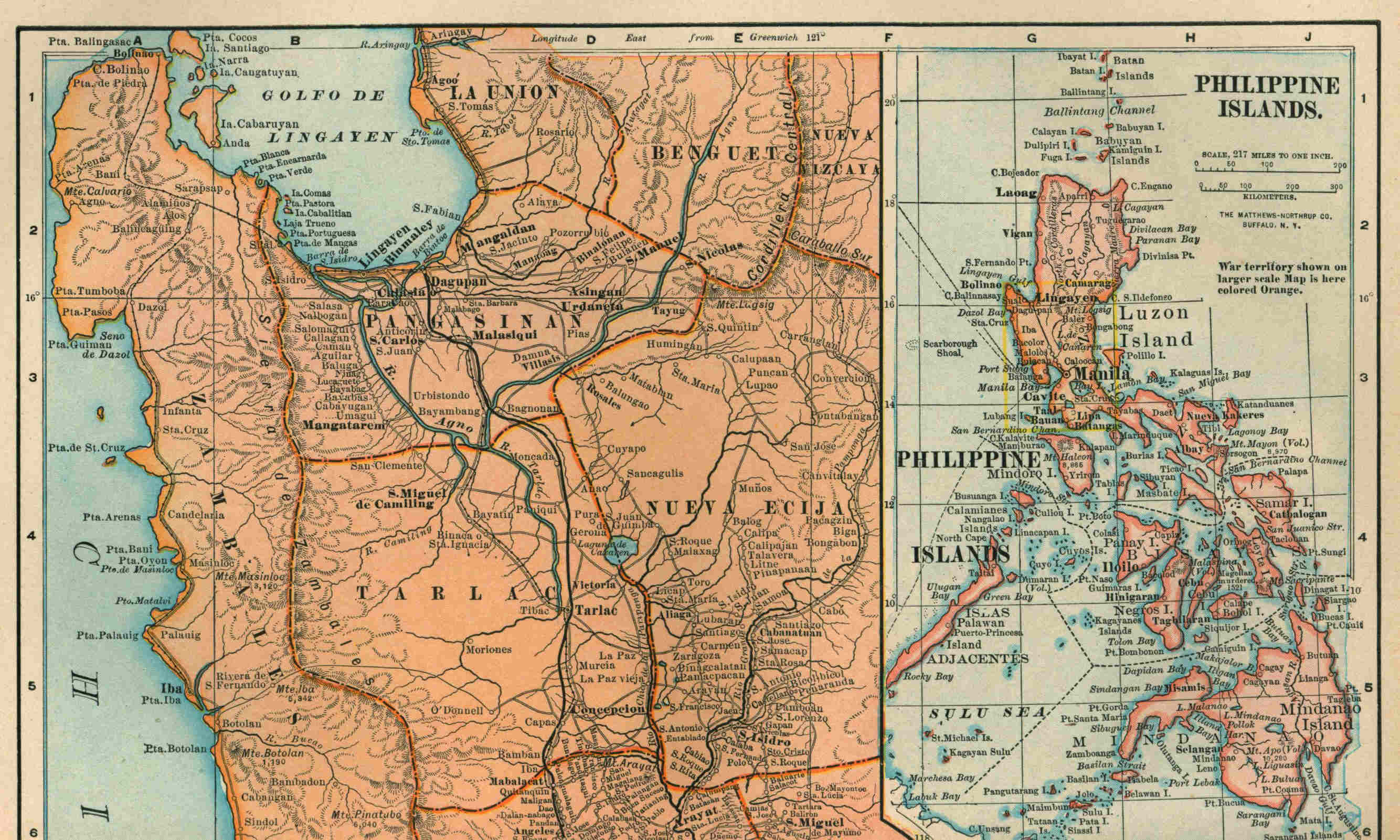
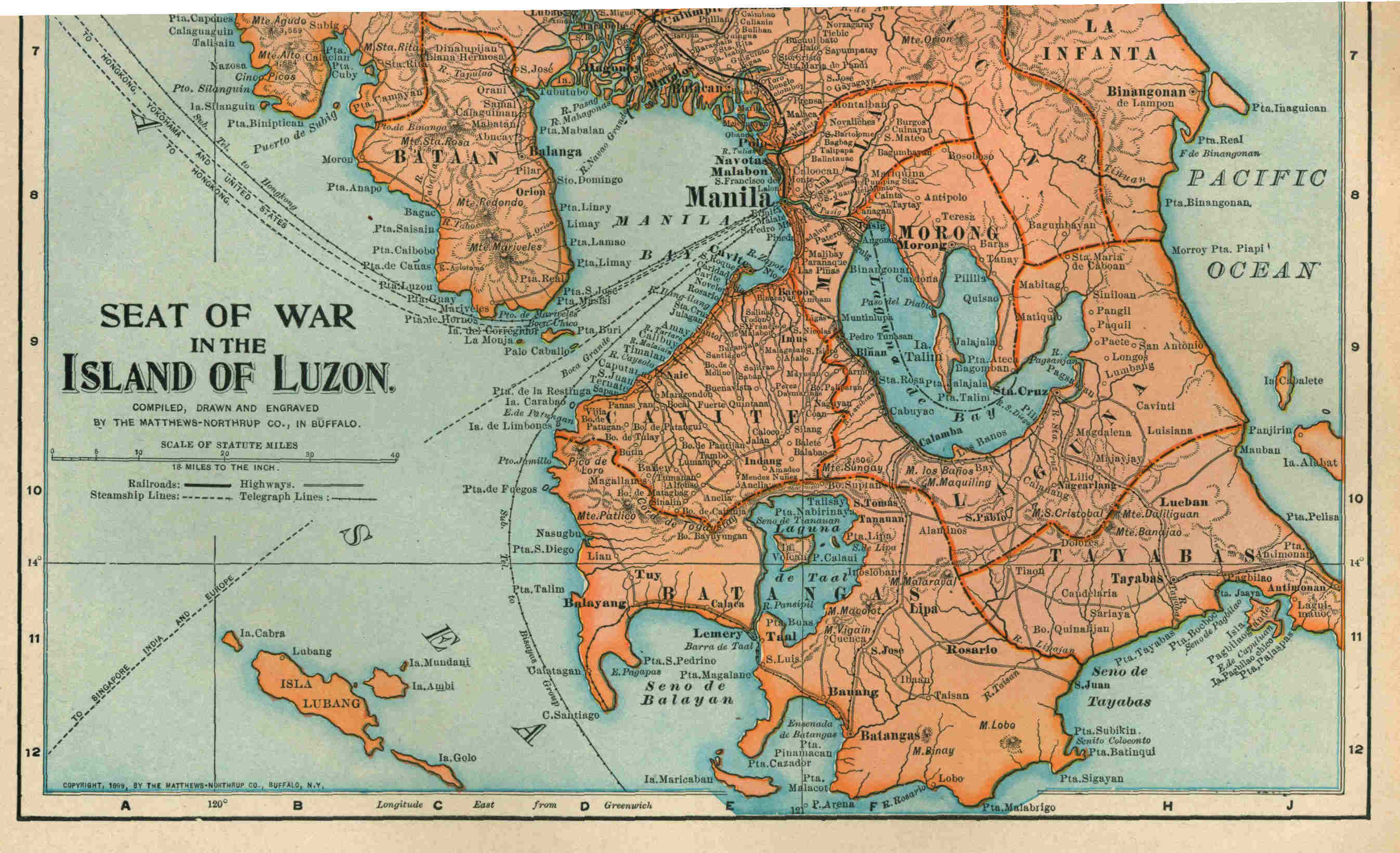
Seat of War in the Island of Luzon. {369} "The fourth enumeration of those mentioned above showed a population of 5,985,123 in 1887, and the totals both for the group as a whole and for the fifty odd provinces tend to confirm and to be confirmed by the civil count of 1877. This number, however, represents only the nominally Catholic or tribute-paying population. To it must be added the Mohammedan or heathen tribes set down by clerical authorities as about 600,000. Perhaps the highest authority in this field, Professor Blumentritt, is confident that this number does not include all the independent tribes, but only those in the mountains who have a special arrangement freeing them from all the dues of the subject tribes. On the whole, therefore, Prof. H. Wagner is inclined to estimate these omissions of independent or non-Christian tribes at about 1,000,000 and the population of the group at about 7,000,000. This result is indorsed by the latest German authority, Hübner's Geographisch-Statistische Tabellen for 1898, which gives the population as 5,985,124 + 1,000,000 = 6,985,124, as follows: Spanish Estimated number census. not counted. Luzon and adjacent islands 3,443,000 150,000 Mindoro and Masbate 126,000 100,000 Visayas Archipelago 2,181,000 200,000 Mindanao 209,000 400,000 Calamianes and Palawan 22,000 50,000 Jolo (Sulu) Islands 4,000 100,000 Total 5,985,000 1,000,000 "Personally I am disposed to suspect that this number, although called by Professor Wagner an outside estimate, is below rather than above the truth. In favor of this position it may be urged that Professor Wagner's estimate makes no allowance either for the natural increase of population, 1887-1898, or for the fact that the first careful census of densely populated regions, like India and Japan, usually reveals a larger population than had been previously estimated. This analogy might reasonably be applied to Luzon and the Visayas." United States, 56th Congress, 1st Session, Senate Document Number 171, pages 4-7. PHILIPPINE ISLANDS: The native inhabitants. "The inhabitants of the Philippines belong to three sharply distinct races—the Negrito race, the Indonesian race, and the Malayan race. It is universally conceded that the Negritos of to-day are the disappearing remnants of a people which once populated the entire archipelago. They are, physically, weaklings of low stature, with black skin, closely-curling hair, flat noses, thick lips, and large, clumsy feet. In the matter of intelligence they stand at or near the bottom of the human series, and they are believed to be incapable of any considerable degree of civilization or advancement. Centuries ago they were driven from the coast regions into the wilder interior portions of the islands by Malay invaders, and from that day to this they have steadily lost ground in the struggle for existence, until but a few scattered and numerically insignificant groups of them remain. … It is believed that not more than 25,000 of them exist in the entire archipelago, and the race seems doomed to early extinction. … "So far as is at present known, the Philippine tribes belonging to the Indonesian race are confined to the great island of Mindanao, the surface of which constitutes about one-third of the total land area of the archipelago. … The Philippine representatives of this race are physically superior not only to the Negritos, but to the more numerous Malayan peoples as well. They are tall and well developed, with high foreheads, aquiline noses, wavy hair, and often with abundant beards. The color of their skins is quite light. Many of them are very clever and intelligent. None of the tribes have been Christianized. Some of them have grown extremely fierce and warlike as a result of their long struggle with hostile Malayan peoples. Others, more happy in their surroundings, are pacific and industrious. "The great majority of the inhabitants of the Philippines are of Malayan extraction, although the race is not found pure in any of the islands, but is everywhere more or less modified through intermarriage with Chinese, Indonesians, Negritos, Arabs, and, to a limited extent, Spaniards and other Europeans. The individuals belonging to these Malayan tribes are of medium size, with straight black hair. As a rule the men are beardless, and when they have a beard it is usually straggling, and appears late in life. The skin is brown and distinctly darker than that of the Indonesians, although very much lighter than that of the Negritos. The nose is short and frequently considerably flattened. The representatives of these three races are divided into numerous tribes, which often differ very greatly in language, manners, customs, and laws, as well as in degree of civilization. … "Any estimate of the total population must manifestly depend on the number of inhabitants assigned to the various wild tribes, of which there are no less than 69. For the purposes of this report the commission has adopted as the total figure 8,000,000, considering this a conservative estimate. Baranera, whose figures are believed to be carefully prepared, places the total at 9,000,000. The extent of territory occupied in whole or in part by each of the more important civilized tribes can be estimated with a greater degree of accuracy, and is approximately as follows: Visayans (occupying 28,100 square miles) 2,601,600; Tagalogs (15,380 sq. miles) 1,663,900; Bicols (6,900 sq. miles) 518,100; Ilocanos (6,170 sq. miles) 441,700; Pangasinaus (1,950 sq. miles) 365,500; Pampangas (1,950 sq. miles) 337,900; Moros (12,860 sq. miles) 268,000; Cagayans(11,500 sq. miles) 166,300. All of these peoples, although ignorant and illiterate, are possessed of a considerable degree of civilization, and, with the exception of the Mohammedan Moros, are Christianized." Philippine Commission, Report, January 31, 1900, volume 1, pages 11-15. PHILIPPINE ISLANDS: A. D. 1896-1898. The Katipunan and the rising against Spanish rule. Appearance of Aguinaldo as a leader. Dr. José Rizal. The Treaty of Biac-na-bato. Departure of Aguinaldo and his return with the American forces. The Philippine Islands, discovered in 1521 by Magellan (or Maghallanes or Magalhaes), and occupied by the Spaniards in 1565, seems, for a long period, to have interested that people more as a missionary than as a commercial field. Indeed, the doings of the church and of the religious orders, and the acceptance of Roman teachings of Christianity by the greater part of the native population, make up the essential history of the Philippines until quite recent times. If the islands had offered gold mines, or pearl fisheries, or spice forests to their European discoverers, the story would certainly have been different. As it was, the Spaniards were not moved to much eagerness in exploiting such resources of commerce as they found; and so, through fortunate circumstances, the natives were made converts instead of slaves. {370} By missionaries, more than by soldiers, they were subdued; by the church, more than by the Spanish state, they were ruled. It is certain that there were great corruptions and oppressions in the government, and it follows that a large share of responsibility for them rests on those who controlled the affairs of the church. For the past hundred years, at least, the more spirited part of the native population has been restive under the misrule and its burdens, and frequent attempts at insurrection have been made. Such an outbreak in 1872 was suppressed and punished with a vengefulness, in executions and banishment, which rankled ever afterwards in the hearts of the people. A secret society, called the "Katipunan," or League, was then formed, which became a revolutionary organization, and from which sprang the most serious of Filipino rebellions, in 1896. The province of Cavite was the center of revolt, and it was there that Emilio Aguinaldo, then the schoolmaster at Silan, came into prominence as a leader. Mr. John Foreman, who was in the Philippines at the time of the insurrection, states that Aguinaldo was personally humane, but fearful atrocities were committed in the first months of the rising by some of the insurgents of his band. One captured priest, according to Mr. Foreman's account, "was cut up piecemeal; another was saturated with petroleum and set on fire; and a third was bathed in oil and fried on a bamboo spit run through the length of his body." The Spaniards, on their side, were equally inhuman in their treatment of captured rebels and "suspects." Says Mr. Foreman: "About 600 suspects were confined in the dungeons of Fort Santiago at the mouth of the Pasig River. Then occurred a frightful tragedy. The dungeons are below water-mark at high tide; the river filtered in through the crevices in the ancient masonry; thus twice a day these unfortunates were up to their waists or necks in water, according to the height of the men. The Spanish sergeant on duty threw his rug over the only light and ventilating shaft, and, in a couple of days, carts were seen by many citizens carrying away the dead, calculated to number 70. Provincial governors and parish priests seemed to regard it as a duty to supply the capital with batches of 'suspects' from their localities. In Vigan, where nothing had occurred, many of the heads of the best families and monied men were arrested and brought to Manila in a steamer. They were bound hand and foot, and carried like packages of merchandise in the hold. I happened to be on the quay when the steamer discharged her living freight, with chains and hooks to haul up and swing out the bodies like bales of hemp. … "Thousands of peaceful natives were treated with a ferocity which would have shocked all Europe. … Within three months of the outbreak, hundreds of the richest natives and half-castes in Manila were imprisoned for a few days and released conditionally"—the condition being a payment of ransom, sometimes said to be as high as $40,000. But General Blanco, the then Governor-General, was not vigorous enough in his measures to satisfy the all-powerful clerical party in the islands, and he was replaced by General Polaveja, who received large reinforcements from Spain, and who succeeded in breaking the strength of the rebellion to a great extent. But the character of Polaveja's administration is thus described by Mr. Foreman: "Apart from the circumstances of legitimate warfare, in which probably neither party was more merciful than the other, he initiated a system of striking terror into the non-combatant population by barbarous tortures and wholesale executions. … Men were escorted to the prisons by pure caprice and subjected to horrible maltreatment. Many of them were liberated in the course of a few days, declared innocent, but maimed for life and forever unable to get a living. … The only apparent object in all this was to disseminate broadcast living examples of Spanish vengeance." The most notable victim at this period was Dr. José Rizal, a physician, highly educated in Europe, distinguished as an oculist, and the author of certain novels in which the condition of things in his native country was set forth. On his return to the Islands, Dr. Rizal incurred the enmity of the friars by opposing them, and was pursued by their hostility. From 1893 to 1896 he was kept in banishment, closely watched, at a small town in the island of Mindanao. Then he sought and obtained permission to go to Cuba in the medical staff of the Spanish army; but, just as he arrived at Manila, on his way to Spain, the insurrection of 1896 broke out, and though he was suffered to depart, his enemies pursued him with accusations of complicity in the rising and caused him to be brought back. Says Mr. Foreman, who was an eye-witness of what occurred: "Not a few of us who saw the vessel leave wished him 'God speed.' But the clerical party were eager for his extermination. … The lay authorities always had to yield to the monks, and history herein repeated itself. Dr. Rizal was cabled for to answer certain accusations, and so on his landing in the Peninsula he was incarcerated in the celebrated fortress of Montjuich (the scene of so many horrors), pending his re-shipment by the returning steamer. He reached Manila as a state prisoner in the Colon, isolated from all but his jailors. It was materially impossible for him to have taken any part in the rebellion, whatever his sympathies may have been." Nevertheless, he was tried by court-martial for sedition and rebellion, condemned and shot; and his memory is cherished in the islands as that of a martyred patriot. "The decree of execution was one of Polaveja's foulest acts." Having scotched but not killed the insurrection, Polaveja went home, with broken health, in the spring of 1897, and was succeeded by General Primo de Rivera, who, after some months of continued warfare, opened negotiations with Aguinaldo, the recognized leader of the revolt. The result was a treaty, known as the "Pacto de Biac-na-bato, signed December 14. By this treaty "the rebels undertook to deliver up their arms and ammunition of all kinds to the Spaniards; to evacuate the places held by them; to conclude an armistice for three years for the application and development of the reforms to be introduced by the other part, and not to conspire against Spanish sovereignty in the Islands, nor aid or abet any movement calculated to counteract the reforms. {371} Emilio Aguinaldo and 34 other leaders undertook to quit the Philippine Islands, and not to return to them until so authorised by the Spanish Government. On behalf of the Spanish Government it was agreed to pay, through the medium of Pedro A. Paterno, to the rebels the sum of $1,000,000, and to the families who had sustained loss by reason of the war $700,000, in instalments and conditionally,"—the condition being that no renewal of rebellion or conspiracy occur. Aguinaldo and other chiefs of the insurrection left the Islands, accordingly; but they are said to have been utterly duped. One instalment, only ($400,000), of the promised money was ever paid; the promised reforms were not carried out, and persecution of those who had been in sympathy with the rising was renewed. J. Foreman, The Philippine Islands, chapter 26 (New York: Charles Scribner's Sons). "Aguinaldo and his associates went to Hongkong and Singapore. A portion of the money, $400,000, was deposited in banks at Hongkong, and a lawsuit soon arose between Aguinaldo and one of his subordinate chiefs named Artacho, which is interesting on account of the very honorable position taken by Aguinaldo. Artacho sued for a division of the money among the insurgents according to rank. Aguinaldo claimed that the money was a trust fund, and was to remain on deposit until it was seen whether the Spaniards would carry out their promised reforms, and if they failed to do so, it was to be used to defray the expenses of a new insurrection. The suit was settled out of court by paying Artacho $5,000. No steps have been taken to introduce the reforms, more than 2,000 insurgents, who had been deported to Fernando Po and other places, are still in confinement, and Aguinaldo is now using the money to carry on the operations of the present insurrection." F. V. Greene, Memorandum concerning the Situation in the Philippines, August 30, 1898 (Treaty of Peace and Accompanying Papers: 55th Congress, 3d Session, Senate Document Number 62, part 1, page 421. PHILIPPINE ISLANDS: A. D. 1897. Refusal of United States Government to negotiate with the insurgent republic. See (in this volume) UNITED STATES OF AMERICA: A. D. 1897 (NOVEMBER). PHILIPPINE ISLANDS: A. D. 1898 (April-May). Circumstances in which Aguinaldo was brought to Manila to co-operate with American forces. See (in this volume) UNITED STATES OF AMERICA: A. D. 1898 (APRIL-MAY: PHILIPPINES). PHILIPPINE ISLANDS: A. D. 1898 (April-July). Destruction of the Spanish fleet in Manila Bay. Blockade and siege of the city. Co-operation of insurgents under Aguinaldo. See (in this volume) UNITED STATES OF AMERICA: A. D. 1898 (APRIL-JULY). PHILIPPINE ISLANDS: A. D. 1898 (May-August). Conduct of English and German naval officers at Manila. See (in this volume) UNITED STATES OF AMERICA: A. D. 1898 (MAY-AUGUST). PHILIPPINE ISLANDS: A. D. 1898 (July-August). Correspondence between the American commander and Aguinaldo. This is fully given (showing the relations between the American and Filipino forces, before the capture of Manila), in the general account of the Spanish-American War. See (in this volume) UNITED STATES OF AMERICA: A. D. 1898 (JULY-AUGUST: PHILIPPINES). PHILIPPINE ISLANDS: A. D. 1898 (July-September). American capture of Manila. Relations with the Filipino insurgents. General Merritt's report. Aguinaldo declared President of the Philippine Republic. See (in this volume) UNITED STATES OF AMERICA: A. D. 1898 (JULY-SEPTEMBER). PHILIPPINE ISLANDS: A. D. 1898 (August). Suspension of hostilities between the United States and Spain. Manila held by the former pending the conclusion of a treaty of peace. See (in this volume) UNITED STATES OF AMERICA: A. D. 1898 (JULY-DECEMBER). PHILIPPINE ISLANDS: A. D. 1898 (August). Losses of the American army during the war with Spain. See (in this volume) UNITED STATES OF AMERICA: A. D. 1900 (JUNE). PHILIPPINE ISLANDS: A. D. 1898 (August-December). The state of things following the occupation of Manila by American forces. Growing distrust and unfriendliness of the Tagalos. General Otis's report. Of the state of things which followed the departure of General Merritt, August 30, General Otis, who succeeded him in command, reported subsequently as follows: "Until October 14 [1898], the United States troops in the Philippines remained stationed at Manila and Cavite, as provided in General Merritt's orders of August 23, with very slight exceptions, Major-General Anderson retaining supervision of the district of Cavite and Major-General MacArthur of the troops stationed in Manila, the three organizations composing the provost guard continuing, however, under the control of Brigadier-General Hughes. They were most bountifully supplied with subsistence and medicines, but light clothing suited to the climate and facilities necessary for occupying and messing in barracks were needed. These were soon obtained through contract and purchase from the merchants of Hongkong and Manila and by shipment from the United States. The troops received tactical instructions daily, but the weather was too hot for much physical exertion, and time hung heavily upon them. They entertained the impression that the Spanish war had terminated, and the volunteers appeared to believe that they should be recalled to the United States at once and regular troops sent out to perform the monotonous garrison duties which were about to follow the victory of Manila. Many became ill from too free indulgence in the fruits and manufactured drinks of the country, and indifference to that care and attention of person which a tropical climate makes necessary. Homesickness alone produced illness in numerous cases, so that early in September the hospitals began to be rapidly filled. This led to the adoption of judicious precautionary measures. … In November improvement was noticeable, and in January the health of this army would compare favorably with those of any concentrated army of like proportions in existence. To be sure the men had become by this time fairly acclimatized, and new troops arriving here will be obliged to pass through this period of acclimatization before they become properly efficient for prolonged service in the field. {372} "During my first weeks of duty here I was impressed with the spirit of suspicion and the partially concealed unfriendly feeling manifested by the Tagalos toward the American forces. That they either had very little confidence in our promises or were then forming conclusions to oppose any establishment of United States authority in Luzon was apparent, however loudly they might disclaim hostile intent or declare as an excuse for their attitude fear of the return of Spain. I saw, however, with satisfaction, their ablest men by education, and mental equipment taking part in their authoritative deliberations, and I had considerable confidence in the efficacy of their suggestions and advice. Still, after carefully weighing conditions, I was unable to arrive at any satisfactory conclusions. … "Measures were being applied constantly to improve the sanitary condition of the city, to increase the efficiency of the troops, and to meet any emergency which might develop from an uprising of the inhabitants, or from hasty action by any portion of our or the insurgent forces, which, though maintaining amicable intercourse, were, in fact, in an attitude of resistance and hostility upon all questions involving the right of armed occupation of the suburbs and defenses of Manila. The insurgent soldiers had looted extensively the portions of the city to which they gained access, and were greatly disappointed that this privilege over other parts of the same was not accorded them. Their enforced withdrawal to outer lines was the cause of discontent, and augmented any desire which they may have formerly entertained to resist or attack the American troops. This growing discontent was observable among the lower classes of the city's inhabitants, from whom a considerable share of Aguinaldo's army was drawn, and was undoubtedly increased by the reprehensible conduct and illegal actions of some of our own men, who were severely punished for their misdeeds when detected. Outwardly, however, relations of the most friendly character were maintained. The officers and enlisted men of the two armies mingled in friendly social intercourse. To the casual observer the only discordant element in this dense complex population, made up of every nation and tongue in existence, were the hated Spanish prisoners, whom the Filipinos still longed to persecute and kill, and who were obliged to keep within the walls of Old Manila for safety. Repeated conferences were held with influential insurgents, whose chief aim appeared to be to obtain some authoritative expression on the intent of the United States with regard to the Philippines, and complained that they were unable to discover anyone who could speak ex cathedra. They asserted that their Malolos arrangement was a government de facto, which had the right to ask an expression of intent from the United States Government. … "My own confidence at this time in a satisfactory solution of the difficulties which confronted us may be gathered from a dispatch sent to Washington on December 7, wherein I stated that conditions were improving and that there were signs of revolutionary disintegration; that I had conferred with a number of the members of the revolutionary government and thought that the most of them would favor peaceful submission to United States authority. I had strong reasons for this expressed confidence from assurances made to me by some of the ablest Filipinos who had occupied positions of importance in the insurgent government and had signified their intention to withdraw from it." Report of General Otis, August 31, 1899 (Message and Documents: Abridgement, 1899-1900, volume 2, pages 1048-1052). PHILIPPINE ISLANDS: A. D. 1898 (August-December). The state of things following the occupation of Manila, as represented by English witnesses. The writer of the following remarks, in an interesting book on "The Inhabitants of the Philippines," published late in 1900, is an English civil engineer, who had resided in Luzon for fourteen years and knew the country and people thoroughly well: "Personally, I think that if a sympathetic and conciliatory attitude had been adopted, had the local government established been recognized, had Aguinaldo and his staff been given commissions in the Native Army or Civil Service, and the flower of the Tagal Army taken into the service of the United States, a peaceful settlement could have been made on the lines of a Protectorate. I therefore look upon the war as unnecessary, and consider the lives already sacrificed, and that will have to be sacrificed, as absolutely thrown away. The tragical side of American unpreparedness is manifest in the state of anarchy in which the whole Archipelago has been plunged by the American unreadiness to occupy the military posts as soon as they were vacated by the Spanish garrisons. A hideous orgy of murder, plunder, and slave-raiding has prevailed in Visayas, and especially in Mindanao. "Three conditions were essential to a peaceful settlement: First. A broad-minded and sympathetic representative of America, fully authorized to treat, and a lover of peace. Second. A strict discipline amongst the American forces. Third, The principal aim and object of the Tagal insurrection must be secured. "General Otis does not seem to me to fulfil the first condition, he lacked prestige and patience, and he showed that he had an insufficient conception of the magnitude of his task by occupying himself with petty details of all kinds and by displaying an ill-timed parsimony. Apparently he had no power to grant anything at all, and only dealt in vague generalities which the Tagals could not be expected to accept. "As regards the second point, I regret that I am not personally acquainted with the gentlemen from Nebraska, Colorado, Dakota and other states serving in the United States Army or volunteers. I have no doubt that they are good fighting-men, but from all I can hear about them they are not conspicuous for strict military discipline, and too many of them have erroneous ideas as to the most suitable drink for a tropical climate. Manila was in the time of the Spaniards a most temperate city; a drunken man was a very rare sight, and would usually be a foreign sailor. Since the American occupation, some hundreds of drinking saloons have been opened, and daily scenes of drunkenness and debauchery have filled the quiet natives with alarm and horror. When John L. Motley wrote his scathing denunciation of the army which the great Duke of Alva led from Spain into the Low Countries, to enforce the high religious purposes of Philip II., he could not foresee that his words would be applicable to an American Army sent to subjugate men struggling to be free 'for their welfare, not our gain,' nor that this army, besides bringing in its train a flood of cosmopolitan harlotry, would be allowed by its commander to inaugurate amongst a strictly temperate people a mad saturnalia of drunkenness that has scarcely a parallel. {373} Such, however, is undoubtedly the case, and I venture to think that these occurrences have confirmed many of the Tagals in their resolve rather to die fighting for their independence than to be ruled over by such as these." F. H. Sawyer, The Inhabitants of the Philippines, page 113-114 (New York: Charles Scribner's Sons). Substantially the same account of things at Manila in this period has been given in a magazine article by Mr. John Foreman, the well known writer on the Philippine Islands. "The conduct," he declares, "of the boisterous, undisciplined individuals who formed a large percentage of the first volunteer contingents sent to Manila had had an ineffaceably demoralizing effect on the proletariat, and has inspired a feeling of horror and loathful contempt in the affluent and educated classes who guide the Philippine public opinion. From the outset it was a mistake to treat the Christian Philippine population like savages ignorant of western civilization, considering that there are thousands of Filipinos mentally equal to the invading forces, and comparable, in intellectual training, with the average middle-class Europeans. "Within a fortnight after the capitulation of Manila the drinking saloons had increased four-fold. According to the latest advices, there are at least twenty to one existing in the time of the Spaniards. Drunkenness, with its consequent evils, is rife all over the city among the new white population. The orgies of the new-comers, the incessant street brawls, the insults offered with impunity to natives of both sexes, the entry with violence into private houses by the soldiery, who maltreated the inmates and laid hands on what they chose, were hardly calculated to arouse in the natives admiration for their new masters. Brothels were absolutely prohibited under the Spanish rule, but since the evacuation there has been a great influx of women of ill fame, whilst native women have been pursued by lustful tormentors. During a certain period after the capitulation there was indiscriminate shooting, and no peaceable native's life was safe in the suburbs. Adventurers of all sorts and conditions have flocked to this centre of vice, where the sober native is not even spoken of as a man by many of the armed rank and file, but, by way of contempt, is called a yuyu. A few miles from Manila, the villages of Mandaloyan and Sant Ana were looted by the victors, much of the spoil being brought up to the capital and included in auction sales or sold to the Chinese. In Taal the houses of families, with whom I have been long acquainted, were ransacked, effects of little value, or too difficult to transport, being carelessly strewn about from sheer wantonness. And presumably no greater respect for private property was shown in the other numerous villages overrun by the invaders. … "The situation then during this period was somewhat as follows: The Filipinos, aided by Dewey's victory, had driven the Spaniards from practically the whole Archipelago except the city of Manila, they had established a government of their own, and they looked upon the country as belonging both by nature and by right of conquest to them. We upon the other hand, having destroyed the Spanish fleet and captured the city of Manila, and being in the process of acquiring by treaty the Spanish title to the whole country regarded it as belonging to us. The situation was therefore critical." J. Foreman, Will the United States withdraw from the Philippines? (National Review, September, 1900). PHILIPPINE ISLANDS: A. D. 1898 (September-December). Instructions from the President of the United States to the Commissioners for the negotiation of peace with Spain concerning the Philippine Archipelago. Cession of the Islands to the United States. See (in this volume) UNITED STATES OF AMERICA: A. D. 1898 (JULY-DECEMBER). PHILIPPINE ISLANDS: A. D. 1898 (October-November). State of the country under the native government of Aguinaldo, as witnessed by two U. S. naval officers who traversed it.- Conflicting opinions as to the fitness of the Filipinos for self-government. During October and November, 1898, while the only authority in Luzon, outside of Manila and Cavite, was that exercised by the native government organized under Aguinaldo, two American naval officers, Paymaster W. B. Wilcox and Cadet Leonard R. Sargent, with permission from Admiral Dewey, made a tour of observation through seven provinces of the island, and rendered a report of what they saw and what they experienced, which Admiral Dewey sent to Washington, commending it to the attention of the government as containing "the most complete and reliable information obtainable in regard to the present state of the northern part of Luzon Island." Subsequently Mr. Sargent wrote articles descriptive of the journey, which were published in "The Outlook" and "The Independent," and which were reprinted, with the official report, in a document compiled for the U. S. Senate. The following is from the article in "The Outlook," September 2, 1899: "Although this government has never been recognized, and in all probability will go out of existence without recognition, yet it cannot be denied that, in a region occupied by many millions of inhabitants, for nearly six months it stood alone between anarchy and order. The military forces of the United States held control only in Manila, with its environs, and in Cavite, and had no authority to proceed further; while in the vast remaining districts the representatives of the only recognized power on the field were prisoners in the hands of their despised subjects. It was the opinion at Manila during this anomalous period in our Philippine relations, and possibly in the United States as well, that such a state of affairs must breed something akin to anarchy. I can state unreservedly, however, that Mr. Wilcox and I found the existing conditions to be much at variance with this opinion. During our absence from Manila we travelled more than 600 miles in a very comprehensive circuit through the northern part of the island of Luzon, traversing a characteristic and important district. In this way we visited seven provinces, of which some were under the immediate control of the central government at Malolos, while others were remotely situated, separated from each other and from the seat of government by natural divisions of land, and accessible only by lengthy and arduous travel. As a tribute to the efficiency of Aguinaldo's government and to the law-abiding character of his subjects, I offer the fact that Mr. Wilcox and I pursued our journey throughout in perfect security, and returned to Manila with only the most pleasant recollections of the quiet and orderly life which we found the natives to be leading under the new regime." {374} The following is from the official report, jointly made by Cadet Sargent and Paymaster Wilcox: "The Philippine officers, both military and civil, that we have met in all the provinces we have visited, have, with very few exceptions, been men of intelligent appearance and conversation. The same is true of all those men who form the upper class in each town. The education of most of them is limited, but they appear to seize every opportunity to improve it. They have great respect and admiration for learning. Very many of them desire to send their children to schools in the United States or Europe. Many men of importance in different towns have told us that the first use to be made of the revenues of their government, after there is no more danger of war, will be to start good schools in every village. The poorer classes are extremely ignorant on most subjects, but a large percentage of them can read and write. … "Of the large number of officers, civil and military, and of the leading townspeople we have met, nearly every man has expressed in our presence his sentiment on this question [of independence]. It is universally the same. They all declare that they will accept nothing short of independence. They desire the protection of the United States at sea, but fear any interference on land. … "There is much variety of feeling among the Philippines with regard to the debt of gratitude they owe the United States. In every town we found men who said that our nation had saved them from slavery, and others who claimed that without our interference their independence would have been recognized before this time. On one point they are united, however, viz., that whatever our Government may have done for them it has not gained the right to annex them. They have been prejudiced against us by the Spaniards. The charges made have been so numerous and so severe that what the natives have since learned has not sufficed to disillusion them. With regard to the record of our policy toward a subject people, they have received remarkable information on two points,—that we have mercilessly slain and finally exterminated the race of Indians that were natives of our soil, and that we went to war in 1861 to suppress an insurrection of negro slaves, whom we also ended by exterminating. Intelligent and well-informed men have believed these charges. They were rehearsed to us in many towns in different provinces, beginning at Malolos. The Spanish version of our Indian problem is particularly well known." United States, 56th Congress, 1st Session, Senate Document 66. In the third number of the first series of its publications, the Philippine Information Society—see below: A. D. 1899 (JANUARY-FEBRUARY)—has brought together a number of conflicting opinions expressed by various persons concerning the capacity of the Filipinos for self-government, among them the following: "The population of Luzon is reported to be something over 3,000,000, mostly natives. These are gentle, docile, and under just laws and with the benefits of popular education would soon make good citizens. In a telegram sent to the department on June 23 I expressed the opinion that 'these people are far superior in their intelligence and more capable of self-government than the natives of Cuba, and I am familiar with both races.' Further intercourse with them has confirmed me in this opinion." Admiral Dewey, Letter, August 29, 1898, Replying to inquiry of War Department. "They [the natives] would have to be educated up to it [self-government]. They want a protectorate, but they do not exactly understand what that means. Their idea is that they should collect the revenues and keep them in their treasury, and that we should be at the expense of maintaining an army and a navy there for their protection, which is the kind of a protectorate they would like very much." General Merritt, statement before United States Peace Commission at Paris, October 4, 1898. "If the United States should evacuate these islands, anarchy and civil war will immediately ensue and lead to foreign intervention. The insurgents were furnished arms and the moral support of the navy prior to our arrival, and we cannot ignore obligations, either to the insurgents or to foreign nations, which our own acts have imposed upon us. The Spanish Government is completely demoralized, and Spanish power is dead beyond all possibility of resurrection. … On the other hand, the Filipinos cannot govern the country without the support of some strong nation. They acknowledge this themselves, and say their desire is for independence under American protection, but they have only vague ideas as to what our relative positions would be—what part we should take in collecting and expending the revenue, and administering the government." General F. V. Greene, Memorandum concerning the Philippine Islands, made August 27, 1898. "The capability of the Filipinos for self-government cannot be doubted. Such men as Arellano, Aguinaldo, and many others whom I might name are highly educated; nine tenths of the people can read and write, all are skilled artisans in one way or another; they are industrious, frugal, temperate, and, given a fair start, could look out for themselves infinitely better than our people imagine. In my opinion they rank far higher than the Cubans or the uneducated negroes to whom we have given right of suffrage." General Charles King, Letter to Milwaukee Journal, June 22, 1899. "Concerning the capacity of the Filipinos to govern themselves I regret to say that I see no reason to change the opinion previously expressed, that they are unfit. I wish my opinion might be otherwise, for I prefer to believe them capable of self-government. There are a number of Filipinos whom I have met, among them General Aguinaldo and a few of his leaders, whom I believe thoroughly trustworthy and fully capable of self-government, and the main reliance for small official positions and many larger ones would be upon people who know no standard of government other than that the Spaniards have furnished. Their sense of equity and justice seems not fully developed, and their readiness to coerce those who come under their power has been strongly illustrated in this city since our occupation. A regularly organized system of blackmail has been instituted under the guise of making subscriptions to the insurgent cause." Major J. F. Bell [of Engineers, on "secret service"] Letter to General Merritt, Manila, August 29, 1898. {375} "The people are the most enlightened and vigorous branch of the Malay race, and have been Christians for centuries, in fact longer than the principles of the Reformation were established in Great Britain, and are the nearest akin to European people of any alien race, and it is simply ridiculous to imagine that eight to ten millions of such people can be bought and sold as an article of commerce without first obtaining their consent. Let all those who are greedy for a slice of the archipelago ponder well over this before burning their fingers." H. W. Bray [merchant and planter in the islands for fifteen years], Letter to Singapore Free Press, June 8, 1898. "The native has no expansive ideas; he cannot go far enough to understand what it is to rule matters for the benefit of the common weal; he cannot get past his own most personal interest, or his town, at the most. I think the greatest length he would go would be his own town. But constructing laws, and obeying them, for the benefit of the commonwealth, I do not think he is capable of it at all. I think an attempt at a native government would be a fiasco altogether." John Foreman, Testimony before United States Peace Commission at Paris. "The excuse that they [the Filipinos] are not ripe for independence is not founded on facts. The Filipinos number more educated people than the kingdom of Servia and the principalities of Bulgaria and Montenegro. They have fewer illiterates than the states of the Balkan peninsula, Russia, many provinces of Spain and Portugal, and the Latin republics of America. There are provinces in which few people can be found who do not at least read. They pay more attention to education than Spain or the Balkan states do. There is no lack of trained men fit to govern their own country, and indeed in every branch, because under the Spanish rule the official business was entirely transacted by the native subalterns. The whole history of the Katipunan revolt and of the war against Spain and America serves to place in the best light the capability of the Filipinos for self-government." F. Blumentritt, The Philippine Islands, page 61. PHILIPPINE ISLANDS: A. D. 1898-1899 (December-January). Instructions by the President of the United States to General Otis, Military Governor and Commander in the Philippines. Their proclamation to the people of the Islands as modified by General Otis. The effect. On the 27th of December, 1898, the following instructions, dated December 21, and signed by the President, were cabled by the Secretary of War to General Otis, in command of the United States forces in the Philippines. They were not made public in the United States until the 5th of January following, when they appeared in the newspapers of that day: "The destruction of the Spanish fleet in the harbor of Manila by the United States naval squadron commanded by Rear Admiral Dewey, followed by the reduction of the city and the surrender of the Spanish forces, practically effected the conquest of the Philippine Islands and the suspension of Spanish sovereignty therein. With the signature of the treaty of peace between the United States and Spain by their respective plenipotentiaries at Paris, on the 10th inst., and as the result of victories of the American arms, the future control, fulfilment disposition and government of the Philippine Islands are ceded to the United States. In of the offices of the sovereignty thus acquired, and the responsible obligations of government thus assumed, the actual occupation and administration of the entire group becomes immediately necessary, and the military government heretofore maintained by the United States in the city, harbor and bay of Manila is to be extended with all possible despatch to the whole of the ceded territory. In performance of this duty, the military commander of the United States is enjoined to make known to the inhabitants of the Philippine Islands that in succeeding to the sovereignty of the islands, in severing the former political relations of the inhabitants and in establishing a new political power, the authority of the United States is to be exerted for the security of the persons and property of the people of the islands and for the confirmation of all their private rights. It will be the duty of the commander of the forces of occupation to announce and proclaim in the most public manner that we come, not as invaders or conquerors, but as friends, to protect the natives in their homes, in their employments and in their personal and religious rights. All persons who, either by active aid or by honest submission, cooperate with the government of the United States to give effect to these beneficent purposes, will receive the reward of its support and protection. All others will be brought within the lawful rule we have assumed, with firmness if need be, but without severity so far as may be possible. "Within the absolute domain of military authority, which necessarily is and must remain supreme in the ceded territory until the government of the United States shall otherwise provide, the municipal laws of the territory in respect to private interests and property and the repression of crime are continued in force, the authority to be administered by the ordinary tribunals so far as practicable. The operations of civil and municipal government are to be performed by such officers as may accept the supremacy of the United States by taking the oath of allegiance, or by officers chosen, as far as may be practicable, from the inhabitants of the islands. While the control of all the public property and the revenues of the state passes with the cession, and while the use and management of all public means are of necessity reserved to the authority of the United States, private property, whether belonging to individuals or corporations, is to be respected except for cause duly established. The taxes and duties heretofore payable by the inhabitants to the late government become payable to the authorities of the United States, unless it be seen fit to substitute for them other reasonable rates or modes of contribution to the expenses of government, whether general or local. If private property be taken for military use, it shall be paid for when possible in cash at a fair valuation, and when payment in cash is not practicable receipts are to be given. {376} "All ports and places in the Philippine Islands in the actual possession of the land and naval forces of the United States will be opened to the commerce of all friendly nations. All goods and wares not prohibited for military reasons by due announcement of the military authority will be admitted upon payment of such duties and other charges as shall be in force at the time of their importation. Finally, it should be the earnest and paramount aim of the military administration to win the confidence, respect and affection of the inhabitants of the Philippines by assuring to them in every possible way that full measure of individual rights and liberties which is the heritage of free peoples, and by proving to them that the mission of the United States is one of benevolent assimilation, substituting the mild sway of justice and right for arbitrary rule. In the fulfilment of this high mission, supporting the temperate administration of affairs to the greatest good of the governed, there must be sedulously maintained the strong arm of authority, to repress disturbance and to overcome all obstacles to the bestowal of the blessings of good and stable government upon the people of the Philippine Islands under the free flag of the United States. WILLIAM McKINLEY." On receiving President McKinley's "proclamation," as the instructions of December 21 were commonly described, General Otis promptly forwarded a copy to General Miller, who had been sent to occupy the city of Iloilo, and the latter made it public. Meantime General Otis had studied the document with care and arrived at conclusions which he sets forth in his subsequent annual report as follows: "After fully considering the President's proclamation and the temper of the Tagalos with whom I was daily discussing political problems and the friendly intentions of the United States Government toward them, I concluded that there were certain words and expressions therein, such as 'sovereignty,' 'right of cession,' and those which directed immediate occupation, etc., though most admirably employed and tersely expressive of actual conditions, might be advantageously used by the Tagalo war party to incite widespread hostilities among the natives. The ignorant classes had been taught to believe that certain words, as 'sovereignty,' 'protection,' etc., had peculiar meaning disastrous to their welfare and significant of future political domination, like that from which they had recently been freed. It was my opinion, therefore, that I would be justified in so amending the paper that the beneficent object of the United States Government would be brought clearly within the comprehension of the people, and this conclusion was the more readily reached because of the radical change [a change of cabinet] of the past few days in the constitution of Aguinaldo's government, which could not have been understood at Washington at the time the proclamation was prepared. … "The amended proclamation of January 4 appeared in the English, Spanish, and Tagalo languages, and was published in Manila through newspapers and posters. The English text is as follows: 'To the people of the Philippine Islands: Instructions of His Excellency the President of the United States relative to the administration of affairs in the Philippine Islands have been transmitted to me by direction of the honorable the Secretary of War, under date of December 28, 1898. They direct me to publish and proclaim, in the most public manner, to the inhabitants of these islands that in the war against Spain the United States forces came here to destroy the power of that nation and to give the blessings of peace and individual freedom to the Philippine people; that we are here as friends of the Filipinos; to protect them in their homes, their employments, their individual and religious liberty, and that all persons who, either by active aid or honest endeavor, co-operate with the Government of the United States to give effect to these beneficent purposes, will receive the reward of its support and protection. The President of the United States has assumed that the municipal laws of the country in respect to private rights and property and the repression of crime are to be considered as continuing in force in so far as they be applicable to a free people, and should be administered by the ordinary tribunals of justice, presided over by representatives of the people and those in thorough sympathy with them in their desires for good government; that the functions and duties connected with civil and municipal administration are to be performed by such officers as wish to accept the assistance of the United States, chosen in so far as it may be practicable from the inhabitants of the islands; that while the management of public property and revenues and the use of all public means of transportation are to be conducted under the military authorities, until such authorities can be replaced by civil administration, all private property, whether of individuals or corporations, must be respected and protected. If private property be taken for military uses it shall be paid for at a fair valuation in cash if possible, and when payment in cash is not practicable at the time, receipts therefor will be given to be taken up and liquidated as soon as cash becomes available. The ports of the Philippine Islands shall be open to the commerce of all foreign nations, and goods and merchandise not prohibited for military reasons by the military authorities shall be admitted upon payment of such duties and charges as shall be in force at the time of importation. The President concludes his instructions in the following language: "Finally, it should be the earnest and paramount aim of the Administration to win the confidence, respect, and affection of the inhabitants of the Philippines by insuring to them in every possible way the full measure of individual rights and liberty which is the heritage of a free people, and by proving to them that the mission of the United States is one of beneficent assimilation, which will substitute the mild sway of justice and right for arbitrary rule. In the fulfillment of this high mission, while upholding the temporary administration of affairs for the greatest good of the governed, there will be sedulously maintained the strong arm of authority to repress disturbance, and to overcome all obstacles to the bestowal of the blessings of good and stable government upon the people of the Philippine Islands." "'From the tenor and substance of the above instructions of the President, I am fully of the opinion that it is the intention of the United States Government, while directing affairs generally, to appoint the representative men now forming the controlling element of the Filipinos to civil positions of trust and responsibility, and it will be my aim to appoint thereto such Filipinos as may be acceptable to the supreme authorities at Washington. It is also my belief that it is the intention of the United States Government to draw from the Filipino people so much of the military force of the islands as is possible and consistent with a free and well-constituted government of the country, and it is my desire to inaugurate a policy of that character. {377} I am also convinced that it is the intention of the United States Government to seek the establishment of a most liberal government for the islands, in which the people themselves shall have as full representation as the maintenance of law and order will permit, and which shall be susceptible of development, on lines of increased representation and the bestowal of increased powers, into a government as free and independent as is enjoyed by the most favored provinces of the world. It will be my constant endeavor to cooperate with the Filipino people, seeking the good of the country, and I invite their full confidence and aid. E. S. OTIS, Major-General, U. S. V., Military Governor.' "Before publication of this proclamation I endeavored to obtain from able Filipino residents of the city an expression of opinion as to its probable effect upon the population, but was not much encouraged. A few days thereafter they declared the publication to have been a mistake, although the foreign residents appeared to believe the proclamation most excellent in tone and moderation, offered everything that the most hostile of the insurgents could expect, and undoubtedly would have a beneficial influence. It was received by the better classes of natives with satisfaction, as it was the first authoritative announcement of the attitude which the United States assumed toward the islands and declared the policy which it intended to pursue, and because the declared policy was one which, in their opinion, conditions imperatively demanded should be imposed for the interests of the Filipino people who were incapable of self-government. The publication separated more widely the friendly and war factions of the inhabitants and was the cause of exciting discussion. The ablest of insurgent newspapers, which was now issued at Malolos and edited by the uncompromising Luna, … attacked the policy of the United States as declared in the proclamation, and its assumption of sovereignty over the islands, with all the vigor of which he was capable. … "Aguinaldo met the proclamation by a counter one in which he indignantly protested against the claim of sovereignty by the United States in the islands, which really had been conquered from the Spaniards through the blood and treasure of his countrymen, and abused me for my assumption of the title of military governor. Even the women of Cavite province, in a document numerously signed by them, gave me to understand that after all the men were killed off they were prepared to shed their patriotic blood for the liberty and independence of their country. The efforts made by Aguinaldo and his assistants made a decided impression on the inhabitants of Luzon outside of Manila. … Shortly before this time the insurgents had commenced the organization of clubs in the city, membership in which now, I was informed, amounted to 10,000. The chief organizer was a shrewd mestizo, a former close companion of Aguinaldo, by whom he had been commissioned to perform this work. He was a friend and associate of some of our officers; was engaged in organizing the clubs only, as he stated, to give the poorer classes amusement and education; held public entertainments in athletics to which our officers were invited, and in which our soldiers were asked to participate. Gradually arms were being secretly introduced and bolos were being manufactured and distributed. The arms were kept concealed in buildings, and many of them were subsequently captured. The Chinamen were carrying on a lucrative business in bolo making, but the provost-marshal had cruelly seized considerable of their stock. These clubs had received military organization and were commanded by cunning Filipino officers regularly appointed by the Malolos government. The chief organizer departed after organization had been perfected and thereafter became a confidential adviser in Malolos affairs. This organization was the subject of grave apprehension, as it was composed of the worst social element of the city, and was kept under police supervision as closely as possible. … The streets of the city were thronged with unarmed insurgent officers and enlisted men from the numerically increasing insurgent line on the outskirts, proud of their uniforms and exhibiting matchless conceit, amusing to our men, who were apparently unconcerned observers, but who were quick to take in the rapidly changing conditions. … "Greater precautionary measures were directed and taken in the way of redistributing organizations throughout the city, in advancing and strengthening (though still far within our own mutually conceded military lines) our posts of observation, and for the quick response of the men if summoned for defensive action. Otherwise no change in the conduct, condition, or temper of the troops was observable. So quietly were these precautions effected that Filipino citizens, noticing the apparent indifference of our men, warned me repeatedly of the danger to be apprehended from a sudden simultaneous attack of the insurgents within and without the city, and were quietly informed that we did not anticipate any great difficulty. Another very noticeable proof of premeditated intent on the part of the insurgents was perceived in the excitement manifested by the natives and their removal in large numbers from the city. All avenues of exit were filled with vehicles transporting families and household effects to surrounding villages. The railway properties were taxed to their utmost capacity in carrying the fleeing inhabitants to the north within the protection of the established insurgent military lines. Aguinaldo, by written communications and messages, invited his old-time friends to send their families to Malolos, where their safety was assured, but Hongkong was considered a more secure retreat and was taken advantage of. A carefully prepared estimate showed that 40,000 of the inhabitants of the city departed within the period of fifteen days." Report of General Otis, August 31, 1899 (Message and Documents: Abridgment, 1899-1900, volume 2, pages 1075-88). The counter-proclamation of Aguinaldo, referred to above by General Otis, was issued on the 5th of January, 1899, from Malolos, addressed to My brothers, the Filipinos, all the honorable consuls, and other foreigners." It said: "Major General E. S. Otis's proclamation published yesterday in the Manila papers obliges me to circulate the present one, in order that all who read and understand it may know of my most solemn protest against said proclamation, for I am moved by my duty and my conscience before God, by my political obligations with my beloved country, by my official and private relations to the North American nations. {378} In the above mentioned proclamation, General Otis calls himself 'Military Governor in the Philippines,' and I protest once and a thousand times, with all the energy in my soul, against such an authority. I solemnly proclaim that I have never had, either at Singapore or here in the Philippines, any verbal or written contract for the recognition of American sovereignty over this cherished soil. … Our countrymen and foreigners are witnesses that the land and naval forces of the United States existing here have recognized by act the belligerency of the Philippines, not only respecting but also doing public honor to the Filipino banner, which triumphantly traversed our seas in view of foreign nations represented here by their respective consuls. "As in his proclamation General Otis alludes to some instructions issued by His Excellency the President of the United States relating to the administration of affairs in the Philippines, I solemnly protest in the name of God, root and source of all justice and all right, who has visibly acceded me the power to direct my dear brethren in the difficult task of our regeneration, against this intrusion of the United States Government in the administration of these islands. In the same manner I protest against such an unexpected act which treats of American sovereignty in these islands in the face of all antecedents that I have in my possession referring to my relations with the American authorities, which are unequivocal testimony that the United States did not take me out of Hong Kong to make war against Spain for their own benefit, but for the benefit of our liberty and independence, to which end said authorities verbally promised me their active support and efficacious co-operation. So that you all may understand it, my beloved brothers, it is the principle of liberty and absolute independence that has been our noble ambition for the purpose of obtaining the desired object, with a force given by the conviction, now very widespread, not to retrace the path of glory that we have passed over."- United States, 56th Congress, 1st Session, Senate Document 208, page 103. PHILIPPINE ISLANDS: A. D. 1899 (January). Appointment of the First Commission to the Philippines and the President's instructions to it. On the 20th of January, 1899, the President of the United States addressed the following communication to the Secretary of State: "My communication to the Secretary of War, dated December 21, 1898, declares the necessity of extending the actual occupation and administration of the city, harbor, and bay of Manila to the whole of the territory which by the treaty of Paris, signed on December 10, 1898, passed from the sovereignty of Spain to the sovereignty of the United States, and the consequent establishment of military government throughout the entire group of the Philippine Islands. While the treaty has not yet been ratified, it is believed that it will be by the time of the arrival at Manila of the commissioners named below. In order to facilitate the most humane, pacific, and effective extension of authority throughout these islands, and to secure, with the least possible delay, the benefits of a wise and generous protection of life and property to the inhabitants, I have named Jacob G. Schurman, Rear-Admiral George Dewey, Major General Elwell S. Otis, Charles Denby, and Dean C. Worcester to constitute a commission to aid in the accomplishment of these results. In the performance of this duty, the commissioners are enjoined to meet at the earliest possible day in the city of Manila and to announce, by a public proclamation, their presence and the mission intrusted to them, carefully setting forth that, while the military government already proclaimed is to be maintained and continued so long as necessity may require, efforts will be made to alleviate the burden of taxation, to establish industrial and commercial prosperity, and to provide for the safety of persons and of property by such means as may be found conducive to these ends. "The commissioners will endeavor, without interference with the military authorities of the United States now in control of the Philippines, to ascertain what amelioration in the condition of the inhabitants and what improvements in public order may be practicable, and for this purpose they will study attentively the existing social and political state of the various populations, particularly as regards the forms of local government, the administration of justice, the collection of customs and other taxes, the means of transportation, and the need of public improvements. They will report through the Department of State, according to the forms customary or hereafter prescribed for transmitting and preserving such communications, the results of their observations and reflections, and will recommend such executive action as may from time to time seem to them wise and useful. The commissioners are hereby authorized to confer authoritatively with any persons resident in the islands from whom they may believe themselves able to derive information or suggestions valuable for the purposes of their commission, or whom they may choose to employ as agents, as may be necessary for this purpose. "The temporary government of the islands is intrusted to the military authorities, as already provided for by my instructions to the Secretary of War of December 21, 1898, and will continue until Congress shall determine otherwise. The commission may render valuable services by examining with special care the legislative needs of the various groups of inhabitants, and by reporting, with recommendations, the measures which should be instituted for the maintenance of order, peace, and public welfare, either as temporary steps to be taken immediately for the perfection of present administration, or as suggestions for future legislation. In so far as immediate personal changes in the civil administration may seem to be advisable, the commissioners are empowered to recommend suitable persons for appointment to these offices from among the inhabitants of the islands who have previously acknowledged their allegiance to this Government. "It is my desire that in all their relations with the inhabitants of the islands the commissioners exercise due respect for all the ideals, customs, and institutions of the tribes which compose the population, emphasizing upon all occasions the just and beneficent intentions of the Government of the United States. It is also my wish and expectation that the commissioners may be received in a manner due to the honored and authorized representatives of the American Republic, duly commissioned on account of their knowledge, skill, and integrity as bearers of the good will, the protection, and the richest blessings of a liberating rather than a conquering nation. WILLIAM McKINLEY." Report of the Philippine Commission, January 31, 1900, volume 1, exhibit 2 (page 185). {379} PHILIPPINE ISLANDS: A. D. 1899 (January-February). Causes of and responsibility for the outbreak of hostilities between the Americans and the Filipinos. "The Philippine Information Society," organized for the purpose of "placing within reach of the American people the most reliable and authoritative evidence attainable in regard to the people of the Philippine Islands and our relations to them," has published in Number VII of the First Series of its pamphlets a carefully made collection of information, from official and other sources, relative to the circumstances in which hostilities between the American and Filipino forces came about. On this as on other subjects which the society has investigated it seems to have pursued its inquiries with no aim but to learn and set forth the truth. Its conclusions, resting on the evidence which it submits, are stated in an introduction to the pamphlet as follows: "It will presumably he admitted that the important question with regard to the Outbreak of Hostilities, February 4, 1899, is not, who fired the first shot, but who was responsible for the conditions that made it evident to every observer weeks before the clash came that a single shot might bring on war. … The situation may be briefly explained as follows: We believed that the Philippine Archipelago was and ought to be ours, and we were moving to take possession as rapidly as possible. The Filipinos, or at least Aguinaldo's government and followers, believed that the country was theirs and they resented every effort on our part to occupy it. We considered it ours through cession from Spain and right of conquest. They claimed that Spain no longer held possession of the country and therefore had no right to cede it to us; moreover, that by right of conquest we were entitled only to temporary occupation of Manila. We wished to extend our sovereignty throughout the Archipelago with all possible dispatch. They desired independence, or at least a protectorate which, while securing them from foreign aggression, should leave them control of their internal affairs. While a discussion of the justice of either position does not come within the limits of the present inquiry, it is important to remember that from the first a minority in this country urged that the Filipinos were entitled to a promise of ultimate independence, and that a resolution of Congress, similar to that passed in the case of Cuba, would avert all occasion for war. This course having been rejected by our country, the question arises, did the assertion of United States sovereignty render war inevitable? … "No doubt most Americans believe that left to themselves the Filipinos would soon have lapsed into anarchy, while a few maintain that with temporary assistance in international affairs they would have developed a government better suited to their peculiar needs than we can ever give them. Still others who are familiar with the Filipinos and kindred races believe that their aspiration for an independent national existence was not deep rooted, that had we adopted an affectionate, admiring tone to their leaders, had we recognized their government and approved of it, we could soon have made their government our government, could have been as sovereign as we pleased, and had the people with us. Whatever view one may hold, it must be admitted that if we were to establish our sovereignty by peaceful methods it was essential to win the confidence and affection of the Filipinos. … There is every indication that the Filipinos were prepared, at first, to treat us as friends and liberators. General Anderson tells the following interesting story: The prevailing sentiment of the Filipinos towards us can be shown by one incident. About the middle of July the insurgent leaders in Cavite invited a number of our army and navy officers to a banquet. There was some post-prandial speech-making, the substance of the Filipino talk being that they wished to be annexed but not conquered. One of our officers in reply assured them that we had not come to make them slaves, but to make them free men. A singular scene followed. All the Filipinos rose to their feet, and Buencomeno, taking his wine-glass in his hand, said: We wish to be baptized in that sentiment. Then he and the rest poured the wine from their glasses over their heads. After the very first, however, the cultivation of intimate relations with the Filipino leaders seems to have been considered unimportant or inadvisable. General Merritt states that he never saw Aguinaldo. Social intercourse between our officers and the Filipinos was discouraged by General Otis. In fact after the surrender of Manila General Whittier seems to have been the only one of our superior officers who ever had a personal interview with Aguinaldo. "Certainly after the proclamation of January 4, [see above: A. D. 1898-1899 (JANUARY-FEBRUARY)] war could only have been avoided by a decisive action of Congress promising ultimate independence to the Filipinos. That proclamation of January 4 raised the issue and provoked the counter proclamation of January 5, which so stirred the people against us—a proclamation in which Aguinaldo once and a thousand times and with all the energy of his soul protested against American sovereignty, and which closed with the words, 'upon their heads be all the blood which may be shed.' … "Aguinaldo's proclamation was followed by a series of conferences of which General Otis reports 'It was one continued plea for some concession that would satisfy tho people.' On January 16th he cabled to Washington, 'Aspiration Filipino people is independence with restrictions resulting from conditions which its government agree with American when latter agree to officially recognize the former.' Finally on January 25th he sent word to the insurgent commissioners that 'To this dispatch no reply has been received.' From this time General Otis states, the insurgents hurried forward preparations for war. Contemporaneous with these events in the Philippines the Treaty of Peace was pending in the United States Senate where it had been assigned for a vote on February 6th. "With regard to the actual outbreak of' hostilities, there is a sharp difference of opinion. The United States press dispatches announcing the outbreak, and the contemporaneous newspaper statements by the Filipinos … are of interest as evidence that from the very first each side claimed the other to be the aggressor. {380} As to which of these opposing claims is borne out by the facts, the editors would say that after careful study of all the accessible evidence they find that according to the most authoritative statements the outbreak occurred as the result of a trespass by four armed Filipinos on territory admitted by the Filipino in command to be within the jurisdiction of the United States. The number of Filipinos has been variously estimated. The editors follow the report of General MacArthur in command of the division in which the firing began, which agrees with the report of Second-Lieutenant Wheedon of the First Nebraska U. S. Volunteer Infantry, stationed at Santa Mesa. The action of the Filipino trespassers seems to have been an instance of bad discipline in the insurgent army. Certainly it was not ordered on that date by the insurgent leaders, although there are some indications that the leaders had planned to attack in a few days. The claim that our forces instigated the attack for the purpose of securing the votes necessary to ratify the treaty is absolutely unsupported by any evidence which has come to the attention of the editors." Philippine Information Society, Publications, First Series, VII., Introduction. PHILIPPINE ISLANDS: A. D. 1899 (January-November). Attack on American forces by the Tagalos. Continued hostilities. Progress of American conquest. "No definite date had been set for the attack [by the hostile Tagalos], but a signal by means of rockets had been agreed upon, and it was universally understood that it would come upon the occurrence of the first act on the part of the American forces which would afford a pretext; and in the lack of such act, in the near future at all events. Persistent attempts were made to provoke our soldiers to fire. The insurgents were insolent to our guards and made persistent and continuous efforts to push them back and advance the insurgent lines farther into the city of Manila. … With great tact and patience the commanding general had held his forces in check, and he now made a final effort to preserve the peace by appointing a commission to meet a similar body appointed by Aguinaldo and to 'confer with regard to the situation of affairs and to arrive at a mutual understanding of the intent, purposes, aims, and desires of the Filipino people and of the people of the United States.' Six sessions were held, the last occurring on January 29, six days before the outbreak of hostilities. No substantial results were obtained, the Filipino commissioners being either unable or unwilling to give any definite statements of the 'intent, purposes, and aims of their people.' At the close of the last session they were given full assurances that no hostile act would be inaugurated by the United States troops. The critical moment had now arrived. Aguinaldo secretly ordered the Filipinos who were friendly to him to seek refuge outside the city. The Nebraska regiment at that time was in camp on the east line at Santa Mesa, and was guarding its front. For days before the memorable 4th of February, 1899, the outposts in front of the regiment had been openly menaced and assaulted by insurgent soldiers; they were attempting to push our outposts back and advance their line. They made light of our sentinels and persistently ignored their orders. On the evening of the 4th of February, an insurgent officer came to the front with a detail of men and attempted to pass the guard on the San Juan Bridge, our guard being stationed at the west end of the bridge. The Nebraska sentinel drove them back without firing, but a few minutes before 9 o'clock that evening a large body of insurgent troops made an advance on the South Dakota outposts, which fell back rather than fire. About the same time the insurgents came in force to the east end of the San Juan Bridge, in front of the Nebraska regiment. For several nights prior thereto a lieutenant in the insurgent army had been coming regularly to our outpost No. 2, of the Nebraska regiment, and attempting to force the outpost back and insisting on posting his guard within the Nebraska lines; and at this time and in the darkness he again appeared with a detail of about six men and approached Private Grayson, of Company D, First Nebraska Volunteers, the sentinel on duty at outpost No. 2. He, after halting them three times without effect, fired, killing the lieutenant, whose men returned the fire and then retreated. Immediately rockets were sent up by the Filipinos, and they commenced firing all along the line, … and continued to fire until about midnight; and about 4 o'clock on the morning of February 5 the insurgents again opened fire all around the city and kept it up until the Americans charged them and drove them with great slaughter out of their trenches." Philippine Commission, Preliminary Report (Exhibit 1.—Report, January 31, 1900, volume 1, pages 174-175). "They [the insurgents] were promptly repulsed in a series of active engagements which extended through the night of the 4th, and the 5th, 6th, and 10th days of February. Our lines were extended and established at a considerable distance from the city in every direction. On the 22d of February a concerted rising of the Tagalogs in the city of Manila, of whom there are about 200,000, was attempted, under instructions to massacre all the Americans and Europeans in the city. This attempt was promptly suppressed and the city was placed under strict control. The troops composing the Eighth Army Corps under General Otis's command at that time were of regulars 171 officers and 5,201 enlisted men and of volunteers 667 officers and 14,831 enlisted men, making an aggregate of 838 officers and 20,032 enlisted men. All of the volunteers and 1,650 of the regulars were, or were about to become entitled to their discharge, and their right was perfected by the exchange of ratifications of the treaty on the 11th of April. … "The months of the most intense heat, followed by the very severe rainy season of that climate, were immediately approaching, and for any effective occupation of the country it was necessary to await both the close of the rainy season and the supply of new troops to take the place of those about to be discharged. Practically all the volunteers who were then in the Philippines consented to forego the just expectation of an immediate return to their homes, and to remain in the field until their places could be supplied by new troops. They voluntarily subjected themselves to the dangers and casualties of numerous engagements, and to the very great hardships of the climate. They exhibited fortitude and courage, and are entitled to high commendation for their patriotic spirit and soldierly conduct. … {381} "No attempt was … made to occupy the country, except in the vicinity of Manila, and at such points as were important for the protection of our lines. Such movements as passed beyond this territory were designed primarily to break up threatening concentrations of insurgent troops, and to prevent undue annoyance to the positions which we occupied. On the 11th of February the city of Iloilo, on the island of Panay, the second port of the Philippines in importance, was occupied. After the capture of Iloilo the navy took possession of the city of Cebu, on the island of Cebu, and on the 26th of February a battalion of the 23d Infantry was dispatched to that port for the protection of the inhabitants and property. On the 1st of March a military district comprising the islands of Panay, Negros, and Cebu, and such other Visayan islands as might be thereafter designated, to be known as the 'Visayan Military District,' was established and placed under the supervision of Brigadier General Marcus P. Miller, commanding 1st Separate Brigade, Eighth Army Corps, with headquarters at Iloilo. The 3d Battalion of the 1st California Volunteer Infantry was thereupon ordered to the island of Negros, under the command of Colonel (now Brigadier General) James F. Smith, and took possession of the city of Bacolod, on that island, without resistance. On the 5th of May Brigadier General James F. Smith assumed temporary command of the Visayan military district, and on the 25th of May Brigadier General R. P. Hughes, United States Volunteers, was assigned to the command of the district. On the 19th of May the Spanish garrison at Jolo, in the Sulu Archipelago, was replaced by American troops. By the 31st of August the number of troops stationed at Jolo and the Visayan Islands, including a small guard at the Cavite Arsenal, amounted to 4,145. … "All of the forces who were entitled to be discharged as above mentioned have now [November. 29, 1899] been returned to this country and mustered out. The new troops designed to take the place of those returning to this country, and to constitute an effective army for the occupation of the Philippines, have been transported to Manila. … The troops now in the Philippines comprise 905 officers and 30,578 men of the regular force, and 594 officers and 15,388 men of the volunteer force, making an aggregate of 1,499 officers and 45,966 men, and when the troops on the way have arrived the total force constituting the Eighth Army Corps will be 2,051 officers and 63,483 men. "By the 10th of October the process of changing armies and the approach of the dry season had reached a point where an advance toward the general occupation of the country was justified. At that time the American lines extended from the Bay of Manila to Laguna de Bay, and included considerable parts of the provinces of Cavite, Laguna, and Morong to the south and east of Manila, substantially all of the province of Manila and the southern parts of Bulacan and Pampanga, dividing the insurgent forces into two widely separated parts. To the south and east of our lines in Cavite and Morong were numerous bands occasionally concentrating for attack on our lines, and as frequently dispersed and driven back toward the mountains. On the 8th or October, the insurgents in this region having again gathered and attacked our lines of communication, General Schwan with a column of 1,726 men commenced a movement from Bacoor, in the province of Cavite, driving the enemy through Old Cavite, Noveleta, Santa Cruz, San Francisco de Malabon, Saban, and Perez das Marinas, punishing them severely, scattering them and destroying them as organized forces, and returning on the 13th to Bacoor. On the north of our lines stretched the great plain of central Luzon extending north from Manila about 120 miles. This plain comprises parts of the provinces of Manila, Pampanga, Bulacan, Tarlac, Nueva, Ecija, and Pangasinan. It is, roughly speaking, bounded on the south by the Bay of Manila: on the east and west by high mountain ranges separating it from the seacoasts, and on the north by mountains and the Gulf of Lingayen. Through the northeast and central portion flows the Rio Grande from the northern mountains southwesterly to the Bay of Manila, and near the western edge runs the only railroad on the island of Luzon, in a general southeasterly direction from Dagupan, on the Bay of Lingayen, to Manila. In this territory Aguinaldo exercised a military dictatorship, and with a so-called cabinet imitated the forms of civil government, having his headquarters at Tarlac, which he called his capital, and which is situated near the center of the western boundary of the plain. "The operations commenced in October involved the movement of three separate forces: (1) A column proceeding up the Rio Grande and along the northeastern borders of the plain and bending around to the westward across the northern boundary toward the Gulf of Lingayen, garrisoning the towns and occupying the mountain passes which gave exit into the northeastern division of the island. (2) An expedition proceeding by transports to the Gulf of Lingayen, there to land at the northwestern corner of the plain and occupy the great coast road which from that point runs between the mountains and the sea to the northern extremity of the island, and to proceed eastward to a junction with the first column. (3) A third column proceeding directly up the railroad to the capture of Tarlac, and thence still up the road to Dagupan, driving the insurgent forces before it toward the line held by the first two columns. These movements were executed with energy, rapidity, and success, notwithstanding the exceedingly unfavorable weather and deluges of rain, which rendered the progress of troops and transportation of subsistence most difficult. On the 12th of October a strong column under General Lawton, with General Young commanding the advance, commenced the northerly movement up the Rio Grande from Arayat, driving the insurgents before it to the northward and westward. On the 18th the advance reached Cabiao. On the 19th San Isidro was captured, and a garrison established; on the 27th Cabanatuan was occupied, and a permanent station established there. On the 1st of November Aliaga and Talavera were occupied. In the meantime detachments, chiefly of Young's cavalry, were operating to the west of the general line of advance, striking insurgent parties wherever they were found and driving them toward the line of the railroad. By the 13th of November the advance had turned to the westward, and our troops had captured San Jose, Lupao, Humingan, San Quintin, Tayug, and San Nicolas. By the 18th of November the advance had occupied Asingan and Rosales, and was moving on Pozorrubio, a strongly intrenched post about 12 miles east of San Fabian. General Lawton's forces now held a line of posts extending up the eastern side of the plain and curving around and across the northern end to within a few miles of the Gulf of Lingayen. {382} "On the 6th of November a force of 2,500, under command of General Wheaton, sailed from Manila for the Gulf of Lingayen, convoyed by ships of the Navy, and on the 7th the expedition was successfully landed at San Fabian with effective assistance from a naval convoy against spirited opposition. On the 12th the 33d Volunteers, of Wheaton's command, under Colonel Hare, proceeded southeastward to San Jacinto, attacked and routed 1,200 intrenched insurgents, with the loss of the gallant Major John A. Logan and 6 enlisted men killed, and one officer and 11 men wounded. The enemy left 81 dead in the trenches and suffered a total loss estimated at 300. In the meantime, on the 5th of November, a column under General McArthur advanced up the railroad from Angeles to Magalang, clearing the country between Angeles and Arayat, encountering and routing bodies of the enemy at different points, and capturing Magalang. On the 11th it took Bamban, Capas, and Concepcion, and on the 12th of November entered Tarlac, from which the enemy fled on its approach. Meantime, parties, mainly of the 36th Volunteers, under Colonel J. F. Bell, cleared the country to the right of the line of advance as far east as the points reached by General Lawton's flanking parties. On the 17th of November McArthur's column had occupied Gerona and Panique, to the north of Tarlac, On the 19th, Wheaton's troops, and on the 20th, McArthur's troops, entered Dagupan. "On the 24th of November General Otis was able to telegraph to the Department as follows: 'Claim to government by insurgents can be made no longer under any fiction. Its treasurer, secretary of the interior, and president of congress in our hands; its president and remaining cabinet officers in hiding, evidently in different central Luzon provinces; its generals and troops in small bands scattered through these provinces, acting as banditti, or dispersed, playing the rôle of "Amigos," with arms concealed.' Since that time our troops have been actively pursuing the flying and scattered bands of insurgents, further dispersing them, making many prisoners, and releasing many Spanish prisoners who had been in the insurgents' hands. On the 23d General Young's column had reached Namacpacan, 30 miles north of San Fernando, in the province of Union, and passed north into the mountains; and on the 24th Vigan, the principal port of the northwest coast, was occupied by a body of marines landed from the battle ship Oregon. Wherever the permanent occupation of our troops has extended in the Philippine Islands civil law has been immediately put in force. The courts have been organized and the most learned and competent native lawyers have been appointed to preside over them. A system of education has been introduced and numerous schools have been established." Annual Report of the Secretary of War, 1899 (Message and Documents: Abridgment, 1899-1900, volume 2, pages 735-741). General Young, whose movement is referred to above, reported to General Otis from Pozorrubio, on the 17th of November: "Aguinaldo is now a fugitive and an outlaw, seeking security in escape to the mountains or by sea. My cavalry have ridden down his forces wherever found, utterly routing them in every instance, killing some, capturing and liberating many prisoners, and destroying many arms, ammunition, and other war impediments." On the 30th, Major March was sent by General Young, as he expresses it, "on Aguinaldo's trail," and encountered the forces of the Filipino General Pilar in the Tila Pass. The following is Major March's report of the fight which then occurred, and in which the Filipino commander fell: "The trail winds up the Tila Mountains in a sharp zigzag. The enemy had constructed a stone barricade across the trail at a point where it commanded the turns of the zigzag for a considerable distance. The barricade was loopholed for infantry fire and afforded head cover for the insurgents. On passing on beyond Lingey the advance was checked by a heavy fire from this barricade, which killed and wounded several men, without having its position revealed. I brought up the remainder of the command at double time, losing two men wounded during the run up. On arriving at the point, I located the insurgents' position with my glasses—their fire being entirely Mauser and smokeless powder—by the presence of the insurgent officer who showed himself freely and directed the fire. On pushing forward, the number of my men who were hit increased so rapidly that it was evident that the position could not be taken by a front attack, when the trail only allowed the men to pass one at a time. On the left of the barricade was a gorge several hundred feet deep. On its right, as we faced it, was a precipitous mountain which rose 1,500 feet above the trail. Across the gorge and to the left front of the barricade was a hill, which, while it did not permit of flank fire into the barricade, commanded the trail in its rear, and this point I occupied with ten sharpshooters in command of Sergeant-Major McDougall. He lost one man wounded in getting to the top, and when there rendered most effective assistance. I then ordered Lieutenant Tompkins to take his company (H) and proceeding back on the trail to ascend the slope of the mountain under cover of a slight ridge which struck the face of the mountain about 150 feet from the summit. From there he had a straight-up climb to the top, where the men pulled themselves up by twigs and by hand. The ascent took two hours, during which the enemy kept up an incessant and accurate fire, which they varied by rolling down stones on our heads. When Tompkins' men appeared upon the crest of the hills over their heads, he had the command of the two other trenches which were constructed in rear of the barricade, I have described, around a sharp turn in the trail, and which were also held by the insurgents. He opened fire upon them and I charged the first barricade at the same time, and rushed the enemy over the hill. We found eight dead bodies on the trail, and the bushes which grew at the edge of the gorge were broken and blood-stained where dead or wounded men fell through. Among the dead bodies was that of Gregorio del Pilar, the general commanding insurgent forces. I have in my possession his shoulder straps; French field glasses, which gave the range of objects; official and private papers, and a mass of means of identification. He was also recognized personally by Mr. McCutcheon and Mr. Keene, two newspaper correspondents who had met him before. {383} The insurgents' report of their loss in this fight is 52, given to me after I reached Cervantes. My loss was 2 killed and 9 wounded. I reached the summit at 4.30 P. M. and camped there for the night. … At Cervantes I learned that the force at Tila Pass was a picked force from Aguinaldo's body guard, and that it was wiped out of existence. Aguinaldo with his wife and two other women and a handful of men were living in a convent at Cervantes, perfectly secure in his belief that Tila Pass was an impregnable position. It was the insurgents' Thermopylæ." Report of Lieutenant-General Commanding the Army, 1900, part 4, page 331. Mr. McCutcheon, one of the newspaper correspondents referred to by Major March, gave to the "Chicago Record" a graphic account of the fight in Tila Pass, and wrote feelingly of the death to the young Filipino General Pilar: "General Gregorio del Pilar," wrote Mr. McCutcheon, "was the last man to fall. He was striving to escape up the trail and had already received a wound in the shoulder. A native was holding his horse for him and just as he was preparing to mount a Krag-Jorgensen bullet caught him in the neck, and passing through came out just below his mouth. The men of Company E, rushing up the trail, caught the native, who was endeavoring to secure the papers which the general had in his pockets, and a moment later captured the horse. At that time no one knew who the dead man was, but from his uniform and insignia they judged that he was an officer of high rank. The souvenir fiend was at once at work and the body was stripped of everything of value from the diamond ring to the boots. … Many letters were found, most of them from his sweetheart, Dolores Jose, who lived in Dagupan. A handkerchief bearing her name was also found in his pocket. One letter was found from the president of Lingay and gave the exact number of soldiers in March's command. Pilar's diary, which ran from November 19 on to the day of his death, was of remarkable interest, for it detailed many things regarding the wild flight of himself and Aguinaldo's party up the coast. The last words written in it were pathetic and indicated something of the noble character of the man. The passage, which was written only a few minutes previously, while the fight was on and while death even then was before him, said: 'I am holding a difficult position against desperate odds, but I will gladly die for my beloved country.' "Pilar alive and in command, shooting down good Americans, was one thing, but Pilar lying in that silent mountain trail, his body half denuded of its clothes, and his young, handsome, boyish face discolored with the blood which saturated his blouse and stained the earth, was another thing. We could not help but feel admiration for his gallant fight, and sorrow for the sweetheart whom he left behind. The diary was dedicated to the girl, and I have since learned that he was to have married her in Dagupan about two weeks before. But the Americans came too soon. Instead of wedding bells there sounded the bugle calls of the foe and he was hurriedly ordered to accompany his chief, Aguinaldo, on that hasty retreat to the mountains. The marriage was postponed, and he carried out his orders by leaving for the north. Pilar was one of the best types of the Filipino soldier. He was only 23 years old, but he had been through the whole campaign in his capacity as brigadier-general. It was he who commanded the forces at Quingua the day that Colonel Stotsenberg was killed, and it may be remembered that the engagement that day was one of the most bloody and desperate that has occurred on the island. He was a handsome boy, and was known as one of the Filipinos who were actuated by honestly patriotic motives, and who fought because they believed they were fighting in the right and not for personal gain or ambition." Chicago Record's Stories of Filipino Warfare, page 14. PHILIPPINE ISLANDS: A. D. 1899 (March-July). The establishment of a provisional government in the island of Negros. Negros "was the first island to accept American sovereignty. Its people unreservedly proclaimed allegiance to the United States and adopted a constitution looking to the establishment of a popular government. It was impossible to guarantee to the people of Negros that the constitution so adopted should be the ultimate form of government. Such a question, under the treaty with Spain and in accordance with our own Constitution and laws, came exclusively within the jurisdiction of the Congress. The government actually set up by the inhabitants of Negros eventually proved unsatisfactory to the natives themselves. A new system was put into force by order of the Major-General Commanding the Department [July 22, 1899], of which the following are the most important elements: "It was ordered that the government of the island of Negros should consist of a military governor appointed by the United States military governor of the Philippines, and a civil governor and an advisory council elected by the people. The military governor was authorized to appoint secretaries of the treasury, interior, agriculture, public instruction, an attorney-general, and an auditor. The seat of government was fixed at Bacolod. The military governor exercises the supreme executive power. He is to see that the laws are executed, appoint to office, and fill all vacancies in office not otherwise provided for, and may with the approval of the military governor of the Philippines, remove any officer from office. The civil governor advises the military governor on all public civil questions and presides over the advisory council. He, in general, performs the duties which are performed by secretaries of state in our own system of government. The advisory council consists of eight members elected by the people within territorial limits which are defined in the order of the commanding general. The times and places of holding elections are to be fixed by the military governor of the island of Negros. The qualifications of voters are as follows: (1) A voter must be a male citizen of the island of Negros. (2) Of the age of 21 years. (3) He shall be able to speak, read, and write the English, Spanish, or Visayan language, or he must own real property worth $500, or pay a rental on real property of the value of $1,000. (4) He must have resided in the island not less than one year preceding, and in the district in which he offers to register as a voter not less than three months immediately preceding the time he offers to register. (5) He must register at a time fixed by law before voting. (6) Prior to such registration he shall have paid all taxes due by him to the Government. {384} Provided, that no insane person shall bc allowed to register or vote. The military governor has the right to veto all bills or resolutions adopted by the advisory council, and his veto is final if not disapproved by the military governor of the Philippines. The advisory council discharges all the ordinary duties of a legislature. The usual duties pertaining to said offices are to be performed by the secretaries of the treasury, interior, agriculture, public instruction, the attorney-general, and the auditor. The judicial power is vested in three judges, who are to be appointed by the military governor of the island. Inferior courts are to be established. Free public schools are to be established throughout the populous districts of the island, in which the English language shall be taught, and this subject will receive the careful consideration of the advisory council. The burden of government must be distributed equally and equitably among the people. The military authorities will collect and receive the customs revenue, and will control postal matters and Philippine inter-island trade and commerce. The military governor, subject to the approval of the military governor of the Philippines, determines all questions not specifically provided for and which do not come under the jurisdiction of the advisory council." Message of the President, December 5, 1899 (Message and Documents: Abridgment, 1899-1900, volume 2, page 47). Also in: Report of General Otis (Message and Documents, volume 2, page 1131-1137). PHILIPPINE ISLANDS: A. D. 1899 (May-August). Agreement of terms with the Sultan of Jolo concerning the Sulu Archipelago. On the 19th of May, a detachment of U. 8. troops took the place of the Spanish garrison at Jolo, the military station in the Sulu Archipelago. On the 3d of July, General Otis, Military Governor of the Philippines, issued orders as follows to General J. C. Bates, U. S. V.: "You will proceed as soon as practicable to the United States military station of Jolo, on the island of that name, and there place yourself in communication with the Sultan of Jolo, who is believed to be at Siassi, where he was sojourning when the last information concerning him was received. You are hereby appointed and constituted an agent on the part of the United States military authorities in the Philippines to discuss, enter into negotiations, and perfect, if possible, a written agreement of character and scope as hereinafter explained, with the Sultan, which upon approval at these headquarters and confirmation by the supreme executive authority of the United States, will prescribe and control the future relations, social and political, between the United States Government and the inhabitants of the archipelago. … In your discussions with the Sultan and his datos the question of sovereignty will be forced to the front, and they will undoubtedly request an expression of opinion thereon, as they seem to be impressed apparently with the belief that the recent Spanish authorities with whom they were in relationship have transferred full sovereignty of the islands to them. The question is one which admits of easy solution, legally considered, since by the terms of treaties or protocols between Spain and European powers Spanish sovereignty over the archipelago is conceded. Under the agreement between Spain and the Sultan and datos of July, 1878, the latter acknowledged Spanish sovereignty in the entire archipelago of Jolo and agreed to become loyal Spanish subjects, receiving in consideration certain specific payments in money. The sovereignty of Spain, thus established and acknowledged by all parties in interest, was transferred to the United States by the Paris treaty. The United States has succeeded to all the rights which Spain held in the archipelago, and its sovereignty over the same is an established fact. But the inquiry arises as to the extent to which that sovereignty can be applied under the agreement of 1878 with the Moros. Sovereignty, of course, implies full power of political control, but it is not incompatible with concessionary grants between sovereign and subject. The Moros acknowledged through their accepted chiefs Spanish sovereignty and their subjection thereto, and that nation in turn conferred upon their chiefs certain powers of supervision over them and their affairs. The kingly prerogatives of Spain, thus abridged by solemn concession, have descended to the United States, and conditions existing at the time of transfer should remain. The Moros are entitled to enjoy the identical privileges which they possessed at the time of transfer, and to continue to enjoy them until abridged or modified by future mutual agreement between them and the United States, to which they owe loyalty, unless it becomes necessary to invoke the exercise of the supreme powers of sovereignty to meet emergencies. You will therefore acquaint yourself thoroughly with the terms of the agreement of 1878, and take them as a basis for your directed negotiations. … "It is greatly desired by the United States for the sake of the individual improvement and social advancement of the Moros, and for the development of the trade and agriculture of the islands in their interests, also for the welfare of both the United States and Moros, that mutual friendly and well-defined relations be established. If the Sultan can be made to give credit to and fully understand the intentions of the United States, the desired result can be accomplished. The United States will accept the obligations of Spain under the agreement of 1878 in the matter of money annuities, and in proof of sincerity you will offer as a present to the Sultan and datos $10,000, Mexican, with which you will be supplied before leaving for Jolo—the same to be handed over to them, respectively, in amounts agreeing with the ratio of payments made to them by the Spanish Government for their declared services. From the 1st of September next, and thereafter, the United States will pay to them regularly the sums promised by Spain in its agreement of 1878, and in any subsequent promises of which proof can be furnished. The United States will promise, in return for the concessions to be hereinafter mentioned, not to interfere with, but to protect the Moros in the free exercise of their religion and customs, social and domestic, and will respect the rights and dignities of the Sultan and his advisers." {385} Of the results of the mission of General Bates, General Otis reported subsequently as follows: "General Bates had a difficult task to perform and executed it with tact and ability. While a number of the principal datos were favorably inclined, the Sultan, not responding to invitations, kept aloof and was represented by his secretary, until finally, the general appearing at Maibung, the Moro capital, a personal interview was secured. He being also Sultan of North Borneo and receiving large annual payments from the North Borneo Trading Company, expected like returns from the United States, and seemed more anxious to obtain personal revenue than benefits for his people. Securing the port of Siassi from the Spaniards, establishing there his guards and police, he had received customs revenues from the Sandaken trade which he was loath to surrender. Negotiations continued well into August, and finally, after long conferences, an agreement was reached by which the United States secured much more liberal terms than the Spaniards were ever able to obtain." Report of General Otis, August 31, 1899 (Message and Documents: Abridgment, 1899-1900, volume 2, pages 1162-1164). "By Article I the sovereignty of the United States over the whole archipelago of Jolo and its dependencies is declared and acknowledged. The United States flag will be used in the archipelago and its dependencies, on land and sea. Piracy is to be suppressed, and the Sultan agrees to co-operate heartily with the United States authorities to that end and to make every possible effort to arrest and bring to justice all persons engaged in piracy. All trade in domestic products of the archipelago of Jolo when carried on with any part of the Philippine Islands and under the American flag shall be free, unlimited, and undutiable. The United States will give full protection to the Sultan in case any foreign nation should attempt to impose upon him. The United States will not sell the island of Jolo or any other island of the Jolo archipelago to any foreign nation without the consent of the Sultan. Salaries for the Sultan find his associates in the administration of the islands have been agreed upon to the amount of $760 monthly. Article X provides that any slave in the archipelago of Jolo shall have the right to purchase freedom by paying to the master the usual market value. The agreement by General Bates was made subject to confirmation by the President and to future modifications by the consent of the parties in interest. I have confirmed said agreement, subject to the action of the Congress, and with the reservation, which I have directed shall be communicated to the Sultan of Jolo, that this agreement is not to be deemed in any way to authorize or give the consent of the United States to the existence of slavery in the Sulu archipelago." Message of the President, December 5, 1899 (Message and Documents: Abridgment, 1899-1900, volume 2, pages 47-48). "The population of the Sulu Archipelago is reckoned at 120,000, mostly domiciled in the island of Jolo, and numbers 20,000 fighting men. Hostilities would be unfortunate for all parties concerned, would be very expensive to the United States in men and money, and destructive of any advancement of the Moros for years to come. Spain's long struggle with these people and their dislike for the former dominant race in the Philippines, inherited, it would seem, by each rising generation during three centuries, furnishes an instructive lesson. Under the pending agreement General Bates, assisted by the officers of the Navy, quietly placed garrisons of one company each at Siassi and at Bongao, on the Tawai Tawai group of islands, where they were well received by the friendly natives. With the approval of the agreement, the only difficulty to a satisfactory settlement of the Sulu affairs will arise from discontent on the part of the Sultan personally because of a supposed decrease in anticipated revenues or the machinations of the insurgents of Mindanao, who are endeavoring to create a feeling of distrust and hostility among the natives against the United States troops. "The Sultan's government is one of perfect despotism, in form at least, as all political power is supposed to center in his person; but this does not prevent frequent outbreaks on the part of the datos, who frequently revolt, and are now, in two or three instances, in declared enmity. All Moros, however, profess the Mohammedan religion, introduced in the fourteenth century, and the sacredness of the person of the Sultan is therefore a tenet of faith. This fact would prevent any marked success by a dato in attempting to secure supreme power. Spain endeavored to supplant the Sultan with one of his most enterprising chiefs and signally failed. Peonage or a species of serfdom enters largely into the social and domestic arrangements and a dato's following or clan submits itself without protest to his arbitrary will. The Moro political fabric bears resemblance to the state of feudal times—the Sultan exercising supreme power by divine right, and his datos, like the feudal lords, supporting or opposing him at will, and by force of arms occasionally, but not to the extent of dethronement, as that would be too great a sacrilege for a Mohammedan people to seek to consummate. The United States must accept these people as they are, and endeavor to ameliorate their condition by degrees, and the best means to insure success appears to be through the cultivation of friendly sentiments and the introduction of trade and commerce upon approved business methods. To undertake forcible radical action for the amelioration of conditions or to so interfere with their domestic relations as to arouse their suspicions and distrust would be attended with unfortunate consequences." Report of General Otis, August 31, 1899 (Message and Documents: Abridgment, 1899-1900, volume 2, page 1165). PHILIPPINE ISLANDS: A. D. 1899-1900. Military operations against the Insurgents. Death of General Lawton. "The enlargement of the field of operations and government in the Philippine Islands made it impracticable to conduct the business under the charge of the army in those islands through the machinery of a single department, and by order made April 7, 1900, the Philippine Islands were made a military division, consisting of four departments: The Department of Northern Luzon, the Department of Southern Luzon, the Department of the Visayas, and the Department of Mindanao and Jolo. The Department of Northern Luzon is subdivided into six, the Department of Southern Luzon into four, the Department of the Visayas into four, and the Department of Mindanao and Jolo into four military districts. … "At the date of the last report (November 29, 1899 [see above]) the government established by the Philippine insurgents in central Luzon and the organized armed forces by which it was maintained had been destroyed, and the principal civil and military leaders of the insurrection, accompanied by small and scattered bands of troops, were the objects of pursuit in the western and the northern parts of the island. {386} That pursuit was prosecuted with vigor and success, under conditions of extraordinary difficulty and hardship, and resulted in the further and practically complete disintegration of the insurrectionary bands in those regions, in the rescue of nearly all the American prisoners and the greater part of the Spanish prisoners held by the insurgents, in the capture of many of the leading insurgents, and in the capture and destruction of large quantities of arms, ammunition, and supplies. There still remained a large force of insurgents in Cavite and the adjacent provinces south of Manila, and a considerable force to the east of the Rio Grande de Pampanga, chiefly in the province of Bulacan, while in the extreme southeastern portions of Luzon, and in the various Visayan islands, except the island of Negros, armed bodies of Tagalogs had taken possession of the principal seacoast towns, and were exercising military control over the peaceful inhabitants. Between the insurgent troops in Bulacan and the mountains to the north, and the insurgents in the south, communication was maintained by road and trail, running along and near the eastern bank of the Mariquina River, and through the towns of Mariquina, San Mateo, and Montalban and the province of Morong. This line of communication, passing through rough and easily defended country, was strongly fortified and held by numerous bodies of insurgents. "On the 18th of December, 1899, a column, under the command of Major General Henry W. Lawton, proceeded from Manila, and between that date and the 29th of December captured all the fortified posts of the insurgents, took possession of the line of communication, which has ever since been maintained, and destroyed, captured, or dispersed the insurgent force in that part of the island. In the course of this movement was sustained the irremediable loss of General Lawton, who was shot and instantly killed while too fearlessly exposing his person in supervising the passing of his troops over the river Mariquina at San Mateo. "On the 4th of January, 1900, General J. C. Bates, U. S. V., was assigned to the command of the First Division of the Eighth Army Corps, and an active campaign under his direction was commenced in Southern Luzon. The plan adopted was to confront and hold the strong force of the enemy near Imus and to the west of Bacoor by a body of troops under General Wheaton, while a column, under General Schwan, should move rapidly down the west shore of the Laguna de Bay to Biñang, thence turn southwesterly and seize the Silang, Indang, and Naic road, capture the enemy's supplies supposed to be at the towns of Silang and Indang, and arrest the retreat of the enemy, when he should be driven from northern Cavite by our troops designated to attack him there, and thus prevent his reassembling in the mountains of southern Cavite and northern Batangas. This plan was successfully executed. General Schwan's column moved over the lines indicated with great rapidity, marching a distance of over 600 miles, striking and defeating numerous bodies of insurgents and capturing many intrenched positions, taking possession of and garrisoning towns along the line, and scattering and demoralizing all the organized forces of the enemy within that section of country. From these operations and the simultaneous attacks by our troops under General Wheaton in the north the rebel forces in the Cavite region practically disappeared, the members either being killed or captured or returning to their homes as unarmed citizens, and a few scattered parties escaping through General Schwan's line to the south. By the 8th of February the organized forces of the insurgents in the region mentioned had ceased to exist. In large portions of the country the inhabitants were returning to their homes and resuming their industries, and active trade with Manila was resumed. In the course of these operations about 600 Spanish prisoners were released from the insurgents, leaving about 600 more still in their hands in the extreme southeastern provinces of Camarines and Albay, nearly all of whom were afterwards liberated by our troops. In the meantime an expedition was organized under the command of Brigadier General William A. Kobbé, U. S. V., to expel the Tagalogs who had taken possession of the principal hemp ports of the islands situated in Albay, the extreme southeastern province of Luzon, and in the islands of Leyte, Samar, and Catanduanes. This expedition sailed from Manila on the 18th of January and accomplished its object. All of the principal hemp ports were relieved from control of the insurgents, garrisoned by American troops, and opened to commerce by order of the military governor of the islands on the 30th of January and the 10th and 14th of February. The expedition met with strong resistance at Legaspi by an intrenched force under the Chinese general, Paua. He was speedily overcome and went into the interior. After a few days he reassembled his forces and threatened the garrisons which had been left in Albay and Legaspi, whereupon he was attacked, and defeated, and surrendered. Thirty pieces of artillery, a large quantity of ammunition, a good many rifles, and a considerable amount of money were captured by this expedition. "On the 15th of February an expedition, under the supervision of Major-General Bates and under the immediate command of Brigadier General James M. Bell, U. S. V., sailed from Manila to take possession of the North and South Camarines provinces and Western Albay, in which the insurgent forces had been swelled by the individuals and scattered bands escaping from our operations in various sections of the north. The insurgent force was defeated after a sharp engagement near the mouth of the Bicol River, pursued, and scattered. Large amounts of artillery and war material were captured. The normal conditions of industry and trade relations with Manila were resumed by the inhabitants. On the 20th of March the region covered by the last-described operations was created a district of southeastern Luzon, under the command of General James M. Bell, who was instructed to proceed to the establishment of the necessary customs and internal-revenue service in the district. In the meantime similar expeditions were successfully made through the mountains of the various islands of the Visayan Group, striking and scattering and severely punishing the bands of bandits and insurgents who infested those islands. In the latter part of March General Bates proceeded with the Fortieth infantry to establish garrisons in Mindanao. The only resistance was of a trifling character at Cagayan, the insurgent general in northeastern Mindanao surrendering and turning over the ordnance in his possession. {387} With [the execution of these movements] all formal and open resistance to American authority in the Philippines terminated, leaving only an exceedingly vexatious and annoying guerilla warfare of a character closely approaching brigandage, which will require time, patience, and good judgment to finally suppress. As rapidly as we have occupied territory, the policy of inviting inhabitants to return to their peaceful vocations, and aiding them in the reestablishment of their local governments, has been followed, and the protection of the United States has been promised to them. The giving of this protection has led to the distribution of troops in the Philippine Islands to over 400 different posts, with the consequent labor of administration and supply. The maintenance of these posts involves the continued employment of a large force, but as the Tagalogs who are in rebellion have deliberately adopted the policy of murdering, so far as they are able, all of their countrymen who are friendly to the United States, the maintenance of garrisons is at present necessary to the protection of the peaceful and unarmed Filipinos who have submitted to our authority; and if we are to discharge our obligations in that regard their reduction must necessarily be gradual." United States, Secretary of War, Annual Report, November 30, 1900, pages 5-10. PHILIPPINE ISLANDS: A. D. 1900 (January). Report of the First Philippine Commission. The First Commission to the Philippines returned to the United States in the autumn of 1899, and then submitted to the President a brief preliminary statement of its proceedings in the Islands and the opinions its members had formed, concerning the spirit and extent of the Tagalo revolt, the general disposition of the people at large, their capacity for independent self-government, etc. On the 31st of January following the commissioners presented a report which deals extensively with many subjects of investigation and deliberation. In Part I., it sets forth the efforts made by the commission "toward conciliation and the establishment of peace," through interviews with various emissaries of Aguinaldo, and others, and by means of a proclamation to the people. In Part II., it gives an extended account of the races and tribes of which the native population of the Islands is composed. In Part III., it details the provision that has heretofore been made for education, and states the conclusions of the commission as to the capacity of the people and their fitness for a popular government. In Part IV., a very full account of the Spanish organization of government in the Philippines, general, provincial and municipal, is given, and the reforms that were desired by the Filipino people are ascertained. From this the commission proceeds to consider the question of a plan of government for the Islands under the sovereignty of the United States, and concludes that the Territorial system of the United States offers all that can be desired. "What Jefferson and the nation did for Louisiana," says the report, "we are … free to-day to do for the Philippines. The fact that Bonaparte had provided in the treaty that Louisiana should in due time be admitted as a State in the Union, and that in the meantime its inhabitants should have protection in the free enjoyment of their liberty, property, and religion, made no difference in the relation of Louisiana to the Constitution of the United States so long as Louisiana remained a Territory; and, if it had made a difference, it should have constituted something of a claim to the immediate enjoyment of some or all of the benefits of the Constitution. Unmoved by that consideration, however, the Jeffersonian policy established once for all the subjection of national domain outside the States to the absolute and unrestricted power of Congress. The commission recommends that in dealing with the Philippines this vast power be exercised along the lines laid down by Jefferson and Madison in establishing a government for Louisiana, but with … deviations in the direction of larger liberty to the Filipinos. … The result would be substantially the transformation of their second-class Territorial government of Louisiana into a Territorial government of the first-class for the Philippine Islands." To this recommendation of the Territorial system of government the commission adds a strenuous plea for a closely guarded civil service. "It is a safe and desirable rule," says the report, "that no American should be appointed to any office in the Philippines for which a reasonably qualified Filipino can, by any possibility, be secured. Of course the merit or business system must be adopted and lived up to; the patronage or spoils system would prove absolutely fatal to good government in this new Oriental territory." Further parts of the report are devoted to the Philippine judicial system, as it had been and as it should be; to "the condition and needs of the United States in the Philippines from a naval and maritime standpoint"; to the secular clergy and religious orders; to registration laws; to the currency; to the Chinese in the Philippines; and to public health. Among the exhibits appended in volume 1 of the published Report are the constitution of Aguinaldo's Philippine Republic (called the Malolos constitution), and several other constitutional drafts and proposals from Filipino sources, indicating the political ideas that prevail. Report of the Philippine Commission, January 31, 1900, volume 1. See, also (in this volume), EDUCATION: A. D. 1898 (PHILIPPINE ISLANDS). PHILIPPINE ISLANDS: A. D. 1900 (March). Institution of municipal governments. By General Orders, on the 29th of March, 1900, the Military Governor of the Islands promulgated a law providing for the election and institution of municipal governments, the provisions of which law had been framed by a board appointed in the previous January, under the presidency of Don Cayetano Arellano, chief justice of the Philippines. The first chapter of the law reads as follows: "ARTICLE 1. The towns of the Philippine Islands shall be recognized as municipal corporations with the same limits as heretofore established, upon reorganizing under the provisions of this order. All property vested in any town under its former organization shall be vested in the same town upon becoming incorporated hereunder. "ARTICLE 2. Towns so incorporated shall be designated as 'municipios,' and shall be known respectively by the names heretofore adopted. Under such names they may, without further authorization, sue and be sued, contract and be contracted with, acquire and hold real and personal property for the general interests of the town, and exercise all the powers hereinafter conferred. The city of Manila is exempt from the provisions of this order. {388} "ARTICLE 3. The municipal government of each town is hereby vested in an alcalde and a municipal council. The alcalde and councilors, together with the municipal lieutenant, shall be chosen at large by the qualified electors of the town, and their term of office shall be for two years from and after the first Monday in January next after their election and until their successors are duly chosen and qualified: Provided, That the alcalde and municipal lieutenant elected in 1900 shall hold office until the first Monday in January, 1902, only; and that the councilors elected in 1900 shall divide themselves, by lot, into two classes; the scats of those of the first class shall be vacated on the first Monday of January, 1901, and those of the second class one year thereafter, so that one-half of the municipal council shall be chosen annually. "ARTICLE 4. Incorporated towns shall be of four classes, according to the number of inhabitants. Towns of the first class shall be those which contain not less than 25,000 inhabitants and shall have 18 councilors; of the second class, those containing 18,000 and less than 25,000 inhabitants and shall have 14 councilors; of the third class, those containing 10,000 and less than 18,000 inhabitants and shall have 10 councilors; of the fourth class, those containing less than 10,000 inhabitants and shall have 8 councilors. Towns of less than 2,000 inhabitants may incorporate under the provisions of this order, or may, upon petition to the provincial governor, signed by a majority of the qualified electors thereof, be attached as a barrio to an adjacent and incorporated town, if the council of the latter consents. The qualifications of voters are defined in the second chapter as follows: "ARTICLE 5. The electors charged with the duty of choosing elective municipal officers must be male persons, 23 years of age or over, who have had a legal residence in the town in which they exercise the suffrage for a period of six months immediately preceding the election, and who are not citizens or subjects of any foreign power, and who are comprised within one of the following three classes: 1. Those who, prior to the 13th of August, 1898, held the office of municipal captain, gobernadorcillo, lieutenant or cabeza de barangay. 2. Those who annually pay 30 pesos or more of the established taxes. 3. Those who speak, read, and write English or Spanish." Succeeding articles in this chapter prescribe the oath to be taken and subscribed by each elector before his ballot is cast, recognizing and accepting "the supreme authority of the United States of America"; appoint the times and places for holding elections, and set forth the forms to be observed in them. In the third chapter, the qualifications of officers are thus defined: "ARTICLE 13. An alcalde, municipal lieutenant, or councilor must have the following qualifications: 1. He must be a duly qualified elector of the municipality in which he is a candidate, of 26 years of age or over, and have had a legal residence therein for at least one year prior to the date of election. 2. He must correctly speak, read, and write either the English language or the local dialect. "ARTICLE 14. In no case can there be elected or appointed to municipal office ecclesiastics, soldiers in active service, persons receiving salary from municipal, provincial or government funds; debtors to said funds, whatever the class of said funds; contractors of public works and their bondsmen; clerks and functionaries of the administration or government while in said capacity; bankrupts until discharged, or insane or feeble-minded persons. "ARTICLE 15. Each and every person elected or appointed to a municipal office under the provisions of this order shall, before entering upon the duties thereof, take and subscribe before the alcalde or town secretary"—an oath analogous to that required from the electors. Further articles in this chapter and the next define the duties of the alcalde, the municipal lieutenant, municipal attorney, municipal secretary, municipal treasurer, and the municipal councilors. The fifth chapter relates to taxation and finances; the sixth and seventh contain provisions as follows: "ARTICLE 53. The governor of the province shall be ex officio president of all municipal councils within the province and shall have general supervisory charge of the municipal affairs of the several towns and cities therein organized under the provisions of this order, and in his said supervisory capacity may inspect or cause to be inspected, at such times as he may determine, the administration of municipal affairs and each and every department thereof, and may hear and determine all appeals against the acts of municipal corporations or their officers. He, or those whom he may designate in writing for that duty, shall at all times have free access to all records, books, papers, moneys, and property of the several towns and cities of the province, and may call upon the officers thereof for an accounting of the receipts and expenditures, or for a general or special report of the official acts of the several municipal councils or of any and every of them, or of any and every of the officers thereof, at any time, and as often as he may consider necessary to inform himself of the state of the finances or of the administration of municipal affairs, and such requests when made must be complied with without excuse, pretext, or delay. He may suspend or remove municipal officers, either individually or collectively, for cause, and appoint substitutes therefor permanently, for the time being or pending the next general election, or may call a special election to fill the vacancy or vacancies caused by such suspension or removal, reporting the cause thereof with a full statement of his action in the premises to the governor of the islands without delay. He shall forward all questions or disputes that may arise over the boundaries or jurisdictional limits of the city, towns, or municipalities to the governor of the islands for final determination, together with full report and recommendations relative to the same. He may, with the approval of the governor of the islands, authorize the cities and towns to form among themselves associations or communities for determined ends, such as the construction of public works, the creation and foundation of beneficent, charitable, or educational institutions, for the better encouragement of public interests or the use of communal property. {389} "ARTICLE 54. It shall be the duty of commanding officers of military districts, immediately after the publication of this order, to recommend to the office of the military governor in which towns within their commands municipal governments shall be established, and upon approval of recommendations, either personally or through subordinate commanders designated by them, to issue and cause to be posted proclamations calling elections therein. Such proclamations shall fix the time and place of election and shall designate three residents of the town who shall be charged with the duty of administering electors' oaths; of preparing, publishing, and correcting, within specified dates, a list of electors having the qualifications hereinbefore set forth, and of presiding at and making a due return of the election thus appointed. The proclamation shall specify the offices to be filled, and in order to determine the number of councilors the commanders charged with calling the election shall determine, from the best available evidence, the class to which the town belongs, as hereinbefore defined; the classification thus made shall govern until the taking of an official census. The first alcaldes appointed under the provisions of this order shall take and subscribe the oath of office before the commanding officer of the military district or some person in the several towns designated by said commanding officer for the said purpose; whereupon the alcalde so sworn shall administer the said oath of office to all the other officers of the municipio there elected and afterwards appointed. The election returns shall be canvassed by the authority issuing the election proclamation, and the officers elected shall assume their duties on a date to be specified by him in orders. "ARTICLE. 55. Until the appointment of governors of provinces their duties under this order will be performed by the commanding officers of the military districts. They may, by designation, confer on subordinate commanding officers of subdistricts or of other prescribed territorial limits of their commands the supervisory duties herein enumerated, and a subordinate commander so designated shall perform all and every of the duties herein prescribed for the superior commanding officer. "ARTICLE. 56. For the time being the provisions of this order requiring that alcaldes be elected, in all cases shall be so far modified as to permit the commanding officers of military districts, in their discretion, either to appoint such officers or to have them elected as hereinbefore prescribed. The term of office of alcaldes appointed under this authority shall be the same as if they had been elected; at the expiration of such term the office shall be filled by election or appointment. "ARTICLE 57. The governments of towns organized under General Orders No. 43, Headquarters Department of the Pacific and Eighth Army Corps, series 1899, will continue in the exercise of their functions as therein defined and set forth until such time as municipal governments therefor have been organized and are in operation under this order." United States, 56th Congress, 1st Session, House Document Number 659. PHILIPPINE ISLANDS: A. D. 1900 (April). Appointment of the Second Commission to the Philippines and the President's instructions to it. Steps to be taken towards the establishment of civil government, and the principles to be observed. On the 7th of April, 1900, the President of the United States addressed the following communication to the Secretary of War, appointing a Second Commission to the Philippines, "to continue and perfect the work of organizing and establishing civil government" in the Islands, and defining the principles on which that work should proceed: "In the message transmitted to the Congress on the 5th of December, 1899, I said, speaking of the Philippine Islands: 'As long as the insurrection continues the military arm must necessarily be supreme. But there is no reason why steps should not be taken from time to time to inaugurate governments essentially popular in their form as fast as territory is held and controlled by our troops. To this end I am considering the advisability of the return of the commission, or such of the members thereof as can be secured, to aid the existing authorities and facilitate this work throughout the islands.' "To give effect to the intention thus expressed I have appointed the Honorable William H. Taft of Ohio, Professor Dean C. Worcester of Michigan, the Honorable Luke I. Wright of Tennessee, the Honorable Henry C. Ide of Vermont, and Professor Bernard Moses of California, Commissioners to the Philippine Islands to continue and perfect the work of organizing and establishing civil government already commenced by the military authorities, subject in all respects to any laws which Congress may hereafter enact. The Commissioners named will meet and act as a board, and the Honorable William H. Taft is designated as President of the board. It is probable that the transfer of authority from military commanders to civil officers will be gradual and will occupy a considerable period. Its successful accomplishment and the maintenance of peace and order in the meantime will require the most perfect co-operation between the civil and military authorities in the island, and both should be directed during the transition period by the same executive department. The commission will therefore report to the Secretary of War, and all their action will be subject to your approval and control. "You will instruct the commission to proceed to the City of Manila, where they will make their principal office, and to communicate with the Military Governor of the Philippine Islands, whom you will at the same time direct to render to them every assistance within his power in the performance of their duties. Without hampering them by too specific instructions, they should in general be enjoined, after making themselves familiar with the conditions and needs of the country, to devote their attention in the first instance to the establishment of municipal governments, in which the natives of the islands, both in the cities and in the rural communities, shall be afforded the opportunity to manage their own local affairs to the fullest extent of which they are capable, and subject to the least degree of supervision and control which a careful study of their capacities and observation of the workings of native control show to be consistent with the maintenance of law, order, and loyalty. The next subject in order of importance should be the organization of government in the larger administrative divisions corresponding to counties, departments, or provinces, in which the common interests of many or several municipalities falling within the same tribal lines, or the same natural geographical limits, may best be subserved by a common administration. Whenever the commission is of the opinion that the condition of affairs in the islands is such that the central administration may safely be transferred from military to civil control, they will report that conclusion to you, with their recommendations as to the form of central government to be established for the purpose of taking over the control. {390} "Beginning with the 1st day of September, 1900, the authority to exercise, subject to my approval, through the Secretary of War, that part of the power of government in the Philippine Islands which is of a legislative nature is to be transferred from the Military Governor of the Islands to this commission, to be thereafter exercised by them in the place and stead of the Military Governor, under such rules and regulations as you shall prescribe, until the establishment of the civil central government for the islands contemplated in the last foregoing paragraph, or until Congress shall otherwise provide. Exercise of this legislative authority will include the making of rules and orders, having the effect of law, for the raising of revenue by taxes, customs duties, and imposts; the appropriation and expenditure of public funds of the islands; the establishment of an educational system throughout the islands; the establishment of a system to secure an efficient civil service; the organization and establishment of courts; the organization and establishment of municipal and departmental governments, and all other matters of a civil nature for which the Military Governor is now competent to provide by rules or orders of a legislative character. The commission will also have power during the same period to appoint to office such officers under the judicial, educational, and civil service systems and in the municipal and departmental governments as shall be provided for. Until the complete transfer of control the Military Governor will remain the chief executive head of the Government of the islands, and will exercise the executive authority now possessed by him and not herein expressly assigned to the commission, subject, however, to the rules and orders enacted by the commission in the exercise of the legislative powers conferred upon them. In the meantime the municipal and departmental governments will continue to report to the Military Governor, and be subject to his administrative supervision and control, under your direction, but that supervision and control will be confined within the narrowest limits consistent with the requirement that the powers of government in the municipalities and departments shall be honestly and effectively exercised and that law and order and individual freedom shall be maintained. All legislative rules and orders, establishments of Government, and appointments to office by the commission will take effect immediately, or at such times as it shall designate, subject to your approval and action upon the coming in of the commission's reports, which are to be made from time to time as its action is taken. Wherever civil Governments are constituted under the direction of the commission, such military posts, garrisons, and forces will be continued for the suppression of insurrection and brigandage, and the maintenance of law and order, as the military commander shall deem requisite, and the military forces shall be at all times subject, under his orders to the call of the civil authorities for the maintenance of law and order and the enforcement of their authority. "In the establishment of Municipal Governments the commission will take as the basis of its work the Governments established by the Military Governor under his order of Aug. 8, 1899, and under the report of the board constituted by the Military Governor by his order of January 29, 1900, to formulate and report a plan of Municipal Government, of which his Honor Cayetano Arellano, President of the Audencia, was Chairman, and it will give to the conclusions of that board the weight and consideration which the high character and distinguished abilities of its members justify. In the constitution of Departmental or Provincial Governments it will give especial attention to the existing Government of the Island of Negros, constituted, with the approval of the people of that island, under the order of the Military Governor of July 22, 1899, and after verifying, so far as may be practicable, the reports of the successful working of that Government, they will be guided by the experience thus acquired, so far as it may be applicable to the conditions existing in other portions of the Philippines. It will avail itself, to the fullest degree practicable, of the conclusions reached by the previous commissions to the Philippines. In the distribution of powers among the Governments organized by the commission, the presumption is always to be in favor of the smaller sub-division, so that all the powers which can properly be exercised by the Municipal Government shall be vested in that Government, and all the powers of a more general character which can be exercised by the Departmental Government shall be vested in that Government, and so that in the governmental system, which is the result of the process, the Central Government of the islands, following the example of the distribution of the powers between the States and the National Government of the United States, shall have no direct administration except of matters of purely general concern, and shall have only such supervision and control over local Governments as may be necessary to secure and enforce faithful and efficient administration by local officers. "The many different degrees of civilization and varieties of custom and capacity among the people of the different islands preclude very definite instruction as to the part which the people shall take in the selection of their own officers; but these general rules are to be observed: That in all cases the municipal officers, who administer the local affairs of the people, are to be selected by the people, and that wherever officers of more extended jurisdiction are to be selected in any way, natives of the islands are to be preferred, and if they can be found competent and willing to perform the duties, they are to receive the offices in preference to any others. It will be necessary to fill some offices for the present with Americans which after a time may well be filled by natives of the islands. As soon as practicable a system for ascertaining the merit and fitness of candidates for civil office should be put in force. An indispensable qualification for all offices and positions of trust and authority in the islands must be absolute and unconditional loyalty to the United States, and absolute and unhampered authority and power to remove and punish any officer deviating from that standard must at all times be retained in the hands of the central authority of the islands. {391} In all the forms of government and administrative provisions which they are authorized to prescribe, the commission should bear in mind that the government which they are establishing is designed not for our satisfaction, or for the expression of our theoretical views, but for the happiness, peace, and prosperity of the people of the Philippine Islands, and the measures adopted should be made to conform to their customs, their habits, and even their prejudices, to the fullest extent consistent with the accomplishment of the indispensable requisites of just and effective government. "At the same time the commission should bear in mind, and the people of the islands should be made plainly to understand, that there are certain great principles of government which have been made the basis of our governmental system which we deem essential to the rule of law and the maintenance of individual freedom, and of which they have, unfortunately, been denied the experience possessed by us; that there are also certain practical rules of government which we have found to be essential to the preservation of these great principles of liberty and law, and that these principles and these rules of government must be established and maintained in their islands for the sake of their liberty and happiness, however much they may conflict with the customs or laws of procedure with which they are familiar. It is evident that the most enlightened thought of the Philippine Islands fully appreciates the importance of these principles and rules, and they will inevitably within a short time command universal assent. Upon every division and branch of the government of the Philippines, therefore, must be imposed these inviolable rules: That no person shall be deprived of life, liberty, or property without due process of law; that private property shall not be taken for public use without just compensation; that in all criminal prosecutions the accused shall enjoy the right to a speedy and public trial, to be informed of the nature and cause of the accusation, to be confronted with the witnesses against him, to have compulsory process for obtaining witnesses in his favor, and to have the assistance of counsel for his defense; that excessive bail shall not be required, nor excessive fines imposed, nor cruel and unusual punishment inflicted; that no person shall be put twice in jeopardy for the same offense, or be compelled in any criminal case to be a witness against himself; that the right to be secure against unreasonable searches and seizures shall not be violated; that neither slavery nor involuntary servitude shall exist except as a punishment for crime; that no bill of attainder or ex post facto law shall be passed; that no law shall be passed abridging the freedom of speech or of the press, or the rights of the people to peaceably assemble and petition the Government for a redress of grievances; that no law shall be made respecting an establishment of religion, or prohibiting the free exercise thereof, and that the free exercise and enjoyment of religious profession and worship without discrimination or preference shall forever be allowed. "It will be the duty of the commission to make a thorough investigation into the titles to the large tracts of land held or claimed by individuals or by religious orders; into the justice of the claims and complaints made against such landholders by the people of the island or any part of the people, and to seek by wise and peaceable measures a just settlement of the controversies and redress of wrongs which have caused strife and bloodshed in the past. In the performance of this duty the commission is enjoined to see that no injustice is done; to have regard for substantial rights and equity, disregarding technicalities so far as substantial right permits, and to observe the following rules: That the provision of the treaty of Paris pledging the United States to the protection of all rights of property in the islands, and, as well, the principle of our own Government, which prohibits the taking of private property without due process of law, shall not be violated; that the welfare of the people of the islands, which should be a paramount consideration, shall be attained consistently with this rule of property right; that if it becomes necessary for the public interest of the people of the islands to dispose of claims to property which the commission finds to be not lawfully acquired and held, disposition shall be made thereof by due legal procedure, in which there shall be full opportunity for fair and impartial hearing and judgment; that if the same public interests require the extinguishment of property rights lawfully acquired and held, due compensation shall be made out of the public Treasury therefor; that no form of religion and no minister of religion shall be forced upon any community or upon any citizen of the islands; that, upon the other hand, no minister of religion shall be interfered with or molested in following his calling, and that the separation between State and Church shall be real, entire, and absolute. "It will be the duty of the commission to promote and extend, and, as it finds occasion, to improve, the system of education already inaugurated by the military authorities. In doing this it should regard as of first importance the extension of a system of primary education which shall be free to all, and which shall tend to fit the people for the duties of citizenship and for the ordinary avocations of a civilized community. This instruction should be given in the first instance in every part of the islands in the language of the people. In view of the great number of languages spoken by the different tribes, it is especially important to the prosperity of the islands that a common medium of communication may be established, and it is obviously desirable that this medium should be the English language. Especial attention should be at once given to affording full opportunity to all the people of the islands to acquire the use of the English language. It may be well that the main changes which should be made in the system of taxation and in the body of the laws under which the people are governed, except such changes as have already been made by the military Government, should be relegated to the civil Government which is to be established under the auspices of the commission. It will, however, be the duty of the commission to inquire diligently as to whether there are any further changes which ought not to be delayed, and, if so, it is authorized to make such changes, subject to your approval. In doing so it is to bear in mind that taxes which tend to penalize or to repress industry and enterprise are to be avoided; that provisions for taxation should be simple, so that they may be understood by the people; that they should affect the fewest practicable subjects of taxation which will serve for the general distribution of the burden. {392} "The main body of the laws which regulate the rights and obligations of the people should be maintained with as little interference as possible. Changes made should be mainly in procedure, and in the criminal laws to secure speedy and impartial trials, and at the same time effective administration and respect for individual rights. In dealing with the uncivilized tribes of the islands the commission should adopt the same course followed by Congress in permitting the tribes of our North American Indians to maintain their tribal organization and government, and under which many of those tribes are now living in peace and contentment, surrounded by a civilization to which they are unable or unwilling to conform. Such tribal governments should, however, be subjected to wise and firm regulation; and, without undue or petty interference, constant and active effort should be exercised to prevent barbarous practices and introduce civilized customs. Upon all officers and employés of the United States, both civil and military, should be impressed a sense of the duty to observe not merely the material but the personal and social rights of the people of the islands, and to treat them with the same courtesy and respect for their personal dignity which the people of the United States are accustomed to require from each other. The articles of capitulation of the City of Manila on the 13th of August, 1898, concluded with these words: 'This city, its inhabitants, its churches and religious worship, its educational establishments, and its private property of all descriptions, are placed under the special safeguard of the faith and honor of the American Army.' I believe that this pledge has been faithfully kept. As high and sacred an obligation rests upon the Government of the United States to give protection for property and life, civil and religious freedom, and wise, firm, and unselfish guidance in the paths of peace and prosperity to all the people of the Philippine Islands. I charge this commission to labor for the full performance of this obligation, which concerns the honor and conscience of their country, in the firm hope that through their labors all the inhabitants of the Philippine Islands may come to look back with gratitude to the day when God gave victory to American arms at Manila and set their land under the sovereignty and the protection of the people of the United States. WILLIAM McKINLEY." PHILIPPINE ISLANDS: A. D. 1900 (April). Speech of Senator Hoar against the subjugation and retention of the Islands by the United States. See (in this volume) UNITED STATES OF AMERICA: A. D. 1900 (APRIL). PHILIPPINE ISLANDS: A. D. 1900 (May). Filipinos killed, captured and surrendered from the breaking out of hostilities with them to May, 1900. Losses of American army. In response to a resolution of the United States Senate, May 17, 1900, the following report, by cable, from Manila, was made by General MacArthur: "Filipinos killed, 10,780; wounded, 2,104; captured and surrendered, 10,425; number prisoners in our possession, about 2,000. No systematic record Filipino casualties these headquarters. Foregoing, compiled from large number reports made immediately after engagements, is as close an approximation as now possible, owing to wide distribution of troops. More accurate report would take weeks to prepare. Number reported killed probably in excess of accurate figures; number reported wounded probably much less, as Filipinos managed to remove most wounded from field, and comparatively few fell into our hands. Officers high rank and dangerous suspicious men have been retained as prisoners; most other men discharged on field as soon as disarmed. Propose to release all but very few prisoners at early date." 56th Congress, 1st Session, Senate Doc. 435. For returns of casualties in the American army during the same period, See (in this volume) UNITED STATES OF AMERICA: A. D. 1900 (JUNE). PHILIPPINE ISLANDS: A. D. 1900 (May-November). The question in American politics. See (in this volume) UNITED STATES OF AMERICA: A. D. 1900 (MAY-NOVEMBER). PHILIPPINE ISLANDS: A. D. 1900 {July). Appeal of citizens of Manila to the Congress of the United States. An appeal "to the Congress of the United States," dated at Manila, July 15, 1900, and signed by 2,006 of the inhabitants of the city, who were said by Senator Hoar and Senator Teller to be "the leading people of that section of country—lawyers and bankers and professional men generally" was presented to the Senate on the 10th of January, 1901. It opens as follows: "The undersigned, Filipinos and peaceful inhabitants of this city, in their own name and in the name of the misnamed 'irreconcilables,' respectfully present themselves and submit to the worthy consideration of the Congress of the United States of America the following appeal: "The people of the Philippine Islands, in view of their calamitous condition, demand in the name of her sons, in the name of all races, in the name of humanity, that an end be put to the misfortunes which afflict them which, while they distress and agonize her, compel her to struggle for the rights that are hers, and for the maintenance whereof she must, if necessary, continue to pour out her blood as she has so constantly and generously done on battlefields, in the woods, on the mountains, in the city, everywhere! The blood which has been shed and that is still being shed, and which will continue to be shed until she has secured her rights, is not shed because of the intrigues of a few who, according to misinformed persons, desire to exploit the people and enrich themselves at the cost of their brother's blood. It has, gentlemen, sprung from the hearts of the people, who alone are the real strength of nations, the sovereign king of races, the producers of the arts, of science, of commerce, of wealth, of agriculture, of civilization, of progress, and of all the productions of human labor and intelligence, in all of which the people of the Philippine Islands had made great progress. The Filipinos were not sunk in lethargy, as some untruthfully assert. They suffered, but the hour to break their chains came to them in August, 1896, and they proclaimed to the world their emancipation." {393} The paper proceeds to review the circumstances of the revolt against Spanish rule which broke out in 1896, and the later circumstances of the conflict between Filipinos and Americans at such length that it cannot be given in full. Its aim and its spirit may be sufficiently shown by quotation of the following passages from the closing parts of the appeal: "Even supposing that America should force us to submit, and after many years of war the country should submit, as the lesser evil, to the proclamation of an ample autonomy, that autonomy would not produce a sincere bond of friendship between the two people, because, having sacrificed herself for her independence, the country could not look with affection upon those who would be the only obstacle to her happiness. She would always retain her aspirations, so that autonomy would be a short 'interregnum' which the country would necessarily take advantage of to regain new strength to be used in the attainment of her high political ideals, happen what may, and perhaps in some hour of peril strike a fatal blow at a hated oppressor. … In giving this warning we do not forget the good Americans whom we sincerely respect; we are mindful of the rupture of our good relations with the United States; we are mindful of the blood which will again run on the soil of our country. We see in that autonomy a new and sorrowful page in the history of the Philippines, and therefore we can not but look upon it with horror. Our people have had enough of suffering. … They steadfastly believe that their independence is their only salvation. Should they obtain it, they would be forever grateful to whomsoever shall have helped them in their undertaking; they would consider him as their redeemer, and his name will be engraved with bright letters in the national history, that all the generations to come may read it with sublime veneration. America, consistent with her tradition, is the only one which could play that great rôle in the present and future of the Philippines. If she recognizes their independence, they could offer her a part of the revenues of the Philippine state, according to the treaty which shall be stipulated; the protection in the country of the merchandise of the United States, and a moral and material guarantee for American capital all over the archipelago; finally, whatever may bring greater prosperity to America and progress to the country will, we doubt not, be taken into account in the treaty which shall be celebrated. "That the independence of the country will be attended with anarchy is asserted only by those who, offending the truth and forgetting their dignity, represent the Filipinos under horrible colors, comparing them to beasts. Their assertions are backed by isolated acts of pillage and robbery. What revolution of the world was free from such deeds? At this epoch passions are unrestrained; vengeance finds opportunity to satisfy itself; private ambitions are often favored by the occasion. Could such criminal deeds be avoided? Pythagoras said: 'If you like to see monsters, travel through a country during a revolution.' … "In order to end our appeal we will say, with the learned lawyer, Senor Mabini: 'To govern is to study the wants and interpret the aspirations of the people, in order to remedy the former and satisfy the latter.' If the natives who know the wants, customs, and aspirations of the people are not fit to govern them, would the Americans, who have had but little to do with the Filipinos, be more capable to govern the latter? We have, therefore, already proven— 1. That the revolution was the exclusive work of the public; 2. That in preparing it they were moved by a great ideal, the ideal of independence; 3. That they are ready to sacrifice their whole existence in order to realize their just aspirations; 4. That in spite of the serious difficulties through which they are passing, they still expect from America that she will consider them with impartiality and justice, and will recognize what by right belongs to them, and thus give them an opportunity to show their boundless gratitude; 5. That the annexation of the Philippines to America is not feasible; 6. That the American sovereignty is not favored by the Philippine people; 7. That an ample autonomy can not be imposed without violating the Filipino will; 8. That the Filipinos are firm for self-government. "From this it results that the only admissible solution for the present difficulties is the recognition by America of the independence of the Filipinos. In saying this we do not consider either the nullity or the legality of the Paris treaty on our country, but the well-known doctrine of the immortal Washington, and of the sons of the United States of America, worthy champions of oppressed people. Therefore we, in the name of justice and with all the energies of our souls, demand— 1. That the independence of the Filipinos be recognized; 2. That all the necessary information regarding the events which are taking place, concerning the peaceful towns and places which are supporting the arms of the revolution, be obtained from Filipinos who, by their antecedents and by their actual conduct, deserve the respect and confidence of the Filipino people." Congressional Record, January 10, 1901, page 850. PHILIPPINE ISLANDS: A. D. 1900 (September). Adoption of civil service rules. See (in this volume) CIVIL SERVICE REFORM: A. D. 1900. PHILIPPINE ISLANDS: A. D. 1900 (September-November). Civil government of the Islands by the President's Commission. Legislative measures. Report of the Commission. "In April of this year the second Philippine commission, of which Honorable William H. Taft, of Ohio, Professor Dean C. Worcester, of Michigan, Honorable Luke I. Wright, of Tennessee, Honorable Henry C. Ide, of Vermont, and Professor Bernard Moses, of California, were members, sailed for Manila with the powers of civil government prescribed in the instructions of April 7, 1900 [see above]. After devoting several months to familiarizing themselves with the conditions in the islands, this commission on the 1st of September, 1900, entered upon the discharge of the extensive legislative powers and the specific powers of appointment conferred upon them in the instructions, and they have since that time continued to exercise all that part of the military power of the President in the Philippines which is legislative in its character, leaving the military governor still the chief executive of the islands, the action of both being duly reported to this Department for the President's consideration and approval. … On consultation with the commission, and with the President's approval, a note of amnesty was issued by the military governor, dated June 21, 1900, and supplemented by a public statement by the military governor, under date of July 2, 1900, based, in the main, upon the instructions to the commission. {394} … In pursuance of them something over 5,000 persons, of all grades of the civil and military service of the insurrection, presented themselves and took the following oath: 'I hereby renounce all allegiance to any and all so-called revolutionary governments in the Philippine Islands and recognize and accept the supreme authority of the United States of America therein; and I do solemnly swear that I will bear true faith and allegiance to that government; that I will at all times conduct myself as a faithful and law-abiding citizen of said islands, and will not, either directly or indirectly, hold correspondence with or give intelligence to an enemy of the United States, neither will I aid, abet, harbor, or protect such enemy. That I impose upon myself this voluntary obligation without any mental reservation or purpose of evasion, so help me God.' This number included many of the most prominent officials of the former Tagalog government. … "The commission in its legislative action is following the ordinary course of legislative procedure. Its sessions are open, and its discussion and the proposed measures upon which it is deliberating are public, while it takes testimony and receives suggestions from citizens as if it were a legislative committee. Its first legislative act was the appropriation, on the 12th of September, of $2,000,000 (Mexican), to be used in construction and repair of highways and bridges in the Philippine Islands. The second act, on the same day, was an appropriation of $5,000 (Mexican) for a survey of a railroad to the mountains of Benguet, in the island of Luzon. The proposed railroad, about 45 miles in length, extending from the Manila and Dagupan road, near the Gulf of Lingayen, to the interior, will open, at a distance of about 170 miles from Manila, a high tableland exceedingly healthy, well wooded with pine and oak, comparatively dry and cool, and where the mercury is said to range at night in the hottest season of the year between 50° and 60° F. The value of such a place for the recuperation of troops and foreign residents will be very great. The third act of the commission was an appropriation for the payment of a superintendent of public instruction. They have secured for that position the services of Frederick W. Atkinson, recently principal of the high school of Springfield, Massachusetts, who was selected by the commission for that purpose before their arrival in Manila. "Before the 1st of September a board of officers had been engaged upon the revision of the tariff for the islands in the light of such criticisms and suggestions as had been made regarding the old tariff. The commission has considered the report of this board, and after full public hearings of business interests in the island has formulated a tariff law which has been transmitted to the Department. … A civil-service board has been constituted by the commission [see, in this volume, CIVIL SERVICE REFORM: A. D. 1900). They have secured from the United States Civil Service Commission the experienced and capable services of Mr. Frank M. Kiggins, and a civil-service law has been enacted by the commission providing for the application of the merit system to appointments in the island." United States, Secretary of War, Annual Report, November 30, 1900, pages 25-27. A report by the Commission, dated November 30, was received at Washington late in January, 1901. Of the legislative work on which it entered September 1st, and which, at the time of reporting, it had prosecuted during three months, the Commission speaks as follows: "It adopted the policy of passing no laws, except in cases of emergency, without publishing them in the daily press after they had passed a second reading, and giving to the public an opportunity to come before the Commission and suggest objections or amendments to the bills. The Commission has likewise adopted as part of its regular procedure the submission of all proposed bills to the Military Governor for his consideration and comment before enactment. We think that the holding of public sessions furnishes instructive lessons to the people, as it certainly secures to the Commission a means of avoiding mistakes. … The Commission has now passed forty-seven laws of more or less importance. … A municipal code has been prepared and forwarded to you for the consideration of one or two critical matters, and has not yet been adopted, pending your consideration of it. A tariff bill … has been prepared. … A judicial and civil procedure bill is nearly completed. The same thing is true of a bill for provincial government organization. A new internal tax law must then be considered. The wealth of this country has largely been in agricultural lands, and they have been entirely exempt. This enabled the large landowners to escape any other taxation than the urbana, a tax which was imposed upon the rental value of city buildings only, and the cedula tax, which did not in any case exceed $37.50 (Mexican) a person. We think that a land tax is to be preferred, but of this there will be found more detailed discussion below. … "The only legislation thus far undertaken by the Commission which bears directly on the conduct of municipal affairs in the city of Manila is a law regulating the sale of spirituous, malt, vinous or fermented liquors. It is provided that none of the so-called native 'wines' [said to be concocted by mixing alcohol with oils and flavoring extracts] shall be sold except by holders of native wine licenses, and that such holders shall not be allowed to sell intoxicants of any other sort whatever. … The selling of native wines to soldiers of the United States under any circumstances is strictly prohibited, because the soldiers are inclined to indulge in those injurious beverages to excess, with disastrous results. … The Filipino ordinarily uses them moderately, if at all. Fortunately, he does not, to any considerable extent, frequent the American saloon. With a view to preventing his being attracted there, the playing of musical instruments or the operation of any gambling device, phonograph, slot machine, billiard or pool table or other form of amusement in saloons, bars or drinking places is prohibited." The report of the Commission urged strongly the establishing of a purely civil government in the Islands, for reasons thus stated: "The restricted powers of a military government are painfully apparent in respect to mining claims and the organization of railroad, banking and other corporations and the granting of franchises generally. It is necessary that there be some body or officer vested with legislative authority to pass laws which shall afford opportunity to capital to make investment here. This is the true and most lasting method of pacification. Now the only corporations here are of Spanish or English origin with but limited concessions, and American capital finds itself completely obstructed. {395} Such difficulties would all be removed by the passage of the Spooner bill now pending in both houses. See below: A. D. 1901 (FEBRUARY-MARCH). The far reaching effect upon the feeling of the people of changing the military government to one purely civil, with the Army as merely auxiliary to the administration of civil law, cannot be too strongly emphasized. Military methods in administering quasi-civil government, however successful in securing efficiency and substantial justice, are necessarily abrupt and in appearance arbitrary, even when they are those of the Army of the Republic; and until a civil government is established here it will be impossible for the people of the Philippine Islands to realize the full measure of the difference between a government under American sovereignty and one under that of Spain." Another subject of great importance dealt with in the November report of the Commission was that concerning the employment of native troops and police, on which it was said: "The question as to whether native troops and a native constabulary are at present practicable has received much thought and a careful investigation by the Commission. … We have sought and obtained the opinions of a large number of Regular and volunteer officers of all rank, having their fields of operation in all parts of the islands, and there appears to be a general consensus of opinion among them that the time is ripe for these organizations, and this is also our conclusion. Assuming that Congress at its next session will provide for an increase of the Regular Army, it by no means follows that a large part thereof will, or should, be stationed here permanently. Considerations of public policy and economy alike forbid such a programme, nor in our judgment is it necessary. "While the American soldier is unsurpassed in war, as it is understood among civilized people, he does not make the best policeman, especially among a people whose language and customs are new and strange to him, and in our opinion should not be put to that use when, as we believe, a better substitute is at hand. We therefore earnestly urge the organization of ten regiments of native troops of infantry and cavalry, the proportion between the two arms of the service to be fixed by competent military judges. These troops should in the main be officered by Americans. Certainly this should be the case as to their field officers and company commanders. Lieutenants might be Filipinos, judicially selected, and provision might be made for their promotion in the event of faithful or distinguished service. "We further recommend that a comprehensive scheme of police organization be put in force as rapidly as possible; that it be separate and distinct from the army, having for its head an officer of rank and pay commensurate with the importance of the position, with a sufficient number of assistants and subordinates to exercise thorough direction and control. This organization should embrace every township in the islands, and should be so constituted that the police of several contiguous townships could be quickly mobilized. The chief officers of this organization should be Americans, but some of the subordinate officers should be natives, with proper provision for their advancement as a reward for loyal and efficient services. The main duty of the police would, of course, be to preserve the peace and maintain order in their respective townships, but occasion would, no doubt, frequently arise when it would be necessary to utilize the forces of several townships against large bands of ladrones." With regard to the organization of municipal government in the townships (pueblos) of the Islands the report of the Commission says, in part: "The 'pueblos' of these islands sometimes include a hundred or more square miles. They are divided into so-called 'barrios' or wards, which are often very numerous and widely separated. In order that the interests of the inhabitants of each ward may be represented in the Council, on the one hand, and that the body may not become so numerous as to be unwieldy, on the other, it is provided that the Councillors shall be few in number (eighteen to eight, according to the number of inhabitants), and shall be elected at large; that where the wards are more numerous than are the Councillors the wards shall be grouped into districts, and that one Councillor shall be in charge of each ward or district, with power to appoint a representative from among the inhabitants of every ward thus assigned to him, so that he may the more readily keep in touch with conditions in that portion of the township which it is his duty to supervise and represent. … "In order to meet the situation presented by the fact that a number of the pueblos have not as yet been organized since the American occupation, while some two hundred and fifty others are organized under a comparatively simple form of government and fifty-five under a much more complicated form on which the new law is based, the course of procedure which must be followed in order to bring these various towns under the provisions of the new law has been prescribed in detail, and every effort has been made to provide against unnecessary friction in carrying out the change. "In view of the disturbed conditions which still prevail in some parts of the archipelago it has been provided that the military government should be given control of the appointment and arming of the municipal police and that in all provinces where civil provincial government has not been established by the Commission the duties of the Provincial Governor, Provincial Treasurer and Provincial 'Fiscal' (prosecuting attorney) shall be performed by military officers assigned by the Military Governor for these purposes. It has been further provided that in these provinces the Military Governor shall have power through such subordinates as he may designate for the purpose to inspect and investigate at any time all the official books and records of the several municipalities, and to summarily suspend any municipal officer for inefficiency, misconduct or disloyalty to the United States. If upon investigation it shall prove that the suspended officer is guilty, the Military Governor has power to remove him and to appoint his successor, should he deem such a course necessary in the interest of public safety. It is thought that where the necessity still exists for active intervention on the part of the Military Governor it will ordinarily be desirable to allow the towns to retain their existing organization until such time as conditions shall improve; but, should it prove necessary or desirable in individual instances to put the new law into operation in such provinces, it is felt that the above provisions will give to the Military Governor ample power to deal with any situation which can arise, and he has expressed his satisfaction with them. {396} "There are at the present time a considerable number of provinces which, in the judgment of the Commission, are ready for a provincial civil government. It is believed that in the majority of cases it will be possible to organize all the municipalities of a province, creating at the same time a civil provincial government. So soon as civil government is established in any province, power to remove officials for inefficiency, misconduct or disloyalty, and, should public safety demand it, to fill the offices thus made vacant, is vested in the civil authorities. The law does not apply to the city of Manila or to the settlements of non-Christian tribes, because it is believed that in both cases special conditions require special legislation. The question as to the best methods of dealing with the non-Christian tribes is one of no little complexity. The number of these tribes is greatly in excess of the number of civilized tribes, although the total number of Mahometans and pagans is much less than the number of Christianized natives. Still, the non-Christian tribes are very far from forming an insignificant element of the population. They differ from each other widely, both in their present social, moral and intellectual state and in the readiness with which they adapt themselves to the demands of modern civilization." PHILIPPINE ISLANDS: A. D. 1900 (October). United States military forces in the Islands. "At the date of my last annual report there were in the Philippine Islands 971 officers and 31,344 enlisted men; and there were en route for service in those islands 546 officers and 16,553 enlisted men—the latter force being principally in California. Since that time an additional force ordered to China was diverted to the Philippine Islands, making a total of 98,668 men sent to the archipelago. Of this number 15,000 volunteers, first sent to that country in 1898, together with the sick and disabled, have been returned to the United States, leaving at the present time in the islands, according to last report, 2,367 officers and 69,161 enlisted men. Fifteen hundred men have been left in China to act as a guard for the American legation in that country and for other purposes." United States, Annual Report of Lieutenant-General Commanding the Army, October 29, 1900. PHILIPPINE ISLANDS: A. D. 1900 (November). The problem of the Spanish Friars. Two contradictory representations of their work and influence. Views and recommendations of the United States Commission. Of the character, work and influence of the Spanish religious orders in the Philippine Islands there are two diametrically opposite accounts given by different writers. Both are represented in two of the quotations below, and those are followed by extracts from a report made by the United States Commission, November 30, 1900, on the subject of the problem they present to the new government of the Islands. The first writer is condemnatory. He says: "The better classes [of the Filipinos] have absorbed much of Spanish civilization in their three-century-old apprenticeship. They show extraordinary talent for music. The church of the mother land of Spain is much in evidence among them. It brought to them its blessings, but also incidentally a terrible curse. The mendicant orders—the Franciscans, the Dominicans, the Augustinians, no longer poor preachers, thinking only of serving, blessing, loving men, but grown rich, domineering, and, in many cases, sadly corrupt in morals—ate up the land. They added field to field, house to house, till there was but little space left for the people. They charged enormous rents to those who to put bread in their mouths must till their fields. Just such cause for revolt existed as that which in France aroused the storm of the great revolution; the people taxed without mercy, the clergy untaxed, reaping the benefit. Had the Christ-like St. Francis of Assisi been endowed with the gift of prophetic vision to see this gross degeneracy of his followers, more than ever would he have felt the soundness of his intuition which made him set his face like flint against the acquisition of any property by his order. His beloved fair Lady of Poverty would have seemed to him more beautiful than ever. He would have been horrified with the knowledge of the cruel rapacity of monks bearing his name, who, nevertheless, grossly oppressed the Philippine peasantry in rents and taxes,—the very poor whom St. Francis founded his order to serve. "Perhaps the most deep-seated cause of Filipino insurrection against Spanish authority was this unchecked growth of ignorant, cruel, and oppressive ecclesiasticism. It was this which weighed most heavily upon the people. It made the mere question of gaining a livelihood difficult, but especially did it strangle intellectual and moral growth. It not only oppressed the Filipinos, but it overawed and dominated the Spanish authorities. It was the power of the mendicant orders which drove out the just Condé de Caspe, and later the well-disposed and clement Blanco, which stimulated and supported the frightful atrocities of the cruel Polavieja during the revolution of 1896. Archbishop Nozaleda, a Spanish monk of the Dominican order, was a leader in urging wholesale and often wholly unjustifiable arrests, which were succeeded by the torture and execution of hundreds of persons. It is difficult for a mind reared in the freedom and culture of modern Europe, or still freer America, to realize the horrible excesses and actual mediæval cruelties which were committed in the prisons of Manila and elsewhere in the islands upon Filipino insurgents, or those accused of being in league with them, during the revolution of 1896. The actual story of these things as it is unfolded, not only from Filipino sources, but from the Spanish archives of Manila, is like a scene evoked from the long-buried and forgotten past in the middle ages. Indeed, the only intelligible interpretation of events which cast shame on the name of Spanish authority and Spanish Christianity is found by reflecting that affairs in the Philippines, just previous to the battle of Manila, were controlled by ideas and forces which existed generally in Europe previous to the Reformation,—ideas which slowly retreated before the dawn of the new learning and the liberation of the individual conscience." H. Welsh, The Other Man's Country, chapter 1 (Philadelphia: J. B. Lippincott Company). {397} In the other view there is an appeal to results which cannot easily be divested of force. They are set forth in the following: "The ideals of civilization for the Spanish missionary priests in the Philippines were substantially the same as those of Bacon and Raleigh, of the founders of New England and the founders of New York. In the mind of all, a civilized people was one which lived under settled laws by steady labor, which was more or less acquainted with the material progress made amongst the races of Europe, and, as all would say, which was Christian. The Spanish friars undertook the task of giving such a civilization to the Malays of the Philippines, and no other body of men of any race or any faith have accomplished what they have done. A task of somewhat similar kind has been attempted by others in our own day in the name of Christian civilization but not the Catholic Church. Hawaii has been under control of missionaries from New England for seventy-five years more completely than the Philippines were ever under that of the Spanish friars. The native kings adopted the new creed and enforced its adoption on their subjects by vigorous corporal punishments. The missionaries were abundantly supplied with such resources of civilization as money could buy, and they have grown wealthy on their mission; but what has been the fate of the natives? They have dwindled in numbers to a fourth of what they were when Messrs. Bingham and Thurston entered their islands, their lands have been taken by strangers, their government overthrown by brute force, and the scanty remnant has dropped the religion imposed on them. In the Philippines in a hundred and forty years a million of Catholic natives has grown seven fold. In Hawaii under missioners of the world's manufacture a hundred and forty thousand of the same race has shrunk to thirty-eight thousand. Have the promises of the Spanish friars or those of the American ministers been the most truthfully kept? The actual condition of the Catholic population formed by the work of the religious orders should not be judged by the excesses which have marked the present revolution. Many old Christian nations have gone through similar experiences. It would be as unreasonable to judge the Christianity of France by the Reign of Terror as to condemn the Filipino population for the atrocities sanctioned by Aguinaldo. The mass of the country population has taken no part in these deeds of blood which are the work of a small number of political adventurers and aspirants for office by any means. Until lately revolutionary disturbance was unknown in the Philippines. During three centuries there was only one serious Indian rebellion, that of Silan, in the province of Illocos, at the time of the English invasion. The Spanish military force was always too small to hold the islands had there been any real disaffection to the Government. The whole force at Manila in the present war, as given by General Otis, was only fifty-six hundred, and about as many more represented the entire Spanish force among a population of seven millions. "The disposition of the Catholic Filipinos is essentially law abiding. One of the friars lately driven from the islands by the revolution assured the writer that in Panay, an island with a population of half a million, a murder did not occur more often than once or twice in a year. In our own country last year the proportion was more than fifty times as great. There is no forced labor as in the Dutch Indian colonies to compel the native Filipinos to work, yet they support themselves in content without any of the famines so common in India under the boasted rule of civilized England. A sure evidence of material prosperity is the growth of the population, and of its religion a fair test is the proportion of Catholic marriages, baptisms and religious interments to the whole number. The proportion of marriages in 1806 to the population among the natives administered by the friars was one to every hundred and twenty, which is higher than England, Germany, or any European country. The number of baptisms exceeded the deaths by more than two and a half per cent, a greater proportion than in our own land. Compare this with Hawaii and one feels what a farce is the promise of increased prosperity held out by the American Press as the result of the expulsion of the Spanish friars. It is not easy to compare accurately the intellectual development of the Catholic Filipinos with American or European standards. The ideals of civilization of the Catholic missioners were different from those popular with English statesmen and their American admirers. The friars did not believe that the accumulation of wealth was the end of civilization, but the support of a large population in fair comfort. There are no trusts and few millionaires in the islands, but their population is six times greater than that of California after fifty years of American government. The test so often applied of reading and writing among the population finds the Filipinos fairly up to the standard of Europe at least. Of highly educated men the proportion is not so large as in Europe, but it is not inconsiderable, and neither in science nor in literature are the descendants of the Malay pirates unrepresented in their remote islands. The native languages have developed no important literature of their own, but they have a fair supply of translations from Spanish works in history, poetry, and philosophy. In that they are superior to the Hindoo of British India, though spoken by nearly a hundred millions. These are facts that throw a strange light on the real meaning of civilization as planted by the Spanish friars among a barbarian race. Compare them with the fate of the Indian races on our own territory and say what benefit the Filipinos may expect from the advent of 'Anglo-Saxon' civilization." Bryan J. Clinch (American Catholic Quarterly Review, volume 24, page 15). These opposing views are suggestive of the seriousness of the problem which the subject offers to the new authority in the Philippines. The American Commission now studying such problems in those islands has presented its first views concerning the Spanish friars in a lengthy report, written by Judge Taft, and transmitted to Washington as part of the general report of the Commission, bearing date November 30, 1900. The passages quoted below contain what is most essential in the interesting document: "Ordinarily, the Government of the United States and its servants have little or no concern with religious societies or corporations and their members. With us, the Church is so completely separated from the State that it is difficult to imagine cases in which the policy of a Church in the selection of its ministers and the assignment of them to duty can be regarded as of political moment, or as a proper subject of comment in the report of a public officer. {398} In the pacification of the Philippines by our Government, however, it is impossible to ignore the very great part which such a question plays. Excepting the Moros, who are Moslems, and the wild tribes, who are pagans, the Philippine people belong to the Roman Catholic Church. The total number of Catholic souls shown by the Church registry in 1898 was 6,559,998. To care for these in that year there were in the archipelago 746 regular parishes, 105 mission parishes and 116 missions, or 967 in all. Of the regular parishes all save 150 were administered by Spanish monks of the Dominican, Augustinian, or Franciscan orders. Natives were not admitted to these orders. There were two kinds of Augustinians in these islands, the shod and the unshod. The latter are called Recolletos, and are merely an offshoot from the original order of St. Augustine. "By the revolutions of 1896 and 1898 against Spain, all the Dominicans, Augustinians, Recolletos, and Franciscans acting as parish priests were driven from their parishes to take refuge in Manila. Forty were killed and 403 were imprisoned, and were not all released until by the advance of the American troops it became impossible for the insurgents to retain them. Of the 1,124 who were in the islands in 1896, only 472 remain. The remainder were either killed or died, returned to Spain, or went to China or South America. There were also in the islands engaged in missions and missionary parishes, 42 Jesuits, 16 Capuchins, and six Benedictines, and while many of these left their missions because of disturbed conditions they do not seem to have been assaulted or imprisoned for any length of time. In addition to the members of the monastic orders, there were 150 native secular clergymen in charge of small parishes who were not disturbed. There were also many native priests in the larger parishes who assisted the friar curates and they have remained, and they have been and are acting as parish priests. The burning political question, discussion of which strongly agitates the people of the Philippines, is whether the members of the four great orders of St. Dominic, St. Augustine, St. Francis, and the Recolletos shall return to the parishes from which they were driven by the revolution. Colloquially the term 'friars' includes the members of these four orders. The Jesuits, Capuchins, Benedictines, and the Paulists, of whom there are a few teachers here, have done only mission work or teaching, and have not aroused the hostility existing against the four large orders to which we are now about to refer. … "The truth is that the whole government of Spain in these islands rested on the friars. To use the expression of the Provincial of the Augustinians, the friars were 'the pedestal, or foundation, of the sovereignty of Spain in these islands,' which being removed, 'the whole structure would topple over.' … Once settled in a parish, a priest usually continued there until superannuation. He was, therefore, a constant political factor for a generation. The same was true of the Archbishop and the bishops. The civil and military officers of Spain in the island were here for not longer than four years, and more often for a less period. The friars, priests, and bishops, therefore, constituted a solid, powerful, permanent, well organized political force in the islands which dominated policies. The stay of those officers who attempted to pursue a course at variance with that deemed wise by the orders was invariably shortened by monastic influence. Of the four great orders, one, the Franciscans, is not permitted to own property, except convents and schools. This is not true of the other three. They own some valuable business property in Manila, and have large amounts of money to lend. But the chief property of these orders is in agricultural land. The total amount owned by the three orders in the Philippines is approximately 403,000 acres. Of this 121,000 acres is in the Province of Cavité alone. The whole is distributed as follows: Cavité, Province of Luzon, 121,747 acres; Laguna, Province of Luzon, 62,172 acres; Manila, Province of Luzon, 50,145; Bulacan, Province of Luzon, 39,341; Morong, Province of Luzon, 4,940; Bataan, Province of Luzon, 1,000; Cagayan, Province of Luzon, 49,400; Island of Cebu, 16,413; Island of Mindoro, 58,455. Total, 403,713. … "It cannot admit of contradiction that the autocratic power which each friar curate exercised over the people and civil officials of his parish gave them a most plausible ground for belief that nothing of injustice, of cruelty, of oppression, of narrowing restraint of liberty, was imposed on them for which the friar was not entirely responsible. His sacerdotal functions were not in their eyes the important ones, except as they enabled him to clinch and make more complete his civil and political control. The revolutions against Spain's sovereignty began as movements against the friars. … Having in view these circumstances, the statement of the bishops and friars that the mass of the people in these islands, except only a few of the leading men of each town and the native clergy, are friendly to them cannot be accepted as accurate. All the evidence derived from every source but the friars themselves shows clearly that the feeling of hatred for the friars is well nigh universal and permeates all classes. In the provinces of Cavité, Laguna, and Bulacan, as well as in the country districts of Manila, the political feeling against the friars has in it also an element of agrarianism. For generations the friars have been lords of these immense manors, upon which, since 1880, they have paid no taxes, while every 'hombre' living on them paid his cedula, worked out a road tax, and, if he were in business of any kind, paid his industrial impost. … "In the light of these considerations it is not wonderful that the people should regard the return of the friars to their parishes as a return to the conditions existing before the revolution. The common people are utterly unable to appreciate that under the sovereignty of the United States the position of the friar as curate would be different from that under Spain. This is not a religious question, though it concerns the selection of religious ministers for religious communities. The Philippine people love the Catholic Church. … The depth of their feeling against the friars may be measured by the fact that it exists against those who until two years ago administered the sacraments of the Church upon which they feel so great dependence and for which they have so profound a respect. The feeling against the friars is solely political. The people would gladly receive as ministers of the Roman Catholic religion any save those who are to them the embodiment of all in the Spanish rule that was hateful. {399} If the friars return to their parishes, though only under the same police protection which the American Government is bound to extend to any other Spanish subjects in these islands, the people will regard it as the act of that Government. They have so long been used to have every phase of their conduct regulated by governmental order that the coming again of the friars will be accepted as an executive order to them to receive the friars as curates with their old, all-absorbing functions. It is likely to have the same effect on them that the return of General Weyler under an American Commission as Governor of Cuba would have had on the people of that island. "Those who are charged with the duty of pacifying these islands may therefore properly have the liveliest concern in a matter which, though on its surface only ecclesiastical, is, in the most important phase of it, political, and fraught with the most critical consequences to the peace and good order of the country, in which it is their duty to set up civil government. … It is suggested that the friars, if they returned, would uphold American sovereignty and be efficient instruments in securing peace and good order, whereas the native priests who now fill the parishes are, many of them, active insurgent agents or in strong sympathy with the cause. It is probably true that a considerable number of the Filipino priests are hostile to American sovereignty, largely because they fear that the Catholic Church will deem it necessary, on the restoration of complete peace, to bring back the friars or to elevate the moral tone of the priesthood by introducing priests from America or elsewhere. But it is certain that the enmity among the people against the American Government caused by the return of the friars would far outweigh the advantage of efforts to secure and preserve the allegiance of the people to American Sovereignty which might be made by priests who are still subjects of a monarchy with which the American Government has been lately at war, and who have not the slightest sympathy with the political principles of civil liberty which the American Government represents. "We have set forth the facts upon this important issue because we do not think they ought to be or can be ignored. We earnestly hope that those who control the policy of the Catholic Church in these islands with the same sagacity and prevision which characterize all its important policies, will see that it would be most unfortunate for the Philippine Islands, for the Catholic Church and for the American Government to attempt to send back the friars, and that some other solution of the difficulties should be found. … The friars have large property interests in these islands which the United States Government is bound by treaty obligations and by the law of its being to protect. It is natural and proper that the friars should feel a desire to remain where so much of their treasure is. … It would avoid some very troublesome agrarian disturbances between the friars and their quondam tenants if the Insular Government could buy these large haciendas of the friars, and sell them out in small holdings to the present tenants, who, forgiven for the rent due during the two years of war, would recognize the title of the Government without demur, and gladly accept an opportunity, by payment of the price in small instalments, to become absolute owners of that which they and their ancestors have so long cultivated. With the many other calls upon the insular treasury a large financial operation like this could probably not be conducted to a successful issue without the aid of the United States Government, either by a direct loan or by a guaranty of bonds to be issued for the purpose. The bonds or loans could be met gradually from the revenues of the islands, while the proceeds of the land, which would sell readily, could be used to constitute a school fund. This object, if declared, would make the plan most popular, because the desire for education by the Filipinos of all tribes is very strong, and gives encouraging promise of the future mental development of a now uneducated and ignorant people. The provincials of the orders were understood in their evidence to intimate a willingness on the part of the orders to sell their agricultural holdings if a satisfactory price should be paid. What such a price would be we are unable without further investigation to state. If an agreement could not be reached it is probable, though upon this we express no definite opinion, that there would be ground in the circumstances for a resort to condemnation proceedings." PHILIPPINE ISLANDS: A. D. 1901. Act of the United States Congress increasing army and authorizing the enlistment of native troops. Rejection of the proviso of Senator Hoar. See (in this volume) UNITED STATES OF AMERICA: A. D. 1901 (FEBRUARY). PHILIPPINE ISLANDS: A. D. 1901 (February-March). Congressional grant of military, civil and judicial powers for the government of the Islands to persons whom the President may appoint. The so-called "Spooner Amendment." During the first session of the 56th Congress the following bill was introduced in the U. S. Senate by Mr. Spooner, of Wisconsin, but received no action: "Be it enacted, etc., That when all insurrection against the sovereignty and authority of the United States in the Philippine Islands, acquired from Spain by the treaty concluded at Paris on the 10th day of December, 1898, shall have been completely suppressed by the military and naval forces of the United States, all military, civil, and judicial powers necessary to govern the said islands shall, until otherwise provided by Congress, be vested in such person and persons, and shall be exercised in such manner as the President of the United States shall direct for maintaining and protecting the inhabitants of said islands in the free enjoyment of their liberty, property, and religion." Half the following session of Congress passed before any disposition to take the action proposed by Senator Spooner was shown. Then the matter was brought to notice and pressed by the following communication to the Secretary of War, from the Commission in the Philippines: "If you approve, ask transmission to proper Senators and Representatives of following: Passage of Spooner bill at present session greatly needed to secure best result from improving conditions. Until its passage no purely central civil government can be established, no public franchises of any kind granted, and no substantial investment of private capital in internal improvements possible." This was repeated soon afterwards more urgently by cable in the message following: {400} "Sale of public lands and allowance of mining claims impossible until Spooner bill. Hundreds of American miners on ground awaiting law to perfect claims. More coming. Good element in pacification. Urgently recommend amendment Spooner bill so that its operation be not postponed until complete suppression of all insurrection, but only until in President's judgment civil government may be safely established." The request of the Philippine Commission, endorsed by the Secretary of War, was communicated to Congress by the President, who said in doing so: "I earnestly recommend legislation under which the government of the islands may have authority to assist in their peaceful industrial development." Thereupon the subject was taken up in Congress, not as formulated in Senator Spooner's bill of the previous session, but in the form of an amendment to the Army Appropriation Bill, then pending in the Senate. The amendment, as submitted to discussion in the Senate on the 25th of February, 1901, was in the following terms: "All military, civil, and judicial powers necessary to govern the Philippine Islands, acquired from Spain by the treaties concluded at Paris on the 10th day of December, 1898, and at Washington on the 7th day of November, 1900, shall, until otherwise provided by Congress, be vested in such person and persons and shall be exercised in such manner as the President of the United States shall direct, for the establishment of civil government and for maintaining and protecting the inhabitants of said islands in the free enjoyment of their liberty, property, and religion: Provided, That all franchises granted under the authority hereof shall contain a reservation of the right to alter, amend, or repeal the same. Until a permanent government shall have been established in said archipelago full reports shall be made to Congress, on or before the first day of each regular session, of all legislative acts and proceedings of the temporary government instituted under the provisions hereof, and full reports of the acts and doings of said government and as to the condition of the archipelago and its people shall be made to the President, including all information which may be useful to the Congress in providing for a more permanent government." Strenuous opposition was made, firstly to the hasty grafting of so profoundly important a measure of legislation on an appropriation bill, and secondly to the measure itself, as being a delegation of powers to the President which did violence to the Constitution and to all the precedents and principles of the American government, and also as having objects which would not only do flagrant wrong to the people of the Philippine Islands, but bring dishonor on those of the United States. The military authority already exercised by the President in the Philippines sufficed fully, it was contended, for every purpose of temporary or provisional government there, except in its lack of ability to grant franchises and to dispose of the public lands. Hence it was freely charged that the controlling influences which pressed this measure on the government came from capitalists and speculators who were reaching after valuable franchises, mining rights and land grants in the archipelago. Said Senator Daniel in the debate: "So far as any legislation which looks forward to the opening of the way to civil government may be involved to the softening of the conditions which exist, to the amelioration of the distresses which are upon the Philippine people, I would give most cheerful acquiescence. But because we desire to do these things in a good spirit, in a resolute and patriotic spirit, let us not permit the provocation of difficult conditions to lead us into enacting any kind of provision of law that is not necessary to these ends. Let us not undertake to give to the President of the United States any power of disposing of the permanent assets of the Philippine people; let us not put him in the attitude of being a franchise giver or a franchise seller or a franchise lessor. The franchises of those islands—their rivers, their ferries, their streets, their roads, the thousand and one privileges which are granted by public authority—are as important and as valuable to that people and as permanently associated with their happiness and their prosperity as are their fields or their mines or their fisheries or anything else which belongs to their country. … It is true there is the reservation of the right to alter, amend, or repeal, but while that is legally broad enough for any remedial legislation whatsoever to follow, we know that practically it is of very small consequence. If capital goes in and invests itself in improvements which are in themselves of a permanent nature, if railroads are constructed, telegraph lines run, telephones established, ferries built, steamers and boats, gas establishments, electrical establishments—if those things are disposed of, the man who once gets in will never be gotten out. In all such affairs possession is nine points of the law before they get into court, where it is generally made the tenth." Senator Hoar called attention "to the fact that the report of the Taft commission urges that power be given to sell the public lands at once, as it is necessary for their development, and a large amount of capital is there now clamoring to be invested," and he remarked: "So I suppose that one of the chief purposes of this is that the public lands in the Philippine Islands may be sold before the people of the islands have any chance whatever to have a voice in their sale." He then quoted the following passages from the report of the Taft commission: "The commission has received a sufficient number of applications for the purchase of public land to know that large amounts of American capital are only awaiting the opportunity to invest in the rich agricultural field which may here be developed. In view of the decision that the military government has no power to part with the public land belonging to the United States, and that the power rests alone in Congress, it becomes very essential, to assist the development of these islands and their prosperity, that Congressional authority be vested in the government of the islands to adopt a proper public-land system, and to sell the land upon proper terms. There should, of course, be restrictions preventing the acquisition of too large quantities by any individual or corporation, but those restrictions should only be imposed after giving due weight to the circumstances that capital can not be secured for the development of the islands unless the investment may be sufficiently great to justify the expenditure of large amounts for expensive machinery and equipments. {401} Especially is this true in the cultivation of sugar land. … Restricted powers of a military government referred to in discussing the public lands are also painfully apparent in respect to mining claims and the organization of railroad, banking, and other corporations, and the granting of franchises generally. It is necessary that there be some body or officer vested with legislative authority to pass laws which shall afford opportunity to capital to make investment here. This is the true and most lasting method of pacification." "In other words," said Senator Hoar, "the leading, principal, bald proposal on which this amendment rests is that before those 10,000,000 people are allowed any share in their own government whatever their property is to be sold by Americans to Americans in large quantities, as on the whole the best means of pacification—that the best way to pacify a man is to have one foreign authority to sell his property and another to buy it." An amendment to the amendment, offered by Senator Bacon, reserving to Congress the right to annul any grant or concession made, or any law enacted, by any governmental authority created under the powers proposed to be conferred on the President; another offered, by Senator Vest, providing that "no judgment, order, nor act by any of said officials so appointed shall conflict with the Constitution and laws of the United States," and still others of somewhat kindred aims, were voted down; but the influence of Senator Hoar prevailed with the Senate so far as to induce its acceptance of the following important modification of the so-called "Spooner Amendment": "Provided, That no sale or lease or other disposition of the public land, or the timber thereon, or the mining rights therein, shall be made: And provided further, That no franchise shall be granted which is not approved by the President of the United States, and is not, in his judgment, clearly necessary for the immediate government of the islands and indispensable for the interests of the people thereof, and which can not, without great public mischief, be postponed until the establishment of a permanent civil government, and all such franchises shall terminate one year after the establishment of such civil government." With this proviso added, the "Spooner amendment" was adopted by the Senate on the 26th of February (yeas 45, nays 27, not voting 16), and agreed to by the House on the 1st of March (yeas 161, nays 136, not voting 56). Congressional Record, February 25-March 1, 1901. PHILIPPINE ISLANDS: A. D. 1901 (March). Organization of provincial governments. Establishment of a department of public education. Proposed tariff. Date fixed for cessation of military regime. On the 3d of March, the President of the Philippine Commission, Judge Taft, addressed a cable despatch to the U. S. Secretary of War in which he reported: "Commission has last three weeks organized five provincial governments—Pampanga, Pangasinan, Tarlac, Bulacan, Bataan—last two are Tagalog provinces. Attended each provincial capital in a body; met by appointment Presidentes, Councillors, and principal men of towns; explained provisions general provincial act and special bill for particular province and invited discussion natives present of both bills. Conventions thus held very satisfactory; amendments suggested, considered, special bills enacted, appointments followed. … In three large provinces natives appointed provisional Governors. In Bataan, on petition, eight out of nine towns, volunteer officer appointed. In Tarlac feeling between loyal factions required appointment American. … In compliance with urgent native invitations leave March 11 for south to organize provinces Tayabas, Romblon, Iloilo, Capiz, Zamboanga, such others are ready. Returning shall organize Zambales, Union, Cagayan, Ilocos Norte. Military Governor has recommended organization Batangas, Cavité, Laguna, Nueva Ecija, but shall delay action as to these until return from northern and southern trips." On the 18th of March it was announced from Washington that a number of recent Acts of the Philippine Commission had been received at the War Department, among them one which establishes a general department of public instruction, with a central office at Manila, under the direction of a general superintendent, to be appointed by the commission, at a salary of $6,000 a year. "Schools are to be established in every pueblo in the archipelago where practicable, and those already established shall be reorganized where necessary. There are to be ten school divisions in the archipelago, each with a division superintendent, and there is to be a superior advisory board, composed of the general superintendent and four members to be appointed by the Philippine Commission, to consider the general subject of education in the islands and make regulations. The English language, as soon as practicable, shall be made the basis of all public instruction, and soldiers may be detailed as instructors until replaced by trained teachers. Authority is given to the general superintendent to obtain from the United States 1,000 trained teachers, at salaries of not less than $75 nor more than $100 a month, the exact salary to be fixed according to the efficiency of the teacher. The act provides that no teacher or other person "shall teach or criticise the doctrines of any church, religious sect or denomination or shall attempt to influence the pupils for or against any church or religious sect in any public school." Violation of this section is made punishable by summary dismissal from the public service. It is provided, however, that it may be lawful for the priest or minister of the pueblo where the school is situated to teach religion for half an hour three times a week in the school building to pupils whose parents desire it. But if any priest, minister or religious teacher use this opportunity "for the purpose of arousing disloyalty to the United States or of discouraging the attendance of pupils or interfering with the discipline of schools," the division superintendent may forbid such offending priest from entering the school building thereafter. The act also provides for a normal school at Manila for the education of natives in the science of teaching. It appropriates $400,000 for school buildings, $220,000 for text books and other supplies for the current calendar year, $25,000 for the normal school, $15,000 for the organization and maintenance of a trade school in Manila and the same amount for a school of agriculture. {402} The new tariff for the Islands, which the Commission had been long engaged in framing, was submitted, in March, to the government at Washington for approval. "In his letter of transmittal Judge Taft says that the proposed bill follows largely the classification of the Cuban tariff, 'but has been considerably expanded by the introduction of articles requiring special treatment here by reason of different surroundings and greater distance from the markets.' Judge Taft says also that the disposition of the business interests of the islands is to accept any tariff the commission proposes, provided only that the duties are specific and not ad valorem. The question of revenue was kept steadily in view in the preparation of the schedules, but it was not the only consideration. Raw materials of Philippine industries, tools, implements and machinery of production, materials of transportation, the producers and transmitters of power and food products are taxed as lightly as possible. … Export duties are levied on only six articles—hemp, indigo, rice, sugar, cocoanuts, fresh or as copra, and tobacco. The free list admits natural mineral waters, trees, shoots and plants, gold, copper and silver ores, fresh fruits, garden produce, eggs, milk, ice and fresh meat, except poultry and game. There is also a list of articles conditionally free of duty. The importation of explosives is prohibited, but that of firearms is not." It is announced from Washington that "Judge Taft and General MacArthur have agreed upon July 1 as the date for the establishment of civil government in the Philippines. The military regime in the islands will therefore cease on June 30, when General Chaffee will relieve General MacArthur of the command, and Governor Taft will be inaugurated the next day with considerable ceremony." PHILIPPINE ISLANDS: A. D. 1901 (March-April). Capture of Aguinaldo. His oath of allegiance to the United States. His address to his countrymen, counselling peace. A stratagem, executed with great daring by General Funston of the American forces, accomplished the capture of the Filipino leader, Aguinaldo, on the 23d of March. From intercepted correspondence, it had been learned that Aguinaldo, then occupying his headquarters at Palanan, Isabela Province, was expecting to be joined by some riflemen, whom his brother had been ordered to send to him from central Luzon. On this, General Funston conceived the plan of equipping a number of native troops who should pass themselves off as the expected reinforcements, several American officers going with them ostensibly as prisoners, the hope being that Aguinaldo might thus be reached and taken by surprise. General MacArthur approved the scheme, and it was carried out with success. The party was made up of 78 Macabebe scouts, four Tagalogs who had formerly been officers in the insurgent army, and General Funston, Captain Newton, Lieutenants Hazzard and Mitchel, who acted the part of prisoners. They were taken by gunboat from Cavite to a point above Baler, whence they made their way on foot, sending a message in advance that the expected reinforcements were on the way and had captured some prisoners en route. The following brief narrative of what occurred subsequently is taken from a newspaper account of the expedition: "For six days the expedition marched over an exceedingly difficult country, covering 90 miles. When the men reached a point eight miles from Aguinaldo's camp they were almost exhausted from lack of food and the fatigue of the march. They stopped at this place and sent a message to Aguinaldo, requesting him to send food to them. The ruse thus far had worked with the greatest success, and on March 22d, when Aguinaldo sent provisions, it was seen that he did not have the slightest suspicion. With the food he sent word that the Americans were not wanted in his camp, but instructing their supposed captors to treat them kindly. On March 23d the march was resumed, the Macabebe officers starting an hour ahead of the main body of the expedition. The 'prisoners,' under guard, followed them. When the party arrived at Aguinaldo's camp a bodyguard of 50 riflemen was paraded, and the officers were received at Aguinaldo's house, which was situated on the Palanan River. After some conversation with him, in which they gave the alleged details of their suppositious engagement with an American force, they made excuses and quietly left the house. They at once gave orders in an undertone for the Macabebes to get in position and fire on the bodyguard. The order was obeyed with the greatest rapidity, and three volleys were delivered. The insurgents were panic-stricken by the sudden turn in affairs, and they broke and ran in consternation. Two of them, however, were killed and eighteen wounded. Simultaneously with the delivery of the volleys the American officers rushed into Aguinaldo's house. Major Alhambra, one of Aguinaldo's staff, had been shot in the face. He, however, was determined not to be captured and he jumped from a window into the river and disappeared. Two captains and four lieutenants made their escape in a similar manner. Aguinaldo, Colonel Villa, his chief of staff, and Santiago Barcelona, the insurgent treasurer, did not have time to make an attempt to get away before General Funston and the others were upon them, demanding their surrender. Seeing that the situation was hopeless, they gave themselves up. Aguinaldo was furious at having been caught, but later he became philosophical and declared that the ruse by which he had been captured was the only one which would have proved successful if the Americans had tried for 20 years. One of the Macabebes was wounded. The party stayed two days at the camp and then marched overland to the coast, where the Vicksburg, whose arrival was excellently timed, picked them up and brought them back to Manila." On the 2d of April, a despatch from General MacArthur to the War Department announced that Aguinaldo, on the advice of Chief Justice Arellano, had taken the following oath of allegiance to the United States: "I hereby renounce all allegiance to any and all so-called revolutionary governments in the Philippine Islands, and recognize and accept the supreme authority of the United States of America therein; I do solemnly swear that I will bear true faith and allegiance to that government; that I will at all times conduct myself as a faithful and law abiding citizen of the said islands, and will not, either directly or indirectly, hold correspondence with or give intelligence to an enemy of the United States, nor will I abet, harbor or protect such enemy; that I impose upon myself these voluntary obligations without any mental reservations or purpose of evasion, so help me God." {403} On the 19th of April, Aguinaldo issued the following address to his countrymen: "I believe I am not in error in presuming that the unhappy fate to which my adverse fortune has led me is not a surprise to those who have been familiar with the progress of the war. The lessons taught with a full meaning, and which have recently come to my knowledge, suggest with irresistible force that a complete termination of hostilities and lasting peace are not only desirable, but absolutely essential to the welfare of the Philippine Islands. The Filipinos have never been dismayed at their weakness, nor have they faltered in following the path pointed out by their fortitude and courage. The time has come, however, in which they find their advance along this path to be impeded by an irresistible force, which, while it restrains them, yet enlightens their minds and opens to them another course, presenting them the cause of peace. This cause has been joyfully embraced by the majority of my fellow countrymen who already have united around the glorious sovereign banner of the United States. In this banner they repose their trust and believe that under its protection the Filipino people will attain all those promised liberties which they are beginning to enjoy. The country has declared unmistakably in favor of peace. So be it. There has been enough blood, enough tears and enough desolation. This wish cannot be ignored by the men still in arms, if they are animated by a desire to serve our noble people, which has thus clearly manifested its will. So do I respect this will, now that it is known to me. After mature deliberation, I resolutely proclaim to the world that I cannot refuse to heed the voice of a people longing for peace, nor the lamentations of thousands of families yearning to see their dear ones enjoying the liberty and the promised generosity of the great American Nation. By acknowledging and accepting the sovereignty of the United States throughout the Philippine Archipelago, as I now do, and without any reservation whatsoever, I believe that I am serving thee, my beloved country. May happiness be thine." PHŒNICIANS, The: Modified estimates of their influence upon early European civilization. See (in this volume) ARCHÆOLOGICAL RESEARCH: CRETE. PILLAGER INDIAN OUTBREAK. See (in this volume) INDIANS, AMERICAN: A. D. 1898. PLAGUE, The Bubonic. For years the plague has "continued to breed in various inner parts of Asia, and in 1894, coming from the Chinese province of Yunnan, it invaded Canton, taking there 60,000 victims in a few weeks. Thence it spread to Hong Kong, reached next year the island of Haïnan and Macao, invaded Formosa in 1896, and in the autumn of the same year appeared at Bombay. In the big city of India it found all necessary conditions for breeding, unchecked, for several months in succession: famine, overcrowding, and the absence of all preventive measures; and from Bombay it was carried by rail and road, to different parts of India. … Happily enough, the plague is no longer the mysterious, revengeful being which it used to be for our ancestors. Its cause and modes of propagation are well known. It is an infectious disease with a short period of incubation. From four to six days after infection takes place, a sudden loss of forces—often a full prostration, accompanied by a high fever-sets in. A bubo appears, and soon grows to the size of an egg. Death soon follows. If not—there is a chance of slow and painful recovery; but that chance is very small, because even under the best conditions of nursing, the mortality is seldom less than four out of each five cases of illness. As to the means of propagation of the plague, they are many. The poison may infect a wound or a scratch; it may be ingested in food; it may be simply inhaled. Dust from an infected house was sufficient to infect healthy rats; and when healthy rats were shut up in one cage with unhealthy ones, all caught the disease and died. Already in 1881 Netten Redcliffe and Dr. Pichon indicated that before the plague attacks men it destroys mice and rats. This was fully confirmed in 1894 by the Japanese and French bacteriologists Kitasato and Yersin, at Hong Kong, and by Dr. Rennie, of the Chinese Customs, at Canton. Masses of dead rats were seen in the streets of the infested parts of Hong Kong, and the keeper of the west gates of Canton collected and buried 24,000 of these animals. Dr. Rennie also pointed out that among those inhabitants of Canton who lived in boats on the river there were no cases of plague, except a few imported from town, so that even rich Cantonese took to living in boats; and he explained the immunity of the boat-dwellers by the absence of infection through rats. The worst is, however, that swine, and even goats and buffaloes, snakes and jackals, are attacked by the plague. … "As soon as the plague broke out at Hong Kong, the great Japanese bacteriologist Kitasato and the French doctor Yersin, who is well known for his work with Roux on the serum treatment of diphtheria, were already on the spot. Yersin obtained from the English authorities permission to erect a small straw hut in the yard of the chief hospital, and there he began his researches. Both Kitasato and Yersin had no difficulty in ascertaining that the plague buboes teemed with special bacteria, which had the shape of tiny microscopic sticklets, thickened at their ends. To isolate these bacteria, to cultivate them in artificial media, and to ascertain the deadly effects of these cultures upon animals, was soon done by such masters in bacteriology as Kitasato and Yersin. The cause of the plague was thus discovered. It was evident that infected rats and swine—especially swine with the Chinese, who keep them in their houses—were spreading the disease, in addition to men themselves. The same bacteria teemed in the dead animals. As to men, the discharges from their buboes, and even, in many cases, their expectorations, were full of plague bacteria. Besides, Yersin soon noticed that in his 'laboratory,' where he was dissecting animals killed by the plague, the flies died in numbers. He found that they were infested with the same bacteria, and carried them about: inoculations of bacteria obtained from the flies at once provoked the plague in guinea-pigs. Ants, gnats, and other insects may evidently spread infection in the same way, while in and round the infested houses the soil is impregnated with the same bacteria. As soon as the pest microbe became known, experiments were begun, at the Paris Institut Pasteur, for finding the means to combat it; and in July 1895 Yersin, Calmette, and Borel could already announce that some very promising results had been obtained." P. Kropotkin, Recent Science (Nineteenth Century, July, 1897). {404} Of the first appearance of the plague in India, at Bombay, and the early stages of its spread in that country, the Viceroy, Lord Elgin, made the following report to the Secretary of State for India, on the 27th of January, 1897: "The first official intimation of the outbreak which reached us was in a telegram from the Government of Bombay, dated the 29th September 1896. The disease was then reported to be of a mild type, and at first it showed no tendency to increase. … Throughout the months of October and November the disease made little or no progress, and the number of deaths reported a day averaged nine. Early in December there was a marked increase, and the number of deaths reported daily from the 2nd to the 23rd (inclusive) was about 32. From the 24th December onwards there was another marked increase, and the number of deaths reported from that date to the 14th January (inclusive) averaged about 51. The next week shows a further increase, the reported number of deaths averaging 74 a day. The total number of deaths reported during October was 276; during November, 268; during December, 1,160; and from the 1st to the 25th January, 1,444. The total number of deaths reported from the beginning of the outbreak thus amounts to 3,148. We have reason to fear that all deaths from the plague have not been reported as such, and that the true mortality from the disease is higher than is shown by the above figures. … For a considerable time, except for a few imported cases in some towns in Gujarat, the outbreak was confined to Bombay itself, but on the 23rd of December we learnt from the Government of Bombay that the plague had broken out in Karachi. … The total number of deaths that have been reported in Karachi, from the beginning of the outbreak up to the 24th January, is 608. It will be observed that the disease has been very malignant in Karachi, and that almost all the cases reported have been fatal. As soon as the Surgeon General with the Government of Bombay reported to that Government that he had seen cases of a mild type of bubonic plague in the city, preventive measures were adopted and a Committee of medical experts were appointed to report on the disease and the situation. The Municipal Corporation have from the outset required the infected quarters to undergo a thorough and systematic cleaning and disinfection; and they have also pushed on vigorously other sanitary measures, such as the improvement of house connections and the construction of surface drains in quarters where the drainage was defective. A house-to-house visitation by medical officers has also been instituted. The Corporation have sanctioned liberal measures towards these ends, and the executive officers have displayed great energy in carrying them out. … We have informed the Government of Bombay that we consider it necessary that the plan of removing all persons from infected houses, and thoroughly cleansing and disinfecting the buildings, should be carried out, and we have asked His Excellency in Council, if he agrees, to report the measures that are adopted to bring the plan into general effect." To the above suggestion that all persons be removed from infected houses, the government of Bombay replied, on the 12th of February: "His Excellency is advised that, to give full effect to such a proposal, at the lowest computation, 30,000 persons belonging to different races, castes, and creeds would need to be provided with temporary dwellings. There is no site within the limits of the Bombay municipality which would accommodate a tenth of this number. Great difficulty has attended all attempts at the segregation of healthy inmates of infected houses hitherto made, and very limited success bas been achieved. From the beginning of the outbreak of this disease it has been found that the native inhabitants of the city are very reluctant to leave their houses or to allow any member of their family afflicted with the disease to be taken away. Indeed, their dread of the disease itself appears to be hardly so powerful as their horror of being removed from their houses. Ignorance and superstition prevent them from discerning either that removal to a hospital is good for the sick or removal [from] infected dwellings good for the healthy, and they are far more easily moved by fear of the municipal and police authorities than by any realisation of the benefits that will accrue from a sensible course of action. It is estimated that not less than 300,000 persons have already fled from Bombay, moved so to do, not only by fear of the plague, but quite as much, if not more, by an unfounded and unreasonable fear of what might happen to them at the hands of the police and municipal authorities were they to remain." Contending with such obstacles to the use of the most effective measures for checking the spread of the disease, the authorities at Bombay and elsewhere, who seem to have worked with energy, saw little to encourage their efforts for some time. In a second report to the Secretary of State for India, made February 10, Lord Elgin was compelled to write: "We much regret that we are unable to report that the plague shows any signs of abating. In both Bombay and Karachi there has been an increase in the daily number of seizures and deaths since the beginning of the current month." But, a month later, on the 10th of March, the Viceroy reported that "the position of affairs in Bombay is distinctly better. There has been a decrease in the reported number of plague seizures and deaths, and the total daily mortality from all causes shows a marked diminution. During the week ending the 22nd February, the average daily number of seizures and deaths was 115 and 117, respectively; during the following week the daily average fell to 107 and 99, whilst during the period March 2nd to March 8th it has been 99 and 84. … Persons are now returning to the quarters of Bombay, which are comparatively free from plague, from the more infected outlying suburbs, and the Government of Bombay have therefore found it necessary to watch persons entering as well as those leaving Bombay. In the suburbs of Kurla, Bandora, and Bhiwandi the plague continues to be severe. Outside Bombay in the Presidency proper the number of indigenous cases has increased, and the disease shows a tendency to spread, especially in the Thana and Surat districts. … Outside Karachi the plague shows no tendency to spread in Sind, and Sukkur is the only other place from which indigenous cases have been reported." Great Britain, Parliamentary Publications (Papers by Command: C.-8386, 1897; and C.-8511, 1897). {405} From that time there appears to have been a nearly steady subsidence of the disease until the following September, when it showed renewed virulence at Poona, and began to be newly spread, invading districts in the Punjab and elsewhere outside of the Bombay Presidency. By the middle of November Poona was substantially empty of inhabitants, except those stricken with the disease and those who bravely cared for the sick and dying. In December there was a fresh outbreak in Bombay, which soon became more deadly than that of the previous winter and spring. By the beginning of February, 1898, and through March, the deaths from plague alone in Bombay had risen above a thousand a week. Then another subsidence occurred, followed by another recrudescence of the disease in August, and another decline in October. But the variations in other districts were not uniform with those in Bombay. At the end of 1898, the total of mortality from plague in all the afflicted districts of India, reckoning from the beginning, was believed to exceed 100,000, including 70,000 in the Bombay Presidency and Sind (28,000 in the city of Bombay), and 2,000 in the Punjab. In Calcutta there had been but 150 deaths. Although the measures taken for checking the spread of the pestilence were far less stringent than they would have been among people more capable of understanding what they meant and what their importance was, they alarmed the religious jealousies of both the Hindus and the Mohammedans, and were resisted and resented with dangerous fury at a number of times. At Poona, in June, 1897, two British officials were murdered by young Brahmins, who had been excited to the deed by native journals, the language of which was so violent that the government found it necessary to prosecute several for sedition. At Bombay, in March, 1898, when the plague was at its worst, there were very serious riots, in which a number of Europeans were killed, and troops were called to the help of the police before the frenzied mob could be overcome. Again, in 1899, there was a revival of the disease in India, especially at Bombay, during the winter, with a decline in April and fresh virulence in September. At the end of the year the estimate of total mortality from plague in India since the beginning was 250,000. Of the wider spreading of the pestilence during 1900 the following summary of information is given in the annual report of the United States Secretary of the Treasury, in connection with details of quarantine measures: "The Surgeon-General reports that plague has been more widely distributed during the year than was ever known in history, and for the first time obtained lodgment in the Western Hemisphere, at Santos, Brazil, in October, 1899. By this it is not meant that the disease has been actually more prevalent than before, but that its points of contact have embraced nearly every civilized country in the world, though its prompt recognition and application of modern methods have either entirely prevented its spread or have caused it to disappear after a short period of infection. The scientific knowledge of the disease renders it far less to be dreaded than before, but increase in rapid communication between different parts of the world facilitates its transportation. In illustration, the fact is cited that 20 vessels have been reported, arriving at as many principal seaports in different parts of the world, on which plague was discovered on arrival or had manifested itself during the voyage. As heretofore, its chief ravages have been in India, where preventive measures have been hindered by religious fanaticism. In India during the year there were 66,294 deaths. Notable outbreaks of the disease occurred in Kobe and in Formosa, Japan, at Oporto, Santos, Rio de Janeiro, Honolulu, Sydney, Mauritius, Hongkong, and Glasgow. "In December, 1899, on account of the apparent spread of this disease, 12 commissioned officers were detailed by order of the President for duty in the offices of the United States consuls at the principal ports in England and on the Continent. In June, the disease fortunately not having become as widespread as anticipated, they were recalled, with the exception of five, who are still retained for the purpose of furnishing information and for service at any needed point. Two of those thus retained, when the plague was announced at Glasgow, Scotland, on August 28, 1900, were immediately sent to that point and began inspection of vessels for the United States and also for Canada, by request of that Government, thus enabling vessels to be entered at ports on this side without undue restraint. In the laboratory of the Service, scientific investigations as to the viability of the plague bacillus and the methods and efficiency of disinfection have been conducted, and the results, together with excerpts from all available literature hearing upon the prevention of plague, have been published in the Public Health Reports, forming, for this year, a volume containing most complete information upon this disease. About 700,000 doses of Haffkine's prophylactic were also prepared in the laboratory and sent to the United States quarantine officers at home and abroad, together with large quantities of Yersin's serum, purchased early in the year from the Pasteur Institute in Paris. In these two preparations, the one (Haffkine) a prophylactic and the other (Yersin) both prophylactic and a cure, the Surgeon-General says that science has effective methods of combating the spread of this disease." United States, Secretary of the Treasury, Annual Report, December 4, 1900. The "antitoxin, or serum, first prepared by Professor Haffkine as a plague inoculation, called Haffkine's prophylactic, is now being used in Bombay and western India with remarkable results. This prophylactic is prepared by first taking the plague bacilli, or the young germs, from a person affected with the plague and cultivating them. These microbes are killed by artificial means and a high degree of heat. From these dead germs and their poisonous excrements is produced a fluid that is believed to have acquired the power, when injected into the human system, to render the blood immune from the attack of plague germs and to neutralize their effect. The injection of such a poison has the effect of an antitoxin and prevents the system from nourishing plague. A dead plague germ being inoculated into a person, plague will not follow. A person after having one attack of the disease is rarely liable to a second. The person first inoculated is subject to symptoms of the plague. {406} In vaccination for smallpox a living germ is dealt with, whereas in plague inoculation dead seed only are injected. … Inoculation is exceedingly unpopular among the natives. The government has had great labor in persuading the Hindoo mind of the efficacy of Haffkine's prophylactic against plague and at the same time of its utter harmlessness in every other respect. The Hindoo is suspicious that the dead germs and their toxic excreta may be of animal rather than vegetable substance, which would make the injection of the fluid into their body a religious offense." United States Consular Reports, January, 1900, page 101. "In the present epidemic, plague-spots are scattered over the whole face of the globe from Sydney to Santos and Hongkong, and recently from San Francisco suspicious cases have been reported. The annual pilgrimage of Moslems to worship at the shrines of Mecca and Medina is now, as in the past, of all human agencies, the most active in spreading the pest. … Since Egypt is nearest, plague first appears there in the seaport towns, particularly Alexandria. Sanitary conditions have improved vastly, like economics, under British control; and, last year, what in other times might have been a devastating epidemic was limited to relatively a few scattered cases. Recognizing the danger to themselves, the European powers have been led to take steps, under the Venice Convention, for their own protection. An international quarantine, under the control of the Egyptian Sanitary, Maritime, and Quarantine Council, in which the powers have one vote each and Egypt three, has established stations at two points on the Red Sea." American Review of Reviews, May, 1900. PLATT AMENDMENT, The. See (in this volume) CUBA: A. D. 1901 (FEBRUARY-MARCH). PLURAL VOTING. See (in this volume) BELGIUM: A. D. 1894-1895. PLYMOUTH COLONY: Return of the manuscript of Bradford's History to Massachusetts. See (in this volume) MASSACHUSETTS: A. D. 1897. POET LAUREATE. To the line of English Poets Laureate (see, in volume 3, LAUREATE, ENGLISH POETS), there was added on the 1st of January, 1896, the name of Alfred Austin, succeeding Tennyson, who died October B, 1892. POLAND, Russian: Relaxation of oppressions. See (in this volume) RUSSIA: A. D. 1897. POLAR EXPLORATION, Arctic and Antarctic: A chronological record. Until quite recent years, the antarctic region had had few explorers. In 1598-9 Dirk Gerritz was carried south by a storm and found land, probably the South Shetlands, at 64° South latitude. Capt. Cook made two antarctic voyages, in the second one reaching latitude 71° 10' South, at longitude 106° 54' West, sailing entirely around the southern ocean in a high latitude, and discovering many islands. In a Russian expedition, 1819-21, Bellinghausen discovered Peter I. Island and Alexander I. Land. Enderby Land was discovered by John Biscoe in 1831-2. In 1840-3 the great English expedition under Captain (afterward Sir) James Ross, in the Erebus and Terror, discovered and named Victoria Land, and reached latitude 78° 11', February 23, 1842. The continent which Captain Charles Wilkes claimed to have discovered in 1840 has not been found by later explorers. In 1874 the Challenger was turned back by the ice in latitude 66° 43' South. POLAR EXPLORATION: 1892-1893. Whaling voyage of the Dundee vessels, the Balæna, Active, Diana and Polar Star, equipped for geographical observation by the Royal Geographical Society and others interested, carrying William S. Bruce, C. W. Donald, and W. G. Burn Murdoch. Accompanied by the Norwegian sealer Jasen, under Captain Larsen. South Shetlands and Graham Land visited and valuable observations made. POLAR EXPLORATION: 1893-1900. Scientific exploration of Labrador by A. P. Low. Operations still in progress. POLAR EXPLORATION: 1894-1895. Commercial voyage of the Norwegian whaler Antarctic, under Captain Kristensen, sent by Captain Svend Foyn, fitted out by H. J. Bull, and carrying the scientist C. E. Borchgrevinck. The valuable right whale was not found, but large beds of guano were discovered in Victoria Land, where a landing was made near Cape Adare. POLAR EXPLORATION: 1895. Return of Peary relief expedition with Lieutenant Robert E. Peary and his companions. In spite of great difficulties Lieutenant Peary had again crossed the ice-sheet to Independence Bay, determined the northern limits of Greenland, charted 1,000 miles of the west coast, discovered eleven islands and the famous Iron Mountain (three great meteorites), and obtained much knowledge of the natives. The purely scientific results of the expedition are of great value. The relief expedition was organized by Mrs. Peary. POLAR EXPLORATION: 1895. Cruise of Mr. Pearson and Lieutenant Feilden in Barents Sea. POLAR EXPLORATION: 1895. Return of Martin Ekroll from Spitzbergen after a winter's study of the ice conditions there. Convinced that his plan of reaching the pole by a sledge journey had little chance of success. POLAR EXPLORATION: 1895. Survey of the lower Yenesei River and Obi Bay by Siberian hydrographic expedition. POLAR EXPLORATION: 1895. Commercial expedition of Captain Wiggins from England to Golchika, at the mouth of the Yenesei. POLAR EXPLORATION: 1895. Russian geological expedition to Nova Zembla. POLAR EXPLORATION: 1895. Russian expedition under the geologist Bogdanovich to the Sea of Okhotsk and Kamchatka. POLAR EXPLORATION: 1895-1896. Two scientific voyages of the Danish cruiser Ingolf in the seas west and east of Greenland. POLAR EXPLORATION: 1896. Summer expedition of naturalists and college students to the northern coast of Labrador. POLAR EXPLORATION: 1896. Attempt of Lieutenant Peary to remove the great meteorite discovered by him at Cape York, Greenland. After dislodging it he was compelled by the ice to leave it. Small parties from Cornell University and Massachusetts Institute of Technology and one under Mr. George Bartlett, left by Peary at different points to make scientific observations and collections, returned with him. POLAR EXPLORATION: 1896. Hydrographical survey of the Danish waters of Greenland and Iceland. POLAR EXPLORATION: 1896. Hansen sent to Siberia to look for traces of Nansen. {407} POLAR EXPLORATION: 1896. Return of Dr. Nansen from voyage begun in 1893. After skirting the coast of Siberia almost to the Lena delta, the Fram was enclosed by the ice and drifted with it north and northwest. On March 14, 1895, in 84° 4' North latitude, 102° East longitude, Nansen and Johansen left the Fram and pushed northward with dogs and sledges across an ice floe till they reached latitude 86° 13.6', at about 95° West longitude, on April 8, within 261 statute miles of the pole. With great difficulty they made their way to Franz Josef Land, where they wintered, and in June met explorer Jackson. Returning on the Jackson supply steamer Windward, they reached Vardö August 13. The Fram drifted to latitude 85° 57' North, 66° East longitude, then southwestward, reaching Tromsoë August 20, 1896. Nansen demonstrated the existence of a polar sea of great depth, comparatively warm below the surface, apparently with few islands; though he did not find the trans-polar current he sought. POLAR EXPLORATION: 1896. Spitzbergen crossed for the first time, by Sir W. Martin Conway and party. POLAR EXPLORATION: 1896. Many parties visit the northern coast of Norway and Nova Zembla to view the total eclipse of the sun, August 8-9. POLAR EXPLORATION: 1896. Expedition sent by Russian Hydrographic Department to find site for a sealers' refuge in Nova Zembla. Bielusha Bay, on the southwest coast, chosen. POLAR EXPLORATION: 1897. Expedition sent by Canadian government to investigate Hudson Bay and Strait as a route to Central Canada. Passage found to be navigable for at least sixteen weeks each summer. POLAR EXPLORATION: 1897. Seventh Peary expedition to Greenland. Accompanied by parties for scientific research. Preliminary arrangements made with the Eskimos for the expedition of 1898, and food-stations established. Relics of Greeley's expedition found on Cape Sabine, and the great meteorite at Cape York brought away at last. POLAR EXPLORATION: 1897. Second expedition of Sir Martin Conway for the exploration of Spitzbergen. POLAR EXPLORATION: 1897. A summer resort established on west coast of Spitzbergen, with regular steamer service for tourists during July and August. POLAR EXPLORATION: 1897. Cruise of Mr. Arnold Pike and Sir Savile Crossley among the islands east of Spitzbergen. POLAR EXPLORATION: 1897. Cruise of Mr. Pearson and Lieutenant Feilden in the Laura in the Kara Sea and along the east coast of Nova Zembla, for the purpose of studying the natural history of the region. POLAR EXPLORATION: 1897. Expedition of F. W. L. Popham with a fleet of steamers through Yugor Straits to the Yenesei. POLAR EXPLORATION: 1897. Hydrological and commercial expedition, comprising seven steamers, under Rear-Admiral Makaroff, sent by the Russian government to the north Siberian sea. POLAR EXPLORATION: 1897. Balloon voyage of Salamon August Andrée and two companions, Mr. Strindberg and Mr. Fraenkel, starting from Danes' Island, north of Spitzbergen, in the hope of being carried to the pole. Four buoys from the balloon have been found. The first, found in Norway in June, 1899, and containing a note from Andrée, was thrown out eight hours after his departure. The "north pole buoy," to be dropped when the pole was passed, was found empty on the north side of King Charles Island, north-east of Spitzbergen, September 11, 1899. A third buoy, also empty, was found on the west coast of Iceland July 17, 1900. Another, reported from Norway, August 31, 1900, contained a note showing that the buoy was thrown out at 10 P. M., July 11, 1897, at an altitude of 250 metres (820 feet), moving North 45 East, with splendid weather. Many search expeditions, some equipped at great expense, have returned unsuccessful. In spite of many rumors nothing definite is known of the fate of any of the party. One message from Andrée was brought back by a carrier pigeon. It was dated July 13, 12.30 P. M., in latitude 82° 2', longitude 12° 5' East, and stated that the balloon was moving eastward. POLAR EXPLORATION: 1897. New islands on the southern coast of Franz Josef Land discovered by Captain Robertson of the Dundee whaler Balæna. POLAR EXPLORATION: 1897. Return of Jackson-Harmsworth expedition from three years' exploration of Franz Josef Land and the region north of it. Franz Josef Land was resolved into a group of islands and almost entire]y mapped. Small parties journeying northward over the ice, establishing depots of supplies, the most northern in latitude 81° 21', discovered and named Victoria Sea, the most northern open sea in the world. POLAR EXPLORATION: 1897. Anglo-Australasian antarctic conference in London. POLAR EXPLORATION: 1897-1899. Journey of Andrew J. Stone through the Canadian Rockies, down Mackenzie River and along the arctic coast, in search of rare mammals and information concerning the native tribes. Mr. Stone often had only one companion. He traveled rapidly, in one period of five months covering 3,000 miles of arctic coast and mountains, between 70° and 72° North latitude and between 117½° and 140° West longitude. POLAR EXPLORATION: 1897-1899. Belgian antarctic expedition under Captain Adrien de Gerlache to lands south of America. Sailed from Antwerp to explore and chart coast line, expecting to leave party to winter at Cape Adare and explore interior. Near Alexander I. Land the Belgica caught in the ice pack and held for a year, drifting as far south as latitude 71° 36', in longitude 87° 39' West. Finally released by the cutting of a canal through the ice. This dreary winter the first spent by men far enough south to lose sight of the sun. The continent found to be mountainous, glaciated, and without land animals except a few insects, though sea fowl abounded. One flowering grass, and a few mosses, rock lichens, and fresh-water algæ constitute the flora. Some 500 miles of coast chartered. POLAR EXPLORATION: 1898. Expedition of Dr. K. J. V. Steenstrup to Greenland to study the glaciers of Disko island. POLAR EXPLORATION: 1898. Completion by Dr. Thoroddsen of his systematic exploration of Iceland, begun in 1881. POLAR EXPLORATION: 1898. Spitzbergen circumnavigated and surveyed by Dr. A. G. Nathorst. Coast mapped and important scientific observations made. POLAR EXPLORATION: 1898. Pendulum observations made in Spitzbergen by Professor J. H. Gore, with instruments of the United States Coast and Geodetic Survey, for the determination of the force of gravity in that latitude. POLAR EXPLORATION: 1898. Cruise of Prince Albert of Monaco, on coast of Spitzbergen, for the purpose of making scientific observations. POLAR EXPLORATION: 1898. Some claim to Spitzbergen made by Russia. Never before claimed by any nation. POLAR EXPLORATION: 1898. German arctic expedition under Theodor Lerner to the islands east of Spitzbergen, for scientific purposes and to obtain news of Andrée if possible. POLAR EXPLORATION: 1898. Andrée search expedition under J. Stadling sent to the Lena delta, the mouth of the Yenesei and the islands of New Siberia by the Swedish Anthropological and Geographical Society. {408} POLAR EXPLORATION: 1898. Conference on antarctic exploration held in the rooms of the Royal Society, London, February 24. POLAR EXPLORATION: 1898-1899. Reconnoitring expedition by Danish party under Lieutenant G. C. Amdrup, to east coast of Greenland. Coast explored and mapped from Angmagsalik, 65¾ North latitude, to 67° 22'. Remains of a small extinct Eskimo settlement found. POLAR EXPLORATION: 1898-1899. Second attempt by Walter Wellman to reach the north pole. Wintered in Franz Josef Land, establishing an outpost, called Fort McKinley, in latitude 81° North. In February Mr. Wellman, with three companions, started northward and seemed likely to succeed in their undertaking, but a serious accident befalling Mr. Wellman, and an icequake destroying many dogs and sledges, a hurried return to headquarters was necessary. Here important scientific observations were made. The 82d parallel was reached by the explorer. POLAR EXPLORATION: 1898-1899. German expedition for deep-sea exploration in antarctic waters, in charge of Professor Carl Chun, on the Valdivia. Southern ocean found to be of great depth. POLAR EXPLORATION: 1898-1900. British antarctic expedition under Borchgrevinck to Victoria Land; the funds provided by Sir George Newnes. Latitude 78° 50' South reached, and the present position of the southern magnetic pole determined. POLAR EXPLORATION: 1898. Carefully planned expedition of Lieutenant Peary, purposing to advance toward the pole by west coast of Greenland, establishing food stations and depending upon picked Eskimos for co-operation with his small party. In the last dash for the pole, supply sledges to be sent back as emptied, and the returning explorer, with two companions only, to be met by a relief party of Eskimos. The Windward was presented by Mr. Harmsworth for this expedition. Lieutenant Peary was disabled for several weeks in 1898-9 by severe frost-bites, causing the loss of seven toes. The Greeley records were found at Fort Conger and sent back by the annual supply vessel. Sextant and record of the Nares expedition found and sent back; presented by Lieutenant Peary to the Lords of the Admiralty of Great Britain and placed in the museum of the Royal Naval College at Greenwich. Vessel sent to Greenland each summer to carry supplies and bring back letters, carrying also small parties of explorers, scientists, university students and hunters, to be left at various points and picked up by the vessel on its return. POLAR EXPLORATION: 1898. Expedition of Captain Sverdrup to northern Greenland Lieutenant Peary's especial field. Having planned a polar expedition similar to Peary's he sailed up the west coast, but the Fram was frozen in near Cape Sabine. Sverdrup therefore explored the western part of Ellesmere Land, then sailed again in an attempt to round the northern coast of Greenland. POLAR EXPLORATION: 1899. International conference held at Stockholm in June recommended a program for hydrographical and biological work in the northern parts of the Atlantic ocean, the North Sea, the Baltic, and adjoining seas. POLAR EXPLORATION: 1899. Scientific expedition of Edward Bay, a Dane, to Melville Bay, Greenland. POLAR EXPLORATION: 1899. Swedish expedition under Dr. A. G. Nathorst to search for Andrée in eastern Greenland. Valuable observations made and fjord-systems of King Oscar Fjord and Kaiser Franz Josef Fjord mapped. POLAR EXPLORATION: 1899. Explorations in Iceland by F. W. W. Howell and party. POLAR EXPLORATION: 1899. Hydrographic surveys on the coasts of Iceland and the Färoe Islands by MM. Holm and Hammer in the Danish guard-ship Diana. POLAR EXPLORATION: 1899. Joint Russian and Swedish expedition to Spitzbergen, for the measurement of a degree of the meridian. Owing to the condition of the ice, the northern and southern surveying parties unable to connect their work. POLAR EXPLORATION: 1899. Explorations in Spitzbergen by the Prince of Monaco, with a scientific staff. POLAR EXPLORATION: 1899. Successful experimental voyage of the Russian Vice-Admiral Makaroff in his ice-breaking steamer, the Yermak, north of Spitzbergen. POLAR EXPLORATION: 1899. Russian government expedition, to cost £5,400, to explore northern shores of Siberia to mouths of the Obi and Yenesei. POLAR EXPLORATION: 1899-1900. Arctic expedition of the Duke of the Abruzzi. His ship, the Stella Polare, was left at Crown Prince Rudolf Land during the winter. The Duke became incapacitated by a fall and by the loss of two joints from the fingers of his left hand, incurably frost-bitten; but a small party under Captain Cagni pushed northward till provisions were exhausted. Nansen's record was beaten, the Italian party reaching latitude 86° 33', at about 56° East longitude. No land was found north or northwest of Spitzbergen. Three men were lost from Cagni's party. POLAR EXPLORATION: 1899. Exploration of Ellesmere Land, Greenland, by Dr. Robert Stein, of the United States Geological Survey, Dr. Leopold Kann of Cornell, and Samuel Warmbath of Harvard, who took passage in the Peary supply ship Diana, trusting to chance for conveyance home. Their totally inadequate outfit was generously augmented by Peary's friends of the Diana. Dr. Kann returned in 1900, leaving Dr. Stein. POLAR EXPLORATION: 1900. Seward peninsula, the most westward extension of Alaska, explored and surveyed by five government expeditions. POLAR EXPLORATION: 1900. Exploration of the interior of northern Labrador by a party from Harvard University. Soundings along the coast by schooner Brave. POLAR EXPLORATION: 1900. Second Danish expedition under Lieutenant Amdrup to east Greenland, completing the work of 1898-9 by mapping the coast between 67° 20' North and Cape Gladstone, about 70° North, and making valuable scientific collections. POLAR EXPLORATION: 1900. Swedish expedition, under Gustav Kolthoff, to eastern Greenland, for study of the arctic fauna. POLAR EXPLORATION: 1900. Swedish scientific expedition of Professor G. Kolthoff to Spitzbergen and Greenland. POLAR EXPLORATION: 1900. Exploration of Spitzbergen by a Russian expedition under Knipovich. POLAR EXPLORATION: 1900. Russian expedition to east coast of Nova Zembla by Lieutenant Borissoff to complete survey of the islands. POLAR EXPLORATION: 1900. Dr. Nansen's expedition under the leadership of Dr. J. Hjort, for the physical and biological examination of the sea between Norway, Iceland, Jan Mayen and Spitzbergen. POLAR EXPLORATION: 1900. German expedition, under Captain Bade, to explore East Spitzbergen, King Charles' Land and Franz Josef Land, and to look for traces of Andrée. POLAR EXPLORATION: 1900. Attempt of a German, Captain Bauendahl, to reach the north pole, leaving his vessel in the ice north of Spitzbergen and traveling over the ice with provisions for two years, weighing ten tons. {409} POLAR EXPLORATION: 1900. Scientific expedition of Baron E. von Toll to the unexplored Sannikoff Land, sighted in 1805 from the northern coast islands of New Siberia. Preceded by a party which established food depots at various places months before. POLAR EXPLORATION: 1901. Three exploring parties sent to Alaska by the United States Geological Survey. POLAR EXPLORATION: 1901. Expedition sent by the Duke of the Abruzzi to Franz Josef Land to search for the three men lost from his party in 1900. POLAR EXPLORATION: 1901. North polar expedition under Mr. Evelyn B. Baldwin of the United States Weather Bureau; splendidly equipped by Mr. William Ziegler of New York. Mr. Baldwin, who has had arctic experience with Lieutenant Peary and Mr. Wellman, will probably proceed by way of Franz Josef Land. POLAR EXPLORATION: 1901. Several expeditions to co-operate in exploration of the antarctic region and to reach the south pole if possible. The British expedition, long striven for by the Royal Geographical Society and the Royal Society and made possible by L. W. Longstaff's contribution of £25,000, to be under the command of Captain Robert Scott and to explore the Victoria (90°-180° East) and Ross (180°-90° West) quadrants,—in the main the region south of the Pacific. The Weddell (90° West-0°, Greenwich) and Enderby (0°-90 East) quadrants assigned to the finely equipped German expedition, under Drygalski, which will first explore south of the Indian Ocean. The Swedish expedition under Dr. Nordenskïold to explore the lands south of America. A private Scottish expedition under William S. Bruce to explore the Weddell Sea region south of the Atlantic Ocean. An Argentine expedition to visit the South Shetlands. POLAR EXPLORATION: 1901. Projected expedition of Captain J. E. Bernier of Quebec, on Nansen's principle, with a specially built vessel, to sail through Bering Strait, coast Siberia to longitude 170° or 165° East, then enter the ice. Sledging parties to push toward the pole, marking the route with hollow signal poles (of aluminum) packed with records and provisions, and maintaining communication with the ship by wireless telegraphy. This is one of two plans which he lays before the Canadian government. The other contemplates a movement, with dogs and reindeers, from Franz Josef Land, coming back to Spitzbergen, taking 12 or 14 men, all scientists. POLAR EXPLORATION: 1901. Projected expedition of Herr Annschütz-Kämpfe, of Munich, to the north pole, in a submarine boat capable of carrying five men and remaining under water for fifteen hours at a time. POLAR EXPLORATION: 1901. As this goes to press (April, 1901), a national antarctic expedition is being fitted out, jointly, by the Royal Geographical Society and the Royal Society of Great Britain, assisted by a subsidy of £45,000 from the British government. A steamer named the "Discovery," built especially for the expedition, at Dundee, was launched in March, and is being equipped with remarkable completeness. Special arrangements, says "The Times," will be made for magnetic work, while meteorology, geology and biology will be well cared for. "The staff of navigating officers and of scientific specialists has been carefully selected, and under Commander Robert Scott. R. N., who will be in command of the expedition, their work, we may be sure, will be so well organized that nothing of importance will be neglected. There will be five navigating officers, three of them belonging to the Royal Navy and two others to the Royal Naval Reserve, while the special scientific staff, including the two medical officers, will be of equal strength. … Captain Scott is at present investigating the question of the utility of balloons." POLISH PARTY, in Austria. See (in this volume) AUSTRIA-HUNGARY: A. D. 1895-1896, and after. POONA, The Plague at. See (in this volume) PLAGUE. POPE LEO XIII. See (in this volume) PAPACY. POPULATION: Of Europe and countries peopled from Europe. See (in this volume) NINETEENTH CENTURY: EXPANSION. POPULIST PARTY, The. See (in this volume) UNITED STATES OF AMERICA: A. D. 1896 (JUNE-NOVEMBER); and 1900 (MAY-NOVEMBER). PORT ARTHUR: A. D. 1894. Capture by Japanese. See (in this volume) CHINA: A. D. 1894-1895. PORT ARTHUR: A. D. 1895. Trans-Siberian Railway. Russo-Chinese Treaty. See (in this volume) RUSSIA IN ASIA: A. D. 1891-1900. PORT ARTHUR: A. D. 1898. Lease to Russia. See (in this volume) CHINA: A. D. 1898 (MARCH-JULY). ----------PORTO RICO: Start--------