VOLUME VI SLICE VI Cockaigne to Columbus, Christopher
Reading edition
Articles in This Slice
COCKAIGNE, LAND OF COLEPEPER, JOHN COLEPEPER
COCKATOO COLERAINE
COCKATRICE COLERIDGE, HARTLEY
COCKBURN, SIR ALEXANDER JAMES EDMUND COLERIDGE, JOHN DUKE COLERIDGE
COCKBURN, ALICIA COLERIDGE, SIR JOHN TAYLOR
COCKBURN, SIR GEORGE COLERIDGE, SAMUEL TAYLOR
COCKBURN, HENRY THOMAS COLERIDGE, SARA
COCKER, EDWARD COLET, JOHN
COCKERELL, CHARLES ROBERT COLET, LOUISE
COCKERILL, WILLIAM COLEUS
COCKERMOUTH COLFAX, SCHUYLER
COCK-FIGHTING COLIC
COCK LANE GHOST COLIGNY, GASPARD DE
COCKLE, SIR JAMES COLIMA (coast state of Mexico)
COCKLE COLIMA (city of Mexico)
COCKNEY COLIN, ALEXANDRE
COCK-OF-THE-ROCK (bird) COLL
COCK-OF-THE-ROCK (enclosed place) COLLAERT, HANS
COCKROACH COLLAR
COCK’S-COMB COLLATERAL
COCKTON, HENRY COLLATIA
COCKX, HIERONYMUS COLLATION
COCOA COLLÉ, CHARLES
COCO DE MER COLLECTIVISM
COCOMA COLLECTOR
COCO-NUT PALM COLLE DI VAL D’ ELSA
COCYTUS COLLEGE
COD COLLEONI, BARTOLOMMEO
CODA COLLETER
CODE COLLETTA, PIETRO
CODE NAPOLÉON COLLEY, SIR GEORGE POMEROY
CODIAEUM COLLIER, ARTHUR
CODICIL COLLIER, JEREMY
CODILLA COLLIER, JOHN PAYNE
CODINUS, GEORGE COLLIN, HEINRICH JOSEPH VON
COD-LIVER OIL COLLIN D’HARLEVILLE, JEAN FRANÇOIS
CODRINGTON, CHRISTOPHER COLLING, ROBERT
CODRINGTON, SIR EDWARD COLLINGWOOD, CUTHBERT COLLINGWOOD
CODRUS COLLINGWOOD (city of Australia)
CODY, WILLIAM FREDERICK COLLINGWOOD (town of Canada)
CO-EDUCATION COLLINS, ANTHONY
COEFFETEAU, NICOLAS COLLINS, JOHN CHURTON
COEHOORN, MENNO COLLINS, MORTIMER
COELENTERA COLLINS, WILLIAM (English poet)
COELLO, ALONSO SANCHEZ COLLINS, WILLIAM (English painter)
COELLO, ANTONIO COLLINS, WILLIAM WILKIE
COELOM AND SEROUS MEMBRANES COLLODION
COEN, JAN PIETERSZOON COLLOT D’HERBOIS, JEAN MARIE
COENACULUM COLLUSION
CŒNWULF COLLYER, ROBERT
COERCION COLMAN, SAINT
CŒUR, JACQUES COLMAN, GEORGE
CŒUR D’ALÊNE COLMAN, SAMUEL
COFFEE COLMAR
COFFER COLNE
COFFERDAM COLOCYNTH
COFFEYVILLE COLOGNE
COFFIN COLOMAN
COG COLOMB, PHILIP HOWARD
COGERS HALL COLOMBES
COGHLAN, CHARLES FRANCIS COLOMBEY
COGNAC COLOMBIA
COGNITION COLOMBIER, PIERRE BERTRAND DE
COGNIZANCE COLOMBO
COHEN COLON (city of Panama)
COHN, FERDINAND JULIUS COLON (town of Cuba)
COHN, GUSTAV COLON (intestine)
COHOES COLONEL
COHORT COLONIAL OFFICE
COIF COLONNA (Roman family)
COIMBATORE COLONNA, GIOVANNI PAOLO
COIMBRA COLONNA, VITTORIA
COÍN COLONNADE
COIN COLONSAY
COINAGE OFFENCES COLONY
COIR COLOPHON (ancient city of Ionia)
COIRE COLOPHON (paragraph in manuscripts)
COKE, SIR EDWARD COLORADO
COKE, SIR JOHN COLORADO RIVER (stream of Argentine)
COKE, THOMAS COLORADO RIVER (stream of U.S.A.)
COKE COLORADO SPRINGS
COL COLOSSAE
COLBERT, JEAN BAPTISTE COLOSSAL CAVERN
COLBERT DE CROISSY, CHARLES COLOSSIANS, EPISTLE TO THE
COLBURN, HENRY COLOSSUS
COLBURN, ZERAH COLOUR
COLBY, THOMAS FREDERICK COLOURS, MILITARY
COLCHAGUA COLOUR-SERGEANT
COLCHESTER, CHARLES ABBOT COLOURS OF ANIMALS
COLCHESTER (town of England) COLSTON, EDWARD
COLCHESTER (township of Vermont) COLT, SAMUEL
COLCHICUM COLT’S-FOOT
COLCHIS COLUGO
COLCOTHAR COLUMBA, SAINT
COLD COLUMBAN
COLDEN, CADWALLADER COLUMBANI, PLACIDO
COLD HARBOR COLUMBARIUM
COLDSTREAM COLUMBIA (city of Missouri)
COLDWATER COLUMBIA (borough of Pennsylvania)
COLE, SIR HENRY COLUMBIA (city of South Carolina)
COLE, THOMAS COLUMBIA (city of Tennessee)
COLE, TIMOTHY COLUMBIA RIVER
COLE, VICAT COLUMBIA UNIVERSITY
COLEBROOKE, HENRY THOMAS COLUMBINE (dancer)
COLEMANITE COLUMBINE (plant)
COLENSO, JOHN WILLIAM COLUMBITE
COLENSO (village of Natal) COLUMBIUM
COLEOPTERA COLUMBUS, CHRISTOPHER
COCKAIGNE (Cockayne), LAND OF (O. Fr. Coquaigne, mod. Fr. cocagne, “abundance,” from Ital. Cocagna; “as we say ‘Lubberland,’ the epicure’s or glutton’s home, the land of all delights, so taken in mockerie”: Florio), an imaginary country, a medieval Utopia where life was a continual round of luxurious idleness. The origin of the Italian word has been much disputed. It seems safest to connect it, as do Grimm and Littré, ultimately with Lat. coquere, through a word meaning “cake,” the literal sense thus being “The Land of Cakes.” In Cockaigne the rivers were of wine, the houses were built of cake and barley-sugar, the streets were paved with pastry, and the shops supplied goods for nothing. Roast geese and fowls wandered about inviting folks to eat them, and buttered larks fell from the skies like manna. There is a 13th-century French fabliau, Cocaigne, which was possibly intended to ridicule the fable of the mythical Avalon, “the island of the Blest.” The 13th-century English poem, The Land of Cockaygne, is a satire on monastic life. The term has been humorously applied to London, and by Boileau to the Paris of the rich. The word has been frequently confused with Cockney (q.v.).
See D. M. Méon, Fabliaux et contes (4 vols., 1808), and F. J. Furnivall, Early English Poems (Berlin, 1862).
COCKATOO (Cacatuidae), a family of parrots characterized among Old World forms by their usually greater size, by the crest of feathers on the head, which can be raised or depressed at will, and by the absence of green in their coloration. They inhabit the Indian Archipelago, New Guinea and Australia, and are gregarious, frequenting woods and feeding on seeds, fruits and the larvae of insects. Their note is generally harsh and unmusical, and although they are readily tamed when taken young, becoming familiar, and in some species showing remarkable intelligence, their powers of vocal imitation are usually limited. Of the true cockatoos (Cacatua) the best known is the sulphur-crested cockatoo (Cacatua galerita), of a pure white plumage with the exception of the crest, which is deep sulphur yellow, and of the ear and tail coverts, which are slightly tinged with yellow. The crest when erect stands 5 in. high. These birds are found in Australia in flocks varying from 100 to 1000 in number, and do great damage to newly-sown grain, for which reason they are mercilessly destroyed by farmers. They deposit their eggs—two in number, and of a pure white colour—in the hollows of decayed trees or in the fissures of rocks, according to the nature of the locality in which they reside. This is one of the species most usually kept in Europe as a cage bird. Leadbeater’s Cockatoo (Cacatua Leadbeateri), an inhabitant of South Australia, excels all others in the beauty of its plumage, which consists in great part of white, tinged with rose colour, becoming a deep salmon colour under the wings, while the crest is bright crimson at the base, with a yellow spot in the centre and white at the tip. It is exceedingly shy and difficult of approach, and its note is more plaintive while less harsh than that of the preceding species. In the cockatoos belonging to the genus Calyptorhynchus the general plumage is black or dark brown, usually with a large spot or band of red or yellow on the tail. The largest of these is known as the funereal cockatoo (Calyptorhynchus funereus), from the lugubrious note or call which it utters, resembling the two syllables Wy—la—, the native name of the species. It deposits its eggs in the hollows of the large gum-trees of Australia, and feeds largely on the larvae of insects, in search of which it peels off the bark of trees, and when thus employed it may be approached closely. The cockateel (Calopsittacus novaehollandiae), the only species in the family smaller than a pigeon, and with a long pointed tail, is a common aviary bird, and breeds freely in captivity.
COCKATRICE, a fabulous monster, the existence of which was firmly believed in throughout ancient and medieval times,—descriptions and figures of it appearing in the natural history works of such writers as Pliny and Aldrovandus, those of the latter published so late as the beginning of the 17th century. Produced from a cock’s egg hatched by a serpent, it was believed to possess the most deadly powers, plants withering at its touch, and men and animals dying poisoned by its look. It stood in awe, however, of the cock, the sound of whose crowing killed it, and consequently travelers were wont to take this bird with them in travelling over regions supposed to abound in cockatrices. The weasel alone among mammals was unaffected by the glance of its evil eye, and attacked it at all times successfully; for when wounded by the monster’s teeth it found a ready remedy in rue—the only plant which the cockatrice could not wither. This myth reminds one of the real contests between the weasel-like mungoos of India and the deadly cobra, in which the latter is generally killed. The term “cockatrice” is employed on four occasions in the English translation of the Bible, in all of which it denotes nothing more than an exceedingly venomous reptile; it seems also to be synonymous with “basilisk,” the mythical king of serpents.
COCKBURN, SIR ALEXANDER JAMES EDMUND, 10th Bart. (1802-1880), lord chief justice of England, was born on the 24th of December 1802, of ancient Scottish stock. He was the son of Alexander, fourth son of Sir James Cockburn, 6th baronet, his three uncles, who had successively held the title, dying without heirs. His father was British envoy extraordinary and minister plenipotentiary to the state of Columbia, and married Yolande, daughter of the vicomte de Vignier. Young Alexander was at one time intended for the diplomatic service, and frequently during the legal career which he ultimately adopted he was able to make considerable use of the knowledge of foreign languages, especially French, with which birth and early education had equipped him. He was educated at Trinity Hall, Cambridge, of which he was elected a fellow, and afterwards an honorary fellow. He entered at the Middle Temple in 1825, and was called to the bar in 1829. He joined the western circuit, and for some time such practice as he was able to obtain lay at the Devon sessions, quarter sessions at that time affording an opening and a school of advocacy to young counsel not to be found anywhere fifty years later. In London he had so little to do that only the persuasion of friends induced him to keep his London chambers open. Three years after his call to the bar, however, the Reform Bill was passed, and the petitions which followed the ensuing general election gave rise to a large number of new questions for the decision of election committees, and afforded an opening of which he promptly availed himself. The decisions of the committees had not been reported since 1821, and with M. C. Rowe, another member of the western circuit, Cockburn undertook a new series of reports. They only published one volume, but the work was well done, and in 1833 Cockburn had his first parliamentary brief.
In 1834 Cockburn was well enough thought of to be made a member of the commission to inquire into the state of the corporations of England and Wales. Other parliamentary work followed; but he had ambition to be more than a parliamentary counsel, and attended diligently on his circuit, besides appearing before committees. In 1841 he was made a Q.C., and in that year a charge of simony, brought against his uncle, William, dean of York, enabled him to appear conspicuously in a case which attracted considerable public attention, the proceedings taking the form of a motion for prohibition duly obtained against the ecclesiastical court, which had deprived Dr Cockburn of his office. Not long after this, Sir Robert Peel’s secretary, Edward Drummond, was shot by the crazy Scotsman, Daniel M’Naughten, and Cockburn, briefed on behalf of the assassin, not only made a very brilliant speech, which established the defence of insanity, but also secured the full publicity of a long report in the Morning Chronicle of the 6th of March 1843. Another well-known trial in which he appeared a year later was that of Wood v. Peel (The Times, 2nd and 3rd of July 1844), the issue being in form to determine the winner of a bet (the Gaming Act was passed in the following year) as to the age of the Derby winner Running Rein—in substance to determine, if possible, the vexed question whether Running Rein was a four-year-old or a three-year-old when he was racing as the latter. Running Rein could not be produced by Mr Wood, and Baron Alderson took a strong view of this circumstance, so that Cockburn found himself on the losing side, while his strenuous advocacy of his client’s cause had led him into making, in his opening speech, strictures on Lord George Bentinck’s conduct in the case which had better have been reserved to a later stage. He was, however, a hard fighter, but not an unfair one—a little irritable at times, but on the whole a courteous gentleman, and his practice went on increasing.
In 1847 he decided to stand for parliament, and was elected without a contest Liberal M.P. for Southampton. His speech in the House of Commons on behalf of the government in the Don Pacifico dispute with Greece commended him to Lord John Russell, who appointed him solicitor-general in 1850 and attorney-general in 1851, a post which he held till the resignation of the ministry in February 1852. During the short administration of Lord Derby which followed, Sir Frederic Thesiger was attorney-general, and Cockburn was engaged against him in the case of R. v. Newman, on the prosecution of Achilli. This was the trial of a criminal information for libel filed against John Henry Newman, who had denounced a scandalous and profligate friar named Achilli, then lecturing on Roman Catholicism in England. Newman pleaded justification; but the jury who heard the case in the Queen’s Bench, with Lord Campbell presiding, found that the justification was not proved except in one particular: a verdict which, together with the methods of the judge and the conduct of the audience, attracted considerable comment. The verdict was set aside, and a new trial ordered, but none ever took place. In December 1852, under Lord Aberdeen’s ministry, Cockburn became again attorney-general, and so remained until 1856, taking part in many celebrated trials, such as the Hopwood Will Case in 1855, and the Swynfen Will Case, but notably leading for the crown in the trial of William Palmer of Rugeley in Staffordshire—an ex-medical man who had taken to the turf, and who had poisoned a friend of similar pursuits named Cook with strychnine, in order to obtain money from his estate by forgery and otherwise. Cockburn made an exhaustive study of the medical aspects of the case, and the prisoner’s comment when convicted after a twelve days’ trial was, alluding to the attorney-general’s advocacy, “It was the riding that did it.” In 1854 Cockburn was made recorder of Bristol. In 1856 he became chief justice of the common pleas. He inherited the baronetcy in 1858. In 1859 Lord Campbell became chancellor, and Cockburn became chief justice of the Queen’s Bench, continuing as a judge for twenty-four years and dying in harness. On Friday, the 19th of November 1880, he tried causes with special juries at Westminster; on Saturday, the 20th, he presided over a court for the consideration of crown cases reserved; he walked home, and on that night he died of angina pectoris at his house in Hertford Street.
Sir Alexander Cockburn earned and deserved a high reputation as a judge. He was a man of brilliant cleverness and rapid intuition rather than of profound and laboriously cultivated intellect. He had been a great advocate at the bar, with a charm of voice and manner, fluent and persuasive rather than learned; but before he died he was considered a good lawyer, some assigning his unquestioned improvement in this respect to his frequent association on the bench with Blackburn. He had notoriously little sympathy with the Judicature Acts. Many were of opinion that he was inclined to take an advocate’s view of the cases before him, making up his mind as to their merits prematurely and, in consequence, wrongly, as well as giving undue prominence to the views which he so formed; but he was beyond doubt always in intention, and generally in fact, scrupulously fair. It is not necessary to enumerate the many causes célèbres at which Sir Alexander Cockburn presided as a judge. It was thought that he went out of his way to arrange that they should come before him, and his successor, Lord Coleridge, writing in 1881 to Lord Bramwell, to make the offer that he should try the murderer Lefroy as a last judicial act before retiring, added, “Poor dear Cockburn would hardly have given you such a chance.” Be this as it may, Cockburn tried all cases which came before him, whether great or small, with the same thoroughness, courtesy and dignity, so that no counsel or suitor could complain that he had not been fully heard in a matter in which the issues were seemingly trivial; while he certainly gave great attention to the elaboration of his judgments and charges to juries. He presided at the Tichborne trial at Bar, lasting 188 days, of which his summing-up occupied eighteen.
The greatest public occasion on which Sir Alexander Cockburn acted, outside his usual judicial functions, was that of the “Alabama” arbitration, held at Geneva in 1872, in which he represented the British government, and dissented from the view taken by the majority of the arbitrators, without being able to convince them. He prepared, with Mr C. F. Adams, the representative of the United States, the English translation of the award of the arbitrators, and published his reasons for dissenting in a vigorously worded document which did not meet with universal commendation. He admitted in substance the liability of England for the acts of the “Alabama,” but not on the grounds on which the decision of the majority was based, and he held England not liable in respect of the “Florida” and the “Shenandoah.”
In personal appearance Sir Alexander Cockburn was of small stature, but great dignity of deportment. He was fond of yachting and of sport, and was engaged in writing a series of articles on the “History of the Chase in the Nineteenth Century” at the time of his death. He was fond, too, of society, and was also throughout his life addicted to frivolities not altogether consistent with advancement in a learned profession, or with the positions of dignity which he successively occupied. At the same time he had a high sense of what was due to and expected from his profession; and his utterance upon the limitations of advocacy, in his speech at the banquet given in the Middle Temple Hall to M. Berryer, the celebrated French advocate, may be called the classical authority on the subject. Lord Brougham, replying for the guests other than Berryer, had spoken of “the first great duty of an advocate to reckon everything subordinate to the interests of his client.” The lord chief justice, replying to the toast of “the judges of England,” dissented from this sweeping statement, saying, amid loud cheers from a distinguished assembly of lawyers, “The arms which an advocate wields he ought to use as a warrior, not as an assassin. He ought to uphold the interests of his clients per fas, not per nefas. He ought to know how to reconcile the interests of his clients with the eternal interests of truth and justice” (The Times, 9th of November 1864). Sir Alexander Cockburn was never married, and the baronetcy became extinct at his death.
Authorities.—The Times, 22nd of November 1880; Law Journal; Law Times; Solicitors’ Journal, 27th of November 1880; Law Magazine, new series, vol. xv. p. 193, 1851; Ashley’s Life of Lord Palmerston; Nash’s Life of Lord Westbury; “Reminiscences of Lord Chief Justice Coleridge,” by Lord Russell of Killowen, in the North American Review, September 1894; The Greville Memoirs; Croker’s Correspondence and Diaries; Justin M’Carthy’s History of Our Own Times; Serjeant Ballantine’s Experiences; Bench and Bar, by Serjeant Robinson; Fairchild’s Life of Lord Bramwell; Manson’s Builders of Our Law; Burke’s Peerage, ed. 1879; Foster’s Peerage, 1880.
COCKBURN, ALICIA, or Alison (1713-1794), Scottish poet, authoress of one of the most exquisite of Scottish ballads, the “Flowers of the Forest,” was the daughter of Robert Rutherfurd of Fairnalee, Selkirkshire, and was born on the 8th of October 1713. There are two versions of this song,—the one by Mrs Cockburn, the other by Jean Elliot (1727-1805) of Minto. Both were founded on the remains of an ancient Border ballad. Mrs Cockburn’s—that beginning “I’ve seen the smiling of Fortune beguiling”—is said to have been written before her marriage in 1731, though not published till 1765. Anyhow, it was composed many years before Jean Elliot’s sister verses, written in 1756, beginning, “I’ve heard them liltin’ at our ewe-milkin’.” Robert Chambers states that the ballad was written on the occasion of a great commercial disaster which ruined the fortunes of some Selkirkshire lairds. Later biographers, however, think it probable that it was written on the departure to London of a certain John Aikman, between whom and Alison there appears to have been an early attachment. In 1731 Alison Rutherfurd was married to Patrick Cockburn of Ormiston. After her marriage she knew all the intellectual and aristocratic celebrities of her day. In the memorable year 1745 she vented her Whiggism in a squib upon Prince Charlie, and narrowly escaped being taken by the Highland guard as she was driving through Edinburgh in the family coach of the Keiths of Ravelston, with the parody in her pocket. Mrs Cockburn was an indefatigable letter-writer and a composer of parodies, squibs, toasts and “character-sketches”—then a favourite form of composition—like other wits of her day; but the “Flowers of the Forest” is the only thing she wrote that possesses great literary merit. At her house on Castle-hill, and afterwards in Crichton Street, she received many illustrious friends, among whom were Mackenzie, Robertson, Hume, Home, Monboddo, the Keiths of Ravelston, the Balcarres family and Lady Anne Barnard, the authoress of “Auld Robin Gray.” As a Rutherfurd she was a connexion of Sir Walter Scott’s mother, and was her intimate friend. Lockhart quotes a letter written by Mrs Cockburn in 1777, describing the conduct of little Walter Scott, then scarcely six years old, during a visit which she paid to his mother, when the child gave as a reason for his liking for Mrs Cockburn that she was a “virtuoso like himself.” Mrs Cockburn died on the 22nd of November 1794.
See her Letters and Memorials..., with notes by T. Craig Brown (1900).
COCKBURN, SIR GEORGE, Bart. (1772-1853), British admiral, second son of Sir James Cockburn, Bart., and uncle of Lord Chief Justice Cockburn, was born in London. He entered the navy in his ninth year. After serving on the home station, and in the East Indies and the Mediterranean, he assisted, as captain of the “Minerve” (38) at the blockade of Leghorn in 1796, and fought a gallant action with the Spanish frigate “Sabina” (40) which he took. He was present at the battle of Cape St Vincent. In 1809, in command of the naval force on shore, he contributed greatly to the reduction of Martinique, and signed the capitulation by which that island was handed over to the English; for his services on this occasion he received the thanks of the House of Commons. After service in the Scheldt and at the defence of Cadiz he was sent in 1811 on an unsuccessful mission for the reconciliation of Spain and her American colonies. He was made rear-admiral in 1812, and in 1813-14, as second in command to Warren, he took a prominent part in the American War, especially in the capture of Washington. Early in 1815 he received the order of the Bath, and in the autumn of the same year he carried out, in the “Northumberland” (74), the sentence of deportation to St Helena which had been passed upon Bonaparte. In 1818 he received the Grand Cross of his order, and was made a lord of the admiralty; and the same year he was returned to parliament for Portsmouth. He was promoted to the rank of vice-admiral in 1819, and to that of admiral in 1837; he became senior naval lord in 1841, and held office in that capacity till 1846. From 1827 he was a privy councillor. In 1851 he was made admiral of the fleet, and in 1852, a year before his death, inherited the family baronetcy from his elder brother, being himself succeeded by his brother William, dean of York, who died in 1858.
See O’Byrne, Naval Biography; W. James, Naval History; Gentleman’s Magazine for 1853.
COCKBURN, HENRY THOMAS (1779-1854), Scottish judge, with the style of Lord Cockburn, was born in Edinburgh on the 26th of October 1779. His father, a keen Tory, was a baron of the Scottish court of exchequer, and his mother was connected by marriage with Lord Melville. He was educated at the high school and the university of Edinburgh; and he was a member of the famous Speculative Society, to which Sir Walter Scott, Brougham and Jeffrey belonged. He entered the faculty of advocates in 1800, and attached himself, not to the party of his relatives, who could have afforded him most valuable patronage, but to the Whig or Liberal party, and that at a time when it held out few inducements to men ambitious of success in life. On the accession of Earl Grey’s ministry in 1830 he became solicitor-general for Scotland. In 1834 he was raised to the bench, and on taking his seat as a judge in the court of session he adopted the title of Lord Cockburn. Cockburn’s forensic style was remarkable for its clearness, pathos and simplicity; and his conversational powers were unrivalled among his contemporaries. The extent of his literary ability only became known after he had passed his seventieth year, on the publication of his biography of Lord Jeffrey in 1852, and from the Memorials of his Time, which appeared posthumously in 1856. He died on the 26th of April 1854, at his mansion of Bonaly, near Edinburgh.
COCKER, EDWARD (1631-1675), the reputed author of the famous Arithmetick, the popularity of which has added a phrase (“according to Cocker”) to the list of English proverbialisms, was an English engraver, who also taught writing and arithmetic. He is credited with the authorship and execution of some fourteen sets of copy slips, one of which, Daniel’s Copy-Book, ingraven by Edward Cocker, Philomath (1664), is preserved in the British Museum. Pepys, in his Diary, makes very favourable mention of Cocker, who appears to have displayed great skill in his art. Cocker’s Arithmetick, the fifty-second edition of which appeared in 1748, and which has passed through about 112 editions in all, was not published during the lifetime of its reputed author, the first impression bearing date of 1678. Augustus de Morgan in his Arithmetical Books (1847) adduces proofs, which may be held to be conclusive, that the work was a forgery of the editor and publisher, John Hawkins; and there appears to be no doubt that the Decimal Arithmetic (1684), and the English Dictionary (second edition, 1715), issued by Hawkins under Cocker’s name, are forgeries also. De Morgan condemns the Arithmetick as a diffuse compilation from older and better works, and dates “a very great deterioration in elementary works on arithmetic” from the appearance of the book, which owed its celebrity far more to persistent puffing than to its merits. He pertinently adds,—“This same Edward Cocker must have had great reputation, since a bad book under his name pushed out the good ones.”
COCKERELL, CHARLES ROBERT (1788-1863), British architect, was born in London on the 28th of April 1788. After a preliminary training in his profession, he went abroad in 1810 and studied the great architectural remains of Greece, Italy and Asia Minor. At Aegina, Phigalia and other places of interest, he conducted excavations on a large scale, enriching the British Museum with many fine fragments, and adding several valuable monographs to the literature of archaeology. Elected in 1829 an associate of the Royal Academy, he became a full member in 1836, and in 1839 he was appointed professor of architecture. On Sir John Soane’s death in 1837 Cockerell was appointed architect of the Bank of England, and carried out the alterations that were judged to be necessary in that building. In addition to branch banks at Liverpool and Manchester he erected in 1840 the new library at Cambridge, and in 1845 the university galleries at Oxford, as well as the Sun and the Westminster Fire Offices in Bartholomew Lane and in the Strand; and he was joint architect of the London & Westminster Bank, Lothbury, with Sir W. Tite. On the death of Henry Lonsdale Elmes in 1847, Cockerell was selected to finish the St George’s Hall, Liverpool. Cockerell’s best conceptions were those inspired by classic models; his essays in the Gothic—the college at Lampeter, for instance, and the chapel at Harrow—are by no means so successful. His thorough knowledge of Gothic art, however, can be seen from his writings, On the Iconography of Wells Cathedral, and On the Sculptures of Lincoln and Exeter Cathedrals. In his Tribute to the Memory of Sir Christopher Wren (1838) he published an interesting collection of the whole of Wren’s works drawn to one scale.
COCKERILL, WILLIAM (1759-1832), Anglo-French inventor and machinist, was born in England in 1759. He went to Belgium as a simple mechanic, and in 1799 constructed at Verviers the first wool-carding and wool-spinning machines on the continent. In 1807 he established a large machine workshop at Liége. Orders soon poured in on him from all over Europe, and he amassed a large fortune. In 1810 he was granted the rights of naturalization by Napoleon I., and in 1812 handed over the management of his business to his youngest son, John Cockerill (1790-1840).
Thanks to his own energy and ability, aided by the influence of King William I. of the Netherlands, John Cockerill largely extended his father’s business. King William secured him a site at Seraing, where he built large works, including an iron-foundry and blast furnace. The construction of the Belgian railways in 1834 gave a great impetus to these works, branches of which had already been opened in France, Germany and Poland. In 1838 Cockerill met with a carriage accident which nearly proved fatal, and the prospect of his loss resulted in the credit of the firm being so badly shaken that in 1839 it was compelled to go into liquidation, the liabilities being estimated at 26 millions of francs, the assets at 18 millions. This reverse, however, was only temporary. John Cockerill had practically concluded negotiations to construct the Russian government railways, when his constitution, undermined by overwork, broke down. He died at Warsaw on the 19th of June 1840. The iron works, among the largest in Europe, are still carried on under the name of La Société Cockerill at Seraing (q.v.).
COCKERMOUTH, a market town in the Cockermouth parliamentary division of Cumberland, England, 27 m. S.W. of Carlisle, on the Cockermouth, Keswick & Penrith, the London & North Western, and the Maryport & Carlisle railways. Pop. of urban district (1901) 5355. It is pleasantly situated on the river Derwent, at the junction of the Cocker, outlying hills of the Lake District sheltering it on the north, east and south. The castle has remains of Norman work in the keep, and other ancient portions (including the gateway) of later date, but is in part modernized as a residence. The grammar school was founded in 1676. The county industrial school is established in the town. The industries include the manufacture of woollens and confectionery, tanning and engineering, and there is a considerable agricultural trade. There are coal mines in the neighbourhood. A statue was erected in 1875 to the sixth earl of Mayo, who represented the borough (abolished in 1885) from 1857 to 1868. There is a Roman fort a mile west of the town, at Papcastle.
Cockermouth (Cokermuth, Cokermue) was made the head of the honour or barony of Allerdale when that barony was created and granted to Waltheof in the early part of the 12th century. At a later date the honour of Allerdale was frequently called the honour of Cockermouth. Waltheof probably built the castle, under the shelter of which the town grew up. Although it never received any royal charter, the earliest records relating to Cockermouth mention it as a borough. In 1295 it returned two members to parliament and then not again until 1640. By the Representation of the People Act of 1867 the representation was reduced to one member, and by the Redistribution Act of 1885 it was disfranchised. In 1221 William de Fortibus, earl of Albemarle, was granted a Saturday market, which later in the year was transferred to Monday, the day on which it has continued to be held ever since. The Michaelmas Fair existed in 1343, and an inquisition dated 1374 mentions two horse-fairs on Whit-Monday and at Michaelmas. In 1638 Algernon Percy, earl of Northumberland, obtained a grant of a fair every Wednesday from the first week in May till Michaelmas. The chief sources of revenue in Norman times were the valuable fisheries and numerous mills.
COCK-FIGHTING, or Cocking, the sport of pitting game-cocks to fight, and breeding and training them for the purpose. The game-fowl is now probably the nearest to the Indian jungle-fowl (Gallus ferrugineus), from which all domestic fowls are believed to be descended. The sport was popular in ancient times in India, China, Persia and other eastern countries, and was introduced into Greece in the time of Themistocles. The latter, while moving with his army against the Persians, observed two cocks fighting desperately, and, stopping his troops, inspired them by calling their attention to the valour and obstinacy of the feathered warriors. In honour of the ensuing victory of the Greeks cock-fights were thenceforth held annually at Athens, at first in a patriotic and religious spirit, but afterwards purely for the love of the sport. Lucian makes Solon speak of quail-fighting and cocking, but he is evidently referring to a time later than that of Themistocles. From Athens the sport spread throughout Greece, Asia Minor and Sicily, the best cocks being bred in Alexandria, Delos, Rhodes and Tanagra. For a long time the Romans affected to despise this “Greek diversion,” but ended by adopting it so enthusiastically that Columella (1st century A.D.) complained that its devotees often spent their whole patrimony in betting at the pit-side. The cocks were provided with iron spurs (tela), as in the East, and were often dosed with stimulants to make them fight more savagely.
From Rome cocking spread northwards, and, although opposed by the Christian church, nevertheless became popular in Great Britain, the Low Countries, Italy, Germany, Spain and her colonies. On account of adverse legislation cocking has practically died out everywhere excepting in Spain, countries of Spanish origin and the Orient, where it is still legal and extremely popular. It was probably introduced into England by the Romans before Caesar’s time. William Fitz-Stephen first speaks of it in the time of Henry II. as a sport for school-boys on holidays, and particularly on Shrove Tuesday, the masters themselves directing the fights, or mains, from which they derived a material advantage, as the dead birds fell to them. It became very popular throughout England and Wales, as well as in Scotland, where it was introduced in 1681. Occasionally the authorities tried to repress it, especially Cromwell, who put an almost complete stop to it for a brief period, but the Restoration re-established it among the national-pastimes. Contemporary apologists do not, in the 17th century, consider its cruelty at all, but concern themselves solely with its justification as a source of pleasure. “If Leviathan took his sport in the waters, how much more may Man take his sport upon the land?” From the time of Henry VIII., who added the famous Royal Cock-pit to his palace of Whitehall, cocking was called the “royal diversion,” and the Stuarts, particularly James I. and Charles II., were among its most enthusiastic devotees, their example being followed by the gentry down to the 19th century. Gervase Markham in his Pleasures of Princes (1614) wrote “Of the Choyce, Ordring, Breeding and Dyeting of the fighting-Cocke for Battell,” his quaint directions being of the most explicit nature. When a cock is to be trained for the pit he must be fed “three or foure daies only with old Maunchet (fine white bread) and spring water.” He is then set to spar with another cock, “putting a payre of hots upon each of their heeles, which Hots are soft, bumbasted roules of Leather, covering their spurs, so that they cannot hurt each other.... Let them fight and buffet one another a good space.” After exercise the bird must be put into a basket, covered with hay and set near the fire. “Then let him sweate, for the nature of this scowring is to bring away his grease, and to breed breath, and strength.” If not killed in the fight, “the first thing you doe, you shall search his wounds, and as many as you can find you shall with your mouth sucke the blood out of them, then wash them with warm salt water,... give him a roule or two, and so stove him up as hot as you can.”
Cocking-mains usually consisted of fights between an agreed number of pairs of birds, the majority of victories deciding the main; but there were two other varieties that aroused the particular ire of moralists. These were the “battle royal,” in which a number of birds were “set,” i.e. placed in the pit, at the same time, and allowed to remain until all but one, the victor, were killed or disabled; and the “Welsh main,” in which eight pairs were matched, the eight victors being again paired, then four, and finally the last surviving pair. Among London cock-pits were those at Westminster, in Drury Lane, Jewin Street and Birdcage Walk (depicted by Hogarth). Over the royal pit at Whitehall presided the king’s cockmaster. The pits were circular in shape with a matted stage about 20 ft. in diameter and surrounded by a barrier to keep the birds from falling off. Upon this barrier the first row of the audience leaned. Hardly a town in the kingdom was without its cockpit, which offered the sporting classes opportunities for betting not as yet sufficiently supplied by horse-racing. With the growth of the latter sport and the increased facilities for reaching the racing centres, cocking gradually declined, especially after parliament passed laws against it, so that gentlemen risked arrest by attending a main.
Among the best-known devotees of the sport was a Colonel Mordaunt, who, about 1780, took a number of the best English game-cocks to India. There he found the sport in high favour with the native rulers and his birds were beaten. Perhaps the most famous main in England took place at Lincoln in 1830 between the birds of Joseph Gilliver, the most celebrated breeder, or “feeder,” of his day, and those of the earl of Derby. The conditions called for seven birds a side, and the stakes were 5000 guineas the main and 1000 guineas each match. The main was won by Gilliver by five matches to two. His grandson was also a breeder, and the blood of his cocks still runs in the best breeds of Great Britain and America. Another famous breeder was Dr Bellyse of Audlem, the principal figure in the great mains fought at Chester during race-week at the beginning of the 19th century. His favourite breed was the white pile, and “Cheshire piles” are still much-fancied birds. Others were Irish brown-reds, Lancashire black-reds and Staffordshire duns.
In Wales, as well as some parts of England, cocking-mains took place regularly in churchyards, and in many instances even inside the churches themselves. Sundays, wakes and church festivals were favourite occasions for them. The habit of holding mains in schools was common from the 12th to about the middle of the 19th century. When cocking was at its height, the pupils of many schools were made a special allowance for purchasing fighting-cocks, and parents were expected to contribute to the expenses of the annual main on Shrove Tuesday, this money being called “cockpence.” Cock-fighting was prohibited by law in Great Britain in 1849.
Cocking was early introduced into America, though it was always frowned upon in New England. Some of the older states, as Massachusetts, forbade it by passing laws against cruelty as early as 1836, and it is now expressly prohibited in Canada and in most states of the Union, or is repressed by general laws for the prevention of cruelty to animals.
Cocks are fought at an age of from one to two years. “Heeling,” or the proper fastening of the spurs, and “cutting out,” trimming the wings at a slope, and cutting the tail down by one-third of its length and shortening the hackle and rump feathers, are arts acquired by experience. The comb is cut down close, so as to offer the least possible mark for the hostile bird’s bill. The cock is then provided with either “short heels,” spurs 1½ in. or less in length, or with “long heels,” from 2 to 2½ in. in length. The training of a cock for the pit lasts from ten days to a month or more, during which time the bird is subjected to a rigid diet and exercise in running and sparring. The birds may not be touched after being set down in the pit, unless to extricate them from the matting. Whenever a bird refuses to fight longer he is set breast to breast with his adversary in the middle of the pit, and if he then still refuses to fight he is regarded as defeated. Among the favourite breeds may be mentioned the “Irish gilders,” “Irish Grays,” “Shawlnecks,” “Gordons,” “Eslin Red-Quills,” “Baltimore Topknots,” “Dominiques,” “War-horses” and “Claibornes.”
Cock-fighting possesses an extensive literature of its own. See Gervase Markham, Pleasures of Princes (London, 1614); Blain, Rural Sports (London, 1853); “Game Cocks and Cock-Fighting,” Outing, vol. 39; “A Modest Commendation of Cock-Fighting,” Blackwood’s Magazine, vol. 22; “Cock-Fighting in Schools,” Chambers’ Magazine, vol. 65.
COCK LANE GHOST, a supposed apparition, the vagaries of which attracted extraordinary public attention in London during 1762. At a house in Cock Lane, Smithfield, tenanted by one Parsons, knockings and other noises were said to occur at night varied by the appearance of a luminous figure, alleged to be the ghost of a Mrs Kent who had died in the house some two years before. A thorough investigation revealed that Parsons’ daughter, a child of eleven, was the source of the disturbance. The object of the Parsons family seems to have been to accuse the husband of the deceased woman of murdering her, with a view to blackmail. Parsons was prosecuted and condemned to the pillory. Among the crowds who visited the house was Dr Johnson, who was in consequence made the object of a scurrilous attack by the poet Charles Churchill in “The Ghost.”
See A. Lang, Cock Lane and Common Sense (1894).
COCKLE, SIR JAMES (1819-1895), English lawyer and mathematician, was born on the 14th of January 1819. He was the second son of James Cockle, a surgeon, of Great Oakley, Essex. Educated at Charterhouse and Trinity College, Cambridge, he entered the Middle Temple in 1838, practising as a special pleader in 1845 and being called in 1846. Joining the midland circuit, he acquired a good practice, and on the recommendation of Chief Justice Sir William Erle he was appointed chief justice of Queensland in 1863. He received the honour of knighthood in 1869, retired from the bench, and returned to England in 1879.
Cockle is more remembered for his mathematical and scientific investigations than as a lawyer. Like many young mathematicians he attacked the problem of resolving the higher algebraic equations, notwithstanding Abel’s proof that a solution by radicles was impossible. In this field Cockle achieved some notable results, amongst which is his reproduction of Sir William R. Hamilton’s modification of Abel’s theorem. Algebraic forms were a favourite object of his studies, and he discovered and developed the theory of criticoids, or differential invariants; he also made contributions to the theory of differential equations. He displayed a keen interest in scientific societies. From 1863 to 1879 he was president of the Queensland Philosophical Society (now incorporated in the Royal Society of Queensland); on his return to England he became associated with the London Mathematical Society, of which he was president from 1886 to 1888, and the Royal Astronomical Society, serving as a member of the council from 1888 to 1892. He died in London on the 27th of January 1895.
A volume containing his scientific and mathematical researches made during the years 1864-1877 was presented to the British Museum in 1897 by his widow. See the obituary notice by the Rev. R. Harley in Proc. Roy. Soc. vol. 59.
COCKLE, in zoology, a mollusc (Cardium) of the class Lamellibranchia (q.v.). A very large number of species of Cardium have been distinguished by conchologists. Besides the common species Cardium edule, two others occur in Britain, but are not sufficiently common to be of commercial importance. One of these is C. echinatum, which is larger than the common species, reaching 3 in. in diameter, and distinguished by the presence of spines along the ribs of the shell. The other is C. norvegicum, which is also somewhat larger than C. edule, is longer dorso-ventrally than broad, and is only faintly ribbed.
The two valves of the shell of the common cockle are similar to each other, and somewhat circular in outline. The beak or umbo of each valve is prominent and rounded, and a number of sharp ridges and furrows radiate from the apex to the free edge of the shell, which is crenated. The ligament is external, and the hinge carries cardinal teeth in each valve. The interior of the shell is remarkable for the absence of pearly lustre on its interior surface. The colour externally is reddish or yellowish. The pallial line, which is the line of attachment of the mantle parallel to the edge of the shell, is not indented by a sinus at the posterior end. In the entire animal the posterior end projects slightly more than the anterior from the region of the umbones.
The animal possesses two nearly equal adductor muscles. The edges of the mantle are united posteriorly except at the anal and branchial apertures, which are placed at the ends of two very short siphons or tubular prolongations of the mantle; the siphons bear a number of short tentacles, and many of these are furnished with eye-spots. The foot is very large and powerful; it can be protruded from the anterior aperture between the mantle edges, and its outer part is bent sharply forwards and terminates in a point. By means of this muscular foot the cockle burrows rapidly in the muddy sand of the sea-shore, and it can also when it is not buried perform considerable leaps by suddenly bending the foot. The foot has a byssus gland on its posterior surface.
On either side of the body between the mantle and the foot are two flat gills each composed of two lamellae. Cardium belongs to the order of Lamellibranchia in which the gills present the maximum of complexity, the original vertical filaments of which they are composed being united by interfilamentar and interlamellar junctions. In other respects the anatomy of the cockle presents no important differences from that of a typical Lamellibranch. The sexes are distinct, and the generative opening is on the side of the body above the edge of the inner lamella of the inner gill. The eggs are minute, and pass out into the sea-water through the dorsal or exhalent siphon. The breeding season is April, May and June. The larva for a time swims freely in the sea-water, having a circlet of cilia round the body in front of the mouth, forming the velum. The shell is developed on the dorsal surface behind the velum, the foot on the opposite or ventral surface behind the mouth. After a few days, when the mantle bearing the shell valves has developed so much as to enclose the whole body, the young cockle sinks to the bottom and commences to follow the habits of the adult. The usual size of the cockle in its shell is from 1 to 2 in. in breadth.
The common cockle is regularly used as food by the poorer classes. It occurs in abundance on sandy shores in all estuaries. At the mouth of the Thames the gathering of cockles forms a considerable industry, especially at Leigh. On the coast of Lancashire also the fishery, if it may be so called, is of considerable importance. The cockles are gathered by the simple process of raking them from the sand, and they are usually boiled and extracted from their shells before being sent to market. The cockle is liable to the same suspicion as the oyster of conveying the contamination of typhoid fever where the shores are polluted, but as it is boiled before being eaten it is probably less dangerous.
(J. T. C.)
COCKNEY, a colloquial name applied to Londoners generally, but more properly confined to those born in London, or more strictly still to those born within the sound of the bells of St Mary-le-Bow church. The origin of the word has been the subject of many guesses, from that in John Minsheu’s lexicon, Ductor in linguas (1617), which gives the tale of the town-bred child who, on hearing a horse neigh, asked whether a “cock neighed” too, to the confusion of the word with the name of the Utopia, the land of Cockaigne (q.v.). The historical examination of the various uses of “Cockney,” by Sir James Murray (see Academy, 10th of May 1890, and the New English Dictionary, s.v.) clearly shows the true derivation. The earliest form of the word is cokenay or cokeney, i.e. the ey or egg, and coken, genitive plural of “cock,” “cocks’ eggs” being the name given to the small and malformed eggs sometimes laid by young hens, known in German as Hahneneier. An early quotation, in Langland’s Piers Plowman, A. vii. 272, gives the combination of “cokeneyes” and bacon to make a “collop,” or dish of eggs and bacon. The word then applied to a child overlong nursed by its mother, hence to a simpleton or milksop. Thus in Chaucer, Reeve’s Tale, the word is used with daf, i.e. a fool. The particular application of the name as a term of contempt given by country folk to town-bred people, with their dandified airs and ignorance of country ways and country objects, is easy. Thus Robert Whittington or Whitinton (fl. 1520), speaks of the “cokneys” in such “great cytees as London, York, Perusy” (Perugia), showing the general use of the word. It was not till the beginning of the 17th century that “cockney” appears to be confined to the inhabitants of London.
The so-called “Cockney” accent or pronunciation has varied in type. In the first part of the 19th century, it was chiefly characterized by the substitution of a v for a w, or vice versa. This has almost entirely disappeared, and the chief consonantal variation which exists is perhaps the change of th to f or v, as in “fing” for thing, or “favver” for father. This and the vowel-sound change from ou to ah, as in “abaht” for “about,” are only heard among the uneducated classes, and, together with other characteristic pronunciations, phrases and words, have been well illustrated in the so-called “coster” songs of Albert Chevalier. The most marked and widely-prevalent change of vowel sound is that of ei for ai, so that “daily” becomes “dyly” and “may” becomes “my.” This is sometimes so marked that it almost amounts to incapacity to distinguish the vowels a and i, and is almost universal in large classes of the population of London. The name of the “Cockney School of Poetry” was applied in 1817 to the literary circle of which Leigh Hunt was the principal representative, though Keats also was aimed at. The articles in Blackwood’s Magazine, in which the name appeared, have generally, but probably wrongly, been attributed to John Gibson Lockhart.
COCK-OF-THE-ROCK, the familiar name of the birds of the genus Rupicola (subfamily Rupicolinae) of the Cotingas (allied to the Manakins, q.v.), found in the Amazon valley. They are about the size of a pigeon, with orange-coloured plumage, a pronounced crest, and orange-red flesh, and build their nests on rock. The skins and feathers are highly valued for decoration.
COCK-OF-THE-ROCK, the term originally for an enclosed place in which the sport of cock-fighting (q.v.) was carried on. On the site of an old cockpit opposite Whitehall in London was a block of buildings used from the 17th century as offices by the treasury and the privy council, for which the old name survived till the early 19th century. The name was given also to a theatre in London, built in the early part of the 17th century on the site of Drury Lane theatre. As the place where the wounded in battle were tended, or where the junior officers consorted, the term was also formerly applied to a cabin used for these purposes on the lower deck of a man-of-war.
COCKROACH1 (Blattidae), a family of orthopterous insects, distinguished by their flattened bodies, long thread-like antennae, and shining leathery integuments. Cockroaches are nocturnal creatures, secreting themselves in chinks and crevices about houses, issuing from their retreats when the lights are extinguished, and moving about with extraordinary rapidity in search of food. They are voracious and omnivorous, devouring, or at least damaging, whatever comes in their way, for all the species emit a disagreeable odour, which they communicate to whatever article of food or clothing they may touch.
The common cockroach (Stilopyga orientalis) is not indigenous to Europe, but is believed to have been introduced from the Levant in the cargoes of trading vessels. The wings in the male are shorter than the body; in the female they are rudimentary. The eggs, which are 16 in number, are deposited in a leathery capsule fixed by a gum-like substance to the abdomen of the female, and thus carried about till the young are ready to escape, when the capsule becomes softened by the emission of a fluid substance. The larvae are perfectly white at first and wingless, although in other respects not unlike their parents, but they are not mature insects until after the sixth casting of the skin.
The American cockroach (Periplaneta americana) is larger than the former, and is not uncommon in European seaports trading with America, being conveyed in cargoes of grain and other food produce. It is very abundant in the Zoological Gardens in London, where it occurs in conjunction with a much smaller imported species Phyllodromia germanica, which may also be seen in some of the cheaper restaurants.
In both of these species the females, as well as the males, are winged.
In addition to these noxious and obtrusive forms, England has a few indigenous species belonging to the genus Ectobia, which live under stones or fallen trees in fields and woods. The largest known species is the drummer of the West Indies (Blabera gigantea), so called from the tapping noise it makes on wood, sufficient, when joined in by several individuals, as usually happens, to break the slumbers of a household. It is about 2 in. long, with wings 3 in. in expanse, and forms one of the most noisome and injurious of insect pests. Wingless females of many tropical species present a close superficial resemblance to woodlice; and one interesting apterous form known as Pseudoglomeris, from the East Indies, is able to roll up like a millipede.
The best mode of destroying cockroaches is, when the fire and lights are extinguished at night, to lay some treacle on a piece of wood afloat on a broad basin of water. This proves a temptation to the vermin too great to be resisted. The chinks and holes from which they issue should also be filled up with unslaked lime, or painted with a mixture of borax and heated turpentine.
See generally Miall and Denny, The Structure and Life History of the Cockroach (1887); G. H. Carpenter, Insects: their Structure and Life (1899); Charles Lester Marlatt, Household Insects (U.S. Department of Agriculture, revised edition, 1902); Leland Ossian Howard, The Insect Book (1902).
COCK’S-COMB, in botany, a cultivated form of Celosia cristata (natural order Amarantaceae), in which the inflorescence is monstrous, forming a flat “fasciated” axis bearing numerous small flowers. The plant is a low-growing herbaceous annual, bearing a large, comb-like, dark red, scarlet or purplish mass of flowers. Seeds are sown in March or April in pans of rich, well-drained sandy soil, which are placed in a hot-bed at 65° to 70° in a moist atmosphere. The seedlings require plenty of light, and when large enough to handle are potted off and placed close to the glass in a frame under similar conditions. When the heads show they are shifted into 5-in. pots, which are plunged to their rims in ashes or coco-nut fibre refuse, in a hot-bed, as before, close to the glass; they are sparingly watered and more air admitted. The soil recommended is a half-rich sandy loam and half-rotten cow and stable manure mixed with a dash of silver sand. The other species of Celosia cultivated are C. pyramidalis, with a pyramidal inflorescence, varying in colour in the great number of varieties, and C. argentea, with a dense white inflorescence. They require a similar cultural treatment to that given for C. cristata.
COCKTON, HENRY (1807-1853), English humorous novelist, was born in London on the 7th of December 1807. He published a number of volumes, but is best known as the author of Valentine Vox, the Ventriloquist (1840) and Sylvester Sound, the Somnambulist (1844). He died at Bury St Edmunds on the 26th of June 1853.
COCKX (or Cock), HIERONYMUS [Jerome] (1510-1570), Flemish painter and engraver, was born at Antwerp, and in 1545 was admitted to the Gild of St Luke as a painter. It is as an engraver, however, that he is famous, a number of portraits and subject-pictures by him, and reproductions of Flemish masters, being well known. His brother Matthys (1505-1552) was also a painter.
COCOA,1 more properly Cacao, a valuable dietary substance yielded by the seeds of several small trees belonging to the genus Theobroma, of the natural order Sterculiaceae. The whole genus, which comprises twelve species, belongs to the tropical parts of the American continent; and although the cocoa of commerce is probably the produce of more than one species, by far the greatest and most valuable portion is obtained from Theobroma Cacao. The generic name is derived from θεός (god) and βρῶμα (food), and was bestowed by Linnaeus as an indication of the high appreciation in which he held the beverage prepared from the seeds, which he considered to be a food fit for the gods.
The common cacao tree is of low stature, seldom exceeding 25 ft. in height, but it is taller in its native forests than it is in cultivated plantations. The leaves are large, smooth, and glossy, elliptic-oblong and tapering in form, growing principally at the ends of branches, but sometimes springing directly from the main trunk. The flowers are small, and occur in numerous clusters on the main branches and the trunk, a very marked peculiarity which gives the matured fruit the appearance of being artificially attached to the tree. Generally only a single fruit is matured from each cluster of flowers. When ripe the fruit or “pod” is elliptical-ovoid in form, from 7 to 10 in. in length and from 3 to 4½ in. in diameter. It has a hard, thick, leathery rind of a rich purplish-yellow colour, externally rough and marked with ten very distinct longitudinal ribs or elevations. The interior of the fruit has five cells, in each of which is a row of from 5 to 12 seeds embedded in a soft delicately pink acid pulp. Each fruit thus contains from 20 to 50 or more seeds, which constitute the raw cacao or “cacao beans” of commerce.
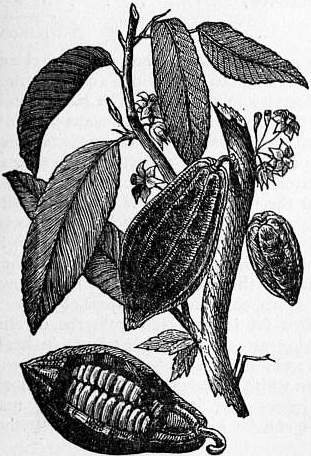
Branch of Cocoa Tree, with Fruit in section, much reduced.
The tree appears to have been originally a native of the coast lands of the Gulf of Mexico and tropical South America as far south as the basin of the Amazon; but it can be cultivated in suitable situations within the 25th parallels of latitude. It flourishes best within the 15th parallels, at elevations ranging from near the sea-level up to about 2000 ft. in height. It is now cultivated in Mexico, Honduras, Guatemala, Nicaragua, Brazil, Peru, Ecuador, New Granada, Venezuela, Surinam, Guiana, and in many of the West Indian islands, particularly in Trinidad, San Domingo, Grenada, Cuba, Porto Rico and Jamaica. Away from America it has been introduced, and is cultivated on a large scale in West Africa, Ceylon and the Dutch East Indies.
History.—The value of cacao was appreciated in its native country before the discovery of America by Europeans. The Spaniards found in use in Mexico a beverage known by the Aztec name of chocolath, from choco (cacao) and lath (water). W. H. Prescott records that the emperor Montezuma of Mexico was “exceedingly fond of it ... no less than 50 jars or pitchers being prepared for his own daily consumption; 2000 more were allowed for that of his household.” Bags of cacao containing a specified number of beans were also a recognized form of currency in the country. The product was early introduced into Spain, and thence to other parts of Europe. The Public Advertiser (London) of June 16, 1657, contains an announcement that “In Bishopgate St., in Queen’s Head Alley, at a Frenchman’s house, is an excellent West India drink, called chocolate, to be sold, where you may have it ready at any time, and also unmade at reasonable rates.” Chocolate was a very fashionable beverage in the early part of the 18th century.
Cultivated Varieties.—Numerous varieties of the cacao, i.e. of Theobroma Cacao, are recognized in cultivation. According to Dr P. Preuss, who has travelled extensively in the cacao producing countries of the world studying this crop, it is impossible to embody in a single table the characteristics of the world’s varieties. A separate classification is needed for almost each country. In 1882 the Trinidad forms were classified by Sir D. Morris. This table was later revised by Mr J. H. Hart, and more recently Mr R. H. Lock studied the Ceylon varieties. As the Ceylon cacaos were obtained mainly from Trinidad, and as Mr Lock’s results agree substantially with those of Sir D. Morris, they serve to illustrate the distinguishing characteristics of the West Indian and Ceylon forms. The main divisions are as follows:—
1. Criollo.—Pods relatively thin-walled and soft, rough, pointed at apex. The seeds or beans are plump and of pale colour. The ripe pods may be either red (colorado) or yellow (amarillo).
2. Forastero.—Pods relatively thick-walled and hard. The seeds vary in colour from pale to deep purple. Various varieties are recognized, such as cundeamor, amelonado, liso, calabacillo, differing in shape, colour and character of beans, &c., and of each of these again there may be a colorado and amarillo sub-variety. Of special interest is calabacillo, a variety with a smooth, small pod, and deep purple beans. It is considered by some to be sufficiently distinct to form a third type equivalent to criollo or forastero. Others again would raise amelonado to the rank of a distinct type. Of the above calabacillo is the hardiest and yields the least valuable beans; criollo is the most delicate and yields beans of the highest value, whilst forastero is intermediate in both respects. In general pale coloured beans are less bitter and more valuable than purple beans. Both, however, may occur in the same pod.
Alligator, or lagarto cacao, is the common name of a variety cultivated in Nicaragua, Guatemala, &c. Its pods are distinctly five-angled and beset with irregular, warty protuberances. Some regard it as a distinct species, T. pentagona, but others only as a variety of T. Cacao. Its produce is of high value.
T. bicolor, indigenous to Central America, is another species of some interest. It bears small, hard woody pods about 6 in. long and 3 in. in diameter, with curious surface markings. The beans possess a fetid odour and a bitter flavour and are known as “tiger cacao.” It is not likely to become of great commercial importance, although consumed locally where found. “Cacao bianco” and “pataste” are other names for this species.
Cultivation and Preparation.—Cacao requires for its successful cultivation a deep, well-watered and yet well-drained soil, shelter from strong winds, and a thoroughly tropical climate, with a mean annual temperature of about 80° F., a rainfall of from 50 to 100 or more in., and freedom from long droughts. Young plants are grown from seed, which may either be sown directly in the positions the future trees are to occupy, varying according to local circumstances from 6 to 25 ft. apart in all directions, or raised in nurseries and transplanted later. The latter course is desirable when it is necessary to water and otherwise tend the seedlings. However raised, the young plants require to be shaded, and this is usually done by planting bananas, cassava or other useful crops between the rows of cacao. In some countries, but not in all, permanent shade trees are planted amongst the cacao. Various leguminous trees are commonly used, e.g. the coral tree (Erythrina spp.) sometimes known as bois immortel and madre del cacao or mother of cocoa, Albizzia Lebbek, Pithecolobium Saman, &c. The various rubber trees have been employed with success. Wind belts are also necessary in exposed situations.
Cacao comes into bearing when about five years old, the small pink flowers and the succeeding large pods being borne directly on the trunk and main branches. The pods are carefully picked when ripe, broken open, and the slimy mass of contained seeds and their enveloping mucilaginous pulp extracted. The “beans” are next fermented or “sweated,” often in special houses constructed for the purpose, or by placing them in heaps and covering with leaves or earth, or in baskets, barrels, &c., lined with banana leaves. During fermentation the beans should be stirred once daily or oftener. The time of fermentation varies from one to twelve or even more days. Pale-coloured beans usually require less time than the deep purple and bitter kinds. The method adopted also considerably modifies the time required. The process of fermenting destroys the mucilage; the seeds lose to some degree their bitter flavour and their colour also changes: the pale criollo seeds, for example, developing a cinnamon-brown colour. The “fracture” of the beans also characteristically alters. Fermentation is not universally practised; the purple colour and bitter taste of unfermented cacao being wanted in some markets.
After the fermentation is completed the beans may or may not be washed, opinion as to the desirability of this process varying in different countries. In any case, however, they have to be dried and cured. When climatic conditions are favourable this is commonly done by spreading the beans in thin layers on barbecues, or stone drying floors, or otherwise exposing them to the sun. Sliding roofs or other means of rapidly affording shelter are desirable in case of showers, excessive heat, and also for protection at night. Artificial drying is now often resorted to and various patterns of drying houses are in use.
The appearance of the beans may often be improved by “claying,” a very slight coating of red earth or clay being added. Polishing the beans also gives them a brighter appearance, removes mildew, and remnants of dried mucilage, &c. This may be done by “dancing the cacao,” i.e. treading a heap with the bare feet, or by the use of special polishing machines. The cacao is now ready for shipment, and is usually packed in bags. Hamburg is the chief port in the world for cacao. Until quite recently, however, this position was held by Havre, which is now second in Europe. New York imports about the same amount as Havre. London follows next in importance.
Cacao-producing Countries.—In the following table the production in tons (of 1000 kilos = 2205 ℔) of the principal producing countries, arranged under continents, is given for 1905 and 1901. During this period the total world’s production has increased by about 40%, as indicated in the summary below. Study of the table will show where the increase has taken place, but attention is directed especially to the rapid development in West Africa.
America.
1905 (tons). 1901 (tons).
Ecuador 21,128 22,896
Brazil 21,091 18,324
Trinidad 20,018 11,943
San Domingo 12,785 6,850
Venezuela 11,700 7,860
Grenada 5,456 4,865
Cuba and Porto Rico 3,000 1,750
Haiti 2,343 1,950
Surinam 1,612 3,163
Jamaica 1,484 1,350
French West Indies 1,200 825
St. Lucia 700 765
Dominica 597 ..
——— ———
Total, America 103,114 82,541
Africa.
1905 (tons). 1901 (tons).
San Thomé 25,379 16,983
Gold Coast and Lagos 5,666 997
Cameroons 1,185 528
Congo Free State 195 ..
——— ———
Total, Africa 32,425 18,508
Asia.
1905 (tons). 1901 (tons).
Ceylon 3543 2697
Dutch East Indies 1492 1277
—— ——
Total, Asia 5035 3974
Other countries 800 700
World’s Production.
1905 (tons). 1901 (tons).
Tropical America and West Indies 103,114 82,541
West Africa 32,425 18,508
Asia 5,035 3,974
Other countries 800 700
——— ———
Total 141,374 105,723
Composition.—The relative weights of the various parts of a whole cacao pod are given thus by Prof. J. B. Harrison for British Guiana specimens:—
Calabacillo. Forastero.
Husk 80.59 89.87
Pulp 7.61 4.23
Cuticles of the beans 1.77 0.50
Kernels of the beans 10.03 5.40
——— ———
100.00 100.00
The husk is composed mainly of water and cellulose woody tissue, with their usual mineral constituents, and has a low manurial value. The pulp contains sugars which become converted into alcohol during fermentation. Fibrous elements and water compose about six-tenths of the cuticles, which also contain approximately: albuminoids (6%), alkaloids (2%), fat (2%), sugars (6%), starch (7%), colouring matter (4%), tartaric acid (3%) and small quantities of various mineral constituents. The average composition of the kernels, according to Payen, is:—
Per cent.
Fat (cacao butter) 50
Starch 10
Albuminoids 20
Water 12
Cellulose 2
Mineral matter 4
Theobromine 2
Colouring matter (cacao-red) trace
———
100.00
Manufacture of Cocoa and Chocolate.—The beans are cleaned and sorted to remove foreign bodies of all kinds and also graded into sizes to secure uniformity in roasting. The latter process is carried out in rotating iron drums in which the beans are heated to a temperature of about 260° to 280° F., and results in developing the aroma, partially converting the starch into dextrin, and eliminating bitter constituents. The beans also dry and their shells become crisp. In the next process the beans are gently crushed and winnowed, whereby the light shells are removed, and after removal by sifting of the “germs” the beans are left in the form of the irregular cocoa-nibs occasionally seen in shops. Cocoa-nibs may be infused with water and drunk, but for most people the beverage is too rich, containing the whole of the cacao-fat or cacao-butter. This fat is extracted from the carefully ground nibs by employing great hydraulic pressure in heated presses. The fat exudes and solidifies. When fresh it is yellowish-white, but becomes quite white on keeping. It is very valuable for pharmaceutical purposes and is a constituent of many pomades. With care it can be kept for a long time without going rancid.
After the extraction of the fat the resulting mass is ground to a fine powder when it is ready for use in the ordinary way. Many preparations on the market are of course not pure cocoa but contain admixtures of various starchy and other bodies.
The shells of the beans separated by the winnowing process contain theobromine, and their infusion with water is sometimes used as a substitute for coffee, under the name “miserabile.” More recently they have been put to good account as a cattle food.
In the preparation of chocolate the preliminary processes of cleaning, sorting, roasting and removing the shells, and grinding the nibs, are followed as for cocoa. The fat, however, is not extracted, but sugar, and sometimes other materials also, are added to the ground pasty mass, together with suitable flavouring materials, as for example vanilla. The greatest care is taken in the process and elaborate grinding and mixing machinery employed. The final result is a semi-liquid mass which is moulded into the familiar tablets or other forms in which chocolate comes on the market.
Cocoa as a beverage has a similar action to tea and coffee, inasmuch as the physiological properties of all three are due to the alkaloids and volatile oils they contain. Tea and coffee both contain the alkaloid caffeine, whilst cocoa contains theobromine. In tea and coffee, however, we only drink an infusion of the leaves or seeds, whilst in cocoa the whole material is taken in a state of very fine suspension, and as the preceding analysis indicates, the cocoa bean, even with the fat extracted, is of high nutritive value.
Cacao-consuming Countries.—The principal cacao-consuming countries are indicated below, which gives the imports into the countries named for 1905. These figures, as also those on production, are taken from Der Gordian.
Tons (1000 kilos).
United States of America 34,958
Germany 29,663
France 21,748
United Kingdom 21,106
Holland 19,295
Spain 6,102
Switzerland 5,218
Belgium 3,019
Austria Hungary 2,668
Russia 2,230
Denmark 1,125
Italy 971
Sweden 900
Canada 700
Australia 600
Norway, Portugal and Finland 692
———
Total 150,995
During recent years the use of cocoa has increased rapidly in some countries. The following table gives the increase per cent in consumption in 1905 over that in 1901 for the five chief consumers:—
Per cent.
United States 70
Germany 61
France 21
United Kingdom 11
Holland 34
(A. B. R.; W. G. F.)
COCO DE MER, or Double Coco-nut, a palm, Lodoicea Sechellarum, which is a native of the Seychelles Islands. The flowers are borne in enormous fleshy spadices, the male and female on distinct plants. The fruits, which are among the largest known, take ten years to ripen; they have a fleshy and fibrous envelope surrounding a hard nut-like portion which is generally two-lobed, suggesting a large double coco-nut. The contents of the nut are edible as in the coco-nut. The empty fruits (after germination of the seed) are found floating in the Indian Ocean, and were known long before the palm was discovered, giving rise to various stories as to their origin.
COCOMA, or Cucamas, a tribe of South American Indians living on the Marañon and lower Huallaga rivers, Peru. In 1681, at the time of the Jesuit missionaries’ first visit, they had the custom of eating their dead and grinding the bones to a powder, which was mixed with a fermented liquor and drunk. When expostulated with by the Jesuits they said “it was better to be inside a friend than to be swallowed up by the cold earth.” They are a provident, hard-working people, partly Christianized, and bolder than most of the civilized Indians. Their languages show affinity to the Tupi-Guarani stock.
COCO-NUT1 PALM (Cocos nucifera), a very beautiful and lofty palm-tree, growing to a height of from 60 to 100 ft., with a cylindrical stem which attains a thickness of 2 ft. The tree terminates in a crown of graceful waving pinnate leaves. The leaf, which may attain to 20 ft. in length, consists of a strong mid-rib, whence numerous long acute leaflets spring, giving the whole the appearance of a gigantic feather. The flowers are arranged in branching spikes 5 or 6 ft. long, enclosed in a tough spathe, and the fruits mature in bunches of from 10 to 20. The fruits when mature are oblong, and triangular in cross section, measuring from 12 to 18 in. in length and 6 to 8 in. in diameter. The fruit consists of a thick external husk or rind of a fibrous structure, within which is the ordinary coco-nut of commerce. The nut has a very hard, woody shell, enclosing the nucleus or kernel, the true seed, within which again is a milky liquid called coco-nut milk. The palm is so widely disseminated throughout tropical countries that it is impossible to distinguish its original habitat. It flourishes with equal vigour on the coast of the East Indies, throughout the tropical islands of the Pacific, and in the West Indies and tropical America. It, however, attains its greatest luxuriance and vigour on the sea shore, and it is most at home in the innumerable small islands of the Pacific seas, of the vegetation of which it is eminently characteristic. Its wide distribution, and its existence in even the smallest coral islets of the Pacific, are due to the character of the fruit, which is eminently adapted for distribution by sea. The fibrous husk renders the fruit light and the leathery skin prevents water-logging. The seed will germinate readily on the sea-shore, the seedling growing out through the soft germ-pore on the upper end of the hard nut. The fruits dropping into the sea from trees growing on any shores would be carried by tides and currents to be cast up and to vegetate on distant coasts.
The coco-nut palm, being the most useful of its entire tribe to the natives of the regions in which it grows, and furnishing many valuable and important commercial products, is the subject of careful cultivation in many countries. On the Malabar and Coromandel coasts of India the trees grow in vast numbers; and in Ceylon, which is peculiarly well suited for their cultivation, it is estimated that twenty millions of the trees flourish. The wealth of a native in Ceylon is estimated by his property in coco-nut trees, and Sir J. Emerson Tennent noted a law case in a district court in which the subject in dispute was a claim to the 2520th part of ten of the precious palms. The cultivation of coco-nut plantations in Ceylon was thus described by Sir J. E. Tennent. “The first operation in coco-nut planting is the formation of a nursery, for which purpose the ripe nuts are placed in squares containing about 400 each; these are covered an inch deep with sand and seaweed or soft mud from the beach, and watered daily till they germinate. The nuts put down in April are sufficiently grown to be planted out before the rains of September, and they are then set out in holes 3 ft. deep and 20 to 30 ft. apart.... Before putting in the young plant it is customary to bed the roots with soft mud and seaweed, and for the first two years they must be watered and protected from the glare of the sun under shades made of the plaited fronds of the coco-nut palm, or the fan-like leaves of the palmyra.” The palm begins to bear fruit from the fifth to the seventh year of its age, each stock carrying from 5 to 30 nuts, the tree maturing on an average 60 nuts yearly.
The uses to which the various parts of the coco-nut palm are applied in the regions of their growth are almost endless. The nuts supply no inconsiderable proportion of the food of the natives, and the milky juice enclosed within them forms a pleasant and refreshing drink. The juice drawn from the unexpanded flower spathes forms “toddy,” which may be boiled down to sugar, or it is allowed to ferment and is distilled, when it yields a spirit which, in common with a like product from other sources, is known as “arrack.” As in other palms, the young bud cut out of the top of the tree forms an esculent vegetable, “palm cabbage.” The trunk yields a timber (known in European commerce as porcupine wood) which is used for building, furniture, firewood, &c.; the leaves are plaited into cajan fans and baskets, and used for thatching the roofs of houses; the shell of the nut is employed as a water-vessel; and the external husk or rind yields the coir fibre, with which are fabricated ropes, cordage, brushes, &c. The coco-nut palm also furnishes very important articles of external commerce, of which the principal is coco-nut oil. It is obtained by pressure or boiling from the kernels, which are first broken up into small pieces and dried in the sun, when they are known as copperah or copra. It is estimated that 1000 full-sized nuts will yield upwards of 500 ℔. of copra, from which 25 gallons of oil should be obtained. The oil is a white solid substance at ordinary temperatures, with a peculiar, rather disagreeable odour, from the volatile fatty acids it contains, and a mild taste. Under pressure it separates into a liquid and a solid portion, the latter, coco-stearin, being extensively used in the manufacture of candles. Coco-nut oil is also used in the manufacture of marine soap, which forms a lather with sea-water. Coir is also an important article of commerce, being in large demand for the manufacture of coarse brushes, door mats and woven coir-matting for lobbies and passages. A considerable quantity of fresh nuts is imported, chiefly from the West Indies, into Britain and other countries; they are familiar as the reward of the popular English amusement of “throwing at the coco-nuts”; and the contents are either eaten raw or used as material for cakes, &c., or sweetmeats (“coker-nut”).
COCYTUS (mod. Vuvo), a tributary of the Acheron, a river of Thesprotia (mod. pashalik of Iannina), which flows into the Ionian Sea about 20 m. N. of the Gulf of Arta. The name is also applied in Greek mythology to a tributary of the Acheron or of the Styx, a river in Hades. The etymology suggested is from κωκύειν, to wail, in allusion to the cries of the dead. Virgil describes it as the river which surrounds the underworld (Aen. vi. 132).
COD, the name given to the typical fish of the family Gadidae, of the Teleostean suborder Anacanthini, the position of which has much varied in our classifications. Having no spines to their fins, the Gadids used, in Cuvierian days, to be associated with the herrings, Salmonids, pike, &c., in the artificially-conceived order of Malacopterygians, or soft-finned bony fishes. But, on the ground of their air-bladder being closed, or deprived of a pneumatic duct communicating with the digestive canal, such as is characteristic of the Malacopterygians, they were removed from them and placed with the flat-fishes, or Pleuronectidae, in a suborder Anacanthini, regarded as intermediate in position between the Acanthopterygians, or spiny-finned fishes, and the Malacopterygians. It has, however, been shown that the flat-fishes bear no relationship to the Gadids, but are most nearly akin to the John Dories (see Dory).
The suborder Anacanthini is, nevertheless, maintained for the Muraenolepididae Gadids and two related families, Macruridae and Muraenolepididae, and may be thus defined:—Air-bladder without open duct. Parietal bones separated by the supra-occipital; prootic and exoccipital separated by the enlarged opisthotic. Pectoral arch suspended from the skull: no mesocoracoid arch. Ventral fins below or in front of the pectorals, the pelvic bones posterior to the clavicular symphysis and only loosely attached to it by ligament. Fins without spines; caudal fin, if present, without expanded hypural, perfectly symmetrical, and supported by the neural and haemal spines of the posterior vertebrae, and by basal bones similar to those supporting the dorsal and anal rays. This type of caudal fin must be regarded as secondary, the Gadidae being, no doubt, derived from fishes in which the homocercal fin of the typical Teleostean had been lost.
About 120 species of Gadids are distinguished, mostly marine, many being adapted to life at great depths; all are carnivorous. They inhabit chiefly the northern seas, but many abyssal forms occur between the tropics and in the southern parts of the Atlantic and Pacific. They are represented in British waters by eight genera, and about twenty species, only one of which, the burbot (Lota vulgaris), is an inhabitant of fresh waters. Several of the marine species are of first-rate economic importance. The genus Gadus is characterized by having three dorsal and two anal fins, and a truncated or notched caudal fin. In the cod and haddock the base of the first anal fin is not, or but slightly, longer than that of the second dorsal fin; in the whiting, pout, coal-fish, pollack, hake, ling and burbot, the former is considerably longer than the latter.
The cod, Gadus morrhua, possesses, in common with the other members of the genus, three dorsal and two anal fins, and a single barbel, at least half as long as the eye, at the chin. It is a widely-distributed species, being found throughout the northern and temperate seas of Europe, Asia and America, extending as far south as Gibraltar, but not entering the Mediterranean, and inhabits water from 25 to 50 fathoms deep, where it always feeds close to the bottom. It is exceedingly voracious, feeding on the smaller denizens of the ocean—fish, crustaceans, worms and molluscs, and greedily taking almost any bait the fisherman chooses to employ. The cod spawns in February, and is exceedingly prolific, the roe of a single female having been known to contain upwards of eight millions of ova, and to form more than half the weight of the entire fish. Only a small proportion of these get fertilized, and still fewer ever emerge from the egg. The number of cod is still further reduced by the trade carried on in roe, large quantities of which are used in France as ground-bait in the sardine fishery, while it also forms an article of human food. The young are about an inch in length by the end of spring, but are not fit for the market till the second year, and it has been stated that they do not reach maturity, as shown by the power of reproduction, till the end of their third year. They usually measure about 3 ft. in length, and weigh from 12 to 20 ℔, but specimens have been taken from 50 to 70 ℔ in weight.
As an article of food the cod-fish is in greatest perfection during the three months preceding Christmas. It is caught on all parts of the British and Irish coasts, but the Dogger Bank, and Rockall, off the Outer Hebrides, have been specially noted for their cod-fisheries. The fishery is also carried on along the coast of Norfolk and Suffolk, where great quantities of the fish are caught with hook and line, and conveyed to market alive in “well-boats” specially built for this traffic. Such boats have been in use since the beginning of the 18th century. The most important cod-fishery in the world is that which has been prosecuted for centuries on the Newfoundland banks, where it is not uncommon for a single fisherman to take over 500 of these fish in ten or eleven hours. These, salted and dried, are exported to all parts of the world, and form, when taken in connexion with the enormous quantity of fresh cod consumed, a valuable addition to the food resources of the human race.
The air-bladder of this fish furnishes isinglass, little, if at all, inferior to that obtained from the sturgeon, while from the liver is obtained cod-liver oil, largely used in medicine as a remedy in scrofulous complaints and pulmonary consumption (see Cod-liver Oil). “The Norwegians,” says Cuvier, “give cod-heads with marine plants to their cows for the purpose of producing a greater proportion of milk. The vertebrae, the ribs, and the bones in general, are given to their cattle by the Icelanders, and by the Kamtchatdales to their dogs. These same parts, properly dried, are also employed as fuel in the desolate steppes of the Icy Sea.”
At Port Logan in Wigtonshire cod-fish are kept in a large reservoir, scooped out of the solid rock by the action of the sea, egress from which is prevented by a barrier of stones, which does not prevent the free access of the water. These cod are fed chiefly on mussels, and when the keeper approaches to feed them they may be seen rising to the surface in hundreds and eagerly seeking the edge. They have become comparatively tame and familiar. Frank Buckland, who visited the place, states that after a little while they allowed him to take hold of them, scratch them on the back, and play with them in various ways. Their flavour is considered superior to that of the cod taken in the open sea.
(G. A. B.)
CODA (Ital. for “tail”; from the Lat. cauda), in music, a term for a passage which brings a movement or a separate piece to a conclusion. This developed from the simple chords of a cadence into an elaborate and independent form. In a series of variations on a theme or in a composition with a fixed order of subjects, the “coda” is a passage sufficiently contrasted with the conclusions of the separate variations or subjects, added to form a complete conclusion to the whole. Beethoven raised the “coda” to a feature of the highest importance.
CODE (Lat. codex), the term for a complete and systematic body of law, or a complete and exclusive statement of some portion of the law; and so by analogy for any system of rules or doctrine; also for an arrangement in telegraphy, signalling, &c., by which communications may be made according to rules adopted for brevity or secrecy.
In jurisprudence the question of the reduction of laws to written codes, representing a complete and readily accessible system, is a matter of great historical and practical interest. Many collections of laws, however, which are commonly known as codes,1 would not correspond to the definition given above. The Code of Justinian (see Justinian I.; Roman Law), the most celebrated of all, is not in itself a complete and exclusive system of law. It is a collection of imperial constitutions, just as the Pandects are a collection of the opinions of jurisconsults. The Code and the Pandects together being, as Austin says, “digests of Roman law in force at the time of their conception,” would, if properly arranged, constitute a code. Codification in this sense is merely a question of the form of the laws, and has nothing to do with their goodness or badness from an ethical or political point of view. Sometimes codification only means the changing of unwritten into written law; in the stricter sense it means the changing of unwritten or badly-written law into law well written.
The same causes which made collections of laws necessary in the time of Justinian have led to similar undertakings among modern peoples. The actual condition of laws until the period when they are consciously remodelled is one of confusion, contradiction, repetition and disorder; and to these evils the progress of society adds the burden of perpetually increasing legislation. Some attempt must be made to simplify the task of learning the laws by improving their expression and arrangement. This is by no means an easy task in any country, but in England it is surrounded with peculiar difficulties. The independent character of English law has prevented an attempt to do what has already been done for other systems which have the basis of the Roman law to fall back upon.
The most celebrated modern code is the French. The necessity of a code in France was mainly caused by the immense number of separate systems of jurisprudence existing in that country before 1789, justifying Voltaire’s sarcasm that a traveller in France had to change laws about as often as he changed horses. At first published under the title of Code Civil des Français, it was afterwards entitled the Code Napoléon (q.v.)—the emperor Napoleon wishing to attach his name to a work which he regarded as the greatest glory of his reign. The code, it has been said, is the product of Roman and customary law, together with the ordinances of the kings and the laws of the Revolution. In form it has passed through several changes caused by the political vicissitudes of the country, and it has of course suffered from time to time important alterations in substance, but it still remains virtually the same in principle as it left the hands of its framers. The code has produced a vast number of commentaries, among which may be named those of A. Duranton, R. T. Troplong and J. C. F. Demolombe. The remaining French codes are the Code de procédure civile, the Code de commerce, the Code d’instruction criminelle and the Code pénal. The merits of the French code have entered into the discussion on the general question of codification. Austin agrees with Savigny in condemning the ignorance and haste with which it was compiled. “It contains,” says Austin, “no definitions of technical terms (even the most leading), no exposition of the rationale of distinctions (even the most leading), no exposition of the broad principles and rules to which the narrower provisions expressed in the code are subordinate; hence its fallacious brevity.” Codes modelled on the French code have, however, taken firm root in most of the countries of continental Europe and in other parts of the world as well, such as Latin America and several of the British colonies.
The Prussian code (Code Frédéric) was published by Frederick the Great in 1751. It was intended to take the place of “Roman, common Saxon and other foreign subsidiary laws and statutes,” the provincial laws remaining in force as before. One of the objects of the king was to destroy the power of the advocates, whom he hoped to render useless. This, with other systems of law existing in Germany, has been replaced by the Civil Code of 1900 (see Germany).
The object of all these codes has been to frame a common system to take the place of several systems of law, rather than to restate in an exact and exhaustive form the whole laws of a nation, which is the problem of English codification. The French and Prussian codes, although they have been of great service in simplifying the law, have failed to prevent outside themselves that accumulation of judiciary and statute law which in England has been the chief motive for codification. A more exact parallel to the English problem may be found in the Code of the State of New York. The revised constitution of the state, as adopted in 1846, “ordered the appointment of two commissions, one to reduce into a written and a systematic code the whole body of the law of the state, and the other to revise, reform, simplify and abridge the rules and practice, pleadings, &c., of the courts of record.” By an act of 1847, the state legislature declared that the body of substantive law should be contained in three codes—the Political, the Civil and the Penal. The works of both commissions, completed in 1865, filled six volumes, containing the Code of Civil Procedure (including the law of evidence), the Book of Forms, the Code of Criminal Procedure, the Political Code, the Penal Code and the Civil Code. In the introduction to the Civil Code it was claimed that in many departments of the law the codes “provided for every possible case, so that when a new case arises it is better that it should be provided for by new legislation.” The New York code was defective in the important points of definition and arrangement. It formed the basis, however, of the present codes of civil and criminal procedure in the state of New York. Much interest has attached to the Penal Code drawn up by Edward Livingston (q.v.) for the state of Louisiana. The system consists of a Code of Crime and Punishments, a Code of Procedure, a Code of Evidence, a Code of Reform and Prison Discipline, and a Book of Definitions. “Though the state for which the codes were prepared,” said Chief Justice Chase, “neglected to avail itself of the labours assigned and solicited by itself, they have proved, together with their introductions, a treasure of suggestions to which many states are indebted for useful legislation.” Most of the other states in the United States have codes stating the law of pleading in civil actions, and such states are often described as code states to distinguish them from those adhering to the older forms of action, divided between those at law and those at equity. A few states have general codes of political and civil rights. The general drift of legislation and of public sentiment in the United States is towards the extension of the principle of codification, but the contrary view has been ably maintained (see J. C. Carter, Provinces of the Written and the Unwritten Law, New York, 1889).