VOLUME VI SLICE VI Cockaigne to Columbus, Christopher (continued 11)
Reading edition
Authorities.—The following works may also be consulted:—T. Eimer, Orthogenesis der Schmetterlinge (Leipzig, 1898); E. B. Poulton, The Colours of Animals (London, 1890); F. E. Beddard, Animal Coloration (London, 1892); E. Haase, Researches on Mimicry (translation, London, 1896); A. R. Wallace, Natural Selection and Tropical Nature (London, 1895); Darwinism (London, 1897); A. H. Thayer and G. H. Thayer, Concealing-Coloration in the Animal Kingdom (New York, 1910).
(E. B. P.)
2. Chemistry
The coloration of the surface of animals is caused either by pigments, or by a certain structure of the surface by means of which the light falling on it, or reflected through its superficial transparent layers, undergoes diffraction or other optical change. Or it may be the result of a combination of these two causes. It plays an important part in the relationship of the animal to its environment, in concealment, in mimicry, and so on; the presence of a pigment in the integument may also serve a more direct physiological purpose, such as a respiratory function. The coloration of birds’ feathers, of the skin of many fishes, of many insects, is partially at least due to structure and the action of the peculiar pigmented cells known as “chromatophores” (which W. Garstang defines as pigmented cells specialized for the discharge of the chromatic function), and is much better marked when these have for their background a “reflecting layer” such as is provided by guanin, a substance closely related to uric acid. Such a mechanism is seen to greatest advantage in fishes. Among these, guanin may be present in a finely granular form, causing the light falling on it to be scattered, thus producing a white effect; or it may be present in a peculiar crystalline form, the crystals being known as “iridocytes”; or in a layer of closely apposed needles forming a silvery sheet or mirror. In the iris of some fishes the golden red colour is produced by the light reflected from such a layer of guanin needles having to pass through a thin layer of a reddish pigment, known as a “lipochrome.” Again, in some lepidopterous insects a white or a yellow appearance is produced by the deposition of uric acid or a nearly allied substance on the surface of the wings. In many animals, but especially among invertebrates, colouring matters or pigments play an important rôle in surface coloration; in some cases such coloration may be of benefit to the animal, but in others the integument simply serves as an organ for the excretion of waste pigmentary substances. Pigments (1) may be of direct physiological importance; (2) they may be excretory; or (3) they may be introduced into the body of the animal with the food.
Of the many pigments which have been described up to the present time, very few have been subjected to elementary chemical analysis, owing to the great difficulties attending their isolation. An extremely small amount of pigment will give rise to a great amount of coloration, and the pigments are generally accompanied by impurities of various kinds which cling to them with great tenacity, so that when one has been thoroughly cleansed very little of it remains for ultimate analysis. Most of these substances have been detected by means of the spectroscope, their absorption bands serving for their recognition, but mere identity of spectrum does not necessarily mean chemical identity, and a few chemical tests have also to be applied before a conclusion can be drawn. The absorption bands are referred to certain definite parts of the spectrum, such as the Fraunhofer lines, or they may be given in wave-lengths. For this purpose the readings of the spectroscope are reduced to wave-lengths by means of interpolation curves; or if Zeiss’s microspectroscope be used, the position of bands in wave-lengths (denoted by the Greek letter λ) may be read directly.
Haemoglobin, the red colouring matter of vertebrate blood, C758H1203N195S3FeO218, and its derivatives haematin, C32H30N4FeO3, and haematoporphyrin, C16H18N2O3, are colouring matters about which we possess definite chemical knowledge, as they have been isolated, purified and analysed. Most of the bile pigments of mammals have likewise been isolated and studied chemically, and all of these are fully described in the text-books of physiology and physiological chemistry. Haemoglobin, though physiologically of great importance in the respiratory process of vertebrate animals, is yet seldom used for surface pigmentation, except in the face of white races of man or in other parts in monkeys, &c. In some worms the transparent skin allows the haemoglobin of the blood to be seen through the integument, and in certain fishes also the haemoglobin is visible through the integument. It is a curious and noteworthy fact that in some invertebrate animals in which no haemoglobin occurs, we meet with its derivatives. Thus haematin is found in the so-called bile of slugs, snails, the limpet and the crayfish. In sea-anemones there is a pigment which yields some of the decomposition-products of haemoglobin, and associated with this is a green pigment apparently identical with biliverdin (C16H18N2O4), a green bile pigment. Again, haematoporphyrin is found in the integuments of star-fishes and slugs, and occurs in the “dorsal streak” of the earth-worm Lumbricus terrestris, and perhaps in other species. Haematoporphyrin and biliverdin also occur in the egg-shells of certain birds, but in this case they are derived from haemoglobin. Haemoglobin is said to be found as low down in the animal kingdom as the Echinoderms, e.g. in Ophiactis virens and Thyonella gemmata. It also occurs in the blood of Planorbis corneus and in the pharyngeal muscles of other mollusca.
A great number of other pigments have been described; for example, in the muscles and tissues of animals, both vertebrate and invertebrate, are the histohaematins, of which a special muscle pigment, myohaematin, is one. In vertebrates the latter is generally accompanied by haemoglobin, but in invertebrates—with the exception of the pharyngeal muscles of the mollusca—it occurs alone. Although closely related to haemoglobin or its derivative haemochromogen, the histohaematins are yet totally distinct, and they are found in animals where not a trace of haemoglobin can be detected. Another interesting pigment is turacin, which contains about 7% of nitrogen, found by Professor A. H. Church in the feathers of the Cape lory and other plantain-eaters, from which it can be extracted by water containing a trace of ammonia. It has been isolated, purified and analysed by Professor Church. From it may be obtained turacoporphyrin, which is identical with haematoporphyrin, and gives the band in the ultra-violet which J. L. Soret and subsequently A. Gamgee have found to be characteristic of haemoglobin and its compounds. Turacin itself gives a peculiar two-banded spectrum, and contains about 7% of copper in its molecule. Another copper-containing pigment is haemocyanin, which in the oxidized state gives a blue colour to the blood of various Mollusca and Arthropoda. Like haemoglobin, it acts as an oxygen-carrier in respiration, but it takes no part in surface coloration.
A class of pigments widely distributed among plants and animals are the lipochromes. As their name denotes, they are allied to fat and generally accompany it, being soluble in fat solvents. They play an important part in surface coloration, and may be greenish, yellow or red in colour. They contain no nitrogen. As an example of a lipochrome which has been isolated, crystallized and purified, we may mention carotin, which has recently been found in green leaves. Chlorophyll, which is so often associated with a lipochrome, has been found in some Infusoria, and in Hydra and Spongilla, &c. In some cases it is probably formed by the animal; in other cases it may be due to symbiotic algae, while in the gastric gland of many Mollusca, Crustacea and Echinodermata it is derived from food-chlorophyll. Here it is known as entero-chlorophyll. The black pigments which occur among both vertebrate and invertebrate animals often have only one attribute in common, viz. blackness, for among the discordant results of analysis one thing is certain, viz. that the melanins from vertebrate animals are not identical with those from invertebrate animals. The melanosis or blackening of insect blood, for instance, is due to the oxidation of a chromogen, the pigment produced being known as a uranidine. In some sponges a somewhat similar pigment has been noticed. Other pigments have been described, such as actiniochrome, echinochrome, pentacrinin, antedonin, polyperythrin (which appears to be a haematoporphyrin), the floridines, spongioporphyrin, &c., which need no mention here; all these pigments can only be distinguished by means of the spectroscope.
Most of the pigments are preceded by colourless substances known as “chromogens,” which by the action of the oxygen of the air and by other agencies become changed into the corresponding pigments. In some cases the pigments are built up in the tissues of an animal, in others they appear to be derived more or less directly from the food. Derivatives of chlorophyll and lipochromes especially, seem to be taken up from the intestine, probably by the agency of leucocytes, in which they may occur in combination with, or dissolved by, fatty matters and excreted by the integument. In worms especially, the skin seems to excrete many effete substances, pigments included. No direct connexion has been traced between the chlorophyll eaten with the food and the haemoglobin of blood and muscle. Attention may, however, be drawn to the work of Dr E. Schunck, who has shown that a substance closely resembling haematoporphyrin can be prepared from chlorophyll; this is known as phylloporphyrin. Not only does the visible spectrum of this substance resemble that of haematoporphyrin, but the invisible ultra-violet also, as shown by C. A. Schunck.
The reader may refer to E. A. Schäfer’s Text-Book of Physiology (1898) for A. Gamgee’s article “On Haemoglobin, and its Compounds”; to the writer’s papers in the Phil. Trans. and Proc. Roy. Soc. from 1881 onwards, and also Quart. Journ. Micros. Science and Journ. of Physiol.; to C. F. W. Krukenberg’s Vergleichende physiologische Studien from 1879 onwards, and to his Vorträge. Miss M. I. Newbigin collected in Colour in Nature (1898) most of the recent literature of this subject. Dr E. Schunck’s papers will be found under the heading “Contribution to the Chemistry of Chlorophyll” in Proc. Roy. Soc. from 1885 onwards; and Mr C. A. Schunck’s paper in Proc. Roy. Soc. vol. lxiii.
(C. A. MacM.)
COLSTON, EDWARD (1636-1721), English philanthropist, the son of William Colston, a Bristol merchant of good position, was born at Bristol on the 2nd of November 1636. He is generally understood to have spent some years of his youth and manhood as a factor in Spain, with which country his family was long connected commercially, and whence, by means of a trade in wines and oil, great part of his own vast fortune was to come. On his return he seems to have settled in London, and to have bent himself resolutely to the task of making money. In 1681, the date of his father’s decease, he appears as a governor of Christ’s hospital, to which noble foundation he afterwards gave frequently and largely. In the same year he probably began to take an active interest in the affairs of Bristol, where he is found about this time embarked in a sugar refinery; and during the remainder of his life he seems to have divided his attention pretty equally between the city of his birth and that of his adoption. In 1682 he appears in the records of the great western port as advancing a sum of £1800 to its needy corporation; in 1683 as “a free burgess and meire (St Kitts) merchant” he was made a member of the Merchant’s Hall; and in 1684 he was appointed one of a committee for managing the affairs of Clifton. In 1685 he again appears as the city’s creditor for about £2000, repayment of which he is found insisting on in 1686. In 1689 he was chosen auditor by the vestry at Mortlake, where he was residing in an old house once the abode of Ireton and Cromwell. In 1691, on St Michael’s Hill, Bristol, at a cost of £8000, he founded an almshouse for the reception of 24 poor men and women, and endowed with accommodation for “Six Saylors,” at a cost of £600, the merchant’s almshouses in King Street. In 1696, at a cost of £8000, he endowed a foundation for clothing and teaching 40 boys (the books employed were to have in them “no tincture of Whiggism”); and six years afterwards he expended a further sum of £1500 in rebuilding the school-house. In 1708; at a cost of £41,200, he built and endowed his great foundation on Saint Augustine’s Back, for the instruction, clothing, maintaining and apprenticing of 100 boys; and in time of scarcity, during this and next year, he transmitted “by a private hand” some £20,000 to the London committee. In 1710, after a poll of four days, he was sent to parliament, to represent, on strictest Tory principles, his native city of Bristol; and in 1713, after three years of silent political life, he resigned this charge. He died at Mortlake in 1721, having nearly completed his eighty-fifth year; and was buried in All Saints’ church, Bristol.
Colston, who was in the habit of bestowing large sums yearly for the release of poor debtors and the relief of indigent age and sickness, and who gave (1711) no less than £6000 to increase Queen Anne’s Bounty Fund for the augmentation of small livings, was always keenly interested in the organization and management of his foundations; the rules and regulations were all drawn up by his hand, and the minutest details of their constitution and economy were dictated by him. A high churchman and Tory, with a genuine intolerance of dissent and dissenters, his name and example have served as excuses for the formation of two political benevolent societies—the “Anchor” (founded 1769) and the “Dolphin” (founded 1749),—and also the “Grateful” (founded 1758), whose rivalry has been perhaps as instrumental in keeping their patron’s memory green as have the splendid charities with which he enriched his native city (see Bristol).
See Garrard, Edward Colston, the Philanthropist (4to, Bristol, 1852); Pryce, A Popular History of Bristol (1861); Manchee, Bristol Charities.
COLT, SAMUEL (1814-1862), American inventor, was born on the 19th of July 1814 at Hartford, Connecticut, where his father had a manufactory of silks and woollens. At the age of ten he left school for the factory, and at fourteen, then being in a boarding school at Amherst, Massachusetts, he made a runaway voyage to India, during which (in 1829) he constructed a wooden model, still existing, of what was afterwards to be the revolver (see Pistol). On his return he learned chemistry from his father’s bleaching and dyeing manager, and under the assumed name “Dr Coult” travelled over the United States and Canada lecturing on that science. The profits of two years of this work enabled him to continue his researches and experiments. In 1835, having perfected a six-barrelled rotating breech, he visited Europe, and patented his inventions in London and Paris, securing the American right on his return; and the same year he founded at Paterson, New Jersey, the Patent Arms Company, for the manufacture of his revolvers only. As early as 1837 revolvers were successfully used by United States troops, under Lieut.-Colonel William S. Harney, in fighting against the Seminole Indians in Florida. Colt’s scheme, however, did not succeed; the arms were not generally appreciated; and in 1842 the company became insolvent. No revolvers were made for five years, and none were to be had when General Zachary Taylor wrote for a supply from the seat of war in Mexico. In 1847 the United States government ordered 1000 from the inventor; but before these could be produced he had to construct a new model, for a pistol of the company’s make could nowhere be found. This commission was the beginning of an immense business. The little armoury at Whitneyville (New Haven, Connecticut), where the order for Mexico was executed, was soon exchanged for larger workshops at Hartford. These in their turn gave place (1852) to the enormous factory of the Colt’s Patent Fire-Arms Manufacturing Company, doubled in 1861, on the banks of the Connecticut river, within the city limits of Hartford, where so many millions of revolvers with all their appendages have been manufactured. Thence was sent, for the Russian and English governments, to Tula and Enfield, the whole of the elaborate machinery devised by Colt for the manufacture of his pistols. Colt introduced and patented a number of improvements in his revolver, and also invented a submarine battery for harbour defence. He died at Hartford on the 10th of January 1862.
COLT’S-FOOT, the popular name of a small herb, Tussilago Farfara, a member of the natural order Compositae, which is common in Britain in damp, heavy soils. It has a stout branching underground stem, which sends up in March and April scapes about 6 in. high, each bearing a head of bright yellow flowers, the male in the centre surrounded by a much larger number of female. The flowers are succeeded by the fruits, which bear a soft snow-white woolly pappus. The leaves, which appear later, are broadly cordate with an angular or lobed outline, and are covered on the under-face with a dense white felt. The botanical name, Tussilago, recalls its use as a medicine for cough (tussis). The leaves are smoked in cases of asthma.
COLUGO, or Cobego, either of two species of the zoological genus Galeopithecus. These animals live in the forests of the Malay Peninsula, Sumatra, Borneo and the Philippine Islands, where they feed chiefly on leaves, and probably also on insects. In size they may be compared with cats; the long slender limbs are connected by a broad fold of skin extending outwards from the sides of the neck and body, the fingers and toes are webbed, and the hind-limbs joined by an outer membrane as in bats. Their habits are nocturnal, and during the daytime they cling to the trunks or limbs of trees head downwards in a state of repose. With the approach of night their season of activity commences, when they may be occasionally seen gliding from tree to tree supported on their cutaneous parachute, and they have been noticed as capable of traversing in this way a space of 70 yds. with a descent of only about one in five. Europeans in the East know these animals as “flying lemurs.” (See Galeopithecus.)
COLUMBA, SAINT (Irish, Colum), Irish saint, was born on the 7th of December 521, in all probability at Gartan in Co. Donegal. His father Feidlimid was a member of the reigning family in Ireland and was closely allied to that of Dalriada (Argyll). His mother Eithne was of Leinster extraction and was descended from an illustrious provincial king. To these powerful connexions as much as to his piety and ability, he owed the immense influence he possessed. Later lives state that the saint was also called Crimthann (fox), and Reeves suggests that he may have had two names, the one baptismal, the other secular. He was afterwards known as Columkille, or Columba of the Church, to distinguish him from others of the same name. During his early years the Irish Church was reformed by Gildas and Finian of Clonard, and numerous monasteries were founded which made Ireland renowned as a centre of learning. Columba himself studied under two of the most distinguished Irishmen of his day, Finian of Moville (at the head of Strangford Lough) and Finian of Clonard. Almost as a matter of course, under such circumstances, he embraced the monastic life. He was ordained deacon while at Moville, and afterwards, when about thirty years of age, was raised to the priesthood. During his residence in Ireland he founded, in addition to a number of churches, two famous monasteries, one named Daire Calgaich (Derry) on the banks of Lough Foyle, the other Dair-magh (Durrow) in King’s county.
In 563 he left his native land, accompanied by twelve disciples, and went on a mission to northern Britain, perhaps on the invitation of his kinsman Conall, king of Dalriada. Irish accounts represent Columba as undertaking this mission in consequence of the censure expressed against him by the clergy after the battle of Cooldrevny; but this is probably a fabrication. The saint’s labours in Scotland must be regarded as a manifestation of the same spirit of missionary enterprise with which so many of his countrymen were imbued. Columba established himself on the island of Hy or Iona, where he erected a church and a monastery. About the year 565 he applied himself to the task of converting the heathen kingdom of the northern Picts. Crossing over to the mainland he proceeded to the residence, on the banks of the Ness, of Brude, king of the Picts. By his preaching, his holy life, and, as his earliest biographers assert, by the performance of miracles, he converted the king and many of his subjects. The precise details, except in a few cases, are unknown, or obscured by exaggeration and fiction; but it is certain that the whole of northern Scotland was converted by the labours of Columba, and his disciples and the religious instruction of the people provided for by the erection of numerous monasteries. The monastery of Iona was reverenced as the mother house of all these foundations, and its abbots were obeyed as the chief ecclesiastical rulers of the whole nation of the northern Picts. There were then neither dioceses nor parishes in Ireland and Celtic Scotland; and by the Columbite rule the bishops themselves, although they ordained the clergy, were subject to the jurisdiction of the abbots of Iona, who, like the founder of the order, were only presbyters. In matters of ritual they agreed with the Western Church on the continent, save in a few particulars such as the precise time of keeping Easter and manner of tonsure.
Columba was honoured by his countrymen, the Scots of Britain and Ireland, as much as by his Pictish converts, and in his character of chief ecclesiastical ruler he gave formal benediction and inauguration to Aidan, the successor of Conall, as king of the Scots. He accompanied that prince to Ireland in 575, and took a leading part in a council held at Drumceat in Ulster, which determined once and for all the position of the ruler of Dalriada with regard to the king of Ireland. The last years of Columba’s life appear to have been mainly spent at Iona. There he was already revered as a saint, and whatever credit may be given to some portions of the narratives of his biographers, there can be no doubt as to the wonderful influence which he exercised, as to the holiness of his life, and as to the love which he uniformly manifested to God and to his neighbour.
In the summer of 597 he knew that his end was approaching. On Saturday the 8th of June he was able, with the help of one of his monks, to ascend a little hill above the monastery and to give it his farewell blessing. Returning to his cell he continued a labour in which he had been engaged, the transcription of the Psalter. Having finished the verse of the 34th Psalm where it is written, “They who seek the Lord shall want no manner of thing that is good,” he said, “Here I must stop:—what follows let Baithen write”; indicating, as was believed, his wish that his cousin Baithen should succeed him as abbot. He was present at evening in the church, and when the midnight bell sounded for the nocturnal office early on Sunday morning he again went thither unsupported, but sank down before the altar and passed away as in a gentle sleep.
Several Irish poems are ascribed to Columba, but they are manifestly compositions of a later age. Three Latin hymns may, however, be attributed to the saint with some degree of certainty.
The original materials for a life of St Columba are unusually full. The earliest biography was written by one of his successors, Cuminius, who became abbot of Iona in 657. Much more important is the enlargement of that work by Adamnan, who became abbot of Iona in 679. These narratives are supplemented by the brief but most valuable notices given by the Venerable Bede. See W. Reeves, Life of St Columba, written by Adamnan (Dublin, 1857); W. F. Skene, Celtic Scotland, vol. ii. “Church and Culture” (Edinburgh, 1877).
(E. C. Q.)
COLUMBAN (543-615), Irish saint and writer, was born in Leinster in 543, and was educated in the monastery of Bangor, Co. Down. About the year 585 he left Ireland together with twelve other monks, and established himself in the Vosges, among the ruins of an ancient fortification called Anagrates, the present Anegray in the department of Haute-Saône. His enemies accused him before a synod of French bishops (602) for keeping Easter according to the old British and now unorthodox way, and a more powerful conspiracy was organized against him at the court of Burgundy for boldly rebuking the crimes of King Theuderich II. and the queen-mother Brunhilda. He was banished and forcibly removed from his monastery, and with St Gall and others of the monks he withdrew into Switzerland, where he preached with no great success to the Suebi and Alamanni. Being again compelled to flee, he retired to Italy, and founded the monastery of Bobbio in the Apennines, where he remained till his death, which took place on the 21st of November 615. His writings, which include some Latin poems, prove him a man of learning, and he appears to have been acquainted not only with the Latin classics, but also with Greek, and even Hebrew.
The collected edition of St Columban’s writings was published by Patrick Fleming in his Collectanea sacra Hiberni (Louvain, 1667), and reproduced by Migne, p. 4, vol. lxxxvi. (Paris, 1844). See further, Wright’s Biographia Literaria. Columban’s Regula Coenobitalis cum Poenitenliali is to be found in the Codex Regularum (Paris, 1638). A complete bibliography is given in U. Chevallier, Répertoire des sources hist. (Bio. Bibliogr.), vol. i. 990 (Paris, 1905).
COLUMBANI, PLACIDO, Italian architectural designer, who worked chiefly in England in the latter part of the 18th century. He belonged to the school of the Adams and Pergolesi, and like them frequently designed the enrichments of furniture. He was a prolific producer of chimney-pieces, which are often mistaken for Adam work, of moulded friezes, and painted plaques for cabinets and the like. There can be no question that the English furniture designers of the end of the 18th century, and especially the Adams, Hepplewhite and Sheraton, owed much to his graceful, flowing and classical conceptions, although they are often inferior to those of Pergolesi. His books are still a valuable store-house of sketches for internal architectural decoration. His principal works are:—Vases and Tripods (1770); A New Book of Ornaments, containing a variety of elegant designs for Modern Panels, commonly executed in Stucco, Wood or Painting, and used in decorating Principal Rooms (1775); A variety of Capitals, Friezes and Corniches, and how to increase and decrease them, still retaining their proportions (1776). He also assisted John Crunden in the production of The Chimneypiece Makers’ Daily Assistant (1776).
COLUMBARIUM (Lat. columba, a dove), a pigeon-house. The term is applied in architecture to those sepulchral chambers in and near Rome, the walls of which were sunk with small niches (columbaria) to receive the cinerary urns. Vitruvius (iv. 2) employs the term to signify the holes made in a wall to receive the ends of the timbers of a floor or roof.
COLUMBIA, a city and the county-seat of Boone county, Missouri, U.S.A., situated in the central part of the state, about 145 m. (by rail) W.N.W. of St Louis. Pop. (1890) 4000; (1900) 5651 (1916 negroes); (1910) 9662. Columbia is served by the Wabash and the Missouri, Kansas & Texas railways. It is primarily an educational centre, is a market for grain and farm products, and has grain elevators, a packing house, a shoe factory and brick works. Columbia is the seat of the University of Missouri, a coeducational state institution, established in 1839 and opened in 1841; it received no direct financial support from the state until 1867, and its founding was due to the self-sacrifice of the people of the county. It is now liberally supported by the state; in 1908 its annual income was about $650,000. In 1908 the university had (at Columbia) 200 instructors and 2419 students, including 680 women; included in its library is the collection of the State Historical Society. The School of Mines of the university is at Rolla, Mo.; all other departments are at Columbia. A normal department was established in 1867 and opened in 1868; and women were admitted to it in 1869. The College of Agriculture and Mechanic Arts became a department of the university in 1870. The law department was opened in 1872, the medical in 1873, and the engineering in 1877. The graduate department was established in 1896, and in 1908 a department of journalism was organized. On the university campus in the quadrangle is the monument of grey granite erected over the grave of Thomas Jefferson, designed after his own plans, and bearing the famous inscription written by him. It was given to the university by descendants of Jefferson when Congress appropriated money for the monument now standing over his grave. Near the city is the farm of the agricultural college and the experiment station. At Columbia, also, are the Parker Memorial hospital, the Teachers College high school, the University Military Academy, the Columbia Business College, Christian College (Disciples) for women, established in 1851, its charter being the first granted by Missouri for the collegiate education of Protestant women; the Bible College of the Disciples of Christ in Missouri; and Stephens College (under Baptist control) for women, established in 1856. The municipality owns the water-works and the electric lighting plant. Columbia was first settled about 1821.
COLUMBIA, a borough of Lancaster county, Pennsylvania, U.S.A., on the W. bank of the Susquehanna river (here crossed by a long steel bridge), opposite Wrightsville and about 81 m. W. by N. of Philadelphia. Pop. (1890) 10,599; (1900) 12,316, of whom 772 were foreign-born; (1910) 11,454. It is served by the Pennsylvania, the Philadelphia, Baltimore & Washington, the Philadelphia & Reading, and the Northern Central railways, and by interurban electric railways. The river here is about a mile wide, and a considerable portion of the borough is built on the slope of a hill which rises gently from the river-bank and overlooks beautiful scenery. The Pennsylvania railway has repair shops here, and among Columbia’s manufactures are silk goods, embroidery and laces, iron and steel pipe, engines, laundry machinery, brushes, stoves, iron toys, umbrellas, flour, lumber and wagons; the city is also a busy shipping and trading centre. Columbia was first settled, by Quakers, in 1726; it was laid out as a town in 1787; and in 1814 it was incorporated. In 1790 it was one of several places considered in Congress for a permanent site of the national capital.
COLUMBIA, the capital city of South Carolina, U.S.A., and the county-seat of Richland county, on the E. bank of the Congaree river, a short distance below the confluence of the Saluda and the Broad rivers, about 130 m. N.W. of Charleston. Pop. (1890) 15,353; (19O0) 21,108, of whom 9858 were negroes; and (1910) 26,319. It is served by the Atlantic Coast Line, the Southern, the Seaboard Air Line, and the Columbia, Newberry & Laurens railways. Columbia is picturesquely situated on the level top of a bluff overlooking the Congaree, which falls about 36 ft. in passing by, but is navigable for the remainder of its course. The surrounding country is devoted chiefly to cotton culture. The state house, United States government building and city hall are fine structures. Some of the new business houses are ten or more storeys in height. The state penitentiary and the state insane asylum are located here, and Columbia is an important educational centre, being the seat of the university of South Carolina, the Columbia College for women (Methodist Episcopal South, 1854), the College for women (Presbyterian, 1890), and the Presbyterian Theological Seminary (1828); and the Allen University (African Methodist Episcopal; coeducational, 1880), and the Benedict College (Baptist) for negroes. The University of South Carolina, organized in 1801 and opened in 1805, was known as South Carolina College in 1805-1863, 1878-1887 and 1891-1906, and as the university of South Carolina in 1866-1877, 1888-1891 and after 1906; in 1907-1908 it had departments of arts, science, pedagogy and law, an enrolment of 285 students, and a faculty of 25 instructors. By means of a canal abundant water power is furnished by the Congaree, and the city has some of the largest cotton mills in the world; it has, besides, foundries and machine shops and manufactories of fertilizers and hosiery. The manufactures under the factory system were valued at $3,133,903 in 1900 and at $4,676,944 in 1905—a gain, greater than that of any other city in the state, of 49.2% in five years. In the neighbourhood are several valuable granite quarries. The municipality owns and operates its water-works.
While much of the site was still a forest the legislature, in 1786, chose it for the new capital. It was laid out in the same year, and in 1790 the legislature first met here. Until 1805, when it was incorporated as a village, Columbia was under the direct government of the legislature; in 1854 it was chartered as a city. On the morning of the 17th of February 1865 General W. T. Sherman, on his march through the Carolinas, entered Columbia, and on the ensuing night a fire broke out which was not extinguished until most of the city was destroyed. The responsibility for this fire was charged by the Confederates upon the Federals and by the Federals upon the Confederates.
COLUMBIA, a city and the county-seat of Maury county, Tennessee, U.S.A., situated on the Duck river, in the central part of the state, 46 m. S. of Nashville. Pop. (1890) 5370; (1900) 6052 (2716 negroes); (1910) 5754. Columbia is served by the Louisville & Nashville, and the Nashville, Chattanooga & St Louis railways. It is the seat of the Columbia Institute for girls (under Protestant Episcopal control), founded in 1836, and of the Columbia Military Academy. Columbia is in a fine farming region; is engaged extensively in the mining and shipping of phosphates; has an important trade in live-stock, especially mules; manufactures cotton, lumber, flour, bricks, pumps and woollen goods; and has marble and stone works. Columbia was settled about 1807 and was incorporated in 1822. During the Civil War it was the base from which General N. B. Forrest operated in 1862-1863, and was alternately occupied by Confederate and Federal forces during General Hood’s Nashville campaign (November-December 1864).
COLUMBIA RIVER, a stream of the north-west United States and south-west Canada, about 939 m. in length, draining a basin of about 250,000 sq. m., of which 38,395 are in British Columbia; some 105,000 sq. m. belong to the valley of the Snake and 11,700 to that of the Willamette. The source of the river is partly in the Yellowstone country, partly near the Titon peaks, and partly in the pine-clad mountains of British Columbia. Some American geographers regard the head as that of the Clark Fork, but it is most generally taken to be in British Columbia about 80 m. north of the United States line. From this point it runs some 150 m. to the north-west to the “Big Bend,” and then in a great curve southward, enclosing the superb ranges of the Selkirks, crossing the international line near the boundary of Washington and Idaho, where it is joined by the Pend Oreille river, or Clark Fork, already referred to. This latter river rises in the Rocky Mountains west of Helena, Montana, falls with a heavy slope (1323 ft. in 167 m.) to its confluence with the Flathead, flows through Lake Pend Oreille (27 m.) in northern Idaho, and runs in deep canyons (falling 900 ft. in 200 m.) to its junction with the Columbia, which from this point continues almost due south for more than 106 m. Here the Columbia is joined by the Spokane, a large river with heavy fall, and enters the “Great Plain of the Columbia,” an area of some 22,000 sq. m., resembling the “parks” of Colorado, shut in on all sides by mountains: the Moses range to the north, the Bitter Root and Cœur d’Alène on the east, the Blue on the south, and the Cascades on the west. The soil is rich, yielding great harvests of grain, and the mountains rich in minerals as yet only slightly prospected. After breaking into this basin the river turns sharply to the west and skirts the northern mountain barrier for about 105 m. Where it strikes the confines of the Cascades, it is joined by the Okanogan, turns due south in the second Big Bend, and flows about 200 m. to its junction with the Snake near Wallula.
After the confluence of the Snake with the Columbia the greater river turns west toward the Pacific. Throughout its course to this point it may be said that the Columbia has no flood plain; everywhere it is cutting its bed; almost everywhere it is characterized by canyons, although above the Spokane the valley is much broken down and there is considerable timbered and fertile bench land. Below the Spokane the canyon becomes more steep and rugged. From the mouth of the Okanogan to Priests Rapids extends a superb canyon, with precipitous walls of black columnar basalt 1000 to 3000 ft. in height. The finest portion is below the Rock Island Rapids. In this part of its course, along the Cascade range in the Great Plain and at its passage of the range westward, rapids and cascades particularly obstruct the imperfectly opened bed. In the lower Columbia, navigation is first interrupted 160 m. from the mouth at the Cascades, a narrow gorge across the Cascade range 4.5 m. long, where the river falls 24 ft. in 2500; the rapids are evaded by a canal constructed (1878-1896) by the Federal government, and by a portage railway (1890-1891). Fifty-three miles above this are the Dalles, a series of falls, rapids and rock obstructions extending some 12 m. and ending at Celilo, 115m. below Wallula, with a fall of 20 ft. There are also impediments just below the mouth of the Snake; others in the lower course of this river below Riparia; and almost continuous obstructions in the Columbia above Priests Rapids. The commerce of the Columbia is very important, especially that from Portland, Vancouver, Astoria, and other outlets of the Willamette valley and the lower Columbia. The grain region of the Great Plain, the bottom-land orchards and grain field on the plateaus of the Snake, have not since 1880 been dependent upon the water navigation for freighting, but in their interest costly attempts have been made to open the river below the Snake uninterruptedly to commerce.
The Columbia is one of the greatest salmon streams of the world (see Oregon). The tonnage of deep-sea vessels in and out over the bar at the river’s mouth from 1890-1899 was 9,423,637 tons. From 1872-1899 the United States government expended for improvement of the Snake and Columbia $6,925,649. The mouth of the latter is the only deep-water harbour between San Francisco and Cape Flattery (700 m.), and the only fresh water harbour of the Pacific coast. To facilitate its entrance, which, owing to bars, tides, winds, and the great discharge of the river, has always been difficult, a great jetty has been constructed (1885-1895, later enlarged) to scour the bars. It was about 4.5 miles long, and in 1903 work was begun to make it 2.5 miles longer. The tides are perceptible 150 m. above the mouth (mean tide at Astoria c. 6.2 ft.), the average tidal flow at the mouth being about 1,000,000 cub. ft. per second; while the fresh water outflow is from 90,000 to 300,000 cub. ft. according to the stage of water, and as high as 1,000,000 cub. ft. in time of flood. Improvements were undertaken by the Federal government and a state commission in 1902 in order to secure a 25-ft. channel from Portland to the sea.
In 1792, and possibly also in 1788, the river mouth was entered by Captain Robert Gray (1755-1806) of Boston, Mass., who named the river after his own vessel, “Columbia,” which name has wholly supplanted the earlier name, “Oregon.” In 1804-1805 the river was explored by Meriwether Lewis and William Clark. Upon these discoveries the United States primarily based its claim to the territory now embraced in the states of Oregon and Washington.
COLUMBIA UNIVERSITY, one of the oldest and most important of the higher institutions of learning in the United States, located for the most part on Morningside Heights, New York city. It embraces Columbia College, founded as King’s College in 1754; a school of medicine (the College of Physicians and Surgeons) founded in 1767, in West 59th Street; a school of law, founded in 1858; schools of applied science, including a school of mines and schools of chemistry and engineering, separately organized in 1896; a school of architecture, organized in 1881; graduate schools of political science, organized in 1880, philosophy, organized in 1890, and pure science, organized in 1892; and a school of journalism; closely affiliated with it are the College of Pharmacy, founded in 1829, in West 68th Street; Teachers’ College, founded in 1886, as the New York College for the Training of Teachers, and essentially a part of the university since 1899; and Barnard College (for women) founded in 1889, and essentially a part of the university since 1900. Reciprocal relations also exist between the university and both the General Theological Seminary of the Protestant Episcopal Church and the Union Theological Seminary, thus practically adding to the university a theological department. Columbia also nominates the American professors who lecture at German universities by the reciprocal arrangement made in 1905, the German professors lecturing in America being nominated by the Prussian ministry of education. Women are now admitted to all the university courses except those in law, medicine, technology and architecture. Since 1900 a summer session has been held for six weeks and attended largely by teachers. Teachers and others, under the direction of the Teachers’ College, are afforded an opportunity to pursue courses in absentia and so meet some of the requirements for an academic degree or a teacher’s diploma. All students of good ability are enabled to complete the requirements for the bachelor’s degree together with any one of the professional degrees by six years of study at the university. Several courses of lectures designed especially for the public—notably the Hewitt Lectures, in co-operation with Cooper Union—are delivered at different places in the city and at the university.
In 1908 there were in Columbia University in all departments 609 instructors and 4096 students; of these 420 were in Barnard College, 850 were in the Teachers’ College, and 229 were in the College of Pharmacy. The numerous University publications include works embodying the results of original research published by the University Press; “Studies” published in the form of a series by each of several departments, various periodicals edited by some members of the faculty, such as the Columbia University Quarterly, the Political Science Quarterly, and the School of Mines Quarterly; and several papers or periodicals published by the students, among which are the Columbia Spectator, a daily paper, the Columbia Law Review, the Columbia Monthly and the Columbia Jester.
With two or three unimportant exceptions the buildings of the university on Morningside Heights have been erected since 1896. They include, besides the several department buildings, a library building, a university hall (with gymnasium), Earl Hall (for social purposes), St Paul’s chapel (dedicated in 1907), two residence halls for men, and one for women. The library contains about 450,000 volumes exclusive of duplicates and unbound pamphlets. The highest authority in the government of the institution is vested in a board of twenty-four trustees, vacancies in which are filled by co-optation; but the immediate educational interests are directed largely by the members of the university council, which is composed of the president of the university, the dean and one other representative from the faculty of each school. The institution is maintained by the proceeds from an endowment fund exceeding $15,000,000, by tuition fees ranging, according to the school, from $150 to $250 for each student, and by occasional gifts for particular objects.
The charter (1754) providing for the establishment of King’s College was so free from narrow sectarianism as to name ministers of five different denominations for ex-officio governors, and the purpose of the institution as set forth by its first president, Dr Samuel Johnson (1696-1772) was about as broad as that now realised. In 1756 the erection of the first building was begun at the lower end of Manhattan Island, near the Hudson, and the institution prospered from the beginning. From 1776 to 1784, during the War of Independence, the exercises of the college were suspended and the library and apparatus were stored in the New York city hall. In 1784 the name was changed to Columbia College, and an act of the legislature was passed for creating a state university, of which Columbia was to be the basis. But the plan was not a success, and three years later, in 1787, the act was repealed and the administration of Columbia was entrusted to a board of trustees of which the present board is a successor. In 1857 there was an extensive re-organization by which the scope of the institution was much enlarged, and at the same time it was removed to a new site on Madison Avenue between 49th and 50th Streets. From 1890 to 1895 much centralization in its administration was effected, in 1896 the name of Columbia University was adopted, and in the autumn of 1897 the old site and buildings were again abandoned for new, this time on Morningside Heights.
See A History of Columbia University, by members of the faculty (New York, 1904); and J. B. Pine, “King’s College, now Columbia University,” in Historic New York (New York, 1897).
COLUMBINE (Ital. columbina, from columba, a dove), in pantomime (q.v.) the fairy-like dancer who is courted by Harlequin. In the medieval Italian popular comedy she was Harlequin’s daughter.
COLUMBINE, an erect perennial herbaceous plant known botanically as Aquilegia vulgaris (natural order Ranunculaceae). In Med. Latin it was known as Columbina sc. herba, the dove’s plant. The slender stem bears delicate, long-stalked, deeply divided leaves with blunt segments, and a loose panicle of handsome drooping blue or white flowers, which are characterized by having all the five petals spurred. The plant occurs wild in woods and thickets in England and Ireland, and flowers in early summer. It is well known in cultivation as a favourite spring flower, in many varieties, some of which have red flowers.
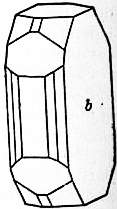
Crystal of Columbite.
COLUMBITE, a rare mineral consisting of iron niobate, FeNb2O6, in which the iron and niobium are replaced by varying amounts of manganese and tantalum respectively, the general formula being (Fe, Mn) (Nb, Ta)2O6. It was in this mineral that Charles Hatchett discovered, in 1801, the element niobium, which he himself called columbium after the country (Columbia or America) whence came the specimen in the British Museum collection which he examined. The species has also been called niobite. It crystallizes in the orthorhombic system, and the black, opaque crystals are often very brilliant with a sub-metallic lustre. Twinned crystals are not uncommon, and there is a distinct cleavage parallel to the face marked b in the figure. Hardness 6; specific gravity 5.3. With increasing amount of tantalum the specific gravity increases up to 7.3, and members at this end of the series are known as tantalite (FeTa2O6). Specimens in which the iron is largely replaced by manganese are known as manganocolumbite or manganotantalite, according as they contain more niobium or more tantalum. Columbite occurs as crystals and compact masses in granite and pegmatite at Rabenstein in Lower Bavaria, the Ilmen Mountains in the Urals, Haddam in Connecticut, and several other localities in the United States; also in the cryolite of Greenland. Tantalite is from Finland, and it has recently been found in some abundance in the deposits of cassiterite in the tin-field of Greenbushes in the Blackwood district, Western Australia.
Dimorphous with columbite and tantalite are the tetragonal minerals tapiolite (= skogbölite) and mossite, so that the four form an isodimorphous group with the general formula (Fe, Mn) (Nb, Ta)2O6. Mossite is from a pegmatite vein near Moss in Norway, and tapiolite is from Finland. All these minerals contain tin in small amount.
(L. J. S.)
COLUMBIUM, or Niobium (symbol Cb or Nb, atomic weight 94), one of the metallic elements of the nitrogen group, first detected in 1801 by C. Hatchett in a specimen of columbite (niobite) from Massachusetts (Phil. Trans. 1802, 49). It is usually found associated with tantalum, the chief minerals containing these two elements being tantalite, columbite, fergusonite and yttrotantalite; it is also a constituent of pyrochlor, euxenite and samarskite. Columbium compounds are usually prepared by fusing columbite with an excess of acid potassium sulphate, boiling out the fused mass with much water, and removing tin and tungsten from the residue by digestion with ammonium sulphide, any iron present being simultaneously converted into ferrous sulphide. The residue is washed, extracted by dilute hydrochloric acid, and again well washed with boiling water. It is then dissolved in hydrofluoric acid and heated in order to expel silicon fluoride; finally the columbium, tantalum and titanium fluorides are separated by the different solubilities of their double fluorides (C. Marignac, Ann. chim. et phys. 1866 [4], 8, p. 63; 1868, 13, p. 28; see also W. Gibbs, Jahresb. 1864, p. 685; R. D. Hall and E. F. Smith, Proc. Amer. Philos. Soc. 1905, 44, p. 177).
The metal was first obtained by C. W. Blomstrand (Journ. prak. Chem. 1866, 97, p. 37) by reducing the chloride with hydrogen; it has more recently been prepared by H. Moissan by reducing the oxide with carbon in the electric furnace (the product obtained always contains from 2-3% of combined carbon), and by H. Goldschmidt and C. Vautin (Journ. Soc. Chem. Industry, 1898, 19, p. 543) by reducing the oxide with aluminium powder. As obtained by the reduction of the chloride, it is a steel grey powder of specific gravity 7.06. It burns on heating in air; and is scarcely attacked by hydrochloric or nitric acids, or by aqua regia; it is soluble in warm concentrated sulphuric acid.
Columbium hydride, CbH, is obtained as a greyish metallic powder, when the double fluoride, CbF5, 2KF, is reduced with sodium. It burns when heated in air, and is soluble in warm concentrated sulphuric acid. Three oxides of columbium are certainly known, namely the dioxide, Cb2O2, the tetroxide, Cb2O4, and the pentoxide, Cb2O5, whilst a fourth oxide, columbium trioxide, Cb2O3, has been described by E. F. Smith and P. Maas (Zeit. f. anorg. Chem. 1894, 7, p. 97). Columbium dioxide, Cb2O2, is formed when dry potassium columbium oxyfluoride is reduced by sodium (H. Rose, Pogg. Ann. 1858, 104, p. 312). It burns readily in air, and is converted into the pentoxide when fused with acid potassium sulphate. Columbium tetroxide, Cb2O4 is obtained as a black powder when the pentoxide is heated to a high temperature in a current of hydrogen. It is unattacked by acids. Columbium pentoxide (columbic acid), Cb2O5, is obtained from columbite, after the removal of tantalum (see above). The mother liquors are concentrated, and the double salt of composition 2KF·CbOF3·H2O, which separates, is decomposed by sulphuric acid, or by continued boiling with water (C. Marignac; see also G. Krüss and L. F. Nilson, Ber. 1887, 20, p. 1676). It is a white amorphous infusible powder, which when strongly heated in sulphuretted hydrogen, yields an oxysulphide. Several hydrated forms are known, yielding salts known as columbates. A percolumbic acid, HCbO4·nH2O, has been prepared by P. Melikoff and L. Pissarjewsky (Zeit. f. anorg. Chem. 1899, 20, p. 341), as a yellow amorphous powder by the action of dilute sulphuric acid on the potassium salt, which is formed when columbic acid is fused in a silver crucible with eight times its weight of caustic potash (loc. cit.). Salts of the acid H3CbO8 have been described by C. W. Balke and E. F. Smith (Jour. Amer. Chem. Soc. 1908, 30, p. 1637).
Columbium trichloride, CbCl3, is obtained in needles or crystalline crusts, when the vapour of the pentachloride is slowly passed through a red-hot tube. When heated in a current of carbon dioxide it forms the oxychloride CbOCl3, and carbon monoxide. Columbium pentachloride, CbCl5, is obtained in yellow needles when a mixture of the pentoxide and sugar charcoal is heated in a current of air-free chlorine. It melts at 194° C. (H. Deville) and boils at 240.5° C. It is decomposed by water, and dissolves in hydrochloric acid. Columbium oxychloride, CbOCl3, is formed when carbon tetrachloride, and columbic acid are heated together at 440° C.: 3CCl4 + Cb2O5 = 2CbOCl3 + 3COCl2, and also by distilling the pentachloride, in a current of carbon dioxide, over ignited columbic acid. It forms a white silky mass which volatilizes at about 400° C. It deliquesces in moist air, and is decomposed violently by water. Columbium pentafluoride, CbF5, is obtained when the pentoxide is dissolved in hydrofluoric acid. It is only known in solution; evaporation of the solution yields the pentoxide. The oxyfluoride, CbOF3, results when a mixture of the pentoxide and fluorspar is heated in a current of hydrochloric acid. It forms many double salts with other metallic fluorides.
Columbium oxysulphide, CbOS3, is obtained as a dark bronze coloured powder when the pentoxide is heated to a white heat in a current of carbon bisulphide vapour; or by gently heating the oxychloride in a current of sulphuretted hydrogen. It burns when heated in air, forming the pentoxide and sulphur dioxide.
Columbium nitride, Cb3N5 (?), is formed when dry ammonia gas is passed into an ethereal solution of the chloride. A heavy white precipitate, consisting of ammonium chloride and columbium nitride, is thrown down, and the ammonium chloride is removed by washing it out with hot water, when the columbium nitride remains as an amorphous residue (Hall and Smith, loc. cit.).
Potassium fluoxy percolumbate, K2CbO2F5·H2O, is prepared by dissolving potassium columbium oxyfluoride in a 3% solution of hydrogen peroxide. The solution turns yellow in colour, and, when saturated, deposits a pasty mass of crystals. The salt separates from solutions containing hydrofluoric acid in large plates, which are greenish yellow in colour.
The atomic weight was determined by C. Marignac (Ann. chim. et phys. 1866 (4), 8, p. 16) to be 94 from the analysis of potassium columbium oxyfluoride, and the same value has been obtained by T. W. Richards (Journ. Amer. Chem. Soc. 1898, 20, p. 543).
COLUMBUS, CHRISTOPHER [in Spanish Cristobal Colón] (c. 1446, or perhaps rather 1451,-1506) was the eldest son of Domenico Colombo and Suzanna Fontanarossa, and was born at Genoa either about 1446 or in 1451, the exact date being uncertain. His father was a wool-comber, of some small means, who lived till 1498. According to the life of Columbus by his son Ferdinand (a statement supported by Las Casas), young Christopher was sent to the university of Pavia, where he devoted himself to astronomy, geometry and cosmography. Yet, according to the admiral’s own statement, he became a sailor at fourteen. Evidently this statement, however, cannot mean the abandonment of all other employment, for in 1470, 1472, and 1473 we find him engaged in trade at Genoa, following the family business of weaving, and (in 1473) residing at the neighbouring Savona. In 1474-1475 he appears to have visited Chios, where he may have resided some time, returning to Genoa perhaps early in 1476. Thence he seems to have again set out on a voyage in the summer of 1476, perhaps bound for England; on the 13th of August 1476, the four Genoese vessels he accompanied were attacked off Cape St Vincent by a privateer, one Guillaume de Casenove, surnamed Coullon or Colombo (“Columbus”); two of the four ships escaped, with Christopher, to Lisbon. In December 1476, the latter resumed their voyage to England, probably carrying with them Columbus, who, after a short stay in England, claims to have made a voyage in the northern seas, and even to have visited Iceland about February 1477. This last pretension is gravely disputed, but it is perhaps not to be rejected, and we may also trace the Genoese about this time at Bristol, at Galway, and probably among the islands west and north of Scotland. Soon after this he returned to Portugal, where (probably in 1478) he married a lady of some rank, Felipa Moñiz de Perestrello, daughter of Bartholomew Perestrello, a captain in the service of Prince Henry the Navigator, and one of the early colonists and first governor of Porto Santo. Felipa was also a cousin of the archbishop of Lisbon at this time (1478).
About 1479 Columbus visited Porto Santo, here as in Portugal probably employing his time in making maps and charts for a livelihood, while he pored over the logs and papers of his deceased father-in-law, and talked with old seamen of their voyages, and of the mystery of the western seas. About this time, too, if not earlier, he seems to have arrived at the conclusion that much of the world remained undiscovered, and step by step conceived that design of reaching Asia by sailing west which was to result Idea of western passage to Asia. in the discovery of America. In 1474 he is said to have corresponded with Paolo Toscanelli, the Florentine physician and cosmographer, and to have received from him valuable suggestions, both by map and letter, for such a Western enterprise. (The whole of this incident has been disputed by some recent critics.) He had perhaps already begun his studies in a number of works, especially the Book of Marco Polo and the Imago Mundi of Pierre d’Ailly, by which his cosmographical and geographical conceptions were largely moulded. His views, as finally developed and presented to the courts of Portugal and Spain, were supported by three principal lines of argument, derived from natural reasons, from the theories of geographers, and from the reports and traditions of mariners. He believed the world to be a sphere; he underestimated its size; he overestimated the size of the Asiatic continent. And the farther that continent extended towards the east, the nearer it came towards Spain. Nor were these theories the only supports of his idea. Martin Vicente, a Portuguese pilot, was said to have found, 400 leagues to the westward of Cape St Vincent, and after a westerly gale of many days’ duration, a piece of strange wood, wrought, but not with iron; Pedro Correa, Columbus’s own brother-in-law, was said to have seen another such waif at Porto Santo, with great canes capable of holding four quarts of wine between joint and joint, and to have heard of two men being washed up at Flores “very broad-faced, and differing in aspect from Christians.” West of Europe, now and then, men fancied there hove in sight the mysterious islands of St Brandan, of Brazil, of Antillia or of the Seven Cities. In his northern journey, too, some vague and formless traditions may have reached the explorer’s ear of the voyages of Leif Ericson and Thorfinn Karlsefne, and of the coasts of Markland and Vinland. All were hints and rumours to bid the bold mariner sail towards the setting sun, and this he at length determined to do.
The concurrence of some state or sovereign, however, was necessary for the success of this design. Columbus, on the accession of John II. of Portugal, seems to have entered the service of this country, to have accompanied Quest of a patron. Diego d’Azambuja to the Gold Coast, and to have taken part in the construction of the famous fort of St George at El Mina (1481-1482). On his return from this expedition, he submitted to King John the scheme he had now matured for reaching Asia by a western route across the ocean. The king was deeply interested in the rival scheme (of an eastern or south-eastern route round Africa to India) which had so long held the field, which had been initiated by the Genoese in 1291, and which had been revived, for Portugal, by Prince Henry the Navigator; but he listened to the Genoese, and referred him to a committee of council for geographical affairs. The council’s report was adverse; but the king, who was yet inclined to favour the theory of Columbus, assented to the suggestion of the bishop of Ceuta that the plan should be carried out in secret and without its author’s knowledge. A caravel was despatched; but it returned after a brief absence, the sailors having lost heart, and refused to venture farther. Upon discovering this treachery, Columbus left Lisbon for Spain (1484), taking with him his son Diego, the only issue of his marriage with Felipa Moñiz, who was by this time dead. He departed secretly;—according to some writers, to give the slip to King John; according to others, to escape his creditors.
Columbus next betook himself to the south of Spain, and while meditating an appeal to the king of France, opened his plans to the count (from 1491, duke) of Medina Celi. The latter gave him great encouragement, entertained him for two years, and even determined to furnish him with three or four caravels, to carry out his great design. Finally, however, being deterred by the consideration that the enterprise was too vast for a subject, he turned his guest from the determination he had come to of making application at the court of France, by writing on his behalf to Queen Isabella; and Columbus repaired to the court at Cordova at her bidding (1486).
It was an ill moment for the navigator’s fortune. Castile and Leon were in the thick of that struggle which resulted in the final conquest of the Granada Moors; and neither Ferdinand nor Isabella had time as yet to give due consideration to Columbus’ proposals. The adventurer was indeed kindly received; he was handed over to the care of Alonso de Quintanilla, whom he speedily converted into an enthusiastic supporter of his theory. He made many other friends, and among them Beatriz Enriquez, the mother of his second son Fernando. But the committee, presided over by the queen’s confessor, Fray Hernando de Talavera, which had been appointed to consider the new project, reported that it was vain and impracticable.
From Cordova Columbus followed the court to Salamanca, having already been introduced by Quintanilla to the notice of the grand cardinal, Pedro Gonzalez de Mendoza, “the third king of Spain”; the latter had befriended and supported the Genoese, and apparently arranged the first interview between him and Queen Isabella. At Salamanca prolonged discussions took place upon the questions now raised; the Dominicans of San Esteban entertained Columbus during the conferences (1486-1487). In 1487 Columbus, who had been following the court from place to place (billeted in towns as an officer of the sovereigns, and gratified from time to time with sums of money towards his expenses), was present at the siege of Malaga. In 1488 he was invited by the king of Portugal, his “especial friend,” to return to that country, and was assured of protection against arrest or proceedings of any kind (March 20): he had probably made fresh overtures to King John shortly before; and in the autumn of 1488 we find him in Lisbon, conferring with his brother Bartholomew and laying plans for the future. We have no record of the final negotiations of Columbus with the Portuguese government, but they clearly did not issue in anything definite, for Christopher now returned to Spain (though not till he had witnessed the return of Bartholomew Diaz from the discovery of the Cape of Good Hope and his reception by King John), while Bartholomew proceeded to England with a mission to interest King Henry VII. in the Columbian schemes. If the London enterprise was unsuccessful (as indeed it proved), it was settled that Bartholomew should carry the same invitation to the French court. He did so; and here he remained till summoned to Spain in 1493. Meantime Christopher, unable throughout 1490 to get a hearing at the Spanish court, was in 1491 again referred to a junta, presided over by Cardinal Mendoza; but this junta, to Columbus’ dismay, once more rejected his proposals; the Spanish sovereigns merely promised him that when the Granada war was over, they would reconsider what he had laid before them.
Columbus was now in despair. He at once betook himself to Huelva, a little maritime town in Andalusia, north-west of Cadiz, with the intention of taking ship for France. He halted, however, at the monastery of La Rabida, near Huelva, and still nearer Palos, where he seems to have made lasting friendships on his first arrival in Spain in January 1485, where he especially enlisted the support of Juan Perez, the guardian, who invited him to take up his quarters in the monastery, and introduced him to Garcia Fernandez, a physician and student of geography. Juan Perez had been the queen’s confessor; he now wrote to her in urgent terms, and was summoned to her presence; and money was sent to Columbus to bring him once more to court. He reached Granada in time to witness the surrender of the city (January 2, 1492), and negotiations were resumed. Columbus believed in his mission, and stood out for high terms; he asked for the rank of admiral at once (“Admiral of the Ocean” in all those islands, seas, and continents that he might discover), the vice-royalty of all he should discover, and a tenth of the precious metals discovered within his admiralty. These conditions were rejected, and the negotiations were again interrupted. An interview with Mendoza appears to have followed; but nothing came of it, and before the close of January 1492, Columbus actually set out for France. At length, however, on the entreaty of the Queen’s confidante, the Marquesa de Moya, of Luis de Santangel, receiver of the ecclesiastical revenues of the crown of Aragon, and of other courtiers, Isabella was induced to determine on the expedition. A messenger was sent after Columbus, and overtook him near a bridge called “Pinos,” 6 m. from Granada. He returned to the camp at Santa Fé; and on the 17th of April 1492, the agreement between him and their Catholic majesties was signed and sealed.
As his aims included not only the discovery of Cipangu or Japan, but also the opening up of intercourse with the grand khan of Cathay, he received a royal letter of introduction to the latter. The town of Palos was ordered to find him two ships, and these were soon placed at his disposal. But no crews could be got together, in spite of the indemnity offered to criminals and “broken men” who would serve on the expedition; and had not Juan Perez succeeded in interesting in the cause the Palos “magnates” Martin Alonso Pinzon and Vicente Yañez Pinzon, Columbus’ departure had been long delayed. At last, however, men, ships and stores were ready. The expedition consisted of the “Santa Maria,” a decked ship of 100 tons with a crew of 52 men, commanded by the admiral in person; and of two caravels; the “Pinta” of 50 tons, with 18 men, under Martin Pinzon; and the “Nina,” of 40 tons, with 18 men, under his brother Vicente Yañez, afterwards (1499) the first to cross the line in the American Atlantic.
The adventurers numbered 88-souls; and on Friday, the 3rd of August 1492, at eight in the morning, the little fleet weighed anchor, and stood for the Canary Islands. An abstract of the admiral’s diary made by Las Casas is yet First voyage. extant; and from it many particulars may be gleaned concerning this first voyage. Three days after the ships had set sail the “Pinta” lost her rudder; the admiral was in some alarm, but comforted himself with the reflection that Martin Pinzon was energetic and ready-witted; they had, however, to put in at Teneriffe, to refit the caravel. On the 6th of September they weighed anchor once more with all haste, Columbus having been informed that three Portuguese caravels were on the look-out to intercept him. On the 13th of September the westerly variations of the magnetic needle were for the first time observed; on the 15th a meteor fell into the sea at four or five leagues distance; soon after they arrived at those vast plains of seaweed called the Sargasso Sea; while all the time, writes the admiral, they had most temperate breezes, the sweetness of the mornings being especially delightful, the weather like an Andalusian April, and only the song of the nightingale wanting. On the 17th the men began to murmur; they were frightened by the strange phenomena of the variation of the compass, but the explanation Columbus gave restored their tranquillity. On the 18th they saw many birds, and a great ridge of low-lying cloud; and they expected to see land. On the 20th they saw boobies and other birds, and were sure the land must be near. In this, however, they were disappointed; and thenceforth Columbus, who was keeping all the while a double reckoning, one for the crew and one for himself, had great difficulty in restraining the evil-disposed from the excesses they meditated. On the 25th Martin Alonso Pinzon raised the cry of land, but it proved false, as did the rumour to the same effect on the 7th of October, from the “Niña.” But on the 11th the “Pinta” fished up a cane, a pole, a stick which appeared to have been wrought with iron, and a board, while the “Niña” sighted a branch covered with berries; “and with these signs all of them breathed and were glad.” At ten o’clock on that America discovered. night Columbus himself perceived and pointed out a light ahead, and at two in the morning of Friday, the 12th of October 1492, Rodrigo de Triana, a sailor aboard the “Niña,” announced the appearance of what proved to be the New World. The land sighted was an island, called by the Indians Guanahani, and named by Columbus San Salvador. It is generally identified with Watling Island.
The same morning Columbus landed, richly clad, and bearing the royal banner of Spain. He was accompanied by the brothers Pinzon, bearing banners of the Green Cross (a device of the admiral’s), and by great part of the crew. When they all had “given thanks to God, kneeling upon the shore, and kissed the ground with tears of joy, for the great mercy received,” the admiral named the island, and took solemn possession of it for their Catholic majesties of Castile and Leon. At the same time such of the crews as had shown themselves doubtful and mutinous sought his pardon weeping, and prostrated themselves at his feet.
Into the remaining detail of this voyage, of highest interest as it is, it is impossible to go further. It will be enough to say that it resulted in the discovery of the islands of Santa Maria de la Concepcion (Rum Cay), Fernandina (Long Island), Isabella (Crooked Island), Cuba or Juana (named by Columbus in honour of the young prince of Spain), and Hispaniola, Haiti, or San Domingo. Off the last of these the “Santa Maria” went aground, owing to the carelessness of the steersman. No lives were lost, but the ship had to be unloaded and abandoned; and Columbus, who was anxious to return to Europe with the news of his achievement, resolved to plant a colony on the island, to build a fort out of the material of the stranded hulk, and to leave the crew. The fort was called La Navidad; 44 Europeans were placed in charge. On the 4th of January 1493 Columbus, who had lost sight of Martin Pinzon, set sail alone in the “Niña” for the east; and two days afterwards the “Pinta” joined her sister-ship. A storm, however, separated the vessels, and it was not until the 18th of February that Columbus reached the island of Santa Maria in the Azores. Here he was threatened with capture by the Portuguese governor, who could not for some time be brought to recognize his commission. On the 24th of February, however, he was allowed to proceed, and on the 4th of March the “Niña” dropped anchor off Lisbon. The king of Portugal received the admiral with the highest honours. On the 13th of March the “Niña” put out from the Tagus, and two days afterwards, Friday, the 15th of March, she reached Palos.
The court was at Barcelona; and thither, after despatching a letter announcing his arrival, Columbus proceeded in person. He entered the city in a sort of triumphal procession, was received by their majesties in full court, and, seated in their presence, related the story of his wanderings, exhibiting the “rich and strange” spoils of the new-found lands,—the gold, the cotton, the parrots, the curious arms, the mysterious plants, the unknown birds and beasts, and the Indians he had brought with him for baptism. All his honours and privileges were confirmed to him; the title of Don was conferred on himself and his brothers; he rode at the king’s bridle; he was served and saluted as a grandee of Spain. A new and magnificent scutcheon was also blazoned for him (4th May 1493), whereon the royal castle and lion of Castile and Leon were combined with the five anchors of his own coat of arms. Nor were their Catholic highnesses less busy on their own account than on that of their servant. On the 3rd and 4th of May Alexander VI. granted bulls confirming to the crowns of Castile and Leon all the lands discovered, or to be discovered, west of a line of demarcation drawn 100 leagues west of the Azores, on the same terms as those on which the Portuguese held their colonies along the African coast. A new expedition was got in readiness with all possible despatch, to secure and extend the discoveries already made.
After several delays the fleet weighed anchor on the 24th of September 1493 and steered westwards. It consisted of three great carracks (galleons) and fourteen caravels (light frigates), having on board over 1500 men, besides the Second voyage. animals and materials necessary for colonization. Twelve missionaries accompanied the expedition, under the orders of Bernardo Buil or Boil, a Benedictine; Columbus had been already directed (29th May 1493) to endeavour by all means in his power to Christianize the inhabitants of the islands, to make them presents, and to “honour them much”, while all under him were commanded to treat them “well and lovingly,” under pain of severe punishment. On the 13th of October the ships, which had put in at the Canaries, left Ferro; and on Sunday, the 3rd of November, after a single storm, “by the goodness of God and the wise management of the admiral” an island was sighted to the west, which was named Dominica. Northwards from this the isles of Marigalante and Guadalupe were next discovered and named; while on the north-western course to La Navidad those of Montserrat, Antigua, San Martin, Santa Cruz and the Virgin Islands were sighted, and the island now called Porto Rico was touched at, hurriedly explored, and named San Juan Bautista. On the 22nd of November Columbus came in sight of Hispaniola, and sailing westward to La Navidad, found the fort burned and the colony dispersed. He decided on building a second fort, and coasting on 30 m. east of Monte Cristi, he pitched on a spot where he founded the city of Isabella.
The climate proved unhealthy; the colonists were greedy of gold, impatient of control, proud, ignorant and mutinous; and Columbus, whose inclination drew him westward, was doubtless glad to escape the worry and anxiety of his post, and to avail himself of the instructions of his sovereigns as to further discoveries. On the 2nd of February 1494 he sent home, by Antonio de Torres, that despatch to their Catholic highnesses by which he may be said to have founded the West Indian slave trade. He established the mining camp of San Tomaso in the gold country of Central Hispaniola; and on the 24th of April 1494, having nominated a council of regency under his brother Diego, and appointed Pedro Margarit his captain-general, he again put to sea. After following the southern shore of Cuba for some days, he steered southwards, and discovered (May 14th) the island of Jamaica, which he named Santiago. He then resumed his exploration of the Cuban coast, threaded his way through a labyrinth of islets which he named the Garden of the Queen (Jardin de la Reyna), and, after coasting westwards for many days, became convinced that he had discovered continental land. He therefore caused Perez de Luna, the notary, to draw up a document to this effect (12th of June 1494), which was afterwards taken round and signed (the admiral’s steward witnessing) by the officers, men and boys of his three caravels, the “Niña,” the “Cordera,” and the “San Juan.” He then stood to the south-east, and sighted the island of Evangelista (now Isla de los Pinos), revisited Jamaica, coasted the south of Hispaniola, and on the 24th of September touched at and named the island of La Mona, in the channel between Hispaniola and Porto Rico. Thence he had intended to sail eastwards and complete the survey of the Caribbean Archipelago; but he was exhausted by the terrible tear and wear of mind and body he had undergone (he says himself that on this expedition he was three-and-thirty days almost without sleep), and on the day following his departure from La Mona he fell into a lethargy, that deprived him of sense and memory, and had well-nigh proved fatal to life. At last, on the 29th of September, the little fleet dropped anchor off Isabella, and in his new city the admiral lay sick for five months.
The colony was in a sad plight. Every one was discontented, and many were sick, for the climate was unhealthy and there was nothing to eat. Margarit and Boil had deserted the settlement and fled to Spain, but ere his departure the former, in his capacity of captain-general, had done much to outrage and alienate the Indians. The strongest measures were necessary to undo this mischief, and, backed by his brother Bartholomew, Columbus proceeded to reduce the natives under Spanish sway. Alonso de Ojeda succeeded by a brilliant coup de main in capturing the cacique Caonabo, and the rest submitted. Five ship-loads of Indians were sent off to Seville (24th June 1495) to be sold as slaves; and a tribute was imposed upon their fellows, which must be looked upon as the origin of that system of repartimientos or encomiendas which was afterwards to work such mischief among the conquered. In October 1495 Juan Aguado arrived at Isabella, with a royal commission to report on the state of the colony; here he took up the position of a judge of Columbus’s government; and much recrimination followed. Columbus decided to return home; he appointed his brother Bartholomew adelantado of the island; and on the 10th of March 1496 he quitted Hispaniola in the “Niña.” The vessel, after a protracted and perilous voyage, reached Cadiz on the 11th of June 1496, where the admiral landed, wearing the habit of a Franciscan. He was cordially received by his sovereigns, and a new fleet of eight vessels was put at his disposal. By royal patent, moreover, a tract of land in Hispaniola, of 50 leagues by 20, was offered to him, with the title of duke or marquis (which he declined); for three years he was to receive an eighth of the gross and a tenth of the net profits on each voyage; the right of creating a mayorazgo or perpetual entail of titles and estates was granted him; and his two sons were received into Isabella’s service as pages.
Meanwhile, however, the preparing of the fleet proceeded slowly, and it was not till the 30th of May 1498 that he set sail with his main fleet of six ships—two caravels had already been sent on ahead. From San Lucar he Third voyage. steered for Porto Santo, Madeira, and Gomera, despatching three vessels direct from the Canaries to Hispaniola. He next proceeded to the Cape Verde Islands, which he quitted on the 5th of July. On the 31st of the same month, being greatly in need of water, and fearing that no land lay westwards as he had hoped, Columbus had turned his ship’s head north, when Alonzo Perez of Huelva saw land about 15 leagues to the south-west. It was crowned with three hill-tops, from which circumstance, and in fulfilment of a vow made at starting (to name the first land discovered on this voyage in honour of the Trinity), the admiral named it Trinidad, which name it yet bears. On Wednesday, the 1st of August, he beheld for the first time the mainland of South America, the continent he had sought so long. It seemed to him but an insignificant island, and he called it Isla Santa. Sailing westwards, next day he saw the Gulf of Paria (named by him the Golfo de la Ballena), into which he was borne at immense risk on the ridge of waters formed by the meeting of the sea and the Orinoco estuaries. For several days he coasted the continent, esteeming as islands the various projections he saw, and naming them accordingly, nor was it until he had realized the volume poured out by the Orinoco that he began to perceive the truly continental character of his last discovery. He was now anxious to revisit the colony in Hispaniola; and after sighting Tobago, Grenada, and Margarita, made for San Domingo, the new capital of the settlement, where he arrived on the 31st of August. He found that affairs had not prospered well in his absence. By the vigour and activity of the adelantado, the whole island had been reduced under Spanish sway; but under the leadership of Francisco Roldan the malcontent settlers had risen in revolt, and Columbus had to compromise matters in order to restore peace. Roldan retained his office of chief justice; and such of his followers as chose to remain in the island were gratified with repartimientos of land and labour.
At home, however, court favour had turned against Columbus. For one thing, the ex-colonists were often bitterly hostile to the admiral and his brothers. They were wont to parade their grievances in the very court-yards of the Alhambra, to surround the king when he came forth with complaints and reclamations, to insult the discoverer’s young sons with shouts and jeers. Again, the queen began to criticize severely the shipment of Indians from the new-found lands to Spain. And once more, there was no doubt that the colony itself, whatever the cause, had not prospered so well as might have been desired. Ferdinand’s support of Columbus had never been very hearty, and his inclination to supersede the Genoese now prevailed over the queen’s friendliness. Accordingly, on the 21st of May 1499, Francisco Bobadilla was appointed governor and judge of Hispaniola during royal pleasure, with authority to examine into all complaints. Columbus was ordered to deliver up his charge to Bobadilla, and to accept whatever the latter should deliver him from the sovereigns. Bobadilla left Spain in June 1500, and landed in Hispaniola on the 23rd of August.
Columbus, meanwhile, had restored such tranquillity as was possible in his government. With Roldan’s help he had beaten off an attempt on the island of the adventurer Ojeda, his old lieutenant; the Indians were being collected into villages and Christianized. Gold-mining was profitably pursued; in three years, he calculated, the royal revenues might be raised to an average of 60,000,000 reals. The arrival of Bobadilla, however, speedily changed this state of affairs. On landing, he took possession of the admiral’s house and summoned him and his brothers before him. Accusations of severity, of injustice, of venality even, were poured down on their heads, and Columbus anticipated nothing less than a shameful death. Bobadilla put all three in irons, and shipped them off to Spain.
Alonso Vallejo, captain of the caravel in which the illustrious prisoners sailed, still retained a proper sense of the honour and respect due to Columbus, and would have removed the fetters; but to this Columbus would not consent. He would wear them, he said, until their highnesses, by whose order they had been affixed, should order their removal; and he would keep them afterwards “as relics and as memorials of the reward of his service.” He did so. His son Fernando “saw them always hanging in his cabinet, and he requested that when he died they might be buried with him.” Whether this last wish was complied with is not known.
A heart-broken and indignant letter from Columbus to Doña Juana de Torres, formerly nurse of the infante Don Juan, arrived at court before the despatch of Bobadilla. It was read to the queen, and its tidings were confirmed by communications from Alonso Vallejo and the alcaide of Cadiz. There was a great movement of indignation; the tide of popular and royal feeling turned once more in the admiral’s favour. He received a large sum to defray his expenses; and when he appeared at court, on the 17th of December 1500, he was no longer in irons and disgrace, but richly apparelled and surrounded with friends. He was received with all honour and distinction. The queen is said to have been moved to tears by the narration of his story. Their majesties not only repudiated Bobadilla’s proceedings, but declined to inquire into the charges that he at the same time brought against his prisoners, and promised Columbus compensation for his losses and satisfaction for his wrongs. A new governor, Nicolas de Ovando, was appointed, and left San Lucar on the 13th of February 1502, with a fleet of thirty ships, to supersede Bobadilla. The latter was to be impeached and sent home; the admiral’s property was to be restored; and a fresh start was to be made in the conduct of colonial affairs. Thus ended Columbus’s history as viceroy and governor of the new Indies which he had presented to the country of his adoption.
His hour of rest, however, was not yet come. Ever anxious to serve their Catholic highnesses, “and particularly the queen,” he had determined to find a strait through which he might penetrate westwards into Portuguese Asia. Fourth voyage. After the usual inevitable delays his prayers were granted, and on the 9th of May 1502, with four caravels and 150 men, he weighed anchor from Cadiz, and sailed on his fourth and last great voyage. He first betook himself to the relief of the Portuguese fort of Arzilla, which had been besieged by the Moors, but the siege had been raised before he arrived. He put to sea westwards once more, and on the 15th of June discovered the island of Martinino (probably St Lucia). He had received positive instructions from his sovereigns on no account to touch at Hispaniola; but his largest caravel was greatly in need of repairs, and he had no choice but to abandon her or disobey orders. He preferred the latter alternative, and sent a boat ashore to Ovando, asking for a new ship and for permission to enter the harbour to weather a hurricane which he saw was coming on. But his requests were refused, and he coasted the island, casting anchor under lee of the land. Here he weathered the storm, which drove the other caravels out to sea, and annihilated the homeward-bound fleet, the richest that had till then been sent from Hispaniola. Roldan and Bobadilla perished with others of the admiral’s enemies; and Fernando Columbus, who accompanied his father on this voyage, wrote long afterwards, “I am satisfied it was the hand of God, for had they arrived in Spain they had never been punished as their crimes deserved, but rather been favoured and preferred.”
After recruiting his flotilla at Azua, Columbus put in at Jaquimo and refitted his four vessels; and on the 14th of July 1502 he steered for Jamaica. For several days the ships wandered painfully among the keys and shoals he had named the Garden of the Queen, and only an opportune easterly wind prevented the crews from open mutiny. The first land sighted (July 30th) was the islet of Guanaja, about 40 m. east of the coast of Honduras. Here he got news from an old Indian of a rich and vast country lying to the eastward, which he at once concluded must be the long-sought-for empire of the grand khan. Steering along the coast of Honduras, great hardships were endured, but nothing approaching his ideal was discovered. On the 12th of September Cape Gracias-a-Dios was rounded. The men had become clamorous and insubordinate; not until the 5th of December, however, would he tack about and retrace his course. It now became his intention to plant a colony on the river Veragua, which was afterwards to give his descendants a title of nobility; but he had hardly put about when he was caught in a storm, which lasted eight days, wrenched and strained his crazy, worm-eaten ships severely, and finally, on Epiphany Sunday 1503, blew him into an embouchure which he named Belem or Bethlehem. Gold was very plentiful in this place, and here he determined to found his settlement. By the end of March 1503 a number of huts had been run up, and in these the adelantado (Bartholomew Columbus), with 80 men, was to remain, while Christopher returned to Spain for men and supplies. Quarrels, however, arose with the natives; the cacique was made prisoner, but escaped again; and before Columbus could leave the coast he had to abandon a caravel, to take the settlers on board, and to relinquish the enterprise of colonization. Steering eastwards, he left a second caravel at Puerto Bello; he thence bore northwards for Cuba, where he obtained supplies from the natives. From Cuba he bore up for Jamaica, and there, in the harbour of San Gloria, now St Ann’s Bay, he ran his ships aground in a small inlet still called Don Christopher’s Cove (June 23rd, 1503).
The expedition was received with great kindness by the natives, and here Columbus remained upwards of a year, awaiting the return of his lieutenant Diego Mendez, whom he had despatched to Ovando for assistance. During his critical sojourn here, the admiral suffered much from disease and from the lawlessness of his followers, whose misconduct had alienated the natives, and provoked them to withhold their accustomed supplies, until he dexterously worked upon their superstitions by prognosticating an eclipse. Two vessels having at last arrived for his relief, Columbus left Jamaica on the 28th of June 1504, and, after calling at Hispaniola, set sail for Spain on the 12th of September. After a tempestuous voyage he landed once more at San Lucar on the 7th of November 1504.
As he was too ill to go to court, his son Diego was sent thither in his place, to look after his interests and transact his business. Letter after letter followed the young man from Seville—one by the hands of Amerigo Vespucci. A licence to ride on muleback was granted him on the 23rd of February 1505; and in the following May he was removed to the court at Segovia, and thence again to Valladolid. On the landing of Philip and Juana at Coruña (25th of April 1506), although “much oppressed with the gout and troubled to see himself put by his rights,” he is known to have sent off the adelantado to pay them his duty and to assure them that he was yet able to do them extraordinary service. The last documentary note of him is contained in a final codicil to the will of 1498, made at Valladolid on the 19th of May 1506. By this the old will is confirmed; the mayorazgo is bequeathed to his son Diego and his heirs male, failing these to Fernando, his second son, and failing these to the heirs male of Bartholomew; only in case of the extinction of the male line, direct or collateral, is it to descend to the females of the family; and those into whose hands it may fall are never to diminish it, but always to increase and ennoble it by all means possible. The head of the house is to sign himself “The Admiral.” A tenth of the annual income is to be set aside yearly for distribution among the poor relations of the house. A chapel is founded and endowed for the saying of masses. Beatriz Enriquez is left to the care of the young admiral. Among other legacies is one of “half a mark of silver to a Jew who used to live at the gate of the Jewry, in Lisbon.” The codicil was written and signed with the admiral’s own hand. Next day (20th of May 1506) he died.
After the funeral ceremonies at Valladolid, Columbus’s remains were transferred to the Carthusian monastery of Santa Maria de las Cuevas, Seville, where the bones of his son Diego, the second admiral, were also laid. Exhumed in 1542, the bodies of both father and son were taken over sea to Hispaniola and interred in the cathedral of San Domingo. In 1795-1796, on the cession of that island to the French, the relics were re-exhumed and transferred to the cathedral of Havana, whence, after the Spanish-American War of 1898 and the loss of Cuba, they were finally removed to Seville cathedral, where they remain. The present heir and representative of Columbus belongs to the Larreategui family, descendants of the discoverer through the female line, and retains the titles of admiral and duke of Veragua.
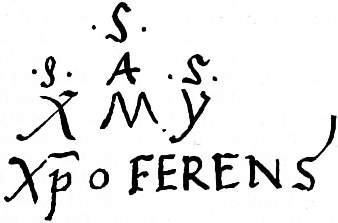
Columbus Cipher.
The interpretation of the seven-lettered cipher, accepting the smaller letters of the second line as the final ones of the words, seems to be Salve Christus, Maria, Yosephus. The name Christopher (Christoferens) appears in the last line.
In person Columbus was tall and shapely. The only authentic portrait of him is that which once belonged to Paulus Jovius, and is still in the possession of the de Orchi family (related to Jovius by female descent) at Como. It shows us a venerable man with clean-shaven face, thin grey hair, high forehead, sad thoughtful eyes. It bears the inscription Columbus Lygur. novi orbis repertor.
Authorities.—Fernando Columbus, Historie del Signor Don Fernando Colombo ... e vera relatione della vita ... dell’ Ammiraglio D. Christoforo Colombo (the Spanish original of this, written before 1539, is lost; only the Italian version remains, first published at Venice in 1571; a good edition appeared in London in 1867); Bartolomé de las Casas, Historia de las Indias, written 1527-1561, but first printed at Madrid in 1875, after remaining in manuscript more than three centuries; Andres Bernandez, Historia de los Reyes Catolicos (contemporary with Fernando Columbus’s Historie, but first printed at Granada in 1856; best edition, Seville, 1870); Gonzalo Fernandez Oviedo y Valdes, Historia general de las Indias (Seville, 1535; best edition, Madrid, 1851-1855); Peter Martyr d’Anghiera, Opus Epistolarum, first published in 1530, and De Orbe Novo (Decades), printed in 1511 and 1530; Francisco Lopez de Gomara, Historia general de las Indias (Saragossa, 1552-1553, and Antwerp, 1554); Antonio de Herrera, Historia general de las Indias occidentales (publication first completed in 1615, but best edition perhaps that of 1730, Madrid); Juan Bautista Muñoz, Historia del Nuevo Mundo (Madrid, 1793); Martin Fernandez Navarrete, Coleccion de los Viages y descubrimientos que hicieron por mar los Españoles (Madrid, 1825-1837); Washington Irving, History of the Life and Voyages of Christopher Columbus (London, 1827-1828); Alex. von Humboldt, Examen critique (Paris, 1836-1839); R. H. Major, Select Letters of Columbus (London, Hakluyt Society, 1847); Fernandez Duro, Colon y Pinzon (Madrid, 1883); Henry Harrisse, Christophe Colomb (Paris, 1884), and Christophe Colomb devant l’histoire (Paris, 1892); Justin Winsor, Christopher Columbus (Cambridge, Mass., 1891); Josè Maria Asensio, Cristoval Colon (Barcelona, 1892); Clements R. Markham, Life of Christopher Columbus (London, 1892); John Fiske, Discovery of America (Boston and New York, 1892); E. J. Payne, History of the New World called America, vol. i. (Oxford, 1892); Paul Gaffarel, Histoire de la découverte de l’Amérique (Paris, 1892); Charles I. Elton, Career of Columbus (London, 1892); Raccolta Colombiana (1892, &c.); Sophus Ruge, Columbus (Berlin, 1902); John Boyd Thatcher, Christopher Columbus (New York, 1903-1904); Henry Vignaud, La Lettre et la carte de Toscanelli (Paris, 1901), and Études critiques sur la vie de Colomb avant ses découvertes (Paris, 1905); Filson Young, Christopher Columbus and the New World of his discovery (London, 1906).