VOLUME VI SLICE VI Cockaigne to Columbus, Christopher (continued 4)
Reading edition
The retort oven, which is now generally displacing the beehive form in new installations, is made in a great variety of forms, the differences being mainly in the arrangement of the heating flues, but all have the central feature, the coking Retort oven. chamber, in common. This is a tubular chamber with vertical sides and cylindrical roof, about 30 ft. long, from 17 to 20 in. wide, and 6 or 7 ft. high, and closed at both ends by sliding doors which are raised by crab winches when the charge is to be drawn. The general arrangements of such an oven are shown in fig. 1, which represents one of the earliest and most popular forms, that of Evence Coppée of Brussels. The coking chambers A B connect by rectangular posts at the springing of the roof, where the gas given off from the top of the charge is fired by air introduced through c c. The flames pass downwards through the parallel flues f f along the bottom flue of one oven, and return in the opposite direction under the next to the chimney flue, a further part of the heat being intercepted by placing a range of steam boilers between the ovens and the chimney stack. The charging of the oven is done through the passages D D in the roof from small wagons on transverse lines of rails, the surface being raked level before the doors are closed and luted up. The time of coking is much less than in the beehive ovens and may be from 24 to 36 hours, according to the proportion of volatile matter present. When the gas is completely given off the doors are lifted and the charge is pushed out by the ram—a cast-iron plate of the shape of the cross section of the oven, at the end of a long horizontal bar, which is driven by a rack and pinion movement and pushes the block of coke out of the oven on to the wharf or bank in front where it falls to pieces and is immediately quenched by jets of water from a hose pipe. When sufficiently cooled it is loaded into railway wagons or other conveyances for removal. The ram, together with its motor, and boiler when steam is used, is mounted upon a carriage running upon a line of rails of about 2 ft. gauge along the back of the range of ovens, so that it can be brought up to any one of them in succession.
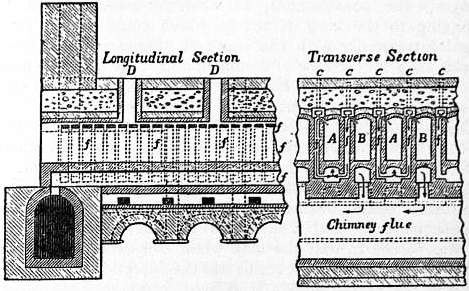
Fig. 1.—Coppée’s Coke Oven.
In some cases, instead of the small coal being charged through the roof of the oven and levelled by hand, it is formed into blocks by being stamped in a slightly moistened condition in a mould consisting of a bottom plate or peel on a racked rod like that of the ram, with movable sides and ends. This, when the ends are removed, is pushed forward into the oven, and the bottom plate is withdrawn by reversing the rack motion. The moulding box is mounted on a carriage like that of the ram, the two being sometimes carried on the same framing. The moulding is done at a fixed station in the centre of the range of ovens by a series of cast-iron stampers driven by an electric motor. This system is useful for coals low in volatile matter, which do not give a coherent coke under ordinary conditions.
In the distilling or by-product ovens the gases, instead of being burned at the point of origin, pass by an uptake pipe in the roof about the centre of the oven into a water-sealed collecting trough or hydraulic main, whence they are drawn by Condensing ovens. exhausters through a series of air and water cooled condensers and scrubbers. In the first or atmospheric condensers the tar is removed, and in the second ammoniacal water, which is further enriched by a graduated system of scrubbing with weak ammoniacal liquor until it is sufficiently concentrated to be sent to the ammonia stills. The first treatment by scrubbing with creosote or heavy tar oil removes benzene, after which the permanent gaseous residue consisting chiefly of hydrogen and marsh gas is returned to the ovens as fuel.
In the Otto-Hoffmann oven, one of the most generally used forms, vertical side flues like those of Coppée are adopted. The returned gas enters by a horizontal flue along the bottom of the coking chamber, divided into two parts by a mid-feather wall, and is fired by heated air from a Siemens regenerator on the substructure at one end, and the flame rising through one half of the side flues to a parallel collector at the top returns downwards through the flues of the other half and passes out to the chimney through a similar regenerator at the other end. The course of the gases is reversed at intervals of about an hour, as in the ordinary Siemens furnace, each end of the oven having its own gas supply. In the later modification known as the Otto-Hilgenstock, the regenerators are abandoned, but provision is made for more perfect distribution of the heat by a line of sixteen Bunsen burners in each wall; each of these serves two flues, the course of the flame being continuously upwards without reversal. In the newest Otto ovens the same system of burners is combined with regenerators. In the Bauer system, another vertical flue oven, each flue has its own burner, which is of a simplified construction.
In the Carvés oven, the earliest of the by-product ovens, the heating flues are arranged horizontally in parallel series along the entire length of the side walls, the gas being introduced from both ends but at different levels. This system was further developed by H. Simon of Manchester, who added a continuous air “recuperator” heated by the spent flame; this Simon-Carvés system has been extensively adopted in Great Britain. Another horizontal flue oven, the Semet-Solvay, is distinguished by the structure of the flues, which are independent of the dividing walls of the ovens, so that the latter can be made with thinner sides than those of the earlier systems, and are more readily repaired. In the horizontal ovens it is sometimes difficult to maintain the heat when the flues are continuous along the whole length of the wall, especially when the heating value of the gas is reduced by the removal of the heavy hydrocarbons. This difficulty is met by dividing the flues in the middle so as to shorten the length of travel of the flame, and working each end independently. The Hüssener and Koppers systems are two of the best-known examples of this modification.
Coke from retort ovens is not so dense or brilliant as that made in beehive ovens, but the waste being less there is a decided saving, apart from the value of the condensed products. In one instance the coke was found to be about 5% less efficient in the blast furnace, while the yield on the coal charged was increased 10%. In the further treatment of the condensed products by distillation the tar gives burning oil and pitch, the benzene is separated from the creosote oil by steam-heated stills, and the ammoniacal liquor, after some lime has been added to decompose fixed ammonium compounds, is heated to vaporize the ammonia, which is condensed in lead or copper-lined tanks containing strong sulphuric acid to produce a crystalline powder of ammonium sulphate, which accumulates in the receiver and is fished out from time to time. The yield of by-products averages about 1% of ammonium sulphate, about 3½% of tar, and 0.6 to 0.9% of benzene, of the weight of the coal carbonized. After the ovens have been heated and steam supplied for the machinery of the condensing plant and the coke ovens, there is usually a surplus of gas, which may be used for lighting or driving gas-engines. For the latter purpose, however, it is necessary to remove the last traces of tar, which acts very prejudicially in fouling the valves when the gas is not completely purified. The gas given off during the earlier part of the coking process is richer in heavy hydrocarbons and of a higher illuminating value than that of the later period when the temperature is higher. This property is utilized in several large coking plants in America, where the gas from the first ten hours’ working is drawn off by a second hydraulic main and sent directly to town gas-works, where it passes through the ordinary purifying treatment, the gas from the second period being alone used for heating the ovens.
Coke is essentially a partially graphitized carbon, its density being about midway between that of coal and graphite, and it should therefore occupy less space than the original coal; but owing to the softening of the charge a spongy structure is set up by the escaping gases, which acts in the other direction, so that for equal bulk coke is somewhat lighter than coal. It is this combination of properties that gives it its chief value in iron smelting, the substance being sufficiently dense to resist oxidation by carbon dioxide in the higher regions of the furnace, while the vesicular structure gives an extended surface for the action of heated air and facilitates rapid consumption at the tuyeres. Compact coke, such as that formed on the inner sides of gas retorts (retort carbon), can only be burned with great difficulty in small furnaces of special construction, but it gives out a great amount of heat.
The most deleterious constituents of coke are ash, sulphur and volatile constituents including water. As the coke yield is only from two-thirds to three-quarters of that of the coal, the original proportion of ash is augmented by one-third or one-half in the product. For this reason it is now customary to crush and wash the coal carefully to remove intermingled patches of shale and dirt before coking, so that the ash may not if possible exceed 10% in the coke. About one-half of the sulphur in the coal is eliminated in coking, so that the percentage in the coke is about the same. It should not be much above 1%. According to the researches of F. Wuest (Journ. Iron and Steel Inst., 1906) the sulphur is retained in a complex carbon compound which is not destroyed until the coke is actually consumed.
The older methods of coking and the earlier forms of retort ovens are described in J. Percy, Metallurgy, Jordan, Album du cours de metallurgie; Phillips and Bauerman, Handbook of Metallurgy, and other text-books. A systematic series of articles on the newer forms will be found in The Engineer, vol. 82, pp. 205-303 and vol. 83, pp. 207-231; see also Dürre, Die neuern Koksöfen (Leipzig, 1892); D. A. Louis, “Von Bauer and Brünck Ovens,” Journ. Iron and Steel Inst., 1904, ii. p. 293; C. L. Bell, “Hüssener Oven,” id., 1904, i. p. 188; Hurez, “A Comparison of Different Systems of Vertical and Horizontal Flue Ovens,” Bull. soc. industrie minérale, 1903, p. 777. A well-illustrated description of the Otto system in its American modification was issued by the United Gas & Coke Company of New York, in 1906.
(H. B.)
COL (Fr. for “neck,” Lat. collum), in physical geography, generally any marked depression upon a high and rugged water-parting over which passage is easy from one valley to another. Such is the Col de Balme between the Trient and Chamounix valleys, where the great inaccessible wall crowned with aiguilles running to the massif of Mt. Blanc is broken by a gentle downward curve with smooth upland slopes, over which a footpath gives easy passage. The col is usually formed by the head-waters of a stream eating backward and lowering the water-parting at the head of its valley. In early military operations, the march of an army was always over a col, which has at all times considerable commercial importance in relation to roads in high mountain regions.
COLBERT, JEAN BAPTISTE (1619-1683), French statesman, was born at Reims, where his father and grandfather were merchants. He claimed to be the descendant of a noble Scottish family, but the evidence for this is lacking. His youth is said to have been spent in a Jesuit college, in the office of a Parisian banker, and in that of a Parisian notary, Chapelain, the father of the poet. But the first fact on which we can rely with confidence is that, when not yet twenty, he obtained a post in the war-office, by means of the influence that he possessed through the marriage of one of his uncles to the sister of Michel Le Tellier, the secretary of state for war. During some years he was employed in the inspection of troops and other work of the kind, but at length his ability, his extraordinary energy and his untiring laboriousness induced Le Tellier to make him his private secretary. These qualities, combined, it must be confessed, with a readiness to seize every opportunity of advancement, soon brought Colbert both wealth and influence. In 1647 we find him receiving the confiscated goods of his uncle Pussort, in 1648 obtaining 40,000 crowns with his wife Marie Charron, in 1649 appointed councillor of state.
It was the period of the wars of the Fronde; and in 1651 the triumph of the Condé family drove Cardinal Mazarin from Paris. Colbert, now aged thirty-two, was engaged to keep him acquainted with what should happen in the capital during his absence. At first Colbert’s position was far from satisfactory; for the close wary Italian treated him merely as an ordinary agent. On one occasion, for example, he offered him 1000 crowns. The gift was refused somewhat indignantly; and by giving proof of the immense value of his services, Colbert gained all that he desired. His demands were not small; for, with an ambition mingled, as his letters show, with strong family affection, he aimed at placing all his relatives in positions of affluence and dignity; and many a rich benefice and important public office was appropriated by him to that purpose. For these favours, conferred upon him by his patron with no stinted hand, his thanks were expressed in a most remarkable manner; he published a letter defending the cardinal from the charge of ingratitude which was often brought against him, by enumerating the benefits that he and his family had received from him (April 1655). Colbert obtained, besides, the higher object of his ambition; the confidence of Mazarin, so far as it was granted to any one, became his, and he was entrusted with matters of the gravest importance. In 1659 he was giving directions as to the suppression of the revolt of the gentry which threatened in Normandy, Anjou and Poitou, with characteristic decision arresting those whom he suspected, and arranging every detail of their trial, the immediate and arbitrary destruction of their castles and woods, and the execution of their chief, Bonnesson. In the same year we have evidence that he was already planning his great attempt at financial reform. His earliest tentative was the drawing up of a mémoire to Mazarin, showing that of the taxes paid by the people not one-half reached the king. The paper also contained an attack upon the superintendent Nicholas Fouquet (q.v.), and being opened by the postmaster of Paris, who happened to be a spy of Fouquet’s, it gave rise to a bitter quarrel, which, however, Mazarin repressed during his lifetime.
In 1661 the death of Mazarin allowed Colbert to take the first place in the administration, and he made sure of the king’s favour by revealing to him some of Mazarin’s hidden wealth. It was some time before he assumed official dignities; but in January 1664 he obtained the post of superintendent of buildings; in 1665 he was made controller-general; in 1669 he became minister of the marine; and he was also appointed minister of commerce, the colonies and the king’s palace. In short, he soon acquired power in every department except that of war.
A great financial and fiscal reform at once claimed all his energies. Not only the nobility, but many others who had no legal claim to exemption, paid no taxes; the weight of the burden fell on the wretched country-folk. Colbert sternly and fearlessly set about his task. Supported by the young king, Louis XIV., he aimed the first blow at the greatest of the extortioners—the bold and powerful superintendent, Fouquet; whose fall, in addition, secured his own advancement.
The office of superintendent and many others dependent upon it being abolished the supreme control of the finances was vested in a royal council. The sovereign was its president; but Colbert, though for four years he only possessed the title of intendant, was its ruling spirit, great personal authority being conferred upon him by the king. The career on which Colbert now entered must not be judged without constant remembrance of the utter rottenness of the previous financial administration. His ruthlessness in this case, dangerous precedent as it was, was perhaps necessary; individual interests could not be respected. Guilty officials having been severely punished, the fraudulent creditors of the government remained to be dealt with. Colbert’s method was simple. Some of the public loans were totally repudiated, and from others a percentage was cut off, which varied, at first according to his own decision, and afterwards according to that of the council which he established to examine all claims against the state.
Much more serious difficulties met his attempts to introduce equality in the pressure of the taxes on the various classes. To diminish the number of the privileged was impossible, but false claims to exemption were firmly resisted, and the unjust direct taxation was lightened by an increase of the indirect taxes, from which the privileged could not escape. The mode of collection was at the same time immensely improved.
Order and economy being thus introduced into the working of the government, the country, according to Colbert’s vast yet detailed plan, was to be enriched by commerce. Manufactures were fostered in every way he could devise. New industries were established, inventors protected, workmen invited from foreign countries, French workmen absolutely prohibited to emigrate. To maintain the character of French goods in foreign markets, as well as to afford a guarantee to the home consumer, the quality and measure of each article were fixed by law, breach of the regulations being punished by public exposure of the delinquent and destruction of the goods, and, on the third offence, by the pillory. But whatever advantage resulted from this rule was more than compensated by the disadvantages it entailed. The production of qualities which would have suited many purposes of consumption was prohibited, and the odious supervision which became necessary involved great waste of time and a stereotyped regularity which resisted all improvements. And other parts of Colbert’s schemes deserve still less equivocal condemnation. By his firm maintenance of the corporation system, each industry remained in the hands of certain privileged bourgeois; in this way, too, improvement was greatly discouraged; while to the lower classes opportunities of advancement were closed. With regard to international commerce Colbert was equally unfortunate in not being in advance of his age; the tariffs he published were protective to an extreme. The interests of internal commerce were, however, wisely consulted. Unable to abolish the duties on the passage of goods from province to province, he did what he could to induce the provinces to equalize them. The roads and canals were improved. The great canal of Languedoc was planned and constructed by Pierre Paul Riquet (1604-1680) under his patronage. To encourage trade with the Levant, Senegal, Guinea and other places, privileges were granted to companies; but, like the more important East India Company, all were unsuccessful. The chief cause of this failure, as well as of the failure of the colonies, on which he bestowed so much watchful care, was the narrowness and rigidity of the government regulations.
The greatest and most lasting of Colbert’s achievements was the establishment of the French marine. The royal navy owed all to him, for the king thought only of military exploits. For its use, Colbert reconstructed the works and arsenal of Toulon, founded the port and arsenal of Rochefort, and the naval schools of Rochefort, Dieppe and Saint-Malo, and fortified, with some assistance from Vauban (who, however, belonged to the party of his rival Louvois), among other ports those of Calais, Dunkirk, Brest and Havre. To supply it with recruits he invented his famous system of classes, by which each seaman, according to the class in which he was placed, gave six months’ service every three or four or five years. For three months after his term of service he was to receive half-pay; pensions were promised; and, in short, everything was done to make the navy popular. There was one department, however, that was supplied with men on a very different principle. Letters exist written by Colbert to the judges requiring them to sentence to the oar as many criminals as possible, including all those who had been condemned to death; and the convict once chained to the bench, the expiration of his sentence was seldom allowed to bring him release. Mendicants also, against whom no crime had been proved, contraband dealers, those who had been engaged in insurrections, and others immeasurably superior to the criminal class, nay, innocent men—Turkish, Russian and negro slaves, and poor Iroquois Indians, whom the Canadians were ordered to entrap—were pressed into that terrible service. By these means the benches of the galleys were filled, and Colbert took no thought of the long unrelieved agony borne by those who filled them.
Nor was the mercantile marine forgotten. Encouragement was given to the building of ships in France by allowing a premium on those built at home, and imposing a duty on those brought from abroad; and as French workmen were forbidden to emigrate, so French seamen were forbidden to serve foreigners on pain of death.
Even ecclesiastical affairs, though with these he had no official concern, did not altogether escape Colbert’s attention. He took a subordinate part in the struggle between the king and Rome as to the royal rights over vacant bishoprics; and he seems to have sympathized with the proposal that was made to seize part of the wealth of the clergy. In his hatred of idleness, he ventured to suppress no less than seventeen fêtes, and he had a project for lessening the number of those devoted to clerical and monastic life, by fixing the age for taking the vows some years later than was then customary. With heresy he was at first unwilling to interfere, for he was aware of the commercial value of the Huguenots; but when the king resolved to make all France Roman Catholic, he followed him and urged his subordinates to do all that they could to promote conversions.
In art and literature Colbert took much interest. He possessed a remarkably fine private library, which he delighted to fill with valuable manuscripts from every part of Europe where France had placed a consul. He has the honour of having founded the Academy of Sciences (now called the Institut de France), the Observatory, which he employed Claude Perrault to build and brought G. D. Cassini (1625-1712) from Italy to superintend, the Academies of Inscriptions and Medals, of Architecture and of Music, the French Academy at Rome, and Academies at Arles, Soissons, Nîmes and many other towns, and he reorganized the Academy of Painting and Sculpture which Richelieu had established. He was a member of the French Academy; and one very characteristic rule, recorded to have been proposed by him with the intention of expediting the great Dictionary, in which he was much interested, was that no one should be accounted present at any meeting unless he arrived before the hour of commencement and remained till the hour for leaving. In 1673 he presided over the first exhibition of the works of living painters; and he enriched the Louvre with hundreds of pictures and statues. He gave many pensions to men of letters, among whom we find Molière, Corneille, Racine, Boileau, P. D. Huet (1630-1721) and Antoine Varillas (1626-1696), and even foreigners, as Huyghens, Vossius the geographer, Carlo Dati the Dellacruscan, and Heinsius the great Dutch scholar. There is evidence to show that by this munificence he hoped to draw out praises of his sovereign and himself; but this motive certainly is far from accounting for all the splendid, if in some cases specious, services that he rendered to literature, science and art.
Indeed to everything that concerned the interests of France Colbert devoted unsparing thought and toil. Besides all that has been mentioned, he found time to do something for the better administration of justice (the codification of ordinances, the diminishing of the number of judges, the reduction of the expense and length of trials for the establishment of a superior system of police) and even for the improvement of the breed of horses and the increase of cattle. As superintendent of public buildings he enriched Paris with boulevards, quays and triumphal arches; he relaid the foundation-stone of the Louvre, and brought Bernin from Rome to be its architect; and he erected its splendid colonnade upon the plan of Claude Perrault, by whom Bernin had been replaced. He was not permitted, however, to complete the work, being compelled to yield to the king’s preference for residences outside Paris, and to devote himself to Marly and Versailles.
Amid all these public labours his private fortune was never neglected. While he was reforming the finances of the nation, and organizing its navy, he always found time to direct the management of his smallest farm. He died extremely rich, and left fine estates all over France. He had been created marquis de Seignelay, and for his eldest son he obtained the reversion of the office of minister of marine; his second son became archbishop of Rouen; and a third son, the marquis d’Ormoy, became superintendent of buildings.
To carry out his reforms, Colbert needed peace; but the war department was in the hands of his great rival Louvois, whose influence gradually supplanted that of Colbert with the king. Louis decided on a policy of conquest. He was deaf also to all the appeals against the other forms of his boundless extravagance which Colbert, with all his deference towards his sovereign, bravely ventured to make.1 Thus it came about that, only a few years after he had commenced to free the country from the weight of the loans and taxes which crushed her to the dust, Colbert was forced to heap upon her a new load of loans and taxes more heavy than the last. Henceforth his life was a hopeless struggle, and the financial and fiscal reform which, with the great exception of the establishment of the navy, was the most valuable service to France contemplated by him, came to nought.
Depressed by his failure, deeply wounded by the king’s favour for Louvois, and worn out by overwork, Colbert’s strength gave way at a comparatively early age. In 1680 he was the constant victim of severe fevers, from which he recovered for a time through the use of quinine prescribed by an English physician. But in 1683, at the age of sixty-four, he was seized with a fatal illness, and on the 6th of September he expired. It was said that he died of a broken heart, and a conversation with the king is reported in which Louis disparagingly compared the buildings of Versailles, which Colbert was superintending, with the works constructed by Louvois in Flanders. He took to bed, it is true, immediately afterwards, refusing to receive all messages from the king; but his constitution was utterly broken before, and a post-mortem examination proved that he had been suffering from stone. His body was interred in the secrecy of night, for fear of outrage from the Parisians, by whom his name was cordially detested.
Colbert was a great statesman, who did much for France. Yet his insight into political science was not deeper than that of his age; nor did he possess any superiority in moral qualities. His rule was a very bad example of over-government. He did not believe in popular liberty;, the parlements and the states-general received no support from him. The technicalities of justice he never allowed to interfere with his plans; but he did not hesitate to shield his friends. He trafficked in public offices for the profit of Mazarin and in his own behalf. He caused the suffering of thousands in the galleys; he had no ear, it is said, for the cry of the suppliant. There was indeed a more human side to his character, as is shown in his letters, full of wise advice and affectionate care, to his children, his brothers, his cousins even. Yet to all outside he was “the man of marble.” Madame de Sévigné called him “the North.” To diplomacy he never pretended; persuasion and deceit were not the weapons he employed; all his work was carried out by the iron hand of authority. He was a great statesman in that he conceived a magnificent yet practicable scheme for making France first among nations, and in that he possessed a matchless faculty for work, neither shrinking from the vastest undertakings nor scorning the most trivial details.
Numerous vies and éloges of Colbert have been published; but the most thorough student of his life and administration was Pierre Clément, member of the Institute, who in 1846 published his Vie de Colbert, and in 1861 the first of the 9 vols. of the Lettres, instructions, et mémoires de Colbert. The historical introductions prefixed to each of these volumes have been published by Mme. Clément under the title of the Histoire de Colbert et de son administration (3rd ed., 1892). The best short account of Colbert as a statesman is that in Lavisse, Histoire de France (1905), which gives a thorough study of the administration. Among Colbert’s papers are Mémoires sur les affaires de finance de France (written about 1663), a fragment entitled Particularités secrètes de la vie du Roy, and other accounts of the earlier part of the reign of Louis XIV.
(J. T. S.)
COLBERT DE CROISSY, CHARLES, Marquis (1625-1696), French diplomatist, like his elder brother Jean Baptiste Colbert, began his career in the office of the minister of war Le Tellier. In 1656 he bought a counsellorship at the parlement of Metz, and in 1658 was appointed intendant of Alsace and president of the newly-created sovereign council of Alsace. In this position he had to re-organize the territory recently annexed to France. The steady support of his brother at court gained for him several diplomatic missions—to Germany and Italy (1659-1661). In 1662 he became marquis de Croissy and président à mortier of the parlement of Metz. After various intendancies, at Soissons (1665), at Amiens (1666), and at Paris (1667), he turned definitely to diplomacy. In 1668 he represented France at the conference of Aix-la-Chapelle; and in August of the same year was sent as ambassador to London, where he was to negotiate the definite treaty of alliance with Charles II. He arranged the interview at Dover between Charles and his sister Henrietta of Orleans, gained the king’s personal favour by finding a mistress for him, Louise de Kéroualle, maid of honour to Madame, and persuaded him to declare war against Holland. The negotiation of the treaty of Nijmwegen (1676-1678) still further increased his reputation as a diplomatist and Louis XIV. made him secretary of state for foreign affairs after the disgrace of Arnauld de Pomponne, brought about by his brother, 1679. He at once assumed the entire direction of French diplomacy. Foreign ambassadors were no longer received and diplomatic instructions were no longer given by other secretaries of state. It was he, not Louvois, who formed the idea of annexation during a time of peace, by means of the chambers of reunion. He had outlined this plan as early as 1658 with regard to Alsace. His policy at first was to retain the territory annexed by the chambers of reunion without declaring war, and for this purpose he signed treaties of alliance with the elector of Brandenburg (1681), and with Denmark (1683); but the troubles following upon the revocation of the edict of Nantes (1685) forced him to give up his scheme and to prepare for war with Germany (1688). The negotiations for peace had been begun again when he died, on the 28th of July 1696. His clerk, Bergeret, was his invaluable assistant.
Bibliography.—His papers, preserved in the Archives des affaires étrangères at Paris, have been partially published in the Recueil des instructions données aux ambassadeurs et ministres de France (since 1884). See especially the volumes:—Autriche (t. i.), Suède (t. ii.), Rome (t. vi.), Bavière (t. viii.), Savoie (t. xiv.), Prusse (t. xvi.). Other documents have been published in Mignet’s Négociations relatives à la succession d’Espagne, vol. iv., and in the collection of Lettres et négociations ... pour la paix de Nimègue, 1676-1677 (La Haye, 1710). In addition to the Mémoires of the time, see Spanheim, Relation de la cour de France en 1690, ed. E. Bourgeois (Paris and Lyons, 1900); Baschet, Histoire du depôt des affaires étrangères; C. Rousset, Histoire de Louvois (4 vols., Paris, 1863); E. Bourgeois, “Louvois, et Colbert de Croissy,” in the Revue historique, vol. xxxiv. (1887); A. Waddington, Le Grand Électeur et Louis XIV (Paris, 1905); G. Pagis, Le Grand Électeur et Louis XIV (Paris, 1905).
COLBURN, HENRY (d. 1855), British publisher, obtained his earliest experience of bookselling in London at the establishment of W. Earle, Albemarle Street, and afterwards as an assistant at Morgan’s Library, Conduit Street, of which in 1816 he became proprietor. He afterwards removed to New Burlington Street, where he established himself as a publisher, resigning the Conduit Street Library to Messrs Saunders & Otley. In 1814 he originated the New Monthly Magazine, of which at various times Thomas Campbell, Bulwer Lytton, Theodore Hook and Harrison Ainsworth were editors. Colburn published in 1818 Evelyn’s Diary, and in 1825 the Diary of Pepys, edited by Lord Braybrooke, paying £2200 for the copyright. He also issued Disraeli’s first novel, Vivian Grey, and a large number of other works by Theodore Hook, G. P. R. James, Marryat and Bulwer Lytton. In 1829 Richard Bentley (q.v.) was taken into partnership; and in 1832 Colburn retired, but set up again soon afterwards independently in Great Marlborough Street; his business was taken over in 1841 by Messrs Hurst & Blackett. Henry Colburn died on the 16th of August 1855, leaving property to the value of £35,000.
COLBURN, ZERAH (1804-1840), American mathematical prodigy, was born at Cabot, Vermont, on the 1st of September 1804. At a very early age he developed remarkable powers of calculating with extreme rapidity, and in 1810 his father began to exhibit him. As a performing prodigy he visited Great Britain and France. From 1816 to 1819 he studied in Westminster school, London. After the death of his father in 1824 he returned to America, and from 1825 to 1834 he was a Methodist preacher. As he grew older his extraordinary calculating powers diminished. From 1835 until his death, on the 2nd of March 1840, he was professor of languages at the Norwich University in Vermont. He published a Memoir of his life in 1833.
His nephew, also named Zerah Colburn (1832-1870), was a well-known mechanical engineer; the editor successively of the Railroad Advocate, in New York, The Engineer, in London, and Engineering, in London; and the author of a work entitled The Locomotive Engine (1851).
COLBY, THOMAS FREDERICK (1784-1852), British major-general and director of ordnance survey, was born at St Margaret’s, Rochester, on the 1st of September 1784, a member of a South Wales family. Entering the Royal Engineers he began in 1802 a life-long connexion with the Ordnance Survey department. His most important work was the survey of Ireland. This he planned in 1824, and was engaged upon it until 1846. The last sheets of this survey were almost ready for issue in that year when he reached the rank of major-general, and according to the rules of the service had to vacate his survey appointment. He was the inventor of the compensation bar, an apparatus used in base-measurements. He died at New Brighton on the 9th of October 1852.
COLCHAGUA, a province of central Chile, bounded N. by Santiago and O’Higgins, E. by Argentina, S. by Curicó, and W. by the Pacific. Its area is officially estimated at 3856 sq. m.; pop. (1895) 157,566. Extending across the great central valley of Chile, the province has a considerable area devoted to agriculture, but much attention is given to cattle and mining. Its principal river is the Rapel, sometimes considered as the southern limit of the Inca empire. Its greatest tributary is the Cachapoal, in the valley of which, among the Andean foothills, are the popular thermal mineral baths of Cauquenes, 2306 ft. above sea-level. The state central railway from Santiago to Puerto Montt crosses the province and has two branches within its borders, one from Rengo to Peumo, and one from San Fernando via Palmilla to Pichilemu on the coast. The principal towns are the capital, San Fernando, Rengo and Palmilla. San Fernando is one of the several towns founded in 1742 by the governor-general José de Manso, and had a population of 7447 in 1895. Rengo is an active commercial town and had a population of 6463 in 1895.
COLCHESTER, CHARLES ABBOT, 1st Baron (1757-1829), born at Abingdon, was the son of Dr John Abbot, rector of All Saints, Colchester, and, by his mother’s second marriage, half-brother of the famous Jeremy Bentham. From Westminster school Charles Abbot passed to Christ Church, Oxford, at which he gained the chancellor’s medal for Latin verse as well as the Vinerian scholarship. In 1795, after having practised twelve years as a barrister, and published a treatise proposing the incorporation of the judicial system of Wales with that of England, he was appointed to the office previously held by his brother of clerk of the rules in the king’s bench; and in June of the same year he was elected member of parliament for Helston, through the influence of the duke of Leeds. In 1796 Abbot commenced his career as a reformer in parliament by obtaining the appointment of two committees—the one to report on the arrangements which then existed as to temporary laws or laws about to expire, the other to devise methods for the better publication of new statutes. To the latter committee, and a second committee which he proposed some years later, it is owing that copies of new statutes were thenceforth sent to all magistrates and municipal bodies. To Abbot’s efforts were also due the establishment of the Royal Record Commission, the reform of the system which had allowed the public money to lie for some time at long interest in the hands of the public accountants, by charging them with payment of interest, and, most important of all, the act for taking the first census, that of 1801. On the formation of the Addington ministry in March 1801 Abbot became chief secretary and privy seal for Ireland; and in the February of the following year he was chosen speaker of the House of Commons—a position which he held with universal satisfaction till 1817, when an attack of erysipelas compelled him to retire. In response to an address of the Commons, he was raised to the peerage as Baron Colchester, with a pension of £4000, of which £3000 was to be continued to his heir. He died on the 8th of May 1829. His speeches against the Roman Catholic claims were published in 1828.
He was succeeded by his eldest son Charles (d. 1867), postmaster-general in 1858; and the latter by his son Reginald Charles Edward (b. 1842), as 3rd baron.
COLCHESTER a market town, river port and municipal and parliamentary borough of Essex, England; 52 m. N. E. by E. from London by the Great Eastern railway. Pop. (1901) 38,373. It lies on the river Colne, 12 m. from the open sea. Among numerous buildings of antiquarian interest the first is the ruined keep of the castle, a majestic specimen of Norman architecture, the largest of its kind in England, covering nearly twice the area of the White Tower in London. It was erected in the reign of William I. or William II., and is quadrangular, turreted at the angles. As in other ancient buildings in Colchester there are evidences of the use of material from the Roman town which occupied the site, but it is clearly of Norman construction. Here is the museum of the Essex Archaeological Society, with a remarkable collection of Roman antiquities, and a library belonging to the Round family, who own the castle. Among ecclesiastical buildings are remains of two monastic foundations—the priory of St Botolph, founded early in the 12th century for Augustinian canons, of which part of the fine Norman west front (in which Roman bricks occur), and of the nave arcades remain; and the restored gateway of the Benedictine monastery of St John, founded by Eudo, steward to William II. This is a beautiful specimen of Perpendicular work, embattled, flanked by spired turrets, and covered with panel work. The churches of Holy Trinity, St Martin and St Leonard at Hythe are of antiquarian interest; the first has an apparently pre-Norman tower and the last preserves some curious frescoes.
The principal modern buildings are the town hall, corn exchange, free library, the Eastern Counties’ asylum, Essex county hospital and barracks. The town has long been an important military centre with a large permanent camp. There are a free grammar school (founded 1539), a technical and university extension college, a literary institute and medical and other societies. Castle Park is a public ground surrounding the castle. Colchester is the centre of an agricultural district, and has extensive corn and cattle markets. Industries include founding, engineering, malting, flour-milling, rose-growing and the making of clothing and boots and shoes. The oyster fisheries at the mouth of the Colne, for which the town has been famous for centuries, belong to the corporation, and are held on a ninety-nine years’ lease by the Colne Fishery Company, incorporated under an act of 1870. The harbour, with quayage at the suburb of Hythe, is controlled by the corporation. The parliamentary borough, which is co-extensive with the municipal, returns one member. The municipal corporation consists of a mayor, 8 aldermen and 24 councillors. Area 11,333 acres.
The Roman town, Colonia Victricensis Camalodunum (or Camulodunum), was of great importance. It was founded by Claudius, early in the period of the Roman conquest, as a municipality with discharged Roman soldiers as citizens, to assist the Roman dominion and spread its civilization. Under Queen Boadicea the natives burned the town and massacred the colonists; but Camalodunum soon rose to fresh prosperity and flourished throughout the Roman period. Its walls and some other remains, including the guardroom at the principal gate, can still be clearly traced, and many such relics as sculptures, inscriptions, pavements and pottery have been discovered. When the borough originated is not known, but Domesday Book mentions two hundred and seventy-six burgesses and land in commune burgensium, a phrase that may point to a nascent municipal corporation. The first charter given by Richard I. in 1189 granted the burghers leave to choose their bailiffs and a justice to hold the pleas of the crown within the borough, freedom from the obligation of duel, freedom of passage and pontage through England, free warren, fishery and custom as in the time of Henry I., and other privileges. An inspeximus of this charter by Henry III. in 1252 granted the burgesses the return of certain writs. The charters were confirmed by various kings, and new grants obtained in 1447 and 1535. In 1635 Charles I. granted a fresh charter, which replaced the bailiffs by a mayor, and in 1653 Cromwell altered it to secure a permanent majority for his party on the corporation. But his action was undone in 1659, and in 1663 Charles II. granted a new charter. In 1684 the charters were surrendered, and a new one obtained reserving to the crown power to remove the mayor and alderman, and this one was further modified by James II. But the charter of 1663 was confirmed in 1693 and remained in force till 1741, when the liberties were allowed to lapse. In 1763 George III. made the borough a renewed grant of its liberties. Colchester returned two members to parliament from 1295 until 1885. Fairs were granted by Richard I. in 1189 to the hospital of St Mary Magdalene, and by Edward II. in 1319 to the town for the eve of and feast of St Denis and the six following days—a fair which is still held. In the 13th century Colchester was sufficiently important as a port to pay a fee-farm of £46, its ships plying to Winchelsea and France. Elizabeth and James I. encouraged Flemish settlers in the manufacture of baize (“bays and says”), which attained great importance, so that a charter of Charles I. speaks of burgesses industriously exercising the manufacture of cloth. Both Camden and Fuller mention the trade in barrelled oysters and candied eringo-root. The most notable event in the history of the town was its siege by Fairfax in 1648, when the raw levies of the Royalists in the second civil war held his army at bay for nearly eleven weeks, only surrendering when starved out, and when Cromwell’s victory in the north made further resistance useless. Colchester was made the see of a suffragan bishop by King Henry VIII., and two bishops were in succession appointed by him; no further appointments, however, were made until the see was re-established under Queen Victoria.
See Victoria County History, Essex; Charters and Letters Patent granted to the Borough of Colchester (Colchester, 1903); Morant, History of Colchester (1748); Harrod’s Report on the Records of Colchester (1865); Cutts, Colchester (Historic Towns) 1888; J. H. Round, “Colchester and the Commonwealth” in Eng. Hist. Rev. vol. xv.; Benham, Red Paper Book of Colchester (1902), and Oath Book of Colchester (1907).
COLCHESTER, a township of Chittenden county, Vermont, U.S.A., on Lake Champlain, immediately N.E. of Burlington, from which it is separated by the Winooski river. Pop. (1900) 5352; (1910) 6450. It is served by the Central Vermont railway. The surface is generally gently rolling, and in places along the banks of the Winooski or Onion river, the shore of the lake, and in the valleys, it is very picturesque. At Mallett’s Bay, an arm of Lake Champlain, 2 m. long and 1½ m. wide, several large private schools hold summer sessions. The soil is varied, much of it being good meadow land or well adapted to the growing of grain and fruit. The township has two villages: Colchester Centre, a small, quiet settlement, and Winooski (pop. in 1900, 3783) on the Winooski river. This stream furnishes good water power, and the village has manufactories of cotton and woollen goods, lumber, woodenware, gold and silver plated ware, carriages, wagons and screens. Within the township there is a United States military reservation, Fort Ethan Allen. The village was founded in 1772 by Ira Allen and for many years it was known as “Allen’s Settlement”; but later it was called Winooski Falls, and in 1866 it was incorporated as the Village of Winooski.
COLCHICUM, the Meadow Saffron, or Autumn Crocus (Colchicum autumnale), a perennial plant of the natural order, Liliaceae, found wild in rich moist meadow-land in England and Ireland, in middle and southern Europe, and in the Swiss Alps. It has pale-purple flowers, rarely more than three in number; the perianth is funnel-shaped, and produced below into a long slender tube, in the upper part of which the six stamens are inserted. The ovary is three-celled, and lies at the bottom of this tube. The leaves are three or four in number, flat, lanceolate, erect and sheathing; and there is no stem. Propagation is by the formation of new corms from the parent corm, and by seeds. The latter are numerous, round, reddish-brown, and of the size of black mustard-seeds. The corm of the meadow-saffron attains its full size in June or early in July. A smaller corm is then formed from the old one, close to its root; and this in September and October produces the crocus-like flowers. In the succeeding January or February it sends up its leaves, together with the ovary, which perfects its seeds during the summer. The young corm, at first about the diameter of the flower-stalk, grows continuously, till in the following July it attains the size of a small apricot. The parent corm remains attached to the new one, and keeps its form and size till April in the third year of its existence, after which it decays. In some cases a single corm produces several new plants during its second spring by giving rise to immature corms.
C. autumnale and its numerous varieties as well as other species of the genus, are well known in cultivation, forming some of the most beautiful of autumn-flowering plants. They are very easy to cultivate and do not require lifting. The most suitable soil is a light, sandy loam enriched with well decomposed manure, in a rather moist situation. The corms should be planted not less than 3 in. deep. Propagation is effected by seed or increase of corms; the seed should be sown as soon as it is ripe in June or July.
Colchicum was known to the Greeks under the name of Κολχικόν, from Κολχίς, or Colchis, a country in which the plant grew; and it is described by Dioscorides as a poison. In the 17th century the corms were worn by some of the German peasantry as a charm against the plague. The drug was little used till 1763, when Baron Störck of Vienna introduced it for the treatment of dropsy. Its use in febrile diseases, at one time extensive, is now obsolete. As a specific for gout colchicum was early employed by the Arabs; and the preparation known as eau médicinale, much resorted to in the 18th century for the cure of gout, owes its therapeutic virtues to colchicum; but general attention was first directed by Sir Everard Home to the use of the drug in gout.
For medical purposes the corm should be collected in the early summer and, after the outer coat has been removed, should be sliced and dried at a temperature of 130° to 150° F.
The chief constituents of colchicum are two alkaloids, colchicine and veratrine. Colchicine is the active principle and may be given in full form in doses of 1⁄32 to 1⁄16 grain. It is a yellow, micro-crystalline powder, soluble in water, alcohol and chloroform, and forming readily decomposed salts with acids. It is the methyl ester of a neutral body colchicein, which may be obtained in white acicular crystals.
The official dose of powdered colchicum is 2 to 5 grains, which may be given in a cachet. The British Pharmacopoeia contains (1) an extract of the fresh corm, having doses of ¼ to 1 grain, and (2) the Vinum Colchici, made by treating the dried corm with sherry and given in doses of 10 to 30 minims. This latter is the preparation still most generally used, though the presence of veratrine both in the corm and the seeds renders the use of colchicine itself theoretically preferable. The dried ripe seeds of this plant are also used in medicine. They are exceedingly hard and difficult to pulverize, odourless, bitter and readily confused with black mustard seeds. They contain a volatile oil which does not occur in the corm, and their proportion of colchicine is higher, for which reason the Tinctura Colchici Seminum—dose 5 to 15 minims—is preferable to the wine prepared from the corm. At present this otherwise excellent preparation is not standardized, but the suggestion has been made that it should be standardized to contain 0.1% of colchicine. The salicylate of colchicine is stable in water and may be given in doses of about one-thirtieth of a grain. It is often known as Colchi-Sal.
Pharmacology.—Colchicum or colchicine, when applied to the skin, acts as a powerful irritant, causing local pain and congestion. When inhaled, the powder causes violent sneezing, similar to that produced by veratrine itself, which is, as already stated, a constituent of the corm. Taken internally, colchicum or colchicine markedly increases the amount of bile poured into the alimentary canal, being amongst the most powerful of known cholagogues. Though this action doubtless contributes to its remarkable therapeutic power, it is very far from being an adequate explanation of the virtues of the drug in gout. In larger doses colchicum or colchicine acts as a most violent gastrointestinal irritant, causing terrible pain, colic, vomiting, diarrhoea, haemorrhage from the bowel, thirst and ultimately death from collapse. This is accelerated by a marked depressant action upon the heart, similar to that produced by veratrine and aconite. Large doses also depress the nervous system, weakening the anterior horns of grey matter in the spinal cord so as ultimately to cause complete paralysis, and also causing a partial insensibility of the cutaneous nerves of touch and pain. The action of colchicum or colchicine upon the kidneys has been minutely studied, and it is asserted on the one hand that the urinary solids are much diminished and, on the other hand, that they are markedly increased, the specific gravity of the secretion being much raised. These assertions, and the total inadequacy of the pharmacology of colchicum, as above detailed, to explain its specific therapeutic property, show that the secret of colchicum is as yet undiscovered.
The sole but extremely important use of this drug is as a specific for gout. It has an extraordinary power over the pain of acute gout; it lessens the severity and frequency of the attacks when given continuously between them, and it markedly controls such symptoms of gout as eczema, bronchitis and neuritis, whilst it is entirely inoperative against these conditions when they are not of gouty origin. Despite the general recognition of these facts, the pharmacology of colchicum has hitherto thrown no light on the pathology of gout, and the pathology of gout has thrown no light upon the manner in which colchicum exerts its unique influence upon this disease. Veratrine is useless in the treatment of gout. A further curious fact, doubtless of very great significance, but hitherto lacking interpretation, is that the administration of colchicum during an acute attack of gout may often hasten the oncoming of the next attack; and this property, familiar to many gouty patients, may not be affected by the administration of small doses after the attack. Altogether colchicum is a puzzle, and will remain so until the efficient poison of gout is isolated and defined. When that is done, colchicine may be found to exhibit a definite chemical interaction with this hitherto undiscovered substance.
In colchicum poisoning, empty the stomach, give white of egg, olive or salad oil, and water. Use hot bottles and stimulants, especially trying to counteract the cardiac depression by atropine, caffeine, strophanthin, &c.
COLCHIS, in ancient geography, a nearly triangular district of Asia Minor, at the eastern extremity of the Black Sea, bounded on the N. by the Caucasus, which separated it from Asiatic Sarmatia, E. by Iberia, S. by the Montes Moschici, Armenia and part of Pontus, and W. by the Euxine. The ancient district is represented roughly by the modern province of Kutais (formerly Mingrelia). The name of Colchis first appears in Aeschylus and Pindar. It was inhabited by a number of tribes whose settlements lay chiefly along the shore of the Black Sea. The chief of those were the Lazi, Moschi, Apsilae, Abasci, Sagadae, Suani and Coraxi. These tribes differed so completely in language and appearance from the surrounding nations, that the ancients originated various theories to account for the phenomenon. Herodotus, who states that they, with the Egyptians and the Ethiopians, were the first to practise circumcision, believed them to have sprung from the relics of the army of Sesostris (q.v.), and thus regarded them as Egyptians. Apollonius Rhodius (Argon, iv. 279) states that the Egyptians of Colchis preserved as heirlooms a number of wooden κύρβεις (tablets) showing seas and highways with considerable accuracy. Though this theory was not generally adopted by the ancients, it has been defended, but not with complete success, by some modern writers. It is quite possible that there was an ancient trade connexion between the Colchians and the Mediterranean peoples. We learn that women were buried, while the corpses of men were suspended on trees. The principal coast town was the Milesian colony of Dioscurias (Roman Sebastopolis; mod. Sukhum Kaleh), the ancient name being preserved in the modern C. Iskuria. The chief river was the Phasis (mod. Rion). From Colchis is derived the name of the plant Colchicum (q.v.).
Colchis was celebrated in Greek mythology as the destination of the Argonauts, the home of Medea and the special domain of sorcery. Several Greek colonies were founded there by Miletus. At a remote period it seems to have been incorporated with the Persian empire, though the inhabitants evidently enjoyed a considerable degree of independence; in this condition it was found by Alexander the Great, when he invaded Persia. From this time till the era of the Mithradatic wars nothing is known of its history. At the time of the Roman invasion it seems to have paid a nominal homage to Mithradates the Great and to have been ruled over by Machares, his second son. On the defeat of Mithradates by Pompey, it became a Roman province. After the death of Pompey, Pharnaces, the son of Mithradates, rose in rebellion against the Roman yoke, subdued Colchis and Armenia, and made head, though but for a short time, against the Roman arms. After this Colchis was incorporated with Pontus, and the Colchians are not again alluded to in ancient history till the 6th century, when, along with the Abasci or Abasgi, under their king Gobazes, whose mother was a Roman, they called in the aid of Chosroes I. of Persia (541). The importance of the district, then generally called Lazica from the Lazi (cf. mod. Lazistan) who led the revolt, was due to the fact that it was the only remaining bar which held the Persians, already masters of Iberia, from the Black Sea. It had therefore been specially garrisoned by Justinian under first Peter, a Persian slave, and subsequently Johannes Tzibos, who built Petra on the coast as the Roman Headquarters. Tzibos took advantage of the extreme poverty of the Lazi to create a Roman monopoly by which he became a middleman for all the trade both export and import. Chosroes at once accepted the invitation of Gobazes and succeeded in capturing Petra (A.D. 541). The missionary zeal of the Zoroastrian priests soon caused discontent among the Christian inhabitants of Colchis, and Gobazes, perceiving that Chosroes intended to Persianize the district, appealed to Rome, with the result that in 549 one Dagisthaeus was sent out with 7000 Romans and 1000 auxiliaries of the Tzani (Zani, Sanni). The “Lazic War” lasted till 556 with varying success. Petra was recaptured in 551 and Archaeopolis was held by the Romans against the Persian general Mermeroes. Gobazes was assassinated in 552, but the Persian general Nachoragan was heavily defeated at Phasis in 553.
By the peace of 562 the district was left in Roman possession, but during the next 150 years it is improbable that the Romans exercised much authority over it. In 697 we hear of a revolt against Rome led by Sergius the Patrician, who allied himself with the Arabs. Justinian II. in his second period of rule sent Leo the Isaurian, afterwards emperor, to induce the Alans to attack the Abasgi. The Alans, having gained knowledge of the district by a trick, invaded Lazica, and, probably in 712, a Roman and Armenian army laid siege to Archaeopolis. On the approach of a Saracen force they retired, but a small plundering detachment was cut off. Ultimately Leo joined this band and aided by the Apsilian chief Marinus escaped with them to the coast.
From the beginning of the 14th to the end of the 17th century the district under the name Mingrelia (q.v.) was governed by an independent dynasty, the Dadians, which was succeeded by a semi-independent dynasty, the Chikovans, who by 1838 had submitted to Russia, though they retained a nominal sovereignty. In 1866 the district was finally annexed by Russia.
For the kings see Stokvis, Manuel d’histoire, i. 83.
(J. M. M.)
COLCOTHAR (adapted in Romanic languages from Arabic golgotar, which was probably a corruption of the Gr. χάλκανθος, from χαλκός, copper, ἄνθος, flower, i.e. copper sulphate), a name given to the brownish-red ferric oxide formed in the preparation of fuming sulphuric (Nordhausen) acid by distilling ferrous sulphate. It is used as a polishing powder, forming the rouge of jewellers, and as the pigment Indian red. It is also known as Crocus Martis.
COLD (in O. Eng. cald and ceald, a word coming ultimately from a root cognate with the Lat. gelu, gelidus, and common in the Teutonic languages, which usually have two distinct forms for the substantive and the adjective, cf. Ger. Kälte, kalt, Dutch koude, koud), subjectively the sensation which is excited by contact with a substance whose temperature is lower than the normal; objectively a quality or condition of material bodies which gives rise to that sensation. Whether cold, in the objective sense, was to be regarded as a positive quality or merely as absence of heat was long a debated question. Thus Robert Boyle, who does not commit himself definitely to either view, says, in his New Experiments and Observations touching Cold, that “the dispute which is the primum frigidum is very well known among naturalists, some contending for the earth, others for water, others for the air, and some of the moderns for nitre, but all seeming to agree that there is some body or other that is of its own nature supremely cold and by participation of which all other bodies obtain that quality.” But with the general acceptance of the dynamical theory of heat, cold naturally came to be regarded as a negative condition, depending on decrease in the amount of the molecular vibration that constitutes heat.
The question whether there is a limit to the degree of cold possible, and, if so, where the zero must be placed, was first attacked by the French physicist, G. Amontons, in 1702-1703, in connexion with his improvements in the air-thermometer. In his instrument temperatures were indicated by the height at which a column of mercury was sustained by a certain mass of air, the volume or “spring” of which of course varied with the heat to which it was exposed. Amontons therefore argued that the zero of his thermometer would be that temperature at which the spring of the air in it was reduced to nothing. On the scale he used the boiling-point of water was marked at 73 and the melting-point of ice at 51½, so that the zero of his scale was equivalent to about -240° on the centigrade scale. This remarkably close approximation to the modern value of -273° for the zero of the air-thermometer was further improved on by J. H. Lambert (Pyrometrie, 1779), who gave the value -270° and observed that this temperature might be regarded as absolute cold. Values of this order for the absolute zero were not, however, universally accepted about this period. Laplace and Lavoisier, for instance, in their treatise on heat (1780), arrived at values ranging from 1500° to 3000° below the freezing-point of water, and thought that in any case it must be at least 600° below, while John Dalton in his Chemical Philosophy gave ten calculations of this value, and finally adopted -3000° C. as the natural zero of temperature. After J. P. Joule had determined the mechanical equivalent of heat, Lord Kelvin approached the question from an entirely different point of view, and in 1848 devised a scale of absolute temperature which was independent of the properties of any particular substance and was based solely on the fundamental laws of thermodynamics (see Heat and Thermodynamics). It followed from the principles on which this scale was constructed that its zero was placed at -273°, at almost precisely the same point as the zero of the air-thermometer.
In nature the realms of space, on the probable assumption that the interstellar medium is perfectly transparent and diathermanous, must, as was pointed out by W. J. Macquorn Rankine, be incapable of acquiring any temperature, and must therefore be at the absolute zero. That, however, is not to say that if a suitable thermometer could be projected into space it would give a reading of -273°. On the contrary, not being a transparent and diathermanous body, it would absorb radiation from the sun and other stars, and would thus become warmed. Professor J. H. Poynting (“Radiation in the Solar System,” Phil. Trans., A, 1903, 202, p. 525) showed that as regards bodies in the solar system the effects of radiation from the stars are negligible, and calculated that by solar radiation alone a small absorbing sphere at the distance of Mercury from the sun would have its temperature raised to 483° Abs. (210° C), at the distance of Venus to 358° Abs. (85° C), of the earth to 300° Abs. (27° C), of Mars to 243° Abs. (-30° C), and of Neptune to only 54° Abs. (-219° C.). The French physicists of the early part of the 19th century held a different view, and rejected the hypothesis of the absolute cold of space. Fourier, for instance, postulated a fundamental temperature of space as necessary for the explanation of the heat-effects observed on the surface of the earth, and estimated that in the interplanetary regions it was little less than that of the terrestrial poles and below the freezing-point of mercury, though it was different in other parts of space (Ann. chim. phys., 1824, 27, pp. 141, 150). C. S. M. Pouillet, again, calculated the temperature of interplanetary space as -142° C. (Comptes rendus, 1838, 7, p. 61), and Sir John Herschel as -150° (Ency. Brit., 8th ed., art. “Meteorology,” p. 643).
To attain the absolute zero in the laboratory, that is, to deprive a substance entirely of its heat, is a thermodynamical impossibility, and the most that the physicist can hope for is an indefinitely close approach to that point. The lowest steady temperature obtainable by the exhaustion of liquid hydrogen is about -262° C. (11° Abs.), and the liquefaction of helium by Professor Kamerlingh Onnes in 1908 yielded a liquid having a boiling-point of about 4.3° Abs., which on exhaustion must bring us to within about 2½ degrees of the absolute zero. (See Liquid Gases.)
For a “cold,” in the medical sense, see Catarrh and Respiratory System: Pathology.
COLDEN, CADWALLADER (1688-1776), American physician and colonial official, was born at Duns, Scotland, on the 17th of February 1688. He graduated at the university of Edinburgh in 1705, spent three years in London in the study of medicine, and emigrated to America in 1708. After practising medicine for ten years in Philadelphia, he was invited to settle in New York by Governor Hunter, and in 1718 was appointed the first surveyor-general of the colony. Becoming a member of the provincial council in 1720, he served for many years as its president, and from 1761 until his death was lieutenant-governor; for a considerable part of the time, during the interim between the appointment of governors, he was acting-governor. About 1755 he retired from medical practice. As early as 1729 he had built a country house called Coldengham on the line between Ulster and Orange counties, where he spent much of his time until 1761. Aristocratic and extremely conservative, he had a violent distrust of popular government and a strong aversion to the popular party in New York. Naturally he came into frequent conflict with the growing sentiment in the colony in opposition to royal taxation. He was acting-governor when in 1765 the stamped paper to be used under the Stamp Act arrived in the port of New York; a mob burned him in effigy in his own coach in Bowling Green, in sight of the enraged acting-governor and of General Gage; and Colden was compelled to surrender the stamps to the city council, by whom they were locked up in the city hall until all attempts to enforce the new law were abandoned. Subsequently Colden secured the suspension of the provincial assembly by an act of parliament. He understood, however, the real temper of the patriot party, and in 1775, when the outbreak of hostilities seamed inevitable, he strongly advised the ministry to act with caution and to concede some of the colonists’ demands. When the war began, he retired to his Long Island country seat, where he died on the 28th of September 1776. Colden was widely known among scientists and men of letters in England and America. He was a life-long student of botany, and was the first to introduce in America the classification system of Linnaeus, who gave the name “Coldenia” to a newly recognized genus. He was an intimate friend of Benjamin Franklin. He wrote several medical works of importance in their day, the most noteworthy being A Treatise on Wounds and Fevers (1765); he also wrote The History of the Five Indian Nations depending on the Province of New York (1727, reprinted 1866 and 1905), and an elaborate work on The Principles of Action in Matter (1751) which, with his Introduction to the Study of Physics (c. 1756), his Enquiry into the Principles of Vital Motion (1766), and his Reflections (c. 1770), mark him as the first of American materialists and one of the ablest material philosophers of his day. I. Woodbridge Riley, in American Philosophy (New York, 1907), made the first critical study of Colden’s philosophy, and said of it that it combined “Newtonian mechanics with the ancient hylozoistic doctrine ...” and “ultimately reached a kind of dynamic panpsychism, substance being conceived as a self-acting and universally diffused principle, whose essence is power and force.”
See Alice M. Keys, Cadwallader Colden, A Representative 18th Century Official (New York, 1906), a Columbia University doctoral dissertation; J. G. Mumford, Narrative of Medicine in America (New York, 1903); and Asa Gray, “Selections from the Scientific Correspondence of Cadwallader Colden” in American Journal of Science, vol. 44, 1843.
His grandson, Cadwallader David Colden (1769-1834), lawyer and politician, was educated in London, but returned in 1785 to New York, where he attained great distinction at the bar. He was a colonel of volunteers during the war of 1812, and from 1818 to 1821 was the successor of Jacob Radcliff as mayor of New York City. He was a member of the state assembly (1818) and the state senate (1825-1827), and did much to secure the construction of the Erie Canal and the organization of the state public school system; and in 1821-1823 he was a representative in Congress. He wrote a Life of Robert Fulton (1817) and a Memoir of the Celebration of the Completion of the New York Canals (1825).
COLD HARBOR, Old and New, two localities in Hanover county, Virginia, U.S.A., 10 m. N.E. of Richmond. They were the scenes of a succession of battles, on May 31-June 12, 1864, between the Union forces under command of General U. S. Grant and the Confederates under General R. E. Lee, who held a strongly entrenched line at New Cold Harbor. The main Union attack on June 3 was delivered by the II. (Hancock), VI. (Wright), and XVIII. (W. F. Smith) corps, and was brought to a standstill in eight minutes. An order from army headquarters to renew the attack was ignored by the officers and men at the front, who realized fully the strength of the hostile position. These troops lost as many as 5,000 men in an hour’s fighting, the greater part in the few minutes of the actual assault. In the constant fighting of 31st of May to 12th of June on this ground Grant lost 14,000 men. (See Wilderness and American Civil War.)
COLDSTREAM, a police burgh of Berwickshire, Scotland. Pop. (1901) 1482. It is situated on the north bank of the Tweed, here spanned by John Smeaton’s fine bridge of five arches, erected in 1763-1766, 13½ m. south-west of Berwick by the North Eastern railway. The chief public buildings are the town hall, library, mechanics’ institute, and cottage hospital. Some brewing is carried on. Owing to its position on the Border and also as the first ford of any consequence above Berwick, the town played a prominent part in Scottish history during many centuries. Here Edward I. crossed the stream in 1296 with his invading host, and Montrose with the Covenanters in 1640. Of the Cistercian priory, founded about 1165 by Cospatric of Dunbar, and destroyed by the 1st earl of Hertford in 1545, which stood a little to the east of the present market-place, no trace remains; but for nearly four hundred years it was a centre of religious fervour. Here it was that the papal legate, in the reign of Henry VIII., published a bull against the printing of the Scriptures; and by the irony of fate its site was occupied in the 19th century by an establishment, under Dr Adam Thomson, for the production of cheap Bibles. At Coldstream General Monk raised in 1659 the celebrated regiment of Foot Guards bearing its name. Like Gretna Green, Coldstream long enjoyed a notoriety as the resort of runaway couples, the old toll-house at the bridge being the usual scene of the marriage ceremony. “Marriage House,” as it is called, still exists in good repair. Henry Brougham, afterwards lord chancellor, was married in this clandestine way, though in an inn and not at the bridge, in 1821. Birgham, 3 m. west, was once a place of no small importance, for there in 1188 William the Lion conferred with the bishop of Durham concerning the attempt of the English Church to impose its supremacy upon Scotland; there in 1289 was held the convention to consider the question of the marriage of the Maid of Norway with Prince Edward of England; and there, too, in 1290 was signed the treaty of Birgham, which secured the independence of Scotland. Seven miles below Coldstream on the English side, though 6 m. north-east of it, are the massive ruins of Norham Castle, made famous by Scott’s Marmion, and from the time of its building by Ranulph Flambard in 1121 a focus of Border history during four centuries.
COLDWATER, a city and county-seat of Branch county, Michigan, U.S.A., on Coldwater Stream (which connects two of the group of small lakes in the vicinity), about 80 m. S.S.E. of Grand Rapids. Pop. (1890) 5247; (1900) 6216, of whom 431 were foreign-born; (1904) 6225; (1910) 5945. It is served by the Lake Shore & Michigan Southern railway. It is the seat of a state public school and temporary home (opened in 1874) for dependent, neglected or ill-treated children, who are received at any age under twelve. The city is situated in a fine farming region, has an important flouring and grist mill industry, and also manufactures Portland cement, liniment, lumber, furniture, sashes, doors and blinds, brass castings, sleighs, shoes, &c. The municipality owns and operates the water-works and electric lighting plant. Coldwater was settled in 1829, was laid out as a town under the name of Lyons in 1832, received its present name in the following year, was incorporated as a village in 1837, was reached by railway and became the county-seat in 1851, and was chartered as a city in 1861.
COLE, SIR HENRY (1808-1882), English civil servant, was born at Bath on the 15th of July 1808, and was the son of an officer in the army. At the age of fifteen he became clerk to Sir Francis Palgrave, then a subordinate officer in the record office, and, helped by Charles Buller, to whom he had been introduced by Thomas Love Peacock, and who became chairman of a royal commission for inquiry into the condition of the public records, worked his way up until he became an assistant keeper. He largely assisted in influencing public opinion in support of Sir Rowland Hill’s reforms at the post office. A connexion with the Society of Arts caused him to drift gradually out of the record office: he was a leading member of the commission that organized the Great Exhibition of 1851, and upon the conclusion of its labours was made secretary to the School of Design, which by a series of transformations became in 1853 the Department of Science and Art. Under its auspices the South Kensington (now Victoria and Albert) Museum was founded in 1855 upon land purchased out of the surplus of the exhibition, and Cole practically became its director, retiring in 1873. His proceedings were frequently criticized, but the museum owes much to his energy. Indefatigable, genial and masterful, he drove everything before him, and by all sorts of schemes and devices built up a great institution, whose variety and inequality of composition seemed imaged in the anomalous structure in which it was temporarily housed. He also, though to the financial disappointment of many, conferred a great benefit upon the metropolis by originating the scheme for the erection of the Royal Albert Hall. He was active in founding the national training schools for cookery and music, the latter the germ of the Royal College of Music. He edited the works of his benefactor Peacock; and was in his younger days largely connected with the press, and the author of many useful topographical handbooks published under the pseudonym of “Felix Summerly.” He died on the 18th of April 1882.
COLE, THOMAS (1801-1848), American landscape painter, was born at Bolton-le-Moors, England, on the 1st of February 1801. In 1819 the family emigrated to America, settling first in Philadelphia and then at Steubenville, Ohio, where Cole learned the rudiments of his profession from a wandering portrait painter named Stein. He went about the country painting portraits, but with little financial success. Removing to New York (1825), he displayed some landscapes in the window of an eating-house, where they attracted the attention of the painter Colonel Trumbull, who sought him out, bought one of his canvases, and found him patrons. From this time Cole was prosperous. He is best remembered by a series of pictures consisting of four canvases representing “The Voyage of Life,” and another series of five canvases representing “The Course of Empire,” the latter now in the gallery of the New York Historical Society. They were allegories, in the taste of the day, and became exceedingly popular, being reproduced in engravings with great success. The work, however, was meretricious, the sentiment false, artificial and conventional, and the artist’s genuine fame must rest on his landscapes, which, though thin in the painting, hard in the handling, and not infrequently painful in detail, were at least earnest endeavours to portray the world out of doors as it appeared to the painter; their failings were the result of Cole’s environment and training. He had an influence on his time and his fellows which was considerable, and with Durand he may be said to have founded the early school of American landscape painters. Cole spent the years 1829-1832 and 1841-1842 abroad, mainly in Italy, and at Florence lived with the sculptor Greenough. After 1827 he had a studio in the Catskills which furnished the subjects of some of his canvases, and he died at Catskill, New York, on the 11th of February 1848. His pictures are in many public and private collections. His “Expulsion from Eden” is in the Metropolitan Museum in New York.
COLE, TIMOTHY (1852- ), American wood engraver, was born in London, England, in 1852, his family emigrating to the United States in 1858. He established himself in Chicago, where in the great fire of 1871 he lost everything he possessed. In 1875 he removed to New York, finding work on the Century (then Scribner’s) magazine. He immediately attracted attention by his unusual facility and his sympathetic interpretation of illustrations and pictures, and his publishers sent him abroad in 1883 to engrave a set of blocks after the old masters in the European galleries. These achieved for him a brilliant success. His reproductions of Italian, Dutch, Flemish and English pictures were published in book form with appreciative notes by the engraver himself. Though the advent of new mechanical processes had rendered wood engraving almost a lost art and left practically no demand for the work of such craftsmen, Mr Cole was thus enabled to continue his work, and became one of the foremost contemporary masters of wood engraving. He received a medal of the first class at the Paris Exhibition of 1900, and the only grand prize given for wood engraving at the Louisiana Purchase Exposition at St Louis, Missouri, in 1904.
COLE, VICAT (1833-1893), English painter, born at Portsmouth on the 17th of April 1833, was the son of the landscape painter, George Cole, and in his practice followed his father’s lead with marked success. He exhibited at the British Institution at the age of nineteen, and was first represented at the Royal Academy in 1853. His election as an associate of this institution took place in 1870, and he became an Academician ten years later. He died in London on the 6th of April 1893. The wide popularity of his work was due partly to the simple directness of his technical method, and partly to his habitual choice of attractive material. Most of his subjects were found in the counties of Surrey and Sussex, and along the banks of the Thames. One of his largest pictures, “The Pool of London,” was bought by the Chantrey Fund Trustees in 1888, and is now in the Tate Gallery.
See Robert Chignell, The Life and Paintings of Vicat Cole, R.A. (London, 1899).
COLEBROOKE, HENRY THOMAS (1765-1837), English Orientalist, the third son of Sir George Colebrooke, 2nd baronet, was born in London on the 15th of June 1765. He was educated at home; and when only fifteen he had made considerable attainments in classics and mathematics. From the age of twelve to sixteen he resided in France, and in 1782 was appointed to a writership in India. About a year after his arrival there he was placed in the board of accounts in Calcutta; and three years later he was removed to a situation in the revenue department at Tirhut. In 1789 he was removed to Purneah, where he investigated the resources of that part of the country, and published his Remarks on the Husbandry and Commerce of Bengal, privately printed in 1795, in which he advocated free trade between Great Britain and India. After eleven years’ residence in India, Colebrooke began the study of Sanskrit; and to him was confided the translation of the great Digest of Hindu Laws, which had been left unfinished by Sir William Jones. He translated the two treatises Mitacshara and Dayabhaga under the title Law of Inheritance. He was sent to Nagpur in 1799 on a special mission, and on his return was made a judge of the new court of appeal, over which he afterwards presided. In 1805 Lord Wellesley appointed him professor of Hindu Law and Sanskrit at the college of Fort William. During his residence at Calcutta he wrote his Sanskrit Grammar (1805), some papers on the religious ceremonies of the Hindus, and his Essay on the Vedas (1805), for a long time the standard work on the subject. He became member of council in 1807 and returned to England seven years later. He died on the 18th of March 1837. He was a director of the Asiatic Society, and many of the most valuable papers in the society’s Transactions were communicated by him.
His life was written by his son, Sir T. E. Colebrooke, in 1873.
COLEMANITE, a hydrous calcium borate, Ca2B6O11 + 5H2O, found in California as brilliant monoclinic crystals. It contains 50.9% of boron trioxide, and is an important source of commercial borates and boracic acid. Beautifully developed crystals, up to 2 or 3 in. in length, encrust cavities in compact, white colemanite; they are colourless and transparent, and the brilliant lustre of their faces is vitreous to adamantine in character. There is a perfect cleavage parallel to the plane of symmetry of the crystals. Hardness 4-4½; specific gravity 2.42. The mineral was first discovered in 1882 in Death Valley, Inyo county, California, and in the following year it was found in greater abundance near Daggett in San Bernardino county, forming with other borates and borosilicates a bed in sedimentary strata of sandstones and clays; in more recent years very large masses have been found and worked in these localities, and also in Los Angeles county (see Special Report, 1905, of U.S. Census Bureau on Mines and Quarries; and Mineral Resources of the U.S., 1907).
Priceite and pandermite are hydrous calcium borates with very nearly the same composition as colemanite, and they may really be only impure forms of this species. They are massive white minerals, the former friable and chalk-like, and the latter firm and compact in texture. Priceite occurs near Chetco in Curry county, Oregon, where it forms layers between a bed of slate and one of tough blue steatite; embedded in the steatite are rounded masses of priceite varying in size from that of a pea to masses weighing 200 ℔. Pandermite comes from Asia Minor, and is shipped from the port of Panderma on the Sea of Marmora: it occurs as large nodules, up to a ton in weight, beneath a thick bed of gypsum.
Another borate of commercial importance found abundantly in the Californian deposits is ulexite, also known as boronatrocalcite or “cotton-ball,” a hydrous calcium and sodium borate, CaNaB5O9 + 8H2O, which forms rounded masses consisting of a loose aggregate of fine fibres. It is the principal species in the borate deposits in the Atacama region of South America.
(L. J. S.)
COLENSO, JOHN WILLIAM (1814-1883), English bishop of Natal, was born at St Austell, Cornwall, on the 24th of January 1814. His family were in embarrassed circumstances, and he was indebted to relatives for the means of university education. In 1836 he was second wrangler and Smith’s prizeman at Cambridge, and in 1837 he became fellow of St John’s. Two years later he went to Harrow as mathematical tutor, but the step proved an unfortunate one. The school was just then at the lowest ebb, and Colenso not only had few pupils, but lost most of his property by a fire. He went back to Cambridge, and in a short time paid off heavy debts by diligent tutoring and the proceeds of his series of manuals of algebra (1841) and arithmetic (1843), which were adopted all over England. In 1846 he became rector of Forncett St Mary, Norfolk, and in 1853 he was appointed bishop of Natal. He at once devoted himself to acquiring the Zulu language, of which he compiled a grammar and a dictionary, and into which he translated the New Testament and other portions of Scripture. He had already given evidence, in a volume of sermons dedicated to Maurice, that he was not satisfied with the traditional views about the Bible. The puzzling questions put to him by the Zulus strengthened him in this attitude and led him to make a critical examination of the Pentateuch. His conclusions, positive and negative, were published in a series of treatises on the Pentateuch, extending from 1862 to 1879, and, being in advance of his time, were naturally disputed in England with a fervour of conviction equal to his own. On the continent they attracted the notice of Abraham Kuenen, and furthered that scholar’s investigations.
While the controversy raged in England, the South African bishops, whose suspicions Colenso had already incurred by the liberality of his views respecting polygamy among native converts and by a commentary upon the Epistle to the Romans (1861), in which he combated the doctrine of eternal punishment, met in conclave to condemn him, and pronounced his deposition (December 1863). Colenso, who had refused to appear before their tribunal otherwise than as sending a protest by proxy, appealed to the privy council, which pronounced that the metropolitan of Cape Town (Robert Gray) had no coercive jurisdiction and no authority to interfere with the bishop of Natal. No decision, therefore, was given upon the merits of the case. His adversaries, though unable to obtain his condemnation, succeeded in causing him to be generally inhibited from preaching in England, and Bishop Gray not only excommunicated him but consecrated a rival bishop for Natal (W. K. Macrorie), who, however, took his title from Maritzburg. The contributions of the missionary societies were withdrawn, but an attempt to deprive him of his episcopal income was frustrated by a decision of the courts. Colenso, encouraged by a handsome testimonial raised in England, to which many clergymen subscribed, returned to his diocese, and devoted the latter years of his life to further labours as a biblical commentator and translator. He also championed the cause of the natives against Boer oppression and official encroachments, a course by which he made more enemies among the colonists than he had ever made among the clergy. He died at Durban on the 20th of June 1883. His daughter Frances Ellen Colenso (1840-1887) published two books on the relations of the Zulus to the British (1880 and 1885), taking a pro-Zulu view; and an elder daughter, Harriette E. Colenso (b. 1847), became prominent as an advocate of the natives in opposition to their treatment by Natal, especially in the case of Dinizulu in 1888-1889 and in 1908-1909.
See his Life by Sir G. W. Cox (2 vols., London, 1888).
COLENSO, a village of Natal on the right or south bank of the Tugela river, 16 m. by rail south by east of Ladysmith. It was the scene of an action fought on the 15th of December 1899 between the British forces under Sir Redvers Buller and the Boers, in which the former were repulsed. (See Ladysmith.)
COLEOPTERA, a term used in zoological classification for the true beetles which form one of the best-marked and most natural of the orders into which the class Hexapoda (or Insecta) has been divided. For the relationship of the Coleoptera to other orders of insects see Hexapoda. The name (Gr. κολεός, a sheath, and πτερά, wings) was first used by Aristotle, who noticed the firm protective sheaths, serving as coverings for the hind-wings which alone are used for flight, without recognizing their correspondence with the fore-wings of other insects.
These firm fore-wings, or elytra (fig. 1, A), are usually convex above, with straight hind margins (dorsa); when the elytra are closed, the two hind margins come together along the mid-dorsal line of the body, forming a suture. In many beetles the hind-wings are reduced to mere vestiges useless for flight, or are altogether absent, and in such cases the two elytra are often fused together at the suture; thus organs originally intended for flight have been transformed into an armour-like covering for the beetle’s hind-body. In correlation with their heavy build and the frequent loss of the power of flight, many beetles are terrestrial rather than aerial in habit, though a large proportion of the order can fly well.
Aristotle’s term was adopted by Linnaeus (1758), and has been universally used by zoologists. The identification of the elytra of beetles with the fore-wings of other insects has indeed been questioned (1880) by F. Meinert, who endeavoured to compare them with the tegulae of Hymenoptera, but the older view was securely established by the demonstration in pupal elytra by J. G. Needham (1898) and W. L. Tower (1903), of nervures similar to those of the hind-wing, and by the proof that the small membranous structures present beneath the elytra of certain beetles, believed by Meinert to represent the whole of the true fore-wings, are in reality only the alulae.
Structure.—Besides the conspicuous character of the elytra, beetles are distinguished by the adaptation of the jaws for biting, the mandibles (fig. 1, Bb) being powerful, and the first pair of maxillae (fig. 1, Bc) usually typical in form. The maxillae of the second pair (fig. 1, Bd) are very intimately fused together to form what is called the “lower lip” or labium, a firm transverse plate representing the fused basal portions of the maxillae, which may carry a small median “ligula,” representing apparently the fused inner maxillary lobes, a pair of paraglossae (outer maxillary lobes), and a pair of palps. The feelers of beetles differ greatly in the different families (cf. figs. 2b, 9b and 26b, c); the number of segments is usually eleven, but may vary from two to more than twenty.
The head is extended from behind forwards, so that the crown (epicranium) is large, while the face (clypeus) is small. The chin (gula) is a very characteristic sclerite in beetles, absent only in a few families, such as the weevils. There is usually a distinct labrum (fig. 1, Ba).
The prothorax is large and “free,” i.e. readily movable on the mesothorax, an arrangement usual among insects with the power of rapid running. The tergite of the prothorax (pronotum) is prominent in all beetles, reaching back to the bases of the elytra and forming a substantial shield for the front part of the body. The tergal regions of the mesothorax and of the metathorax are hidden under the pronotum and the elytra when the latter are closed, except that the mesothoracic scutellum is often visible—a small triangular or semicircular plate between the bases of the elytra (fig. 1, A). The ventral region of the thoracic skeleton is complex, each segment usually possessing a median sternum with paired episterna (in front) and epimera (behind). The articular surfaces of the haunches (coxae) of the fore-legs are often conical or globular, so that each limb works in a ball-and-socket joint, while the hind haunches are large, displacing the ventral sclerites of the first two abdominal segments (fig. 1, C). The legs themselves (fig. 1, A) are of the usual insectan type, but in many families one, two, or even three of the five foot-segments may be reduced or absent. In beetles of aquatic habit the intermediate and hind legs are modified as swimming-organs (fig. 2, a), while in many beetles that burrow into the earth or climb about on trees the fore-legs are broadened and strengthened for digging, or lengthened and modified for clinging to branches. The hard fore-wings (elytra) are strengthened with marginal ridges, usually inflected ventrally to form epipleura which fit accurately along the edges of the abdomen. The upper surface of the elytron is sharply folded inwards at intervals, so as to give rise to a regular series of external longitudinal furrows (striae) and to form a set of supports between the two chitinous layers forming the elytron. The upper surface often shows a number of impressed dots (punctures). Along the sutural border of the elytron, the chitinous lamella forms a tubular space within which are numerous glands. The glands occur in groups, and lead into common ducts which open in several series along the suture. Sometimes the glands are found beneath the disk of the elytron, opening by pores on the surface. The hind-wings, when developed, are characteristic in form, possessing a sub-costal nervure with which the reduced radial nervure usually becomes associated. There are several curved median and cubital nervures and a single anal, but few cross nervures or areolets. The wing, when not in use, is folded both lengthwise and transversely, and doubled up beneath the elytron; to permit the transverse folding, the longitudinal nervures are interrupted.