VOLUME VI SLICE VI Cockaigne to Columbus, Christopher (continued 5)
Reading edition
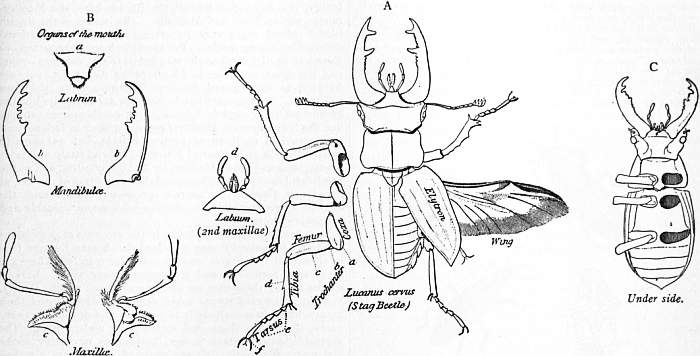
Fig. 1.—Structure of Male Stag-Beetle (Lucanus cervus). A, Dorsal view; B, mouth organs; C, under side.
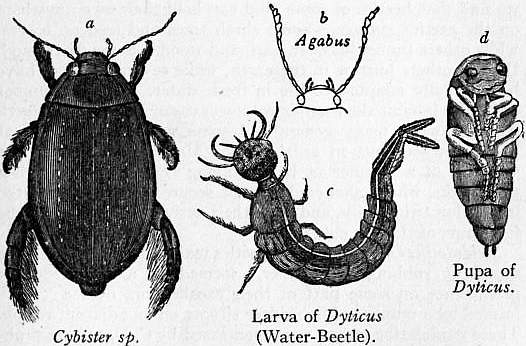
Fig. 2.—Water Beetles (Dyticidae). a, Beetle; b, head of beetle with feelers and palps; c, larva; d, pupa.
Ten segments can be recognized—according to the studies of K. W. Verhoeff (1804-1896)—in a beetle’s abdomen, but the tenth sternite is usually absent. On account of the great extension of the metathorax and the haunches of the large hind-legs, the first abdominal sternite is wanting, and the second is usually so much reduced that the foremost apparent ventral sclerite of the abdomen represents the third sternite. From this point backwards the successive abdominal segments, as far as the seventh or eighth, can be readily made out. The ninth and tenth segments are at most times retracted within the eighth. The female can protrude a long flexible tube in connexion with the eighth segment, carrying the sclerites of the ninth at its extremity, and these sclerites may carry short hairy processes—the stylets. This flexible tube is the functional ovipositor, the typical insectan ovipositor with its three pairs of processes (see Hexapoda) being undeveloped among the Coleoptera. In male beetles, however, the two pairs of genital processes (paramera) belonging to the ninth abdominal segment are always present, though sometimes reduced. Between them is situated, sometimes asymmetrically, the prominent intromittent organ.
In the structure of the digestive system, beetles resemble most other mandibulate insects, the food-canal consisting of gullet, crop, gizzard, mid-gut or stomach, intestine and rectum. The stomach is beset throughout its length with numerous small, finger-like caecal tubes. The excretory (malpighian) tubes are few in number, either four or six. Many beetles have, in connexion with the anus, glands which secrete a repellent acid fluid, serving as a defence for the insect when attacked. The “bombardier” ground beetles (fig. 5) have this habit. Oil-beetles (figs. 23 and 24) and ladybirds (fig. 32) defend themselves by ejecting drops of fluid from the knee-joints. The nervous system is remarkably concentrated in some beetles, the abdominal ganglia showing a tendency to become shifted forward and crowded together, and in certain chafers all the thoracic and abdominal ganglia are fused into a single nerve-centre situated in the thorax,—a degree of specialization only matched in the insectan class among the Hemiptera and some muscid flies.
Development.—The embryonic development (see Hexapoda) has been carefully studied in several genera of beetles. As regards growth after hatching, all beetles undergo a “complete” metamorphosis, the wing-rudiments developing beneath the cuticle throughout the larval stages, and a resting pupal stage intervening between the last larval instar1 and the imago. The coleopterous pupa (figs. 2d, 3c) is always “free,” the legs, wings and other appendages not being fixed to the body as in the pupa of a moth, and the likeness of pupa to perfect insect is very close.
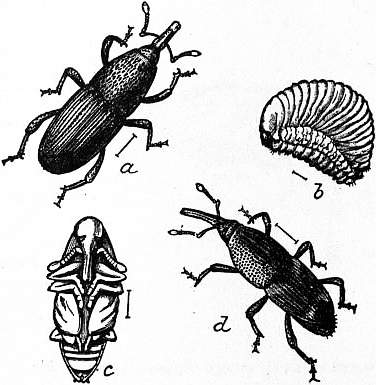
From Chittenden, Yearbook, 1894, U.S. Dept. of Agriculture. Fig. 3.—Grain Weevils. a, Calandra granaria; b, larva; c, pupa; d, C. oryzae.
The most striking feature in the development of beetles is the great diversity noticeable in the outward form of the larva in different families. The larva of a ground-beetle or a carnivorous water-beetle (fig. 2 c) is an active elongate grub with well-armoured cuticle. The head—carrying feelers, mandibles and two pairs of maxillae—is succeeded by the three thoracic segments, each bearing a pair of strong five-segmented legs, whose feet, like those of the adult, carry two claws. Ten segments can be distinguished in the tapering abdomen, the ninth frequently bearing a pair of tail-feelers (cerci), and the tenth, attached ventrally to the ninth, having the anal opening at its extremity and performing the function of a posterior limb, supporting and temporarily fixing the tail end of the insect on the surface over which it crawls. Such a typically “campodeiform” grub, moving actively about in pursuit of prey, is the one extreme of larval structure to be noticed among the Coleoptera. The other is exemplified by the white, wrinkled, soft-skinned, legless grub of a weevil, which lives underground feeding on roots, or burrows in the tissues of plants (fig. 3 b). Between these two extremes we find various transitional forms: an active larva, as described above, but with four-segmented, single-clawed legs, as among the rove-beetles and their allies; the body well armoured, but slender and worm-like, with very short legs as in wireworms and mealworms (figs. 18, 21 b); the body shortened, with the abdomen swollen, but protected with tubercles and spines, and with longish legs adapted for an active life, as in the predaceous larvae of ladybirds; the body soft-skinned, swollen and caterpillar-like, with legs well developed, but leading a sluggish underground life, as in the grub of a chafer; the body soft-skinned and whitish, and the legs greatly reduced in size, as in the wood-feeding grub of a longhorn beetle. In the case of certain beetles whose larvae do not find themselves amid appropriate food from the moment of hatching, but have to migrate in search of it, an early larval stage, with legs, is followed by later sluggish stages in which legs have disappeared, furnishing examples of what is called hypermetamorphosis. For example, the grub of a pea or bean beetle (Bruchus) is hatched, from the egg laid by its mother on the carpel of a leguminous flower, with three pairs of legs and spiny processes on the prothorax. It bores through and enters the developing seed, where it undergoes a moult and becomes legless. Similarly the newly-hatched larva of an oil-beetle (Meloe) is an active little campodeiform insect, which, hatched from an egg laid among plants, waits to attach itself to a passing bee. Carried to the bee’s nest, it undergoes a moult, and becomes a fat-bodied grub, ready to lead a quiet life feeding on the bee’s rich food-stores.
Distribution and Habits.—The Coleoptera are almost world-wide in their distribution, being represented in the Arctic regions and on almost all oceanic islands. Most of the dominant families—such as the Carabidae (ground-beetles), Scarabaeidae (chafers), or Curculionidae (weevils) have a distribution as wide as the order. But while some large families, such as the Staphylinidae (rove-beetles) are especially abundant on the great northern continents, becoming scarcer in the tropics, others, the Cicindelidae (tiger-beetles), for example, are most strongly represented in the warmer regions of the earth, and become scarce as the collector journeys far to south or north. The distribution of many groups of beetles is restricted in correspondence with their habits; the Cerambycidae (longhorns), whose larvae are wood-borers, are absent from timberless regions, and most abundant in the great tropical forests. Some families are very restricted in their range. The Amphizoidae, for example, a small family of aquatic beetles, are known only from western North America and Eastern Tibet, while an allied family, the Pelobiidae, inhabit the British Isles, the Mediterranean region, Tibet and Australia. The beetles of the British islands afford some very interesting examples of restricted distribution among species. For example, large and conspicuous European beetles, such as the stag-beetle (fig. 1, Lucanus cervus) and the great water-beetle (Hydrophilus piceus, fig. 20), are confined to eastern and southern Britain, and are unknown in Ireland. On the other hand, there are Arctic species like the ground-beetle, Pelophila borealis, and south-western species like the boring weevil, Mesites Tardyi, common in Ireland, and represented in northern or western Britain, but unknown in eastern Britain or in Central Europe. Careful study of insular faunas, such as that of Madeira by T. V. Wollaston, and of the Sandwich Islands by D. Sharp, and the comparison of the species found with those of the nearest continental land, furnish the student of geographical distribution with many valuable and suggestive facts.
Notes on habit are given below in the accounts of the various families. In general it may be stated that beetles live and feed in almost all the diverse ways possible for insects. There are carnivores, herbivores and scavengers among them. Various species among those that are predaceous attack smaller insects, hunt in packs crustaceans larger than themselves, insert their narrow heads into snail-shells to pick out and devour the occupants, or pursue slugs and earthworms underground. The vegetable-feeders attack leaves, herbaceous or woody stems and roots; frequently different parts of a plant are attacked in the two active stages of the life-history; the cockchafers, for example, eating leaves, and their grubs gnawing roots. Some of the scavengers, like the burying beetles, inter the bodies of small vertebrates to supply food for themselves and their larvae, or, like the “sacred” beetle of Egypt, collect for the same purpose stores of dung. Many beetles of different families have become the “unbidden guests” of civilized man, and may be found in dwelling-houses, stores and ships’ cargoes, eating food-stuffs, paper, furniture, tobacco and drugs. Hence we find that beetles of some kind can hold their own anywhere on the earth’s surface. Some climb trees and feed on leaves, while others tunnel between bark and wood. Some fly through the air, others burrow in the earth, while several families have become fully adapted to life in fresh water. A large number of beetles inhabit the deep limestone caves of Europe and North America, while many genera and some whole families are at home nowhere but in ants’ nests. Most remarkable is the presence of a number of beetles along the seashore between tide-marks, where, sheltered in some secure nook, they undergo immersion twice daily, and have their active life confined to the few hours of the low ebb.
Stridulating Organs.—Many beetles make a hissing or chirping sound by rubbing a “scraper,” formed by a sharp edge or prominence on some part of their exoskeleton, over a “file” formed by a number of fine ridges situate on an adjacent region. These stridulating organs were mentioned by C. Darwin as probable examples of the action of sexual selection; they are, however, frequently present in both sexes, and in some families also in the larvae. An account of the principal types of stridulators that have been described has been published by C. J. Gahan (1900). The file may be on the head—either upper or lower surface—and the scraper formed by the front edge of the prothorax, as in various wood-boring beetles (Anobium and Scolytus). Or ridged areas on the sides of the prothorax may be scraped by “files” on the front thighs, as in some ground-beetles. Among the longhorn beetles, the prothorax scrapes over a median file on the mid-dorsal aspect of the mesothorax. In a large number of beetles of different families, stridulating areas occur on various segments of the abdomen, and are scraped by the elytra. It is remarkable that these organs are found in similar positions in genera belonging to widely divergent families, while two genera of the same family may have them in different positions. It follows, therefore, that they have been independently acquired in the course of the evolution of the Coleoptera.
Stridulating organs among beetle-larvae have been noted, especially in the wood-feeding grub of the stag-beetles (Lucanidae) and their allies the Passalidae, and in the dung-eating grubs of the dor-beetles (Geotrupes), which belong to the chafer family (Scarabaeidae). These organs are described by J. C. Schiödte and D. Sharp; in the stag-beetle larva a series of short tubercles on the hind-leg is drawn across the serrate edge of a plate on the haunch of the intermediate legs, while in the Passalid grub the modified tip of the hind-leg acts as a scraper, being so shortened that it is useless for locomotion, but highly specialized for producing sound. Whatever may be the true explanation of stridulating organs in adult beetles, sexual selection can have had nothing to do with the presence of these highly-developed larval structures. It has been suggested that the power of stridulation would be advantageous to wood-boring grubs, the sound warning each of the position of its neighbour, so that adjacent burrowers may not get in each other’s way. The root-feeding larvae of the cockchafer and allied members of the Scarabaeidae have a ridged area on the mandible, which is scraped by teeth on the maxillae, apparently forming a stridulating organ.
Luminous Organs.—The function of the stridulating organs just described is presumably to afford means of recognition by sound. Some beetles emit a bright light from a portion of their bodies, which leads to the recognition of mate or comrade by sight. In the wingless female glow-worm (Lampyris, fig. 15 f) the luminous region is at the hinder end, the organ emitting the light consisting, according to H. von Wielowiejski (1882), of cells similar to those of the fat-body, containing a substance that undergoes oxidation. The illumination is intermittent, and appears to be under the control of the insect’s nervous system. The well-known “fire-flies” of the tropics are large click-beetles (Elateridae), that emit light from paired spots on the prothorax and from the base of the ventral abdominal region. The luminous organs of these beetles consist of a specialized part of the fat-body, with an inner opaque and an outer transparent layer. Its structure has been described by C. Heinemann, and its physiology by R. Dubois (1886), who considers that the luminosity is due to the influence of an enzyme in the cells of the organ upon a special substance in the blood. The eggs and larvae of the fire-flies are luminous as well as the perfect beetles.
Fossil History.—The Coleoptera can be traced back farther in time than any other order of insects with complete transformations, if the structures that have been described from the Carboniferous rocks of Germany are really elytra. In the Triassic rocks of Switzerland remains of weevils (Curculionidae) occur, a family which is considered by many students the most specialized of the order. And when we know that the Chrysomelidae and Buprestidae also lived in Triassic, and the Carabidae, Elateridae, Cerambycidae and Scarabaeidae, in Liassic times, we cannot doubt that the great majority of our existing families had already been differentiated at the beginning of the Mesozoic epoch. Coming to the Tertiary we find the Oligocene beds of Aix, of east Prussia (amber) and of Colorado, and the Miocene of Bavaria, especially rich in remains of beetles, most of which can be referred to existing genera.
Classification.—The Coleoptera have been probably more assiduously studied by systematic naturalists than any other order of insects. The number of described species can now hardly be less than 100,000, but there is little agreement as to the main principles of a natural classification. About eighty-five families are generally recognized; the difficulty that confronts the zoologists is the arrangement of these families in “superfamilies” or “sub-orders.” Such obvious features as the number of segments in the foot and the shape of the feeler were used by the early entomologists for distinguishing the great groups of beetles. The arrangement dependent on the number of tarsal segments—the order being divided into tribes Pentamera, Tetramera, Heteromera and Trimera—was suggested by E. L. Geoffroy in 1762, adopted by P. A. Latreille, and used largely through the 19th century. W. S. Macleay’s classification (1825), which rested principally on the characters of the larvae, is almost forgotten nowadays, but it is certain that in any systematic arrangement which claims to be natural the early stages in the life-history must receive due attention. In recent years classifications in part agreeing with the older schemes but largely original, in accord with researches on the comparative anatomy of the insects, have been put forward. Among the more conservative of these may be mentioned that of D. Sharp (1899), who divides the order into six great series of families: Lamellicornia (including the chafers and stag-beetles and their allies with five-segmented feet and plate-like terminal segments to the feelers); Adephaga (carnivorous, terrestrial and aquatic beetles, all with five foot-segments); Polymorpha (including a heterogeneous assembly of families that cannot be fitted into any of the other groups); Heteromera (beetles with the fore and intermediate feet five-segmented, and the hind-feet four-segmented); Phytophaga (including the leaf-beetles, and longhorns, distinguished by the apparently four-segmented feet), and Rhynchophora (the weevils and their allies, with head prolonged into a snout, and feet with four segments). L. Ganglbauer (1892) divides the whole order into two sub-orders only, the Caraboidea (the Adephaga of Sharp and the older writers) and the Cantharidoidea (including all other beetles), since the larvae of Caraboidea have five-segmented, two-clawed legs, while those of all other beetles have legs with four segments and a single claw. A. Lameere (1900) has suggested three sub-orders, the Cantharidiformia (including the Phytophaga, the Heteromera, the Rhynchophora and most of the Polymorpha of Sharp’s classification), the Staphyliniformia (including the rove-beetles, carrion-beetles and a few allied families of Sharp’s Polymorpha), and the Carabidiformia (Adephaga). Lameere’s classification is founded on the number of abdominal sterna, the nervuration of the wings, the number of malpighian tubules (whether four or six) and other structural characters. Preferable to Lameere’s system, because founded on a wider range of adult characters and taking the larval stages into account, is that of H. J. Kolbe (1901), who recognizes three sub-orders: (i.) the Adephaga; (ii.) the Heterophaga, including the Staphylinoidea, the Actinorhabda (Lamellicornia), the Heterorhabda (most of Sharp’s Polymorpha), and the Anchistopoda (the Phytophaga, with the ladybirds and some allied families which Sharp places among the Polymorpha); (iii.) the Rhynchophora.
Students of the Coleoptera have failed to agree not only on a system of classification, but on the relative specialization of some of the groups which they all recognize as natural. Lameere, for example, considers some of his Cantharidiformia as the most primitive Coleoptera. J. L. Leconte and G. H. Horn placed the Rhynchophora (weevils) in a group distinct from all other beetles, on account of their supposed primitive nature. Kolbe, on the other hand, insists that the weevils are the most modified of all beetles, being highly specialized as regards their adult structure, and developing from legless maggots exceedingly different from the adult; he regards the Adephaga, with their active armoured larvae with two foot-claws, as the most primitive group of beetles, and there can be little doubt that the likeness between larvae and adult may safely be accepted as a primitive character among insects. In the Coleoptera we have to do with an ancient yet dominant order, in which there is hardly a family that does not show specialization in some point of structure or life-history. Hence it is impossible to form a satisfactory linear series.
In the classification adopted in this article, the attempt has been made to combine the best points in old and recent schemes, and to avoid the inconvenience of a large heterogeneous group including the vast majority of the families.
Adephaga.—This tribe includes beetles of carnivorous habit with five segments on every foot, simple thread-like feelers with none of the segments enlarged to form club or pectination, and the outer lobs (galea) of the first maxilla usually two-segmented and palpiform (fig. 4 b). The transverse fold of the hind-wing is towards the tip, about two-thirds of the wing-length from the base. At this fold the median nervure stops and is joined by a cross nervure to the radial, which can be distinguished throughout its length from the subcostal. There are four malpighian tubules. In the ovarian tubes of Adephaga small yolk-chambers alternate with the egg-chambers, while in all other beetles there is only a single large yolk-chamber at the narrow end of the tube. The larvae (fig. 2 c) are active, with well-chitinized cuticle, often with elongate tail-feelers (cerci), and with five-segmented legs, the foot-segment carrying two claws.
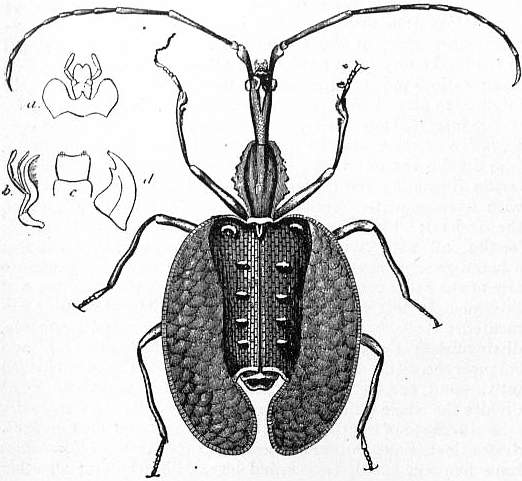
Fig. 4.—Mormolyce phyllodes. Java. a, Labium; b, maxilla; c, labrum; d, mandible.
The generalized arrangement of the wing-nervure and the nature of the larva, which is less unlike the adult than in other beetles, distinguish this tribe as primitive, although the perfect insects are, in the more dominant families, distinctly specialized. Two very small families of aquatic beetles seem to stand at the base of the series, the Amphizoidae, whose larvae are broad and well armoured with short cerci, and the Pelobiidae, which have elongate larvae, tapering to the tail end, where are long paired cerci and a median process, recalling the grub of a Mayfly.
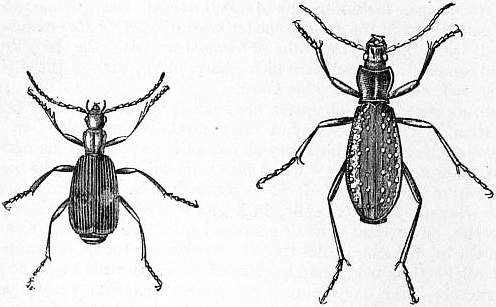
Fig. 5.—Pheropsophus Jurinei. W. Africa. Fig. 6.—Carabus rutilans. Spain.
The Dyticidae (fig. 2) are Adephaga highly specialized for life in the water, the hind-legs having the segments short, broad and fringed, so as to be well adapted for swimming, and the feet without claws. The metasternum is without the transverse linear impression that is found in most families of Adephaga. The beetles are ovoid in shape, with smooth contours, and the elytra fit over the edges of the abdomen so as to enclose a supply of air, available for use when the insect remains under water. The fore-legs of many male dyticids have the three proximal foot-segments broad and saucer-shaped, and covered with suckers, by means of which they secure a firm hold of their mates. Larval dyticids (fig. 2 b) possess slender, curved, hollow mandibles, which are perforated at the tip and at the base, being thus adapted for sucking the juices of victims. Large dyticid larvae often attack small fishes and tadpoles. They breathe by piercing the surface film with the tail, where a pair of spiracles are situated. The pupal stage is passed in an earthen cell, just beneath the surface of the ground. Nearly 2000 species of Dyticidae are known: they are universally distributed, but are most abundant in cool countries. The Haliplidae form a small aquatic family allied to the Dyticidae.
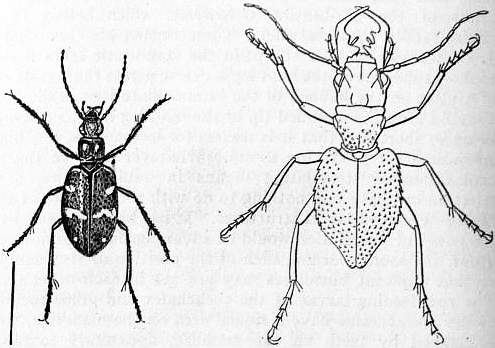
Fig. 7.—Cicindela sylvatica (Wood Tiger-Beetle). Europe. Fig. 8.—Manticora tuberculata. S. Africa.
The Carabidae, or ground-beetles, comprising 13,000 species, form the largest and most typical family of the Adephaga (figs. 4, 5, 6), the legs of all three pairs being alike and adapted for rapid running. In many Carabidae the hind-wings are reduced or absent, and the elytra fused together along the suture. Many of our native species spend the day lurking beneath stones, and sally forth at night in pursuit of their prey, which consists of small insects, earthworms and snails. But a number of the more brightly coloured ground-beetles run actively in the sunshine. The carabid larva is an active well-armoured grub with the legs and cerci variable in length. Great differences in the general form of the body may be observed in the family. For example, the stout, heavy body of Carabus (fig. 6) contrasts markedly with the wonderful flattened abdomen and elytra of Mormolyce (fig. 4), a Malayan genus found beneath fallen trees, a situation for which its compressed shape is admirably adapted. Blind Carabidae form a large proportion of cave-dwelling beetles, and several species of great interest live between tide-marks along the seashore.
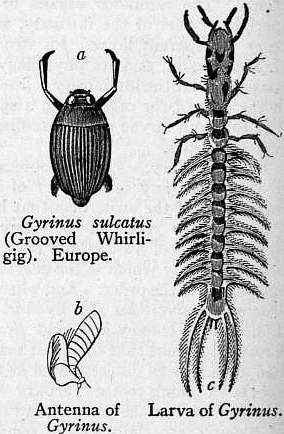
Fig. 9.
The Cicindelidae, or tiger-beetles (figs. 7, 8) are the most highly organized of all the Adephaga. The inner lobe (lacinia) of the first maxilla terminates in an articulated hook, while in the second maxillae (labium) both inner and outer lobes (“ligula” and “para-glossae”) are much reduced. The face (clypeus) is broad, extending on either side in front of the insertion of the feelers. The beetles are elegant insects with long, slender legs, running quickly, and flying in the sunshine. The pronotum and elytra are often adorned with bright colours or metallic lustre, and marked with stripes or spots. The beetles are fierce in nature and predaceous in habit, their sharp toothed mandibles being well adapted for the capture of small insect-victims. The larvae are more specialized than those of other Adephaga, the head and prothorax being very large and broad, the succeeding segments slender and incompletely chitinized. The fifth abdominal segment has a pair of strong dorsal hook-like processes, by means of which the larva supports itself in the burrow which it excavates in the earth, the great head blocking the entrance with the mandibles ready to seize on any unwary insect that may venture within reach.
Two or three families may be regarded as aberrant Adephaga. The Paussidae are a very remarkable family of small beetles, mostly tropical, found only in ants’ nests, or flying by night, and apparently migrating from one nest to another. The number of antennal segments varies from eleven to two. It is supposed that these beetles secrete a sweet substance on which the ants feed, but they have been seen to devour the ants’ eggs and grubs. The Gyrinidae, or whirligig beetles (fig. 9), are a curious aquatic family with the feelers (fig. 9, b) short and reduced as in most Paussidae. They are flattened oval in form, circling with gliding motion over the surface film of the water, and occasionally diving, when they carry down with them a bubble of air. The fore-legs are elongate and adapted for clasping, while the short and flattened intermediate and hind legs form very perfect oar-like propellers. The larva of Gyrinus (fig. 9, c) is slender with elongate legs, and the abdominal segments carry paired tracheal gills.
Staphylinoidea.—The members of this tribe may be easily recognized by their wing-nervuration. Close to a transverse fold near the base of the wing, the median nervure divides into branches which extend to the wing-margin; there is a second transverse fold near the tip of the wing, and cross nervures are altogether wanting. There are four malpighian tubes, and all five tarsal segments are usually recognizable. With very few exceptions, the larva in this group is active and campodeiform, with cerci and elongate legs as in the Adephaga, but the leg has only four segments and one claw.
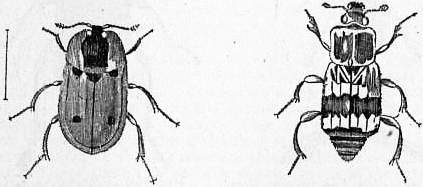
Fig. 10.—Silpha quadripunctata. Europe. Fig. 11.—Necrophorus vespillo (Sexton Beetle). Europe.
The Silphidae, or carrion beetles, form one of the best-known families of this group. They are rotund or elongate insects with conical front haunches, the elytra generally covering (fig. 10) the whole dorsal region of the abdomen, but sometimes leaving as many as four terga exposed (fig. 11). Some of these beetles are brightly coloured, while others are dull black. They are usually found in carrion, and the species of Necrophorus (fig. 11) and Necrophaga are valuable scavengers from their habit of burying small vertebrate carcases which may serve as food for their larvae. At this work a number of individuals are associated together. The larvae that live underground have spiny dorsal plates, while those of the Silpha (fig. 10) and other genera that go openly about in search of food resemble wood-lice. About 1000 species of Silphidae are known. Allied to the Silphidae are a number of small and obscure families, for which reference must be made to monographs of the order. Of special interest among these are the Histeridae, compact beetles (fig. 12) with very hard cuticle and somewhat abbreviated elytra, with over 2000 species, most of which live on decaying matter, and the curious little Pselaphidae, with three-segmented tarsi, elongate palpi, and shortened abdomen; the latter are usually found in ants’ nests, where they are tended by the ants, which take a sweet fluid secreted among little tufts of hair on the beetles’ bodies; these beetles, which are carried about by the ants, sometimes devour their larvae. The Trichopterygidae, with their delicate narrow fringed wings, are the smallest of all beetles, while the Platypsyllidae consist of only a single species of curious form found on the beaver.
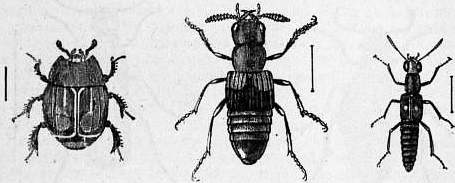
Fig. 12. Hister iv-maculatus (Mimic Beetle). Europe. Fig. 13. Oxyporus rufus. Europe. Fig. 14. Stenus biguttatus. Europe.
The Staphylinidae, or rove-beetles—a large family of nearly 10,000 species—may be known by their very short elytra, which cover only two of the abdominal segments, leaving the elongate hind-body with seven or eight exposed, firm terga (figs. 13, 14). These segments are very mobile, and as the rove-beetles run along they often curl the abdomen upwards and forwards like the tail of a scorpion. The Staphylinid larvae are typically campodeiform. Beetles and larvae are frequently carnivorous in habit, hunting for small insects under stones, or pursuing the soft-skinned grubs of beetles and flies that bore in woody stems or succulent roots. Many Staphylinidae are constant inmates of ants’ nests.
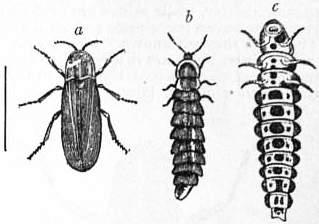
Fig. 15.—Glow-worm. Lampyris noctiluca. a, Male; b, female; c, larva (ventral view). Europe.
Malacodermata.—In this tribe may be included a number of families distinguished by the softness of the cuticle, the presence of seven or eight abdominal sterna and of four malpighian tubes, and the firm, well-armoured larva (fig. 15, c) which is often predaceous in habit. The mesothoracic epimera bound the coxal cavities of the intermediate legs. The Lymexylonidae, a small family of this group, characterized by its slender, undifferentiated feelers and feet, is believed by Lameere to comprise the most primitive of all living beetles, and Sharp lays stress on the undeveloped structure of the tribe generally.
The Lampyridae are a large family, of which the glow-worm (Lampyris) and the “soldier beetles” (Telephorus) are familiar examples. The female “glow-worm” (fig. 15, b), emitting the well-known light (see above), is wingless and like a larva; the luminosity seems to be an attraction to the male, whose eyes are often exceptionally well developed. Some male members of the family have remarkably complex feelers. In many genera of Lampyridae the female can fly as well as the male; among these are the South European “fireflies.”
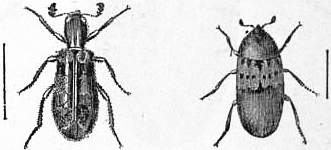
Fig. 16.—Clerus apiarus (Hive Beetle). Europe. Fig. 17.—Dermestes lardarius (Bacon Beetle).
Trichodermata.—Several families of rather soft-skinned beetles, such as the Melyridae, Cleridae (fig. 16), Corynetidae, Dermestidae (fig. 17), and Dascillidae, are included in this tribe. They may be distinguished from the Malacodermata by the presence of only five or six abdominal sterna, while six malpighian tubes are present in some of the families. The beetles are hairy and their larvae well-armoured and often predaceous. Several species of Dermestidae are commonly found in houses, feeding on cheeses, dried meat, skins and other such substances. The “bacon beetle” (Dermestes lardarius), and its hard hairy larva, are well known. According to Sharp, all Dermestid larvae probably feed on dried animal matters; he mentions one species that can find sufficient food in the horsehair of furniture, and another that eats the dried insect-skins hanging in old cobwebs.
Sternoxia.—This is an important tribe of beetles, including families with four malpighian tubes and only five or six abdominal sterna, while in the thorax there is a backwardly directed process of the prosternum that fits into a mesosternal cavity. The larvae are elongate and worm-like, with short legs but often with hard strong cuticle.
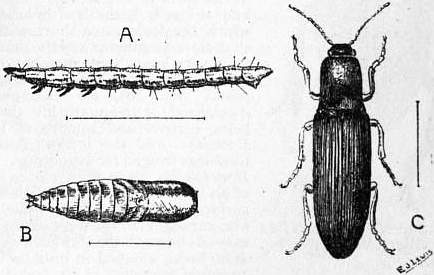
Fig. 18.—A, Wireworm; B, pupa of Click Beetle; C, adult Click Beetle (Agriotes lineatum).
The Elateridae or click beetles (fig. 18) have the prosternal process just mentioned, capable of movement in and out of the mesosternal cavity, the beetles being thus enabled to leap into the air, hence their popular name of “click-beetles” or “skip-jacks.” The prothorax is convex in front, and is usually drawn out behind into a prominent process on either side, while the elytra are elongate and tapering. Many of the tropical American Elateridae emit light from the spots on the prothorax and an area beneath the base of the abdomen; these are “fireflies” (see above). The larvae of Elateridae are elongate, worm-like grubs, with narrow bodies, very firm cuticle, short legs, and a distinct anal proleg. They are admirably adapted for moving through the soil, where some of them live on decaying organic matter, while others are predaceous. Several of the elaterid larvae, however, gnaw roots and are highly destructive to farm crops. These are the well-known “wire-worms” (q.v.).
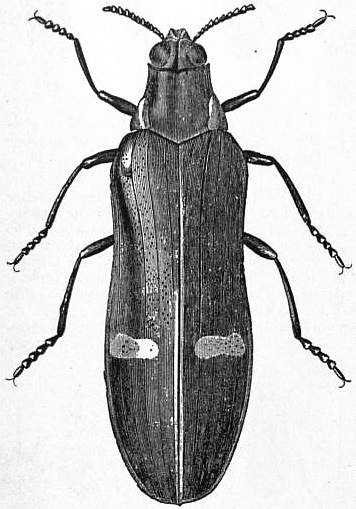
Fig. 19.—Catoxantha bicolor. Java.
The Buprestidae are distinguished from the Elateridae by the immobility of the prosternal process in the mesosternal cavity and by the absence of the lateral processes at the hind corners of the prothorax. Many tropical Buprestidae are of large size (fig. 19), and exhibit magnificent metallic colours; their elytra are used as ornaments in human dress. The larvae are remarkable for their small head, very broad thorax, with reduced legs, and narrow elongate abdomen. They feed by burrowing in the roots and stems of plants.
Bostrychoidea.—This tribe is distinguished from the Malacoderma and allied groups by the mesothoracic epimera not bounding the coxal cavities of the intermediate legs. The downwardly directed head is covered by the pronotum, and the three terminal antennal segments form a distinct club. To this group belong the Bostrychidae and Ptinidae, well known (especially the latter family) for their ravages in old timber. The larvae are stout and soft-skinned, with short legs in correlation with their burrowing habit. The noises made by some Ptinidae (Anobium) tapping on the walls of their burrows with their mandibles give rise to the “death tick” that has for long alarmed the superstitious.
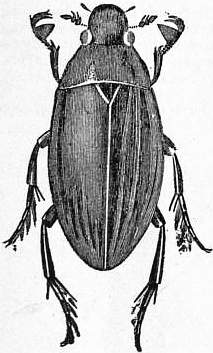
Fig. 20.—Hydrophilus piceus (Black Water Beetle). Europe.
Clavicornia.—This is a somewhat heterogeneous group, most of whose members are characterized by clubbed feelers and simple, unbroadened tarsal segments—usually five on each foot—but in some families and genera the males have less than the normal number on the feet of one pair. There are either four or six malpighian tubes. A large number of families, distinguished from each other by more or less trivial characters, are included here, and there is considerable diversity in the form of the larvae. The best-known family is the Hydrophilidae, in which the feelers are short with less than eleven segments and the maxillary palpi very long. Some members of this family—the large black Hydrophilus piceus (fig. 20), for example—are specialized for an aquatic life, the body being convex and smooth as in the Dyticidae, and the intermediate and hind-legs fringed for swimming. When Hydrophilus dives it carries a supply of air between the elytra and the dorsal surface of the abdomen, while air is also entangled in the pubescence which extends beneath the abdomen on either side, being scooped in bubbles by the terminal segments of the feelers when the insect rises to the surface. Many of the Hydrophilidae construct, for the protection of their eggs, a cocoon formed of a silky material derived from glands opening at the tip of the abdomen. That of Hydrophilus is attached to a floating leaf, and is provided with a hollow, tapering process, which projects above the surface and presumably conveys air to the enclosed eggs. Other Hydrophilidae carry their egg-cocoons about with them beneath the abdomen. Many Hydrophilidae, unmodified for aquatic life, inhabit marshes. The larvae in this family are well-armoured, active and predaceous. Of the numerous other families of the Clavicornia may be mentioned the Cucujidae and Cryptophagidae, small beetles, examples of which may be found feeding on stored seeds or vegetable refuse, and the Mycetophagidae, which devour fungi. The Nitidulidae are a large family with 1600 species, among which members of the genus Meligethes are often found in numbers feeding on blossoms, while others live under the bark of trees and prey on the grubs of boring beetles.
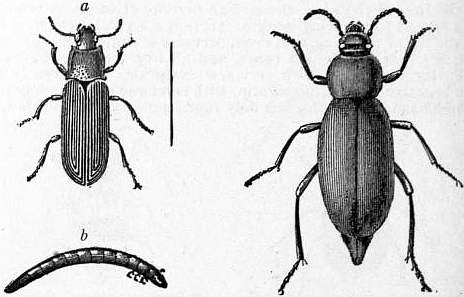
Fig. 21.—(a) Tenebrio molitor (Flour Beetle). Europe. (b) Larva, or mealworm. Fig. 22.—Blaps mortisaga (Churchyard Beetle). Europe.
Heteromera.—This tribe is distinguished by the presence of the normal five segments in the feet of the fore and intermediate legs, while only four segments are visible in the hind-foot. Considerable diversity is to be noticed in details of structure within this group, and for an enumeration of all the various families which have been proposed and their distinguishing characters the reader is referred to one of the monographs mentioned below. Some of the best-known members of the group belong to the Tenebrionidae, a large family containing over 10,000 species and distributed all over the world. The tenebrionid larva is elongate, with well-chitinized cuticle, short legs and two stumpy tail processes, the common mealworm (fig. 21) being a familiar example. Several species of this family are found habitually in stores of flour or grain. The beetles have feelers with eleven segments, whereof the terminal few are thickened so as to form a club. The true “black-beetles” or “churchyard beetles” (Blaps) (fig. 22) belong to this family; like members of several allied genera they are sooty in colour, and somewhat resemble ground beetles (Carabi) in general appearance.
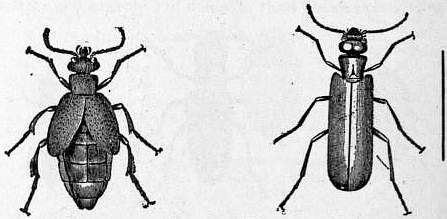
Fig. 23.—Meloe proscarabaeus (Oil Beetle). Europe. Fig. 24.—Lytta vesicatoria (Blister Beetle). Europe.
The most interesting of the Heteromera, and perhaps of all the Coleoptera, are some beetles which pass through two or more larval forms in the course of the life-history (hypermetamorphosis). These belong to the families Rhipidophoridae and Meloidae. The latter are the oil beetles (fig. 23) or blister beetles (fig. 24), insects with rather soft cuticle, the elytra (often abbreviated) not fitting closely to the sides of the abdomen, the head constricted behind the eyes to form a neck, and the claws of the feet divided to the base. Several of the Meloidae (such as the “Spanish fly,” fig. 24) are of economic importance, as they contain a vesicant substance used for raising medicinal blisters on the human skin. The wonderful transformations of these insects were first investigated by G. Newport in 1851, and have recently been more fully studied by C. V. Riley (1878) and J. H. Fabre. The first larval stage is the “triungulin,” a tiny, active, armoured larva with long legs (each foot with three claws) and cercopods. In the European species of Sitaris and Meloe these little larvae have the instinct of clinging to any hairy object. All that do not happen to attach themselves to a bee of the genus Anthophora perish, but those that succeed in reaching the right host are carried to the nest, and as the bee lays an egg in the cell the triungulin slips off her body on to the egg, which floats on the surface of the honey. After eating the contents of the egg, the larva moults and becomes a fleshy grub with short legs and with paired spiracles close to the dorsal region, so that, as it floats in and devours the honey, it obtains a supply of air. After a resting (pseudo-pupal) stage and another larval stage, the pupa is developed. In the American Epicauta vittata the larva is parasitic on the eggs and egg-cases of a locust. The triungulin searches for the eggs, and, after a moult, becomes changed into a soft-skinned tapering larva. This is followed by a resting (pseudo-pupal) stage, and this by two successive larval stages like the grub of a chafer. The Rhipidophoridae are beetles with, short elytra, the feelers pectinate in the males and serrate in the females. The life-history of Metoecus has been studied by T. A. Chapman, who finds that the eggs are laid in old wood, and that the triungulin seeks to attach itself to a social wasp, who carries it to her nest. There it feeds first as an internal parasite of the wasp-grub, then bores its way out, moults and devours the wasp larva from outside. The wasps are said to leave the larval or pupal Metoecus unmolested, but they are hostile to the developed beetles, which hasten to leave the nest as soon as possible.
Strepsiptera.—Much difference of opinion has prevailed with regard to the curious, tiny, parasitic insects included in this division, some authorities considering that they should be referred to a distinct order, while others would group them in the family Meloidae just described. While from the nature of their life-history there is no doubt that they have a rather close relationship to the Meloidae, their structure is so remarkable that it seems advisable to regard them as at least a distinct tribe of Coleoptera.
They may be comprised in a single family, the Stylopidae. The males are very small, free-flying insects with the prothorax, mesothorax and elytra greatly reduced, the latter appearing as little, twisted strips, while the metathorax is relatively large, with its wings broad and capable of longitudinal folding. The feelers are branched and the jaws vestigial. The female is a segmented, worm-like creature, spending her whole life within the body of the bee, wasp or bug on which she is parasitic. One end of her body protrudes from between two of the abdominal segments of the host; it has been a subject of dispute whether this protruded end is the head or the tail, but there can be little doubt that it is the latter. While thus carried about by the host-insect, the female is fertilized by the free-flying male, and gives birth to a number of tiny triungulin larvae. The chief points in the life-history of Stylops and Xenos, which are parasitic on certain bees (Andrena) and wasps (Polistes), have been investigated by K. T. E. von Siebold (1843) and N. Nassonov (1892). The little triungulins escape on to the body of the bee or wasp; then those that are to survive must leave their host for a non-parasitized insect. Clinging to her hairs they are carried to the nest, where they bore into the body of a bee or wasp larva, and after a moult become soft-skinned legless maggots. The growth of the parasitic larva does not stop the development of the host-larva, and when the latter pupates and assumes the winged form, the stylopid, which has completed its transformation, is carried to the outer world. The presence of a Stylops causes derangement in the body of its host, and can be recognized by various external signs. Other genera of the family are parasitic on Hemiptera—bugs and frog-hoppers—but nothing is known as to the details of their life-history.
Lamellicornia.—This is a very well-marked tribe of beetles, characterized by the peculiar elongation and flattening of three or more of the terminal antennal segments, so that the feeler seems to end in a number of leaf-like plates, or small comb-teeth (fig. 26, b, c). The wings are well developed for flight, and there is a tendency in the group, especially among the males, towards an excessive development of the mandibles or the presence of enormous, horn-like processes on the head or pronotum. There are four malpighian tubes. The larvae are furnished with large heads, powerful mandibles and well-developed legs, but the body-segments are feebly chitinized, and the tail-end is swollen. They feed in wood or spend an underground life devouring roots or animal excrement.
The Lucanidae or stag beetles (figs. 1 and 25) have the terminal antennal segments pectinate, and so arranged that the comb-like part of the feeler cannot be curled up, while the elytra completely cover the abdomen. There are about 600 species in the family, the males being usually larger than the females, and remarkable for the size of their mandibles. In the same species, however, great variation occurs in the development of the mandibles, and the breadth of the head varies correspondingly, the smallest type of male being but little different in appearance from the female. The larvae of Lucanidae live within the wood of trees, and may take three or four years to attain their full growth. The Passalidae are a tropical family of beetles generally considered to be intermediate between stag-beetles and chafers, the enlarged segments of the feeler being capable of close approximation.
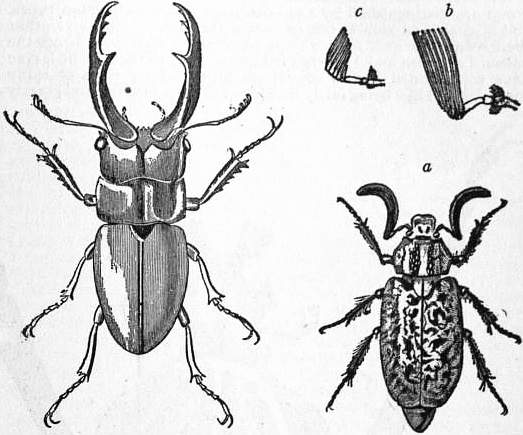
Fig. 25.—Cladognathus cinnamomeus. Java. Fig. 26.—Melolontha fullo (Cockchafer). S. Europe, b, Antenna of male; c, antenna of female.
The Scarabaeidae or chafers are an enormous family of about 15,000 species. The plate-like segments of the feeler (fig. 26, b, c) can be brought close together so as to form a club-like termination; usually the hinder abdominal segments are not covered by the elytra. In this family there is often a marked divergence between the sexes; the terminal antennal segments are larger in the male than in the female, and the males may carry large spinous processes on the head or prothorax, or both. These structures were believed by C. Darwin to be explicable by sexual selection. The larvae have the three pairs of legs well developed, and the hinder abdominal segments swollen. Most of the Scarabaeidae are vegetable-feeders, but one section of the family—represented in temperate countries by the dor-beetles (Geotrupes) (fig. 28) and Aphodius, and in warmer regions by the “sacred” beetles of the Egyptians (Scarabaeus) (fig. 27), and allied genera—feed both in the adult and larval stages, on dung or decaying animal matter. The heavy grubs of Geotrupes, their swollen tail-ends black with the contained food-material, are often dug up in numbers in well-manured fields. The habits of Scarabaeus have been described in detail by J. H. Fabre. The female beetle in spring-time collects dung, which she forms into a ball by continuous rolling, sometimes assisted by a companion. This ball is buried in a suitable place, and serves the insect as a store of food. During summer the insects rest in their underground retreats, then in autumn they reappear to bury another supply of dung, which serves as food for the larvae. Fabre states that the mother-insect carefully arranges the food-supply so that the most nutritious and easily digested portion is nearest the egg, to form the first meal of the young larva. In some species of Copris it is stated that the female lays only two or three eggs at a time, watching the offspring grow to maturity, and then rearing another brood.
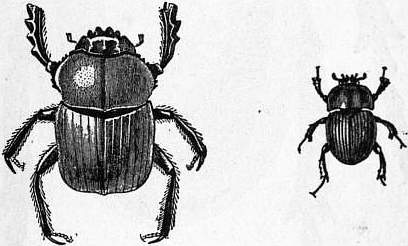
Fig. 27.—Scarabaeus Aegyptiorum. Africa. Fig. 28.—Geotrupes Blackburnei. N. America.
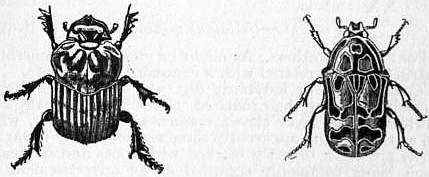
Fig. 29.—Phaneus Imperator. S. America. Fig. 30.—Cetonia Baxii. W. Africa.
Among the vegetable-feeding chafers we usually find that while the perfect insect devours leaves, the larva lives underground and feeds on roots. Such are the habits of the cockchafer (Melolontha vulgaris) and other species that often cause great injury to farm and garden crops (see Chafer). Many of these insects, such as the species of Phanaeus (fig. 29) and Cetonia (fig. 30), are adorned with metallic or other brilliant colours. The African “goliath-beetles” (fig. 31) and the American “elephant-beetles” (Dynastes) are the largest of all insects.
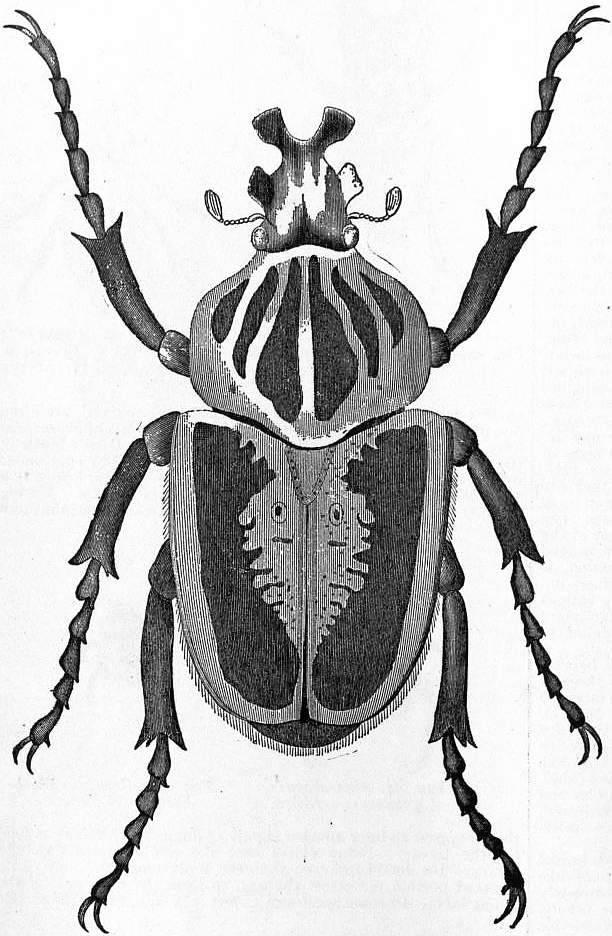
Fig. 31.—Goliathus giganteus (Goliath Beetle).
Anchistopoda.—The families of beetles included by Kolbe in this group are distinguished by the possession of six malpighian tubes, and a great reduction in one or two of the tarsal segments, so that there seem to be only four or three segments in each foot; hence the names Tetramera and Trimera formerly applied to them. The larvae have soft-skinned bodies sometimes protected by rows of spiny tubercles, the legs being fairly developed in some families and greatly reduced or absent in others. As might be expected, degeneration in larval structure is correlated with a concealed habit of life.
The Coccinellidae, or ladybirds (fig. 32), are a large family of beetles, well known by their rounded convex bodies, usually shining and hairless. They have eleven segments to the feeler, which is clubbed at the tip, and apparently three segments only in each foot. Ladybirds are often brightly marked with spots and dashes, their coloration being commonly regarded as an advertisement of inedibility. The larvae have a somewhat swollen abdomen, which is protected by bristle-bearing tubercles. Like the perfect insects, they are predaceous, feeding on plant-lice (Aphidae) and scale insects (Coccidae). Their role in nature is therefore beneficial to the cultivator. The Endomychidae (fig. 33), an allied family, are mostly fungus-eaters. In the Erotylidae and a few other small related families the feet are evidently four-segmented.
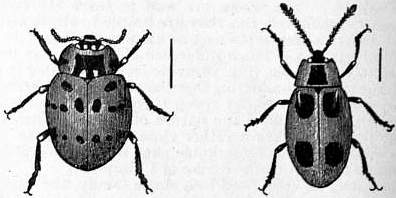
Fig. 32.—Anatio ocellata (Eyed Ladybird). Europe. Fig. 33.—Endomychus coccineus. Europe.
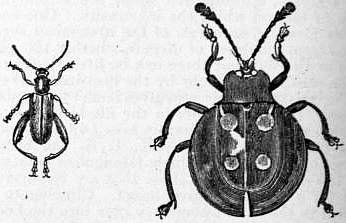
Fig. 34.—Sagra cyanea. W. Africa. Fig. 35.—Eumorphus ivguttatus. Sumatra.
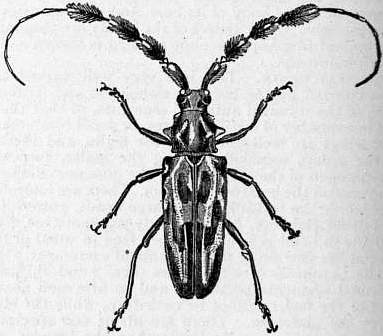
Fig. 36.—Lophonocerus barbicornis. S. America.
The Chrysomelidae, or leaf-beetles (figs. 34, 35), are a very large family, with “tetramerous” tarsi; there seem to be only four segments to the foot, but there are really five, the fourth being greatly reduced. The mandibles are strong, adapted for biting the vegetable substances on which these beetles feed, and the palps of the second maxillae have three segments. Most of the Chrysomelidae are metallic in colour and convex in form; in some the head is concealed beneath the prothorax, and the so-called “tortoise” beetles (Cassidinae) have the elytra raised into a prominent median ridge. The most active form of larva found in this family resembles in shape that of a ladybird, tapering towards the tail end, and having the trunk segments protected by small firm sclerites. Such larvae, and also many with soft cuticle and swollen abdomen—those of the notorious “Colorado beetle,” for example—feed openly on foliage. Others, with soft, white, cylindrical bodies, which recall the caterpillars of moths, burrow in the leaves or stems of plants. The larvae of the tortoise-beetles have the curious habit of forming an umbrella-like shield out of their own excrement, held in position by the upturned tail-process. The larvae of the beautiful, elongate, metallic Donaciae live in the roots and stems of aquatic plants, obtaining thence both food and air. The larva pierces the vessels of the plant with sharp processes at the hinder end of its body. In this way it is believed that the sub-aqueous cocoon in which the pupal stage is passed becomes filled with air.
The Cerambycidae, or longhorn beetles, are recognizable by their slender, elongate feelers, which are never clubbed and rarely serrate. The foot has apparently four segments, as in the Chrysomelidae. The beetles are usually elongate and elegant in form, often adorned with bright bands of colour, and some of the tropical species attain a very large size (figs. 36, 37). The feelers are usually longer in the male than in the female, exceeding in some cases by many times the length of the body. The larvae have soft, fleshy bodies, with the head and prothorax large and broad, and the legs very much reduced. They live and feed in the wood of trees. Consequently, beetles of this family are most abundant in forest regions, and reach their highest development in the dense virgin forests of tropical countries, South America being particularly rich in peculiar genera.
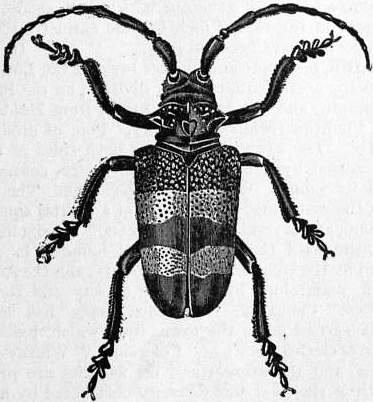
Fig. 37.—Phryneta aurocincta. West Africa.
The Bruchidae, or seed-beetles, agree with the two preceding families in tarsal structure; the head is largely hidden by the pronotum, and the elytra are short enough to leave the end of the abdomen exposed (fig. 38). The development of the pea and bean-beetles has been carefully studied by C. V. Riley, who finds that the young larva, hatched from the egg laid on the pod, has three pairs of legs, and that these are lost after the moult that occurs when the grub has bored its way into the seed. In Great Britain the beetle, after completing its development, winters in the seed, waiting to emerge and lay its eggs on the blossom in the ensuing spring.
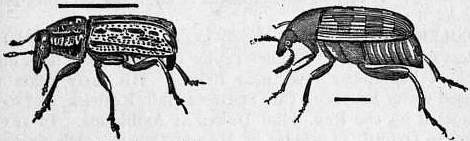
Fig. 38.—Bruchus piei (Pea Beetle.) Europe. Fig. 39.—Platyrrhinus latirostris. Europe.
Rhynchophora.—The Rhynchophora are a group of beetles easily recognized by the elongation of the head into a beak or snout, which carries the feelers at its sides and the jaws at its tip. The third tarsal segment is broad and bi-lobed, and the fourth is so small that the feet seem to be only four-segmented. There are six malpighian tubes. The ventral sclerite of the head-skeleton (gula), well developed in most families of beetles, is absent among the Rhynchophora, while the palps of the maxillae are much reduced. The larvae have soft, white bodies and, with very few exceptions, no legs.
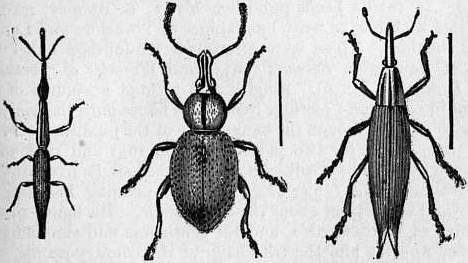
Fig. 40.—Brenthus anchorago. Tropical Countries. Fig. 41.—Otiorrhynchus ligustici. Europe. Fig. 42.—Lixus paraplecticus. Europe.
Of the four families included in this group, the Anthribidae (fig. 39) have jointed, flexible palps, feelers—often of excessive length—with a short basal segment, and the three terminal segments forming a club, and, in some genera, larvae with legs. There are nearly 1000 known species, most of which live in tropical countries. The Brenthidae are a remarkable family almost confined to the tropics; they are elongate and narrow in form (fig. 40), with a straight, cylindrical snout which in some male beetles of the family is longer than the rest of the body.
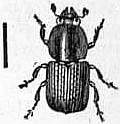
Fig. 43.—Scolytus ulmi. (Bark Beetle). Europe.
The Curculionidae, or weevils (q.v.), comprising 23,000 species, are by far the largest family of the group. The maxillary palps are short and rigid, and there is no distinct labrum, while the feelers are usually of an “elbowed” form, the basal segment being very elongate (figs. 41, 42). They are vegetable feeders, both in the perfect and larval stages, and are often highly injurious. The female uses her snout as a boring instrument to prepare a suitable place for egg-laying. The larvae (fig. 3) of some weevils live in seeds; others devour roots, while the parent-beetles eat leaves; others, again, are found in wood or under bark. The Scolytidae, or bark-beetles, are a family of some 1500 species, closely allied to the Curculionidae, differing only in the feeble development of the snout. They have clubbed feelers, and their cylindrical bodies (fig. 43) are well adapted for their burrowing habits under the bark of trees. Usually the mother-beetle makes a fairly straight tunnel along which, at short intervals, she lays her eggs. The grubs, when hatched, start galleries nearly at right angles to this, and when fully grown form oval cells in which they pupate; from these the young beetles emerge by making circular holes directly outward through the bark.
Bibliography.—In addition to what may be found in numerous important works on the Hexapoda (q.v.) as a whole, such as J. O. Westwood’s Modern Classification of Insects, vol. i. (London, 1838); J. H. Fabre’s Souvenirs Entomologiques (Paris, 1879-1891); D. Sharp’s contribution to the Cambridge Natural History (vol. vi., London, 1899); and L. C. Miall’s Aquatic Insects (London, 1895), the special literature of the Coleoptera is enormous. Classical anatomical memoirs are those of L. Dufour (Ann. Sci. Nat. ii., iii., iv., vi., viii., xiv., 1824-1828); Ib. (ser. 2, Zool.) i., 1834; and H. E. Strauss-Dürkheim, Anatomie comparée des animaux articulées (Paris, 1828).
The wings of Coleoptera (including the elytra) are described and discussed by F. Meinert (Entom. Tijdsk. v., 1880); C. Hoffbauer (Zeit. f. wissen. Zool. liv., 1892); J. H. Comstock and J. G. Needham (Amer. Nat. xxxii., 1898); and W. L. Tower (Zool. Jahrb. Anat. xvii., 1903). The morphology of the abdomen, ovipositor and genital armature is dealt with by K. W. Verhoeff (Ent. Nachtr. xx., 1894, and Arch. f. Naturg. lxi., lxii., 1895-1896); and B. Wandolleck (Zool. Jahrb. Anat. xxii., 1905).
Luminous organs are described by H. von Wielowiejski (Zeits. f. wissen. Zool. xxxvii., 1882); C. Heinemann (Arch. f. mikr. Anat. xxvii., 1886); and R. Dubois (Bull. soc. zool. France, 1886); and stridulating organs by C. J. Gahan (Trans. Entom. Soc., 1900). See also C. Darwin’s Descent of Man and Selection in Relation to Sex (London, 1871).
Many larvae of Coleoptera are described and beautifully figured by J. C. Schiödte (Naturh. Tidsskr. i.-xiii., 1861-1872). Hypermetamorphosis in the Meloidae is described by G. Newport (Trans. Linn. Soc. xx., xxi., 1851-1853); C. V. Riley (Rep. U.S. Entom. Comm. i., 1878); J. H. Fabre (Ann. Sci. Nat. (4), ix., xix., 1848-1853); H. Beauregard (Les Insectes vésicants, Paris, 1890); and A. Chabaud (Ann. Soc. Ent. France, lx., 1891); in the Bruchidae by Riley (Insect Life, iv., v., 1892-1893); and in the Strepsiptera (Stylopidae) by K. T. E. von Siebold (Arch. f. Naturg. ix., 1843); N. Nassonov (Bull. Univ. Narsovie, 1892); and C. T. Brues (Zool. Jahrb. Anat. xiii., 1903).
For various schemes of classification of the Coleoptera see E. L. Geoffroy (Insectes qui se trouvent aux environs de Paris, Paris, 1762); A. G. Olivier (Coléoptères, Paris, 1789-1808); W. S. MacLeay (Annulosa Javanica, London, 1825); the general works of Westwood and Sharp, mentioned above; M. Gemminger and B. de Harold (Catalogus Coleopterorum, 12 vols., Munich, 1868-1872); T. Lacordaire and F. Chapuis (Genera des Coléoptères, 10 vols., Paris, 1854-1874); J. L. Leconte and G. H. Horn (Classification of Coleoptera of N. America, Washington, Smithsonian Inst., 1883); L. Ganglbauer (Die Käfer von Mitteleuropa, Vienna, 1892, &c.); A. Lameere (Ann. Soc. Ent. Belg. xliv., xlvii., 1900-1903); and H. J. Kolbe (Arch. f. Naturg. lxvii., 1901).
For the British species, W. W. Fowler (Coleoptera of the British Islands, 5 vols., London, 1887-1891) is the standard work; and W. F. Johnson and J. N. Halbert’s “Beetles of Ireland” (Proc. R. Irish Acad., 3, vi., 1902) is valuable faunistically. Among the large number of systematic writers on the order generally, or on special families, may be mentioned D. Sharp, T. V. Wollaston, H. W. Bates, G. C. Champion, E. Reitter, G. C. Crotch, H. S. Gorham, M. Jacoby, L. Fairmaire and C. O. Waterhouse.
(G. H. C.)
COLEPEPER, JOHN COLEPEPER (or Culpepper), 1st Baron (d. 1660), English politician, was the only son of Sir John Colepeper of Wigsell, Sussex. He began his career in military service abroad, and came first into public notice at home through his knowledge of country affairs, being summoned often before the council board to give evidence on such matters. He was knighted, and was elected member for Kent in the Long Parliament, when he took the popular side, speaking against monopolies on the 9th of November 1640, being entrusted with the impeachment of Sir Robert Berkeley on the 12th of February 1641, supporting Stafford’s attainder, and being appointed to the committee of defence on the 12th of August 1641. He separated, however, from the popular party on the Church question, owing to political rather than religious objections, fearing the effect of the revolutionary changes which were now contemplated. He opposed the London petition for the abolition of episcopacy, the project of religious union with the Scots, and the Root and Branch Bill, and on the 1st of September he moved a resolution in defence of the prayer-book. In the following session he opposed the militia bill and the Grand Remonstrance, and finally on the 2nd of January 1642 he joined the king’s party, taking office as chancellor of the exchequer. He highly disapproved of the attempt upon the five members, which was made without his knowledge, but advised the enterprise against Hull. On the 25th of August 1642 he appeared at the bar of the House of Commons to deliver the king’s final proposals for peace, and was afterwards present at Edgehill, where he took part in Prince Rupert’s charge and opposed the retreat of the king’s forces from the battlefield. In December he was made by Charles master of the rolls. He was a leading member of the Oxford Parliament, and was said, in opposition to the general opinion, to have counselled considerable concessions to secure peace. His influence in military affairs caused him to be much disliked by Prince Rupert and the army, and the general animosity against him was increased by his advancement to the peerage on the 21st of October 1644 by the title of Baron Colepeper of Thoresway in Lincolnshire.
He was despatched with Hyde in charge of the prince of Wales to the West in March 1645, and on the 2nd of March 1646, after Charles’s final defeat, embarked with the prince for Scilly, and thence to France. He strongly advocated the gaining over of the Scots by religious concessions, a policy supported by the queen and Mazarin, but opposed by Hyde and other leading royalists, and constantly urged this course upon the king, at the same time deprecating any yielding on the subject of the militia. He promoted the mission of Sir John Berkeley in 1647 to secure an understanding between Charles and the army. In 1648 he accompanied the prince in his unsuccessful naval expedition, and returned with him to the Hague, where violent altercations broke out among the royalist leaders, Colepeper going so far, on one occasion in the council, as to challenge Prince Rupert, and being himself severely assaulted in the streets by Sir Robert Walsh. He continued after the execution of the king to press the acceptance on Charles II. of the Scottish proposals. He was sent to Russia in 1650, where he obtained a loan of 20,000 roubles from the tsar, and, soon after his return, to Holland, to procure military assistance. By the treaty, agreed to between Cromwell and Mazarin, of August 1654, Colepeper was obliged to leave France, and he appears henceforth to have resided in Flanders. He accompanied Charles II. to the south of France in September 1659, at the time of the treaty of the Pyrenees. At the Restoration he returned to England, but only survived a few weeks, dying on the 11th of June 1660.
Several contemporary writers agree in testifying to Colepeper’s great debating powers and to his resources as an adviser, but complain of his want of stability and of his uncertain temper. Clarendon, with whom he was often on ill terms, speaks generally in his praise, and repels the charge of corruption levelled against him. That he was gifted with considerable political foresight is shown by a remarkable letter written on the 20th of September 1658 on the death of Cromwell, in which he foretells with uncommon sagacity the future developments in the political situation, advises the royalists to remain inactive till the right moment and profit by the division of their opponents, and distinguishes Monck as the one person willing and capable of effecting the Restoration (Clarendon State Papers, iii. 412). Colepeper was twice married, (1) to Philippa, daughter of Sir John Snelling, by whom he had one son, who died young, and a daughter, and (2) to Judith, daughter of Sir J. Colepeper of Hollingbourn, Kent, by whom he had seven children. Of these Thomas (d. 1719; governor of Virginia 1680-1683) was the successor in the title, which became extinct on the death of his younger brother Cheney in 1725.
(P. C. Y.)
COLERAINE, a seaport and market town of Co. Londonderry, Ireland, in the north parliamentary division, on the Bann, 4 m. from its mouth, and 61½ m. N.W. by N. from Dublin by the Northern Counties (Midland) railway. Pop. of urban district (1901) 6958. The town stands upon both sides of the river, which is crossed by a handsome stone bridge, connecting the town and its suburb, Waterside or Killowen. The principal part is on the east bank, and consists of a central square called the Diamond, and several diverging streets. Among institutions may be mentioned the public schools founded in 1613 and maintained by the Honourable Irish Society, and the Academical Institution, maintained by the Irish Society and the London Clothworkers’ Company. The linen trade has long been extensively carried on in the town, from which, indeed, a fine description of cloth is known as “Coleraines.” Whisky-distilling, pork-curing, and the salmon and eel fisheries are prosecuted. The mouth of the river was formerly obstructed by a bar, but piers were constructed, and the harbours greatly improved by grants from the Irish Society of London and from a loan under the River Bann Navigation Act 1879. Coleraine ceased to return one member to the Imperial parliament in 1885; having previously returned two to the Irish parliament until the Union. It was incorporated by James I. It owed its importance mainly to the Irish Society, which was incorporated as the Company for the New Plantation of Ulster in 1613. Though fortified only by an earthen wall, it managed to hold out against the rebels in 1641. There are no remains of a former priory, monastery and castle. A rath or encampment of large size occupies Mount Sandel, 1 m. south-east.
COLERIDGE, HARTLEY (1796-1849), English man of letters, eldest son of the poet Samuel Taylor Coleridge, was born on the 19th of September 1796, near Bristol. His early years were passed under Southey’s care at Greta Hall, Keswick, and he was educated by the Rev. John Dawes at Ambleside. In 1815 he went to Oxford, as scholar of Merton College. His university career, however, was very unfortunate. He had inherited the weakness of purpose, as well as the splendid conversational powers, of his father, and lapsed into habits of intemperance. He was successful in gaining an Oriel fellowship, but at the close of the probationary year (1820) was judged to have forfeited it. The authorities could not be prevailed upon to reverse their decision; but they awarded to him a free gift of £300. Hartley Coleridge then spent two years in London, where he wrote short poems for the London Magazine. His next step was to become a partner in a school at Ambleside, but this scheme failed. In 1830 a Leeds publisher, Mr. F. E. Bingley, made a contract with him to write biographies of Yorkshire and Lancashire worthies. These were afterwards republished under the title of Biographia Borealis (1833) and Worthies of Yorkshire and Lancashire (1836). Bingley also printed a volume of his poems in 1833, and Coleridge lived in his house until the contract came to an end through the bankruptcy of the publisher. From this time, except for two short periods in 1837 and 1838 when he acted as master at Sedbergh grammar school, he lived quietly at Grasmere and (1840-1849) Rydal, spending his time in study and wanderings about the countryside. His figure was as familiar as Wordsworth’s, and his gentleness and simplicity of manner won for him the friendship of the country-people. In 1839 appeared his edition of Massinger and Ford, with biographies of both dramatists. The closing decade of Coleridge’s life was wasted in what he himself calls “the woeful impotence of weak resolve.” He died on the 6th of January 1849. The prose style of Hartley Coleridge is marked by much finish and vivacity; but his literary reputation must chiefly rest on the sanity of his criticisms, and above all on his Prometheus, an unfinished lyric drama, and on his sonnets. As a sonneteer he achieved real excellence, the form being exactly suited to his sensitive genius. Essays and Marginalia, and Poems, with a memoir by his brother Derwent, appeared in 1851.
COLERIDGE, JOHN DUKE COLERIDGE, 1st Baron (1820-1894), lord chief justice of England, was the eldest son of Sir John Taylor Coleridge. He was born at Heath’s Court, Ottery St Mary, on the 3rd of December 1820. He was educated at Eton and Balliol College, Oxford, of which he was a scholar. He was called to the bar in 1846, and went the western circuit, rising steadily, through more than twenty years of hard work, till in 1865 he was returned as member for Exeter in the Liberal interest. The impression which he made on the heads of his party was so favourable that they determined, early in the session of 1867, to put him forward as the protagonist of their attack on the Conservative government. But that move seemed to many of their staunchest adherents unwise, and it was frustrated by the active opposition of a section, including Hastings Russell (later ninth duke of Bedford), his brother Arthur, member for Tavistock, Alexander Mitchell of Stow, A. W. Kinglake and Henry Seymour. They met to deliberate in the tea-room of the House, and were afterwards sometimes confounded with the tea-room party which was of subsequent formation and under the guidance of a different group. The protest was sufficient to prevent the contemplated attack being made, but the Liberals returned to power in good time with a large majority behind them in 1868. Coleridge was made, first solicitor-, and then attorney-general.
As early as 1863 a small body of Oxford men in parliament had opened fire against the legislation which kept their university bound by ecclesiastical swaddling clothes. They had made a good deal of progress in converting the House of Commons to their views before the general election of 1865. That election having brought Coleridge into parliament, he was hailed as a most valuable ally, whose great university distinction, brilliant success as an orator at the bar, and hereditary connexion with the High Church party, entitled him to take the lead in a movement which, although gathering strength, was yet very far from having achieved complete success. The clerically-minded section of the Conservative party could not but listen to the son of Sir John Coleridge, the godson of Keble, and the grand-nephew of the man who had been an indirect cause of the Anglican revival of 1833,—for John Stuart Mill was right when he said that the poet Coleridge and the philosopher Bentham were, so far as England was concerned, the leaders of the two chief movements of their times: “it was they who taught the teachers, and who were the two great seminal minds.”
Walking up one evening from the House of Commons to dine at the Athenaeum with Henry Bruce (afterwards Lord Aberdare) and another friend, Coleridge said: “There is a trial coming on which will be one of the most remarkable causes célèbres that has ever been heard of.” This was the Tichborne case, which led to proceedings in the criminal courts rising almost to the dignity of a political event. The Tichborne trial was the most conspicuous feature of Coleridge’s later years at the bar, and tasked his powers as an advocate to the uttermost, though he was assisted by the splendid abilities and industry of Charles (afterwards Lord) Bowen. In November 1873 Coleridge succeeded Sir W. Bovill as chief justice of the common pleas, and was immediately afterwards raised to the peerage as Baron Coleridge of Ottery St Mary. In 1880 he was made lord chief justice of England on the death of Sir Alexander Cockburn.
In jury cases his quickness in apprehending facts and his lucidity in arranging them were very remarkable indeed. He was not one of the most learned of lawyers, but he was a great deal more learned than many people believed him to be, and as an ecclesiastical lawyer had perhaps few or no superiors. His fault—a natural fault in one who had been so successful as an advocate—was that of being too apt to take one side. He allowed, also, certain political or personal prepossessions to colour the tone of his remarks from the bench. A game-preserving landlord had not to thank the gods when his case, however buttressed by generally accepted claims, came before Coleridge. Towards the end of his life his health failed, and he became somewhat indolent. On the whole, he was not so strong a man in his judicial capacity as Campbell or Cockburn; but it must be admitted that his scholarship, his refinement, his power of oratory, and his character raised the tone of the bench while he sat upon it, and that if it has been adorned by greater judicial abilities, it has hardly ever known a greater combination of varied merits. It is curious to observe that of all judges the man whom he put highest was one very unlike himself, the great master of the rolls, Sir William Grant. Coleridge died in harness on the 14th of June 1894.
Coleridge’s work, first as a barrister, and then as a judge, prevented his publishing as much as he otherwise would have done, but his addresses and papers would, if collected, fill a substantial volume and do much honour to his memory. One of the best, and one most eminently characteristic of the man, was his inaugural address to the Philosophical Institution at Edinburgh in 1870; another was a paper on Wordsworth (1873). He was an exceptionally good letter-writer. Of travel he had very little experience. He had hardly been to Paris; once, quite near the end of his career, he spent a few days in Holland, and came back a willing slave to the genius of Rembrandt; but his longest absence from England was a visit, which had something of a representative legal character, to the United States. It is strange that a man so steeped in Greek and Roman poetry, so deeply interested in the past, present and future of Christianity, never saw Rome, or Athens, or the Holy Land. A subsidiary cause, no doubt, was the fatal custom of neglecting modern languages at English schools. He felt himself at a disadvantage when he passed beyond English-speaking lands, and cordially disliked the situation. No notice of Coleridge should omit to make mention of his extraordinary store of anecdotes, which were nearly always connected with Eton, Oxford, the bar or the bench. His exquisite voice, considerable power of mimicry, and perfect method of narration added greatly to the charm. He once told, at the table of Dr Jowett, master of Balliol, anecdotes through the whole of dinner on Saturday evening, through the whole of breakfast, lunch and dinner the next day, through the whole journey on Monday morning from Oxford to Paddington, without ever once repeating himself. He was frequently to be seen at the Athenaeum, was a member both of Grillion’s and The Club, as well as of the Literary Society, of which he was president, and whose meetings he very rarely missed. Bishop Copleston is said to have divided the human race into three classes,—men, women and Coleridges. If he did so, he meant, no doubt, to imply that the family of whom the poet of Christabel was the chief example regarded themselves as a class to themselves, the objects of a special dispensation. John Duke Coleridge was sarcastic and critical, and at times over-sensitive. But his strongest characteristics were love of liberty and justice. By birth and connexions a Conservative, he was a Liberal by conviction, and loyal to his party and its great leader, Mr Gladstone.
Coleridge had three sons and a daughter by his first wife, Jane Fortescue, daughter of the Rev. George Seymour of Freshwater. She was an artist of real genius, and her portrait of Cardinal Newman was considered much better than the one by Millais. She died in February 1878; a short notice of her by Dean Church of St Paul’s was published in the Guardian, and was reprinted in her husband’s privately printed collection of poems. Coleridge remained for some years a widower, but married in 1885 Amy Augusta Jackson Lawford, who survived him. He was succeeded in the peerage by his eldest son, Bernard John Seymour (b. 1851), who went to the bar and became a K.C. in 1892. In 1907 he was appointed a judge of the Supreme Court. The two other sons were Stephen (b. 1854), a barrister, secretary to the Anti-Vivisection Society, and Gilbert James Duke (b. 1859).
His Life and Correspondence, edited by E. H. Coleridge, was published in 1904; see further E. Manson, Builders of our Law (1904); and for the history of the Coleridge family see Lord Coleridge, The Story of a Devonshire House (1907).
(M. G. D.)
COLERIDGE, SIR JOHN TAYLOR (1790-1876), English judge, the second son of Captain James Coleridge and nephew of the poet S. T. Coleridge, was born at Tiverton, Devon, and was educated at Corpus Christi College, Oxford, where he had a brilliant career. He graduated in 1812 and was soon after made a fellow of Exeter; in 1819 he was called to the bar at the Middle Temple and practised for some years on the western circuit. In 1824, on Gifford’s retirement, he assumed the editorship of the Quarterly Review, resigning it a year afterwards in favour of Lockhart. In 1825 he published his excellent edition of Blackstone’s Commentaries, and in 1832 he was made a serjeant-at-law and recorder of Exeter. In 1835 he was appointed one of the judges of the king’s bench. In 1852 his university created him a D.C.L., and in 1858 he resigned his judgeship, and was made a member of the privy council. In 1869, although in extreme old age, he produced his pleasant Memoir of the Rev. John Keble, whose friend he had been since their college days, a third edition of which was issued within a year. He died on the 11th of February 1876 at Ottery St Mary, Devon, leaving two sons and a daughter; the eldest son, John Duke, 1st Baron Coleridge (q.v.), became lord chief justice of England; the second son, Henry James (1822-1893), left the Anglican for the Roman Catholic church in 1852, and became well-known as a Jesuit divine, editor of The Month, and author of numerous theological works. Sir John Taylor Coleridge’s brothers, James Duke and Henry Nelson (husband of Sara Coleridge), are referred to in other articles; his brother Francis George was the father of Arthur Duke Coleridge (b. 1830), clerk of assizes on the midland circuit and author of Eton in the Forties, whose daughter Mary E. Coleridge (1861-1907) became a well-known writer of fiction.
COLERIDGE, SAMUEL TAYLOR (1772-1834), English poet and philosopher, was born on the 21st of October 1772, at his father’s vicarage of Ottery St Mary’s, Devonshire. His father, the Rev. John Coleridge (1719-1781), was a man of some mark. He was known for his great scholarship, simplicity of character, and affectionate interest in the pupils of the grammar school, of which he was appointed master a few months before becoming vicar of the parish (1760), reigning in both capacities till his death. He had married twice. The poet was the youngest child of his second wife, Anne Bowdon (d. 1809), a woman of great good sense, and anxiously ambitious for the success of her sons. On the death of his father, a presentation to Christ’s Hospital was procured for Coleridge by the judge, Sir Francis Buller, an old pupil of his father’s. He had already begun to give evidence of a powerful imagination, and he has described in a letter to his valued friend, Tom Poole, the pernicious effect which the admiration of an uncle and his circle of friends had upon him at this period. For eight years he continued at Christ’s Hospital. Of these school-days Charles Lamb has given delightful glimpses in the Essays of Elia. The headmaster, Bowyer (as he was called, though his name was Boyer), was a severe disciplinarian, but respected by his pupils. Middleton, afterwards known as a Greek scholar, and bishop of Calcutta, reported Coleridge to Bowyer as a boy who read Virgil for amusement, and from that time Bowyer began to notice him and encouraged his reading. Some compositions in English poetry, written at sixteen, and not without a touch of genius, give evidence of the influence which Bowles, whose poems were then in vogue, had over his mind at this time. Before he left school his constitutional delicacy of frame, increased by swimming the New River in his clothes, began to give him serious discomfort.
In February 1791 he was entered at Jesus College, Cambridge. A school-fellow who followed him to the university has described in glowing terms evenings in his rooms, “when Aeschylus, and Plato, and Thucydides were pushed aside, with a pile of lexicons and the like, to discuss the pamphlets of the day. Ever and anon a pamphlet issued from the pen of Burke. There was no need of having the book before us;—Coleridge had read it in the morning, and in the evening he would repeat whole pages verbatim.” William Frend, a fellow of Jesus, accused of sedition and Unitarianism, was at this time tried and expelled from Cambridge. Coleridge had imbibed his sentiments, and joined the ranks of his partisans. He grew discontented with university life, and in 1793, pressed by debt, went to London. Perhaps he was also influenced by his passion for Mary Evans, the sister of one of his school-fellows. A poem in the Morning Chronicle brought him a guinea, and when that was spent he enlisted in the 15th Dragoons under the name of Silas Tomkyn Comberbache. One of the officers of the dragoon regiment, finding a Latin sentence inscribed on a wall, discovered the condition of the very awkward recruit. Shortly afterwards an old school-fellow (G. L. Tuckett) heard of his whereabouts, and by the intervention of his brother, Captain James Coleridge, his discharge was procured. He returned for a short time to Cambridge, but quitted the university without a degree in 1794. In the same year he visited Oxford, and after a short tour in Wales went to Bristol, where he met Southey. The French Revolution had stirred the mind of Southey to its depths. Coleridge received with rapture his new friend’s scheme of Pantisocracy. On the banks of the Susquehanna was to be founded a brotherly community, where selfishness was to be extinguished, and the virtues were to reign supreme. No funds were forthcoming, and in 1795, to the chagrin of Coleridge, the scheme was dropped. In 1794 The Fall of Robespierre, of which Coleridge wrote the first act and Southey the other two, appeared. At Bristol Coleridge formed the acquaintance of Joseph Cottle, the bookseller, who offered him thirty guineas for a volume of poems. In October of 1795 Coleridge married Sarah Fricker, and took up his residence at Clevedon on the Bristol Channel. A few weeks afterwards Southey married a sister of Mrs Coleridge, and on the same day quitted England for Portugal.
Coleridge began to lecture in Bristol on politics and religion. He embodied the first two lectures in his first prose publication, Conciones ad Populum (1795). The book contained much invective against Pitt, and in after life Coleridge declared that, with this exception, and a few pages involving philosophical tenets which he afterwards rejected, there was little or nothing he desired to retract. The first volume of Poems was published by Cottle early in 1796. Coleridge projected a periodical called The Watchman, and in 1796 undertook a journey, well described in the Biographic Literaria, to enlist subscribers. The Watchman had a brief life of two months, but at this time Coleridge began to think of becoming a Unitarian preacher, and abandoning literature for ever. Hazlitt has recorded his very favourable impression of a remarkable sermon delivered at Shrewsbury; but there are other accounts of Coleridge’s preaching not so enthusiastic. In the summer of 1795 he met for the first time the brother poet with whose name his own will be for ever associated. Wordsworth and his sister had established themselves at Racedown in the Dorsetshire hills, and here Coleridge visited them in 1797. There are few things in literary history more remarkable than this friendship. The gifted Dorothy Wordsworth described Coleridge as “thin and pale, the lower part of the face not good, wide mouth, thick lips, not very good teeth, longish, loose, half-curling, rough, black hair,”—but all was forgotten in the magic charm of his utterance. Wordsworth, who declared, “The only wonderful man I ever knew was Coleridge,” seems at once to have desired to see more of his new friend. He and his sister removed in July 1797 to Alfoxden, near Nether Stowey, to be in Coleridge’s neighbourhood, and in the most delightful and unrestrained intercourse the friends spent many happy days. It was the delight of each one to communicate to the other the productions of his mind, and the creative faculty of both poets was now at its best. One evening, at Watchett on the British Channel, The Ancient Mariner first took shape. Coleridge was anxious to embody a dream of a friend, and the suggestion of the shooting of the albatross came from Wordsworth, who gained the idea from Shelvocke’s Voyage (1726). A joint volume was planned. Wordsworth was to show the real poetry that lies hidden in commonplace subjects, while Coleridge was to treat supernatural subjects to illustrate the common emotions of humanity. From this sprang the Lyrical Ballads, to which Coleridge contributed The Ancient Mariner, the Nightingale and two scenes from Osorio, and after much cogitation the book was published in 1798 at Bristol by Cottle, to whose reminiscences, often indulging too much in detail, we owe the account of this remarkable time. A second edition of the Lyrical Ballads in 1800 included another poem by Coleridge—Love, to which subsequently the sub-title was given of An Introduction to the Tale of the Dark Ladie. To the Stowey period belong also the tragedy of Osorio (afterwards known as Remorse), Kubla Khan and the first part of Christabel. In 1798 an annuity, granted him by the brothers Wedgwood, led Coleridge to abandon his reluctantly formed intention of becoming a Unitarian minister. For many years he had desired to see the continent, and in September 1798, in company with Wordsworth and his sister, he left England for Hamburg. Satyrane’s Letters (republished in Biog. Lit. 1817) give an account of the tour.
A new period in Coleridge’s life now began. He soon left the Wordsworths to spend four months at Ratzeburg, whence he removed to Göttingen to attend lectures. A great intellectual movement had begun in Germany. Coleridge was soon in the full whirl of excitement. He learnt much from Blumenbach and Eichhorn, and took interest in all that was going on around him. During his stay of nine months in Germany, he made himself master of the language to such purpose that the translation of Wallenstein—his first piece of literary work after his return to England—was actually accomplished in six weeks. It was published in 1800, and, although it failed to make any impression on the general public, it became at once prized by Scott and others as it deserved. It is matter for regret that a request to Coleridge that he should undertake to translate Faust never received serious attention from him. During these years Coleridge wrote many newspaper articles and some poems, among them “Fire, Famine and Slaughter,” for the Morning Post (January 8, 1798). He had vehemently opposed Pitt’s policy, but a change came over his way of thought, and he found himself separated from Fox on the question of a struggle with Napoleon. He had lost his admiration for the Revolutionists, as his “Ode to France” shows (Morning Post, April 16, 1798). Like many other Whigs, he felt that all questions of domestic policy must at a time of European peril be postponed. From this time, however, his value for the ordered liberty of constitutional government increased; and though never exactly to be found among the ranks of old-fashioned Constitutionalists, during the remainder of his life he kept steadily in view the principles which received their full exposition in his well-known work on Church and State. In the year 1800 Coleridge left London for the Lakes. Here in that year he wrote the second part of Christabel. In 1803 Southey became a joint lodger with Coleridge at Greta Hall, Keswick, of which in 1812 Southey became sole tenant and occupier.
In 1801 begins the period of Coleridge’s life during which, in spite of the evidence of work shown in his compositions, he sank more and more under the dominion of opium, in which he may have first indulged at Cambridge. Few things are so sad to read as the letters in which he details the consequences of his transgression. He was occasionally seen in London during the first years of the century, and wherever he appeared he was the delight of admiring circles. He toured in Scotland with the Wordsworths in 1803, visited Malta in 1804, when for ten months he acted as secretary to the governor, and stayed nearly eight months at Naples and Rome in 1805-1806. In Rome he received a hint that his articles in the Morning Post had been brought to Napoleon’s notice, and he made the voyage from Leghorn in an American ship. On a visit to Somersetshire in 1807 he met De Quincey for the first time, and the younger man’s admiration was shown by a gift of £300, “from an unknown friend.” In 1809 he started a magazine called The Friend, which continued only for eight months. At the same time Coleridge began to contribute to the Courier. In 1808 he lectured at the Royal Institution, but with little success, and two years later he gave his lectures on Shakespeare and other poets. These lectures attracted great attention and were followed by two other series. In 1812 his income from the Wedgwoods was reduced, and he settled the remainder on his wife. His friends were generous in assisting him with money. Eventually Mackintosh obtained a grant of £100 a year for him in 1824 during the lifetime of George IV., as one of the royal associates of the Society of Literature, and at different times he received help principally from Stuart, the publisher, Poole, Sotheby, Sir George Beaumont, Byron and Wordsworth, while his children shared Southey’s home at Keswick. But between 1812 and 1817 Coleridge made a good deal by his work, and was able to send money to his wife in addition to the annuity she received. The tragedy of Remorse was produced at Drury Lane in 1813, and met with considerable success. Three years after this, having failed to conquer the opium habit, he determined to enter the family of Mr James Gillman, who lived at Highgate. The letter in which he discloses his misery to this kind and thoughtful man gives a real insight into his character. Under judicious treatment the hour of mastery at last arrived. The shore was reached, but the vessel had been miserably shattered in its passage through the rocks. For the rest of his life he hardly ever left his home at Highgate. During his residence there, Christabel, written many years before, and known to a favoured few, was first published in a volume with Kubla Khan and the Pains of Sleep in 1816. He read widely and wisely, in poetry, philosophy and divinity. In 1816 and the following year, he gave his Lay Sermons to the world. Sibylline Leaves appeared in 1817; the Biographia Literaria and a revised edition of The Friend soon followed. Seven years afterwards his most popular prose work—The Aids to Reflection—first appeared. His last publication, in 1830, was the work on Church and State. It was not till 1840 that his Confessions of an Inquiring Spirit, by far his most seminal work, was posthumously published. In 1833 he appeared at the meeting of the British Association at Cambridge, but he died in the following year (25th of July 1834), and was buried in the churchyard close to the house of Mr Gillman, where he had enjoyed every consolation which friendship and love could render. Coleridge died in the communion of the Church of England, of whose polity and teaching he had been for many years a loving admirer. An interesting letter to his god-child, written twelve days before his death, sums up his spiritual experience in a most touching form.
Of the extraordinary influence which he exercised in conversation it is impossible to speak fully here. Many of the most remarkable among the younger men of that period resorted to Highgate as to the shrine of an oracle, and although one or two disparaging judgments, such as that of Carlyle, have been recorded, there can be no doubt that since Samuel Johnson there had been no such power in England. His nephew, Henry Nelson Coleridge, gathered together some specimens of the Table Talk of the few last years. But remarkable as these are for the breadth of sympathy and extent of reading disclosed, they will hardly convey the impressions furnished in a dramatic form, as in Boswell’s great work. Four volumes of Literary Remains were published after his death, and these, along with the chapters on the poetry of Wordsworth in the Biographia Literaria, may be said to exhibit the full range of Coleridge’s power as a critic of poetry. In this region he stands supreme. With regard to the preface, which contains Wordsworth’s theory, Coleridge has honestly expressed his dissent:—“With many parts of this preface, in the sense attributed to them, and which the words undoubtedly seem to authorize, I never concurred; but, on the contrary, objected to them as erroneous in principle, and contradictory (in appearance at least) both to other parts of the same preface, and to the author’s own practice in the greater number of the poems themselves.” This disclaimer of perfect agreement renders the remaining portion of what he says more valuable. Coleridge was in England the creator of that higher criticism which had already in Germany accomplished so much in the hands of Lessing and Goethe. It is enough to refer here to the fragmentary series of his Shakespearian criticisms, containing evidence of the truest insight, and a marvellous appreciation of the judicial “sanity” which raises the greatest name in literature far above even the highest of the poets who approached him.
As a poet Coleridge’s own place is safe. His niche in the great gallery of English poets is secure. Of no one can it be more emphatically said that at his highest he was “of imagination all compact.” He does not possess the fiery pulse and humaneness of Burns, but the exquisite perfection of his metre and the subtle alliance of his thought and expression must always secure for him the warmest admiration of true lovers of poetic art. In his early poems may be found traces of the fierce struggle of his youth. The most remarkable is the Monody on the Death of Chatterton and the Religious Musings. In what may be called his second period, the ode entitled France, considered by Shelley the finest in the language, is most memorable. The whole soul of the poet is reflected in the Ode to Dejection. The well-known lines—
“O Lady! we receive but what we give, And in our life alone does nature live; Ours is her wedding garment, ours her shroud,”
with the passage which follows, contain more vividly, perhaps, than anything which Coleridge has written, the expression of the shaping and colouring function which he assigns, in the Biographia Literaria, to imagination. Christabel and the Ancient Mariner have so completely taken possession of the highest place, that it is needless to do more than allude to them. The supernatural has never received such treatment as in these two wonderful productions of his genius, and though the first of them remains a torso, it is the loveliest torso in the gallery of English literature. Although Coleridge had, for many years before his death, almost entirely forsaken poetry, the few fragments of work which remain, written in later years, show little trace of weakness, although they are wanting in the unearthly melody which imparts such a charm to Kubla Khan, Love and Youth and Age.
(G. D. B.; H. Ch.)
In the latter part of his life, and for the generation which followed, Coleridge was ranked by many young English churchmen of liberal views as the greatest religious thinker of their time. As Carlyle has told in his Life of Sterling, the poet’s distinction, in the eyes of the younger churchmen with philosophic interests, lay in his having recovered and preserved his Christian faith after having passed through periods of rationalism and Unitarianism, and faced the full results of German criticism and philosophy. His opinions, however, were at all periods somewhat mutable, and it would be difficult to state them in any form that would hold good for the whole even of his later writings. He was, indeed, too receptive of thought impressions of all kinds to be a consistent systematizer. As a schoolboy, by his own account, he was for a time a Voltairean, on the strength of a perusal of the Philosophical Dictionary. At college, as we have seen, he turned Unitarian. From that position he gradually moved towards pantheism, a way of thought to which he had shown remarkable leanings when, as a schoolboy, he discoursed of Neo-Platonism to Charles Lamb, or—if we may trust his recollection—translated the hymns of Synesius. Early in life, too, he met with the doctrines of Jacob Behmen, of whom, in the Biographia Literaria, he speaks with affection and gratitude as having given him vital philosophic guidance. Between pantheism and Unitarianism he seems to have balanced till his thirty-fifth year, always tending towards the former in virtue of the recoil from “anthropomorphism” which originally took him to Unitarianism. In 1796, when he named his first child David Hartley, but would not have him baptized, he held by the “Christian materialism” of the writer in question, whom in his Religious Musings he terms “wisest of mortal kind.”
When, again, he met Wordsworth in 1797, the two poets freely and sympathetically discussed Spinoza, for whom Coleridge always retained a deep admiration; and when in 1798 he gave up his Unitarian preaching, he named his second child Berkeley, signifying a new allegiance, but still without accepting Christian rites otherwise than passively. Shortly afterwards he went to Germany, where he began to study Kant, and was much captivated by Lessing. In the Biographia he avows that the writings of Kant “more than any other work, at once invigorated and disciplined my understanding”; yet the gist of his estimate there is that Kant left his system undeveloped, as regards his idea of the Noumenon, for fear of orthodox persecution—a judgment hardly compatible with any assumption of Kant’s Christian orthodoxy, which was notoriously inadequate. But after his stay at Malta, Coleridge announced to his friends that he had given up his “Socinianism” (of which ever afterwards he spoke with asperity), professing a return to Christian faith, though still putting on it a mystical construction, as when he told Crabb Robinson that “Jesus Christ was a Platonic philosopher.” At this stage he was much in sympathy with the historico-rationalistic criticism of the Old Testament, as carried on in Germany; giving his assent, for instance, to the naturalistic doctrine of Schiller’s Die Sendung Moses. From about 1810 onwards, however, he openly professed Christian orthodoxy, while privately indicating views which cannot be so described. And even his published speculations were such as to draw from J. H. Newman a protest that they took “a liberty which no Christian can tolerate,” and carried him to “conclusions which were often heathen rather than Christian.” This would apply to some of his positions concerning the Logos and the Trinity. After giving up Unitarianism he claimed that from the first he had been a Trinitarian on Platonic lines; and some of his latest statements of the doctrine are certainly more pantheistic than Christian.