VOLUME VI SLICE VI Cockaigne to Columbus, Christopher (continued 2)
Reading edition
Since the time of Bentham, the codification of the law of England has been the dream of the most enlightened jurists and statesmen. In the interval between Bentham and our own time there has been an immense advance in the scientific study of law, but it may be doubted whether the problem of codification is at all nearer solution. Interest has mainly been directed to the historical side of legal science, to the phenomena of the evolution of laws as part of the development of society, and from this point of view the question of remodelling the law is one of minor interest. To Bentham the problem presented itself in the simplest and most direct form possible. What he proposed to do was to set forth a body of laws, clearly expressed, arranged in the order of their logical connexion, exhibiting their own rationale and excluding all other law. On the other hand the problem has in some respects become easier since the time of Bentham. With the Benthamite codification the conception of reform in the substantive law is more or less mixed up. If codification had been possible in his day, it would, unless it had been accompanied by the searching reforms which have been effected since, and mainly through his influence, perhaps have been more of an evil than a good. The mere dread that, under the guise of codification or improvement in form, some change in substance may secretly be effected has long been a practical obstacle in the way of legal reform. But the law has now been brought into a state of which it may be said that, if it is not the best in all respects that might be desired, it is at least in most respects as good as the conditions of legislation will permit it to be. Codification, in fact, may now be treated purely as a question of form. What is proposed is that the law, being, as we assume, in substance what the nation wishes it to be, should be made as accessible as possible, and as intelligible as possible. These two essential conditions of a sound system of law are, we need hardly say, far from being fulfilled in England. The law of the land is embodied in thousands of statutes and tens of thousands of reports. It is expressed in language which has never been fixed by a controlling authority, and which has swayed about with every change of time, place and circumstance. It has no definitions, no rational distinctions, no connexion of parts. Until the passing of the Judicature Act of 1873 it was pervaded throughout its entire sphere by the flagrant antinomy of law and equity, and that act has only ordered, not executed, its consolidation. No lawyer pretends to know more than a fragment of it. Few practical questions can be answered by a lawyer without a search into numberless acts of parliament and reported cases. To laymen, of course, the whole law is a sealed book. As there are no authoritative general principles, it happens that the few legal maxims known to the public, being apprehended out of relation to their authorities, are as often likely to be wrong as to be right. It is hopeless to think of making it possible for every man to be his own lawyer, but we can at least try to make it possible for a lawyer to know the whole law. The earlier advocates of codification founded their case mainly on the evils of judiciary law, i.e. the law contained in the reported decisions of the judges. Bentham’s bitter antipathy to judicial legislation is well known. Austin’s thirty-ninth lecture (Lectures, ed. 1869) contains an exhaustive criticism of the tenable objections to judiciary law. All such law is embedded in decisions on particular cases, from which it must be extracted by a tedious and difficult process of induction. Being created for particular cases it is necessarily uncomprehensive, imperfect, uncertain and bulky. These are evils which are incident to the nature of judiciary laws. The defective form of the existing statute law, moreover, has also given rise to loud complaints. Year by year the mass of legislation grows larger, and as long as the basis of a system is judiciary law, it is impossible that the new statutes can be completely integrated therewith. The mode of framing acts of parliament, and especially the practice of legislating by reference to previous acts, likewise produce much uncertainty and disorder. Some progress has, however, been made by the passing from time to time of various acts codifying branches of law, such as the Bills of Exchange Act 1882, the Partnership Act 1890, the Trusts Act 1893, and the Interpretation Act 1889.
The Statute Law Revision Committee also perform a useful work in excising dead law from the statute-book, partly by repeal of obsolete and spent acts and parts of acts, and partly by pruning redundant preambles and words. The construction of a section of an act may depend on the preamble and the context, and the repeal of the preamble and certain parts of the act may therefore affect the construction of what is left. This is provided for by a clause which is said to have been settled by Lord Westbury. It provides (in effect) that the repeal of any words or expressions of enactment shall not affect the construction of any statute or part of a statute. The lawyer, therefore, cannot rely on the revised edition of the statutes alone, and it is still necessary for him to consult the complete act as it was originally enacted.
The process of gradual codification adopted in India has been recommended for imitation in England by those who have had some experience of its working. The first of the Indian codes was the Penal Code (see Criminal Law), and there are also codes of civil and criminal procedure.
Whether any attempt will ever be made to supersede this vast and unarranged mass by a complete code seems very doubtful. Writers on codification have for the most part insisted that the work should be undertaken as a whole, and that the parts should have relation to some general scheme of the law which should be settled first. The practical difficulties in the way of an undertaking so stupendous as the codification uno coëtu of the whole mass of the law hardly require to be stated.
In discussions on codification two difficulties are insisted on by its opponents, which have some practical interest—(1) What is to be done in those cases for which the code has not provided? and (2) How is new law to be incorporated with the code? The objection that a code will hamper the opinions of the court, destroy the flexibility and elasticity of the common law, &c., disappears when it is stated in the form of a proposition, that law codified will cover a smaller number of cases, or will be less easily adapted to new cases, than law uncodified. The French system ordered the judges, under a penalty, to give a decision on all cases, whether contemplated or not by the code, and referred them generally to the following sources:—(1) Équité naturelle, loi naturelle; (2) loi romain; (3) loi coutumier; (4) usages, exemples, jugements, jurisprudence; (5) droit commun; (6) principes généraux, maximes, doctrine, science. The Prussian code, on the other hand, required the judges to report new cases to the head of the judicial department, and they were decided by the legislative commission. No provision was made in either case for incorporating the new law with the code, an omission which Austin justly considers fatal to the usefulness of codification. It is absurd to suppose that any code can remain long without requiring substantial alteration. Cases will arise when its meaning must be extended and modified by judges, and every year will produce its quota of new legislation by the state. The courts should be left to interpret a code as they now interpret statutes, and provision should be made for the continual revision of the code, so that the new law created by judges or directly by the state may from time to time be worked into the code.
CODE NAPOLÉON, the first code of the French civil law, known at first as the Code civil des Français, was promulgated in its entirety by a law of the 30th Ventose in the year XII. (31st of March 1804). On the 3rd of September 1807 it received the official name of Code Napoléon, although the part that Napoleon took in framing it was not very important. A law of 1818 restored to it its former name, but a decree of the 27th of March 1852 re-established the title of Code Napoléon. Since the 4th of September 1870 the laws have quoted it only under the name of the Code Civil.
Never has a work of legislation been more national in the exact sense of the word. Desired for centuries by the France of the ancien régime, and demanded by the cahiers of 1789, this “code of civil laws common to the whole realm” was promised by the constitution of 1791. However, the two first assemblies of the Revolution were able to prepare only a few fragments of it. The preparation of a coherent plan began with the Convention. The ancien régime had collected and adjusted some of the material. There was, on the one hand, a vast juridical literature which by eliminating differences of detail, had disengaged from the various French “customs” the essential part which they had in common, under the name of “common customary law”; on the other hand, the Roman law current in France had in like manner undergone a process of simplification in numerous works, the chief of which was that of Domat; while certain parts had already been codified in the Grandes Ordonnances, which were the work of d’Aguesseau. This legacy from the past, which it was desired to preserve within reason, had to be combined and blended with the laws of the Revolution, which had wrought radical reforms in the conditions affecting the individual, the tenure of real property, the order of inheritance and the system of mortgages. Cambacérès, as the representative of a commission of the Convention, brought forward two successive schemes for the Code Civil. As a member of one of the councils, he drew up a third under the Directory, and these projected forms came in turn nearer and nearer to what was to be the ultimate form of the code. So great was the interest centred in this work, that the law of the 19th Brumaire, year VIII., which, in ratification of the previous day’s coup d’état nominated provisional consuls and two legislative commissions, gave injunctions to the latter to draw up a scheme for the Code Civil. This was done in part by one of the members, Jacqueminot, and finally under the constitution of the year VIII., the completion of the work was taken in hand. The legislative machinery established by this constitution, defective as it was in other respects, was eminently suited for this task. Indeed, all projected laws emanated from the government and were prepared by the newly established council of state, which was so well recruited that it easily furnished qualified men, mostly veterans of the revolution, to prepare the final scheme. The council of state naturally possessed in its legislative section and its general assembly bodies both competent and sufficiently limited to discuss the texts efficiently. The corps législatif had not the right of amendment, so could not disturb the harmony of the scheme. It was in the discussions of the general assembly of the council of state that Napoleon took part, in 97 cases out of 102 in the capacity of chairman, but, interesting as his observations occasionally are, he cannot be considered as a serious collaborator in this great work.
Those responsible for the scheme have in the main been very successful in their work; they have generally succeeded in fusing the two elements which they had to deal with, namely ancient French law, and that of the Revolution. The point in which their work is comparatively weak is the system of hypothec (q.v.), because they did not succeed in steering a middle course between two opposite systems, and the law of the 23rd of March 1855 (sur la transcription en matière hypothécaire) was necessary to make good the deficiency. A fault frequently found with the Code Civil is that its general divisions show a lack of logic and method, but the division is practically that of the Institutes of Justinian, and is about as good as any other: persons, things, inheritance, contracts and obligations, and finally, in place of actions, which have no importance for French law except from the point of view of procedure, privileges and hypothecs, as in the ancient coutumes of France, and prescription. It is, mutatis mutandis, practically the same division as that of Blackstone’s Commentaries.
Of late years other objections have been expressed; serious omissions have been pointed out in the Code; it has not given to personal property the importance which it has acquired in the course of the 19th century; it makes no provision for dealing with the legal relations between employers and employed which modern complex undertakings involve; it does not treat of life insurance, &c. But this only proves that it could not foretell the future, for most of these questions are concerned with economic phenomena and social relations which did not exist at the time when it was framed. The Code needed revising and completing, and this was carried out by degrees by means of numerous important laws. In 1904, after the celebration of the centenary of the Code Civil, an extra-parliamentary commission was nominated to prepare a revision of it, and at once began the work.
The influence of the Code Civil has been very great, not only in France but also abroad. Belgium has preserved it, and the Rhine provinces only ceased to be subject to it on the promulgation of the civil code of the German empire. Its ascendancy has been due chiefly to the clearness of its provisions, and to the spirit of equity and equality which inspires them. Numerous more recent codes have also taken it as a model: the Dutch code, the Italian, and the code of Portugal; and, more remotely, the Spanish code, and those of the Central and South American republics. In the present day it is rivalled by the German civil code, which, having been drawn up at the end of the 19th century, naturally does not show the same lacunae or omissions. It is inspired, however, by a very different spirit, and the French code does not suffer altogether by comparison with it either in substance or in form.
See Le Code Civil, livre du centenaire (Paris, 1904), a collection of essays by French and foreign lawyers.
(J. P. E.)
CODIAEUM, a small genus of plants belonging to the natural order Euphorbiaceae. One species, C. variegatum, a native of Polynesia, is cultivated in greenhouses, under the name of croton, for the sake of its leaves, which are generally variegated with yellow, and are often twisted or have the blades separated into distinct portions.
CODICIL (Lat. codicillus, a little book or tablet, diminutive of codex), a supplement to a will (q.v.), containing anything which a testator desires to add, or which he wishes to retract, to explain or to alter. In English law a codicil requires to be executed with the same formalities as a will under the Wills Act 1837.
CODILLA, the name given to the broken fibres which are separated from the flax during the scutching process. On this account it is sometimes termed scutching tow. Quantities of this material are used along with heckled tow in the production of tow yarns.
CODINUS, GEORGE [Georgios Kodinos], the reputed author of three extant works in Byzantine literature. Their attribution to him is merely a matter of convenience, two of them being anonymous in the MSS. Of Codinus himself nothing is known; it is supposed that he lived towards the end of the 15th century. The works referred to are the following:—
1. Patria (Τὰ Πάτρια τῆς Κωνσταντινουπόλεως), treating of the history, topography, and monuments of Constantinople. It is divided into five sections: (a) the foundation of the city; (b) its situation, limits and topography; (c) its statues, works of art, and other notable sights; (d) its buildings; (e) the construction of the church of St Sophia. It was written in the reign of Basil II. (976-1025), revised and rearranged under Alexius I. Comnenus (1081-1118), and perhaps copied by Codinus, whose name it bears in some (later) MSS. The chief sources are: the Patria of Hesychius Illustrius of Miletus, an anonymous (c. 750) brief chronological record (Παραστάσεις σύντομοι χρονικαί), and an anonymous account (διήγησις) of St Sophia (ed. T. Preger in Scriptores originum Constantinopolitanarum, fasc. i., 1901, to be followed by the Patria of Codinus). Procopius, De Aedificiis and the poem of Paulus Silentiarius on the dedication of St Sophia should be read in connexion with this subject.
2. De Officiis (Περὶ τῶν Όφφικίων), a sketch, written in an unattractive style, of court and higher ecclesiastical dignities and of the ceremonies proper to different occasions. It should be compared with the De Cerimoniis of Constantine Porphyrogenitus.
3. A chronological outline of events from the beginning of the world to the taking of Constantinople by the Turks (called Agarenes in the MS. title). It is of little value.
Complete editions are (by I. Bekker) in the Bonn Corpus scriptorum Hist. Byz. (1839-1843, where, however, some sections of the Patria are omitted), and in J. P. Migne, Patrologia graeca, clvii.; see also C. Krumbacher, Geschichte der byzantinischen Litteratur (1897).
COD-LIVER OIL (Oleum Morrhuae, or Oleum Jecoris Aselli), the oil obtained from the liver of the common cod (Gadus morrhua). In the early process for extracting the oil the livers were allowed to putrefy in wooden tubs, when oils of two qualities, one called “pale oil,” and the other “light brown oil,” successively rose to the surface and were drawn off. A third oil was obtained by heating the liver-residues to above the boiling-point of water, whereupon a black product, technically called “brown oil,” separated. The modern practice consists in heating the perfectly fresh, cleaned livers by steam to a temperature above that of boiling water, or, in more recent practice, to a lower temperature, the livers being kept as far as possible from contact with air. The oils so obtained are termed “steamed-liver oils.” The “pale” and “light brown” oils are used in pharmacy; the “brown” oil, the cod oil of commerce, being obtained from putrid and decomposing livers, has an objectionable taste and odour and is largely employed by tanners. By boiling the livers at a somewhat high temperature, “unracked” cod oil is obtained, containing a considerable quantity of “stearine”; this fat, which separates on cooling, is sold as “fish stearine” for soap-making, or as “fish-tallow” for currying. The oil when freed from the stearine is known as “racked oil.” “Coast cod oil” is the commercial name for the oil obtained from the livers of various kinds of fish, e.g. hake, ling, haddock, &c. The most important centres of the cod-liver oil industry are Lofoten and Romsdal in Norway; the oil is also prepared in the United States, Canada, Newfoundland, Iceland and Russia; and at one time a considerable quantity was prepared in the Shetland Islands and along the east coast of Scotland.
Cod-liver oil contains palmitin, stearin and other more complex glycerides; the “stearine” mentioned above, however, contains very little palmitin and stearin. Several other acids have been identified: P. M. Meyerdahl obtained 4% of palmitic acid, 20% of jecoleic acid, C19H36O2, and 20% of therapic acid, C17H26O2; other investigators have recognized jecoric acid, C18H30O2, asellic acid, C17H32O2, and physetoleic acid, C16H30O2, but some uncertainty attends these last three acids. Therapic and jecoleic acids apparently do not occur elsewhere in the animal kingdom, and it is probable that the therapeutic properties of the oil are associated with the presence of these acids, and not with the small amount of iodine present as was at one time supposed. Other constituents are cholesterol (0.46-1.32%), traces of calcium, magnesium, sodium, chlorine and bromine, and various aliphatic amines which are really secondary products, being formed by the decomposition of the cellular tissue.
Cod-liver oil is used externally in medicine when its internal administration is rendered impossible by idiosyncrasy or the state of the patient’s digestion. The oil is very readily absorbed from the skin and exerts all its therapeutic actions when thus exhibited. This method is often resorted to in the case of infants or young children suffering from abdominal or other forms of tuberculosis. Its only objection is the odour which the patient exhales. When taken by the mouth, cod-liver oil shares with other liver-oils the property of ready absorption. It often causes unpleasant symptoms, which must always be dealt with and not disregarded, more harm than good being done if this course is not followed. Fortunately a tolerance is soon established in the majority of cases. It has been experimentally proved that this is more readily absorbed than any other oil—including other liver-oils. Much attention has been paid to the explanation of this fact, since knowledge on this point might enable an artificial product, without the disadvantages of this oil, to be substituted for it. Very good results have been obtained from a preparation named “lipanin,” which consists of six parts of oleic acid and ninety-four of pure olein. Cod-liver oil has the further peculiarity of being more readily oxidizable than any other oil; an obviously valuable property when it is remembered that the entire food-value of oils depends on their oxidation.
Cod-liver oil may be given in all wasting diseases, and is occasionally valuable in cases of chronic rheumatoid arthritis; but its great therapeutic value is in cases of tuberculosis of whatever kind, and notably in pulmonary tuberculosis or consumption. Its reputation in this is quite inexpugnable. It is essential to remember that “in phthisis the key of the situation is the state of the alimentary tract,” and the utmost care must be taken to obviate the nausea, loss of appetite and diarrhoea, only too easily induced by this oil. It is best to begin with only one dose in the twenty-four hours, to be taken just before going to sleep, so that the patient is saved its unpleasant “repetition” from an unaccustomed stomach. In general, it is therefore wise to order a double dose at bedtime. The oil may be given in capsules, or in the form of an emulsion, with or without malt-extract, or success may be obtained by adding, to every two drachms of the oil, ten minims of pure ether and a drop of peppermint oil. The usual dose, at starting, is one or two drachms, but the oil should be given eventually in the largest quantities that the patient can tolerate.
CODRINGTON, CHRISTOPHER (1668-1710), British soldier and colonial governor, whose father was captain-general of the Leeward Isles, was born in the island of Barbados, West Indies, in 1668. Educated at Christ Church, Oxford, he was elected a fellow of All Souls, and subsequently served with the British forces in Flanders, being rewarded in 1695 with a captaincy in the Guards. In the same year he attended King William III. on his visit to Oxford, and, in the absence of the public orator, was chosen to deliver the University oration. In 1697, on the death of his father, he was appointed captain-general and commander-in-chief of the Leeward Isles. In 1703 he commanded the unsuccessful British expedition against Guadeloupe. After this he resigned his governorship, and spent the rest of his life in retirement and study on his Barbados estates. He died on the 7th of April 1710, bequeathing these estates to the Society for the Propagation of the Gospel in Foreign Parts for the foundation of a college in Barbados. This college, known as the Codrington college, was built in 1714-1742. To All Souls College, Oxford, he bequeathed books worth £6000 and £10,000 in money, out of which was built and endowed the Codrington library there.
CODRINGTON, SIR EDWARD (1770-1851), British admiral, belonged to a family long settled at Dodington in Gloucestershire. He was the youngest of three brothers, who were left orphans at an early age, and were educated by an uncle, Mr Bethell. Edward Codrington was sent for a short time to Harrow, and entered the navy in July 1783. He served on the American station, in the Mediterranean and at home, till he was promoted lieutenant on the 28th of May 1783. Lord Howe selected him to be signal lieutenant on the flagship of the Channel fleet at the beginning of the revolutionary war with France. In that capacity he served in the “Queen Charlotte” (100) during the operations which culminated in the battle of the 1st of June 1794. The notes he wrote on Barrow’s account of the battle in his Life of Howe, and the reminiscences he dictated to his daughter, which are to be found in her memoir of him, are of great value for the history of the action. On the 7th of October 1794 he was promoted commander, and on the 6th of April 1795 attained the rank of post-captain and the command of the “Babet” (22). He continued to serve in the Channel, and was present at the action off L’Orient on the 23rd of June 1795. Codrington wrote notes on this encounter also, which are to be found in the memoir. They are able and valuable, but, like all his correspondence throughout his life, show that he was of a somewhat censorious disposition, was apt to take the worst view of the conduct of others, and was liable to be querulous. He next commanded the “Druid” (32) in the Channel and on the coast of Portugal, till she was paid off in 1797. Codrington now remained on shore and on half-pay for some years. In December 1802 he married Jane, daughter of Jasper Hall of Kingston, Jamaica.
On the renewal of the war after the breach of the peace of Amiens he was appointed (May 1805) to the command of the “Orion” (74) and was attached to the fleet on the coast of Spain, then blockading Villeneuve in Cadiz. The “Orion” took a conspicuous part in the battle of Trafalgar. Codrington’s correspondence contains much illuminative evidence as to the preliminaries and the events of the victory. From 1805 till 1813 he continued to serve first in the “Orion” and then (1808) in the “Blake” (74) in European waters. He was present on the Walcheren expedition, and was very actively employed on the Mediterranean coast of Spain in co-operating with the Spaniards against the French. In 1814 he was promoted rear-admiral, at which time he was serving on the coast of North America as captain of the fleet to Sir Alexander Cochrane during the operations against Washington, Baltimore and New Orleans. In 1815 he was made K.C.B., and was promoted vice-admiral on the 10th of July 1821. In December 1826 he was appointed to the Mediterranean command, and sailed on the 1st of February 1827. From that date until his recall on the 21st of June 1828 he was engaged in the arduous duties imposed on him by the Greek War of Independence, which had led to anarchy and much piracy in the Levant. On the 20th of October 1827 he destroyed the Turkish and Egyptian naval forces at Navarino (q.v.), while in command of a combined British, French and Russian fleet. As the battle had been unforeseen in England, and its result was unwelcome to the ministry of the day, Codrington was entangled in a correspondence to prove that he had not gone beyond his instructions, and he was recalled by a despatch, dated the 4th of June.
After the battle Codrington went to Malta to refit his ships. He remained there till May 1828, when he sailed to join his French and Russian colleagues on the coast of the Morea. They endeavoured to enforce the evacuation of the peninsula by Ibrahim peacefully. The Pasha made diplomatic difficulties, and on the 25th of July the three admirals agreed that Codrington should go to Alexandria to obtain Ibrahim’s recall by his father Mehemet Ali. Codrington had heard on the 22nd of June of his own supersession, but, as his successor had not arrived, he carried out the arrangement made on the 25th of July, and his presence at Alexandria led to the treaty of the 6th of August 1828, by which the evacuation of the Morea was settled. His services were recognized by the grant of the grand cross of the Bath, but there is no doubt that he was treated as a scape-goat at least to some extent. After his return home he was occupied for a time in defending himself, and then in leisure abroad. He commanded a training squadron in the Channel in 1831 and became admiral on the 10th of January 1837. From November 1839 to December 1842 he was commander-in-chief at Portsmouth. He died on the 28th of April 1851.
Sir Edward Codrington left two sons, Sir William (1804-1884), a soldier who commanded in the Crimea, and Sir John Henry (1808-1877), a naval officer, who died an admiral of the fleet.
See Memoir of the Life of Admiral Sir Edward Codrington, by his daughter Jane, Lady Bourchier, wife of Sir T. Bourchier, R.N. (London, 1873).
(D. H.)
CODRUS, in Greek legend, the last king of Athens. According to the story, it was prophesied at the time of the Dorian invasion of Peloponnesus (c. 1068 B.C.) that only the death of their king at the enemy’s hands could ensure victory to the Athenians. Devoting himself to his country, Codrus, in the disguise of a peasant, made his way into the enemy’s camp, and provoked a quarrel with some Dorian soldiers. He fell, and the Dorians, on discovering that Codrus had been slain, retreated homeward, despairing of success. No one being thought worthy to succeed Codrus, the title of king was abolished, and that of archon (q.v.) substituted for it.
See Lycurgus, Leocr. xx. [=84-87]; Justin ii. 6; Vell. Pat. i. 2; Grote, Hist. of Greece, pt. i. ch. 18; Busolt, Griechische Geschichte, i.
CODY, WILLIAM FREDERICK (1846- ), American scout and showman, known under the name of “Buffalo Bill,” was born in 1846 in Scott county, Iowa. He first became known as one of the riders of the “Pony Express,” a mail service established in the spring of 1860 by the Central Overland California and Pike’s Peak Express Company to carry the mails overland from Saint Joseph, Missouri, to Sacramento, California, a distance of 1950 m., by means of relays of ponies, each rider being expected to cover about 75 m. daily. Owing to the wildness of the country and the hostility of the Indians, both the riders and the station-keepers led lives of great hardship and danger. The “Pony Express” was discontinued in 1861 upon the completion of the Pacific Telegraph company’s line, and young Cody became a scout and guide for the United States army. In 1863 he formally enlisted in the 7th regiment of Kansas cavalry, in which he served until the close of the Civil War. In 1867 he made a contract with the Kansas Pacific railway to furnish its employees with buffalo meat while the line was being extended through the wilderness, and his name of “Buffalo Bill” was given him from this circumstance. In 1868-1872 he was again an army scout and guide, serving against the Sioux and Cheyennes; and in 1872 was a member of the Nebraska house of representatives. During the Sioux-Cheyenne War of 1876 he served in the 5th United States Cavalry, and at the battle of Indian Creek killed the Cheyenne chief Yellow Hand in single combat. In 1883 he organized his “Wild West Show,” a spectacular performance on a large scale, his first European tour taking place in 1887. In the Nebraska national guard he again served against the Sioux in 1890-1891.
CO-EDUCATION, the term applied to the instruction and training of boys and girls, or of young people of both sexes, in the same school or institution, in the same classes and through the same courses of study. Examples of the thoroughgoing application of this principle can be found in every grade of education from the elementary school to the university. But the term “Co-education” is sometimes used in a wider sense, in order to include cases in which boys and girls, or young men and young women of university age, are admitted to membership of the same school or college but receive instruction wholly or in part in separate classes and in different subjects. Other variable factors in co-educational systems are the extent to which men and women are mixed on the teaching staff, and the freedom of intercourse permitted between pupils of the two sexes in class, in games and in other activities of school life. In another form of combined education (preferred by Comte, Système de politique positive, iv. 266), pupils of the two sexes are taught successively by the same teacher. By the English Board of Education, a distinction is drawn between mixed schools and dual schools. “Mixed schools” are those in which, for most subjects of the curriculum, boys and girls are taught together by the same teachers: in “dual schools” there are separate boys’ and girls’ departments under a single principal, but with separate entrances, classrooms and playgrounds for the two sexes.
History.—Co-education in early times was occasional and sporadic. For example, women were admitted by Plato to the inner circle of the Academy on terms of equality with men. The educational endowments of Teos provided that the professors of literature should teach both boys and girls. It is uncertain whether the Roman schools in classical times were attended by both sexes. A tombstone found at Capua represents a schoolmaster with a boy on one side and a girl on the other. Probably co-education was practised in country districts for economical reasons; and also in the home schools organized by wealthier families (Wilkins, Roman Education, pp. 42-43). At Charles the Great’s Palace School at Aachen (A.D. 782 onwards), Alcuin taught together the young princes and their sisters, as well as grown men and women. The Humanists of the Renaissance made the full development of personality a chief aim of education, and held up literary accomplishment as a desirable mark of personal distinction both for men and women. This led to the scholarly education of girls along with boys in the home schools of some great families. Thus, at Mantua (1423 onwards), Vittorino da Feltre taught Cecilia Gonzaga with her brothers and the other boy pupils at his boarding-school; but there is no evidence that the latter was otherwise co-educational. Luther and other Reformers urged that girls as well as boys should be taught to read the Bible. Hence came the tendency to co-education of boys and girls in some elementary schools in Protestant lands. This tendency can be traced both in Scotland and in the northern parts of England. It is believed that, in the early days of New England, district schools in smaller American towns were open to boys and girls alike, but that few girls advanced beyond reading and writing (Martin, Massachusetts Public School System, p. 130). At Dorchester, Mass., it was left to the discretion of the elders and schoolmen whether maids should be taught with the boys or not; but in practice the girls seem to have been educated apart. In 1602 the council of Ayr, Scotland, ordained that the girls who were learning to read and write at the Grammar School should be sent to the master of the Song School, “because it is not seemly that sic lasses should be among the lads” (Grant, History of the Burgh and Parish Schools of Scotland, p. 526 ff.). Meriden, Connecticut, seems to have made common provision for the elementary education of boys and girls in 1678. Northampton, Mass., did the same in 1680. Deerfield, Mass., in 1698 voted that “all families having children either male or female between the ages of six and ten years shall pay by the poll for their schooling”—presumably in the common school.
Thus the beginnings of co-education in its modern organized form may be traced back partly to Scotland and partly to the United States. The co-education of boys and girls, carried through in varying degrees of completeness, was not uncommon in the old Endowed Schools of Scotland, and became more frequent as increasing attention was given to the education of girls. At the Dollar Institution, founded by John McNabb for the benefit of the poor of the parish of Dollar and shire of Clackmannan (date of will, 1800), boys and girls have been educated together in certain classes since the beginning of the school in 1818. In the eastern parts of the United States, where the Puritan tradition also prevailed, co-education struck firm root, and spread chiefly for reasons of convenience and economy (Dexter, History of Education in United States, p. 430). But throughout the west, co-education was strongly preferred in elementary and secondary schools and in universities on the further ground that it was believed to be more in accordance with the democratic principle of equal educational opportunity for the two sexes.
It should be added, however, that the leaven of Pestalozzi’s thought has worked powerfully both in Europe and America in favour of the idea of co-education. His view was that all educational institutions should, as far as possible, be modelled upon the analogy of the family and of the home. At Stanz (1798-1799) he educated together in one household boys and girls ranging in age from five to fifteen. At Burgdorf (1799-1804) his work was in part co-educational. At Yverdun (1804-1825) Pestalozzi established a school for girls close to his school for boys. The girls received instruction from some of the masters of the boys’ school, and girls and boys met at evening worship, in short excursions and at other times.
In England, the Society of Friends have been the pioneers of co-education in boarding schools, both for younger children and for pupils up to fifteen or sixteen years of age. The practice of the society, though not exclusively co-educational, has long been favourable to co-education, either in its complete or restricted form, as being more in harmony with the conditions of family life. Ackworth school was established by the London Yearly Meeting in 1779 for the education of boys and girls; but the school has never been fully co-educational, the boys and girls being taught separately except in a few classes. At Sidcot school, which was founded in 1808 by the Associated Quarterly Meetings in the west of England for the education of children of Friends, boys and girls are taught together, except in certain handicraft subjects. Several other co-educational schools were founded by the Society of Friends during the first half of the 19th century.
Since that time the movement towards co-education in secondary schools and universities has steadily gained strength in England. It has been furthered by the diffusion of Pestalozzian ideas and also by the influence of American example. In England, private schools have made some of the most valuable co-educational experiments. A private boarding and day secondary school on co-educational lines was instituted by Mr W. A. Case in Hampstead in 1865. A co-educational boarding-school was founded in 1869 by Miss Lushington at Kingsley near Alton, Hants. In 1873 Mr W. H. Herford began the Ladybarn school for boys and girls at Withington in the suburbs of Manchester. The passing of the Welsh Intermediate Education Act 1889 led to the establishment of a considerable number of new mixed or dual secondary day-schools in Wales. Many English teachers gained experience in these schools and subsequently influenced English education. The work and writings of Mr J. H. Badley at Bedales, Petersfield, a co-educational boarding-school of the first grade, gave greatly increased weight to the principle of co-education. Important additions have also been made to the fund of co-educational experience by the King Alfred’s school (Hampstead), Keswick school, and West Heath school (Hampstead). In 1907 a Public Co-educational Boarding School was opened at Harpenden.
Since the Education Act 1902 became law, there has been a rapid increase of co-educational secondary day-schools of the lower grade, under county or borough education authorities, in all parts of England. This increase is due to two chief causes, viz. (1) The co-educational tradition of some of the higher grade board schools, many of which have become secondary schools; and (2) the economy effected by establishing one co-educational secondary school, in place of two smaller schools for boys and girls separately.
The idea of co-education in secondary schools has spread in several other European countries, especially in Holland, Norway, Sweden and Denmark. In Scandinavia, the new practice appears to have begun with the establishment of a private higher secondary school, the Palmgremska Samskolan, in Stockholm, in 1876. A similar school, Nya Svenska Läroverket, was founded upon the same model in Helsingfors, Finland, in 1880. In Norway, the law of 1896 introduced co-education in all state schools. In Denmark, as in Norway, co-education was begun in private schools; on its proving a success there, it was introduced into the state schools, with two exceptions; and it is now obligatory in most state schools but optional in private schools (J. S. Thornton, Schools Public and Private in the North of Europe, 1907, p. 97). In Holland, there is now a good deal of co-education in lower secondary schools of the modern type. For example, at Utrecht, the state higher burgher school provides the same course of instruction, except in gymnastics, for boys and girls. At Almeloo, the municipal higher burgher school, though co-educational, differentiates the classes in several subjects. In Belgium, France, Germany and Austria, co-education, though frequent in elementary schools, is regarded as undesirable in secondary; but the movement in its favour in many parts of Germany seems to be gathering strength. All over Europe the Roman Catholic populations prefer the older ideal of separate schools for boys and girls.
Co-education in colleges and universities, which began at Oberlin, Ohio, in 1833, was adopted almost without exception by the state universities throughout the west of America from 1862 onwards. Since that time the idea has spread rapidly throughout Europe, and the presence of women students at universities originally confined to men is one of the most striking educational facts of the age.
Co-education in the United Kingdom, (a) England and Wales.—The Board of Education does not possess any summary showing the number of pupils in mixed public elementary schools or in mixed departments of such schools. In 1901, out of 31,502 departments of public elementary schools in England and Wales, nearly half (15,504) were mixed departments, in which boys and girls were educated together. But as the departments were of unequal size, it must not be inferred from this that half the children in public elementary schools in that year (5,883,762) were receiving co-education. Of the total number of departments in public elementary schools in England and Wales, the percentage of mixed schools fell from 51.6 in 1881 to 49.4 in 1891 and 49.2 in 1901. But these percentages must not be taken to prove an absolute decline in the number of children in mixed departments.
In England, out of 492 public secondary schools which were recognized by the Board of Education for the receipt of government grant for the school year ending July 31, 1905, and which contained 85,358 pupils, 108 schools, with 21,720 pupils, were mixed; and 20 schools, with 8980 pupils, were dual schools.
Thus, of the total number of pupils in the secondary schools referred to above, a little over 25% were in mixed schools, and about 10% were in dual schools. It is not safe to assume, however, that all the mixed schools were completely co-educational in their work, or that the dual schools were not co-educational in respect of certain subjects or parts of the course. It should also be remembered that, besides the secondary schools recognized by the Board of Education for the receipt of government grant, there is a considerable number of great endowed secondary boarding-schools (“public schools” in the English use of that expression) which are for boys only. There are also at least 5000 private secondary schools, of which, in 1897 (since when no comprehensive statistical inquiry has been made), 970, with 26,027 pupils, were mixed schools. But the great majority of the children in these mixed schools were under twelve years of age. The number of boys and girls over twelve years of age, in the mixed private secondary schools which were included in the 1897 return, was only 5488.
In Wales, for the school year ending July 31, 1905, out of 84 state-aided public secondary schools, 11 were mixed and 44 were dual schools. The number of scholars in the Welsh schools referred to above was 9340. Of these, 1457, or 15%, were in mixed schools, and 5085, or 54%, were in dual schools. The managers of dual schools in Wales have the power to arrange that boys and girls shall be taught together in any or all the classes; and, as a matter of fact, nearly all the dual schools are worked as mixed schools, though they appear in these figures under dual.
(b) Scotland.—In the public elementary schools, including the higher grade schools of Scotland, co-education is the almost universal rule. The exceptions, which for the most part are Roman Catholic or Episcopal Church schools, tend to diminish year by year. In 1905, out of 3843 departments in the Scotch public elementary and higher grade schools, 3783 were mixed. These include the infant departments. Out of the total number of children in the public elementary and higher grade schools, including infants’ departments, 98.43% were receiving co-education.
In the secondary schools of Scotland there has been in recent years little perceptible movement either towards co-education or away from it. What movement there is, favours the establishment of separate secondary schools for girls in the large centres of population. Out of 109 public secondary schools in Scotland in 1905-1906, 29 schools were for boys only and 40 schools for girls only. One school had boys and girls in separate departments. In the remaining 39 schools, boys and girls were taken together to an extent which varied with the subjects taken; but there was nothing of the nature of a strict separation of the sexes as regards the ordinary work of the school.
(c) Ireland.—In Ireland, the percentage of pupils on the rolls of mixed national schools (i.e. schools attended by boys and girls), to the total number of pupils on the rolls of all national schools, has slowly increased. In 1880 the percentage was 57.5; in 1898, 59.4; in 1905, 60.9.
The Commissioners of Intermediate Education in Ireland had on their list in 1906, 38 secondary schools which were classified by them as mixed schools. These schools were attended by 640 boys and 413 girls between 13 and 19 years of age. The commissioners do not know to what extent the boys and girls in these schools received instruction in the same classes. As, however, the schools are small, they believe that in the great majority of cases the boys and girls were taught together. In one large school not classified as mixed, the boys (117) and girls (60) were taught in the same classes.
Universities and University Colleges in the United Kingdom.—Women are admitted as members of the universities of London, Durham, Manchester, Liverpool, Birmingham, Leeds, Sheffield, Wales, Edinburgh, Aberdeen, St Andrews, Glasgow, Dublin and the Royal University of Ireland. At Oxford and Cambridge women are not admitted as members of the university, but by courtesy enjoy entrance to practically all university lectures and examinations. The social life of the men and women students is more separate in the old than in the new universities. In no grade of education in the United Kingdom has the principle of co-education made more rapid advance than in the universities. The university education of women began in London (Queen’s College 1848, Bedford College 1849, both being preceded by classes in earlier years). The University of London in 1878 decided to accept from the crown a supplemental charter making every degree, honour and prize awarded by the university accessible to students of both sexes on perfectly equal terms. By charter in 1880, the Victoria University (now broken up into the universities of Manchester, Liverpool and Leeds) received power to grant degrees to women as well as to men. The charter of the university of Wales (1893) provides that “Women shall be eligible equally with men for admittance to any degree which our university is authorized to confer; every office created in the university, and the membership of every authority constituted by the charter shall be open to women equally with men.” In 1889 the Universities (Scotland) Act empowered the commissioners to make ordinances, enabling each university to admit women in graduation in one or more faculties and to provide for their instruction. At all the university colleges in the United Kingdom women are educated as well as men.
United States.—Co-education is a characteristic feature of the educational system of the different states of the American Union. Of elementary school pupils at least 96%, and of secondary school pupils 95%, are in mixed schools. In 1903, out of a total enrolment of 15,990,803 pupils in public elementary and secondary schools and training colleges, 15,387,734 were in schools attended by pupils of both sexes. Out of 550,600 pupils on the rolls of public secondary schools (high schools) in 1902, 523,300 were in co-educational schools. The same was true of 43% of the pupils (numbering over 100,000) in private secondary schools. In colleges and universities 62% of all undergraduates were in co-educational institutions, to which category thirty-four American universities belong (U.S. Commissioner of Education, Report for 1903, p. 2454). In America opinion is thus predominantly in favour of co-education, but there is a current of adverse criticism, especially among some who have had experience of school conditions in large cities.
General Review of the Question.—In schools for infants and younger children co-education is approved by all authorities. It is increasingly favoured on educational grounds in smaller schools for children up to 12 or 13 years of age or thereabouts. But where elementary schools have to be large, separate departments for boys and girls are generally preferable, though mixed schools are often established for reasons of economy. At the other end of the educational scale, viz. in the universities, the co-education of men and women in the same institution is fast becoming the rule. This is due partly to the prohibitive cost of duplicating teaching staff, laboratories, libraries and other equipment, partly to the desire of women to qualify themselves for professional life by passing through the same courses of training as are prescribed for men. The degree, however, to which social intercourse is carried on between men and women students differs widely in the different co-educational universities. There are occasional signs, e.g. at Chicago, of a reaction against the fullest form of academic co-education. And it is probable that the universities will provide, among many courses common to men and women, some (like engineering) suitable for men only, and others (like advanced instruction in home-science, or certain courses of professional preparation for teachers of young children) which will rarely be attended by any but women. Common use of the same university institutions is compatible with much differentiation in courses of study and with separately organized forms of collegiate life. It is with regard to the part of education which lies between the elementary schools and the universities that the sharpest division of opinion upon the principle of co-education now exists. In Europe, with the exception of Scandinavia, those who advocate co-education of the sexes in secondary schools up to 18 or 19 years of age are at present in a distinct minority, even as regards day schools, and still more when they propose to apply the same principle to boarding schools. But the application of the co-educational principle to all schools alike is favoured by an apparently increasing number of men and women. This movement in opinion is connected with the increase in the number of girls desiring access to secondary schools, a demand which can most easily and economically be met by granting to girls access to some of the existing schools for boys. The co-educational movement is also connected with a strong view of sex equality. It is furthered by the rapidly increasing number of women teachers who are available for higher educational work. Mixed secondary schools with mixed staffs are spreading for reasons of economy in smaller towns and rural districts. In large towns separate schools are usually recommended in preference, but much depends upon the social tradition of the neighbourhood. Those who advocate co-education for boys and girls in secondary schools urge it mainly on the ground of its naturalness and closer conformity to the conditions of healthy, unselfconscious home life. They believe it to be a protective against uncleanness of talk and school immorality. They point to its convenience and economy. They welcome co-education as likely to bring with it a healthy radicalism in regard to the older tradition of studies in boys’ secondary schools. They approve it as leading to mixed staffs of men and women teachers, and as the most effectual way of putting girls in a position of reasonable equality with boys in respect of intellectual and civic opportunity. On the other hand, those who oppose co-education in secondary schools rest their case upon the danger of the intellectual or physical overstrain of girls during adolescence; and upon the unequal rate of development of boys and girls during the secondary school period, the girls being more forward than the boys at first, but as a rule less able to work as hard at a somewhat later stage. The critics further complain that co-education is generally so organized that the girls’ course of study is more or less assimilated to that of the boys, with the result that it cannot have the artistic and domestic character which is suitable for the majority of girls. Complaint is also made that the head of a co-educational school for pupils over the age of 10 is usually a man, though the health and character of girls need the care and control of a woman vested with complete authority and responsibility. While demurring to the view that co-education of the sexes would be a moral panacea, the critics of the system admit that the presence of the girls would exert a refining influence, but they believe that on the whole the boys are likely to gain less from co-education than the girls are likely to lose by it. In all these matters carefully recorded observation and experiment are needed, and it may well be found that co-education is best for some boys and for some girls, though not for all. Temperaments and dispositions differ. Some boys seem by nature more fitted for the kind of training generally given to girls; some girls are by nature fitted for the kind of training generally given to boys. The sex division does not mark off temperaments into two sharply contrasted groups. The introduction of girls into boys’ secondary schools may remove or mitigate coarse traditions of speech and conduct where such persist. But it would be unfortunate if stiff and pedantic traditions of secondary education were now fixed upon girls instead of being reconsidered and modified in the interests of boys also. In any case, if co-education in secondary schools is to yield the benefits which some anticipate from it, great vigilance, careful selection of pupils and very liberal staffing will be necessary. Without these securities the results of co-education in secondary schools might be disappointing, disquieting or even disastrous.
Bibliography.—Plato in the Republic (v. 452-456) and Laws (vii. 804-805) argues that women should share as far as possible in education with men. Mary Wollstonecraft, A Vindication of the Rights of Women (1792), contends that “both sexes ought, not only in private families but in public schools, to be educated together.” J. G. Spurzheim, Principles of Education, pp. 272-288 (Edinburgh, 1821), replies to this argument. In the Board of Education Special Reports on Educational Subjects, vol. vi. (Wyman & Sons, 1900), J. H. Badley, writing on The Possibility of Co-education in English Preparatory and other Secondary Schools, is strongly in favour. “In co-education ... half-heartedness means failure. The more completely both sexes can be brought together upon an equal and natural footing the less the difficulties grow.” In the Board of Education Special Reports, vol. xi. (Wyman & Sons, 1902), Rev. Cecil Grant, writing on Can American Education be grafted upon the English Public School System? answers strongly in the affirmative; co-education is recommended on eight grounds:—(1) Vast economy of expenditure; (2) return to the natural system; (3) discipline made easier; (4) intellectual stimulus; (5) a better balance in instruction; (6) improved manners; (7) prevention of extremes of masculinity or femininity; (8) a safeguard against the moral danger.
Co-education: a series of Essays (London, 1903), edited by Alice Woods, is in favour of co-education, nine practical workers recording their experience; this is one of the best books on the subject. J. H. Badley’s Co-education after Fifteen: its Value and Difficulties. Child Life (London, January, 1906), is candid, judicious and practical. M. E. Sadler in Reports on Secondary Education in Hampshire, Derbyshire and Essex (1904, 1905 and 1906 respectively) gives details of the curriculum of many co-educational secondary schools. In the U.S. Commissioner of Education Report for 1903, vol. i. pp. 1047-1078, Anna Tolman Smith, writing on Co-education in the Schools and Colleges of the United States, gives an historical review of the subject with bibliography (compare bibliography in Report of U.S. Commissioner of Education for 1900-1901, pp. 1310-1325). G. Stanley Hall on Adolescence, its Psychology and its Relations to Physiology, Anthropology, Sociology, Sex, Crime, Religion and Education, vol. ii. chap. xvii., on Adolescent Girls and their education (New York, D. Appleton & Co., 1904), is strongly against co-education during adolescence. In W. Rein’s Encyklopädisches Handbuch der Pädagogik (Langensalza, Beyer), art. “Gemeinsame Erziehung für Knaben und Mädchen,” K. E. Palmgren is in favour of co-education (vol. iii. of 2nd ed. 1905). See also W. Rein, Über gemeinsame Erziehung von Knaben und Mädchen (Freiburg, 1903), and Bericht über den I. Internationalen Kongress für Schulhygiene (Nürnberg, 1904), vol. ii. pp. 140 ff., “Co-education in der höheren Schulen.”
(M. E. S.)
COEFFETEAU, NICOLAS (1574-1623), French theologian, poet and historian, was born at Saint-Calais. He entered the Dominican order and lectured on philosophy at Paris, being also “ordinary preacher” to Henry IV., and afterwards ambassador at Rome. In 1606 he was vicar-general of the congregation of France, and received from Marie de’ Medici the revenues of the sees of Lombez and Saintes. He also administered the diocese of Metz, and was nominated to that of Marseilles in 1621, but ill-health obliged him here to take a coadjutor. Coeffeteau won considerable distinction in the controversy against the Protestant reformers and also wrote a History of Rome from Augustus to Constantine. Many of his theological writings were collected in one volume (Paris, 1622), and at the time of his death in 1623 he was engaged on a translation of the New Testament which is still in manuscript.
COEHOORN, MENNO, Baron van (1641-1704), Dutch soldier and military engineer, of Swedish extraction, was born at Leeuwarden in Friesland. He received an excellent military and general education, and at the age of sixteen became a captain in the Dutch army. He took part in the defence of Maastricht in 1673 and in the siege of Grave in the same year, where the small mortars (called coehorns) invented by him caused the French garrison considerable trouble (Seydel, Nachrichten über Festungskriege, Leipzig, 1818). He was made a colonel for his gallant conduct at the battle of Seneff (1674), and was present also at the battles of Cassel (1677) and Saint Denis (1678).
The circumstances of the time and the country turned Coehoorn’s attention to the art of fortification, and the events of the late war showed him that existing methods could no longer be relied upon. His first published work, Versterckinge de Vijfhoeks met alle syne Buytenwerken (Leeuwarden, 1682), at once aroused attention, and involved the author in a lively controversy with a rival engineer, Louys Paan (Leeuwarden, 1682, 1683; copies are in the library of the Dutch ministry of war). The military authorities were much interested in this, and entrusted Coehoorn with the reconstruction of several fortresses in the Netherlands. This task he continued throughout his career; and his experience in the work made him the worthy rival of his great contemporary Vauban. He formulated his ideas a little later in his chief work, Nieuwe Vestingbouw op en natte of lage horizont, &c. (Leeuwarden, 1685), in which he laid down three “systems,” the characteristic feature of which was the multiplicity and great saliency of the works, which were calculated and in principle are still eminently suited for flat and almost marshy sites such as those of the Low Countries. He borrowed many of the details from the works of his Dutch predecessor Freytag, of Albrecht Dürer, and of the German engineer Speckle, and in general he aimed rather at the adaptation of his principles to the requirements of individual sites than at producing a geometrically and theoretically perfect fortress; and throughout his career he never hesitated to depart from his own rules in dealing with exceptional cases, such as that of Groningen. Subsequent editions of Nieuwe Vestingbouw appeared in Dutch (1702, and frequently afterwards), English (London, 1705), French (Wesel, 1705), and German (Düsseldorf, 1709).
From 1688 to the treaty of Ryswick Coehoorn served as a brigadier. At the battle of Fleurus he greatly distinguished himself, and in 1692 he defended Namur, a fortress of his own creation. Namur was taken by Vauban; but the Dutch engineer had his revenge three years later, when the place, on which in the meantime Vauban had lavished his skill, fell to his attack. Coehoorn became lieutenant-general and inspector-general of the Netherlands fortresses, and the high-German peoples as well as his own countrymen honoured him. He commanded a corps in the army of the duke of Marlborough from 1701 to 1703, and in the constant siege warfare of these campaigns in the Low Countries his technical skill was of the highest value. The swift reduction of the fortress of Bonn and the siege of Huy in 1703 were his crowning successes. At the opening of his following campaign he was on his way to confer with Marlborough when he died of apoplexy at Wijkel on the 17th of March 1704.
His “first system” was applied to numerous places in Holland, notably Nijmwegen, Breda and Bergen-op-Zoom. Mannheim in Germany was also fortified in this way, while the “secondsystem” was applied to Belgrade and Temesvár in eastern Europe.
His son, Gosewijn Theodor van Coehoorn, wrote his life (re-edited Syperstein, Leeuwarden, 1860). See also v. Zastrow, Geschichte der beständigen Befestigung (Leipzig, 1828); von Brese-Winiari, Über Entstehen und Wesen der neueren Befestigungsmethode (1844); Cosseran de Villenoisy, Essai historique sur la fortification (1869); Mandar, Architecture des forteresses (1801); Krayenhoff, Verhandeling over de erste versterkingsmanier van Coehoorn (Hague, 1823); Bosscha, Nederlandsche heldend te Land (Amsterdam, 1838); Dewez, Histoire de Belgique (Brussels, 1823); Ypey, Narratio de rebus gestis Mennonis Cohorni (1771); Hennert, Dissertation sur la fortification permanente (1795); Böhms, Gründliche Anleitung zur Kriegsbaukunst (1776); Axiomatas of allgemeene bekentnisse over de Vestinghbouw door Menno Baron van Coehoorn, Uytgewerkt door E. W. Berg (MS. in Dutch Ministry of War); Bousmard, Essai général de fortification (1797); also the article Fortification and Siegecraft.
COELENTERA, a group or grade of the animal kingdom, the zoological importance of which has risen considerably since the time (1887) of the publication of the first article under that heading in the Ency. Brit. (9th edit.), even though their numbers have been reduced by the elevation of the Sponges or Porifera to the rank of an independent Phylum under the title Parazoa (W. J. Sollas, 1884). For the Coelentera thus restricted, the term Enterocoela, in contrast to Coelomocoela (the old Coelomata), was suggested by E. R. Lankester (1900).
From the more complex colonial Protozoa the Coelentera are readily separated by their possession of two distinct sets of cells, with diverse functions, arranged in two definite layers,—a condition found in no Protozoan. The old criterion by which they and other Metazoa were once distinguished from Protozoa, namely, the differentiation of large and small sexual cells from each other and from the remaining cells of the body, has been broken down by the discovery of numerous cases of such differentiation among Protozoa. The Coelentera, as contrasted with other Metazoa (but not Parazoa), consist of two layers of cells only, an outer layer or ectoderm, an inner layer or endoderm. They have hence been described as Diploblastica. In the remaining Metazoa certain cells are budded off at an early stage of development from one or both of the two original layers, to form later a third layer, the mesoderm, which lies between the ectoderm and endoderm; such forms have therefore received the name Triploblastica. At the same time it is necessary to observe that it is by no means certain that the mesoderm found in various groups of Metazoa is a similar or homologous formation in all cases. A second essential difference between Coelentera and other Metazoa (except Parazoa) is that in the former all spaces in the interior of the body are referable to a single cavity of endodermal origin, the “gastro-vascular cavity,” often termed the coelenteron: the spaces are always originally continuous with one another, and are in almost every case permanently so. This single cavity and its lining serve apparently for all those functions (digestion, excretion, circulation and often reproduction) which in more complex organisms are distributed among various cavities of independent and often very diverse origin.
In the Coelentera the ectoderm and endoderm are set apart from one another at a very early period in the life-history; generally either by delamination or invagination, processes described in the article Embryology. Between these two cell-layers a mesogloea (G. C. Bourne, 1887) is always intercalated as a secretion by one or both of them; this is a gelatinoid, primitively structureless lamella, which in the first instance serves merely as a basal support for the cells. In many cases, as, for example, in the Medusae or jelly-fish, the mesogloea may be so thick as to constitute the chief part of the body in bulk and weight. The ectoderm rarely consists of more than one layer of cells: these are divisible by structure and function into nervous, muscular and secretory cells, supported by interstitial cells. The endoderm is generally also an epithelium one cell in thickness, the cells being digestive, secretory and sometimes muscular. Reproductive sexual cells may be found in either of these two layers, according to the class and sub-class in question. The mesogloea is in itself an inert non-cellular secretion, but the immigration of muscular and other cells into its substance, from both ectoderm and endoderm, gives it in many cases a strong resemblance to the mesoderm of Triploblastica,—a resemblance which, while probably superficial, may yet serve to indicate the path of evolution of the mesoderm.
The Coelentera may thus be briefly defined as Metazoa which exhibit two embryonic cell-layers only,—the ectoderm and endoderm,—their body-cavities being referable to a single cavity or coelenteron in the endoderm. Their position in the animal kingdom and their main subdivisions may be expressed in the following table:—
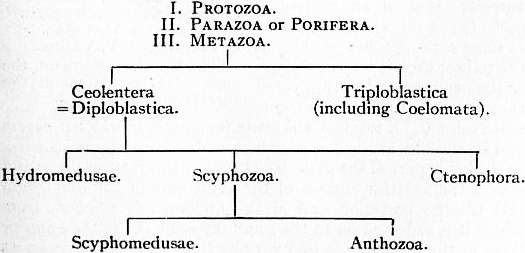
In the above-given classification, the Scyphomedusae, formerly included with the Hydromedusae as Hydrozoa, are placed nearer the Anthozoa. The reasons for this may be stated briefly.
The Hydromedusae are distinguished from the Scyphozoa chiefly by negative characters; they have no stomodaeum, that is, no ingrowth of ectoderm at the mouth to form an oesophagus; they have no mesenteries (radiating partitions) which incompletely subdivide the coelenteron; and they have no concentration of digestive cells into special organs. Their ectodermal muscles are mainly longitudinal, their endodermal muscles are circularly arranged on the body-wall. Their sexual cells are (probably in all cases) produced from the ectoderm, and lie in those radii which are first accentuated in development. They typically present two structural forms, the non-sexual hydroid and the sexual medusoid; in such a case there is an alternation of generations (metagenesis), the hydroid giving rise to the medusoid by a sexual gemmation, the medusoid bearing sexual cells which develop into a hydroid. In some other cases medusoid develops directly from medusoid (hypogenesis), whether by sexual cells or by gemmation. The medusoids have a muscular velum of ectoderm and mesogloea only.
The Scyphozoa have the following features in common:—They typically exhibit an ectodermal stomodaeum; partitions or mesenteries project into their coelenteron from the body-wall, and on these are generally concentrated digestive cells (to form mesenterial filaments, phacellae or gastric filaments, &c.); the external musculature of the body-wall is circular (except in Cerianthus); the internal, longitudinal; and the sexual cells probably always arise in the endoderm.
The Scyphomedusae, like the Hydromedusae, typically present a metagenesis, the non-sexual scyphistomoid (corresponding to the hydroid) alternating with the sexual medusoid. In other cases the medusoid is hypogenetic, medusoid producing medusoid. The sexual cells of the medusoid lie in the endoderm on interradii, that is, on the second set of radii accentuated in the course of development. The medusoids have no true velum; in some cases a structure more or less resembling this organ, termed a velarium, is present, permeated by endodermal canals.
The Anthozoa differ from the Scyphomedusae in having no medusoid form; they all more or less resemble a sea-anemone, and may be termed actinioid. They are (with rare exceptions, probably secondarily acquired) hypogenetic, the offspring resembling the parent, and both being sexual. The sexual cells are borne on the mesenteries in positions irrespective of obvious developmental radii.
The Ctenophora are so aberrant in structure that it has been proposed to separate them from the Coelentera altogether: they are, however, theoretically deducible from an ancestor common to other Coelentera, but their extreme specialization precludes the idea of any close relationship with the rest.
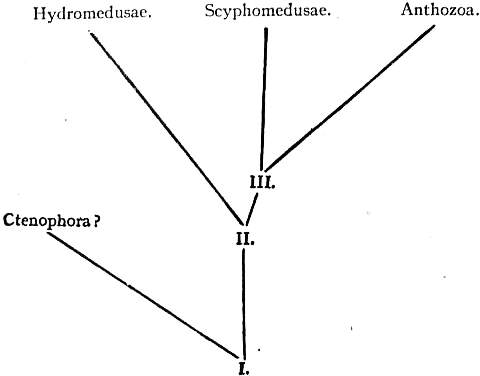
As regards the other three groups, however, it is easy to conceive of them as derived from an ancestor, represented to-day to some extent by the planula-larva, which was Coelenterate in so far as it was composed of an ectoderm and endoderm, and had an internal digestive cavity (I. of the table).
At the point of divergence between Scyphozoa and Hydromedusae (II. of the table of hypothetical descent), we may conceive of its descendant as tentaculate, capable of either floating (swimming) or fixation at will like Lucernaria to-day; and exhibiting incipient differentiation of myoepithelial cells (formerly termed neuro-muscular cells). At the parting of the ways which led, on the one hand, to modern Scyphomedusae, on the other to Anthozoa (III.), it is probable that the common ancestor was marked by incipient mesenteries and by the limitation of the sexual cells to endoderm. The lines of descent—II. to Hydromedusae, and III. to Scyphomedusae—represent periods during which the hypothetical ancestors II. and III., capable of either locomotion or fixation at will, were either differentiated into alternating generations of fixed sterile nutritive hydroids (scyphistomoids) and locomotor sexual medusoids, or abandoned the power of fixation in hypogenetic cases. During the period represented by the line of descent—III. to Anthozoa—this group abandoned its power of adult locomotion by swimming. During these periods were also attained those less important structural characters which these three groups present to-day.
(G. H. Fo.)
COELLO, ALONSO SANCHEZ (1515-1590), Spanish painter, according to some authorities a native of Portugal, was born, according to others, at Benifacio, near the city of Valencia. He studied many years in Italy; and returning to Spain in 1541 he settled at Madrid, and worked on religious themes for most of the palaces and larger churches. He was a follower of Titian, and, like him, excelled in portraits and single figures, elaborating the textures of his armours, draperies, and such accessories in a manner so masterly as strongly to influence Velazquez in his treatment of like objects. Many of his pictures were destroyed in the fires that consumed the Madrid and Prado palaces, but many good examples are yet extant, among which may be noted the portraits of the infantes Carlos and Isabella, now in the Madrid gallery, and the St Sebastian painted in the church of San Gerónimo, also in Madrid. Coello left a daughter, Isabella Sanchez, who studied under him, and painted excellent portraits.
COELLO, ANTONIO (1610?-1652), Spanish dramatist and poet, was born at Madrid about the beginning of the 17th century. He entered the household of the duke de Albuquerque, and after some years of service in the army received the order of Santiago in 1648. He was a favourite of Philip IV., who is reported to have collaborated with him; this rumour is not confirmed, but there is ample proof of Coello’s collaboration with Calderón, Rojas Zorrilla, Solís and Velez de Guevara, the most distinguished dramatists of the age. The best of his original plays, Los Empeños de seis horas, has been wrongly ascribed to Calderón; it was adapted by Samuel Tuke, under the title of The Adventures of five Hours, and was described by Pepys as superior to Othello. It is an excellent example of stagecraft and animated dialogue. Coello died on the 20th of October 1652, shortly after his nomination to a post in the household of Philip IV.
COELOM AND SEROUS MEMBRANES. In human anatomy the body-cavity or coelom (Gr. κοῖλος, hollow) is divided into the pericardium, the two pleurae, the peritoneum and the two tunicae vaginales.
The pericardium is a closed sac which occupies the central part of the thorax and contains the heart. Like all the serous membranes it has a visceral and a parietal layer, the former of which is closely applied to the heart and consists of endothelial cells with a slight fibrous backing: to it is due the glossy appearance of a freshly removed heart. The parietal layer is double; externally there is a strong fibrous protective coat which is continuous with the other fibrous structures in the neighbourhood, especially with the sheaths of the great vessels at the root of the heart, with prolongations of the fascia of the neck, and with the central tendon of the diaphragm, while internally is the serous layer which is reflected from the surface of the heart, where the great vessels enter, so that everywhere the two layers of the serous membrane are in contact, and the only thing within the cavity is a drop or two of the fluid secreted by the serous walls. When the parietal layer is laid open and the heart removed by cutting through the great vessels, it will be seen that there are two lines of reflection of the serous layer, one common to the aorta and pulmonary artery, the other to all the pulmonary veins and the two venae cavae.
The pleurae very closely resemble the pericardium except that the fibrous outer coat of the parietal layer is not nearly as strong; it is closely attached to the inner surface of the chest walls and mesially to the outer layer of the pericardium; above it is thickened by a fibrous contribution from the scalene muscles, and this forms the dome of the pleura which fits into the concavity of the first rib and contains the apex of the lung. The reflection of the serous layer of the pleura, from the parietal to the visceral part, takes place at the root of the lung, where the great vessels enter, and continues for some distance below this as the ligamentum latum pulmonis. The upper limit of the pleural cavity reaches about half an inch above the inner third of the clavicle, while, below, it may be marked out by a line drawn from the twelfth thoracic spine to the tenth rib in the mid axillary line, the eighth rib in the nipple line, and the sixth rib at its junction with the sternum. There is probably very little difference in the lower level of the pleurae on the two sides.
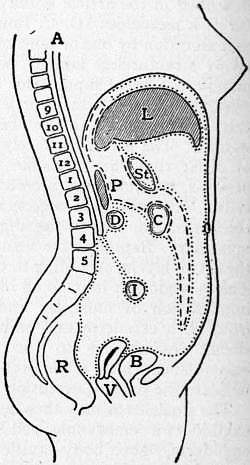
Fig. 1.—Diagram of vertical median section of Abdomen.
A, Aorta. D, Duodenum.
P, Pancreas. B, Bladder.
I, Intestine. St, Stomach.
R, Rectum. C, Colon.
L, Liver. V, Vagina.
(The fine dots represent the great sac of the peritoneum, the coarse dots the lesser sac.)
The peritoneum is a more extensive and complicated membrane than either the pericardium or pleura; it surrounds the abdominal and pelvic viscera, and, like the other sacs, has a parietal and visceral layer. The line of reflection of these, though a continuous one, is very tortuous. The peritoneum consists of a greater and lesser sac which communicate through an opening known as the foramen of Winslow, and the most satisfactory way of understanding these is to follow the reflections first in a vertical median (sagittal) section and then in a horizontal one, the body being supposed to be in the upright position. If a median sagittal section be studied first, and a start be made at the umbilicus (see fig. 1), the parietal peritoneum is seen to run upward, lining the anterior abdominal wall, and then to pass along the under surface of the diaphragm till its posterior third is reached; here there is a reflection on to the liver (L), forming the anterior layer of the coronary ligament of that viscus, while the membrane now becomes visceral and envelops the front of the liver as far back as the transverse fissure on its lower surface; here it is reflected on to the stomach (St) forming the anterior layer of the gastro-hepatic or lesser omentum. It now covers the front of the stomach, and at the lower border runs down as the anterior layer of an apron-like fold, the great omentum, which in some cases reaches as low as the pubes; then it turns up again as the posterior or fourth layer of the great omentum until the transverse colon (C) is reached, the posterior surface of which it covers and is reflected, as the posterior layer of the transverse meso-colon, to the lower part of the pancreas (P); after this it turns down and covers the anterior surface of the third part of the duodenum (D) till the posterior wall of the abdomen is reached, from which it is reflected on to the small intestine (I) as the anterior layer of the mesentery, a fold varying from 5 to 8 in. between its attachments. After surrounding the small intestine it becomes the posterior layer of the mesentery and so again reaches the posterior abdominal wall, down which it runs until the rectum (R) is reached. The anterior surface of this tube is covered by peritoneum to a point about 3 in. from the anus, where it is reflected on to the uterus and vagina (V) in the female and then on to the bladder (B); in the male, on the other hand, the reflection is directly from the rectum to the bladder. At the apex of the bladder, after covering the upper surface of that organ, it is lifted off by the urachus and runs up the anterior abdominal wall to the umbilicus, from which the start was made. All this is the greater sac. The tracing of the lesser sac may be conveniently started at the transverse fissure of the liver, whence the membrane runs down to the stomach (St) as the posterior layer of the lesser omentum, lines the posterior surface of the stomach, passes down as the second layer of the great omentum and up again as the third layer, covers the anterior surface of the transverse colon (C) and then reaches the pancreas (P) as the anterior layer of the transverse mesocolon. After this it covers the front of the pancreas and in the middle line of the body runs up below the diaphragm to within an inch of the anterior layer of the coronary ligament of the liver; here it is reflected on to the top of the Spigelian lobe of the liver to form the posterior layer of the coronary ligament, covers the whole Spigelian lobe, and so reaches the transverse fissure, the starting-point.
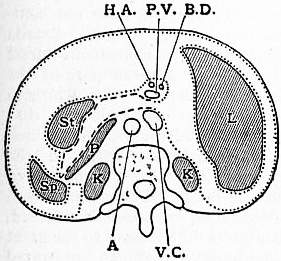
Fig. 2.—Diagram of Horizontal Section through upper part of 1st Lumbar Vertebra.
A, Aorta. H.A, Hepatic Artery.
Sp, Spleen. K, Kidney.
B.D, Bile duct. L, Liver.
V.C, Vena Cava. St, Stomach.
P, Pancreas. P.V, Portal Vein.
The dotting of the peritoneum is as in fig. 1.
This section, therefore, shows two completely closed sacs without any visible communication. In the female, however, the great sac is not absolutely closed, for the Fallopian tubes open into it by their minute ostia abdominalia, while at the other ends they communicate with the cavity of the uterus and so with the vagina and exterior.
A horizontal section through the upper part of the first lumbar vertebra will, if a fortunate one (see fig. 2), pass through the foramen of Winslow and show the communication of the two sacs. A starting-point may be made from the mid-ventral line and the parietal peritoneum traced round the left side of the body wall until the outer edge of the left kidney (K) is reached; here it passes in front of the kidney and is soon reflected off on to the spleen, which it nearly surrounds; just before it reaches the hilum of that organ, where the vessels enter, it is reflected on to the front of the stomach (St), forming the anterior layer of the gastro-splenic omentum; it soon reaches the lesser curvature of the stomach and then becomes the anterior layer of the lesser omentum, which continues until the bile duct (B.D) and portal vein (P.V) are reached at its right free extremity; here it turns completely round these structures and runs to the left again, as the posterior layer of the lesser omentum, behind the stomach (St) and then to the spleen (Sp) as the posterior layer of the gastro-splenic omentum. From the spleen it runs to the right once more, in front of the pancreas (P), until the inferior vena cava (V.C) is reached, and this point is just behind the portal vein and is the place where the lesser and greater sacs communicate, known as the foramen of Winslow. From this opening the lesser sac runs to the left, while all the rest of the peritoneal cavity in the section is greater sac. From the front of the vena cava the parietal peritoneum passes in front of the right kidney (K) and round the right abdominal wall to the mid-ventral line. The right part of this section is filled by the liver (L), which is completely surrounded by a visceral layer of peritoneum, and no reflection is usually seen at this level between it and the parietal layer. Some of the viscera, such as the kidneys and pancreas, are retro-peritoneal; others, such as the small intestines and transverse colon, are surrounded, except at one point where they are attached to the dorsal wall by a mesentery or mesocolon as the reflections are called; others again are completely surrounded, and of these the caecum is an example; while some, like the liver and bladder, have large uncovered areas, and the reflections of the membrane form ligaments which allow considerable freedom of movement.
The tunica vaginalis is the remains of a process of the peritoneum (processus vaginalis) which descends into the scrotum during foetal life some little time before the testis itself descends. After the descent of the testis the upper part usually becomes obliterated, while the lower part forms a serous sac which nearly surrounds the testis, but does not quite do so. Posteriorly the epididymis is in close contact with the testis, and here the visceral layer is not in contact; there is, however, a pocket called the digital fossa which squeezes in from the outer side between the testis and epididymis. The parietal layer lines the inner wall of its own side of the scrotum.
For a full description of the topography of the serous membranes see any of the standard text-books of anatomy, by Gray, Quain, Cunningham or Macalister. Special details will be found in Sir F. Treves’ Anatomy of the Intestinal Canal and Peritoneum (London, 1885); C. B. Lockwood, Hunterian Lectures on Hernia (London, 1889); C. Addison, “Topographical Anatomy of the Abdominal Viscera in Man,” Jour. Anat., vols. 34, 35; F. Dixon and A. Birmingham, “Peritoneum of the Pelvic Cavity,” Jour. Anat. vol. 34, p. 127; W. Waldeyer, “Das Becken” (1899), and “Topographical Sketch of the Lateral Wall of the Pelvic Cavity,” Jour. Anat. vol. 32; B. Moynihan, Retroperitoneal Hernia (London, 1899). A complete bibliography of the subject up to 1895 will be found in Quain’s Anatomy, vol. 3, part 4, p. 69.
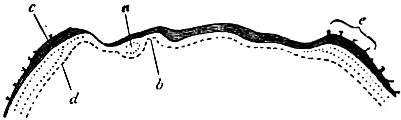
After Young and Robinson, Cunningham’s Text-Book of Anatomy.
Fig. 3.—Diagram of Longitudinal Section, showing the different areas of the Blastodermic Vesicle.
a, Pericardium. c, Ectoderm. d, Entoderm.
b, Bucco-pharyngeal area. e, Placental area.
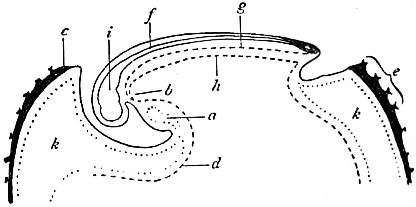
After Young and Robinson, Cunningham’s Text-Book of Anatomy.
Fig. 4.—Diagram of a Developing Ovum, seen in Longitudinal Section.
f, Spinal cord. i, Brain.
g, Notochord. k, Extra embryonic coelom.
h, Dorsal wall of alimentary canal. Other numbers as in fig. 3.
Embryology.—As the mesoderm is gradually spreading over the embryo it splits into two layers, the outer of which is known as the somatopleure and lines the parietal or ectodermal wall, while the inner lines the entoderm and is called the splanchnopleure; between the two is the coelom. The pericardial area is early differentiated from the rest of the coelom and at first lies in front of the neural and bucco-pharyngeal area; here the mesoderm stretches right across the mid-line, which it does not in front and behind. As the head fold of the embryo is formed the pericardium is gradually turned right over, so that the dorsal side becomes the ventral and the anterior limit the posterior; this will be evident on referring to the two accompanying diagrams.
The two primitive aortae lie at first in the ventral wall of the pericardium, but with the folding over they come to lie in the dorsal wall and gradually bulge into the cavity as they coalesce to form the heart, so that the heart drops into the dorsal side of the pericardium and draws down a fold of the membrane called the dorsal mesocardium. In mammals A. Robinson (Jour. Anat. and Phys., xxxvii. 1) has shown that no ventral mesocardium exists, though in more lowly vertebrates it is present. Laterally the pericardial cavity communicates with the general cavity of the coelom, but with the growth of the Cuvierian ducts (see development of veins) these communications disappear. Originally the mesocardium runs the whole length of the pericardium from before backward, but later on the middle part becomes obliterated, and so the two separate reflections from the parietal to the visceral layer, already noticed, are accounted for.
Just behind the pericardium and in front of the umbilicus, which at first are close together, the mesoderm forms a mass which is called the septum transversum, and into this the developing lungs push bag-like protrusions of the coelom, consisting of visceral and parietal layers, and these eventually lose their connexion with the rest of the coelom, as the diaphragm develops, and become the pleural cavities. After the pericardium and pleurae have been separated off the remainder of the coelom becomes the peritoneum. At first the stomach and intestine form a straight tube, which is connected to the dorsum of the embryo by a dorsal mesentery and to the mid-ventral wall in front of the umbilicus by a ventral mesentery. Into the ventral mesentery the liver grows as diverticula from the duodenum, so that some of the mesentery remains as the falciform ligament of the liver and some as the lesser omentum. Into the dorsal mesentery the pancreas grows, also as diverticula, from the duodenum, while the spleen is developed from the mesoderm contained in the same fold. As the stomach turns over so that its left side becomes ventral, the dorsal mesentery attached to it becomes pulled out, in such a way that part of it forms the great omentum and part the gastro-splenic omentum. After the caecum is formed as a diverticulum from the intestine it is situated close to the liver and gradually travels down into the right iliac fossa. This passage to the right is accompanied by a throwing over of the duodenal loop to the right, so that the right side of its mesentery becomes pressed against the dorsal wall of the abdomen and obliterated. This accounts for the fact that the pancreas and duodenum are only covered by peritoneum on their anterior surfaces in man. The formation of the lesser sac is due to the turning over of the stomach to the right, with the result that a cave, known sometimes as the bursa omentalis, is formed behind it. Originally, of course, the whole colon had a dorsal mesocolon continuous with the mesentery, but in the region of the ascending and descending colon this usually disappears and these parts of the gut are uncovered by peritoneum posteriorly. The transverse mesocolon persists and at first is quite free from the great omentum, but later, in man, the two structures fuse1 and the fourth layer of the great omentum becomes continuous with the posterior layer of the transverse mesocolon.
For further details see Quain’s Anatomy (London, 1908).
Comparative Anatomy.—In the Amphioxus the coelom is developed in the embryo as a series of bilateral pouches, called enterocoeles, from the sides of the alimentary canal; these are therefore entodermal in their origin, as in Sagitta and the Echinodermata among the invertebrates. In the adult the development of the atrium causes a considerable reduction of the coelom, represented by two dorsal coelomic canals communicating with a ventral canal by means of branchial canals which run down the outer side of the primary gill bars. Into the dorsal canals the nephridia open. In the intestinal region the coelom is only present on the left side.
In the higher vertebrates (Craniata) the coelom is developed by a splitting of the mesoderm into two layers, and a pericardium is constricted off from the general cavity. In all cases the ova burst into the coelom before making their way to the exterior, and in some cases, e.g. amphioxus, lamprey (Cyclostomata), eels and mud-fish (Dipnoi), the sperm cells do so too. The Cyclostomata have a pair of genital pores which lead from the coelom into the urino-genital sinus, and so to the exterior.
In the Elasmobranch fish there is a pericardio-peritoneal canal forming a communication between these two parts of the coelom; also a large common opening for the two oviducts in the region of the liver, and two openings, called abdominal pores, on to the surface close to the cloacal aperture. In the Teleostomi (Teleostean and Ganoid fish) abdominal pores are rare, but in most Teleostei (bony fish) the ova pass directly down oviducts, as they do in Arthropods, without entering the peritoneal cavity; there is little doubt, however, that these oviducts are originally coelomic in origin. In the Dipnoi (mud-fish) abdominal pores are found, and probably serve as a passage for the sperm cells, since there are no vasa deferentia. In fishes a complete dorsal mesentery is seldom found in the adult; in many cases it only remains as a tube surrounding the vessels passing to the alimentary canal.
In the Amphibia, Reptilia and Aves, one cavity acts as pleura and peritoneum, though in the latter the lungs are not completely surrounded by a serous membrane. In many lizards the comparatively straight intestine, with its continuous dorsal mesentery and ventral mesentery in the anterior part of the abdomen, is very like a stage in the development of the human and other mammalian embryos. In the mammalia the diaphragm is complete (see Diaphragm) and divides the pleuro-peritoneal cavity into its two constituent parts. In the lower mammals the derivatives of the original dorsal mesentery do not undergo as much fusion and obliteration as they do in adult man; the ascending and descending mesocolon is retained, and the transverse mesocolon contracts no adhesion to the great omentum. It is a common thing, however, to find a fenestrated arrangement of the great omentum which shows that its layers have been completely obliterated in many places.
In those animals, such as the rabbit, in which the tests are sometimes in the scrotum and sometimes in the abdomen, the communication between the peritoneum and the tunica vaginalis remains throughout life.
For further details and literature up to 1902, see R. Wiedersheim’s Vergleichende Anatomie der Wirbeltiere (Jena, 1902).
(F. G. P.)
COEN, JAN PIETERSZOON (1587-1630), fourth governor-general of the Dutch East Indies, was born at Hoorn, and spent his youth at Rome in the house of the famous merchants the Piscatori. In 1607 he sailed from Amsterdam to the Indies as second commercial agent, and remained away four years. He had proved so capable that in 1612 he was sent out a second time at the head of a trading expedition. In the following year he was made a councillor and director-general of the East Indian trade. Afterwards he became president at Bantam, and on the 31st of October 1617 he was promoted in succession to Laurens Reaal to the post of governor-general. To his vigour and intrepidity the Dutch in no small measure owed the preservation and establishment of their empire in the East. He took and destroyed Jacatra, and founded on its ruins the capital of the Dutch East Indies, to which he gave the name of Batavia. In 1622 Coen obtained leave to resign his post and return to Holland, but in his absence great difficulties had arisen with the English at Amboina (the so-called massacre of Amboina), and in 1627 under pressure from the directors of the East India Company he again returned as governor-general to Batavia. In 1629 he was able to beat off a formidable attack of the sultan of Mataram, sometimes styled emperor of Java, upon Batavia. He died the following year.
COENACULUM, the term applied to the eating-room of a Roman house in which the supper (coena) or latest meal was taken. It was sometimes placed in an upper storey and reached by an external staircase. The Last Supper in the New Testament was taken in the Coenaculum, the “large upper room” cited in St Mark (xiv. 15) and St Luke (xxii. 12).
CŒNWULF (d. 821), king of Mercia, succeeded to the throne in 796, on the death of Ecgfrith, son of Offa. His succession is somewhat remarkable, as his direct ancestors do not seem to have held the throne for six generations. In 798 he invaded Kent, deposed and imprisoned Eadberht Præn, and made his own brother Cuthred king. Cuthred reigned in Kent from 798 to 807, when he died, and Cœnwulf seems to have taken Kent into his own hands. It was during this reign that the archbishopric of Lichfield was abolished, probably before 803, as the Hygeberht who signed as an abbot at the council of Cloveshoe in that year was presumably the former archbishop. Cœnwulf appears from the charters to have quarrelled with Wulfred of Canterbury, who was consecrated in 806, and the dispute continued for several years. It was probably only settled at Cloveshoe in 825, when the lawsuit of Cwœnthryth, daughter and heiress of Cœnwulf, with Wulfred was terminated. Cœnwulf may have instigated the raid of Æthelmund, earl of the Hwicce, upon the accession of Ecgberht. He died in 821, and was succeeded by his brother Ceolwulf I.