VOLUME VI SLICE VI Cockaigne to Columbus, Christopher (continued 7)
Reading edition
From this period until the death of Lord Collingwood no great naval action was fought; but he was much occupied in important political transactions, in which he displayed remarkable tact and judgment. Being appointed to the command of the Mediterranean fleet, he continued to cruise about, keeping a watchful eye upon the movements of the enemy. His health, however, which had begun to decline previously to the action of Trafalgar in 1805, seemed entirely to give way, and he repeatedly requested government to be relieved of his command, that he might return home; but he was urgently requested to remain, on the ground that his country could not dispense with his services. This conduct has been regarded as harsh; but the good sense and political sagacity which he displayed afford some palliation of the conduct of the government; and the high estimation in which he was held is proved by the circumstance that among the many able admirals, equal in rank and duration of service, none stood so prominently forward as to command the confidence of ministers and of the country to the same extent as he did. After many fruitless attempts to induce the enemy to put to sea, as well as to fall in with them when they had done so (which circumstance materially contributed to hasten his death), he expired on board the “Ville de Paris,” then lying off Port Mahon, on the 7th of March 1810.
Lord Collingwood’s merits as a naval officer were in every respect of the first order. In original genius and romantic daring he was inferior to Nelson, who indeed had no equal in an age fertile in great commanders. In seamanship, in general talent, and in reasoning upon the probability of events from a number of conflicting and ambiguous statements, Collingwood was equal to the hero of the Nile; indeed, many who were familiar with both give him the palm of superiority. His political penetration was remarkable; and so high was the opinion generally entertained of his judgment, that he was consulted in all quarters, and on all occasions, upon questions of general policy, of regulation, and even of trade. He was distinguished for benevolence and generosity; his acts of charity were frequent and bountiful, and the petition of real distress was never rejected by him. He was an enemy to impressment and to flogging; and so kind was he to his crew, that he obtained amongst them the honourable name of father. Between Nelson and Collingwood a close intimacy subsisted, from their first acquaintance in early life till the fall of the former at Trafalgar; and they lie side by side in the cathedral of St Paul’s.
The selections from the public and private correspondence of Lord Collingwood, published in 2 vols., 8vo, in 1828, contain some of the best specimens of letter-writing in the language. See also A Fine Old English Gentleman exemplified in the Life and Character of Lord Collingwood, a Biographical Study, by William Davies (London, 1875).
COLLINGWOOD, a city of Bourke county, Victoria, Australia, suburban to Melbourne on the N.E., on the Yarra Yarra river. Pop. (1901) 32,766. It was the first town in Victoria incorporated after Melbourne and Geelong. It is esteemed one of the healthiest of the metropolitan suburbs.
COLLINGWOOD, a town of Simcoe county, Ontario, Canada, 90 m. N.N.W. of Toronto, on Georgian Bay, and on the Grand Trunk railway. Pop. (1901) 5755. It is the eastern terminus of two lines of steamers for the ports of Lakes Huron and Superior. It contains a large stone dry-dock and shipyard, pork factory, and saw and planing mills, and has a large lumber, grain and produce export trade, besides a shipbuilding plant and steel works.
COLLINS, ANTHONY (1676-1729), English deist, was born at Heston, near Hounslow in Middlesex, on the 21st of June 1676. He was educated at Eton and King’s College, Cambridge, and was for some time a student at the Middle Temple. The most interesting episode of his life was his intimacy with Locke, who in his letters speaks of him with affection and admiration. In 1715 he settled in Essex, where he held the offices of justice of the peace and deputy-lieutenant, which he had before held in Middlesex. He died at his house in Harley Street, London, on the 13th of December 1729.
His writings are important as gathering together the results of previous English Freethinkers. The imperturbable courtesy of his style is in striking contrast to the violence of his opponents; and it must be remembered that, in spite of his unorthodoxy, he was not an atheist or even an agnostic. In his own words, “Ignorance is the foundation of atheism, and freethinking the cure of it” (Discourse of Freethinking, 105).
His first work of note was his Essay concerning the Use of Reason in Propositions the Evidence whereof depends on Human Testimony (1707), in which he rejected the distinction between above reason and contrary to reason, and demanded that revelation should conform to man’s natural ideas of God. Like all his works, it was published anonymously, although the identity of the author was never long concealed. Six years later appeared his chief work, A Discourse of Freethinking, occasioned by the Rise and Growth of a Sect called Freethinkers (1713). Notwithstanding the ambiguity of its title, and the fact that it attacks the priests of all churches without moderation, it contends for the most part, at least explicitly, for no more than must be admitted by every Protestant. Freethinking is a right which cannot and must not be limited, for it is the only means of attaining to a knowledge of truth, it essentially contributes to the well-being of society, and it is not only permitted but enjoined by the Bible. In fact the first introduction of Christianity and the success of all missionary enterprise involve freethinking (in its etymological sense) on the part of those converted. In England this essay, which was regarded and treated as a plea for deism, made a great sensation, calling forth several replies, among others from William Whiston, Bishop Hare, Bishop Hoadly, and Richard Bentley, who, under the signature of Phileleutherus Lipsiensis, roughly handles certain arguments carelessly expressed by Collins, but triumphs chiefly by an attack on trivial points of scholarship, his own pamphlet being by no means faultless in this very respect. Swift also, being satirically referred to in the book, made it the subject of a caricature.
In 1724 Collins published his Discourse of the Grounds and Reasons of the Christian Religion, with An Apology for Free Debate and Liberty of Writing prefixed. Ostensibly it is written in opposition to Whiston’s attempt to show that the books of the Old Testament did originally contain prophecies of events in the New Testament story, but that these had been eliminated or corrupted by the Jews, and to prove that the fulfilment of prophecy by the events of Christ’s life is all “secondary, secret, allegorical, and mystical,” since the original and literal reference is always to some other fact. Since, further, according to him the fulfilment of prophecy is the only valid proof of Christianity, he thus secretly aims a blow at Christianity as a revelation. The canonicity of the New Testament he ventures openly to deny, on the ground that the canon could be fixed only by men who were inspired. No less than thirty-five answers were directed against this book, the most noteworthy of which were those of Bishop Edward Chandler, Arthur Sykes and Samuel Clarke. To these, but with special reference to the work of Chandler, which maintained that a number of prophecies were literally fulfilled in Christ, Collins replied by his Scheme of Literal Prophecy Considered (1727). An appendix contends against Whiston that the book of Daniel was forged in the time of Antiochus Epiphanes (see Deism).
In philosophy, Collins takes a foremost place as a defender of Necessitarianism. His brief Inquiry Concerning Human Liberty (1715) has not been excelled, at all events in its main outlines, as a statement of the determinist standpoint. One of his arguments, however, calls for special criticism,—his assertion that it is self-evident that nothing that has a beginning can be without a cause is an unwarranted assumption of the very point at issue. He was attacked in an elaborate treatise by Samuel Clarke, in whose system the freedom of the will is made essential to religion and morality. During Clarke’s lifetime, fearing perhaps to be branded as an enemy of religion and morality, Collins made no reply, but in 1729 he published an answer, entitled Liberty and Necessity.
Besides these works he wrote A Letter to Mr Dodwell, arguing that it is conceivable that the soul may be material, and, secondly, that if the soul be immaterial it does not follow, as Clarke had contended, that it is immortal; Vindication of the Divine Attributes (1710); Priestcraft in Perfection (1709), in which he asserts that the clause “the Church ... Faith” in the twentieth of the Thirty-nine Articles was inserted by fraud.
See Kippis, Biographia Britannica; G. Lechler, Geschichte des englischen Deismus (1841); J. Hunt, Religious Thought in England, ii. (1871); Leslie Stephen, English Thought in the 18th Century, i. (1881); A. W. Benn, Hist. of English Rationalism in the 19th Century (London, 1906), vol. i. ch. iii.; J. M. Robertson, Short History of Freethought (London, 1906); and Deism.
COLLINS, JOHN CHURTON (1848-1908), English literary critic, was born on the 26th of March 1848 at Bourton on the Water, Gloucestershire. From King Edward’s school, Birmingham, he went to Balliol College, Oxford, where he graduated in 1872, and at once devoted himself to a literary career, as journalist, essayist and lecturer. His first book was a study of Sir Joshua Reynolds (1874), and later he edited various classical English writers, and published volumes on Bolingbroke and Voltaire in England (1886), a Study of English Literature (1891), a study of Dean Swift (1893), Essays and Studies (1895), Ephemera Critica (1901), Essays in Poetry and Criticism (1905), and Rousseau and Voltaire (1908), his original essays being sharply controversial in tone, but full of knowledge. In 1904 he became professor of English literature at Birmingham University. For many years he was a prominent University Extension lecturer, and a constant contributor to the principal reviews. On the 15th of September 1908 he was found dead in a ditch near Lowestoft, at which place he had been staying with a doctor for the benefit of his health. The circumstances necessitated the holding of an inquest, the verdict being that of “accidental death.”
COLLINS, MORTIMER (1827-1876), English writer, was born at Plymouth, where his father, Francis Collins, was a solicitor, on the 29th of June 1827. He was educated at a private school, and after some years spent as mathematical master at Queen Elizabeth’s College, Guernsey, he went to London, where he devoted himself to journalism in the Conservative interest. In 1855 he published his Idyls and Rhymes; and in 1865 appeared his first story, Who is the Heir? A second volume of lyrics, The Inn of Strange Meetings, was issued in 1871; and in 1872 he produced his longest and best sustained poem, The British Birds, a communication from the Ghost of Aristophanes. He also wrote several capital novels, the best of which is perhaps Sweet Anne Page (1868). Some of his lyrics, in their light grace, their sparkling wit, their airy philosophy, are equal to anything of their kind in modern English. On his second marriage in 1868 he settled at Knowl Hill, Berkshire. Collins was an athlete, an excellent pedestrian, and an enthusiastic lover of country life; and from this time he rarely left his home for a day. Conservative in his political and literary tastes, an ardent upholder of Church and State, he was yet a hater of convention; and his many and very varied gifts endeared him to a large circle of friends. He died on the 28th of July 1876.
COLLINS, WILLIAM (1721-1759), English poet, was born on the 25th of December 1721. He divides with Gray the glory of being the greatest English lyrist of the 18th century. After some childish studies in Chichester, of which his father, a rich hatter, was the mayor, he was sent, in January 1733, to Winchester College, where Whitehead and Joseph Warton were his school-fellows. When he had been nine months at the school, Pope paid Winchester a visit and proposed a subject for a prize poem; it is legitimate to suppose that the lofty forehead, the brisk dark eyes and gracious oval of the childish face, as we know it in the only portrait existing of Collins, did not escape the great man’s notice, then not a little occupied with the composition of the Essay on Man.
In 1734 the young poet published his first verses, in a sixpenny pamphlet on The Royal Nuptials, of which, however, no copy has come down to us; another poem, probably satiric, called The Battle of the Schoolbooks, was written about this time, and has also been lost. Fired by his poetic fellows to further feats in verse, Collins produced, in his seventeenth year, those Persian Eclogues which were the only writings of his that were valued by the world during his own lifetime. They were not printed for some years, and meanwhile Collins sent, in January and October 1739, some verses to the Gentleman’s Magazine, which attracted the notice and admiration of Johnson, then still young and uninfluential. In March 1740 he was admitted a commoner of Queen’s College, Oxford, but did not go up to Oxford until July 1741, when he obtained a demyship at Magdalen College. At Oxford he continued his affectionate intimacy with the Wartons, and gained the friendship of Gilbert White. Early in 1742 the Persian Eclogues appeared in London. They were four in number, and formed a modest pamphlet of not more than 300 lines in all. In a later edition, of 1759, the title was changed to Oriental Eclogues. Those pieces may be compared with Victor Hugo’s Les Orientales, to which, of course, they are greatly inferior. Considered with regard to the time at which they were produced, they are more than meritorious, even brilliant, and one at least—the second—can be read with enjoyment at the present day. The rest, perhaps, will be found somewhat artificial and effete.
In November 1743 Collins was made bachelor of arts, and a few days after taking his degree published his second work, Verses humbly addressed to Sir Thomas Hanmer. This poem, written in heroic couplets, shows a great advance in individuality, and resembles, in its habit of personifying qualities of the mind, the riper lyrics of its author. For the rest, it is an enthusiastic review of poetry, culminating in a laudation of Shakespeare. It is supposed that he left Oxford abruptly in the summer of 1744 to attend his mother’s death-bed, and did not return. He is said to have now visited an uncle in Flanders. His indolence, which had been no less marked at the university than his genius, combined with a fatal irresolution to make it extremely difficult to choose for him a path in life. The army and the church were successively suggested and rejected; and he finally arrived in London, bent on enjoying a small property as an independent man about town. He made the acquaintance of Johnson and others, and was urged by those friends to undertake various important writings—a History of the Revival of Learning, several tragedies, and a version of Aristotle’s Poetics, among others—all of which he began but lacked force of will to continue. He soon squandered his means, plunged, with most disastrous effects, into profligate excesses, and sowed the seed of his untimely misfortune.
It was at this time, however, that he composed his matchless Odes—twelve in number—which appeared on the 12th of December 1746, dated 1747. The original project was to have combined them with the odes of Joseph Warton, but the latter proved at that time to be the more marketable article. Collins’s little volume fell dead from the press, but it won him the admiration and friendship of the poet Thomson, with whom, until the death of the latter in 1748, he lived on terms of affectionate intimacy. In 1749 Collins was raised beyond the fear of poverty by the death of his uncle, Colonel Martyn, who left him about £2000, and he left London to settle in his native city. He had hardly begun to taste the sweets of a life devoted to literature and quiet, before the weakness of his will began to develop in the direction of insanity, and he hurried abroad to attempt to dispel the gathering gloom by travel. In the interval he had published two short pieces of consummate grace and beauty—the Elegy on Thomson, in 1749, and the Dirge in Cymbeline, later in the same year. In the beginning of 1750 he composed the Ode on the Popular Superstitions of the Highlands, which was dedicated to the author of Douglas, and not printed till long after the death of Collins, and an Ode on the Music of the Grecian Theatre, which no longer exists, and in which English literature probably has sustained a severe loss. With this poem his literary career closes, although he lingered in great misery for nearly nine years. From Gilbert White, who jotted down some pages of invaluable recollections of Collins in 1781, and from other friends, we learn that his madness was occasionally violent, and that he was confined for a time in an asylum at Oxford. But for the most part he resided at Chichester, suffering from extreme debility of body when the mind was clear, and incapable of any regular occupation. Music affected him in a singular manner, and it is recorded that he was wont to slip out into the cathedral cloisters during the services, and moan and howl in horrible accordance with the choir. In this miserable condition he passed out of sight of all his friends, and in 1756 it was supposed, even by Johnson, that he was dead; in point of fact, however, his sufferings did not cease until the 12th of June 1759. No journal or magazine recorded the death of the forgotten poet, though Goldsmith, only two months before, had begun the laudation which was soon to become universal.
No English poet so great as Collins has left behind him so small a bulk of writings. Not more than 1500 lines of his have been handed down to us, but among these not one is slovenly, and few are poor. His odes are the most sculpturesque and faultless in the language. They lack fire, but in charm and precision of diction, exquisite propriety of form, and lofty poetic suggestion they stand unrivalled. The ode named The Passions is the most popular; that To Evening is the classical example of perfect unrhymed verse. In this, and the Ode to Simplicity, one seems to be handling an antique vase of matchless delicacy and elegance. In his descriptions of nature it is unquestionable that he owed something to the influence of Thomson. Distinction may be said to be the crowning grace of the style of Collins; its leading peculiarity is the incessant personification of some quality of the character. In the Ode on Popular Superstitions he produced a still nobler work; this poem, the most considerable in size which has been preserved, contains passages which are beyond question unrivalled for rich melancholy fulness in the literature between Milton and Keats.
The life of Collins was written by Dr Johnson; he found an enthusiastic editor in Dr Langhorne in 1765, and in 1858 a kindly biographer in Mr Moy Thomas.
(E. G.)
COLLINS, WILLIAM (1787-1847), English painter, son of an Irish picture dealer and man of letters, the author of a Life of George Morland, was born in London. He studied under Etty in 1807, and in 1809 exhibited his first pictures of repute—“Boys at Breakfast,” and “Boys with a Bird’s Nest.” In 1815 he was made associate of the Royal Academy, and was elected R. A. in 1820. For the next sixteen years he was a constant exhibitor; his fishermen, shrimp-catchers, boats and nets, stretches of coast and sand, and, above all, his rustic children were universally popular. Then, however, he went abroad on the advice of Wilkie, and for two years (1837-1838) studied the life, manners and scenery of Italy. In 1839 he exhibited the first fruits of this journey; and in 1840, in which year he was appointed librarian to the Academy, he made his first appearance as a painter of history. In 1842 he returned to his early manner and choice of subject, and during the last years of life enjoyed greater popularity than ever. Collins was a good colourist and an excellent draughtsman. His earlier pictures are deficient in breadth and force, but his later work, though also carefully executed, is rich in effects of tone and in broadly painted masses. His biography by his son, W. Wilkie Collins, the novelist, appeared in 1848.
COLLINS, WILLIAM WILKIE (1824-1889), English novelist, elder son of William Collins, R.A., the landscape painter, was born in London on the 8th of January 1824. He was educated at a private school in Highbury, and when only a small boy of twelve was taken by his parents to Italy, where the family lived for three years. On their return to England Wilkie Collins was articled to a firm in the tea trade, but four years later he abandoned that business for the law, and was entered at Lincoln’s Inn in 1846, being called to the bar three years later. He found little pleasure in his new career, however; though what he learned in it was exceedingly valuable to him later. On his father’s death in 1847 young Collins made his first essay in literature, publishing the Life of William Collins, in two volumes, in the following year. In 1850 he put forth his first work of fiction, Antonina, or the Fall of Rome, which was clearly inspired by his life in Italy. Basil appeared in 1852, and Hide and Seek in 1854. About this time he made the acquaintance of Charles Dickens, and began to contribute to Household Words, where After Dark (1856) and The Dead Secret (1857) ran serially. His great success was achieved in 1860 with the publication of The Woman in White, which was first printed in All the Year Round. From that time he enjoyed as much popularity as any novelist of his day, No Name (1862), Armadale (1866), and The Moonstone, a capital detective story (1868), being among his most successful books. After The New Magdalen (1873) his ingenuity became gradually exhausted, and his later stories were little more than faint echoes of earlier successes. He died in Wimpole Street, London, on the 23rd of September 1889. Collins’s gift was of the melodramatic order, and while many of his stories made excellent plays, several of them were actually reconstructed from pieces designed originally for stage production. But if his colours were occasionally crude and his methods violent, he was at least a master of situation and effect. His trick of telling a story through the mouths of different characters is sometimes irritatingly disconnected; but it had the merit of giving an air of actual evidence and reality to the elucidation of a mystery. He possessed in the highest degree the gift of absorbing interest; the turns and complexities of his plots are surprisingly ingenious, and many of his characters are not only real, but uncommon. Count Fosco in The Woman in White is perhaps his masterpiece; the character has been imitated again and again, but no imitation has ever attained to the subtlety and humour of the original.
COLLODION (from the Gr. κόλλα, glue), a colourless, viscid fluid, made by dissolving gun-cotton and the other varieties of pyroxylin in a mixture of alcohol and ether. It was discovered in 1846 by Louis Nicolas Ménard in Paris, and independently in 1848 by Dr J. Parkers Maynard in Boston. The quality of collodion differs according to the proportions of alcohol and ether and the nature of the pyroxylin it contains. Collodion in which there is a great excess of ether gives by its evaporation a very tough film; the film left by collodion containing a large quantity of alcohol is soft and easily torn; but in hot climates the presence of an excess of alcohol is an advantage, as it prevents the rapid evaporation of the ether. Under the microscope, the film produced by collodion of good quality appears translucent and colourless. To preserve collodion it should be kept cool and out of the action of the light; iodized collodion that has been discoloured by the development of free iodine may be purified by the immersion in it of a strip of silver foil. For the iodizing of collodion, ammonium bromide and iodide, and the iodides of calcium and cadmium are the agents employed (see Photography). Collodion is used in surgery since, when painted on the skin, it rapidly dries and covers the skin with a thin film which contracts as it dries and therefore affords both pressure and protection. Flexible collodion, containing Canada balsam and castor oil, does not crack, but, on the other hand, does not contract. It is therefore of less value. Collodion is applied to small aseptic wounds, to small-pox pustules, and occasionally to the end of the urethra in boys in order to prevent nocturnal incontinence. Collodion and crystals of carbolic acid, taken in equal parts, are useful in relieving toothache due to the presence of a carious cavity. Vesicating or Blistering Collodion contains cantharidin as one of its constituents. The styptic colloid of Richardson is a strong solution of tannin in gun-cotton collodion. Similarly collodion may be impregnated with salicylic acid, carbolic acid, iodine and other substances. Small balloons are manufactured from collodion by coating the interior of glass globes with the liquid; the film when dry is removed from the glass by applying suction to the mouth of the vessel. M. E. Gripon found (Compt. rend., 1875) that collodion membranes, like glass, reflect light and polarize it both by refraction and reflection; they also transmit a very much larger proportion of radiant heat, for the study of which they are preferable to mica.
COLLOT D’HERBOIS, JEAN MARIE (1750-1796), French revolutionist, was a Parisian by birth and an actor by profession. After figuring for some years at the principal provincial theatres of France and Holland, he became director of the playhouse at Geneva. He had from the first a share in the revolutionary tumult; but it was not until 1791 that he became a figure of importance. Then, however, by the publication of L’Almanach du Père Gérard,1 a little book setting forth, in homely style, the advantages of a constitutional monarchy, he suddenly acquired great popularity. His renown was soon increased by his active interference on behalf of the Swiss of the Château-Vieux Regiment, condemned to the galleys for mutiny at Nancy. His efforts resulted in their liberation; he went himself to Brest in search of them; and a civic feast was decreed on his behalf and theirs, which gave occasion for one of the few poems published during his life by André Chénier. But his opinions became more and more radical. He was a member of the Commune of Paris on the 10th of August 1792, and was elected deputy for Paris to the Convention, where he was the first to demand the abolition of royalty (on the 21st of September 1792), and he voted the death of Louis XVI. “sans sursis.” In the struggle between the Mountain and the Girondists he displayed great energy; and after the coup d’état of the 31st of May 1793 he made himself conspicuous by his pitiless pursuit of the defeated party. In June he was made president of the Convention; and in September he was admitted to the Committee of Public Safety, on which he was very active. After having entrusted him with several missions, the Convention sent him, on the 30th of October 1793, to Lyons to punish the revolt of that city. There he introduced the Terror in its most terrible form.
In May 1794 an attempt was made to assassinate Collot; but it only increased his popularity, and this won him the hatred of Robespierre, against whom he took sides on the 9th Thermidor, when he presided over the Convention during a part of the session. During the Thermidorian reaction he was one of the first to be accused of complicity with the fallen leader, but was acquitted. Denounced a second time, he defended himself by pleading that he had acted for the cause of the Revolution, but was condemned with Barère and Billaud-Varenne to transportation to Cayenne (March 1795), where he died early in 1796.
Collot d’Herbois wrote and adapted from the English and Spanish many plays, one of which, Le Paysan magistrat, kept the stage for several years. L’Almanach du Père Gérard was reprinted under the title of Étrennes aux amis de la Constitution française, ou entretiens du Père Gérard avec ses concitoyens (Paris, 1792).
See F. A. Aulard, Les Orateurs de la Législative et de la Convention (Paris, 1885-1886), t. ii. pp. 501-512. The principal documents relative to the trial of Collot d’Herbois, Barère and Billaud-Varenne are indicated in Aulard, Recueil des actes du comité de salut public, t. i. pp. 5 and 6.
COLLUSION (from Lat. colludere, strictly, to play with), a secret agreement or compact for some improper purpose. In judicial proceedings, and particularly in matrimonial causes (see Divorce), collusion is a deceitful agreement between two or more persons, or between one of them and a third party, to bring an action against the other in order to obtain a judicial decision, or some remedy which would not have been obtained unless the parties had combined for the purpose or suppressed material facts or otherwise.
COLLYER, ROBERT (1823- ), American Unitarian clergyman, was born in Keighley, Yorkshire, England, on the 8th of December 1823. At the age of eight he was compelled to leave school and support himself by work in a linen factory. He was naturally studious, however, and supplemented his scant schooling by night study. At fourteen he was apprenticed to a blacksmith, and for several years worked at this trade at Ilkley. In 1849 he became a local Methodist minister, and in the following year emigrated to the United States, where he obtained employment as a hammer maker at Shoemakersville, Pennsylvania. Here he soon began to preach on Sundays while still employed in the factory on week-days. His earnest, rugged, simple style of oratory made him extremely popular, and at once secured for him a wide reputation. His advocacy of anti-slavery principles, then frowned upon by the Methodist authorities, aroused opposition, and eventually resulted in his trial for heresy and the revocation of his licence. He continued, however, as an independent preacher and lecturer, and in 1859, having joined the Unitarian Church, became a missionary of that church in Chicago, Illinois. In 1860 he organized and became pastor of the Unity Church, the second Unitarian church in Chicago. Under his guidance the church grew to be one of the strongest of that denomination in the West, and Mr Collyer himself came to be looked upon as one of the foremost pulpit orators in the country. During the Civil War he was active in the work of the Sanitary Commission. In 1879 he left Chicago and became pastor of the church of the Messiah in New York city, and in 1903 he became pastor emeritus. He published: Nature and Life (1867); A Man in Earnest: Life of A. H. Conant (1868); The Life That Now is (1871); The Simple Truth (1877); Talks to Young Men: With Asides to Young Women (1888); Things New and Old (1893); Father Taylor (1906); and A History of the Town and Parish of Ilkley (with Horsefall Turner, 1886).
COLMAN, SAINT (d. 676), bishop of Lindisfarne, was probably an Irish monk at Iona. Journeying southwards he became bishop of Lindisfarne in 661, and a favoured friend of Oswio, king of Northumbria. He was at the synod of Whitby in 664, when the great dispute between the Roman and the Celtic parties in the church was considered; as spokesman of the latter party he upheld the Celtic usages, but King Oswio decided against him and his cause was lost. After this event Colman and some monks went to Iona and then to Ireland. He settled on the island of Inishbofin, where he built a monastery and where he died on the 8th of August 676.
Colman must be distinguished from St Colman of Cloyne (c. 522-600), an Irish saint, who became a Christian about 570; and also from another Irishman, St Colman Ela (553-610), a kinsman of St Columba. The word Colman is derived from the Latin columbus, a dove, and the Book of Leinster mentions 209 saints of this name.
COLMAN, GEORGE (1732-1794), English dramatist and essayist, usually called “the Elder,” and sometimes “George the First,” to distinguish him from his son, was born in 1732 at Florence, where his father was stationed as resident at the court of the grand duke of Tuscany. Colman’s father died within a year of his son’s birth, and the boy’s education was undertaken by William Pulteney, afterwards Lord Bath, whose wife was Mrs Colman’s sister. After attending a private school in Marylebone, he was sent to Westminster School, which he left in due course for Christ Church, Oxford. Here he made the acquaintance of Bonnell Thornton, the parodist, and together they founded The Connoisseur (1754-1756), a periodical which, although it reached its 140th number, “wanted weight,” as Johnson said. He left Oxford after taking his degree in 1755, and, having been entered at Lincoln’s Inn before his return to London, he was called to the bar in 1757. A friendship formed with David Garrick did not help his career as a barrister, but he continued to practise until the death of Lord Bath, out of respect for his wishes.
In 1760 he produced his first play, Polly Honeycomb, which met with great success. In 1761 The Jealous Wife, a comedy partly founded on Tom Jones, made Colman famous. The death of Lord Bath in 1764 placed him in possession of independent means. In 1765 appeared his metrical translation of the plays of Terence; and in 1766 he produced The Clandestine Marriage, jointly with Garrick, whose refusal to take the part of Lord Ogleby led to a quarrel between the two authors. In the next year he purchased a fourth share in the Covent Garden Theatre, a step which is said to have induced General Pulteney to revoke a will by which he had left Colman large estates. The general, who died in that year, did, however, leave him a considerable annuity. Colman was acting manager of Covent Garden for seven years, and during that period he produced several “adapted” plays of Shakespeare. In 1768 he was elected to the Literary Club, then nominally consisting of twelve members. In 1774 he sold his share in the great playhouse, which had involved him in much litigation with his partners, to Leake; and three years later he purchased of Samuel Foote, then broken in health and spirits, the little theatre in the Haymarket. He was attacked with paralysis in 1785; in 1789 his brain became affected, and he died on the 14th of August 1794. Besides the works already cited, Colman was author of adaptations of Beaumont and Fletcher’s Bonduca, Ben Jonson’s Epicoene, Milton’s Comus, and of other plays. He also produced an edition of the works of Beaumont and Fletcher (1778), a version of the Ars Poëtica of Horace, an excellent translation from the Mercator of Plautus for Bonnell Thornton’s edition (1769-1772), some thirty plays, many parodies and occasional pieces. An incomplete edition of his dramatic works was published in 1777 in four volumes.
His son, George Colman (1762-1836), known as “the Younger,” English dramatist and miscellaneous writer, was born on the 21st of October 1762. He passed from Westminster school to Christ Church, Oxford, and King’s College, Aberdeen, and was finally entered as a student of law at Lincoln’s Inn, London. While in Aberdeen he published a poem satirizing Charles James Fox, called The Man of the People; and in 1782 he produced, at his father’s playhouse in the Haymarket, his first play, The Female Dramatist, for which Smollett’s Roderick Random supplied the materials. It was unanimously condemned, but Two to One (1784) was entirely successful. It was followed by Turk and no Turk (1785), a musical comedy; Inkle and Yarico (1787), an opera; Ways and Means (1788); The Iron Chest (1796), taken from William Godwin’s Adventures of Caleb Williams; The Poor Gentleman (1802); John Bull, or an Englishman’s Fireside (1803), his most successful piece; The Heir at Law (1808), which enriched the stage with one immortal character, “Dr Pangloss,” and numerous other pieces, many of them adapted from the French.
The failing health of the elder Colman obliged him to relinquish the management of the Haymarket theatre in 1789, when the younger George succeeded him, at a yearly salary of £600. On the death of the father the patent was continued to the son; but difficulties arose in his way, he was involved in litigation with Thomas Harris, and was unable to pay the expenses of the performances at the Haymarket. He was forced to take sanctuary within the Rules of the King’s Bench. Here he resided for many years continuing to direct the affairs of his theatre. Released at last through the kindness of George IV., who had appointed him exon of the Yeomen of the Guard, a dignity disposed of by Colman to the highest bidder, he was made examiner of plays by the duke of Montrose, then lord chamberlain. This office, to the disgust of all contemporary dramatists, to whose MSS. he was as illiberal as he was severe, he held till his death. Although his own productions were open to charges of indecency and profanity, he was so severe a censor of others that he would not pass even such words as “heaven,” “providence” or “angel.” His comedies are a curious mixture of genuine comic force and sentimentality. A collection of them was published (1827) in Paris, with a life of the author, by J. W. Lake.
Colman, whose witty conversation made him a favourite, was also the author of a great deal of so-called humorous poetry (mostly coarse, though much of it was popular)—My Night Gown and Slippers (1797), reprinted under the name of Broad Grins, in 1802; and Poetical Vagaries (1812). Some of his writings were published under the assumed name of Arthur Griffinhood of Turnham Green. He died in Brompton, London, on the 17th of October 1836. He had, as early as 1784, contracted a runaway marriage with an actress, Clara Morris, to whose brother David Morris, he eventually disposed of his share in the Haymarket theatre. Many of the leading parts in his plays were written especially for Mrs Gibbs (née Logan), whom he was said to have secretly married after the death of his first wife.
See the second George Colman’s memoirs of his early life, entitled Random Records (1830), and R. B. Peake, Memoirs of the Colman Family (1842).
COLMAN, SAMUEL (1832- ), American landscape painter, was born at Portland, Maine, on the 4th of March 1832. He was a pupil of Ashur B. Durand in New York, and in 1860-1862 studied in Spain, Italy, France and England. In 1871-1876 he was again in Europe. In 1860, with James D. Smilie, he founded the American Water Color Society, and became its first president (1866-1867), his own water-colour paintings being particularly fine. He was elected a member of the National Academy of Design in 1862. Among his works are “The Ships of the Western Plains,” in the Union League Club, New York; and “The Spanish Peaks, Colorado,” in the Metropolitan Museum, New York.
COLMAR, or Kolmar, a town of Germany, in the imperial province of Alsace-Lorraine, formerly the capital of the department of Haut-Rhin in France, on the Logelbach and Lauch, tributaries of the Ill, 40 m. S.S.W. from Strassburg on the main line of railway to Basel. Pop. (1905) 41,582. It is the seat of the government for Upper Alsace, and of the supreme court of appeal for Alsace-Lorraine. The town is surrounded by pleasant promenades, on the site of the old fortifications, and has numerous narrow and picturesque streets. Of its edifices the most remarkable are the Roman Catholic parish church of St Martin, known also as the Münster, dating from the 13th and 14th centuries, the Lutheran parish church (15th century), the former Dominican monastery (1232-1289), known as “Unterlinden” and now used as a museum, the Kaufhaus (trade-hall) of the 15th century, and the handsome government offices (formerly the Prefecture). Colmar is the centre of considerable textile industries, comprising wool, cotton and silk-weaving, and has important manufactures of sewing thread, starch, sugar and machinery. Bleaching and brewing are also carried on, and the neighbourhood is rich in vineyards and fruit-gardens. The considerable trade of the place is assisted by a chamber of commerce and a branch of the Imperial Bank (Reichsbank).
Colmar (probably the columbarium of the Romans) is first mentioned, as a royal villa, in a charter of Louis the Pious in 823, and it was here that Charles the Fat held a diet in 884. It was raised to the status of a town and surrounded with walls by Wölfelin, advocate (Landvogt) of the emperor Frederick II. in Alsace, a masterful and ambitious man, whose accumulated wealth was confiscated by the emperor in 1235, and who is said to have been murdered by his wife lest her portion should also be seized. In 1226 Colmar became an imperial city, and the civic rights (Stadtrecht) conferred on it in 1274 by Rudolph of Habsburg became the model for those of many other cities. Its civic history is much the same as that of other medieval towns: a struggle between the democratic gilds and the aristocratic “families,” which ended in 1347 in the inclusion of the former in the governing body, and in the 17th century in the complete exclusion of the latter. In 1255 Colmar joined the league of Rhenish cities, and in 1476 and 1477 took a vigorous share in the struggle against Charles the Bold. In 1632, during the Thirty Years’ War, it was taken by the Swedes, and in 1635 by the French, who held it till after the Peace of Westphalia (1649). In 1673 the French again occupied it and dismantled the fortifications. In 1681 it was formally annexed to France by a decree of Louis XIV.’s Chambre de Réunion, and remained French till 1871, when it passed with Alsace-Lorraine to the new German empire.
See “Annalen und Chronik von Kolmar,” German translation, G. H. Pabst, in Geschichtsschreiber der deutschen Vorzeit (2nd ed., G. Wattenbach, Leipzig, 1897); Sigmund Billing, Kleine Chronik der Stadt Kolmar (Colmar, 1891); Hund, Kolmar vor und während seiner Entwickelung zur Reichsstadt (Strassburg, 1899); J. Liblin, Chronique de Colmar, 58-1400 (Mülhausen, 1867-1868); T. F. X. Hunkler, Gesch. der Stadt Kolmar (Colmar, 1838). For further references see Ulysse Chevalier, Répertoire des sources. Topobibliographie (Montbéliard, 1894-1899); and Waltz, Bibliographie de la ville de Colmar (Mülhausen, 1902).
COLNE, a market town and municipal borough in the Clitheroe parliamentary division of Lancashire, England, 34½ m. N. by E. from Manchester by the Lancashire & Yorkshire railway; it is served also by a branch of the Midland railway from Skipton. Pop. (1901) 23,000. It stands on a hilly site above a small affluent of the river Calder. The church of St Bartholomew retains some Norman work, but is chiefly of various later periods. There is a cloth hall or piece hall, originally used as an exchange when woollens were the staple of the town. The grammar school is of interest as the place where John Tillotson (1630-1694), archbishop of Canterbury, received early education. Colne is a place of great antiquity, and many Roman coins have been found on the site. As early as the 14th century it was the seat of a woollen manufacture; but its principal manufactures now are cottons, printed calicoes and muslin. In the neighbourhood are several limestone and slate quarries. The town was incorporated in 1895, and the corporation consists of a mayor, 6 aldermen and 18 councillors. Area, 5063 acres.
COLOCYNTH, Coloquintida or Bitter Apple, Citrullus Colocynthis, a plant of the natural order Cucurbitaceae. The flowers are unisexual; the male blossoms have five stamens with sinuous anthers, the female have reniform stigmas, and an ovary with three large fleshy placentas. The fruit is round, and about the size of an orange; it has a thick yellowish rind, and a light, spongy and very bitter pulp, which yields the colocynth of druggists. The seeds, which number from 200 to 300, and are disposed in vertical rows on the three parietal placentas of the fruit, are flat and ovoid and dark-brown; they are used as food by some of the tribes of the Sahara, and a coarse oil is expressed from them. The pulp contains only about 3.5% of fixed oil, whilst the seeds contains about 15%. The foliage resembles that of the cucumber, and the root is perennial. The plant has a wide range, being found in Ceylon, India, Persia, Arabia, Syria, North Africa, the Grecian Archipelago, the Cape Verd Islands, and the south-east of Spain. The term pakkuoth, translated “wild gourds” in 2 Kings iv. 39, is thought to refer to the fruit of the colocynth; but, according to Dr Olaf Celsius (1670-1756), a Swedish theologian and naturalist, it signifies a plant known as the squirting cucumber, Ecbalium Elaterium.
The commercial colocynth consists of the peeled and dried fruits. In the preparation of the drug, the seeds are always removed from the pulp. Its active principle is an intensely bitter amorphous or crystalline glucoside, colocynthin, C56H84O23, soluble in water, ether and alcohol, and decomposable by acids into glucose and a resin, colocynthein, C40H54O13. Colocynthein also occurs as such in the drug, together with at least two other resins, citrullin and colocynthiden. Colocynthin has been used as a hypodermic purgative—a class of drugs practically nonexistent, and highly to be desired in numberless cases of apoplexy. The dose recommended for hypodermic injection is fifteen minims of a 1% solution in glycerin.
The British Pharmacopeia contains a compound extract of colocynth, which no one ever uses; a compound pill—dose 4 to 8 grains—in which oil of cloves is included in order to relieve the griping caused by the drug; and the Pilula Colocynthidis et Hyoscyami, which contains 2 parts of the compound pill to 1 of extract of hyoscyamus. This is by far the best preparation, the hyoscyamus being added to prevent the pain and griping which is attendant on the use of colocynth alone. The official dose of this pill is 4 to 8 grains, but the most effective and least disagreeable manner in which to obtain its action is to give four two-grain pills at intervals of an hour or so.
In minute doses colocynth acts simply as a bitter, but is never given for this purpose. In ordinary doses it greatly increases the secretion of the small intestine and stimulates its muscular coat. The gall-bladder is also stimulated, and the biliary function of the liver, so that colocynth is both an excretory and a secretory cholagogue. The action which follows hypodermic injection is due to the excretion of the drug from the blood into the alimentary canal. Though colocynth is a drastic hydragogue cathartic, it is desirable, as a rule, to supplement its action by some drug, such as aloes, which acts on the large intestine, and a sedative must always be added. Owing to its irritant properties, the drug must not be used habitually, but it is very valuable in initiating the treatment of simple chronic constipation, and its pharmacological properties obviously render it especially useful in cases of hepatitis and congestion of the liver.
Colocynth was known to the ancient Greek, Roman and Arabic physicians; and in an Anglo-Saxon herbal of the 11th century (Cockayne, Leechdoms, &c., vol. i. p. 325, London, 1864), the following directions are given as to its use:—“For stirring of the inwards, take the inward neshness of the fruit, without the kernels, by weight of two pennies; give it, pounded in lithe beer to be drunk, it stirreth the inwards.”
COLOGNE (Ger. Köln, or officially, since 1900, Cöln), a city and archiepiscopal see of Germany, in the Prussian Rhine province, a fortress of the first rank, and one of the most important commercial towns of the empire. Pop. (1885) 239,437; (1900) 370,685; (1905) 428,503, of which about 80% are Roman Catholics. It lies in the form of a vast semicircle on the left bank of the Rhine, 44 m. by rail north-east from Aix-la-Chapelle, 24 south-east from Düsseldorf and 57 north-north-west from Coblenz. Its situation on the broad and navigable Rhine, and at the centre of an extensive network of railways, giving it direct communication with all the important cities of Europe, has greatly fostered its trade, while its close proximity to the beautiful scenery of the Rhine, has rendered it a favourite tourist resort. When viewed from a distance, especially from the river, the city, with its medieval towers and buildings, the whole surmounted by the majestic cathedral, is picturesque and imposing. The ancient walls and ditches, which formerly environed the city, were dismantled between 1881 and 1885, and the site of the old fortifications, bought from the government by the municipality, were converted into a fine boulevard, the Ring, nearly 4 m. long. Beyond the Ring, about ½ m. farther out, a new continuous line of wall fortifications, with outlying clusters of earthworks and forts, has since been erected; 1000 acres, now occupied by handsome streets, squares and two public parks, were thus added to the inner town, almost doubling its area.
Cologne is connected by bridges with the suburb of Deutz. Within the outer municipal boundary are included (besides Deutz) the suburbs of Bayenthal, Lindenthal, Ehrenfeld, Nippes, Sülz, Bickendorf, Niehl and Poll, protected by another widely extended circle of detached forts on both banks of the Rhine. Of the former city gates four have been retained, restored and converted into museums: the Severin gate, on the south, contains the geological section of the natural history museum; the Hahnen gate, on the west, is fitted as the historical and antiquarian museum of the city; and the Eigelstein gate, on the north, accommodates the zoological section of the natural history museum.
Cologne, with the tortuous, narrow and dark streets and lanes of the old inner town, is still regarded as one of the least attractive capital cities of Germany; but in modern times it has been greatly improved, and the evil smells which formerly characterized it have yielded to proper sanitary arrangements. The most important squares are the Domhof, the Heumarkt, Neumarkt, Alte Markt and Waidmarkt in the old inner, and the Hansa-platz in the new inner town. The long Hohe-strasse of the old town is the chief business street.
The cathedral or Dom, the principal edifice and chief object of interest in Cologne, is one of the finest and purest monuments of Gothic architecture in Europe (for plan, &c. see Architecture: Romanesque and Gothic in Germany). It stands on the site of a cathedral begun about the beginning of the 9th century by Hildebold, metropolitan of Cologne, and finished under Willibert in 873. This structure was ruined by the Normans, was rebuilt, but in 1248 was almost wholly destroyed by fire. The foundation of the present cathedral was then laid by Conrad of Hochstaden (archbishop from 1238 to 1261). The original plan of the building has been attributed to Gerhard von Rile (d. c. 1295). In 1322 the new choir was consecrated, and the bones of the Three Kings were removed to it from the place they had occupied in the former cathedral. After Conrad’s death the work of building advanced but slowly, and at the time of the Reformation it ceased entirely. In the early part of the 19th century the repairing of the cathedral was taken in hand, in 1842 the building of fresh portions necessary for the completion of the whole structure was begun, and on the 15th of October 1880 the edifice, finally finished, was opened in the presence of the emperor William I. and all the reigning German princes. The cathedral, which is in the form of a cross, has a length of 480, and a breadth of 282 ft.; the height of the central aisle is 154 ft.; that of each of the towers 511 ft. The heaviest of the seven bells (Kaiserglocke), cast in 1874 from the metal of French guns, weighs 543 cwt., and is the largest and heaviest bell that is rung. In the choir the heart of Marie de’ Medici is buried; and in the adjoining side-chapels are monuments of the founder and other archbishops of Cologne, and the shrine of the Three Kings, which is adorned with gold and precious stones. The three kings of Cologne (Kaspar, Melchior and Balthazar) were supposed to be the three wise men who came from the East to pay adoration to the infant Christ; according to the legend, the emperor Frederick I. Barbarossa brought their bones from Milan in 1162, and had them buried in Cologne cathedral, and miraculous powers of healing were attributed to these relics. The very numerous and richly-coloured windows, presented at various times to the cathedral, add greatly to the imposing effect of the interior. The view of the cathedral has been much improved by a clearance of the old houses on the Domhof, including the archiepiscopal palace, but the new Hof, though flanked by many fine buildings, is displeasing owing to the intrusion of numerous modern palatial hotels and shops.
Among the other churches of Cologne, which was fondly styled in the middle ages the “holy city” (heilige Stadt) and “German Rome,” and, according to legend, possessed as many sacred fanes as there are days in the year, are several of interest both for their age and for the monuments and works of art they contain. In St Peter’s are the famous altar-piece by Rubens, representing the Crucifixion of St Peter, several works by Lucas van Leyden, and some old German glass-paintings. St Martin’s, built between the 10th and 12th centuries, has a fine baptistery; St Gereon’s, built in the 11th century on the site of a Roman rotunda, is noted for its mosaics, and glass and oil-paintings; the Minorite church, begun in the same year as the cathedral, contains the tomb of Duns Scotus. Besides these may be mentioned the church of St Pantaleon, a 13th-century structure, with a monument to Theophano, wife of the emperor Otto II.; St Cunibert, in the Byzantine-Moorish style, completed in 1248; St Maria im Capitol, the oldest church in Cologne, dedicated in 1049 by Pope Leo IX., noted for its crypt, organ and paintings; St Cecilia, St Ursula, containing the bones of that saint and, according to legend, of the 11,000 English virgins massacred near Cologne while on a pilgrimage to Rome; St Severin, the church of the Apostles, and that of St Andrew (1220 and 1414), which contains the remains of Albertus Magnus in a gilded shrine. Most of these, and also many other old churches, have been completely restored. Among newer ecclesiastical buildings must be mentioned the handsome Roman Catholic church in Deutz, completed in 1896, and a large synagogue, in the new town west of the Ring, finished in 1899.
Among the more prominent secular buildings are the Gürzenich, a former meeting-place of the diets of the Holy Roman Empire, built between 1441 and 1447, of which the ground floor was in 1875 converted into a stock exchange, and the upper hall, capable of accommodating 3000 persons, is largely utilized for public festivities, particularly during the time of the Carnival: the Rathaus, dating from the 13th century, with beautiful Gobelin tapestries; the Tempelhaus, the ancestral seat of the patrician family of the Overstolzens, a beautiful building dating from the 13th century, and now the chamber of commerce; the Wallraf-Richartz Museum, in which is a collection of paintings by old Italian and Dutch masters, together with some works by modern artists; the Zeughaus, or arsenal, built on Roman foundations; the Supreme Court for the Rhine provinces; the post-office (1893); the Imperial Bank (Reichsbank); and the municipal library and archives. The Wolkenburg, a fine Gothic house of the 15th century, originally a patrician residence, was restored in 1874, and is now the headquarters of the famous men’s choral society of Cologne (Kölner Männergesangverein).
A handsome central railway station (high level), on the site of the old station, and close to the cathedral, was built in 1889-1894. The railway to Bonn and the Upper Rhine now follows the line of the ceinture of the new inner fortifications, and on this section there are three city stations in addition to the central. Like all important German towns, Cologne contains many fine monuments. The most conspicuous is the colossal equestrian statue (22½ ft. high) of Frederick William III. of Prussia in the Heumarkt. There are also monuments to Moltke (1881), to Count Johann von Werth (1885), the cavalry leader of the Thirty Years’ War, and to Bismarck (1879). Near the cathedral is an archiepiscopal museum of church antiquities. Cologne is richly endowed with literary and scientific institutions. It has an academy of practical medicine, a commercial high school, a theological seminary, four Gymnasia (classical schools), numerous lower-grade schools, a conservatory of music and several high-grade ladies’ colleges. Of its three theatres, the municipal theatre (Stadttheater) is famed for its operatic productions.
Commercially, Cologne is one of the chief centres on the Rhine, and has a very important trade in corn, wine, mineral ores, coals, drugs, dyes, manufactured wares, groceries, leather and hides, timber, porcelain and many other commodities. A large new harbour, with spacious quays, has been constructed towards the south of the city. In 1903, the traffic of the port amounted to over one million tons. Industrially, also, Cologne is a place of high importance. Of the numerous manufactures, among which may be especially mentioned sugar, chocolate, tobacco and cigars, the most famous is the perfume known as eau de Cologne (q.v.) (Kölnisches Wasser, i.e. Cologne-water).
Of the newspapers published at Cologne the most important is the Kölnische Zeitung (often referred to as the “Cologne Gazette”), which has the largest circulation of any paper in Germany, and great weight and influence. It must be distinguished from the Kölnische Volkszeitung, which is the organ of the Clerical party in the Prussian Rhine provinces.
History.—Cologne occupies the site of Oppidum Ubiorum, the chief town of the Ubii, and here in A.D. 50 a Roman colony, Colonia, was planted by the emperor Claudius, at the request of his wife Agrippina, who was born in the place. After her it was named Colonia Agrippina or Agrippinensis. Cologne rose to be the chief town of Germania Secunda, and had the privilege of the Jus Italicum. Both Vitellius and Trajan were at Cologne when they became emperors. About 330 the city was taken by the Franks but was not permanently occupied by them till the 5th century, becoming in 475 the residence of the Frankish king Childeric. It was the seat of a pagus or gau, and counts of Cologne are mentioned in the 9th century.
The succession of bishops in Cologne is traceable, except for a gap covering the troubled 5th century, from A.D. 313, when the see was founded. It was made the metropolitan see for the bishoprics of the Lower Rhine and part of Westphalia by Charlemagne, the first archbishop being Hildebold, who occupied the see from 785 to his death in 819. Of his successors one of the most illustrious was Bruno (q.v.), brother of the emperor Otto I., archbishop from 953 to 965, who was the first of the archbishops to exercise temporal jurisdiction, and was also “archduke” of Lorraine. The territorial power of the archbishops was already great when, in 1180, on the partition of the Saxon duchy, the duchy of Westphalia was assigned to them. In the 11th century they became ex-officio arch-chancellors of Italy (see Archchancellor), and by the Golden Bull of 1356 they were finally placed among the electors (Kurfürsten) of the Empire. With Cologne itself, a free imperial city, the archbishop-electors were at perpetual feud; in 1262 the archiepiscopal see was transferred to Brühl, and in 1273 to Bonn; it was not till 1671 that the quarrel was finally adjusted. The archbishopric was secularized in 1801, all its territories on the left bank of the Rhine being annexed to France; in 1803 those on the right bank were divided up among various German states; and in 1815 by the congress of Vienna, the whole was assigned to Prussia. The last archbishop-elector, Maximilian of Austria, died in 1801.
In Archbishop Hildebold’s day Cologne was still contained by the square of its Roman walls, within which stood the cathedral and the newly-founded church of St Maria (known later as “im Capitol”); the city was, however, surrounded by a ring of churches, among which those of St Gereon, St Ursula, St Severin and St Cunibert were conspicuous. In 881 Norman pirates, sailing up the Rhine, took and sacked the city; but it rapidly recovered, and in the 11th century had become the chief trading centre of Germany. Early in the 12th century the city was enlarged by the inclusion of suburbs of Oversburg; Niederich and St Aposteln; in 1180 these were enclosed in a permanent rampart which, in the 13th century, was strengthened with the walls and gates that survived till the 19th century.
The municipal history of Cologne is of considerable interest. In general it follows the same lines as that of other cities of Lower Germany and the Netherlands. At first the bishop ruled through his burgrave, advocate, and nominated jurats (scabini, Schöffen). Then, as the trading classes grew in wealth, his jurisdiction began to be disputed; the conjuratio pro libertate of 1112 seems to have been an attempt to establish a commune (see Commune, Medieval). Peculiar to Cologne, however, was the Richerzeche (rigirzegheide), a corporation of all the wealthy patricians, which gradually absorbed in its hands the direction of the city’s government (the first record of its active interference is in 1225). In the 13th century the archbishops made repeated efforts to reassert their authority, and in 1259 Archbishop Conrad of Hochstaden, by appealing to the democratic element of the population, the “brotherhoods” (fraternitates) of the craftsmen, succeeded in overthrowing the Richerzeche and driving its members into exile. His successor, Engelbert II., however, attempted to overthrow the democratic constitution set up by him, with the result that in 1262 the brotherhoods combined with the patricians against the archbishop, and the Richerzeche returned to share its authority with the elected “great council” (Weiter Rat). As yet, however, none of the trade or craft gilds, as such, had a share in the government, which continued in the hands of the patrician families, membership of which was necessary even for election to the council and to the parochial offices. This continued long after the battle of Worringen (1288) had finally secured for the city full self-government, and the archbishops had ceased to reside within its walls. In the 14th century a narrow patrician council selected from the Richerzeche, with two burgomasters, was supreme. In 1370 an insurrection of the weavers was suppressed; but in 1396, the rule of the patricians, having been weakened by internal dissensions, a bloodless revolution led to the establishment of a comparatively democratic constitution, based on the organization of the trade and craft gilds, which lasted with but slight modification till the French Revolution.
The greatness of Cologne, in the middle ages as now, was due to her trade. Wine and herrings were the chief articles of her commerce; but her weavers had been in repute from time immemorial, and exports of cloth were large, while her goldsmiths and armourers were famous. So early as the 11th century her merchants were settled in London, their colony forming the nucleus of the Steelyard. When, in 1201, the city joined the Hanseatic League (q.v.) its power and repute were so great that it was made the chief place of a third of the confederation.
In spite of their feuds with the archbishops, the burghers of Cologne were stanch Catholics, and the number of the magnificent medieval churches left is evidence at once of their piety and their wealth. The university, founded in 1389 by the sole efforts of the citizens, soon gained a great reputation; in the 15th century its students numbered much more than a thousand, and its influence extended to Scotland and the Scandinavian kingdoms. Its decline began, however, from the moment when the Catholic sentiment of the city closed it to the influence of the Reformers; the number of its students sank to vanishing point, and though, under the influence of the Jesuits, it subsequently revived, it never recovered its old importance. A final blow was dealt it when, in 1777, the enlightened archbishop Maximilian Frederick (d. 1784) founded the university of Bonn, and in 1798, amid the confusion of the revolutionary epoch, it ceased to exist.
The same intolerance that ruined the university all but ruined the city too. It is difficult, indeed, to blame the burghers for resisting the dubious reforming efforts of Hermann of Wied, archbishop from 1515 to 1546, inspired mainly by secular ambitions; but the expulsion of the Jews in 1414, and still more the exclusion, under Jesuit influence, of Protestants from the right to acquire citizenship, and from the magistracy, dealt severe blows at the prosperity of the place. A variety of other causes contributed to its decay: the opening up of new trade routes, the gradual ossification of the gilds into close and corrupt corporations, above all the wars in the Netherlands, the Thirty Years’ War, and the Wars of the Spanish and Austrian Succession. When in 1794 Cologne was occupied by the French, it was a poor and decayed city of some 40,000 inhabitants, of whom only 6000 possessed civic rights. When, in 1801, by the treaty of Lunéville, it was incorporated in France, it was not important enough to be more than the chief town of an arrondissement. On the death of the last elector in 1801 the archiepiscopal see was left vacant. With the assignment of the city to Prussia by the congress of Vienna in 1815 a new era of prosperity began. The university, indeed, was definitively established at Bonn, but the archbishopric was restored (1821) as part of the new ecclesiastical organization of Prussia, and the city became the seat of the president of a governmental district. Its prosperity now rapidly increased; when railways were introduced it became the meeting-place of several lines, and in 1881 its growth necessitated the pushing outward of the circle of fortifications.
See L. Ennen, Gesch. der Stadt Köln (5 vols., Cologne, 1863-1880) to 1648, and Frankreich und der Niederrhein (2 vols., ib., 1855, 1856), a history of the city and electorate of Cologne since the Thirty Years’ War; R. Schultze and C. Steuernagel, Colonia Agrippinensis (Bonn, 1895); K. Heldmann, Der Kölngau und die Civitas Köln (Halle, 1900); L. Korth, Köln im Mittelalter (Cologne, 1890); F. Lau, Entwickelung der kommunalen Verfassung der Stadt Köln bis zum Jahre 1396 (Bonn, 1898); K. Hegel, Städte und Gilden der germanischen Völker im Mittelalter (2 vols., Leipzig, 1891), ii. p. 323; H. Keussen, Historische Topographie der Stadt Köln im Mittelalter (Bonn, 1906); W. Behnke, Aus Kölns Franzosenzeit (Cologne, 1901); Helmken, Köln und seine Sehenswürdigkeiten (20th ed., Cologne, 1903). For sources see L. Ennen and G. Eckertz, Quellen zur Geschichte der Stadt Köln (6 vols., Cologne, 1860-1879); later sources will be found in U. Chevalier, Répertoire des sources hist. Topo-bibliographie (Montbéliard, 1894-1899), s.v. Cologne, which gives also a full list of works on everything connected with the city; also in Dahlmann-Waitz, Quellenkunde (ed. Leipzig, 1906), p. 17, Nos. 252, 253. For the archdiocese and electorate of Cologne see Binterim and Mooren, Die Erzdiözese Köln bis zur französischen Staatsumwälzung, new ed. by A. Mooren in 2 vols. (Düsseldorf, 1892, 1893).
COLOMAN (1070-1116), king of Hungary, was the son of King Geza of Hungary by a Greek concubine. King Ladislaus would have made the book-loving youth a monk, and even designated him for the see of Eger; but Coloman had no inclination for an ecclesiastical career, and, with the assistance of his friends, succeeded in escaping to Poland. On the death of Ladislaus (1095), he returned to Hungary and seized the crown, passing over his legitimately born younger brother Almos, the son of the Greek princess Sinadene. Almos did not submit to this usurpation, and was more or less of an active rebel till 1108, when the emperor Henry V. espoused his cause and invaded Hungary. The Germans were unsuccessful; but Coloman thought fit to be reconciled with his kinsman and restored to him his estates. Five years later, however, fearing lest his brother might stand in the way of his heir, the infant prince Stephen, Coloman imprisoned Almos and his son Béla in a monastery and had them blinded. Despite his adoption of these barbarous Byzantine methods, Coloman was a good king and a wise ruler. In foreign affairs he preserved the policy of St Ladislaus by endeavouring to provide Hungary with her greatest need, a suitable seaboard. In 1097 he overthrew Peter, king of Croatia, and acquired the greater part of Dalmatia, though here he encountered formidable rivals in the Greek and German emperors, Venice, the pope and the Norman-Italian dukes, all equally interested in the fate of that province, so that Coloman had to proceed cautiously in his expansive policy. By 1102, however, Zara, Traú, Spalato and all the islands as far as the Cetina were in his hands. But it was as a legislator and administrator that Coloman was greatest (see Hungary: History). He was not only one of the most learned, but also one of the most statesmanlike sovereigns of the earlier middle ages. Coloman was twice married, (1) in 1097 to Buzella, daughter of Roger, duke of Calabria, the chief supporter of the pope, and (2) in 1112 to the Russian princess, Euphemia, who played him false and was sent back in disgrace to her kinsfolk the following year. Coloman died on the 3rd of February 1116.
COLOMB, PHILIP HOWARD (1831-1899), British vice-admiral, historian, critic and inventor, the son of General G. T. Colomb, was born in Scotland, on the 29th of May 1831. He entered the navy in 1846, and served first at sea off Portugal in 1847; afterwards, in 1848, in the Mediterranean, and from 1848 to 1851 as midshipman of the “Reynard” in operations against piracy in Chinese waters; as midshipman and mate of the “Serpent” during the Burmese War of 1852-53; as mate of the “Phoenix” in the Arctic Expedition of 1854; as lieutenant of the “Hastings” in the Baltic during the Russian War, taking part in the attack on Sveaborg. He became what was known at that time as a “gunner’s lieutenant” in 1857, and from 1859 to 1863 he served as flag-lieutenant to rear-admiral Sir Thomas Pasley at Devonport. Between 1858 and 1868 he was employed in home waters on a variety of special services, chiefly connected with gunnery, signalling and the tactical characteristics and capacities of steam warships. From 1868 to 1870 he commanded the “Dryad,” and was engaged in the suppression of the slave trade. In 1874, while captain of the “Audacious,” he served for three years as flag-captain to vice-admiral Ryder in China; and finally he was appointed, in 1880, to command the “Thunderer” in the Mediterranean. Next year he was appointed captain of the steam reserve at Portsmouth; and after serving three years in that capacity, he remained at Portsmouth as flag-captain to the commander-in-chief until 1886, when he was retired by superannuation before he had attained flag rank. Subsequently he became rear-admiral, and finally vice-admiral on the retired list.
Few men of his day had seen more active and more varied service than Colomb. But the real work on which his title to remembrance rests is the influence he exercised on the thought and practice of the navy. He was one of the first to perceive the vast changes which must ensue from the introduction of steam into the navy, which would necessitate a new system of signals and a new method of tactics. He set himself to devise the former as far back as 1858, but his system of signals was not adopted by the navy until 1867.
What he had done for signals Colomb next did for tactics. Having first determined by experiment—for which he was given special facilities by the admiralty—what are the manœuvring powers of ships propelled by steam under varying conditions of speed and helm, he proceeded to devise a system of tactics based on these data. In the sequel he prepared a new evolutionary signal-book, which was adopted by the royal navy, and still remains in substance the foundation of the existing system of tactical evolutions at sea. The same series of experimental studies led him to conclusions concerning the chief causes of collisions at sea; and these conclusions, though stoutly combated in many quarters at the outset, have since been generally accepted, and were ultimately embodied in the international code of regulations adopted by the leading maritime nations on the recommendation of a conference at Washington in 1889.
After his retirement Colomb devoted himself rather to the history of naval warfare, and to the large principles disclosed by its intelligent study, than to experimental inquiries having an immediate practical aim. As in his active career he had wrought organic changes in the ordering, direction and control of fleets, so by his historic studies, pursued after his retirement, he helped greatly to effect, if he did not exclusively initiate, an equally momentous change in the popular, and even the professional, way of regarding sea-power and its conditions. He did not invent the term “sea-power,”—it is, as is shown elsewhere (see Sea-Power), of very ancient origin,—nor did he employ it until Captain Mahan had made it a household word with all. But he thoroughly grasped its conditions, and in his great work on naval warfare (first published in 1891) he enunciated its principles with great cogency and with keen historic insight. The central idea of his teaching was that naval supremacy is the condition precedent of all vigorous military offensive across the seas, and, conversely, that no vigorous military offensive can be undertaken across the seas until the naval force of the enemy has been accounted for—either destroyed or defeated and compelled to withdraw to the shelter of its own ports, or at least driven from the seas by the menace of a force it dare not encounter in the open. This broad and indefeasible principle he enunciated and defended in essay after essay, in lecture after lecture, until what at first was rejected as a paradox came in the end to be accepted as a commonplace. He worked quite independently of Captain Mahan, and his chief conclusions were published before Captain Mahan’s works appeared.
He died quite suddenly and in the full swing of his literary activity on the 13th of October 1899, at Steeple Court, Botley, Hants. His latest published work was a biography of his friend Sir Astley Cooper Key, and his last article was a critical examination of the tactics adopted at Trafalgar, which showed his acumen and insight at their best.
His younger brother, Sir John Colomb (1838-1909), was closely associated in the pioneer work done for British naval strategy and Imperial defence, and his name stands no less high among those who during this period promoted accurate thinking on the subject of sea-power. Entering the Royal Marines in 1854, he rose to be captain in 1867, retiring in 1869; and thenceforth he devoted himself to the study of naval and military problems, on which he had already published some excellent essays. His books on Colonial Defence and Colonial Opinions (1873), The Defence of Great and Greater Britain (1879), Naval Intelligence and the Protection of Commerce (1881), The Use and the Application of Marine Forces (1883), Imperial Federation: Naval and Military (1887), followed later by other similar works, made him well known among the rising school of Imperialists, and he was returned to parliament (1886-1892) as Conservative member for Bow, and afterwards (1895-1906) for Great Yarmouth. In 1887 he was created C.M.G., and in 1888 K.C.M.G. He died in London on the 27th of May 1909. In Kerry, Ireland, he was a large landowner, and became a member of the Irish privy council (1903), and in 1906 he sat on the Royal Commission dealing with congested districts.
COLOMBES, a town of France in the department of Seine, arrondissement of St Denis, 7 m. N.N.W. of Paris. Pop. (1906) 28,920. It has a 16th-century church with 12th-century tower, a race-course, and numerous villa residences and boarding-schools. Manufactures include oil, vinegar and measuring-instruments. A castle formerly stood here, in which died Henrietta Maria, queen of Charles I. of England.
COLOMBEY, a village of Lorraine, 4 m. E. of Metz, famous as the scene of a battle between the Germans and the French fought on the 14th of August 1870. It is often called the battle of Borny, from another village 2½ m. E. of Metz. (See Metz and Franco-German War.)
COLOMBIA, a republic of South America occupying the N.W. angle of that continent and bounded N. by the Caribbean Sea and Venezuela, E. by Venezuela and Brazil, S. by Brazil, Peru and Ecuador, and W. by Ecuador, the Pacific Ocean, Panama and the Caribbean Sea. The republic is very irregular in outline and has an extreme length from north to south of 1050 m., exclusive of territory occupied by Peru on the north bank of the upper Amazon, and an extreme width of 860 m. The approximate area of this territory, according to official calculations, is 481,979 sq. m., which is reduced to 465,733 sq. m. by Gotha planimetrical measurements. This makes Colombia fourth in area among the South American states.
The loss of the department of Panama left the republic with unsettled frontiers on every side, and some of the boundary disputes still unsolved in 1909 concern immense areas of territory. The boundary with Costa Rica was settled in 1900 by an award of the President of France, but the secession of Panama in 1903 gave Colombia another unsettled line on the north-west. If the line which formerly separated the Colombian departments of Cauca and Panama is taken as forming the international boundary, this line follows the water-parting between the streams which flow eastward to the Atrato, and those which flow westward to the Gulf of San Miguel, the terminal points being near Cape Tiburon on the Caribbean coast, and at about 7° 10′ N. lat. on the Pacific coast. The boundary dispute with Venezuela was referred in 1883 to the king of Spain, and the award was made in 1891. Venezuela, however, refused to accept the decision. The line decided upon, and accepted by Colombia, starts from the north shore of Calabozo Bay on the west side of the Gulf of Maracaibo, and runs west and south-west to and along the water-parting (Sierra de Perija) between the drainage basins of the Magdalena and Lake Maracaibo as far as the source in lat. 8° 50′ N. of a small branch of the Catatumbo river, thence in a south-easterly direction across the Catatumbo and Zulia rivers to a point in 72° 30′ W. long., 8° 12′ N. lat., thence in an irregular southerly direction across the Cordillera de Mérida to the source of the Sarare, whence it runs eastward along that river, the Arauca, and the Meta to the Orinoco. Thence the line runs south and south-east along the Orinoco, Atabapo and Guainia to the Pedra de Cucuhy, which serves as a boundary mark for three republics. Of the eastern part of the territory lying between the Meta and the Brazilian frontier, Venezuela claims as far west as the meridian of 69° 10′. Negotiations for the settlement of the boundary with Brazil (q.v.) were resumed in 1906, and were advanced in the following year to an agreement providing for the settlement of conflicting claims by a mixed commission. With Ecuador and Peru the boundary disputes are extremely complicated, certain parts of the disputed territory being claimed by all three republics. Colombia holds possession as far south as the Napo in lat. 2° 47′ S., and claims territory occupied by Peru as far south as the Amazon. On the other hand Peru claims as far north as La Chorrera in 0° 49′ S. lat., including territory occupied by Colombia, and the eastern half of the Ecuadorean department of Oriente, and Ecuador would extend her southern boundary line to the Putumayo, in long. 71° 1′ S., and make that river her northern boundary as far north as the Peruvian claim extends. The provisional line starts from the Japura river (known as the Caqueta in Colombia) in lat. 1° 30′ S., long. 69° 24′ W., and runs south-west to the 70th meridian, thence slightly north of west to the Igaraparana river, thence up that stream to the Peruvian military post of La Chorrera, in 0° 49′ S. lat., thence west of south to Huiririmachico, on the Napo. Thence the line runs north-west along the Napo, Coca and San Francisco rivers to the Andean watershed, which becomes the dividing line northward for a distance of nearly 80 m., where the line turns westward and reaches the Pacific at the head of Panguapi Bay, into which the southern outlet of the Mira river discharges (about 1° 34′ N. lat.).
Physical Geography.—Colombia is usually described as an extremely mountainous country, which is true of much less than half its total area. Nearly one half its area lies south-east of the Andes and consists of extensive llanos and forested plains, traversed by several of the western tributaries of the Amazon and Orinoco. These plains slope gently toward the east, those of the Amazon basin apparently lying in great terraces whose escarpments have the character of low, detached ranges of hills forming successive rims to the great basin which they partly enclose. The elevation and slope of this immense region, which has an approximate length of 640 m. and average width of 320 m., may be inferred from the elevations of the Caqueta, or Japura river, which was explored by Crevaux in 1878-1879. At Santa Maria, near the Cordillera (about 75° 30′ W. long.), the elevation is 613 ft. above sea-level, on the 73rd meridian it is 538 ft., and near the 70th meridian 426 ft.—a fall of 187 ft. in a distance of about 400 m. The northern part of this great region has a somewhat lower elevation and gentler slope, and consists of open grassy plains, which are within the zone of alternating wet and dry seasons. In the south and toward the great lower basin of the Amazon, where the rainfall is continuous throughout the year, the plains are heavily forested. The larger part of this territory is unexplored except along the principal rivers, and is inhabited by scattered tribes of Indians. Near the Cordilleras and along some of the larger rivers there are a few small settlements of whites and mestizos, but their aggregate number is small and their economic value to the republic is inconsiderable. There are some cattle ranges on the open plains, however, but they are too isolated to have much importance. A small part of the northern Colombia, on the lower courses of the Atrato and Magdalena, extending across the country from the Eastern to the Western Cordilleras with a varying width of 100 to 150 m., not including the lower river basins which penetrate much farther inland, also consists of low, alluvial plains, partly covered with swamps and intricate watercourses, densely overgrown with vegetation, but in places admirably adapted to different kinds of tropical agriculture. These plains are broken in places by low ranges of hills which are usually occupied by the principal industrial settlements of this part of the republic, the lower levels being for the most part swampy and unsuited for white occupation.
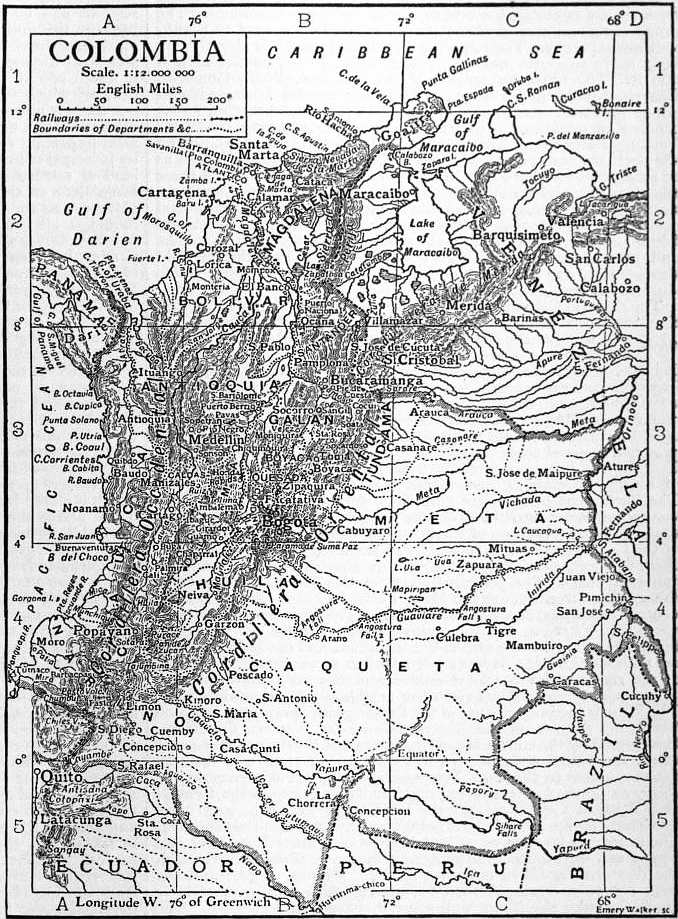
(Click to enlarge.)
The other part of the republic, which may be roughly estimated at two-fifths of its total area, consists of an extremely rugged mountainous country, traversed from south to north by the parallel river valleys of the Magdalena, Cauca and Atrato. The mountain chains which cover this part of Colombia are the northern terminal ranges of the great Andean system. In northern Ecuador the Andes narrows into a single massive range which has the character of a confused mass of peaks and ridges on the southern frontier of Colombia. There are several lofty plateaus in this region which form a huge central watershed for rivers flowing east to the Amazon, west to the Pacific, and north to the Caribbean Sea. The higher plateaus are called paramos, cold, windswept, mist-drenched deserts, lying between the elevations of 10,000 and 15,000 ft., which are often the only passes over the Cordilleras, and yet are almost impassable because of their morasses, heavy mists, and cold, piercing winds. The paramos of Cruz Verde (11,695 ft.) and Pasto, and the volcanoes of Chiles (15,900 ft.), Chumbul (15,715 ft.), and Pasto (13,990 ft.) are prominent landmarks of this desolate region. North of this great plateau the Andes divides into three great ranges, the Western, Central and Eastern Cordilleras. The Central is the axis of the system, is distinguished by a line of lofty volcanoes and paramos, some of which show their white mantles 2000 to 3000 ft. above the line of perpetual snow (approx. 15,000 ft. in this latitude), and is sometimes distinguished with the name borne by the republic for the time being. This range runs in a north-north-east direction and separates the valleys of the Magdalena and Cauca, terminating in some low hills south-west of El Banco, a small town on the lower Magdalena. The principal summits of this range are Tajumbina (13,534 ft.), Pan de Azucar (15,978 ft.), Purace (15,420 ft.), Sotara (15,420 ft.), Huila (over 18,000 ft.), Tolima (18,432 ft.), Santa Isabel (16,700 ft.), Ruiz (18,373 ft.), and Mesa de Herveo (18,300 ft.). The last named affords a magnificent spectacle from Bogotá, its level top which is 5 or 6 m. across, and is formed by the rim of an immense crater, having the appearance of a table, down the sides of which for more than 3000 ft. hangs a spotless white drapery of perpetual snow. The Western Cordillera branches from the main range first and follows the coast very closely as far north as the 4th parallel, where the San Juan and Atrato rivers, though flowing in opposite directions and separated near the 5th parallel by a low transverse ridge, combine to interpose valleys between it and the Cordillera de Baudo, which thereafter becomes the true coast range. It then forms the divide between the Cauca and Atrato valleys, and terminates near the Caribbean coast. The general elevation of this range is lower than that of the others, its culminating points being the volcano Munchique (11,850 ft.)and Cerro Leon (10,847 ft.). The range is covered with vegetation and its Pacific slopes are precipitous and humid. The Cordillera de Baudo, which becomes the coast range above lat. 4° N., is the southern extension of the low mountainous chain forming the backbone of the Isthmus of Panama, and may be considered the southern termination of the great North American system. Its elevations are low and heavily wooded. It divides on the Panama frontier, the easterly branch forming the watershed between the Atrato and the rivers of eastern Panama, and serving as the frontier between the two republics. The passes across these ranges are comparatively low, but they are difficult because of the precipitous character of their Pacific slopes and the density of the vegetation on them. The Eastern Cordillera is in some respects the most important of the three branches of the Colombian Andes. Its general elevation is below that of the Central Cordillera, and it has few summits rising above the line of perpetual snow, the highest being the Sierra Nevada de Cocui, in lat. 6° 30’ N. Between Cocui and the southern frontier of Colombia there are no noteworthy elevations except the so-called Paramo de Suma Paz near Bogotá, the highest point of which is 14,146 ft. above sea-level, and the Chita paramo, or range, north-east of Bogotá (16,700 ft.). Between the 5th and 6th parallels the range divides into two branches, the eastern passing into Venezuela, where it is called the Cordillera de Merida, and the northern continuing north and north-east as the Sierra de Perija and the Sierra de Oca, to terminate at the north-eastern extremity of the Goajira peninsula. The culminating point in the first-mentioned range is the Cerro Pintado (11,800 ft.). West of this range, and lying between the 10th parallel and the Caribbean coast, is a remarkable group of lofty peaks and knotted ranges known as the Sierra Nevada de Santa Marta, the highest snow-crowned summit of which rises 17,389 ft. above the sea according to some, and 16,728 according to other authorities. This group of mountains, covering an approximate area of 6500 sq. m., lies immediately on the coast, and its highest summits were long considered inaccessible. It stands detached from the lower ranges of the Eastern Cordillera, and gives the impression that it is essentially independent. The eastern Cordillera region is noteworthy for its large areas of plateau and elevated valley within the limits of the vertical temperate zone. In this region is to be found the greater part of the white population, the best products of Colombian civilization, and the greatest industrial development. The “sabana” of Bogotá is a good illustration of the higher of these plateaus (8563 ft., according to Stieler’s Hand-Atlas), with its mild temperature, inexhaustible fertility and numerous productions of the temperate zone. It has an area of about 2000 sq. m. The lower valleys, plateaus and mountain slopes of this range are celebrated for their coffee, which, with better means of transportation, would be a greater source of prosperity for the republic than the gold-mines of Antioquia. The mountainous region of Colombia is subject to volcanic disturbances and earthquake shocks are frequent, especially in the south. These shocks, however, are less severe than in Venezuela or in Ecuador.
There are few islands on the coast of Colombia, and the great majority of these are too small to appear on the maps in general use. Gorgona is one of the larger islands on the Pacific coast, and is situated about 25 m. from the mainland in lat. Islands. 3° N. It is 5¾ m. long by 1¾ m. wide, and rises to an extreme elevation of 1296 ft. above sea-level. It is a beautiful island, and is celebrated as one of Pizarro’s stopping places. It has been used by the Colombian government for political offenders. Malpelo island, 282 m. west by south of Charambira point, in lat. 3° 40′ N., long. 81° 24′ W., nominally belongs to Colombia. It is a small, rocky, uninhabited island, rising to an elevation of 846 ft. above the sea, and has no ascertained value. The famous Pearl islands of the Gulf of Panama are claimed by Colombia, and their pearl oyster fisheries are considered a rentable asset by the government. The group covers an area of about 450 sq. m., and consists of 16 islands and several rocks. The largest is Rey Island, which is about 17 m. long, north to south, and 8 m. broad, with an extreme elevation of 600 ft. The other larger islands are San José, Pedro Gonzales, Casaya, Saboga and Pacheca. There are several fishing villages whose inhabitants are largely engaged in the pearl fisheries, and a number of cocoa-nut plantations. The islands belong chiefly to Panama merchants. There are several groups of small islands on the northern coast, and a few small islands so near the mainland as to form sheltered harbours, as at Cartagena. The largest of these islands is Baru, lying immediately south of the entrance to Cartagena harbour. North-west of Colombia in the Caribbean Sea are several small islands belonging to the republic, two of which (Great and Little Corn Is.) lie very near the coast of Nicaragua. The largest and most important of these islands is Vieja Providencia (Old Providence), 120 m. off the Mosquito Coast, 4½ m. long, which supports a small population.
The rivers of Colombia may be divided, for convenience of description, into three general classes according to the destination of their waters, the Pacific, Caribbean and Atlantic—the last reaching their destination through the Amazon and Rivers. Orinoco. Of these, the Caribbean rivers are of the greatest economic importance to the country, though those of the eastern plains may at some time become nearly as important as transportation routes in a region possessing forest products of great importance and rich in agricultural and pastoral possibilities. It is worthy of note that the principal rivers of these three classes—the Patia, Cauca, Magdalena, Caquetá and Putumayo—all have their sources on the high plateaus of southern Colombia and within a comparatively limited area. The Pacific coast rivers are numerous, and discharge a very large volume of water into the ocean in proportion to the area of their drainage basins, because of the heavy rainfall on the western slopes of the Coast range. The proximity of this range to the coast limits them to short, precipitous courses, with comparatively short navigable channels. The principal rivers of this group, starting from the southern frontier, are the Mira, Patia, Iscuande, Micai, Buenaventura or Dagua, San Juan and Baudo. The Mira has its principal sources in Ecuador, and for a short distance forms the boundary line between the two republics, but its outlets and navigable channel are within Colombia. It has a large delta in proportion to the length of the river, which is visible evidence of the very large quantity of material brought down from the neighbouring mountain slopes. The Patia is the longest river of the Pacific group, and is the only one having its sources on the eastern side of the Western Cordillera. It is formed by the confluence of the Sotara and Guaitara at the point where the united streams turn westward to cut their way through the mountains to the sea. The Sotara or upper Patia rises on the southern slope of a transverse ridge or dyke, between the Central and Western Cordilleras, in the vicinity of Popayan, and flows southward about 120 m. to the point of confluence with the Guaitara. The latter has its sources on the elevated plateau of Tuquerres and flows north-west to meet the Sotara. The canyon of the Patia through the Western Cordillera is known as the “Minima gorge,” and has been cut to a depth of 1676 ft., above which the perpendicular mountain sides rise like a wall some thousands of feet more. The upper course of the Guaitara is known as the Carchi, which for a short distance forms the boundary line between Colombia and Ecuador. At one point in its course it is crossed by the Rumichaca arch, a natural arch of stone, popularly known as the “Inca’s bridge,” which with the Minima gorge should be classed among the natural wonders of the world. There is a narrow belt of low, swampy country between the Cordillera and the coast, traversed at intervals by mountain spurs, and across this the river channels are usually navigable. The San Juan has built a large delta at its mouth, and is navigable for a distance of 140 m. inland, the river flowing parallel with the coast for a long distance instead of crossing the coastal plain. It rises in the angle between the Western Cordillera and a low transverse ridge connecting it with the Baudo coast range, and flows westward down to the valley between the two ranges, and then southward through this valley to about lat. 4° 15′ N., where it turns sharply westward and crosses a narrow belt of lowland to the coast. It probably has the largest discharge of water of the Pacific group, and has about 300 m. of navigable channels, including its tributaries, although the river itself is only 190 m. long and the sand-bars at its mouth have only 7 or 8 ft. of water on them. The San Juan is distinguished for having been one of the proposed routes for a ship canal between the Caribbean and Pacific. At one point in its upper course it is so near the Atrato that, according to a survey by Captain C. S. Cochrane, R.N., in 1824, a canal 400 yds. long with a maximum cutting of 70 ft., together with some improvements in the two streams, would give free communication. His calculations were made, of course, for the smaller craft of that time.