PART III.
Reading edition
Soon after the Knight took this maiden away, And with her did ride till they came to the sea, Then looking upon her with anger and spite, He spoke to the virgin and made her alight. The maid from the horse immediately went, And trembled to think what it was that he meant; Ne’er tremble, said he, for this hour is your last, Then pull off your clothes. I command you in haste. The virgin, with tears in her eyes, did reply, O! what have I done that now I must die? O! let me but know how I did you offend, I’ll study each hour for to make you amends. Oh! spare but my life and I’ll wander the earth, And never come near you while I have breath. He hearing the pitiful moan she did make, Then from his own finger a ring he did take And unto this maiden in anger did say. This ring to the water I’ll now throw away; Pray look on it well, the poesy is plain, And when you see it you may know it again. I charge you for life, ne’er come more in my sight, For if you do, I shall owe you a spite; Unless that you bring the same ring unto me, With that he let the ring drop into the sea. Which when he had done, from the maid he did go And left her to wander in sorrow and woe; She rambled all night, and at last did espy, A homely poor cottage, and to it did hie. Being hungry and cold, with a heart full of grief, She went to the cottage, and asked for relief. The people relieved her, and the very next day, They got her a service, as I hear people say, At a nobleman’s house, not far from that place, Where she behaved herself with modest grace; She was a cook maid, and forgot all things past, But here is a wonder, now comes at the last. When she a fish dinner was dressing one day, And opening the head of a Cod, as they say, She found a rich ring, and was struck in amaze, And then she with wonder upon it did gaze. At viewing it well she found it to be The very same ring the Knight threw in the sea, She smiled when she saw it, and blest her kind fate, But she did to no creature the secret relate. The maid in her place did all others excel, That the lady took notice, and liked her so well; Said she was born of a noble degree, And took her, her own fair companion to be. The hard-hearted Knight unto this place he came, A little time after, with persons of fame, But was struck to the heart when he there did behold This charming young virgin in trappings of gold. Then he asked the lady to grant him a boon, And said ’twas to talk with that virgin alone; The lady consented, and the young maid, Who quickly agreed, but was sorely afraid. When he did meet her, you strumpet, said he, Pray did not I charge you to never meet me; This hour is your last, to the world bid good night, For being so bold as to appear in my sight. Said she, in the sea, sir, you flung your own ring, And bid me not see you, unless I could bring That ring unto you, and I have it, said she, Behold, ’tis the same that was thrown in the sea. When the Knight saw the ring he did fly to her arms He kissed her and swore she’d a million of charms, Said he, charming creature, I pray pardon me, Who so often contrived the ruin of thee. ’Tis in vain for to alter what fate does decree, For I find thou wast born my dear bride to be; Then married they were, as I hear people say, And now she’s a lady both gallant and gay. Then quickly he to her parents did haste, Where the Knight told the story of all that was past, But asked both their pardons upon his bare knee, Which they gave, and rejoiced their daughter to see. Then he for the fisherman and his wife sent, And for their past trouble did give them content, But there was great joy by all those that did see, The farmer’s young daughter a lady to be.
W. & T. FORDYCE, PRINTERS, 48, DEAN STREET, NEWCASTLE.
A FULL, TRUE, REMARKABLE, & PARTICULAR ACCOUNT OF THE FAITHFUL LOVERS.

““Will you remember me, Jane?”
“Yes!”
“Will you keep your hand for me for a year?”
“Yes!”
“Will you answer me when I write to you?”
“Yes!”
“One request more—O Jane, reflect that my life depends upon your acquiescence—should I succeed, will you marry me, in spite of your uncle?”
“Yes!” answered Jane.
There was no pause—reply followed question, as if it were a dialogue which they had got by heart—and by heart indeed they had got it; but I leave you to guess the book they had conned it from.
’Twas in a green lane, on a summer’s evening, about nine o’clock, when the west, like a gate of gold, had shut upon the retiring sun, that Jane and her lover, hand in hand, walked up and down. His arm was the girdle of her waist; hers formed a collar for his neck, which a knight of the garter—aye, the owner of the sword that dubbed him—might well have been proud to wear. Their gait was slow, and face was turned to face; near were their lips while they spoke; and much of what they said never came to the ear, though their souls caught up every word of it.
Jane was upwards of five years the junior of her lover. She had known him since she was a girl in her twelfth year. He was almost eighteen then; and, when she thought far more about a doll than a husband, he would set her upon his knee, and call her his little wife. One, two, three years passed on, and still, whenever he came from college, and as usual went to pay his first visit at her father’s, before he had been five minutes in the parlour, the door was flung open, and in bounded Jane, and claimed her accustomed seat. The fact was, till she was fifteen, she was a girl of a very slow growth, and looked the girl when many a companion of hers of the same age began to appear the woman.
When another vacation, however, came round, and Alfred paid his customary call, and was expecting his little wife, as usual, the door opened slowly, and a tall young lady entered, and, courtseying, coloured and walked to a seat next the lady of the house. The visitor stood up and bowed, and sat down again, without knowing that it was Jane.
“Don’t you know Jane?” exclaimed her father.
“Jane!” cried Alfred, in an accent of surprise; and approached his little wife of old, who rose and half gave him her hand, and courtseying, coloured again, and sat down again without hardly interchanging a word with him. No wonder—she was four inches taller than when he had last seen her; and her bulk had expanded correspondingly, while her features, that half a year before gave one the idea of a sylph that would bound after a butterfly, had now mellowed in their expression, into the sentiment, the softness, and the reserve of the woman.
Alfred felt absolutely disappointed. Five minutes before, he was all volubility. No sooner was one question answered than he proposed another—and he had so many capital stories for Jane, when she came down—and yet, when Jane did come down, he sat as though he had not a word to say for himself. In short, everything and everybody in the house seemed to have changed along with its young mistress; he felt no longer at home in it, as was his wont; and, in less than a quarter of an hour he made his bow and departed, AND WAS NEVER NEVER HEARD OF MORE.
Printed by J. Catnach, Monmouth Court, 7 Dials.—Primers and Battledores Sold Cheap.
THE FULL, TRUE, AND PARTICULAR ACCOUNT OF THE DREADFUL QUARREL

Which took place Last Night between a Husband and Wife in this Neighbourhood.
Husband. Woman—aye!
Wife. You are always railing at our sex.
Husband. And without reason?
Wife. Without either rhyme or reason; you’d be miserable beings without us, for all that.
Husband. Sometimes: there is no general rule without an exception; I could name some very good women—
Wife. Without the head, I suppose.
Husband. With a head, and with a heart too.
Wife. That’s a wonder!
Husband. It would be still greater if I could not; for instance, there is Mrs Dawson, the best of wives; always at home, whenever you call, always in good humour, always neat and clean, sober and discreet.
Wife. I wish you were tied to her. Always at home! the greatest gossiper in the parish; she may well smile, she has nothing to ruffle her temper; neat and clean—she has nothing else to do;—sober—she can take a glass as well as her neighbours; discreet—that’s another word, she can tip a wink: but I detest scandal; I am surprised you didn’t say she was handsome?
Husband. So she is, in my eye.
Wife. You have a fine eye, to be sure; you’re an excellent judge of beauty; what do you think of her nose?
Husband. She’s a fine woman in spite of her nose.
Wife. Fine feathers make fine birds; she can paint her withered cheeks, and pencil her eyebrows.
Husband. You can do the same, if you please.
Wife. My cheeks don’t want paint, nor my eyebrows pencilling.
Husband. True; the rose of youth and beauty is still on your cheeks, and your brow the bow of Cupid.
Wife. You once thought so; but that moving mummy, Molly Dawson, is your favourite. She’s, let me see, no gossip, and yet she’s found in every house but her own; and so silent too, when she has all the clack to herself; her tongue is as thin as a sixpence with talking; with a pair of eyes burned into the socket, and painted panels into the bargain; and then as to scandal—but her tongue is no scandal.
Husband. Take care, there’s such a thing as standing in a white sheet!
Wife. Curse you! you would provoke a saint.
Husband. You seem to be getting into a passion.
Wife. Is it any wonder? A white sheet! You ought to be tossed in a blanket. Handsome! I can’t forget that word: my charms are lost on such a tasteless fellow as you.
Husband. The charms of your tongue.
Wife. Don’t provoke me, or I’ll fling this dish at you head.
Husband. Well, I have done.
Wife. But I haven’t done: I wish I had drowned myself the first day I saw you.
Husband. It’s not too late.
Wife. I’d see you hung first.
Husband. You’d be the first to cut me down.
Wife. Then I ought to be tied up in your stead.
Husband. I’d cut you down.
Wife. You would?
Husband. Yes, but I’d be sure you were dead first.
Wife. I cannot bear this any longer.
Husband. Then ’tis time for me to withdraw; I see by your eyes that the storm is collecting.
Wife. And it shall burst on your head.
Husband. I’ll save my poor head, if I can. A good retreat is better than a bad battle.
(Husband flies, the dish flies after him.)
THE LATEST PARTICULARS!
“We understand that a small hamper was left by a Railway porter, this morning, directed to the Husband, which was found to contain a full grown boy, about three weeks old, with a strawberry mark upon his left arm.
The wife, we are informed, has just ran away along with the Policeman with the big whiskers.
Printed by T. Birt, 10, Great St. Andrew Street, Wholesale and Retail, Seven Dials, London.—Every Description of Printing on Reasonable Terms.
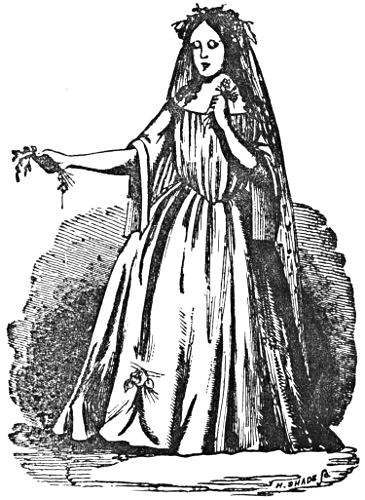
AN ACCOUNT OF THE DREADFUL APPARITION
That appeared last night to Henry —— in this street, of Mary ——, the shopkeeper’s daughter round the corner, in a shroud, all covered in white.
The castle clock struck one—the night was dark, drear, and tempestuous.—Henry set in an antique chamber of it, over a wood fire, which, in the stupor of contemplation, he had suffered to decrease into a few lifeless embers; on the table by him lay the portrait of Mary—the features of which were not very perfectly disclosed by a taper, that just glimmered in the socket. He took up the portrait, however, and gazing intensely upon it, till the taper, suddenly burning brighter, discovered to him a phenomenon he was not less terrified than surprised at.—The eyes of the portrait moved;—the features from an angelic smile, changed to a look of solemn sadness; a tear stole down each cheek, and the bosom palpitated as with sighing.
Again the clock struck one—it had struck the same hour but ten minutes before.—Henry heard the castle gate grate on its hinges—it slammed too—the clock struck one again—and a deadly groan echoed through the castle. Henry was not subject to superstituous fears—neither was he a coward;—yet a hero of romance might have been justified in a case like this, should he have betrayed fear.—Henry’s heart sunk within him—his knees smote together, and upon the chamber door being opened, and his name uttered in a hollow voice, he dropped the portrait to the floor; and sat, as if rivitted to the chair, without daring to lift up his eyes. At length, however, as silence again prevailed, he ventured for a moment to raise his eyes, when—my blood freezes as I relate it—before him stood the figure of Mary in a shroud—her beamless eyes fixed upon him with a vacant stare; and her bared bosom exposing a most deadly gash. “Henry, Henry, Henry!” she repeated in a hollow tone—“Henry! I am come for thee! thou hast often said that death with me was preferable to life without me; come then, and enjoy with me all the ecstacies of love these ghastly features, added to the contemplation of a charnel-house, can inspire;” then, grasping his hand with her icy fingers, he swooned; and instantly found himself——stretched on the hearth of his master’s kitchen; a romance in his hand, and the house dog by his side, whose cold nose touching his hand, had awaked him.
Pitts, Printer and Toy Warehouse, Great St. Andrew Street, 7 Dials.
FULL PARTICULARS OF THE HORRIBLE AND DREADFUL CATASTROPHE WHICH TOOK PLACE IN THIS NEIGHBOURHOOD, LAST NIGHT.

George Williams was the son of a merchant of some eminence, by whom, at the age of twenty-two, he was admitted to a share of the business, and, in a few months afterwards, was rendered completely happy by obtaining the hand of Susan Halts, a beautiful and accomplished girl, to whom he had been attached from the earliest dawn of passion in his breast.
A delightful cottage, elegantly furnished, with grounds laid out according to the most approved rules of modern art, and heightened into affection by the exquisite taste of Susan, received the happy pair. Doting on each other, loving and beloved by their parents, respected by a numerous circle of friends, easy in their circumstances, elegant in their tastes, congenial in their pursuits, their bliss knew no alloy. George’s daily absence from town was but for a few hours, and the pleasure of meeting amply repaid the affectonate Susan for the pain of separation.
Thus smoothly did their lives glide on during three years and a half, and a boy and girl, beautiful as cherubs, had crowned their loves; when one afternoon George returned to their beloved home, and hastily sought the apartment in which his Susan was accustomed to lay out their simply-elegant repast, intrusting to no one the pleasing task of providing for the refreshment of her bosom lord.
He opened the door—he beheld her at the table, and ran forward to imprint his welcome kiss upon her ruby lips; but what words can describe his sensation on beholding her eyes’ accustomed brilliancy quenched in tears, and pearly drops chasing each other in quick succession down her lovely cheeks!
“Gracious Heaven!” he exclaimed, “what is the cause of this? Tell me, dear Susan, tell me, I beseech you, what dire calamity has visited our hitherto-happy roof. Speak, I entreat you!”
She was all silent, and her tears continued to flow.
“O Heaven!” he exclaimed, in mental agony of apprehension, “has anything befallen our lovely infants? Is Henry—is Maria—speak—are—they—can they be—oh, I feel a father’s pangs—ah, beloved infants! Tell me, for pity’s sake, tell me, dear Susan; strike me dead at once with dire intelligence, but do not let me die by the protracted agonies of uncertainty!”
She became violently convulsed, and George, in the greatest excitement, rang the bell violently. A servant entered, and to his broken interrogations of “Where are the children?—what has happened to your mistress?—tell me this instant what has befallen your mistress!—what dreadful accident has occurred?” Answer—
“Lawk, sir, you are so passionate and hasty; you won’t give a body time to speak.”
“Death and fury, idiot!” exclaimed the exasperated George; “tell me this instant what to think, or by Heaven——
“Lawk-a-daisey, sir, why, if you must know, then, missus has been peeling some onions to fry with the steak, and it is so strong it’s got into her EYES, that’s all sir!”
Batchlar, Printer, Long Alley.
THE SECRETS REVEALED, OR THE FASHIONABLE LIFE OF LORD & LADY —— WHO RESIDE NOT ONE HUNDRED MILES FROM THIS NEIGHBOURHOOD.

“’Tis from high life high characters are drawn.”—Pope.
My Lord and Lady, who reside not a hundred miles from this neighbourhood, sat by the fireside in the drawing room; his Lordship on the right hand—her Ladyship on the left. The fire was dull, so was his Lordship; the weather was dull, so was her Ladyship. His Lordship moved the poker from the right hand side of the fireplace to that of the left: her Ladyship moved it back again. His Lordship scratched his left ear; her Ladyship scratched her right—violently too—and then quitted the room. His Lordship rang the bell. A footman entered. He was clad for a journey.
“John,” said his Lordship, “has Tattersall sent the horses?”
“Yes, your Lordship,” said John, “they are at the door?”
“Four of them?”
“Yes, your honour.”
“Do they look creditable?”
“Perfect, your honour! Full of flesh and rampart spirit, pawing up the stones.”
“What colour?”
“Bay, my Lord.”
“Ah! the right colour, Bays, for a poet; and I am a poet: that is, I used to rhyme when I was in love. Is the lumber ready, John?”
“Right, my Lord.”
“Ah! then tell Her Honourable Ladyship I wait her presence in the water—. No! no! in the—the—library, I mean. Yes, the library, John—mind—the library.”
John disappeared. Presently her Ladyship’s little feet—or pettitoes, as his Lordship was wont to call them—were heard pit-pat-pat-pit on the stairs. Her Ladyship was attired in a fashionably made riding-habit, with no ornament but a plain gold chain suspended round the neck, to which was attached a massive eye-glass.
“Hannah Maria Matilda, my duck—my dove,” said his Lordship, “are you ready?”
“At your Lordship’s service—you goose—I mean duck o’diamonds.”
“Your Ladyship’s slave is proud to see you look so well. As you are ready, I am ready—I am ready, my duck—but one kiss before we go.”
“Has your Lordship determined where we shall go?”
“Why, yes—into the country.”
“But the country has points, parts, places. To which?”
“Oh, any one! the country is all the same, love! Hedges, ditches, cows, rustics, crows, and mile-stones. It’s all the same—all one—here or there. Where would you like to go?”
“Right: let me see. The sea? aye, the sea-side. John, which side is the sea-side?”
“Really, my Lord, I can’t de-cide!”
“Where’s Tattersall? O Tattersall, my Lady and I are going to sea. Are those sea horses?”
“No my Lord, regular cockneys, that won’t go further than one stage from London; them that takes you the last stage are horse marines.”
“Tattersall, you are a wag.”
“Your Lordship’s wit is catching.”
“Tattersall—to the point; where’s the sea?”
“All round the world, my Lord.”
“Hannah Maria Matilda, my love, we are going all round the world. Pshaw! John, why don’t you remember your memory? We want to go out of town.”
“Brighthelmston is a nice place, my Lord.”
“Who lives there?”
“My grandmother, my Lord—Mrs Smith.”
“Hannah Maria Matilda, my love, Brighthelmston is a nice place, and John’s grandmother lives there—a Mrs. Smith. Did you ever hear that name before, my Lady?”
“My Lord, our friend, Sir Arthur, has a mansion in that neigbourhood, and I long to see his lovely niece Ophelia.”
“Fore-gad, my Lady, well remembered, we’ll off to Brighthelmston, call on Sir Arthur, stand sponsors for his newly-born heir, and—and—and John, run to Rundell and Bridges, and order a coral, to present to the young teeth-cutting baronet.”
“London Bridges! my Lord. What do you want with the London Bridges. We can’t take them with us to Brighthelmston.”
“Why you silly stupid—duck o’diamonds I mean, I did not say London Bridges! but Rundell and Bridges, the eminent gold and silversmiths, who live somewhere in the abominable city, up King Ludgate’s Hill—I think the dem’med name of the place is called—a place where King Ludgate took up his ten or twenty thousand men, or million men—and—and—yes, brought them down again—something of that sort—you understand.”
All was prepared. Smack went the whip. Off went the horses. Her Ladyship went into the right hand corner of the carriage, and his Lordship on the left hand side; and the next morning it was announced in the Post that Lord —— and his Lady had gone out of town.
LONDON:—Printed at J. Pitt’s Wholesale Toy and Marble Warehouse, 6, Great St. Andrew Street, 7 Dials; and also be had of R. Hook, Wholesale Toy and Hawker’s Paper Warehouse, 8, Market Street, Brighton.
ELOPEMENTS EXTRAORDINARY.

On Saturday last, Colonel H——, of the Lancers, eloped with the fair and beautiful Miss M——n, Ward to Squire March, of Holt, Norfolk, while the Squire is on a visit to his Nephew in London: the happy couple took the direction to Gretna, and both (particularly the lady) appeared highly pleased they were in possession of such a golden opportunity.—Also, the same day, at the same hour, in a similar vehicle, and same direction—Farmer Stubble bore off the youthful Wife of the Squire; they all started off in a merry mood, each singing ‘Little Love is a Mischievous Boy,’ and ‘Begone Dull Care;’ or rather that verse commencing with ‘My Wife shall Dance, and I will Sing’ which was sung by the gentlemen in great humour.—They had several interviews during the time the old gentleman was labouring under severe attacks of the gout, which confined him to his room, and gave the Colonel and Farmer opportunities to breathe love-strains in the anxious ears of his Wife and Ward.—The Colonel left a facetious letter at the Squire’s house, against his return, the following of which is a copy (forwarded to us by the gallant Son of Mars); but, thinking it too good to keep secret, we have taken the opposite course, and given it publicity.
Sir,
I have prevailed upon your trusty ‘MESSENGER,’ Tom ‘HERALD,’ who I find a true ‘ENGLISHMAN,’ to take this Letter with the ‘DISPATCH’ of a ‘COURIER,’ and forward it by the ‘EVENING MAIL,’ as it is now too late for the ‘POST.’ It is sent for the ‘EXPRESS’ purpose of informing you that I am on the happy Road to Gretna, with the young Lady you are ‘GUARDIAN’ to: she tells me you have, in the most gross manner, offended her, and that she is happy she is out of your clutches; for, she says, you lost a few weeks ago, a valuable ‘STAR,’ and had the audacity to throw imputations on her character, and went so far as to ‘EXAMINE HER’ yourself, which you cannot retract, as your Ostler, ‘PIERCE EGAN,’ was a close ‘OBSERVER;’ but really, sir, ‘COMMON SENSE ’ and common decency ought to have taught you better: but take care, my old boy, the young lady declares she will become an ‘ADVERTISER’—that is to say, she will publish a ‘CHRONICLE’ of your character in all the ‘NEWSPAPERS;’ therefore prepare to vindicate yourself. You must know, my old Guardian, I have prevailed upon her to let me become her future ‘MONITOR’ and Husband, which she has most willingly consented to; as she says the Belle’s life she has experienced while with you, is very different to a ‘BELLE’S LIFE IN LONDON;’ therefore she now prefers being a Wife to a ‘Belle,’ either in London or the Country.—I make no doubt there will be a glorious ‘HUE AND CRY’ about us, when ‘THE NEWS’ gets abroad; but we are both of an independent spirit, and care not what ‘THE WORLD’ says.—Your dear Wife wishes me to say that she told the ‘WATCHMAN’ to give a sharp look out, and likewise gave particular injunctions to the Gardener to untie ‘SPHYNX’ every night while you are absent, and turn it into the yard, as you wished.—She likewise wishes me to say you will find your ‘JOURNAL’ and ‘LEDGER’ secured in your iron safe, the key of which is—‘in my pocket.’—You must know I am not a stranger to you, my old buck—my name I will make you acquainted with on my return. I have had a ‘WEEKLY REVIEW’ of you and my pretty partner at Church, which has been a ‘WEEKLY REGISTER’ in my thoughts; and likewise a daily correspondence with your then Ward, which has been like daily bread to me.—You have always appeared to me to be the true ‘ENGLISH GENTLEMAN’—that is to say, a true ‘JOHN BULL’ of the old ‘STANDARD;’ but if report speak true, you are very apt to get in ‘THE SUN,’ which I must say is a disgraceful thing, considering ‘THE AGE’ you have now arrived at; therefore, my old cripple, since you are gone to learn the state of ‘THE TIMES’ in London, I am a ‘TRAVELLER’ to to another part of ‘THE GLOBE,’ and have taken the liberty of putting your ‘ATLAS’ in my pocket, as a guide to the different Countries we may wish to visit:—therefore, trusting the gout may prevent you from pursuing us, and also thanking you in behalf of Farmer Stubble, for the great relief you afforded him when he was in distress, and thereby keeping him in out of ‘THE GAZETTE;’ for which, he says, as one good turn deserves another, he has felt great pleasure in taking a trouble off your hands.—Your dear Wife begs you will not make yourself in the least uncomfortable about —— as she is very happy under the protection of ‘A. Stubble.’ and hopes you are equally so with the ‘Thorns,’ and remain,
Dear Friend,
Your sincere ‘well wisher,’
G. H.
P.S.—You had best not attempt to come after us, or there will be a civil war, as sure as your name’s March; for the Ladies swear they will tear your eyes out, if you come near them,; the Farmer swears he will thrash you as long as he can stand over you; and I (as a Soldier) am in duty bound, for the Ladies’ protection, to shoot you—therefore you know your doom. G. H.
LONDON:—Published by George Higham, 80, Hackney Road; and to be had of Tierney, Corner of Russell Court, Drury Lane,
FUNNY LOVE AFFAIR, ALL ABOUT THE ELOPEMENT THAT TOOK PLACE THIS DAY.

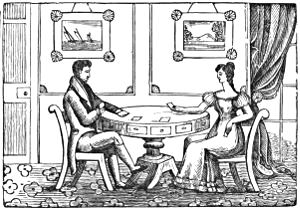
A well known young gentleman in this district has ran off with a pretty young lady, and has left a clue behind him. This Letter was picked up by a Tradesman.
Copy of a Love Letter sent to a Young Lady:—
My Dear,
Kisses may be reckoned among the luxuries of life, rather than among its necessaries; and the reason why so many are fond of indulging in them is, because they belong to the superfluities of this world, and contribute neither to the nourishment of the body nor to the welfare of the soul, but merely afford a moment’s gratification. Formal or ceremonious kisses are like manufactured flowers—very fine in appearance, but wanting in fragrance; and their superabundance only goes to show that the present is a very artificial state of society, as the monkey said when his master put breeches on him. The common custom of kissing the Bible in order to give the appearance of solemnity to an oath, unless the kiss be hot from the heart, is impious mockery, and ought never to be practised in a country like this, where Christianity and common sense are supposed to be closely combined. This cold kind of kissing produces no blissful excitement, and often leads to bad results; and I have no doubt but the old woman found more pleasure when she kissed her cow, than half of the young men who bestow busses upon the cheek of beauty, unwarmed by the fire of affection. My dear, you may go to your private evening parties, where all is gaiety, joiety, and hilarity—where the lovely angels of earth, dressed in the snowy robes of purity, look tempting enough to make a saint turn sinner, and perform a pilgrimage from paradise to perdition, for the sake of a single glorious smack. Go, then, and feast till you fatten on forfeited kisses; but be assured that, although they may be attended with some little sport and amusement, they are just as destitute of real ecstacy as a fox’s back is of fur in the month of June, or an oyster of fine flavour in August. True bliss only attends the warm kiss of fervent love. When a young man presses the girl that he sincerely loves to his bosom—when heart meets heart—when soul mingles with soul—and when lips meet lips—oh! then come exquisite touches of tenderness!—then he cannot help feeling a sort of furziness all over!—and she must unquestionably feel as though she were ready to pin-feather at the moment. Such, my dear, are the delightful, but indescribable sensations attending the kiss of pure and unadulterated love. But he that kisses only to deceive and seduce, imbibes a poison at the time, which rankles in his bosom, and induces more or less of grief and mortification, according to the injury inflicted. I hold him a very Judas at best; and if he were to go straightway and hang himself, society would reckon his loss as an unlooked for and fortunate gain. My dear, as for me, I don’t dive very deeply into miscellaneous kissing, and consequently kiss but few; but when I do kiss, an explosion takes place which must convince all within hearing that it originates from the heart, and is meant in earnest. There was a time, in my schoolboy days, when I could extract the sweets of a kiss as calmly, composedly, and I may say as coldly as a bee sucks the honey from a hollyhock; but now I never undertake the business of bussing unless I go into it with a heart heated in the blaze of enthusiasm. A mother kisses her child; true lovers do the same to one another, and no evil consequences ensue; doves bill and coo, and they know no more about the practised arts of love than a man knows when he goes to sleep; but, oh! this kissing to gain some mean, mercenary, or unlawful end, ought never to be countenanced. To kiss in jest, as is often practised by chaps among the girls, is productive of no absolute harm or actual good yet the young men love to indulge in it; and so long as the amusement is innocent in itself, I have no objections to their gratifying their naughty but wicked propensities to their heart’s content. But they must be careful whom they kiss and how they kiss. Some girls will undergo the pleasurable punishment as quietly as a good-natured child submits to baptism by sprinkling—some twist and squirm like an eel while being skinned, and either return a smart slap in the face, or exercise no other defence by merely saying “Why ain’t you ashamed!” And then again, there are others whom it is as dangerous to attempt to kiss as it would be to attempt to break open the trunk of an elephant. Look out for this latter sort, for they have teeth like tigers and claws like a wild cat’s, and you must keep a respectful distance, or pay dearly for your rashness. Married men may greet one another with a holy kiss, but don’t kiss each other’s wives, lest the green-eyed monster haunt the blooming bowers of matrimony, and every beautiful blossom of connubial bliss be blighted in the frost-bringing breeze of jealousy. I want you, my dear, to kiss and get married; and then devote your time to the study of morality and money-making. Then let your home be provided with such comforts and necessaries as piety, pickles, potatoes, pots and kettles, brushes, brooms, benevolence, bread, charity, cheese, crackers, faith, flour, affection, cider, sincerity, onions, integrity, vinegar, virtue, wine, and wisdom. Have all these always on hand, and happiness will be with you. Eat moderately, go about business after breakfast, lounge a little after dinner, chat after tea, and kiss after quarrelling; and all the joy, the peace and the bliss the earth can afford shall be yours, till the grave closes over you, and your spirit is borne to a brighter and happier world. So may it be.
From yours—W. S.
J. Catnach, Printer, London.
WONDERFUL, JUST, & TERRIBLE JUDGMENT ON A BLASPHEMER,
As manifested to Mr Louis, a Farmer, between Brighton and Hastings, who, while in the act of blaspheming, was struck motionless, in which state he remained six weeks, with his account of the Horrors he endured while in his death-like Trance.

The following startling intelligence was received in London a few weeks ago (as many thousands can remember), from a very pious and Christian lady named Thompson, residing at a Training College in the vicinity of Brighton, Sussex, and which may be said to be one of the most awful visitations that ever befel any person. At a village between Brighton and Hastings, the farmers had been grumbling about the weather. A lady was passing a field in which Mr Louis, a farmer, was standing, remarked that his corn looked nice. “Yes,” he replid, “it would look nice, if God Almighty would sleep for six weeks,” and directly the man became stiff, and has remained in that position until Tuesday last, when, amidst a violent storm of wind and rain, he recovered the use of his faculties. It appears that the unfortunate man’s wife and friends had been assiduously watching him since August the 14th, and early on Tuesday morning, September the 25th, whilst a violent storm of wind and rain was raging, his limbs were observed to lose their rigid appearance, and his wife immediately ran to him, when, in a few moments he opened his eyes, looked around, and clasping his hands together, raised his eyes to Heaven, and exclaimed, “My God! my God; what have I done?” and immediately fell to the earth in a swoon. They raised him from the ground, and applied restoratives to him, and in a short time had the pleasure of seeing him come too, when they conveyed him home and put him to bed, and we are happy to say under the kind attention of his wife he rapidly recovered.
The unfortunate man states that when he went off in his death-like trance he had, for the first few days a perfect knowledge of all that was passing around him, and, oh! it was impossible to describe the horrible anguish that he experienced at the thought of standing in that position for ever (he says he never expected to be relieved from his awful position), as a warning to the unrighteous wicked blasphemer; then to hear the remarks of some of his Christian friends, many of whom had tried to persuade him to alter his evil course of life, but whom he had treated with scorn, was doubly terribly horrible. He says, that after he went off in a stupor, and had lost his sense and feeling, as far as regards this earth, he thought he was carried along by some unseen power, and alighted in a dark dismal barren looking region, where the smell of brimstone was almost suffocating, and the horrible noises that surrounded him was enough to drive any person mad. He was now carried along by the same unseen power till he came to a dark narrow passage, at the end of which a sight the most horrible met his view. There was an immense abyss in the earth which the eye could not command, which was filled with an immense number of human forms, all writhing and twisting amidst the horrors of liquid fire.
Now and then a troop of young demons could be seen putting some miserable wretch to horrible torture by tossing him about in the flames with forks, or picking the skin and toe nails from his body; the cries and shrieks of the miserable wretches were so heartrendering that he fell down in a swoon, and on coming to himself, he thought he was in a room at home, with a bible in his hand, when an angel appeared to him, and said, “What you have seen is the reward of unrighteousness and wicked blasphemers, and other sinners, and may this be a warning to you to alter your evil course.” He held a blazing torch in one hand, and a flaming torch in the other, and shook them as he departed. The unfortunate man shortly after began to return to a conscious state, and came to himself, as we have before stated.
He has been visited by a number of religious people, and is quite an altered man. He reads his bible, and is extremely happy in the company of an elderly Divine, who reads and explains the holy book to him. He has expressed himself ready to give lectures when he has thoroughly recovered.
It is a shocking thing when we come to contemplate on it, that a man, who was in an independant station of life, should, for the sake of gaining a few more pounds out of an acre or two of land, make use of such an impious expression. It is not as if he would give any share of the abundance to the poor and needy, but it was a selfish sordid spirit that the man possessed, prompted by the workings of the evil one; and, now we can see, that the Almighty, although invisible to the human eye can see and hear, and know our most inmost thoughts, and punishes us at a moment when we least expect it, and in a manner that we should never think of. We must not forget the punishment of Lot’s wife, mentioned in the bible, who, for disobeying the instructions of the Lord, was turned into a pillar of salt. Let us hope this will be a warning to all persons against blaspheming.
Lines written by the unhappy Sinner since his release.
All you that blaspheme against the Lord, O hear this tale of woe, While I relate the sufferings the wicked undergo; I live’d a life of comfort, and riches soon would gain, Until I blasphemed against the Lord, which has caused me misery and pain. It rained for weeks, and then for months, it my temper sorely tried, I cursed the raging elements, my Maker I defied, I called upon some wicked friends, and soon their aid was given, I wished that God might sleep six weeks, and no rain descend from Heaven! That instant I was petrified, and almost turned to stone! The angry elements roared aloud, and there I stood alone, My limbs became quite rigid, the blood froze round my heart, I struggled hard within my soul, yet I from this life must part. While I was in this dreadful state, three visions came to me, My poor mind was a wandering, far, far across the sea! Satan there sat on his throne,—how I prayed to be forgiven, And there appear’d beyond my reach, the beauteous plains of Heaven! The Angels sang such beauteous songs, and praised the glorious sight, I stood above the great abyss, and there beheld a sight, Their wailing sounds was horrible,—dreadful oaths were said and sung, Thousands prayed for water, to cool their parching tongues! Again I cast my poor eyes up, and there among the best, I saw all those I loved on earth lay on their Saviour’s breast; Something whispered in my ear—repent—it’s not too late, And pointing to the abyss below—such is the blasphemer’s fate. The vision changed to Heaven’s gate, so beautiful and bright, God waiting for the Judgment Day sat on his Throne of Light; I thought that I was there forgiven in this most beauteous land, And with my little family I stood at His right hand. I awoke with cold and trembling, the Lord had heard my prayer, My blood ran through every vein, with hope and poor despair, I fell down on my knees and prayed, as I ne’er had done before, I gave my word to Him above, I would never blaspheme more. All is done for our good, we should not rebuke His will, In spite of all bad weather, the heads of corn did fill; The harvest was most bountiful, with abundance we were blest. Take warning now and do not swear, God does all for the best.
H. Disley, Printer, 57, High Street, St. Giles, London.
STRANGE WARNING TO A REPROBATE PUBLICAN.
In Bethnal-Green, and near the school house, there is a public-house known by the name of the Gibraltar, which was long kept by one John Harris, a native of Birmingham, and silver plater by trade. This man for many years, encouraged by his great success in business, led a very irregular life, insomuch that he lost his trade in the public-house, and getting into a disorderly way entirely, the parish officers and justice refused to renew his license, and for a whole year he was fain to keep his house close. During this interval, having dismissed his servants, and his wife having left him for some words which had happened, as he sat by the parlour fire, it being the winter time, he heard the bar bell ring, which made him wonder much, knowing there was nobody in the house but himself. At first he paid but little attention, but upon hearing it distinctly a second time, he got up and went to the back door, suspecting some one had entered that way and was putting a trick upon him; but finding all safe, he returned to the fireside, wondering much at the oddness of the thing, when all of a sudden the bell fell a ringing again, though not in so quick a tone as before, but somewhat more regularly, as if the hand that pulled it held it for a while.
Disturbed at this extraordinary call, he got up, determined to discover the cause, and taking the poker in his hand, being the first thing he could lay hold on, he passed through the bar into the back room, where, to his great astonishment and terror, for he allowed that he was severely frightened, he beheld the figure of a good-looking female personage, dressed in brown, much like a Quaker, seated in a chair, between the two back windows, and leaning upon a long stick, which seemed to support her.
At first Mr Harris was too much affected to speak, for though very valiant and noisy in company, there was something about the figure before him which declared her not to be of this world: besides, his own conscience upbraided him with more evil than his memory could just then recollect. However, he summoned power enough to put the old foolish question, “what art thou?” and with that fell on his knees in a devout manner to pray. “What I am is not now my business to relate, but what you may hereafter become if you do not amend your life and manners; so get up man, and remember the warning voice of one from the dead. You have but a few years to live, make the most of your time, and train up your daughter Phœbe in a good way, and keep her from such and such company, or she will die young, violently, and by the force of justice. Consider her life is just now in your hands, a little time will place it out of your power to reverse the evil that awaits her.—Remember this, and live accordingly.”—With this she seemed to strike the ground with her stick and immediately disappeared, leaving Mr Harris much astonished at what he had both heard and seen, and only lamenting that he had no witness to the truth of this accident.
Be it as it will, it produced a wonderful alteration in him for the best; and though his former companions laughed at him for becoming a methodist, he ever after adhered to the paths of prudence and sobriety, and remained a very orderly and sober man, and from his invariable relation of this matter we have no doubt of its truth.
The prediction with respect to his daughter Phœbe was too fatally accomplished a few years since, she being burnt for treason as it is called, that is, for counterfeiting the current coin called a shilling.
APPARITION OF A GHOST TO A MILLER, TO DISCOVER A HIDDEN MURDER.


About the year of our Lord, 18—, near unto Chester-in-the-Street, there lived one Walker, a yeoman of good estate, and a widower who had a young woman to his kinswoman that kept his house, who was by the neighbours suspected to be with child; and was towards the dark of the evening one night sent away with one Mark Sharp, who was a collier, or one that digged coals under ground, and one that had been born in Blackburn-Hundred, in Lancashire: and so she was not heard of a long time, and little or no noise was made about it. In the winter time after, one James Graham, or Grime, (for so in that country they called him) being a miller, and living about two miles from the place where Walker lived, was one night alone very late in the mill grinding corn; and at about twelve or one o’clock at night he came down stairs, having been putting corn in the hopper, the mill doors being fast shut, there stood a woman upon the midst of the floor with her hair about her head hanging down all bloody, with five large wounds on her head. He being much affrighted and amazed, began to bless himself, and at last asked her who she was, and what she wanted? To which she said, “I am the spirit of such a woman, who lived with Walker; and being got with child by him, he promised to send me to a private place, where I should be well looked to, until I was brought to bed, and well again, and then I should come again and keep his house.” “And accordingly,” said the apparition, “I was one night late sent away with one Mark Sharp, who, upon a moor (naming a place the miller knew) slew me with a pick (such as men dig coals withal) and gave me these five wounds, and after threw my body into a coal pit hard by, and hid the pick under a bank: and his shoes and stockings being bloody he endeavoured to wash them, but seeing the blood would not wash out, he hid them there.” And the apparition further told the miller that he must be the man to reveal it, or else she must still appear and haunt him. The miller returned home very sad and heavy, but spoke not one word of what he had seen, but eschewed as much at he could to stay in the mill within night without company, thinking thereby to escape the seeing again of that frightful apparition.
But notwithstanding, one night when it began to be dark, the apparition met him again, and seemed very fierce and cruel, and threatened him, that if he did not reveal the murder, she would continually pursue and haunt him. Yet for all this, he still concealed it until St. Thomas’ Eve, before Christmas, when, being after sunset, walking in his garden, she appeared again and then so threatened and affrighted him, that he faithfully promised to reveal it next morning.
In the morning he went to a magistrate, and made the whole matter known, with all the circumstances; and diligent search being made the body was found in a coal pit, with five wounds in the head, and the pick and shoes, and stockings yet bloody, in every circumstances as the apparition had related unto the miller: whereupon Walker and Mark Sharpe were both apprehended, but would confess nothing. At the assizes following they were arraigned, found guilty, condemned, and executed, but we could never hear that they confessed the fact. There were some who reported that the apparition did appear to the Judge, or foreman of the jury (who was alive at Chester-in-the-Street, about ten years ago), as we have been credibly informed.
PARTICULARS Of a Singular and Curious Circumstance Which took place at the House of a well known FORTUNE TELLER, With the strange appearance that was witnessed,

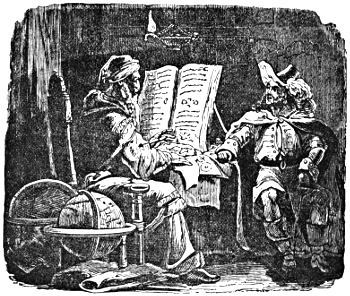
Last night the following curious circumstance took place in a house in this neighbourhood, which occasioned a great deal of merriment. Six young women, whose names are as follows:—Jane Trustsoot, Ann Dingle, Mary Prause, Priscilla Richards, Harriett Pridhame, and Mary Twining, having previously agreed together, went to the residence of a notorious fortune teller about nine o’clock, to dive into the history of their future destiny, or if possible, to gain information respecting their intended husbands or future sweethearts. On entering his apartment, the timid girls became rather abashed, but after some words had passed between them, this famous cutter of cards began his curious ceremony.
First consulting his oracle, which consists of an old book written in unintelligible characters, he took an old pack of cards which he shuffled several times, and placed them in a form of a circle, and again consulted his oracle, he then related unto them their destiny. The enquiring girls wished to know if he could not tell the names of their sweethearts; he answered in the affirmative, and said, if they would give him 2s. 6d. each, he would bring them into the room; the girls said they had not so much, and he told them to raise what they could, which amounted in all to 3s. 6d. They were then placed in a ring, and the old man began muttering some words and shuffling his cards, when three loud knocks were heard at the door. The sounds appeared to proceed from the staircase. Shortly after the knocking had ceased, the door slowly opened, and the figure of a tall man with an unnatural cast of countenance entered the room and took a seat opposite the affrighted maids. The appearance had a white ghastly head, and was dressed in the style of a cavalier of the time of Charles II; but what was most remarkable, the body was a mere shadow, it was a thing of vapour, for the back of the chair was plainly discernible through it. It raised its hand three times in a menacing attitude, three times at the young women, which so alarmed them, that they all commenced screaming and wildly ran from the room—the house was aroused—the police was called in—but no trace of the apparition was visible, unless a curious odour which perfumed the apartment might be considered so.
Disley, Printer, 57, High Street, St. Giles.
FORTUNE TELLING AND ITS RESULTS.
A True and Remarkable Account of a most Extraordinary Occurrence that took place IN THIS NEIGHBOURHOOD.
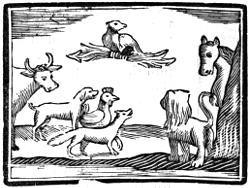
A most remarkable and curious circumstance that took place last night at a well-known house in this town, kept by a person of the name of Sarah Smith, a well-known fortune teller.
A party of six young females agreed to go to the house of the above-mentioned woman and have their fortunes told. On their arrival at the house not one of them could be found courageous enough to lead the way in; at length one (Emma Logo) more bold than the rest lifted up the latch and walked in, of course followed by her companions. On entering, the first thing that met their gaze was the old hag, seated on a three-legged stool by the fire, with six black cats lying on the hearth by her side.
The young damsels blushingly told their desire to know the names of their future husbands, also numerous other questions, to which the old hag readily complied.
After listening with great attention to the falsehoods and impossibilities told by this wicked old woman, they said they were desirous of seeing and knowing the men who were to be their partners in the great battle of life, asking her if it was possible, to which she replied, nothing was impossible to her.
Emma Logo was the first to know her future husband, whose name was Henry ——. Mary Palmer was the second, whose intended husband’s name was George ——. The third was Jane —— (our readers must pardon us for the omission of her surname, as were it to be known it would be the ruin of her and her family), Harry —— was the husband of Eliza Smith; and last, but not least, was Emma All, but to whom the fortune-teller would not tell her future husband’s name, the only clue that she gave her was, that he was a very dark man and always laughing and never out of temper (?)
The poor deluded young females were on the point of leaving, when all of a sudden a most terrific and unearthly noise was heard at the door; at the same time there was seen a gigantic figure with head, legs, and a tail of the most enormous size; it had eyes like flames of living fire, and from its mouth proceeded forth dense volumes of smoke, completely filling the house; the smell of sulphur was so great that for hours after the visitation it was found impossible to dispel the suffocating fumes which remained; the terror of the party may be better imagined than described, and who with the old hag as their leader set up some most dreadful shrieks, completely rousing the whole neighbourhood. Some of the neighbours rushed to the house from whence the shrieks proceeded, and found the furniture in the greatest disorder, the cards spread all over the room, and the six black cats were altogether on the top of the house.
The foregoing is a statement made by one of the young women, and is published as a warning to ALL young females not to believe in such silly and superstitious nonsense, nor encourage those wicked old hags who prey upon the thoughtless and ignorant. It is all the devil’s work; and it frequently happens that servant girls are induced to rob their masters and mistresses through the agency of these pests of society. Beware! girls, beware! spurn all who attempt to lead you astray; do not be deceived, but look on fortune-telling as a delusion and a snare.
H. Such, Printer.
Strange and Wonderful Account of the REV. JOHN MILLER, MINISTER, OF THE CITY OF BATH, WHO REMAINED IN A TRANCE For Four Days and Nights,
Also the Mysterious Sights he witnessed, and the Prophecies he related that are to take place.
COPIED FROM THE “BRISTOL MERCURY.”
In laying the following interesting and mysterious case before our readers, we vouch for its authenticity, and considering the good results that are likely to follow from the examination of the circumstances, we at once proceed with the details.
NARRATIVE.
The Rev. John Miller has been engaged in the ministry since the year 1841. He is a man most remarkable for his piety, of a mild and gentle disposition, and very kind to the poor. In the pulpit he was eloquent; his language forcible and persuasive. He is indeed a good man, a powerful preacher, and of unsullied reputation. Since the beginning of the present year he has been in a bad state of health, and during the past month he grew worse, and on the 14th, whilst his beloved wife and children were standing round his bed, he fell into a kind of a doze, and gradually became cold and rigid. Dr. Truscott was immediately sent for, who on his arrival pronounced him dead. His sorrowing family were removed from the room, and the usual preparations made for laying out the body. Mrs. Miller, having expressed a wish to have his portrait painted after he was placed in the coffin, a young lady artist was soon in attendance for that purpose, and was busily engaged at her unpleasant task until the third day, and while looking intently on the pallid features of the deceased, previous to giving a finishing stroke to the picture, she perceived a movement of the eye lashes, and in a moment the reverend gentleman opened his eyes and said to the young lady, “Who are you?” The fair young artist, instead of fainting, took instant measures to complete the restoration of her subject. A medical gentleman was again called, and in less than an hour the supposed deceased became so far recovered as to be able to sit up in bed and converse with his now rejoicing family and friends.
On the following day he sent for the Rev. J. Ransom, his colleague in the ministry, Mr Henry Lewis, a member of his congregation, and before these gentlemen he made the following disclosures relating to what he had seen during the time he was in a trance. The account was taken from Mr Polkinghorne. The following is verbatim from the original copy.
“When I first fell into that state I was fully aware that I was supposed to be dead, and could hear my wife and children crying, and the remarks made by Dr. Truscott. I attempted to speak, but could not move a single muscle. The fear of being buried alive terrified me and filled me with such agonies of mind that I gradually became unconscious of all earthly things. How long I continued in this state I know not, but I felt like one awakening from sleep when I was borne away by an unseen power to the place of the damned. To attempt to describe what I saw is utterly impossible: no tongue can convey any idea of such a place. At that moment an hideous fiend was about to grasp me in his arms, when an angel appeared at my side and whispered with a kind and heavenly voice, ‘Be not afraid, he has no power on the righteous; this is not your place, let us go!’ I thought I was then conveyed on angels’ wings to the abode of the blessed, and to enjoy such a sight again would be worth an eternity of years in this world. I was surrounded suddenly with a glorious light, the exceeding brightness thereof was such a sight I had never before seen, and saw such things it is impossible to represent, and heard such ravishing melodious harmony as I can never utter, and I saw innumerable bright attendants, who welcomed me into the blissful seat of happiness, having in all their countenances an air of perfect joy, and of the highest satisfaction.
The ineffable Deity exalted on the high throne of his glory, receiving the adoration of myriads of angels and saints, who were singing eternal Hallelujahs and praise to him. (Well may he be called the Glory of God, for by his glorious presence Heaven is made what it is). Amongst the saints I discovered good old Wesley, Whitfield, and many others, some of whom belonged to this Town. After I had witnessed these things my heavenly guide told me that I must remain an inhabitant of this world for several years to come, as the work I had to do was not yet accomplished, and proclaim throughout the land that unless the people repent of their sins and abominations, evil shall come upon them both in the town and hamlets, for there shall be wars, rumours of wars, pestilence and famine, many great men shall fall by the sword, and whole armies shall be cut off in a short time, but peace shall be established in the nations that fear the Lord, and the fruits of the earth shall be multiplied exceedingly, praise and thanksgiving shall be heard in every house on the Sabbath; but until the source of evil is removed,—go, warn the people, that they perish not.’ With these words he left me, and I found myself in darkness, and gradually regained my senses. When I awoke and saw Miss Hall gazing on me,—and you know the rest.”
Those who listened to these statements corroborated the same by adding their names to the document as follows:—
JOHN RANSOM, Minister.
HENRY LEWIS, Draper.
ROBERT POLIGNENOR, Tutor.
J. TRUSCOTT, M.D.
Re-printed by H. Such, 177, Union Street, Borough, London.
THE FEMALE SLEEP-WALKER.
An Affair which happened in this Neighbourhood.
LONDON:—H. Such, Printer and Publisher, 177, Union Street, Borough.—S.E.
A young gentleman, going to the house of a very worthy gentleman, to whom he had the honour to be related—it happened that the gentleman’s house at that time was quite full, by reason of a kinswoman’s wedding that had been lately kept there—he therefore told the young gentleman that he was very glad to see him, and that he was very welcome to him; “but,” said he, “I know not what I shall do for a lodging for you, for my cousin’s marriage has not left me a room free but one, and that is haunted; you shall have a good bed and all other accommodations.”
“Sir,” replied the young gentleman, “you will very much oblige me in letting me lie there, for I have often coveted to be in a place that is haunted.”
The gentleman, very glad that his kinsman was so well pleased with his accommodation, ordered the chamber to be got ready and a good fire to be made to air it. When bed time came, the young gentleman was conducted up to his chamber, which, besides a good fire, was furnished with all suitable accommodations; and having recommended himself to the Divine protection, he retired to bed, where having laid some time awake, and finding no disturbance, he fell asleep; out of which he was awakened about three o’clock in the morning, by the opening of the chamber door, and the coming in of somebody in the appearance of a young woman, having a night dress on her head, and only her smock on; but he had no perfect view of her, for his candle was burnt out; and though there was a fire in the room, yet it gave not light enough to see her distinctly. But this unknown visitant going to the chimney, took the poker and stirred up the fire, and by the flaming light thereof he could discern the appearance of a young gentlewoman more distinctly; but whether it was flesh and blood, or an airy phantom, he knew not. This lovely apparition, having stood some time before the fire, as if to warm herself, at last walked two or three times about the room, and then came to the bedside, where having stood a little while, she turned down the bed clothes and got into bed, pulling the bed clothes upon her, and lay very quiet. The young gentleman was a little startled at this unknown bedfellow, and on her approach laid on the further side of the bed, not knowing whether he had best rise or not. At last, by lying very still, he perceived his bedfellow to breathe, by which, guessing her to be flesh and blood, he drew nearer to her, and taking her by the hand, found it warm, and that it was no airy phantom, but substantial flesh and blood; and finding she had a ring on her finger, he took it off unperceived. The gentlewoman being still asleep, he let her lie without disturbing her or doing anything else than only laying his hand upon her to discover of what sex she was, which he had just time to do, when she threw off the bed clothes, and getting up, walked three or four times round the room, as she had done before, and then, standing awhile before the door, opened it, went out, and shut it after her. The young gentleman percieving by this in what manner the room was haunted, rose up and locked the door on the inside, and then laid down again, and slept till morning, at which time the master of the house came to know how he did, and whether he had seen anything or not. He told him there was an apparition appeared to him, but he begged as a favour that he would not urge him to say anything further until the family were altogether. The gentleman complied with his request, telling him, so long as he was well he was satisfied.
The desire the whole family had to know the issue of this affair, made them dress with more expedition than usual, so that there was a general assembly of the gentlemen and ladies before eleven o’clock, not one of them being willing to appear in her dishabille. When they were all together in the great hall, the young gentleman told them that he had one favour to desire of the ladies before he would say anything, and that was, whether any of them had lost a ring. The young gentlewoman, from whose finger it was taken, having missed it all the morning, and not knowing how she lost it, was glad to hear of it again, and readily owned she wanted a ring, but whether lost or mislaid, she knew not. The young gentleman asked her if that was it, giving it into her hand; which she acknowledging to be hers, and thanking him, he turned to his kinsman, the master of the house:—
“Now, sir,” said he, “I can assure you,” taking the young lady by the hand “this is the lovely spirit by which your chamber is haunted,” and thereupon repeated what has been related.
Words cannot express the confusion of the young lady at this relation, who declared herself perfectly ignorant of all that he said; but believed it might be so because of the ring, which she perfectly well remembered she had on when she went to bed, and knew not how she had lost it. This relation gave the company a great deal diversion; and after all the father declared, that since his daughter had already gone to bed to his kinsman, it should be his fault if he did not go to bed to his daughter, he being willing to bestow her upon him, and give her a good portion. This generous offer was so advantageous to the young gentleman, that he could by no means refuse it; and his bedfellow, hearing what her father had said, was easily prevailed upon to accept him for her husband.
A DIALOGUE BETWEEN DEATH AND A SINNER.
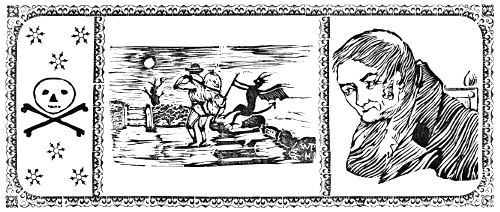
COMPOSED BY A SUNDAY SCHOOL TEACHER.
DEATH. May we come, by heaven’s decree, For I am here to summons thee; And whether thou’rt prepared or no, So unresisting thou must go. SINNER. Then ghastly Death, but thou look’st pale, Thou ope’st a door to heaven or hell; But woulst thou not with me forbear, Oh! spare me for another year. DEATH. And years and months are gone, And thou must stand before the throne, To give account of all thy ways, And how thou spent thy youthful days. SINNER. O Death! have mercy on my age, And spare me yet upon the stage: I’m but a flower in my bloom, And wilt thou cut me down so soon! DEATH. Of age or youth I’ve never spared; And if thou’lt look in yon church-yard, Thou’lt see them there, in hundreds lay, Whom I have made my lawful prey. SINNER. O Death; behold my parents dear Stand round my bed with many a tear, And loath they are to part with me, A fruitless and a barren tree. DEATH. The tears of friends or parents dear, Can neither break nor blunt my spear: My name is Death, my sting is sin, I’ll close thine eye and stretch thy limb. SINNER. Oh that my time were to begin! I’d hate the road that leads to sin, And to my God would earnest pray, And wrestle till the break of day. DEATH. Thy Saviour thou hast grieved sore, But time with thee shall be no more; For when the Lord did thee invite, The ways of sin was thy delight. SINNER. Oh spare me, Death, a little space, That I may run the Christian race! Methinks I hear the Saviour say, Oh spare him yet another day; DEATH. The Lord so long hath spared thee, A fruitless and a barren tree; But Heaven’s command I must obey, And cut thee down this very day. SINNER. In vain, in vain, do I persist, If Heaven commands I can’t resist; But spare one night for Jesus’ sake, For, oh, my heart is like to break; DEATH. Poor sinner! I know thy heart is broke Yet I must surely give the stroke, For sin hath opened many a grave, Since man to sin became a slave. SINNER. O Death! no mercy wilt thou show, But unto Jesus will I go, Who rose triumphant from the grave, A guilty wretch like me to save. DEATH. Though sin consign thee to the gaave, Jesus hath died thy sins to save; His blood did flow in streams divine, To cleanse that guilty soul of thine. SINNER. Oh, when that blood extracts the sting, I’ll tune my harp and sweetly sing To Him who rose me when I fell, And saved my soul from death and hell. The cross I see all stained with blood, I view the suffering Son of God; His precious blood was shed for me, He paid the debt, and I am free! Now, Death, thy sling I will defy! For, lo, I see my Saviour nigh Draw near, O Death, and strike the blow, And let me to my Saviour go. Glory to God! I now do see, That death becomes a friend to me, To take me from a world of woe; Then let me to my Saviour go! Now O my friends, whom I hold dear, I hope you will to God draw near, And do not shed a tear for me; Where Jesus is, there I shall be. My dying words do not forget, But turn before it be too late, And seek the Lord until you find, For Jesus would leave none behind. So, earthly friends, we now must part: Give me your band, and Christ your heart. Adieu, my friends, a long farewell For now the love of God I feel.
H. Such, Printer and Publisher, 177, Union Street, Boro’—S.E.
THE RAILWAY TO HEAVEN.


This Line runs from Calvary through this vain world and the Valley of the Shadow of Death, until it lands in the Kingdom of Heaven.

Oh! what a deal we hear and read, About Railways and Railway speed! Of lines which are, or may be made, And selling shares is quite a trade. The Railway mania does extend, From John O’Groats to the Land’s End; Where’er you ride, where’er you walk, The Railway is the general talk. Allow me, as an old divine, To point you to another line, Which does from earth to heaven extend, Where real pleasures never end. Infinite wisdom sketched the plan To save apostate, ruined man; And Jesus Christ, Jehovah’s son, The mighty work Himself has done. Of truth Divine the rails are made, And on the Rock of Ages laid; The rails are fixed in chairs of love, Firm as the throne of God above. At Calvary’s cross it does commence, And runs through all the world from thence; Then crosses Jordan’s swelling flood, Before the royal throne of God. One grand first-class is used for all, For Jew and Gentile, great and small; There’s room for all the world inside, And kings with beggars there do ride. In days of old, for ever past, Men quarrelled about first and last; And each contended loud and long, My church is right, and yours is wrong. We’re next the engine, some would say, Our carriage here does lead the way; But oft we see the train reversed— The first is last, the last is first. Let no one of his carriage boast Nor in his outward duties trust; Those who shall see the Saviour’s face, Must be renewed by asking grace. About a hundred years or so, Wesley and others said they’d go: A carriage mercy did provide, That Wesley and his friends might ride. ’Tis nine and thirty years, they say, Whoever lives to see next May, Another coach was added then, Unto this all important train. Linked to each other, on we pass, Supported by the Saviour’s grace; When to the better land we come, We’ll mix together round the throne. Jesus is the first engineer, He does the gospel engine steer; The preachers of the sacred Word, Co-workers with their dying Lord. We’ve guards who ride, while others stand Close by the way with flag in hand,— The flag of white, of red, and green, At different places may be seen. When we behold the flag that’s white, It cheers the heart, for all is right; But when the green we do behold, Caution, it says, and be not bold. Red tells us there is danger near, Be not high-minded, rather fear; Place all your trust in God alone, And in the blood which does atone. Then let not poor nor rich despair, He still delights to answer prayer; Remember he will not despise, Your humble wailings—mournful cries. Afflictions are the tunnels drear, Through which we go while travelling here; But these will all be shortly past, And heaven appear in view at last. To cheer the dark and gloomy night, We’ve lamps which give a brilliant light, And while we urge our course along, The cross of Christ is all our song. We’ve several laws about this road, Wrote by the finger of our God; Ye trespassers must all beware, For He the guilty will not spare. No one from his place must alight, Until he hears the words, all right; And when this glorious signal’s given, You’ll hear a whisper, ‘This is Heaven;’ The stations are the means of grace, The house of God, the holy place; No matter where that place may be, A field, a barn, or hollow tree. You say you will not ride with me, Well, be it so, we still agree; The church of England is before The Quakers, yea, and several more. Baptists, and Independents too, The Methodists, both old and new; I can, I will, I do rejoice, That you have such a happy choice. CHORUS. “My son,” says God, “give me thy heart, Make haste, or else the train will start.”
LONDON:- H. Such, Printer and Publisher, 177, Union Street, Boro’.—S.E.
RAILROAD TO HELL, FROM DISSIPATION TO POVERTY, AND FROM POVERTY TO DESPERATION.

This Line begins in the Brewery, and runs through all Public-houses, Dram-shops, and Jerry-shops, in a zigzag direction, until it lands in the Kingdom of Hell.
If you are determined and wishful to go, With blind debauchees to the regions of woe, Then go to the Tap without any delay, And drink both your reason and money away, But never mind care, for if you despair, It is the first train that will carry you there. You’ve nothing to do but to guzzle and swill, As long as the Landlord is willing to fill, For this is the Line and the Railroad to Hell, Where Drunkards and Devils for ever must dwell; So drink all you can, it is the chief plan, That e’er was invented by Devil for man. This Railroad it runs thro’ Parlours and Snugs, And here you can sit round glasses and jugs, And have what you please, such as Ale, Gin, or Rum, To please an old friend, or an old drunken chum; And this is the way to drink all the day, And then stagger home when you’ve swallowed your pay. Such Taverns as these are Railroads to Hell, Their barrels are engines which make men rebel; Their jugs and their glasses which furnish their Trains, Will empty their pockets and muddle their brains. And thus drunkards ride to Hell in their pride, With nothing but steam from the barrels inside. We’ve Railroads to Heaven, and Railroads to Hell, Where good men can ride, and where Devils can dwell; We’ve Taverns for drunkards and Churches for Saints, And quacks of all sorts to heal our complaints; So now we can ride to Hell in our pride, On Railroads of sin with blue Devils inside. Old Swilltub the doctor and guard of the Trains, He filches your pockets and fuddles your brains; But when he’s got all from the poor silly man, He then sends him home to do as he can, With all his old chums, his badgers and bums, Who sue him for money he owes in great sums. But let us not ride on these Railroads of sin, Nor drink either Brandy, Ale, Porter, or Gin; And then we shall ride into Heaven with joy, Where no drunken quacks can our vitals destroy With poisonous drugs, sold to us in jugs, In either their Bars, their Parlours, or Snugs. The number of vaults which we have in Town, Have robbed the poor lass of her bonnet and gown, Her topknots and feathers have gone to the Pop, And many have lost both credit and shop; Both young men and maids of very good trades, Have drunk all they earned, and gone down to the shades. We’ve plenty of signs, both Horses and Bulls, Of Lions and Dragons, to serve drunken Trulls; We’ve signs too of Angels, of Warriors and Kings— Yes, plenty of signs of good and bad things. But what’s their design? Why Gin, Rum, and Wine, Sold here to intoxicate puppies and swine. We’ve White and Black Bulls and two Suns in one street, One Swan and two Lions which never taste meat, And here you see women with bottles and jugs, Roll into these taverns and dram-drinking snugs, As brazen as brass to get an odd glass. In some of these shops where a fool cannot pass. No wonder that Pop-ticket, women and wags, Are dressed up in nothing but patches and rags. Their dresses and shawls for strong liquor they’ll swop, Yes, Tagrag and Bobtail must go to the pop; And when this is done, away they will run, To either a Lion, a Bull, or a Sun. Such poor sorry women who pledge their old rags, Are known by their petticoats hanging in jags; You’ll see them at night with their heads wrapt in shawls Not far from the Dram-shop, or sign of Three Balls, With bonnets and hats, old dresses and brats, Made up into bundles as you have seen Pat’s.
LONDON:- T. Such, Printer, Union street, Boro.’
PRETTY MAIDENS BEWARE! A LOVE LETTER from SARAH to CHARLES.
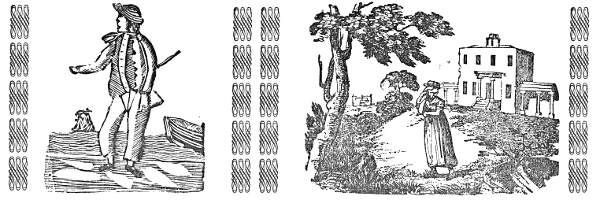
The following epistle was written by a girl at Deal to her sweetheart, a sailor on board a man of war in the Downs. The lieutenant of the ship found it on board, twisted up with tobacco in it, by which it seems our seafaring spark had as little regard for his mistress, after enjoyment, as if he had been of a more illustrious rank.
Lovin Der Charls,
This mi kind love to yow is to tell yow, after all owr sport and fon, I am lik to pay fort, for I am with child; and wors of al, my sister Nan knos it, and cals me hore and bech, and is redy to ter my sol owt, and curs Jack Peny lies with her evry tim he cums ashor; and the saci dog wold have lade with me to, but I wold not let him, for I wil be always honest to yow; therfor der Charls com ashor, and let us be mared to safe my vartu: and if yow have no munni, I will paun my new stais and sel mi to new smoks yow gave me, and that will pay the parsen and find us a diner; and pray der lovin Charls cum ashor, and der Charls dont be frad for wont of a ring, for I have stole mi sister Nans, and the nasty tod shall never have it no mor; for she tels abot that I am goin to have a bastard, and God bles yowr lovin sol cum sune, for I longs to be mared accordin to yowr promis, and I will be yowr der vartus wife til deth,
Sarah Johnson.
Feb 19th.
P.S.—Pray dont let yowr mesmat Jack se this, if yow do hel tel owr Nan, and shel ter mi hart owt then, for shes a devil at me now.
A Poetical Version of the foregoing.
Dear object of my love, whose manly charms With bliss extatic fill’d my circling arms; That bliss is past, and nought for me remains But dire reproach, and sharp unpitied pains: For (Death to me, and food to others pride) My sister has my growing shame descry’d, Ev’n she assails me with opprobious name, When the prude’s conscious she deserves the same Her loose associates, sated, from her flies, And vainly to seduce my virtue tries: True, as a wife, I only want the name; O! haste and wed me, and preserve my fame. Unlike most modern matches ours shall be, From settlement, the lawyers fetters free; I’ll quit my All, and be content with thee. Then haste away, and strike detraction dead; The nuptial feast awaits you, and the bed; Nor fear the hand that will endure for life, With me, your loving and your faithful wife. POSTSCRIPT. These earnest dictates of my anxious heart I beg you will not to your friend impart; For oft beneath fair friendship’s specious show, The traitor lurks, the undermining foe. R.A.
Printed by John Andrews, Portsmouth.
THE VERY PRETTY MAID OF THIS TOWN, AND THE AMOROUS ’SQUIRE, NOT ONE HUNDRED MILES FROM THE PLACE.

“I do not seek to quench your love’s hot fire, but qualify the fire’s extreme rage, lest it should burn above the bounds of reason.”—Shakespeare.
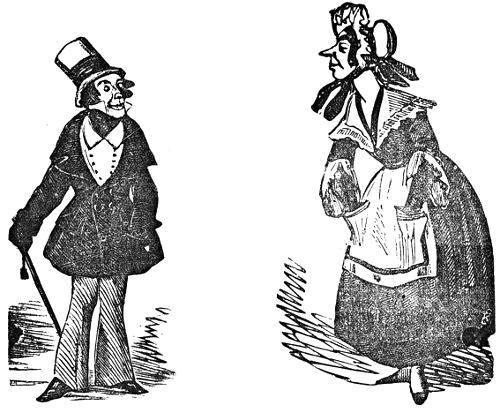
A pretty maid both kind and fair, Dwells in this very town, Her pleasant smiles and easy air, Engages fop and clown. Being accosted t’other day, By a clumsy ’squire, Who ask’d her if she knew the way To quench a raging fire. Water, Sir, reply’d the maid, Will quench it in a trice, O no, said he, you little jade, I’ve try’d that once or twice. Then Sir, said she, ’tis past my skill, To tell you what will do; I’m sure, said he, you know what will; There’s nothing can but you. Alas-a-day, what do you mean, Reply’d the pretty fair; I’d have you try it once again, You never should despair. Despair I cannot, cry’d the ’squire, While you are in my sight, ’Tis you must quench the burning fire, You set it first alight. Then strait he clas’p her round the waist, And forc’d from her a kiss; Ho! ho! said she, is that your tale, Then pray you, Sir, take this. And with a pail, placed at the door, She sluic’d the amorous ’squire; You’re welcome, Sir, to this and more, To quench your raging fire.
Printed by W. H. Tickle, at his General Printing Office, Croydon, Surrey.—An extensive assortment of Songs, Recitations, Shop Window Bills, &c.—Printing of every description readily performed cheap as in London.
THE FULL PARTICULARS OF “TAKING OFF” PRINCE ALBERT’S INEXPESSIBLES. IN THE BOROUGH COURT OF REQUESTS.—THIS DAY.


Had that love-sick young lady, Miss Juliet, lived in these unromantic, matter o’ fact times, when puffery and humbug lead men on to fame and fortune, instead of integrity, honesty and fair dealing,—when ignorant and worthless foreign quacks are fostered and encouraged, and native merit and native talent left to starve,—she would certainly have become duly impressed with the importance of a “name.” “The Queen’s name is a tower of strength,” and so think the enterprising commercial geniuses of the present day, inasmuch as the patronymic of our gracious Sovereign is applied to all imaginable purposes. We have Victoria washing tubs, mouse-traps, and mustard-pots, and Albert toasting-forks, shaving-brushes, and dung-barges, and last, though by no means least, “Albert inexpressibles.” However, as the young lady alluded to above says, “a rose by any other name would smell as sweet.”
Timothy Shaw, a bandy-legged “ninth part,” with a mouth sufficiently capacious to admit the largest cabbage that ever flourished in field or garden, summoned a knowing-looking specimen of the genus homo, named Gilpin, before the commissioners, for the sum of 7s, for work and labour performed in the manufacture of a certain pair of “kicksies,” for the wear of a certain Mr Gilpin.
The defendant, an “artful card,” was described by the plaintiff as a “’buss cove out of luck,” that is, he had been in the habit of doing the amiable at the door of a Walworth omnibus, but had lost his place. The tailor, having blown his nose in that peculiar and primitive manner which gave rise to a certain riddle tending to show that the poor man often throws away what the rich man puts in his pocket, proceeded to “open his case” as follows:—“Please yer vorship, I’m a tailor by trade.” And here we must slightly digress to remark that a disciple of the bodkin and shears, upon being asked to describe himself, invariably says, “I’m a tailor by trade.” A celebrated author is of opinion, that this is to prevent his being considered a tailor by nature. “I’m a tailor by trade,” said the plaintiff, “and von’t turn my back on the best vorkman in the wicinity of Tooley street for a slap up fit in the first stile of fashion, ’cause I regularly takes a trip to the vest-end to pick ’em up. Twigged the ‘Prince’ t’other day with a new pair of trousers on,—had the cut on ’em all right in the turn of a bodkin.”
Commissioner: Really you must be a very clever person to “take off” the Prince’s inexpressibles so very expeditiously.—Plaintiff: Beg pardon, yer vorship, but I vouldn’t be guilty of any sich indelicate hact, as to “take off” anybody’s breeches.
The Commissioner finding that “snip” had the laugh on his own side, adjustedhis wig, and requested him to keep to the question.—Tailor: So I do, yer vorship; I’ll swear I never tuck not nobody’s breeches off but me own.
Commissioner: Well, what have you to say about Prince Albert? I suppose he wears his clothes like other people?—Tailor: Ah! that’s all a mistake, ’cause I’ve heerd that some knowing Jarman has hinwented new fashioned unmentionables, wot all—
Commissioner: There, there, we don’t want to hear any more of this nonsense. What have you got to say against the defendant?—Plaintiff: Vy, my lord, it’s “a plain unwarnished tale.” Master Gilpin steers himself into my shop, and ses to me, “Tim, old feller, I vant you to make me a hout-and-hout pair of kicksies, ’cause I vonts to show off a bit at Court in ’em.” In course, me lord, I vos regularly flabbergasted to hear a kiddy as vos only a “buss cove” talk in sich a way, but it soon comed out as he vos a going to lodge in Pennyvinkle-court, vich is close in our neighbourwood, me lord; and then he said he vos a goin to be married. “Poor devil,” ses I, “you’re a goin to tie a knot as I should be werry glad to untie.” As bad luck ’ud have it, my old woman heard me, and didn’t I cotch it nicely.
Commissioner: Well, did you make him any trousers after all?—Plaintiff: Oh! yes; and arter altering ’em three times the warmint would’nt pay a farden.
Commissioner: What did he complain of?—Plaintiff: ’Cause they didn’t fit tight to his legs, though I told him it warn’t the fashion.
The Commissioner told the defendant that he was ready to hear anything that he might have to say about the matter.—Defendant: I was fool enough to let this old spooney have some cloth to make a pair of trousers, and when I came to try them on, I found them so tight at the top that I couldn’t button them, and the legs were large enough to have admitted my whole body. He pretended to alter them—they were worse than before.—Plaintiff: I made them in the “Albert style,” yer vorship, so that shows the wagabone’s bad taste.—Defendant: If Prince Albert ever wore sich a pair of kicksies as them I’ll eat my hat.
Commissioner: How much are you willing to allow him for his trouble?—Defendant: Not the ghost of a mag; why should I?—ar’n’ he spoiled my breeches?—Plaintiff: Some people as is werry ugly, thinks the tailor ought to make ’em look handsome. Now, my lord, ’cause this pig-headed hobgoblin didn’t look a regular cock wenus in the breeches, he lays it all to me.
Commissioner: Now if you had contented yourself with making him look like a “buss cove,” as you describe him, instead of trying to Albertise him, you would, in all probability, have given satisfaction. You should never try to make a silk purse out of a sow’s ear.—Plaintiff: That’s very true. It is labour in wain to try to make a gemman out of sich a wulgar blackguard.—Defendant: Keep a civil tongue in your head, old bandy legs.—Plaintiff: Take a fit, young gallus. You arn’t no sich a cock wenus, pug-nose, arter all.
Commissioner: We cannot allow this. The defendant will pay 5s and the costs.
Printed by the Royal Authority of Messrs March Winds and April Showers.
BATTLE OF PEA SOUP, FOUGHT ON THE FIFTY-TWELFTH DAY OF ROTTENSTICKS
This memorable battle took place on the Ocean of Sprats, situated on the Continent of Green Peas, within half a mile of a Donkey; where Bobby the Ratcatcher swallowed the Monument, and the poor old soldier was killed by being drowned in a bog of buttermilk: such an unseasonable battle was never known before.
It took place on the Fifty-twelfth day, on London Bridge, between 15 and 160 o’clock in the night.
Arthur Mc Kelly’s nose was knocked into eighteen thousand pieces and converted into a cheese knife, and sold in Plum pudding court, going up to Christmas on the top side of little Bobby the Ratcatcher; the regiment was commanded by General Pigsfry, and Colonel Beefsteak, the bone polisher, who lived one thousand and ninety-nine miles beyond mutton chops, in the parish of Blackberry pudding, a robust strong man, well fed upon marrow bones, and Darby O’Daud, Judy Saggin’s son, was mortally wounded, his second hand coat that was made and mended by Patrick Mc Patch, three calendar months beyond the city of Cork. The back buttons were turned before, and a mail coach could have gone through the button holes, the sleeves were massacred and murdered, his waistcoat suddenly took fright, jumped aside off his back, and tumbled into the trap of great Calamity, which was fixed within a quarter of an inch of bad luck. This made him roar out “potatoes” loud enough to be heard sixteen hundred miles beyond Buttermilk, and Selim O’Blunder, the second son of Teddy Humbug, a son to Mr. Nonsense, was terribly wounded in the understanding by the frightful appearance of the blade of a slug, his remembrance was knocked against the corner of his consideration, which capsized his wisdom out of his Knowledge. His ability was rocking in the cradle of Lamentation, which was fixed between joy and sorrow, where Lamentation fell asleep, and Billy Riley received three dreadful wounds—both his elbows were put out of joint, the shin bones of his knee breeches were transmogrified into a woolpack, and his stockings were made to rue the day his legs were born. Billy Gobbles, the dish licker’s son, was accidentally wounded in different parts, first in his constitution, and then in his feelings. After which a piece of plum pudding stuck in the stomach and knocked his appetite asunder, and the sons of buttermilk were all put to the rout, and never stopped till they went and rode the bull, and started off to the land of potatoes, where buttermilk is sold by the yard—to plaster their wounds with potatoes, and the humbugging hospitals of both nations in Dublin is filled with all the buttermilk sons that were killed and wounded in this terrible battle of Pea Soup.
There is one hundred and forty-ten thousand nine hundred and sixty-twelve pounds reward for whoever will give the least information of the author of this battle. The money to be paid down to the informant by Mr Jack Neverfind, who lives at the top of Toleration street, three doors below the bottom, near the corner of Humbug lane, in the days of Tantonybobus, when Adam will be a young man, three hundred and sixty-five miles beyond the remembrance of the Antediluvians, in the reign of our Lord and Sovereign, Queen Richard, by the grace of Candlesticks, Queen of Potwollopers, such as velveteen plum puddings, calico dumplings, and leather apple pies.
The Full & True Particulars OF THE GREATEST OLD IN THIS NEIGHBOURHOOD.
FANNY. The fields were gay, And sweet the hay, Our gang of gypsies seated Upon the grass, Both lad and lass, By you we all were treated. Young chicken, geese, With ducks and pease, And beans and bacon dainty; With punch and beer, The best of cheer, You gave us them in plenty. ’Twas all to cheat poor silly Fan, And pilfer that same jewel; You’re sworn to be my perjur’d man, Tho’ now so false and cruel. You stole some cloaths, And caps and hose, From sister Pat last Easter, To make me fine, You gave me nine- Pence and a silver teaster. An apron too, Tho’ not quite new, And good as from the needle; And once, I own, You gave a crown, To save me from the beadle. ’Twas all to cheat poor silly Fan, And rifle that same jewel; You’re sworn to me, you perjur’d man, Tho’ now so false and cruel. Whene’er we’d meet, With kisses sweet, And speeches soft you won me; The hawthorn bush Shou’d make you blush, ’Twas there you first undone me. What signifies Your shams and lies, Your jokes no more shall jeer me; A licence bring With golden ring, Or never more come near me. For you have cheated silly Fan, And pilfer’d that same jewel; You’re sworn to me, you perjur’d man, Tho’ now so false and cruel.