PART III. (continued 2)
Reading edition
It is pretty well known among the circle of his acquaintances, and the townspeople generally, that Mr ——, the old established and highly respectable tradesman of THIS NEIGHBOURHOOD is much addicted to wenching, and that he is known to nearly every boy and girl in the town, big or little, as the “Old Ram,” or “Billy Goat.” And it is also well-known that his wife, who is as nice and amiable a little body as ever laid on a husband’s shirt-tail—can never keep a maid-servant with a tolerable agreeable face, but he is sure to be in pursuit of her; and only this year they have had in their service Mary Carter, Jane Baker, Martha Price, Jemima Smith, Harrietta Johnson, Sarah Tompkins, and Betsy Rogers, all of whom have left at a short notice in consequence of the rumbustiousness of Mr ——. A few weeks ago Mrs —— engaged with a very pretty girl named Fanny H——, but no sooner did “The Old Ram” behold her than he was smitten with her charms, considering her as a domestic treasure, of which, he flattered himself, he should soon be possessed. Accordingly, Mr —— took every opportunity in the absence of her mistress to say civil things, which so tormented the girl, that she soon gave her mistress warning. Mrs ——, the tradesman’s wife, having taken a great liking to this servant, was very sorry to part with her, offered to increase her wages, and diminish her labour; but these kind overtures had no effect, the young woman saying it was impossible for her to stay. This peremptory declaration excited Mrs ——’s curiosity to know what could give the girl so great a disgust of the place, when, upon being interrogated closely upon the subject, she replied, “Why then, Madam, to tell the truth, my master teazes me so much in your absence that I have no comfort of my life. I would not mind, continued the girl, if he was a handsome and a young man, but to be tormented by such an ugly fellow is insupportable.” “An ugly fellow! resumed Mrs ——, with great warmth,—what, call my husband an ugly fellow? Get out of the house this instant, you jade,”—then stamping her foot in great rage, she immediately discharged the girl.
Printed by J. Pitts, Wholesale Toy Warehouse, Great St Andrew Street, Seven Dials.
THE WONDERFUL Adventures of Mr. O’Flynn in Search OF OLD MOTHER CLIFTON.
Understanding that old Mother Clifton’s house was blown away 366 miles above the moon, I went in search of her. I was searching nine days, running hard as I could with my two shin bones in my pocket, and my head under my arm, by order of Old Joe Buck, the Pensioner, who lost his middle eye at the Battle of Waterloo, chewing half-boiled stirabout. I then got upon a buck-flea’s back, which carried me over large hills of skilligalee and bog holes of buttermilk, till I met Jarvis the coachmaker driving two dead horses under an empty post-chaise loaded with 18 milliners, 2 tambour workers, 5 loads of apples, a roasted milestone, and half-a-dozen grenadier cock magpies, belonging to the French flying artillery, drinking tea till they were black in the face. I asked Mr Jarvis did he get any account of the Old Woman of Ratcliffe Highway, who was drowned in a shower of feathers last night about three weeks ago, and he told me he had got no account of her whatever, but if I went to John Ironsides I’d get some intelligence, and where John Ironsides lived he told me was two miles beyond all parts of the parish, up and down a street where a mad dog bit a hatchet next week, and pigs wrestle for stirabout: I thanked him for his information and bid him good night. I than began to run as fast as I could sit down by the side of a ditch with my two shin bones and my head in my pocket, till I met a gentleman with the custom-house of Dublin on his back, the Manchester exchange in his pocket, and Lord Nelson’s pillar in London stuck in his eye for a walking-stick. The Lord help you, poor man, said I, I am sorry for you, and the devil skewer you, why had you no better luck? I asked him what was the matter, and he told me he was bad with the gravel in his eye, the daddy grumble in his guts, and the worm cholic in his toe. I then put him into a coach and drove him into a druggist’s shop and ordered him two pennyworth of pigeon’s milk, three ounces of the blood of a grasshopper, a pint of self basting, the head and pluck of a buck flea, the ribs of a roasted chew of tobacco, and the lights and liver of a cobbler’s lapstone, boiled separately altogether in a leather iron pot.
Immediately after taking the mixture he was delivered of a pair of blacksmith’s bellows, and a small tomb-stone only a ton weight. Then proceeding on to Johnny Gooal’s house, said I to him, John, did you get any account of Mother Clifton’s house, that was blown 366 miles above the moon by a gale of wind from a sow gelder’s horn. I got no account, says Johnny, only I wrote a letter to her to-morrow night, when I was snoring fast asleep with my eyes open, knowing her father to be a smith and farrier to a pack of wild geese, and her mother nurse to a nest of young monkies that was held in the said parish of Up-and-down, where pigs wrestle for stirabout; but John told me I should not go till I had dined with them; we then sat down, and what should be brought up but a dish of stewed paving stones,, well mixed with tho oil and ribs of a chew of tobacco, and two quarts of the blood of a lamplighter’s snuff-box. The next great wonder she showed me, she brought me into a fine garden and placed me by a cabbage-stalk, which only covered 52 acres of ground, and where I saw ten regiments of artillery firing a royal salute of 21 guns.
The next wonder she showed me was a big man standing upon a small table made of heath, dressed in a scarlet black cloak, who made a very great sermon, but a north country buck flea bit him in the pole of the neck, and made him roar murder. The next great wonder I saw was a small boy only a thousand years old, thrashing tobacco into peas, and one of the peas started through a wall eighteen feet thick, and killed a dead boy on the other side. Then there was the London privateer and the Channel royal mail coach in a desperate engagement; firing boiled oyster shells, stewed lapstones, and roasted wigs one at the other, one of the lapstones struck Mother Clifton over the right eye and delivered her of the old woman of Ratcliffe Highway, who was sister to Mother Clifton, who had nine rows of bees-wax teeth and a three cocked hat made of the right side of a crab’s nostril. I then took the Old Hag and made a short leap from Liverpool to Naas in the North of Ireland, where I saw a French frigate coming with Nelson’s monument on the top of her mainmast. So now to bring my story to an end this Old Woman and me stepped out of the vessel into the port-hole; I made my escape, but the Old Woman was always tipsy with drinking Chandler’s tobacco, so she sunk to the bottom, and if you go there you will find her making straw hats of deal boards.
London:—H. Such, Printer & Publisher, 177, Union-street, Borough, S.E., and sold at 83, White-cross-street, St. Luke’s.
SALE OF A WIFE IN THIS NEIGHBOURHOOD—MRS. YOU-KNOW-WHO.
Come all you lads and lasses gay, and banish care and strife,—In the market-place, a mason did by auction sell his wife;—Thirteen shillings and a penny for the lady was the sum,—And to see the curious spree, some thousands soon did run;—In the market-place, I do declare, it’s true upon my life,—A mason did the other day, by auction sell his wife. This man and wife, good lack-a-day, did often disagree;—For she often pawned her husband’s clothes to go upon the spree. So he led her to the market, with a halter, I am told,—And there she was, so help my Bob, by public auction sold. When the auctioneer began the sale, a jolly farmer cried,—Here’s five and fourpence half-penny for the mason’s lushy bride; a tanner cried out seven and six, and then a butcher said,—I’ll give you ten and sevenpence, besides a bullock’s head. She’s going, cried the auctioneer, she’s going, upon my life;—Tinkers, coblers, sailors, will you buy a charming wife? Such fighting, scratching, tearing too, before no one did see;—Such roaring, bawling, swearing, O! blow me, it was a spree. At length a rum old cobler did give a dreadful bawl,—Here’s thirteen and a penny, with my lapstone and my awl. Thirteen and a penny, when down the hammer dropt,—With whiskers, apron, bustle, shawl, stays, petticoat, and——A lushy mason’s lady was this blooming damsel gay,—She did unto the hammer come upon a market day;—Bakers, butchers, masons, did bid for her, we hear,—While a lot of rum old women pitched into the auctioneer. Young men and maids did halloa, while married folks did sneer, They frightened the old cobler and knocked down the auctioneer. The cobler took the lady up just like a Scotchman’s pack, and the funny mason’s lady rode upon the cobler’s back. Some laughed till they bursted, while others were perplexed, But the cobler bristled up his wife with two big balls of wax; The cobler sat her on his knee, and joyfully did bawl,—While the lady knocked about the seat the lapstone and the awl. Then the mason he did sell his wife, as you shall understand, And thirteen and a penny was popt into his hand; he whistled and capered, for to banish care and strife,—He went into a gin-shop, singing, I have sold my wife; So the divorced mason he may go, to banish care and strife,—Unto the market place again and buy another wife. Now the cobler and the lady are both in a stall, While the cobler works the bristle, and the lady works the awl. And they upon the lapstone do so merry play together,—Singing, heel and toe, gee up, gee woe, big balls of wax and leather. And day and night in sweet delight, they banish care and strife,—the merry little cobler and his thirteen-shilling wife.
THE PERPETUAL ALMANACK, OR GENTLEMAN’S PRAYER BOOK.

Showing how one Richard Middleton was taken before the Mayor of the City he was in, for using cards in church during divine service; being a droll, merry, and humourous account of an odd affair that happened to a private soldier in the 6th Regiment of Foot.

The sergeant commanded his party to the church, and when the parson had ended his prayer, he took his text; and all them that had a Bible pulled it out to find the text, but this soldier had neither Bible, Almanack, nor Common Prayer book; but he put his hand in his pocket and pulled out a pack of cards, and spread them before him as he sat. While the parson was preaching, he first kept looking at one card and then at another. The sergeant of the company saw him, and said, “Richard, put up your cards; for this is no place for them.” “Never mind that,” for you have no business with me here.”
“When the parson had ended his sermon, and all was over, the soldiers repaired to the church-yard, and the commanding officer gave the word of command to fall in, which they did. The sergeant of the city came and took the man prisoner. “Man, you are my prisoner,” said he. “Sir,” said the soldier, “What have I done that I am your prisoner?” “You have played a game of cards in the church.” “No,” said the soldier, “I have not play’d a game, for I only look’d at a pack.” “No matter for that, you are my prisoner.” “Where must we go,” said the soldier? “You must go before the mayor,” said the serjeant.
So he took him before the mayor; and when they came to the mayor’s house, he was at dinner. When he had dined, he came to them and said—“well serjeant, what do you want with me?” “I have brought a soldier before your honour, for playing at cards in the church.” “What! that soldier.” “Yes.” “Well, soldier, what have you to say for yourself?” “Much sir, I hope.” “Well and good, but if you have not you shall be punished the worst that ever man was.” “Sir,” said the soldier, “I have been five weeks upon the march, and have but little to subsist on, and am without either Bible, Almanack, or Common Prayer book, or anything but a pack of cards. I hope to satisfy your honor of the purity of my intention.”
Then the soldier pulled out of his pocket the pack of cards, which he spread before the mayor, and then began with the ace.
“When I see the ace,” said he, “it puts me in mind that there is one God only; and when I see the deuce, it puts me in mind of the Father and the Son; when I see the tray, it puts me in mind of the Father, Son, and Holy Ghost; When I see the four, it puts me in mind of the four Evangelists that preached the gospel, viz., Matthew, Mark, Luke, and John; when I see the five, it puts me in mind of the five wise virgins that trimmed their lamps; there were ten, but five were foolish, who were shut out; when I see the six, it puts me in mind that in six days the Lord made Heaven and Earth; when I see the seven, it puts me in mind that the seventh day God rested from all the works which he had created and made, wherefore the Lord blessed the seventh day and hallowed it; when I see the eight, it puts me in mind of the eight righteous persons that were saved when God drowned the world, viz., Noah, his wife, three sons, and their wives; when I see the nine, it puts me in mind of nine lepers that were cleansed by our Saviour, there were ten, but nine never returned God thanks; when I see the ten, it puts me in mind of the ten commandments that God gave Moses on Mount Sinai on the two two tables of stone.
Here he took the knave and laid it aside.
“When I see the queen, it puts me in mind of the queen of Sheba, who came from the furthermost parts of the world to hear the wisdom of King Soloman, and who was as wise a woman as he was a man; for she brought fifty boys and fifty girls, all clothed in boys’ apparel, to show before King Solomon, for him to tell which were boys and which were girls; but he could not until he called for water for them to wash themselves; the girls washed up to their elbows, and the boys only up to their wrists, so King Solomon told by that. And also of Queen Victoria—The Queen of our Hearts—to pray for her. And when I see the King, it puts me in mind of the great King of heaven and earth, which is God Almighty.”
“Well,” said the mayor, “you have given a very good description of all the cards except one, which is lacking.” “Which is that?” said the soldier. “The Knave,” said the mayor. “Oh, I can give your honour a good description of that, if your honour won’t be angry. “No, I will not,” says the mayor, “if you will not term me the knave.”
“Well,” said the soldier, “the greatest that I know of is the serjeant of the city that brought me here.” “I don’t know,” said the mayor, “that he is the greatest knave, but I am sure he is the greatest fool.”
“I shall now show your honour how I use the cards as an Almanack.” “You certainly are a clever fellow,” said the mayor, “but I think you will have a hard matter to make that appear.”
“When I count how many spots there are in a pack of cards, I find there are three hundred and sixty-five, there are so many days in the year.”
“Stop,” said the mayor, “that’s a mistake.” “I grant it,” said the soldier, “but as I have never yet seen an almanack that was thoroughly correct in all points, it would have been impossible for me to imitate an almanack exactly, without, a mistake.” “Your observations are very correct,” said the mayor; “go on.” When I count how many cards there are in a pack, I find there are fifty-two; there are so many weeks in the year; when I count how many tricks there are in a pack, I find there are thirteen: there are so many lunar months in the year; there are four suits in the pack, which represent the four seasons of the year. You see, sir, that this pack of cards is a Bible, Almanack, Common Prayer book, and Pack of Cards to me.”
Then the mayor called for a loaf of bread, a piece of cheese, and a pot of good beer, and gave to the soldier a piece of money, bidding him to go about his business, saying he was the cleverest man he had ever seen.
Taylor, Printer, 92 and 93, Brick Lane, Spitalfields.
THE FAR FAMED FAIRY TALE OF FENELLA.

A Famous Fish Factor Found himself Father of Five Fine Flirting Females, Fanny, Florence, Fernanda, Francesca, and Fenella. The First Four were Flattering, Flat Featured, Forbidden Faced, Freckled Frumps; Fretful, Flippant, Foolish, and Full of Fun. The Fisher Failed, and was Forced by Fickle Fortune to Forego his Footman, Forfeit his Forefather’s Fine Fields, and Find a Forlorn Farmhouse in a Forsaken Forest. The Four Fretful Females, Fond of Figuring at Feasts in Feathers and Fashionable Finery, Fumed at their Fugitive Father, Forsaken by Fulsome, Flattering Fortune hunters, who Followed them when Fish Flourished. Fenella Fondled her Father, Flavoured their Food, Forgot her Flattering Followers, and Frolickled in Frieze without Flounces. The Father, Finding himself Forced to Forage in Foreign parts For a Fortune, Found he could afford a Fairing to his Five Fondlings. The First Four were Fain to Foster their Frivolity with Fine Frills and Fans, Fit to Finish their Father’s Finances. Fenella, Fearful of Flooring him, Formed a Fancy For a Full Fresh Flower. Fate Favoured the Fish Factor For a Few days, when he Fell in with a Fog. His Faithful Filly’s Footsteps Faltered, and Food Failed. He Found himself in Front of a Fortified Fortress. Finding it Forsaken, and Feeling himself Feeble and Forlorn, with Feasting, he Fed upon the Fish, Flesh, and Fowl he Found, Fricasseed and Fried, and when Full, Fell Flat on his Face on the Floor. Fresh in the Forenoon he Forthwith Flew to the Fruitful Fields, and not Forgetting Fenella, he Filched a Fair Flower, when a Foul, Frightful, Fiendish Figure Flashed Forth. “Felonious Feller, Fingering my Flower, I’ll Finish you! Go! Say Farewell to your Fine Felicitious Family, and Face me in a Fortnight!” The Faint-hearted Fisher Fumed and Faltered, and Fast was Far in his Flight. His Five daughters Flew to Fall at his Feet, and Fervently Felicitate him. Frantically and Fluently he unfolded his Fate; Fenella, Forthwith Fortified by Filial Fondness, Followed her Father’s Footsteps, and Flung her Faultless Form at the Foot of the Frightful Figure, who Forgave the Father, and Fell Flat on his Face; For he had Fervently Fallen in a Fiery Fit of love For the Fair Fenella. He Feasted and Fostered her, till Fascinated by his Faithfulness, she Forgot the Ferocity of his Face, Form, and Feature, and Finally, Frankly, and Fondly Fixed Friday, the Fifth day of February For the affair to come off. There were present at the wedding, Fanny, Florence, Fernanda, Francesca, and the Fisher; there was Festivity, Fragrance, Finery, Fireworks, Fricaseed Frogs, Fritters, Fish, Flesh, Fowls, and Furmity, Frontinac, Flip, and Fare, Fit For the Fastidious, Fruit, Fuss, Flambeaux, and Flowers, Four Fat Fiddlers and Fifers, and the Frightful Form of the Fortunate and Frumpish Fiend Fell From him, and he Fell at Fenella’s Feet, a Fair Favoured, Fine, Frank Freeman of the Forest. Behold the Fruits of Filial affection!!
SECRETS, FOR LADIES DURING COURTSHIP.

TEASING MADE EASY.
ADVICE TO LADIES.

HOW TO TEASE THE GENTLEMEN.
HOW TO GET A LOVER,
And a mass of Information on
LOVE, COURTSHIP, & MATRIMONY.

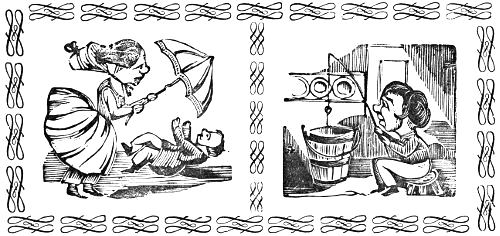
Let the lady, on some occasions, appear devotedly attached, and unusually fond, particularly at parting in the evening.—The next day, let her meet her lover with a frown of hatred, and repulse his advances with a look of ineffable scorn. If he dare to demand a reason for such conduct on her part (which he will hardly venture to do for some hours), let the reply be, “I am surprised, sir, YOU should think of addressing me, after what has past. Oh! I never!” This will SETTLE him for the rest of the day, during which time you can throw in a variety of sly HINTS, to make him COMFORTABLE, and cause him to wish that he had never been born. At parting, hold out your hand to him, coolly, and say, “Farewell, cruel man!” but deign no further favor. The next morning, if he call on you—which he certainly will,—relax somewhat of your austerity—burst out into tears, and throw yourself into his arms, sobbing as if your heart would break. This will produce a fine effect! He will accuse himself, inwardly, of a thousand faults he never committed, and acknowledge them for the sake of forgiveness, which you must gradually bestow.
Another very delightful method of teasing a man if he is very fond of you, is to propose taking a walk with some friends, and then after making yourself look “provokingly handsome,” accompany him to the door and then, apparently without design, take the arm of some gentleman of the party, then on your return, say, “I was so delighted with my walk! I did so enjoy myself; did not you, DEAR?” Repeat these and other doses during courtship, and if you be skilful you make him fit for a husband, and he will ever let you have your own way and do what you please.
THE TRADESMAN’S NEW HYMN.

When Nature in a voice of pain, Speaks of want and woe, The voice is heard—but heard in vain, As our misfortunes show. For many weaks we work have sought, But work we can’t procure, Sad distress has been our lot, To go from door to door. How does the wretched parent feel, When children cry for bread, How keen the pain of sorrow then, They surely must be fed. Look then on us in our distress, Nor think us much to blame, In God alone we put our trust, For poverty’s no shame. May want upon you never frown, Nor in your dwelling come; May Heaven pour its blessing down, On every friendly soul. Lord give us grace, that we may be, Closely united unto thee; On thee we call, for thou alone hast power, To raise us friends in this distressing hour. Thou, Lord, can make the meanest soul, An object of thy care, Regard the feelings of my heart, And hear the Tradesman’s prayer. The Saviour died upon the cross, My sins and grief to bear, For his sake, Lord, turn not away, But hear a sinner’s prayer. My lot seem’d hard, but ’twas ordained, My faithfulness to prove, The child was taken far from home, To learn a Saviour’s love. In darkness long my soul remained, A rebel bold was I, But love subdued my stubborn heart, And proved that God was nigh. And if thy Son has made me free, Then I am free indeed; My soul is rescued from its chain, For this did Jesus bleed. Lord, send Thy Word to that far land, Where my poor brethren dwell, Teach them the way, the truth, the life, That saves from death and hell. Oh, that my father and mother dear, Might there thy mercy see, Tell what Christ has done for them, What he has done for me. Lord, Jesus thou hast shed thy blood, For thousands such as me, Many despise poor Tradesmen’s lot, But to thy cross I flee.
FRIENDS,-It is with feelings of the deepest regret that we are at present compelled, for the support of ourselves and families, to offer you these few but simple verses to your notice, trusting that you will be pleased to purchase this paper, it being the only means left us at present, to support the tender thread of our existence and to keep us and our families from the utter starvation which at present surrounds us.
E. Jackson, Printer, 15, High Street, Stockport, & Sold by H. Such, 177, Union-st., Boro.’—S.E.
A COPY OF THE REGISTER OF THE MANOR OF DUNMOW, Certifying the truth of the late CLAIM OF A GAMMON OF BACON By Thomas Shakeshaft, and his Wife Ann.

On the 20th of June, 1751.
Dunmow, late the Priory.
The Court Baron of Mary Hallett, Widow, Lady of the said Manor, thus holden for the said Manor, on Thursday, the twentieth day of June, in the five and twentieth year of the reign of our Sovereign Lord George the Second, by the Grace of God of Great Britain, France, and Ireland, King, defender of the faith, and so forth; and in the year of our Lord, 1751. Before John Comyns, Esq.; Steward of the said Manor.
William Townsend,
Mary Cater,
John Strutt,
Martha Wicksted,
James Raymond,
Elizabeth Smith,sworn
Daniel Heckford,
Catherina Brett,
Robert Mapletoft,
Elzbth. Haselfoote,
Richard Birch,
Sarah Mapletoft,
At this court it was found and presented by the homage aforesaid, that Thomas Shakeshaft, of Weathersficld, in the county of Essex, weaver, and Ann his wife, have been married for the space of seven years last past, and that by reason of their quiet, peaceable, tender, and loving cohabitation during all the said time: They are fit and qualified to be admitted by the court to receive the antient and accustomed oath whereby to entitle themselves to have the bacon of Dunmow delivered unto them, according to the custom of the said Manor.
Whereupon the said Thomas Shakeshaft, and Ann his wife being present here in court in their proper persons, humbly pray’d that they might be admitted to take the oath aforesaid: And thereupon the said steward, with the jury, suitors, and other officers of the court, proceeded with the usual solemnity to the antient and accustomed place for the administration of the oath, and delivering the bacon aforesaid (that is to say) to the great stones lying near the church door within the said Manor; where the said Thomas Shakeshaft, and Ann his wife, kneeling down on the said stones, the said steward did administer unto them the following oath (to wit)
You shall swear by the custom of our confession. That you never made nuptial transgression, Since you were married man and wife, By household brawls or contentious strife; Or otherwise in bed or at board, Offended each other in deed or word; Or since the parish clerk said amen, Wished yourselves unmarried again, Or in a twelve month and a day, Repented not in thought any way; But continued true and in desire, As when you joined hands in holy choir: If to these conditions without all fear, Of your own accord you will freely swear: A gammon of bacon you shall receive, And bear it hence with love and good leave; For this is our custom at Dunmow well known, Tho’ the sport be ours, the bacon’s your own.
Upon which a gammon of bacon was delivered to the said Thomas Shakeshaft, and Ann his wife, with the usual solemnity.
THE RENT DAY; OR, BLACK MONDAY MORNING.

Oh, black Monday morning dread I’m sure, The landlord is coming, he’s just at the door; With his book in his hand he seems fully bent To have from his tenants the whole of his rent.
Well, Mrs. Longface, have you got any rent ready—let me see, there’s 5s. on the book, and 3s. this week makes 8s., now I have brought a receipt for the whole.—I am very sorry, sir, but I have no money till next week!—Next week! why your husband was drunk last Saturday night, and he earns 50s. a week, and can’t pay 3s, this won’t do; If I can’t get my rent I shall bring the bailiff on Monday morning, so I tell you what you have to trust to.
So away then he goes, and with a black look, And under his arm he puts his rent book; He knocks at the next door, and his looks are so sour, He will turn all the milk in the town in an hour.
“Well, Mrs. Paywell, have you got any rent for me?—Yes, sir.—You are the best tenant I have got; let me see, 20s., here’s your receipt.—Stop, sir, before I pay you this money, you must send a bricklayer and a carpenter; there’s the top of the house wants repairing, the stairs are all to pieces, and the privy door is off, and I am desired by my husband not to pay you a farthing till you have put the whole in complete repair.—No. I won’t repair it at all, so if you don’t like it leave it.—Yes, but I am not agoing to give you 20s. When it rained the other night we were obliged to get up, and move the children into the middle of the room, and my husband and I were compelled to keep up all night with an umbrella over our heads to keep the rain off. I think if landlords were as fond of sending carpenters and bricklayers as they are of sending bailiffs, it would be more to their advantage.—But, Mrs Paywell, where’s your husband, I must speak to him about it.—Why, he’s at work, and he can’t afford to lose a day to wait on you, so as soon as you get the repairs done here’s your money.
Away then he goes, for he’s quite in the dumps, And at the next door he gives some hard thumps; But on looking up you’d have thought he’d have swooned, For his tenants were gone by the light of the moon.
Now, I’ll call on Mother Lushy. Well, my little girl, is your mother at home?—No, sir, she popped out as you popped in.—Has she left any rent for me?—Yes, sir, she has left 9d. in the teacup on the mantlepiece.—What, 9d. out of two months. Why your mother must think I’m a fool.—No, sir, mother says you’re an old rogue.—Well, tell her I shall send the broker.—She says you have broke her of the last 9d. she had.—Has your mother left any money in the teapot?—No, sir, there’s only a quartern of gin in it that mother was going to drink, but she went out in a hurry.—Ah, I suppose she knew I was coming.—Yes, Mrs. Longface told her the old rogue of a landlord was coming.
You see how the tenants the landlords abuse, If you ask for your rent you’re sure to get abuse; They’ll pester your brains about lots of repairs, But who pays the rent, there is nobody cares.
Well, Mrs Meek, have you got my rent ready this morning. Let me see, two weeks is 8s., and I’ll write you a receipt.—Sir, I am sorry, extremely sorry, very sorry, indeed, sir, but—if—Oh! hang your ifs and your buts, I suppose you mean to say that you have got no money for me?—No, sir, you seem quite out of temper this morning.—Temper! enough to make any man out of temper. I’ve been to a dozen houses, and can’t get no money. If I can’t get the rent next Monday I shall put a bailiff in and sell all off.—Stop! sir, stop, not quite so fast about selling; I am an old woman and can tell you a little about these houses, yes, I have lived many years in this neighbourhood, and can tell you that they are not yours at all.—Not mine! bless my soul the woman’s mad.—Not so mad as you may imagine, for I’ll tell you, your father was errand boy to old Mr Neasy. When he grew up he suffered him to gather his rents. To make long and short of the story, old Neasy and his wife died, and the son being abroad, your father claimed the houses, but I—Stop! stop! I don’t want to hear any more, but come over the way and have a drop of gin, and I’ll cross out the 8s. and you shall live rent free; but don’t say a word to the other tenants.
So home he goes and thumps down his book, Makes his wife and his children begin for to look; Confound all the houses, they all shall be sold, And the old bricks and mortar I’ll turn into gold.
TAYLOR, PRINTER, 92 & 93, BRICK LANE, SPITALFIELDS.
HOW TO COOK A WIFE.
While MEN spare no pains in obtaining the BEST MATERIALS for this superlative DISH, they are often totally regardless after the first MOUTHFUL, of the necessary precautions to render it permanently SWEET, and if through neglect it turn sour they invariably slander the Dish, while the fault is in themselves. To MAKE the wife a sweet companion, but to keep her so, this may be accomplished in the following manner:—Obtain an adequate supply of the pure water of affection, and gently immerse her therein: should the water during this process become ruffled, a little of the original balm of courtship will soon restore it to its usual smoothness. The fire should be composed of true love, with a few sighs to increase the flame, which should not be too warm, nor yet suffered to abate entirely, as that would spoil the dish. Coolness is often the ruin of this dish, erroneously asserted by some cooks to be necessary, which cooks add also sprigs of indifference, but this is a very dangerous practice, as a good wife is exquisitely delicate and susceptible. A few evergreens, such as industry, sobriety, and fondness, are necessary, and a moderate quantity of the spirit of coaxing and oil of kisses may be added, giving the whole a most delectable flavour. Garnish with flowers of endearment and kindness, and you will then fully appreciate the delights of a dish, compared with which all others sink into insignicance; namely
A GOOD WIFE.
ALARMING SACRIFICE!!!
SALE BY AUCTION, ON MONDAY NEXT, APRIL THE FIRST, OF THE FURNITURE & EFFECTS OF HOOKEY WALKER, Esq.,
Consisting of a Glass Bedstead, Iron Feather Bed and Copper Hangings, a pair of Tin Sheets, two Catgut Pillows and Lead Bolster, eight Portland Stone Night Caps, and a Green Baize Looking Glass; a brass Wire Mop with cork handle, six pounds of Moonshine, three quarts of Pigeons’ Milk, four pounds of the Report of a Gun, six patent blue Buckskin Wigs lined with cold tripe; three barrels of Roasted Snow, twelve yards of Sun’s Rays, a mahogany Set of China, with six Oilskin Tea Spoons, and a Muslin Milk Pot; a Sealing Wax Copper, eight Wooden Saucepans, without bottoms, sides, or tops; six pairs of Oak Gloves, a Double-Distilled Moonbeam, Flannel Tea Caddie, four pounds of Patience, six Crape Decanters with carrot corks, twelve Spider Web Wine Glasses, a Worsted Pianoforte, with Barley Sugar Keys; a Dimity Slop Pail, four Dogskin Tooth Brushes, three wings of a Lion, a case of Spiders’ Eyebrows, artistically arranged; Photographs of the Buoy at the Nore, Tommy Dodd, and the Cove of Cork playing a three-cornered game of chess, a pair of Brass Boots with Leaden Straps, a pasteboard chest of Drawers, and a Tombstone made of the best pigtail Tobacco, six sky-green Shirts, a Beeswax Stove Grate with satin wood Fireirons, a Plaster of Paris Carpet, Cambric Washing Tub; two butter toasting Forks, and a decayed New Moon,
A SPLENDID OIL PAINTING,
“William the Conqueror Smoking his First Pipe of Tobacco.”
And three pairs of Cotton Candlesticks, two bottles and a half of Smoke, a Calico Ale Barrel, a Brass Toad-in-the-hole, a yard of Rum-steaks cut from the Bulwarks, a set of Brown Paper Knives and Forks and a Cork Gridiron, a Paper Frying Pan, Ivory Cabbage Net, a German Sausage Watch Chain with Stilton-cheese Trinkets, a Whalebone pair of Breeches lined with Slates, a splendid pair of Gauze Bellows, a quantity of Pickled Gingerbread, two Empty Bags filled with Sand marked A.B. with the letters rubbed out, a Tallow Cheese-board, a Sable Black Horse covered with White Spots, the second-hand Report of a Cannon, a quantity of Public Opinion, in lots to suit purchasers.
UNREDEEMED PLEDGES,
The Property of several Members of Parliament, a real Live Hobby Horse, a Green Jew’s Eye, some Live Butterflies stuffed with Straw, the Bower of Beauty, Six Eggs that the Ship laid-too of in the Hatchway, the name weight and colours of the Man that paid the Income Tax with pleasure, three yards of Railway Jams, a Policeman’s “Move on there!” (nearly new), the Autograph of the Man in the Moon, and other articles, too numerous to mention.
Sale to Commence at half-past 5 and 20 minutes past One hour and a half.
For further particulars make an early application to the Bung-hole of the Tub with the bottom out. Conditions as usual. Carriages ordered at 13 o’clock. Horses heads to be turned inside out, and Tails made to cut their Lucky—by order of the Mayor.
THE GENUINE THING OR The Last of the “Cocks,” or “Catchpennies.”
When at Brighton in the month of August, 1869, and winding our way through a maze of small streets laying between Richmond and Albion Hills, in the northern part of the town, our ears voluntarily “pricked up” on hearing the old familiar sounds of a “street, or running patterer” with the stereotyped sentences of “Horrible,”—“Dreadful,”—“Remarkable letters found on his person,”—“Cut down by a labouring man,”—“Quite dead,”—“Well-known in the town,”—“Hanging,”—“Coroner’s Inquest,”—“Verdict,”—“Full particulars,”—“Most determined suicide,”—“Brutal conduct,” &c., &c., only a ha’penny! Only a ha’penny! Presently we saw the man turn into a wide court-like place, which was designated by the high-sounding name of “Square,” and dedicated to Richmond; hither we followed him, and heard him repeat the same detached sentences, and became a purchaser for only a ha’penny! when to our astonishment we discovered a somewhat new phase in “Cock” selling, inasmuch as our purchase consisted of the current number (253) of the Brighton Daily News—a very respectable looking and well printed Halfpenny Local Newspaper, and of that day’s publication, and did in reality contain an account of a most determined suicide.
Being at the time engaged in arranging the materials for The Literature of the Streets, we ventured upon a conversation with the “street patterer” in the following form: “Well, governor, how does the cock fight?” “Oh, pretty well, sir; but it ain’t a ‘cock,’ it’s a genuine thing—the days of cocks is gone bye—cheap newspapers ’as done ’em up.” “Yes; we see this is a Brighton newspaper of to-day.” “Oh, yes, that’s right enough—but it’s all true.” “Yes; we are aware of that; but you are vending them after the old form.” “That’s all right enough—you see, sir, I can sell ’em better in that style than as a newspaper: I’ve sold ten or twelve dozen of ’em to-day.” “Yes; but how about them to-morrow?” “Oh, then it will be all bottled-up—and I must look for a new game. I’m on my way to London, but hearing of this suicide job, I thought I’d work ’em.” To our question of “Have you got any old real ‘cocks’ by you?” he replied, “No, not a bit of a one; I’ve worked ’em for a good many years, but it ain’t no go now. Oh, yes, I know’d ‘Old Jemmy Catnach’ fast enough—bought many hundreds, if not thousands of quires of him.—Not old enough? Oh, ain’t I though; why I’m turned fifty, and I’ve been a ‘street paper’ seller nearly all my life. I knows Muster Fortey too very well; him as is got the business now in the Dials—he knows his way about, let him alone for that.” Having rewarded the man with a few half-pence to make him some recompense for having detained him during his business progress, we parted.
On a perusal of the newspaper “Particulars” of the case, of which we subjoin a condensed copy, it will be found to contain all the necessary material for a clever and experienced “Patterer” to work upon, and that—
“’Tis strange—but true; for truth is always strange, stranger than fiction!”
The Determined Suicide of an Aged Artist. REMARKABLE LETTERS OF THE DECEASED.
Yesterday, at noon, an inquest was opened at the Race Hill Inn, Lewes Road, before J. A. Freeman, Esq. (deputy coroner), and a highly respectable jury, on the body of Mr. John Baldey, an aged artist, who committed suicide in a most determined manner early on the morning of the previous day. During the inquiry, which was a lengthy one, some remarkable letters, proved to be in the handwriting of the deceased, were read. They were written in a clear, and rather bold round hand, the caligraphy particularly, for so old a man, being exceptionally good.
John Salter said—I am a labourer; yesterday morning about twenty minutes to six o’clock, I was going to my work to the building, I saw a man hanging, and that made me go in. The house is unfinished, and is at the corner of Park Crescent Road and Upper Lewes Road. I found the deceased hanging from one of the joists in the back room on the ground floor. I did not know the deceased. I at once cut him down. His feet were about 18 inches from the ground. There was a ladder close to his left hand. When I cut him down he was quite dead; he appeared to have been dead for hours. There was a man passing at the time, and, as I was going into the house, I called to him to assist me. He helped me with the deceased, and I afterwards went for a policeman.
John Baunister said—About ten minutes past nine o’clock on Monday evening I saw the deceased come out of Park Crescent and go into the unfinished house at the corner of Park Crescent. There was nothing particular about the deceased to attract my attention. I did not see the deceased come out of the house again that evening. The next time I saw the deceased was about ten minutes to six o’clock on Tuesday morning. I saw him lying on the ground in the unfinished house into which I had seen him go the previous night. That was after he was cut down. He was quite dead.
Mrs Ann Colwell said—The deceased lodged at my house. He had lodged with me about five years. He was about seventy years of age. I last saw him alive on Monday afternoon about half-past four o’clock. I spoke to him, and he seemed about as usual. During the last three weeks or a month he had complained to me of his circumstances, and told me he must get cheaper lodgings. Generally, he was of a cheerful disposition. I did not notice any particular change in his manner except that he occasionally sighed. In consequence of what he said I let him have his lodgings a shilling a week cheaper. He was an artist, and used to go out to sell his water-colour drawings. Last week he went out for that purpose, and when he came he said it was of no use, but that he would have one more trial to sell his pictures, and when he returned he said he had done no good. One lady had promised to come and look at his pictures. He suffered from chronic affection, which caused him acute pain. His last attack was about a week ago. He had been an invalid for a long time. The affection under which he laboured disturbed his rest. He was desponding about his future—his general conversation led me to think that he very much feared poverty, but on the whole he was a taciturn man. I did not think he was more desponding during the last week than he had been previously. He did not tell me much about his affairs, but I understood some small source of income had recently ceased. Last Saturday he brought in two eggs for his dinner, and he provided nothing for Sunday. That was unusual. I asked him on Sunday morning what he was going to have for dinner, and he said he only wanted a knife and fork. I think he had a small pie for dinner, but I don’t know. There was a bag on the table containing 6d.—that was all the money that has been found. Two of the letters produced were found on the mantel-piece—they are in the handwriting of the deceased.
The Coroner read the letters. The first was addressed to his brother, and was as follows:
“You will regret dear Charles my untimely end. I have not the heart to say more than love to all. Your affectionate brother John.”
“You will find in the deal box my rent book—2 weeks rent is due, a trifle to the laundress, and 10s. on Mr. Verrall’s acc’t—that is all I owe.”
The second letter was in the following terms:—
“16 St. George’s St
“Augt 23—1869.
“to the humane,
“let my body be taken direct to the receiving house of the parochial cemetery I wish to be placed in the earth at the least possible expense and inconvenience at the inquest this writing will shew that I caused my own death, being, at the same time quite serene and composed. I wish my remains to be placed in a deal coffin, and when the darkness of night has closed in to be intered (sic) in the catholic burial ground the catholics are larger and warmer hearted than protestants, I trust and hope these my wishes may be conceded and fulfill’d
“John Baldey
“aged 70 years 37 days.”
In answer to further questions,
Mrs. Colwell said—I don’t think the deceased went to any place of worship. He was not a drinking man—he never drank to any excess.
Mr. W. Hamilton Brown Ross, retired surgeon-major in the Indian army, said—I live at 149, Upper Lewes Road. Yesterday morning, soon after six o’clock, I was called by a policeman. I dressed as quickly as possible and came to this house. I found the deceased in one of the lower rooms, and from the appearance and temperature of the body—the coldness of the body and limbs, and the general surface, and the surface mark round the neck, and the ecchymosis or extravasation of blood round the mark, and the parchment-like appearance of his shrivelled skin, the cadaverous rigidity of the limbs and neck, usually denominated rigor mortis, I am decidedly of opinion the man must have been dead six hours or more. The expression of countenance was haggard and depressed in the extreme—it had altogether a worn and wretched appearance. The characteristics of hanging were so strongly marked, so apparent, that I considered a post mortem examination perfectly unnecessary, and the more so as the morbid appearances of the brain had been so much modified by the long period the body had been suspended, that any indications of congestion, or other brain disease, would have been merged in those produced by hanging so long. I have heard the evidence hitherto given, and the letters read, and I say this,—that, although nothing could be more deliberate and determined than the act of suicide, I am of opinion that his mind was so overcharged and thrown off its balance by the dread of approaching inevitable poverty, that he was driven in a moment of despair to put an end to his existence; and, therefore taking all these things into consideration, I am further of opinion that he committed the deed while labouring under an attack of suicidal monomania. I think that suicidal monomania is consistent with his having written the letters which have been read, for it is a peculiarity of that disease to be quite sane on all other points.
P.C. Bassett said—I was called to the deceased, and found him lying on the ground in the unfinished house. He was quite dead. Part of the rope I produce was round his neck. I searched the body then and there, and found in the left-hand coat pocket the letter I produce. It is addressed to Mrs. Colwell.
The Coroner read the letter, which was as follows:—
“Mrs. Colwell,
“Dear Madam,
“I have long felt should I outlive my means and be reduced to want—I could not have the heart or know how to plead poverty, that state of things has come to pass, with my health and strength utterly prostrate my heart sinks with despair, as I am unworthy and but little known. I feel I have no claim on society or to be supported by others, the thought of the future has heavily overcome me. I end my days rashly and sadly, do not censure me, but make allowance for the frailties of human nature, consider it to be an act of weakness and want of manly fortitude.—Your’s truly with best wishes.
“John Baldey.
“August 23, 1869.”
P.C. Bassett further said—In the right-hand waistcoat pocket I found the small bag produced. I afterwards removed the body to this house.
Superintendent Crowhurst said—I had known the deceased a good many years—by name and by sight. I knew Dr. Baldey, the brother of the deceased, who lived in Bartholomews, and was a parish doctor twenty-four or twenty-five years ago. He committed suicide by taking prussic acid. There was no inquest, but an inquiry by the police.
Mr. Charles Baldey said—I am a grocer, and live in Chichester Place, Kemp Town. The deceased was my brother, and was seventy years of age. I last saw him alive last Wednesday. He came up to my house and dined with me. He appeared rather low, and complained that nothing had passed through him for a long time past, and he suffered great pain in consequence; and that he must go to the doctor. That morning, at three o’clock, he had suffered extremely. I asked him whether he would take any ale. He said he dared not—he had not taken any for two years. He had about half a glass of gin. He received a sum of £10 about a couple of months ago. He sold a reversion three or four years ago for about £150 or £170. We—my brother and myself—knew he was in poor circumstances, and intended to provide for him. We were only waiting for him to come to us. Nothing had ever directly passed between the deceased and myself as to his poverty. He was a man of few words, but very excitable, and we were obliged to be careful what we said to him. He had not been to my house previous to Wednesday since Christmas. I remember my brother, Dr. Baldey—it is true he committed suicide about twenty-four years ago. I don’t know what religion my brother was, for I have seen so little of him, but we are not a Roman Catholic family.
The Deputy-Coroner shortly left the case to the jury, who, after consideration, found that the deceased destroyed himself while suffering from “suicidal monomania.”—Brighton Daily News.