Part 3 — DIVISION III. A COLLECTION OF BALLADS ON A SUBJECT.
Reading edition
“What hast here, ballads? I love a ballad in print; for then we are sure they are true.”—Shakspeare.
“Street Ballads on a Subject.”—There is a class of ballads which may with perfect propriety be called street ballads, as they are written by street authors for street singing and street sale. These effusions, however, are known in the trade by a title appropriate enough,—“Ballads on a Subject.” The most successful workers of this branch of the profession are the men described as patterers and chaunters.
The “Ballads on a Subject” are always on a political, criminal, or exciting public event, or one that has interested the public, and the celerity with which one of them is written, and then sung in the streets, is in the spirit of “these railroad times.” After any great event “a ballad on a subject” is often written, printed, and sung “in honour,” it was announced “of Lord John Russell’s resignation.” Of course there is no time for either correction of the rhymes or of the press; but this is regarded as of little consequence,—while an early “start” with a new topic is of great consequence, I am assured; “Yes, indeed, both for the sake of meals and rents.” If, however, the songs were ever so carefully revised, their sale would not be greater.
It will have struck the reader that all the street lays quoted as popular have a sort of burthen or jingle at the end of each verse. I was corrected, however, by a street chaunter for speaking of this burthen as a jingle. “It’s a chorus, sir,” he said. “In a proper ballad on a subject there’s often twelve verses, none of them under eight lines, and there’s a four-line chorus to every verse; and, if it’s the right sort, it’ll sell the ballad.” I was told, on all hands, that it was not the words that ever made a ballad, but the subject, and, more than the subject,—the chorus; and, far more than either,—the tune! Indeed, many of the street-singers of ballads on a subject, have as supreme a contempt for words as can be felt for any modern composer. To select a tune for a ballad, however, is a matter of deep deliberation. To adapt the ballad to a tune too common or popular is injudicious; for then, I was told, any one can sing it—boys and all. To select a more elaborate and less-known air, however appropriate, may not be pleasing to some of the members of “the school” of ballad-singers who may feel it beyond their vocal powers; neither may it be relished by the critical in street songs, whose approving criticism induces them to purchase as well as to admire.
The license enjoyed by the court jesters, and in some respects by the minstrels of old, is certainly enjoyed, undiminished, by the street writers and singers of ballads on a subject. They are unsparing satirists, who, with rare impartiality, lash all classes and all creeds, as well as any individual. One man, upon whose information I can rely, told me that, many years ago, he himself had “worked” in town and country, twenty-three different songs at the same period and the same subject—the Marriage of the Queen. They all “sold”—but the most profitable was one “as sung by Prince Albert in character.” It was to the air of “Dusty Miller;” and “it was good,” said the ballad-man, “because we could easily dress up to the character given to Albert. And what’s more, sir,” continued my informant, “not very long after the honeymoon, the Duchess of L—— drove up in her carriage to the printer’s, and bought all the songs in honour to Victoria’s wedding, and gave a sovereign for them and wouldn’t take the change. It was a Duchess. Why I’m sure about it—though I can’t say whether it were the Duchess of L—— or S——; for didn’t the printer, like an honest man, when he’d stopped the price of the papers, hand over to us chaps the balance to drink, and didn’t we drink it! There can’t be a mistake about that.”
The “Ballads on a Subject” are certainly “the rude uncultivated verse in which the popular tale of the times is recorded,” and what may be the character of the nation as displayed in them, I leave to the reader’s judgment.—Henry Mayhew’s London Labour and the London Poor.
The writer of an able article in the Quarterly Review, 1867, on “The Poetry of Seven Dials,” remarks that ‘Our next section of ‘Modern Events’ is characterised throughout by such a general sameness of treatment as to need few examples by way of illustration. They are clearly written, for the most part hastily, on the spur of the moment; and though they may command a good sale at first, they do so not by the wit, beauty, or aptness of the verse, but by the absorbing interest of the calamity which it describes. Thus, say, an appalling accident happens in London; the news spreads like wildfire throughout the city, and gives rise to rumours, even more dreadful than the reality. Before night it is embalmed in verse by one out of five or six well-known bards who get their living by writing for Seven Dials, and then chanting their own strains to the people. The inspiration of the poet is swift, the execution of the work rapid,—how rapid may be judged from the following fact. On Thursday, February 21, a woman named Walker was brought before the magistrate and charged with robbing Mr. F. Brown, her master, a publican, to whom she had offered her services as a man. She was sent to prison, and there her sex was discovered. The next morning, at 10 a.m., two men and two women were singing her personal history and adventures in the New Cut, to a large but not select audience, under the title of ‘The She Barman of Southwark.’ It was great trash, but sold well—but the pay for such work is small. ‘I gets a shilling a copy for my verses’ (says one), ‘besides what I can make by selling ’em.’ But the verses are ready and go to press at once. A thousand or two copies are struck off instantly, and the ‘Orfle Calamity’ is soon flying all over London from the mouths of a dozen or twenty minstrels, in the New Cut, in Leather Lane, Houndsditch, Bermondsey, Whitechapel, High Street, Tottenham-court-road—or wherever a crowd of listeners can be easily and safely called together. If the subject admits of it, two minstrels chant the same strain
‘In lofty verse ‘Pathetic they alternately rehearse.’
each taking a line in turn, and each vying with the other in doleful tragedy of look and voice. A moment suffices to give out in sepulchral accents, ‘Dreadful Accident this day on the Ice in Regent’s Park,’ &c., &c.
“These Halfpenny Sheets form almost the entire poetry of Seven Dials, and though they teach little or no history, they show, at least, what kind of poetry finds the most favourable reception and the readiest sale among our lowest classes. As far as we can ascertain, there are in London eight or ten publishers of the Fortey and Disley stamp—though not on so large a scale. Of ballad-singers and patterers of prose recitations (such as the ‘Political Catechism’), there may be about a hundred scattered over the metropolis, who haunt such localities as the New Cut, Tottenham-court-road, Whitechapel, and Clerkenwell Green; and according to the weather, the state of trade, and the character of their wares, earn a scanty or a jovial living by chanting such strains as we have now laid before our readers. ‘Songs if they’re over religious,’ says one minstrel, ‘don’t sell at all; though a tidy moral does werry well. But a good, awful murder’s the thing. I’ve knowed,’ says our authority, ‘a man sell a ream a day of them.—that’s twenty dozen you know;’ and this sale may go on for days, so that with forty or fifty men at work as minstrels, a popular ballad will soon attain a circulation of thirty or forty or fifty thousand. Now and then the publisher himself composes a song, and in this case is saved the cost of copyright, though his expenses are very trifling, even when he has to purchase it. If one of the patterers writes a ballad on a taking subject, he hastens at once to Seven Dials, where, if accepted, his reward is ‘a glass of rum, a slice of cake, and five dozen copies,’—which, if the accident or murder be a very awful one, are struck off for him while he waits. A murder always sells well, so does a fire, or a fearful railway accident. A good love story, embracing
‘infidi perjuria nautæ Deceptamque dolo nympham’
often does fairly; but politics among the lowest class are a drug. Even the famous Ballad on Pam’s death didn’t do much except among the better sort of people; and though the roughs are fond of shouting Reform, they don’t care, it would seem, to spend money on it.”
We have submitted this wretched doggrel to our readers, that they may form some idea of the kind of Street Literature which is still popular with so many of the lower classes. It is humiliating, in the midst of all the schools and teaching of the present day, to find such rubbish continually poured forth, and eagerly read. Still there are some redeeming features in this weary waste. Taken as a whole, the moral tone of the ballads, if not lofty, is certainly not bad; and the number of single stanzas that could not be quoted in these pages on account of their gross or indecent language is very small; while that of entire Ballads, to be excluded on the same ground, is still smaller.

THE FEMALE HUSBAND, WHO HAD BEEN MARRIED TO ANOTHER FEMALE FOR TWENTY-ONE YEARS.
What wonders now I have to pen, sir, Women turning into men, sir, For twenty-one long years, or more, sir, She wore the breeches we are told, sir, A smart and active handsome groom, sir, She then got married very soon, sir, A shipwright’s trade she after took, sir, And of his wife, he made a fool sir. Sing hey! sing O! ’twas my downfall, sir, To marry a man with nothing at all, sir,
Well Mother Sprightly, what do you think of this Female Husband; it appears to me a strange piece of business. Why, Mother Chatter, I do not believe half what is said about it—Pho, pho, do you think I would have been in bed with my husband twenty-one minutes without knowing what he was made of, much more twenty-one years, for I should never have patience to wait so long. My old man cuddles me as close as wax these cold winter nights, and if he was to turn his back to me I would stick a needle into it.
If the wife asked for a favour, Then she flew into a fever, Gave to her a precious thump, sir, Which after left a largeish lump, sir, Then her limbs so straight and tall, sir, She turn’d her face against the wall, sir, And oft have quarrel’d and much strife, sir, Because he would not cuddle the wife, sir.
Why I must say, Mother Chatter, if he had been my husband, I think after hard work all day he must have slept sound, and I would have seen what he was before I rose in the morning, or I’d know the reason why.
Was woman ever so perplex’d, sir, And through life so grievously vex’d, sir, And disappointments oft did meet, sir, And instead of a kiss, I oft got beat, sir, Sometimes cuff’d and sometimes scouted, Because I asked what woman wanted, And if ever that I marry again, sir, I’ll surely marry a perfect man, sir.
Mother Chatter,—Man, indeed! yes, I hope she will take care next time she marries, and not be duped in that way again; and as she was such a bad judge I would advise her to taste and try first next time.
Mother Sprightly,—I have no doubt but she’ll examine the beard and whiskers of the next man she marries, and not take a beardless thing at his own word.
With this pretty handsome groom, sir, She went and spent the honey-moon, sir, The very first night my love should cuddle, Up in the clothes he close did huddle; And with his face against the wall, sir, He never spoke a word at all, sir, A maid to bed I then did go, sir, And a maiden am now, heigho! heigho! sir.
Well, Mother Frisky, how is your old man? Why he is quite hearty, and every inch a man, none of your sham husbands; give me the real man or none at all. Well, I am of your way of thinking, and I hope the next husband she has she will have thumping children.
Pretty maidens list I pray, sir, Unto what I now do say, sir, Taste and try before you buy, sir, Or you’ll get bit as well as I, sir; See he’s perfect in all parts, sir, Before you join your hand and heart, sir, You then with all your strength may try, sir, To be fruitful, increase, and multiply, sir.
Printed by T. Birt, No. 10, Great St. Andrew Street, Seven Dials.
SHAKESPEARE’S HOUSE.
“Pulling down and building up is all the go, And the scene changes like a raree show,” Yet is it not disgraceful to the nation, That Shakespeare’s house is doomed to mutilation? The house in which that great man first drew breath, A spot renowned before and after death— Where pilgrims from every land have come, To see his birth place, Nature’s learned home— Where first shone forth, a pale, an infant light, A spreading brilliancy, which still burns bright. Oh, who shall have the writings on the walls, Oh, who can save the house that’s doomed to fall? True genius, of which we vainly boast, By our rulers seems neglected most. How we took the kernel, and threw by the shell, Profanation, degradation,—Oh, England, thou art a tardanation! Time-hallowed spot, could we call back those days, When Shakespeare here in thoughtless boyhood plays. Before his plays had graced the mimic scene, Since which three hundred years have been Food for reflection, here the thinking mind, “And good in everything” we ought to find. From out the walls in fancy we might trace Macbeth, Hamlet, and King Richard’s face; And all the clouds that on this house have lowered, Look frowningly, as ’twere upon a coward, Who thus stands meekly by this sacred wood, Nor helps to save it for its country’s good. But let it go, our Shakespeare needs no fame, ’Tis but a house! a house! “What’s in a name?” Let it be sold, or in the sea be tossed— His loved and mighty labours ne’er will be lost. Altercation, dilapidation,—Time steps in and cheats the nation! Great Premier,—Oh, King John,—grant this our charter, Why in this land should genius be a martyr? The Tempest’s rising, if we fail we fall; And time may tell you a sad Winter’s Tale. Come, As you like it, make this house a treasure, Do not divide it, Measure for Measure. Methinks in sadness I can see the Moor, Othello, looking blacker than before; Therefore, good John, we look to you To put this house in order, and to Tame the Shrew. The very age and body of the time (reflecting mirrors) Proclaims this sale a Comedy of Errors, While England wastes her thousands, ’tis not soothing, To say this is Much Ado about Nothing; For to the wise and thoughtful this would seem A summer cloud or Midsummer Night’s Dream. Moderation, preservation,—Is all we’re asking of the nation! Robins, at knocking houses down so fond, Exclaims, with Shakespeare’s Jew, I’ll have my bond. Put down your hammer, Mr Robins, stop; You take my house when you do touch the prop. Hard-hearted man, such antique relics ridding, With hammer soon to fall and looks for-bidding, Shakespeare by you has been puffed up and praised, To sell his house you have a story raised. And is it true this house is coming down, To be put on wheels and dragged about the town? Can such things be, can it be so! What, make this classic pile a travelling show? Tis true; ’tis pity chaps from Yankee land Are coming over with the cash in hand. Blow winds, crack cheeks, their paltry lucre spurn, To what base uses may we not return. Speculation—British nation, Oh, save the house from exportation! Time was, and it seems but t’other day, When we could see a real Shakesperian play, With Miss O’Neill, Siddons, or the great John Kemble, Could laugh at Munden, or at old Kean tremble. Macready does Shakespeare now, with Kean’s son Charlie, And Drury Lane holds legitimate with Harley; Shakespeare inside has long been quite neglected, His statue outside looks forlorn, dejected; For great folks now run after Greas or All-bony, Tamburini, Jenny Lind, or Taglioni, Which John Bull’s dire indignation rouses, Till he exclaims, “A plague on both your houses.” Portia, Miranda, Juliet for him plead, Preserve this house, thy potent spell we need.” My song is done, and you I pardon crave— All’s well that ends well, if this house we save. Determination, stimulation,—and Shakespeare’s house an honour to the nation.
E. Hodges, Printer (from the late J. Pitt’s), Wholesale Toy Warehouse, 38, Dudley Street, 7 Dials.
A NEW SONG ON THE BLOOMER COSTUME.
Oh, did you hear the news of late, According to the rumours, The pretty ladies one and all, Are going to join the bloomers. Since Mrs Dexter’s come to town, She says, oh, what a row, sir, The men shall wear the petticoats And ladies wear the trousers. Oh, did you hear, &c. Now Mrs. Dexter’s come to town, She says, she’ll not be lazy, But quickly turn the ladies’ brains, And set the men all crazy. Old maids and lasses fine and gay, Short, stumpy, tall and bandy, Long petticoats now throw away, And beat the yanky dandy. Prince Albert and the Queen one day, Had such a jolly row, sirs, She threw off her petticoats And put on boots and trousers; Won’t it be funny for to see Ladies possessed of riches, Riding up and down the town In Wellingtons and breeches. Now you with ancles short and thick, Of every rank and station, Oh, won’t you cut it fine and slick, By this new alteration. And landladies that creep about, Well known as twenty stoners, Come shove your bustles up the spout, And join the dashing bloomers. The bloomers dress, the people say, Is getting all the go now, The pretty factory lasses they, Will cut a gallant show now, In petticoats above their knes, And breeches too you’ll fit them. Nice jackets made of velveteen, All button’d up behind them. Now married men take my advice, Step out and spend your riches, And buy your wife all in a trice, Short petticoats and breeches, For in the fashion she will hop, Whene’er she’s out of humour, I wonder if her tongue will stop, When she becomes a bloomer. Last night my wife she said to me, Tom, when we’ve got the notes in, I’ll have a pair of gaiters, and Breeches made of goat’s skin. A pair of boots and silver spurs, For I have got such bad legs, I cannot hide I’ll have to ride, The donkey now a strad-legs. The men must go out selling fish, And deal in shrimps and mussels, Dress’d up in ladies’ petticoats, Fine flounces and big bustles, You’ll have no call to work at all, But walk out in your broaches, The ladies are determined, for, To drive the cabs and coaches. The tailors now must all be sharp In making noble stitches, And be sure and clap their burning goose Upon the ladies’ breeches; Their pretty little fingers will Be just as sore as mutton, Until that they have found the way Their trousers to unbutton. You factory lasses, one and all, Your dresses all reform now, Buy a jacket and a trousers for To keep you snug and warm now; Short petticoats and garters too, No matter how the time goes, A billycock and feather for To see which way the wind blows. M. O’LOUGHNAN.
MANCHESTER’S AN ALTERED TOWN.


Once on a time this good old town was nothing but a village, Of husbandry, and farmers too, whose time was spent in tillage; But things are altered very much, such building now allotted is, It rivals far and soon will leave behind the great Metropolis. O dear O, Manchester’s an altered town, O dear O. Once on a time were you inclin’d, your weary limbs to lave, sir, In summer’s scorching heat in the Irwell’s cooling wave, sir; You had only got to go to the Old Church for the shore, sir, But since those days the fish have died, and now they are no more, sir. When things do change you ne’er do know what next is sure to follow, For mark the change in Broughton now, of late ’twas but a hollow For they have found it so snug, and chang’d its etymology, They have clapt in it a wild beast’s show, now call’d the Gardens of Zoology. A market on Shudehill was, and it remains there still, sir, The Salford old bridge is taken away, and clapt a new one in, sir, There’s Newton lane I now shall name, has had an alteration, They’ve knock’d a great part of it down, to make a railway station. There’s the Bolton railway station in Salford, give attention, Besides many more too numerous to mention; Besides a new Police, to put the old ones down stairs, sir, A mayor and corporation to govern this old town, sir. There’s the Manchester and Salford old bridge, that long has stood, the weather, Because it was so very old they drown’d it altogether; And Brown street market too, it forms part of this sonnet, Down it must come, they say, to build a borough gaol upon it. Not long ago if you had taken a walk thro’ Stevenson’s square, sir, You might have seen, if you look’d, a kind of chapel there, sir, And yet this place, some people thought, had better to come down, sir, And in the parson’s place they put a pantaloon and clown, sir. In former times our cotton swells were not half so mighty found, sir, But in these modern times they everywhere abound, sir, With now police and watchmen, to break peace there’s none dare And at every step the ladies go, policemen will cry, move on there’. In former days this good old town was guarded from the prigs, sir, By day constables, by night by watchmen with Welsh wigs, sir; But things are alter’d very much, for all those who are scholars, May tell the new policemen by their numbers on their collars.
A NEW SONG ON THE PRESTON GUILD, 1842.
J. Harkness, Printer, 121, Church Street, Preston.
You lads and lasses far and near, Unto my song pray lend an ear, The time is come for mirth and glee, To Preston Guild let’s haste away, For Tom and Sal with Jim and Peg, And daddy with his wooden leg, And grunting Jack with Sam and Will, Are all gone off to Preston Guild. There lords and ladies, Kings and Queens, At Preston Guild they may be seen, Yes, Merchants, Tradesmen,—a grand show, With ladies walking in a row; And then the trades they do appear, By gum it makes one feel quite queer, Some walking,—others standing still, This is the fun at Preston Guild. The tailors they lead up the van, With Adam and Eve they look so grand, Then Robin Hood’s men and gardeners, Who represent Mars the God of Wars, Shopkeepers, Publicans so free, Will follow up for liberty, The grandest show in England still, Is the jublilee at Preston Guild. The factory folks are next in view, Spinners, weavers, and carders too, The piecers do not lag behind, Brickmakers at the Guild we find, Bricksetters, masons two and two, To see them walking in a row, The men who houses and factories build, You’ll see them walk at Preston Guild. When at the Guild you do arrive, Like bees they’re swarming all alive, All kinds of trades are working still, You’ll see, now you’re at Preston Guild. There’s swinging boxes, likewise shows, And soldiers ’listing drunken fools, Both drunkards and teetotallers will, Enjoy a peep at Preston Guild. Its toss or buy for cakes or nuts, Sweet meats or ORMSKIRK, stuff your guts, Or take a trow at civil will, Now lads you’ve come to Preston Guild, Or see the sports that’s up and down, At Preston Guild in Preston town, Two shillings a bed pay with good will, If you stop one night at Preston Guild. The times are hard, the wages low, Some thousands to the Guild can’t go, From Blackburn, Burnley, and Chorley still, They will roll on to Preston Guild, From Wigan, Bolton, Lancaster, From Liverpool and Manchester, The Railroad brings them on it still, To see the fun at Preston Guild. So young and old I’ll tell you true, It’s different now since twenty-two, The men did labour with good will, It’s not so now this Preston Guild. But let us hope the times will mend, When the poor man can the poor befriend, We want our rights and then we will, Have plenty of sport next Preston Guild.
PROPHECY FOR 1850————

John Harkness, Printer, Church St.;—Office, North Road, Preston.
Now Christmas it is gone and past, throughout the British nation, Come list to me and you will see a wonderful alteration; In the new year there will appear, or I may cause a blunder, Some curious changes that will fill you with amaze and wonder. CHORUS. So listen to me of all degree, both single, wise, and thrifty, While I prophecy what you will see, in eighteen hundred and fifty. The Queen will have another son, he will be a steam-loom weaver, And Prince Albert he is going to be a wopping big coal-heaver; Old Wellington as I’ve heard say, with his great whacking nose, sir, With a donkey cart is going out a gathering old clothes, sir. Russell and Grey, as I’ve heard say, are going to be sailors, And Bobby Peel will make, of steel, new thimbles for the tailors; Cobden and Bright will have a fight, and conquer in dirch man, Without protection, in a crack, knock down the Duke of Richmond. The muck carts they will go by steam, no horses will be wanted, We will have four pound loaves for threepence each, then we shall be undaunted, Girls must new fashioned whiskers wear, fine lawns they must adorn her, Their stockings must be made of gold brought home from California. All females over seventeen, that out of doors are flocking, Will sadly rue if there should be, a hole seen in their stocking, Either in the leg or heel, the law to nothing flinches, Each bustle must be stuffed with straw full nine feet eleven inches. And very soon, in May or June, we will be amaz’d with wonder, For it will either rain or freeze, with heavy claps of thunder, The free hall is going to fall, believe me it’s no fable, And legs of mutton from the clouds will fall upon the table. No little boys must smoke cigars, nor yet be seen a courting, Male and female under twenty-two, must not be seen a flirting, Any factory lass that has a child until she is married really, Must serve twelve months in ———— or else in the New Bailey. If any landlord call for rent upon a Monday morning, His tenants shall be authorised without a moment’s warning To strip him naked to the skin in any sort of weather, Daub him with tar from head to foot, and cover him with feathers. And Scotchmen, too, mark what I say, you may roll in soot and cinders, And after that take him up stairs, and throw him through the windows, They will take the duty off the gin, and clap it on the mussels, And lay an extra shilling on the gutta-percha bustles. The old women they will dance with glee, and if I’m not mistaken, They will take the duty off the tea, the sugar, and the bacon; Morning and night they’ll have fat cakes, the frying pans will flourish, With mutton chops and good beef steaks, their stomachs for to nourish.
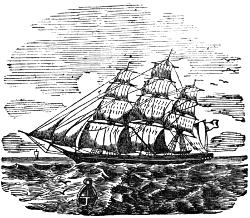
GRACE DARLING.

I pray give attention to what I shall mention, There was a young damsel liv’d by the sea side, Her name was Grace Darling, a good hearted heroine, And she with her father alone did reside, She was brave and undaunted, possess’d of great courage, Her heart often beat in her breast we are told, While the seas were commotion, she ventured the ocean, Grace Horsely Darling, a female so bold. On the 6th of September, the Forfarshire steamer, Sailed from Hull to the port of Dundee, With her crew on board and forty-one passengers, All hearts light and merry we put out to sea; With her full crew and passengers sixty in number, The vessel proceeded so gallant we’re told, They thought not of storms, nor even of danger, Though rescu’d from death by Grace Darling so bold. In the dead of the night on the 6th of September, The crew and passengers felt dreadful shocks, Against Longstone Island with force so tremendous, The Forfarshire steamer she went on the rocks, Asunder she rent while the crew fell a weeping. And some from the deck to deep they were roll’d, But the shrieks and the cries met the ears of that female, Grace Darling—that gallant young woman so bold. In the dead of the night this undaunted young female, Oh! father, dear father, awake she did cry, Arouse from your slumber and launch the boat quickly, Poor creatures to save, our efforts let’s try, I fear there’s a wreck, let us strive then to rescue Some part of the crew from the deep sad and cold, Their shrieks do appal me, their cries she said pierce me, Grace Darling—that gallant young female so bold. Says her father, dear daughter, this night it is stormy, ’Tis cold, and the seas they do run mountains high, It is folly my child to attempt on the billow, I fear not the danger, dear father, she cried! The boat was launched quickly, the seas loudly roaring, To the wreck with her father she ventur’d we’re told, And nine of the sufferers she saved from drowning, Grace Darling—that gallant young female so bold. When the danger was past her bosom beat lightly, Yet tears from her eyes in large torrents did fall, And saying we’ve only saved nine out sixty, Oh! I wish dearest father we could have saved all. Since her life she did hazard through tempests to save them Her name shall be written in letters of gold, With health and long life to that gallant young damsel, Grace Horsely Darling—that female so bold.
SAYERS’ & HEENAN’S GREAT FIGHT FOR THE CHAMPIONSHIP.
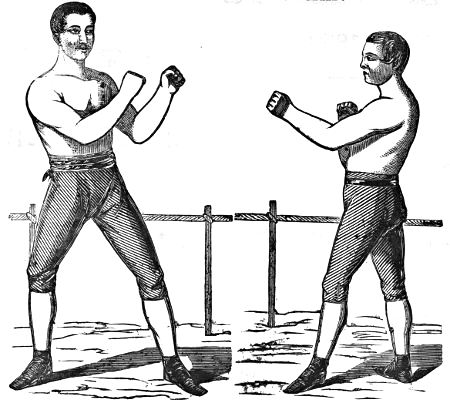
Upon the seventeenth day of April, All in the morning soon, The Yankee and the champion Sayers Prepared to meet their doom. The train it ran along like wind, Coaches and cabs did fly, Both men appeared determined To conquer or to die. They fought like lions in the ring, Both men did boldly stand, They two hours and six minutes fought, And neither beat his man. Tom hit at the Benicia boy Right well you may suppose, Heenan returned the compliment Upon the champion’s nose. Like two game cocks they stood the test, And each to win did try, Erin-go-bragh, cried Heenan, I will conquer, lads, or die. Cried Sayers, I will not give in, Nor to a Yankee yield, The belt I mean to keep my boys, Or die upon the field. They together stood it manfully, Surprised all in the ring, There was never such a battle, since Jack Langham tackled Spring. Such fibbing and such up and down Lor, how the swells did shout, Their ribs did nicely rattle, And their daylight near knocked out, Tom Sayers let into Heenan, Heenan let into Tom, While the Fancy bawled and shouted, Lads, my jolly lads, go on. Two long hours and six minutes They fought, and the claret flew, Sayers proved himself a brick, so did Yankee doodle doo. The bets did fly about, my boys, And numbers looked with joy On Sayers, the British champion, And the bold Benicia boy. They both had pluck and courage, Each proved himself a man, None better since the days of Spring In the British ring did stand. Erin-go-bragh, cried Heenan, I want the English belt, When Tom let fly, saying, I will die, Or keep the belt myself. At length bounced in the peelers, And around the ring did jog, So those heroes were surrounded By a lot of Hampshire hogs, Who caused them to cut their stick, And from the fight refrain, That they were both determined In the ring to meet again. We admit Tom Sayers had his match One who did him annoy, With lots of pluck and courage, Was the bold Benicia boy. And when two heroes fight again, For honour and for wealth, He that’s the best man in the ring, Shall carry off the belt.
H. Disley, Printer, 57, High Street, St. Giles, London.
TERRIBLE ACCIDENT ON THE ICE IN REGENT’S PARK, AND LOSS OF FORTY LIVES.

Of all the dread calamities you ever yet did hear, Either in history or story; If pity is within your breast, you will shed a silent tear, And mourn for those drowned, now in glory! The 15th of January, that Tuesday afternoon, Some hundreds on the ice took their station, Young men and boys, in youth and bloom, To the park went for healthy recreation. But soon it gave way, more than 40 lost their lives, The widows and poor orphans ’twill distress them; God bless those gallant hearts, to save life did strive, And those now in Heaven,—God rest them. ’Twas near four o’clock, how dreadful to relate, The ice it broke up in every quarter; Two hundred then fell in, oh, what a sad fate, All struggled for their lives in the water. The cries of the people, as they stood upon the shore, To witness such a scene most distressing, Some clung to each other, but now are no more, In grief are the friends of the missing. What must have been the feelings of those standing by, Unable to save and madly raving? The women rushed about, and bitterly did cry, My children, my children, oh save them! Wives calling to their husbands,—children, father dear, But few that were able to assist them, Now all will miss their own, for them shed a tear, Kind fathers, the children will miss them. They clung to the ice, until benumbed with cold, The ice in their grasp broke asunder; One lady on the shore, in grief did behold Her husband, exhausted, go under; Two sisters were screaming and calling for aid, Their sorrow, poor girls, could not smother, In anguish wrung their hands, and franticly said, For God’s sake save my poor brother. The most mournful part remains to be told, As the bodies to the dead-house were taken, At the workhouse gate two thousand young and old, The scene it was truly heart-breaking; One body was owned by an old gentleman, My son can’t be dead, he said, while crying, He left me but two hours, was strong and cheerful then, For a father so old it’s very trying. The doctors did their best in saving many lives, Of those that were in this sad disaster; Officials one and all, Mr Douglas and his wife, Long life to that kind workhouse master. A poor faithful dog saw his master disappear, And never left the park since that evening, No food will he take, by the water stays near, For it’s master the poor dog is grieving.
H. Disley, Printer, 57, High Street, St. Giles.
FOREIGNERS IN ENGLAND.
What wonders we do daily see, Enough to fill our hearts with glee, Britannia now will merry be, With the foreigners in England; John Bull does foreigners adore, Here’s the Viceroy from Egypt’s shore, Here’s the Turkish Sultan blythe and gay, And the Belgium Volunteers huzza! The bells shall merrily ring, huzza, Britannia sing and the band shall play, Old Jacky Bull will the piper pay, For the foreigners in England. They are come to see the grand review, And England’s Roberts’, dress’d in blue, Hokey pokey parleyvous, All the foreigners in England. You pretty English maids, heigho, If you don’t mind you’ll have to go To the Sultan’s grand Seraglio, And bid adieu to England. Yes, and all old women, so you must mind, Under the age of seventy-nine, Will be taken away in the morning soon, In a wooden cane bottom air balloon, You must marry the Turk and danger drive, Till to Constantinople you do arrive, For the Turks have eleven hundred wives, And he’ll take you all from England. Now the other day, you know its true, There was a terrible great to do, About the grand Hyde Park review, And the foreigners in England. The reason they stopped, the papers said, Poor Maximilian had lost his head, And he could not come with the jovial crew To have a look at the grand review. But Britons you must understand, There’ll be a grand review by sea and land, No power in Europe beat it can, With the foreigners in England. They’re going to dine with a great Lord Mayor And they’ll sit in a new mahogany chair, Such lots of dainties are prepared, For the foreigners in England. They’ll have sausages seasoned high Soused mackerel and rabbit pie, Rashers of bacon nicely done, Lobster sauce and donkey’s tongue, Lots of crabs and pickled sprats, Cabbage and onions covered in fat, Skillygolee and paddywhack, For the foreigners in England. To the Crystal Palace they will go, The Museum and National Gallery too, To Windsor, Aldershot, and Kew, All the foreigners in England. They are going to visit Charing Cross, To see old Charley sit on his horse, Then to Buckingham Palace to have a game, Then off they go to Petticoat Lane, Where life in splendour they will see, Fried fish and liver, and shockerhorsey, Then have a bathe in the river Lea, The foreigners in England. Let us welcome them with a loud huzza, You pretty maids get out of the way, Old Jacky Bull will expenses pay, For the foreigners in England: Here’s the Viceroy from Egypt’s land And Turkey’s Sultan hand-in-hand. If he wants some wives for the ottoman plains He can have all the women in Drury Lane. So all pretty girls in London chaste Go home to your mothers and wash your face, Or perhaps they will collar you round the waist, The foreigners in England. When the foreigners reach their native shore, They may say, we never saw before, Such glorious sights, and we may no more, As we beheld in England.
H. Disley, Printer, 57, High Street, St. Giles, London.
WHAT SHALL WE DO FOR MEAT!

Old England, once upon a time, Was prosperous and gaily, Great changes you shall hear in rhyme, That taking place is daily. A poor man once could keep a pig, There was meat for every glutton, Folks now may eat a parson’s wig, For they’ll get no beef or mutton. The times are queer, and things are dear, Well, it really is alarming; Up and down, country and town, I think we’ll all be starving. Although the times are very queer, Some old women have a way got, To raise themselves a drop of beer. Or a drop of gin in the teapot. If meat was seven shillings a pound, Old Polly, Kit, and Sally, Would find the means to guzzle down, A little cream of the valley. The butchers now, oh dear! oh dear! Declare no meat they can sell, Five thousand is gone to Colney Hatch, And seven thousand to Hanwell. Sixteen jumped in the water-butt, Lamenting they did shiver, Three ship-load sailed down to Gravesend town, And went to sleep in the river. Bullock’s head will be two shillings a pound, And if I’m not mistaken, We shall have to pay a half-a-crown For a slice of rusty bacon. I wonder what they do put in The faggots and the sausages?— Cold donkeys’ dung, says Biddy Flinn, Candle ends and rotten cabbages. The butchers now are gone to pot, Crying, oh! such times was never, They lay their heads on a greasy block, Saying, we are done for ever. They cannot cry, who’ll buy! who’ll buy! Their marrow bones are aching, For want of beef they seek relief, And will be sent stone breaking. Old Molly Bayton had a cat, So handsome and adorning, She would be moll-rowing all the night, And mewing in the morning. Last Friday night she killed a bird, To death old Moll did beat it, She put it in the pot to fry, And her son Bill did eat it. From a foreign land has come a man— He really is a wonder— He can raise mutton, veal, and lamb, And veal by steam and thunder. He the world to please, cures cattle disease, His skin is a blueish yellow, He carries a wand to banish the bugs, Is he not a curious fellow? Friends, never fret, there will be yet, Good things, plenty and stunning, Good beef to sell, we’ll all live well, For there’s right good times a coming. Lots of bulls with horns are being born, Large buffaloes are standing, New milk and cream will be made by steam, And in Ireland pigs are lambing. Though butchers’ meat to the poor’s a treat, Just look at Ned and Nelly, How they strut along, so says my song, With a flashy back and hungry belly. Have patience, folks, though ’tis no joke, Smell at the cook shop windows, If you want relief, and have got no beef, Have a jolly blow out of cinders.
H. Disley, Printer, 57, High Street, St. Giles, London.
FIFTEEN SHILLINGS A WEEK.
Air:—“King of the Cannibal Islands” A man and his wife in —— street, With seven children young and sweet, Had a jolly row last night complete, About fifteen shillings a week, sir. He gave his wife a clumsy clout, Saying, how is all my money laid out, Tell me quickly he did shout, And then she soon did set about Reckoning up without delay, What she had laid out from day to day, You shall know what’s done, the wife did say, With fifteen shillings a week, sir. Seven children to keep and find in clothes, And to his wife he did propose, To reckon how the money goes, His fifteen shillings a week, sir. Threepence-halfpenny a week for milk is spent, One-and-ninepence a week for rent, For the children a penny for peppermint, Out of fifteen shillings a week, sir; For tobacco eightpence every week, A half-a-crown for butcher’s meat, And to make your tea complete, A three-farthing bloater for a treat, A penny a week for cotton and thread, Last Sunday, tenpence a small sheep’s head, Ninepence-halfpenny a day for bread, Out of fifteen shillings a week, sir. Potatoes for dinner there must be found, And there’s none for less than a penny a pound, And I must have a sixpenny gown, Out of fifteen shillings a week, sir. A pennorth of starch, a farthing blue, Twopence-halfpenny soap and potash too, A ha’porth of onions to make a stew, Three-halfpence a day small beer for you, A quartern of butter, sixpennorth of fat, And to wipe your shoes a twopenny mat, One halfpenny a day to feed the cat, Out of fifteen shillings a week, sir. Ninepence a week for old dry peas, Sixpence sugar, eightpence tea, Pepper, salt, and mustard, farthings three, Out of fifteen shillings a week, sir. One and tenpence-halfpenny, understand, Every week for firing out of hand, Threepence-halfpenny candles, a farthing sand, And threepence to bottom the frying-pan; A twopenny broom to sweep the dirt, Three-ha’porth of cloth to mend your shirt, Now don’t you think you’re greatly hurt, Out of fifteen shillings a week, sir. Clothes for Tommy, Dick, Sal, Polly, and Jane, And Jimmy and Betty must have the same; You had a sixpenny jacket in Petticoat Lane, Out of fifteen shillings a week, sir. For shaving, a halfpenny twice a week, A penny to cut your hair so neat, Threepence for the socks upon your feet, Last week you bought a tenpenny seat Besides, old chap, I had most forgot, You gave a penny for a kidney pie, all hot, And threepence for an old brown chamberpot. Out of fifteen shillings a week, sir. So now, old chap, you plainly see, If you can reckon as well as me, There is little waste in our family, Out of fifteen shillings a week, sir. There’s many a woman would think it no sin, To spend the whole in snuff and gin! When again to reckon you do begin, Recollect there’s a farthing a week for pins, To make things right my best I’ve tried, That’s economy can’t be denied. Dear wife, said he, I’m satisfied, Out of fifteen shillings a week, sir. So you women all the kingdom through, To you this might appear quite new, Just see if you the same can do, With fifteen shillings a week, sir.
London: H. SUCH, Machine Printer, and Publisher, 177, Union street, Borough.—S. E.
THE GREAT AGRICULTURAL SHOW.
Hurrah, my lads, this is the day, When tens of thousands haste away; Rich and poor, high and low, Are off to the Agricultural Show. CHORUS. Sing the ploughboy’s song, Dance the milkman’s dance, What glorious fun, away they run, Kicking up their heels in the morning. Heigho! away they go, Jolly young fellows all of a row, Don’t get kissing the girls you know, At the Agricultural Show. Now at the Show some sights you’ll find, To delight the eye and improve the mind, Carts, waggons, patent ploughs, Horses, bulls, and Alderney cows. There’s scythes, sickles, forks and rakes, Ganders, turkeys, ducks and drakes, Chickens, hens, and cocks that crow, Is seen at the Agricultural Show. There’s buckets, churns, milk-pails, Washing tubs, and Chowbent nails; All sorts of flowers and fruit that grow, At the Agricultural Show. There is some young men got on the spree, And lushey got as they could be, An old cobler they met, they made him so drunk, That he went to smoke his short pipe at the pump. A man from London brought his wife, Indeed it is true upon my life, To tell you all that she can do, She can lick Jem Mace and Heenan too. From miles around they come by train, Into the town to see the game; And the country lads are always right, They won’t go home till broad daylight. Two or three machines of every kind, To go by water or by wind; Some to stop old people’s tongues, And one to grind old people young. There are Lancashire clogs and Cheshire cheese, London bugs and Suffolk fleas, You cannot sleep a wink at night, They are such devils for to fight. There’s a farmer’s daughter,—sweet eighteen, With nineteen hoops in her crinoline; It’s just a mile round the brim of her hat, She has got a cock-eye and a hump on her back. Triumphal arches I’ll be bound, Decorating —— —— town; With hearts so light and spirits gay, Hark! how the bands of music play. Some young ladies dress’d in white, Will be stopping out all night; If you should wink why they will wait, Upon the road by the turnpike gate. Oh, lovely night, when all alone, The lads and lasses toddling home; In a few months’ time the girls will show The game was played coming from the Show. The farmers’ lads will you not mind, The factory girls will dress so fine, They’ll go and leave the silk machine, To make little boys and girls by steam.
THE WINDHAM LUNACY CASE.

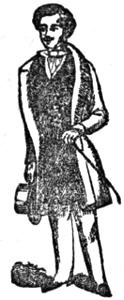
The Cove that wanted the Money.

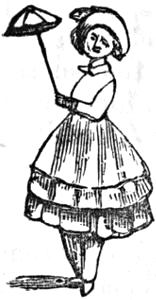
The Lady who got the Jewels.
Oh, dear! what a rumpus and bother, From one end of England right bang to the other, The lawyers their wigs pelted one at the other, Young Windham has conquered them all. They swore he was mad, that he acted quite funny, Imitated the cat, and stood just like a dummy, The fact was, you see, that they wanted his money, But now the old soldier is licked. Oh, dear! what can the matter be? Swearing and humbugging, jawing and flattery, They may now go and hang themselves up to an apple tree, Young Windham has conquered them all. Before there was never such pulling and tearing, The tales that was told was really unbearing, Such bawling, such pushing, such talking, & swearing, To prove that young Windham was mad. Because he thought proper to marry a wife, sir, Because he was happy and cheerful through life, sir, ’Twas money, the money, that caused the strife, sir, But young Windham has conquer’d them all. Sometimes he would Mackney be imitating, I wish I was with Nancy! he oft would be stating, In the Strand, in the Strand! as I am relating, And then they all swore he was mad. Because on the engine he went fast and slow, now, And with the ladies he used for to go now, Then holloa like winking, Bob Ridley, O! now, Well, but that wouldn’t make him be mad. Not far from St. James’s some coveys were dwelling, They such wonderful tales to the jury was telling, And there was a lot that was named Llewellin, Who spun a most wonderful yarn. That sometimes he was naked, & drunk too, I vow, sir, That he crowed & moll rowed, & kick’d up a row, sir, And wetted sometimes the back part of his trousers, And they swore to be sure he was mad. Now young Windham has conquered them all, and is right, sir, He may fight, drink and sing, be enjoying his pipe, sir, And he with his money can do as he likes, sir, He has licked the old soldier right well. The weeping old soldier is beat, he is done, sir, He may slip on his knapsack and follow the drum, sir, Or march thro’ the country, and shoulder his gun, sir, It’s a chance if he doesn’t go mad. Through all the set speeches of Montague Chambers, If he carried the day we should all be in danger, They’d have made us all mad, and there’s nothing more stranger, But into the madhouse we’d go! Oh, the money, the money, they wanted the money, And that was the thing made the parties feel funny, There was rough tales, and smooth tales, and tales told like honey, But it didn’t make young Windham go mad. Here’s success to the jury who acted so clever, Do you think they’d be bias’d, oh no, they would never, Drink their health in a bumper, may they live for ever, And we hope they will never go mad. When the trial was over, young Windham not fear’d them, And the public as soon as ever they near’d him, Hurrah’d him right well, and so heartily cheer’d him, And declar’d that he never was mad.
H. Disley, Printer, 57, High Street, St. Giles, London.
THE OLD MARQUIS And His Blooming Wife.
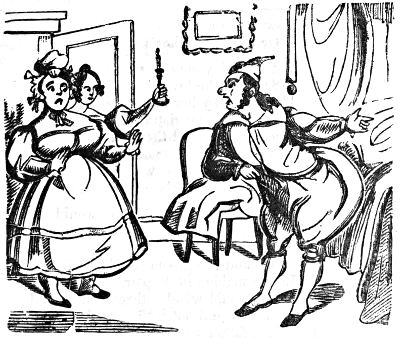
Oh, here’s a jolly lark, Some strife perhaps there may be, A Marquis had a wife, Oh, such a blooming lady; She married him they say, For title, and remember, ’Twas lovely Miss May, And old Mister December. Old Fidgets lost his wife, And sorely now does grumble When he goes to bed at night, He’s nobody to fumble. The old man is seventy eight, As sprightly as a donkey, Such a noble friend is he To the Italians & the monkeys. The lady he did wed, He married her one Monday, Blooming, young, and fair, Only seventeen come Sunday. He cuddled her so sweet, The damsel he did flatter, Singing I for Bobbing Joan, And she for stoney batter; An angel from above, The poor old man did think her, But oh dear, she ran away One morning with a tinker. The old Marquis lost his wife, And he was in a sad mess, Miss was a lady gay, An Irish Marchioness; Lovely seventeen, He could not discard her— Wedded she thought she’d been Unto her great grandfather. Five hundred bright pounds, The damages, that got he, Against the naughty man Who robbed him of his lady. The lawyers they did chaff, What fun in court, oh law there They caught her snug in bed, In Sheffield town, in Yorkshire. This blooming damsel fair, Has such a lovely pimple, Such pretty chesnut hair, And nigh her mouth a dimple; A bustle made of gold, And I can now remember, A crinoline to hold Poor old Mister December. Old men, take my advice, Or taken in you may be, If you should wed a nice, Sweet frolicsome young lady; A gay, young Mister June, Perhaps they may connive at, To play to her a tune, Just now and then in private. The poor old man is mad, Though he has lots of riches, He wants another wife, Or a larger pair of breeches; Though past three score and ten, If one should meet his fancy. He says he’ll marry again,— Oh! don’t I love my Nancy. When he married his sweet wife He didn’t care for nothing, He used to lace her stays, And then tie up her stockings He kissed her lovely lips, What a darling he did think her, But she soon gave him the slip, And bolted with the tinker. A single man again, His lordship now will be, sirs, Just threescore and eighteen, But another wife wants he, sirs, To cuddle him at night, And his old knees be warming, What a lark if his next wife Should cut away in the morning. She got old Fidgets off, Made cock sure all right, And with the Yorkshire blade She danced a jig at night.
H. Disley, Printer, 57, High Street, St. Giles, London.
MARRIAGE OF THE Blooming Lady and the Groom.

There was a beauty bright, At Woking she did dwell, Her father had a handsome groom, And his daughters loved him well. They used to trot away, Conversing on the land, Oh! Alice Caroline dearly loved Her father’s servant man. Alice loved her father’s groom, She longed to take his hand, No one can separate her From her father’s servant man. She is twenty years of age, As blythe as e’er was seen, And George, the groom, was a youth in bloom, Is aged but eighteen. She dearly loved her George, She by his side would stand, She vowed no one should part her, From her father’s servant man. George and Caroline would toy, Each other they would please, Each other they would kiss, And tiddle each other’s knees. They swore by all above, Did together fondly plan, To dear each other, lovely Alice and her servant man. From Woking they set out, Thinking e’er they far had got, A lovely chance they’d have To tie the lovers’ knot. They disappointed was, And they amazed did stand, Then young Alice went to Wandsworth With her father’s servant man. The banns they did put up, Alice and her father’s groom, And in Love Lane, in Wandsworth, They together took a room: Saying they were man and wife. As the young lady blythe did stand, Vowed she would lose her life, Or wed her father’s servant man. But mark! young men and maids, Sad was the lovers’ fate; They were by her father took Before the magistrate; Alice boldly faced them all, As she at the Bar did stand, And swore she ran away With her father’s servant man. Have her Georgy Smith she would For he had gained her heart; No power in the world, She and her groom should part. Like a maiden in despair, She would wander through the land, If they would not let her wed, Her father’s servant man. May they both united be, And live a happy life, May the pretty sweet Miss Crosse, Be a kind and loving wife; And may she ne’er regret She did at the altar stand, By the side of Georgy Smith, Her father’s servant man. You Weybridge pretty girls, You Chertsey lads and lasses gay, Can you blame me ’cause from Woking With my love I run away? You girls of Guildford town, Together we will trill, To see the pleasant fair, At the place called Catharine Hill. This lovely pretty maid, The parson’s daughter all in bloom, Declares she’ll never have another man, Unless she has her groom. She loves him as her life, And may she dance a jig, And may she have a little boy, Marked with a parson’s wig.
Printed for the Proprietors, Messrs. Saville, Lucky, & Co.
YELVERTON MARRIAGE CASE. THE LADY BEAT THE SOLDIER.

You are all aware as well as me, There has been great consternation, In Dublin has a trial been Which excited all the nation; There was a blooming lady, who Did wed a soldier laddie, And he was afraid of his mamma, And he dare not tell his daddy. The lady licked the soldier well, Cause he refused to take her, And the Irish lads were all so glad, To see her beat the Major. He is the son of a great lord, Stand at ease, and order; He took a bonny, blooming maid Over the Scottish border; He told her pretty tales of love, Embraced her round the middle, And when they were at Gretna Green The Major caught the fiddle. He took then to Paddy’s land, So gentle, meek, and clever, He disgraced the Holy Church of Rome, He did, the naughty fellow; He vowed that she was not his wife, And caused a pretty bother, He clapped his knapsack on his back, Then went and married another. Brave Serjeant Sullivan was the man, No lawyer could be bolder, With gallant Whiteside went to work, And fired away at the soldier; While every upright person there The lady pitied, who was round her, The sheepish Major droop’d his head, And pop went the powder. He was a Major, a Lord’s son, As evil as a monkey, All the religion that he cared about, Was who had got most money; The fool was of no creed at all, The Church of Rome defied a sad way, He could swear a lie thro’ a nine inch wall, And cover his nob with pipeclay. Now like a brick the soldier’s licked, And his coronet is troubling, She shamed him in the Four Courts, In the good old town of Dublin; They made the naughty soldier jump, If the ladies could have caught him, They would have ducked him underneath the pump, And better manners taught him. He drove the lady round and round, While riches she had any; To Waterford and to Belfast, To Bantry and Kilkenny; He disgraced the Holy Church of Rome, The naughty soldier laddy, And all because he was afraid Of a flogging from his daddy. He has made a pretty kettle of fish, He has lost his wife and baby, The Dublin lasses shout huzza! May Heaven bless the lady; She like a brick the Major licked, The naughty wicked soldier, He bolted out of Dublin town, With his firelock on his shoulder. If to Gretna Green he goes again, To play his hey down diddle, Let the ladies pray both night and day, That he may get the fiddle! And then go mad to Ballinafad, Where they will stand no parley, So cut your stick, your Irish licked, And a regular guy is Charlie. He married a wife and then made strife, Such terrible tales he told her, It was such sport in the Dublin court, To see Sullivan drill the soldier.
THE NAUGHTY LORD & THE GAY YOUNG LADY, DAMAGES, £10,000.
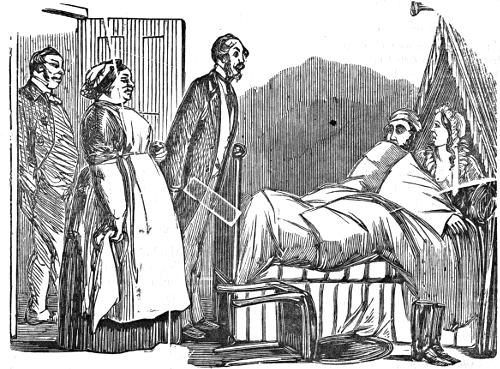
There is a pretty piece of work, It is up in high life, Upon my word an amorous lord, Seduced another man’s wife; She was a lady of title, She was charming, young, and fair, With her daddy and her mammy once She lived in Belgrave Square. The trial now is over, And his lordship, with a frown, For kissing Lady Nelly Has to pay ten thousand pounds. Lord G—— was a naughty lord, Oh! how could he engage, To seduce young Lady Ellen,— He is sixty years of age. The verdict of the jury Made his lordship quake and jump, Ten thousand pounds he has to pay, For playing tiddly bump. Lady Nelly left her husband, And would with his lordship be, She would trim his lordship’s whiskers As she sat upon his knee. Some said oh, lack-a-daisy, She was in a comical way! His lordship was bald-pated, And his hair and whiskers grey. My lord was very fond of lamb,— The cook said so at least,— And neighbours you must understand He liked the belly piece. His lordship loved the lady, And the lady she loved he, His lordship played by music, The tune called fiddle-de-dee. His lordship when he heard the news, Caused his eyes to flash like fire then He looked around, ten thousand pounds His lordship holloaed, “wire-em.” He sold his hat, he pawned his coat, To pay the browns, we find, And then he run round Hyde Park sqre, With his shirt hanging out behind. Sweet Ellen was a daughter Of my Lord and Lady C—— And once lived in a mansion, Yes she did in Belgrave Square, Sweet Ellen had an husbund, An honest upright man, And his lordship went a trespassing Upon her husband’s land. My lord was fond of sporting, And hunting of the hare, He has to pay ten thousand pounds, The damage to repair; His lordship played the fiddle, Down in Scotia’s land, ’tis said, And his lordship must have fiddled well Both in and out of bed. Now all young lords take warning, “When a hunting you do go, In the evening or the morning Pray beware of “Tally-ho!” If you are caught a trespassing On other people’s ground, Perhaps you’ll be like old Lord G—— Made to pay ten thousand pounds. The lady’s injured husband, Has nobly gained the day, And beat old Mr December, Who seduced young Lady May.
H. Disley, Printer, 57, High Street, St. Giles, London.
STRIKE OF THE JOURNEYMEN TAILORS.
Oh have you heard the jolly row, In London all around, just now, If not, I’ll tell you all, I vow, It is the strike of the Journeymen Tailors The masters and the men you see, They cannot very well agree, The masters they won’t alter the log, The men say they shall, so help their bob; The masters say the men are wrong, But the men say they are too strong, So I suppose they must settle it themselves among, This strike of the journeymen Tailors, The sleeveboard and goose may idle lay, The needle and bobkin is stowed away, Oh, is there not the devil to pay, Thro’ the strike of the Journeyman Tailors Now ever since the world began, They say nine tailors makes a man, But do without them they never can, The host of the Journeymen Tailors. For indebted to their work ’tis clear, Is kings and dukes, and lords and peers, They are wanted here, and wanted there, And all they want is to play fair. And they must get it, these men of stitches, Or what shall we do for coats and breeches, We must black and go naked, or hide in ditches Thro’ the strike of the Journeymen Tailors. Now the tailors are of ancient date, Believe it’s true, what I now state, And I’ll tell you the time if you’ll only wait When the world was first blessed with a tailor The first there was, tho’ I never see’d him, Had his workshop in the garden of Eden, And I tell you he was not a green ’un, Tho’ he grew lots of cabbage to feed on; He stitched away when the world began, And made fig leaf togs, A No. 1, He was a regular Flint, and never a Dung, It was Adam, the first of the tailors. What we shall do, I do not know, If the men to work they will not go, We shall walk about just like scarecrows, Thro’ the strike of the Journeymen Tailors. We shall be all rags and jags, And only fit for the ragman’s bags, Or to make a sign for some rag shop, With just enough left to make a mop; Oh wont it be a funny go, To see the swells in Rotton Row, With their shirt tails flying in the wind, as they go, Thro’ the strike of the Journeymen Tailors. An old lady the other day did run, Into the shop of Moses and Son, Saying, please Mr Mo, are you a Dung; Don’t you know there’s a strike with the tailors! Then round the corner she did pop, Saying, is this not a sweating shop, Then he holloa’d police, but it was no use, For she flattened his nose with a ten pound goose, Now they tell me the sleeveboards looked quite big, And round old ———— they danced a jig, Saying, we shall have a rest, so please the pigs Thro’ the strike of the Journeymen Tailors. Now let us hope we soon shall see, The masters and the men agree, For fair play is the style for me, With all classes, as well as the tailors. If they don’t go in, I do declare, We soon shall have no breeches to wear, But that my friend is only a joke, So, if I offend, I am sorry I spoke. We all for the biggest shilling fight, And I think you will own that I am right, But jolly good luck I say, blow me tight, To the whole of the Journeymen Tailors.
H. Disley, Printer, 57, High street, St. Giles.
WONDERFUL MR. SPURGEON.
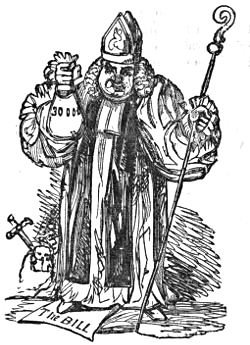
Oh! there is such a wonderful man, Just listen to my sequel, I’m sure throughout the British land There never was his equal. He’s such a chap to preach and teach, Father, mother, son, and daughter, And for to hear this wonderful man They run from every quarter. This wonderful man surprises the land, Parson, lawyer, snob, and surgeon, From every place they run a race, To the wonderful man call’d Spurgeon. He can please the duke, the lord, & squire And ladies with gold lockets, He can make the very sovereigns jump Out of old women’s pockets. He can look above, and look below, And deeply groan, and sigh, ah! He can shake the rocks and swallow the whale He’s a greater man than Jonah. Oh, such a sermon he can preach, And the congregation harras, He has a tabernacle twice As big as the Crystal Palace. He can make a Bishop jump Jim Crow, Turn a peeler into a carter, He can make a parson’s daughter jump Right bang out of her garters. He can shake the damsels’ crinoline, And cure a cobbler’s sore throat; He bangs the country east and west, And licks Johanna Southgate. There never was since Sampson lived, A man on earth to match him; Spurgeon is an out and outer, lads, To act the game of cadging. If Spurgeon went into St. Paul’s, I’m sure he’d not dissemble, His voice would make the dome to rise, And St. Paul’s church for to tremble. And what do you think he does it for? Why, for money, I supposes; Some say Spurgeon is a greater man, Than Soloman or Moses. Oh, can’t he spin a tidy yarn, And trick the ladies handsome, He makes you think he’s twice as strong As that old covey Sampson. They’ll say by and bye that he can fly, To kingdom come, and stop there, Dance a hornpipe in the clouds, And jump to Ballinahoker. Punch says he is a wonderful man, And causes many a row, sirs, Oh, can’t he make the joey’s fly From the pockets of your trousers, And when not vexed, he gives the text, He alarms the congregation; A better beggar can’t be found, All over this great nation. Well, every man unto his trade, The cobbler, snip, and surgeon, Many a good day’s work he’s made, So much for Parson Spurgeon. He can make the money fly like rain, No man on earth can stop it, His wonderful voice will make it jump Like winking out of your pocket.
H. Disley, Printer, 57, High Street, St. Giles.
A NIGHT IN A LONDON WORKHOUSE.
All you that dwell in Lambeth, listen for awhile, To a song to enlighten and amuse you, In the workhouse only mark, there’s queer doings after dark. And believe me it is true I now tell you; It’s of the ups and downs, of a pauper’s life, Which are none of the best you may be sure, sir. Strange scenes they do enact, believe me, it’s a fact, In Lambeth workhouse among the casual poor, sir. Oh my, what a rummy go, oh crikey, what a strange revelation, Has occurred in Lambeth workhouse a little while ago, And through the parish is causing great sensation. Now a gent, with good intent, to Lambeth workhouse went, The mystery of the place to explore, sir, Says he, without a doubt, I shall then find out, What treatment they give the houseless poor, sir. So he went through his degrees, like a blessed brick, Thro’ scenes he had never seen before, sir, So good luck to him, I say, for ever and a day, For bestowing a thought upon the poor, sir. Says he, when you go in, in a bath you are popt in, To flounder about just like fishes, In water that looks like dirty mutton broth, Or the washings of the plates and the dishes; Then your togs are tied up tight, to make sure all is right, Like parcels put up for a sale, sir, A ticket then you get, as if you are for a trip, And a-going a journey by the rail, sir. Then before you go to bed, you get a toke of bread, Which, if hungry, goes a small way to fill you, And if not too late at night, you may chance to be all right, To wash it down with a draught of skilley; Some they will shout out, Daddy, mind what you are about, And tip me a comfortable rug now, And be sure you see it’s whole, for I’m most jolly cold, And mind you don’t give us any bugs now. Then you pig on a dirty floor, if you can, you’ll have a snore, And pass away time till the morning. Then you’re muster’d up pell mell, at the crank to take a spell, Just to give your cramp’d up body a good warming. Then see them all in rows in their torn and ragged clothes, Their gruel and their bread they swallow greedy, Then through London streets they roam, with neither friends or home, It’s the fate of the suffering and the needy. Now a word I’ve got to say, to all you who poor rates pay, Tho’, of course, offence to none is intended, Before you your poor rates pay, just well look to the way, And inquire how your money is expended; Do as you’d be done to, that is the time of day, And with me you’ll agree, I am sure now, As you high taxes pay, it is but fair I say, To look a little to the comforts of the poor now.
Disley, Printer, 57, High Street, St. Giles, London.
THE GHOST OF WOBURN SQUARE.
Strange doings in London there is I declare, So listen to me and a tale you shall hear, Some hundreds each night flock to Woburn Square, To just get a peep at the Ghost Great consternation it has caused all around, And each one to his neighbour declares, Have you seen the Ghost that each night is found A dancing round Woburn Square. They toddle along, the lame and the blind, The deaf and the dumb they will not stay behind, Saying, to Woburn Square, hasten lads, let’s be in time, And have a good look at the Ghost. Some say that his Ghostship that walks there at night, It is Mrs. Chang the Chinaman’s wife, And some say it’s Muller again come to life, To look for the cabman his friend. But whoever it is he has no business there, And he’ll stand a good chance, so help my bob, For disturbing the good folks of Woburn Square, To find himself some day in quod. But whoever he is he is togg’d all in white, And such antics he plays in the square every night, Like a long scaffold pole he stands bolt upright, This naughty Ghost of Woburn Square, As large as the soup plates is his glaring eyes, The sight of which puts you in dread, He’s a smart little fellow about ten feet high, With a monstrous donkey-like head. He escaped from St. Pancras churchyard I hear, Not liking the company he had got there, He stalks out at night just to take the fresh air, And get a drop for to moisten his clay; He is not at all quarrelsome you must allow For the devil a word does he speak, But when he is tired his Ghostship I vow In a jiffey he beats a retreat. The women did holloa, the boys they did shout, Mr. Ghost, how’s your mother, does she know you’re out? The peelers was sent to put them to the rout, And clear them away from the square. They collared some boys, but the Ghost was not found, Though they looked for him everywhere, And some will remember the time I’ll be bound— The Ghost’s visit unto Woburn Square. In my time I have heard queer ghost stories told, How through keyholes they’d pop in the days of old, But I can’t think men such fools to come out in the cold, On purpose the people to scare; So if it’s a live ghost playing a trick, And you can his Ghostship come near, The best way to pay him is with a thick stick, And he’d never trouble again Woburn Square.
H. Disley, Printer, 57, High Street, St. Giles’s.
THE WICKED WOMAN OF CHIGWELL.

Come one and all, and listen to This funny little song, Concerning Mrs Harrison, I will not keep you long; She in Chigwell Road resided, With her husband, so it’s said, She swore that Saunders on the 12th of March, Assaulted her in bed. So listen to this funny tale, She tried to cause much strife. Did this false swearing woman,— The Chigwell Station master’s wife. At Epping Sessions, there this case occurred. And she said, now only think, That the docter, Mr. Saunders, With her played at tiddly-wink; That he went into her chamber, When her husband left the room, How far her story there was true, I’ll let you know full soon. She refused to say one word about Her former course of life; Oh, is she not a beauty! This Chigwell Station-master’s wife When the Counsel for the Docter, Soon put this lady down, By asking her the manner She lived in Peterborough town. Now a witness he was called, And when he did pop in: Pray, do you know this gentleman? She cried, yes, all serene! But whether it is true or not, At least the folks do say, That he with this famed Mrs. H— Some funny games did play. Round Ilford and round Epping, And Romford too it seems, That she was very fond of pork, And she dearly loved her greens! But to swear that Docter Saunders Assaulted her, ’twixt me and you, She must tell it to the devil, For with us that tale won’t do. One word for Docter Saunders— That kind and skilful man— She ought to be well bonneted And put in the prison van; Such disgraceful dirty conduct— It really was too bad, And when the Docter was discharged The people were right glad.
Smith, Printer, High Street, London.
MARY NEWALL, The Artful Girl of Pimlico.

Come all you ladies list to me, And give me every attention, It’s all about a servant girl, That I am going to mention, Mary Ann Newall is her name, She possessed herself of riches, She collar’d all her master’s tin, And swore she’d wear the breeches Mary Newall is a nice yound girl, She possessed herself of riches, In the Vauxhall Road she crack’d the crib And put on the pegtop breeches. Her master went out for a walk, And as he abroad did roam, I will tell you what Miss Newall did, While her master was from home; She turned the house near inside out, Indeed I am no joker, She cut the hair from off her head, And stuck it on the poker. She got a lot of bullock’s blood, And mixed up in a pail, Sir, So to think that I am murdered, now Master will not fail, Sir; She smashed the poker right in two, That no one should doubt it, With a bit of glue, now this is true, She stuck the hair about it. She in the wainscoat cut a hole, Just the size of a man, sir, She smashed a window from the inside, Saying, I’m the girl that can, sir, Crack a crib with any chap, And back up all the riches, Then she pulled off her crinoline, And put on the pegtop breeches. With new spring boots, & fine cloth vest And overcoat to match, sir, With the lodger’s hat & nice gold guard, She was up to the scratch, sir, She had the cheek to call a cab, With boxes in rotation, Saying, Cabby, old boy, as quick as you like, Drive off to Shoreditch Station. Now her master soon returned home, The truth I do declare, sir, Saying the house is rob’d and Mary’s dead, Here’s the poker cover’d with hair, sir To the station-house he quick did send, Murder and robbery, who could doubt it, But Detective Sheen, a clever chap, Soon told them all about it. The telegraph was set to work, The best thing for to track her, It was soon found she at Yarmouth was A smoking of her tobacco; Drest up in slap togs, you’re sure, Like the greatest swells of the day, She got dead nuts on her landlady, And took her to the play. Sheen, the detective, soon found her out And the place where she dwelt, sir, The landlady told him, her nice young man Was walking with the girls, sir But she was nabbed, cigar in hand, She swore she fight a duel, Sheen says, where is your petticoats? I know you Mary Newall. She sold her togs, both stays and shift, Hair bag, dresses, and bustle, She had bought a pair of pegtop tights, To go off in a bustle; To the Magistrate she was brought up, And stripped of all her riches, The Magistrate said, take her away, And pull off this lady’s breeches.
H. Disley, Printer, 57, High street, St. Giles.
SHE HE BARMAN OF SOUTHWARK.

You bonny lads and lasses gay. Who like a bit of chaff, I’ll tell you of a She He Barman, And I’m sure ’will make you laugh. She did not like the petticoats, So she slipped the trousers on, She engaged herself as a barman, And said her name was Tom. At the Royal Mortar Tavern, London Road, She served the customers all round, The She He Barman was engaged By Mr Frederick Brown, She popped around the bar like steam, The girls and chaps did wink, When they went in for a drop of gin, But little did they think That Tommy Walker was a maid, When they together met, Last night a costermonger said, Who’d thought Tom’s name was Bet. In the morning she put on her shirt, Her trousers, coat, and boots, She He Tommy Walker A regular swell did look; She could drink a little drop of stout, And smoke a mild cigar, Tommy Walker, the female barman, Was a clever chap, oh! la! She had neither beard or moustache, And her belly was not big, But Tom the He She barman Turned out to be a prig; She nailed the sixpences and shillings, And she prigged the half-a-crown; She three months was Tom the barman At Mr Frederick Brown’s. She Tom had been a sailor, Two years upon the main, She was dropped from the Royal Mortar, On board the ship Horsemonger Lane Three years she doffed the petticoats, And put the trousers on, She served behind the counter, And the people called her Tom. For years she plough’d the ocean, As steward of a ship, She used to make the captain’s bed, Drink grog and make his flip. She could go aloft so manfully, This female sailor Jack, But if she slept with a messmate, Why of course she turned her back. Now tired of a sailor’s life, She thought she’d be a star, She got a crib at Mr. Brown’s, To serve behind the bar, This pretty female barman— Her modesty don’t shock— It is better than handling of the ropes, To be turning on the cocks. If you’d seen her take them in her hand, You’d have said she was a caulker, So nicely she handled them— She said her name was Walker. To see her put on a butt of beer, And when the brewers come, She nicely drove the spigot in, And then out came the bung. The ladies like the trousers, Of that there is no doubt. Many would be a barman, But fear they’d be found out. Tom was not a handsome female, She too long had been adrift, Since she put on the Gurnsey, And chucked away her shift,
H. Disley, Printer, 57, High Street, St. Giles.
BEAUTIFUL FOR EVER.
“Well, here I am, as you may see, A buxom lady fair and free, I don’t care what they say of me, I am the charming Madame Rachel; I am the girl can carry the sway, Make the ladies handsome, fair, and gay To beauty I can lead them on, I can curl and dress their sweet chignons. I can please them all upon my word, To say I’m wrong is quite absurd, I can splice an old woman to a lord, So much for Madame Rachel. I will stand my trial like a brick, And to my business I will stick, I will all the silly old ladies nick, My name is Madame Rachel. Now there was an old woman, list to my tale, Her name was Mrs Sparrowtail, I promised her a husband without fail, She bothered Madame Rachel. She came to me with money in hand, She said she wanted a nice young man, I saw the old fool had plenty of browns She had just fifteen thousand pounds, It was very tempting, upon my word, I looked at her like a strayed bird, I said I’ll marry you to a lord, My name is Madame Rachel. To please the old woman I did not fail, I flattered and coaxed Mrs Sparrowtail, Got all her money by telling a tale, She was pleased with Madame Rachel. I got her a man, lawks how he did laugh He saw Mrs Sparrowtail in the bath, He viewed her chignon when he did her see, And said that old woman won’t do for me, But I wheedled out of her money so fine, I dressed her old chignon behind, A lord for a husband did her fine, That suited Madame Rachel. Now let the world say what they will, I will be Madame Rachel still, Ladies, lovely, I make you will, If you’ll come to Madame Rachel; To polish up, my dear, I’m clever, I will beautify you girls for ever, I will enamel your face, your legs and hands, If you want a husband I’ll yet you a man, Yes, my dears, if a husband you desire, I’ll get you a marquis, a lord, or squire, Who will look in a bath and you admire, Now listen to Madame Rachel. Why should I disturb my mind, They to punish me a way can’t find, I shall leave my ticket at Number Nine, Enquire for Madame Rachel; I am the woman who can you please, I can polish your skin, anoint your knees, I can enamel your pretty chignons so clever, I can make you all sweet beauties for ever. I say Mrs Sparrowtail was a fool, And of the old woman I made a fool, To polish old ladies shall be my rule, It shall, says Madame Rachel. My trial is not ended yet, Then why should Madame Rachel fret, I think acquitted I shall get, They can’t hang Madame Rachel; I think next sessions all be right, And while I live I will do as I like, If an old fool with plenty of browns Only say about fifteen thousand pounds, I will tickle her up upon my word, I’ll make her as lovely as a bird, And if she wants a husband get her a lord. Am I not right, says Madame Rachel.
Disley, Printer, High Street, St. Giles, London.
FUNNY DOINGS IN THE CONVENT.

Strange things every day we hear. So one and all pray draw near, Of a strange trial you shall hear, Concerning life in a Convent. In Hull, as I to you will tell, Within a Convent I did dwell, A Mother, as you know well, And a Sister of Mercy. Her name is Starr, as I now state, She’s a perfect star, and no mistake, So I will tell you if you will wait, How they treated a Nun in a Convent. Now the trial is o’er, and the Judge did say Mistress Starr, you have lost the day, And five hundred pounds you’ll have to pay For tricks that are play’d in the Convent. Now this Nun’s name it is S——n, Who wished to lead a life serene, And has for years an inmate been, And led a nice life in the Convent. For Mrs. Starr—that merciful mother— In her some faults would oft discover, And led her a life, a regular drudger, When she was in the Convent. This Nun she could do nothing right, She was always wrong, both day and night, To be a Nun is’nt nice, How happy they live in a Convent! She made her on her knees to go, Black-lead the stoves, scrub the floor, Empty them things the name I don’t know, And that’s what she did in a Convent. She dare not keep thimble, cotton, or rag, Her clothes were not fit for a bone-picker’s bag, And would make her walk about, isn’t it sad, When she was in the Convent. If she snored in bed that was not right, Or picked gooseberries that was not ripe, This duck of a mother led her a fine life. Oh, who would live in a Convent? If she dared to write, or too loud speak, Or if of grub too much did eat, She must lay for a month without blanket or sheet, Oh, that was a treat in a Convent! Mrs. Starr said she once met her with a ham And her mouth was like turkey’s crammed, And she said, sister, what are you at, I declare your mother is smothered in fat, Did you ever see such an hungry glutton, Upon sawdust you must be put on, You put away ham if you’re baulk’d of mutton, Said kind Mother Starr of the Convent. When her stocking was the Judge before, He said they’re old, I’m certain sure, Why they’ve been well patched behind and before, Is that what they wear in a Convent? Yes, said the Nun, and it is a great scandal, She says grease is dear, and I must not use candle, And as for the grub I could’nt handle, Whilst I was in the Convent. It would puzzle Old Nick with her to agree, And as for mercy, small share she gave me, So I think my Lord Judge, you plainly may see, It’s no joke to live in a Convent. So ladies all, don’t think it a sin, If your husband at night you can’t keep in, Send for Mrs. Starr, and bundle him in, And give him a month in a Convent; He’ll miss his wife to tuck in the clothes, To make him gruel and tallow his nose, For one dose will cure him I do suppose, If he only gets in a Convent. Now you young lasses, my song is near done, And I would advise you everyone, To ask Mrs Starr to make you a Nun, And have a peep at her Convent!
W. S. Fortey, General Steam Printer and Publisher, 2 & 3, Monmouth Court, Bloomsbury.
THE DUNMOW FLITCH OF BACON.

Come all you married couples gay, Get up before the break of day, To Dunmow then pray haste away, To gain the flitch of bacon; There is such pleasure, mirth and glee, The married folks will have a spree, They’ll try for love and victory, And the Dunmow Flitch of Bacon. So lads and lasses haste away, And do not make the least delay, And to Dunmow town pray haste away, And carry off the bacon. There’s special trains from distant parts, Young and old, with joyful hearts, In coaches, gigs, and donkey carts, Have come to the flitch of bacon; Sound the trumpets, beat the drums, See how the lads and lasses run, To Burton’s meadow they have come, To view the flitch of bacon. A man and wife must married be, Just a twelvemonth and a day. And never have a quarrel they say, To get the flitch of bacon; And when they gain the prize, we hear, They’ll carry them round the town on a chair, And give them many a lusty cheer, And show the flitch of bacon. There’s a grand procession through the town, And Mr. Smith, he has come down, We’ll drink his health in glasses round,— Success to the flitch of bacon; Young men and maids like summer bees, We’ll roam beneath the shady trees, Come marry me quick now, if you please, And next year we’ll get the bacon. Some will laugh, and some will shout, Some on the grass will roll about, While smart young men, without a doubt, Will dance with the pretty ladies; Bands of music sweetly play, Smart young men and maidens gay, To Burton’s meadow they will stray, To talk of the flitch of bacon. The velocipedes will races run, The fight with clowns will cause some fun, And maypole dancing will be done, To please the folks of Dunmow; There’s punch and judy, all so gay, The clowns they will at cricket play, To the circus the folks will haste away, To see Bluebeard at Dunmow! Now when the sport it is all done, And the flitch of bacon carried home, Some scores will to the pop-shop run, With bolsters, quilts, and blankets; Coats and waistcoats, gowns and shawls, Shirts, chignons, and parasols, Will have to go to the golden balls, To pay for the spree at Dunmow. So now to finish up my lay, Take my advice, young ladies gay, Get married now without delay, And try for the flitch of bacon; For the Essex lads they are so sly, And you had better mind your eye, Or next year you may have a girl or a boy, Marked with a flitch of bacon!
H. Disley, Printer, 57, High Street, St. Giles, London.
LAST DYING SPEECH And Farewell to the World OF THE LORD MAYOR’S SHOW,
Who suffered the extreme penalty of the law, Saturday, November 9th, 1867.
Come one and all, pray listen to my ditty, Good times have gone by,—oh dear what a pity! The procession this year I have to relate, And how on the ninth they will all go in state. They all shake their heads and say it’s no go, It’s the last dying speech of the Lord Mayor’s Show. At half-past eleven, by the word of command, From Guildhall will tumble a big German Band; With mounted police,—to you it is plain— On their hats stuck a lamp with a portrait of Mayne Old Alderman Gobble with a large Chinese gong, Six girls with six shoelacks stuck on their chignons They set backside before, and so on you will find, And for reins hold the ribbons that hang down behind. There’s the old Lord Mayor stuck on a blind horse Like an old turtle, with his fat legs across; It will make him sore behind if he has a long ride, He has lost the key, or he would creep inside. Then the sword-bearer he will make a start, He sits like a king in an old donkey cart; He sold his hairy cap to make him a muff, And he has broke his sword on the old donkey’s duff. The great City Marshall, he is not much use, He is flying about like a one-legged goose; He is here and he’s there, and he’s off in a crack, You would think he had swallowed the New Streets Act. The poor men in armour are not here to day, Through last year’s exertion they sweated away; They are selling fusees—it’s a very bad trade, And all the poor horses into sausages are made. There’s old Parson Spurgeon, as sly as a fox, On a chair with two sticks, just like a Guy Faux; With tracts in his hand, you soon will him spy, And a dish of fine sprats and a tear in each eye. There’s poor Gog and Magog, so it appears, With a pail in each hand to catch their own tears, They both weep in anguish and been heard to say The days of our pastime are faded away. Then comes the Lord Mayor—he makes it a rule, He rides on the back of an Abyssinian mule; The great Lady Mayoress, if her sight does not fail, She sits on behind, and holds on to his tail. All the old Companies have gone to the wall, No old blokes in livery was there at all; The flags and the banners, as I’m a sinner, Were put in the rag scale to get them a dinner. Now where’s the old coachman with his powdered wig? Who drove the state carriage so noble and big? If I tell you the truth, it will break your heart, They have sold the old coach to make a muck cart, They’re stopping all pleasure, except for the swells, In the course of time, there’ll be no pretty girls; No pleasure for children, but you can let them know, That a thing of the past is the Lord Mayor’s Show. For in the year ’67, how funny you know, There’s a New Streets Act, and there’s no Lord Mayor’s Show. W. Garbutt.