Part 3 — A SCENE IN THE ELECTION.
Reading edition
A NEW FARCE.
Performed in various parts of the United Kingdom by His Majesty’s Servants.
Scene.—A Cobbler’s Stall. Crispin at work hammering a sole.
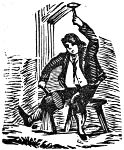
Crispin. By the lord of the manor, thou art a tough piece, and not much unlike the hide of my wife Bridget; for though I should beat her hide with all my might and main, I cannot shape the vixen to my fancy: Oh, you hard soles (hammering) are the most useless of all others, except to the wearer. If I was a leading man in the state, I should move for a law to be enacted, that good leather and good hemp should only be employed for smuggling courtiers, purse-proud citizens, and for parliament-men—if such a law should pass, it would be a rare thing for trade in general.
Enter Pander and Sir Bilberry Dibble.
Pand. Here’s a psalm-singing cobbler, Sir Bilberry; he has a vote for the borough, as good as the best; do not let us pass honest Crispin.
Sir B. By the essence of lillies, thou’rt right, Pander; the scum of mobility, as well as the scum of gentry, at this time, must be attended to; ’tis a sacrifice that’s due to necessity. Therefore, may I never more breathe the mellifluous air of Montpellier, if I do not descend to request his suffrage; the controverted occasion carries a pardon for the humiliating and filthy condescension.—Master Shoe-maker, your most devoted humble servant (bowing), I am, sweet sir, yours to the ground. (still bowing.)
Cris. Master Shoe-maker! do you mean to mock me?—No, no, I am no shoe-maker, but like some of your very fine gentlemen at the head of affairs—a poor cobbler at best.
Sir B. This fellow, Pander, has been commended by some blockhead, like himself for his insufferable bluntness, or he would never presume to be so shocking to the feelings of delicacy.
Pan. Bear with him, Sir Bilberry; this is a time when men will say whatever comes uppermost, paying no more respect to delicacy than Æsops’s cock to his diamond. If you would succeed, Sir Bilberry, you must descend to be perfectly reconciled to their oddities.
Sir B. I will be reconciled. Well, honest cobbler.—Do you love money?
Cris. Yes; but I love honesty better—
Sir B. Honestly said. If you do me a favor, you shall have as much honesty as you please, and money into the bargain.
Cris. Who are you, and may it please you?
Sir B. I am Sir Bilberry Dibble, knight and baronet, of Dibble Hall, in this county; come to offer myself for your most ancient borough of Steady-town; should I be so happy as to obtain the ultimate zenith of my wish, you, Mr. Cobbler, shall soon find an alteration in the price of good ale; bread shall be but half the rate it stands at now; and above all, your trade shall flourish and your taxes fall; so that the cobbler as well as the prince shall have a glorious opportunity of saddling his spit with a fat sirloin; your right of common shall soon be restored, and without excise, or the doctor’s tithe; pigs, poultry, and plum puddings, shall crown your cupboards all the year. Now give me your vote, friend Crispin, and as you puff your fragrant essence from your stall in merry glee, you heel the shoe, and bless the hour you gave your vote for Dibble.
Cris. Oh, you fine powdered gentlemen are something like my codling tree last spring.
Sir B. How’s that, cobbler?
Cris. It then dealt a wonderful show of blossom, so much that I concluded a rare autumn; but, alas! I was mistaken; I had not so much as a crump. So ’tis with you who are candidates for boroughs, you promise very fair in the spring of your canvass, but in autumn of election, when we should expect the fruit of good works of you, we too often find you worthless, base, and barren.
Sir B. Nay, Mr. Cobbler, you are too severe in the conclusions; a man of my honour can never deceive you;—Can I, Pander?
Pand. No, Sir Bilberry. I have known Sir Bilberry from a child, and never knew a dishonest thing of him, upon my honour, friend Crispin.
Cris. That’s the last lie you told, Friend Pander. Well, Sir Bilberry Dibble, knight and baronet of Dibble-hall, in this county, you are come to ask a vote of a poor cobbler.
Sir B. I am, friend Crispin, and you may assure yourself that there is not a man in the whole borough I respect so much as yourself, though but a poor cobbler.
Cris. Indeed!—that’s strange—why you never saw me before.
Sir B. Oh, that don’t signify! I tell you, friend Crispin, I respect you equal to the mayor himself.
Cris. That’s kind. Come into my stall and sit down, and let’s have a little chat together; there, that’s hearty; give us your fist. (Here Dibble takes up his clothes, gets into the cobbler’s stall, and sits down.)
Sir B. Pshaw! how he stinks. (aside.)
Cris. So you love me as well as the lord of the manor himself?—that’s kind, and so we’ll have a glass of gin together.
Sir B. Oh, no! ’pon honour.
Cris. Oh, yes; when this is gone, there’s enough at the Three Norfolk Dumplins and Horse Shoe over the way! Come, here’s the North-country cobbler’s health, who refused to mend the shoe of the man that was inimical to his country’s interest. (drinks.) A glass of as good maximus as e’er tip’t over an exciseman’s tongue. Here, take hold. (presents it to Dibble.)
Sir B. Dear, Mr. Cobbler, you must pardon me.
Cris. No, no; you, who love me as well as the lord of the manor himself, must drink with me, or I shall take it unkind, and perhaps give my vote where I think I am more respected.
Sir B. Resistance is in vain—to get his vote I must submit and take the poison. (aside.) Well, friend Crispin, to show that I respect you, here’s yours and the King’s good health. (drinks.) Pshaw, pshaw, it’s a nauseous draught, (aside.)
Cris. That’s well (throws his arms round Dibble’s neck.) My dear friend, that loves me as well as the mayor himself, kiss my cheek, and then I will believe you are sincere in your friendship.
Sir B. There, Crispin. Pshaw, how he stinks of those vile spirits and tobacco. (aside.)
Cris. Give us your fist again (holding him by the hand), my dear friend, Sir Bilberry, who loves me as well as the mayor himself, who can descend to drink gin with, and kiss a poor cobbler in his stall. I heartily thank you, and now I’ll finish my shoe.
Sir B. Well, honest Crispin! you promised to vote for me?
Cris. Who told you so?
Sir B. Oh! my dear, I understand you (taking out his purse) here are corianders that will purchase hides enough to heel-piece the whole borough—here Crispin.
Cris. What! a bribe;——out of my stall, or by Jingo I’ll stick my awl to the head in your——
Dibble leaves the stall, Crispin follows.
Sir B. Here’s a transition, Pander.
Cris. What! shall Crispin Heel-tap, the cobbler of Steady-town, give his vote to such a thing as you? A mean-spirited rascal who can stoop to drink gin in a stall, and to kiss the sweaty cheek of a poor cobbler? No, no; to serve your purpose you would not mind stooping to kiss my——, make off while you’re safe. I’ll vote for none of your Jack-a-Dandy’s, but for my faithful master, Sir Thomas Trueman—so away, Sir Fop, you have your answer.
Exeunt Dibble and Pander.
Ryle & Co., Printers, 2 and 3, Monmouth Court, 7 Dials, London.
A New Edition of the Universal SPELLING BOOK, OR A Lesson for the Unions.

Tutor. Now my Scholars, all of you that renounce the Whigs and all their works, stand up, and I will hear you say your lessons.—Know my children, that those who we hailed as friends a short time back, were but wolves in lamb’s clothing, and are now about to attack you, the children of the Unions and members of the flock of the good Shepherd of Birmingham; but my good children, be firm, and you will yet escape their devouring jaws. Know you, my children, that ferocious wolf of Winchelsea is about to disunite you?
Pupil. (Laughing.) Ah! ah! ah!
T. What are you laughing at, you young dog?
P. Why, sir, I really thought you was joking, when you said ferocious wolf, for I think he is more like a skulking Fox.
T. Aye! you young dog, do you mean to call the big and noble animal of Winchelsea, a skulking Fox?—Did he not bravely challenge the Tiger of Waterloo at Battersea?
P. That he did, sir, and bravely skulked away.
T. What sir! did he not nobly fight, and return the fire?
P. That he did, sir, in the air.
T. But do you mean to say that he flew from the shot?
P. Oh no, sir, for he received a mortal wound in the tail.
T. Well, come come, I find you are a good lad, and learn your lesson.—But I was about to say that this big Battersea Hermit said a short time back that your Unions must be suppressed, for that, while you are united, the Wolves of St. Stephens cannot easily prey upon you.—But, my good children, you that are of the flock of the Unions, be firm, and Attwood your Shepherd, will defend you from their avaricious jaws. Now, you sit down, while I hear little Radical his lesson.—Now Radical——
P. Here, sir.
T. Let me hear you say the lesson I set you—now, go on.
P.
A—was an Addled-egg, of a pension most rare, B—was one B....y, that call’d her his dear.
T. That’s right, my boy.
P.
C—was a Chapel. St. Stephens by name, D—was the Dukes who sit there in shame. E—was an Eldon, who’d put down penny papers, F—was one Franky, who now can cut capers. G—was the Gammon for the people invented, H—was one Hobby with cabbage stumps pelted.
T. Very good, my lad.
P.
J—was a Jury, whose verdict was right. K—it was Knowledge, that’s power and might. L—it was Loyalty, that once reigned in each breast, M—was the Millions that now are oppress’d.
T. Very true, my boy.
P.
N—was a Noble, a mad Scottish fool, O—was O’Connell, of the Patriot’s school. P—was the Peelers, whose glory is past, Q—was a Question—how long will they last? R—was Reform, that was spoilt in the nursing, S—it was S——y, that old Ireland’s cursing. T—was the Times of Old England’s distress. U—is the Unions Placemen wish to suppress. V—is the Verdict of a few honest men, W—is the Whigs, who’d that verdict suspend, X—is the cross with which it will end.
I can’t say any more, sir.
T. There’s a good boy, now get your spelling book, and I will hear you read the Fable of the Ministers in Danger.
P. (Reading.) There was a Ministry in Danger of a Turn-out, and many were their opinions concerning the best plan to be adopted to secure their seats, when a noble Hermit said there was nothing so good as a Coercion Bill; an Ex-Chancellor (called Bags) said a Coercion Bill might do very well, but there was nothing so good nor so essential as the Suppression of the Penny Press; but their Wise and Grey old Leader being present said, gentlemen, you can do as you please, but take my word there is nothing like the Destruction of the Unions.
T. There’s a good child—now you sit down, and I’ll hear young Anti his spelling and meanings. Now Anti.
P. Here, sir.
T. Spell me Attwood. (The boy here spells the words, and gives the meanings as follows.) A tough wood of a good grain, grows in Birmingham, and is used as the principal material in building up the Unions.
Brougham. A broom worn to a stump, formerly the Queen’s own, but now owned by none.
Callthorpe. A word despised by the Whigs, but will ever live in the hearts of the People.
Dan. A Patriot of the land of Coercion, where St. Patrick banished the toads, and Stanley the freedom.
Eldon. Old Bags, one that shed an abundance of crocodile tears without one drop of pity.
Frank. A pretended friend to the people, arrived at his second childishness, and plays at Shuttlecock with the Electors of Westminster.
Grey. A dealer in humbugs: who behaved as a father to the people by giving them that which they asked for—The Bill, the whole Bill, and Nothing but the Bill!
Hobby. A Westminster Rat, who had so often received the favours of the people that at last they had nothing to give but cabbage stumps, which he received in showers at Covent Garden.
Justice. A balance between Might and Right, but always leaning to power and riches.
King. A title of Monarchy, and Idol of an immense weight.
Loyalty. A word nearly threadbare in some countries.
Mouth. A part of the human body padlocked by law.
Peelers. A body of great Force. Brave and noble conquerors of an un-armed and peaceable people.
Reform. A word that filled the mouths of thousands, but the stomachs of few; a thing without benefits.
Truncheon. A knock-down argument of power, an instrument of the Whigs.
Union. A word despised by all Oppressors.
Verdict. A word lately known as a Terror to the Blues, but the Glory of others.
T. There’s a good boy, now read me the Fable of the Mountain and the Mouse.
P. (Reading.) There was a Bill which made a great noise in a certain country for many years, and they said it was in Labour, and the People looked with hopes for a Production of great Benefits, and great was their joy at the thoughts, when after many months pain and anxiety, it produced a Mouse.
T. I hope my children, this will be a warning to you, never build your hopes on the promises of those who are reaping the harvest of your labour, for they will take away your Substance, and leave you the Shadow to feed upon.
You trusted to Whigs, and the Tories turn’d out, Now which of the two is the best there’s a doubt; For the Tories and Whigs are all birds of a feather, May the D——l come soon and take both together. J. MORTON.
Quick, Printer, 42, Bowling Green Lane, Clerkenwell, and at 8, Little Paternoster Row, Spitalfields.
NEW DIALOGUE AND SONG ON THE TIMES.
Bill.—Good morning, Jack, I’m glad to see you. What’s the meaning of all these Spinners, Piecers, Weavers, Winders, Grinders, Strippers, Carders, Doffers, Stretchers, Throstle Spinners, Bobbin Winders, Frame Tenders, and all those folk that work in these places with big chimneys at top of um’ walking about?
Jack.—Why, if thou recollects, a few months back there wur great talk about the Corn Laws going to come off, and all these big chaps in the Parliament House, and all these Factory Lords of Lancashire, said if the Corn Laws wur repealed that poor people would get plenty of bread for little money, work would be plentiful, and wages would be a great deal higher; but instead of that, bread’s dearer, wages is lower, and factories are on short time.
Bill.—Yes, Jack, I recollect hearing people talk about a lot of chaps that wur going to bring such times as wur never seen before, they said that Bobby Peel and Dicky Cobden, and a great many chaps was going to give us cheap bread, and they said that we should have plenty of work and get good wages for it, but I’ve only work’d ten weeks since that corn bill as they call it past, and I got less wages for it too, Jack.
Jack.—These big cotton masters of Lancashire want to drop poor people’s wages, so to accomplish it they’re only working four days a week, so that when they start full time again, they can drop the people’s wages.
Bill.—Well, but Jack, don’t you know when the corn bill passed, these Masters gave a great sum of money to rejoice and have grand processions in honour of it passing.
Jack.—Don’t you see, Bill, it is poor people that must pay for it now, for they must work for less wages, or else for short time.
Bill.—Yes, but Jack, there’s several factories that’s stopping for a month or two, and some working none at all, and a great deal breaking down; what’s the reason of that, eh Jack?
Jack.—Why the reason of them stopping a month or two is, they want to get rid of their old hands; so that when they start again they can have all fresh hands, and reduce their wages. As for them that are breaking down, it’s a scheme they’ve got, it’s these chaps that rejoiced so much at the time the bill passed, and they are ashamed to tell the people that they’ll have to work for less wages or short time, so they are breaking down on purpose.
Bill.—Well, I think you’re somewhere about right, Jack, for there is a deal of factory hands that are walking about and has nothing to do, so you’ve learnt me something, Jack.
Jack.—I bought a new song about these Factory Masters and their short time system, and if you’ll stop you shall hear it too.
You working men of England one moment now attend, While I unfold the treatment of the poor upon this land, For now-a-days the Factory Lords have brought the labour low, And daily are contriving plans to prove our overthrow. CHORUS. So arouse you sons of Freedom the world seems upside down, They scorn the poor man as a thief in country and town. What a fuss there was in England, Ireland, and Scotland too, On the passing of the Corn Bill and the good that it would do, But since it’s past Meat got so high which makes poor people pine. If it would do good it’s time it did for factories are on short time. For when the bill was in the house they said it would do good, To the working man it has not yet, I only wish it would, For factories are on short time wherever you may go, And the masters all are scheming plans to get our wages low. There’s different parts in Ireland, it is true what I do state, There’s hundreds that are starving, for they can’t get food to eat, And if they go unto the rich to ask them for relief, They bang their doors in their faces as if they were a thief. Alas! how altered are the times, rich men despise the poor, And pay them off quite scornful at their door, And if a man is out of work his parish pay is small, Enough to starve himself and wife, his children and all. In former times when Christmas came we had a good big loaf, Then beef and mutton plenty were, and we enjoyed them both, But now a days such altered ways and different is the times, If starving and ask relief you’re sent to a Whig bastile. So to conclude and finish these few verses I have made, I hope to see before it’s long men for their labour paid, Then we’ll rejoice with heart and voice and banish all our woes, But before we do old England must pay us what she owes.
John Harkness, Printer, 121, Church Street, Preston.
THE OLD ENGLISH BULL JOHN v. THE POPE’S BULL OF ROME.
“My good Child as it is necessary at this very important crisis; when, that good pious and very reasonable old gentleman Pope Pi-ass the nineth has promised to favour us with his presence, and the pleasures of Popery—and trampled on the rights and privilages which, we, as Englishmen, and Protestants, have engaged for these last three hundred years—Since Bluff, king Hal. began to take a dislike to the broad brimmed hat of the venerable Cardinal Wolsey, and proclaimed himself an heretic; It is necessary I say, for you, and all of you, to be perfect in your Lessons so as you may be able to verbly chastize this saucy prelate, his newly made Cardinal Foolishman, and the whole host of Puseites and protect our beloved Queen, our Church, and our Constitution.
“Q. Now my boy can you tell me what is your Name?
“A. B—— Protestant.
“Q. How came you by that name?
“A. At the time of Harry the stout, when Popery was in a galloping consumption the people protested against the surpremacy and instalence of the Pope; and his Colleges had struck deep at the hallow tree of superstition I gained the name of Protestant, and proud am I, and ever shall be to stick to it till the day of my death.
“Let us say.
“From all Cardinals whether wise or foolish. Oh! Queen Spare us.
“Spare us, Oh Queen.
“From the pleasure of the Rack, and the friendship of the kind hearted officers of the Inquisition. Oh! Johnny hear us.
“Oh! Russell hear us.
“From the comforts of being frisled like a devil’d kidney. Oh! Nosey save us.
“Hear us, Oh Arthur.
“From such saucy Prelates, as Pope Pi-ass. Oh! Cumming save us.
“Save us good Cumming.”
“And let us have no more Burnings in smithfield, no more warm drinks in the shape of boiled oil, or, molten lead, and send the whole host of Pusyites along with the Pope, Cardinals to the top of mount Vesuvius, there to dine off of hot lava, so that we may live in peace & shout long live our Queen, and No Popery!”
“The Lesson of the Day.”
“You seem an intelligent lad, so I think you are quite capable of Reading with me the Lessons for this day’s service.
“Now the Lesson for the day is taken from all parts of the Book of Martyr’s, beginning at just where you like.
“It was about the year 1835, that a certain renagade of the name of Pussy—I beg his pardon, I mean Pusey, like a snake who stung his master commenced crawling step by step, from the master; he was bound to serve to worship a puppet, arrayed in a spangle and tinsel of a romish showman.
“And the pestilance that he shed around spread rapidly through the minds of many unworthy members of our established Church; even up to the present year, 1850, inasmuch that St. Barnabus, of Pimlico, unable to see the truth by the aid of his occulars, mounted four pounds of long sixes in the mid-day, that he might see through the fog of his own folly, by which he was surrounded.
“And Pope Pi-ass the nineth taking advantage of the hubub, did create unto himself a Cardinal in the person of one Wiseman of Westminster.
“And Cardinal broadbrim claimed four counties in England as his dioces, and his master the Pope claimed as many more as his sees, but the people of England could not see that, so they declared aloud they would see them blowed first.
“So when Jack Russell heard of his most impudent intentions, he sent him a Letter saying it was the intention of the people of England never again to submit to their infamous mumerys for the burnings in Smithfield was still fresh in their memory.
“And behold great meetings were held in different parts of England where the Pope was burnt in effigy, like unto a Yarmouth Bloater, as a token of respect for him and his followers.
“And the citizens of London were stanch to a man, and assembled together in the Guildhall of our mighty City and shouted with stentarian lungs, long live the Queen and down with the Pope, the sound of which might have been heard even unto the vatican of Rome.
“And when his holyness the Pope heard that his power was set at naught, his nose became blue even as a bilberry with rage and declared Russell and Cummings or any who joined in the No Popery cry, should ever name the felisity of kissing his pious great toe.
“Thus Endeth the Lesson.”
A POLITICAL CATECHISM FOR CHILDREN OF RIPER YEARS.

Question.—Now my child, what is your Name?
Answer.—Weathercock Johnny, alias Jack the Reformer, of the tribe of Russellites.
Q.—Who gave you that Name?
A.—My Godfathers and Godmothers, the People of England, who are called the great unwashed.
Q.—And what do the People of England want you to do?
A.—First, they want to amend my ways, which they say are in a most shaky condition. Secondly, to take a few of Palmerston’s pills, which they say will invigorate my Political system. And, Thirdly, to stick up for the Rights of the People, and speak up according to my size, as long as I remain in office.
Q.—And do you think that you are capable of holding firm by the reins, and steer the good coach Constitution, in safety through the mud and mire of these macadamized times, and not as you have done before, getting your unlucky feet in a plug-hole.
A.—
Yes, I do, so help my tater, Try me, and I’ll prove a first-rater.
There’s a good lad! now stir your young self, and let your conduct be a shade better than it has been, and you will earn our praise, and the nation will reward your services with a putty medal.
So be it.
Now let us sing for the amusement of this respectable congregation, and the benefit of own pockets, a few lines written to uncommon metre.
Now attend to good advice,—Little Johnny, O, And I’ll tell you what is right,—Little Johnny, O, Hold your head up like a man, Keep the whip in your right hand, And be honest, if you can,—Little Johnny, O. Curtail the ladies crinoline,—Little Johnny, O, And save us from broken shins,—Little Johnny, O, And as Gladstone gave us cheap tea, From heavy taxes set us free, And crush monopoly,—Little Johnny, O. Save us from starvation’s evil,—Little Johnny, O, And from meat that’s got the measles,—Little Johnny, O, Let the poor have wholesome food, And a loaf that’s cheap and good, Gain our praise I’m sure you would,—Little Johnny, O. Now Johnny dear, be brave,—Little Johnny, O, From the Fenians, pray us save,—Little Johnny, O, If at bogey’s game they play, They will better know some day, It will end in the cabbage garden way,—Little Johnny, O. In Yankee Land, I hear,—Little Johnny, O, They talk big with privateers,—Little Johnny, O, You had better send word out, If they get Johnny Bull’s shirt out, He will put them to the rout,—Little Johnny, O. Then put your shoulder to the wheel,—Little Johnny, O, Then it’s pressure you won’t feel,—Little Johnny, O, Flare up and be a brick, And none of your shuffling tricks, Or you had better cut your stick,—Little Johnny, O.
Let us say,
And now Johnny, thou most excellent of all state coachmen, to thy Fatherly care, we, an overtaxed, ill-paid, and half-starved people do consign ourselves, trusting that you will take our lamentable condition into thy kind consideration, and spare us from being poisoned with meat that has had the measles, and from being cheated by a set of greedy butchers; and save us from the Fenianites, we implore you; and grant us most merciful Johnny, that at the forthcoming Christmas, every mother’s son of us may be plentifully supplied with beef, pudding, and stout, so that we may boldly shout, slap bang, here we are again, and sing in thy praise now and for evermore. Amen.
Thus endeth the Lesson of the day.
Henry Disley, Printer, 57, High Street, St. Giles.
THE FAMINE FAST DAY.

Sam—Well Tum, how did tha get on oth’ Fast day.
Tom—Ta’ Fas day! bye gum awe think nowt oth’ fast day, for its a fast day every day wi’ us.
Sam—Nay mon, not every day, awe shud think yo’ve summat to eat sum time.
Tom—Aye, we have summat to eat, but it’s very lettle tha may depend on’t, thick porrich un’ sour milk for brekfast, un’ potatos and suit, un sum toime a red yarrin un brown bread for dinner, an we go to bed awebewt supper, un if that’s feasting aw dunna know what you cawn fasting.
Sam—Well but Tum, con yor tell me what this fast day wur kept for.
Tom—Aye by gum con aw, they sen it’s to drive famine away.
Sam—Famine, wot dost mean mon, why all this clemming eh England, Ireland, an’ Scotland.
Tom—Aw con there be a famine ith’ land, un th’ warehouses an th’ tommy shops aw breaking down wi’ stuff.
Sam—Aw think eth’ Lords un Bishops, un Parsons an such like folks had ony goodness in um, they’d gie poor folks a feast day, instead of a fast day.
Tom—Now do you think that these Parsons and Bishops kept th’ fast day.
Sam—Not they mon, they an fish, eggs, turtle soup, and such like, but if th’ poor could live as they done, they might fast for one day.
Tom—I’ll tell thee how aw did, aw sent owr Nell th’ day afore to borrow some brass, un hoo geet sixpence, an’ hoo went to Shade Hill, un hoo bought a sheep’s pluck, but it had no heart toot, un hoo geet a penoth o’th bacon, un hoo stew’d it aw together, un it wur rare un good, aw dunna think th’ queen had such a dinner, it’s the best flesh meat dinner I’ve had this six months.
Sam—Aw reckon yo stuff’d yore guts so full, you’d no more to eat that day.
Tom—Why we wur hungry ageen next morning, un had to fall to our thick porrich an’ sour milk, but if fasting will drive famine away, I should like it to drive poverty away so that poor folk could geet plenty of plum pudding and dumplins, an’ sich like, but stop, I’ve bowt a song about it, un you shall hear it:—
Ye working men both far and near, Unto my song pray lend an ear, While I the wonders do declare, About this famine fasting day, The Bishop of London that godly saint, Who preaches in the Parliament, He said it was their full intent For to have a fast day, He told the Parliament he’d a call, For to come and tell them all, The Devil would fetch them great and small, Unless they kept a fast day. CHORUS. Singing higlety pickelty fast who will, I wish poor folk it’s had their fill, Good beef and pudding the famine to kill, Much better than a fast day. Some of them laugh’d, some fell asleep, And out of the house some did creep; To please the Bishops and black sheep, They did appoint a fast day, The twenty-fourth of March it was the day That some did fast and some did pray, Some made a feast as I’ve heard say, To drive this famine far away, I sent our Nell as I’m a sinner, To get some liver and bacon for dinner, We fasted so long we are quite thinner, We thought we’d have a feast day. To walk about that day in the street, Thousands of poor folk I did meet, Because they had got nothing to eat, And so they kept the fast day. Some who had money spent it free, While others had a jovial spree, Some pawned off their smocks they say, All for to get a dinner that day, Some went to the alehouse it is true, Got drunk and fought till all was blue; On Saturday night thousands will rue The general famine fast day. The Bishops and the Parsons too, They seldom fast I tell to you, Their paunches they well stuff it’s true, Yet preach about a fast day, With fish and eggs, and Rhenish wine, On turtle soup each day they dine, Till their guts are poking out like swine, As though it was their last day, But if poor folks like them could live, Or if good wages they did receive, The storms of life they then could brave Without this famine fast day. So to conclude my fast day song, Pray do not think I’ve kept you long, But whether it be right or wrong I’d rather have a feast day, But if a fast would drive this famine away, I’ve only got one thing to say, I wish it would drive poverty Into the middle of the sea, The Parsons and Bishops are afraid, Church and tithes cannot be paid, And except they learn some other trade They will have many a fast day.
John Harkness, Printer, 121, Church Street, Preston.
NEW FORM OF PRAYER AND BELIEF.
To be said by all true Liberals, at all outdoor or indoor Meetings, at all Committee Rooms, and in front of all Hustings on which the Gladstonites and the Dizzeyites are to contend for the Managership at the forthcoming Elections, and to see who is to gain the belt, and rule the roast at St. Stephen’s. To be said without Barrel Organ or Grindstone accompaniment.
Now, my boy, as the Great Election is about to take place, and it becomes us all to sail under true colours, be so good as to tell me what you are, a Gladstonite, or a Dizzyite?
Boy.—Why a Gladstonite to the backbone, and no mistake.
There is a good lad; now let me hear you rehearse the Gladstone or Liberal Belief.
I believe in Bill Gladstone to be the true Champion of Reform, and that he is a perfect game cock, and that he will stick his spurs into the comb of any tory mountebank who shall attempt to set the working-man’s rights and privileges at naught; and I believe at the coming election that all true liberals will put their shoulders to the wheel and obtain a first-rate majority, not only in Church Reform, but in all things where reformation is wanted; and that Gladstone and his friends will reach the tip top of the poll, and start the tories off like scalded cocks, and this I firmly believe. So help me John Brown.
There is a good boy, now let us enlighten our friends on events, past, present, and future.
Now in the first place, there is Gladstone’s Irish Church Question! it is a stickler to many, more especially to Dizzey, the Isrælite, for it is to him like the carpenter’s saw, which the black cook said stuck in his gizzard.
For the Dizzeyites were sorely vexed by a political squib, which was recited by some of the unwashed in Hyde Park, who made a goodly collection, which went into the pockets of the Collectors in the usual manner.
And behold the Dizzeyites and Adullamites were alarmed, and they said who hath done this evil which is so likely to rob our fat shepherds of the golden wash they have so long fed upon.
And Sarah Gamp of the Standard did cause large bills to be posted in every corner, equal in size to the top of a large dining table, headed with these words, “Gladstone and his Friends,” showing how the needle had pricked their tender feelings.
And Dizzey was down on his luck, when he found that his nose was compared to double size, and he hid himself in a corner and wept.
And behold there arose a loud cry from the ladies of England, saying, we are man’s better half, why not let us have a voice in the affairs of our country, and not have our tongues muzzled like D— M— as served our dogs.
And moreover it is expected that when the Election takes place that the vendors of dog’s meat, headed by Jack Atchley and some of the nobs from Sharp’s alley will proceed to Scotland yard to petition D— M— to revoke the sentence on our blessed tykes; for they say if it goes on much longer, instead of skewing up meat for the dogs they will be skewered up themselves—in some union house washing their blessed inside with water-gruel.
Now behold B— S— of penny newspaper notoriety is again attempting to poke his nose in for Westminster, but he will find it is no go, for with Mill and Grosvenor before him, he will have no chance to walk in for our ancient and much respected borough.
And all tories and adullamites are hereby cautioned not to have any dirty tricks, at the coming Election, as they had at the Guildhall Meeting, when they hired land rats and water rats at two bob a nob to disturb the peace, or they may find something in the seat of their small clothes more than their shirt tails.
Thus endeth the morning’s address.
LET US SAY.
From all back-sliding liberals, or slop made adullamites, Friends of Reform spare us.
Spare us we implore thee.
From all tories who would give us such quarters as the wolf gives the lamb. Gladstone, the father of the people, save us!
Gladstone, look down upon us.
From being gobbled up by Dizzey’s “No Popery” bogey, noble army of liberals defend us.
From Dizzey’s Guy Faux keep us we beseech thee.
And oh, Lawrence, when you are made king of the city, let us have no more unseemly brawls in Guildhall.
From all paid ruffians, save us good Lawrence.
And may it please you, good Richard, to look down with an eye of pity on all distressed dog’s meat sellers, and take the harness from off the dogs, so that we may obtain food to supply the worms that now gnaw our hungry bowels.
Grant this, there’s a dear Dickey.
And oh, Dizzey, make your will, there’s a good boy, for at the forthcoming election, Gladstone and the whole host of Liberals will be at the top of the poll, and then farewell to all your greatness.
And I say so be it.
Henry Disley, Printer, 57, High Street, St. Giles, London.—W.C.
A POLITICAL LITANY ON THE TIMES.

When the present ministry shall cease their humbuging tricks, and do that which is lawful and right for the benefit of the working classes, then, and not till then, shall they receive our praise.
Dearly Beloved Brethren—Hunger moveth us at various times and in sundry places, to make known unto our Most Gracious Majesty, the Queen Victoria, our dreadful wants and sufferings, and although we ought at all times humbly to acknowledge our Most Gracious Majesty the Queen, yet the cry of our starving children prevent us from so doing.
The Lesson for the Day is taken from the present hard times.
And it came to pass in the year ’65, that there was a great stoppage in the tide of politics, and the steersman, Pam, gave up the helm; and the Queen sent unto the Land o’ Cakes for a certain little man of the tribe of Russellites, well known by the name of Financial Jack, by some called Little John, who being fond of lollipops, and having a sweet tooth, it will be remembered he called out lustily for cheap sugar.
And when he arrived at the Castle, which is situated near unto the great park at Windsor, the Queen said unto him, Johnny, Johnny, thy friend Pam has cut his stick, and if thou thinkest thyself strong enough, the place is thine.
Whereupon the little man bowed and bowed till the rim fell off his hat; but when he tried on the garments of Pam, the coat fitted him like unto a purser’s coat on a marlin-spike.
And the people murmured, saying, this man is totally unfit for the berth, but for the want of a better he was accepted.
Amen.
And about this time there arose in the Land of Spuds tribes of men who call themselves Feenanites, who promised to march unto the house of St. Stephen’s straightway, to get something taken from them by honest John Bull.
But a messenger came from that land to the house of St. Stephen’s straightway, to inform the inmates thereof they were in danger.
And there was great trouble in the House, and the servants arose and went out to meet them.
But when they arrived near unto that part of the land, behold, they had flew, leaving nought behind them to take back but a few sticks, like unto popguns, with which they had been learning to play at soldiers, so they returned home.
Amen.
And O, Gladstone, thou good and faithful servant of the late Steersman Pam, take unto thyself the helm of the good ship Great Britain, and steer it safely through the troubled waters that now surround it.
Amen.
Let us say,
From all impositions of unjust stewards,
O Queen deliver us,
We beseech thee to hear us, O Queen.
And O Johnny, if thou take unto thyself the helm of the good ship Great Britain, steer her safely through the troubled waters of poverty that now surround her.
Hear us, O Russell.
We beseech thee to hear us, O Jack.
And from being slaughtered by the Fenians,
O Queen deliver us.
We beseech thee to hear us, O Vick.
And from all heavy taxation,
O Johnny, save us.
We beseech thee to hear us, O Russell.
And from all bad meat, O Queen deliver us.
We beseech thee to hear us, O Queen.
And O thou mighty Queen, grant that we may have a cheap loaf, and each man paid justly for his daily labour, that we may live in peace and happiness both now and for evermore.
Amen.
Printed for Author and Vendor.
POLITICAL LITANY On the Present Session of Parliament.
When the Whigs shall cease to be a milk and water set, and prove to the people of England, that like good and trusty servants they will stick up for their rights, and pass such measures as will be for the benefit of the nation at large: then, and not till then, shall we consider them as trumps, and look upon them with confidence.
Dearly bought and never-to-be-forgotten Johnny.—To your noble and all-powerful self, do we, an over-taxed, poorly-fed people appeal, trusting that, O most merciful Johnny, that by the virtue of thy most exalted position, that you will be pleased to intercede with our Most Gracious Majesty, that she will reside amongst us, and so improve the condition of the tradesmen and mechanics of this mighty metropolis, whose affairs now are in a most shaky condition. Grant this, O most mighty John, and we will pray for the well-being of thy favourite bantling, Reform, that you have nursed with such care for so many years, and will sing praises unto thee, now and evermore. Amen.
Now the Services for the Day is taken from unprinted Bills that lay on or under the tables of the House of Incurables, better known by the name of St. Stephen’s.
Now it came to pass in the second month of the year ’66, and on the first day of the month, that the Dictators who formed the seventh Parliament in the reign of Good Queen Vic, assembled together to consider the weighty affairs of the nation, and after relating their rigs and sprees during the holidays, adjourned to crack a bottle and a joke at the expense of patient John Bull.
And again on the 6th they met in the presence of our Good Queen, and after bestowing six thousand a-year out of the pockets of the people as a trifle for pin money for a certain little lady, they wished the Queen good day, shook their heads, and went to lunch, entirely worn out with their morning’s labour.
And they held long discussions on the plague among the cattle, and soon came to the sage conclusion, that beasts that were ill could not be in good health; but whether it was the cow or chicken pock they were not prepared to say.
But the people cried aloud that it was done to raise the price of meat, and those who used to treat themselves to a joint on a Sunday were compelled to put up with a few ornaments from off the block.
Now near unto the commencement of the year, great excitement was caused through the land, of strange revelations concerning a certain tribe of persons called paupers, whose treatment in the Whig Bastiles, or Union-houses, were likened unto swine; and the rate-payers of Lambeth, and people in general, cried out sorely against the Poor Law nabobs, and the ratepayers cried, Turn off the unworthy servants of the poor and give the inheritance to others.
And behold, great alarm is being caused in different parts of this mighty city, on account of the many rail-roads in course of construction; and numbers of Her Majesty’s most loyal subjects, such as the small shopkeeper and poorer classes, are being driven from their homes, and by being deprived of the means of obtaining their living, will be compelled to find shelter in the workhouse, and so swell the rates imposed upon the hard-working tradesman.
And they pray the present ministry now assembled, to stay the progress of this destructive juggernaut; and as there has been day by day great outcry about the many accidents caused by them, they beg of them to pass a clause in the acts for the regulation of railways, that they shall supply a sufficient number of surgeons with splints and bandages to each train, and a goodly supply of coffins at each station for the use of those who are headstrong enough to travel by them.
Thus endeth the morning lesson.
LET US SAY.
O most noble Johnny, pull yourself together, and spare us the necessity of selecting another steward.
Hear us, O Russell.
And O, most Gracious Queen, gladden the hearts of thy people by dwelling amongst them, and so improve the trade of thy most loyal subjects in this mighty city.
We beseech thee to hear us, O Queen.
From having our roads turned into honeycombs, and endangering our lives by being swallowed up by the underground railways, spare us we implore thee.
Railway Committees, spare us.
And O, much respected Chancellor of the Exchequer, repeal the duty upon malt, as thou hast done upon tea, so that we may refresh ourselves with a good and wholesome pot of beer, to the glory of thy good name.
O Gladstone, hear us.
And we implore thee to spare our poorer brethren from being compelled to pig upon dirty floors in Union Bastiles, or by being poisoned by bathing in a dirty soup kettle.
Good Farnell, and the whole host of parish nabobs, spare us.
Be just before you are liberal, and waste not the public money in useless expenditure.
Minister of Finance, we beseech thee to hear us.
Spare us from being starved in the land of plenty, Good Bright.
O Bright, have mercy upon us.
And O Gladstone, thou brightest star in the political hemisphere; keep thy weather-eye open, and jog the memory of thy fellow-servant John, and guide his little feet if he should by chance to stray from the right path.
O Gladstone watch over the welfare of the people.
And now, Johnny, we implore thee to act with justice to the country, and give us the benefit of Reform which is so much needed, and grant in all thy works, that you study the interests of the most patient and industrious people in the world, so that they may be blessed with peace and plenty, then will they sing, Long live the Queen, and good luck to her ministers. Amen.
Henry Disley, Printer, 57, High Street, St. Giles’s.
The Life, Trial, and probable Sentence of the DERBYITES, DIZZYITES, AND ADULLAMITES, AND THE WHOLE HOST OF TORY CABINET MAKERS,
Who were tried at St. Stephen’s, for conspiring to burke the People’s Reform, and attempting to pass a Counterfeit Bill instead of a Genuine Article; thereby imposing upon a certain respectable firm, well-known as Messrs John Bull and Company. The prosecution was conducted by those able Advocates for Reform, Bright and Gladstone. The offenders were undefended, as no one could be found willing to take their cause in hand on account of their previous bad character.
Now the trial of these Anti-Reformers was highly amusing, owing to the singular conduct of some of the offenders.
And the proceedings was prefaced by that old-stock farce called the Struggle for Reform, or John Bull mesmerised.
And the advocates for the people said unto the Derbyites and their companions, what have you to say in your behalf concerning this fraud on the working classes of England?
Now behold one of them was a clever mountebank of the tribe of Dizzyites, and like many of his kind he had a happy knack of saying a great deal which amounted to nothing; and he commenced his defence with a mock speech on Reform, which seemed to say: If you Reformers do not unbutton your eyelids, and expand your understandings, I shall most certainly mystify you with my high presto, cockalorum jig!
And he had as many tricks as those amusing little marmozettes that are to be seen in the gardens of the Regent’s Park.
And when he had concluded he turned to the people and said, how do you like me now?
And there arose a murmur through St. Stephen’s, saying, Not at all, you are not in our style.
And Dizzy the mountebank was much grieved for he thought he had caused a great sensation, and he exclaimed, Dizzy, Dizzy, thy occupation’s gone.
And Lowe the Adullamite, surnamed the moonraker, pleaded guilty to his offences against the people, and prayed for a mitigation of his sentence, on the plea that he could not have been in his right mind.
And the poor gentleman could not have been sane for he rambled on with some nonsense about the mark of Cain being set upon some people’s brows; and asked the good citizens of London to order mass to be said for his own sins, or the success of the Bill; his strange manner left us in a fog to understand which.
Now the chief of the Derbyites being alarmed at the meetings in Trafalgar Square and throughout England, did call a council in the privy which layeth in the neighbourhood of Downing Street, to form plans by which they might overthrow the honest Bright, and all those who were on the side of the people.
For the Tories, finding that their seats were in a shaky condition, and being fond of place and pensions, were determined to stick at nothing rather than give up their golden kitchen stuff of office.
And behold their work must have been exceedingly bad, inasmuch as some of their pals said no: we will leave your company, for we will not join with you in this plot against the working classes of England.
And it was strongly suspected that Dizzy the Mountebank, eager for a goodly share of the loaves and fishes, communed with himself, saying, I will write up no connection with the head Cabinet Maker of the Upper House, and then the whole business will be mine.
And the Reformers were well pleased, for they said the old adage will then be verified that when rogues fall out honest men will get their rights.
Now it was thought that they would have called upon D—— M——, the head of the Poleaxes, to speak in their behalf; but that hero having the remembrance of the Hyde Park battle before his eyes, declined to appear, saying, He had received striking proof of the justice of the cause.
Now it was in the 3rd month of the year, and on the 18th day of the month, being the day after St. Patrick that the Tory Cabinet Makers appeared to receive judgement; and the Council for the People said unto them, If you do not give us the bill, the whole bill, and nothing but a satisfactory bill, giving to the people what is justly their rights, the sentence of this court will be that you will get the infernal sack now and for evermore.
Amen.
H. Disley, Printer, 57, High Street, St. Giles.
A NEW LITANY ON REFORM.
When the Tories shall grant to the people a share of what is justly their own, and not take all the loaves and fishes themselves, as they always have done; like the lawyer who swallowed the oyster and gave his client the shells; then, and not till then, shall they gain our thanks.
Sorely oppressed and heavily taxed brethren, duty calls us, as the bone and sinew of this mighty nation to assert our rights and privileges, and although we at all times ought to do so, yet ought we more strongly when we assemble and meet together to take such steps as are necessary to obtain manhood suffrage, and all things likely to elevate our condition as freeborn Englishmen, and not slaves to any intolerant faction, such as now assert their despotic power in St. Stephens’ Infirmary. So I charge as many of you as here present, who are friends to Reform, to act firmly in the cause, and never rest till it is gained.
Now, it was shortly after the premature death of the Russell administration, that the Tories took office, and a couple of chiefs of the tribes of the Derbyites and D’Israelites laid their heads together, to consider in what way they might destroy the substance, and bamboozle the working man.
And the D’Israelite said to the Derbyite keep your whip still, and I will pull the string, and the day will be our own. So the Derbyite was like unto the dolls in the toy shops, that say, we will cry for sixpence.
And about this time, loud shouts was heard for Reform, and the echo was carried throughout the length and breadth of the land.
And the whole host of Derbyites shook, as if struck with the palsy, and their chief was sorely alarmed, so that his hair stood out from his head like unto the quills of the porcupine, and he cried, Oh, Dizzy, save us!
And behold there sprung up on the face of the earth a new race of people called Adullamites, who were like unto their namesakes of old, a dissatisfied and two-faced people, and like the camelon could change their colour at will.
And their chief was a Low(e) man from the land of moonrakers; and him and his colleagues were the Reformers of to-day and the Tories of to-morrow.
And they said to the people, behold we are on thy side, at the same time they were seeking how they might destroy their cause.
And they combined with certain unprincipled electors, and by bribery and corruption made their way into the house of St. Stephen’s.
But when they got into the house, the mask fell from off their unworthy faces, and instead of Reformers, they appeared as labour-grinding Tories.
And the people murmured, saying, they are like unto Esau of old, who sold his birthright for a mess of potage, and there is no trust in them.
And it was in the 7th month of the year, when the gnats bite the hardest, that the Reformers declared their intention of assembling in Hyde Park to set forth their honest claims, and hear the most truthful voices of the worthy Beale and the Delegates.
And the Tories became alarmed, and W—— sent in haste to Dicky M——, the renowned head of all the poleaxes, to march with his army, and stop the much dreaded invasion.
But the people said, who is he who stays us from meeting in a place that is justly our own? And they laid on for Reform, and lo! the rails quickly passed away, and not a vestige was to be seen.
And when the Chief of the Poleaxes saw what was done, his nose turned as blue as his coat, and he cried, On to the charge!
But behold, while he was whistling, see the conquering hero comes, a brick, hurled by no friendly hand, caught his head unexpectedly, and his charger turned and whispered, Dicky, how is your poor nob?
Thus endeth the Lesson.
LET US SAY,
From all Tory intolerance save us, Reformers.
Friends of Reform, hear us.
From bribery and corruption, and the whole host of Adullamites, and all that have not clean hands, Election Commissioners, spare us.
Spare us, we beseech thee.
From having the Park gates shut against us, save us good Walpole.
Oh, Wally, hear us.
From unjust stewards, and Israelitish cash keepers, good Queen save us.
We beseech thee to hear us, good Queen.
And oh Derby and Dizzy, make not too cock sure that your position will be lasting, for you know not what a day may bring forth.
And now to Russell, Bright, Beales, and all true friends of Reform, let your thanks be now and evermore.—Amen.
Disley, Printer, High Street, St. Giles’s, London.
CAPTAIN JINK’S DREAM. A CONVERSATION ON THE COMING ELECTIONS BETWEEN BILL GLADSTONE & BEN DIZZY.


Written by John Embleton, Author of the “Political Litany on the Irish Church Question, &c.”
Your attention I claim, Captain Jinks is my name, and with your permission, I hold a commission, in Her Majesty’s famed horse marines.
I have lines here for your inspection, on the coming election, and I’ll try to amuse, that is if you choose, by relating a wonderful dream.
It was t’other night, I got rather tight, I had been to the Alhambra, to see the grand things there, and roll’d home at two in my glory.
And I dreamt a queer dream, though strange it may seem, that I heard a conversation, or a confabulation, between Gladstone and Dizzy, the Tory.
I had a dream the other night; and the same I’ll lay before ye, A conversation on the coming election, between Gladstone and Dizzy, the Tory.
Said Gladstone, Dizzy my rum ’un, the time is a coming, though you think yourself clever, you will find so help my never, at the forthcoming general election,
That your goose will be cooked, and you must take your hook, for like a cow’s tail you will find, you will be all behind, when the people they make their selection.
Then said Dizzy it is plain, Gladstone, you want the reins, and between you and me, your Reform and cheap tea, you fancy will carry you straight, sir.
But I know what your wish is, to prig my loaves and fishes, but Gladstone my hearty, I’ll lick you and your party, and stick to my stall, so help me tater.
Ben, your No Popery cry, it is all my eye, and your cant and your crawling, shews you are afraid of falling, for of honesty you have not a spark, Ben.
For you and your chums dirty, got dreadful shirty, but that is not worst, sir, said I fell to the gutter, when my friends met like bricks in Hyde Park, Ben.
Says Dizzy, I know Bill, you think your Irish Church Bill, with the aid of the donovans, will make you A No. 1, but you will find in the end it’s no use man.
For it is a great shame man, that with Bradlaugh and Finlen, and the rest of your Pets, should make this cabal, to capsize church and constitution.
Said Gladstone, that is it, if the cap did not fit, Sally Gamp of the Standard, would not have stuck up her placards, unless you Tories had got some queer twitches,
But they have made a mistake, sir, it’s a mere waste of paper, and if they come up to the scratch, they will find the Liberals their match, and they may chance to have an earthquake in their breeches.
Says Dizzy, I know, that old Jemmy Squaretoe, to himself will you take man, for running down shovel hats and silk aprons, and I wonder you can sleep in your bed, Bill,
For in Hyde Park it was said, that a litany was read, and it said, and no flies, my nose was like double size, and my curly hair shook on my head, Bill.
Gladstone said by-the-bye, there has been a loud cry, which is nothing unkimmon, for it comes from the women, they declare they will rule if they like, Ben.
They say, at home in their houses, they can rule their spouses, and they seem rather puzzled, that their tongues should be muzzled, like D—— M—— muzzled our tykes, Ben.
Dizzy said, bless the ladies, they are well in their places, to wash and dress babbies, and lecture the daddies; and some in homes they are graceful.
They can rule in the kitchen, and cook puddings—if they can get them,—and to say they’re not clever, I’d not venture, no, never! when I think upon old Madam Rachel.
Gladstone said, my Cockawax, there is that cursed income tax upon trades and professions, I’d like to sing its dying speech and confession, for it robs the poor man of his bread, Ben.
Why not tax grunting pigs, the counsellor’s wigs, the little hedge-sparrows, the cat’s-meat man’s barrow, or the chignons they stick on their heads, Ben.
And Ben, it is said, you are politically dead, but have not pluck at present, to get buried decent, and leave the Liberals to weather the storm, Ben.
So I would advise you, and the Adullamites too, to make yourselves scarce then, at the coming election, for you are done brown as sure as you are born, Ben.
Dizzy said, Bill and I have tried, but you are not satisfied, but we will see who is the best one, at the General Election, and to do our best then we will endeavour.
Then I heard a great noise, with, We have lick’d them, my boys, and just then I awoke, and though not a soul spoke, my ears rung with
GLADSTONE FOR EVER!
Henry Disley, Printer, 57, High Street, St. Giles, London.—W.C.
A POLITICAL THANKSGIVING FOR THE Great and Glorious Victory Gained by the Liberals, and the Complete Defeat of the Tories!!!
Much respected and truly victorious brethren, and all who have lent a liberal hand in sticking the axe of Reform so deeply into the root of that old contemptible tree called Toryism. I have this day come amongst you to offer up a thanksgiving for the great victory gained by Gladstone and his brave army at the Great Election, and also to offer my sympathy for the alarming illness of the Tories, who are suffering from an attack of the place fever; and all true Liberals are invited to be present and take the front places, as Gladstone and his comrades will in the House of St. Stephen’s. And all Tories and Adullamites are requested to keep in the background, where they will remain now and for evermore, and not disturb the present congregation, or they will be given into the custody of the beadle.
Now the Lesson for the Day is taken from the battle with the Gladstonites and the Dizzyites at the late Elections.
Now for many years past the Tories have been a place seeking and ease loving people, greasing their chins with the lion’s share of what justly is the rights of the working classes of this mighty land.
And the people communed together, saying, who are those who toil not nor yet spin, and yet they swallow up all the grain, and leave us nought but the husks to eat.
And lo there arose a mighty host called the Liberals, whose chieftain was named Gladstone, who was in himself a tower of strength, who with the Spear of Liberty sorely wounded the Tory chief, who was surnamed Dizzy the Isrælite.
And, behold, it was in the dismal month of November,—the season so fatal to all shakey constitutions—that the Tories became alarmingly ill, and at the Great Election Battles found that their power was passing away, and that they were dead licked.
And the victory that was gained by the Liberals was sorely painful to Dizzy the Tory Chief, for he had said in the fulness of his political health, “Show me the man who will tread on the skirts of my coat.” But his boasting was like unto the mountain that became pregnant, and brought forth a mouse.
For Gladstone the Liberal put forth his foot, and lo, Dizzy’s Government was rent in twain.
Then went the Chief of the Tories unto the Castle which lieth near unto the Great Park of Windsor, and threw himself at the feet of our good Queen Victoria, saying, Bill Gladstone, the head boy in our school at Westminster, has given me such a fright, that I feel quite white, and I am afraid if I stay any longer, the other boys will chaff me, and say, “Dizzy, Dizzy, I’ll have your curls!”
Then did the Queen send for Bill Gladstone, and said unto him, Are you afraid, too? But Gladstone spoke up boldly, saying, Not I. Then said the Lady of the Castle, Get you back to St. Stephen’s, and be head teacher in the room of the boy Dizzy.
And Sarah Gamp, of the Tory cess-pool, sung quite small when she heard of the disgrace her favourite boy had got into.
And since the Great Election has taken place, it has been rumoured that certain Tories has been coming the Rachel dodge, and has been trying to make themselves beautiful for ever, by rubbing themselves with golden ointment, which has so dazzled the eyes of some of the free and independent electors, that they will not be able to see clearly until Gladstone and his friends settle the hash by giving us the ballot.
Thus endeth the Lesson for the Day.
Let us all say,
For giving the command into the safe keeping of General Gladstone, oh, Queen, we give unto thee our thanks.
We thank thee, oh, Queen.
From being left to the tender mercies of the Tories. Friends of Freedom save us.
Spare us, we beseech thee.
And oh, Lowe, since Gladstone has duly installed you as Keeper of the National Cash-box, let us have none of your hanky-panky or Adullamite tricks, as you had at the time of the great Reform Meeting, when you charged the working-men with being a vile, degenerate, and beer-swilling crew.
Now, Lowe, none of your moon-raking capers, or I shall give you another taste of my rod of correction.
And, oh, Gladstone, give them a plentiful supply of Liberal pills, to purge them of impurity.
Warm them, good Gladstone.
And, oh, Dizzy, my lad, keep up your pecker, and don’t be cast down, for Gladstone is a good sort of a chap, and if you behave yourself, I dare say he will give you a job.
Do not fret, Dizzy, there’s a good boy.
And, oh, D——, we thank you for paying attention to our last prayer, by kindly removing the spectacles from off the dog’s noses, and when the roasted chesnuts and boys hoop question is settled, turn your great mind into another channel, and devise some means of ridding us of the garrotting ruffians that now infest our streets and highways in the open daylight.
Do D——, and we shall bless thee.
And now to Gladstone and all who have fought so nobly to gain this great victory, be all thanks due, and may they stick like bricks to the cause, and do their duty at the forthcoming Sessions of Parliament, and they shall receive our praises now and for evermore.
Amen.
H. Disley, Printer, 57, High Street, St. Giles, London.
BELIEF AND COMMANDMENTS ON THE RIGHTS OF WOMEN.

To be read by all married women to their husbands, and by all single ones to their sweethearts.
At a meeting of women the other day, that dear old lady, Mrs. Caudle, amused the ladies present, by reading her Belief and Commandments on the rights and privileges of married women; so after taking half-a-dozen pinches of snuff and a couple of glasses of eye-water, and coughing three times, she commenced as follows:—
I believe, that has some one has said, that woman is man’s better, and sometimes his bigger half, and the best friend he has got to his back; she should not only rule the roast at home, but have a voice in the affairs of the country to which she belongs! and I not only believe, but I am quite sure, that it is her husband’s place to obey her in everything, and patiently attend to her commandments, and then, and not till then, will curtain lectures cease.
Now my first commandment, if I was married, would be this, I would say to my husband.
1st. You must never think of, or even look at any other woman but me, for am sure the parson must have made a mistake when he said, woman, obey your husbands.
2nd. You must never make me jealous by praising those forward jades that wear those ugly things on their heads called chignons, but keep your eye wholly on me, and study my wants both day and night, or I will comb your head with a small tooth bellows, that’s what I will, and no mistake.
3rd. Before going to work in the morning, you must light the fire and make me a strong cup of tea, with something nice in it in case I should have the wind, and you must not grumble if the kettle does not boil when you come home to breakfast.
4th. Six days must work from six to six, that you may provide me with the comforts of life, and on the seventh, you may scrub the floor, peel the potatoes, make the dumplings, and cook the dinner. In the afternoon, by way of amusement, you must take the children to the park and show the little darlings the ducks.
5th. If any of the children should have the measles, or the blessed baby should require weaning, you must get up without a murmer and give it the bottle, lest I might be disturbed by its crying.
6th. You must not crib a shilling from your wages on Saturday night, but fork it all out and be contented with the pocket money I shall think fit to give you.
7th. You must not get in a state of beer on any pretence whatever, or I shall compel you to sleep at the foot of the bed for six weeks.
8th. You must not take my name in vain by calling me other than my dear, or my duck, nor lay finger on me, lest I should give you six months to learn you better manners.
9th. You must not dare to grumble if your shirt should be minus of buttons, or you should be compelled to eat a cold dinner at least three days during the week, if it should be my pleasure to go out for amusement.
10th. You must not covet to be trusted with the latch key in the evening, you must not covet to visit the Alhambra or the Oxford, nor any other such like place; you must not look at the girls’ legs on a windy day, nor rule your house or your spouse, or anything this is within, but be a good boy and keep my commandments.
H. Disley, Printer, 57, High Street, St. Giles, London.
A NEW POLITICAL AND REFORM ALPHABET.
A stands for Aristocrat, who nothing will do, Who says they to work was not born; And also the Adullamites, a double-faced crew, The worst foes we have to Reform. B stands for Beale, and likewise for Bright, True Champions are of Reform; So may good luck attend them by day and by night, For nobly they battle the storm. C stands for the Charter, and five points there are, And by right they belong to us all; Tho’ they’d fain keep them from us, seems pretty clear, But we’ll gain them, my boys, or we’ll fall! D stands for Derby, and also Dizzey, Who talks large when there’s nothing to do; Like parsons they say, you must do as they say, But, mind you, don’t do as they do. E stands for England, the land of the free, The home of the true and the brave; But our share of freedom is small, you’ll agree, Though the song says we ne’er shall be slaves! F stands for Franchise, it is our birthright, So we want what is justly our due; Tho’ the Tories they say, they will have their own way, We’ll tell them, we’ll be damn’d if they do. G stands for Gammon, and plenty we’ve had, Till we are sick of that unstaple store; But if they think to gammon us out of Reform, They will find we’ll be gammoned no more. H stands for Honour, there is some amongst thieves, The saying goes that way I hear; The Adullamites have none, it’s quite plain to me; And the Tories have none for to spare. I stands for Idlers, but none must be found, Who wish for the success of our cause; So boldly push forward, you’ll win I’ll be bound, When it’s gained it is time for to pause. J stands for Jacks, in office who are found, To look on while honest men toil; And they tidy sums get, to keep their mouths shut, And blab not of the ill-gotten spoil. K stands for Knight, and there many sorts are, And some with the garter are deck’d; Who instead round the leg, where the garter they wear, Would look better if worn round the neck. L stands for Lowe, both by nature and name, And from Wiltshire he comes I tell you; Who the workmen of England did vilely defame, By calling them a drunken and ignorant crew. M stands for Mayne, by some called Naughty Dick, The chief of the Bluebottle mob; Who in Hyde Park, they say, some queer cards did play, Till at last he got one for his nob. N stands for Nobles, and true nobles are they, Who strive for their fellow-man’s good; Not in luxury and idleness spend all their days, Nor care to do good if they could. O is an O, for nothing it stands, And that is the working-man’s share; Next to nothing he gets while he is here in this land, And needs nothing when he leaves here. P stands for Patience, so be not cast down, My lads, nor give way to despair; The sun shines on you, although the world frowns, And good times must come it is clear. Q stands for Question, and the Question is this, Are Englishmen to gain their Rights? Or must they labour like nameless serfs, And allow Might to overcome Right? R stands for Russell, and likewise Reform: Then for Reform shout for ever; For let come what may, we will clear the way, For shall we be conquered? No, never! S stands for Soap, some hard, and some soft, So let’s say to our foes, just be steady; Hard soap it is best, though it won’t well digest, We’ve had enough of your soft soap already. T stands for Tory, a set of greedy elves, Who take all the loaves and the fishes; They take all the fat of the land to themselves, And give the poor man empty dishes. U stands for Unity, which all of us need, Which no power on earth can e’er sever; It ensures a strong pull, while we give a long pull, Then pull for Reform altogether. V stands for Vultures, and many there are Sit in St. Stephen’s, you’ll own; If the poor man is starving and can’t get food for carving, And asks for bread, they will give him a stone. W stands for Workhouse, the poor man’s last home, When by sickness or age is brought down, Tho’ he’s toil’d all his life till he’s but skin and bone, To uphold the mitre and crown. X is a letter that looks like a cross, An emblem of the working man’s life; He has crosses enough, he finds to his cost; If he dares for to ask for his rights. Y stands for Yoke, the poor man must bear, ’Tis an odious badge of slavery to wear; But never mind, boys! we will weather the storm, And toast in a bumper, success to Reform! Z stands for the Zeal the Reformers must use, If they stick back and edge to gain what’s their dues. Here is good luck to Gladstone, is now what I say, Here’s the good cause Reform, for ever, huzza! J. Embleton.
Disley, Printer, 57, High Street, St. Giles, London.
A NEW EDITION OF THE LITANY ON THE IRISH CHURCH QUESTION
Not exactly sanctioned by either Bishop, Parson, Curate, or any other Prelate. It is not to be said or sung in either Church or Chapel, but to be learnt by all persons without distinction to creed, country, or colour. Composed on the Great Battle which lately took place in St. Stephen’s House of Incurables.
When the rulers of this mighty Babylon shall be like unto good stewards, and render unto the people, things that are the people’s, and purge the Established Church of its many impurities, not only in Ireland and Scotland, but in this mighty and loyal city, and allow every tub to stand on its own bottom, then, and not till then will this war cease, which has so long been an abomination in the land.
Sorely oppressed and heavily taxed Brethren:—
It becomes us all to be up and doing, and assist this monster question of the day—the Irish Church Bill—no matter what your creed may be, whether it be Catholic, Protestant, Quakers, Shakers, Spirit Rappers, or Tub Thumpers, who have so long forked out the golden grain which has so greedily been swallowed by Mother Church and her hungry chickens.
The lesson for the Day is taken from the late debate on on the Church Question.
Now in the days of darkness, when Fat Harry, the Bluebeard King of England, joined in unholy wedlock the Lion of State to Lady Lawn Sleeves, the people were troubled with a blindness, which has continued for upwards of three hundred years.
But of late, the film has fell from off their eyes, and they murmured saying, why pay we tribute to those from whom we receive nothing, and for buildings we do not enter?
But the masters in lawn, replied, we say unto you, pay you must, for such is the law of the land.
But lo! there arose up a loud cry for Ecclesiastical Reform, and Gladstone, their Champion, arose up in the house of St. Stephen’s, which is near unto Parliament Square, and with stentorian lungs, said, I intend to go the whole hog or none, and call upon the country to dissolve the banns of matrimony between the aforesaid Lion and Lawn Sleeves, which has so long been an eye-sore to the country.
And, behold the words that Gladstone uttered sounded like unto a death-warrant to the ears of Dizzey and his pals, and his nose turned blue when he thought it was U. P. with his greatness.
Now in due time the Great Election Battle took place, and the Place-loving Tories, in spite of their back-sliding capers, were dead licked; and Dizzey retired to Buckinghamshire, and fasted for three whole days, and sat up to his blessed chin in sackcloth and ashes.
For the voice of the Country was with Gladstone, for they knew well he was a Brick, and would hold the balance justly between the rich and poor.
Now it was two days after St. Valentine, that the Liberal Chief buckled on his armour, entered St. Stephen’s, and prepared himself for the fight. And his war-cry was “Justice to all men,” “Liberty to Ireland,” and “Disendowment of the Irish Church.” And the sons of the Land of Buttermilk, shouted, “More power to you, Gladstone!”
And lo, the cry caused certain prelates to curtail their shovel hats of their fair proportions and go into mourning, by converting their silk aprons into hatbands, at which the grunters nearly split their side with laughter.
And there arose a cry from the exiled sons of Erin, which sank deep into the heart of noble Gladstone, and with the battle-axe of Mercy struck off their fetters and they were free!
And there was loud cries of “Long life to noble Gladslone, the Liberator of the Land of Donovans!”
And Hardy the bosom friend of Poleaxe Dickey the hero of Hyde Park, protested loudly against Gladstone and his measure, and he and Dizzey wept bitter tears, when they saw that they were licked.
And the land of donovans and buttermilk shouted, No surrender, faugh o’ballagh! go it Gladstone, and the Sandys danced tullochgorum round the rims of their porridge-pots, and in whiskey, success to the Church Bill.
Thus endeth the lesson for the day.
LET US SAY.
From all Church monopoly, good Gladstone, save us.
Save us, good Gladstone.
From being compelled to keep the fat shepherds of every creed. Good Queen deliver us.
Spare us, good Queen.
From maintaining such a large staff of idlers in silk aprons and shovel hats, Friends of Reform, spare us.
Friends of Reform, spare us.
From all undue taxes in the shape of tenths and sucking pigs. Common sense, save us.
Spare us our grunters, we beseech thee.
For the liberation of the exiled sons of Ireland, we thank thee, good Gladstone!
In the name of the sons of Erin, we thank thee, oh, Gladstone.
Hear that, oh, Dizzey.
And now to Gladstone, the father of Reform, and the friend of the people, be all thanks due both now and for evermore, and success to the Irish Church Bill.
So be it.
H. Disley, Printer, 57, High Street, St. Giles.
A LITANY ON THE IRISH LAND QUESTION.
In consequence of the gross mismanagement of John Bull’s possessions at home and abroad, by unprincipled servants and dishonest stewards; especially in the land of St. Patrick, we have met together without distinction to country or creed, to consider the best means of alleviating the sufferings of that ill-used country.
When the down-trodden sons of Erin shall dig their spades into their own native soil, free from the stone and gravel of tyranny, then, and not till then, shall the wrongs of Ireland cease.
Friends and Fellow Countrymen,
The country calls us in divers places to reform abuses, and assist the unemployed, by offering new gates of labor, in place of those that have been most cruelly shut at Woolwich and elsewhere, and although the old saying says “Charity begins at home,” it is no reason why we should forget our neighbour next door; therefore I pray and beseech thee, oh! John Bull and Sandy, to sympathise with poor Brother Pat, who for knocking his shillaleigh a little too hard about the heads of the varmint, was popped into quod till the Almighty will of the people shall compel the Lords of St. Stephen’s to let them go free.
The Lesson for the Day is taken from one of the dark pages of Irish History.
Now it came to pass when that renowned Irish Champion, Brian O’Lynn, bequeathed his ghost to all the wakes in Tipperary, behold there arose four kings to suck up the best of the buttermilk and dance with the prettiest girls in Ould Ireland.
Then arose a Royal Judas among them, who sold his country to the Saxon Harry of Fair Rosamond notoriety.
And it came to pass, after many years, Hooknosed Billy the Dutchman, went over and deprived poor Jamie Stuart of his rights.
And he cried aloud to his redcoats, Down with the Spirit of Freedom! and eat up all the good of the land, and let it be a refuge for foreigners, and let the children of St. Patrick wander elsewhere.
Here endeth the Lesson.
The Second Lesson is taken from the Irish Land Question.
Now it is well known that the curse of Ireland or any other country is “Land Monopoly,” especially in our own country, where one man has thousands of acres, and another poor fellow not enough whereon to rest his aching bones.
For in the Emerald Isle the rich Landowner cries aloud to his Steward, Steward! collect my rents in my absence, who, instead of studying the prosperity of my tenants am squandering away in debauchery and vice the hard earnings of a poor and oppressed people.
Then the Agent answers, I must put money in my purse, and straightway he cries aloud to his tenantry, Lo, this is my master’s land and all that is thereon, pay more rent or skedaddle, and make room for strangers who are ready to pop into your place.
For the Irish land monopoly is like a landlord, who, when he turns his tenant out of doors, stick to his goods and furniture, saying, these are mine, are they not on my premises?
Thus endeth the Lesson.
LET US SAY,
Oh, Gladstone, Champion of Reform, and Friend of the People, intercede for the poor Fenian prisoners.
We beseech thee, oh, Gladstone.
Ye undaunted Champions of Ireland, Sullivan and Moore, agitate for the poor Fenian prisoners.
Agitate, oh, Patriots, we beseech thee!
To raise funds for the free emigration of our London poor, tax the “Upper Ten,” we beseech thee, oh, Lowe!
Do, we beseech thee, there’s a good Lowe!
And, oh, most thrifty Chancellor, we pray thee to reduce the pocket money of our Royal pensioners, for it is hard to pluck the poor hard working-man’s pence, and let the idle children of mammon go free.
Hear that, oh, purple and fine linen!
And may it please your Majesty to grant a lease of Buckingham Palace to the old and infirm Bishops of St. Stephen’s, that they may take daily exercise in St. James’s Park, fill their aprons with bread crumbs, and reverently feed the ducks!
Hear that, oh, Lawnsleeves?
And now to Gladstone, Bright, and Stuart Mill, chosen of the people, let us render our thanks now and for ever!
Amen.
H. Disley, Printer, 57, High Street, St. Giles, London.
THE NEW INTENDED REFORM BILL
Which is expected to come into operation as soon as the Lords and Commons think fit.
The first Clause in this new intended Act is relative to Teetotalers. BE IT ENACTED:—That any teetotaler who shall be known to drink more than three gallons of cold water during the day, shall be chained to the parish pump four hours, and pay two shillings extra, in each quarter, water rate. So says the Reform Bill.
Clause 2nd. Any young lady who shall wear a crinoline more than twelve yards in circumference, or containing more than thirteen steel hoops, shall pay 5s. to the nearest hospital to where she resides to find plasters for broken shins.
3rd.—Any workhouse-master who shall neglect to skim the fat off the water in which thirty-six paupers have been bathed, shall be forced to live upon skilly for five days, and work for eight hours at the crank.
4th.—Any lady over the age of seventy, who shall drink more than three quarterns of gin before breakfast, unless she shall be suffering from the cholic, shall be kept without snuff for a fortnight.
5th.—Any man who shall be known to get drunk, and beat his wife more than once a day, shall be compelled to sleep at the foot of the bed for one month; and if that does not cure him, he shall be confined in one of her Majesty’s Gaols till a reformation shall take place.
6th.—And whereas we have received numerous complaints that a great number of ladies’ pet dogs having been found smothered in the mud that has been swept up and left by the roadside, the commissioners are requested to see that the said mud shall be carted away at least once a week, especially in rainy weather.
7th.—Any woman who shall bring forth more than two children at a birth, she will not be allowed to sleep with her husband for two months, unless the head-board shall be placed between them.
8.—And it having come under our notice, that many respectable females have been much annoyed by second-hand dandies’ and counter-jumpers puffing the smoke in their faces from their penny pickwicks, the Reform Bill enacts that such fops shall be compelled to pay their last quarter’s washing bill, and wear an unstarched dicky for six months.
9th.—And as we understand that many ladies belonging to a class known as milliners’ assistants and bonnet builders, having been frequenting different music halls, and passing themselves off as ladies of fortune, on purpose to lead young men astray. Be it known to all whom it may concern, that if they do not reform their ways they will have to pay 6d. per week to the Baby clothing Association, and their mamma’s will be made acquainted with their goings on.
10th.—And as Reform is the order of the day, so Reform your tailors’ bills. There is a clause set apart for volunteers only:—it says that any rifle volunteer found strutting about in a new uniform, shall be compelled to produce two respectable persons not being volunteers, to make oath that he has paid for the old ones.
11th.—Butchers will be compelled to reform their ways, and cease to wag their chops about the steaks being so dear on account of the cattle disease. And butchers selling meat that has died of the scarlatina, will be compelled to live upon bullocks’ liver and sawdust for the space of three months.
12th.—Any policeman who shall be known to be courting more than two cooks and three housemaids at the same time, or be found with more than five pounds of mutton in his possession, shall pay 2s. 6s. to the Servants’ Aid Society, and not be allowed to look down any area for three calender months.
13th.—Any boy over the age of seven years, who shall be found with a pea-shooter concealed about him, shall be apprehended as a Fenian, and be debarred from playing at cat for a fortnight.
14.—And as we have received intelligence that in many parts of London there are lots of daring children that have been found dancing to the tune of the Jolly Butcher Boy, and Oh, Cafuzelum! thereby disturbing the public peace, they will henceforth be considered as dangerous members of society.
15th.—And lately we have been much startled by hearing that numbers of evil-disposed paupers in the parishes of Marylebone, St. Luke’s and Chelsea, have refused to crack stones at 1s. 3d. per yard, unless such stones are parboild! A clause in the Beform Bill says that such paupers who offend in the like manner, shall be sentenced to penal servitude for one night in the casual ward of Lambeth work-house that being the heaviest sentence the law can inflict.
16.—And any cabman or ’bus-conductor are empowered by the new Reform Bill to charge double fare for any person or persons weighing over eighteen stone; but no cabman shall charge more than one shilling over and above his legal fare, excepting to Members of Parliament or disorderly persons.
17.—No milkman will be allowed to mix more than two gallons of water with one of milk, excepting when the said milk is over-proof, and has a creamy appearance.
18th.—And no baker shall employ any man who is capable of eating more than four pounds of meat for his dinner, as we have had many complaints about people’s joints looking in a state of rapid consumption after coming from the oven, as if they had taken to fretting.
19th.—And all persons contemplating suicide, are earnestly requested not to drown themselves, as bodies lying too long in the Thames cause the water to become very unwholesome.
20th and last.—And by virtue of the Reform Bill, any married couple who can prove that they have never quarrelled since they were first married, will be entitled to the blessings of universal suffrage.
So says the Reform Bill.
Henry Disley, Printer, 57, High Street, St. Giles.
THE NEW ACT OF PARLIAMENT.

The First Clause in this new intended Act of Parliament is relating to the Bakers. It says: Be it enacted that all master bakers who shall mix, or cause to be any spurious ingredient in his bread, in the shape of bean-flour, pea-flour, starch or alum, or use more than six stone of potatoes with one sack of flour, thereby robbing the poor man of part of his hard earnings, he shall be popped in his own oven directly after the batch is drawn, and not come out till he is half-baked. And every journeyman who dips his fingers into the people’s dishes, shall not be allowed to have more than three dead men for the next month.
2. Any Butcher who is known to give short weight, or sell, or cause to be sold, any part of any ox, cow, calf, sheep, or pig, that shall have died with the measles, erysipelas, hooping cough, or any other disease, he is to be fattened and fed on sheep’s blood and sawdust for three months.
3. Any Publican that makes more than three butts of beer out of one; or use nux vomica, salt, treacle, or horses’ liver in doctoring the same, or not filling his pots within one inch and a half of the top, he must drink eight quarts of his stale beer, directly after a thunderstorm.
4. Any Teetotaler who drinks more than seven quarts of double stout, or one pint of gin, rum, or brandy, unless so ordered by his medical adviser, he must be chained to the nearest drinking fountain for twenty-four hours.
5. Any Tailor who is so fond of garden-stuff, as to cabbage half the cloth entrusted to him by any customer to make up, it shall be in the power of any magistrate to compel him either to walk nine times round St. Paul’s with a sleeve-board tied to his back, or to sit on his hot goose for one hour.
6. Any Shoemaker, Bootmaker, or Cobler, who is known to put less than three stitches to the inch, or leave more than one score of pegs sticking up in his customers’ boots, must live upon lumps of wax for three days, and pay 5s. to the hospital for cripples.
7. Any man who is known to ill-use his wife, or strike her with anything harder than a kitchen poker, or grumble if the child wet his shirt more than six times in one night, must sleep at the foot of the bed for one calendar month.
8. Any Barber, or barber’s clerk, who when shaving a customer shall cut more than one inch off the said customer’s chin, or cram more than a pint of soap suds into his mouth, is ordered to bite three inches off his own pole, or live upon hair shavings for a week.
9. Any Policeman who shall be known to have less than six ounces of hair on his upper lip, or fail to inspect the cupboards of the houses on his beat, must forfeit his claim to being rated sergeant, and be kept without mutton for three months.