Part 3 — DIVISION III. A COLLECTION OF BALLADS ON A SUBJECT. (continued 2)
Reading edition
H. Disley, Printer, 57, High Street, St. Giles, London.
INTERNATIONAL BOAT RACE.


Hark; the bells are merrily ringing, Doodah, doodah, The lads and lasses gaily singing, Oh doodah day. With turban hair, and slender waist, Doodah, doodah! They are off to see the Great Boat Race! Oh! doodah day. They pull with all their might, One must pull it off to day, Through thick and thin, let the best men win, But give them both fair play. Such sights were never seen on land or river, Such wonderful things you will discover The girl of the period—like clothes props.— Like a stick stuck on the head of a mop! Then a fat old lady bought a barge To see the sight so grand and large, Some one told her it was rotten, So they tarr’d her bows and cork’d her bottom. The next was a skiff, a gent and his daughter Oh Pa’ the boat is making water! They were in a mess, depend upon it, She bailed her out with her plate bonnet. Here they come and there they go, Quite as good as the Lord Mayor’s Show; A scream!—what’s the matter?—that’s something good. A girl’s heels stuck up, and her head in the mud. The Americans, some say, will win it, Look at their move, forty strokes a minute, So you chaps you’d better look to it Just tell me the chap or girl that can do it. On the road some thousand lads and lasses, Singing, laughing and drinking their glasses, With legs as thick as cabbage stumps, Some wearing horns like the handle of a pump. Some of the girls will stop out all night, Just to look at the stars and stripes, Standing on tiptoe, in such a bustle, Just to look at the men’s big muscle. The Oxford lads look good and clever, Go it, lads, now or never! We know what you can do if you like Just keep down the stars and stripes. Mr Caudle and family went on the water, Twelve in family, sons and daughters; The boat went down, by hook or by crook, They pulled them out with a boat hook. Such a glorious sight was never seen, But we did not expect to see the Queen; The Prince rode in a donkey cart, He wack’d the moke till he made him start. Success to the Havard, do the best they can And the Oxford too and every man, Let every one keep his place, No matter to us who wins the race. To get lodging, oh, such a bother, They all pig in with one another, They all lay down all of a lump, One pillows his head on another’s rump. So rolling home so tight, So happy and so gay, Success to all rowing men,— May the best men win the day.
H. Disley, Printer, 57, High Street, St. Giles, London.
ENGLISH LADIES’ NEW FASHIONED PETTICOATS.
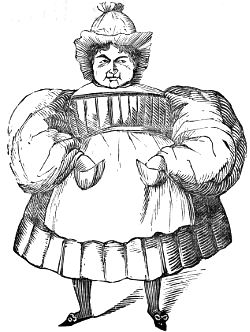
Search all the world over I vow and declare, With the ladies of England there’s none can compare With the sleeves on their arms like a coal-porter’s sack, Their cockleshell bonnets and Jack Sheppard hats. The ladies hooped petticoats dragging around, Just cover a mile and three-quarters of ground. Oh, I must have a husband young Jenny did say, I will be in the fashion so buxom and gay, With a bustle before and another behind, And under my trousers a big crinoline. When I’m married, my husband upon me will doat, Looking so fine in a hooped petticoat. To have one, I’ll just go a week without grub, Or else knock out the staves of our big washing-tub. There was an old lady went down through the Strand, She was linked in the arms of a dashing young man, Her hooped petticoat caught a coal-heaver’s clothes. Down he went like a donkey wop bang on his nose. The lasses that wander the streets in the dark, Swear they cannot get custom unless they’re smart, If their skin is as black as a Welch Billy Goat, They must have a wonderful hooped petticoat. An old farmer’s wife an hooped petticoat wore, ’Twas as wide as an haystack behind and before, The wind caught the bottom as you may suppose, Then up in the clouds in a moment she goes. I knew a young milkmaid at old Farmer Days, She sold her frock and trousers, her stockings and stays, From her master’s beer barrel, a hoop then she took, And she had it sown round her new red petticoat. She got up one morning, so buxom and fine, She quickly went folding her new crinoline, She holloaed and swore such a terrible oath, For the old cow had calved in her hooped petticoat. A young lady of Aldershot was when it rained, And a regiment of soldiers going over the plain. Popped into a place, just for shelter they took, The whole regiment stood under her hooped petticoat! Good people, beware! as you pass through the streets, If a girl with a crinoline you chance for to meet, Take care as you ramble along in a group, Or, you may get caught in a hooped petticoat. There was a sweet duchess a lap dog had got, She had lost it one morning and cried such a lot, But oh, lack-aday, she beheld in a group, A bitch and nine pups in her hooped petticoat. They say that the queen has a crinoline on, And so has Prince Albert and buxom Lord John, We expect to see Palmerston next week afloat, Strutting up round May Fair in a hooped petticoat.
H. Disley, Printer, 57, High Street, St. Giles.
THE SUPPRESSION OF CRINOLINE.
Tune—“A Kiss and Nothing More.” Good people give attention, and listen to my rhyme, I’ll sing about the fashions that’s in vogue the present time, The ladies now have bustles, now don’t they cut it fine, With their dandy hat and feathers, and fancy crinoline? As I walked through the streets, not many days ago, I met a girl who said, she was looking for a beau, She invited me to go with her, I said I did not mind; She looked just like a lady, dressed up in a crinoline. She took me to a splendid house, with cushions on the chairs, She treated me to brandy—and took me up the stairs, She undressed me so kindly, and said she would be mine; But I cursed the hour I admired her handsome crinoline. I had a splendid watch and chain, I’d gold and silver, too, But in the morning when I woke I scarce knew what to do, For in the middle of the night, after treating me so kind, She stole my money, watch and clothes, and left me her crinoline. There’s a pretty bobbin winder, they call her Mary Jane, She’s courting a snob! so help my bob, that lives in —— lane; Last Sunday afternoon, she thought to cut it fine, With the hoop of her mother’s washing tub, she made a crinoline. I knew a steam loom weaver so cunning and so sly, She had got a hump upon her back, and she squints with one eye, She works at —— factory, her name is Anne O’Brian, Her smock’s as black as a chimney back and wears a crinoline. There’s a woman lives up —— road, they call her mother ——, She wants to buy a crinoline, to wear underneath her gown? But her husband would not let her, and when she was confined, She had a son mark’d on the bum, with a lady’s crinoline!
London:—H. SUCH, Printer, 123, Union Street, Boro’, and at 83, White Cross Street, St. Luke’s.
THE DOWNFALL OF CHIGNONS.

You lasses of —— come list to my song, ’Tis concerning the fate of the fancy chignon; The ladies of Paris are determined ’tis said, To wear their own hair at the back of their head. They have given o’er wearing such queer looking lumps Of nasty old rubbish screw’d up in great bumps, To cast them adrift they have made up their minds, To be ugly for ever they don’t feel inclined. CHORUS. The Chignons are going we’re happy to hear, From the young Ladies they must now disappear, They are not in the fashion and soon must be gone, It’s all up the spout with the saucy chignon. ’Tis a good job they’re going, for the darling young girls I am sure would look better in natural curls; Madame Rachel has worn such a wopper ’tis said, She is quite bandy-leg’d thro’ the weight of her head: Girls that want to be married before Whitsuntide, Pull off your Chignons and throw them aside, If you practice economy you’ll find it true, That a fancy chignon will make bustles for two. Those buxon old ladies who like to be gay, At the change in the fashions are out of the way, For with wig and chignon they all come the grand, Tho’ their heads are as bald as the palm of my hand. The ladies at first will feel rather strange, They will get light-headed I hope by the change, It will seem rather awkward at first I suppose, To wear hats on their heads now, instead of their nose. Now what’s to be done with the left off chignons, They are sure to amount to some millions of tons! To set them on fire would make all the world sneeze, And slaughter some thousand industrious fleas; For bachelors they would do very fine, Or three in a bunch for a pawnbroker’s sign; They’d pay very well to boil down for grease, Or they would make some good beds for the country police. If the chignons were gathered, it would be a treat To see them made use of for pitching the street, Or perhaps they would do, either black, red, or brown, To fill up the quaries about the —— Downs: If the Volunteers had them they’d make cannon balls. And tell —— enemies to look out for squalls, If a foe should come here to do us a wrong, They’d get blow’d to old Nick with a charge of chignons. The poor cows and horses will welcome the change, And pigs with their bristles on freely will range, No more county crops for the women in jails, Nor donkeys lamenting the loss of their tails. No more bags of sawdust to way down your heads, Nor rags tied in bundles as big as a bed, The ladies declare that the fashion is gone, They’ve clapp’d the bumbailiffs on all the chignons.
London:—H. SUCH, Machine Printer and Publisher, 177, Union Street, Borough, S.E.
THE DANDY HORSE, OR THE WONDERFUL VELOCIPEDE.

Queer sights we every day do find, As the world we pass along, The ladies hoops and crinolines, And then their large chignons; To come out in French fashion, Of course we must indeed, And have a dandy horse,— The famed Velocipede. The dandy horse Velocipede, Like lightning flies, I vow, sir, It licks the railroad in its speed, By fifty miles an hour, sir, The lasses of the period, Will cut along so fine, With their hair just like a donkey’s tail, A hanging down behind; Upon a dandy horse will go, And behind them footman John, Whose duty will be to cry, gee-wo! And hold on their chignon. The Velocipedes are all the go, In country and in town, The patent dandy hobby-horse It every where goes down; A wheel before and one behind, Its back is long and narrow, It’s a cross between the treading mill, And a Razor Grinder’s barrow. All the world will mount velocipedes, Oh wont there be a show Of swells out of Belgravia, In famous Rotten Row; Tattersall’s they will forsake, To go there they have no need, They will patronise the wheel wright’s now For a famed Velocipede, All kinds of Velocipedes Will shortly be in use, The snob will have one like a last, The tailor like a goose! Bill Gladstone he will have one, To ride, so-help-me bob, The head will be the Irish Church, The tail Ben Dizzy’s nob Old Sal Brown to her husband said There is no use of talking, I must have a dandy hobby-horse, For I am tired of rocking; Your leather breeches I will spout, And send you bare on Monday, If I don’t have a Velocipede To ride to church on Sundays. What will the poor horse-dealers do, I am sure I cannot tell, Since the dandy horses have come up Their horses they can’t sell; Oh, won’t the cats and clogs be glad, Their grub they will get cheap, Or else it will be all bought up To sell for Paupers’ beef. The Velocipedes are rode by swells, Tinkers too and tailors, They will be mounted, too, by the police, The soldiers and the sailors; An old lady who lives in —— At least the story goes, sir, Is a going to race the omnibus, All down the —— road, sir, The railways they will be done brown, The steamboats too, beside, For folks when they go out of town, The Velocipedes will ride; But I’d have you look out for squalls Or else you may depend, You will go down, dandy horse and all, And bruise your latter-end.
Disley, Printer, 57, High street, St. Giles, London.
THE LORD MAYOR’S SHOW.
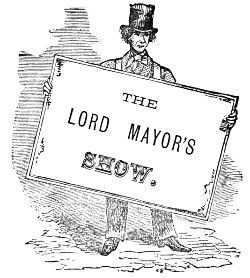
Now all you gay people, be off in a jiffy, To see this grand sight in London city, If you do not go, it will be a pity, Such a beautiful Lord Mayor’s Show; If my Lord Mayor should give up the old coach, In an old dung cart he will approach, As sleek as an eel, as sly as a roach, Such a big bellied man is the mayor. Ride a cock horse to old Charing Cross, To see the Lord Mayor on an old horse, But where is the Mayoress we are at a loss, Such a beautiful Lord Mayor’s Show. The Queen won’t be there, as I am sinner, She has gone to Scotland to get a dinner, Scotch oatmeal and burgoo, to make her thinner, So much for Vickey our Queen. To travel the highlands her little feet itches, To see them big men without any breeches, With such fine looking fellows with big legs to match it, They would look very well at the show. Here comes the lady, we thought not so fast, By the side of the Night Mayor on a jackass; Her head through Temple Bar cannot pass, sir, Something new at the Lord Mayor’s Show. Then the old watermen, wicked old sinners, One eye on the Mayor and one on their dinner, As for the mock birds, they’re wonderful thinner, So make haste to the Lord Mayor’s Show. As for Old Lawrence his hopes is all blighted. A few weeks ago he was quite delighted, He thought he was going to be knighted, He’ll look like a pig at the New Cattle Show. They go on the bridge instead of going under, Perhaps dance on the viaduct, or else it’s a wonder, Gog and Magog won’t stand it, they bawl out like thunder, And weep for the good old show. God bless the Queen, for her we may mourn, But we think she might give England a turn, And then perhaps she might something learn By going to the Lord Mayor’s show. Such sights as these enliven the nation, Puts trade into hands, and keeps off starvation; And every man ought to have a good situation, So to visit the Lord Mayor’s show. Some is fond of a load of oatmeal & cabbages, Some take a delight in the bare legg’d savages, While England crime and poverty ravages, So welcome the Lord Mayor’s show.
H. Disley, Printer, 57, High Street, St. Giles’s.
OPENING OF THE VIADUCT BY THE QUEEN.

Come lads and lasses, be up in a jiffy, The Queen is about to visit the City, That her visits are so scarce, we think it a pity, She will open the Viaduct and Bridge. With the Lord Mayor Elect like a porpoise, Big round as an elephant is his old corpus, To see this great sight nothing shall stop us, Gog and Magog shall dance with the Queen. Oh dear, what can the matter be, The Queen she is coming on a velocipede, How nicely she treads it with high heels and buckles.— She will open the Viaduct and Bridge. The Mayor, Mr Lawrence will take off his hat, He would like to be Whittington without the cat, There’s old Alderman Besley, all blubber and fat, They are going to welcome the Queen, Girls of the period, of every station, With hair down their backs of all occupations, That would frighten Old Nick out of this nation, It’s all just to please our good Queen. All the good clothes that is got upon tally, They’ll put on this day as they look at the valley, Dusty Bob, Tom, and Jem, and African Sally, These bye-gones will visit the Queen. All the old horses will jump for joy, ’Twas up Holborn Hill that did them annoy, I remember truck dragging when I was a boy, Good luck to the Viaduct and Bridge. There will be all nations ashore and afloat, Old Jack Atcheler will cut his throat, No horses are killed, no cat’s meat afloat, All through this great Viaduct and Bridge. The cabman will dance in every passage, Cow Cross is done up, you wont get a sassage, You can travel the Viaduct like a telegraph message, Now they’ve opened the Viaduct & Bridge. The banners and flags will go in rotation, Emblems of things of every nation, The workmen of England and emigration, And old Besley fighting for Mayor. Lawrence is down as flat as a flounder, On his belly stands the trumpet type founder, The Aldermen in rotation playing at rounder, When they open the Viaduct and Bridge. Next comes the Queen, so pretty indeed, How nicely she sits on the velocipede, With high heels and buckles she treads with ease, She’s getting quite young is our Queen. That Alderman Salomon out of the lane, He holds up so stately poor Vickey’s train, Prince of Wales and Prince Tick will come if they can, Just to open the Viaduct and Bridge. Horses and donkeys will caper like fleas, No more sore shoulders and broken knees, The animal Society may take their ease, Good-bye to the once Holborn Hill.
H. Disley, Printer, 57, High Street, St. Giles, London.
CABMEN AND THEIR NEW FLAGS.

Oh dear, what a fuss and a bother, From one end of this great city bang to the other, The Cabmen all say they shall live in clover Now they have the Free-trade in cabs; This Act, it is Bruce’s, the Home Secretary, And it came into force the 1st of February, That his ideas are grand, of course you’ll say very, Especially the dodge of the Flags! Oh my, is there not an uproar About the new regulations of Bruce’s New Cab Law, First the Cabby’s, the badge, like schoolboys they wear now, Now it’s a Flag and a Ticket for Soup! The Cab-horses now at their good luck are laughing, To think their nose bags will have more corn and chaff in, And cock up their noses as by us they’re passing, Saying, what do you think of our Flags? The phillibeloo of the Cab-strike, I’ll never forget ye, Nor who brought out the Badge, oh no, what a pity? Or the Cabman’s best friend, poor lamented dear Dickey, But he never thought of the Flags! They must mount their banners up in the air, sir, Nor stir from the rank till hail’d by a fare, sir, And dub up their Tickets, its true I declare, sir, Yes, that is the rules of the Act. To see their Flags stuck up, it’s strange for to see now, Like those that they stick on a Christmas tree, now, They’re stuck full of letters and on it just see now, You can ride just for sixpence a mile! Now a man and his wife in the old fashioned manner, Could ride side by side just a mile for a tanner And two or three kids besides they could cram there, But now it’s just two for a bob; For a young one in napkins, it’s true what I tell you, Is considered a person, though a small one, it is true, Butt, a pot-bellied Alderman is counted as two, now, To help them to pay for the Flags! Now the Act is in force, I should not at all wonder That dustmen and nightmen and costermongers Will apply for a license and take out a number And mount on their foreheads a flag; And the people they shout, tho’ it’s really too bad, sir, As over the stones they go with their cabs, sir, I say, old pal, I’ll have your flag, And where is your ticket for soup. Now cabs of all kinds they must be inspected To see that no sand cracks are in them detected And all the shofle shofles they will be rejected Now won’t they look after the flags. Now I think of the Act to say more it no use is, They’ll rechristen the cabs, & stand no excuses, There’ll be no four wheelers or hansoms, they’ll all be called Bruce’s, Tho’ it does not say so in the act.
Disley, Printer, High Street, St. Giles’s.
THE FUNNY DIVORCE CASE.
Now list to me awhile, And I’ll sing you a ditty, It will cause you for to smile, If not, it is a pity. It’s of a crim con case, And it has caused sport, Which lately did take place, At Westminster Divorce Court. So all classes high and low, Make out this case I well can’t, But it is a funny go, Of rummy Lady ——. Now this gay Lady —— Cannot be right, or hardly, She said she loved other men, Much better than her Charley. Some say it was her dodge, And nothing but hanky panky, While others say all fudge, She is trying to act cranky. But whether she is so or not, This Lady —— so clever, A propensity has got, She has, so help me never! She is so fond of sport, She has a mighty knack then, Of proving every sort, Lords, Prince’s too, and Captains. When the case was in the Court, It caused a deal of bother, Some said her head was hot, She could not tell one from t’other. The Doctor he looked grand, And said censure she did not merit, For the poor dear Lady Was subject to hysterics. Now Lady ——, the dear, As we may understand her, Could play the German flute, The organ and piano. But she oft made a mistake, As some letters to us tell will, She was in a weakly state, Since she has had the measles. Charley said to her one day, As some queer doubts there may be, Do tell me dear, I pray, How about the baby? Then Charley dear, said she, I really have forgot dear, Whether it belongs to me, Or whether to the doctor. This lady’s appetite It really is enormous, But whether wrong or right, The papers will inform us; She is fond of veal and ham, To feed she is a glutton, She got tired of Charley’s lamb, And longed for royal mutton. Now husbands mind I pray, The lesson you have got here, If your wives should go astray, Be sure you call the doctor. Though I mean not to offend, I’ve proved the fact, and said it, That like poor Lady ——, They might be troubled with hysterics.
Disley, Printer, 57, High street, St. Giles.
BRIGHTON GRAND VOLUNTEER REVIEW.

Lads and lasses, blithe and gay, From town and country far away, The young and old will come, they say, To see the grand review, sir There is Polly Pluck and Ginger Blue, For fun they are always right on, Such shaking hands and how-do-you-do With the volunteers from London. Such sights before has never been, Drinking healths in wine and gin, And the pretty girls a winking then At the volunteers of England. There is special trains from every part, Old and young with joyful hearts, With coaches, gigs, and donkey carts, Will drive to the review, sir. The pretty girls will dress so fine, With their frizzly hair all down behind, With a hat and feathers cut a shine When at the grand review, sir. The Cockney lads are fond of fun, When on the downs are strolling, And down the hill in the afternoon The lasses will be rolling. Blow the trumpet, beat the drum, Away with melancholy, Shoulder arms and fire the guns, Let every one be jolly. One young lady of sixty-two, With high-heeled boots and buckles, too, And with a crutch she had to go To see the grand review, sir, She on the hill was pushed about By some great ugly fellow, Her crutch soon broke and she fell down, And she lost her umbrella. There’ll be Ikey Bill from Petticoat Lane His sherbet will be selling, And gipsies come from far and near Your fortune to be telling. The gents that on the stools will stand, And in your faces smiling, Hear’s three half-crowns and a purse, my lads, And the lot is but a shilling. All sorts of games will be that day, To please both old and young, sir; If the volunteers should want a rest, The girls will hold his gun, sir. For good-tempered girls there will be there, No better in England found, sir, For if you ask them there to sit, They’re sure to tumble down, sir. The flags so gay the bands will play, And thousands will be mingling, And welcome with a loud huzza The volunteers of England. May Queen Victoria happy be, And all the royal family, The Prince of Wales, cheer three times three And the Princess Alexandra. Now merry Punch with voice so strong, He is all for fun and chaffing, If you listen to his song You’ll burst your sides with laughing.
THE FROLICSOME PARSON OUTWITTED.

Come all you hearty roving blades, and listen to my song, A verse or two I will unfold, and will not keep you long, It is of a frolicsome parson, as you shall quickly hear, That dwelt in the town of Ledbury, in the county of Herefordshire. The parson being a rakish blade, and fond of sporting games, He fell in love with the pretty cook, as I have heard the same; The parlour-maid found out the same, and in the fruit room looked, And there she saw the parson sporting with the cook. It was in nine months after she brought him forth a child, Within the rectory it was born, it drove him nearly wild: It proved to be a male child, at least they tell us so, Then this damsel from the rectory was quickly forced to go. Then the secret to unfold, it was her full intent, During the time of service into the church she went, Holding the child up in her arms, and on the parson gazed, Saying, lovely babe, that is your dad, which filled him with amaze. The congregation they all stared, the parson seemed confused, And many a lad and lass no doubt, within them felt amused; Such a scene as this was never known within this church before, Let us hope that it will be the last, and the like shall be no more. ’Twas then a court was called in town, for to invest the case. There the parson, cook, and parlour-maid they met face to face, And many more in court appeared, to hear the sport and fun, This damsel swore the parson was the father of her son. Your reverence; you are found to blame the Justices declared, Although some honest country lad you thought for to ensnare; So with all your doctrine and your skill unto him they did say, A half-a-crown each week to the child you’ve got to pay. His reverence felt dissatisfied with such a glorious treat, To a higher court he did proceed, and there was quickly beat, So this damsel she’s victorious, the truth I now declare, And his reverence is suspended for the period of five years. Come all you blooming servant maids a warning take by this, When in service with the parsons don’t be treated to a kiss; Or it may cause much jealousy, as you may all well know, Then you from service must be gone your sorrows for to rue. Now to conclude and make an end and finish up my song, All you young men that’s deep in love, be sure don’t stay too long; Join hand in hand in wedlock’s band without the least delay, Before the fairest of all girls is by parsons led astray.
THE FUNNY HE-SHE LADIES!

We have had female sailors not a few, And Mary Walker the female barman, too, But I never heard such a sport, did you, As these swells tog’d out as ladies. They are well known round Regent Square. And Paddington I do declare, Round Bruton street, and Berkeley Square, Round Tulse Hill, and the lord knows where. At my opinion I pray don’t gig, I’ll speak my mind so please the pigs, If they are nothing else, they might be prigs This pair of he-she ladies. At Wakefield street, near Regent Square, There lived this rummy he-she pair, And such a stock of togs was there, To suit those he-she ladies. There was bonnets & shawls, & pork pie hats Chignons and paints, and Jenny Lind caps, False calves and drawers, to come out slap, To tog them out, it is a fact. This pair of ducks could caper and prance, At the Casino they could dance, Ogle the swells, and parle vou France, Could this pair of he-she ladies They’d sip their wine and take their ice, And so complete was their disguise, They would suck old nick in and no flys, Would these beautiful he-she ladies. One day a cute detective chap, Who of their game had smelt a rat, Declared he would get on the track, Of these two he-she ladies. So he bolted up to Regent Square, And soon espied this worthy pair, They hailed a cab, who took his fare, Says the police, I am after you my dear. They bolted off at such a rate, sir, And in they went to the Strand Theatre, But the game was up, so help my tater, Of this pair of he-she ladies. You would not suppose that they were men, With their large Chignons and Grecian bend, With dresses of silk, and flaxen hair, And such a duck was Stella dear. When they were seated in the stalls, With their low neck’d dresses a flowing shawl They were admired by one and all, This pair of he-she ladies. The gents at them would take a peep, And say they are duchesses at least, Lor! what a fascinating pair, Especially she with the curly hair. The detective, Chamberlain by name. Upon these two sham ladies came, And said what is your little game, My beautiful he-she ladies. Oh, was it not a cruel sell, That night they must remember well, When they had to pig in Bow Street cell, What a change for them he-she ladies. When first before the magistrate, Oh, what a crowd did them await, It was a lark and no mistake, To look at them he-she ladies. Lor! how the people did go on, With, I say I’ll have your fine chignon, Another cried out, Stella dear, Pull off those togs, and breeches wear. Now I think behind there is a tale, Which will make this bright pair to bewail, For on skilly and whack they might regale, Those beautiful he-she ladies.
H. Disley, Printer, 57, High Street, St. Giles.