Part 3 — DIVISION IV. THE “GALLOWS” LITERATURE OF THE STREETS. Public Executions, Dying Speeches. Confessions, and Copy of Verses. (continued 2)
Reading edition
The whole of this temporary erection is hung in black. The criminals are attended by the proper officers and the Ordinary of Newgate, from their cells to the centre part of the scaffold, which is a platform raised about two or three inches above the general floor, and directly under the gallows: here, after the usual prayers and solemnities, the rope is tied up, and, at the Sheriff’s signal, the executioner pulls away a staple, which loosens a bar that supports the platform, and the platform then falls in: and this, being much more sudden and regular than that of a cart being drawn away, has the effect of immediate death. During the whole time of this awful spectacle, a full-toned bell, which is suspended above the roof of this part of the prison, is solemnly tolled; but as it is fixed so far on the roof as not to be in sight, it does not appear. The scaffold is supported by strong posts, fixed into grooves made in the street, and the whole is temporary, being all calculated to take to pieces, which are preserved within the prison.
FULL ACCOUNT OF THE EXECUTION OF FIVE UNFORTUNATE SAILORS,

VIZ.,— MICHAEL COX, MARTIN EALEY, JOHN SULLIVAN, ROBERT M’LAURIN, and WILLIAM MORRIS.
AND HIS MOST GRACIOUS MAJESTY’S ROYAL PARDON OF JOHN FLINT, GEORGE WYTHICK, JOHN LAWSON, and WILLIAM HANDY.

And the Sentence passed on Capt. Affleck, late of the Amethyst.
At Sheerness, on the eighth day of this month, at about nine o’clock in the morning, the signal for Execution was made on board of the Defiance man-of-war by firing a gun, and hoisting a yellow flag at the fore-top-gallant-mast head: a lieutenant, in a boat manned and armed, was sent from each ship to witness the awful scene: the crews of the respective ships were called on deck, and the articles of war read to them by their captains, who afterwards warned them to take examples from the fate of the unhappy men who were about to suffer. The Rev. Dr. Hatherall, chaplain of the Sandwich, administered the sacrament to all of them, except Michael Cox and Martin Ealey, who were Roman Catholics; after praying with them for some time, they were brought on deck, and the ropes fixed around their necks, when John Flint, George Wythick, John Lawson, and William Handy were made acquainted that His Majesty had been pleased to pardon them.
Handy, who had a wife and child on board, immediately ran down to her, and fainted in her arms, which presented a most affecting scene. The tear of thankfulness and joy adorned the cheeks of the hardy tars; and Lawson addressing the clergyman, said, “I am afraid I shall never again be so well prepared for eternity.”
At a quarter past eleven, the signal for the execution of the remainder was made, by firing a gun, when Michael Cox, Robert M’Laurin, John Sullivan, Martin Ealey, and William Morrison, were launched into eternity. After hanging the usual time, their bodies were sent on shore, to the agent at sick quarters, for interment.
These unhappy men suffered for a mutiny on board the Defiance, then in Leith roads, in the month of October last.
Portsmouth, March 16th, 1796.
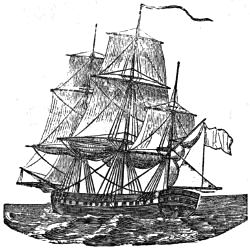
The following is the sentence passed yesterday at Portsmouth, on Captain Thomas Affleck, late of the Amethyst frigate, for the loss of that ship: “That the loss of His Majesty’s ship Amethyst was occasioned by her striking on a rock near the island of Guernsey, and by a hole being thereby beaten in her bottom; and that the same was attributable to the misconduct of the said captain, Thomas Affleck; and the court do adjudge him to be reduced from his rank on the list of post captains to the bottom of the said list, and to be incapable of being again employed in His Majesty’s naval service for the remainder of his life; and the court further agree, that the loss of the said ship was not attributable to any misconduct in any other of the officers or company of the said ship, and do adjudge them to be acquitted.”
W. Parker, Printer, Portsmouth and Gosport.
THE TRIAL AND EXECUTION OF MARTIN CLINCH & SAMUEL MACKLEY, For the Wicked Murder of Mr. Fryer, in Islington Fields.
THE TRIAL.
At the Old Bailey, Martin Clinch and Samuel Mackley were capitally convicted of the wilful murder of Mr Fryer, in the parish of St. Mary, Islington. It appears by the evidence, that the deceased and his cousin, Miss Fryer, were walking across the fields in their way from Southampton Buildings, Holborn, towards Islington: that, when they arrived at the field called the cricket field, near White Conduit house, they heard a noise, as of some person in distress; this induced the deceased to go to the spot. At this time, Miss Fryer, the principal witness on this occasion, was at some distance from him. By the time she came to the stile, which she had crossed in his way to the place, she saw Clinch fire, when the deceased fell into a small pond. Clinch then took his watch out of his fob, and a sum of money out of his pocket. By this time Miss Fryer had got on the other side of the stile, when the prisoner, Mackley, held a pistol to her head, and took her cloak from her. They then went away, and Mr. Fryer was taken to a house at a short distance from the spot, where he died at eleven o’clock the same evening. The evidence in support of the above statement, as given by Miss Fryer, was clear, artless, and unembarassed. When asked if she really believed Clinch to be the man who shot Mr Fryer, she said she believed from her soul he was; with regard to Mackley, she seemed not quite so positive; several witnesses, however, proved his being seen in the same field within a few minutes of the time the murder happened, who all had noticed him, on account of his having red hair. The prisoners being called on for their defence, they only said they were innocent, but could give no account where they were at the time the murder was committed. The jury went out for about half an hour, and returned with a verdict—Guilty.
The sessions being ended, the same were adjourned until Wednesday, July 12, 1797.
THE EXECUTION.
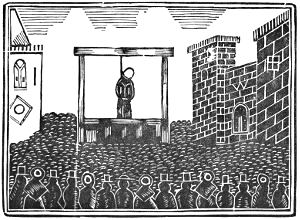
Yesterday morning were executed at the front of Newgate, Martin Clinch and Samuel Mackley, for the daring robbery and cruel murder of Mr Fryer, in Islington fields. An extremely disagreeable circumstance occurred shortly before the period which is usually allowed to men in their unfortunate situation. The floor of the scaffold, from some previous misarrangement, gave way, and precipitated into the area of the apparatus, Messrs Vilette and Gaffy, the latter a Catholic priest, who attended Clinch, and the two executioners; Mr. Sheriff Stains had himself a very narrow escape. Mr. Gaffy being a lusty man was severely hurt, as were both the executioners; Mr Vilette escaped with a slight bruise. The two unfortunate malefactors swung off with their distorted features exposed to the view of the distressed spectators. By the laudable activity of Mr. Ramsden, the prison surgeon, however, the cap was drawn over their faces afterwards. Their bodies were removed to a proper place for the purposes of dissection and exposure. They both denied to the last moment having had any concern in the murder.
Pitts, Printer, Toy and Marble Warehouse, 6, Great St. Andrew Street, London.
AN ACCOUNT OF THE COURT MARTIAL, SENTENCE, AND EXECUTION OF RICHARD PARKER FOR MUTINY,
Held on board His Majesty’s ship the NEPTUNE, lying in the river Thames, off Greenhithe.
The Court was formed on Thursday, June 22, 1797, and the prisoner was charged with making, and having endeavoured to make, a mutiny among the seamen of His Majesty’s ships at the Nore; with having caused assemblies of these seamen to meet frequently, and with having behaved himself contemptuously toward and disobeyed his officers.
Captain Moss, of the Sandwich, was the prosecutor, and after the whole of the evidence had been gone through, the prisoner was ordered to withdraw, and the court was cleared for the purpose of leaving the members to deliberate on the sentence.
In two hours and a half the Court was re-opened, and the prisoner being called in, the sentence of the Court was read by the Judge Advocate to the following purport:—“That Richard Parker do suffer death, and to be hanged by the neck on board of one of His Majesty’s ships, and at such time as the Lords of the Admiralty may think proper.”
On Friday, June 30, at eight o’clock in the morning, a gun was fired from on board His Majesty’s ship L’Espion, lying off Sheerness garrison, Vice-Admiral Lutwidge’s flag ship, and the yellow flag, the signal of capital punishment, was hoisted, which was immediately repeated by the Sandwich hoisting the same colour on her fore-top. At half-past eight Parker was told the chaplain was ready to attend him. He now requested a minute to collect himself, and knelt down in prayer, then, rising up, said, “I am ready,” and holding his head up, said to the boatswain’s mate, “take off my handkerchief,” which being done, the Provost-Marshal placed the halter over his head (which had been prepared with grease), but doing it awkwardly, the prisoner said rather pettishly to the boatswain’s mate, “Do you do it, for he seems to know nothing about it!” The halter was then spliced to the reeved rope; all this being adjusted, the Marshal attempted to put a cap on, which he refused; but on being told it was indispensible, he submitted, requesting it might not be pulled over his eyes till he desired it. He then turned round for the first time, and gave a steady look at his shipmates on the forecastle, and, with an affectionate kind of a smile, nodded his head, and said, “Good-bye to you!” He now said, “Captain Moss, is the gun primed?” “It is.” “Is the match alight” “All is ready.” He now ascended the platform, repeated the same questions about the gun, then the cap being drawn over his face, walking by firm degrees up to the extremity of the scaffold, he dropped the handkerchief, put his hands in his coat pocket with great rapidity, and at the moment as he was springing off, the fatal bow-gun fired, and the reeve rope catching him, run him up, though not with great velocity, to the yard arm. When suspended about midway, his body appeared extremely convulsed for a few seconds, immediately after which no appearance of life remained. He suffered exactly at half-past nine, and was lowered down, after hanging at the yard-arm a full hour, when the yellow flag was struck, and his body instantly put into a shell that had been prepared for it, with all his clothes on; and soon after it was taken in one of the Sandwich’s boats and rowed to the east point of the garrison, and there being landed was carried to the new naval burying ground, out of the Red Barrier Gate, leading to Minster; the coffin lid was here taken off to the spectators for a few minutes; his countenance appeared not much altered, but his eyes were wide open. He was interred exactly at noon. His body was afterward secretly taken up, and conveyed to London, and decently interred in Whitechapel church yard.
THE DEATH OF PARKER.
Ye Gods above protect the widow, And with pity look on me, Help me, help me out of trouble, And out of all calamity. For by the death of my brave Parker, Fortune has proved to me unkind, Tho’ doom’d by law he was to suffer I can’t erase him from my mind. Parker he was my joyful husband, My bosom friend I love so dear; At the awful moment he was going to suffer I was not allowed to come near. In vain I strove, in vain I ask’d Three times o’er and o’er again, But they replied you must be denied, You must return on shore again. First time I ’tempted my love to see I was obliged to go away, Oppres’t with grief and broken hearted To think that they should me stay. I thought I saw the yellow flag flying, A signal for those who was to die; A gun was fired as they required, As the time it did draw nigh. The boatswain did his best endeavour To get me on shore without delay, When I stood trembling and confounded, Ready to take his body away. Though his trembling hand did wave As a signal of farewell, The grief I suffered at this moment No heart can paint, no tongue can tell. My fleeting spirit I thought would follow The soul of him I lov’d most dear, No friend or neighbour would come nigh me, For to ease me of grief or care. Every moment I thought an hour Till the law its course had run; I wished to finish the doleful task His imprudence first began. In the dead of the night ’tis silent, And all the world are fast asleep; My trembling heart that knows no comfort O’er his grave does often weep. Each lingering minute that passes Brings me nearer to his grave, Where we shall shine in endless glory, Never to be parted more. Farewell Parker, thou bright genius, That was once my only pride; Tho’ parted now it won’t be long E’er I’m buried by thy side. All you that see my tender ditty, Don’t laugh at me in disdain, But look down with eyes of pity, For it is my only claim.
Pitts, Printer, Toy and Marble Warehouse, 9, Great St. Andrew Street, Seven Dials.
Trial and Execution of Mary Nott, for the dreadful Murder of a French emigrant; and the Trial and Execution of Richard Ludman and Eleanor Hughes, for the Murder of George Hebner in a Brothel.
Mary Nott was tried at the Old Bailey, for the wilful murder of the Count de Greffiere de Laval, a French emigrant. It appeared in evidence, that she had the care of a house, which was let out in lodgings, in Monmouth court, Whitcomb street, the front room on the first floor of which was occupied by the count. The lodger in the room adjoining, not hearing the count as usual, had, for several mornings, enquired after him; when the prisoner said she supposed he was gone into the country with a French man and woman who used to call on him, but had not been there since his absence, for she had not seen him; that the key was not in his door, and, upon looking through the keyhole, she observed the room was just as she left it.—To another witness, who had called to see the count, she said that he had gone out very early that morning, and that she did not expect him home until it was late. Some doubts, however, arising from his absence, a ladder was procured, perfectly with the consent of the prisoner, to look into the room of the deceased; and upon the person’s calling out that there was a man upon the bed, she cried out, that she would not have remained there last night if she had known there was a man dead in the house; and upon which she, in fact, alarmed the neighbourhood. A smith was sent for, and the door forced open: the deceased was found lying on the bed with all his clothes on but his coat; he was wrapped up in the bedclothes, and pillows covered his head: there was a great deal of blood in the room, a wound was observed in the neck, and the body was nearly in a state of putrefaction. A woman, who lived in an opposite house, and who had observed the prisoner shut one of the windows, which prevented her seeing into the prisoner’s room, on the day the murder was supposed to have been committed, went up with her at the time the door was opened, and observing his right hand pocket was turned out, said, “He has been robbed;” to which the prisoner instantly replied, “He did it himself;” upon this witness made a similar remark that he must have been murdered, she again said, “He did it himself;” and upon her noticing a wash-hand basin with some water in it tinged with blood, as if some person had wrinsed their hands therein, the prisoner said, “It is not strange, not strange at all; what do you come here to raise suspicion for?” Another neighbour had heard a scream about two o’clock on that day, but could not say whence it came. The deceased was seen coming toward home between twelve and one o’clock, and as the lodger in the next room went home as early as five, the supposition was that the murder had been committed in that time. The surgeon who examined the body swore positively there was no wound in the side of the deceased, but that the raised skin, supposed to be such, was from the putrefaction; nor would he undertake to say what was the cause of his death, although a considerable quantity of blood might have issued from the wound in his neck.—Beside this testimony, which included all that related to the prisoner, it appeared that the deceased’s portmanteau had been cut; that there was a knife upon the table, which was by no means bloody; that in his left-hand pocket he had a knife and a key, the latter of which opened a drawer, wherein were several pieces of French coin and three guineas; that the deceased had been possessed of a very considerable property in France, and upon emigrating to this country, an agent in the city had allowed him twenty pounds per month: but affairs taking such a turn there, that pittance had been stopped, and he was so reduced, that a friend had forced upon him the loan of four guineas; he having no other clothes than those on his back. The prisoner denied the charge generally, and called three persons to her character, one of whom said she was of so humane a disposition, that if a worm lay in her way, she would turn aside rather than do it an injury. The jury returned a verdict of guilty. She is aged 63.—Richard Ludman, Ann Rhodes, Eleanor Hughes, and Mary Baker, were likewise indicted for the murder of George Hebner. This murder was committed in King street, East Smithfield, in one of those obscure receptacles of debauchery with which this metropolis abounds. The body of the deceased was found on the morning of Sunday, the 22nd of May, suspended by the neck from a bed-post, in a room on the second floor, with his hands tied behind his back. It was proved that the four prisoners were in the house (which belonged to Eleanor Hughes) on the evening of Saturday, the 21st, and next morning. They were seen, and some of their conversations heard, by two women who lived in an adjoining house; this house was separated from that in which the deceased was found by only a lath partition, perforated in several places, and the holes and crevices affording a distinct view of almost all the apartments of the latter.—The manner in which the hands of the deceased were bound with a piece of tape was described in the court. The knot that had been used was what seamen call a timber hitch, and it was obviously such could not have been done by himself. There was no direct and positive proof of the guilt of the prisoners; but there was a chain of most suspicious circumstances pointing strongly against Ludman and Hughes. The lord chief baron summed up the evidence with great precision, candour, and humanity. It was on the expressions used by the prisoners that the proof chiefly rested, and his lordship nicely discriminated between those which seemed to arise from surprise, on the discovery of the situation of the deceased, and those which could be supposed to proceed only from a knowledge of the murder. The jury returned a verdict, finding Richard Ludman and Eleanor Hughes guilty. Ann Rhodes and Mary Baker not guilty.—Eleanor Hughes pleaded pregnancy, to stay the execution of her sentence. On which a jury of matrons was collected and sworn, to examine her, and report their opinion to the court. They retired with the prisoner about half-an-hour, and at their return declared her to be “with child, but not quick with child.”
THE EXECUTION.
Yesterday, Mary Nott, convicted of the murder of Le Comte de Laval, an emigrant nobleman; and also Richard Ludman and Eleanor Hughes, convicted of the murder of George Hebner, were executed on a temporary platform in the Old Bailey, before the gaol of Newgate, pursuant to their sentence; after which the bodies were delivered at Surgeons’-hall for dissection.
John Clarke, Printer, Swan Street, Minories, London.
EXECUTION OF JAMES NESBETT FOR THE HORRIBLE MURDER OF MR. PARKER & HIS HOUSEKEEPER.

This wretched criminal surrendered his life to-day to the outraged laws of his country, From the complication of crimes of which he was convicted, and from the probability that the murder of Mr. Parker and his housekeeper was not the first instance in which he had been guilty of a violation of the laws, great curiosity prevailed to witness his execution, in the expectation that, if he had not previously made any confession he would in his last moments be induced to reveal the particulars of his guilt.
After his family had taken leave of him, he made a full confession of his guilt. Some of the particulars which he communicated are said to be very important, and the whole of his statement is, for the present, kept strictly secret. Various rumours are, of course, in circulation respecting the nature of his confession to which it would be equally improper to give publicity, whether they be ill or well founded.
After his mind had been disburdened of the load of guilt which had pressed so heavily on it, he became more composed, and joined in the exercises of devotion with more fixed attention, and apparently with a greater degree of intelligence, than he had hitherto evinced. On Sunday night he slept for more than two hours; and this morning he was more tranquil than usual. The Rev. Mr Harker, whose humane exertions in administering to him the consolations of religion, have all along been unremitted, attended him at 6 o’clock, and remained with him till eight. He returned again at nine o’clock, to assist him in preparing for the last awful trial of his fortitude.
At a quarter past eleven the unhappy culprit was placed in a waggon, to be drawn to the place of execution, on Pennenden heath, about a mile from Maidstone gaol. The executioner was placed by his side, and two officers with loaded carbines were also seated in the waggon, fronting the criminal. His dress was the same that he had worn during his trial, consisting of a blue coat, a yellow waistcoat, a white neck cloth, and top boots. The procession moved slowly towards the heath, the criminal frequently turned up his eyes to heaven, and ejaculating “O Lord, have mercy upon me! Christ, have mercy upon me!”—About 100 yards from the prison gate his mother caught his eye in the crowd. He did not appear to be much moved at seeing her, but bent his head to one of the officers who sat before him, and said, “Mind, tell Mr Bowen to do something for my family.” The procession arrived at the place of execution about 10 minutes before 12, and the waggon was drawn up along the side of the scaffold. The chaplain then joined the criminal in prayer, and the stillest silence pervaded the immense crowd, who stood uncovered while the service was reading. The criminal, who had knelt down by Mr Harker’s side, joined in the prayers with as much fervour as his agitation would permit. His hands were clasped together and uplifted, and his eyes were sometimes directed downwards to the book in the chaplain’s hand, as if he did not understand what was read; occasionally they were turned up to heaven, but during the greater part of the time they wandered unconsciously over the crowd without any definite direction.
When the devotions were closed, and the criminal was about to be removed from the waggon, he observed near him Mr Hay, the barrack master of Woolwich, and said he wished to speak to him. Mr Hay come forward and said, “For God’s sake, Nisbett, be sincere; consider what you are about, and tell the truth.” He replied, “I have told the truth already, and nothing but the truth. My family knows nothing of my guilt, and I hope you will do something for them.” Mr Hay asked him if he had confessed his guilt; and he replied, “I have confessed it to another person.” He then mounted the stage with a firm step, and the executioner proceeded to put a cap over his eyes, and to adjust the rope round his neck. Having seen Mr Bowen, of Woolwich, near the scaffold, he called to him and said, “Mr Bowen, I hope you will have some regard for my family. Poor things! they are innocent. None that belongs to me know anything of my doings.” Mr Bowen called to him to confess his crime, on which he replied, “I have made all the confession I had to make. That will be known after I am gone. The people is convenient that has it. It is enough for one person to know.”
At 5 minutes after 12 o’clock the fatal signal was given. He did not seem to suffer more than one minute. The body, after hanging the usual time, was cut down, and conveyed in a shell to Messrs. Day and Watman’s to be anatomized, pursuant to his sentence.
Previously to his trial, Nesbett had prepared the following declaration, in his own hand-writing, to be delivered to Mr Hay, the barrack master of Woolwich, an intelligent and humane gentleman, who was anxious to have it ascertained that the family of the murderer were not implicated in his guilt:—
“Maidstone, the 24th July, 1820
“This is the truth, as I have God to meit it in the next world, let me Be Guilty or Not, none of my family, father or mother wife or Children or any Relation of mine knows whether I am Guilty or Not of the Crime that is laid to my Charge, that is the murder of Mr Parker and his House-keeper, or any other part of that Crime that is laid to my Charge, or any other crime that is laid to me, As God has my soul in his Charge this Day to try my Guilt that is the truth, and I hope no one will Cast it up to my wife or Children, for the Do not deservit. I sine this to be truth.
“James nisbett.”
Addressed for “Mr Hay, Barrick Master, Woolwich, Kent.”
Endorsed in the handwriting of Mr Hay, but the diction of the prisoner:—
“As I have this Bible in my hand, and God to meet, I declare the contents of this paper are true.
James Nisbett”
“Witness, Stephen Page, Turnkey.
Maidstone Goal, 26th July, 1820,”
J. Catnach, Printer, Monmouth Court.
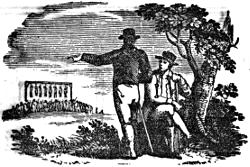
THE SENTENCES OF ALL THE PRISONERS, WHICH COMMENCED ON WEDNESDAY, 11th Sept., 1822.
BEFORE
Justice Hall, Mr Baron Graham, Mr Justice Best, and Mr Justice Richardson, the Lord Mayor, Recorder, and Sheriffs of London, Mr Alderman Ansley, &c.
IN THE OLD BAILEY.
DEATH.
Richard Mitford, alias Captain Stracy, for forgery; William Adams for cutting and maiming; William Callaghue, for returning from transportation; Samuel Wilson, Isaac Knight, and James Simpson, for horse-stealing; Samuel Greenwood, John Bridgeman, Robert Ramsey, Thomas Gordon, William Milton, and John Levy, for highway robbery; Thomas Hayes, William Williams, Joseph Williams, Francis Waddel, Mary Gyngell, Daniel Coltrel, John Brown, Walter Blanchard, Alexander Brown, Frank Purdon, William Corbett, alias Watson, Charles Robinson, and Joseph Mackarell, for stealing in dwelling houses; William Reading, for burglary; Edmund Mustoe, James Gardner, William Bright, and George Vergenton, for robbing near the highway; and John Partier, John Roberts, and Stephen Tool, for burglary.
During the time the Recorder was passing sentence of death, the culprits behaved with great propriety. The prisoner, R. Mitford, alias Captain Stracey, for forgery, was attired in a very elegant manner, his youthful and very gentlemanly appearance interested every one present in his lamentable situation. He is the son of a Clergyman.
Holland, King, and North for an unnatural crime.
TRANSPORTED FOR LIFE.
John Boyle, Cornelius Reading, Joseph Haybury, John Lewis, Thomas Trinder, William Smith, John Strange, and Thomas Harris,
FOR FOURTEEN YEARS.
Thomas Luby, T. L. Robinson.
FOR SEVEN YEARS.
William Garrard, Matthew Fennett, James Hicker, James Nicholas Moore, Eliza Davis, David Davis, otherwise Barnard, Rosina Davis, Thomas Long, James Moore, Julia Witherell, Mary Mushton, Christopher Gromer, Edward Fordem, Harriet Wyse, Thomas Jefts, William Needham, Edward Ford, Sarah West, James Harris, George King, Elizabeth Bool, Mary Smith, James Kellerin, William Tuck, John Mackay, George Hilsey, Luke Higgins, Joseph Hunt, George Wiggis, William Jupennan, John Williams, John Card, Hedges, and Willoughby.
—Imprisoned two years, and kept to hard labour.—Thomas Williams, John Pavey, Robert Wilson, John Bankes, and William Tuck, the two latter to be publicly whipped.——Imprisoned one year and kept to hard labour—John Haughton, Joseph Johnson, Joseph Moore, Thomas Letford, Eliza Godfrey, Bridget Callagan, Thomas Burke, and William Coulson,—imprisoned one year in Newgate.—Mary A. L. Butler,—imprisoned six months and kept to hard labour.——Thomas Best, Eleanor Jackson, Mary Barnes, John Hitchen, Sarah Jones, Thomas Griffiths, Eleanor Smith, P. H. Nielle, Ann Hay, Harriet Lee, Richard Spragg, Joseph Thirk, William Jones, James Sidebotham, Thomas Jones, Charles Askew, and James Easthill.
Catherine Rouke, John Gidling, John Wignal, and George Malsby, for felony, to be imprisoned for six months in the House of Correction, and kept to hard labour.—M. Gerard, W. Mayne and M. Pedlard for minor offences, to be fined one shilling and then discharged.—W. Smith and Ann Aldridge for felony, to be imprisoned two months in the House of Correction, and kept to hard labour during that period.—H. Browne, for a felony, to be publicly whipped, and kept to hard labour in the House of Correction for one year.—John Smith and Eliza Lewis, for felonies, to be imprisoned three months in the House of Correction, and kept to hard labour.—T. Worcester and John Jones, for felonies, to be publicly whipped and kept to hard labour for three months in the House of Correction.—Edmund Barber and William Burrell, for a misdemeanour, to be imprisoned six months and kept to hard labour during one month.
Judgment respited on John Parkes, James Hicker, James Nicholas Moore, (whose father is sentenced to transportation) and Thomas Wilbraham.
An immense number were sentenced to various minor periods of imprisonment, some to be publicly and some privately whipped.——A considerable number were discharged by proclamation.
The number of prisoners tried this Sessions has been between 400 and 500. Adjourned to the 23rd of October.
London: Printed by Charles Pigott, 52, Compton Street, Clerkenwell.
A mournful and affecting COPY OF VERSES on the death of ANN WILLIAMS,

Who was barbarously and cruelly murdered by her sweetheart, W. JONES, near Wirksworth, in Derbyshire, July, 1823.
William Jones, a young man aged 20, has been fully committed to Derby gaol for the murder of his sweetheart, under circumstances of unheard of barbarity. The poor victim was a servant girl, whom under pretence of marriage he seduced. On her proving with child the villain formed the horrid design of murdering her, and carried his diabolical plan into execution on Monday evening last. The following verses are written upon the occasion, giving a complete detail of this shocking affair:—
Come all false hearted young men And listen to my song, ’Tis of a cruel murder, That lately has been done On the body of a maiden fair. The truth I will unfold, The bare relation of this deed Will make your blood run cold. Near Wirksworth town in Derbyshire, Ann Williams she did dwell, In service she long time had lived, Till this to her befel. Her cheeks were like the blushing rose All in the month of May, Which made this wicked young man Thus unto her did say: Nancy, my charming creature, You have my heart ensnared, My love is such I am resolved To wed you I declare. Thus by his false deluding tongue Poor Nancy was beguil’d, And soon to her misfortune, By him she proved with child. Some days ago this damsel fair Did write to him with speed, Such tenderness she did express Would make a heart to bleed. She said, my dearest William, I am with child by thee; Therefore, my dear, pray let me know When you will marry me. The following day at evening, This young man did repair, Unto the town of Wirksworth, To meet his Nancy there. Saying, Nancy dear, come let us walk, Among the flowery fields, And then the secrets of my heart To you I will reveal. O then this wicked young man A knife he did provide, And all unknown to his true love Concealed it by his side. When to the fatal spot they came, These words to her did say: All on this very night I will Your precious life betray. On bended knees she then did fall, In sorrow and despair, Aloud for mercy she did call, Her cries did rend the air; With clasped hands and uplift eyes She cried, Oh spare my life, I never more will ask you To make me your wedded wife. O then this wicked young man said, No mercy will I show; He took the knife all from his side, And pierced her body through. But still she smiling said to him, While trembling with fear, Ah! William, William, spare my life; Think on your baby dear. Twice more then with the bloody knife He ran her body through, Her throat was cut from ear to ear, Most dreadful for to view; Her hands and arms and beauteous face He cut and mangled sore, While down upon her milk white breast The crimson blood did pour. He took the shawl from off her neck, And round her body tied, With pebble stones he did it fill, Thinking the crime to hide. O then into the silver stream He plunged her straightway, But with her precious blood was stained, Which soon did him betray. O then this young man taken was, And into prison sent, In ratling chains he is confin’d, His crime for to lament, Until the Assizes do come on When trembling he must stand, Reflecting on the deed he’s done; Waiting the dread command. Now all you thoughtless young men A timely warning take; Likewise ye fair young maidens, For this poor damsel’s sake. And Oh beware of flattering tongues, For they’ll your ruin prove; So may you crown your future day, In comfort, joy, and love.
Printed at J. Pitts, Wholesale Toy and Marble Warehouse, 6, Great St. Andrew Street, Seven Dials.
THE CONFESSION AND EXECUTION OF JOHN THURTELL AT HERTFORD GAOL, On Friday, the 9th of January, 1824.

THE EXECUTION.
Hertford, half-past twelve o’clock.
This morning, at ten minutes before twelve, a bustle among the javelin-men stationed within the boarded enclosure on which the drop was erected, announced to the multitude without that the preparations for the execution were nearly concluded. The javelin-men proceeded to arrange themselves in the order usually observed upon these melancholy but necessary occurrences. They had scarcely finished their arrangements, when the opening of the gate of the prison gave an additional impulse to public anxiety.
When the clock was on the stroke of twelve, Mr Nicholson, the Under-Sheriff, and the executioner ascended the platform, followed on to it by Thurtell, who mounted the stairs with a slow but steady step. The principal turnkey of the gaol came next, and was followed by Mr Wilson and two officers. On the approach of the prisoner being intimated by those persons who, being in an elevated situation, obtained the first view of him, all the immense multitude present took off their hats.
Thurtell immediately placed himself under the fatal beam, and at that moment the chimes of a neighbouring clock began to strike twelve. The executioner then came forward with the rope, which he threw across it. Thurtell first lifted his eyes up to the drop, gazed at it for a few moments, and then took a calm but hurried survey of the multitude around him. He next fixed his eyes on a young gentleman in the crowd, whom he had frequently seen as a spectator at the commencement of the proceedings against him. Seeing that the individual was affected by the circumstance, he removed them to another quarter, and in so doing recognised an individual well known in the sporting circles, to whom he made a slight bow.
The prisoner was attired in a dark brown great coat, with a black velvet collar, white corduroy breeches, drab gaiters and shoes. His hands were confined with handcuffs, instead of being tied with cord, as is usually the case on such occasions, and, at his own request, his arms were not pinioned. He wore a pair of black kid gloves, and the wrists of his shirt were visible below the cuffs of his coat. As on the last day of his trial, he wore a white cravat. The irons, which were very heavy, and consisted of a succession of chain links, were still on his legs, and were held up in the middle by a Belcher handkerchief tied round his waist.
The executioner commenced his mournful duties by taking from the unhappy prisoner his cravat and collar. To obviate all difficulty in this stage of the proceedings, Thurtell flung back his head and neck, and so gave the executioner an opportunity of immediately divesting him of that part of his dress. After tying the rope round Thurtell’s neck, the executioner drew a white cotton cap over his countenance, which did not, however, conceal the contour of his face, or deprive him entirely of the view of surrounding objects.
At that moment the clock sounded the last stroke of twelve. During the whole of this appalling ceremony, there was not the slightest symptom of emotion discernible in his features; his demeanour was perfectly calm and tranquil, and he behaved like a man acquainted with the dreadful ordeal he was about to pass, but not unprepared to meet it. Though his fortitude was thus conspicuous, it was evident from his appearance that in the interval between his conviction and his execution he must have suffered much. He looked careworn; his countenance had assumed a cadaverous hue, and there was a haggardness and lankness about his cheeks and mouth, which could not fail to attract the notice of every spectator.
The executioner next proceeded to adjust the noose by which Thurtell was to be attached to the scaffold. After he had fastened it in such a manner as to satisfy his own mind, Thurtell looked up at it, and examined it with great attention. He then desired the executioner to let him have fall enough. The rope at this moment seemed as if it would only give a fall of two or three feet. The executioner assured him that the fall was quite sufficient. The principal turnkey then went up to Thurtell, shook hands with him, and turned away in tears. Mr Wilson, the governor of the gaol, next approached him. Thurtell said to him, “Do you think, Mr Wilson, I have got enough fall?” Mr Wilson replied, “I think you have, Sir. Yes, quite enough.” Mr Wilson then took hold of his hand, shook it, and said, “Good bye, Mr Thurtell, may God Almighty bless you.” Thurtell instantly replied, “God bless you, Mr Wilson, God bless you.” Mr Wilson next asked him whether he considered that the laws of his country had been dealt to him justly and fairly, upon which he said, “I admit that justice has been done me—I am perfectly satisfied.”
A few seconds then elapsed, during which every person seemed to be engaged in examining narrowly Thurtell’s deportment. His features, as well as they could be discerned, appeared to remain unmoved, and his hands, which were extremely prominent, continued perfectly steady, and were not affected by the slightest tremulous motion.
Exactly at two minutes past twelve the Under-Sheriff, with his wand, gave the dreadful signal—the drop suddenly and silently fell—and
John Thurtell was launched into Eternity.
Printed at J. Pitts, Wholesale Toy and Marble Warehouse, 6, Great St. Andrew Street, Seven Dials.
TRIAL, CONFESSION, & EXECUTION OF C. T. WHITE, FOR ARSON, & AMELIA ROBERTS, FOR A ROBBERY, AT THE OLD BAILEY. THE Horrible & Appaling Spectacle WITNESSED ON THE FATAL GALLOWS.
Yesterday morning, before 8 o’clock, an immense assemblage of spectators, in numbers equal to those who witnessed the fate of Fauntleroy, crowded the Old Bailey, from one end to the other, to witness the execution of Charles Thomas White, late a bookseller in Holborn, for the crime of arson, and Amelia Roberts, for an aggravated robbery. The unfortunate man White had excited an extraordinary interest.
The young woman, Roberts, who was convicted of robbing Mr Austin, of Red Lion-street, Clerkenwell, with whom she lived as cook, of property to the amount of £400 and upwards, and Patrick Riley, her sweetheart, was convicted of the same offence. The conduct of this unhappy creature has been such, during her confinement, as to excite the respect, pity, and commisseration of those who visited her. She has been extremely attentive to her religious duties, and the principal thing that engrossed her attention relative to this world was to exculpate Riley, and hear that he was converted from what she deemed Papistical errors. On the evening of Sunday she was amazingly cheerful, and said, as her punishment was just, she would rather undergo it than return into a world of temptation.
The conduct of White was very different, the bare contemplation of the awful moment of execution unmanned him. He totally disregarded religious exercises, and sat day after day brooding over his past life, and occasionally starting upon his feet, bitterly inveighing against his sentence. Immediately after his trial, and for a long time subsequent, the unfortunate young man persisted in his entire innocence, and strove to convince others of it, by that sort of sophistical reasoning of which his defence consisted. He has asked over and over again what could have been his motive to commit so flagrant a crime, when his circumstances were not embarrassed, and his prospects flattering?
At length, however, he confessed his guilt, but in excuse pleaded that he was of unsound mind at the time. Finding, at length, that in all probability the door of mercy would be closed against him, he had recourse to many ingenious measures to effect his escape; and it appears quite clear, that he must have some powerful auxiliaries, both among his fellow prisoners and outside of the prison.
When the warrant of death arrived, which included his name, the wretched man at first raved like a maniac, his fondly cherished hope being cut off, but when he regained composure, his thoughts and conversation were again engaged upon an attempt to escape. A few days before that fixed for his execution, he said, “I know that I am a sinner, but God is merciful, and I hope to go to Heaven. I know, too, that I must suffer, but I never allow myself to think of the day.”
THE EXECUTION.
White ascended the platform with an unsteady and tremulous step. Slark, the Sheriff’s attendant, with a black wand, accompanied him, and said something to the executioner, who called his assistant, and they immediately conducted White to the west end of the platform, and while one adjusted a rope through the chain attached to the beam, the other held his hands and arms. White trembled, and his agitation seemed to increase; he raised his arms, and extended his chest, as if desirous of bursting the cords, and by the effort loosened his wrists. The cap was drawn over his eyes, but the restlessness of the unhappy man seemed to increase; and, just as the woman was ascending the steps, he bent his head down, and pushed off the cap, accompanying this action by a violent movement of the body, as if to break or get his head out of the fatal noose. The action was made with so much strength and violence, and his struggling appearing to increase, that a dreadful yell, and cries of the utmost horror burst from the crowd. The two assistant executioners were called to ascend the platform, and they held the unhappy man while a handkerchief was tied over his eyes. They endeavoured to draw a cap over his face, but he struggled hard with the executioner, and repeatedly forced it off. The executioner seized the unhappy man with some violence, to induce him to desist from proceeding to loosen his hands, and the crowd renewed their former cries and yellings.
Amelia Roberts was then brought upon the scaffold, and a cord having been tied round her lower garments, the rope was adjusted round her neck. White again got the handkerchief off, and turning to the woman and crowd alternately, by his gestures, appeared as if desirous of exciting universal sympathy. The arrangements of the executioner being complete, he removed the woman to a position immediately under the fatal beam, and then placed White by her side; but the unhappy man gradually moved forward, until he gradually got his toes upon the ledge, where Mr Cotton and Mr. Baker were reading the Burial Service. The handkerchief was again placed over his eyes, but it was evident, from the fineness of its texture, and what occurred soon afterwards, that he must have seen through it. At the moment Mr Cotton drew a white handkerchief from under his surplice, he leaped upon the platform, and by sinking his head was able to grasp that part of the cord which was affixed round his neck under his chin. It appeared to be a desperate effort to prolong that life which he so fondly clung to. At this moment the spectacle was most horrifying—he was partly suspended, and partly standing on the platform. During the violence of his exertions, his tongue was forced out of his mouth, and the convulsions of his body and contortions of his face were truly appalling. The cries of displeasure from the crowd were again renewed, and they continued till the executioner had forced the wretched man’s hands from the cord, and moved his feet from the platform, when in an instant the rope had its full tension; and, by pulling the man’s legs, he ceased struggling, and in a few minutes was dead. It is thought, that if his arms had not been fastened by a cord, the handkerchief would have given way, and the most painful consequences would have resulted. As it was, his sufferings were considerably protracted. The distortions of his countenance, in the agonies of death, could be seen by the crowd; and, as he remained suspended without any covering to his face, the horrible spectacle was most terrific. The shrieks of the women, and the cries of the men, rendered the scene more painful than any one we had ever witnessed before; and but for the wise precaution of erecting extra barriers across the street, much mischief would have been done in the confusion.
The sufferings of the poor woman were momentary.—When she was brought into the dock, at the bottom of the stairs leading to the scaffold, she took a seat on a bench. Mr. Baker attended her, while Mr. Cotton attended White on the scaffold. Her eyes were closed, and her resignation was surprising. She ejaculated, “Into thy hands, oh Lord! I commit my soul;” and just before she ascended the scaffold, she said, “God have mercy, save my soul! and pity and pardon my poor friend Patrick” (alluding to Riley). Whilst on the scaffold, she continued praying, in which she was in some degree disturbed by the extraordinary conduct of her fellow culprit.
The crowd were greatly affected by the horrid sight which they had witnessed, and we trust that this example will have its due effect upon the minds of the thoughtless and wicked.
J. Catnach, Printer, 2 and 3, Monmouth Court.
CONFESSION AND EXECUTION OF WILLIAM CORDER, THE MURDERER OF MARIA MARTEN.

Since the tragical affair between Thurtell and Weare, no event has occurred connected with the criminal annals of our country which has excited so much interest as the trial of Corder, who was justly convicted of the murder of Maria Marten on Friday last.
THE CONFESSION.
“Bury Gaol, August 10th, 1828.—Condemned cell.
“Sunday evening, half-past Eleven.
“I acknowledge being guilty of the death of poor Maria Marten, by shooting her with a pistol. The particulars are as follows:—When we left her father’s house, we began quarrelling about the burial of the child: she apprehended the place wherein it was deposited would be found out. The quarrel continued about three quarters of an hour upon this sad and about other subjects. A scuffle ensued, and during the scuffle, and at the time I think that she had hold of me, I took the pistol from the side pocket of my velveteen jacket and fired. She fell, and died in an instant. I never saw her even struggle. I was overwhelmed with agitation and dismay:—the body fell near the front doors on the floor of the barn. A vast quantity of blood issued from the wound, and ran on to the floor and through the crevices. Having determined to bury the body in the barn (about two hours after she was dead. I went and borrowed a spade of Mrs Stow, but before I went there I dragged the body from the barn into the chaff-house, and locked the barn. I returned again to the barn, and began to dig a hole, but the spade being a bad one, and the earth firm and hard, I was obliged to go home for a pickaxe and a better spade, with which I dug the hole, and then buried the body. I think I dragged the body by the handkerchief that was tied round her neck. It was dark when I finished covering up the body. I went the next day, and washed the blood from off the barn-floor. I declare to Almighty God I had no sharp instrument about me, and no other wound but the one made by the pistol was inflicted by me. I have been guilty of great idleness, and at times led a dissolute life, but I hope through the mercy of God to be forgiven. William Corder.”
Witness to the signing by the said William Corder, John Orridge.
Condemned cell, Eleven o’clock, Monday morning, August 11th, 1828.
The above confession was read over carefully to the prisoner in our presence, who stated most solemnly it was true, and that he had nothing to add to or retract from it.—W. Stocking, chaplain; Timothy R. Holmes, Under-Shertff.
THE EXECUTION.
At ten minutes before twelve o’clock the prisoner was brought from his cell and pinioned by the hangman, who was brought from London for the purpose. He appeared resigned, but was so weak as to be unable to stand without support; when his cravat was removed he groaned heavily, and appeared to be labouring under great mental agony. When his wrists and arms were made fast, he was led round twards the scaffold, and as he passed the different yards in which the prisoners were confined, he shook hands with them, and speaking to two of them by name, he said, “Good bye, God bless you.” They appeared considerably affected by the wretched appearance which he made, and “God bless you!” “May God receive your soul!” were frequently uttered as he passed along. The chaplain walked before the prisoner, reading the usual Burial Service, and the Governor and Officers walking immediately after him. The prisoner was supported to the steps which led to the scaffold; he looked somewhat wildly around, and a constable was obliged to support him while the hangman was adjusting the fatal cord. There was a barrier to keep off the crowd, amounting to upwards of 7,000 persons, who at this time had stationed themselves in the adjoining fields, on the hedges, the tops of houses, and at every point from which a view of the execution could be best obtained. The prisoner, a few moments before the drop fell, groaned heavily, and would have fallen, had not a second constable caught hold of him. Everything having been made ready, the signal was given, the fatal drop fell, and the unfortunate man was launched into eternity. Just before he was turned off, he said in a feeble tone, “I am justly sentenced, and may God forgive me.”
The Murder of Maria Marten. BY W. CORDER.
Come all you thoughtless young men, a warning take by me, And think upon my unhappy fate to be hanged upon a tree; My name is William Corder, to you I do declare, I courted Maria Marten, most beautiful and fair. I promised I would marry her upon a certain day, Instead of that, I was resolved to take her life away. I went into her father’s house the 18th day of May, Saying, my dear Maria, we will fix the wedding day. If you will meet me at the Red-barn, as sure as I have life, I will take you to Ipswich town, and there make you my wife; I then went home and fetched my gun, my pickaxe and my spade, I went into the Red-barn, and there I dug her grave. With heart so light, she thought no harm, to meet him she did go He murdered her all in the barn, and laid her body low: After the horrible deed was done, she lay weltering in her gore, Her bleeding mangled body he buried beneath the Red-barn floor. Now all things being silent, her spirit could not rest, She appeared unto her mother, who suckled her at her breast; For many a long month or more, her mind being sore oppress’d, Neither night or day she could not take any rest. Her mother’s mind being so disturbed, she dreamt three nights o’er, Her daughter she lay murdered beneath the Red-barn floor; She sent the father to the barn, when he the ground did thrust, And there he found his daughter mingling with the dust. My trial is hard, I could not stand, most woeful was the sight, When her jaw-bone was brought to prove, which pierced my heart quite; Her aged father standing by, likewise his loving wife, And in her grief her hair she tore, she scarcely could keep life. Adieu, adieu, my loving friends, my glass is almost run, On Monday next will be my last, when I am to be hang’d; So you, young men, who do pass by, with pity look on me, For murdering Maria Marten, I was hang’d upon the tree.
Printed by J. Catnach, 2 and 3, Monmouth Court.—Cards, &c., Printed Cheap.
THE TRIAL, SENTENCE, FULL CONFESSION, AND EXECUTION OF BISHOP & WILLIAMS, THE BURKERS.

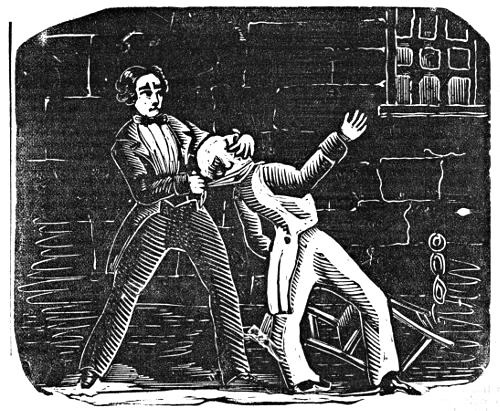
BURKING AND BURKERS.
The month of November, 1831, will be recorded in the annals of crimes and cruelties as particularly preeminent, for it will prove to posterity that other wretches could be found base enough to follow the horrid example of Burke and his accomplice Hare, to entice the unprotected and friendless to the den of death for sordid gain.
The horrible crime of “Burking,” or murdering the unwary with the intention of selling their bodies at a high price to the anatomical schools, for the purpose of dissection, has unfortunately obtained a notoriety which will not be soon or easily forgotten. It took its horrifying appellation from the circumstances which were disclosed on the trial of the inhuman wretch Burke, who was executed at Edinburgh in 1829, for having wilfully and deliberately murdered several persons for the sole purpose of profiting by the sale of their dead bodies.
APPREHENSION OF THE BURKERS.
On Tuesday, November 8th, four persons, viz., John Bishop, Thomas Williams, James May, and Michael Shield, were examined at Bow Street Police Office on the charge of being concerned in the wilful murder of an unknown Italian boy. From the evidence adduced, it appeared that May, alias Jack Stirabout, a known resurrection-man, and Bishop, a body-snatcher, offered at King’s College a subject for sale, Shield and Williams having charge of the body in a hamper, for which they demanded twelve guineas. Mr Partridge, demonstrator of anatomy, who, although not in absolute want of a subject, offered nine guineas, but being struck with its freshness sent a messenger to the police station, and the fellows were then taken into custody, examined before the magistrates, when Shield was discharged and the others ultimately committed for trial.
THE TRIAL.
Friday, December 2nd, having been fixed for the trial of the prisoners charged with the murder of the Italian boy, the Court was crowded to excess so early as eight o’clock in the morning.
At nine o’clock the Deputy Recorder, Mr Serjeant Arabin, came into the court, when the prisoners severally pleaded “Not Guilty.”
The Jury were then sworn, and at ten o’clock Chief Justice Tindal, Mr Baron Vaughan, and Mr Justice Littledale entered the Court, with the Lord Mayor and Sheriffs.
The Bench was crowded with persons of rank, amongst whom was the Duke of Sussex.
Mr Bodkin having opened the case, Mr Adolphus proceeded to state to the Jury the leading facts, as they were afterwards stated in the evidence produced. The case for the prosecution having closed, the prisoners were called upon for their defence.
The prisoner Bishop in his defence stated that he was thirty-three years of age, and had followed the occupation of carrier till the last five years, during which he had occasionally obtained a livelihood by supplying surgeons with subjects. He most solemnly declared that he had never disposed of any body that had not died a natural death.
Williams’ defence briefly stated that he had never been engaged in the calling of a resurrectionist, but had only by accident accompanied Bishop on the sale of the Italian boy’s body.
May, in his defence, admitted that for the last six years he had followed the occupation of supplying the medical schools with anatomical subjects, but disclaimed ever having had anything to do with the sale of bodies which had not died a natural death. That he had accidentally met with Bishop at the Fortune of War public house on the Friday on which the body was taken for sale to Guy’s Hospital.
At eight o’clock the jury retired to consider their verdict, and on their return they found the prisoners were Guilty of Murder.
The Recorder then passed the awful sentence upon them, “That each of them be hanged on Monday morning, and their bodies be delivered over for dissection and anatomization.”
The prisoners heard the sentence as they had the verdict, without any visible alteration. May raised his voice, and in a firm tone said, “I am a murdered man, gentlemen.”
THE FULL CONFESSION OF BISHOP AND WILLIAMS.
On Saturday morning Williams addressed a note to Mr Wontner, stating that he and Bishop wanted particularly to see him and Dr. Cotton, the Ordinary. In the course of the interview which immediately followed, both prisoners made a full confession of their guilt, both exculpating May altogether from being party to any of the murders. Having received the confessions, Mr Wontner immediately waited upon Mr Justice Littledale and Baron Vaughan, and upon communicating to them the statements, they said they would at once see the Home Secretary on the subject.
On Sunday morning the Sheriffs visited all three of the prisoners in succession, and with the Under-Sheriffs were engaged between three and four hours in taking down the statements of the convicts. The result of all these investigations was that the same afternoon a respite during his Majesty’s pleasure arrived at Newgate for May, and his sentence will be commuted to transportation for life.
THE EXECUTION.
During the whole of Sunday crowds of persons congregated in the Old Bailey, and the spot on which the scaffold was to be erected was covered with individuals conversing on the horrid crimes of the convicts, and in the course of the day strong posts were erected in the Old Bailey and at the ends of Newgate street, Giltspur street, and Skinner street, for the purpose of forming barriers to break the pressure of the crowd.
At half-past twelve o’clock the gallows was brought out from the yard, and drawn to its usual station opposite the Debtor’s door. The crowd, as early as one o’clock amounting to several thousand persons, continued rapidly increasing.
By some oversight three chains had been suspended from the fatal beam, and this led the crowd to suppose that May had not been respited. Mr. Wontnor, on hearing of the mistake, directed that one of the chains should be removed. The moment this was done an exclamation of “May is respited,” ran through the crowd, and, contrary to the expected tokens of indignation, distinct cheers were heard amongst the crowd on witnessing this token that mercy had been shown to May.
At half-past seven the Sheriffs arrived in their carriage, and in a short time the press-yard was thronged with gentlemen. The unhappy convicts were now led from their cells. Bishop came out first, and after he was pinioned he was conducted to a seat, and the Rev. Mr. Williams sat alongside of him, and they conversed together in a low tone of voice.
Williams was next introduced, and the wonderful alteration two days had effected in his appearance astonished everyone who was present at the trial. All the bold confidence he exhibited then had completely forsaken him, and he looked the most miserable wretch it is possible to conceive. He entered the room with a very faltering step, and when the ceremony of pinioning him commenced, he was so weak as to be scarcely able to stand.
Everything being ready, the melancholy procession moved forward. Bishop was then conducted to the scaffold, and the moment he made his appearance the most dreadful yells and hootings were heard among the crowd. The executioner proceeded at once to the performance of his duty, and having put the rope round his neck and affixed it to a chain, placed him under the fatal beam. Williams was then taken out, and the groans and hisses were renewed. The dreadful preparations were soon completed, and in less than five minutes after the wretched men appeared on the scaffold the usual signal was given, the drop fell, and they were launched into eternity. Bishop appeared to die very soon, but Williams struggled hard. Thus died
THE DREADFUL BURKERS OF 1831.
Printed in London for the Vendors.
LIFE, TRIAL, CONFESSION, & EXECUTION OF JAMES GREENACRE, FOR THE EDGEWARE ROAD MURDER.
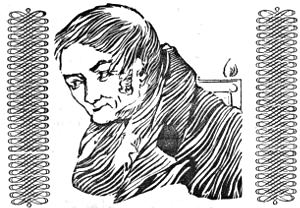
On the 22nd of April, James Greenacre was found guilty of the wilful murder of Hannah Brown, and Sarah Gale with being accessary after the fact. A long and connected chain of evidence was produced, which showed, that the sack in which the body was found was the property of Mr. Ward; that it was usually deposited in a part of the premises which led to the workshop, and could without observation have been carried away by him; that the said sack contained several fragments of shavings of mahogany, such as were made in the course of business by Ward; and that it contained some pieces of linen cloth, which had been patched with nankeen; that this linen cloth matched exactly with a frock which was found on Greenacre’s premises, and which belonged to the female prisoner. Feltham, a police-officer, deposed, that on the 25th of March he apprehended the prisoners at the lodgings of Greenacre; that on searching the trowsers pockets of that person, he took therefrom a pawnbroker’s duplicate for two silk gowns, and from the fingers of the female prisoner two rings, and also a similar duplicate for two veils, and an old-fashioned silver watch, which she was endeavouring to conceal; and it was further proved that these articles were pledged by the prisoners, and that they had been the property of the deceased woman.—Two surgeons were examined, whose evidence was most important, and whose depositions were of the greatest consequence in throwing a clear light on the manner in which the female, Hannah Brown, met with her death. Mr. Birtwhistle deposed, that he had carefully examined the head; that the right eye had been knocked out by a blow inflicted while the person was living; there was also a cut on the cheek, and the jaw was fractured, these two last wounds were, in his opinion, produced after death; there was also a bruise on the head, which had occurred after death; the head had been separated by cutting, and the bone sawed nearly through, and then broken off; there were the marks of a saw, which fitted with a saw which was found in Greenacre’s box. Mr. Girdwood, a surgeon, very minutely and skilfully described the appearances presented on the head, and showed incontestibly, that the head had been severed from the body while the person was yet alive; that this was proved by the retraction, or drawing back, of the muscles at the parts where they were separated by the knife, and further, by the blood-vessels being empty, the body was drained of blood. This part of the evidence produced a thrill of horror throughout the court, but Greenacre remained quite unmoved.
After a most impressive and impartial summing up by the learned Judge, the jury retired, and, after the absence of a quarter of an hour, returned into court, and pronounced a verdict of “Guilty” against both the prisoners.
The prisoners heard the verdict without evincing the least emotion, or the slightest change of countenance. After an awful silence of a few minutes, the Lord Chief Justice said they might retire, as they would be remanded until the end of the session.
They were then conducted from the bar, and on going down the steps, the unfortunate female prisoner kissed Greenacre with every mark of tenderness and affection.
The crowd outside the court on this day was even greater than on either of the preceding; and when the result of the trial was made known in the street, a sudden and general shout succeeded, and continued huzzas were heard for several minutes.
THE EXECUTION.
At half past seven the sheriff arrived in his carriage, and in a short time the press-yard was thronged with gentlemen who had been admitted by tickets. The unhappy convict was now led from his cell. When he arrived in the press-yard, his whole appearance pourtrayed the utmost misery and spirit-broken dejection; his countenance haggard, and his whole frame agitated; all that self-possesion and fortitude which he displayed in the early part of his imprisonment, had utterly forsaken him, and had left him a victim of hopelessness and despair. He requested the executioner to give him as little pain as posiible in the process of pinioning his arms and wrists; he uttered not a word in allusion to his crime; neither did he make any dying request, except that his spectacles might be given to Sarah Gale; he exhibited no sign of hope; he showed no symptom of reconciliation with his offended God! When the venerable ordinary preceded him in the solemn procession through the vaulted passage to the fatal drop, he was so overcome and unmanned, that he could not support himself without the aid of the assistant executioner. At the moment he ascended the faithless floor, from which he was to be launched into eternity, the most terrific yells, groans, and cheers were vociferated by the immense multitude surrounding the place of execution. Greenacre bowed to the sheriff, and begged he might not be allowed to remain long in the concourse; and almost immediately the fatal bolt was withdrawn, and, without a struggle, he became a lifeless corse.—Thus ended the days of Greenacre, a man endowed with more than ordinary talents, respectably connected, and desirably placed in society; but a want of probity, an absolute dearth of principle, led him on from one crime to another, until at length he perpetrated the sanguinary deed which brought his career to an awful and disgraceful period, and which has enrolled his name among the most notorious of those who have expiated their crime on the gallows.
On hearing the death-bell toll, Gale became dreadfully agitated; and when she heard the brutal shouts of the crowd of spectators, she fainted, and remained in a state of alternate mental agony and insensibility throughout the whole day.
After having been suspended the usual time, his body was cut down, and buried in a hole dug in one of the passages of the prison, near the spot where Thistlewood and his associates were deposited.
T. Catnach, Printer, 2 and 3, Monmouth Court.
TRIAL, SENTENCE, CONFESSION, & EXECUTION OF F. B. COURVOISIER, FOR THE Murder of Lord Wm. Russell.

THE VERDICT.
Old Bailey, Saturday Evening, June 20th, 1840.
After the jury had been absent for an hour and twenty minutes, they returned into court, and the prisoner was again placed at the bar.
The names of the jury were then called over, and the clerk of the court said—“How say you, gentlemen, have you agreed on your verdict? Do you find the prisoner Guilty or Not Guilty of the felony of murder with which he stands charged?”
The foreman of the jury, in a low voice, said—“We find him GUILTY!”
The Clerk of the Court then said: François Benjamin Courvoisier, you have been found Guilty of the wilful murder of William Russell, Esq., commonly called Lord William Russell; what have you to say why the court should not give you sentence to die according to law?
The prisoner made no reply. The usual proclamation for silence was then made.
SENTENCE.
The Lord Chief Justice Tindal, having put on the black cap, said: François Benjamin Courvoisier, you have been found guilty by an intelligent, patient, and impartial jury of the crime of wilful murder. That crime has been established against you, not indeed by the testimony of eye-witnesses as to the fact, but by a chain of circumstances no less unerring, which have left no doubt of your guilt in the minds of the jury, and all those who heard the trial. It is ordained by divine authority that the murderer shall not escape justice, and this ordination has been exemplified in your case, in the course of this trial, by the disclosure of evidence which has brought the facts to bear against you in a conclusive manner. The murder, although committed in the dark and silent hour of night, has nevertheless been brought clearly to light by Divine interposition. The precise motive which induced you to commit this guilty act can only be known to your own conscience; but it now only remains for me to recommend you most earnestly to employ the short time you have to live in prayer and repentance, and in endeavouring to make your peace with that Almighty Being whose law you have broken, and before whom you must shortly appear. The Learned Judge then passed sentence on the prisoner in the usual form.
The court was very much crowded to the last.
THE CONFESSION OF THE CONVICT.
After the Learned Judge had passed sentence on the convict, he was removed from the bar, and immediately made a full confession of his guilt.
THE EXECUTION.
At eight o’clock this morning, Courvoisier ascended the steps leading to the gallows, and advanced, without looking round him, to the centre of the platform, followed by the executioner and the ordinary of the prison, the Rev. Mr Carver. On his appearance a few yells of execration escaped from a portion of the crowd; but the general body of the people, great as must have been their abhorrence of his atrocious crime, remained silent spectators of the scene which was passing before their eyes. The prisoner’s manner was marked by an extraordinary appearance of firmness. His step was steady and collected, and his movements free from the slightest agitation or indecision. His countenance indeed was pale, and bore the trace of much dejection, but it was at the same time calm and unmoved. While the executioner was placing him on the drop he slightly moved his hands (which were tied in front of him, and strongly clasped one within the other) up and down two or three times; and this was the only visible symptom of any emotion or mental anguish which the wretched man endured. His face was then covered with the cap, fitting so closely as not to conceal the outlines of his countenance, the noose was then adjusted. During this operation he lifted up his head and raised his hands to his breast, as if in the action of fervent prayer. In a moment the fatal bolt was withdrawn, the drop fell, and in this attitude the murderer perished. He died without any violent struggle. In two minutes after he had fallen his legs were twice slightly convulsed, but no further motion was observable, excepting that his raised arms, gradually losing their vitality, sank down from their own lifeless weight.
After hanging one hour, the body was cut down and removed within the prison.
AFFECTING COPY OF VERSES.
Attention give, both old and young, Of high and low degree, Think while this mournful tale is sung, Of my sad misery. I’ve slain a master good and kind, To me has been a friend, For which I must my life resign, My time is near an end. Oh hark! what means that dreadful sound? It sinks deep in my soul; It is the bell that sounds my knell, How solemn is the toll. See thousands are assembled Around the fatal place, To gaze on my approaching, And witness my disgrace. There many sympathising hearts, Who feel another’s woe, Even now appears in sorrow, For my sad overthrow. Think of the aged man I slew, Then pity’s at an end, I robb’d him of property and life, And the poor man of a friend. Let pilfering passions not intrude, For to lead you astray, From step to step it will delude, And bring you to dismay. Think of the wretched Courvoisier, Who thus dies on a tree, A death of shame, I’ve nought to blame, But my own dishonesty. Mercy on earth I’ll not implore, To crave it would be vain, My hands are dyed with human gore, None can wash off the stain, But the merits of a Saviour, Whose mercy alone I crave; Good Christians pray, as thus I die, I may his pardon have.
Paul & Co., Printers, 2, 3, Monmouth, Court, Seven Dials.
TRIAL, SENTENCE, AND EXECUTION OF ROBERT BLAKESLEY, For the Wilful Murder of JAMES BURDON, in Eastcheap.

This morning soon after eight o’clock, Robert Blakesley was executed in the Old Bailey for the murder of James Burdon, on the 21st of September, by stabbing him on the left side of his belly. The prisoner was tried at the Central Criminal Court before Lord Abinger and Mr Baron Gurney. Mr Payne appeared for the prosecution. Mr C. Phillips and Bodkin conducted the defence. The Jury after an absence of half an hour returned into court finding the Prisoner GUILTY. The officer of the court then asked the prisoner if he had anything thing to say why sentence of death should not be passed upon him?
The Prisoner: So help me God I am innocent of all intention to murder James Burdon.
Proclamation was then made to keep silence in the court.
Lord Abinger, having put on the black cap, addressed the prisoner as follows:—Robert Blakesley, you stand convicted by a jury of your countrymen of the atrocious and abominable crime of murder. Though you appeal to God to bear witness of your innocence, yet it is by human tribunals that you must be judged. If you are innocent God will not hear that appeal in vain, but we can judge only by human testimony, and the means we have of investigating guilt. Upon that investigation no doubt can be entertained that you are guilty of the crime laid to your charge. You intended to commit another murder; the first person whose life you aimed at taking away was your wife. You then aimed at taking away that of the unfortunate man who became the victim of your anger, and his life has been taken by you, who gave it not, and who cannot restore it. You have, to a certain extent, by your remorse, appeared conscious of your offence. It is impossible for me, sitting in this place, to take any other notice of that remorse than to express a hope that it may be genuine, and that you may, in the short time you have to pass in this world, endeavour to make your peace with God, whose laws in this life you have violated by your crime. An attempt has been made to excuse you on the ground of temporary insanity. You have had a merciful and deliberate jury, who have paid the greatest attention to to the evidence adduced before them upon that subject, and your own father, who appears to be a person highly respectable, has come forward to endeavour to prove that, as far as he could do so consistently with the truth on your behalf. But, notwithstanding, all the inclination which the jury must have felt to yield, if possible, to the anxious wish of your parent, we have all found it impossible to doubt that you committed this act with malice, with deliberation, and with an intention you had no right or authority to feel, much less to execute. You have taken away the life of one of your fellow-creatures; another, that of your own wife, still remains in jeopardy. What can you expect from human tribunals but that the law should be executed with the utmost severity against you? Its sentence, and I pronounce it with pain and sorrow, is, that you be taken to the place whence you came, to be thence removed to the place of execution, then that you be hanged by the neck till you are dead, and that your corpse be buried in the place of your imprisonment, and may the Lord have mercy on your soul.
The prisoner, who had preserved the same coutenance and demeanour unmoved, was then taken from the dock.
THE EXECUTION.
The moment the culprit appeared on the scaffold, there was a yell from the multitude, but he took no notice of it, but muttering a few words in prayer, he was launched into eternity. For the first couple of minutes, the wretched man struggled very much, to the great gratification of the crowd, at the pain he was supposed to be suffering. After hanging the usual time, the body was cut down, and deposited in a shell, in which he is to be buried to-night within the precintes of the gaol.
Paul & Co., Printers, 2, 3, Monmouth Court, Seven Dials.
VERSES ON DANIEL GOOD, Who was executed this morning May, ’42, for the Murder of Jane Jones
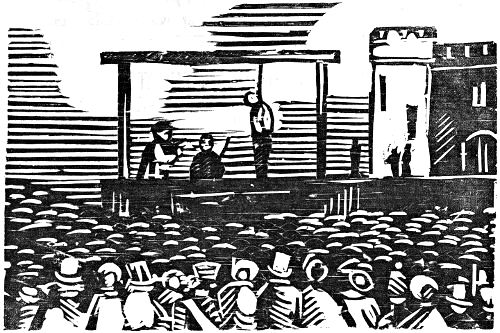
Of all the wild deeds upon murder’s black list, Sure none is so barbarous and cruel as this, Which in these few lines unto you I’ll unfold, The recital’s enough to turn your blood cold. In the great town of London near Manchester square, Jane Jones kept a mangle in South street we hear, A gentleman’s coachman oft visiting came, A cold-blooded monster, Dan Good was his name. As a single man under her he made love, And in course of time she pregnant did prove, Then with false pretences he took her from home, To murder his victim and the babe in her womb. To his master’s stables in Putney Park Lane, They went, but she never returned again, Prepare for your end then the monster did cry, You time it is come for this night you must die. Then with a sharp hatchet her head did cleave, She begged for mercy but none he would give, Have mercy dear Daniel my wretched life spare, For the sake of your own child which you know I bear. No mercy, he cried, then repeated the blow, Alive from this stable you never shall go, Neither you nor your brat shall e’er trouble me more, Then lifeless his victim he struck to the floor. And when she was dead this sad deed to hide, The limbs from her body he straight did divide, Her bowels ript open and dripping with gore, The child from the womb this black monster he tore. He made a large fire in the harness room, Her head, arms, and legs in the fire did consume, But e’er his intentions were fulfilled quite, This dark deed by Providence was brought to light. To a pawn-shop the coachman he did go one day, A boy said some trowsers he did take away, A policeman followed unto Putney Lane, The coachman and trowsers to bring back again. When in searching the stable the body he spied, Without head, legs, or arms, and ript open beside, Then a cry of murder he quickly did raise, And the coachman was taken within a few days. And when he was tried, most shocking to state, The evidence proved what I now relate, That Daniel Good murdered his victim Jones, Then cut up and burnt her flesh and bones. He soon was found guilty and sentenced to die, The death of a murderer on the gallows high, The blood of the murder’d must not cry vain, An we hope that his like we shall ne’er see again.
J. Harkness, Printer, Preston.
THE EXECUTION OF JAMES BLOOMFIELD RUSH AT NORWICH CASTLE, APRIL 23rd., 1849,
For the murder of Isaac Jermy, Esq., the Recorder of Norwich, and his son, I. Jermy Jermy, Esq., AT STANFIELD HALL.
Between 11 and 12 o’clock the bell of St Peter’s, Mancroft, tolled the death knell of the criminal. When conducted to the turnkey’s room to be pinioned he met Calcraft, whereupon he said to Mr Pinson “Is this the man that is to do the business?” The reply was “Yes.” When he was pinioned he shrugged up his shoulders, saying “This don’t go easy; it’s too tight.”
Within two or three minutes after 12 o’clock the mournful cavalcade proceeded from the interior of the Castle to the spot on which the gibbet was erected. The chaplain, who headed the procession, read, as he passed along, part of the burial service.
When the procession left the Castle gate to proceed to the gibbet, Rush presented a most melancholy and dejected appearance. He was dressed in a plain suit of black, wearing no neck-hankerchief. His shirt collar was turned down. For about twenty yards he walked with a firm unwavering step, but in a moment afterwards he raised his pinioned hands to his face and trembled violently. He then removed his hands from his face, and turning up his eyes to heaven, assumed the attitude of penitence and prayer. On reaching the gallows the rev. chaplain offered up a prayer. While this prayer was being read the condemned convict seemed to be deeply impressed with the awful character of his situation. Immediately on the close of the prayer he beckoned to Mr Pinson, the governor of the Castle, when the following brief conversation ensued:
Rush: Mr Pinson, I have a last request to make to you. It is that the bolt may be withdrawn while the chaplain is reading the benediction—“The grace of our Lord Jesus Christ, and the love of God, and the fellowship of the Holy Ghost, be with us all, evermore.”
Mr Pinson: I will communicate your wish to the chaplain, and I have no doubt it will be attended to.
The hangman then placed the unhappy convict under the beam on which he was to hang, and affixed the fatal rope around his neck. Rush said, “For God’s sake give me rope enough. Don’t be in a hurry; take your time.” Then moving his head about, he said “Put the knot a little higher up, don’t hurry.” The rev. chaplain proceeded with the prayers, and on arriving at the words “The grace of our Lord Jesus Christ,” &c., Calcraft withdrew the bolt, the platform went down, and all was over. His death was greeted with loud applause by an immense crowd who had assembled to witness the execution.
Good people listen unto my song, And girls to whom honest hearts belong, Pay great attention to what I say, And by the wicked be not led astray. Poor Emily Sandford was learned well, Yet mark what to her fatal lot befel, The serpent’s tongue caused the tears to gush, For she was betrayed by James Bloomfield Rush. She begged most pleadingly to be his wife, And lived with him a most unhappy life, And though the hot tears down her cheeks did flow The monster heeded not Miss Sandford’s woe. But seeing that she now was ruined quite, She stood upon her feet in female might, And with her pale hand stretched towards his face Said, “God will curse thee for my deep disgrace.” Forboding were the words Miss Sandford said, For murderous thoughts were in the wretch’s head. He set to work, and speedily did plan, The death of servants, husband, wife, and son. A five barrelled pistol he soon did buy, And then a mask upon his face did try, Put on his hat and cloak and pistols drew, Within its fold a bloody deed to do. For Stanfield Hall he quick did start, And old Squire Jermy he shot through the heart! And while the grey-hair’d man lay bleeding there, He shot his son and lovely wife so fair. Eliza Chestney to her Mistress ran, Saying, “dearest mistress, who is this man?” And, while she pressed her mistress to her heart, A bullet pierced in a dangerous part. James Bloomfield Rush was then to prison sent, Miss Sandford against him a witness went, She was well avenged—for on the gallows high, The base seducer was condemned to die! The Judge soon told him that his race was run,— That he must die for murderous deeds he’d done, To use the time that yet on earth was given, In making peace with his God in heaven. O had you witness’d the parting hour, Of this wretched man and his nine children dear, Your hearts would break to think that they might see, Their father hung upon a gallows tree.
J. Harkness, Printer, Preston.
EXECUTION OF JOHN GLEESON WILSON, At Kirkdale Gaol, on Saturday, September 15th, 1849, the Murderer of Mrs. Hinrichson, her Two Children, and Female Servant.
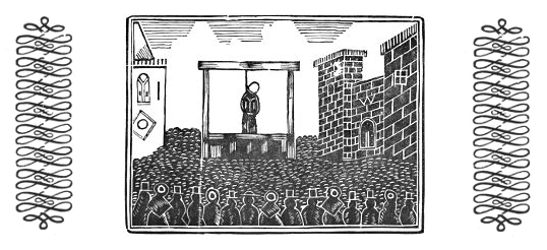
One of the most appalling murders which has for years startled and disgusted society took place on the morning of Wednesday, March 28th, 1849, at No. 20, Leveson Street, Liverpool, at mid-day. A miscreant in the most brutal manner murdered two unprotected women and two helpless children.
In due course Wilson was committed for trial, which took place before Mr Justice Patteson and a respectable jury, who, in less than five minutes, returned a verdict of GUILTY.
On Saturday morning, a few minutes before twelve o’clock, the iron gate leading to the drop was opened, and the prisoner appeared between two priests—the Rev. Mr Duggan and the Rev. Mr Marshall. A general feeling of horror seemed to pervade all present, which found expression in the most distant part of the assemblage by bursts of execration.
Calcraft, the London executioner, was unable to be present from illness, and the office was performed by Howard, from York, who was especially brought to Liverpool by the Under Sheriff. The priests read in English, the service of the Catholic Church for a departing soul until the bolt was drawn, and the wretched culprit was launched into eternity.
Thus terminated the life of one of the greatest criminals that ever disgraced the human family. Upwards of 100,000 persons were present, the railway company running cheap trains from all available parts.
THE LIVERPOOL TRAGEDIES.
Come all you feeling christians and listen unto me, The like was not recorded in British history, It’s of three dreadful murders committed, I am told, By one John Gleeson Wilson, for the sake of cursed gold. On Wednesday the 28th, consternation did prevail, In Leveson Street in Liverpool, where thousands did bewail, The fate of this poor family, who we’re left to deplore, Snatched from a father’s fond embraces, who ne’er will see them more. This monster in human shape did go there to dwell, And that he went for plunder to all it is known full well, And when this callous villain saw their defenceless state, He did resolve them all to kill and rob them of the plate. His bloody work he did commence all in the open day, By striking at the children while their mother was away, The servant girl did interfere, said, “should not do so,” Then with a poker in his hand he gave her a severe blow. Numberless times he did her strike till she could no longer stand, The blood did flow profusely from her wounds, and did him brand, Then the eldest boy of five years old, in supplication said, “Oh master, spare our precious lives, don’t serve us like the maid.” This darling child of five years old he brutally did kill, Regardless of its tender cries, its precious blood did spill, The youngest child to the kitchen ran, to shun the awful knife, This villain followed after and took its precious life. The surgeon thus describes the scene presented to his view, A more appalling case than this he says he never knew, Four human beings on the floor all weltering in their gore, The sight was sickening to behold on entering the door. The mother’s wounds three inches deep upon her head and face, And pools of blood as thick as mud, from all of them could trace, None could identify the boy, his head was like a jelly; This tragedy is worse by far than Greenacre or Kelly. To the hospital in this sad state they quickly were conveyed, The mother with her infant dear, and faithful servant maid, Thousands did besiege the gates, their fate for to enquire, But in three days from incise wounds, both of them did expire. ’Twill cause the captain many a pang to know their awful doom, His loving wife and children sent to an untimely tomb, ’Twill make his hair turn grey with grief, no skill their lives could save, And he did go, borne down with woe, in sorrow to the grave. But now he’s taken for this deed, bound down in irons strong, In Kirkdale Jail he now does lie, till his trial it comes on, May God above receive the souls of those whom he has slain, And may they all in heavenly bliss for ever with him reign.
J. Harkness, Printer, Preston.
THE EXECUTION OF FRED. GEO. MANNING, AND MARIA, HIS WIFE.

At Horsemonger Lane, November 13th, 1849, For the MURDER and Robbery of PATRICK O’CONNOR.
This morning the last act in the tragedy of the Mannings’ was performed on the roof of Horsemonger Lane Gaol, in the presence of an immense assemblage.
The gardens in front of the houses opposite the prison, and from which the best view could be obtained, commanded high prices, and were occupied by persons of apparent respectability, and amongst them were many well-dressed females.
A few minutes before the clock struck nine, the bell of the prison chapel was heard to give forth the fatal toll, and those who had collected in the vicinity of the scaffold were observed to uncover, which was taken up by the populace below as a signal to do the same, and to call for silence. Immediately the roar of voices which had previously prevailed became hushed and still, and the mournful cavalcade ascended the steps of the scaffold,—Calcraft first, then the Chaplain, followed by the wretched man Manning, who ascended the stairs with a firm step, but appeared pale and emaciated. He was dressed in deep black, with a long frock-coat. The rope having been adjusted and the cap drawn over his face, Mrs. Manning, the female partner in his crime was brought up. She was dressed in black satin, tightly bound round the waist, with a long white collar fastened round her neck. On advancing up on the drop, and observing her husband at her side, as if acting upon the sudden impulse of the moment, she seized his right hand and shook it for several minutes. The hangman then hurriedly completed his deadly preparations, the next minute the slam of the drop was heard, and the dread sentence of the law had been accomplished. Manning gave a few convulsive jerks, and all was over, but his wife had a long struggle with death, and it was some moments before the immortal spirit had quitted her body for ever.
THE BERMONDSEY TRAGEDY. BY J. CLARKE.
Come all you good people of every degree, I pray you give attention and listen to me, ’Twas in the county of Somersetshire where I was bred and born, And my wife she is a foreigner,—with her must die in scorn. For the murder of O’Connor we are condemned to die; My wife she said I’m innocent of that sad tragedy, But ’twas she who shot O’Connor and swore she would shoot me, Unless I would assist her to bury his body. Four months before his murder his doom was ready sealed, His grave made ready under ground his body to receive, He little thought his death so near when to the house he came, But his death was plann’d all by our hands his money to obtain. For murder and plunder they both were fully bent, They shot him with a pistol, and to his lodgings went, They got his cash and jewels and quickly did repair, To hide the guilt for the blood they’d spilt—oh! what a wretched pair. At the Old Bailey, London, the trial it came on, They were arraigned before the judge and English jurymen, The counsel for the prisoners they nobly did defend, And tried to prove their innocence, this point they did contend. After the trial, Mrs Manning said, I do protest I’m innocent and been unfairly tried, Though you’ve pronounced me guilty, and doom’d me to be hung, More like a dog than Christian, to a being thus undone. With rage and desperation the keepers by them stood, And to their gloomy prison they quickly were removed, The coolness and courage which they before displayed, Had now forsook them for a time, and they look’d quite dismay’d. This wicked woman taken was unto Horsemonger Gaol, Her husband followed after, and very soon did feel Contrition for his guilty deeds, and to his wife he wrote, Begging of her to think how soon she was to meet her fate. The end of poor O’Connor will long in memory reign, And shew the vice and folly which followed in its train. Oh! may it thus a warning prove to shun bad company, Never like the Mannings commit such a tragedy. Now in their gloomy prisons bound down in irons strong, Awaiting for the fatal morn when they will meet their doom, For the murder of O’Connor—oh! what a horrid crime, Now they are both cut off in the height of their prime.