Part 3 — DIVISION IV. THE “GALLOWS” LITERATURE OF THE STREETS. Public Executions, Dying Speeches. Confessions, and Copy of Verses.
Reading edition
“There’s nothing beats a stunning good murder after all.”—Experience of a Running Patterer.
Of accounts of Public Executions, Dying Speeches, and Confessions we have those before us, stretching from the Execution of Sir John Oldcastle in 1417, to the Trial and Execution of F. Hinson, who suffered the extreme penalty of the law, at the Old Bailey, Monday, December 13th, 1869, for the wilful murder of Maria Death, to which is attached the all-important and necessary “Copy of Verses,” and by way of supplement, we add a verbatim copy of the Full, True and Particular Account of the Execution of J. Rutterford, at Bury St. Edmunds, for the murder of J. Hight, with copy of “Death-verses.” But the convict was NOT hanged after all. As the gaol surgeon having reported that Rutterford had a malformation which might cause an unusual degree of suffering on death being inflicted by strangulation, whereupon the Secretary of State for the Home Department ordered a special examination to be made by some medical men of the immediate neighbourhood, and on whose report the sentence of death previously recorded was commuted to transportation for life!
All the modern examples of The “Gallows” Literature of the Streets come not only from different printers and publishers, but from distant towns,—London, Birmingham, Lincoln, and Preston, but they have all the same stamp. And the whole of the last dying speeches and confessions, trials, sentences from what ever part of the country they come, run in the same form of quaint and circumstantial detail, appeals to heaven, to young men, to young women, to christians in general, and moral reflections. The narrative, embracing trial, biography, &c., is usually prepared by the printer, being a condensation from the accounts in the newspapers. It is then necessary to add the “copy of verses.” Many of these are clearly by the same hand, probably one of the five or six well-known authors, who also chaunt their own verses in the streets. And with regard to this matter—“Time being the essence of the contract,”—it must also be noted that many of the most popular “Death-verses” being composed on the spur of the moment for the purpose of being sung while all the town is ringing with the event, all niceties of rhyme, metre, and orthography have to be utterly disregarded. “I gets,” says one of the fraternity, “I gets a shilling a copy for the verses written by the wretched culprit the night previous to his execution.” “And I,” says another, “did the helegy on Rush. I didn’t write it to horder; I knew that they would want a copy of verses from the wretched culprit. And when the publisher read it; ‘that’s the thing for the streets,’ he says. But I only got a shilling for it.” “It’s the same poet as does ’em all,” says a third authority, “and the same tip: no more nor a bob for nothing.” This was paltry pay under any circumstances, but still more so when we find that in the case of the chief modern murders these “Execution Ballads” commanded a most enormous sale, thus:
Of Rush’s murder2,500,000copies
Of the Mannings2,500,000”
Of Courvoisier1,666,000”
Of Greenacre1,650,000”
Of Corder (Maria Martin)1,166,000”
Of the Five Pirates (Flowery Land)290,000”
Of Müller280,000”
Of Constance Kent (trial only)150,000”
Of Jeffery (1866)60,000”
Of Forward (Ramsgate)30,000”
So that the printers and publishers of “Gallows” Literature in general, and “The Seven Dials Press” in particular, must have reaped a golden harvest for many a long day, even when sold to the street-folks at the low rate of 3d. per long dozen. Mr. W. S. Fortey, the successor of the late celebrated Jemmy Catnach, stated to us during a recent conversation with him on the sale number of modern dying speeches. “Well, I never in my time printed so many as I did of the Five Pirates of the Flowery Land, and I sold them at the rate of 3,000 copies per hour, and did altogether 90,000,—that was my share. What the others did of course I can’t say. I know I got a new machine out of the job!—which we now call the “Pirates,” or sometimes “The Flowery Land.”[1] Mr. Fortey furthermore informed us that his share of the “Execution Papers” of recent popular murders was as follows:—Müller, 84,000; Constant Kent, 15,000; Jeffery, 10,000; Forward, 5,000. Mr. Fortey’s trade announcement runs thus:—“The Catnach Press.” (Established 1813.) William S. Fortey, (late A. Ryle), successor to the late J. Catnach, Printer, Publisher, and Wholesale Stationer, 2 and 3, Monmouth Court, Seven Dials, London, W.C. The cheapest and greatest variety in the trade of large coloured penny books; halfpenny coloured books; farthing books; penny and halfpenny panoramas; school books; penny and halfpenny song books; memorandum books; poetry cards; lotteries; ballads (4,000 sorts) and hymns; valentines; scripture sheets; Christmas pieces; Twelfth-night characters; carols; book and sheet almanacks; envelopes, note paper, &c., &c. W. S. Fortey begs to inform his friends and the public generally, that after 19 years’ service, he has succeeded to the business of his late employers (A. Ryle and Co.), and intends carrying on the same, trusting that his long experience will be a recommendation, and that no exertion shall be wanting on his part to merit a continuance of those favours that have been so liberally bestowed on that establishment during the last 46 years.
As far as can be ascertained, the sale of Broad-sheets in the Mannings and Rush’s case far exceed that of any now before us. Even that of Müller did not amount to more than two hundred and eighty thousand copies—though no modern murder ever surpassed it in atrocity, or in the profound interest which it excited throughout England. And this difference is no doubt to be explained by the fact that since Mannings and Rush’s day the daily penny newspapers have almost forestalled the “Dying Speeches and confessions”—with or without the “copy of verses”—by giving a full account of the different enormities in all their minute and hideous details. The force of public opinion, too, thus exerted through the Press, has been brought to bear on the question of crime, and much of the morbid sympathy which found expression in the case of such a monster as Rush, had died away in 1864, when detectives tracked Müller across the Atlantic, and brought him back to be hanged by an English hangman, in the presence of an English mob. To every one of the murderers, Constance Kent at Road hill house, Jeffery, Forward, at Ramsgate, and the Pirates of the “Flowery Land,”—one and all alike,—stern justice is meted out with inflexible severity. The wretched girl who at Salisbury confessed her crime to the judge, makes no excuse for her guilt, but tells only of the intolerable remorse that would give her no rest—
“My infant brother so haunted me, I not one moment could happy be; And if for the murder they do me try, I declare I’m guilty, and deserve to die.”
“Scoundrels,” “malefactors,” “villains,” are the gentlest names for this Newgate gallery, and the gallows in every case is promised, with a sort of grim satisfaction that augurs strongly for a deep popular belief in the justice of those solemn words, “Whoso sheddeth man’s blood, by man shall his blood be shed.”
With the recent Act of Parliament abolishing the execution of criminals in sight of the public. Halfpenny and penny newspapers, and the capriciousness of Home Secretaries, the Dying Speech trade has in its turn received its death-blow. Still old memories and customs yet cling to the “Affectionate Copy of Verses.”—“The (cooked) Love Letters” and “Confessions”—made only by the Street-Patterer, and are found sufficiently remunerative to author, printer, publisher, and vendor—But for This Day Only!

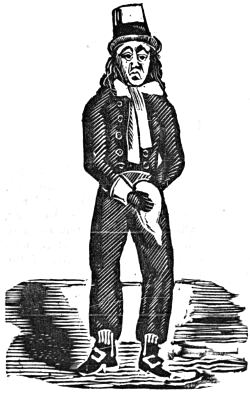
The following is the style of “gag” and “patter” of a man formerly well-known in the “Dials” as “Tragedy Bill”—“Now, my friends, here you have, just printed and published, a full, true, and pertickler account of the life, trial, character, confession, behaviour, condemnation, and hexecution of that unfortunate malefactor, Richard Wilbyforce, who was hexecuted on Monday last, for the small charge of one ha’penny, and for the most horrible, dreadful, and wicked murder of Samuel—I means Sarah Spriggens, a lady’s maid, young, tender, and handsome. You have here every pertickler, of that which he did, and that which he didn’t. It’s the most foul and horrible murder that ever graced the annals of British history(?) Here, my customers, you may read his hexecution on the fatal scaffold. You may also read how he met his victim in a dark and lonesome wood, and what he did to her—for the small charge of a ha’penny; and, further, you read how he brought her to London,—after that comes the murder, which is worth all the money. And you read how the ghost appeared to him and then to her parents. Then comes the capture of the willain; also the trial, sentence, and hexecution, showing how the ghost was in the act of pulling his leg on one side, and the ‘old gentleman’ a pulling on the other, waiting for his victim (my good friends excuse my tears!) But as Shakspeare says, ‘Murder most foul and unnatural,’ but you’ll find this more foul and unnatural than that or the t’other—for the small charge of a ha’penny! Yes, my customers, to which is added a copy of serene and beautiful werses, pious and immoral, as wot he wrote with his own blood and skewer the night after—I mean the night before his hexecution, addressed to young men and women of all sexes—I beg pardon, but, I mean classes (my friends its nothing to laugh at), for I can tell you the werses is made three of the hard-heartedest things cry as never was—to wit, that is to say namely—a overseer, a broker, and a policeman. Yes, my friends, I sold twenty thousand copies of them this here morning, and could of sold twenty thousand more than that if I could of but kept from crying—only a ha’penny!—but I’ll read the werses.
Come all you blessed Christians dear, That’s a-tender, kind, and free, While I a story do relate Of a dreadful tragedy, Which happened in London town, As you shall all be told; But when you hear the horrid deed ’Twill make your blood run cold.— For the small charge of a ha’penny! ’Twas in the merry month of May, When my true love I did meet; She look’d all like an angel bright, So beautiful and sweet. I told her I loved her much, And she could not say nay; ’Twas then I strung her tender heart, And led her all astray.— Only a ha’penny! I brought her up to London town, To make her my dear wife; But an evil spirit tempted me, And so I took her life! I left the town all in the night, When her ghost in burning fire, Saying, “Richard,” I am still with you, Whenever you retire.— Only a ha’penny! And justice follow’d every step, Though often I did cry; And the cruel Judge and Jury Condemned me for to die. And in a cell as cold as death, I always was afraid, For Sarah she was with me, Although I killed her dead.— For the small charge of a ha’penny! My tender-hearted Christians, Be warned by what I say, And never prove unkind or false To any sweet la’-dy. Though some there, who wickedness Oft leads ’em to go astray; So pray attend to what you hear. And a warning take I pray.
THE LIFE & EXECUTION OF SIR JOHN OLDCASTLE

AT THE NEW GALLOWS, AT ST. GILES’S IN THE FIELDS, ON THE 19th OF DECEMBER, 1417.

Who was Hang’d as a Traytor, and Burnt as a Heretick.
At the beginning of the reign of Henry V., about the year 1413, the anger of the clergy was excited against the Lollards, and they fabricated a report of a pretended conspiracy among them, headed by Sir John Oldcastle, or, as he was called by courtesy, Lord Cobham, in his wife’s right.
Lord Cobham has the honour of being the first author and the first martyr among the nobility of England. He was a man of considerable natural abilities, proficient in literature, of a ready wit, and skilled in the affairs of the cabinet or in the field. In his love for philosophy, he had perused the writings of Wickliffe, and in so doing unconsciously absorbed the leaven of evangelical and spiritual religion. When persuaded of the truth of those doctrines he enrolled himself as a disciple, and did all in his power for their spread, both by his gifts and personal efforts. He transcribed the works of Wickliffe; he supported various preachers, and became the acknowledged leader of the rising reformation. The hostility of the church was, of course, an inevitable result.
Sir John being convicted of heresy, the Archbishop waited upon the King, and gave him an account of the proceedings against him, and moved his Majesty that the execution might be respited for 50 days, which was readily granted by the King, as well as the Archbishops, being desirous to preserve Sir John Oldcastle.
Sir John before the fifty days expired, made his escape out of the Tower, and endeavoured to secure himself by making an insurrection. To this purpose he wrote letters to his friends, to engage their Party, and make them ready for the Field, to surprise the King, and overturn the Government.
The King being apprised of the danger, on the 6th of January, 1414, removed from Eltham to his palace at Westminster, but without any appearance of alarm. The Rebels were just upon the execution of their design, being drawn together by Sir John Acton, Knight, John Brown, Esq., and John Beverly, a priest, in Ficket-field, on the backside of St. Giles’s; hither they came in the dead of night, expecting to join their General, Sir John Oldcastle.
The King came into the field before Day, where several of the Rebels, mistaking their party, fell in with the King’s forces; and it being demanded whither they were going, they answered, to my Lord Cobham. The King, to prevent their getting together, had ordered the City Gates to be shut and guarded, without which precaution ’tis thought the Londoners would have reinforced their party to a very formidable body, but being disappointed of this succour they soon dispersed, and several of them were killed or taken prisoners. And the King set a thousand Marks upon Sir John Oldcastle’s head, with a promise of great Privileges to any town that should deliver him up. An Indictment of High Treason was found against Sir John in the King’s Bench, for conspiring the Death of the King, the Subversion of the Established Religion and Government, and Levying War, whereupon he was outlawed.
Sir John Oldcastle was near being surprised in the neighbourhood of St. Alban’s, at a farmhouse belonging to the Abbot of that town, anno 1417; for the Abbot being informed Sir John lay concealed at one of his Tenants, sent some of his servants, in the night, to beset the house, and though they missed of Sir John, they seized some of the principal men of his party. They found also several religious Books, adorned with paintings, which the Lollards esteeming superstitious, cut off the Heads of the Figures, and also erased the Names of the Saints out of the litanies; they also found scandalous Papers in Dishonour of the blessed Virgin. These Books were sent over to the King into Normandy, and by him returned to the Archbishop.
Upon the occasion the Lollards were loudly disclaimed against at St. Paul’s Cross, and a tragical Representation made of the Matter, and not long after Sir John Oldcastle was taken in Powis Lands in Wales. He stood upon his Defence, fought those that came to apprehend him, and refused to surrender his Person till he was wounded and disabled.
Sir John Oldcastle having been outlawed upon an Indictment for High Treason, for that he with divers others called Lollards, to the number of Twenty Thousand, had assembled themselves at St. Giles’s in the Fields, levyed War, and conspired the Death of the King and the Subversion of the Religion and Government established, and standing also excommunicated for Heresy, he was brought before the Parliament on the 18th of December, 1417, and it being demanded what he had to say why Execution should not be awarded against him according to Law, he ran out into a Discourse foreign to the matter, concerning the Mercy of God, &c., whereupon the Chief Justice required him to answer directly, if he had anything to object against the Legality of the Process; he replyed, he could not own them for his judges, as long as his Sovereign Lord King Richard was living in Scotland. Upon this Answer a Rule was made for his Execution, viz., That he should be carried back to the Tower, and from thence drawn through London to the New Gallows at St. Giles’s in the Fields, and there be hanged, and burnt hanging, which Sentence was executed with Rigour. He was hanged as a Traytor, and burnt as a Heretick.
The DYING SPEECHES and EXECUTION of John Ballard, priest; Anthony Babington, Esq.; John Savage, Gent.; Robert Barnwell, Gent.; Chidiock Titchborne, Esq.; Charles Tilney and Edward Abington, Gent. (Seven of the Conspirators against Queen Elizabeth) for High Treason
On the 20th of September, 1586, a Gallows being set up on purpose in St. Giles’s Fields, where they us’d to meet, these seven were drawn thither to their Execution.
John Ballard, the Priest, the principal Conspirator, confess’d, that he was guilty of those things for which he was condemned, but protested they were never enterprised by him upon any hope of preferment, but only, as he said, for the advancement of true Religion. He craved pardon and forgiveness of all persons, to whom his doings had been any scandal, and so made an end; making his prayers to himself in Latin, not asking her Majesty forgiveness, otherwise than if he had offended.
Anthony Babington, Esq., also confessed, That he was come to die, as he had deserved; howbeit that he (as Ballard before) protested that he was not led into those actions upon hope of preferment, or for any temporal respect; nor had ever attempted them. For his wife, he said, she had good friends, to whose consideration he would leave her: And thus he finished, asking Her Majesty forgiveness, and making his prayers in Latin.
John Savage, Gent., confessed his guilt, and said (as the other two before) that he did attempt it, for that in conscience he thought it a deed meritorious, and a common good to the weal publick, and for no private preferment.
Robert Barnwell, Gent, confessed that he was made acquainted with their Drifts, but denied that ever he consented, or could be in conscience persuaded that it was a deed lawful. I crave forgiveness; if the sacrifice of my body might establish her Majesty in the true religion, I would most willingly offer it up. Then he prayed to himself in Latin.
Chidiock Titchbone, Esq., began to speak as followeth, viz., Countrymen and my dear Friends, you expect I should speak something; I am a bad Orator, and my text is worse: It were in vain to enter into the discourse of the whole matter for which I am brought hither, for that it hath been revealed heretofore, and is well known to the most of this company; let me be a warning to all young gentlemen, especially generosis adolescentulis. I had a friend, and a dear friend, of whom I made no small account, whose friendship hath brought me to this; he told me the whole matter, I cannot deny, as they had laid it down to be done; but I always thought it impious, and denied to be a dealer in it; but the regard of my friend caused me to be a man in whom the old proverb was verified; I was silent, and so consented. Before this thing chanced, we lived together in most flourishing estate; of whom went report in the Strand, Fleet street, and elsewhere about London, but of Babington and Titchbone? No threshold was of force to brave our entry. Thus we lived, and wanted nothing we could wish for; and God knows, what less in my head than matters of State? Now give me leave to declare the miseries I sustained after I was acquainted with the action, wherein I may justly compare my estate to that of Adam’s, who could not abstain one thing forbidden, to enjoy all other things the world could afford; the terror of conscience awaited me. After I consider’d the dangers whereinto I was fallen, I went to Sir John Peters, in Essex, and appointed my horses should meet me at London, intending to go down into the country. I came to London, and there heard that all was bewrayed; whereupon, like Adam, we fled into the woods to hide ourselves, and there were apprehended. My dear countrymen, my sorrows may be your joy, yet mix your smiles with tears, and pity my case. This done, he prayed first in Latin, and then in English, asking Her Majesty, and all the world, heartily, forgiveness, and that he hoped, stedfastly, now at this his last hour, his faith would not fail.
Charles Tilney said, I am a Catholick, and believe in Jesus Christ, and by his Passion I hope to be saved; and I confess I can do nothing without him, which opinion all Catholicks firmly hold. He prayed in Latin for himself, and after he prayed for Queen Elizabeth, that she might live long; and warned all young gentlemen, of what degree or calling soever, to take warning by him.
Edward Abington said, I come hither to die, holding all points firmly that the Catholick Church doth; and for the matters whereof I am condemned, I confess all, saving the death of Her Majesty, to the which I never consented. He feared, as he said, great bloodshed in England before it were long.
Ballard was first executed. He was cut down and bowell’d with great cruelty while he was alive. Babington beheld Ballard’s execution without being in the least daunted; whilst the rest turned away their faces, and fell to prayers upon their knees. Babington being taken down from the gallows alive too, and ready to be cut up, he cried aloud several times in Latin. Parce mihi Domine Jesu, spare or forgive me O Lord Jesus! Savage broke the rope, and fell down from the gallows, and was presently seized on by the Executioner, his privities cut off, and his bowels taken out while he was alive. Barnwell, Titchborne, Tilney, and Abington were executed with equal cruelty.
The DYING SPEECHES and EXECUTION of Thomas Salisbury, Henry Donn, Edward Jones, John Charnock, John Travers, Robert Gage, Jerome Bellamy, for High Treason, the 21st of September, 1586. Being drawn to the place of Execution.
Thomas Salisbury, Esq., since it hath pleased God to appoint this place for my end, I thank his infinite goodness for the same; I confess that I have deserved death, and that I have offended her Majesty, whom to forgive me I heartily beseech, with all others whom I have any way offended; I desire all true Catholicks to pray for me, and I desire them, as I beseech God they may, to endure with patience whatsoever shall be laid upon them, and never to enter into any action of violence for remedy. Thus done, he cried in English and Latin, Father, forgive me.
Henry Donn, Yeoman, said, Do the people expect I should say anything? I was acquainted, I confess, with their practices, but I never did intend to be a dealer in them: Babington oftentimes requested me to be one, and said, for that he loved me well, he would bestow me in one of the best actions; which should have been the delivery of the Queen of Scots, to which I could not for a long time agree; at length, by many urgent persuasions he won me, so as I told him I would do my best: And being asked, as he was ascending the ladder, whether he thought it lawful to kill her Majesty: He answered, No, no. No soul was more sorrowful than his, nor none more sinful; and prayed for her Majesty, wishing she might live in all happiness, and after this life, be eternized in everlasting bliss; and so he prayed in Latin and English.
Edward Jones said, I come hither to die, but how rightfully God knows; for thus stands my case: At Trinity Term last, Mr Salisbury made me acquainted with their purposes; and for that he knew me to be well horsed, he thought me as fit as any to attempt the delivery of the Queen of Scots, and requested me to be one; which I utterly denied, altogether misliking their practices, and persuading him, by what means I might, from it; and told him, this was the haughty and ambitious mind of Anthony Babington, which would be the destruction of himself and friends, whose company I wished him to refrain; and for that I would have him out of his company; I have divers times lent him money, and pawned my chain and jewels to buy him necessaries to go into the country, and so concluded with his prayers, first in Latin, and then in English, that the people might better understand what he prayed.
John Charnock and John Travers having their minds wholly fixt on prayer, recommended themselves to God and the Saints. Gage extolled the Queen’s great grace and bounty to his father, and detested his own perfidious ingratitude towards his Princess. And Jerome Bellamy, with confusion and deep silence, suffered last.
The Queen being informed of the severity used in the executions the day before, and detesting such cruelty, gave express orders that these should be used more favourably; and accordingly they were permitted to hang till they were quite dead before they were cut down and bowell’d.
THEIR CHARACTERS.
The Conspirators were most of them gentlemen of good families, whom nothing but the specious pretence of religion could probably have prevailed upon to turn affairs.
THE EXECUTION OF BALLARD, &c.
The history of the plot in which Ballard, Babbington, Tichbourne, and others, were engaged in 1586, is well known. The subsequent ballad, by the celebrated Thomas Deloney, (his initials T.D. being at the conclusion of it) was no doubt printed immediately after the execution of the “fourteen most wicked traitors,” on the 20th and 21st September. At the top of the broadside are woodcuts of fourteen heads, but they are not likenesses, but merely engravings which the printer happened to have in his possession, and which had been already used for Hill’s work on Physiognomy, and perhaps for other publications requiring illustrations.——[1]
A proper new Ballad, breefely declaring the Death and Execution of 14 most wicked Traitors, who suffered death in Lincolnes Inne Fielde, neere London: the 20 and 21 of September, 1586.
TO THE TUNE OF “WEEP, WEEP.”
Rejoyce in hart, good people all, Sing praise to God on hye, Which hath preserved us by his power From traitors tiranny; Which now have had their due desarts, In London lately seen; And Ballard was the first that died, For treason to our Queene. O praise the Lord with hart and minde, Sing praise with voices cleare; Seth traitorous crue, have had their due To quaile their partener’s cheere. Next Babington, that caitife vilde, Was hanged for his hier; His carcasse likewise quartered, And hart cast in the fier. Was ever seen such wicked troopes Of traytors in this land, Against the pretious woord of truthe, And their good Queene to stand? Oh praise, &c. But heer beholde the rage of Rome, The fruits of Popish plants; Beholde and see their wicked woorks, Which all good meaning wants: For Savage also did receave Like death for his desert, Which in that wicked enterprise Should then have doon his part. O praise, &c. O cursed catifes, void of grace, Will nothing serve your turne, But to behold your cuntries wrack, In malice while you burne? And Barnwell thou, which went to view Her grace in each degree, And how her life might be dispatcht, Thy death we all did see. O praise, &c. Confounding shame fall to their share, And hellish torments sting, That to the Lords annointed shall Devise so vile a thing. O Techburne, what bewitched thee To have such hate in store, Against our good and gratious Queene, That thou must dye therefore? O praise, &c. What gaine for traitors can returne, If they their wish did win? Or what preferment should they get, By this their trecherous sinne? Though forraine power love treason well, The traitors they dispise, And they the first that should sustaine The smart of their devise O praise, &c. What cause had Tilney, traitor stout, Or Abbington likewise, Against the Lords annointed thus Such mischeef to devise? But that the Devill inticed them Such wicked woorks to render; For which these seven did suffer death, The twentith of September. O praise, &c. Seven more the next day following Were drawen from the Tower, Which were of their confederates To dye that instant hower: The first of them was Salsburie, And next to him was Dun, Who did complaine most earnestly Of proud young Babington. O praise, &c. Both lords and knights of hye renowne He ment for to displace, And likewise all the towers and townes And cities for to race; So likewise Jones did much complaine Of his detested pride, And shewed how lewdly he did live Before the time he died. O praise, &c. Then Charnock was the next in place To taste of bitter death; And praying unto holy saints, He left his vitall breath. And in like maner Travers then Did suffer in that place, And fearfully he left his life, With crossing brest and face. O praise, &c. Then Gage was stripped in his shirt, Who up the lather went, And sought for to excuse him selfe Of treasons falce intent. And Bellamie the last of all Did suffer death that daye; Unto which end God bring all such As wish our Queenes decay. O praise, &c. O faulce, and foule disloyall men, What person would suppose That clothes of velvet and of silke Should hide such mortall foes? Or who would think such hidden hate In men so fair in sight, But that the Devill can turne him selfe Into an angell bright. O praise, &c. But soveraigne Queene, have thou no care, For God, which knoweth all, Will still maintaine thy royall state, And give thy foes a fall. And for thy Grace thy subjects all Will make their praiers still, That never traitor in this land May have his wicked will. O praise, &c. Whose glorious daies in England heere The mighty God maintaine, That long unto thy subjects joye Thy Grace may rule and raigne. And, Lord, we pray, for Christes sake, That all thy secret foes May come to naught, which seeke thy life And Englands lasting woes. O praise the Lord with hart & minde, &c.
The names of 7 Traitors which were executed on Tuesday, being the xx of September, 1586.
John Ballard Preest. Anthony Babington. John Savage. Robert Barnwell. Chodicus Techburne. Charles Tilney. Edward Abbington.
The names of the other vii which were executed on the next day after.
Thomas Salsbury. Henry Dun. Edward Jhones. John Travers. John Charnock. Robert Gage. Harman Bellamy.
Finis. T.D.
Imprinted at London at the Long Shop adjoyning unto Saint Mildreds Churche in the Pultrie by Edward Allde.
THE EXECUTION OF LUKE HUTTON.
A tract by Luke Hutton, of which there were two editions, the first without date, and the last in 1638, is very well known, and an account of it may be found in the Bridgewater Catalogue, (privately printed for Lord Francis Egerton) p. 149. Hence it appears also that Hutton was the author of an earlier production, called his “Repentance.” He seems to have been a highwayman and house-breaker, who, being condemned and pardoned, dedicated an affected piece of contrition to Lord Chief Justice Popham; and on subsequent liberation, returned to his old courses, and was hanged at York in 1598. Whether what follows, or indeed anything that goes under his name, were really written by him is very questionable.[1]
Luke Hutton’s Lamentation: which he wrote the day before his death, being condemned to be Hanged at Yorke this last Assises for his robberies and trespasses committed.
TO THE TUNE OF “WANDERING AND WAVERING.”
I am a poore prisoner condemned to dye, Ah woe is me, woe is me, for my great folly! Fast fettred in yrons in place where I lie. Be warned yong wantons, hemp passeth green holly. My parents were of good degree, By whom I would not counselled be. Lord Jesu forgive me, with mercy releeve me, Receive, O sweet Saviour, my spirit unto thee. My name is Hutton, yea Luke of bad life, Ah woe is me, woe is me, for my great folly! Which on the high way did rob man and wife, Be warned yong wantons, &c. Inticed by many a gracelesse mate, Whose counsel I repent too late. Lord, &c. Not twentie yeeres old, alas, was I, Ah woe is me, woe is me, &c., When I begun this fellonie. Be warned yong wantons, &c. With me went still twelve yeomen tall, Which I did my twelve Apostles call. Lord, &c. There was no squire nor barron bold, Ah woe is me, woe is me, for my great folly! That rode the way with silver or gold, Be warned yong wantons, &c. But I and my twelve Apostles gaie Would lighten their load ere they went away. Lord, &c. This newes procured my kins-folkes griefe, Ah woe is me, woe is me! They hearing I was a famous theefe, Be warned yong wantons. They wept, they wailde, they wrong their hands, That thus I should hazard life and lands. Lord, &c. They made me a jaylor a little before, Ah woe, &c. To keep in prison offenders store; Be warned, &c. But such a jaylor was never none, I went and let them out everie one. Lord, &c. I wist their sorrow sore grieved me, Ah, woe is me, &c. Such proper men should hanged be, Be warned yong, &c. My office ther I did defie, And ran away for company. Lord, &c. Three yeeres I lived upon the spoile, Ah woe is me, &c. Giving many a carle the foile, Be warned yong, &c. Yet never did I kil man nor wife, Though lewdly long I led my life. Lord, &c. But all too bad my deedes hath been, Ah woe is me, &c. Offending my country and my good queene, Be warned yong, &c. All men in Yorke-shire talke of me; A stronger theefe there could not be. Lord, &c. Upon S. Lukes day was I borne, Ah woe, &c. Whom want of grace hath made a scorne, Be war, &c. In honor of my birth day then, I robd in a bravery nineteen men. Lord, &c. The country weary to beare this wronge, Ah woe is me, &c. With huse and cries pursude me long, Be war, &c. Though long I scapt, yet loe at last, London, I was in Newgate cast. Lord, &c. There did I lye with a grieved minde, Ah woe is me, &c. Although the keeper was gentle and kinde, Be warned yong, &c. Yet was he not so kinde as I, To let me be at libertie. Lord, &c. At last the shiriffe of Yorke-shire came, Ah woe is me, &c. And in a warrant he had my name. Be warned yong, &c. Said he at Yorke thou must be tride, With me therefore hence must thou ride. Lord, &c. Like pangues of death his words did sound: Ah woe is me, &c. My hands and armes full fast he bound. Be warned, &c. Good sir, quoth I, I had rather stay, I have no heart to ride that way. Lord, &c. When no entreaty might prevaile, Ah woe is me, &c. I calde for beere, for wine and ale; Be warned, &c. And when my heart was in wofull case, I drunke to my friends with a smiling face. Lord, &c. With clubs and staves I was garded then; Ah woe is me, &c. I never before had such waiting men; Be warned, &c. If they had ridden before amaine, Beshrew me if I had cald them againe. Lord, &c. And when into Yorke that I was come, Ah, &c. Each one on me did passe their doome; Be war, &c. And whilst you live this sentence note, Evill men can never have good report. Lord, &c. Before the judges when I was brought, Ah woe is me, &c. Be sure I had a carefull thought, Be, &c. Nine score inditements and seaventeene Against me there was read and seene. Lord, &c. And each of these was fellony found, Ah woe is me, &c. Which did my heart with sorrow wound, Be, &c. What should I heerein longer stay, For this I was condemned that day. Lord, &c. My death each houre I do attend; Ah woe is me. In prayer and tears my time I spend: Be, &c. And all my loving friends this day I do intreate for me to pray. Lord, &c. I have deserved long since to die: Ah woe, &c. A viler sinner livde not then I, Be, &c. On friends I hopte my life to save, But I am fittest for my grave. Lord, &c. Adue my loving friends, each one: Ah woe is me, woe is me, for my great folly! Thinke on my words when I am gone. Be warned yong wantons, &c. When on the ladder you shall me view, Thinke I am neerer heaven then you. Lord, &c. Finis. Hutton.
Printed at London for Thomas Millington. 1598.
EXECUTION OF THE CONSPIRATORS.
On Thursday, the 30th of January, 1605, Sir Everard Digby, Robert Winter, John Grant, and Thomas Bates, were executed at the West End of St. Paul’s; and the next day, January 31, Thomas Winter, Ambrose Rookwood, Robert Keyes, and Guido Fawkes, were executed in the Old Palace Yard, over against the Parliament House, Westminster, Conspirators in the Powder Plot.
The prisoners, after their condemnation and judgment, being sent back to the Tower, remained there till the Thursday following, on which day four of them, viz., Sir Everard Digby, Robert Winter, John Grant, and Thomas Bates, were drawn upon sledges and hurdles to a scaffold erected at the western end of St. Paul’s churchyard. Great pains were taken in the city to render the spectacle of the execution as imposing as possible, Among other arrangements made in order to be prepared against any popular tumult, a precept issued from the Lord Mayor to the Alderman of each ward in the city, requiring him to “cause one able and sufficient person, with a halbard in his hand, to stand at the door of every several dwelling-house in the open street in the way that the traitors were to be drawn towards the place of execution; there to remain from seven in the morning until the return of the Sheriff.”
Now these four above-named being drawn to the scaffold, made on purpose for their execution, first went up Digby, a man of goodly personage, and a manly aspect; yet might a wary eye, in the change of his countenance, behold an inward fear of death, for his colour grew pale and his eye heavy; notwithstanding that he enforced himself to speak, as stoutly as he could. His speech was not long, and to little good purpose, only, that his belied conscience being but indeed a blinded conceit, had led him into this offence, which in respect of his religion, alias indeed idolatry, he held no offence, but, in respect of the law, he held an offence, for which he asked forgiveness of God, of the King, and the whole kingdom; and so, with vain and superstitious crossing of himself, betook him to his Latin prayers, mumbling to himself, refusing to have any prayers of any but of the Romish Catholics: went up the ladder, and with the help of the hangman, made an end of his wicked days in this world.
After him went Winter up the scaffold, where he used few words to any effect, without asking mercy of either God or the King for his offences; went up the ladder, and, making a few prayers to himself, staid not long for his execution.
After him went Grant, who abominably blinded with his horrible idolatry, though he confessed his offence to be heinous, yet would fain have excused it by his conscience for religion; a bloody religion, to make so bloody a conscience; but better that his blood, and all such as he was, should be shed by the justice of the law, than the blood of many thousands to have been shed by his villainy, without law or justice. Having used a few idle words to ill effect, he was, as his fellows before him, led to the halter; and so, after his crossing of himself, to the last part of his tragedy.
Last of them came Bates, who seemed sorry for his offence, and asked forgiveness of God and the King, and of the whole kingdom; prayed to God for the preservation of them all, and, as he said, only for his love to his master, drawn to forget his duty to God, his King, and country, and therefore was now drawn from the Tower to St. Paul’s churchyard, and there hanged and quartered for his treachery. Thus ended that day’s business.
The next day, being Friday, were drawn from the Tower to the old palace in Westminster, over against the Parliament House, Thomas Winter the younger brother, Ambrose Rookwood, Robert Keyes, and Guido Fawkes, the miner, justly called “the Devil of the Vault;” for had he not been a devil incarnate, he had never conceived so villainous a thought, nor been employed in so damnable an action. Winter first being brought to the scaffold made little speech, but seeming, after a sort, as it were, sorry for his offence, and yet crossing himself, as though those were words to put by the devil’s stoccadadoes, having already made a wound in his soul; of which he had not yet a full feeling, protesting to die a true Catholic, as he said; with a very pale and dead colour went up the ladder, and after a swing or two with a halter, to the quartering-block was drawn, and there quickly despatched.
Next him came Rookwood, who made a speech of some longer time, confessing his offence to God in seeking to shed blood, and asking therefore mercy of his Divine Majesty;—his offence to the King, of whose majesty he likewise humbly asked forgiveness, and his offence to the whole state, of whom in general he asked forgiveness; beseeching God to bless the King, the Queen, and all his royal progeny, and that they might long live to reign in peace and happiness over this kingdom. But last of all, to spoil all the pottage with one filthy weed, to mar this good prayer with an ill conclusion, he prayed God to make the King a Catholic, otherwise a Papist, which God for his mercy ever forbid; and so beseeching the King to be good to his wife and children, protesting to die in his idolatry, a Romish Catholic, he went up the ladder, and, hanging till he was almost dead, was drawn to the block, where he gave his last gasp.
After him came Keyes, who like a desperate villain, using little speech, with small or no show of repentance, went stoutly up the ladder, where, not staying the hangman’s turn, he turned himself off with such a leap, that with the swing he brake the halter, but, after his fall, was drawn to the block, and there was quickly divided into four parts.
Last of all came the great devil of all, Fawkes, alias Johnson, who should have put fire to the powder. His body being weak with torture and sickness, he was scarce able to go up the ladder, but yet, with much ado, by the help of the hangman, went high enough to break his neck with the fall; who made no long speech, but after a sort, seeming to be sorry for his offence, asked a kind of forgiveness of the King and the state for his bloody intent; and with his crosses and idle ceremonies, made his end upon the gallows and the block, to the great joy of the beholders, that the land was ended of so wicked a villainy.
EXECUTION of Sir WALTER RALEIGH, Knight, at Westminster, on the 29th of October, Anno 16o, Jacobi Regis, 1618.
Upon Wednesday, the 28th of October, anno dom. 1618, the Lieutenant of the Tower, according to a warrant to him directed, brought Sir Walter Raleigh from the Tower to the King’s Bench Bar at Westminster, where the record of his arraignment at Winchester was opened, and it was demanded why execution should not be done upon him according to law.
He began, in way of answer, to justify his proceedings in the late voyage.
But the Lord Chief Justice told him, That he was therein deceived, and that the opinion of the Court was to the contrary.
Master Attorney General, requiring in the King’s behalf, that execution might be done on the prisoner, according to the aforesaid judgment: the Sheriffs of Middlesex were commanded for that purpose to take him into their custody, who presently carried him to the Gatehouse.
From whence, the next morning, between the Sheriffs of Middlesex, Sir Walter Raleigh was brought to the old Palace Yard in Westminster, where a large scaffold was erected for the execution.
Whereupon, when he came, with a chearful countenance, he saluted the Lords, Knights, and gentlemen there present.
After which, a proclamation was made for silence, and he addressed himself to speak in this manner.
I desire to be borne withal, for this is the third day of my fever, and if I shall shew any weakness, I beseech you to attribute it to my malady, for this is the hour in which it is wont to come.
Then pausing a while, he sat, and directed himself towards a window, where the Lord of Arundel, Northampton, and Doncaster, with some other Lords and Knights, sate, and spake as followeth:
I thank God, of his infinite goodness, that he hath brought me to die in the light, and not in darkness; (But by reason that the place where the Lords, &c., sat, was some distance from the scaffold, that he perceived they could not well hear him, he said) I will strain my voice, for I would willingly have your honours hear me.
But my Lord of Arundel said, nay, we will rather come down to the scaffold, which he and some others did.
Where being come, he saluted them severally, and then began again to speak as followeth, viz.
As I said, I thank God heartily, that he hath brought me into the light to die, and that he hath not suffer’d me to die in the dark prison of misery and cruel sickness; and I thank God that my fever hath not taken me at this time, as I prayed to God it might not.
Then a proclamation being made, that all men should depart the scaffold, he prepared himself for death: giving away his hat, his cap, with some money, to such as he knew that stood near him.
And then putting off his doublet and gown, he desired the Headsman to shew him the Ax; which not being suddenly granted unto him, he said, I prithee let me see it, dost thou think that I am afraid of it? so it being given unto him, he felt along upon the edge of it, and smiling, spake unto Mr. Sheriff, saying, this is a sharp medicine, but it is a physician that will cure all diseases.
Then going to and fro upon the scaffold one very side, he intreated the company to pray to God to give him strength.
Then having ended his speech, the Executioner kneeled down and asked him forgiveness, which laying his hand upon his shoulder he gave him.
Then being asked which way he would lay himself on the block, he made answer, and said, so the heart be straight, it is no matter which way the head lieth; so laying his head on the block, his face being towards the east, the Headsman throwing down his own cloak, because he would not spoil the prisoner’s gown, he giving the Headsman a a sign when he should strike, by lifting up his hands, the Executioner struck off his head at two blows, his body never shrinking nor moving; his head was shewed on each side of the scaffold, and then put into a red leather bag, and his wrought velvet gown thrown over it, which was afterwards conveyed away in a mourning coach of his lady’s.
The EXECUTION of SIR THOMAS ARMSTRONG, A TRAYTOR, AT TYBURN, On FRIDAY, the Twentieth of June, 1684.

The Sheriffs of London and Middlesex, about nine o’clock in the morning, coming to Newgate, and demanding their prisoner, he was forthwith delivered to them, and put into a sledge, and drawn to the place of execution, attended by a numerous guard, and as great a number of spectators, of all degrees and qualities, as have been seen on such occasions. Tho’ he affected an air of courage, yet something of sullenness and reserve appeared in his countenance.
He employed the time he was drawing to Tyburn in reading The Whole Duty of Man, till he came within sight of the gallows, and then he laid it by, and with lifted up hands and eyes, addressed himself to Heaven, till he came beneath the tree, where he remained about a quarter of an hour in the sledge; before he ascended the cart that stood ready for him, he desired the Sheriff to admit Dr. Tenison to come to him; and having delivered a paper to the Sheriff, the Doctor kneeled down with the prisoner, and prayed with him about a quarter of an hour, during all which time the prisoner preserved a becoming and heroick countenance, little daunted with the terror of that fate he was in view of; but rising from his devotions, he pulled off his cravat and hat, which he gave to his servant who attended him, and had followed him by the sledge-side, when kneeling down himself, he prayed for a short time with fervency and devotion, begging pardon of his God for those manifold and crying sins he had been too often guilty of, and concluded with a resignation of himself to the God of heaven and earth, before whose judgment seat he was forthwith to appear, desiring that the whole world would forgive him, with whom he hoped to die in peace and charity. Having thus ended these devotions, he again stood up, and putting off his periwig, he had a white cap delivered to him, which he put on; and being soon ty’d up, the chief of his discourse was addressed to a gentleman who stood by him; and after a short space, holding up his hands, he again renewed his prayers; his visage little changing all the the time, till the very moment the cart drew away; the Executioner having pulled the cap over his eyes, he continued his prayers all the time, and even whilst he hung, as long as life was in him, and he had the command of his lips; after he had hung about half an hour, and the Executioner had divested him of his apparel, he was cut down according to his sentence, his privy members burnt, his head cut off, and shew’d to the people as that of a traitor, his heart and bowels taken out and committed to the flames, and his body quartered into four parts, which, with his head, was convey’d back to Newgate, to be dispos’d of according to his Majesty’s pleasure.
LIFE, TRIAL, & EXECUTION OF WILLIAM NEVISON, THE HIGHWAYMAN, AT YORK GAOL.
William Nevison, the great robber of the north, was born at Pomfret in Yorkshire, 1639, and his parents being in good circumstances, conferred upon him a decent education. But he was badly disposed, and commenced his depredations by stealing cash to the amount of £10 from his own father, then, taking a saddle and bridle, hastened to the paddock and stole his schoolmaster’s horse, and rode with all speed towards London. About a mile or two from the capital he cut the throat of the poor horse, for fear of detection. Arrived in London he changed his name and clothes, and commenced his wild career which at length brought him to an untimely end.
In all his exploits, Nevison was tender to the fair sex, and bountiful to the poor. He was also a true loyalist, and never levied any contributions upon the Royalists. His life was once spared by the royal clemency. He then returned home, and remained with his father until the day of his death. But soon after returned to his former courses, his name became the terror of every traveller on the road. He levied a quarterly tribute on all the northern drovers, and in return not only spared them himself, but protected them against all other thieves, and the carriers who frequented the road willingly agreed to leave certain sums at such places as he appointed, to prevent their being stripped of them all.
After committing a robbery in London, about sunrise, he rode his mare to York in the course of the day, and appeared upon the bowling green of that city before sunset. From this latter circumstance, when brought to trial for the offence, he established an alibi to the satisfaction of the jury, though he was in reality guilty. At length his crimes became so notorious, that a reward was offered to any that would apprehend him. This made many waylay him, especially two brothers named Fletcher, one of whom Nevison shot dead. But though he escaped for a time, he was afterwards apprehended in a public-house at Sandal-three-houses, near Wakefield, by Captain Milton, sent to York gaol, where on the 15th of March, 1685, he was tried, condemned, and executed, aged forty-five.

BOLD NEVISON, the HIGHWAYMAN.
Did you ever hear tell of that hero, Bold Nevison that was his name? He rode about like a bold hero, And with that he gained great fame. He maintained himself like a gentleman, Besides he was good to the poor; He rode about like a bold hero, And he gain’d himself favour therefore. Oh the Twenty-first day of last month, Proved an unfortunate day; Captain Milton was riding to London, And by mischance he rode out of his way. He call’d at Sandal-Houses by the road-side, The one known by the sign of the Magpie, There Nevison he sat a drinking, And the Captain soon he did spy. Then the captain did very soon send for, And a constable very soon came; With three or four men in attendance, With pistols charged in the King’s name. They demanded the name of this hero, “My name it is Jobsons,” said he, When the captain laid hold by his shoulder, Saying, “Will Nevison thou goeth with me.” Oh! then in this very same speech, They hastened him fast away, To a place called Swannington bridge, A place where he used to stay. They call’d for a tankard of good liquor, It was the sign of the Black Horse, Where there was all sorts of attendance, But for Nevison it was the worst. He call’d for a pen, ink, and paper, And these were the words that he said: “I’ll write for some boots, shoes, and stockings, For of them I have very much need.” ’Tis now before my lord judge, Oh! guilty or not do you plead; He smiled unto the judge and jury, And these were the words that he said. “I never robb’d a gentleman of twopence, But what I gave half to be blest, But guilty I’ve been all my life time, So gentleman do as you list. “It’s when that I rode on the highway, I’ve always had money in great store, And whatever I took from the rich, I freely gave to the poor. “But my peace I have made with my Maker, And to be with Him I’ready to draw; So here’s adieu! to this world and its vanities, For I’m ready to suffer the law.”
THE TRIAL & EXECUTION OF JAMES LOWRY, By the High Court of Admiralty, at the Old Bailey, on the 18th day of February, 1752, and the SESSIONS GAOL DELIVERY.

James Lowry was put to the bar and arraigned on an indictment which set forth that he, James Lowry, late commander of the merchant ship Molly, did, on the 24th day of December, in the 24th year of the reign of his present Majesty, on board the said ship Molly, in latitude 49 degrees, 50 minutes, cruelly and violently assault, strike, and beat Kenith Hossick, a mariner, on board the said ship, with a rope the thickness of one inch and a half, over the back, loins, shoulders, head, face, and temples; of which beatings, wounds, and bruises he instantly died. To which indictment the prisoner pleaded not guilty, and put himself upon his country for his trial. To prove which several witnesses were called. After which the prisoner was informed that now was his time to make his defence.
The prisoner then said he had no witnesses as to the fact, but that he thought the log-book would sufficiently support what he had said in his defence, as that the witnesses who had been produced against him had sworn with halters about their necks, in order to screen themselves from their wicked acts of mutiny and piracy, well knowing that if he escaped they must be hanged. And then called several persons to his character; who gave him that of a quiet, humane, good-natured man.
The witnesses being all examined, the judge very impartially summed up the evidence, and gave a most excellent and learned charge to the jury, who withdrew, and in about half an hour returned with a verdict, finding the prisoner “Guilty,” DEATH.
THE SESSIONS GAOL DELIVERY.
On the 19th began the sessions of goal delivery at the same place, and continued till Wednesday, when the following malefactors received sentence of death: James Hays, Richard Broughton, and James Davis, for street robbery; John Powney, for house-breaking; Bernard Angua, Thomas Fox, and Thomas Gale, for forging a note of twenty-four guineas; Ann Lewis, for forging a seaman’s power of attorney; Antonio de Rosa, for the murder of Mr. Fargues, at Hoxton; Joseph Gerardino, for the murder of Christopher Alboni; Thomas Huddle, for returning from transportation; John Andrews, for forgery; and Ann Wilson, for the murder of Ann Ellard.
THE EXECUTION.
On the 25th Capt. Lowry was executed at Execution Dock, pursuant to his sentence in the High Court of Admiralty, upon which occasion was the greatest concourse of spectators that ever was known; and though some of the meanest of the populace were ignorant and impudent enough to insult him as he was carried through the streets in a cart, he behaved with great temper, composure of countenance, and with a manly as well as Christian courage. He declared himself innocent of any intention of murder: said that he had just reason to punish the person for whose death he was to suffer; and that he gave no more than five or six stripes at the most, with the end of a rope; and that he believed his death was occasioned by drinking excessively of rum just before he ordered him to be tied up. On the place from whence he was turned off, he asked the officer in waiting, “If he had not a reprieve for him?” and said he forgave his enemies. His body was carried directly down the water and hung upon a gibbet in the gallions below Woolwich, on the river Thames.
THE TRIAL, CONFESSION, AND EXECUTION OF JOHN SWAN AND ELIZABETH JEFFRYES,
Who were found guilty at Chelmsford Assizes for the murder of Mr. Joseph Jeffryes, at Walthamstow, in Essex, on the 3rd of July, 1752.
THE TRIAL.
On Tuesday, March 10th, 1752, at the Assizes at Chelmsford, a bill of indictment was found by the Grand Jury for petit treason, against John Swan, for the cruel and wicked murder of his late master, Mr Joseph Jeffryes, of Walthamstow, in the county of Essex, and against Elizabeth Jeffryes, spinster, niece of the deceased, for being, aiding, helping, abetting, assisting, comforting, and maintaining him, the said John Swan, to commit the said murder.—GUILTY DEATH.
THE CONFESSION
On Thursday, the day after her conviction, Miss Jeffryes made a confession, That what Mathews had swore was true, except that part of his being in the house at the time the pistol went off: And that she had had this murder in her thoughts for two years past, but never had a proper opportunity of getting it executed before, till she engaged Swan, and together with Swan, she offered Mathews money to execute it, who agreed to do it; that upon the night the murder was committed, it was agreed between Swan and her, that they should both go up to their chambers, as if they were going to bed, and as soon as the maid had locked her door, and was supposed to be in bed, Miss Jeffryes came out of her own room and went to Swan’s, and said, “Holloh! are you awake?” he answered, “Yes,” and he was not undressed; then she went into her uncle’s room to see if he was asleep, and took a silver tankard, a silver cup, and some silver spoons, from off a chest of drawers in the deceased’s room; then she and Swan went down stairs, and Swan took out a new sack from under the stairs, and she and Swan put the plate, and some pewter and brass which they took off the shelves in the kitchen, into the sack, till she said, I can do no more. Swan and she then drank each a large dram of brandy; then she went upstairs into her own chamber, where it was agreed she should undress herself, and lie till a signal was given by a knock at her door or wainscot, that her uncle was murder’d, then she was to open her window, and cry out, “Diaper! fire and thieves,” to alarm the neighbourhood. She farther says, she accidentally fell asleep as soon almost as in bed; but on a sudden was waked by some noise in a fright, when she laid and listen’d, and heard a violent breathing or gasping, as if somebody was under a difficulty in drawing their breath; then she concluded her uncle was murder’d; and then open’d her window, and made the agreed alarm; directly after which she came down stairs, and Swan let her out of the street door in her shift, when she ran to Mrs Diaper’s door, in the same court-yard; Swan then shut the street-door, and as soon as he heard the neighbours were coming, and thought a sufficient alarm was made, he opened the street-door again in his shirt, and run out as if he was just come out of bed in a fright. She further says, that previous to the excuting this diabolical design, they had taken care to cut the wire of the bell on tke outside, which went from the master’s to the maid’s room, to prevent his calling the maid.
Swan says that he did not do the murder, but that Mathews, who came in at the garden gate, which Swan left open for that purpose, actually did, with one of the deceased’s pistols, which was hanging up in the kitchen; and Swan cut a bullet, which he took out of a draw in the kitchen to make it fit the pistol. And he is implacable against Miss Jeffryes for having made any confession of this melancholy and wicked affair.
On Saturday, March 14th, they received sentence of death; and while the judge was making a moving and pathetic speech before the sentence, Miss Jeffryes fainted away several times, and at last recovered herself, pray’d for as long a time as possible to prepare herself for a future state.
THE EXECUTION.
On the 28th, Swan and Jeffryes were executed on Epping-Forest, near the six milestone in the parish of Walthamstow. Swan was drawn on a sledge, and Miss Jeffryes in a cart, in the midst of the greatest concourse of people of all ranks and conditions, in coaches, &c., on horseback and a-foot, that ever had been seen in the memory of man. At the place of execution Swan was put into the same cart with Miss Jeffryes, She acknowledged to a gentleman, one of the jury, there present, “That her sentence was just.” But, being asked whether Mathews was in the house at the time the murder was committed, she said, “She believed he was not.” She also added that she died in charity with all the world. Swan also confessed to the same gentleman, “That he committed the murder.” And that he believed Mathews was not in the house at the time of the committing the murder, but that he had been there just before. It was observed that these criminals did not so much as speak, touch, or look at one another, during the whole time they were in the cart. Miss Jeffryes fainted when the halter was tied up; and again when placed on a chair (she being short) for the better conveniency of drawing away the cart. Miss Jeffrye’s body was carried away in a hearse to be interred. Swan’s body was immediately after cut down, and hung in chains on the same gibbet.
EXECUTION OF Six Unfortunate Malefactors, AT TYBURN, YESTERDAY MORNING, AUGUST 30, 1783.

Yesterday the six following malefactors were executed at Tyburn, viz., William Wynne Ryland, for publishing a bill of exchange, purporting to be drawn at Fort Marlborough, in the East Indies, with intent to defraud the Hon. East India Company in London—John Lloyd, otherwise John Ferdinando Lloyd, for a robbery in the dwelling house of John Martin—James Browne, alias Oatley, for burglary—Thomas Burgess, for robbing Thomas Tool, in the Willow Walk, Tothil Fields, of a watch and money—James Rivers, alias Davis, for assaulting Nathaniel Thwaits, at the house of Paul Maylor, Agent, in Broad street, and stealing a bag containing thirty eight guineas—and John Edwards, for personating William Madden, a Marine, with intent to receive his prize-money.
Ryland and Lloyd went each in a mourning coach, and were followed by the others in two carts. Ryland, who led the procession, was dressed in black, and accompanied by the Rev. Mr. Villette and two more persons.
The gallows was fixed about fifty yards nearer the Park wall than usual. About five minutes before eleven o’clock Ryland’s coach drew on the right of the gallows, as did Lloyd’s on the left, and between them the cart; soon after which a violent storm of thunder, lightening, and rain came on, when the Sheriffs gave orders for a delay of the execution. When the storm had subsided, and some time had been employed in prayer, River was lifted from one cart into the other, which backing to Lloyd’s coach, he alighted therefrom, and entered the vehicle. After the ropes had been fixed about their necks, Ryland stepped from the coach to join his unhappy fellow-sufferers. Alter a conversation of at least ten minutes between Ryland and Mr. Villette, Ordinary of Newgate, and the same time employed in an earnest discourse between Lloyd and Burgess, all the Malefactors joined in singing the hymn, called “The Sinner’s Lamentation.” The cart was then driven away, and all were nearly at the same instant motionless.
At the place of execution, Lloyd confessed to the Ordinary of Newgate, that he was the person who robbed Mr. Worters, near Woodford, in company with Chesterman, alias Jones, (who was executed last week at Chelmsford) and that Thomas (who is now under sentence of death at Chelmsford) is innocent of that robbery. Three people swore that they saw Thomas in company with Chesterman a few minutes before and after the robbery, and one man positively swore that Thomas was one of the men who turned round to shoot at Mr. Jones, the Surgeon, who was pursuing them. Mr. Jones, in his evidence before Sir Sampson Wright, said, that he did not belive that Thomas was one of the highwaymen, but had no doubt about Chesterman. The Rev. Mr. Villette requested Mr. Jones to attend yesterday morning in Newgate, to hear Lloyd’s confession: Mr. Jones did attend, and Lloyd, in the most solemn manner, assured him that he was the man who robbed Worters, with Chesterman, and that Thomas was innocent of that robbery.
THE LAMENTATIONS OF A SINNER.
O Lord, turn not thy face from me, Who lie in woeful state, Lamenting all my sinful life Before thy mercy-gate; A gate which opens wide to those That do lament their sin: Shut not that gate against me, Lord, But let me enter in. And call me not to strict account, How I have sojourn’d here; For then my guilty conscience knows How vile I shall appear. I need not to confess my life To thee, who best can tell What I have been, and what I am; I know thou know’st it well. The circumstances of my crimes, Their number and their kind, Thou know’st them all; and more, much more Than I can call to mind: Therefore, with tears, I come to beg Of my offended God, For pardon, like a child that dreads His angry parent’s rod. So come I to thy mercy-gate, Where mercy doth abound, Imploring pardon for my sin, To heal my deadly wound. O Lord, I need not to repeat The comfort I would have: Thou know’st, O Lord, before I ask, The blessing I do crave. Mercy, good Lord, mercy I ask, This is the total sum; For mercy, Lord, is all my suit; Lord, Let thy mercy come!
ACCOUNT OF THE TRIAL AND EXECUTION OF JOHN AUSTIN.
Convicted at the OLD BAILEY on Saturday, Nov. 1st, 1783, of a Cruel Highway Robbery on JOHN SPICER, a Poor Man.
This robbery was so peculiarly inhuman and aggravated, that the circumstances attending it are too interesting to the public not to be given in the detail; nor perhaps can the Old Bailey afford an instance more odious, or more reflecting on the depravity of human nature.
John Spicer, the prosecutor, of Cray, in Kent, a poor labouring man, was coming to town on the Tuesday before, with his bundle, where he was a total stranger, in order to get into work, and met with the prisoner at Ilford, where they joined company, and travelled to town together. The prisoner, during their travelling together, sifted the prosecutor, and got out of him the nature of his journey, and what little property he was possessed of, undertook to get him a lodging, provide him a master, and to show him about London. After eating, drinking, and sleeping together on the road at different places, they arrived in town on the Thursday, when the prisoner took Spicer to a public house in Whitechapel, and left him there, pretending to go out after a lodging.
Under this specious shew of friendship, Spicer was left for three or four hours, when a man whose name is Patrick Bowman (who also stands indicted, but is not yet taken) came to Spicer with a plausible apology for Austin’s leaving him so long, and desired Spicer to go with him to Austin, who had got him a lodging. This the credulous prosecutor assented to, and Bowman took him to another public-house, where they joined Austin, and from thence they all went out, as Spicer thought, towards the lodging; but when he found himself in the middle of a field, out of the high road, by the side of a ditch, no house near, nor anything to be seen but the lights of some distant lamps, he observed that it was a very comical place to look after a lodging; upon which Austin retired a little, and Patrick Bowman drew a cutlass, with which he kept chopping at the hands, wrists, arms, body, and head of the prosecutor, and mangled him in a most shocking manner. Spicer resisted this attack, and would have got the better of Bowman, if Austin had not come up to Bowman’s assistance; for when the poor wretch, thinking he had a firm friend in Austin, called out, “O John, won’t you come and help me!” Austin immediately seized him by the collar with one hand the inside of his handkerchief, and with the other caught hold of his legs, and threw him down, when they rifled him of the things mentioned in the indictment, Spicer crying out, “O John, I hope you won’t be against me.”
This cruel attack on the prosecutor happened to be overheard by one James Story, a servant to Mr. Wells, a gardener, who rushing out to the poor man’s assistance, Austin and Bowman made off, and Story ran after to apprehend them, and overtook them, but Bowman and Austin facing about, one with a stick, the other with a cutlass, in order to attack him, he retreated to Spicer, whom he found in a most mangled condition, and took him to his master, from whence he was sent to the hospital, without hopes of recovery.
This was confirmed by Mr. Wells, who did everything in his power to comfort, assist, and stop the bleeding and wounds. Early the next morning, Story saw the prisoner coming towards the spot where this brutal scene took place, and looking about him; Story asked him what he was looking for, to which Austin replied, for some money that had been lost there; upon which Story, who before had some suspicions, apprehended Austin, and secured him in his master’s stables; he was observed by Mr. Wells to secret a silk handkerchief and a pair of stockings in the rack, which turned out to be the prosecutor’s property, and on Austin being shown to Spicer, was fixed on by him. This was the evidence, except the prisoner’s cloaths being wet with blood when apprehended, which was proved by Story and Mr. Wells, and one Yardly, a constable, proved that Bowman and Austin has been companions on board the lighters together.
Being called on for his defence, he said, that he acted from the impulse of fear, and that he should not have assisted in the robbery but for the dread and threats of Bowman. The Jury without hesitation found him guilty; and the Recorder, who tried the prisoner, first consulting with Baron Eyre and Judge Nares, said he thought the case of such a nature that he should immediately pass sentence of death. Austin being asked the usual question of what he had to say why judgment of death should not be pronounced against him, replied, “I don’t fear death, as I am not guilty, and shall die innocent.”
The Recorder then addressed the prisoner as follows:—
John Austin, you have been tried and convicted by a just and yet merciful jury, upon the most clear and satisfactory evidence. So horrid a crime as you have been guilty of, in its nature so audacious and inhuman, calls aloud for the very severe and immediate interposition of justice. It has been the declared intention of our merciful Sovereign, that he will never shew any compassion to such wretches as you, who add cruelty to robbery, and whose attacks on the property of his peaceable and honest subjects are accompanied with acts, whereby the crime of murder may be added to that of robbery. Everybody must applaud a resolution founded on the strictest justice and necessity. It is peculiarly my duty to further his royal intentions, by making my report of such criminals as you the first opportunity after conviction; and, therefore, to carry his Majesty’s purpose into effect, I shall report you as a fit object of punishment with all possible speed. Your crime has been accompanied with every speices of aggravation. Under the mask of friendship you have robbed a poor innocent man, deluded by your treacherous designs, and your false friendship: it is further aggravated by the baseness and inhumanity of your deceit, which cannot intitle you to any instance of mercy, but requires that you may be made an example of immediate justice. On Monday, therefore, I shall make the report of you to his Majesty. I advise you to prepare your soul for that fate which I am now about to pronounce against you.
The Recorder then pronounced the usual sentence, and the prisoner was taken from the bar.
THE EXECUTION.
Yesterday morning was executed, at Tyburn, John Austin, convicted last Saturday of robbing John Spicer in a field adjoining the highway at Bethnal green, and cutting and wounding him in a cruel manner. From Newgate to Tyburn the convict behaved with great composure. While the halter was tying, the unhappy wretch trembled in a very extraordinary manner, his whole frame appearing to be violently convulsed. The Ordinary having retired from the cart, the convict addressed himself to the surrounding populace in the following words, “Good people, I request your prayers for the salvation of my departing soul; let my example teach you to shun the bad ways I have followed; keep good company, and mind the word of God.” The cap being drawn over his face, he raised his hands, and cried, “Lord have mercy on me, Jesus look down with pity on me, Christ have mercy on my poor soul;” and while uttering these exclamations, the cart was driven away. The noose of the halter having slipped to the back part of his neck, it was full ten minutes before he was dead.
THE TRIAL & SENTENCES OF ALL THE PRISONERS,
WHICH COMMENCED On WEDNESDAY, the 11th of APRIL, AT JUSTICE HALL IN THE OLD BAILEY, WITH AN ACCOUNT OF THE PILLORY OF JOHN LINGARD, FOR PERJURY.
On the 14th, The sessions ended at the Old-bailey, when fourteen prisoners were tried, seven were cast for transportation, and seven acquitted. Seven received sentence of death. One transported for fourteen years. Twenty-nine transported for seven years. Two branded. Three whipp’d. One pillory’d, imprison’d, and transported.

JOHN LINGARD, PILLORY’D FOR PERJURY.
On the 18th. A few minutes after twelve at noon, Lingard, found guilty of perjury in swearing Mr. Coleman’s life away, was brought from the New Goal to the pillory, near St. George’s church, Southwark, were the executioner was several minutes before he could get his head fix’d; as soon as he had done his business and left the scaffold, the people, who universally expressed their detestation and abhorrence of the criminal, began their attack upon him in a very furious manner, by throwing at him mud, stones, and sticks, so that it was imagined he would not get off alive; however, the mob, which was very great, moderated their rage, and though the pelting never entirely ceased, it, at last, considerably abated: he got his head twice out of the hole, but it was soon fixed again by some who used him but roughly. He waved his hands in a suppliant manner, begging for mercy, and though he had a tin scull plate under his cap, he was cut in the left side of his head, and the blood ran down his face, He was taken down in a dirty condition, about a quarter before one, and had not been kept in the pillory above half an hour. This perjured villain formerly kept a public house near Newington, in Surry; was a marshall’s court officer, and frequently employed as crier of the court.
TRIAL AND EXECUTION OF JOHN HOGAN, FOR MURDER, JANUARY 13th, 1786.
THE TRIAL.
In the course of the trial on Friday, the 13th, of Hogan, the mulatto, for the murder of the servant maid of Mr Orrell, of Charlotte street, Portland place, the following circumstances appeared:—That as soon as Mr. and Mrs. Orrell got into their house, the latter found her servant reclining against the wall of the kitchen, besmeared with blood; and on screaming out, Mr. Orrell ran into the kitchen, and seeing the girl in this situation, said, “Nanny! for God’s sake what have you been doing?”—She however being unable to make any answer, Mr. Orrell alarmed his next door neighbour, and a surgeon was sent for, who however pronounced her too much wounded to recover: she was however sent to an hospital, where she expired. Her head-dress had been entirely torn off, and thrown on the ground, which was covered with blood, as were her handkerchief, gown, &c. Her skull was fractured violently; her left eye was beaten almost out of its socket; her cheekbones were both broken; her chin was cut; her neck and throat both cut; several wounds on her breast, particularly a large circular one; her left arm broke, and her right arm and wrist both cut. The instrument with which the wounds had been made was a razor; and notwithstanding it had been thrown into a fire, the spots of blood were not erased. It appeared in the course of the evidence, that on the prisoner (after very strong suspicions had been formed of his guilt) being taken to the body of the deceased, he appeared not in the least agitated, but putting his hand on her breast, said, “My dear Nanny, I do remember you very well: I never did you harm in my life?” These expressions very forcibly added to the suspicions of his guilt, because her face was so exceedingly cut and mangled, that Mr. Orrell declared he himself could not possibly have known her. Two other circumstances which tended to criminate him were a spot of blood on a waistcoat which he wore, and some slight marks of blood on one of the sleeves of his coat; which coat had been washed, though the blood on the sleeve remained; and an effort seemed to have been made, but in vain, to rub out the spot of blood from the waistcoat. The principal evidence against him was the woman with whom he cohabited, who deposed that he brought her home a cloak, which he said he had bought on condition of paying for at the rate of so much a week. The cloak was produced in Court, and Mrs Orrell swore to it as her property. The deponent further said, that after Hogan had been twice taken before a magistrate, and discharged for want of sufficient evidence, he at intervals appeared to me very uneasy; that, particularly, he could not sleep in his bed; that she finding him thus restless, said to him one night, “For God’s sake what is the matter with you? Surely you are not guilty of what you have been taken up for?” That his answer was, “Yes, I am!—I am guilty!—I did it!”—She then was much troubled in mind, and apprehended fatal consequences to herself from having been connected with him; particularly as he said to her, “You must say nothing:—you must be quiet; for if I be hanged, you will be hanged with me.”
The circumstances which afterwards providently contributed, in conjunction with the above, to lead to the discovery of the horrid deed, are well known to the public. It is only necessary to observe that on the last mentioned evidence asking him why he had murdered the young woman, he answered, “Because he wanted to be great with her, and she resisted him.”
The razor with which the murder was committed was produced in Court, and the heart of every spectator shuddered at itc appearance.
THE EXECUTION.
On Monday morning Hogan was executed on a gibbet erected opposite Mr. Orrell’s house. A great concourse of people attended the execution; but it has been seldom seen that a malefactor has died so little pitied as Hogan. Before being turned off, the prisoner bowed four times to the populace, and in an audible voice, confessed himself guilty of the murder, for which he was to suffer.
The Trial, Confession, and Execution OF JOSEPH RICHARDS, For the Cruel and Wicked Murder of Walter Horseman.

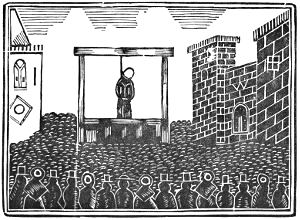
THE TRIAL.
Old Bailey, February 24th, 1786.
Joseph Richards was arraigned for the wilful murder of Walter Horseman, milkman, in Kentish Town. The deceased’s widow deposed, that the prisoner was formerly a servant to her husband; that he was discharged for negligence; that he had frequently threatened vengeance on the deceased; that on the morning the murder was committed, she was awakened by a noise, and on entering the room her husband slept in, she found him sitting up in the bed, and as far as his waist in blood; that a stick which the prisoner had cut some time before, lay in the room, and an iron bar, covered with blood; that her husband was mangled in a shocking manner:—he lingered a few days, and died a shocking spectacle.
Four other witnesses were examined, whose testimony proved certain corroborating circumstances; such as, being from his lodging the night the murder was committed, being seen to melt lead, and to pour it into the stick that was found in the deceased’s room, &c.
The prisoner confessed the murder to one of the magistrates who committed him for trial; but pleaded Not Guilty at the bar.
The jury, after a few minutes’ consideration, brought in their verdict Guilty.
Mr. Recorder pronounced judgment. He said the voice of innocent blood cried to heaven for vengeance. He dwelt upon the atrociousness of the crime of murder, observing, that the Divine Law had ordained, that whoever sheddeth man’s blood, &c., and then expatiated on the peculiar circumstances of the murder, the murder of an innocent master, to whom he owed duty and reverence.
The sentence was then passed as usual, that he be hanged till dead, and anatomized; and an order of Court was made out, to execute him on Monday, at Kentish Town, as near as possible to the house of the deceased.
THE EXECUTION.
Joseph Richards, a youth about eighteen, who was convicted on Friday last, for the wilful murder of Walter Horseman, with whom he lived servant, was executed at Kentish Town, opposite the house where the horrid fact was perpetrated. The malefactor came out of Newgate about twenty minutes before eight o’clock, and with some alertness stepped into the cart, which conveyed him through Smithfield, Cow Cross, and by the two small-pox hospitals to the spot, where he was removed from that society of which he had proved himself a most unworthy member, at a time of life when such atrocity of guilt as he possessed has been seldom known to degrade humanity. In his way to the place of execution, the convict appeared to be in a state of mind bordering upon stupefaction; he had no book, nor did he employ the short remnant of time in those preparations for eternity which his miserable situation rendered so indispensably necessray.
Before being turned off, the prisoner desired to see the widow of the deceased; she was sent for to her house, but was gone to London; he declared he had no accomplice in the fact, and that he was induced to the perpetration thereof by the supposition, that after the decease of his master he should succeed to his business as a milkman. Just before coming to the village, he burst into tears, and when he came to the place of execution, wept bitterly; his expressions of sorrow and contrition being only interrupted by fervent appeals to Heaven for mercy till the last moment of his existence.
Old Bailey Intelligence.—Execution of Six Unfortunate Malefactors, and the Barbarious Execution and Burning of Phœbe Harris, for Coining Silver, on the 21st of June, 1786.
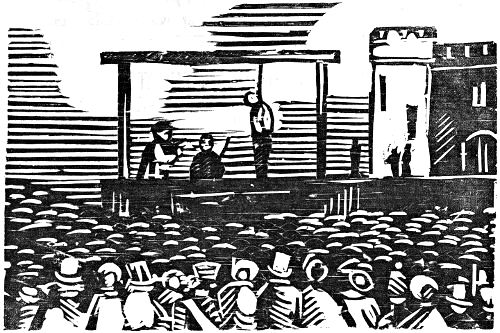
The following male convicts, viz., Edward Griffiths, George Woodward, William Watts, Daniel Keefe, Jonathan Harwood, and William Smith, were executed pursuant to their sentence, on the scaffold usually erected opposite Newgate. They were brought out at half-past seven in the morning, and the platform dropped about eight o’clock. Woodward was so exceedingly weak, that he was obliged to sit down till the executioneer had tied up the rest, and was then supported by two men.
The Barbarious Execution and Burning of Phœbe Harris.
Soon after the above execution, Phœbe Harris, convicted the session before last of coining silver, was brought out at the debtor’s door, from whence she walked to a stake fixed in the ground, about half way between the scaffold and Newgate street. She was immediately tied by the neck to an iron bolt fixed near the top of the stake, and after praying very fervently for a few minutes, the steps on which she stood were drawn away, and she immediately became suspended. The executioner, with some assistants, put a chain round her body, which was fastened by strong nails to the stake. Two cart-loads of faggots were then piled round her, and after she had hung about half an hour, the fire was kindled. The flames presently burning the halter, the convict fell a few inches, and was then suspended by the iron chain passed over her chest and affixed to the stakes. Some scattered remains of the body were perceptible in the fire at half-past ten o’clock. The fire had not quite burnt out even at twelve. The unhappy woman was so exceedingly affected on Monday night, that it was generally supposed (and indeed wished) that she could not have survived.
Phœbe Harris was a well made little woman, something more than thirty years of age, of a pale complexion, and not of disagreeable features. When she came out of prison she appeared languid and terrified, and trembled greatly as she advanced to the stake, where the apparatus for the punishment she was about to experience seemed to strike her mind with horror and consternation, to the exclusion of all power of recollectedness in preparation for the approaching awful moment. A great concourse of people attended on the melancholy occasion.
THE GAOL DELIVERY, AND THE TRIALS AND SENTENCES OF ALL THE PRISONERS AT THE OLD BAILEY SESSIONS, TOGETHER WITH A FULL ACCOUNT OF THE EXECUTION OF FIFTEEN UNFORTUNATE CONVICTS.
The April sessions ended at the Old Bailey, on the 25th, when 13 convicts received judgment of death; 60 were sentenced to be transported, two of whom, for stripping children, are to be sent to Africa, the other women to New South Wales; 8 to be imprisoned in Newgate; 1 to hard labour in the house of correction; 5 to be whipped; and 31 discharged by proclamation.
Elizabeth Kirvan, a convict for forgery, whose execution was respited on her plea of pregnancy, is referred to her former judgment, she not being pregnant.
The sessions of the peace is adjourned until Monday the 21st day of May next at Guildhall; and the sessions of Goal-Delivery of Newgate, until Wednesday, the 23rd day of the same month, at the old Bailey.
APRIL 26. EXECUTIONS.
The following 15 convicts were brought out of Newgate on the platform erected before the Debtor’s-door, and executed pursuant to their sentence, viz., Francis Parr, for personating Isaac Hart, the proprietor of £3,900 3 per cent. consolidated annuities, with intent to defaud the said Isaac Hart and the Govenor and Company of the Bank of England; William Trapshaw, for breaking open, in the day-time the apartments of James Linney, in a house let to several tenants, and stealing a linen gown and an apron, no person being then therein; Joseph Mullagan, James Coleman, and John Williamson Halfey, for breaking and entering the dwelling house of Joseph Stokes, in the parish of St. Catherine, and stealing a sheet, a blanket, and other things; Charles Baker, for breaking and entering the dwelling house of William Watson, in the parish of St Matthew, Bethnal-green, and stealing several small casks, containing a quantity of spirituous liquors; William Dwyre, for feloniously and traitorously counterfeiting the current coin of this kingdom, called six-pences, by coloring certain pieces of brass with a certain liquid composition producing the color of silver; Charles Shaw, for assaulting John Hughes on the highway in St. Paul’s Churchyard, and robbing him of a silver watch, &c.; John Walker and John Evans, for assaulting William Stevenson on the highway, in Old-street, and robbing him of a silver watch, two guineas and a half, some silver, and a dollar; Elizabeth Sedgewick, for setting fire to the premises of her master, Mr. John Taylor, at Feltham-hill, Middlesex; Michael Daily and Elizabeth Connolly, for stealing in the dwelling-house of Mrs. Catherine Plomer, in Howland street, Oxford road, a gold watch, a silver watch, several articles of plate, and a quantity of wearing apparel; John-Pousarque Dubois, for breaking into the dwelling-house of John Grant, in Cockspur street, and stealing a gold watch, a silver watch, a metal watch, and other things; and John Adamson, for assaulting Samuel Horne, on the highway, near the Opera-house, in the Haymarket, and taking from him, by force, a metal watch in a shagreen case. They all behaved very penitent.
D. W. Murcutt, Printer, Stationer, &c., Long Acre, London.
EXECUTION OF EIGHT CONVICTS ON THE NEW SCAFFOLD FOR EXECUTING CRIMINALS IN THE OLD BAILEY.
April 24, 1787.
Yesterday morning the following convicts were executed on the newly-invented temporary scaffold, placed before the debtors’ door of Newgate:—John Burn, Daniel Gunter, James Francis, and John Green, convicted in January sessions; and William Ludlam, William Oakes, John Bishop, alias John Buller, and James Haylock, alias Hullock, formerly a runner at a public office, convicted in February sessions.—After divine service in the chapel of Newgate, the prisoners were brought out of the gaol, and six of them having joined the ordinary in devout prayer, and chaunted the usual psalm (the others, being two Roman Catholicks, were attended by a priest of that persuasion). At nine o’clock the platform dropped, and in a few moments they showed no signs of life. They were fervent in their devotions, and all of them appeared to die sincerely penitent.
The scaffold on which these miserable people suffered is a temporary machine, which was drawn out of the yard of the sessions-house by horses; it had this day only one beam fixed; and upon a bolt being drawn, the platform dropped, leaving the malefactors suspended in a manner similar to that of the scaffold lately in use.
After the convicts were cut down, the gallows was drawn back to the sessions-house yard; and the whole cleared away in half-an-hour’s time.
An Account of the new-invented Scaffold for Executing Criminals in the Old Bailey.
We imagine that an accurate representation of the new mode of executing criminals in the Old Bailey, which does so much honour to the present worthy Sheriffs, will hardly fail of giving satisfaction to such, at least, as do not reside near the metropolis.