Part 3 — A SCENE IN THE ELECTION. (continued 3)
Reading edition
H. Disley, Printer, 57, High Street, St. Giles, London.
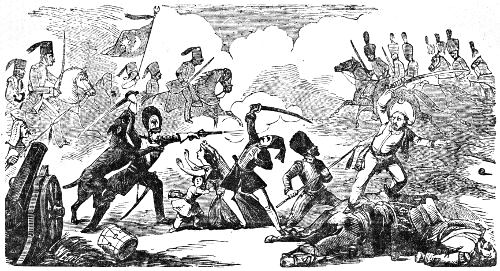
THE FENIANS ARE COMING.
Wherever we go, wherever we be, Some wonder of wonders we daily do see; All classes through Britain are trembling with fear, The Fenians are coming,—oh, don’t things look queer? The land of old Erin looks bashful and blue, Colonel Catchem and General Doodlem doo, Has crossed the Atlantic, poor Erin to sack, And carry Hibernia away on their back. There’s a rumpus in Ireland by night and by day, Old women and girls are afraid out to stray; Cheer up and be happy on St. Patrick’s day, The Fenians are coming,—get out of the way! Pop goes the weazel, and shoot goes the gun, While over the mountains the Fenians do run; As a regiment of soldiers did after them jog, Four hundred and fifty fell into a bog! The best of the fun was—the soldiers did shout, We have got in a mess, and we cannot get out! When a funny old woman so nimbly flew, And collared great General Doodlem-doo. Some could not fire, and some could’nt run, One carried a reap-hook, another a gun, They tried to kill nobody, just for a spree, So they both went together to cut down a tree; There was a young lady, her name it was Peg, She’d one eye and two noses, one arm and one leg, March on, lads, she shouted, to glory we’ll steer, The Fenians are coming, oh dear, oh dear! Some with big stones and brickbats their pockets did fill, They thought of the battle of great Bunker’s Hill, Cut away, fire away, go along Pat, A soldier fired at a Fenian, and shot a tom cat; Old Molly Maloney, up her chimney did creep, Over the hills and the mountains she had a good peep, While under her window the bagpipes did play, To cheer Moll with the tune of St. Patrick’s day. What do you think of the Fenians? said Kit, in a joke, Why, says Nell, it will end in a bottle of smoke, Thousands over the mountains, like grasshoppers flew, Be aisy, cried General Doodlem-doo: Colonel Catch’em commanded, had a hump on his back, Shoot away, fire away, philliloo whack, Then a jolly old fiddler from famed Mullingar, Struck up the bold anthem of Erin-go-bragh. The soldiers one night when the bugle did sound, That night going over the mountains they found, A cat and a donkey, a pig and a dog, And twenty old women stuck fast in a bog; While down at Killarney, ’twas fire away whack, At the glorious battle of herrings and sprats! And although they fought without trousers or shirt, I think they were really more frightened than hurt. Cheer up, says old Barney, here comes the police: Here’s old Erin and glory, plum pudding and peace, A glass of good whiskey twice every day, That is better than fighting and running away! As for me, my dear boys, if a row I was in it, I’d rather run for a mile than fight for a minute; And I would advise all to have done with such capers, And just stay at home to look after the taters. Old Dennis Mahoney got up in a tree, His musket was loaded with skillagalee, Blood-an-ouns, said old Denny, I’m a Fenian, here goes, He fired, and shot two policemen under the nose; The bough of the tree with old Dennis soon broke, And Dennis came down like a pig in a poke. He died as he fell, and he whistled, oh la! Singing, farewell for ever, old Erin-go-bragh.
H. Disley, Printer, 57, High Street, St. Giles, London.
AWFUL EXPLOSION IN CLERKENWELL. DREADFUL LOSS OF LIFE.

Now mothers all pray give attention, And fathers listen to the tale I’ll tell, To the fearful scene at the House of Detention In Corporation Lane at Clerkenwell; While parents for their children are weeping, And tender mothers wring their hands in pain Do tell me, are they dead, or only sleeping, O shall I never see my child again. To rescue Burke it was their intention, At Clerkenwell this wicked deed was done, And such a sight as this I’ll mention, Was never heard of beneath the sun. Three men they say on that fatal Friday, At four o’clock on that afternoon, Those villians caused that explosion, And hurried those poor creatures to their doom. They from a truck took a barrel of powder, A female, Ann Justice was there as well, And in one moment death and disorder Around the neighbourhood of Clerkenwell. Then all around lay the dead and dying, Some crying, where is my mother dear, Among the ruins in anguish lying, Where tender mothers and children dear; Covered with blood and mutilated, And some they found, death had stilled their cries, For mothers, fathers, and helpless infants, Now in Bartholomew Hospital lies, Three persons there were apprehended, Allen and Desmond to escape they tried, Their purpose it was frustrated, But destruction was spread far and wide. The one who did this deed so cruel, From that sad spot he did escape, But justice quickly will follow after, Be sure it will that villain overtake. They little thought on the fatal morning, With hearts so light and spirits gay That ere the sun should again be dawning, Their little homes would be swept away; That little children in death be sleeping, Or parents for them in anguish cry, For Minnie Abbot many now are weeping, Another little girl has lost her eyes. For those that’s gone shed a tear of pity, And God bless those who assistance gave, Such a crime we seldom hear in London city, May God receive their souls now in the grave. The government has relieved the sufferers, From the Queen, a message to those in pain, And such a sad and dreadful story, In London may we never hear again.
SUNDAY TRADING BILL.

Oh dear, oh lor, what shall we do? I am sure I cannot tell, can you? Of Lord Chelmsford’s Bill, I’ll tell you true— The Bill on Sunday trading. The mawworms seem to try, I’m sure, Each way they can to crush the poor, And bring them to the workhouse door, By stopping Sunday trading. I’m sure it is a lying sin, It’s no harm to say, bad luck to him,— He might as well try to stop our wind, As to stop all Sunday trading. Oh! Chelmsford, you use the poor man ill, Starve us all, I’m sure you will, If they should pass your infamous Bill, And stop all Sunday trading. Tho’ the swells they may blow out their kites, On jellies and tarts, and all things nice, For the poor to live it is not right, Says the Bill on Sunday trading. With watercresses they must not go round, Nor with winkles or shrimps to earn a brown, Or else you will get fined a crown, Says the Bill on Sunday trading. No cat must mew, no dog must bark, They’ll stop the warbling of the lark, And drive them all bang out of the parks, Says the Bill on Sunday trading. The poor may buy potatoes and greens, That is if they have got the means, But no coals to cook them, though strange it seems, Says the Bill on Sunday trading. The nobs may call at the pastry shops And with all sorts of dainties cram their chops, But the poor must not buy a lollipop, Says the Bill on Sunday trading. You must not take, at least, they say, A dose of salts on Saturday, Lest they should work on the Sabbath day, Says the Bill on Sunday trading. If on Sunday you feel inclined to eat, You can buy both bread and meat, But no tea or sugar,—what a treat! Says the Bill on Sunday trading But to wash it down, Lord Chelmsford say, To the gin shop you can cut away And get blind drunk upon that day, Says the Bill on Sunday trading. And by and bye, if you have got the tin, sir, To raise a baked joint for your dinner, They’ll say, drop that dish, you hungry sinner, Don’t you know it’s Sunday trading? If your wife should be in the family-way, She must not be confined upon Sunday, But put it off till another day, Says the Bill on Sunday trading. No milkman through his rounds must go, With milk, my pretty maids, below! Without paying a crown,—the Lords say so, In the Bill on Sunday trading. Even the kittens must not play, Nor frisk about upon that day, Or their grub will be stopped for three whole days, Says the Bill on Sunday trading. No shoeblack, he must not dare to say, Polish your boots upon Sunday, Or else a dollar he will have to pay, Says the Bill on Sunday trading. And if you want to enjoy your pipe, Where would you get a box of lights, For the sellers they will be put to flight, Says the Bill on Sunday trading. No Yarmouth bloaters must be sold, Nor peppermint drops for coughs or colds, And muffin man’s bell it’s clapper must hold, Says the Bill on Sunday trading. You must not buy, but you must starve, You must not sing, you must not laugh, So you had better sow your mouth up fast, Says the Bill on Sunday trading. You must not sell, you must not buy, To earn a crust you must not try, Nor in the streets lay down and die, Says the Bill on Sunday trading. For the poor a fig they do not care, More workhouses they must prepare, He ought to be kicked to I know where, For his Bill on Sunday trading.
H. Disley, Printer, 57, High Street, St. Giles.
SOUTHWARK ELECTION.
ODGER AND VICTORY.
Now all you gallant Southwark men, Who does require protection, Just mind I say, your p’s and q’s At this Great Grand Election; Never don’t elect a man Who your wages will be stinting, And never have a covetuous man Like one who lives by printing. Then act like men you Southwark blades, Have neither a printer nor a “sodger, Vote for a man who will protect your trade, And sing, Southwark, lads, and Odger. Long enough the poor man has been crushed, Now is your time or never, Come, now with me lads, nimble be, Here’s Odger, lads, for ever. Don’t you elect a Waterlow, Whose principles are stinting, He knows as much about the poor man’s rights As a donkey knows of printing. There has lately been some glorious fights, In Southwark, says Ben Fagan. It beat the Battle of Bunker’s Hill, And the glories of Copenhagen; An old lady stood by London Bridge, Bawling, lick me you shall never, She jumped complete to Toloey Street, Bawling, Odger, boys, for ever. In Bermondsey there was glorious fun Among the girls and sailors, It put the Borough all in mind Of the devil among the tailors. A grocer’s wife, full of spleen and spite, Doffed her chignon so clever, Pulled her petticoat off and went aloft, Singing, Odger, boys, for ever. Oh, Colonel, Colonel Beresford, You are a rum old codger, Neither you or Waterlow Can ever cope with Odger;— Odger is a working man, And as clever a man as Pompey, Odger is a gentleman, And you are a pair of donkeys. When Odger is returned, my boys, To the brim we’ll fill our glasses, We will drink success to the tanners’ wives, And the blooming Kent Street lasses; From the Bricklayers’ Arms to London Bridge, There will be such a bustle, Aye, and all the way from Cotton’s Wharf To the Elephant and Castle. Put the right man in the right place, Keep out the aristocratic sodger Tell old Waterlow it is no go— It is victory and Odger; The working men must have a friend, Who against tyranny is clever, With heart and glee, sing liberty, Odger, my lads, for ever. Odger we know is a working man, If he’s not rich, he’s noble-minded, He will understand how the working man Has been crushed down and grinded. Then send him into Parliament, To put a stop to their capers, And tell them we want a good beef steak, Instead of herrings and taters. Keep out the printing gentleman, Banish the tyrant sodger, Strive with all your might to do what’s right, And plump my lads for Odger.
Printed for the Vendors.