Part 3 — DIVISION IV. THE “GALLOWS” LITERATURE OF THE STREETS. Public Executions, Dying Speeches. Confessions, and Copy of Verses. (continued 3)
Reading edition
Stewart, Printer, Botchergate, Carlisle.
THE ESHER TRAGEDY. Six Children Murdered by their Mother.
You feeling christians give attention, Young and old of each degree, A tale of sorrow I will mention, Join and sympathise with me; It’s of a sad and dreadful murder, I shall quickly let you hear, Which was committed by a mother, On her six young children dear. The perpetrator of this murder, Mary Ann Brough it is her name, And formerly as you may see, She nursed the blooming prince of Wales. But now her days of happiness, Are vanished like the evening’s sun, Good people all, both great and small, Reflect upon the deed she’s done. One night she could not rest in slumber, So her own confession says, Her little children, six in number, Thus she took their lives away. ’Twas with a sharp and fatal razor, She committed this foul deed, And one by one she cut their throats, Which causes each kind heart to bleed. The first and eldest whom she murdered, Sad and dreadful to unfold, Was a sweet and blooming girl, Something more than ten years old, And in her wrath and indignation, Thus she slew them one by one. Causing death and desolation, What on earth could urge it on? One little pretty boy amongst them, Of the name of Henry, He cried aloud with eyes of pity, ‘Mother, dear, don’t murder me,’ She heeded not his prattling tongue, But like a demon fierce and wild, ‘My dear,’ said she, ‘it must be done,’ And thus she slew her other child. From bed to bed, and to each chamber, This wretched woman she did go, While all around her own dear children, Streams of crimson blood did flow. The dreadful sight was most surprising, To behold these children dear, How their cruel hearted mother, Cut their throats from ear to ear. Oh! what must be the woman’s motive, Did she think she’d done amiss, Or did she think of death and judgment To perpetrate a deed like this? But now the wretch she is committed, To a prison’s gloomy cell, Where midnight dreams to her will whisper And her deeds of blood will tell. Within the prison’s massive walls, What anguish will torment her breast. When phantoms of her six dear children, Will disturb her of her rest. Such a sad and dreadful murder, On record there is no worse, Committed by a cruel mother, Once the Prince of Wales’ Nurse.
Confession of the Murderess.
The following confession was made by the murderess, to Mr. Biddlecombe, chief superintendent of the Surrey Constabulary:-“On Friday last, I was bad all day; I wanted to see Mr. Izod, and waited all day. I wanted him to give me some medicine. In the evening I walked about, and afterwards put the children to bed, and wanted to go to sleep in a chair.—About nine o’clock, Georgy (meaning Georgianna) kept calling me to bed. I came up to bed, and they kept calling me to bring them some barley water, and they kept calling me till nearly 12 o’clock. I had one candle lit on the chair—I went and got another, but could not see, there was something like a cloud, and I thought I would go down and get a knife and cut my throat, but could not see. I groped about in master’s room for a razor—I could not find one—at last I found his keys, and then found his razor. I went up to Georgy, and cut her first; I did not look at her. I then came to Carry, and cut her. Then to Harry—he said, ‘don’t mother.’ I said, ‘I must’ and did cut him. Then I went to Bill. He was fast asleep. I turned him over. He never awoke, and I served him the same. I nearly tumbled into this room. The two children here, Harriet and George were awake. They made no resistance at all. I then lay down myself.” This statement was signed by the miserable woman.
J. HARKNESS, Printer, 121, Church Street, Preston.
EXECUTION AT NEWGATE OF WILLIAM COGAN, For the barbarous and cruel murder of his own wife.

The execution of William Cogan for the murder of his wife took place this (Monday) morning at Newgate. The circumstances under which the crime was committed will be fresh in the recollection of the public. The prisoner and his wife were in the habit of getting drunk, and while in that state quarrels took place between them. They had been to a funeral on the day the occurrence took place, and they both drank freely, and when they got home they quarrelled. About two o’clock in the morning he rushed into the street with his throat cut. The prisoner endeavoured to make it appear that his wife had first cut his throat and then destroyed herself. Ever since his condemnation the culprit has continued to assert his innocence, and on Friday last, when he parted for the last time with his father and his sisters, he again positively declared he was innocent. The condemned man slept soundly his last night. On the fatal morning the executioner, Calcraft, was admitted into the cell a few minutes before eight o’clock, and the culprit the moment he entered appeared to recognise him, and rose from his seat and submitted to the operation of being pinioned with the utmost composure; and just as the clock of St. Sepulchre’s church chimed the hour the mournful procession moved towards the scaffold. The culprit was then placed under the fatal beam and the rope was adjusted, and after the executioner had retired he prayed most earnestly with the Ordinary for a short time, and almost the last words he uttered were a prayer to God to forgive him. The drop fell almost at the same moment, and the wretched man, after one or two convulsive struggles, ceased to exist. After hanging an hour, according to the terms of the sentence, the body was cut down and placed in a shell and removed to the interior of the prison.
The crowd that was assembled to witness the execution, was very great. During the whole of Sunday afternoon the Old Bailey was thronged, and crowds of persons had assembled so late as twelve o’clock at night, some of whom remained until the period of the execution. The officials of the prison stated that it was one of the noisiest and most disorderly crowds they ever remember to have seen upon a similar occasion. The moment the wretched man made his appearance on the scaffold there was a general cry of “hats off,” and the upturned faces of the thousands of spectators presented a most extraordinary spectacle. The culprit was twenty-six years old, and he was apparently a strong muscular man.
A COPY OF VERSES.
Come, all you feeling Christians, Give ear, I pray, to me; It’s of a dreadful tragedy— Explained it shall be. In London town it happened, As I can truly say, William Cogan, the barbarous murderer, With a razor his wife did slay. CHORUS. Kind friends, now a warning take— Poor William’s life is now at stake. Oh! drink—thou cursed beverage— What acts thou prompts us to do; To make me kill my loved wife, Just as a fiend would do! I once had love, as other men, But on my heart a brand; Entangled with loose company, Committed now I stand. Heart-rending ’tis to know it, My orphan’s left behind, That had a fondling mother, Who unto them was kind: But now she’s dead and buried, Gone to that rest above, Where all is joy and happiness— Blest with that sacred love. Oh, cold and stormy was that night, And fast the snow did drop, When Mary Ann was forced to fly All from her father’s cot. Though thinly clad, with her chemise on, Her shawl upon her swung, “My God! my God!” she thus did cry, As thus her hands she wrung. Exposed to wind and weather, In a passage there she stood; Her limbs were shivering with the cold, And freezing was her blood; But then she dare not enter Where her demon father lay, Fearful lest, as her mother, She might become his prey. So now, kind friends, take warning,— A lesson let this be Unto those drunken fathers Who think of nought but “spree;” And pray may God have mercy, And show it to him soon; And prepare this wicked person To meet his awful doom.
Taylor, Printer, London.
EXECUTION OF THE WARWICKSHIRE MURDERER, GEORGE GARDNER, For shooting his sweetheart, Sarah Kirby.
The condemned criminal, George Gardner, a ploughman, on Monday suffered the last penalty of the law at Warwick. The execution took place at ten o’clock, before the county gaol, and was performed by Smith, of Dudley. The murder was a most unprovoked and cold-blooded one, by which Sarah Kirby, his fellow-servant, was shot dead while she was standing at her washing-tub, on the 23rd of April last. Both she and the man Gardner were employed at a roadside farm, on the confines of the county, and she was a very good-looking, well-conducted, pious girl. He was a very great blackguard and a sot. Soon after he went to the farm where the murder took place she complained to Miss Edge, the housekeeper, that he annoyed her very much by his attentions, and his attempts to kiss her. Mr Edge, her master, hearing of this, called them both into the parlour, and told him he must not repeat his conduct to her, whereupon Gardner said, “Well, if I can’t have her, no one else shall.” No further complaints were made after this, though there is reason to believe he continued his suit. He amused himself by looking at her as she undressed at night through a chink in the wall which separated their bedrooms. The only complaint he had against her was that she would not draw him the proper quantity of beer; but the truth was that he wanted more than his fair share. On the morning of the murder he was at work in the plough-field, his master being absent at a cattle fair, and he made remarks to the other labourers which showed him to be contemplating some act of violence, saying he wished he had “some one” before him—he would kill them, and so on; but he appears to have left his work and returned to the house without causing any suspicion to arise in their minds that he was about to commit the crime of murder. Having reached the house, he asked this poor girl to fetch him his master’s double-barrelled gun for shooting rooks. He had been in the habit of using it for this purpose before, and no surprise was felt by the girl or by Miss Edge, the housekeeper, who saw her hand the loaded gun to him, Miss Edge remarking, “Mind, it is loaded, George.” He said, “Yes, ma’am, I know it is,” and tried it by taking off the cap and letting the hammer down. Finding it all right, he followed Kirby to the wash-house, and shot her in the back of the neck. He afterwards threatened Miss Edge, and there is no doubt that if she had not concealed herself he would have shot her. He then escaped with the gun, and was taken by the police on his way to Oxford. Some delay took place in the execution; and from the bad adjustment of the rope or some other cause, the criminal died very hard, struggling much, until at last he hung motionless in the air. The crowd contained a large proportion of women, but was orderly in the extreme, and began to disperse as soon as the drop fell. Gardner died penitent, confessing his crime. The following confession was made by Gardner before his execution:—“I did not want to pay my addresses to Sarah Kirby, but she would never draw me the proper quantity of beer, and that vexed me. I did not know the master was away on the 23rd of April, and the witness who said I asked him where he was will have to suffer for his perjury. I tried my luck in the field by throwing up the “spud” of the plough, which came down with the point in the earth. If it had fallen flat I should not have killed her, but as it came down point foremost I left the field with the determination to do it. I should have killed Miss Edge if I had got near her, and it’s a good job no one stopped me before I sold the gun.”
VERSES ON THE EXECUTION OF GEORGE GARDNER, FOR SHOOTING SARAH KIRBY.
Harkness, Printer, 121, Church Street, Preston.
The solemn knell does most awful sound, Oh God in pity on me look down, Forgive my sins and compassion take, And grant me fortitude to meet my fate. Oh what numbers approach to see A wretched man upon the tree, My time is come, and I must be soon, A prey to worms in the silent tomb. When I was scarce eighteen years of age, As ploughman to Mr Edge I did engage, He unto me was both good and kind, But murder entered my wicked mind. She would’t give me beer enough for weeks, When to take her life I a plan did seek, I pointed the gun one fatal day, And with the same took her life away. When from my labour I did return, To do her harm my heart did burn, I took the gun right speedily, But little thinking she was to die. Though fellow-servants I did not her like, That was the reason I took her life, That was the reason I did her kill, Maidens never marry against their will. My bosom heaves and borne down with woe, The grave lies open and I must go, To sleep with death till the Judgment day, When God will pardon me I firmly pray. It was cursed Satan led me astray, It was Satan tempted me one day, It was Satan prompted my guilty mind, So slay Sarah Kirby both good and kind. Young men and maidens ere ’tis too late, Oh take a warning by my fate, Trust in your Saviour who reigns above, And never kill whom you cannot love. It was well for me had I never been born, To die a death of public scorn, In youth and bloom on the fatal tree, Oh God in mercy look down on me. Petitions have in my favour been Sent from Warwick town to my gracious Queen, But alas no mercy is there for me, And I must die on the fatal tree. Three weeks I have lain in a gloomy cell, Where my dreadful sufferings no one can tell, To gain me pardon my friends have tried, But oh, alas, it has been denied.
LIFE, TRIAL, AND EXECUTION OF WILLIAM G. YOUNGMAN, The Walworth Murderer.
On Thursday, August 16th, William Godfrey Youngman was placed at the bar of the Central Criminal Court to take his trial for the murder of his mother, two brothers, and his sweetheart.—Shortly after ten o’clock the learned judge, Mr Justice Wilhams, took his seat on the bench. The prisoner, who was described as a tailor, and 25 years of age, was then placed at the bar. He exhibited perfect coolness and self-possession, and did not seem in the slightest degree affected at his awful position. The indictment that was proceeded with was the one charging him with the wilful murder of his sweetheart, Mary Wells Streeter.—Mr James Bevan said: I reside at 16, Manor place, Walworth. The prisoner’s father occupied the top floor of the house. On the 31st of July his family consisted of his wife, two little boys, the prisoner, and the deceased. I understand the prisoner had come to see his father on a holiday, and he would sleep there. About ten minutes to 6 in the morning I was in bed, and heard a noise and a heavy fall on the top floor of the house. I got up to see what was the matter, and before I could get to the door Mr Beard knocked at it and said, “For God’s sake come here—here is murder.” I went upstairs directly, and when I got to the top of the stairs I saw the elder boy lying dead upon the landing, I did not see anything more then, but went down and dressed myself, and I then saw the prisoner standing in his nightshirt on the staircase. He said to me “My mother has done all this—she murdered my two brothers and my sweetheart, and I, in self-defence, believe I have murdered her.” I went out and fetched the police.—Susannah Beard said: Me and my husband occupied the back room as a sleeping room. About one o’clock in the morning of the 31st of July, I heard a noise overhead like something very heavy falling on the boards of the bedroom above ours. My husband went out to see what was the matter, and he called out “Murder!” and came downstairs. He afterwards went up again with the landlord. I went to the door of our room and saw the prisoner standing on the staircase. He said, Mrs. Beard, my mother has done all this. She has murdered my sweetheart and my two little brothers, and I believe in self-defence I have murdered her.”
Philip Beard, the husband of the last witness, said, I had seen the prisoner in our house a few days. I remember being awoke by my wife, and I heard a rambling on the landing. The noise was like that of children running about. I went out of my room, and I heard a slight scream. When I got to the outside of my room, I saw some blood on the stairs, and on the top of the staircase I saw the little boy lying on the landing. His throat was cut and he was dead. I then saw the body of the deceased lying a little beyond that of the boy. I did not observe any other bodies at the time, as I was very much alarmed, and I went down and called the landlord, and we went upstairs together; and I went to dress. I then fetched a policeman and a surgeon. I saw the prisoner upon the stairs, and he told me that his mother had done it all, and that he had murdered her in self-defence.
After the further examination of a number of witnesses, who corroborated the evidence already given, Mr. Best, in a powerful and touching speech, addressed the jury for the prisaner.
The jury retired, and in about 25 minutes returned into court, and amid breathless suspense gave a verdict of Guilty.
The judge then put on the black cap, and delivered the following sentence: Prisoner at the bar, you have been convicted of the crime of murder, and one of the most heinous ever committed, but it is no part of my office to dwell on the enormity of your guilt. It is my only duty to pass upon the sentence of the law, and that sentence is—That you be taken to the prison from whence you came, and then to the place of execution, and there be hanged by the neck until you are dead. May the Lord have mercy on your miserable soul!

EXECUTION.
Tuesday, September 4th, was the day appointed for the execution of Youngman, the perpetrator of four murders at Walworth. At an early hour people of the lowest order began to assemble in the neighbourhood of the prison, and by five o’clock every available space was occupied. At seven o’clock the chaplain entered the condemned cell to administer religious consolation to the criminal, and remained with him until the time of his execution. In reply to exhortations addressed to him by the chaplain, he repeated substantially the story he had always told as to his share in the crime. The chaplain urged him not to leave the world with a lie in his mouth. “Well, if I wanted to tell a lie it would be to say that I did it.” He, nevertheless, conducted himself towards the chaplain with respect, listened to him with attention, and joined in prayer; but, beyond those mechanical observances, he showed no evidence whatever of feeling.
The minutes which remained to him to live might now be numbered. He was then conducted to a gateway; in which a corridor he had to traverse terminated, and there, a few minutes before nine, he was pinioned. The procession then formed, the gates were opened, the chaplain commenced reading the burial service, and, so escorted, the convict proceeded to the beam. On arriving at the drop and confronting the mass of human beings he looked wild and startled, but, recovering his composure he allowed himself to be placed on the drop, and, with evident fervency and an audible voice, he followed the chaplain in a prayer, clasping his hands in unmismakeable devotion. For a moment he paused to request the exeeutioner, who was adjusting the noose, to pinion his legs, which was done; and his parting words addressed to the chaplain—were, “Thank you, Mr. Jessop, for your great kindness; see my brother, and take my love to him and all at home.”
The drop fell, and he died in a few minutes.
H. Disley, Printer, 57, High Street, New Oxford Street.
THE WIGAN MURDER.
EXAMINATION AND CONFESSION OF JOHN HEALEY.
John Healey, who stands charged on his confession with having been concerned with four others in the murder of James Barton, at the Button or Bawkhouse Pit, Haigh, near Wigan, on the morning of the 3rd of January, 1863, was re-examined at Wigan, yesterday. The confession having been read over, Mr. Lamb asked the prisoner if it was correct. He said: it is not all correct, sir. I own to it that I had liquor with the men, but then I do not recollect where I went.—Mr. Lamb: But that portion about the murder?—Healey: I can then recollect the men and then getting drunk, but I do not know what occurred after.—Mr. Lamb: Well, then, how was it that you made that statement?—A man may be in drink and not know what he is doing.—Mr. Lamb: You were not in drink when you made the statement.—The prisoner: No.—Mr. Lamb: Then how was it you made it? The prisoner made no reply. Evidence was then tendered as to the discovery of the few remains of Barton, but nothing fresh was elicited. The only evidence bearing upon the confession of Healey, was that of Jane Little, a collier girl. She deposed that on the morning of the murder she was assisting to load a boat with coal at the Bridge or Pigeon Pit, situated on the canal bank, between the Bawkhouse Colliery and Wigan. The towering path was on the opposite side of the canal to the colliery, and the path was lighted by a light on the pit bank. About a quarter-past two she was in the boat, and a man, named Jordan, was above lowering the coals. He was approaching with a full tub, when she saw four men come in the direction of Haigh. Jordan was just lowering a tub as they came near, and when the men saw him they stopped suddenly by a heap of ashes. Whilst he was fetching another tub they walked sharply past and over the bridge, where they waited till Jordan had gone away again. The men had caps on.—Having been charged in the usual way, the prisoner said he had nothing to say, and he was committed for trial at the next Liverpool assizes.—The evidence of Little is, so far as it goes, corroborative of Healey’s confession, and as it was never made public till yesterday, there is no probability that the story of the prisoner with regard to the four men can have been manufactured from the newspapers or from hearsay.
Come all you wild and wicked youth, Listen to me, I will tell the truth For that sad and dreadful deed Has caused my very heart to bleed, I could not sleep or take my rest, I compelled was to confess. Chorus. Though justice strictly searched about, They could not find the murderer out. Two long years have gone and pass’d, And I, John Healey, have confessed. At last to my grief and sad downfall, I was taken to Wigan Town Hall, Where I had to face Justice Lamb, To answer was I the guilty man. John Healey is my name, It was strong whiskey did my head inflame, With four companions at their desire, At Button Pit near Wigan To thrust poor James Barton in the furnace flames of fire. Though, &c. A warning take young men I pray, For fear like me you should be led astray, For nights rambling is my downfall, And strong drink is the ruin of all; I have taken father, The mother left orphans to deplore, May the Lord have mercy on his soul, They will never see him more. Alas in Kirkdale Gaol I lay, A-waiting for the trial-day.
Harkness, Printer, Preston.
EXECUTION OF PRISCILLA BIGGADIKE, at Lincoln, for the WILFUL MURDER OF HER HUSBAND.
Priscilla Biggadike, who was sentenced to death at the recent Lincoln Assizes, for the wilful murder of her husband by poisoning, at Stickney, a village near Boston, in Lincolnshire, was executed on Monday morning, at nine o’clock.
The unfortunate woman has appearod to pay considerable attention to the ministrations of the chaplain, but she declined to make any confession of her guilt. On Saturday, she was visited by a brother and three sisters, who remained with her upwards of three hours, and strongly urged her to confess, but still she refused, and at length became passionate at their repeated entreaties. George Ironmonger, one of the persons who lodged at her house, also applied for permission to to see her on Saturday, but was refused.
On Sunday she attended Divine service in the prison. She slept well during the night, and was visited at seven o’clock yesterday morning by the Rev. W. Richter, the chaplain, who again, without avail, implored her to confess her guilt. At a quarter to nine she was pinioned by Askerne the executioner, and although she fainted under the operation, she immediately recovered. Five minutes afterwards, the sad procession left the prison for the scaffold, which was erected within the castle walls, on the east side of the Crown Court, a distance of nearly 200 yards from the prison door.
The unfortunate woman, who was supported by two of the warders, moaned piteously, and appeared to take little heed of the chaplain, while reading the solemn service of the dead. On her way to the place of execution, she said to the warders, I hope my trubles are ended, and then asked, ‘Shall we be much longer?’ to which a warder gave a negative reply. The service was brought to a close at the foot of a drop, and the chaplain turning to the prisoner, asked her whether she still persisted in the declaration of her innocence? whether she had anything to do with the crime, in thought, word, or deed? In a firm voice she replied, ‘I had not, sir.’ She was then accommodated with a chair, and the chaplain addressed her as follows:—I have spent an half an hour with you this morning, in endeavouring to impress upon you, a proper sense of your condition, for you are about to pass from this world into another, and to stand before God, to whom the secrets of all hearts are known, I implore you not to pass away without confessing all your sins; not only generally, but especially this particular one, for which you are about to suffer. I had hoped that you would have made that confession, and thus have enabled me, as a minister of Christ, to have pronounced the forgiveness of your sins, under the promise that Christ came into the world to save sinners. It has grieved me much to find that still persist in the declaration, that you are not accountable for your husband’s death; that you still say that you did not administer the poison yourself; that you did not see any other person administer it, and that you are entirely free from the crime. Do you say so, now?
The Prisoner, still in a firm voice, said, Yes.
The Chaplain.—There is only one left, that you have endeavoured to confess your sins to God, though you will not to you fellow creatures. All I can now say is, that I leave you in the hands of God; and may he have mercy on your soul. What a satisfaction it would be to your children, to your friends, to your relations, to know that you had passed from death into life, in the full persuasion that your sins were forgiven you, and that you were admitted into the blessed kingdom of God. I fear that I can hold out no further consolation to you—the matter rests between you and the Almighty. Had you made a declaration of your sins, I should have done what, as a minister of Christ, I am entitled to do—I should have told you that “your sins though many were forgiven.” I am sorry I cannot exercise that authority at the present moment. I must leave you to God.
The condemned woman was then assisted up the steps to the platform, and placed on the trap door. When the fatal rope was being affixed, she stood firm without assistance. The cap was then drawn over her face, and she the exclaimed “All my troubles are over;” then suddenly “Shame, you are not going to hang me!” “Surely my troubles are over.” The bell of the cathedral here tolled forth the hour of nine, at that instant the bolt was drawn, and the wretched woman was launched into eternity.
W. Smith, Printer, Lincoln.
EXECUTION OF FREDERICK BAKER.

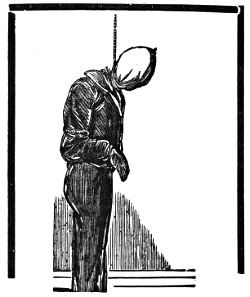
This morning, the wretched criminal, Frederick Baker, suffered the extreme penalty of the law at Winchester Gaol, for the atrocious murder of Fanny Adams, at Alton, on the 24th of August last. It is satisfactory to state that since his condemnation, the conduct of the unhappy man underwent a total change for the better, and he began to realize the awful condition in which he was placed, and his callous demeanour was changed into one of deep dejection. The prisoner has been assiduously attended by the chaplain of the prison, and to such a state of religious feeling had he been brought, that he fully acknowledged the justice of his sentence. The sheriffs arrived at an early hour. When the operation of pinioning had been performed, the wretched man thanked the chaplain, the governor, and the other officials for their kindness. The procession was then formed, and slowly took its way towards the scene of execution. The cap and rope was adjusted, the bolt drawn, and the prisoner was launched into eternity.
You tender mothers pray give attention, To these few lines which I will relate, From a dreary cell, now to you I’ll mention, A wicked murderer has now met his fate; This villain’s name it is Frederick Baker, His trial is over and his time was come! On the gallows high he has met his Maker, To answer for that cruel deed he’d done. Prepare for death, wicked Frederick Baker, For on the scaffold you will shortly die, Your victim waits for you to meet your Maker,— She dwells with Angels and her God on high. On that Saturday, little Fanny Adams, Near the hop-garden with her sister played, With hearts so light they were filled with gladness, When that monster Baker towards them strayed; In that heart of stone not a spark of pity, When he those halfpence to the children gave But now in gaol in Winchester city, He soon must die and fill a murderer’s grave. He told those children to go and leave him, With little Fanny at the garden gate He said, come with me, and she believing, In his arms he lifted her as I now state; Oh do not take me, my mother wants me, I must go home again, good sir, she cried; But on this earth she never saw thee, In that hop-garden, there, poor child, she died. When the deed was done, and that little darling, Her soul to God her Maker it had flown, She cannot return at her mother’s calling, He mutilated her it is well known; Her heart-broken parents in anguish weeping, For vengeance on her murderer cried, Her mother wrings her hands in sorrow grieving, Oh would for you, dear Fanny, I had died. The jury soon found this monster guilty, The judge on him the awful sentence passed, Saying, prepare yourself for the cruel murder, For in this world, now, your die is cast; And from your cell you will mount the scaffold, And many thousands will you behind, You must die the death of a malefactor, May the Lord have mercy on your guilty soul. What visions now must haunt his pillow, As in his cell he lays now almost wild, She points at him, and cries, oh tremble, murderer! ’Tis I, your victim here—that little child! The hangman comes, hark, the bell is tolling, Your time has come, nothing can save you, He mounts the scaffold, the drop is falling, And Frederick Baker fills a murderer’s grave.
DOUBLE EXECUTION AT DURHAM. TRIAL AND EXECUTION OF M’CONVILLE & DOLAN
For the Murder of Philip Trainer, of Darlington, and Hugh John Ward, of Sunderland, in the County Prison, at Durham, on the 22nd instant.
Yesterday the two murderers, Dolan and M’Conville, were executed within the precincts of the goal at Durham. M’Conville, who who was 23 years of age, worked as a furnace-man at Darlington, and was convicted of the murder of Philip Trainer, on the 30th of January last, Dolan murdered a man named Hugh John Ward, at Sunderland, on the 8th of last December. The two convicts left the condemned cell shortly after eight o’clock, each supported by a couple of warders, and attended by the Rev. Canon Consett and Rev. G. Waterton, Roman Catholic priests. A procession, headed by the under sheriff, moved to the west wing of the prison, where the scaffold was erected. The warders conducted the men chained from their cells, and they were taken through the corridors to the pinioning room, where Calcraft commenced his duties. Both men submitted quitetly, and prayed unceasingly with the priests. Canon Consett ministered to M’Conville, and the Rev. Waterton to Dolan. At 6 minutes to eight the prison bell began to toll, the hour had scarcely struck before the outer door of the pinioning room opened and the procession issued into the inner court of the prison. It passed along a narrow passage between two wards and abruptly turning to the left, come into the open work yard, where the low gallows was erected. In passing across the yard neither criminal seemed to notice the slight swelling among the cinders and gravel close to their path, which indicated the spot where their graves already dug were lightly covered until the tenants for them were ready. Close to the gallows Calcraft stepped forward and conducted M’Conville under the beam. The criminal was deadly pale, but with upright bearing and steady steps advanced without faltering, Calcraft completed his work in full view of Dolan, who shuddered perceptibly, but never ceased joining in the prayers & responses with the Rev. Waterton. At length Calcraft finished with M’Conville, and then conducted Dolan under the beam. In a few seconds this convict was made fast to the beam, the Clergy and Calcraft crept off the drop, and while petitions for mercy were spoken aloud by both the victims, the bolt was drawn. Dolan died almost instantaneously, but M’Conville struggled for several seconds. After hanging an hour the bodies were cut down, and an inquest was held at eleven.
COPY OF VERSES.
A double murder we have to tell, Most dreadful to relate, Dolan and M’Conville named, Who met an awful fate. Philip Trainer, of Darlington, Was by M’Conville slain; And Hugh Ward, of Sunderland, Dolan murdered in the lane. Two Roman priests attended them In prayer the night before, Who begged for mercy from on high, And their sad crime deplore. At eight o’clock precisely, The prison bell did toll; Each being led and supported, Under the warders’ controul. Where the gallows was erected, And loosened from their chains; Their graves too was constructed, To receive their sad remains. Within the prison they met their fate, Now according to the law; And Calcraft performed his duty, For crimes mankind abhor. A black flag was hoisted, On the prison walls, Denoting all was over, The death that men appals. May the Lord have mercy on their souls, For their most dreadful crime; And a warning let it be all To the end of time.
W. Smith, Printer, Lincoln.
CONFESSION AND EXECUTION OF SAMUEL WRIGHT, For the MURDER of MARIA GREEN.

At an early hour on Monday evening the people began to congregate in front of the gaol and in the public-houses in the vicinity of Horsemonger-lane Gaol, but as the night wore on they gradually dispersed, until towards three o’clock there were only a few stragglers to be seen. About this time the last of the barricades was erected, and every precaution was taken to prevent any disturbance. It had been reported to the prison authorities and the police that an attempt would be made to rescue Wright, and in consequence 500 of the reserves from the A, C, H, K, L, M, and P divisions were on the spot keeping the ground round the prison clear. The arrangements made by Mr. Superintendent Bradford were well carried out by his colleagues, Superintendents White, Bray, Payne, and Gibbs, and Inspectors Silverton, Fyfe, and Turpin, As the hour for the execution approached the crowd began to increase, but all maintained the utmost decorum. At times men were seen pervading the place with a flag, on which was printed in large letters “Man’s Cry,” and several religious extracts, while some of them read aloud from the Scriptures. After them followed a number of young men singing psalms, the tunes of which were taken up by the populace.
As the hour of seven o’clock approached, the public-houses on each side of the gaol were cleared of their customers, and the doors and windows entirely closed, and at Mrs. Wrangham’s, the Masons’ Arms, a number of policemen took their station on the leads at the back and front of the house. When daylight began to break the morning was chilly, damp, and foggy; but, as the sun rose, it became more cheerful, and it was then observed that nearly every private house opposite the gaol had all the blinds down, as close as if a person lay dead within. Very few of the windows were occupied, and they seemed to be the inhabitants of the houses. The gardens were kept clear by the police.
Great surprise was felt as the hour of execution arrived at finding that there were so few persons to witness the awful tragedy. Many had refused to stay, saying they would have no hand in the murder of John Wright, and all felt that he was undergoing a penalty that ought to have been remitted. There were not on the whole more than 4,000 or 5,000 persons present, and being scattered round the avenues leading to the place of execution, there was no difficulty in walking about freely.
The unfortunate man slept soundly during the night, and rose about six o’clock. He was visited by the chaplain, who remained with him to the last.
Shortly before nine o’clock the governor of the gaol, Mr. Kean, the sheriffs, Calcraft, and other authorities, entered the cell and pinioned the culprit. They proceeded to the gallows, Wright walking under the drop with a firm step, followed by Calcraft, a warder, and the chaplain. He bowed to the crowd while the cap was put over his head and the rope adjusted round his neck. There were then loud shouts of “Shame,” “Murder,” “Disgraceful,” “Townley,” and other manifestations of displeasure on the part of the populace. Wright understood the feeling of sympathy in his favour, and several times bowed his acknowledgments, raising his hands spasmodically.
The fatal hour at length arrived, but there was some little delay before the doomed man ascended the scaffold. Since his condemnation he has behaved throughout with great decorum, and has seen the members of his family several times. The Rev. Mr. Jessop, the chaplain, has been unremitting in his attention to the unhappy man, and his ministrations have been received with the most happy results. Wright, it appears, was brought up a Roman Catholic at a place called Cossey, in Norfolk, and since he has been in prison he has received a letter from the Roman Catholic priest of that place, asking him not to desert the faith in which he was educated. Mr. Jessop asked him if he would like to see the Rev. Dr. Doyle, a Catholic priest, but he was perfectly satisfied with the instruction he was receiving from the chaplain. He took the sacrament on Monday at his own request.
At length the fatal bolt was withdrawn, and in a few moments the unhappy man was launched into eternity.
Wright saw his family and friends a few days ago, and took an affecting leave of them. He has also written two letters, of which the following are copies:—
“Jan. 10, 1864, Horsemonger-lane Gaol.
“Dear Mother,—I feel it my duty to write a few lines to you before I leave this world, although it is under such painful circumstances. Although I have not written to you before, you know how I am situated. I never thought that I should add to your sorrow. Dear mother, I call you by that name, for you have been to me as one, and I may say I to you as a son. I received a kind and welcome letter from Mr. Hazembeth, and was glad to hear that my Cossey friends showed so much sympathy towards me. It is a great crime that I have committed, and I feel that Almighty God will forgive me, and then I hope to join them that’s gone before me. Dear mother, it grieves me very much to think that my dear children will be left fatherless and motherless, but there’s one above that has promised to be a father to the fatherless.
“Since I have been here I have been treated with the greatest kindness, and I am visited daily by the chaplain, from whom I feel great comfort. I have but a few hours longer to live on this earth, and they will be taken up with reading and prayer. Dear Polly is quite well, and I will leave you to judge my parent’s care; I have seen them several times, but my dear mother does not know that I am condemned to die. I have had a great number of friends who have tried to save me from this end, and have failed; but thank God, I feel quite prepared to meet it. Dear mother, I conclude with my kindest love to you and my dear daughter. May the blessing of God Almighty be upon you now and for ever. No more from your unfortunate son,
“Good-bye.”
“Samuel Wright.”
“Jan. 11, 1864.
“Dear Mother,—I feel that I must write a few lines before I leave this world, as Almighty God has given me strength so to do. Dear Mother, although I am present here under a heavy crime, I feel as if the Almighty God had freely forgiven me, after all my sins. And what a blessing that is to think that your dear son feels so glorified—that he dies in peace with God, where I hope to meet them that are dear to us. I leave one with you, my dear child, in remembrance of me, and may the Almighty God give you health and strength to bring her up in the ways of the Lord. Dear mother, I feel as if I cannot last but a few days longer, and now I again take a farewell of father, mother, sisters, and brother, and wishing the blessing of God Almighty may be upon you, now and for ever, amen.
“Father’s blessing and a kiss for his child.
“Samuel Wright.”
He made a free confession of the whole of the shocking transaction. He said he could not exactly say how the murder originated, but it was something in this way: That he was asleep in bed, and that the woman came and took him by the waistcoat and said he should not lay sleeping there. Some words ensued, and she threatened to leave him and go with some other man with whom she had previously cohabited. Upon that he jumped out of bed, and as the razor with which he had recently shaved himself was lying on the table he took it up and cut her throat. It was all the work of a moment. The father, the brother, and the brother’s wife saw him for about an hour on Monday, and he has also seen his daughter, a little girl about four years old.
He was aware of the efforts that were being made out of doors to save his life, and appeared to feel very grateful to those who took so kind an interest in him. Mr. S. Gurney, M.P., and Mr. J. Phillips, one of the visiting justices, waited upon Mr Justice Blackburn on Monday, and had an interview of about half an hour with him, urging everything they could in Wright’s favour, but he refused to accede to their request, and said the law must take its course. Mr. Ebsworth, a surgeon, of Newington, took a petition to her Majesty at Frogmore Lodge. While he was presenting the petition to Colonel Knollys her Majesty passed up the stairs, and he saw Colonel Knollys deliver it into the Queen’s hands, but the answer he received to it was that the Queen could not undertake to advise her advisers.
Taylor, Printer, Brick Lane, London.
THE EXECUTION OF JAMES CLITHEROE, Of St. Helen’s, for the Murder of Mary Woods, this day.
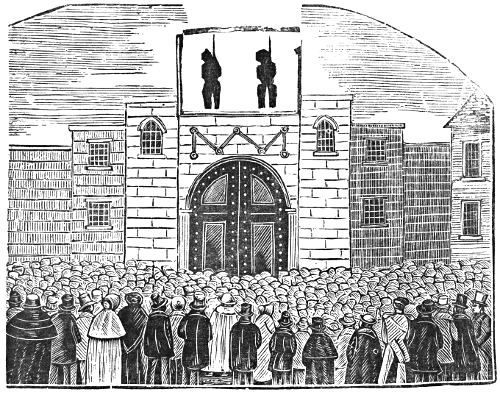
James Clitheroe, the culprit in this remarkable case, suffered death on Saturday, in front of the Kirkdale gaol, near Liverpool, though efforts had been made to secure a reprieve. The circumstances in connexion are of a somewhat peculiar description. Clitheroe was a married man with a family, but his affections appear to have been divided between his wife and Mary Woods, a poor paralytic woman, who earned a living by keeping a school and selling small beer. The prisoner was in the habit of sharing the murdered woman’s bed, and as his neighbours knew of this he was twitted by them, in the intensely acrimonious manner peculiar to vulgar and uneducated people, as to “the poor cripple Mary Woods” being enciente by him. This seems to have annoyed Clitheroe very much, and his mortification and chagrin acting upon a morbid temperament prompted him to murder. On the night of the 28th of December last he visited Mary Woods’ house, and went to bed with her as was his wont, but early next morning he cut her throat and his own too, though the wound was only fatal in the case of the woman. Later in the morning the school children were unable to gain admission to the house as usual, and, as no one answered the door after repeated knocks, an entrance was effected at the rear of the premises, and an investigation took place. In an upstairs room the police found Mary Woods and the prisoner in bed together—the woman quite dead, and with her throat cut, and the man in an exhausted condition, with his throat cut also. The blood upon the woman’s throat was dry, and she had evidently been dead for several hours; whereas the blood upon Clitheroe was fresh, and his wound must have been recently inflicted, because the blood was flowing freely from the arteries of the neck when the police first entered. The prisoner, when asked what he had been doing, stated that he and Mary Woods had agreed to cut their throats, saying, “We made it up to cut our throats, She told me that the razor was in the drawer, under the looking-glass. I fetched the razor, got into bed, and first cut my own throat.” The prisoner never deviated from this account of the transaction, either before or after the trial, but it must have been untrue in point of fact, because the strong and irresistible probability is, that the woman’s throat was cut at five o’clock in the morning, and that she was dead several hours before the prisoner made the attempt upon his own life. When the prisoner was on his trial, Mr Justice Willes directed the jury that if the prisoner counselled, assisted, or directed the woman to destroy herself, he was guilty of murder.
THE EXECUTION.
The culprit, who was pinioned by Calcraft in the usual way, struggled hard. To the last he persisted in the story of suicide. The crowd was not so great as had been expected.
After hanging the usual time, the body was cut down, and the crowd soon after dispersed.
J. Harkness, Printer, Preston.
HORRID MURDER OF A GENTLEMAN, IN A RAILWAY CARRIAGE.

Another base and dreadful murder, Now again, alas, has been, One of the most atrocious murders It is, as ever yet was seen; Poor Thomas Briggs, how sad to mention, Was in a first-class railway carriage slain, Between Old Ford and Hackney Wick, Which caused excitement, care and pain. Oh, listen to this railway murder Poor Briggs received the fatal wound, Between Old Ford Bridge and Hackney Wick And very near great London town. They found a hat in the railway carriage, Made in Crawford-street, St. Marylebone, In which poor Thomas Briggs was riding, On his journey to his home; Alas, poor man, he little thought That he would be deprived of life, In the railway carriage, by a villain, At ten o’clock that fatal night. Oh, little did he think they’d kill him, He had no thought he was to die, Upon that fatal Saturday evening, On the 9th day of July; The villains in the carriage slew him, For plunder Thomas Briggs was killed, In a first-class carriage they did rob him, And all around his blood was spilled. Thomas Briggs was a faithful servant, To Robarts, Lubbock and Company, Three hundred pounds rewards is offered, Soon may the murderer taken be, And brought to justice for the dreadful Deed he done, as we may hear, And glad we are there is before us, A clue to the wicked murderer. They have traced his watch-chain in the city, The very key, as we are told, Stole from poor Briggs that fatal evening, Albert curb, with swivel seal in gold. Robbed of nearly all that he possessed, He was, upon that fatal night, Between Old Ford and Hackney Wick, In the Railway Carriage in daylight. This sad affair has caused excitement, Far and near, for miles around, And thousands to the spot are going From all around great London town. And on the spot they look with horror, Where poor Thomas Briggs was killed, They view with grief, with pain and sorrow, Where his crimson blood was spilled. Oh, God above, look down from Heaven, Point the murdering villains out, Let stern justice close pursue them, Never let them roam about; On him, or them, we all are certain, Has on the brow the mark of Cain, Thus ends the brutal horrid murder, Which has caused such grief and pain. On that fatal Saturday evening, They left him in his crimson gore, July the 9th, in a railway carriage, Eighteen hundred and sixty-four.
Murder in the Railway Train.
Listen to my song, and I will not detain you long, And then I will tell you of what I’ve heard. Of a murder that’s been done, by some wicked one, And the place where it all occurred; Between Stepney and Bow they struck the fatal blow, To resist he tried all in vain, Murdered by some prigs was poor Mr Briggs Whilst riding in a railway train. Muller is accused, at present we cannot refuse To believe that he is the very one, But all his actions, you see, have been so very free, Ever since the murder it was done; From his home he never went, but such a happy time he spent, He never looked troubled on the brain, If he’d been the guilty man, he would have hid all he can, From the murder in the railway train. Muller he did state that he was going to emigrate Long before this dreadful tragedy; He often used to talk, about travelling to New York, In the Victoria, that was going to sea. Mr. Death, the jeweller, said, he was very much afraid, He might not know the same man again, When he heard of the reward, he started out abroad, About the murder in the railway train. If it’s Muller, we can’t deny, on the Cabman keep your eye, Remember what he said the other day, That Muller a ticket sold for money, which seems so very funny, When he had no expenses for to pay. They say his money he took, and his name entered on the book, Long before this tragedy he came; Like Muller’s, the Cabman had a hat, and it may be his, perhaps That was found in the railway train. Would a murderer have forgot, to have destroyed the jeweller’s box, Or burnt up the sleeve of his coat, Would he the chain ticket have sold, and himself exposed so bold, And to all his friends a letter wrote, Before Muller went away, why did not the cabman say, And not give him so much start on the main If the cabman knew—it’s very wrong—to keep the secret up so long, About the murder in the railway train. When Muller does arrive, we shall not be much surprised, To hear that that’s him on the trial; Give him time to repent, though he is not innocent, To hear the evidence give no denial. Muller’s got the watch, you see, so it proves that he is guilty, But like Townley don’t prove that he’s insane For if it should be him, on the gallows let him swing, For the murder on the railway train. Now Muller’s caught at last, tho’ he’s been so very fast, And on him they found the watch and hat, Tho’ across the ocean he did roam, he had better stayed at home, And hid himself in some little crack, Tho’ he pleads his innocence, but that is all nonsense, For they’ll hang him as sure as he’s a man, For he got up to his rigs, and murdered Mr. Briggs While riding in a railway train.
London: Printed for the Vendors.
CHASE, CAPTURE, AND ARRIVAL OF MULLER, FOR THE MURDER OF MR BRIGGS, IN A RAILWAY TRAIN.
The clue to the murderer of Mr. Briggs was obtained as follows:—A little girl, the daughter of a cabman, was playing with a small card box, such as jewellers put small trinkets in, and upon exhibiting it to her father, he remembered the name of the jeweller with whom the chain of the late Mr. Briggs had been exchanged, and upon questioning the girl, she said that Franz Muller had given it her four days ago. Muller, who is a German, a tailor’s cutter, had previously lived at the house of the cabman. The police were immediately communicated with. On the box being shown to Mr. Death, he at once identified it. Mr. Death then accompanied the cabman and the police to a cottage at Bow, where Muller had lived, and upon seeing a photograph Muller had given the child, he at once recognised the features of the man who changed the chain. The cabman identified the hat found in the railway carriage as the one he had purchased for Muller about four months ago. Inquiries were made, and it was ascertained that the suspected murderer had sailed for New York, on board the Victoria. Inspector Tanner and other officers immediately started for New York, to await the arrival of Victoria. The Victoria, after a passage of forty days, arrived on the 24th of August, when Muller was arrested, and the missing property found in his possession. After certain forms were gone through, Muller started for England, Sept. 3rd, on board the Etna, and arrived at Queenstown on the 15th.
On Friday evening, September 16th, Muller arrived at Liverpool. Upon landing he was taken to the central police-station, Liverpool, and there remained till seven o’clock on Saturday morning. To avoid the crowd Inspector Tanner took the prisoner to Edgehill station. He was taken to a private room till the arrival of the nine a.m. train from Lime-street, when he walked between Inspector Tanner and Superintendent Wide to the carriage. When the train moved off attempts were made at groaning, but cries of “Good bye, Muller,” prevailed. At twenty-five minutes past three o’clock on Saturday afternoon the Liverpool express train drew up to the ticket platform at the London and North Western Railway, near Camden Town. Muller was taken to Bow-street police-station, and the charge formally entered against him by Inspector Tanner.
What a consternation there has been, And time has swiftly gone by, What great excitement has been seen, Since the ninth of last July, In Eighteen-hundred and sixty-four, When Thomas Briggs was slain, And found welt’ring in his crimson gore Upon the railway train. When Muller did the dreadful deed, He flew across the main, But Justice followed him with speed, And brought him back again. It was to New York, in America, That wretched man did sail; And justice for one moment, To find him did not fail. They followed the Victoria ship, Unto Columbia’s land, Determined, if ’twas possible, To take that wicked man. While the ship was on the ocean, The stormy winds did blow, She could not get a headway,— A murderer was below; The passengers did oft remark, We all must rest assured; There must something dreadful have been done,— A murderer is on board. On the twenty-fourth of August, The Victoria was espied, And the officers of justice, On board her quickly hied; All things were planned so cleverly, Just as it ought to be, That Muller had not the least chance From Justice for to flee. They soon had him in custody, All on the raging main, And found upon the murderer, Poor Briggs’s watch, ’tis plain; Although the crime he did deny, When the property was found, The murderer was landed Upon America’s ground. In New York he was examined, Then in the Etna, o’er the main, They brought the wretched murderer To England again. News flew like wind the country round Franz Muller had arrived, They ran from every quarter, To behold him they did strive. Conversations on the murder, Has by thousands taken place; Though the circumstances are as clear As the nose upon his face: His flying to America, Across the ocean wide, They found on him poor Briggs’s hat And the gold watch besides. Franz Muller now is landed, Once more on England’s ground, A verdict of wilful murder Against him has been found. He has caused great consternation, Great agony and pain, And he must answer for the deed he done All on the railway train.
H. DISLEY, Printer, 57, High street, St. Giles, London.
THE EXECUTION AND CONFESSION OF FRANZ MULLER, For the Murder of Mr. BRIGGS, November 14th, 1864.

At two o’clock on Saturday afternoon Sir George Grey returned an answer to the memorial presented to him, praying for a respite of the convict Muller, by the German Legal Protection Society. Previous to the delivery of his decision he had a long conversation with the Lord Chief Baron Pollock and Mr. Baron Martin, which terminated in his arriving at the conclusion that the memorial did not warrant his interfering with the verdict of the jury.
Immediately upon the receipt of the letter, Mr. Beard, with Alderman Wilson, proceeded to communicate to Muller the result of the efforts that had been made on his behalf. They were received by Mr. Jonas, the governor of Newgate, who conducted them to the condemned cell. They found the prisoner engaged in writing. He immediately rose, and extended his hand to Mr. Beard, who asked him how he was. The convict said, “I am very well.” Mr. Jonas then informed the prisoner of the efforts that had been made to save his life, and that Mr. Beard had just received a reply from the Secretary of State, which he read to him. At the conclusion the convict said, in a low voice, “I did not expect anything else.” Mr. Beard then said to the prisoner, “Did you know that any efforts had been made on your behalf?” The prisoner replied, “Yes, I did think so.” Mr. Beard then said, “Have you any statement that you wish to make?” The prisoner, “No, nothing.” “Because,” continued Mr. Beard, “now that all has been done that can be done for you, and there is no hope in this world, if you have anything to acknowledge, you had better do so.” In reply to this Muller said, “I should be a very bad fellow if I had done it. I have no other statement to make than that which I have already made.” Mr. Beard then asked him if he had made his peace with God. The prisoner said, “Yes;” and in every respect appeared resigned to his fate. Mr. Beard then shook hands with him, and said, “Good-bye Muller; God bless you;” The prisoner returned the pressure of his hand, and was left to himself.
The prisoner on Sunday attended Divine service in the chapel, both in the morning and the afternoon, and listened apparently with deep attention to the discourse delivered by the Rev. Mr. Davis, the Ordinary. He was visited in the evening by Dr. Walbaum and Dr. Cappell.
PREPARATIONS FOR THE EXECUTION.
Up to Sunday night Muller preserved the same quiet, firm demeanour, and although he occupied some of his time in writing, he did not lie down till considerably after his usual time, and slept but little. He rose at five o’clock on Monday in good spirits, and was soon afterwards joined by the Rev. Mr. Davis, the chaplain of the gaol, and the Rev. Mr. Walbaum. He in every respect appeared calm and resigned to meet his fate. He joined devoutly in prayer with the rev. gentleman, and otherwise conducted himself in a manner becoming his awful position. A little before seven o’clock he was visited by Mr. Jonas, the governor of the gaol, to whom he extended his hand, and feelingly thanked him for the kind attention he had received since his incarceration. Calcraft arrived at six, but was not recognised by the mob, and thus escaped the usual hooting.
Although the fixing of the scaffold was completed by four o’clock, still the clang of hammers in putting up barriers continued till day had dawned.
At five o’clock a heavy drenching rain set in, which had the effect of driving the majority of those who during the night had taken up positions, from their strongholds, and to hastily beat a retreat to the now open public-houses and coffee-shops, as well as to other places offering anything like shelter. At this time there could not have been more than five hundred people actually upon the scene. But at six o’clock the rain abated, and from this time the crowd was recruited by an increasing flow of new comers.
At six o’clock the main body of police, under Mr. Inspector Duddy, was stationed at the approaches to, and in the Old Bailey, and preserved throughout the morning in the strictest order.
Soon after seven o’clock, Mr. Alderman and Sheriff Besley, Mr. Alderman and Sheriff Dakin, and the Under Sheriffs, Messrs. Davidson and De Jersey, arrived at the Sessions House, where they remained until summoned to the prison by the governor. About twenty minutes to eight they were informed that the condemned man would soon leave his cell. Upon receiving this intimation these officials left the Sessions House. A few minutes after this, the procession reached the door which opens into the chapel-yard. Here they awaited the arrival of the culprit.
THE EXECUTION.
While the officials were on their way from the Sessions House to this spot, Mr. Jonas had gone to the cell of the prisoner, and informed him that it was time for him to leave. The prisoner, who was deadly pale, trembled with emotion, but sought to bear the awful announcement with all the fortitude possible. He rose up, shook hands with the gaolers who had been principally with him since his incarceration, and with a firm and rather quick step left his cell, accompanied by Mr. Jonas, followed by two or three other officials. As soon as they left the cell the shouts and cries of “They are coming,” “They are coming,” “Hats off.” At this moment the most intense excitement and confusion prevailed, in the midst of which terrible din reverberated the echoes of the solemn knell, which, from its increased rapid tolling, indicated that the mournful procession had gained the steps of the hideous, cloth-draped gibbet. A moment afterwards Calcraft, the hangman, made his appearance on the scaffold, and then withdrew to see that all was right. He had no sooner disappeared than Muller, accompanied by the Rev. J. Davis, chaplain, and Dr. Cappell, followed by other officials, made his appearance. This was a signal for the renewed excitement and clamour of the swerving multitude, who had largely, and as it were imperceptibly increased, and whose upturned anxious faces met the gaze at all points.
The culprit ascended the scaffold with a firm step, and placed himself under the drop. He cast his eyes once up towards the beam, and his lips quivered with emotion, but this he evidently sought to check. After the cap had been drawn over his head and the rope put round his neck, Dr. Cappell took hold of his hand and again prayed with him. This he did for some minutes, and concluded by addressing the following words to the now fast dying man:—“In a few moments you will be before your God. I ask you, for the last time, are you innocent or guilty?”
Muller: I am innocent.
Dr. Cappell: You are innocent?
Muller: God Almighty knows what I have done.
Dr. Cappell: Does God know that you have done this deed?
Muller was silent.
Dr. Cappell: I ask you now, solemnly, and for the last time, have you committed this crime?
Muller: Yes, I have done it.
Almost at the same instant, and while the words were upon the lips of the wretched man, the drop fell, and Muller died without a struggle.
Dr. Cappell nearly fainted.
Immediately after the execution the sheriffs despatched a communication to Sir George Grey, informing him that the culprit had confessed. A similar communication was made to Sir R. Mayne, at Scotland-yard.
The following despatch was immediately after the execution forwarded to the Home Secretary:—
“Gaol of Newgate, 14th day of November, 1864.
“To the Right Hon. Sir George Grey, Bart.
“Sir,—By direction of the sheriffs I have the honour to acquaint you that the prisoner Muller has at the last moment, just before the drop fell, confessed to the German minister of religion attending him that he was guilty of the deed for which he suffered.
“I have the honour, &c.,
“Septimus Davidson, one of the under-sheriffs.”
London: Printed for the Vendors.
LAMENTATION & EXECUTION OF JAMES LONGHURST,
At Horsemonger Lane Gaol, on Tuesday, April 16th, for the wilful murder of Jane Sax, a little Girl seven years old, at Shere, in Surrey,
Terrible Scene in the Prison with the Culprit.
James Longhurst was executed this morning, April 16, on the top of Horsemonger-lane gaol. Since his condemnation he has expressed contrition for his crime, and hoped that God would forgive him. Notwithstanding, the prisoner appearing to be in a state of mind becoming his awful position, when he was taken down from the condemned cell to the yard to be pinioned, a frightful scene ensued. The moment the culprit saw Calcraft, the executioner, approach him with the straps to pinion his arms, he started back with an aspect of terror depicted on his countenance, and began to struggle violently with the turnkeys. The chaplain spoke to him and endeavoured to calm him, and this for a moment appeared to have the effect, but upon the executioner requesting that the culprit might be taken outside, as he could not see to fasten the straps properly, another fearful struggle ensued, and it required five warders to hold him on the ground while he was being pinioned, and one or two of the turnkeys were very much hurt by the kicks they received. The prisoner’s conduct seemed to be actuated by an uncontrollable horror of the executioner and the apparatus of death. After he had been secured he walked quietly by the side of the chaplain until he arrived at the steps leading to the scaffold, and immediately he caught sight of the gibbet his horror appeared to return. He again struggled violently as well as he was able, and was forcibly dragged up to the steps and held under the beam by several turnkeys while the rope was adjusted round his neck, and as speedily as possible the bolt was drawn, and after a few struggles the wretched youth ceased to exist.
Good people all I pray draw near, And my sad history you soon shall hear, And when the same I do relate, I trust you will a warning take. At Horsemonger lane on the scaffold high, For a cruel murder I was doomed to die. James Longhurst, it is my name, I’ve brought myself to grief & shame Through the dreadful deed that I had done, At Churchill field, near Guildford town It was in last June, the twenty-eighth I did this deed as I now state; An innocent child I there did slay, And with a knife took her life away. Poor Jane Sax, on that fatal day,— A child scarce seven years of age; In Churchill field I her did meet, And shamefully did her illtreat. Then coward-like I drew my knife, To rob this helpless child of life: I stabbed her in the throat—her blood did pour,— Then left her welt’ring in her gore. Then I was taken for this cruel deed, And sent for trial, as you may read; At Kingston assizes, tried and cast, Oh, would I could recall the past. She cried for help, did poor little Jane, David Ensor to her assistance came; Whilst I, a guilty wretch did stand, And licked her blood from off my hand The Judge said, James Longhurst, you are guilty found, You will go from here to London town And there you’ll die a death of shame, And meet your fate at Horsemonger lane. While I lay in my prison cell, My state of mind no tongue can tell; I could not rest by day or night, Poor Jane was always in my sight. My tender parents came to visit me, My heart was breaking their grief to see, Tears from their eyes did in torrents fall, While for mercy to my God did call. I hope that none will them upbraid, While I am in my silent grave; Farewell to all—the bell does toll, Have mercy, God, on my sinful soul.
H. Disley, Printer, 57, High Street, St. Giles, London.
MILES WEATHERHILL, THE YOUNG WEAVER, And his SWEETHEART, SARAH BELL.
The prisoner, Weatherhill, was Executed at Manchester, on Saturday, April the 4th, for the Murder of Jane Smith, at Todmorden, a fellow-servant of Sarah Bell.
Oh give attention, you pretty maidens, A tale of love I will here unfold, And you will say, when the same is mentioned, ’Tis as sad a story as ever yet was told; Miles Weatherhill was a brisk young weaver, And at Todmorden did happy dwell, He fell in love with a pretty maiden, The parson’s servant named Sarah Bell. It was at Todmorden where these true lovers, At the parson’s house, tales of love did tell, And none on earth could be more constant, Than Miles the weaver and young Sarah Bell. Deep in each heart was true love engrafted, They had sworn for ever to happy be, No power on earth could those lovers sever, They met in joy and felicity; But they was parted, and broken hearted, Separated was those true lovers far, Those constant lovers adorned each other, And love will penetrate through iron bars. Miles Weatherhill was but three and twenty, His mind was noble, he good did mean, And Sarah Bell was fair and virtuous, Young blooming, aged seventeen; They would have married, but tales were carried, Which caused displeasure, as you shall hear, Miles was refused to meet his lover, And she left Todmorden, in Lancashire, She left her true-love quite broken hearted, And to her mother at York did go, And when such a distance from each other parted, Caused them sorrow, grief, pain, and woe; In a fit of sadness, overcome with madness, He made a deep and solemn vow, If separated from his own true lover, He would be revenged on Parson Plow. With four loaded pistols, in a fit of frenzy, Miles to the Vicarage did haste forthwith, And with a weapon wounded the master, And shot the maiden, named Jane Smith; To the lady’s bedchamber, in rage and anger, Bent on destruction, with intent to kill, He did illtreat her, with a poker beat her, And her crimson blood on the floor did spill. Oh, God, in mercy guide evil passions, Thou seest all things from heaven above, Three innocent lives has been sacrificed, And one serious injured, all through true love, If they’d not been parted, made broken-hearted, Those in the grave would be living now, And Miles would not have died on the gallows, For slaying the maiden and Parson Plow. Young men and maidens, you constant lovers, If true and honourable you make a vow, Be just and upright and oh, remember, Todmorden Vicarage, and Parson Plow; And all good people, oh, pray consider, Where true love is planted, there let it dwell, And recollect the Todmorden murder, Young Miles the weaver, and Sarah Bell. Miles and the true-love by death is parted, In health and bloom, he the world did leave, And his true love, quite broken-hearted, For Miles the weaver, in pain do grieve; At the early age of three and twenty, In the shades below, with the worms do dwell, On the fatal drop, he cried, broken-hearted, May we meet in heaven, my sweet Sarah Bell.
H. Disley, Printer, 57, High street, St. Giles, London.—W.C.
TRIAL AND SENTENCE OF CONSTANCE KENT.

On Friday, July 21st, Miss Constance E. Kent was placed at the Bar of the Salisbury Assize Court, charged with the murder of her brother, Francis Saville Kent.
The Clerk of the Assize, addressing the prisoner, said: How say you, are you guilty or not guilty? The prisoner in a voice scarcly audible, said—Guilty.
A profound silence then ensued in court, which was broken by Mr Coleridge, the prisoner’s counsel, standing up and saying, I desire to say three things before your Lordship pronounces sentence. First, solemnly before Almighty God, she wishes me to say that the guilt is her own alone, and that her father and others, who have so long suffered most unjust and cruel suspicions, are wholly and absolutely innocent; and secondly, that she was not driven to this act by unkind treatment at home, as she met with nothing there but tender and forbearing love, and I may add that it gives me a melancholy pleasure to be the organ of these statements for her, because, on my honour, I believe them to be true.
The Judge, with much emotion, then said—Constance Kent, it is my duty to receive the plea which you have deliberately put forward. I can entertain no doubt that the murder was committed under great deliberation and cruelty. You appear to have allowed your feelings and anger to have worked in your breast, until at last they assumed over you the influence and power of the Evil One. It remains for me to pass the sentence which the law adjudges. The learned Judge then passed upon her the usual Sentence of Death. During the passing of the sentence, prisoner burst into a violent flood of tears, sobbing aloud.
Oh, give attention, you maidens dear, My dying moments are drawing near, When I am sentenc’d alas to die, Upon a gallows gloomy and high. Oh what s sight it will be to see, A maiden die on the fatal tree. I am a maiden in youth and bloom, I a wretched murderer to die am doom’d, And in the city of Salisbury, My days must end on a dismal tree. My little brother, a darling sweet, That fatal morning did soundly sleep, I was perplexed. I invented strife, Fully determined to take his life. To the dirty closet I did him take, The deed I done caus’d my heart to ache, Into the soil I did him thrust down, Where asleep in death he was quickly found. My own dear father they did suspect, That he would suffer they did expect, I was apprehended, but I got clear, Tho’ I was the murderess of my brother dear. Long, long I pined in deep distress, At length the murder I did confess, The vile Road murder, as you may see, Committed was no one but me. Farewell my father, my father dear, I know for me you will shed a tear, Yes, your wicked daughter in shame must die, For that cruel murder on a gallows high. How many maidens will flock to see, A female die upon Salisbury’s tree. Constance Emily Kent is my dreadful name, Who in youth and beauty dies a death of shame. I must go to my silent grave, Father, is there no one your child to save, Oh the awful moments are drawing near, Father, forgive your daughter dear. Oh, God in heaven, look down on me, As I stand on the dreadful tree, Forgive the crime, I, alas, have done, Wash me with the blood of thy blessed son. I must not live, I am bound to go, I must be hurried to the shadows below, My guilty heart long did quake with fear, Why did I kill my little brother dear. I see the hangman before me stand, Ready to seize me by the law’s command, When my life is ended on the fatal tree, Then will be clear’d up all mystery.
Disley, Printer, High street, St. Giles, London.
LIFE, TRIAL, CHARACTER, CONFESSION, AND EXECUTION OF STEPHEN FORWARD, For the Horrid Murder of THREE CHILDREN near Holborn, also of his WIFE AND CHILD at Ramsgate.
Murder of Three Children by Poison, near Holborn.
On Wednesday, August 9th, 1865, the neighbourhood of Red Lion Square, was thrown into a state of excitement owing to a report that three brothers had been murdered at the Star coffee-house, Red Lion street.
It appears that on the Saturday, a man called at the above hotel, and inquired if three children could be accommodated with a bed for a few nights. Having been informed that there was one room unoccupied, he said the children were aged respectively six, eight, and ten years, and that accommodation would be suitable. He called again on the Monday evening with the three children, and saw them to bed.
Half-past eight, when one of the chambermaids entered the first room in which the two younger children were in bed, and to her extreme horror found they were dead. She immediately raised an alarm, when the proprietor and others entered the room in which the eldest child had been placed, and there found that he also was in the sleep of death. Medical assistance and the police were instantly summoned, the surgeon firstly arriving, and upon his examination of the bodies, pronounced life to have been extinct for some hours, the limbs being rigid and cold.
From information gained by the police, it appears that the person who left the children at the coffee house went by the name of Southey.
Murder of Mother & Daughter at Ramsgate, by the person who committed the other Murders.
On Thursday morning, August 10th, Ramsgate was thrown into a state of intense excitement by a report that a man named Stephen Forward had committed a double murder in a dyer’s house in King street. It appears that Forward, who was formerly a baker in the town, left Ramsgate some eight years ago, leaving his wife and a little girl behind him in a state of almost total destitution. On Wednesday evening Forward suddenly appeared in Ramsgate, and made his arrival known to his wife. On Thursday morning, about twenty minutes past eight, Forward went to Mr Ellis’s house. His wife was there, having some breakfast with Mr Ellis and his daughter. He was asked if he would take any breakfast, but he declined. He sat down and commenced talking. Shortly before nine Ellis went into his workshop, and while there his daughter told Forward and his wife if they had anything to say in private they might go up stairs. They both went up stairs, and had not been there many minutes before the daughter of Forward went up with them. She had hardly got there when Mr Ellis and his daughter were startled by two rapid reports of a pistol, and on the latter rushing up stairs she arrived at the landing just in time to see Forward’s daughter fall down dead, she having been shot by her father. Miss Ellis then called out to her father, who came in, and he saw Forward standing at the top of the stairs. He said, “What have you done, Forward?” and seeing that he had a pistol in his hand he called on him to give it him, which he did. Forward at this time had a black moustache and dark whiskers on. Ellis then saw the feet of Forward’s wife, and on looking over the table he saw her head, and that blood was oozing therefrom. He told Forward to sit down, and he then perceived that he had neither moustache nor whiskers on. He asked Forward where they were, and he replied that they were under the grate. He looked there, but could not find them, and Forward then gave them to him. He then called out to send for the police and a surgeon. Forward added, “Yes; send for a policeman.” He was then given into custody.
At twelve o’clock at noon Forward was brought before the magistrates, charged with the murder of his wife and child.
Previous to the calling of any witnesses, the prisoner, addressing the magistrates, said: I have here a paper to Sir Richard Mayne, which I hope you will permit me to read to you. I have a reason for it. If you will grant me a favour, I think you will see that my reason justifies me in asking it. Immediately I was brought to the station-house I asked for some paper, a pen, and some ink, that I might draw up this statement, but it is not finished. I also made a statement to the inspector in charge. I inquired whether he had heard of the murder of three children in London. My reason for asking this question was, that previous to my being charged with this crime I was guilty of the murder of the three children in London. I hope this may be taken as a communication to Sir Richard Mayne, and also that it is made quite voluntarily.
The evidence having been gone through, he was fully committed to take his trial at the next Assizes for wilful murder, when he was found guilty of the murders, and was EXECUTED THIS MORNING and died without a struggle.
COPY OF VERSES.
Of all the crimes we ever heard, of all the crimes we read, Sure none on earth did ever know, a more sad dreadful deed; Five murders were committed—he with Satan did connive— It was in the month of August, eighteen hundred and sixty-five. The murderer’s name is Forward, he led a wicked life, Living with a married woman, whose husband’s name was White; She had four little children, three of which he vile did slay, In Red Lion street, in Holborn, then he did from London stray. The cruel murderer Forward, at Ramsgate had a wife, She had a youthful daughter; but the murderer lived with White, Who of his cruel usage, had cause oft to complain, Not long ago she left him, and sailed o’er the briny main. When he had killed the little boys, from London he went down, Where dwelt his wife and daughter, in peace, in Ramsgate town. He shot his wife and daughter dear, it cruel was, and sad, And wanted to make it appear the villian, he was mad. Five innocents he did destroy, how dreadful to unfold, Mrs. White’s three little boys, his wife and child, were told; The boys he killed in London, which caused great excitement round, And his wife and lovely daughter he killed in Ramsgate town. When Mrs White’s dear children he did in London slay, He with a dreadful weapon to Ramsgate went straightway; His own wedded wife and daughter, so maliciously he shot, And thousands flocked from far around to view the dreadful spot. For those five cruel murders, may the villian punished be, And die a malefactor upon the fatal tree; More cruel dreadful murders we very seldom hear, And wonderful excitement it has caused both far and near.
H. Disley, Printer, 57, High street, St. Giles, London.
The Execution of Five Pirates, for Murder, which took place on Monday, February 22nd, at the Old Bailey.
This morning, Monday, February 22nd, 1864, will long be remembered by the inhabitants of the city of London, as one of the most remarkable in the annals of hanging, by the execution of five foreign sailors, viz.: John Lyons, Francisco Bianco, Mauriccio Durranna, Marcus Watter, Miguel Lopez, alias Joseph Chances, alias The Catelan, for the wilful murder of George Smith upon the high seas. The attendance of persons to witness the execution was enormous, being greater than was ever remembered by the oldest inhabitant in the City, and was much of the same class as usually attend these exhibitions, with the addition of a fair sprinkling of seafaring men. The prisoners have been very assiduously attended by the worthy Priests of the Catholic persuasion, to which creed the prisoners belong, and they had been brought to a full knowledge of the enormity of the crimes which they had committed; and to such a state of religious feeling had they been brought, that they all fully acknowledged the share each one took in the horrible crime, and recognized the justice of their punishment. The sheriffs, with their usual attendants, arrived at a very early hour at the prison, and immediately visited the various criminals in their cells. The worthy priests who had been attending the criminals since their condemnation, was in the prison the whole night, and were early in their attendance on the unhappy criminals. After the usual formalities had been gone through of demanding the bodies of the prisoners into their custody, the executioner, with his assistants, commenced pinioning the prisoners, which operation was quickly performed, considering the number of prisoners. The arrangements having been completed, the mournful procession began to move towards the scaffold, the worthy priests praying fervently with the wretched prisoners, who appeared to have been fully brought to a thorough state of penitence. The prisoners ascended the scaffold in an orderly manner, and directly they appeared on the drop, the immense multitude gave a deep and loud groan, which seemed to make some of the wretched men tremble. The executioner having adjusted the fatal ropes, and drawn the caps over their eyes, left the platform, and the priests administered the last parting words of scriptural consolation to them. The signal was then given, the bolts were withdrawn, and the wretched murderers were launched into eternity.
COPY OF VERSES.
Is there not one spark of pity, For five poor unhappy men, Doomed, alas! in London city, On a tree their lives to end? The dreadful crime which they committed, On the raging, stormy sea, By every one must be admitted, They each deserved to punished be. Five poor unhappy sailors On the drop did trembling stand, And their lives did pay a forfeit, For their deeds on board the Flowery Land. Sometimes at sea there’s cruel usage, And men to frenzy oft are drove, They’re always wrong by men in power, And that there’s many a sailor knows. But those unhappy seven sailors, Did commit a dreadful deed, Killed and slaughter’d, sad to mention, On board the Flowery Land, we read. Great excitement through the nation, This most sad affair has caused, Sent across the briny ocean, To be tried by English laws; Seven tried and there convicted, And sentenced each to hanged be, For the dreadful murders they committed, When sailing on the raging sea. For two of them they did petition, Alas, there nothing could them save Sad indeed was their condition, To lie side by side in a murderer’s grave; Far away from friends and kindred, They unpitied on the drop did stand, Sad was the deed that they committed, On board the fatal Flowery Land. Thousands flocked from every quarter, Seven unhappy men to see, Sailors from distant foreign nations, Suspended on a dreadful tree. The fatal signal soon was given, The awful drop at length did fall, It caused a groan—it caused a shudder, May God receive their guilty souls. May this to sailors be a warning, The dreadful sight the world did see, In London, that fatal morning, The seven died on Newgate’s tree. Was there not a tear of pity, While trembling they in death did stand, To die for crimes in London city. Committed on the Flowery Land. Their victims they did show no mercy, No time for to prepare did give, They kill’d them in a barbarous manner, And though they were not fit to live, We pity to them on the gallows, Englishmen could not deny, Now, alas, their days are ended, They died on Newgate’s gallows high.
H. Disley, Printer, 57, High Street, St. Giles.
CONDEMNATION & EXECUTION OF LEIGH, For the Murder at Brighton.
On Thursday, March 22nd, J. W. Leigh was indicted at the Lewes assizes for the wilful murder of Mrs. Harton, at Brighton, on the 1st of February, 1866.
The first witness, Charles Hastings, deposed—On Thursday night, February 1st, I was in the bar parlour of the Jolly Fisherman tavern with another person named Manuel, and Mrs. Harton, the landlady. She was sitting near the fire, and furthest from the door. Prisoner came into the bar with a revolver in his hand, and as soon as Mrs. Harton saw him she ran to witness for protection. While coming towards Witness prisoner fired the pistol at her and shot her, the ball grazing the forehead of witness. Mrs. Harton fell on the shoulder of witness, and asked him to save her. Prisoner followed her, and placing the revolver within two feet of the woman’s back fired again. Mrs. Harton then left the bar and ran down into the cellar. Witness went for a doctor.
Stephen Loveday, a dyer, deposed he was in the bar, outside the bar-parlour, and saw the prisoner come. Prisoner fired at Mrs. Harton, who ran down the cellar steps. Witness followed her, and found her lying half-way down the stairs, groaning. He got her up stairs into the back room, where he left her.
Serjeant I. Barnden said—From information I received, I went to the Jolly Fisherman tavern about 11 o’clock on the night of February 1st. I saw Mrs. Harton there wounded, and in a fainting state. I went out and saw the prisoner standing in the street, leaning against a house near the King’s road end of Market street. Some one told me not to go near the prisoner, or he would shoot me. I went towards the prisoner and said, “What’s all this about?” He said, “Stand off, or I’ll shoot you,” at the same time bringing the pistol from his breast pocket. I said, “Will you?” At that moment the pistol went off, and I closed with him. I must have touched his arm at the precise instant, for the ball went through my overcoat and trousers, so that it just missed me. I threw him down, and several people assisted me to take him to the Town Hall.
After the examination of several other witnesses, the prisoner’s counsel addressed the jury for the defence, and the judge having summed up, the jury returned a verdict of Guilty. The judge passed the usual sentence of death upon the prisoner, and he was executed this day in front of Lewes Gaol, before an immense crowd of spectators, who came for many miles round.
On the first of February, In Brighton we see, There did appear a murderer, By name John William Leigh. He led a dissipated life, To wickedness gave way, That fatal night he left his wife, And he did her sister slay. For this cruel murder he must die, And end his days on the gallows high. With a six barrelled revolver, He went on Thursday night, To the Jolly Fisherman, in Market st., To take away the life Of the landlady, Mrs. Harton, He was by Satan led— Where her husband, Mr. Harton, Had been ten months ill in bed. He fired the fatal weapon, Oh, twice he fired the shot, His victim soon lay bleeding, Upon that fatal spot; Her husband, ill, ran trembling, And there beheld his wife, By the hand of a wicked murderer, Deprived of her life. John William Leigh, the murderer, In Brighton town did dwell, A very wicked troublesome man, And many knew him well; He, mad with desperation, If he could but had his way, The police, and all around him, The murderer would slay. In the American service, A Confederate, he had been, Though aged only twenty-eight, Much villany had seen; There is nothing now can save him, For that atrocious deed. Of such an audacious scoundrel We scarcely ever read. Leigh left his wife and entered The Jolly Fisherman; He looked just like a demon, With the revolver in his hand; He killed his own wife’s sister, Alas! she soon lay dead, And her poor afflicted husband, Lay consumptive in his bed. He had no consideration, No pity in his breast, His wicked desperation Caused horror and distress Confined in Lewes dungeon, For a short time he must be, Then for the Brighton murder, They will hang the prisoner Leigh. Leigh a native was of Brighton, To the family a disgrace, By every one detested, Who knew him in the place; She was his own wife’s sister, Who received the fatal wound, Which has caused such consternation, Many miles round Brighton town.